

Two weather stations share the name Bozeman, and the roof over a house depends on which one the house sits near. The station six miles west of town, at the experiment farm, carries a ground snow load of 29.8 pounds per square foot. The station twelve miles northeast, about 1,200 feet higher, carries 95.7 pounds per square foot. Same city name, same county, triple the load, and a roof framed for the first number would be in trouble under the second.
That gap is the whole story of roofing in Montana. The state is the fourth largest in the country and holds at least four roofing markets inside one border: the eastern plains around Billings and Miles City, where hail and wind do the damage; the western valleys around Missoula and Kalispell, where snow piles deep and wildfire smoke fills August; the Gallatin Valley around Bozeman, where high altitude, strong sun, and the fastest growth in the state push prices up; and the mountain country, where a roof is an engineered structure and the working season is short. A statewide average hides all of it, so this guide prices each market on its own evidence and names the places where the evidence runs out.
On every model in this guide, Montana’s number lands within a few percent of the national middle. On the one cost model that names the roof size, the material, and the pricing date together, Montana runs about 3 percent above the national band for the same job. Other models put Montana a few percent below the national average, and this guide reports that disagreement openly rather than averaging it away. What Montana adds on top of the national price is weather: a snow load that must be looked up by address, a hail season that runs from late May into August, chinook winds that can gust past 90 miles per hour along the Rocky Mountain Front, and a wildfire season that reached 2,424 fires in 2025.
The rules changed while most of the internet was not looking. On January 1, 2026, Montana repealed contractor registration and replaced it with a Construction Contractor License, and most of the guides a homeowner finds today still describe the dead system. The state adopted the 2024 building codes, including the wildland-urban interface code, effective September 26, 2026, while some city web pages still show the 2021 criteria. And the federal tax credit that once softened energy work is gone for 2026 installs. Every one of those changes lands on the roof decision, and every one is covered here with the source named.
For the country-wide picture behind these Montana bands, see the national roof replacement cost guide.
Table of Contents
How Much Does a Roof Replacement Cost in Montana in 2026?
Five kinds of price evidence circulate for Montana in 2026, and each one measures a different job. The bands spread from about $10,000 to about $26,000 for what sounds like the same roof, and the spread is the first thing a buyer has to understand, because comparing a planning model to a contractor average as if they were the same number guarantees a bad decision.
The NumeralQ Montana page builds its figure from material prices and local labor, priced October 26, 2026, and names all three inputs: architectural shingles, a 2,000 sq ft roof, installed. SmartRoofingCalculator starts from national per-square bands and scales them by what Montana roofers earn and what goods cost in the state, using older wage data. MyRoofData models a typical single-family home with one layer of old roofing torn off, prices each material per square before tear-off, and quotes tear-off separately. Instant Roofer works from prices contractors typed into its estimating app across 78,400 measured Montana roofs, and its average roof is 2,489 sq ft, a quarter larger than the planning size. RoofingEstimatorPros models the same 2,000 sq ft roof far above every other source.
This guide leads with the NumeralQ band. No other source in this guide puts the roof size, the material, and the pricing date in a single figure, and NumeralQ is candid that the figure is a planning estimate rather than a tally of invoices Montanans paid. The midpoint, about $11,130, is the working number for the rest of this guide. A planning estimate is not a quote, and the gap between the two is where the rest of this article earns its keep.
SmartRoofingCalculator’s figure lands close once the bigger roof is allowed for. Its $10,750–$15,500 covers a 25-square roof, which is 2,500 sq ft of roof surface, with tear-off included, and its $430–$620 per square for architectural shingles brackets the implied NumeralQ rate of $501–$612 per square. A square, the unit every roofer prices in, is 100 sq ft of roof surface, so a 2,000 sq ft roof is 20 squares before waste is added. The two models agree within a few hundred dollars per square once the scope is matched, which is as close as two independent models usually get.
MyRoofData’s band runs wider and higher because its scope is wider. Its typical-home figure of $12,500–$21,750 includes one layer of tear-off, and its worked example prices 23.4 squares at $12,600–$21,800, or $5.39–$9.32 per sq ft of roof. The top end reflects bigger, steeper, more cut-up roofs than the flat planning case, plus the premium materials its model folds in. The bottom end sits just above the NumeralQ top end, which is consistent once the extra 3.4 squares and the tear-off are counted.
Instant Roofer’s average of $26,031 is a different animal and should not be averaged with the models. It comes from contractor-entered pricing on roofs averaging 2,489 sq ft at $1,046 per square, and it folds in metal and designer jobs alongside asphalt. A bigger roof at a higher rate, with premium materials mixed in, explains the whole gap. The figure is useful as a reminder that real invoices on larger homes with premium materials run far above the planning band, and useless as a planning number for a 2,000 sq ft shingle roof.
One model sits far above the rest and is recorded here as a warning marker. RoofingEstimatorPros prices the same 2,000 sq ft architectural roof at $13,621–$24,541, an average of $18,474, or $9.24 per sq ft. Its own state table contradicts it, showing $10,780–$18,620 at a 0.98 multiplier, and nothing in its scope notes explains the gap. This guide excludes it from every band that follows and flags it so a reader who finds it first does not anchor on it.
A second cross-check comes from One Good Roofer, which prices a 1,500–2,500 sq ft home at $10,900–$17,000 and puts Montana at a 1.01 index, essentially the national average. Its per-square bands, $455–$707 for asphalt and $960–$1,566 for metal, sit close to the other models. CostBand’s $33,077 typical figure is not comparable at all: it prices a specified 3,000 sq ft job from the Cost vs Value survey, a different job definition, and is noted here only so a reader who finds it understands why it reads so high.
The national comparison carries a genuine disagreement that this guide does not hide. NumeralQ’s national band for the same job, $9,710–$11,840, puts Montana about 3 percent above the country as a whole. MyRoofData says Montana runs about 2 percent below the national average. SmartRoofingCalculator applies a 0.947 factor, about 5 percent below its national baseline, and RoofingEstimatorPros uses 0.98. Three models say below, one says above. The honest statement is that Montana sits within a few percent of the national middle on every model, and the direction depends on which model’s wage and price data is freshest. NumeralQ’s wage data is the newest of the four, from May 2025, which is one more reason it leads.
Labor is the reason the models disagree as much as they do. NumeralQ puts Montana roofer median pay at $28.38 per hour from Bureau of Labor Statistics data of May 2025, with crews billed at $57–$74 per worker-hour. SmartRoofingCalculator uses the older May 2024 vintage, a median of $23.57 per hour and a mean of $25.44, with about 360 roofers counted statewide. The $4.81 gap between the two medians is a data vintage difference, not an error by either source, and the draft names both vintages so a reader comparing guides does not mistake a calendar gap for a contradiction. MyRoofData’s crew rates of $52–$90 per hour span both models’ billing ranges.
Montana has no general statewide sales tax, which removes one line from the quote entirely. NumeralQ checked the Montana Department of Revenue position on November 10, 2026, and the state page states it plainly. A Montana roof quote should carry no sales-tax line, and a quote that adds one deserves a question.
About 49 percent of Montana homes were built before 1980, according to Census data cited by NumeralQ, and that age shows up in roof quotes as decking. A roof torn off a 1970s house can reveal plank decking, soft spots, or a second layer of shingles the seller never mentioned, and each one adds a line the planning band does not include. The add-on prices in the material section are the honest way to budget for that discovery.
| Cost source | Job priced | Montana 2026 figure |
|---|---|---|
| NumeralQ, Oct 26, 2026 (planning estimate) | 2,000 sq ft roof, architectural shingles, installed | $10,020–$12,240 |
| SmartRoofingCalculator, Apr 24, 2026 (modeled) | 25-square roof, architectural shingles, tear-off included | $10,750–$15,500 |
| MyRoofData, 2026 model | Typical home, architectural shingles, one-layer tear-off included | $12,500–$21,750 |
| One Good Roofer, Oct 7, 2026 (modeled) | 1,500–2,500 sq ft home, asphalt shingles | $10,900–$17,000 |
| Instant Roofer (contractor pricing, 78,400 roofs) | Average roof 2,489 sq ft, asphalt shingle | $26,031 average |
| RoofingEstimatorPros, Aug 26, 2026 (modeled) | 2,000 sq ft roof, architectural shingles | $13,621–$24,541 (high outlier, excluded) |
Roof Replacement Cost in Montana by Material
The material table below comes from the NumeralQ Billings page, priced October 26, 2026, for a 2,000 sq ft roof installed, including waste and markup. Billings runs about 6 percent below the state band on the architectural row, so every row here is labeled Billings and should be read as the Billings price, not the Montana price. The state band from the first section is the planning number for the state as a whole; this table is for comparing materials against each other on one city’s consistent basis. Missoula runs about 9 percent above Billings on the same rows, and the Missoula figures are quoted in the city section.
Rated lives in the table come from the MyRoofData Montana page, which publishes nine material rows for the state. Three rows in the table below, designer shingles, stone-coated steel, and synthetic slate or shake, have no rated life on the Montana page, so their lives follow the spans used across the same model family in sibling states: 25–30 years, 40–50 years, and 40–50 years. Those three spans are disclosed here as model-family spans, not Montana-published figures. A rated life is the manufacturer’s design expectation under normal conditions, not a promise, and Montana’s hail, sun, and freeze-thaw cycling shorten the real life of asphalt more than the rating suggests, as the asphalt-versus-metal section explains.
Three-tab shingles are the cheapest roof a Montana homeowner can buy, and the weakest buy in the state. A 3-tab shingle is a single flat layer of asphalt with cut tabs, rated 15–20 years, and it carries the lowest wind and impact resistance of any shingle. In a state where hail reaches 2 inches or more on about 6 days a year and chinook gusts top 70 miles per hour along the Front, the cheapest shingle is the one most likely to need replacing first. The $1,530–$2,150 saved against architectural shingles on the Billings table buys the shortest life and the worst hail performance, and most Montana roofers steer buyers past it.
Architectural shingles, also called dimensional or laminated shingles, are the default Montana roof and the material every band in this guide prices. Two layers of asphalt are laminated into a thicker shingle with a shadowed profile, rated 22–30 years, and the better lines carry wind ratings of 110–130 miles per hour. The Billings band of $9,410–$11,450 is the number to beat in any quote comparison, and the state band of $10,020–$12,240 is the number to plan against. Designer or luxury shingles add a third layer and a heavier profile that mimics slate or shake, at $11,340–$13,650 in Billings, with a 25–30 year model-family life. The upgrade buys looks and weight, not a longer rated life than a good architectural line.
Metal splits into two very different roofs, and the price gap between them is the largest single decision in this table. Exposed-fastener panels, corrugated or 5V profile, run $14,610–$18,540 in Billings, rated 30–40 years, with screws driven through the panel face that need checking and re-tightening as the roof moves through Montana’s temperature swings. Standing-seam metal, $20,740–$31,550, hides its fasteners under raised seams that allow the panels to expand and contract freely, rated 40–70 years. MyRoofData calls standing seam the most-installed system in Montana, followed by architectural asphalt and then ribbed metal, and describes standing seam fitted with snow retention as the standard mountain system. One Bozeman contractor guide pushes back, saying asphalt remains the most popular choice across the Gallatin Valley. Both claims are reported here as the claims of their sources; no statewide market-share survey was found, and this guide does not assert one.
Stone-coated steel, $16,440–$23,840, is a steel panel pressed into a shingle, shake, or tile profile and coated with stone granules. It carries the impact resistance of steel with the look of a traditional roof, and its 40–50 year model-family life sits between exposed-fastener and standing-seam metal. Synthetic slate and shake, $17,250–$24,940, are composite panels molded to imitate the natural materials at a fraction of the weight, with a 40–50 year model-family life and no quarry price. Both are niche products in Montana, and both need a roofer who has installed that exact system before, because the flashing details are brand-specific.
Cedar shakes, $17,350–$30,650, are the one material on this table that fights Montana’s fire season. Cedar is a wood roof, rated 25–35 years, and it needs fire-retardant treatment to reach a Class A assembly rating, the highest fire rating a roof assembly can carry. In a designated wildland-urban interface area, an untreated cedar roof may not be permitted at all, and in any area the maintenance burden, treatment renewal, moss, and splitting in dry mountain air, runs higher than any other material here. The look is unmatched on a log or timber home, and the fire and maintenance costs are the price of it.
Tile and slate are the heavy end of the table, and weight is the deciding factor. Concrete tile runs $18,690–$26,690, rated 40–75 years; clay tile runs $24,390–$38,900, rated 50–100 years; natural slate runs $31,790–$62,190, rated 75–150 years. All three weigh far more than asphalt or metal, and most Montana homes were framed for a light roof, so a tile or slate quote that does not include a structural check is incomplete. The framing upgrade, if needed, is not in these bands. Slate at the top end costs roughly five times the architectural band, which is why it appears on historic and high-end homes and almost nowhere else in the state.
Flat and low-slope roofs use membranes, not shingles, and three appear on the Billings table. Modified bitumen, $10,300–$13,260, is a torch- or adhesive-applied asphalt sheet. EPDM rubber, $10,620–$16,630, is a single-ply black membrane seamed on site. TPO, $12,670–$16,910, is a white heat-welded membrane that reflects summer sun. MyRoofData rates flat membranes at 20–30 years as a group. These matter for the flat sections, porch roofs, and additions that many Montana homes carry, and a quote that prices a low-slope section in shingles instead of membrane is a quote to question, because shingles shed water by slope and fail on flat runs.
Tear-off is the hidden line in every material comparison, and the two models quote it differently. MyRoofData prices materials before tear-off and adds $100–$200 per square per layer, which is $2,000–$4,000 on a 20-square roof with one layer to remove. NumeralQ’s Billings add-on table prices an extra layer of tear-off at $1.23–$1.62 per sq ft, or $2,460–$3,240 on 2,000 sq ft, and its material bands already include waste and markup. The two approaches land in the same neighborhood, and the practical point is the same either way: a roof with two layers already on it costs more to replace than a roof with one, and the building code forbids a third layer, so the old roofing has to come off.
The add-on table is where real quotes depart from planning bands, and every figure below is installed, from the NumeralQ Billings page. A sheet of 4-by-8 OSB decking, the plywood-like board under the shingles, runs $58.75–$85.40 installed, and a 1970s roof can need a dozen sheets once the old covering is off. A full ice-and-water barrier, the self-sealing membrane that stops ice-dam leaks, runs $0.85–$1.37 per sq ft, or $1,700–$2,740 across a 2,000 sq ft roof, against the code minimum of a strip at the eaves. Seamless aluminum gutters run $7.92–$11.41 per linear foot. Chimney or wall flashing, the metal that seals where the roof meets a wall, runs $316–$454 each, and re-flashing a skylight runs $474–$610 each. Missoula runs 10–15 percent above Billings on the same add-ons. None of these lines appears in the headline band, and a quote that omits the decking allowance entirely is the quote most likely to grow mid-job.
| Material (2,000 sq ft, Billings, installed) | Cost | Rated life |
|---|---|---|
| 3-tab asphalt shingles | $7,880–$9,300 | 15–20 years |
| Architectural asphalt shingles | $9,410–$11,450 | 22–30 years |
| Designer / luxury asphalt shingles | $11,340–$13,650 | 25–30 years (model-family span) |
| Exposed-fastener metal panels | $14,610–$18,540 | 30–40 years |
| Stone-coated steel | $16,440–$23,840 | 40–50 years (model-family span) |
| Synthetic slate or shake | $17,250–$24,940 | 40–50 years (model-family span) |
| Cedar shakes | $17,350–$30,650 | 25–35 years |
| Concrete tile | $18,690–$26,690 | 40–75 years |
| Standing-seam metal | $20,740–$31,550 | 40–70 years |
| Clay tile | $24,390–$38,900 | 50–100 years |
| Natural slate | $31,790–$62,190 | 75–150 years |
| Flat: modified bitumen | $10,300–$13,260 | 20–30 years (flat membranes) |
| Flat: EPDM rubber | $10,620–$16,630 | 20–30 years (flat membranes) |
| Flat: TPO membrane | $12,670–$16,910 | 20–30 years (flat membranes) |

Roof Replacement Cost in Montana by Roof Size
Roofers price by the square, and the size table is the fastest way to scale the headline band to the actual house. The NumeralQ state table below prices architectural shingles, installed, at four sizes, and the implied per-square rate falls as the roof grows, from $529–$654 per square on a 1,000 sq ft roof to $491–$598 on a 3,000 sq ft roof. The fall is real and has a plain cause: the fixed costs of a job, the dumpster, the delivery, the crew’s travel, the permit, spread across more squares, while the variable costs, shingles and labor per square, stay roughly flat. A small roof carries the same fixed load as a big one and pays more per square for it.
The roof size is not the house size, and confusing the two is the most common budgeting error in roofing. A 2,000 sq ft house under a pitched roof has more than 2,000 sq ft of roof surface, because the pitch stretches the surface and the overhangs add area. A 1,500 sq ft ranch with a steep pitch can carry a 2,000 sq ft roof, and a 2,500 sq ft two-story with a shallow pitch can carry the same. The only number that prices a roof is the measured roof surface, which a roofer takes from a tape, a satellite measurement, or a drone flight, and a quote that prices the house footprint instead of the roof surface is guessing.
Waste is the second number buyers miss. Shingles are cut at valleys, hips, ridges, and penetrations, and the cut pieces are thrown away, so the roofer orders 10–15 percent more material than the bare surface. MyRoofData adds about 15 percent to labor for a cut-up roof, meaning a roof with many valleys, dormers, and direction changes, and the waste factor rises with it. A simple gable roof wastes the least. A roof with four valleys, two dormers, and a chimney wastes the most, and the waste shows up as extra squares on the material order, not as a separate line.
Pitch, the steepness of the roof, moves the labor price more than any other single feature. A walkable 4-in-12 pitch, rising 4 inches for every 12 inches of run, is the baseline. A steep 10-in-12 or 12-in-12 pitch needs roof jacks, staging, and slower crew movement, and Montana roofers charge for it. No Montana-specific steep-pitch surcharge was verified in this research, so no percentage is asserted here, but a buyer with a steep roof should expect the per-square rate to sit at or above the top of the size-table band, and should ask the roofer to name the pitch charge as its own line rather than burying it in the rate.
Stories matter for a simpler reason: access. A single-story ranch lets the crew stage material at eave height and tear off straight into the dumpster. A three-story home needs a conveyor or a crane lift for the tear-off and the delivery, and the crew spends more of the day moving material than installing it. The size table does not price stories, so a tall home should be budgeted at the top of its size band and the access method named in the contract.
The table below is the NumeralQ state size table, architectural shingles, installed, priced October 26, 2026. The implied per-square column is NestPriced arithmetic, the band divided by the number of squares, shown so a buyer can compare a quote’s per-square rate against the model at the same size. A quote that lands well above the implied rate at the same size needs an explanation in pitch, complexity, layers, or decking, and a quote that lands well below it needs an explanation in scope, because something has been left out.
| Roof size | Cost (architectural shingles) | Implied $/square |
|---|---|---|
| 1,000 sq ft (10 squares) | $5,290–$6,540 | $529–$654 |
| 1,500 sq ft (15 squares) | $7,650–$9,390 | $510–$626 |
| 2,000 sq ft (20 squares) | $10,020–$12,240 | $501–$612 |
| 2,500 sq ft (25 squares) | $12,380–$15,090 | $495–$604 |
| 3,000 sq ft (30 squares) | $14,740–$17,940 | $491–$598 |
A rough scaling rule follows from the table, and it is labeled here as a rule of thumb, not a quote. Each added 500 sq ft of roof surface adds roughly $2,360–$2,850 at the architectural rate. That rule holds for simple roofs at walkable pitches. It breaks on steep, cut-up, or multi-layer roofs, where the add-ons and the complexity charge dominate, and it breaks on metal, where the material rate is roughly double and the per-square math must be redone from the material table.
Roof Replacement Cost by City: Billings, Missoula, Bozeman, and Great Falls
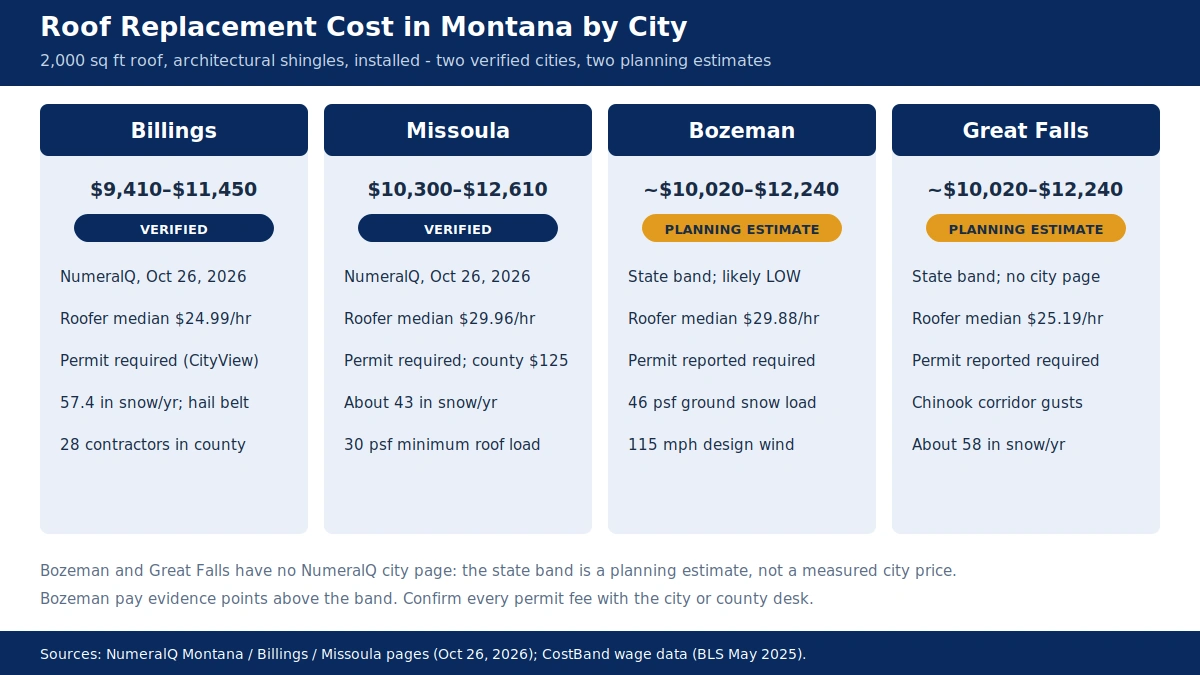
NumeralQ publishes Montana city pages for exactly two cities, Billings and Missoula. No NumeralQ page was found for Bozeman or Great Falls in targeted searches, and no other source in this research names a Bozeman or Great Falls band with the same size, material, and date discipline. This section therefore gives verified bands for Billings and Missoula and planning estimates, clearly labeled, for Bozeman and Great Falls, with every cross-check that exists. A guide that printed four identical-looking bands would be inventing two of them, and this one does not.
Billings is the cheapest of the four cities on verified evidence, and the reasons are visible in the labor data. The NumeralQ Billings page prices a 2,000 sq ft architectural roof at $9,410–$11,450, about 6 percent below the state band. Roofer median pay in the Billings metro is $24.99 per hour, 6 percent below the national median, with crews billed at $50–$65 per worker-hour. Yellowstone County holds 28 roofing contractors, 3.8 per 10,000 homes against a national rate of 1.7, and about 75 percent of them employ fewer than five people. Competition is real, and it shows in the band. The median Billings home is worth $343,400 and was built in 1980, and a typical roof job runs about 3.0 percent of the median home value, the highest share of the cities priced here, because the homes are older and worth less.
Billings weather shapes the Billings roof. The city takes 57.4 inches of snow a year at the nearby station, sits in the state’s hail belt with 147 large-hail reports in Yellowstone County over 2016–2025, and sees average highs under 40 degrees Fahrenheit from December through February, which triggers the hand-sealing rule for shingles installed in cold weather. A Billings quote should name the ice-barrier scope, the hail rating of the shingle, and the winter installation method if the job runs into the cold months. Cross-checks on Billings run higher than the NumeralQ band: SquareDash lists a $14,400 fixed-price average for a 2,000 sq ft home, RoofTide’s guide prices architectural shingles at $450–$750 per square, or $9,000–$15,000 for 20 squares, and Instant Roofer’s contractor averages run far above both. The NumeralQ band is the planning number; the cross-checks are a reminder that fixed-price and contractor-entered figures measure different jobs.
Missoula is the most expensive verified city in the state, and the labor data explains why. The NumeralQ Missoula page prices the same 2,000 sq ft architectural roof at $10,300–$12,610, about 9 percent above Billings and just above the state band. Roofer median pay in the Missoula metro is $29.96 per hour, 12 percent above the national median, with crews billed at $60–$78 per worker-hour. Missoula County holds 12 roofing contractors, 2.1 per 10,000 homes, a thinner bench than Billings. The median Missoula home is worth $473,100 and was built in 1981, and a typical roof job runs about 2.4 percent of the median value. The material table in Missoula runs the same 9 percent premium across every row: standing seam at $22,800–$34,230 against $20,740–$31,550 in Billings, and concrete tile at $21,310–$30,100 against $18,690–$26,690.
Missoula’s weather adds its own lines to the quote. The city takes about 43 inches of snow a year, precipitation runs 14.1 inches against a national median station figure of 37.5 inches, and average highs sit under 40 degrees from November through February, a month longer than Billings. The driest months are July and August, which is also wildfire season, and one local guide says smoke compresses the August and September install window in western Montana. That claim is single-sourced and is reported here as a guide’s claim, not a verified fact. What is verified is the permit picture: the city requires a permit for replacement or re-cover, the county charges a $125 flat fee for the permit with two inspections, and the county’s 30 psf minimum design roof snow load applies with the ground load set site by site. The wildfire section covers the Missoula subdivision rules that can require Class A roofing on qualifying new subdivisions in mapped high-risk areas.
Bozeman carries a planning estimate in this guide, not a verified band, and the evidence points to the estimate running low. The state band of $10,020–$12,240 is the planning figure, used because no source names a Bozeman band with size, material, and date together. Every cross-check runs above it or warns upward. CostBand’s wage data puts Bozeman roofer pay at $29.88 per hour, the highest of the five Montana metros and 19 percent above Great Falls, on 220 roofers counted across the state’s metros. Wegner Roofing, a Bozeman contractor, prices asphalt at $9,500–$18,000 for a 2,000 sq ft home and standing seam at $22,000–$38,000, and SquareDash lists a $15,700 fixed-price average for a 2,000 sq ft Bozeman home. GetMyRoofEstimateNow puts the Bozeman range at $8,500–$23,000 with about $14,000 typical, and Instant Roofer’s Bozeman average is $25,146 on its larger-roof basis. The honest statement is that a Bozeman buyer should budget at or above the top of the state band for asphalt and well above it for metal, and should treat any quote at the bottom of the state band with suspicion about scope.
Bozeman’s altitude and growth explain the premium. The city sits near 4,800 feet, the design criteria set a 46 psf ground snow load and a 41 psf roof snow load, and the design wind speed is 115 miles per hour. One Bozeman guide says the altitude and ultraviolet exposure accelerate granule loss on asphalt shingles, shortening their real life, and that claim is single-sourced from a contractor guide and reported as such. What is not in doubt is the demand: Bozeman is the fastest-growing of the four cities, crews are stretched, and the design criteria are the strictest of any city page verified in this research. A Bozeman quote should name the snow-load figure the roofer designed to, because the city table and the station figures disagree by a wide margin, as the snow section explains.
Great Falls carries the same planning estimate, the state band of $10,020–$12,240, on thinner evidence than Bozeman. No verified city band was found, and the cross-checks are sparse: Instant Roofer’s Great Falls average is $25,484 on its larger-roof basis, and one lead-generation page puts the range at $7,000–$18,500 without stating the scope behind it. CostBand’s wage data puts Great Falls roofer pay at $25.19 per hour, the lowest of the five metros, which points to prices at or below the state band, but wage data alone does not make a price band. Great Falls sits on the chinook corridor, where the January 2021 wind event set a modern city record of 76 miles per hour, and the city takes about 58 inches of snow a year. A Great Falls buyer should budget the state band, ask for the wind rating of the shingle by name, and get the permit answer from the city desk in writing, because the permit evidence for Great Falls is the weakest of the four cities, as the permit section discloses.
Smaller Montana communities have no verified bands at all in this research, and the honest guidance is to start from the state band and adjust by distance and crew travel. Kalispell, Helena, Butte, and the mountain towns around Big Sky and Whitefish all appear in guide claims of premiums from 5 percent to 35 percent above the base, but those claims come from a single lead-generation source whose figures run far above every verified band in this guide, and they are not adopted here. A mountain-town quote that runs 15–35 percent above the state band is plausible on snow load, access, and crew travel alone, and the buyer should ask the roofer to name which of the three drives the premium rather than accepting a single lump sum.
| City | 2,000 sq ft architectural roof | Basis |
|---|---|---|
| Billings | $9,410–$11,450 | NumeralQ Billings, Oct 26, 2026 |
| Missoula | $10,300–$12,610 | NumeralQ Missoula, Oct 26, 2026 |
| Bozeman | ~$10,020–$12,240 | State band as planning estimate; likely low |
| Great Falls | ~$10,020–$12,240 | State band as planning estimate |
Snow, Ice, and Chinook Winds: What Montana Weather Does to a Roof
No number in this guide varies more by address than the snow load, and no number is more dangerous to guess. Snow load is the weight of snow a roof must be designed to carry, measured in pounds per square foot, abbreviated psf. The governing study is Snow Loads for Structural Design in Montana, published by Montana State University and revised in 2004, and it is applied by the state Building Codes Program. The study publishes station figures, not county averages, and the figures run from 19.2 psf at Dillon to 410.7 psf at North Fork Jocko, a spread of more than twenty to one. Elevation drives the spread, but not in a straight line: Dillon sits at 5,216 feet and carries the lowest figure in the table, while Kalispell at 2,957 feet carries 60.9 psf. Moisture, exposure, and terrain matter as much as height, which is why the study publishes stations and why a county average is useless.
The state sets a floor under the whole system. Under Montana law, the minimum design roof snow load after allowed reductions is 30 psf, a figure the state Building Codes Program publishes and the Bozeman, Billings, and Missoula County criteria all repeat. A design roof snow load is the load the structure must carry after the code’s reductions for slope, exposure, and thermal conditions are applied, and it is different from the ground snow load, which is the weight of snow on flat ground at the site. The 30 psf floor means no Montana roof is designed for less than 30 psf, even where a station figure reads lower, and it means the Dillon figure of 19.2 psf is a station reading, not a design permission.
The station table below is the heart of this section, and every figure in it was read from the Montana State University study through a 2026 reading that checked all twelve published figures. The Bozeman pair is the one to remember: Bozeman 6 W, the experiment farm west of town at 4,775 feet, reads 29.8 psf, and Bozeman 12 NE, at 5,950 feet, reads 95.7 psf. A buyer twelve miles northeast of Bozeman needs a roof engineered for more than three times the load of a buyer six miles west. Red Lodge 2 N reads 105.2 psf, West Yellowstone 135.0 psf, Badger Pass in Flathead County 321.3 psf, and North Fork Jocko in Missoula County 410.7 psf, the highest figure in the study. On the plains, Glasgow reads 22.6 psf, Great Falls International 24.1 psf, Helena Regional 25.5 psf, and Billings Logan 31.7 psf.
The building code’s prescriptive path, the set of standard tables a builder can follow without hiring an engineer, covers ground snow loads up to 70 psf. Above 70 psf, the roof needs engineering, which means a licensed design professional sizes the framing for the site. Bozeman 12 NE, Red Lodge, West Yellowstone, and both SNOTEL stations in the table exceed that line, and a roof in those areas carries an engineering cost the planning band does not include. A roofer who prices a mountain roof from the prescriptive tables without asking the elevation is pricing the wrong roof.
City design criteria can differ from the station figures, and the city table governs inside city limits. Bozeman’s official design criteria set a ground snow load of 46 psf and a roof snow load of 41 psf, both well above the 29.8 psf station figure west of town. The difference is not an error: the city table is a design value for the jurisdiction, the station figure is a reading at one spot, and the permit desk reviews against the city table. Billings design criteria, dated March 2020, set 30 psf plus drifting, the extra load where wind piles snow against a parapet, a dormer, or a higher roof section. Missoula County sets the 30 psf minimum with the ground load determined site by site under the ASCE 7 standard, the national loading standard engineers use. No verified ground snow load figure for a Missoula station was found in this research, and this guide does not state one. A Missoula buyer gets the parcel figure from the building official, not from a guide.
Outside the certified cities and counties, the state program applies, and the design load comes from the ASCE 7 Hazard Tool, the online tool that returns site-specific loads from an address. The Montana State University study declines to give figures for some terrain, called case-study areas, where local conditions defeat the station method, and for those sites the study directs the builder to call the State Building Codes Bureau at (406) 841-2056. A buyer whose parcel falls in case-study terrain, or whose address sits between stations at a different elevation, should make that call before signing, because the roofer’s guess is not a design value.
| Station | Elevation | Ground snow load |
|---|---|---|
| Dillon AP | 5,216 ft | 19.2 psf |
| Glasgow International AP | 2,285 ft | 22.6 psf |
| Great Falls International Airport | 3,664 ft | 24.1 psf |
| Helena Regional AP | 3,828 ft | 25.5 psf |
| Bozeman 6 W Experiment Farm | 4,775 ft | 29.8 psf |
| Billings Logan International AP | 3,581 ft | 31.7 psf |
| Kalispell Glacier Park AP | 2,957 ft | 60.9 psf |
| Bozeman 12 NE | 5,950 ft | 95.7 psf |
| Red Lodge 2 N | 5,500 ft | 105.2 psf |
| West Yellowstone | 6,659 ft | 135.0 psf |
| Badger Pass (SNOTEL, Flathead County) | 6,900 ft | 321.3 psf |
| North Fork Jocko (SNOTEL, Missoula County) | 6,330 ft | 410.7 psf |
Ice dams are the slow leak that snow loads do not capture. The dam starts in the attic: warmth leaking through thin insulation thaws the snowpack on the upper slope, the water runs down to the freezing eave, and the refrozen ridge traps later meltwater behind it until the water finds its way beneath the shingles. The fix is three parts, and only one of them is roofing: insulation and air sealing in the attic to keep heat out of the roof deck, ventilation to keep the deck cold, and an ice-and-water barrier at the eaves to seal the deck where water backs up. A roofer who quotes a new roof over an under-insulated attic without mentioning the attic is selling half a fix. Insulation pricing for the attic half of the fix is in the attic insulation cost guide.
The ice-barrier rule in Montana is local, not statewide, and this guide does not claim a statewide mandate that was not verified. The International Residential Code, section R905.1.2, requires a self-adhering ice barrier from the lowest eave edge to at least 24 inches inside the exterior wall line, in places where ice dams form according to the jurisdiction’s design table. The City of Billings one- and two-family reroofing handout requires exactly that: an ice barrier from the lowest roof edge to at least 24 inches inside the wall line. A Missoula guide reports the same 24-inch minimum for Missoula, but that claim is single-sourced and is reported here as a guide’s claim. No verified statement of a statewide ice-barrier mandate was located, so the buyer confirms the requirement with the local permit desk and treats the eave barrier as a minimum, not a luxury, everywhere in the state.
A full-roof ice-and-water barrier, covering the whole deck instead of just the eaves and valleys, is an upgrade worth pricing on low-slope and valley-heavy roofs. At Billings rates of $0.85–$1.37 per sq ft, full coverage on a 2,000 sq ft roof adds $1,700–$2,740 by NestPriced arithmetic, and Missoula rates of $0.92–$1.47 per sq ft run slightly higher. The upgrade seals every nail hole and every seam against wind-driven rain and ice-dam backup, and on a roof with a history of leaks it is cheaper than the next interior repair. On a steep, simple roof in the eastern plains, the eave strip plus valley coverage is usually enough, and the roofer should say which scope the quote carries.
Freeze-thaw cycling wears a Montana roof from the inside out. Water enters a small crack or a lifted shingle edge, freezes overnight, expands, and opens the crack wider, and the cycle repeats through every shoulder season. Chinook winds accelerate the cycle along the Rocky Mountain Front, where temperatures can swing 40–50 degrees Fahrenheit in hours as warm downslope wind replaces cold air. The defense is installation quality more than material: sealed shingle tabs, proper flashing, and a deck that stays dry. A roof installed in a cold snap needs hand-sealing, the practice of applying roofing cement under each shingle tab because the factory adhesive strip will not activate in the cold, and the Owens Corning technical bulletin sets the threshold at 40 degrees Fahrenheit and below. Billings averages highs under 40 degrees from December through February, Missoula from November through February, so a winter install in either city must name hand-sealing in the contract or wait for spring.
Wind is the third Montana load, and the chinook corridor is where it bites. Montana ranks 31st nationally for damaging wind, with 2,225 reports to the National Oceanic and Atmospheric Administration since 2016, but the statewide rank hides the Front. Yellowstone County logged 121 damaging-wind reports from 2016 through 2025, and Missoula County logged 18, a sevenfold gap that mirrors the hail gap. The January 2021 chinook event set modern records of 76 miles per hour in Great Falls, 74 in Helena, and 72 in Havre, and a February 2020 gust of 106 miles per hour was recorded at Deep Creek south of Browning, both figures from a single secondary source and reported here as its claims. In November 2026, the National Weather Service warned of gusts to 95 miles per hour, isolated near 100, along the Front. Bozeman’s design wind speed is 115 miles per hour, the only verified city design wind figure in this research. No verified design wind speed was found for Billings, Missoula, or Great Falls, and none is stated here.
The practical wind answer is the shingle rating and the nailing pattern. Architectural shingles carry wind ratings of 110–130 miles per hour, and the better lines carry a Class H rating of 150 miles per hour. A six-nail pattern, six nails per shingle instead of the standard four, is described by Montana guides as standard practice in wind detailing, and that claim is attributed to the guides rather than stated as code. The buyer asks for the wind rating by product name and the nailing pattern in writing, because a 130 mph shingle installed with four nails in a chinook corridor is a 130 mph shingle in name only.
Wildfire and Ember Risk: WUI Rules That Change What Your Roof Must Be
Montana burned in 2025, and the numbers explain why the roof is now fire equipment in the western half of the state. The Governor’s Office and the Department of Natural Resources and Conservation reported 2,424 wildfires and 75,099 acres burned statewide, with 32 percent started by lightning and 68 percent human-caused or undetermined. The acreage was the fourth lowest in 15 years, but the number of starts ran above average, and the Department kept 94 percent of the fires under its direct protection to 10 acres or fewer, protecting about $36.67 billion in property value on private lands. The season’s cost ran $50–$70 million, against a 10-year average near $30 million a year. The Windy Rock Fire near Drummond, which started August 14, 2025, burned 6,175 acres, cost about $56 million to suppress, and threatened about 175 residences. The prior year was worse by acreage: 2,323 incidents and 352,491 acres in 2024, on National Interagency Coordination Center figures reported by a wildfire tracker.
The roof is the part of the house embers reach first. Embers ride the wind ahead of a fire front, sometimes more than a mile, land in a roof valley, a gutter full of dry needles, or an unscreened vent, and ignite the house while the flame front is still distant. The mechanism is well established in fire science, and the Montana anchor for it is practical: the Department of Natural Resources and Conservation offers a free home wildfire risk assessment statewide, carried out by a local fire professional, and a homeowner in the wildland-urban interface should take it before choosing a roof. The wildland-urban interface, abbreviated WUI, is the zone where homes meet wildland vegetation, and it is where the rules in this section apply. About 29 percent of Montana homes sit in high wildfire-risk zones, the highest share of any state, on an Insurify 2026 analysis reported by a roofing guide, a single secondary source reported here in one clause and not relied on for any decision.
The state code that governs WUI construction changed in 2026, and the change is widely misunderstood. Montana’s building rules adopt the 2024 International Wildland-Urban Interface Code, the IWUIC, effective September 26, 2026, alongside the rest of the 2024 code family. The IWUIC sets construction requirements for homes in designated WUI areas: Class A roof assemblies, the highest fire rating, vents covered with 1/8-inch mesh, ignition-resistant siding, and dual-pane windows with one tempered pane. The critical limit is that the state code applies only within WUI areas that a governmental body has declared, and certified cities, counties, and towns that elect to enforce it must record official maps. The state version deletes the model code’s retroactivity and defensible-space maintenance sections, so it is not a blanket order to retrofit every existing home in the state. A buyer who hears that the new code forces a roof upgrade on an existing home outside a declared area is hearing a sales pitch, not the code.
The edition history is messy enough to name. The 2021 IWUIC was adopted in March 2023, and some guides still cite the 2018 edition. The current adoption, per a summary of the state building rules checked in October 2026, is the 2024 IWUIC effective September 26, 2026. The draft uses that adoption as current, notes the declared-area limit, and tells the buyer to confirm the applicable edition and the parcel’s WUI status with the local building official, because the map, not the guide, decides what the roof must be.
Missoula carries the most detailed local wildfire rules verified in this research, and they apply to subdivisions, not to every existing home. The city Unified Development Code, section 22.5.2.01-D, sets wildfire standards for qualifying subdivisions in mapped High and Very High WUI areas, covering access, fire-water supply, and obligations recorded through a development agreement or covenant, and the code took effect March 4, 2026. An older city subdivision exhibit requires Class A or B fire-rated roofing materials in WUI areas. Missoula County’s subdivision regulations, chapter 3, adopted April 2, 2026, require wildfire-hazard review for qualifying subdivisions, and recorded obligations can run with the property. None of these is a universal retrofit rule for an existing home, and a Missoula buyer should ask whether the parcel carries a recorded wildfire obligation before assuming the roof choice is free.
Class A is the rating to ask for by name in any WUI area. A Class A roof assembly is the highest fire rating under the standard test, meaning the assembly resists severe fire exposure, and standing-seam metal, tile, slate, and Class A rated asphalt assemblies all reach it. The rating applies to the assembly, the covering plus the underlayment and deck, not to the shingle alone, so a Class A shingle over the wrong underlayment is not a Class A roof. The roofer should name the assembly rating in the contract, and the buyer in a declared WUI area should confirm with the permit desk that the assembly as quoted satisfies the local requirement.
The cost of WUI hardening is reported here as two conflicting single-source claims, and neither is adopted as a band. One roofing guide puts the add-on for Class A hardening in designated WUI areas at $1,200–$4,500. A Missoula guide puts the Class A upgrade at $600–$1,900. The ranges overlap at the bottom and diverge by $2,600 at the top, and neither source shows its scope, so the honest guidance is to price the hardening as named lines, assembly rating, vent mesh, gutter guards, and ember-resistant vents, rather than accepting a single WUI surcharge. Vents deserve their own line: 1/8-inch mesh over every vent opening is cheap material and expensive to retrofit after the roof is on.
No homeowner wildfire-hardening roof grant was found in this research. NumeralQ states it plainly for Montana: no statewide grant as of October 2026. The Department of Natural Resources and Conservation’s free assessment is real help, and its forestry cost-share programs reach landowners through local partners for land and forest work, not for roof coverings. A contractor who promises a state grant for a fire-hardened roof is promising money that does not exist, and the buyer should ask for the program name, the agency, and the application form before believing it.
Asphalt Shingles vs Metal Roofing in Montana
The asphalt-versus-metal choice is the largest financial decision in a Montana roof, and it is the choice where the state’s weather argues most strongly against the default. Architectural asphalt costs $9,410–$11,450 in Billings and $10,300–$12,610 in Missoula for a 2,000 sq ft roof. Standing-seam metal costs $20,740–$31,550 in Billings and $22,800–$34,230 in Missoula. The metal roof costs roughly double to triple the asphalt roof on day one, lasts roughly double the rated life, and changes the snow, fire, and hail behavior of the house. The comparison below prices that trade honestly, including the lifetime math that reverses the first impression.
Snow is metal’s strongest argument in Montana. A smooth metal surface sheds snow instead of holding it, so the accumulated load on the structure stays lower through the winter and the ice-dam risk at the eaves falls. Standing-seam panels move with temperature through concealed fasteners that allow expansion and contraction, which matters in a state where a chinook can swing the temperature 40 degrees in a day. MyRoofData puts it bluntly: for mountain homes, the standard system is standing seam fitted with snow retention. The snow-retention qualifier is not optional. A sheet of wet snow releasing from a metal roof two stories up can injure a person and destroy a gutter line, and snow guards, the bars or cleats that hold snow on the roof until it melts, must sit above every entry, walkway, and driveway. A metal quote without a snow-retention line is incomplete in Montana, and the buyer should ask where the guards go and what they cost.
Fire is metal’s second argument, and it is the argument that matters most in the western valleys. A standing-seam metal roof carries a Class A assembly rating, sheds embers instead of catching them, and does not smolder. Asphalt can reach Class A as an assembly, but the assembly depends on the underlayment and the installation, and an asphalt roof with a gutter full of needles is still an ember trap at the eave. In a declared WUI area, the metal roof satisfies the strictest requirement by default. In a non-WUI area, the fire advantage is real but should not be oversold: most Montana homes never face a wildfire, and the fire case alone does not justify doubling the roof budget.
On hail, the two materials fail in opposite ways, and each failure mode carries its own insurance consequence. Metal dents. A 2-inch hailstone that cracks an asphalt shingle will dent a metal panel, and the dent is cosmetic damage that some insurance policies exclude as cosmetic-only, meaning the insurer pays nothing for a roof that looks battered but still sheds water. Asphalt cracks, granule loss exposes the mat, and the damage is functional, which insurers pay for. The Class 4 section covers the insurance side in detail. The practical point is that a metal roof in the Billings hail belt should carry a hail-dent conversation with the insurer before installation, and the buyer should know whether the policy pays for cosmetic denting or only for functional damage.
Asphalt’s real life in Montana is shorter than its rating, and the gap is the strongest argument against it. MyRoofData rates architectural asphalt at 22–30 years. One Montana guide claims 15–22 years for architectural asphalt in Billings, Great Falls, Helena, and Missoula, and 15–20 years for standard asphalt in Billings, blaming chinook cycling, freeze-thaw, and hail. That claim is single-sourced from a lead-generation guide and is reported here as the guide’s claim, not adopted as fact. The mechanism behind it is sound, though: ultraviolet exposure at altitude degrades granules, freeze-thaw opens cracks, and hail removes granule coverage, and all three act faster in Montana than in a mild climate. A buyer who plans to stay in the house for 30 years should budget for two asphalt roofs or one metal roof, and the lifetime math below prices exactly that choice.
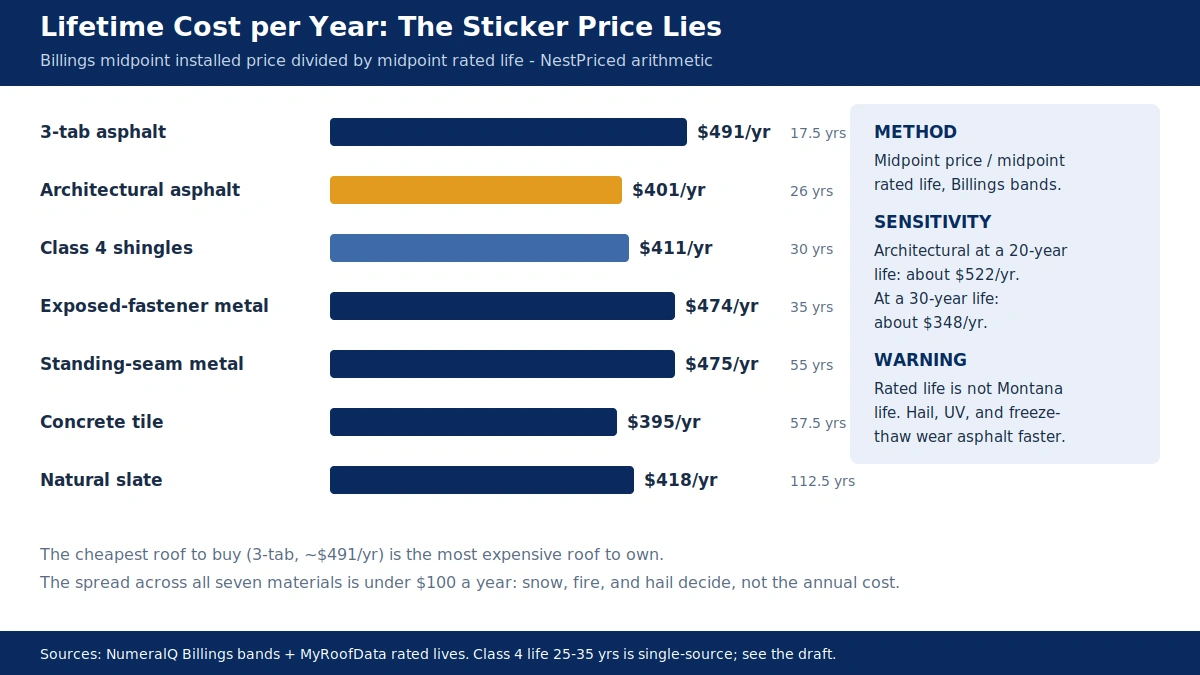
The lifetime math reverses the sticker-price verdict, and it is labeled here as NestPriced arithmetic on Billings midpoints divided by rated-life midpoints. Architectural asphalt at $10,430 over 26 years costs about $401 per year. Standing-seam metal at $26,145 over 55 years costs about $475 per year. Exposed-fastener metal at $16,575 over 35 years costs about $474 per year. Three-tab shingles, the cheapest roof to buy, cost about $491 per year, the most expensive roof to own, because the short life dominates. Concrete tile, at $22,690 over 57.5 years, costs about $395 per year, the cheapest of all on this math, before the structural check. Natural slate, at $46,990 over 112.5 years, costs about $418 per year. The spread between the cheapest and most expensive lifetime cost is under $100 a year, which means the material choice is driven by snow, fire, hail, and how long the buyer stays, not by the annual cost alone.
The sensitivity check matters more than the point estimate. If architectural asphalt lasts 20 years instead of 26, its annual cost rises to about $522, the most expensive figure in the table. If it lasts the full 30 years, the annual cost falls to about $348, the cheapest. The buyer’s real question is not which material wins the midpoint math, but which life the roof will actually live in that microclimate, on that pitch, under that hail exposure. A shaded, low-slope asphalt roof in Missoula’s wet valley may live its full rating. A south-facing asphalt roof in Bozeman’s high sun, under chinook cycling, may not. The roofer who has worked the neighborhood for a decade knows which, and the buyer should ask.
Noise is the myth that should be retired. A metal roof over a solid deck with insulation and an attic is not meaningfully louder than asphalt in rain, and the Montana guides that raise the subject agree. What is real is the installer pool: standing seam needs a crew that has installed standing seam, with the seaming tools and the flashing details for that profile, and a crew that has only ever laid shingles is not that crew. The hiring section covers how to verify metal experience, and the answer is references for standing-seam jobs in the same county, not a general claim of metal experience.
For the full national comparison of the two materials, see the metal roof vs shingles cost guide, the metal roof cost guide, and the tile roof cost guide for the heavy-material end of the table.
| Lifetime cost (Billings midpoints) | Installed cost | Rated life | Cost per year |
|---|---|---|---|
| 3-tab asphalt | $8,590 | 17.5 years | ~$491 |
| Architectural asphalt | $10,430 | 26 years | ~$401 |
| Class 4 shingles (derived band) | $12,330 | 30 years | ~$411 |
| Exposed-fastener metal | $16,575 | 35 years | ~$474 |
| Standing-seam metal | $26,145 | 55 years | ~$475 |
| Concrete tile | $22,690 | 57.5 years | ~$395 |
| Natural slate | $46,990 | 112.5 years | ~$418 |
Class 4 Impact-Resistant Shingles: Cost, Hail Protection, and Insurance Discounts
Montana’s hail record is the reason Class 4 shingles exist as a buying decision rather than a footnote. A 30-year analysis of National Oceanic and Atmospheric Administration Storm Prediction Center data, covering 1996 through 2025, counts 859 severe hail days and 4,830 individual reports of hail 1 inch or larger across the state, an average of 29 severe hail days a year and 5.6 reports per hail day. Days with hail at 2 inches or larger, the threshold the Storm Prediction Center calls significant severe, average 6.3 a year, 190 days in 30 years. The middle 80 percent of the season runs May 28 through August 17, July is the busiest month, and the largest stones in the 30-year window reached 4.5 inches, softball size, in Fergus and Musselshell counties on June 26, 1996, in McCone County on July 18, 1999, and in Valley County on July 21, 1999. The analysis warns that report-based counts undercount thinly populated states, so Montana’s true hail frequency is higher than the recorded figures. An older record of a 6-inch stone on July 11, 1965, appears in a 1955–2024 dataset, but the 30-year analysis excludes pre-1996 magnitudes as unreliable, and this guide follows the 30-year window.
The county gap is as wide as the snow-load gap. Yellowstone County logged 147 large-hail reports from 2016 through 2025, 21 of them at 2 inches or larger, and the county plus its seven neighbors recorded 391 reports, 19.1 per 1,000 square miles against 11.2 statewide and 20.1 nationally. The Federal Emergency Management Agency rates Yellowstone County’s hail risk Relatively Moderate. Missoula County logged 22 large-hail reports in the same decade, 2 at 2 inches or larger, and the county plus its nine neighbors recorded 100 reports, 3.3 per 1,000 square miles, with a FEMA rating of Very Low. A Billings roof faces roughly seven times the recorded hail exposure of a Missoula roof, and the Class 4 decision is correspondingly different in the two cities. The largest hail in Yellowstone County since 2010 was 3 inches, teacup size, on August 11, 2019, and the most recent large hail before this guide was written fell September 7, 2026, at 2.75 inches near Shepherd, 13.5 miles northeast of Billings. The county’s hazard plan counts 447 hail events and $14,085,500 in severe-summer-weather property losses, mainly hail, from 1955 through 2022. No hail count for Cascade County or the Great Falls area was located in this research, and none is stated here.
Class 4 is the highest impact rating a shingle can carry, and the test is specific. Under UL 2218, the Underwriters Laboratories impact standard, a 2-inch steel ball is dropped from 20 feet onto the same spot twice, and the shingle mat must not crack or tear. The rating covers impact only: wind resistance and fire resistance are separate tests with separate ratings, and a Class 4 shingle is not automatically a high-wind or Class A shingle. GAF sells two Class 4 lines, Timberline AS II and ArmorShield II, and Owens Corning sells two more, Duration Storm and Duration FLEX. CertainTeed answers with NorthGate and Landmark IR, Atlas with StormMaster, Malarkey with Legacy and Vista, IKO with Nordic, and Tamko with StormFighter FLEX. Billings guides name Duration Storm, ArmorShield II, and Landmark IR specifically, and GAF’s Timberline ArmorShield II also carries a Class H wind rating of 150 miles per hour, which matters on the chinook corridor.
The upgrade cost carries a conflict that this guide reports rather than resolves. A Billings guide puts the Class 4 upgrade at $600–$1,800 over architectural shingles, and its table puts the range at $500–$1,800. A second Billings guide, RoofTide, says Class 4 adds about $3,000–$5,000 upfront, pricing Class 4 at $600–$950 per square against $450–$750 for architectural, or $12,000–$19,000 against $9,000–$15,000 for a 20-square roof. The two claims differ by a factor of three at the top end, and no Montana roofer quote stating a per-square Class 4 premium was located. The derived band in this guide adds the $600–$1,800 increment to the state architectural band, giving about $10,620–$14,040 for a 2,000 sq ft Class 4 roof, and labels the result NestPriced arithmetic. The RoofTide range is reported as the cross-check that runs higher. A buyer should get the Class 4 premium as its own line in the quote, because the spread between the two published claims is too wide to budget from a guide alone. The rated life used in the lifetime math, 25–35 years, is single-sourced from the research file of a sibling article and is disclosed here as such.
The insurance discount is where Montana guides disagree most wildly, and no statute settles the argument. A Billings contractor guide says Montana insurers offer 20–30 percent discounts for qualifying Class 4 systems. A statewide guide says many Montana carriers offer 10–25 percent. A Billings guide says 5–20 percent in Yellowstone County. A Montana and Wyoming contractor says most providers discount 10–30 percent. A national calculator says 10–35 percent. RoofTide says carriers commonly offer discounts, amounts vary, and the buyer should verify with the insurer, working an example of 20 percent on a $2,000 premium, or $400 a year, recovering the premium over 8–12 years. The spread across the guides is 5–35 percent, no Montana statute sets a Class 4 discount percentage, and no carrier-verified Montana percentage was found. This guide adopts no discount percentage as fact. The discount, if the buyer’s carrier offers one, is carrier-specific, may apply only to the wind and hail portion of the premium rather than the whole premium, and must be confirmed in writing with the portion named and the Class 4 certificate filed with the insurer before the roof goes on.
The payback math below runs four scenarios against the Montana average premium of $3,765 a year, from the NerdWallet analysis of May 6, 2026, and every scenario is labeled an assumption, not a promise. At 10 percent of the full premium, the saving is about $377 a year, and the $600–$1,800 upgrade pays back in about 1.6–4.8 years. At 15 percent of the full premium, the saving is about $565 a year, and the payback is about 1.1–3.2 years. At 25 percent of the full premium, the saving is about $941 a year, and the payback is about 0.6–1.9 years. At 15 percent of half the premium, the wind-and-hail-portion case, the saving is about $282 a year, and the payback is about 2.1–6.4 years. The portion-only case is the realistic one for many policies, and it is the case a buyer should budget from until the agent confirms otherwise in writing. If the upgrade costs the RoofTide figure of $3,000–$5,000 instead, every payback in the table roughly triples, which is why the premium line in the quote matters more than the discount percentage in a guide.
The decision rule follows the hail map. In Yellowstone County and the eastern plains, where the recorded hail exposure runs near the national rate and 2-inch stones appear in most years, Class 4 is the default recommendation of this guide, and the upgrade pays for itself in avoided deductibles even before any discount. In Missoula County and the western valleys, where the recorded exposure is a sixth of the eastern figure and the FEMA rating is Very Low, Class 4 is a reasonable upgrade for a buyer who plans to stay, but the case rests on the discount and the peace of mind, not on the hail record. In the mountain towns, the decision turns on the individual parcel’s storm history and the insurer’s written offer, because the station data thins out with the population. Everywhere in the state, the buyer asks the agent three questions before choosing: the discount percentage, the portion of the premium it applies to, and the certificate the insurer needs on file.
| Payback scenario (assumptions, not promises) | Annual saving | Payback on $600–$1,800 upgrade |
|---|---|---|
| 10% of full $3,765 premium | ~$377 | ~1.6–4.8 years |
| 15% of full $3,765 premium | ~$565 | ~1.1–3.2 years |
| 25% of full $3,765 premium | ~$941 | ~0.6–1.9 years |
| 15% of half the premium (wind/hail portion) | ~$282 | ~2.1–6.4 years |
Montana Roof Permits, Building Codes, and Snow Load Rules
Montana has no single permit answer, and the first question a buyer asks is which desk governs the address. The state runs a Building Codes Program out of Helena, and cities, counties, and towns that the state certifies enforce the codes locally through their own building departments. Everywhere else, the state program issues permits and inspects, or no permit desk exists at all. Gallatin County and Flathead County issue no building permits. Missoula County has enforced codes countywide since 2006, one of only a handful of Montana counties with a building program. Cascade County does not appear on the certified list, so outside the Great Falls city limits the state program applies and the snow load comes from the ASCE 7 Hazard Tool. The state program exempts residential buildings under five units from state building permits, and state guidance says no state building permit is required for a single-family residence unless a local jurisdiction requires one by ordinance. The practical rule is simple: inside a certified city or county, the local desk decides, and outside one, the buyer may face no permit and no inspection, which makes the contractor’s own quality control the only quality control.
The code edition changed in 2026, and the transition is still visible on city web pages. Montana adopted the 2021 code family in stages, the residential code in June 2022 and the full suite including the wildland-urban interface code in March 2023. The state then adopted the 2024 code family, including the 2024 residential code and the 2024 wildland-urban interface code, effective September 26, 2026, under Title 24, Chapter 301 of the Administrative Rules of Montana. Three independent summaries agree on the 2024 adoption and the September date. Bozeman’s design-criteria page still shows 2021 criteria, and Missoula County’s criteria are described by a secondary source as the 2021 codes. The buyer confirms which edition the local desk reviews against before the roofer orders material, because the edition decides the ice-barrier rule, the fastening schedule, and the WUI requirements that apply to the job.
Billings requires a permit for roofing and siding work, and the requirement is stated by the city’s own building division materials and by the NumeralQ Billings page. Applications run through the CityView online portal, and the Building Division can be reached at (406) 657-8270. The fee is valuation-based under the city schedule, and no verified fee figure for a re-roof was found: NumeralQ’s state page lists the Billings re-roof permit fee as not published, and a secondary reproduction of the city’s valuation table was not used to compute a fee because its currency could not be verified. One guide claims $120–$350 for Billings, and that claim is single-sourced and not adopted here. The buyer gets the fee from the division before budgeting it. The city’s one- and two-family reroofing handout requires the ice barrier described in the snow section, and the city’s design criteria set 30 psf plus drifting. A historic-district wrinkle applies in Billings: under Article 6-700, an exterior change to property in a historic district or on the local register needs a Certificate of Appropriateness from the Yellowstone Historic Preservation Board before a permit issues, and covering original materials counts as an alteration, so a re-roof that changes the material or the look can trigger review.
Missoula runs two desks, city and county, and the buyer must know which one governs the address. The city Building Division requires a permit for residential or commercial roofing, replacement or re-cover, on its official permit page, and the city office can be reached at (406) 552-6630. The county requires a permit for residential or commercial re-roofing in Missoula County, and the county’s Roofing Permit and Inspection Guide, dated February 2023, sets a $125 flat fee covering the dry-in inspection and the final inspection, with the fee adjusted by valuation if structural repairs or re-sheathing are involved. The guide is a primary county document, but it is dated February 2023, and the buyer confirms the current fee before relying on it. The dry-in inspection checks the underlayment and flashing before the covering goes on, and the final inspection checks the finished roof. Minor repair is exempt in the county only when all three conditions hold: the damage is minor, no new underlayment is needed, and the area is under 10 feet by 10 feet. Past any one condition, a permit is required. The same 10-by-10 formulation is reported for the city by a secondary source and is attributed here as such. Missoula’s historic rule adds a step for individually National Register-listed homes: a Historic Preservation Permit for exterior changes, taking about two months and lasting two years, with ordinary roof repairs exempt but a full replacement with a different material on a listed home possibly not exempt.
Bozeman’s permit position is the least verified of the four cities relative to its importance, and this guide says so. Contractor sources state that a permit is required for roof replacement involving sheathing, structural changes, or more than 25 percent of the roof area, with fees typically $150–$400 by valuation, and mid-roof and final inspections. No city primary document confirming the 25 percent threshold or the fee range was located in targeted searches of city materials. The figures are reported here as contractor-stated, unverified from a city document, and the buyer confirms both the threshold and the fee with the City Building Division before relying on them. Gallatin County issues no building permits, so a home outside the Bozeman and Belgrade city limits goes to the state program. Bozeman’s Unified Development Code took effect February 1, 2026, and the city’s design criteria, ground snow 46 psf, roof snow 41 psf, wind 115 miles per hour, are the verified figures a Bozeman roofer designs to.
Great Falls has the weakest permit evidence of the four cities, and the gap is disclosed rather than papered over. A contractor source states that a permit is required for a residential reroof, citing the 2021 residential and building codes, under which anyone intending to construct, enlarge, alter, repair, move, or demolish a building must obtain a permit first, with repair named in the list and reroofs issued without plans. No city primary document was located to confirm the requirement, and no fee figure was verified. A secondary directory agrees that all four big cities require permits, and one guide claims $100–$300 for Great Falls, neither of which is adopted here as verified. The sources conflict on which code edition Great Falls enforces, so no edition is stated for the city. The buyer calls the city desk, gets the requirement and the fee in writing, and treats any contractor claim about Great Falls permits as unverified until the desk confirms it.
The layer limit is the one permit-adjacent rule that is uniform. The International Residential Code, section R908.3, forbids a new roof covering over two or more existing layers, which means a roof with two layers already on it must be torn off to the deck before new covering goes on. Montana guides restate the rule as a prohibition on a third overlay, consistent with the code. A quote that prices an overlay over two existing layers is pricing an illegal job, and a quote that prices a tear-off without stating how many layers it assumes is a quote that can grow when the second layer is discovered.
| Jurisdiction | Permit for re-roof | Fee evidence |
|---|---|---|
| Billings (city) | Required, via CityView portal | Valuation-based; no verified figure found |
| Missoula (city) | Required for replacement or re-cover | No verified figure found |
| Missoula (county) | Required | $125 flat fee (county guide, Feb 2023; confirm current) |
| Bozeman (city) | Reported required for sheathing, structural, or over 25% of roof | $150–$400 contractor-stated, unverified from city documents |
| Great Falls (city) | Reported required | No verified figure found |
| Outside certified jurisdictions | State program or no desk | State exempts residential buildings under 5 units |
Hiring a Roofer in Montana: The New Contractor License and How to Vet Bids
The most important hiring fact in Montana in 2026 is that the system most guides describe no longer exists. Through December 31, 2025, Montana ran a construction contractor registration system under Title 39, Chapter 9 of the Montana Code, administered by the Department of Labor and Industry. Registration cost $70 for two years, required no exam and no experience, and turned on workers’ compensation compliance. House Bill 239, Chapter 644 of the Laws of 2025, repealed the registration chapter and created a Construction Contractor License, the CCL, under Title 37, Chapter 45, effective January 1, 2026. The Department’s Construction Contractor License Program page confirms the change: all construction contractors in Montana must be licensed, and active registrations held on December 31, 2025, converted automatically to licenses. Any guide, contractor website, or bid form that still says a Montana roofer needs registration is describing a dead system, and a contractor who still calls himself registered rather than licensed has not kept up with the law that governs his own trade.
The license covers roofing by name. The statute’s definition of construction contractor expressly includes the installation or repair of roofing or siding, and the licensing section provides that an individual or business entity may not engage in business as a construction contractor without a current license from the department. The fee is $70 to apply and $70 to renew. There is no trade exam, no experience requirement, no bond, and no continuing education, and no general-liability minimum beyond workers’ compensation compliance. The license confirms that the business is registered and its workers’ compensation is in order; it is not a competency test, and it does not prove the holder can roof. No roofing trade-specific state license or exam exists in Montana, so the CCL is the credential and the buyer’s own vetting is the quality check. The license term length is not stated in this guide because the sources conflict: one summary describes a two-year term carried from the registration era, another describes renewal on the anniversary of issuance with a window opening 60 days prior and flags the term length as pending verification. The fee is stated; the term is not.
Two exemptions matter for roofing, and both are narrow. Jobs with a total price for labor and materials under $2,500 are exempt, a threshold that appears in both the old-system and new-system summaries, and every roof replacement in this guide exceeds it by a wide margin, so the exemption never applies to a full re-roof. An independent contractor with no employees is exempt from the CCL, but must carry an Independent Contractor Exemption Certificate, the ICEC, or workers’ compensation coverage when working at others’ locations. The ICEC still exists under the workers’ compensation statutes. Its current fee was not verified in this research, the $125 figure circulating online dates from before 2026, and no current fee is stated here. A solo roofer who claims exemption must show the certificate or the coverage, and a buyer who hires a solo operator without either is hiring an uninsured worker onto the roof.
Cities and counties cannot add their own contractor licensing on top of the state license. The exclusivity section of the new chapter provides that a city or county may not require or issue registrations, licenses, or bonds for the same or a similar purpose, though it may levy a general nondiscriminatory business license fee on all businesses. Claims found online that Billings, Missoula, Bozeman, or Great Falls require local contractor registration contradict the statute and are either stale or describe a general business license. The draft follows the statute and flags the conflict, because a buyer who is told a contractor needs a city roofing license is being told something the law forbids the city to require.
The license check takes two minutes and is the first vetting step. The Department of Labor and Industry runs a Licensee Lookup System linked from the Construction Contractor License Program page, and the buyer searches the contractor’s name or business name and confirms an active license before the first site visit. The lookup shows only currently active records. A contractor who cannot be found in the lookup, or whose license shows inactive, is not hired until the Department confirms the status. The check is free, and it catches the two most common hiring failures: the unlicensed operator and the operator working under someone else’s number.
Insurance is the second check, and it has two parts. Workers’ compensation coverage protects the buyer if a crew member is injured on the property, and general liability coverage protects the buyer if the crew damages the property. The buyer asks for certificates of both, naming the buyer as certificate holder, and calls the insurer or agent to confirm the policies are current, because a printed certificate can outlive a lapsed policy. A contractor who cannot produce both certificates is not hired, whatever the price. The CCL confirms workers’ compensation compliance at licensing, but coverage lapses, and the certificate check is how the buyer catches a lapse.
Lien law is the third check, and Montana’s version has teeth. Montana is a full-price lien state, and subcontractors and suppliers must send a notice of right to claim a lien within 20 days of first delivering work or material, under Montana Code section 71-3-531, with the state notice suggesting joint checks and lien waivers under section 71-3-532. The chain of sources for this paragraph runs through NumeralQ citing a lien-law guide, and it is attributed here as such. The practical meaning is plain: the shingle distributor and any subcontracted crew can lien the house for unpaid bills even if the buyer paid the contractor in full, unless the buyer collects lien waivers and, for large jobs, pays suppliers by joint check. The contract should require final lien waivers from the contractor, every subcontractor, and every supplier before the final payment, and the buyer should not make the final payment until the waivers are in hand.
References are the quality check the license cannot provide. The buyer asks for three recent jobs in the same county, in the same material, and calls all three. For standing seam, the references must be standing-seam jobs, because the seaming tools and flashing details are specific to the system. For a mountain roof, the references should include a high snow-load address. The buyer asks each reference the same questions: did the crew show up when promised, did the price change mid-job and why, did the roof leak in the first winter, and would the reference hire the contractor again. A contractor with no same-county, same-material references is asking the buyer to fund the learning curve.
The bid comparison is where most buyers fail, because they compare totals instead of scopes. Three bids on the same roof can differ by thousands of dollars and all be honest, if one includes tear-off and decking allowance and another does not. The buyer requires every bid to name the same lines: the shingle or panel by brand and product name, the underlayment type, the ice-barrier scope in feet or full coverage, the flashing scope by penetration, the ventilation scope, the decking allowance in sheets and the per-sheet price beyond it, the tear-off layers assumed, the disposal method, the permit responsibility and fee, the cleanup standard, and the warranty terms for both the material and the workmanship. The full list of vetting questions lives in the questions to ask a roofer guide. A bid that names none of these lines is not a bid; it is a number.
Storm chasers are the hiring risk that follows every Montana hail event. After a large hailstorm, out-of-state crews arrive, knock on doors, offer free inspections, and press for a signed contract and an insurance assignment before the adjuster visits. The pattern is well documented nationally, and Montana’s low credential bar makes the state an easy stop. The defenses are the same as the vetting steps: an active CCL in the lookup, a local address and local references, no signature before the adjuster, no assignment of the insurance claim, and no payment before work starts. A roofer who needs a signature today, before the adjuster, needs the buyer’s claim more than the buyer’s roof.
- Confirm an active Construction Contractor License in the Department of Labor and Industry lookup.
- Collect current workers’ compensation and general liability certificates and confirm them with the insurer.
- Call three same-county, same-material references and ask about price changes and first-winter leaks.
- Require every bid to name the product, underlayment, ice-barrier scope, flashing, ventilation, decking allowance, and permit responsibility.
- Put the payment schedule in the contract: deposit, progress at a named milestone, balance on completion and final inspection.
- Collect lien waivers from the contractor, subcontractors, and suppliers before the final payment.
- Never sign before the insurance adjuster visits, and never assign the claim to the contractor.
Roof Insurance in Montana: Premiums, Deductibles, and Hail Claims
Montana homeowners pay the second-highest insurance cost in this guide’s comparison set, and the premium is the context for every roof decision that touches insurance. A NerdWallet analysis of May 6, 2026, covering more than 100 companies, puts the Montana average homeowners premium at $3,765 a year, or $314 a month, against a national average of $2,490. The sample is a 40-year-old with good credit, a $400,000 dwelling, $300,000 in liability coverage, and a $1,000 deductible, so the figure is a benchmark, not a quote, and a buyer with a different home, credit, or deductible will see a different number. The direction is what matters: Montana premiums run about 51 percent above the national average on the same sample, and the gap reflects hail, wildfire, and the cost of rebuilding in a state where crews travel far.
The premium has risen fast. Data from the National Association of Insurance Commissioners, cited by Commissioner James Brown in August 2026, shows the Montana average premium rising 74 percent from 2018 to 2024. That figure reaches this guide through a single secondary summary and is attributed here as such. The Commissioner’s office has warned about two changes that matter more to a roof claim than the premium itself: split deductibles are spreading, and some policies now pay roofs 10–15 years old at actual cash value instead of replacement cost. Both changes shift cost from the insurer to the homeowner at claim time, and both are invisible until the claim is filed.
A deductible is the amount the homeowner pays before the insurer pays anything, and Montana policies increasingly carry two of them. The flat deductible, often $1,000, applies to most losses. The wind and hail deductible, increasingly a percentage of the dwelling coverage, applies to storm losses. A 2 percent wind and hail deductible on a $250,000 dwelling is $5,000, five times the flat deductible, and it applies to exactly the loss a Montana roof is most likely to suffer. The declarations page, the summary page at the front of the policy, is the authority for which deductible applies, and the buyer reads it before the storm, not after. No Montana rule on hurricane or named-storm deductibles exists, because Montana has no hurricane exposure, and no Montana statute setting a roof-age settlement rule or a matching rule was located, so the policy governs both.
Replacement cost value and actual cash value are the two ways an insurer can pay, and the difference is the depreciation. Replacement cost value, RCV, pays what the roof costs to replace at today’s prices, usually in two checks: the first for the depreciated value, the second for the withheld depreciation once the work is done and invoiced. Actual cash value, ACV, pays the replacement cost minus depreciation for age and wear, and the homeowner keeps the difference. A $10,000 roof with a $1,000 flat deductible pays $9,000 under RCV across the two checks, by NestPriced arithmetic. The same roof at 12 years old with 50 percent depreciation pays $5,000 under ACV before the deductible, and $4,000 after it, leaving the homeowner $6,000 short of the replacement cost. The worked example is arithmetic on assumed figures; the real depreciation schedule is the insurer’s, and the buyer asks for it before the claim.
The Commissioner’s own example shows how the two changes combine. A $20,000 hail-damaged roof at 12 years old, with 50 percent depreciation, on a $250,000 policy with a 2 percent hail deductible, leaves the homeowner $15,000 out of pocket: the $20,000 replacement cost depreciates to $10,000, the $5,000 deductible comes off, the insurer pays $5,000, and the homeowner covers the remaining $15,000. The arithmetic checks, and the example is attributed to the Commissioner through the secondary summary that reported it. A buyer who has never read the declarations page can discover a $15,000 gap on the worst day of the year. A buyer who reads it in advance can price the gap into the roof decision, choose a lower percentage deductible, or budget the deductible as part of the roof fund.
Montana law sets a clock on the insurer once the claim is filed. Under Montana Code section 33-18-232, the insurer must pay or deny the claim within 30 days after receiving proof of loss, or within 60 days if it reasonably requests more information, unless it explains why it is not paying in full or reports suspected fraud, and late payment owes 10 percent annual interest from the due date. The Unfair Claim Settlement Practices Act, section 33-18-201, requires the insurer to affirm or deny coverage within a reasonable time after proof of loss and to explain the policy basis for any denial or compromise. Both provisions reach this guide through a single secondary summary that cites the statutes, and they are attributed here as such. The practical meaning is that the homeowner documents the loss, files promptly, and keeps a dated record of every communication, because the clock runs from proof of loss and the record is what enforces it.
Claim conduct after a storm follows a fixed order, and the order protects the payment. Photograph the damage from the ground and, if safe, from a ladder, before anything is moved. Tarp the roof to prevent further water damage and keep the receipt, because mitigation is the homeowner’s duty and the tarp is reimbursable. Call the insurer and file the claim before signing anything with a contractor. Meet the adjuster on the roof, with the contractor present if possible, and get the scope in writing. Compare the adjuster’s scope line by line against the contractor’s bid, and dispute missing lines, ridge cap, flashing, ventilation, ice barrier, before the work starts, not after. Never sign an assignment of the claim to the contractor, never accept a contractor’s offer to absorb the deductible, and never authorize work beyond the approved scope without a supplement in writing.
| Insurance term | What it means for a Montana roof |
|---|---|
| Flat deductible | Fixed amount, often $1,000, paid before the insurer pays on most losses |
| Wind/hail deductible | Often a percentage of dwelling coverage, for example 2% of $250,000 = $5,000 |
| Replacement cost value (RCV) | Pays today’s replacement cost, usually in two checks |
| Actual cash value (ACV) | Pays replacement cost minus depreciation; the homeowner keeps the gap |
| Proof of loss | The documented claim that starts the 30-day payment clock |
Paying for a New Roof in Montana: Financing, $0 Federal Credit, and Assistance
The federal government contributes $0 to a 2026 Montana roof, and the sentence needs no softening. The One Big Beautiful Bill Act, Public Law 119-21, together with Internal Revenue Service Fact Sheet 2025-05, ended the residential energy credits under sections 25C and 25D for installations after December 31, 2025. A roof covering alone never carried a federal credit in any case, so the change removes a credit that roof buyers never had, but it also removes the credit for the energy work that often accompanies a re-roof, such as insulation and air sealing done in the same project. The lease pass-through under section 48E covers clean-electricity property, solar panels and similar equipment, and does not apply to a roof. The federal energy tax credits guide carries the full 2026 picture. A contractor who promises a federal tax credit on a 2026 roof is promising money Congress repealed.
Montana’s home energy rebate programs are not available, and the roof buyer should not budget for them. The Montana Home Energy Rebates program, covering the federal HEAR and HOMES programs, is run by the Department of Environmental Quality’s Energy Bureau, the designated State Energy Office, and the program page states that the program is not currently available and that final federal approval of the implementation award is required before rollout. Planning paused in February 2025, the federal Department of Energy issued revised guidance on June 1, 2026, and the state must revise and resubmit its application before any launch. No launch date exists and no public application exists, a position confirmed across four or more independent trackers in October and November 2026. The federal allocations were $35,484,830 for HEAR and $35,622,334 for HOMES, on Department of Energy figures from May 2024, and one tracker cites a slightly different total, a $70,000 variance that does not change the conclusion. A roof covering is not a rebate measure in any case: the programs cover insulation, air sealing, ventilation, wiring, panels, and appliances, so at most the insulation and ventilation in a whole-home project could have qualified. No rebate line belongs in a 2026 Montana roof quote.
The Weatherization Assistance Program is the one assistance program that is real, open, and relevant to part of the job, and it does not pay for a roof. The program, run by the Department of Public Health and Human Services, is free to income-qualified households, with an upper limit of 200 percent of the poverty level varying by program year, and an energy auditor decides which measures are most cost-effective for the home. The work can include insulation, air sealing, blower-door testing, and heating-system repair or replacement. Households approved for the Low Income Home Energy Assistance Program are also eligible, and one combined application covers both. The program is delivered through local Human Resource Development Councils, including District XI in Missoula, Action for Eastern Montana in Glendive, and Opportunities Inc. in Great Falls. The roof covering is not a weatherization measure, but the attic insulation and air sealing that prevent ice dams are, and a buyer who qualifies should apply for the weatherization work in the same season as the roof, so the attic and the roof are fixed together.
No Montana state roof grant, state roof tax credit, or verified utility roof rebate was found in this research. NumeralQ states that no statewide grant exists as of October 2026. One guide mentions NorthWestern Energy and Montana-Dakota Utilities efficiency programs in a financing context, but no specific rebate amount or term was verified, and no detail is asserted here. The Department of Natural Resources and Conservation’s free home wildfire risk assessment is real help for a WUI homeowner, and its forestry cost-share programs reach landowners through local partners for land and forest work, not for roof coverings. Federal disaster loans from the Small Business Administration, which can run up to 20 percent above the verified loss for mitigation work, exist only after a declared disaster and are noted here only for completeness. A buyer who is promised a state grant, a utility rebate, or a disaster loan for an ordinary re-roof should ask for the program name, the agency, and the application form, and should expect the promise to evaporate.
Financing for the balance follows the general routes, because no Montana-specific contractor financing offer, rate, or term was verified in this research. Contractor payment plans exist, home equity lines of credit and home equity loans exist, and personal loans exist, and each carries a different rate, term, and risk. A home equity line puts the house behind the loan, which is the cheapest money and the riskiest. A contractor plan is the most convenient and often the most expensive once the promotional period ends. A personal loan is unsecured and priced accordingly. The roof financing guide compares the routes in full. Whatever the route, the payment schedule in the contract follows the same rule: a deposit, a progress payment at a named milestone such as dry-in, and the balance on completion and final inspection, with lien waivers collected before the final payment. No reputable Montana roofer needs full payment before the work starts, and a contractor who demands it is signaling a cash problem the buyer should not fund.
The budget rule for a Montana roof is the band plus the contingencies, and the contingencies are named, not guessed. The planning band for a 2,000 sq ft architectural roof is $10,020–$12,240. The decking allowance should cover a realistic number of sheets at $58.75–$85.40 installed in Billings, more in Missoula. The ice-barrier scope should be named, eave strip or full coverage at $1,700–$2,740. The permit fee should be confirmed with the desk, not assumed. The deductible should be budgeted if the roof follows a storm, because the percentage deductible can exceed the upgrade cost of the Class 4 shingles that would have prevented the next claim. A buyer who budgets the band plus the named contingencies gets a number that survives contact with the quote. A buyer who budgets the band alone gets a surprise.
Roof Repair vs Replacement in Montana, and Getting Quotes That Compare
A Montana roof does not always need replacing, and the repair table below prices the decision honestly. The figures come from the NumeralQ Billings repair page, priced October 26, 2026, on the same labor basis as the Billings replacement bands, with roofer median pay of $24.99 per hour and crews billed at $50–$65 per worker-hour. A vent or pipe boot, the rubber collar that seals where a vent pipe passes through the roof, runs $154–$329. Up to 10 missing or damaged shingles run $196–$396. A flashing repair runs $209–$449. Ten feet of soffit or fascia, the boards under and at the edge of the eave, run $271–$590. Finding and fixing a leak runs $282–$790. Reflashing a chimney runs $294–$650. A skylight leak runs $312–$610. A valley repair runs $367–$900. Replacing a 100 sq ft section runs $482–$960. Hail or wind damage to one slope runs $820–$2,580. A Billings contractor guide puts minor repairs, a few shingles or a small leak, at $250–$1,000, consistent with the table, and a second Billings guide puts leak repair at $300 for a minor leak to $1,500–$2,000 for an extensive one.
The repair-versus-replace decision turns on four facts, and the buyer should know all four before choosing. Age is the first: a shingle roof past 20 years with widespread granule loss is near the end of its rated life, and patching it buys months, not years. Layers are the second: a roof with two layers already on it cannot take a third, so any repair that adds covering is limited, and a full replacement means a tear-off. Decking is the third: soft or rotted decking is visible only when the old covering comes off, so a repair quote on an old roof carries an unknown that a replacement quote prices as an allowance. Scope is the fourth: damage confined to one slope, one valley, or one penetration is a repair, and damage spread across the whole roof, with curling, cracking, and granule loss everywhere, is a replacement. The 50 percent rule of thumb, that a repair costing more than half of a replacement argues for replacement, is contractor guidance, unsourced, and labeled here as such. It is a useful tiebreaker, not a law.
A large repair can trigger code requirements that a small repair does not, and the trigger is local. The state wildland-urban interface code covers alteration, addition, repair, and remodeling in declared WUI areas, so a large repair in a declared area may need to meet WUI construction requirements, and the buyer confirms the trigger with the permit desk before assuming a repair escapes the code. No Montana 50 percent repair trigger figure was verified in this research, and none is asserted here: a 50 percent figure from another state’s guide does not transfer to Montana. The Missoula County repair exemption, minor damage, no new underlayment, under 10 feet by 10 feet, is the only verified repair threshold in this guide, and it is a county rule, not a state rule.
Metal repair pricing is thinner and is reported here as contractor-published figures, not model bands. A Montana contractor guide prices metal roof repair at $8–$14 per sq ft installed, and a Billings contractor prices metal repair at $6.70–$10.50 per sq ft, with job totals of $6,700–$36,800. The ranges overlap and both are single-source, so a metal repair quote should be compared against at least two other bids rather than against a guide. The roof repair cost guide and the gutter installation cost guide price the adjacent work that often accompanies a repair, because gutters and flashing fail together and a repair that fixes the shingles without the flashing is half a repair.
Timing a Montana roof is a weather decision as much as a price decision. The driest months in Missoula are July and August, and the hand-sealing threshold runs November through February there and December through February in Billings, so a spring or early-summer install avoids both the cold-weather adhesive problem and the late-summer smoke that one western Montana guide says compresses the August and September window. Hail season runs late May through mid-August, and a spring install can face a hailstorm before the shingles have sealed, while a post-hail install faces backlogs and door-knockers. The practical window for most of the state is late spring through early fall, with the exact weeks set by the elevation, the snowmelt, and the crew’s backlog. A buyer who can wait until the backlog clears after a hail event gets a better price and a calmer crew than a buyer who signs in the week after the storm.
Getting quotes that compare is a discipline, and the checklist below is the discipline. Three bids, same scope, same lines, same product names, from contractors whose licenses check out in the state lookup. Every bid names the shingle or panel by brand and product, the underlayment, the ice-barrier scope, the flashing by penetration, the ventilation, the decking allowance and the per-sheet price beyond it, the tear-off layers assumed, the disposal, the permit responsibility, the cleanup standard, and the two warranties. The buyer rejects any bid that prices a lump sum without the lines, any bid that demands full payment upfront, any bid from a contractor who cannot be found in the lookup, and any bid that follows a door knock with pressure to sign before the adjuster. The cheapest bid that names every line is usually the best bid. The cheapest bid that names none of them is usually the most expensive roof in the county by the time it is done.
For the Montana heating side of the same house, see the heat pump cost in Montana guide. For neighboring-state comparisons, see the Idaho roof replacement cost guide, the Utah roof replacement cost guide, and the Oregon roof replacement cost guide.
| Repair (Billings, installed) | Cost |
|---|---|
| Vent / pipe boot | $154–$329 |
| Missing / damaged shingles (up to 10) | $196–$396 |
| Flashing repair | $209–$449 |
| Soffit / fascia (10 ft) | $271–$590 |
| Find and fix a leak | $282–$790 |
| Chimney flashing reflash | $294–$650 |
| Skylight leak repair | $312–$610 |
| Valley repair | $367–$900 |
| Replace 100 sq ft section | $482–$960 |
| Hail / wind damage, one slope | $820–$2,580 |

Sources & methodology
This guide prices a 2,000 sq ft roof in architectural asphalt shingles, installed, as its headline job, and every band states its source, its date, and its scope. The lead band comes from NumeralQ planning estimates priced October 26, 2026, for Montana, Billings, and Missoula, including the Billings material table, the Billings and Missoula size tables, and the Billings repair table. Cross-checks come from SmartRoofingCalculator (April 24, 2026), MyRoofData (2026 model), Instant Roofer (contractor pricing, 78,400 Montana roofs), One Good Roofer (October 7, 2026), and RoofingEstimatorPros (August 26, 2026, recorded as the high outlier and excluded). Snow-load figures come from Snow Loads for Structural Design in Montana (Montana State University, revised 2004) as read in September 2026, the City of Bozeman design criteria, the City of Billings design criteria (March 2020), and the state Building Codes Program. Hail figures come from a 30-year analysis of National Oceanic and Atmospheric Administration Storm Prediction Center data (1996–2025) and National Oceanic and Atmospheric Administration county data for 2016–2025 as reported on the NumeralQ city pages. Wildfire figures come from the Governor’s Office and Department of Natural Resources and Conservation 2025 season release, National Interagency Coordination Center figures for 2024, and summaries of the state building rules checked in October 2026. Licensing facts come from the Department of Labor and Industry Construction Contractor License Program page, House Bill 239 (Chapter 644, Laws of 2025), and Montana Code Title 37, Chapter 45. Insurance figures come from the NerdWallet analysis of May 6, 2026, and summaries of Commissioner of Securities and Insurance warnings and Montana Code sections 33-18-201 and 33-18-232. Tax framing follows the One Big Beautiful Bill Act (Public Law 119-21) and Internal Revenue Service Fact Sheet 2025-05. Rebate status follows the Department of Environmental Quality Home Energy Rebates program page and concordant trackers from October and November 2026. Derived figures, including the Class 4 band, the per-square rates, the lifetime cost-per-year math, and the payback scenarios, are NestPriced arithmetic on the cited sources and are labeled as such in the text. Figures that could not be verified, including Bozeman and Great Falls city bands, the Missoula ground snow load, the Billings and Great Falls permit fees, the Bozeman permit threshold and fee, the Construction Contractor License term length, the current Independent Contractor Exemption Certificate fee, and any carrier-verified Class 4 discount percentage, are disclosed as unverified or as planning estimates in the sections where they arise, and no figure in this guide is presented as verified when it is not.
Disclaimer: Prices in this guide are planning estimates from the cited cost models and guides, not quotes, and the actual price of a roof depends on the measured roof surface, the pitch, the complexity, the layers to remove, the decking condition, the snow load for the exact address, and the contractor’s current material and labor costs. Permit requirements, fees, code editions, and wildfire-area maps change, and the buyer should confirm the current requirement with the local building official before signing a contract. Insurance coverage, deductibles, and discounts are set by the individual policy and carrier, not by this guide, and the buyer should confirm coverage in writing with the insurance agent. This guide is general information, not legal, tax, or insurance advice, and the buyer should consult a licensed professional for advice on a specific property.
How much does a roof replacement cost in Montana in 2026?
A 2,000 sq ft roof in architectural asphalt shingles costs $10,020–$12,240 installed in Montana in 2026, on NumeralQ planning estimates priced October 26, 2026. The midpoint is about $11,130. Billings runs lower at $9,410–$11,450, Missoula runs higher at $10,300–$12,610, and Bozeman and Great Falls carry the state band as planning estimates because no verified city band was found for either city.
What is the cost per square for a new roof in Montana?
The implied state rate for architectural shingles is $501–$612 per square, from the 2,000 sq ft band divided by 20 squares. SmartRoofingCalculator prices architectural shingles at $430–$620 per square installed with tear-off, and MyRoofData prices them at $441–$735 per square before tear-off, with tear-off adding $100–$200 per square per layer. A square is 100 sq ft of roof surface. The rate falls as the roof grows, because fixed job costs spread across more squares.
How much does a metal roof cost in Montana in 2026?
Exposed-fastener metal panels cost $14,610–$18,540 for a 2,000 sq ft roof in Billings, and standing-seam metal costs $20,740–$31,550, on NumeralQ figures priced October 26, 2026. Missoula runs about 9 percent higher on both. Standing seam is the standard choice for mountain homes in Montana because it sheds snow, carries a Class A fire rating, and moves with temperature through concealed fasteners, but it needs snow guards above every entry and driveway, and hail dents may be excluded as cosmetic-only by some insurance policies.
Do I need a permit to replace a roof in Montana?
It depends on the address. Billings requires a permit for roofing work through its CityView portal. Missoula city requires a permit for replacement or re-cover, and Missoula County requires a permit with a $125 flat fee from a February 2023 guide, which the buyer should confirm as current. Bozeman and Great Falls are reported to require permits, but no city primary document was located for either, so the buyer confirms with the city desk. Outside certified cities and counties, the state program applies or no permit desk exists, and the state exempts residential buildings under five units from state permits.
Does Montana require a contractor license for roofing?
Yes. Since January 1, 2026, Montana requires a Construction Contractor License from the Department of Labor and Industry, under Montana Code Title 37, Chapter 45, and the definition expressly includes the installation or repair of roofing. The old contractor registration system was repealed by House Bill 239. The license costs $70 to apply and $70 to renew, requires no exam and no experience, and confirms workers’ compensation compliance rather than roofing skill. The buyer checks the license in the Department’s online lookup before hiring.
What snow load must a Montana roof be designed for?
The minimum design roof snow load after allowed reductions is 30 pounds per square foot statewide, but the actual figure for a parcel runs from 19.2 psf at Dillon to 410.7 psf at North Fork Jocko in the Montana State University study. Bozeman’s city criteria set 46 psf ground load and 41 psf roof load. Above 70 psf ground load, the roof needs engineering rather than the code’s prescriptive tables. The buyer gets the parcel figure from the building official or the ASCE 7 Hazard Tool, never from a county average.
Are Class 4 shingles worth it in Montana?
In the eastern plains and around Billings, where Yellowstone County logged 147 large-hail reports from 2016 through 2025, Class 4 shingles are the default recommendation of this guide. In the Missoula area, where the county logged 22 reports in the same decade, the case is weaker and rests on the insurance discount. The derived Class 4 band is about $10,620–$14,040 for a 2,000 sq ft roof. Discount claims across Montana guides span 5–35 percent with no statute behind any of them, so the buyer gets the discount percentage, the premium portion it applies to, and the certificate requirement in writing from the insurer before choosing.
Is there a tax credit or grant for a new roof in Montana in 2026?
No. The federal government contributes $0 to a 2026 roof: the residential energy credits ended for installations after December 31, 2025, and a roof covering never carried a federal credit. Montana’s home energy rebates are not currently available and would not pay for a roof covering in any case. No statewide roof grant exists. The Weatherization Assistance Program is free to income-qualified households but pays for insulation, air sealing, and heating work, not for the roof covering itself.