

Metal roof cost in 2026 runs $10–$16 per square foot installed for standing seam steel — the most popular residential metal roof. That is $20,000–$36,000 on a typical 2,000 sq ft home (HomeAdvisor national average, Jun 2026: $19,000). Metal shingles run $7–$14/sq ft; corrugated $5–$10; stone-coated steel $8–$15. The 2026 story is the tariff year: Section 232 tariffs hit 50% on steel and aluminum in April 2026, pushing material costs 8–18% above late-2025 levels across sources. The real question is not the sticker — it is what the $20k–$40k premium over asphalt actually buys, and whether 2026 changed the break-even. It has not — but the math got narrower.
Table of Contents
A metal roof is the highest-stakes envelope decision a homeowner makes. Asphalt runs roughly a third of the price, and every metal salesman promises “the last roof you’ll ever buy.” The honest version: metal really does outlast asphalt two-to-three times over, and it really does cut cooling costs, earn insurance discounts, and add resale value. But the tariff year raised the entry price, the insurance discount comes with a trap most pages never mention, and energy savings alone do not justify the upgrade. This guide prices the systems, the tariff hit, the 50-year math, the benefit stack, and the traps — so you can price a real quote instead of a brochure.
If you want the asphalt numbers this article measures metal against, see our roof replacement cost guide — this one is the metal deep-dive.
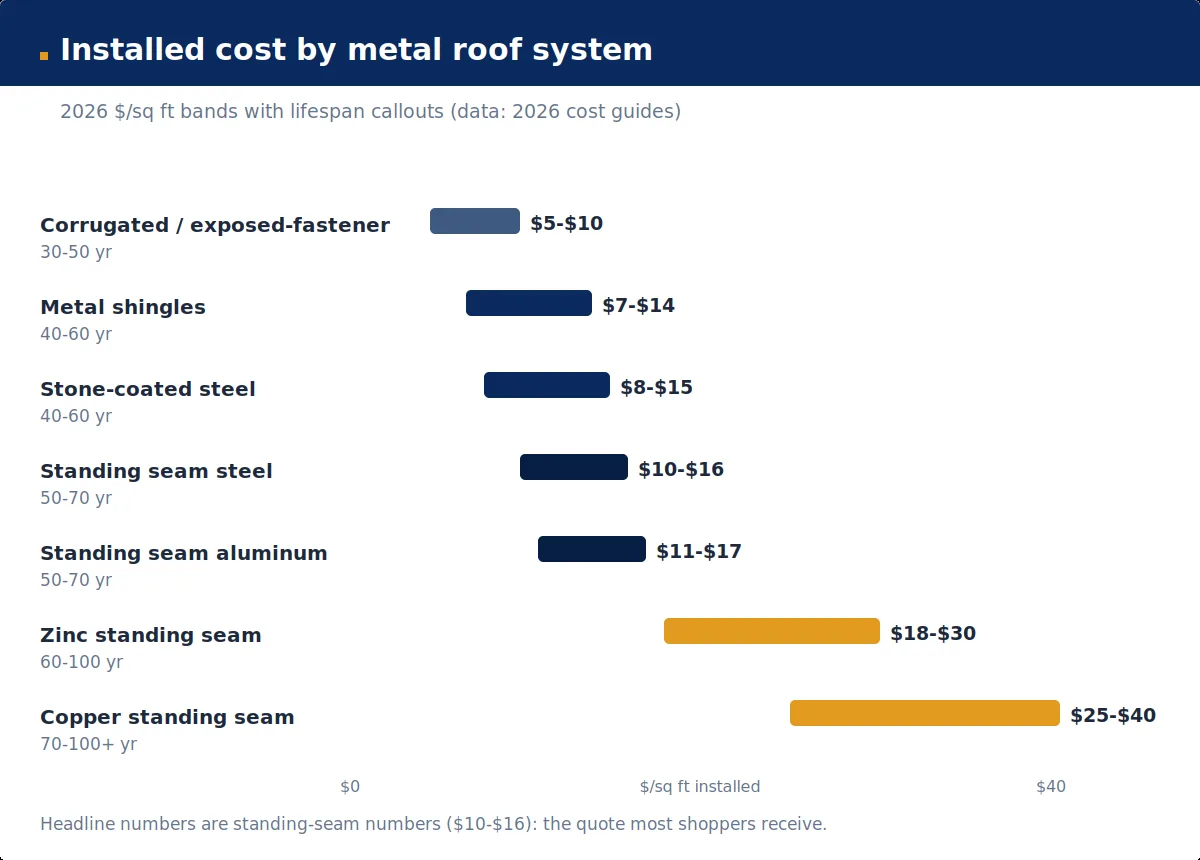
Metal roof cost by system: the full 2026 ladder
Metal is not one roof. It is seven systems at seven prices, and quoting “a metal roof” without naming the system is how $15,000 misunderstandings happen:
| System | Installed $/sq ft (2026) | Lifespan | Notes |
|---|---|---|---|
| Corrugated / exposed-fastener steel | $5–$10 | 30–50 yr | Cheapest metal; fasteners exposed, more maintenance |
| Metal shingles (steel) | $7–$14 | 40–60 yr | Looks like shingles/slate; Class 4 impact, 50-yr warranties |
| Stone-coated steel | $8–$15 | 40–60 yr | Most homeowners pay ~$19,550 (myhomequote.com) |
| Standing seam steel | $10–$16 | 50–70 yr | The residential default; hidden fasteners |
| Standing seam aluminum | $11–$17 | 50–70 yr | Coastal/salt-air premium (HomeAdvisor: $11–$18) |
| Zinc standing seam | $18–$30 | 60–100 yr | Self-healing patina; boutique |
| Copper standing seam | $25–$40 | 70–100+ yr | Premium; patinas green |
Per square (100 sq ft of roof): standing seam $900–$1,600 (26-gauge) or $1,100–$1,600 (24-gauge); through-fastened $500–$900 (aibuildcalc.com, Sep 2026). Angi’s often-quoted “$5,700–$17,700 metal roof average” blends every system above including corrugated — do not compare it to standing-seam-only figures.
The headline numbers are standing seam numbers. When this article says “metal roof cost,” it means standing seam steel at $10–$16/sq ft unless the system is named. That is the quote 80% of residential metal shoppers receive.
The 2026 tariff shock: why metal costs more this year
This is the freshness edge most 2026 guides bury or omit. On April 6, 2026, Section 232 tariffs were restructured to 50% on steel, aluminum, and most copper articles — charged on the full customs value — with 25% on derivatives. A temporary 10% surcharge (Section 122, Feb 24, 2026) was replaced by Section 301 tariffs on July 24, 2026 (ftmercati.com; imhora.com, Oct 2026).
The pass-through is measurable. BLS producer price indexes: aluminum mill shapes +25–40% year-over-year (33% in January 2026 per AGC; 40.5% to July per ftmercati), steel mill products +20–28% (20.7% January; 27.6% September), construction inputs +11.9% YoY in September 2026. Hot-rolled coil futures hit $1,317/ton on October 6, 2026 — up 63.6% year-over-year. Estimated additional US construction material costs in 2026: $4.8 billion (pacificbeachbuilder.com, Oct 2026).
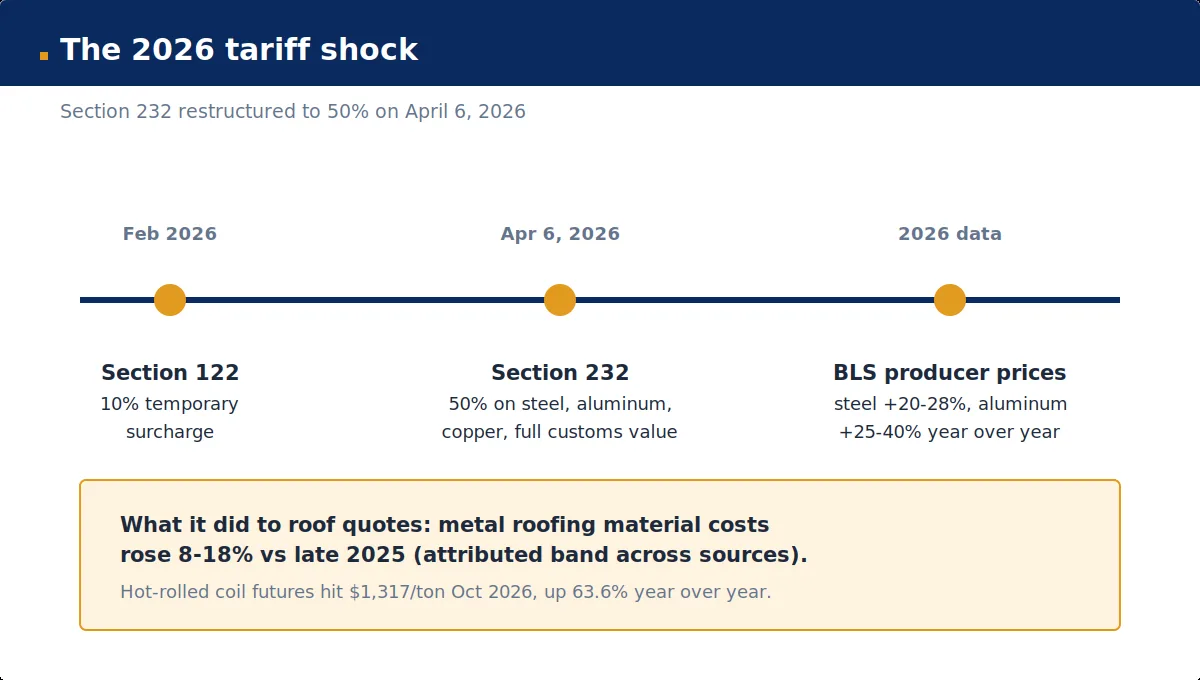
What it did to roof quotes: metal roofing material costs rose 8–15% versus late 2025 (hammerio.com); a residential analysis puts the tariff push at 12–18% (mywebanswers.com; elevatedperceptions.net, Jun 2026). Present the band honestly: 8–18% across sources, with the wide end depending on how much of the supply chain a source counts. Commercial-scale evidence: a 20,000 sq ft commercial roof now bids $36,000–$70,000 more than in recent years (roof.care).
The honest 2026 framing, stated plainly (mywebanswers.com): energy savings alone may not justify the upgrade this year — you need durability, insurance discounts, resale, or climate hazards to close the gap. The tariff year made the “is it worth it” question harder, not easier. Keep reading: the 50-year math is where metal earns its keep.
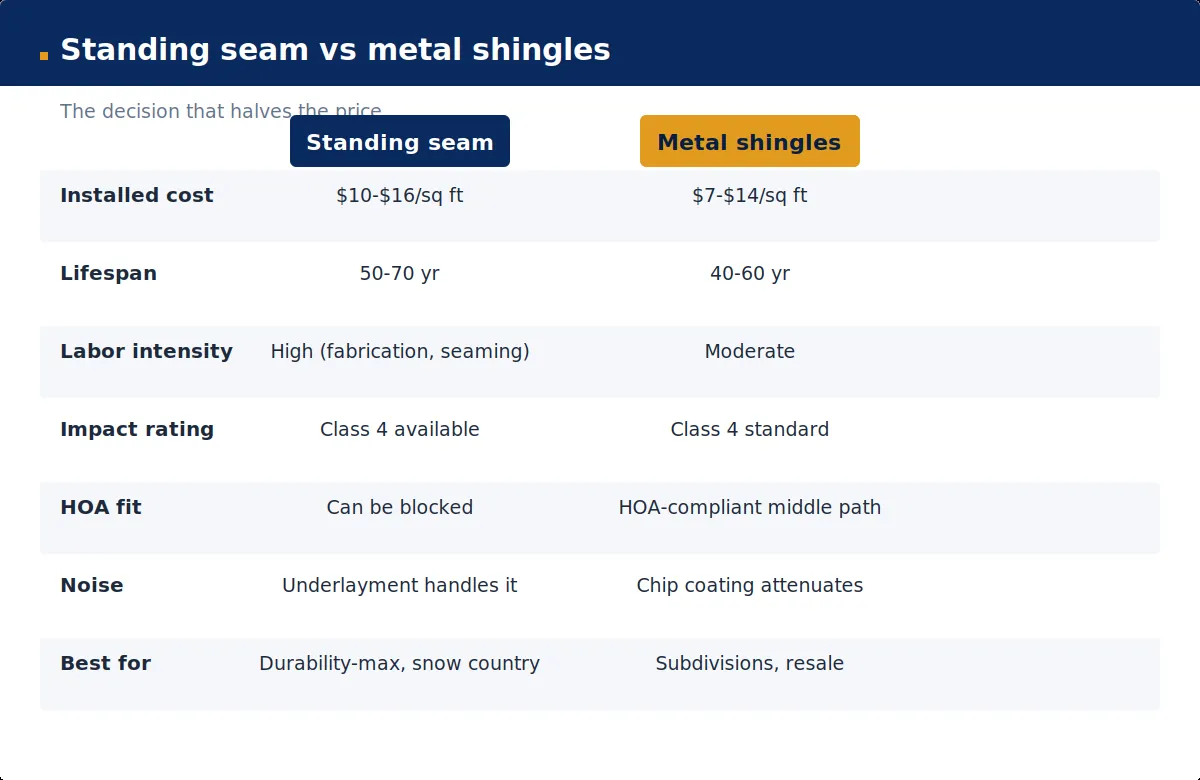
Standing seam vs metal shingles: the decision that halves the price
The two systems most homeowners actually compare are standing seam and metal shingles — and they differ in more than price:
| Standing seam | Metal shingles | |
|---|---|---|
| Installed cost | $10–$16/sq ft | $7–$14/sq ft |
| Lifespan | 50–70 yr | 40–60 yr |
| Labor intensity | High (panel fabrication, seaming) | Moderate |
| Fasteners | Hidden | Hidden |
| Impact rating | Class 4 available | Class 4 standard |
| HOA fit | Can be blocked by “non-traditional” rules | The HOA-compliant middle path |
| Stone-coated option | No | Yes ($8–$15, sound-attenuating chip coating) |
| Noise myth | Addressed by underlayment | Chip coating attenuates sound |
| Best for | Durability-max buyers, snow country, modern look | Subdivisions, resale, shingle/slate aesthetics |
Metal shingles are the sleeper of this guide: nearly the lifespan, nearly the wind and impact ratings, $3/sq ft cheaper installed — and they sidestep the two most common objections to metal (HOA boards and the rain-noise myth). If your decision stalls on looks or price, shingles deserve the second quote.
Snap-lock vs mechanical-lock (standing seam profiles): snap-lock $9–$16/sq ft is the cheapest profile — panels snap together, best for standard slopes. Mechanical-lock $11–$20/sq ft is double-folded on site — required for low slopes, high-wind, and heavy-snow zones (theroofingbrief.com, Oct 2026). Your roof pitch decides this, not your budget.
24-gauge vs 26-gauge: 24-gauge is the thicker, hail-recommended panel (a Colorado Springs contractor recommends 24ga Galvalume as baseline; 26ga $2.60–$7, 24ga $3–$8, 22ga $10–$25/sq ft per HomeAdvisor gauge tables). If hail is your climate, the gauge is not where to save money.
Metal roof cost for a 2,000 sq ft home: the real totals
Per-square-foot numbers are for comparing systems. Home totals are for writing checks:
| Home size | Standing seam (2026) | Notes |
|---|---|---|
| 1,500 sq ft | $15,000–$24,000 | Smaller footprint, proportionally less |
| 2,000 sq ft (typical) | $20,000–$36,000 | Charlotte NC BBB A+ contractor data (bestroofingnow.com, Jun 2026); serviceagent.ai: $24,000–$44,000 at $12–$22/sq ft (high-side planning estimate); theroofingbrief.com: $19,000–$42,000 |
| 2,500 sq ft | $25,000–$40,000 | Complexity adds faster than area |
HomeAdvisor’s national average (Jun 2026): $19,000 standing seam; most homeowners land $9,400–$32,600; metal overall averages $11,741 with most projects $5,745–$17,740 (blends all systems). Regional reads: Colorado Springs 2026 — standing seam $12.68–$14.14/sq ft Class 4, labor $3–$7/sq ft, underlayment $1,100–$4,200, ice/water shield $125–$170/square (coloradoproroofing.com, Apr 2026). Santa Rosa CA — standing seam $18,000–$40,000+, labor $100–$200/square vs shingle $50–$100 (cornerstoneroofs.com, Oct 2026). Treasure Valley ID — $16,000–$42,000 metal vs $9,000–$24,000 asphalt (fitnessportal.org, Oct 2026).
Where the money goes. Labor and panel fabrication are roughly half a standing-seam invoice: painted steel panel material $2.50–$5/sq ft; labor $4–$8/sq ft; trim, flashing, and closures another 10–15% of the total (aibuildcalc.com, Sep 2026). New England Metal Roof breaks it down as materials 30–40% of total, labor $3–$7/sq ft, tear-off $1–$5/sq ft. The corollary: a quote that is suspiciously cheap is usually light on labor — which is exactly where leaks come from.
Metal roof cost drivers: what moves you within the band
Roof complexity. Pitch, valleys, chimneys, dormers, and access drive labor — trim, flashing, and closures alone are 10–15% of the job, and standing-seam crews work 1.5–2.2x slower than corrugated installers (theroofingbrief.com; aibuildcalc.com).
Tear-off vs overlay. A full tear-off and disposal runs $1–$3/sq ft (estimatorsuite.com). Installing over one existing shingle layer (allowed in most codes) saves $1,000–$3,000 — but you sacrifice the deck inspection, may void manufacturer warranties, and complicate future leak detection (bestroofingnow.com; dealyplanet.com; ksinglecorp.com). On a 2,000 sq ft roof that is roughly a 5–10% saving in exchange for a blind deck. Most premium quotes assume tear-off; cheap quotes assume overlay. Ask which yours assumed.
Underlayment and ice-water shield. $1,100–$4,200 for underlayment; $125–$170/square for ice-water shield (Colorado Springs data). Required in snow and ice-dam zones — not optional there.
Waste factor. Order ~10% extra material for cuts and flashing (newenglandmetalroof.com). Legitimate quotes include it.
Disposal and tear-off. Ripping off the old roof costs $1–$3/sq ft for labor plus dumpster and landfill fees — $2,000–$6,000 on a typical home. Two-layer tear-offs (common on older homes) run at the high end. This is the line item cheap overlay quotes skip.
| Region (2026) | Standing seam installed | Notes |
|---|---|---|
| Colorado Springs, CO | $12.68–$14.14/sq ft | Class 4 rated; labor $3–$7/sq ft (coloradoproroofing.com, Apr 2026) |
| Santa Rosa, CA | $18,000–$40,000+ | Labor $100–$200/square vs shingle $50–$100 (cornerstoneroofs.com, Oct 2026) |
| Treasure Valley, ID | $16,000–$42,000 | Metal vs $9,000–$24,000 asphalt (fitnessportal.org, Oct 2026) |
| Charlotte, NC | $20,000–$36,000 | BBB A+ contractor data (bestroofingnow.com, Jun 2026) |
Corrugated metal: when the budget option makes sense
At $5–$10/sq ft installed, corrugated (exposed-fastener) metal is the only metal system that competes with asphalt on sticker price — a 2,000 sq ft home lands around $10,000–$20,000, squarely in premium-asphalt territory. It buys you a 30–50-year panel life and the metal look for roughly half the standing-seam price.
The tradeoffs are real and should be priced honestly. The fasteners are exposed — hundreds of rubber-washer screws that weather, loosen, and need re-torquing or replacement every 10–15 years. The panels expand and contract against those fasteners, which is why corrugated’s lifespan is 30–50 years rather than 50–70. It is louder in rain (no chip coating), less HOA-friendly, and thinner gauges dent more easily.
Corrugated makes sense for: outbuildings, cabins, and rentals where the budget is fixed and the aesthetic is rustic; homeowners who want metal’s longevity floor without the standing-seam premium. It does not make sense as a “cheap standing seam” — if you want the 50-year roof with the hidden-fastener warranty story, the $5–$10 band is not it.
Metal roof cost over 50 years: where metal wins, slowly
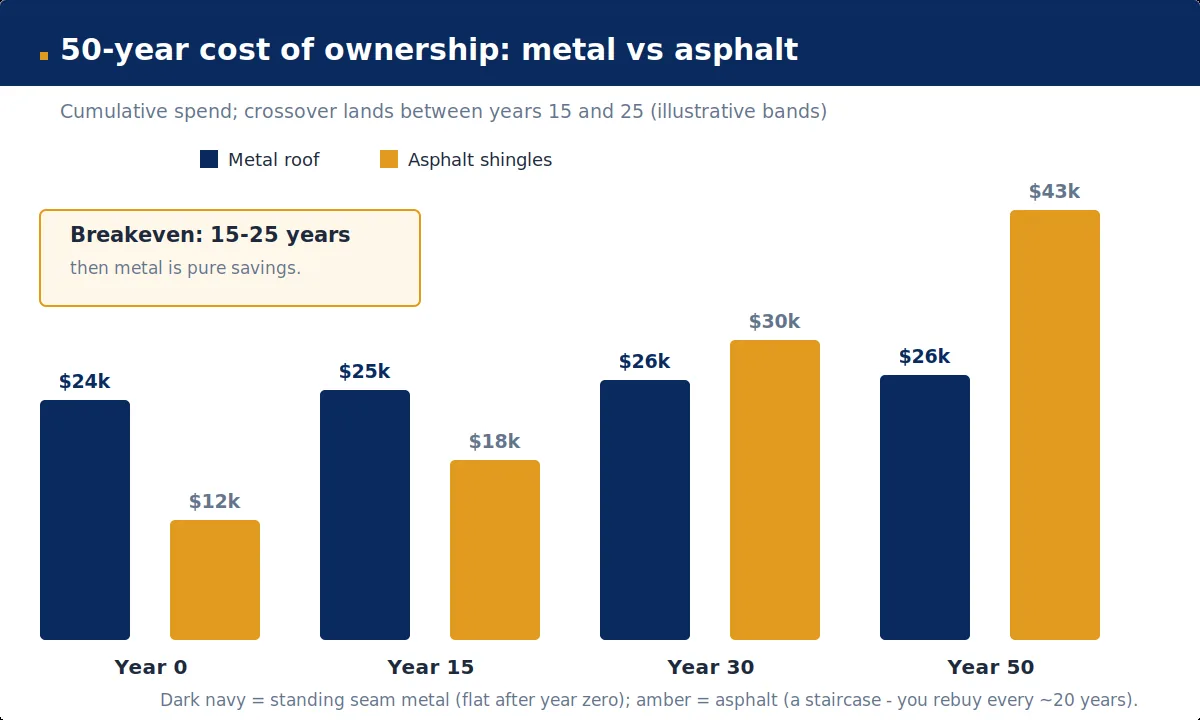
This is the centerpiece — the only honest way to compare a $28,000 roof to a $9,000 roof:
- Upfront: standing seam $20,000–$36,000 vs architectural asphalt $7,000–$11,000 on a 2,000 sq ft home (estimatorsuite.com) — metal costs 2–3x more upfront (hammerio.com; ksinglecorp.com). For the asphalt deep-dive, see our roof replacement cost guide.
- Lifespan: metal 40–70 years (standing seam 50–70; corrugated 30–50; copper/zinc 70–100+) vs asphalt 15–30 years. Consensus across all sources.
- 30-year totals (hammerio.com): asphalt $27,500–$46,000 (including one full replacement) vs standing seam $20,900–$38,000 — metal is cheaper by year 30.
- Breakeven: 15–25 years (newenglandmetalroof.com); 15–20 years (elevatedperceptions.net; HomeCostLab).
- Cost-per-year framing (dealyplanet.com, Apr 2026): a $12,000 shingle roof over 20 years = $600/yr; a $24,000 metal roof over 50 years = $480/yr.
- Maintenance: metal $0–$200/yr (homeauthoritypro); over the decades, metal $200–$500 per 10–15 years vs shingle $300–$1,000 per 5–10 years (newenglandmetalroof.com); 50-year totals $2,500 metal vs $7,500 shingle (homeauthoritypro).
Worked example — a 2,000 sq ft home, mid-range quotes, cumulative spend:
| Year | Architectural asphalt | Standing seam metal |
|---|---|---|
| 0 (install) | $9,000 | $28,000 |
| 15 (asphalt mid-life repairs) | +$2,000 | $0 |
| 20–25 (asphalt replacement) | +$12,000 (inflated) | $0 |
| 30 | $23,000 cumulative | $28,000 cumulative |
| 40–50 (asphalt replacement #2 begins) | +$14,000 | $0 |
| 50 total | ~$37,000 | ~$28,000 |
Asphalt’s curve is a staircase — every 20 years you buy the roof again, at inflated prices. Metal’s curve is flat after year zero. The crossover lands between years 15 and 25 depending on your quotes and local labor inflation. After the crossover, metal is pure savings — $480/year of housing cost vs $600+/year, before counting the energy and insurance benefits stacked below.
One widely-shared model — homeauthoritypro.com’s 50-year totals of $34,500 asphalt vs $6,500 metal (“$20,000–$30,000 less”) — is one publisher’s model, not an industry figure. Treat it as the optimistic end of the band, not the promise. The conservative, defensible claim is the breakeven band: metal pays back in 15–25 years, and everything after that is savings.
The catch the 50-year chart hides: you have to stay in the house. If you sell at year 10, you never reach the crossover — you recover 60–70% of the cost at resale (next section) but not the rest. The 50-year math rewards long stays; the resale math is what protects movers.
The benefit stack: energy, insurance, resale
Metal’s premium is not just lifespan. The benefit package, stacked:
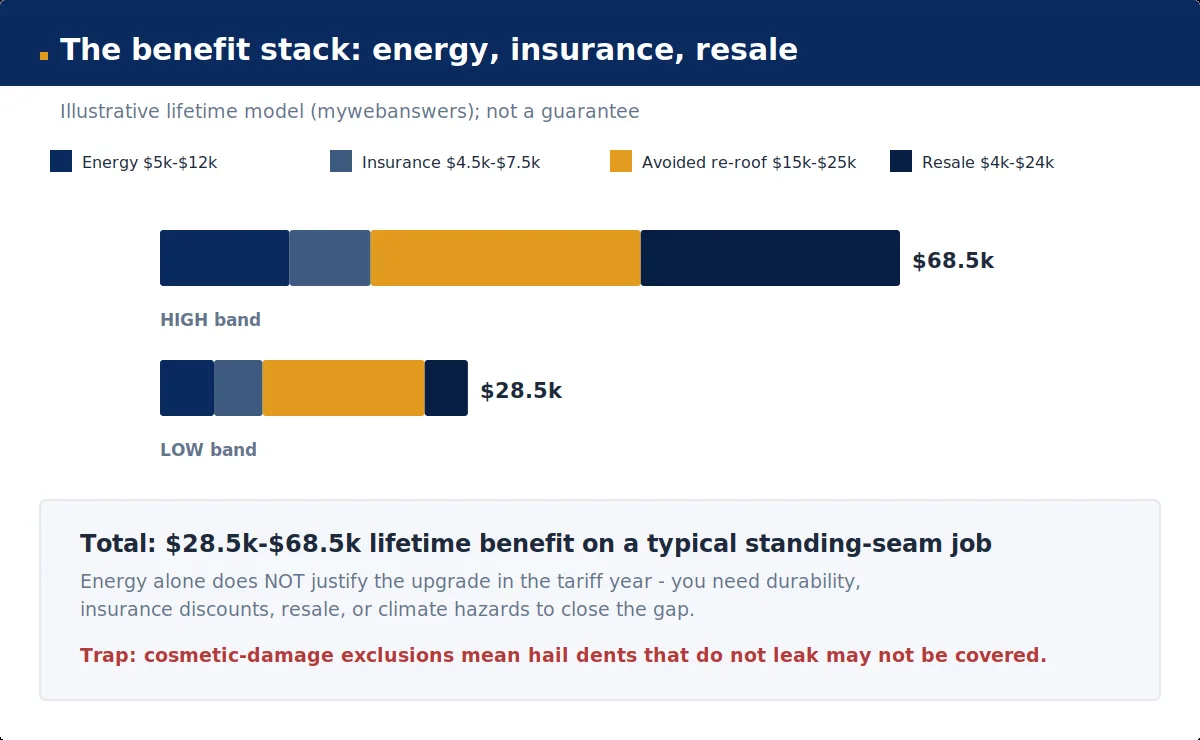
Energy: cooling costs drop 10–25% (Metal Roofing Alliance; DOE cool-roof data — metal surfaces stay up to 50°F cooler). In dollars: $200–$600/year in hot climates (homeauthoritypro); Texas light-colored standing seam 15–22% is the realistic band (mywebanswers.com); 25-year cumulative $5,000–$12,000 (mywebanswers, illustrative). But remember the tariff-year framing: energy alone does not justify the upgrade.
Insurance: discounts of 5–35%, averaging ~20% (Metal Roofing Alliance; newenglandmetalroof.com); hail states 15–25%; typically $50–$500/year; stone-coated Class 4 often earns 20–30% (hammerio.com). Concretely: 15% off a $2,000 premium = $300/year (elevatedperceptions.net). The ratings behind the discounts: UL 2218 Class 4 impact (2-inch steel ball dropped from 20 feet), Class A fire, and tested wind performance (ridgelineconstructionhsv.com; angi.com, Jul 2026).
2026 insurance backdrop: on March 18, 2026, FHFA reversed policy — Fannie Mae and Freddie Mac may now accept Actual Cash Value (ACV) roof coverage on single-family homes (roomgic.com). ACV depreciates your roof’s payout as it ages. Metal’s 50–70-year lifespan is the direct counter-argument: an ACV policy punishes roofs that die young and rewards roofs that don’t. If your carrier moves you to ACV, a metal roof is one of the few upgrades that directly improves your coverage economics — a 20-year-old metal roof still has 30+ years of life to depreciate slowly against, while a 20-year-old asphalt roof is a claim waiting to be denied.
Resale: +1–6% home value — $3,000–$18,000 on a $300,000 home; Remodeling Magazine’s Cost vs Value shows 60–70% cost recovery (newenglandmetalroof.com). One roofer-published claim runs 60–85% (ridgelineconstructionhsv.com) — keep both attributed; use the conservative 60–70% band in your expectations. On a $28,000 standing-seam job, that is $16,800–$19,600 back at sale — which is exactly why the “sell at year 10” scenario still pencils out for many sellers, even without reaching the 50-year crossover.
Trap: the cosmetic-damage exclusion. Competitors sell the insurance discount and stop there. Some policies now exclude cosmetic-only metal damage — hail dents that do not leak may not be covered (fitnessportal.org, Oct 2026). Your roof can look like a golf ball and your carrier can still say no. Before you count the discount, read the exclusion page of your own policy. This is the trap that turns a hailstorm into a self-pay cosmetic problem.
Metal + solar: the pairing note
One pointer for solar households: a standing-seam roof is the best roof for future solar — panels clamp to the seams with no roof penetrations. And if you are overlaying metal over an existing shingle roof that carries a solar array, the array never comes off: contrast that with the detach-and-reset process our solar panel removal & reinstall guide prices. Sequence matters: if a metal roof is in your 5-year plan and solar is in your 1-year plan, do the roof first.
2026 tax status: $0 federal, one commercial exception
Say it plainly: §25C = $0 for metal roofs in 2026. OBBBA (P.L. 119-21; IRS FS-2025-05) ended the residential energy credit for property placed in service after Dec 31, 2025 — and §25C never covered the roof itself anyway, only ENERGY STAR metal roofs with pigmented coatings. Nothing survives for residential metal in 2026. For the full credit-kill list, see our 2026 energy tax credits guide.
The one exception: §48E commercial — business-owned metal systems in service by Dec 31, 2027 may still qualify. Residential owners get $0. Do not let a salesperson resurrect the credit.
What a good metal roof quote itemizes
Metal quotes are where vague numbers cost the most. Demand all nine in writing:
- System and profile — standing seam vs shingles; snap-lock vs mechanical-lock; gauge (24 vs 26)
- Material $/sq ft AND roof square footage — the math must reconcile to the total
- Panel material cost separated from labor — labor + fabrication is ~half the invoice
- Tear-off vs overlay — which is assumed; if overlay, the warranty consequence in writing
- Underlayment type — synthetic vs ice-water shield, and where each goes
- Trim, flashing, and closures — 10–15% of the job, itemized
- Waste factor — ~10% extra material, included or not
- Penetration and chimney flashing detail — valleys, skylights, vents priced individually
- Workmanship warranty term — separate from the panel warranty, in years, in writing
Two more money questions worth asking before you sign. First, the maintenance schedule: standing seam is close to set-and-forget — an annual visual check, keeping valleys and gutters clear, and re-sealing exposed penetration flashings every 10–15 years. Budget $0–$200/year (homeauthoritypro) — or $200–$500 per decade for the sealant work (newenglandmetalroof.com). Compare that to asphalt’s $300–$1,000 every 5–10 years for repairs, moss treatment, and ridge-cap replacement. Over 50 years the maintenance gap alone is roughly $5,000 in metal’s favor.
Second, what voids the panel warranty: the common killers are installing over an unapproved substrate, walking on the panels incorrectly during later trades’ work (HVAC, solar — tell every contractor the roof is metal), and using incompatible metals for flashing (galvanic corrosion between, say, copper flashing and a steel panel will eat the panel). Get the “approved walking and penetration” rules in writing — a $28,000 roof should not be compromised by a $300 satellite-dish install.
Get three quotes. And when one is 40% cheaper than the other two, it is not the same roof — check the gauge, the profile, the tear-off assumption, and the underlayment before you celebrate.
Key takeaways
– Metal roof cost 2026: $10–$16/sq ft standing seam ($20,000–$36,000 per home); metal shingles $7–$14; corrugated $5–$10.
– The tariff year added 8–18% to material costs vs late 2025 — energy savings alone no longer justify the upgrade; you need durability, insurance, resale, or climate hazards to close the gap.
– Metal wins the 50-year race: breakeven 15–25 years, then the savings compound. It rewards long stays; resale recovers 60–70%.
– Insurance discounts average ~20% — but cosmetic-damage exclusions mean hail dents that don’t leak may not be covered.
– Metal shingles are the sleeper: nearly the lifespan, $3/sq ft cheaper, HOA-friendly.
– $0 federal tax credit in 2026. §48E commercial only.
Sources & methodology
Cost figures compiled November 2026 from published 2026 cost guides and contractor data: estimatorsuite.com (Jul 2026); hammerio.com (2026); HomeAdvisor (Jun 2026, via theroofingbrief.com); newenglandmetalroof.com; bestroofingnow.com (Jun 2026, BBB A+ contractor data); serviceagent.ai; aibuildcalc.com (Sep 2026); theroofingbrief.com (Oct 2026); myhomequote.com; This Old House (Jun 2026); coloradoproroofing.com (Apr 2026); cornerstoneroofs.com (Oct 2026); fitnessportal.org (Oct 2026); Metal Roofing Alliance; DOE cool-roof data; ridgelineconstructionhsv.com; angi.com (Jul 2026); elevatedperceptions.net (Jun 2026); HomeCostLab; dealyplanet.com (Apr 2026); homeauthoritypro.com (50-year model, one publisher — flagged); mywebanswers.com (benefit arithmetic, illustrative — flagged); roomgic.com (FHFA ACV policy, Mar 18, 2026). Tariffs: ftmercati.com; imhora.com (Oct 2026); kharypenebaker.com (Jun 2026); roof.care; pacificbeachbuilder.com (Oct 2026); BLS PPI; AGC. Tax: IRS FS-2025-05, OBBBA P.L. 119-21. Asphalt pricing referenced from our article 6; OBBBA master list from our article 5. Stale/outdated kyro.ai content excluded as a source.
Disclaimer: Prices are 2026 US national averages and vary by region, roof complexity, system, gauge, and contractor — get 3 written, itemized local quotes. Tax and rebate information is general and not tax advice — confirm with a tax professional. Roofing is licensed-contractor work at height — this article covers cost and decision information only, never installation instructions.
How much does a metal roof cost in 2026?
Standing seam steel — the most popular residential metal roof — costs $10–$16 per square foot installed in 2026, or $20,000–$36,000 on a typical 2,000 sq ft home (HomeAdvisor national average, Jun 2026: $19,000). Metal shingles run $7–$14/sq ft, corrugated $5–$10, stone-coated steel $8–$15. Tariffs added 8–18% to material costs vs late 2025, so 2026 quotes run hotter than 2024–2025 pages suggest.
How much do metal shingles cost vs standing seam?
Metal shingles cost $7–$14 per square foot installed vs $10–$16 for standing seam — roughly $3/sq ft cheaper, or $6,000–$8,000 less on a typical home. You get nearly the same lifespan (40–60 years), Class 4 impact ratings, and 50-year warranties, plus HOA-friendly looks and better sound attenuation. The tradeoff: shorter maximum lifespan (no 70-year copper/zinc equivalent) and less of the modern standing-seam aesthetic.
How have 2026 tariffs affected metal roof prices?
Section 232 tariffs were restructured to 50% on steel, aluminum, and most copper articles on April 6, 2026. BLS producer prices rose 20–28% for steel mill products and 25–40% for aluminum mill shapes year-over-year. Material costs for metal roofing rose 8–18% vs late 2025 across sources. The honest 2026 framing: energy savings alone no longer justify the upgrade — you need durability, insurance discounts, resale value, or climate hazards to close the gap.
Is a metal roof worth it over asphalt shingles?
Over 15–25 years, yes — that is the breakeven band where metal’s 50–70-year lifespan overtakes asphalt’s 15–30 years plus a full replacement ($27,500–$46,000 asphalt vs $20,900–$38,000 metal over 30 years). Over a shorter stay, metal recovers 60–70% of its cost at resale. The $20k–$40k premium buys lifespan, 10–25% cooling savings, ~20% average insurance discounts, and 1–6% resale value — but only if you itemize a real quote and read the insurance exclusions.
Do metal roofs lower homeowners insurance?
Usually — discounts run 5–35% and average ~20%, with hail states at 15–25% and stone-coated Class 4 roofs often earning 20–30%. The ratings behind the discounts are UL 2218 Class 4 impact, Class A fire, and tested wind performance. The trap: some policies exclude cosmetic-only damage, so hail dents that don’t leak may not be covered. Read the exclusion page of your own policy before counting the discount.
Can you install a metal roof over existing shingles?
Yes, in most codes — overlaying metal over one shingle layer saves $1,000–$3,000 on tear-off and disposal ($1–$3/sq ft). But you sacrifice the deck inspection, may void manufacturer warranties, and complicate future leak detection. On a 2,000 sq ft roof that is roughly a 5–10% saving in exchange for a blind deck. Most premium quotes assume tear-off; cheap quotes assume overlay — ask which yours assumed, and get the warranty consequence in writing.
How long does a metal roof last?
Standing seam steel lasts 50–70 years; metal shingles and stone-coated steel 40–60 years; corrugated 30–50 years; zinc 60–100 years; copper 70–100+ years. Asphalt shingles last 15–30 years by comparison. Lifespan is the whole economic argument for metal: the roof you buy in 2026 may still be on the house in 2096, while asphalt would have been replaced two or three times.
6 thoughts on “Metal Roof Cost in 2026 (Standing Seam vs Metal Shingles)”