


Montana hands a solar buyer the best billing deal in the northern Rockies and the weakest reason to use it, in the same envelope. The deal is real: every extra kilowatt-hour the panels send out cancels a kilowatt-hour bought later, at full value, for up to a year. The reason is thin: Montana electricity is cheap, the federal credit that once cut the price by nearly a third is gone for 2026 homeowner installs, and the state offers no rebate to take its place.
Cheap power and generous credits pull the Montana numbers in opposite directions all through this guide. Panels here cost a little less than the national average to install. The power they replace costs about 14 percent less than the national average. A system sized with care still earns its money back, but it earns it slowly, and the difference between a good Montana install and a poor one is rarely the panel brand. It is the size of the system, the name on the electric bill, and one box on a utility form.
The box matters more than most buyers are told. Once a year, on a date the homeowner chooses, every banked credit the home has not used goes to the utility for nothing. Pick April, after a long heating winter has spent the bank, and little is lost. Pick October, with the whole summer surplus still in the bank, and the home gives away months of sunshine just before the season that needed it. No other choice in the buying process costs so much for so little attention.
The name on the bill matters nearly as much. About 6 in 10 Montana homes buy power from NorthWestern Energy, a smaller share from Montana-Dakota Utilities, and the rest from about two dozen rural electric co-operatives that write their own solar rules outside state law. A Flathead Valley member and a Billings homeowner can buy identical panels and live under different economics, because the co-op member’s credits face a large monthly basic charge that solar cannot touch.
One more Montana fact belongs before any price. The state is not one solar climate. Billings, open to the Yellowstone Valley sky, makes about 14 percent more power per kilowatt than Missoula, tucked in a western valley where winter inversions sit. Bozeman gets more than twice Missoula’s snowfall. A statewide average hides all of that, so this guide prices four cities separately and gives each its own production figure.
Start with the big picture before the Montana detail: our national solar panel cost guide lays out what systems cost across the country and which federal rules still shape every quote. What follows prices Montana on its own terms: the cross-checked cost band, four cities, the settle-up rule, and each utility’s terms, with a source and a date on every figure.
Table of Contents
How Much Do Solar Panels Cost in Montana in 2026?
No single published average drawn from completed Montana invoices was found, so this guide builds its headline price the honest way: three independent 2026 models, laid side by side, with the band they agree on and the outliers named. The band is $2.54–$2.91 per watt installed, before any incentive. An 8 kW system at that band costs $20,320–$23,280, and the payback section uses the midpoint, about $21,800, as its working cost. Treat the band as a planning range to hold quotes against, not a price any installer has promised.
EnergySage gives the low end. Its Montana page, updated November 6, 2026, from marketplace quote data, puts the state average at $2.54 per watt including installation. The average Montana system quoted through its marketplace is large, 14.13 kW at $35,833, with prices ranging from $30,458 to $41,208, which works out to about $2.16–$2.92 per watt across that range. Its size table charges the same per-watt rate at every size, so an 8 kW system costs $20,285 on its figures. EnergySage also puts the national average at $2.60 per watt, which makes Montana slightly cheaper than the country as a whole.
EcoGen gives the center. Its Solar Cost Index, September 2026 edition with prices as of September 25, 2026, puts Montana at $2.73 per watt cash before incentives, 11th lowest of 51 jurisdictions, against a $2.89 national figure. Its typical Montana system is 7.13 kW, the median size Montana homeowners installed in 2025 on Berkeley Lab data covering 599 systems, at $19,465. A buyer who sees $2.73 a watt on a written quote is seeing the middle of the Montana market, not a bargain and not a rip-off.
SolarReviews gives the high end. Its November 2026 cost model, built from National Renewable Energy Laboratory, Energy Information Administration, and Bureau of Labor Statistics data, puts Montana at $2.91 per watt, with a 7.1 kW system at $21,957 before incentives, against a $3.03 national average. Its “after tax credit” column still subtracts the expired 30 percent federal credit and is ignored here. The cost model itself is sound; the tax column is stale, and the two should not be confused.
Two weaker trackers land inside the same band from thinner evidence. Renewestimator, working from a two-ZIP sample, puts Montana at $2.78 per watt with an 8 kW system at $21,760, though the same site contradicts itself elsewhere with a $3.00 per watt figure, so it counts as weak corroboration only. A March 2026 installer-style page puts the range at $2.60–$3.10 per watt. Neither source sets the headline band, and neither contradicts it.
One figure sits outside the band and is named as an outlier. A ZIP-code cost site puts both Billings and Great Falls at $3.12 per watt, the identical number for two different cities, with no method stated. That is above every other 2026 model for Montana, and a quote at $3.12 a watt for an ordinary roof should have to explain itself: premium equipment, a steep or complex roof, or a long wire run, stated in writing.
The neighbors bracket Montana closely on EcoGen’s index. South Dakota sits at $2.85, Idaho at $2.96, Wyoming at $3.14, and North Dakota at $3.39 per watt. Montana is the cheapest of its neighbors to install in, which is a small comfort when the power being replaced is also cheap. For the Wyoming figures, see our Wyoming solar panel cost guide, and for Idaho, our Idaho solar panel cost guide.
The installed price buys a working system, not a pile of parts: panels, inverter hardware in either a single string inverter or one microinverter per panel, racking and flashing, wiring with disconnects, the permit and inspection fees, the labor, and the visit that starts the system up. Montana adds one saving other states lack: there is no general statewide sales tax, so no sales tax is added to the equipment or the labor. The costs outside the headline price are where Montana buyers still get surprised, because the work around the system is billed separately.
- Roof repairs or a roof replacement before the panels go on, priced on their own
- An electrical panel upgrade, if the existing service cannot take the solar backfeed
- A battery, priced separately and covered in its own section below
- Tree removal or trimming where pines or cottonwoods shade the roof
- Snow guards or extra racking on a steep metal roof, where the installer specifies them
- The NorthWestern Energy $200 interconnection processing fee, which the quote should state rather than absorb silently
Ask three licensed installers for written quotes on an identical scope of work. Drop any bidder who will not name the panel model, the inverter type, the year-one production estimate for the actual roof direction, and the settle-up month the savings math assumes, because a Montana savings estimate that prices every generated kilowatt-hour at retail without mentioning the yearly reset is pricing a rule that does not exist.
| Source | Price per watt | 8 kW total | Basis |
|---|---|---|---|
| EnergySage (Nov 2026) | $2.54 average | $20,285 | Marketplace quote data |
| EcoGen Index (Sept 2026) | $2.73 | $21,840 (scaled) | Cost index, cash, before incentives |
| SolarReviews (Nov 2026) | $2.91 | $23,280 (scaled) | NREL/EIA/BLS cost model |
| renewestimator (July 2026) | $2.78 | $21,760 | Two-ZIP sample, weak basis |
| solarcostbyzip (Sept 2026) | $3.12 | $24,960 (scaled) | Outlier, no method stated |
Read the table’s 8 kW column as scaled arithmetic: the EcoGen, SolarReviews, and solarcostbyzip totals come from multiplying each source’s per-watt average by 8,000 watts, because none of those three publishes an 8 kW total of its own, and the table marks each one as scaled. The headline band of $2.54–$2.91 per watt is the range from the EnergySage average to the SolarReviews average, with EcoGen at its center. The agreement across three different methods inside a 37-cent spread is the point: Montana installs cost about $2.70 a watt at the center, and the band around it is wide enough to hold most real quotes.
Solar Panel Cost in Montana by System Size
Kilowatts, written kW, measure the peak power panels can make under full sun, and every size in this section is priced in those units. Going bigger raises the total bill while usually trimming the price of each watt, since the crew’s visit, the permit, and the inverter cost nearly the same whether they serve 15 panels or 25. The table below prices the headline band with a slight taper, so the per-watt price falls a little as the system grows, and it shows production at the planning figure of 1,300 kilowatt-hours per kilowatt each year against the average Montana home’s 10,224 kilowatt-hours a year.
| System size | Installed cost | Cost per watt | Yearly production | Share of average use |
|---|---|---|---|---|
| 4 kW | $10,720–$12,200 | $2.68–$3.05 | 5,200 kWh | 51% |
| 5 kW | $13,200–$15,050 | $2.64–$3.01 | 6,500 kWh | 64% |
| 6 kW | $15,600–$17,820 | $2.60–$2.97 | 7,800 kWh | 76% |
| 7 kW | $17,990–$20,580 | $2.57–$2.94 | 9,100 kWh | 89% |
| 8 kW | $20,320–$23,280 | $2.54–$2.91 | 10,400 kWh | 102% |
| 9 kW | $22,590–$25,920 | $2.51–$2.88 | 11,700 kWh | 114% |
| 10 kW | $24,800–$28,500 | $2.48–$2.85 | 13,000 kWh | 127% |
| 11 kW | $27,060–$31,130 | $2.46–$2.83 | 14,300 kWh | 140% |
| 12 kW | $29,280–$33,720 | $2.44–$2.81 | 15,600 kWh | 153% |
Costs: NestPriced planning arithmetic applying the $2.54–$2.91 headline band with a small-size taper around the $2.73 center; no published Montana size-specific model was found. Production and coverage: NestPriced arithmetic at 1,300 kWh per kW per year against 10,224 kWh average annual use (852 kWh a month, EIA Form 861 Table 5A, 2024). Count panels at 400 watts each, and the arithmetic is 20 panels for 8 kW, 15 for 6 kW, and 25 for 10 kW, before setbacks, vents, and shade take roof space away.
The taper is gentle on purpose. A 4 kW system at $2.68–$3.05 per watt costs only a little more per watt than a 12 kW system at $2.44–$2.81, because the expensive parts of a Montana install, the crew’s travel, the racking on a steep roof, and the interconnection paperwork, do not shrink with the array. A quote that charges a steep premium for a small system, or that prices a 12 kW system at the same per-watt rate as a 4 kW system, should explain why.
In Montana the size decision carries a penalty no other state in this series applies in quite the same way. Generation above the home’s yearly use is not paid for at a lower rate. It is given to the utility for nothing at the settle-up date. A 10 kW system making 127 percent of average use hands over roughly 2,800 kilowatt-hours a year unpaid, and a 12 kW system hands over more than 5,300. The lower per-watt price on the big system does not make up for power that earns zero.
The right size follows the home’s last 12 months of bills, not the roof’s capacity and not the sales pitch. At 650 kilowatt-hours a month, about 7,800 a year, a 6 kW system matches the home’s use almost exactly. A home at the state average of 852 a month fits an 8 kW system, with a small surplus that a good settle-up month mostly saves. Electric vehicles, heat pumps, and electric resistance heat can push a home past 1,100 kilowatt-hours a month, which is the kind of load that justifies 10 kW, but only the bills can prove that load exists, and the cheaper per-watt price on the bigger system is not proof.
Roof area is rarely the binding limit: 20 panels at 400 watts each occupy roughly 350 to 400 square feet, and most Montana houses carry well beyond that across the south, east, and west slopes combined. What binds sooner is the roof itself: its age, its pitch, and whether it is metal or asphalt. A steep metal roof sheds snow well and takes a different mounting system from a low-pitch asphalt roof, and a roof that needs replacing within five years should be dealt with before panels are priced at all. Roof replacement pricing, which decides whether the roof should be renewed before any panels are mounted, is covered in our national roof replacement cost guide.
The same three sizes, priced for the country as a whole rather than for Montana alone, are compared in our 6 kW, 8 kW, and 10 kW solar system cost guide. That guide runs the same 6, 8, and 10 kW comparison with national numbers. The table above is the Montana version, and the two agree that 8 kW is the sensible planning size for the average home, with the Montana settle-up rule as the reason not to overshoot it.

Solar Panel Cost by City: Billings, Missoula, Bozeman, and Great Falls
Only two of Montana’s four big cities have a published price figure, and the two figures come from the same source family. EnergySage publishes a Missoula average, and its Bozeman average reaches this guide through an installer page quoting it. Billings and Great Falls have no EnergySage city page and no published invoice average, so their figures below are planning estimates drawn from the state band, labeled as such, and a local quote is the only real price in either city. The city that costs the most to install in is not the city where panels earn the least, and the production column is what separates them.
| System size | Billings (estimate) | Missoula | Bozeman | Great Falls (estimate) |
|---|---|---|---|---|
| 6 kW | $15,600–$17,820 | $16,620 | $16,140 | $15,600–$17,820 |
| 8 kW | $20,320–$23,280 | $22,160 | $21,520 | $20,320–$23,280 |
| 10 kW | $24,800–$28,500 | $27,700 | $26,900 | $24,800–$28,500 |
| 8 kW yearly production | 11,016 kWh | 9,648 kWh | 10,352 kWh | 10,800 kWh |
Billings and Great Falls: NestPriced planning estimates from the state band; no published city model exists for either city. Missoula: EnergySage average $2.77/W, November 2026, scaled to each size. Bozeman: EnergySage average $2.69/W via Wegner Roofing guide, scaled to each size. Production: PVGIS v5.2 city yields (Solar Learning Lab, August 18, 2026): Billings 1,377, Missoula 1,206, Bozeman 1,294, Great Falls 1,350 kWh per kW per year.
Billings is the strongest solar city in the state on production and the largest market for installers. An 8 kW system there makes about 11,016 kilowatt-hours a year, more than any of the other three cities, because the Yellowstone Valley sits open to the sky and the city’s winters, while cold, break often under chinook winds that clear snow off roofs. Billings is NorthWestern Energy territory, so a Billings buyer gets the 1-for-1 credit rule and the right to pick a settle-up month. The price to hold a Billings quote against is the state band, and the $3.12 per watt figure one ZIP-code site publishes for Billings is treated in this guide as an outlier, not a city price.
Missoula is the dearest city to buy in and the weakest on production, a combination that deserves plain statement. EnergySage puts the Missoula average at $2.77 per watt, with the average quoted system a large 11.24 kW at $31,130, and its geo model gives Missoula a 21.53-year payback, far longer than the state figure. That payback is a model output, not a measured result, and it should not be quoted as one, but the direction is right: Missoula’s valley inversions and cloud hold production to 9,648 kilowatt-hours for an 8 kW system, about 1,400 kilowatt-hours a year behind Billings. A Missoula buyer should size from the local production figure, not the state average, and should treat any quote that promises Billings-level output on a Missoula roof with suspicion.
Bozeman sits between the two on both price and production, with the heaviest snow of the four. EnergySage’s Bozeman average of about $2.69 per watt, for an average quoted system of 13.07 kW at about $35,206, comes through a secondary source and is labeled as such. Production at 1,294 kilowatt-hours per kilowatt gives an 8 kW system about 10,352 kilowatt-hours a year. Bozeman’s distinction is its roof: the Montana State University station records 91.3 inches of snow a season on the 1991–2020 normals, more than double Missoula’s 43.0 inches, so racking, snow load, and panel tilt are buying questions in Bozeman in a way they are not in Billings. The City of Bozeman lists a Solar Electric Permit and a submittal checklist for solar work, and the installer should name the permit fee on the quote.
Great Falls pairs strong production with the state’s most demanding wind. An 8 kW system makes about 10,800 kilowatt-hours a year at the city’s 1,350 kilowatt-hour yield, second only to Billings. Great Falls is also where the Rocky Mountain Front’s chinook winds hit hardest, with a 76 mph gust setting a modern city record in January 2021, so the racking attachment and the design wind speed the install is engineered for belong on the quote in writing. No published Great Falls price model exists, so the state band is the planning figure, and three local quotes will tell a Great Falls buyer more than any model.
One caution applies to all four cities. About two dozen rural co-operatives serve the land around them, and the city line on a map is not the utility line. A home with a Billings address on Yellowstone Valley Electric, or a home outside Missoula on Missoula Electric, follows co-op rules, not NorthWestern rules, and the payback changes with them. The buyer should confirm which utility bills the exact address before comparing any city price, because the utility decides the value of every kilowatt-hour the panels make.

Montana Sun, Snow, and Cold: What Panels Actually Produce Here
Montana’s nickname promises more sun than its valleys deliver, and the gap between the promise and the roof is the first thing a buyer should understand. The state is sunny by northern standards, but it is not one sun. Eastern Montana, open and high, catches long clear spells. Western valleys catch mountain cloud, winter inversions, and long shadows from the ridges. The production figures below come from one consistent model run for all four cities, so the differences between cities are real differences in sky, not differences in method.
The model is PVGIS version 5.2, run by Solar Learning Lab on August 18, 2026, on National Solar Radiation Database data, for a fixed roof mount facing south at a 30-degree tilt with 14 percent system losses. It gives Billings 1,377 kilowatt-hours per kilowatt each year, Great Falls 1,350, Bozeman 1,294, and Missoula 1,206, a four-city mean of 1,307. This guide’s statewide planning figure of 1,300 kilowatt-hours per kilowatt is that mean rounded, chosen because it sits inside the published range rather than at either end of it. An 8 kW system at that figure makes about 10,400 kilowatt-hours a year.
The published range runs wider than the PVGIS spread, and the ends of it should be treated with care. EcoGen’s per-utility figures use about 1,410 kilowatt-hours per kilowatt, which is above every PVGIS city result and is treated here as a high outlier. The renewestimator total of 9,794 kilowatt-hours for an 8 kW system works back to roughly 1,224 per kilowatt.
Sunmetriclab implies about 1,344 from its 10,750 kilowatt-hours for the same size. A state table from solarpricelist gives Missoula 1,080–1,230. The PVGIS city figures, with their stated method and date, are the ones this guide builds on, and a quote whose production estimate sits far above the PVGIS figure for its city should show its weather data source.
A peak sun hour is the unit behind all of these figures, and it is worth one plain sentence. It is not an hour of daylight. It is an hour’s worth of full-strength sun, 1,000 watts per square meter, compressed from a whole day of weaker morning, evening, and cloudy light. Montana runs about 4.5 to 4.6 peak sun hours a day on the planning figures used here, with Billings at the sunnier end and the western valleys at the cloudier end. The number matters because it turns panel wattage into yearly energy, and a small difference in it compounds over 25 years.
No part of the Montana solar decision catches buyers out like the swing between seasons. Summer days are long and the sun rides high, so a July month can make roughly twice what a December month makes. Winter days are short, the sun stays low, and snow sits on panels after storms. The 1-for-1 credit bank is what makes that swing livable: summer surplus carries forward to winter bills, month after month, until the settle-up date.
The bank does not make winter production higher. It moves summer production into winter bills, and that is a different and more fragile thing.
Cold air is one advantage Montana holds over sunnier, hotter states, and it shows up directly in panel output. The wattage on a panel’s label is measured under full sun with the cells at 25 degrees Celsius, about 77 degrees Fahrenheit. Past that rating temperature, each extra degree of cell heat trims output by a fixed percentage, a figure the datasheet calls the temperature coefficient. For a typical modern panel the loss runs 0.30 to 0.35 percent of output per degree Celsius above 25, while a standard monocrystalline panel gives up 0.38 to 0.45 percent per degree.
July heat closes the gap fast: cells on a Montana roof run 20 to 25 degrees Celsius hotter than the air, so a 90-degree afternoon can drive them toward 60 degrees Celsius and shave more than 10 percent off output. A bright January day at 20 degrees Fahrenheit keeps cells near the temperature they were rated at, so the panels deliver close to the power printed on the label. Cold does not double output, and any claim that it does confuses cell temperature with air temperature, but a cold, bright, snow-cleared winter day is genuinely good solar weather, and Montana gets a fair number of them.
Snow is the honest caveat, and Bozeman is where it bites hardest. While snow covers the glass, the sun cannot reach the cells, and production waits until the snow slides or melts away. Panels are dark, tilted, and warm in sun, so snow usually clears within a day or two of a storm, and a steep roof pitch helps it slide. The 1991–2020 normals give Bozeman 91.3 inches of snow a season at the Montana State University station, Great Falls 66.1 inches, Billings 57.4 inches, and Missoula 43.0 inches. Other station records give lower figures for the same cities, so the exact inches depend on which station is quoted, but the ranking does not change: Bozeman snowiest, Missoula least, by a wide margin.
No Montana-specific snow-loss percentage was verified for this guide, so none is asserted. The PVGIS figures above carry 14 percent system losses, but those models count snow losses as zero, and a buyer should treat the winter months as the uncertain part of the estimate. The practical answers are a steep-enough tilt, panels kept clear of the roof’s snow-drift zones, and a production estimate that shows monthly figures rather than a single annual total, because the monthly shape is what the credit bank lives on.
Roof direction and roof pitch move yearly production more than most buyers expect when they first see the numbers. Every model quoted above assumes the standard case: panels facing south, tilted near the pitch the roof already has. East- and west-facing panels make less total energy, and a north-facing roof section is rarely worth paneling at all. In the western valleys, where ridges and tall pines throw long winter shadows, a shade analysis for the actual roof matters more than the statewide yield figure. The quote should state the expected production for the actual roof direction and tilt, with shading accounted for, not the textbook south-facing figure.
Net Metering in Montana: The 1-for-1 Credit and the Yearly Settle-Up
Montana’s net metering law is generous in a way that is becoming rare, and it has one sharp edge. The generous part is the credit: extra power earns a kilowatt-hour credit at full value, carried forward from bill to bill for up to a year. The sharp edge is the settle-up: once a year, on a date the homeowner picks, whatever credit is left goes to the utility without payment. Understanding both halves, and the date that joins them, is the whole Montana solar decision in miniature.
The law sits in the Montana Code, Title 69, chapter 8, part 6. It defines a net metering system as solar, wind, or hydro generation of no more than 50 kW, on the customer’s own premises, running in parallel with the utility, and meant mainly to offset the customer’s own electricity use. A home system of 8 kW sits far inside that limit. The 50 kW ceiling matters for farms and small businesses more than for homes, but it also caps the sensible size of any home system, because generation far above the home’s use is given away at the settle-up anyway.
The core rule, at section 69-8-603, works in kilowatt-hours, not dollars. In a month when the panels send out more power than the home buys, the extra kilowatt-hours appear as a credit on the next bill. The credit carries forward, month after month, and each banked kilowatt-hour later cancels one kilowatt-hour the home buys, at full value. A July surplus of 100 kilowatt-hours offsets 100 kilowatt-hours bought in January, as long as the settle-up date has not passed in between. Credits are measured in energy, so their dollar value moves with the utility’s price: when rates rise, banked credits become worth more.
The settle-up is the end of the credit year. The customer designates January 1, April 1, July 1, or October 1 as the start of a 12-month billing period, and at the end of that period any unused credit is granted to the utility without compensation. That is the ordinary annual true-up, not a penalty, and the statute states it plainly. The choice of date is the homeowner’s, made once on the interconnection paperwork, and at NorthWestern Energy it can be changed one time only. After that change, the month is permanent.
For a heating-heavy Montana home, the four dates are not equal, and EcoGen’s analysis of the choice is worth following. April 1 is the right pick for most homes: the credit year ends at the year’s low point, after a winter of heating has drained the bank, so little is left to surrender. October 1 is the costly pick: the bank is fullest after summer, just before the winter that needed it, so the home gives up its whole summer surplus. January 1 is poor, because roughly half the summer surplus is still unspent ahead of the coldest months. July 1 is middling, catching the spring build-up just as peak production starts.
The choice should follow the home’s own bills, not a rule of thumb. NorthWestern’s bills show a 13-month usage graph, and the buyer should look at it before the form is filled in. A home heated with gas, whose winter electricity use is modest, banks differently from a home heated with electric resistance or a heat pump, whose winter draw is large. A cabin occupied only in winter is the worst possible match for a summer settle-up date. The installer should be able to say, from the home’s monthly use and the system’s monthly output, which date loses the least, and the buyer should see that reasoning before signing.
Two more settle-up facts belong in the open. The first is that credits do not move with the homeowner: NorthWestern states that any balance left when the agreement ends or the home changes owner goes to the utility with no payment. A seller who banks a large credit in the summer and closes in the fall gives that credit away.
The second is that the first settle-up period can run longer than 12 months, depending on when the system starts running, because the settle-up falls on the meter-reading day in the chosen month. Neither fact is a reason not to buy panels. Both are reasons to pick the date with the home’s own numbers in hand.
The law’s survival is not an accident. In November 2019, NorthWestern Energy asked the Public Service Commission to end retail-rate net metering, create a separate rate class for solar customers, and impose a demand charge of $7.69 per kilowatt-month, about $45 a month for the average net metering customer, with exported power credited at 6.3 cents instead of the retail value. The Commission voted 5 to 0 to reject the proposal, with its final order in December 2019, and kept retail net metering until rooftop solar reaches 5 percent of NorthWestern’s peak load. At the time, rooftop solar stood at about 1 percent of peak load. No successor proceeding or closing deadline was found in checks through October 2026, but the terms are a policy decision, and policy can change in a future rate case.
One claimed 2017 law, said to let the Commission create a separate solar rate class applying only to systems connected after its final order, rests on a single secondary source and is recorded here as unverified rather than asserted. A buyer who wants certainty about future terms should ask NorthWestern, in writing, what terms apply to a system connected now, and should treat any salesperson’s promise that today’s terms last forever as a promise the salesperson cannot keep. The full NorthWestern process is set out in the utility’s own Montana Consumer Guide to grid-interactive solar systems, updated in April 2026, which every Montana buyer should read before signing.
NorthWestern Energy, Montana-Dakota, and the Co-ops: Who Sets Your Rules
The statute sets the frame for two utilities and leaves the rest of the state to write its own rules. NorthWestern Energy and Montana-Dakota Utilities follow the state net metering law. The rural electric co-operatives do not: section 69-8-605 excludes co-operatives organized under Title 35, chapter 18 from Part 6, and each co-op sets its own solar terms. The Public Service Commission does not regulate co-op rates. A buyer who assumes the statute covers every Montana meter will be wrong for a large minority of the state.
NorthWestern Energy is the default Montana experience. It serves about 6 in 10 Montana homes across the western two-thirds of the state, including Billings, Missoula, Bozeman, Great Falls, Helena, and Butte, though published shares disagree between about 59 percent and about 69 percent depending on the count, and this guide does not assert a precise figure. Its net metering terms sit in Electric Tariff Rule 16, and the connection process runs through a Level 1 Small Generator Facility Interconnection Request for systems up to 50 kW using certified equipment.
That request carries a $200 processing fee that is not refunded, and it must accompany the form. The form’s Exhibit A is where the settle-up month is chosen, and the form states that NorthWestern will grant a one-time change to that month. Net metered facilities may only run on solar, wind, or hydro power. Any storage in the system may only store and discharge energy the net metering system itself produced, not energy drawn from the grid. The system must not be switched on until NorthWestern installs the net meter, and one secondary source puts the meter swap at up to 20 business days, a figure the buyer should confirm with the utility rather than treat as a promise.
NorthWestern’s residential bill starts with a $4.20 monthly service charge, owed whether the panels cover the month’s usage or not, which costs $50.40 a year before a single kilowatt-hour is counted. The per-kilowatt-hour price moves with the annual Power Costs and Credit Adjustment Mechanism, and one secondary source reports that the supply price fell on October 1, 2026, with the next change due January 1, 2027. The size of that fall was not verified, so it is not stated here, but the direction matters: savings math built on the 12 months to August 2026 slightly overstates what each banked credit is worth today. The quote’s savings math should use the current tariff, not a year-old average.
Montana-Dakota Utilities serves a smaller share of Montana homes, about 3.5 to 4 percent, in eastern Montana towns, under its Rate 92 net metering schedule. Rate 92 carries the same 50 kW limit, the same 1-for-1 carry-forward, and the same yearly reset the state law sets, with the customer picking the reset date, and it has its own application form. Montana-Dakota states that it offers no solar incentives. One single-source report notes that its Montana tariff page also lists a Schedule 94 Net Billing Option effective June 1, 2026, alongside Schedule 96 interconnection procedures, so a Montana-Dakota customer should confirm in writing which schedule the home will be billed under before the system is designed. The two schedules pay for exported power differently, and designing for the wrong one misprices the whole job.
The co-ops are where the Montana story fragments. Flathead Electric Cooperative, serving the Kalispell and Flathead Valley area and about 11 to 13 percent of Montana homes, banks extra power as kilowatt-hour credits that expire after 12 months under its own policy, and banked credits do not lower the basic charge or any demand charge. Its basic charge runs $26.66 a month on EcoGen’s compilation, more than six times NorthWestern’s service charge, and that fixed charge is the reason Flathead payback runs far longer than NorthWestern payback for the same panels. The figures in this paragraph are secondary compilations, and a Flathead member should get the co-op’s written policy, including any size limit, before modeling anything.
Yellowstone Valley Electric Cooperative, serving the area around Billings, banks credits for up to 12 months on a reset the co-op sets rather than the member, and it charges net metered accounts a demand charge, a fee based on the most power the home draws at one moment, which kilowatt-hour credits do not cancel. The dollar amount of that demand charge was not verified, and no figure for it is stated here. A home with a Billings address on Yellowstone Valley Electric lives under different economics from a home a mile away on NorthWestern Energy, and the address alone does not say which one applies.
Every other co-op, including Missoula Electric Cooperative and Mission Valley Power, sets its own terms, and none of those terms was verified for this guide. Some co-ops offer retail-rate net metering, others pay only avoided cost for exported power, and some impose standby fees, interconnection fees, or size limits. The only safe instruction is the same for all of them: get the net metering policy, the fixed charges, the export treatment, and the interconnection steps in writing from the co-op before any design work, and make the installer show the savings math using those terms, not NorthWestern’s.
When the roof, the shade, or the utility’s rules take rooftop panels off the table, shared community solar is the fallback, and Montana has one working example of it: Flathead Electric Cooperative’s community solar project, running since 2015 with later phases added, lets members buy the output of panels in a shared array and receive bill credits for the power those panels make. No current subscription price was verified for this guide, so none is stated here. For the national picture, including how subscriptions are priced and what to check before joining, see our community solar cost guide. A Montana buyer who hears about a local shared-solar offer should ask for its price per kilowatt-hour, its term, and its exit terms in writing, because an unverified local offer is not a verified program.
| Utility | Share of Montana homes | Extra power treatment | Yearly reset | Ask about |
|---|---|---|---|---|
| NorthWestern Energy | About 6 in 10 | 1 kWh for 1 kWh, up to 50 kW | Month you pick: Jan, Apr, July, Oct | $200 fee, settle-up month, current tariff |
| Montana-Dakota Utilities | About 3.5–4% | 1 kWh for 1 kWh under Rate 92 | Date you pick, same law | Which schedule applies: Rate 92 or Net Billing |
| Flathead Electric Co-op | About 11–13% | Banked kWh credits | Credits expire after 12 months (co-op policy) | Written policy, size limit, basic and demand charges |
| Yellowstone Valley Electric Co-op | About 4% | Banked up to 12 months | Set by the co-op | Demand charge dollars, reset date |
| Other co-ops and Mission Valley Power | The rest | Set by each utility | Set by each utility | Full written terms before any design work |
Shares are calculated from EIA Form 861 2024 data and disagree between sources; the ranges above show the spread rather than hiding it. Flathead and Yellowstone Valley terms are EcoGen readings of co-op pages in September and October 2026, flagged as secondary compilations. Confirm every figure in this table with the utility that bills the address.
How Long Until Solar Panels Pay for Themselves in Montana?
Payback in Montana is slower than in most states, and the reason is the price of the power being replaced, not the price of the panels. The statewide residential average was 15.57 cents a kilowatt-hour in August 2026, against 18.16 cents nationally, on U.S. Energy Information Administration data in Electric Power Monthly Table 5.6.A, and the EIA table behind those figures is the most authoritative rate source available. Montana power costs about 14 percent less than the national average, and it was the 19th cheapest of 51 jurisdictions that month. Roof power in Montana displaces grid power that is cheap by national standards, so each kilowatt-hour the panels make is worth less than the same kilowatt-hour in a high-rate state.
The published payback estimates agree that the wait is long and differ on how long, because they model different systems. EcoGen’s September 2026 index puts simple payback at about 12.7 years at NorthWestern Energy for its typical 7.13 kW system, assuming every banked credit is used before the reset, with 15.6 years at Montana-Dakota and 24.0 years at Flathead Electric. EnergySage, modeling the much larger 14.13 kW average quoted system, puts payback at 17.93 years. A simplified payback index that prices all generation at retail with no forfeiture gives 12.1 years for a 7 kW system, which is optimistic by construction. The honest reading is that the published range runs from about 13 years in the best-modeled case to about 18 years on the largest systems, before upkeep and rate rises.
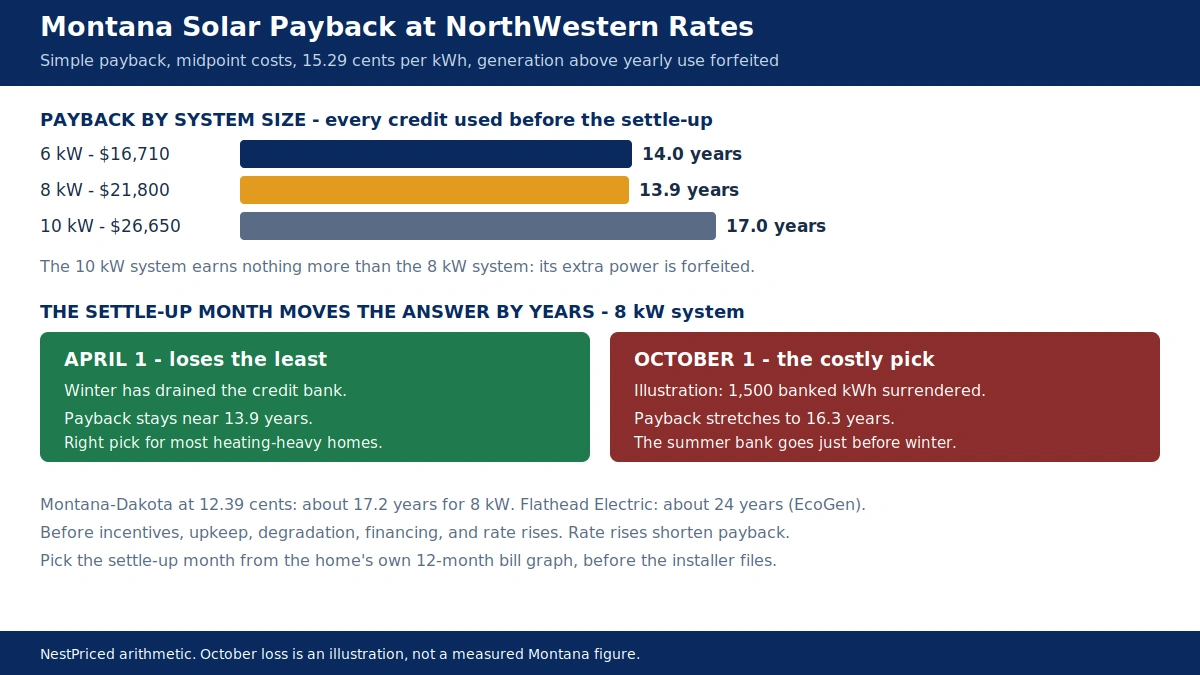
The arithmetic below is NestPriced arithmetic, built on stated assumptions so any reader can redo it. It values generation at 15.29 cents a kilowatt-hour, which is NorthWestern’s EIA 12-month price of 15.90 cents less the $4.20 monthly service charge, on EcoGen’s basis. It counts only generation up to the home’s yearly use of 10,224 kilowatt-hours, because generation above that is forfeited at the settle-up. It uses midpoint costs, the 1,300 planning production figure, and no upkeep, degradation, financing cost, or rate rises. It is a planning model, not a promise.
| System | Cost (midpoint) | Yearly production | Yearly value | Simple payback |
|---|---|---|---|---|
| 6 kW | $16,710 | 7,800 kWh | $1,193 | 14.0 years |
| 8 kW | $21,800 | 10,400 kWh | $1,563 | 13.9 years |
| 10 kW | $26,650 | 13,000 kWh | $1,563 | 17.0 years |
Costs: NestPriced midpoints from the headline band. Value: generation up to 10,224 kWh valued at 15.29 cents; generation above yearly use valued at $0 (forfeited at settle-up). Before incentives, upkeep, degradation, financing, and rate rises. The 8 kW and 10 kW systems earn the same yearly value in this model because both cover the home’s full yearly use; the 10 kW system’s extra 2,800 kWh earns nothing.
That table contradicts the usual sales pitch, and the contradiction is the point. The 10 kW system costs $4,850 more than the 8 kW system and earns nothing more a year under the settle-up rule, so its payback is three years longer. Because the 6 kW system earns value from every kilowatt-hour it generates, it reaches payback in roughly the same time as the 8 kW system while costing $5,090 less. Size to the yearly load and the settle-up month, not to the roof, and not to the lower per-watt price on the big system.
The settle-up month moves the answer by years, and one illustration shows how. Take the 8 kW system above, and suppose an October settle-up surrenders 1,500 kilowatt-hours of banked summer credits that an April settle-up would have saved. Yearly value falls from $1,563 to $1,334, and payback stretches from 13.9 years to 16.3 years. The 1,500 figure is an illustration, not a measured Montana loss, and the real loss depends on the home’s monthly pattern. The direction is certain, and the size of the swing is why the settle-up choice belongs in the buying decision, not in the paperwork afterthoughts.
The utility moves the answer further. The same 8 kW system at Montana-Dakota’s 12.39-cent value earns $1,267 a year and pays back in about 17.2 years. At Flathead Electric, on EcoGen’s published 24.0-year figure for its typical system, the wait is roughly a decade longer than at NorthWestern, because the co-op’s large basic charge shrinks the value of every banked credit. A buyer who compares a NorthWestern payback quoted by a salesperson with a co-op bill at home is comparing two different investments.
Three real-world forces pull payback in different directions, and the simple model above leaves all three out. Electricity rates rise: the statewide average rose 9.0 percent in the year to August 2026, and every future rise shortens payback, because banked credits are worth more when power costs more. Output fades slowly, typically around 0.5 percent a year, which stretches payback a little. Upkeep adds a cost the model leaves out, chiefly the inverter that may need replacing in the system’s second decade. A buyer who treats 14 to 18 years as the planning case at NorthWestern, with rate rises as the upside, is reading the Montana numbers honestly.
Stretching the view to 25 years makes the picture kinder without changing the verdict. At the modeled value, adjusted for slow degradation, an 8 kW system returns roughly $36,000 to $37,000 in gross bill value over 25 years against a $21,800 cost, before any rate rises. If rates rise even 2 percent a year, the 25-year margin grows much larger. Montana solar pays back slowly and steadily rather than quickly, and a buyer who must recover the money within ten years has no financial case for panels on their own. A buyer with a 15-year horizon, a sound roof, and the right settle-up month has a fair case, and this guide’s job is to state both halves of that sentence.
Should You Add a Battery in Montana?
A home battery holds extra solar power until after sunset, and in states with expensive evening rates it earns its keep by moving cheap midday power into those dear hours. Montana’s credit bank undercuts that money-making case, because the grid already acts as a free battery for up to a year: power sent out at noon cancels power drawn at midnight at full value, as long as the swap happens before the settle-up date. A physical battery can only improve on that deal for the kilowatt-hours left over at the settle-up, and on a right-sized system there are not many of those.
The arithmetic makes the point. The payback model in the previous section leaves an 8 kW system with about 180 surplus kilowatt-hours a year above the home’s use, and even a system with 900 surplus kilowatt-hours would earn only about $54 a year from shifting them, at a 6-cent spread between a forfeited credit and retail value. That illustration is generous, because it assumes the battery captures every surplus kilowatt-hour and loses nothing in the round trip. Set against a battery priced at $10,000 or more, $54 a year of bill savings needs many decades to repay the purchase, which means the battery never pays for itself on Montana bill savings alone.
That does not make a battery pointless. It reframes the battery as outage protection, and Montana weather gives a buyer genuine reasons to want it. Winter storms, high wind, and wildfire-season outages can take power out for hours or days, and a rural home at the end of a long feeder is restored last. With islanding capability, meaning it can disconnect from the grid and run the home on its own, a battery keeps the refrigerator cold, the furnace fan turning, the well pump working, and the phones charged through an outage. A buyer who has lived through a multi-day winter outage in a Montana valley understands that value without a spreadsheet.
Battery prices run as follows, on national figures, because no Montana-specific battery install price was verified. EnergySage marketplace data reported in September 2026 put installed battery costs across the country at $700–$1,300 per kilowatt-hour, with the typical first-half-2026 install at $15,647 for 13.5 kilowatt-hours, which works out to $1,159 per kilowatt-hour. On EnergySage data, the battery most quotes name, the Tesla Powerwall 3, averaged $13,473 installed, with a typical range of $13,000–$16,500, for a 13.5-kilowatt-hour unit with 11.5 kW of continuous output and an inverter built in. A Montana quote should be held against those national figures, with travel and cold-weather installation conditions stated if they add cost.
Its warranty holds 70 percent of capacity for 10 years, and about 89 to 90 percent of the energy put in comes back out, which is what round-trip efficiency means. All of those numbers describe the product across the country, not a Montana install in particular. One Montana rule does apply: NorthWestern’s interconnection form requires that any storage in a net metered system store and discharge only energy the system itself produced, not energy drawn from the grid. One secondary source also states that a battery counts toward the 50 kW system limit at NorthWestern, which is flagged here as unverified and should be confirmed with the utility before a large system plus battery is designed.
No Montana or utility battery rebate was found, and the federal credit for a homeowner-owned battery placed in service in 2026 is $0, the same as for the panels. Buying the battery with the panels saves one installation visit and one permit, and some labor with them, but no incentive follows the battery either way. The property tax exemption in the next section does not name batteries in the law, so a buyer should ask the Department of Revenue field office before counting a battery in the exempt value.
The battery call comes down to three questions. First, outage history: a home that has sat dark for days, or sits at the end of a rural feeder where crews arrive last, has a far stronger case than a home on a city circuit that rarely blinks. Second, medical or work need: refrigerated medication, a home office, or a well pump that cannot stop in a storm all push toward buying. Third, size against the need: one 13.5-kilowatt-hour battery runs the essentials for most of a day while solar refills it, but backing up the whole home through a multi-day outage takes more capacity than most buyers plan to pay for.
One cheaper way to survive an outage deserves its place here. A portable generator, running on gasoline or propane, costs a fraction of a battery and covers the same essentials in an outage, at the price of fuel runs, noise, and no automatic start. For a buyer whose only aim is getting through the next storm, the generator quote should come before the battery quote. A buyer who wants silent, automatic, solar-fed backup, and can treat it as a comfort and safety purchase instead of an investment, should buy the battery knowing the payback picture in full.
Solar Incentives, Tax Breaks, and Loans in Montana in 2026
Start with the federal picture, because it is the simplest part of this section and the part most likely to surprise a Montana buyer. For a home system the owner places in service during 2026, the federal tax credit is exactly $0. For systems installed after December 31, 2025, both homeowner credits are gone: the residential clean energy credit under section 25D and the energy efficient home improvement credit under section 25C, ended by the One Big Beautiful Bill Act, Public Law 119-21, and confirmed by the Internal Revenue Service in Fact Sheet FS-2025-05. The 2026 math starts from zero federal help: the federal government contributes $0 to a system the homeowner owns. Any quote, advertisement, or savings sheet that still subtracts 30 percent for a federal credit is using expired law, and several national solar websites still do, including one whose Montana incentives page claims the credit runs to 2035.
Montana adds no state income tax credit for home solar, and the one it once had is gone. The Alternative Energy System Credit, worth up to $500 over a lifetime, was repealed in 2021, and Montana’s 2025 list of income tax credits contains no credit for home solar. Websites that still list a $500 or $1,000 Montana solar credit are stale, and a quote that counts either figure is out of date. There is no state check coming to fill the federal gap, and no market for solar renewable energy certificates, the tradable credits that pay solar owners in some eastern states.
What Montana does offer is a property tax break, a low-interest state loan, and the absence of a sales tax, and each item needs its paperwork done properly. The property tax exemption sits in Montana Code section 15-6-224: up to $20,000 of the appraised value of a home solar system is exempt from property tax for 10 years after installation, with a $100,000 limit for apartment buildings and other buildings. Appraised value is the value the state sets for tax, and value above the $20,000 limit can be taxed. At Montana’s average effective property tax rate of 0.74 percent, the exemption on a full $20,000 of value is worth about $148 a year, or about $1,480 over the decade, on NestPriced arithmetic; the actual saving depends on the county’s appraised value and levy.
The exemption is not automatic, and that is where buyers lose it. The homeowner sends Form AB-14, the property tax exemption application for an alternative energy system, with proof of what the system cost, to the local Department of Revenue field office, and it must arrive by March 1 to count for that tax year. One competing source cites a different statute number and claims a 100 percent exemption with a different form, and this guide follows the version backed by two sources and the Department of Revenue form: section 15-6-224, $20,000, Form AB-14, March 1. The buyer should confirm the filing with the field office in writing, because a missed March 1 deadline costs a year of the exemption.
Montana has no general statewide sales tax, so no sales tax is added to solar equipment or installation labor, and there is nothing to exempt. That saving is real but invisible: in a state with an 8 percent sales tax, a $21,800 system would carry about $1,740 of tax, and in Montana it carries none. Some resort areas charge a local resort tax, so a buyer in a resort community should confirm whether any local tax applies to the job, but for most Montana homes the quote’s headline price is the whole price on the tax line.
The state loan is the most useful money in Montana solar, and it is a loan, not a grant. The Department of Environmental Quality runs the Alternative Energy Revolving Loan Program, which lends up to $40,000 for up to 10 years at a fixed rate of 3.5 percent in 2026, with a 4.023 percent annual percentage rate in the department’s own example once fees are counted. There is no down payment, no application fee, and no penalty for paying early. The origination fee is $250 or 2 percent of the loan, whichever is greater, plus about $200 in other fees. A $21,800 loan at 3.5 percent over 10 years costs about $216 a month on NestPriced arithmetic, which the buyer can compare directly against the monthly bill saving.
The loan’s catch is timing and competition. The department takes applications four times a year, and the next window runs January 1 to January 29, 2027, with mailed applications postmarked by January 26, 2027. The buyer must apply before any work starts: a project finished before funding no longer qualifies. Demand has beaten the available money every quarter since April 2023, so the department ranks applications, and an application not funded can stay in the pool for up to 12 months. A buyer who wants the loan should plan the install around the window, not the other way around, and should not sign an installer contract that starts work before the funding decision.
Montana has not launched either federal home energy rebate program, HEAR or HOMES. The Department of Environmental Quality’s program page states that the Montana Home Energy Rebates Program is not currently available, planning was paused in February 2025, and the state must revise and resubmit its application before any rollout, with final federal approval required first. The U.S. Department of Energy issued revised guidance on June 1, 2026. No launch date exists.
When HEAR does launch, it will pay up to $8,000 at the point of sale to income-qualified households, yet solar panels sit outside it: federal program notices effective May 29, 2026, restrict it to replacing electric appliances with electric appliances. No 2026 solar budget should count a dollar from either program. Which federal rules ended and which ones survive, with the dates and the statute numbers, is set out in full in our federal energy tax credits guide.
Montana’s federal Solar for All award, which would have helped lower-income households, has no application route: checks in October 2026 found nothing to apply for, after the federal grants were ended in August 2025 and a federal court ruled that ending unlawful in September 2026. The status is unresolved, and a buyer who hears about Solar for All from an older article should treat it as closed until the state posts a live application. No utility solar rebate exists to fall back on: NorthWestern Energy states that it does not offer a residential solar-installation incentive, Montana-Dakota offers none, and no co-op solar rebate was verified.
The lease section holds the one narrow federal route left: a leasing company can claim the commercial credit under section 48E for a system it owns and hand the value on as lower payments, for systems placed in service through 2027. In Montana that route runs into the absence of any verified lease seller, which is why the next section treats leasing as a rarity rather than a standard option.
Lease vs Own in Montana: Why Buying Is Nearly the Only Real Choice
In most states a homeowner can choose among three ways to get solar: buy the system outright or with a loan, lease it from a solar company, or sign a power purchase agreement and buy the power it makes. In Montana the second and third options barely exist as verified offers, and the reason is the market, not a single banning law. The national lease companies that dominate advertising in other states do not sell a standard Montana residential lease product, and repeated checks have found no company selling home leases or power purchase agreements in the state.
The evidence for that absence is unusually consistent. The DSIRE database’s May 2026 map lists Montana’s third-party power purchase status as unclear or unknown, citing no Montana law for or against it. A 2025 magazine analysis of federal data found no residential lease or power purchase offerings in Montana.
A check in October 2026 found no company selling either product to Montana homes. EnergySage’s Montana page, updated November 6, 2026, shows zero installers offering lease, power purchase, or rent-to-own products in the state, against two installers offering ownership. Montana home solar capacity still grew 42.9 percent in a year, to 68.0 megawatts at the end of 2024, with no leasing companies, no state rebate, and no state tax credit. Montanans buy their panels.
One conflict is flagged honestly. A single company-comparison page mentions companies offering power purchase plans with no money out of pocket, one with its license unchecked, and one installer’s marketing page describes leases and power purchase agreements generically as the primary vehicle for 2026 incentives, without naming a Montana offer, price, or term. Neither source names a verified Montana residential lease price, escalator, or contract term, and neither is treated here as proof that a real offer exists. A buyer who is offered a lease or power purchase agreement should treat it as exceptional and demand written proof on three points before signing anything: the legal basis for the arrangement in Montana, the full payment schedule including every escalator, buyout price, transfer term, and end-of-term condition, and the federal credit pass-through, if any is claimed.
Narrow as the federal lease route is, it needs stating accurately. For systems placed in service through 2027, a company that owns the panels and leases them to a homeowner may claim the commercial clean electricity credit under section 48E and hand the value on through lower lease payments. That framing is the standing federal position, and no other federal help remains for any kind of 2026 residential solar install. A claim from one source only, that section 48E(i) denies the credit for solar leased to a home and sets a construction deadline in July 2026, could not be corroborated anywhere else, so it stands in the research file as unresolved and is not asserted in this guide. Anyone weighing a lease should demand the pass-through in writing from the leasing company and take the tax position to a tax professional, since the buyer never claims the credit and cannot check it from the lease paperwork alone.
Owning outright is the straightforward path, and it is the path nearly every Montana solar home has taken. The buyer pays the installed price, less nothing from the federal government and nothing from the state beyond the property tax exemption, owns the equipment, claims the 1-for-1 credit benefit on the utility bill, and keeps whatever banked credits the settle-up month preserves. Ownership also leaves the upkeep, the inverter replacement risk, and the roof in the buyer’s hands, and the roof must outlast the panels or the budget must carry removing and reinstalling them when the roof is replaced. No Montana-specific detach and reset price was verified for this guide, so none is stated; for the national figures, see our solar panel removal and reinstall cost guide.
A loan splits the difference between paying cash and leasing without the legal uncertainty. The Department of Environmental Quality loan, covered in the incentives section, lends at a fixed 3.5 percent through quarterly windows, and a home equity line or a solar loan from the installer are alternatives. With a loan, ownership, net metering, and the property tax exemption all stay with the homeowner, and the monthly payment can be set straight against the monthly bill saving. The comparison must be honest about the loan term: a 10-year loan at low interest against a 14-year payback means the household pays more than it saves for the first decade and banks the benefit later, and a loan with dealer fees buried in the price can cost far more than its headline rate suggests.
The decision rule is short. Buy with cash or a low-interest loan when the home will be kept at least 15 years, the roof has at least 15 years left, and the utility has confirmed its net metering terms in writing. Do not sign a lease or power purchase agreement without written proof of its legal basis in Montana and written proof of the federal pass-through, because the burden of proof sits with the seller in a market where no verified offer exists. And let no promise of free panels stand in for the ownership arithmetic in the payback section, since that arithmetic is the only math verified for Montana.
Hail, Chinook Wind, Snow Load, and Wildfire Smoke: Montana Weather and Your Panels
Montana weather tests a solar panel in four different ways, and each way hits a different part of the state hardest. Hail hammers the eastern plains. Chinook winds rake the Rocky Mountain Front.
Snow loads the roofs of Bozeman and the mountain valleys. Wildfire smoke dims the summer sun across the west. A buyer who chooses equipment for only one of those four is choosing for a different state.
Hail is the eastern problem. The eastern plains corridor, Billings, Miles City, Glendive, Glasgow, and Sidney, is one of Montana’s most active severe-weather zones, and Billings sees multi-report hail events most summers, including June 2023 storms that drew regional insurance losses. The test evidence reassures, with one serious qualification hiding in the glass thickness. Under the baseline certifications, UL 61730 and IEC 61215, testers fire 1-inch ice balls at about 50 mph into 11 points on the panel, and the panel must come through with no visible cracking or delamination and no more than 5 percent of its power lost. A second UL test drops a 2-inch steel sphere onto the panel from 51 inches up.
The field evidence most often cited is a 2017 hailstorm the National Renewable Energy Laboratory studied, where 1 panel out of 3,168 was damaged in stones up to 2.75 inches, a survival rate of 99.97 percent. The U.S. Department of Energy puts the damage threshold at about 1.75 inches, golf-ball size, with smaller hail generally leaving panels alone. The qualification is the glass: in a 45 mm ice-ball test, 97 percent of panels with 2 mm glass failed, against 13 percent of panels with 3.2 mm glass. That is a large difference, and it means the buyer should ask for the glass thickness and the hail rating in writing, and prefer panels tested to the FM 4473 standard up to Class 4, which covers hail approaching 2 inches. For readers who want the laboratory procedures, the ice-ball test standards, and the field studies behind this section in one place, EnergySage’s hail durability guide gathers them together, and it was updated August 10, 2026.
Wind is the Front problem. Chinook winds, warm downslope winds off the Rockies, can swing temperatures 30 to 40 degrees in hours and drive gusts that rival hurricanes. A January 2021 event set a modern Great Falls record at 76 mph, with Helena at 74 mph and Havre at 72 mph, and a February 2020 event drove a 106 mph gust at Deep Creek south of Browning.
A 140 mph panel test rating from a Tier 1 maker covers those gusts on paper, yet the racking and the way it fastens to the roof structure count for just as much as the panel’s own rating, because a panel that rides out the wind and rips its mount from rotted decking has failed all the same. Ask the installer to name the racking system, the attachment method, and the design wind speed the installation is engineered for in writing, and have the roof decking checked sound before any racking is fixed to it. No city design wind speeds from a code document were verified for this guide, so none are stated.
Snow load is the structural question, and Montana has no single answer. Reported ground snow loads run 30 to 70 pounds per square foot across the state’s jurisdictions, with Billings and Great Falls around 30 to 35, Missoula and Helena at 30 to 50, and Bozeman, Kalispell, and Whitefish at 40 to 70, while high-elevation mountain communities can require 70 to 120 or more with engineered framing. Those are reported ranges from a secondary source, not code text, and the legal number for any address comes from the local jurisdiction. Panels add weight and change how snow drifts and slides, and the structural check on an older roof should account for the combined load of panels, racking, and snow together. A roof near the end of its life should be replaced before panels are mounted, not after.
Wildfire smoke is the production question nobody can price precisely. About 29 percent of Montana homes sit in high wildfire-risk zones, the highest share of any state on one 2026 insurance analysis, and smoke from fires in Montana and neighboring states dims the sun for days or weeks in bad fire seasons, cutting summer output when the credit bank should be filling. No Montana smoke-loss percentage was verified, so none is asserted. The practical answers are the same as for snow: a production estimate with honest monthly figures, a settle-up month chosen for the home’s real pattern, and no savings math that assumes every summer is clear.
Insurance is where Montana buyers most often get caught after the install. The average Montana homeowners premium ran near $2,399 a year on one 2026 insurance analysis, after rises of about 22 percent in 2024 and 18 percent in 2025, and wind and hail percentage deductibles of 1 to 2 percent of the dwelling value have become common on eastern-Montana policies. Those figures come from a single secondary source and are flagged as such; the buyer’s own policy is the only figure that matters. Get the insurer’s answers in writing before installation day: are the panels covered under the dwelling policy, is that coverage replacement cost or actual cash value, what does the wind and hail deductible come to in dollars, and does the policy exclude cosmetic damage, a question that matters because hail can mark a panel’s looks while leaving its power output intact. Settle the insurance questions before hail season opens, not while the first storm is overhead.
Permits, Licenses, and Installer Rules in Montana
No license in Montana covers solar specifically, so the electrical license is the credential that counts. The Montana State Electrical Board, inside the Department of Labor and Industry, licenses electricians and electrical contractors under Title 37, chapter 68. A journeyman license requires an approved apprenticeship or 8,000 hours of practical experience, plus a written exam.
A residential electrician license requires a residential apprenticeship or 4,000 hours of residential experience. A master license requires four years as a licensed journeyman plus an exam, or a graduate engineering route. An electrical contractor must have a responsible licensed electrician: a master makes it an unlimited contractor, while a journeyman may serve only for a limited residential contractor working on structures with fewer than five living units.
Licenses expire on July 15 of even-numbered years, and every electrician completes 16 hours of National Electrical Code education per two-year cycle. Individual electricians must work for a licensed electrical contractor, and no one may work as or hold out as an electrician or electrical contractor without a Department of Labor and Industry license. Owners wiring their own property are generally exempt from the licensing requirement, but one source states that the homeowner exemption does not cover work on a grid-tied generator, which would mean a homeowner may not legally wire their own grid-tied solar system. That point rests on a single source and is flagged here rather than asserted as settled law; the buyer should confirm it with the Board before assuming a do-it-yourself install is lawful, and this guide covers cost only, never installation instructions.
Montana’s contractor licensing changed at the start of 2026, on one reported account. As of January 1, 2026, the state is reported to have replaced its older contractor registration system with a formal licensing program under House Bill 239, moving oversight from Title 39 into the professional licensing framework under Title 37. The details of that change, including fees and scope, were not verified from a state source, so they are not stated here. The buyer should confirm the installer’s current contractor license status with the Department of Labor and Industry directly, and should not rely on a registration number from the old system without checking that it still counts.
Permits come from two places in a fixed order: the city or county first, then the utility. The city or county issues the building or electrical permit, while the utility’s interconnection approval must land before anyone switches the system on. The City of Bozeman lists a Solar Electric Permit and a Solar Submittal Checklist for solar work. No permit fees for Billings, Missoula, Bozeman, or Great Falls were verified, and no fee waiver for solar was confirmed anywhere in the state, so the quote must state the permit fees or state that they are included. Starting work before the permit is in hand risks a stop-work order and a doubled fee in many jurisdictions, and connecting before the utility’s approval can mean the system sits idle.
Checking the installer takes four steps, and none of them is optional. Confirm the Montana electrical contractor license and the name of the responsible licensed electrician, and check that the name on the license matches the name on the contract. Confirm the liability and workers’ compensation insurance certificates are current, and ask for them in writing rather than taking a verbal assurance. Confirm three recent Montana installs with addresses the buyer can drive past, ideally in the same utility territory, because a portfolio of installs in another state says nothing about NorthWestern’s forms or a co-op’s rules. Ask whether the lead installer holds NABCEP certification, a voluntary solar credential that signals training beyond the electrical license, without treating its absence as a disqualification on its own.
The market itself is small and local, which cuts both ways. EnergySage lists two Montana installers on its marketplace, Bozeman Green Build of Bozeman, established in 1986, and Freedom Energy of Victor, established in 2023, and other established Montana names include Big Dog Renewable Energy, Solar Plexus, and Wegner Roofing and Solar of Billings. A small market means fewer quotes to compare and longer waits in the busy season, and it means a buyer should start the quote process early rather than expecting a crew next week. It also means reputations travel: a local installer with a decade of Montana roofs behind it has more to lose from a bad job than a national sales operation passing through. This guide names installers only as market context and endorses none of them.
Two payment protections deserve a place in every Montana solar contract conversation. The first is milestone payment: never pay in full before the system is inspected, the utility has approved the interconnection, and the net meter is in place, and keep every payment tied to a written milestone. The second is paperwork: keep the contract, the permit, the inspection sign-off, the interconnection request with its settle-up month, the utility approval, and the Form AB-14 filing in one file, because the settle-up month and the tax exemption are both decided on paper, and paper lost is money lost. No Montana-specific lien statute or cancellation statute was verified for this guide, so none is cited; the buyer should read the contract’s cancellation and payment terms before signing and ask a lawyer about anything unclear.
Getting Solar Quotes in Montana: Checklist and Decision Rules
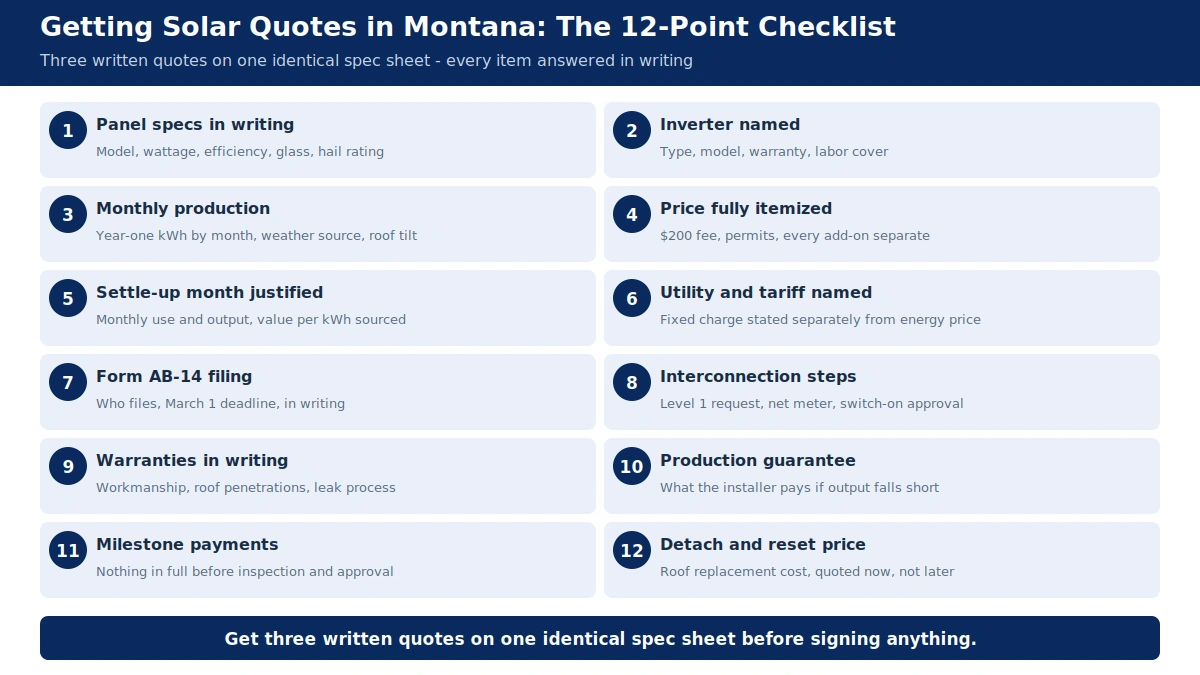
Quotes only line up against each other when every bidder prices the identical job on identical assumptions, which is exactly what the checklist below is built to force. Collect three written quotes from licensed installers for one identical scope: the same system size, the same panel model class, the same roof work, with every checklist item answered in writing by each bidder. Any bidder who answers out loud instead of in writing, or folds every answer into one monthly payment number, is keeping the buyer from the comparison that matters.
- Panel make, model, wattage, efficiency, temperature coefficient, glass thickness, and hail rating, in writing
- Inverter type, string or microinverters, make and model, warranty length, and whether the warranty covers labor
- Year-one production estimate in kilowatt-hours, shown month by month, with the weather data source named and the roof direction and tilt stated
- Total installed price, with the NorthWestern $200 interconnection fee, permit fees, and every add-on as a separate line: panel upgrade, roof work, battery, tree work, snow guards
- The settle-up month the savings math assumes, with the monthly use and monthly output that justify it, and the value per kilowatt-hour used in the math with its source
- The utility name and the tariff or schedule the savings math assumes, with the fixed monthly charge stated separately from the per-kilowatt-hour price
- The property tax exemption filing, Form AB-14, with who prepares it, who files it, and the March 1 deadline stated in the contract or in writing
- The interconnection steps and who handles each one, including the Level 1 request, the $200 fee, the net meter installation, and the switch-on approval
- The workmanship warranty length and what it covers, the roof penetration warranty, and the process if a leak appears under the array
- The production guarantee, if any, and what the installer pays or does if the system underproduces
- The payment schedule tied to milestones, with no full payment before inspection and utility approval
- The removal and reinstallation price if the roof needs replacing during the panel warranty period, quoted now, not later
The decision rules follow from everything above, and they are stated as rules because Montana punishes vague intentions. Rule one: size to the yearly load and the settle-up month. The average Montana home suits 8 kW; a smaller home suits 6 kW and loses nothing to the forfeiture rule; 10 kW needs a real load behind it, an electric vehicle or a heat pump, and the lower per-watt price alone never justifies the extra panels.
Rule two: pick the settle-up month before the installer files, and see the reasoning. April suits most heating-heavy homes, October costs the most, and the home’s own 12-month bill graph is the evidence. Rule three: put the utility’s terms in writing before anyone signs. The fixed charges, the export treatment, the interconnection steps, and, for co-op members, the full written solar policy are the facts that decide payback, and all of them come from the utility, not the installer.
Rule four: count no incentive in the budget until its funding is confirmed or its form is filed. The property tax exemption needs Form AB-14 by March 1, the state loan needs a quarterly window and a funding decision before work starts, and the federal credit is $0. A budget built on an unfiled exemption or an unconfirmed loan is a budget built on hope. Rule five: fix the roof first. Panels keep working for 25 years or more, so a roof with five years of life left all but guarantees a removal and reinstallation bill halfway through payback.
Rule six: buy the battery for outage protection, never as an investment. In Montana’s 1-for-1 credit market, a battery earns roughly $54 a year in bill savings on the generous illustration in the battery section, and it should be bought for outage protection with open eyes, or not bought at all. Rule seven: buy, do not lease, unless a lease offer arrives with written proof of its legal basis in Montana and written proof of the federal pass-through, because no verified residential lease offer exists in the state and the burden of proof sits with the seller.
Rule eight: weigh the solar spend against what the same money buys elsewhere. Insulation, air sealing, and a heat pump can shrink the bill for less money and pay back sooner, and a home that has skipped the cheap efficiency work should get those prices before it gets panel prices. Our heat pump versus solar guide compares the two investments directly, and our Montana heat pump cost guide prices the Montana heat pump case, including the honest finding that a heat pump costs more to run than a gas furnace where gas is already piped in. Solar is the right answer for a home with a sound roof, a suitable roof direction, confirmed utility terms, a well-chosen settle-up month, and a 15-year horizon. A home that fails any one of those tests may do best with efficiency first and panels later, which counts as a good outcome, not a sale that failed.
Sources & methodology
Cost sources: EnergySage Montana solar panel cost page, updated November 6, 2026 (marketplace quote data; verified by direct read November 15, 2026), including Missoula city page (same date) and Butte city page (context); EcoGen America Solar Cost Index, September 2026 edition, prices September 25, 2026, Montana cost page updated October 19, 2026 (verified by direct read); SolarReviews solar panel cost page, November 2026 (NREL/EIA/BLS model; its federal-credit columns are stale and were not followed); renewestimator Montana pages, data compiled July 25, 2026 (two-ZIP sample, weak, internally inconsistent); umbdcmart, March 28, 2026; solarcostbyzip Billings and Great Falls pages, September 2026 (outlier, named as such); Solar Learning Lab Montana page (EnergySage August 2026 cash figure $2.57/W); Wegner Roofing Bozeman guide (EnergySage Bozeman average via secondary source).
Production sources: Solar Learning Lab PVGIS v5.2 model runs, August 18, 2026, NSRDB data, south-facing 30-degree tilt, 14 percent losses (Billings 1,377, Missoula 1,206, Great Falls 1,350, Bozeman 1,294 kWh per kW per year); EcoGen per-utility production figures, October 30, 2026 (~1,410 kWh per kW, high outlier); renewestimator and sunmetriclab implied yields; solarpricelist state output table; CovertItAll peak sun hours reference (NSRDB, May 2026); NOAA 1991–2020 climate normals via montana-guide.com and mywild.report (station snowfall); HomeSnacks NOAA station figures (conflicting snowfall, noted); temperature coefficient ranges from published panel specifications.
Rate and utility sources: U.S. Energy Information Administration, Electric Power Monthly, Table 5.6.A, August 2026 (Montana 15.57 cents, US 18.16 cents), and Form EIA-861 Table 5A, 2024 and final 2025 (852 and 853 kWh a month); Montana Public Service Commission 2026 Residential Rate Summary (NorthWestern $4.20 service charge; Montana-Dakota $0.19 a day basic charge); EcoGen per-utility price compilations, October 30, 2026 (NorthWestern 15.29 cents, Montana-Dakota 12.39 cents, Flathead 8.08 cents, each less fixed charges; secondary compilations, flagged); NorthWestern Energy Level 1 Small Generator Facility Interconnection Request (revision 1/23; $200 fee, Exhibit A, one-time settle-up change, storage rule) and Montana Consumer Guide to Grid-Interactive Solar PV Systems (updated April 2026); Montana-Dakota Rate 92 via EcoGen (read September 29, 2026) and Schedule 94 note via solarexitmontana (single source, flagged); Flathead Electric and Yellowstone Valley Electric terms via EcoGen readings of co-op pages (September and October 2026; secondary, flagged). Flathead Electric Cooperative community solar page (project running since 2015, with phases added in 2018 and 2025; current subscription price not verified).
Law and program sources: Montana Code Annotated sections 69-8-103, 69-8-603, and 69-8-605 (net metering; checked September 30, 2026, by EcoGen); section 15-6-224 (property tax exemption) and Department of Revenue Form AB-14 (March 1 deadline); section 15-32-115 (repealed alternative energy credit, 2021); Title 37, chapter 68 (State Electrical Board licensing); House Bill 239 contractor licensing (reported, single source, flagged); Montana Public Service Commission December 2019 order on NorthWestern’s solar rate proposal, via pv magazine (November 26, 2019) and Earthjustice (5-0 vote, $7.69/kW-month demand charge proposal, 5 percent peak-load trigger); One Big Beautiful Bill Act, Public Law 119-21, and IRS Fact Sheet FS-2025-05; U.S. Department of Energy HEAR/HOMES Program Notices 26-1 and 26-2, effective May 29, 2026; Montana Department of Environmental Quality Alternative Energy Revolving Loan Program and Home Energy Rebates Program pages (loan terms checked November 2, 2026; rebates not available, paused February 2025, DOE guidance June 1, 2026); Montana Solar for All status via EcoGen (checked October 5, 2026); DSIRE May 2026 third-party PPA map status (via EcoGen).
Weather and insurance sources: NOAA storm and climate records via montana-guide.com, mywild.report, and HomeSnacks; bestroofingestimates.com Montana snow-load ranges (secondary, flagged); sidingquotesnearme.com Montana siding guide (chinook gust records, hail corridor, Insurify 2026 premium and wildfire figures; single secondary source, flagged); EnergySage hail durability guide, updated August 10, 2026; National Renewable Energy Laboratory 2017 hailstorm study; U.S. Department of Energy hail guidance; FM 4473 and UL 61730/IEC 61215 test standards.
Battery sources: EnergySage marketplace data via art 178 research (September 2026 and first-half 2026 figures); Tesla Powerwall 3 specifications and EnergySage and SolarReviews pricing; NorthWestern Level 1 storage rule.
Methodology: production at the NestPriced planning figure of 1,300 kilowatt-hours per kilowatt per year, the rounded PVGIS four-city mean, inside the published range of about 1,206 to 1,410. Size-table costs are NestPriced planning arithmetic applying the $2.54–$2.91 headline band with a small-size taper. Payback arithmetic is NestPriced arithmetic at NorthWestern’s 15.29-cent value, counting only generation up to yearly use, stated in the payback section.
Battery arbitrage illustration is NestPriced arithmetic at a 6-cent spread on modeled surplus. All planning estimates, secondary compilations, outliers, and unresolved conflicts are flagged in the text where they appear. Figures that could not be verified are listed in the QC log and are not asserted in the body.
Disclaimer: Prices, rates, credits, and program rules change, and utility terms, loan windows, and tax filings must be confirmed in writing with the utility, the lender, or the Department of Revenue before signing. This guide states planning estimates and published figures with their sources and dates, and it is not a quote, a tax opinion, or legal advice. Get three written quotes from licensed installers, confirm the roof condition, the utility terms, and the settle-up month, and confirm insurance coverage before the panels go on.
How much do solar panels cost in Montana in 2026?
An 8 kW rooftop system costs $20,320–$23,280 installed in Montana in 2026, or $2.54–$2.91 per watt, on a cross-checked band from EnergySage ($2.54), EcoGen ($2.73), and SolarReviews ($2.91). Montana has no general sales tax, so no sales tax is added to the price. The final price depends on roof pitch and material, equipment choice, and any panel or roof work the job needs.
Does Montana have net metering in 2026?
Yes, for customers of NorthWestern Energy and Montana-Dakota Utilities, with systems up to 50 kW under state law at sections 69-8-103 and 69-8-603. Extra power earns a kilowatt-hour credit at full value, carried forward for up to a year, and unused credits go to the utility unpaid at the yearly settle-up. Rural electric co-operatives are outside the state law and set their own terms, so co-op members must get their written policy before designing a system.
When do Montana solar credits reset, and which month should I pick?
Credits reset once a year, on the settle-up date that starts the 12-month billing period the homeowner picks: January 1, April 1, July 1, or October 1. For most heating-heavy homes, April 1 loses the least, because winter has already spent the summer bank, while October 1 costs the most, because it surrenders the full summer surplus just before winter. At NorthWestern Energy the month goes on Exhibit A of the interconnection request, and it can be changed one time only.
How long is the solar payback in Montana?
Simple payback runs about 14 to 18 years at NorthWestern Energy rates for a right-sized owned system, on NestPriced arithmetic at 15.29 cents a kilowatt-hour and the published EcoGen and EnergySage range of 12.7 to 17.9 years for different system sizes. Payback runs longer at Montana-Dakota Utilities, far longer on Flathead Electric co-op terms, and longer still with an October settle-up month. Cheap Montana electricity and the $0 federal credit are the reasons the wait is long.
Is there a federal tax credit for solar panels in Montana in 2026?
No. A homeowner-owned system placed in service in 2026 earns a $0 federal credit, because the One Big Beautiful Bill Act ended the residential clean energy credit for installs after December 31, 2025. Montana has no state income tax credit for home solar either, since its $500 credit was repealed in 2021. What survives is a property tax exemption on up to $20,000 of system value for 10 years, claimed by filing Form AB-14 by March 1, plus the state’s low-interest solar loan.
Will snow and hail damage solar panels in Montana?
Panels certified to UL 61730 and IEC 61215 survive 1-inch ice balls at about 50 mph, and a National Renewable Energy Laboratory study of a 2017 hailstorm found 1 damaged panel out of 3,168. Montana’s hail risk is real on the eastern plains, so ask for the glass thickness and the hail rating in writing and prefer panels tested beyond the 1-inch baseline. Snow blocks panels until it slides or melts off, and no Montana snow-loss percentage is published, so treat winter output as the uncertain part of any production estimate.
Can I lease solar panels in Montana?
No verified residential lease or power purchase offer exists in Montana. Repeated checks through October 2026 found no company selling either product to Montana homes, DSIRE lists the state’s third-party status as unclear, and EnergySage shows zero Montana installers offering lease products. Most Montana homeowners buy outright or with a loan, including the state’s 3.5 percent loan. Any lease offer needs written proof of its legal basis in Montana and written proof of the federal section 48E pass-through.
Should I add a battery to solar panels in Montana?
Buy a battery for outage protection, not for bill savings. The 1-for-1 credit bank already gives the home full value for power swapped before the settle-up date, so a battery on a right-sized system earns only about $54 a year in extra bill value on a generous NestPriced illustration. A 13.5 kilowatt-hour battery costs about $13,000–$16,500 installed on national figures, with no Montana battery rebate found and a $0 federal credit for 2026 homeowner installs.