

Table of Contents
The 2026 Reality Check (Read This First — Most Insulation Guides Are Outdated)
Three things changed the money math this year, and most still-ranking pages haven’t caught up.
First, the 30% federal credit is dead — and pages still promise it. The §25C Energy Efficient Home Improvement Credit (30%, up to $1,200/year) ended for property placed in service after December 31, 2025. Yet a “2026” insulation guide updated May 2026 still advertises “IRA 25C tax credit: 30% back, up to $1,200,” and another from October 2026 claims homeowners “qualify for a federal tax credit equal to 30% of the cost of insulation and air sealing materials.” Both are fiction for 2026 installs. Five 2026 cost sources confirm the credit is $0. If a guide or quote subtracts 30%, close the tab. (The full credit picture: our federal energy tax credits 2026 guide.)
Second, the feds made insulation a prerequisite — “insulation comes first” is now policy. DOE’s Program Notices 26-1 and 26-2 (May 29, 2026) rewrote the HEAR rebate program: insulation + air sealing are now REQUIRED before you can claim appliance rebates. The envelope is a gate, not a bonus. No cost guide we’ve found covers this. It also means rebate-chasers must insulate first — which directly raises the commercial intent of this exact keyword.
Third, 9 out of 10 US homes are under-insulated (EPA/ENERGY STAR). The cheapest energy project in the house got more important this year, not less.
What this page does differently: cost by material AND by R-value (nobody prices R-49 vs R-38), the DOE 8-zone target table, depth-and-bag math, the removal decision framework (most attics don’t need removal), and the honest 2026 incentive picture — including which states actually have money.
Attic Insulation Cost by Material (2026)
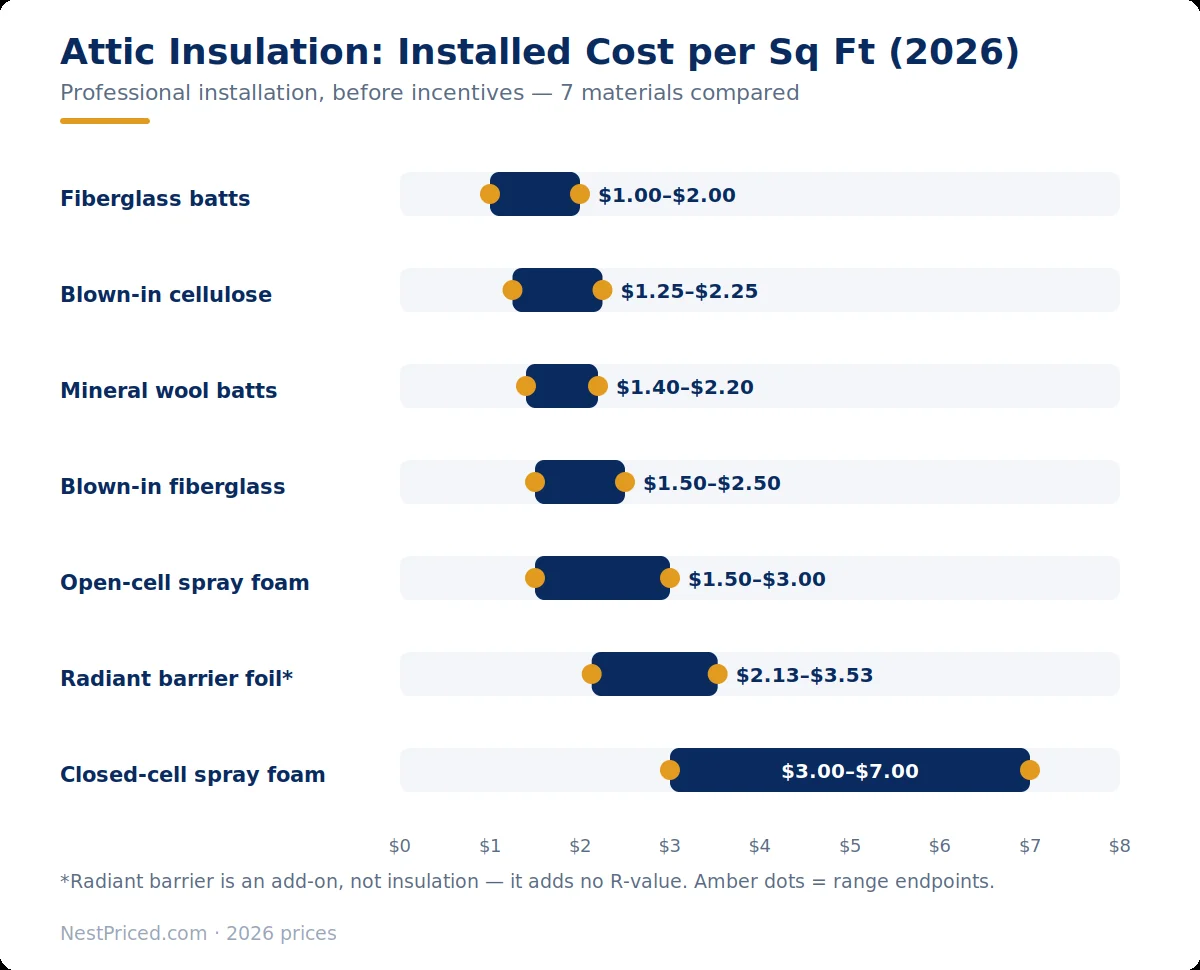
The head-to-head numbers, installed, before incentives:
| Material | Installed $/sq ft | 1,500 sq ft attic | R-value/inch |
|---|---|---|---|
| Blown-in cellulose | $1.25–$2.25 | $1,500–$3,750 | 3.2–3.8 |
| Blown-in fiberglass | $1.50–$2.50 | $2,250–$3,750 | 2.2–2.7 |
| Fiberglass batts | $1.00–$2.00 | $1,350–$2,700 | 3.1–3.8 |
| Mineral wool batts | $1.40–$2.20 | $2,100–$3,300 | ~4.0 |
| Open-cell spray foam | $1.50–$3.00 | $1,500–$4,500 | 3.5–3.8 |
| Closed-cell spray foam | $3.00–$7.00 | $3,000–$6,750 | 6.0–7.0 |
| Radiant barrier foil | $2.13–$3.53 | $750–$3,300 | n/a (reflective) |
2026 US national installed ranges (fixupfirst, HomeGuide, homebuddy, Angi, projectcostpro). 1,500 sq ft totals from homebuddy; radiant barrier is an add-on, not a substitute for insulation.
Three things in that table deserve a second look.
First, the cheapest installed option is blown-in cellulose — and it’s also the best value per R. At $1.25–$2.25/sq ft with 3.2–3.8 R/inch, it beats batts on both price and coverage. Batts look cheap per square foot until you price the labor of cutting around every joist, wire, and can light — and the gaps that installers leave behind. Blown-in conforms to everything. That’s why blown-in is the default pro choice for most attics.
Second, spray foam’s $/sq ft is misleading without the board-foot math. Foam is sold by the board foot (1 sq ft × 1 inch): open-cell runs $0.44–$0.73/bf, closed-cell $1.00–$2.12/bf (2026 median bands, armorthane). An R-49 attic in closed-cell foam needs ~7–8 inches — that’s 7–8 board feet per square foot, which is how $3–$7/sq ft happens. Foam also air-seals as it insulates, which is the real reason to buy it (more below).
Third, radiant barrier is not insulation. It reflects radiant heat; it adds no R-value. It pays only in hot climates with ducts in the attic — everywhere else it’s a $2–$3.50/sq ft decoration. If a contractor pitches it as your primary “insulation,” get a second quote.
Cost by R-Value: The Table Competitors Don’t Have
Everyone prices by material. Almost nobody answers the question that actually determines your quote: what does R-49 cost versus R-38? These are 2026 planning bands for blown cellulose over a 1,500 sq ft attic floor, with air sealing included (projectcostpro, explicitly labeled “planning estimate, not a bid”):
| Target | Total (1,500 sq ft) | $/sq ft | Depth (cellulose) |
|---|---|---|---|
| R-30 | $3,050–$5,314 | $2.03–$3.54 | ~8–9 in |
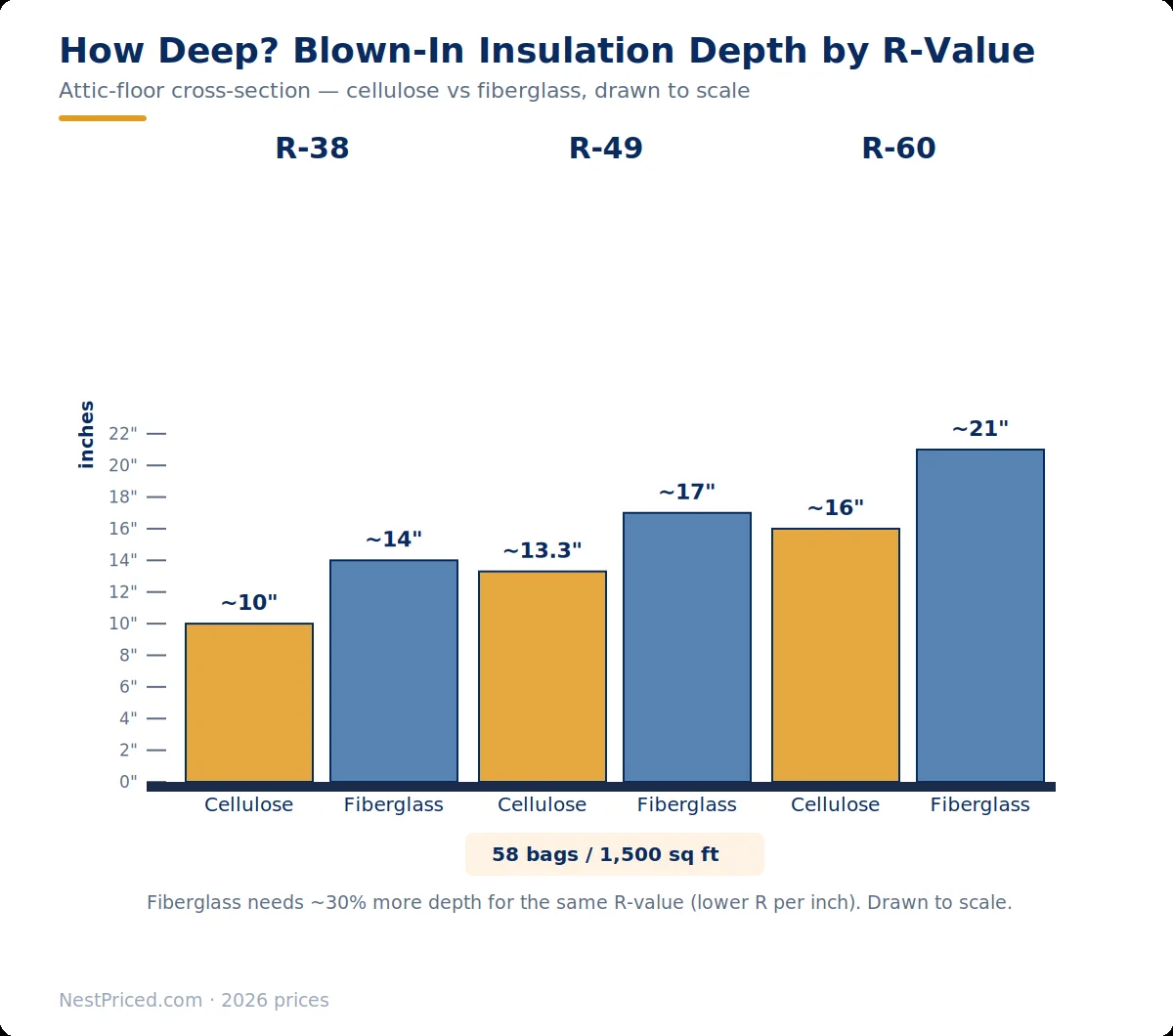
| R-49 | $3,960–$6,778 | $2.64–$4.52 | ~13.3 in |
| R-60 | $4,578–$7,819 | $3.05–$5.21 | ~16–17 in |
The jump from R-30 to R-49 costs roughly $900–$1,500 more — and in climate zones 5–8, R-49 isn’t optional, it’s the DOE recommendation. Undershooting your zone’s target to save $1,000 is the most expensive “saving” in this project: you pay the mobilization once, and topping up later means paying it again.
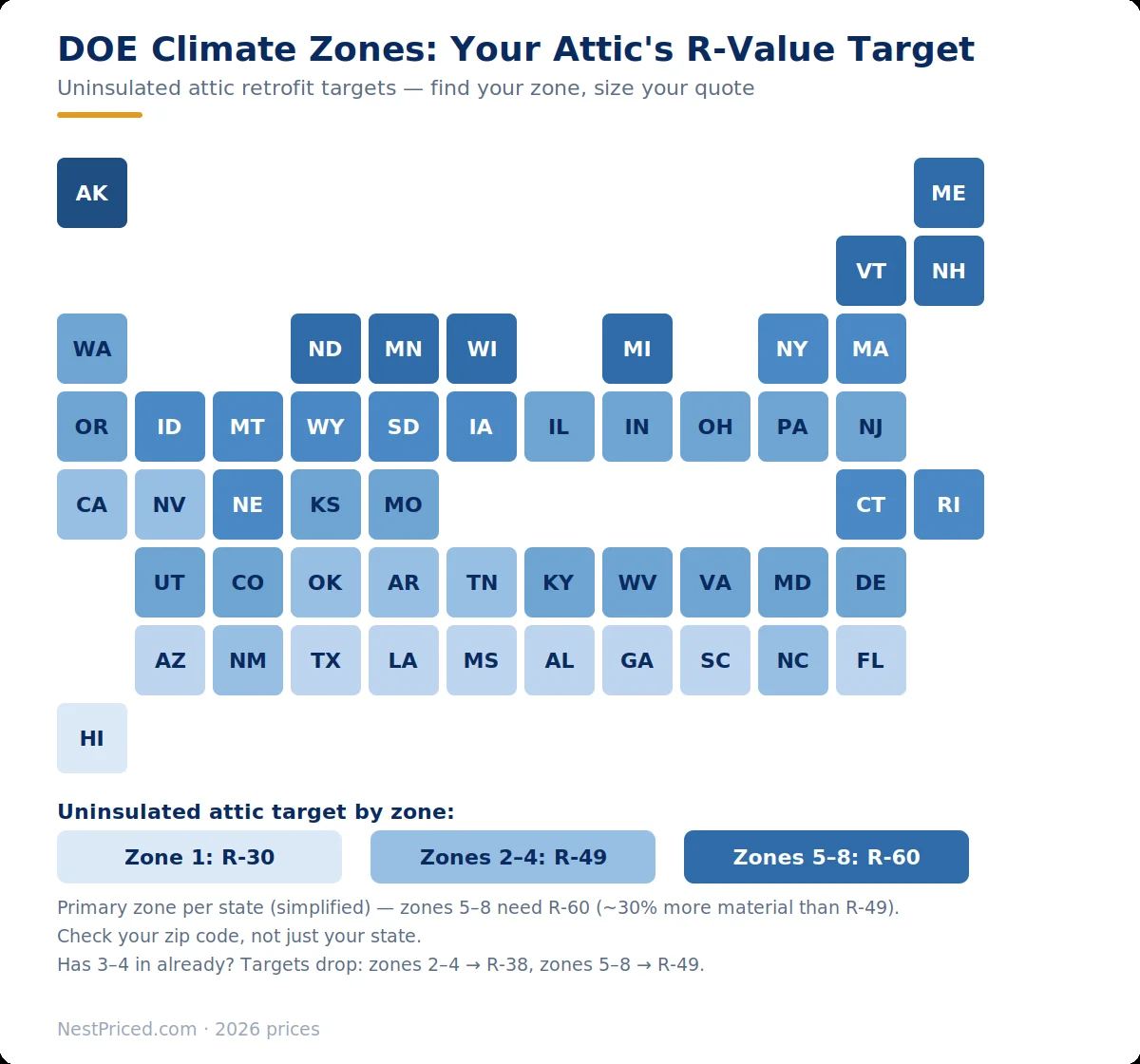
How Much Insulation Your Zone Actually Needs (DOE Targets)
The DOE/ENERGY STAR retrofit recommendations for existing homes, by climate zone:
| Zone | Where | Uninsulated attic → | Already has 3–4 in → |
|---|---|---|---|
| 1 | South FL, Hawaii | R-30 | R-25 |
| 2 | Phoenix, Houston, Miami | R-49 | R-38 |
| 3 | Atlanta, Dallas, LA | R-49 | R-38 |
| 4 | DC, St. Louis, Portland | R-49 | R-38 to R-49 |
| 5 | Chicago, Denver, Toledo | R-60 | R-49 |
| 6 | Burlington, Duluth, Helena | R-60 | R-49 |
| 7 | Minneapolis, Bismarck, Fairbanks | R-60 | R-49 |
| 8 | Northern Alaska | R-60 | R-49 |
R-values add. If you have R-19 of old fiberglass and your zone wants R-49, you need roughly R-30 of new material on top — if the old stuff is clean, dry, and undisturbed (more on the removal decision below).
The bag math (so you can check a quote): R-49 in blown cellulose means ~13.3 inches deep — about 58 bags for a 1,500 sq ft attic (Greenfiber coverage charts). Blown fiberglass needs ~17 inches for the same R-49 (lower R/inch). If a quote says “R-49, 30 bags,” the math doesn’t close. Ask.
What Actually Drives Your Quote
Material choice is the biggest lever (see the table — a 3x spread from cellulose to closed-cell foam). After that:
R-value target. Zones 5–8 need R-60; that’s ~20% more material than R-49. Your zip code picks your number, not your budget.
Air sealing — a separate line item that must come first. $250–$750 (Angi 2026), and pros treat it as its own job: sealing top plates, wire penetrations, can lights, and the attic hatch before any insulation goes in. This is not optional upsell. The EPA’s 15% savings figure is air sealing + insulation together — insulation over a leaky ceiling is half a job. Any quote that doesn’t list air sealing separately is missing the most important line.
Attic access and complexity. Steep roof pitch, low clearance, knob-and-tube wiring, or HVAC equipment in the attic all add labor. Labor runs $0.25–$2.00/sq ft depending on region and complexity.
Baffles and ventilation. Soffit baffles run $2–$3 each (one per ~2 ft of eave) — they keep insulation from blocking soffit vents, and skipping them causes moisture damage. Bath/kitchen vents exhausting into the attic must be vented outside first: $200–$700.
**Air seal BEFORE you insulate — order matters more than material.** Insulation slows heat flow; air sealing stops air flow. Air leakage causes ~40% of a building’s heat loss. Blowing 13 inches of cellulose over unsealed top plates is like wearing a down jacket with the zipper open. Get the air-sealing line item in writing, and make sure it happens first.
Removal: Most Attics Don’t Need It (The Decision Framework)
This is where insulation quotes go sideways. Here’s the honest decision tree:
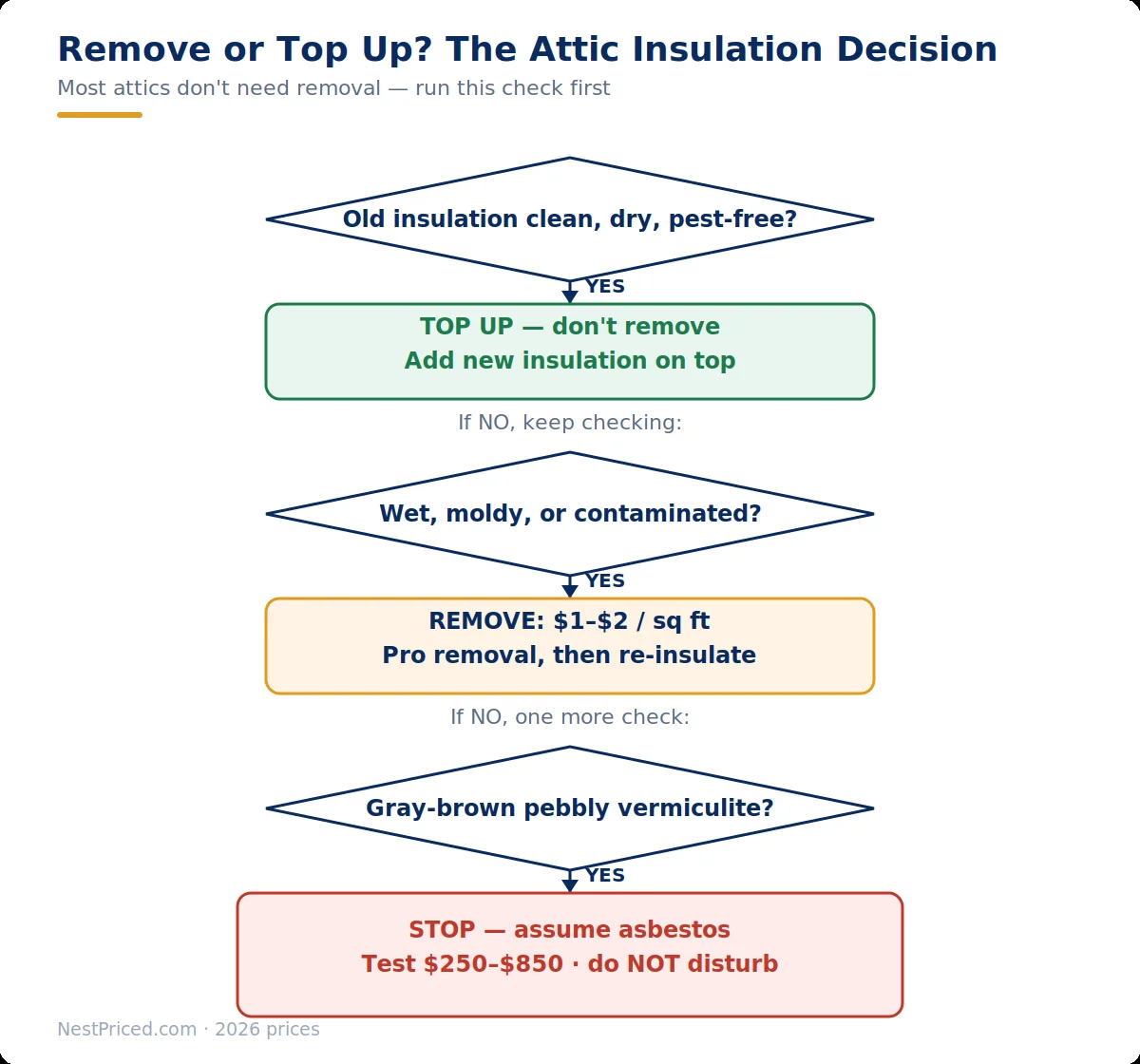
Leave it and top up — if the old insulation is clean, dry, pest-free, and undisturbed, add new on top. R-values add. This is the right answer for most attics, and it’s what armorthane and homeenergydecisions both recommend. Clean removal costs $1–$2/sq ft ($600–$1,200 for a typical job) — money better spent on more R-value unless there’s a real reason to remove.
Remove it — only for: contamination (rodent waste, mold), water damage, or because you need to air-seal the ceiling deck properly (sealing is far more effective with the old insulation out). Full removal + air sealing + new insulation runs $3,000–$10,000+ for the whole project.
Vermiculite — stop and test. If your attic has gray-brown or gold pebble-like insulation (sold as Zonolite from the 1940s–1980s), assume it contains asbestos and do not disturb it (EPA). Testing costs $250–$850. Licensed abatement runs $10–$25/sq ft ($1,000–$11,000+). The Zonolite Attic Insulation (ZAI) Trust reimburses up to 55% of removal costs. And here’s the part contractors won’t always tell you: leaving undisturbed vermiculite in place is often safer and cheaper than removing it — asbestos is dangerous when airborne, not when it’s sitting quietly under a layer of new cellulose.
**Vermiculite = assume asbestos. Do not disturb it.** Don’t scoop a sample yourself, don’t blow new insulation over it until it’s been tested, and never let a contractor treat it like regular old fiberglass. Test first ($250–$850), then decide: professional abatement, ZAI Trust reimbursement (up to 55%), or — often the smartest move — leave it sealed and undisturbed. This is cost information, not removal instructions: asbestos work requires licensed professionals.
Bundle discount: 10–20% off when the same contractor does removal + install (dropcurb).
DIY vs Pro: Where the Savings Are Real (and Where They Aren’t)
DIY blown-in cellulose: $400–$1,000 in materials for a typical attic — and home centers often throw in the blower rental free with a minimum bag purchase. Total DIY range runs $300–$600 versus $1,500–$3,500 pro. The savings are real, but only for blown-in and batts.
The pro advantage is everything around the insulation: air sealing (the $250–$750 line item DIYers skip), baffle installation, vent checks, and knowing what vermiculite looks like. DOE’s sequence is: seal air leaks and fix roof issues before insulating.
Spray foam is never DIY. Two-part chemical rig, respirator requirements, and exothermic reaction risks — this is licensed-pro-only work, full stop.
The honest math: DIY saves $1,000–$2,500 on a cellulose job. But a DIY job without air sealing captures maybe half the savings. If you’re going DIY, rent the blower, buy the caulk and foam cans first, and spend day one sealing — day two blowing.
How Long Insulation Lasts (Material Life vs Real Life)
Insulation doesn’t “expire” on a schedule — but its effective life and its material life are different numbers, and contractors quote whichever sounds better. Here’s the honest version, sourced from Angi’s July 2026 replacement guide and 2026 installer data:
| Material | Material lifespan | Practical notes |
|---|---|---|
| Fiberglass (batts/blown) | 80–100 years | Glass fibers don’t decompose — but start checking for weak points around year 15; moisture, compression, and pests cut real-world life to 15–20 years in bad attics |
| Blown cellulose | 20–30 years | Settles over time, reducing R-value; can start degrading around year 15 without proper air sealing |
| Closed-cell spray foam | 50–80+ years | Most durable option; rigid structure resists moisture and settling |
| Open-cell spray foam | 40–50 years | Less dense; minor microcracks from temperature cycling, minimal performance impact |
The pattern: dry and undisturbed lasts; wet and compressed doesn’t. A 25-year-old fiberglass attic that’s dry and fluffy is fine. A 10-year-old one under a slow roof leak is not. When a contractor says “your insulation is old, it must be replaced,” ask what’s actually wrong with it — age alone isn’t a diagnosis.
Energy Savings & Payback: The Math That Sells This Project
EPA/ENERGY STAR: ~15% off heating and cooling (about 11% of total energy bills) from air sealing + insulating attics, floors over crawlspaces, and basement rim joists. Heating and cooling are up to 70% of home energy use, and the average household spends $2,200+/year on energy — roughly half of that on heating and cooling.
In dollars: $200–$600/year depending on material and climate (installer-published 2026 bands: fiberglass batts $200–$300, cellulose $250–$400, spray foam $350–$600). Payback runs 2–7 years — among the fastest paybacks of any major home energy project. Regional split (Angi): northern states save 18–19%, the middle band 16–17%, southern states 7–14%.
The silo bonus nobody prices: insulation shrinks every other project on this site. Less heat loss means a smaller heat pump (see our heat pump cost guide) and — directly — a smaller solar system: our solar sizing guide sizes from your electric bill, and every kWh the envelope saves is kW you don’t have to buy (the full $/W story is in our solar panel cost guide). Insulate before you size equipment, not after.
2026 Incentives: The 30% Credit Is $0 — Here’s What’s Real
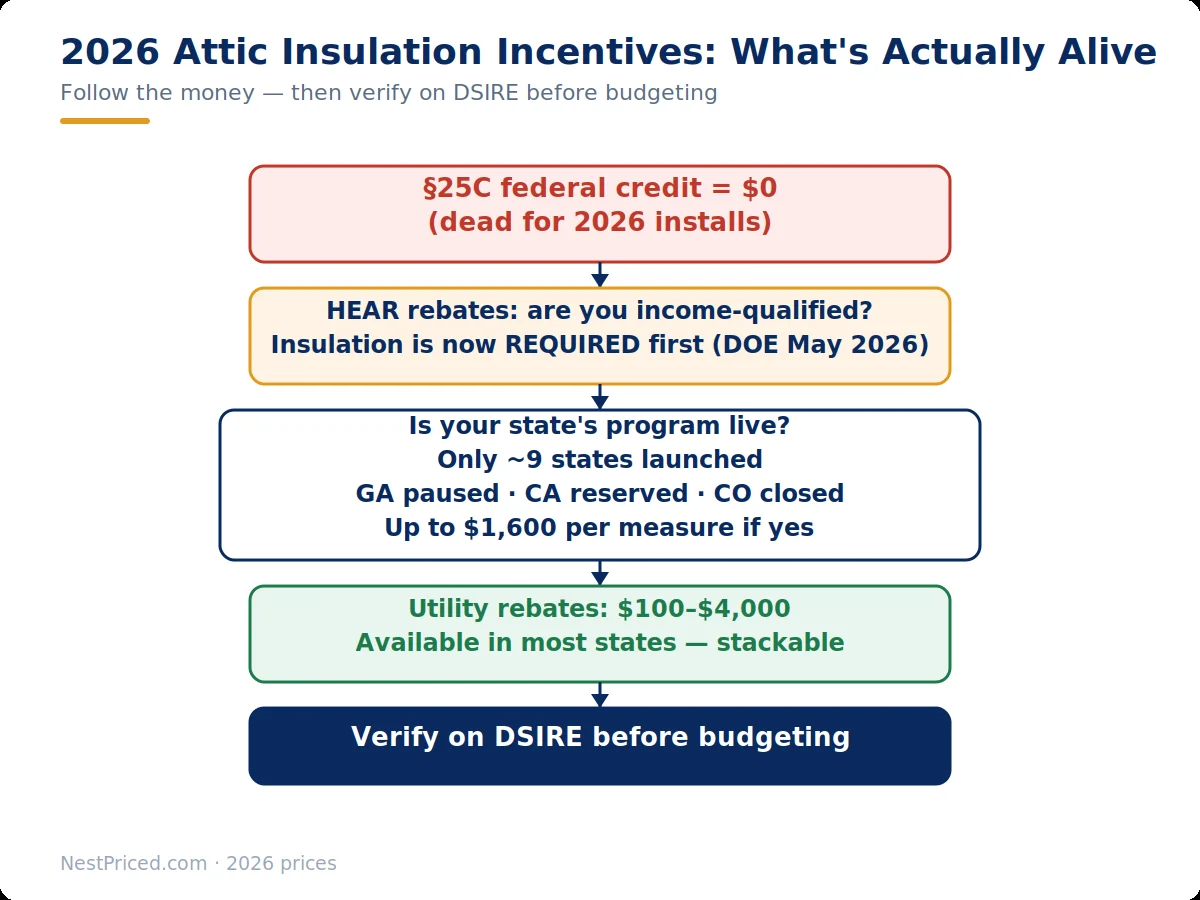
§25C: $0 for 2026 installs. The 30%-up-to-$1,200 credit ended for property placed in service after December 31, 2025 (OBBBA, IRS FS-2025-05). Five 2026 cost sources confirm it. Don’t budget it, don’t let a quote subtract it.
HEAR rebates: real, income-qualified, and patchy. The Home Electrification and Appliance Rebates program (IRA §50122) covers insulation, air sealing, and ventilation at up to $1,600 per measure, under a household ceiling of up to $14,000 — how much you get depends on income vs. area median income, and it’s point-of-sale (the contractor discounts your invoice).
The May 29, 2026 DOE rewrite changed two big things:
1. Insulation + air sealing are now REQUIRED before appliance rebates (Notices 26-1/26-2). The envelope is the gate.
2. Fuel-switching is out. Rebates no longer cover replacing a gas/oil/propane appliance with electric — only electric-to-more-efficient-electric in existing homes. (States got a grace period: reservations under old rules through Aug 31, 2026; new reservations from Sep 1 follow the new rules.)
State status — the honest version (verified Nov 2026): only about 9 states had launched programs as of late summer. Georgia paid out $50M+ to 3,500+ households (avg $12,104) — then paused new applications Aug 14, 2026. California’s single-family pool has been fully reserved since Feb 24, 2026 (waitlist only). Colorado’s single-family HEAR closed Aug 1, 2026. Texas, Minnesota, and Maine still have no launch date. A federal allocation to your state is not a rebate you can claim — check DSIRE and your state energy office before budgeting a dollar of it.
State/utility rebates: $100–$4,000 — the most reliable money left. Utility insulation rebates (especially in the Midwest and Northeast) are often simpler to claim than HEAR and stack with it where both exist.
When Each Material Wins
Blown-in cellulose wins when: you want the best value per R-dollar, your attic has lots of obstacles (wires, can lights, odd joist spacing), or you’re topping up over old insulation. The default pro choice, and the default is right.
Fiberglass batts win when: the attic floor is open, flat, and empty (new construction, unfinished attic) and you’re DIYing — batts are the friendliest DIY material. Don’t pay pro labor to hand-cut batts around obstacles; that’s what blown-in is for.
Open-cell spray foam wins when: you need air sealing + insulation in one pass and the budget allows $1.50–$3/sq ft — or you’re insulating the roof deck (conditioned attic) rather than the floor. Roof-deck foam pairs naturally with a re-roof, since the deck is exposed anyway — see our roof replacement cost guide if your roof is due within 5 years.
Closed-cell spray foam wins when: moisture is the enemy (humid climates, marginal roof), you need maximum R in minimum depth, or the attic will become conditioned space. At $3–$7/sq ft it’s 2–3x cellulose — worth it only when its air/moisture barrier properties earn their keep.
Mineral wool wins when: fire resistance matters most (it’s naturally non-combustible) and you want batt-form convenience with better R/inch than fiberglass.
What a Good Quote Itemizes (2026 Checklist)
A lump-sum number is not a quote. Demand all eight, in writing:
- Material + R-value target — not just “blown-in,” but “blown cellulose to R-49” with your climate zone cited
- Square footage measured — the attic floor area they’re pricing (verify it yourself; quotes have been known to round up)
- Air sealing line item — scope (top plates, penetrations, hatch) and price, scheduled BEFORE insulation
- Depth in inches — the installed depth that delivers the R-value (13+ in for R-49 cellulose)
- Baffles and ventilation — count of baffles, vent routing fixes, each priced
- Removal scope (if any) — what comes out, how it’s disposed of, and why removal is needed vs topping up
- Rebate handling — which rebates they’re claiming on your behalf (HEAR, utility), as invoice discounts
- Warranty terms — workmanship warranty in years, and who honors the material warranty
Get three quotes. The spread on identical specs routinely runs 20–40% — that’s up to a $1,000+ gap hiding in plain sight on a $2,500 job.
Sources & methodology
Cost figures compiled November 2026 from published 2026 cost guides: Angi (attic insulation cost, Oct 12, 2026; insulation lifespan, Jul 8, 2026; regional savings); HomeAdvisor (Jun 2026: $2,100 average, $1,700–$2,500 range, removal $600–$1,200); HomeGuide (Jan 2026: $1,000–$2,700; material $/sq ft bands; vent/baffle pricing; vermiculite testing $250–$850, abatement $10–$25/sq ft); fixupfirst.com (May 2026: material bands — still incorrectly promises 25C); homebuddy.com (labor $0.25–$2.00/sq ft; 1,500 sq ft totals by material; 25C $0 confirmed); projectcostpro.com (Jul 2026: R-30/R-49/R-60 planning bands for 1,500 sq ft, radiant barrier $2.13–$3.53/sq ft, 25C $0 confirmed); armorthane.com (spray foam board-foot medians $0.44–$0.73 open / $1.00–$2.12 closed; “most attics don’t need removal”); homeenergydecisions.com (Jun 2026: removal costs, vermiculite framework, 25C $0 confirmed); familylifespace.com (mineral wool $1.40–$2.20; air sealing $500–$1,500; $300–$600/yr savings + 2–7 yr payback — single source, presented as their estimate); insulationcentennial.com (Aug 2026: lifespan + savings by material table); engineered/sealed.com (lifespan nuance: material vs practical life); craftedcalcs.com (DOE zone table, R/inch, 58-bag math); dwellia.ah-studio.com (Sep 2026: DIY cellulose $400–$1,000); dropcurb.com (10–20% bundle discount); EPA/ENERGY STAR (15% heating/cooling, 11% total; 9/10 under-insulated; $2,200+/yr energy spend). Tax: IRS FS-2025-05, OBBBA P.L. 119-21. HEAR: DOE Program Notices 26-1/26-2 (May 29, 2026, announced Jun 1); retrofitrelay.com (verified Jul 15, 2026: insulation-first rule, $1,600/measure, $14,000 household cap); for.you.com (Oct 27, 2026: fuel-switching removed, GA paused Aug 14, CA reserved Feb 24, CO closed Aug 1, ~9 states launched); mortardesk.com (Aug 29, 2026: 9-state count); referencesource.org (Sep 30, 2026: state-by-state status table); nationalhousingtrust.org (Apr 2026: HEAR caps). Competitor staleness notes verified by crawl, November 2026 (fixupfirst.com, calculator.com.in).
Disclaimer: Prices are 2026 US national averages and vary by region, attic complexity, material, and installer — get 3 written, itemized local quotes. Tax and rebate information is general and not tax advice — confirm with a tax professional and verify program status on DSIRE before budgeting, as programs open, pause, and close without notice. Vermiculite/asbestos work requires licensed professionals — do not disturb suspect material. This article covers cost information only, not installation instructions.
How much does it cost to insulate an attic in 2026?
$2,100 on average nationally — typically $1,700–$2,500, or $1–$3 per square foot installed. Blown-in cellulose ($1.25–$2.25/sq ft) is the cheapest pro-installed option; closed-cell spray foam ($3–$7/sq ft) is the most expensive. Air sealing ($250–$750) is usually a separate line item.
What is the cheapest way to insulate an attic?
DIY blown-in cellulose at $400–$1,000 in materials (blower rental often free with purchase). Pro-installed, blown-in cellulose at $1.25–$2.25/sq ft is the cheapest. The real cheapest move: air-seal first ($250–$750) — it delivers roughly half the savings of the whole project.
Is blown-in or batt insulation cheaper?
Installed, they’re close — batts $1.00–$2.00/sq ft, blown-in $1.25–$2.50/sq ft. But batts cost more in labor on real attics (cutting around every obstacle), and gaps from bad batt fits leak R-value. On an empty flat attic floor, batts are fine. Everywhere else, blown-in wins on both installed price and performance.
How much does it cost to insulate a 1,500 sq ft attic?
Roughly $1,500–$3,750 for blown-in cellulose, $1,350–$2,700 for batts, $3,000–$6,750 for closed-cell spray foam (2026 national ranges). To hit R-49 with air sealing included, budget $3,960–$6,778 (planning estimates, not bids).
Does the 30% insulation tax credit apply in 2026?
No. The §25C credit (30%, up to $1,200/year) ended for property placed in service after December 31, 2025. For 2026 installs it’s $0. The live federal path is HEAR rebates — up to $1,600 per measure for insulation/air sealing, income-qualified, but only in states that have actually launched (about 9 as of late 2026). Check DSIRE before budgeting.
Should I remove old attic insulation before adding new?
Usually no. If it’s clean, dry, and pest-free, add new on top — R-values add, and clean removal ($1–$2/sq ft) is money better spent on more R-value. Remove only for contamination, moisture damage, or to air-seal the ceiling deck. Exception: vermiculite (pebble-like, 1940s–1980s) — assume asbestos, do not disturb, test first ($250–$850).
How much insulation do I need in my attic?
Check your DOE climate zone: zones 1–4 generally target R-38 to R-49, zones 5–8 target R-49 to R-60. In blown cellulose that’s roughly 10–17 inches deep (R-49 ≈ 13.3 inches ≈ 58 bags per 1,500 sq ft). Measure what you have, subtract from your target, and buy the difference.
Is spray foam worth it in an attic?
Sometimes. Closed-cell foam ($3–$7/sq ft) earns its 2–3x premium when you need its air barrier + moisture barrier + high R/inch in one — humid climates, conditioned attics, or tight depth constraints. For a standard vented attic floor, blown-in cellulose at one-third the price delivers nearly all the energy savings. Don’t buy foam for R-value alone.