
Table of Contents
A new roof is one of the most expensive things a homeowner buys. Most people compare the monthly payment. Almost nobody compares the total interest. That’s the mistake this guide fixes.
No SERP page does this math honestly. Contractor sites push 0% promos. LendingTree pushes its lenders. Nobody shows you the same $15,000 roof financed seven ways, side by side, at November 2026 rates. Below is exactly that — plus the traps that catch homeowners every year.
*This guide is for general information only and is not financial advice. Rates change daily — confirm current terms with lenders before you borrow.*
The $15,000 roof: $0 to $10,042 in interest
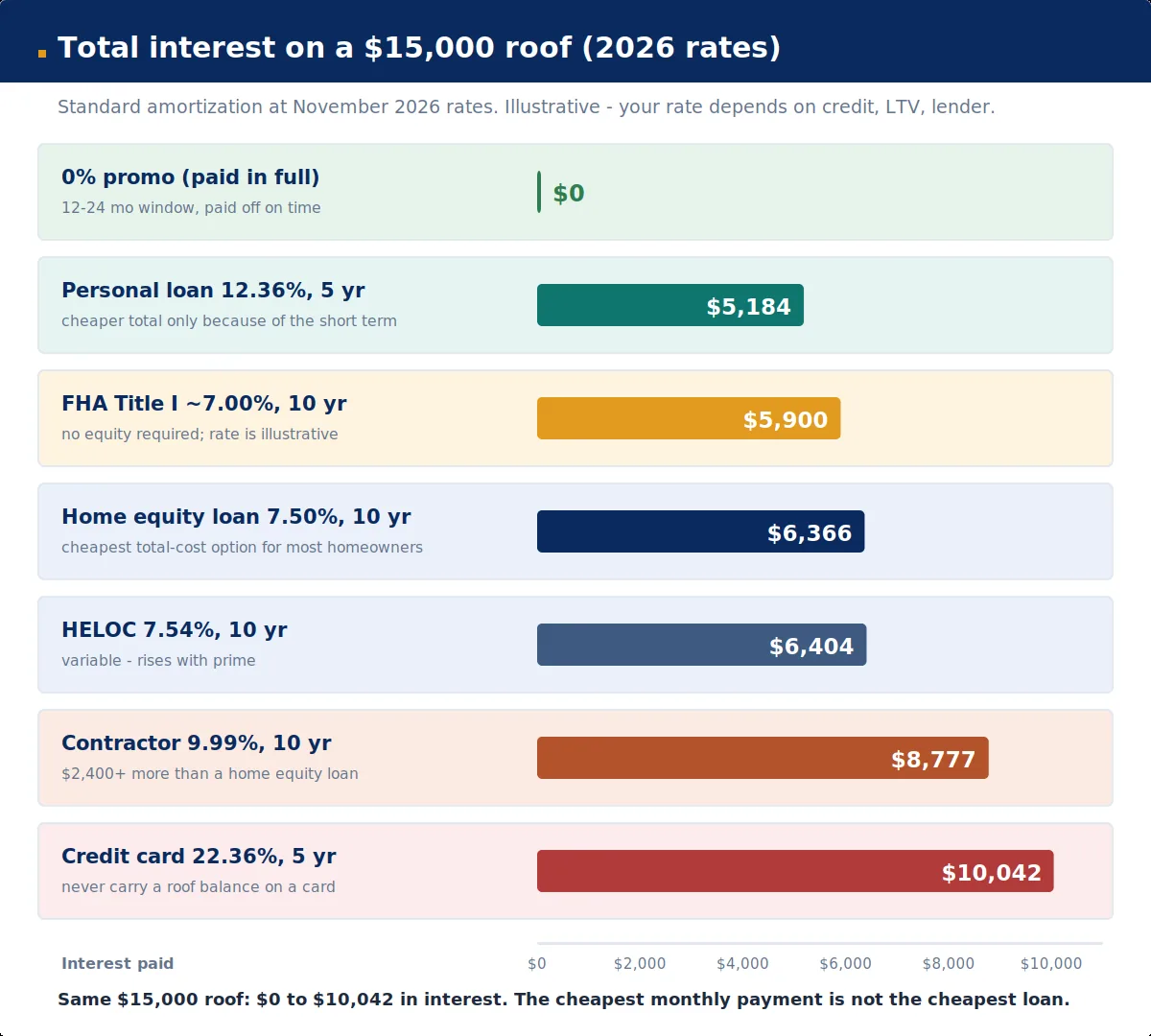
Here’s the decoder. Every figure below is computed with standard amortization at November 2026 rates, on a $15,000 roof:
0% same-as-cash promo (12–24 months, paid in full): $0 interest. The true cheapest — IF you pay it off inside the window. Miss the deadline and it becomes one of the most expensive (see the deferred-interest trap below).
Personal loan, 12.36%, 5 years: $336.40/month → $5,184 interest. Less total interest than a HELOC — but only because the term is half as long. The monthly payment nearly doubles. (Bankrate, October 28, 2026.)
FHA Title I, ~7.00%, 10 years: $174.16/month → ~$5,900 interest. The cheapest option for homeowners with no equity. Rate is a 2026 market estimate — lenders set it individually.
Home equity loan, 7.50%, 10 years: $178.05/month → $6,366 interest. The cheapest total-cost option for most homeowners who have equity. (Curinos, November 2, 2026 — best-qualified borrowers.)
HELOC, 7.54%, 10 years: $178.37/month → $6,404 interest. Virtually identical to a home equity loan at today’s rates — but the rate is variable and moves with prime.
Contractor financing, 9.99%, 10 years: $198.14/month → $8,777 interest. Convenient, same-day approvals — but costs $2,400+ more than a home equity loan on the same roof. (NEXGEN Jacksonville; Smith Roofing Knoxville.)
Credit card, 22.36%, 5 years: $417.36/month → $10,042 interest. The worst option by far. You’d pay two-thirds of the roof’s price again in interest. Never carry a roof balance on a card. (Federal Reserve G.19, August 2026 — accounts assessed interest.)
The flip: the “cheapest monthly payment” ($174/month FHA Title I) is not the “cheapest total cost” ($0 with a disciplined 0% promo). And the most convenient option — contractor financing — quietly costs thousands more than the bank would charge.
One caveat: these are illustrative figures at stated rates. Your rate depends on credit score, loan-to-value, and lender. But the ordering — 0% promo < personal < Title I < home equity loan < HELOC < contractor < credit card — is robust. It holds across normal rate noise.
The 7 options at a glance
| Option | Nov 2026 rate | Term | Total interest on $15k | Best for |
|---|---|---|---|---|
| 0% contractor promo | 0% (deferred) | 12–24 mo | $0 (if paid in full) | Can pay off fast |
| Personal loan | 12.36% avg | 3–5 yr | ~$5,184 | Speed, no collateral |
| FHA Title I | ~6–9% | 6 mo–20 yr | ~$5,900 | No equity needed |
| Home equity loan | 7.50%–8.63% | 5–15 yr | ~$6,366 | Homeowners with equity |
| HELOC | 7.36–7.54% | 10-yr draw | ~$6,404 | May draw again later |
| Contractor financing | 9.99%+ | 10–15 yr | ~$8,777 | One-stop convenience |
| Cash-out refinance | 7.37–7.60% | 30 yr | Trap (see below) | Almost never |
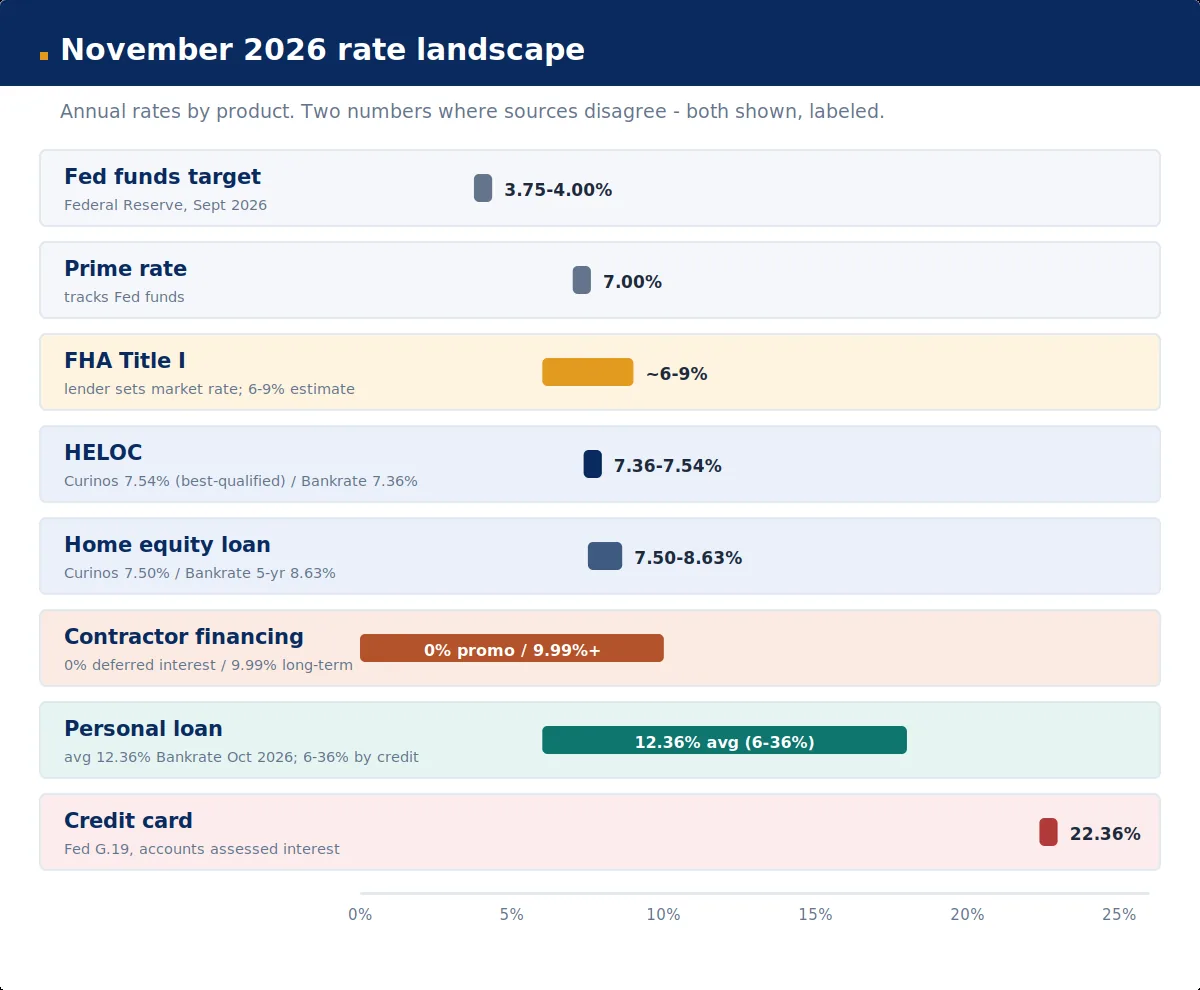
The rate landscape in November 2026, after the Fed’s September 16 quarter-point hike (first increase since 2023): fed funds at 3.75–4.00%, prime at 7.00%.
Two notes on the numbers above. Curinos rates (HELOC 7.54%, home equity loan 7.50%, November 2, 2026) reflect best-qualified borrowers — 780+ credit, combined loan-to-value under 70%. Bankrate’s broader surveys show a HELOC average of 7.36% (October 28) but 8.63% for a 5-year $30,000 home equity loan (October 14). Neither is THE average. They’re different surveys of different borrowers. Always compare with your own profile in mind.
Home equity loan: the cheapest option for most homeowners
A home equity loan is a second mortgage: a lump sum, a fixed rate, fixed payments. For a one-time roof cost, it’s the cheapest mainstream option at November 2026 rates.
The numbers: 7.50% fixed for best-qualified borrowers (Curinos, November 2, 2026), up from a 2026 low of 7.31% in late June. Broader surveys run higher — Bankrate’s October 14 survey showed 8.63% on a 5-year $30,000 loan, the fifth straight weekly rise and the highest since April 2024.
What you need: typically 680+ FICO, and 15–20% equity left in the home (max 80–85% combined loan-to-value). Funding takes 2–8 weeks. Some lenders waive closing costs.
The tax angle: home equity loan interest is deductible only if the loan is used to buy, build, or substantially improve your home — and a roof replacement qualifies (IRS Publication 936). That doesn’t make the loan free. It makes it deductible. Consult a tax professional about your situation.
The catch: your home is collateral. A fixed rate protects you from the rate rises that have defined 2026 — the Fed just hiked in September, and the prime rate sits at 7.00%.
HELOC: flexible but variable
A HELOC is a revolving credit line secured by your home. You draw what you need, repay, draw again. For a roof — a one-time expense — the flexibility is mostly wasted. But it wins in one scenario: bundling the roof with a second project later (say, the roof now and a premium upgrade next year — see our roof replacement cost guide for 2026 pricing) without a second application.
The numbers: 7.54% average (Curinos, November 2, 2026, best-qualified) vs 7.36% (Bankrate, October 28, broader survey) vs 7.21% (MonitorBankRates, November 3). Whichever survey you trust, the HELOC runs slightly above the home equity loan — and it’s variable.
That variable part matters. A HELOC rate moves with prime. If prime rises 2 points from here, a 7.54% HELOC becomes ~9.54% — and the $6,404 interest figure above stops being true. The typical structure is a 10-year draw period (interest-only payments possible) followed by a 20-year repayment period. The payment shock when the draw period ends is a known risk.
Funding takes 2–6 weeks. Same 680+ FICO, same 15–20% retained equity, same IRS Publication 936 deductibility rules as home equity loans.
Bottom line: for a roof alone, the home equity loan’s fixed rate beats the HELOC’s flexibility. The rate gap is tiny (0.04%). The certainty gap is not.
Personal loan: fast and unsecured, but pricey
A personal loan is unsecured — no home as collateral, no appraisal, no equity required. That’s the entire appeal. Funding in 1–7 days makes it the fastest option besides contractor financing.
The numbers: 12.36% average (Bankrate, October 28, 2026 — 700 FICO, $5,000, 3-year term). The range by credit score is brutal: 740+ borrowers get ~11.7%; 680–699 get ~16.0%; 620–639 get ~18.7% (Curinos via Experian, September 2026, 60-month terms). Credit unions are kinder — 10.64% average personal loan rate (NCUA, Q4 2025), and federal credit unions cap credit card rates at 18%.
The paradox from the interest ladder: a personal loan at 12.36% over 5 years costs $5,184 in total interest — LESS than a home equity loan at 7.50% over 10 years ($6,366). The shorter term saves you. But the monthly payment is $336 vs $178. That’s the trade: faster freedom, harder months.
Personal loan interest is NOT tax deductible. And if your credit is under 620, traditional banks will decline you — online lenders like Upstart (minimum 300) will approve at 18–36%. At that point, FHA Title I (below) is usually the better no-equity path.
Contractor 0% promos: deferred interest, not free money
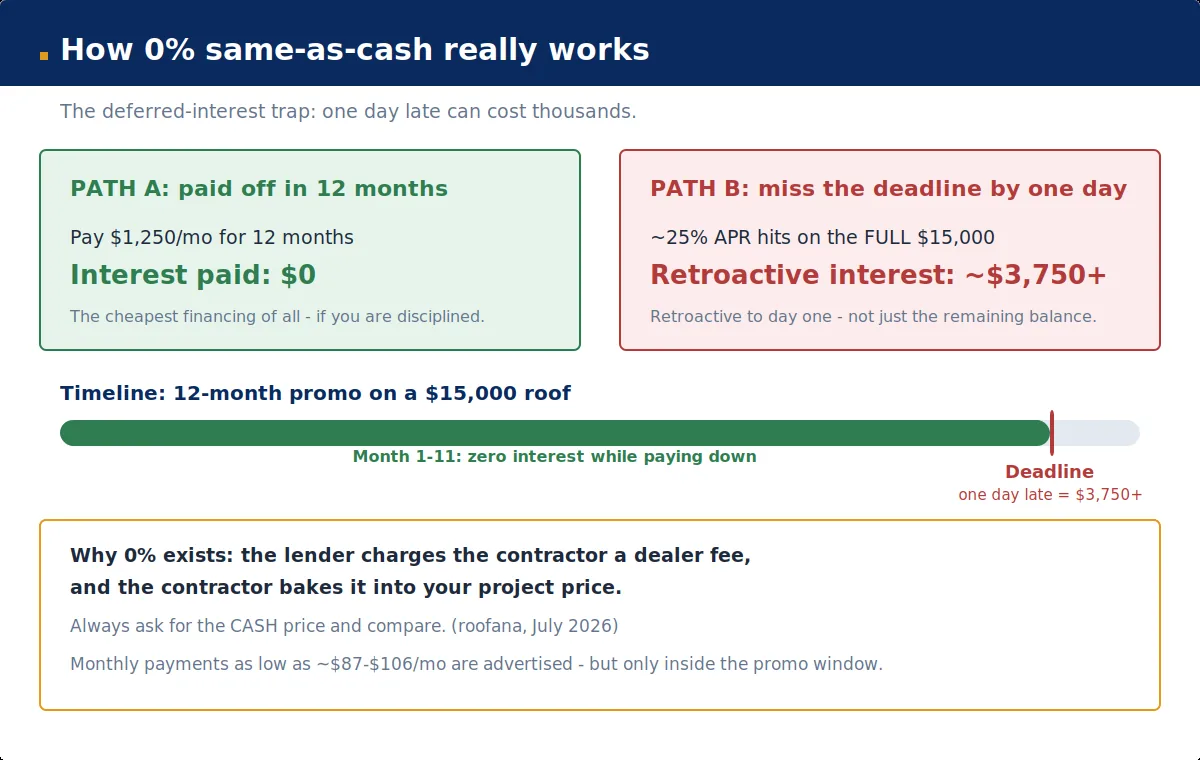
This is the trap that catches the most homeowners. The contractor offers “12 months no interest, no payments.” It sounds like free money. It’s not. It’s deferred interest.
How it works: partner lenders — Service Finance Company, GreenSky, Wisetack (JDH Remodeling, May 2026) — fund the loan at 0% for 12 to 24 months. If you pay the FULL balance by the promo end date, you pay $0 in interest. True. But if you miss the deadline — by one day, by one dollar — all the interest that accrued during the promo period hits retroactively, typically at 20–29.99% APR (roofana, July 2026; Wegner Roofing, Rapid City). On a $15,000 roof at 25%, that’s roughly $3,750+ in retroactive interest — and the clock started on day one, not at the deadline.
There’s a second, quieter cost: the dealer fee. The lender charges the contractor a fee for offering 0% financing — and the contractor bakes it into your project price. The “0% price” is not the cash price. Ask for the cash price. Compare. A 2–3% discount for ACH, check, or cash payments is standard with roofers (EquityRoofs, January 2026). Your 0% deal may already cost you $450.
When long-term contractor plans kick in (120–180 months), rates start at 9.99% APR (NEXGEN Jacksonville; Smith Roofing Knoxville) — no prepayment penalty, but $8,777 in interest on a $15k roof over 10 years.
The honest version of 0% promos: they’re excellent for disciplined borrowers who WILL pay in full before the deadline. They’re expensive for everyone else. Know which one you are before you sign.
FHA Title I: the no-equity option
FHA Title I is the option no SERP page covers properly — and it’s the best one for homeowners with no equity. It’s a government-backed home improvement loan that does not require equity.
The terms: up to $25,000 for a single-family home. Loans $7,500 and under are unsecured — above that, the loan is secured by a lien on the property, but that’s not an equity requirement. Fixed rate only (the lender sets the market rate — expect roughly 6–9% in 2026, though that band comes from lender comparisons, not a rate survey). Terms from 6 months to 20 years. No prepayment penalty. No income limits. Most participating lenders want 580+ credit.
The property must be complete and occupied for at least 90 days before you apply, and the work must improve livability — a roof replacement qualifies. The wrinkle: not all FHA lenders offer Title I. You have to find an approved participating lender through HUD’s lender directory.
At ~7.00% over 10 years, a $15,000 Title I loan costs about $5,900 in interest — cheaper than contractor financing, cheaper than a personal loan’s longer terms, and available with zero equity. If you can’t tap home equity and can’t clear a 0% promo in 12 months, this is usually the answer.
Cash-out refinance: the $90,000 trap
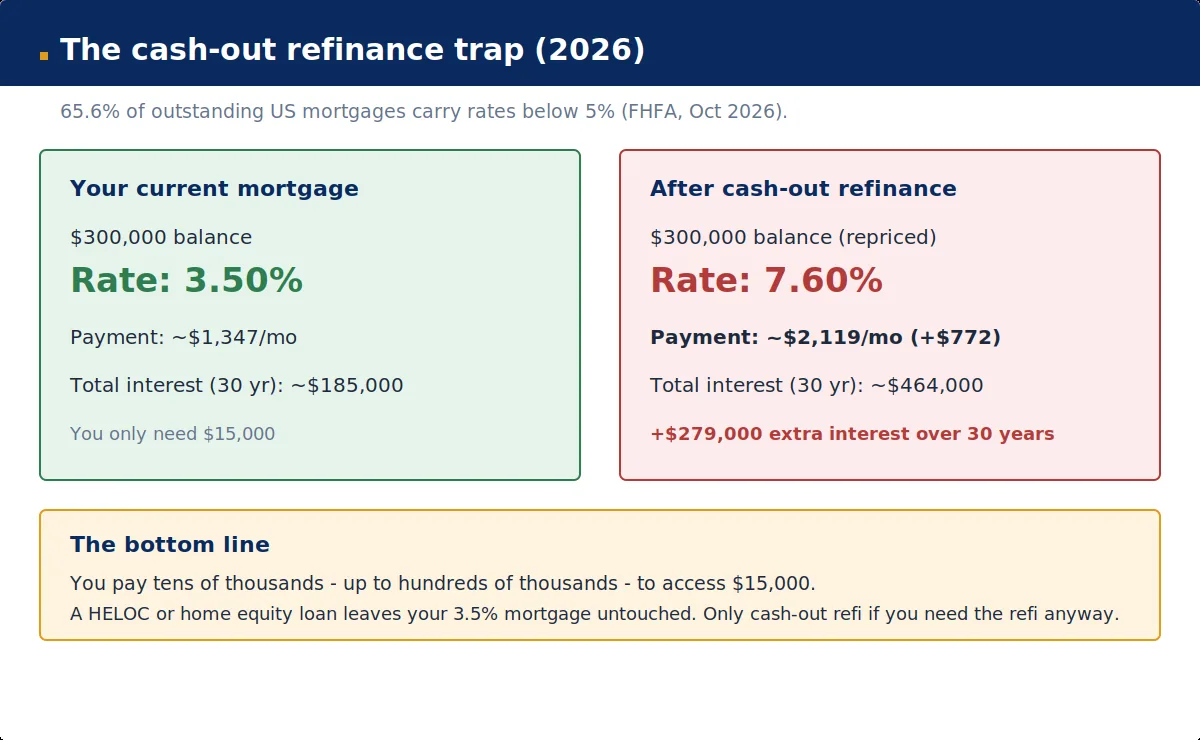
The most expensive roof financing in America isn’t the credit card. It’s the cash-out refinance — because it doesn’t reprice the $15,000. It reprices your entire mortgage.
The setup: cash-out refis price at ~7.37–7.60% for a 30-year fixed in October–November 2026 (Investopedia; Bankrate), typically 0.25–0.50 points above a rate-and-term refi. Closing costs run 2–6% of the loan ($3,000–$6,000 typical). Funding takes ~6 weeks.
The trap: 65.6% of outstanding first-lien mortgages carry rates below 5% (FHFA National Mortgage Database, via Realtor.com, October 2026). If you hold a $300,000 mortgage at 3.5% and refinance into 7.6% to pull out $15,000 for a roof, the $15,000 itself costs about $7,700 in interest over 10 years. Reasonable. But repricing the $300,000 balance from 3.5% to 7.6% costs roughly $90,000+ in extra interest over the life of the loan. You’d pay tens of thousands to access fifteen thousand.
The only scenario where a cash-out refi makes sense for a roof: you need the refinance anyway — you’re already refinancing at 7.6% for other reasons, and the roof rides along. Otherwise, a home equity loan does the same job at a similar rate without touching your first mortgage.
Credit cards: the worst way to finance a roof
Short section, strong conclusion: don’t.
Credit cards carry the highest rates of any option — 22.36% on accounts assessed interest (Federal Reserve G.19, August 2026), 19.67% in Bankrate’s October survey. A $15,000 roof carried for 5 years costs $10,042 in interest — and that’s at the Fed’s average. Store cards and rewards cards routinely charge 25–30%.
The only card scenario that works: a 0% introductory APR card (12–21 months) that you pay in full before the promo ends — with the same deferred-interest discipline as contractor promos. Note that most card promos charge interest only from the remaining balance (unlike deferred-interest contractor loans), so they’re slightly less punitive. Still: miss the payoff and you’re at 22%+ on a roof.
Federal credit unions cap card rates at 18% — better, but still worse than every option above.
Rebates and assistance programs
A financing note: there are no federal tax credits for roofing in 2026. OBBBA (P.L. 119-21) ended §25C/§25D for property placed in service after December 31, 2025 — and roofing was never §25C/§25D property anyway. Rebates, not credits, are the game.
HEAR (Home Electrification and Appliance Rebates): income-qualified, up to $8,000 per measure ($14,000 household cap). Covers heat pumps, heat pump water heaters, panels/wiring, insulation — NOT roofing shingles or tiles themselves.
HOMES (Home Efficiency Rebates): up to $8,000 on whole-home modeled or measured energy savings. Insulation installed during a reroof can count toward the savings model in some states — but this is state-dependent, so check your state program before counting on it.
Launch status (October 2026): only 12–13 states plus DC have launched programs. California’s single-family program is fully reserved. Colorado closed in August 2026. Georgia is paused. Most states are still pending. (DOE Program Notices 26-1/26-2, May 29, 2026: fuel-switching is no longer eligible.)
State and utility incentives: check DSIRE for local programs — cool-roof utility rebates exist in some markets and can offset financing costs.
USDA Section 504: 1% loans up to $40,000 for very-low-income rural homeowners age 62+ (grants up to $10,000). Niche, but real — worth checking if you qualify.
FHA Title I (above) is also a government program — it’s listed with the loans because it functions like one.
One more offset: a new roof can cut homeowners insurance premiums 5–20% in storm states through wind-mitigation credits. That doesn’t finance the roof, but it lowers the effective monthly cost once it’s on.
Which option fits you: the decision matrix
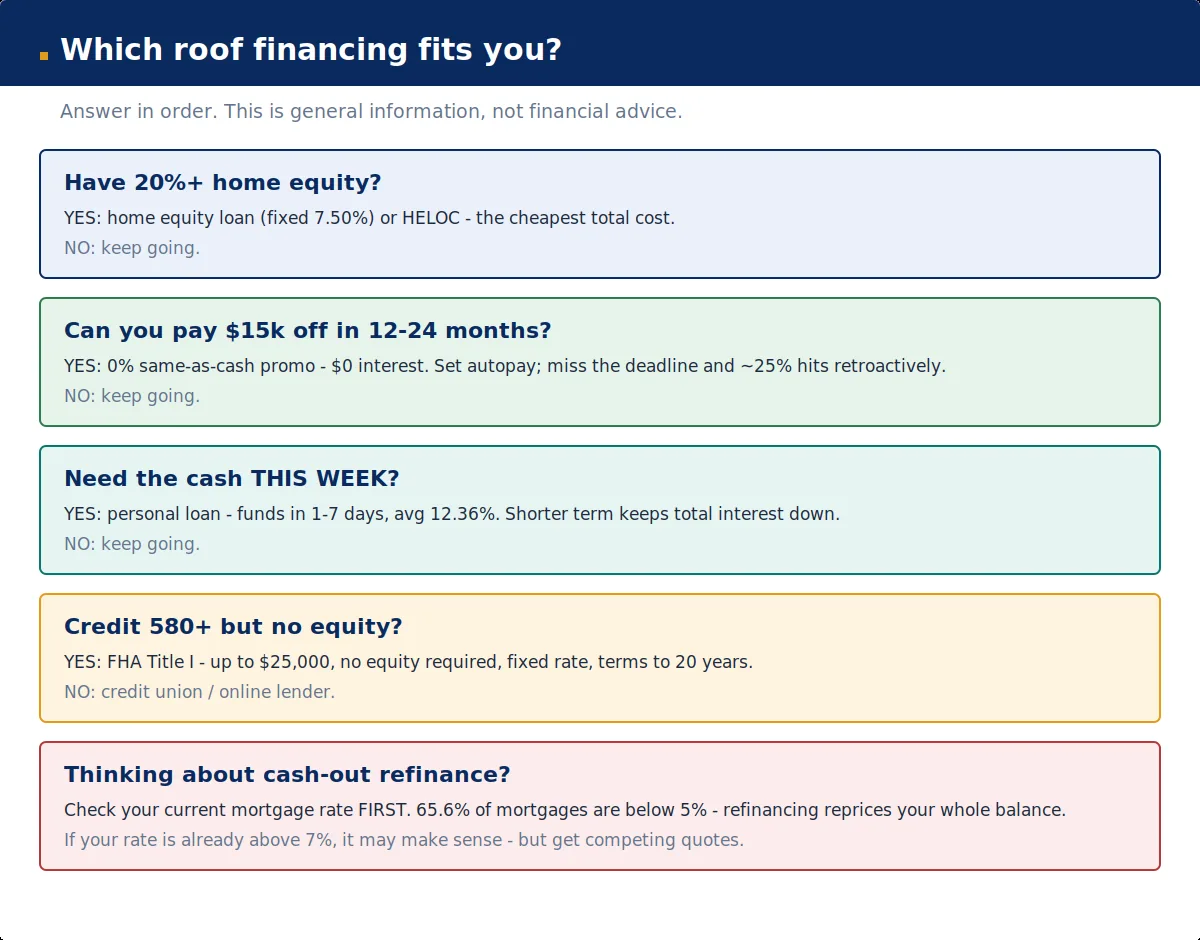
One flowchart, five questions:
- Can you pay it off in 12 months? → 0% contractor promo. Cheapest possible outcome ($0 interest) — but only if the payoff is certain.
- Do you have equity and good credit? → Home equity loan (fixed, ~7.50%). Cheapest mainstream option. HELOC only if you’ll draw again later.
- No equity? → FHA Title I (~7%, up to $25k, 580+ credit). The no-equity specialist.
- Need the money this week? → Personal loan (1–7 day funding, 12.36% avg). Accept the higher rate for speed — or wait 2 weeks and save thousands.
- Bad credit (under 620)? → Credit union personal loan first (10.64% avg), FHA Title I second (580+). Avoid online lenders at 18–36% unless there’s no alternative.
And the universal don’t: don’t cash-out refinance a sub-5% mortgage to fund a roof. Check your current rate before you even consider it.
Final practical note: financing choice interacts with negotiated price. Get the cash price first — roofers commonly discount 2–3% for ACH, check, or cash (EquityRoofs, January 2026). Then compare financing on the same number. A 0% promo on an inflated price can cost more than a home equity loan on the cash price.
For context on what roofs actually cost before financing: our roof replacement cost guide breaks down 2026 shingle pricing; metal roofs and tile roofs cost more but last longer; and if you’re not sure you need a full replacement, our roof repair cost guide covers the repair-vs-replace math.
Sources & methodology
Rate anchors (November 2026): Federal Reserve FOMC (September 16, 2026 — fed funds 3.75–4.00%, first hike since 2023; prime 7.00%); Federal Reserve G.19 Consumer Credit (credit cards 22.36% on accounts assessed interest, August 2026); Curinos via Yahoo Finance (HELOC 7.54%, home equity loan 7.50% fixed — November 2, 2026, borrowers with 780+ credit and CLTV under 70%; up from 2026 lows of 7.09% and 7.31%); Bankrate surveys (HELOC 7.36% October 28, 2026; personal loan 12.36% October 28, 2026; credit card 19.67% October 14, 2026; home equity loan 8.63% 5-year $30,000 October 14, 2026 — highest since April 2024); MonitorBankRates (HELOC 7.21% national, November 3, 2026); Freddie Mac PMMS (30-year fixed 7.24%, October 29, 2026); Investopedia (refi 7.37%, November 3, 2026); Curinos via Experian (personal loan rates by credit score, September 2026); NCUA (credit union personal loan 10.64%, Q4 2025). Cash-out refi: 7.37–7.60% (Investopedia/Bankrate, October–November 2026); mortgage-info.com 6.35% (April 2026, top-tier) vs erneroy 7.95% (March 2026) — spread reflects credit tiers; the October–November band is the anchor. The refi trap: 65.6% of outstanding first-lien mortgages below 5% (FHFA National Mortgage Database via Realtor.com, October 2026). Contractor financing: JDH Remodeling (May 15, 2026 — Service Finance, GreenSky, Wisetack partner model; 12-month no-interest-no-payments); NEXGEN Jacksonville and Smith Roofing Knoxville (9.99% APR, 120–180 months, no prepayment penalty); roofana (July 2026 — deferred-interest mechanics, $0 down, $87–$106/mo payments); Wegner Roofing Rapid City (deferred-interest 20–29.99%); Wisetack (true 0% short-term, min FICO 600, $25k max); Service Finance (min FICO 550, terms 1–15 years, $100k max); EquityRoofs (January 2026 — 2–3% cash discount). FHA Title I: HUD policy handbook via mymortgageinsider and thelendersnetwork ($25,000 max single-family, ≤$7,500 unsecured, fixed rate, 6 months–20 years, no prepayment penalty, 580+ at most lenders; “6–9%” rate band from lender comparisons — illustrative, lender sets the rate); CRS report (January 2026). Rebates: DOE Program Notices 26-1/26-2 (May 29, 2026 — fuel-switching no longer eligible); startbusinessbystate (October 6, 2026 — 12–13 states + DC launched; CA reserved, CO closed, GA paused); retrofitrelay (July 2026); DSIRE (dsireusa.org); USDA Section 504 (1% loans up to $40,000, 62+, very-low-income rural); LendingTree roof financing guide (August 6, 2026); furilia roof loan facts. Tax: IRS Publication 936 (home equity interest deductible when used to buy, build, or substantially improve — consult a tax professional). Tax-credit status: standing project rule per IRS FS-2025-05 (OBBBA, P.L. 119-21) — $0 federal credit for roofing in 2026. The $15,000-roof interest figures were computed with standard amortization at the stated November 2026 rates and are illustrative — your rate depends on credit, LTV, and lender. All data US and 2026-dated unless flagged.
What is the cheapest way to finance a new roof in 2026?
A 0% same-as-cash contractor promo ($0 interest if paid in full within 12–24 months), then a home equity loan at ~7.50% ($6,366 in interest on a $15,000 roof over 10 years). The cheapest option depends on whether you can clear the balance inside the promo window.
Is a home equity loan or HELOC better for a roof replacement?
For a one-time roof cost, a fixed home equity loan (7.50% at best-qualified rates, November 2026) beats a HELOC (7.54% variable) on payment certainty — the 0.04% gap is tiny, but the HELOC’s rate moves with prime. A HELOC wins only if you might draw again for a second project later.
Can I get a roof loan with no equity?
Yes. FHA Title I offers up to $25,000 with no equity required (loans up to $7,500 unsecured), fixed rates around 6–9%, and terms up to 20 years — most participating lenders accept 580+ credit. A personal loan (avg 12.36% APR, 1–7 day funding) is the faster unsecured alternative.
Do roofing companies offer 0% financing?
Yes — 12–24 month same-as-cash promos are common through lenders like Service Finance and Wisetack. But they’re usually DEFERRED interest, not true 0%: miss the payoff deadline and ~20–30% APR applies retroactively to the full balance from day one. Always ask for the cash price — the contractor bakes a dealer fee into the 0% price.
Should I do a cash-out refinance to pay for a roof?
Almost always no in 2026. 65.6% of US mortgages carry rates below 5% (FHFA, October 2026), while cash-out refis price at ~7.37–7.60%. Refinancing reprices your entire mortgage balance upward — costing roughly $90,000+ in extra interest on a $300,000 balance to access $15,000. Only consider it if you need the refinance anyway.
Are there government programs to help pay for a new roof?
FHA Title I (up to $25,000, no equity needed), USDA Section 504 (1% loans up to $40,000 for very-low-income rural homeowners 62+), and state/utility rebates via DSIRE. Federal HEAR/HOMES rebates cover efficiency measures (heat pumps, insulation, panels) — not roofing itself — and only 12–13 states have launched programs so far.
Is home equity loan interest tax deductible for a roof?
Yes, if the loan is used to buy, build, or substantially improve your home — a roof replacement qualifies (IRS Publication 936). Personal loan and credit card interest are not deductible. Consult a tax professional about your situation.