

Table of Contents
“Metal costs twice as much” is true and also meaningless. A metal roof that outlives two asphalt roofs isn’t competing on installed price — it’s competing on installed price per year, and it brings insurance discounts and energy savings that shingles can’t match. The honest comparison has four parts: what each roof costs installed today (tariff-adjusted), what each costs per year over its real lifespan, what insurance and energy take off the metal premium, and what each returns at resale.
This guide is the comparison no top-10 SERP page gives you in one place: Angi’s freshest October 2026 installed-cost data, the 2026 tariff impact with labeled figures, the 50-year cost-per-year math, the insurance math by state, and the Zonda 2025 resale paradox — asphalt recoups 68% of its cost at resale, metal just 50.1%.
Metal roof vs shingles: the 2026 price tags
Start with the anchors, then complicate them. Every figure below is a 2026 US installed cost unless labeled otherwise.
Metal (steel): $19,000 average. Angi’s “How Much Does a Steel Roof Cost to Install?” (updated October 30, 2026) puts the national average at $19,000, with most homeowners spending $16,000–$28,000 and an installed rate around $11/sq ft (typical band $6–$16/sq ft). Standing seam specifically averages $19,000 too, with a wider project range of $9,400–$32,600 (Angi, October 20, 2026).
Asphalt shingles: $10,500 average. Angi’s shingle roof page (updated October 1, 2026) puts the national average at $10,500, with most homeowners spending $7,500–$24,000. Angi’s roof-replacement dataset — 32,999 verified projects, updated October 22, 2026 — averages $9,610 with most paying $5,903–$13,378 at $4–$11/sq ft installed.
So the headline ratio is roughly 1.8x: $19,000 vs $10,500. But that ratio collapses the moment you split metal into its four price tiers — because “metal roof” as a single price band ($4–$30/sq ft, which some pages print as one number) is about as useful as “car” as a single price band. The decoder below fixes that.
Metal roof prices by profile in 2026 (the installed-price decoder)
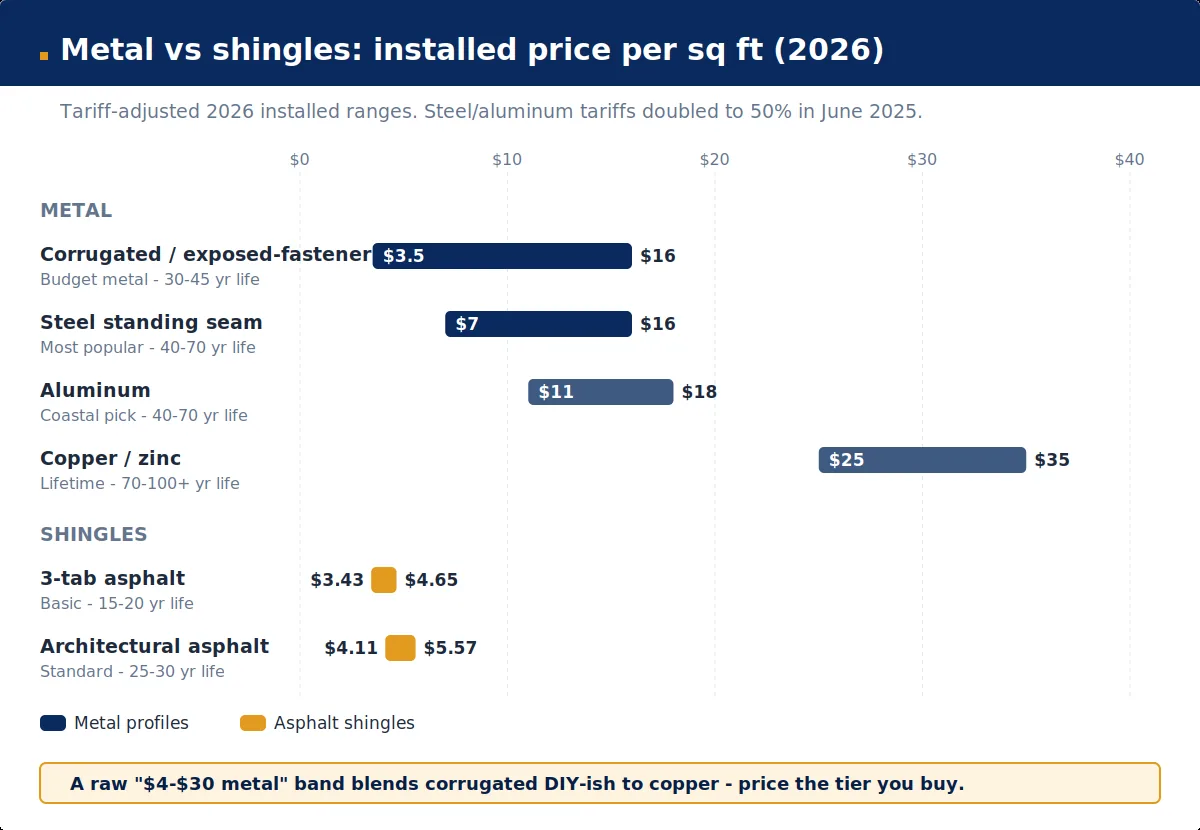
Never price “metal” as one number. A corrugated steel roof on a shed and a copper standing seam roof on a colonial share nothing except the word “metal.” Here are the four tiers, installed per square foot, 2026:
Tier 1 — Corrugated / exposed-fastener steel: $3.50–$16/sq ft. The budget metal. Low-end installed runs ~$5.50–$6.00/sq ft (investbuzzers 2026); Angi’s band runs $6–$10/sq ft for corrugated steel within the broader metal range. Lifespan: 30–45 years — shorter than premium metal, because exposed fasteners are maintenance points. This is the metal roof that can come within striking distance of architectural asphalt on price.
Tier 2 — Steel standing seam: $7–$16/sq ft. The residential standard and the default “metal roof” in most cost guides. Angi (October 2026) prices standing seam at $12–$16/sq ft; Homewyse’s calculator (May 2026, 24-gauge steel, favorable conditions) lands at $17.74–$23.95/sq ft, and the HomeMatchup Roofing Cost Index (2026) at $18.11–$24.50/sq ft — roughly 2–3x architectural asphalt. Take the Homewyse/HomeMatchup numbers as the contractor-priced high end; Angi’s $19,000 average is the verified-transaction anchor. Our metal roof cost guide breaks down each profile’s installed pricing in more depth.
Tier 3 — Aluminum: $11–$18/sq ft. Angi (October 20, 2026) prices aluminum standing seam at $11–$18/sq ft installed; premium interlocking aluminum runs $9–$17/sq ft (Interlock Roofing 2026). The coastal choice — it won’t corrode in salt air. Lifespan matches steel at 40–70 years.
Tier 4 — Copper and zinc: $25–$35/sq ft. Angi (October 20, 2026): zinc and copper both $25–$35/sq ft installed. Lifespan: 70–100+ years — these are lifetime roofs that get handed down, not replaced.
2026 tariff impact, labeled honestly. Section 232 steel and aluminum tariffs doubled from 25% to 50% in June 2025, and one 2026 analysis of Angi’s San Francisco metro data puts metal roofing material costs up 12–18% vs late 2025 (mywebanswers, corroborated). One single-source estimate claims up to ~60% since mid-2025 (thehealthyattitude) — that figure is uncorroborated and should not be treated as national. What the tariff means in practice: metal’s installed price is under upward pressure that asphalt doesn’t share to the same degree — asphalt manufacturers (GAF, Owens Corning, CertainTeed, Atlas) announced only 4–8% increases by April 2026, with petroleum-derived inputs adding 6–10% (thehealthyattitude).
Labor is the quiet majority. Metal labor runs 40–60% of the total ($7,600–$11,400 on an average steel roof per Angi, March 2026); asphalt labor is ~60% of project cost (avg $6,300, range $4,500–$10,800). Labor averages $4,600–$7,800 by metro for metal installation (Angi, July 2026), at pro rates of $40–$90 per worker-hour (hasbeenz 2026). This is why identical roofs get quotes 30% apart in different metros — you’re mostly buying labor.
Asphalt shingle prices by tier in 2026
Asphalt isn’t one price either — but its tiers are narrower and its math is simpler (the price-decoder visual above includes both shingle tiers for comparison):
3-tab: $3.43–$4.65/sq ft installed (HomeMatchup 2026) — roughly $7,000–$9,500 on a 2,000 sq ft roof. Material runs $1–$3/sq ft (This Old House 2026). Lifespan: 15–20 years — and in the Southeast, 15–20 is the realistic ceiling (Ridgeline 2026). This tier is shrinking; many contractors don’t offer 3-tab anymore.
Architectural (dimensional): $4.11–$5.57/sq ft installed (HomeMatchup 2026) — roughly $8,500–$12,000 on a 2,000 sq ft roof, or ~$4.75/sq ft (~$475 per roofing square) installed (Homewyse via TOH 2026). Angi’s national installed table for asphalt shingle roofs runs $5,800–$20,000; This Old House puts asphalt shingle replacement at $5,800–$12,200 average. Lifespan: 25–30 years.
The honest asphalt anchor: architectural shingles at ~$10,500 installed is what most homeowners actually buy. Impact-resistant Class 3/4 shingles cost more and unlock small insurance discounts (5–10%, newenglandmetalroof) — but they’re still shingles on lifespan.
Lifespan: 40–70 years vs 15–30 years
This is the whole comparison in one line: metal lasts 40–70 years; asphalt lasts 15–30. Everything else is arithmetic on that fact.
Metal: 40–70 years (This Old House 2026; Metal Roofing Alliance; Ridgeline 2026). Premium metals — copper, zinc — run 70–100+ years. Warranties typically run 30–50 years. Metal’s durability drivers: 140+ mph wind resistance (Miami-Dade rated, 180–240 PSF), UL 2218 Class 4 impact resistance (the highest rating, and the one insurers reward), and maintenance of just $50–$150/year — gutter cleaning and fastener checks (industry figures). One honest caveat: metal coatings chalk and fade after 15–20 years; recoating costs $3–$6/sq ft and buys another 10–15 years (aspsuperhome 2026). Budget for it.
Asphalt: 15–30 years (This Old House 2026). 3-tab: 15–20 years. Architectural: 25–30 years. Warranties: 15–30 years. Annual maintenance runs $100–$300 — inspections, debris clearing, sealant, minor repairs (industry figures). Our roof repair cost guide covers what those individual fixes run. Asphalt’s enemies are heat (granule loss), ice dams, and algae — none of which shorten metal’s life the same way.
The practical meaning: a 40-year-old homeowner who installs metal may never reroof again; the same homeowner installing asphalt will reroof at least once, probably twice. That’s not a feeling — it’s the next section’s math.
The 50-year cost-per-year math (metal’s real price tag)
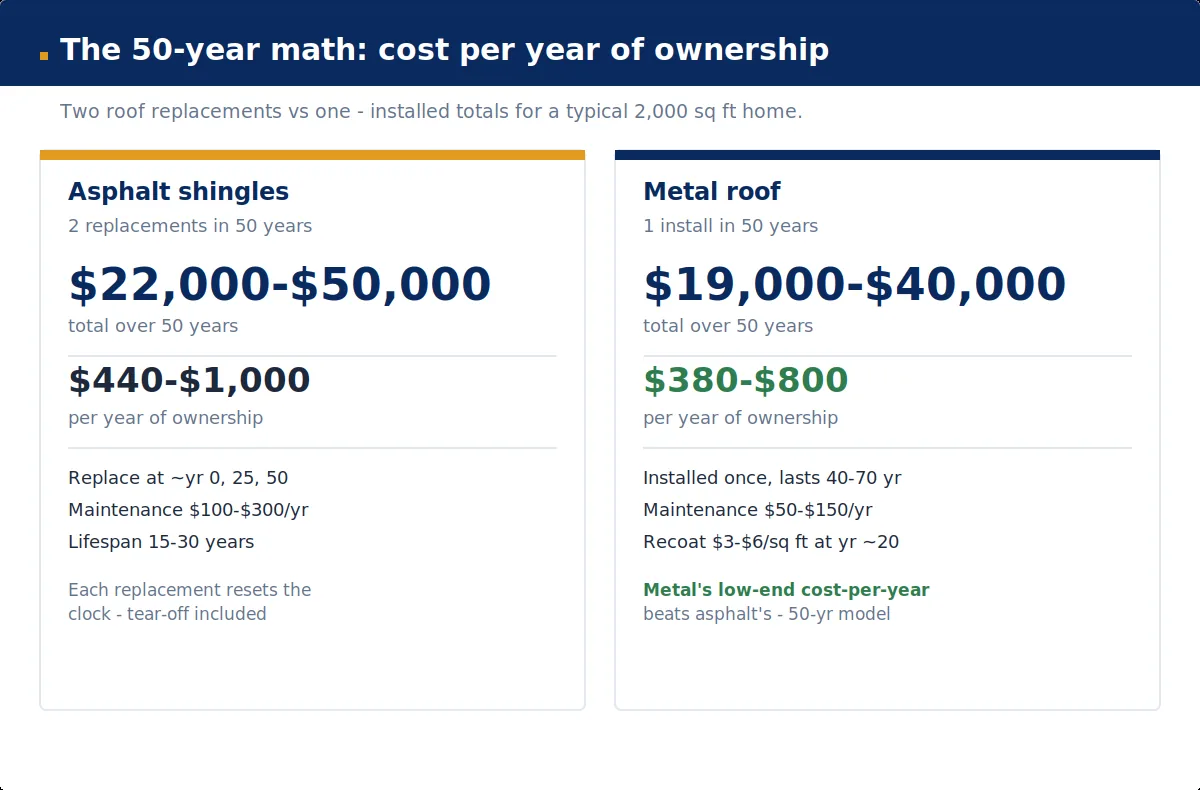
Two replacements vs one install — that’s the 50-year game. Two modeled comparisons, sources labeled:
knowledgementors model (2,000 sq ft): asphalt $6,300–$8,000 with a 25–30 year life = $210–$320/year; metal $14,000–$24,000 with a 40–60 year life = $233–$600/year. Note the overlap: metal’s low end beats asphalt’s high end on cost per year even before insurance and energy are counted.
ksinglecorp 50-year model: shingles require two replacements over 50 years at $22,000–$50,000 total; one metal roof at $25,000–$40,000 covers the same 50 years. The ranges overlap, but the metal owner writes one check and the shingle owner writes three — with each reroof carrying tear-off costs ($1,500–$4,500 per project, HomeAdvisor 2026; or $1–$3/sq ft) and decking surprises ($2–$5/sq ft if rotted) that metal’s single install avoids.
The break-even window: 15–25 years. Metal vs asphalt crosses somewhere between year 15 and year 25 (newenglandmetalroof 2026; mywebanswers’ Texas model at 15–20 years). Before that, asphalt is cheaper; after that, metal pulls away — and the gap widens with every avoided replacement.
Lifetime offsets (modeled, ranges labeled): mywebanswers’ lifetime model puts the total metal advantage at $28,500–$68,500 over 50 years, from: energy $5,000–$12,000 + insurance $4,500–$7,500 + avoided replacement $15,000–$25,000 + resale premium $4,000–$24,000. Treat the endpoints as modeled scenarios, not guarantees — but the direction is robust: the longer you stay, the more metal wins.
Insurance discounts: the hidden line item (5–35%)
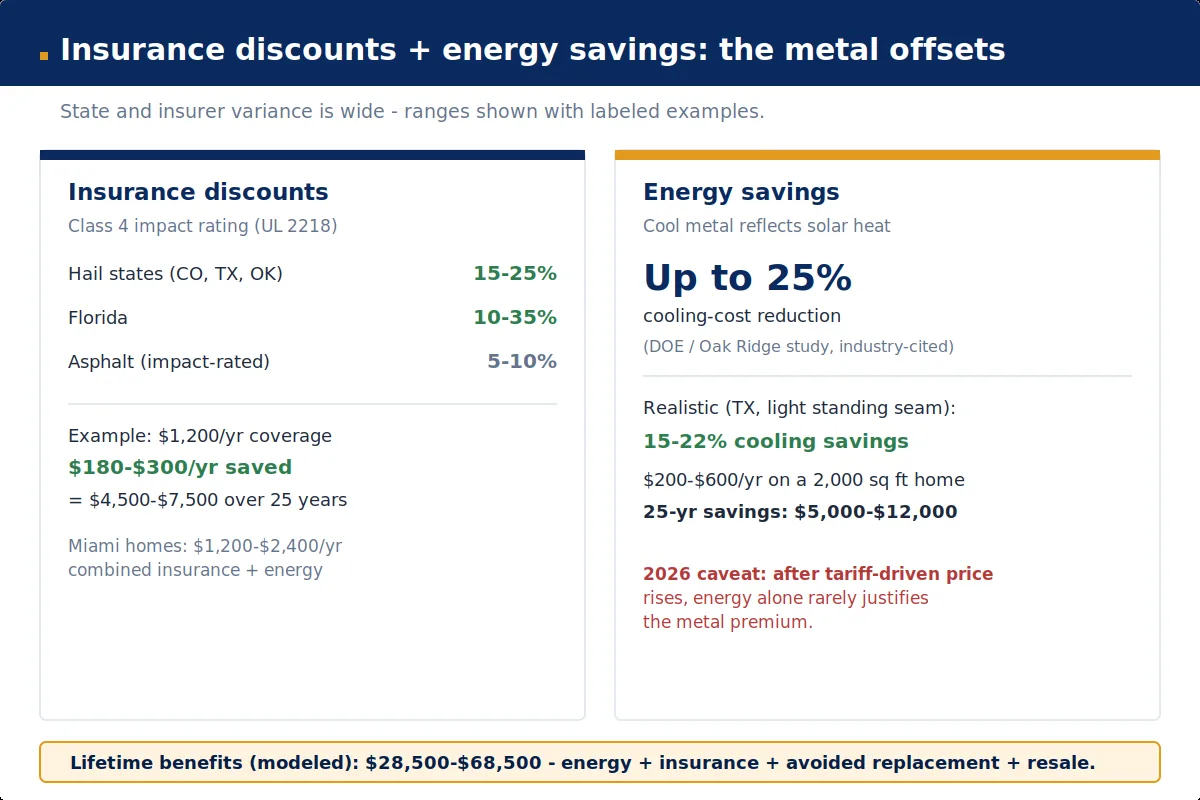
Metal’s Class 4 impact rating — the UL 2218 highest tier, tested with a 2-inch steel ball — is the rating insurers pay for. The discount range is wide because insurance is state-by-state, but it’s real money:
The range: 5–35% off homeowners premiums (newenglandmetalroof 2026; homerunimprovement 2026; Metal Roofing Alliance). Asphalt with Class 3/4 impact-resistant shingles gets only 5–10% (newenglandmetalroof).
Hail states (CO, TX, OK): typically 15–25%. On $1,200/year of roof coverage, that’s $180–$300/year saved — $4,500–$7,500 over 25 years (mywebanswers 2026).
Florida: 10–35%. Citing Insurance Information Institute data via aspsuperhome 2026; Miami homes can save $1,200–$2,400/year combined insurance + energy. In Florida, the insurance discount alone can carry a meaningful share of the metal premium.
Always labeled, always verified: these are insurer- and state-specific. Get the quote from your insurer before you buy the roof — some carriers discount Class 4 metal aggressively, others barely. But on average, insurance is metal’s single largest annual offset after energy.
Energy savings: real, but no longer the deciding argument
Metal reflects solar heat; asphalt absorbs it. The numbers, handled carefully:
The headline figure: up to 25% cooling reduction. A DOE/Oak Ridge National Laboratory study found metal roofing reduced heat flow 45%, cutting cooling costs 25% (cited via homerunimprovement 2026). The Metal Roofing Alliance cites up to 25% cooling-cost reduction, up to 40% total energy use reduction in warmer climates (via Ridgeline 2026). Present these as industry-cited study figures — they’re real studies, but the industry does the repeating.
The realistic band: 15–22%. Texas, light-colored standing seam, proper attic ventilation and insulation: 15–22% cooling savings (mywebanswers 2026); a 2,000 sq ft metal roof saves roughly $200–$600/year on cooling. Modeled 25-year energy savings run $5,000–$12,000 vs asphalt (mywebanswers) — climate-dependent, as always.
The 2026 caveat that matters: one 2026 analysis notes energy savings alone no longer justify the metal premium for most homeowners after tariff-driven price increases — the Texas payback stretched from 15–20 years to 18–24 years on energy alone (mywebanswers 2026). Energy is a real offset, but buy metal for the lifespan + insurance math; treat energy as the bonus, not the business case.
And the framing rule, stated once: cool metal roofs are reflective — they are not tax-credit eligible. Roofs (metal or shingle) were never §25C/§25D energy property, and OBBBA (P.L. 119-21; IRS FS-2025-05) ended those credits for post-December-31-2025 installs anyway. There is $0 federal credit for any roof in 2026. Any page implying a “cool roof tax credit” is selling, not informing.
The resale paradox: asphalt wins on percentage
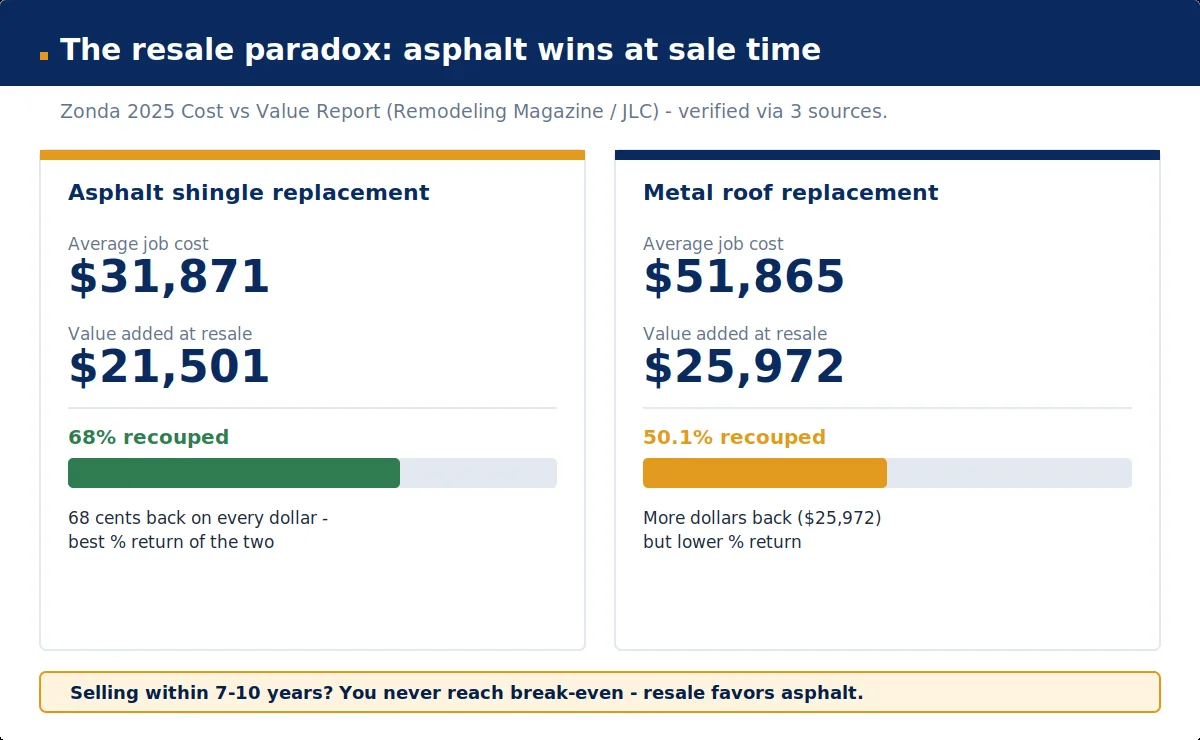
Here’s the twist the industry doesn’t advertise: asphalt recoups a higher percentage of its cost at resale than metal does.
Zonda 2025 Cost vs Value Report (Remodeling Magazine/JLC — verified across three independent sources: elliottroofs, thenexthint, luxrroof 2026): asphalt shingle replacement averages $31,871 and adds $21,501 in resale value = 68% recouped. Metal roof replacement averages $51,865 and adds $25,972 = 50.1% recouped.
Note the absolute numbers, though: metal adds $4,471 more in resale dollars ($25,972 vs $21,501) — it just cost $19,994 more to install. Asphalt’s percentage win is arithmetic: a cheaper project recoups more of itself. (NAR’s 2025 Remodeling Impact Report puts roof replacement recovery closer to 37% — different methodology, realtor estimates rather than appraiser-modeled; the spread is worth one sentence, not an argument.)
The market rule that follows: if you’re selling within 7–10 years, asphalt wins — you never reach break-even, and the buyer discounts your metal roof to roughly half its installed cost (luxrroof 2026; shop4anything 2026). New roofs add 5–6% to listed home value independent of ROI percentage (homeworthhq 2026), so the roof still pays you — just more of it if it’s asphalt. If you’re staying 15+ years, the resale percentage is irrelevant next to the cost-per-year math.
The decision framework: when metal wins, when shingles win
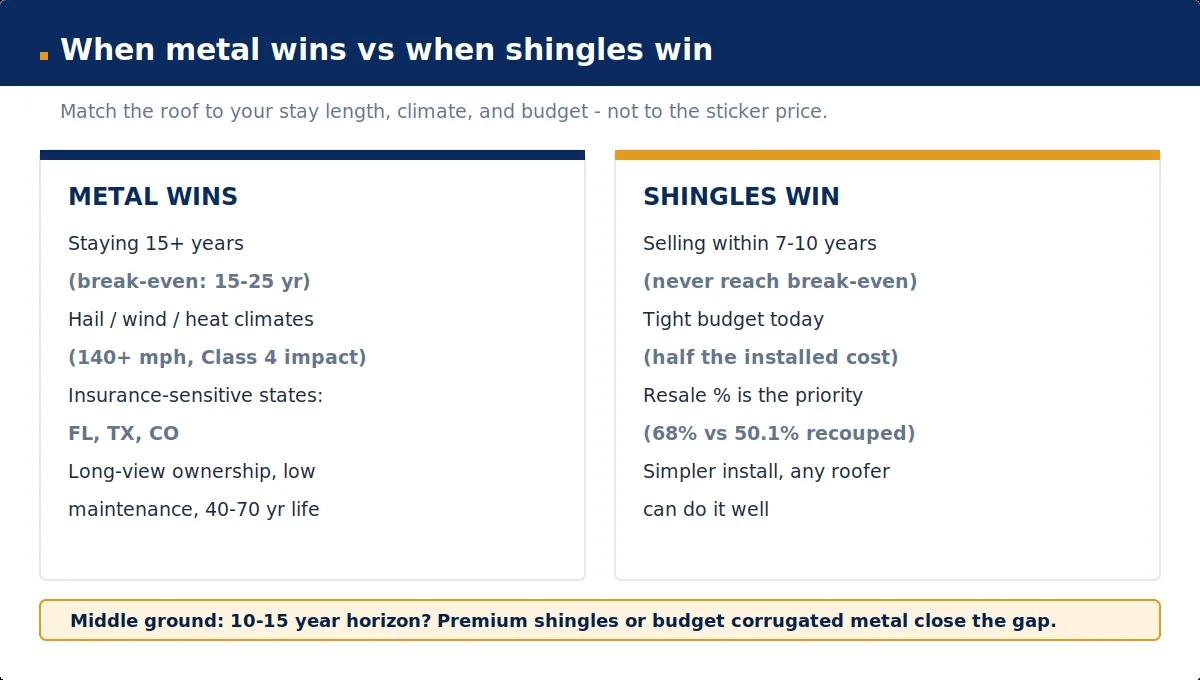
Three questions, in order. Answer them honestly and the roof picks itself:
1. How long are you staying? Selling within 7–10 years → shingles. The break-even never arrives, and Zonda’s resale math favors asphalt on percentage. Staying 15+ years → metal starts winning on cost-per-year, and every year past break-even widens the gap.
2. What’s your climate and insurer? Hail belt (TX, CO, OK), hurricane coast (FL), or high-heat Southwest → metal‘s insurance discounts (15–25% in hail states, up to 35% in FL) and energy savings do the most work here. Mild climate, cheap insurance → asphalt’s case gets stronger because metal’s offsets shrink.
3. What’s the rest of the project? A complex roof — steep pitch (8:12+ adds 25–50% to labor), hips, dormers, valleys, skylights, chimneys — makes metal 15–25% more expensive than a simple gable (hasbeenz 2026), with an NRCA waste factor of 10–20%. Chimney flashing alone is its own trade boundary — our chimney repair cost guide covers the masonry side. Complex roofs also make reroofing twice (asphalt) doubly painful. Simple roof + selling soon = shingles. Complex roof + staying = the math tilts metal even harder than the averages suggest.
What drives your final quote regardless of material: roof size is actual surface area (a 2,000 sq ft home ≈ 22 roofing squares at 6:12 pitch — not floor plan); tear-off and disposal run $1,500–$4,500 per project (HomeAdvisor 2026); underlayment $0.10–$0.90/sq ft (premium synthetic + ice-and-water shield worth it); decking replacement $2–$5/sq ft if rotted; and code allows only one existing asphalt layer to be roofed over — with a deck inspection required (Interlock 2026). If the whole project is a full tear-off, our roof replacement cost guide itemizes the complete scope.
The one-line version: stay 15+ years in a hail, wind, or heat market → metal. Sell soon, mild climate, tight budget → architectural shingles. Both roofs keep the rain out; the math decides which one is cheaper.
Sources & methodology
Installed-cost anchors: Angi, “How Much Does a Steel Roof Cost to Install? [2026 Data]” (Oct 30, 2026: $19,000 avg, $16,000–$28,000, $11/sq ft avg, $6–$16 band; corrugated $6–$10); Angi standing seam page (Oct 20, 2026: $19,000 avg, $9,400–$32,600; steel $10–$16, aluminum $11–$18, zinc/copper $25–$35/sq ft); Angi metal roofing page (Jul 20, 2026: $11/sq ft avg, $4–$30 band by material); Angi metal roofing FAQ (Mar 19, 2026: $5,730–$17,710; labor 40–60%). Angi shingle roof page (Oct 1, 2026: $10,500 avg, $7,500–$24,000; asphalt $5,800–$20,000); Angi roof replacement (Oct 22, 2026: $9,610 avg, $5,903–$13,378, 32,999 verified projects, $4–$11/sq ft). Homewyse calculators (May 2026 standing seam $17.74–$23.95/sq ft; Jan 2026 steel 1,200 sq ft example $18,035–$25,383); HomeMatchup Roofing Cost Index 2026 (standing seam $18.11–$24.50; 3-tab $3.43–$4.65; architectural $4.11–$5.57); This Old House 2026 (metal $29/sq ft material-only figure noted as high-end reference; asphalt $1–$4/sq ft materials, shingle replacement $5,800–$12,200; lifespan figures); Interlock Roofing 2026 (metal $5–$16/sq ft installed). Tariff: Section 232 doubled 25%→50% June 2025; mywebanswers 2026 (12–18% metal material-cost pressure, corroborated via Angi SF data); asphalt manufacturer 4–8% increases by April 2026 (thehealthyattitude). Energy: DOE/Oak Ridge study via industry sources (25% cooling reduction, 45% heat-flow reduction); Metal Roofing Alliance (up to 25%); mywebanswers 2026 (Texas 15–22% realistic band; $200–$600/yr; $5,000–$12,000 25-yr modeled; post-tariff payback caveat 18–24 yrs). Insurance: newenglandmetalroof 2026 (5–35% range; hail states 15–25%; asphalt Class 3/4 5–10%); Insurance Information Institute data via aspsuperhome 2026 (FL 10–35%). Resale: Zonda 2025 Cost vs Value via elliottroofs, thenexthint, luxrroof 2026 (asphalt $31,871/68%; metal $51,865/50.1%); NAR 2025 Remodeling Impact (37%, different methodology); homeworthhq 2026 (5–6% list-price bump). Lifespan/durability: TOH 2026, Metal Roofing Alliance, Ridgeline 2026, knowledgementors (maintenance bands), aspsuperhome 2026 (recoating $3–$6/sq ft). ROI models: newenglandmetalroof 2026 (15–25 yr break-even), mywebanswers TX model (15–20 yr; $28,500–$68,500 lifetime benefit), knowledgementors ($210–$320/yr asphalt vs $233–$600/yr metal), ksinglecorp (50-yr: shingles $22,000–$50,000 vs metal $25,000–$40,000), luxrroof 2026 (sell within 7–10 yrs favors asphalt). Installation factors: investbuzzers 2026 (pitch 25–50%), hasbeenz 2026 (complexity 15–25%; $40–$90/worker-hour), NRCA (10–20% waste), HomeAdvisor 2026 (tear-off $1,500–$4,500), cobexcg (underlayment $0.10–$0.90; decking $2–$5), Interlock 2026 (roof-over code). EXCLUDED: UK sources, pre-2025 stale data, thin ad-aggregator pages (used only where corroborated), the uncorroborated “60% metal price increase” claim (F7), TOH survey figures as anchors (F3). Tax-credit status: standing project rule per IRS FS-2025-05 (OBBBA, P.L. 119-21) — $0 federal credit for any roof in 2026.