

Table of Contents
A new roof is one of the biggest checks most homeowners ever write. A typical asphalt shingle replacement runs $340–$595 per square installed (RoofingCalculator, Nov 2026) — roughly $7,000–$12,000 for a typical 20-square home — and the crew is on your roof for one to three days. After that, you live with the result for 15–30 years.
The difference between a roof that lasts and a roof that leaks in year two is rarely the shingle brand. It is the contractor. Most roof failures in the first 10 years trace back to installation errors, not defective materials (econo-roofing, Oct 2026). And a bad install can void the manufacturer’s warranty entirely.
So the most valuable hour in the whole project is the hour before you sign. Angi’s vetting guide (updated Jul 8, 2026) says the same thing: talk to at least three local roofers and ask the same questions to each one. When the answers are comparable, the bids become comparable — and the weak contractor exposes itself.
This guide gives you the seven questions, why each one matters, what a good answer sounds like, and the red-flag answer that should send you to the next bidder. It also covers storm-chaser scams, how to check complaints, and your right to cancel if you already signed.
National pricing context for the job itself: roof replacement cost.
The 7 questions at a glance
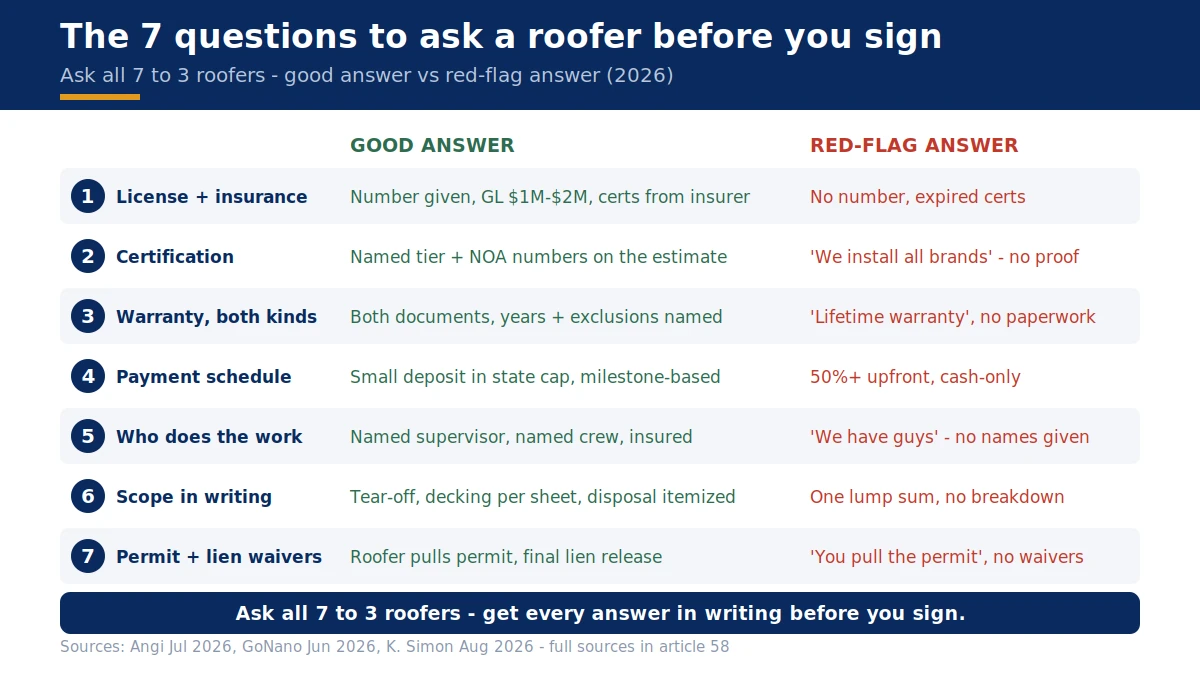
Use this table as your bid-leveling sheet. Ask every bidder the same seven questions and write the answers down — the quotes only become comparable when the questions are identical.
| # | Question | Good answer (green light) | Red-flag answer (walk away) |
|---|---|---|---|
| 1 | What is your license number, and can I see your insurance certificates? | License number on the spot; GL $1M–$2M + workers’ comp certificates sent from the insurer | “We’re licensed” with no number; photocopied or expired certificates |
| 2 | What manufacturer certifications do you hold for this product? | Named tier (GAF Master Elite, OC Platinum Preferred, CertainTeed SELECT ShingleMaster) + NOA numbers where required | “We install all brands” with no certification to show |
| 3 | What warranty do I get — workmanship and manufacturer, separately? | Both documents in writing; years, exclusions, and transfer rules named | “Lifetime warranty” with no paperwork and no split between the two |
| 4 | What is the payment schedule? | Small deposit inside your state’s cap; balance tied to visible milestones | 50%+ upfront, cash-only, or full payment before work starts |
| 5 | Who actually does the work — your crew or subs? | Named supervisor, named crew, whose insurance covers them | “Don’t worry, we have guys” — no names, no supervisor |
| 6 | Is tear-off, decking, underlayment and disposal in writing? | Every line itemized, decking priced per sheet with a cap | One lump-sum price with no scope breakdown |
| 7 | Who pulls the permit, and will I get lien waivers? | Contractor pulls the permit in its own name; final lien release before last payment | “You pull the permit” or “waivers aren’t needed” |
Question 1: What is your license number, and can I see your insurance certificates?
This is the first question because it is the cheapest filter. A roofer who cannot clear it in five minutes should not get a second question.
Why it matters. Roofing is dangerous, high work. If an uninsured worker is injured on your property, you can face serious problems (Best Way Roofing, Oct 2026). And an unlicensed roofer’s contract may be unenforceable by them — in Florida, for example, a contract with a roofer who holds no license is unenforceable by the roofer at any time (roofing-it, Nov 2026). Your license check is also your only proof the business is who it claims to be.
What a good answer looks like:
- A license number given without hesitation, in the name that appears on the contract. In Florida that is a CCC certified roofing contractor license, verifiable free at myfloridalicense.com (Florida DBPR). In California it is a C-39 Roofing license on the CSLB website. In Minnesota it is a residential roofer license from the Department of Labor and Industry, checkable on the free DLI lookup (Oct 2026). In Connecticut it is a Home Improvement Contractor registration — HIC followed by seven digits — on the Department of Consumer Protection lookup (Oct 2026).
- General liability insurance of $1 million–$2 million, the typical range for roofing contractors (GoNano, Jun 2026). Liability covers damage to your property.
- Workers’ compensation covering the crew. Ask for the certificate of insurance to be sent directly from the insurance agent — not a photocopy handed to you by the contractor (Best Way Roofing, Oct 2026; Dodd Roofs, Oct 2026). The certificate names the carrier and the expiration date.
- The license holder’s name matches the contract, and the license is active with the roofing classification — not a general handyman or a different trade.
Red-flag answers:
- “We’re licensed” with no number, or a number that does not match the business name on the contract.
- Expired certificates, or reluctance to produce insurance details at all (GoNano, Jun 2026).
- “We don’t need workers’ comp — we have no employees.” In California, C-39 roofing contractors must carry workers’ comp whether or not they have employees (Business and Professions Code 7125; CSLB guidance, Oct 2026). The same “no employees” claim is a known trap in other states.
- A license from the wrong state, or a city license offered where a state license is required.
How to verify in 5 minutes. Search your state licensing board’s free lookup (every state board above has one) and confirm three things: active status, roofing classification, and that the holder name matches the contract. Then call the insurer on the certificate to confirm the policy is current. Note that some states have no statewide roofing license at all — Colorado, for example, licenses roofers at the city level (Denver requires a Class D roofing certificate), and Texas has no state roofing license. In those states, check the city or county rules and lean harder on insurance, references, and the BBB (Angi, Jul 2026).
An independent roof inspection ($75–$200) before you call contractors also helps: you walk into the conversation knowing what your roof actually needs, so a bidder cannot invent scope.
Question 2: What manufacturer certifications do you hold — and are the products approved?
The shingle brand matters less than most homeowners think. The installer’s certification tier matters more — because it decides which warranty you can actually buy.
Why it matters. All three major US shingle makers — GAF, Owens Corning, and CertainTeed — sell flagship architectural shingles with lifetime limited material warranties. What differs is the warranty tier, and the tier depends on the contractor, not the shingle (The Roofing Brief, Oct 2026). Only certified contractors can sell manufacturer-backed system warranties, which cover both material defects and workmanship in one plan — and the manufacturer stands behind the work even if the installer goes out of business (econo-roofing, Oct 2026). A standard manufacturer warranty is voided by a bad install, so the certification is your protection against exactly the failure mode that matters most.
What a good answer looks like:
- A named tier for the product being quoted: GAF Master Elite, Owens Corning Preferred or Platinum Preferred, or CertainTeed SELECT ShingleMaster. Each is a real, verifiable status — the BBB’s own roofing guidance says homeowners can ask the manufacturer whether a roofer is certified for a particular roof system (BBB via thetopselected, Oct 2026).
- In Florida and other hurricane-code states, Miami-Dade Notice of Acceptance (NOA) numbers or Florida Product Approval for every product on the quote, verifiable in Miami-Dade’s public Product Control search with expiration dates. No NOA, no permit — and no hurricane rating you can trust. Our Florida roof replacement guide explains the HVHZ product rules in full.
- The certification matches the tier of warranty being sold (see Question 3). A contractor selling a Golden Pledge warranty must be GAF Master Elite. If the tier and the warranty do not match, one of them is not real.
Red-flag answers:
- “We install all brands” with no certification to show for any of them.
- A certification for a different product than the one quoted — certified for metal, quoting shingles.
- NOA numbers that are expired, or a refusal to put product approvals on the written estimate.
What to ask for in writing. The shingle line, color, and manufacturer; the underlayment brand; and the certification tier — all on the estimate. If the roofer switches products after you sign, the certification and the warranty tier switch with it, and you should be told before, not after.
Question 3: What warranty do I get — workmanship and manufacturer, separately?
This is the question most homeowners get wrong, because “lifetime warranty” sounds complete. It is not. There are two warranties from two different parties, and you need both documents.
Why it matters. The manufacturer warrants the materials against defects. The contractor warrants the workmanship — the installation itself. Most roof failures in the first 10 years come from install errors, so the workmanship warranty is your key warranty early on (econo-roofing, Oct 2026). A contractor-only workmanship warranty also dies if the contractor closes. A manufacturer-backed system warranty does not.
What a good answer looks like:
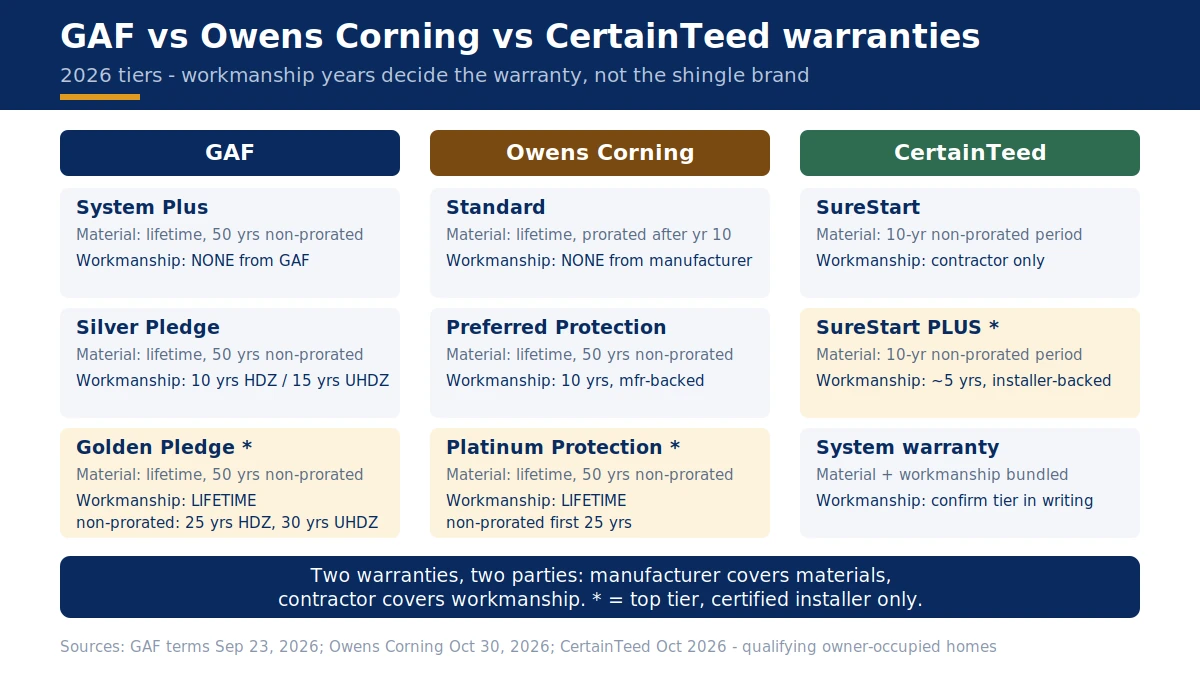
- Two documents, named separately, with years, exclusions, and transfer rules stated. Here are the 2026 tiers for the three big manufacturers:
| Manufacturer | Entry tier | Mid tier | Top tier |
|---|---|---|---|
| GAF | System Plus: lifetime material, 50 non-prorated years; no GAF workmanship | Silver Pledge: same material terms + 10 yrs workmanship (HDZ) / 15 yrs (UHDZ, Designer) | Golden Pledge (Master Elite only): same material terms + lifetime workmanship, non-prorated 25 yrs (HDZ) / 30 yrs (UHDZ) |
| Owens Corning | Standard: lifetime material, prorated after yr 10; no manufacturer workmanship | Preferred Protection: lifetime material, non-prorated 50 yrs + 10 yrs manufacturer-backed workmanship | Platinum Protection (Platinum Preferred only): lifetime material, non-prorated 50 yrs + lifetime workmanship, non-prorated first 25 yrs |
| CertainTeed | SureStart: 10-yr non-prorated material period | SureStart PLUS (SELECT ShingleMaster): adds installer-backed workmanship coverage, commonly cited 5 yrs | Top system warranties bundle material + workmanship; confirm the tier in writing |
Sources: current GAF terms, Sep 23, 2026 (via Ridgeline); Owens Corning tiers, Oct 30, 2026 (econo-roofing); CertainTeed SureStart, Oct 2026 (The Roofing Brief) and ecoroofsystems, 2026. Terms apply to qualifying owner-occupied single-family detached homes; other owners and buildings have different terms.
- A plain answer on prorated vs non-prorated: after the non-prorated period, coverage drops — GAF holds a 20% minimum, while Owens Corning and CertainTeed drop to 10–20% in later years (ecoroofsystems, 2026). A “lifetime warranty” that is prorated after year 10 is a very different product from one that is non-prorated for 25–50 years.
- A plain answer on transfer: CertainTeed allows 2 transfers over the warranty life; GAF allows 1 transfer within 15 years of installation; Owens Corning allows 1 transfer within 10 years (ecoroofsystems, 2026). Transferable coverage can measurably help resale value.
- A plain answer on exclusions: improper ventilation, storm damage, ponding water, foot traffic, failure to maintain, and unapproved alterations are typical exclusions. Ask what voids it.
Red-flag answers:
- “Lifetime warranty” with no paperwork, no split between manufacturer and workmanship, and no years attached.
- A workmanship warranty of “1 year” presented as generous — Angi (Jul 2026) notes most roofers offer at least one year, so one year is the floor, not a selling point. Examples in 2026 sources run 5 years (a Minnesota contractor) to 15 years (a Connecticut GAF Master Elite contractor).
- “Up to 25 years” language with no hard year count. GoNano (Jun 2026) warns to ask whether the warranty is a hard warranty for the full duration or an “up to” warranty — and who honors it if the business closes or changes ownership.
Material comparisons if you are still choosing the roof itself: metal roof cost and tile roof cost.
Question 4: What is the payment schedule — and what is the legal deposit limit in my state?
Money is where good contractors and bad ones separate fastest. The rules are set by state law, not by the sales pitch — and in the strictest state, the legal deposit is far smaller than most homeowners expect.
Why it matters. A large upfront payment is the single biggest financial exposure in a roofing job. If the contractor disappears, goes bankrupt, or does shoddy work, money already paid is money you may never recover. State deposit caps exist precisely to limit that exposure.
What a good answer looks like:
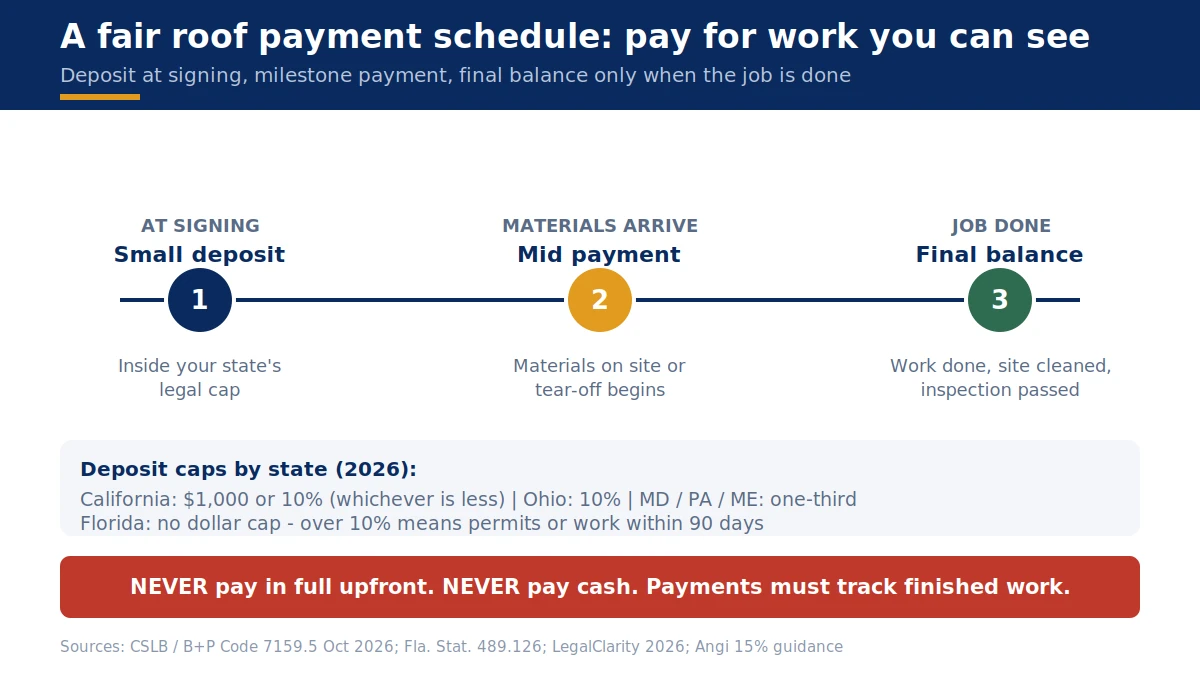
- A schedule tied to visible milestones: a small deposit at signing, a second payment when materials arrive or tear-off begins, and the final balance only after the work is done, the site is cleaned up, and you have reviewed the finished roof (Dodd Roofs, Oct 31, 2026). Every payment tracks work you can see.
- A deposit inside your state’s legal cap. The caps vary widely:
| State / group | Deposit cap (2026) |
|---|---|
| California | $1,000 or 10% of contract price, whichever is less (B&P Code 7159.5; CSLB, Oct 2026) — the strictest cap in the country; no exception for custom materials |
| Ohio | 10% of contract price (exception: up to 75% of the cost of nonreturnable special-order items) |
| Maryland, Pennsylvania, Maine | One-third of the contract price |
| Florida | No dollar cap — but if the initial payment exceeds 10%, the contractor must apply for permits or begin work within 90 days (Fla. Stat. 489.126) |
| Nevada | $1,000 / 10% — pool and spa construction only |
| States with no cap (most) | No statutory ceiling; industry norms generally 10–33%, and Angi advises a reasonable down payment is typically 15% or less |
Sources: CSLB / B&P Code 7159.5 (Oct 2026); LegalClarity state survey (2026); consumoteca (Sep 2026); Angi via thetopselected (Oct 2026). About a dozen states cap upfront payments; confirm your state’s rule with your licensing board before signing.
- California detail worth knowing: later payments cannot exceed the value of work performed, the contract must carry a boldface notice of the $1,000/10% cap, and the only narrow exceptions are a blanket performance and payment bond on file with CSLB or CSLB-approved joint control (B&P Code 7159.5; CSLB guidance, Oct 2026). On a $50,000 job, the legal California deposit is still $1,000.
- Payment by check or card, never cash — CSLB advises against paying in cash, and Angi warns against cash-only terms.
Red-flag answers:
- 50% or more upfront to “buy materials,” or full payment before work starts. In California that is illegal; everywhere else it is a sign of financial instability (LegalClarity, 2026).
- Cash-only, wire transfer today, or “pay now or the price goes up.”
- A deposit that exceeds your state’s cap with no bond or joint control to justify it.
If the job is financed rather than paid from savings, read our roof financing guide before you sign a loan at the kitchen table — and remember the FTC cooling-off rights in the last section of this guide.
Question 5: Who actually does the work — your crew or subcontractors?
Subcontractors are not automatically a problem. Unaccountable subcontractors are. This question is about who answers for the roof in year five.
Why it matters. Both models exist and both can be run well or badly. What matters is not the label but the accountability: whose license the permit is pulled under, whose insurance covers the people on your roof, who supervises the crew day to day, and who answers for the workmanship warranty years later (K. Simon, Aug 2026).
What a good answer looks like:
- The name of the site supervisor and how often they are on your roof.
- Whether the crew is in-house or subcontracted — and if subcontracted, the sub’s license and insurance, and confirmation that the sub’s crew is covered by workers’ comp (the contractor’s policy or the sub’s own — see the certificate).
- A straight answer to: “If a subcontractor installs it, who do I call about the workmanship warranty in year five?” The answer should be the contractor you signed with, not a phone number that no longer answers (K. Simon, Aug 2026).
Red-flag answers:
- “Don’t worry, we have guys” — no names, no supervisor, no sub identity.
- The contractor cannot say whose workers’ comp covers the crew.
- A different company name on the crew’s trucks, shirts, or paperwork than the one on your contract, with no explanation.
Put it in the contract. The crew model, the supervisor’s name, and the warranty contact should be written down. If the contractor swaps to a sub after signing without telling you, that is a change you should have approved in writing first — the same as any other change order.
Question 6: Is tear-off, decking, underlayment and disposal in writing?
A lump-sum price with no scope breakdown is not a quote. It is a blank check for change orders.
Why it matters. The BBB’s roofing guidance says a clear, itemized proposal should identify the roof covering (manufacturer and color), underlayment, removal or replacement, flashing and ventilation work, dates, warranty coverage, payment procedures, and debris removal (BBB via thetopselected, Oct 2026). Every item missing from that list is an item that can appear later as a surprise charge — and decking is the classic one, because rot is only visible after tear-off.
What a good answer looks like — every line item named:
- Tear-off: priced per square, per layer. Budget $1–$2 per sq ft ($100–$175 per square per layer) (sitereckoner, Nov 2026). In Florida, an overlay is effectively not an option — the sealed deck must go over the bare deck joints, and the dry-in inspection requires the re-nailed deck visible (article 54 research).
- Decking: a per-sheet price in writing, with a cap and a photo rule. A 2026 estimate example prices 1/2-in. plywood at $95 per sheet installed, with an 8-sheet allowance and photos plus homeowner confirmation beyond that (Zarla, Oct 2026). Material alone runs $30–$85 per sheet for CDX plywood ($40–$60 for 1/2-in.), installed $1.20–$6.00 per sq ft (newenglandmetalroof, 2026). Hidden decking damage typically adds $500–$2,000 to a job (Angi Denver guide, Oct 2026). Get the per-sheet price before tear-off, not after the deck is open.
- Underlayment: type and coverage named — synthetic vs felt, ice-and-water shield at eaves and valleys in cold climates, sealed deck in Florida. Ask how much of the roof gets ice-and-water shield and where.
- Flashing, drip edge, ventilation, ridge vent: line items, not “included.” Bad flashing and weak ventilation are among the most common install-error failures the workmanship warranty exists to catch.
- Disposal and cleanup: dump fees and a magnet sweep for nails in the contract. Ask who hauls the old roof and where it goes.
- Start and completion dates in writing, with a weather-delay explanation (Dodd Roofs, Oct 2026).
Red-flag answers:
- One lump-sum number with no breakdown — you cannot compare it to any other bid, and you cannot dispute a change order against it.
- “We’ll see about decking when we get there” with no per-sheet price.
- Ventilation or flashing described only as “included” with no product or quantity.
Weighing repair against replacement changes the scope entirely — our roof repair cost guide has the repair-side numbers, and gutter installation is the accessory most often bundled with a reroof.
Question 7: Who pulls the permit — and will I get lien waivers?
This is the question that protects you after the roof is finished. The permit proves the work was inspected. The lien waiver proves you actually own the roof you paid for.
Why it matters — permits. A roof replacement needs a building permit in most jurisdictions, and the licensed roofer pulls it in their own name (roofersdirectoryus, Oct 2026). Permit cost is typically $100–$500 (Fixr, Feb 2026). The permit holder is legally responsible for completing the job to code — which is exactly why the contractor, not you, should hold it. Do not make the final payment until building inspections are approved (Denver city guidance, Oct 2026). At the end, you should hold the permit record, the inspection sign-offs, and both warranty documents (K. Simon, Aug 2026).
Why it matters — liens. In most states, an unpaid supplier or subcontractor can file a mechanic’s lien against your home even if you paid the contractor in full (Florida: roofersdirectoryus, Oct 2026; Idaho: Dodd Roofs, Oct 2026; Colorado: denverrentalmanagers, Oct 2026). That is the trap Question 7 exists to close.
What a good answer looks like:
- “We pull the permit in our name, and we schedule the inspections.” The permit fee is a line item on the estimate.
- Lien waivers from the contractor and the major subcontractors and suppliers, collected as you pay — and a final release of lien before your last payment. In Florida, larger jobs also involve a Notice of Commencement filed with the county (roofersdirectoryus, Oct 2026).
- A written promise that final payment waits for passed inspections, not just for the crew leaving.
Red-flag answers:
- “You pull the permit as owner-builder.” The FTC lists a contractor asking you to get the permits yourself as a sign of a possible scam (FTC via bidwellapp, Nov 2026). An owner-builder permit also shifts code responsibility onto you.
- “Lien waivers aren’t needed — we pay our suppliers.” Trust, but verify: the waiver costs the contractor nothing to provide and protects you from a lien you cannot see coming.
- No permit at all: “Permits just slow things down.” Unpermitted work can block a future home sale, void insurance coverage, and leave code violations in your name.
Storm-chaser red flags: the 8 signs to walk away from
Storm chasers are out-of-town roofing crews that follow hail and wind storms, knock on doors, and push homeowners to sign quickly (Medium, Oct 23, 2026). Not every door-knocker is a scammer — but every one of these signs is a reason to pause, verify, and get a second opinion before signing anything.
| # | Red flag | Why it is a problem |
|---|---|---|
| 1 | Knocks uninvited right after a storm | Legitimate local roofers rarely need to canvass; the pitch starts with your damage, not your roof |
| 2 | Out-of-state plates, no local office or address | No local address means no one to find when the warranty claim comes in year two |
| 3 | Pressure to sign today / “offer expires” | High-pressure deadlines are a scam pattern — reported in ~30% of 2025 home-improvement scams, with roofing the leading trade at ~25% (FTC/BBB data as reported Feb 2026) |
| 4 | Offers to waive or cover your deductible | Usually means inflating the bill to the insurer — can be treated as insurance fraud, and it puts you at risk too (Medium, Oct 2026). Banned in Florida and Colorado law |
| 5 | Asks for a large payment before any work | See Question 4 — large upfront payments are the core exposure deposit caps exist to limit |
| 6 | Asks you to sign your insurance claim over (assignment of benefits) | Florida no longer allows AOB on residential property insurance for policies issued since Jan 1, 2023 — be wary of anyone asking you to sign your claim over (roofersdirectoryus, Oct 2026) |
| 7 | “Leftover shingles from a neighbor’s job” — special deal | A classic pitch; the BBB’s roofing tips specifically flag offers involving leftover materials (BBB via thetopselected, Oct 2026) |
| 8 | Whole roof needs replacing after a 5-minute look | A real assessment takes photos, measurements, and an attic check — get a second roofer’s opinion and contact your insurer first (Angi via thetopselected, Oct 2026) |
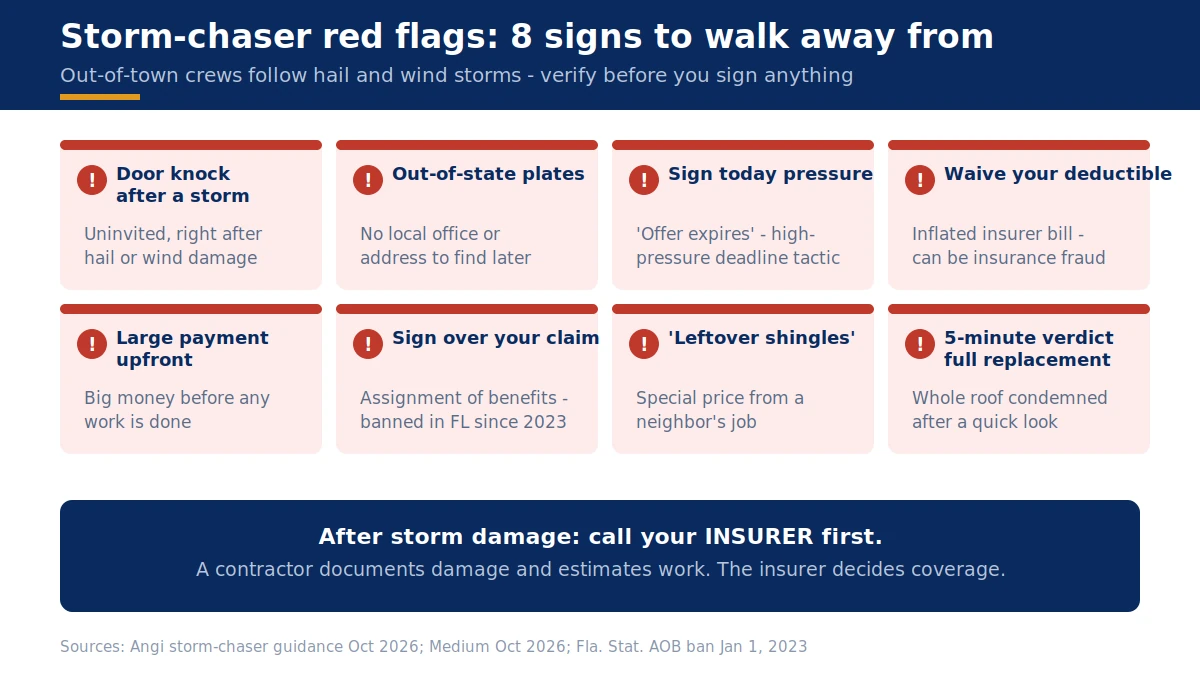
The one rule that beats all eight: after storm damage, contact your insurer first so the damage is assessed before you sign anything (Angi via thetopselected, Oct 2026). A contractor can document damage and estimate work. The insurer decides coverage. Never let a sales pitch define the claim.
How to check complaints: BBB, the state board, and references
Seven questions filter the sales pitch. Three checks filter the company behind it. Do all three before you sign — they take under an hour total.
1. BBB (bbb.org) — the complaint record. Look up the business profile: rating, complaint subjects and dates, company responses, and stated resolutions. Read the pattern, not the count. A complaint is an account of a dispute, not proof of wrongdoing, and the BBB itself cautions readers to weigh a company’s size, transaction volume, and responses — not complaint counts alone (financeply, Oct 2026). Look for the same concern repeated across independent sources, then ask the roofer for a direct explanation with paperwork. Also search “[company name] + complaints” (Medium, Oct 2026).
2. State licensing board + Attorney General — the official record. Verify the license (see Question 1) and check for disciplinary actions on the same lookup. Then check your state Attorney General’s consumer-protection division for complaints (Medium, Oct 2026). A clean BBB profile means little if the board shows a suspended license.
3. Local references — the reality check. Ask for recent local jobs of the same roof type, from the last 6–12 months — then call them. Ask whether scope changes, cleanup, and warranty service matched the contract (daytonroofingguide, Oct 2026). Drive by the contractor’s local address to confirm it exists (Medium, Oct 2026). A roofer with no local references is a roofer with no local track record.
A note on review sites. Online reviews are one input, not a verdict. Use the BBB record to review identity, complaint patterns, and responses, then verify insurance, manufacturer claims, references, and the written contract independently (daytonroofingguide, Oct 2026).
If you already signed: your cancellation rights + the printable checklist
Signed too fast? You may still have an exit. Know the windows — they are short.
The FTC Cooling-Off Rule (16 CFR 429). For sales made at your home — including sales after you invited the salesperson in — of $25 or more, you can cancel for a full refund until midnight of the 3rd business day after the sale. Saturday counts as a business day; Sundays and federal holidays do not. You do not need a reason. The seller must refund your money within 10 days. The rule does not cover emergency sales, or sales where you asked the seller to come only for a specific repair (though items beyond what you asked for are still covered) (Troutman transcript, Nov 20, 2025; Texas guide, Nov 2026).
State versions add more. Connecticut law requires the 3-day right to cancel in the contract itself (Best Way Roofing, Oct 2026). Texas has its own version in Business and Commerce Code Chapter 601. Florida’s storm rule (Fla. Stat. 489.147(6)) lets you cancel a roof contract without penalty within 10 days of signing — or before the official start date, whichever comes first — when the contract was signed within 180 days of a declared storm for a home in a declared county; cancel by certified mail to the address in the contract (roofing-it, Nov 1, 2026). A Florida contract missing the required no-rebates notice may be voidable within 10 days, and a contract with an unlicensed roofer is unenforceable by them.
How to cancel. In writing, to the address in the contract, keeping proof of mailing (certified mail where the rule requires it). Keep copies of the contract, payments, and photos. If money was already paid and not returned, contact your state Attorney General’s consumer-protection division.
Printable checklist: the 7 questions
Print this page and take it to every estimate:
- [ ] Q1 License + insurance: License number ______ verified on state board lookup. GL $1M–$2M + workers’ comp certificates received from the insurer. Names match the contract.
- [ ] Q2 Certification: Tier named ______ (GAF Master Elite / OC Preferred or Platinum / CertainTeed SELECT ShingleMaster). NOA / product approval numbers on the estimate.
- [ ] Q3 Warranty: Manufacturer warranty ______ years, ______ non-prorated. Workmanship warranty ______ years, honored by ______. Transfer rules: ______.
- [ ] Q4 Payment: Deposit $______ (inside my state’s cap: ______). Milestones: ______. Final balance only after completion + cleanup + passed inspection. No cash.
- [ ] Q5 Crew: In-house / subcontracted ______. Supervisor ______. Workers’ comp covers crew via ______.
- [ ] Q6 Scope: Tear-off $______/square. Decking $______/sheet, cap ______ sheets, photos required. Underlayment ______. Disposal + cleanup included.
- [ ] Q7 Permit + liens: Contractor pulls permit in its own name. Permit fee $______. Final lien release before last payment.
- [ ] Checks done: BBB profile reviewed. State board + AG checked. 3 local references called. 3 bids compared.
- [ ] Before signing: I slept on it. The contract has start/completion dates, cancellation rights, and every answer above in writing.
Sources & methodology
Vetting framework: Angi “17 Questions to Ask a Roofer Before Hiring Them” (updated Jul 8, 2026); GoNano “15 Questions to Ask a Roofing Contractor Before Signing | 2026 Guide” (updated Jun 30, 2026); K. Simon Construction Florida hiring guide (reviewed Aug 26, 2026); Total Home Exteriors Minnesota checklist (Oct 29, 2026); Best Way Roofing Connecticut guide (Oct 2026). Insurance: GL $1M–$2M (GoNano, Jun 2026); CA C-39 workers’ comp rule B&P 7125 (CSLB, Oct 2026). Certification/warranty: econo-roofing warranty comparison (Oct 30, 2026); GAF terms Sep 23, 2026 (via Ridgeline); The Roofing Brief OC/GAF/CertainTeed comparison (Oct 2026); ecoroofsystems warranty analysis (2026). Deposits: CSLB B&P 7159.5 (Oct 2026); Fla. Stat. 489.126 (Sep 2026); LegalClarity state caps survey (2026); Angi 15% guidance (via thetopselected, Oct 2026). Scope/pricing: Zarla estimate template (Oct 2026); newenglandmetalroof plywood costs (2026); Fixr permit $100–$500 (Feb 2026); RoofingCalculator $340–$595/square (Nov 2026); sitereckoner tear-off (Nov 2026); Angi Denver decking $500–$2,000 (Oct 2026). Liens/permits: roofersdirectoryus Florida guide (Oct 2026); Dodd Roofs Idaho guide (Oct 31, 2026); denverrentalmanagers Colorado guides (Oct 2026); FTC via bidwellapp (Nov 2026). Storm chasers: Medium Arkansas guide (Oct 23, 2026); thetopselected warning signs (Oct 2026); financeply BBB complaint analysis (Oct 2026); daytonroofingguide verification framework (Oct 2026); FTC/BBB 2025 scam data as reported by consumoteca (Feb 25, 2026). Cancellation: FTC Cooling-Off Rule 16 CFR 429 (Troutman transcript Nov 20, 2025; Texas guide Nov 2026); Fla. Stat. 489.147(6) (roofing-it, Nov 1, 2026). Tax: OBBBA P.L. 119-21 / IRS FS-2025-05 — $0 federal credit for 2026 homeowner-owned roofs. EXCLUDED: NRCA-specific claims (no NRCA source retrieved in this pass); pre-OBBBA credit framing; any DIY roofing installation or safety instructions (LOW YMYL).
—
What are the 7 questions to ask a roofer before you sign in 2026?
(1) What is your license number, and can I see your insurance certificates? (2) What manufacturer certifications do you hold for this product? (3) What warranty do I get — workmanship and manufacturer, separately? (4) What is the payment schedule? (5) Who actually does the work — your crew or subs? (6) Is tear-off, decking, underlayment and disposal in writing? (7) Who pulls the permit, and will I get lien waivers? Ask all seven to at least three local roofers and get every answer in writing.
How much deposit can a roofer legally ask for?
It depends on your state. California caps the down payment at $1,000 or 10% of the contract price, whichever is less (B&P Code 7159.5). Ohio caps it at 10%. Maryland, Pennsylvania, and Maine cap it at one-third. Florida has no dollar cap, but if the first payment exceeds 10%, the contractor must apply for permits or begin work within 90 days. In states with no cap, Angi advises a reasonable deposit is typically 15% or less — and never pay in full upfront.
What is the difference between a workmanship warranty and a manufacturer warranty?
The manufacturer warranty covers defects in the roofing materials; the contractor’s workmanship warranty covers installation errors. Most roof failures in the first 10 years come from install errors, so the workmanship warranty matters most early on. Top tiers are manufacturer-backed: GAF Golden Pledge (lifetime workmanship, non-prorated 25–30 years), Owens Corning Platinum Protection (lifetime workmanship, non-prorated 25 years), and CertainTeed SureStart PLUS. A standard manufacturer warranty can be voided by a bad install.
How do I verify a roofer’s license and insurance?
Get the license number and check it free on your state licensing board’s online lookup — confirm active status, roofing classification, and that the holder name matches the contract. Ask for the certificate of insurance to be sent directly from the insurer, and confirm general liability of $1M–$2M plus workers’ compensation. In Florida check myfloridalicense.com; in California check the CSLB; in Minnesota check the DLI lookup.
What are storm chaser red flags?
An uninvited door knock right after a storm, out-of-state plates with no local office, pressure to sign today, an offer to waive or cover your deductible, a large payment before work, being asked to sign your insurance claim over, a “leftover shingles” deal, or a full-replacement verdict after a 5-minute look. After storm damage, contact your insurer first before signing anything.
Can a roofer put a lien on my house if I already paid the contractor?
Yes — in most states an unpaid supplier or subcontractor can file a mechanic’s lien against your home even if you paid the contractor in full. Protect yourself by collecting lien waivers from the contractor and major subcontractors and suppliers as you pay, and by getting a final release of lien before your last payment.
Who should pull the roofing permit?
The licensed roofing contractor, in its own name. Permit cost is typically $100–$500. A contractor who asks you to pull the permit as owner-builder is a red flag — the FTC lists it as a possible scam sign — and the permit holder is legally responsible for completing the job to code. Do not make final payment until building inspections are approved.
Can I cancel a roofing contract after signing?
Often yes, but the window is short. The FTC Cooling-Off Rule gives you until midnight of the 3rd business day after a sale made at your home to cancel for a full refund, no reason needed. Florida’s storm rule (§489.147(6)) allows cancellation within 10 days of signing for roof contracts signed within 180 days of a declared storm in a declared county. Cancel in writing to the address in the contract and keep proof of mailing.