

Table of Contents
A heat pump in Montana is a different purchase from a heat pump in most of the country, and the difference starts before anyone talks about price. In a mild-climate state the question is which brand and which efficiency rating. In Montana the question is whether the machine keeps heating when the thermometer reads minus 10, because it reads minus 10 most winters, in most towns, for days at a time. The state’s own design temperatures run from minus 1 degree in Missoula to minus 17 in Glasgow, with Bozeman at minus 12 and Butte at minus 14. Those are not record lows. Those are the temperatures the system is designed to handle as a matter of routine. A standard heat pump bought on price alone will spend a large part of every Montana winter handing the work to its backup heat — electric resistance at full price, or a gas furnace doing the job the heat pump was bought to do.
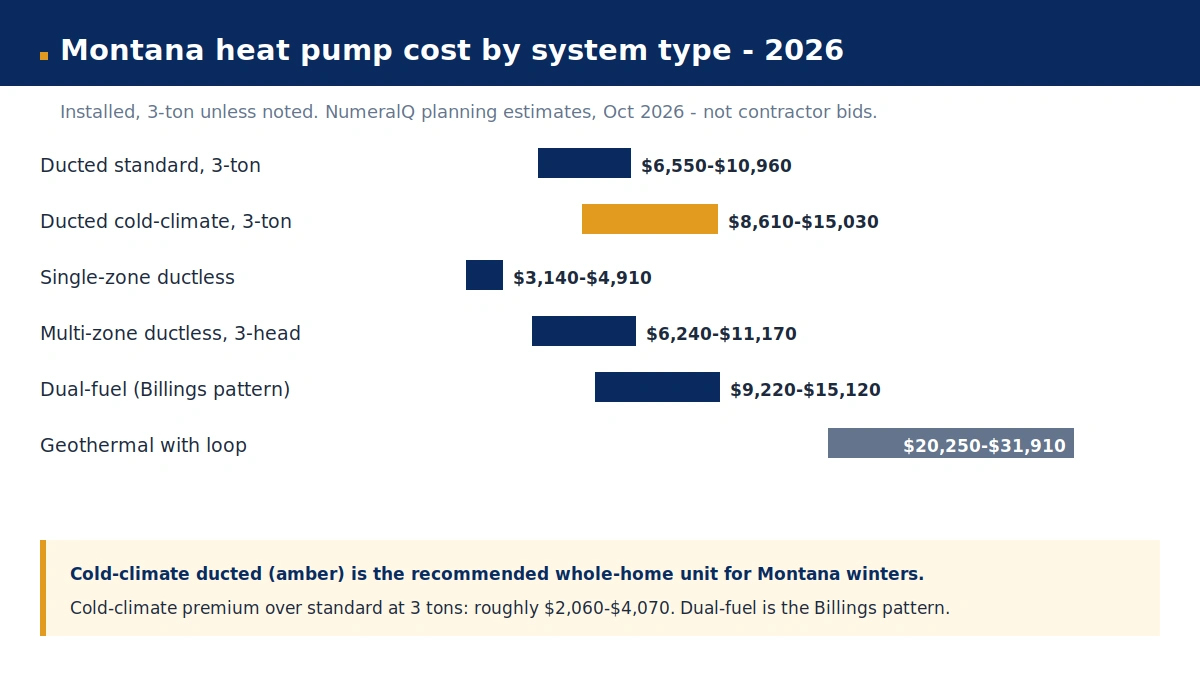
That is why this guide prices two different machines and treats them as two different purchases. The standard ducted air-source system, $6,550-$10,960 for a 3-ton home, is the cheaper quote and the worse Montana buy for most houses. The cold-climate ducted system, $8,610-$15,030 for the same 3-ton home, is the one built for the job: a variable-speed inverter compressor, enhanced vapor injection, full rated output at 5 degrees, and useful heat down to minus 13 or minus 22 depending on the model. The roughly $2,000-$4,000 gap between them is the price of winter performance, and in Montana it is the most important money in the whole quote.
The other difference is the running cost, and it is the one most Montana quotes skip. Electricity in Montana is cheap by national standards — about 15.57 cents a kilowatt-hour in August 2026 against 18.16 nationally — but gas is cheaper still relative to the heat it delivers, and a heat pump’s efficiency falls exactly when the house needs the most heat. The modeled result is blunt: heating the average Montana home costs about $364 a year with a 95% gas furnace and about $618-$741 a year with a heat pump. A heat pump in a gas-heated Montana home costs more to run, every year, and no rebate closes that gap. The same machine in a home that heats with electric baseboards or propane is a different story entirely, and this guide works both stories out in full, with the arithmetic shown.
Start with our heat pump cost guide for the national figures, then measure Montana’s against them.
How Much Does a Heat Pump Cost in Montana in 2026?
Two machines, two prices, and the cheaper one is usually the wrong one in Montana. The planning estimates that anchor this guide come from NumeralQ’s Montana page, priced October 26, 2026 from Fixr’s installed-cost data, Home Depot equipment prices, and This Old House’s cost guide, adjusted for Montana labor. They are planning estimates, not contractor bids, and this guide labels them that way everywhere they appear — no Montana contractor-bid survey was verified in this pass, and no figure here should be read as a quote for a specific house.
A standard ducted air-source heat pump — the ordinary whole-home system with an outdoor unit and an indoor air handler feeding the house ducts — runs $6,550-$10,960 installed for a 3-ton system, the size that fits the typical Montana home in this guide’s tables. That is the number most national cost guides would headline, and in Montana it is a trap for the unwary, because a standard unit loses a large share of its heating capacity below 25 degrees and leans on backup heat below about 15 degrees. In a state where the design temperature is minus 7 in Billings and minus 12 in Bozeman, a standard unit spends much of the heating season as a very expensive way to run electric resistance heat.
A cold-climate ducted heat pump — the same whole-home layout, but built around a variable-speed inverter compressor with enhanced vapor injection — runs $8,610-$15,030 installed for a 3-ton system. The premium over the standard unit is roughly $2,060 at the low end and $4,070 at the high end, and it buys the performance Montana actually needs: at least 70% of rated heating capacity at 5 degrees under the Northeast Energy Efficiency Partnerships cold-climate specification, a coefficient of performance of 1.75 or better at that temperature, and continued operation down to minus 13 or minus 22 depending on the model. The premium is not decoration. It is the difference between a system that heats the house in January and one that hands January to the backup strips.
The national cross-checks land in the same territory. This Old House’s August 2026 guide puts the national average for a ducted system at $10,575. ConsumerAffairs’ July 2026 figures put ducted systems at $4,000-$14,000 nationally. BetterHouse’s wage-adjusted Montana table puts Montana ducted at $3,950-$13,810 with a typical figure of $10,430. The Montana wage index is 0.96, meaning Montana installer pay runs slightly below the national mean, which is why the Montana ranges sit a little under the national ones even though the equipment is the same. A Montana quote far above $15,030 for a 3-ton cold-climate ducted system calls for an explanation. A quote far below $8,610 for one calls for a closer look at what was left out — most often the cold-climate rating itself.
What the installed price has to cover is the whole job: the outdoor unit, the indoor air handler or coil, the refrigerant lineset, the condensate drain, the thermostat and controls, the electrical hookup, labor, the permit, and startup and commissioning. A furnace kept as backup in a dual-fuel setup, new ductwork, an electrical panel upgrade, and a thermostat beyond the basic model are all extra, and in Montana’s older housing stock the ductwork and the panel are the two extras that show up most often. Every one of those extras gets a number of its own in the sections below.
One warning before the tables: the lowest quote in Montana is not always the cheapest system over its life. The cheapest bid in a thin rural market is often the bid that skipped the Manual J load calculation or quoted a standard unit where a cold-climate unit belongs. Compare bidders only on installed price for the same cold-climate-rated equipment, on the same house, with the same backup-heat arrangement, in writing. Collect that figure from at least three installers, and walk away from any bidder who will not show the model’s cold-climate ratings in writing.
| System (3-ton, installed) | Montana range | National comparison |
|---|---|---|
| Standard ducted air-source | $6,550-$10,960 | $4,000-$14,000 (ConsumerAffairs, Jul 2026) |
| Cold-climate ducted air-source | $8,610-$15,030 | ~$2,000-$4,000 above standard in MT |
| Ductless mini-split, single zone | $3,140-$4,910 | $2,000-$12,000; typical $3,250 (This Old House) |
| Ductless multi-zone, 3 heads | $6,240-$11,170 | Varies by head count and line length |
| Geothermal with ground loop | $20,250-$31,910 | $12,000-$40,000+; avg $15,206 (Angi, Aug 2026) |
| Dual-fuel (heat pump + gas furnace) | $9,220-$15,120 (Billings pattern) | See dual-fuel section below |
The dual-fuel row deserves a note, because it is the configuration many Montana gas-heated homes will actually buy. NumeralQ’s Billings figures put a dual-fuel system — heat pump plus gas furnace — at $9,220-$15,120 for a 3-ton home, and the statewide pattern is the same shape. Dual-fuel is the honest answer for a Montana home that already has gas piped in and a furnace that still works, and the running-cost section below shows why it usually wins the arithmetic in that house.
Heat Pump Cost in Montana by System Type
The system type decides the price before the brand does, and in Montana the type also decides whether the house stays warm in January. Five configurations cover nearly every Montana home, and they split cleanly by house shape: ducted whole-home, ductless room-by-room, dual-fuel, and geothermal.
Ducted air-source, standard. $6,550-$10,960 for a 3-ton system. One outdoor unit, one indoor air handler, and the house’s existing ducts carry the heated air to every room. This is the default replacement for a home that already has ducts and a furnace, and it is the cheapest whole-home option. Its weakness in Montana is capacity at low temperature: a standard unit’s heating output falls off steeply below 25 degrees, and by 0 degrees most standard units have handed most of the work to backup heat. In a Billings winter that means weeks of running on resistance strips. Buy this only for a home in the mildest corner of the state with a strong backup system already in place, and never as the sole heat source in a zone 7 county.
Ducted air-source, cold-climate rated. $8,610-$15,030 for a 3-ton system. The same ducts and the same layout, but the outdoor unit is a different machine: variable-speed inverter compressor, enhanced vapor injection, and a coil and controls designed to keep pulling heat out of sub-zero air. The industry gatekeeper is the Northeast Energy Efficiency Partnerships cold-climate product list, which requires a coefficient of performance of 1.75 or higher at 5 degrees, at least 70% of rated heating capacity at 5 degrees, and published performance data at minus 15 degrees. More than 100 product lines meet that specification as of 2026, from Mitsubishi’s Hyper-Heat line (rated to minus 13) to Bosch’s IDS Ultra (100% capacity at 5 degrees, rated to minus 13) to Trane’s new 20 TruComfort WeatherGuard (100-107% of rated capacity at 5 degrees, operating to minus 20, field-tested in Montana itself over two winters with temperatures down to minus 21). For a ducted Montana home that wants one system to do the whole job, this is the buy. It also happens to be the system NorthWestern Energy’s $450 rebate is written around: ENERGY STAR rated, or SEER2 15.2 or higher and HSPF2 8.5 or higher.
Ductless mini-split, single zone. $3,140-$4,910 installed. One outdoor unit and one wall-mounted indoor head, heating and cooling a single room or open-plan space, with no ducts at all. This is the right answer for a cabin, a small home, a single cold room, or a house with no ducts where running new ductwork would cost more than the system. It is also the cheapest way into cold-climate performance, because many mini-splits are cold-climate rated by design — Mitsubishi’s Hyper-Heat mini-splits are the classic example — and a single-zone cold-climate mini-split is often the best value in the whole Montana market. Its limit is coverage: one head heats one space, and a house with closed-off bedrooms needs more heads or a different system.
Ductless multi-zone, three heads. $6,240-$11,170 installed. One outdoor unit feeding three indoor heads, each with its own thermostat, so three rooms or zones get their own temperature. This is the standard answer for a Montana home without ducts that still wants the whole house heated: a ranch, a split-level, or an older home where the rooms are used at different times. The price moves with the number of heads and the length of the refrigerant lines — a head in a far bedroom costs more to pipe than a head beside the outdoor unit — and a four- or five-head system can run past the top of this range. For the cold-climate question, see our cold-climate mini-split guide and our mini-split installation guide.
Dual-fuel: heat pump plus gas furnace. Roughly $9,220-$15,120 for a 3-ton home on the Billings pattern, with the statewide shape the same. The heat pump does the heating in mild weather and the cooling in summer; the gas furnace takes over below a set outdoor temperature — the balance point, usually somewhere around 25-35 degrees in Montana, set by the installer. This is the configuration that makes the most sense for the half of Montana homes that already heat with piped gas. It keeps the furnace’s cheap heat for the coldest weeks, uses the heat pump’s efficiency for the shoulder seasons, and adds air conditioning the furnace never had. The running-cost math in the section below is where dual-fuel earns its keep: it is the only configuration in which a heat pump can save a gas-heated Montana home money. For the full comparison, see our dual-fuel guide and our heat pump vs furnace guide.
Geothermal (ground-source). $20,250-$31,910 installed with the ground loop, on NumeralQ’s Montana figures. A geothermal system pulls heat from the ground, where the temperature sits near 50 degrees all year, instead of from the air — so its efficiency barely moves with the weather, and it needs no backup heat at all in a Montana winter. Its coefficient of performance runs roughly 3.5-4.5 year-round, against a cold-climate air-source unit’s seasonal average near 2.0-2.5. The price is the loop: horizontal trenches need land, vertical boreholes need drilling, and either way the ground work is most of the premium over an air-source system. The $20,250-$31,910 range is a planning estimate for a typical home; a large home or a rocky drilling site can run past it. The federal credit that used to cut 30% off a geothermal system is gone for 2026 installs, which took the best financial argument for geothermal with it. What remains is the performance argument: the only heat pump in Montana that never notices the weather. For the national picture, see our geothermal cost guide.
Ducted or ductless? The house usually decides. A home with sound ducts should stay ducted — the ducts are already paid for, and a ducted cold-climate system heats every room evenly. A home without ducts, or with ducts in poor shape, should go ductless rather than pay $4,160-$7,060 for new ductwork on top of the system price. A home with a mix — a main floor with ducts and a cold addition without them — often ends up with a ducted system plus one mini-split head for the problem room. For the full comparison, see our ductless vs ducted guide.
Heat Pump Cost by Home Size
Size is the second decision after system type, and in Montana it is the decision most often got wrong. A heat pump sized for cooling, the way air conditioners are sized in warm states, will be too small for a Montana winter — and a heat pump sized by a contractor’s rule of thumb, 500 square feet per ton or some similar shortcut, will be wrong in one direction or the other on most houses. The only sizing that works in Montana is a Manual J load calculation: a room-by-room accounting of the house’s heat loss through walls, windows, roof, and infiltration, run against the town’s design temperature. Montana’s Department of Environmental Quality publishes the design temperatures for exactly that calculation, and any installer who sizes without one is guessing with your money.
The table below prices ducted systems by tonnage from NumeralQ’s Montana figures, priced October 26, 2026, with the cold-climate column alongside so the premium is visible at every size. The home-size column is a rough guide only — a tight, well-insulated 2,000-square-foot home can need less capacity than a drafty 1,500-square-foot one, and the Manual J is what settles it.
| Size | Standard ducted | Cold-climate ducted | Rough home size |
|---|---|---|---|
| 1.5 tons | $4,400-$7,070 | ~$5,700-$9,200 | Small home, cabin, ~800-1,000 sq ft |
| 2 tons | $5,120-$8,370 | ~$6,600-$10,800 | ~1,000-1,400 sq ft |
| 2.5 tons | $5,830-$9,660 | ~$7,500-$12,500 | ~1,400-1,800 sq ft |
| 3 tons | $6,550-$10,960 | $8,610-$15,030 | ~1,800-2,200 sq ft (state typical) |
| 3.5 tons | $7,260-$12,250 | ~$9,500-$16,800 | ~2,200-2,600 sq ft |
| 4 tons | $7,980-$13,550 | ~$10,500-$18,500 | ~2,600-3,200 sq ft |
| 5 tons | $9,410-$16,140 | ~$12,400-$22,100 | Large home, ~3,200+ sq ft |
Two things in that table need a plain warning. First, the cold-climate column outside the 3-ton row is NestPriced arithmetic, not a published figure: the 3-ton cold-climate premium is about 31-37% over standard, and that ratio is applied to the other sizes. Treat those rows as planning estimates, and get the real number from a quote for the size your Manual J calls for. Second, the home-size column is deliberately rough. Montana homes vary enormously in insulation, window area, ceiling height, and exposure — a log home on a ridge and a new build in a Bozeman subdivision can be the same square footage and need a ton apart. The Manual J, not the square footage, is the sizing document.
Oversizing is the quieter mistake. A heat pump that is too big short-cycles — heating in short bursts, shutting off, and starting again — which wears the compressor, leaves temperatures uneven, and costs more upfront for capacity the house never uses. In summer an oversized unit cools the air before it has run long enough to dehumidify, leaving a cold, clammy house. The right size is the smallest one that holds the house at the design temperature with the backup heat barely used. To any installer who proposes to size up “just to be safe”: in Montana, sizing up is not safety, it is a second system you paid for and a compressor you will replace sooner.
Undersizing is the louder mistake, and it shows up on the first cold snap. A heat pump that cannot meet the load at the design temperature leans on its backup heat, and in Montana backup heat is either resistance strips at full electric price or the gas furnace the heat pump was supposed to replace. A system that is half a ton too small can spend hundreds of hours a year on backup, and those hours are the most expensive hours in the heating season. The fix is not a bigger unit ordered after the fact — it is a Manual J done before the order, with the design temperature for the actual town, not the state average. Missoula’s design temperature is minus 1. Glasgow’s is minus 17. A system sized for Missoula and installed in Glasgow is a system that will fail its first January.
Heat Pump Cost by City: Billings, Missoula, Bozeman & Great Falls
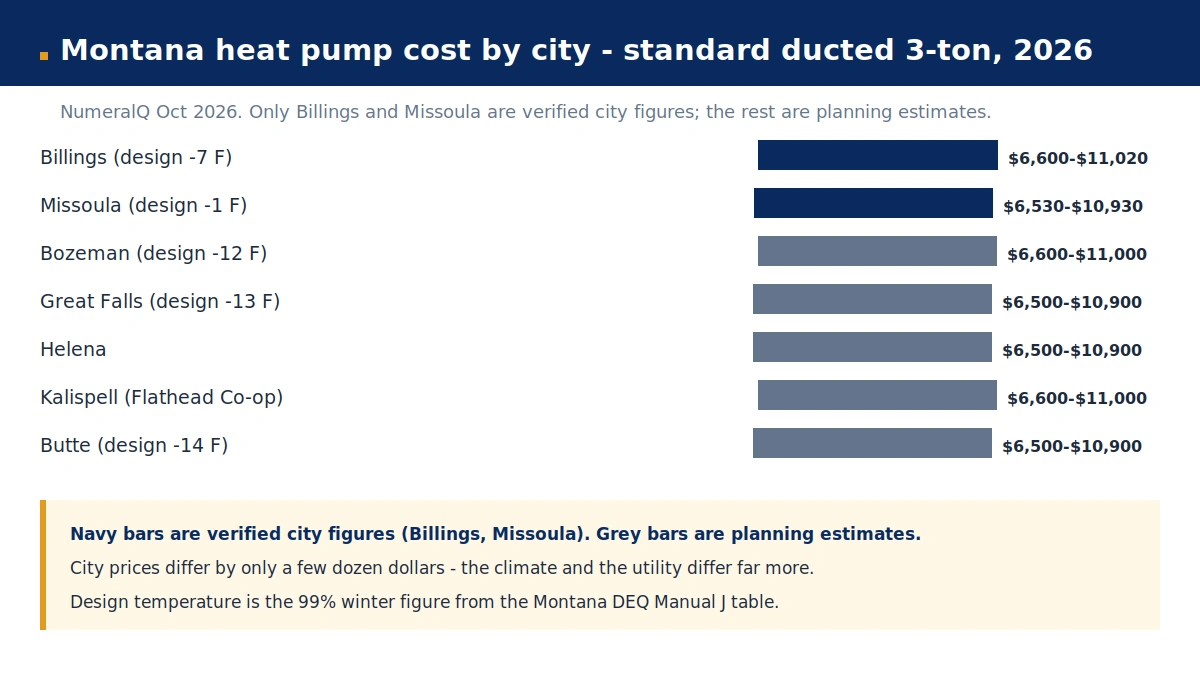
Montana’s cities are small by national standards and far apart by any standard, and the verified price figures cover only two of them. NumeralQ’s October 2026 city pages give Billings and Missoula; no verified city figures were pulled in this pass for Bozeman, Great Falls, Helena, Kalispell, or Butte, and this guide does not invent them. The rows for those cities below are planning estimates built from the statewide ranges, flagged as such, and a reader in any of them should treat the statewide anchor — $6,550-$10,960 standard, $8,610-$15,030 cold-climate for a 3-ton ducted system — as the number to test quotes against.
| City | Standard ducted 3-ton | Cold-climate ducted 3-ton | Utility | Notes |
|---|---|---|---|---|
| Billings | $6,600-$11,020 | ~$8,670-$15,110 | NorthWestern Energy | Verified (NumeralQ, Oct 2026) |
| Missoula | $6,530-$10,930 | ~$8,580-$15,000 | NorthWestern Energy | Verified (NumeralQ, Oct 2026) |
| Bozeman | ~$6,600-$11,000 | ~$8,600-$15,000 | NorthWestern Energy | Planning estimate only |
| Great Falls | ~$6,500-$10,900 | ~$8,500-$14,900 | NorthWestern Energy | Planning estimate only |
| Helena | ~$6,500-$10,900 | ~$8,500-$14,900 | NorthWestern Energy | Planning estimate only |
| Kalispell | ~$6,600-$11,000 | ~$8,600-$15,000 | Flathead Electric Co-op | Planning estimate only |
| Butte | ~$6,500-$10,900 | ~$8,500-$14,900 | NorthWestern Energy | Planning estimate only |
Billings is Montana’s largest city and its warmest major market, and its verified figures sit almost exactly on the statewide anchor: $6,600-$11,020 for a standard ducted 3-ton system, against $6,550-$10,960 statewide. Billings is also the mildest of the big cities for a heat pump — a design temperature of minus 7, about 7,049 heating degree days a year, and the longest cooling season in the state, with about 498-663 cooling degree days and roughly 32 days a year at 90 degrees or hotter. A heat pump in Billings earns its keep in summer as well as winter, because the cooling load is real, and that dual use is part of the value case there. The city’s heating mix matters too: about 73% of Billings homes heat with gas and 23% with electricity, so most Billings buyers are choosing between a heat pump and a gas furnace they already own — the dual-fuel question, answered in the running-cost section below.
Missoula runs a touch cheaper than Billings on the verified figures — $6,530-$10,930 for a standard ducted 3-ton system — and a touch colder in the ways that matter. Its design temperature is minus 1, the mildest of the big cities, but its heating degree days run about 7,514-8,125 a year, higher than Billings, because Missoula’s winters are long and grey rather than sharp: 173 nights a year at or below freezing, 43 inches of snow a year, and a December normal low of 18 degrees. A Missoula heat pump works long hours at temperatures just below freezing, which is actually the range where a cold-climate unit is at its most efficient relative to a standard one — the standard unit is already leaning on backup at 15 degrees, while the cold-climate unit is still running a coefficient of performance near 2.5. Missoula is also a NorthWestern Energy city, so the $450 rebate and the 15.9-cent electricity price apply exactly as they do in Billings.
Bozeman is the city where a heat pump faces its hardest test among the big markets, and it is also the city with no verified price figure in this pass. Its design temperature is minus 12, its elevation is about 4,475 feet, and it sits in one of the fastest-growing housing markets in the state — which means new builds, tight envelopes, and a lot of homes designed with heat pumps in mind from the start. A new, well-insulated Bozeman home is genuinely a good heat pump house: the load is small, the ducts are right, and the cold-climate unit can hold the design temperature without much backup. An older Bozeman home with original windows and a drafty shell is the opposite. The planning estimate for Bozeman in the table above is the statewide range, and it should be read that way.
Great Falls sits in the middle of the state and the middle of the climate range: a design temperature of minus 13, about 7,750 heating degree days, and the wind that the city’s name understates. Wind matters for a heat pump in a way it does not matter for a furnace, because wind drives infiltration — cold air forced through every gap in the shell — and infiltration is load the heat pump has to meet. A Great Falls home with a leaky shell will see its heat pump work harder than the same home in a sheltered valley, and the Manual J for a windy site should say so. Great Falls is a NorthWestern Energy city, and it also has municipal licensing requirements for HVAC work, which the licensing section below covers.
Helena, the capital, and Butte, the old mining city at 5,553 feet, are both colder than the table’s planning estimates can show: Butte’s design temperature is minus 14, and Helena’s heating degree days run about 8,129 a year. Both are NorthWestern Energy territory. Kalispell, in the Flathead Valley, is the outlier on the utility column: it is served by Flathead Electric Cooperative, not NorthWestern, so the $450 rebate does not apply there — the co-op’s own rebate and on-bill financing programs do instead, and the rebate section below explains how to check them. Kalispell’s design temperature is milder than the eastern cities, and its valley climate is wetter, with more snow to manage around the outdoor unit.
One pattern runs through every city in the table: the price differences between Montana cities are small — a few dozen dollars on a $10,000 job — because the equipment is the same, the labor market is thin everywhere, and the installer base is small. What differs between cities is not the price but the climate the machine has to survive and the utility that sends the bill. Rank the cities on design temperature and utility before ranking them on price.
Rural Montana, beyond the cities, is where the table stops being useful and the logistics start mattering. A home outside the city limits may sit on a co-op rather than NorthWestern, may have no gas line at all, and may be heated today by propane or a wood stove. The installer may drive two hours each way. Travel charges of $500-$1,500 are a real line on rural Montana quotes — ask for the travel charge in writing before signing, and ask which dealer stocks parts for the brand being quoted within a day’s drive. The cheapest system in Montana is the one a local technician can fix in January, not the one with the lowest sticker price in October.
Montana’s Deep Winters: Design Temps, Climate Zones & What Cold Does to a Heat Pump
Montana is the coldest state in this series to put a heat pump in as a primary heat source, and the numbers that prove it are not the ones on the weather page. They are the numbers in the state’s own design-temperature table, published by the Montana Department of Environmental Quality from the ACCA Manual J tables, and they are the numbers every honest Montana quote is built on.
The 99% winter design temperature — the temperature the heating system is designed to hold the house against — is minus 7 degrees in Billings, minus 1 in Missoula, minus 12 in Bozeman, minus 14 in Butte, minus 13 in Great Falls, Glendive, and Miles City, minus 16 in Cut Bank, and minus 17 in Glasgow. Those figures mean the system is expected to keep the house warm when it is 17 below zero in Glasgow, as a design condition, not as a freak event. The heating degree days tell the same story in a different unit: about 7,049 a year in Billings, 7,514-8,125 in Missoula, 7,750 in Great Falls, 8,129 in Helena, 8,191 in Kalispell, 8,996 in Glasgow, and 7,723 in Miles City, against a median American station of about 5,373. Montana’s heating season is roughly 40-65% longer than the national middle, and it is the heating season, not the coldest night, that decides what a heat pump costs to run.
The federal climate-zone map puts Montana in IECC zones 6 and 7, and NumeralQ’s county-level check puts 100% of Montana counties in zone 6 or colder. Zone 7 is the coldest zone in the code — the zone where the code itself expects backup heat to be part of the conversation. The plant-hardiness map says the same thing in garden terms: zones 3a through 6b across the state, with annual minimum winter temperatures from minus 40 to 0 degrees. A heat pump that works in zone 5 will work in Montana only if it is the cold-climate version of itself, sized for the coldest town in the county rather than the warmest.
What cold actually does to a heat pump is a matter of physics, and it is worth understanding before the quote arrives, because it explains both the price premium and the backup-heat question. A heat pump moves heat rather than making it: it pulls heat out of the outdoor air and delivers it inside. As the outdoor air gets colder, there is less heat in each cubic foot of it, and the compressor has to work harder to pull the same amount of heat out — so the machine’s capacity falls and its efficiency falls with it. A standard heat pump that delivers its full rated heat at 47 degrees may deliver only 40-60% of that heat at 5 degrees, and 20-40% at minus 13. Its coefficient of performance — the units of heat delivered per unit of electricity consumed — falls with the temperature too, from 3.0-4.0 on a mild day toward 1.0, the efficiency of plain resistance heat, as the temperature drops toward the machine’s limit.
A cold-climate heat pump is built to flatten that curve. The core technology is the variable-speed inverter compressor with enhanced vapor injection: instead of running at one speed and switching on and off, the compressor speeds up and slows down to match the load, and the vapor injection lets it keep pulling heat out of air that a standard compressor has given up on. The result, measured the way the industry measures it, is a machine that holds 70-100% of its rated heating capacity at 5 degrees, runs a coefficient of performance of 2.0-2.5 at that temperature, still manages 1.5-2.0 at minus 10, and keeps operating down to minus 13 or minus 22 depending on the model. The Northeast Energy Efficiency Partnerships cold-climate list is the gatekeeper for that claim: to be listed, a system must be variable-capacity, AHRI-matched, hold a coefficient of performance of 1.75 or higher at 5 degrees, keep at least 70% of its rated capacity at 5 degrees, and publish its performance at minus 15 degrees. More than 100 product lines meet that bar as of 2026.
Backup heat is the other half of the cold-climate question, and Montana is the state where it matters most. In zone 7, backup heat is not an admission of failure. It is the safety margin for the nights the design temperature does not cover — the minus 25 night in Glasgow, the week-long cold snap with wind, the night the power flickers and the system restarts into a cold house. Three kinds of backup cover it. Electric resistance strips built into the air handler are the simplest: they switch on automatically when the heat pump cannot meet the load, and they heat at a coefficient of performance of 1.0 — full electric price for every unit of heat. A dual-fuel setup keeps the gas furnace as backup, which is cheaper per unit of heat and is the right answer for any home that already has gas. A wood stove, common in rural Montana, is the third option, and it doubles as the outage backup when the power goes out. Field studies in Vermont and Minnesota find backup heat running for under 5-10% of total heating hours, and under 100-200 hours a year, in a properly sized cold-climate system. The hours are few, but they are the coldest hours, so an undersized system that leans on backup heat will see it in the bill.
Two Montana-specific details belong in any cold-climate conversation. The first is the outdoor unit’s placement. A heat pump’s outdoor unit sheds water as it defrosts, and in Montana that water freezes where it lands — on the pad, on the walkway, on the unit itself. The unit should sit on a stand that lifts it clear of the snow line, with drainage that carries defrost water away from the walkway, and with clearance on all sides so drifting snow cannot bury the coil. A unit installed at ground level in a drift-prone spot will spend its winter half-buried and its spring with a cracked pad. The second is the defrost cycle itself: every air-source heat pump periodically reverses to melt frost off its outdoor coil, and during defrost it is not heating the house. In a humid cold snap the unit defrosts more often, and the house feels it. Ask how the quote handles both — the stand height and the defrost staging — before signing, because both are the kind of detail a cheap quote leaves out.
The cooling side is the part nobody argues about. Montana’s summers are short and dry, with design cooling temperatures of 84-93 degrees, but the days at 90 degrees or hotter — about 32 a year in Billings — are real, and a heat pump cools the house the furnace never could. In a gas-heated home, the cooling is often the reason the heat pump gets bought at all. Size the system for the heating load, not the cooling load — the heating load is the bigger one in Montana by a wide margin — and let the cooling follow.
Heat Pump vs Gas Furnace in Montana: The Running-Cost Math
This is the section most Montana heat pump advertising skips, and it is the section this guide will not skip, because it is the section that decides whether the purchase makes financial sense. In Montana, a heat pump costs more to run than a gas furnace. That sentence is the honest headline, and everything in this section is the evidence for it.
Start with the prices. Montana’s residential electricity averaged 15.57 cents a kilowatt-hour in August 2026, according to the Energy Information Administration’s Electric Power Monthly, against 18.16 cents nationally — 14.3% below the national average and the 19th lowest of 51 jurisdictions. The 12-month average to August 2026 was lower, 13.9 cents, with an average bill of about $115 a month. NorthWestern Energy, which serves most Montana homes, averaged 15.9 cents over that same 12 months, up 13% on the year before, with an average bill of about $108 a month. Those are cheap electrons by national standards — and they are still expensive heat, because gas is cheaper still. Montana’s residential gas price averaged $8.99 per thousand cubic feet in 2025, and NorthWestern’s average gas bill at 100 therms ran roughly $71-$89 a month across the 2025-26 winter months in the Public Service Commission’s rate summary.
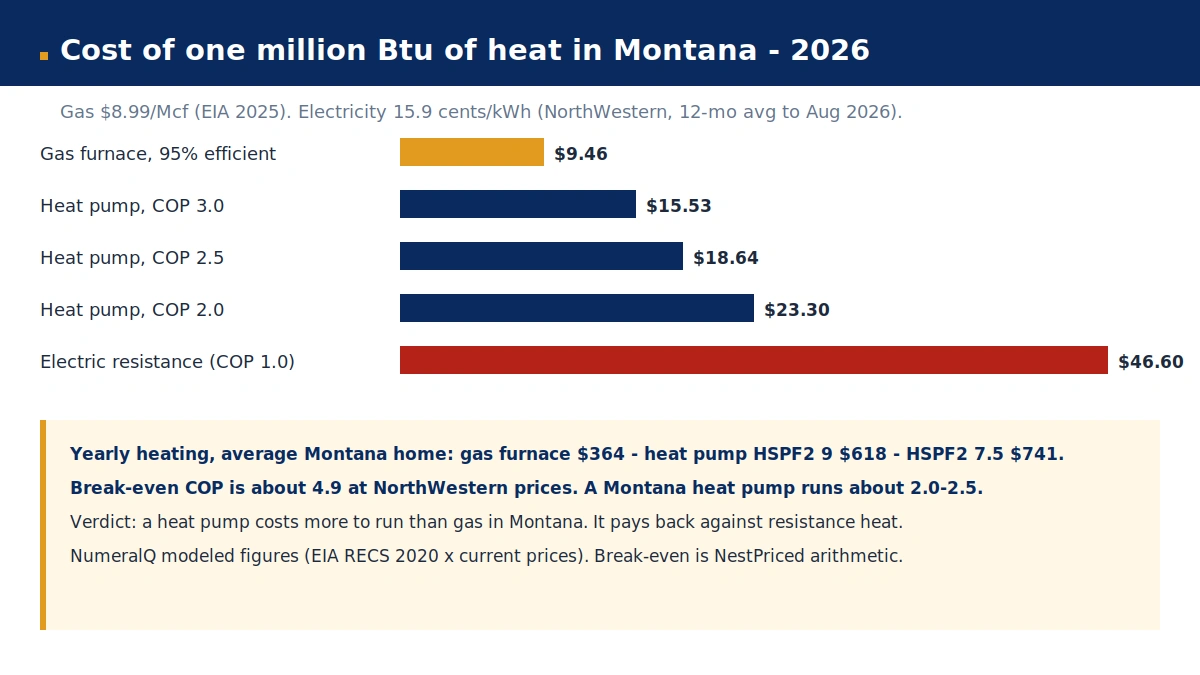
The modeled result, built by NumeralQ from the federal Residential Energy Consumption Survey and current Montana prices, is the table below: the yearly heating cost for an average Montana home, by system.
| System | Yearly heating cost |
|---|---|
| Gas furnace, 95% efficient | $364 |
| Heat pump, HSPF2 7.5 (federal minimum) | $741 |
| Heat pump, HSPF2 9 (high efficiency) | $618 |
Read that table twice, because it reverses the story most heat pump advertising tells. The high-efficiency heat pump costs $254 a year more than the gas furnace to heat the same average Montana home. The minimum-efficiency heat pump costs $377 a year more. The heat pump does not save money against gas in Montana. It costs money, every year, for as long as both systems run. A $450 rebate does not close a $254-a-year gap. A $2,000 federal credit would not have closed it either, and that credit is gone in any case.
The reason is the break-even coefficient of performance, and it is worth working out in the open so the reader can check it. A therm of gas costs about 90 cents at $8.99 per thousand cubic feet, and a 95% furnace turns that therm into 95,000 BTUs of delivered heat — so delivered gas heat costs about $9.46 per million BTUs. A kilowatt-hour of NorthWestern electricity costs 15.9 cents and carries 3,412 BTUs; a heat pump at a coefficient of performance of 2.0 turns that kilowatt-hour into 6,824 BTUs of delivered heat, so delivered heat-pump heat costs about $23.30 per million BTUs at that efficiency — nearly two and a half times the gas figure. At a coefficient of performance of 2.5 the cost falls to about $18.64 per million BTUs, still roughly double gas. At 3.0 it is about $15.53, still well above gas. The break-even point — the efficiency at which the heat pump ties the gas furnace — is a coefficient of performance of about 4.9 at NorthWestern’s 15.9-cent price, or about 4.3 at the statewide 12-month average of 13.9 cents. A Montana heat pump’s seasonal coefficient of performance is roughly 2.0-2.5. It never reaches 4.3, let alone 4.9. That arithmetic is NestPriced arithmetic from the stated inputs, and it is consistent with the independent modeled figure of 4.17 published by startbusinessbystate in October 2026 at a 12.98-cent electricity price.
What changes the answer is the fuel the house burns today. Half of Montana homes heat with piped gas, and for those homes the heat pump’s case has to be made on cooling, comfort, and the value of a single system that heats and cools — not on fuel savings, because there are none. About 27-28% of Montana homes heat with electricity, and for those homes the arithmetic flips hard. Electric resistance heat — baseboards, wall heaters, a furnace with resistance strips — delivers heat at a coefficient of performance of 1.0, so a kilowatt-hour that costs 15.9 cents delivers 3,412 BTUs, or about $46.60 per million BTUs. A cold-climate heat pump at a seasonal coefficient of performance of 2.2 delivers the same million BTUs for about $21.18. The saving is about $25.42 per million BTUs, and on the average home’s heating load — about 38.5 million BTUs a year, derived from NumeralQ’s $364 gas figure at $9.46 per million BTUs — that is roughly $979 a year saved. Against electric resistance, the heat pump pays. Against propane and oil, which heat roughly 14% of Montana homes between them, the heat pump almost certainly pays too, because delivered propane and oil heat are both priced well above gas — but no verified Montana propane or heating-oil price was pulled in this pass, so no figure is stated here, and a propane-heated reader should price their own delivered fuel before deciding.
The dual-fuel configuration is the bridge between the two stories. A home with piped gas keeps the furnace and adds a heat pump, with a balance point — the outdoor temperature below which the furnace takes over — set by the installer, usually somewhere around 25-35 degrees in Montana. Above the balance point the heat pump heats, and it heats at a coefficient of performance of 2.5-3.5 in the mild shoulder-season weather, where it is at its most efficient. Below the balance point the furnace heats, at its cheap gas price. The heat pump also cools all summer, which the furnace never did. It is the most sensible heat pump purchase in gas-heated Montana.
One more cost belongs here, because it surprises Montana buyers most often: the electricity bill in January. A heat pump moves the heating load onto the electric bill, and in a cold month that bill jumps — a home that used to pay $80 a month for electricity can see $200 or more in January, even as the gas bill falls to nothing. The annual total is what matters, and the annual total is the table above — but a household that budgets month to month should expect the shape of the bills to change, and should ask the installer for a month-by-month estimate before signing. For the national picture, see our heat pump running cost guide.
NorthWestern Energy, Co-op Rebates & the Other Money You Can Collect in 2026
Montana’s incentive picture is thin, and the honest way to describe it is to list what exists, what does not, and what is often confused for something that exists. What exists is one utility rebate, a set of co-op rebates that vary by territory, a state loan, and a property-tax exemption with limits. What does not exist is a state rebate, a state income-tax credit, or a federal rebate a Montanan can claim today.
NorthWestern Energy pays $450 per heat pump. The utility’s E+ program, on Forms 3743 (existing home) and 3744 (new construction), revised July 2026 and effective August 1, 2026 through June 30, 2027, pays $450 per unit for a central heat pump, ducted or ductless. The unit must be ENERGY STAR rated, or rated SEER2 15.2 or higher and HSPF2 8.5 or higher — which is, in practice, a cold-climate-rated machine, since a standard unit rarely clears those bars. The program covers existing homes and new materials only under the existing-home form; new construction has its own form, and garages do not qualify under either. Work completed or materials purchased before August 1, 2026 are not eligible, so a system installed in July cannot claim the August cycle’s money. Only NorthWestern Energy residential electric customers can claim it, which covers most of the state’s population centers — Billings, Great Falls, Bozeman, Helena, Missoula, Butte — and leaves the co-op territories to their own programs. Four hundred and fifty dollars is about 3-5% of a cold-climate installed price. It is real money, and it should be claimed, but it does not change the purchase decision.
NorthWestern also pays up to $3,000 for a heat pump water heater. The water-heater rebate is the larger number in the E+ program, but it is a different purchase: it pays for replacing an old electric water heater with a heat pump water heater, through a participating plumbing contractor, from the Northwest Energy Efficiency Alliance’s qualified product list. The City of Bozeman adds a $500 heat pump water heater rebate of its own for Bozeman residents, stackable with NorthWestern’s. Neither rebate applies to a space-heating heat pump, and neither should be folded into a space-heating quote. They belong in the budget only if the water heater is being replaced at the same time, which is a sensible pairing — the panel work and the plumbing visit overlap — but a separate decision.
The co-ops pay their own way, and the amounts vary. Roughly a quarter of Montana’s homes sit on rural electric cooperatives rather than NorthWestern or Montana-Dakota Utilities, and those co-ops run Bonneville Power Administration-funded efficiency programs of their own. The amounts differ by co-op, and no single statewide co-op figure was verified in this pass — a tracker that puts the Montana range at $450-$1,560 across NorthWestern and the BPA co-ops is the best statewide summary available, and it should be read as a range across territories, not a figure any one household can claim. The practical step is to call the co-op before getting quotes: ask for the heat pump rebate in writing, ask whether it requires a specific efficiency rating or a cold-climate listing, and ask whether it requires a backup heat source on a separate meter, because some co-op programs do. Flathead Electric Cooperative, which serves Kalispell and the Flathead Valley, adds a financing tool rather than a large rebate: on-bill financing of up to $10,000 for a heat pump upgrade, with the loan amount added to the monthly electric bill, available only where the project qualifies for a co-op rebate and only for members served by the federal hydropower system.
Montana has no sales tax, which is a small automatic saving. Montana is one of the few states with no general sales tax at all, so no sales tax is added to the equipment or the installation, and there is no exemption to claim or paperwork to file. On a $12,000 system in a state with a 6% sales tax, that would be worth about $720. In Montana it is worth exactly the absence of that charge — a real saving against the national comparison, and one that shows up in the quote as a line that is simply not there.
Montana has no state income-tax credit for a heat pump. The state’s old alternative-energy income tax credit was repealed in 2021, and the 2025 Form 2 Schedule III — the state’s own list of income tax credits — contains no credit for a home heat pump or any other residential energy system. A quote that still counts a Montana state tax credit is out of date by five years. Ask for it to be removed.
The state loan is real, and it mostly serves geothermal. The Department of Environmental Quality’s Alternative Energy Revolving Loan Program lends up to $40,000 at 3.5% fixed for 2026 — 4.023% annual percentage rate once the fees are counted — for up to 10 years, with no down payment, no application fee, and no penalty for paying early. The origination fee is $250 or 2% of the loan, whichever is greater, plus about $200 in other fees. Applications run in quarterly windows, and the next window is January 1-29, 2027, with mailed applications postmarked by January 26, 2027; the October 2026 round is due to be funded December 1, 2026. The loan must be applied for before the work starts, and demand has beaten the available money every quarter since April 2023, so an application is a place in line, not a guarantee. The catch for most heat pump buyers is eligibility: the program’s eligible technologies include geothermal heat pumps by name, along with solar, wind, micro-hydro, and EPA-certified pellet and wood stoves. Whether an air-source heat pump qualifies was not confirmed from a primary source in this pass, and this guide does not claim it does — a buyer counting on the loan for an air-source system should confirm eligibility with the Department of Environmental Quality in writing before signing anything.
The property-tax exemption may or may not cover an air-source heat pump. Montana Code 15-6-224 exempts up to $20,000 of the appraised value of a nonfossil energy generation system from property tax for 10 years after installation — $100,000 for multifamily or business buildings — on filing Form AB-14 with the local Department of Revenue office by March 1. The exemption is verified for solar and geothermal systems. Whether an air-source heat pump counts as nonfossil energy generation under the statute was not verified in this pass, and this guide does not claim it does. The value, if it applies, is modest — on the order of a hundred dollars a year — but the filing costs nothing, and a buyer should ask the county assessor how the system will be valued before signing.
| Help available | Value | Status |
|---|---|---|
| NorthWestern E+ heat pump rebate | $450 per unit | Live, Aug 1, 2026-Jun 30, 2027 |
| NorthWestern heat pump water heater rebate | Up to $3,000 | Live, separate purchase |
| City of Bozeman heat pump water heater rebate | $500 | Live, stackable with NWE |
| Co-op rebates (BPA-funded) | Varies by co-op | Check your co-op in writing |
| Flathead Electric on-bill financing | Up to $10,000 loan | Live, federal-hydropower members only |
| DEQ Alternative Energy Revolving Loan | Up to $40,000 at 3.5% (4.023% APR), 10 yrs | Quarterly windows; next Jan 1-29, 2027 |
| Property-tax exemption (MCA 15-6-224) | Up to $20,000 value, 10 yrs | File Form AB-14 by Mar 1; air-source eligibility unverified |
| No Montana sales tax | ~$0 added to the job | Automatic |
| Montana state income-tax credit | $0 — repealed 2021 | Does not exist |
| HEAR federal rebate (up to $8,000) | $0 — not launched | See federal section |
| Federal tax credit §25C | $0 for 2026 installs | Ended Dec 31, 2025 |
Federal Help in 2026: $0 Tax Credit, HEAR Not Launched & the Lease Question
The 2026 federal story for a Montana heat pump buyer fits in one paragraph, and it is a paragraph of closed doors. Buy a heat pump yourself in 2026 and the federal tax credit is zero — there is none to claim. The federal rebate that could pay up to $8,000 has not launched in Montana. And the lease route that saves buyers in some other states has no verified provider in Montana. The price is the price, less $450 from NorthWestern and whatever the co-op pays.
The tax credit is $0. The One Big Beautiful Bill Act — Public Law 119-21, signed July 4, 2025 — ended the Energy Efficient Home Improvement Credit (§25C, up to $2,000 a year for a qualifying heat pump) and the Residential Clean Energy Credit (§25D, 30%, which covered geothermal heat pumps) for property placed in service after December 31, 2025. The Internal Revenue Service’s fact sheet FS-2025-05 makes clear that the completion date is what counts: a 2025 deposit buys nothing when the crew finished the job in January 2026. Any 2026 quote that still deducts $2,000 for a heat pump, or 30% for a geothermal system, is priced under a law that no longer exists — ask the installer to strip it out and quote again. For the full 2026 federal picture, see our federal tax credits guide.
The HEAR rebate has not launched in Montana, and there is no launch date. The Montana Department of Environmental Quality, which runs the state’s Home Energy Rebates Program, says so plainly on its own program page: the program is not currently available, and final approval from the U.S. Department of Energy is required before any rollout can happen. The history behind that sentence is a program that has stalled twice. Conditional awards for the implementation funding reached the department in January 2025. The implementation application went to the Department of Energy in November 2024 and has sat pended ever since. Design work with the third-party program contractor was paused in February 2025. Then, on June 1, 2026, the Department of Energy issued revised program guidance, and the department must now revise its application to match the new guidance and resubmit it — with no date given for when that resubmission happens or when approval might follow. Only after final approval will the conditional status of the award lift and a launch become possible. The money itself is allocated: $35,484,830 for the electrification rebates and $35,622,334 for the efficiency rebates, about $71.1 million in total, on the Department of Energy’s May 2024 figures. Allocated is not available, and no Montanan can claim a dollar of it today.
Even once it launches, HEAR will pay only for electric-to-electric upgrades. The federal design caps are up to $8,000 for a heat pump and up to $14,000 per household across the program, for households under 150% of area median income. But the Department of Energy’s Program Notice 26-2, dated May 29, 2026 and announced June 1, 2026, rewrote the eligibility rules: for reservations made after August 31, 2026, rebates pay only when an electric appliance replaces electric equipment, or in new construction. A gas furnace may not be replaced with a heat pump under HEAR. That rule matters enormously in Montana, where half the homes heat with gas — the households most likely to want a heat pump are the ones the rule excludes. The HOMES efficiency program, capped by federal design at up to $8,000 per household for projects achieving at least 20% energy savings, has not launched in Montana either. Neither program should appear in a Montana quote as a line item, a deduction, or a promise.
The lease route is not established in Montana. A company-owned heat pump can still claim the commercial clean-electricity credit (§48E, 30%), so long as the system enters service by December 31, 2027 and construction started by July 4, 2026, the cutoff the Internal Revenue Service set out in Notice 2025-42. In a state where residential third-party ownership is clearly legal and providers are selling leases, that credit reaches homeowners through a lease or a power purchase agreement, with the company passing part of the value on as a lower monthly payment. Montana is not such a state in this pass: no provider was found selling a residential heat pump lease or power purchase agreement to Montana homes, and no Montana statute or regulator statement confirming the legality of residential third-party ownership was verified. That does not prove no lease exists anywhere in the state — it proves none was found, and a buyer should treat any lease offer as unverified until a lawyer has read it and the provider’s Montana authority is shown in writing. Have a lawyer read any lease before signing, in any state, and doubly so where the legal route itself is unconfirmed.
Permits & Licensing: Montana Has No State HVAC License
Montana’s licensing picture is the thinnest in this series, and a buyer who does not know that will ask for the wrong document and accept the wrong answer. Montana issues no statewide HVAC license, requires no HVAC exam, and runs no HVAC competency test. What it runs instead is a registration system tied to workers’ compensation, and the registration is not a test of skill.
The business must be registered with the Department of Labor & Industry. Any contractor offering HVAC work in Montana must register with the department’s Employment Relations Division. There are two tracks. A Construction Contractor Registration costs $70 and is valid for two years, and it is required for any construction business that has employees, is a corporation, or is a manager-managed limited liability company. An Independent Contractor Exemption Certificate costs $125 and is valid for two years, and it is for the solo contractor with no employees. Both are filed with the department in Helena, both require proof of workers’ compensation coverage or a waiver of it, and neither requires an exam, an experience record, or a competency test of any kind. The registration verifies that the business is set up to carry workers’ compensation — it does not verify that the business knows how to size a heat pump for Glasgow in January. Montana does not reciprocate registrations with any other state, so a contractor from Idaho or Wyoming must register in Montana before working here.
The electrical work is licensed separately, and that license is real. The Montana State Electrical Board, inside the Department of Labor & Industry, licenses electricians and electrical contractors under Title 37, Chapter 68 of the Montana Code: master, journeyman, residential, and electrical contractor classifications, with exams. A heat pump installation involves electrical work — a dedicated circuit, a disconnect, often a panel upgrade — and the person doing that work should hold the electrical license for it, or work under a licensed electrical contractor. Ask for the electrical contractor’s license number and check it against the board’s registry, and check that the name on the license matches the name on the contract. The same split applies to plumbing: plumbers are licensed separately through the Board of Plumbers, and a dual-fuel job that touches gas piping should be done by or under a licensed plumber or gas fitter, as the local code requires.
The federal refrigerant certification is mandatory. Anyone handling refrigerants must hold Environmental Protection Agency Section 608 certification under federal law, and Montana is no exception. There is no state test to fall back on, so the 608 card is the one competency document a Montana HVAC technician is certain to hold. Ask to see it. North American Technician Excellence (NATE) certification is voluntary and is a genuine plus — it is a tested credential in a state that tests nobody — and manufacturer training on the specific brand being installed is worth asking about as well, because a cold-climate system’s commissioning settings are brand-specific and a technician who has never commissioned that brand is learning on your house.
Permits are local, and the fees are modest. There is no statewide permit for a heat pump in Montana. The city or county building department issues the mechanical and electrical permits, and NumeralQ’s check of 35 cities put permit fees for this kind of job at $70-$166 — modest against a $10,000 system, and no reason to skip the permit. No Montana-specific statewide permit fee schedule was verified in this pass, so no fee figure beyond that range is stated here. The building department’s figure governs, not the installer’s guess, and the permit is what gets the installation inspected. An installer who offers to skip the permit is offering to skip the inspection, and the inspection is the only independent check that the system was installed to code. Some cities — Billings, Great Falls, and Missoula among them — have municipal licensing requirements of their own, so a contractor working in one of those cities should be able to show the municipal credential as well as the state registration.
The load calculation is the document that matters most. Montana’s Department of Environmental Quality publishes the design temperatures for Manual J calculations, town by town, because the load calculation is the engineering basis for the whole job. A quote that does not rest on a Manual J is a quote built on a guess, and in Montana a guess costs comfort or money — usually both. Ask for the Manual J in writing before signing. If the installer cannot produce one, that answers the question of whether to hire them.
What Pushes Your Montana Quote Up or Down
Use the per-ton anchor only to orient yourself — the real quote comes later. Eight factors can move a Montana quote by thousands of dollars, and four of them come from this state’s climate, housing stock, and geography.
The cold-climate rating is the biggest single price lever. The gap between a standard and a cold-climate 3-ton ducted system is roughly $2,060-$4,070, and it is the most important money in the quote — it buys the capacity at 5 degrees and the operation down to minus 13 or minus 22 that a Montana winter demands. A quote that looks cheap because it prices a standard unit is not cheap. It is a different, lesser machine, and the saving will be spent several times over on backup heat in the first few winters. Compare quotes only between cold-climate-rated units, with the 5-degree capacity and coefficient of performance figures shown.
The ducts decide the second-biggest lever. New or extended ductwork runs $4,160-$7,060 per job on NumeralQ’s Montana figures, and Montana’s older housing stock makes it a common line. A home with sound, sealed, insulated ducts pays nothing here. A home with ducts in an unconditioned attic or crawlspace, leaking at every joint, pays for sealing and insulation at minimum — and a home with no ducts at all either pays for new ducts or goes ductless instead. Ducts in Montana deserve a particular check: ducts running through an unconditioned space lose heat all winter, and a duct system that was sized for a furnace’s 120-degree supply air may not distribute a heat pump’s 90-100-degree supply air evenly. Ask the installer to test the ducts — a pressure test and a visual inspection — before the quote is final, not after the system is running cold rooms.
The electrical panel is the most common surprise. A 200-amp panel upgrade runs $2,500-$3,850 per job on NumeralQ’s Montana figures, and many Montana homes still run on 100-amp service — especially ranch homes and split-levels from the 1960s to the 1980s, and rural homes wired when the load was a fraction of today’s. A heat pump adds a large new electrical load, and a heat pump with resistance backup strips adds a very large one: a 10-kilowatt strip package alone can draw more than 40 amps. Settle whether the panel is in the quote before you sign — not after the electrician has pulled into the driveway. The national figures for a panel upgrade are in our electrical panel upgrade guide, and no Montana-specific panel-upgrade dollar figure beyond NumeralQ’s range was verified for this guide.
Labor is close to the national middle, and thin competition is the real cost. Montana HVAC mechanics and installers earn a median of $29.26 an hour, per the Bureau of Labor Statistics’ May 2025 figures, against a national mean near $31.14 — and the billed rate, what a contractor charges per worker-hour once insurance, payroll taxes, overhead, and profit are counted, runs $59-$76 an hour. Electricians earn a median of $36.90 an hour in Montana, billed at $74-$96 an hour. Of all the soft costs on an install, labor is the biggest, and in Montana it neither cheapens the job nor pushes it up the way coastal pay does. What moves a Montana quote is the thin bench: with a handful of installers serving much of the state, the crew’s experience matters more than the headline rate, and the travel charge matters more than either.
The house itself sets the rest. Insulation and air sealing are the cheapest capacity a Montana home can buy: every unit of heat loss sealed out of the shell is a unit the heat pump does not have to produce at minus 10, and a well-sealed home can drop a full ton of sizing. The shell work is not in the heat pump quote, and it should be priced separately — but it should be priced, because a heat pump sized for a leaky house is a bigger, more expensive machine doing a job the insulation could have done for less. The outdoor unit’s placement is a smaller but real cost: a stand that lifts the unit clear of the snow line, a pad with drainage for defrost water, and wind screening on an exposed site are all legitimate lines on a Montana quote.
Financing terms. Over the life of the system, no payment route beats cash. With nothing down, the loan quietly folds dealer fees of 10-30% of the cash price — in some cases over half — into what you borrow. That national figure comes from the Consumer Financial Protection Bureau’s August 2024 market spotlight, and Montana quotes carry it no differently. The Department of Environmental Quality’s revolving loan is the third path in Montana, and it is a genuinely cheap one — 3.5% fixed for 2026 — but it runs in quarterly windows, demand beats supply every quarter, and air-source eligibility was not confirmed in this pass. A lease is the fourth path, and it is thin here: no provider was found selling one to Montana homes, so a lease quote should be read by a lawyer before it is compared on its monthly payment.
Maintenance and lifespan. A heat pump keeps heating for 12-15 years of typical service before a major repair or replacement decision, on the national figures, and a well-maintained cold-climate unit can run longer. The outdoor coil needs its airflow kept clear of snow and debris, the filters need changing, and the system needs an annual check — ideally in the fall, before the heating season, when a technician can still get parts and time. Lifespan and maintenance figures are national only — no Montana-specific versions exist. For the ongoing costs, see our heat pump maintenance guide and our heat pump repair guide.
Payback: When Does a Montana Heat Pump Pay for Itself?
Payback is where a Montana heat pump either earns its keep or does not, and the answer turns on what the house burns today — more sharply than in any other state in this series, because Montana’s gas is cheap, its electricity is cheap, and the gap between them is wide.
Against a gas furnace, there is no payback. The arithmetic is in the running-cost section, and it bears repeating here because it is the verdict: a high-efficiency heat pump costs about $618 a year to heat the average Montana home, and a 95% gas furnace costs about $364. The heat pump costs $254 a year more, every year. The NorthWestern rebate of $450 covers less than two years of that gap and then it is gone. A cold-climate system at $8,610-$15,030, less $450, never pays back against gas on fuel savings, because there are no fuel savings. The payback case for a gas-heated Montana home has to be made on something else: the cooling the furnace never provided, the comfort of even temperatures and filtration, the value of a second heat source, or the wish to stop burning gas. Those are real reasons to buy. Fuel savings is not one of them, and any quote that projects fuel savings for a gas-heated Montana home is modeling a different state.
Against electric resistance heat, the payback is about 8-15 years. The worked example below is NestPriced arithmetic from the anchors in this guide, with every input stated so it can be checked. The average Montana home needs about 38.5 million BTUs of delivered heat a year — derived from NumeralQ’s $364 gas figure at $9.46 per delivered million BTUs. Electric resistance heat at NorthWestern’s 15.9 cents a kilowatt-hour costs about $46.60 per million BTUs, so the resistance-heated home pays about $1,794 a year for heat. A cold-climate heat pump at a seasonal coefficient of performance of 2.2 costs about $21.18 per million BTUs, or about $815 a year for the same heat. The saving is about $979 a year. A cold-climate 3-ton system at $8,610-$15,030, less the $450 NorthWestern rebate, nets $8,160-$14,580. Simple payback is $8,160 divided by $979, about 8 years, at the low end — and $14,580 divided by $979, about 15 years, at the high end. That is inside the system’s 12-15 year service life at the low end and at its edge at the high end, before counting the cooling value, which the resistance-heated home did not have at all. The range is wide because the installed price range is wide, and the low end of the price range is where the payback lives.
Against propane or oil, the payback is almost certainly shorter — but no figure is stated here. Roughly 14% of Montana homes heat with propane or oil, and delivered propane and oil heat are both priced well above gas per unit of heat, so a heat pump’s saving against either fuel should be larger than its saving against resistance heat in some cases and smaller in others, depending on the delivered fuel price that winter. No verified Montana propane or heating-oil price was pulled in this pass, and this guide will not invent one. A propane-heated reader should take their delivered price per gallon, convert it to dollars per million BTUs at their furnace’s efficiency, and run the same comparison the worked example above runs for resistance heat.
Geothermal never pays back against gas, and pays back slowly against resistance. The premium over a cold-climate air-source system is roughly $11,600-$16,900 on the planning figures. Geothermal’s year-round coefficient of performance of roughly 3.5-4.5, against the air-source unit’s seasonal 2.2, saves about $300-$400 a year on the average home’s heating load at NorthWestern prices — a payback of roughly three to five decades, past the life of either system. Geothermal’s case in Montana is performance and comfort, not payback: it never needs backup heat and never notices the weather. Buy it for that, not for a payback the arithmetic does not support.
What moves the payback most. The fuel the house burns today is the first and largest lever — resistance heat pays back, gas does not, and propane and oil sit in between on their own delivered prices. The installed price is the second: the low end of the cold-climate range pays back in 8 years against resistance, and the high end in 15, so the quote matters as much as the fuel. The seasonal coefficient of performance is the third: a unit that actually achieves 2.2 across a Montana winter pays back faster than one that spends its season on backup strips at 1.0, which is why the cold-climate rating and the Manual J sizing matter more here than in any mild-climate state. Rate escalation is the fourth: NorthWestern’s rates rose 13% in the year to August 2026, and if electricity keeps rising faster than gas, the gap narrows — but it narrows from $254 a year, and it would need to narrow a long way before a gas-heated home sees a payback. The rebate is the smallest lever: $450 shortens the resistance-heat payback by about half a year, and it shortens the gas payback not at all, because there is no gas payback to shorten.
Who should buy, and who should not. Buy the heat pump if the house heats with electric resistance, a wall furnace, or an old propane or oil system — the saving is real, the payback is inside the system’s life, and the cooling is a bonus. Buy it as a dual-fuel system if the house has piped gas and a working furnace — the heat pump heats in the shoulder seasons, cools in summer, and the furnace keeps the coldest weeks cheap. Buy it as a single-zone mini-split if the house is a cabin, a small home, or a home with one cold room and no ducts. Do not buy a standard, non-cold-climate unit as the sole heat source in a zone 7 county. Do not buy any heat pump expecting it to save money against a gas furnace on fuel alone. And do not buy on a quote that deducts a $2,000 federal credit, an $8,000 federal rebate, or a state rebate that does not exist — the price is the price, less $450 from NorthWestern, and the decision should be made on that number.
Getting Quotes in Montana: The Checklist
Montana is a hard state to buy a heat pump in — deep winters, thin installer coverage, long drives between towns, and an incentive picture that is mostly closed doors — but only for a homeowner who checks the cold-climate ratings and the fuel math before the sales pitch. Check every bidder against this list, and leave the contract unsigned until each line is answered on paper.
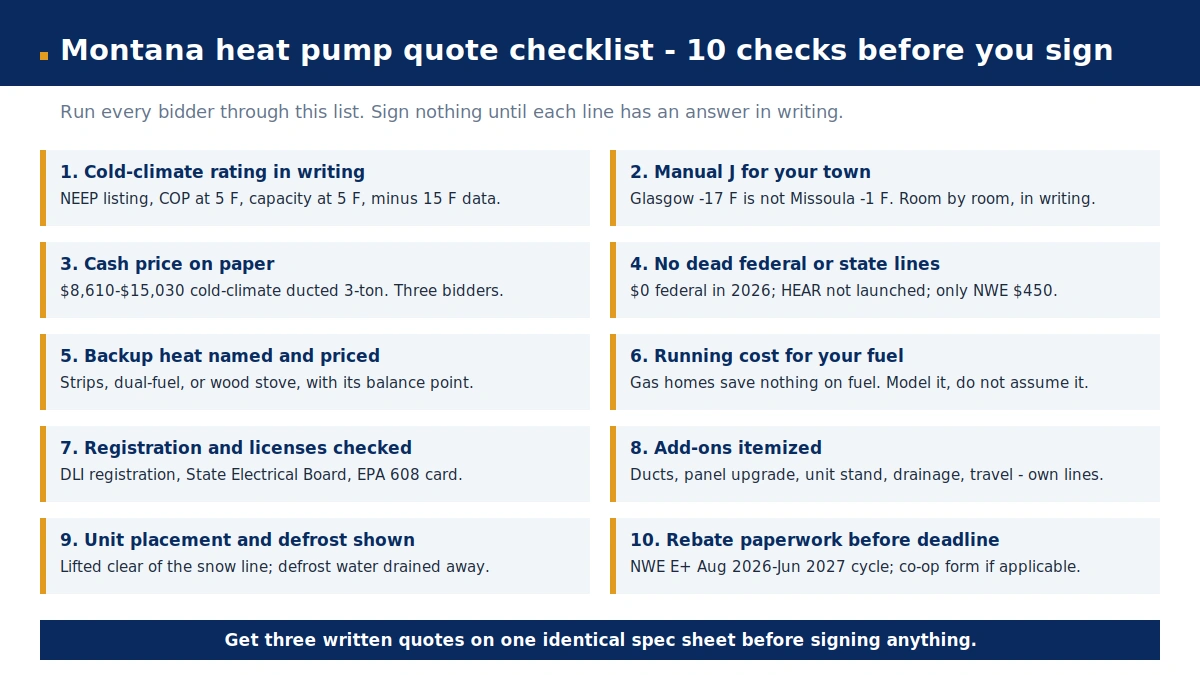
The ten-item quote checklist:
- Cold-climate rating in writing, first — the model’s NEEP cold-climate listing, its capacity and coefficient of performance at 5 degrees, and its published performance at minus 15 degrees. A standard unit quoted where a cold-climate unit belongs is the most expensive mistake in this guide.
- A Manual J load calculation for your town — run against your town’s design temperature (minus 17 in Glasgow is not minus 1 in Missoula), with the result in writing. No Manual J, no signature.
- Cash price for the same cold-climate equipment, all three bidders — the Montana anchor is $8,610-$15,030 for a cold-climate ducted 3-ton system. A bid far over the anchor needs a reason, and a bid far under it needs a second look at what the installer left off the page.
- No line for a $2,000 federal credit, no line for an $8,000 federal rebate, no line for a state rebate — a 2026 owner purchase gets $0 federal, HEAR has not launched in Montana, and Montana has no state rebate. The only rebate to show is NorthWestern’s $450, or the co-op’s figure in writing.
- Backup heat named and priced — resistance strips, dual-fuel furnace, or wood stove, with the balance point and the expected backup hours stated. A quote that does not name the backup heat has not priced the winter.
- Running cost modeled for your fuel, not assumed — the yearly heating cost shown for your current fuel against the heat pump, at your utility’s own rates. On a gas-heated home, a quote that projects fuel savings is wrong.
- Registration and licenses verified — the contractor’s Department of Labor & Industry registration (Construction Contractor Registration or Independent Contractor Exemption Certificate), the electrical contractor’s State Electrical Board license, and the technician’s EPA Section 608 card, all checked, with names matched to the contract. Montana has no state HVAC license to ask for — do not accept a registration as proof of skill.
- Add-ons itemized — ductwork, panel upgrade, thermostat, outdoor-unit stand and drainage, and any travel charge, each as its own line, not folded into the system price.
- Outdoor unit placement and defrost plan shown — the unit lifted clear of the snow line, defrost water drained away from walkways, clearance for drifting snow, and the auxiliary-heat staging during defrost stated.
- Rebate paperwork filed before the deadline — NorthWestern’s E+ form for the August 2026-June 2027 cycle, or the co-op’s own form, filed with the efficiency rating documented. Work done before August 1, 2026 does not qualify for the current NorthWestern cycle.
Buy, dual-fuel, or wait? Buy a cold-climate system outright if the house heats with resistance, propane, or oil — the payback is real and the cooling is a bonus. Buy dual-fuel if the house has piped gas and a working furnace — the heat pump earns its keep in the shoulder seasons and summer, and the furnace keeps the coldest weeks cheap. Buy a single-zone mini-split if the need is one room, a cabin, or a home with no ducts. Wait if the only quote on the table is a standard unit, if no bidder will show a Manual J, or if the furnace is new and the house has no cooling need — the machine will still be there next year, and the HEAR program may be too, though no date has been set. For the furnace side of the decision, see our furnace replacement guide.
Sources & methodology
Cost anchors (installed, planning estimates unless noted):
- NumeralQ Montana heat pump cost page, estimator pricing Oct 26, 2026 (model v2; Fixr cost guide, Home Depot equipment prices, This Old House cost guide; planning estimates, not contractor bids): ducted air-source 3-ton $6,550-$10,960; cold-climate ducted 3-ton $8,610-$15,030; single-zone mini-split $3,140-$4,910; multi-zone 3-head $6,240-$11,170; geothermal with loop $20,250-$31,910; by size 1.5t $4,400-$7,070, 2t $5,120-$8,370, 2.5t $5,830-$9,660, 3t $6,550-$10,960, 3.5t $7,260-$12,250, 4t $7,980-$13,550, 5t $9,410-$16,140; ductwork $4,160-$7,060/job; panel upgrade 200 A $2,500-$3,850/job; permits $70-$166 in cities checked
- NumeralQ Billings page Oct 2026: standard ducted 3-ton $6,600-$11,020; dual-fuel $9,220-$15,120; Missoula page Oct 2026: $6,530-$10,930
- BetterHouse heat pump cost by state 2026: Montana ducted $3,950-$13,810, typical $10,430, wage index 0.96 (BLS OEWS 49-9021 May 2025, US mean $31.14/hr)
- This Old House cost guide Aug 2026: ducted average $10,575; single-zone mini-split typical $3,250. ConsumerAffairs Jul 2026: ducted $4,000-$14,000; single-zone $2,000-$12,000; geothermal $12,000-$40,000+. Angi Aug 2026: ducted $4,500-$8,000; geothermal average $15,206
Rates:
- EIA Electric Power Monthly Table 5.6.A, Aug 2026 release: MT residential 15.57 cents/kWh, US 18.16 cents, 14.3% below US, 19th lowest of 51; average August bill ~$140.13
- Kadoa/EIA 12 months to Aug 2026 (updated Nov 7, 2026): MT 12-mo average 13.9 cents/kWh, average bill ~$115/mo, +9.5% YoY; NorthWestern 15.9 cents, +13% YoY, ~337,936 customers, ~$108/mo; EIA-861 2024 final: NorthWestern 328,127 residential accounts, 14.23 cents, 49.1% of state residential sales
- NorthWestern Energy: ~375,000 electric customers (electricchoice Nov 2026); standard residential tariff $4.20/mo fixed charge plus ~7.83 cents/kWh riders (priceofelectricity); PSC final decision Dec 2025: 17% residential base-rate increase, ~12% overall bill increase, effective Feb 1, 2026 (interim self-implemented May 2025)
- Montana-Dakota Utilities: electric interim increase +22.008% effective Apr 1, 2026 (PSC Docket 2025.09.072); MDU electric fixed charge $0.19/day (PSC 2026 rate summary)
- Natural gas: EIA 2025 annual average MT residential $8.99/Mcf (via startbusinessbystate Oct 6, 2026); Montana PSC 2026 rate summary: NWE gas average bill at 100 therms ~$71-$89/mo; MDU gas ~$78-$93/mo; MDU cost of gas $4.439/dk Oct 2026
- Heating fuels: Census ACS 2020-2024 5-yr tables B25034/B25040 via NumeralQ Oct 2026: electric 27%, piped gas 50%, propane or oil ~14%; startbusinessbystate Oct 6, 2026: electric 28.4%, utility gas 49.9%
Running-cost math:
- NumeralQ heat pump math in Montana (EIA RECS 2020 x current state prices; planning figure, not a bill forecast): gas furnace 95% $364/yr; heat pump HSPF2 7.5 $741/yr; HSPF2 9 $618/yr
- Break-even COP: startbusinessbystate Oct 6, 2026 modeled 4.17 at 12.98 cents/kWh and $8.99/Mcf; NestPriced arithmetic: gas $9.46 per delivered MMBtu at 95% efficiency; heat pump $23.30 per MMBtu at COP 2.0 and 15.9 cents/kWh, $18.64 at COP 2.5, $15.53 at COP 3.0; break-even COP ~4.9 at 15.9 cents, ~4.3 at 13.9 cents
- Payback worked example is NestPriced arithmetic: delivered heat ~38.5 MMBtu/yr from NumeralQ’s $364 gas anchor; resistance heat $46.60 per MMBtu at 15.9 cents = ~$1,794/yr; heat pump at seasonal COP 2.2 = $21.18 per MMBtu = ~$815/yr; saving ~$979/yr; net system $8,160-$14,580 after the $450 rebate; simple payback ~8-15 years
Climate:
- Montana DEQ, Montana Temperatures for Manual J Calculations (ACCA Manual J 8th ed. v2.0): 99% winter design temps Billings -7 F, Bozeman -12 F, Butte -14 F, Cut Bank -16 F, Glasgow -17 F, Glendive -13 F, Great Falls -13 F, Miles City -13 F, Missoula -1 F; summer design 84-93 F
- Heating degree days: Billings 7,049 (NumeralQ 1991-2020: 6,754); Glasgow 8,996; Great Falls 7,750; Helena 8,129; Kalispell 8,191; Missoula 8,125 (plainclimate 1991-2020: 7,514); Miles City 7,723; US median station ~5,373. Cooling degree days: Billings 498-663, Missoula 188-306; Billings ~32 days/yr at 90 F or hotter
- IECC climate zones 6 and 7 statewide; NumeralQ: 100% of Montana counties zone 6+ (PNNL-33270). USDA hardiness zones 3a-6b; annual minimum -40 F to 0 F. Missoula: 173 nights/yr at or below freezing, 43 inches snow/yr, December normal low 18 F (NOAA 1991-2020)
- Federal minimums, North region: 7.5 HSPF2 heating, 13.4 SEER2 cooling (DOE, 10 CFR 430.32, in effect Jan 1, 2023)
Cold-climate performance:
- NEEP ccASHP specification: variable-capacity inverter, AHRI-matched, COP 1.75 or higher at 5 F, at least 70% rated capacity at 5 F, published performance at -15 F; 100+ product lines as of 2026
- Typical cold-climate COP 2.0-2.5 at 5 F, 1.5-2.0 at -10 F, 3.0-4.0 in mild winter weather; EVI holds 70-80% capacity at -10 F; operating range -13 F to -22 F (HomeEnergyGeek Jul 27, 2026; AmazingFlash cold-climate guide Jun 2026)
- Trane 20 TruComfort WeatherGuard: 100-107% rated capacity at 5 F, operates to -20 F, field-tested in Montana among other states, temps to -21 F (Trane Sep 24, 2026; ACHR News Oct 1, 2026). Mitsubishi Hyper-Heat to -13 F; Daikin Aurora to -13 F (2026 model to -20 F); Bosch IDS Ultra to -13 F, 100% capacity at 5 F
- Backup heat field data: under 5-10% of heating hours, under 100-200 hours/yr in VT/MN field studies (Efficiency Vermont, Minnesota Dept. of Commerce, Massachusetts Clean Energy Center)
Rebates and state help:
- NorthWestern Energy Forms 3743 (existing home) and 3744 (new construction), Jul 2026, effective Aug 1, 2026-Jun 30, 2027: central heat pump (ductless or ducted) $450/unit, ENERGY STAR or SEER2 15.2+ and HSPF2 8.5+; work/materials before Aug 1, 2026 not eligible; garages do not qualify
- NorthWestern heat pump water heater rebate up to $3,000 (participating plumbing contractors, NEEA qualified product list); City of Bozeman $500 heat pump water heater rebate (Bozeman Sustainability Division)
- Co-ops: BPA-funded programs vary by co-op; Flathead Electric Cooperative on-bill financing up to $10,000 for heat pump upgrades (federal-hydropower members only; Cooke City/Silver Gate excluded); HomeEnergyBasics tracker Sep 22, 2026 puts the Montana range at $450-$1,560 (NorthWestern + BPA co-ops)
- Montana has no general sales tax (MT Dept. of Revenue guidance; EcoGen checked Sep 30, 2026). Montana alternative-energy income tax credit repealed 2021; 2025 Form 2 Schedule III lists none
- DEQ Alternative Energy Revolving Loan Program: up to $40,000, 3.5% fixed 2026 (4.023% APR), up to 10 years, no down payment, origination $250 or 2% (whichever greater) plus ~$200 fees; quarterly windows, next Jan 1-29, 2027 (mailed postmarked by Jan 26, 2027), October round funded Dec 1, 2026; demand has beaten money every quarter since Apr 2023 (EcoGen checked Nov 2, 2026; Montana Renewable Energy Association)
- Montana Code 15-6-224: up to $20,000 of appraised value of a nonfossil energy generation system exempt from property tax for 10 years ($100,000 multifamily/business); Form AB-14 by Mar 1 (MT Dept. of Revenue). City of Helena 0% residential energy loan, assessed on property tax bills
Federal:
- OBBBA P.L. 119-21 and IRS FS-2025-05: §25C and §25D $0 for property placed in service after Dec 31, 2025, completion date counts
- §48E 30% for third-party-owned systems, in service by Dec 31, 2027, construction begun by Jul 4, 2026 per IRS Notice 2025-42
- HEAR/HOMES: Montana DEQ Home Energy Rebates Program page (checked Nov 8, 2026): “not currently available,” final DOE approval required; conditional awards Jan 2025; application submitted Nov 2024, pended; design work paused Feb 2025; DOE revised guidance Jun 1, 2026; DEQ must revise and resubmit; no launch date. Allocations (DOE May 23, 2024 via ECW Oct 27, 2026): HEEHR $35,484,830 + HOMES $35,622,334 = ~$71.1M. NASEO status Sep 30, 2026: not launched. Heatpumppricing.com verified Nov 4, 2026: DEQ must resubmit under June 2026 guidance, no launch date
- DOE Program Notice 26-2 (dated May 29, 2026, announced Jun 1, 2026): HEAR electric-to-electric only for reservations after Aug 31, 2026, no fuel-switching; HEAR design caps up to $8,000 per heat pump, up to $14,000 per household, income-capped at 150% AMI; HOMES design cap up to $8,000 per household at 20%+ savings
- Solar for All: EPA ended grants Aug 2025; courts ruled termination unlawful Sep 2026; no Montana household route found (EcoGen checked Oct 5, 2026)
Licensing and labor:
- Montana has no statewide HVAC license and no HVAC exam; DLI Construction Contractor Registration $70/2 years, Independent Contractor Exemption Certificate $125/2 years; registration is workers’-comp compliance, not a competency test; no reciprocity (ServiceTitan, Housecall Pro, ContractorTests Montana guides, 2026)
- State Electrical Board (MCA Title 37, Ch. 68): Master, Journeyman, Residential, Electrical Contractor, with exams. Board of Plumbers (MCA Title 37, Ch. 69). EPA Section 608 certification federally required for refrigerant handling. Some cities (Billings, Great Falls, Missoula) have municipal licensing requirements
- BLS OEWS May 2025 via NumeralQ Oct 2026: Montana HVAC mechanics/installers median $29.26/hr, billed $59-$76/hr; electricians median $36.90/hr, billed $74-$96/hr. CFPB Solar Financing Market Issue Spotlight Aug 2024: dealer fees 10-30%, sometimes over 50% (national figure)
EXCLUDED:
- Any “after $2,000 credit” or “after 30% credit” prices: §25C/§25D are $0 for 2026 installs
- Any HEAR rebate in a Montana quote: not launched, no launch date, and electric-to-electric only once it launches — a gas-heated home is excluded
- Any state rebate for a Montana heat pump: none exists
- Any Montana residential heat pump lease/PPA offer: no provider found in this pass; legality of residential third-party ownership not verified
- RenewEstimator/ConsumerAffairs-style modeled paybacks that price heat pump savings against a national average fuel mix: this guide uses Montana’s own fuel prices and heating mix
- City prices for Bozeman, Great Falls, Helena, Kalispell, Butte: planning estimates only, flagged as such; no verified figures pulled
- A Montana propane or heating-oil price: not verified, so no vs-propane or vs-oil payback stated
- AERLP eligibility for air-source heat pumps: not confirmed from a primary source; geothermal confirmed eligible
- MCA 15-6-224 property-tax exemption for air-source heat pumps: not verified; verified for solar/geothermal class systems
- Montana-specific permit fee schedule, install timeline, installer names, disciplinary records, and heat pump install counts: not verified
*Disclaimer: The prices here are 2026 Montana planning figures. City, house, utility territory, and contractor all push these numbers around. Get three installers’ written quotes in hand before you fix your budget. The tax notes in this guide are general background, not advice about your own return. A Montana tax pro can tell you how these notes apply to your own return — ask one before you file. Program rules change — NorthWestern Energy E+ terms, co-op terms, and the DEQ loan windows — so confirm current terms with NorthWestern Energy, your co-op, or the DEQ before signing. NorthWestern’s $450 rebate runs to June 30, 2027, and the DEQ loan’s next window is January 1-29, 2027 — rate and program figures in this guide are dated to their sources.*
How much does a heat pump cost in Montana in 2026?
A cold-climate ducted heat pump costs $8,610-$15,030 installed for a typical 3-ton Montana home in 2026, and a standard ducted system runs $6,550-$10,960 (NumeralQ planning estimates, October 2026). A single-zone ductless mini-split runs $3,140-$4,910, a three-head multi-zone system $6,240-$11,170, and geothermal with a ground loop $20,250-$31,910. Billings runs $6,600-$11,020 for a standard 3-ton system and Missoula $6,530-$10,930. NorthWestern Energy pays a $450 rebate, the federal credit is $0 for a 2026 install, and Montana’s HEAR rebate has not launched.
Does a heat pump work in a Montana winter?
Yes, if it is a cold-climate rated unit, sized for the town’s design temperature, with backup heat in place. A cold-climate heat pump holds 70-100% of its rated heating capacity at 5 degrees, runs a coefficient of performance of 2.0-2.5 at that temperature, and keeps operating down to minus 13 or minus 22 depending on the model. Montana’s design temperatures run from minus 1 in Missoula to minus 17 in Glasgow, so the sizing must use the local figure, not a state average. A standard, non-cold-climate unit loses most of its capacity below 25 degrees and leans on backup heat below about 15 degrees — in Montana that means much of the winter on resistance strips.
Is a heat pump cheaper to run than a gas furnace in Montana?
No. Heating the average Montana home costs about $364 a year with a 95% gas furnace and about $618-$741 a year with a heat pump, depending on efficiency (NumeralQ modeled figures from federal energy-use data and current Montana prices). The break-even efficiency is a coefficient of performance of about 4.9 at NorthWestern’s 15.9 cents a kilowatt-hour, and a Montana heat pump’s seasonal efficiency is roughly 2.0-2.5. A heat pump in a gas-heated Montana home costs more to run every year. It pays back only where the house now heats with electric resistance, propane, or oil — or as a dual-fuel system, where the furnace keeps the coldest weeks and the heat pump covers the shoulder seasons and summer cooling.
What rebates can I get for a heat pump in Montana in 2026?
NorthWestern Energy pays $450 per central heat pump, ducted or ductless, rated ENERGY STAR or SEER2 15.2 and HSPF2 8.5 or higher, for work in the August 1, 2026 to June 30, 2027 cycle. Rural co-op rebates vary by territory — Flathead Electric offers on-bill financing up to $10,000 rather than a large rebate — so check your own co-op in writing. Montana has no state rebate, no sales tax, and no state income-tax credit for a heat pump, and the federal HEAR rebate of up to $8,000 has not launched in Montana. The Department of Environmental Quality lends up to $40,000 at 3.5% through its revolving loan program, in quarterly windows, with the next window January 1-29, 2027 — though air-source eligibility was not confirmed in this pass.
Can I still get the $2,000 federal tax credit for a heat pump in Montana in 2026?
No. Under the One Big Beautiful Bill Act (P.L. 119-21), the Energy Efficient Home Improvement Credit (§25C, up to $2,000 a year for a heat pump) no longer applies to property placed in service after December 31, 2025 — and the IRS has made clear the finish date of the installation is the date that decides it. The 30% credit (§25D) that covered geothermal heat pumps ended on the same date. Any 2026 quote that still deducts either credit is priced under a law that no longer exists.
Has Montana’s HEAR heat pump rebate launched?
No. Montana’s Home Energy Rebates Program has not launched, and the Department of Environmental Quality says on its own program page that the program is not currently available and final federal approval is required before any rollout. The state was allocated about $71.1 million — $35.5 million for electrification rebates and $35.6 million for efficiency rebates — but the application has sat pended since November 2024, design work paused in February 2025, and the department must revise and resubmit its application under the federal government’s revised June 2026 guidance. No launch date has been set. Even once it launches, HEAR will pay only for electric-to-electric upgrades — a gas furnace may not be replaced with a heat pump under the program.
Do I need backup heat with a heat pump in Montana?
Yes — plan for it, even with a cold-climate unit. Montana sits in federal climate zones 6 and 7, and backup heat is the safety margin for the nights below the design temperature. The backup can be electric resistance strips in the air handler, the gas furnace in a dual-fuel setup, or a wood stove. Field studies in Vermont and Minnesota find backup heat running for under 5-10% of heating hours, and under 100-200 hours a year, in a properly sized cold-climate system. The hours are few, but they are the coldest hours, so an undersized system that leans on backup heat will see it in the bill. Name the backup heat and its balance point in the quote before signing.
Does Montana require an HVAC license to install a heat pump?
No — Montana issues no statewide HVAC license and requires no HVAC exam. Contractors must register with the Department of Labor & Industry: a Construction Contractor Registration ($70, two years) for businesses with employees, or an Independent Contractor Exemption Certificate ($125, two years) for solo contractors. That registration is workers’-compensation compliance, not a test of skill, so it proves nothing about the installer’s competence. The electrical work is licensed separately through the State Electrical Board, refrigerant handling requires federal EPA Section 608 certification, and some cities — Billings, Great Falls, Missoula among them — have municipal requirements of their own. Ask for the Manual J load calculation, not just the registration.