

On the evening of July 31, 2025, the Range Fire started near the Orchard training range southeast of Boise and ran fast enough that deputies were knocking on doors along South Pleasant Valley Road and West Thompson Road before dark. It burned 26,922 acres in two days. Eleven months later, on a July afternoon in 2026, a foothills fire above North Claremont Drive grew to about 2,000 acres while crews protected houses and cleared the Hulls Gulch trails.
Neither fire reached the roof of a house in the Boise valley floor. Both fires explain why the roof over a house near the foothills is fire equipment as much as shelter. Embers ride the wind ahead of a grass fire, land in a valley or a gutter full of dry needles, and find the one vent with no screen.
The Idaho Department of Lands puts it in one sentence in its wildfire guide: the roof is the most vulnerable part of a home because it can easily catch fire from windblown embers.
Idaho holds three roofing markets inside one state line, and the price of a roof only makes sense once the buyer knows which market the house sits in. The Treasure Valley around Boise, Meridian, and Nampa is a dry, sunny, fast-growing metro market where the ground snow load runs 14 to 18 pounds per square foot and the crews are thick on the ground. Eastern Idaho around Idaho Falls sits nearly 2,000 feet higher, runs colder and snowier, and takes more summer hail.
The mountain towns run on different numbers again. McCall carries a ground snow load of 157 pounds per square foot in the University of Idaho study, ten times the Boise valley figure, and a roof there is an engineered structure with snow guards and a short working season. This guide prices the valley and eastern Idaho markets where most Idahoans live, and names the mountain premium wherever it changes the decision.
The price itself is close to the national middle. Idaho sits about 2 percent above the national band on the same cost model, with roofer pay running 4 percent above the national median and a deep bench of contractors in Ada County holding bid spreads honest. The hard part is everything around the price: the snow load for the exact address, the wildfire rule for the exact parcel, the permit desk for the exact city, and a registration check that takes two minutes and saves the whole job.
To see how Idaho compares with the rest of the country, start with the national roof replacement cost guide.
Table of Contents
How Much Does a Roof Replacement Cost in Idaho in 2026?
The Idaho market carries five different kinds of price evidence in 2026. Each kind measures a different job, so the numbers spread wide, and the spread has to be understood before quotes can be compared fairly.
The NumeralQ Idaho page works from a cost model that combines material prices with local labor, priced October 26, 2026. It is specific about all three inputs: architectural shingles, a 2,000 sq ft roof, installed. SmartRoofingCalculator takes a different road: it adjusts national per-square bands for what Idaho roofers earn and what goods cost here, and still lands near the same figure.
MyRoofData’s approach, on its Idaho page, is to model a typical single-family home with one layer torn off, then price each material per square, with tear-off quoted separately. Instant Roofer works from contractor pricing typed into its app, 152,600 measured Idaho roofs in all. Its average roof is 2,472 sq ft, well above the planning size, and that extra roof area is the plain reason its average sits higher.
RoofingEstimatorPros models the same 2,000 sq ft roof far above the rest, and is recorded here as the high outlier rather than followed.
This guide leans on the NumeralQ band first. It is the only source that names the roof size, the material, and the pricing date together, and it presents itself honestly as a planning estimate rather than a survey of checks Idahoans wrote. The midpoint, about $11,005, is the number the rest of this guide works from.
Allow for the bigger roof and SmartRoofingCalculator’s $10,500–$15,000 for 25 squares sits close to the NumeralQ size table. Its $420–$600 per square for architectural shingles also brackets the implied NumeralQ rate near $496–$605 per square.
MyRoofData’s wider scope, a typical home with one-layer tear-off included, is what pushes its $12,250–$21,000 top end above the others. Its model example prices 23.4 squares at $12,200–$21,100, or $5.22–$9.02 per sq ft of roof. Instant Roofer’s $16,261 average sits on a 24.72-square roof at $658 per square, which is a bigger roof at a higher rate, and the two facts together explain why it reads so far above the planning band.
One model sits far above the rest, and this guide notes it without following it. The RoofingEstimatorPros model lands far higher: $13,211–$23,798 for the same 2,000 sq ft architectural roof, or about $8.96 per sq ft installed, nearly double the NumeralQ top end. Nothing in that model’s scope notes explains the gap, so it is kept here only as a warning marker and excluded from every band that follows.
A survey-style average runs the other way. This Old House put the Idaho average at $7,947 in May 2026, inside a range of $6,117–$20,703, as cited by two Treasure Valley guides. The citing pages do not state the home size or the material scope behind that average, so it is recorded here and not followed.
A single price book runs lower still: a Bork Roofing partner price book prices GAF Timberline HDZ at $380–$410 per square all-in, which would put a 22-square Boise roof near $8,400–$9,000. One company’s price book is not a market, and the draft does not use it as a band.
| Cost source | Job priced | Idaho 2026 figure |
|---|---|---|
| NumeralQ, Oct 26, 2026 (planning estimate) | 2,000 sq ft roof in architectural shingles, installed | $9,910–$12,100 |
| SmartRoofingCalculator, Nov 9, 2026 (modeled) | 25-square roof in architectural shingles, tear-off included | $10,500–$15,000 |
| MyRoofData, 2026 model | Typical home in architectural shingles, one-layer tear-off included | $12,250–$21,000 |
| Instant Roofer (contractor prices, 152,600 roofs) | Average Idaho roof: 2,472 sq ft, asphalt shingle | $16,261 average |
| This Old House, May 2026 (scope unstated) | Statewide average, survey-style | $7,947 average |
| RoofingEstimatorPros, Aug 2026 (modeled) | 2,000 sq ft roof in architectural shingles | $13,211–$23,798 (high outlier) |
The headline band covers the roof system itself: shingles, underlayment, starter course, ridge cap, flashing, and ventilation pieces. It also covers the work: tear-off of the old roof, disposal, labor, and the contractor’s markup. The surprises live outside that band.
A second tear-off layer adds $1.40–$1.84 per sq ft, each installed decking sheet runs $65.65–$94.37, a full ice-and-water barrier costs $0.91–$1.45 per sq ft, new gutters run $8.85–$12.62 per linear ft, and flashing work adds $358–$509 at a chimney or wall and $526–$679 to re-flash a skylight.
Every one of those add-on figures comes from the NumeralQ Boise page. Each deserves its own line on any quote a buyer compares. A quote that folds these items into one lump sum hides exactly the part of the job that grows once tear-off exposes the deck.
A Nampa contractor’s materials-only decking figure of about $25–$40 per sheet describes a different scope from the installed figure above, and the two should never be compared as if they were the same line.
Run the same NumeralQ model across the country and a 2,000 sq ft roof prices at $9,710–$11,840. Idaho lands about 2 percent above that national band. Pay explains the gap.
The median Idaho roofer earns $27.78 an hour, above the national median, and by the time insurance, payroll taxes, overhead, and profit are loaded on, contractors bill $56–$72 per worker-hour. Boise roofers earn a median $28.89 an hour, 8 percent above the national median, with billed rates of $58–$75 per worker-hour.
Materials travel on national prices, so the Idaho premium is all in the crew. That also means the premium shrinks on a roof where the crew spends its hours on tear-off, decking, and steep-slope work rather than laying shingles, because those hours cost the same everywhere. Competition helps in the valley: Ada County holds 87 roofing contractors, or 4.1 per 10,000 homes against a national rate of 1.7, which keeps bid spreads honest and scheduling quick.
Roof Replacement Cost in Idaho by Material
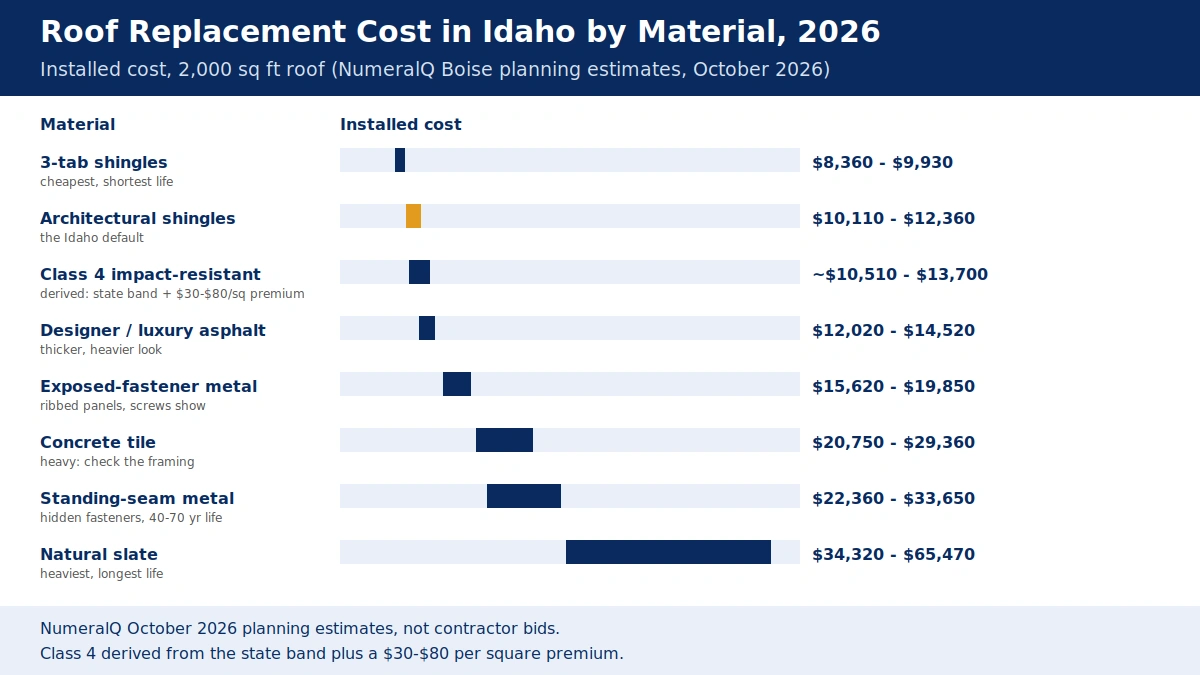
Material is the second-biggest lever on the price after size, and in Idaho it is also a snow, fire, and sun decision. The table below prices a 2,000 sq ft roof in every common material from the NumeralQ Boise page, which is the closest published material breakdown and runs about 2 percent above the state band. Boise is labeled as the source throughout this section so no reader mistakes a Boise table for a statewide survey.
The rated-life column follows the MyRoofData Idaho model. The final column gives the Idaho read: what each material actually faces in this climate. No publisher prints the Class 4 row; it is derived here by adding a $30–$80 per square installed premium to the state architectural band, labor held flat.
The Class 4 section shows the full derivation.
| Material | 2,000 sq ft roof, installed (Boise) | Rated life | Idaho read |
|---|---|---|---|
| 3-tab asphalt shingles | $8,360–$9,930 | 15–20 years | Cheapest buy; lowest wind ratings; many insurers have moved away from it |
| Architectural asphalt shingles | $10,110–$12,360 | 22–30 years | The default Idaho roof; 110–130 mph wind ratings |
| Class 4 impact-resistant shingles | ~$10,510–$13,700 (derived) | 25–35 years | Top hail rating; the discount roof; see the Class 4 section |
| Designer / luxury asphalt shingles | $12,020–$14,520 | 25–30 years | Thicker look; same hail exposure as standard architectural |
| Exposed-fastener metal (corrugated, 5V) | $15,620–$19,850 | 30–40 years | Common on rural homes; screws need checking as gaskets age |
| Stone-coated steel | $17,580–$25,320 | 40–50 years | Shingle look in steel; sheds snow; Class A assemblies available |
| Cedar shakes | $18,780–$32,510 | 25–35 years | Needs upkeep in dry sun; restricted in wildfire areas unless treated |
| Synthetic slate or shake (composite) | $18,480–$26,550 | 40–50 years | Slate look at half the weight; Class 4 options exist |
| Concrete tile | $20,750–$29,360 | 40–75 years | Heavy at 850–1,100 lb per square; structure check first |
| Standing-seam metal | $22,360–$33,650 | 40–70 years | Concealed fasteners; the snow-country metal roof |
| Clay tile | $26,540–$41,700 | 50–100 years | Brittle underfoot; tile-experienced crews only |
| Natural slate | $34,320–$65,470 | 75–150 years | A lifetime roof at 3–6 times the shingle price; specialist labor |
| Flat: modified bitumen / EPDM / TPO | $11,170–$14,400 / $11,540–$17,810 / $13,890–$18,490 | 20–30 years | Low-slope sections, porches, additions, mid-century flat roofs |
3-tab shingles are the budget buy, and the budget buy saves less than it looks like in a state with this much sun and freeze-thaw. On a 2,000 sq ft roof the 3-tab band of $8,360–$9,930 undercuts architectural shingles by about 19 percent, a gap of roughly $1,750–$2,430. The trade is a thinner single-layer shingle with lower wind ratings and a shorter rated life, on a roof that will face the same UV, the same freeze-thaw cycles, and the same summer hail as its thicker neighbor.
Few insurers or builders still recommend 3-tab for a full replacement. The $2,000 saved on install day can vanish in a single earlier replacement. Treat 3-tab as a comparison price for most Idaho homes, not as the roof to put on the house.
Architectural shingles hold the default slot in Idaho, and they have earned it. It is a dimensional, two-layer shingle: wind ratings of 110–130 mph, a rated life of 22–30 years, and an install price every crew in Idaho can quote from memory. MyRoofData’s per-square math is $428–$713 installed before tear-off. Tear-off adds another $100–$200 per square for each layer removed.
On a 2,000 sq ft roof the installed band of $10,110–$12,360 on the Boise page is the number every other material in this table is measured against. The Idaho caveat on life is plain: heat, ultraviolet light, and freeze-thaw wear asphalt faster than the lab test assumes, and a valley roof that bakes all summer and freezes all winter will not deliver the top of its rated span without good ventilation underneath it.
Designer and luxury asphalt is a looks upgrade, not a strength upgrade. The $12,020–$14,520 designer band pays for depth, shadow lines, and curb appeal on a front-facing slope over standard architectural. Thickness alone adds no impact rating. A buyer who wants both the look and the hail rating should get a price on a Class 4 designer line by name and have the UL 2218 rating confirmed in writing.
The word metal covers two different roofs. Corrugated or 5V exposed-fastener panels cost $15,620–$19,850. Screws driven through the panel face make them quick to fit, which is why they show up on rural Idaho homes, barns, and budget metal conversions. The screws and their gaskets are the upkeep item: gaskets age in Idaho sun and temperature swings, and a roof that is never re-checked can weep at a thousand screw holes.
Standing seam costs $22,360–$33,650 because its fasteners hide under raised seams. The panels slide with temperature instead of fighting it, and that movement is what supports the 40–70 year rated life and the premium. Before tear-off, MyRoofData puts standing seam at $903–$1,520 per square and ribbed panels at $523–$903.
SmartRoofingCalculator’s installed-with-tear-off figure for standing seam is $840–$1,300 per square. Standing seam takes over as elevation climbs, because it sheds snow instead of holding it.
Gauge, finish, and trim are priced line by line in our metal roof cost guide, and the head-to-head choice gets the full treatment in our metal vs shingles guide.
In Idaho, tile, slate, cedar, and synthetic stay special-case choices. Each needs a justification stronger than appearance. Weight rules out a casual switch to tile: concrete at $20,750–$29,360 and clay at $26,540–$41,700 often demand an engineering check of the structure first. Clay also cracks underfoot, so repairs call for crews who know tile.
At $34,320–$65,470, natural slate is priced by its weight and by the specialist labor it needs, and it can outlast the mortgage itself.
Cedar shakes at $18,780–$32,510 ask for upkeep in a dry, sunny climate and face restrictions in wildfire-prone areas unless treated to Class A or Class B fire ratings, which makes cedar a hard sell anywhere near the foothills. Synthetic slate or shake, $18,480–$26,550, mimics slate at roughly half the weight. Some product lines in this group also carry Class 4 ratings.
Before any tile quote is signed, read our tile roof cost guide for the weight and structure questions.
Flat and low-slope sections follow their own price scale, and they often disappear inside a shingle quote. Porches, additions, and mid-century flat roofs, where shingles cannot shed water, take membranes instead: modified bitumen $11,170–$14,400, EPDM rubber $11,540–$17,810, TPO $13,890–$18,490. Where one house carries both a flat porch roof and a pitched main roof, the quote needs both prices on separate lines: the flat section is the part that fails first when it is treated as an afterthought. Ponding water after a summer downpour is the tell: a flat section that holds water for days is a section whose slope or drainage was never right.
Roof Replacement Cost by Roof Size in Idaho
Roofers price by the roof surface, not by the living area on the deed. A “square” is 100 sq ft of roof surface, so a 2,000 sq ft roof is 20 squares, and the roof surface is always bigger than the floor plan because of the slope, the overhangs, the valleys, and the waste cut at ridges and edges. A 2,000 sq ft single-story home carries about 25 squares by one estimator’s rule and about 27 squares by a Boise roofer’s rule, which means the same house can be priced as 20 squares of living area or 25–27 squares of roof, and the two numbers describe different things.
That mismatch is the most common reason two quotes for the same house look wildly apart. One roofer measured the roof, and the other quoted the floor plan. The table below uses roof surface area, from the NumeralQ Idaho page, with the implied per-square rate carried across so a reader can check any quote against it.
| Roof size (sq ft of surface) | Squares | Architectural shingles, installed | Implied rate per square |
|---|---|---|---|
| 1,000 | 10 | $5,240–$6,470 | $524–$647 |
| 1,500 | 15 | $7,570–$9,290 | $505–$619 |
| 2,000 | 20 | $9,910–$12,100 | $496–$605 |
| 2,500 | 25 | $12,250–$14,920 | $490–$597 |
| 3,000 | 30 | $14,580–$17,730 | $486–$591 |
A second planning figure checks the table from a different direction. SmartRoofingCalculator prices a 25-square architectural roof at $10,500–$15,000 installed with tear-off, which brackets the NumeralQ 25-square figure of $12,250–$14,920 and overlaps it across most of the range. MyRoofData’s 23.4-square example at $12,200–$21,100 runs higher at the top end because its per-square material spread is wider and its scope is less tightly stated.
Complexity bends the per-square rate more than size does. A simple gable roof with two slopes, few valleys, and no chimneys prices near the bottom of the per-square range, because the crew lays shingle after shingle without cutting. A cut-up roof with dormers, valleys, skylights, and a chimney prices toward the top, because every valley and penetration is hand work, flashing work, and waste.
Pitch bends it too: a steep slope slows the crew, needs more staging, and adds waste at every cut. A two-story house costs more per square than a one-story house of the same roof area because material handling and safety setup take longer. Access matters in Idaho in a specific way: a foothills lot with a steep drive, a narrow cul-de-sac, or a backyard the dumpster cannot reach adds labor hours that a flat valley lot never sees.
Waste runs 10–15 percent of the material order and is not padding. The published material bands already include waste and contractor markup, and the waste covers starter shingles, ridge cap, valley cuts, and the offcuts that never land on the roof. A reader who orders shingles from a home center price and multiplies by the roof area will always underprice the job, because the waste, the ridge cap, and the starter strip are never in that first multiplication.
Two ways to price your own roof before the first quote lands. The quick way: take the NumeralQ band for the roof size nearest yours, add the per-square rate for every feature that adds work (a chimney, a skylight, a valley, a steep pitch), and treat the result as a planning number with a 10 percent contingency. The careful way: measure the roof surface from a satellite measurement, count the squares, multiply by $496–$605 per square for architectural shingles, and add tear-off, decking, and flashing as separate lines.
Either way, the number that matters is the one on a written quote after a crew has walked the roof. Planning numbers exist to tell a good quote from a bad one, not to replace one.
Roof Replacement Cost by City: Boise, Meridian, Nampa and Idaho Falls
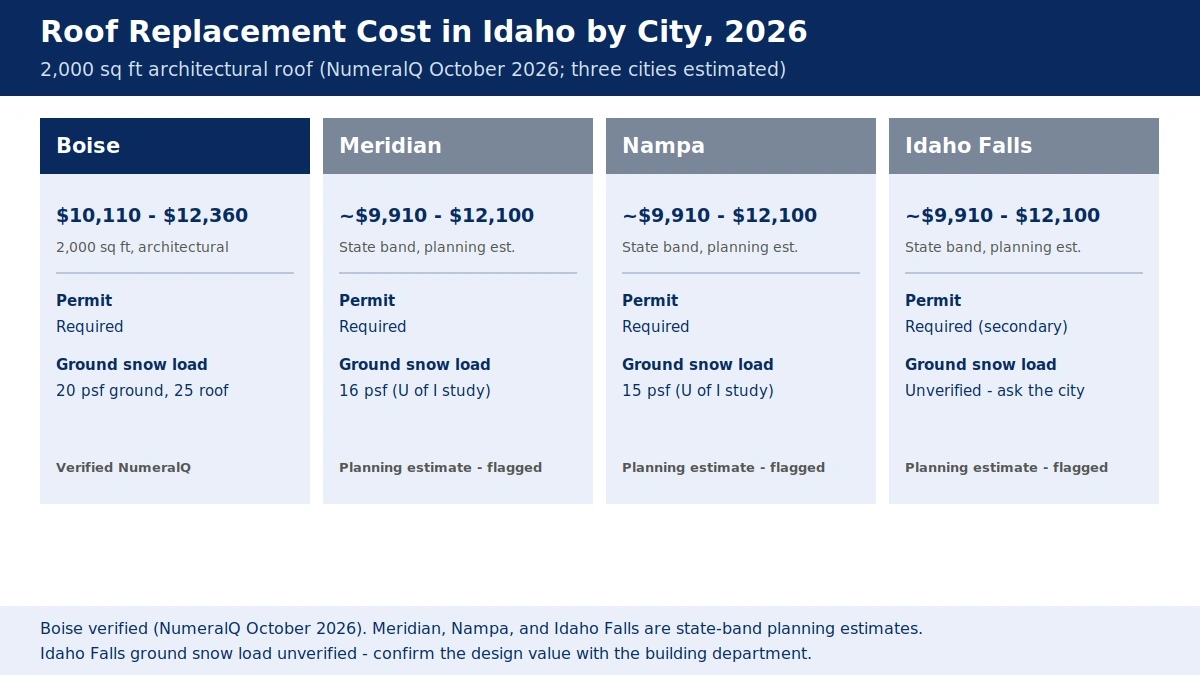
Only Boise has a published cost model behind it. Meridian, Nampa, and Idaho Falls have no NumeralQ or SmartRoofingCalculator city pages, and no city-level price is published for any of the three in any source this guide opened. The city table below is therefore honest about what it is: one measured city and three planning estimates that carry the state band, adjusted by what each city’s market is known to do, and labeled as estimates in every cell.
Treasure Valley roofers cross city lines freely, and a Meridian job and a Boise job five miles apart will usually price within a few hundred dollars of each other on the same spec sheet. Idaho Falls is a separate market, 280 miles east, with a colder climate, a smaller contractor pool, and more hail, and its prices should be treated as an estimate until three local quotes say otherwise.
| City | 2,000 sq ft architectural roof | Basis | Permit |
|---|---|---|---|
| Boise | $10,110–$12,360 | NumeralQ Boise page, Oct 26, 2026 | Required |
| Meridian | ~$9,910–$12,100 | State band as planning estimate | Required |
| Nampa | ~$9,910–$12,100 | State band as planning estimate | Required |
| Idaho Falls | ~$9,910–$12,100 | State band as planning estimate; colder, more hail | Required (secondary sources) |
Boise is the measured market, and it runs about 2 percent above the state band. The Boise page prices the 2,000 sq ft roof at $10,110–$12,360, against $9,910–$12,100 statewide, and the size table runs the same 2 percent above at every size: 1,000 sq ft $5,340–$6,600, 1,500 $7,720–$9,480, 2,500 $12,490–$15,240, 3,000 $14,880–$18,110. Boise roofer pay explains the gap: a median $28.89 an hour, 8 percent above the national median, with billed rates of $58–$75 per worker-hour.
Boise also carries the deepest bench. Ada County’s 87 roofing contractors, 4.1 per 10,000 homes against a national 1.7, mean a Boise homeowner can get three written quotes in a week without chasing anyone. The median Boise home is worth $484,800 and was built in 1986, which puts most of the valley’s housing stock at about 40 years old, old enough that a house on its original roof has already lived past one asphalt life.
A second model puts Boise below the state baseline, and the conflict is worth naming rather than smoothing over. SmartRoofingCalculator gives Boise a local factor of 0.95, five percent below its Idaho baseline, and prices a 25-square Boise roof at $9,975–$14,250 against its statewide $10,500–$15,000. NumeralQ puts Boise about 2 percent above the state band. The two models disagree by roughly 7 points on which side of the state number Boise sits.
Both models are arithmetic, not surveys of Boise bids, and neither is wrong on its own terms; they weight different inputs. The honest read is that Boise sits near the state band, within a few percent either way, and that any quote far outside the state band on either side deserves a question about scope, not a celebration. The draft reports both figures and does not pick a winner.
Meridian is the fastest-growing market in the state, and its prices ride the state band with new-build competition holding them down. No published city price exists, so the state band of $9,910–$12,100 is the planning estimate. Meridian contractor guides price architectural roofs at $9,000–$18,000 and $400–$700 or more per square, but those ranges carry no roof size and no scope note, so they are background only.
Meridian’s growth cuts both ways: new subdivisions mean many roofs are young and the crews that built them are nearby, but the June 26, 2026 storm that dumped several inches of small hail across northwest Meridian showed how fast a local market can tighten after one afternoon. A Meridian homeowner quoting in the month after a hailstorm should expect longer lead times and should read the storm-chaser section in the hiring chapter before signing anything at the door.
Nampa is the west end of the Treasure Valley, with the same crews, the same prices, and a slightly older housing stock. The state band is the planning estimate here too, at $9,910–$12,100. A Nampa contractor guide prices the average home at $9,000–$28,000 and a 2,300 sq ft roof at $12,650–$17,250, but again without a stated scope, so the figures stay in the background.
Nampa’s permit form is the most specific in the valley, and it tells a buyer something useful about the market: it asks for a site plan or aerial, a manufacturer installation packet for residential jobs, and the contractor’s state registration number or exemption. A city that asks for the installation packet is a city that checks the work against the manufacturer’s instructions, which is the cheapest quality control a homeowner ever gets.
Idaho Falls is the estimate that needs the most caution. The state band of $9,910–$12,100 is the planning number, but Idaho Falls sits at 4,728 feet, runs colder, and takes more summer hail than the valley, all of which push toward heavier underlayment, more ice protection, and sometimes a metal roof. The city has no published ground snow load figure this guide could verify from a primary source, so the snow section gives the building department the last word.
Eastern Idaho pricing evidence is thin. The Instant Roofer city list runs from $15,432 in Kuna to $17,237 in Jerome on its bigger average roof, but those are averages across every job size and material mix, and they do not price a 2,000 sq ft architectural roof. Three local quotes on one identical spec sheet matter more in Idaho Falls than in Boise, because the local market is smaller and the climate penalty for a thin spec is higher.
Snow Load, Freeze-Thaw and Ice Dams in Idaho: Valley Numbers, Mountain Numbers
Snow load is the load the roof must carry when snow sits on it, measured in pounds per square foot, and Idaho’s range is the widest of any topic in this guide. The ground snow load is what falls and lies on open ground; the roof design load is what the structure must carry after the code discounts for roof slope, shape, and exposure. The two numbers are different, and confusing them is the most common snow mistake a buyer makes.
The University of Idaho published a 2015 study of ground snow loads city by city, and its numbers still anchor most discussions. The study itself warns that it is not legally binding and that the local building authority decides the design value for any address. That warning matters, because the study’s Boise figure and the city of Boise’s design table disagree, and the city table wins.
| City | Ground snow load (U of I study) | City design value where published |
|---|---|---|
| Kuna | 14 psf | Not published in this guide’s sources |
| Boise | 15 psf | 20 psf ground; roof design load 25 psf minimum |
| Garden City | 15 psf | Not published in this guide’s sources |
| Nampa | 15 psf | Not published in this guide’s sources |
| Meridian | 16 psf | Not published in this guide’s sources |
| Eagle | 17 psf | 20 psf ground; roof 25 psf; ice barrier No |
| Caldwell | 18 psf | Not published in this guide’s sources |
| Twin Falls | 15 psf | City 15 psf ground, roof 25 psf minimum; county 30 psf |
| Post Falls | Not in the study extract | 56 psf ground; roof 40 psf |
| Moscow | Not in the study extract | 64 psf ground; roof 40 psf; ice barrier Yes |
| Bonners Ferry | Not in the study extract | 68 psf ground; roof 70 psf minimum |
| McCall | 157 psf | Not published in this guide’s sources |
Boise’s city table governs, and it runs higher than the study. The City of Boise design criteria table sets ground snow load at 20 psf and a minimum uniform roof design load of 25 psf, with a design wind speed of 90 mph, severe weathering, 24 inches of frost depth, and a winter design temperature of 10 degrees Fahrenheit. The University study’s 15 psf for Boise is a research value; the city’s 20 psf is the number the permit desk enforces.
The gap between the two is a useful reminder that snow numbers are local. Twin Falls shows the same lesson inside one metro: the city sets ground snow at 15 psf with a 25 psf minimum roof load, while Twin Falls County sets ground snow at 30 psf. The address decides which number applies, and a house just outside the city line can carry double the design snow of its neighbor inside it.
The mountain numbers are a different world, and they change the roof, not just the price. McCall’s 157 psf ground load is ten times the Boise valley figure, and at that load the code’s prescriptive rules no longer apply: the International Residential Code covers prescriptive roof design up to 70 psf of ground snow, and above that the structure needs engineering. Bonners Ferry at 68 psf sits just under that line with a 70 psf minimum roof load; Moscow at 64 psf and Post Falls at 56 psf sit comfortably under it but still need roof systems built for heavy snow.
A mountain roof needs snow retention so the load does not slide off in one sheet onto a walkway or a car, ice protection at the eaves, and a crew that has worked steep, heavy-snow roofs before. A buyer pricing a McCall roof from a Boise table will underprice it badly, because the engineering, the retention hardware, and the short working season all cost money that a valley quote never carries.
Idaho Falls has no verified ground snow load figure in this guide, and that absence is stated plainly. Targeted searches found no primary city or county figure for Idaho Falls, and the draft will not borrow a number from a calculator site or a neighboring county. What is known is the elevation, 4,728 feet, and the climate: January runs a high of 28 and a low of 11 degrees Fahrenheit on the 1991–2020 normals, and the city sits colder and snowier than the Treasure Valley.
An Idaho Falls buyer should ask the building department for the design snow load for the exact address before signing a quote, and should treat any quote that does not name a snow figure as incomplete. The department sits at 308 Constitution Way and answers at (208) 612-8100.
Freeze-thaw is the slow wear that snow load numbers never show. Boise winters run freezing nights and sunny afternoons, and that daily swing is harder on a roof than steady cold. Water finds a hairline opening, freezes, expands, and widens it; the next thaw carries water deeper; the next freeze widens it again. Shingles lose granules faster, sealant joints open, and flashing that was tight in September weeps by February.
The same cycle drives ice dams. Heat escaping through an under-insulated attic melts snow on the upper roof, the meltwater runs down to the cold eave, and refreezes into a dam that backs water under the shingles. No covering prevents ice dams on its own; the fix is attic insulation and ventilation that keep the roof deck cold, plus an ice barrier membrane at the eaves where the code requires it.
For what the insulation work costs, see our attic insulation cost guide.
The ice barrier rule is local, and Idaho has no statewide requirement. The code section, IRC R905.1.2, requires a self-adhering ice barrier membrane from the lowest eave edge to at least 24 inches inside the exterior wall line, but only where ice dams form according to the jurisdiction’s own design table. Boise’s table says ice barrier underlayment is not required, while noting that it applies where there is a history of ice-dam damage. Twin Falls follows the manufacturer’s underlayment instructions instead of requiring a barrier.
Moscow requires one.
A buyer who hears that Idaho mandates a full ice barrier is hearing a calculator site’s generalization, not the code. A full-roof ice-and-water barrier costs $0.91–$1.45 per sq ft on the Boise page, so covering a 2,000 sq ft roof adds roughly $1,820–$2,900, and the question is whether the address and the roof’s ice history justify it. In a valley home with good insulation, eave protection at the valleys and eaves is often the right spend; in a mountain home, full coverage is the conversation to have with the roofer and the inspector.
Winter installation is slower and needs hand-sealing. Boise’s average high sits under 40 degrees in December and January, and shingle manufacturers say that at 40 degrees and below, shingles should be hand-sealed at the edges because the sun will not activate the sealant strip. Hand-sealing adds labor, and a winter crew that skips it leaves shingles that can lift in the first spring wind. A buyer who signs a December install should see hand-sealing written on the quote, not assumed.
Wildfire Embers in Idaho: Class A Roofs, Screened Vents and the Boise WUI Rule
Idaho’s wildfire years have grown teeth. The Idaho Department of Insurance infographic records 97,504 acres burned in 2023, about one million acres in 2024, and 195,275 acres in 2025. More than 200 structures burned in 2024, and 14 in 2025.
A separate federal count, the National Interagency Coordination Center’s incident data, puts 2025 at 182,005 acres across 1,498 fires, a different total from a different reporting stream; this guide uses the Department of Insurance figures for acres and structures, and the federal figures only for what started the fires.
Lightning started 607 of the 2025 fires and caused 57 percent of the acres, while human causes started 59 percent of the fires. The 2026 season added its own evidence: the Claremont Fire burned about 2,000 acres in the Boise Foothills in July 2026, and the Idaho Department of Lands reported about 10,000 acres on the land it protects through the end of September, with more than 80 percent of the fires it responded to started by people. The pattern is not one bad year; it is a run of bad years with more homes in the path.
Embers, not flames, burn most houses, and the roof is where embers land. The Idaho Department of Lands wildfire guide states the mechanism plainly: windblown embers can ignite a roof, and the entry points are the valleys, the open ends of barrel tiles, and the gutters. Eave and cornice vents are particularly exposed because an ember that enters an unscreened vent lands in dry attic insulation and smolders out of sight.
The National Fire Protection Association reaches the same conclusion from fire data: embers ahead of the flame front ignite most homes lost to wildfire. The practical meaning for a roof buyer is that the covering matters, but the details matter as much: a Class A covering over unscreened vents and a gutter full of dry needles is a strong roof with open doors. The ember package on a quote should read like a checklist, not a material name.
Class A is the top fire rating, and it rates the assembly, not just the shingle. The rating comes from the ASTM E108 or UL 790 fire test, which measures how a roof assembly handles burning brands, flame spread, and wind. Fiberglass asphalt shingles, metal, concrete and clay tile, slate, and rated synthetic lines can all carry Class A ratings as installed assemblies, which means the underlayment and the deck are part of the rating and a tile roof’s open eave gaps need fire-stopping or a cap sheet to hold it.
Untreated wood shake does not qualify, and cedar is restricted in wildfire-prone areas unless treated to Class A or Class B. A buyer who wants a wood look near the foothills should price a rated synthetic shake or a treated product with the rating in writing, and should ask the roofer to name the assembly rating on the quote, not just the shingle brand.
Boise has a rule, and it is a city rule, not a state rule. No statewide wildland-urban interface roof code was located in this guide’s research. Boise City Code Title 5, Chapter 12, with fire code amendments at sections 4112 and 4113, sets the local rule: in the mapped wildland-urban interface zone, when a roof covering or siding is replaced, or when half or more of it is replaced within 12 months, the new covering must meet the new-construction requirements for the parcel’s ignition-resistant class.
The city’s roofing permit application states the practical version: a Class A roof covering is required for all structures in the wildland-urban interface zone and the foothills. The rule is based on the 2018 fire code amendments, and the parcel’s class and the current text should be confirmed with the city before a quote is signed, because the map and the code both move over time. A buyer whose house sits on the edge of the mapped zone should ask the permit desk which side of the line the parcel falls on, in writing, before choosing a material.
The 50 percent trigger turns a repair into a replacement decision. A homeowner in the mapped zone who replaces half the roof within 12 months crosses the threshold and must meet new-construction requirements for the whole job. That means a large repair that looks like a saving can quietly become a full replacement at a Class A spec, and the honest comparison is the repair price against the replacement price at the required spec, not against the repair price alone. The trigger is one more reason to get the parcel’s class in writing before any work starts.
The ember bid details belong on the quote as named lines. Screen every eave and attic vent with 1/8-inch metal mesh, which is fine enough to stop embers and coarse enough to keep the attic breathing. Fix loose shingles so embers cannot slide under a lifted edge. Fit gutters that are easy to clear, and clear the valleys and gutters of needles and leaves before fire season.
Close the open ends of barrel tiles where tile roofs carry them.
Federal guidance from FEMA Region 10 lists the same roof items alongside defensible space around the house, and the Idaho Department of Lands guide adds the ground work: clear the first five feet around the house of anything that burns, and keep the gutters clean. None of these items is expensive on its own; all of them together are what turns a Class A covering into a Class A roof.
No homeowner wildfire grant is open, and the draft will not pretend otherwise. The Western States Wildland Urban Interface Grants fund community fuel treatments at up to $240,000 per project with a one-to-one match, but individual landowners are not eligible. The Idaho Department of Lands’ Post-Fire Recovery and Restoration program funds agencies, nonprofits, tribes, and schools, and states plainly that construction and homeowner maintenance do not qualify.
House Bill 384, which would have created an Idaho Wildfire Risk Mitigation Fund including roof grants, was held in committee, and a replacement resolution, RS 31831, was introduced by the House Business Committee. NumeralQ’s October 2026 review states the position plainly: Idaho has no statewide roof grant right now. A contractor who promises grant money for a roof is promising something that does not exist.
Asphalt vs Metal in Idaho: The Lifetime Math
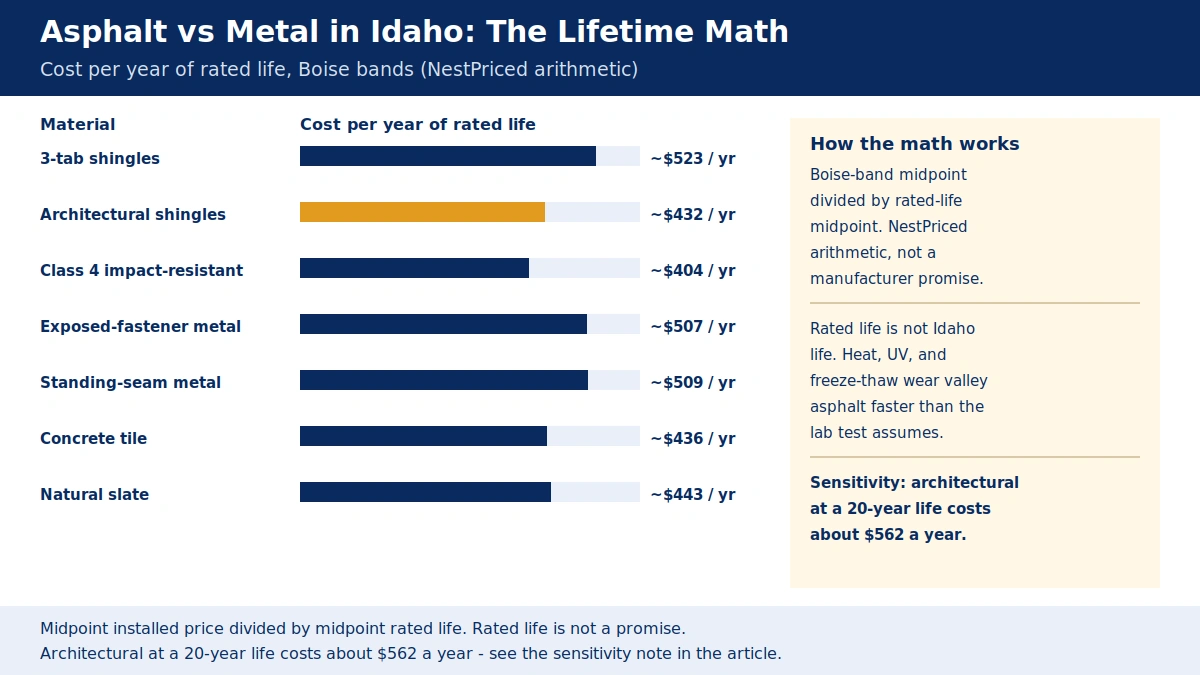
The sticker price favors asphalt by a wide margin, and the lifetime math closes the gap without closing it entirely. The honest comparison is cost per year of rated life, computed here from the Boise material bands and the rated lives in the material table, with every figure labeled as NestPriced arithmetic. Rated life is not a promise: sun, freeze-thaw, and installation quality move the real number, and the sensitivity line at the end of this section shows what happens when an asphalt roof delivers only 20 years instead of 26.
| Material | Boise band midpoint | Rated-life midpoint | Cost per year of rated life |
|---|---|---|---|
| 3-tab shingles | $9,145 | 17.5 years | ~$523 |
| Architectural shingles | $11,235 | 26 years | ~$432 |
| Class 4 shingles | $12,105 (derived) | 30 years | ~$404 |
| Exposed-fastener metal | $17,735 | 35 years | ~$507 |
| Standing-seam metal | $28,005 | 55 years | ~$509 |
| Concrete tile | $25,055 | 57.5 years | ~$436 |
| Natural slate | $49,895 | 112.5 years | ~$443 |
Read the table from the right column, not the left. Architectural shingles at about $432 a year beat 3-tab at about $523 a year, because the thicker shingle buys eight and a half more years for roughly $2,000. Class 4 at about $404 a year is the cheapest roof in the table per year of life, because the premium is small and the rated life is long.
Standing seam at about $509 a year costs more per year than architectural shingles despite lasting twice as long, because the install price is two and a half times higher.
The sensitivity line is where the asphalt math gets honest. If an architectural roof in the valley delivers 20 years instead of 26, which heat and freeze-thaw make plausible, the cost per year rises to about $562, above standing seam. If the same roof delivers the full 30 years at the top of its rated span, the cost per year falls to about $375, and no metal roof touches it. The buyer is not choosing between a $11,235 roof and a $28,005 roof; the buyer is choosing between a roof whose life depends on ventilation, sun exposure, and installation quality, and a roof whose life depends mostly on the fasteners staying tight.
Snow decides more of this choice than the arithmetic does. Metal sheds snow, and on a steep roof at elevation that is the point: snow slides off a standing-seam roof instead of sitting on it, which cuts the load the structure carries all winter. But sliding snow needs somewhere to go, and a metal roof over a walkway, a driveway, or a lower roof needs snow guards, which add cost and are often left off a first quote. A valley roof in Boise, where the design load is 25 psf and the snow melts between storms, gains little from shedding; a mountain roof at 64 or 157 psf gains a great deal.
Fire decides the rest. Metal carries a Class A rating as an assembly, sheds embers, and does not smolder, which is why it dominates the foothills conversation. But a Class A asphalt assembly with screened vents and clean gutters holds the same rating, and the fire section above shows that the details matter as much as the covering. A buyer near the foothills who cannot afford standing seam is not buying a fire trap by choosing Class A shingles; the buyer is buying a roof whose ember details must be right.
Noise, denting, and resale are the three metal questions every Idaho buyer asks, and each has a plain answer. Noise is a myth on a properly built roof: insulation and decking mute rain on metal to about the level of shingles, and the difference a homeowner notices is in the attic, not the bedroom. Denting is real: exposed-fastener panels dent under large hail, and standing seam can show cosmetic dents that do not leak but do show, which is why the hail section matters for metal buyers too.
Resale is the softest number in the comparison. A metal roof photographs well, reads as a premium feature in a listing, and can help a sale in the foothills and mountain markets where buyers expect it. In the valley, where every comparable house has shingles, a metal roof is a personal choice that may not return its premium at sale.
A buyer who plans to move in five years should price the roof for five years of ownership, not fifty.
The decision rule is a matrix, not a winner. Buy architectural shingles if the house sits in the valley, the budget is tight, and the plan is to own the house for a decade or two. Buy Class 4 shingles if hail or insurance discounts enter the math, which the next section prices. Buy standing seam if the house sits at elevation, near the foothills, or on a slope where snow load and embers both matter, and if the budget can carry two and a half times the shingle price for a roof that will outlast two shingle roofs.
Class 4 Shingles in Idaho: Cost, Discounts and the Honest Hail Math
Class 4 is the highest impact-resistance rating a shingle can carry, and it comes from a specific test: UL 2218 drops a 2-inch steel ball from 20 feet onto the same spot twice, and the shingle mat must not crack or tear. The rating covers impact only. Wind resistance is a separate test, fire resistance is a separate test, and a shingle can carry Class 4 without carrying the wind rating the Boise design speed needs, so the buyer checks all three.
The Class 4 lines are mostly polymer-modified asphalt, which is ordinary asphalt with rubber-like polymers mixed in so the shingle flexes under impact instead of cracking. GAF Timberline AS II and ArmorShield II, Owens Corning Duration Storm and Duration FLEX, CertainTeed NorthGate and Landmark IR, Atlas StormMaster, Malarkey Legacy and Vista, IKO Nordic, and Tamko StormFighter FLEX all carry Class 4 lines. The Insurance Institute for Business and Home Safety also publishes shingle performance ratings, and its Good and Excellent tiers meet UL 2218 or the FM 4473 impact standard, which gives a buyer a second shopping check beyond the manufacturer’s claim.
The Class 4 band in this guide is derived, and the derivation is shown so any reader can check it. The state architectural band of $9,910–$12,100 covers a 2,000 sq ft roof, or 20 squares. Slade Roofing’s 2026 pricing puts the Class 4 installed premium at $30–$80 per square, and one Idaho roofer quoted a Class 4 upgrade at $30 per square in a May 2026 insurance agency write-up, which sits at the bottom of that range. Twenty squares times $30–$80 is $600–$1,600, and adding it to the state band gives about $10,510–$13,700.
Labor does not change for Class 4, because the crew installs the same number of shingles the same way. A wider national adjuster estimate puts the premium at $50–$150 per square, which would give $10,910–$15,100, and that wider figure is recorded here as a cross-check, not adopted. The $30–$80 range is the one with an Idaho quote inside it, so it leads.
Hail in Idaho is real, seasonal, and mostly small, and the numbers are better than the folklore. The MyWild Idaho hail analysis, built on National Oceanic and Atmospheric Administration Storm Prediction Center data from 1996 through 2025, counts 240 severe hail days and 534 reports of hail at least one inch across in 30 years, or about eight days a year. Days with hail at least two inches across, the threshold the Storm Prediction Center calls significant severe, come about 0.4 times a year, or 11 days in 30 years.
The largest stone in the record is 2.75 inches, baseball size, and it has fallen four times: Bonneville County in September 2001, Nez Perce County in July 2012, Idaho County in August 2019, and Kootenai County in August 2022. June is the busiest month with 59 days, followed by August with 55 and July with 51, and the middle 80 percent of the season runs May 17 to August 30. Idaho ranks 35th of 46 states in the analysis, and about nine in ten reports fall between noon and 9 pm, with the busiest hour starting at 1 pm.
Ada County, where Boise sits, is quieter than the state as a whole. From 2016 through 2025 the county recorded five large-hail reports of one inch or more, none at two inches or more, alongside 32 damaging-wind reports and one tornado. The six counties around Boise together recorded 21 reports of one inch or more, or 1.4 per 1,000 square miles against 2.5 for Idaho and 20.1 for the country.
FEMA rates Ada County’s hail risk as relatively low and its strong-wind risk as relatively high, which is the right way round for a valley market.
Two 2026 storms show the two kinds of hail Idaho gets. On June 26, 2026, a storm dumped several inches of small hail across northwest Meridian, enough to look like snow on the roads and to send adjusters into the subdivisions, but the National Weather Service’s Boise lead meteorologist described it as small hail, of which there was an awful lot. Small hail in volume bruises gutters and dents cars; it rarely cracks a shingle.
On September 17, 2026, a 2.50-inch stone fell at Rose in Bingham County, and night storms from American Falls through Blackfoot and Idaho Falls to Rexburg dropped hail up to golf-ball size. That is the eastern Idaho pattern: fewer storms than the valley, but bigger stones when they come. A buyer in Idaho Falls faces a different hail question than a buyer in Boise, and the Class 4 math below should be read with that difference in mind.
The honest question is whether Class 4 pays, and the answer depends on the insurance discount, not the hail. NumeralQ’s judgment, built on the same hail data, is that hail big enough to crack shingles is rare in Idaho and that impact-resistant shingles are not worth it for most Idaho homes. That judgment is about damage avoided, and on damage alone it is hard to argue with in the valley, where two-inch hail has never been recorded in Ada County in the last decade.
The discount side of the math tells a different story. No Idaho statute sets a Class 4 discount percentage, and no Idaho-specific percentage was verified in this guide’s research. Nationally, discounts of 10–25 percent are commonly cited, and one insurance agency example puts the saving at 15–20 percent, or about $350 a year on an $1,800–$2,000 policy, with payback in three to four years.
That agency example is one agency’s figure, its location is not confirmed as Idaho, and it is cited here as an agency example only, never as an Idaho guarantee.
The payback table below runs the upgrade cost of $600–$1,600 against Idaho’s average premium of $2,195 a year from NerdWallet’s May 2026 analysis, under four discount assumptions. Every scenario states its assumption, and none of them is a promise: the discount is carrier-specific, it may apply to the whole premium or only to the wind and hail portion, and the only figure that counts is the one the buyer’s own agent puts in writing before the roof is ordered.
| Discount assumption | Saving per year on $2,195 premium | Payback on $600–$1,600 upgrade |
|---|---|---|
| 10% of full premium | ~$220 | ~2.7–7.3 years |
| 15% of full premium | ~$329 | ~1.8–4.9 years |
| 25% of full premium | ~$549 | ~1.1–2.9 years |
| 15% of half the premium (wind/hail portion only) | ~$165 | ~3.6–9.7 years |
Read the bottom row first, because it is the one most buyers actually get. If the discount applies only to the wind and hail portion of the policy, which is often about half the premium, the saving is about $165 a year and the upgrade pays back in roughly four to ten years. That is still inside the roof’s rated life, but it is not the three-year payback the headline discount suggests.
The buyer who asks the agent, in writing, which portion of the premium the discount applies to, and what documentation the carrier needs, will know the real number before spending the upgrade money.
The certificate is the discount. Carriers that offer a Class 4 discount need proof that Class 4 shingles went on the roof, and that proof is the manufacturer’s certificate or the roofer’s documentation of the product installed. A buyer who pays for Class 4 and never files the certificate pays the premium and misses the discount. The certificate should be in the contract’s closeout paperwork, alongside the warranty registration and the permit final.
The verdict splits by geography. In the Boise valley, Class 4 is a discount play, not a damage play: the hail record is thin, the discount math is the reason to buy, and the buyer’s agent decides whether it pays. In eastern Idaho, where bigger stones fall and the season runs harder, Class 4 is both a discount play and a damage play, and the case is stronger on both counts. In the mountains, where hail is one hazard among several and snow load dominates, the material choice is usually metal anyway, and the Class 4 question rarely arises.
Permits and Code in Idaho: Every Big City Wants a Permit
Idaho has no statewide reroof permit. The state does not issue one, and no state desk stamps a re-roof. Cities and counties issue permits and inspect the work, each with its own department, its own fee table, and its own inspection steps, and a permit from one city does not transfer to another.
Idaho Code section 39-4111 makes it unlawful to begin construction, improvement, or alteration without a permit from the state Division of Occupational and Professional Licenses or the local government, and a roof replacement is an improvement under that rule.
Boise requires a permit, and the fee is the best-documented in the state. The city’s Homeowner’s Guide to Residential Construction lists re-roofing among the jobs that require a building permit. The fee on a $15,000 job runs about $236, computed from the city’s fee table at $70.76 for the first $2,000 of value plus $12.71 for each additional $1,000, and the arithmetic checks: $70.76 plus 13 times $12.71 is $235.99.
Boise adds a second layer in its Historic Districts. A Certificate of Appropriateness is required for most exterior changes, including a roofing-material change, before the building permit issues. A like-for-like replacement without a material change may not need one, but the decision matrix on the city’s planning pages is the authority, and a buyer in a historic district should check it before ordering material.
A material change that skips the certificate can be stopped mid-job.
Meridian requires a permit, and the city’s own guide says so in plain language. The city’s residential permit guide lists roof replacement and roof repair among the jobs that need a permit. No verified fee figure was located for Meridian, and the draft will not borrow one from a secondary site; the fee is confirmed at application. The guide is a city document, and it settles the question that a contractor claim tried to unsettle: one Meridian contractor’s November 2026 guide claimed like-for-like re-roofs need no permit in Boise or Meridian, which contradicts both cities’ documents, and this guide follows the cities.
Nampa requires a permit, and its form is the most demanding in the valley. The city’s reroof permit application states that it is for all reroof projects, covers both tear-off and roof-over work, and enforces the two-layer cap: no more than two layers are allowed at completion. The form carries the state registration declaration that section 54-5209 requires, and the checklist asks for a site plan or aerial plus the manufacturer’s installation packet for residential jobs.
No verified fee was located for Nampa, and a secondary range of $150–$300 was not used. The building department answers at (208) 468-5435, and a Nampa buyer who wants the fee before budgeting should call that number rather than trust a calculator site.
Idaho Falls requires a permit on secondary evidence, and the draft says so. A March 2026 permit guide states that re-roofing and full replacement require a permit under the city code and the 2018 International Residential Code, with minor repairs exempt. That guide’s fee range of $150–$500 and its timeline of about a week are single-secondary figures and are not used here as verified numbers.
The city publishes a 2025–2026 fee schedule, and the Building Division sits in Community Development Services at 308 Constitution Way, reachable at (208) 612-8100. The city has adopted the 2018 family of I-Codes. An Idaho Falls buyer should confirm the fee and the inspection steps with the division before the quote is signed, because the secondary evidence is enough to say a permit is required and not enough to say what it costs.
Smaller cities and rural counties vary, and the variation runs both ways. Caldwell’s city code, at section 12-01-15, requires no permit for a reroof onto bare decking, according to a single secondary summary, which is recorded here as a qualitative mention only. Several rural counties have no building department at all, which means no permit desk, no inspection, and no one checking the work but the homeowner.
The absence of a permit is not a saving; it is a gap in quality control. A rural buyer with no inspection should hire the registration check, the written contract, and the manufacturer’s installation instructions as the inspection, and should consider a third-party roof inspection at completion, because no one else will catch a flashing error before the first rain.
The code underneath the permits is the 2018 family, with Idaho amendments. The Idaho Residential Code is the 2018 International Residential Code plus Idaho amendments, published as the 2020 Edition, and the state has adopted the 2018 International Building Code and International Energy Conservation Code with amendments, with the State Fire Marshal administering the 2018 International Fire Code. Boise has adopted the 2018 building, residential, energy, and fire codes plus the 2023 National Electrical Code.
The layer limit comes from the residential code at section R908.3: no new roof covering may be installed over two or more existing layers, so a roof that already carries two layers must be torn off. The ice barrier rule at section R905.1.2 is covered in the snow section. The design criteria table for each jurisdiction, Boise’s Table R301.2(1) among them, sets the snow load, wind speed, frost depth, and ice barrier requirement for that address, and it is the table the inspector enforces.
Hiring a Roofer in Idaho: Registration, the $2,000 Line and the Out-of-State Test
Idaho does not license roofers. The state registers contractors instead. Registration is a state record that the contractor exists, carries insurance, and has paid a fee; it is not a test of skill, and it is not a guarantee of quality.
The Idaho Contractors Board, inside the Division of Occupational and Professional Licenses, runs the program under the Idaho Contractor Registration Act, Title 54, Chapter 52 of the Idaho Code.
The division states the position in one sentence: the act requires registration, not licensure. A buyer who understands that sentence will never mistake a registration card for a license, and will ask the questions that registration does not answer: how long has this crew worked in Idaho, what roofs can I drive past, and who answers the phone when a leak shows up in February.
The $2,000 line decides who must register. Any contractor whose construction job exceeds $2,000 in labor plus materials must register, unless an exemption applies. Every roof replacement in this guide costs far more than $2,000, so every roofer on a replacement job must be registered, and a roofer who says the job is too small to register is either mistaken or hoping the buyer does not know the rule.
Registration requires general liability insurance, including products and completed operations coverage, of at least $300,000 for a single limit from an Idaho-authorized insurer, plus workers’ compensation coverage or a statement explaining why it is not required. There is no exam and no experience requirement: three independent trackers, quoting the division, agree on that point, and the division’s own materials confirm it. The fee from July 1, 2026 is $120 to apply and $60 a year to renew, and the move from one-year to two-year registration terms began on October 14, 2025.
No separate statewide roofing license exists for ordinary private roofing. Registration covers it. Electrical, plumbing, and HVAC work need separate state licenses, and public works projects need a separate public works license, except for projects under $100,000, but a private roof replacement is a registration job, not a licensing job. Cities and counties cannot run their own contractor registration or licensing programs: section 54-5213(1) bars them from doing so, and has since January 1, 2007.
That bar is why a claim found in one Idaho Falls document, that roofing needs a city Class D license and a state license, is excluded from this guide. The claim conflicts with the statute and may be outdated, and it is recorded in the research file as unverified rather than repeated here. An Idaho Falls buyer who hears the Class D claim should ask the city which current document requires it, and should check the state registration first.
The registration number travels with the permit. Section 54-5209 requires permit applicants to state their registration number or the exemption they claim, and Nampa’s reroof form carries that declaration on its face. Section 54-5204(2) requires a contractor who engages another contractor to verify the other contractor’s registration, which means the general contractor on a roof job is responsible for checking the subcontracted crew, not just for hiring them.
The buyer can check registration through the Division of Occupational and Professional Licenses before signing anything, and should. The check takes two minutes, it is free, and it answers the one question that matters most: does this contractor exist in the state’s records, with insurance, right now.
Lien law gives the buyer two documents to demand, and gives the unregistered contractor nothing. On a residential job over $2,000, the contractor must give the homeowner a disclosure before signing, under section 45-525(2), and must provide a list of subcontractors and suppliers owed more than $500 before final payment, under section 45-525(3). The shingle distributor and the subcontracted crew are the most likely lien senders on a roof job, and the list is how the buyer learns whether they have been paid.
An unregistered contractor has no lien rights at all, under section 54-5208. That cuts both ways: it protects the buyer from a lien by someone who never registered, and it means a registered contractor’s lien rights are real and must be handled by paying through the contract’s terms and keeping the supplier list. Penalty figures for unregistered contracting were not verified from the primary text and are not stated here.
The out-of-state test is the hiring question that matters most after a storm. Idaho’s registration bar is low by design, which means a crew from out of state can register, work a storm, and leave, and the registration alone will not tell the buyer whether the crew will be in Idaho when a leak appears. The test is four questions, asked in person, with the answers written down: where is your Idaho office, how long have you worked in this county, which three roofs within ten miles can I drive past, and who answers the phone for warranty calls in February.
A crew that cannot answer all four is a crew that may not be here when the roof needs it. The June 2026 Meridian hailstorm and the September 2026 eastern Idaho storms both drew out-of-area crews, and the pattern after every Idaho storm is the same: door-knockers offering to handle the insurance claim, a signature on the spot, and a crew that is gone before the first rain tests the flashing. The rule is simple: no signature at the door, no signature before the adjuster has seen the roof, and no signature before the registration check.
The quote comparison rule is one spec sheet, three quotes, no exceptions. Write the material, the underlayment, the ice barrier scope, the flashing scope, the ventilation pieces, the tear-off scope, the decking allowance, the permit responsibility, the warranty terms, and the cleanup scope on one sheet, and give the identical sheet to three registered roofers. Quotes on different specs cannot be compared, and a low quote on a thin spec is not a bargain; it is a different job. Our questions to ask a roofer guide carries the full interview list, and the checklist in the final section turns it into a signing-day routine.
Insurance in Idaho: Wildfire Pressure, Deductibles and What a Claim Really Pays
Idaho’s homeowners insurance market is under wildfire pressure, and the pressure is visible in the numbers the state publishes. One hundred companies offered homeowners coverage in Idaho in 2024, according to the Department of Insurance, and the department’s director told legislators that the market was contracting across many Western states after a season of about one million burned acres. No non-renewal statistic was verified for this guide, and none is stated here, but the direction of travel is not in doubt: carriers are repricing wildfire risk, and roofs are where they look first.
No Idaho wildfire-mitigation insurance discount was verified, and no Idaho statute sets a Class 4 discount percentage, as the Class 4 section records. A buyer who hears that a new roof automatically cuts the premium should ask the agent for the discount in writing, with the portion of the premium it applies to, before treating it as a saving. The discount may be real, but it is carrier-specific, and it is not a state guarantee.
No Idaho-specific deductible statute, roof-age settlement rule, or matching law was located, and this guide will not invent one. Some states set a rule that roofs over a certain age settle at depreciated value, or that carriers must match undamaged shingles, or that percentage deductibles follow a state formula. Idaho has none of those rules in any source this guide opened, which means the buyer’s own policy is the only authority, and the declarations page is the document that decides what a claim pays.
The declarations page is the summary sheet at the front of the policy, and it names the deductible type and amount, the coverage limit, and whether the roof settles at replacement cost or depreciated value. A buyer who has never read it should read it before the roof is quoted, because the deductible and the settlement method change the out-of-pocket math more than any material choice does.
Replacement cost, depreciated value, and payment schedules are three different checks. Replacement cost value, or RCV, pays the cost to replace the roof at today’s prices, and it usually arrives in two checks: the first for the depreciated value, and the second for the recoverable depreciation after the work is done and the invoices are in. Actual cash value, or ACV, pays the depreciated value only, minus the deductible, and the depreciation is generally not recovered. A roof payment schedule pays a percentage of the replacement cost that falls as the roof ages, with the percentages set by the carrier’s filed schedule for the material and the age.
A worked example, labeled as NestPriced arithmetic, shows the difference on a $10,000 roof with a $1,000 flat deductible, which is the deductible basis in the NerdWallet sample policy. Under replacement cost, the insurer pays $9,000 across two checks, and the homeowner pays the $1,000 deductible. Under depreciated value, the insurer pays the depreciated figure minus $1,000, and the homeowner covers the rest of the replacement cost out of pocket.
Under a payment schedule, the insurer pays the scheduled percentage minus $1,000, and the percentage depends on the roof’s age and material.
The reader’s own deductible may be flat or percentage, and this guide asserts no Idaho percentage-deductible range, because none was verified. A percentage deductible on a $400,000 dwelling limit at 1 percent is $4,000, and at 2 percent is $8,000, which is why the declarations page matters more than any general statement about deductibles. Read it, note the type and the dollars, and bring it to the quote comparison.
Claim conduct is a sequence, and the order protects the homeowner. Photograph the damage before moving anything, and photograph the roof, the gutters, and the attic if water has entered. Tarp the roof if water is coming in, keep the receipt, and do not wait for the adjuster before stopping active water. Let the adjuster see the roof before signing a roofing contract, and get the adjuster’s scope in writing.
Compare the roofer’s quote against the adjuster’s scope line by line, and ask the roofer to explain any line the adjuster did not include.
No Idaho statute on deductible waivers was located, and this guide does not claim that waiving a deductible is illegal under Idaho law. The general fraud risk is real everywhere: a contractor who offers to absorb the deductible is usually recovering it by inflating the claim or cutting the scope, and the homeowner who signs that deal owns the consequences. No Idaho cancellation-right statute for insurance-funded roofing contracts was verified, and no Idaho door-to-door cooling-off rule for roofing was verified, so neither is stated here.
Matching is not governed by any Idaho law this guide located, so a buyer whose repair leaves a visible patch should ask the adjuster, get the answer in writing, and price the full slope if the answer is no.
The average premium is the baseline for the discount math. NerdWallet’s May 2026 analysis, covering more than 100 companies, puts the Idaho average at $2,195 a year, or $183 a month, against a national average of $2,490. The sample policy carries a $400,000 dwelling limit, $300,000 of liability coverage, and a $1,000 deductible, for a 40-year-old homeowner with good credit. A buyer whose premium runs above that average, which is common near the foothills, should run the Class 4 payback table against their own premium, not the state average.
Paying for an Idaho Roof in 2026: $0 Federal Credit, No Rebate and Financing
The federal government contributes $0 to a 2026 roof replacement. The One Big Beautiful Bill Act, Public Law 119-21, and the Internal Revenue Service guidance at FS-2025-05 ended the energy-efficient home improvement credit and the residential clean energy credit for installations after December 31, 2025. A roof alone never carried a federal credit on its own, and the credits that once softened the cost of the energy work around a roof are gone for 2026 installs.
That sentence is the whole federal picture, and any contractor, advertiser, or calculator site that promises a federal credit for a 2026 roof is selling a credit that no longer exists. Our federal energy tax credits guide carries the full post-OBBBA position for every measure, and the Idaho solar guide prices the panel math separately for a buyer who is adding solar to the new roof.
Idaho’s home energy rebates do not exist, and the path is closed, not delayed. The state was awarded $40,367,910 for the Home Electrification and Appliance Rebates program and $40,522,381 for the Home Efficiency Rebates program, a combined $80,890,291, in the federal dataset of January 17, 2025. The legislature’s Joint Finance-Appropriations Committee zeroed a request of about $24.6 million in March 2025, and the state Office of Energy and Mineral Resources page states that rebates are not currently available and advises against buying equipment in anticipation of them.
Trackers agree on the outcome in different words: one calls the programs “not coming,” another calls the funding “declined,” and a third calls both programs “not yet open.” Idaho does not appear on the federal map of launched programs as of February 2026. The programs are not paused; the funding was declined, and no 2026 roof quote should carry a rebate line.
A roof is not a rebate measure anyway, which closes the door twice. The electrification rebates cover appliances, insulation, air sealing, ventilation, wiring, and electrical panels, and a roof covering is not on the list. At most, insulation or ventilation installed as part of a whole-home efficiency project could have qualified under the efficiency program, and that program is not open either. A buyer who is adding insulation with the roof should price the insulation on its own merits, not on a rebate that does not exist.
The clean-electricity credit’s lease pass-through, section 48E, does not apply to roofs, because it covers clean-electricity property only. The Idaho state tax deduction at section 63-3022C covers alternative-energy equipment such as solar, wind, and geothermal systems, at 40 percent in the first year and 20 percent in each of the next three years, capped at $5,000 a year and $20,000 total, and a roof alone is not covered. One line is all that deduction earns in a roof guide, and the Idaho solar guide carries the panel math for a buyer who is combining the two jobs.
No Idaho state roof grant, no state roof tax credit, and no verified sales-tax figure belong in a 2026 quote. The wildfire section records that no homeowner hardening grant is open and that the bill that would have created one was held in committee. No state roof grant program was located anywhere in this guide’s research, and no sales-tax figure is asserted, because none was verified from a primary source. A quote that carries a state grant line or a sales-tax saving for a roof should be questioned before it is signed.
Financing is general, because no Idaho-specific contractor offer was verified. Contractor payment plans, home equity lines and loans, and personal loans are the three routes most Idaho buyers use, and each carries different terms, different rates, and different risks. No Idaho-specific contractor financing offer, rate, or term was verified in this guide’s research, and no rate is stated here, because a rate quoted from another state or another year would mislead more than it would help.
Our roof financing guide compares the routes in full, including the questions to ask about deferred interest, prepayment, and the total cost of the loan against the cost of the roof. The one financing rule that belongs in every Idaho quote is the payment schedule: a deposit, a progress payment at a named milestone, and the balance on completion and final inspection, with no full payment up front and no final payment before the supplier list arrives.
One post-disaster route exists, and it only opens after a declared disaster. Small Business Administration disaster loans can include up to 20 percent above the verified loss for mitigation measures, which can cover a stronger roof after a declared disaster. The route is real, but it is not a financing plan for a planned replacement: it requires a disaster declaration, an application, and an approval, and it should never appear in a quote for a roof that is being replaced on a normal schedule.
Repair or Replace and Getting Quotes in Idaho: The Decision Rules and the Checklist
Most Idaho roof calls start as a leak, and the leak is usually cheaper than the fear. A Boise repair averages about $1,130 on a modeled estimate, inside a range of $390–$2,950, with a minor repair of a few shingles at $390, a moderate repair of a leak plus flashing at $1,130, and a major repair of a large section plus decking at $2,950. A second Boise model prices a vent or pipe boot at $173–$369, finding and fixing a leak at $318–$890, a skylight leak at $339–$670, and hail or wind damage to one slope at $890–$2,840.
Contractor ladders bracket the same work from the other side. A Boise roofer prices most repairs at $350–$850, with complex work at $1,000–$2,000, pipe flashing at $350–$450, a small leak at $350–$650, missing shingles at $350–$550, a valley at $450–$1,200, chimney flashing at $650–$1,200, a skylight at $650–$1,500, and fascia or soffit at $350–$1,000. An emergency tarp or leak-stop in Boise runs $300–$900.
A second contractor ladder prices minor work at $150–$1,000, moderate work at $1,000–$3,000, and major work at $3,000–$6,000 or more. The ranges overlap enough to trust the middle: most repairs land between $350 and $1,200, and anything above $3,000 is a replacement conversation, not a repair.
The decision drivers are age, layers, decking, scope, and the wildfire trigger, in that order. Age against the rated life comes first: an architectural roof at 25 years with a leak on one slope is a different decision from the same roof at 12 years, because the first is near the end of its span and the second has a decade or more left. Layers come second: a roof that already carries two layers must be torn off before anything new goes on, which turns a repair into a tear-off job and changes the price.
Decking is visible only at tear-off, which is why the decking allowance belongs on every quote as a per-sheet price with a cap, not as a surprise after the old roof is off. Scope comes fourth: one slope is a repair, the whole roof is a replacement, and the line between them is the condition of the shingles on the slopes that are not leaking. The wildfire trigger comes last and only in the mapped zone: a repair that replaces half the roof within 12 months crosses the Boise threshold and must meet new-construction requirements, which can make the replacement the honest comparison.
The 50 percent rule of thumb is contractor guidance, not a sourced figure, and it is labeled as such. If the repair costs more than half the replacement, replacement usually wins, because the repair buys a few years on a roof that is already old while the replacement buys a full rated life with a warranty. The rule is a shortcut, not a law, and it breaks when the roof is young, when the damage is confined to one slope, or when an insurance claim changes the out-of-pocket math. Use it to frame the question, not to answer it.
Timing is a real cost in Idaho, and the calendar is the cheapest lever a buyer has. July and August are the driest months in Boise, with about one measurable-rain day in July and about none in August, which makes summer the fastest and most reliable install window. Winter installs are slower, need hand-sealing below 40 degrees, and can be delayed by snow, which is why a winter quote should carry a weather clause and a hand-sealing line.
Spring is hail season, and the weeks after a hailstorm bring backlogs, out-of-area crews, and door-knockers, which is why a spring quote should be compared carefully and signed slowly. Summer is wildfire season, and a fire near the foothills can pull crews, close roads, and delay a job that was scheduled for a quiet week. The buyer who can choose the season should choose late spring or early summer, before hail season peaks and before fire season starts, and should book the crew before the season, not during it.
The checklist below is the signing-day routine, in the order it should be followed. No step is skipped, and no step is signed at the door.
- Measure the roof surface in squares and write the spec sheet: material, underlayment, ice barrier scope, flashing scope, ventilation, tear-off, decking allowance, permit, warranty, cleanup.
- Check the contractor’s state registration through the Division of Occupational and Professional Licenses, and get the liability and workers’ compensation certificates in writing.
- Get three written quotes on the identical spec sheet, from three registered roofers, and compare them line by line.
- Confirm the permit requirement and the fee with the city or county building department, and confirm who pulls the permit.
- Confirm the design snow load, the ice barrier requirement, and the wildland-urban interface class for the exact address, in writing from the permit desk.
- Read the declarations page of the homeowners policy, note the deductible type and amount and the settlement method, and call the agent about the Class 4 discount before ordering material.
- Get the adjuster’s scope in writing before signing any roofing contract, if the job involves an insurance claim.
- Sign a written contract that names the material by brand and line, the warranty terms, the payment schedule, the start and completion window, and the cleanup scope.
- Pay by the schedule: deposit, progress at a named milestone, balance on completion and final inspection, with the supplier list in hand before the final payment.
- File the closeout paperwork: the permit final, the warranty registration, the Class 4 certificate if applicable, and the roofer’s written warranty, in one folder with the contract.
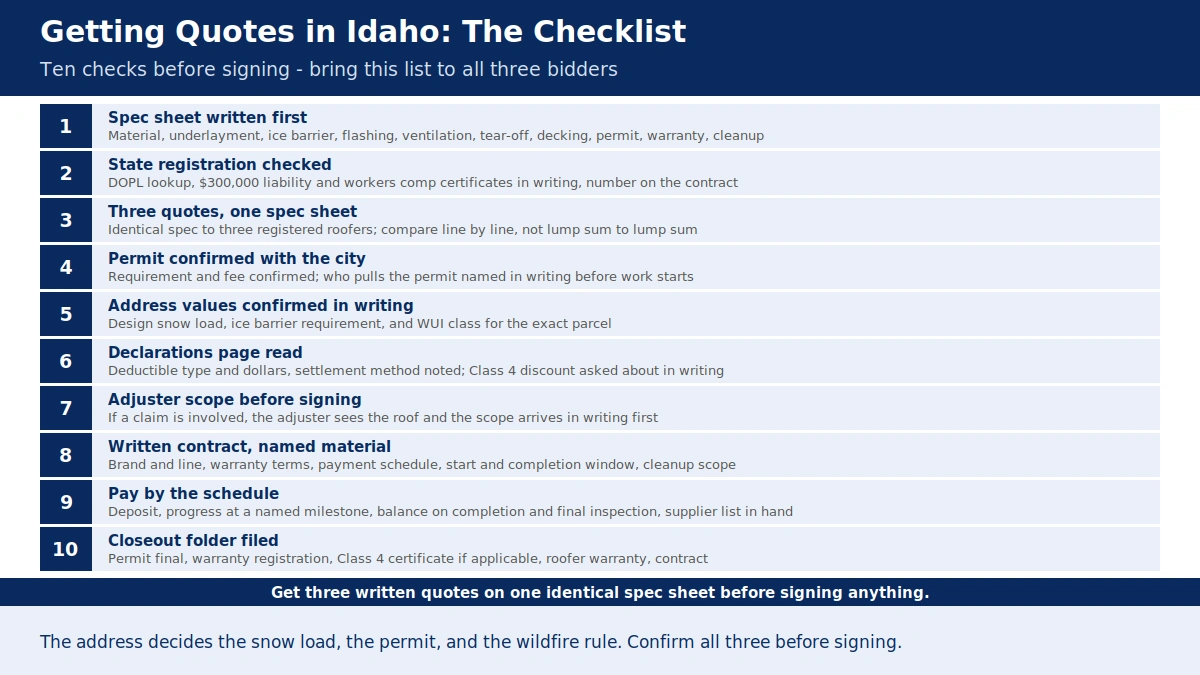
Sources & methodology
Installed costs:
- NumeralQ, Idaho roof replacement cost page, planning estimates with pricing as of October 26, 2026, architectural shingles, 2,000 sq ft roof, $9,910–$12,100; size table and national comparison on the same page.
- NumeralQ, Boise roof replacement cost page, pricing as of October 26, 2026, material table for a 2,000 sq ft roof, add-on figures, permit fee arithmetic, roofer pay, and Ada County contractor counts.
- SmartRoofingCalculator, Idaho roof cost page, updated November 9, 2026, per-square bands and state factor 0.928; Boise city page, local factor 0.95, 25-square figures.
- MyRoofData, Idaho roof cost page, 2026 model, per-square figures before tear-off, typical-home range, tear-off rates, and rated lives.
- Instant Roofer, Idaho roof replacement cost page, contractor pricing across 152,600 roofs and 38 contractors, average $16,261 on a 2,472 sq ft roof.
- RoofingEstimatorPros, Idaho page, updated August 26, 2026, high outlier recorded and not adopted.
- This Old House, Idaho average of $7,947, May 2026, as cited by two Treasure Valley guides, scope unstated, recorded and not adopted.
Snow, freeze-thaw, ice, and code:
- University of Idaho, Ground Snow Loads for Idaho, 2015 Edition, city-by-city ground snow loads, with the study’s own warning that it is not legally binding.
- City of Boise, current codes and design criteria table, Table R301.2(1), revised January 2021, ground snow 20 psf, roof design load 25 psf minimum, wind 90 mph, ice barrier not required.
- Twin Falls city and county design values, Post Falls, Moscow, Bonners Ferry, Eagle, and Power County published values, as recorded in the research file.
- International Residential Code sections R905.1.2 and R908.3, ice barrier and layer-limit rules.
- Interlock Roofing, Idaho roof climate page, October 8, 2026, freeze-thaw mechanism, snow-load summary, and adopted-code list.
- Owens Corning technical bulletin TB-10022497-A, hand-sealing at 40 degrees Fahrenheit and below.
Hail:
- MyWild Idaho hail analysis, National Oceanic and Atmospheric Administration Storm Prediction Center data, 1996–2025, 240 severe hail days, 534 reports, seasonal and size breakdowns.
- NumeralQ Idaho and Boise pages, National Oceanic and Atmospheric Administration data, May–July share, Ada County counts, and the judgment on impact-resistant shingles for most Idaho homes.
- East Idaho News, June 27, 2026, June 26, 2026 Meridian hailstorm and National Weather Service comment.
- StormAuditor and Cloudbreak summaries, September 17, 2026 eastern Idaho hail, 2.50-inch stone at Rose, Bingham County.
Wildfire:
- Idaho Department of Insurance, 2025 wildfire and property insurance infographic, December 2025, acres burned 2023–2025, structures burned, and company count.
- National Interagency Coordination Center, 2025 incident data via MyWild, fire counts and lightning share.
- Bureau of Land Management Boise District and Capital Press, Range Fire and Mile Marker 65 Fire, July–August 2025.
- City of Boise release, Claremont Fire, July 2026, and Idaho Department of Lands season summary via Idaho Capital Sun, October 16, 2026.
- Idaho Department of Lands, Ready, Set, Go! wildfire guide, roof vulnerability and ember entry points.
- Boise City Code Title 5, Chapter 12, fire code amendments sections 4112–4113, wildland-urban interface rule, via NumeralQ review of city documents, October 11, 2026.
- FEMA Region 10 wildfire guidance, February 2021, roof hardening items and defensible space.
Registration, permits, and liens:
- Idaho Code Title 54, Chapter 52, Idaho Contractor Registration Act, sections 54-5204, 54-5205, 54-5208, 54-5209, and 54-5213, via the Division of Occupational and Professional Licenses and three independent trackers.
- Idaho Code section 45-525, residential lien disclosure and supplier list.
- Idaho Code section 39-4111, permit requirement.
- City of Boise Homeowner’s Guide to Residential Construction, re-roof permit requirement, and fee table.
- City of Meridian residential permit guide, roof replacement and repair permit requirement.
- City of Nampa reroof permit application, form of May 19, 2022, file updated September 9, 2026, two-layer cap and registration declaration.
- PermitMint guide, March 28, 2026, Idaho Falls permit requirement, secondary source, fee and timeline figures not used.
- Idaho Residential Code, 2018 International Residential Code plus Idaho amendments, 2020 Edition, via the Division of Occupational and Professional Licenses adopted-codes list.
Insurance, Class 4, and incentives:
- NerdWallet, Idaho homeowners insurance analysis, May 6, 2026, average premium $2,195 a year, sample-policy basis.
- UL 2218 Class 4 test description and manufacturer lines, via manufacturer and standards summaries recorded in the research file.
- Slade Roofing 2026 pricing, Class 4 premium $30–$80 per square, and one Idaho roofer’s $30 per square quote via Lifelong Insurance Agency, May 4, 2026.
- WinChoice, November 2026, commonly cited national discount range of 10–25 percent; Lifelong Insurance Agency, May 2026, agency example of 15–20 percent.
- One Big Beautiful Bill Act, Public Law 119-21, and Internal Revenue Service FS-2025-05, end of sections 25C and 25D for post-2025 installs.
- United States Department of Energy dataset, January 17, 2025, Idaho HEAR and HOMES allocations; Idaho Capital Sun, March 19, 2025, legislature zeroing the request; Idaho Office of Energy and Mineral Resources page, rebates not currently available.
- Idaho Code section 63-3022C, alternative-energy equipment deduction, via the Idaho solar guide research.
- Derived figures: the Class 4 band, the cost-per-year table, the payback table, and the insurance worked example are NestPriced arithmetic from the sources named in the text, and are labeled as such wherever they appear.
Disclaimer: Prices in this guide are planning estimates from published cost models and contractor pricing, not quotes, and the actual cost of a roof depends on the roof’s size, slope, condition, material, and the contractor’s bid. Snow loads, permit fees, and wildfire rules vary by address and change over time, so confirm the design values, the permit requirement, and the parcel’s wildland-urban interface class with the local building department before signing a contract. Insurance discounts, deductibles, and settlement methods depend on the individual policy and carrier, and tax and rebate positions change with legislation; verify the current position with the carrier, the tax adviser, and the state agency before relying on any figure in this guide.
How much does a roof replacement cost in Idaho in 2026?
A 2,000 sq ft architectural shingle roof costs $9,910–$12,100 installed in Idaho in 2026, on NumeralQ planning estimates priced October 26, 2026. Boise runs about 2 percent above the state band at $10,110–$12,360, and the price rises with roof size, slope, layers, and material.
What is the cost per square for a roof replacement in Idaho?
Architectural shingles run about $496–$605 per square installed on the NumeralQ state band, and SmartRoofingCalculator prices the same material at $420–$600 per square installed with tear-off. MyRoofData prices architectural shingles at $428–$713 per square before tear-off, with tear-off adding $100–$200 per square per layer.
Do I need a permit to replace a roof in Idaho?
Yes in every big city: Boise, Meridian, and Nampa all require a permit on their own city documents, and Idaho Falls requires one on secondary evidence. Smaller cities and rural counties vary, and several rural counties have no building department, so confirm the requirement with the local building department before work starts.
Is a Class A roof required in Idaho?
Boise requires a Class A roof covering for structures in its wildland-urban interface zone and foothills, and the requirement triggers when the covering is replaced or when half or more is replaced within 12 months. No statewide wildland-urban interface roof code was located, so the rule is a city rule and the parcel’s class should be confirmed with the city.
Are Class 4 shingles worth it in Idaho?
In the Boise valley, Class 4 is mainly a discount play, because two-inch hail has not been recorded in Ada County in the last decade and the insurance discount decides whether the $600–$1,600 upgrade pays back. In eastern Idaho, where bigger stones fall, Class 4 is both a discount play and a damage play, and the case is stronger on both counts.
Does Idaho require a roofing license?
Idaho does not license roofers; it registers contractors under the Idaho Contractor Registration Act, and any job over $2,000 in labor plus materials requires registration with the Division of Occupational and Professional Licenses. Registration requires insurance but no exam and no experience, so check the registration, the insurance certificates, and local references before signing.
Is there a federal tax credit or Idaho rebate for a new roof in 2026?
No on both counts. The federal government contributes $0 to a 2026 roof, because the One Big Beautiful Bill Act ended the relevant credits for post-2025 installs, and Idaho’s home energy rebates do not exist after the legislature zeroed the funding in March 2025.
How long does a roof last in Idaho?
Architectural shingles carry a rated life of 22–30 years, 3-tab shingles 15–20 years, exposed-fastener metal 30–40 years, and standing-seam metal 40–70 years, on the MyRoofData Idaho model. Heat, ultraviolet light, and freeze-thaw wear asphalt faster than the lab test assumes, so ventilation and installation quality decide where inside each range a real roof lands.