

A Portland roof and a Bend roof live in different climates, and the state line between them is a mountain range. The Portland roof sits under roughly 37 inches of rain a year, spread across about 150 wet days, with shade and tree cover that keep the north slope damp for months. Moss grows on it the way grass grows on a lawn. The Bend roof sits at about 3,600 feet on the dry side of the Cascades, under 22 inches of snow a year, with winter nights near 24 degrees and a freeze-thaw cycle that works on every seam. A third Oregon roof, in Medford or Grants Pass or the Santiam Canyon, answers to a different threat altogether: embers carried on a dry east wind, looking for a cedar shake or a gutter full of needles. No single statewide figure covers all three roofs. This guide does not try to force one. It builds the price from the published anchors, then separates the wet west, the cold east, and the fire country so each quote can be read against the right market.
What follows is ordered the way an Oregon homeowner actually decides. First come the statewide anchors: every published model in one place, with the high outlier called out instead of buried. Next, each material is priced on one shared 25-square roof, and the rows that exclude tear-off are marked as such so nobody reads them as fitted prices. After that comes roof size, because the budgeting error Oregon homeowners make most often is pricing the living area instead of the roof surface. Then the cities. Then the price drivers: rain and moss in the west, snow and freeze in the east, ember risk in the south and east. The license, the permit patchwork, the insurance picture, and the money follow after that. Each figure names its source and its date. Where sources conflict, the conflict is printed, not smoothed over. Nothing unverified is presented as fact anywhere in this guide.
Every figure below is measured against the national baseline in our roof replacement cost guide. Where the roof meets the rest of the house, one Oregon guide completes the picture: our heat pump cost in Oregon guide prices the system that often goes in alongside a reroof, and it matters here because the heat pump rebates that do exist in Oregon are the ones this guide keeps separate from the roof. Across the state line, the two neighbours price differently: Washington runs $500–$720 a square and California $510–$730, both above Oregon, while Idaho runs $420–$600 and Nevada $440–$630, both below it.
Table of Contents
What a Roof Replacement Costs in Oregon in 2026
Two models anchor the Oregon market. They disagree on nothing except units. SmartRoofingCalculator counts in squares. Its Oregon page puts architectural shingles at $470–$680 per square fitted with tear-off, which makes a typical 25-square roof $11,750–$17,000. NumeralQ counts in square feet of roof surface. Its Oregon page puts a 2,000 square foot roof at $10,010–$12,230 statewide, pricing October 26, 2026. The conversion is simple: divide the surface by 100. Across 20 squares, the $470–$680 band gives $9,400–$13,600, which lands almost on top of NumeralQ’s $10,010–$12,230. The two models agree; they only count differently.
The other published models fan out around that center, and the fan is wide in Oregon because the state’s labor market is split. MyRoofData’s 2026 model sits higher: $14,250–$24,500 for a typical single-family architectural roof. That is about a tenth above the national average, built on crews at $60–$100 an hour and a state index of 1.10. The highest published figure comes from RoofingEstimatorPros, updated August 26, 2026: $15,633–$27,891 for a 2,000 square foot architectural roof, $21,081 on average, about $10.54 a square foot once tear-off, permits, and waste are in. HomeCostLens, with cost data reviewed in September 2026, puts Portland near $11,590 for a typical 2,200 square foot home, ranging from $9,490 to $18,970, with roofing labor near $30 an hour, about 25 percent above the national median. MyHomeQuote puts a 2,000 square foot mid-range Oregon roof at $10,300–$21,500, with most homeowners spending $15,800, low-end work near $8,000 and premium work near $37,000. ServiceCostHub, modeling from BLS and BEA data in July 2026, puts Portland at a typical $12,321, ranging from $11,408 to $13,151.
Below the planning models sit two contractor ranges. They need a different reading. Cornerstone Renovations, pricing Portland in October 2026 from its own estimator, puts GAF architectural shingles at $700–$1,200 a square installed with one layer torn off — $16,100–$27,600 on a 20-square one-story medium-pitch home, $20,100–$34,500 on a 25-square one. Denali Builders, also Portland, puts most full replacements at $8,000–$25,000, with a 2,000 square foot single-story architectural roof generally landing around $12,000–$16,000 installed. Jobin Roofing, working the Portland-Vancouver metro, puts most homes at $14,000–$20,000 at $7–$9 a square foot, inside a $12,000–$30,000-plus range. Roof Life of Oregon publishes $5,400–$11,700 as typical for a full Portland replacement. A Portland contractor and a statewide planning model are pricing different houses: the contractor prices the one-story bungalows and split-levels it actually stands on, which run smaller and simpler than the statewide models assume. Neither range is wrong.
Every model that publishes a comparison puts Oregon above the national average. Wages are the reason. SmartRoofingCalculator applies a state factor of 1.042 and a BEA all-items price parity of 103.4. MyRoofData applies a 1.10 cost index. RoofingEstimatorPros uses a state multiplier of 1.10. The Bureau of Labor Statistics, in its May 2025 Occupational Employment and Wage Statistics, puts the median Oregon roofer at $28.35 an hour, with a mean of $29.57 and about 3,430 roofers working statewide, against a national median of $26.65 — the state median runs about 6 percent above the national one. One conflict belongs in the open: SmartRoofingCalculator, on a May 2024 BLS vintage, lists the Oregon roofer median at $27.08 an hour and the construction laborer median at $24.03. This guide uses the May 2025 number. Against the neighbours, Oregon is the middle-priced roof in its own borderland on the SmartRoofingCalculator page: Washington at $500–$720 a square and California at $510–$730 sit above it, Idaho at $420–$600 and Nevada at $440–$630 sit below it. Near the border, one quote from a contractor based over the line is worth getting. Their labor market is cheaper, and the contractor still needs the Oregon license, covered in the hiring section below.
Flag RoofingEstimatorPros as the high outlier: its $21,081 average is roughly half again the SmartRoofingCalculator midpoint, which reads like a large, steep, or complex roof rather than a standard Oregon ranch or bungalow. Cornerstone deserves the same flag from a different direction: its $700–$1,200 a square is an estimator band for a premium GAF system on a one-story home, not a planning band for the state. Walk into the first contractor meeting with two figures in mind: $11,750–$17,000 for a 25-square roof, and $10,010–$12,230 for a 2,000-square-foot roof as the independent check. A standard-pitch asphalt roof takes a crew one to three days in fair weather. Metal takes longer. The calendar around the install is what eats the time — collecting three quotes, waiting for the July-August dry window in the west if the old roof can hold, and confirming with the building department whether the job needs a permit at all, which in Oregon depends on the scope and sometimes the map.
| Source | Typical job | Price | Dated |
|---|---|---|---|
| SmartRoofingCalculator | 25-square architectural roof | $11,750–$17,000 ($470–$680/sq) | Apr 24, 2026 / index Nov 9, 2026 |
| NumeralQ | 2,000 sq ft roof, statewide | $10,010–$12,230 | Oct 26, 2026 |
| NumeralQ | 2,000 sq ft roof, Portland | $10,200–$12,480 | Oct 26, 2026 |
| MyRoofData | Typical single-family arch roof | $14,250–$24,500 | 2026 model |
| RoofingEstimatorPros | 2,000 sq ft arch roof | $15,633–$27,891 (avg $21,081) | Aug 26, 2026 |
| HomeCostLens | Typical 2,200 sq ft home, Portland | ~$11,590 avg (range $9,490–$18,970) | Sep 2026 |
| MyHomeQuote | 2,000 sq ft mid-range roof | $10,300–$21,500 (most $15,800) | 2026 |
| ServiceCostHub | 2,000 sq ft home, Portland | $11,408–$13,151 (typical $12,321) | Jul 2026 |
| Cornerstone Renovations | 20-square one-story, Portland | $16,100–$27,600 (GAF arch) | Oct 13, 2026 |
| Denali Builders | 2,000 sq ft single-story, Portland | ~$12,000–$16,000 | Apr 12, 2026 |
| Jobin Roofing | Most Portland-Vancouver homes | $14,000–$20,000 | 2026 guide |
| Roof Life of Oregon | Typical full replacement, Portland | $5,400–$11,700 | 2026 |
| Angi | Flat roof, 1,000 sq ft, Portland | $8,000–$16,000 (avg $8,566) | Aug 1, 2026 |
| Angi | Tile roof, Portland | $11,516–$27,500 (avg $19,508) | Jul 29, 2026 |
Roof Replacement Cost in Oregon by Material
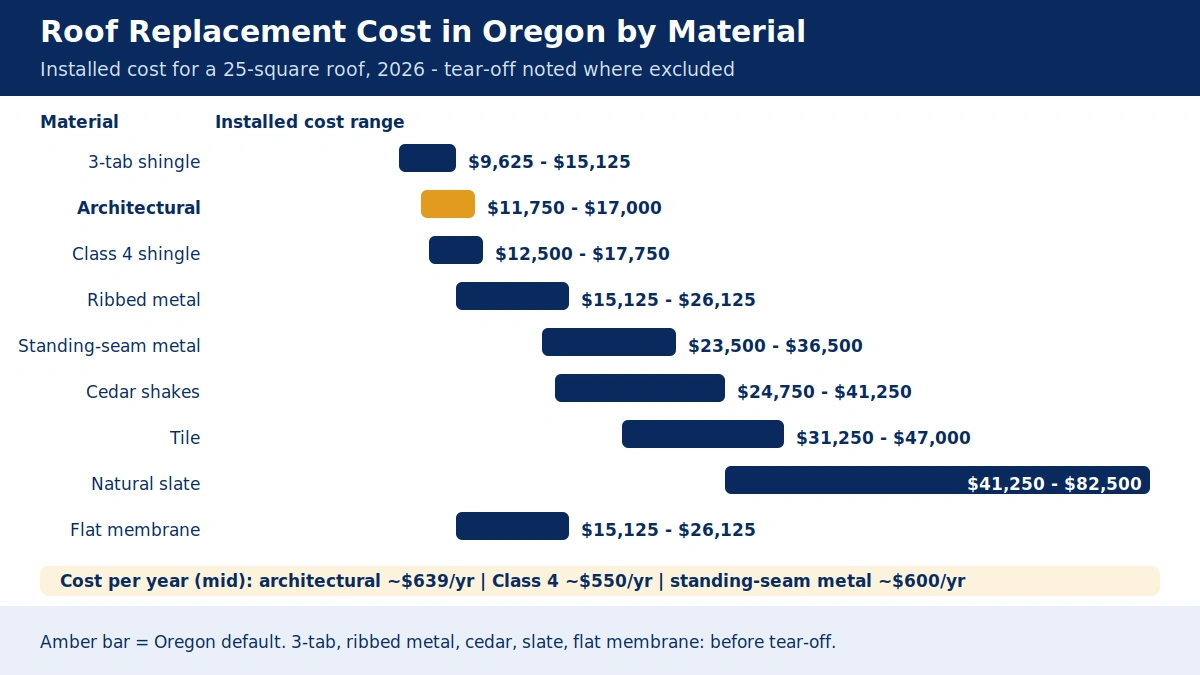
Read this warning before the numbers: three rows in the table are priced before tear-off, the rest include it, and confusing the two understates a 25-square job by $2,500 to $5,000. MyRoofData’s per-square bands exclude tear-off. It bills tear-off separately, at $100–$200 a square per layer. SmartRoofingCalculator’s bands are fitted prices, tear-off included. Both kinds of row stay in the table below, each labeled, all priced on one typical 25-square roof: 2,500 square feet of surface, material by material. Read it with Oregon’s split climate in mind, not just the sticker: the cheapest shingle on the shelf is the one most likely to grow moss on a shaded Portland slope, and the dearest metal on the shelf is the one most likely to still be shedding snow in Bend when the mortgage is paid off.
| Material | Installed cost per square | Total for 25 squares | Realistic life in Oregon |
|---|---|---|---|
| 3-tab asphalt shingle | $385–$605 (before tear-off) | $9,625–$15,125 | 15–20 yrs |
| Architectural asphalt shingle | $470–$680 | $11,750–$17,000 | 20–25 yrs |
| Class 4 impact-resistant shingle | $500–$710 (modeled) | $12,500–$17,750 | 25–30 yrs |
| Ribbed metal (exposed fastener) | $605–$1,045 (before tear-off) | $15,125–$26,125 | 30–40 yrs |
| Standing-seam metal | $940–$1,460 | $23,500–$36,500 | 40–60 yrs |
| Cedar shakes and shingles | $990–$1,650 (before tear-off) | $24,750–$41,250 | 20–30 yrs |
| Tile (concrete/clay) | $1,250–$1,880 | $31,250–$47,000 | 50+ yrs |
| Natural slate | $1,650–$3,300 (before tear-off) | $41,250–$82,500 | 75–150 yrs |
| Flat membrane (TPO/EPDM) | $605–$1,045 (before tear-off) | $15,125–$26,125 | 20–30 yrs |
Treat the 3-tab row as a budget line. It is not the recommendation for most Oregon homes. MyRoofData’s 3-tab figure is $385–$605 a square installed, before tear-off. NumeralQ’s Portland figure for a 2,000-square-foot 3-tab job is $8,420–$10,010, roughly 19 percent below architectural. It is one flat layer, the weakest wind rating in this guide, and no impact rating an Oregon insurer credits. Insurers and builders have largely moved past it, and on a shaded Willamette Valley slope its thin profile is the wrong place to save money. Each wet winter, moss works the edges a little looser, and each dry summer the ultraviolet thins the granular surface a little further, so the saving on 3-tab often only pre-pays the next repair. It still fits some jobs: a rental, an outbuilding, or a house the owner plans to sell within a few years. For a house the owner intends to hold through ten years of valley rain and high-desert freeze, it is the wrong default.
Roughly three in four American homes wear architectural shingles. Oregon is no exception. The $470–$680-a-square headline band is the price of this thicker dimensional shingle. Its 110-to-130-mile-per-hour wind rating only holds when the crew uses the manufacturer’s high-wind nailing pattern. Plan on 20 to 25 realistic years from it in Oregon, not the 22 to 30 MyRoofData prints: wet winters age asphalt faster than dry ones, moss lifts the edges on the north slope, and the freeze-thaw cycle east of the Cascades works the sealant strips a little looser each spring. A Portland contractor puts the point more bluntly, saying architectural shingles rated for 25 to 30 years typically last 20 to 25 years in Portland conditions, and less without regular maintenance. That is a contractor’s claim, not a manufacturer’s figure, and it is printed here as one. A roof that looks sound at year twelve can be a single wet winter away from a deck repair. In the west, ask for the algae-resistant granule package by name: copper or zinc granules mixed into the shingle slow the black streaking, and zinc or copper strips at the ridge release metal ions every time it rains, which slows moss growth as the water sheets down the slope.
Class 4 gets its own section below. In Oregon it deserves a cooler reading than the one it gets in hail-belt states. No Oregon-specific Class 4 premium turned up in this pass, so the guide models one instead of quoting one. The $500–$710-a-square band in the table is arithmetic, not a quote: take a Michigan insurance agent’s 2026 figure — roughly $30 a square above standard architectural — and apply it to Oregon’s $470–$680 band. Across 25 squares, that arithmetic comes to $12,500–$17,750. The honest Oregon case for Class 4 rests less on hail — Multnomah County recorded zero reports of one-inch hail in ten years — and more on wind-driven debris, the ice-storm risk FEMA rates Relatively High in Multnomah County, and the insurance discount, which is carrier-specific and must be confirmed in writing before the install. The Class 4 section below takes up all three.
Metal is where the per-year arithmetic flips the table, and where Oregon’s two climates pull the specification in opposite directions. MyRoofData’s Oregon model puts ribbed panels with exposed fasteners at $605–$1,045 a square before tear-off. That is $15,125–$26,125 on a 25-square roof, for 30 to 40 years of life. NumeralQ’s Portland figure for exposed-fastener metal on a 2,000-square-foot roof is $15,760–$20,030. SmartRoofingCalculator’s Oregon figures put standing-seam metal at $940–$1,460 a square, or $23,500–$36,500 for 25 squares, with 40 to 60 years of life. MyRoofData’s figure is $1,045–$1,760 a square before tear-off. West of the Cascades, metal’s advantage is water: it sheds rain instantly, moss cannot root on it, and a standing-seam roof never holds the damp mat that rots a shingle deck. East of the Cascades, the advantage is snow: it sheds a snow load instead of holding it, and it never grows an ice dam the way a cold shingle roof does. Near the coast, the metal itself matters as much as the seam: aluminum is the salt-air choice because it does not rust, while steel relies on coatings that ocean air attacks, and the fasteners and flashings must be compatible metal or they corrode first. No Oregon coastal-grade price adder was verified in this pass, so none is printed; ask the bidder to name the metal, the coating, and the fastener in writing. Do the per-year math and the table turns over: standing seam comes to about $600 a year at the midpoints, architectural about $639. Judge metal by the year, not by the quote, and the sticker shock fades. For metal, start with our metal roof cost guide. For the head-to-head, the metal vs shingles comparison has it.
Cedar is a shrinking choice in Oregon. MyRoofData puts shakes at $990–$1,650 a square, or $24,750–$41,250 for 25 squares, with 20 to 30 realistic years in this climate. Cedar looks beautiful on a wooded lot in the Coast Range and needs real maintenance, and it holds moisture in its gaps — a poor combination on a roof that has to survive a wet valley winter and a dry high-desert summer in the same year. NumeralQ’s cedar figure for a 2,000-square-foot Portland roof is $18,970–$32,770. It sits below the table’s 25-square total because the roof is smaller, not because cedar got cheaper. The sharper Oregon problem is fire: cedar is restricted in some wildfire-prone areas unless it is treated to a Class A or B fire rating, and a shake roof in the wildland-urban interface is an ember’s favorite landing spot. Check the MyRoofData band against a local quote before budgeting around it, check the wildfire map for the address, and ask the bidder how the shakes will be treated against the humidity.
Tile and slate sit at the luxury end of the table. In Oregon they are rare as much for structural reasons as for price. SmartRoofingCalculator puts tile at $1,250–$1,880 a square — $31,250–$47,000 across 25 squares. MyRoofData puts slate at $1,650–$3,300 a square — $41,250–$82,500. MyRoofData breaks tile down further: concrete $1,100–$1,980 a square, clay $1,320–$2,750. Both weigh far more than asphalt. Both need a structural check before they go on. Both can serve fifty years or longer. Angi’s Portland tile figure — $19,508 on average, ranging from $11,516 to $27,500 — prices smaller or simpler tile jobs than the 25-square table, and the gap is a reminder to compare square counts before comparing totals. Tile’s Oregon problem is freeze-thaw in the east and weight everywhere: a porous tile that soaks up autumn rain and freezes in a Bend January can spall. Slate’s problem is the crew. Few Oregon roofers lay it regularly, and a slate roof from a crew that seldom handles the material finds its first leak at the first thaw. Read our tile roof cost guide before pricing tile at all: a concrete or clay roof needs the frame checked for its weight first.
Judge the table by the year, not by the quote. Each yearly figure below divides a midpoint total by the midpoint of that material’s realistic life. Divided that way, the yearly cost lands near $707 for 3-tab, $639 for architectural, $550 for Class 4, $589 for ribbed metal, $600 for standing seam, $1,320 for cedar, $783 for tile at a 50-year life, $550 for slate, and $825 for flat membrane. They leave out the deductibles, where Class 4 and metal actually win, and the moss specification, where algae-resistant shingles actually win. Decide with the material table in one hand and the insurance section in the other. Neither one alone tells the truth. And remember that the flat-membrane row prices a 25-square roof that almost no Portland bungalow has: the flat-roof market below re-prices membranes on the smaller roofs they actually cover.
Roof Replacement Cost by Roof Size
Two Oregon listings can both say 2,000 square feet and still need completely different roofs. A single-story rancher covers roughly 2,000 square feet of ground with its roof. A two-story Craftsman with the same living area covers only about 1,000 square feet of ground. Its roof surface is about half the rancher’s. Add pitch, overhangs, and waste, and that rancher footprint usually becomes 20–25 squares of roof surface. Oregon homeowners make one pricing error more than any other: mistaking the listing’s living area for the roof surface. It is not a small one. Insist that every bidder print the square count as its own line on the bid. A quote built on living area is a quote for a house that was never built.
The table below starts from the SmartRoofingCalculator architectural range for Oregon — $470–$680 a square with tear-off folded in — and sets the modeled Class 4 range beside it. The headline row is the 25-square one. Check the 20-square row against NumeralQ: the per-square band gives $9,400–$13,600, next to NumeralQ’s $10,010–$12,230 for a 2,000-square-foot roof statewide.
| Roof size | Typical Oregon home | Architectural shingle total | Class 4 shingle total |
|---|---|---|---|
| 15 squares | Small ranch / cottage | $7,050–$10,200 | $7,500–$10,650 |
| 20 squares | 2,000 sq ft ranch | $9,400–$13,600 | $10,000–$14,200 |
| 25 squares | Typical OR home | $11,750–$17,000 | $12,500–$17,750 |
| 30 squares | Large two-story | $14,100–$20,400 | $15,000–$21,300 |
| 35 squares | Large home, complex roof | $16,450–$23,800 | $17,500–$24,850 |
| 40 squares | Very large / steep | $18,800–$27,200 | $20,000–$28,400 |
Pitch is the first thing that breaks this table. On a 10/12 or 12/12 slope, crews move slower and stage differently than on a walkable 4/12. The per-square price climbs with the difficulty. After pitch comes complexity. Each valley, dormer, skylight, and chimney adds a flashing detail. Each one eats crew time, and each one becomes the first leak when rushed. Two roofs can share a square count and still price differently: one plain gable, one cut up with dormers. MyRoofData’s estimator adds roughly 15 percent to labor on a cut-up roof with several valleys, dormers, and hips. Third comes decking. Soft sheathing stays hidden until the tear-off exposes it. The crew prices replacement by the sheet, on the day. NumeralQ prices a 4-by-8 OSB deck sheet at $66.60–$95.61 installed in Portland. Get the per-sheet deck rate in writing before the old shingles come off. The housing stock makes this more than a formality: half of Portland’s homes were built in 1966 or earlier, so older roofs hide soft decking and extra layers more often than the quote assumes. NumeralQ’s Portland figures put a second tear-off layer at $1.42–$1.87 a square foot. A house already carrying two layers cannot take a third — the code limit is two — so the job becomes a full tear-off.
Budget from measurements of the roof itself. Multiply the footprint by the pitch factor — about 1.12 at 6/12 on SmartRoofingCalculator’s chart, about 1.25 at 8/12 — add 10 percent waste for a simple gable and 15 percent for a hip roof, then divide by 100 for squares. Line the bids up by square count first. Compare prices only once the counts agree. A bid with no square count on it gives you nothing to measure against.
Roof Replacement Cost by City: Portland vs Salem vs Eugene vs Bend vs Medford
Portland is the puzzle in this table, so start there. It sits in the dearest labor market in the state, inside the Portland-Vancouver-Hillsboro metro, and its verified NumeralQ figure — $10,200–$12,480 for a 2,000 square foot roof — is barely above the statewide $10,010–$12,230. The planning models disagree with each other over the size of the gap. SmartRoofingCalculator’s Portland page, applying a local factor of 1.20 to the state baseline, prices a 25-square roof at $14,100–$20,400, or $564–$816 a square. HomeCostLens prices a typical 2,200 square foot Portland home near $11,590. Cornerstone’s estimator band for a one-story Portland home runs $16,100–$27,600 on 20 squares. NumeralQ’s Portland figure prices a standard job in a standard house, while the Portland contractor bands price the larger, steeper, more complex roofs that fill the West Hills and the inner east side. The two figures measure different houses, so both can be true. The honest summary is the shape of the market: Portland roofers earn about 10 percent above the national median, the highest verified city figure in the state; FEMA rates hail risk in Multnomah County as Very Low; and the typical job is only 2.0 percent of the median Portland home value — the smallest share in Oregon, because the houses are worth far more than the roofs on them.
| City / metro | 2,000 sq ft roof (arch) | Roofer median wage | Market note |
|---|---|---|---|
| Portland | $10,200–$12,480 (NumeralQ) | $29.43/hr (metro) | Dearest labor; oldest housing stock, median built 1966 or earlier |
| Salem | ~$10,500 midpoint (NumeralQ) | $25.33/hr (metro) | Dearest job vs home value, 2.5% of median value |
| Eugene | ~$10,025 midpoint (NumeralQ) | $23.00/hr (metro) | Cheapest roofer pay verified in the state, 14% below US median |
| Bend | No city figure verified | $28.84/hr (metro) | High desert; snow and freeze set the specification |
| Medford | No city figure verified | $24.01/hr (metro) | Rogue Valley; wildfire country, driest summers in the state |
Salem is the dearest job in the state relative to what the house is worth. Its NumeralQ midpoint of about $10,500 runs 2.5 percent of the median Salem home value, against 2.0 percent in Portland and 2.2 percent in Eugene. The roofer median wage in the Salem metro is $25.33 an hour — about 5 percent below the national median — so the cost is not labor. It is the house: Salem homes are worth less than Portland homes, so the same roof is a bigger share of the asset. FEMA rates hail risk in Marion County as Relatively Low, the highest county rating in the state, which is still low in absolute terms. Salem sits in the Willamette Valley’s rain belt, so the moss specification from the Portland section applies here in full.
Eugene is the cheapest labor market in the state, and the numbers show it. The roofer median wage in the Eugene-Springfield metro is $23.00 an hour — 14 percent below the national median, a 24-point spread against Portland’s 10 percent above. NumeralQ’s Eugene midpoint of about $10,025 is the lowest verified city midpoint in Oregon. A contractor based in the lower-pay area may quote less for the same work, which is worth one quote on a job near the metro line — provided the contractor holds the Oregon license the job requires. Eugene’s rain and moss load matches Portland’s, and its housing stock runs younger than Portland’s, which means less deck work found at tear-off on the average job.
Bend has no verified city-only price in this pass, and the guide says so rather than inventing one. Budget from the statewide band — $10,010–$12,230 for a 2,000 square foot roof — and adjust for what Bend actually changes: the roofer median wage in the Bend metro is $28.84 an hour, near the state median of $28.35, so labor does not move the price much. What moves it is the specification. A Bend roof needs the ice and water shield run further up the eave, a ventilation detail that handles freeze-thaw, and a material that sheds snow instead of holding it. The snow section below prices those choices. Medford is the same story from the other direction: no city-only figure verified, a roofer median of $24.01 an hour, about 10 percent below the national median, and a specification set by wildfire rather than weather. The Rogue Valley runs the driest summers in the state, and the ember section below is written for it.
Portland holds the state’s biggest roofing market and the hardest one to price with a single number, because it holds two markets inside it. The pitched-roof market runs $10,200–$12,480 on NumeralQ’s figures for a 2,000 square foot roof, while SmartRoofingCalculator’s Portland page, applying a local factor of 1.20 to the state baseline, prices a 25-square roof at $14,100–$20,400, or $564–$816 a square. The flat-roof market is separate and cheaper per job, because the roofs are smaller: Angi prices a 1,000 square foot Portland flat roof at $8,000–$16,000, averaging $8,566. The roofer median wage in the Portland-Vancouver-Hillsboro metro is $29.43 an hour — about 10 percent above the national median — with 2,280 roofers employed. Portland’s permit picture is the quirkiest in the state, taken up in the permits section below: a like-for-like reroof on a one- or two-family home generally needs no permit at all, while a reroof in a wildfire hazard zone always does. And the city’s housing stock is the oldest in the state, with half of homes built in 1966 or earlier, which means more deck work found at tear-off and more reason to get the per-sheet rate in writing first. The flat-roof market is priced on its own terms in our flat roof replacement cost guide.
Why Oregon Roofs Cost What They Do: Rain, Moss & Two Climates
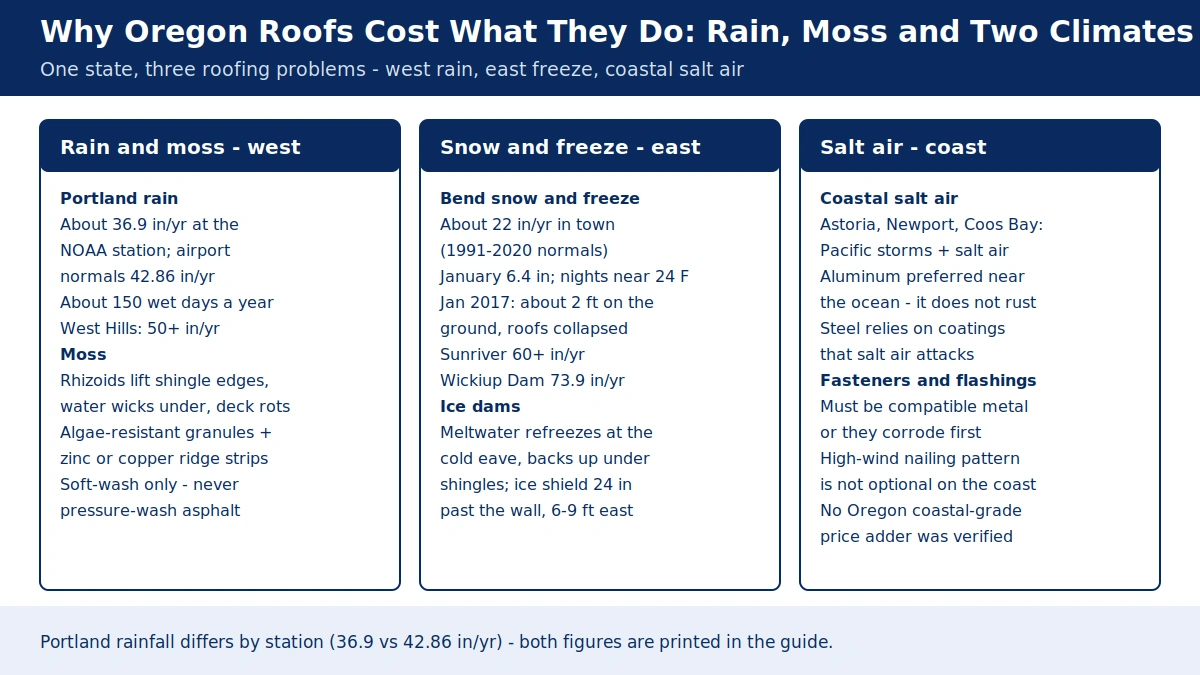
Oregon’s price is set by water in the west and cold in the east, and the Cascades decide which one a given roof answers to. West of the crest, the roof never really dries out. A NOAA station near Portland averages 36.9 inches of precipitation a year, and the National Weather Service’s 1991–2020 normals for the airport station average 42.86 inches — the two figures differ by station and period, not by error, and the commonly quoted Portland figure of 36 to 37 inches sits at the low end of the range. What matters more than the total is the count: roughly 150 days a year bring measurable precipitation, and from November through February the city can go weeks at a stretch without seeing the sun. The West Hills, where elevations reach 1,000 feet or more, routinely see 50 or more inches a year. East of the crest, Bend gets about 11 to 12 inches of precipitation a year and 22 inches of snow. Same state, different roofing problem.
Moss is the western problem, and it does its damage slowly enough that homeowners miss it until the deck is involved. Moss anchors itself with root-like rhizoids that grip the shingle granules, and as it grows it lifts the shingle edges. That lifting creates a damming effect: water wicks upward and under the shingle, reaches the deck, and rots it. Algae is the cosmetic cousin — Gloeocapsa magma, the organism behind the black streaks — which holds moisture against the surface and strips granules without wedging the shingle up the way moss does. Lichen sits between the two. All three thrive where the roof stays shaded and damp: the north slope, under overhanging branches, on the side of the house the sun never reaches. A Portland contractor’s rule of thumb is that the biological load can cut years off a shingle roof, and the guide’s own realistic life for architectural shingles in Oregon — 20 to 25 years against a 22-to-30-year manufacturer range — already prices that in.
The specification that answers moss is a short list, and it belongs on the quote as named lines, not as a verbal promise. Algae-resistant shingles with copper or zinc granules mixed into the surface slow the streaking. Zinc or copper strips at the ridge release metal ions every time it rains, and the ions wash down the slope and slow growth below. Ventilation matters as much as either: a roof that dries between storms grows less moss than one that stays damp, and the vent detail is where a cheap bid quietly saves money. Cleaning matters too, and the method matters more than the frequency: soft-wash cleaning is the standard for asphalt, concrete tile, and most metal. Never pressure-wash an asphalt roof. A pressure washer strips the granules that are the shingle’s only defense, and the roof it cleans is the roof it shortens. When the old roof comes off, ask the crew what the deck looks like under the mossiest slope. That is where the soft sheathing hides.
The eastern problem is the opposite of the western one. Bend’s 22 inches of snow a year sounds modest, and compared with the Cascades it is. But the town sits at about 3,600 feet, winter nights run near 24 degrees, and the hazard is ice more than depth. Snow melts on a warm afternoon, refreezes overnight, and the cycle works on every seam and flashing. The January 2017 storms left about two feet of snow on the ground in Bend and collapsed roofs in town. A west-side observer recorded more than 81 inches across the 2016–17 winter. Sunriver, at 4,160 feet, gets more than 60 inches a year, and Wickiup Dam near La Pine gets 73.9. The valleys of eastern Oregon are drier and colder at once: La Grande averages 9.4 inches of snow a year, John Day 9.6, Pendleton 15.7. A roof east of the Cascades needs the ice and water shield run further up the eave than a valley roof does, a ventilation detail that keeps the deck cold so snow does not melt from below, and a material that sheds a snow load instead of holding it. Metal earns its premium here. The snow section below works through the numbers.
The coast adds a third climate in a narrow strip. Astoria, Newport, and Coos Bay face Pacific storms, wind-driven rain, and salt air that attacks steel. Aluminum is the coastal choice because it does not rust. Steel relies on coatings, and salt air attacks coatings. Fasteners and flashings must be compatible metal, or they corrode before the panels do. No Oregon coastal-grade price adder was verified in this pass, so none is printed. What can be said is the specification: name the metal, name the coating, name the fastener, and get all three in writing before the install. A coastal roof is also the one place in Oregon where the high-wind nailing pattern is not optional. The shingle’s 110-to-130-mile-per-hour wind rating holds only when the crew follows the manufacturer’s high-wind pattern, and a coastal storm tests every nail that was skipped.
Wildfire Country: Embers, Class A Roofs & the Hazard Map
The roof is the part of the house a wildfire reaches first, and in Oregon it usually reaches it as embers, not flame. An ember can cross a mile of open ground on a dry east wind, land on a cedar shake or in a gutter full of needles, and start a fire on a roof the flame front never touches. That is why the roofing decision in southern and eastern Oregon is a fire decision before it is a price decision, and why the cheapest material on the shelf can be the most expensive one a homeowner ever buys.
The law behind the decision is Senate Bill 762, passed in 2021 after the Labor Day 2020 fires burned through the Santiam Canyon and much of southern Oregon. The bill ordered the Oregon Department of Forestry, working with Oregon State University, to draw a statewide wildfire hazard map. The first draft, sent out in 2022, covered about two million tax lots and drew intense criticism. ODF withdrew it five weeks after publishing it. The maps were redeveloped, and the final versions were released in January 2025. They divide Oregon’s roughly 1.9 million property tax lots into low, moderate, and high hazard zones, and they mark whether each lot sits inside the wildland-urban interface — the ground where houses and wildland meet. About 106,000 properties, 6 percent of all tax lots, sit in both a high hazard zone and the interface. Those are the properties the rules are written for.
Two sets of rules follow from the map, and their status is the first thing to get straight. Defensible space rules cover the ground around the house: Zone 1, from the walls out to 30 feet, requires dead vegetation removed, grass mowed to 4 inches or shorter during fire season, trees limbed up to 10 feet, and flammable material cleared away — and the roof and gutters kept free of accumulated debris, which is a roofing line item hiding inside a landscaping rule. Zone 2, from 30 to 100 feet, covers spacing and ladder-fuel removal. Fire hardening rules cover the house itself, and roofing is the first item on that list: install Class A or B roof coverings. Both codes are still in draft form and are not adopted for enforcement, as of the March 2025 reporting this guide relies on. The standards are not retroactive. They apply only to new construction, major additions, or a replacement of a covered item — and a roof replacement is a covered item. So a homeowner in a high-hazard interface lot who reroofs today is not yet bound by a hardening code, but is buying a roof that will live under one. That is the honest frame: the code is coming, the roof lasts 25 years, and the material chosen now is the material the future code will judge.
One protection in the law is worth knowing before the map is used against a homeowner. State law prohibits insurers in Oregon from using the hazard map to decide whether to extend coverage or to set rates. The map exists to help state agencies prioritize mitigation, not to price a policy. That does not mean insurers ignore wildfire risk — they model it themselves, and the insurance section below takes up what that means for a roof. It means the map itself cannot be the reason a carrier declines a house. And one political flag belongs in the open: Senate Bill 83, which passed the Oregon Senate in April 2025, would repeal the map and the rules built on it. Its final status was not verified in this pass. A homeowner in a high-hazard zone should check the current status of both the map and the bill before budgeting around either.
Portland has its own wildfire layer, and it is already enforceable. For properties in Portland’s mapped wildfire hazard areas, the city requires fire-resistant roofing, and reroofing a home in a wildfire hazard zone requires a permit — one of the few cases where a Portland reroof needs one at all. The city’s wildfire brochure also recommends ember-resistant vents with mesh openings under a quarter inch, noncombustible siding, enclosing decks higher than 24 inches with nonflammable material, and defensible-space landscaping. Only the roofing item is a requirement. The rest are recommendations, and some landscaping work in environmental zones may need a permit of its own. Check the city’s wildfire zone map for the address before the bid is written. A roofer who prices a Portland reroof without checking the zone map is a roofer who has not done the job before.
What the ember risk means for material choice is simple to state and expensive to ignore. Architectural shingles carry a Class A fire rating as a system, and that is the baseline. Standing-seam metal is Class A as well, and it has the extra advantage that embers find nothing to catch on a metal surface. Cedar is the material the rule is written against: untreated shakes are the most ember-vulnerable common roofing in Oregon, and cedar is restricted in some wildfire-prone areas unless it is treated to a Class A or B fire rating. Tile and slate are Class A. The vent detail matters as much as the covering: an ember that cannot land on the roof will try the vent, and a quarter-inch mesh stops what a half-inch mesh lets through. Gutters matter too. A gutter full of dry needles is a fuse running along the eave, and the defensible-space rules say so in plain language. Clean the gutters, screen the vents, and pick a Class A covering, and the roof stops being the house’s weakest point in a fire.
Class 4 Impact-Resistant Shingles in Oregon: What the Upgrade Costs and What It Pays Back
Class 4 is the most oversold upgrade in Oregon roofing, and the reason is simple: the shingle is tested for hail, and Oregon barely has hail. The UL 2218 Class 4 test drops a two-inch steel ball on the shingle and asks whether it cracks. A shingle that passes earns the rating. In a hail-belt state, that rating is worth real money. In Oregon, the hail record barely justifies it, and the honest case for the upgrade has to be built from other things.
Start with the record. NOAA’s storm database lists five reports of hail one inch or larger in Multnomah County and the six counties around it from 2016 to 2025 — 0.8 reports per 1,000 square miles, against 1.1 across Oregon and 20.1 nationwide. Multnomah County itself recorded zero reports of one-inch hail and zero of two-inch hail in that decade. The statewide hail season runs May through July, which held 72 percent of Oregon’s large-hail reports from 2016 to 2025. FEMA’s National Risk Index rates hail risk Very Low in Multnomah County and Relatively Low in Marion County, the highest county rating in the state. NumeralQ, which prices Oregon roofs for a living, answers its own question — are impact-resistant shingles worth it in Oregon — with a flat no for most homes: hail big enough to crack shingles is rare here. That is the record. A contractor who sells Class 4 in Portland on hail alone is selling a solution to a problem the county does not have.
The price is modeled, not quoted, and the guide says so. No Oregon-specific Class 4 premium was verified in this pass. The band in the material table — $500–$710 a square, $12,500–$17,750 for a 25-square roof — is arithmetic: a Michigan insurance agent’s 2026 figure of roughly $30 more per square than standard architectural shingles, applied to the Oregon architectural band of $470–$680. On a 25-square roof, the upgrade costs about $750 more than standard architectural at the midpoints, which is roughly 5 percent of the job. That is the whole premium. It is small enough that the decision should turn on the payback, not the price.
The payback has three parts, and only one of them is hail. The first is wind-driven debris. A Class 4 shingle is a thicker, tougher mat, and it resists the branch strikes and wind-lifted debris that a wet Oregon winter throws at a roof. The second is the ice-storm risk FEMA rates Relatively High in Multnomah County: ice loads and freeze-thaw work a shingle mat the way hail does, slowly, and a tougher mat holds up longer. The third is the insurance discount, and this is where the guide stops and asks the homeowner to do the work. Published Class 4 discount ranges run from 5–20 percent to 20–30 percent off the wind and hail portion of the premium, depending on the source, and no Oregon-specific figure was verified. The discount is carrier-specific. Some carriers credit the UL 2218 marking. Some credit only a named product line. Some credit nothing at all. Confirm it in writing with the carrier before the install, with the exact shingle named, and get the discount as a line on the policy. A verbal discount promise from a roofer means nothing at renewal time.
Run the per-year arithmetic with the modeled band and the picture is respectable. At the midpoints, Class 4 works out near $550 a year against architectural near $639, because the tougher shingle is credited with 25 to 30 realistic years against architectural’s 20 to 25. That arithmetic assumes the longer life is real, and in Oregon’s wet west it is the moss and the deck, not the mat, that usually ends a shingle roof. The upgrade buys a tougher mat on a roof whose life is set by water. That is the honest limit. Buy Class 4 in Oregon for the debris resistance, for the ice-storm toughness, and for a discount confirmed in writing. Do not buy it for hail. And if the carrier offers no discount and the house sits in a low-hail, low-wind valley lot, put the $750 toward the algae-resistant package and the ventilation detail instead. Those are the lines that actually extend an Oregon roof’s life.
Snow, Ice Dams & the Eastern Freeze: Bend and the High Desert on a Coastal-State Roof
Oregon is a coastal state with a mountain winter hiding inside it, and the roof is where the two meet. West of the Cascades, snow is a curiosity: Portland averages about 4.2 inches a year at the nearby NOAA station, and some winters pass with no snow at all. East of the crest, snow is the season. Bend averages about 22 inches a year in town on the NOAA 1991–2020 normal, with January the snowiest month at 6.4 inches, February at 5.5, December at 5.3. The town sits at about 3,600 feet, winter days run 41 to 46 degrees, and winter nights run near 24. The snow that falls in town tends to come in bursts and melt between storms, because Bend sits right around the elevation where a storm’s snow level usually hovers. The deep, reliable snow is a short drive away in the Cascades. The bigger day-to-day hazard in town is ice, not depth: freezing fog, overnight refreezing, shaded slopes that stay frozen longest.
The averages hide the years that matter. The 2016–17 winter left more than 81 inches on a west-side Bend gauge, and the January 2017 storms put about two feet of snow on the ground in town — and collapsed roofs. The winter of 2018–19 brought nearly 46 inches of snow in February alone. The winter of 2025–26, by contrast, brought only 3 to 5 inches to several Bend gauges. A Bend roof has to survive the 80-inch winter and the 4-inch winter on the same structure, and the specification that survives both is the one that sheds snow and keeps the deck cold. Higher up, the numbers climb fast: Sunriver, at 4,160 feet, gets more than 60 inches a year, and Wickiup Dam near La Pine gets 73.9. The valleys of eastern Oregon are drier and colder at once: La Grande averages 9.4 inches a year, John Day 9.6, Pendleton 15.7. A roof in La Grande answers to freeze more than to snow load, and a roof in Sunriver answers to snow load first.
An ice dam is the mechanism that turns a Bend winter into a roof claim, and it is worth understanding before the bid is written. Snow sits on the roof. Heat escaping from the house warms the deck from below and melts the snow from underneath. The meltwater runs down to the eave, which is cold because it hangs past the heated wall, and refreezes there. The ice builds into a dam. More meltwater pools behind the dam, backs up under the shingles, and finds the deck. The cure is not a stronger shingle. It is a cold deck: enough insulation that the deck stays near the outside temperature, enough ventilation that the air under the deck carries the heat away, and an ice and water shield membrane at the eave that seals the deck even when water does back up. The residential code calls for an ice barrier at the eaves in areas with a history of ice dams, running at least 24 inches past the inside of the exterior wall. On a low-slope eastern roof, six to nine feet of shield from the eave is the working rule, not the minimum. Ask whether the quote includes it, and in how many feet. NumeralQ prices a whole-roof ice and water barrier in Portland at $0.92–$1.46 a square foot installed, which is the line to compare against a Bend quote that lists the membrane only at the eave.
FEMA rates ice storm risk in Multnomah County as Relatively High, which surprises homeowners who think of Portland as a rain city. The mechanism is the Columbia Gorge: cold air from the interior pools in the Gorge and spills into the metro, freezing rain falls on a roof that was 40 degrees the day before, and the weight and the refreeze work the shingles. A Portland roof needs the ice barrier too, even though the snow rarely stays. The same Gorge wind that brings the ice also brings the damaging wind: Multnomah County recorded one damaging-wind report of 58 miles per hour or more in the 2016–2025 decade, and three tornado reports. The numbers are small. The point is that the western roof’s enemy is water in all its forms, and the eastern roof’s enemy is the freeze that follows it.
Material choice east of the Cascades is a snow decision. Standing-seam metal sheds a snow load instead of holding it, and a metal roof never grows an ice dam the way a cold shingle roof does — the snow slides before the melt-and-refreeze cycle can start. That is why MyRoofData notes metal growing east of the Cascades. Architectural shingles work in Bend too, and most Bend roofs wear them, but they need the full cold-deck detail: insulation, ventilation, and the extended ice shield. At 40 degrees Fahrenheit and below, shingle sealant strips need warmth and sun to bond, and the manufacturer asks roofers to hand-seal shingles along the edges with dabs of roof cement. In Bend, days usually warm past 40 degrees even in winter, but the shingles laid late in the day may not seal until a warm spell. A winter install east of the Cascades needs the hand-sealing line on the quote. A summer install needs the dry window: July and August bring the fewest rainy days in the west, about two each in Portland, and the same dry window is the safest time to have a roof open in the east.
Permits & Code: The 2023 ORSC, the Portland Reroof Exemption & the County Patchwork
Oregon’s permit rule for roofs is the opposite of what most homeowners expect, and the surprise cuts both ways. In most states, a full roof replacement needs a permit. In Oregon, a like-for-like reroof usually does not. The reason is a statute, and it is worth reading before anyone pays a fee or skips one. ORS 455.310 says the state building code is not meant to require permits or fees for repairs and maintenance on a single-family residence that do not violate the structural and fire-safety provisions of the code, and the exempt list the statute orders the director to maintain includes replacement or repair of roofing by name. A like-for-like reroof is maintenance of the existing structure. The work still has to meet code — underlayment, flashing, ventilation, maximum layer counts — but there is no permit fee and no inspection visit.
Portland applies the statute the way the statute reads. The city’s Bureau of Development Services treats a like-for-like reroof on a typical single-family home, where new shingles go onto the existing roof structure, as generally not requiring a building permit. The exemption covers even replacing some or all of the existing roof sheathing. The line is crossed when the work touches structure. A permit is needed to reroof in a wildfire hazard zone, to reroof a townhouse, or to install building-integrated solar roof panels. Heavier roofing, such as tile over a structure built for shingles, may need structural review. Changing the roof structure — adding dormers, raising a pitch, cutting in a skylight that requires framing changes — needs a building permit, and plan review is likely. Either the property owner or a licensed contractor can pull a residential building permit in Oregon. Straightforward residential permits are often issued over the counter or through the city’s online portal within days. Portland’s historic districts add a second check: exterior alterations need historic resource review unless exempt, and repair and maintenance is exempt, so a like-for-like reroof in a historic district is usually exempt while a material change is not.
The counties write their own versions of the same rule, and the differences are the patchwork. Jackson County, in the Rogue Valley, requires a permit to apply roofing when 15 percent of the sheathing is removed or replaced, or always if the structure is in a wildfire hazard zone. It does not require a permit to replace or repair as much as two layers of roofing if there is no replacement of sheathing — except for rowhouses or structures in wildfire hazard areas, which always need one. Oregon City requires a permit for a full tear-off and replacement, with an overlay possibly exempt depending on existing layers, and its residential re-roof fee runs $150–$350 on a secondary guide. Bend’s re-roof fee runs typically $150–$400 on a secondary guide, and the city may require fire-rated shingles in its wildfire overlay zones. Those two fee figures come from secondary guides, not from the cities’ own schedules, and they are flagged as such. SmartRoofingCalculator’s statewide permit planning average is about $280. RoofingEstimatorPros puts the permit range at $250–$900. HomeCostLens puts Portland at $200–$500. The spread is the point: the fee depends on the jurisdiction and the scope, and the building department’s answer for the address is the one that governs.
One secondary permit guide claims Oregon requires a permit for all roof replacements without exception, regardless of square footage or structure type. That claim is contradicted by the statute, by Portland’s published rule, by Jackson County’s published rule, and by MyRoofData’s Oregon page, and this guide follows the statute and the cities. The conflict is printed here so a homeowner who reads that guide is not confused by it. If the county and the contractor disagree, call the building department: its answer governs, and the call is free.
The code under the permit question is the 2023 Oregon Residential Specialty Code, based on the 2021 International Residential Code. Two of its rules decide the most common reroof arguments. The first is the layer limit: two roofing layers maximum, and a house that already carries two cannot take a third. The job becomes a full tear-off, with the extra layer’s removal priced at $1.42–$1.87 a square foot on NumeralQ’s Portland figures. The second is the ice barrier: at least 24 inches past the inside of the exterior wall in areas with a history of ice dams, which covers the eastern half of the state and the Gorge. Specific ORSC section numbers for reroofing were not verified in this pass, and none are cited. What is cited is the rule that decides the bid: no more than two layers, ice shield at the eave where ice dams happen, and a permit only when the scope crosses into structure, weight, townhouse, solar, or wildfire ground.
Hiring a Roofer in Oregon: The CCB License, the Bond & the Lien Notice
Oregon has no roofer-only license, and that sentence confuses homeowners in both directions. Some read it as “anyone can roof in Oregon.” The truth is the opposite: Oregon licenses every paid contractor, and roofing is named in the law. The Construction Contractors Board — the CCB — licenses anyone who works for pay on construction improvements to real property, and roofing is listed by name in the Board’s own description of covered work. There is no separate roofer license and no minimum job size. The roofer picks an endorsement, completes the training, passes the exam, and files the bond and the insurance for that endorsement. A roofer without a CCB license is not a cheaper roofer. The roofer is an unlicensed contractor, and the law treats that as a crime.
The statute is ORS 701.021. It says a person who undertakes, offers to undertake, or submits a bid to do work as a contractor must hold a current license from the Construction Contractors Board and possess an appropriate endorsement. The residential endorsements are the ones a homeowner meets: Residential General Contractor, Residential Specialty Contractor, and Residential Limited Contractor. Most single-trade roofing outfits hold a Residential Specialty endorsement — one or two unrelated trades, a $20,000 surety bond, and $300,000 of general liability insurance per occurrence. A Residential General Contractor carries a $25,000 bond and $500,000 of liability. A Residential Limited Contractor carries a $15,000 bond and $100,000 of liability. Commercial work needs a commercial endorsement, with bonds up to $80,000 and liability up to $2,000,000. A dual-endorsed contractor needs both a residential and a commercial bond. The bond amounts took effect on January 1, 2024, after a $5,000 increase to every tier. The bond pays CCB final orders the contractor fails to pay, up to the bond amount. It is not a warranty, and it is not a substitute for the contractor’s own guarantee. It is a floor under the homeowner’s worst case.
The path to the license is a gate, not a formality. The responsible managing individual completes 16 hours of approved pre-license training, then sits the Oregon exam through PSI: 80 multiple-choice questions, open-book from the Oregon NASCLA Contractors Guide to Business, Law and Project Management, 3 hours, a $60 exam fee, and a pass mark of 70 percent — 56 of 80 correct. The score is given immediately. The license must be applied for within 24 months of passing, and if a license lapses for more than 24 months, the training and the exam must be retaken. The license itself costs $400 for two years. That fee rose from $325: renewals from July 1, 2024, and new applications from July 1, 2025. Older pages still quote $325, and a contractor who quotes $325 as the current fee is reading an old page. There is no years-of-experience requirement in the Board materials checked — the gate is the 16-hour training and the exam. After licensing, continuing education applies: 8 hours per two-year cycle for residential contractors. Applicants who passed the NASCLA Accredited Commercial exam skip the 16-hour training but must still pass the Oregon law and business exam.
Violating the licensing law is a Class A misdemeanor under ORS 701.990. The exemption is narrow: a person whose aggregate price on one structure or project is under $1,000, for work that is not advertised, is exempt under ORS 701.010(4). A roof replacement is never under $1,000, so the exemption never applies to a reroof. Two more rules protect the homeowner. First, Oregon licensing is exclusive to the state: under ORS 701.325(6), cities and counties may not require or issue their own contractor registrations, licenses, or surety bonds for CCB licensees, though they may charge a general, nondiscriminatory business license fee. No city roofing license exists to substitute for the state one, and no city can demand one. Second, no city or county may issue a building permit without a current, properly endorsed CCB license under ORS 701.325(1). The permit desk is a second license check, and it catches what the homeowner misses.
The license check itself takes minutes, and it is the highest-value ten minutes in the whole project. Look the contractor up on the CCB website before signing anything. Confirm the license is current, the endorsement covers residential roofing, and the bond and insurance are on file. Ask for the insurance certificates to be mailed from the carrier, not handed over by the contractor. A certificate printed by the contractor proves the contractor owns a printer. Then ask for three local references from the homeowner’s own county, and call them. The CCB lookup answers whether the contractor is licensed. The references answer whether the contractor is good. Both questions need answers.
The lien rule is the one Oregon homeowners least expect, and it is the reason the contract matters as much as the license. Oregon is a full-price lien state. When a subcontractor or supplier on the roof goes unpaid, the law may let them lien the house even though the homeowner paid the contractor in full. On a residential contract over $2,000, the contractor must give the homeowner an Information Notice to Owner about liens under ORS 87.093. Subcontractors send a notice of right to lien within 8 business days. Only licensed contractors can lien, which is one more reason the license check matters. On a roof replacement, the shingle distributor and any crew the roofer subcontracts are the parties most likely to send a lien notice. Ask for lien releases from every party that sent a notice before paying the final bill. The final payment is the homeowner’s only leverage, and once it is paid, the leverage is gone.
The contract itself should carry five lines that a homeowner can check without a lawyer. The square count, the pitch, and the waste allowance, measured and written down. The material named by manufacturer and line, with the Class 4 UL 2218 marking where priced and the metal named by alloy and coating where metal is priced. The tear-off depth stated, and the per-sheet deck rate agreed before tear-off. The ice and water shield, measured in feet from the eave. And the deposit, which Oregon law does not cap the way some states do — there is no one-third deposit cap in Oregon, and a contractor who claims one is borrowing another state’s law. What Oregon law does require is the lien notice, the license, and the bond. Keep the deposit small, tie every payment to a completed stage, and never pay the final bill before the lien releases arrive. Our questions to ask a roofer guide carries the full interview list, and the financing options for the job are in our roof financing guide.
Insurance: Wildfire Nonrenewal, ACV vs RCV, the Roof-Age Rule & the FAIR Plan
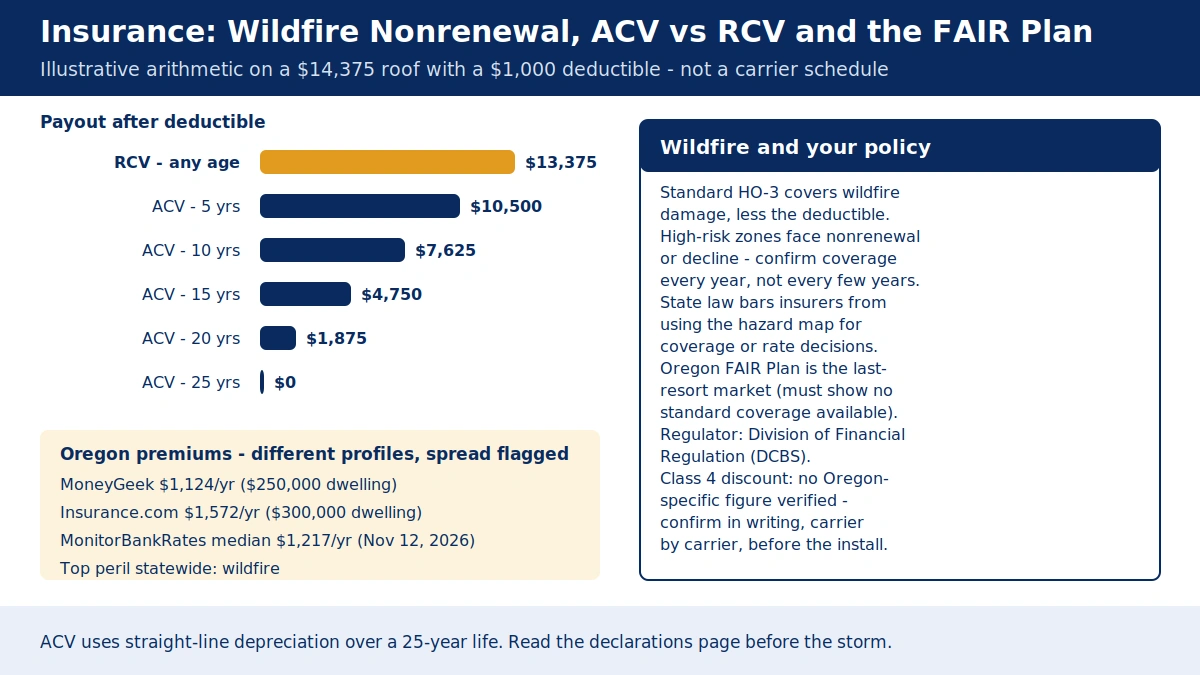
An Oregon homeowner’s insurance policy is the part of the roof that either earns its keep or delivers a nasty surprise, and in this state the surprise usually has a wildfire map attached to it. Three studies price Oregon coverage from different angles, and their premium figures do not agree. The disagreement is worth stating outright. MoneyGeek prices Oregon homeowners insurance at $1,124 a year, or $94 a month, ranking it 48th most expensive in the country and 68 percent below its national average of $3,467, on a $250,000 dwelling profile. Insurance.com prices the same state at $1,572 a year for $300,000 of dwelling coverage, against a national average of $2,543. MonitorBankRates, from Census Bureau figures, puts the Oregon median at $1,217 a year, or $101 a month, verified November 12, 2026. MarketWatch puts Oregon at $125 a month on average. The four studies use different dwelling values and different profiles. The spread between them is the point: no single average describes one specific Oregon house. Your own policy is the yardstick for every figure in this section. One fact sits behind all four studies: wildfire is the top peril in Oregon, and it is the peril that moves the premium even when the house never burns.
The wildfire problem is not the premium. It is the renewal. A standard HO-3 policy covers wildfire damage to the dwelling and personal property, paying for repairs or rebuilding after a loss, minus the deductible. But in high-risk wildfire zones, insurers may non-renew a policy or decline new coverage altogether, and the homeowner finds out at renewal time. Homeowners in those zones should confirm their coverage status every year, not every few years, and keep defensible space around the property. The state map cannot be the reason — Oregon law prohibits insurers from using the statewide hazard map for coverage or rate decisions — but insurers model wildfire risk themselves, and their models reach the same addresses the map does. Documented mitigation can move a declined home back into the standard market: a Class A roof, ember-resistant vents, cleared gutters, defensible space. When the standard market will not take the house, Oregon operates a state-mandated program of last resort, the Oregon FAIR Plan Association, which provides basic property coverage. To qualify, a homeowner generally must show an inability to get standard coverage. Before turning to the last-resort market, exhaust the standard one: an independent agent can quote carriers the homeowner will not reach directly, including surplus-lines insurers that specialize in higher-risk Oregon properties. For consumer help, for verifying an insurer’s license, for filing a complaint, or for understanding rights after a nonrenewal, the regulator is the Oregon Division of Financial Regulation, inside the Department of Consumer and Business Services.
The roof-age rule is what changes the call as the roof gets older. Insurers price youngest roofs cheapest: under ten years old is the sweet spot. In the ten-to-twenty-year window, expect the carrier’s standard rate and a closer look at the roof’s condition. Past twenty years, some insurers will not offer coverage for the roof at all, and some will not offer coverage for the house. MoneyGeek’s Oregon figures show the age gradient in the premium itself: newer homes cost $856 a year to insure on its profiles against $1,166 for older properties. Age is priced into the premium whether the roof is new or not, and a new roof on an old house is the single most effective way to move the number down.
The ACV versus RCV distinction is where the age rule turns into dollars. A replacement-cost-value policy pays the cost of replacing the roof at today’s prices, less the deductible, at any age. An actual-cash-value policy pays the depreciated value — the replacement cost minus the wear the roof has already used up. The arithmetic below is illustrative, built on a $14,375 roof, a $1,000 deductible, and straight-line depreciation over a 25-year life. It is not a carrier’s schedule, and no carrier’s schedule is printed here. On those assumptions, an RCV policy pays $13,375 at any age. An ACV policy pays about $10,500 at 5 years, about $7,625 at 10 years, about $4,750 at 15 years, about $1,875 at 20 years, and nothing at 25 years, when the roof’s depreciated value reaches zero. The gap between the two policies at year 15 is nearly $9,000, and it is the gap that decides whether a storm-damaged roof gets replaced or patched. Read the declarations page peril by peril while the weather is calm, not after the damage. The page says whether the roof is RCV or ACV, what the deductible is, and whether wind and hail carry a separate percentage deductible — often 1 to 5 percent of dwelling value rather than a flat dollar amount. Lifting a deductible from $500 to $1,000 usually trims the premium by 10 to 25 percent on the national pattern, per the Insurance Information Institute — genuine savings, and a genuine gamble on the next storm.
The mitigation discount is the one place the roof and the premium meet on the homeowner’s side. A Class 4 roof can earn a discount on the wind and hail portion of the premium, and a documented hardening package — Class A covering, ember-resistant vents, cleared defensible space — can move a declined home back into the standard market. The discount is carrier-specific, and no Oregon-specific percentage was verified. Confirm it in writing with the carrier before the install, with the exact shingle and the exact vent named. Verbal promises from a roofer carry no weight at renewal time; only the written confirmation counts. And remember what the insurer never pays for: gradual damage. A slow leak, a worn roof, rot from a long-running drip — those are the homeowner’s responsibility, and a claim can be denied on that basis. Policies pay for sudden and accidental damage. The roof that gets inspected twice a year is the roof that gets its claims paid.
Paying for It: No Federal Credit in 2026, HEAR Not Launched in Oregon & No Roof Rebate
The money section of an Oregon roof quote has a trap in it, and the trap is a line that should not be there. Any 2026 quote that subtracts a federal tax credit from a roof is wrong, and any quote that subtracts a HEAR rebate from a roof is wrong twice over. Both lines have to be found and taken out before the job is priced, because a quote built on money that does not exist is a quote that will grow by exactly that amount when the money fails to arrive.
The federal credit is $0. Both credits died the same way. The One Big Beautiful Bill Act — Public Law 119-21, signed July 4, 2025 — ended them for property placed in service after December 31, 2025, and IRS fact sheet FS-2025-05 states the cutoff. The Residential Clean Energy Credit, §25D at 30 percent, never covered a roof, because roofing never counted as solar equipment. The Energy Efficient Home Improvement Credit, §25C, was sometimes claimed for qualifying roofing materials, and that door has closed as well. A 2026 roof earns nothing from either one. A 2026 quote that still shows a tax-credit line was priced by a dead law. Ask for the line to come out and the quote to be re-priced. A contractor who insists otherwise has not read the law that governs the year they are working in. Our federal energy tax credits guide has the full federal picture: every credit, every cutoff date. One credit survives: §48E. It pays for clean-electricity equipment through a commercial or lease pass-through, and only for property in service by December 31, 2027. No record routes federal dollars through a lease or pass-through to an Oregon roof. None is claimed here.
The state rebates are not launched. Oregon received more than $113 million in federal funding for two rebate programs: HEAR, the Home Electrification and Appliance Rebates program, allocated $56,714,440, and HOMES, the Home Efficiency Rebates program, allocated $56,932,545. The Oregon Department of Energy’s own page states the position plainly: no rebates are currently available, and the department will set a launch date when it has approval from the U.S. Department of Energy. Contractor enrollment for the two programs opened on October 12, 2026. No homeowner application date exists. The published HEAR terms — up to $8,000 toward a heat pump, 100 percent of cost below 80 percent of area median income, 50 percent from 80 to 150 percent — describe a program that does not yet pay anyone. And HEAR never pays for a roof in any case: it pays for efficient electric appliances, heat pumps, insulation, air sealing, ventilation, wiring, and panel upgrades. HOMES pays up to $8,000 for whole-home efficiency work that models at least 20 percent energy savings. A roof is not on either list. DOE Program Notice 26-2, effective May 29, 2026, tightened HEAR further: it no longer pays to replace gas, oil, or propane equipment with electric equipment. Only electric-to-electric replacements qualify. A homeowner who plans a heat pump alongside a reroof should read the heat pump cost in Oregon guide for the rebate position on that system, and keep the roof’s money separate from the heat pump’s money.
As of this writing, Oregon offers no state-level roof grant, rebate, or tax credit, and no utility pays for a roof either. The Energy Trust of Oregon pays for heat pumps, insulation, and other efficiency work, and no Energy Trust roof incentive was verified — that is stated as a search result, not as a claim about Energy Trust’s whole catalog. The insurer is the one that pays: a Class 4 roof can earn a discount on the wind and hail portion of the premium, a documented hardening package can move a declined home back into the standard market, and each claim avoided is a deductible the homeowner keeps. Oregon has no sales tax, so a quote is the full price with no state tax added — a small mercy on a $14,000 job, and one less line to check. The honest way to pay for an Oregon roof in 2026 is the ordinary way: three written quotes on one spec sheet, a loan or a home equity line priced in our roof financing guide, and no line on the quote for money that does not exist.
Repair vs Replace & Getting Quotes in Oregon: The Decision Rules and the Checklist
The repair question has a short answer and a long one. The short answer is age and area. A roof under ten years old with damage in one place — a lifted flashing, a valley leak, a branch strike — is a repair. A roof over twenty years old with damage in more than one place is a replacement. The long answer is the deck. A roof that looks tired from the street but has a sound deck underneath is a reroof. A roof that looks fine from the street but has soft sheathing under the mossiest slope is a replacement with deck work, and the deck work is the line that decides the budget. Our roof repair cost guide prices the repair side, and our roof inspection cost guide prices the inspection that answers the deck question — $120 to $320 in Portland on Angi’s figures. Get the inspection before the quotes, not after. An inspector’s report is the only document in the process that does not come from someone trying to sell a roof.
Three decision rules carry the rest. First, never put a new array on an old roof. Solar panels last 25 years, and a roof with fewer than eight to ten years of life left in it will need replacing under the panels. The removal and reinstallation costs more than the roof does. Second, never overlay a third layer. The code limit is two, and a house that already carries two needs a full tear-off. Third, never sign on the first quote. The spread between three Oregon bids on the same scope routinely runs 20 to 30 percent, and the ten minutes spent lining them up on one spec sheet is the highest-paid time in the whole project.
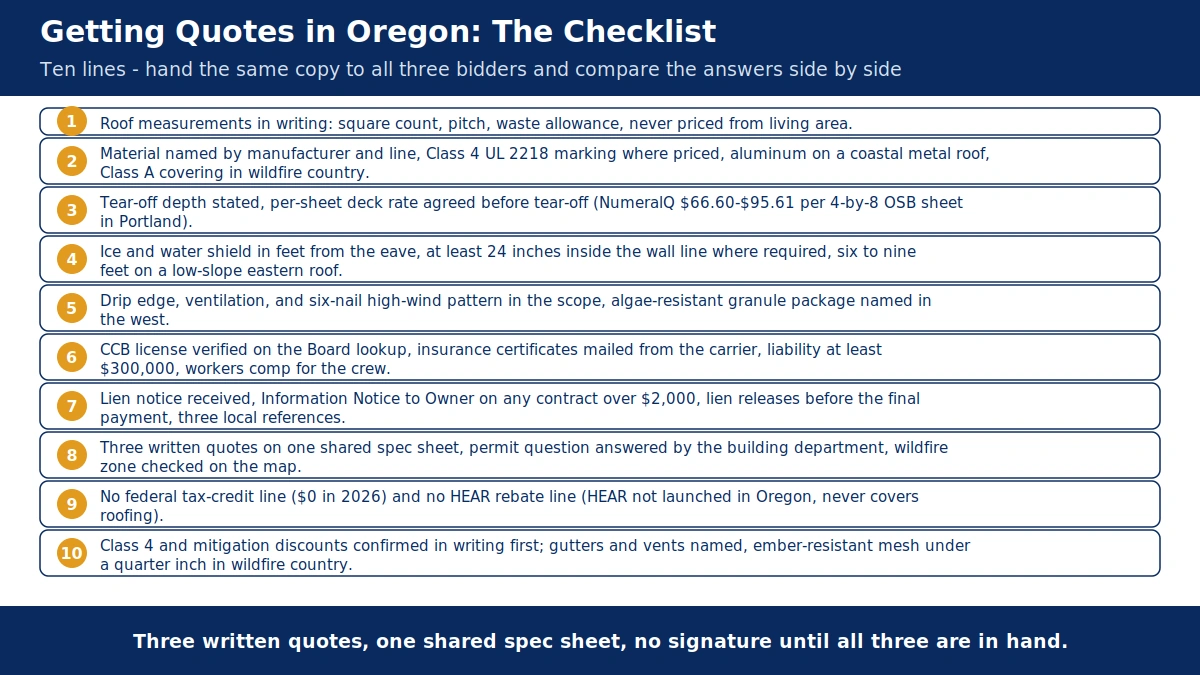
The checklist below is the whole guide in ten lines. Print it, hand the same copy to all three bidders, and compare the answers side by side.
- Roof measurements in writing: square count, pitch, and waste allowance. Living area is never the basis.
- Material named by manufacturer and line, Class 4 UL 2218 marking where priced, aluminum specified on a coastal metal roof, Class A covering named in wildfire country.
- Tear-off depth stated, per-sheet deck rate agreed before tear-off (NumeralQ $66.60–$95.61 per 4-by-8 OSB sheet installed in Portland).
- Ice and water shield coverage in feet from the eave, at least 24 inches inside the wall line where the code requires it, six to nine feet on a low-slope eastern roof.
- Drip edge, ventilation, and six-nail high-wind pattern in the scope, with the algae-resistant granule package named in the west.
- CCB license verified on the Board’s lookup, insurance certificates mailed from the carrier, general liability at least $300,000 for a residential specialty contractor, workers comp for the crew.
- Lien notice received, Information Notice to Owner on any contract over $2,000, lien releases from every party that sent a notice before the final payment, three local references from your own county.
- Three written quotes against one shared spec sheet, permit question answered by the building department, wildfire zone checked on the map for the address.
- No federal tax-credit line ($0 in 2026) and no HEAR rebate line (HEAR not launched in Oregon, never covers roofing).
- Class 4 and mitigation discounts confirmed in writing first; gutters and vents named in the scope, with ember-resistant mesh under a quarter inch in wildfire country.
Three written quotes, one shared spec sheet, no signature until all three are in hand. If a bid hides its square count, its material, or its license, there is nothing to compare it against. Refuse it.
What does a roof replacement cost in Oregon in 2026?
A typical 25-square architectural shingle roof costs $11,750–$17,000 in 2026, per SmartRoofingCalculator, and a 2,000 square foot roof costs $10,010–$12,230 statewide, per NumeralQ (pricing October 26, 2026). The 3-tab version of that 25-square roof is $9,625–$15,125 before tear-off. Class 4 impact-rated shingles run $12,500–$17,750 as modeled arithmetic, and standing-seam metal runs $23,500–$36,500. Portland runs $10,200–$12,480 for a 2,000 square foot roof, Salem about $10,500 at the midpoint, and Eugene about $10,025. Bend and Medford have no verified city-only figure in this pass, so the statewide band is the honest budget there.
How much does a roof cost per square in Oregon?
Architectural shingles run $470–$680 per square fitted with tear-off, per SmartRoofingCalculator. MyRoofData’s figure for the same material is $495–$825 a square before tear-off. Class 4 impact-rated shingles run $500–$710 a square as modeled arithmetic — a Michigan agent’s $30-a-square premium applied to the Oregon architectural band, because no Oregon-specific Class 4 premium was verified. Standing-seam metal runs $940–$1,460 a square fitted, and 3-tab $385–$605 before tear-off. One square equals 100 square feet of finished roof surface; that is the unit every Oregon bid uses.
Do I need a permit to replace a roof in Oregon?
Usually not for a like-for-like reroof, and the reason is a statute. ORS 455.310 puts replacement or repair of roofing on the exempt list for single-family homes, and Portland’s Bureau of Development Services treats a like-for-like reroof on a one- or two-family home as generally permit-exempt, even when some or all of the sheathing is replaced. A permit is needed when the scope crosses into structure, a heavier material, a townhouse, building-integrated solar panels, or a wildfire hazard zone. Jackson County needs one when 15 percent of the sheathing is removed or replaced, or always in a wildfire hazard zone. If the county and the contractor disagree, the building department decides.
Does Oregon license roofers?
Oregon has no roofer-only license, but every paid roofer must hold a Construction Contractors Board license under ORS 701.021. Most single-trade roofing outfits hold a Residential Specialty endorsement: 16 hours of pre-license training, an 80-question exam passed at 70 percent, a $20,000 surety bond, and $300,000 of general liability insurance per occurrence. The license costs $400 for two years. Working without one is a Class A misdemeanor. Verify the number on the CCB’s license lookup before signing, and ask for insurance certificates mailed from the carrier.
Does wildfire change what roof I can put on my Oregon home?
It can, and in two ways. In Portland’s mapped wildfire hazard areas, the city requires fire-resistant roofing and a permit for the reroof. Statewide, the January 2025 hazard map puts about 106,000 properties in a high hazard zone inside the wildland-urban interface, and the fire hardening code in draft would require Class A or B roof coverings when a covered item — including a roof — is replaced. The code is not yet adopted for enforcement, so a reroof today is not bound by it, but the roof will live under it. Cedar shakes are the material at risk: they are restricted in some wildfire-prone areas unless treated to a Class A or B rating. Architectural shingles, metal, tile, and slate all carry Class A ratings as systems.
How does moss damage an Oregon roof, and what stops it?
Moss anchors itself with root-like rhizoids that grip the shingle granules, and as it grows it lifts the shingle edges. Water then wicks upward and under the shingle, reaches the deck, and rots it. Algae streaks the surface black and strips granules without lifting the shingle. The specification that answers both is algae-resistant shingles with copper or zinc granules, zinc or copper strips at the ridge, and ventilation that lets the roof dry between storms. Clean by soft-wash only, never pressure-wash asphalt. Plan on 20 to 25 realistic years from architectural shingles in Oregon, not the 22 to 30 the manufacturer prints, because the wet west ages asphalt faster than dry climates do.
How long does a roof last in Oregon?
Rain, moss, and the eastern freeze cut shingle life short and leave metal and slate standing longer than the brochure claims. Expect 75–150 years from natural slate and 50 or more from tile; 40–60 from standing-seam metal and 30–40 from ribbed metal; 20–30 from cedar shakes; 25–30 from Class 4 shingles, 20–25 from architectural shingles, and 15–20 from 3-tab. For flat membranes, expect 20–30 years from EPDM, 15–25 from TPO, and 15–20 from modified bitumen. Those lives get cut short by moss, wind-driven debris, salt corrosion on the wrong metal, ice dams in the east, and embers in the south. Inspect the roof twice a year: once in fall after the dry season ends, and once in spring before the wet season begins.
Can I get a rebate or tax credit for a new roof in Oregon in 2026?
No. Finish a roof after December 31, 2025 and neither federal credit pays anything. The Residential Clean Energy Credit (§25D) pays nothing on a roof, and neither does the Energy Efficient Home Improvement Credit (§25C). Public Law 119-21 — the One Big Beautiful Bill Act, signed July 4, 2025 — closed both credits for installs finished after 2025. Oregon’s HEAR and HOMES rebates have not launched — the Oregon Department of Energy says no rebates are available and contractor enrollment opened October 12, 2026, with no homeowner application date set — and HEAR never pays for a roof in any case. No Oregon state roof grant, rebate, or tax credit exists as of this writing, and no utility roof rebate was found either. The insurer is the one that pays: a Class 4 roof can earn a discount on the wind and hail portion of the premium, and a documented hardening package can move a declined home back into the standard market.