

In North Dakota, a 2,000 sq ft roof in architectural asphalt shingles costs $10,080–$12,320 installed in 2026. NumeralQ’s October 26, 2026 planning figures put Fargo at $10,240–$12,530 and Bismarck at $9,270–$11,270 for the same job. A metal roof costs far more up front, lasts roughly twice as long, and sheds snow and hail better. No federal tax credit exists for a 2026 roof. North Dakota’s home energy rebates have not launched, and no statewide roof grant exists. Before a crew is hired, the buyer checks the contractor’s license in the Secretary of State’s FirstStop lookup, and in Fargo and Bismarck a plain reroof needs no permit, while Grand Forks requires one.
North Dakota is the coldest state in the Lower 48 for roof work, and the numbers in this guide show it. The installing season runs about May to October, the ground snow load reaches 60 pounds per square foot in places, and the state recorded its highest tornado count ever, 82, in 2025. An EF5 tornado near Enderlin on June 20, 2025 killed three people with winds over 210 miles per hour. A roof bought here has to survive snow sitting on it for months, hail in June, wind in July, and freeze-thaw cycling from October to April. The price bands below come from NumeralQ planning estimates priced October 26, 2026, checked against three other sources, with every conflict and every unverified figure named in place. Prices are for a 2,000 sq ft roof unless a table says otherwise, and every band is installed, meaning tear-off, materials, labor, and disposal are inside the number.
Table of Contents
How Much Does a Roof Replacement Cost in North Dakota?
Five sources price a North Dakota roof, and they do not all measure the same job. NumeralQ publishes the state figures on its North Dakota page, priced October 26, 2026, built from material prices and local labor. NumeralQ, dated October 26, 2026, is the lead source in this guide because it publishes a full material table for Fargo, a city band for Bismarck, and a state band, all for the same 2,000 sq ft architectural-shingle job. SmartRoofingCalculator, dated April 24, 2026, prices a 25-square roof at $10,750–$15,500, or $430–$620 per square, with a North Dakota factor of 0.960. MyRoofData puts a typical North Dakota home at $12,250–$21,000, with a 23.4-square example at $12,200–$21,100, an index of 0.95, crews at $50–$85 an hour, and tear-off at $100–$200 per square per layer. A Minot contractor guide prices architectural shingles at $9,000–$22,000, or $450–$750 per square. RoofingEstimatorPros reports $13,286–$23,873 with an average of $17,991, which sits far above the other four and is set aside here as a high outlier.
| Roof size (sq ft) | North Dakota cost (installed) | Implied $ per sq ft |
|---|---|---|
| 1,000 | $5,320–$6,580 | $532–$658 |
| 1,500 | $7,700–$9,450 | $513–$630 |
| 2,000 | $10,080–$12,320 | $504–$616 |
| 2,500 | $12,450–$15,190 | $498–$608 |
| 3,000 | $14,830–$18,050 | $494–$602 |
The headline figure, $10,080–$12,320 for a 2,000 sq ft architectural-shingle roof, comes from NumeralQ’s state band. Its national figure for the same model is $9,710–$11,840, so North Dakota runs about 4 percent above the national price. MyRoofData points the other way at minus 5 percent, and SmartRoofingCalculator at 0.960. The three sources disagree on direction, and this guide reports the disagreement instead of picking a winner. For a buyer comparing quotes, the $11,200 midpoint is the working figure, not the low end and not the high end.
Instant Roofer and One Good Roofer publish no North Dakota figures that could be found, and their absence is recorded here rather than filled in. CostBand lists $33,980, but that is a different job, a 3,000 sq ft Cost vs Value model, so it appears only as background. The bands above exclude sales tax treatment, because NumeralQ does not say whether its figures include tax on materials. North Dakota charges 5 percent state sales tax plus local tax, with combined rates from 5.0 percent to 8.75 percent, the highest in Grafton. A buyer should ask the contractor whether the quote includes tax, because on an $11,200 job the tax alone can add $560–$980.
What the bands leave out matters as much as what they hold. The NumeralQ figures cover tear-off, materials, labor, and disposal for a standard 2,000 sq ft architectural-shingle roof. They do not cover a skylight replacement, a structural repair to rafters or trusses, a full gutter replacement, or a deck rebuild. Those items arrive as separate lines, and the add-on figures in the material section price the common ones. A buyer comparing two quotes should check that both quotes carry the same inclusions, because a band that looks cheap often leaves the decking allowance out.
Labor is the other half of the band, and North Dakota’s labor market moved fast. The Bureau of Labor Statistics put the median roofer wage at $23.00 an hour in May 2024 and $28.72 an hour in May 2025. Contractors bill that wage out at roughly $57–$75 an hour once overhead, insurance, and the short season are counted. Fargo’s median sits higher still at $29.62 an hour, billed at $59–$77, while Bismarck’s median is $24.20, billed at $48–$63. The gap between the two cities shows up directly in the roof bands. Crews in the state run $50–$85 an hour according to MyRoofData, and tear-off runs $100–$200 per square per layer, so a two-layer tear-off on a 20-square roof can add $4,000–$8,000 before a single shingle is laid.
The national comparison puts North Dakota in context. NumeralQ’s national figure for the same 2,000 sq ft architectural model is $9,710–$11,840, against North Dakota’s $10,080–$12,320, which is about 4 percent higher. MyRoofData’s index points the other way at 0.95, and SmartRoofingCalculator at 0.960. The disagreement is honest: different sources weight labor, materials, and the short season differently, and none of them publishes its full model. A buyer should treat the state band as the planning figure and the quote as the real figure, and should be suspicious of any quote that lands far outside the band in either direction.
Roof Replacement Cost in North Dakota by Material
The Fargo figures come from NumeralQ’s Fargo page, dated October 26, 2026, carrying the full material table for a 2,000 sq ft roof, installed. Fargo is the most expensive city in the state for this work, so these figures are the top of the North Dakota range, not the middle. Bismarck’s architectural band, $9,270–$11,270, sits about 11 percent below Fargo’s $10,240–$12,530. The table below is Fargo’s.
| Material (2,000 sq ft, installed) | Cost |
|---|---|
| 3-tab asphalt shingles | $8,450–$10,040 |
| Architectural asphalt shingles | $10,240–$12,530 |
| Designer asphalt shingles | $12,140–$14,690 |
| Exposed-fastener metal | $15,810–$20,100 |
| Stone-coated steel | $17,790–$25,600 |
| Synthetic slate / shake | $18,720–$26,850 |
| Cedar shake | $19,040–$32,860 |
| Concrete tile | $21,130–$29,870 |
| Standing-seam metal | $22,660–$34,050 |
| Clay tile | $26,940–$42,230 |
| Slate | $34,790–$66,090 |
| Modified bitumen (flat) | $11,340–$14,610 |
| EPDM rubber (flat) | $11,710–$18,030 |
| TPO (flat) | $14,120–$18,790 |
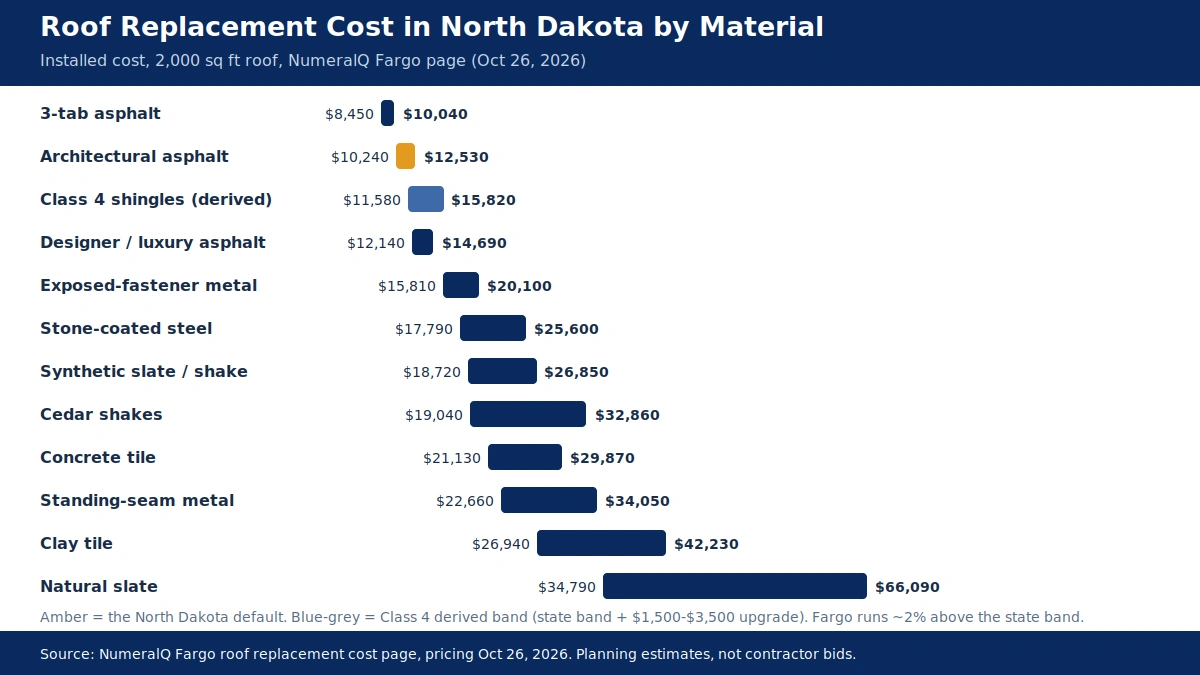
Three-tab shingles are the cheapest cover on the table and the weakest. One flat layer of asphalt with cut tabs, rated 15–20 years, with the lowest wind and impact resistance of any shingle, they save about $1,800 against architectural on a 2,000 sq ft roof and give back roughly a decade of life. Architectural shingles, two layers laminated, rated 20–30 years, are the standard North Dakota choice and the band this guide leads with. Designer shingles add about $1,900 over architectural for thicker profiles that mimic slate or shake. Standing-seam metal, at $22,660–$34,050, costs roughly twice the architectural band and carries a 40–70 year life. Exposed-fastener metal, $15,810–$20,100, is the budget metal option, but its screws need resealing over time. Slate, at $34,790–$66,090, is the most expensive cover and the longest-lived, and few North Dakota homes carry it because the weight needs a reinforced structure.
Rated lives in the lifetime math come from the MyRoofData North Dakota page, which publishes nine material rows for the state. Where that page publishes no rated life, designer shingles, stone-coated steel, and synthetic slate or shake use the spans from the same model family in sibling states, 25–30, 40–50, and 40–50 years, and those spans are model-family figures, not North Dakota-published ones.
Flat and low-slope roofs take modified bitumen, EPDM, or TPO, at $11,340–$18,790. These are commercial and garage materials more than house materials, and a buyer with a flat section should get the flat price as its own line, not blended into the shingle band.
Fargo’s add-ons, also from NumeralQ, are priced separately from the material bands. Tearing off an extra layer costs $1.43–$1.88 per sq ft. A sheet of OSB decking runs $66.94–$96.05 installed, and a 1970s roof can need a dozen sheets once the old covering comes off. A full ice-and-water barrier across the whole deck, rather than just the eaves and valleys, costs $0.92–$1.46 per sq ft, or $1,840–$2,920 on a 2,000 sq ft roof. New gutters run $9.03–$12.85 per linear foot. Flashing runs $366–$519, and reflashing a skylight runs $536–$692. A buyer who budgets the material band alone and skips these lines gets a surprise. Budget the band plus the named contingencies, and the figure that comes out survives contact with the quote.
Three-tab shingles deserve a closer look before a buyer picks them for the price. In a state where the June hail season can drop 2-inch stones, a 3-tab shingle’s thinner mat and lower impact resistance mean it fails earlier and more often than an architectural shingle. The $1,800 saved on day one can turn into a deductible paid twice, once for the hail claim and once for the early replacement. For a rental or a house the buyer plans to sell within five years, 3-tab can still make sense. For a house the buyer plans to keep, it rarely does.
Designer shingles sit between architectural and the premium materials, and they sell on looks. Thicker profiles that mimic slate or wood shake cost about $1,900 more than architectural on a 2,000 sq ft Fargo roof, and they carry similar wind ratings. The buyer pays for appearance, not for a longer life, and should know that before signing. Stone-coated steel, at $17,790–$25,600, offers a middle path between shingles and standing seam: a steel panel with a stone-chip coating that looks like a shingle, sheds snow like metal, and carries a hail rating. It is less common in North Dakota than in the Mountain West, so the installer pool is thinner, and the buyer should check references the same way as for standing seam.
Tile and slate carry a weight question that no price table answers. Concrete tile at $21,130–$29,870 and clay tile at $26,940–$42,230 both need a structure that can carry them, and most North Dakota houses framed for asphalt cannot. A structural check comes before the tile quote, not after, and the check itself costs money. Slate, at $34,790–$66,090, is heavier still and rarer in the state. A buyer who loves the look of tile should budget the structural work separately and ask the contractor to name it, because a tile quote without a structural line is a quote that will grow.
Flat and low-slope sections take a different set of materials, and the price table shows it. Modified bitumen at $11,340–$14,610, EPDM rubber at $11,710–$18,030, and TPO at $14,120–$18,790 are the three options for a flat garage or porch roof. TPO costs the most and reflects the most heat, which matters less in North Dakota than in Arizona, but its welded seams hold up well under snow load. EPDM is the budget flat option and the easiest to repair. A buyer with a flat section should get the flat price as its own line, not blended into the shingle band, and should ask how the flat section drains, because a flat roof that ponds water in April will leak in May.
Roof Replacement Cost in North Dakota by Roof Size
Roofers charge by the square, and the square is 100 sq ft of roof surface. A 2,000 sq ft roof is 20 squares before waste is added, and a pitched roof has more surface than the house footprint it covers, because the pitch stretches the surface and the overhangs add area. Floor area and roof area are different numbers. A steep 1,500 sq ft ranch can carry as much roof surface as a shallow 2,500 sq ft two-story, so the quote should show the square count, not the floor area.
| Roof size (sq ft) | Cost (installed) | Implied $ per sq ft |
|---|---|---|
| 1,000 | $5,320–$6,580 | $532–$658 |
| 1,500 | $7,700–$9,450 | $513–$630 |
| 2,000 | $10,080–$12,320 | $504–$616 |
| 2,500 | $12,450–$15,190 | $498–$608 |
| 3,000 | $14,830–$18,050 | $494–$602 |
The price per square falls as the roof grows, from $532–$658 at 1,000 sq ft to $494–$602 at 3,000 sq ft. Dumpsters, delivery, travel, and permits cost the same whether the roof is 15 squares or 30, so those fixed lines get thinner as the roof grows, while shingles and labor per square barely move. Small roofs pay more per square because they carry the same fixed load on fewer squares. The table is built by scaling NumeralQ’s 2,000 sq ft band with the same per-square fall the national model shows, and it is presented here as a planning tool, not a quote. When a quote comes in well above the table’s implied rate for the same size, the pitch, the complexity, the layers, or the decking should explain it. When a quote comes in well below, the same questions apply, because a price far under the band usually leaves something out.
After size, waste is the number buyers miss. A plain gable roof loses about 10 percent of material in cuts. Valleys, dormers, and a chimney push waste higher, and it appears as extra squares on the material order rather than its own line. Of all the features, pitch moves labor price the most. For the baseline, take a walkable 4-in-12 pitch, which climbs 4 inches across every 12 inches of run. On a steep 10-in-12 or 12-in-12 roof the crew needs jacks and staging and moves slower, and the price reflects that. Stories matter because height changes how the crew works. On a single-story ranch, material stages at eave height and the tear-off drops straight into the dumpster. On a three-story home the crew needs a conveyor or a crane lift for the tear-off and the delivery, and more of the day goes to moving material than installing it.
For a quick estimate, take the 2,000 sq ft midpoint of $11,200, divide by 20 squares for $560 per square, and multiply by the roof’s square count, remembering that smaller roofs pay more per square and larger roofs less. That is a rule of thumb, not a quote. The table above already runs that math, so a buyer can read the figure straight off it.
Measuring the roof is the step that decides whether the band fits. Most North Dakota contractors measure by satellite now, tracing the roof outline on aerial imagery and letting software compute the squares, the pitch, and the waste. A tape measure on the ground, using the footprint plus the pitch multiplier, gets close enough for a planning figure. Either way, the buyer should see the square count in the quote and check it against the table. A 20-square quote on a house the buyer measured at 24 squares is a quote that will grow by change order, and a 28-square quote on a 20-square roof is a quote that overcharges from the start.
Complexity is the second multiplier after size. A plain gable roof with two slopes is the cheapest shape to roof. Every valley, dormer, skylight, and chimney adds cutting time, flashing work, and waste. A roof with four valleys, two dormers, and a chimney can cost 15–25 percent more than a plain roof of the same square count, and the extra shows up as labor and flashing lines rather than as a separate complexity fee. The buyer should ask the contractor to walk the roof and name the complexity features in the quote, because a quote written from the ground misses them.
Pitch is the third multiplier, and it works through safety and speed. On a walkable 4-in-12 roof the crew moves freely and carries bundles by hand. On a 10-in-12 roof the crew works from jacks and staging, moves slower, and charges more per square. Some contractors will not walk a 12-in-12 roof at all and will quote a lift or a harness crew instead. The pitch should appear in the quote as a number, not as a word like steep, because the number is what the price is based on.
Roof Replacement Cost in North Dakota by City
Only two North Dakota cities have their own NumeralQ pages, Fargo and Bismarck. Grand Forks and Minot have none, so this guide assigns them the state band and labels it a planning estimate, backed by two independent cross-checks each. Four bands that looked equally solid would mean two of them were invented.
| City | Architectural shingles (2,000 sq ft, installed) | Basis |
|---|---|---|
| Fargo | $10,240–$12,530 | NumeralQ city page, verified |
| Bismarck | $9,270–$11,270 | NumeralQ city page, verified |
| Grand Forks | $10,080–$12,320 | State band, planning estimate |
| Minot | $10,080–$12,320 | State band, planning estimate |

Fargo is the most expensive city in the state. Its architectural band is $10,240–$12,530, with a midpoint of $11,385. The roofer median wage in Fargo is $29.62 an hour, billed at $59–$77, the permit for a $15,000 job is $121, the median home is $281,900 built in 1991, the roof costs 4.0 percent of the home value, and 23 contractors work in Cass County. Bismarck runs about 11 percent below Fargo, at $9,270–$11,270 with a midpoint of $10,270. Its roofer median wage is $24.20 an hour, billed at $48–$63, the permit is $176.95, the median home is $300,300 built in 1985, the roof costs 3.4 percent of the home value, and 12 contractors work in Burleigh County.
Grand Forks and Minot get the state band, $10,080–$12,320, as a planning estimate. Two cross-checks support it. GetMyRoofEstimateNow puts both cities at $7,000–$18,500 with about $11,500 typical. Shingle Geek’s retail pricing for a GAF HDZ shingle roof puts Grand Forks at $11,110–$12,036 for a 22-square roof and Minot at $11,651–$12,621 for a 24-square roof. In Fargo, a good quote names the ice-barrier scope, the shingle’s hail rating, and how the crew will install in cold weather if the job runs into the winter months. In Minot, the buyer should work from the state band, ask which wind rating the shingle carries by name, and get the permit fee from the city desk in writing, since the Minot permit figure is a single-source estimate of $100–$200.
Fargo costs more than Bismarck for reasons a buyer can check. The roofer median wage is $29.62 an hour in Fargo against $24.20 in Bismarck, and the billed rate follows at $59–$77 against $48–$63. Demand is higher in Fargo too: 23 contractors work in Cass County against 12 in Burleigh County, but the Fargo metro is larger and busier, and the hail season keeps crews booked. The median home in Fargo is $281,900 built in 1991, against $300,300 built in 1985 in Bismarck, and the roof costs 4.0 percent of the home value in Fargo against 3.4 percent in Bismarck. None of those figures is a quote, but together they explain why the same shingle costs about 11 percent more in Fargo.
Rural pricing works differently from city pricing. Outside the four cities, the contractor’s travel time, the delivery distance for materials, and the size of the local crew pool all push the price, and the direction is not always up. A rural contractor with lower overhead can undercut a Fargo crew, but the buyer pays for the travel in the quote or in the wait. A buyer in a small town should get at least one bid from a local contractor and one from the nearest city, and compare the two line by line, because the cheapest rural bid sometimes leaves out the disposal fee or the permit, and the city bid sometimes adds a travel charge the local bid does not carry.
After a hail event, the city bands stop mattering for a while. Crews book out for weeks, material prices spike, and the same roof costs more in July than it did in May. A buyer who can wait until the backlog clears gets a better price and a calmer crew, and a buyer who signs in the week after the storm pays the storm price. The timing section at the end of this guide covers the calendar in detail.
Snow Loads, Ice Dams, and Freeze-Thaw: What a North Dakota Winter Does to a Roof
Snow load is the one figure in this guide that changes by address more than any other, and it changes by a lot. ASCE 7-22, the national loading standard, puts North Dakota ground snow loads at 25–60 pounds per square foot. The USDA and International Building Code listing gives 30–60. For planning, this guide uses a statewide range of 35–50 pounds per square foot from a secondary table, and it does not adopt the 50-pound figure sometimes quoted for Fargo and Grand Forks, because that number rests on a single source. The buyer should get the design load for the actual address from the city desk or the structural engineer, not from a state average. A roof built for 35 pounds per square foot in a 60-pound zone is a roof carrying a load it was never designed for.
Snowfall, measured by NOAA over 1991–2020, runs about 51.4 inches a year in Fargo, 50.5 in Bismarck, 49 in Grand Forks, and 45.1 in Minot. Snow that sits on a roof for months does two kinds of damage. Its weight loads the structure, and its meltwater finds every gap the ice dam creates. Heat escaping through the attic melts snow on the upper roof. That water runs down to the cold eave, refreezes into a ridge, and traps more water behind it. The trapped water backs up under the shingles and leaks into the house. The code answer is an ice-and-water barrier from the eave edge to 24 inches inside the wall line, under IRC R905.1.2. The full-deck version of that barrier costs $1,840–$2,920 on a 2,000 sq ft roof, and on a low-slope or valley-heavy roof it is money worth spending. The other half of the fix is in the attic, not on the roof: insulation and ventilation that keep the roof deck cold so the snow does not melt from below. When a roofer prices a new cover over a poorly insulated attic and says nothing about the attic, only half the problem is being fixed, and the attic insulation cost guide prices the other half.
Cold also changes how a roof is installed. Owens Corning’s technical bulletin TB-10022497-A says shingles installed at or below 40 degrees Fahrenheit need hand-sealing, with roofing cement applied under each tab because the factory adhesive strip will not activate in the cold. Fargo’s average highs run under 40 degrees from November through March, and Bismarck’s from December through February. The practical installing season runs about May to October, according to MyRoofData, and a job that slips into the cold months should show hand-sealing as a line in the quote.
Ward County’s design checklist shows how the code stacks the loads on one address: 115 mile-per-hour wind in exposure C, 48 inches of frost depth, a winter design temperature of minus 20 degrees, ground snow load from the ASCE 7 tool, and an air freezing index of 4,000. Frost depth itself carries a conflict this guide does not resolve: Ward County lists 48 inches, a Minot guide lists 60 inches, and a secondary statewide average lists 75 inches. No verified city design wind speed was found for Fargo, Bismarck, Grand Forks, or Minot, and none is stated here. Each freeze-thaw cycle works the cracks a little wider. Water gets into small cracks, freezes, expands, and opens the crack wider, and the cycle repeats from October to April. The material choice that survives that cycle best is covered in the asphalt-versus-metal section below.
Ventilation is the part of the winter roof that buyers forget, and it is the part that prevents ice dams. A roof needs intake air at the soffits and exhaust air at the ridge, and the two have to balance. When the intake is blocked by insulation or the exhaust is missing, the attic warms, the snow melts from below, and the ice dam forms at the eave. A new roof is the right moment to fix ventilation, because the ridge vent goes on with the shingles and the soffit vents are cheap while the crew is already on site. The buyer should ask for the ventilation plan in the quote, not as an afterthought, and should check that the quote names the ridge vent length and the soffit vent count.
Gutters and downspouts carry the winter water, and they fail first. Ice in a gutter lifts the gutter off the fascia, and a gutter full of ice pulls its fasteners out of the wood. New gutters run $9.03–$12.85 per linear foot in Fargo, and a buyer replacing a roof should price the gutters at the same time, because the crew is already on the roof and the fascia is already exposed. A gutter quote that appears after the roof is done costs more than the same gutter priced with the roof.
The spring thaw is the leak season. Snow that sat on the roof all winter melts in March and April, and every gap the ice dam opened shows up as a stain on the ceiling. A buyer who finds a stain in April should not wait for the next winter to fix it. The leak gets worse with every thaw, and the decking under it rots while the buyer waits. The repair table in the last section prices a leak fix at $324–$900 in Fargo, and a skylight leak at $344–$680, which is cheap against the cost of a rotted deck.
Hail, Tornadoes, and High Winds: The Storm Risk a North Dakota Roof Faces
Hail is a summer risk in North Dakota, and the calendar is narrow. About 87 percent of the large-hail reports in the last ten years fell in June, July, and August, according to NOAA. Cass County and seven surrounding counties recorded 330 reports of hail at least one inch across from 2016 to 2025, or 36.5 reports per 1,000 square miles, against 30.5 for the state and 20.1 nationally. Cass County alone recorded 90, with six at two inches or more, and 156 damaging-wind reports. FEMA rates the hail risk in the Fargo area as Relatively High, and 15 tornadoes touched down in the same counties over the same decade. Burleigh County and six surrounding counties recorded 328 large-hail reports, or 32.1 per 1,000 square miles, with Burleigh alone at 69 and 15 at two inches or more, 82 damaging-wind reports, and 12 tornadoes.
The largest stones on record are recent. South Fargo saw 4.0-inch hail on June 29, 2026. Burleigh County saw 4.5-inch hail on July 29, 2024. Since 2010, hail has fallen within 15 miles of Bismarck on 66 days and within 15 miles of Fargo on 48 days, according to Storm Prediction Center data via Cloudbreak, through November 12, 2026. North Dakota ranks 30th nationally for damaging wind, with 2,318 reports since 2016. The strongest gusts recorded since 2006 were 92 miles per hour in Burleigh County on June 20, 2025, and 99 miles per hour in Cass County on June 21, 2025. FEMA rates strong-wind risk as Very High in Cass County and Relatively Moderate in Burleigh County.
Tornadoes are the risk that changed most recently. North Dakota averages 23.2 tornadoes a year over 1950–2025, and 2025 set the record at 82. An EF5 tornado near Enderlin on June 20, 2025, with winds over 210 miles per hour and a 12.1-mile track, killed three people. No roof covering is rated for an EF5. What actually holds the roof on is the shingle’s wind rating and the nailing pattern. Most architectural shingles are rated for winds of 110–130 miles per hour, while the stronger lines carry a Class H rating of 150 miles per hour. North Dakota guides describe a six-nail pattern, six nails per shingle rather than the usual four, as standard practice where wind matters, and that description rests on a single source. A buyer should still ask for the nailing pattern and the wind rating by name in the quote, since those two lines are what hold the roof on in the next July storm.
The storm calendar is the part of the risk a buyer can plan around. Large hail concentrates in June, July, and August, with about 87 percent of the reports in the last ten years falling in those three months. Tornado season runs May through August, and the record 82 tornadoes in 2025 all fell inside that window. Damaging wind reports run year-round but cluster in the summer, when thunderstorms carry the strongest gusts. A buyer scheduling a roof should aim for May or September, before the hail season peaks and after it passes, and should avoid signing a contract in the week after a storm, when prices spike and the out-of-state crews arrive.
After a hailstorm, the inspection matters more than the repair. A buyer should walk the property, photograph every slope, every gutter, and every window screen, and keep the photos with the date. Hail damage on a shingle shows as bruised granules, cracked mats, and dented flashing, and a homeowner can miss it from the ground. A free inspection from a door-knocking crew is not the same as an inspection from the insurer’s adjuster, and the buyer should get the adjuster out before signing anything. The hiring section covers the storm-chaser risk in detail, and the insurance section covers the claim order.
Wind-borne debris is the risk the hail numbers miss. A 99 mile-per-hour gust in Cass County on June 21, 2025, the strongest recorded in the county since 2006, throws branches, signs, and loose material across a roof, and a shingle that survives the wind can still fail when a branch hits it. The wind rating on the shingle covers the wind, not the debris. A buyer in a treed neighborhood should budget for a Class 4 shingle or a metal roof for the debris resistance, not just the wind rating, and should keep trees trimmed back from the roofline, because a branch over the roof is a claim waiting to happen.
Asphalt Shingles vs Metal Roofing in North Dakota
Choosing between asphalt and metal is the biggest money decision in a North Dakota roof, and the state’s weather argues harder against the default choice than in most states. Architectural asphalt runs $10,240–$12,530 in Fargo and $9,270–$11,270 in Bismarck for a 2,000 sq ft roof. Standing-seam metal runs $22,660–$34,050 in Fargo and $20,420–$31,130 in Bismarck. Metal costs about double to triple on day one, lasts about double the rated life, and behaves differently under snow, hail, and wind. The comparison below prices that trade honestly, including the per-year math that flips the first impression.
Snow is where metal makes its strongest case. A smooth metal surface lets snow slide off instead of sitting on the roof, so the structure carries less load through the winter and ice dams form less often at the eaves. Standing-seam panels move with temperature through concealed fasteners that allow expansion and contraction, which matters in a state where the temperature can swing 40 degrees in a day and the winter design temperature in Ward County is minus 20 degrees. MyRoofData names standing seam as one of the three most-installed systems in the state, and the farm-building supply lines that run through North Dakota keep the material and the crews available. Snow retention is not optional. Wet snow sliding off a two-story metal roof can injure a person standing below and tear a gutter line off the house. Snow guards, the bars or cleats that hold snow in place until it melts, belong above every entry, walkway, and driveway. In North Dakota, a metal quote with no snow-retention line is incomplete. The buyer should ask where the guards go and what they cost.
Hail is where the two materials fail in opposite ways, and each failure carries its own insurance result. Metal dents. Take a 2-inch hailstone. It cracks an asphalt shingle and dents a metal panel, and some policies treat that dent as cosmetic-only damage, so the insurer pays nothing for a roof that looks battered but still sheds water. Asphalt fails by cracking, and once the granules are gone the mat is exposed. That is functional damage, and insurers pay for functional damage. The insurance side is covered in detail in the Class 4 section. In practice, a metal roof in the Bismarck hail corridor calls for a hail-dent conversation with the insurer before installation. The buyer should know whether the policy pays for cosmetic denting or only for functional damage.
In North Dakota, asphalt lives a shorter real life than its rating promises, and that gap is the strongest argument against it. The MyRoofData rating puts architectural asphalt at 22–30 years. No North Dakota-specific shortened-life figure was verified in this research, so none is used here, but the mechanism behind a shorter life is sound: ultraviolet exposure on the open prairie degrades granules, freeze-thaw opens cracks, and hail strips granule coverage, and all three act faster in North Dakota than in a mild climate. Anyone staying in the house for 30 years should plan on two asphalt roofs or one metal roof, and the per-year math below prices that exact choice.
The per-year math flips the sticker-price verdict. That math carries the NestPriced arithmetic label: Fargo midpoints over rated-life midpoints. Divide the $11,385 Fargo midpoint by a 26-year life, and architectural asphalt works out to roughly $438 a year. Divide the $28,355 Fargo midpoint by a 55-year life, and standing-seam metal works out to roughly $516 a year. Divide $17,955 by a 35-year life, and exposed-fastener metal works out to roughly $513 a year. Three-tab shingles are the cheapest roof to buy and the most expensive roof to own, at about $528 per year, because the short life dominates. Concrete tile, at $25,500 over 57.5 years, costs about $443 per year, close to architectural asphalt on this math, before the structural check. Divide $50,440 by a 112.5-year life, and natural slate works out to roughly $448 a year. Under $100 a year separates the cheapest lifetime cost from the most expensive, so snow, hail, wind, and how long the buyer stays drive the material choice, not the annual cost alone.
What matters more than the point estimate is how sensitive it is. Cut the architectural asphalt life to 20 years from 26, and the yearly cost climbs to about $570, the highest figure in the table. Stretch the life to the full 30 years, and the annual cost falls to about $380, the cheapest. The question that matters is not which material wins the midpoint math. It is how long the roof will actually live in that microclimate, on that pitch, under that hail exposure. In the Red River Valley, a shaded low-slope asphalt roof may live out its full rating. A south-facing asphalt roof on the open prairie, under freeze-thaw cycling and hail, may not. A roofer who has worked the neighborhood for a decade knows the answer, so the buyer should ask.
The noise worry is a myth worth retiring. Put a metal roof over a solid deck with insulation and an attic, and rain does not make it meaningfully louder than asphalt. The North Dakota guides that raise the subject agree. The installer pool is what is real. Standing seam needs a crew that has installed standing seam before, with the seaming tools and the flashing details for that profile, and a crew that has only ever laid shingles is not that crew. Metal experience gets its own check in the hiring section below. What matters is references for standing-seam work done in the same county, not a broad claim of metal experience.
For the national picture, the metal roof vs shingles cost guide compares both materials, while the metal roof cost guide and the tile roof cost guide cover the heavy end of the table.
| Lifetime cost (Fargo midpoints) | Installed cost | Rated life | Cost per year |
|---|---|---|---|
| 3-tab asphalt | $9,245 | 17.5 years | ~$528 |
| Architectural asphalt | $11,385 | 26 years | ~$438 |
| Class 4 shingles (derived band) | $13,700 | 25 years | ~$548 |
| Exposed-fastener metal | $17,955 | 35 years | ~$513 |
| Standing-seam metal | $28,355 | 55 years | ~$516 |
| Concrete tile | $25,500 | 57.5 years | ~$443 |
| Natural slate | $50,440 | 112.5 years | ~$448 |

Metal roofing carries a color question that matters in a cold state. A dark metal roof absorbs heat and sheds snow faster in the spring, which helps with ice dams but can raise the cooling load in July. A light metal roof reflects heat and sheds snow slower. Neither choice is wrong, but the buyer should pick with the snow in mind, not just the curb appeal. Standing seam comes in painted finishes that carry warranties of 30–40 years on the paint alone, and the paint warranty is separate from the panel warranty, so the buyer should ask for both in writing.
Warranties are where asphalt and metal differ most after price. An architectural shingle carries a manufacturer warranty of 20–30 years on the material and a workmanship warranty from the contractor, usually 5–10 years, that covers the installation. A standing-seam metal roof carries a manufacturer warranty of 40–70 years on the panels and a similar workmanship warranty. The workmanship warranty is the one that matters most, because most roof failures are installation failures, not material failures. A buyer should get the workmanship warranty in writing, with the length and the coverage named, and should check that the contractor will still be in business to honor it. A five-year workmanship warranty from a contractor who has been in the county for twenty years is worth more than a ten-year warranty from a crew that arrived last month.
Asphalt’s granule loss is the slow failure that hail accelerates. Ultraviolet light on the open prairie degrades the granules, freeze-thaw opens cracks, and each hailstorm strips more granules off the mat. A roof that loses its granules loses its protection, and the mat underneath cracks and leaks. The buyer can check granule loss from the ground by looking at the gutters, where the granules collect, and by looking at the shingles for bare patches. A roof with bare patches across wide areas is a roof near the end of its life, even if it has not leaked yet.
Class 4 Impact-Resistant Shingles: Cost, Hail Protection, and Insurance Discounts
North Dakota’s hail record is the reason Class 4 shingles are a buying decision rather than a footnote, and the Bismarck corridor is where the case is strongest. Burleigh County logged 15 reports of hail at 2 inches or larger from 2016 through 2025, against 6 in Cass County, and the largest stone in the county reached 4.5 inches in July 2024. A shingle that survives a 2-inch stone without cracking is worth real money in a county where stones that size arrive in most years, and it is worth less in a county where they do not. The decision rule in this guide follows the hail map, not the sales pitch.
No shingle carries an impact rating above Class 4, and the test behind the rating is specific. Under the UL 2218 impact standard, a 2-inch steel ball falls 20 feet onto a single spot, twice over, and the mat must hold without a crack or a tear. Impact is all the rating covers. Wind and fire are tested separately, with their own ratings, so Class 4 does not make a shingle high-wind or Class A by itself. North Dakota guides name three lines specifically, Owens Corning Duration Storm, GAF Timberline ArmorShield II, and CertainTeed Landmark IR, and the national lineup adds GAF Timberline AS II, Owens Corning Duration FLEX, CertainTeed NorthGate, Atlas StormMaster, Malarkey Legacy and Vista, IKO Nordic, and Tamko StormFighter FLEX. GAF’s Timberline ArmorShield II also carries a Class H wind rating of 150 miles per hour, which matters on the open prairie. One more North Dakota benefit is built into the better Class 4 lines: the SBS-modified asphalt in several of them stays flexible at low temperature, which is a genuine secondary benefit in a state where the winter design temperature is minus 20 degrees.
Two published scopes disagree on the upgrade cost, and this guide reports the disagreement instead of settling it. A Minot contractor guide puts the Class 4 upgrade at 15 to 25 percent over architectural shingles, roughly $1,500–$3,500 on an average Minot home, and prices Class 4 at $550–$900 per square against $450–$750 for architectural. A second North Dakota guide puts the Class 4 premium at about $75–$175 per square, which is $1,500–$3,500 on a 20-square roof, the same installed range from a different route. A third North Dakota guide prices the uplift at $400–$900 and calls it 5 to 10 percent, but that figure is a material-only uplift, not an installed total, and it measures a different scope. Add the $1,500–$3,500 installed increment to the state architectural band, and the derived Class 4 band comes out at about $11,580–$15,820 for a 2,000 sq ft roof. That result is labeled NestPriced arithmetic. The material-only range is reported as the cross-check that runs lower because it excludes labor. The Class 4 premium belongs on its own line in the quote. The spread between the two published scopes is too wide to budget from a guide alone. The rated life used in the lifetime math, 20–30 years, comes from a single North Dakota guide and is disclosed here as such.
On the insurance discount, North Dakota guides disagree more wildly than anywhere else, and no statute settles the argument. A Minot contractor guide says many insurers offer a discount on the wind and hail portion for a Class 4 roof, commonly 5 to 30 percent depending on carrier and state. A North Dakota storm-damage guide says most North Dakota carriers offer 10 to 28 percent on the wind and hail portion of the premium on a verified install, and names State Farm, Nodak Insurance, American Family, Allstate, and Farmers among the carriers. A national guide puts the Dakotas at 5 to 15 percent. Across the guides the spread is 5–30 percent. No North Dakota statute sets a Class 4 discount percentage, and no carrier-verified North Dakota percentage was found. No discount percentage is adopted here as fact. If the buyer’s carrier offers a discount at all, it is specific to that carrier. Coverage may stop at the wind and hail portion instead of the whole premium. Written confirmation, with the portion named, plus the Class 4 certificate filed with the insurer before the roof goes on, is what the buyer needs.
Four payback scenarios follow, run against the North Dakota average premium of $3,510 a year from the NerdWallet analysis of May 6, 2026. None of the four is a promise; each one is an assumption. With a 10 percent saving on the full premium, about $351 a year, the $1,500–$3,500 upgrade pays back in about 4.3–10.0 years. With a 15 percent saving on the full premium, about $527 a year, the payback is about 2.8–6.6 years. With a 25 percent saving on the full premium, about $878 a year, the payback is about 1.7–4.0 years. Save 15 percent on half the premium, the wind-and-hail-portion case, and the saving is about $263 a year with a payback of about 5.7–13.3 years. For many policies the portion-only case is the realistic one, and a buyer should budget from it until the agent confirms otherwise in writing. If the upgrade costs the material-only figure instead, every payback in the table shortens sharply, which is why the premium line in the quote matters more than the discount percentage in a guide.
The decision rule follows the hail map. In Burleigh County and the Missouri River hail corridor, where the recorded 2-inch hail exposure runs highest and the largest stones reach 4.5 inches, Class 4 is the default recommendation of this guide, and the upgrade pays for itself in avoided deductibles even before any discount. In Cass County and the Red River Valley, where the total hail count is high but the big-stone count is lower, Class 4 is a strong upgrade for a buyer who plans to stay, and the case rests on the discount and the peace of mind as much as on the hail record. Out in the rural counties, the call turns on the individual parcel’s storm history and the insurer’s written offer, since the station data thins out with the population. Wherever the house sits, the buyer puts three questions to the agent before choosing: what percentage the discount is, which part of the premium it applies to, and what certificate the insurer needs on file.
| Payback scenario (assumptions, not promises) | Annual saving | Payback on $1,500–$3,500 upgrade |
|---|---|---|
| 10% of full premium | ~$351 | 4.3–10.0 years |
| 15% of full premium | ~$527 | 2.8–6.6 years |
| 25% of full premium | ~$878 | 1.7–4.0 years |
| 15% of half the premium (wind/hail portion) | ~$263 | 5.7–13.3 years |
Filing the Class 4 certificate is the step that turns the upgrade into a discount. After the roof goes on, the contractor or the manufacturer issues a certificate that names the product, the rating, and the address. The buyer files that certificate with the insurer, and the discount, if the carrier offers one, starts from the next renewal. A buyer who never files the certificate never gets the discount, whatever the shingle. The certificate should be filed before the first hail season after installation, because a claim filed before the certificate is on file can be paid at the old rate.
The Class 4 product lines are worth naming, because not every shingle that looks tough carries the rating. North Dakota guides name Owens Corning Duration Storm, GAF Timberline ArmorShield II, and CertainTeed Landmark IR. The national lineup adds GAF Timberline AS II, Owens Corning Duration FLEX, CertainTeed NorthGate, Atlas StormMaster, Malarkey Legacy and Vista, IKO Nordic, and Tamko StormFighter FLEX. The buyer should ask for the product by name in the quote and check the rating on the manufacturer’s data sheet, because a shingle sold as impact resistant without the UL 2218 Class 4 rating is a shingle that has not passed the test.
Cold flexibility is the secondary benefit that matters in North Dakota. The SBS-modified asphalt in the better Class 4 lines stays flexible at low temperature, which means the shingle bends rather than cracks when the temperature drops to minus 20 degrees. A standard asphalt shingle gets brittle in the cold, and a brittle shingle cracks under hail and underfoot. The buyer who picks Class 4 for the hail rating gets the cold flexibility as well, and on a roof that will see forty winters, that flexibility is worth something on its own.
North Dakota Roof Permits, Building Codes, and Snow Load Rules
North Dakota runs one building code for the whole state, and it is new. The 2026 North Dakota State Building Code took effect January 1, 2026, and it adopts the 2024 editions of the International Building Code, the International Residential Code, the International Mechanical Code, the International Fuel Gas Code, the International Energy Conservation Code, and the International Existing Building Code. The state adopted it on September 11, 2025 through the Department of Commerce. No appendices are adopted. The International Property Maintenance Code and the International Fire Code are not in the state code, and no wildland-urban interface code adoption was found for North Dakota, so there is no wildfire-interface rule to check for a roof here.
The layer rule comes from the residential code. IRC R908.3 bars a new covering over two or more existing layers, which means a roof that already carries two layers must be torn off to the deck. A quote that prices an overlay over two existing layers is pricing an illegal job, and a quote that prices a tear-off without stating how many layers it assumes is pricing an unknown.
Permits depend on the city, and the four cities split two and two. Fargo exempts a plain reroof under the 2024 IEBC amendments in Fargo Municipal Code Article 21.2-01, so no permit is needed for a straight re-cover. Bismarck also exempts a reroof under its IEBC and IBC amendments, though the buyer should confirm with the desk because the exemption language is an amendment, not a plain statement. Grand Forks goes the other way: the city FAQ says a permit is required for reshingling, in the city’s own words, if you have to pound a nail, and the fee is about $185 from a single source. Minot’s fee is a single-source estimate of $100–$200. One source disagrees with the city codes. MyRoofData says permits are required in Fargo and Bismarck at $50–$250, but the city-code sources lead here, and the conflict is reported rather than hidden.
Snow load is a code number, not a guide number, and it is covered in the winter section above. The permit desk is also the place to confirm the design snow load for the address, the frost depth, and the wind exposure category, because all three are local values that no statewide table can settle.
The permit desk is the first stop, not the last. Before the contractor starts, the buyer or the contractor checks with the city desk whether a permit is needed, what the fee is, and what the inspection schedule looks like. In Fargo and Bismarck, where a plain reroof is exempt, the desk confirms the exemption in writing so there is no argument later. In Grand Forks, where a permit is required, the desk issues the permit and schedules the inspection, and the license number goes on the permit under section 43-07-24. A contractor who tells the buyer not to bother with the desk is a contractor to avoid, because the desk is the cheapest insurance a roof job has.
Homeowners associations add a second layer of rules that the city code does not cover. An HOA can restrict the shingle color, the material, and even the manufacturer, and it can require an architectural review before the work starts. A buyer in an HOA should get the approval in writing before signing the contract, because a roof installed without HOA approval can be ordered removed at the buyer’s cost. The contractor is not responsible for the HOA rules, and the buyer is. The same goes for historic districts, where the local preservation rules can restrict the material and the color, and the buyer should check with the city before choosing.
The inspection itself is straightforward. The city inspector checks the tear-off, the decking, the underlayment, the ice barrier, and the flashing, and signs off when the work matches the code. A buyer should ask the contractor when the inspection is scheduled and should be home for it, because the inspection is the moment when a shortcut gets caught. A contractor who discourages the inspection is a contractor with something to hide.
Hiring a Roofer in North Dakota: License, Insurance, Liens, and Storm Contracts
The most important hiring fact in North Dakota is that the system most guides describe no longer exists. North Dakota has no roofing-specific license and no exam. What it has is a contractor license from the Secretary of State under North Dakota Century Code chapter 43-07, required on any job over $4,000. The classes are D up to $100,000 for a $100 fee, C up to $300,000 for $225, B up to $500,000 for $300, and A unlimited for $450. Renewal costs 20 percent of the initial fee. The contractor year runs March 2 to March 1, renewal is due by March 1, and a $50 late penalty applies through June 1. The license number must appear on the permit under section 43-07-24. A buyer verifies the license in the Secretary of State’s FirstStop lookup at firststop.sos.nd.gov/search/contractor, and the check takes two minutes. A contractor who cannot show the license does not get hired, whatever the price. For the full vetting list, see the questions to ask a roofer guide.
Insurance is the second check. The contractor must file a liability certificate with the Secretary of State, and employers must carry Workforce Safety and Insurance coverage for their workers. No published minimum dollar amount for the liability coverage was found, so none is stated here. A contractor who cannot produce both certificates, the license and the insurance, is not hired, whatever the price. The bond question carries a three-way conflict that this guide does not resolve: one source says there is no bond because the requirement was repealed in 1995, another cites section 43-07-11 as requiring one, and a third quotes a $10,000 bond. No bond figure is asserted here. One secondary source says an unlicensed contractor cannot recover payment in court and faces a class A misdemeanor charge, and that claim is reported as single-source.
Lien law is the third check, under chapter 35-27. The lien is capped at the unpaid balance, and full payment bars a lien under section 35-27-02. The contractor must give a 10-day notice of intent by certified mail before filing. A late lien does not reach money paid before the lien was recorded, under section 35-27-14. A homeowner who successfully contests a lien can recover fees under section 35-27-24.1. The buyer collects lien waivers from the contractor, the subcontractors, and the suppliers before the final payment, and the final payment waits until the waivers arrive.
Storm contracts carry their own law, chapter 26.1-39.2. A homeowner can cancel until midnight of the fifth business day after signing, or after a coverage denial. The contractor may not rebate the deductible, under section 26.1-39.2-03. The contract must carry an itemized description before work starts, and the required notices must appear in 14-point capitals. After a large hailstorm, crews from out of state arrive, knock on doors, offer free inspections, and press for a signed contract and an insurance assignment before the adjuster has visited. When a roofer pushes for a signature today, before the adjuster has visited, the claim matters more to that roofer than the roof does. Three same-county, same-material references get a call, and the buyer asks about price changes and first-winter leaks. Standing-seam references have to be standing-seam jobs. Those tools and flashing details belong to that system alone.
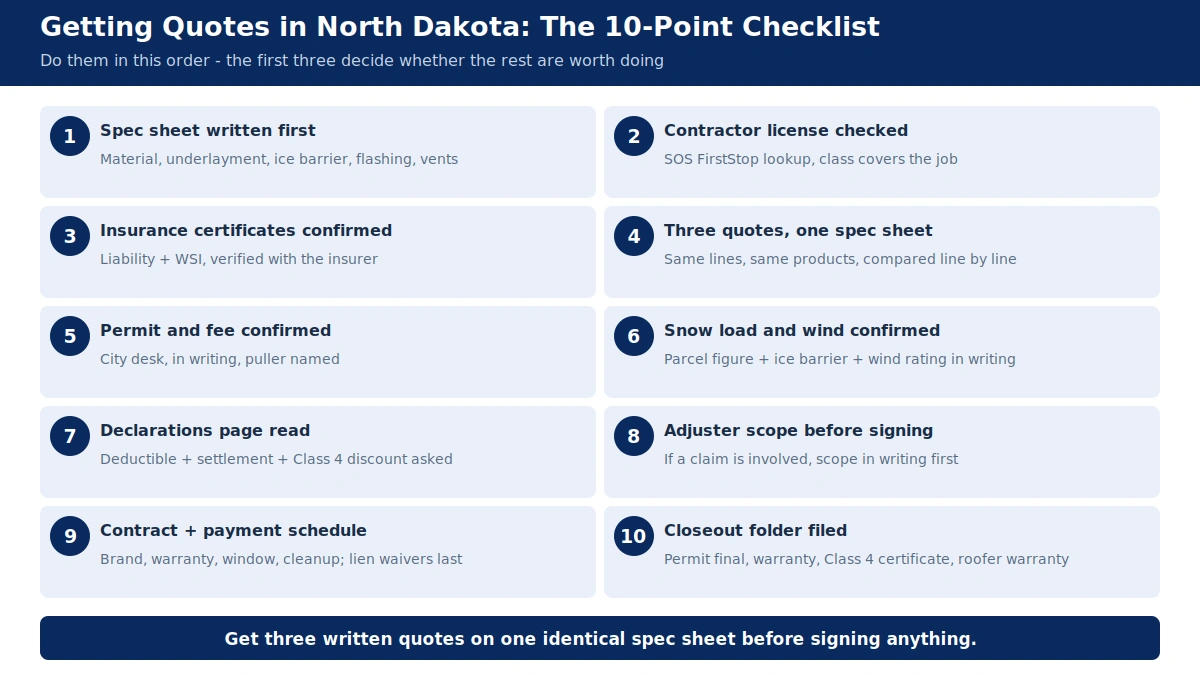
Quotes that actually compare take discipline, and the checklist below is that discipline. Get three bids, all for the same scope, the same lines, and the same product names, from contractors whose licenses check out in the FirstStop lookup. Every bid names the shingle or panel by brand and product, the underlayment, the ice-barrier scope, the flashing by penetration, the ventilation, the decking allowance, the disposal, and the permit. A bid with none of those lines named is not really a bid at all. It is only a number. The cheapest bid that names every line is usually the best bid, because a complete bid has nothing left to add later.
Reading a bid line by line is the skill that saves the most money. A good bid names the shingle or panel by brand and product, the underlayment, the ice-barrier scope, the flashing by penetration, the ventilation, the decking allowance, the disposal, and the permit. Each line carries a quantity and a price. A bid that lists a single number with no lines is a bid that will grow by change order, and a bid that names the lines but leaves the quantities blank is a bid that will grow the same way. The buyer should ask the contractor to walk through the bid, line by line, and explain any line the buyer does not understand. A contractor who cannot explain the bid did not write it.
Red flags are worth naming plainly. A contractor who knocks on the door after a storm, offers a free inspection, and presses for a signature the same day is a storm chaser, and the hiring risk is real. A contractor who offers a cash discount for payment in full up front is a contractor who may not come back. A contractor with no written warranty, no local references, and no license in the FirstStop lookup is a contractor to walk away from. The price is never the reason to hire a contractor who cannot pass the checks, because the cheapest roof that fails in the first winter is the most expensive roof the buyer will ever buy.
The workmanship warranty deserves its own line in the contract. Most contractors offer 5–10 years on the installation, and the manufacturer covers the material separately. The buyer should get the warranty in writing, with the length, the coverage, and the remedy named, and should ask what happens if the contractor leaves the state. A warranty from a contractor with a local office and a twenty-year history in the county is worth more than a longer warranty from a crew that arrived after the last storm.
Roof Insurance in North Dakota: Premiums, Deductibles, and Claims
A North Dakota homeowner pays more for insurance than the national average, and the roof is the reason. NerdWallet looked at more than 100 companies in an analysis dated May 6, 2026, and put the North Dakota average homeowners premium at $3,510 a year, or $293 a month, against a national average of $2,490. The figures assume a 40-year-old homeowner in good credit standing, with $400,000 of dwelling cover, $300,000 of liability cover, and a $1,000 deductible. Hail, wind, and tornado exposure drive the gap, and the roof is the part of the house the weather hits first.
Before the insurer pays anything, the homeowner pays the deductible. North Dakota policies increasingly carry two of them. Most claims go against the flat deductible rather than the wind-and-hail one, and the flat figure is often $1,000. The wind and hail deductible, often 2 percent of the dwelling limit, applies to exactly the loss a North Dakota roof is most likely to suffer. On a $300,000 dwelling, a 2 percent wind and hail deductible is $6,000, six times the flat deductible. A buyer who has never read the declarations page can discover a $15,000 gap on the worst day of the year, so the declarations page gets read before the roof decision, not after the storm.
An insurer pays on one of two bases, replacement cost value or actual cash value, and depreciation is the difference between them. Replacement cost value pays the cost of a new roof, minus the deductible. With actual cash value, depreciation for age and wear comes off the replacement cost, and the homeowner keeps the difference. On a 15-year-old roof, that difference can be thousands of dollars. The buyer asks the agent which basis the policy uses before choosing a material, because the answer changes what a hail claim is worth.
After a storm, the claim follows a set order, and keeping that order is what protects the payment. The first call goes to the insurer, to file the claim, and it goes before anything is signed with a contractor. Set the adjuster’s scope beside the contractor’s bid, line by line, and dispute anything missing, ridge cap, flashing, ventilation, ice barrier, before the work starts. Before the final payment goes out, the buyer collects lien waivers from the contractor, the subcontractors, and the suppliers. Nodak Insurance is described by a single source as the largest domestic carrier in the state. No North Dakota claim-payment-clock statute was verified in this research, so none is stated.
Documenting the roof before the storm is the cheapest insurance a buyer can buy. Photographs of every slope, taken from the ground and dated, plus the age of the roof and the product name, give the adjuster a baseline to compare against after the storm. A buyer who can show the roof was in good condition before the hail has a stronger claim than a buyer who cannot. The photographs cost nothing, and they take ten minutes. Keep them with the policy, not on a phone that can be lost.
The claim timeline matters as much as the claim itself. The buyer files the claim as soon as the damage is found, meets the adjuster, and compares the adjuster’s scope with the contractor’s bid before any work starts. A missing line, a ridge cap or a flashing detail the adjuster left out, gets disputed before the work, not after, because once the roof is on, the missing line is gone. The buyer should not sign a contract or an insurance assignment before the adjuster has visited, because the assignment hands the claim to the contractor and the buyer loses control of it.
The deductible needs budgeting before the storm, not after. On a $300,000 dwelling with a 2 percent wind and hail deductible, the buyer pays $6,000 before the insurer pays anything. A buyer who has not saved the deductible will delay the repair, and a delayed repair leaks. The roof fund should hold the deductible plus a margin for the items the insurer does not cover, because the claim rarely pays the whole job.
Paying for a New Roof in North Dakota: Financing, $0 Federal Credit, and Assistance
No federal money goes toward a 2026 North Dakota roof, and the sentence needs no softening. The One Big Beautiful Bill Act, Public Law 119-21, and IRS Fact Sheet FS-2025-05 ended the section 25C and 25D credits for installs after December 31, 2025. A roof covering alone never carried a federal credit in any case, so the change removes a credit that roof buyers never had, but it also removes the credit for the solar panels and the heat pump that a roof job sometimes carries alongside. The section 48E lease pass-through is solar only and does not reach a roof. The 2026 federal credit rules, in full, are covered in our guide to federal energy tax credits. Congress repealed the credit, so any contractor still offering one on a 2026 roof is offering money that no longer exists.
North Dakota’s home energy rebates have not launched. The Department of Commerce runs both the Home Electrification and Appliance Rebates program and the Home Energy Rebates program, and neither has launched, with no estimated date published. The department’s own page warns that offers of these rebates are likely a scam. North Dakota’s total allocation is $74,459,530, and the HEAR design allows up to $8,000 per household, but $0 is claimable in North Dakota in 2026 because the program is not open. No statewide roof grant exists, according to NumeralQ in October 2026, and no verified North Dakota utility roof rebate was found.
Of the assistance programs, the Weatherization Assistance Program is the one that is real, open, and relevant, and it does not pay for a roof. It is free for households at or below 200 percent of the federal poverty level: $31,920 for one person and $66,000 for four in 2026, plus $11,360 for each additional person. LIHEAP clients are automatically eligible. Eight Community Action Agencies run the program, including CAP Minot at 701-839-7221 and CAP Williston at 701-572-8191. The program requires a savings-to-investment ratio of 1.0 or better, serves a household once unless the home was weatherized more than 15 years ago, and covers insulation, air sealing, ventilation, wiring, panels, and appliances. A roof covering is not a rebate measure in any case, so at most the insulation and ventilation work that accompanies a roof job is covered. Federal disaster loans from the Small Business Administration, which can run up to 20 percent above the verified loss for mitigation work, exist only after a declared disaster.
Whatever the roof costs after savings, the financing follows the usual routes. A full comparison of the routes is in the roof financing guide. The routes are contractor payment plans, home equity lines and home equity loans, and personal loans, and each one carries its own rate, term, and risk. Of the financing routes, the contractor’s own plan is the easiest to sign and usually the priciest once the promotional rate expires. With a home equity line, the house itself backs the loan. That makes it the cheapest money on offer and the riskiest. A personal loan has no collateral behind it, and the interest rate shows it. The budget rule for this guide is the band plus the contingencies: the material band, plus the named add-ons, plus the permit fee, plus the tax question, and the total is the number the quote is judged against.
A home equity line and a home equity loan are not the same product, and the difference matters for a roof. A line of credit lets the buyer draw what is needed and pay interest only on the draw, which suits a roof job whose final cost is not known until the tear-off. A home equity loan gives a lump sum at a fixed rate, which suits a buyer who knows the price and wants a fixed payment. Both put the house behind the loan, which is why the rate is low and the risk is real. A buyer who cannot make the payments can lose the house over a roof, and that risk should be weighed before the loan is signed. A personal loan carries no such risk, but the rate is higher, and the term is shorter.
Contractor financing needs reading before signing. A promotional rate of zero percent for twelve months is cheap until the twelfth month passes, and then the rate jumps to the standard rate, which can be over 20 percent. The buyer should ask what the rate becomes after the promotion, what the monthly payment is, and whether the interest is deferred or waived. Deferred interest means the interest accrues during the promotion and lands on the balance if the loan is not paid in full by the end of it. A buyer who reads the fine print before signing avoids a surprise that costs more than the roof.
Saving for the roof in advance is the cheapest financing of all, and it is the route this guide recommends where the buyer has time. A roof fund of $100 a month reaches $6,000 in five years, which covers the deductible and most of a repair, and $200 a month reaches $12,000 in five years, which covers most of a replacement. A buyer whose roof is ten years old and has twenty years of rated life left has time to save. A buyer whose roof is twenty-five years old does not, and should finance rather than wait for the leak.
Roof Repair vs Replacement in North Dakota, and Getting Quotes That Compare
Not every North Dakota roof needs replacing, and the repair table below prices that call honestly. The figures are NumeralQ Fargo repair prices from October 26, 2026, installed.
| Repair (Fargo, installed) | Cost |
|---|---|
| Vent or pipe boot | $177–$377 |
| Shingles, up to 10 | $224–$450 |
| Flashing | $242–$520 |
| Emergency tarp | $247–$510 |
| Ridge cap, about 20 ft | $265–$520 |
| Soffit and fascia, 10 ft | $313–$680 |
| Find and fix a leak | $324–$900 |
| Chimney reflash | $336–$740 |
| Skylight leak | $344–$680 |
| Rotted decking, 2 sheets | $370–$780 |
| Valley repair | $418–$1,020 |
| 100 sq ft section | $530–$1,080 |
| Hail or wind damage, one slope | $910–$2,880 |
Modernize’s North Dakota figures bracket the same range: minor repairs at $300–$800 and major repairs at $1,000–$1,500. North Dakota metal-repair per-square pricing was not verified, so none is stated. For the work that usually rides along with a repair, see our roof repair costs and gutter installation costs pages. Four facts decide between repair and replacement. Start with age. A shingle roof past 20 years with granules gone across wide areas is near the end of its rated life, and patching it buys months rather than years. Extent is the second: a leak confined to one flashing detail is a repair, and leaks across several slopes are a roof. Third is decking. Deck rot stays hidden until the old covering comes off. A repair quote on an old roof therefore carries an unknown that a replacement quote does not. Fourth is code. A large repair can trigger code requirements that a small repair does not, and whether it does is decided locally. The 50 percent rule of thumb, replace when the repair costs half the replacement, is contractor guidance, unsourced, and this guide does not adopt it.
When to roof in North Dakota is a weather decision as much as a price decision. The installing season runs about May to October, and a buyer who can wait until the backlog clears after a hail event gets a better price and a calmer crew than a buyer who signs in the week after the storm. A buyer who is promised a state grant, a utility rebate, or a disaster loan for an ordinary re-roof should ask for the program name, the agency, and the application form, and treat a vague answer as a warning. For a neighboring-state heating comparison, see the heat pump cost in Minnesota guide. For neighboring-state roof comparisons, see the Minnesota roof replacement cost guide, the Montana roof replacement cost guide, the Nebraska roof replacement cost guide, and the Iowa roof replacement cost guide. An emergency tarp is the first repair after a storm, and it is a repair, not a fix. A tarp over a damaged slope keeps the rain out while the claim is filed and the contractor is booked, and it costs $247–$510 in Fargo. A tarp left on for months rots the decking underneath and hides the damage from the adjuster, so the buyer should treat it as a bridge to the repair, not as the repair itself. The contractor should install the tarp, because a homeowner on a damaged roof after a storm is a homeowner at risk of a fall.
A leak that shows up as a stain on the ceiling is rarely above the stain. Water runs down the rafters and the decking before it drops, so the leak can be several feet away from the stain, uphill. A contractor finds the leak by tracing the water path from the attic, not by guessing from the ceiling. The buyer should not pay for a repair that patches the stain without finding the source, because the stain will come back with the next rain. The find-and-fix price of $324–$900 in Fargo covers the diagnosis and the repair together, and the buyer should ask for both in the quote.
A single slope can be replaced without replacing the whole roof, and the hail table prices it at $910–$2,880 for one slope in Fargo. A slope replacement makes sense when the damage is confined to one side and the rest of the roof has life left. It does not make sense when the shingles on the other slopes are the same age and the same condition, because the buyer will be back on the roof within a few years for the next slope. The contractor should give an honest read on the remaining life of the other slopes, and the buyer should weigh the slope price against the full replacement price before deciding.
How much does a roof replacement cost in North Dakota in 2026?
NumeralQ’s October 26, 2026 planning estimates put a 2,000 sq ft architectural-shingle roof at $10,080–$12,320 installed in North Dakota in 2026. The midpoint is about $11,200. Fargo runs higher at $10,240–$12,530, Bismarck runs lower at $9,270–$11,270, and Grand Forks and Minot carry the state band as planning estimates because no verified city band was found for either city.
What is the cost per square for a new roof in North Dakota?
Divide the 2,000 sq ft band by 20 squares and the implied state rate for architectural shingles comes out at $504–$616 per square. SmartRoofingCalculator puts architectural shingles at $430–$620 per square with tear-off included, while MyRoofData puts them at $428–$713 per square before tear-off, and tear-off adds $100–$200 per square per layer. A square is 100 sq ft of roof surface. The per-square price drops as the roof gets bigger, since the fixed job costs stretch across more squares.
How much does a metal roof cost in North Dakota in 2026?
In Fargo, NumeralQ’s October 26, 2026 figures put exposed-fastener metal at $15,810–$20,100 and standing-seam metal at $22,660–$34,050 for a 2,000 sq ft roof. Bismarck runs about 9 percent lower on both. Standing seam sheds snow, carries a Class A fire rating, and moves with temperature through concealed fasteners, but it needs snow guards above every entry and driveway, and hail dents may be excluded as cosmetic-only by some insurance policies.
Do I need a permit to replace a roof in North Dakota?
It depends on the address. Fargo exempts a plain reroof from the permit under its amendments to the 2024 existing building code, and Bismarck does the same, though the buyer should confirm the Bismarck exemption with the city desk. Grand Forks requires a permit for reshingling, with a fee of about $185 from a single secondary guide. Minot is reported to require a permit at $100–$200, also from a single secondary guide. Structural sheathing or framing repairs may still need a permit even where a plain reroof is exempt.
Does North Dakota require a contractor license for roofing?
Yes. North Dakota requires a Secretary of State contractor license for any job over $4,000, under North Dakota Century Code chapter 43-07, and roofing is covered by that license. The classes run from Class D for jobs up to $100,000 to Class A with no cap, the initial fee runs $100–$450 by class, and there is no exam. The buyer checks the license in the Secretary of State’s FirstStop lookup before hiring, and confirms the class covers the job’s value.
What snow load must a North Dakota roof be designed for?
The ground snow load for a North Dakota site runs 25 to 60 pounds per square foot under ASCE 7 hazard mapping, and the exact figure comes from the ASCE 7 Hazard Tool or the local building official for the parcel. Ward County’s building checklist sets a 115 mile-per-hour design wind speed and a 48-inch frost depth. The ice barrier must run from the lowest eave edge to at least 24 inches inside the exterior wall line where ice dams form. The buyer gets the parcel figure from the building official, never from a county average.
Are Class 4 shingles worth it in North Dakota?
In Burleigh County and the Missouri River hail corridor, where the county logged 15 reports of hail at 2 inches or larger from 2016 through 2025, Class 4 shingles are the default recommendation of this guide. In the Fargo area, where the county logged 6 such reports in the same decade, the case is strong but rests more on the insurance discount. The derived Class 4 band is about $11,580–$15,820 for a 2,000 sq ft roof. Discount claims across North Dakota guides span 5–30 percent with no statute behind any of them, so the buyer gets the discount percentage, the premium portion it applies to, and the certificate requirement in writing from the insurer before choosing.
Is there a tax credit or grant for a new roof in North Dakota in 2026?
No. No federal money goes to a 2026 roof. Congress ended the residential energy credits for installations after December 31, 2025. A roof covering never carried a federal credit in the first place. North Dakota’s home energy rebates have not launched and would not pay for a roof covering in any case. No statewide roof grant exists. The Weatherization Assistance Program is free to income-qualified households but pays for insulation, air sealing, and heating work, not for the roof covering itself.