

Table of Contents
An Iowa roof works harder in a single year than most American roofs work in three. Spring brings supercell storms that drop hail the size of golf balls across the corn belt, and NOAA logged 2,638 large-hail reports in Iowa between 2016 and 2025 — ninth most in the country, with two-thirds of them falling in April, May, and June. Summer brings tornadoes and straight-line wind; the derecho of August 10, 2020, drove gusts to 140 mph through Cedar Rapids and became the costliest thunderstorm event in American history at $11.2 billion. Then winter arrives with 30 to 50 inches of snow and 30 to 80 freeze-thaw cycles, and the meltwater that refreezes at the eave builds the ice dam that backs water under shingles that survived everything summer threw at them.
The pricing here follows a Des Moines estimator’s order: material first, then roof size, then city — Des Moines, Cedar Rapids, Davenport, Sioux City, and Iowa City — with the hail ratings, ice-barrier rule, permit, registration, and insurance rules that actually set the number. It also covers the surprise that catches most people moving here from a coastal state: Iowa has no statewide roofing license at all, and the credential that matters is a $50-a-year registration that tests nobody’s roofing skill.
To see how Iowa stacks up against the rest of the country, start with our roof replacement cost guide.
How Much Does a Roof Replacement Cost in Iowa in 2026?
SmartRoofingCalculator’s 2026 Iowa guide is the strongest anchor available: it puts a full architectural asphalt replacement on a typical 25-square roof — about 2,500 sq ft of roof surface — at $10,250–$15,000, or $410–$600 per square installed with tear-off. On the smaller measure most homeowners have in mind, a 2,000 sq ft roof surface, the same source prices architectural shingles at $8,200–$12,000. That gap is the measuring-stick trap that runs through the guide: the home-size table is priced for a 2,000 sq ft house, while the per-square table is priced for one square of roofing, and a real Iowa roof is bigger than the living-area footprint below it — SmartRoofingCalculator itself prices a 2,000 sq ft Iowa house at 25 squares, and a Des Moines contractor puts the average local job at 28 to 30 squares. The practical lesson is the one Cedar Rapids estimators repeat on every walk-through: have the roofer measure the roof itself, and have every quote say which area it priced.
Other 2026 sources land in the same range, with one honest disagreement to flag. NumeralQ’s Iowa guide (pricing as of October 26, 2026) puts architectural shingles at $4.29–$5.13 per sq ft, or $9,130–$11,080 for a 2,000 sq ft roof — inside the SmartRoofingCalculator band, toward the middle. MyRoofData’s 2026 model puts a typical Iowa home at $11,750–$20,500 for architectural shingles, about 8 percent below the national average. Superstorm Restoration, a Des Moines contractor writing in March 2026, prices the average local job higher still: $12,500–$19,000 for 28–30 squares of architectural shingles, with larger or steeper roofs at $19,000–$30,000 and up. The gap is not an error on any side: Superstorm counts 28–30 squares of roof while SmartRoofingCalculator counts only 25, and Superstorm charges Des Moines labor rates on the jobs it does itself. This guide leans on SmartRoofingCalculator as its main anchor and notes the Des Moines contractor figure wherever it shows up.
Taken together, the honest headline is this: most Iowa homeowners pay $9,100–$20,500 for a full asphalt replacement in 2026, and architectural shingles on a typical 25-square roof sit at $10,250–$15,000. Every figure from here on is a turn-key installed total, tear-off included, unless the passage says something different.
| Material | $/sq ft installed (roof surface) | 2,000 sq ft home total | Iowa realistic lifespan |
|---|---|---|---|
| 3-tab shingle | $3.57–$5.50 | $7,100–$11,000 | 15–20 yrs |
| Architectural shingle | $4.10–$6.00 | $8,200–$12,000 | 20–30 yrs |
| Class 4 impact shingle | $5.50–$7.50 (derived) | $11,000–$15,000 | 25–35 yrs |
| Exposed-fastener metal (5V) | $6.83–$8.59 | $13,700–$17,200 | 30–40 yrs |
| Stone-coated steel | $7.71–$11.21 | $15,400–$22,400 | 40–50 yrs |
| Standing-seam metal | $8.30–$12.80 | $16,600–$25,600 | 40–70 yrs |
| Synthetic slate/shake | $8.10–$11.73 | $16,200–$23,500 | 40–50 yrs |
| Cedar shakes | $8.11–$14.53 | $16,200–$29,100 | 20–30 yrs |
| Concrete tile | $8.65–$12.39 | $17,300–$24,800 | 40–50 yrs |
| Clay tile | $11.48–$18.46 | $23,000–$36,900 | 50+ yrs |
| Natural slate | $15.11–$30.01 | $30,200–$60,000 | 75+ yrs |
Sources: SmartRoofingCalculator Iowa guide (updated Apr 24, 2026); NumeralQ Iowa (pricing Oct 26, 2026); MyRoofData Iowa (2026 model); Superstorm Restoration (Mar 2026); BestRoofingEstimates Iowa (2026). The 2,000 sq ft home totals are arithmetic of our own, worked out from the per-square-foot ranges for a 2,000 sq ft roof surface. The Class 4 row is our own arithmetic (the material section has the method), not a surveyed figure.
How the money splits on a typical Iowa job: labor runs about 50–60% of the total — a roofer’s median pay in Iowa is $23.39 an hour (BLS, May 2025), and contractors bill $47–$61 per worker-hour once insurance, payroll taxes, overhead, and profit are folded in (NumeralQ). Materials take roughly 40 percent, and overhead and profit take most of the rest. A second tear-off layer adds $1.15–$1.52 per sq ft (NumeralQ). Nobody knows the decking until tear-off: replacement runs $55.92–$81.73 per 4×8 sheet installed (NumeralQ), and about 62 percent of Iowa homes were built before 1980 — older roofs often hide soft decking and extra layers. Running ice and water barrier across the whole roof instead of just the eaves adds $0.82–$1.34 per sq ft, and a reroof is the cheapest moment in a house’s life to buy that coverage.
Roof Replacement Cost in Iowa by Material
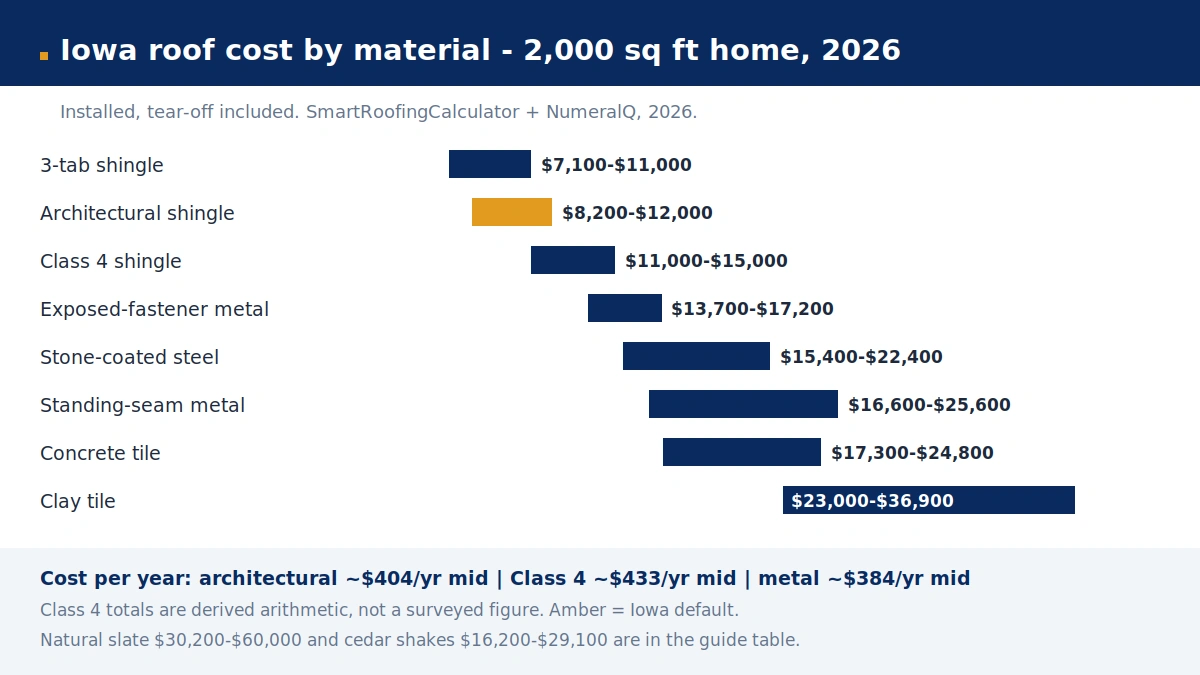
Material is the biggest single line on any Iowa invoice — standing-seam metal costs about twice what architectural shingles cost installed. But the sticker price is only half the Iowa picture, because hail, wind, and freeze-thaw shorten shingle life while metal usually outlasts the mortgage. The table below puts 2026 installed prices beside Iowa lifespans and yearly service cost, so the expensive option can be measured on what it costs per year, not per bill.
| Material | $/sq ft installed | 2,000 sq ft home total | Iowa lifespan | Cost per year* |
|---|---|---|---|---|
| 3-tab shingle | $3.57–$5.50 | $7,100–$11,000 | 15–20 yrs | ~$406–$733/yr (mid ~$517/yr) |
| Architectural shingle | $4.10–$6.00 | $8,200–$12,000 | 20–30 yrs | ~$273–$600/yr (mid ~$404/yr) |
| Class 4 impact shingle | $5.50–$7.50 (derived) | $11,000–$15,000 | 25–35 yrs | ~$314–$600/yr (mid ~$433/yr) |
| Exposed-fastener metal (5V) | $6.83–$8.59 | $13,700–$17,200 | 30–40 yrs | ~$343–$573/yr (mid ~$441/yr) |
| Stone-coated steel | $7.71–$11.21 | $15,400–$22,400 | 40–50 yrs | ~$309–$560/yr (mid ~$420/yr) |
| Standing-seam metal | $8.30–$12.80 | $16,600–$25,600 | 40–70 yrs | ~$237–$640/yr (mid ~$384/yr) |
| Synthetic slate/shake | $8.10–$11.73 | $16,200–$23,500 | 40–50 yrs | ~$324–$588/yr (mid ~$441/yr) |
| Cedar shakes | $8.11–$14.53 | $16,200–$29,100 | 20–30 yrs | ~$540–$1,455/yr (mid ~$906/yr) |
| Concrete tile | $8.65–$12.39 | $17,300–$24,800 | 40–50 yrs | ~$346–$620/yr (mid ~$468/yr) |
| Clay tile | $11.48–$18.46 | $23,000–$36,900 | 50+ yrs | ~$460–$738/yr (mid ~$599/yr) |
| Natural slate | $15.11–$30.01 | $30,200–$60,000 | 75+ yrs | ~$403–$800/yr (mid ~$601/yr) |
*Cost per year = installed cost over the realistic Iowa lifespan. Class 4 totals are worked-out arithmetic — the material section shows how they were built. Lifespan and price figures: SmartRoofingCalculator Iowa (2026); NumeralQ Iowa (Oct 2026); MyRoofData Iowa (2026); Superstorm Restoration (Mar 2026); BestRoofingEstimates Iowa (2026).
Architectural shingles cover most Iowa roofs already: they draw the lowest bids, the most crews install them, and they are the simplest product to patch after a hailstorm. In Iowa they last 20–30 years — shorter than the same shingle lasts in a mild climate, because hail strips granules, freeze-thaw cycles crack the asphalt, and summer heat bakes the adhesive. The weak point is not cold but impact: a standard architectural shingle takes a 1-inch hailstone and keeps going, and takes a 2-inch hailstone and bruises through to the mat. High-wind nailing — six nails per shingle — is not an upgrade here, it is the job, because Iowa’s design wind speed runs 115 mph and straight-line winds of 50 to 65 mph are routine in squall lines.
3-tab shingles are the budget option, and in Iowa they are a false economy on most houses. At $3.57–$5.50 per sq ft they save roughly $1,100 against architectural shingles on a 2,000 sq ft home, then lose the savings by lasting only 15–20 years in Iowa weather — and by offering the lowest hail and wind resistance of any asphalt product in a state where hail decides everything. On a house you plan to keep, the bargain shingle is the one you end up buying twice — and the second time, you pay a deductible too.
Class 4 impact-rated shingles get their own section below, because here in Iowa they are the upgrade that earns its keep through insurer discounts — but the reason they pay back is not the one most Iowa roofing pages offer, and the difference matters. They run about $5.50–$7.50 per sq ft installed ($11,000–$15,000 on a 2,000 sq ft home), roughly $1,500–$3,500 more than standard architectural shingles on a typical job, and they extend service life to 25–35 years. One honest caveat: no separate Iowa per-square figure for Class 4 was confirmed in the sources behind this guide. The range here is arithmetic built from the SmartRoofingCalculator architectural base plus the premium suggested by Superstorm’s combined architectural and Class 3/4 band and by CoralvilleHome’s Class 4 band along the Iowa City corridor — and it is marked as derived, not surveyed.
Exposed-fastener metal (5V crimp and corrugated) is the rural Iowa workhorse: $6.83–$8.59 per sq ft installed, 30–40 years of service, and a profile that has sheltered Iowa farmhouses and barns for decades. It runs about half the price of standing seam, sheds snow rather than holding it, and shakes off hail that would dent a shingle. The weak point is the screws: hundreds of screws with rubber washers, all exposed, that need a check and a re-tightening over the years, on a roof that can look worn out long before it leaks.
Standing-seam metal is the premium Iowa roof, and it earns the title here more honestly than in most states. At $8.30–$12.80 per sq ft, a 2,000 sq ft home runs $16,600–$25,600 — roughly double architectural shingle upfront. What you buy is 40–70 years, a surface that sheds snow and hail instead of holding them, concealed fasteners that never back out in a windstorm, and a material that does not care about freeze-thaw. One flagged conflict: NumeralQ prices standing seam higher, at $9.77–$14.93 per sq ft, and BestRoofingEstimates higher still, at $9.00–$16.00. This guide uses SmartRoofingCalculator’s band as primary and notes the higher bands rather than resolving them. If you are still weighing the two, our metal roof vs shingles cost comparison puts them head to head, and our metal roof cost guide gives the nationwide figures.
Stone-coated steel sits between shingle and standing seam: $7.71–$11.21 per sq ft installed, 40–50 years, and a shingle look with a steel core. It earns a Class 4 hail rating, which is the number insurers care about, and it suits Iowa homeowners who want the curb appeal of a shingle roof with the hail resistance of metal. The tradeoff is installer depth — fewer Iowa crews install stone-coated steel than install standing seam, so get the manufacturer’s certification in writing.
Cedar shakes are the worst value in Iowa’s climate on a cost-per-year basis, and the table shows why: $8.11–$14.53 per sq ft installed for 20–30 years of service, or about $906 a year at the midpoint — more than double architectural shingle. Cedar needs maintenance, holds moisture in Iowa’s humid summers, and carries the lowest hail rating of any premium material. It belongs on historic and upscale homes where the look is the point, not on a house where the roof is supposed to pay for itself.
Concrete and clay tile are rare in Iowa for a structural reason, not a price reason: concrete tile at $8.65–$12.39 per sq ft and clay tile at $11.48–$18.46 both need framing designed for the weight, and most Iowa houses were framed for shingles. Tile buys 40–50-plus years and shrugs off hail and freeze-thaw when it is nailed to the current code, but a retrofit onto a shingle-framed house needs an engineer’s sign-off and often structural reinforcement. To see what tile runs across the rest of the country, our tile roof cost guide covers the nationwide numbers.
Natural slate is the lifetime roof at the lifetime price: $15.11–$30.01 per sq ft installed, $30,200–$60,000 on a 2,000 sq ft home, 75-plus years of service. In Iowa it appears on historic homes and university buildings, not on typical replacements, and it needs the same structural sign-off as tile plus a crew that actually installs slate.
Flat and low-slope roofs deserve a mention because they cover Iowa’s commercial buildings, apartment blocks, and low-slope additions. NumeralQ prices Iowa flat systems at $4.85–$7.66 per sq ft for EPDM rubber, $5.82–$7.72 for TPO membrane, and $4.70–$5.99 for modified bitumen — the one Iowa-specific flat-roof figure set verified for this guide. Our flat roof replacement cost guide carries the national figures, and an Iowa flat-roof bid should be judged on its seam and drainage scope, not on a statewide average alone.
The takeaway: metal costs about double what shingles cost on day one, then hands most of it back across the decades — because an Iowa shingle roof comes off when hail, wind, and ice say so, not when the warranty does.
Roof Replacement Cost by Roof Size
The table below is built from SmartRoofingCalculator’s 2026 per-square bands, priced by roof surface at the state baseline, typical pitch 4:12–7:12, single-layer tear-off. Keep the measuring-stick warning from section one in mind: roof surface is bigger than living area, so a 2,000 sq ft home here usually has a 2,000–3,000 sq ft roof — and those are the totals SmartRoofingCalculator gave for that roof.
| Home size | Squares | Architectural | Class 4 (derived) | Standing-seam metal |
|---|---|---|---|---|
| 1,000 sq ft | ~10 | $4,100–$6,000 | $5,500–$7,500 | $8,300–$12,800 |
| 1,500 sq ft | ~15 | $6,150–$9,000 | $8,250–$11,250 | $12,450–$19,200 |
| 2,000 sq ft | ~20 | $8,200–$12,000 | $11,000–$15,000 | $16,600–$25,600 |
| 2,500 sq ft | ~25 | $10,250–$15,000 | $13,750–$18,750 | $20,750–$32,000 |
| 3,000 sq ft | ~30 | $12,300–$18,000 | $16,500–$22,500 | $24,900–$38,400 |
Cross-checks: NumeralQ’s Iowa model puts architectural shingles on a 2,000 sq ft roof at about $9,130–$11,080 — inside the band above, toward the middle. MyRoofData’s typical-home figure of $11,750–$20,500 sits above the table’s 2,000 sq ft architectural band, which fits its wider home-size definition and post-storm demand pricing. Superstorm’s Des Moines framework prices a 28–30 square job at $12,500–$19,000 — above the table’s 2,500 sq ft row, because it counts more squares and prices Des Moines labor. A smaller house carries a higher rate per square foot, because fixed costs — permit, dumpster, and crew mobilization — are spread across fewer squares. A big or steeply pitched roof costs more for its shape, not just its size: steep pitches and complex cut-up roofs can lift costs by up to 30 percent, and in Iowa the pitch also decides how much snow the roof holds.
Roof Replacement Cost by Region: Des Moines vs Cedar Rapids vs Davenport vs Sioux City vs Iowa City
Labor rates move noticeably from one Iowa region to another, but the spread is smaller than the hail spread. Des Moines sets the statewide benchmark: the deepest bench of crews and the most competitive bidding in the state. Sioux City runs highest, with the fewest local contractors and the highest wind exposure. Rural counties run higher than any city, because travel time gets billed and fewer crews bid.
| Region / Metro | Architectural asphalt (2,000 sq ft home) | Variance vs state mean |
|---|---|---|
| Des Moines metro | $11,800–$17,500 | Most competitive market; most bids per project |
| Cedar Rapids / Corridor | $12,000–$18,000 | Near average; high hail frequency |
| Quad Cities (Davenport / Bettendorf) | $12,200–$18,400 | Cross-border Illinois contractors compete |
| Iowa City / Coralville | $12,000–$18,200 | University town; steady demand |
| Waterloo / Cedar Falls | $11,900–$17,800 | Near average; higher snowfall zone |
| Sioux City | $12,500–$19,000 | 3–5% above; fewest local contractors; high wind zone |
| Rural Iowa counties | $13,000–$20,500 | 8–15% above; travel time, fewest bids |
Source: BestRoofingEstimates Iowa guide (2026); NumeralQ Iowa (Oct 26, 2026); Superstorm Restoration (Mar 2026); Wegner Roofing (Aug 2026); CoralvilleHome (2026).
Des Moines metro is the benchmark for cost and for contractor depth: the most crews, the most bids per project, and the most competitive pricing in the state. BestRoofingEstimates puts the metro at $11,800–$17,500 for architectural shingles on a 2,000 sq ft home. Local contractor figures land in the same range once the squares are counted honestly: Superstorm prices the average Des Moines job at $12,500–$19,000 for 28–30 squares, and Wegner Roofing prices an average 1,800 sq ft home at $8,500–$16,000. Des Moines permits are fee-based on project value with an inspection before final sign-off. The metro’s suburbs — Ankeny, Waukee, West Des Moines, Urbandale, Johnston — carry the same pricing, with Waukee’s adopted 2018 IRC setting the local code numbers: 30 psf ground snow load, 115 mph design wind, 42-inch frost line, ice barrier required.
Cedar Rapids / Corridor runs near the state average at $12,000–$18,000, but it is the city where Iowa’s weather history is written on the roofs. The August 2020 derecho drove 140 mph gusts through the city, and the reroofs that followed in a hurry are still being found out: shingles nailed over damaged layers, cracked decking left in place, ice-and-water barrier skipped. Cedar Rapids enforces the 2021 IRC with municipal amendments, requires a building permit for any reroofing over one square of roof surface, and enforces the ice-barrier rule. NumeralQ’s city figure for Cedar Rapids is $9,060–$10,990 for a 2,000 sq ft roof — lower than the BestRoofingEstimates row, because NumeralQ’s city figures are a national baseline with small local adjustments. Treat the NumeralQ row as a floor and the BestRoofingEstimates row as the working range.
Quad Cities (Davenport / Bettendorf) runs $12,200–$18,400, near the average, with one advantage no other Iowa metro has: Illinois contractors across the river compete for the same jobs, which keeps bidding honest. A permit is required in Davenport, and the river-corridor wind exposure means the same 115 mph design wind and six-nail fastening as the rest of the state. No standalone surveyed Davenport average was found beyond the Quad Cities row, so the figure here is the regional row, labeled as such.
Iowa City / Coralville runs $12,000–$18,200 — a university town with steady demand and good contractor availability. The corridor guide (CoralvilleHome, 2026) prices a typical 2,000 sq ft home at $9,000–$15,000 for 30-year architectural asphalt, $12,000–$18,000 for 50-year asphalt, $14,000–$24,000 for Class 4, $22,000–$35,000 for stone-coated steel, and $25,000–$50,000 for standing seam — a useful cross-check that sits just under the BestRoofingEstimates row, because the corridor guide counts a smaller roof surface for the same home size.
Sioux City runs highest among the metros at $12,500–$19,000, about 3–5 percent above the state average. The reason is supply, not weather: fewer local contractors, longer travel for crews and materials, and a high wind zone on the western edge of the state. One caveat: Sioux City has no second source behind the figure — it is the BestRoofingEstimates row alone, and it is flagged as such. Get three written quotes before trusting it.
Waterloo / Cedar Falls runs $11,900–$17,800, near the average, in the state’s higher snowfall zone — northern Iowa takes 40–50-plus inches a year, and the ice-dam pressure on Waterloo roofs is the worst in the state outside the far north.
Rural Iowa counties run 8–15 percent above Des Moines pricing — $13,000–$20,500 for the same 2,000 sq ft home — because crews bill travel time and fewer contractors bid. The irony is that the cheapest houses in Iowa often carry the most expensive roofs, and the fix is the same as everywhere: get at least three quotes, and make the travel charge a line item, not a surprise.
Why Iowa Roofs Cost What They Do: Hail, Derecho Wind, Ice Dams & Freeze-Thaw
Iowa has one of the hardest climates in America for a roof, because four separate forces work on every roof in the state, often in a single year. Hail bruises shingles and strips granules. Derecho wind lifts shingles and whole roof sections off the deck. Snow loads the roof and melts into ice dams at the eave. And freeze-thaw cycles crack the asphalt that survived the first three. All four compound: hail-bruised shingles let water into the deck, freeze-thaw opens the cracks wider, and a roof that survived May can still fail the adjuster’s inspection in February.
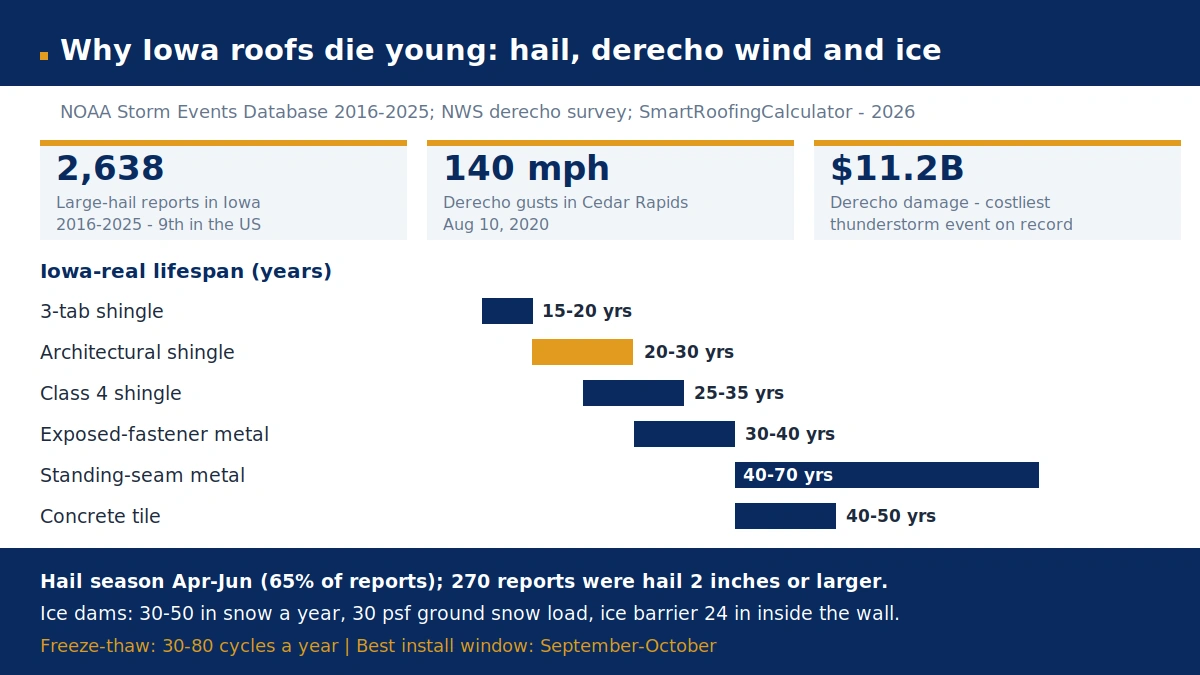
Hail is the force that sets Iowa’s material rules. NOAA logged 2,638 large-hail reports in Iowa from 2016 to 2025 — ninth most in the country — and 270 of those reports were hail two inches or larger, the size that cracks standard shingles outright. Two-thirds of the reports fall in April, May, and June, when cold Canadian fronts collide with moist Gulf air over the plains. A 1-inch hailstone strips granules and shortens shingle life by 5 to 10 years per event; a 2-inch hailstone bruises through to the mat and the roof is done, whether it leaks yet or not. That is why the impact rating matters more in Iowa than the wind rating on most bids: the shingle that survives hail is the shingle that does not need replacing after the storm season.
Derecho wind is the force that sets Iowa’s fastening rules. On August 10, 2020, a derecho — a long-lived line of severe thunderstorms — swept 770 miles in 14 hours and hit Cedar Rapids with gusts estimated at 130–140 mph, the highest winds ever recorded in a derecho event. The storm killed four people, caused $11.2 billion in damage across the Midwest, knocked out power to more than 400,000 Iowans, and flattened roughly half of Cedar Rapids’ tree canopy. More than 800 buildings suffered partial collapse of roof, walls, ceiling, or floors. The design wind speed Iowa codes to is 115 mph — Waukee’s adopted 2018 IRC table says so plainly — but the derecho proved that straight-line wind can exceed the design number, and the practical consequence is the same: an Iowa roof is built for wind first, and the shingle on it has to be rated for the wind it will actually face. In high-wind areas the IRC requires shingles rated to ASTM D7158 Classes G or H or ASTM D3161 Class F; Class H covers up to Category 4 wind speeds. Six nails per shingle in a high-wind pattern is not an upgrade in Iowa — it is the job.
Snow load is the force that sets Iowa’s structural rules. Iowa takes 30 to 50 inches of snow a year, and northern Iowa takes 40 to 50-plus inches. The ground snow load Iowa designs to is 30 pounds per square foot, and a roof that holds a winter’s snow while the attic leaks heat into it is a roof building an ice dam at the eave. Metal sheds snow; asphalt holds it. Steep pitches shed snow; low pitches hold it. The pitch of the roof is not a style choice in Iowa — it is a snow decision, and it shows up in the bid.
Freeze-thaw is the force that ages Iowa asphalt from the inside out. Iowa runs 30 to 80 freeze-thaw cycles a year. Each cycle stresses the shingle adhesive, cracks aged shingles, and opens the granule surface a little wider. Summer heat bakes the asphalt soft; winter cold makes it brittle; spring hail hits it while it is still cold and cracks it instead of denting it. The Iowa-realistic lifespan for architectural shingles is 20–30 years, against 25–30 years for the same product in a mild climate — and the shingle that dies at 20 years in Iowa dies of hail and freeze-thaw, not of old age.
The install season runs April through October — and that cuts both ways. Roofing is viable in the warm months, when shingles seal in the heat and crews work full days. Winter installs happen, but cold brittle shingles can crack underfoot and adhesive strips may not seal until spring, so a roof near the end of its life should be replaced before winter, not during it. Scheduling inside hail season, May through June, carries storm-delay risk — and after every big hail event, demand surges and prices spike. The best months are roughly September and October: cooler, drier, past hail season, and before the first snow load.
Ice Dams, Snow Load & Freeze-Thaw: The Slow Iowa Roof Killers
If one failure defines Iowa roofing, it is not the hailstorm — it is the slow damage that happens between storms, in a winter that freezes and thaws eighty times. An Iowa roof can look fine from the street while the decking below is wet, the attic insulation is soaked, and mold is growing out of sight.
The mechanism is straightforward, and it repeats on thousands of Iowa roofs. Heat escapes from the living space into the attic through a thin ceiling and under-insulated hatch. Snow on the roof melts from below at the ridge, runs down the slope, and refreezes at the eave, where the roof overhangs the cold outside air. The ice builds into a dam, and the meltwater behind it has nowhere to go but up — under the shingles, through the underlayment, and into the deck. Winter after winter, the decking stays wet, fasteners rust, and the wood fiber goes soft. A small leak that would dry in a week in dry country stays wet for months in an Iowa winter — and a leak that has been dripping into the attic all winter can run $400–$1,200 in ice-dam damage repair alone by the time the damaged section is stripped and the roof goes back on (BestRoofingEstimates).
The ice barrier is the code answer, and it is not optional. IRC Section R905.1.2 calls for an ice barrier — a self-adhering polymer-modified bitumen membrane — extending from the lowest eave edge to a point at least 24 inches inside the interior line of the exterior wall, wherever the average January temperature is 25°F or below. All of Iowa qualifies. Cedar Rapids enforces it; Waterloo’s roofing handout spells it out for attached garages and porches as well as the house itself. The barrier is the last line of defense when the dam forms: water that gets under the shingles hits a sealed membrane instead of bare wood. Running the barrier across the whole roof instead of just the eaves costs $0.82–$1.34 per sq ft (NumeralQ) — about $1,640–$2,680 on a 2,000 sq ft roof — and a reroof is the cheapest moment in a house’s life to buy it.
Attic insulation and ventilation are the durable fix, and the reroof is the moment to do them. The dam forms because heat escapes into the attic, so the fix is in the attic: bring ceiling insulation up to R-49, the minimum recommended for Iowa, seal the air leaks around the hatch and the penetrations, and balance ridge-to-soffit ventilation so cold air moves through the attic instead of sitting warm under the deck. The code minimum is 1 square foot of net free ventilating area per 150 square feet of attic, or 1 per 300 where the ventilation is balanced between upper and lower vents. Done together, insulation plus ventilation plus the ice barrier is what keeps an Iowa roof dry from below as well as from above.
What freeze-thaw costs when it wins. Replacing decking at $55.92–$81.73 a sheet adds up quickly on an older home — twelve soft sheets run $671–$981 before a single new shingle is laid, and a house with years of leaks can need much more. The insurance picture is uneven, and it is worth knowing ahead of the next winter: a carrier covers sudden storm damage, but it often will not cover slow ice-dam and maintenance damage, and rot found on inspection can be used to deny a claim or refuse renewal. And if your roof was built before today’s ice-barrier and ventilation rules, a new roof lifts the whole assembly to the standard your insurer expects now.
The inspection habit that pays for itself: get the roof inspected every spring after hail season begins, and every fall before winter sets in. A spring inspection catches the hail bruising, lifted shingles, and dead pipe boots that the next storm will exploit. A fall inspection catches the flashing gaps and ventilation problems that will build the first ice dam. Small, cheap fixes caught in time keep a minor leak from turning into a full deck remediation that costs five to ten times as much.
Class 4 Impact Shingles in Iowa: What the Upgrade Costs and What It Pays Back
In Iowa, the Class 4 impact-rated shingle is not a marketing term. It is a tested rating — UL 2218 — and it is the single most valuable upgrade an Iowa homeowner can buy, because hail is the risk that actually hits Iowa roofs, and the rating is the one insurers actually discount.
What Class 4 means. The UL 2218 test drops steel balls on shingles to simulate hail. Class 3 withstands a 1.75-inch ball dropped from 17 feet. Class 4 — the highest rating — withstands a 2-inch ball dropped from 20 feet without cracking, roughly a golf-ball hailstone at terminal velocity. A Class 4 shingle does not make a roof hail-proof: hail larger than 2.5 inches can still damage it, and the typical hail that causes most Iowa claims, 1 to 2 inches, is exactly what it is built to survive. Most Class 4 products are architectural shingles with a reinforced mat and a tougher asphalt blend, so they install like the shingles a crew already knows.
What it costs. A Class 4 upgrade adds about $1,500–$3,500 above a standard architectural install on a typical Iowa home, putting the Class 4 roof at roughly $11,000–$15,000 on a 2,000 sq ft home against $8,200–$12,000 for standard architectural. One Iowa insurance agent quotes the upcharge at about $30 per square — roughly $1,200–$1,500 on a 2,400 sq ft home (Lifelong Insurance Agency, May 2026). The upgrade also stretches service life to 25–35 years, because the same toughness that survives hail survives freeze-thaw.
What it pays back. Three things, and they are easy to mix up — so here they are, separated. First, the insurance discount: Iowa carriers that offer one typically discount the dwelling-coverage portion of the premium by 10–20 percent for a Class 4 roof (RoofRepair.co, 2026 state table, select carriers). One flagged conflict: other sources put the Iowa figure lower, at 5–15 percent (AmazingFlash, June 2026), or higher, at 10–30 percent (BestRoofingEstimates), and one Iowa agent reports 15–20 percent, about $350 a year on a $1,800–$2,000 policy. This guide uses 10–20 percent as the Iowa figure and flags the wider claims rather than resolving them. Second, the avoided claims: each hail claim avoided saves a deductible — $1,000 to $5,000 on a typical Iowa policy — and preserves a clean claim history. Third, the longer life: a Class 4 roof that survives three hail seasons a standard roof would not is a roof that does not need replacing at year 18.
The dollar math. A Class 4 upgrade at $1,500–$3,500 above standard, set against a dwelling-portion discount of 10–20 percent, pays back in about three to five years on a typical Iowa policy — and then keeps paying as long as the roof lasts. The discount is not automatic: you must notify your insurer, show the Class 4 certificate from the manufacturer or the roofer, and get the discount confirmed in writing before you sign — because the discount only starts once the insurer has the proof. And the discount applies to the dwelling-coverage portion of the premium, not the whole bill: if the total policy is $3,200 a year but only $1,800 of that is dwelling coverage, a 20 percent discount saves $360 a year, not $640.
Bottom line: in Iowa, Class 4 is the default specification that pays for itself — and unlike metal, it does not ask for double the money on day one.
Permits & Code: The Iowa State Building Code, Ice Barrier & City Rules
Iowa has a statewide building code, and the cities enforce it with local amendments. The Iowa State Building Code (Iowa Code chapter 103A), administered by the State Building Code Bureau under the Department of Inspections, Appeals, and Licensing, adopts the International Residential Code — and each city adopts its own edition with its own amendments. Waukee adopted the 2018 IRC; Cedar Rapids enforces the 2021 IRC with municipal amendments. The city still issues the permit and decides the fee — but the rules on the roof itself are set by the code, and the ice-barrier rule does not change at a city line.
A full replacement needs a permit in most incorporated Iowa cities — and in rural areas it often does not. Cedar Rapids requires a building permit for any reroofing involving more than one square (100 sq ft) of roof surface. Des Moines requires a permit with a fee based on project value and an inspection before final sign-off. Rural counties often exempt reroofing entirely, which is one reason rural bids look cheaper on paper and cost more in practice once travel is billed.
| City / Jurisdiction | Typical fee | What to know |
|---|---|---|
| Des Moines | $94–$200 (statewide city range) | Permit required; fee based on project value; inspection before final sign-off |
| Cedar Rapids | $94–$200 (statewide city range) | Permit required for reroof over 1 square; 2021 IRC + amendments; ice barrier enforced |
| Davenport / Quad Cities | $94–$200 (statewide city range) | Permit required in Davenport; confirm fee locally |
| Sioux City | $94–$200 (statewide city range) | Confirm fee locally; fewest local contractors |
| Iowa City / Coralville | $94–$200 (statewide city range) | Confirm fee locally |
| Rural counties | Often exempt | No permit in many unincorporated areas; travel premiums common |
Source: SmartRoofingCalculator Iowa model (~$175 permit, 2026); NumeralQ Iowa ($94–$200 across 47 cities checked, Oct 2026); MyRoofData Iowa ($50–$250, rural often exempt). There is no statewide fee schedule — each city or county sets its own, so check yours before you budget.
What the code actually requires on the roof itself. The ice barrier is the rule that matters most: a self-adhering membrane from the eave edge to at least 24 inches inside the exterior wall line, on every heated structure where ice dams can form — which in Iowa means every house. The two-layer maximum is the second rule: Iowa code allows at most two roofing layers, so a house already carrying two has to come all the way off. Low-slope rules bite on Iowa’s many low-pitch additions: asphalt shingles are not allowed below a 2:12 pitch, and pitches from 2:12 to 4:12 need double underlayment. Ventilation belongs to the same package: balanced ridge-to-soffit airflow at 1:150, or 1:300 where the vents are balanced, keeps the attic cold enough that snow does not melt from below. And the sheathing gets checked at tear-off and replaced if it is rotted or unsound — on a house where 62 percent of the state’s homes were built before 1980, that check is not a formality.
What the permit process actually looks like. The city issues the permit, the crew tears off, the inspector — or the city’s adopted inspection process — checks the decking and the ice barrier before the shingles go on, and the final sign-off closes the job. Keep the issued permit, the inspection report, and the completion paperwork with the roof file: your insurer will want them, and a buyer will want them too, because Iowa’s seller disclosure law (Iowa Code chapter 558A) obliges the seller to disclose known material defects — and an unpermitted reroof is a defect a buyer can find.
One more Iowa rule to know before you put pen to paper. Iowa law prohibits a contractor from paying, waiving, or rebating your insurance deductible. Any contractor who offers to “cover your deductible” is violating Iowa law and creating liability for you as the homeowner. The deductible is yours to pay, and the bid that pretends otherwise is a bid to walk away from.
Hiring a Roofer in Iowa: Registration, Not a License — What to Check
Iowa holds one surprise for almost every homeowner who moves here from a state with a roofer license: there is no statewide roofing license, and there never has been. What Iowa has instead is registration — and the difference between a license and a registration is the first thing to understand before you hire anyone.
The credential that matters is Construction Contractor Registration. Under Iowa Code Chapter 91C, every construction contractor earning $2,000 or more a year must register annually with the Division of Labor, in the Department of Inspections, Appeals, and Licensing (DIAL). Registration is administrative: it checks the business, the unemployment-insurance account, and workers’ compensation. It does not test roofing skill. There is no exam, no experience requirement, and no trade test — a registered roofer has proven paperwork, not competence. The fee is $50 a year, capped by statute. Out-of-state contractors must also post a $25,000 surety bond. The registration number must be shown on contracts, bids, and proposals, and kept at the jobsite.
What registration does not do. It does not set a minimum for general liability insurance — there is no state liability minimum for registration at all. It does not require a contractor to carry workers’ compensation unless they have employees, though a contractor with employees must file a workers’ comp certificate. Separate state trade licenses exist only for electrical, plumbing, and mechanical/HVAC work — roofing is registration-only, full stop. And cities add permits, not a competing roofer license: Cedar Rapids, for example, requires contractor registration to pull a permit, but it does not issue its own roofer license.
How to use registration to vet a bidder — and what to check instead of a license. Because the state credential proves so little, the vetting falls to you. Look the contractor up on the Iowa DIAL lookup and confirm the registration is current — a number printed on the proposal is not proof. Then check what the state does not: ask to see the general liability and workers’ compensation certificates, sent to you directly from the carrier, not as photocopies passed along by the contractor, and look for $1 million or more in general liability, which is what reputable Iowa contractors carry even though the state requires none. Confirm the business name on the registration is letter-for-letter the business name on the contract, because a mismatched business name is the biggest red flag there is after a hailstorm. Look for manufacturer certification — GAF Master Elite, Owens Corning Platinum Preferred, CertainTeed SELECT ShingleMaster, Atlas Pro Plus — and ask for local references from jobs done before the last storm — a crew that has been in Des Moines for ten years has a reputation to protect, and a crew that arrived last week does not.
The six-step vetting process:
- Verify the Iowa Construction Contractor Registration (Chapter 91C) on the DIAL lookup, and confirm it is current — a number on the proposal is not enough.
- Confirm insurance — $1 million general liability and an active workers’ comp certificate sent directly from the carrier — and remember the state sets no liability minimum, so the certificate is all the protection you have.
- Make sure the business name printed on the registration matches the business name printed on the contract letter for letter.
- Insist on a written itemized proposal with tear-off, underlayment grade, ice-barrier scope, shingle model and wind rating, flashing scope, ridge vent, disposal, permit, and final cleanup, each as its own line item, naming the Class 4 product where quoted.
- Turn down bids that only lay over a roof that already has two layers — Iowa code allows at most two, and a layover holds moisture in a freeze-thaw climate and usually voids the shingle warranty.
- Look for manufacturer certification — GAF Master Elite, Owens Corning Platinum Preferred, CertainTeed SELECT ShingleMaster, Atlas Pro Plus — and pay by milestone rather than all upfront — a typical draw is 10% deposit, 40% on material delivery, 40% at dry-in, 10% at final inspection. A contractor who asks for the whole job paid before the crew arrives is one to walk away from.
The storm-chaser problem is Iowa-scale after every hail event. After the 2020 derecho and after every May hailstorm since, out-of-state crews knock on doors and offer to “handle the insurance claim.” Use a registered Iowa contractor with a verifiable physical address inside Iowa. Never sign an assignment of benefits — it hands your insurance claim rights to the contractor. Before you sign anything, put every bidder through the questions in our questions to ask a roofer — the checklist we built to sit beside this Iowa guide.
Insurance: Wind/Hail Deductibles, ACV vs RCV & the Class 4 Discount
An Iowa homeowner policy typically covers roof damage from sudden events — hail, wind, and the tornado or derecho that delivers them. Slow wear, skipped maintenance, ice-dam damage, and a roof that simply wore out are not covered at all. Three lines on your declarations page carry more weight for a roof claim than the storm itself: whether the policy pays replacement cost or actual cash value, how the deductible is set up, and whether the roof carries a Class 4 rating.
What is covered, and what is not. A sudden hail hit is covered. A roof that simply wore out after twenty Iowa winters gets no payout at all. A large share of Iowa roofs are replaced through homeowner insurance claims after a hailstorm or wind event, not through age-driven replacement — and most policies ask you to file quickly, with photos taken before repairs begin, because hail bruising fades and ice dams melt within weeks. Have your contractor photograph the damage before you file, with dates on the pictures, and hold on to every tarping receipt.
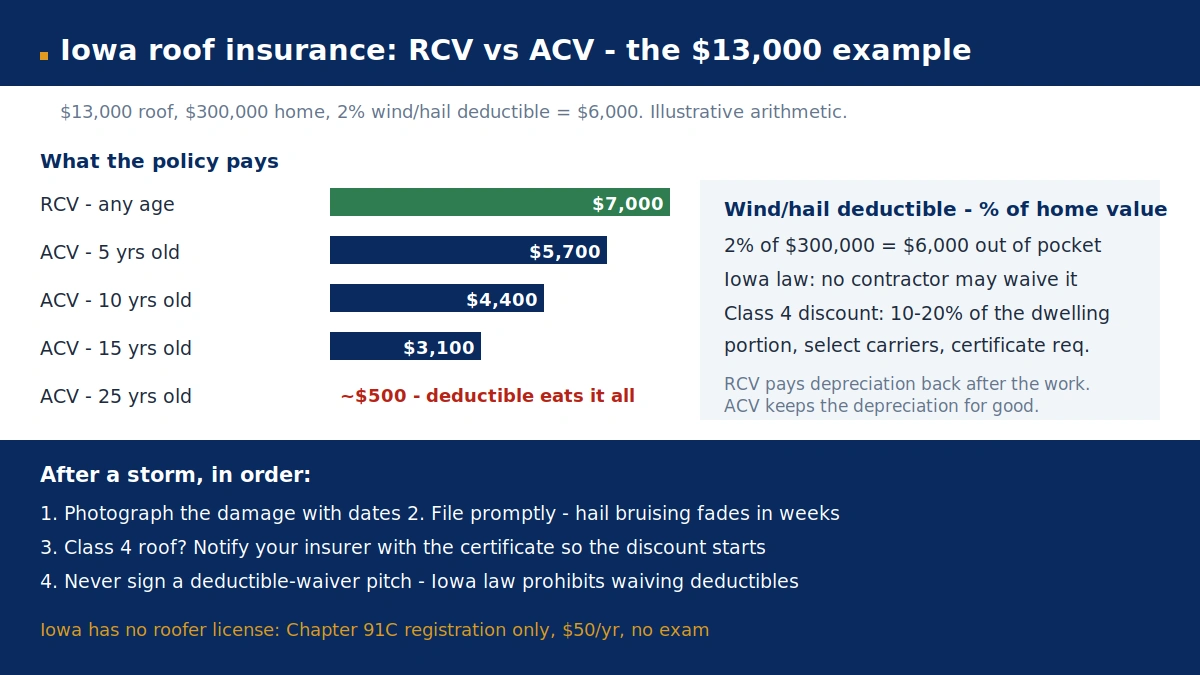
The wind/hail deductible is the number that shocks people. Many Iowa policies carry a separate wind/hail deductible, written as a percentage of dwelling coverage, rather than a fixed dollar figure. A Des Moines contractor’s example: on a $300,000 policy, a 2% deductible is $6,000 — very different from the $1,000 flat deductible you might be expecting. Check your declarations page before the next storm season, not after it, because the percentage applies to dwelling coverage (Coverage A), and a 1% or 2% deductible on a $300,000 home is $3,000 or $6,000 out of pocket before the carrier pays a dollar.
Replacement cost or actual cash value — the policy’s choice fixes the size of the check. With Replacement Cost Value, your carrier pays the current price for a brand-new roof, less the deductible. With Actual Cash Value, depreciation cuts the payout — the older and more worn-out the roof, the smaller the payout. The example below is illustrative arithmetic, not a regulator’s published example — no Iowa regulator example was found for this guide. Take a $13,000 replacement on a $300,000 home with a 2% wind/hail deductible ($6,000), depreciating in a straight line at 2% a year over a 25-year life: an RCV policy pays $7,000 minus the deductible, whatever the roof’s age, once the work is finished and proven. An ACV policy on that same roof at 15 years old pays $3,100 — and at 25 years, about $500.
| Roof age | RCV payout (illustrative) | ACV payout (illustrative) |
|---|---|---|
| New (0–2 years) | $7,000 | ~$6,700–$7,000 |
| 5 years | $7,000 | ~$5,700 |
| 10 years | $7,000 | ~$4,400 |
| 15 years | $7,000 | ~$3,100 |
| 20 years | $7,000 | ~$1,800 |
| 25 years | $7,000 | ~$500 |
*Illustrative arithmetic: $13,000 roof, $6,000 deductible (2% of a $300,000 home). Depreciation is figured straight-line, 2 percent per year, over a 25-year roof life. How fast a roof depreciates differs by carrier, so your own policy’s roof schedule is the one that counts.*
The roof-age schedule is the clause Iowa owners miss. Many Iowa carriers now write endorsements that step coverage down as the roof ages — 100% for the first few years, then 80%, 60%, or 40% as the roof gets older. A twelve-year-old roof can pay only 60% of replacement cost even if the policy still says RCV. Check the roof schedule and endorsements ahead of the next hail season, not after it.
The Class 4 discount is real — but it is voluntary, not mandatory. Iowa has no law requiring insurers to discount a Class 4 roof. Carriers that offer one typically discount the dwelling-coverage portion of the premium by 10–20 percent for a Class 4 roof, from select carriers (RoofRepair.co, 2026). One flagged conflict: other sources put the Iowa figure at 5–15 percent (AmazingFlash) or 10–30 percent (BestRoofingEstimates), and one Iowa agent reports 15–20 percent. This guide uses 10–20 percent and flags the wider claims. Either way, the discount applies to the dwelling-coverage portion of the premium, not the whole bill, it is not automatic — you must notify your insurer and show the Class 4 certificate — and a standard architectural shingle does not trigger it.
When to file, and how to complain. Take dated photos of everything, file quickly, and keep every tarping invoice — hail bruising is hard to prove after months pass, and a late claim about stale damage is one of the quickest ways to hear no from a carrier. One contractor claim to treat carefully: a Des Moines roofer’s FAQ states that Iowa classifies hail and wind as “acts of God” and that an individual rate should not increase for filing a claim. That is a contractor’s statement, not a regulator’s, so confirm it with your agent before you rely on it. If a claim is denied, ask for the denial in writing, with the provision it relies on named, and take it to Iowa’s Insurance Division if the carrier stays silent.
Paying for It: No Federal Credit in 2026, HEAR/HOMES Not Launched & How Iowans Actually Pay
Federal help for a 2026 roof: zero. For any roof installed after December 31, 2025, OBBBA (P.L. 119-21) ended both §25C and §25D. So a roof put on the home you live in during 2026 earns a federal credit of zero — not a single dollar. A few Iowa roofing pages still pitch a federal energy credit for insulation bundled with a reroof — that pitch leans on law that no longer exists, because the insulation and air-sealing credit ended with §25C. Plan the budget as though that credit never existed — unless a tax professional tells you otherwise in writing.
HEAR and HOMES: the money is allocated, the programs are not open — plan as though they do not exist. Iowa was allocated $121 million in federal IRA funding for the Home Electrification and Appliance Rebates (HEAR, $60,473,810) and Home Efficiency Rebates (HOMES, $60,704,701) programs, administered by the Iowa Energy Office and Iowa Economic Development. As of November 2026, neither program is open to homeowners, and no launch date has been announced. HEAR would pay for insulation, air sealing, and ventilation for income-qualified households — not roofing itself — and since DOE Program Notice 26-2 (September 1, 2026), rebates are limited to replacing electric equipment with more efficient electric equipment, so a gas-to-electric swap no longer qualifies. MidAmerican Energy and Alliant Energy do offer $300–$713 in instant discounts for air-source heat pumps, but those are heat-pump discounts, not roof money. Do not let a bid show a HEAR rebate for a roof.
Iowa does have one state loan program worth knowing. The Iowa Finance Authority HELPS Home Energy Loan Program offers fixed-rate loans for energy-efficient improvements, including qualifying roofing upgrades such as metal or cool-roof projects. It is a loan, not a grant — the money gets paid back — but the rate is fixed and the terms are built for exactly this kind of work. Check eligibility with IFA before you sign a financing agreement with a contractor.
How an Iowa roof actually gets paid for: the insurance claim path, where hail or wind damage qualifies — deductible applies, and ACV vs RCV decides the check; the IFA HELPS loan for a qualifying energy-efficient roof; a HELOC or home-equity loan, usually the lowest rate around, though closing takes a few weeks; contractor financing from lenders like GreenSky and Synchrony — quick decision, 12–18 month 0% promo periods show up often, mind the reset-rate fine print; and FHA Title I or 203(k) loans for owner-occupied homes, which close more slowly.
No Iowa-specific contractor APR figures were verified in 2026 sources, so this guide gives none. The same borrowing rules apply here as anywhere: compare APRs instead of monthly payments, stay clear of the deferred-interest trap — a balance still sitting there when a 0% promo ends can pull retroactive interest at 20% or more — and never let the loan outlive the roof, because twenty-five years out of a shingle roof should never come with a thirty-year loan attached. Our roof financing guide sets every way of paying for a roof next to the others, so you can compare them directly.
If you own solar, add one more item to the job: the panels come off and go back on for a reroof, so put the detach-and-reset charge on the bid as its own line. No verified Iowa dollar figure for detach-and-reset exists, so have it quoted as its own line item.
Repair vs Replace: The Iowa Decision Rules
Repair costs (BestRoofingEstimates Iowa guide, 2026):
| Repair | Typical range |
|---|---|
| Missing / blown shingles | $150–$400 |
| Wind / hail damage patch | $300–$900 |
| Leak repair | $250–$650 |
| Flashing replacement | $200–$500 |
| Ice dam damage repair | $400–$1,200 |
| Gutter / fascia damage | $200–$600 |
Cross-check: the typical Iowa repair call-out runs about $475. A $13,000 replacement that lasts 25 years costs about $520 a year — the number to set next to any repair quote. Catching a $300 repair early prevents a $1,500-plus structural repair from a leak that develops over winter.
Missing and lifted shingles are common after every spring thunderstorm and summer squall line across Iowa. Flashing at the chimney, skylight, and wall-step fails often, and wind-driven rain is why: water driven sideways under a lifted flashing reaches the deck in minutes. Pipe boots deserve a second mention: the rubber gaskets bake and crack in Iowa’s summer heat, and a $250–$650 boot-and-flashing repair is one of the cheapest leaks to spot early. Hail bruising is the failure that hides: a shingle can look fine from the ground while the mat underneath is cracked, and the granule loss shows up in the gutters after the next rain.
Replacement is the right call once two or more of these apply:
- Architectural shingle roof age 20+ in Iowa — surrounding materials are already hail-bruised and freeze-thaw cracked, so patching pays less and less
- Three or more leaks in a year — that frequency usually means the underlayment or flashing is failing as a system, not a single bad spot
- Interior stains, soft, spongy decking, or heavy granule shedding — when granules pile up in gutters and driveways after spring hail, the asphalt binders are already broken down
- Recurring ice dams despite a clear gutter — the insulation and ventilation, not the shingle, are at fault, and a reroof is the cheapest moment to sort the attic out
- Hail damage spread across the entire field — that kind of spread normally means a full claim, not a repair
- A roof already carrying two layers — Iowa code caps roofs at two, so the next job has to be a full tear-off either way
- Age past the Iowa lifespan for the material, especially in the high-hail counties of central and eastern Iowa
A repair is the right call when: one leak you can trace on a roof still early in its life, a few shingles lifted by a single storm, a dead pipe boot, or a flashing detail that gave way. If today’s job is a repair rather than a full replacement, the prices for that sit in our roof repair cost guide.
Quote red flags, Iowa-specific:
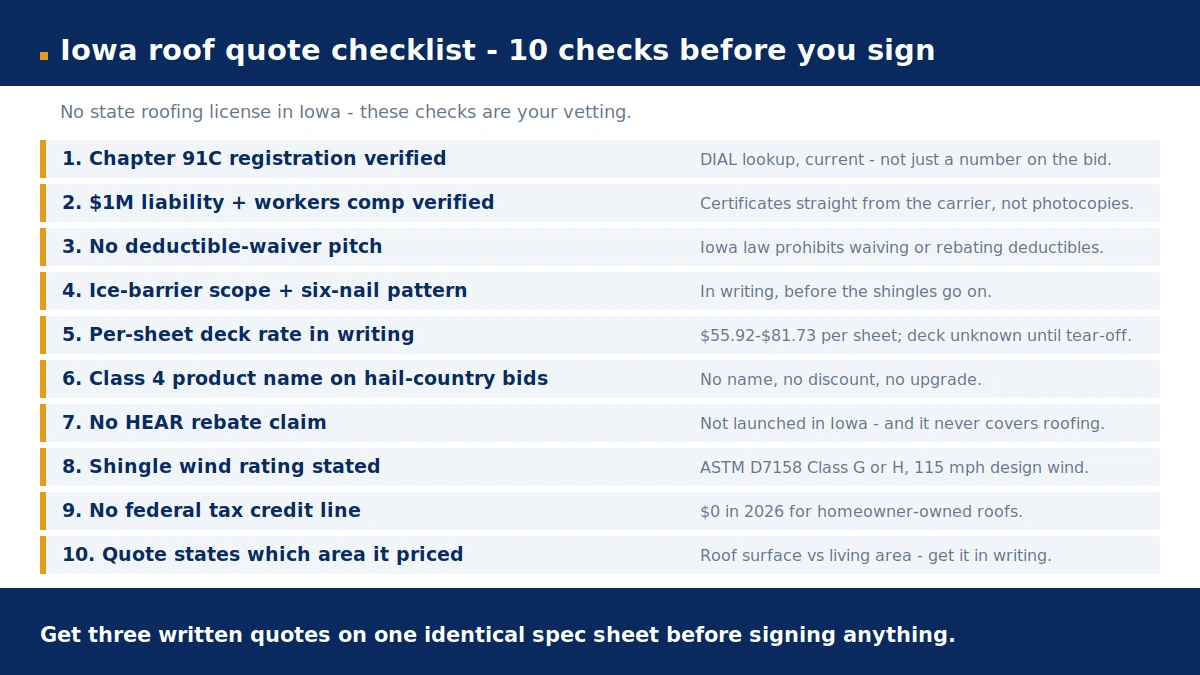
- No Iowa Construction Contractor Registration number on the proposal — Iowa registers roofers under Chapter 91C, and any contractor earning $2,000 or more a year must hold it. Check the number on the DIAL lookup before anyone climbs on your roof.
- No $1 million liability or no workers’ comp certificate — the state sets no liability minimum, so the certificate is all the protection you have, and the business name on the registration must match the contract letter for letter.
- A contractor who offers to cover your deductible — Under Iowa law, paying, waiving, or rebating a homeowner’s deductible is prohibited, and a contractor who offers to do it breaks the law.
- No ice-barrier scope, or no six-nail pattern — the code and the hail climate both start with the deck and the fastening, and a bid without them is a pre-2020 roof.
- No per-sheet deck rate — the deck stays hidden until the tear-off exposes it, so the price per sheet has to be agreed before the first shingle comes off. Leave the decking allowance out and the total jumps once the old shingles come off and the real deck is exposed.
- No Class 4 product name on a hail-country bid — when the bid only says “architectural shingles,” the upgrade that earns its keep never made it onto the page.
- A claim that a HEAR rebate will pay for the roof — the federal rebates have not launched in Iowa, they cover insulation and ventilation rather than roofing, and no launch date has been announced.
- No wind rating on the shingle — ASTM D7158 Class G or H in a 115 mph design wind zone is a code matter, not a choice.
- A tax-credit line in the bid — the federal credit ended for 2026 owner-occupied roofs, so a bid that still shows one is pitching a figure that no longer exists.
- One bare $/sq ft figure with no area behind it — an Iowa roof surface is bigger than the living area, so that lone figure means nothing by itself.
Before any contract gets signed, give every bidder the once-over with our questions to ask a roofer — the vetting list that belongs beside this guide. And if your gutters are part of the job, our gutter installation cost guide prices them — remember that in a freeze-thaw climate the gutter’s job is to carry meltwater away before it refreezes at the eave.
Sources & methodology
Cost anchors: SmartRoofingCalculator — “Iowa Roof Replacement Cost: $10,300–$15,000 (2026)” (updated Apr 24, 2026) — primary Iowa anchor: $410–$600/sq architectural, $830–$1,280 metal, $1,100–$1,650 tile, permit ~$175, 25-square roof $10,250–$15,000, 2,000 sq ft house at 25 squares; NumeralQ — Iowa (pricing Oct 26, 2026: arch $4.29–$5.13/sq ft; 2,000 sq ft roof $9,130–$11,080; 3-tab $3.57–$4.11; standing seam $9.77–$14.93; concrete tile $8.65–$12.39; clay $11.48–$18.46; cedar $8.11–$14.53; slate $15.11–$30.01; EPDM $4.85–$7.66; TPO $5.82–$7.72; modified bitumen $4.70–$5.99; extra layer $1.15–$1.52/sq ft; decking $55.92–$81.73/sheet; full-roof ice barrier $0.82–$1.34/sq ft; gutters $7.54–$10.91/linear ft; flashing $299–$432; skylight reflash $452–$582; permits $94–$200; cities Des Moines $9,200–$11,180, Cedar Rapids $9,060–$10,990; roofer $23.39/hr BLS May 2025, billed $47–$61/hr); MyRoofData — Iowa (2026 model: $11,750–$20,500 typical home; arch $414–$690/sq; ribbed metal $506–$874; standing seam $874–$1,472; crews $48–$80/hr; permits $50–$250); Superstorm Restoration — Des Moines contractor (Mar 4, 2026: $12,500–$19,000 for 28–30 squares arch; 38+ squares $19,000–$30,000+; arch incl Class 3/4 $4.50–$6.50/sq ft; metal $18,000–$35,000+); Wegner Roofing — West Des Moines (Aug 2026: $8,500–$16,000 for 1,800 sq ft home arch; metal $16,000–$25,000+, $9–$14/sq ft; tile $28,000+; large/complex $16,000–$28,000); BestRoofingEstimates — Iowa (2026: 2,000 sq ft home arch $12,200–$18,600; material $/sq ft table; city table; repair table; 40+ hail days/yr; 30–80 freeze-thaw cycles; R-49 insulation; IFA HELPS; deductible-waiver ban); CoralvilleHome — Iowa City corridor (2026: arch $9K–$15K; 50-yr asphalt $12K–$18K; Class 4 $14K–$24K; stone-coated $22K–$35K; standing seam $25K–$50K; premium $60K+; two-layer max); This Old House — Iowa (2026 survey: avg $6,160 — flagged outlier, not used as a headline). The home-size totals, the Class 4 totals, and the cost-per-year figures are our own arithmetic, worked from the per-square-foot ranges and lifespans.
Climate + wind + hail: NumeralQ Iowa (NOAA Storm Events Database 2016–2025: 2,638 large-hail reports, 9th nationally, 65% Apr–Jun, 270 reports 2-inch+; 759 tornado reports; 4,492 reports of 58-mph-plus wind, 18th; 62% of homes built before 1980); Wikipedia / NOAA — August 2020 Midwest derecho (Aug 10, 2020: 140 mph gusts Cedar Rapids; $11.2B damage; costliest thunderstorm event on record; 4 deaths; 26 tornadoes; ~50% tree canopy lost; 400,000+ without power); City of Waukee — Code 155.02, adoption of the 2018 IRC (ground snow 30 psf; wind 115 mph; frost 42 in; ice barrier required); DisclosurePro — Cedar Rapids roof disclosure guide (Oct 31, 2026: 2021 IRC + amendments; permit over 1 square; ice barrier IRC R905.1.2; derecho legacy, rushed unpermitted repairs); City of Waterloo — roofing handout (ice dam protection to 24 in inside wall line; shingles not below 2:12; double underlayment 2:12–4:12; ventilation 1:150/1:300); BestRoofingEstimates Iowa (30–50 in snow; 30–80 freeze-thaw cycles; R-49 insulation; ice dam repair $400–$1,200).
Class 4 + insurance discount: RoofRepair.co — Class 4 discounts by state (2026: Iowa 10–20%, select carriers); AmazingFlash — impact-resistant shingles (June 2026: MN/Dakotas/Iowa 5–15%); Lifelong Insurance Agency — impact-resistant roofs (May 4, 2026: +$30/sq Class 4; 15–20% savings, ~$350/yr, 3–4 yr payback); Superstorm Restoration — Des Moines FAQ (Class 4 discount, 3–5 yr payback; 2% deductible example; RCV vs ACV; hail/wind “acts of God” claim); BestRoofingEstimates Iowa (Class 4 discount 10–30% claimed).
Permits + licensing: RoofingLicenseCheck — Iowa roofing license and 51-jurisdiction dataset (checked Oct 22, 2026: registration only; Iowa Code ch. 91C; $2,000 threshold; $50/yr fee cap 91C.4; $25,000 out-of-state bond 91C.7; no exam; DIAL Division of Labor; number on contracts/bids, kept at jobsite); ServiceTitan and Workyard state guides (same regime, corroborating); City of Cedar Rapids building services (2021 IRC + amendments; permit over 1 square; ice barrier); City of Des Moines (permit required, fee by project value, inspection before sign-off).
Insurance: Superstorm Restoration — Des Moines FAQ (2% deductible example; RCV vs ACV; hail/wind “acts of God” — contractor claim, flagged); BestRoofingEstimates Iowa (Iowa law prohibits contractors paying/waiving/rebating deductibles; roof-age schedules); Iowa Insurance Division (complaints route).
HEAR / HOMES: National Housing Trust — DOE Home Energy Rebates state funding tracker (Mar 5, 2026: Iowa HEAR/HOMES conditionally approved, $121M, no expected launch date; Iowa Economic Development); StartBusinessByState — heat pump rebates by state (checked Oct 6, 2026: Iowa not open); ElectricalContractorsAndWiring — heat pump rebate tracker (checked Oct 27, 2026: Iowa HEAR $60,473,810 / HOMES $60,704,701, funds awarded, not launched); HomeEnergyBasics — heat pump rebate tracker (June 2026: MidAmerican/Alliant $300–$713 heat pump discounts); DOE Program Notice 26-2 (Sep 1, 2026: electric-to-electric only).
Repair costs: BestRoofingEstimates — Iowa (2026: missing shingles $150–$400; wind/hail patch $300–$900; leak $250–$650; flashing $200–$500; ice dam $400–$1,200; gutter/fascia $200–$600; typical call-out $475).
Federal credit: OBBBA (P.L. 119-21); IRS FS-2025-05 — §25C and §25D ended for any install placed in service after Dec 31, 2025.
Method notes: the RCV vs ACV table and the $13,000-roof example are illustrative arithmetic (linear 2%/yr depreciation over a 25-year life), not a regulator’s published example; no Iowa regulator example was found. Carrier discount percentages are published figures, never promises, and they apply to the dwelling-coverage portion of the premium and nothing else. The headline-cost conflict (SRC vs NumeralQ vs Superstorm vs MyRoofData), the standing-seam conflict, the architectural $/sq ft conflict, the city-pricing conflict, and the Class 4 discount conflict are flagged in the text rather than resolved. No Iowa-specific contractor APR figures or solar detach-and-reset figures were verified, so none are given. Sioux City pricing rests on a single source and is flagged; Davenport pricing is the Quad Cities regional row. The Class 4 price is derived arithmetic, and it is labeled as derived. Iowa lifespans are realistic figures from contractor consensus for Iowa’s hail and freeze-thaw climate, not a single published table. The hail/wind “acts of God” no-rate-increase claim is a contractor FAQ statement, attributed as such.
How much does a roof replacement cost in Iowa in 2026?
Most Iowa asphalt replacements run $9,100–$20,500 in 2026. Architectural shingles on a typical 25-square roof cost $10,250–$15,000 (SmartRoofingCalculator; $410–$600 per square installed with tear-off), or $8,200–$12,000 on a 2,000 sq ft home. On a 2,000 sq ft home: 3-tab shingles $7,100–$11,000, Class 4 shingles $11,000–$15,000, standing-seam metal $16,600–$25,600. Des Moines runs the most competitive market in the state; Sioux City runs 3–5% above the average; rural counties run 8–15% above Des Moines. One honest disagreement: a Des Moines contractor framework prices the average local job at $12,500–$19,000, because it counts 28–30 squares of roof surface where the state model counts 25.
Does Iowa require a roofing license?
No — Iowa has no statewide roofing license and never has. What Iowa requires is Construction Contractor Registration under Iowa Code Chapter 91C: every contractor earning $2,000 or more a year must register annually with the Division of Labor (DIAL) for $50 a year. Registration is administrative — it checks the business, the unemployment-insurance account, and workers’ compensation — and it does not test roofing skill; there is no exam. Out-of-state contractors must also post a $25,000 surety bond. Because the state credential proves so little, the vetting falls to you: confirm the registration on the DIAL lookup, get liability and workers’ comp certificates straight from the carrier, look for $1 million in general liability, and check manufacturer certification and local references.
What is the derecho, and does it change what roof I should buy?
A derecho is a long-lived line of severe thunderstorms that produces widespread straight-line wind. On August 10, 2020, one swept across Iowa and hit Cedar Rapids with gusts estimated at 130–140 mph — the highest winds ever recorded in a derecho — causing $11.2 billion in damage and becoming the costliest thunderstorm event in American history. It changes what to buy in two ways: fastening and hail resistance. Iowa’s design wind speed is 115 mph, so shingles should be rated ASTM D7158 Class G or H with a six-nail high-wind pattern, and Class 4 impact-rated shingles are worth pricing because the same storm systems that bring derecho wind also bring hail. A roof built to the current code — ice barrier, six nails, proper fastening — is the roof that survives the next one.
Are Class 4 shingles worth it in Iowa?
For most Iowa homeowners who plan to stay five or more years, yes. Class 4 shingles withstand a 2-inch steel ball dropped from 20 feet under the UL 2218 test — roughly a golf-ball hailstone — and Iowa logged 2,638 large-hail reports from 2016 to 2025, ninth most in the country. The upgrade adds about $1,500–$3,500 to a standard architectural install on a typical job and stretches service life to 25–35 years. Carriers that offer a discount typically cut the dwelling-coverage portion of the premium by 10–20 percent, which pays the upgrade back in roughly three to five years — though the discount is not automatic, varies by carrier, and requires the Class 4 certificate. Each hail claim avoided also saves a deductible of $1,000–$5,000.
How much is the wind/hail deductible on an Iowa roof claim?
Many Iowa policies carry a separate wind/hail deductible calculated as a percentage of dwelling coverage, not a flat dollar figure. On a $300,000 home, a 2% deductible means $6,000 out of pocket before the carrier pays anything. Check your declarations page before hail season, not after it. Iowa law also prohibits a contractor from paying, waiving, or rebating your deductible — any contractor who offers to “cover your deductible” is violating Iowa law and creating liability for you. Whether the claim pays replacement cost or actual cash value decides the size of the check: on a $13,000 roof with a $6,000 deductible, RCV pays $7,000 at any roof age, while ACV pays about $3,100 at 15 years and about $500 at 25 years.
Do I need a permit to replace my roof in Iowa?
In most incorporated cities, yes; in many rural counties, no. Cedar Rapids requires a building permit for any reroofing over one square (100 sq ft) of roof surface and enforces the 2021 IRC with municipal amendments. Des Moines requires a permit with a fee based on project value and an inspection before final sign-off. Typical city permit fees run $94–$200, and the statewide model is about $175. The code demands an ice barrier from the eave to 24 inches inside the exterior wall line, a maximum of two roofing layers, double underlayment on 2:12–4:12 pitches, and balanced ridge-to-soffit ventilation. File the permit and inspection record with the roof papers — your insurer and a future buyer will ask for them.
Is there a federal tax credit for a new roof in Iowa in 2026?
No — $0. OBBBA ended §25C and §25D for anything placed in service after December 31, 2025. Iowa has no state tax credit to take its place, and the federal HEAR rebate (worth up to $8,000) and HOMES program are still closed in Iowa despite a $121 million allocation — no launch date has been announced, and HEAR would cover insulation and ventilation for income-qualified households, not roofing itself. The one state program that does help is the Iowa Finance Authority HELPS Home Energy Loan Program, which offers fixed-rate loans for energy-efficient improvements including qualifying roofing upgrades. The real recurring payback is the insurance discount — 10–20% off the dwelling-coverage portion of the premium for a Class 4 roof.
How long does a roof last in Iowa?
Shorter than the brochure promises in mild states, longer for metal. Realistic Iowa lifespans: 3-tab shingles 15–20 years, architectural shingles 20–30 years, Class 4 shingles 25–35 years, exposed-fastener metal 30–40 years, standing-seam metal 40–70 years, stone-coated steel 40–50 years, cedar shakes 20–30 years, concrete tile 40–50 years, clay tile 50+ years, natural slate 75+ years. The killers are hail that strips granules and bruises the mat, straight-line wind, and 30–80 freeze-thaw cycles a year that crack aging asphalt — plus the ice dam that backs meltwater under shingles every February. A roof that “looks fine” from the curb can be much worse off than it looks after a few Iowa hail years — get it inspected every spring once hail season begins and every autumn before winter sets in.