

Table of Contents
Two seasons write the price of every Nebraska roof. Between May and July, supercells rolling off the High Plains drop hail that has totaled whole neighborhoods in one afternoon — softball-sized ice in Cozad in June 2024, baseball-sized ice across Omaha the same month. Then winter brings single-digit cold, drifting snow, and ice dams that push water under shingles that came through summer untouched. Between those seasons, freeze-thaw works every seam, flashing lap, and nail hole a little looser, year after year. The result is a state where roofs get replaced on the insurance cycle as often as on the age cycle, where the average homeowner now pays nearly $6,400 a year to insure a house, and where the best dollar a homeowner can spend is often the Class 4 upgrade that keeps the next hailstorm from turning into the next claim.
What follows prices Nebraska the way an Omaha estimator prices it: material by material, size by size, city by city — Omaha, Lincoln, Bellevue, Grand Island, Kearney, and the Panhandle — plus the hail counts, wind ratings, permit rules, registration system, and insurance math that move the number. It also clears up the mistake most newcomers make: Nebraska has no statewide roofing license, no state exam, and no state roof grant. The crew that knocks on the door the morning after a hailstorm knows all three of those facts better than you do.
For the national picture, our roof replacement cost guide puts Nebraska beside every other state.
What a Roof Replacement Costs in Nebraska in 2026
Start with SmartRoofingCalculator’s 2026 Nebraska guide. A full architectural asphalt job on a typical 25-square roof — roughly 2,500 sq ft of roof surface — comes to $10,000–$14,250, or $400–$570 per square installed with tear-off. NumeralQ prices the same shingle on a 2,000 sq ft roof at $8,940–$10,840. Those two numbers describe different things, and mixing them up is the most common budgeting mistake in the state: the home-size table prices a 2,000 sq ft home, the per-square table prices a square of roof surface, and a real Nebraska roof surface runs bigger than the living area underneath it — about 1.3 times bigger on a typical Omaha home, once pitch, overhangs, and gables are counted. Omaha estimators say the same thing on every walk-through: get the roof measured, and get every quote to state which area it priced.
Other 2026 sources sit in the same range, with one figure worth calling out. Modernize (updated August 27, 2026) puts most Nebraska replacements at $8,500–$22,000, averaging about $12,900 for architectural asphalt on a typical 1,800 to 2,200 sq ft home. ProRoofCalc lands at $7,500–$11,000, averaging $9,200. MyRoofData’s 2026 model lands at $11,750–$20,250. RoofingEstimatorPros is the high outlier: $12,752–$23,004 for a 2,000 sq ft architectural roof, averaging $17,308. That is not a mistake on either side. RoofingEstimatorPros prices a larger roof surface at a higher per-square-foot rate, while SmartRoofingCalculator prices the state baseline. This guide treats SmartRoofingCalculator as the main anchor and notes the higher figure where it shows up.
So the working headline is: $8,500–$22,000 covers most Nebraska asphalt replacements in 2026, with architectural shingles on a typical 25-square roof at $10,000–$14,250. Every number from here on is a turn-key installed total, tear-off included, unless the text says otherwise.
| Material | Installed $/sq ft | 2,000 sq ft roof | Nebraska lifespan |
|---|---|---|---|
| 3-tab shingle | $3.51–$4.03 | $7,020–$8,060 | 10–15 yrs |
| Architectural shingle | $4.20–$5.01 | $8,400–$10,020 | 15–22 yrs |
| Designer / luxury asphalt | $5.17–$6.12 | $10,340–$12,240 | 20–25 yrs |
| Class 4 impact shingle | $5.45–$8.15 | $10,900–$16,300 | 20–30 yrs |
| Exposed-fastener metal (5V) | $6.69–$8.42 | $13,380–$16,840 | 30–45 yrs |
| Stone-coated steel | $7.56–$11.01 | $15,120–$22,020 | 40–50 yrs |
| Synthetic slate / shake | $7.93–$11.51 | $15,860–$23,020 | 40–50 yrs |
| Cedar shakes | $7.92–$14.28 | $15,840–$28,560 | 20–30 yrs |
| Concrete tile | $8.38–$12.03 | $16,760–$24,060 | 40–50+ yrs |
| Standing-seam metal | $9.55–$14.65 | $19,100–$29,300 | 40–60 yrs |
| Clay tile | $11.19–$18.09 | $22,380–$36,180 | 50+ yrs |
| Natural slate | $14.77–$29.57 | $29,540–$59,140 | 75–150 yrs |
Sources: SmartRoofingCalculator Nebraska guide (updated Nov 2, 2026); NumeralQ Nebraska (pricing Oct 26, 2026); BestRoofingEstimates Nebraska (2026). The 2,000 sq ft roof totals are arithmetic from the per-square-foot ranges on a 2,000 sq ft roof surface. The Class 4 row uses BestRoofingEstimates’ Omaha-metro per-square-foot range.
On a typical Nebraska job, labor takes about 50–60% of the total in the Omaha and Lincoln metros. Roofer median pay sits at $22.34 an hour (BLS, May 2025), and billed rates run $45–$58 an hour once insurance, payroll taxes, overhead, and profit are folded in. Materials take roughly 40 percent. A second tear-off layer adds $1.11–$1.46 per sq ft (NumeralQ). Nobody knows the decking until tear-off: replacement runs $54–$79 per 4×8 sheet installed (NumeralQ), or $60–$95 a sheet on an Omaha-metro bid. Hail-driven water intrusion plus freeze-thaw cycling commonly damages 5 to 15 percent of the sheathing on roofs older than 15 years. Full-roof ice-and-water barrier instead of eaves-only adds $0.81–$1.32 per sq ft.
Roof Replacement Cost in Nebraska by Material
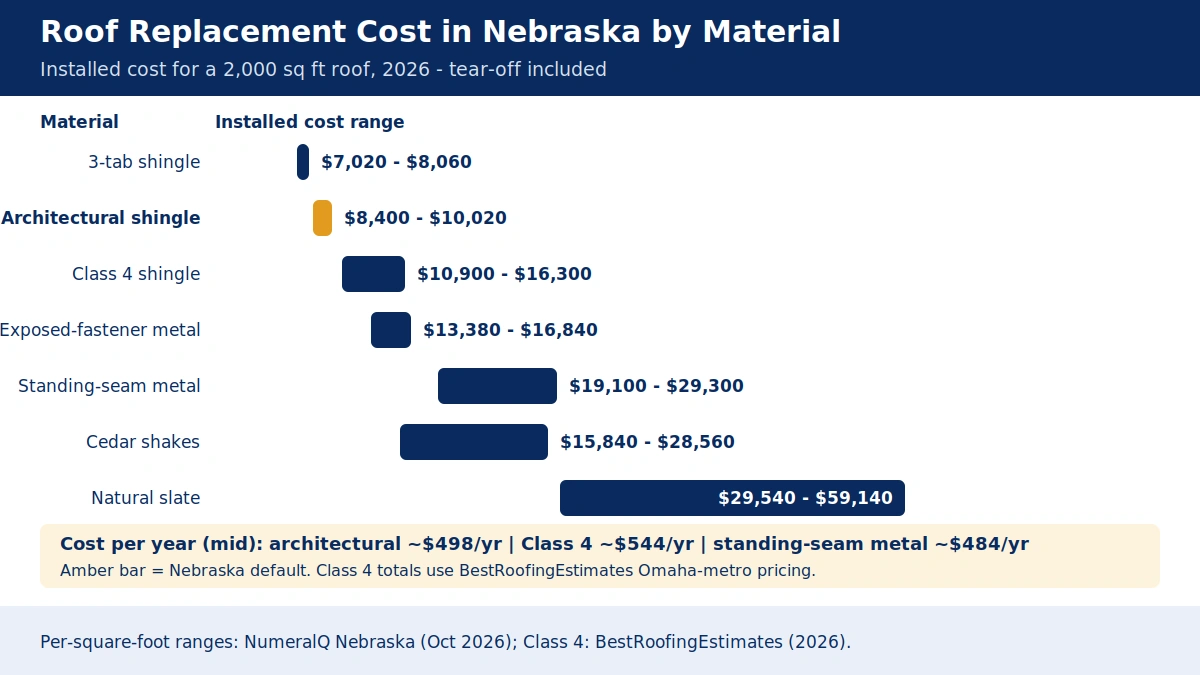
The material line is the largest on any Nebraska invoice. Standing-seam metal costs about twice what architectural shingles cost to put on. But the invoice price is only half the Nebraska story. Hail shortens shingle life, while metal and stone-coated steel mostly shrug it off. So the table below pairs 2026 installed prices with Nebraska lifespans and a per-year cost, so the expensive option gets judged on what it costs per year, not per invoice.
| Material | Installed $/sq ft | 2,000 sq ft roof | Nebraska lifespan | Cost per year* |
|---|---|---|---|---|
| 3-tab shingle | $3.51–$4.03 | $7,020–$8,060 | 10–15 yrs | ~$468–$806/yr (mid ~$603/yr) |
| Architectural shingle | $4.20–$5.01 | $8,400–$10,020 | 15–22 yrs | ~$382–$668/yr (mid ~$498/yr) |
| Designer / luxury asphalt | $5.17–$6.12 | $10,340–$12,240 | 20–25 yrs | ~$414–$612/yr (mid ~$502/yr) |
| Class 4 impact shingle | $5.45–$8.15 | $10,900–$16,300 | 20–30 yrs | ~$363–$815/yr (mid ~$544/yr) |
| Exposed-fastener metal (5V) | $6.69–$8.42 | $13,380–$16,840 | 30–45 yrs | ~$297–$561/yr (mid ~$403/yr) |
| Stone-coated steel | $7.56–$11.01 | $15,120–$22,020 | 40–50 yrs | ~$302–$551/yr (mid ~$413/yr) |
| Synthetic slate / shake | $7.93–$11.51 | $15,860–$23,020 | 40–50 yrs | ~$317–$576/yr (mid ~$432/yr) |
| Cedar shakes | $7.92–$14.28 | $15,840–$28,560 | 20–30 yrs | ~$528–$1,428/yr (mid ~$888/yr) |
| Concrete tile | $8.38–$12.03 | $16,760–$24,060 | 40–50+ yrs | ~$335–$602/yr (mid ~$454/yr) |
| Standing-seam metal | $9.55–$14.65 | $19,100–$29,300 | 40–60 yrs | ~$318–$733/yr (mid ~$484/yr) |
| Clay tile | $11.19–$18.09 | $22,380–$36,180 | 50+ yrs | ~$373–$724/yr (mid ~$532/yr) |
| Natural slate | $14.77–$29.57 | $29,540–$59,140 | 75–150 yrs | ~$197–$788/yr (mid ~$394/yr) |
*Cost per year = installed cost divided by Nebraska realistic lifespan. Lifespan and price figures: NumeralQ Nebraska (Oct 2026); BestRoofingEstimates Nebraska (2026).
Architectural shingles cover most Nebraska roofs already. They draw the lowest bid, the most crews install them, and they are the simplest product to patch after a storm. Here they last 15–22 years. That is shorter than the same shingle lasts in a mild climate. Hail bruises the mat, and freeze-thaw works the sealant loose a little more every winter. The weak point is impact, not heat: a standard architectural shingle carries a Class 3 impact rating, which stands up to pea-to-marble-sized hail and usually fails under quarter-to-golf-ball-sized hail. Six nails per shingle in a high-wind pattern is the usual Nebraska answer to the straight-line wind that arrives with the same storms.
3-tab shingles are the budget option, and on most Nebraska houses they are a false economy. At $3.51–$4.03 per sq ft they save roughly $1,400 against architectural shingles on a 2,000 sq ft roof. Then they hand the savings back by lasting only 10–15 years under repeated hail and freeze-thaw — and by offering the lowest wind and impact resistance of any asphalt product in a state where hail is the whole game. They are also getting harder to insure on a replacement-cost basis in the Omaha and Lincoln metros, because carriers know the next hailstorm will produce a total-loss claim. Keep a 3-tab roof only on a rental, a short hold, or a detached structure where insurance grade is not a constraint.
Class 4 impact-rated shingles get a full section below. They are the upgrade that pays for itself in insurance discounts — but the reason they pay is different from what most Nebraska roofing pages say, and the difference matters. Expect about $5.45–$8.15 per sq ft installed ($10,900–$16,300 on a 2,000 sq ft roof), roughly $1,800–$3,200 more than standard architectural shingles on a typical Omaha home. Service life stretches to 20–30 years. One honest caveat: the Class 4 per-square-foot figure comes from BestRoofingEstimates’ Omaha-metro pricing, not a statewide survey, and it is labeled as such wherever it appears.
Designer and luxury asphalt shingles sit between architectural and Class 4 on price — $5.17–$6.12 per sq ft, or $10,340–$12,240 on a 2,000 sq ft roof — and buy a thicker, heavier shingle with a longer manufacturer warranty. In Nebraska they make sense on a house where the look matters and the hail exposure is moderate. But they are not a substitute for a Class 4 rating: a heavy shingle without the UL 2218 Class 4 test behind it still fails the same hail test, and it still earns no insurance discount.
Exposed-fastener metal (5V crimp and corrugated) is the farm-country workhorse: $6.69–$8.42 per sq ft installed, 30–45 years of service, and a profile that has covered Nebraska barns, acreages, and outbuildings for generations. It costs roughly half what standing seam costs and sheds hail and snow well. The catch is the fasteners: hundreds of exposed screws with rubber washers that want checking and re-tightening over the decades, and the roof can look worn out years before it ever leaks.
Standing-seam metal is the premium Nebraska roof for anyone planning to stay put. At $9.55–$14.65 per sq ft, a 2,000 sq ft roof runs $19,100–$29,300 — roughly double architectural shingle upfront. What you get is 40–60 years, a Class 4 impact rating as standard, concealed fasteners that never back out in a storm, and a surface that sheds snow instead of holding it. One flagged conflict: BestRoofingEstimates prices standing seam higher, at $9.40–$17.00 per sq ft. This guide uses NumeralQ’s band as primary and notes the higher top rather than resolving it. One warning matters more than the price band: some Nebraska carriers now write metal roofs with a cosmetic-damage exclusion, so a dented-but-watertight metal roof may not earn a claim at all. If the choice is still open, our metal roof vs shingles cost comparison sets the two side by side, while our metal roof cost guide holds the national numbers.
Stone-coated steel deserves a line of its own in Nebraska because it solves a problem standing seam cannot: the HOA. At $7.56–$11.01 per sq ft, panels from DECRA, Gerard, and Metro deliver the shingle look with 40–50 years of metal durability, a Class 4 impact rating, and the same insurance discount as Class 4 shingles — and they pass architectural review in Papillion, La Vista, and west Omaha subdivisions where standing-seam panels would be rejected. The textured stone surface also disguises minor hail dimples better than flat metal.
Cedar shakes are in retreat across Nebraska. At $7.92–$14.28 per sq ft they cost more than architectural shingles, last 20–30 years, and carry the worst combination in the state: hail vulnerability, maintenance demand, and — most decisively — an unwillingness from many Nebraska homeowner carriers to write or renew policies over a wood-shake roof. Existing wood-shake roofs are typically replaced with Class 4 architectural or stone-coated steel at the next claim event.
Concrete and clay tile are rare in Nebraska, and the reasons are structural. Concrete tile runs $8.38–$12.03 per sq ft and clay $11.19–$18.09, but tile averages 800 to 1,100 pounds per roofing square against 240 to 350 for asphalt, large hail can crack it, and freeze-thaw spalls lower-density tile. The few Nebraska tile installations sit on Spanish-revival custom builds in west Omaha that were framed for the load. For tile pricing across the country, our tile roof cost guide has the national picture.
Natural slate is the heirloom option: $14.77–$29.57 per sq ft, or $29,540–$59,140 on a 2,000 sq ft roof, for a roof that lasts 75–150 years and needs framing engineered for its weight. It appears on historic homes and high-end builds, and almost nowhere else in Nebraska. Synthetic slate and shake, at $7.93–$11.51 per sq ft, offer the look at a third of the price with a 40–50 year life.
Flat and low-slope roofs deserve a mention because they cover so many Nebraska ranch additions, garages, and commercial buildings. NumeralQ prices them for a 2,000 sq ft roof at $9,710–$12,500 for modified bitumen, $10,000–$15,820 for EPDM rubber, and $11,850–$15,830 for TPO membrane. Our flat roof replacement cost guide carries the national figures, and a Nebraska flat-roof bid should be judged on its seam and drainage scope — ponding water plus freeze-thaw is a fast way to kill a membrane.
The bottom line on materials: metal asks for roughly double the shingle money on day one, then hands most of it back over the decades. A Nebraska shingle roof comes off when hail and freeze-thaw say so, not when the warranty says so.
Roof Replacement Cost by Roof Size
The table below prices SmartRoofingCalculator’s 2026 per-square bands by home size (living area) at the state baseline, typical pitch 4:12–8:12, single-layer tear-off. Keep the measuring-stick warning from the first section in mind: roof surface runs larger than living area, so a 2,000 sq ft home here usually carries a 2,000–2,600 sq ft roof. These totals are the ones SmartRoofingCalculator published for that home size.
| Living area | Roof squares | Architectural | Class 4 | Standing seam |
|---|---|---|---|---|
| 1,000 sq ft | ~10 | $4,000–$5,700 | $5,450–$8,150 | $9,550–$14,650 |
| 1,500 sq ft | ~15 | $6,000–$8,550 | $8,175–$12,225 | $14,325–$21,975 |
| 2,000 sq ft | ~20 | $8,000–$11,400 | $10,900–$16,300 | $19,100–$29,300 |
| 2,500 sq ft | ~25 | $10,000–$14,250 | $13,625–$20,375 | $23,875–$36,625 |
| 3,000 sq ft | ~30 | $12,000–$17,100 | $16,350–$24,450 | $28,650–$43,950 |
NumeralQ’s Nebraska model lands inside the band above, toward the middle: architectural shingles on a 2,000 sq ft roof at about $8,940–$10,840. BestRoofingEstimates’ Omaha-metro table lands above it: $11,800–$17,500 for the same 2,000 sq ft home. The reason is the squares count. BestRoofingEstimates prices about 26 squares of roof surface where SmartRoofingCalculator prices about 20, and it prices Omaha labor. Small houses pay more per square foot: permits, dumpsters, and crew mobilization are fixed costs, and fewer squares have to carry them. Steep or cut-up roofs cost more for their shape, not just their size: anything above 8:12 pitch, common in newer Sarpy County subdivisions, adds 15 to 20 percent to labor for fall protection and slower crew movement.
Roof Replacement Cost by Region: Omaha vs Lincoln vs Grand Island vs Kearney
Nebraska roofing labor is unusually consistent statewide. The Omaha and Lincoln metros set the baseline, and most major suppliers stock from regional warehouses. The spread that exists comes from crew travel time, not from material prices — and from hail exposure, which keeps demand elevated in the east and lets Panhandle crews book several weeks out.
| Region / Metro | 25-square roof, architectural (SRC) | 2,000 sq ft home, architectural (BRE metro) |
|---|---|---|
| Omaha metro | $9,300–$13,253 | $11,800–$17,500 |
| Lincoln | $9,300–$13,253 | $11,600–$17,200 |
| Bellevue | Not published by SRC | $11,900–$17,800 |
| La Vista / Papillion | Not published by SRC | $12,200–$18,400 |
| Grand Island | Not published by SRC | $12,000–$18,000 |
| Kearney | Not published by SRC | $11,900–$17,800 |
| Fremont / Hastings | Not published by SRC | $11,700–$17,500 |
| North Platte / Panhandle | Not published by SRC | $12,800–$20,200 |
Sources: SmartRoofingCalculator Omaha and Lincoln city pages (updated Nov 2, 2026); BestRoofingEstimates Nebraska metro table (2026); NumeralQ Nebraska (Oct 26, 2026).
Omaha metro sets the benchmark for cost and for hail. SmartRoofingCalculator’s Omaha page puts the city at $372–$530 per square, or $9,300–$13,253 for a 25-square roof, about 7 percent below the Nebraska state baseline. A local Omaha contractor guide puts most full replacements at $9,000–$18,000 in 2026, and a separate Omaha estimator puts the typical architectural job at about $11,500 for a 2,000 sq ft roof. The metro — Omaha plus Bellevue, La Vista, Papillion, and Council Bluffs across the river in Iowa — holds the largest concentration of residential roofs in the state, the deepest contractor pool, and the highest hail frequency. Class 4 shingles are the norm among quality Omaha contractors, not the exception. Omaha also adds its own layer of cost: a city contractor license on top of state registration, and a permit for any roof work at or above two squares.
Lincoln tracks Omaha within 1 to 2 percent on price — $11,600–$17,200 for a 2,000 sq ft home on the BestRoofingEstimates metro table, against Omaha’s $11,800–$17,500. The two metros share a material supply chain and a similar contractor density. The state capital runs the second-deepest contractor pool in Nebraska, and its homeowners get one break Omaha does not always offer: Lincoln Electric System rebates on attic insulation bundled with envelope work, worth pricing into any reroof that opens the deck. Lincoln’s permit rule is lighter than Omaha’s — a like-for-like reroof is sometimes exempt, and a permit is required when the job includes deck replacement, structural changes, or a material upgrade.
Bellevue, La Vista, and Papillion run 3 to 5 percent above the Omaha baseline. Bellevue, Sarpy County’s largest city and home to the Offutt Air Force Base community, carries a high VA-loan share and is served heavily by Omaha contractors. La Vista and Papillion, the newest Sarpy County subdivisions, run the highest in the metro at $12,200–$18,400 — newer, steeper roofs above 8:12 pitch, plus HOA architectural review that is common on material upgrades and often pushes homeowners toward stone-coated steel.
Grand Island and Kearney are the central Nebraska hubs, at $12,000–$18,000 and $11,900–$17,800 respectively for a 2,000 sq ft home. Grand Island is the agricultural metal capital of the region — standing seam and exposed-fastener metal are common on acreages and farm properties — and its tornado history runs heavy. Kearney, a university town with a smaller contractor pool, sees Lincoln and Grand Island crews competing for work. Both add 3 to 8 percent for crew travel over the Omaha baseline.
North Platte and the Panhandle run the highest in the state, at $12,800–$20,200 for a 2,000 sq ft home — 8 to 15 percent above the Omaha baseline. Three forces stack up out west: longer freight runs from Omaha or Denver, smaller local contractor pools that book several weeks out, and snow-load detailing that exceeds the eastern part of the state. Blizzard events that produce drifting snow loads of 50 to 70 pounds per square foot are routine in the Panhandle, and roof framing plus underlayment must be specified accordingly. Rural unincorporated areas often require no permit at all — the one place in Nebraska where the paperwork gets lighter instead of heavier.
Why Nebraska Roofs Cost What They Do: Hail, Tornado-Alley Wind & Freeze-Thaw
Four forces act on every Nebraska roof, often in the same year. Hail bruises and cracks the covering. Tornado-alley wind lifts shingles and ridge caps off the deck. Freeze-thaw cycling works every seam a little looser each winter. And the insurance market — the highest-stakes roofing market on the Plains — prices every one of those risks into the premium and the deductible. They compound: hail-bruised shingles let water into the deck, freeze-thaw opens the laps the hail loosened, and a roof that survived June can still fail the adjuster’s inspection in October.
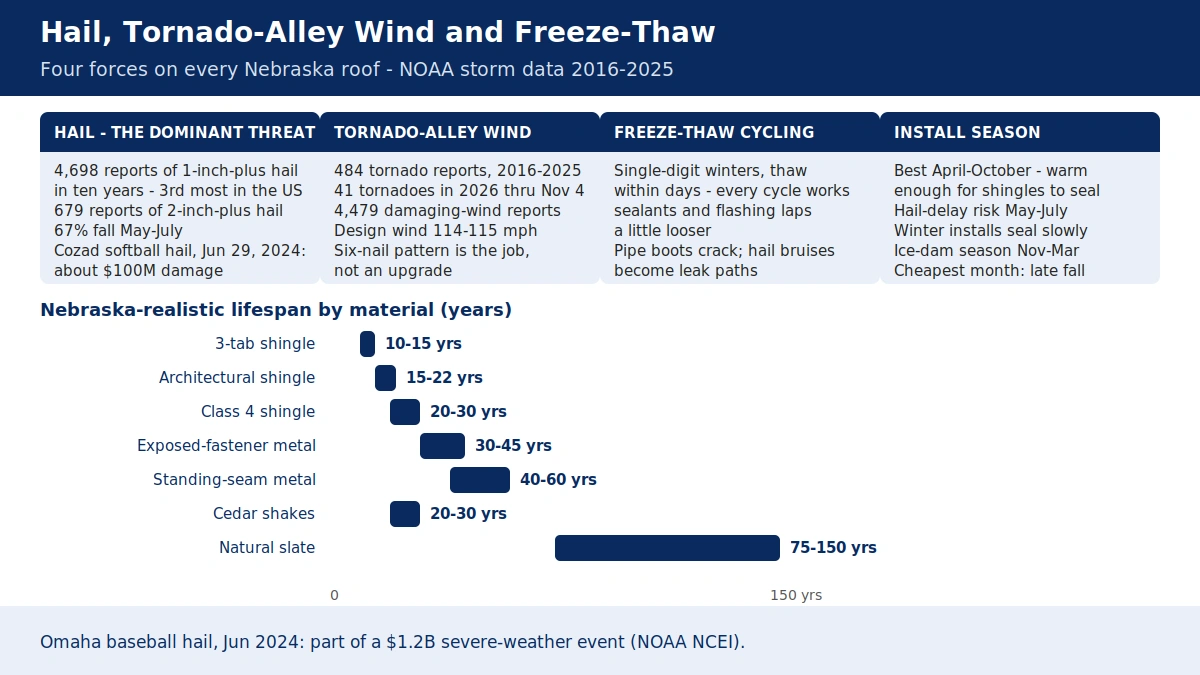
Hail sets Nebraska’s material rules. NOAA logged 4,698 reports of one-inch-plus hail in Nebraska over the last ten years (2016–2025), the third most in the country, and 679 reports of two-inch-plus hail — the size that totals a standard asphalt roof on contact. Two-thirds of the large-hail reports fall between May and July, which is why the roofing season in Nebraska runs on the storm calendar as much as on the weather. The named events tell the story in dollars: baseball-sized hail across the Omaha metro in June 2024, part of a $1.2 billion severe-weather event; softball-sized hail in Cozad on June 29, 2024, that damaged virtually every building in a town of about 4,000 people and caused roughly $100 million in damage. Harbilo’s count from NOAA Storm Prediction Center data puts 867 severe wind and hail reports in Nebraska in the twelve months to September 2026, with June 2026 the busiest month at 258 reports. The consequence is plain: a Nebraska roof gets engineered for impact first, and the shingle on it has to be rated for the hail it will actually meet.
Tornado-alley wind sets Nebraska’s fastening rules. Nebraska sits on the northern edge of Tornado Alley. NOAA logged 484 tornado reports in the state over 2016–2025, and 41 tornadoes in 2026 through November 4 — about 1 percent above the ten-year norm. The June 2024 season alone produced an EF-3 tornado at Whitman, the first strong tornado to hit Grant County in more than 70 years. Between named events, sustained 60 to 80 mph straight-line winds are routine across the plains, and derecho-style events lift ridge caps, peel back drip edge, and tear off whole shingle courses. NOAA also logged 4,479 damaging-wind reports in ten years. Design wind speeds run about 114–115 mph under ASCE 7 in the Omaha and Lincoln area — Grand Island’s ordinance sets 114 mph, Columbus sets 115 mph — and standard architectural shingles are rated 110–130 mph with a six-nail pattern, while standing-seam metal with mechanical clips is rated 140–180 mph. Six nails per shingle in a high-wind pattern is the job here, not an upgrade.
Freeze-thaw finishes what hail starts. Nebraska winters drop into single digits and below, then thaw above freezing within days. Each daily cycle stresses sealants, opens flashing laps, and works water a little deeper into small cracks. A hail bruise that would stay cosmetic in a warm climate becomes a leak path after three winters of freezing and thawing. Pipe boots are a repeat problem: the rubber gaskets bake under Nebraska summer sun, then crack in the winter cold, and a dead boot is one of the cheapest leaks to catch and one of the most common. Attic ventilation matters in both seasons: in summer it vents heat off the deck, and in winter it keeps the deck cold enough that snow does not melt, refreeze at the eave, and back water under the shingles.
The install season runs on the storm calendar. Roofing works from roughly April through October, when temperatures are warm enough for shingles to seal properly. Summer jobs are common, but 95-degree-plus heat slows crews down, shortens the workday, and scuffs shingles underfoot. Booking in May, June, or July carries hail-delay risk — and after every major hail event, demand surges and prices spike, because every crew in the metro is booked and every supplier is short. Winter installs are possible but shingles seal slowly in the cold, and the ice-dam season runs November through March. The cheapest month to buy a roof in Nebraska is usually the quiet one after the storm season ends and before the cold sets in — late fall, when crews have open calendars and suppliers have stock.
Ice Dams, Snow Load & Winter: The Cold Nebraska Roof Killers
If one failure defines Nebraska roofing in winter, it is not the blizzard. It is the ice dam that forms on an ordinary January week, on a roof that looked fine in October. A Nebraska roof can survive a summer of hail and still leak in February, because the water that gets in during winter does not come from above. It comes from below, backing up behind a ridge of ice at the eave.
Here is how it happens, on thousands of Nebraska houses. Heat escapes from the living space into the attic through gaps, recessed lights, and thin insulation — most Nebraska homes built before the mid-1990s carry only R-19 to R-30 in the attic. The warm attic melts snow on the upper roof. The meltwater runs down to the eave, which sits past the warm wall and stays below freezing. It refreezes into a dam. The next melt backs up behind the dam, under the shingles, past the underlayment, and into the deck. Day after day, the decking stays wet, fasteners rust, and the wood fiber softens. A small leak that would dry out in a week in a dry climate stays wet for months in a Nebraska winter — and a leak that has been dripping into the attic since January can run $1,500–$8,000 by the time the damaged section is stripped, the structural wood is replaced, and the roof goes back on.
The ice barrier is the code answer, and it is not the same everywhere in Nebraska. The IRC requires an ice barrier where the local climatic table designates a history of ice forming along the eaves. Columbus’s table says Yes — ground snow load 25 pounds per square foot, winter design temperature minus 3, ice barrier required. Grand Island’s 2021 table says No — same 25-pound ground snow load, but no ice barrier designation, with a roof snow load of 30 pounds per square foot and no reductions allowed. The requirement is jurisdiction-by-jurisdiction, so confirm it on the local table before the bid is written rather than assuming the next county over has the same rule. Where it is required, the membrane must extend from the lowest edges of all roof surfaces to at least 24 inches inside the exterior wall line — which on a typical 6-pitch roof with a 12-inch overhang means about 47 inches up the slope from the drip edge, not the 36 inches a single roll covers. A bid that prices one roll at the eave is a bid that does not meet the code.
Snow load is the Panhandle’s problem and the east’s quiet one. Ground snow load runs 25 pounds per square foot in the Columbus and Grand Island tables, with a roof snow load of 30 pounds per square foot in Grand Island. In the Panhandle, blizzard events produce drifting snow loads of 50 to 70 pounds per square foot as a matter of routine, and roof framing plus underlayment must be specified for it. Frost depth runs 36 inches statewide. A roof that was framed for eastern Nebraska snow loads and then re-covered with heavy tile or slate in the west is a roof carrying weight it was never designed for — and a retrofit onto a shingle-framed house needs an engineer’s sign-off.
What winter costs when it wins. Ice dam steaming and removal runs $350–$1,200 (BestRoofingEstimates). Deck rot found during a winter leak repair runs $1,500–$8,000 in Lincoln contractor pricing, and a Lincoln roofer’s own rule of thumb is that freeze-thaw turns a $600 leak in October into $3,500 or more in deck rot by April. The lasting fix is in the attic, and a reroof is the cheapest moment in a house’s life to do it: bring attic insulation up to R-49 or R-60 while the deck is open — roughly half the cost of a standalone insulation job — seal the air leaks that carry heat into the attic, and bring ventilation into balance so the deck stays cold and the snow stays put. Insulation plus air sealing plus balanced ventilation, done together, is what keeps a Nebraska roof dry from below as well as from above.
Check the roof twice a year. Have it inspected in late fall after hail season, and again in late spring before it starts. A fall inspection catches the hail bruises, lifted shingles, dead pipe boots, and failing flashing that the next winter will exploit. Small, cheap fixes caught in time keep a minor leak from becoming a full deck repair that costs five to ten times as much.
Class 4 Impact-Resistant Shingles in Nebraska: What the Upgrade Costs and What It Pays Back
The Class 4 shingle is a test result, not a marketing term. UL 2218 Class 4 is the highest impact rating in the standard. It is the single most valuable upgrade a Nebraska homeowner can buy, because the state has now put the insurance discount behind it and the hail statistics in front of it.
The rating itself. The shingle survives a 2-inch steel ball dropped from 20 feet without fracturing. In Nebraska terms: it typically resists quarter- to golf-ball-sized hail without granule loss, and baseball-sized hail with manageable cosmetic damage rather than total loss. Products on Nebraska roofs include GAF Timberline AS II, Owens Corning Duration Storm, CertainTeed Landmark IR, Atlas StormMaster Shake, and Malarkey Vista AR. A standard architectural shingle carries a Class 3 rating, which stands up to pea-to-marble-sized hail and usually fails under quarter-to-golf-ball-sized hail — the exact size Nebraska gets most often. The rating is printed on the shingle packaging and the manufacturer certificate, not on the contractor’s brochure: ask for the UL 2218 Class 4 label by name.
The price tag. A Class 4 upgrade runs about $1,800–$3,200 more than standard architectural shingles on a typical 2,000 sq ft Omaha home — a premium of roughly 15 to 25 percent. Per square foot, Class 4 installs at $5.45–$8.15, against $4.20–$5.01 for standard architectural. On a 2,000 sq ft roof, that puts a Class 4 roof at roughly $10,900–$16,300. The upgrade also stretches service life to 20–30 years, against 15–22 for standard architectural — five to ten extra years before the next replacement.
The payback. This is the insurance discount, and the published bands disagree enough to say so plainly. BestRoofingEstimates, the Nebraska-specific source, reports 10–30% off the wind/hail portion of the premium. SquareDash (May 2026) reports Nebraska at 5–15%. RoofRepair.co reports Nebraska at 15–25%. AmazingFlash reports Kansas, Nebraska, and Oklahoma together at 10–20%, or $150–$400 a year. This guide uses BestRoofingEstimates’ 10–30% as primary and notes the narrower bands rather than resolving them. The discount applies to the wind/hail portion of the premium only, not the whole bill — a 20 percent discount on a $1,400 wind/hail component is $280 a year, not 20 percent off everything you pay. BestRoofingEstimates puts the typical annual saving at $140–$420 a year, and the payback window at four to eight years on premium savings alone.
The deductible angle is the second payback, and it is harder to put a number on. Many Nebraska carriers now apply percentage wind/hail deductibles — often 1 to 5 percent of dwelling coverage — to standard-shingle roofs. On a $400,000 home with a 2 percent wind/hail deductible, that is $8,000 out of pocket per claim event. A Class 4 roof can reduce or eliminate that deductible exposure with some carriers, which means a single avoided claim can be worth $1,500–$5,000 or more in deductible alone — before the discount is counted at all. And the third payback is the claim that never happens: a Class 4 roof that survives a hailstorm the standard roof would have totaled keeps the homeowner off the claims record entirely, which matters in a state where carriers have been moving older or hail-battered roofs onto actual cash value.
The math in dollars. A Class 4 upgrade at $1,800–$3,200 above standard, against a wind/hail discount of 10–30 percent, pays back in roughly four to eight years on premium savings alone — and then keeps paying for the life of the roof. With a single avoided deductible behind it, the upgrade can pay for itself in one storm. Carriers writing the discount in Nebraska include State Farm, American Family, Allstate, Farmers, Nationwide, Liberty Mutual, USAA, and multiple regional mutuals — but the discount amount and the qualifying SKU list vary by carrier, so call the agent before signing and ask three questions: what is the exact discount percentage on the wind/hail premium component, which manufacturer SKUs qualify on the approved list, and what documentation is needed from the contractor, typically a manufacturer-issued impact-resistance certificate referencing the address and the install date. The discount only exists once the documentation does.
The short version: in Nebraska, Class 4 is the default specification that happens to pay for itself — and unlike a heavier shingle without the rating, it is the one the insurer actually discounts.
Permits & Code: The 2018 IRC, City Rules & the Two-Square Trigger
Nebraska runs one statewide construction code, and the cities enforce it with their own thresholds on top. The statewide code is based on the 2018 International Residential Code, adopted through the Building Construction Act and overseen by the Nebraska State Fire Marshal and the Department of Labor. Grand Island adopted the 2021 IBC and IRC in December 2023. Your city still issues the permit and sets the fee — but the rules on the roof itself are the state’s, and they do not change when you cross a county line. Most of eastern Nebraska sits in Climate Zone 5; the western Panhandle is Climate Zone 5B.
A full replacement needs a permit in essentially every Nebraska city — and in Omaha, the trigger is written down in square feet. Any roof work at or above two squares (200 sq ft) requires a permit in Omaha; below that it is routine maintenance. Starting work without a permit in Omaha quadruples the fee. Lincoln is lighter: a permit is required for any reroof that includes deck replacement, structural changes, or a material upgrade, while a like-for-like reroof is sometimes exempt. In rural unincorporated areas, often no permit is required at all — the one place in Nebraska where the paperwork gets lighter instead of heavier.
| City / Jurisdiction | Typical fee | What to know |
|---|---|---|
| Omaha | $80–$260 | Permit required at 2+ squares (200 sq ft); city contractor license required; mid-roof inspection on deck replacements; fees quadrupled if started without a permit |
| Lincoln | $90–$250 | Permit required for deck replacement, structural changes, or material upgrade; like-for-like reroofs sometimes exempt |
| Bellevue | $60–$200 | Sarpy County contractor registration; standard inspection |
| Papillion / La Vista | $60–$210 | HOA architectural review may apply on material upgrades |
| Grand Island / Kearney | $50–$200 | Smaller central-NE markets; permit usually pulled by contractor |
| North Platte / Panhandle | $0–$175 | Variable enforcement; rural unincorporated areas often no permit |
Sources: BestRoofingEstimates Nebraska permit table (2026); City of Omaha Planning Department permit guide; SmartRoofingCalculator Nebraska model (~$175 permit, 2026); NumeralQ Nebraska ($94–$200 in the cities checked). No single statewide fee schedule exists — fees are set by the city, so confirm yours before budgeting. Real Omaha re-roof permits on record (2024–2025) show fees of $75–$288 on job valuations of $5,000–$26,000.
What the fee looks like in Omaha. Fees are valuation-based: a minimum of $41 for up to $2,000 in value, plus $9.53 for each additional $1,000 up to $25,000. Permits for roofing or siding can be obtained with just an application and the fee, while other work needs drawings. Keep the issued permit and the inspection record with the roof file. The insurer will ask for them, and a buyer will too.
What the code demands on the roof itself. The ice barrier is the headline rule where the local table requires it — see the winter section above for the Columbus-versus-Grand Island split. Nailing patterns matter in tornado-alley wind: six nails per shingle in a high-wind pattern, and shingles rated to the wind speed the code assigns to the city. Low-slope rules bite on the state’s many low-pitch ranch additions: asphalt shingles are not allowed below a 2:12 pitch, and pitches from 2:12 to 4:12 require double underlayment. Nebraska code allows at most two roofing layers, so a house already carrying two has to come all the way off. Ventilation is part of the same package: balanced ridge-to-soffit airflow keeps the attic from cooking in summer and keeps the deck cold enough in winter that snow does not melt and refreeze at the eave.
One more rule to know before you put pen to paper. In Sarpy County subdivisions — particularly Papillion, La Vista, and west Omaha — HOA architectural review commonly applies to material upgrades. Stone-coated steel usually passes where standing seam is rejected, and a permit without the HOA sign-off can still stop the job. Check the HOA guidelines and any historic-district rules before ordering materials.
Hiring a Roofer in Nebraska: Registration, Not a License
Here is the fact that surprises almost every homeowner who moves here from a state with a roofer license: Nebraska has no statewide roofing license, and it never has had one. The state does not test roofers, does not require roofing experience, and does not issue a license that proves a contractor knows how to roof. What Nebraska has instead is a registration — and the difference between a license and a registration is the difference between a skill check and a name on a list.
The registration that matters is the Department of Labor Contractor Registration. Under the Contractor Registration Act (Neb. Rev. Stat. sections 48-2101 to 48-2117), every contractor and subcontractor earning $5,000 or more a year from construction must register with the Nebraska Department of Labor before doing work, and renew annually. The registration number is a five-digit number plus a two-digit year of issue, and it is searchable on the Department of Labor website. The annual fee is $40, effective August 1, 2026 — before that date it was $25, and older pages still quoting $25 are quoting the pre-August 2026 fee. Contractors with one or more employees must file a current Workers’ Compensation Certificate of Insurance with the Department of Labor listed as certificate holder, and keep it current — cover that lapses removes the contractor from the registered list. General liability insurance is not required for state registration. Registration proves the business exists and carries workers’ comp. It proves nothing about workmanship.
Omaha adds the layer the state does not. The City of Omaha issues its own contractor licenses, and Class E covers roofing, siding, windows, and decks. Omaha requires a $25,000 bond and a $150 annual registration fee, plus an insurance certificate. Lincoln requires city contractor registration with an insurance certificate through Lincoln Building and Safety. Bellevue, La Vista, Papillion, and Sarpy County each maintain their own permit and inspection requirements — verify before signing. A contractor who is registered with the state but not licensed in Omaha cannot legally pull an Omaha permit, and work done without the proper city license can draw fines and stop-work orders.
Using the registration to vet a bidder. Look the contractor up on the Department of Labor registration list before anyone climbs on your roof — an unregistered contractor cannot legally do the work, and a lapsed workers’ comp certificate leaves the homeowner exposed if a crew member is injured on the property. Have the general liability and workers’ comp certificates sent to you directly by the carrier — never accept a photocopy handed over by the contractor. And confirm the contractor operates under the registered business name — the registration number should appear on every contract and invoice.
Six checks before you hire:
- Verify the Department of Labor contractor registration on the DOL lookup, and confirm it is current — not just that a number exists on the proposal — plus the Omaha Class E license or Lincoln registration where the job sits.
- Confirm insurance — workers’ comp certificate mailed directly from the carrier, and general liability even though the state does not require it — and confirm the business name on the registration matches the contract exactly.
- Require a written, itemized proposal with tear-off, underlayment grade, ice-barrier scope, shingle model and wind and impact ratings, flashing scope, ridge vent, disposal, permit, and final cleanup as separate line items, with the Class 4 product name specified where quoted.
- Reject layover-only bids on a roof that already carries two layers — Nebraska code caps roofs at two, and a layover traps moisture under a freeze-thaw climate and typically voids the manufacturer warranty.
- Check manufacturer certification (GAF Master Elite, Owens Corning Platinum Preferred, CertainTeed SELECT ShingleMaster, Atlas Pro Plus) — in a state with no license, this is the closest thing to a skill credential that exists; and pay in milestones, never in full upfront — the typical draw is 10% deposit, 40% on material delivery, 40% at dry-in, 10% at final inspection. If a contractor wants full payment before the crew arrives, walk away.
- Never sign an assignment of benefits, and never accept a promise to waive, absorb, or rebate the insurance deductible — Nebraska law forbids it, and a contract entered into in violation of the Insured Homeowners Protection Act is void.
The storm-chaser problem is Nebraska-scale after every hail event. Nebraska, Kansas, Oklahoma, and Texas form the core territory for traveling storm-chaser roofing crews. After every major hail event in the Omaha or Lincoln metros, dozens of out-of-state contractors set up temporary offices, staff door-to-door canvassers, and sign as many homes as possible before disappearing once the work is complete. The Nebraska Attorney General’s Consumer Protection Division has issued repeated public guidance warning homeowners about these operations. The pattern to recognize: a door knock within days of a hail event, pressure to sign a free-inspection agreement on the spot that contains assignment-of-benefits or contingency-contract language, out-of-state phone area codes, no permanent local office, no Nebraska Secretary of State business registration, promises to waive the deductible, and a demand for substantial up-front payment before material delivery. Nebraska law requires any door-to-door contractor to provide a written contract with a three-day right of cancellation — use it. If anything about the encounter feels rushed, sign nothing, ask for the company’s Department of Labor registration number, and verify it on the Department of Labor website before any further conversation.
Before anything gets signed, run every bidder through our questions to ask a roofer — it is the vetting checklist written to go with this guide.
Insurance: Wind/Hail Deductibles, ACV vs RCV & the Class 4 Discount
A Nebraska homeowner policy usually pays for roof damage from a sudden event — hail, wind, and wind-driven rain. Slow wear, skipped maintenance, freeze-thaw deterioration, and a roof that simply aged out all fall outside coverage. Your declarations page has three lines that matter more to a roof claim than the storm itself: how the policy values the roof, how the deductible is written, and whether the roof is Class 4.
Covered, and not covered. A sudden hail hit is covered. A roof that simply wore out after fifteen Nebraska winters gets no payout at all. A large share of Nebraska roofs are replaced through homeowner insurance claims following a hail or wind event, not age-driven replacement — and most policies require you to file promptly, with photo documentation before repairs begin, because hail bruising fades and water spreads within weeks. Get your contractor to photograph the damage with date stamps before you file, and hold on to every tarping receipt.
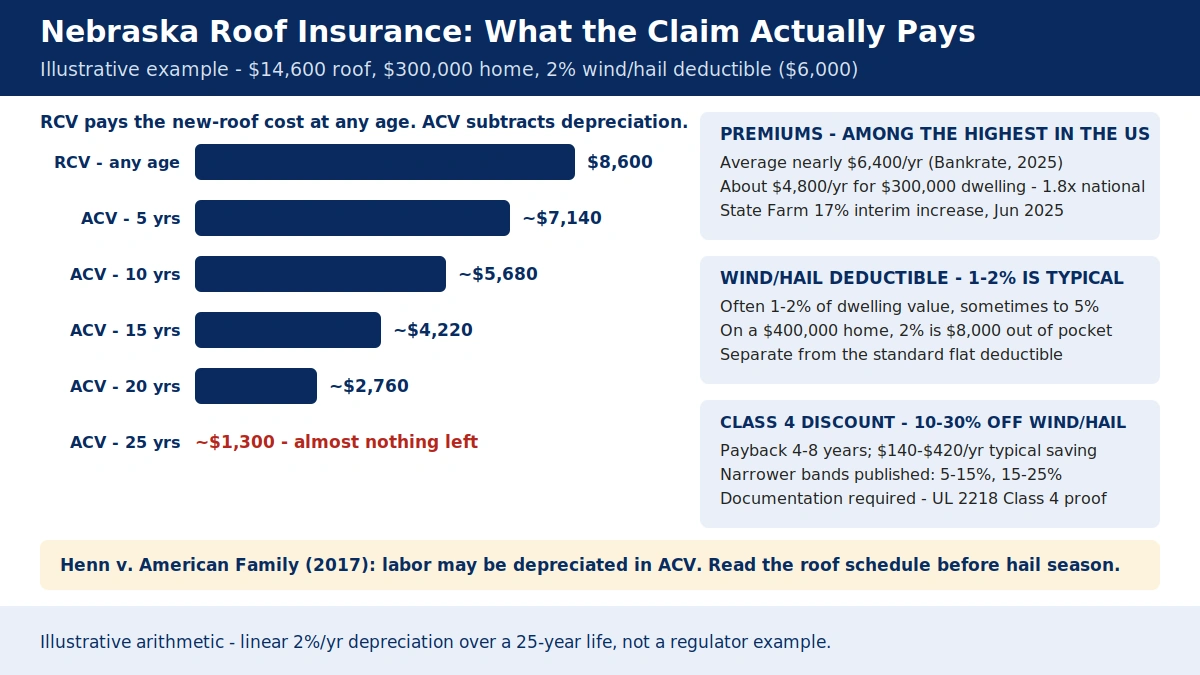
The premium shocks people first. The average Nebraska homeowners policy now costs nearly $6,400 a year (Bankrate, 2025). The University of Nebraska Omaha puts it at about $4,800 a year for $300,000 in dwelling coverage with a $1,000 deductible — more than 1.8 times the national average of $2,601 — and Bankrate ranks Nebraskans second-highest in the country for the true cost of home insurance and second-highest for the share of income it takes, at 8.61 percent. A few years ago the same $300,000 home cost about $1,500 a year to insure; now it costs $3,000–$4,500. The reason is the loss history: severe convective storms caused over $50 billion in U.S. insured losses in 2023, the costliest year on record, and hailstorms caused an estimated $160 billion in damage to U.S. homes in 2024. State Farm secured a 17 percent interim rate increase in June 2025, with regulators attaching conditions including a $400 million surplus note from the parent company.
The wind/hail deductible shocks people second. Many Nebraska policies now carry a separate percentage-based wind/hail deductible, often 1 to 2 percent of dwelling value, sometimes up to 5 percent — separate from the standard flat deductible. On a $400,000 home, a 2 percent deductible is $8,000 out of pocket before the carrier pays a dollar. On a $300,000 home, 1 percent is $3,000 and 2 percent is $6,000. Read the declarations page before the next hail season, not after it.
Replacement cost or actual cash value — the policy’s choice decides the size of the check. Under Replacement Cost Value, the carrier pays today’s cost of a brand-new roof, less your deductible. Under Actual Cash Value, depreciation cuts the check down. The older and more worn the roof, the smaller the payout. Many carriers have been moving older or hail-battered Nebraska roofs onto ACV. In *Henn v. American Family Mutual Insurance Co.* (Nebraska Supreme Court, 2017), the court held that an insurer may depreciate the cost of labor in determining actual cash value where the policy does not define it otherwise — so an ACV settlement can be far smaller than the contractor’s bid. The example below is an illustration we worked out ourselves, not a regulator’s published example — no Nebraska regulator example was found for this guide. Take a $14,600 replacement (the Nebraska average for a 2,000 sq ft home) on a $300,000 home with a 2 percent wind/hail deductible ($6,000), depreciating linearly at 2 percent a year over a 25-year life: an RCV policy pays $8,600 after the deductible at any roof age, once the work is done and proven. An ACV policy on the same roof at 15 years old pays $4,220 — and at 25 years, about $1,300.
| Roof age | What RCV pays (example) | What ACV pays (example) |
|---|---|---|
| New (0–2 years) | $8,600 | ~$8,020–$8,600 |
| 5 years | $8,600 | ~$7,140 |
| 10 years | $8,600 | ~$5,680 |
| 15 years | $8,600 | ~$4,220 |
| 20 years | $8,600 | ~$2,760 |
| 25 years | $8,600 | ~$1,300 |
*Worked example: $14,600 roof, $6,000 deductible (2 percent of a $300,000 home). Depreciation runs straight-line at 2 percent a year across a 25-year life. Carriers depreciate at different speeds, so the roof schedule printed on your own policy is what decides.*
The clause Nebraska owners miss is the roof-surface payment schedule. Many Nebraska carriers now attach endorsements that cut coverage as the roof ages — full payment for the first few years, then 80 percent, 60 percent, or 40 percent as it gets older. A roof that is 12 years old can pay out just 60 percent of replacement cost, even when the policy is nominally RCV. Check the roof schedule and endorsements before hail season starts, not after it does.
The Class 4 discount is the payback — but only for Class 4 roofs. The published bands run 10–30 percent off the wind/hail portion of the premium (BestRoofingEstimates), with narrower published bands of 5–15 percent (SquareDash), 15–25 percent (RoofRepair.co), and 10–20 percent (AmazingFlash). Either way, the discount applies to the wind/hail portion of the premium, not the whole bill, and it only exists once the Class 4 documentation does. A heavier shingle without the UL 2218 Class 4 test behind it does not trigger it. And one warning for metal roofs: some carriers now write a cosmetic-damage exclusion, so a dented-but-watertight metal roof may not earn a claim at all — read the endorsement before choosing metal for hail reasons alone.
Claim timing and complaints. Take date-stamped photos of everything, file quickly, and keep every tarping receipt — hail bruising is hard to prove months later, and a stale-damage claim is one of the easiest for a carrier to refuse. If the carrier denies the claim, ask for the denial in writing with the provision it relies on, then complain to the Nebraska Department of Insurance if the carrier will not explain itself.
Paying for It: No Federal Credit in 2026, Utility Rebates & No State Grant
Washington pays nothing toward a 2026 Nebraska roof. The OBBBA law (P.L. 119-21) ended both §25C and §25D for any roof installed after December 31, 2025. So a 2026 roof on the home you live in earns a federal credit of zero — not one dollar. One Nebraska roofing page still pitches a federal energy credit for insulation bundled with a reroof — that pitch relies on law that no longer exists, because the insulation and air-sealing credit ended with §25C. Count on zero unless a tax professional tells you otherwise in writing. The one door the law leaves open is the commercial §48E credit, which survives for third-party-owned systems in service by December 31, 2027 — relevant to a leased solar array, not to a roof a homeowner buys outright.
HEAR and HOMES are funded but not launched — do not count on them. Nebraska was allocated about $91 million in federal IRA funding for the Home Electrification and Appliance Rebates (HEAR) and Home Efficiency Rebates (HOMES) programs, administered by the Nebraska Department of Water, Energy, and Environment (DWEE), with both applications conditionally approved. As of November 2026, neither program has launched for homeowners and no launch date has been announced — DWEE still lists both as “Preparing Application.” HEAR would cover insulation, air sealing, and ventilation for income-qualified households — not roofing itself — and since DOE Notice 26-2 (September 1, 2026) it is electric-to-electric only and never covers solar, batteries, EV chargers, or windows. Do not pay anyone who claims to reserve a rebate for you.
Nebraska has no statewide roof grant. NumeralQ checked in October 2026 and found none. No state program pays for a stronger roof. The money for a Nebraska roof comes from three places instead: the insurance claim where hail or wind damage qualifies, the Class 4 discount on the premium, and the utility rebates below.
The utility rebates worth checking before a reroof. OPPD (Omaha Public Power District) Energy Smart Rebates offer limited rebates for attic insulation upgrades and air sealing performed alongside a roof replacement. LES (Lincoln Electric System) Sustainable Energy Program offers similar rebates on attic insulation and envelope improvements. The reason both matter at reroof time is timing: adding R-49 to R-60 attic insulation while the deck is exposed is roughly half the cost of a standalone insulation job, and most Nebraska homes built before the mid-1990s carry only R-19 to R-30. A reroof that opens the deck is the cheapest insulation job the house will ever get.
How Nebraskans actually pay for a roof: the insurance claim path, where hail or wind damage qualifies — percentage deductible applies, and ACV vs RCV decides the check; a HELOC or home-equity loan, usually the cheapest rate you will find, though closing takes weeks; contractor financing through lenders like GreenSky, Service Finance, and Hearth — fast decision, 0 percent promo periods common, read the reset-rate fine print; and FHA Title I or 203(k) programs for owner-occupied homes, which are slower to close.
No Nebraska-specific contractor APR figures were verified in 2026 sources, so this guide gives none. The borrowing rules are the same here as anywhere: compare APRs instead of monthly payments, stay clear of the deferred-interest trap — a balance still sitting there when a 0 percent promo ends can pull retroactive interest at 20 percent or more — and never let the loan outlast the roof, because eighteen years out of a shingle roof should never come with a twenty-five-year loan attached. Our roof financing guide sets every payment route side by side so the comparison is direct.
Solar owners need one more line in the scope: panels come off and go back on around a reroof, so price detach-and-reset as its own line item. No verified Nebraska dollar figure for detach-and-reset was found, so get it quoted as its own line item.
Repair vs Replace: The Nebraska Decision Rules
Repair costs (NumeralQ Omaha, October 2026; BestRoofingEstimates Nebraska, 2026):
| Repair | Typical range |
|---|---|
| Most small repairs (leak, missing shingles, pipe boot, flashing) | $300–$800 minor / $1,000–$1,500 major |
| Find and fix a roof leak | $259–$720 |
| Flashing repair | $191–$411 |
| Replace missing/damaged shingles (up to 10) | $180–$365 |
| Chimney flashing reflash | $270–$600 |
| Skylight leak | $293–$560 |
| Rotted decking (2 sheets) with shingles | $305–$640 |
| Decking / structural repair | $2,000–$8,000+ |
| Ice dam steaming and removal | $350–$1,200 |
| Ridge cap and edge wind uplift | $500–$2,000 |
| Emergency tarp | $300–$900 |
Modernize’s 2026 cross-check agrees: Nebraska minor repairs $300–$800; major repairs $1,000–$1,500. A Lincoln contractor puts most repair calls at $700–$2,000, mid-range work at $2,000–$6,000, and deck rot or multi-slope storm damage at $6,000–$15,000 or more. A $12,500 replacement that lasts 18 years costs about $694 a year — hold that number next to any repair quote. Omaha repair prices run about 41 percent above the Nebraska listed-city average, and emergency or after-hours repairs typically carry a 15–25 percent surcharge.
Missing and lifted shingles show up after every straight-line wind event across the plains. Flashing — chimney, skylight, and wall-step — fails often, and wind-driven rain is the reason: water pushed sideways under a lifted flashing finds the deck in minutes. Pipe boots are a repeat problem: the rubber gaskets bake under summer sun and crack in winter cold, and a $300–$800 boot-and-flashing fix is one of the cheapest leaks to catch. Hail bruising looks cosmetic until it is not — the granule loss it causes shortens shingle life on the same slope, and a carrier that finds it on inspection can use it to move the roof to actual cash value.
Replace when two or more of these fit your roof:
- Architectural shingle roof age 15+ in Nebraska — surrounding materials are already hail-bruised and freeze-thawed, so patching has diminishing returns
- Three or more leaks in a year — repairs that frequent mean the underlayment or flashing is failing as a system, not one bad spot
- Interior staining, soft decking, or heavy granule loss — granules filling the gutters and driveway after summer storms means the asphalt binders have already broken down
- Recurring ice dams despite a clear gutter — the insulation and ventilation, not the shingle, are the problem, and a reroof is the cheapest moment to fix the attic
- Hail damage spread across the whole field — damage that widespread usually means a full claim instead of a repair
- A roof already carrying two layers — Nebraska code caps roofs at two, so the next job is a full tear-off whether you want it or not
- Age past the Nebraska lifespan for the material, especially in the eastern hail corridor
Patch it instead when: one leak you can trace on a roof still early in its life, a few shingles lifted by a single wind event, a dead pipe boot, or a flashing detail that gave way. If a repair quote is what you need today, those prices live in our roof repair cost guide.
Quote red flags, Nebraska-specific:
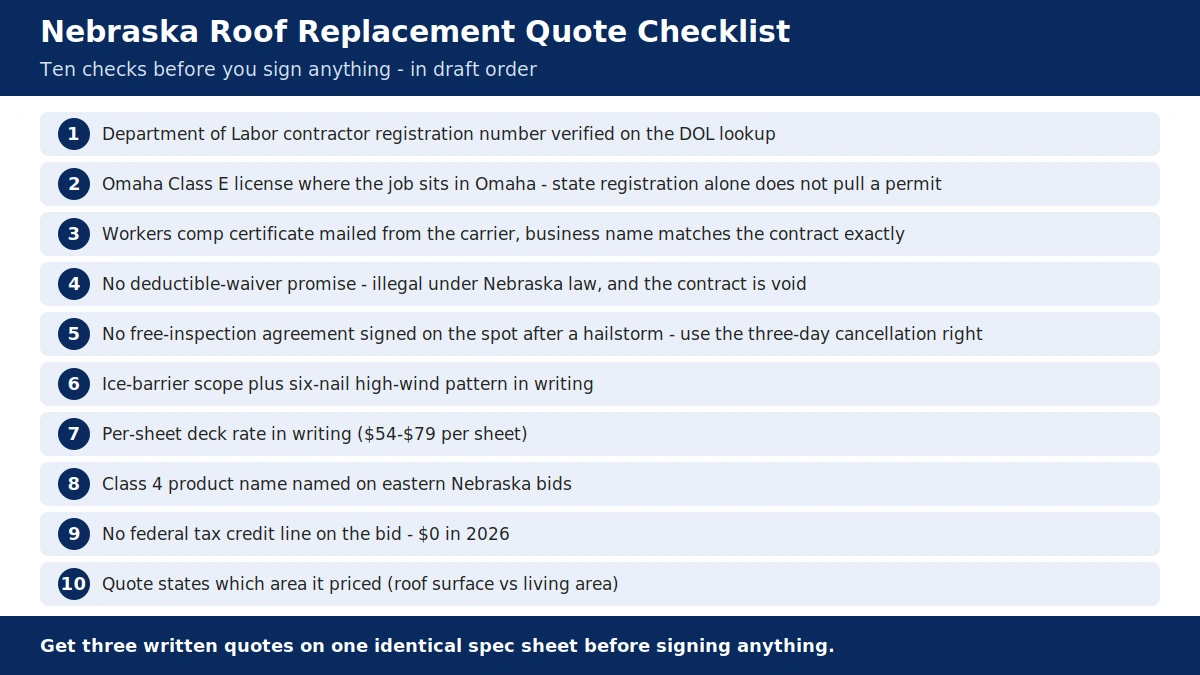
- No Department of Labor contractor registration number on the proposal — Nebraska registers roofers through the Department of Labor, and any contractor earning $5,000 or more a year must hold it. Look the number up on the DOL lookup before anyone climbs on your roof.
- No Omaha Class E license where the job sits in Omaha — state registration alone does not pull an Omaha permit.
- No workers’ comp certificate, or a photocopy instead of one mailed from the carrier — these are verifiable, not optional, and the business name on the registration must match the contract exactly.
- A contractor who offers to waive, absorb, or rebate the deductible — Nebraska law forbids it, and a contract entered into in violation of the Insured Homeowners Protection Act is void.
- A free-inspection agreement signed on the spot after a hailstorm — it often contains assignment-of-benefits or contingency language that ties you to that contractor regardless of what the inspection finds. Nebraska law gives a three-day right of cancellation on door-to-door contracts — use it.
- No ice-barrier scope, or no high-wind nailing pattern — the code and the hail climate both start with the deck and the fastening, and a bid without them is a pre-2018 roof.
- No per-sheet deck rate — the deck’s condition stays hidden until tear-off exposes it. Skip the decking allowance and the total jumps as soon as the old shingles come off and the real deck shows itself.
- No Class 4 product name on an eastern Nebraska bid — if the bid just says “architectural shingle,” the upgrade that pays for itself was never quoted.
- A tax-credit line on the bid — no federal credit exists for 2026 owner-occupied roofs, so a bid still showing one is padding its numbers with a fiction.
- One bare $/sq ft number with no area behind it — a Nebraska roof surface runs about 1.3 times the living area, so that lone figure tells you nothing on its own.
Before you put pen to paper, run every bidder through our questions to ask a roofer — it is the vetting checklist written to go with this guide. And if your gutters are part of the job, our gutter installation cost guide prices them — remember that in a hail climate the gutter’s job is to carry wind-driven rain away before it backs up under the eaves.
Sources & methodology
Cost anchors: SmartRoofingCalculator — “Roof Replacement Cost by State (2026)” and “2026 Roofing Cost Index by State” (updated Nov 2, 2026; Nebraska $400–$570/sq arch; 25-square roof $10,000–$14,250; metal $790–$1,230; tile $1,050–$1,580; permit ~$175; roofer wage $22.10/hr; index 88) and Omaha / Lincoln city pages (Nov 2, 2026: $372–$530/sq; 25-square roof $9,300–$13,253; 0.93x baseline; standing seam $735–$1,144/sq); NumeralQ — Nebraska (pricing Oct 26, 2026: arch $4.20–$5.01/sq ft; 2,000 sq ft roof $8,940–$10,840; 3-tab $3.51–$4.03; designer $5.17–$6.12; standing seam $9.55–$14.65; concrete tile $8.38–$12.03; clay $11.19–$18.09; cedar $7.92–$14.28; slate $14.77–$29.57; extra layer $1.11–$1.46/sq ft; decking $54.06–$79.31/sheet; whole-roof ice-and-water $0.81–$1.32/sq ft; repair table; cities Omaha $8,940–$10,840, Lincoln $9,020–$10,940); BestRoofingEstimates — Nebraska (2026: Omaha metro arch $11,800–$17,500, Class 4 $14,200–$21,200, standing seam $24,500–$44,000, avg $14,600; Class 4 premium $1,800–$3,200, discount 10–30%, payback 4–8 yrs; material table; metro table; permit table; repair table; 1.3x roof-surface factor; Panhandle +8–15%); Modernize — Nebraska (updated Aug 27, 2026: $8,500–$22,000, avg ~$12,900; asphalt $5–$11/sq ft); ProRoofCalc (2026: Nebraska $7,500–$11,000, avg $9,200); MyRoofData (2026: Nebraska $11,750–$20,250; crews $46–$80/hr); RoofingEstimatorPros (updated Aug 26, 2026: 2,000 sq ft arch $12,752–$23,004, avg $17,308; $8.65/sq ft). We computed the home-size totals, the Class 4 totals, and the cost-per-year figures ourselves from the per-square-foot ranges and the lifespans.
Climate + hail + wind: NOAA Storm Events Database via NumeralQ (4,698 one-inch-plus hail reports 2016–2025, 3rd in US; 679 two-inch-plus; 67% May–Jul; 484 tornado reports; 4,479 damaging-wind reports); NOAA NCEI billion-dollar disasters (June 12–14, 2024 Omaha baseball hail, $1.2B; June 24–26, 2024 EF-3 Whitman); Nebraska Public Media (Nov 13, 2025: Cozad June 29, 2024 softball hail, ~$100M damage; Nebraska avg premium nearly $6,400/yr Bankrate); Weather.city storm reports (Nebraska all-time 3,244 tornadoes, 25,198 hail, 14,202 wind; 2026 YTD 41 tornadoes through Nov 4); Harbilo (Oct 10, 2026: 867 severe wind and hail reports in 12 months; June 2026 busiest, 258); Grand Island Ordinance 9958 (2021 IRC; wind 114 mph Exposure C; roof snow load 30 psf; ground snow 25 psf; ice barrier No); Columbus Ordinance 20-29 (2018 IRC; wind 115 mph; ground snow 25 psf; frost 36 in; ice barrier Yes; winter design temp -3); Fine Home Building — ice barriers (IRC R905.1.2; membrane to 24 inches inside the exterior wall line).
Class 4 + insurance discounts: BestRoofingEstimates Nebraska (discount 10–30% on the wind/hail portion; $140–$420/yr typical saving; carriers State Farm, American Family, Allstate, Farmers, Nationwide, Liberty Mutual, USAA); SquareDash — Class 4 guide (updated May 8, 2026: Nebraska 5–15%; UL 2218 2-inch steel ball from 20 feet); RoofRepair.co — Class 4 discounts by state (Nebraska 15–25%); AmazingFlash (June 9, 2026: KS/NE/OK 10–20%, $150–$400/yr).
Permits + licensing: City of Omaha Planning Department permit guide (roofing/siding permit required; 2-square / 200 sq ft trigger; $41 minimum; fees quadrupled if started without permit); PermitFlow — Omaha building permit guide (valuation fee table); BuildZoom — Omaha re-roof permit records (fees $75–$288 on $5,000–$26,000 valuations, 2024–2025); RoofingLicenseCheck — Nebraska roofing license (checked Oct 22, 2026: registration only, no exam; $40 fee from Aug 1, 2026; workers’ comp certificate; Omaha $25,000 bond + $150/yr); ContractorLicenseRequirements — Nebraska roofing roadmap (verified Apr 7, 2026; DOL registration, Omaha Class E, Lincoln registration, 3-day rescission, deductible non-waiver); Adapt Digital Solutions — Nebraska contractor license requirements (Apr 2026: sections 48-2101 to 48-2117; Omaha Class E); Autographs.app — Nebraska contractor requirements (2026: section 48-2104(1), section 48-2108, section 44-8604, section 44-8608).
Insurance: University of Nebraska Omaha — “When Hail Meets High Finance” (Aug 26, 2025: ~$4,800/yr for $300,000 dwelling, 1.8x national $2,601; 2nd-highest true cost, 8.61% of income; State Farm 17% interim increase June 2025; severe convective storms over $50B insured losses in 2023); Storm Damage Omaha — ACV vs replacement cost (Oct 29, 2026: $24,000 job, ~50% depreciation at 14 years, ~$9,500 net after $2,500 deductible; 1–2% wind/hail deductibles; Henn v. American Family 2017).
HEAR / HOMES + utilities: HeatPumpPricing (verified Nov 4, 2026: Nebraska “Preparing Application,” not open); National Housing Trust — DOE Home Energy Rebates tracker (Apr 30, 2026: Nebraska $91M allocation, applications conditionally approved); HomeRepairGrants — Nebraska home repair grants (updated July 27, 2026: DWEE lists both programs “Preparing Application”); BestRoofingEstimates Nebraska (OPPD Energy Smart and LES Sustainable Energy Program insulation rebates; R-19 to R-30 in pre-mid-1990s homes).
Repair costs: NumeralQ — Omaha roof repair cost (Oct 26, 2026: leak $259–$720; flashing $191–$411; shingles up to 10 $180–$365; decking 2 sheets $305–$640); Nelson Roofing — Lincoln roof repair cost (June 2026: small $500–$2,000, mid $2,000–$6,000, deck rot $6,000–$15,000+; $600 October leak becomes $3,500+ deck rot by April); RealtyTimes — Omaha roof repair cost (June 25, 2026: leak $350–$1,200; flashing $200–$500; decking $70–$100/sheet; structural $2,000–$8,000+; 15–25% emergency surcharge); Modernize — roof repair cost (updated Oct 12, 2026: Nebraska minor $300–$800, major $1,000–$1,500).
Federal credit: OBBBA (P.L. 119-21) and IRS FS-2025-05 ended §25C and §25D for installs placed in service after December 31, 2025. DOE Notice 26-2 (Sep 1, 2026) made HEAR electric-to-electric only.
How we worked: the RCV vs ACV table and the $14,600-roof example are our own worked arithmetic (linear 2%/yr depreciation over a 25-year life), not a regulator’s published example; no Nebraska regulator example was found. Carrier discount percentages are published ranges, not promises, and they apply to the wind/hail portion of the premium only. We flagged the headline-cost disagreement (SRC vs NumeralQ vs BRE vs RoofingEstimatorPros), the standing-seam disagreement, the Class 4 discount disagreement, the city-pricing disagreement, and the ice-barrier split in the text rather than settling them. No Nebraska-specific contractor APR figures or solar detach-and-reset figures were verified, so none are given. Grand Island, Kearney, Bellevue, La Vista, Papillion, and Panhandle pricing uses BestRoofingEstimates metro figures only; no SRC city pages exist for them. Class 4 pricing is BestRoofingEstimates Omaha-metro pricing, labeled as such. Nebraska lifespans are realistic contractor-consensus estimates for the hail and freeze-thaw climate, not a single published table.
What does a roof replacement cost in Nebraska in 2026?
In 2026, most Nebraska asphalt replacements land between $8,500 and $22,000. SmartRoofingCalculator puts a typical 25-square architectural roof at $10,000–$14,250 ($400–$570 a square, tear-off in), while NumeralQ prices a 2,000 sq ft roof at $8,940–$10,840. On a 2,000 sq ft roof: 3-tab shingles $7,020–$8,060, Class 4 shingles $10,900–$16,300, standing-seam metal $19,100–$29,300. Omaha and Lincoln run about 7% below the state baseline on the SmartRoofingCalculator city pages, while Omaha-metro contractor pricing runs higher because it counts about 26 squares of roof surface for a 2,000 sq ft home. The Panhandle runs 8–15% above the Omaha baseline for travel and snow-load detailing.
Is hail really that bad for roofs in Nebraska?
Yes — Nebraska is core Hail Alley. NOAA logged 4,698 reports of one-inch-plus hail in the state over the last ten years (2016–2025), the third most in the country, including 679 reports of two-inch-plus hail, and 67% of the large-hail reports fall between May and July. Softball-sized hail damaged virtually every building in Cozad on June 29, 2024, causing about $100 million in damage, and baseball-sized hail hit the Omaha metro the same month as part of a $1.2 billion severe-weather event. A standard architectural shingle carries a Class 3 impact rating and typically fails under quarter-to-golf-ball-sized hail, which is why Class 4 impact-rated shingles are the norm among quality Omaha contractors.
Are Class 4 shingles worth it in Nebraska?
For most eastern Nebraska homeowners, yes. The upgrade costs about $1,800–$3,200 more than standard architectural shingles on a typical 2,000 sq ft Omaha home, and it earns an insurance discount of 10–30% off the wind/hail portion of the premium (BestRoofingEstimates), with narrower published bands of 5–15% and 15–25% from other sources. Typical savings run $140–$420 a year, so the payback window is about four to eight years on premium savings alone — and a single avoided deductible, often $3,000–$8,000 on a percentage wind/hail deductible, can pay for the upgrade in one storm. Class 4 also stretches roof life to 20–30 years. Confirm the exact discount, the qualifying SKU list, and the documentation your carrier needs before signing.
Does my Nebraska roofer need a license?
No — Nebraska has no statewide roofing license and no state exam. What the state requires is registration: under the Contractor Registration Act, every contractor earning $5,000 or more a year from construction must register with the Nebraska Department of Labor and renew annually ($40 a year from August 1, 2026), with workers’ compensation cover if they have employees. Registration proves the business exists — it proves nothing about workmanship. Omaha adds its own layer: a Class E contractor license for roofing, a $25,000 bond, and a $150 annual fee. Lincoln requires city contractor registration. Verify every bidder on the Department of Labor lookup, and in Omaha check the Class E license too.
Is a permit required for a roof replacement in Nebraska?
In most cities, yes. In Omaha, any roof work at or above two squares (200 sq ft) requires a permit, and starting without one quadruples the fee. Typical Omaha fees run $80–$260; Lincoln runs $90–$250 and requires a permit when the job includes deck replacement, structural changes, or a material upgrade, while a like-for-like reroof is sometimes exempt. Smaller cities run $50–$210, and rural unincorporated areas often require no permit at all. Nebraska’s statewide code is based on the 2018 International Residential Code, with local amendments — Grand Island adopted the 2021 editions in December 2023.
Can I claim a federal tax credit on a Nebraska roof in 2026?
No — $0. OBBBA ended §25C and §25D for anything placed in service after December 31, 2025. Nebraska has no state roof grant and no state tax credit to take its place, and the federal HEAR rebate (up to $8,000) has not launched in Nebraska despite about $91 million in allocated funding — the state energy office still lists both rebate programs as “Preparing Application.” What does pay is the insurer: a Class 4 roof can earn a 10–30% discount on the wind/hail portion of the premium, and the Omaha and Lincoln utilities offer limited rebates for attic insulation and air sealing done alongside a reroof.
How long does a roof last in Nebraska?
Shorter than the brochure promises in mild states, longer for metal and slate. Lifespans that hold up in Nebraska: 3-tab shingles 10–15 years, architectural shingles 15–22 years, Class 4 shingles 20–30 years, exposed-fastener metal 30–45 years, standing-seam metal 40–60 years, stone-coated steel 40–50 years, cedar shakes 20–30 years, concrete tile 40–50+ years, clay tile 50+ years, natural slate 75–150 years. The killers are hail that bruises the mat, freeze-thaw cycling that works every seam looser each winter, and ice dams that back water under shingles in January. A roof that looks sound from the curb may be far closer to failure than it seems after several Nebraska summers — book an inspection in late fall, once hail season ends, and another in late spring, before it begins.
What should I watch out for with storm-chaser roofers after a hailstorm?
Nebraska is core storm-chaser territory, and the crews arrive within days of a hail event. Watch for a door knock with pressure to sign a free-inspection agreement on the spot, out-of-state phone numbers, no permanent local office, no Nebraska Secretary of State registration, a promise to waive or absorb your deductible, and a demand for large up-front payment. Waiving a deductible is illegal in Nebraska, and a contract entered into in violation of the Insured Homeowners Protection Act is void. Nebraska law also gives you a three-day right of cancellation on any door-to-door contract — use it. Before signing anything, verify the contractor’s Department of Labor registration number on the DOL lookup, check the Omaha Class E license where the job sits, and get the workers’ comp certificate mailed to you straight from the carrier.