

Table of Contents
A Minnesota roof lives a harder winter than a roof almost anywhere else in the lower forty-eight. The Twin Cities take about 54 inches of snow a year and Duluth takes 86. January nights drop to twenty below, and the north can see forty below. The ground snow load the state writes into its rules is 50 pounds per square foot in the south and 60 in the north, Then March arrives and the roof starts cycling through freezing and thawing a hundred times or more in a single year, prying at every shingle bond and every flashing seal. And every February, the same quiet failure repeats on thousands of houses: warm air leaking out of the attic melts the snowpack from underneath, the meltwater runs down to the cold eave, freezes solid, and the dam it builds backs water up under the shingles and into the living room ceiling.
This guide prices Minnesota the way a Twin Cities estimator would: by material, by roof size, and by region — Minneapolis–St. Paul, Duluth and the North Shore, Rochester, St. Cloud, and the Iron Range — with the cold, snow-load, ice-dam, freeze-thaw, hail, permit, licensing, and insurance rules that actually move the number. It also covers the fact most homeowners moving here from out of state get backwards: Minnesota does require a statewide roofer license, issued by the Department of Labor and Industry, and the contractor who cannot show one cannot legally pull your permit.
To see how Minnesota stacks up against the rest of the country, start with our roof replacement cost guide.
How Much Does a Roof Replacement Cost in Minnesota in 2026?
The strongest Minnesota anchor is BestRoofingEstimates’ 2026 state guide: a full architectural asphalt replacement on a typical 2,000 sq ft home runs $11,000–$17,000, averaging about $13,200. Its per-square-foot table puts architectural shingles at $5.00–$7.90 per sq ft installed. The gap between the two figures is the measuring-stick problem this guide keeps coming back to: the home-size table prices a 2,000 sq ft home, while the per-square-foot table prices a square foot of roof surface, and a real Minnesota roof surface runs larger than the living-area footprint underneath it. The practical lesson is the same one Twin Cities estimators repeat on every walk-through: make the roofer measure the roof, and make every quote state which area it priced.
Cross-checks from other 2026 sources land in the same territory. This Old House puts the Minnesota average at $8,737, with prices ranging from $6,747 to $21,517 depending on material, and prices a typical 2,000 sq ft Minnesota home at $10,143 — about 13% above the national average, which it attributes to the state’s snow-load building codes. SmartRoofingCalculator’s Minnesota model prices architectural shingles at $510–$730 per square, or $12,750–$18,250 for a typical 25-square roof. Angi’s Minneapolis page (updated July 31, 2026) puts the city average at $9,988, with most jobs between $6,316 and $13,812. Instant Roofer’s contractor-pricing database, built from nearly 400,000 measured Minnesota roofs, puts the statewide average near $15,248 on an average Minnesota roof of 2,513 sq ft.
Put together, the honest headline is this: most Minnesota homeowners pay $8,000–$20,000 for a full asphalt replacement in 2026, and architectural shingles on a typical 2,000 sq ft home sit at $11,000–$17,000. Every price from here on is an installed total with tear-off included, unless the text flags an exception.
| Material | $/sq ft installed (roof surface) | 2,000 sq ft home total | Minnesota realistic lifespan |
|---|---|---|---|
| 3-tab shingle | $3.80–$5.50 | $8,000–$11,600 | 12–17 yrs |
| Architectural shingle | $5.00–$7.90 | $11,000–$17,000 | 20–26 yrs |
| Class 4 impact shingle | $6.00–$9.00 | $12,500–$19,000 | 25–30 yrs |
| Standing-seam metal | $9.50–$17.50 | $20,000–$37,000 | 40–70 yrs |
| Metal shingle | $8.00–$14.50 | $16,000–$29,000 | 40–60 yrs |
Sources: BestRoofingEstimates Minnesota guide (2026); This Old House Minnesota (2026); Angi Minneapolis (updated Jul 31, 2026); SmartRoofingCalculator Minnesota model (updated Nov 2, 2026); Instant Roofer Minnesota database (2026). The 2,000 sq ft home totals for 3-tab, architectural, Class 4, and standing-seam metal are BestRoofingEstimates’ home-size table; the metal-shingle total is our arithmetic from its per-square-foot range.
Where the money goes on a typical Minnesota job: labor runs about 50–65% of the total — Angi’s Minneapolis data puts labor near 50% (about $5,000 on an average job). Materials eat up roughly 40%, with overhead and profit taking what’s left. A second tear-off layer adds $1.00–$1.80 per sq ft, and Minnesota code caps roofs at two layers, so a house already carrying two has no layover option at all. Decking is the unknown until tear-off: replacement runs $65–$105 per 4×8 sheet installed, and freeze-thaw plus ice-dam moisture rot sheathing at valleys and around penetrations on older Minnesota homes. Ventilation, air-sealing, and insulation upgrades during replacement run $500–$2,500.
Roof Replacement Cost in Minnesota by Material
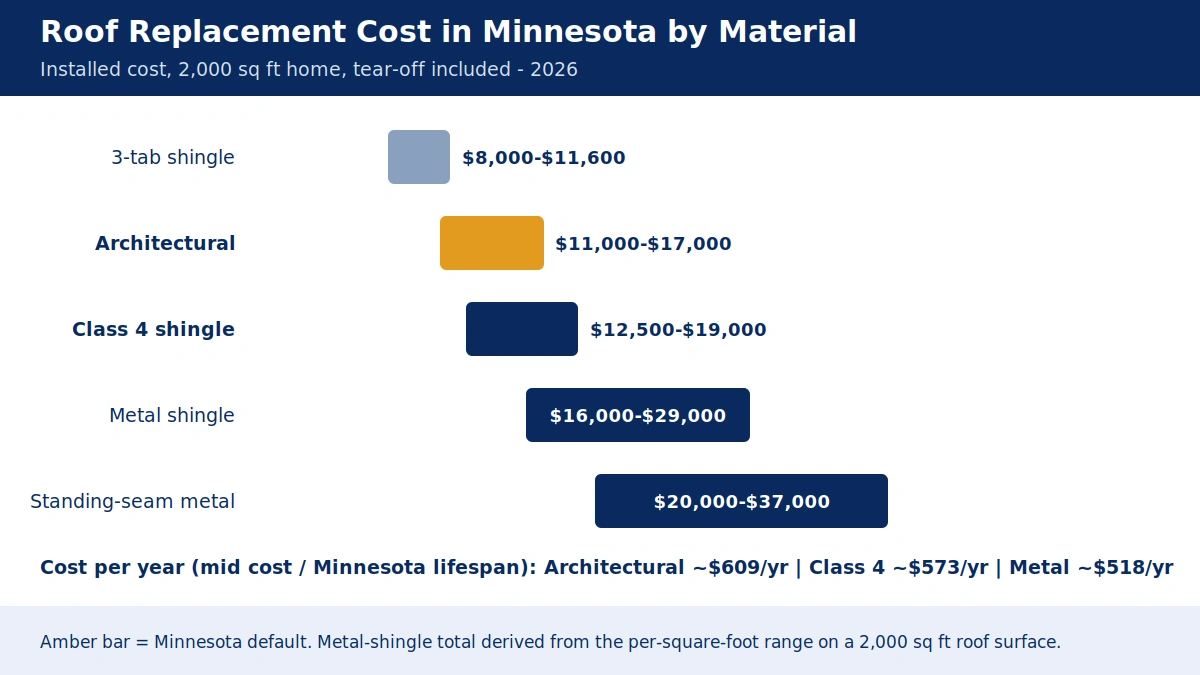
Material is the biggest single line on any Minnesota invoice — metal costs roughly double what architectural shingles cost to install. But the sticker price tells only half the Minnesota story, because forty-below cold, freeze-thaw, and ice dams cut shingle life short while metal mostly outlasts the house. The table below pairs 2026 installed prices with Minnesota lifespans and cost per year of service, so the expensive option can be judged on what it costs per year, not per invoice.
| Material | $/sq ft installed | 2,000 sq ft home total | Minnesota lifespan | Cost per year* |
|---|---|---|---|---|
| 3-tab shingle | $3.80–$5.50 | $8,000–$11,600 | 12–17 yrs | ~$471–$967/yr (mid ~$676/yr) |
| Architectural shingle | $5.00–$7.90 | $11,000–$17,000 | 20–26 yrs | ~$423–$850/yr (mid ~$609/yr) |
| Class 4 impact shingle | $6.00–$9.00 | $12,500–$19,000 | 25–30 yrs | ~$417–$760/yr (mid ~$573/yr) |
| Standing-seam metal | $9.50–$17.50 | $20,000–$37,000 | 40–70 yrs | ~$286–$925/yr (mid ~$518/yr) |
| Metal shingle | $8.00–$14.50 | $16,000–$29,000 | 40–60 yrs | ~$267–$725/yr (mid ~$450/yr) |
*Cost per year = installed cost divided by Minnesota realistic lifespan. Metal-shingle totals are arithmetic from the per-square-foot range on a 2,000 sq ft roof surface. Lifespan and price figures: BestRoofingEstimates Minnesota guide (2026).
Architectural shingles are what most Minnesota roofs already are: the lowest bid, the most crews who install them, and the simplest product to patch after a storm. In Minnesota they last 20–26 years — a respectable run for asphalt in a cold climate, helped by summers that are milder than the Sun Belt’s. The weak point is not heat but cold: standard asphalt turns brittle below about −20°F, and a shingle walked on or struck by a falling branch in a January cold snap can crack. Polymer-modified architectural shingles, built on SBS rubberized asphalt, stay flexible in extreme cold and hold granules better through freeze-thaw cycling.
3-tab shingles are the budget option, and in Minnesota they are a false economy on most houses. At $3.80–$5.50 per sq ft they save roughly $3,000 against architectural shingles on a 2,000 sq ft home, then give back the savings by lasting only 12–17 years — and BestRoofingEstimates specifically warns against them in heavy hail areas and northern Minnesota. On a house you plan to keep, the cheapest shingle is the one you buy twice.
Class 4 impact-rated shingles get a whole section below, because in the Twin Cities and southern Minnesota they are the upgrade that pays for itself in avoided claims and premium discounts. They run $6.00–$9.00 per sq ft installed, roughly $800–$2,000 more than standard architectural shingles on a typical job, and they stretch service life to 25–30 years.
Standing-seam metal is the premium Minnesota roof, and it earns the title here more honestly than in most states. At $9.50–$17.50 per sq ft, a 2,000 sq ft home runs $20,000–$37,000 — roughly double architectural shingle upfront. What you buy is 40–70 years, a surface that sheds snow instead of holding it, and a material that does not turn brittle at any temperature Minnesota produces. It is the dominant long-term choice on the North Shore, the Iron Range, and lake properties. The tradeoffs, beyond price, are cosmetic denting from large hail and snow sliding off in sheets — which is why snow guards are standard on Minnesota metal roofs over entries, driveways, and walkways. Still weighing the two, our metal roof vs shingles cost comparison sets them side by side, and our metal roof cost guide carries the national figures.
Metal shingles (stone-coated steel and similar) run $8.00–$14.50 per sq ft and combine the familiar shingle look with 40–60 years of metal durability. The textured surface hides cosmetic hail denting far better than slick standing seam, which matters in the Twin Cities hail corridor, and it sheds snow more slowly, which reduces the avalanche risk that slick metal presents over a front door.
Concrete tile and slate barely register in Minnesota residential roofing: tile needs engineered framing for Minnesota snow loads above the standard truss specification, and slate — This Old House puts it at $16.72 per sq ft in Minnesota, over $21,500 on an average roof — buys a century of life on a house whose framing was never designed for it. For tile pricing across the country, see our tile roof cost guide.
The takeaway: metal asks for roughly double the shingle money on day one, then hands most of it back over the decades — because a Minnesota shingle roof comes off when cold, ice, and hail say so, not when the warranty says so.
Roof Replacement Cost by Roof Size
The table below uses BestRoofingEstimates’ 2026 home-size table, priced by home size (living area) at the Twin Cities metro baseline, typical pitch 4:12–7:12, single-layer tear-off. Read it with the measuring-stick warning from the first section in mind: roof surface runs larger than living area, so a 2,000 sq ft home here usually carries a 2,200–2,500 sq ft roof — and these totals are the ones BestRoofingEstimates published for that home size.
| Home size | 3-tab asphalt | Architectural | Class 4 IR shingle | Standing-seam metal |
|---|---|---|---|---|
| 1,000 sq ft | $4,000–$5,800 | $5,000–$7,800 | $6,200–$9,500 | $9,500–$17,500 |
| 1,500 sq ft | $6,000–$8,700 | $7,500–$11,700 | $9,300–$14,300 | $14,300–$26,300 |
| 2,000 sq ft | $8,000–$11,600 | $11,000–$17,000 | $12,500–$19,000 | $20,000–$37,000 |
| 2,500 sq ft | $10,000–$14,500 | $13,800–$21,300 | $15,600–$23,800 | $25,000–$46,300 |
| 3,000 sq ft | $12,000–$17,400 | $16,500–$25,500 | $18,800–$28,500 | $30,000–$55,500 |
Cross-checks: SmartRoofingCalculator’s Minnesota model puts architectural shingles on a typical 25-square roof at about $12,750–$18,250 — inside the band above, toward the middle. Angi’s Minneapolis average of $9,988 sits just below the table’s 2,000 sq ft architectural band, consistent with a smaller average Minneapolis roof. A smaller house carries a steeper per-square-foot rate, since fixed costs like permits, dumpsters, and crew mobilization get divided across fewer squares. Big or steeply pitched roofs cost more for their shape, not just their size: steep pitches add 10–20% to labor in Minnesota.
Roof Replacement Cost by Region: Twin Cities vs Duluth vs Rochester vs St. Cloud vs Northern Minnesota
Minnesota roofing labor varies noticeably by region, but the spread is smaller than the weather spread. The Twin Cities metro sets the statewide baseline with the highest labor rates and the deepest bench of crews. Rochester runs cheaper on good contractor competition. Duluth and the Iron Range run higher despite softer labor markets, because lake-effect snow, extreme cold, travel, and a thin contractor bench add the premium back.
| Region / Metro | Architectural asphalt (2,000 sq ft home) | Variance vs state mean |
|---|---|---|
| Minneapolis–St. Paul Metro | $12,000–$18,000 | Baseline — highest labor rates |
| Savage / Southwest Metro | $11,500–$17,000 | −2% to −5% |
| Rochester / Southeast MN | $10,500–$15,500 | −5% to −10% |
| Duluth / North Shore | $12,000–$17,500 | About even, metal preferred |
| St. Cloud / Central MN | $11,500–$17,000 | About even — see note below |
| Iron Range / Northern MN | $12,500–$18,500 | +5% to +10% |
Source: BestRoofingEstimates Minnesota region table (2026); St. Cloud row estimated from the same table’s Greater Minnesota pattern and the Instant Roofer database (see note).
Minneapolis–St. Paul Metro is the benchmark: the deepest bench of crews, the most hail claims, and the most competitive bidding in the state. BestRoofingEstimates’ Minneapolis city page puts the city at $11,800–$18,400 for a 2,000 sq ft home, averaging $13,200. The southwest metro corridor around Savage sits in the same hail-and-ice belt as the city itself, and its pricing tracks just under the metro mean. The pre-war bungalow and four-square stock in Uptown, Powderhorn, Kingfield, and Northeast Minneapolis carries the state’s worst ice-dam exposure: under-insulated attics, shaded eaves, and steep 5:12 to 9:12 pitches that concentrate meltwater exactly where the dam forms.
Rochester / Southeast Minnesota runs 5–10% below the Twin Cities on mid-state pricing and good contractor competition. BestRoofingEstimates’ Rochester city page puts the typical replacement at $14,200 for a 2,000 sq ft architectural job. Rochester sits in IECC Climate Zone 6A along the Zumbro River, with a 35 psf roof snow load and winters that drop below −20°F, and its hail season runs May through August. The average Rochester repair call-out runs $725.
Duluth / North Shore runs about even with the metro on price but for different reasons: fewer contractors, lake-effect snow off Lake Superior, and 86 inches of annual snowfall against the Twin Cities’ 54. Metal is strongly preferred here — a roof that sheds snow instead of holding 86 inches of it is not a luxury on the North Shore. Instant Roofer’s database puts Duluth’s average near $14,486.
St. Cloud / Central Minnesota is the one region where the sources disagree enough to say so plainly. No standalone surveyed average was found for St. Cloud; BestRoofingEstimates’ state table implies about-even pricing with the metro, while Instant Roofer’s contractor database puts St. Cloud at $16,254 — the highest of the 20 Minnesota communities it tracks. The database figure is built from the same statewide pricing data as its other city figures, not from a separate St. Cloud survey, so treat it as a signal that central Minnesota runs at or above the metro mean, not as a precise average. What is not in doubt is the climate: central Minnesota sits squarely in the hail belt, and the average Minnesota hail claim now runs around $30,000 including siding and gutters.
Iron Range / Northern Minnesota runs 5–10% above the metro on travel and logistics premiums, extreme cold, and a thin contractor bench — and metal dominates long-term installs there because it has to. This is Zone 7 country: 23 northern counties including St. Louis County, where the ground snow load is 60 psf, winter nights reach −40°F, and the install window is the shortest in the state.
Why Minnesota Roofs Cost What They Do: Cold, Snow, Ice Dams & Freeze-Thaw
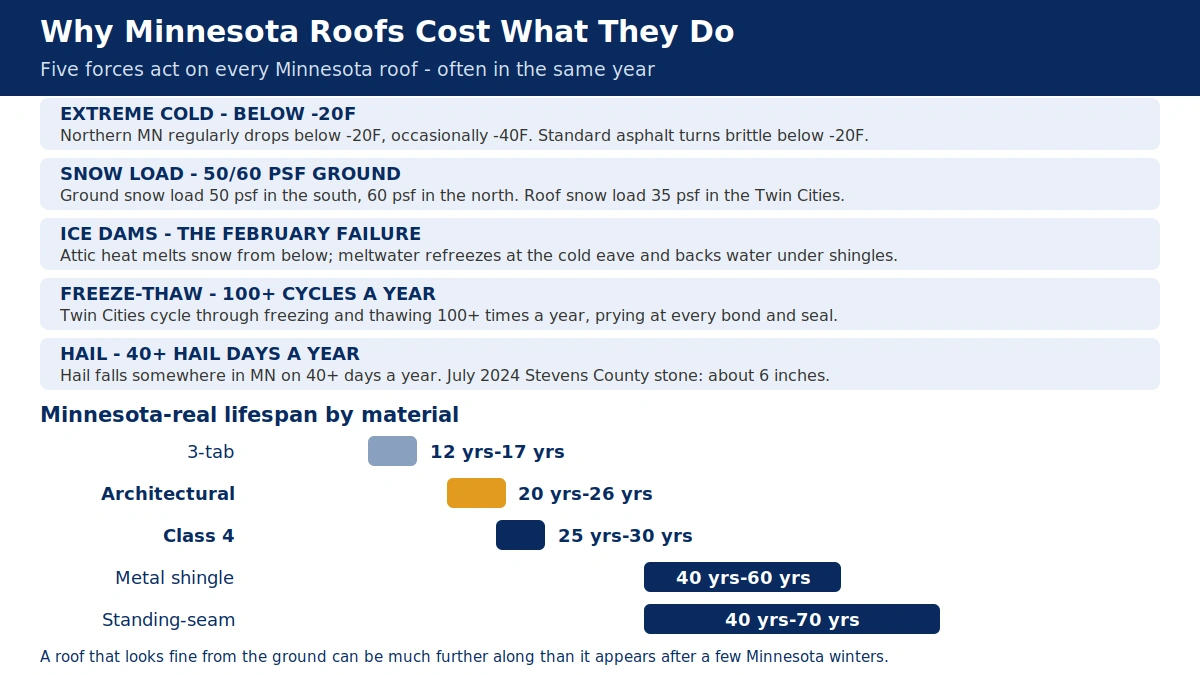
Minnesota is one of the most demanding climates in the country for roofing systems because five distinct forces act on every roof in the state, often in the same year. Extreme cold turns asphalt brittle. Snow load sizes the framing and sets the pitch. Ice dams back water under shingles that would otherwise never leak. Freeze-thaw cycling pries at every bond and seal. And spring hail, arriving just as the snow finally melts, totals roofs across whole counties in a single afternoon. All five compound: cold-brittled asphalt cracks more easily under hail, freeze-thaw opens the micro-cracks that let meltwater in, and a roof that survived January can still fail in April.
Extreme cold is the force that sets Minnesota’s material rules. Northern Minnesota regularly records temperatures below −20°F in January and February, and occasionally below −40°F. Standard asphalt shingles can become brittle and crack at those temperatures — walked on, struck by a falling branch, or flexed by a wind gust. Polymer-modified shingles built on SBS rubberized asphalt hold their flexibility in extreme cold and keep their granules through freeze-thaw cycling, which is why Minnesota contractors reach for them on northern jobs. Metal roofing is unaffected by any temperature Minnesota produces, which is the single cleanest argument for metal in the north. The Twin Cities see 10-day stretches at −15°F to −25°F in most winters, and the all-time low sits near −40°F.
Snow load sizes the structure under the shingles. Minnesota’s rules set the ground snow load at 50 pounds per square foot in the southern portion of the state, including the Twin Cities, and 60 psf in the northern portion (Minnesota Administrative Rules 1303.1700). The roof snow load — what the structure actually has to carry — is 0.7 times the ground load, so 35 psf in the Twin Cities. One caution, flagged here because the sources disagree: BestRoofingEstimates’ Minnesota pages describe the ground snow load as “35 psf in the Twin Cities to 50+ psf in northern Minnesota,” which matches the roof snow load figure, not the ground snow load the rule states. This guide follows the rule itself, and a second 2026 source, TallySquare’s Minneapolis page, independently confirms 50 psf ground snow load for Hennepin County and 60 psf across 29 named northern counties. The practical consequence is the same either way: Minnesota roof framing is heavier than a southern roof’s, and steep pitches of 5:12 to 9:12 are engineered to shed snow rather than hold it.
Freeze-thaw cycling eats asphalt from the inside out. The Twin Cities cycle through freezing and thawing more than 100 times a year, concentrated in the shoulder seasons of March–April and October–November. Water trapped in shingle micro-cracks expands when frozen and contracts when thawed, steadily breaking down the asphalt matrix and loosening granules. Flashing sealants age the same way, which is why chimney flashing is a high-failure item in Minnesota — BestRoofingEstimates puts chimney flashing repair at $400–$1,200 and calls out freeze-thaw as the cause.
Hail arrives the moment winter lets go. The Minnesota State Climatology Office counts hail falling somewhere in the state on 40 or more days in a typical year, with about 30–35 of those days producing hail an inch across and hail two inches or bigger showing up on about 7–8 days a year. In July 2024 a hailstone in Stevens County measured about six inches, possibly the largest on record for the state. The 2026 season kept the pattern going: on April 13, 2026, ping-pong-ball hail was confirmed by the National Weather Service in Cannon Falls, southeast of the Twin Cities, from a tornado-warned storm carrying a history of hail up to three inches. Minnesota is repeatedly ranked among the top hail-claim states in the country, with the Twin Cities metro, Rochester, and southern Minnesota hit hardest. Peak season runs April through June statewide, extending May through August around Rochester.
The short install season compresses everything. Minnesota’s viable roofing window runs roughly May through October. Shingles installed below 40°F do not seal properly and are susceptible to wind uplift in the first winter, so a November tear-off is a gamble no careful contractor takes. The best months are May through June, after the last reliable freeze and before peak summer hail, and September through October, after the worst of hail season and before winter storms close the window. Reputable Twin Cities contractors book weeks out in peak season.
Ice Dams: The Minnesota Roof Killer
If one failure defines Minnesota roofing, it is the ice dam — and it is the failure most homeowners misunderstand. An ice dam is not caused by a bad shingle. It is caused by a warm attic.
The mechanism is simple and repeats every February on thousands of Minnesota houses. Warm air leaks out of the living space into the attic through bypasses — recessed lights, plumbing stacks, attic hatches, chimney chases — and warms the roof deck from below. Snow on the warm part of the roof melts from underneath, even on a day when the air temperature never rises above freezing. The meltwater runs down the slope until it reaches the eave, which hangs past the warm wall and stays cold. There it freezes solid, more meltwater piles up behind it, and eventually the pooled water has nowhere to go but up, under the shingles, past the underlayment, and into the ceiling below. The stain on the living room ceiling in March is a February ice dam, and the shingles above it may look perfect from the ground.
The ice-and-water shield is the code’s answer, and it is mandatory. The Minnesota Residential Code (R905.1.2, in the 2020 Minnesota Residential Code adopting the 2018 IRC with state amendments) requires an ice barrier — a self-adhering polymer-modified bitumen sheet, or two cemented layers of underlayment — extending from the lowest eave edge to a point at least 24 inches inside the exterior wall line. On roofs pitched 8:12 or steeper, the barrier must extend 36 inches measured along the slope. The rule reaches asphalt shingles, metal shingles, slate, and wood shakes; only detached accessory structures without conditioned floor area are exempt. Quality Minnesota contractors commonly go past the minimum, running the shield 36–48 inches up the eave and covering valleys and low-slope sections completely, because a bad dam can back water up further than 24 inches inside the wall.
But the shield is secondary protection, not prevention. The code minimum protects the deck after a dam has formed. It does nothing to stop the dam forming. The durable fix is in the attic, and a reroof is the cheapest moment in a house’s life to do it: seal the attic bypasses so warm air stops leaking up, bring attic insulation to the code minimum of R-49 (about 14 inches of blown cellulose) in both Climate Zone 6A and Zone 7, keep the soffit vents open with baffles, and balance the ventilation ridge-to-soffit so the roof deck stays cold. Done together, air sealing plus R-49 plus ventilation is what keeps the snowpack frozen on the roof until spring melts it from above.
What an ice dam costs when it wins. BestRoofingEstimates puts ice-dam repair at $700–$3,200 in Minnesota, and that is only the roof side — interior drywall, paint, and insulation damage runs on top of it. Emergency ice-dam steaming, the standard removal method, runs $400–$1,400 and is the only safe removal: chipping at a dam with an axe damages shingles and voids warranties. The insurance picture is mixed and worth knowing before February: water damage inside the home from an ice dam is usually covered, while the ice on the roof itself usually is not. If a claim is denied, Minnesota law requires the denial to name the specific provision it relies on (Minn. Stat. 72A.201 subd. 4(11)), and the insurer must advise acceptance or denial within 60 business days of a properly executed proof of loss. And if your roof predates the current ice-barrier rule or was installed without it, a replacement brings the eaves up to code.
The inspection habit that pays for itself: have the roof inspected in late fall before winter, and again in late spring after the thaw. A fall inspection catches the lifted shingles, dead pipe boots, and failing flashing that a February dam will exploit. Small, cheap fixes caught in time keep a minor winter leak from becoming a full ceiling remediation that costs five to ten times as much.
Class 4 Impact-Resistant Shingles in Minnesota: Worth It?
In the Twin Cities and southern Minnesota, Class 4 impact-rated shingles are the upgrade that pays for itself — but the reason they pay is different from what most Minnesota roofing pages say, and the difference matters.
What Class 4 means. The impact benchmark is UL 2218, and Class 4 is its top rating: a shingle earns it only when a two-inch steel ball dropped from twenty feet leaves it uncracked. Named products in 2026 Minnesota sources include Malarkey Legacy and Vista (SBS modified asphalt, which also stays flexible in extreme cold), GAF ArmorShield II and Timberline AS II, Owens Corning Duration Storm, CertainTeed NorthGate, and Atlas StormMaster Shake. Standard architectural laminates show functional damage at hailstone diameters around 1.25 inches or less — and 1.25-inch hail is a routine Minnesota event.
The discount is real, but it is not required by Minnesota law — and that is the correction this guide makes. Colorado has a statute, CRS 10-4-110.8, that requires most residential insurers to offer a premium discount for impact-resistant roofing. Minnesota has no equivalent law for Class 4 shingles alone. What Minnesota does require, under Minn. Stat. 65A.298, is a premium discount or rate reduction for homes that meet IBHS FORTIFIED program standards — which include a hail supplement — and only when the owner submits an IBHS certificate; the discount itself is whatever the insurer files and the state approves, not a fixed number. A Class 4 shingle by itself does not trigger the state-required discount. Several Minnesota roofing pages blur this distinction, and some quote a statutory discount that does not exist in Minnesota law. Do not budget on a discount the statute does not promise.
What carriers actually offer, voluntarily, is still meaningful. BestRoofingEstimates cites 10–30% off the homeowner’s premium with most Minnesota carriers, with the upgrade paying back in three to five years. A Chanhassen contractor guide reports State Farm typically at 5–10% and American Family and Farmers up to 25%, on the wind/hail portion of the premium. A Cannon Falls guide reports 15–30% annually, typically $200–$500 a year. The honest summary: most major carriers offer something, the amount varies widely by carrier and location, and the only number that counts is the one your own insurer puts in writing before you order. Get the exact discount from your insurer in writing and the Class 4 manufacturer certificate from your contractor, and file both with your agent the same week the crew finishes.
The dollar math. Class 4 runs $6.00–$9.00 per sq ft installed ($12,500–$19,000 on a 2,000 sq ft home), roughly $800–$2,000 more than standard architectural shingles on a typical job (BestRoofingEstimates), or $1,500–$3,000 by other Minnesota estimates — and lasts 25–30 years instead of 20–26. At $200–$500 a year in premium savings, the upgrade pays back in three to seven years, then keeps paying for the life of the roof. The deciding factor is where your house sits: in the Twin Cities metro, the southwest metro corridor, Rochester, and southern Minnesota, where hail tracks across the state with regularity, the case is strong. In Duluth and the Iron Range, where hail is lighter and cold and snow load dominate the budget, the payback depends more on your specific premium — and metal may be the better place to put the same money.
Bottom line: in the hail belt, Class 4 is the default specification that happens to pay for itself. In the north, run the numbers on your own premium first — and do not let any contractor tell you Minnesota law requires the discount, because it does not.
Permits & Code: Minneapolis, St. Paul, Duluth & the State Building Code
Minnesota runs one statewide building code. The Minnesota State Building Code applies in every city, township, and county in the state, and the current residential chapter adopts the 2018 International Residential Code with Minnesota amendments, published as the 2020 Minnesota Residential Code. Your city still issues the permit and sets the fee — but the rules on the roof itself are the state’s, and they do not change when you cross a city line.
A full replacement needs a permit in essentially every Minnesota city and county. City re-roof handouts — Delano, Elk River, Bloomington, and others — state it flatly: a building permit is required for re-roofing residential dwellings and garages. Some cities go further and require photos of the roof deck after the underlayment and ice-and-water protection are in place, including the eaves and valleys, before the shingles go on. which means the inspection happens mid-job, not at the end.
| City / Jurisdiction | Typical fee | What to know |
|---|---|---|
| Minneapolis (CPED) | $235–$500 | 50 psf ground snow load (Hennepin County); ice barrier 24 in inside wall; photo inspection of underlayment common |
| St. Paul (DSI) | $200–$500 | Department of Safety & Inspections; same state code; older housing stock, steep pitches |
| Duluth | $200–$500 | Lake-effect snow; 60 psf ground snow load region; metal strongly preferred |
| Rochester / Olmsted Co. | $150–$400 | Zone 6A; 35 psf roof snow load; good contractor competition |
| St. Cloud / Stearns Co. | $150–$400 | Central MN hail belt; permit via city or county building department |
| Greater Minnesota (rural) | $100–$350 | County building department; travel premiums common |
Source: SmartRoofingCalculator Minnesota model (~$240 permit, 2026); TallySquare Minneapolis model ($235 baseline permit fee, Aug 2026); New England Metal Roof Minneapolis ($100–$500 by scope, 2026). No single statewide fee schedule exists — fees are set by the city or county, so confirm yours before budgeting.
What the code actually demands on the roof itself. The ice barrier is the headline rule: self-adhering polymer-modified bitumen from the lowest eave edge to at least 24 inches inside the exterior wall line, 36 inches along the slope on pitches of 8:12 or steeper (MNRC R905.1.2, covered in the ice-dam section above). Low-slope rules bite on the state’s many low-pitch ramblers and additions: asphalt shingles are not allowed below a 2:12 pitch, and pitches from 2:12 to 4:12 require double underlayment. The code caps roofs at two layers maximum, so a house already carrying two layers must be fully torn off. One Minnesota contractor guide cites MNRC R908.3 as prohibiting patching or layering over a roof damaged or repaired on more than 25% of its total surface area; the code text itself was not independently verified for this guide, so treat that citation as contractor guidance rather than a confirmed code section.
The energy code bites at reroof time too. Minnesota’s residential energy code (Minn. R. 1322.0402, Table R402.1.1) sets the attic ceiling minimum at R-49 in both Climate Zone 6A and Zone 7 — roughly 14 inches of blown cellulose — with a minimum 6-inch energy heel where needed to maintain full R-value at the eaves. A reroof does not automatically trigger a full insulation upgrade on an existing home, but the moment the deck is exposed is the cheapest moment in the house’s life to air-seal the attic bypasses and top up insulation — and in Minnesota, that work is ice-dam prevention, not an energy nicety. Ventilation is part of the same package: balanced ridge-to-soffit airflow keeps the deck cold, and baffles keep the soffit vents open where the insulation pinches down at the eave.
One more Minnesota rule to know before you put pen to paper. In historic districts — particularly parts of Minneapolis, St. Paul, and Duluth — architectural review can restrict a metal retrofit or a material change, so check your local historic-district guidelines and any HOA rules before ordering materials. A permit without the review-board sign-off can still stop the job.
Hiring a Roofer in Minnesota: The DLI Residential Roofer License
Minnesota has one fact that surprises almost every homeowner who moves here from a western state: there is a statewide roofer license, and it is the first thing to check. The Minnesota Department of Labor and Industry (DLI), through its Construction Codes and Licensing Division, licenses residential contractors under Minnesota Statutes Chapter 326B — and roofing is one of the trades the state licenses directly.
The license that matters is the Residential Roofer license. DLI issues three residential credentials that touch roofing: the Residential Building Contractor license (new construction plus remodeling), the Residential Remodeler license, and the Residential Roofer (RR) license, which authorizes roofing work only. Roofing is a notable exception to the state’s general rule: a contractor normally needs a license only when contracting directly with homeowners above $15,000 in gross annual residential receipts or when offering two or more defined “special skills” — but a roofer contracting directly with a homeowner must be licensed even though roofing is a single skill.
What it takes to hold one. The license is issued to the company, which must designate a qualifying person who passes DLI’s prelicensing exam — the QR exam for roofers — before the company can apply. The exam is open-book, uses the Minnesota State Residential Code and a DLI reference manual provided on site, and requires a 70% passing score. The Q registration is valid for two years and renews with 14 hours of DLI-approved continuing education, including at least one hour on the energy code and one hour on business management. The application itself requires a $180 fee, a $15,000 surety bond, liability insurance, and a workers’ compensation certificate or a written exemption explanation. One flagged conflict in the sources: DLI’s own roofer page states liability limits of at least $300,000 per occurrence including at least $10,000 property damage, while secondary licensing guides cite $100,000 per occurrence, $300,000 aggregate, and $25,000 property damage for residential contractors generally. This guide uses DLI’s figures as primary and flags the difference rather than resolving it.
How to use the license to vet a bidder. Look the contractor up on DLI’s online license search before anyone climbs on your roof — a lapsed license means no recourse through DLI’s Contractor Recovery Fund if the work fails, and an unlicensed contractor cannot pull a permit. Confirm the business name on the license matches the business name on the contract exactly, because a mismatched business name is the single biggest red flag after a hail event. Ask for the general liability and workers’ comp certificates mailed directly from the carrier, not photocopied by the contractor. Contractors who are not required to hold a state license — subcontractors and single-skill trades outside the licensed categories — must still register with DLI under the Construction Contractor Registration Program, so “no license needed” is never the same as “no registration needed.
The six-step vetting process:
- Verify the DLI Residential Roofer license on the DLI lookup, and confirm it is current — not just that a number exists on the proposal.
- Confirm bonding ($15,000 surety bond) and insurance — liability per DLI’s stated minimums and an active workers’ comp certificate mailed directly from the carrier.
- Check that the business name on the license matches the business name on the contract exactly.
- Require a written, itemized proposal with tear-off, underlayment grade, ice-and-water shield scope (24 inches inside the wall, minimum), shingle model, flashing scope, ridge vent, disposal, permit, and final cleanup as separate line items, with the Class 4 product name specified.
- Reject layover-only bids on a roof that already carries two layers — Minnesota code caps roofs at two, and a layover traps moisture under freeze-thaw and typically voids the manufacturer warranty.
- Check manufacturer certification (GAF Master Elite, Owens Corning Platinum Preferred, CertainTeed SELECT ShingleMaster, Atlas Pro Plus, Malarkey Premium Certified); and pay in milestones, never in full upfront — the typical draw is 10% deposit, 40% on material delivery, 40% at dry-in, 10% at final inspection. A contractor who demands full payment before the crew arrives is a contractor to walk away from.
The storm-chaser problem is Minnesota-scale after every big hail event. After the April 2026 Cannon Falls storm and every storm like it, out-of-state crews knock on doors and offer to “handle the insurance claim.” Use a DLI-licensed contractor with a verifiable physical address inside Minnesota. Never sign an assignment of benefits that hands your insurance claim rights to the contractor. Before you sign anything, put every bidder through our questions to ask a roofer — the vetting checklist written to go with this guide.
Insurance: Hail, Ice-Dam & Wind Claims, ACV vs RCV & Deductibles
Minnesota homeowner policies typically cover roof damage from sudden events — hail, wind, ice-dam water intrusion, and snow-load failure. Slow wear, skipped maintenance, and a roof that simply aged out all fall outside coverage. Three lines on your declarations page matter more to a roof claim than the storm itself: how the policy values the roof, how the deductible is written, and whether cosmetic damage is covered at all.
Covered damage, and damage that is not. Sudden storm damage is covered. A roof that simply wore out after twenty Minnesota winters gets no payout at all. A large share of Minnesota roofs are replaced through homeowner insurance claims following a hail or wind event, not age-driven replacement — and most policies require you to file a claim within 12 months of the storm. The average Minnesota hail claim now runs around $30,000 including siding and gutters. Ask your contractor to photo-document damage before filing, with date-stamped photos, because hail damage signatures fade within months.
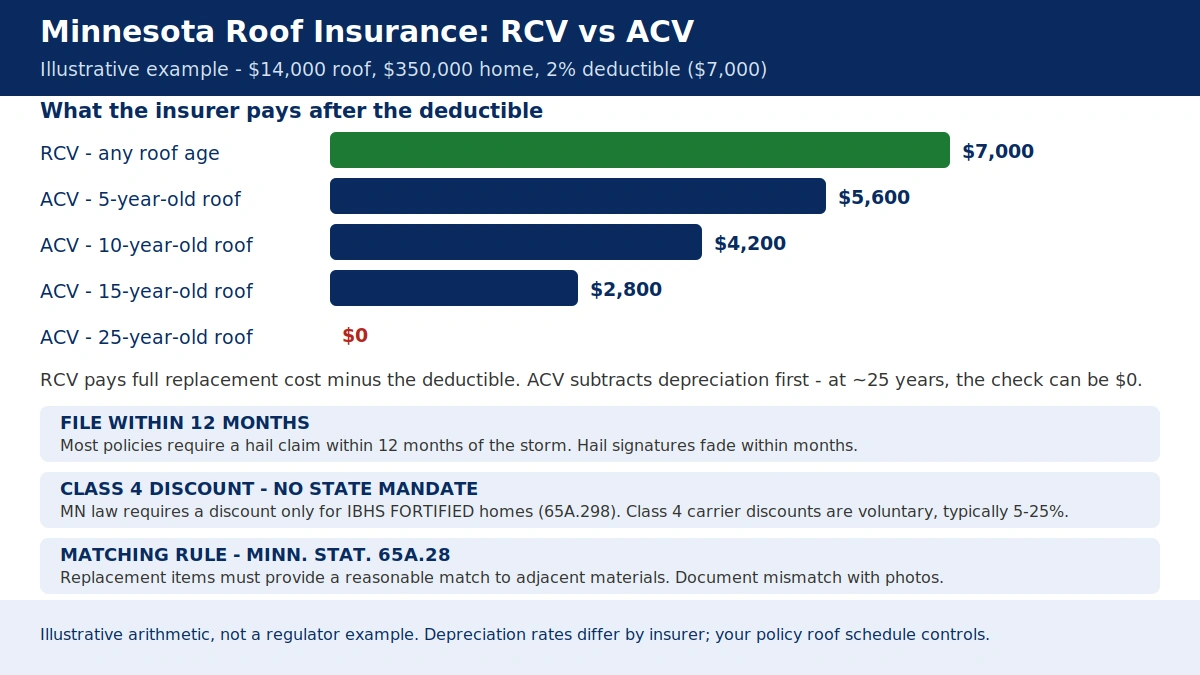
Replacement cost or actual cash value — the one your policy pays decides the size of the check. With Replacement Cost Value, the carrier covers what a brand-new roof costs today, minus your deductible. With Actual Cash Value, the check shrinks by depreciation — the older and more worn the roof, the smaller the payout. The example below is illustrative arithmetic, not a regulator’s published example — no Minnesota regulator example was found for this guide. Take a $14,000 replacement on a $350,000 home with a 2% wind/hail deductible ($7,000), depreciating linearly at 2% a year over a 25-year life: an RCV policy pays $7,000 after the deductible at any roof age, once the work is done and proven. An ACV policy on the same roof at 15 years old pays $2,800 — and at 25 years, about $0.
| Roof age | RCV payout (illustrative) | ACV payout (illustrative) |
|---|---|---|
| New (0–2 years) | $7,000 | ~$6,700–$7,000 |
| 5 years | $7,000 | ~$5,600 |
| 10 years | $7,000 | ~$4,200 |
| 15 years | $7,000 | ~$2,800 |
| 20 years | $7,000 | ~$1,400 |
| 25 years | $7,000 | $0 |
*Illustrative arithmetic: $14,000 roof, $7,000 deductible (2% of a $350,000 home). Linear depreciation at 2% per year over a 25-year life. How fast a roof depreciates varies from carrier to carrier, so the roof schedule printed on your own policy is the one that decides.*
The cosmetic-damage exclusion is the clause Minnesota owners miss. Insurers increasingly write policies that exclude cosmetic-only hail damage — dented metal panels or granule-bruised shingles that never cause a functional leak. A standing-seam metal roof can survive a storm with zero leaks and still be visibly dented, and under a cosmetic exclusion the carrier pays nothing for the dents. Read the roof schedule and endorsements before the next storm season, not after it.
The matching rule is a Minnesota advantage worth knowing. Minn. Stat. 65A.28 requires replacement items to provide a reasonable match to adjacent materials. When hail damages one slope and the original shingle is discontinued or visibly mismatched, the matching statute is the argument for replacing more than the damaged slope — document the mismatch with photos and raise the statute with your adjuster by name. It is one of the few state laws that works directly in a hail claimant’s favor.
Deductibles are usually percentage-based in the hail belt. A 1–2% wind/hail deductible is common, which means the deductible on a $350,000 home is $3,500–$7,000 — a number that surprises owners who assumed a flat $1,000 deductible. Some policies carry a separate wind/hail deductible that runs higher than the standard deductible on the rest of the policy. And remember the Class 4 discussion above: a documented Class 4 roof earns a voluntary carrier discount, typically 5–25% off the wind/hail portion — but Minnesota law does not require that discount for Class 4 alone; the state-required discount is tied to an IBHS FORTIFIED certificate under Minn. Stat. 65A.298.
Claim timing and complaints. Photograph everything with dates on the pictures, file fast, and hang on to every tarping and ice-dam steaming receipt — hail marks wash out within months, and a late claim on stale damage is one of the easiest ways for a carrier to say no. If a claim is denied, Minnesota law requires the denial to name the specific provision it relies on, and the insurer must advise acceptance or denial within 60 business days of a properly executed proof of loss (Minn. Stat. 72A.201 subd. 4(11)). The Minnesota Department of Commerce handles insurance complaints.
Paying for It: Financing, Rebates & No Federal Credit in 2026
Federal help for a 2026 roof: zero. For any roof installed after December 31, 2025, the OBBBA law (P.L. 119-21) ended both §25C and §25D. So for a 2026 roof on the home you live in, the federal credit is zero — not a dollar. A few Minnesota roofing pages still pitch a federal energy credit for insulation bundled with a reroof — that pitch relies on law that no longer exists, because the insulation and air-sealing credit ended with §25C. Budget as though that credit never existed — unless a tax professional puts the opposite in writing for you.
There is no Minnesota statewide roof rebate to replace it. No 2026 source verified a Minnesota equivalent of Florida’s My Safe Florida Home grant program, and no current residential roof rebate dollar figure was verified for Xcel Energy or CenterPoint Energy. Insulation and air-sealing rebates that can be bundled with a tear-off are referenced by Minnesota contractor guides, but no 2026 dollar figure was verified for this guide, so none is quoted here.
The narrow help that does exist is a loan, not a roof grant. The Minnesota Housing Finance Agency Home Improvement Loan, offered through the Center for Energy and Environment, provides below-market rates for energy-efficient improvements; certain cool-roof or metal roofing products may qualify, with loans to $50,000 at fixed rates and extended terms for income-qualifying homeowners. The HEAR rebate (up to $8,000, income-qualified) pays for heat pumps and electrification, not roofing.
The real Minnesota “rebate” is the insurance discount. A documented Class 4 roof earns a voluntary carrier discount — typically 5–25% off the wind/hail portion of the premium — and metal earns a similar band on most Minnesota policies (see the Class 4 section above). And unlike a grant that lands once, this saving repeats every single year the roof stays on the house.
How Minnesotans actually pay for a roof: the insurance claim path, where storm damage qualifies — deductible applies, the 12-month filing window matters, and ACV vs RCV decides the check; a HELOC or home-equity loan, usually the cheapest rate you will find, though closing takes weeks; the Minnesota Housing Home Improvement Loan for income-qualifying homeowners; contractor financing through lenders like GreenSky, Service Finance, and Hearth — fast decision, 0% promo periods common, read the reset-rate fine print; and FHA Title I or 203(k) programs for owner-occupied homes, which are slower to close.
No Minnesota-specific contractor APR figures were verified in 2026 sources, so this guide gives none. The same borrowing rules apply here as anywhere: compare APRs instead of monthly payments, stay clear of the deferred-interest trap — a balance still sitting there when a 0% promo ends can pull retroactive interest at 20% or more — and never let the loan outlast the roof, because twenty years out of a shingle roof should never come with a twenty-five-year loan attached. Our roof financing guide sets every payment route side by side so you can compare them directly.
If you own solar, there’s one more line to chase: the panels have to come off and go back on around a reroof, so get the detach-and-reset cost written into the claim scope as its own line. No verified Minnesota dollar figure for detach-and-reset was found, so get it quoted as its own line item.
Repair vs Replace: The Minnesota Decision Rules
Repair costs (BestRoofingEstimates, Minnesota pricing; Duluth and the Iron Range add 5–15%):
| Repair | Typical range |
|---|---|
| Most repair calls | $450–$1,600 |
| Typical repair call-out (starting) | $450 |
| Hail-damage repair | $500–$2,500 |
| Wind / blown-off shingles | $275–$750 |
| Ice-dam repair | $700–$3,200 |
| Active leak diagnosis & patch | $450–$1,600 |
| Chimney flashing replacement | $400–$1,200 |
| Vent boot / pipe-collar replacement | $200–$450 |
| Emergency tarp (post-storm) | $350–$1,000 |
| Ice-dam steaming & removal | $400–$1,400 |
Cross-check (Gopher Roofing, Minneapolis 2026): minor repairs $300–$800; moderate repairs $800–$2,800; major structural repairs $2,800–$6,000+. A $14,000 replacement that lasts 25 years costs $560 a year — the number to hold next to any repair quote.
Missing and lifted shingles are common after spring straight-line wind events and summer derechos across the Twin Cities metro. Flashing — chimney, skylight, and wall-step — is a common failure point, and freeze-thaw is the reason it fails: sealants that flexed a hundred times a year eventually stop flexing. Ice-dam steaming is a February staple statewide. Rubber vent boots deserve a repeat mention: the gaskets turn brittle in Minnesota cold, and a $200–$450 boot replacement is one of the cheapest leaks to fix.
A replacement wins out once two or more of these ring true:
- Architectural shingle roof age 20+ in Minnesota — surrounding materials are already cold-aged and hail-pitted, so patching has diminishing returns
- Three or more leaks in a year — coming back for repairs that often points to the underlayment or flashing failing as a system, not one bad spot
- Interior staining, soft decking, or heavy granule loss — when gutters and driveways fill with granules after spring storms, the asphalt binders have already broken down
- Recurring ice dams every winter despite a clear gutter — the attic, not the shingle, is the problem, and a reroof is the cheapest moment to fix the attic
- Hail damage spread across the whole field — that kind of spread usually points to a full claim instead of a repair
- A roof already carrying two layers — Minnesota code caps roofs at two, so the next job is a full tear-off whether you want it or not
- Age past the Minnesota lifespan for the material, especially in the hail corridor
A repair is the right call when: one leak you can trace on a roof still early in its life, a few shingles lifted by a single wind event, a dead pipe boot, or a flashing detail that gave way. If a repair quote is what you actually need today, our roof repair cost guide has those prices.
Quote red flags, Minnesota-specific:
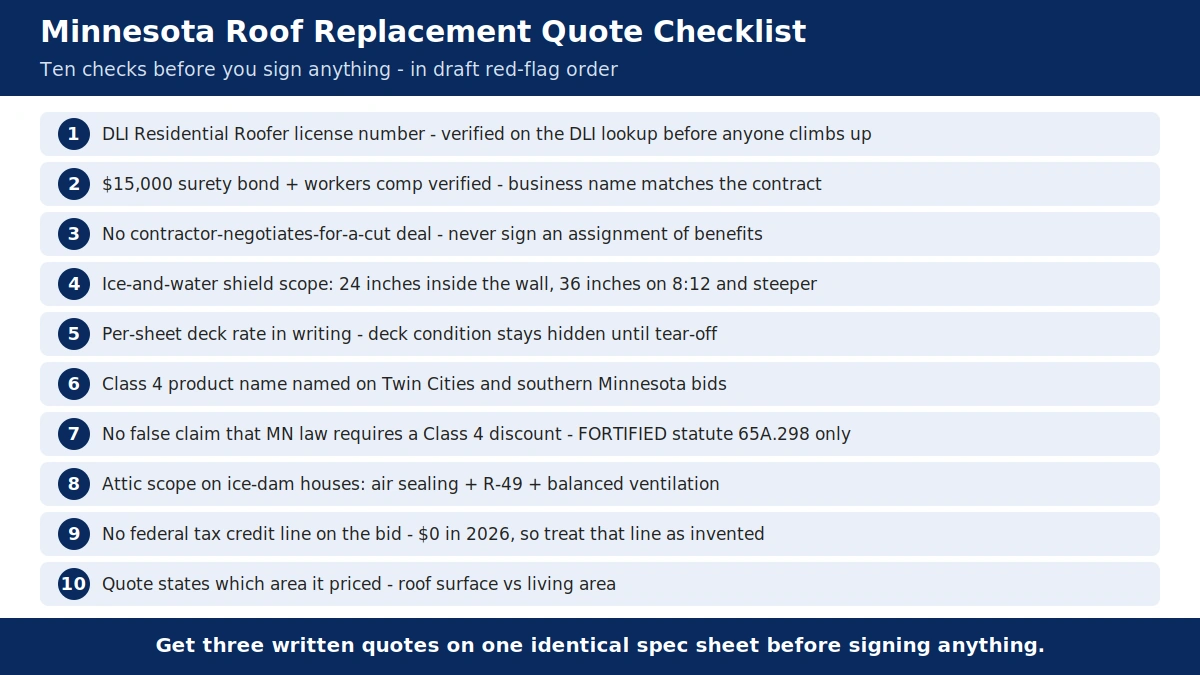
- No DLI Residential Roofer license number on the proposal — Minnesota licenses roofers statewide through DLI. Look the number up on DLI’s own search before anyone climbs on your roof.
- No $15,000 surety bond or no workers’ comp certificate — these are verifiable, not optional, and the business name on the license must match the contract exactly.
- A contractor who offers to negotiate with your insurer for a cut — file the claim yourself and keep the contractor’s job to the roof; never sign an assignment of benefits.
- No ice-and-water shield scope, or shield that stops at the eave — the code requires 24 inches inside the exterior wall line, 36 inches on 8:12 and steeper.
- No per-sheet deck rate — nobody can see what the deck looks like until the tear-off exposes it. Skip the decking allowance and the total jumps the moment the old shingles come off and the real deck shows itself.
- No Class 4 product name on a Twin Cities or southern Minnesota bid — if the bid just says “architectural shingle,” the upgrade that pays for itself was never quoted.
- A claim that Minnesota law requires an insurance discount for Class 4 — it does not. The state-required discount is tied to IBHS FORTIFIED under Minn. Stat. 65A.298. A contractor who misstates the law will misstate other things too.
- No attic scope on a house with recurring ice dams — air sealing, R-49 insulation, and balanced ventilation are the fix.
- A tax-credit line on the bid — that credit is gone for 2026 owner-occupied roofs, so any bid still showing one is padding its numbers with a fiction.
- One bare $/sq ft number with no area behind it — a Minnesota roof surface runs larger than the living area, so that lone figure tells you nothing on its own.
Before you sign anything, put every bidder through our questions to ask a roofer — the vetting checklist written to go with this guide. And if your gutters are part of the job, our gutter installation cost guide prices them — remember that in a cold climate the gutter’s job is to carry meltwater away before it refreezes at the eave.
Sources & methodology
Cost anchors: BestRoofingEstimates — “Roofing Cost Minnesota” (2026 state guide, crawled Nov 6–7, 2026) — primary Minnesota anchor: material table, home-size table, region table, repair table, licensing, climate, financing, average ~$13,200 on a 2,000 sq ft home; BestRoofingEstimates Minneapolis city page (2026: $11,800–$18,400, avg $13,200; 100+ freeze-thaw cycles/yr; 54 in snowfall; roof surface ~1.4x living area) and Rochester city page (2026: typical $14,200; repair call-out $725); This Old House — “How Much Does Roof Replacement Cost in Minnesota?” (2026: MN avg $8,737, range $6,747–$21,517; asphalt $5.24/sq ft; metal $10.29; slate $16.72; 2,000 sq ft home $10,143, 13% above national average); SmartRoofingCalculator — Minnesota (updated Nov 2, 2026: arch. $510–$730/square, 25-square roof $12,750–$18,250, permit ~$240 — model-derived, cross-check only); Angi — Minneapolis (updated Jul 31, 2026: avg $9,988, most $6,316–$13,812, $5.25/sq ft; metal avg $20,000; labor ~50%); Instant Roofer — Minnesota (contractor-pricing database: MN avg ~$15,248 on a 2,513 sq ft average roof; Rochester $14,379, Duluth $14,486, St. Paul $15,324, Minneapolis $15,416, St. Cloud $16,254);. The home-size totals, metal-shingle totals, and cost-per-year figures are our arithmetic from BestRoofingEstimates’ per-square-foot ranges and lifespans.
Climate + snow load: BestRoofingEstimates MN / Minneapolis / Rochester / Savage pages (2026: Zone 6A/7, 54 in Twin Cities snowfall, 86 in Duluth, −20°F to −40°F, 100+ freeze-thaw cycles/yr, hail April–June peak, May–October install window, shingles do not seal below 40°F); HomesMSP (MN Admin Rules 1303.1700: 50 psf ground snow load south / 60 psf north; roof snow load 0.7 x ground = 35 psf Twin Cities); TallySquare — Minneapolis (Aug 2026: 50 psf ground snow load Hennepin County, 60 psf across 29 named northern counties, citing Rule 1303.1700; $235 permit baseline); Minnesota State Climatology Office hail statistics via Silver Loon Roofing (2026: hail on 40+ days/yr statewide; 2-inch hail on 7–8 days/yr; July 2024 Stevens County ~6-inch stone, possibly a state record); Owl Roofing — Cannon Falls, April 13, 2026 (NWS ping-pong-ball hail; 1-year filing window).
Ice barrier + code + energy: Minnesota Residential Code R905.1.2 (2020 MN Residential Code, 2018 IRC with MN amendments: ice barrier to 24 inches inside the exterior wall line; 36 inches along the slope on 8:12+) — confirmed via City of Delano, City of Elk River, and City of Bloomington re-roof handouts; Perfect Exteriors; Team Shoreline (verified 2026-09-27). Energy code: Minn. R. 1322.0402 Table R402.1.1 — ceiling R-49 in both Zone 6 and Zone 7; walls R-20 (Zone 6) / R-21 (Zone 7); 6-inch energy heel (EngineerFix; Home Builders MN; SCG MN, 2026).
Licensing: Minnesota DLI — “Roofer license” (dli.mn.gov: Residential Roofer license; $180 fee; $15,000 surety bond; liability at least $300,000 per occurrence including at least $10,000 property damage; QR exam; qualifying person; 2-year Q registration); Housecall Pro (Minn. Stat. 326B.802; 70% exam pass; 14 hrs CE; insurance figures that differ from DLI — flagged).
Class 4 + insurance: Silver Loon Roofing (2026: no statutory Class 4 discount; Minn. Stat. 65A.298 ties the required discount to IBHS FORTIFIED with a hail supplement and an IBHS certificate; UL 2218 2-inch steel ball from 20 ft); BestRoofingEstimates MN (2026: Class 4 $6.00–$9.00/sq ft, +$800–$2,000 typical, 10–30% carrier discounts, 3–5 yr payback); Keystone Roofing Minneapolis (2026: State Farm typically 5–10%, American Family/Farmers up to 25%); Owl Roofing (2026: 15–30%, typically $200–$500/yr); Zablocki Roofing FAQ (avg MN hail claim ~$30,000 incl siding/gutters; Minn. Stat. 65A.28 reasonable match); Team Shoreline (Minn. Stat. 72A.201 subd. 4(11): denial must name the provision; 60 business days on proof of loss); Gopher Roofing (Minneapolis, 2026: repair bands $300–$800 / $800–$2,800 / $2,800–$6,000+; R908.3 25% rule citation — code text not independently verified).
Federal credit: OBBBA (P.L. 119-21); IRS FS-2025-05 — §25C and §25D ended for installs after Dec 31, 2025.
Method notes: RCV vs ACV table and the $14,000-roof example are illustrative arithmetic (linear 2%/yr depreciation over a 25-year life), not a regulator’s published example; no Minnesota regulator example was found. Carrier discount percentages are reported ranges, not promises. The snow-load wording conflict (BRE “35 psf ground” vs MN Admin Rules 1303.1700 “50 psf ground south / 60 psf north”), the DLI insurance-minimum conflict, and the R908.3 25% citation are flagged in the text rather than resolved. No Minnesota-specific contractor APR figures or Xcel/CenterPoint rebate dollar figures were verified, so none are given. St. Cloud has no standalone surveyed average; the figure given is a contractor-database estimate, and the St. Cloud region row is an estimate from the state table’s Greater Minnesota pattern plus the Instant Roofer database, not a surveyed figure.
How much does a roof replacement cost in Minnesota in 2026?
Most Minnesota asphalt replacements run $8,000–$20,000 in 2026. Architectural shingles on a typical 2,000 sq ft home cost $11,000–$17,000 (BestRoofingEstimates; average about $13,200). On a 2,000 sq ft home: 3-tab shingles $8,000–$11,600, Class 4 shingles $12,500–$19,000, standing-seam metal $20,000–$37,000. The Twin Cities run at the statewide baseline; Rochester runs 5–10% below it; Duluth and the Iron Range run about even to 5–10% above it on travel, cold, and snow-load premiums.
Why is my Minnesota roof quote so different from my neighbor’s?
Roof surface runs larger than living area — roughly 2,200–2,500 sq ft of roof on a 2,000 sq ft home at standard pitch, and about 1.4 times living area on steep Minneapolis bungalow and four-square stock — and quotes price different areas, so a 2,000 sq ft home can be priced as a 2,000 sq ft roof or a 2,500 sq ft one. Material, pitch above 7:12 (+10–20% labor), tear-off layers, decking condition, and region all move the number. Two quotes cannot be compared until you know which area each one priced.
What is an ice dam, and will a new roof stop one?
An ice dam forms when warm air leaking into the attic melts snow from underneath; the meltwater runs to the cold eave, freezes, and the dam backs water up under the shingles and into the ceiling. A new roof helps because Minnesota code requires an ice-and-water shield extending at least 24 inches inside the exterior wall line (36 inches on roofs 8:12 or steeper), which protects the deck after a dam forms. But the shield does not prevent the dam — the durable fix is attic air sealing, R-49 insulation, and balanced ridge-to-soffit ventilation that keeps the roof deck cold. A reroof is the cheapest moment in a house’s life to do that attic work.
Are Class 4 impact-resistant shingles worth it in Minnesota?
In the Twin Cities and southern Minnesota, yes — they are effectively the default roof in the hail belt. They cost roughly $800–$2,000 more than standard architectural shingles on a typical job ($6.00–$9.00 per sq ft installed) and last 25–30 years instead of 20–26. Most major carriers offer a voluntary discount, typically 5–25% off the wind/hail portion of the premium, which usually pays the upgrade back in three to seven years. One correction: Minnesota law does not require a discount for Class 4 alone — the state-required discount under Minn. Stat. 65A.298 is tied to an IBHS FORTIFIED certificate. Get the exact discount from your insurer in writing, and the Class 4 manufacturer certificate from your contractor, before you order. In Duluth and the Iron Range, where hail is lighter, run the numbers on your own premium first.
Does my Minnesota roofer need a license?
Yes — Minnesota requires a statewide license, issued by the Department of Labor and Industry (DLI). A contractor working directly for a homeowner needs a Residential Roofer license (roofing only) or a Residential Building Contractor or Remodeler license. The company must designate a qualifying person who passes DLI’s prelicensing exam, carry a $15,000 surety bond, and hold liability insurance. Verify every bidder on DLI’s online license lookup before anyone climbs on your roof — an unlicensed contractor cannot pull a permit, and a lapsed license means no recourse through DLI’s Contractor Recovery Fund.
Do I need a permit to replace my roof in Minnesota?
Yes — a full replacement requires a permit essentially everywhere in the state, under the single statewide Minnesota State Building Code. Typical fees run $100–$500 depending on the city: Minneapolis around $235–$500, St. Paul $200–$500, Duluth $200–$500, Rochester $150–$400. Some cities require photos of the roof deck after the underlayment and ice-and-water protection are installed, including the eaves and valleys, before shingles go on. Confirm the fee and the inspection steps with your own city or county building department before work starts.
Is there a federal tax credit for a new roof in Minnesota in 2026?
No — $0. OBBBA closed §25C and §25D for anything put in service after December 31, 2025. Minnesota has no statewide roof rebate to replace it. The narrow help that exists is a loan, not a grant: the Minnesota Housing Finance Agency Home Improvement Loan, offered through the Center for Energy and Environment, provides below-market rates with loans to $50,000 for income-qualifying homeowners, and certain cool-roof or metal products may qualify. The HEAR rebate (up to $8,000, income-qualified) covers heat pumps, not roofing. The real recurring payback is the insurance discount — typically 5–25% off the wind/hail premium for a documented Class 4 roof.
How long does a roof last in Minnesota?
Shorter than the brochure promises in the south, longer in the north for metal. Realistic Minnesota lifespans: 3-tab shingles 12–17 years, architectural shingles 20–26 years, Class 4 shingles 25–30 years, metal shingles 40–60 years, standing-seam metal 40–70 years. The killers are forty-below cold that turns standard asphalt brittle, 100-plus freeze-thaw cycles a year that pry at every bond and seal, ice dams that back water under shingles every February, and spring hail that totals roofs across whole counties. A roof that “looks fine” from the ground can be much further along than it appears after a few Minnesota winters — get it inspected in late fall before winter and again in late spring after the thaw.