


For a typical 3-ton ducted system, published state cost modeling priced in October 2026 puts an Alaska heat pump install at $7,160–$11,750 in 2026. A single-zone ductless mini-split runs $3,540–$5,430, a cold-climate ducted system runs $9,680–$16,420 in Anchorage, and a geothermal system with a ground loop runs $21,540–$33,580. The federal government contributes $0 toward a 2026 homeowner-owned install, and Alaska’s federal HEAR and HOMES rebates have not launched, so the money that actually exists is the $900 Chugach Electric rebate in Anchorage, $4,000–$8,500 from the ACES program on the coast, and up to $17,500 from the Fairbanks change-out program.
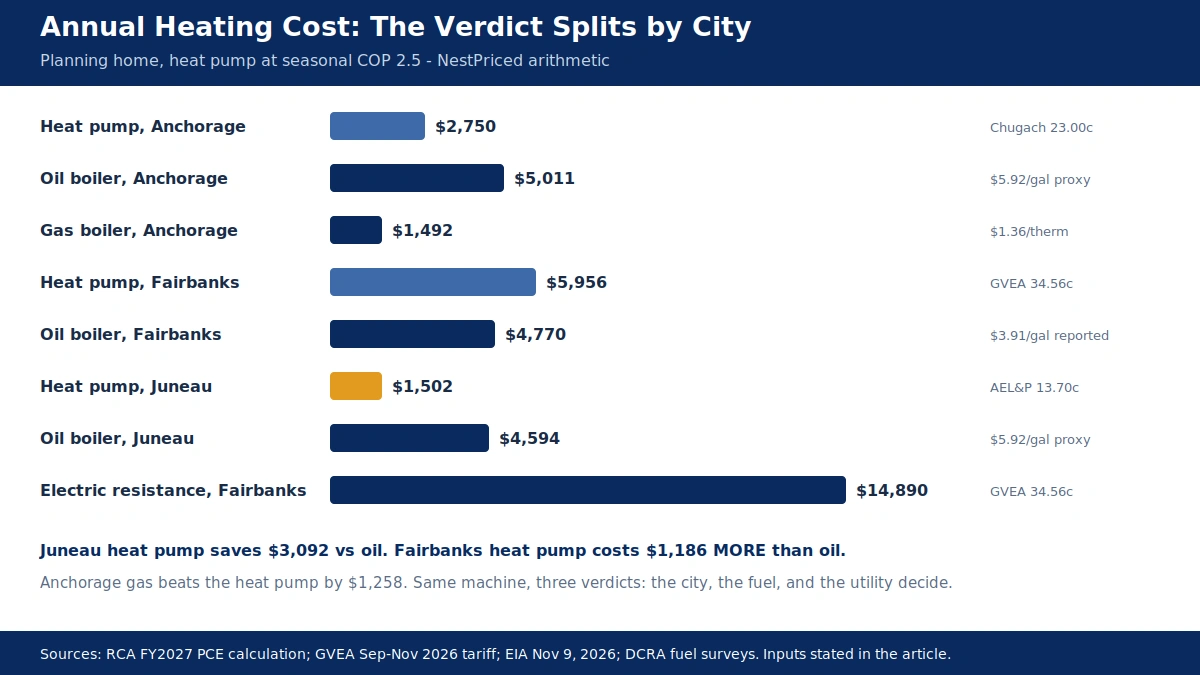
Alaska is not one heating market. It is three. Juneau runs on cheap hydro power at 13.70 cents a kilowatt-hour, so a heat pump there beats an oil boiler by about $3,092 a year. Anchorage runs on Cook Inlet gas, and a gas boiler beats a heat pump by about $1,258 a year. Fairbanks runs on oil and the most expensive Railbelt power in the state, and at Fairbanks oil prices a heat pump costs about $1,186 a year more than the oil boiler it would replace. Your city, your fuel, and your utility decide whether a heat pump pays, and this guide prices all three honestly.
Step off a plane in Anchorage in January and the first thing you notice is how the cold behaves. It is dry, still, and deep, the kind of cold that makes a car groan when it starts and turns breath into a cloud that hangs in the air. Drive north to Fairbanks and the cold gets serious in a way the Lower 48 never sees, with weeks where the temperature never climbs above zero and the lowest nights touch minus 40. Fly southeast to Juneau and the cold turns wet and grey, rain on the roof in January and snow that melts as fast as it falls.
A heat pump has to survive all three versions of Alaska winter, and that is why the question in the title is not really about price. The price is the easy part. The hard part is whether a machine that pulls heat out of outdoor air can keep a house warm when the outdoor air is minus 20, and what it costs to run when it does. This guide answers both questions with numbers you can check, city by city, fuel by fuel.
The short version is that Alaska rewards heat pumps unevenly. Juneau is one of the best heat pump markets in America, because its power comes from falling water and costs less than the national average. Anchorage is a mixed market, where a heat pump crushes electric baseboard heat and oil heat but loses to the gas boiler most homes already own. Fairbanks is the hardest market in the country for a heat pump, because the power is expensive, the winters are brutal, and the oil is cheap by Alaska standards. Rural Alaska is a fourth market entirely, where fuel arrives by barge at $8 a gallon and the state pays part of the electric bill, and the math there follows rules no Lower 48 guide ever mentions.
Every price in this guide comes from published cost modeling priced in October 2026, read in November 2026, and every running-cost figure shows its inputs. Where a number could not be verified against a primary source, the draft says so in the text and in the research file, instead of smoothing over the gap. Alaska deserves that honesty more than most states, because the gaps here are wide enough to swallow a budget.
Table of Contents
How Much Does a Heat Pump Cost in Alaska in 2026?
A 3-ton ducted heat pump costs $7,160–$11,750 installed in Alaska in 2026. The October 26, 2026 NumeralQ state model is the source of that band, and it prices a finished job: the outdoor box, the indoor air handler, the refrigerant lines, the thermostat, and the crew that fits them. New ductwork, an electrical panel upgrade, and a permit all sit outside that band, and in Alaska those three extras show up often enough that most homeowners should budget for at least one of them.
Alaska sits at the top of the national range on the same model. Set the national heat pump cost band beside it, $6,550–$10,960 for the same 3-ton ducted system, and Alaska runs about $610 to $790 higher at each end. The reason is labor, plus distance. Bureau of Labor Statistics data from May 2025 puts the median Alaska heating and cooling installer at $37.23 an hour, about 20% above the national median, and after insurance, payroll taxes, and overhead, contractors bill about $74–$97 per worker-hour. Equipment ships at national prices, then rides a barge or a truck for thousands of miles to reach the job.
Three published sources frame the Alaska market, each measuring something different. For figures that name the machine, the size, and the pricing date in one place, NumeralQ’s modeled band is the sharpest source in this guide. BetterHouse scales a national baseline by state wages, and its Alaska spread runs far wider, $4,330–$15,160, with a typical figure of $11,450. BetterHouse puts its typical Alaska figure near the top of NumeralQ’s band, which lends the model some support, but its $4,330 to $15,160 spread lumps single-zone mini-splits together with full ducted systems, so it cannot carry a budget on its own.
| Source | Alaska 3-ton ducted cost | Basis | Date |
|---|---|---|---|
| NumeralQ state model | $7,160–$11,750 | Modeled installed cost, state list | Priced Oct 26, 2026 |
| NumeralQ Anchorage model | $7,460–$12,140 | Modeled installed cost, Anchorage market | Updated Oct 12, 2026 |
| BetterHouse | $4,330–$15,160, typical $11,450 | Aggregator model, wage-adjusted | 2026 |
| ElectricMetrics whole-home average | $19,000 average | Whole-home installs, all system types | Jul 2026 dataset |
| Alaska HeatSmart field range | $6,500–$9,000 single-zone ductless | Contractor-observed, Southeast | Apr 2025 hearing |
The ElectricMetrics row needs explaining, because $19,000 looks like it contradicts the modeled band. It does not. Keep in mind what the modeled band actually prices: one ducted system, nothing more.
The $19,000 figure is an average across whole-home installs, and most Alaska whole-home jobs are not one ducted system. They are two or three cold-climate ductless outdoor units, each serving part of the house, plus freight, plus travel, plus backup heat, installed across a house that never had ductwork. Compare like with like: one ducted system against the modeled band, and a multi-unit cold-climate job against the whole-home average.
The Alaska HeatSmart row carries a different warning. Witnesses told the Alaska House Energy Committee that single-zone ductless installs commonly run $6,500–$9,000 in Southeast Alaska, with two-head systems at $9,500–$11,000 and smoother installs near $5,000 in ideal conditions. Those contractor-observed figures run well above NumeralQ’s modeled Anchorage single-zone band of $3,740–$5,690. Both numbers are reported here rather than averaged away, because the gap is real information: Southeast jobs carry barge freight, small-crew travel, and cold-climate equipment that the Anchorage model prices more cheaply. Budget toward the field range if you live outside Anchorage, and toward the modeled band if you live in it.
A band that wide holds very different machines at its two ends, and that spread is the reason the range looks so broad. At the bottom of the range sits a plain single-stage unit built to the federal efficiency floor, a machine that heats well until the thermometer drops toward 30°F. At the top sits a variable-speed cold-climate system that keeps most of its heating muscle at 5°F and holds rooms at a steadier temperature through a January cold snap. Both are called heat pumps. Only the second of those two units is built to face an Anchorage January, which makes the choice between them the weightiest decision in this guide.
Just as much as what it includes, what the band leaves out matters. From the same NumeralQ pricing, Anchorage ductwork, new or extended, runs $5,280–$8,530 a job, and a 200-amp panel upgrade runs $2,640–$4,020 a job. Before the heat pump itself is priced, an Anchorage home with a 100-amp panel and no ducts can add $7,920–$12,550 to the headline band. Ask for each extra as a separate line on the quote, and read the permit and contract sections before signing, because Alaska is a full-price lien state and an unpaid supplier can lien your home even after you paid the contractor in full.
When you buy can shift the price by hundreds of dollars and the wait by weeks. NumeralQ’s Anchorage data names July and August as the mildest install months, when a day without heat is no hardship. A heat pump ordered in July in Anchorage is the same machine as one ordered in January, but the January order is more likely to be an emergency replacement at emergency pricing, with less time to compare bids or wait for a cold-climate model the local distributor does not stock. In Fairbanks, winter installs carry a second risk: a system that cannot be properly tested far below zero, and a crew working in the dark for most of the day.
Alaska adds one cost no other state has at this scale: freight. Equipment that arrives in Seattle still has to reach Anchorage, Fairbanks, Juneau, or a village off the road system, and every mile adds money. A Juneau job pays barge freight.
A Fairbanks job pays trucking up the Parks Highway. A village job pays air freight or a summer barge, and the install may have to wait for breakup or freeze-up to pass. If your quote does not show a freight line, ask where the freight is hiding, because it is in the price somewhere.
Heat Pump Cost in Alaska by System Type
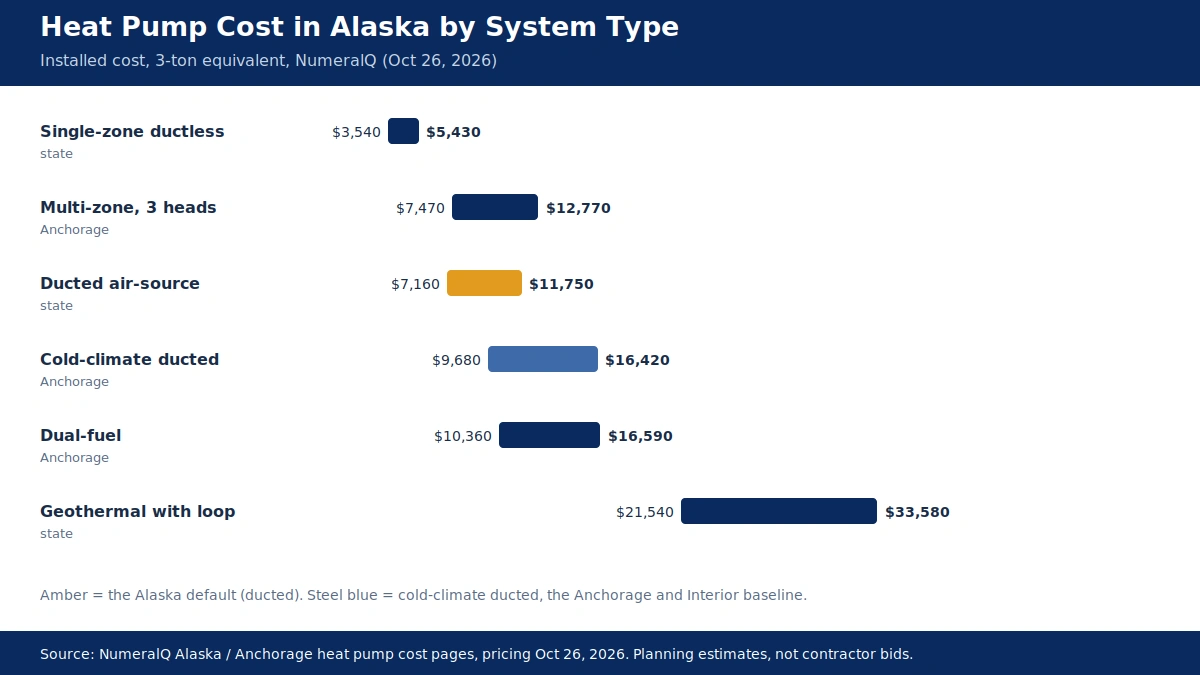
Your system type has already set the price band before any contractor crosses your threshold. Heating one part of the house with a single-zone mini-split costs a small fraction of what a ground-loop geothermal system costs. The table below uses a state-model row wherever one is published, and where none exists, Anchorage figures stand in, labeled as Anchorage. Every figure in the table below is an installed cost for a 3-ton equivalent system, except where a row says otherwise.
| System type | Alaska installed cost | Best for |
|---|---|---|
| Single-zone ductless mini-split | $3,540–$5,430 (state) | One zone, addition, or first unit |
| Multi-zone ductless, 3 heads | $7,470–$12,770 (Anchorage) | Homes without ducts, zoned rooms |
| Ducted air-source heat pump | $7,160–$11,750 (state) | Homes with good ducts |
| Cold-climate ducted heat pump | $9,680–$16,420 (Anchorage) | Anchorage, Interior, high ground |
| Dual-fuel (heat pump plus gas furnace) | $10,360–$16,590 (Anchorage) | Gas-heated homes, Railbelt only |
| Geothermal with ground loop | $21,540–$33,580 (state) | Long-term owners, large lots |
A single-zone ductless mini-split is the cheapest way into heat pump heating in Alaska, and it is the unit most Alaska installs start with. One outdoor box feeds one indoor head, most often fixed high on a living-room or bedroom wall, and that head heats and cools its own zone. At $3,540–$5,430 on the state band, it is the go-to fix for an Anchorage condo on electric baseboard heat, a Juneau addition that never got ductwork, or the first step in a phased whole-home plan. Contractor-observed prices in Southeast Alaska run higher, $6,500–$9,000 for the same single-zone job, so budget toward the top end for a cold-climate-rated unit with a longer line set and barge freight.
A multi-zone ductless setup stretches that idea across three or more rooms, giving each room its own head and thermostat while one outdoor box serves them all. Anyone who takes ductless as always cheaper is in for a surprise, because the $7,470–$12,770 Anchorage band for three heads overlaps the ducted band. Set against ductwork built from scratch, a multi-zone job looks like a bargain, and set against ducts already in good shape, it looks dear.
Where a furnace and ducts already heat the house, swapping in a ducted air-source heat pump is the obvious move. The ducts remain, the vents remain, and often the air handler cabinet remains as well, which keeps the crew’s job simple and the price inside the state band. The catch is the condition of the ducts, and in Alaska that question carries more weight than in most states. Ducts in an unheated crawl space or attic lose heat fast in a minus 20 night, and ducts that leak can shed a fifth or more of their heated air before any room feels it.
At the Anchorage midpoints, a cold-climate ducted system costs about $3,250 more than a standard one, and across most of Alaska that premium buys the difference between comfort and a cold house. What makes a cold-climate unit different sits inside the box: a variable-speed compressor and an oversized outdoor coil that keep drawing heat from air cold enough to stop a standard unit and force it onto resistance backup. Behind the $9,680–$16,420 Anchorage band sit three things: a bigger coil, an inverter drive, and a more careful install.
For a home in Fairbanks, where January nights average far below zero, a cold-climate rating is not an upgrade. It is the baseline, and even then the system needs backup heat that can carry the house alone. Contractor guides that price cold-climate ducted work above the modeled band in the Interior are describing harder jobs, longer travel, and electrical upgrades bundled in, not the same modeled scope.
A dual-fuel system puts a heat pump and a gas furnace in the same house, with a control passing the heating job between them as the outdoor temperature rises and falls. The Anchorage band of $10,360–$16,590 buys two heating systems in one install. Dual-fuel only exists where a gas line reaches, which in practice means Anchorage, the Mat-Su Valley, and parts of the Kenai Peninsula. Fairbanks has no residential gas grid, Juneau has none either, and rural Alaska has none at all, so dual-fuel is a Railbelt-only option and the running-cost section shows why its fuel math is the weakest case in this guide.
The dearest system on the list is geothermal, also called a ground-source heat pump. A loop of pipe buried in the yard or dropped down a well draws on ground that holds steady temperatures at depth, while the air above it swings from minus 40 to 70. The $21,540–$33,580 state band covers both the loop and the indoor unit, and the final figure turns on the loop itself, since horizontal trenches want a large yard while vertical boreholes cost more and fit a small lot. Permafrost complicates the ground loop in the Interior, and drilling through frozen ground adds cost and time, so get the loop design from a driller who has worked your soil before. No Alaska ground-source rebate amount was found in the pages read for this guide, so no rebate is assumed for geothermal in any figure that follows.
Inside every system type on the list hides one cost: the refrigerant, the gas that carries heat around the loop. In 2025 the EPA ended R-410A in new home systems, and the refrigerant in new units changed with that rule. R-454B or R-32 fills new Alaska systems in 2026, and neither gas can top off an R-410A unit from an earlier year. Because both replacement gases burn mildly, crews follow extra handling rules, and those rules add a little to the install cost. Before you accept a cheap recharge on an aging system, learn which refrigerant it holds, then weigh the repair against replacing the unit outright.
Heat Pump Cost in Alaska by Home Size and Tonnage
Tons are the unit for sizing: one ton moves 12,000 Btu of heat in an hour. Short for British thermal unit, a Btu is the heat needed to raise one pound of water by one degree Fahrenheit. Ton says nothing about how heavy the outdoor box is: a 3-ton unit sits in the middle of the home range, far below commercial size.
State installed costs by size follow in the table below, from NumeralQ’s October 2026 pricing. The home-size column is a rough planning guide. Treat it as nothing firmer. Floor area alone never settles the size, since insulation, windows, ceiling height, and air leakage matter as much, and in Alaska the age of the house and the depth of the winter often matter more than any of them, so two homes of the same square footage can need different sizes.
| System size | Alaska installed cost | Rough home size | Typical Alaska home |
|---|---|---|---|
| 1.5 ton | $4,920–$7,740 | 600–900 sq ft | Small condo, cabin |
| 2 ton | $5,670–$9,080 | 900–1,200 sq ft | Starter home, small ranch |
| 2.5 ton | $6,410–$10,410 | 1,200–1,500 sq ft | Older Anchorage bungalow |
| 3 ton | $7,160–$11,750 | 1,500–2,100 sq ft | Typical Alaska family home |
| 3.5 ton | $7,900–$13,080 | 2,100–2,400 sq ft | Two-story Eagle River home |
| 4 ton | $8,650–$14,420 | 2,400–3,000 sq ft | Large Fairbanks home |
| 5 ton | $10,140–$17,090 | 3,000–3,700 sq ft | Large Anchorage home |
A half-ton step up adds roughly $750 at the low end and $1,340 at the high end. The 4-ton to 5-ton jump is the exception, adding $1,490 and $2,670. The 3-ton to 4-ton jump alone runs about $1,490 at the low end and $2,670 at the high end, and that is why oversizing stings in dollars too. Short-cycling is what an oversized unit does: it fires in brief bursts that strain parts and skip the steady running that pulls humidity from summer air, so it never settles into efficient operation. On the coldest days an undersized unit runs without rest and drags in resistance backup, which costs roughly three times what the heat pump delivers for each unit of heat.
The right size comes from a Manual J load calculation, a room-by-room worksheet of heat loss and heat gain that takes in your walls, windows, insulation, air leakage, and the local design temperature. The Air Conditioning Contractors of America publishes Manual J. In Alaska the calculation matters more than in any other state, because the design temperature swings from 1°F in Juneau to minus 47°F in Fairbanks, and a size that is right in Juneau is dangerously wrong in Fairbanks. A size picked from floor area alone, or copied from the unit being replaced without running the numbers, is a guess dressed up as experience.
A good load calculation catches three sizing wrinkles that Alaska homes add. First, many Alaska houses are built for cold that the Lower 48 never sees, with thick walls and small windows, but many others are older cabins and converted structures with thin walls and real air leaks. Second, many Alaska homes heat with a boiler or a wood stove and have no ducts at all, so the heat pump is an addition to the house rather than a swap in a closet, and the load calculation must cover rooms the old system heated through pipes or a stove in one room.
Third, the design temperature is not a statewide number. The older code table this guide cites puts the 97.5% design temperature at minus 18°F in Anchorage, 1°F in Juneau, and minus 47°F in Fairbanks, and even that table is old enough to flag. Check that the calculation uses your town’s design temperature rather than a statewide default, and ask the contractor which temperature went into it. A contractor who sizes from Anchorage rules and installs in Fairbanks will undersize the system by a wide margin.
The furnace-plus-air-conditioner comparison sits in this section because that is the quote Anchorage homeowners truly weigh theirs against. A 3-ton central air conditioner plus gas furnace costs $9,300–$15,350 installed in Anchorage, which is $1,840–$3,210 more than the Anchorage 3-ton heat pump band. The pair costs more because two machines are doing the work of one heat pump. With the furnace and the air conditioner both near the end of their lives, the heat pump is the cheaper of the two replacements. When the furnace is failing but the air conditioner has years left, the two options draw much closer, and the payback section runs that case in full.
Heat Pump Cost by City: Anchorage, Fairbanks, and Juneau
Anchorage is the only Alaska city with a published cost model. NumeralQ treats Anchorage in full, with figures split by size, system type, add-on, and labor rate. No published cost model prices Fairbanks or Juneau, and this section is honest about that gap. The Anchorage figures below are modeled costs. Built from the state band, the Fairbanks and Juneau figures are planning estimates, and they carry that label wherever they appear.
| City | 3-ton ducted cost | Basis | What moves the price |
|---|---|---|---|
| Anchorage | $7,460–$12,140 | NumeralQ model, Oct 2026 | Standard reference market |
| Fairbanks | $7,160–$11,750 | State-band planning estimate | Extreme cold, GVEA rates, freight |
| Juneau | $7,160–$11,750 | State-band planning estimate | Barge freight, hydro rates, rain |
As the reference market, Anchorage anchors this guide with the firmest numbers anywhere in it. The municipality counts 89 plumbing and HVAC contractors, about 7.4 per 10,000 homes, roughly the national rate. The median Anchorage home is worth $395,900, and 79% of homes heat with piped gas while 16% heat with electricity. That fuel split matters for quotes: an Anchorage home on a gas line faces the weakest running-cost case in this guide, while a home on electric baseboard heat faces the strongest. Anchorage is also the only Alaska city where dual-fuel is a real option, because it is the only one of the three with a residential gas grid.
Fairbanks is a colder heating climate wearing the same state name, and the difference is not small. The city sees 14,279 heating degree days against Anchorage’s 9,902, about 44% more, and its design temperature sits at minus 47°F against Anchorage’s minus 18°F on the older code table. About 54% of Fairbanks homes heat with fuel oil, the highest oil share of any city in the national comparison set, and 23% heat with electricity.
The Fairbanks planning estimate borrows the state band for a standard system, yet a system that truly works in Fairbanks needs the cold-climate Anchorage budget of $9,680–$16,420 at minimum, and the cold-climate section shows why the cold-climate rating outweighs the brand name. Fairbanks homeowners should also check which costs sit outside the band before pricing anything: freight up the Parks Highway, a smaller pool of installers, and the Fairbanks change-out program, which can pay up to $17,500 toward a heat pump that replaces a wood stove. The rebate section works through that program in full, because it is the largest single rebate in the state.
Juneau is the mildest of the three cities and the cheapest place in Alaska to run a heat pump. The capital sees 9,075 heating degree days, its design temperature is 1°F, and its power comes almost entirely from hydro, at 13.70 cents a kilowatt-hour, the cheapest residential power in the state. About 48% of Juneau homes heat with fuel oil and 35% with electricity, so nearly half the city is paying oil prices for heat while sitting on some of the cheapest electricity in America.
The Juneau planning estimate also uses the state band, but Juneau homeowners should budget more carefully for freight and access. Juneau is reachable only by boat or plane, so equipment arrives by barge, and a job that needs a part the local distributor does not stock waits for the next sailing. Juneau’s rain matters too: the city is wet enough that outdoor units need solid drainage and a spot out of the drip line, and the coastal wind drives rain sideways into places a Fairbanks installer never thinks about.
Outside the three cities, travel and access can move a quote in ways the city bands do not capture. A home in the Mat-Su Valley, on the Kenai Peninsula, or in Bethel may face a trip charge, a smaller pool of qualified installers, or a longer wait for a cold-climate model the local distributor does not stock. A village home off the road system faces the steepest costs of all: air freight for the equipment, a crew flown in for the install, and a schedule set by the barge season. The equipment price itself barely moves through all of that, while the timeline gains days and the labor line gains hundreds of dollars. If you live outside Anchorage, get one bid from a contractor based in your region and one from the nearest city, and compare the full installed price rather than the equipment price alone.
Living near a state line is not a factor in Alaska, because there is no neighboring state market to compare against. The useful comparisons are the other cold-climate states: see the guides for Montana and Maine for how the same cold-climate questions play out where the winters are milder and the rebate programs are open.

Cold-Climate Performance: What an Alaska Winter Asks of a Heat Pump
No fuel burns inside a heat pump: it creates its warmth another way. Through a refrigerant loop and a compressor, heat moves from the outdoor air into the house, the same basic process as a refrigerator running in reverse. Moving heat that already exists, rather than making heat from nothing, is how one unit of electricity can deliver two or three units of warmth indoors. That is one more reason outdoor temperature matters so much. As the outdoor air gets colder it holds less heat to carry, the machine works harder for each unit, and both output and efficiency slide downward.
The number that sums all of this up is COP, short for coefficient of performance. Heat delivered divided by electricity consumed gives that ratio in plain form, so three units of heat enter the house for each unit of electricity at a COP of 3.0. Resistance heat sits at a COP of 1.0 by definition, one unit of electricity in and one unit of heat out, and that is the heat the baseboards in many older Alaska houses deliver. Any COP above 1.0 beats resistance heat, and heat pumps clear that bar almost all the time. As the cold deepens, though, the edge thins until the machine can no longer match what the house loses.
That crossover has a name among installers, the balance point: the outdoor temperature where the heat pump’s best output just matches the heat escaping the house. Above the balance point, the heat pump handles all of the heating on its own. Once the temperature falls below the balance point, a second heat source has to cover the shortfall.
In an Anchorage house, a well-sized cold-climate system may balance near 5°F or lower, leaving backup heat to run a handful of nights a year. In a Fairbanks house, a standard system may balance near 25°F or 30°F, leaving backup heat to run for weeks. A balance point appears in no brochure, since it belongs to one machine matched to one house. A good contractor works it out from the load calculation and the maker’s capacity tables.
Start serious shopping at the capacity tables. Heat output at three outdoor temperatures, 47°F, 17°F, and 5°F, is what the maker publishes for each model. At 5°F, a standard unit may deliver only 40% to 60% of the heat it manages at its 47°F rating point.
Far more muscle at 5°F is what cold-climate models are built to hold: the ENERGY STAR cold-climate designation demands at least 70% of the 47°F output at 5°F, plus a COP of at least 1.75 in that cold. For the precise model on the quote, get its capacity table and read the 17°F and 5°F rows. Set those figures against your home’s heating load at the local design temperature. A quote that lacks that table is unfinished business.
Alaska field research backs up the capacity-table habit with hard numbers. A National Renewable Energy Laboratory team tested a 1-ton ductless mini-split in Fairbanks, rated to keep working down to minus 31°F, and found it still delivered heat with a COP above 1.0 down to minus 35°F, holding 12,000 Btu an hour of capacity at minus 12°F. A prototype built by Oak Ridge National Laboratory ran in Fairbanks down to minus 30°F, delivering 75% of its 47°F capacity at that temperature with a COP of 1.8. Those are research machines, not the unit on your quote, but they prove the physics: a good cold-climate heat pump does not stop at zero. It keeps working, at a lower COP, and the question is whether the lower COP still beats your current fuel at your utility’s rate.
The University of Alaska’s own guidance sets the sizing rule plainly. A reasonably sized heat pump for a cold climate has a heating capacity at 0°F of 25% to 35% of the house design heating load, and such a system supplies 60% to 75% of the annual heating load. Look for a COP of 2 or better at 0°F, the guidance says, and keep a backup heat source, because the coldest models stop working near minus 20°F. That last line is the one Fairbanks buyers must take seriously: at minus 40, the heat pump is not heating your house. Something else is.
Defrost cycles give new owners their biggest surprise. When ice coats the outdoor coil, the system flips into reverse for a few minutes to melt it off. The air coming indoors during those minutes feels cool unless backup heat warms it. Defrost is normal and necessary.
When defrosting never stops, something is wrong: an undersized unit, a bad spot, or wet snow and ice piling up around the base. A raised stand well above the snow line is where the outdoor unit should sit in Alaska, with the drain routed so meltwater does not refreeze under the unit. Anchorage averages deep snow every winter, and Fairbanks piles it deeper still, so a unit set at ground level will spend part of every winter buried. The NREL Fairbanks test found the drain-pan heater, a 260-watt strip that keeps meltwater from freezing in the pan, running half the time at 14°F. That heater is pure electric resistance load, and it belongs in your running-cost expectations.
Where the unit goes also depends on snow and ice. Falling snow and ice off the roof will land on a unit set under a roof valley. A drift will bury a unit set in a low corner.
Ice forms faster on a unit on the windward side of the house than on one in a sheltered spot. Get the contractor to say where the outdoor unit will sit, how high it will be raised, and where the defrost drain will run. Nothing is what these three questions cost, and they prevent the most common Alaska installation complaints.
The coast-to-Interior contrast is the single most important climate fact for an Alaska buyer. Anchorage, at sea level on Cook Inlet, has 9,902 heating degree days, a measure of how much heating a climate demands over a year. Fairbanks, inland on the Tanana River, has 14,279, about 44% more.
Juneau, on the panhandle coast, has 9,075. About 184 Anchorage nights a year drop to freezing or below, and about 28 of them fall to zero or below. Fairbanks sees far more of both, and its record cold runs past minus 60.
One last cold-climate reality check: the test climate behind yellow-label efficiency ratings is far milder than any Alaska city. A test region whose winters run far gentler than Fairbanks sits behind the HSPF2 rating, explained in the efficiency section. Even an HSPF2 9.5 unit falls short of its rated seasonal efficiency in a 14,279-heating-degree-day climate. The label promises more than real output delivers, and the gap widens with each degree the design temperature drops. Instead of the label alone, budget your running costs off the COP range in the next section, and treat any promise of label efficiency through a Fairbanks winter as a sales pitch, not a fact.
Running Costs: Heat Pump vs Oil, Gas, Propane, and Electric Heat
Three directions at once is how Alaska breaks the usual heat pump sales pitch on running cost. Among the most expensive power in the country, Alaska electricity hurts heat pumps. Heating oil in Alaska is also expensive and volatile, which helps them.
And Alaska natural gas, where a gas line reaches, is cheap, which hurts them again. Which force wins depends on your city, your utility, and your current fuel. This section states every input in plain sight, so your own delivery tickets and utility bills can check the math.
The planning homes in this section are built from heating degree days, scaled from a 70 million Btu planning home at 6,795 degree days. Anchorage, at 9,902 heating degree days, needs about 102 million Btu of delivered heat per year. Fairbanks, at 14,279 degree days, needs about 147 million Btu.
Juneau, at 9,075 degree days, needs about 93.5 million Btu. Planning figures, not measurements of your own house: that is how to treat these, and every result from this method carries the NestPriced arithmetic label. Burn 846 gallons of oil a year through an 87% efficient boiler and your delivered heat is about 102 million Btu, and every figure in this section scales by your own gallons.
The energy prices are current and dated. Electricity uses the average residential rate from the Regulatory Commission of Alaska’s fiscal year 2027 Power Cost Equalization calculation, built from the utilities’ 2025 annual reports: 23.00 cents per kWh on Chugach Electric lines in Anchorage, 31.47 cents per kWh on Golden Valley Electric lines in Fairbanks, and 13.70 cents per kWh on Alaska Electric Light and Power lines in Juneau. For Fairbanks, the running-cost math uses Golden Valley’s actual current tariff instead: 34.56 cents per kWh, the effective residential rate for September through November 2026, because the tariff is the price a Fairbanks heat pump actually pays and it moved above the 2025 average. The fixed monthly charge stays on the bill either way, so the comparison leaves it out.
Heating oil has no statewide survey in Alaska, and that gap shapes this whole section. The US residential average is $5.92 a gallon for the week of November 9, 2026, and the draft uses it as the Anchorage and Juneau planning price, labeled as a proxy, because the state fuel survey deliberately excludes Anchorage and the EIA does not survey Alaska at all. Fairbanks heating oil is $3.91 a gallon, the midpoint of a broker-reported $3.82–$4.00 range, flagged as a single weak secondary source. Rural heating oil is $7.97 a gallon, the state survey’s Summer 2026 average across 90 unsubsidized communities. Propane is $6.00 a gallon in Fairbanks, from the same broker report, flagged the same way.
Natural gas is $1.36 a therm, the EIA Alaska residential average for the 12 months to July 2026, with the August 2026 monthly figure of $1.76 a therm as a warning that the price moves. Furnaces and boilers use standard efficiency defaults: oil boiler 87%, propane and gas boilers 93%.
| Heating system | Annual heating cost | Notes |
|---|---|---|
| Heat pump, COP 2.5, Anchorage | $2,750 | Central case, Chugach 23.00 cents |
| Heat pump, COP 2.0, Anchorage | $3,438 | Harsh winter, standard system |
| Heat pump, COP 2.8, Anchorage | $2,456 | Good cold-climate system |
| Heat pump, COP 2.5, Fairbanks | $5,956 | Central case, GVEA 34.56 cents |
| Heat pump, COP 2.8, Fairbanks | $5,318 | Good cold-climate system |
| Heat pump, COP 2.5, Juneau | $1,502 | Central case, AEL&P 13.70 cents |
| Oil boiler, 87%, Anchorage | $5,011 | US average $5.92/gal, proxy price |
| Oil boiler, 87%, Fairbanks | $4,770 | Reported $3.91/gal, flagged |
| Oil boiler, 87%, rural | $9,723 | DCRA summer average $7.97/gal |
| Gas boiler, 93%, Anchorage | $1,492 | ENSTAR $1.36/therm |
| Propane boiler, 93%, Fairbanks | $10,365 | Reported $6.00/gal, flagged |
| Electric resistance, Anchorage | $6,876 | Baseboards, Chugach lines |
| Electric resistance, Fairbanks | $14,890 | Baseboards, GVEA lines |
| Electric resistance, Juneau | $3,754 | Baseboards, AEL&P lines |
Read the Anchorage rows first, because Anchorage is where most Alaskans live. A heat pump at the central COP of 2.5 on Chugach lines costs $2,750 a year to heat the planning home, which is $2,261 less than the $5,011 an oil boiler costs at the proxy oil price. The same heat pump costs $1,258 more a year than the $1,492 a gas boiler costs. The break-even point tells the same story in one number: against gas, a heat pump ties at a seasonal COP of 4.61, which no air-source heat pump sustains in Alaska.
Against oil at $5.92, it ties at a COP of 1.37, which almost any working heat pump beats. An Anchorage home that heats with gas today will see its heating bill rise with a heat pump, not fall. If it heats with oil or electric baseboards, a heat pump is a clear fuel saving.
Now read the Fairbanks rows, because they change the verdict. A heat pump at COP 2.5 on Golden Valley lines costs $5,956 a year, which is $1,186 more than the $4,770 an oil boiler costs at the reported $3.91 oil price. At COP 2.8, the best realistic case, the heat pump still costs $548 more than oil.
The break-even COP against $3.91 oil is 3.12, and no air-source heat pump holds a seasonal COP of 3.12 through a Fairbanks winter. The verdict flips only if oil gets expensive: at the US average of $5.92 a gallon, oil costs $7,222 and the heat pump saves $1,266 a year, and at the rural $7.97 average, oil costs $9,723 and the heat pump saves $3,767 a year. Fairbanks oil is cheap by Alaska standards, and that cheap oil is the whole story.
The propane comparison in Fairbanks is the worst fuel verdict in this guide. Against a propane boiler at $10,365 a year, the heat pump at COP 2.5 saves $4,409 a year. Propane in Fairbanks costs more than $6 a gallon, and at that price almost anything beats it. A Fairbanks home burning propane delivered by truck is one of the best heat pump candidates in the state, even with Golden Valley’s high power prices.
The electric resistance comparison is the strongest case in this guide, in all three cities. Against baseboard heat at $6,876 a year in Anchorage, the heat pump saves $4,126 a year. Against baseboard heat at $14,890 a year in Fairbanks, it saves $8,934 a year. Against baseboard heat at $3,754 a year in Juneau, it saves $2,252 a year.
For homes with electric baseboards, ceiling cable heat, or wall units, a heat pump transforms the winter bill, and a ductless system drops into those homes with the least disruption. If you heat with electricity today, the running-cost case is settled in every Alaska city. What remains to settle is sizing, rebates, and the panel.
Juneau deserves its own paragraph, because Juneau is the exception that proves the rule. A heat pump at COP 2.5 on Alaska Electric Light and Power lines costs $1,502 a year, against $4,594 for an oil boiler at the proxy price. The saving is $3,092 a year, the break-even COP against oil is 0.82, and even a mediocre heat pump running at a COP of 2.0 costs only $1,877 a year. Juneau’s power is hydro, its price is 13.70 cents, and its winters are the mildest of the three cities. Nearly half of Juneau homes still heat with oil, which means nearly half the city is paying oil prices while sitting on the cheapest power in the state.
Rural Alaska follows different rules, and this guide will not pretend otherwise. Power Cost Equalization pays the difference between the 21.85 cent base rate and the village utility’s actual cost of generation, but only for the first 750 kilowatt-hours a month for a residential customer. A heat pump heating a 147 million Btu home at COP 2.5 needs about 17,233 kilowatt-hours a year, roughly 1,400 a month on average and far more in January, so most winter kilowatt-hours are billed at the full village rate of 55 to 80 cents or more. The 750 kilowatt-hour cap is the number that decides the rural math, and any quote that prices rural running costs at the base rate alone is wrong. Price your own winter kilowatt-hours against your village tariff, month by month, and count only the first 750 at the subsidized rate.
Cooling changes the comparison in the heat pump’s favor, though less in Alaska than in the Lower 48. A heat pump also cools like an air conditioner, and an oil boiler does not. Anchorage summers are short and mild, Fairbanks summers are short and hot, with days past 80 and wildfire smoke, and Juneau summers are cool and damp.
Through a smoky July, a Fairbanks home that wants cooling either buys a window unit or a central air conditioner alongside the boiler, or buys a heat pump that does both jobs. In Anchorage the furnace-plus-air-conditioner pair costs $9,300–$15,350 against $7,460–$12,140 for the heat pump, so the heat pump starts about $1,150 ahead on equipment at the midpoints before a single kilowatt-hour is counted. The payback section runs the math with cooling included.
Your own bills are the final check. Gallons, not dollars, are how to count your last 12 months of oil deliveries, because the price swung violently during 2026. Your delivered heat comes from multiplying your gallons by 138,500 Btu and by your boiler’s efficiency, and then you price that heat at the COP range in the table above using your own utility’s rate from your bill. Far above 102 million Btu in Anchorage, delivered heat points to a larger, leakier, or colder house than the planning home, and savings against oil or propane grow with it. Land far below and your home is tighter or smaller, with a payback that will run longer.
Efficiency Ratings That Matter: SEER2, HSPF2, and Cold-Climate Labels
Heat pump efficiency comes down to two ratings, and in Alaska the heating rating deserves far more weight than the cooling one. Cooling efficiency over a whole summer is the measure SEER2, the Seasonal Energy Efficiency Ratio 2, gives. Heating efficiency over a whole winter is the measure HSPF2, the Heating Seasonal Performance Factor 2, gives. A 2023 test update that used truer duct pressures is what the 2 marks, and on the new scale the same machine scores lower than it did as SEER or HSPF. A 16 SEER figure from an old quote should never sit beside a 16 SEER2 figure: the two scales do not line up, and the comparison will steer you wrong.
Since January 1, 2023, no split-system heat pump sold anywhere in the country may rate below 14.3 SEER2 and 7.5 HSPF2, and that floor has held ever since. For any new system sold in Alaska, those numbers are the floor. That floor is a floor, not buying advice. Juneau homes get adequate heat from a federal-minimum unit; Anchorage homes get marginal heat and heavy backup use in the coldest weeks; Fairbanks homes get a machine that quits early and often. Alaska’s own field guidance points the same way: look for a COP of 2 or better at 0°F, a bar the federal minimum does not test at all.
Split HSPF2 by 3.412, the Btu in a watt-hour, and the answer is the seasonal COP. Run that arithmetic at the federal minimum of 7.5 and the seasonal COP comes out near 2.2. An HSPF2 of 9.5 implies about 2.8.
An HSPF2 of 10.5 implies about 3.1. Approximate is the word for the conversion, with the cold-climate section’s caveat attached. HSPF2 testing happens in a climate far milder than Alaska’s, so Fairbanks’ realized seasonal COP lands below the converted number. Caveat and all, nothing compares two quotes on heating cost faster than the conversion, and the table below prices each tier for the Anchorage planning home on Chugach lines.
| Efficiency tier | HSPF2 | Implied seasonal COP | Annual heating cost, Anchorage |
|---|---|---|---|
| Federal minimum | 7.5 | About 2.2 | $3,128 |
| Cold-climate floor, ducted | 8.1 | About 2.4 | $2,896 |
| Mid-tier | 8.5 | About 2.5 | $2,760 |
| High-tier | 9.5 | About 2.8 | $2,469 |
| Top-tier cold-climate | 10.5 | About 3.1 | $2,234 |
About $659 a year on Chugach lines is what the jump from the federal minimum to the high tier saves, before the test-climate caveat. That saving justifies the upgrade only if the premium is right, and premiums move by brand and by how much of the extra money buys the cold-climate coil rather than the efficiency rating. The efficiency saving alone pays the cold-climate premium back in about 4.9 years in Anchorage, where that premium runs about $3,250 over a standard system at the midpoints. From the same premium, Fairbanks buyers get faster payback and a bigger comfort gain, because it also buys 5°F capacity and far fewer backup hours. Two separate decisions, each with its own price on the quote: that is how to treat the tier jump and the cold-climate capability.
Two labels cut through the rating fog in cold climates. Three bars make up the ENERGY STAR cold-climate designation: a COP of at least 1.75 at 5°F outdoors, at least 70% of the 47°F heating output at 5°F, and a controls check that proves the system performs as rated once installed. Under that designation, ducted units need 15.2 SEER2 plus 8.1 HSPF2, and ductless ones need 8.5 HSPF2.
The cold-climate specification that rebate programs across the country use comes from NEEP, the Northeast Energy Efficiency Partnerships, and it calls for a variable-capacity compressor and a COP of at least 1.75 at 5°F running flat out. Below 17°F, the standard HSPF test never measures, which is why both labels exist, since a unit can post a fine HSPF2 score and still wilt at 5°F. A cold-climate label outweighs a half-point of HSPF2 in Alaska’s winters, and the Chugach rebate requires a cold-climate system, which is a useful signal: the utility will not pay you to install a system that will not perform in an Anchorage winter.
SEER2 still matters in Fairbanks, where summer days run hot and wildfire smoke fills July. A system at 14.3 SEER2 will cost noticeably more to cool and dehumidify with than one at 16 SEER2 or higher, and the dehumidification comfort is genuine. In Anchorage and Juneau, where summers are short and cool, weight SEER2 less and HSPF2 and the cold-climate labels more.
Keep an eye on EER2, the Energy Efficiency Ratio 2, which grades cooling at one hot outdoor temperature rather than across a season. A quote that leads with a high EER2 may be hiding a middling HSPF2. Put EER2 second in your priorities as an Alaska buyer.
Put HSPF2, the 5°F capacity, and the cold-climate labels first among your questions. Press the contractor on why when EER2 leads the quote while the heating figures hide at the back. Brand-by-brand price and cold-climate comparisons live in the best heat pump brands cost guide and the cold-climate mini-split guide.
Oil, Wood, and Backup Heat in Alaska Homes
Most Alaska heat pumps do not work alone. Beside them work an oil boiler, a wood stove, or electric resistance strips that take over when the cold deepens. How that backup is arranged decides both the rebate and the January bill, and in Alaska the backup question is sharper than in any other state, because the coldest nights are colder and the stakes of a failure are higher. Three backup patterns Alaska homeowners actually use, with the rebate consequences of each, are what this section covers.
Most common of all is the retained oil boiler. Primary heat becomes the heat pump’s job, while the oil boiler stays in the basement for emergency backup only. In the Interior, keeping the boiler is sensible insurance in a state where a minus 40 night can follow a power outage, and where the heat pump simply stops working at the bottom of its operating range. Keeping the boiler is not free: the boiler still needs annual service, the tank still needs fuel in it, and the oil in the tank still ages. Set the boiler thermostat to emergency-only levels, and make sure the two systems do not fight: the heat pump heads must be placed so they do not blow hot air directly onto the boiler thermostat and confuse it.
The second pattern pairs the heat pump with a wood or pellet stove. About 5% of Alaska homes heat mainly with wood, and many more burn wood as a second heat source, especially in Fairbanks and the Interior. In that pattern, the coldest nights go to the stove and the milder weather goes to the heat pump, the same split of work as dual-fuel with wood as the second fuel. Fairbanks cordwood runs $275–$400 a cord, from a broker’s review of homeowner bills, flagged as a single secondary source. The trade-offs are the labor of feeding it, indoor air quality, and the fact that a stove heats the room it sits in rather than the whole house.
Fairbanks adds a rule no other Alaska city has: the borough sits in a serious PM2.5 nonattainment area, the worst fine-particle air pollution in the nation, and wood smoke contributes 60% to 80% of it. Non-EPA-certified stoves in the nonattainment area had to be removed or made inoperable by December 31, 2024, and the state restricts wood burning on bad-air days. If you burn wood as backup in Fairbanks, keep the stove certified and listed, watch the burn alerts, and do not count the stove as your only backup if you travel in winter. The change-out program in the rebate section will pay you to replace that stove with a heat pump, which is the borough’s whole point.
Electric resistance strips inside the air handler make up the third pattern, the default backup in all-electric homes. Fitting strip heaters costs little, often a few hundred dollars, and on the coldest nights they count as safety equipment rather than a luxury. What decides the bill is the strips’ running hours, not the strips themselves. Only a few dozen hours a year is all the strips may log with the right size, a cold-climate unit, and a low balance point.
Weeks on end is how long the strips can run behind an undersized standard unit. A January electric bill double or triple December’s is the most common complaint from Alaska owners who bought on price alone, so watch for it. At Golden Valley’s 34.56 cents a kWh, an hour of strip heat costs three times what an hour of heat pump heat costs at a COP of 3.0, and the drain-pan heater adds its own steady draw on top.
Dual-fuel deserves its own paragraph because Alaska treats it as a Railbelt-only choice. In a dual-fuel system, a heat pump and a gas furnace share the house and switch between each other as the outdoor temperature moves. The Anchorage band is $10,360–$16,590. Take the Anchorage planning home, let the heat pump carry 60% of the load at a COP of 2.8 on Chugach lines, and let the gas boiler carry 40% at 93% efficiency.
About $1,472 a year comes from the heat pump portion and about $597 from the gas portion, for a total of about $2,069. The same home heated entirely by gas costs $1,492, so dual-fuel costs about $577 a year more on fuel, on top of a $1,150 equipment premium over the air-conditioner-plus-furnace pair and a $3,675 premium over the ducted heat pump alone. Redundancy and comfort on a gas line are what dual-fuel is for, never fuel savings. Outside the Railbelt, dual-fuel does not exist, because there is no gas line to pair with.
How much more thermostat behavior counts with a heat pump than with a boiler is what Alaska’s cold mornings expose, and hot water to radiators is how a boiler recovers fast from a nighttime setback. A heat pump recovers slowly, so a sharp morning warm-up can wake the resistance strips and erase the overnight saving. Keep the overnight setback small, two or three degrees instead of eight. Or fit a smart thermostat whose heat pump mode raises the temperature gently and keeps the strips off above a chosen outdoor temperature. Before the installer leaves the house, ask for the strip lockout to be set and a showing of how to adjust it.
Size the backup as part of sizing the system, not after it. Through a cold night with the heat pump dead, the strips should hold the house at a safe temperature, which usually means covering a large share of the design load. Because the night the heat pump fails will be the coldest night of the year, a retained boiler should carry the home on its own.
In a village, the backup question is sharper still: if the power goes out, an electric heat pump stops, and the house needs a stove or a generator. Ask the contractor this: on a minus 40 night with the heat pump stopped, what keeps the house warm? Look for a backup capacity number in the reply, not a soothing sentence.
Ducted vs Ductless Heat Pumps in Alaska Homes
Two groups cover nearly all of Alaska’s houses, and your group picks your heat pump. Where a furnace already heats the house, the ducts are already there, and a ducted heat pump drops straight into that system. No ducts exist in homes built with a boiler and radiators, electric baseboards, or a wood stove, and a ductless system avoids the cost and disruption of building ductwork from scratch. The housing stock in Anchorage’s older neighborhoods, Fairbanks’ post-war streets, and Juneau’s hillside homes holds plenty of both kinds, and the wrong choice costs thousands.
Where sound ducts are already in place, ducted wins easily. Fitting is faster, the indoor unit tucks into a closet or basement, and heat reaches every room through vents already there. The risk is invisible: ducts leak.
Ducts that run through a cold attic or crawl space can shed a fifth or more of their heated air before any room feels it. Returns sized too small can choke the system’s airflow. Before any ducted price is set, have the ducts inspected, and in a house past 30 years, have them leakage-tested too. Often the highest-value dollar in the whole project goes to sealing leaky ducts, and that work pairs naturally with the weatherization help covered in the next section.
Where ductless mini-splits win is in homes with no ducts, ducts past saving, or rooms that want different temperatures. Its own thermostat rides on each indoor head, so a bedroom can stay cool beside a warm living room and a spare room can sit turned down without touching the rest of the house. High on a wall or flush in a ceiling is where heads sit, fed by refrigerant lines that pass through one small hole in the wall to the outdoor unit. For sheer disruption, fitting heads beats cutting duct chases through finished walls and ceilings. A Fairbanks home with baseboard heat and no attic access often has ductless as its only practical option that does not involve opening walls.
The cost crossover is specific. Building new ductwork in Anchorage costs $5,280–$8,530 per job. In Anchorage, a three-head ductless system runs $7,470–$12,770. A ducted job with no ducts in place means $7,460–$12,140 for the system, plus the ductwork bill on top.
Ductless at $7,470–$12,770 undercuts ducted-plus-new-ducts at roughly $12,740–$20,670 where no ducts exist, by a margin wide enough to settle the question outright. Good ducts hand ducted the win on price and looks alike, with no wall heads showing anywhere in the house. Bad ducts call for both options priced with the duct repair folded in. Refuse any ducted quote that takes the old ducts on faith without an inspection.
A wrinkle that furnace homes never face comes with boiler homes. Water, not air, is what a boiler heats, so the radiators or baseboard pipes stay in place when a heat pump arrives. Air is what the heat pump heats, through heads or a new air handler, while the boiler stays as backup or comes out.
The two systems must not fight, so the boiler thermostat needs emergency-only levels, and the heat pump heads need placing where they do not blow hot air directly onto a radiator thermostat and confuse it. These patterns will be familiar to a contractor who has converted Alaska boiler homes before. Find out how many boiler-to-heat-pump conversions the installer completed in the last year.
A mix of the two, rather than either one alone, suits some Alaska houses best. Keep the main floor on its old ducts with a ducted unit, and warm an addition, a converted garage, or a bonus room the ductwork never reached with one ductless head. Or warm the rooms that matter with ductless heads, leaving baseboards behind as backup in the rooms nobody uses. Alaska remodels use these hybrids often, and they let the investment arrive in phases, main system now and extra head later. Size the phased plan as a whole from the start, even if it is installed in stages, or the second head will arrive on a system that cannot carry it.
Both options feel the press of electrical limits in older Alaska houses at once. A 100-amp panel still serves plenty of pre-1980 houses, and a ducted unit with resistance strips can push such a house toward 200-amp service. A panel upgrade in Anchorage runs $2,640–$4,020 per job.
Less current flows to each ductless head, so a single-zone setup may run happily on the old panel where a ducted unit cannot. At estimate time, with the panel door open and the spare breaker spaces counted, settle the panel question instead of discovering it on install day. The electrical panel upgrade cost guide walks through the job and its fair price if the panel needs an upgrade.
The hidden difference between ducted and ductless in a state with long heating seasons and wildfire smoke is filtration. All the air passes through one central filter in a ducted system, and stepping up to a high-efficiency filter during wildfire smoke events protects the whole house. Only its own room’s air is cleaned by one ductless head, through a small washable filter that traps dust while fine smoke slips past it. During the weeks when Interior air fills with smoke from wildfires, the ducted system’s central filtration is a real health advantage if anyone in the home has asthma or smoke sensitivity. A standalone bedroom purifier is what a ductless household in smoke country should price, far cheaper than the filtration gap it closes.
Rebates, Loans, and Credits You Can Actually Collect in 2026
Alaska’s incentive picture is thin, scattered, and easy to get wrong. There is no statewide heat pump rebate for an existing home, the federal rebate programs have not launched, and the money that does exist is tied to where you live: the coast, Fairbanks, or a new build. This section covers each source in the order you should check them: the federal situation first, because it is zero, then the coastal ACES program, then the Fairbanks change-out program, then the utility rebates, then the new-home rebate and the help programs. Every rebate figure below was checked against program pages or official filings in November 2026, and figures that could not be verified against a primary source are flagged as reported.
Federal money: $0 for 2026 installs, and HEAR and HOMES have not launched
For a heat pump installed in 2026 in an Alaska home the owner lives in, the federal government contributes $0. Both federal credits shut down under the One Big Beautiful Bill Act, Public Law 119-21, for property placed in service after December 31, 2025: the energy efficient home improvement credit under §25C and the residential clean energy credit under §25D. That cutoff date is confirmed by the IRS in Fact Sheet FS-2025-05.
Out of date and wrong is any web page, contractor flyer, or quote still promising a 30% federal credit or a $2,000 federal credit for a 2026 heat pump install. The IRS fact sheet is the source to trust, not a contractor’s rebate page. The national picture is covered in the federal energy tax credits guide.
The federal rebate programs tell a shorter story in Alaska than in most states. In federal law, the High-Efficiency Electric Home Rebate program, known as HEAR, offers up to $8,000 for a heat pump, income-qualified and paid at the point of sale. The Home Owner Managing Energy Savings program, known as HOMES, pays for whole-home energy savings.
In Alaska, both programs are announced and neither has opened for applications. The Alaska Housing Finance Corporation is the office that will run them, the federal allocation is about $74.6 million, and there is no launch date and no retroactive rebates. Do not hold an install for HEAR money that may not arrive for a year or more, and do not let a quote subtract $8,000 that no Alaska homeowner can claim today.
A lease route exists in federal law that no Alaska company actually offers. Under §48E, the clean electricity investment credit goes to a leasing company, which can pass its value to the homeowner. That arrangement stays open through December 31, 2027. The route is theoretical here, since no provider was found offering a heat pump lease to Alaska homes. Cross out any lease saving on a quote when no Alaska company offers the lease behind it.
ACES: $4,000–$8,500 for coastal Alaska
The largest heat pump rebate an existing Alaska homeowner can actually collect is the Accelerating Clean Energy Savings program, known as ACES, run by Alaska HeatSmart with Southeast Conference and the Alaska Municipal League. It is a five-year, $39 million program funded by the Environmental Protection Agency, and it pays $4,000 to $8,500 toward a heat pump for homes in coastal communities from Metlakatla to Kodiak. The $8,500 rebates reach households with a gross income below 80% of the community’s area median income. Households between 81% and 150% of area median income receive $6,000, as currently written in the program’s EPA work plan, which the program says is subject to change.
Three rules decide whether ACES pays. First, the home must sit inside the ACES region, the coastal communities from Metlakatla to Kodiak, which includes Juneau, Sitka, and Ketchikan and the smaller Southeast towns between them. Anchorage, Fairbanks, and the Interior are not in the region. Second, the household must complete income verification and a home energy assessment and receive final program approval before buying any equipment or starting any work.
Third, there are no retroactive rebates: a heat pump bought before approval earns nothing. The program is operating with open enrollment, and Alaska HeatSmart keeps a Qualified Contractor List for the work. Check the region map and the income tiers on the Alaska HeatSmart program page before budgeting any ACES money, and start the application before you start the project.
Fairbanks change-out program: up to $17,500 to replace a wood stove
Fairbanks holds the second-largest rebate in the state, and it exists because the air is the worst in the country. The Fairbanks North Star Borough Air Quality Division runs a voluntary change-out program for homes inside the PM2.5 nonattainment area, paying owners to replace a solid-fuel heating appliance, wood, pellet, or coal, with a cleaner one. Replacement with electricity, which includes heat pumps, pays up to $7,500 in one column of the program’s reimbursement table and up to $17,500 in the second column. The application packet does not label the two columns in the text read for this guide, and the higher tier is presented here as the deed-restriction tier, flagged as inferred, because the companion bounty program is the one described as needing no deed restriction. A secondary summary describes the program as $4,000–$14,000, which conflicts with the packet figures, and the draft reports the packet figures and flags the conflict.
Replacement with natural gas or propane pays $12,500 or $17,500 on the same two columns. Replacement with home heating oil pays $7,500 or $15,000. Removal only, with no replacement, pays $12,500 or $17,500. Repair of an EPA-certified wood stove pays $750.
Funding is limited and not guaranteed unless a purchase order has been issued, and residents who replace or remove an appliance before applying and being approved are not reimbursed. Call the Air Quality Division before touching the stove. The program also runs a separate Voluntary Bounty Program that pays $600 per solid-fuel appliance, up to three per property, with no deed restriction, one time per property.
Utility rebates: Chugach pays $900, and the co-ops pay less
Chugach Electric pays up to $900 for a cold-climate heat pump in the Anchorage area, according to rebate roundups checked in November 2026 and the utility’s own presence at the University of Alaska Anchorage cold-climate heat pump lab open house, where Chugach staff were scheduled to share information about the program. The $900 figure is reported from secondary sources, not from a Chugach tariff page read for this guide, so confirm the amount, the efficiency rules, and the participating-contractor requirement with Chugach before counting the $900. The payback section nets it against the Anchorage midpoint as an example, not as a promise.
Smaller utilities pay smaller amounts. Homer Electric and Alaska Power and Telephone offer rebates in the $500–$1,000 range, according to a June 2026 roundup, and the draft does not assert a per-utility figure for either one, because the amounts were not verified against the utilities’ own pages. Matanuska Electric and Golden Valley Electric rebates were not verified for this guide, and the draft does not assert them. Check your own utility’s rebate page, and check it twice: utility rebates in Alaska change during the year, and several require a participating contractor or a qualifying efficiency level that a cheap quote will not meet.
New homes, weatherization, and heating help
The Alaska Housing Finance Corporation’s New Home Construction Rebate pays $10,000, and it is open now, but only for newly built homes. A buyer or builder of a new owner-occupied home qualifies when the foundation was completed and inspected on or after January 2, 2025, and the home achieves a 5-Star Plus or higher energy rating. The program launched in January 2025 and pays after completion and approval. It does not pay for work on an existing home, so no figure in this guide counts it against a retrofit.
The same corporation runs a Weatherization Assistance Program that helps qualifying low- and moderate-income households cut heating demand and improve building safety, and the Alaska Department of Health runs Heating Assistance for households that meet income and heating-cost requirements. Dollar amounts for both programs were not asserted in this guide, because they turn on household income and the work needed. Smaller is the heat pump a tighter house needs, and it runs at a higher seasonal COP while leaning less on backup heat than a leaky one. That work is priced in the attic insulation cost guide. Price insulation before the heat pump size is final, because the load calculation should reflect the house after air sealing rather than before it.
| Incentive source | Amount | Who qualifies | Status, Nov 2026 |
|---|---|---|---|
| ACES (Alaska HeatSmart) | $4,000–$8,500 | Coastal communities, income tiers | Open, pre-approval required |
| FNSB change-out, heat pump | $7,500 or $17,500 | PM2.5 area, replaces solid fuel | Open, purchase order required |
| FNSB bounty program | $600 per appliance, up to 3 | PM2.5 area, no deed restriction | Open, one time per property |
| Chugach Electric | Up to $900 | Cold-climate heat pump, Anchorage | Reported, confirm first |
| Homer Electric, AP&T | $500–$1,000 range | Utility customers | Reported, confirm first |
| AHFC New Home Construction | $10,000 | New homes only, 5-Star Plus | Open, new builds only |
| AHFC Weatherization | Varies | Low- and moderate-income | Open, amounts not asserted |
| Alaska Heating Assistance | Varies | Income and heating-cost test | Open, amounts not asserted |
| Federal credit §25C/§25D | $0 | 2026 installs | Ended Dec 31, 2025 |
| HEAR rebates | $0 | Alaska homeowners | Not launched, no date |
| HOMES rebates | $0 | Alaska homeowners | Not launched, no date |
Permits, Licensing, and Installation Rules in Alaska
Alaska regulates heating work through a license that surprises homeowners from other states: a mechanical administrator license is required for HVAC work, and the check runs through the Alaska Division of Corporations, Business and Professional Licensing. The NumeralQ Anchorage page states the rule plainly and points to that division for the lookup. Ask for the license before the site visit, and verify it yourself in the division’s lookup, because a contractor who cannot show it cannot legally do the work. Alaska also requires a state business license, so ask for that too, and check that the name on the license matches the name on the quote.
For the heat pump itself, three credentials matter beyond the state license. First comes refrigerant handling: EPA Section 608 certification, a federal rule covering safe handling of the gases in the loop, is mandatory for anyone who touches it. Second, the electrical connections require a licensed electrician, and a panel upgrade is electrician’s work, not the heat pump crew’s side job. Third, and most important for your wallet, the installer must be on the right list for the rebate you are claiming: Alaska HeatSmart’s Qualified Contractor List for ACES, and the borough’s accepted installer list for the Fairbanks change-out program. Ask for all three before the site visit: the mechanical administrator license, the EPA 608 card, and the program list status for the rebate you plan to claim.
Permits are a local matter, and the only verified fee in this guide is Anchorage’s. A mechanical permit for a $12,000 install in Anchorage costs about $175, under the city’s fee schedule in Municipal Code Title 23. Usually a new circuit or panel upgrade needs a separate electrical permit.
Installing a heat pump in Anchorage takes a permit from the city, and the city treats mini-split and multi-split systems as mechanical work. Permit fees for Fairbanks and Juneau were not verified, and this guide does not guess them. Pin down before work starts which permits the job needs, who pulls them, what they cost, and the permit numbers.
Alaska has no statewide sales tax, which keeps the price of a heat pump install closer to the quote than in most states. Some boroughs and cities add their own local sales tax, so ask whether your city or borough charges one and whether the quote includes it. Juneau, for example, charges local sales tax, and the rate and the treatment of contractor labor should be confirmed with the city before you sign, because this guide does not assert the Juneau figure.
Alaska lien law adds a protection with a catch, and the catch is bigger here than in most states. Alaska is a full-price lien state: anyone who works on a heat pump install or supplies material for it, and is not paid, may be able to file a mechanic’s lien against the house, and paying your contractor does not stop an unpaid sub or supplier from liening the house, under AS 34-35-090. Claims can be recorded up to 120 days after the last work.
Usually a supplier’s face is what lien risk wears on a heat pump job: an unpaid supply house can lien your home for the equipment even after you paid the contractor in full. Collect a lien waiver from each sub and supplier with every payment, and once a notice arrives, hold back the amount claimed until the contractor shows that party was paid. Secondary legal sources, not legal advice, are what this paragraph sums up, and a real dispute deserves an attorney.
No Alaska down-payment statute was found in this research, so this guide does not assert a legal cap the way the Maine guide asserts its one-third rule. Get the payment terms in writing anyway: a modest deposit, progress payments tied to milestones, and a final payment held until the system runs, the permits close, and the lien waivers arrive. A contractor who asks for half up front is asking for more than the job needs, even if no statute forbids it.
A paragraph of their own is what timing and access deserve. One to two days on site is what a straight ducted swap takes. A multi-zone ductless job takes two to three days. A week or more is what drilling a geothermal loop needs, with drilling conditions, permafrost, and weather setting the pace.
A Fairbanks or Interior winter install can run later for three reasons: snow, frozen ground, and an outdoor unit that cannot be properly tested far below zero. A system that dies in January calls for two answers: what temporary heat the contractor supplies while you wait, and the full timeline in writing. A July install avoids all of this, and July sits inside Anchorage’s mildest install months.
Payback: When a Heat Pump Pays for Itself in Alaska (and When It Does Not)
Years are the unit for payback: energy savings per year set against the extra money the heat pump costs over the alternative. As much as the heat pump, the alternative matters, and in Alaska the city matters as much as either. On the running-cost section’s planning numbers, six cases follow, and the arithmetic stays consistent and checkable.
At the midpoint of the state ducted band, the heat pump costs $9,800. The net cost after the $900 Chugach rebate is $8,900. The net cost after the $6,000 ACES mid-tier rebate is $3,800, and after the $8,500 ACES low-income tier it is $1,300. The net cost after the $7,500 Fairbanks change-out tier is $2,300.
Case one: replacing oil heat in Anchorage at current prices. The heat pump saves about $2,261 a year against an oil boiler at the $5.92 proxy price, at a seasonal COP of 2.5. The simple payback is 4.3 years before rebates and 3.9 years after the $900 Chugach rebate. A heat pump that lasts 15 to 20 years pays for itself well within its life against oil at that price on Chugach lines. The case weakens if Anchorage oil turns out cheaper than the proxy price, so price your own delivered oil before trusting the proxy.
Case two: replacing a gas boiler in Anchorage that still works. The $9,800 heat pump costs $1,258 more per year to run than the gas boiler it replaces on Chugach lines. With no savings there is no payback: nothing comes back to repay the outlay. The heat pump is a more expensive way to heat the same home, it earns no rebate beyond the $900 Chugach payment, and the honest advice is to keep the gas boiler until it fails, then compare a heat pump against a boiler-plus-air-conditioner pair.
A gas-heated home that wants air conditioning it does not yet have is the one exception that breaks the pattern. There, the boiler is not the heat pump’s only rival, since the comparison includes a new cooling system too. Its rival is the boiler plus a new cooling system, and the comparison flips to case six.
Case three: replacing oil heat in Juneau with ACES money. The heat pump saves about $3,092 a year against an oil boiler at the proxy price, at a seasonal COP of 2.5 on Alaska Electric Light and Power lines. The simple payback is 3.2 years before rebates, 1.2 years after the $6,000 ACES mid-tier rebate, and 0.4 years after the $8,500 low-income tier. Juneau is the strongest payback in this guide, and it does not depend on any fuel price forecast. The ACES pre-approval rule is the only catch: the rebate must be approved before the equipment is bought, or it pays nothing.
Case four: replacing oil heat in Fairbanks. The heat pump costs $1,186 a year more to run than the oil boiler at the reported $3.91 oil price, so there is no payback at all. The rebate does not fix it, because a rebate is a one-time payment and the running-cost gap repeats every year. A Fairbanks homeowner who buys a heat pump to save money against oil at $3.91 a gallon will be disappointed every winter for the life of the equipment. The Fairbanks payback case lives in cases five and six, not here.
Case five: replacing electric resistance heat, in any city. Against baseboard heat, the heat pump saves about $4,126 a year in Anchorage, for a payback of 2.2 years after the Chugach rebate, and about $8,934 a year in Fairbanks, for a payback of 1.1 years before any change-out money and 0.3 years after the $7,500 change-out tier. In Juneau the saving is about $2,252 a year, for a payback of 1.7 years after the $6,000 ACES tier. In every city, the resistance case is the strongest payback in this guide, and it does not depend on any fuel price forecast.
A gas furnace and an air conditioner together are what case six replaces. The furnace-plus-air-conditioner pair comes to $12,325 at the Anchorage midpoints. The heat pump costs $9,800. Before a dollar of energy saving is counted, day one favors the heat pump by $2,525; each year after, Chugach lines make it $1,258 dearer to run.
Inside the day-one saving fit about 2.0 years of dearer running costs, and across a 15-year equipment life the heat pump ends about $16,345 dearer than the pair overall. Beyond fuel, the decision rests on steadier temperatures, quieter variable-speed running, lower carbon emissions, and one system under one maintenance contract, and the premium is real all the same. Reasonably, a gas-heated home replacing both machines can pick the heat pump and still pay more across its life. A different story altogether comes from replacing only the boiler.
Give the cold-climate premium a payback line of its own, apart from the base system. About $3,250 above the standard one is where the cold-climate ducted system runs at the Anchorage midpoints. Lift the seasonal COP from 2.2 to 2.8 on Chugach lines with the cold-climate system and the annual saving is about $669, with the premium paying back in about 4.9 years on efficiency alone.
The payback is reasonable, but efficiency is only part of the return. Resistance-backup hours shrink, indoor temperatures steady, and the chance of a cold house through a minus 20 week falls when capacity holds at 5°F. For comfort and reliability, buy the cold-climate system in Fairbanks and the Interior, and treat the efficiency saving as a bonus.
Geothermal payback runs on a longer clock and depends on incentives that were not found for Alaska. Set against a ducted air-source system at $9,800, the $27,560 state geothermal midpoint stands $17,760 higher. Oil heat at $5.92 a gallon sets the bar: geothermal at a COP of 4.0 costs $1,719 a year on Chugach lines and saves about $3,292 a year, for a payback of 5.4 years on the premium before any incentive.
The pages read for this guide turned up no Alaska ground-source rebate amount, so no rebate is assumed. By decades a ground loop outlives air-source outdoor units, and it can serve two generations of indoor equipment over its lifetime. The payback runs long, but the asset lives longer still.
Two ownership costs that are easy to overlook stretch every payback quietly. Yearly service is part of owning a heat pump, so maintenance comes first, and the heat pump maintenance cost guide puts a price on it. Cooling duty piles more running hours onto a heat pump than a boiler ever sees, so repairs come second, and the heat pump repair cost guide lists the common failures. Fuel-by-fuel running costs for the whole country are compared in the national heat pump running cost guide. The payback ranking flips on no single one of these costs, but each belongs in a 15-year ownership budget beside the energy figures.
Getting Quotes: A Checklist for Alaska Homeowners
Three quotes are the starting point for a job this size, and all three must describe the same work. Beside a quote that breaks out equipment, labor, freight, ductwork, electrical work, permits, and disposal of the old system, a lone total price cannot stand. The same itemized format goes to every contractor to fill in, and any bid that refuses to use it gets set aside. Below are the questions that matter most in Alaska, set out in the order to ask them.

Begin with the rebate and the load calculation, since those two decide everything else. Ask whether the contractor is on Alaska HeatSmart’s Qualified Contractor List for ACES, or accepted by the Fairbanks change-out program, whichever applies to your address, and verify the status before the site visit. Does the quote include a load calculation and a sizing worksheet, and can you see them both? Ask for the design temperature used in the calculation, and confirm it matches your town: about 1°F in Juneau, minus 18°F in Anchorage, and minus 47°F in Fairbanks on the older code table, colder still at the 99.6% level. A size taken off the old unit’s label or off floor area skips the calculation the job needs.
Move to the equipment. Exact model numbers for the outdoor unit, the indoor unit, and the thermostat are what to collect, plus the AHRI certificate that proves the set is rated as one matched system. The capacity table, showing heat output at 47°F, 17°F, and 5°F together with the HSPF2 and SEER2 ratings, is what to collect. Ask whether the system carries the ENERGY STAR cold-climate designation or appears on the NEEP cold-climate list, and whether the exact model meets the Chugach rebate rules.
Ask whether the outdoor units are single-zone or multi-zone, and what the freight line covers. In Fairbanks and the Interior, the 5°F capacity is the number that decides whether the house stays warm. Juneau shoppers should weigh the HSPF2 rating and the hydro-powered running cost above the 5°F figure.
Ask about backup heat explicitly. What backs the system up, how big is that heat source, and at which outdoor temperature does it take charge? If resistance strips are the backup, how many kilowatts are fitted? And how does the thermostat hold strip use down while the house warms up in the morning?
If the backup is the retained oil boiler, how will it be set to emergency-only, and who sets it? If the backup is a wood stove in Fairbanks, is the stove certified and listed, and what happens on a burn-alert day? In writing is where the backup arrangement belongs, and the contractor should show you how to adjust it yourself.
Next comes everything around the heat pump itself. Are the ducts sound, and does the price cover a leakage test? Is duct sealing or repair priced? What size is the panel, and will the job force an upgrade to it?
Which permits, mechanical and electrical, does the contractor take out, and what will they add to the bill in total? The outdoor unit’s spot, its height above the snow line, and where its defrost water drains are all worth pinning down. Where does the old equipment go, and does disposal sit inside the price? A surprise charge after signing is what Alaska homeowners have met over every one of these questions.
Ask about money in the right order. Ask for the installed price split into its parts, equipment, freight, labor, materials, permits, and disposal, each priced on its own line. Which rebate fits this equipment, how much is it, and who files the paperwork?
Has the ACES pre-approval been received, or the Fairbanks purchase order issued, before any equipment is bought? Look for any line subtracting a federal tax credit. If one is there, ask why, when the credit is $0 for 2026 installs. What are the payment terms, and will the contractor provide lien waivers from the equipment supplier and the electrician before the final payment?
The warranty and the service standing behind it come last. What is the length of the maker’s parts warranty, and has it been registered for the longer term than the base? Count the contractor’s own labor warranty in years: how long does it last? When the system quits on a January night at minus 30, who comes out, and how fast?
A common pairing is ten years of parts cover beside one year of labor cover, and the labor side is the one that counts when a board dies in year three. Both warranties belong in writing, with registration confirmation for the parts cover included. The hidden fees guide covers reading the fine print on any HVAC quote.
Finally, ask for time. Urgency, not equipment, is what pressure to sign on the first visit, a discount that dies tonight, or a refusal to leave the quote behind all sell. The Anchorage install market is competitive, and a second opinion costs you a phone call. In Fairbanks and Juneau, where the installer pool is smaller, a second opinion costs a little more time, and it is worth more, not less.
Five decision rules sum up the whole guide, and they are worth keeping. If you heat with electric resistance heat, a heat pump saves thousands of dollars a year and pays for itself in about one to two years after rebates, in every Alaska city. If you heat with oil in Juneau, a heat pump saves about $3,092 a year and pays for itself in about a year after ACES money.
If you heat with oil in Fairbanks, a heat pump costs more to run than the boiler, so buy it for the change-out rebate, for cooling, or for comfort, never on a promise of fuel savings. If you heat with gas in Anchorage, keep the boiler and wait, because a heat pump costs more to run. And whatever your fuel, size from a load calculation at your town’s design temperature, verify the rebate before you buy anything, itemize the invoice, and confirm the backup heat before you sign.
Sources & methodology
Cost figures: NumeralQ heat pump cost models for Alaska (state list) and Anchorage (city page), pricing as of October 26, 2026, Anchorage page updated October 12, 2026; NumeralQ Anchorage HVAC replacement page for dual-fuel and furnace-plus-air-conditioner rows; BetterHouse heat pump cost by state (2026); ElectricMetrics most-expensive-states ranking (July 2026 dataset); ProjectCosted Juneau, Anchorage, and Fairbanks pages (August 2026 prices); Alaska HeatSmart witnesses to the Alaska House Energy Committee (April 3, 2025 hearing); Bureau of Labor Statistics May 2025 wage data via NumeralQ.
Energy prices: Regulatory Commission of Alaska fiscal year 2027 Power Cost Equalization base-rate calculation (utilities’ 2025 annual reports, FERC Form 1); Golden Valley Electric Association current rates page and tariff advice TA408-13 (September 1-November 30, 2026); Chugach Electric COPA tariff advice TA595-8 (fourth quarter 2026); U.S. Energy Information Administration, Electric Power Monthly (August 2026), Weekly Heating Oil and Propane Update (week of November 9, 2026), Winter Fuels Outlook (October 6, 2026), and Alaska residential natural gas prices (release October 30, 2026); Alaska Division of Community and Regional Affairs Fuel Price Reports, Winter 2026 (February 17, 2026) and Summer 2026 (August 28, 2026); ENSTAR gas cost adjustment (RCA U-25-021, February 27, 2026).
Fuel shares and housing: U.S. Census Bureau, American Community Survey 2021 5-year Table B25040 via NPGA compilation and 2020-2024 5-year estimates via RateDeed and Juneau Independent (November 3, 2026); EIA and state heating-fuel household counts (November 2026).
Climate and performance: NOAA 1991-2020 climate normals via NumeralQ (Anchorage); ICC Appendix D climatic data table (older code-table vintage, flagged); University of Alaska Fairbanks Cold Climate Housing Research Center and Alaska Center for Energy and Power white paper on air-source heat pumps in cold and Arctic climates (December 2019); National Renewable Energy Laboratory detailed air-source heat pump evaluation for very cold climates (Fairbanks field test, 2023-2025); Oak Ridge National Laboratory cold-climate heat pump prototype field test in Fairbanks (2019).
Incentives and tax: Alaska Housing Finance Corporation Residential Energy Rebates pages, read via mywild.report (September 23, 2026) and heatpumppricing.com (verified November 4, 2026); Alaska HeatSmart ACES program page (akheatsmart.org); Fairbanks North Star Borough Air Quality Division change-out program application packet (revised June 12, 2025) and Voluntary Bounty Program application; Chugach Electric heat pump rebate via Home Upgrade Check and HVAC Visit roundups and University of Alaska Anchorage cold-climate lab open house notice (November 5, 2026); One Big Beautiful Bill Act, P.L. 119-21, and IRS Fact Sheet FS-2025-05; Home Energy Basics heat pump incentive status (June-September 2026).
Efficiency and standards: U.S. Department of Energy, 10 CFR 430.32 (effective January 1, 2023); ENERGY STAR Central Air Conditioner and Heat Pump Specification V6.2 (revised 2025-2026) and Northeast Energy Efficiency Partnerships cold-climate air-source heat pump Specification v4.0 (effective January 1, 2023), via 2026 summaries (flagged); EPA refrigerant rules via NumeralQ.
Licensing, permits, and contracts: Alaska Division of Corporations, Business and Professional Licensing (mechanical administrator license, via NumeralQ Anchorage page); Anchorage Municipal Code Title 23 building safety fee schedule via NumeralQ (checked October 2026); Alaska lien law AS 34-35-090 and AS 34-35-117 via Levelset (checked November 10, 2026); Alaska Department of Revenue sales-tax check (November 10, 2026).
Methodology: state and Anchorage cost bands are published modeled estimates, not contractor quotes, and are labeled as such. Fairbanks and Juneau city figures are planning estimates built from the state band, because no published cost model prices those cities. Running-cost, payback, tier, and break-even figures are NestPriced arithmetic: the planning home needs 102 MMBtu of delivered heat per year (Anchorage), about 147 MMBtu (Fairbanks), or about 93.5 MMBtu (Juneau), scaled from a 70 MMBtu home at 6,795 heating degree days; electricity is priced at 23.00 cents per kWh (Chugach average residential), 34.56 cents per kWh (GVEA Sep-Nov 2026 effective tariff), or 13.70 cents per kWh (AEL&P average residential); heating oil at $3.91 per gallon (Fairbanks, flagged), $5.92 per gallon (US average, proxy), or $7.97 per gallon (DCRA rural summer average); propane at $6.00 per gallon (flagged); natural gas at $1.36 per therm; oil boilers at 87% efficiency and propane and gas boilers at 93%. Inputs are stated in the running-cost section so readers can redo the math. Figures that could not be verified against a primary source are flagged in the text and in the research file’s disclosed-flags register.
Disclaimer: Cost figures in this guide are planning estimates based on published cost models priced in October 2026, not quotes for your home. Your installed price depends on the equipment chosen, freight and travel to your address, the condition of your ducts and electrical panel, local permit fees, and the contractor you hire. Rebate amounts and qualifications change, and the figures here were current as of November 2026. Confirm the current amount with Alaska HeatSmart, the Fairbanks North Star Borough, your utility, or the Alaska Housing Finance Corporation before signing a contract, and confirm any tax treatment with a licensed tax professional. This guide does not provide tax, legal, or installation advice.
How much does a heat pump cost in Alaska in 2026?
A 3-ton ducted heat pump costs $7,160–$11,750 installed in Alaska in 2026, based on published state cost modeling priced in October 2026. A single-zone ductless mini-split costs $3,540–$5,430, a cold-climate ducted system costs $9,680–$16,420 in Anchorage, and a geothermal system costs $21,540–$33,580. Ductwork, panel upgrades, freight, and permits are extra, and whole-home ductless jobs with several outdoor units often run far above the single-system band.
Will a heat pump work in a Fairbanks winter?
Yes, if it is rated for cold climates, sized for the minus 47°F design temperature, and paired with backup heat that can carry the house alone. Look for the ENERGY STAR cold-climate designation or the NEEP cold-climate listing, check the capacity table at 5°F, and expect the heat pump to supply 60% to 75% of the annual heating load while the backup covers the coldest weeks. A standard system sized for Anchorage will not hold a Fairbanks home without heavy backup heat, and at minus 40 the heat pump is not heating your house at all.
Can I get a federal tax credit for a heat pump installed in 2026?
No. The federal government contributes $0 toward a 2026 homeowner-owned install, because the One Big Beautiful Bill Act ended the §25C and §25D credits for property placed in service after December 31, 2025. Alaska’s federal HEAR and HOMES rebate programs have been announced but have not launched, have no launch date, and pay no retroactive rebates, so a standard Alaska homeowner cannot claim them either.
What is the ACES rebate for a heat pump in Alaska?
ACES, the Accelerating Clean Energy Savings program run by Alaska HeatSmart, pays $4,000 to $8,500 toward a heat pump for homes in coastal communities from Metlakatla to Kodiak, including Juneau. Households below 80% of area median income receive $8,500 and households at 81% to 150% receive $6,000, as currently written in the program’s EPA work plan. Income verification, a home energy assessment, and final approval must all happen before any equipment is bought, and Anchorage, Fairbanks, and the Interior are not in the region.
What does the Fairbanks change-out program pay for a heat pump?
The Fairbanks North Star Borough change-out program pays up to $7,500 or up to $17,500 to replace a wood, pellet, or coal heating appliance with electricity, which includes heat pumps, for homes inside the PM2.5 nonattainment area. The higher figure is presented here as the deed-restriction tier, which the application packet does not label in the text read for this guide, so confirm which tier applies to your home. Funding is limited, a purchase order must be issued first, and nothing removed before approval is reimbursed.
Does Power Cost Equalization make a heat pump cheap to run in rural Alaska?
Only for the first 750 kilowatt-hours a month. Power Cost Equalization pays the difference between the 21.85 cent base rate and the village utility’s actual cost of generation, but only for a residential customer’s first 750 kilowatt-hours each month. A heat pump heating a Fairbanks-size home needs roughly 1,400 kilowatt-hours a month on average and far more in January, so most winter kilowatt-hours are billed at the full village rate of 55 to 80 cents or more. Price your own winter kilowatt-hours against your village tariff, month by month.
Should I choose a ducted or ductless heat pump for an Alaska home?
Choose ducted if the home has ducts in good condition, and ductless if it heats with a boiler, baseboards, or a wood stove and has no ducts. Building new ductwork costs $5,280–$8,530 in Anchorage, which makes a three-head ductless system at $7,470–$12,770 cheaper than a ducted system plus new ducts. Have the ducts inspected and tested for leaks before deciding, and remember that only cold-climate rated equipment belongs in an Anchorage or Fairbanks winter.
What size heat pump do I need for my Alaska home?
The correct size comes from a Manual J load calculation, not from square footage alone, and a 3-ton system fits most homes between 1,500 and 2,100 square feet as a rough guide. The calculation must use your town’s design temperature, about 1°F in Juneau, minus 18°F in Anchorage, or minus 47°F in Fairbanks on the older code table, and a size that is right in Juneau is dangerously wrong in Fairbanks. Ask the contractor to show you the load calculation and the design temperature used.