

On the night of December 11, 2008, freezing rain fell across New Hampshire for hours and laid half an inch to a full inch of ice on every roof, tree, and power line in the state. By morning, 422,000 homes had lost power, the largest outage in New Hampshire history, and some families waited nearly two weeks for the lights to come back. Roofs that winter carried ice, then snow, then meltwater that froze again at the eaves, and the ice dams that followed did more damage to ceilings and walls than the storm itself.
That storm is still the best short lesson in what a New Hampshire roof has to survive. Winter here is not one event. It is months of snow loading the deck, freeze-thaw cycles working at every seam and flashing, and meltwater looking for the one gap in the ice barrier. A roof bought on price alone, with a thin ice barrier and poor ventilation, will show the mistake in the first hard February.
New Hampshire also runs its roofing market differently from nearly every neighboring state. The state issues no roofing license and no contractor registration at all, so the piece of paper that protects a buyer in Massachusetts does not exist here. Whether a permit is needed depends on the town, and the four biggest cities in the state give four different answers. The snow load for a roof is set town by town in a 2002 Army Corps study, and the number for a house in Jackson is more than double the number for a house in Portsmouth.
The national comparison is undramatic: the same cost model prices the country at $9,710–$11,840, which puts the New Hampshire midpoint about 4 percent higher, on roofer pay above the national median and ordinary contractor competition in the two big counties. The hard part is everything wrapped around the price: the snow load for the exact address, the ice barrier the code requires at the eaves, the permit desk for the exact city, and a hiring check that has to be done without a state license lookup.
The national roof replacement cost guide sets the countrywide baseline that the New Hampshire figures in this article are measured against.
Table of Contents
How Much Does a Roof Replacement Cost in New Hampshire in 2026?
Six kinds of price evidence circulate for New Hampshire roofs in 2026, and each one measures a different job. The bands spread wide because the jobs differ, not because anyone is guessing. A buyer who knows which job each number prices can compare quotes fairly.
The NumeralQ New Hampshire page builds its band from material prices plus local labor, priced October 26, 2026, and names all three inputs plainly: architectural shingles, a 2,000 sq ft roof, installed. SmartRoofingCalculator adjusts national per-square bands for what New Hampshire roofers earn and what goods cost in the state, and lands near the same place. MyRoofData models a typical single-family home with one layer torn off, then prices each material per square with tear-off quoted separately, which is why its totals run higher.
Instant Roofer works from contractor pricing typed into its own app, 74,800 measured New Hampshire roofs in all, and its average roof is 2,312 sq ft of generic asphalt at a lower rate. One Good Roofer models a 1,500–2,500 sq ft home and lands at the top of the planning band. RoofingEstimatorPros models the same 2,000 sq ft roof far above every other source, and this guide records it as the high outlier rather than following it.
The NumeralQ model anchors this guide, because it is the only source that states the roof size, the material, and the pricing date in one place, and it calls itself a planning estimate rather than a survey of checks New Hampshire homeowners wrote. The midpoint, about $11,205, is the number the rest of this guide works from, and the per-square rate it implies is $504–$617 for a 20-square roof.
SmartRoofingCalculator’s $430–$620 per square for architectural shingles, tear-off included, brackets that rate from below, and its $8,600–$12,400 for a 2,000 sq ft home overlaps the NumeralQ band almost exactly. MyRoofData’s wider scope, a 23.4-square model home with tear-off, is what pushes its $13,600–$23,500 example above the others. Its $477–$795 per square for architectural shingles is quoted before tear-off, so $100–$200 per square per layer must be added before the figures can be compared.
Instant Roofer’s $9,160 average sits on a 23-square roof at $396 per square, which is a bigger roof at a generic-asphalt rate, and the two facts together explain why it reads below the planning band. It is useful as low-side evidence that contractor-entered pricing exists below the model bands, and it is not used as a band here. One Good Roofer’s $11,800–$18,300 for a 1,500–2,500 sq ft home confirms the top of the planning range from a second model.
A single model breaks away from the pack, and the honest treatment is to show it and set it aside. RoofingEstimatorPros prices the New Hampshire job at $15,508–$27,766, an average of $20,956, or $775–$1,388 per square with a 1.10x multiplier. No scope note in that model accounts for a gap of that size, so the figures stay in the table as a caution and out of every band used in this guide.
| Cost source | Job priced | New Hampshire 2026 figure |
|---|---|---|
| NumeralQ, Oct 26, 2026 (planning estimate) | 2,000 sq ft roof in architectural shingles, installed | $10,080–$12,330 |
| SmartRoofingCalculator, Nov 9, 2026 (modeled) | 2,000 sq ft home in architectural shingles, tear-off included | $8,600–$12,400 |
| MyRoofData, 2026 model | 2,338 sq ft / 23.4-square model home, one-layer tear-off | $13,600–$23,500 |
| One Good Roofer, Oct 7, 2026 | 1,500–2,500 sq ft home | $11,800–$18,300 |
| Instant Roofer (contractor-entered) | 2,312 sq ft average roof, generic asphalt | $9,160 average |
| RoofingEstimatorPros, Aug 26, 2026 (outlier) | 2,000 sq ft roof | $15,508–$27,766 |
New Hampshire has no general sales tax, which keeps the quoted price closer to the final price than in most states. The Department of Revenue Administration position was checked in November 2026, and the practical effect is simple: the tax line that pads a roof quote in Massachusetts or Vermont does not appear on a New Hampshire invoice. Materials and labor still carry their own costs, and the no-sales-tax fact does not make the roof cheap. It only removes one surprise.
Roofer pay explains part of the premium over the national band. The Bureau of Labor Statistics median for New Hampshire roofers was $28.76 an hour in May 2025, and contractors bill $58–$75 per worker-hour once insurance, payroll taxes, overhead, and profit are added. In the Manchester-Nashua metro, median roofer pay runs 4 percent above the national median. An older May 2024 BLS figure, $24.16 an hour with about 320 roofers statewide, still appears in some guides, and the difference is vintage rather than error. This guide uses the May 2025 figure as primary.
Roof Replacement Cost in New Hampshire by Material
The material choice moves the price more than any other single decision, and in New Hampshire it also moves the snow, ice, and wind behavior of the roof. The table below uses the NumeralQ Manchester page, the most complete New Hampshire material table published in 2026, for a 2,000 sq ft roof installed. Manchester and Nashua share identical prices in that model, so the table serves both metro markets, and the state band sits about 2 percent above it.
Architectural asphalt shingles are the New Hampshire default for a plain reason: they cost the least to install well, every crew in the state knows them, and they handle snow and ice adequately when the ice barrier and ventilation are right. Three-tab shingles save about $1,700–$2,350 against architectural on this table, and the saving is the only argument for them. They carry the shortest rated life, the weakest wind rating of the common options, and the least margin for a bad winter.
Metal splits into two very different products that buyers often confuse. Exposed-fastener panels, corrugated or 5V, cost $15,310–$19,440 installed and shed snow fast, which is a real advantage on a North Country roof. Standing-seam metal costs $21,860–$33,000, hides every fastener under a raised seam, and carries the longest rated life of any common roof. The gap between the two is mostly labor and detailing, and the exposed-fastener roof needs its screws checked and re-seated over time in a way standing seam does not.
Cedar shakes and natural slate are the New Hampshire heritage materials, and both carry warnings the price table cannot show. Cedar runs $18,330–$31,930, needs regular treatment and a crew that knows wood, and holds snow in a way metal does not. Natural slate runs $33,530–$64,450, lasts longer than the house under it, and weighs enough that many older New Hampshire frames need an engineer’s check before the first slate goes up. No New Hampshire-specific restriction on either material beyond the general fire and weight rules was located, and the frame check for slate is the step buyers skip most often.
Tile is the awkward fit in this climate. Concrete tile at $20,110–$28,530 and clay tile at $25,870–$40,830 both carry long rated lives, and both add heavy dead load to a frame that also has to carry 50–120 psf of snow. Freeze-thaw cycling works at tile and its fasteners year after year, and the number of New Hampshire crews with deep tile experience is small. A tile roof in New Hampshire is possible, and it is a specialty job with specialty pricing rather than a standard quote.
Flat-roof membranes belong on the flat and low-slope sections that show up on additions, dormers, and commercial-style residential roofs. Modified bitumen runs $10,900–$14,050, EPDM rubber $11,250–$17,440, and TPO membrane $13,510–$18,000 for a 2,000 sq ft roof. On a low slope, the membrane choice matters less than the detailing at drains, edges, and penetrations, and a flat section that ponds water in a New Hampshire winter will fail at the seams first.
| Material | 2,000 sq ft installed (Manchester/Nashua) | Rated life (MyRoofData) |
|---|---|---|
| 3-tab asphalt shingles | $8,210–$9,730 | 15–20 years |
| Architectural asphalt shingles | $9,890–$12,080 | 22–30 years |
| Modified bitumen (flat) | $10,900–$14,050 | 20–30 years |
| EPDM rubber (flat) | $11,250–$17,440 | 20–30 years |
| Designer / luxury asphalt shingles | $11,810–$14,250 | Not stated in the model |
| TPO membrane (flat) | $13,510–$18,000 | 20–30 years |
| Metal panels, exposed fastener | $15,310–$19,440 | 30–40 years |
| Stone-coated steel | $17,220–$24,860 | Not stated in the model |
| Synthetic slate or shake | $18,100–$26,050 | Not stated in the model |
| Cedar shakes | $18,330–$31,930 | 25–35 years |
| Concrete tile | $20,110–$28,530 | 40–75 years |
| Standing-seam metal | $21,860–$33,000 | 40–70 years |
| Clay tile | $25,870–$40,830 | 50–100 years |
| Natural slate | $33,530–$64,450 | 75–150 years |
The rated lives in the table come from the MyRoofData New Hampshire model, which prices each material per square with a rated life attached. Three products in the Manchester material table carry no rated life in that model, and the table says so rather than borrowing a number from a manufacturer brochure. Rated life is a laboratory and manufacturer figure, not a New Hampshire promise. Heat, ultraviolet light, and freeze-thaw wear valley asphalt faster than the lab test assumes, and the lifetime math section prices that gap.
Add-on lines are where two quotes for the same roof diverge most, and the Manchester page prices six of them. A second tear-off layer adds $1.35–$1.77 per sq ft, which is $2,700–$3,540 on a 2,000 sq ft roof by NestPriced arithmetic. A sheet of 4×8 OSB decking costs $63.51–$91.59 installed, and a 1960s roof can hide a dozen bad sheets. Full-roof ice-and-water barrier costs $0.89–$1.42 per sq ft, or $1,780–$2,840 for the whole deck, against eaves-only coverage that the code minimum requires.
Flashing and skylight work round out the list. Chimney or wall flashing runs $345–$492 each, re-flashing a skylight $510–$658 each, and seamless aluminum gutters $8.56–$12.24 per linear foot. Every one of these lines should appear as its own item on the quote, with its own unit price, so a change in scope changes the total by a known amount. A quote that bundles them into one lump sum cannot be compared with another quote, and cannot be audited when the deck is open.
For the full national picture on metal, read the metal roof cost guide and the metal roof vs shingles comparison. For tile, the tile roof cost guide prices the same materials nationally.

Roof Replacement Cost by Roof Size in New Hampshire
Roof size is measured in squares, and a square is 100 sq ft of roof surface, not 100 sq ft of living space. A 2,000 sq ft house rarely has a 2,000 sq ft roof, because slope, overhangs, dormers, and valleys add surface the floor plan does not show. A steep colonial with dormers can carry 25 squares over a 1,800 sq ft footprint, and a low-slope ranch can carry 18 squares over a 2,000 sq ft footprint. The quote must state the measured roof area, or two quotes cannot be compared at all.
The state size table below comes from the NumeralQ New Hampshire page, architectural shingles installed, priced October 26, 2026. The Manchester and Nashua size tables run about 2 percent below the state table at every size, which is the metro labor difference inside one model. Find the measured size, read across, and treat anything far outside the band as a question to ask rather than a bargain to grab.
| Roof size | State band (architectural, installed) | Manchester / Nashua band |
|---|---|---|
| 1,000 sq ft (10 squares) | $5,320–$6,590 | $5,230–$6,460 |
| 1,500 sq ft (15 squares) | $7,700–$9,460 | $7,560–$9,270 |
| 2,000 sq ft (20 squares) | $10,080–$12,330 | $9,890–$12,080 |
| 2,500 sq ft (25 squares) | $12,460–$15,200 | $12,220–$14,890 |
| 3,000 sq ft (30 squares) | $14,840–$18,070 | $14,560–$17,700 |
Size alone does not set the price. Slope adds labor and safety cost on every square, because a steep roof is worked slowly and tied off. Complexity adds flashing, valleys, and waste, because every dormer, chimney, and skylight is a penetration that must be flashed by hand. Two layers of old shingles add tear-off and disposal, and a deck with rot adds sheets at $63.51–$91.59 each. A small, steep, cut-up roof can cost more per square than a large, simple, walkable one, and the per-square rate is the number that exposes that fact.
The cheapest way to get an honest size figure is a satellite measurement, which most established New Hampshire roofers run before quoting. Ask for the measurement report with the quote, and check that the square count, the slope, and the number of planes match what the house actually has. A quote that prices “about 20 squares” without a measurement is pricing a guess, and the final invoice will price the real roof.
Roof Replacement Cost by City: Manchester, Nashua, Concord and Portsmouth
New Hampshire’s four biggest cities split into two price situations. Manchester and Nashua have published, city-level cost-model prices that are identical in the NumeralQ model. Concord and Portsmouth have no published city-level model price, so this guide prices them from the state band as planning estimates and says so plainly. No city figure in this section is presented as a measured local survey, because none exists in the sources reviewed.
Manchester is the state’s largest roofing market and the only city with a priceable permit fee published online. The 2,000 sq ft architectural band is $9,890–$12,080, roofer median pay is $27.68 an hour, and the housing stock is old: the median Manchester home was built in 1966, about 65 percent of homes predate 1980, and the typical roof costs about 3.0 percent of the median home value of $365,600. Old stock means two-layer tear-offs and decking surprises are common, and the quote should carry a written decking allowance rather than a verbal promise.
Nashua matches Manchester dollar for dollar in the same model, at $9,890–$12,080 for the same roof, with the same $27.68 median roofer pay and the same billed rate of $55–$72 per worker-hour. The housing stock is younger but still old: about 60 percent of Nashua homes were built before 1980, and the median home value is $403,900, so the typical roof runs about 2.7 percent of home value. Hillsborough County, which holds both cities, had 28 roofing contractors in 2023, or 1.6 per 10,000 homes against a national rate of 1.7, which is normal competition. A quote far above the others in either city is worth questioning, not accepting.
Concord, the capital, has no published city model price, so the state band of $10,080–$12,330 is the planning estimate for a 2,000 sq ft architectural roof. Concord is snowier than the metro south, with 67.7 inches of snow a year against about 52.8 in Manchester, and its ground snow load is 70 psf at 600 feet of elevation. The city’s own permit guide says no permit is needed for a nonstructural re-roof, which removes a fee and a wait that Manchester buyers face. The permit section below carries the full Concord position, including the fee arithmetic for the structural cases that do need a permit.
Portsmouth, the Seacoast hub, also has no published city model price, and the state band is again the planning estimate. Seacoast contractor pricing runs above the model bands: Nova Roofing’s September 2026 Seacoast update prices installed architectural work at about $810–$925 per square including one-layer tear-off, which would put a 20-square roof at $16,200–$18,500 by NestPriced arithmetic. That is contractor pricing for a coastal scope, not a model band, and it is cited here so a Portsmouth buyer is not surprised when Seacoast quotes land above the state figures. Portsmouth also requires a building permit for roofing, requires Historic District Commission approval before the permit for visible changes, and carries the state’s lowest ground snow load at 50 psf with the highest wind exposure.
| City | 2,000 sq ft architectural band | Status of the figure | Permit for a re-roof |
|---|---|---|---|
| Manchester | $9,890–$12,080 | NumeralQ city page, Oct 2026 | Required, ~$175 on a $15,000 job |
| Nashua | $9,890–$12,080 | NumeralQ city page, Oct 2026 | Conflicting evidence, confirm with the city |
| Concord | $10,080–$12,330 | State band as planning estimate | Not required for nonstructural re-roof |
| Portsmouth | $10,080–$12,330 | State band as planning estimate | Required, fee unverified |
The neighbor states bracket New Hampshire on price. SmartRoofingCalculator prices Maine at the same $430–$620 per square as New Hampshire, Vermont at $430–$630, and Massachusetts higher at $500–$720 per square. Readers near a border can compare directly with the Maine roof replacement guide, the Massachusetts roof replacement guide, and the Connecticut roof replacement guide. A crew working across the border still has to meet the code and permit rules of the town where the house stands, and the cheaper state’s price does not travel with the crew.

Snow Loads, Ice Dams and Freeze-Thaw in New Hampshire: The Numbers That Decide the Spec
The ground snow load is the weight of snow on the ground, measured in pounds per square foot (psf), that a roof in a given town must be designed to carry. It is not a guess and it is not a statewide number. The authority is “Ground Snow Loads for New Hampshire,” a February 2002 study by the Army Corps of Engineers Cold Regions Research and Engineering Laboratory with the Structural Engineers of New Hampshire, known as ERDC/CRREL TR-02-6, which published case studies for all 259 New Hampshire towns. The New Hampshire building code references that study, and the local enforcement agency applies it. Above 2,500 feet of elevation, the table stops and a site-specific case study is required.
The spread inside one small state is startling. Portsmouth, at 100 feet on the Seacoast, carries 50 psf. Nashua carries 60 psf at 400 feet, Dover 60 psf at 200 feet, and Manchester and Concord 70 psf at 500 and 600 feet. Keene carries 70 psf at 900 feet, Hanover 75 psf at 1,300 feet, Laconia and Lebanon 80 psf, Berlin 100 psf at 1,600 feet, and Jackson 115 psf at 1,800 feet. Beans Purchase, Chandlers Purchase, and Thompson and Meserves Purchase top the table at 120 psf. A roof in Jackson is designed for more than twice the snow weight of a roof in Portsmouth, and the framing, the fastening, and the ice barrier all follow from that one number.
One conflict in the published figures must be reported, not smoothed over. A secondary estimator claims Manchester’s ground snow load is about 50 psf on an ASCE basis, while the CRREL table and the city design criteria put Manchester at 70 psf. This guide follows the CRREL study and the city tables, because those are the documents the code references and the building department applies. A buyer whose quote uses the lower figure should ask which document the roofer relied on, and get the answer in writing.
Concord shows how the load moves with elevation inside one city. The city table sets 70 psf at 600 feet and adjusts by 2.1 psf for every 100 feet of elevation change, which gives 61.6 psf at 200 feet and 75.8 psf at 875 feet. Two houses in the same city, one in the valley and one on a hill, can carry design loads 14 psf apart. The quote should name the ground snow load used for the exact address, and the buyer should confirm it with the building department rather than trusting a county average.
The code draws a hard line at 70 psf. Under the International Residential Code section R301.2.3, regions with a ground snow load over 70 psf must be designed per accepted engineering practice, while the prescriptive chapters of the code apply at 70 psf or less. Manchester and Concord sit exactly on the line, and every town north and west of them sits above it. For those towns, the roof is an engineered structure, and a quote that treats it as a standard re-roof without an engineering check is missing the point.
The ice barrier is the second number that decides the spec. An ice barrier is a self-adhering waterproof membrane, often called ice-and-water shield, laid along the eaves where ice dams form. The code, IRC section R905.1.2, requires it from the lowest eave edge to at least 24 inches inside the exterior wall line, wherever the local design table records a history of ice dams. The 2024 code adds a steeper-roof rule: on slopes of 8:12 or steeper, the barrier must run at least 36 inches up the slope from the eave edge. New Hampshire’s state amendments leave the section as written, and the barrier is marked required across most of the state.
Common New Hampshire practice runs past the code minimum, and buyers should know what the upgrade costs before they are asked to approve it. Many crews run the barrier 36 inches minimum, extend it through every valley, and run 6 feet from the eave in heavy-snow regions. Full-deck coverage costs $0.89–$1.42 per sq ft installed, or $1,780–$2,840 for a 2,000 sq ft roof, and it is standard on low slopes and some metal systems. When a dam does form, the membrane holds the backed-up water out of the house for a time. It is a second line of defense, not a cure, and it cannot do the job that insulation and ventilation do in keeping the deck cold.
An ice dam starts with heat leaking from the living space into the attic, which warms the upper deck enough to turn the snow above it into water. That water runs down to the overhang, where no attic heat reaches, and freezes into a ridge. The ridge grows, water pools behind it, and the pool works its way under the shingles and into the house, so the ceiling stain that follows is often the first sign. The fix is a cold deck: enough attic insulation to keep house heat out of the attic, and balanced ventilation to carry away what heat gets through. The insulation target is R-49 under the energy code for Climate Zone 6, and the ventilation rule is 1 square foot of vent for every 150 sq ft of attic floor, or 1:300 with balanced upper and lower vents. One secondary source reports that Concord and Merrimack County moved from Climate Zone 6 to Zone 5 under an amendment effective July 1, 2026, but that change is single-source and unverified, so this guide states the Zone 6 figure and flags the report.
Freeze-thaw cycling is the slow damage that never makes the news. Water enters a small gap, freezes, expands, and opens the gap a little wider, and the cycle repeats all winter. It works at flashing, at fasteners, at tile, and at every seam the installer left imperfect. No verified count of New Hampshire freeze-thaw cycles per winter was located, and a single secondary figure of 35–50 cycles is not stated here as fact. The practical defense is the same as the ice-dam defense: tight flashing, a full ice barrier at the vulnerable edges, and a deck that stays cold and dry.
Timing matters as much as materials. Owens Corning’s cold-weather bulletin asks roofers to hand-seal shingles along the roof edges with dabs of roof cement when the air and surface temperature is at or below 40°F, because the sealant strip needs warmth and sun to bond and may not seal until warmer weather. In Manchester, the average high stays under 40°F from December through February, so a winter roof is slower, needs those hand-sealing steps, and carries a real risk of wind damage to unsealed shingles before spring. September has the fewest days of measurable rain in the Manchester area, which is one reason the best crews book out early for late summer and fall.
Nor’easters and Seacoast Wind: What the Coast Adds to a Roof
A nor’easter is a coastal storm that tracks northeast along the Atlantic, drives wind and rain or snow onshore for a day or more, and tests every edge, ridge, and flashing on a Seacoast roof. New Hampshire has only 18 miles of coastline, but Portsmouth, Rye, Hampton, and New Castle sit fully exposed to it, and the wind design values for the coast run higher than the values inland. The Federal Emergency Management Agency rates strong-wind risk as Relatively High across the covered New Hampshire counties, and the storm record backs that rating: 840 damaging-wind reports statewide from 2016 to 2025, against 248 large-hail reports in the same period. Wind, not hail, is the dominant storm risk for a New Hampshire roof.
Design wind speed is the wind speed the structure must be designed to resist, and the published New Hampshire figures need careful reading because they come from different code vintages. Alton’s design table sets 115 mph for an ordinary building. A Portsmouth solar certification example uses 125 mph with Exposure C, the open-terrain exposure that fits much of the coast. A secondary steel-building source puts southern and central New Hampshire at about 110–115 mph and the Seacoast and exposed mountains at 120–130 mph, and reports a state amendment Wind Zone 2 figure of 140–150 mph ultimate, which is single-source and flagged as such here. Portsmouth’s own 2022 code chapter lists 100 mph, but that table predates the 2024 code editions and is superseded in basis, so it is not presented here as the current design speed.
Architectural shingles carry wind ratings of 110–130 mph in the MyRoofData model, which brackets the inland design speeds and sits close to the coastal figures. The rating on the box is not the rating on the roof, because the installed wind resistance depends on the nailing pattern, the sealant bond, and the condition of the deck under the shingle. A shingle rated to 130 mph that was installed in a cold snap and never sealed is a shingle waiting for the first nor’easter to lift it. The quote should name the shingle line and its rated wind speed, and the buyer should ask what nailing pattern the crew will use on the windward slopes. One weak single source mentions six nails per shingle in high-wind corridors, and that figure is not asserted here as code.
Metal earns its keep on the coast for a different reason: a standing-seam roof has no exposed fasteners for wind-driven rain to work at, and its interlocking seams resist uplift as a system rather than shingle by shingle. Exposed-fastener metal sheds snow fast and costs less, but every screw is a penetration that wind, rain, and freeze-thaw will test over decades. On a Seacoast roof, the flashing details at the ridge, the eaves, and every wall intersection matter more than the panel choice, and the quote should itemize flashing by location rather than bundling it.
The practical coastal checklist is short. Confirm the design wind speed for the exact address with the building department, because the town table governs and the county average does not. Ask for the shingle wind rating and the nailing pattern in writing. Confirm the ice barrier runs the full eave and every valley, because a nor’easter drives rain sideways under edges that a summer storm never reaches. And read the insurance declarations page for the wind deductible before signing, because the Seacoast deductible pattern is the subject of the insurance section below.
Asphalt vs Metal in New Hampshire: The Lifetime Math
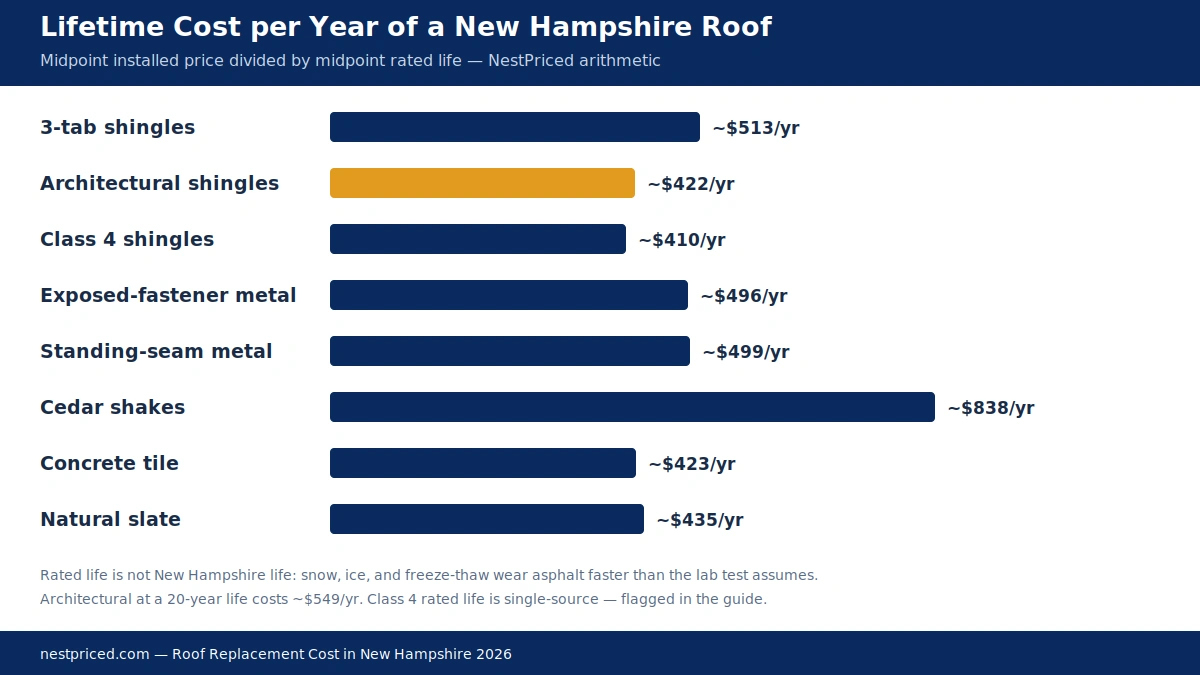
The cheapest roof to install is rarely the cheapest roof to own, and the lifetime math makes the comparison honest. The method is simple: take the midpoint of the installed band, divide it by the midpoint of the rated life, and read the result as the cost per year of owning that roof. The arithmetic is NestPriced arithmetic from the Manchester material bands and the MyRoofData rated lives, and it is labeled as such wherever it appears. It is a planning comparison, not a promise, because rated life is not New Hampshire life.
On that method, Class 4 impact-resistant shingles come out cheapest per year at about $410, architectural shingles next at about $422, and concrete tile at about $423, with natural slate close behind at about $435. The surprise is that the most expensive roof on the table, slate, costs little more per year than the cheapest common roof, because its rated life is four to five times longer. The catch is the frame check, the specialty crew, and the $33,530–$64,450 check that has to be written on day one. Cost per year is a fair comparison only for a buyer who can afford the upfront price and plans to stay in the house long enough to collect the saving.
Metal splits in the middle of the table. Exposed-fastener metal runs about $496 a year and standing seam about $499 a year, both above architectural shingles on this method, because their higher installed price outweighs their longer rated life at the midpoint. The per-year figure understates metal’s real advantage in the North Country, where snow shedding, ice-dam resistance, and a 40–70 year life on a roof that is hard to access in winter carry value the arithmetic cannot see. A standing-seam roof over a Jackson house at 115 psf is bought for the winters it survives, not for the dollars per year it saves.
Cedar is the outlier at about $838 a year, the highest cost per year on the table by a wide margin. Its installed price is high, its rated life is ordinary, and its maintenance is real. Cedar in New Hampshire is a look and a heritage choice, bought for the way it suits a colonial or a lakeside house, and it should be bought with open eyes about the maintenance bill. Three-tab shingles, at about $513 a year, cost more per year than architectural shingles while giving up wind rating and life, which is why the saving at install is a false economy for most buyers.
| Material | Midpoint installed | Midpoint rated life | Cost per year |
|---|---|---|---|
| 3-tab asphalt shingles | $8,970 | 17.5 years | ~$513 |
| Architectural asphalt shingles | $10,985 | 26 years | ~$422 |
| Class 4 impact-resistant shingles | $12,305 | 30 years | ~$410 |
| Exposed-fastener metal | $17,375 | 35 years | ~$496 |
| Standing-seam metal | $27,430 | 55 years | ~$499 |
| Cedar shakes | $25,130 | 30 years | ~$838 |
| Concrete tile | $24,320 | 57.5 years | ~$423 |
| Natural slate | $48,990 | 112.5 years | ~$435 |
The sensitivity test matters more than the headline numbers. If an architectural roof in New Hampshire lasts 20 years instead of the 26-year midpoint, because heat, ultraviolet light, and freeze-thaw wore it faster than the lab test assumed, the cost per year rises to about $549. That single change moves architectural shingles from second-cheapest to more expensive per year than either metal option. Ventilation and installation quality decide where inside each range a real roof lands, and they are the two items a buyer can actually control by hiring well and specifying the ventilation in the contract.
The Class 4 life figure carries a flag. The 25–35 year rated life used for Class 4 shingles is single-source, carried through the research pattern from an earlier article, and no second source confirmed it for this guide. The cost-per-year figure for Class 4 should be read with that flag attached. Even at a shorter life, Class 4 stays competitive on this method, because the premium over standard architectural is modest against a 20-square roof.
The buying question is not which row wins the table. It is which roof fits the house, the town, and the number of winters the buyer plans to live under it. A buyer selling in five years should buy the roof that photographs well and passes inspection, which is architectural shingles installed properly. A buyer staying thirty years in the Lakes Region or the North Country should price standing seam and slate seriously, because the second re-roof is the cost the table is really warning about.
Class 4 Shingles in New Hampshire: Cost, Discounts and the Honest Hail Math
Class 4 is the highest impact-resistance rating in the UL 2218 test, and the test is specific: a 2-inch steel ball is dropped from 20 feet onto the same spot twice, and the shingle must not crack or tear. The rating covers impact only. Wind resistance and fire resistance are separate tests with separate ratings, and a Class 4 shingle is not automatically a high-wind shingle or a Class A fire-rated shingle. The distinction matters in New Hampshire, where wind does more damage than hail and the buyer needs to know which risk each rating addresses.
The upgrade costs $30–$80 per square installed over standard architectural shingles, on 2026 pricing from Slade Roofing, which is $600–$1,600 on a 20-square roof. Added to the state band, the derived Class 4 band is $10,680–$13,930, with labor held flat, and that derivation is NestPriced arithmetic labeled as such. One roofer quoted the $30 per square end of the range to the Lifelong Insurance Agency in May 2026, which supports the low end of the premium but does not set a New Hampshire price. Get the Class 4 line priced on the same quote as the standard line, so the premium is a visible number rather than a bundled guess.
The hail record says the damage case for Class 4 in New Hampshire is thin. The Storm Prediction Center data, analyzed by MyWild for 1996–2025, counts 174 severe hail days and 530 reports in thirty years, or 5.8 days a year, with 29 of 30 years recording hail somewhere in the state. Stones of 2 inches or more fell on only 0.4 days a year. The largest stone in the record was 3 inches in Grafton County in June 2008, and a 2.5-inch stone fell in Strafford County in July 2015. New Hampshire ranks 40th of 46 states on that analysis, while NumeralQ ranks it 35th of 51 on a different basis, and the two rankings measure different things and should not be merged.
The recent county record is quieter still. Hillsborough County recorded 37 large-hail reports of 1 inch or more from 2016 to 2025, and zero reports at 2 inches or more, against 149 damaging-wind reports and zero tornado reports in the same period. Around Manchester, 34 hail days were recorded within 15 miles since 2010, the largest stone 1.75 inches in 2024, at 1.8 days a year from 2016 to 2025. The July 14–15, 2026 storm dropped 1.5–1.75 inch hail around Manchester, Nashua, and Concord, which is the realistic worst case a southern New Hampshire roof faces: big enough to dent gutters and crack a weak shingle, small enough that a sound architectural roof usually survives it.
NumeralQ’s own New Hampshire FAQ puts the point bluntly: impact-resistant shingles are “rarely” worth it in New Hampshire, and 80 percent of 1-inch-plus reports since 2016 fell in June through August. Statewide, 73 percent of damaging wind and large-hail reports since 2016 fell in those same three months. The hail season is short, the big stones are rare, and the wind risk runs all year. Class 4 in New Hampshire is mainly a discount play, and the discount decides whether the upgrade pays back.
No New Hampshire-specific Class 4 insurance discount percentage was verified for this guide, and any article that states one is guessing. The national ranges in circulation are wide: Slade Roofing cites 25–35 percent in Texas and Oklahoma, 20–25 percent in Colorado, and 10–15 percent in the Southeast, while a June 2026 Clean Invoice summary puts low-hail states at 0–5 percent. The Lifelong Insurance Agency example, 15–20 percent saving or about $350 on a $1,800–$2,000 policy with a 3–4 year payback, is an agency example from an unconfirmed location, not a New Hampshire figure. A single secondary state guide claims 10–15 percent for New Hampshire, and that claim is unverified and not adopted here.
The payback table below uses the New Hampshire average premium of $1,500 a year from NerdWallet’s May 2026 analysis, and tests three discount rates so the buyer can see the range. At a 5 percent discount, the $600–$1,600 premium pays back in 8.0–21.3 years. At 10 percent, it pays back in 4.0–10.7 years. At 15 percent, it pays back in 2.7–7.1 years. Every figure in the table is NestPriced arithmetic, and the discount rates are national single-source ranges, not verified New Hampshire rates. The only number that matters is the one the buyer’s own carrier puts in writing.
| Assumed discount on a $1,500 premium | Annual saving | Payback on a $600 premium | Payback on a $1,600 premium |
|---|---|---|---|
| 5% | $75 | 8.0 years | 21.3 years |
| 10% | $150 | 4.0 years | 10.7 years |
| 15% | $225 | 2.7 years | 7.1 years |
The honest answer for most New Hampshire buyers is that Class 4 is worth pricing and worth asking the carrier about, and not worth assuming. Ask the carrier for the discount in writing, with the certificate the carrier requires, before signing the roofing contract. If the carrier offers nothing, the upgrade buys impact resistance against a hail risk that the record says is modest, and the $600–$1,600 may be better spent on a wider ice barrier, better ventilation, or a higher wind-rated shingle. If the carrier offers 10 percent or more in writing, the upgrade pays for itself inside the roof’s life and the decision is easy.
Documentation is the step buyers miss. A carrier discount requires proof that the installed shingle carries the Class 4 rating, usually a certificate or the product documentation from the manufacturer, filed with the carrier after installation. Get the certificate named in the contract, collect it at closeout, and send it to the carrier before the next renewal. A Class 4 roof without the paperwork is a Class 4 roof that earns no discount.
Permits and Code in New Hampshire: Four Cities, Four Different Answers
New Hampshire building code is set at the state level and enforced at the local level, and that split is the reason the permit answer changes from town to town. The state code is RSA 155-A, the New Hampshire State Building Code. House Bill 1159, signed May 8, 2026 and effective July 1, 2026, adopted the 2024 editions of the International Building Code, the International Residential Code, and the companion codes, kept the 2018 energy code, and adopted the 2023 electrical code. A six-month grace period allows either the 2021 or the 2024 editions through December 31, 2026, and the 2024 editions are required from January 1, 2027. Older guides still citing the 2018 or 2021 editions as current are stale, and the grace period is the reason two honest sources can cite different editions in late 2026.
Enforcement belongs to the municipality. Towns adopt an enforcement mechanism under RSA 155-A:3, and Senate Bill 94, effective July 1, 2026, repealed municipal technical amendments, so local amendments are now limited to administrative matters. The contractor, not the town, is responsible for code compliance under RSA 155-A:2, VII, and a permit is required before covered work under RSA 155-A:4, through the locally adopted process. The two-layer cap is a code rule everywhere: the International Residential Code does not allow a new covering over two or more existing layers, so a roof with two layers already in place must be stripped to the deck.
Manchester requires a permit for roofing and siding, and its fee is the only one of the four cities that can be priced from a published schedule. The fee is 1 percent of the estimated cost plus a $25 application fee, which is $175 on a $15,000 job. The Manchester page in the NumeralQ model confirms the figure from the city fee schedule in October 2026. In the Amoskeag historic district, the permit comes only after Heritage Commission approval for exterior changes including roofing, which adds a step and a wait that the quote timeline should allow for.
Concord is the surprise. The city’s own Residential Building Permit Application Guide states plainly that permits are not required for nonstructural roof coverings and nonstructural exterior building siding. A straight re-roof, new covering over a sound deck with no structural change, needs no permit in Concord. Structural repair, decking replacement that crosses into structural work, or framing changes can need a permit, and the line between nonstructural and structural is the building department’s call. The fee schedule for cases that do need a permit, implemented July 1, 2020, charges $30 plus $7.60 per $1,000 of estimated cost, which is $144 on a $15,000 job by arithmetic, and the currency of that 2020 schedule is unverified. The Code Administration Office at 37 Green Street, (603) 225-8580, is the place to confirm. Concord’s Historic District requires Planning approval for exterior work. One secondary guide’s claims of a $175 Concord fee and a 6-foot ice shield requirement are unreliable and are not used in this guide.
Nashua is the genuinely unresolved case, and this guide reports the conflict rather than picking a winner. The NumeralQ Nashua roof-repair page states that Nashua does not require a permit to re-roof a one- or two-family home, that the code still applies, that shingles may go over one layer but not two, and that a full strip needs ice-and-water barrier for the first 3 feet plus 15-lb felt elsewhere. A county-office summary agrees that in-kind roof replacement needs no permit, and lists fees of $9 per $1,000 plus $25 with labor included, or $12 per $1,000 plus $25 with labor excluded, where a permit does apply. Two other secondary guides claim a permit is required, quoting $75–$250, $100–$300, and about $200–$225. The weight of the primary-facing evidence leans toward no permit for an in-kind re-roof of a one- or two-family home, but the conflict is real, and the only safe step is to confirm with the Department of Building Safety at 229 Main Street before work starts. In a Nashua historic district, re-roofing with the same roof plane needs no Historic District Commission approval, while structural roof changes need a Commission application.
Portsmouth requires a permit, and its Inspection Department says so in plain language: “Do I need a permit for roofing? YES! You need to apply for a Building Permit.” Applications run through the OpenGov portal. For visible exterior changes, including roof color and material, Historic District Commission approval comes before the building permit, and a secondary source puts the added wait at 2–4 weeks. No verified current Portsmouth permit fee was located, and none is stated in this guide. Secondary figures of $75–$150 and 2015 permit records of $35–$120 are not current evidence, and stating them as the fee would mislead.
| City | Permit for a re-roof | Fee basis | Historic district step |
|---|---|---|---|
| Manchester | Required | 1% of cost + $25, $175 on a $15,000 job | Heritage Commission approval first |
| Concord | Not required for nonstructural re-roof | $30 + $7.60 per $1,000 if a permit applies, $144 arithmetic on $15,000 | Planning approval for exterior work |
| Nashua | Conflicting evidence, confirm with the city | $9–$12 per $1,000 + $25 where a permit applies, per county summary | HDC approval only for structural roof changes |
| Portsmouth | Required | Unverified, confirm at application | HDC approval before the building permit |
A general secondary claim that all eleven of the state’s larger cities require permits is contradicted by the Concord primary guide and the Nashua evidence, and it is not followed here. The rule for every New Hampshire town is the same: confirm the requirement, the fee, and the inspection steps with the local building department, get the answer in writing where possible, and name the permit puller in the contract. A roofer who says no permit is needed should be able to say which document supports that, and a roofer who pulls the permit should name the fee on the quote.
Hiring a Roofer in New Hampshire: No State License and What to Check Instead
New Hampshire has no general contractor license, no roofing license, no contractor registration, no exam, and no state fee. That sentence is the most important hiring fact in this guide, and it was confirmed across multiple October 2026 sources, including a licensing guide checked October 22, 2026. The Office of Professional Licensure and Certification licenses electricians and plumbers and gas fitters through the Mechanical Licensing Board, and it does not license roofers. Asbestos work carries its own licensing, and a business entity must register with the New Hampshire Secretary of State, but neither of those is a roofing license. Workers’ compensation insurance is required for employers under RSA 281-A:5.
Three bogus claims circulate in secondary guides and must be named so buyers can spot them. One guide claims a home-improvement-contractor registration with the licensing office for work over $1,000 in Nashua. Another claims active state trade licenses for Concord roofers. A third writes about “licensed New Hampshire roofers” as if the license existed. None of these claims is true. New Hampshire has no statewide home-improvement-contractor registration and no consumer guaranty fund, unlike Massachusetts, and a national contractor guide explicitly warns that New Hampshire “HIC registration” references are a mix-up with a neighboring state. A roofer who claims a New Hampshire roofing license is either confused or dishonest, and either answer disqualifies the bid.
What does apply, and what a buyer can actually check, is a short list. Business registration with the Secretary of State can be verified online. Workers’ compensation and general liability insurance must be confirmed by certificates sent directly from the insurer, not photocopies handed over by the roofer. Local references from the same town, with addresses the buyer can drive past, matter more here than in a licensed state, because no state board has vetted the crew. Manufacturer certification, such as a shingle manufacturer’s credentialed contractor status, is a voluntary quality signal, not a license, and it is worth asking about because it often unlocks a stronger manufacturer warranty.
Local contractor or business registration in some towns is mentioned in one national guide as a possibility for Manchester and Nashua, but it is unverified, and this guide does not assert it. The building department is the place to ask whether the town keeps any local list or registration, and the answer should be recorded before signing. The absence of a state license makes the town building department the most useful office in the hiring process, because it is the only authority that will see the job, inspect it where inspection applies, and hold the permit record.
In a state with no license to check, the written contract has to do the protective work itself. Under RSA 359-G, the Residential Construction Defects law, a contract to construct or improve a residence for more than $5,000 must include a conspicuous written notice of the contractor’s right to resolve alleged defects before a lawsuit, in the statute’s own wording. The homeowner must serve written notice of alleged defects at least 60 days before filing suit. The Consumer Protection Act, RSA 358-A, enforced by the Attorney General, governs unfair and deceptive practices, and a private action can recover fees and double-to-treble damages for willful or knowing violations. These are real protections, and they work best when the contract is written, specific, and signed before work starts.
Lien law is the second protection buyers ignore until it bites. New Hampshire has no recorded claim of lien. A lien is perfected only by court attachment, a suit plus an ex parte petition plus a recorded writ, within 120 days of the last furnishing of labor or materials. A subcontractor or supplier without a contract with the homeowner must give the owner written notice before furnishing work, and a later notice covers only amounts then due or later becoming due. After notice, written accounts must follow at least every 30 days, and the owner must hold back enough to cover the claim. The threshold is $15, which means nearly every roofing job is inside the statute. The practical defense is a supplier list in hand before the final payment, lien waivers or receipts from the suppliers named on it, and a payment schedule that never pays ahead of the work.
The hiring checklist that replaces the license lookup is ten questions long, and every one of them has a verifiable answer. Is the business registered with the Secretary of State? Are the insurance certificates confirmed by the insurer? Can the roofer name three local jobs from the last year with addresses? Does the quote carry a measured roof area, the material brand and line, the underlayment and ice barrier specification, the flashing scope, and the ventilation scope? Is the permit requirement confirmed with the town, and is the puller named? Is the decking allowance a unit price in writing? Is the payment schedule tied to milestones, with a holdback until the final inspection and the paperwork? Is the warranty in writing, with the manufacturer and workmanship terms separated? Is the RSA 359-G notice in the contract? And is the supplier list promised before the final payment? A roofer who answers all ten cleanly is a safer hire than a license number would ever prove.
For the questions to ask any roofer, anywhere, read the questions to ask a roofer guide.
Insurance in New Hampshire: Deductibles, Seacoast Wind Rules and Claim Reality
New Hampshire homeowners insurance is cheaper than the national average, and the deductible is where the surprise hides. NerdWallet’s analysis of more than 100 companies, updated May 6, 2026, puts the New Hampshire average premium at $1,500 a year, or $125 a month, against a national average of $2,490. The sample policy behind that figure is a $400,000 dwelling, $300,000 liability, a $1,000 deductible, a 40-year-old homeowner, and good credit. Insurify’s 2026 figures put the state average at $1,434 a year, with an average wind and hail deductible of 0.65 percent, or $2,494. The premium is the easy number. The deductible is the number that decides what a storm actually costs the homeowner.
New Hampshire has no mandatory statutory hurricane deductible, which is a fact worth stating plainly because coastal states to the south do have one. The absence of a statute does not mean the deductible is flat. On the Seacoast, many carriers apply a percentage wind or named-storm deductible, typically 1–3 percent of Coverage A, the dwelling coverage limit, with one secondary source reporting 1–5 percent, for homes within a few miles of the coast in Portsmouth, Rye, Hampton, and New Castle. A 2 percent deductible on a $500,000 dwelling limit is $10,000 out of pocket before the carrier pays a dollar on a wind claim. State Farm’s windstorm and hail document, updated May 2026, confirms the mechanism for New Hampshire: wind and hail are covered, but subject to a separate deductible if the loss occurs during a hurricane event, under a Named Storm Duration Deductible endorsement.
One secondary state guide claims New Hampshire carries a standard flat deductible with no separate wind or hail deductible. That claim conflicts with the Seacoast evidence and the carrier document, and it is treated here as a single secondary source that is not adopted. The declarations page governs, and it is the one document every buyer should read before signing a roofing contract. The declarations page is the summary sheet of the policy that states the coverage limits, the deductibles, and the settlement method, and it is the page the adjuster will read when a claim is filed.
No New Hampshire roof-age settlement statute, matching law, or Class 4 discount statute was located in the research for this guide, and the absence is stated here rather than filled with a guess. In states with a matching law, the carrier must pay to match undamaged shingles to repaired ones. In states with a roof-age statute, the settlement method shifts from replacement cost to actual cash value at a set roof age. New Hampshire has neither rule on the books as far as this research could establish, which means the policy language decides both questions. Replacement cost value, or RCV, pays the cost to replace the damaged roof with like kind and quality, while actual cash value, or ACV, pays replacement cost minus depreciation for the roof’s age and wear. An older roof on an ACV settlement can leave the homeowner paying most of the replacement out of pocket, and the declarations page is where that settlement method is stated.
Ice-dam damage follows a different rule. Water damage from an ice dam is typically covered as sudden-and-accidental damage under a standard HO-3 homeowners policy, while the labor to remove the ice itself is usually excluded as maintenance. That distinction is secondary-source guidance, and the policy language governs, but it matches the pattern carriers apply across the Northeast. A homeowner who discovers an ice-dam leak should document the water entry, mitigate further damage, and call the carrier before authorizing removal work, so the covered damage and the excluded maintenance are separated in the record from the start.
The claim sequence for storm damage is the same in New Hampshire as anywhere, and the order matters. Document the damage with dated photographs before any repair. Call the carrier and open the claim. Get the adjuster’s scope in writing before signing a roofing contract, because the scope is the carrier’s statement of what it will pay for, and a contract signed before the scope arrives can leave the homeowner covering the gap. Get the roofer’s estimate on the same scope, so the two documents can be compared line by line. And never sign an assignment of benefits or a direction-to-pay that hands the claim check to the roofer without understanding that the homeowner remains responsible for any shortfall.
Paying for a New Hampshire Roof in 2026: $0 Federal Credit, NHSaves and Financing
The federal government contributes $0 to a 2026 roof replacement in New Hampshire. The One Big Beautiful Bill Act, Public Law 119-21, ended the sections 25C and 25D energy credits for homeowner installs after December 31, 2025, and the Internal Revenue Service confirmed the position in FS-2025-05. A roof covering earns no energy credit in any case, because the credits covered energy property such as heat pumps and solar panels, not shingles and underlayment. Any contractor or guide that promises a federal tax credit for a 2026 roof is working from expired law, and the promise should be treated as a warning about the source. For the full credit position, read the federal energy tax credits guide.
The state rebate picture is a waiting room, not a program. New Hampshire’s HEAR and HOMES rebates, funded by the federal Inflation Reduction Act at $34,749,580 and $34,882,819 respectively, had not launched as of checks in early November 2026. The Department of Energy pages, updated July 29, 2026, describe the programs as not yet available and under development, with HEAR expected in fall 2026, and state explicitly that the rebates are not retroactive: projects started before launch will not qualify. The design amounts, up to $8,000 for a heat pump, $1,750 for a heat-pump water heater, $4,000 for an electrical panel, and $1,600 for insulation, air sealing, and ventilation, with a $14,000 household maximum for households at or below 150 percent of area median income, are not claimable until the program opens. A roof covering is not a HEAR or HOMES measure in any case, so even a launched program would not pay for shingles. It could pay for the insulation and air sealing that prevent the next ice dam, and that is the honest connection between the rebate programs and a roofing job.
NHSaves is the live program, and it pays for the work that protects the roof rather than the roof itself. NHSaves is the utility efficiency brand for Eversource, Liberty, Unitil, and the New Hampshire Electric Cooperative, funded by ratepayers rather than run as a state agency. Its weatherization program covers 75 percent of insulation and air sealing, with a combined cap generally $6,000–$8,000 depending on the utility and the measure mix, and one contractor guide puts the cap at up to $8,000 per project. Liberty natural-gas customers can receive 100 percent of air sealing, and income-eligible households at or below 200 percent of the federal poverty level can receive 100 percent through a Community Action Agency. The program requires a Home Performance with ENERGY STAR assessment first, at a $100 copay or $0 for income-eligible households, and the work must be done by a participating contractor. The 2026 figures were checked through secondary contractor guides in mid-2026 and should be confirmed before signing. There is no roof-covering rebate, no statewide roof grant as of October 2026, and no New Hampshire state roof tax credit was located.
The insulation connection deserves emphasis, because it is where the money and the building science meet. A re-roof is the cheapest moment to fix attic insulation and ventilation, because the deck is open and the crew is already on site. NHSaves money can cover most of the insulation and air sealing, and the work keeps the deck cold, which prevents the ice dams that destroy ceilings. The attic insulation cost guide prices the insulation side of the job, and the New Hampshire heat pump guide prices the electrification side for buyers planning a whole-house upgrade. Coordinating the three scopes, roof, insulation, and ventilation, in one project is the single most valuable planning step in this guide.
Financing is the gap this guide cannot price, and the gap is disclosed rather than filled. No New Hampshire-specific contractor financing offer or rate was verified in the research, so no rate is stated here. Contractor financing, home equity lines, and personal loans all exist, and each carries different rates, terms, and risks. The roof financing guide compares the options nationally and explains the questions to ask before signing a financing agreement. The standing warning applies with extra force in a no-license state: never sign a financing agreement and a roofing contract in the same sitting without reading both, never let a contractor pressure a same-day signature, and never pay the full price before the work is complete and the paperwork is in hand. Small Business Administration disaster loans, which can run up to 20 percent above the verified loss for mitigation work, exist only after a declared disaster, and they are a recovery route, not a plan for a scheduled replacement.
Repair or Replace and Getting Quotes in New Hampshire: The Decision Rules and the Checklist
The repair-or-replace decision turns on three facts: the age of the roof, the number of problem areas, and the number of layers already on the deck. A contractor rule of thumb from a Seacoast roofer, labeled here as contractor guidance rather than a standard, puts the line plainly: under 15 years old with one problem area, repair it; 20 years or older with multiple leaks, a second layer, or visible granule loss, replace it. The rule is useful because it matches the economics. A repair on a roof near the end of its life buys a year or two and leaves the replacement bill untouched, while a repair on a young roof with one failed flashing buys the full remaining life of the roof.
Repair prices in New Hampshire are modest against replacement prices, and the NumeralQ repair table, priced October 26, 2026, gives the planning figures. A vent or pipe boot repair runs $173–$368, replacing up to 10 missing or damaged shingles $219–$440, a flashing repair $236–$500, and an emergency tarp $242–$497. Finding and fixing a leak runs $316–$880, a chimney flashing reflash $328–$720, and a skylight leak $338–$670. Larger repairs climb fast: rotted decking for two sheets with shingles $362–$770, a valley repair $408–$1,000, a 100 sq ft section $520–$1,060, and hail or wind damage to one slope $890–$2,830. Seacoast contractor guidance puts most single-point repairs at $350–$1,200, and one Seabrook roofer puts most repairs at $350–$2,500. When the repair estimate passes a third of the replacement band, get a replacement quote alongside it, because the comparison is the decision.
The layer count can force the decision on its own. The code does not allow a new covering over two or more existing layers, so a roof with two layers must be stripped to the deck, and the tear-off adds $1.35–$1.77 per sq ft, or $2,700–$3,540 on a 2,000 sq ft roof. A roof with one layer can sometimes take a second layer, and the saving is real, but the second layer hides the deck condition, adds weight the snow load must also carry, and shortens the life of the new covering. On a house with a 70 psf or higher ground snow load, the weight argument against a second layer is stronger than it is on the Seacoast, and the buyer’s engineer or building department can settle the question for the exact address.
Getting quotes right is a process, not a phone call, and the checklist below is the process. It is written for a no-license state, where the paperwork carries the protection a license number would carry elsewhere. Every step has a document attached to it, and a step without a document is a step that did not happen.
- Write the spec sheet first: material brand and line, underlayment, ice barrier extent, flashing scope, ventilation scope, tear-off layers, decking allowance as a unit price, permit responsibility, warranty terms, and cleanup.
- Check the business registration with the Secretary of State, and confirm the insurance certificates directly with the insurer, in writing.
- Get three written quotes on the identical spec sheet, and compare them line by line. A quote that does not follow the spec is not a competing quote.
- Confirm the permit requirement, the fee, and the inspection steps with the town building department, and name the permit puller in the contract.
- Confirm the ground snow load, the ice barrier requirement, and the design wind speed for the exact address, in writing, before the material is ordered.
- Read the declarations page, note the deductible and the settlement method, and ask the carrier about a Class 4 discount in writing.
- If the job involves a claim, get the adjuster’s scope in writing before signing any roofing contract.
- Sign a written contract naming the brand and line, the warranty terms, the payment schedule tied to milestones, the work window, and the cleanup standard, with the RSA 359-G notice included.
- Pay by the schedule, never ahead of the work, and hold the final payment until the final inspection passes and the paperwork is complete.
- File the closeout folder: the permit final, the warranty registration, the Class 4 certificate if applicable, the roofer’s workmanship warranty, and the supplier list with receipts.
For repair pricing in detail, read the roof repair cost guide, and for the gutter work that often accompanies a re-roof, the gutter installation cost guide.

Sources & methodology
Pricing models:
- NumeralQ New Hampshire roof replacement page, pricing as of October 26, 2026, state band, size table, labor rates, no-sales-tax position, no statewide roof grant.
- NumeralQ Manchester roof replacement page, pricing as of October 26, 2026, city band, material table, add-on table, housing stock, permit fee, Owens Corning cold-weather bulletin, historic district note.
- NumeralQ Nashua roof replacement page, pricing as of October 26, 2026, city band, housing stock, storm record, historic district note.
- NumeralQ New Hampshire roof repair page, pricing as of October 26, 2026, repair table, city permit comparison, lien summary.
- SmartRoofingCalculator New Hampshire page, page updated April 24, 2026, data updated November 9, 2026, per-square bands, permit planning average, May 2024 BLS figures, neighbor-state bands.
- MyRoofData New Hampshire page, 2026 model, typical-home model, per-square bands before tear-off, rated lives, wind ratings, permit note.
- One Good Roofer, published October 7, 2026, home-size band and per-square bands.
- Instant Roofer New Hampshire figures, contractor-entered pricing, average roof size and rate, city range.
- RoofingEstimatorPros New Hampshire page, updated August 26, 2026, recorded as the high outlier.
- Nova Roofing New Hampshire guide, published April 17, 2026, updated May 16, 2026, Seacoast pricing updated September 2026, home-size bands, Seacoast per-square pricing, repair rule of thumb.
- Vincenzo Roofing, Seabrook, repair range, secondary contractor source.
- Bureau of Labor Statistics, Occupational Employment and Wage Statistics, May 2025, New Hampshire roofer median pay and metro figures, via the NumeralQ pages.
Snow, ice, code, and wind:
- ERDC/CRREL TR-02-6, Ground Snow Loads for New Hampshire, February 2002, town case studies for all 259 towns, 2,500-foot site-study threshold, via the MyWild report of the study.
- City of Concord design-criteria table, 70 psf at 600 feet with elevation adjustment.
- City of Portsmouth Building Code Chapter 12, adopted December 14, 2022, design criteria table including ice barrier requirement.
- City of Alton design criteria, 90 psf and 115 mph. City of Bedford and City of Lebanon design criteria tables.
- International Residential Code sections R301.2.3, R905.1.2, and R908.3, via the International Code Council and the Atlas roofing guide.
- New Hampshire House Bill 1159, signed May 8, 2026, effective July 1, 2026, 2024 code editions and grace period, via the NH Municipal Association September 2026 bulletin, Atlas, and NHAFC minutes.
- New Hampshire Senate Bill 94, Chapter 17, effective July 1, 2026, repeal of municipal technical amendments.
- RSA 155-A, State Building Code, including sections 155-A:2, VII and 155-A:4.
- NOAA 1991–2020 climate normals, snowfall figures for Concord, Manchester, Portsmouth, and Mount Washington, via the National Weather Service and NumeralQ pages.
- Owens Corning Technical Bulletin TB-10022497-A, Cold Weather Shingle Installation.
- Cabinet Press retrospective, December 14, 2018, December 2008 ice storm outage and damage figures.
- Universal Steel secondary ranges for wind speed, flagged as single-secondary where used.
Licensing, permits, and liens:
- ReadyDocs New Hampshire contractor licensing guide, verified October 2026. RoofingLicenseCheck New Hampshire page, checked October 22, 2026. ContractorTests and HouseCallPro 2026 guides, no-license position and Massachusetts mix-up warning.
- City of Concord Residential Building Permit Application Guide, nonstructural roof covering exemption, fee schedule implemented July 1, 2020, Code Administration Office contact.
- City of Manchester fee schedule, 1 percent plus $25, via NumeralQ October 2026.
- NumeralQ Nashua roof-repair page and county-office summary, no-permit position for in-kind re-roofing, conflicting secondaries recorded.
- City of Portsmouth Inspection Department permit statement, via Granite State Metal Roofing, RSA 155-A:2 read October 7, 2026. OpenGov portal and Historic District Commission sequence, secondary.
- RSA 359-G, Residential Construction Defects, sections 359-G:4 and 359-G:7. RSA 358-A, Consumer Protection Act. RSA 447, liens, sections 447:2, 447:5, 447:6, 447:8, 447:9, and 447:10. RSA 281-A:5, workers’ compensation.
Insurance, Class 4, and incentives:
- NerdWallet, New Hampshire homeowners insurance analysis, May 6, 2026, average premium $1,500 a year, sample-policy basis.
- Insurify 2026 New Hampshire figures, average premium and wind/hail deductible.
- State Farm windstorm and hail document, updated May 2026, Named Storm Duration Deductible endorsement for New Hampshire.
- NOAA Storm Prediction Center data 1996–2025, via the MyWild hail analysis, and NOAA storm reports 2016–2025, via the NumeralQ pages.
- UL 2218 Class 4 test description and manufacturer lines, via manufacturer and standards summaries recorded in the research file.
- Slade Roofing 2026 pricing, Class 4 premium $30–$80 per square, and national discount ranges. Lifelong Insurance Agency, May 4, 2026, agency discount example. Clean Invoice, June 2026, low-hail-state discount range.
- One Big Beautiful Bill Act, Public Law 119-21, and Internal Revenue Service FS-2025-05, end of sections 25C and 25D for post-2025 installs.
- New Hampshire Department of Energy HEAR and HOMES pages, updated July 29, 2026, not launched, not retroactive, allocations and design amounts, via HeatPumpPricing and BetterPowered checks November 2026.
- NHSaves weatherization figures, via secondary contractor guides checked July and April 2026, confirm before signing.
- Derived figures: the Class 4 band, the cost-per-year table, the payback table, the Seacoast 20-square arithmetic, the Concord fee arithmetic, and the full-deck ice barrier and second-layer arithmetic are NestPriced arithmetic from the sources named in the text, and are labeled as such wherever they appear.
Disclaimer: Prices in this guide are planning estimates from published cost models and contractor pricing, not quotes, and the actual cost of a roof depends on the roof’s size, slope, condition, material, and the contractor’s bid. Snow loads, permit requirements, permit fees, and wind values vary by address and change over time, so confirm the design values, the permit requirement, and the fee with the local building department before signing a contract. New Hampshire issues no roofing license, so verify business registration, insurance, and references directly. Insurance discounts, deductibles, and settlement methods depend on the individual policy and carrier, and tax and rebate positions change with legislation; verify the current position with the carrier, the tax adviser, and the state agency before relying on any figure in this guide.
How much does a roof replacement cost in New Hampshire in 2026?
A 2,000 sq ft architectural shingle roof costs $10,080–$12,330 installed in New Hampshire in 2026, on NumeralQ planning estimates priced October 26, 2026. Manchester and Nashua run about 2 percent below the state band at $9,890–$12,080, and the price rises with roof size, slope, layers, and material.
What is the cost per square for a roof replacement in New Hampshire?
Architectural shingles run about $504–$617 per square installed on the NumeralQ state band, and SmartRoofingCalculator prices the same material at $430–$620 per square installed with tear-off. MyRoofData prices architectural shingles at $477–$795 per square before tear-off, with tear-off adding $100–$200 per square per layer.
Do I need a permit to replace a roof in New Hampshire?
It depends on the town. Manchester and Portsmouth require a permit, Concord requires no permit for a nonstructural re-roof, and Nashua’s evidence conflicts, so confirm the requirement with the local building department before work starts.
Does New Hampshire require a roofing license?
No. New Hampshire has no state roofing license, no general contractor license, and no contractor registration, and the licensing office covers electricians and plumbers only. Check business registration with the Secretary of State, confirm insurance directly with the insurer, and verify local references before signing.
What snow load must a New Hampshire roof carry?
The ground snow load runs from 50 psf in Portsmouth to 120 psf in the North Country, town by town, under the 2002 Army Corps CRREL study the state code references. Manchester and Concord carry 70 psf, and loads above 70 psf require design per accepted engineering practice, so confirm the figure for the exact address with the building department.
Are Class 4 shingles worth it in New Hampshire?
Class 4 is mainly a discount play in New Hampshire, because 2-inch hail is rare and the storm record is dominated by wind. The upgrade costs $600–$1,600 on a 20-square roof, no New Hampshire discount percentage was verified, and the carrier’s written discount decides whether the upgrade pays back.
Is there a federal tax credit or New Hampshire rebate for a new roof in 2026?
No on both counts. The federal government contributes $0 to a 2026 roof, because the One Big Beautiful Bill Act ended the relevant credits for post-2025 installs, and the HEAR and HOMES rebates had not launched as of November 2026. NHSaves covers insulation and air sealing, not the roof covering.
How long does a roof last in New Hampshire?
Architectural shingles carry a rated life of 22–30 years, 3-tab shingles 15–20 years, exposed-fastener metal 30–40 years, and standing-seam metal 40–70 years, on the MyRoofData New Hampshire model. Snow, ice, and freeze-thaw wear asphalt faster than the lab test assumes, so ventilation and installation quality decide where inside each range a real roof lands.