

A Connecticut roof lives two lives. From December to March it holds snow that melts a little each sunny afternoon and freezes again each night, while heat escaping through the attic ceiling feeds the melt from below. From August to October it faces the other direction, toward Long Island Sound, where a nor’easter or the remains of a hurricane can drive rain sideways under any shingle that was nailed short or sealed thin.
The houses make both jobs harder. Hartford’s housing stock is old, with the median home dating to 1951 and about 80 percent of the city’s homes predating 1980, against 67 percent statewide. Old framing, old deck boards, two layers of shingles from two different decades, and attics that were never vented to any modern rule all sit under the new roof, and each one shows up on the quote as a line the buyer did not expect.
Price follows from that, not from the shingle catalog. Labor runs high, the code asks for more underlayment than a southern roof needs, and the coastal towns pay a premium for crews that work within sight of the New York metro market. Our roof replacement cost guide sets the national baseline, and the sections below show where Connecticut sits against it.
Table of Contents
What a Roof Replacement Costs in Connecticut in 2026?
Roofers price by the square. One square covers 100 square feet of roof surface, measured along the slope, and the planning roof used through this article is 25 squares, or 2,500 square feet of roof surface. A 2,000-square-foot one-story house carries about 25 squares at a typical 6/12 pitch once waste is added, while the same floor area over two stories carries about half that, because the roof footprint is half the size.
Four published sources price the Connecticut market in 2026, and they measure different jobs, which is why their bands do not line up neatly. SmartRoofingCalculator builds its band from national per-square prices adjusted for Connecticut wages and goods prices, and states the method in the open. NumeralQ prices Hartford from a cost model of materials plus local labor.
The SmartRoofingCalculator Connecticut page publishes the statewide band and the arithmetic behind it.
Best Way Roofing publishes the price list of a working Connecticut contractor. MyRoofData runs a 2026 model that prices the material before tear-off, so its band reads higher once tear-off is added back.
| Source | Figure | What it measures |
|---|---|---|
| SmartRoofingCalculator (Apr 2026) | $12,250–$17,750 | 25-square architectural roof, installed with tear-off |
| NumeralQ Hartford (Oct 2026) | $13,090–$16,020 | 2,500 sq ft roof, architectural, installed |
| Best Way Roofing (2024–2026) | $11,250–$17,500 | 25 squares at $450–$700/sq, full replacement |
| MyRoofData (2026 model) | $14,750–$25,500 | Typical home, architectural, tear-off added separately |
| RoofingEstimatorPros (Aug 2026) | $16,799–$29,949 | 2,000 sq ft roof, modeled; highest in the set |
The first two rows agree where it counts. NumeralQ’s Hartford band for a 2,500-square-foot roof sits inside the statewide SmartRoofingCalculator band for the same 25 squares, and Best Way’s contractor band overlaps both almost exactly.
That overlap is the reason the SmartRoofingCalculator band leads this article: three independent routes land on the same ground. MyRoofData reads higher because tear-off sits outside its per-square figure, and RoofingEstimatorPros reads highest of all, so both are reported here and neither sets the headline.
What the headline band buys is a full replacement, not a patch. On the Best Way scope, which matches how Connecticut contractors write the job, the band covers tear-off of one layer, underlayment, flashing, ridge venting, drip edge, and disposal.
It does not cover a second tear-off layer, decking replacement, chimney rebuilds, skylight work, gutters, or structural repair. Each of those arrives as its own line, and on an older Connecticut house at least one of them usually does.
Labor is the larger half of the story. Roofers in Connecticut earned a median $29.84 an hour in May 2025, or $62,070 a year, against a national median of $26.65, with 790 roofing jobs counted statewide.
Hartford contractors bill about $63–$82 per worker-hour for roofers, which covers insurance, payroll taxes, overhead, and profit on top of pay. Materials run close to the national average, so the gap between a Connecticut quote and a cheaper state’s quote is mostly the crew, the code, and the drive time.
Timing moves the price too, and Connecticut’s calendar has two sharp edges. Hartford’s average high stays under 40 degrees in January and February, and at or below 40 degrees shingle makers ask roofers to hand-seal shingles along the edges with dabs of roof cement, because the sealant strip needs warmth and sun to bond.
August and September are the driest months in Hartford, so they carry the fewest rain delays. A winter reroof is possible, but it runs slower, and a quote that ignores the cold-weather steps has skipped part of the job.
Roof Replacement Cost in Connecticut by Material
Material is the largest single lever on the quote. The spread from the cheapest shingle to natural slate runs more than five to one on the same 25 squares, and no other choice on the job moves the total that far.
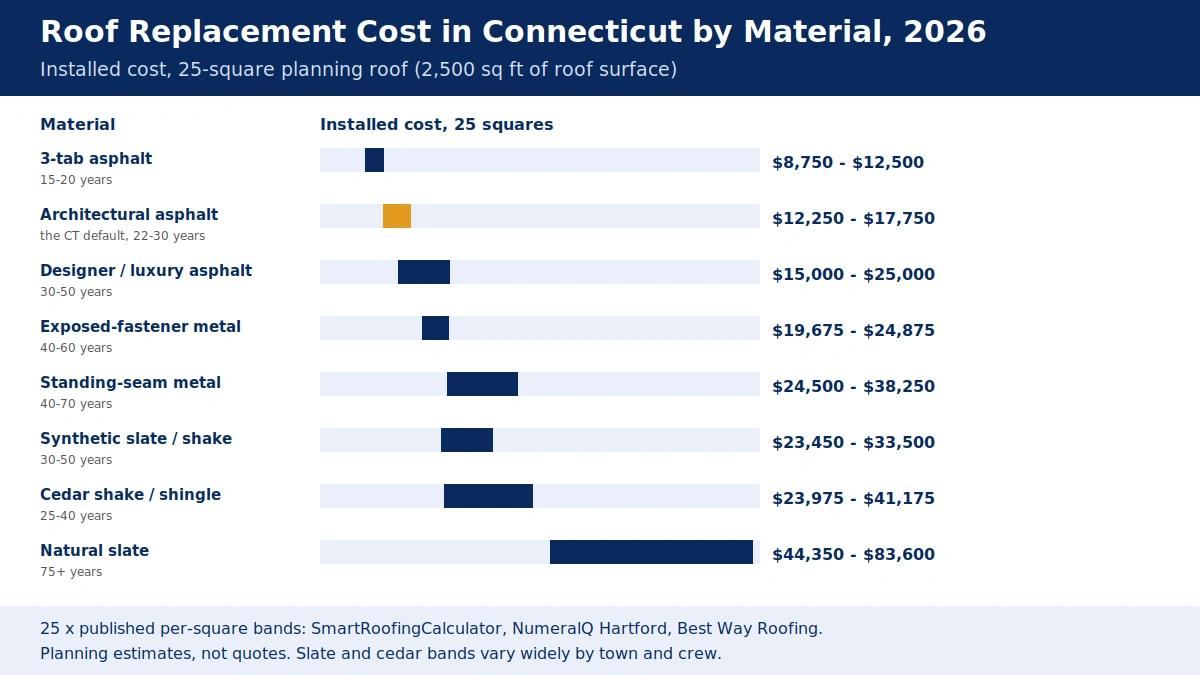
The table below prices each material on the planning roof, using one lead per-square band per material and multiplying by 25. Those 25-square totals are arithmetic from the published per-square bands, not published job prices, and each lead band names its source.
| Material | Per square (lead band) | 25-square planning total | Life in Connecticut |
|---|---|---|---|
| 3-tab asphalt | $350–$500 (Best Way) | $8,750–$12,500 | 15–20 years |
| Architectural asphalt | $490–$710 (SmartRoofing) | $12,250–$17,750 | 22–30 years |
| Designer/luxury asphalt | $600–$1,000 (Best Way) | $15,000–$25,000 | 30–50 years |
| Exposed-fastener metal | $787–$995 (NumeralQ Hartford) | $19,675–$24,875 | 40–60 years |
| Standing-seam metal | $980–$1,530 (SmartRoofing) | $24,500–$38,250 | 40–70 years |
| Stone-coated steel | $889–$1,274 (NumeralQ Hartford) | $22,225–$31,850 | 40–70 years |
| Synthetic slate/shake | $938–$1,340 (NumeralQ Hartford) | $23,450–$33,500 | 30–50 years |
| Cedar shake/shingle | $959–$1,647 (NumeralQ Hartford) | $23,975–$41,175 | 25–40 years |
| Natural slate | $1,774–$3,344 (NumeralQ Hartford) | $44,350–$83,600 | 75+ years |
| Concrete/clay tile | $1,310–$1,960 (SmartRoofing) | $32,750–$49,000 | 50+ years |
Architectural shingles are the default Connecticut buy, and the default is earned. They are thicker than 3-tab shingles, they carry higher wind ratings, and they sit in the middle of the price table while lasting roughly a decade longer than the budget option. Three-tab shingles still appear on quotes, usually where the budget is tight or the house will sell soon, but many insurers and builders have moved away from them, and the saving against architectural shingles buys a shorter roof.
Designer and luxury shingles copy the look of slate or shake at a fraction of the slate price. They suit the older colonials and Victorians around New Haven and Fairfield County, where the roof is part of the street view and the neighbors’ roofs set the standard. The Norwalk guide prices designer and impact-rated asphalt at $750–$1,100 per square, which sits inside the Best Way designer band and gives a second read on the same tier.
Metal splits into two very different roofs that share a name. Exposed-fastener panels, the corrugated and 5V profiles, cost less because the screws go through the panel face and the install runs faster, but every screw head is a future leak point that needs checking as washers age. Standing seam hides the fasteners under raised seams, costs more, lasts longer, and sheds snow in sheets, which is a real benefit on a north-facing Connecticut slope and a real hazard over a walkway if no snow guards are fitted.
Cedar suits Connecticut’s older colonials and shingle-style houses, and it looks right near the water. The published bands spread wide, from $700–$1,300 per square on the Best Way contractor list to $1,500–$2,200 per square in the Stamford guide, because sawn shingles, hand-split shakes, treated stock, and Fairfield County labor are four different purchases. Salt air, shade from mature trees, and moss all shorten cedar’s life on the coast, so the quote should name the treatment and the ventilation gap under the shakes.
Slate is the roof that outlives the mortgage, and sometimes the house around it. Some Stamford and Hartford homes still carry their original slate after 75 years or more, which is why slate appears on quotes for historic houses even at $1,774–$3,344 per square before the higher Fairfield bands.
Slate is heavy, slow to install, and needs a roofer with slate experience plus a frame check, because an old frame built for shingles may not carry stone. Synthetic slate and shake copy the look at roughly half the installed price and a fraction of the weight, and they suit a house whose frame cannot take real slate.
Tile is rare in Connecticut, and the table keeps it for completeness rather than as a recommendation. Concrete and clay tile suit warm, dry climates better than freeze-thaw winters, and the weight asks the same frame question slate asks. Flat and low-slope sections, the porch roof or the addition with almost no pitch, take a membrane instead: modified bitumen, EPDM rubber, or TPO, priced by NumeralQ Hartford at $11,780–$19,590 for a 2,000-square-foot typical job depending on the membrane.
Our metal roof cost guide prices standing seam against metal shingles nationally, and our metal versus shingles guide works through the same choice head to head. For the Connecticut house, the short version is that architectural shingles win on price, standing seam wins on life, cedar wins on looks for the right house, and slate wins on life for a house built to carry it.
Roof Replacement Cost by Roof Size in Connecticut
Roof size is measured on the slope, not on the floor plan. A steeply pitched roof carries more surface than a shallow one over the same rooms, dormers and valleys add surface and waste, and a hip roof needs more waste allowance than a simple gable. The table below uses the NumeralQ Hartford by-size figures for architectural shingles, because they price the same material in the same city at five sizes, so the shape of the decision shows cleanly.
| Roof surface | Squares | Architectural shingles (Hartford) |
|---|---|---|
| 1,000 sq ft | 10 | $5,580–$6,920 |
| 1,500 sq ft | 15 | $8,090–$9,950 |
| 2,000 sq ft | 20 | $10,590–$12,980 |
| 2,500 sq ft | 25 | $13,090–$16,020 |
| 3,000 sq ft | 30 | $15,600–$19,050 |
Each step of 500 square feet adds roughly $2,500–$3,000 at the bottom of the band and $3,000–$3,100 at the top. That steady step is the most useful number on the page for a buyer who does not yet know the roof’s size: measure the roof, find the row, and the budget follows. A quote that never states the measured size in squares cannot be compared with any other quote, because the size is the price.
Floor area misleads in both directions. A 1,500-square-foot ranch carries a roof close to its own footprint, while a 3,000-square-foot two-story colonial carries a roof closer to half its floor area.
Pitch adds more: at a 6/12 pitch the slope factor is 1.118, so a 2,000-square-foot footprint becomes about 2,236 square feet of sloped surface before waste is added. Waste runs about 10 percent on a simple gable and about 15 percent on a hip roof with valleys and dormers.
Small roofs cost more per square than large ones. The crew still sets up, the dumpster still arrives, the permit still gets pulled, and the flashing details around chimneys and walls take the same hours on a cottage as on a colonial.
A 10-square roof at the Hartford figures runs $558–$692 per square, while a 30-square roof runs $520–$635 per square. The difference is setup cost spread over fewer squares, not a worse deal.
The planning roof in this article, 25 squares, sits near the top of the common range for Connecticut single-family homes, which mostly run 15 to 35 squares. A buyer with a measured roof of 18 squares should budget from the 20-square row and adjust down, not from the 25-square headline. The headline exists to compare materials and cities on one fixed size, and the size table exists to budget the actual house.
Roof Replacement Cost by City: Hartford, New Haven, Bridgeport, and Stamford
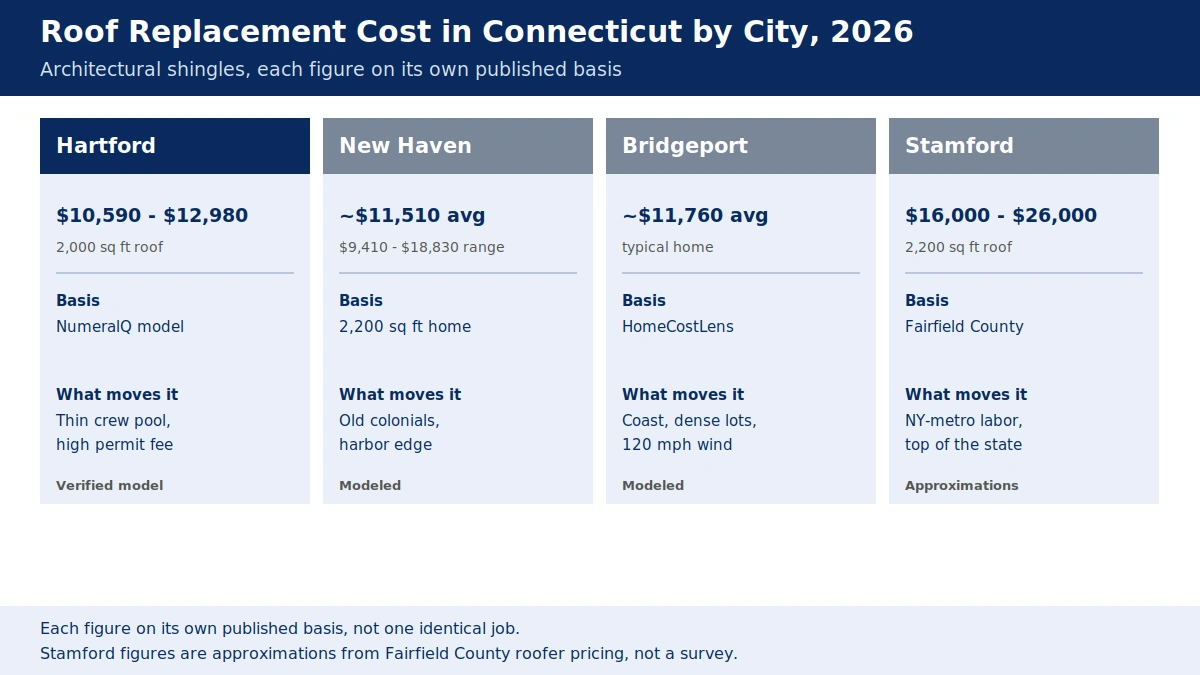
Connecticut is small, but its roofing prices are not flat. Fairfield County labor sits within reach of the New York metro market, the coast adds wind and salt exposure, and the inland cities price closer to the state middle. The table below keeps each city’s figure on its own published basis, because the sources measured different jobs, and blending them into one column would invent a precision none of them claims.
| City | Published figure | Basis |
|---|---|---|
| Hartford | $10,590–$12,980 | NumeralQ, 2,000 sq ft roof, architectural, Oct 2026 |
| New Haven | ~$11,510 average; $9,410–$18,830 range | HomeCostLens, 2,200 sq ft home, architectural, Sept 2026 |
| Bridgeport | ~$11,760 average | HomeCostLens, typical home model, Sept 2026 |
| Stamford | $16,000–$26,000 | Stamford guide, 2,200 sq ft roof colonial, Oct 2026 |
Hartford is the capital, the largest inland market, and the best-documented price in the state. NumeralQ’s Hartford band is the only city figure in this article built from a stated cost model with a stated date, and it anchors the size table above.
Hartford’s permit runs high by Connecticut standards, at about $474 on a $15,000 roof under the city’s fee schedule, and the local contractor pool is thin, at 38 roofing contractors across the Capitol region, or 0.9 per 10,000 homes. A thin pool means the better crews book first, so lead time belongs in the first phone call, not the last.
New Haven prices close to Hartford on the modeled figures, with a wider range that reflects the city’s housing mix. The HomeCostLens average of about $11,510 for a 2,200-square-foot home sits about 5 percent above the national average, and roofing labor in New Haven runs about $31 an hour.
Yale’s presence, the older colonials and Victorians, and the coastal edge at the harbor all pull in different directions on any single quote. A second published read puts New Haven at $11,000–$17,000, which overlaps the modeled range and supports the same budget.
Bridgeport is the state’s largest city and its most coastal large market, and its modeled average of about $11,760 runs a little above New Haven’s. The city’s housing runs older and denser, with more flat and low-slope sections, more shared walls, and tighter lots for dumpsters and staging. Bridgeport’s design wind speed for homes is 120 mph under the state code’s town table, and its ground snow load is 30 pounds per square foot, both of which the code section below explains in full.
Stamford is the most expensive of the four by a clear margin, and the gap is labor and land, not shingles. The Stamford guide puts architectural shingles at $650–$1,000 per square with tear-off, against the $490–$710 statewide band, and a 2,200-square-foot colonial roof at $16,000–$26,000.
Fairfield County towns commonly run 15 to 25 percent above the state average, with Greenwich, Darien, and New Canaan at the top of the county. A Stamford buyer who budgets from the statewide band will come up short, and a buyer near the New York line should take one quote from each side of it, since a contractor prices from its own labor market.
Outside the four cities, the pattern runs in the expected directions. The Naugatuck Valley and the northeast corner often quote 10 to 15 percent below the statewide band, and eastern Connecticut commonly runs 5 to 15 percent below the state average.
Litchfield County sits in the middle, with higher costs in towns far from suppliers, and New Haven County sits in the middle too. Small-town crews often price toward the lower half of the state band, while a long drive, steep terrain, or a dumpster on a tight lot pushes a quote toward the top.
Ice Dams and the Connecticut Winter: Why the Eaves Decide the Roof
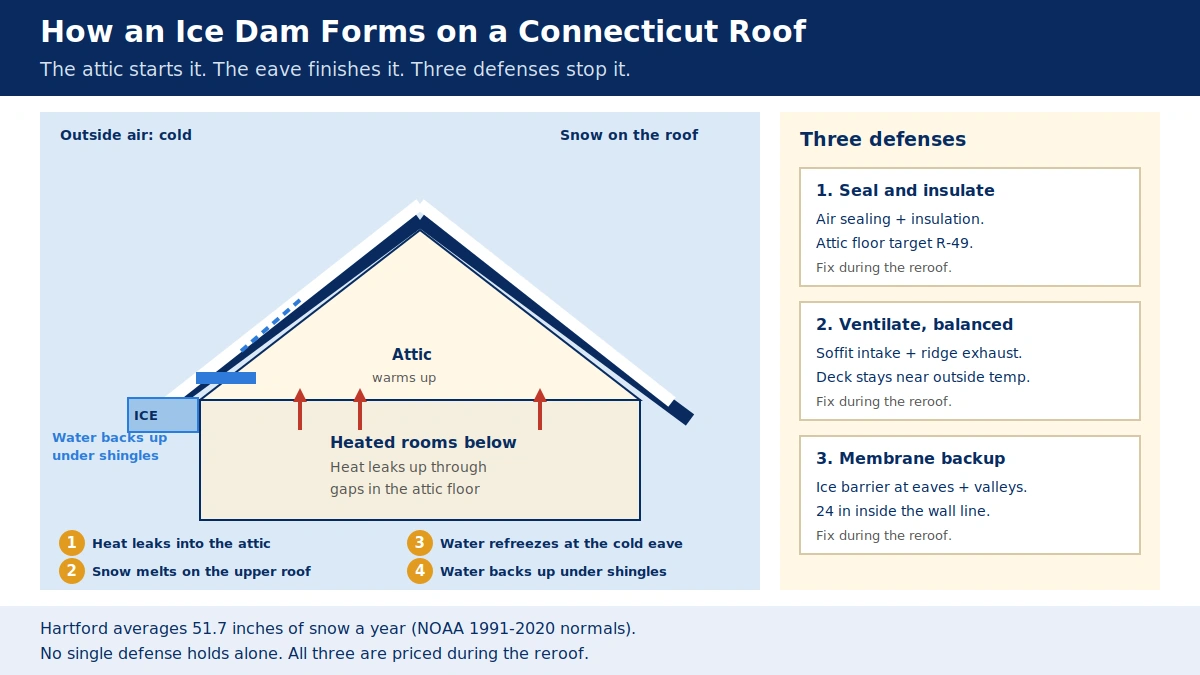
An ice dam starts in the attic, not on the roof. Heat leaking through the attic floor warms the roof deck, the snow on the upper roof melts, and the meltwater runs down to the eave overhang, where the roof extends past the heated wall and stays cold. The water refreezes there, builds into a ridge of ice, and the next melt pools behind the ridge and backs up under the shingles, where shingles were never meant to hold standing water.
Hartford averages 51.7 inches of snow a year, over about 22 days with measurable snow, and snow sits an inch or more deep on the ground for over a third of winter days. Bridgeport averages about 29 inches at the airport station, and the northwest hills see more than either city.
Snow alone does not make an ice dam, though. The dam needs the freeze-thaw cycle, a warm deck above and a cold eave below, and Connecticut’s winters supply that cycle for months, with sunny afternoons in the 30s and nights in the teens.
The damage shows up inside before it shows up on the roof. Water stains on the ceiling near an outside wall, peeling paint at the top of a wall, damp insulation, and stained plaster in a second-floor bedroom all point to the same failure.
By the time the stain appears, water has already crossed the deck, soaked the insulation, and sat against framing. A roof that leaks only in February, and only after snow, is almost always an ice dam roof, and a shingle-only fix will not hold it.
Three defenses work together, and no one of them holds alone. Air sealing and insulation keep the house’s heat out of the attic, so the snow on the upper roof stays frozen.
Ventilation moves cold outside air through the attic, so the deck stays near the outside temperature from ridge to eave. The ice barrier membrane under the shingles at the eaves is the backup: when meltwater does back up, the membrane seals around the nails and keeps the water off the deck.
The reroof is the one cheap moment to fix all three. With the old shingles off, the crew can lay the membrane at the eaves and valleys, add or correct the ridge vent and soffit intake, and fit baffles that keep insulation out of the airflow path.
The insulation itself usually goes in from inside, through the attic floor, and the rebate section below prices the help available for that part. Skipping the ventilation work while installing premium shingles leaves the ice dam risk exactly where it was, under a newer roof.
Two details deserve their own lines on the quote. Valleys collect the same backup as eaves, and the membrane belongs in every valley, not just along the edges.
Penetrations, the chimney, the plumbing vent, the skylight, are the other backup points, and each one needs its flashing woven into the new shingles, not smeared over the top. A quote that lists one roll of membrane and no valley or penetration detail has priced the idea of the fix, not the fix.
The Coast and the Wind: Nor’easters, Hurricanes, and the Nailing Schedule
Connecticut’s coast faces Long Island Sound, and the Sound gives the state two storm seasons. Summer and early fall bring tropical systems that weaken as they climb the coast but still carry surge, rain, and gusts.
Late fall through spring brings nor’easters, the slow coastal storms that park off New England, pile snow or rain for a day or two, and drive wind straight into the south-facing slopes. A roof on the coast must survive both, and a roof inland must survive the second plus the snow load that follows it.
The storm record sets the scale. Hurricane Irene in August 2011 weakened to a tropical storm before it reached Connecticut, yet it still produced gusts to 66 mph, cut power to more than 800,000 customers at the peak, and destroyed 132 homes.
Superstorm Sandy in October 2012 was not a hurricane when it reached the state, yet it damaged homes in all eight counties, caused more than $360 million in damage, cut power to 640,000 homes and businesses, and damaged about 38,200 homes across the four coastal counties. The 1938 hurricane, a Category 3 storm, killed 125 people in Connecticut and remains the benchmark every coastal building rule is measured against.
Wind speed on paper is set town by town. The 2022 Connecticut State Building Code lists a basic design wind speed for each municipality, and for homes the figure is 120 mph in most towns, including Bridgeport, Greenwich, Darien, and Danbury, 115 mph in parts of the northwest hills, and 125 mph in parts of eastern Connecticut.
Nearly every town in the table sits in the hurricane-prone region, and coastal towns carry a wind-borne debris designation as well. The town’s number, not a statewide guess, is what the shingle’s wind rating and the nailing schedule must meet.
The nailing schedule is where the wind rating becomes real. In high-wind corridors, the standard practice is six nails per shingle with an enhanced starter strip, against the four nails used on calmer roofs, and the shingle maker’s instructions for the rated wind speed govern the exact pattern.
A shingle rated for 130 mph and nailed for 110 mph is a 110 mph roof. The quote should name the shingle, its wind rating, and the nails per shingle, and the buyer should check that the three match the town’s design speed.
Sealed deck details matter as much as the shingle. When shingles blow off, the next line of defense is the deck: taped sheathing seams and a sealed underlayment slow the water that follows the wind.
Connecticut’s code conversation after Sandy pushed in exactly that direction, toward sealing the deck seams so a stripped roof still sheds water. The buyer cannot see the deck once the shingles go on, so the time to confirm the seam treatment is before the underlayment is covered, at the inspection the town requires.
Hail is the secondary risk, and it should stay secondary in the budget. Hartford County logged 13 large-hail reports from 2016 to 2025, one of them 2 inches or larger, and 144 damaging-wind reports in the same decade.
The six-county area around Hartford runs a little above the national hail rate, while the state as a whole runs below it. Impact-rated shingles, tested to the UL 2218 Class 4 standard, are worth a quote line on any Connecticut roof, but no verified Connecticut discount percentage for them was found, so no saving should be budgeted until the carrier states one in writing.
Salt air is the slow coastal cost. It corrodes exposed fasteners, stains cedar, and shortens the life of untreated metal flashing faster than inland air does.
On a coastal roof, the flashing metal, the fastener coating, and the vent hardware deserve the same attention as the shingle brand. Stainless fasteners cost more and earn the money within sight of the Sound, while a coastal quote that prices the same galvanized hardware as an inland quote has missed the climate it sits in.
Attic Ventilation and Insulation: The Work Under the Roof That Protects It
The attic is the half of the roof you never see from the street. The shingles shed water, but the attic decides whether the deck stays dry, whether the snow melts evenly, and whether the shingle warranty survives.
Manufacturers tie their warranties to ventilation, inspectors check it, and ice dams punish its absence. The reroof is the moment the attic gets fixed, because the ridge is open, the deck is bare, and the crew is already on the roof.
Ventilation works on a simple loop. Cool outside air enters low, through soffit vents under the eaves, travels up along the underside of the deck, and leaves high, through a ridge vent at the peak.
That moving air keeps the deck near the outside temperature in winter, which keeps snow from melting unevenly, and it carries moisture out of the attic all year. Intake must equal or beat exhaust: a ridge vent with blocked soffits pulls air from the nearest gap instead of from the eaves, and leaves part of the attic still.
The code rule is a ratio. The residential code asks for net free ventilating area of 1/150 of the vented attic floor area, with a 1/300 exception only when the conditions for it are met, including 40 to 50 percent of the vent area in the upper attic, within 3 feet of the ridge, and the balance low.
Insulation must not block the airflow at the eaves, and at least 1 inch of clear space must stay open between the insulation and the deck there. Baffles, the chutes fitted in each rafter bay, hold that space open and keep loose insulation from sliding over the soffit vents.
Mixing exhaust types breaks the loop. A ridge vent paired with gable vents or box vents on the same attic pulls air from the nearest vent instead of from the soffits, and part of the attic goes unventilated.
The fix is one exhaust type per attic, sized to the intake, with the old vents closed when the new system goes in. A quote that adds a ridge vent and leaves the gable vents open has bought two systems that fight each other.
Insulation does the other half of the job. The federal energy department recommends R-49 to R-60 for an uninsulated attic in Connecticut’s climate zone, and the state’s prescriptive code for new ceilings asks for R-60.
Those are different numbers for different situations: the first is guidance for an existing house, the second is the new-build code path. For a reroof, the practical target is set by the rebate rule in the paying section below, which asks for a finished R-49 or better on attic floors, with R-38 accepted where R-49 is not practicable in the space available.
Air sealing comes before insulation, and it is the step most often skipped. Gaps around plumbing vents, chimney chases, recessed lights, and the attic hatch leak warm, moist house air straight into the attic, and insulation laid over those gaps does not stop the leak.
The Home Energy Solutions visit that opens the insulation rebate includes air sealing work, which is why the visit comes first in the sequence. A roofer who proposes insulation without mentioning air sealing has priced half the fix.
Cathedral ceilings and finished attics change the rules. Where no vented attic exists, the insulation sits against the deck, and the assembly needs a different design, often with foam board above the deck or closed-cell foam below it, plus condensation control matched to the climate zone.
Those roofs cost more to insulate and must be designed, not improvised. A quote for a cathedral ceiling that prices only shingles has left the hardest part of the roof undesigned.
Our attic insulation cost guide prices blown-in, batt, and spray foam work nationally. For the Connecticut house, the sequence is what matters: seal the leaks, insulate to the target, ventilate on the balanced loop, and lay the membrane at the eaves. Each step is cheaper during the reroof than after it, and each step skipped shows up as a February stain or a July attic that cooks the shingles from below.
Asphalt, Metal, Cedar, and Slate in Connecticut: The Lifetime Math
Judge the roof by the cost of each year it shelters the house, not by the total at the bottom of the quote. A shingle roof bought twice costs more than a metal roof bought once, and a slate roof bought once can outlive two owners.
The table below works the arithmetic on the 25-square planning roof, using the midpoint of each material’s band and the midpoint of its published life. The figures exclude financing, upkeep, insurance effects, and energy effects, and they are arithmetic on stated assumptions, not a prediction of any one roof’s life.
| Material | Planning total | Assumed life | Cost per year |
|---|---|---|---|
| 3-tab asphalt | $8,750–$12,500 | 17 years | ~$625 |
| Architectural asphalt | $12,250–$17,750 | 25 years | ~$600 |
| Standing-seam metal | $24,500–$38,250 | 55 years | ~$570 |
| Cedar shake/shingle | $23,975–$41,175 | 32 years | ~$1,018 |
| Natural slate | $44,350–$83,600 | 75 years | ~$853 |
Architectural shingles and standing seam land close on cost per year, and that closeness is the real decision. The shingle roof costs about half as much up front and lasts about half as long, so a buyer who stays 30 years likely buys shingles twice, at $24,500–$35,500 in current prices before any inflation, against one metal roof at $24,500–$38,250.
The metal roof also sheds snow, resists wind uplift with hidden fasteners, and needs no shingle replacement after a hailstorm that would crack asphalt. The shingle roof wins for a buyer who plans to move within a decade, because the next owner, not the buyer, pays for the second roof.
Cedar costs the most per year in the table, and the table understates it. Cedar needs cleaning, treatment, and moss control, and no verified Connecticut price for that upkeep was found, so none is included.
Cedar earns its place on looks and on historic fit, not on math, and a buyer who chooses it should budget the upkeep as a known cost, not discover it as a surprise. On a shaded, coastal lot, the upkeep runs heavier than on an open, sunny one.
Slate costs more per year than metal or shingles, but the comparison misses what slate buyers are buying. A slate roof is a 75-year roof on a house that may itself be 100 years old, and its value sits in the life of the house, the historic character, and the fact that individual slates can be replaced without redoing the roof. The frame check is the gate: an old frame built for shingles may need reinforcement to carry stone, and that work is priced on inspection, not from a table.
Three-tab shingles look cheap until the second purchase is counted. At about $625 a year on the same arithmetic, they cost more per year than architectural shingles, because the shorter life swallows the lower price.
The gap widens if the first roof fails early from ice dams or wind, which cheaper shingles resist less well. The budget case for 3-tab holds only where the house will sell soon or the cash is truly short, and even there the buyer should price the resale effect of a visibly thinner roof.
Energy effects run small and should not decide the material. A light-colored metal roof reflects more summer sun than a dark shingle roof, and a vented attic matters more than either.
No Connecticut-specific energy saving figure for any roofing material was verified, so none is claimed here. The attic work in the section above, insulation and ventilation, saves more energy than any shingle color, and it costs less than the jump from shingles to metal.
The decision rule follows from the buyer’s horizon. Staying under 10 years points to architectural shingles.
Staying 20 years or more points to standing seam or slate, priced against the two-roof shingle total. A historic house, a coastal shingle-style house, or a house in a district with appearance rules may point to cedar or slate regardless of the math, and that is a sound reason, stated openly, not a math error.
Permits and Code in Connecticut: The 2022 State Building Code and the Town Desk
Connecticut runs one building code statewide and enforces it town by town. The 2022 Connecticut State Building Code builds on the 2021 residential and building codes with Connecticut amendments, and the Office of the State Building Inspector administers it.
The town building department issues the permit, sets the fee, and inspects the work. A contractor who says a tear-off needs no permit is almost always wrong, and the check costs one phone call to the town desk.
Permits are required for full replacements in most Connecticut towns. Roofing and siding are not on Hartford’s list of work exempt from permits, and the same pattern holds across the state: a full tear-off and replacement gets a permit, while a small repair may not, depending on the town’s rules. The fee is set locally, so no statewide figure exists.
Published planning figures run $225–$600, with a planning average near $380, and other models put the range at $100–$400 or $300–$900. Hartford charges on the job’s value, at $50.26 for the first $1,000 and $30.26 for each $1,000 after, which puts a $15,000 roof near $474, though the posted schedule dates from 2020 and the rate should be confirmed when applying.
The ice barrier rule is the code requirement that most changes a Connecticut quote. The code requires an ice barrier, either a self-adhering polymer-modified bitumen membrane or two layers of cemented underlayment, from the lowest edges of all roof surfaces to a point at least 24 inches inside the exterior wall line.
At 8:12 or steeper, the rule changes from a horizontal measure to a slope measure: 36 inches of membrane measured up the slope from the eave edge. On most houses that means one or two courses of membrane along every eave, plus membrane in the valleys, and the membrane shows up as its own line on the bid.
The layer limit is the second rule that changes the job. New roof coverings must not go over existing coverings where the old roof is water-soaked or deteriorated past serving as a base, and the code allows at most two layers of shingles in total.
A house that already carries two layers gets a full tear-off, not a recover, and the tear-off of the second layer costs $1.52–$2.00 per square foot on the Hartford figures. Counting the layers is a five-minute check at the eave edge, and it should happen before the quote is written, not after the crew arrives.
Underlayment and edge details carry their own code lines. Underlayment conforming to the listed felt standards is required on all new and stripped roofs, sheathing joints must be taped or covered with ice and water membrane, and drip edge is required at the eaves and rakes.
Some towns inspect the ice barrier before it is covered, and New Canaan’s roofing permit form states the inspection requirement in plain terms, along with a ventilation check and a fastener check. Burlington’s roof compliance form has the contractor certify the work against the code’s roofing chapter and the shingle maker’s instructions, with photos accepted for taped seams, membrane, flashing, and drip edge where the official cannot attend in person.
Historic districts add a review step. In Hartford, a visible alteration on a property in a National or State Register district, or on an individually listed property, needs Historic Preservation Commission approval before the permit application is filed, and an application not acted on within 45 days is treated as approved.
The rule covers register properties only, and only where the work needs a building permit. Greenwich, New Canaan, and other towns with historic districts run their own versions, so a buyer in an old neighborhood should check the address against the district map before ordering materials.
A new code cycle is in preparation. Connecticut is working toward a 2026 State Building Code built on the 2024 energy code, but permits in 2026 are still reviewed under the 2022 code, and the final Connecticut-specific numbers for the new code are not yet published.
The buyer need not track the code cycle. The buyer needs the permit in hand, the inspection scheduled, and the membrane, ventilation, and flashing details in writing before the first shingle is laid.
Hiring a Roofer in Connecticut: HIC Registration, the Contract, and the Guaranty Fund
Connecticut has no roofer license. It has no general contractor license either.
Roofing work on an existing home falls under the Home Improvement Contractor registration, run by the Department of Consumer Protection under the Home Improvement Act. The distinction matters, because a registration is not an exam, and a buyer who treats the registration card as proof of skill has checked the wrong thing.
Registration is required once the work crosses two thresholds: any single job priced over $200, and total home improvement contracts over $1,000 in any 12 consecutive months. The contractor applies online through the DCP eLicense system, pays $120 plus a $100 annual assessment to the Home Improvement Guaranty Fund, and renews every year, with registrations expiring March 31.
No state exam and no experience requirement stand behind the registration. The applicant must carry at least $20,000 in general liability insurance and name the insurer and policy number on the application, and must carry workers’ compensation once it employs workers.
That $20,000 liability floor is low, and the buyer should treat it as a floor. A $20,000 policy will not cover much real damage to a house, and established contractors carry far higher limits.
The buyer should ask for the certificate of insurance directly, check that it names the contractor doing the work, and confirm the policy is current. The commissioner also has the authority to require a $15,000 surety bond from a contractor, though that power is discretionary, not a universal requirement, and the buyer should not accept a bond claim at face value without seeing the bond.
The check itself takes minutes. The DCP license lookup shows whether the registration is current, and the registration number must appear in every contract and advertisement.
A contractor who will not give the number, or whose number does not check out, should not be on the roof. Manufacturer credentials, such as a shingle maker’s certified installer status, sit on top of the registration and speak to training on one product line, but they do not replace the state registration.
The contract is where Connecticut law gives the buyer the strongest protection. Every home improvement contract must be written, signed by the owner and the contractor, dated, and contain the entire agreement, the contractor’s name, address, and registration number, the start and completion dates, and a notice of the owner’s cancellation rights.
A contract missing the required provisions is not valid or enforceable against the owner. A registered contractor may still recover the reasonable value of work actually performed if the contract is written and signed, carries the cancellation notice and the dates, and the contractor is registered.
The cancellation right is three business days, and it applies no matter where the contract was signed. Every home improvement contract is treated as a home solicitation sale, so the buyer may cancel before midnight on the third business day after signing, even if the signing happened at the contractor’s office.
The notice must sit near the signature, be supplied in duplicate, and be backed by a separate notice sheet explaining the right. Saturday counts as a legal business day in Connecticut, so a Friday signing leaves less weekend room than the buyer may assume.
The Guaranty Fund is the last resort, not a warranty. The fund, fed by the $100 annual contractor assessment, can pay up to $25,000 per claim to a homeowner who holds a final court judgment or court-confirmed arbitration award against a registered contractor who has not paid. The homeowner must apply within two years of the judgment, the contract must have exceeded $200, and the work must have been on a residential property of six units or fewer.
New home construction is not covered. The fund does not mediate disputes, fix poor work, or pay while a dispute is still open. It pays after litigation, when the contractor has already failed to pay what a court ordered.
Red flags follow from the rules above. A contractor who asks for full payment up front, who offers to skip the permit, who writes the contract without dates or without the cancellation notice, who cannot produce the registration number, or who pressures for a signature before the three-day window has run, is telling the buyer how the job will go.
Storm-chasing crews from out of state deserve the same checks as local crews, plus one more: a local address and a local track record that survive after the storm work ends. Our questions to ask a roofer guide lists every question worth asking before a bidder leaves your driveway.
Insurance After Storm Damage in Connecticut: Deductibles, ACV vs RCV, and the Claim File
Insurance pays for sudden storm damage, not for age. A roof that fails at 28 years because the shingles wore out is a maintenance cost, and no policy covers it.
A roof that loses shingles to a nor’easter, takes a tree limb through the deck, or suffers a punctured membrane in a hailstorm is a claim, and the policy’s storm terms decide how much of the new roof the carrier pays for. The distinction is the first thing the adjuster tests, so the buyer’s photos and records should test it first.
Connecticut law sets a strict trigger for hurricane deductibles. A carrier may impose a hurricane deductible only when a hurricane warning is issued for Connecticut and the National Weather Service records sustained hurricane-force winds of 74 mph or more anywhere in the state. Sandy did not meet that test, and the state told carriers they could not impose hurricane deductibles on Sandy claims.
A nor’easter, however damaging, is not a hurricane under that law, so its damage falls under the policy’s standard wind deductible in most policies. The declarations page states which deductible applies, and the buyer should read it before the storm, not after.
Coastal underwriting guidelines add a second layer. Under the Insurance Department’s coastal guidelines, a property within 2,600 feet of the coast may face both a hurricane deductible of up to 2 percent and windstorm shutter mitigation requirements.
Beyond 2,600 feet, the carrier may impose either the hurricane deductible or the mitigation requirement, not both. The 2 percent figure is a cap on the hurricane deductible under the guidelines, and it is measured against the insured value, so a 2 percent deductible on a $400,000 dwelling limit is $8,000 out of pocket before the carrier pays anything on a qualifying hurricane claim.
Replacement cost and actual cash value decide the size of the check. Replacement cost value pays what it costs to replace the damaged roof with like kind and quality, less the deductible. Actual cash value pays the replacement cost less depreciation for the roof’s age and condition, which on a 20-year-old shingle roof can cut the payment by half or more.
Many replacement-cost policies pay in two parts: the actual cash value first, then the withheld depreciation after the work is done and documented. The buyer should confirm which basis the policy uses, and whether depreciation is recoverable, before signing a contract that assumes the full replacement figure.
Matching is the gap most buyers discover late. When only one slope is damaged, the carrier may pay to replace that slope, while the new shingles do not match the weathered shingles on the other slopes in color or profile. No Connecticut matching statute was found in the research for this article, so no matching right should be assumed.
The policy language governs, and the buyer should ask the carrier, in writing, how matching is treated before accepting a partial payment. Photos of all slopes, taken before the repair, are the evidence that makes the conversation possible.
The claim file should start the day the damage is found. Photograph the roof from the ground and, safely, from the attic, showing stains, daylight through the deck, and displaced shingles. Photograph the interior damage in every room it reaches.
Cover the opening with a tarp or board to stop further water entry, keep the receipts, and log every call with the carrier, including the date, the name, and what was said. Temporary repairs that prevent further damage are part of the claim in most policies, while permanent repairs made before the adjuster inspects can cost the buyer the evidence.
Two cautions close the section. A contractor who offers to “handle the insurance” and asks the buyer to sign over the claim, or who promises the roof will cost only the deductible, is selling a result the contractor does not control.
The carrier sets the payment, the policy sets the terms, and the buyer keeps the contract with the roofer separate from the claim with the carrier. And a roof replaced under a claim still needs the same permit, the same code details, and the same registered contractor as a roof paid for out of pocket, because the code does not waive itself for insured work.
Paying for a Connecticut Roof in 2026: No Federal Credit, HEAR Not Launched, and One Real Rebate
The money available for a Connecticut roof in 2026 is short, and the shortness should be stated before any quote is read. The federal government contributes $0. The state rebate programs have not launched.
The one live rebate that touches a reroof pays for the insulation under the roof, not for the roof itself. A quote that subtracts any other public money from a 2026 roof price is built on old rules or wrong rules, and it needs rewriting before it is compared.
The federal credit ended on December 31, 2025. Congress ended both credits in the One Big Beautiful Bill Act, Public Law 119-21: the Section 25C energy efficient home improvement credit and the Section 25D residential clean energy credit no longer apply to property placed in service after December 31, 2025, and the IRS confirmed that end date in Fact Sheet FS-2025-05. A homeowner-owned roof installed in Connecticut in 2026 gets a $0 federal tax credit, whether the roof is shingle, metal, cedar, or slate.
A 2025 install can still be claimed on a 2025 return. A 2026 install cannot be claimed on any return.
The lease route does not rescue the roof. Section 48E, the clean electricity investment credit, still supports leased systems placed in service by December 31, 2027, with the credit passing through from the leasing company in a lower payment. That route pays for clean electricity property, such as leased solar panels, not for a standalone roof.
A roof installed as part of a leased solar system is a different purchase with different paperwork, and our Connecticut solar guide prices that purchase separately. A roofer who prices shingles against a Section 48E credit has mixed two jobs into one quote.
Connecticut’s HEAR and HOMES rebates have not launched. The programs, funded by the Inflation Reduction Act and run by the Department of Energy and Environmental Protection, were still awaiting federal approval of the state’s application and blueprint in checks through November 9, 2026, and the state’s own page says rebates will not be available until the programs launch.
The department told the Energy Efficiency Board in October 2026 that it hopes funding will be available in early 2027, pending further review. The federal allocations are $49,541,390 for HEAR and $49,732,517 for HOMES, and none of that money buys a rebate a homeowner can claim today.
Even after launch, the federal rules narrow what the money can buy. Program Notice 26-2, effective May 29, 2026, renamed HEAR the High-Efficiency Electric Home Rebate and limited it to electric-to-electric upgrades and new construction, so it does not pay to replace gas, oil, or propane equipment with electric equipment. The insulation, air sealing, and ventilation part of HEAR carries a federal cap of $1,600 per home for households under 150 percent of area median income, and Connecticut’s final amounts have not been published.
Shingles are not a HEAR or HOMES measure at all. The insulation under the roof can be, once the programs open, and that distinction is the whole point of this section.
The live rebate is the Energize CT insulation incentive, and it is worth claiming in the right order. Through the Home Energy Solutions program, a professional insulation install by an approved contractor earns up to $2.00 per square foot, or 75 percent of the total cost, whichever is less, up to $10,000. Households in the enhanced tier and in Environmental Justice Communities can earn $2.50 per square foot, up to $15,000 in those communities, and income-eligible households below 60 percent of the state median income may have insulation fully covered.
Self-installed insulation earns $0.25 per square foot on approved projects, after an inspection. The offer runs January 1 to December 31, 2026, for customers of Eversource, United Illuminating, Connecticut Natural Gas, and Southern Connecticut Gas, in homes of up to four units.
The sequence matters more than the amount. The insulation must be recommended during a Home Energy Solutions visit, the project must be approved before installation, and the professional-rate install must be done by a contractor in the Energize CT Insulation Installers Network. The visit carries a $40 copay since April 1, 2026, and no cost for income-eligible households.
The attic floor rule asks for an existing R-value of no more than R-19 and a finished R-49 or better, with R-38 accepted where R-49 is not practicable in the space. Book the visit before the reroof, so the insulation, air sealing, and ventilation work can be sequenced with the roof work instead of redone after it.
No Connecticut roof rebate, state tax credit for a roof, or roof grant program was found. Other states run roof-hardening grant programs, and Connecticut has no equivalent that this research could verify. No Connecticut-specific roof loan program was verified either.
Our roof financing guide covers the generic options, from home equity to contractor financing, and our federal energy tax credits guide carries the full 2026 picture of what ended and what survived. Price the roof on cash, financing, and the insulation rebate, and the budget will hold.
Repair or Replace and Getting Quotes in Connecticut: The Decision Rules and the Checklist
A roof near the end of its life, leaking in more than one place, or carrying soft decking underfoot is a replacement, not a repair. A young roof with one failed flashing, one lifted shingle course, or one storm puncture is a repair, and replacing it wastes most of its remaining life. The rules below sort the two cases without a price table, because no verified Connecticut repair-price table was found, and inventing one would mislead more than help.
- Age against life: a shingle roof past 20 years with curling, granule loss, or widespread lifting is near replacement, while the same roof at 8 years with one leak is a repair.
- Leak count and spread: one leak at one flashing points to repair, while leaks on two or more slopes point to system failure.
- Deck condition: soft, spongy, or sagging decking means the structure, not just the covering, has failed, and the job is a tear-off with deck work.
- Layer count: two layers already on the roof means any reroof is a full tear-off, and a repair that adds weight to two layers should be questioned.
- Storm scope: damage confined to one slope after a storm may repair cleanly, while damage across the roof, or a deck punctured in several places, usually replaces.
- Attic evidence: daylight through the deck, widespread staining, or mold across the attic floor means water has crossed the system, not one seam.
- Sale horizon: a roof with 5 years of life left on a house selling next year may repair, while the same roof on a house kept for 20 years should replace.
An inspection settles the close cases. A roofer or inspector on the roof can count layers, test the deck, read the flashing, and check the attic in one visit, and the written report becomes the baseline for every quote that follows.
Our roof inspection cost guide explains what a real inspection covers and what it costs, and our roof repair cost guide prices the repair side nationally. Get the inspection before the quotes, not after the first crew has already priced a replacement.
Hold every bidder to the same written spec sheet, and sign nothing until all three quotes answer every item on the checklist below. A quote missing an item is not a cheaper quote. It is an incomplete quote, and the missing item arrives later as a change order, at a price the buyer can no longer negotiate.
- Measured roof size in squares, pitch, and planes included, with the waste allowance stated
- Material named by brand, line, color, wind rating, and warranty, with the per-square price and the total shown separately
- Tear-off depth stated (one layer or two), disposal included, and decking priced per sheet for concealed damage found after tear-off
- Ice barrier membrane at eaves and valleys to the code depth, underlayment type, drip edge, and flashing at every chimney, wall, and skylight, each as its own line
- Ventilation design in writing: soffit intake, ridge exhaust, baffle count, and the vent ratio used, with old exhaust vents closed
- Nailing schedule stated (nails per shingle), starter strip type, and the shingle maker’s high-wind instructions followed for the town’s design speed
- HIC registration number verified on the DCP lookup, insurance certificate current, permit pulled by the contractor with the town fee stated
- Contract with all required provisions: entire agreement, dates, cancellation notice in duplicate, and the three-business-day right to cancel
- Cash price for the identical spec from three bidders, with no line for a federal credit, no HEAR rebate, and no roof rebate of any kind on a 2026 install
- Payment schedule tied to milestones, start and completion dates, cleanup and magnet sweep for nails, and the warranty terms for both material and labor in writing
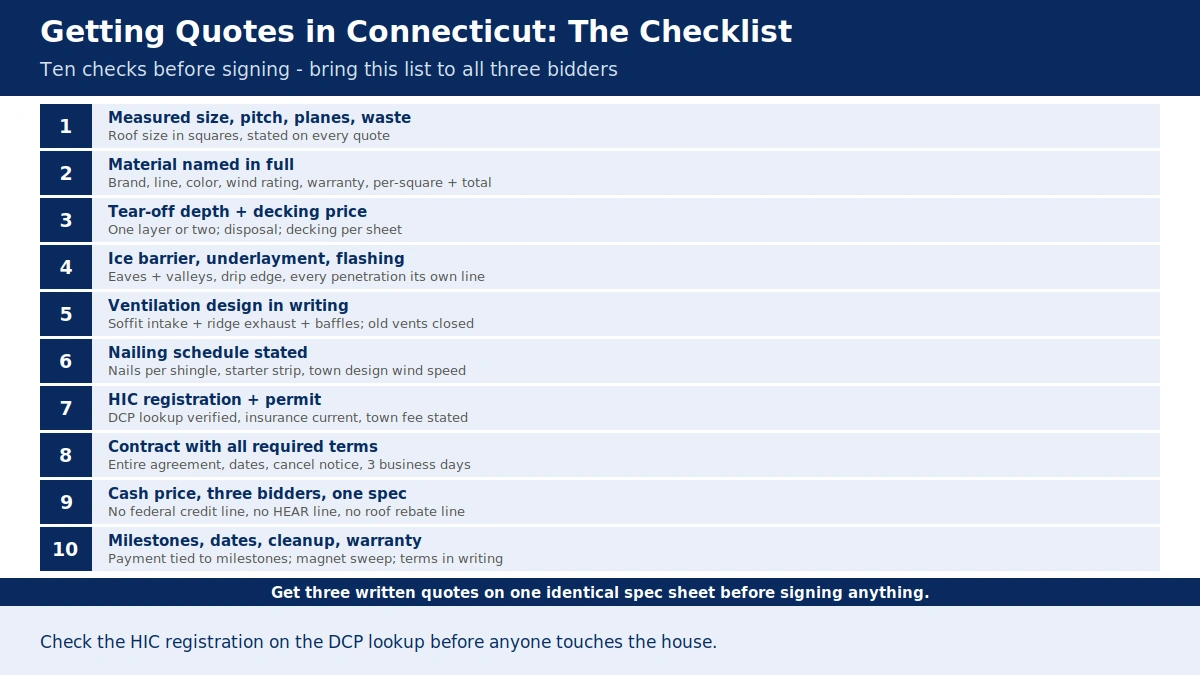
Get three written quotes on one identical spec sheet before signing anything. The lowest quote usually leaves something out. The best quote names the material, shows the membrane and the ventilation design, proves the registration, carries the contract the law requires, and prices the roof the house actually needs, from the eaves up.
Sources & methodology Installed costs:
- SmartRoofingCalculator, Connecticut Roof Replacement Cost (2026), updated Apr 24, 2026, re-crawled Nov 9, 2026: architectural $490–$710/sq installed with tear-off; 25-square roof $12,250–$17,750; standing-seam metal $980–$1,530/sq; tile $1,310–$1,960/sq; permit ~$380 planning average, $225–$600 range; method: national bands x state factor 1.090 (BLS May 2024 wages + BEA 2024 goods RPP); neighboring states NY $520–$750, MA $500–$720, RI $450–$660 per square
- NumeralQ, Roof Replacement Cost in Hartford, CT (2026), estimator pricing Oct 26, 2026: by size 1,000 sq ft $5,580–$6,920, 1,500 sq ft $8,090–$9,950, 2,000 sq ft $10,590–$12,980, 2,500 sq ft $13,090–$16,020, 3,000 sq ft $15,600–$19,050; by material on 2,000 sq ft typical job: 3-tab $8,690–$10,360, architectural $10,590–$12,980, modified bitumen $11,780–$15,180, EPDM $12,170–$18,630, designer $12,480–$15,130, TPO $14,730–$19,590, exposed-fastener metal $16,320–$20,760, stone-coated steel $18,360–$26,350, synthetic $19,340–$27,660, cedar $19,770–$33,800, concrete tile $22,170–$31,220, standing seam $23,480–$35,110, clay tile $28,030–$43,640, natural slate $36,060–$67,740; add-ons: extra layer $1.52–$2.00/sq ft, decking sheet $70–$101, whole-roof ice barrier $0.95–$1.50/sq ft, seamless aluminum gutters $9.50–$13.46/linear ft, flashing $387–$547 each, skylight re-flash $563–$726 each
- Best Way Roofing LLC (CT contractor, Litchfield/New Haven/Fairfield counties), 2024–2026 pricing: 3-tab $350–$500/sq, architectural $450–$700/sq, luxury $600–$1,000/sq, standing seam $1,000–$1,500/sq, cedar $700–$1,300/sq, natural slate $2,000–$5,000+/sq; typical 2,000 sq ft home $10,000–$18,000 architectural; most common projects $12,000–$18,000; tear-off $1–$2/sq ft single layer, $2–$4 two layers; sheathing $2–$5/sq ft
- MyRoofData, Connecticut (2026 model): typical home $14,750–$25,500; architectural $518–$862/sq before tear-off; 3-tab $402–$633/sq; tear-off $100–$200/sq/layer; crews $65–$105/hr; permits $100–$400
- ProTech Roofing (Apr 13, 2026): average $9,000–$22,000; 3-tab $350–$500/sq, architectural $450–$700/sq, standing seam $800–$1,400/sq, tile/slate $1,000–$2,000/sq
- RoofingEstimatorPros (updated Aug 26, 2026): 2,000 sq ft roof $16,799–$29,949, avg $22,643; permit $300–$900; reported as the highest model, not an anchor
- HomeCostLens, New Haven (data reviewed Sept 2026, modeled): avg ~$11,510 for 2,200 sq ft home, range $9,410–$18,830; Hartford $11,300 (factor 1.03), Bridgeport $11,760 (factor 1.07); New Haven roofing labor ~$31/hr
- Stamford guide, connecticutbusinessesnearme.com (Oct 19, 2026, approximations, not a survey): architectural $650–$1,000/sq; 2,200 sq ft colonial $16,000–$26,000; cedar $1,500–$2,200/sq; slate $2,500–$4,000/sq; size table 12/20/30/40 squares
- Norwalk guide, connecticutbusinessesnearme.com (Oct 21, 2026): architectural $550–$850/sq; designer/impact-rated $750–$1,100/sq; cedar shake $1,100–$1,700/sq
- Lifetime Warranty Roofs: state $8,500–$18,500, typical $12,000–$14,000; Hartford $10,500–$16,000; New Haven $11,000–$17,000; Bridgeport $10,000–$15,500
- New England Metal Roof: Fairfield County 15–25% above state average; eastern CT 5–15% below; labor $50–$80/hr; deck repairs $7–$12/sq ft
Labor, housing, climate:
- BLS OEWS May 2025, SOC 47-2181 Roofers: Connecticut median $29.84/hr ($62,070/yr), mean $32.93/hr, 790 jobs, 10th–90th $22.95–$46.19/hr; national median $26.65/hr ($55,440)
- NumeralQ Hartford: roofer median pay $31.59/hr Hartford metro, billed $63–$82/worker-hour; 38 roofing contractors in Capitol Planning Region, 0.9 per 10,000 homes; Hartford median home value $228,600; half of Hartford homes built 1951 or earlier; ~80% built before 1980 vs 67% statewide, 50% nationally (ACS 2020–2024)
- NOAA 1991–2020 normals via Current Results: Hartford 51.7 in snow/year, 22.3 snow days; Bridgeport ~29 in (airport station normals); Litchfield Hills higher
- NOAA Storm Events Database via NumeralQ Hartford: Hartford County 13 large-hail reports 2016–2025 (1 at 2 in+), 144 damaging-wind reports; 6-county area 77 large-hail reports, 21.1 per 1,000 sq mi vs 14.7 statewide, 20.1 national; FEMA National Risk Index: Hartford County hurricane Relatively High, hail Relatively Moderate
- Owens Corning Technical Bulletin TB-10022497-A: at or below 40°F hand-seal shingles at edges; Hartford average high under 40°F in Jan–Feb; driest months Aug–Sept (Brainard Field)
- Connecticut Natural Hazard Mitigation Plan Update 2014: Irene max gusts 66 mph, 10 deaths; Sandy more than $360 million damage, all 8 counties, peak 640,000 without power; CDBG-DR QPR: ~38,200 homes damaged in 4 coastal counties, losses over $288 million; CIRCA/UConn: 2,853 single-family homes damaged in Fairfield County, 1,165 in New Haven County; Fairfield Museum: 1938 hurricane 125 CT deaths, $53 million CT damage (1938 dollars); Vagell: Irene 800,000+ without power, 20+ tropical systems since 1893, about one every 5–6 years
Code, wind, snow, ventilation, insulation:
- 2022 Connecticut State Building Code (2021 IRC/IBC with CT amendments); Appendix P municipality table: Risk Category II basic design wind speed 120 mph most towns, 115 mph northwest hills, 125 mph eastern towns; ground snow load 30 psf coastal/Fairfield towns, 35–40 psf northwest hills; hurricane-prone region Yes; wind-borne debris Type B coastal towns
- IRC R905.1.2: ice barrier from lowest eaves to at least 24 inches inside the exterior wall line; 36 inches along the slope on roofs 8:12 or steeper; IRC R908.3/R908.3.1.1: two-layer maximum, tear-off where old roof is water-soaked or deteriorated
- Plainfield roofer handout (CT code summary): #15 felt or similar (ASTM D226 Type I, D4869 Type I, D6757) on new/stripped roofs; sheathing joints taped or full ice-and-water; New Canaan roofing permit form: drip edge required (effective 10/1/2016), ice-and-water inspection before covering, ventilation check per R806; Burlington roof compliance certification: R905 of 2021 IRC / Ch. 15 of 2021 IBC portion of 2022 CSBC
- Hartford permit: $50.26 first $1,000 + $30.26 each additional $1,000, ~$474 on a $15,000 roof (city fee schedule, posted 2020, confirm at application); Hartford Municipal Code Ch. 28, Art. XII: Historic Preservation Commission approval for visible alterations in register districts, 45 days without action = approved
- IRC R806: net free ventilating area 1/150 of vented space; 1/300 exception with conditions (40–50% upper vent area within 3 ft of ridge, balance low); R806.3: at least 1-inch clearance at eave vents; intake must equal or exceed exhaust; do not mix exhaust types
- DOE guidance: Zone 5 uninsulated attics R-49 to R-60; CT prescriptive code (2022 CSBC/2021 IECC, Zone 5A): ceilings/attics R-60; 2026 CSBC in preparation, permits still under 2022 code in 2026
Registration, contracts, Guaranty Fund:
- CGS Chapter 400, §§20-418–20-432 (Home Improvement Act); DCP eLicense system; trigger: contracts over $200, totals over $1,000 in 12 months (§20-419); no exam, no experience requirement; fee $120 + $100 Guaranty Fund assessment = $220 (§20-421, §20-432); renewal annually, expiry March 31; registration number in every contract and advertisement; liability insurance minimum $20,000; workers’ comp once employees are hired; commissioner may require $15,000 surety bond (discretionary)
- CGS §20-429: written, signed, dated contract containing the entire agreement, contractor name/address/registration number, start and completion dates, cancellation notice; contract without required provisions unenforceable against the owner; DCP contracting page, Hartford contract-requirements sheet, CGA 2004-R-0477 and 98-R-1385: three-business-day cancellation right, notice near signature in duplicate plus separate sheet, Saturday is a legal business day
- CGS §20-432 and DCP Guaranty Fund page: up to $25,000 per claim (raised from $15,000 effective July 1, 2022); final judgment or court-confirmed arbitration award unpaid by the contractor; apply within 2 years; contract over $200; residential property of 6 units or fewer; no new-home construction; fund cap $750,000 (CGA 2023-R-0170)
Insurance:
- Connecticut hurricane deductible trigger law (post-Irene): hurricane warning for CT + NWS-recorded sustained winds of 74+ mph anywhere in the state; Sandy did not meet the test, no hurricane deductibles imposed (Governor’s announcement Nov 1, 2012; Insurance Journal Dec 2011)
- CID Bulletin PC-62 (July 2008, CGS §38a-689): within 2,600 ft of coast, hurricane deductible (not over 2%) plus shutter mitigation may both apply; beyond 2,600 ft, either one, not both; hurricane defined by NHC declaration, Category 1–5, sustained winds 74+ mph
- No Connecticut matching statute, roof-age rule, or Class 4 discount percentage was found; ACV/RCV mechanics stated as policy terms to check
Federal, HEAR/HOMES, Energize CT:
- OBBBA P.L. 119-21; IRS FS-2025-05 (§25C/§25D $0 for property placed in service after Dec 31, 2025); IRS Notice 2025-42 (§48E lease pass-through, in service by Dec 31, 2027)
- HEAR/HOMES: DEEP administers; not launched as of checks Oct 13, Oct 25, Oct 29, and Nov 9, 2026; DEEP hopes funding available early 2027 (Oct 2026 Energy Efficiency Board update); allocations HEAR $49,541,390, HOMES $49,732,517 (DOE dataset); DOE Program Notice 26-2 (May 29, 2026): HEAR renamed High-Efficiency Electric Home Rebate, no fuel-switching; federal insulation/air sealing/ventilation cap $1,600 per home (under 150% AMI); CT final amounts not published
- Energize CT Residential Insulation Incentive (verified on energizect.com Nov 14, 2026): up to $2.00/sq ft professional install, 75% of cost whichever is less, max $10,000; $0.25/sq ft self-install after inspection; $2.50/sq ft enhanced/EJC (EJC up to $15,000); up to 100% for income-eligible (below 60% state median income); HES visit recommendation required, project approval before install, approved-contractor install for professional rate; Eversource, UI, CNG, SCG customers; 1–4 unit homes; offer Jan 1–Dec 31, 2026; attic floor existing R-value at most R-19, final R-49+ (R-38 where R-49 not practicable); HES visit $40 copay since Apr 1, 2026, no cost for income-eligible tiers
- Lifespans: NAHB Study of Life Expectancy of Home Components (2007) via SmartRoofing (asphalt ~20 years, wood shakes ~30, slate/tile beyond 50); contractor/model bands in the material table
Lifetime-math arithmetic:
- 25-square totals are 25 x the lead per-square band; cost per year is the band midpoint divided by the midpoint of the published life: architectural ~$15,000 / 25 years = ~$600; standing seam ~$31,375 / 55 years = ~$570; cedar ~$32,575 / 32 years = ~$1,018; slate ~$63,975 / 75 years = ~$853; 3-tab ~$10,625 / 17 years = ~$625; two shingle purchases $24,500–$35,500 at current prices before inflation; excludes financing, upkeep, insurance, and energy effects
EXCLUDED:
- Any federal credit, HEAR rebate, or Connecticut roof rebate on a 2026 roof quote
- Any Class 4 shingle insurance discount percentage; any Connecticut matching rule, roof-age rule, or repair-price table
- Any Stamford or Norwalk figure presented as a measured survey
- Any blended per-square figure mixing with-tear-off and before-tear-off bands
- Any DCP lookup URL (not verified); the eLicense system is named only
- The $15,000 surety bond as a universal HIC requirement (discretionary authority only)
- SmartRoofing May 2024 wage vintage as current (May 2025 BLS is the lead)
- The RoofingEstimatorPros band as an anchor (highest model; one labeled mention)
- Any claim that HEAR pays for shingles, or that Section 48E pays for a standalone roof
- Any cedar upkeep price, slate frame-reinforcement price, or energy-saving figure by material (none verified for Connecticut)
- SmartRoofing page-title band $12,300–$17,800 (body arithmetic $12,250–$17,750 used instead)
Disclaimer: The prices here are 2026 Connecticut planning figures from the published sources listed above. What you end up paying moves with the town, the roof size and pitch, the material, the layers to remove, the deck condition, and the contractor. Get written quotes from three registered Connecticut contractors before settling on a budget, and check the registration yourself on the Department of Consumer Protection lookup before anyone touches the house. Nothing here is tax advice for your own return. Program rules change, so confirm current terms with Energize CT and the Department of Energy and Environmental Protection before signing, and note that HEAR and HOMES rebates have not launched in Connecticut.
What does a roof replacement cost in Connecticut in 2026?
A 25-square architectural shingle roof costs $12,250–$17,750 installed with tear-off in Connecticut in 2026, or $490–$710 per square. Standing-seam metal runs $24,500–$38,250 for the same 25 squares, cedar $23,975–$41,175, and natural slate $44,350–$83,600. Hartford prices near the state middle, while Stamford and Fairfield County run higher on labor.
How much does a roof replacement cost per square in Connecticut?
Architectural shingles run $490–$710 per square installed with tear-off, which is the band to compare quotes against. Three-tab shingles run $350–$500 per square, designer shingles $600–$1,000, standing-seam metal $980–$1,530, and natural slate $1,774–$3,344. One square covers 100 square feet of roof surface, measured along the slope, so the quote must state the measured squares before any per-square figure can be compared.
Do I need a permit to replace a roof in Connecticut?
Yes, in most towns. A full tear-off and replacement needs a building permit from the town building department, which sets the fee and inspects the work, and roofing is not on Hartford’s exempt list. Planning figures for the fee run $225–$600 statewide, while Hartford charges on job value at about $474 on a $15,000 roof, so confirm the fee with the town desk before signing.
What is an ice dam, and how does a new roof stop one?
An ice dam forms when heat leaking into the attic melts snow on the upper roof, the meltwater runs to the cold eave overhang, refreezes into a ridge of ice, and backs up under the shingles. A new roof stops it with three defenses working together: air sealing and insulation that keep heat out of the attic, balanced ventilation that keeps the deck cold, and an ice barrier membrane at the eaves and valleys that seals the deck when water does back up. The membrane alone will not hold if the attic stays warm and unventilated.
Does homeowners insurance pay for a new roof in Connecticut?
Insurance pays for sudden storm damage, such as shingles torn off by a nor’easter or a deck punctured by a falling limb, not for a roof that wore out with age. Connecticut law allows a hurricane deductible only when a hurricane warning is issued for the state and the National Weather Service records sustained winds of 74 mph or more, so nor’easter damage usually falls under the standard wind deductible. Check whether the policy pays replacement cost or actual cash value, and whether depreciation is recoverable, before signing a contract that assumes the full replacement figure.
Can I get a tax credit or rebate for a new roof in Connecticut in 2026?
No. The federal tax credit is $0 for a 2026 roof install, Connecticut’s HEAR and HOMES rebates have not launched, and no Connecticut roof rebate or roof grant program was found. The one live rebate that touches a reroof pays for attic insulation through Energize CT, up to $2.00 per square foot to a $10,000 maximum, and it must be recommended during a Home Energy Solutions visit before the work is installed.
How do I check if a roofer is registered in Connecticut?
Connecticut has no roofer license, so check the Home Improvement Contractor registration with the Department of Consumer Protection, which runs the registration under the Home Improvement Act. Ask for the registration number, confirm it is current on the DCP lookup, and confirm the contractor carries liability insurance and workers’ compensation. The registration proves the contractor filed paperwork and paid the fee, not that the contractor passed an exam, so check references and past roofs too.
Is a metal roof worth the extra cost in Connecticut?
It can be, for a buyer who stays in the house. Standing-seam metal costs about double the architectural shingle price up front, $24,500–$38,250 against $12,250–$17,750 for 25 squares, but lasts 40 to 70 years against 22 to 30, sheds snow, and resists wind uplift with hidden fasteners. On cost per year the two land close, near $570 for metal against near $600 for shingles, so the deciding factor is how long the buyer keeps the house and whether the roof must shed snow over walkways without guards.