


New Hampshire gives a solar buyer a strange mix: the expensive power that makes panels pay, and almost no help paying for them. The average home here paid 27.64 cents for each kilowatt-hour in August 2026, the eighth-highest average in the country and about half again the national average. At that price, every kilowatt-hour the roof makes is worth real money. Yet the state rebate is gone for good, the federal credit is gone for 2026 homeowner installs, and no state income tax credit can exist in a state that does not tax wages.
What carries the case is the billing rule, not a check. New Hampshire’s NEM 2.0 formula credits exported power at the full supply and transmission charges plus a quarter of the distribution charge, which works out to roughly four-fifths of the retail price on the big utilities. The Public Utilities Commission kept that formula in place in November 2024 and fixed its end date at December 31, 2040, so a system connected now bills under known rules for a decade and a half. No other New England state pairs power this expensive with an export credit this strong and this settled.
The catch is that the credit depends on two choices the buyer may not know they made. The first is the utility: Eversource, Unitil, Liberty, and the New Hampshire Electric Cooperative each run their own rates, and the co-op runs an entirely different billing method. The second is the power supplier: a home that buys its supply from a community power program or a competitive supplier loses the supply part of the export credit, and the credit can fall from about 20 cents to about 6 cents. Both facts sit on the electric bill, and both must be read before any savings estimate is believed.
This guide prices New Hampshire on its own evidence. The cost bands come from dated 2026 models that are cross-checked against each other, the export credits come from tariff reviews dated October 2026, the production figures come from published solar models for Concord, Nashua, and Portsmouth, and every place where a figure could not be verified says so in plain words. For the country as a whole, our solar panel cost guide for 2026 states the national price and the federal rules. What follows is the New Hampshire version: four utilities, four cities, one town-by-town tax vote, and the supplier trap that can quietly cut the credit by two-thirds.
Table of Contents
How Much Do Solar Panels Cost in New Hampshire in 2026?
NumeralQ’s estimator pricing, dated October 26, 2026, puts a New Hampshire 8 kW rooftop install at $20,980–$27,420. In per-watt terms the range is $2.62–$3.43, and the payback section works from the midpoint of the band, about $24,200. NumeralQ labels its figures planning estimates from a national cost model adjusted for New Hampshire materials and labor, not records of what New Hampshire homeowners paid, and this guide presents them the same way.
The strongest cross-check comes from real quotes. EnergySage marketplace data, updated November 6, 2026, puts the New Hampshire average at $2.88 a watt including installation, with an average system of 12.56 kW costing $36,154 before incentives and prices ranging from $30,731 to $41,577, or about $2.45 to $3.31 a watt. At the $2.88 average, an 8 kW system costs $23,025, which sits comfortably inside the NumeralQ band and just below its midpoint. A quote near $2.88 a watt for an ordinary roof is a market quote; a quote above $3.43 a watt needs a reason the installer can state, such as a steep or cut-up roof, a long wire run, premium equipment, or electrical work folded into the job.
A second model lands in the same place. EcoGen’s Solar Cost Index, September 2026 edition, prices New Hampshire at $2.92 a watt, three cents above the $2.89 national average and tied for 30th lowest of 51 jurisdictions. Its typical New Hampshire system is 9.87 kW at $28,820 in cash, a size calibrated to the 10.0 kW median New Hampshire homeowners installed in 2025 on Berkeley Lab records covering 339 systems. Two more trackers sit nearby: SolarReviews models $2.97 a watt with a 7.8 kW average system at $24,627, and solarenergyprices.com puts the typical cash price at $3.10 a watt inside a $2.85–$3.40 range. Four methods inside a 25-cent spread around $2.88–$2.92 a watt say the same thing: New Hampshire installs cost about the national average, in a state where the power they replace costs far more than the national average.
Two figures sit outside that agreement and are named here so they are not mistaken for the market. Renewestimator puts New Hampshire at $3.16 a watt, but its own page says the figure rests on two ZIP code samples, which is too thin a base to trust. Sunmetriclab assumes $3.35 a watt with a 22-cent electricity rate and still describes a state rebate as merely suspended, both of which are stale for late 2026. Neither figure is used anywhere in this guide. A third figure looks alarming until its basis is understood: Berkeley Lab’s 2026 data update reports a 2025 New Hampshire median of $3.70 a watt from installed-price records, but that is last year’s invoice data from 48 priced systems, not this year’s quotes, and it is reported here as context, not as the price.
One more cross-check deserves a warning of its own. SolarReviews runs two New Hampshire pages that disagree with each other, $2.97 a watt on its cost page and $2.83 a watt on its incentives page, and the incentives page still subtracts a $6,622 federal credit for a 2026 install. That credit does not exist for a homeowner-owned system placed in service in 2026. The $/W figures are usable as rough cross-checks; the net cost on that page is not, and any quote that repeats the same subtraction is using expired law.
For the installed price, the buyer gets a working system: the panels, inverter hardware (a single string inverter, or one microinverter behind each panel), racking and flashing engineered for the roof, wiring with disconnects, permit and inspection fees, labor, and the startup visit that commissions the system. The costs that sit outside that price are where New Hampshire buyers get surprised, because the work around the panels is billed on its own lines.
- Roof repairs or a roof replacement before the panels go on, priced separately
- An electrical panel upgrade, if the existing service cannot take the solar backfeed, at $2,200–$3,460 in Manchester on NumeralQ’s model
- A battery, priced separately and covered in its own section below
- Tree removal or trimming where shade falls on the roof, a common cost in a heavily wooded state
- Any utility interconnection application fee, which Liberty prices at $200 and the co-op at $220 for systems up to 25 kW, while Eversource and Unitil fees could not be verified and must be stated on the quote
- Sales tax of $0, because New Hampshire has no general sales tax and there is no form to file
Labor is not the reason a New Hampshire quote runs high. Solar installers here earn a median $26.69 an hour (Bureau of Labor Statistics, May 2025, via NumeralQ), billed at roughly $53–$69 per worker-hour, and Manchester-Nashua electricians earn 1 percent above the national median. When a quote lands far above the band, the cause is usually equipment choice, roof complexity, or margin. Ask three licensed installers for written quotes on an identical scope of work, and drop any bidder who will not name the panel model, the inverter type, the year-one production estimate, and the export credit the savings math assumes, because a savings estimate that prices every exported kilowatt-hour at the full retail rate is pricing a rule New Hampshire does not have.
| Source | Price per watt | 8 kW total | Basis |
|---|---|---|---|
| NumeralQ (Oct 2026) | $2.62–$3.43 | $20,980–$27,420 | Planning estimate, state model |
| EnergySage (Nov 2026) | $2.88 avg; $2.45–$3.31 range | $23,025 (at average) | Marketplace quote data |
| EcoGen Index (Sept 2026) | $2.92 | $23,360 | Cost index, cash, before incentives |
| SolarReviews (Nov 2026) | $2.97 | $23,760 (scaled) | NREL/EIA/BLS model |
| solarenergyprices.com (Aug 2026) | $3.10 typical | $24,800 (scaled) | Planning range $2.85–$3.40/W |
Two figures in that table, the SolarReviews and solarenergyprices.com 8 kW numbers, are scaled from per-watt averages rather than totals either source publishes for an 8 kW system, and the table labels them as scaled. SolarReviews publishes $24,627 for its 7.8 kW average system, and solarenergyprices.com publishes $31,000 for a 10 kW system. The agreement across sources is the point: the center of the New Hampshire market sits near $2.90 a watt, and the NumeralQ band around it is wide enough to hold most real quotes.
Solar Panel Cost in New Hampshire by System Size
A system’s size is its peak wattage in full sun, stated in kilowatts, or kW: the most power the panels can make at once. Total cost rises with size while the per-watt price usually falls, because one site visit, one permit, and one inverter serve every panel on the roof. The table below prices the full NumeralQ New Hampshire range, with production at the NestPriced planning figure of 1,300 kilowatt-hours per kilowatt each year and coverage against the average New Hampshire home’s 7,680 kilowatt-hours a year (640 kilowatt-hours a month, EIA final 2025 data).
| System size | Installed cost | Cost per watt | Yearly production | Share of average use |
|---|---|---|---|---|
| 4 kW | $11,040–$14,420 | $2.76–$3.61 | 5,200 kWh | 68% |
| 5 kW | $13,630–$17,800 | $2.73–$3.56 | 6,500 kWh | 85% |
| 6 kW | $16,150–$21,100 | $2.69–$3.52 | 7,800 kWh | 102% |
| 7 kW | $18,600–$24,300 | $2.66–$3.47 | 9,100 kWh | 118% |
| 8 kW | $20,980–$27,420 | $2.62–$3.43 | 10,400 kWh | 135% |
| 9 kW | $23,300–$30,440 | $2.59–$3.38 | 11,700 kWh | 152% |
| 10 kW | $25,550–$33,380 | $2.56–$3.34 | 13,000 kWh | 169% |
| 11 kW | $27,730–$36,230 | $2.52–$3.29 | 14,300 kWh | 186% |
| 12 kW | $29,840–$38,990 | $2.49–$3.25 | 15,600 kWh | 203% |
Costs: NumeralQ New Hampshire estimator pricing, October 26, 2026. Production and coverage: NestPriced arithmetic at 1,300 kWh per kW per year against 7,680 kWh average annual use. At 400 watts a panel, the counts run 15 panels for 6 kW, 20 for 8 kW, and 25 for 10 kW, before setbacks, vents, and shade take roof space away.
The table carries a surprise for anyone who has read a national guide. In most states the average home needs an 8 kW system. In New Hampshire the average home needs about 6 kW, because the average home here uses only 640 kilowatt-hours a month. Many New Hampshire homes heat with oil or propane and cool little, so their electric bills are modest even though the price per kilowatt-hour is high. A 6 kW system at 102 percent of average annual use is the right planning size for the average bill, and an 8 kW system at 135 percent makes about a third more power than the average home uses over the year.
That does not mean the bigger systems other buyers install are mistakes. The median system New Hampshire homeowners actually installed in 2025 was 10.0 kW, and the EnergySage average is 12.56 kW at 88 percent offset, which implies those homes use far more power than average. A home with a heat pump, an electric vehicle, electric water heating, a pool, or an addition uses far more than 640 kilowatt-hours a month, and for such a home a 10 kW or 12 kW system is sized to the load, not oversized. The size must follow the home’s last 12 months of bills, not the state average and not the roof’s capacity.
New Hampshire punishes oversizing less than most states, and the reason is the export credit. In states where surplus power earns only 3 or 4 cents, every extra panel past the home’s use earns almost nothing. Here, surplus power on Eversource default supply earns 19.96 cents, about four-fifths of the 25.03-cent value of power used at home, so extra panels still earn a respectable return.
The payback section works this through in full: payback stays near 9 to 10 years from 6 kW to 10 kW in Eversource territory. Oversizing is still money spent for a smaller return per dollar, and it is punished hard in co-op territory and on community power, where the export credit is far lower. Size to the bills first, and treat the strong export credit as a cushion, not a reason to fill the roof.
Roof space rarely binds first in New Hampshire. Twenty panels at 400 watts need about 350 to 400 square feet of usable roof, and a typical single-family roof has far more than that across the south, east, and west faces. Shade binds sooner: tall pines and oaks are a New Hampshire fact of life, and a roof in heavy shade can lose a large share of its production no matter how good the panels are. Roof age binds sooner still: about 52 percent of New Hampshire homes were built before 1980, and a roof near the end of its life should be replaced before panels are mounted, not after. What a new roof costs across the country, and how to sequence it with panels, is covered in our roof replacement cost guide.
Our cost guide for 6 kW, 8 kW, and 10 kW systems compares the three sizes homeowners quote most, state by state and nationally. Countrywide prices for those three sizes sit in the national guide. The table above is the New Hampshire version, and the two agree on the method while differing on the answer: the New Hampshire average home is a 6 kW home, and the national average home is an 8 kW home.

Solar Panel Cost by City: Manchester, Nashua, Concord, and Portsmouth
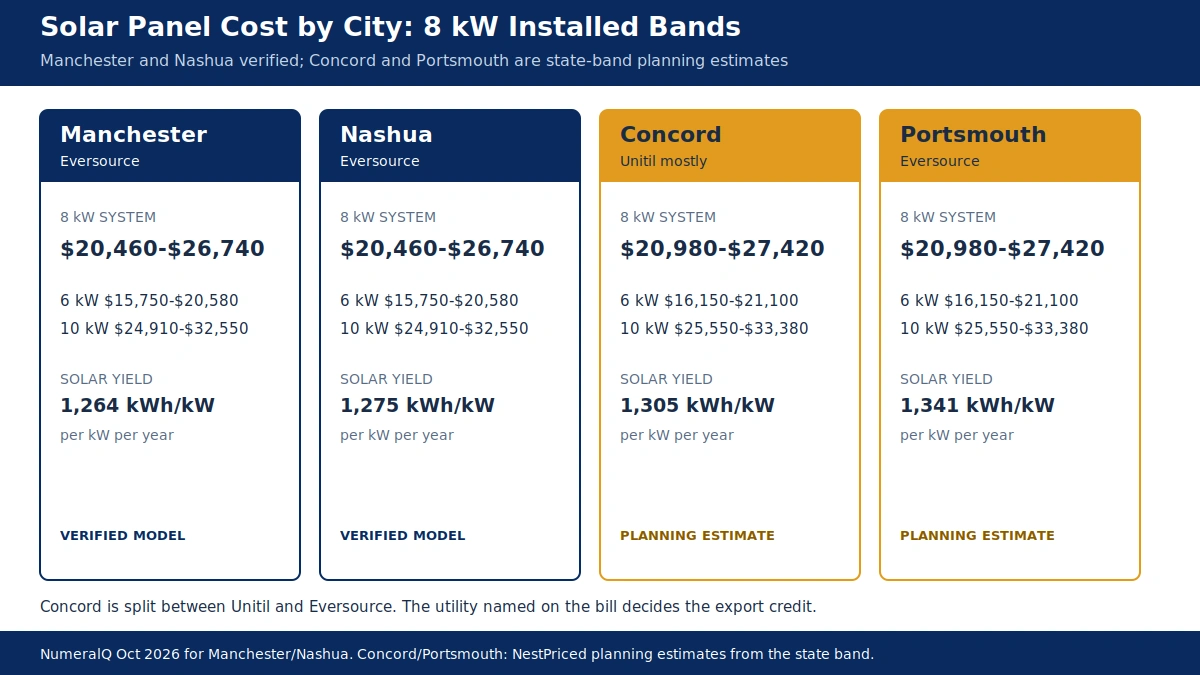
Only two New Hampshire cities have a published cost model. Manchester and Nashua each have a NumeralQ estimator page, and the two carry the same price bands, which is informative by itself: installer labor, electrician pay, and material costs in the state’s two largest cities sit close enough together that the model keeps them as one. Concord and Portsmouth have no published model, so their figures below are planning estimates drawn from the statewide band, labeled as such, and a local quote is the only real price in either city.
| System size | Manchester | Nashua | Concord (estimate) | Portsmouth (estimate) |
|---|---|---|---|---|
| 4 kW | $10,760–$14,060 | $10,760–$14,060 | $11,040–$14,420 | $11,040–$14,420 |
| 6 kW | $15,750–$20,580 | $15,750–$20,580 | $16,150–$21,100 | $16,150–$21,100 |
| 8 kW | $20,460–$26,740 | $20,460–$26,740 | $20,980–$27,420 | $20,980–$27,420 |
| 10 kW | $24,910–$32,550 | $24,910–$32,550 | $25,550–$33,380 | $25,550–$33,380 |
Manchester and Nashua: NumeralQ estimator pricing, October 26, 2026. Concord and Portsmouth: NestPriced planning estimates from the statewide NumeralQ band; no published city model exists for either city. The Manchester and Nashua bands sit about $500 below the statewide band at 8 kW, which reflects city labor and market conditions rather than any difference in equipment.
Manchester is the state’s largest city and its largest solar market, and it sits in Eversource territory. The city bands above are the price to hold a Manchester quote against, and the Eversource export credit of 19.96 cents, covered in the utility section, is what turns that price into a payback near 10 years. The median Manchester home costs $365,600 on American Community Survey 2020–2024 figures via NumeralQ, which puts an 8 kW system at the city midpoint near 6.5 percent of the median home’s value.
Manchester adopted the solar property tax exemption on February 3, 2015, at 100 percent of the equipment’s assessed value, so the panels add no property tax for a homeowner who files Form PA-29 by April 15. One Manchester rule is worth knowing before a ground-mounted array is priced: city code section 5.6.5(J), effective March 1, 2026, requires a lot of at least 20,000 square feet, caps coverage at 5 percent of the lot, requires 25-foot setbacks and a 25-foot height limit, and requires the array to be oriented to reduce glare. Rooftop systems face no such city provision.
Nashua matches Manchester on price and differs in the details around it. Nashua is Eversource electric territory, which surprises buyers who know Liberty’s name from the gas side of the bill: Liberty provides natural gas in the Nashua area, not electricity, and the electric bill is what decides the solar credit. Nashua’s solar yield is a touch stronger than Manchester’s on the published models, 1,275 kilowatt-hours per kilowatt a year against 1,264 at a 20-degree tilt, a difference too small to change any decision. Nashua adopted its solar exemption in 2016, and the city assessing office exempts the full value of the system, subject to an April 15 application and an inspection. The same 8 kW system at the city midpoint weighs least against home values in Nashua, about 5.8 percent of the median home, because Nashua homes cost more.
Concord is the capital, the snowiest of the four cities, and the one where the utility question needs the most care. Most of Concord is Unitil territory: Unitil Energy Systems serves the capital city and parts of a dozen surrounding towns, plus the Seacoast towns around Exeter and Hampton. But Eversource also serves parts of Concord, and the two territories meet inside the city, so a Concord buyer cannot assume the utility from the ZIP code.
Read the bill: if it says Unitil, the export credit is 20.63 cents; if it says Eversource, it is 19.96 cents. Either way the credit is strong, but the supplier trap in the utility section applies to both, and the interconnection application goes to the utility named on the bill.
Concord adopted a solar property tax exemption in some form, but the amount could not be verified for this guide, so a Concord buyer should ask the assessing office what the exemption covers before counting it. No published Concord price model exists, so the estimate above uses the statewide band.
Portsmouth is the Seacoast city, the sunniest of the four on the published models, and an Eversource city. Its modeled yield of 1,341 kilowatt-hours per kilowatt a year is the strongest of the four cities, about 3 percent above Concord, and its coastal position brings milder winters and less snow than the capital. Portsmouth is also a community power city: Portsmouth Community Power enrolls residents in the Community Power Coalition’s Granite Basic supply at 14.949 cents for the August 2026 to January 2027 period, which is 0.94 cents above the Eversource default rate.
That supply choice matters more than the sunshine difference, because a Portsmouth solar home on community power loses the supply part of its export credit unless it returns to default supply. The property tax picture needs a check too: the 2018 state list capped Portsmouth’s exemption at $25,000, but that list is eight years old and the current amount could not be verified, so confirm it with the assessor. Older neighborhoods and the historic district may add review steps for visible work; ask the city before assuming a standard permit path.
The add-on costs that surprise buyers are published for Manchester and worth stating plainly, since Nashua shares the same model. A battery of 10 to 13 kilowatt-hours costs $10,250–$15,860 installed in Manchester on NumeralQ’s model. A main panel upgrade costs $2,200–$3,460. Treat both figures as planning estimates, and insist each appears as its own line on a quote that includes it, never folded into the per-watt price. When the existing panel cannot carry the new system, the upgrade itself is a separate cost, priced across the country in our guide to electrical panel upgrade costs.
A last city-level fact applies in Manchester, Nashua, Concord, and Portsmouth alike. New Hampshire’s housing is old: about 52 percent of homes were built before 1980, and an older home is likelier to need panel work, roof work, or both before panels go on. A Manchester triple-decker from 1920 and a Nashua subdivision home from 2015 can carry the same panel price and very different total job costs. Preparation work belongs on its own quote line, apart from the system price, or the comparison turns dishonest.
New Hampshire Sun, Snow, and Cold: What Your Panels Will Produce
New Hampshire is not a famously sunny state, and buyers sometimes assume the panels will struggle. The models say otherwise. The state gets a respectable amount of sun for its latitude, the cold air helps panels run efficiently, and the long summer days carry most of the year’s production. The honest caveats are snow cover in winter and shade from trees, and both are manageable when the quote is built on monthly figures rather than a single annual promise.
The planning figure adopted here is 1,300 kilowatt-hours per kilowatt each year. NestPriced picked that planning figure because it lands inside the published range instead of at one end of it. A 6 kW system at that figure makes about 7,800 kilowatt-hours a year, which covers the average New Hampshire home’s 7,680 kilowatt-hours. An 8 kW system makes about 10,400 kilowatt-hours, and a 10 kW system about 13,000.
Published models put the range near 1,258 to 1,341 kilowatt-hours per kilowatt each year, with the model, the city, and the tilt moving the figure. The tightest comparison comes from one model run on the same settings for four cities: PVGIS version 5.2, using the National Solar Radiation Database, fixed roof mount, facing south, 30-degree tilt, 14 percent losses, gives Concord 1,304.8, Nashua 1,319, and Portsmouth 1,341. At a flatter 20-degree tilt, the same database gives Manchester 1,264 and Nashua 1,275.
EcoGen’s cost index uses 1,319, a PVWatts-based state table gives 1,258, and a second PVWatts run gives 1,268. The spread across the credible models is about 7 percent from low to high, and the city spread is about 3 percent. Roof direction, tilt, and shade move the result far more than the choice of city does.
Peak sun hours tell the same story in different units. A peak sun hour is a measure of light strength, not a clock hour: one hour of sun at full strength, 1,000 watts per square meter, and it is how panel wattage becomes yearly energy. Published New Hampshire figures run from about 4.0 to 4.6 peak sun hours a day on an annual average, with one index reporting 4.82. The seasonal swing is large: at Concord, each kilowatt of capacity yields about 5.72 kilowatt-hours a day in summer and 5.23 in spring, but only 3.17 in autumn and 1.88 in winter, on hourly weather data from NASA. A summer month makes about three times what a winter month makes, and the system earns its keep from April through September and coasts from November through February.
Cold weather is one of New Hampshire’s real advantages for panels. Panels are rated in the lab at a cell temperature of 25 degrees Celsius, about 77 degrees Fahrenheit, in full sun. Past that point, each extra degree of cell heat cuts output by a fixed percentage, a figure called the temperature coefficient.
Above 25 degrees, a typical modern panel gives up 0.30 to 0.35 percent of its output for each extra degree Celsius. On a New Hampshire roof in July, the cell temperature runs well above the air temperature and costs output to heat.
A bright January day keeps the cells near their rated temperature, and the panels run close to nameplate power. Cold does not double output, and any claim that it does confuses cell temperature with air temperature, but a cold, bright winter day is genuinely good solar weather, and New Hampshire gets many of them.
Snow is the honest caveat, and Concord’s numbers show why. Concord averages about 61 inches of snow a year on the NOAA 1991–2020 normals, with about 18 inches in January and 14 inches in December, and January averages a high of 32 degrees and a low of 11 degrees Fahrenheit. A panel under snow makes no power at all until the snow slides off or melts away.
Dark, tilted panels warm in the sun, so snow usually clears a day or two after a storm, and more tilt sheds it sooner. This guide asserts no New Hampshire snow-loss percentage, because none was verified: the production figures already include 14 percent system losses in the PVWatts and PVGIS models, but those models count snow losses as zero, so a buyer should treat the winter months as the uncertain part of the estimate. Never climb onto a snowy roof to clear panels, and never let anyone scrape them with a metal tool; the quote should address snow shedding through tilt and placement, not through roof work in January.
Roof direction and tilt move production more than most buyers expect. South-facing panels at a tilt near the roof’s natural pitch are the standard case in every model above, and the optimal fixed tilt at Concord’s latitude is about 37 degrees facing south. Most New Hampshire roofs sit flatter than that, and the models at a 20-degree tilt show the cost: about 3 to 4 percent less yearly energy than at 30 degrees.
A west-facing roof makes less energy in total, but more of it lands in the late afternoon. Panels facing east make less again, and a roof section facing north is almost never worth covering. The quote should state the expected production for the actual roof direction and tilt, not the textbook south-facing figure, and it should show monthly figures, not just an annual total, because the monthly shape is what the billing rule pays on.
Trees deserve a paragraph of their own, because they are the most common New Hampshire production problem. A roof shaded by tall pines for part of the day can lose far more production than the difference between any two cities, and shade moves with the seasons as the sun’s path drops. Microinverters or power optimizers, which let each panel work on its own instead of dragging the whole string down to the shaded panel’s level, help on partly shaded roofs and cost more than a single string inverter. The installer should run a shade analysis, name the equipment choice it drives, and state the production estimate with shade included. If the estimate assumes an unshaded roof and the roof is not unshaded, the estimate is fiction.
Net Metering in New Hampshire: The NEM 2.0 Credit Formula
New Hampshire’s billing rule for home solar is called NEM 2.0, and understanding it is worth more than any other section in this guide. It decides what every exported kilowatt-hour is worth, it is locked in through 2040 for systems connected now, and it contains a supplier trap that can cut the credit by two-thirds without any change to the panels. Every savings estimate a buyer sees is built on this rule, whether the salesperson names it or not.
The law behind it is RSA 362-A:9, the state’s net energy metering statute. Net metering, in plain words, is the billing method that credits a solar home for power it sends to the grid. New Hampshire’s version works like this for a home system of 100 kW or less, which covers every residential roof: each kilowatt-hour the home sends out beyond what it used becomes a dollar credit on the bill, and that credit equals the default energy service charge plus the transmission charge plus 25 percent of the distribution charge.
Power the home uses as it is made never reaches the meter and saves the full retail price. Power sent out first cancels power taken later in the same billing month, and only the leftover at month end is credited at the formula rate.
Credits carry forward to later bills. A credit balance above $100 at the end of March can be paid out in cash on request, and state law also allows a payment every three months for a balance above $25.
That formula is NEM 2.0, and it is deliberately less than full retail. It comes from Public Utilities Commission Order 26,029, issued in June 2017, which replaced the older full-retail credit for new systems. In November 2024, Order 27,074 kept the formula in place for all new customers and fixed the legacy end date at December 31, 2040, replacing a rolling term.
A system that receives its net metering allocation now is billed under this formula until that date. The date protects the formula, not the cents: when supply, transmission, or distribution rates change, the credit moves with them, up or down.
The commission’s docket DE 22-060 is still open and includes whether to credit exports at a lower supply rate, and no order changing the credit had issued when the tariff reviews behind this guide were read in October 2026. That open case is a real uncertainty, and it is the reason to connect sooner rather than later and to keep the utility’s written terms in the project file.
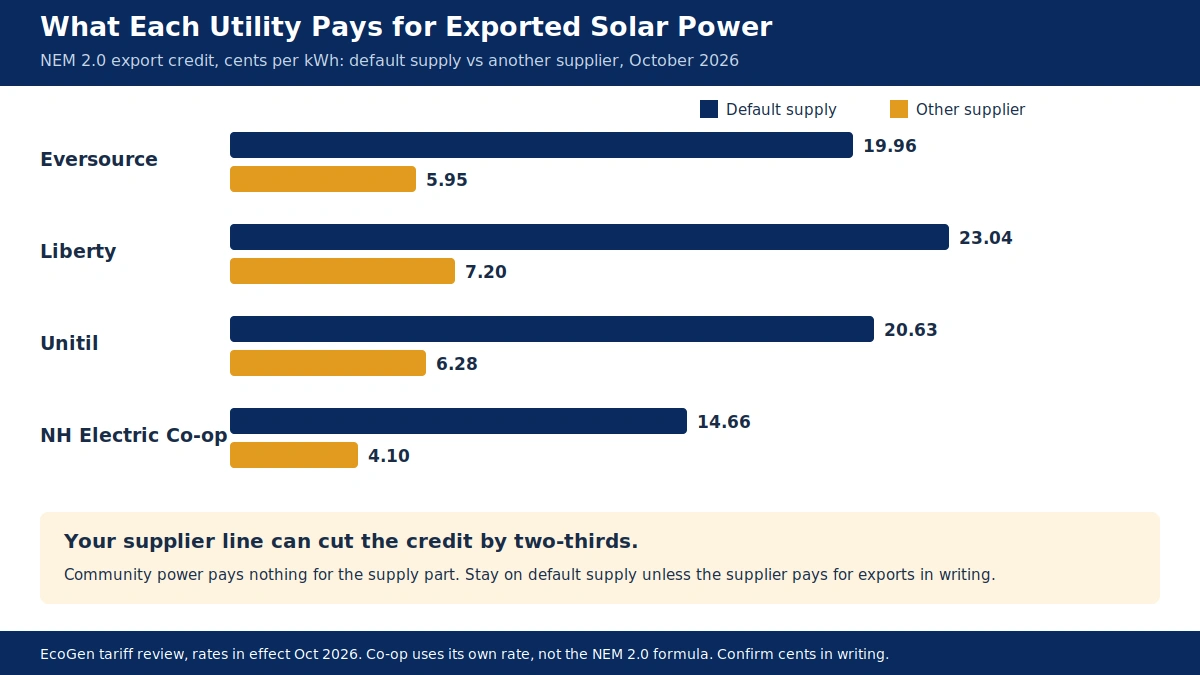
The supplier trap is the part most national guides miss. The formula’s largest piece is the default energy service charge, the supply part of the bill, and the utility pays that piece only to customers who buy their supply from the utility. A home that buys supply from a competitive supplier or a community power program gets only the transmission charge plus 25 percent of distribution from the utility.
Any payment for the supply part must come from the company selling the power, on its own terms, and the Community Power Coalition of New Hampshire, which supplies about 40 percent of the state’s population through town programs, pays its net metered customers nothing for the supply part and recommends they stay on default supply. At Eversource, that difference is 19.96 cents against 5.95 cents.
At Liberty, it is 23.04 cents against 7.20 cents. The panels do not change; the supplier line on the bill changes everything.
Two 2026 laws touch this rule, and both are worth stating accurately because summaries online get them wrong. The first is HB 1718, signed July 10, 2026, which authorizes energy storage in connection with net metering. It clarifies that a battery charged from on-site solar can export power for net metering credits, with exceptions for utility-managed peak demand reduction and pre-storm charging for backup power, and it moves storage rulemaking from the commission to the Department of Energy.
Most of its provisions take effect January 1, 2027, and the detailed rules had not been issued when this guide was researched, so a buyer should not budget battery export credits until the utility publishes its terms. The second is HB 1738, signed July 15, 2026, which one online guide describes as a net metering update.
It is principally a Regional Greenhouse Gas Initiative bill; as amended, it also carried SB538, which extends net metering eligibility terms for municipal energy projects to 20 years for projects already in the interconnection queue, and provisions on nuclear resources. It does not change the residential credit formula.
A third 2026 law fixes a specific enrollment mistake. Community power programs enroll homes in their town automatically, and homes marked as net metered are supposed to be left out, but mistakes happen. Since August 18, 2026, under HB 1742, a solar customer enrolled by mistake can ask the utility to re-enroll them in default energy service and recover up to four months of missed credits. Read the supply line on the bill before the system is switched on, and again after. If it names a company other than the utility, ask that company in writing what it pays for exported power, and ask the utility in writing how to return to default supply.
Two more rules round out the picture. Net metering is open to systems up to 1 megawatt, far above any home roof, and the 100 kW boundary matters because larger systems bill under different terms. State rules also set capacity allocations for the standard net metering tariff by utility, totaling 100 megawatts across the four utilities, and new residential systems take the alternative tariff, which is the NEM 2.0 formula described here. A buyer should confirm with the utility that net metering is open at the address and which tariff applies, in writing, before signing. And from January 1, 2027, a separate law allows one plug-in solar unit of up to 1,200 watts per home; it earns no credit for exported power and is not a substitute for a roof system.
The full text of the statute is public, and the commission’s orders are public too. A buyer who wants the primary sources should ask the installer to cite the current tariff schedule for the utility and the rate class, and should keep that citation with the contract. The next section states each utility’s numbers as reviewed in October 2026, with the reliability of each figure stated plainly.
What Eversource, Unitil, Liberty, and the Electric Co-op Pay for Extra Power
The statute sets the formula; each utility fills in the cents. The table below states the export credit each utility pays, on default supply and on another supplier, at rates in effect in October 2026. These figures come from a tariff review that read each utility’s rate documents in September and October 2026, and they are a secondary compilation rather than the tariff text itself. Rates reset on utility schedules, so every figure below carries the same instruction: confirm the current cents with the utility in writing before signing, and make the installer show the savings math using those cents.
| Utility | Territory | Export credit, default supply | Export credit, other supplier | Built from (Oct 2026) |
|---|---|---|---|---|
| Eversource | Manchester, Nashua, Portsmouth, most of NH | 19.96 cents | 5.95 cents | 14.009 energy + 4.265 transmission + 25% of 6.727 distribution |
| Liberty | Salem area, Lakes Region | 23.04 cents | 7.20 cents | 15.835 energy + 5.548 transmission + 25% of 6.611 distribution |
| Unitil | Concord, Exeter, Hampton | 20.63 cents | 6.28 cents | 14.348 energy + 4.662 transmission + 25% of 6.460 distribution |
| NH Electric Co-op | Rural north, Lakes Region | 14.662 cents | About 4.1 cents | Co-op’s own rate; 10.546-cent Co-op Power part not paid on another supplier |
Eversource is the default New Hampshire experience. It serves about 520,000 customers across 211 communities, including Manchester, Nashua, Portsmouth, and parts of Concord, and it has been a wires-only utility since 2003, meaning it delivers power but does not own generation. Its residential Rate R charges a $19.81 monthly customer charge plus variable charges totaling 25.76 cents a kilowatt-hour at rates as of October 1, 2026, and the $19.81 is owed whether the panels cover the month’s usage or not, which costs $237.72 a year before a single kilowatt-hour is counted.
The energy charge of 14.009 cents runs from August 1, 2026 to January 31, 2027, up from 11.303 cents in the prior six months, a rise of about 24 percent in one step. Eversource resets its default service rate every six months, on February 1 and August 1, and the history swings both ways: about 20 cents in early 2023, about 8 cents in early 2024, about 14 cents now. Solar replaces part of a moving expense with a fixed one, and the export credit moves with the same resets.
One small discrepancy is flagged honestly: the August 1 rate summary lists transmission at 4.445 cents, while the October tariff compilation behind the 19.96-cent credit uses 4.265 cents. The difference moves the credit by less than two-tenths of a cent, and the current tariff wins over either secondary figure.
Liberty Utilities pays the highest export credit of the four, and its territory is the easiest to misunderstand. Liberty’s electric service covers the Salem-area towns in the south and parts of the Lakes Region, while its natural gas service covers a much wider area including Nashua and Manchester. A Nashua buyer who sees Liberty’s name on the gas bill and assumes Liberty is the electric utility will chase the wrong credit.
Liberty’s Rate D homes pay 28.74 cents a kilowatt-hour from August 1, 2026, the highest all-in residential rate of the four, and the supply rate is capped at 15.835 cents through January 31, 2027, so the 23.04-cent credit moves at the next reset. Liberty charges a $200 application fee to connect a system up to 25 kW. Its high retail rate and high export credit make the solar math strong in its territory, and the supplier trap bites hardest there too: the same exported kilowatt-hour earns 7.20 cents on community power instead of 23.04 cents on default supply.
Unitil serves the capital and the Seacoast: Concord and parts of a dozen surrounding towns, plus Hampton, Exeter, Atkinson, Plaistow, and the surrounding Seacoast towns, about 72,600 customers across 408 square miles. Its energy charge of 14.348 cents from August 1, 2026 rose 20 percent from the prior period, and its export credit of 20.63 cents sits between Eversource and Liberty. Unitil’s net metering terms run under its Schedule QF, and the rate parts behind the credit come from the commission’s rate table as reviewed in October 2026. Unitil’s connection fee could not be verified for this guide, so the quote must state it or state that there is none. A Concord buyer should also remember the split-territory warning from the city section: parts of Concord are Eversource territory, and the bill, not the city name, decides which credit applies.
The New Hampshire Electric Cooperative is the exception to every rule in this section, and its members need a different savings model. The co-op is member-owned, sets its own rates through its board, and serves the rural north and much of the Lakes Region across 115 towns and cities. It does not use the NEM 2.0 formula and does not net imports against exports over the month.
Instead, it measures power in and power out separately: power used as it is made never reaches the meter and saves the full delivered rate of 24.713 cents, while each kilowatt-hour sent out earns 14.662 cents, plus a $29.00 monthly member charge. Above 2,000 kilowatt-hours sent out, the credit drops to 12.180 cents, but the rate sheet does not state over what period the 2,000 applies, so ask the co-op before modeling a large system.
The co-op’s application fee is $220 for systems up to 25 kW of alternating-current output, the application must be filed before any equipment is bought, and a credit of $50 or more can be paid by check after the March, June, or September bill. Co-op rates change several times a year, more often than the investor-owned utilities, so a co-op quote ages faster and must be rechecked against the current Schedule of Rates.
Group net metering is the fallback for a home whose roof, shade, or utility rules make rooftop panels a poor fit, and it is how New Hampshire does community solar. A host builds a community-scale project and shares its output with group members, who receive bill credits. Projects up to 5 megawatts of alternating-current capacity can take part; projects of 1 megawatt or less are open to any customer type in the same utility territory, while projects above 1 megawatt are limited to municipal and county entities.
A low- and moderate-income adder of 2.5 cents a kilowatt-hour applies to designated projects, capped at 6 megawatts statewide. The Community Power Coalition’s Poverty Plains project in Warner, a 4.999 megawatt array on an old gravel pit, expects governmental subscribers in Eversource territory to earn 12.5 percent of the applicable net metering credit at no cost to subscribe.
No residential community-solar subscription price was verified for this guide, so none is stated; a renter or shaded-roof homeowner should ask the coalition and the utility what is open in their territory. Shared solar, for homes whose roofs cannot carry panels, is priced for the whole country in our community solar costs across the country.
How Long Until Solar Panels Pay for Themselves in New Hampshire?
New Hampshire payback beats most states, and the price of the power being replaced is why. In August 2026 the statewide residential average was 27.64 cents a kilowatt-hour on Electric Power Monthly Table 5.6.A from the Energy Information Administration, against 18.16 cents nationally, with a 12-month average to August 2026 of 26.95 cents. The EIA table behind those figures is the most authoritative rate source available, and it shows New Hampshire power about half again as expensive as the national average. Roof power replaces grid power that costs 27.64 cents, so every kilowatt-hour the roof makes is worth more here than in a cheap-power state.
The published payback estimates agree on the shape of the answer. EnergySage’s marketplace model puts payback at 9.86 years for its 12.56 kW average system, with $83,196 in 25-year savings after the upfront cost. EcoGen’s per-utility simple payback, on a 9.87 kW system at $28,820 making 13,019 kilowatt-hours a year, puts Eversource at 9.8 years on default supply, Liberty at 10.6 years on default supply and 11.7 years on community power, and the co-op at 12.5 years, all before incentives and without counting upkeep or rate rises. A New Hampshire installer blog, using September 2026 data, puts the average near 11 years. The honest center of these estimates is 10 to 11 years for a right-sized system on default supply in investor-owned territory, and 12 to 13 years in co-op territory.
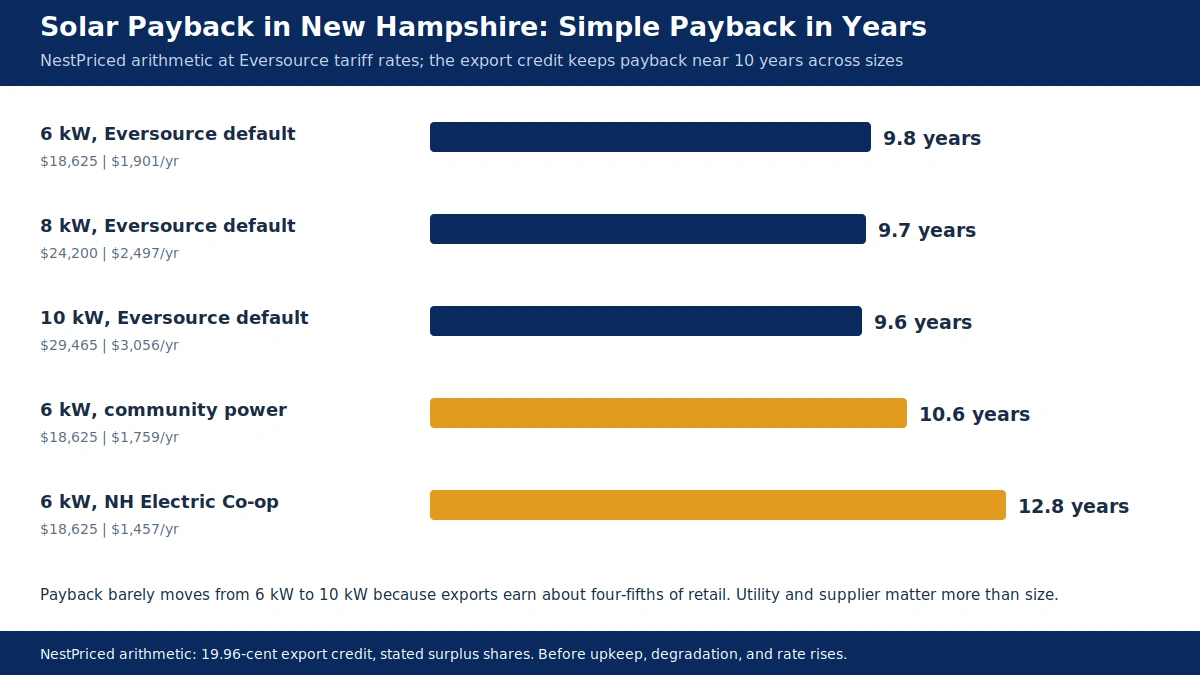
The arithmetic below is NestPriced arithmetic, built at Eversource’s tariff rates, and its assumptions are stated so any reader can redo it. The model uses the 1,300 kilowatt-hour planning figure, an offset value of 25.03 cents for power used at home or netted within the month (14.009 cents energy, 4.445 cents transmission, 6.727 cents distribution, less 0.148 cents stranded cost recovery, from the August 1, 2026 Rate R summary), and an export credit of 19.96 cents for month-end surplus. Savings leave out the $19.81 monthly customer charge, which is owed whether the home has panels or not. The surplus share is assumed at 13 percent for a 6 kW system, 20 percent for an 8 kW system, and 30 percent for a 10 kW system on an average-use home, close to the 13.2 percent leftover share Eversource reported for its solar homes.
| System and case | Cost (midpoint) | Yearly value | Simple payback |
|---|---|---|---|
| 6 kW, Eversource default supply | $18,625 | $1,901 | 9.8 years |
| 8 kW, Eversource default supply | $24,200 | $2,497 | 9.7 years |
| 10 kW, Eversource default supply | $29,465 | $3,056 | 9.6 years |
| 6 kW, Eversource community power | $18,625 | $1,759 | 10.6 years |
| 6 kW, NH Electric Co-op | $18,625 | $1,457 | 12.8 years |
Costs: NumeralQ New Hampshire midpoints, October 2026. Value and payback: NestPriced arithmetic at the rates and assumptions stated above, before incentives, upkeep, degradation, and rate rises. The co-op case assumes 40 percent of output is used at home as it is made, with the rest credited at 14.662 cents. The community-power case holds the offset value constant for comparability and prices surplus at 5.95 cents, which understates the loss slightly because the supply price differs too.
The table carries a lesson that runs against the usual sales pitch in other states. Payback barely moves as the system grows, from 9.8 years at 6 kW to 9.6 years at 10 kW, because the export credit is about four-fifths of the offset value and extra panels keep earning a strong return. That flatness is a New Hampshire feature, not a mistake, and it means a buyer who sizes up for a future heat pump or electric vehicle is not throwing money away in Eversource territory. It also means the supplier choice and the utility matter more than the system size: the same 6 kW system pays back in 9.8 years on default supply, 10.6 years on community power, and 12.8 years in co-op territory. Size the system to the bills, keep the supply on default unless the supplier pays for exports in writing, and let the credit do its work.
The simple model leaves out three forces, and they push the real payback in different directions. Electricity rates rise and fall: the statewide average rose 13.1 percent in the year to August 2026, Eversource’s supply rate rose 24 percent in one six-month step, and the same rate was about 20 cents in early 2023 and about 8 cents in early 2024. Every future rise shortens payback, and every fall lengthens it.
Year by year the panels lose about 0.5 percent of output, which pulls the payback out slightly. Upkeep adds a cost the simple model leaves out, above all a possible inverter replacement during the second decade. A buyer who treats 10 to 11 years as the planning case in investor-owned territory, with rate rises as the upside and upkeep as the offset, is reading the New Hampshire numbers honestly.
The 25-year view is where the case becomes comfortable. At the modeled $1,901 a year for a 6 kW system, adjusted for slow degradation, the system returns roughly $44,800 in bill value over 25 years against an $18,625 cost, before incentives and before any rate rises. Even a 2 percent yearly rise in rates widens that margin further. EnergySage’s $83,196 in 25-year savings for its larger average system is built on the same logic with rate inflation included, and the two figures are consistent once the system sizes are accounted for. Solar in New Hampshire is a solid, decade-scale return, not a quick one, and a buyer who needs the money back in five years should not buy panels on financial grounds alone.
Should You Add a Battery to Solar Panels in New Hampshire?
A home battery holds extra solar power for use after dark, and in states where evening power is far pricier than midday power, moving solar energy into the evening is how it earns its keep. In New Hampshire that money-making case is weak in investor-owned territory and modest in co-op territory, and the honest reason is the export credit. The grid already pays well for surplus power: 19.96 cents on Eversource default supply, against 25.03 cents for power used at home. A battery can only improve on that deal by the 5-cent spread between the two values, and there are only so many kilowatt-hours to shift.
The arithmetic makes the point. On Eversource default supply, the spread between the offset value and the export credit is 5.07 cents. A battery that shifted 3,000 kilowatt-hours a year from export to home use, a generous assumption for a single 13.5 kilowatt-hour battery, would earn about $152 a year in extra bill value. In co-op territory the spread is wider, 10.05 cents between the 24.713-cent delivered rate and the 14.662-cent export credit, so the same 3,000 kilowatt-hours would earn about $302 a year. Against a battery costing $13,000 or more, the bill-saving payback runs to many decades in Eversource territory and several decades in co-op territory, which is another way of saying the battery does not pay for itself on bill savings in New Hampshire.
That does not make a battery pointless. It makes it a resilience purchase with one real payment attached, and New Hampshire gives a buyer genuine reasons to want one. Winter storms, ice, and heavy wet snow take down lines in a heavily wooded state, and a home that loses power in January loses heat, water, and light together. A battery with islanding capability, the ability to disconnect from the grid and power the home on its own, keeps the refrigerator, the furnace or boiler controls, the well pump, and the phones running through an outage, and solar refills it each sunny day. A buyer who has lived through a multi-day winter outage understands that value without a spreadsheet, and a buyer in co-op territory, where restoration can run last on long rural feeders, understands it best of all.
Battery prices run as follows. Across the country, a home battery install ran $700–$1,300 per kilowatt-hour in EnergySage marketplace data reported in September 2026. The typical install in the first half of 2026 was 13.5 kilowatt-hours for $15,647, or $1,159 per kilowatt-hour. The Tesla Powerwall 3 is the home battery quoted most often: 13.5 kilowatt-hours with 11.5 kW of continuous output and a built-in inverter.
EnergySage data put the average installed price at $13,473, with a typical range of $13,000–$16,500. The New Hampshire-specific planning estimate from NumeralQ puts a 10 to 13 kilowatt-hour battery add-on at $10,250–$15,860 installed in Manchester. The Powerwall 3 warranty holds 70 percent of capacity for 10 years, and about 89 to 90 percent of the energy stored comes back out, a figure called round-trip efficiency.
The one real battery payment in New Hampshire belongs to Eversource customers. Eversource’s ConnectedSolutions program, funded through the Clean Energy Fund, pays $230 per kilowatt-hour of enrolled storage as a one-time upfront payment, capped at $3,000 per residential account. A 13.5 kilowatt-hour battery hits the cap, so the payment is $3,000, and it arrives as a check within about four weeks of acceptance.
The battery must be an approved Enphase or FranklinWH model bought after October 1, 2022, the home enrolls in three years of demand response, and Eversource draws on the battery about 40 times a year from June through September between 3 and 8 p.m., never below 20 percent charge. Funds are limited, and the current balance could not be verified, so ask Eversource whether money remains before budgeting the payment. A separate 0.00 percent APR loan through the National Energy Improvement Fund offers $1,000 to $10,000 for Eversource customers with an approved battery, first come, first served.
Liberty’s battery leasing pilot, which offered utility-owned Powerwalls, is closed to new applicants. No battery rebate was found from Unitil or the co-op, and the federal credit for a homeowner-owned battery placed in service in 2026 is $0, the same as for the panels.
The battery decision comes down to three questions. The first is outage history: a home that lost power for days in a winter storm, or sits at the end of a long rural feeder, has a stronger case than a home on a city circuit that rarely blinks. Second is need at home: medication that must stay cold, a home office, a well pump, or a sump pump that has to keep running through a storm all make the case stronger.
Third is sizing the battery to the need. One 13.5 kilowatt-hour battery carries essentials for most of a day while solar refills it, but backing up the whole home through a multi-day outage takes more capacity than most buyers plan for. One more question belongs on the list in New Hampshire: whether the battery model qualifies for ConnectedSolutions, because a $3,000 payment changes the math more than any arbitrage ever will.
A cheaper way to ride out an outage is worth weighing first. A portable generator runs on gasoline or propane, costs far less than a battery, and keeps the same essentials going in an outage, but it needs refueling, it is loud, and it never starts on its own. When the only goal is getting through the next storm, price a generator first and compare it with the battery. A buyer who wants backup that is silent, automatic, and fed by the roof, and who can pay for it as safety and comfort rather than as an investment, should buy the battery knowing the payback is weak. From January 2027, the HB 1718 framework may also let solar-charged batteries earn net metering credits for power they send to the grid, but the detailed rules had not been issued when this guide was researched, so no battery export income should be budgeted until the utility publishes its terms.
Solar Incentives, Tax Breaks, and Loans in New Hampshire in 2026
The incentive picture in New Hampshire is short, and honesty about it is the point of this section. There is no state check, no state tax credit, and no federal credit for a homeowner-owned 2026 install. What exists is a town-by-town property tax vote, no sales tax, a strong export credit, one battery payment for Eversource customers, and two federal rebate programs that have not launched. A quote that counts anything beyond that list is counting money that does not exist.
The federal picture is simple, and it is the first thing a New Hampshire buyer must absorb. For a system the homeowner owns and places in service during 2026, the federal tax credit is $0. The One Big Beautiful Bill Act, Public Law 119-21, ended the residential clean energy credit under section 25D for systems installed after December 31, 2025.
The same law ended the energy efficient home improvement credit under section 25C, as the Internal Revenue Service confirmed in Fact Sheet FS-2025-05. Add up every federal program open to a homeowner-owned install in 2026 and the total is plain: the federal government contributes $0. Any quote, advertisement, or savings sheet that still subtracts 30 percent for a federal credit is using expired law, and several national solar websites still do, including one that shows a $6,622 credit on its New Hampshire page.
New Hampshire adds no state rebate and no state income tax credit, for two separate reasons. The state’s residential rebate program, the Residential Renewable Electrical Generation Rebate Program, was permanently closed when Senate Bill 303 of 2024 repealed it, and a 2025 budget law closed all state renewable rebate programs to new projects. There is nothing to apply for, no waitlist to join, and no revival to wait for.
The state income tax credit cannot exist as a matter of structure: New Hampshire does not tax wages, and its tax on interest and dividends was repealed on January 1, 2025, so there is no income tax for a credit to reduce. The Solar for All grant, a $43.51 million federal award planned for community solar, is not a household program either: the Environmental Protection Agency ended the grants in August 2025, two federal courts ruled that termination unlawful in September 2026, and the agency was weighing an appeal as of October 2026. No household application exists today.
The property tax exemption is the one incentive with real money in it, and it is decided town by town. State law at RSA 72:61 and RSA 72:62 lets each city and town adopt an exemption from the assessed value for a solar energy system, but it does not require any town to do so. The definition was rewritten in 2019, and for towns that adopted or re-adopted on or after January 1, 2020, it covers photovoltaic panels, inverters, and storage across grid-tied, net-metered, group-net-metered, and off-grid systems. As of June 2018, the last published state list, 135 of the state’s 234 municipalities had adopted the exemption in some form. The amounts vary widely: many towns exempt 100 percent of the assessed value of the equipment, some exempt 50 percent, some exempt the cost or replacement cost including installation, and some cap the exemption anywhere from $5,000 to $50,000.
| City | Exemption status | Amount | Source and date |
|---|---|---|---|
| Manchester | Adopted Feb 3, 2015 | 100% of equipment assessed value | City assessor page, read Sept 2026 |
| Nashua | Adopted 2016 | Full value of the system | City assessing page, read Oct 2026 |
| Concord | Adopted in some form | Amount unverified | 2018 state list; confirm with assessor |
| Portsmouth | Adopted in some form | $25,000 cap on 2018 list; current amount unverified | 2018 state list; confirm with assessor |
The exemption is not automatic even where the town adopted it. The homeowner must apply on Form PA-29, available from the Department of Revenue Administration, by April 15 of the year the exemption is first claimed, must have owned the property as of April 1, and must show the system exists and works; Nashua requires an inspection, and the assessors must send a written decision by July 1. File before the April 15 deadline or the exemption waits a year.
A separate local option at RSA 72:85 covers home batteries, and the assessor can say whether the town adopted that one too. The value is real: at New Hampshire’s high property taxes, a $15,000 addition to assessed value would cost roughly $290 a year at an illustrative 1.93 percent effective rate, or about $7,250 over 25 years, and the exemption wipes that out where it applies. That rate is a single-source figure used for illustration only; the assessor’s answer for the exact address is what counts.
What New Hampshire does offer every buyer, with no form and no deadline, is the absence of sales tax. The state has no general sales tax, so the installed price is the price, with no 6 or 7 percent added at the bottom of the quote as in neighboring states. That is worth roughly $1,500 on a mid-band 8 kW system compared with a taxed state, though the exact comparison depends on the other state’s rate and what it taxes. Combined with the export credit locked in through 2040, the no-sales-tax rule is the quiet reason New Hampshire’s total cost lands close to the national average while its payback lands well ahead of it.
NHSaves, the statewide efficiency program run jointly by the four utilities, pays for efficiency work, not for panels. Its heat pump rebates, $250 a ton for a standard install and up to $2,000 a ton for a home leaving electric resistance heat, plus a $650 regional accelerator discount, can pair with a solar project when a home adds a heat pump alongside the panels, but no NHSaves money goes toward the panels themselves. A home that is adding a heat pump should price both together and stack the heat pump rebate honestly; a home that is only adding panels should not let a quote count NHSaves at all. Our New Hampshire heat pump cost guide prices the heat pump side in full.
New Hampshire has launched neither of the two federal home energy rebate programs, HEAR and HOMES, so neither one can appear in a 2026 budget. The Department of Energy’s HEAR page, updated July 29, 2026, lists the program as coming soon with a fall 2026 launch expected, after the Governor and Council approved the implementation contract with Everblue on March 25, 2026, but a check on November 9, 2026 found funding still not available to consumers, and no launch date has been announced. The HOMES page says the program is not available to New Hampshire consumers yet and awaits federal approval and funding.
HEAR, when it launches, will pay up to $8,000 at the point of sale for income-qualified households at or below 150 percent of area median income, but it does not cover solar panels, federal program notices effective May 29, 2026 limit it to electric-to-electric appliance replacements, and projects started before launch will not qualify because the program is not retroactive. A 2026 solar budget should count on neither program. What ended, what survives, and what the new law means for a 2026 install is set out in our guide to the federal energy tax credits.
Loans split the upfront cost without changing who owns the system. No New Hampshire state solar loan program was verified for this guide. Credit-union solar loans exist in the state, and at least one established installer lists an EastRise Credit Union loan as its financing route, but no terms were verified and none are stated here.
A home equity line or an installer loan are alternatives, and the comparison must be honest about the loan term and any dealer fee: a loan keeps ownership, net metering, and the property tax exemption with the homeowner, and the monthly loan payment can be compared directly against the monthly bill saving. Ask every lender for the cash price and the financed price side by side, with any dealer fee shown as its own line, because a financed price that hides a 15 or 20 percent fee is not the same price as the cash quote. For third-party systems one narrow federal route survives, and the lease section covers it: a leasing company can claim the commercial credit under section 48E for a system it owns and pass it through as lower payments, for systems placed in service by December 31, 2027.
Lease vs Own: How Third-Party Solar Works in New Hampshire
In New Hampshire a homeowner can choose among three ways to get solar: buy the system outright or with a loan, lease it from a solar company, or sign a power purchase agreement and buy the power it makes. All three are available here, unlike in some states where third-party ownership runs into legal barriers. The federal credit’s end for owners has made the rented options more competitive than they were, because the company that owns the system can still claim the commercial credit and pass part of it through. That does not make renting the better deal for every home; it makes the comparison worth doing properly.
EnergySage marketplace data for New Hampshire, November 2026, prices all three routes for its 12.56 kW average system. A power purchase agreement runs from about $151 a month, at a typical rate of 16 to 19 cents a kilowatt-hour over 25 years with an escalator of 0 to 1 percent a year, and the provider handles upkeep while the contract transfers to the buyer if the home sells. A lease runs about $183 a month, with a typical range of $78 to $317 a month and a 3 percent yearly escalator.
A lease-to-own deal runs about $183 a month with a path to ownership after about five years. A prepaid lease costs about $35,000 upfront with no monthly bills. A loan runs about $306 a month.
Cash costs $36,154 upfront. The 25-year savings estimates tell the story: $61,430 for the power purchase agreement, $14,895 for the lease and the lease-to-own deal, $44,975 for the loan, $83,196 for cash, and $100,491 for the prepaid lease. Two installers on the marketplace offer lease or purchase-agreement deals, eleven offer ownership, and four offer rent-to-own.
The lease math turns on three numbers that must all be in writing. The first is the escalator: a 3 percent yearly rise turns a $183 monthly payment into about $244 in year 10 and about $328 in year 20, and the 25-year total can exceed the cash price of the system while the home never owns it. A power purchase agreement with a 0 to 1 percent escalator ages far better, which is why its 25-year savings estimate is four times the lease’s.
The second is the federal pass-through: the leasing company claims the commercial clean electricity credit under section 48E and should pass the value through as lower payments, but the buyer does not claim the credit and cannot verify it from the lease paperwork alone, so the pass-through must be stated in the contract and the payment schedule must show it. The third is what happens at the end and on a sale: the buyout price, the transfer terms, the removal terms, and who holds the net metering credits and the renewable energy certificates, the paper credits that prove the power came from a renewable source. A lease that keeps the net metering credits with the company while the homeowner pays the lease is a different deal from one that credits the homeowner’s bill, and the contract must say which it is.
Ownership, by contrast, is straightforward and is what the payback section models. The buyer pays the installed price, owns the equipment and the renewable energy certificates, claims the NEM 2.0 credit on the utility bill, files for the property tax exemption, and keeps whatever surplus credits accumulate. Upkeep, the risk of an inverter replacement, and responsibility for the roof all sit with the buyer, who needs a roof that outlasts the panels or a budget for taking the panels off and putting them back when the roof is replaced. No detach and reset price specific to New Hampshire was verified, so this guide states none; a roof near the end of its life should still have that line in the quote. For the national picture on that cost, see our solar panel removal and reinstall cost guide.
The decision rule is short. Buy, with cash or a loan, if the home will be kept for at least 10 years, the roof has at least 15 years of life, and the utility’s net metering is confirmed at the address, because ownership keeps the most value over 25 years. Consider a power purchase agreement if the home cannot fund the upfront cost and the agreement offers a low escalator, a clear pass-through, and clean transfer terms, and compare its 25-year total against the loan’s 25-year total, not against the monthly payment alone. Be cautious with a standard lease at a 3 percent escalator, because the rising payment eats the savings year by year. And do not let a promise of free panels substitute for the ownership math, because the ownership math is the only math verified for New Hampshire in full.
Snow Loads, Ice Dams, and Wind: Will New Hampshire Weather Damage Solar Panels?
New Hampshire weather tests a roof system in ways that have little to do with hail. The threats here are weight, water, and wind: heavy snow loading the roof for weeks, ice dams backing water under shingles, and winter storms driving wind and ice against everything mounted on the roof. A buyer here should choose equipment and racking with those three threats in front of them, and should confirm the roof itself is sound before anything is mounted on it.
Snow load is the first question, and it is an engineering question, not a guess. Panels add weight to the roof and change how snow drifts, slides, and piles against obstructions. The racking must be engineered for the design snow load at the exact address, which rises from the Seacoast toward the White Mountains and the North Country, and the installer should state the design load and the tilt plan that sheds snow.
Concord’s 61 inches of annual snow is the middle of the state’s range, not the top of it, and a home in the higher country faces deeper snow and longer cover. The structural check on an older roof should account for the combined load of the panels, the racking, and the snow, and a roof with soft decking, sagging rafters, or past water damage should be repaired or replaced before the racking goes on. Ask for the engineering basis in writing; a verbal assurance that the racking handles snow is not an engineering basis.
Ice dams are the second question, and they are a roof and attic problem that panels can complicate. An ice dam forms when heat escaping into the attic melts snow on the upper roof, the meltwater runs down to the cold eave and refreezes, and the dam backs water under the shingles. Panels do not cause ice dams, but they change snow melt patterns on the roof face, and every roof penetration for the racking is a place where backed-up water can find a path inside if the flashing is poor.
The defenses are the same ones that protect any New Hampshire roof: sound flashing at every penetration, an ice and water barrier at the eaves, adequate attic insulation and ventilation, and a workmanship warranty that covers roof penetrations in writing. The established New Hampshire installers named in the permits section warrant roof penetrations for 10 to 12 years; any installer who will not warrant penetrations in writing should not be on the roof. If the home already grows ice dams most winters, fix the attic and the roof first, because panels mounted over a dam-prone roof inherit the problem.
Wind is the third question. NOAA logged 149 thunderstorm wind reports of 58 mph or more in Hillsborough County in the ten years from 2016 to 2025, and winter storms add their own wind and ice loading on top of the summer thunderstorm season. Panel makers in the top tier test to high wind speeds, but the racking and the attachment to the roof structure count as much as the panel rating: a panel that rides out the wind yet tears its mount from rotted decking has still failed. Ask the installer to name the racking system and the attachment method, and to state the design wind speed the array is engineered for, then confirm the roof decking is sound before any racking goes on. Ground-mounted arrays face their own wind and snow engineering, plus the local rules illustrated by Manchester’s lot-size, coverage, setback, and height limits.
Hail, the headline risk in the Plains states, is a minor risk here. NOAA logged 2 reports of hail two inches or wider in New Hampshire in the ten years from 2016 to 2025. Panels certified to UL 61730 and IEC 61215 are tested against 1-inch ice balls at about 50 mph, and the field evidence from larger hailstorms elsewhere shows survival rates above 99 percent. A New Hampshire buyer does not need to shop for hail ratings the way a Nebraska buyer does, but the insurance question below still matters, because the same storm that brings hail brings wind, and wind claims are the common ones.
Insurance is where buyers most often get caught, in New Hampshire as everywhere. Get the insurer’s answers in writing before the panels go on: that the panels are covered under the dwelling policy, whether the coverage pays replacement cost or actual cash value, what the wind and hail deductible runs in dollars, and whether cosmetic damage is excluded, which matters because a storm can mark a panel that still produces power. No New Hampshire-specific figure for the premium effect of adding solar was verified, so none is stated; the insurer’s written answer for the exact policy is the only figure that counts. Confirm the coverage before winter, not after the first storm, and keep the confirmation with the contract, the permit, and the utility approval in one file.
Permits, Licenses, and Installer Rules in New Hampshire
No license in New Hampshire covers solar alone, so the electrical license is the one that counts. The state licenses electricians, plumbers, and gas fitters through the Office of Professional Licensure and Certification, but it issues no statewide general contractor license and runs no home-improvement contractor registration. Anyone can call themselves a contractor; only a licensed electrician can legally do the electrical work on a solar install for pay. That single fact organizes the whole permits section.
The electrical law is RSA 319-C. Section 319-C:1 bars any electrical installation for compensation unless it is made by an electrician or other person licensed by the Office of Professional Licensure and Certification, with narrow exceptions. A journeyman electrician needs 8,000 hours as an apprentice plus 600 hours of approved education plus an exam.
A master electrician needs 2,000 hours of field experience as a journeyman plus an exam on top of that foundation. A corporation or partnership doing electrical work needs an entity license with a licensed master directly in charge of its business affairs. License fees, effective July 1, 2025, run $198 for a two-year master license, $110 for a journeyman, $137 for a corporation or partnership, and $33 for a 12-month apprentice registration, plus a $90 exam fee.
Licensees must complete 15 hours of instruction on each new edition of the National Electrical Code. A homeowner may wire the single-family home they own and occupy, but that exception does not extend to hired help, and a solar install is not a homeowner wiring project. Licenses can be checked in the state’s online license verification search, and the buyer should check the installer’s entity license and the master in charge before signing.
The building code adds a timing wrinkle that matters for late 2026 and 2027 projects. The state building code under RSA 155-A is effective in every municipality and is built on the 2021 editions of the International Building Code and International Residential Code, the 2018 energy code, and the 2023 National Electrical Code. An update to the 2024 building and residential codes took effect July 1, 2026, with a six-month concurrency period through December 31, 2026, during which a permit can be submitted under either the 2021 or the 2024 codes. From January 1, 2027, all permit requests follow the 2024 codes. The installer should know which code edition the permit will be filed under and should file before the work starts, not after.
The town or city permit comes first and the utility approval follows it, because the utility step depends on the town’s. A building or electrical permit comes from the town or city building official where the municipality has adopted enforcement, and from the state fire marshal in towns that have not set up local enforcement. No published solar permit fee was found for Manchester or Nashua, and no fee schedule was verified for Concord or Portsmouth, so the quote must state the permit fees or state that they are included.
The utility’s interconnection approval must arrive before the system is switched on, and the co-op requires its application before equipment is bought. Liberty charges $200 and the co-op $220 for systems up to 25 kW; Eversource and Unitil fees could not be verified. In practice the installer handles the permit and interconnection steps, but the buyer should confirm they happened, because a system switched on without the utility’s approval can sit idle or face refusal of the interconnection.
Three installers illustrate what to check, drawn from company sites and the Electricians Board registry as read in October 2026. Granite State Solar, based in Bow and founded in 2008, held Electrical Corporation license 0366C, active through May 31, 2027, and warrants workmanship for 12 years including roof penetrations. ReVision Energy, with New Hampshire offices in Brentwood and Enfield and employee-owned since 2017, warrants workmanship for 10 years in New Hampshire including roof penetrations, but its Electrical Corporation license 0243C showed as expired on May 31, 2025 when checked on October 13, 2026, so a buyer should ask for a current license before relying on that listing. Venture Home, which lists no New Hampshire office and gives a Hudson, Massachusetts address, held Electrical Corporation license 0506C, active through May 31, 2027, and its sales page promises 25 years of coverage for the system, labor, and workmanship, with the actual length and scope set in the service agreement. These are facts from dated checks, not recommendations, and the license status of any installer must be rechecked at signing time, because licenses renew, lapse, and change.
Two protections for the buyer belong in every contract conversation about New Hampshire solar. The first is the lien law: under RSA 447:5 and 447:6, a subcontractor or supplier without a direct contract with the homeowner must give notice before furnishing work, and a later notice covers only amounts then due; after a notice, the contractor must give written accounts every 30 days and the owner must hold back enough to cover the claim, and a lien expires after 120 days unless secured by a court attachment. On a solar install, the panel and inverter distributor and any electrician the installer subcontracts are the likely lien claimants. What the law means in practice: never pay in full before the system is inspected and running, tie every payment to a written milestone, and keep the contract, the permit, the inspection sign-off, and the utility approval in one file. The second is the paper trail itself: the contract should name the panel model, the inverter type, the racking system, the warranties, the payment schedule, and who handles each permit and application, because a dispute over a solar install is won on the paper, not on the memory of a sales conversation.
Checking the installer takes minutes and is not optional. Confirm the New Hampshire electrical corporation license and the master in charge through the state’s verification search. Confirm liability and workers’ compensation insurance certificates are current.
Confirm three recent New Hampshire installs with addresses the buyer can drive past, and ask those homeowners about leaks, snow shedding, and how the installer handled the utility paperwork. Confirm the installer will name the export credit, the supplier, and the property tax filing in the quote. An installer who cannot produce the license, the insurance, and the references should not be on the roof, however polished the sales presentation.
Getting Solar Quotes in New Hampshire: Checklist and Decision Rules
Quotes can only be compared fairly when every bidder prices the identical job on the identical assumptions, and the checklist below forces that comparison. Ask three licensed installers for written quotes on the identical job: the same system size, the same class of panel, the same roof scope, with every checklist item answered in writing. A bidder who will only answer out loud, or who folds every answer into one monthly payment number, is keeping the buyer from comparing bids fairly.
- Panel make, model, wattage, efficiency, and temperature coefficient, in writing
- Inverter type, string or microinverters, make and model, warranty length, and whether the warranty covers labor
- Racking system, attachment method, design snow load, and design wind speed, in writing
- Year-one production estimate in kilowatt-hours, shown month by month, with the weather data source and the shade analysis named
- Total installed price with every add-on as a separate line: panel upgrade, roof work, battery, tree work, permit fees, interconnection fee, and sales tax of $0 stated as such
- The export credit and the retail rates the savings math assumes, with the utility name, the rate schedule, and the supplier named
- The supplier the savings math assumes, default supply or otherwise, and what that supplier pays for the supply part of exported power, in writing
- The property tax exemption status for the exact address, who files Form PA-29, and the April 15 deadline
- The interconnection steps and who handles each one, including the utility application, the permit, and the permission to operate
- The workmanship warranty length and what it covers, the roof penetration warranty, and the process if a leak appears under the array
- The production guarantee, if any, and what the installer pays or does if the system underproduces
- The payment schedule tied to milestones, with no full payment before inspection and utility approval
- The removal and reinstallation price if the roof needs replacing during the panel warranty period, quoted now, not later
The decision rules follow from everything above, and they are stated as rules because New Hampshire punishes vague intentions. Rule one: size to the bills. A 6 kW system fits the average New Hampshire home; a larger system needs a load to justify it, such as a heat pump, an electric vehicle, or electric water heating; and the strong export credit is a cushion for sizing up, not a reason to fill the roof without a load.
Rule two: read the bill before believing the savings. The utility name, the rate schedule, and the supplier line decide the export credit, and the credit decides payback. A savings estimate that does not name all three is not an estimate. Rule three: stay on default supply unless the supplier pays for exports in writing. Community power and competitive suppliers can offer a lower supply price, but the lost export credit usually costs more than the supply saving earns, and the HB 1742 fix exists for buyers enrolled by mistake.
Rule four: never budget an incentive that has not been confirmed. The state rebate is closed, the federal credit is $0, HEAR and HOMES have not launched, the Eversource battery payment depends on limited funds and approved models, and the property tax exemption depends on the town’s vote and a timely filing. A budget built on an unconfirmed incentive is a budget built on hope.
Rule five: fix the roof first. Panels keep working for 25 years or more, so a roof with only five years left means paying for removal and reinstallation halfway through the payback period. When the roof is near the end of its life, get one combined price for roof and panels, put the roof first, and get the penetration warranty in writing from the installer.
Rule six: buy the battery for keeping the power on, not for making money. In Eversource territory a battery earns roughly $152 a year in extra bill value on the modeled spread, and it should be bought for outage protection with open eyes, or not bought at all, unless the ConnectedSolutions payment and an approved model change the math. Rule seven: weigh solar against what the same money would do elsewhere.
The cheap efficiency work comes first for a home that has not done it: insulation, air sealing, and a heat pump cut the bill for less money than panels, so price them before pricing a system. A homeowner torn between a heat pump and panels, or planning both at once, can weigh the two options side by side in our heat pump or solar comparison.
A home with a sound roof, a good roof direction, a confirmed default-supply deal with the utility, and a 10-year horizon is the right home for solar. A home missing any one of those may do better with efficiency work first and panels later, which is a sound result, not a lost sale.
Sources & methodology
Cost sources: NumeralQ New Hampshire, Manchester, and Nashua solar cost pages, estimator pricing October 26, 2026 (planning estimates, not bids; EnergySage and SolarReviews data retrieved October 26, 2026; model v2); EnergySage New Hampshire solar cost page, updated November 6, 2026 (marketplace quote data); EcoGen America Solar Cost Index, September 2026 edition, and EcoGen New Hampshire hub page, updated October 19, 2026; SolarReviews solar cost page and New Hampshire incentives page, November 2026 (federal credit math on the incentives page is stale and was not followed); solarenergyprices.com, August 2026; ConsumerAffairs New Hampshire incentives page, updated September 12, 2026; renewestimator and sunmetriclab (weak/stale, noted not followed); Berkeley Lab U.S. Distributed Solar and Storage 2026 Data Update (2025 installed-price records, different basis, noted not followed as the headline price).
Production sources: PVGIS version 5.2 model runs via Solar Learning Lab, August 18, 2026 (NSRDB radiation database, fixed roof mount, south-facing, 30-degree tilt, 14 percent losses); PVGIS via NumeralQ (20-degree tilt, south-facing, 14 percent losses); EcoGen Cost Index production figure; NREL PVWatts version 8 via TheGreenWatt (April 2026) and SparkPowered; ProfileSolar Concord seasonal analysis (NASA POWER hourly data); NOAA National Centers for Environmental Information 1991–2020 climate normals, Concord Municipal Airport station USW00014745; temperature coefficient ranges from published panel specifications.
Rate and utility sources: U.S. Energy Information Administration, Electric Power Monthly, Table 5.6.A, August 2026, and Form EIA-861 final 2025 data; EcoGen New Hampshire hub tariff review, rates in effect October 2026 (Eversource Summary of Electric Rates October 1, 2026; Liberty Electricity Delivery Service Tariff NHPUC No. 23; Unitil Schedule QF and PUC rate table; New Hampshire Electric Cooperative Schedule of Rates effective August 1, 2026, Schedule of Fees effective January 1, 2026, and Terms and Conditions); Eversource Rate R summary, August 1, 2026; Concord Community Power and Portsmouth Community Power rate notices, August 1, 2026 to January 31, 2027; Community Power Coalition of New Hampshire Net Energy Metering FAQ, read October 6, 2026; Unitil Corporation Form 10-K for fiscal year 2025.
Law and program sources: RSA 362-A:9 (net energy metering); PUC Order 26,029 (2017) and Order 27,074 (November 18, 2024); PUC Docket DE 22-060 (open); Puc 903.02 (capacity allocations); HB 1718 (2026, chapter 309), HB 1738 (2026, chapter 332), HB 1742 (2026, chapter 179), SB 538 (2026, chapter 315), SB 540 / 2026 chapter 262 (plug-in solar); RSA 72:61, 72:62, 72:27-a, 72:85 (property tax exemptions); Department of Revenue Administration Form PA-29 and June 2018 municipal exemption list; Manchester assessor and Nashua assessing pages; RSA 319-C (electricians) and OPLC fee schedule Plc 1002.13; RSA 155-A and RSA 674:51 (building code and permits); RSA 447:5–6 and 447:8 (lien law); One Big Beautiful Bill Act, Public Law 119-21, and IRS Fact Sheet FS-2025-05; U.S. Department of Energy HEAR/HOMES Program Notices 26-1 and 26-2, effective May 29, 2026; New Hampshire Department of Energy HEAR and HOMES pages, updated July 29, 2026, and rebate page (permanently closed, SB 303 of 2024); Eversource ConnectedSolutions battery incentive page and National Energy Improvement Fund loan page; group net metering statutes SB 98 (2013), SB 165 (2019), SB 270 (2022), and ILSR Community Power Scorecard 2026.
Weather, battery, and market sources: NOAA storm reports via NumeralQ, checked October 2026; UL 61730 and IEC 61215 test standards; EnergySage marketplace battery data via JouleIO, September 17, 2026, and via EnergyCollective; Tesla Powerwall 3 specifications and EnergySage pricing; NumeralQ Manchester battery and panel upgrade estimates, October 2026; Solar Energy Industries Association New Hampshire state profile, September 2026; Granite State Solar installer blog, September–October 2026 (rate history, market context).
Methodology: production at the NestPriced planning figure of 1,300 kilowatt-hours per kilowatt per year, chosen inside the published range of about 1,258 to 1,341. Payback arithmetic is NestPriced arithmetic at Eversource tariff rates with a 19.96-cent export credit and stated surplus shares, as set out in the payback section. Battery arbitrage arithmetic is NestPriced arithmetic at the stated spreads on 3,000 kilowatt-hours a year of assumed shifting. All planning estimates, secondary compilations, and unresolved conflicts are flagged in the text where they appear. Figures that could not be verified are listed in the QC log and are not asserted in the body.
Disclaimer: Prices, rates, credits, and program rules change, and utility export credits, battery funds, and tax exemption amounts must be confirmed in writing with the utility or assessor before signing. This guide states planning estimates and published figures with their sources and dates, and it is not a quote, a tax opinion, or legal advice. Get three written quotes from licensed installers, confirm the roof condition, the supplier line on the bill, and the utility terms, and confirm insurance coverage before the panels go on.
How much do solar panels cost in New Hampshire in 2026?
An 8 kW rooftop system costs $20,980–$27,420 installed in New Hampshire in 2026, or $2.62–$3.43 per watt, on NumeralQ planning estimates dated October 26, 2026. EnergySage marketplace data puts the state average at $2.88 per watt, or about $23,025 for an 8 kW system. The final price depends on roof complexity, equipment choice, shade, and any panel or roof work the job needs, and there is no sales tax to add.
Does New Hampshire still have net metering in 2026?
Yes, under the NEM 2.0 formula. State law at RSA 362-A:9 requires the utilities to credit exported power at the default energy service charge plus the transmission charge plus 25 percent of the distribution charge, for systems up to 100 kW. The Public Utilities Commission kept that formula in November 2024 and fixed its end date at December 31, 2040. The New Hampshire Electric Cooperative uses its own separate rate instead of this formula.
What does Eversource pay for extra solar power in New Hampshire?
Eversource credits exported power at 19.96 cents per kilowatt-hour for a home on default supply, at rates in effect in October 2026, built from a 14.009-cent energy charge, a 4.265-cent transmission charge, and 25 percent of the 6.727-cent distribution charge. A home buying supply from a community power program or a competitive supplier gets only 5.95 cents from Eversource, because the supply part is not paid by the utility. Confirm the current cents with Eversource in writing, since default service rates reset every six months.
How long is the solar payback in New Hampshire?
Simple payback runs about 9 to 11 years for a right-sized system on default supply in Eversource, Unitil, or Liberty territory, on EnergySage’s 9.86-year marketplace figure, EcoGen’s 9.8 to 10.6-year per-utility figures, and NestPriced arithmetic at Eversource tariff rates. In New Hampshire Electric Cooperative territory, payback runs about 12 to 13 years because the co-op credits exports at 14.662 cents and does not net usage over the month. High electricity prices are the reason payback is faster here than in most states.
Is there a federal tax credit or state rebate for solar in New Hampshire in 2026?
No to both. A homeowner-owned system placed in service in 2026 earns a $0 federal credit, because the One Big Beautiful Bill Act ended the residential clean energy credit for installs after December 31, 2025. New Hampshire’s residential solar rebate was permanently repealed in 2024, and the state has no income tax credit because it does not tax wages. The surviving help is the NEM 2.0 export credit through 2040, no sales tax, and a property tax exemption in towns that adopted one.
Will solar panels raise my property taxes in New Hampshire?
They can, and the answer depends on the town. State law lets each city and town adopt an exemption for solar equipment, and most have, but the amount is set locally: Manchester exempts 100 percent of the equipment’s assessed value, Nashua exempts the full value of the system, and other towns cap the exemption or have not adopted one. File Form PA-29 with the assessor by April 15, and confirm the town’s current terms before counting the exemption.
Does community power change my solar credit in New Hampshire?
Yes, sharply. On Eversource, Liberty, or Unitil, a home on community power loses the supply part of the export credit, so the credit falls from about 20 to 23 cents to about 6 to 7 cents per kilowatt-hour. The Community Power Coalition of New Hampshire pays its net metered customers nothing for the supply part and recommends they stay on default supply. Since August 2026, a solar customer enrolled in community power by mistake can return to default supply and recover up to four months of missed credits.
Should I add a battery to solar panels in New Hampshire?
Buy a battery for outage protection, not for bill savings. The export credit is already strong, so a battery on Eversource default supply earns only about $152 a year in extra bill value on NestPriced arithmetic, against a cost of about $13,473 installed for a Tesla Powerwall 3. Eversource customers with an approved Enphase or FranklinWH battery can earn a one-time ConnectedSolutions payment of $230 per kilowatt-hour, capped at $3,000, while funds last. No battery rebate was found from Unitil or the co-op.