


Table of Contents
New Hampshire does not buy heat pumps the way most states buy them. In most of the country a heat pump is an air conditioner that also heats, bought for comfort and a lower summer bill. In New Hampshire it is a way out of the oil truck. About 42% of the state’s homes heat with fuel oil as their main fuel, the highest share in the Northeast outside Maine, and another 18% heat with propane. The oil bill is not a background cost here. It is a delivery that arrives in the driveway, a tank that needs watching through January, and a price that moved $2.56 a gallon in a single year. When oil costs $6.06 a gallon, a machine that turns electricity into heat at twice the efficiency of a resistance heater stops being a green gesture and starts being a household budget decision.
That decision has a catch, and the catch is the reason this guide exists. New Hampshire electricity is among the most expensive in the country — about 27 cents a kilowatt-hour, the eighth-highest rate in the nation, more than half again the national average. A heat pump that is merely good will lose money here. A heat pump that holds its capacity at 5 degrees, keeps a coefficient of performance above 1.75 when the thermometer reads single digits, and is sized to the house rather than to the catalogue page, will beat oil on every cold night of the year. The difference between those two machines is not a brand name. It is a list of numbers on the specification sheet, and this guide teaches you to read them before you sign anything.
Three facts decide what a heat pump costs you in New Hampshire, and none of them is the sticker price alone. The first is the fuel your house burns today. Oil and propane homes get a $250-a-ton rebate and real monthly savings. Electric resistance homes get up to $2,000 a ton and the fastest payback in the state. Gas homes get the same $250-a-ton rebate but much thinner monthly savings, because gas is cheap and the heat pump has to earn its keep on the air conditioning instead. The second is which of the four utilities sends the electric bill. Four utilities divide the state — Eversource across most of the south, center, and seacoast, Liberty and Unitil in smaller territories, and the New Hampshire Electric Cooperative across the center, north, and Lakes Region — and their supply prices and delivery charges differ enough to move the monthly sums by real money. The third is the calendar. The federal tax credit is gone, the NHSaves rebates run to the end of 2026 with forms due in January, and the federal HEAR rebates have not launched at all. A November quote can turn wrong by January when the rebate forms were never sent in.
The climate, for once, is the part you can plan for. Southern New Hampshire sits in zone 5A, with a Manchester winter design temperature near 7 degrees and a Concord design near minus 3. The north sits in zone 6A, colder still. A standard heat pump sized for a southern summer will not carry a New Hampshire January. A cold-climate unit, properly sized, will carry all but a handful of hours a year — and the handful it cannot carry is what the backup heat is for. The sections below run that addition in full: every system priced, every city compared, the oil-versus-electricity sums worked at four efficiencies, the rebates listed with their dates and their traps, and a checklist that keeps a thinly regulated market honest.
For the country-wide baseline, start with our national heat pump cost guide before weighing New Hampshire’s figures against them.
How Much Does a Heat Pump Cost in New Hampshire in 2026?
Two anchors describe the New Hampshire market in 2026, and they agree within a few hundred dollars on the typical job. NumeralQ’s New Hampshire model, priced as of October 26, 2026, puts a 3-ton ducted air-source system at $7,030-$11,580 installed. BetterHouse, which builds its state figures from a national baseline scaled by each state’s HVAC labor wages, puts New Hampshire ducted at $4,150-$14,510 with a typical job at $10,960. TryDun, working from federal labor statistics and typical equipment pricing, puts the state at $6,750-$12,500. The national baseline underneath all three is a ducted system at $4,000-$14,000, typically about $10,575 (This Old House, August 2026). New Hampshire runs a little above the national typical, and the reason is labor: the state’s HVAC wage index is 1.10 against a national mean of $31.14 an hour for HVAC mechanics and installers (BLS May 2025), so the crew costs about 10% more than the national average before a single piece of equipment is unboxed.
The midpoint of the NumeralQ range, about $9,300, is the planning figure to carry through the rest of this guide. It is a planning figure, not a quote, and the range around it is wide for reasons that have nothing to do with haggling. A 3-ton ducted system in a Manchester ranch with good ducts and a 200-amp panel sits near the bottom of the range. The same tonnage in a 1920s Concord colonial with undersized ducts, a 100-amp panel, and an outdoor unit that needs a stand above the snow line sits near the top — and the cold-climate version of the same system sits higher still. Every one of those differences is a line on the quote, and this guide puts a number on each where it arises.
What the headline price has to cover is the whole installed job: the outdoor condenser, the indoor air handler or heads, the refrigerant lines, the electrical work, the condensate drain, the pad or wall bracket, labor, permits, and inspection. A new electrical panel, duct repairs, a snow stand, and a backup heat source are all extra, and in New Hampshire the backup heat question is not optional the way it is in a mild climate. One incentive does sit inside the arithmetic, and it is small enough to be easy to overstate: NHSaves pays $250 a ton for a home swapping oil, gas, or propane heat, which is $750 on a 3-ton system — real money, and not the reason to buy the machine. No federal credit sits inside the price either, because there is none to put there for a 2026 install.
A word of caution before the tables: the lowest quote in New Hampshire is not always the cheapest system overall. A big share of any installer’s total is overhead and margin, and loan quotes often bury dealer fees of 10-30% of the cash price — sometimes more — inside the amount financed. When bidders are compared side by side, only one figure lines up cleanly: cash price for the same equipment on the same house, with the cold-climate numbers from the specification sheet attached. Get that number on paper from three installers at minimum, and cross off any bidder who will not put it in front of you. In a state with no statewide HVAC license, that third quote is harder to get — and more important for exactly that reason.
| Source | 3-ton ducted | Basis | Date |
|---|---|---|---|
| NumeralQ NH model | $7,030-$11,580 | Installed, planning estimate | Oct 26, 2026 |
| BetterHouse NH | $4,150-$14,510 (typical $10,960) | Wage-adjusted national baseline | 2026 |
| TryDun NH | $6,750-$12,500 | Labor-statistics model | Aug 2026 |
| NumeralQ Manchester | $7,000-$11,540 | Installed, planning estimate | Oct 2026 |
| National range (article 1) | $4,000-$14,000 (typical $10,575) | This Old House / ConsumerAffairs / Angi | 2026 |
Two entries in that table call for a footnote, not a headline. BetterHouse’s $4,150 low end is a modeled floor from a national baseline, not a New Hampshire quote anyone has seen — treat it as the bottom of a statistical range, not a price you can shop for. And no EnergySage or HomeAdvisor New Hampshire-specific heat pump price was pulled in this pass, so the anchors above are the market as it can be verified today. If an installer shows you a price far below $7,000 for a 3-ton ducted cold-climate system, ask what was left out: the snow stand, the panel work, the backup heat, or the cold-climate rating itself.
Heat Pump Cost in New Hampshire by System Type
System type is the first decision, and in New Hampshire it is also a climate decision. A standard heat pump and a cold-climate heat pump look alike from the driveway. Inside, the cold-climate unit carries a variable-speed inverter compressor with enhanced vapor injection, a larger coil, and controls that keep it running when the outdoor temperature falls below zero. The price gap between them is the price of a New Hampshire winter, and it is worth paying in full.
Ducted air-source, standard. The workhorse: one outdoor unit, one indoor air handler, the house’s existing ducts. NumeralQ puts a 3-ton system at $7,030-$11,580 in New Hampshire. It heats and cools the whole house through the ducts you already own, and it is the right choice for a home with sound, sealed ductwork and a winter design temperature the unit can meet. In southern New Hampshire, on a well-insulated house, a standard ducted system can carry most of the heating season. On a drafty house, or anywhere north of Concord, it will lean on backup heat for weeks at a time, and the savings in the running-cost section will not arrive.
Ducted air-source, cold-climate. The same shape, built to a harder specification: $9,170-$15,760 for a 3-ton system in New Hampshire (NumeralQ, October 2026). The premium over standard is roughly $2,100-$4,200, and it buys the NEEP cold-climate rating — a coefficient of performance of 1.75 or better at 5 degrees Fahrenheit, and at least 70% of rated heating capacity at that temperature. That is the unit this guide recommends for any New Hampshire home that plans to heat with the heat pump rather than merely assist the oil burner. The rebate programs agree: NHSaves pays only for equipment on its qualified product list, which is built from the same cold-climate standard.
Ductless mini-split, single zone. One outdoor unit, one indoor head, no ducts at all: $3,460-$5,320 in New Hampshire (NumeralQ). A single-zone cold-climate mini-split runs $4,500-$7,000 installed (NuWatt, February 2026). This is the right machine for a home with no ducts, a single cold room, an addition, or a homeowner who wants to heat the rooms people actually live in and leave the oil burner for the rest. It is also the cheapest way into the NHSaves rebate, since the $250-a-ton rate and the $650 regional discount both apply per outdoor unit. For the full mini-split picture, see our mini-split installation cost guide.
Ductless mini-split, multi-zone. One outdoor unit feeding two to five indoor heads: $15,000-$25,000 for a typical three-bedroom home (NuWatt, February 2026). The per-head cost falls as heads are added, but the outdoor unit grows, the refrigerant runs get longer, and the installation gets more complex. Multi-zone is the right answer for a home with no ducts where every bedroom needs its own temperature, and the wrong answer where a single large open-plan space would do. Each outdoor unit can still claim the $650 regional discount, so a two-unit home can stack $1,300 from that program alone.
Dual-fuel. A heat pump paired with a gas furnace, with controls that hand over to the furnace below a set outdoor temperature: $9,820-$15,890 in New Hampshire (NumeralQ). Dual-fuel is the right answer for a home on natural gas that wants the heat pump’s air conditioning and shoulder-season savings without giving up the furnace for the coldest nights. It is a poor answer for an oil home, where the second fuel is the expensive one you are trying to escape. For the full comparison, see our dual-fuel heat pump guide.
Geothermal. A ground loop instead of outdoor air, and the most expensive system on this page: $12,000-$40,000 or more nationally, typically about $15,206 for the system before the loop, with the loop itself adding thousands more (Angi, 2026 — national figures, no New Hampshire-specific geothermal price was verified in this pass). Geothermal is indifferent to the air temperature, which makes it the most reliable heater in the state, and it is also the hardest to justify on price alone in a state where a cold-climate air-source unit costs a third as much. It earns its keep on large or poorly insulated homes, on land with room for a loop, and for buyers who plan to stay for decades. Our geothermal cost guide prices the loop options in full.
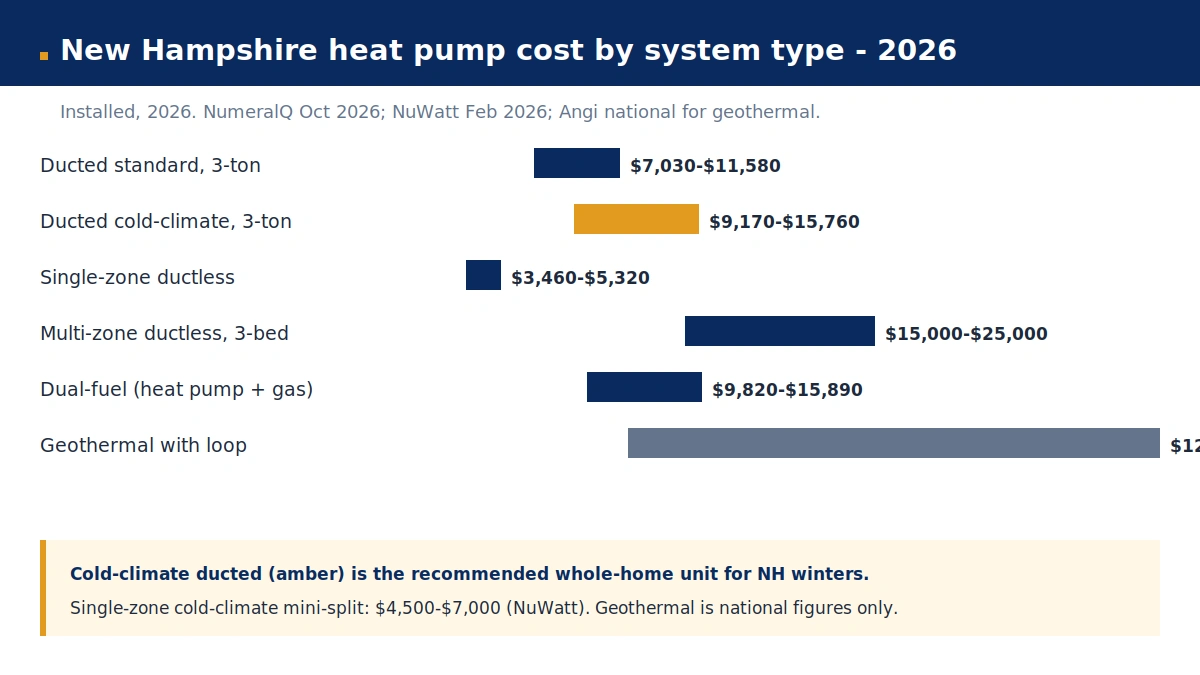
| System type | Installed cost (NH, 2026) | Best for |
|---|---|---|
| Ducted air-source, standard, 3-ton | $7,030-$11,580 | Sound ducts, mild southern NH, tight house |
| Ducted air-source, cold-climate, 3-ton | $9,170-$15,760 | Whole-home heating, any NH climate zone |
| Ductless mini-split, single zone | $3,460-$5,320 ($4,500-$7,000 cold-climate) | No ducts, one room, addition |
| Ductless mini-split, multi-zone (3-bed) | $15,000-$25,000 | No ducts, every bedroom zoned |
| Dual-fuel (heat pump + gas furnace) | $9,820-$15,890 | Gas home, keep furnace for coldest nights |
| Geothermal (national figures) | $12,000-$40,000+ | Large home, long stay, land for a loop |
Spend an extra moment on two rows of that table. First, the gap between standard and cold-climate ducted — about $2,100 at the low end and $4,200 at the high end — is not a luxury upgrade in New Hampshire. It is the difference between a machine that keeps 70% of its capacity at 5 degrees and one that keeps 40-60% and may stop altogether below minus 5. A standard unit that cannot heat the house in January is not a cheaper heat pump. It is an expensive air conditioner with a heater attached. Second, the single-zone mini-split is the cheapest entry point and the most flexible one: a homeowner can start with the living room, prove the savings on one oil bill, and add heads later. No other system type lets you buy the heat pump in installments that way.
Heat Pump Cost by Home Size
Size is the second decision, and in New Hampshire it is decided by the heating load, not the cooling load. A house that needs 3 tons of cooling in July may need 4 tons of heating in January, and a contractor who sizes from the air conditioning chart alone will leave the house cold on the nights that matter. The only honest sizing method is a Manual J load calculation — a room-by-room accounting of insulation, windows, air leakage, and the local design temperature — and any quote that skips it is a guess dressed up as a price.
The table below prices whole-home ducted systems by tonnage from the NumeralQ New Hampshire anchors, scaled from the 3-ton figures. The scaling is NestPriced arithmetic, labelled as such: the per-ton cost falls slightly as systems grow, because the outdoor unit and the crew’s day do not double when the tonnage does. Treat the table as a budgeting tool, not a quote. Your house’s tonnage comes from the Manual J, not from this page.
| Home size (approx.) | System size | Standard ducted | Cold-climate ducted |
|---|---|---|---|
| 1,000-1,200 sq ft | 2 tons | $5,400-$8,900 | $7,100-$12,100 |
| 1,500-1,800 sq ft | 2.5 tons | $6,200-$10,200 | $8,100-$13,900 |
| 1,800-2,200 sq ft | 3 tons | $7,030-$11,580 | $9,170-$15,760 |
| 2,200-2,800 sq ft | 4 tons | $8,900-$14,700 | $11,600-$19,900 |
| 2,800-3,500 sq ft | 5 tons | $10,800-$17,800 | $14,100-$24,100 |
Two rows deserve a second look. The 2-ton row is the sweet spot for a well-insulated New Hampshire ranch or cape, and it is also where a single-zone or two-head mini-split starts to compete on price: two heads at $4,500-$7,000 each can heat the same small house for less than a ducted system that also needs duct repairs. The 5-ton row is where the NHSaves cap bites: the rebate stops at 5 tons per account, so a house that genuinely needs more than 5 tons gets $1,250 at the standard rate and not a dollar more, however big the system. Oversizing past the Manual J number to chase a bigger rebate is the worst trade in this guide — an oversized heat pump short-cycles, dehumidifies badly in summer, and costs more to run than the right-sized unit.
A note on the square-footage column: it is a rough guide only. A 2,000-square-foot 1950s cape in Manchester with original windows and no wall insulation can need more heating than a 2,800-square-foot new build in Nashua with spray foam and triple glazing. The insulation matters more than the floor area, which is why the HPwES program’s 75% insulation discount is the cheapest heating upgrade in this guide — a tight house needs a smaller heat pump, and a smaller heat pump costs less to buy and less to run. Size the house first, then the machine.
Heat Pump Cost by City: Manchester, Nashua, Concord & Portsmouth
New Hampshire is a small state with one big heat pump market in the south and smaller ones scattered up the Merrimack Valley and the Seacoast, and the verified figures are thinner than the state’s reputation for cold-climate heating would suggest. Only Manchester carries a verified city-level heat pump price in this pass. The other cities below carry planning estimates built from the state anchors, labelled as such, and the guide does not invent a city price where none was verified.
| City | 3-ton ducted (planning) | Cold-climate 3-ton | Utility | Notes |
|---|---|---|---|---|
| Manchester | $7,000-$11,540 (verified, NumeralQ Oct 2026) | $9,140-$15,720 (verified) | Eversource | Largest city; zone 5A; ~129 freezing nights/yr |
| Nashua | $7,000-$11,500 (planning estimate) | $9,100-$15,700 (planning estimate) | Eversource / Liberty | 70% of homes heat with gas; 6,172 heating degree days |
| Concord | $7,100-$11,700 (planning estimate) | $9,300-$16,000 (planning estimate) | Unitil | State capital; design temp -3°F; colder than Manchester |
| Portsmouth | $7,000-$11,500 (planning estimate) | $9,100-$15,700 (planning estimate) | Eversource | Seacoast; milder winters, higher labor costs |
| Dover / Rochester | $7,000-$11,600 (planning estimate) | $9,100-$15,800 (planning estimate) | Eversource | Rochester: 47% of homes heat with oil |
Manchester is the biggest market in the state, served by Eversource, at $7,000-$11,540 for a 3-ton ducted system — a touch below the statewide $7,030-$11,580, which is what a deep installer bench in the state’s largest city should deliver. Manchester’s climate is the southern New Hampshire standard: about 129 freezing nights a year, four nights at 0 degrees or colder, a 99% design temperature of 7 degrees, and a median extreme low of minus 6. A cold-climate unit is the safer quote even here, because the design temperature is a planning number and the coldest nights are the ones that test it.
Nashua, about 20 miles south in the same utility territory, runs a little cheaper on paper and a lot different on fuel. Seventy percent of Nashua homes heat with gas and only 13% with electricity, per Census figures — which means most Nashua heat pump buyers are gas homes, and the running-cost answer for them is thinner than for the oil homes up the road. Nashua also runs warmer: 6,172 heating degree days against Concord’s 7,383, and 16 days a year at 90 degrees or hotter, so the air conditioning half of the machine earns its keep sooner. No verified Nashua heat pump price was pulled in this pass — the NumeralQ Nashua page prices HVAC replacement at $8,810-$14,720 for a central air conditioner plus gas furnace, which is a different job and is not used as a heat pump price here. The planning estimate above is the state anchor applied to a southern city, nothing more.
Concord is the coldest of the four named cities, and the one where the cold-climate premium pays for itself fastest. The winter design temperature is minus 3 degrees, the 99.6% design is minus 8, and the median extreme low is minus 17. Concord’s 7,383 heating degree days are about 20% more than Nashua’s, which means a Concord house needs about 20% more heat over the year than an identical house in Nashua — and a standard heat pump will spend more of that year leaning on backup heat. Unitil serves Concord, and its default supply price of 14.348 cents a kilowatt-hour for the August 2026 to January 2027 period is close to Eversource’s 14.009 cents, so the fuel sums do not change much between the two cities. What changes is the load, and the load is what sizes the machine.
Portsmouth, on the Seacoast, is the mildest of the four and the most expensive to hire in. The ocean takes the edge off the coldest nights, so a standard ducted system carries more of the season here than it would in Concord — but the Seacoast labor market and the older housing stock near the water push installation costs up, and the two effects roughly cancel. Portsmouth is also a Community Power town, where the default supply choice is the coalition’s Granite Basic rate of 14.949 cents a kilowatt-hour in Eversource territory — slightly above Eversource’s own default of 14.009 cents, a reminder to check the supply line on the bill rather than assuming the community rate is cheaper.
Rank the cities on price per ton, never the total, and use the fuel column before the price column. A Rochester home that burns oil at $6.06 a gallon saves real money on every ton of heat pump capacity, while a Nashua home on gas saves much less per ton — and a Concord home that needs a bigger system because of the cold pays more upfront for the same reason it saves more later. The city that looks cheapest on the quote is not always the city where the heat pump pays back fastest. The payback section below does that work for each fuel.
New Hampshire’s Climate: Cold-Climate Ratings, Design Temps & Snow
New Hampshire’s winters are the reason the cold-climate rating exists, and the state’s own numbers explain why a standard heat pump is a gamble here. Concord logs 7,383 heating degree days a year. Manchester logs about 129 freezing nights a year. The winter design temperature — the outdoor temperature the heating system is sized to meet — is minus 3 degrees in Concord and 7 degrees in Manchester at the 99% level, which means the system is expected to hold the house warm at those temperatures and colder for a few hours a year besides. A heat pump that loses half its capacity at 5 degrees cannot do that job without help, and help in New Hampshire means backup heat running on the most expensive nights of the year.
The rating that matters is NEEP’s. The Northeast Energy Efficiency Partnerships maintains the cold-climate air-source heat pump specification and product list, and it is the gatekeeper for almost every rebate in the region. To earn the listing under version 4.0, effective January 2023, a system must use a variable-capacity inverter compressor, be an AHRI-matched system, hold a coefficient of performance of 1.75 or higher at 5 degrees Fahrenheit at maximum capacity, keep at least 70% of its rated heating capacity at 5 degrees, and clear HSPF2 ratings above 7.7 for ducted systems and 8.5 for ductless, with SEER2 above 15. NEEP proposed a version 5.0 revision in July 2026, took comments through August, and expects a final version in December 2026 — so the specification is moving, and a model that qualified in 2025 may not qualify under the new version. Check the list at neep.org before you buy, and ask the installer to name the AHRI reference number of the exact matched system on the quote, not the outdoor unit alone.
What the numbers mean on a January night. A coefficient of performance of 1.75 at 5 degrees means the machine delivers 1.75 units of heat for every unit of electricity it consumes — 175% efficient, against 100% for electric resistance heat. A standard heat pump at the same temperature often falls below 1.0, which means it is worse than a baseboard heater. Typical cold-climate performance runs about 4.0-4.5 COP at 47 degrees, 1.8-2.3 at 5 degrees, 1.5-2.0 at minus 5, and 1.2-1.5 at minus 15. Those are industry-guide ranges, not any one model’s tested data, and they are the reason the running-cost math in the next section uses a seasonal COP of 2.0-2.5 rather than the catalogue headline. The catalogue headline is measured at 47 degrees. January is not 47 degrees.
The models buyers actually meet. Mitsubishi’s Hyper-Heat H2i line is the most installed cold-climate unit in the Northeast: full rated capacity down to 5 degrees, about 76% of rated capacity at minus 13, HSPF2 ratings of 10-12, rated for operation to minus 13. Fujitsu’s Halcyon XLTH is rated to minus 15 with a COP near 1.8 at 5 degrees. Daikin’s Aurora is rated to minus 22, holds full capacity at 5 degrees and over 70% at minus 22 — the lowest published operating temperature of any residential heat pump. Bosch’s IDS 2.0 is a ducted system rated to minus 13. No brand wins on the name alone. Two units with the same brand can sit on opposite sides of the NEEP line, and the specification sheet is the only place the difference shows.
Backup heat is a plan, not a failure. Even the best cold-climate unit meets nights it cannot carry alone — Concord’s median extreme low is minus 17 degrees, and the 99.6% design temperature is minus 8. The question is never whether the house needs backup heat. It is what kind, and how often it runs. Keeping the existing oil or propane system as backup is the cheapest answer for most New Hampshire homes, and it is the answer this guide recommends: the heat pump carries the house down to a set outdoor temperature, often 5 degrees or 0 degrees, and the oil burner takes over below it. Electric resistance strips as backup are the expensive answer, because they heat at COP 1.0 on the coldest nights, at 27 cents a kilowatt-hour. A dual-fuel setup with a gas furnace is the middle answer, and it suits gas homes. Whatever the backup, the switchover temperature — the balance point — should be written on the quote, not left to the installer’s habit.
Snow and the outdoor unit. New Hampshire winters bring regular snow, and the outdoor unit must sit above it. The standard practice is a wall bracket or a stand that lifts the unit clear of the snow line, with clear space around it for airflow and for the defrost cycle to shed ice. A unit buried in a drift cannot breathe, cannot defrost, and will fault out on the night it is needed most. No New Hampshire-specific annual snowfall figure was verified for this pass, so none is stated here — the point is the placement, not the inches. Ask where the unit will sit, how high it will sit, and who clears the snow around it. The same question applies to the condensate drain, which must not freeze and back up into the house.
The refrigerant changed in 2026. Since January 1, 2026, new heat pumps may not use refrigerants with a global warming potential above 700, which takes R-410A out of new equipment. The systems on the NHSaves qualified list in 2026 run on R-32 or R-454B. That matters twice: a quote for an R-410A system in 2026 is a quote for old stock, and a homeowner with an older R-410A system should know that the refrigerant it uses is on its way out. For the cold-climate mini-split angle in detail, see our cold-climate mini-split guide.
Heat Pump vs Oil & Propane in New Hampshire: The Running-Cost Math
This is the section the whole guide turns on, because in New Hampshire the heat pump is bought to displace oil, and the displacement either pays or it does not. The inputs are all dated: oil at $6.056 a gallon and propane at $3.960 a gallon (EIA weekly survey, week of November 2, 2026), electricity at 26.9 cents a kilowatt-hour (EIA 12-month average to August 2026). The arithmetic is NestPriced, and every step is shown so a reader can redo it with their own bill.
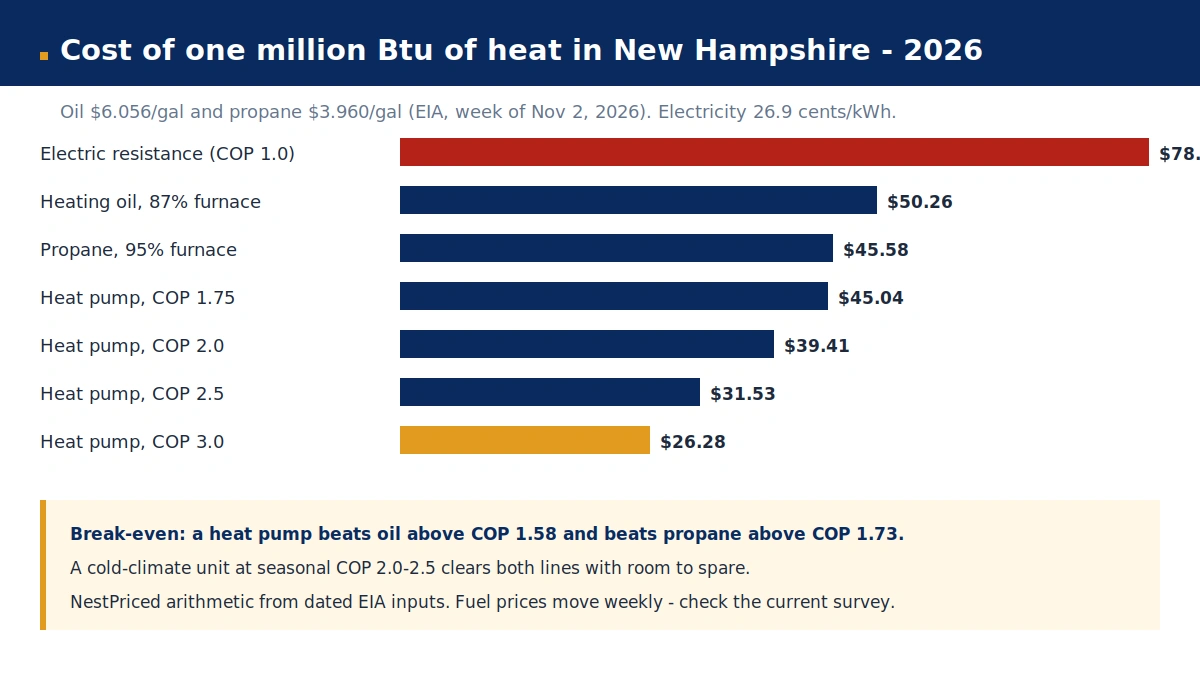
The cost of one million Btu of heat, by fuel. A million Btu is the unit the comparison needs, because it is the same amount of heat however it is made. Heating oil carries 138,500 Btu a gallon, and a typical oil furnace is about 87% efficient, so a gallon delivers about 120,500 Btu of heat into the house. At $6.056 a gallon, that works out to $50.26 per million Btu of delivered heat. Propane carries 91,500 Btu a gallon, a propane furnace runs about 95% efficient, and at $3.960 a gallon the delivered cost is $45.58 per million Btu. A heat pump makes heat from electricity: one million Btu is 293 kilowatt-hours of heat, and the electricity it needs is 293 divided by the COP. At 26.9 cents a kilowatt-hour, the heat pump’s cost per million Btu is $26.28 at COP 3.0, $31.53 at COP 2.5, $39.41 at COP 2.0, and $45.04 at COP 1.75. Electric resistance heat, at COP 1.0, costs $78.83 per million Btu — the most expensive heat in the state.
| Heat source | Fuel price (dated) | Efficiency / COP | Cost per million Btu |
|---|---|---|---|
| Heating oil | $6.056/gal (EIA, Nov 2, 2026) | 87% furnace | $50.26 |
| Propane | $3.960/gal (EIA, Nov 2, 2026) | 95% furnace | $45.58 |
| Heat pump, seasonal COP 3.0 | 26.9 cents/kWh (EIA 12-mo avg) | COP 3.0 | $26.28 |
| Heat pump, seasonal COP 2.5 | 26.9 cents/kWh | COP 2.5 | $31.53 |
| Heat pump, seasonal COP 2.0 | 26.9 cents/kWh | COP 2.0 | $39.41 |
| Heat pump, COP 1.75 | 26.9 cents/kWh | COP 1.75 | $45.04 |
| Electric resistance | 26.9 cents/kWh | COP 1.0 | $78.83 |
Read the break-even lines off that table. A heat pump beats oil at any seasonal COP above about 1.58, and it beats propane at any COP above about 1.73. A cold-climate unit running at a seasonal COP of 2.0-2.5 in New Hampshire clears both lines with room to spare. A standard unit that spends January at COP 1.2-1.5 does not clear either line, and a house heated by one will pay more than the oil burner it replaced. That is the whole running-cost story in one paragraph: the machine’s cold-weather efficiency is the purchase, and everything else is packaging.
A worked year for an oil home. Take a typical New Hampshire oil home using about 800 gallons a year — a single source’s typical-household assumption, labelled as such. At $6.056 a gallon the oil bill is about $4,845 a year. Those 800 gallons carry 110.8 million Btu of fuel energy, and at 87% furnace efficiency they deliver about 96.4 million Btu of heat into the house. A heat pump delivering the same 96.4 million Btu at a seasonal COP of 2.2 needs about 12,840 kilowatt-hours of electricity, which at 26.9 cents costs about $3,454 a year — a saving of about $1,390 a year at full displacement. Full displacement is the optimistic case, because few homes retire the oil burner entirely. At 70% displacement, the house burns 240 gallons of oil ($1,454) and the heat pump delivers 67.5 million Btu (about 8,990 kilowatt-hours, about $2,418), for a total heating bill of about $3,872 a year — a saving of about $970 a year against the all-oil bill. The 70% case is the honest planning figure for a home that keeps its oil burner as backup.
The same sums for a propane home. Propane at $3.960 a gallon is cheaper heat than oil, so the savings are thinner but still real. A home burning 1,000 gallons of propane a year pays $3,960, and the 91.5 million Btu of fuel energy delivers about 86.9 million Btu of heat at 95% efficiency. A heat pump at seasonal COP 2.2 delivers the same heat for about 11,590 kilowatt-hours, about $3,118 — a saving of about $840 a year at full displacement, and about $590 a year at 70% displacement. Propane homes should also check the tank: a heat pump that cuts propane use by 70% may still leave a minimum-delivery or tank-rental fee on the bill, and that fee eats into the saving.
The electric resistance home is the best deal in the state. A home heating with baseboards or an electric furnace pays $78.83 per million Btu, and a heat pump at COP 2.2 cuts that to about $35.83 — a saving of more than half on every unit of heat. That is why NHSaves pays up to $2,000 a ton to those homes, and why their payback is the fastest in this guide. If your house heats with electricity, stop reading the oil sums and start getting quotes.
The gas home is the honest exception. No New Hampshire residential natural gas price per therm was verified in this pass, so this guide does not print a gas-versus-heat-pump table it cannot source. The shape of the answer is still worth stating: piped gas is cheap heat, and a heat pump at 27 cents a kilowatt-hour will often cost more per million Btu than a 95% gas furnace. A gas home buys a heat pump for the air conditioning, for the shoulder-season savings, and for the day the gas price moves — not for a fuel saving that the current numbers do not support. If a salesperson shows a gas home a big monthly saving, ask for the gas price on the quote and check it against the bill.
Three things that move the sums. First, the oil price moves weekly — it rose $2.56 a gallon in a year, and the EIA’s Winter Fuels Outlook expects the national average to ease from $5.79 a gallon in November toward $4.84 by March. A heat pump bought at $6.06 oil saves more than the same machine bought at $4.84 oil, and the payback section runs both cases. Second, the electricity price matters as much as the oil price: the 26.9-cent average used here is the all-in rate, and a household on a time-of-use rate or a community power plan will pay a different number — use your own bill’s all-in cents per kilowatt-hour, not the supply line alone. Third, the house itself: a drafty house needs more heat, and more heat means a bigger machine and a bigger bill, whatever the fuel. Insulation is the cheapest heat in New Hampshire, and the HPwES program pays 75% of it.
NHSaves, the Accelerator & the Other New Hampshire Rebates for 2026
New Hampshire’s rebate picture in 2026 is smaller than the headlines suggest and more useful than the small numbers imply. There is no state rebate worth thousands for the average oil home. There is a $250-a-ton utility rebate, a $650 regional discount, and a much larger rebate for the homes that need it most — the ones heating with electricity. The money is real, the rules are specific, and the dates matter more than the amounts.
NHSaves: $250 a ton, and $2,000 a ton for electric heat. NHSaves is the joint efficiency program of Eversource, Liberty, Unitil, and the New Hampshire Electric Cooperative, and it is the only rebate most New Hampshire heat pump buyers will touch. For a qualifying air-source heat pump, ducted or ductless, on the NHSaves qualified product list, the program pays $250 per ton when the system replaces oil, gas, or propane heat. Tonnage is the AHRI cooling capacity divided by 12,000, and the rebate stops at 5 tons per account — so the standard maximum is $1,250. The enhanced tier is where the money is: a home replacing working, permanent electric resistance heat gets $1,250 a ton for installations from January 1 to March 22, 2026, and $2,000 a ton for installations from March 23 to December 31, 2026 — the $2,000 figure is the standard $250 plus an additional $1,750 a ton, and it needs pre-verification through NHSaves.com/GetVerified before the work starts. At 5 tons the enhanced maximum is $10,000. The equipment must be installed between January 1 and December 31, 2026, and the rebate forms must be submitted or postmarked by January 30, 2027. One wrinkle in the sources: the NHSaves heat-pump water heater page gives January 31, 2027, a day later than the heat pump pages. Use January 30 for the heat pump and check the water heater date on its own page.
The regional discount that stacks. The New England Heat Pump Accelerator, a $450 million five-state collaboration launched in February 2026 by the Northeast Energy Efficiency Partnerships and VEIC, pays $650 per qualifying cold-climate air-source heat pump outdoor unit under 5.4 tons as a point-of-sale discount through participating distributors. It stacks with NHSaves, it applies whatever the utility and whatever the old fuel, and it runs through December 2029 subject to funding. The same program pays $300 on a qualifying heat pump water heater and $750 on an air-to-water or geothermal unit. Ask the contractor to show the Accelerator discount as its own line on the proposal, and confirm the distributor is participating before the equipment is ordered — a discount that never reaches the invoice is not a discount.
What the stack is worth. A 3-ton system on an oil home: $750 from NHSaves plus $650 from the Accelerator, $1,400 in total, against a cold-climate installed cost of $9,170-$15,760. A 3-ton system on an electric resistance home: $6,000 from NHSaves plus $650 from the Accelerator, $6,650 in total. A 5-ton system on an electric resistance home: $10,000 plus $650, $10,650 — the biggest stack in the state, and the reason the enhanced tier’s pre-verification step is worth doing properly. None of these figures touches the installed cost the way a $15,000 rebate does in other states, and this guide does not pretend otherwise. In New Hampshire the rebate is a discount on the purchase, not the reason for it. The reason is the oil bill.
The smaller lines. An ENERGY STAR certified central air conditioner earns $70 a ton from NHSaves. A Wi-Fi thermostat installed with a qualifying heat pump earns $85 a unit. A qualifying ENERGY STAR heat pump water heater, up to 85 gallons, earns a $900 flat rebate from NHSaves — the official NHSaves page’s figure, current for purchases in 2026. Some secondary sources still quote $750 for the same rebate; the $900 figure is the program page, and the $750 figure is treated here as superseded. The water heater rebate stacks with the Accelerator’s $300, for up to $1,200 on one appliance. For the water heater in full, see our heat pump water heater cost guide.
The assessment and the insulation. Home Performance with ENERGY STAR, the NHSaves whole-home program, starts with a $100 energy assessment and pays 75% of the cost of insulation work that follows. There is an income-eligible tier with deeper help, whose details were not verified beyond its existence. The assessment is the cheapest money in this guide for a simple reason: a house that leaks heat needs a bigger heat pump, and insulation shrinks the machine before the machine is bought. Book the assessment before the heat pump quotes, not after.
Who does not get NHSaves money. Customers of the state’s five municipal electric departments are not part of NHSaves and cannot claim its rebates — check the name on the bill before counting a dollar of it. The Liberty commercial promotion of $750 a ton for large air-source systems, with applications due October 31, 2026 and installation by November 30, 2026, is commercial only and is excluded from every residential figure in this guide. And a headline seen in some marketing — “$10,000 for a whole-home cold-climate heat pump install” — is not a separate program. It is the enhanced 5-ton tier restated as a round number, and a home that does not heat with electric resistance cannot claim it.
| Program | Amount | Who qualifies | Deadline |
|---|---|---|---|
| NHSaves standard | $250/ton, max 5 tons ($1,250) | Oil/gas/propane swap, qualified list | Install by Dec 31, 2026; file by Jan 30, 2027 |
| NHSaves enhanced | $2,000/ton, max 5 tons ($10,000) | Replacing working electric resistance heat; pre-verification required | Install Mar 23-Dec 31, 2026; file by Jan 30, 2027 |
| NE Heat Pump Accelerator | $650/outdoor unit (under 5.4 tons) | Any utility/fuel; qualifying cold-climate unit; participating distributor | Through Dec 2029, subject to funding |
| NHSaves heat pump water heater | $900 flat (up to 85 gal) | ENERGY STAR certified | Purchase in 2026 |
| NE Accelerator water heater | $300 | Qualifying ENERGY STAR heat pump water heater | Through Dec 2029 |
| NHSaves central AC | $70/ton | ENERGY STAR certified | Install in 2026 |
| NHSaves Wi-Fi thermostat | $85/unit | Installed with qualifying heat pump | Install in 2026 |
| HPwES assessment + insulation | $100 assessment; 75% off insulation | NHSaves utility customers | 2026 program year |
Federal Help in 2026: $0 Tax Credit, HEAR Not Launched
The 2026 federal story fits in one paragraph, and the New Hampshire version has a second half that makes it worse than the national one. There is no federal money for a homeowner who buys a heat pump outright in 2026, and the federal money that might replace it has not arrived — and when it does arrive, it will probably not pay for the fuel switch most New Hampshire buyers want.
A homeowner-owned system installed in 2026 earns no federal tax credit whatsoever. The One Big Beautiful Bill Act — Public Law 119-21, signed July 4, 2025 — took the Energy Efficient Home Improvement Credit (§25C, up to $2,000 a year for a qualifying heat pump) away from property placed in service after December 31, 2025. IRS fact sheet FS-2025-05 pins the credit to the finish date, so a deposit paid in 2025 is worthless if the crew wrapped up in January 2026. The §25D residential clean energy credit closed on the same date. A 2026 cash or loan quote that still subtracts a federal credit was built on repealed law — have the installer take the credit off and re-price the job. Our federal tax credits guide carries the whole 2026 federal picture in one place.
The lease route is not a verified second door in New Hampshire. A company-owned system can still claim the commercial clean-electricity credit (§48E, 30%), so long as the system enters service by December 31, 2027 and construction started by July 4, 2026, the cutoff IRS Notice 2025-42 sets out. In a state where residential third-party ownership is clearly established, that credit reaches homeowners through a lease or a power purchase agreement, with the company passing part of the value on as a lower monthly payment. No New Hampshire lease or PPA provider with verified §48E pass-through terms was found in this pass. Palmetto markets heat pump leasing in New Hampshire, but no lease terms were verified, and no provider was confirmed to be passing the §48E value through to a New Hampshire homeowner. Have a lawyer read any lease or PPA before signing, and do not let a monthly payment stand in for a price comparison.
HEAR money has not launched in New Hampshire — and the fuel-switching rule has already narrowed it. The state was allocated $34,749,580 for HEAR and $34,882,819 for HOMES, per the federal dataset. The New Hampshire Department of Energy’s program page says plainly that rebates are not yet available, and that projects started before launch will not qualify. The implementation contract was approved in March 2026, and the launch was anticipated for fall 2026 — but as of November 4, 2026, the program had still not opened for homeowners, and no launch date had been published. As of that same date, HEAR was fully open in only two states and had never launched in 38. And there is a trap waiting for the launch itself: since September 1, 2026, under Department of Energy Notice 26-2, HEAR pays only for electric-to-electric upgrades — no fuel-switching. A New Hampshire homeowner who swaps an oil burner for a heat pump is doing exactly the fuel switch the notice excludes. Even when New Hampshire’s program opens, the $8,000 HEAR rebate will most likely be available only to homes replacing electric heat, not to the oil homes that make up 42% of the state. Do not plan a purchase around a HEAR rebate, and do not let a quote count one.
HOMES is further behind. The Home Efficiency Rebates program, which pays for whole-home energy savings rather than a single appliance, was still awaiting final federal approval in the fall of 2026, with no launch date published. The state’s March 2026 tracker entry says it plans to direct 60% of HEAR funding and all of HOMES funding to low-income households, and to raise the HOMES maximum to $15,000 for 20-34% energy savings and $20,000 for 35% or more — but those are plans for a program that does not exist yet, not money a homeowner can claim. The honest summary is this: in 2026 the federal government contributes nothing to a New Hampshire homeowner who buys a heat pump outright, and the two programs that might contribute later are both unlaunched, with the bigger one already narrowed by a rule that excludes the state’s most common fuel switch.
Permits & Licensing: No Statewide HVAC License — What That Means
New Hampshire is one of the least regulated states in the country for heating work, and the buyer has to do the checking the state does not. There is no statewide general contractor license, no state HVAC license, and no home improvement contractor registration. The town building department and the trades the state does license are the only checkpoints, and this section names them all.
The state licenses the trades around the heat pump, not the heat pump itself. The Office of Professional Licensure and Certification licenses electricians (Master and Journeyman), plumbers (Master and Journeyman), and fuel gas fitters through the Mechanical Licensing Board, under RSA 153:28 and the Mec rules. A heat pump job touches two of those trades: the electrical work needs a licensed electrician, and any gas work — a dual-fuel hookup, a gas line move, a furnace change — needs a licensed gas fitter. New mechanical licensing rules took effect in February 2026, and they are recent enough that third-party guides may not reflect them — verify the current requirements at oplc.nh.gov before the work starts. A fuel gas installation technician needs 1,000 hours of field experience within 60 months; a fuel gas service technician needs 2,000. Oil heating certification is voluntary under RSA 153:16-b, which means the oil technician servicing the backup burner may hold a credential or may not — ask, and do not assume. HB 594, signed in 2024, streamlined reciprocity for out-of-state specialty-trade licensees, so a Massachusetts or Maine licensee can work in New Hampshire more easily than before — which is good for competition and another reason to check the New Hampshire credential, not the out-of-state one.
The town is the permit authority. A heat pump installation needs a building permit and an electrical permit from the town or city building department, in that order with the work itself, and the department sets the fee — no statewide fee schedule was verified for this guide, so no fee figure is given here. Manchester and Nashua both require contractor registration with a bond and proof of insurance before a contractor can pull permits, which makes those two cities the easiest places in the state to check a contractor’s standing. Every business operating in the state must register with the Secretary of State, and workers’ compensation insurance is required where the contractor has employees. The building department also applies the snow-load and wind figures the outdoor unit and its stand must meet — let the department’s figure govern, not the installer’s guess.
What to ask for, since the state will not ask for you. Ask for the electrician’s OPLC license number and check it on the OPLC registry. Ask for the gas fitter’s license number if any gas work is involved, and check that one too. Ask for the business’s Secretary of State registration and a certificate of insurance naming the homeowner as certificate holder. Ask whether the installer is NATE-certified or factory-trained on the brand being installed — neither is a state requirement, and both are better evidence of competence than a business card. And ask for the Manual J load calculation in writing, with the design temperature it used: a contractor who sized the system from the square footage alone has not done the engineering, and in a state where the design temperature is minus 3 in Concord, the engineering is the job.
A note on the crew itself. New Hampshire’s light regulation is a double-edged fact. It keeps prices down and lets small local firms compete, which is part of why Manchester’s verified price runs a touch below the state average. It also means a homeowner cannot lean on a state license as a guarantee, the way a buyer in a licensed state can. The checklist in the final section is written for exactly that market: every line is a check the state does not perform for you.
What Pushes Your New Hampshire Quote Up or Down
The per-ton anchor is a starting point, not a quote. Eight factors can move a New Hampshire quote by thousands of dollars, and four of them come from this state’s climate, fuel mix, and light regulation.
Cold-climate rating. The premium over a standard ducted system runs roughly $2,100-$4,200 on a 3-ton job, and it is the most important money in the whole purchase. A standard unit that cannot hold capacity at 5 degrees will run its backup heat through January, and backup heat at 27 cents a kilowatt-hour or $6.06-a-gallon oil erases the running-cost saving the heat pump was bought for. Pay the premium, and check the NEEP listing before you sign.
Ductwork. Many New Hampshire homes still run on ducts sized for a furnace, not a heat pump, and a heat pump moves more air at lower temperatures than a furnace does. Undersized or leaky ducts starve the system, and the fix — sealing, resizing, or adding returns — is a separate line that can run into the thousands. A home with no ducts at all faces the opposite choice: mini-splits at $3,460-$5,320 a head, or new ducts, which cost more than the heat pump itself. Before signing, find out whether the quote covers duct work — not once the crew is already in the attic. Our ductless versus ducted guide walks through the trade-off in full.
The electrical panel. Many New Hampshire homes still run on 100-amp service — especially capes and ranches from the 1950s to the 1970s — and a heat pump install often forces the question. Per our electrical panel upgrade guide, a 200-amp panel upgrade runs $1,500-$4,000 nationally, and it is the most common surprise add-on in heat pump quotes. No New Hampshire-specific panel-upgrade dollar figure was verified for this guide, so the national figure stands in, flagged as national. One New Hampshire wrinkle: a panel upgrade is electrification work, the kind HEAR is designed to pay for — once the program launches, which it has not.
Backup heat. Keeping the oil or propane system as backup costs little upfront — a control change and a switchover setting — and it is the right answer for most homes. Electric resistance strips as backup cost little to install and a great deal to run, because they heat at COP 1.0 on the coldest nights. A dual-fuel setup costs $9,820-$15,890 all in, and it suits gas homes. The quote should name the backup type and the switchover temperature. A quote that does not mention backup heat at all is a quote for a different state.
The outdoor unit’s placement. A wall bracket or a stand above the snow line, a condensate drain that will not freeze, and clear space for defrost are small lines with large consequences. A unit set at grade in a snow belt will fault out in a storm, and the emergency call to free it will cost more than the stand would have. Ask where the unit will sit and how high, and get it in writing.
Financing terms. Cash up front is the cheapest way to own the system over its life. A loan with nothing down hides dealer fees worth 10-30% of the cash price — sometimes more than half — inside the amount financed. The Consumer Financial Protection Bureau’s August 2024 market spotlight is where that national figure comes from, and a New Hampshire quote carries it just the same. A lease or PPA is the third path, and it is thin here: no provider with verified terms was found in this pass, so a lease quote should be read by a lawyer before it is compared on its monthly payment at all. New Hampshire has no general sales tax, so there is no sales-tax line to argue about — one small mercy in a state with expensive electricity.
Labor is dearer than the national average — and that is itself the point. New Hampshire’s HVAC wage index is 1.10 against a national mean of $31.14 an hour (BLS May 2025), so the crew costs about 10% more than the national average. Labor is the largest soft-cost component of an install, and in New Hampshire it neither discounts the job nor inflates it the way coastal wages do. What moves a New Hampshire quote is not cheap labor but thin competition outside the southern cities: with fewer installers serving the North Country and the Lakes Region, the crew’s cold-climate experience matters more than the headline rate. Find out how many cold-climate jobs this crew has actually finished in New Hampshire, not merely how long the firm has been trading.
Maintenance and lifespan. A heat pump lasts 15-20 years with regular service, and the outdoor unit’s coils, the refrigerant charge, and the defrost controls all need a yearly check in this climate — snow, ice, and road salt are harder on outdoor equipment here than in a mild state. Budget for an annual service visit, and for a filter or coil cleaning the homeowner can do between visits. Lifespan and maintenance figures are national only — no New Hampshire-specific versions exist — so every figure in this paragraph carries a national flag. Our heat pump maintenance guide and repair guide cost each item out over the system’s life.
Payback: When Does a New Hampshire Heat Pump Pay for Itself?
Payback is where a New Hampshire heat pump either earns its keep or does not, and the answer turns on the fuel being replaced more sharply than in any other state in this series. The worked examples below are built on the dated anchors in the running-cost section, so each input can be checked — and this guide flags every place the arithmetic is optimistic.
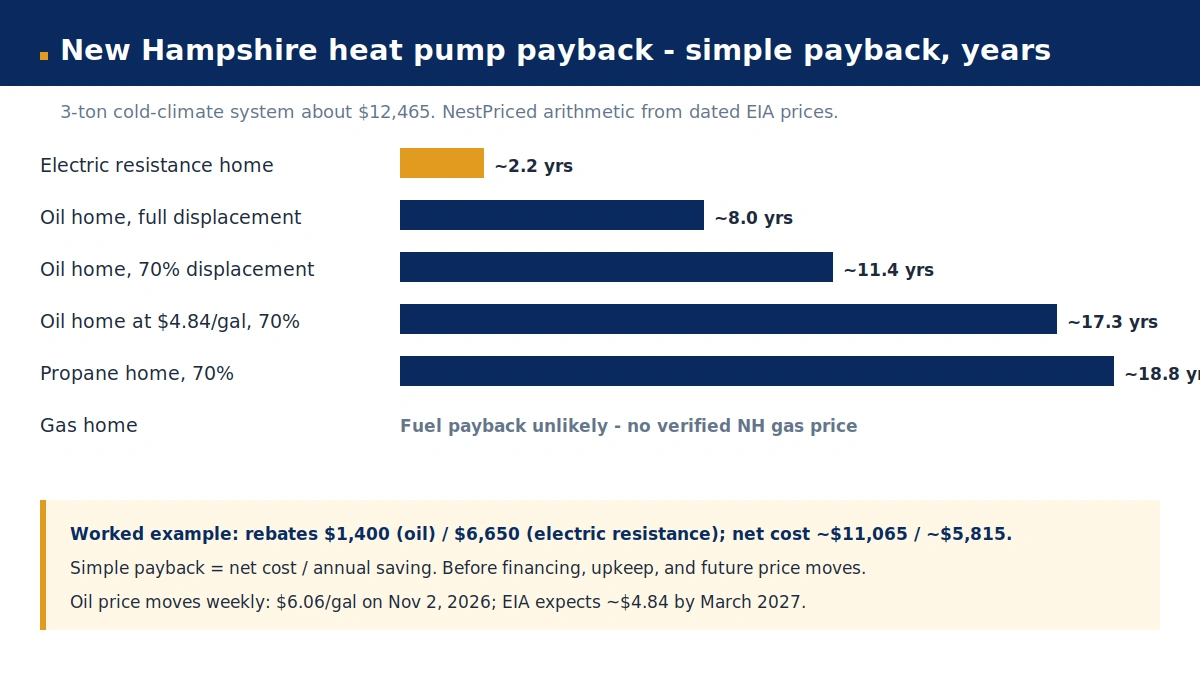
A worked example for an oil home. Take a 3-ton cold-climate ducted system at the midpoint of its range, about $12,465 installed. The rebates on an oil swap are $750 from NHSaves plus $650 from the Accelerator, $1,400 in total, so the net cost is about $11,065. The annual saving at 70% displacement, from the worked year above, is about $970 a year — so simple payback is about 11.4 years. At full displacement the saving is about $1,390 a year and payback is about 8 years. The truth for most homes sits between those two figures, because most homes keep the oil burner as backup and displace 60-80% of their oil. At the November 2026 oil price of $6.06 a gallon, the case is strong. At the EIA’s expected March price of $4.84 a gallon, the same 70% displacement saves about $640 a year and payback stretches to about 17 years. Oil is the variable, and it moves weekly.
An electric resistance home pays back fastest. The same $12,465 system on a home leaving electric resistance heat earns $6,000 from NHSaves plus $650 from the Accelerator, $6,650 in total, for a net cost of about $5,815. The annual saving against resistance heat at $78.83 per million Btu is roughly $2,600 a year on the same 96.4 million Btu heating load — so simple payback is about 2.2 years. That figure is so fast it deserves a second look: it assumes the house was heating entirely with resistance heat, which is the most expensive heat in the state, and it assumes the heat pump displaces all of it. Even at half that saving, payback is under five years. If your house heats with baseboards, this is the best payback in the series, and the only reason not to buy is a house that cannot take the equipment.
A propane home sits in the middle. The same system on a propane swap earns the same $1,400 in rebates for a net cost of about $11,065, and the annual saving at 70% displacement is about $590 a year — so simple payback is about 18.8 years, close to the end of the machine’s life. Propane homes should buy the heat pump for the air conditioning and the comfort as much as for the fuel saving, and should think hard about a single-zone mini-split for the rooms people live in, where the payback is far faster because the cost is far lower.
A gas home may never pay back on fuel alone. No verified gas price was available to work the sums, and this guide will not invent one. The shape of the answer is clear enough from the other fuels: gas is cheap heat, a heat pump at 27 cents a kilowatt-hour is not, and the gap between them is the air conditioning. A gas home that buys a heat pump should judge it as an air conditioner that also heats in the shoulder seasons, and should not expect the fuel saving to repay the machine. For the national comparison, see our heat pump versus furnace guide and our running cost guide.
| Case (3-ton cold-climate, ~$12,465) | Rebates | Net cost | Annual saving | Simple payback |
|---|---|---|---|---|
| Oil home, 70% displacement | $1,400 | ~$11,065 | ~$970/yr | ~11.4 yrs |
| Oil home, full displacement | $1,400 | ~$11,065 | ~$1,390/yr | ~8.0 yrs |
| Oil home at $4.84/gal oil, 70% | $1,400 | ~$11,065 | ~$640/yr | ~17.3 yrs |
| Electric resistance home | $6,650 | ~$5,815 | ~$2,600/yr | ~2.2 yrs |
| Propane home, 70% displacement | $1,400 | ~$11,065 | ~$590/yr | ~18.8 yrs |
| Gas home | $1,400 | ~$11,065 | Not verified | Fuel payback unlikely |
What moves the payback most. The oil price is the biggest lever, and it is the one the buyer does not control — a dollar a gallon moves the 70% displacement saving by about $170 a year. The seasonal COP is the second lever: a machine that runs at 2.5 instead of 2.0 through the winter saves about $700 a year on the same heating load, which is why the cold-climate premium pays for itself. The displacement share is the third: every gallon of oil the heat pump does not displace is a gallon bought at $6.06, so the switchover temperature matters — a balance point set too high hands the coldest, most expensive nights back to the oil burner. Fourth comes financing: a loan carrying dealer fees can lift the effective price by 10-30%, so judge quotes on cash price rather than the monthly payment. And the rebates barely move the needle for an oil home — $1,400 takes about a year and a half off the payback at $970 a year — while they transform it for an electric resistance home, where $6,650 is more than half the installed cost.
Who still comes out ahead. Four kinds of New Hampshire household clear it. The electric resistance home, where the payback is measured in years, not decades. The oil home that displaces 70% or more of its oil, especially in the North Country and the Lakes Region, where the heating load is biggest and the oil truck comes most often. The household pairing a heat pump with insulation work first, shrinking the machine before buying it. And the comfort buyer, who buys mainly for air conditioning in a house that has never had it, with heating savings second — in that case the payback math is context, not verdict. Walk away when your home heats with cheap gas and you are counting on a fuel saving, when the quote prices a standard unit for a Concord winter, or when the installer projects savings without naming your old fuel’s price and your new machine’s COP at 5 degrees.
Getting Quotes in New Hampshire: The Checklist
New Hampshire is a demanding state to buy a heat pump in — expensive electricity, a cold winter, no state license to lean on, and an oil bill that makes every decision feel urgent — but only for a homeowner who checks the machine and the installer before the sales pitch. Put every bidder through this checklist, and do not sign until each item has a written answer.
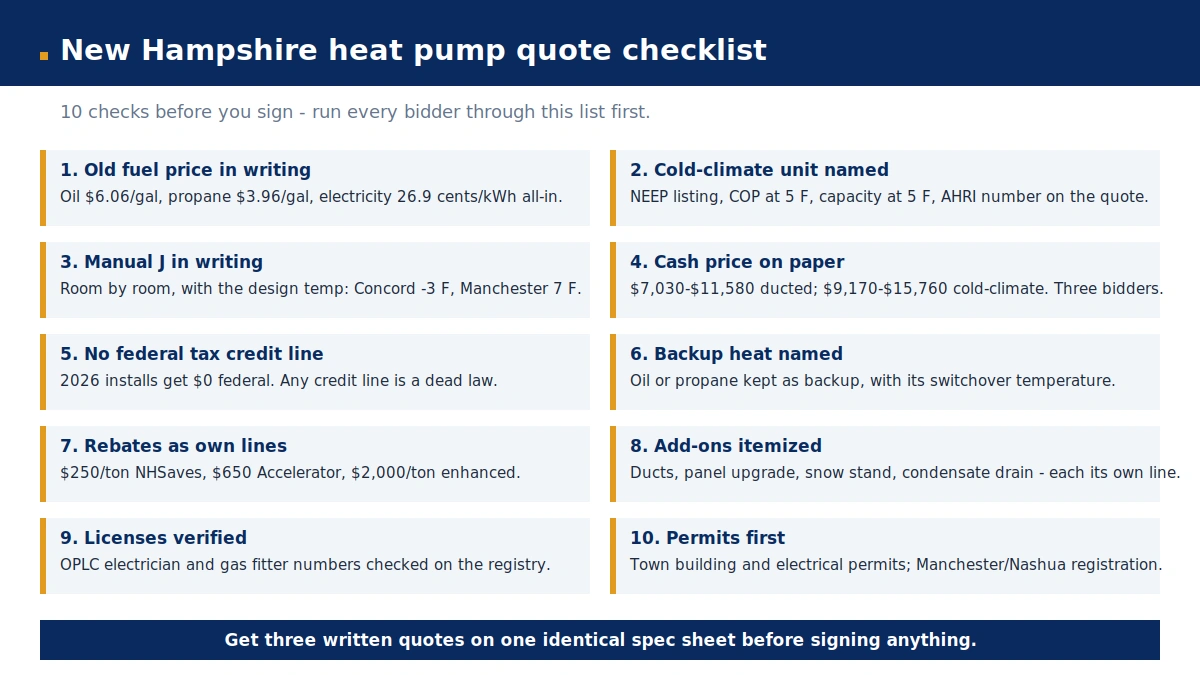
The ten-item quote checklist:
- Your old fuel’s price, in writing first — the oil or propane price per gallon, the electric rate per kilowatt-hour all-in, or the gas price per therm. The running-cost sums in this guide are built on dated prices; your quote must be built on yours.
- A cold-climate unit, named on the quote — the NEEP listing, the COP at 5 degrees, the capacity at 5 degrees, and the AHRI reference number of the matched system. A quote that names only the outdoor unit has not specified the system.
- A Manual J load calculation, in writing — room by room, with the design temperature it used (Concord minus 3, Manchester 7). A quote sized from square footage alone is a guess.
- Cash price for the same equipment, on paper — identical kit, identical house, all three bidders. The New Hampshire anchor is $7,030-$11,580 for a 3-ton ducted system, $9,170-$15,760 cold-climate. When a bid lands well clear of that anchor in either direction, make the bidder justify it — a high one has to earn its premium, and a low one has to show nothing was quietly dropped.
- No federal-credit line anywhere on the quote — a 2026 install earns $0, so a quote that still subtracts a credit is built on repealed law. Have it taken off.
- Backup heat named, with its switchover temperature — the oil or propane system kept as backup, electric strips, or a dual-fuel furnace, and the outdoor temperature at which the backup takes over. A quote that does not mention backup heat is a quote for a different state.
- Rebates shown as their own lines, with their conditions — $250 a ton from NHSaves, $650 a unit from the Accelerator, and for electric resistance homes the $2,000-a-ton enhanced tier with its pre-verification step. The installer should confirm the equipment is on the NHSaves qualified product list and the distributor is in the Accelerator program.
- Add-ons itemized — duct work, panel upgrade, snow stand or wall bracket, condensate drain, and any insulation work, each as its own line, not folded into the per-ton price.
- Licenses verified — the electrician’s OPLC license number and the gas fitter’s number if any gas work is involved, checked on the OPLC registry, with names matched to the contract. In a state with no HVAC license, these are the only state credentials that exist.
- Permits and the town’s rules, confirmed first — the building permit and electrical permit from the town or city, and in Manchester or Nashua the contractor’s registration, bond, and insurance. Get the permit numbers before the work starts, not after it finishes.
Buy, lease, or wait? Over 15-20 years, buying wins for oil homes that displace most of their oil, for electric resistance homes, and for households that want the air conditioning as well. With a purchase, the system, the resale value, and every kilowatt-hour of displaced oil all stay with the house. Leasing wins for homeowners who want no upfront cost and no maintenance — but only where a lease is actually on offer with verified terms, and in New Hampshire no provider with verified §48E pass-through terms was found, so a lease quote should be read by a lawyer before it is compared at all. Waiting wins for a household that expects HEAR to launch and heats with electricity, since the $8,000 rebate may one day apply to them — but waiting loses for an oil home, because the fuel-switching rule already excludes them, and every winter waited is another winter of oil at $6.06 a gallon.
Sources & methodology
Cost anchors (installed, 3-ton ducted unless noted):
- NumeralQ New Hampshire state page, pricing as of Oct 26, 2026: ducted $7,030-$11,580; cold-climate ducted $9,170-$15,760; dual-fuel $9,820-$15,890; single-zone ductless $3,460-$5,320; packaged unit $7,570-$10,710. Planning estimates, not contractor bids.
- NumeralQ Manchester, NH page, Oct 2026: 3-ton ducted $7,000-$11,540; cold-climate $9,140-$15,720; ~129 freezing nights/yr, 4 nights at 0°F or colder; zone 5A.
- NumeralQ Nashua page, Oct 2026: HVAC replacement $8,810-$14,720 (central AC + gas furnace) — NOT a heat pump price, excluded from heat pump figures; Nashua 6,172 heating degree days, 773 cooling degree days, 16 days/yr at 90°F+, 70% gas heat, 13% electric heat.
- BetterHouse state table, 2026: NH ducted $4,150-$14,510, typical $10,960; wage index 1.10; national baseline ducted $4,000-$14,000 typical $10,575 (This Old House Aug 2026), single-zone ductless $2,000-$12,000 typical $3,250, geothermal $12,000-$40,000+ typical $15,206 (Angi).
- TryDun, Aug 2026: NH ducted $6,750-$12,500; national ducted $6,500-$12,000.
- NuWatt Energy, Feb 2026: single-zone ductless cold-climate $4,500-$7,000; whole-home ducted $12,000-$20,000; multi-zone 3-bed $15,000-$25,000; cold-climate units handle 98%+ of winter hours without backup (installer’s claim for its 9-state service area).
- No EnergySage or HomeAdvisor NH-specific heat pump price was pulled in this pass.
Rates:
- EIA Electric Power Monthly, Aug 2026 (refreshed Oct 28, 2026): NH residential 27.64 cents/kWh, 8th-highest of 51, 52.2% above US average 18.16 cents.
- kadoa/EIA, updated Nov 7, 2026: NH 12-mo avg 26.9 cents/kWh, avg bill $173/mo, +14% YoY.
- NH PUC, rates effective Oct 1, 2026: Eversource default supply (energy charge) 14.009 cents/kWh; customer charge $19.81/mo; distribution 6.727 cents, transmission 4.445 cents, system benefits 0.618 cents, stranded cost -0.148 cents; all-in ~25.59 cents/kWh at 900 kWh (priceofelectricity.com tariff analysis).
- Unitil default fixed 14.348 cents/kWh Aug 2026-Jan 2027 (Concord NH notice); CPCNH Granite Basic 14.949 cents/kWh Eversource territory, 15.344 cents Unitil territory, Aug 1, 2026-Jan 31, 2027.
- NHEC: roughly 85,000 households across 115 towns (ProFusion). Eversource customer count: ProFusion ~525,000 vs kadoa/EIA-861 251,887 — CONFLICT, no count used.
Fuel prices and mix:
- EIA Weekly Heating Oil & Propane Survey, week of Nov 2, 2026: NH oil $6.056/gal (up $2.56 from $3.496 a year earlier), NH propane $3.960/gal (up $0.53 from $3.429); US avg oil $6.138, propane $2.820. Week of Oct 26, 2026: NH oil $6.068, propane $3.904.
- nailthemath, Nov 4, 2026 (from EIA prices): oil $50.26/MMBtu delivered at 87% efficiency; propane $45.58/MMBtu at 95% efficiency.
- EIA Winter Fuels Outlook, Oct 6, 2026: oil households $2,115 Nov-Mar (+21%), avg retail $5.26/gal; monthly path $5.79 Nov to $4.84 Mar.
- Census ACS 2022 (via brilliantmaps/consultenergy): NH primary heat — oil 41.74%, utility gas 21.22%, propane 17.80%, electricity 10.45%, wood 5.99%. Reuters Oct 24, 2026: 43% of NH residents use heating oil.
- Typical NH oil use ~800 gal/yr: wearemainstreet Oct 26, 2026, labelled as that source’s typical-household assumption.
- Heat content: oil 138,500 Btu/gal, propane 91,500 Btu/gal, 1 MMBtu = 293.07 kWh (EIA units/calculators).
Running-cost and payback arithmetic:
- All per-MMBtu figures and worked examples are NestPriced arithmetic from the dated inputs above: heat pump $26.28/MMBtu at COP 3.0, $31.53 at COP 2.5, $39.41 at COP 2.0, $45.04 at COP 1.75, $78.83 at COP 1.0; break-even COP ~1.58 vs oil, ~1.73 vs propane.
- Worked year: 800 gal oil = 110.8 MMBtu input x 0.87 = ~96.4 MMBtu delivered; oil bill ~$4,845; heat pump at seasonal COP 2.2 needs ~12,840 kWh = ~$3,454 (saving ~$1,390 full displacement); 70% displacement ~$3,872 total (saving ~$970). Propane worked year: 1,000 gal = $3,960; heat pump at COP 2.2 ~$3,118 (saving ~$840 full, ~$590 at 70%).
- Payback table: 3-ton cold-climate midpoint ~$12,465; oil-home rebates $1,400 (NHSaves $750 + Accelerator $650); electric-resistance rebates $6,650 (NHSaves $6,000 + Accelerator $650). Paybacks are simple (net cost / annual saving), before financing, upkeep, and future price moves.
Cold-climate performance:
- NEEP ccASHP Specification v4.0 (effective Jan 2023): COP 1.75+ at 5°F (max capacity), 70%+ capacity at 5°F, HSPF2 above 7.7 ducted / 8.5 ductless, SEER2 above 15, variable capacity 3+ speeds. v5.0 proposed Jul 7, 2026; comments due Aug 28, 2026; final expected Dec 2026.
- COP-by-temperature ranges: industry guides (Ohmsnap Apr 2026; HomeEnergyGeek Jul 2026) — ~4.0-4.5 at 47°F, 1.8-2.3 at 5°F, 1.5-2.0 at -5°F, 1.2-1.5 at -15°F; standard units 40-60% capacity at 5°F.
- Models: Mitsubishi Hyper-Heat H2i (full capacity to 5°F, ~76% at -13°F, HSPF2 10-12, rated to -13°F); Fujitsu Halcyon XLTH (rated to -15°F, COP ~1.8 at 5°F); Daikin Aurora (rated to -22°F, full capacity at 5°F, over 70% at -22°F); Bosch IDS 2.0 (rated to -13°F).
Climate:
- Concord: 7,383 heating degree days, winter design -3°F (97.5%, IPC Appendix D Table D101); 99.6% design -8°F, median extreme low -17°F (NCEI engineering weather data, 1973-1996). Jan avg low ~15°F, Jul avg high ~81°F (WeatherSpark).
- Manchester: 99% design 7°F, 99.6% design 1°F, median extreme low -6°F (NCEI, 1988-2017).
- Climate zones: southern NH 5A, northern NH 6A. DOE minimum new split-system AC, North region: 13.4 SEER2.
- No NH-specific annual snowfall figure was verified in this pass.
Rebates:
- NHSaves residential electric heating/cooling equipment page, reviewed Oct 1, 2026 (hvacinnh.com) and corroborated by Comfort Air Services and Caron Heating (Sep 2026): $250/ton standard; $1,250/ton electric-resistance Jan 1-Mar 22, 2026; $2,000/ton Mar 23-Dec 31, 2026 (pre-verification required, NHSaves.com/GetVerified); 5-ton cap; CAC $70/ton; Wi-Fi thermostat $85/unit; install Jan 1-Dec 31, 2026; file by Jan 30, 2027. HPWH page gives Jan 31, 2027 — one-day discrepancy flagged.
- NHSaves heat pump water heater page (official): $900 flat, ENERGY STAR, up to 85 gallons, purchase Jan 1-Dec 31, 2026. Secondary $750 figure treated as superseded.
- NE Heat Pump Accelerator: $650 per qualifying cold-climate ASHP outdoor unit under 5.4 tons, point-of-sale, stacks with NHSaves, through Dec 2029 subject to funding; $300 HPWH; $750 air-to-water/geothermal (LeBlanc; getenergyrebates checked Oct 2026; Palmetto NH page). $450M five-state collaboration launched Feb 2026 by NEEP/VEIC.
- HPwES: $100 assessment, 75% off insulation (NuWatt NHSaves guide, updated Apr 2026).
- Liberty $750/ton commercial ASHP promo (application by Oct 31, 2026, install by Nov 30, 2026) — COMMERCIAL only, excluded.
- Municipal electric departments are not part of NHSaves (ProFusion).
Federal:
- OBBBA P.L. 119-21 and IRS FS-2025-05: §25C and §25D $0 for post-Dec-31-2025 installs, completion date counts.
- §48E 30% for third-party-owned systems, in service by Dec 31, 2027, construction begun by Jul 4, 2026 per IRS Notice 2025-42.
- HEAR/HOMES: DOE dataset (Jan 2025): NH $34,749,580 HEAR + $34,882,819 HOMES allocated; not launched; NH DOE page says rebates not yet available and pre-launch projects will not qualify (heatpumppricing, verified Nov 4, 2026); implementation contract approved March 2026, launch anticipated fall 2026, HOMES awaiting final DOE approval (BetterHouse, Sep 2026); National Housing Trust tracker Mar 5, 2026: HEAR approved, HER conditionally approved, 60% HEAR + 100% HER to low-income planned, HER max $15,000/$20,000 planned.
- DOE Notice 26-2, Sep 1, 2026: HEAR electric-to-electric only, no fuel-switching for reservations after Aug 31, 2026.
- HEAR open in 2 states fully, 7 with restrictions, never launched in 38, as of Nov 4, 2026 (heatpumppricing).
Permits & licensing:
- No statewide GC license, no state HVAC license (Huckleberry; ServiceTitan; ContractorMatrix; contractorlicensebystate). OPLC licenses electricians, plumbers, gas fitters; Mechanical Licensing Board; new mechanical rules effective Feb 2026; HB 594 (2024) reciprocity; fuel gas installation technician 1,000 hrs / service technician 2,000 hrs field experience (RSA 153:28); oil heating certification voluntary (RSA 153:16-b).
- Manchester and Nashua require contractor registration with bond and proof of insurance before pulling permits (ContractorMatrix, May 2026).
- EPA refrigerant rule Jan 1, 2026: no new equipment with GWP above 700 — R-410A out for new systems (ReservoirHome; ProFusion notes NHSaves list is R-32/R-454B systems).
- No NH-specific permit fee schedule or inspection timeline was verified.
Labor:
- BLS OEWS May 2025 via BetterHouse: HVAC mechanics/installers (49-9021) US mean $31.14/hr; NH wage index 1.10. No NH-specific BLS HVAC wage pulled.
- CFPB Solar Financing Market Issue Spotlight, Aug 2024: dealer fees 10-30%, sometimes over 50% (national figure).
Maintenance, lifespan, warranty (national figures):
- Heat pump lifespan 15-20 years with regular service; panel upgrade $1,500-$4,000 nationally (article 9). No NH-specific versions exist.
EXCLUDED:
- Any “after federal tax credit” prices — §25C is $0 for 2026 installs.
- Any HEAR rebate in a New Hampshire quote — not launched; and no HEAR-for-oil-switch claim, since DOE Notice 26-2 excludes fuel-switching.
- ProFusion’s “$10,000 whole-home” headline as a standalone program — it is the enhanced 5-ton tier restated.
- Liberty $750/ton commercial promo — commercial only.
- Nashua HVAC replacement price ($8,810-$14,720) as a heat pump price — it is central AC plus gas furnace.
- The $750 HPWH figure — superseded by the official NHSaves page’s $900.
- Any Eversource customer count — sources conflict (525,000 vs 251,887).
- Any NH city heat pump price except Manchester — not verified; other cities are labelled planning estimates.
- NH snowfall inches, permit fees, gas price per therm, BLS NH wages, property-tax exemption — not verified, none stated as fact.
- NuWatt’s “98%+ of winter hours without backup” — installer’s claim for its 9-state area, labelled as such.
*Disclaimer: The prices here are 2026 New Hampshire planning figures. The numbers move with the city, the house, the old fuel, and the contractor — and the oil price moves weekly. Line up three written quotes from New Hampshire installers before you settle on a budget. Treat every tax note here as background reading, not guidance for your own filing. Talk to a New Hampshire tax professional before you file. Program rules change — NHSaves, the Accelerator, HEAR — so confirm current terms with NHSaves, your utility, and the New Hampshire Department of Energy before signing. NHSaves rebates for 2026 installs must be filed by January 30, 2027, and the federal HEAR program has not launched in New Hampshire — rate and program figures in this guide are dated to their sources.*
What does a heat pump cost in New Hampshire in 2026?
A 3-ton ducted air-source heat pump costs $7,030-$11,580 installed in New Hampshire in 2026 (NumeralQ, October 2026), with a typical whole-home job landing near $9,300. A cold-climate ducted system runs $9,170-$15,760, a single-zone ductless mini-split $3,460-$5,320, a dual-fuel system $9,820-$15,890, and a multi-zone ductless system for a three-bedroom home $15,000-$25,000. Manchester runs $7,000-$11,540 for a 3-ton ducted system. For a homeowner-owned system installed in 2026, the federal tax credit is $0 — but NHSaves pays $250 a ton, and a $650 regional discount stacks on top.
Do heat pumps work in New Hampshire winters?
Yes — if they are cold-climate units. A NEEP-listed cold-climate heat pump holds a coefficient of performance of 1.75 or better at 5 degrees Fahrenheit and keeps at least 70% of its rated heating capacity at that temperature, with models like the Mitsubishi Hyper-Heat rated to minus 13 degrees and the Daikin Aurora to minus 22. A standard heat pump falls to 40-60% of its capacity at 5 degrees and may stop below minus 5. Concord’s winter design temperature is minus 3 degrees and Manchester’s is 7 degrees, so the cold-climate rating is not optional here — and even the best unit needs backup heat for the coldest nights, usually the oil or propane system it replaces.
How much can a heat pump save versus heating oil in New Hampshire?
At November 2026 prices — oil at $6.06 a gallon, electricity at about 27 cents a kilowatt-hour — a heat pump makes heat for about $39 per million Btu at a seasonal COP of 2.0, against about $50 for oil in an 87% furnace. A typical oil home using 800 gallons a year pays about $4,845 for oil; the same heat from a heat pump at seasonal COP 2.2 costs about $3,454, saving about $1,390 a year at full displacement and about $970 a year at 70% displacement, with the oil burner kept as backup. The saving shrinks if oil falls — at $4.84 a gallon, the EIA’s expected March price, the 70% case saves about $640 a year.
What rebates are available for heat pumps in New Hampshire in 2026?
NHSaves pays $250 per ton for a qualifying air-source heat pump replacing oil, gas, or propane heat, up to 5 tons ($1,250 maximum), and up to $2,000 per ton — $10,000 at 5 tons — for a home replacing working, permanent electric resistance heat, with pre-verification required for the enhanced tier. The New England Heat Pump Accelerator adds $650 per qualifying cold-climate outdoor unit under 5.4 tons as a point-of-sale discount, and it stacks with NHSaves. Installations must be completed by December 31, 2026, with rebate forms filed by January 30, 2027. There is no state sales tax in New Hampshire, and no verified state property-tax exemption for heat pumps.
Can I still get the $8,000 federal heat pump rebate (HEAR) in New Hampshire?
No — not yet, and maybe not for an oil home at all. New Hampshire was allocated about $34.7 million for HEAR and $34.9 million for HOMES, but the programs have not launched: the state energy office says rebates are not yet available, and projects started before launch will not qualify. The launch was anticipated for fall 2026, but as of November 4, 2026 it had still not opened. Even after launch, the federal rule changed in September 2026 (DOE Notice 26-2): HEAR now pays only for electric-to-electric upgrades, with no fuel-switching — so a swap from oil to a heat pump, the most common New Hampshire case, will probably not qualify.
Can I still get the federal tax credit for a heat pump in 2026?
No, not if you own the system. Under the One Big Beautiful Bill Act (P.L. 119-21), the Energy Efficient Home Improvement Credit (§25C, up to $2,000 a year) no longer applies to a heat pump placed in service after December 31, 2025 — and the IRS has made clear the finish date of the installation is the date that decides it. The commercial credit (§48E, 30%) survives for third-party-owned systems, but no New Hampshire lease or PPA provider with verified pass-through terms was found in this pass, so do not count on a lease to recover it. Have a lawyer read any lease before signing.
Does New Hampshire require an HVAC license to install a heat pump?
No. New Hampshire has no statewide general contractor license and no state HVAC license. The state licenses the trades around the job instead: electricians and fuel gas fitters are licensed by the Office of Professional Licensure and Certification, with new mechanical licensing rules in effect since February 2026. The town or city building department issues the building and electrical permits, and Manchester and Nashua require contractor registration with a bond and insurance before permits can be pulled. Since the state does not check the HVAC installer for you, ask for the electrician’s and gas fitter’s license numbers and verify them on the OPLC registry before signing.
Should I keep my oil burner if I install a heat pump?
For most New Hampshire homes, yes — as backup heat, not as the main heat. The heat pump carries the house down to a set outdoor temperature, often 5 degrees or 0 degrees, and the oil burner takes over below it. Keeping the burner costs little upfront, and it covers the handful of nights a year when even a cold-climate unit cannot carry the house alone. Electric resistance strips as backup are the expensive alternative, because they heat at COP 1.0 on the coldest nights at 27 cents a kilowatt-hour. Whatever the backup, get the switchover temperature written on the quote.