


Nevada sells the same house two different roofs. In Las Vegas, the roof bakes through 78 days a year at or above 100 degrees, and the sun does more damage in one summer than rain does in five years.
In Reno, the same roof holds 21 inches of snow a winter, freezes and thaws 122 nights a year, and sits downwind of wildfire country. A buyer who prices a Nevada roof from one city’s weather will misjudge the other city’s roof by thousands of dollars.
The second split runs through the material. Most Las Vegas Valley production homes built since the mid-1990s carry concrete tile, and the job those owners usually need is not a new roof at all. It is a lift-and-relay: the tile comes off, the failed underlayment underneath gets replaced, and the same tile goes back on.
Reno and Sparks buy shingles and metal the way most of the country does, with snow shedding and ice dams setting the details. The quote that fits a Summerlin tile roof has almost nothing in common with the quote that fits a Sparks shingle roof, and the two should never be compared line for line.
The third split is paperwork, and it cuts in the buyer’s favor for once. Nevada licenses roofers at the state level through one board, caps the deposit by law, and backs licensed work with a state recovery fund that pays up to $40,000 per claim.
The permit, by contrast, comes from the city or county, and the Las Vegas Valley alone has five building departments. Read the sections below in order: price first, then material, then the climate that wears each material out, then the license and permit checks that keep the job legal.
Start with the countrywide picture: our national roof replacement cost guide sets the baseline every state is measured against. Nevada sits just under that baseline on the planning figures, and the rest of this article explains why the sticker still surprises so many Nevada buyers.
Table of Contents
What a Roof Replacement Costs in Nevada in 2026
Five kinds of evidence price the Nevada market in 2026, and they disagree by design. Each one measures a different job, a different home size, or a different mix of labor and material. The table below lines them up on the same 2,000 sq ft architectural shingle job where possible, and flags the ones that price something else.
| Source | 2,000 sq ft architectural shingles | Basis |
|---|---|---|
| NumeralQ state page (Oct 2026) | $9,330–$11,350 | Planning estimates; 2,000 sq ft of roof surface |
| SmartRoofingCalculator (Apr/Nov 2026) | $8,800–$12,600 | Planning estimates; 2,000 sq ft house, about 20 squares |
| MyRoofData model (2026) | $13,000–$22,750 | Model; typical single-family home, tear-off included |
| This Old House survey (Jun 2026) | $7,830 average | Homeowner survey; all materials and sizes mixed |
| RoofingEstimatorPros (Aug 2026) | $15,235–$27,270 | Model; 2,000 sq ft roof, 1.08x state multiplier |
The NumeralQ state band leads here because it pins down the roof surface, the material, and the scope: 2,000 sq ft of roof surface, architectural asphalt shingles, installed, priced October 26, 2026. Its midpoint is $10,340.
The national NumeralQ band for the same job is $9,710–$11,840, so Nevada lands a few hundred dollars under the country on this measure. Roofer pay explains part of that gap: Nevada roofers earn a median $24.56 an hour, and contractors bill $49–$64 per worker-hour after insurance, payroll taxes, and overhead.
The SmartRoofingCalculator band sits close to NumeralQ once the size difference is understood. That model prices a 2,000 sq ft house at about 20 squares of roof, while NumeralQ prices 2,000 sq ft of roof surface itself.
A house and its roof are different areas. The roof surface runs larger than the floor area because of pitch, eaves, and waste, so the two bands describe different jobs and should not be averaged together.
MyRoofData runs higher because its model prices a larger worked example: 23.4 squares, or 2,338 sq ft of roof area, at $5.60–$9.71 per sq ft of roof. Its crew rates run $55–$92 an hour, above the billed rates NumeralQ derives from BLS pay data. Treat the MyRoofData band as the top of the planning range for a bigger or steeper roof, not as the price of the standard job.
This Old House runs lower because a survey average mixes small repairs, partial jobs, and full replacements across all materials. Its $7,830 average is a cross-check on the floor, not a budget.
RoofingEstimatorPros is the outlier on the high side, at roughly double the NumeralQ band for the same nominal job. Its 1.08x state labor multiplier and $10.29 per sq ft installed rate produce totals no other 2026 source corroborates for Nevada.
The figure is printed here so a buyer who finds it online can place it. Do not budget from it, and do not let a contractor cite it as the going rate.
Inside the headline band sit the tear-off of one layer, disposal, underlayment, flashing, ridge caps, ventilation, and the crew’s labor. Outside it sit the lines that surprise Nevada buyers most: a second tear-off layer, decking repair, skylight and chimney flashing, gutters, the permit, and any tile-profile match an HOA demands.
Each of those carries its own price in the material section below. Burying them inside one lump sum hides the parts of the job most likely to grow.
One statewide fact steadies the whole price picture. Nevada’s three priced cities sit within $220 of each other at the bottom of the 2,000 sq ft band, which makes Nevada one of the flattest price maps in the country. Labor barely moves between Las Vegas and Reno.
What moves a Nevada quote is the material, the roof’s size in squares, the pitch, and the climate details of the address. The city section prices each market separately, and the climate sections explain why two quotes for the same house can still land thousands apart.
NumeralQ’s Nevada planning estimates carry the full by-size table and the labor figures used above. MyRoofData’s Nevada model shows the higher per-square build-up for comparison.
Roof Replacement Cost in Nevada by Material
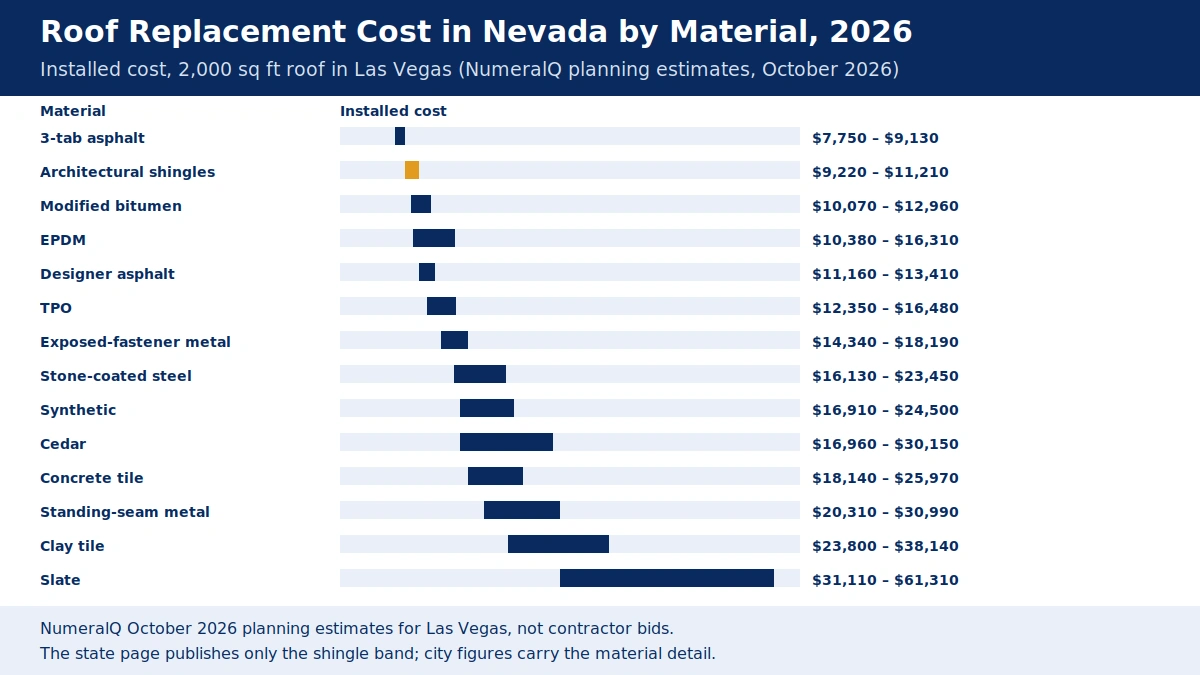
Material is the largest single lever on a Nevada quote, and the spread runs more than six to one from the cheapest shingle to slate. The table below uses NumeralQ’s Las Vegas typical-job totals for a 2,000 sq ft roof, because the state page publishes only the shingle band and Las Vegas is the market where most Nevada roofs get bought. Reno runs a few hundred dollars higher on most materials, as the city section shows.
| Material | 2,000 sq ft roof, Las Vegas (NumeralQ) | Installed per sq ft |
|---|---|---|
| 3-tab asphalt shingles | $7,750–$9,130 | $3.60–$4.15 |
| Architectural asphalt shingles | $9,220–$11,210 | $4.34–$5.19 |
| Flat roof: modified bitumen | $10,070–$12,960 | $4.76–$6.07 |
| Flat roof: EPDM rubber | $10,380–$16,310 | $4.92–$7.74 |
| Designer / luxury asphalt shingles | $11,160–$13,410 | $5.31–$6.29 |
| Flat roof: TPO membrane | $12,350–$16,480 | $5.90–$7.83 |
| Metal panels, exposed fastener | $14,340–$18,190 | $6.90–$8.68 |
| Stone-coated steel | $16,130–$23,450 | $7.79–$11.31 |
| Synthetic slate or shake (composite) | $16,910–$24,500 | $8.18–$11.84 |
| Cedar shakes | $16,960–$30,150 | $8.21–$14.66 |
| Concrete tile | $18,140–$25,970 | $8.80–$12.57 |
| Standing-seam metal | $20,310–$30,990 | $9.88–$15.08 |
| Clay tile | $23,800–$38,140 | $11.63–$18.66 |
| Natural slate | $31,110–$61,310 | $15.28–$30.24 |
Architectural shingles are the default buy statewide, and the price to beat. A thicker, dimensional shingle with 110–130 mph wind ratings, architectural asphalt covers most Reno and Sparks roofs and the shingle-roofed minority of the Valley. The Las Vegas band of $9,220–$11,210 sits just under the state band, and the material is the only one every Nevada roofer stocks, every insurer understands, and every HOA has already approved somewhere in the neighborhood. Its weakness is desert life, covered in the climate section: national life expectancy runs about 30 years, while Las Vegas contractor guides put real desert life at 15–20 years.
3-tab shingles cost about 17–18% less and buy measurably less roof. The flat, single-layer shingle carries lower wind ratings, and many insurers and builders have moved away from it. On a Nevada roof the saving is roughly $1,500 against architectural on the same job. That saving buys a shorter life and a thinner defense against monsoon gusts.
A buyer on a tight budget can justify 3-tab on a rental or a short hold. A buyer staying put should price the architectural upgrade before deciding, because the per-year cost usually favors the thicker shingle.
Flat membranes cover the low-slope sections Nevada builds everywhere. Mid-century homes, additions, porches, and the flat portions of desert-modern houses take modified bitumen, EPDM rubber, or TPO membrane instead of shingles. Modified bitumen is the cheapest of the three in Las Vegas at $10,070–$12,960, TPO the dearest at $12,350–$16,480.
The membrane choice matters less than the detailing: seams, drains, and the flashing where the flat section meets a pitched section are where flat roofs leak. Our flat roof replacement guide prices each membrane system separately.
Metal splits into two very different products at two very different prices. Exposed-fastener panels, corrugated or ribbed steel screwed through the panel face, run $14,340–$18,190 in Las Vegas and suit rural homes, barns, and budget conversions. Standing-seam metal, with concealed fasteners that allow the panels to expand and contract in desert heat, runs $20,310–$30,990.
Standing seam is the premium metal system, common in snow country and the right metal choice for a Reno roof that must shed snow and survive freeze-thaw. Our metal roof cost guide prices the standing-seam and exposed-fastener range in full.
Tile is the Valley material, and its price reflects its weight. Concrete tile runs $18,140–$25,970 for a 2,000 sq ft Las Vegas roof, clay tile $23,800–$38,140. Concrete weighs 850–1,100 lb per square; clay runs lighter at 600–650 lb per square but costs more per square to buy and install. Tile outlasts every other common covering at 50–100 years, and the tile-vs-shingle decision deserves its own section below, because the underlayment under the tile, not the tile, decides when the roof gets worked on again.
Cedar shakes, synthetic shake, stone-coated steel, and slate fill narrow niches. Cedar runs $16,960–$30,150 and needs maintenance, and it faces restrictions in wildfire-prone areas unless treated to a Class A or B fire rating. Synthetic slate and shake, at $16,910–$24,500, mimic the look without the fire exposure. Stone-coated steel, at $16,130–$23,450, pairs a steel core with a stone-chip finish.
Natural slate, at $31,110–$61,310, is a lifetime roof at a lifetime price, and its weight and specialist labor rule it out for most Nevada homes. None of these four should be bought without a roofer who has installed that exact product in Nevada before.
Add-on lines sit outside every material total above. NumeralQ’s Las Vegas add-on prices, installed, run: extra layer removal $1.18–$1.56 per sq ft; a sheet of 4×8 OSB decking $56.89–$82.99; full ice-and-water barrier $0.83–$1.35 per sq ft; seamless aluminum gutters $7.67–$11.08 per linear ft; chimney or wall flashing $305–$440 each; skylight re-flash $460–$592 each.
Reno add-ons run slightly higher across the board. Gutter work pairs naturally with a reroof, and our gutter installation cost guide prices that job on its own.
Roof Replacement Cost by Roof Size in Nevada
Roofers price by the square, and the square is the unit that decides whether two quotes can be compared at all. One square covers 100 sq ft of roof surface.
A 2,000 sq ft house does not have a 2,000 sq ft roof: pitch, eaves, hips, valleys, and waste push the roof surface well past the floor area. SmartRoofingCalculator sizes a 2,000 sq ft single-story house at about 25 squares of roof at a 6/12 pitch with 10% waste, and that 25-square figure is the planning size used through this article.
| Roof surface | Squares | Architectural shingles, Nevada (NumeralQ) |
|---|---|---|
| 1,000 sq ft | 10 | $4,940–$6,090 |
| 1,500 sq ft | 15 | $7,140–$8,720 |
| 2,000 sq ft | 20 | $9,330–$11,350 |
| 2,500 sq ft | 25 | $11,530–$13,990 |
| 3,000 sq ft | 30 | $13,730–$16,620 |
Each added 500 sq ft of roof surface adds roughly $2,200 at the bottom of the band and $2,650 at the top. The step from a 20-square roof to a 25-square roof is the step most Nevada buyers actually face, because the typical Valley single-story home lands near 25 squares once pitch and waste are counted. Budgeting from the 20-square band for a 25-square roof understates the job by about $2,200–$2,640 before a single add-on is counted.
Per-square planning rates let a buyer sanity-check any quote in seconds. SmartRoofingCalculator’s Nevada installed rates, tear-off included, run $440–$630 per square for architectural shingles, $870–$1,360 for standing-seam metal, and $1,160–$1,750 for tile. Multiply the quoted square count by the matching rate.
A 25-square shingle roof at those rates lands at $11,000–$15,750, close to the NumeralQ 2,500 sq ft band of $11,530–$13,990. A quote far outside the per-square band needs an explanation in writing: steep pitch, a cut-up roofline, a second tear-off layer, or deck damage.
Two-story homes break the floor-area shortcut completely. A 2,000 sq ft two-story house has roughly half the roof footprint of a single-story house with the same floor area, because only the ground floor sits under the roof. SmartRoofingCalculator sizes that roof at about 12 squares, or $5,280–$7,560 in shingles.
Any quote that prices a two-story home from its total floor area without measuring the roof has skipped the measurement the whole price rests on. Ask every bidder for the measured roof area, the pitch, and the square count in writing, and compare bids only when all three match.
Pitch and complexity move the per-square rate itself. A walkable 4/12 or 5/12 pitch prices near the bottom of the band. A steep 9/12 or 12/12 pitch needs staging, safety gear, and slower crew movement, and prices toward the top.
Valleys, dormers, hips, and skylights add flashing work and waste. MyRoofData’s model adds about 15% labor for a cut-up roof with multiple valleys, dormers, and hips. A simple gable roof and a cut-up roof of the same square count are different jobs at different prices, and the square count alone will not tell a buyer which one they own.
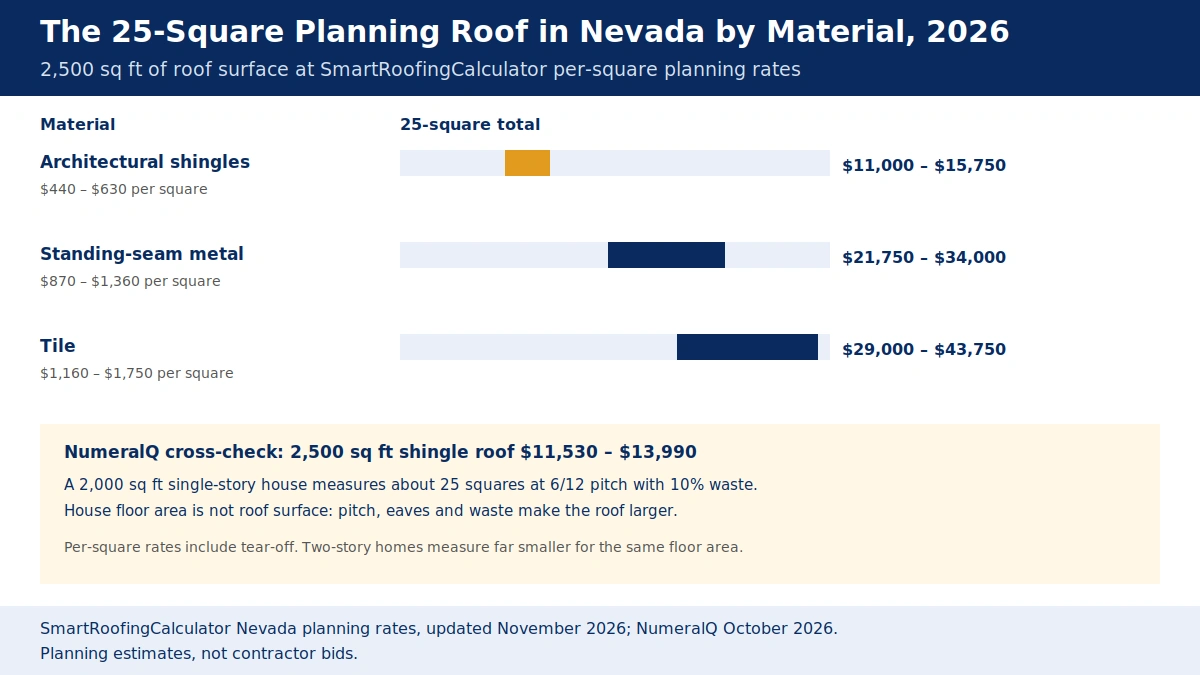
SmartRoofingCalculator’s Nevada per-square rates show the full build-up from BLS wage data and BEA price levels, with the 0.971 state factor that puts Nevada 32nd cheapest of 50 states.
Roof Replacement Cost by City: Las Vegas vs Henderson vs Reno vs Sparks vs Carson City
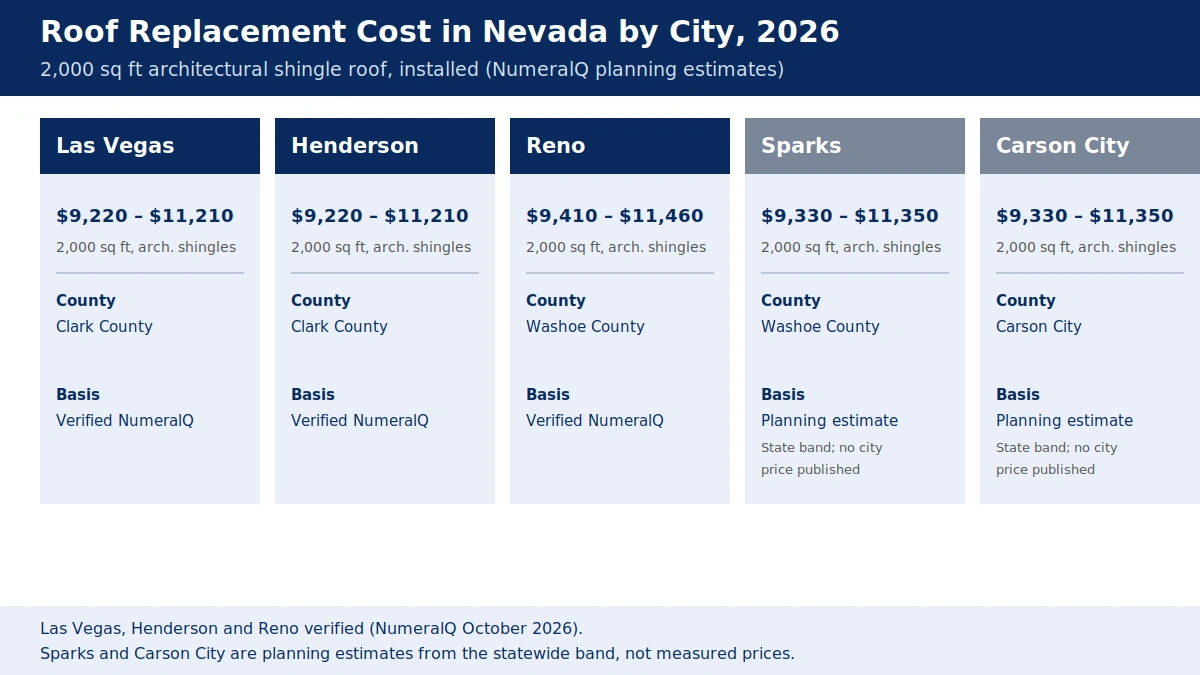
Nevada’s city map is flat on price and sharp on climate. The three cities with published 2026 bands sit within $220 of each other at the bottom of the range. What separates them is what the roof must survive: desert heat and monsoon wind in the south, snow and freeze-thaw in the north, and wildfire exposure along the Sierra edge.
| City | 2,000 sq ft architectural shingles | Status | Roofer pay vs US median | Roof vs median home value |
|---|---|---|---|---|
| Las Vegas | $9,220–$11,210 | NumeralQ, verified | 10% below | 2.4% |
| Henderson | $9,220–$11,210 | NumeralQ, verified | 10% below | 2.1% |
| Reno | $9,410–$11,460 | NumeralQ, verified | 6% below | 1.9% |
| Sparks | ~$9,330–$11,350 | Planning estimate, state band | ~6% below | Not published |
| Carson City | ~$9,330–$11,350 | Planning estimate, state band | Not published | Not published |
Las Vegas is the biggest market and the cheapest verified band, by a small margin. The 2,000 sq ft shingle job runs $9,220–$11,210, with concrete tile at $18,140–$25,970 and standing-seam metal at $20,310–$30,990. Roofer median pay is $23.94 an hour, billed at $48–$62 per worker-hour. The median Las Vegas home dates to 1994 and carries a $427,900 median value, so the typical roof costs about 2.4% of the house.
Contractor supply is the constraint buyers feel: Clark County holds 52 roofing contractors, or 0.6 per 10,000 homes, 68% below the national rate. Book early in the busy months, and expect longer waits after a monsoon outbreak.
Henderson matches Las Vegas dollar for dollar on the published bands. The same 2,000 sq ft shingle job runs $9,220–$11,210, from the same NumeralQ city page, and the same labor market serves both cities. Henderson’s median home is newer, and the roof takes a slightly smaller share of home value at 2.1%. The practical difference is jurisdiction and HOA mix, not price.
Henderson runs its own Development Services building department, and its newer master-planned tracts carry their own design rules. A Henderson quote and a Las Vegas quote for the same roof should land within a few hundred dollars of each other. A gap larger than that is a scope difference, not a city difference.
Reno runs about $200 higher than the southern cities, and buys a different roof for it. The 2,000 sq ft shingle job runs $9,410–$11,460, with concrete tile at $18,700–$26,700 and standing-seam metal at $20,750–$31,560. Roofer median pay is $25.00 an hour, billed at $50–$65 per worker-hour, the highest of Nevada’s priced cities. The median Reno home dates to 1990 and carries a $548,300 median value, so the roof costs only 1.9% of the house, the lightest share in the state.
Contractor supply is close to typical at 39 roofing contractors in Washoe County, or 1.8 per 10,000 homes. Snow detailing, ice-barrier underlayment, and cold-weather sealing rules shape Reno quotes more than labor does.
Sparks and Carson City carry planning estimates, not published city prices. No NumeralQ city page exists for either one, so the state band of $9,330–$11,350 is applied to each and flagged as an estimate. Sparks sits beside Reno in the same labor market and the same snow country, so a Sparks quote should track Reno closely.
Carson City, the state capital, sits at similar elevation with similar winters and a smaller contractor pool, so travel and scheduling can push a Carson City quote toward the top of the band. Treat the state band as a starting point for both cities and get three local quotes before budgeting anything firmer.
The Lake Tahoe basin is the exception to the flat map, and no published band covers it. Incline Village, Crystal Bay, Stateline, and Zephyr Cove add heavy snow loads, steep access, wildfire-code detailing, and a short install season to every job. Local guides describe Tahoe-basin work as dearer than Reno work, but no verified percentage was found, so none is printed here. A Tahoe-basin buyer should budget above the Reno band and insist on a roofer with basin experience, a snow-load-aware design, and a schedule that finishes before the first heavy snow.
Desert Heat, UV & the Monsoon: What the Valley Climate Does to a Roof
Las Vegas heat is not a comfort problem for a roof. It is a chemical one. Ultraviolet light and sustained high temperatures break down the asphalt in shingles, dry out sealants, and cook the underlayment under tile years before its rated life ends.
The numbers behind that sentence come from NOAA’s 1991–2020 normals: 78 days a year at or above 100 degrees, 137 days at or above 90 degrees, and a record high of 120 degrees set on July 7, 2024. The July average high is 104 degrees. About 85 nights a year never drop below 75 degrees, so the roof gets no cool night to recover in.
Rain barely enters the southern Nevada picture. Las Vegas averages 4.18 inches of precipitation a year, against 9.5 inches at the median Nevada station and 37.5 inches at the median US station. A roof that sees almost no rain still fails, because the failure mode is heat and light, not water.
Granules loosen and wash into gutters in the first real rain. Shingles curl at the edges and crack along the sun-facing slope.
Sealant strips soften, re-seal, and soften again through hundreds of heat cycles. The south and west slopes age fastest, and a roof can look sound from the street while the sun-facing slope is already past saving.
The life-expectancy gap between national figures and desert reality is the number to carry into every material decision. InterNACHI puts architectural shingles at about 30 years and 3-tab at about 20 years nationally. Las Vegas contractor guides put real desert shingle life at 15–20 years, with top designs reaching 25.
MyRoofData’s Nevada model prices architectural shingles at a 22–30 year life and notes that UV and 115-degree attic temperatures kill underlayment in 20–25 years while tile lives on. Neither figure is a measured Nevada average. Both point the same way: budget for a shorter shingle life in the Valley than the warranty headline suggests, and read the warranty’s fine print on heat before trusting it.
Underlayment is the hidden casualty of Valley heat, and it matters most on tile roofs. Traditional felt underlayment fails in about 20 years in the Valley climate, while modern high-temperature synthetic underlayment lasts 25–35 years or more. The tile above it can last 50–100 years.
That mismatch is why the lift-and-relay exists, and why the cheapest tile bid is often the one that reuses old felt or skimps on the underlayment grade. Ask for the underlayment product name and its temperature rating in writing. A bid that names the tile and stays silent on the underlayment has priced the durable part and hidden the part that fails first.
The monsoon arrives when the roof is already at its weakest. Monsoon season runs July through September, when sudden intense rain and wind arrive after months of dry weather. Clark County logged 96 damaging-wind reports of 58 mph or more from 2016 to 2025, against 7 in Washoe County.
Microburst gusts of 60 mph and beyond cross the Valley in single evenings, with 70-mph events recorded, and haboob dust walls often precede the storm front. Wind-driven rain probes the exact spots heat has already weakened: flashings at roof-to-wall transitions, pipe boots, valley metal, and ridge caps.
Hail, by contrast, barely registers in Nevada. Clark County logged 14 large-hail reports of 1 inch or more in the same ten years, with only 1 report of hail 2 inches or larger. Washoe County logged 2 large-hail reports and none at 2 inches.
Statewide, only 1 report of 2-inch hail appeared in ten years, and hail season runs May–July, accounting for 74% of 1-inch-plus reports since 2016. FEMA’s National Risk Index rates hail risk Relatively High in Clark County, which conflicts with the low report count and should be read as a modeled rating, not a claims history. The insurance section weighs what that record means for impact-resistant shingles.
Timing a Valley reroof around the weather is straightforward. May and June are the driest months at the Las Vegas Air Terminal station, and they offer the fewest rain delays. Shingles seal well in Valley warmth for most of the year, though nights drop below 40 degrees in December and January, when shingles laid late in the day may not seal until a warm spell.
Owens Corning asks roofers to hand-seal shingles along the roof edges with dabs of roof cement at or below 40 degrees. A July install is possible but punishing for crews, and a monsoon outbreak can halt work mid-tear-off with the deck exposed. Spring and fall bookings avoid both problems.
The desert next door prices the same way. Arizona runs $420–$610 per square for architectural shingles against Nevada’s $440–$630, close enough that a buyer near the state line gains little by shopping across it. Our Arizona roof replacement guide covers the same heat and tile questions from the Phoenix side of the desert.
Tile vs Shingle in Southern Nevada: The Lift-and-Relay Decision
Southern Nevada is the rare US market where the default roof is not a shingle roof. Concrete tile dominates Las Vegas Valley subdivisions, and most-installed systems statewide run concrete tile first, architectural asphalt second, and flat membrane third. A Valley buyer usually inherits the material decision with the house: the roof already on the home, the HOA’s approved list, and the structure’s load capacity narrow the choice before price enters the conversation.
The tile roof’s real cost is the layer nobody sees. Tile lasts 50–100 years. The underlayment beneath it lasts about 20 years in felt form and 25–35 years or more in modern synthetic form. Flashing wears on a similar schedule to the underlayment.
When a 20-year-old tile roof leaks, the tile is usually sound and the waterproofing layer beneath it has failed. Replacing the whole roof in that situation throws away the most expensive material on the roof to fix the cheapest one.
The lift-and-relay fixes the failed layer and keeps the sound one. The crew removes the tile, stacks it, strips the old underlayment, installs new high-temperature synthetic underlayment, rebuilds flashing and valley metal, and resets the same tile. Fixr prices the job at $3–$5 per sq ft, or $6,000–$10,000 for a 2,000 sq ft tile roof, assuming about 10% tile breakage. One Las Vegas roofer’s illustrative sample for a 26-square single-story concrete S-tile relay totals $14,820 including the Clark County permit.
A relay usually runs 40–55% of a full tile replacement. The relay needs a permit in unincorporated Clark County, because the county’s permit exemption for roof-covering replacements specifically excludes tile roofing.
Switching from shingles to tile is a structural decision before it is a price decision. Concrete tile weighs 850–1,100 lb per square, several times the weight of asphalt shingles. The structure often needs an engineering check before a shingle roof converts to tile, and some homes need reinforcement.
Clay tile runs lighter at 600–650 lb per square but costs more: $23,800–$38,140 against $18,140–$25,970 for concrete on a 2,000 sq ft Las Vegas roof. A quote for a shingle-to-tile conversion that skips the structural check has skipped the step that decides whether the conversion is possible at all.
Switching from tile to shingles is possible, and it is usually the wrong move in the Valley. Shingles cost less up front, install faster, and weigh far less. But the switch gives up the tile roof’s 50-plus-year covering life, its Class A fire rating, and its fit with the neighborhood’s look, and an HOA may refuse the change outright.
A shingle roof on a street of tile roofs can also hurt resale, because the buyer pool for a tile-street home expects tile. Price the switch only when the structure cannot carry tile, the tile profile is discontinued and matching has failed, or the budget leaves no other path.
The 50-year math below compares the three serious Valley options at today’s prices, with no inflation and no discounting. It is planning arithmetic, not a quote, and it uses the desert-realistic shingle life from local contractor guides alongside the national figure so both cases are visible.
| 50-year option | Installs in 50 years | 50-year cost at today’s prices |
|---|---|---|
| Architectural shingles, 15–20 yr desert life | 3 | $27,990–$34,050 (3x state band) |
| Architectural shingles, 30 yr national life | 2 | $18,660–$22,700 (2x state band) |
| Concrete tile + 1 lift-and-relay | 1 + 1 relay | $24,140–$35,970 (LV tile + Fixr relay) |
| Standing-seam metal, 40–70 yr life | 1 | $20,310–$30,990 (LV band) |
Read the table as a range of plausible outcomes. At national shingle life, shingles win on 50-year cost. At desert-realistic shingle life, tile and metal pull even or ahead, before any cooling or insurance effects are counted.
Metal earns its place in that table on life, not on install price. Our metal roof vs shingles comparison weighs the two systems against each other for a Nevada roof.
The tile column also carries the relay’s disruption twice over fifty years if the underlayment is felt, and once if it is synthetic. The metal column carries the highest single outlay and the longest quiet stretch afterward. A buyer staying in the home for decades should weigh the middle column of that table as heavily as the first.
Cool-roof effects belong in the same decision but carry no verified Nevada price. Light-colored tile and reflective metal shed more solar heat than dark shingles, and a cooler roof surface eases the load on the air conditioner through 78 days past 100 degrees. No verified study prices that saving for a specific Nevada home, and no NV Energy rebate pays for a cool roof, as the paying section explains.
Treat reflectivity as a comfort and durability bonus, not as a payback line. A reflective shingle or a light tile color costs little extra at install time and pays nothing verifiable later, which is still a reasonable trade on a Valley roof.
Solar sequencing matters for every Valley roof decision. Panels sit on the roof for 25 years or more, so a roof with less than 15 years of life left should be replaced before panels go on, not after. A tile roof needs tile-experienced solar installers who know how to flash mounts without cracking tile.
Our Nevada solar panel cost guide prices the panel side, and the detach-and-reset cost of moving panels for a later reroof should be quoted before the first panel is mounted. Our tile roof cost guide covers tile profiles, weights, and underlayment grades in full.
Wildfire Country: Embers, Class A Roofs & the Tahoe Edge
Wildfire risk follows Nevada’s western edge and the foothills around both metros. FEMA’s National Risk Index rates wildfire risk Relatively High in Washoe County and in Clark County alike. The Reno and Sparks side faces the Sierra slope directly, with the Truckee Meadows and the Tahoe basin downwind of the same fire weather.
The Las Vegas side faces fire risk around Mount Charleston, Red Rock, and the foothill edges of Summerlin and the northwest valley. A roof bought without fire exposure in mind is a roof bought for only half the state.
Embers decide most home losses, not the flame front. The National Fire Protection Association states that embers, not direct flame contact, ignite most homes in wildfires. Wind-blown embers land on the roof surface, lodge in gutters, slip through unscreened vents, and settle in debris trapped along edges and valleys.
A roof can sit a mile from the flame front and still catch from a single ember that finds dry debris in a gutter or an open eave vent. The roof is the largest exposed surface on the house, and it is where embers land first.
Class A is the highest fire rating a roof covering can earn, and it rates the whole assembly. Roofing materials are tested under UL 790, also published as ASTM E108, for flame spread, burning brands, and the ability to resist severe fire exposure without producing flying firebrands. Tile, metal, and slate are noncombustible and commonly carry Class A ratings.
Class A fiberglass asphalt shingles also qualify. The rating covers the covering plus the underlayment and deck beneath it, so a Class A shingle over a rotted deck or a flammable underlayment does not deliver a Class A roof. Ask for the assembly rating in writing, not just the shingle’s rating.
Three detailing steps matter as much as the covering choice, and a reroof is the cheapest time to buy all three. Screen eave and attic vents with 1/8-inch metal mesh, which blocks embers while keeping airflow. Close gaps under roof tiles and along edges where embers can lodge.
Keep gutters clear and easy to clear, because a gutter full of pine needles is a fuse laid along the eave line. None of these steps shows up in a standard reroof quote unless the buyer asks for it. Each one belongs on the quote as its own line for any home in a mapped hazard area.
Code has tightened around the Tahoe edge and the Reno foothills within the last year. Reno adopted the 2024 International Fire Code and Wildland-Urban Interface Code with local amendments, effective January 1, 2026, and vegetation-management review checks a five-foot area around structures for noncombustible material or approved fire-resistive vegetation, using the Washoe County fire-hazard map.
In unincorporated Washoe County, a roof that is replaced, or has 25% or more replaced within 12 months, must meet the roof covering required for new construction under the wildland-urban interface code. On Nevada’s Lake Tahoe shore, the 2024 Lake Tahoe Nevada wildland-urban interface code, effective January 1, 2026, applies defensible-space rules to existing structures as well as new construction, with at least 100 feet of defensible space in the North Lake Tahoe and Tahoe Douglas fire districts.
Cedar shakes deserve a direct warning in fire country. Natural wood shakes need maintenance and face restrictions in wildfire-prone areas unless treated to a Class A or B fire rating. A cedar roof in a mapped hazard area can cost more to insure, more to maintain, and more to defend than any other common covering.
Synthetic shake delivers the same look with a Class A rating and none of the fuel load. A buyer who loves the wood look should price synthetic shake first and treated cedar second, and should confirm the local fire district accepts the product before signing.
Insurance discounts for fire-resistant roofing are claimed more often than they are verified. One Las Vegas contractor guide claims Nevada insurers give 10–20% discounts for Class A roofing. That figure is a contractor claim, not a published carrier schedule, and no carrier-specific discount was verified.
Some carriers do discount rated roofs, and some require them for coverage in hazard areas at all. The only reliable step is to call the carrier with the exact assembly rating before choosing the material, and to get any discount in writing. A material chosen for a discount that never arrives is still a good roof, but the payback math should never count money the carrier has not promised.
Check the parcel’s hazard rating before planning the work, because wildfire rules follow the parcel, not the mailing address. Cities, counties, fire districts, and some homeowner associations each set their own requirements, and they start in different ways: ongoing maintenance, a remodel permit, a home sale, or recorded subdivision conditions.
The FEMA National Risk Index gives the county-level picture. The local fire district gives the parcel-level answer, and that answer governs the roof.
Snow, Freeze-Thaw & Ice Dams: Reno, Sparks and the High Desert Roof
Reno is a mountain city wearing a desert city’s clothes. The valley floor sits near 4,500 feet, and the snow that barely touches Las Vegas arrives every winter in the Truckee Meadows. NOAA’s 1991–2020 normals put Reno snowfall at about 20.9 inches a year, against a median of 15.9 inches at US stations that measure snow.
Precipitation runs 7.3 inches a year, most of it falling as winter snow and spring rain. The city counts about 122 days a year with a low at or below freezing, and the record low is minus 16 degrees. Summer still hits 92 degrees on an average July day, so a Reno roof swings more than 100 degrees between seasons.
Freeze-thaw is the slow mechanism that opens a Reno roof up. Daytime sun melts snow on the upper roof. Night cold refreezes the meltwater at the eaves.
Water expands as it freezes, prying at shingle edges, flashing joints, and sealant lines a fraction of an inch at a time, hundreds of cycles a winter. The damage shows up as lifted shingles, cracked sealant, and flashing that has worked loose from the wall it was meant to seal.
A roof that survives its first five Reno winters without detailing problems usually survives the next fifteen. A roof that leaks in its second winter was detailed for a milder climate than the one it sits in.
Ice dams form where heat escapes through the roof deck and melts snow from below. Meltwater runs down to the cold eave, refreezes, and builds a dam that ponds water behind it. Ponded water backs up under shingles and into the house, staining ceilings and soaking insulation.
The defense is a stack of details, not one product: an ice-barrier underlayment along the eaves, sealed air leaks between the living space and the attic, enough attic insulation to keep the deck cold, and ventilation that carries away the heat that does escape. The ice-barrier membrane must run from the eave edge to at least 24 inches inside the exterior wall line where the local climate table requires it, which covers Nevada’s colder and higher-elevation areas.
The ice-barrier line belongs on every Reno, Sparks, and Carson City quote as its own item. NumeralQ prices a full-roof ice-and-water barrier in Reno at $0.85–$1.37 per sq ft installed, against eaves-only coverage as the baseline. A full-roof membrane is insurance against the worst ice-dam winter, and it costs a fraction of one interior water-damage repair.
At minimum, confirm the eaves coverage, the valley coverage, and the membrane product name in writing. Silence on ice barrier in a Reno quote leaves out the detail the climate demands most.
Cold-weather installation rules shape the Reno calendar. Owens Corning asks roofers to hand-seal shingles along the roof edges with dabs of roof cement when air and surface temperatures sit at or below 40 degrees, because the sealant strip needs warmth and sun to bond. Reno nights drop below 40 degrees from October through April, so shingles laid late in the day may not seal until a warm spell arrives.
July and September are the driest months at the Reno Airport station and offer the fewest rain delays. A fall install needs a weather window with warm days after it, and a winter install needs a crew that hand-seals as it goes.
Pitch and snow shedding pull Reno roofs steeper than Valley roofs. Pitched roofs in the Reno area commonly run 6/12 to 9/12, steep enough to shed snow rather than hold it. Steeper pitches cost more to work on, because crews need staging and move slower, and they add roof surface for the same floor area.
Snow guards, heat cables, and reinforced valleys all appear on Reno quotes for homes under heavy snow load or with valleys that collect drifting snow. No single snow-load figure covers the region, because the load rises with elevation and exposure, so the local building department’s climate table governs. Ask the contractor which ground snow load the design assumes, and confirm it matches the address.
The Tahoe basin takes every Reno problem and turns it up. Snowfall runs far heavier than the valley floor, access narrows in winter, and the install season shortens to the months when the roads and the roof are both clear. A basin roof needs snow-load-aware design, ice-barrier coverage, ember-resistant detailing, and a schedule that finishes before the first heavy snow.
No published Tahoe-basin price band was found, so the city section gives no Tahoe figure. Budget above the Reno band, hire a basin-experienced crew, and treat any quote that prices a Tahoe roof like a Reno roof as a quote from a contractor who has not worked the basin.
Permits, Code & HOA Approval in Nevada: Four Jurisdictions, the 2024 Code & the Design Review Committee
Nevada splits the paperwork in two directions. The state licenses the roofer, and the city or county permits the job. No city or county license substitutes for the state license, and no state permit exists for a reroof.
A buyer who checks only one side has checked half the job. The permit side is where Nevada gets complicated, because the Las Vegas Valley alone splits across five building departments, and a mailing address that reads “Las Vegas” often sits in unincorporated Clark County.
| Address falls in | Permit office |
|---|---|
| Unincorporated Clark County (Paradise, Spring Valley, Enterprise, Summerlin South, Sunrise Manor, Whitney) | Clark County Department of Building and Fire Prevention |
| City of Las Vegas (incorporated city limits, older urban core and northwest neighborhoods) | City of Las Vegas Department of Building and Safety |
| Henderson | Henderson Development Services |
| North Las Vegas | City of North Las Vegas Building and Safety Division |
| Boulder City | City of Boulder City building department |
| Reno / Sparks / Washoe County | City of Reno Development Services / City of Sparks / Washoe County Building |
Pinning down the right office is the first permit step, and getting it wrong invalidates the permit. A contractor who pulls a City of Las Vegas permit for a Summerlin or Henderson address has not pulled a valid permit.
The repair is unpermitted, an insurance claim built on it is weakened, and the problem surfaces at resale. Ask the contractor to name the permitting jurisdiction for the address before work starts, and confirm the permit number sits in the file before tear-off begins.
Clark County runs on the 2024 code editions as of 2026. The county adopted the 2024 International Residential Code with Southern Nevada Amendments by ordinance on July 15, 2025, effective January 11, 2026, and the same changeover covered the building, plumbing, mechanical, and energy codes. Henderson’s 2024 IRC amendments took effect January 2, 2026.
Reno’s reroof checklist follows the 2024 code as well. Older online advice that cites the 2018 code for the Valley is out of date, and a contractor quoting 2018 rules in 2026 is working from an old book.
Whether a reroof needs a permit depends on the jurisdiction and the scope. Clark County Code exempts some roof-covering replacements from a permit but specifically excludes tile roofing, so a tile relay or re-roof in unincorporated Clark County is permitted work. Re-roofing that replaces structural components or sheathing beyond the exempt limits needs a permit, while a like-for-like covering swap with minimal sheathing repair may not.
The City of Las Vegas requires a permit for replacing all roofing material or installing tile over existing materials. Reno handles reroofs through its EZ permit program, with the fee based on the job’s value. The safe rule for every Nevada reroof is to assume a permit is needed and let the building department say otherwise in writing.
Reno’s EZ permit checklist shows what the 2024 code demands in practice: shingles only over solid sheathing, drip edge at eaves and rakes, a cricket on the uphill side of chimneys, and no new layer over a roof that already has two. The two-layer maximum comes from the IRC itself: if the house already carries two layers of shingles, the job is a full tear-off, not a recover. Drip edge and crickets are small details with outsized leak consequences, and both belong on the quote as named items rather than buried inside a lump sum.
Permit fees run on valuation or flat schedules depending on the office, and no single statewide figure exists. Published planning figures run $150–$375 on SmartRoofingCalculator’s Nevada page, $150–$450 for Clark County on MyRoofData, $150–$500 on This Old House via HomeGuide, and $250–$900 for Las Vegas on RoofingEstimatorPros. NumeralQ could not publish a priceable base fee for any Nevada city.
The contractor normally pulls the permit and passes the fee through, so confirm the fee sits on the quote as its own line. A missing permit line usually means the permit was never pulled.
HOA approval is a separate permission that runs before the permit, and in the Valley it often decides the material. Nevada common-interest communities run under NRS Chapter 116. The declaration of covenants, conditions, and restrictions sits at the top of the governing documents, and no owner may change the exterior appearance of a home, including roofing materials, without the association’s permission.
Architectural rules must be reasonably related to their purpose, explicit enough to follow, consistent with the declaration, and uniformly enforced. Summerlin, Anthem, Southern Highlands, Inspirada, Cadence, and most newer Henderson tracts are master-planned communities where these rules apply.
The Summerlin South improvement request form, revised January 2026, states the process plainly: approval must be obtained prior to commencement of construction, and no work shall commence unless the Association has provided prior written approval. A separate sub-association approval may also be required, and Summerlin may ask for a copy of the sub-association approval letter with the submittal. Color schemes must come from the designated palette for the community.
Submittals typically include a site plan or photo, product specifications, color samples, the contractor’s license and insurance, and a project timeline. Architectural review turnaround typically runs 2–6 weeks, so the HOA clock should start before the contractor’s clock does.
Material and color rules are where Valley owners make the expensive mistakes. Summerlin communities often require concrete or clay tile in specific earth tones. Henderson associations may mandate architectural shingles in desert-palette colors.
Anthem communities typically hold strict tile style requirements. An approved tan tile in the wrong shade can draw a rejection, and a roof installed without approval can draw an order to tear it out at the owner’s expense.
The fix is unglamorous: pull the CC&Rs and the architectural guidelines, match the product and color to the approved list in writing, and file before signing the roofing contract. A contractor who says HOA approval can wait until after tear-off is a contractor to walk away from.
One protection runs the other way. Nevada law voids any covenant that prohibits or unreasonably restricts a solar energy system, and an association may not prohibit or unreasonably deny drought-tolerant landscaping.
Solar panels still go through an approval process, but the association cannot block them outright. A homeowner combining a reroof with a solar install should file both approvals together, with the panel layout and the roofing material on the same submittal, so the committee sees the finished roof rather than two separate changes.
Hiring a Roofer in Nevada: The C-15a License, the Deposit Cap & the Recovery Fund
Nevada licenses roofers through the Nevada State Contractors Board, and the license is the single most important check in the whole hiring process. Roofing is classification C-15, Roofing and Siding, with subclass C-15a, Roofing, under NAC 624.320.
The C-15a scope covers the installation, application, alteration, and repair of watertight and weatherproof material used on roofs, including asphalt, shingles, shakes, tile, slate, metal, urethane, and photovoltaic roof tiles that serve as the roof. A contractor without that classification is not a roofer in Nevada’s eyes, whatever the truck says.
Earning the license takes four full years of qualifying experience within the prior 15 years, as a journeyman, foreman, supervising employee, or contractor in the classification. Accredited training can count for at most three of those years. The qualifier then passes two exams through PSI: the Contractor Management Survey covering business and law, and the C-15a trade exam, each with a 75% pass mark.
The application fee is $300, nonrefundable, and the license fee is $600 for a two-year license. The Board sets a bond or cash deposit between $1,000 and $500,000 based on the license type, the monetary limit, and the applicant’s finances, experience, and character.
Workers’ compensation proof or an exemption affidavit is required, along with a financial statement supporting the requested monetary limit. Licenses renew every two years, and Nevada requires no continuing education for contractor renewal.
The monetary limit deserves its own sentence, because buyers rarely check it. Each license carries a limit on the dollar value of work the contractor may take on, and a contract above that limit sits outside the license. A contractor whose limit is below the bid is effectively unlicensed for that job, and a Recovery Fund claim on such a contract can be denied.
Ask for the license number, the classification, and the monetary limit in writing, and confirm all three on the Board’s license search before signing. The check takes minutes and it is the cheapest insurance in the project.
The exemption that lets unlicensed hands touch a roof is narrow. State law exempts repair or maintenance work valued under $1,000, including labor and materials, where no building permit is required and the work is not part of a larger project. Every full reroof exceeds that threshold many times over.
Any contractor who offers to do a reroof without a license, or who asks the owner to pull the permit, is asking the owner to give up the legal protections that come only with licensed work. Owner-pulled permits also bar Recovery Fund eligibility, as the fund’s own rules state.
Nevada caps the deposit by law, and the cap is low. For residential improvement work on an owner-occupied single-family home, the deposit may not exceed $1,000 or 10% of the contract price, whichever is less, under NRS 624.970. A $10,340 midpoint roof therefore takes a deposit of at most $1,000.
A contractor who asks for half up front, or for the full material cost before delivery, is asking for money the law does not allow. Pay by check or card rather than cash, so every payment leaves a record. Progress payments tied to completed stages, with a final payment held until the final inspection passes, keep the bargaining power with the buyer.
The Residential Recovery Fund is Nevada’s backstop when licensed work goes wrong, and it is worth understanding before it is needed. The fund pays up to $40,000 per claim to single-family owner-occupant homeowners who hired a properly licensed residential contractor and suffered actual damages. It does not cover work by unlicensed contractors, and it does not guarantee full recovery: amounts recovered from other sources are deducted, and awards rest on the low bid from three licensed-contractor proposals.
Complaints must be filed within four years of work completion, and a homeowner with a court judgment may apply within two years of the judgment. The fund’s decision is final and not subject to judicial review. The Nevada State Contractors Board’s Recovery Fund page carries the full eligibility rules and the claim forms.
Lien law adds one more reason to pay on schedule and keep records. Subcontractors and suppliers who are not paid may file a mechanic’s lien against the house. In Nevada they send a preliminary notice within 31 days, and on a residence a claimant must give the owner 15 days’ notice before recording a lien.
The state requires statutory waiver forms, and a prime contractor who was paid must defend the owner against a subcontractor’s lien. Unlicensed contractors cannot lien.
The lien notice usually comes from two directions at once: the supplier who delivered the shingles or tile, and a subcontracted crew the roofer brought in. Collect lien waivers with each payment, and keep every check copy, receipt, and change order in one file.
Storm-chaser pressure is the hiring risk no license check alone catches. After a monsoon outbreak, door-to-door operators arrive in affected neighborhoods offering free inspections and same-day signatures. Some are licensed Nevada roofers doing real outreach.
Some are not licensed at all, or hold a license with a monetary limit below the job, or plan to leave the state before the warranty matters. The defense is procedural: verify the license and limit on the Board’s search, confirm the contractor’s insurance in writing, refuse same-day signatures, and get three written quotes on one identical scope.
A roofer who will not wait for those steps is telling the buyer how the warranty calls will go. Our questions to ask a roofer guide carries the full interview list.
Insurance in Nevada: Monsoon Wind Claims, ACV vs RCV & the Roof-Age Rule
Homeowners insurance in Nevada pays for sudden damage and refuses gradual decay, and the line between the two runs straight through the desert aging problem. A monsoon gust that tears shingles off a sound roof is a covered peril. Shingles that curled and shed granules through 18 summers in desert sun are wear and tear.
The policy covers the storm, not the sun. A buyer who understands that distinction before filing will not waste a claim on a roof the carrier will call maintenance, and will not pay out of pocket for damage the carrier owes.
The sudden-damage pattern in the Valley is wind and wind-driven rain. A 60 mph monsoon gust lifts shingles, breaks tile, tears flashing from vents and chimneys, and drives rain through openings the wind just made. Hail joins the claim only rarely, given the thin hail record.
Fire joins it in the foothills and the Tahoe basin. After any storm, document before cleaning up: photograph the damage from the ground and, where safe, from the roof edge, photograph the interior water path, keep receipts for tarps and board-up, and get a licensed roofer’s written scope before the adjuster arrives. Delay gives the carrier grounds to argue the damage grew from neglect rather than from the storm.
Replacement cost value and actual cash value decide what the carrier actually pays, and the difference is the depreciation of the old roof. Replacement cost value pays the cost of a new roof of like kind, less the deductible. Actual cash value pays the replacement cost less depreciation for the roof’s age and condition.
A 15-year-old shingle roof under an actual cash value settlement may pay only a fraction of the reroof cost, with the owner funding the rest. A replacement cost settlement pays the full job, usually in two checks: the depreciated amount first, and the recoverable depreciation after the work is done and documented.
Roof-age underwriting has tightened across Nevada since 2023, and heat-aged roofs feel it first. Carriers have moved policies from replacement cost to actual cash value on aging roofs earlier than owners expect, because a Valley roof can be functionally old at 15 years while the calendar says it is middle-aged. One contractor guide warns that roofs older than 15 years may receive a depreciated payout rather than full replacement cost.
That is carrier practice, not a statute, and the policy’s own roof schedule governs. Read the declarations page and the roof endorsement before the storm season, not after it. A buyer shopping for a new policy with a 12-year-old Valley roof should ask which settlement basis applies, and at what age it changes.
Deductibles follow the peril, and the wind deductible can dwarf the standard one. Flat-dollar deductibles remain common on Nevada homeowner policies outside high-risk ZIP codes. Percentage wind deductibles of typically 1–2% of Coverage A appear on policies written after a monsoon-season loss or in known microburst corridors around the Valley.
On a $500,000 dwelling limit, a 1% wind deductible means $5,000 out of pocket before the carrier pays the first dollar. Check the declarations page for a separate wind or hail deductible, and budget the reroof decision around the deductible that actually applies to a monsoon claim.
Class 4 impact-resistant shingles are the upgrade Nevada’s hail record struggles to justify. The impact rating, tested by dropping steel balls onto the shingle, earns its keep where large hail is common. Nevada logged 1 report of 2-inch hail in ten years, and only 14 large-hail reports in Clark County over the same period.
NumeralQ’s Nevada guide answers the worth-it question directly: usually not. FEMA’s Relatively High hail rating for Clark County points the other way, but it is a modeled rating, and the observed report count is thin.
No verified Nevada price band or carrier discount percentage for Class 4 shingles was found, so none is printed here. A buyer who wants the rating for peace of mind should price it as its own line and confirm any carrier discount in writing before counting it.
Nevada’s unfair-claims backbone is NRS 686A.310, the Unfair Claims Settlement Practices Act, which sets standards for how carriers must handle claims. A carrier that delays without reason, denies without investigation, or misstates policy language can be challenged under that statute, and the Nevada Division of Insurance takes complaints. That protection matters most on large monsoon claims where the scope is disputed.
The practical defense is still documentation: dated photos, a written roofer scope, the permit number from the correct jurisdiction, and a claim filed promptly. An insurance scope for a wind-damaged tile roof will usually price a lift-and-relay, with a breakage allowance, rather than a full tile replacement, because the tile itself usually survives the wind that broke the underlayment’s seal.
Searches of the Nevada statutes located no deductible-payment ban and no roof-matching statute, and neither rule should be assumed. Some states bar contractors from paying or waiving deductibles, and some states require carriers to match undamaged slopes. The policy language and the contract govern instead.
A contractor who offers to absorb the deductible is offering a discount that changes the contract price, and the carrier’s scope should reflect the price actually charged. Get the deductible handling in writing on the contract, and keep the carrier’s scope and the contractor’s scope in the same file.
Paying for a Nevada Roof in 2026: No Federal Credit, HEAR Not Launched & the Loans That Exist
The federal help for a 2026 Nevada roof totals $0, and the arithmetic is short. The One Big Beautiful Bill Act, Public Law 119-21, ended the Section 25C energy efficient home improvement credit and the Section 25D residential clean energy credit for property placed in service after December 31, 2025. The IRS confirmed the end in Fact Sheet FS-2025-05.
Roofing materials were never a standalone credit item on their own, except for qualifying solar roofing under the old rules. The Section 48E credit that survives for leased clean-energy systems has no roof application, because no roof lease market was found.
For a homeowner-owned roof installed in Nevada in 2026, the federal government contributes $0. A 2026 bid with a federal credit netted out is pricing a program that no longer exists. Ask for the numbers again with that line removed.
Nevada’s HEAR and HOMES rebates have not launched, and no launch date exists. The combined federal allocation is about $96.1 million: $47,920,160 for HEAR and $48,103,711 for HOMES, administered by the Nevada Governor’s Office of Energy. The program page still carries a 2025 opening estimate and a July 2025 update stamp, and the current activity is a request for proposals through the State Purchasing Division.
Trackers that re-checked the program in October and November 2026 list both halves as not yet open. A roof replacement is not a rebate item under either program even after launch, and the per-household caps of up to $8,000 under each program apply only to their covered measures. Attic insulation and air sealing done alongside the roof are the only plausible overlap, and that money cannot be claimed until the programs open.
The Energy Department’s Program Notice 26-2, effective May 29, 2026, renamed HEAR the High-Efficiency Electric Home Rebate and limited it to electric-to-electric upgrades and new construction, barring fuel switching. That change matters for heat pumps and water heaters, not for roofs. It is noted here because rebate marketing sometimes bundles roof work with electrification claims.
A roof does not become a HEAR item by sharing a quote with a heat pump. Price the roof on its own, and price any insulation or air-sealing line separately, so a future rebate claim can be documented cleanly if the programs ever open.
Nevada has no statewide roof grant, and no verified utility rebate pays for a roof. NumeralQ checked for a statewide roof grant in October 2026 and found none. NV Energy’s PowerShift program pays for weatherization, not roofing: duct sealing at $200, duct sealing plus insulation at $300, and insulation at $0.10 per sq ft, subject to R-value thresholds, a whole-house electric cooling requirement, and a 180-day documentation deadline.
Those amounts can soften the cost of attic insulation added while the roof is open, and our attic insulation cost guide prices that work. Claims of an NV Energy cool-roof rebate appear on contractor and lead-generation pages, but no verified program was found, and no such rebate should be subtracted from any quote.
A proposed federal cool-roof rebate deserves one paragraph, because it will surface in search results. The Cool Roof Rebate Act, H.R. 2679, introduced in April 2025, would pay $0.25–$0.75 per sq ft for qualifying cool roof products in high-heat areas.
The bill sits in committee. It is not law, it funds nothing, and it pays $0 in 2026.
A contractor or website that presents it as live money is presenting a proposal as a program. The same caution applies to any page still advertising a 30% federal credit on solar roofing for 2026 installs: that credit ended with Section 25D on December 31, 2025.
Financing that actually exists starts with the Nevada Clean Energy Fund’s RE-UP program, the Residential Energy Upgrade Program. RE-UP offers low-interest unsecured loans for eligible upgrades including roofing, through a network of vetted contractors, and considers factors beyond credit score when assessing eligibility, which matters for low-income and credit-challenged households. The program runs with the Solar and Energy Loan Fund, a nonprofit green lender.
Terms, rates, and eligibility are set by the program and should be confirmed directly, because no Nevada-specific rate schedule was verified for this article. Standard routes remain available alongside it: home equity lines, FHA Title I loans, and contractor financing, each with terms that vary by lender and borrower. Our roof financing guide compares those routes in full, and our federal energy tax credits guide carries the complete 2026 credit picture.
Repair or Replace & Getting Quotes in Nevada: The Decision Rules and the Checklist
The repair-or-replace call turns on how much of the roof has failed, not on how old the roof is. Age sets the context. Condition sets the decision.
A 12-year-old Valley shingle roof with one lifted valley flashing needs a repair. A 12-year-old Valley shingle roof with granule loss across every slope, curling on the south face, and a second leak in two years needs a replacement. The rules below sort the two cases, and the checklist below them turns the decision into three comparable quotes.
Repair when the failure is local. One slope, one valley, one flashing detail, or one pipe boot is a repair, provided the rest of the roof holds granules, lies flat, and shows no daylight through the deck from the attic. A tile roof with a handful of broken tiles and sound underlayment is a repair, with matching tile as the only hard part.
A roof with one layer of shingles and a sound deck can also take a partial re-roof of the failed slope, though matching aged shingles is never exact. Our roof repair cost guide prices the common repairs separately.
Replace when the failure is general. Widespread granule loss, curling or cracking across multiple slopes, recurring leaks after repair, daylight through the deck, or sag between rafters all point to replacement. Two layers already on the roof force a tear-off rather than a recover.
A shingle roof past the desert-realistic 15–20 year band on its sun-facing slopes is living on borrowed time even without a leak, and a tile roof whose underlayment has failed across the field needs a relay at minimum. An inspection settles the close calls: our roof inspection guide explains what a proper inspection checks and when to book one.
Relay when the tile is sound and the underlayment is not. This is the Valley’s third option, and it is the most commonly missed. Sound tile plus failed underlayment equals a lift-and-relay at $6,000–$10,000 for a 2,000 sq ft roof, against $18,140–$25,970 for a full new tile roof in Las Vegas. Relay when breakage is low, the profile is still made or well matched, and the deck is sound.
Replace the tile when breakage is widespread, the profile is discontinued, or the deck needs broad repair. Pricing only a full replacement, without pricing the relay, skips the option most Valley tile owners actually need.
Do not sign anything until every item on the list below is in writing, on one identical scope, from three licensed contractors. An incomplete quote is a deferred bill: the missing line comes back as a change order, priced after the buyer has already signed.
- Measured roof area, pitch, and square count in writing (25-square planning size for a 2,000 sq ft single-story house; two-story homes measure far smaller)
- Material named with its product, profile, color, and warranty (architectural shingle brand and line, or tile profile and manufacturer; underlayment product and temperature rating named separately)
- Cash price in writing for the same scope ($9,330–$11,350 state anchor for a 2,000 sq ft shingle roof; $11,530–$13,990 for 25 squares)
- Tear-off layers, disposal, deck allowance, and flashing lines itemized (extra layer, decking per sheet, chimney and skylight flashing, gutters, ice barrier on northern roofs)
- Permit jurisdiction named and fee shown as its own line (correct city or county office; tile work permitted in unincorporated Clark County; Reno EZ permit)
- HOA approval in writing before signing (Summerlin and master-planned rules; 2–6 week review; color and profile matched to the approved list; sub-association approval where required)
- License verified (NSCB C-15a classification, monetary limit covering the contract price, bond, workers’ compensation; deposit at most $1,000 or 10% of the contract)
- No line for a federal credit and no line for a HEAR or HOMES rebate ($0 federal; Nevada programs not launched; no roof rebate exists)
- Storm and fire detailing named where the address needs it (vent screens with 1/8-inch mesh, ember gaps closed, ice barrier at eaves, monsoon flashing details at roof-to-wall transitions)
- Insurance scope matched to the contractor scope (sudden-damage documentation, deductible from the declarations page, lift-and-relay scope for tile wind claims, lien waivers collected with each payment)
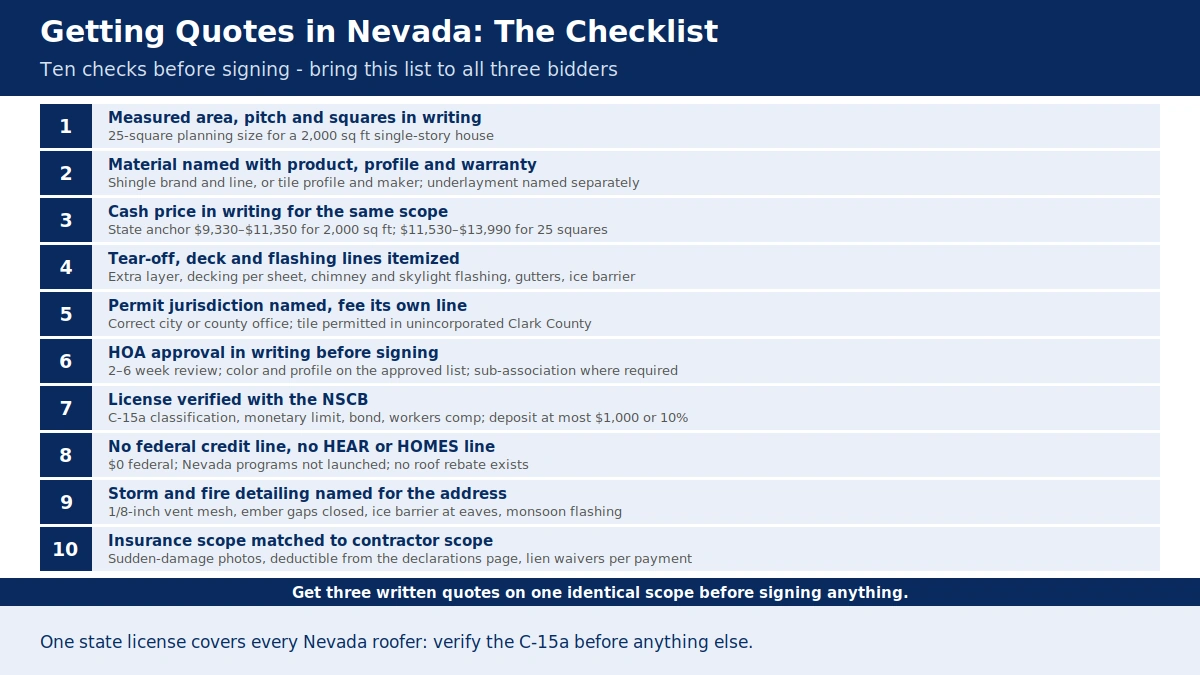
Get three written quotes on one identical scope before signing anything. The cheapest quote is rarely the best quote.
The best quote names the material and the underlayment, shows the measured squares, itemizes the add-ons, names the permit office, proves the license and the limit, and puts the HOA approval in writing first. In Nevada, the best quote is also the one that knows which climate the house sits in: desert heat in the south, snow and embers in the north, and a different roof for each.
Sources & methodology Installed costs:
- NumeralQ, Roof Replacement Cost in Nevada (2026), estimator pricing as of Oct 26, 2026 (planning estimates, not contractor bids): by roof area 1,000 sq ft $4,940–$6,090, 1,500 sq ft $7,140–$8,720, 2,000 sq ft $9,330–$11,350, 2,500 sq ft $11,530–$13,990, 3,000 sq ft $13,730–$16,620; 3-tab about 18% under architectural; slate roughly 4.5x; roofer median pay $24.56/hr, billed $49–$64/worker-hour; national band $9,710–$11,840
- NumeralQ, Roof Replacement Cost in Las Vegas (2026), pricing Oct 26, 2026: by size 1,000 sq ft $4,880–$6,020 to 3,000 sq ft $13,560–$16,400; 2,000 sq ft $9,220–$11,210; by material 3-tab $7,750–$9,130, architectural $9,220–$11,210, modified bitumen $10,070–$12,960, EPDM $10,380–$16,310, designer asphalt $11,160–$13,410, TPO $12,350–$16,480, exposed-fastener metal $14,340–$18,190, stone-coated steel $16,130–$23,450, synthetic $16,910–$24,500, cedar $16,960–$30,150, concrete tile $18,140–$25,970, standing seam $20,310–$30,990, clay tile $23,800–$38,140, slate $31,110–$61,310; add-ons extra layer $1.18–$1.56/sq ft, decking $56.89–$82.99/sheet, full ice-and-water $0.83–$1.35/sq ft, gutters $7.67–$11.08/lin ft, flashing $305–$440, skylight re-flash $460–$592; roofer median $23.94/hr, billed $48–$62/hr; median home 1994 build, $427,900 value, roof 2.4% of value; 52 roofing contractors in Clark County, 0.6 per 10,000 homes
- NumeralQ, Roof Replacement Cost in Henderson (2026), pricing Oct 26, 2026: same bands as Las Vegas; 2,000 sq ft $9,220–$11,210; roof 2.1% of median home value; roofer pay 10% below US median
- NumeralQ, Roof Replacement Cost in Reno (2026), pricing Oct 26, 2026: by size 1,000 sq ft $4,980–$6,140 to 3,000 sq ft $13,840–$16,770; 2,000 sq ft $9,410–$11,460; by material 3-tab $7,880–$9,300, architectural $9,410–$11,460, modified bitumen $10,310–$13,270, EPDM $10,630–$16,630, designer asphalt $11,340–$13,650, TPO $12,680–$16,910, exposed-fastener metal $14,620–$18,540, stone-coated steel $16,440–$23,850, synthetic $17,250–$24,940, cedar $17,350–$30,650, concrete tile $18,700–$26,700, standing seam $20,750–$31,560, clay tile $24,390–$38,910, slate $31,800–$62,200; add-ons extra layer $1.23–$1.62/sq ft, decking $58.77–$85.43/sheet, full ice-and-water $0.85–$1.37/sq ft, gutters $7.92–$11.41/lin ft, flashing $316–$455, skylight re-flash $474–$611; roofer median $25.00/hr, billed $50–$65/hr; median home 1990 build, $548,300 value, roof 1.9% of value; 39 roofing contractors in Washoe County, 1.8 per 10,000 homes
- SmartRoofingCalculator, Nevada (2026), page Apr 24, 2026, updated Nov 9, 2026, planning estimates: architectural $440–$630/sq installed with tear-off, standing-seam metal $870–$1,360/sq, tile $1,160–$1,750/sq; 25-square arch roof $11,000–$15,750; 2,000 sq ft house arch $8,800–$12,600, standing seam $17,400–$27,200, tile $23,200–$35,000; permit $150–$375, avg ~$230; BLS May 2024 about 2,230 roofers, mean $26.75/hr, median $23.64/hr; state factor 0.971, ranks 32 of 50 cheapest; neighbor arch per-square California $510–$730, Oregon $470–$680, Idaho $420–$600, Utah $430–$620, Arizona $420–$610
- MyRoofData, Nevada (2026), a model, not a quote: typical home architectural $13,000–$22,750; per square before tear-off 3-tab $357–$561, architectural $459–$765, premium $561–$969, ribbed metal $561–$969, standing seam $969–$1,632, cedar $918–$1,530, concrete tile $1,020–$1,836, clay tile $1,224–$2,550, slate $1,530–$3,060, flat membrane $561–$969; crews $55–$92/hr; tear-off $100–$200/sq/layer; worked example 23.4 squares $13,100–$22,700; concrete tile 850–1,100 lb/sq; architectural wind ratings 110–130 mph; underlayment killed by UV and 115 F attic temps in 20–25 years
- This Old House, Nevada (2026 survey, updated Jun 17, 2026): average $7,830, range $5,994–$19,854; asphalt $4.58/sq ft, slate $15.17/sq ft; permits $150–$500 (HomeGuide); survey methodology, low cross-check only
- RoofingEstimatorPros, Nevada and Las Vegas (updated Aug 26, 2026): state $15,235–$27,270, avg $20,584, $10.29/sq ft, multiplier 1.08x, permit $200–$800; Las Vegas $16,128–$28,764, avg $21,744, multiplier 1.13x, permit $250–$900; high outlier, reported not headlined
- HomeCostLens, Las Vegas (cost data reviewed Sept 2026, modeled): typical 2,200 sq ft home ~$11,020, range $9,020–$18,040, $4.51–$9.02/sq ft; labor ~$26/hr; by material 3-tab $4.51–$7.52/sq ft, architectural $6.01–$9.02, premium asphalt $9.02–$16.03, metal $8.02–$18.04, tile $10.02–$25.05
- Prestige Roofing (Las Vegas contractor, 2025–2026 guide): most 2,000 sq ft homes $12,000–$18,000; asphalt $6,000–$13,500, tile $15,000–$30,000, metal $15,000–$50,000; clay tile 6–6.5 lb/sq ft (600–650 lb/sq), 75–100+ years; concrete tile 8.2–11 lb/sq ft (820–1,100 lb/sq), 50+ years
- Shingle Geek (Las Vegas-area modeled retail, May 2026): Summerlin 22-square HDZ retail $16,320–$17,680; Skye Canyon 32-square HDZ retail $22,730–$24,624; single-source modeled retail, cross-check only
- Umbdcmart state table (Mar 2026, secondary): Nevada $9,500–$17,000, $4.75–$8.50/sq ft; Reno $8,500–$15,000; permits $150–$350
Tile relay:
- Fixr via CostCheck (Oct 2026): lift-and-relay $3–$5/sq ft, $6,000–$10,000 for a 2,000 sq ft tile roof, about 10% breakage; labor $2.75–$3.50/sq ft; new tile roof $19,000–$35,000
- City Seamless Roofing (Las Vegas, May 2026): felt underlayment fails in about 20 years in the Valley climate; modern synthetic 25–35+ years; tile 50–100 years; tile re-roofs and relays generally $8–$20/sq ft
- Arista Roofing (Las Vegas): illustrative 26-square single-story 4:12 concrete S-tile relay sample $14,820 including Clark County permit; sample, not a bid; Clark County Code 22.02.190 excludes tile from the roof-covering permit exemption
- Novory Las Vegas guide: relay usually 40–55% of full replacement; underlayment typically fails at 20–30 years from heat and UV
Climate and storms:
- NOAA 1991–2020 normals via NWS Las Vegas: 78.2 days a year at or above 100 F, 137 days at or above 90 F, record 120 F (Jul 7, 2024), precipitation normal 4.18 in, cooling degree days 3,720, July average high 104 F; about 85 nights a year at or above 75 F (derived from NOAA daily data, mywild.report)
- NOAA 1991–2020 normals via NWS Reno: snowfall about 20.9 in/year, precipitation 7.3–7.4 in/year, about 122 days a year with low at or below 32 F, record low -16 F, record high 108 F, July average high 92 F
- NOAA Storm Events Database via NumeralQ (2016–2025): Clark County 14 large-hail reports, 1 of 2 in+, 96 damaging-wind reports, 0 tornadoes; Washoe County 2 large-hail reports, 0 of 2 in+, 7 damaging-wind reports, 1 tornado; statewide 1 report of 2-inch hail in ten years; hail season May–July = 74% of 1-inch+ reports since 2016
- FEMA National Risk Index: hail Relatively High in Clark County, Relatively Low in Washoe County; wildfire Relatively High in both
- Owens Corning Technical Bulletin TB-10022497-A: hand-seal shingles at or below 40 F; Las Vegas driest months May-June, Reno driest July and September (NOAA station normals via NumeralQ)
- InterNACHI life expectancy: architectural shingles about 30 years, 3-tab about 20 years; NAHB: asphalt about 20 years, tile beyond 50; Rhino Roofing (Las Vegas contractor): desert asphalt life 15–20 years, top designs 25, tile 50–100 years
Wildfire:
- NFPA (via NumeralQ): embers ignite most homes in wildfires; screen vents with 1/8-inch metal mesh; UL 790 / ASTM E108 Class A/B/C assembly ratings
- Reno 2024 IFC and IWUIC with local amendments effective Jan 1, 2026, five-foot noncombustible zone in vegetation-management review; Washoe County WUI code 25%-replacement rule; 2024 Lake Tahoe Nevada WUI code effective Jan 1, 2026, defensible space at least 100 ft (A1 Ember, sources checked Oct 26, 2026)
- Class A insurance discount 10–20%: single contractor-guide claim (Rhino), unverified, carrier-dependent
Licensing, permits, HOA, liens:
- Nevada State Contractors Board, NRS Chapter 624; C-15/C-15a (NAC 624.320); 4 years experience within 15 years (NRS 624.260(6)); PSI exams, 75% pass; $300 application, $600 biennial license; bond $1,000–$500,000 (NRS 624.270(4)); workers’ compensation proof (NRS 624.256); renewal every 2 years (NRS 624.283); under-$1,000 repair exemption (NRS 624.031(6)); no continuing education in NRS/NAC 624
- Deposit cap NRS 624.970: $1,000 or 10% of contract, whichever is less, owner-occupied single-family
- Residential Recovery Fund (NSCB page verified Nov 14, 2026): up to $40,000 per claim (NRS 624.510); single-family owner-occupants, licensed contractors only; complaint within 4 years; judgment route within 2 years; low-bid basis; decision final
- Liens: preliminary notice within 31 days; 15 days’ notice before recording a lien on a residence (NRS 108.226(6)); statutory waiver forms (NRS 108.2457); unlicensed contractors cannot lien (via NumeralQ / Levelset)
- Clark County: 2024 IRC with Southern Nevada Amendments adopted Jul 15, 2025, effective Jan 11, 2026 (Municode Ch. 22.05, Ord. 5272); jurisdiction table via Pearl Remodeling / PermitFlow summaries of county and city departments; Henderson 2024 IRC amendments effective Jan 2, 2026 (City of Henderson building codes page); Reno EZ permit program and 2024-code checklist (NumeralQ Reno); two-layer maximum IRC R908.3.1.1; ice barrier IRC R905.1.2, 24 in inside wall line (SRC)
- HOA: NRS Chapter 116; CC&Rs and architectural standards (NRS 116.2111); rules standards (NRS 116.31065); Summerlin South improvement request form Rev. 1/2026 (prior written approval, sub-association approval); solar protection NRS 111.239; typical practice (Rhino guide): earth-tone tile in Summerlin, desert-palette shingles in Henderson, strict tile styles in Anthem, 2–6 week ARC turnaround
Insurance:
- First Quality Roofing (Las Vegas contractor guide): sudden perils covered, wear/UV aging/maintenance not covered; roofs older than 15 years may receive depreciated payouts; carrier practice, not a rule
- RoofingStormDamage Nevada claims guide: RCV-to-ACV conversion on heat-aged roofs since 2023; percentage wind deductibles typically 1–2% of Coverage A; 1% on $500,000 dwelling = $5,000; monsoon microbursts to 70 mph; NRS 686A.310 Unfair Claims Settlement Practices Act; lift-and-relay as the usual tile wind-claim scope
- NumeralQ Nevada FAQ: Class 4 shingles “usually not” worth it in Nevada
- No Nevada deductible-payment ban or matching statute located (VerticalOS search of NRS 624, 684A, 686A, Nov 1, 2026)
Federal, state, utility, financing:
- OBBBA P.L. 119-21; IRS FS-2025-05 (§25C/§25D $0 after Dec 31, 2025); DOE Program Notice 26–2 (May 29, 2026, no fuel-switching)
- HEAR/HOMES: $47,920,160 HEAR + $48,103,711 HOMES = about $96.1M combined, Nevada Governor’s Office of Energy; not launched, RFP stage, no launch date (Retrofit Relay re-read Oct 12, 2026; BetterPowered checked Nov 9, 2026; ECW checked Oct 27, 2026)
- No statewide roof grant (NumeralQ, checked Oct 2026); NV Energy PowerShift weatherization: duct sealing $200, duct sealing + insulation $300, insulation $0.10/sq ft, 180-day documentation (Retrofit Relay, July 2026); no verified cool-roof rebate found
- Cool Roof Rebate Act H.R. 2679 (Apr 2025): proposed $0.25–$0.75/sq ft, in committee, not law
- Nevada Clean Energy Fund RE-UP: low-interest unsecured loans including roofing, vetted contractors, factors beyond credit score (NCEF, updated Dec 2025)
Planning arithmetic (NestPriced, labeled in text):
- 25-square tile at SRC per-square rates: 25 x $1,160–$1,750 = $29,000–$43,750
- 50-year shingle cost: 3 x $9,330–$11,350 = $27,990–$34,050 (15–20 yr desert life); 2 x $9,330–$11,350 = $18,660–$22,700 (30 yr national life)
- 50-year tile + relay: $18,140–$25,970 + $6,000–$10,000 = $24,140–$35,970; standing seam once: $20,310–$30,990; all at today’s prices, no inflation, no discounting
EXCLUDED:
- Any “after 30% credit” or “after $2,000 credit” roof price: §25C/§25D are $0 for 2026 installs
- Any HEAR/HOMES rebate in a 2026 Nevada quote: not launched, no launch date, and a roof is not a rebate item
- Any NV Energy cool-roof rebate: no verified program found
- Sparks and Carson City install prices and Tahoe-basin premium percentages: planning estimates / direction only, flagged in the draft
- Class 4 shingle price band and insurance discount percentage: no verified Nevada figures
- Nevada deductible-payment ban or matching statute: none located
- Six-nail shingle pattern as a Nevada code requirement: single-guide claim, not verified in code text
- Attic temperature figures of 140–170 F and roof-surface 180 F+ claims: single-source guide claims; NWS air temperatures used instead
- Henderson median home build year: NumeralQ pages conflict; omitted
- The “73% of HOAs” materials-list statistic: single contractor-guide claim; omitted
- 2027 HEAR/HOMES launch timing or rebate levels: not published; not projected
- Contractor financing rates and HELOC rates: none verified for Nevada roofing; omitted
Disclaimer: The prices here are 2026 Nevada planning figures. What you end up paying moves with the city, the roof size in squares, the material, the pitch, the climate details of the address, the HOA rules, and the contractor. Get written quotes from three licensed Nevada roofers before settling on a budget, and check the C-15a license and monetary limit yourself on the Nevada State Contractors Board’s license search before anyone touches the house.
Nothing here is tax advice for your own return. Program rules change, so confirm current terms with the Governor’s Office of Energy and your utility before signing, and note that Nevada’s HEAR and HOMES rebates have not launched. Insurance terms vary by carrier and policy, so read the declarations page and the roof endorsement for the settlement basis and deductible that apply to the home.
What does a roof replacement cost in Nevada in 2026?
A 2,000 sq ft architectural shingle roof costs $9,330–$11,350 installed in Nevada in 2026, on NumeralQ planning estimates priced October 26, 2026. A 25-square roof, the planning size for a 2,000 sq ft single-story house, runs $11,530–$13,990 in shingles. Concrete tile costs $18,140–$25,970 for a 2,000 sq ft roof in Las Vegas, and standing-seam metal costs $20,310–$30,990.
How much does a roof replacement cost in Las Vegas vs Reno?
Las Vegas and Henderson both run $9,220–$11,210 for a 2,000 sq ft architectural shingle roof, and Reno runs $9,410–$11,460, all on NumeralQ planning estimates. The price gap is small, but the roofs differ: Las Vegas quotes center on heat, UV, and tile underlayment, while Reno quotes add snow detailing, ice-barrier underlayment, and cold-weather sealing. Sparks and Carson City carry planning estimates at the state band of $9,330–$11,350, since no city-specific price was published for either one.
Is a tile roof worth it in Las Vegas?
Tile is the Valley standard for good reason: concrete tile lasts 50–100 years against 15–20 desert-realistic years for shingles, carries a Class A fire rating, and suits the stucco production housing that fills the Valley. A 2,000 sq ft concrete tile roof costs $18,140–$25,970 in Las Vegas, about double the shingle job, and its underlayment still needs a lift-and-relay at $6,000–$10,000 after about 20 years. Over 50 years at today’s prices, tile plus one relay runs $24,140–$35,970, against $27,990–$34,050 for three shingle installs at desert-realistic life.
What is a tile lift-and-relay, and when does a Nevada tile roof need one?
A lift-and-relay removes the tile, replaces the failed underlayment and flashing, and resets the same tile, fixing the layer that failed while keeping the layer that did not. It fits a tile roof whose tiles are sound but whose underlayment has failed, which typically shows up as leaks on a roof around 20 years old. The job runs $3–$5 per sq ft, or $6,000–$10,000 for a 2,000 sq ft roof, and it needs a permit in unincorporated Clark County because the county’s permit exemption specifically excludes tile roofing.
Do I need a permit to replace a roof in Nevada?
Usually yes, and the office depends on the address: unincorporated Clark County, the City of Las Vegas, Henderson, North Las Vegas, and Boulder City each run their own building department, and Reno handles reroofs through an EZ permit program. Tile work is permitted work in unincorporated Clark County, and the 2024 code editions govern the Valley as of January 2026. Published planning figures for the fee run $150–$500, and the contractor normally pulls the permit and passes the fee through as its own line.
What license should a Nevada roofer hold?
A Nevada roofer needs a State Contractors Board classification C-15a, Roofing, which requires four years of qualifying experience, two exams with a 75% pass mark, a Board-set bond, and a monetary limit that covers the contract price. The only exemption covers repair or maintenance under $1,000 with no permit required, which no reroof meets. Verify the license number, classification, and monetary limit on the Board’s license search before signing, and note that the deposit is capped at $1,000 or 10% of the contract, whichever is less.
Does homeowners insurance cover a new roof in Nevada?
Insurance covers sudden damage from a covered peril, such as monsoon wind tearing off shingles or hail breaking tile, and it does not cover gradual wear, UV aging, or maintenance failure. The payout depends on the settlement basis: replacement cost value pays the new roof less the deductible, while actual cash value subtracts depreciation, which matters most on roofs older than 15 years. Check the declarations page for a separate wind deductible, since percentage wind deductibles of 1–2% of Coverage A appear on some Nevada policies.
Are there any rebates or tax credits for a new roof in Nevada in 2026?
No. The federal tax credit is $0 for a 2026 install because the One Big Beautiful Bill Act ended the Section 25C and 25D credits for property placed in service after December 31, 2025. Nevada’s HEAR and HOMES rebates, about $96.1 million combined, have not launched and carry no launch date, and a roof is not a rebate item under either program even after launch. The live options are financing, including the Nevada Clean Energy Fund’s RE-UP low-interest loans for roofing, and NV Energy PowerShift weatherization money for insulation added while the roof is open.