

Flat roof replacement cost in 2026 runs $4–$15 per square foot installed — $6,000–$15,000 for a typical 1,000 sq ft residential roof, with most TPO and EPDM projects landing in the $5–$10/sq ft band at standard thickness. The membrane is roughly half the invoice: tear-off, insulation brought up to code, drainage fixes, and deck repair decide the total. Angi’s national data (Oct 30, 2026, 32,999 verified projects) averages $7,433, with most projects at $3,331–$11,558. And the industry’s worst-kept secret: a $2.50–$5/sq ft coating can buy 10–20 more years on the right roof — 50–70% cheaper than replacement.
Table of Contents
A flat roof is a different world from the pitched shingle roof most homeowners know — if you want shingle pricing, see our roof replacement cost guide. Nobody picks a flat roof for the looks. You pick it because the building has one: the garage, the addition, the brownstone, the warehouse. And the economics are upside down from pitched roofing — there are no beautiful materials to fall in love with, just a membrane holding back water on a surface that barely slopes. The failure mode is ponding, not shingle blow-off. The hidden costs are insulation and drainage, not architectural shingle upgrades.
This guide prices all six systems, breaks the invoice into its real parts, answers the coat-vs-replace question with the actual code rule, and flags the quote traps — including the insulation line item that missing-quote contractors conveniently forget.
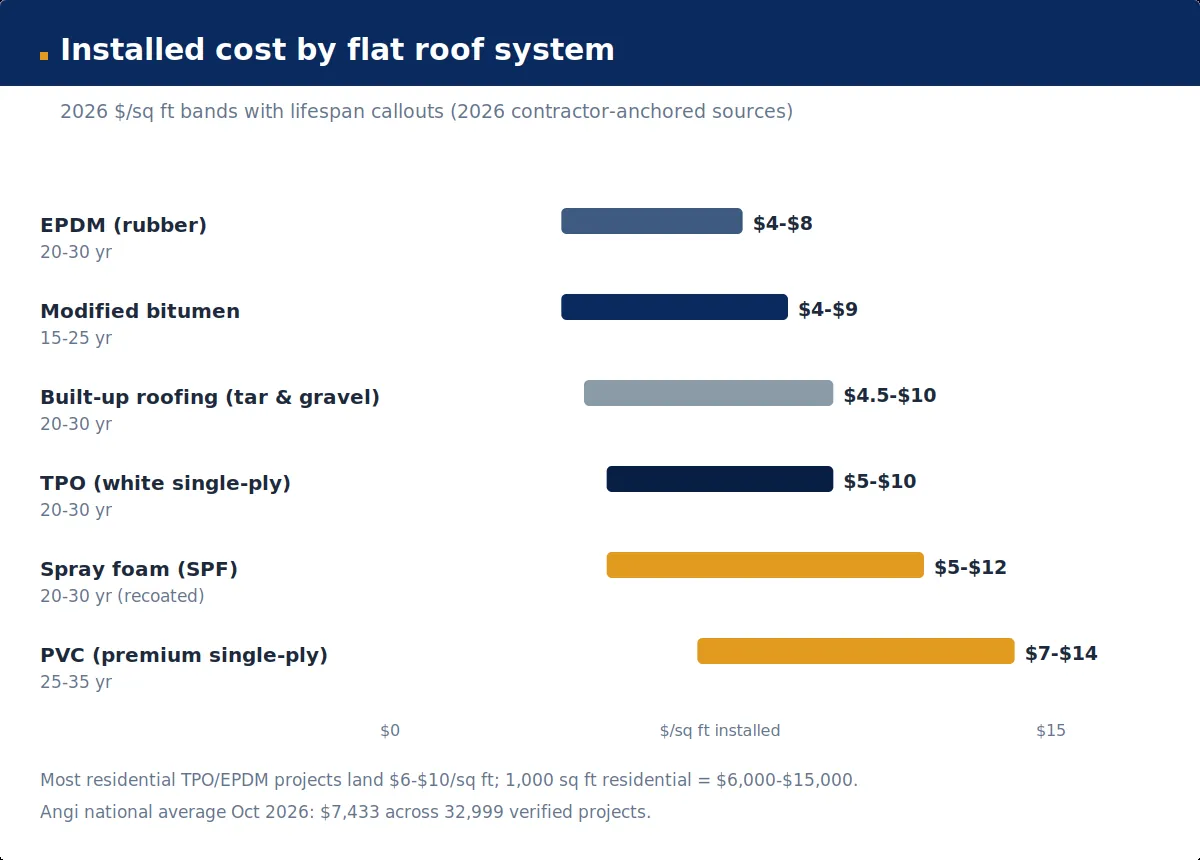
Flat roof replacement cost by system: the 2026 ladder
Six systems, six prices, six personalities. The flat-roof market in 2026 is single-ply dominated — TPO is the most-installed commercial membrane — with modified bitumen and built-up roofing (BUR) holding on in niches:
| System | Installed $/sq ft (2026) | Lifespan | Notes |
|---|---|---|---|
| EPDM (rubber) | $4–$8 | 20–30 yr | Budget single-ply; cold-flex, best in northern climates |
| Modified bitumen | $4–$9 | 15–25 yr | Asphalt multi-ply (torch-down/self-adhered); toughest under foot traffic |
| Built-up roofing (tar & gravel) | $4.50–$10 | 20–30 yr | Oldest system, multi-ply redundancy; losing share |
| TPO | $5–$10 | 20–30 yr | White reflective single-ply; the 2026 commercial default |
| Spray polyurethane foam (SPF) | $5–$12 | 20–30 yr (with recoating) | Seamless insulation + membrane in one |
| PVC | $7–$14 | 25–35 yr | Premium single-ply; grease/chemical resistant; strongest warranties |
Two labeling notes before you use this table. First, some sources split hairs on EPDM’s low end: one editorial planning range quotes $3.50–$6/sq ft (roofvista.com), while contractor quotes cluster at $4–$8 and one contractor guide runs $5–$9 (roofmedic.com). That spread is the commercial-planning-vs-contractor-quote split, not a contradiction — use $4–$8 for a real residential quote and treat the lower band as bulk commercial planning math. Second, material-only prices run far below installed: EPDM $0.50–$3.50, TPO $1.00–$2.50, PVC $1.50–$3.00, mod-bit $0.70–$2.20, BUR $1.50–$2.70 per sq ft (HomeGuide via theroofingbrief.com — and note that table’s figures date to November 2025, so use it for material-only context only; every headline range in this article comes from 2026 sources).
Thickness economics. Not all TPO is TPO. Sheets come in 45-mil, 60-mil, and 80-mil, and 60-mil TPO plus 90-mil EPDM “perform significantly better… worth the premium” (roofreplacementcost.ai). The warranty world draws hard lines: Carlisle’s 20-year Golden Seal TPO warranty requires a 60-, 72-, or 80-mil sheet — 45-mil does not qualify. If your quote says “60-mil” and your competitor says “45-mil,” that is not a $0.50/sq ft saving; it is a different warranty class.
Attachment methods. Mechanically attached is the cheapest and fastest. Fully adhered adds $1–$3/sq ft (on industrial reroofs, TPO runs $7–$9 mechanically attached vs $8–$12 fully adhered — theroofingbrief.com, Oct 2026). Ballasted EPDM sits at the bottom: 45-mil EPDM ballast material runs $1.60–$2.50/sq ft. Attachment affects wind ratings and warranty options, not just price — ask which yours assumes.
The BUR decline. Contractors are walking away from tar-and-gravel: roofmedic.com no longer installs it at all. The reasons are practical — hot-asphalt odor, urban restrictions, and cold-applied BUR costing 10–20% more (roofvista.com). If your 2026 quote still leads with BUR, get a second quote in single-ply.
Residential vs commercial: flat roof replacement cost for two buyer types
The residential searcher and the commercial searcher read this article for different numbers. Here are both:
| Project | 2026 totals | Notes |
|---|---|---|
| 1,000 sq ft residential — EPDM | $4,000–$8,000 | Most residential replacements land $6,000–$15,000 (flatroofcalculator.com, Oct 2026) |
| 1,000 sq ft residential — TPO | $5,000–$10,000 | Most-installed membrane; most projects at standard thickness |
| 1,000 sq ft residential — PVC | $7,000–$14,000 | Premium single-ply; strongest NDL warranties |
| 1,000 sq ft residential — mod-bit | $4,000–$9,000 | Foot-traffic toughness, shorter lifespan |
| 1,500 sq ft NYC brownstone | $13,500–$27,000 ($9–$18/sq ft) | ~2x national: NYC labor + scaffolding + access (mlmconstructiongroupnyc.com, May 2026) |
| 10,000 sq ft commercial (insulation upgrade) | $80,000–$180,000 | Canadian commercial read, 2026 (ronovations.ca) |
| 20,000 sq ft commercial | $200,000–$320,000 replacement vs $60,000–$120,000 coating | The coat-vs-replace scale anchor (notearoffroofing.com, Oct 2026) |
Angi’s fresh national data (updated Oct 30, 2026): $7,433 average across 32,999 verified projects, most at $3,331–$11,558; TPO $4–$14, EPDM $5–$13 per sq ft. Single-ply commercial replacements cluster $7–$12/sq ft (federalestimating.com, Jul 2026), with one 2026 commercial guide reading TPO $5.50–$8.50, EPDM $4.50–$7.50, PVC $6.50–$10.00, mod-bit $5.00–$8.50, SPF $5.50–$9.50 — and 20,000+ sq ft jobs often earn 10–15% volume discounts. (Those are the guide’s editorial planning ranges, not contractor bids — labeled as such; the headline numbers in this article use contractor-anchored figures.)
Regional reads. Brooklyn is the extreme: $9–$18/sq ft installed, with mod-bit $8–$12, EPDM $9–$14, TPO/PVC $11–$18 (mlmconstructiongroupnyc.com, May 2026). NYC TPO specifically: $9–$14/sq ft, 20–30 years (alterphaseroofing.com, Oct 2026). The Northeast and West Coast run 15–30% above the national average on labor — the same gradient that applies to flat-roof tear-off. For the general inflation picture on labor, the BLS OEWS framing via hammerio.com applies across roofing.
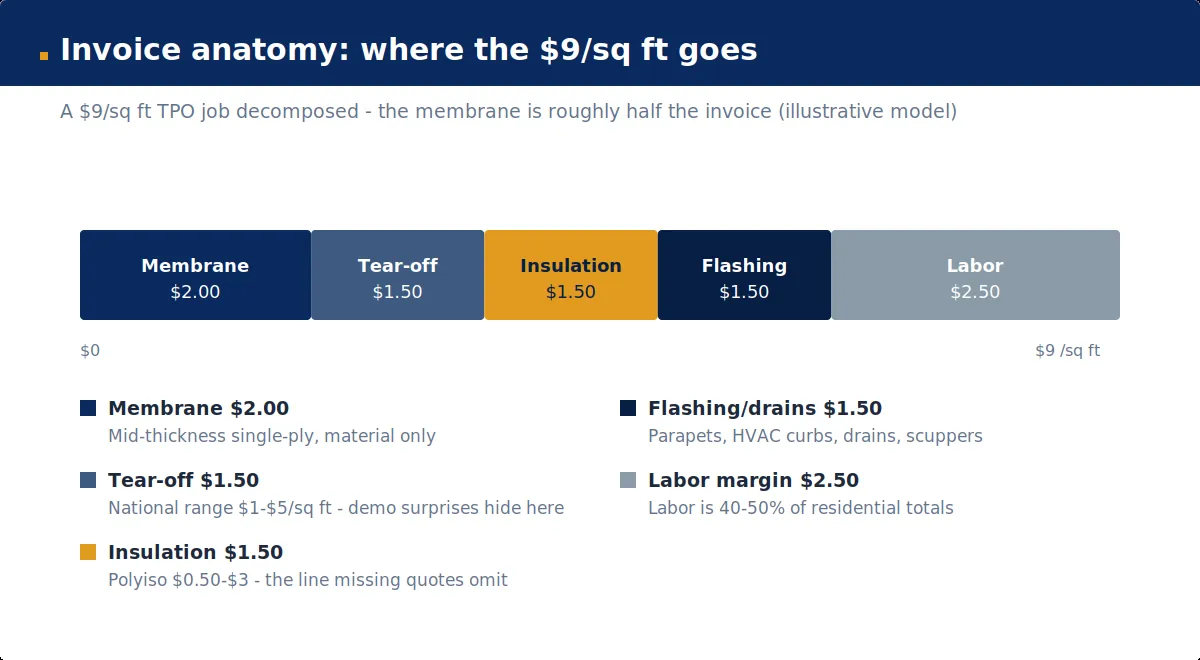
The invoice anatomy: why the membrane is half the bill
Here is the competitive edge most ranking pages bury: a $9/sq ft TPO quote is roughly $2.00 membrane and $7.00 everything else. The membrane is the name on the brochure; the invoice is decided elsewhere. Take this illustrative decomposition of a 10,000 sq ft commercial TPO reroof at $9/sq ft ($90,000 total):
- Membrane: ~$2.00/sq ft. Material-only, mid-thickness single-ply.
- Tear-off and disposal: ~$1.50/sq ft. Nationally $1–$5/sq ft (angi.com, Oct 2026); per-layer labor runs $90–$140 per 100 sq ft for one layer, rising to $120–$170 for three layers (constructionspecifier.com, Feb 2026).
- Insulation to code: ~$1.50/sq ft. Polyiso $0.50–$3 installed (roofmedic.com); board stock $0.70–$1.10 per board foot at R-5.7/inch (roofvista.com). This is the line item missing quotes conveniently omit — more below.
- Flashing, drains, penetrations: ~$1.50/sq ft. Parapets, HVAC curbs, drains, scuppers. “Roofs crowded with curbs and drains price higher per sq ft” (theroofingbrief.com) — a roof full of restaurant exhaust curbs is not the same roof as a clean warehouse deck.
- Labor margin: ~$2.50/sq ft. Labor is 40–50% of residential totals (roofreplacementcost.ai); commercial tear-off + replacement labor runs $3–$7/sq ft (constructionspecifier.com, Feb 2026).
The takeaway for quote-reading: the spread between your quotes is in the adders, not the membrane. If two TPO quotes differ by $3/sq ft, the membrane prices are probably identical — the difference is tear-off depth, insulation thickness, drainage fixes, or deck repair. Ask for the line items and the gap explains itself.
Flat roof replacement cost adders: tear-off, insulation, drainage
The 2026 freshness angle: the insulation reroof trigger. In many jurisdictions, touching the roof triggers current energy code — and that means R-25 or higher commercial roof insulation at reroof (roofmedic.com). The 2021 IECC ceiling trajectory is R-49 (zones 2–3) and R-60 (zones 4–8), and the direction of travel is up (armorthane.com via DOE/PNNL). The insulation scope “varies by jurisdiction, climate, existing conditions, project scope” (roofvista.com) — which is exactly why a quote with no insulation line is the #1 red flag in flat roofing. The missing line means either the contractor is skipping code or planning a change order mid-job. Neither is your friend.
Insulation volatility. Polyiso prices jumped 12% in a single quarter when petroleum feedstock costs spiked (ronovations.ca, 2026). Treat that as a quote-hygiene rule: a flat-roof quote older than 90 days may be stale on the insulation line. This is the one line item where a January quote and an April quote can legitimately disagree.
Deck repair. Budget for the unknown: $5–$15/sq ft of damaged area, wood deck repairs $3–$5/sq ft, full deck replacement $7–$12/sq ft (newenglandmetalroof.com — cited as that site’s own estimates). Wet insulation removal and replacement adds ~$1.50–$3/sq ft. An infrared moisture scan ($400–$600, newenglandmetalroof.com) finds wet insulation beyond the visible leaks — pro work, and the single best $500 you can spend before signing a $50,000 contract.
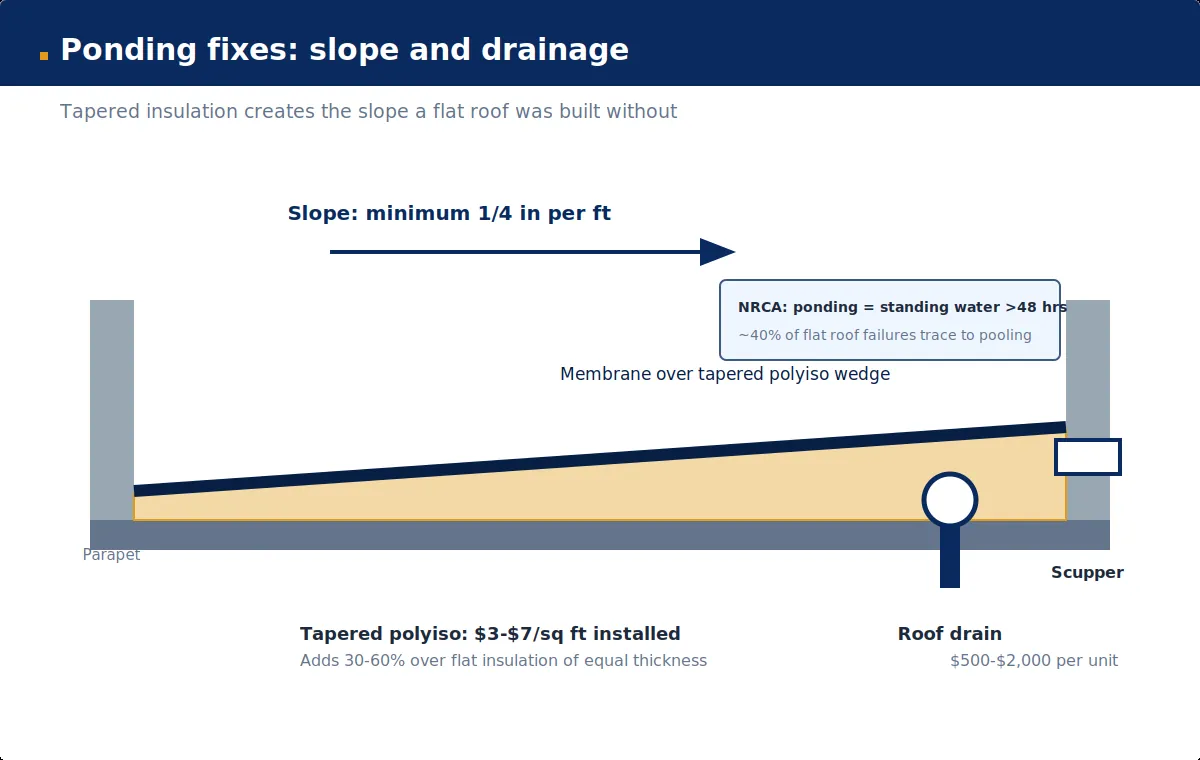
Ponding fixes. Tapered polyiso runs $3–$7/sq ft installed (lintaroofing.com, Jun 2026); full tapered systems land $4.50–$16 with most at $7–$10 (newenglandmetalroof.com’s own estimates). Tapered adds 30–60% over flat insulation of equal average thickness, and roofvista.com flags the psychology perfectly: tapered adds $2–$4/sq ft and “most owners discover late in the bidding process.” Drains and scuppers: $500–$2,000 per unit (truehandroofing.com); drain clearing $150–$500. Recovery/cover board adds $0.50–$3/sq ft. Permits: $250–$600 (angi.com) — and in NYC, a DOB permit is required when more than 25% of the roof area is touched (mlmconstructiongroupnyc.com).
Why ponding matters enough to price: standing water weighs ~5 lbs per sq ft per inch of depth — a 10×10 ft patch of 3-inch ponding is 1,500 lbs of concentrated load (truehandroofing.com). The NRCA defines ponding as water standing more than 48 hours after rain; minimum design slope is 1/4 inch per foot; roughly 40% of flat roof failures trace to pooling water (newenglandmetalroof.com). Drainage is not a finishing touch — it is the structural design.
Coat vs replace: the 50–70% shortcut
This is the highest-value question in flat roofing, and most pages answer it with vibes. Here is the actual rule.
The price gap. Silicone restoration coating runs $2.50–$5.00/sq ft installed on warranted systems (theroofingbrief.com, Oct 2026; West Roofing Systems: $3.50–$7 for warranted); acrylic $1.50–$3; polyurethane $3–$6. National consumer data runs $0.65–$5 by type (nycrenovators.com). Against a new membrane at $5–$11/sq ft with full tear-off (Custom Coatings Inc. via theroofingbrief.com), the math is 50–70% savings on the total project (truehandroofing.com; notearoffroofing.com). No tear-off, no landfill, 1–3 day install, no business interruption — on that 20,000 sq ft project, $60,000–$120,000 coated vs $200,000–$320,000 replaced. Coating lifespans: silicone 15–20 years, acrylic 10–15, polyurethane ~20, with warranties up to 20 years on qualifying systems and a recoat cycle of roughly every 10 years (constructionspecifier.com, Feb 2026).
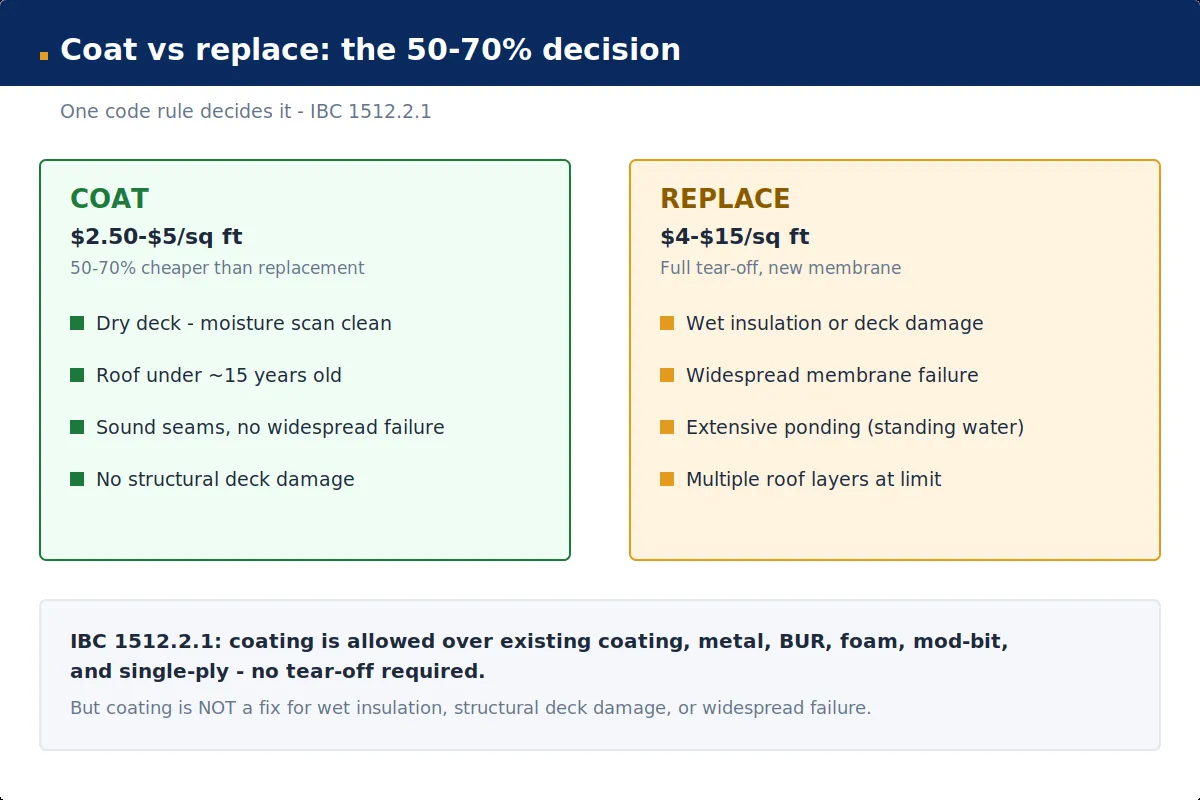
The rule that decides it: IBC 1512.2.1. The International Building Code allows coating over existing coating, metal, BUR, foam, modified bitumen, and single-ply without tear-off. (Metal roofs included — if your metal-overhanging property has a low-slope metal section, that is coat-eligible; for metal pricing generally see our metal roof cost guide.) But — and this is the part the coating salesmen rush past — coating is NOT a fix for wet insulation, structural deck damage, widespread membrane failure, or extensive ponding (theroofingbrief.com). The decision anchor:
- Dry deck + more than ~5 years of structural life left = coat. The cheapest roof is the one you do not tear off.
- Wet insulation, deck damage, widespread failure = replace. Coating over a wet roof is a $4/sq ft lesson in physics.
The energy angle. White silicone reflects 80–90% of UV (notearoffroofing.com); white TPO reflects ~80% of solar radiation at SRI 95+ (theroofingbrief.com, Oct 2026). Cool-roof code compliance asks for initial reflectance 0.65 and emittance 0.75, and the cooling-cost reduction runs 10–30% — $0.10–$0.30/sq ft/year (roofvista.com). White TPO cuts cooling costs 15–30% vs dark membranes (roofmedic.com); one Gulf Coast case shows $1,500–$3,000/year saved on a 10,000 sq ft building vs black EPDM. The counterpoint: a dark EPDM roof can reach compliance with a reflective coating at $0.50–$1.50/sq ft — a small adder that belongs in the comparison.
TPO vs EPDM vs PVC: which membrane for your building
The three single-ply systems most buyers actually compare:
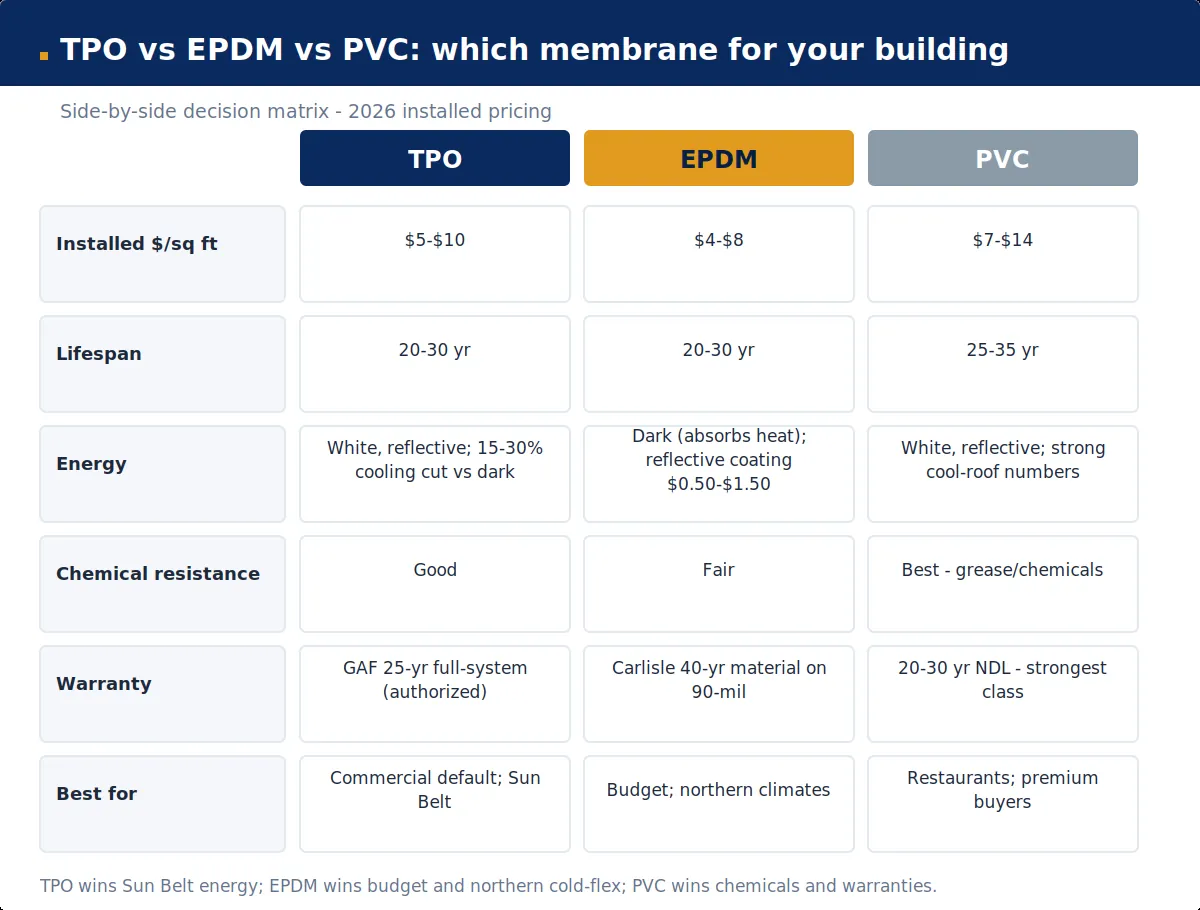
| TPO | EPDM | PVC | |
|---|---|---|---|
| Installed $/sq ft | $5–$10 | $4–$8 | $7–$14 |
| Lifespan | 20–30 yr | 20–30 yr | 25–35 yr |
| Energy | White, reflective — 15–30% cooling savings vs dark | Dark (absorbs heat); reflective coating $0.50–$1.50/sq ft | White, reflective; strong cool-roof numbers |
| Chemical resistance | Good | Fair | Best — grease/chemical resistant (restaurants, food plants) |
| Warranty | GAF 25-yr full-system TPO via authorized contractors | Carlisle 40-yr non-prorated material warranty on 90-mil Sure-Seal; 30-yr eligible on 60-mil (Oct 2024 update) | 20–30 yr NDL — “among the strongest in the industry” (roofvista.com) |
| Best for | Commercial default; cooling-dominated climates | Budget; northern climates; cold-flex | Restaurants, chemical exposure, premium longest-warranty buyers |
Is TPO or EPDM cheaper? EPDM is cheaper to buy; TPO is cheaper to run in cooling climates. In a Sun Belt warehouse, TPO’s 15–30% cooling-cost cut against dark EPDM erases EPDM’s $1–$2/sq ft installed advantage within a few cooling seasons. In a Chicago brownstone, EPDM’s cold-flex and the shorter heating season make it the honest pick. Pick by building type, not by sticker.
Warranty caveats worth your money. NDL (No Dollar Limit) warranties require certified installers and exact assembly details, and “carry a real premium over a basic material warranty” (federalestimating.com). The 20–30-year NDL numbers on PVC and the Carlisle EPDM numbers are not free — they are priced into the assembly. Residential labor warranties run ~10 years in quality markets (mlmconstructiongroupnyc.com). Get the warranty type named in the quote, not just “30-year warranty.”
Modified bitumen and BUR: the asphalt twins
Mod-bit ($4–$9) and BUR ($4.50–$10) are the asphalt-based holdouts — multi-ply systems with 15–30-year lives. Mod-bit’s one enduring edge: it is the toughest membrane under foot traffic (roofmedic.com). Rooftops that get walked on — restaurant kitchens below, maintenance access, party decks — belong to mod-bit.
The 2026 freshness angle: asphalt feedstock. One industry tracker reported raw asphalt experiencing “an unprecedented 35 percent price increase over a recent three-month window” (BuildRefs, July 2026, via trivanroofing.com). That is a single source, not an established fact — but the mechanism is real: “asphalt-based products (mod-bit and BUR) are tied to oil prices, and oil market volatility this year has pushed those costs up independently of tariffs” (federalestimating.com). While the metal-roof world watches steel tariffs, the flat-roof world watches crude. If your mod-bit quote reads hot in 2026, ask how much is membrane and how much is the oil market.
Torch-down safety. Torch-down mod-bit is installed by open-flame crews. Confirm the crew is trained and insured for hot-work specifically — this is a licensing-and-insurance question, not a technique question, and it belongs on your contractor’s certificate, not in your YouTube history.
SPF: the outlier that is also insulation
Spray polyurethane foam ($5–$12 installed) is the weirdo of the list: it sprays on as a seamless membrane and cures as insulation — R-6 to R-7 per inch, with 20–30% heating/cooling reductions claimed (armorthane.com, Oct 2026). The price range reflects prep depth: ~$7/sq ft at 2 inches of light prep, up to $13.25 at 5 inches of heavy prep (roofobservations.com, 2026). The catch is the recoat cycle: every 10–15 years at $1.50–$3/sq ft, and the system’s 20–30-year lifespan assumes you actually recoat. newenglandmetalroof.com rates SPF’s energy efficiency “Excellent.” SPF makes sense where insulation value and a seamless membrane matter more than a walkable surface — and where you will hire the same contractor for the recoat, not discover the cycle by accident.
Note the relationship to our attic insulation guide: that article covers below-deck attic insulation (blown-in, batts). This section is above-deck polyiso and SPF — a different building element, a different code trigger, priced here as a line item, not a system.
2026 tax status: $0 federal
Sixty words, stated plainly. §25C and §25D are $0 for flat roofs in 2026 — OBBBA (P.L. 119-21; IRS FS-2025-05) ended both credits for property placed in service after Dec 31, 2025. Any page still implying a 2026 federal credit on a cool roof, roof coating, or insulation is stale; none of the sources in this guide’s research claimed one, and several correctly note the credit’s absence. For the full credit-kill list, see our 2026 energy tax credits guide. Residential flat-roof owners get nothing from Washington in 2026. Price at full price.
Flat roof replacement cost quote checklist: what a good quote itemizes
Demand all of these in writing:
- System, membrane, and thickness — TPO/EPDM/PVC/mod-bit; 45/60/80-mil; which warranty class that thickness buys
- Attachment method — mechanically attached vs fully adhered vs ballasted; wind-rating consequence
- Tear-off depth — per-layer pricing; two layers is where “demo surprises” hide
- Insulation to code — type, thickness, R-value, and the jurisdiction’s reroof requirement named. No insulation line = the #1 red flag.
- Drainage and ponding plan — drains, scuppers, tapered insulation, minimum 1/4-in-per-ft slope
- Deck repair allowance — per-sq-ft rate for damaged areas, not “TBD”
- Flashing and penetrations — parapets, HVAC curbs, penetrations priced individually
- Coat-vs-replace verdict — why the roof does not qualify for coating, if it does not. If the contractor never offered the $2.50–$5 alternative, ask why.
- Warranty type in full — material vs NDL vs labor; certified-installer requirement named
- Quote date — polyiso can move 12% in a quarter; a quote older than 90 days may be stale on the insulation line
And the safety framing, because flat roofs kill the unwary: no DIY installation information is in this guide, and none should be. Torch-down is open-flame work. Flat roofs have fall hazards at every edge and structural-load hazards under every pond. Infrared scans and deck assessments are licensed-pro work. Your job is reading quotes; the contractor’s job is the roof.
Get three written, itemized quotes. When one is 40% cheaper than the other two, it is not the same roof — check the thickness, the attachment, the insulation line, and the drainage plan before you celebrate.
Key takeaways
– Flat roof replacement cost 2026: $4–$15/sq ft installed; $6,000–$15,000 for 1,000 sq ft; Angi averages $7,433 across 32,999 projects.
– The membrane is roughly half the invoice — tear-off, insulation-to-code, drainage, and deck repair decide the total.
– Coating ($2.50–$5/sq ft) saves 50–70% vs replacement when the deck is dry — IBC 1512.2.1 allows it without tear-off; wet insulation means replace.
– The insulation reroof trigger is the 2026 code angle: R-25+ in many jurisdictions. A quote with no insulation line is the #1 red flag.
– TPO for cooling climates, EPDM for budget/north, PVC for chemicals and the strongest warranties; 60-mil+ buys the warranty class.
– $0 federal tax credit in 2026. Polyiso can move 12% in a quarter — do not shop with a stale quote.
Sources & methodology
Cost figures compiled November 2026 from published 2026 cost guides and contractor data: roofgenius.com (2026 Roofing Cost Report, reviewed Oct 30, 2026); roofmedic.com (Sep 2026); roofreplacementcost.ai (~Aug 2026); trivanroofing.com; flatroofcalculator.com (Oct 2026); roofvista.com (~Aug 2026, editorial planning ranges — labeled); commercialroofguide.com (2026, editorial planning ranges — labeled); federalestimating.com (~Jul 2026); angi.com (Oct 30, 2026, 32,999 verified projects); newenglandmetalroof.com (own estimates; inconsistent slugs — cited by site name); theroofingbrief.com (Oct 2026); mlmconstructiongroupnyc.com (May 2026); alterphaseroofing.com (Oct 2026); constructionspecifier.com (Feb 2026); notearoffroofing.com (Oct 2026); truehandroofing.com; lintaroofing.com (Jun 2026); ronovations.ca (2026); roofobservations.com (2026); remodelingexpense.com (Jun 2026); armorthane.com (Oct 2026); nycrenovators.com; West Roofing Systems; Custom Coatings Inc. via theroofingbrief.com; Big Easy Roofing via PressAdvantage (Aug 2026). BuildRefs (Jul 2026, via trivanroofing.com): asphalt +35% in three months — single source, attributed. Tax: IRS FS-2025-05, OBBBA P.L. 119-21. HomeGuide (Nov 2025, via theroofingbrief.com) used for material-only prices only — borderline stale for headline ranges. Pitched-shingle pricing referenced from our article 6; OBBBA master list from our article 5; attic insulation from our article 24; metal systems from our article 30.
Disclaimer: Prices are 2026 US national averages and vary by region, roof type, system, thickness, and contractor — get 3 written, itemized local quotes. Tax and rebate information is general and not tax advice — confirm with a tax professional. Roofing is licensed-contractor work at height; torch-down installation is open-flame work — this article covers cost and decision information only, never installation instructions.
How much does a flat roof replacement cost in 2026?
Flat roof replacement costs $4–$15 per square foot installed in 2026 — $6,000–$15,000 for a typical 1,000 sq ft residential roof, with most TPO and EPDM projects landing at $6–$10/sq ft. Angi’s national data (Oct 30, 2026, 32,999 verified projects) averages $7,433, with most projects at $3,331–$11,558. Commercial single-ply replacements cluster at $7–$12/sq ft.
Is TPO or EPDM cheaper?
EPDM is cheaper to buy — $4–$8/sq ft installed vs $5–$10 for TPO. But TPO is cheaper to run in cooling climates: white TPO cuts cooling costs 15–30% vs dark EPDM, which erases EPDM’s $1–$2/sq ft installed advantage within a few cooling seasons. In northern climates with long heating seasons, EPDM’s cold-flex makes it the honest pick. Choose by building type, not by sticker.
Is it cheaper to coat or replace a flat roof?
Yes — coating is 50–70% cheaper. Silicone restoration coating runs $2.50–$5/sq ft installed vs $4–$15 for a full replacement, with 15–20-year lifespans and warranties up to 20 years on qualifying systems. The International Building Code (IBC 1512.2.1) allows coating without tear-off — but only with a dry deck: coating is not a fix for wet insulation, structural deck damage, widespread membrane failure, or extensive ponding. Dry deck with 5+ years of structural life = coat; wet insulation = replace.
How much do tear-off and insulation add to a flat roof quote?
Tear-off runs $1–$5/sq ft, polyiso insulation $0.50–$3/sq ft installed, and deck repair $5–$15/sq ft of damaged area. On a typical $9/sq ft TPO job, the membrane is roughly $2.00 of it — the rest is tear-off, insulation brought up to code, flashing and drainage, and labor. The insulation line is the most-missed item: many jurisdictions require R-25 or higher insulation at reroof, so a quote with no insulation line is the #1 red flag.
How long does a flat roof last?
TPO and EPDM last 20–30 years, PVC 25–35, modified bitumen 15–25, built-up roofing (BUR) 20–30, and spray polyurethane foam (SPF) 20–30 years with its 10–15-year recoat cycle at $1.50–$3/sq ft. Thicker membranes earn both the longer end of the range and the better warranty class — Carlisle’s 20-year TPO warranty, for example, requires 60-mil or thicker sheet; 45-mil does not qualify.
Can you put a new flat roof over the old one?
Generally yes under the two-roof-layer convention common in US codes — but check your jurisdiction and the membrane manufacturer’s warranty terms. The easier path is coating: IBC 1512.2.1 allows restoration coating over existing coating, BUR, foam, mod-bit, metal, and single-ply without any tear-off, provided the deck is dry. Over an existing single-ply, most manufacturers require a cover board separation layer. Verify locally and get the warranty consequence in writing either way.
Why do flat roof quotes vary so much?
Because the membrane is only half the invoice. The spread between quotes lives in the adders: insulation brought up to code (R-25+ in many jurisdictions), tapered-insulation drainage fixes ($3–$7/sq ft), deck repair ($5–$15/sq ft of damaged area), roof crowded with HVAC curbs and drains, and access/scaffolding. If two TPO quotes differ by $3/sq ft, the membranes are probably identical — ask for the line items and the gap explains itself.