

Table of Contents
Arizona is not a normal roofing market. In most states, the question is which material you can afford. In Arizona, the question is which material survives the sun — and how often you will pay to replace the parts you cannot see. A shingle roof that would last 30 years in Ohio lasts about 20 in Phoenix. A tile roof that looks perfect from the street can be leaking through a dead underlayment underneath. And a flat roof on a stucco home in Tucson is a foam roof, not a shingle roof at all.
This guide prices every material for a typical 2,000 sq ft roof (20 squares of roof surface — not living area), explains why tile quotes in the Valley can differ by $10,000 for the same house, and covers the parts other guides skip: the underlayment clock, the permit rules in Phoenix, Tucson, Scottsdale and Flagstaff, monsoon and hail insurance claims, and the new 2026 law that makes “free roof” deductible pitches illegal on catastrophic-storm claims.
For the national baseline, see our roof replacement cost guide.
How Much Does a Roof Replacement Cost in Arizona in 2026?
The best single Arizona anchor is Arizona Roofers’ 2026 Arizona guide (updated around October 20, 2026): most Arizona replacements land between $9,000 and $28,000, with a state midpoint of about $17,200. Every figure in the table below is installed, tear-off included, for a typical 2,000 sq ft roof surface.
| Material | $/sq ft installed | 2,000 sq ft total | AZ realistic lifespan |
|---|---|---|---|
| Architectural shingle | $4.50–$7.00 | $9,000–$14,000 | 18–22 yrs |
| Concrete tile (new system) | $7.00–$14.00 | $14,000–$28,000 | 40–50 yrs (tile); underlayment 20–25 yrs |
| Clay tile (new system) | $10.00–$18.00 | $20,000–$36,000 | 50–75+ yrs (tile); underlayment 20–25 yrs |
| Standing-seam metal | $9.00–$18.00 | $18,000–$36,000 | 40–70 yrs |
| SPF foam (flat/low-slope) | $4.00–$10.00 | $8,000–$20,000 | 25–35 yrs with maintenance |
| Tile lift-and-relay | $4.50–$8.50 | $9,000–$17,000 | Resets the 20–25 yr underlayment clock |
Sources: Arizona Roofers AZ 2026 guide (Oct 2026); Simply Roofing Phoenix tile guide (Oct 4, 2026); Irish Roofing metal/SPF guides (Oct–Nov 2026).
Cross-checks from the Phoenix market tell the same story with different sample sizes. Angi (updated July 31, 2026) puts the Phoenix average at $8,856, with most homeowners paying $6,273–$11,694 and a full range of $1,400–$42,753; labor runs $4,400–$5,300, about 50–60% of the total. HomeYou (updated October 9, 2026) puts the Phoenix average higher, at $12,104, with most jobs at $9,138–$18,498. This Old House’s Arizona guide (2026) averages $7,484 — treat that as a low-end cross-check, not the headline: it is survey-based and likely reflects smaller and older jobs plus a statewide mix, well below contractor-published Phoenix figures.
Where the money goes on a typical Arizona job (Arizona Roofers, October 2026): labor about 55–60% — highest on tile, where handling dominates — materials about 25–35%, tear-off and disposal $1,000–$3,000, and the permit $150–$650. A second or third tear-off layer adds $1,000–$3,000. Tear-off alone in Phoenix runs $1–$3 per sq ft. Decking repair is variable and unknown until tear-off; honest quotes carry a per-sheet allowance rather than a lump sum.
One warning before you compare quotes: roof-surface square footage is not living-area square footage. Roof area runs about 1.2–1.3 times living area. A 1,500 sq ft home usually has a roughly 2,000 sq ft roof. Every table in this guide is priced per roof-surface sq ft, and any quote that does not say which area it uses is not comparable to the others.
Roof Replacement Cost in Arizona by Material
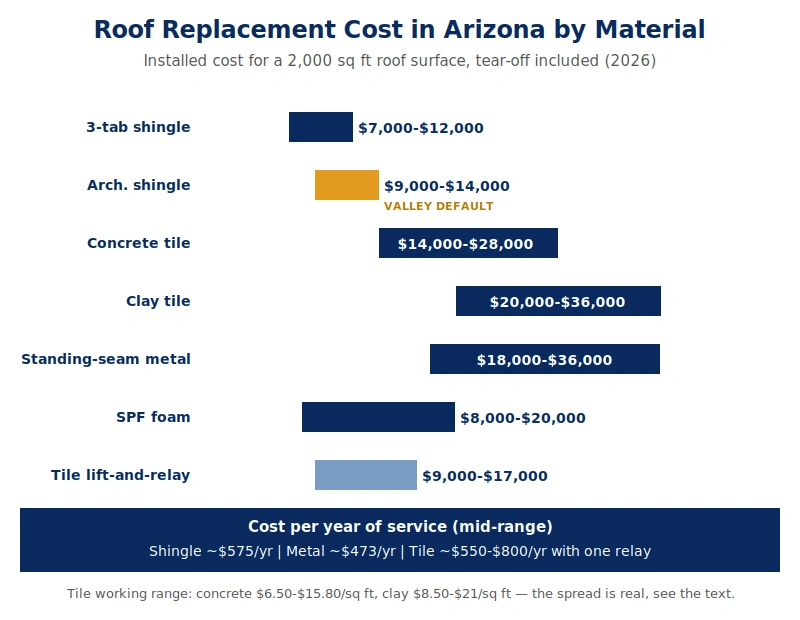
Material is the biggest single lever on your invoice — tile and metal cost 2–3 times shingle upfront. But upfront cost is only half the story in Arizona, because the desert heat cuts shingle life by roughly a quarter while tile and metal barely notice it. The table below pairs 2026 installed prices with Arizona-adjusted lifespans and cost per year of service.
| Material | $/sq ft installed | 2,000 sq ft total | AZ lifespan | Cost per year* |
|---|---|---|---|---|
| 3-tab shingle | $3.50–$6.00 | $7,000–$12,000 | 12–15 yrs | ~$580–$800/yr |
| Architectural shingle | $4.50–$7.00 | $9,000–$14,000 | 18–22 yrs | ~$450–$640/yr (mid ~$575/yr) |
| Concrete tile (new system) | $7.00–$14.00 | $14,000–$28,000 | 40–50 yrs tile; relay at ~20–25 yrs | ~$350–$560/yr before relay; ~$550–$800/yr with one relay |
| Clay tile (new system) | $10.00–$18.00 | $20,000–$36,000 | 50–75+ yrs tile; relay at ~20–25 yrs | ~$370–$560/yr before relay; ~$550–$750/yr with one relay |
| Standing-seam metal | $9.00–$18.00 | $18,000–$36,000 | 40–70 yrs | ~$390–$650/yr (mid ~$473/yr) |
| SPF foam | $4.00–$10.00 | $8,000–$20,000 | 25–35 yrs with maintenance | ~$320–$560/yr before recoats; add ~$160–$320/yr per recoat cycle |
*Cost per year = installed cost divided by Arizona realistic lifespan. Tile figures show both numbers because the mid-life lift-and-relay is the true lifecycle cost — never quote tile’s 50-year life without the underlayment clock next to it. Lifespan sources: Canyon State Roofs (May 2026), Strad Roofing (2026), Arizona Roofers (Oct 2026), EngineerFix (2026), Irish Roofing (Oct 2026), The Roofing Brief (Oct 2026).
Architectural shingles are the Valley default: cheapest upfront, widest contractor choice, and the easiest to match after storm damage. Their weakness is the heat (see the climate section below). BestRoofingEstimates’ Phoenix figures run higher — architectural shingles $5.75–$8.75 per sq ft, or $11,500–$17,500 on a 2,000 sq ft home — partly because that source prices roof area at 1.3 times living area. One Good Roofer (October 7, 2026) lands in between at $410–$637 per square ($9,800–$15,300 for a 1,500–2,500 sq ft home), with an Arizona cost index of 0.91 against the national average — modelled figures, not contractor quotes.
Concrete tile is the most common premium roof in the Valley, and the hardest to price from a single number. The spread is real and wide: Simply Roofing (October 4, 2026) quotes $6.50–$10.50 per sq ft, Arizona Roofers $7–$14, BestRoofingEstimates $10.80–$15.80, and the national Roofing Brief $10–$14. The honest working range is $6.50–$15.80 per sq ft, with a realistic Valley mid-range of $7–$14. Three things drive the spread: some sources mix new-system prices with lift-and-relay prices, premium or discontinued profiles cost far more to source and match, and some sources price per living-area sq ft while others price per roof sq ft. Scottsdale and Paradise Valley premium jobs also pull averages up. Always ask whether a tile figure is a new system or a lift-and-relay, and whether it is per roof sq ft.
Clay tile spreads even wider: $8.50–$14 (Simply Roofing) against $10–$18 (Arizona Roofers), $13.30–$19.50 (BestRoofingEstimates), and $9.47–$21 (BuildX Phoenix, 2026). Working range $8.50–$21 per sq ft; realistic Valley mid-range $10–$18. Clay holds its color better than concrete under decades of UV, and it lasts the longest — 50–75+ years for the tile itself — but it is the heaviest and most expensive option, and it shares concrete tile’s underlayment clock.
Standing-seam metal runs $9–$18 per sq ft in the Valley (Irish Roofing, Paradise Valley/Scottsdale, October 2026), or $18,000–$36,000 on a 2,000 sq ft roof; a 2,500 sq ft standing-seam job runs $25,000–$45,000. Corrugated metal is cheaper at $7–$9 per sq ft, and stone-coated steel runs $8–$11. National benchmarks for context: galvalume steel $9–$14, aluminum $11–$17, zinc $15–$22, copper $20–$35+ per sq ft. Metal is the heat’s friend — reflective finishes run cooler, and the lifespan (40–70 years) makes it among the cheapest options per year of service at the mid-range.
SPF foam is priced in the flat-roof section below, but the headline is that it is the cheapest lifecycle option for flat and low-slope roofs: $4–$10 per sq ft installed, $8,000–$20,000 on 2,000 sq ft, with a recoat every 10–15 years instead of a full replacement.
The headline of this section: tile and metal cost 2–3 times shingle upfront but match or beat it per year of service — because a Phoenix shingle roof lasts about 20 years, not 30. For the material-by-material national comparison, see our metal roof cost guide and tile roof cost guide.
Roof Replacement Cost by Roof Size
The table below multiplies the Arizona Roofers per-sq-ft ranges by roof-surface area. It is roof-surface sq ft, not living area — a 1,500 sq ft home typically has a roughly 1,800–2,000 sq ft roof.
| Roof size | Arch. shingle ($4.50–$7) | Concrete tile ($7–$14) | Clay tile ($10–$18) | Standing-seam metal ($9–$18) | SPF foam ($4–$10) |
|---|---|---|---|---|---|
| 1,000 sq ft | $4,500–$7,000 | $7,000–$14,000 | $10,000–$18,000 | $9,000–$18,000 | $4,000–$10,000 |
| 1,500 sq ft | $6,750–$10,500 | $10,500–$21,000 | $15,000–$27,000 | $13,500–$27,000 | $6,000–$15,000 |
| 2,000 sq ft | $9,000–$14,000 | $14,000–$28,000 | $20,000–$36,000 | $18,000–$36,000 | $8,000–$20,000 |
| 2,500 sq ft | $11,250–$17,500 | $17,500–$35,000 | $25,000–$45,000 | $22,500–$45,000 | $10,000–$25,000 |
| 3,000 sq ft | $13,500–$21,000 | $21,000–$42,000 | $30,000–$54,000 | $27,000–$54,000 | $12,000–$30,000 |
Cross-check: BestRoofingEstimates’ by-size table puts a 2,000 sq ft architectural shingle job at $11,500–$17,500 — higher than the table above, because it assumes roof area equals 1.3 times living area. White Leaf Roofing (East Valley, ROC #325377) prices by home size instead: under 3,000 sq ft homes $8,000–$15,000; 3,000–4,000 sq ft $14,000–$20,000; over 4,000 sq ft $18,000–$30,000. Small homes pay more per sq ft (fixed costs like permits, dumpsters, and mobilization spread over fewer squares); very large or cut-up roofs pay more for complexity, not just area.
Why Arizona Roofs Cost What They Do: Heat, UV & Monsoon
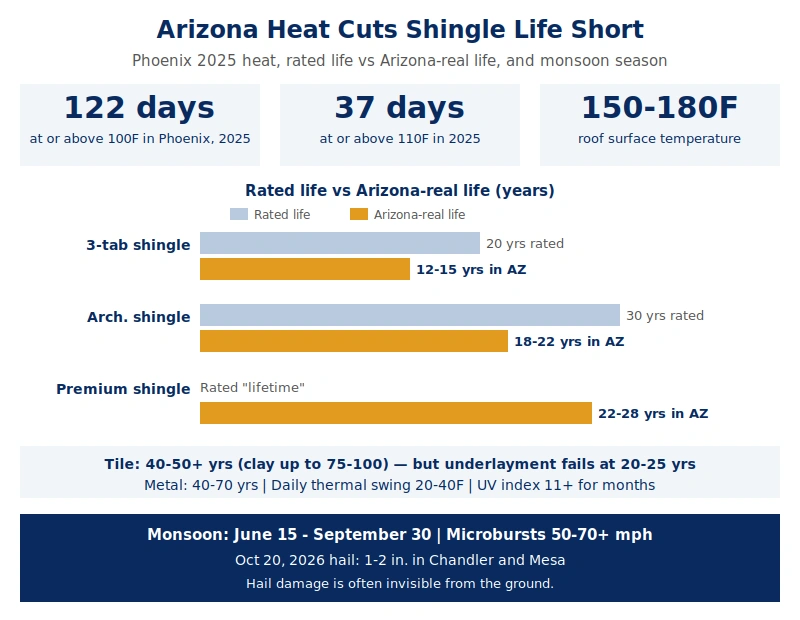
Phoenix in 2025 logged 122 days at or above 100°F and 37 days at or above 110°F (NWS/NOAA data via azcentral, June 2026). The 30-year average is 111 days at or above 100°F. The records are worse: 145 days at or above 100°F in 2020, and 70 days at or above 110°F in 2024. The all-time high is 122°F (June 26, 1990). Roof-deck and shingle surfaces reach 150–180°F on summer afternoons — dark shingles 160–180°F, attics up to 150°F (BestRoofingEstimates; Strad Roofing, 2026). Daily thermal swings of 20–40°F expand and contract sealants, flashing, underlayment, and fasteners every single day (EcoRoof AZ, 2026). The UV index sits at 11+ — extreme — for months of the year.
What the heat does to each material:
- Asphalt shingles — the rated life is fiction in Arizona. Three-tab shingles rated for 20 years last 12–15 years here; architectural shingles rated for 30 years last 18–22 years; premium or “lifetime” shingles last 22–28 years (Canyon State Roofs, updated May 21, 2026). Phoenix roofs perform at roughly 70–80% of rated life. Other 2026 sources agree: architectural shingles average 12–20 years in the Phoenix metro (Strad Roofing) and 15–25 years across Arizona generally (Capstone Roofing AZ; American Roofing & Waterproofing, May 2025). The mechanism is simple: heat bakes the oils out of the asphalt, and the shingles turn brittle, shed granules, curl, and crack. South- and west-facing slopes deteriorate fastest. SBS-modified shingles flex better through thermal cycling (Canyon State).
- Tile — the tile outlives its underlayment. Concrete and clay tile last 40–50+ years (clay up to 75–100 years), but the underlayment beneath them fails at 20–25 years. That mismatch is the whole Arizona tile story, covered in the next section.
- Metal — heat’s friend. Standing-seam galvalume lasts 40–60 years, aluminum 50–70+ years, zinc 80–100+ years, copper 100+ years (Irish Roofing, October 2026). Light-colored and cool-rated shingles run 20–40°F cooler at the surface than dark ones (Strad Roofing).
- Foam — built for flat desert roofs. SPF lasts 25–35 years with maintenance, with a recoat every 10–15 years (Irish Roofing) or 10–20 years (Modernize). About 9 of 10 Arizona flat-roof owners use foam (Right Way Roofing / azroof.com).
Monsoon and haboob season runs June 15–September 30 (NWS). Microbursts hit 50–70+ mph, and haboobs drive dust walls sideways with wind-driven rain that hits the roof from the side, not the top. The current-events anchor: on October 20, 2026, NWS Phoenix confirmed a supercell over Chandler and Mesa with hail of 1–2 inches — up to baseball-size reported in North Phoenix (Irish Roofing Chandler guide; Masizo Development hail guide, October 26, 2026). Hail damage is often invisible from the ground, and a roof with 10–15 years of life left can lose most of it to a single hail event. Demand spikes right after monsoon storms; late winter usually brings better availability and sometimes better pricing (Arizona Roofers).
Cool roofs and energy: Arizona has no California-style Title 24 — do not let anyone cite Title 24 as Arizona law. Arizona has no statewide residential building code; cities adopt IRC/IBC editions locally (Phoenix and Mesa have adopted the 2024 editions). For commercial low-slope roofs in Phoenix, the minimum is a 3-year aged solar reflectance of 0.55, thermal emittance of 0.75, or SRI of 64 or higher. Cool-roof shingles and reflective coatings can cut cooling demand by 10–15% (SRP, citing EPA) — use that figure, not the higher numbers some contractor pages claim. DOE guidance for climate zone 2 (Phoenix metro) calls for attic insulation of R-30 to R-60.
Tile Roofs: The Underlayment Clock
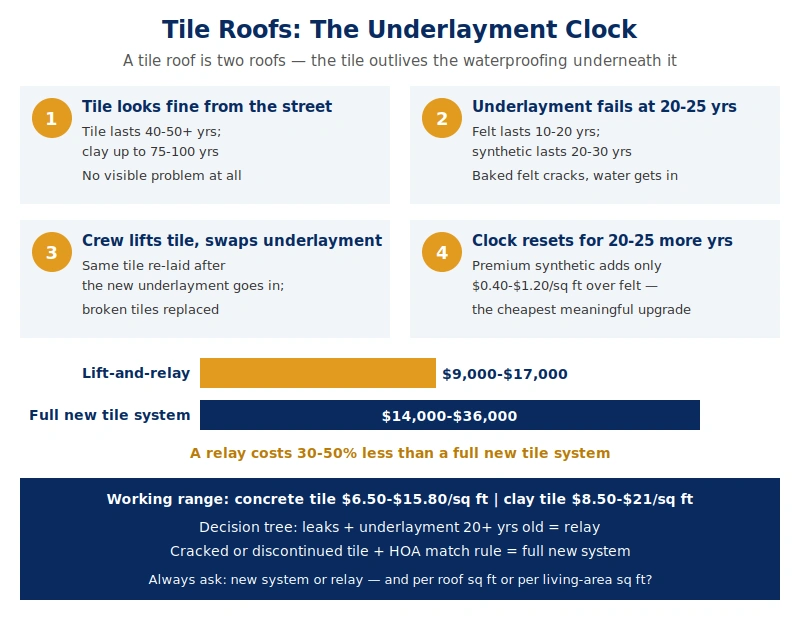
If you remember one thing from this guide, make it this: a tile roof is two roofs. The tile is the visible one, and it lasts 40–50+ years (clay up to 75–100). The underlayment is the hidden one — the waterproof layer under the tile — and it fails at 20–25 years. Standard felt lasts 10–20 years; synthetic underlayment lasts 20–30 years (EngineerFix, 2026). The original felt on a 20-year-old tile roof is the conversation to have, not the tile (Behmer Roofing).
That is why so many Arizona tile roofs leak while looking perfect from the street. The tile is fine. The felt underneath has baked, cracked, and let water through. And it is why the Arizona-specific job is not a full replacement — it is a lift-and-relay: the crew lifts the existing tile off, replaces the underlayment (and any broken tiles), and lays the same tile back down.
| Job | $/sq ft | 2,000 sq ft total |
|---|---|---|
| Lift-and-relay (Arizona Roofers, Oct 2026) | $4.50–$8.50 | $9,000–$17,000 |
| Lift-and-relay (Roof With Sunrise, Tucson, 2026) | $4.50–$11.00 | $9,000–$22,000 |
| Lift-and-relay (Behmer Roofing, Phoenix, 2026) | $4.00–$7.00 | ~$8,000–$14,000 |
| Full new concrete tile system | $7.00–$14.00 | $14,000–$28,000 |
| Full new clay tile system | $10.00–$18.00 | $20,000–$36,000 |
A lift-and-relay runs roughly 30–50% under a full new tile system (Arizona Roofers). Simply Roofing (October 4, 2026) prices the relay alone at $4–$7 per sq ft for concrete tile and $5–$8.50 for clay. JBS Roofing (Phoenix, 2026) puts a 3,000 sq ft concrete tile roof relay at about $10,000–$15,000. Premium synthetic or self-adhered membrane adds about $0.40–$1.20 per sq ft over standard felt (Arizona Roofers) — the cheapest meaningful upgrade in this climate, and the one worth paying for, because the next relay is 20–25 years away either way.
The tile decision tree: tile looks fine, underlayment is 20+ years old, and the roof leaks — lift-and-relay ($9,000–$17,000), not a full replacement. Tile is cracked or broken beyond reuse, or the profile is discontinued and the HOA requires a uniform match — full new tile system. A discontinued profile plus an HOA uniformity rule can turn a slope repair into a full replacement (Arizona Roofers), and Scottsdale has the highest concentration of clay tile and HOA design review in the Valley.
Weight and structure: clay tile weighs roughly 800–1,000 lb per square (100 sq ft) and concrete tile roughly 900–1,100 lb per square — approximate figures from a single source (azroof.com), so treat them as planning numbers, not engineering data. Switching from shingle to tile on a home not framed for that weight can require structural engineering. Scottsdale requires a licensed design professional’s review for a material change (Irish Roofing, October 2026). No verified dollar figure exists for the reinforcement work itself, so this guide gives none — get the engineering review quoted as its own line item before you sign a tile contract.
Foam & Flat Roofs: Arizona’s Other Default
Much of Arizona — especially Tucson, with its flat and low-slope stucco homes — does not have a pitched shingle roof at all. The default there is spray polyurethane foam (SPF), and it is a different product with a different lifecycle. New foam over an existing roof runs $4–$7 per sq ft; tear-off plus new foam runs $6–$9 per sq ft; a recoat runs $2–$4 per sq ft (Irish Roofing, Paradise Valley, October–November 2026). Angi’s national spray-foam guide (updated October 30, 2026) puts installed foam at $2.50–$8 per sq ft, with a national average of $11,500 (most jobs $7,500–$18,000) — use the installed range only, because Angi’s own page contradicts itself on the labor split.
On a 2,000 sq ft flat section, a new foam roof runs $8,000–$20,000 (Arizona Roofers), and a residential flat section typically lands at $7,000–$18,000 (Irish Roofing). The alternatives: modified bitumen at $4–$8 per sq ft and TPO at $5–$10 per sq ft (Arizona Roofers). Our flat roof replacement cost guide covers the membrane options in detail.
The foam decision is the recoat decision. Sound foam with a worn coating gets a recoat at $2–$4 per sq ft — $4,000–$8,000 on a 2,000 sq ft roof — every 10–15 years (Irish Roofing) or 10–20 years (Modernize; Roof Observations, 2026). A wet deck or multiple failed layers means tear-off plus new foam at $6–$9 per sq ft. Budget the recoat from day one: over a 25–35 year foam life, the recoats add roughly $160–$320 per year to the lifecycle cost. One source (azroof.com) cites an $8,250 average recoat — a single-source figure that implies a larger roof — so this guide states the per-sq-ft price only.
Foam’s advantages in the desert are real: it is seamless, so there are no shingle gaps or tile joints for wind-driven rain to find, and it insulates. Its weakness is maintenance discipline — skip the recoat and the foam itself starts to degrade. In Flagstaff, foam barely appears: snow load and freeze-thaw favor metal and steep-slope shingle instead.
What Drives Your Quote Up or Down
In rough order of impact, Arizona-specific:
- Whether the tile can be reused. The single biggest fork: reusable tile turns a roughly $24,000 job into roughly $14,000 (Arizona Roofers). A lift-and-relay instead of a full new system is the largest saving available on any Arizona roof.
- Material. See the material table — tile and metal run 2–3 times shingle.
- Tile weight and structure. A shingle-to-tile switch on a home not framed for tile can require a licensed design professional’s review (Scottsdale) and structural work. No verified dollar figure exists for the reinforcement — get it quoted separately.
- Pitch, height, and complexity. Steep pitch (over 7/12), cut-up roofs, valleys, dormers, and skylights add 20–50% to labor (national guide 06). Flagstaff-grade snow detailing adds 10–25% (BestRoofingEstimates).
- Tear-off layers. A second or third layer adds $1,000–$3,000 (Arizona Roofers). Phoenix codes generally limit shingle-over-shingle installs — assume a full tear-off (Slade Roofing, 2026).
- Decking condition. Unknown until tear-off. Honest quotes carry a per-sheet allowance. Decking rot repair is quoted at $500–$1,000 for small isolated rot and $3,000–$8,000 for significant rot (The Arizona Roofer, 2026 — single source, so treat as a planning band, not a firm price).
- Underlayment grade. Felt versus premium synthetic or self-adhered membrane is $0.40–$1.20 per sq ft (Arizona Roofers) — the cheapest meaningful upgrade in this climate.
- HOA tile match. A discontinued profile plus an HOA uniformity rule can turn a slope repair into a full replacement (Arizona Roofers). Scottsdale has the highest concentration of clay tile and HOA design review in the Valley.
- Season. Demand spikes right after monsoon storms (June 15–September 30); late winter usually brings better availability and sometimes better pricing.
- Access. Two stories, no driveway staging, or a pool and landscaping in the drop zone all add labor time.
Permits & Code: Phoenix, Tucson, Scottsdale & Flagstaff
A permit is required for a full re-roof in Phoenix (TSM Roofs; LegalClarity, 2026). A permit is required for re-roofing, new roof construction, and any major repair that changes the roof assembly type or affects the structure. A final inspection is required to close the job.
Phoenix permit fees: TSM Roofs (citing the City of Phoenix Development Services 2025 schedule) prices permits at $150 for the first $1,000 plus $9 per additional $1,000 for projects under $10,000 — about $222 for an $8,856 project ($150 + 8 × $9, per $1,000 or fraction) — and $231 for the first $10,000 plus $8 per additional $1,000 for larger jobs — about $271 for a $15,000 project. The total range is $150–$500 (TSM) or $150–$650 depending on jurisdiction and project value (Arizona Roofers). Slade Roofing quotes about $200 for Maricopa County / City of Phoenix. Verify the current fee page with the City of Phoenix Development Services before budgeting.
Tucson: the FY27 fee schedule was adopted May 19, 2026 and took effect July 1, 2026 — a building permit at $89.45 up to $2,000 plus $22.95 per $1,000 to $25,000, with 50% residential plan review (Build Permit Guide, October 2026, summarizing the City of Tucson PDSD schedule). One fee calculator (PermitCalculator, using city fee-schedule data) lists a Tucson roof permit at $496.97 — flag that as a calculator output, not a city-published worked example: the City of Tucson’s own permit FAQ gives only the valuation method, not a worked reroof example. The city’s PDSD can be reached at (520) 791-5550.
Scottsdale: re-roofing is exempt from a permit only when the same material is reused. Switching materials — for example, tile or shingle to standing-seam metal — requires a building permit and often a licensed design professional’s review (Irish Roofing Scottsdale guide, October 2026, citing City of Scottsdale guidance).
Code framework: Arizona has no statewide residential building code; cities adopt IRC/IBC editions locally. Phoenix has adopted the 2024 IRC/IBC; other cities sit on 2018 or 2021 editions (LegalClarity, 2026). The minimum ultimate design wind speed is 105 mph in Scottsdale and Maricopa County jurisdictions under the 2021 IBC/ASCE 7 (Irish Roofing Paradise Valley guide, October 2026). Fire rating: the IRC requires Class A/B/C roofing where mandated or where the roof edge is less than 3 ft from a property line (LegalClarity).
Licensing: roofing work requires an Arizona Registrar of Contractors (ROC) license — verify any roofer at roc.az.gov/search. A licensed contractor gives you access to the Residential Contractors’ Recovery Fund (Arizona Roofers). The residential specialty bond is $4,250 (under $375,000 per year of work) or $7,500 ($375,000 or more) (LegalClarity).
HOA: many Phoenix-area communities require architectural-review approval — typically 2–4 weeks — with material samples and colors before work starts (TSM Roofs, 2026). File it before you sign, not after.
Phoenix vs Tucson vs Flagstaff: Same State, Different Roofs
Here is the honest version (Arizona Roofers, October 2026): the base price barely moves across the Phoenix metro. Only about 7% separates the cheapest Arizona market from the most expensive, because crews, suppliers, and wage rates are shared across the Valley. What differs by city is the permit cost, the HOA requirements, and the roof type on the house.
Modelled ranges for a 2,000–2,500 sq ft home across common roof types (Arizona Roofers — modelled, not contractor quotes):
| City | Modelled range |
|---|---|
| Phoenix | $11,800–$24,900 |
| Mesa | $11,300–$23,700 |
| Tempe | $11,100–$23,400 |
| Scottsdale | $11,100–$23,500 |
| Chandler | $11,200–$23,500 |
| Gilbert | $11,200–$23,500 |
| Glendale | $11,200–$23,500 |
| Tucson | $11,300–$23,800 |
| Flagstaff | $11,100–$23,300 |
A second source (BestRoofingEstimates, Arizona guide) agrees on the shape: Tucson labor runs 5–8% below Phoenix, while Flagstaff runs +8–15% on labor (altitude, snow-load detailing, shorter work seasons). Architectural asphalt on a 2,000 sq ft roof: Phoenix $11,200–$17,000; Tucson $10,400–$15,800; Flagstaff $12,800–$19,500. The Flagstaff premium is a labor premium, and it comes from a single source — no Flagstaff-specific per-sq-ft price list by material was found, so no Flagstaff material table is given here.
A third source (Mikku & Sons calculator, 2026) puts Tucson at $9,013–$11,014 and Flagstaff at $7,992–$9,768 — far below the two sources above. Treat those as a low outlier: they appear to be shingle-only modelled averages, not full replacement ranges.
The real difference is climate, not price. Tucson has more flat and low-slope stucco homes, so foam and coatings carry a larger share of the work. Flagstaff is a different climate entirely — snow load, ice damming, and freeze-thaw. Metal sheds snow and steep-slope shingle dominates; desert foam and tile advice does not transfer. Buying a roof in Flagstaff is a snow decision first and a price decision second.
Insurance: Monsoon & Hail Claims, Roof Age & the 2026 Deductible Law
What insurance covers — and what it does not. Arizona homeowners policies are typically “all risk” (DIFI). They cover sudden storm damage — wind, hail, falling objects, water intrusion through a storm-opened roof — only for the portion damaged (DIFI storm guidance via Tucson Roofers Network, October 2026; Irish Roofing Chandler, October 2026). They do not cover age, wear, UV deterioration, or a failed 20+-year-old underlayment (Arizona Roofers; Daily Phoenix, October 8, 2026). The short version, from Tucson Roofers Network: insurance pays for the roof the storm broke, not the roof that wore out.
RCV vs ACV — the number that decides your check. Replacement Cost Value pays today’s replacement cost. Actual Cash Value pays depreciated value — for example, an 18-year-old tile roof on a 30-year life may be paid at roughly 40% of replacement cost (Arizona Roofers, October 2026). For roofs over 20 years old at application, most insurers require an inspection, and some cover only at ACV (Insurance Information Institute, via Tucson Roofers Network). Check your policy’s valuation clause before storm season, not after.
The new 2026 law — SB 1206 / A.R.S. § 32-1158.02 (effective September 12, 2026). On catastrophic-storm claims in an insurer-designated area, a contractor may not pay or rebate the homeowner’s deductible and may not act as the homeowner’s adjuster. That outlaws the “free roof” pitch on those claims (Tucson Roofers Network, October 15–16, 2026; Arizona Roofers). Storm-damage contracts also carry real consumer protections: the down payment is capped at 50%, you have 4 business days to cancel for any reason, and 72 hours to cancel after an insurer denies the claim (Arizona Roofers). If a roofer offers to eat your deductible on a storm claim, that offer is now illegal on catastrophic-storm claims — walk away.
Claim deadlines — correct the myth. Arizona property-damage lawsuits have a 2-year statute of limitations (A.R.S. § 12-542) from the date of damage. That is the deadline to *sue*, not the insurer’s reporting deadline; most policies require prompt notice, often within days (Irish Roofing Chandler, October 2026). Arizona does not have a one-year claim window — that is a common online myth.
Class 4 impact shingles: in hail-prone states, many insurers discount premiums 20–30% a year for Class 4 roofs (national guide 06). That is a national hail-belt figure — no Arizona-specific discount has been verified, and Irish Roofing (Paradise Valley) notes that coverage and discounts “vary by carrier and aren’t guaranteed in Arizona.” Do not budget an Arizona premium discount you have not confirmed with your own carrier in writing.
The October 20, 2026 hail outbreak is the current anchor for all of this: NWS Phoenix confirmed a supercell over Chandler and Mesa with hail of 1–2 inches. Hail damage is often invisible from the ground. If your roof was in that storm, get an inspection — and if you have solar panels, make sure detach-and-reset costs are listed in the scope of work, because the claim should cover them (Daily Phoenix, October 8, 2026). Our Arizona solar guide covers the solar side.
Where to complain: the Arizona Department of Insurance and Financial Institutions (DIFI) — consumer line (602) 364-2499, difi.az.gov.
Financing, Rebates & the $0 Federal Credit
The federal credit is $0 — say it plainly. OBBBA (P.L. 119-21) ended §25C/§25D for property placed in service after December 31, 2025. A 2026 homeowner-owned roof replacement gets no federal tax credit. Several Arizona roofing sites still advertise federal energy credits for ENERGY STAR metal roofs — Irish Roofing (Paradise Valley, October 2026) explicitly flags this as changed and unreliable: do not build that credit into your budget until you have confirmed current eligibility with a tax professional. Mikku & Sons’ incentives page still cites the old Residential Energy Efficient Property Credit — stale, do not use it.
The one verified residential rebate: SRP Cool Roof. SRP pays $0.30 per sq ft, up to $600, on installed cool roofing material (low-slope). Products must be CRRC-rated: 3-year SRI of 86 or higher, or initial solar reflectance of 0.83 or higher, or 3-year reflectance of 0.70 or higher. You must be an SRP residential electric customer, install by April 30, 2027, and submit within 6 months of install (srpnet.com, current page; SRP blog, May 21, 2026). Verify the product in the Cool Roof Rating Council directory before claiming the rebate. Note for publish time: the April 30, 2027 deadline should be re-checked in case the program year rolls. SRP’s Efficient Home Program also offers attic insulation at up to 75% off, max $600, plus shade screens, windows, duct repair, and reflective roofing.
Other real Arizona incentives, with honest caveats:
| Incentive | 2026 status | Value |
|---|---|---|
| Federal §25C/§25D credit | Ended Dec 31, 2025 — $0 | $0 |
| SRP Cool Roof rebate | Live; install by Apr 30, 2027 | $0.30/sq ft, up to $600 |
| SRP Efficient Home (attic insulation) | Live | Up to 75% off, max $600 |
| APS cool-roof incentives | Exist, but no current residential $/sq ft figure verified | Not stated — confirm at aps.com |
| Tucson Electric Power (insulation) | Single source (King Insulation, Mar 2026) | Rebates up to $800 for attic/roof insulation; licensed professional required |
| Efficiency Arizona (state, IRA funds) | Live | Up to $14,000 per qualifying household; insulation/air sealing/ventilation rebates up to $1,600 — roofing itself is not a listed eligible measure, though insulation done with a reroof may qualify |
| Federal §179D commercial deduction | Pre-OBBBA framing; post-OBBBA commercial status unverified | Not cited for residential |
APS residential cool-roof incentives exist through APS energy-efficiency programs, but no current residential rate was found on aps.com — the $0.15–$0.30 per sq ft figures floating around are commercial-only and single-sourced, so they are not given here. Efficiency Arizona details are at resilient.az.gov.
Financing (2026 Arizona market): contractor financing via GoodLeap (Phoenix Roofing & Repair, 2026) runs 12.99% APR with autopay / 13.49% without, fixed, on 5/7/10-year terms, with no origination or dealer fee and no prepayment penalty. The deductible can be financed but must be collected in full under Arizona law. Zero-percent promo and “same as cash” 12-month plans are common (Home Pro Roofing; American Roofing & Waterproofing, Phoenix) — watch the deferred-interest trap: an unpaid balance after the promo can trigger retroactive interest at 20%+ (Roofana blog, July 2026). A HELOC or home-equity loan is usually the lowest rate for a large job, takes weeks to close, and puts your home up as collateral. Rule of thumb: match the loan term to the roof’s lifespan — do not finance a 20-year shingle roof over 25 years.
Example math: a $12,000 roof on a 5-year loan costs about $14,600 total repaid at 8% APR versus about $18,280 at 18% APR (Roof Replacement Cost.ai, 2026). Compare APR, not monthly payment. For the full financing comparison, see our roof financing guide.
Repair vs Replace: The Arizona Decision Rules
Phoenix repair costs (Angi, updated July 9, 2026): average $1,834; most projects $175–$3,075; full range $603–$18,750 — the top end is replacement territory. Leak repair $550–$2,500; cracked tile or shingle repair $175–$1,600; shingle repair $3.50–$6 per sq ft; tile repair $4–$11 per sq ft. Local contractor bands (AZ Roofing Works, July–September 2026): leak repair $400–$1,500 typical; minor work (pipe boot seal, a few tiles) $150–$300; moderate $500–$1,500; major $1,500–$3,000+. Flashing $320–$800; patching $175–$1,600; vent repair $175–$320.
Replace, not repair, when you hit two or more of these (Canyon State Roofs, 2026; national guide 06):
- Shingles 15+ years old in Arizona — surrounding materials are already UV-brittle, so patching has diminishing returns
- Tile underlayment approaching 20 years — the tile looks fine, the waterproofing underneath is done
- Widespread granule loss, curling, or buckling across slopes, not one patch
- Multiple leaks rather than one isolated leak
- Age past the Arizona lifespan for the material
Repair when: an isolated leak on a young roof, a few cracked tiles, a failed pipe boot, or damaged flashing. For the repair side of the math instead of replacement prices, see our roof repair cost guide.
The tile decision, one more time: tile looks fine + underlayment 20+ years old + leaks = lift-and-relay ($9,000–$17,000), not a full replacement. Tile cracked or broken beyond reuse, or a discontinued profile plus an HOA match rule = full new tile system.
Quote red flags, Arizona-specific:
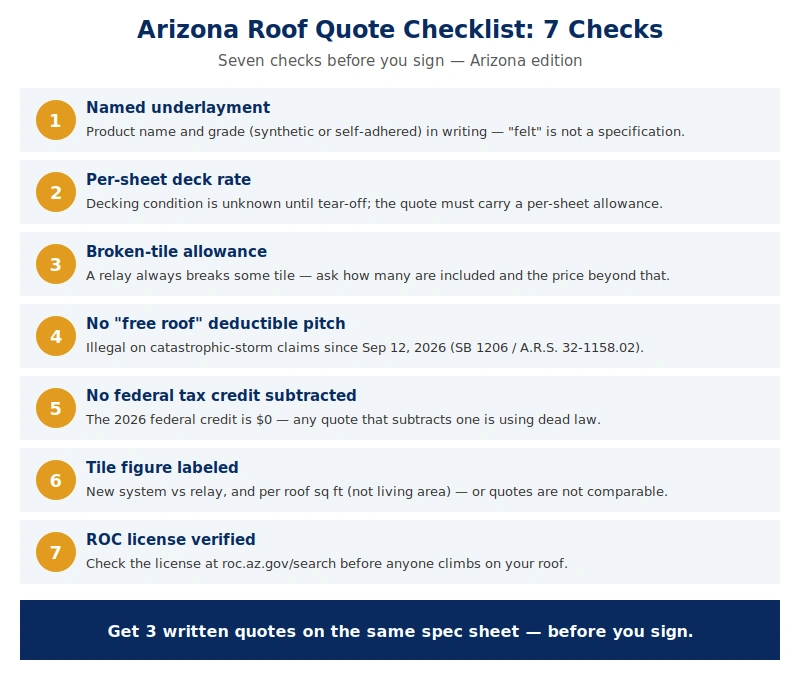
- No named underlayment — “felt” is not a specification. Demand the product name and grade, synthetic or self-adhered, in writing.
- No per-sheet deck rate — decking condition is unknown until tear-off. A quote with no per-sheet allowance will come back with a surprise.
- No broken-tile allowance — a relay always breaks some tile. Ask how many are included and at what price beyond that.
- A “free roof” deductible pitch — illegal on catastrophic-storm claims since September 12, 2026 (SB 1206 / A.R.S. § 32-1158.02).
- A federal tax credit subtracted from the price — $0 for 2026 homeowner-owned installs. Dead law.
- A single tile $/sq ft with no explanation — tile quotes legitimately range from $6.50 to $15.80 per sq ft. If the quote does not say new system or relay, and per roof sq ft or per living-area sq ft, it is not comparable.
- No ROC license number — verify it at roc.az.gov/search before anyone climbs on your roof.
Timelines, for planning: shingle jobs typically run 1–3 days and full tile or metal jobs 1–2 weeks — national guidance, not Arizona-verified — while tile lift-and-relay runs 3–7 days (The Arizona Roofer, 2026, Arizona-sourced). Before you sign, read our questions to ask a roofer — the vetting checklist that pairs with this guide.
Sources & methodology
Cost anchors: Arizona Roofers — “How Much Does a Roof Replacement Cost in Arizona? (2026 Guide)” (updated ~Oct 20, 2026, crawled Nov 5, 2026) — primary Arizona anchor; Angi — “How Much Does Roof Replacement Cost in Phoenix, AZ?” (updated Jul 31, 2026: Phoenix avg $8,856; most $6,273–$11,694; labor $4,400–$5,300); HomeYou — “Roof Replacement Cost in Phoenix, AZ (2026)” (updated Oct 9, 2026: Phoenix avg $12,104; most $9,138–$18,498); This Old House — “Cost of Roof Replacement in Arizona” (2026, crawled ~Jun 2026: AZ avg $7,484 — low-end cross-check only); Simply Roofing — “Tile Roof Installation in Arizona” (Oct 4, 2026); BestRoofingEstimates — “Roofing Cost in Phoenix, AZ” + “Roofing Cost in Arizona” (2026); TSM Roofing — tile + roof replacement Phoenix guides (updated ~Oct 2026); The Roofing Brief — “Roof Cost Per Square Foot in 2026” (reviewed Oct 2026); Irish Roofing Company — SPF Paradise Valley, standing seam Scottsdale, metal Paradise Valley, storm damage Chandler (Oct–Nov 2026); One Good Roofer — “Roof Replacement Cost in Arizona” (published Oct 7, 2026; AZ index 0.91); White Leaf Roofing — “Arizona Roof Replacement Cost (2026)” (ROC #325377); Mikku & Sons Roofing — roofing costs + calculator (updated Jun 3, 2026); Right Way Roofing (azroof.com) — Phoenix replacement, SPF, clay vs concrete tile (2026); Canyon State Roofs — asphalt roof signs (updated May 21, 2026); Strad Roofing — shingle lifespan in Arizona (2026); Capstone Roofing AZ; American Roofing & Waterproofing (May 2025); EcoRoof AZ; EngineerFix — tile roof life in Arizona (2026); Roof With Sunrise — underlayment replacement Tucson (2026); Behmer Roofing — underlayment Phoenix (2026); JBS Roofing AZ (updated May 11, 2026); The Arizona Roofer — underlayment replacement in Arizona climate (2026); AZ Roofing Works — repair cost guides, Phoenix/Mesa (Jul–Oct 2026); Slade Roofing — Phoenix replacement cost 2026; ContractorsRanked — Phoenix (updated Oct 21, 2026); BuildX — clay tile Phoenix (2026). Size and cost-per-year tables are our arithmetic from the Arizona Roofers per-sq-ft ranges.
Climate: NWS/NOAA heat records via azcentral (Jun 16, 2026: Phoenix 2025 — 122 days ≥100°F, 37 days ≥110°F; 30-yr avg 111; records 145 in 2020, 70 ≥110°F in 2024; all-time high 122°F, Jun 26, 1990); Extreme Weather Watch (NOAA records); BestRoofingEstimates + Strad Roofing (roof surfaces 150–180°F; dark shingles 160–180°F; attics to 150°F); EcoRoof AZ (20–40°F daily swing; DOE climate zone 2, R-30 to R-60); Strad Roofing (UV 11+); NWS monsoon season Jun 15–Sep 30; NWS Tucson via Tucson Roofers Network (microbursts 50–70+ mph); NWS Phoenix via Irish Roofing Chandler + Masizo Development (Oct 26, 2026: Oct 20, 2026 hail, 1–2 in., Chandler/Mesa); LegalClarity — Arizona roofing codes (no statewide code; Phoenix 2024 IRC/IBC; commercial cool-roof reflectance 0.55 / emittance 0.75 / SRI ≥64).
Permits + licensing: TSM Roofs (City of Phoenix Development Services 2025 schedule: $150 for first $1,000 + $9 per additional $1,000 under $10k; $231 for first $10,000 + $8 per additional $1,000 over $10k; range $150–$500); Arizona Roofers ($150–$650); Slade Roofing (~$200); Build Permit Guide (Oct 2026: Tucson FY27 schedule, adopted May 19, 2026, eff. Jul 1, 2026 — $89.45 + $22.95/$1,000); PermitCalculator (Tucson roof permit $496.97 — calculator output, flagged); City of Tucson permit FAQ (tucsonaz.gov; PDSD (520) 791-5550); Irish Roofing Scottsdale guide (same-material exemption; design-professional review; 105 mph design wind, 2021 IBC/ASCE 7); LegalClarity (ROC license; Recovery Fund; bonds $4,250/$7,500; Class A/B/C fire rating); TSM Roofs (HOA approval 2–4 weeks).
Insurance + law: DIFI storm guidance via Tucson Roofers Network (Oct 15–16, 2026); Irish Roofing Chandler (Oct 2026); Arizona Roofers insurance guide (Oct 2026; RCV vs ACV — 18-yr tile on 30-yr life at ~40%); Insurance Information Institute via Tucson Roofers Network (20+ yr inspection; ACV-only); SB 1206 / A.R.S. § 32-1158.02 (eff. Sep 12, 2026; deductible rebate ban; no acting as adjuster; 50% down-payment cap; 4-business-day cancel; 72-hour cancel after denial); A.R.S. § 12-542 (2-year suit deadline); Daily Phoenix (Oct 8, 2026: solar detach/reset in claim scope); DIFI consumer line (602) 364-2499.
Financing + rebates: OBBBA P.L. 119-21 / IRS FS-2025-05 ($0 federal credit for post-2025 installs); SRP cool roof rebate page (srpnet.com; $0.30/sq ft, up to $600; CRRC 3-yr SRI ≥86 / initial reflectance ≥0.83 / 3-yr ≥0.70; install by Apr 30, 2027; submit within 6 months) + SRP blog (May 21, 2026; cooling demand 10–15% per EPA); SRP Efficient Home Program (attic insulation up to 75% off, max $600); King Insulation (Mar 24, 2026: TEP up to $800; Efficiency Arizona up to $14,000/household, insulation rebates up to $1,600); Governor’s Office of Resiliency (resilient.az.gov); East Valley Foam (APS commercial $0.15–$0.30/sq ft — single source, commercial only; §179D $1.80/sq ft pre-OBBBA — not used for residential); Phoenix Roofing & Repair (GoodLeap 12.99%/13.49% APR, 5/7/10-yr); Home Pro Roofing + American Roofing & Waterproofing (0% promo plans); Roofana blog (Jul 2026: deferred-interest trap, retroactive 20%+); Roof Replacement Cost.ai (2026: $12,000 roof, 5-yr — ~$14,600 at 8% vs ~$18,280 at 18%; HELOC notes).
Repair + lifespans: Angi — Phoenix roof repair (updated Jul 9, 2026: avg $1,834; most $175–$3,075; leak $550–$2,500); AZ Roofing Works (leak $400–$1,500; minor $150–$300; moderate $500–$1,500; major $1,500–$3,000+; flashing $320–$800; vent $175–$320); Canyon State Roofs (replace signals); national draft 06 (pitch/complexity +20–50%; shingle 1–3 days; tile/metal 1–2 weeks — national, flagged); The Arizona Roofer (tile R&R 3–7 days; decking rot $500–$1,000 / $3,000–$8,000 — single source); Modernize SPF guide (2026; recoat 10–20 yrs); Angi spray foam (updated Oct 30, 2026: $2.50–$8/sq ft installed; national avg $11,500); RemodelingExpense SPF (updated Jun 19, 2026); Roof Observations SPF (2026).
EXCLUDED: any “after 30% credit” prices; Title 24 cited as Arizona law (California only); the 15–30% / $300–$600 per year cool-roof savings claim (New England Metal Roof, single unattributed source); azroof.com’s “$700–$1,000 per square foot” tile figure (units error — per square); Angi foam labor split ($2–$4 vs $4–$6/sq ft — internally contradictory); Mikku & Sons city figures as the primary range (low outlier, shingle-only modelled averages); §179D for residential; APS residential cool-roof $/sq ft (unverified); any structural-reinforcement dollar figure (unverified); a single tile $/sq ft (spread presented instead).
*Disclaimer: Prices are 2026 Arizona planning figures and change by city, roof, and contractor. Always get 3 written local quotes before budgeting. Tax information is general, not tax advice — confirm with a tax professional. The SRP rebate deadline (install by April 30, 2027) should be re-checked at publish time in case the program year rolls.*
—
How much does a roof replacement cost in Arizona in 2026?
Most Arizona replacements run $9,000–$28,000 in 2026 (Arizona Roofers, October 2026), with a state midpoint of about $17,200. On a typical 2,000 sq ft roof: architectural shingles $9,000–$14,000, concrete tile $14,000–$28,000, clay tile $20,000–$36,000, standing-seam metal $18,000–$36,000, and spray foam $8,000–$20,000 — tear-off included. A tile lift-and-relay runs $9,000–$17,000.
Why do tile roof quotes vary so much in Arizona?
Three reasons. First, some quotes are for a full new tile system and others are for a lift-and-relay that reuses your tile — the relay costs 30–50% less. Second, premium or discontinued profiles cost far more to source and match, and HOA uniformity rules can force a full replacement. Third, some quotes price per roof sq ft and others per living-area sq ft — roof area runs 1.2–1.3 times living area. The honest working range is $6.50–$15.80 per sq ft for concrete tile and $8.50–$21 for clay, with a realistic Valley mid-range of $7–$14 and $10–$18.
My tile looks fine but my roof leaks — do I need a new roof?
Usually no. The tile lasts 40–50+ years, but the underlayment beneath it fails at 20–25 years — and that is what leaks. The fix is a lift-and-relay: the crew lifts the tile off, replaces the underlayment, and lays the same tile back down, for $9,000–$17,000 on a 2,000 sq ft roof. You need a full new tile system only if the tile itself is cracked or broken beyond reuse, or the profile is discontinued and your HOA requires a uniform match.
How long does a shingle roof last in Phoenix?
Architectural shingles last 18–22 years in Arizona, against a 30-year rating; 3-tab shingles last 12–15 years against a 20-year rating (Canyon State Roofs, May 2026). Phoenix roofs perform at roughly 70–80% of rated life because summer roof surfaces hit 150–180°F and daily thermal swings of 20–40°F bake the oils out of the asphalt. South- and west-facing slopes deteriorate fastest.
Do I need a permit to replace my roof in Phoenix?
Yes for a full replacement — $150–$500 is typical (TSM Roofs, citing the City of Phoenix fee schedule), or $150–$650 depending on jurisdiction and project value. A final inspection is required to close the job. In Scottsdale, a re-roof is exempt from a permit only when the same material is reused; switching materials requires a permit and often a licensed design professional’s review.
Will insurance cover my roof after a monsoon or hailstorm?
Sudden storm damage — wind, hail, falling objects, water through a storm-opened roof — is covered, but only for the portion damaged. Age, wear, UV deterioration, and a failed 20+-year-old underlayment are not covered. Roofs over 20 years old often face an inspection and may be paid at Actual Cash Value — an 18-year-old tile roof on a 30-year life may be paid at roughly 40% of replacement cost. The October 20, 2026 hail outbreak (1–2 inches in Chandler and Mesa) is a current example. Since September 12, 2026, a contractor cannot pay or rebate your deductible on catastrophic-storm claims (SB 1206 / A.R.S. § 32-1158.02).
Is there a federal tax credit for a new roof in Arizona in 2026?
No — $0. OBBBA (P.L. 119-21) ended §25C/§25D for property placed in service after December 31, 2025. Several Arizona roofing sites still advertise federal energy credits — that information is stale. The one verified residential rebate is SRP’s cool-roof rebate: $0.30 per sq ft, up to $600, for CRRC-rated cool roofing installed by April 30, 2027.
How much does a foam roof recoat cost in Arizona?
$2–$4 per sq ft — $4,000–$8,000 on a 2,000 sq ft roof — every 10–15 years (Irish Roofing) or 10–20 years (Modernize). A recoat is the right call when the foam is sound and only the coating is worn. A wet deck or multiple failed layers means tear-off plus new foam at $6–$9 per sq ft instead.