

Arkansas hands a solar buyer the cheapest panels in the country and some of the cheapest grid power to compete with, and those two facts pull in opposite directions all the way through the decision. Panel prices sit near the bottom of the national table: $2.56 a watt on the EcoGen Solar Cost Index, tied for the second-lowest installed price of the 50 states and the District of Columbia. The power the panels replace is a bargain too: 14.37 cents a kilowatt-hour on the latest EIA statewide average, against 18.16 cents nationally.
Low panel prices shorten the payback. Low grid prices lengthen it, because each kilowatt-hour from the roof replaces one the utility would have sold for about 14 cents.
A date on a piece of paper matters as much as either price. Arkansas paid full retail value for exported solar power for more than 20 years, and then Act 278 of 2023 ended that deal for new customers. Anyone whose interconnection paperwork went in before September 30, 2024 keeps the old one-for-one credits until June 1, 2040.
Anyone who applies now gets a bill credit at the utility’s avoided cost, 3.34 cents a kilowatt-hour at Entergy Arkansas for March 2026 to February 2027. A neighbor’s solar bill from 2023 says nothing about a system bought in 2026. Savings math that prices exports at the retail rate prices a program that closed to new applicants more than two years ago.
Two questions decide the answer for a 2026 buyer, and neither one is the price per watt. The first is whose name sits at the top of the electric bill, because Entergy Arkansas, SWEPCO, OG&E, 17 electric co-ops, and the city utilities each pay their own export credit and charge their own fees.
The second is how much of the power the home uses while the sun is up, because a kilowatt-hour used at home is worth about four times a kilowatt-hour sent out. Get those two answers in writing before comparing quotes, and the rest of the decision falls into place.
Start with the national figures in our national solar panel cost guide, then read Arkansas against that baseline. The national guide sets the countrywide price and the federal rules; the sections below price Arkansas city by city, utility by utility, and kilowatt-hour by kilowatt-hour.
Table of Contents
How Much Do Solar Panels Cost in Arkansas in 2026?
The headline band for Arkansas in 2026 is $18,630–$24,350 for an 8 kW rooftop system, installed, from NumeralQ’s estimator pricing of October 26, 2026. That is $2.33–$3.04 per watt, and the midpoint of the band, about $21,490, is the figure the payback section works from.
NumeralQ labels its figures planning estimates built from a national cost model adjusted for Arkansas labor and materials, not records of what Arkansas homeowners paid. No published average drawn from completed Arkansas invoices was found, and the band is presented as what it is: a planning range to hold quotes against, not a price any installer has promised.
Two other price trackers land close to the NumeralQ band from different directions, and the agreement is reassuring. EcoGen’s Solar Cost Index (September 2026 edition, prices as of September 25, 2026) puts Arkansas at $2.56 per watt, tied for the second-lowest installed price of 51 jurisdictions, against a $2.89 national average. EnergySage’s Arkansas marketplace data (November 2026) averages $2.37 per watt, but on much bigger systems: its average Arkansas system is 14.28 kW at $33,907, with quotes ranging from $28,821 to $38,993.
A third tracker, solarenergyprices.com, puts the typical Arkansas cash price at $2.75 a watt, inside a $2.50–$3.00 range. Three methods, three different system mixes, all inside a 40-cent spread: the Arkansas price is genuinely low, and a quote far above $3.04 a watt for an ordinary roof needs a clear reason.
A quote inside the band pays for a working system: the panels, the inverter (a string inverter or microinverters), the racking and flashing, the wiring and disconnects, the permit and inspection fees, the labor, and the startup and commissioning visit. What the band does not cover is the work around the system, and that work is where Arkansas quotes most often surprise their buyers.
- Roof repairs or a roof replacement before the panels go on, priced on their own
- An electrical panel upgrade, if the existing service cannot take the solar backfeed
- A battery, priced separately and covered in its own section below
- Tree removal or trimming where shade falls on the roof
- Sales tax on the equipment, at the 6.5 percent state rate plus local tax, unless the quote states otherwise
- The utility’s interconnection fee, which runs from $100 to $320 depending on the utility and is itemized in the utility sections below
One warning belongs before any quote is compared. A low first bid can turn into the expensive job once the system is running, and the highest bid does not guarantee the best equipment.
Get written quotes from three licensed installers, all priced on the same job. Drop any bidder who will not name the panel model, the inverter type, the year-one production estimate, and the export credit the savings math assumes.
| Source | Price per watt | 8 kW total | Basis |
|---|---|---|---|
| NumeralQ (Oct 2026) | $2.33–$3.04 | $18,630–$24,350 | Planning estimate, state model |
| EcoGen Index (Sept 2026) | $2.56 | $20,480 | Cost index, cash, before incentives |
| EnergySage (Nov 2026) | $2.37 | $18,960 (scaled) | Marketplace quotes, avg 14.28 kW system |
| solarenergyprices.com (Aug 2026) | $2.75 typical | $22,000 | Planning range $2.50–$3.00/W |
The EnergySage 8 kW figure in that table is scaled from its per-watt average, not a price EnergySage publishes for an 8 kW system, and it is labeled as such. EnergySage’s own published total is $33,907 for its 14.28 kW average system.
The gap between that average size and the 8 kW planning size is itself a finding: marketplace averages skew toward big roofs and big bills, while the typical Arkansas home, using about 12,912 kilowatt-hours a year, needs roughly 9 to 10 kW to cover its full annual use, and less than that to cover its daytime use. Treat size as a decision in its own right, made from the home’s daytime load, and the next section prices it step by step.
Solar Panel Cost in Arkansas by System Size
System size in solar is measured in kilowatts, and a kilowatt is a measure of capacity: how much power the array can make at any instant under full sun. A kilowatt-hour is the energy itself, the unit the electric bill counts.
The link between the two is the sun: each kilowatt of panels on an Arkansas roof makes about 1,350 kilowatt-hours a year on the planning figure used here, so an 8 kW system makes about 10,800 kilowatt-hours a year. Sizing starts from the home’s annual use, then gets cut back to what the home can use while the sun shines, because under the post-2024 export rules every surplus kilowatt-hour earns only about 3 cents.
The table below prices each size from the NumeralQ bands, with year-one production at the 1,350 planning figure and each size’s output set against the average Arkansas home’s 12,912 kilowatt-hours a year. Every row is a planning estimate, and the per-watt price falls as the system grows, because the fixed costs of the job (the permit, the crew’s travel, the inverter setup) spread across more watts.
| System size | Installed cost (NumeralQ) | Price per watt | Year-one production | Share of average home use |
|---|---|---|---|---|
| 4 kW | $9,800–$12,810 | $2.45–$3.20 | ~5,400 kWh | ~42% |
| 5 kW | $12,100–$15,810 | $2.42–$3.16 | ~6,750 kWh | ~52% |
| 6 kW | $14,330–$18,740 | $2.39–$3.12 | ~8,100 kWh | ~63% |
| 7 kW | $16,510–$21,590 | $2.36–$3.08 | ~9,450 kWh | ~73% |
| 8 kW | $18,630–$24,350 | $2.33–$3.04 | ~10,800 kWh | ~84% |
| 10 kW | $22,680–$29,650 | $2.27–$2.96 | ~13,500 kWh | ~105% |
| 11 kW | $24,610–$32,180 | $2.24–$2.93 | ~14,850 kWh | ~115% |
| 12 kW | $26,490–$34,630 | $2.21–$2.89 | ~16,200 kWh | ~125% |
The falling per-watt price tempts buyers toward the biggest roof the budget allows, and under the old one-for-one credits that temptation made sense. Under the new rules it works against the buyer. A 12 kW system on a home that uses the state average makes about a quarter more power than the home uses in a year, and the surplus earns the avoided-cost credit of about 3 cents while the home keeps buying evening power at about 14 cents.
The extra panels cost full price and earn the lowest rate on the bill. Size to the daytime load first, then add only what a battery or a daytime habit (a pool pump, daytime car charging, pre-cooling the house) can absorb.
Two size facts sit behind that table and both come from the law, not from the roof. A new residential system cannot exceed the lesser of 25 kW of alternating-current capacity or enough capacity to cover the home’s highest month of use in the past 12 months, under the Act 278 rules the utilities now enforce.
A 25 kW roof is far bigger than any ordinary Arkansas home needs, so the 25 kW ceiling rarely binds; the highest-month test is the one that can bite on a small home with a big roof. Either way, the utility applies the cap at interconnection, so a design the utility will not connect is a design that should never have been quoted.
Panel counts follow from the panel wattage, and 400-watt panels are the common 2026 module. An 8 kW system needs 20 of them, a 6 kW system needs 15, and a 10 kW system needs 25, before roof setbacks and shading cut the usable area.
A layout promising 25 panels on a roof with two dormers, a chimney, and a mature oak on the south side comes from a bidder who has not measured the roof. Ask for the panel layout drawing with the quote, and check that the count on the drawing matches the count on the invoice.
Our 6 kW vs 8 kW vs 10 kW guide works through the same size decision for the national picture, with the production math shown for each size. For the Arkansas roof, the short version is this: 6 to 8 kW covers most of the average home’s use, 10 kW covers all of it on paper, and anything past 10 kW needs a daytime load or a battery to justify it under the new export rules.

What Little Rock, Fayetteville, Fort Smith & Jonesboro Actually Pay
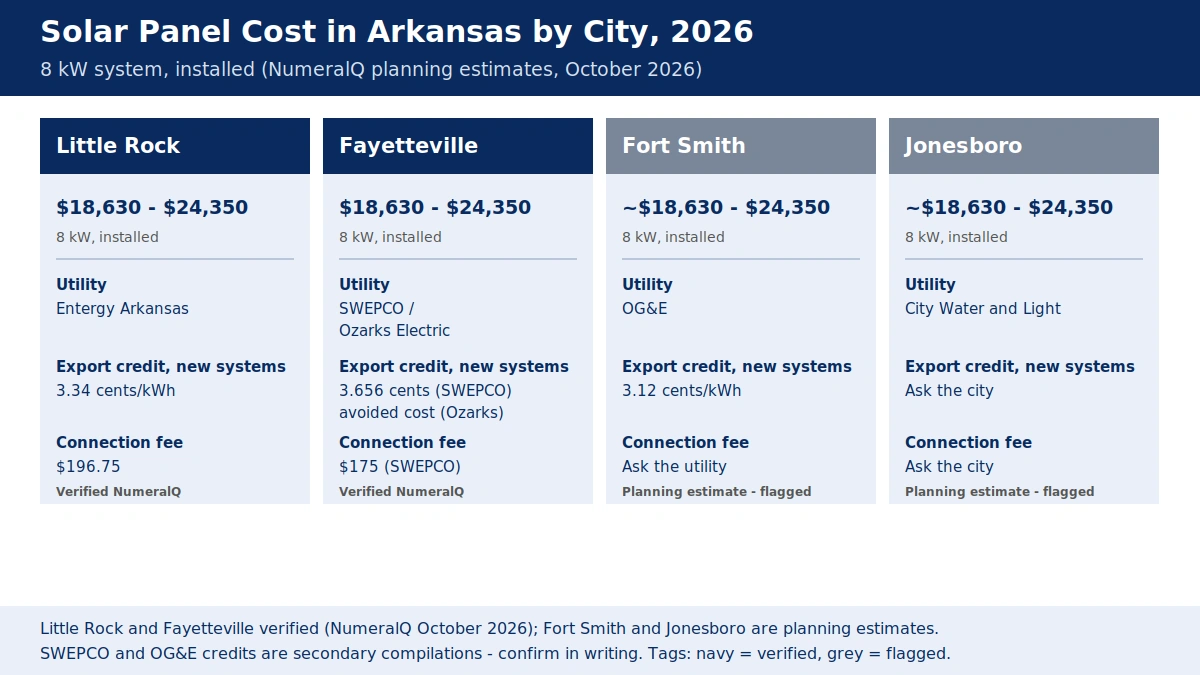
Arkansas has no expensive solar market and no cheap one, at least in the published figures. NumeralQ publishes the identical 8 kW band, $18,630–$24,350, for Little Rock, for Fayetteville, and for the state as a whole, which means its model finds no city spread worth pricing.
That flatness is plausible: panels and inverters are priced nationally, Arkansas labor runs below the national average everywhere in the state, and the crew that installs a roof in Little Rock charges much the same as the crew in Fayetteville. What genuinely differs between the four cities is the utility on the bill, the export credit that utility pays, and the fees it charges to connect.
| City | 8 kW installed | Utility | Export credit, new systems | Connection fee |
|---|---|---|---|---|
| Little Rock | $18,630–$24,350 (NumeralQ) | Entergy Arkansas | 3.34 cents/kWh | $196.75 |
| Fayetteville | $18,630–$24,350 (NumeralQ) | SWEPCO / Ozarks Electric | 3.656 cents (SWEPCO) / avoided cost (Ozarks) | $175 (SWEPCO) |
| Fort Smith | ~$18,630–$24,350 (planning est.) | OG&E | 3.12 cents/kWh | Ask the utility |
| Jonesboro | ~$18,630–$24,350 (planning est.) | City Water and Light | Ask the city | Ask the city |
Little Rock is the capital, the largest metro, and the best-documented solar market in the state. EnergySage’s Little Rock marketplace data (November 2026) averages $2.42 a watt on an 11.52 kW average system at $27,865, inside a $23,685–$32,045 range, while HomeCostLens models a typical 7 kW Little Rock job at about $19,670. The utility is Entergy Arkansas, so the export credit is the verified 3.34 cents and the connection fee is $196.75.
Two local rules deserve a line each: Little Rock treats a solar array as a miscellaneous permit priced on the city’s standard valuation table, and in the Central High Neighborhood Design Overlay District, new solar collectors on a one- or two-family lot must go in the rear yard or on a rear-facing roof. North Little Rock, across the river, has its own municipal electric department, so a buyer a mile away can face a different utility and different terms.
Fayetteville sits in the Ozark hills of the northwest corner, and its utility picture is split. SWEPCO serves the city itself, while Ozarks Electric Cooperative serves parts of the surrounding area, so two homes a few miles apart can sit on different tariffs with different export credits. SWEPCO’s avoided-cost credit for March 2026 to February 2027 is 3.656 cents a kilowatt-hour on the per-utility figures EcoGen compiled, and its connection fee is $175; both figures come from a secondary compilation rather than tariff pages read firsthand, so both carry the confirm-in-writing flag.
Fayetteville’s own rules treat solar under the Unified Development Code’s accessory-structure and residential-district sections, and the city’s tree cover means a shade analysis matters more here than on a Delta roof. The median Fayetteville home is worth $349,600 on NumeralQ’s figures, which puts a midpoint system at roughly 6 percent of the home’s value.
Fort Smith carries a planning estimate rather than a verified city price, because no city-specific solar price was published for it. The state band is applied to the city and labeled as such, and a Fort Smith buyer should treat three local quotes as the real price discovery. The utility is OG&E, whose Arkansas avoided-cost credit is 3.12 cents a kilowatt-hour for March 2026 to February 2027 on EcoGen’s per-utility figures, again flagged for written confirmation.
Fort Smith sits on the Arkansas River at the Oklahoma line, in the hottest corner of the state for summer design temperatures, and its storm exposure runs high: the Fort Smith radar area averaged 54 hail days and 14 tornado days a year over 1980–2006 on NOAA Storm Prediction Center climatology, an area figure that covers far more ground than the city itself. A Fort Smith quote should carry the hail-rated glass and the anchoring the storm section calls for, priced as its own lines.
Jonesboro, the commercial center of the northeast Delta, also carries a planning estimate, for the same reason: no city-specific price was published. The city utility is City Water and Light, a municipal system that sets its own solar terms through its governing body, and no residential export rate for Jonesboro CWL was found.
That gap is stated plainly rather than filled with a guess: a Jonesboro buyer should ask CWL for its current buyback terms in writing before signing anything, and should check whether the address sits on CWL, Entergy Arkansas, or Craighead Electric, since all three serve parts of Craighead County. Jonesboro CWL owns a 10 MW solar park that opened in 2022, which shows the city knows solar at utility scale; it says nothing about what a rooftop customer earns, and the two should not be confused.
Arkansas Sun: Humid Heat, Spring Clouds & What a Kilowatt Really Makes
A peak sun hour is an hour of full-strength sunshine, the unit that measures how much sun a place gets. It is not an hour of daylight: a hazy morning and a blazing noon add up to fewer peak sun hours than the clock suggests.
Arkansas averages about 4.5 to 5.2 peak sun hours a day across the published sources, with the most careful recent figure, a PVWatts simulation on federal weather data, putting the state at 5.18 and about 1,373 kilowatt-hours per kilowatt each year. The planning figure used here, 1,350 kilowatt-hours per kilowatt a year, sits near the middle of the published range, which runs from about 1,314 to about 1,413 depending on the source and the city modeled.
| Source | Basis | Production per kW per year |
|---|---|---|
| PVWatts v8 (thegreenwatt, Apr 2026) | NSRDB weather data, Little Rock | 1,373 kWh |
| EcoGen per-utility file (Oct 2026) | 8.16 kW system, 11,351 kWh/yr | 1,391 kWh |
| sparkpowered (2026) | NASA/EIA data | 1,363 kWh |
| solarenergyprices.com (Aug 2026) | 8 kW system, 10,795 kWh/yr | 1,349 kWh |
| sunmetriclab (Sept 2026) | 4.5 peak sun hours/day model | 1,314 kWh |
| HomeCostLens (Sept 2026) | PVWatts, Little Rock, south-facing | 1,413 kWh |
| Planning figure used here | Middle of the published range | 1,350 kWh |
Humidity is the Arkansas fact that a sun-hours table cannot show. Little Rock’s July averages a high of 92 degrees with Gulf moisture riding north all summer, and solar cells lose output as they heat up: a panel rated at 25 degrees Celsius gives up a fraction of a percent of its power for every degree hotter the cells run, on a typical manufacturer temperature coefficient of about 0.35 percent per degree.
A dark roof in a Little Rock July runs far hotter than the air above it, so the same panel makes less power at 3 p.m. in July than its label promises. The loss is already baked into the production figures above, which model real roof temperatures, but it is why multiplying the panel label by the sun hours and stopping there overstates the yield.
Clouds and rain shape the year more than most buyers expect. Little Rock gets about 50 inches of rain a year, spread across every month, with spring the wettest season, and the sun follows a steep seasonal curve: NASA surface data puts Little Rock’s solar energy at about 6.1 kilowatt-hours per square meter per day in July and about 2.0 in December.
A system sized from the annual average will overproduce in May and June and underproduce in December and January, and the monthly bills will show it. Panels still make power on cloudy days, at a reduced rate, and the annual total is what the payback math uses, but a buyer who expects steady monthly output will be surprised by the winter bills.
Roof direction, tilt, and shade move the yield more than any difference between Arkansas cities. A south-facing roof at a moderate tilt is the reference case behind every production figure in the size table. An east- or west-facing roof makes less, a flat roof makes less unless the racking tilts the panels, and shade from a mature oak or a neighbor’s two-story addition can cut a section of the array for hours a day.
The Ozark and Ouachita hills carry heavy tree cover, and a Fayetteville or Hot Springs roof under oaks needs a shade analysis with the quote, not a production promise from a satellite photo. Every quote should carry a year-one production estimate for the actual roof, with the tilt, direction, and shade assumptions printed on it.
Latitude barely matters inside Arkansas. Little Rock sits at about 34.7 degrees north and Fayetteville at about 36.1, a span too small to change the production figure by more than a few percent.
Snow matters even less: Little Rock sees only light snow in most winters, and what falls melts off a tilted dark panel quickly. The production differences that matter in Arkansas are the roof, the shade, and the heat, in that order, and none of them appears on a statewide sun map.
Net Metering After Act 278: The September 2024 Line That Split Arkansas Solar
Arkansas paid solar owners the full retail value of their exported power for more than two decades, under one of the friendliest net-metering rules in the South. The Arkansas Renewable Energy Development Act of 2001 set up net metering, and the Arkansas Public Service Commission kept the one-for-one credit in its June 2020 order, a decision the Arkansas Court of Appeals upheld in May 2022 against a challenge from utilities that wanted wholesale-based credits and a monthly grid charge.
For each kilowatt-hour a customer sent to the grid, the customer earned a kilowatt-hour back at the same price. That rule built the Arkansas rooftop market, and every payback promise made before 2023 assumed it would last.
The Solar Access Act of 2019, Act 464, expanded the market before the compensation fight reached the legislature. Signed on July 24, 2019, it authorized third-party leasing of net-metering facilities, raised the size of facilities exempt from compliance filings from 300 kW to 1,000 kW, expanded the non-residential cap, and made a paired energy-storage device an eligible net-metering facility.
Cities, counties, schools, and churches moved first, signing solar service agreements under the new law, and residential leasing became a lawful option for homeowners for the first time. The compensation rule itself did not change in 2019: the one-for-one credit stayed in place, and the Commission locked it in for two more years in its 2020 order.
Act 278 of 2023, the Arkansas Cost-Shifting Prevention Act, changed the compensation rule for everyone who came after. Effective March 13, 2023, it directed the Commission to move new net-metering customers to a billing structure that credits exported power at the utility’s avoided cost instead of the retail price. The Commission adopted revised Net-Metering Rules on September 29, 2023, and the utilities filed their new tariffs under Docket 23-070-TF.
The law’s stated target was cost-shifting: the argument, pressed by Entergy Arkansas and the Arkansas Electric Cooperative Corporation, that retail-rate credits let solar customers skip their share of transmission, distribution, and grid upkeep costs. Whatever a buyer thinks of that argument, the new structure is the law, and it governs every system applied for after the cutoff.
The cutoff is September 30, 2024, and the law protects two groups that met it. Legacy customers, whose systems met the net-metering requirements as they stood before March 12, 2023, keep the old retail-rate credits. Legacy-transitional customers, who submitted a standard interconnection agreement, executed a facilities agreement, or filed a Commission complaint about a disputed facilities agreement before September 30, 2024, keep them too.
Both groups hold the old terms until June 1, 2040, a fixed date written into the statute, not 20 years from each system’s start. A system connected in 2020 and a system connected in September 2024 lose their protection on the same day.
That deadline has passed, and no new applicant can reach back across it. A 2026 buyer is a non-legacy customer on every Arkansas utility, whatever a sales pitch suggests, and the only way to hold legacy terms now is to buy a home whose system already has them.
A buyer in that position should confirm the legacy status with the utility in writing before closing, and should confirm it again before modifying or expanding the system, since changes can affect the protected status. A seller’s word about the paperwork date is not proof; the interconnection agreement and its date, confirmed by the utility, are proof.
Non-legacy billing works differently from the old net metering in three ways that all cut the same direction. The structure is often called net billing to mark the difference from the old net metering, and the DSIRE database lists the Arkansas program under that name.
- Separate metering: power bought from the grid is billed at the retail rate, and every kilowatt-hour sent out earns a dollar credit at the avoided cost.
- Energy portion only: the credit cannot pay the customer charge, any demand charge, any minimum-bill provision, taxes, or fees, which the customer pays every month regardless.
- Surplus carries forward: leftover dollars roll to the next bill rather than expiring at year end. At Entergy Arkansas the leftover credit rolls forward with no year-end payout or expiry, and Ozarks Electric states the same rollover without expiry.
| Legacy (paperwork before Sept 30, 2024) | Non-legacy (2026 applicants) | |
|---|---|---|
| Export value | Full retail rate, one-for-one | Avoided cost, about 3–3.7 cents/kWh |
| How credits work | Kilowatt-hours offset kilowatt-hours | Dollar credits on the energy portion only |
| Fixed charges | Offset by surplus in most months | Never offset by export credits |
| Surplus rollover | Month to month; buyout rules at 24 months | Dollar surplus carries to the next bill |
| Terms last until | June 1, 2040 | Reset every March; no end date |
Avoided cost is a wholesale concept, and the statute defines it precisely: the 12-month average of the Locational Marginal Price in the utility’s load zone in the Midcontinent Independent System Operator (MISO) or Southwest Power Pool (SPP) wholesale market, depending on which grid operator serves the utility. Each utility files a new avoided-cost rate by February 1, and it applies from March for one year.
At Entergy Arkansas the filed rate was 2.59 cents for March 2024 to February 2025, then 2.47 cents for March 2025 to February 2026, and now 3.34 cents for March 2026 to February 2027, on Rate Schedule 71 as filed with the Commission. The next reset lands in March 2027, and no quote should treat the current credit as fixed: a proposal that holds the export value flat for 25 years is modeling a rate that the tariff re-prices every year.
The size cap changed with the same law, and it now works as an eligibility test. A new residential facility cannot exceed the lesser of 25 kW of alternating-current capacity or enough capacity to cover the customer’s highest month of use in the previous 12 months, as Entergy’s net-metering schedule and the Commission’s rules both state. A larger residential facility is allowed only when it was included in a standard interconnection agreement executed before December 31, 2022.
For most homes the 25 kW ceiling is far above any sensible design, but the highest-month test can limit a small home with a big roof, and the utility enforces the cap when it reviews the interconnection request. Size the system to the home’s use first, and the cap will rarely be the binding limit.
Read the current tariff before believing any figure in this section, including the figures printed here. Entergy Arkansas publishes its net-metering schedules with the Legacy and Non-Legacy tariffs side by side, and the avoided-cost filing for March 2026 to February 2027 sits in the Commission’s docket record.
A buyer who checks the tariff will also find the interconnection steps, the metering rules, and the purchase terms for surplus credits on account closure. The tariff is the document that governs the bill, and everything else is a summary of it.
Co-ops & City Utilities: 17 Different Answers to the Same Question
Entergy Arkansas serves about 4 in 10 Arkansas homes, but the other 6 in 10 sit on different systems with different solar terms. About a third of Arkansas homes belong to one of 17 electric cooperatives, and about 1 in 8 sits on a city-owned utility. Every co-op filed its own Act 278 compliance tariff with the Commission, and every city utility sets its own terms through its governing body.
The statute gives all of them the same framework, avoided-cost credits for new customers and legacy protection to 2040, but the credit rate, the fees, the minimum bill, and the paperwork differ from one provider to the next. A buyer on a co-op or a city system needs that provider’s own numbers, not Entergy’s.
First Electric Cooperative, the largest co-op in the state, shows how the co-op structure works. Its Legacy schedule (Schedule 65) and Non-Legacy schedule (Schedule 66) were filed with the Commission in December 2023, and its non-legacy tariff follows the statute’s two-channel model: separate metering, retail billing on imports, avoided-cost dollar credits on exports, and fixed charges the credits cannot touch. Its export credit tracks its wholesale supplier’s avoided cost: 2.89 cents a kilowatt-hour was the last approved figure, from March 1, 2025, and a 3.72-cent figure filed in January 2026 was pending approval on the per-utility figures EcoGen compiled.
First Electric’s one-time fee is $320 and its minimum bill with solar is $31 plus taxes on those same figures. All four numbers carry the confirm-in-writing flag, because they come from a secondary compilation rather than tariff pages read firsthand, and the pending 3.72-cent figure may have been decided since.
Ozarks Electric Cooperative, headquartered in Fayetteville, publishes its rule in plain language on its own site. For facilities installed after September 29, 2024, power used from the co-op is billed at the standard retail rate, power sent back is credited at the avoided cost of energy based on the prior year’s rate filed with the Commission, unused credits roll over from month to month and never expire, and credits apply only to the energy portion of the bill.
Ozarks also publishes its hardware rule: the system needs a visibly open, lockable, manual photovoltaic AC disconnect switch next to the electric meter, within 3 feet and clearly labeled, so a lineworker can see at a glance that the system cannot back-feed a de-energized line. The co-op’s net-metering page carries the full procedure, including the interconnection steps and the code standards the system must meet.
The other named co-ops follow the same pattern with their own figures. Carroll Electric, Arkansas Valley Electric, North Arkansas Electric, and Woodruff Electric all filed net-metering tariffs under Act 464 in 2019 and Act 278 compliance tariffs afterward, and Craighead Electric and Petit Jean Electric serve their own counties under the same framework. EcoGen’s per-utility file models simple paybacks of 24.3 years at Arkansas Valley, 25.3 at Carroll, 26.5 at Ozarks, 26.9 at First Electric, and 30.4 at North Arkansas, all at the 2.89-cent supplier credit, and states plainly that co-op terms for new customers were not confirmed.
Those paybacks are modeling, not tariff text, and they show the range a co-op member might face rather than a price anyone can bank on. A co-op member’s first call is to the co-op: the current credit, the fee, the minimum bill, and the disconnect and metering rules, all in writing.
| Utility | Export credit, new systems | One-time fee | Notes |
|---|---|---|---|
| Entergy Arkansas | 3.34 cents/kWh (Mar 2026–Feb 2027) | $196.75 | Verified from APSC filing; resets each March |
| SWEPCO | 3.656 cents/kWh (Mar 2026–Feb 2027) | $175 | Secondary compilation; confirm in writing |
| OG&E (Arkansas) | 3.12 cents/kWh (Mar 2026–Feb 2027) | $175 | Secondary compilation; confirm in writing |
| First Electric Co-op | 2.89 cents approved; 3.72 filed, pending | $320 | Minimum bill $31 plus taxes; confirm in writing |
| Ozarks Electric Co-op | Prior-year filed avoided cost | Ask the co-op | Credits roll over, never expire |
| Other co-ops | Own filed figures | Ask the co-op | 17 co-ops; terms differ |
| Conway Corp | Per city tariff; excess at avoided cost on closure | $100 + $250 + $100/visit | Credits roll forward; non-transferable |
| Jonesboro CWL / NLR Electric | Ask the city | Ask the city | No residential rate found |
City utilities write their own rules, and Conway Corp shows both the pattern and the detail. Conway’s net-metering terms credit excess generation to the next billing period, purchase leftover credits at avoided cost when the account closes, and bar transfers of credits between accounts. Its fees are published on its own FAQ page: a $100 application fee, a $250 interconnection fee, and a $100 inspection fee per site visit.
Conway also requires a licensed electrician for all wiring and equipment, and points buyers to the City of Conway Permitting Department for the permit. For Jonesboro City Water and Light and North Little Rock Electric, no current residential export rate was found, and the honest statement is that gap, not a borrowed number from another utility. A buyer in either city should ask for the current buyback terms, the fees, and any size limit in writing, and should check the address against the service map first, since city, co-op, and Entergy territories interleave at the edges of both cities.
The rule that covers every provider in this section fits in one sentence: read the name at the top of the electric bill, then get that provider’s current credit, fee, and minimum bill in writing. Two neighbors on the same street can sit on different providers where a city limit or a co-op boundary runs between their houses, and their solar math will differ by thousands of dollars over the life of the system. Entergy’s credit applied to a co-op address, or a co-op’s credit applied to a city address, prices the wrong utility, and the payback shown belongs to someone else’s house.
Payback in Arkansas: The Home-Use Share Decides Everything
Simple payback is the years the savings take to cover the price: the net cost divided by the yearly savings. It is the simplest payback measure there is, and its simplicity is both its strength and its limit: it counts no upkeep, no panel wear, no inverter replacement, and no rise in electric rates.
The table below runs that measure for an 8 kW system at the NumeralQ midpoint of $21,490, making 10,800 kilowatt-hours in year one, with power used at home valued at 14.37 cents (the EIA August 2026 statewide average) and power sent out valued at 3.34 cents (the Entergy Arkansas credit for March 2026 to February 2027). The only input that changes across the rows is the share of the power the home uses as it is made.
| Share used at home | Home-use value | Export value | Yearly savings | Simple payback |
|---|---|---|---|---|
| 30% | ~$466 | ~$253 | ~$718 | ~29.9 years |
| 50% | ~$776 | ~$180 | ~$956 | ~22.5 years |
| 70% | ~$1,086 | ~$108 | ~$1,195 | ~18.0 years |
| 90% | ~$1,397 | ~$36 | ~$1,433 | ~15.0 years |
Read the table across, and the Arkansas story is the gap between the rows. Moving from 30 percent home use to 90 percent nearly doubles the yearly savings and halves the payback, without changing the panels, the price, or the sun. Each kilowatt-hour used at home saves about 14 cents, while each kilowatt-hour sent out earns about 3 cents, so the household’s daytime habits are worth more than any equipment choice on the quote.
A home where someone is in during the day, or where a pool pump, a daytime car charger, or a pre-cooled house soaks up the midday output, lands on the lower rows. A home empty on weekdays, with everyone out from 8 to 6, lands on the top row, and most of its power leaves at the low credit.
The price the buyer actually pays moves the answer too, and the range is wide enough to matter. At the low end of the NumeralQ band, $18,630, the 50-percent-home-use payback drops to about 19.5 years. At the high end, $24,350, it rises to about 25.5 years, past the 25-year performance warranty most panels carry.
At EcoGen’s $2.56-a-watt price, $20,480 for 8 kW, the same 50-percent case pays back in about 21.4 years and the 70-percent case in about 17.1 years. A buyer comparing two quotes $5,000 apart is comparing two paybacks five years apart, which is why the cash price on the quote matters more than any savings promise wrapped around it.
The legacy contrast shows what the old rules were worth. If every kilowatt-hour the system made earned the full 14.37-cent retail rate, as a grandfathered system still does, the same 8 kW system would save about $1,552 a year and pay back in about 13.8 years at the midpoint price. That is the math the neighbor with a 2023 system lives under, and it is roughly nine years faster than the 50-percent case a 2026 buyer faces.
The difference is not the hardware, which got cheaper, or the sun, which did not change. The difference is the export credit, and it is the single largest fact in Arkansas solar economics.
Outside modeling agrees with the table’s shape, if not with every decimal. EcoGen’s per-utility file puts a new Entergy Arkansas system at about 22.7 years, its statewide figure at about 23.5 years, and OG&E and SWEPCO both at about 26.6 years, all simple payback before incentives, with no upkeep or price rises counted.
EnergySage’s models show shorter paybacks, 15.26 years statewide and 13.92 years in Little Rock, but they run on different rate and export assumptions and on much bigger systems, and the gap between the two sets of figures is itself a lesson: payback is an assumption stack, not a measurement, and savings math that hides its assumptions cannot be checked. Ask every bidder for the home-use share, the retail rate, and the export credit behind the savings figure, and rerun the table with the numbers from the actual bill.
Two forces push the real payback in opposite directions over time, and neither appears in a simple-payback table. Arkansas residential rates have climbed about 4.68 percent a year over the past five years on EcoGen’s EIA-based figure, and every rate rise shortens the payback on the power used at home. Upkeep, panel wear, and a possible inverter replacement push the other way, and the export credit resets every March from wholesale prices that can fall as well as rise: at Entergy it dropped from 2.59 cents to 2.47 cents before rising to 3.34.
A careful buyer runs the table twice, once at the current credit and once at last year’s 2.47 cents, and checks that the decision survives the lower number. If it does not survive, the system is a bet on wholesale prices, not an investment in the roof.
Some households should pause, and the table says which ones.
- A light user with a small bill has too little spending to offset for an 8 kW ticket.
- An export-heavy home with no load to shift and no battery will watch most of its power leave at 3 cents.
- A buyer who may move within a few years needs a sale that prices the system in, because the payback needs a decade or more of staying put.
- Any proposal that shows retail-valued exports for a 2026 system is modeling a program that closed in September 2024, whatever else it gets right.
The households that should sign are the mirror image: heavy daytime users, high bills, a roof that faces the sun, and a plan to stay in the house long enough for the slow math to finish.

Batteries in Arkansas: Outage Cover That Rarely Pays for Itself
A battery changes the Arkansas equation by moving power across the clock. Without one, surplus midday power leaves the house at about 3 cents, and the home buys evening power back at about 14 cents. With one, the surplus charges the battery in the afternoon and runs the evening load after sunset, so each stored kilowatt-hour displaces a full-price purchase instead of earning the low export credit.
The battery earns the spread between the two rates, about 11 cents a kilowatt-hour, minus the energy lost on the round trip through the battery and its inverter. That spread is the whole bill-saving case for storage in Arkansas, and it is a thin one.
No Arkansas-specific installed battery price was published, so the figures here are national, labeled as such. Installed residential storage runs about $700 to $1,300 per kilowatt-hour of usable capacity in 2026, with a typical mid-market figure near $1,000 per kilowatt-hour, on EnergySage Marketplace installer quotes compiled in February to July 2026.
A 10 kWh battery therefore runs roughly $7,000 to $13,000 installed, and the most common single module, the 13.5 kWh Tesla Powerwall 3, runs about $13,000 to $16,500 installed against $9,300 to $10,500 for the unit alone. The planning figure used below is $10,000 for a 10 kWh battery, inside that national range and labeled a planning figure.
The arithmetic is short, and it is not kind to the battery. A 10 kWh battery cycled once a day moves about 3,650 kilowatt-hours a year, and at roughly 90 percent round-trip efficiency it delivers about 3,285 of them to the home. Each delivered kilowatt-hour gains about 11 cents against the export alternative, which works out to about $350 a year in bill savings.
A $10,000 battery needs about 29 years of those savings to pay for itself, against a typical 10-year battery warranty. The battery would need to outlive its warranty nearly three times over on bill savings alone, and no battery on the market promises that. A battery payback shown in just a few years rests on either a battery priced far below the national range or stored power valued at a rate the Arkansas bill does not charge.
The real case for a battery in Arkansas is the outage, not the bill. Arkansas averages 42 tornadoes a year and 32 severe hail days a year, and ice storms take down lines across the state most winters, so a home that loses power can lose it for hours or days. A battery paired with solar keeps the essentials running through an outage and recharges from the roof the next morning, while a solar-only system shuts down when the grid goes down, as the safety rules require.
A portable generator is the cheaper backup for most homes, and a whole-home standby generator is the answer for a home that must run air conditioning through an outage, but neither one recharges itself from the roof. The battery buyer is buying quiet, automatic, fuel-free backup with a solar charger attached, and should judge it on backup value alone.
Sizing a battery starts from the loads it must carry, not from the size of the solar array. A 10 kWh battery covers an evening of lights, refrigeration, phones, a fan, and a modest television load, and it does not cover whole-home air conditioning through an Arkansas July night.
A buyer who wants the air conditioner on battery power needs a bigger battery bank and a bigger budget, and should get the load calculation in writing before signing. The battery also needs its own space, ventilation, and disconnect rules, and the installer should state the usable capacity, the round-trip efficiency, the warranty years and cycles, and the behavior in an outage (which circuits stay live, and whether the solar keeps charging the battery while the grid is down) as separate lines on the quote.
Arkansas law treats storage as part of the solar facility, not as a stranger to it: the Solar Access Act made a paired energy-storage device an eligible net-metering facility. No Arkansas battery rebate or incentive was found, and no federal credit applies to a battery a homeowner buys outright in 2026, since the credit that once covered storage ended with the rest of Section 25D. The one route that can still carry federal value for storage runs through a lease, where the third-party owner claims the business credit and passes value through in the payment; a lease that includes a battery should state whether the storage sits inside the credit pass-through, in writing, with the basis named.
Arkansas Incentives in 2026: What Exists, What Ended & What Never Launched
Arkansas offers no statewide incentive for a homeowner’s solar panels in 2026, and the empty stack should be stated in full so no buyer budgets around money that does not exist. There is no state income-tax credit for residential solar. There is no state rebate.
There is no sales-tax exemption for solar equipment, and no property-tax exemption for the added value of a system. Three separate 2026 sources confirm the same absence, and no live Arkansas program that pays a homeowner for a rooftop array was found. Any state incentive subtracted on a quote exists only on that quote.
The sales-tax position deserves a paragraph of its own, because it runs against what buyers from other states expect. Arkansas charges a 6.5 percent state sales tax, plus city and county tax on top, and the equipment portion of a solar job is taxable tangible property with no solar exemption. Whether a given quote includes the tax depends on how the installer structures the invoice, and the answer is worth several hundred dollars on a $21,000 job.
Ask every bidder whether the cash price includes sales tax on the equipment, and get the answer in writing before comparing bids. A quote with the tax left out understates the real price by the tax.
No utility in the state pays a rebate for rooftop solar either. Entergy Arkansas, SWEPCO, and OG&E run efficiency rebate programs that pay small amounts for qualifying upgrades (roughly $3 to $350 at Entergy, $6 to $500 at SWEPCO, on EcoFlow’s 2026 compilation), but those rebates cover efficiency measures, not panels, and they do not stack onto a solar quote.
A few co-ops and city utilities run modest efficiency rebates of their own, and none of them provides a meaningful solar incentive. The only utility money a new Arkansas solar customer earns is the avoided-cost credit for exported power, and that credit is a billing rule, not a rebate.
The federal home-energy rebates have not launched in Arkansas, and they would not pay for panels even if they had. The Arkansas Energy Office’s own program page states that the Home Energy Rebates Program is not available in Arkansas, and three status trackers re-checked the state in October and November 2026 and found the same position, with no launch date posted. Arkansas holds about $105.1 million in federal allocations for the two programs ($52,433,010 for the electrification rebates and $52,633,292 for the whole-home efficiency rebates), administered by the Arkansas Energy Office, and none of it buys a rebate a homeowner can claim today.
The electrification rebates pay for efficient electric appliances, panel and wiring work, insulation, and air sealing; they do not pay for a solar array. A solar buyer waiting on that program is waiting on money that would not fund panels after launch.
| Program | 2026 status in Arkansas | Value to a solar buyer |
|---|---|---|
| State income-tax credit | None exists | $0 |
| State rebate | None exists | $0 |
| Sales-tax exemption | None exists; 6.5% state + local applies | $0; tax is owed |
| Property-tax exemption | None exists | $0 |
| Utility solar rebate | None confirmed at any utility | $0 |
| HEAR / HOMES rebates | Not launched; no launch date | $0, and HEAR does not cover panels |
| Federal credit, owned system | Ended Dec 31, 2025 | $0 |
| Federal credit, leased system | Section 48E via the lessor, to Dec 31, 2027 | Passed through in the lease payment |
| Export credits | Avoided cost, reset each March | About 3–3.7 cents/kWh exported |
| Renewable energy credits | Kept by the customer (Entergy tariff) | Do not sign away for nothing |
One federal program sometimes appears in Arkansas solar marketing and should be excluded plainly. The USDA’s Rural Energy for America Program (REAP) offers grants and loans for renewable energy, but its customers are rural small businesses and agricultural producers, not homeowners buying a roof array.
A farm shop or a rural business may qualify; a house in Little Rock does not. The program belongs in a farm’s solar plan, not in a homeowner’s quote, and any residential savings figure leaning on it has borrowed another customer’s program.
What survives for an Arkansas solar buyer is a short list, and it should be read as a whole.
- The avoided-cost export credit, reset each March.
- The lease route to federal credit value, covered in the next section.
- The renewable energy credits the system creates, which the customer keeps under the Entergy tariff and should not sign away for nothing.
- The bill savings on power used at home, which carry the entire case.
Price the job on that list, and the job will not surprise the buyer later.
Federal Help in 2026: $0 Credit for Owners, a Narrow Lease Window
The federal picture for a 2026 Arkansas install fits in a short section, and the shortness is the point. The tax credit is gone for homeowners who buy. The rebates have not launched and would not pay for panels.
The one route still open runs through a lease, and no Arkansas lease provider was verified, so no lease offer is named in the sections that follow. Federal money shown on a homeowner-owned 2026 install means the quote was built on 2025 rules, and it needs rewriting before it is compared with anything.
The tax credit ended on December 31, 2025. The One Big Beautiful Bill Act, Public Law 119-21, ended the Section 25D residential clean energy credit and the Section 25C energy efficient home improvement credit for property placed in service after that date, and the IRS confirmed it in Fact Sheet FS-2025-05. For a homeowner-owned solar system installed in Arkansas in 2026, the federal tax credit is $0.
The 30 percent credit that once cut a $21,490 system to about $15,043 is gone for 2026 work, not reduced, not capped, and not delayed. A system placed in service in 2025 can still be claimed on a 2025 return through IRS Form 5695.
A 2026 install cannot be claimed on any return. The federal government contributes $0 to a homeowner-owned 2026 install, and any contractor who says otherwise is working from an old price sheet.
The lease route is the one federal path still open, and it runs through a different owner. Section 48E, the clean electricity investment credit, still supports systems owned by a business and placed in service by December 31, 2027, with the credit passing through from the leasing company to the homeowner in the form of a lower payment. That is the mechanism behind a solar lease in 2026: the homeowner does not own the panels, the leasing company does, and the company claims the business credit and shares the value through the lease terms.
If a contractor offers a lease, ask for the pass-through in writing, with the Section 48E basis named and the in-service deadline of December 31, 2027 printed on the agreement. A lease that cannot show the pass-through is a lease that costs more than the purchase it replaced, and the buyer has no way to check the claim without the paper.
Arkansas law allows the lease itself, and restricts the look-alike. The Solar Access Act of 2019 explicitly authorized third-party leasing of net-metering facilities, and the DSIRE database’s March 2026 map of third-party solar policies records Arkansas as a state that explicitly allows solar leasing. Residential power purchase agreements are a different matter: DSIRE limits Arkansas PPA authorization to solar services agreements that qualify for safe-harbor protection for tax-exempt entities, and the legislator who brokered the 2019 compromise put the rule in one sentence: the lease cannot be a PPA that says it is a lease.
A residential agreement that charges per kilowatt-hour, like a PPA, is not the structure the law opened for homeowners, and any such offer needs careful reading before signing. The DSIRE third-party policy map carries the state-by-state picture, and Arkansas sits in the leasing-allowed column with the PPA limit noted beside it.
Three lease questions belong on every comparison, and a lease offer that cannot answer them is not ready to sign.
- The payment: the monthly amount, the escalator (if any), the term, and the total paid over the term, next to the cash purchase price for the same system.
- The end of the term: whether the homeowner can buy the system, renew, or require removal, and at what price.
- The roof and the home sale: who pays for removal and reinstallation if the roof needs work, and whether a buyer must assume the lease when the home sells.
A lease with a steep escalator can cost more over 20 years than the purchase it replaced, and a lease that blocks a home sale can cost more than that. Our federal energy tax credits guide carries the full 2026 picture, including what ended, what survived, and how the lease route works.
Hail, Tornadoes & the Roof: What Arkansas Weather Does to Panels
Arkansas weather is the most severe test a residential solar array faces in the South, and no Arkansas solar guide is complete without pricing that test honestly. Severe hail, meaning stones of 1 inch or larger, was reported somewhere in Arkansas on 955 separate days over the 30 years from 1996 to 2025, which works out to 32 severe hail days a year. Stones of 2 inches or larger, the threshold the Storm Prediction Center uses for its top hail category, fell on 168 of those days, or 5.6 days a year.
Severe hail was reported in 30 of the 30 years, and the middle 80 percent of hail days fell between March 7 and September 27. March through August carries the bulk of the season, which means the hail risk peaks in the same months the panels produce the most power.
Tornadoes run on a similar calendar with a sharper peak. Arkansas recorded 1,268 tornadoes over the 30 years from 1996 to 2025, an average of 42 a year spread over 12 tornado days a year, with 8.6 a year rated EF2 or stronger. April is the peak month, with 716 recorded events (24.2 percent of the 1950–2024 total), and the record includes a 122-mile EF4 track on February 5, 2008, in the Super Tuesday outbreak, and the EF4 that hit Vilonia in 2014.
The National Weather Service counted 60 tornadoes in Arkansas in 2025, against a 1991–2020 average of about 37 a year. Most Arkansas tornadoes are weak, and most tornado days produce several of them at once: the average tornado day in the 30-year record produced 3.5 tornadoes. Storms are the normal condition for an Arkansas roof, and calm spells are the exception between outbreaks.
Panels are built for hail, and the testing behind that claim is specific. The baseline UL 61730 and IEC 61215 hail test fires 1-inch ice balls at about 50 miles per hour at 11 points on the panel, and a panel passes only with no visible cracking, no delamination, and under 5 percent power loss afterward. UL Solutions also tests panels by dropping a 2-inch solid steel sphere from 51 inches onto them, simulating the impact energy of serious hail.
The field record backs the lab: when a severe hailstorm with stones to 2.75 inches hammered the National Renewable Energy Laboratory campus in Colorado in 2017, only 1 panel out of 3,168 suffered damage. A 2020 laboratory study of more than 50,000 installations found hail accounted for under 0.1 percent of warranty claims. The glass thickness matters: in one test, 97 percent of 2 mm glass panels failed a 45 mm ice-ball test, against 13 percent of 3.2 mm panels.
Hail-rated buying in Arkansas means asking for the thicker glass and the stricter rating by name. Look for 3.2 mm tempered glass rather than thinner glass, and for an FM 4473 impact-resistance rating, which runs to Class 4, the tier built to hold up against hail approaching 2 inches. Most Tier 1 panels are tested to endure wind speeds up to 140 miles per hour, but the panel rating is only half the system: the racking, the flashing, and the attachment to the roof structure decide whether the array stays on the roof in a severe thunderstorm.
Ask for the mounting system’s wind rating in writing, and for the attachment method (lag bolts into rafters, not screws into decking alone) on the quote. A panel that survives the hail and leaves the roof in the gust has still failed.
The roof itself should be settled before the panels go on, because panels live about 25 years and most Arkansas roofs do not. A roof with five years of life left will need replacing under the array, and removal and reinstallation of the panels is a separate job with its own price, its own permit, and its own risk to the roof penetrations.
Sequence the work roof-first where the roof is aging, and get the roofer and the solar installer to agree in writing on who warrants the flashing and the penetrations. Our roof replacement cost guide prices the roof side of that decision, and a buyer replacing both in the same year should claim any roof work before the array covers it.
Insurance is the last line of defense, and it needs confirming before the storm, not after it. Panels are typically covered under the home’s dwelling coverage, but policies differ on hail and wind deductibles, on whether the array raises the premium, and on whether a separate rider is needed. Confirm the coverage, the deductible, and any premium change with the insurer in writing, and tell the insurer the array is there: an undeclared improvement can complicate a claim.
After any storm that drops hail, throws debris, or drives water across the roof, walk the ground, look for cracked glass, shifted panels, and damaged flashing from below, and do not restart or touch a system that has taken a visible hit until a technician has looked at it. A service call after a storm costs far less than a damaged array left running.
Ice belongs in the same section, because it decides the outage plan rather than the panel choice. Arkansas ice storms glaze lines, load branches until they snap, and cut power across whole counties, and a grid-tied solar system without a battery shuts down with the grid, as the safety rules require.
The battery section covers the backup answer in full. The point here is narrower: no panel choice keeps the lights on in an ice storm by itself, and a buyer who wants outage cover needs the battery or the generator decided before the first winter with the new system, not during it.
Permits, Licenses & the Price Drivers
Arkansas has no solar-specific license, and the absence of one is the first thing a buyer should understand about hiring. The work splits across two state licenses, and the installer needs the right one for each half of the job. The wiring must be done by electricians licensed by the Arkansas Board of Electrical Examiners, part of the Department of Labor and Licensing.
The company doing the job needs an Arkansas Contractors Licensing Board license whenever the work on a single-family home exceeds $2,000, which every rooftop solar job does. A company that holds one license and not the other is licensed for half the job, and the buyer should ask which half before signing.
The electrician’s license runs on a ladder, and each rung is earned. A journeyman electrician needs a completed four-year registered apprenticeship or eight years (16,000 hours) of experience. A master electrician needs six years in the trade including two as a licensed journeyman, or an electrical engineering degree plus two years.
Residential versions of both licenses exist, alongside industrial maintenance and sign specialist licenses, and apprentices register with the Board. Licenses renew annually ($50 for a master, $25 for a journeyman) and require eight hours of continuing education per National Electrical Code cycle. A business applying as an electrical contractor must be a licensed Master Electrician or employ one, and the construction specialty license is not a substitute for the electrical license.
The contractor’s license runs on dollar thresholds. Commercial contractor licensure is required at $50,000 or more including labor and materials, with a Solar Systems classification available on the commercial route. Single-family residential work over $2,000 uses the residential builder, remodeler, or home-improvement credentials, and the solar roadmap published for Arkansas contractors points single-family specialty work above $2,000 to the Residential Home Improvement route, with the classification confirmed with the Board.
Cities may require permits and inspections, and may adopt material standards that do not conflict with state rules, but they may not examine or license state-licensed electricians. Arkansas adopted the 2026 edition of the National Electrical Code statewide effective September 3, 2026, on a single-source report that buyers need not verify themselves: the licensed electrician on the job works to the code in force, and the permit inspection checks it.
The permit desk is the local checkpoint, and its rules vary by city. Little Rock treats a solar array as a miscellaneous permit priced on the city’s standard valuation table, like a storm shelter or a tall fence, and the Central High overlay district adds its rear-yard and rear-roof rule for one- and two-family lots. Fayetteville handles solar under its Unified Development Code’s accessory-structure and residential-district sections.
Conway points buyers to the City of Conway Permitting Department and requires a licensed electrician for all wiring and equipment. The permit fee is a small part of the job’s price, and its value is the inspection record that follows the house: a permitted, inspected array is an asset at resale, and an unpermitted one is a question the next buyer will ask.
Interconnection is a separate queue from the building permit, and it runs on the utility’s clock. The standard path is an interconnection request, a one-line diagram of the system, a signed interconnection agreement, the installation, the inspection, and the utility’s permission to operate, in that order. The fees sit in the utility table in the co-op section, and the hardware rules (the disconnect switch, the metering, the code standards) come from the utility’s interconnection requirements.
The agreement date is the date that decided legacy status under Act 278, and it remains the date that fixes which tariff the system takes. Get the agreement signed before the crew starts, and keep a copy with the house papers.
Arkansas law gives the buyer two protections that most buyers never hear about, and both are worth using. The solar contractor must disclose the amounts due at signing and at completion, the payment schedule, the payback period, and the forecasted savings, monthly and annual, based on current electric rates with fees. The buyer gets at least five days to evaluate a net-metering proposal before it can bind.
A contractor who pressures for a same-day signature is asking the buyer to give up a protection the law wrote for exactly that moment. Complaints about a solar contractor go to the Arkansas Attorney General at (501) 682-2007.
What pushes an Arkansas quote up or down, line by line, is a short list, and a buyer who knows it can read a quote the way the installer wrote it.
- Size: it moves the total most, and the per-watt price falls as the system grows.
- Equipment tier: premium panels, microinverters, and hail-rated glass cost more than the value tier, and the warranty terms matter more than the badge on the box.
- The roof: a steep, high, cut-up roof with dormers costs more to work on than a low, simple one, and roof repairs are their own line.
- The electrical service: a panel upgrade, if the existing service cannot take the backfeed, is the add-on most likely to surprise a buyer, and our electrical panel upgrade guide prices that job on its own.
- Shade, tree work, sales tax, the interconnection fee, and financing fees: these move the price the rest of the way, and itemized lines for each driver show a bidder who actually looked at the house.
Getting Quotes in Arkansas: The Checklist
Work through every item below before signing, and hold all three bidders to the same spec sheet. A missing item on a quote is a cost that arrives later as a change order, when the buyer can no longer negotiate it.
- Your utility and its export credit in writing first (Entergy 3.34 cents, SWEPCO 3.656 cents, OG&E 3.12 cents, co-op and city figures from your own provider; the months the credit covers; the March reset)
- Cash price in writing for one identical system ($18,630–$24,350 anchor for 8 kW; $2.33–$3.04 per watt; sales tax stated as included or excluded)
- Panel and inverter models named, with the hail rating (3.2 mm glass, FM 4473 class where offered) and the mounting wind rating
- Year-one production estimate for your roof (tilt, direction, shade assumptions printed; panel layout drawing attached)
- Home-use share behind the savings math, with the retail rate and the export credit shown separately, plus the same math at last year’s lower credit
- Size against your use and the Act 278 cap (lesser of 25 kW AC or your highest month of use in the past 12 months)
- No line for a federal credit and no line for a state rebate on a homeowner-owned 2026 install ($0 federal; no Arkansas program; HEAR not launched and does not cover panels)
- Licenses verified (Board of Electrical Examiners electrician license; ACLB contractor license for work over $2,000; permit and interconnection agreement in hand before work starts)
- Add-ons itemized (roof work, panel upgrade, tree work, interconnection fee, battery if any, sales tax as its own line)
- Lease terms in full if leasing (Section 48E pass-through in writing, payment and escalator, end-of-term options, roof-work and home-sale terms; five days to evaluate before signing)

Judge the three quotes on completeness, not on the price alone. The strongest quote names the equipment, shows the production estimate for the actual roof, prices the export credit the home genuinely earns, proves both licenses, and puts the payback math where it can be checked. In Arkansas, the strongest quote is also the one that has read the utility tariff, because the tariff, not the sales pitch, decides what the roof earns.
Sources & methodology Installed costs:
- NumeralQ, Solar Panel Cost in Arkansas (2026), estimator pricing as of Oct 26, 2026 (planning estimates, not contractor bids): 4 kW $9,800–$12,810; 5 kW $12,100–$15,810; 6 kW $14,330–$18,740; 7 kW $16,510–$21,590; 8 kW $18,630–$24,350; 10 kW $22,680–$29,650; 11 kW $24,610–$32,180; 12 kW $26,490–$34,630; rooftop solar, string or microinverters
- NumeralQ, Solar Panel Cost in Little Rock, AR (2026) and Solar Panel Cost in Fayetteville, AR (2026): identical 8 kW band $18,630–$24,350; Little Rock miscellaneous permit and Central High overlay rule (Code Sec. 36-434.29(j), checked Oct 10, 2026); Fayetteville UDC 164.02 and 161.07–161.10 (checked Oct 10, 2026); median Fayetteville home value $349,600
- EcoGen Solar Cost Index, September 2026 edition (prices as of Sept 25, 2026): Arkansas $2.56/W, tied 2nd-lowest of 51; typical 8.16 kW system $20,890 (size modeled from neighboring states); neighbors Texas $2.57, Oklahoma $2.64, Mississippi $2.59, Missouri $2.74, Louisiana $2.69, US average $2.89
- EnergySage, Arkansas Solar Panel Cost (Nov 2026, updated Nov 6, 2026): $2.37/W average; 14.28 kW average system $33,907, range $28,821–$38,993; modeled payback 15.26 years; 25-year savings $32,335
- EnergySage, Little Rock, AR Solar Panel Cost (Nov 2026): $2.42/W; 11.52 kW average system $27,865, range $23,685–$32,045; modeled payback 13.92 years; 25-year savings $30,358
- HomeCostLens, Solar Panel Installation Cost in Little Rock, AR (cost data reviewed Sept 2026, modeled): ~$19,670 for a typical ~7 kW system, typical range $13,410–$33,080; 7 kW production ~9,891 kWh/yr (NLR PVWatts, south-facing)
- solarenergyprices.com, Solar Panel Cost in Arkansas (Aug 2026): typical $2.75/W, range $2.50–$3.00/W; 10 kW $27,500; 8 kW production 10,795 kWh/yr
- sunmetriclab.com, Solar Panel Cost in Arkansas (Sept 10, 2026): ~$2.70/W model; 4.5 peak sun hours/day; 8 kW production ~10,510 kWh/yr
Production and climate:
- thegreenwatt.com, Average Peak Sun Hours by State (PVWatts v8, NSRDB 1998–2024, fetched Apr 2026): Arkansas 5.18 peak sun hours/day, 1,373 kWh per kW per year
- EcoGen per-utility payback file (Oct 30, 2026): 1,391 kWh per kW per year; 8.16 kW system 11,351 kWh in year one
- sparkpowered.com, Electricity Prices, EV Charging and Solar by State (2026): Arkansas 1,363 kWh per kW per year; average use 1,048 kWh/month
- SolarReviews, Peak Sun Hours Explained (updated Oct 24, 2024): Arkansas 4.5–5.4 peak sun hours/day (NSRDB 1998–2016)
- unboundsolar.com, Peak Sun Hours by State (NREL PVWatts/NSRDB): Arkansas 4.5 peak sun hours/day
- Palmetto, What Are Peak Sun Hours (updated Jan 8, 2026): Arkansas 4.5–5 peak sun hours/day (NREL)
- NOAA NCEI, Summary of Monthly Normals 1991–2020, Little Rock AP Adams Field (USW00013963): July mean daily max 91.7 F, August 91.5 F, annual mean 61.7 F, annual precipitation ~50 inches
- usclimatedata.com, Climate Little Rock (1991–2020 normals): July high 92 F, low 73 F; annual precipitation 49.57 inches; 3,097 sunshine hours
- NASA Langley surface meteorology data via gaisma.com, Little Rock: insolation ~6.07 kWh/m2/day in July, ~1.95 in December
- Planning production figure 1,350 kWh per kW per year: NestPriced planning figure inside the published 1,314–1,413 range, labeled as such
Electricity rates and use:
- EIA, Electric Power Monthly, Table 5.6.A, August 2026: Arkansas residential 14.37 cents/kWh (US 18.16), up 7.8% year over year; August average bill $217.04 on 1,510 kWh
- EIA, Electric Power Monthly, Table 5.6.B, year-to-date Jan–Aug 2026: Arkansas residential 13.74 cents/kWh (US 18.19)
- EIA, Form 861, 2025 average monthly bill (final data released Oct 7, 2026): Arkansas 1,076 kWh/month, 12.87 cents/kWh, $138.42/month (US 874 kWh, $150.68)
- EIA, Form 861, 2024 average monthly bill (Table 5A): Arkansas 1,048 kWh/month, 12.32 cents/kWh, $129.13/month (US 863 kWh, $142.26)
- EcoGen per-utility file (Oct 30, 2026): Entergy Arkansas 12-month EIA average 14.14 cents (12 months to Aug 2026); variable home-use value 12.95 cents after removing the $12.59/month average customer charge over 12,690 kWh/yr; Arkansas rate growth 4.68% a year over five years; utility shares from EIA Form 861, 2024 (Entergy ~42% of homes, co-ops ~1 in 3, city utilities ~1 in 8)
Net metering, Act 278, and utility tariffs:
- Arkansas Renewable Energy Development Act (AREDA), 2001; APSC Order No. 28 (June 1, 2020) keeping 1:1 retail credits; Arkansas Court of Appeals ruling upholding full-rate net metering (May 2022, via pv-magazine-usa.com)
- Act 464 of 2019, the Solar Access Act (SB 145, signed July 24, 2019): third-party leasing, 300 kW to 1,000 kW exemption, non-residential cap expansion, paired storage as an eligible facility (Utility Dive, Mar 15, 2019; Talk Business, Feb 18, 2020; modelclimatelaws.org)
- Act 278 of 2023, the Arkansas Cost-Shifting Prevention Act (effective Mar 13, 2023); APSC revised Net-Metering Rules (Order No. 7, Docket 23-021-R, Sept 29, 2023); compliance tariffs in Docket 23-070-TF
- Ark. Code Ann. 23-18-603 (avoided cost defined as the 12-month average Locational Marginal Price in the MISO or SPP load zone); 23-18-604 (Commission authority; legacy and legacy-transitional classes to June 1, 2040); 23-18-605 (municipal utilities); 23-18-606 (rate structure determination); 23 CAR 457-204 (billing) and 457-208 (avoided-cost filing by Feb 1)
- Entergy Arkansas, Net Metering Services page: Legacy and Non-Legacy schedules; residential cap at the lesser of 25 kW or highest 12-month usage; non-residential cap at the lesser of 5 MW or highest usage; customers interconnecting after Sept 30, 2024 take Non-Legacy service
- Entergy Arkansas, Rate Schedule 71 (Non-Legacy Net-Metering), Attachment A, APSC Docket 23-070-TF Doc. 101 (filed Jan 14, 2026): avoided cost $0.0259 (Mar 2024–Feb 2025), $0.0247 (Mar 2025–Feb 2026), $0.0334 (Mar 2026–Feb 2027)
- SWEPCO compliance tariffs, APSC Docket 25-003-U Doc. 392 (Jan 27, 2026): Legacy Schedule 57, Non-Legacy Schedule 58
- First Electric Cooperative, Legacy Schedule 65 and Non-Legacy Schedule 66, APSC Docket 23-070-TF Doc. 61 (Dec 28, 2023)
- Ozarks Electric Cooperative, Net Metering page: post-Sept 29, 2024 avoided-cost credits, rollover without expiry, energy-portion-only credits, disconnect-switch rule
- Conway Corp FAQ: net-metering fees $100 application, $250 interconnection, $100 per inspection visit; excess credits roll forward, purchased at avoided cost on account close, non-transferable; licensed electrician required; contractor disclosure and 5-day evaluation rules; Attorney General contact (501) 682-2007
- EcoGen per-utility file (Oct 30, 2026), secondary compilation, flagged in the draft: SWEPCO 3.656 cents (Mar 2026–Feb 2027), fee $175; OG&E 3.12 cents (Mar 2026–Feb 2027); Entergy fee $196.75; First Electric supplier credit 2.89 cents approved from Mar 1, 2025, 3.72 cents filed Jan 2026 pending, fee $320, minimum bill $31 plus taxes; co-op modeled paybacks 24.3–30.4 years
- APSC Docket 19-055-U (Nov 2019): Act 464 net-metering tariff filings by Woodruff Electric, North Arkansas Electric, Carroll Electric, and Arkansas Valley Electric
- legalclarity.org, Arkansas Solar Bill: Act 278 Net Metering Changes (2026): legacy and legacy-transitional definitions, June 1, 2040 fixed date, SWEPCO ~$0.03/kWh for Mar 2024–Feb 2025
- DSIRE: Arkansas program listed as Net Billing (cited by legalclarity.org)
Payback and battery arithmetic:
- EcoGen per-utility file (Oct 30, 2026): Entergy Arkansas new system 22.7 years; statewide 23.5 years; OG&E 26.6 years; SWEPCO 26.6 years; simple payback before incentives, no upkeep or price rises; 49.5% home use / 50.5% export (2024 Arkansas average from utilities reporting exports to EIA)
- NestPriced sensitivity table: 8 kW, $21,490 midpoint, 10,800 kWh/yr at 1,350 kWh/kW, home use at 14.37 cents, exports at 3.34 cents; 30% home ~$718/yr ~29.9 yrs; 50% ~$956/yr ~22.5 yrs; 70% ~$1,195/yr ~18.0 yrs; 90% ~$1,433/yr ~15.0 yrs; legacy contrast at full retail ~$1,552/yr ~13.8 yrs; low-end $18,630 at 50% ~19.5 yrs; high-end $24,350 at 50% ~25.5 yrs; EcoGen price $20,480 at 50% ~21.4 yrs, at 70% ~17.1 yrs
- Battery prices (national, labeled): $700–$1,300 per kWh installed, typical ~$1,000/kWh (EnergySage Marketplace installer quotes, Feb–July 2026, via renewestimator.com); EnergySage 2026 average $1,128/kWh (via amissah.net); Tesla Powerwall 3 (13.5 kWh) $9,300–$10,500 equipment, $13,000–$16,500 installed
- NestPriced battery arithmetic: 10 kWh battery, ~3,650 kWh/yr gross, ~3,285 kWh delivered at ~90% round-trip efficiency, ~11-cent spread, ~$350/yr, $10,000 planning price, ~29 years, against a typical 10-year warranty; labeled arithmetic with stated assumptions
Incentives and federal:
- sunmetriclab.com (Sept 10, 2026): no Arkansas state income-tax credit, rebate, sales-tax exemption, or property-tax exemption for residential solar; co-op and municipal efficiency rebates are modest and none provides a meaningful solar incentive
- EcoFlow, Arkansas Solar Incentives (2026): no sales-tax break, no property-tax exemption, no state rebate; Entergy efficiency rebates ~$3–$350, SWEPCO ~$6–$500, for efficiency upgrades
- solarlearninglab.com, Arkansas Solar in 2026: no Arkansas credit, rebate, or tax break confirmed for new residential solar
- Arkansas Energy Office, Home Energy Rebates Program page: program not available in Arkansas; status re-checked Oct 13, Oct 25, Oct 27, and Nov 9, 2026 (1-800deals.com, referencesource.org, betterpowered.com, retrofitrelay.com): not launched, no launch date
- DOE allocations (May 23, 2024): Arkansas HEEHR $52,433,010, HOMES $52,633,292 (via electricalcontractorsandwiring.com, Oct 27, 2026)
- DOE Program Notice 26-2 (effective May 29, 2026): HEEHR renamed the High-Efficiency Electric Home Rebate; no fuel-switching; HEEHR covers appliances, panel/wiring work, insulation, air sealing, and ventilation, not solar arrays
- OBBBA, P.L. 119-21; IRS Fact Sheet FS-2025-05: Section 25C and Section 25D ended for property placed in service after Dec 31, 2025; 2025 installs claimable on a 2025 return via Form 5695
- Section 48E clean electricity investment credit via third-party ownership for systems placed in service by Dec 31, 2027 (IRS Notice 2025-42, per art 160 sourcing)
- DSIRE, 3rd-Party Solar PV Power Purchase Agreement Policies (March 2026): Arkansas limited to solar services agreements qualifying for safe harbor under 26 U.S.C. 7701(e)(3)(A) for tax-exempt entities, and explicitly allows solar leasing (authority: SB 145, 2019)
Licensing, permits, and consumer protection:
- EcoGen, Best Solar Companies in Arkansas (2026): no Arkansas solar license; wiring by electricians licensed by the Board of Electrical Examiners; ACLB license for work over $2,000 on a single-family home
- Arkansas Solar License Roadmap (contractorlicenserequirements.com, verified Sept 4, 2026): commercial route with Solar Systems classification at $50,000+; Residential Home Improvement route for single-family specialty work above $2,000; electrical contractor must be or employ a licensed Master Electrician
- contractortests.com, Arkansas Contractor Licenses (2026): ACLB commercial at $50,000+; residential builder/remodeler/home-improvement and roofer credentials over $2,000 single-family
- thereadydocs.com, Electrical Requirements Arkansas (verified Oct 2026): Ark. Code Ann. 17-28-304; journeyman 4-year apprenticeship or 8 years (16,000 hours); master 6 years including 2 as journeyman or engineering degree plus 2 years; renewal $50 master / $25 journeyman annually; 8 hours continuing education per NEC cycle; cities may permit and inspect but may not examine or license state-licensed electricians (17-28-305)
- electricalcontractorwebsites.com, Electricians in Arkansas (Nov 2026): 2026 NEC statewide adoption effective Sept 3, 2026 (single source, flagged)
Storms and durability:
- NOAA Storm Prediction Center Severe Weather Database, 1996–2025, via mywild.report (snapshot Sept 2, 2026): hail 955 severe-hail days, 5,044 reports, 32 days/yr, 2-inch+ stones on 168 days (5.6/yr), middle 80% of hail days Mar 7–Sep 27; tornadoes 1,268 total, 42/yr over 12 tornado days/yr, 8.6/yr EF2+, 122-mile EF4 track Feb 5, 2008
- National Weather Service, Little Rock, Arkansas Weather Statistics for 2025: 60 tornadoes in 2025; ~37/yr on the 1991–2020 average
- tornadopath.com, Arkansas Tornado Archive (NOAA Storm Events Database, 1950–2024): 2,962 tornadoes; April peak with 716 events (24.2%)
- EnergySage, Can Hail Damage Solar Panels (updated Aug 10, 2026): UL 61730 / IEC 61215 hail test, 1-inch ice balls at ~50 mph, 11 points, under 5% power loss; UL 2-inch steel sphere drop from 51 inches; NREL 2017 hailstorm, 1 panel damaged out of 3,168; 2 mm vs 3.2 mm glass test results (97% vs 13% failure at 45 mm); FM 4473 Class 4; Tier 1 wind testing to 140 mph
- NREL 2020 study of 50,000+ installations (via solarlove.org): hail under 0.1% of warranty claims
- NOAA SPC, Fort Smith (SRX) Severe Weather Climatology (1980–2006, 124 nm radar area): 54 hail days/yr, 59 wind days/yr, 14 tornado days/yr (area figure, not a city figure)
EXCLUDED:
- Any “after 30% credit” prices: Section 25D is $0 for 2026 installs
- Any HEAR rebate in a 2026 Arkansas solar quote: not launched, and HEAR does not pay for panels
- Any Arkansas state tax credit, rebate, sales-tax exemption, or property-tax exemption: none confirmed
- Any Arkansas utility solar rebate: none confirmed
- OG&E and SWEPCO avoided-cost figures, Entergy/SWEPCO/First Electric fees, First Electric minimum bill and supplier credits: single secondary source (EcoGen per-utility file), flagged for written confirmation
- Fort Smith and Jonesboro city install prices: planning estimates only, flagged
- A 9 kW NumeralQ row: not published
- Arkansas-specific battery, panel-upgrade, roof-work, and mounting prices: none found; national figures or internal-guide pointers only
- Any Arkansas lease or PPA provider, lease price, or escalator: none verified, none named
- Arkansas HOA solar rights: no statute confirmed; buyers are told to get HOA approval in writing
- The per-kilowatt “grid charge” claim (single secondary source): not stated; only commission-approved customer, demand, and minimum-bill charges per the statute are stated
- The 2026 NEC adoption date: single source, flagged
- “Act 827 of 2019” (single source, uncorroborated): not used; the verified chain is AREDA 2001, Act 464 (2019), Act 278 (2023)
- Competitor claims of retail-rate net metering and tax exemptions for new Arkansas customers (solarpricelist.com): wrong for 2026 applicants under Act 278; excluded and contradicted with tariff sources
- Conway Electric 8.59-cent rate (findenergy, 2024 data): dated, not used
- Any claim that co-ops sit outside the APSC net-metering framework: co-ops filed Act 278 compliance tariffs with the Commission; not repeated
Disclaimer: The prices here are 2026 Arkansas planning figures. What you end up paying moves with the city, the roof, the utility territory, the export credit in force when the system connects, and the installer. Get written quotes from three licensed Arkansas installers before settling on a budget, and check both licenses yourself before anyone touches the house.
Nothing here is tax advice for your own return. Program rules change: export credits reset every March, co-op and city terms differ from the investor-owned utilities, and the HEAR/HOMES launch status may change, so confirm current terms with your own utility before signing. The payback figures are simple payback on stated assumptions, with no upkeep, no panel wear, no inverter replacement, and no rate rises counted; a quote’s savings promise should be checked against the assumptions printed on the quote.
What do solar panels cost in Arkansas in 2026?
An 8 kW rooftop system costs $18,630–$24,350 installed in Arkansas in 2026, or $2.33–$3.04 per watt, on NumeralQ planning estimates from October 2026. EcoGen’s cost index puts the state at $2.56 per watt, and EnergySage averages $2.37 per watt on larger marketplace systems. Roof work, a panel upgrade, a battery, and sales tax sit outside that band and appear as their own lines on a complete quote.
Does Arkansas still have net metering?
Only for systems whose interconnection paperwork went in before September 30, 2024, which keep full retail-rate credits until June 1, 2040. A system applied for in 2026 falls under net billing: imports are billed at the retail rate and exports earn a dollar credit at the utility’s avoided cost, 3.34 cents per kilowatt-hour at Entergy Arkansas for March 2026 to February 2027. The credit resets every March from wholesale prices, and it cannot pay the fixed charges on the bill.
How much power will solar panels make on an Arkansas roof?
Each kilowatt of panels makes about 1,350 kilowatt-hours a year on the planning figure, so an 8 kW system makes about 10,800 kilowatt-hours a year. Published estimates run from about 1,314 to about 1,413 kilowatt-hours per kilowatt, depending on the source and the city modeled. Summer heat trims output below the panel label, spring clouds cut the seasonal curve, and shade from trees can cut a section of the array for hours a day, so every quote should carry a production estimate for the actual roof.
When do solar panels pay for themselves in Arkansas?
Payback depends on how much of the power the home uses while the sun shines: about 22.5 years at 50 percent home use and about 18.0 years at 70 percent home use, for an 8 kW system at the $21,490 midpoint price. A home that uses only 30 percent of its power as it is made waits about 29.9 years, while a home at 90 percent waits about 15.0 years. Those are simple payback figures with no upkeep, no panel wear, and no rate rises counted.
What is the export credit at Entergy Arkansas, SWEPCO, and OG&E?
Entergy Arkansas credits exports at 3.34 cents per kilowatt-hour for March 2026 to February 2027, on its filed Rate Schedule 71. SWEPCO credits 3.656 cents and OG&E credits 3.12 cents for the same months, on per-utility figures compiled from tariff filings, and both should be confirmed with the utility in writing. Co-ops and city utilities set their own figures, so a First Electric, Ozarks, Conway, or Jonesboro customer needs that provider’s own current number.
Is there a tax credit or rebate for solar in Arkansas in 2026?
No. The federal homeowner credit ended for systems placed in service after December 31, 2025, so a homeowner-owned 2026 install earns a $0 federal credit, and Arkansas has no state credit, rebate, sales-tax exemption, or property-tax exemption for residential solar. The state’s HEAR and HOMES rebate programs have not launched, and the electrification rebates would not pay for a solar array even after launch. The remaining federal route runs through a lease, where the leasing company claims the business credit and passes value through in the payment.
Can I lease solar panels in Arkansas, and what about a power purchase agreement?
Yes, leasing is explicitly allowed: the Solar Access Act of 2019 authorized third-party leasing of net-metering facilities, and a lease is the main route to federal credit value in 2026. A residential power purchase agreement that charges per kilowatt-hour is a different structure, and Arkansas authorization for it is limited to solar services agreements for tax-exempt entities. Any per-kilowatt-hour agreement offered to a homeowner needs careful reading, and a lease should state the Section 48E pass-through, the escalator, and the end-of-term options in writing.
Will hail and tornadoes damage solar panels in Arkansas?
Panels are tested for hail: the standard test fires 1-inch ice balls at about 50 miles per hour at 11 points, and a 2017 hailstorm at the National Renewable Energy Laboratory campus damaged only 1 panel out of 3,168. Arkansas averages 32 severe hail days and 42 tornadoes a year, so buyers should ask for 3.2 mm glass, an FM 4473 impact rating where offered, and a mounting wind rating in writing. Confirm hail and wind coverage with the home insurer before the storm season, and have a technician inspect any system that takes a visible hit before it runs again.