


A roof in Valdez carries more than six times the snow load of a roof in Anchorage, and the two towns are only about 120 miles apart by air. Valdez averages about 325 inches of snow a year. Anchorage averages about 59 inches on the weather normals used in this guide. The snow that falls on a Valdez roof is wet, heavy, and relentless, and the code answers with a ground snow load of 160 pounds per square foot, against 50 in Anchorage. A roof framed for Anchorage numbers would be in serious trouble under a Valdez winter.
That gap is the first thing to understand about roofing in Alaska, and it is not the only one. Alaska is the largest state in the country by a wide margin, and it holds at least four roofing markets inside one border: the Railbelt around Anchorage, the Mat-Su Valley, and Fairbanks, where most of the people and most of the roofers live; Southeast Alaska around Juneau, Ketchikan, and Sitka, where rain falls in feet and the road system ends; the Kenai Peninsula, where coastal weather meets mountain snow; and the remote communities beyond the road system, where shingles arrive by barge or plane and the price of a roof includes the price of getting there. No single statewide average can carry that range, so each market in this guide is priced from its own evidence, and the gaps in the evidence are named wherever they appear.
Freight is the cost other states never see. Nearly every bundle of shingles and every metal panel in Alaska arrives by barge or by air from outside the state, and the freight charge lands on the quote before a single shingle is nailed. Labor runs high for the same reason everything runs high in Alaska: the skilled-trade pool is small, it is concentrated around Anchorage and Fairbanks, and the building season for exterior work runs roughly May through September. A roofer who can work twelve months a year in Texas works about five in Fairbanks, and the calendar squeezes every job into the same short window.
The rules are different here in ways that surprise buyers from the Lower 48. Alaska has no statewide residential building code, so the permit question is answered borough by borough and city by city, and in much of the state there is no permit desk at all. Contractor registration runs through the state licensing program, with a surety bond and a cold-climate exam for the residential endorsement, a combination no other state in this guide uses. And the federal tax credit that once softened energy work is gone for 2026 installs, while Alaska’s own home energy rebates have not launched at all. Each of those facts changes what a roof costs or how it must be built, and each one is covered below with its source named.
The national roof replacement cost guide puts these Alaska bands against the rest of the country.
Table of Contents
How Much Does a Roof Replacement Cost in Alaska in 2026?
Five price sources speak about Alaska roofs in 2026, and no two of them price the same job. For what sounds like the same roof, the figures run from about $10,700 to about $36,700. That spread has to be understood before anything else, because a planning model and a contractor average are different numbers, and treating them as one guarantees a bad decision.
The NumeralQ Alaska page starts from material prices and local labor, is priced October 26, 2026, and states all three of its inputs up front: architectural shingles, a 2,000 sq ft roof, installed. MyRoofData starts from a typical single-family home, assumes one layer of old roofing torn off, prices each material per square before tear-off, and charges tear-off as its own line. Instant Roofer draws on prices contractors typed into its estimating app, covering 41,230 measured Alaska roofs, and the average roof in that set is 2,411 sq ft, about a fifth bigger than the planning size. BestRoofingEstimates is a secondary guide that prices a 2,000 sq ft Anchorage home with tear-off, permit, and disposal included. RoofingEstimatorPros prices the same 2,000 sq ft roof far higher than any other source in this guide.
This guide leads with the NumeralQ band. No other source here ties roof size, material, and pricing date into one figure, and NumeralQ is open about the fact that its figure is a planning estimate, not a count of invoices Alaskans actually paid. The middle of the band, about $11,890, is the number this guide works from here on. A planning estimate is not a quote. Closing the gap between the two is what the rest of this article is for.
MyRoofData’s band runs higher because its scope is bigger. Its typical-home figure of $16,500–$28,500 prices a 2,338 sq ft roof, 23.4 squares, with one layer of tear-off included, at $7.06–$12.15 per sq ft of roof. The extra 338 sq ft of roof surface and the tear-off explain most of the gap against the NumeralQ band. MyRoofData applies a state cost index of 1.28, meaning its model treats Alaska as 28 percent above the national average, and it prices Alaska roofing crews at $70–$110 per hour. The bottom end of its band sits just above the NumeralQ top end, which is consistent once the bigger roof and the tear-off are counted.
Instant Roofer’s $22,349 average belongs in a different category from the models, and the two should never be averaged together. That average comes from contractor-entered pricing on roofs of 2,411 sq ft on average, at $9.27 per sq ft, or $927 per square, and it mixes designer and metal jobs in with asphalt. A bigger roof, a higher rate, and premium materials mixed in together explain the entire gap. The figure works as a warning that real invoices for larger homes with premium materials run far above the planning band. As a planning number for a 2,000 sq ft shingle roof, it is no use at all. Its city averages, which span only about $2,600 from the cheapest community to the most expensive, are flagged in the city section as implausibly narrow for a state where freight alone can add 25 to 50 percent.
BestRoofingEstimates prices a 2,000 sq ft Anchorage home at $17,700–$27,300 with tear-off, permit, and disposal included, and pushes the same home to $28,600–$52,000 in standing-seam metal. That guide is a single secondary source, and its bands are reported here as its claims rather than adopted as verified prices. They sit well above the NumeralQ Anchorage band for the same size, and the guide does not show its scope in enough detail to reconcile the difference. A buyer who finds that guide first should treat its figures as the high end of the market, not the middle.
One model stands far above the others, and it is recorded here so readers can spot it and set it aside. RoofingEstimatorPros prices the same 2,000 sq ft architectural roof at $18,534–$33,244, an average of $25,072, or about $12.54 per sq ft installed including tear-off, permits, and waste. Its own state multiplier is 1.32 times the national average, and its labor multiplier is 1.30 times the national mean. Nothing in its scope notes explains why it runs roughly double the NumeralQ band for the same job, and the same model ran far above every other source in the Montana guide too. It is left out of every band that follows, and flagged here so a reader who finds it first does not treat it as the going rate.
A second cross-check comes from CostBand, which prices a specified 3,000 sq ft job from the Cost vs Value survey at $36,720 typical, with most jobs between $29,885 and $42,861. That is a different job definition, a bigger roof with a different scope, and it is noted here only so a reader who finds it understands why it reads so high. It is not comparable to any band in this guide.
The national comparison shows a real disagreement between models, and this guide states it plainly instead of hiding it. For the same job, NumeralQ’s national band is $9,710–$11,840. Alaska sits about 10 percent above the country as a whole. MyRoofData’s 1.28 index puts Alaska 28 percent above the national average. BestRoofingEstimates says Alaska runs 15 to 30 percent above the Lower 48 average. CostBand’s labor figures put Alaska construction labor about 21 percent above the national mean. The honest statement is that Alaska costs more than the national middle on every model, by somewhere between a tenth and a quarter, and the exact premium depends on which model’s wage and freight data is freshest. NumeralQ’s wage data, from May 2025, is the freshest of the four, which is one more reason this guide leads with it.
Labor is the reason the models disagree as much as they do, and Alaska’s labor numbers are unusually scattered. From Bureau of Labor Statistics data of May 2025, NumeralQ puts the median Alaska roofer at $32.09 an hour, with crews billed at $64–$83 per worker-hour. In Anchorage the median is $31.61 per hour, billed at $63–$82. MyRoofData’s crew rates of $70–$110 per hour run above both. Instant Roofer puts Alaska roofing labor at $300–$500 per square, or about $60–$95 an hour for crew time. The three models do not agree with each other, and this guide reports all three as model ranges rather than reconciling them into a single number that no source supports.
There is no statewide sales tax in Alaska, so that line never appears on a quote at all. NumeralQ checked the Alaska Department of Revenue position on November 10, 2026. Some boroughs and cities add their own local sales tax, so a quote in Juneau or another taxing community may carry a local tax line, but no statewide tax line should appear. A Juneau buyer should ask whether the quote includes the local tax; this research did not verify Juneau’s current local rate, so no percentage is stated here. A quote that adds a statewide sales tax deserves a question.
Census data cited by NumeralQ puts about 44 percent of Anchorage homes before 1980, and that age shows up in roof quotes as decking work. Tear off a 1960s roof and you may find plank decking, soft spots, or a second layer of shingles the seller never mentioned. Each discovery adds a line the planning band never included. The add-on prices in the material section are how a buyer budgets for that kind of discovery.
| Cost source | Job priced | Alaska 2026 figure |
|---|---|---|
| NumeralQ, Oct 26, 2026 (planning estimate) | 2,000 sq ft roof, architectural shingles, installed | $10,680–$13,100 |
| NumeralQ Anchorage, Oct 26, 2026 | 2,000 sq ft roof, architectural shingles, installed | $10,590–$12,990 |
| MyRoofData, 2026 model | Typical home, 2,338 sq ft, architectural shingles, one-layer tear-off included | $16,500–$28,500 |
| Instant Roofer (contractor pricing, 41,230 roofs) | Average roof 2,411 sq ft, asphalt shingle | $22,349 average |
| BestRoofingEstimates (secondary guide) | 2,000 sq ft Anchorage home, tear-off, permit, disposal included | $17,700–$27,300 |
| RoofingEstimatorPros, Aug 26, 2026 (modeled) | 2,000 sq ft roof, architectural shingles | $18,534–$33,244 (high outlier, excluded) |
| CostBand (Cost vs Value 3,000 sq ft job) | Specified 3,000 sq ft job, different scope | $36,720 typical (not comparable) |
Roof Replacement Cost in Alaska by Material
The material table below is built from the NumeralQ Anchorage page, priced October 26, 2026, for a 2,000 sq ft roof installed, with waste and markup already in the figures. Anchorage runs a fraction below the state band on the architectural row, so every row here is labeled Anchorage and should be read as the Anchorage price, not the Alaska price. The state band from the first section stays the planning number for Alaska as a whole. This table does a different job: it compares materials against each other on one city’s consistent basis. Fairbanks runs higher on labor, and Juneau runs higher on freight, and both are priced in the city section.
For rated lives, the table uses the MyRoofData Alaska page. That page publishes nine material rows for the state. Three rows below, designer shingles, stone-coated steel, and synthetic slate or shake, carry no rated life on the Alaska page. Their lives use the spans the same model family carries in sibling states: 25–30 years, 40–50 years, and 40–50 years. Those three spans are model-family spans, disclosed here as such, not figures Alaska published. A rated life is the manufacturer’s design expectation under normal conditions, not a promise, and Alaska’s freeze-thaw cycling, wind-driven rain, and long snow cover shorten the real life of asphalt more than the rating suggests, as the asphalt-versus-metal section explains.
Three-tab shingles are the cheapest roof money can buy in Alaska, and the weakest buy in the state. One flat asphalt layer with cut tabs makes a 3-tab shingle. Its rating is 15–20 years, and no shingle made has lower wind or impact resistance. In a state where a roof sits under snow for four to five months and the temperature swings through freezing and thawing all through the shoulder seasons, the cheapest shingle is the one most likely to need replacing first. Saving $1,900–$2,630 against architectural shingles on the Anchorage table buys the shortest life and the worst cold-weather performance, which is why most Alaska roofers steer buyers past it.
Architectural shingles, also called dimensional or laminated shingles, are the roof Alaska buys most often, and the material every band in this guide prices. Laminating two asphalt layers gives a thicker shingle with a shadowed profile. The rating is 22–30 years, and the better lines are rated for wind at 110–130 miles per hour. In any quote comparison, the Anchorage band of $10,590–$12,990 is the number to beat. For planning, the state band of $10,680–$13,100 is the number to use. What sets designer or luxury shingles apart is a third layer and a heavier profile that copies slate or shake. In Anchorage they run $12,490–$15,130, with a 25–30 year model-family life. That upgrade buys looks and weight, not extra years: a good architectural line lasts just as long on paper.
Metal is really two different roofs, and the price gap between them is the biggest single choice in this table. Exposed-fastener panels, corrugated or 5V profile, run $16,320–$20,770 in Anchorage and are rated 30–40 years. Their screws go straight through the panel face, so they need checking and re-tightening as the roof works through Alaska’s temperature swings. Standing-seam metal runs $23,490–$35,120 and hides its fasteners under raised seams, so the panels can expand and contract freely. It is rated 40–70 years. MyRoofData calls standing seam the most-installed system in Alaska, followed by ribbed metal and then architectural asphalt, and the same order shows up in the Interlock job book, where the 26 Alaska aluminum roofs contracted in 2026 were mostly in Anchorage, the Mat-Su Valley, and the Kenai Peninsula. One Anchorage contractor guide pushes back, saying asphalt remains common across the Railbelt. Both claims are reported here as their sources made them. No statewide market-share survey was found, so this guide asserts none.
Aluminum deserves its own paragraph in Alaska, because it is the metal that fits the coast. The Interlock figures are for aluminum, not steel: a median contract price of $63,200 across 26 Alaska jobs in 2026, with the middle half at $48,300–$86,400, or $21.58–$25.10 per sq ft of roof area. Aluminum costs more than steel, and it earns the premium in Southeast Alaska and on the Kenai Peninsula, where salt air rusts steel and aluminum does not. In Fairbanks and the Interior, where the air is dry and the cold is the enemy, coated steel does the same job for less money. A Juneau buyer quoted steel prices should ask whether the quote accounts for the coastal air, and an Anchorage buyer quoted aluminum prices should ask whether steel would serve just as well for less.
Stone-coated steel runs $18,370–$26,360. It is a steel panel pressed into a shingle, shake, or tile profile and coated with stone granules. It keeps the impact resistance of steel and the look of a traditional roof. Its 40–50 year model-family life falls between exposed-fastener and standing-seam metal. Synthetic slate and shake run $19,350–$27,670. They are composite panels molded to copy the natural materials at a fraction of the weight, with a 40–50 year model-family life and no quarry price. Both are niche products in Alaska, and both need a roofer who has installed that exact system before, because the flashing details are brand-specific and the freight on a special-order panel can dwarf the material saving.
Cedar shakes, $19,770–$33,810, are the one material on this table that fights Alaska’s wet climate. Cedar is a wood roof, rated 25–35 years. It needs fire-retardant treatment to reach a Class A assembly rating, the highest fire rating a roof assembly can carry. In Southeast Alaska, where rain falls for weeks at a time, cedar stays damp, grows moss, and splits as it dries between storms. The look is unmatched on a timber or log home, and the maintenance burden is the price of it. A cedar quote that does not name the treatment and the maintenance schedule is incomplete.
Tile and slate sit at the heavy end of the table, and weight decides whether they fit at all. Concrete tile runs $22,180–$31,230, rated 40–75 years; clay tile runs $28,040–$43,660, rated 50–100 years; natural slate runs $36,080–$67,760, rated 75–150 years. All three weigh far more than asphalt or metal. Most Alaska homes were framed for a light roof, so any tile or slate quote without a structural check in it is incomplete. If the frame needs upgrading, that work is not in these bands. At the top end, slate costs roughly five times the architectural band. That is why it shows up on high-end homes and almost nowhere else in the state. In a place where the snow load alone can reach 160 psf, adding a heavy covering to an un-checked frame is a risk no buyer should take.
Flat and low-slope roofs take membranes, not shingles, and three of them appear on the Anchorage table. Modified bitumen runs $11,780–$15,190. It is an asphalt sheet put down with a torch or with adhesive. EPDM rubber runs $12,170–$18,640. It is a single-ply black membrane seamed on site. TPO runs $14,740–$19,590. It is a white heat-welded membrane that reflects summer sun. For flat membranes, MyRoofData gives one rating for the group: 20–30 years. They matter for the flat sections, porch roofs, and additions many Alaska homes carry. A low-slope section priced in shingles instead of membrane should raise a question. Shingles shed water by slope, and they fail on flat runs. In Juneau, where rain is the daily weather, a flat membrane detail done badly leaks within a season.
Tear-off is the line buyers miss in every material comparison, and the two models price it in different ways. MyRoofData starts its material prices before tear-off, then adds $100–$200 per square for each layer. On a 20-square roof with one layer to remove, that is $2,000–$4,000. NumeralQ’s Anchorage add-on table prices one extra layer of tear-off at $1.52–$2.00 per sq ft, or $3,040–$4,000 on 2,000 sq ft. Its material bands already include waste and markup. Both approaches land in the same neighborhood. Whichever model you follow, the practical point stays the same. A roof that already carries two layers costs more to replace than one with a single layer, and the code will not allow a third, so the old roofing has to come off.
Planning bands and real quotes part company at the add-on table. Every figure below is installed, from the NumeralQ Anchorage page. One sheet of 4-by-8 OSB decking, the plywood-like board under the shingles, runs $70–$101 installed. A 1960s roof can need a dozen sheets once the old covering is off. A full ice-and-water barrier, the self-sealing membrane that stops ice-dam leaks, runs $0.95–$1.50 per sq ft. Across a 2,000 sq ft roof that is $1,900–$3,000, against a code minimum of a strip at the eaves. Seamless aluminum gutters run $9.51–$13.47 for each linear foot. Chimney or wall flashing, the metal that seals where the roof meets a wall, runs $387–$547 each. Re-flashing a skylight runs $563–$726 each. Fairbanks and Juneau run above Anchorage on the same add-ons, on labor and freight, though no city add-on table was published for either. None of these lines appears in the headline band. A quote that leaves out the decking allowance entirely is the one most likely to grow mid-job.
| Material (2,000 sq ft, Anchorage, installed) | Cost | Rated life |
|---|---|---|
| 3-tab asphalt shingles | $8,690–$10,360 | 15–20 years |
| Architectural asphalt shingles | $10,590–$12,990 | 22–30 years |
| Designer / luxury asphalt shingles | $12,490–$15,130 | 25–30 years (model-family span) |
| Exposed-fastener metal panels | $16,320–$20,770 | 30–40 years |
| Stone-coated steel | $18,370–$26,360 | 40–50 years (model-family span) |
| Synthetic slate or shake | $19,350–$27,670 | 40–50 years (model-family span) |
| Cedar shakes | $19,770–$33,810 | 25–35 years |
| Concrete tile | $22,180–$31,230 | 40–75 years |
| Standing-seam metal | $23,490–$35,120 | 40–70 years |
| Clay tile | $28,040–$43,660 | 50–100 years |
| Natural slate | $36,080–$67,760 | 75–150 years |
| Flat: modified bitumen | $11,780–$15,190 | 20–30 years (flat membranes) |
| Flat: EPDM rubber | $12,170–$18,640 | 20–30 years (flat membranes) |
| Flat: TPO membrane | $14,740–$19,590 | 20–30 years (flat membranes) |

Roof Replacement Cost in Alaska by Roof Size
Roofers price by the square. The size table is the fastest way to stretch the headline band to the actual house. The state table below, from NumeralQ, prices architectural shingles, installed, at four sizes. The implied per-square rate falls as the roof grows: $563–$698 per square on a 1,000 sq ft roof, down to $524–$641 on a 3,000 sq ft roof. That fall is real, and the cause is plain. The fixed costs of a job, the dumpster, the delivery, the crew’s travel, the permit, spread across more squares. The variable costs, shingles and labor per square, stay roughly flat. Small roofs pay more per square, because the same fixed load lands on fewer squares. In Alaska the fixed load is heavier than in most states, because the delivery is a barge or a long highway haul, so the small-roof penalty is heavier too.
Roof size is not house size. Mixing the two up is the most common budgeting error in roofing. A 2,000 sq ft house under a pitched roof has more than 2,000 sq ft of roof surface. The pitch stretches the surface, and the overhangs add area. A 1,500 sq ft ranch with a steep pitch can carry a 2,000 sq ft roof. A 2,500 sq ft two-story with a shallow pitch can carry the same one. Only the measured roof surface prices a roof. A roofer takes it from a tape, a satellite measurement, or a drone flight. Price the house footprint instead of the roof surface, and the quote is a guess. In Alaska the pitch matters more than in most states, because a steep pitch sheds snow and a shallow pitch holds it, so the measurement and the pitch belong on the same page of the quote.
Waste is the second number buyers miss. Shingles get cut at valleys, hips, ridges, and penetrations, and the cut pieces are thrown away. Cuts waste material, so the roofer orders 10–15 percent more than the bare surface needs. A cut-up roof, one with many valleys, dormers, and direction changes, costs about 15 percent more in labor under MyRoofData, and wastes more material too. A simple gable roof wastes the least. A roof with four valleys, two dormers, and a chimney wastes the most. The waste shows up as extra squares on the material order, not as its own line. In a remote community the waste costs double, because every wasted bundle was barged in at full freight and then barged out as trash.
Of every feature on the house, pitch, the steepness of the roof, moves the labor price the most. A walkable 4-in-12 pitch is the baseline. That means the roof rises 4 inches for every 12 inches of run. A steep 10-in-12 or 12-in-12 pitch needs roof jacks, staging, and slower crew movement. Alaska roofers charge for that. This research verified no Alaska-specific steep-pitch surcharge, so no percentage is stated here. A buyer with a steep roof should still expect the per-square rate at or above the top of the size-table band, and should ask the roofer to name the pitch charge as its own line rather than burying it in the rate. A steep pitch in Alaska also sheds snow sooner, which is a real benefit that the labor surcharge partly pays for.
Stories matter because of access, nothing more complicated than that. On a single-story ranch, staging happens at eave height, and tear-off goes straight into the dumpster. A three-story home needs a conveyor or a crane lift for the tear-off and the delivery. The crew spends more of the day moving material than installing it. The size table does not price stories. For a tall home, budget the top of its size band and put the access method in the contract. In Juneau, where steep lots and narrow streets are the norm, access can dominate the quote in a way it never does on a flat Anchorage lot.
What follows is NumeralQ’s state size table for architectural shingles, installed, priced October 26, 2026. The implied per-square column is NestPriced arithmetic: the band divided by the number of squares. It is shown so a buyer can compare a quote’s per-square rate against the model at the same size. A quote well above the implied rate at the same size needs an explanation in pitch, complexity, layers, or decking. A quote well below it needs an explanation in scope, because something has been left out. In Alaska the most common missing item is freight, so a quote that looks cheap should be checked for a freight line before it is celebrated.
| Roof size | Cost (architectural shingles) | Implied $/square |
|---|---|---|
| 1,000 sq ft (10 squares) | $5,630–$6,980 | $563–$698 |
| 1,500 sq ft (15 squares) | $8,150–$10,040 | $543–$669 |
| 2,000 sq ft (20 squares) | $10,680–$13,100 | $534–$655 |
| 2,500 sq ft (25 squares) | $13,200–$16,160 | $528–$646 |
| 3,000 sq ft (30 squares) | $15,730–$19,220 | $524–$641 |
A rough scaling rule follows from the table. It is labeled here as a rule of thumb, not a quote. Roughly $2,520–$3,060 gets added for each extra 500 sq ft of roof surface at the architectural rate. That rule holds for simple roofs at walkable pitches on the road system. The rule breaks on steep, cut-up, or multi-layer roofs, where add-ons and the complexity charge dominate. It also breaks on metal, where the material rate is roughly double and the per-square math has to be redone from the material table. It breaks hardest off the road system, where the freight line can exceed the material line.
Roof Replacement Cost by City: Anchorage, Fairbanks, Juneau, and Beyond the Road System
NumeralQ publishes an Alaska city page for exactly one city, Anchorage. Targeted searches found no NumeralQ page for Fairbanks or Juneau, and no other source in this research names a Fairbanks or Juneau band with matching size, material, and date discipline. This section therefore gives a verified band for Anchorage and planning figures, clearly labeled, for Fairbanks, Juneau, and the communities beyond the road system, with every cross-check that exists. Printing four identical-looking bands would mean inventing three of them. This guide does not do that.
Anchorage is the cheapest verified market in the state and the one with the deepest bench of roofers, and the labor data shows why. The NumeralQ Anchorage page prices a 2,000 sq ft architectural roof at $10,590–$12,990, a fraction below the state band. Roofer median pay in the Anchorage metro is $31.61 per hour, about 19 percent above the national median, with crews billed at $63–$82 per worker-hour. Census business counts for 2023 show 33 roofing contractors based in Anchorage Municipality, 2.7 per 10,000 homes against a national rate of 1.7, and about 64 percent of Anchorage homes are lived in by their owners. The median Anchorage home is worth $395,900 and was built in 1982, and a typical roof job runs about 3.0 percent of the median home value. Competition is real, and the band shows it.
Anchorage weather shapes the Anchorage roof. The city takes about 59 inches of snow a year on the NOAA normals used by NumeralQ, though other guides quote figures near 74 to 79 inches, a conflict this guide discloses rather than resolves. Precipitation runs about 14 to 16 inches a year, against 37.5 inches at the median United States station, so Anchorage is a dry city by national standards and a snowy one by the same measure. Average highs sit under 40 degrees Fahrenheit from November through March, which triggers the hand-sealing rule for shingles installed in cold weather. A buyer who finds an Anchorage quote far above the NumeralQ band should check the cross-checks before panicking: SquareDash lists no Anchorage fixed price in this research, BestRoofingEstimates prices the Anchorage metro at $17,700–$27,300 with tear-off and disposal included, and Instant Roofer’s Anchorage average is $23,779 on its larger-roof basis. The NumeralQ band is the planning number; the cross-checks measure bigger roofs and fuller scopes.
Fairbanks carries a planning figure in this guide, not a verified band, and the evidence points to Fairbanks running above Anchorage. For Fairbanks, the state band of $10,680–$13,100 is the planning figure, because no source names a Fairbanks band with size, material, and date together. Every labor cross-check runs above Anchorage. CostBand’s wage data puts Fairbanks roofer pay at $40.49 per hour against $32.92 in Anchorage, on 230 roofers counted across the state’s metros. CostBand’s own text calls that gap 9 percent, but its own dollars make it 23 percent, so this guide uses the dollars and discards the percentage as an error. SquareDash lists a $25,000 fixed-price average for a 2,000 sq ft Fairbanks home, with Owens Corning materials and a 25-year workmanship warranty. Instant Roofer’s Fairbanks average is $21,522 on its larger-roof basis. A Fairbanks buyer should budget at or above the top of the state band for asphalt, and well above it for metal. A quote at the bottom of the state band deserves suspicion about scope.
Fairbanks weather is the coldest of the four markets, and the cold changes the roof in ways a price table cannot show. The city takes about 60 inches of snow a year, close to Anchorage, but the snow stays longer, the winter runs colder, and the ground in much of the Fairbanks area is permafrost, frozen soil that shifts when it thaws. A home whose foundation moves with the seasons needs a roof system that tolerates movement, and a roofer who has worked the Fairbanks area knows which details forgive a shifting frame and which ones crack. No verified Fairbanks design roof snow load was found in this research, only the ground snow load of 60 psf from the code table, so the buyer gets the design figure from the building official rather than from a guide. A Fairbanks quote should name the cold-weather installation method, the ice-barrier scope, and the ventilation design, because the cold roof is not optional this far north.
Juneau carries the same planning figure, the state band of $10,680–$13,100, on thinner evidence than Fairbanks and with a clear upward warning. No verified city band was found, and the cross-checks are sparse: Instant Roofer’s Juneau average is $22,483 on its larger-roof basis, and one secondary guide puts Juneau and Southeast Alaska at 8 to 15 percent above Anchorage. Juneau is not connected to the North American road system, so every bundle of shingles and every metal panel arrives by barge or ferry, and the freight line is a permanent part of the quote. Juneau takes about 88 inches of snow a year and about 58 inches of precipitation, which makes it the wettest of the four markets by a wide margin. The rain, not the snow, is the Juneau roof problem: wind-driven rain finds every flashing gap, and a Juneau quote should name the flashing and kickout details by name rather than burying them in a lump sum.
The Kenai Peninsula, the Mat-Su Valley, and the smaller road-system towns have no verified bands at all in this research, and the honest guidance is to start from the state band and adjust by distance and crew travel. Wasilla averages $23,176 and Palmer $21,880 on Instant Roofer’s larger-roof basis, and Kenai averages $21,187, all within a narrow band that says more about the model’s roof sizes than about real local prices. A Kenai or Soldotna buyer should budget the state band and ask the roofer to name the freight and travel lines separately, because the peninsula’s coastal weather and the drive from Anchorage both show up in the quote.
Beyond the road system, the state band stops being useful, and this guide says so plainly. Communities that can only be reached by plane or boat pay freight that can add 25 to 50 percent to an Anchorage price, on a single secondary guide’s claim, and the crew may need lodging and meals for the whole job. A village roof is often a community project as much as a household one, scheduled around the barge season and the weather window, and a quote that does not name the freight, the mobilization, and the lodging lines separately cannot be compared with anything. A buyer off the road system should get the freight quote in writing from the supplier, not from the roofer’s memory, and should plan the job a full season ahead, because a missed barge can cost a year.
| City | 2,000 sq ft architectural roof | Basis |
|---|---|---|
| Anchorage | $10,590–$12,990 | NumeralQ Anchorage, Oct 26, 2026 |
| Fairbanks | ~$10,680–$13,100 | State band as planning figure; labor evidence points above |
| Juneau | ~$10,680–$13,100 | State band as planning figure; freight evidence points above |
| Wasilla / Palmer / Kenai | ~$10,680–$13,100 | State band as planning figure; no verified city band |
| Off the road system | State band + 25–50% | Single secondary guide; freight, lodging, mobilization separate |

Snow Load, Ice Dams, and Freeze-Thaw: What Alaska Weather Does to a Roof
No number in this guide changes more from one address to another than the snow load, and no number is more dangerous to guess. A snow load is the weight of snow a roof must be built to carry. It is measured in pounds per square foot, shortened to psf. The governing table is Table 1608.2 of the International Building Code, which publishes ground snow loads for Alaska locations, and the current edition of the ASCE 7 standard carries the same values forward in its Alaska table. The table publishes town figures, not borough averages, and the figures run from 25 psf at Utqiagvik to 300 psf at Whittier, a spread of twelve to one. Elevation drives part of the spread, but moisture drives more of it: Valdez sits near sea level and carries 160 psf, because the wet coastal snow piles deep and heavy, while Fairbanks sits inland and carries 60 psf on much lighter, drier snow.
The code’s ground snow load is the weight of snow on flat ground at the site. The design roof snow load is the load the structure must carry after the code’s reductions for slope, exposure, and thermal conditions are applied, and it is always lower than the ground load. Anchorage’s design roof snow load has been 40 psf for decades, against a ground load of 50 psf, and at the design snow density of about 20 pounds per cubic foot, a roof reaches its design load under about two feet of snow. That arithmetic is the reason Anchorage roofers watch the snow depth on a roof the way other states watch the rain gauge. In Whittier, where the ground load is 300 psf, the roof is an engineered structure in the full sense of the word, and no prescriptive table covers it.
The winter of 2011 to 2012 is the cautionary tale every Anchorage roofer knows. By mid-March the city had received 129 inches of snow, only four inches short of the record season of 133 inches set in 1955, and 14 roofs in the Anchorage area collapsed under what appeared to be excessive snow. Engineers who measured roof snow loads that winter found depths under 24 inches and densities of 7 to 12 pounds per cubic foot on most roofs, well below the design density, with resulting loads typically under 20 psf in January and still under 35 psf by March. Most of the failures happened at loads below the 40 psf design roof load, and the investigations blamed errors in the fabrication or installation of the roof framing members, trusses that failed at less than the loads the code required. The lesson is not that the code number was wrong. The lesson is that a roof built wrong fails before its design load, and the snow only reveals the error.
The winter of 2023 to 2024 proved the point again. By the end of January, Anchorage had already passed 100 inches of snow for the season, about twice the average to that point, and 24 buildings in the city collapsed under the weight, one of them killing a woman at a CrossFit gym. City engineers mailed warnings to more than 7,000 property owners whose roofs might share the supports that had failed.
The station table below is the heart of this section, and every figure in it comes from the code table. Anchorage reads 50 psf, Fairbanks 60, Juneau 60, Palmer 50, Kenai 70, Homer 40, Seward 50, Sitka 50, Kodiak 30, Bethel 40, Nome 70, Galena 60, McGrath 70, Nenana 80, Talkeetna 120, Cordova 100, Yakutat 150, Petersburg 150, Valdez 160, and Whittier 300. The Southeast figures deserve a second look: Juneau at 60 psf takes about 88 inches of snow a year, but the snow is wet and heavy, and the rain that falls between snowfalls adds weight the snowfall total never shows. A Juneau roof carries its load in water as much as in snow, and the code number is the only honest way to compare the two.
Where the table runs out, the engineer takes over. The ASCE 7 standard marks some areas as case-study areas, where local conditions defeat the table method, and for those sites the ground snow load must be approved by the authority having jurisdiction, based on a statistical analysis of local data. Sites above the table’s elevation limits need the same treatment. A buyer whose parcel sits between table towns, or up a hillside above the town elevation, should get the parcel figure from the building official or the ASCE 7 Hazard Tool, the online tool that returns site-specific loads from an address, and should never accept a borough average as a design value. In Anchorage the Hillside neighborhoods sit higher and take more snow and wind than the Bowl in the same storm, and the same pattern repeats on every hillside in the state.
| Location | Ground snow load (IBC Table 1608.2) | Annual snowfall (NOAA normals 1991–2020) |
|---|---|---|
| Utqiagvik (Barrow) | 25 psf | Not stated in this guide |
| Kodiak | 30 psf | Not stated in this guide |
| Adak | 30 psf | Not stated in this guide |
| Bethel | 40 psf | Not stated in this guide |
| Homer | 40 psf | Not stated in this guide |
| Anchorage | 50 psf | About 59 inches (see snowfall note) |
| Palmer | 50 psf | Not stated in this guide |
| Seward | 50 psf | Not stated in this guide |
| Sitka | 50 psf | Not stated in this guide |
| Fairbanks | 60 psf | About 60 inches |
| Juneau | 60 psf | About 88 inches |
| Wrangell | 60 psf | Not stated in this guide |
| Galena | 60 psf | Not stated in this guide |
| Kenai | 70 psf | Not stated in this guide |
| Nome | 70 psf | Not stated in this guide |
| McGrath | 70 psf | Not stated in this guide |
| Nenana | 80 psf | Not stated in this guide |
| Cordova | 100 psf | Not stated in this guide |
| Talkeetna | 120 psf | Not stated in this guide |
| Yakutat | 150 psf | Not stated in this guide |
| Petersburg | 150 psf | Not stated in this guide |
| Valdez | 160 psf | About 325 inches |
| Whittier | 300 psf | Not stated in this guide |
Ice dams are the slow leak a snow load number never shows. The dam starts in the attic. Warmth leaking through thin insulation thaws the snowpack up high. The water runs down to the freezing eave, where it refreezes into a ridge that traps later meltwater until the water finds its way beneath the shingles. The fix has three parts, and only one of them is roofing. First, insulation and air sealing in the attic keep heat out of the roof deck. Second, ventilation keeps the deck cold. Third, an ice-and-water barrier at the eaves seals the deck where water backs up. A new-roof quote over an under-insulated attic that never mentions the attic is half a fix. The attic insulation cost guide prices the attic half of the fix.
Alaska has its own name for the right roof, and it is the cold roof. A cold roof has a ventilated cavity above the insulation, with intake low at the soffit and exhaust high at the ridge, so cold air moves continuously across the underside of the deck and the deck stays near the outside temperature. A hot roof has no vented cavity, and the heat that reaches the deck melts snow from below. The Alaska Housing Finance Corporation building manual calls the cold roof the best option for the Railbelt and for Southcentral, Interior, and Southeast Alaska, anywhere the snow sits on a roof for more than two weeks, and the snow-cover period in much of Alaska runs four to five months. Most Alaska attics reach insulation values of R-38 to R-60, and one Anchorage contractor guide sets a target of at least R-49 where possible, a figure reported here as the guide’s claim. The cold roof only works if the vent slots at the eaves stay open, so the insulation must reach out over the wall plate without blocking the airflow, a detail the roofer should be able to describe before the job starts.
In Alaska the ice-barrier rule is local, not statewide. This guide claims no statewide mandate that was not verified. Section R905.1.2 of the International Residential Code calls for a self-adhering ice barrier. It runs from the lowest eave edge to at least 24 inches inside the exterior wall line, in places where ice dams form under the jurisdiction’s design table. The NumeralQ Anchorage page tells buyers to ask whether the bid includes an ice barrier along the eaves, which the residential code requires where ice dams are a known problem. No verified statement of a statewide ice-barrier mandate turned up. The buyer confirms the requirement with the local permit desk, and treats the eave barrier as a minimum everywhere in the state, not a luxury. A metal roof does not change this. An Anchorage metal roofing company states plainly that a metal roof does not stop ice dams, that ice damming is an exclusion in its material warranty, and that any Anchorage roofer who says otherwise is selling, not advising.
A full-roof ice-and-water barrier covers the whole deck instead of just the eaves and valleys. It is an upgrade worth pricing on low-slope and valley-heavy roofs. At Anchorage rates of $0.95–$1.50 per sq ft, full coverage on a 2,000 sq ft roof adds $1,900–$3,000 by NestPriced arithmetic. It seals against wind-driven rain and ice-dam backup, closing every nail hole and every seam. On a roof with a history of leaks, that sealing costs less than the next interior repair. On a steep, simple roof in the Interior, the eave strip plus valley coverage is usually enough. The roofer should still say which scope the quote carries.
Freeze-thaw cycling attacks an Alaska roof from the inside out. A small crack or a lifted shingle edge lets water in. It freezes overnight, expands, and opens the crack wider, and the cycle repeats through every shoulder season. In Fairbanks the shoulder seasons are long, and in Southeast Alaska the temperature crosses freezing dozens of times in a single winter as rain follows snow and snow follows rain. Against that cycle, what matters most is how well the roof is put on, not which material it is: sealed shingle tabs, proper flashing, and a deck that stays dry. A roof put on in a cold snap needs hand-sealing. That means roofing cement under each shingle tab, because the factory adhesive strip will not activate in the cold. The Owens Corning technical bulletin sets the threshold at 40 degrees Fahrenheit and below. Anchorage averages highs under 40 degrees from November through March, so a winter install in Anchorage must name hand-sealing in the contract or wait for spring. April is the driest month in Anchorage, and the practical window for most of the state runs from late spring through early fall, with the exact weeks set by the elevation, the snowmelt, and the crew’s backlog.
Wind, Rain, and Wildfire: Alaska’s Other Roof Risks
Hail is the dog that does not bark in Alaska, and the silence matters more than any storm record. The National Oceanic and Atmospheric Administration logged five reports of one-inch hail or bigger across the whole state from 2016 through 2025, and no reports of two-inch hail at all in those ten years. Anchorage Municipality and the three counties around it logged zero reports of one-inch hail in the same decade. The Federal Emergency Management Agency rates the hail risk Very Low. A buyer coming from the Lower 48, where hail decides the shingle, should reset the priorities: in Alaska the roof is sized for snow, sealed against ice dams, and detailed against rain, and hail barely enters the decision. The Class 4 section prices exactly what that means.
Wind is a different story, and it splits the state the same way snow does. Anchorage Municipality logged zero reports of damaging wind, 58 miles per hour or more, from 2016 through 2025, and zero tornado reports in the same decade. That calm record should not be read as a statewide fact. The Aleutian chain and the coastal communities face some of the hardest wind in the country, and Southeast Alaska faces wind-driven rain that pushes water sideways into every flashing gap. No verified design wind speed was found for Juneau, Fairbanks, or Anchorage in this research, and none is stated here. Ask for the shingle’s wind rating by product name, and get the nailing pattern in writing. A 130 mph shingle fixed with four nails in a coastal storm is a 130 mph shingle in name only. Architectural shingles are rated for wind at 110–130 miles per hour. The better lines carry a Class H rating of 150 miles per hour.
Rain is the Southeast roof problem, and Juneau is the case study. The city takes about 58 inches of precipitation a year, against about 14 to 16 inches in Anchorage and about 10 to 12 inches in Fairbanks, and much of it arrives as wind-driven rain in the dark months. A Juneau roof fails at the details: the kickout flashing where a roof meets a wall, the valley flashing, the skylight curb, the vent pipe boot. A Juneau quote should name the flashing scope by penetration, the underlayment type, and the ice-and-water coverage in valleys and at eaves, because a lump-sum quote hides exactly the lines that decide whether the roof leaks in November. In the Interior, where the air is dry and the rain is light, the same lines matter less, and the money is better spent on the ice barrier and the ventilation.
Wildfire reaches Alaska roofs from the Interior, where summer fires burn across the boreal forest in most years. This research collected no verified 2025 acreage or fire-count figures for Alaska, so no wildfire numbers are stated in this guide, and the wildfire paragraph is deliberately short. The roof lesson does not need numbers: a Class A assembly, the highest fire rating a roof assembly can carry, resists embers that ride the wind ahead of a fire front, and standing-seam metal, tile, slate, and Class A rated asphalt assemblies all reach it. That rating applies to the whole assembly, the covering plus the underlayment and deck, not to the shingle alone. A Class A shingle over the wrong underlayment is not a Class A roof. A buyer in the Interior should ask the roofer to name the assembly rating in the contract, and should keep gutters clear of dry needles, because the gutter is where embers land first.
Asphalt Shingles vs Metal Roofing in Alaska
Choosing between asphalt and metal is the largest money decision in an Alaska roof, and it is the choice where the state’s weather argues hardest against the default. Architectural asphalt costs $10,590–$12,990 in Anchorage for a 2,000 sq ft roof. Standing-seam metal costs $23,490–$35,120 in Anchorage. On day one, a metal roof costs roughly double to triple an asphalt roof. It lasts roughly double the rated life, and it changes how the house handles snow, fire, and rain. The comparison below prices that trade straight, including the lifetime math that turns the first impression around.
Snow is the strongest case metal can make in Alaska. A smooth metal surface lets snow slide off instead of holding it. The load on the structure stays lower through the winter, and the ice-dam risk at the eaves falls with it. Standing-seam panels move with temperature through concealed fasteners that allow expansion and contraction, which matters in a state where the temperature can swing 40 degrees in a day and the roof moves with it. MyRoofData puts standing seam first among Alaska’s most-installed systems, and the Interlock job book backs that up with 26 contracted aluminum roofs in 2026. That warning about sliding snow is not optional. A sheet of wet snow sliding off a metal roof two stories up can injure a person and wreck a gutter line. Snow guards, the bars or cleats that hold snow on the roof until it melts, have to sit above every entry, walkway, and driveway. In Alaska, a metal quote with no snow-retention line in it is incomplete. Ask where the guards go and what they cost.
Rain is metal’s second argument, and it is the argument that matters most in Southeast Alaska. A standing-seam roof has no exposed fasteners and no shingle edges for wind-driven rain to lift, and its seams run from ridge to eave without a horizontal joint. An asphalt roof in Juneau depends on its sealant strips and its flashing details to hold against rain that falls sideways for weeks, and a lifted shingle edge becomes a leak path within a season. In the Interior, where the rain is light and the cold is the enemy, the rain advantage is real but should not be oversold: most Interior homes never face a wind-driven rain event, and the rain case alone does not justify doubling the roof budget.
Hail breaks the two materials in opposite ways. Each break carries its own insurance consequence. Metal dents. A large hailstone that cracks an asphalt shingle will dent a metal panel instead. The dent is cosmetic damage, and some insurance policies exclude cosmetic-only damage, which means the insurer pays nothing for a roof that looks battered but still sheds water. Asphalt cracks and loses granules, the mat shows through, and the damage is functional. Insurers pay for functional damage. In Alaska the hail case is nearly moot, because the state logged no two-inch hail in ten years, but the insurance point still matters: a metal roof buyer should ask the agent whether the policy pays for cosmetic denting or only for functional damage, before installation, because the answer decides whether a dented roof is a claim or a decoration.
In Alaska, asphalt lives a shorter life than its rating promises. That gap is the strongest argument against it. Architectural asphalt’s rated life is 22–30 years in the MyRoofData model. One Alaska guide claims 15–18 years for asphalt under Alaska freeze-thaw cycling, and that claim is single-sourced from a secondary guide and is reported here as the guide’s claim, not adopted as fact. The mechanism behind it is sound, though: water enters small cracks, freezes overnight, expands, and opens the crack wider, and the cycle repeats through every shoulder season, while ultraviolet exposure at high latitude and long summer daylight degrades granules. A buyer planning to stay in the house for 30 years should budget for two asphalt roofs or one metal roof. The lifetime math below prices exactly that choice.
The lifetime math turns the sticker-price verdict around. It is labeled here as NestPriced arithmetic: Anchorage midpoints divided by rated-life midpoints. Divide the $11,790 Anchorage midpoint by a 26-year rated life, and architectural asphalt works out near $453 a year. The same division puts standing-seam metal, $29,305 over 55 years, near $533 a year. Exposed-fastener metal, $18,545 over 35 years, works out near $530 a year on the same division. Three-tab shingles are the cheapest roof to buy and the most expensive roof to own, near $544 a year, because the short life dominates the division. Concrete tile, $26,705 over 57.5 years, works out near $464 a year, before any structural check. Natural slate, $51,920 over 112.5 years, works out near $461 a year. The spread between the cheapest and the most expensive lifetime cost is under $100 a year. Snow, rain, and how long the buyer stays drive the material choice, not the annual cost alone. In Alaska the spread is even narrower than in most states, because the freight premium lifts every material at once.
What matters more than the point estimate is the sensitivity check. If architectural asphalt lasts 20 years instead of 26, the same division gives about $590 a year, the most expensive figure in the table. If it lasts the full 30 years, the division gives about $393 a year, the cheapest. The real question for the buyer is not which material wins the midpoint math. It is which life the roof will actually live in that microclimate, on that pitch, under that snow load. In Juneau’s wet valley, a shaded, low-slope asphalt roof may reach the end of its rating. A south-facing asphalt roof in Fairbanks, under freeze-thaw cycling and long summer sun, may not. A roofer who has worked the neighborhood for a decade knows which life to expect. Ask.
The noise worry is a myth. A metal roof over a solid deck, with insulation and an attic under it, is not meaningfully louder than asphalt in rain. The Alaska guides that raise the subject agree. What is real is the installer pool. For standing seam, hire a crew that has installed standing seam before. The seaming tools and the flashing details belong to that profile. A crew that has only ever laid shingles is not the crew for the job. In Alaska the pool is thin, and a standing-seam crew may be booked months ahead, which is one more reason the building season feels short. The hiring section covers how to check metal experience. Check metal experience with references for standing-seam jobs in the same borough. A general claim about metal experience is not enough.
The metal roof vs shingles cost guide and the metal roof cost guide carry the full national comparison of the two materials, and the tile roof cost guide covers the heavy-material end of the table.
| Lifetime cost (Anchorage midpoints) | Installed cost | Rated life | Cost per year |
|---|---|---|---|
| 3-tab asphalt | $9,525 | 17.5 years | ~$544 |
| Architectural asphalt | $11,790 | 26 years | ~$453 |
| Exposed-fastener metal | $18,545 | 35 years | ~$530 |
| Standing-seam metal | $29,305 | 55 years | ~$533 |
| Concrete tile | $26,705 | 57.5 years | ~$464 |
| Natural slate | $51,920 | 112.5 years | ~$461 |

Class 4 Impact-Resistant Shingles: Why Alaska Is Different
In most states in this guide, Class 4 shingles are a serious buying decision. In Alaska they are mostly a no, and the hail record is the reason. A ten-year count of National Oceanic and Atmospheric Administration data, 2016 through 2025, finds five reports of one-inch hail or bigger across the whole state, and zero reports of two-inch hail. Around Anchorage itself, the ten-year count came to zero: no one-inch hail reports in the municipality or in the three counties that border it. FEMA rates the hail risk Very Low. NumeralQ’s own state page answers the question directly: impact-resistant shingles are usually not worth it in Alaska. This guide agrees, and the rest of this section prices the exception rather than the rule.
Class 4 is the highest impact rating a shingle can carry. The test behind it is specific. The UL 2218 impact test drops a 2-inch steel ball from 20 feet onto the same spot twice. The shingle mat must come through without a crack or a tear. That rating covers impact only. Wind and fire resistance are tested on their own, with their own ratings. A Class 4 shingle is not automatically a high-wind or Class A shingle. Two GAF lines carry the rating, Timberline AS II and ArmorShield II. Owens Corning matches with two of its own, Duration Storm and Duration FLEX. CertainTeed offers NorthGate and Landmark IR, Atlas offers StormMaster, Malarkey offers Legacy and Vista, IKO offers Nordic, and Tamko offers StormFighter FLEX. GAF’s Timberline ArmorShield II also carries a Class H wind rating of 150 miles per hour, which matters on a coastal roof even where hail does not.
No Alaska Class 4 price band was published by any source in this research, so this guide does not invent one. An illustration is possible, and it is labeled here as an illustration, not a price. In the Montana guide, a contractor source put the Class 4 upgrade at $600–$1,800 over architectural shingles. Applying that same increment to the Alaska state architectural band gives about $11,280–$14,900 for a 2,000 sq ft Class 4 roof, by NestPriced arithmetic. The increment comes from a Montana source, the Alaska freight premium is not in it, and no Alaska roofer quote stating a per-square Class 4 premium was located. A buyer who wants Class 4 should get the premium as its own line in the quote, because no guide price exists to budget from.
The insurance discount is where the case falls apart. In hail-belt states, guides claim Class 4 discounts of 5 to 35 percent, with no statute behind any of them. In Alaska, no carrier-verified Class 4 discount percentage was found at all, and no Alaska statute sets one. Any discount is carrier-specific. It may cover only the wind and hail portion of the premium, not the whole premium. Confirm it in writing, with the portion named. File the Class 4 certificate with the insurer before the roof goes on. The payback math below runs three scenarios on the Alaska average premium of $1,385 a year, from the NerdWallet analysis of May 6, 2026. Every scenario below is an assumption. None of them is a promise. At 10 percent of the full premium, the saving works out near $139 a year, and a $600–$1,800 upgrade pays for itself in about 4.3–13 years. At 15 percent, the saving is about $208 a year, and the payback is about 2.9–8.7 years. At 25 percent, the saving is about $346 a year, and the payback is about 1.7–5.2 years. Every one of those scenarios assumes a discount exists. In a state with no two-inch hail in ten years, the carrier may offer nothing at all, and the payback is then never.
The decision rule follows the hail map, and the map is nearly empty. In the Interior and Southcentral, where the recorded hail exposure is effectively zero, Class 4 is not the default recommendation of this guide, and the upgrade buys peace of mind rather than protection. A buyer who chooses it anyway should choose it for the thicker shingle and the longer warranty, not for the hail rating. In Southeast Alaska, where wind-driven rain and falling branches are the real impact risks, the case rests on the wind rating and the durability, not on hail. Ask the agent three questions before choosing, anywhere in the state: what discount percentage, what portion of the premium it applies to, and what certificate the insurer needs on file. If the agent cannot answer all three in writing, the upgrade is a guess, and the money is better spent on the ice barrier and the ventilation.
| Payback scenario (assumptions, not promises) | Annual saving | Payback on $600–$1,800 upgrade |
|---|---|---|
| 10% of full $1,385 premium | ~$139 | ~4.3–13 years |
| 15% of full $1,385 premium | ~$208 | ~2.9–8.7 years |
| 25% of full $1,385 premium | ~$346 | ~1.7–5.2 years |
Alaska Roof Permits, Building Codes, and Snow Load Rules
Alaska gives no single permit answer. The first question a buyer asks is which desk governs the address. Alaska has no statewide residential building code, so there is no state permit desk for a house roof the way there is in some other states. Anchorage enforces a building code with permits and inspections for most structural work. Many unincorporated areas have little or no permitting at all. The practical rule is simple. Inside a city or borough that enforces a code, the local desk decides. Outside one, the buyer may face no permit and no inspection, and then the contractor’s own quality control is the only quality control there is.
Anchorage is the one jurisdiction in this guide with a published re-roof policy, and it carries a conflict the buyer needs to know about. The Municipality of Anchorage publishes Policy A.03, which says permits are required for residential and commercial re-roofs, with an exception for non-structural projects valued under $5,000, and structural work is not covered by that exception. A separate reading of the Anchorage Municipal Code, section 23.10.104.2.1 item U, as amended by ordinance AO 2026-33 and checked October 13, 2026, says no building permit is required to repair or replace exterior nonstructural wall and roof coverings when the total cost of the work, using fair market value of materials and labor, does not exceed $10,000. The two figures cannot both be the current threshold. The $10,000 figure is the newer code citation, and the $5,000 figure is the one the municipality’s own policy page and the cost-model pages still repeat. This guide does not resolve the conflict, because it cannot be resolved from a desk. The buyer confirms the current threshold with Anchorage Building Safety before budgeting, and treats any re-roof above $10,000 as permit-required under either reading, since no 2,000 sq ft roof replacement in this guide costs less than that.
The Anchorage permit fee is valuation-based, and the floor is high. The municipal code multiplies valuation by 0.009 but never charges less than $360, so a $15,000 reroof pays the minimum. NumeralQ ranks Anchorage’s standard re-roof permit 4th from the top among the 47 cities it could price, and the fee runs about 1.7 percent of the typical job price on its Anchorage page. Anchorage also draws a line around its Building Safety Service Area: inside the service area, permits, plan review, and inspections apply, and outside it they are optional, except that land-use permits may still be required for new buildings and additions. If any part of a property is inside the service area, the whole property is treated as inside it. The buyer checks the service-area map or asks Anchorage Building Safety for the specific address, because the map, not the guide, decides.
Anchorage reroof inspections run in two steps under Policy AG.50: a tear-off inspection after the old roofing comes off, and a final inspection when the new roof is done. Large phased reroofs need a tear-off inspection after each phased portion is removed. The dry-in inspection looks at the underlayment and flashing before the covering goes on. The final inspection looks at the finished roof. A contractor who suggests skipping the tear-off inspection is asking the buyer to cover up the deck before anyone has seen it, and the buyer should refuse.
Of the three cities, Fairbanks has the weakest permit evidence. The gap is disclosed here rather than papered over. One secondary guide puts the Fairbanks North Star Borough permit fee at $100–$350 and the snow load at 50 psf. The fee figure is unverified from any borough document, and the snow-load figure conflicts with the code table, which sets Fairbanks ground snow load at 60 psf. This guide uses the code table and does not adopt the guide’s fee. Phone the borough desk and get the requirement and the fee in writing. Until the desk confirms it, treat any contractor claim about Fairbanks permits as unverified. The same guide claims cold-weather installation restrictions in Fairbanks, which is plausible given the climate, but no borough document stating them was located, so no restriction is asserted here.
Juneau’s permit evidence is thinner still. One secondary guide puts the City and Borough of Juneau permit fee at $175–$500 and the snow load at 60–80 psf. The fee figure is unverified from any city document. The snow-load figure is half right: the code table sets Juneau ground snow load at 60 psf, and the 80 psf upper end is the guide’s own number, flagged here as unverified. Juneau’s heavy-rain detailing is the real permit question, and the buyer confirms with the city desk whether the permit review checks the flashing and drainage details or only the structural load. The Matanuska-Susitna Borough is reported to charge $0–$250 with limited code enforcement outside city limits, and Kenai Peninsula Borough cities are reported at $100–$350, both from the same single secondary guide, both unverified, and both reported here only so the buyer knows what to ask the desk.
The layer limit is the one permit-adjacent rule that does not change from place to place. Section R908.3 of the International Residential Code forbids a new roof covering over two or more existing layers. With two layers already on it, a roof has to be torn off to the deck before new covering goes on. Anchorage’s own materials restate the rule, and the median Anchorage home was built in 1982, old enough to have accumulated two layers. A quote that prices an overlay over two existing layers is pricing an illegal job. A quote that prices a tear-off without saying how many layers it assumes is a quote that can grow when the second layer is found.
| Jurisdiction | Permit for re-roof | Fee evidence |
|---|---|---|
| Anchorage (Municipality, inside Building Safety Service Area) | Required; non-structural exemption threshold disputed ($5,000 vs $10,000) | Valuation × 0.009, minimum $360; $15,000 job pays $360 |
| Anchorage (outside service area) | Permits optional; land-use permits may still apply | Confirm address with Building Safety |
| Fairbanks North Star Borough | Reported required | $100–$350 claimed, unverified from borough documents |
| City and Borough of Juneau | Reported required | $175–$500 claimed, unverified from city documents |
| Matanuska-Susitna Borough | Limited enforcement outside city limits | $0–$250 claimed, unverified |
| Kenai Peninsula Borough cities | Reported required | $100–$350 claimed, unverified |
| Outside enforcing jurisdictions | No permit desk in much of the state | No fee; contractor quality control is the only check |
Hiring a Roofer in Alaska: Registration, Bonds, and the Cold-Climate Endorsement
The most important hiring fact in Alaska in 2026 is that the credential is a registration, not a license, and the check runs through the state licensing program, not a contractors board. Alaska regulates construction contractors under Alaska Statutes Title 8, Chapter 18, administered by the Division of Corporations, Business and Professional Licensing, known as CBPL, and its Construction Contractors Section. Under the statute, contractor registration applies to essentially all construction work performed for compensation. A roofer working for pay without registration is working illegally, and the buyer who hires one has no bond and no state record to fall back on.
The base registration requires no exam and no experience, and the buyer should understand exactly what that means. The requirements are financial and administrative: a surety bond, public liability insurance, an Alaska business license, and workers’ compensation coverage if the contractor employs anyone. The bond amounts come from the statute itself, section 08.18.071: $25,000 for a general contractor, $20,000 for a general contractor with a residential endorsement who performs exclusively residential work, $10,000 for a mechanical or specialty contractor, and $5,000 for a contractor whose work on one project totals $10,000 or less. A specialty contractor in the roofing trade posts the $10,000 bond. Older statute text still circulating online lists $10,000 for a general contractor and $5,000 for a specialty contractor, and that text is out of date. This guide uses the current figures and flags the stale ones, because a buyer who checks a bond amount against an old guide will misjudge the protection.
The residential endorsement is where Alaska gets demanding, and it is the credential that separates a roofer who can work on houses from one who can only work on commercial buildings. A general contractor may not build or alter a private residential structure of one to four units, or bid on that work, without a residential contractor endorsement issued under section 08.18.025. The endorsement requires general contractor registration, a passing score on the residential contractor examination, offered through PSI, and completion within the prior two years of the Alaska Craftsman Home Program, or its equivalent, or a postsecondary course in arctic engineering. The course is a 16-hour cold-climate building course, and the exam may test competence in arctic structural and thermal construction techniques. The endorsement is required for new home construction and for residential work worth more than 25 percent of a structure’s value, which covers most full roof replacements on modest homes. A roofer who holds only a specialty registration can roof a house, but a general contractor doing residential work without the endorsement cannot, and the buyer should know which registration the bidder holds before the first site visit.
The fees around the endorsement are reported by a single secondary guide and are flagged here as unverified from CBPL itself: a $65 endorsement application fee, a $235 registration fee, and a $150 PSI exam fee. The same guide reports that contractor licenses expire September 30 of even years. Neither figure was verified against a CBPL document in this research, so neither is stated here as a verified fact. The buyer confirms the current fees with CBPL, and the buyer checks the registration itself, not the fee schedule, because the registration is what protects the house.
Two more registrations matter, and both are easy to miss. Every contracting operation needs an Alaska business license from the DCCED, separate from the contractor registration, and a roofer who has the registration but not the business license is still out of compliance. Anchorage also requires a municipal contractor license before a contractor can pull permits in the municipality, on a single secondary source’s claim that this guide flags as unverified from a city document. The buyer asks for both, and the buyer checks the state registration in the CBPL free license lookup before hiring, because the lookup is the only check that cannot be faked with a printed certificate.
Insurance is the second check. It has two parts. Workers’ compensation coverage protects the buyer if a crew member is hurt on the property. General liability coverage protects the buyer if the crew damages the property. Ask for certificates of both, naming the buyer as certificate holder, and call the insurer or agent to confirm the policies are still current. A printed certificate can outlive a lapsed policy. Whatever the price, a contractor who cannot produce both certificates does not get the job. The registration confirms insurance at the time of registration, but coverage lapses, and the certificate check is how the buyer catches a lapse.
Lien law is the third check. Alaska’s version has teeth. Alaska is a full-price lien state: if a sub or supplier on the roof is not paid, the law may let them file a lien on the house even when the buyer paid the contractor in full, under section 34-35-090, and claims can be recorded up to 120 days after the last work. A waiver covers only work already done, not future work, under section 34-35-117. The practical meaning is plain. In practice, the shingle distributor and any subcontracted crew can put a lien on the house for unpaid bills, even when the buyer paid the contractor in full. The protection is lien waivers with every payment and, for large jobs, payment to suppliers by joint check. The contract should require final lien waivers from the contractor, every subcontractor, and every supplier before the final payment. The buyer should not make that payment until the waivers are in hand.
A registration cannot tell you how good the work is. Only references can. Get three recent jobs in the same borough and the same material, and phone all three. For standing seam, the references have to be standing-seam jobs. The seaming tools and flashing details are specific to that system. For a Juneau roof, the references should include a wind-driven-rain address. For a Fairbanks roof, the references should include a cold-weather install. Ask each reference the same four questions. Did the crew show up when promised? Did the price change mid-job, and why? Did the roof leak in the first winter? Would that reference hire the same contractor again? A contractor with no same-borough, same-material references is asking the buyer to fund the learning curve, and in Alaska the learning curve is paid for in freight.
Most buyers fail at the bid comparison, because they compare totals instead of scopes. Three bids on the same roof can differ by thousands of dollars, and all three can be honest. One may include tear-off and freight while another leaves them out. Every bid has to name the same lines. The first lines name the shingle or panel by brand and product name, the underlayment type, and the ice-barrier scope in feet or full coverage. They also name the flashing scope by penetration and the ventilation scope. They also cover the decking allowance in sheets and the per-sheet price beyond it, the tear-off layers assumed, the disposal method, the freight and mobilization lines, the permit responsibility and fee, the cleanup standard, and the warranty terms for both the material and the workmanship. Open the questions to ask a roofer guide for every vetting question in one place. A bid that names none of these lines is not a bid. It is a number.
Storm chasers are a smaller risk in Alaska than in the hail states, because Alaska has no hail season to chase, but the pattern still appears after wind and heavy snow events. After a storm, out-of-state crews show up and knock on doors. They offer free inspections and press for a signed contract and an insurance assignment before the adjuster visits. Your defense is those same vetting steps. They are no signature before the adjuster, no assignment of the insurance claim, no payment before work starts, an active registration in the CBPL lookup, and a local address with local references. A roofer who needs a signature today, before the adjuster, is chasing the buyer’s claim, not the buyer’s roof.
- Confirm an active contractor registration in the CBPL lookup, and note whether the bidder holds a specialty or general registration and whether the residential endorsement applies.
- Get current workers’ compensation and general liability certificates. Check them with the insurer before you hire.
- Phone three same-borough, same-material references. Ask about price changes and first-winter leaks.
- Make sure every bid names the product, the underlayment, the ice-barrier scope, the flashing, the ventilation, the decking allowance, the freight and mobilization, and the permit responsibility.
- Write the payment schedule into the contract. It should show a deposit, progress at a named milestone, and the balance on completion and final inspection.
- Collect lien waivers from the contractor, subcontractors, and suppliers with every payment, and final waivers before the final payment.
- Do not sign before the insurance adjuster visits, and do not assign the claim to the contractor.
Roof Insurance in Alaska: Low Premiums, High Stakes
Alaska homeowners pay some of the lowest insurance premiums in the country, and the premium is the context for every roof decision that touches insurance. A NerdWallet analysis of May 6, 2026, covering more than 100 companies, puts the average Alaska homeowners premium at $1,385 a year, or $115 a month. The national average is $2,490. The sample behind that figure is a 40-year-old with good credit, a $400,000 dwelling, $300,000 in liability coverage, and a $1,000 deductible. It is a benchmark, not a quote, and a buyer with a different home, credit, or deductible will see a different number. The direction is what matters: Alaska premiums run about 44 percent below the national average on the same sample, and the gap reflects the near absence of hail, the low wildfire exposure in the population centers, and the lower rebuilding-cost pressure of a state where the big losses come from snow and water rather than from hail and tornadoes.
The low premium does not mean a cheap claim. A deductible is what the homeowner pays before the insurer pays anything. Alaska policies increasingly carry two of them. Most losses fall under the flat deductible, often $1,000. The wind and hail deductible, more and more often a percentage of the dwelling coverage, applies to storm losses. A 2 percent wind and hail deductible on a $250,000 dwelling comes to $5,000, five times the flat deductible. It applies to exactly the loss an Alaska roof is most likely to suffer in a coastal storm. No Alaska-specific rule on percentage deductibles was found in this research, and no Alaska statute setting a roof-age settlement rule or a matching rule was located, so the policy governs both. The declarations page, the summary page at the front of the policy, is the authority on which deductible applies. Read it before the storm, not after.
An insurer can pay in two ways, replacement cost value or actual cash value. The difference between them is the depreciation. Replacement cost value, RCV, pays what the roof costs to replace at today’s prices. It usually comes in two checks: the first for the depreciated value, the second for the withheld depreciation once the work is done and invoiced. Actual cash value, ACV, pays the replacement cost minus depreciation for age and wear. The homeowner keeps the difference. Picture a $10,000 roof with a $1,000 flat deductible. Under RCV it pays $9,000 across the two checks, by NestPriced arithmetic. At 12 years old, the same roof carries 50 percent depreciation. Under ACV it pays $5,000 before the deductible, and $4,000 after it. The homeowner is left $6,000 short of the replacement cost. That worked example runs on assumed figures. The insurer holds the real depreciation schedule. Ask for it before the claim.
The metal-roof buyer faces one more insurance question, and it should be asked before installation. A metal roof that is dented by hail or by a falling branch may be excluded as cosmetic-only damage, meaning the insurer pays nothing for a roof that looks battered but still sheds water. Some insurers require a cosmetic damage waiver for metal roofs, and the waiver is the document that makes the exclusion explicit. In Alaska, where hail is nearly absent, the dent risk comes from branches and from ice sliding off an upper roof, not from hailstones, but the policy question is the same. The buyer asks the agent, in writing, whether the policy pays for cosmetic denting or only for functional damage, and whether a waiver applies, before choosing metal.
After a storm, claim conduct follows a fixed order. The order protects the payment. Before anything is moved, photograph the damage from the ground, and from a ladder if it is safe. Tarp the roof to stop further water damage, and keep the receipt. Mitigation is the homeowner’s duty, and the tarp is reimbursable. Get the claim filed with the insurer before signing anything with a contractor. Meet the adjuster on the roof. Bring the contractor if possible, and get the scope in writing. Compare the adjuster’s scope line by line against the contractor’s bid. Dispute missing lines, ridge cap, flashing, ventilation, and ice barrier, before the work starts, not after. Do not sign an assignment of the claim to the contractor. Do not accept a contractor’s offer to absorb the deductible. Do not authorize work beyond the approved scope without a supplement in writing. In a remote community, the adjuster may arrive by plane days after the storm, and the dated photo record and the tarp receipt are what protect the claim in the meantime.
| Insurance term | What it means for an Alaska roof |
|---|---|
| Flat deductible | Fixed amount, often $1,000, paid before the insurer pays on most losses |
| Wind/hail deductible | Often a percentage of dwelling coverage, for example 2% of $250,000 = $5,000 |
| Replacement cost value (RCV) | Pays today’s replacement cost, usually in two checks |
| Actual cash value (ACV) | Pays replacement cost minus depreciation; the homeowner keeps the gap |
| Cosmetic damage exclusion | May exclude payment for metal dents that do not cause a leak |
| Proof of loss | The documented claim that starts the insurer’s payment clock |
Paying for a New Roof in Alaska: Financing, $0 Federal Credit, and Assistance
Federal money for a 2026 Alaska roof is $0, and that sentence needs no softening. For installations after December 31, 2025, the residential energy credits under sections 25C and 25D are gone. The One Big Beautiful Bill Act, Public Law 119-21, and Internal Revenue Service Fact Sheet 2025-05 ended them. A roof covering alone never carried a federal credit in any case. The change removes a credit roof buyers never had, but it also removes the credit for the energy work that often goes with a re-roof, such as insulation and air sealing done in the same project. The lease pass-through under section 48E covers clean-electricity property, solar panels and similar equipment. It does not apply to a roof. Everything about 2026 energy credits is in the federal energy tax credits guide. A contractor who promises a federal tax credit on a 2026 roof is promising money that is gone. Congress took it away.
Alaska’s home energy rebates have not launched, and the roof buyer should not budget for them. The federal Home Energy Rebates programs, known as HOMES and HEAR, were allocated about $74.6 million for Alaska, but the Alaska Housing Finance Corporation’s own consumer notice confirms that neither program has launched in Alaska as of November 2026, that no start date has been announced, and that no retroactive rebates will be available. The HEAR program would have paid up to $8,000 to income-qualified households at the point of sale, but an allocation is not an open program, and a roof covering is not a rebate measure in any case: the programs cover insulation, air sealing, ventilation, wiring, panels, and appliances, so at most the insulation and ventilation in a whole-home project could have qualified. The Corporation warns residents about unsolicited calls, messages, advertisements, and door-to-door promises about these rebates, and a buyer who is promised a HEAR rebate for a roof should ask for the program name, the agency, and the application form, and should expect the promise to evaporate.
One Alaska rebate is real, open, and irrelevant to a re-roof, and it is worth naming so the buyer does not confuse it with roof money. The Alaska Housing Finance Corporation launched a New Home Construction Rebate in January 2025, paying $10,000 to Alaskans who build or buy a newly constructed, owner-occupied home that reaches a 5-Star Plus efficiency rating or higher, with foundations completed and inspected on or after January 2, 2025. The program has no household income cap, carries a $7 million appropriation from the 2025 Capital Budget, and is designed to support about 650 homes. It pays for a new home, not for a new roof on an old home, and no rebate line belongs in a 2026 Alaska roof quote on its strength.
The Weatherization Assistance Program is the one assistance program that is real, open, and relevant to part of the job. It does not pay for a roof. The program, run by the Alaska Housing Finance Corporation, is free to income-qualified households, with an upper limit of 200 percent of the federal poverty level, and an energy auditor decides which measures are most cost-effective for the home. Weatherization work can include insulation, air sealing, blower-door testing, ventilation, and heating-system repair or replacement. The program is delivered through regional providers, including the Rural Alaska Community Action Program, known as RurAL CAP, in Anchorage. The roof covering is not a weatherization measure. The attic insulation and air sealing that prevent ice dams are, so a buyer who qualifies should apply for the weatherization work in the same season as the roof, and fix the attic and the roof together. Two details in this paragraph come from a single secondary guide and are flagged as such: a typical Anchorage road-system weatherization project averaging about $10,000 in covered upgrades, and a rule that homes must not have received weatherization help in the last 15 years.
No Alaska state roof grant turned up in this research, and no state roof tax credit or verified utility roof rebate either. NumeralQ states that no statewide grant exists as of October 2026, and this guide found nothing to contradict it. The Alaska Housing Finance Corporation also runs an Energy Efficiency Interest Rate Reduction, which connects mortgage pricing to qualifying energy ratings, including 5-star and 6-star AkWarm ratings, but that is a mortgage term, not a roof payment, and it is mentioned here in one line only. A buyer who is promised a state grant or a utility rebate for an ordinary re-roof should ask for the program name, the agency, and the application form. Expect the promise to evaporate.
Financing for the balance follows the general routes. No Alaska-specific contractor financing offer, rate, or term was verified in this research. There are contractor payment plans, home equity lines of credit, home equity loans, and personal loans. Each one carries a different rate, term, and risk. A home equity line puts the house behind the loan. It is the cheapest money and the riskiest. A contractor plan wins on convenience. It is often the most expensive once the promotional period ends. A personal loan has no collateral behind it, so it is priced accordingly. To compare all the routes in full, read the roof financing guide. Whatever the route, the same rule governs the payment schedule in the contract. A deposit, a progress payment at a named milestone such as dry-in, and the balance on completion and final inspection. Collect lien waivers before the final payment. A reputable Alaska roofer never needs full payment before the work starts. A contractor who demands full payment upfront is signaling a cash problem the buyer should not fund.
The budget rule for an Alaska roof is the band plus the contingencies. The contingencies are named, not guessed. Start with the planning band: $10,680–$13,100 for a 2,000 sq ft architectural roof. The decking allowance should cover a realistic number of sheets at $70–$101 installed in Anchorage, more in Fairbanks and Juneau. Name the ice-barrier scope, eave strip or full coverage. The price is $1,900–$3,000. The freight and mobilization lines should be named separately, because they are the lines most likely to be buried in the rate. Confirm the permit fee with the desk. Do not assume it. If the roof follows a storm, budget for the deductible. The percentage deductible can cost more than the upgrade that would have prevented the next claim. Budget the band plus the named contingencies, and the number survives contact with the quote. Budget the band alone and expect a surprise.
Roof Repair vs Replacement in Alaska, and Getting Quotes That Compare
An Alaska roof does not always need replacing, and the repair picture below is honest about what it does and does not know. No verified Alaska repair-price table was found in this research, and this guide does not invent one. The closest verified repair-adjacent figures are the NumeralQ Anchorage add-ons: re-flashing a skylight at $563–$726 each, chimney or wall flashing at $387–$547 each, a sheet of OSB decking at $70–$101 installed, and an extra layer of tear-off at $1.52–$2.00 per sq ft. One secondary guide puts a typical Alaska roof repair call-out at $750, a figure reported here as that guide’s claim, not adopted as a verified price. A buyer who finds a guide with a full Alaska repair table should ask which city, which year, and which scope it prices, because none was published with those details attached.
The repair-versus-replace decision turns on four facts. The buyer should know all four before choosing. Age is the first. Past 20 years, a shingle roof with widespread granule loss is near the end of its rated life. Patching it buys months, not years. Layers are the second. A roof with two layers already on it cannot take a third. Any repair that adds covering is limited, and a full replacement means a tear-off. Decking is the third. You only see soft or rotted decking when the old covering comes off. A repair quote on an old roof carries an unknown. A replacement quote prices that unknown as an allowance. Scope is the fourth. One slope, one valley, or one penetration with damage means a repair. When the damage covers the whole roof, with curling, cracking, and granule loss everywhere, it calls for a replacement. The 50 percent rule of thumb says a repair costing more than half of a replacement argues for replacement. That is contractor guidance, unsourced, and labeled here as such. It is a useful tiebreaker, not a law.
A large repair can bring code requirements into play that a small repair never triggers, and the trigger is local. In Anchorage, a non-structural repair under the disputed $5,000 or $10,000 exemption threshold may need no permit at all, while structural work always needs one, and the buyer confirms the current threshold with Building Safety rather than guessing. This research verified no Alaska 50 percent repair trigger figure, and none is asserted here. A 50 percent figure from another state’s guide means nothing in Alaska. A Juneau repair that changes flashing or drainage details should be checked with the city desk, because the rain detailing is the part of the job the permit review may actually examine.
Metal repair pricing is thinner and is reported here as contractor-published figures from other states, not Alaska model bands, because no Alaska metal repair figures were verified. The roof repair cost guide and the gutter installation cost guide price the adjacent work that often comes with a repair. Gutters and flashing fail together. Fix the shingles without the flashing, and the repair is only half done. In Juneau, where gutters carry 58 inches of rain a year, the gutter is not an accessory. It is part of the roof.
When to do an Alaska roof is a weather decision as much as a price decision. The driest month in Anchorage is April, and the hand-sealing threshold runs November through March there, so a spring or early-summer install avoids both the cold-weather adhesive problem and the late-summer rain that slows Southeast work. The building season for exterior work runs roughly May through September, and contractors book out early, so a buyer who waits until June to call may find the summer already full. A spring install can face a late snowstorm before the shingles have sealed, while a post-storm install faces backlogs. For most of the state, the practical window is late spring through early fall. The exact weeks depend on the elevation, the snowmelt, the barge schedule, and the crew’s backlog. Wait until the backlog clears after a storm, and you get a better price and a calmer crew than a buyer who signs in the week after the storm.
Quotes that compare do not happen by accident. The checklist below is the discipline that makes them happen. Get three bids for the same scope, with the same lines and the same product names. Every contractor’s registration should check out in the CBPL lookup. Each bid should name the shingle or panel by brand and product, the underlayment, the ice-barrier scope, the flashing by penetration, and the ventilation. It also names the decking allowance and the per-sheet price beyond it, the tear-off layers assumed, the disposal, the freight and mobilization, the permit responsibility, the cleanup standard, and the two warranties. Reject any bid that prices a lump sum without the lines, and any bid that demands full payment upfront. Reject any bid from a contractor who cannot be found in the lookup, and any bid that follows a door knock with pressure to sign before the adjuster. When the cheapest bid names every line, it is usually the bid to take. The cheapest bid that names none of them usually ends up the most expensive roof in the borough.
For the Alaska heating side of the same house, see the heat pump cost in Montana guide while Alaska heating guides are in production. For neighboring-state comparisons, see the Montana roof replacement cost guide, the Idaho roof replacement cost guide, the West Virginia roof replacement cost guide, and the Hawaii roof replacement cost guide.
| Repair-adjacent work (Anchorage, installed) | Cost |
|---|---|
| OSB decking sheet (4×8) | $70–$101 |
| Chimney or wall flashing | $387–$547 each |
| Re-flash a skylight | $563–$726 each |
| Extra layer tear-off | $1.52–$2.00 per sq ft |
| Full-roof ice-and-water barrier | $0.95–$1.50 per sq ft |
| Seamless aluminum gutters | $9.51–$13.47 per linear ft |
| Typical repair call-out (single secondary guide) | About $750 |
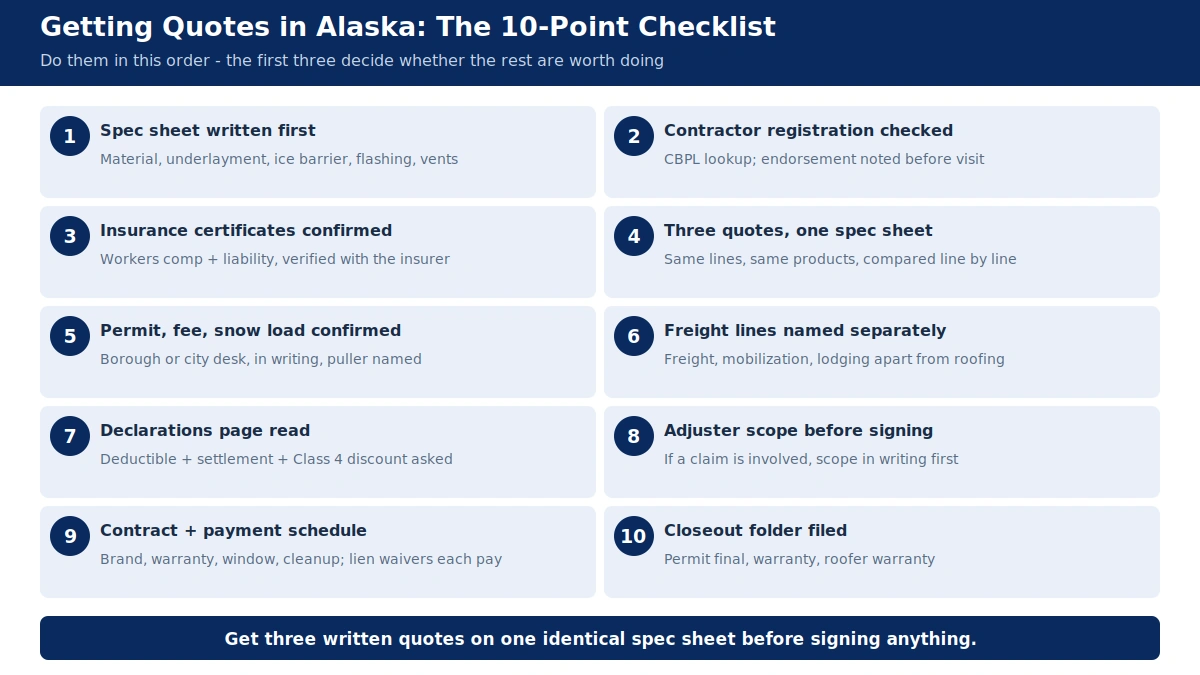
Sources & methodology
This guide prices a 2,000 sq ft roof in architectural asphalt shingles, installed, as its headline job, and every band states its source, its date, and its scope. The lead band comes from NumeralQ planning estimates priced October 26, 2026, for Alaska and Anchorage, including the Anchorage material table, the state size table, and the Anchorage add-on table. Cross-checks come from MyRoofData (2026 model), Instant Roofer (contractor pricing, 41,230 Alaska roofs), BestRoofingEstimates (secondary guide), SquareDash Fairbanks (April 2026), Interlock Industries job-book data (26 Alaska aluminum contracts, 2026), CostBand (BLS May 2025 wage data), and RoofingEstimatorPros (August 26, 2026, recorded as the high outlier and excluded). Snow-load figures come from International Building Code Table 1608.2 and the ASCE 7 Alaska table, with Anchorage design roof snow load and the 2011 to 2012 collapse record from Reid Middleton engineers. Snowfall figures come from National Oceanic and Atmospheric Administration normals for 1991 to 2020 as reported by Current Results and NumeralQ. Hail and wind figures come from National Oceanic and Atmospheric Administration county data for 2016 to 2025 as reported on the NumeralQ state and Anchorage pages. Cold-roof and ice-dam guidance comes from the Alaska Housing Finance Corporation Building Manual chapter 7, Anchorage contractor guides, and Interlock Metal Roofing. Licensing facts come from Alaska Statutes Title 8, Chapter 18, sections 08.18.011, 08.18.025, and 08.18.071, and the Division of Corporations, Business and Professional Licensing. Lien facts come from Alaska Statutes sections 34-35-090 and 34-35-117 as cited by NumeralQ. Insurance figures come from the NerdWallet analysis of May 6, 2026. Tax framing follows the One Big Beautiful Bill Act (Public Law 119-21) and Internal Revenue Service Fact Sheet 2025-05. Rebate status follows the Alaska Housing Finance Corporation consumer notice and concordant trackers from November 2026. Derived figures, including the per-square rates, the lifetime cost-per-year math, the payback scenarios, and the Class 4 illustration band, are NestPriced arithmetic on the cited sources and are labeled as such in the text. Figures that could not be verified, including Fairbanks and Juneau city bands, the Fairbanks, Juneau, Mat-Su, and Kenai permit fees, the Anchorage permit exemption threshold, the Juneau design wind speed, the Fairbanks design roof snow load, the endorsement fees, the Anchorage municipal contractor license, any carrier-verified Class 4 discount percentage, and any Alaska repair-price table, are disclosed as unverified or as planning figures in the sections where they arise, and no figure in this guide is presented as verified when it is not.
Disclaimer: Prices in this guide are planning estimates from the cited cost models and guides, not quotes, and the actual price of a roof depends on the measured roof surface, the pitch, the complexity, the layers to remove, the decking condition, the snow load for the exact address, the freight and mobilization for the location, and the contractor’s current material and labor costs. Permit requirements, fees, code editions, and snow-load figures change, and the buyer should confirm the current requirement with the local building official before signing a contract. Insurance coverage, deductibles, and discounts are set by the individual policy and carrier, not by this guide, and the buyer should confirm coverage in writing with the insurance agent. This guide is general information, not legal, tax, or insurance advice, and the buyer should consult a licensed professional for advice on a specific property.
How much does a roof replacement cost in Alaska in 2026?
A 2,000 sq ft roof in architectural asphalt shingles costs $10,680–$13,100 installed in Alaska in 2026, on NumeralQ planning estimates priced October 26, 2026. The midpoint is about $11,890. Anchorage runs a fraction lower at $10,590–$12,990, and Fairbanks and Juneau carry the state band as planning figures because no verified city band was found for either city. Larger modeled jobs that include tear-off and bigger roofs run higher, up to $16,500–$28,500 on the MyRoofData model.
What is the cost per square for a new roof in Alaska?
The implied state rate for architectural shingles is $534–$655 per square, from the 2,000 sq ft band divided by 20 squares. MyRoofData prices architectural shingles at $576–$960 per square before tear-off, with tear-off adding $100–$200 per square per layer, and Instant Roofer reports contractor-entered asphalt pricing near $927 per square on larger roofs. A square is 100 sq ft of roof surface. The rate falls as the roof grows, because fixed job costs spread across more squares, and it rises off the road system, where freight is added.
How much does a metal roof cost in Alaska in 2026?
Exposed-fastener metal panels cost $16,320–$20,770 for a 2,000 sq ft roof in Anchorage, and standing-seam metal costs $23,490–$35,120, on NumeralQ figures priced October 26, 2026. Premium aluminum metal roofs contracted in Alaska in 2026 had a median price of $63,200, with the middle half at $48,300–$86,400. Standing seam is the most-installed system in Alaska because it sheds snow, carries a Class A fire rating, and moves with temperature through concealed fasteners, but it needs snow guards above every entry and driveway, and hail dents may be excluded as cosmetic-only by some insurance policies.
Do I need a permit to replace a roof in Alaska?
It depends on the address. Alaska has no statewide residential building code, so the answer is local. Anchorage requires a permit for re-roofs inside its Building Safety Service Area, with a small-value exemption for non-structural work that two sources state differently, at $5,000 and at $10,000, so the buyer confirms the current threshold with Anchorage Building Safety. Fairbanks, Juneau, Mat-Su, and Kenai Peninsula fees are reported by a single secondary guide only and should be confirmed with the borough or city desk. Outside enforcing jurisdictions, there may be no permit desk at all.
Does Alaska require a contractor license for roofing?
Alaska requires contractor registration, not a trade license, under Alaska Statutes Title 8, Chapter 18. A roofing contractor registers as a specialty contractor, posts a $10,000 surety bond, and carries liability insurance and an Alaska business license, with no exam for the base registration. A general contractor doing residential work needs a residential contractor endorsement, which adds a 16-hour cold-climate course and a PSI exam. The buyer checks the registration in the Division of Corporations, Business and Professional Licensing lookup before hiring.
What snow load must an Alaska roof be designed for?
The ground snow load runs from 25 pounds per square foot at Utqiagvik to 300 pounds per square foot at Whittier in the building code table, with Anchorage at 50, Fairbanks at 60, Juneau at 60, and Valdez at 160. Anchorage’s design roof snow load has been 40 pounds per square foot for decades. The buyer gets the parcel figure from the building official or the ASCE 7 Hazard Tool, never from a borough average, because the load changes with elevation, moisture, and exposure.
Are Class 4 shingles worth it in Alaska?
Usually not. Alaska logged five reports of one-inch hail or bigger from 2016 through 2025, and no reports of two-inch hail at all in those ten years, so the hail risk a Class 4 shingle protects against barely exists here. No Alaska Class 4 price band was published, and no carrier-verified discount percentage was found. A buyer who wants Class 4 should choose it for the thicker shingle and the longer warranty, and should get the discount percentage, the premium portion it applies to, and the certificate requirement in writing from the insurer before choosing.
Is there a tax credit or grant for a new roof in Alaska in 2026?
No. The federal government contributes $0 to a 2026 roof: the residential energy credits ended for installations after December 31, 2025, and a roof covering never carried a federal credit. Alaska’s HOMES and HEAR home energy rebates have not launched, with no start date announced, and no retroactive rebates will be available. The Alaska Housing Finance Corporation’s $10,000 New Home Construction Rebate pays for new homes only, not for a re-roof. The Weatherization Assistance Program is free to income-qualified households but pays for insulation, air sealing, and heating work, not for the roof covering itself.