

Kentucky is a cheap state to reroof. Labor costs little here. Roofers earn a median $22.57 an hour statewide, pay in Louisville runs 11 percent below the national median and pay in Lexington 16 percent below it, and the state ranks 16th cheapest of 50 on a combined labor and materials index.
The weather that roof must survive is a different story. Kentucky ranks 11th in the country for damaging wind, with 5,785 NOAA reports since 2016. The west lives in tornado country, the east lives with Appalachian floods, and hail hits every part of the state.
The house under the roof shapes the quote as much as the weather does. About 47 percent of Kentucky homes were built before 1980, and the median Kentucky home is 1,953 square feet. In Louisville, the Old Louisville, Highlands and Crescent Hill neighborhoods hold houses built a century or more ago, while around downtown Lexington, mid-century ranches sit beside older brick homes.
Those houses hide costs that only show up when the old roof comes off:
- A second layer of shingles over the first
- Plank decking instead of plywood
- A chimney patched three times
- A valley never flashed right
Get the tear-off depth, the per-sheet decking rate, and the underlayment named before anyone climbs a ladder. That is the number to compare.
Kentucky issues no statewide license for roofers. There is no state exam, no state registration, and no state board to call. The Department of Housing, Buildings and Construction licenses electricians, plumbers and HVAC technicians, but not roofers.
What Kentucky has instead is a roofing-contract statute, KRS 367.622 through 367.628. KRS stands for Kentucky Revised Statutes, the state’s book of laws. This statute covers every home roofing contract paid with insurance money, gives the homeowner five business days to cancel after written notice from the insurer that all or part of the claim is not covered, and makes it illegal for a roofer to offer to pay the deductible.
Prices below come with labels. The headline bands are planning estimates from NumeralQ, priced October 26, 2026, and from SmartRoofingCalculator, updated November 9, 2026: models built from material prices and local wages, not a survey of what Kentuckians paid. Contractor figures are labeled as the companies’ own published ranges, and where sources disagree by thousands, both numbers stay in; the country-wide picture is in the national roof replacement cost guide.
Table of Contents
What a Roof Replacement Costs in Kentucky in 2026
The headline number for a Kentucky roof in 2026 is $8,980–$10,890, installed, for a 2,000-square-foot roof in architectural asphalt shingles. That is the NumeralQ band, priced October 26, 2026. It names the roof area, the material and the scope: a full tear-off and replacement, not a repair and not a recover, which means laying new shingles over the old ones.
The midpoint of that band, about $9,935, is the figure the insurance section and the lifetime-cost section both use. A 2,000-square-foot roof is about 20 roofing squares, so the band works out to roughly $449–$545 per square installed. That sits a little under the SmartRoofingCalculator per-square band of $410–$600, and the two models overlap heavily.
Three other sources price the same job, and sorting out the gaps matters before any quote is compared. SmartRoofingCalculator, updated November 9, 2026, puts a typical 25-square architectural roof at $10,250–$15,000, or $410–$600 a square installed with tear-off.
That 25-square figure is not the same roof as NumeralQ’s 2,000-square-foot roof. Twenty-five squares is the roof surface of a one-story 2,000-square-foot house once pitch and waste are added in, so the two bands describe different roof areas, and the SmartRoofingCalculator total runs higher for that reason.
MyRoofData’s 2026 Kentucky model puts a typical single-family home at $11,500–$20,000 in architectural shingles, on a worked example of 23.4 squares at $4.96–$8.55 per square foot of roof. This Old House’s 2026 survey reports a Kentucky average of $7,372, with most projects ranging from $5,789 to $17,656.
No planning band from the sources checked sits as low as that survey average. A survey averages repairs, partial jobs and full replacements together, and its asphalt figure of $4.67 a square foot reads like a material-only number, not an installed total. Treat it as a low cross-check, not a budget.
One more source sits above the rest and needs its own warning. RoofingEstimatorPros, updated August 26, 2026, prices a 2,000-square-foot architectural roof in Kentucky at $12,777–$23,029, averaging $17,333, or about $8.67 a square foot installed including tear-off, permits and waste.
That band runs thousands above NumeralQ, SmartRoofingCalculator and MyRoofData on the same job, and nothing in its method explains the gap. It applies the same 0.92x state multiplier the other models use. It is reported here and not headlined.
Judge a quote by what it folds in: which material, which roof area, which tear-off depth, and which add-ons. Landing inside the NumeralQ band does not prove a quote is fair, and landing above it does not prove the roofer is overcharging.
The headline band buys the complete replacement:
- Tear-off of the old covering
- Disposal
- Underlayment, the water-resistant layer laid on the deck under the shingles
- Drip edge, the metal strip that guides water off the roof edge
- Flashing, the metal that seals joints where the roof meets a chimney, wall or valley
- Ridge vent
- The new shingles
- The labor to install them
What the band does not buy is often the expensive part in Kentucky:
- A second layer of shingles to tear off: roughly $100–$150 per square
- Rotted or damaged plywood decking: $2.00–$4.00 a square foot to replace, on a Louisville contractor’s published figures
- A chimney that needs reflashing, a valley that needs rebuilding, gutters that need replacing while the crew is up there, and a ridge vent where the old roof had none, all as separate lines
The permit, where one is needed at all, is small money: about $100–$275 on SmartRoofingCalculator’s planning average of $170, and no published fee at all for Louisville or Lexington on a $15,000 job, because neither city charges one for a standard reroof.
There is no big rebate to subtract from the sticker. The largest single incentive in the state is the Strengthen Kentucky Homes grant of up to $10,000, and it pays only for the FORTIFIED upgrade, only when the application is approved before the old roof comes off, and only to the contractor, on completion.
Judge every quote on the gross figure first. Strike any line that subtracts a federal credit that no longer exists, or a HEAR rebate that has not launched, before comparing quotes.
The spread between bidders on identical materials can run several thousand dollars. In Kentucky the spread is widest where the house is hardest: a century-old Old Louisville Victorian with three layers and a slate neighbor, a steep-pitched farmhouse in the Bluegrass, a hail-damaged roof in Mayfield where every crew in the county is booked.
Line up the identical job from each bidder: one material, one roof area in squares, one tear-off depth, all in writing, with the decking rate agreed before tear-off. Three written quotes on one shared spec sheet is the minimum. Any bidder who will not name the shingle manufacturer and line, the underlayment, and the nailing pattern is a bidder to walk away from.
| Source | 2,000 sq ft roof (arch. asphalt) | Basis |
|---|---|---|
| NumeralQ (Oct 26, 2026, planning est.) | $8,980-$10,890 | Roof area 2,000 sq ft, about 20 squares |
| SmartRoofingCalculator (Nov 9, 2026, planning est.) | $10,250-$15,000 | 25 squares, 2,000 sq ft one-story house with pitch and waste |
| MyRoofData (2026 model) | $11,500-$20,000 | Typical home, 23.4-square worked example |
| This Old House (2026 survey) | $7,372 avg, $5,789-$17,656 range | Survey average, mixed job scopes — low cross-check only |
| RoofingEstimatorPros (Aug 26, 2026) | $12,777-$23,029, avg $17,333 | High outlier — reported, not headlined |
Two rows of that table need a warning before anything else is read from it. The This Old House average is a survey figure that mixes repairs and replacements, and it sits below every 2026 planning band for that reason. The RoofingEstimatorPros band sits above every planning band for no reason its method explains.
The NumeralQ band is the one the rest of the article builds on. Every size row in the next sections that comes from it is labeled a planning estimate, because that is what it is.
Roof Replacement Cost in Kentucky by Material
Material is the second big lever on a Kentucky roof, after size. It moves the price more than six to one from the cheapest to the dearest. The table below prices every material on the same roof, a 2,000-square-foot roof of about 20 squares, so the rows can be compared directly.
The per-square figures come from SmartRoofingCalculator and Kentucky Businesses Near Me, both 2026 planning figures. The slate total comes from NumeralQ. A square is 100 square feet of roof surface, and it is the unit roofers price by.
| Material | Per square installed | 20-square roof total | Lifespan |
|---|---|---|---|
| 3-tab asphalt shingles | $325-$450 | $6,500-$9,000 | 15-20 years |
| Architectural asphalt shingles | $410-$600 | $8,200-$12,000 | 22-30 years |
| Class 4 impact-resistant shingles | $500-$750 | $10,000-$15,000 | 25-35 years |
| Exposed-fastener metal | $500-$850 | $10,000-$17,000 | 30-40 years |
| Standing-seam metal | $830-$1,290 | $16,600-$25,800 | 40-70 years |
| Concrete or clay tile | $1,100-$1,660 | $22,000-$33,200 | 50+ years |
| Natural slate | Not published per square | $30,230-$60,160 | 75+ years |
Architectural asphalt is the default Kentucky buy, and it is the default for a cost reason. About three in four American homes wear it, and Kentucky is no exception. It is a dimensional shingle with a 110–130 mph wind rating, a 22–30 year life, and a 20-square installed total of $8,200–$12,000 on the SmartRoofingCalculator per-square band, with the NumeralQ 2,000-square-foot band of $8,980–$10,890 sitting inside it.
The step up from 3-tab is the step most Kentucky buyers should take. Three-tab runs $6,500–$9,000 on the same roof, and NumeralQ’s 3-tab total of $7,580–$8,910 sits inside that band, about 17 percent under architectural. But 3-tab buys a thinner, single-layer shingle with a lower wind rating and a 15–20 year life, and many insurers and builders have moved away from it.
On a Kentucky roof, the wind rating is the difference between a roof that holds in a severe thunderstorm and one that does not. The architectural premium is the cheapest protection money can buy on a Kentucky roof. Our national roof replacement guide prices the same materials nationally, and Kentucky runs about 8 percent below the national figure on both of them.
Class 4 impact-resistant shingles are the Kentucky upgrade with a payback story, and they get a full section below. At $500–$750 a square, or $10,000–$15,000 on a 20-square roof, they cost roughly $1,800–$3,000 more than architectural shingles on the same house.
What they buy is a shingle tested to survive a 2-inch steel ball dropped from 20 feet without cracking. That is the UL 2218 Class 4 test. UL 2218 is the impact test standard for roofing, and Class 4 is its toughest rating.
A Louisville contractor’s published guide claims discounts of 20–30 percent on premiums for Class 4 roofs. That would be real money against a Kentucky average premium of $3,326–$3,540 a year, but no carrier filing was verified. Put the discount question to your own insurer in writing before counting on it.
Metal is the old Kentucky material, and the price split inside metal matters more than the price of metal itself. Exposed-fastener panels, the ribbed metal of barns, tobacco sheds and farmhouses across the Bluegrass, run $500–$850 a square, or $10,000–$17,000 on a 20-square roof. That puts them in the same territory as Class 4 shingles.
Standing-seam metal, with concealed fasteners and raised seams, runs $830–$1,290 a square, or $16,600–$25,800. That is roughly double architectural shingles.
The difference goes deeper than looks. Exposed fasteners are screws through the panel that need re-tightening and resealing as they age, while standing seam has no penetrations at all.
That is why standing seam lasts 40–70 years against 30–40 for exposed-fastener panels. On a house the buyer intends to keep for decades, standing seam wins the lifetime math in the asphalt-versus-metal section below.
On a rental or a house likely to sell within a decade, the exposed-fastener panel or the architectural shingle is the sensible buy. Our metal roof cost guide works the standing-seam-versus-metal-shingle choice in full, and our metal versus shingles comparison puts the two head to head.
Tile and slate are the materials almost nobody in Kentucky buys, and the prices explain why. Concrete or clay tile runs $1,100–$1,660 a square, or $22,000–$33,200 on a 20-square roof. It weighs enough that many Kentucky houses would need structural work to carry it, a cost no per-square figure includes.
Natural slate runs $30,230–$60,160 as a total on NumeralQ’s figures, with no published per-square price for Kentucky, and it lasts 75 years or more. Both belong on the houses that already have them: the slate roofs of Old Louisville, where a replacement in kind is a preservation question as much as a roofing question, and where the Louisville Metro Landmarks rules may govern the choice anyway.
No source checked gives a verified Kentucky price for two materials, so no band is printed for them. Cedar shakes are rare in Kentucky, and no Kentucky per-square figure was published by any source checked. A cedar roof is priced per job, by a specialist.
The same goes for flat and low-slope membranes (TPO and EPDM) on the flat sections of older Louisville commercial-style rowhouses and additions. They are priced by the square foot of membrane and the condition of the deck, and no Kentucky band was verified. If a quote for either material arrives with a round number and no breakdown, get a second quote from a specialist before signing.
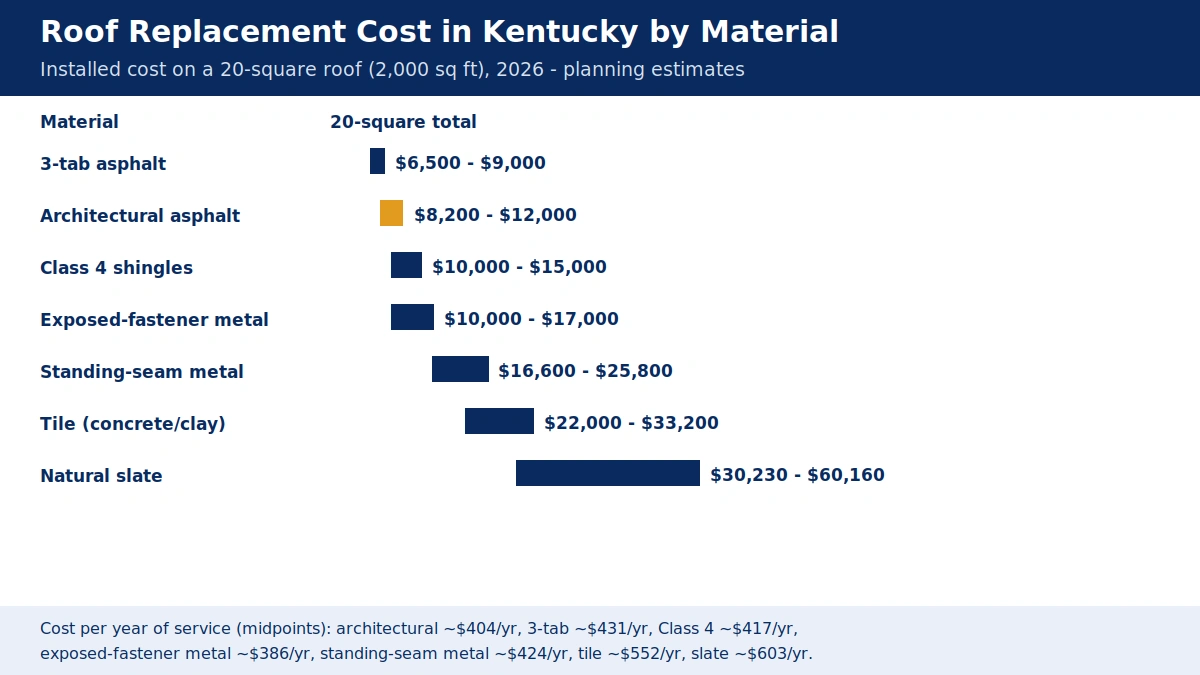
One more cost sits inside every material row and is easy to miss: the cost per year of service. A roof is bought once per lifespan. At the midpoints of the bands above, divided by the midpoint of each lifespan, architectural shingles cost about $404 a year of service, 3-tab about $431, Class 4 about $417, exposed-fastener metal about $386, standing-seam metal about $424, tile about $552, and slate about $603.
The cheapest roof per year is not the cheapest roof to buy. Exposed-fastener metal, bought for $13,500 at the midpoint and lasting 35 years, costs less per year than the architectural shingle bought for $10,100 and lasting 25. The expensive materials lose on this measure because their lifespans, long as they are, do not stretch far enough to repay their price.
Start from how long the buyer will own the house, and work backwards to the material whose lifespan matches. Do not start from the sticker.
Roof Replacement Cost by Roof Size in Kentucky
Roofers do not price houses. They price roofs, measured in squares, and the first mistake a Kentucky buyer can make is to budget from the living area on the listing instead of the measured roof.
A one-story 2,000-square-foot house has roughly 2,000 square feet of roof footprint before pitch and waste. The same floor area on two stories has roughly half the roof. Steep pitch, dormers, hips and valleys all add surface, and waste runs about 10 percent on a simple gable and 15 percent on a hip roof.
Without the measured roof area in squares, a quote cannot be compared with anything. Pitch means the steepness of the roof, stated as rise over a 12-inch run, so a 6/12 roof rises 6 inches for every 12 inches across.
The size table below is the NumeralQ band by roof area, priced October 26, 2026. Every row is a planning estimate for an architectural asphalt replacement, and the rows are consistent with each other because they come from one model on one date.
| Roof area | Installed cost (arch. asphalt) |
|---|---|
| 1,000 sq ft | $4,760-$5,860 |
| 1,500 sq ft | $6,870-$8,370 |
| 2,000 sq ft | $8,980-$10,890 |
| 2,500 sq ft | $11,090-$13,410 |
| 3,000 sq ft | $13,200-$15,930 |
The step from one size to the next costs roughly $2,100–$2,500 at the bottom of the band and $2,100–$2,500 at the top. Material and labor both scale with area, and there is no discount for size. The 2,000-square-foot row is the size most Kentucky homes land on, and it is the row the whole article anchors to.
The Kentucky median home is 1,953 square feet of living area, so a typical Kentucky roof sits just under that row once the footprint is measured. A one-story median home lands near it. A two-story median home lands a row or two below it.
The SmartRoofingCalculator house-size table tells the same story from the other direction. For a one-story house, it prices 1,000 square feet at 12 squares and $4,920–$7,200; 1,300 square feet at 16 squares and $6,560–$9,600; 1,500 at 18 squares and $7,380–$10,800; 1,800 at 22 squares and $9,020–$13,200; 2,000 at 25 squares and $10,250–$15,000; 2,500 at 31 squares and $12,710–$18,600; and 3,000 at 37 squares and $15,170–$22,200.
For a two-story house of the same floor area, every figure is roughly half: a two-story 2,000-square-foot house is 12 squares and $4,920–$7,200. The squares assume a 6/12 pitch and 10 percent waste. Steeper roofs, dormers and a second tear-off layer push the figure up, and a low-pitch ranch pushes it down.
Three cautions sit behind both tables:
- Measure the roof area. It is measured, not guessed. A buyer who budgets from the 1,953-square-foot median living area and then discovers a 25-square roof with a steep pitch has under-budgeted by thousands.
- Price the pitch. A walkable 4/12 or 6/12 pitch is a fast job. A steep 10/12 or 12/12 pitch is a slow job with staging, harnesses and a crew that moves at half speed, and a Louisville contractor’s guide prices steep-pitch work higher for exactly that reason.
- Price the tear-off depth. A house with two layers pays roughly $100–$150 a square extra to remove the second one, which on a 20-square roof is $2,000–$3,000 before a single new shingle goes on. The Kentucky housing stock, with 47 percent of homes built before 1980, is exactly the stock where a second layer turns up, and where a third layer, which the code does not allow to stay under a recover, turns up too.
Roof Replacement Cost by City: Louisville vs Lexington vs Bowling Green vs Owensboro vs Northern Kentucky
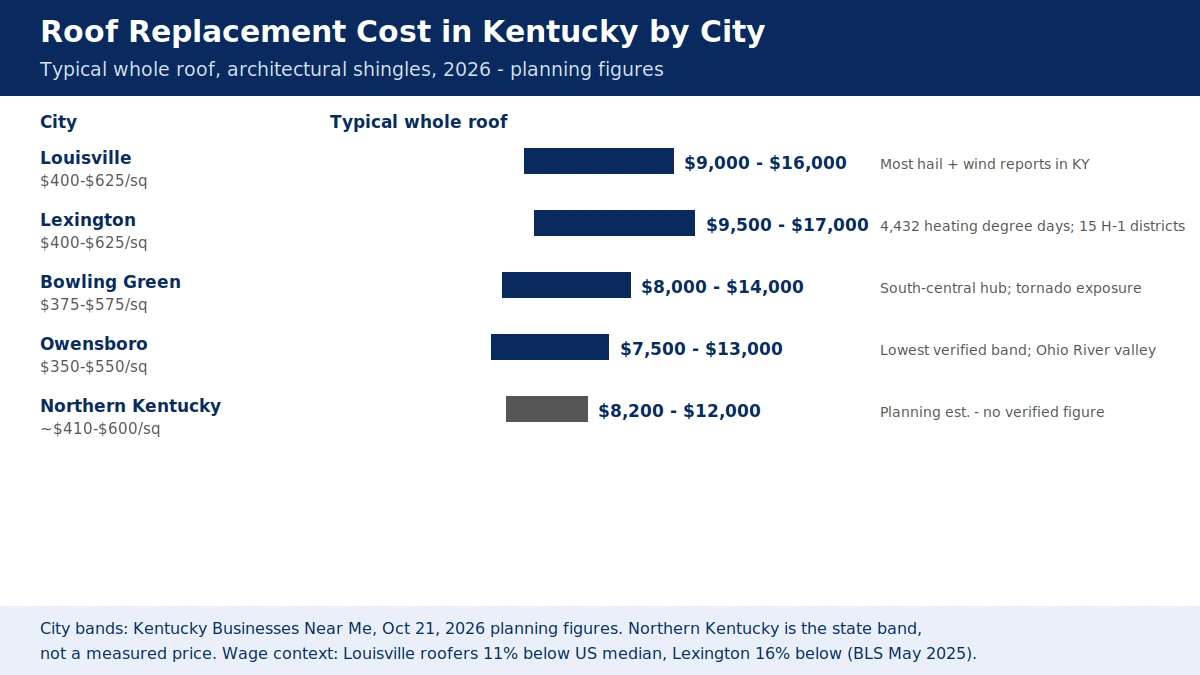
Kentucky has no expensive roofing market and no cheap one. The verified figures run from about $350 a square in the rural west to $625 a square in the two big metros, and the spread is labor, not materials. Shingles are priced nationally, while the crew that installs them is priced by the city.
NumeralQ’s wage figures put the shape of it plainly. Louisville roofers earn 11 percent below the national median, and Lexington roofers 16 percent below it. The city bands below follow that shape.
One warning first: the city bands in this section come from a single Kentucky guide published October 21, 2026, and they are that guide’s planning figures, not a survey of contractor bids. No NumeralQ city price page exists for Kentucky, and no verified figure was found for Northern Kentucky at all, so the Covington row is the state band, flagged as a planning estimate rather than a measured price.
| City | Architectural, per square | Typical whole roof | What sets it apart |
|---|---|---|---|
| Louisville | $400-$625 | $9,000-$16,000 | Largest market; most hail and wind reports in the state; preservation districts |
| Lexington | $400-$625 | $9,500-$17,000 | Highest verified totals; Bluegrass cold; 15 historic districts |
| Bowling Green | $375-$575 | $8,000-$14,000 | South-central hub; lower labor; tornado exposure from the west |
| Owensboro | $350-$550 | $7,500-$13,000 | Lowest verified band; Ohio River valley; rural crews |
| Northern Kentucky (Covington) | ~$410-$600 (state band) | ~$8,200-$12,000 | No verified figure; Cincinnati metro spillover |
Louisville is the largest market, the most hail-exposed, and the oldest housing stock, at $9,000–$16,000 for a typical home. Old Louisville, the Highlands and Crescent Hill hold houses built a century or more ago, with multiple shingle layers, plank decking, and chimneys patched more than once.
Jefferson County logs more severe hail and wind reports with the National Weather Service than any other county in the state. The permit rule is forgiving: no permit for a standard reroof, and a permit only when the deck or rafters are replaced.
The preservation rule is not forgiving. Several local preservation districts and individual landmarks need a Certificate of Appropriateness before any exterior change, and a slate roof in Old Louisville may not be replaceable with shingles at all. A typical job runs about 4.3 percent of the median Louisville home value, the highest share in the state, because Louisville homes are cheaper than Lexington homes while the roof costs the same.
Lexington is the highest verified total in the state, at $9,500–$17,000 for a typical home, on the same $400–$625 per-square band as Louisville. The difference is the house, not the square: Lexington homes are dearer, so the same roof is a smaller share of the home, about 3.4 percent of the median value, and the housing stock runs to larger Bluegrass properties with more roof area, more hips and valleys, and more dormers.
Lexington is also the coldest of the big cities. It carries 4,432 heating degree days a year against Louisville’s 3,936, and 90 nights a year at or below freezing against Louisville’s 74, because the Bluegrass sits about 500 feet higher. Heating degree days count how much heating a climate needs over a year, so a higher number means a colder place.
That cold is a roof matter, not just a heating matter. More freeze-thaw crossings mean more ice-dam risk at the eaves, and more reason for ice-and-water shield to run the full way up from the edge. The freeze-thaw section below prices that risk in full.
Lexington’s other distinction is regulatory. Contractors must register with Lexington-Fayette Building Inspection, and the city’s 15 H-1 historic districts, Gratz Park, Ashland Park and Bell Court among them, need a Certificate of Appropriateness for exterior changes whether or not a building permit is involved.
Bowling Green is the south-central hub, at $8,000–$14,000 for a typical home and $375–$575 a square. It is the city where the tornado map starts to matter: Bowling Green sits on the eastern edge of the western Kentucky tornado country, and the December 2021 outbreak passed through the region on its way east.
The labor market is smaller and cheaper than the two metros, and the housing stock is newer on average, which is why the band sits lower. A Bowling Green buyer should still budget for the same tear-off surprises as a Louisville buyer. The city has its share of mid-century ranches with a second layer, but the quote is more likely to land in the lower half of the state band, and a crew from a smaller town nearby may price lower still.
Owensboro, Paducah and the rural west run the lowest verified band in the state, at $7,500–$13,000 for a typical home and $350–$550 a square. Labor is the cheapest in Kentucky, and rural crews often price toward the lower half of the range.
But the west is also where the storm risk is highest. The Mayfield EF-4 of December 2021 tore through Graves County, and the western counties live with tornado exposure every spring. The wind section below gives the full toll of that outbreak.
After a big storm, the low band stops meaning anything. Every crew in the region is booked, out-of-state crews arrive, and the price is whatever the next available crew charges.
A western Kentucky buyer who can schedule a replacement in the quiet months, late winter or early spring, will pay the band in the table. A buyer who waits for the storm to choose the date will not.
Northern Kentucky, Covington, Newport and the river cities, carries a planning estimate of about $8,200–$12,000, the state per-square band of $410–$600 applied to a 20-square roof, because no Covington-specific price was published. Do not quote the Northern Kentucky figure as a measured price, because it is not.
What is certain is the context. The metro faces Cincinnati across the river, where a contractor based over the state line prices from the Ohio labor market. Ohio architectural shingles run $440–$640 a square, above Kentucky’s $410–$600.
A Covington buyer should get one quote from a Kentucky crew and one from an Ohio crew, and compare them on the same spec sheet. The state line is the one place in Kentucky where the labor market changes within a single metro.
Why Kentucky Roofs Cost What They Do: Tornado Wind, Hail, Humidity & Freeze-Thaw
Four forces set the price of a Kentucky roof, and none of them is the shingle:
- Wind
- Hail
- Water
- Cold
The order they matter in depends on which end of the state the house sits in.
Western Kentucky buys tornado coverage. Eastern Kentucky buys flood resilience. The middle buys hail resistance and freeze-thaw durability.
Every part of the state pays for the other parts’ losses through the rating territories, which is one reason Kentucky homeowners’ premiums run $3,326–$3,540 a year for $300,000 of dwelling coverage, roughly 38–46 percent above the national average.
Wind is the first force, and Kentucky has more of it than most states admit. The state ranks 11th in the country for damaging wind, with 5,785 NOAA reports since 2016. The December 10–11, 2021 outbreak is the event every western Kentucky roofer measures against: a long-track EF-4 through Mayfield that ran 165.7 miles across 19 counties, killed 57 people, and damaged or destroyed roughly 1,889 single-family residences in Graves County alone.
A roof in western Kentucky is built for the night the tornado siren goes off and the wind finds every loose tab, every unsealed edge, every nail that missed the deck. That is why the wind rating on the shingle wrapper matters here. Architectural shingles carry 110–130 mph ratings, and the fastening pattern matters as much as the rating: six nails per shingle in the high-wind zones, sealed properly, with the starter course and the ridge cap done right.
A roof that loses its ridge cap in a 70 mph gust was not beaten by the weather alone. Poor installation is the likelier cause, and the nailing pattern on the quote is the check.
Hail is the second force, and it files the most claims. Kentucky’s hail does not need a tornado to do damage. Stones as small as one inch, quarter-sized, can bruise asphalt shingles, and stones of 1.5 to 2 inches, golf-ball size, often cause immediate severe damage.
Fayette County took baseball-size hail in the Chilesburg area in May 2022. Jefferson County logs more severe hail and wind reports than any other county in the state. Louisville took hail and tornadoes in March 2025.
The hail map is the reason Class 4 impact-resistant shingles exist as a Kentucky product at all. A hail claim is the most common way a Kentucky roof gets paid for, and the deductible is the part the homeowner pays. See the insurance section for how deductibles work.
FEMA rates the hail risk Relatively Moderate in both Fayette and Jefferson counties. Relatively Moderate is a county-level rating that averages the quiet years with the bad ones, and a single May afternoon can do a decade of damage in one neighborhood.
Humidity is the third force, and it is the slow one. Kentucky is a mixed-humid climate, and a roof here lives wet for much of the year. The wettest months run through spring and into summer, and a roof that stays damp grows algae, the black streaks on a north-facing slope that every Kentucky homeowner recognizes, and feeds the mold that rots decking from underneath.
Algae does not shorten a roof’s life the way hail does, but it shortens the life of the roof’s appearance, and on a house for sale it reads as neglect. The answers are unglamorous: ridge ventilation that actually moves air, soffit intake that is not painted shut, algae-resistant shingles with copper granules on the north slope, and a deck that dries between rains.
A roofer who prices a replacement without pricing the ventilation has priced half a roof. Ventilation means the flow of air through the attic, in at the soffits under the eaves and out at the ridge along the peak.
Freeze-thaw is the fourth force, and it separates Kentucky from the Deep South. Louisville logs 74 nights a year at or below freezing and 19 nights at or below 20 degrees. Lexington logs 90 freezing nights and 26 at or below 20, and carries 4,432 heating degree days a year against Louisville’s 3,936 and Paducah’s 3,925.
The heating season in Louisville runs about 203 days, from mid-October to early May. That is a long cold season for a state most people think of as southern, and it is the season that makes ice dams. An ice dam forms when heat escaping through a poorly insulated attic melts snow on the upper roof, the water runs down to the cold eave, refreezes, and backs up under the shingles.
The defense has three parts:
- Insulation and air sealing in the attic
- Ventilation that keeps the deck cold
- A self-adhering ice-and-water membrane at the eaves where the code requires it
The freeze-thaw cycle also works on the shingles themselves. Water gets into a crack, freezes, expands, and opens the crack a little wider, hundreds of times a winter.
Our attic insulation guide prices the insulation half of the ice-dam defense. A roof replacement that ignores the attic will fight the same ice dam again.
The four forces do not act separately. A hailstorm in March bruises the shingles, the summer humidity feeds the bruise into a leak, the winter freeze-thaw opens the leak into a rotted deck, and the next windstorm lifts the whole weakened slope. That chain is why a Kentucky roof inspection after a major storm tells the buyer more than the roof’s age alone.
A roof in Kentucky takes damage in small increments from four directions at once. The replacement decision is usually made when the increments add up, and the repair-versus-replace section sets its thresholds where it does for that reason.
Freeze-Thaw, Ice Dams & the Older Housing Stock: The Slow Kentucky Roof Killers
The storm gets the headlines in Kentucky. The slow killers get the roof. About 47 percent of Kentucky homes were built before 1980, and those houses carry the features that turn a simple reroof into a rebuild.
The features that turn a simple reroof into a rebuild are:
- Plank decking instead of plywood
- Two layers of shingles where the code allows two, and a third layer where it does not
- Chimneys patched more than once, valleys never flashed right, and attics never ventilated at all
A new shingle on top of those problems sits on a rotting foundation, and the buyer who pays for the shingle without paying for the foundation pays twice.
Plank decking is the first surprise, and it is a Kentucky surprise. Houses built before plywood became standard sit on boards, planks with gaps between them, and a modern shingle nailed across a gap has nothing to hold it. A crew that tears off a 1960s ranch roof in Lexington or a 1920s four-square in Louisville will find planks.
The quote should price what happens next. Either the planks are sound and get a plywood overlay, or they are soft and get replaced, sheet by sheet, at an agreed per-sheet rate set before tear-off. Rotted or damaged plywood runs $2.00–$4.00 a square foot to replace on a Louisville contractor’s published figures.
The per-sheet rate is the number to agree in writing, because the deck is the one part of the job nobody can price until the old shingles are off. A quote with no decking line will grow on tear-off day. With the rate named in writing, the buyer can hold the roofer to it.
Multiple layers are the second surprise, and the code has a firm view of them. Kentucky follows the residential code limit of two roof layers: if a house already has two layers of shingles, the job is a full tear-off, not a recover. A recover is not allowed at all when the existing roof is water-soaked or badly deteriorated, when it is slate, clay, cement or asbestos-cement tile, or when there are already two or more layers.
The reason is practical. A second layer hides the deck, so nobody sees what is rotted underneath, and it doubles the weight on a structure that was designed for one. Removing a second layer adds roughly $100–$150 a square, or $2,000–$3,000 on a 20-square roof, and that money is well spent, because the tear-off is the only moment anyone sees the deck.
Ice dams are the third slow killer, and they are a house problem before they are a roof problem. The mechanism is heat loss: warm air leaking into the attic melts the snow above, meltwater runs down to the cold eave and refreezes there, and the ridge of ice that builds up forces later meltwater back under the shingles.
Lexington, with 90 freezing nights a year and the coldest big-city climate in the state, is the city where ice dams do their worst work. Louisville, with 74 freezing nights and a heating season of about 203 days, is not far behind. The defense is the same three-part system named in the freeze-thaw section above.
A roofer who sells a membrane without asking about the insulation is selling the bandage without treating the wound. A buyer who replaces the roof without touching the attic will fight the same ice dam again, on a brand-new roof, the first winter it snows.
Ventilation is the fourth slow killer, and it is the one most often skipped. Kentucky’s mixed-humid climate means a roof lives wet for much of the year, and an attic without balanced ventilation, intake at the soffits and exhaust at the ridge, traps that moisture against the deck. The deck rots from underneath, the shingles cook from below in summer, and the roof loses years of life without ever seeing a storm.
The signs are visible from the ground: black algae streaks on a north-facing slope, shingles that curl years before their rated life, a ridge that was never vented at all. The fix is part of the replacement, not an extra: ridge vent where the old roof had none, soffit vents that are open and not painted shut, and baffles that keep the insulation from blocking the airflow.
Our attic insulation guide prices the insulation half of this system. A Kentucky roof replacement that ignores the attic will age twice as fast as the shingle warranty promises.
Chimneys and valleys are where the old house leaks first. A Louisville Victorian or a Lexington brick ranch has a chimney that has been patched more than once, and the flashing around it, the metal that seals the joint between the chimney and the roof, is usually the oldest metal on the house. Step flashing, counter-flashing, and a cricket behind a wide chimney are the details that decide whether the roof leaks, and they are the details a low quote leaves out.
Valleys are the same story. Two slopes meet, water concentrates, and a valley that was never lined properly will leak long before the shingles around it fail. The quote should name the flashing at every chimney, valley and penetration, and it should name the drip edge at the eaves and rakes.
The lesson of the older Kentucky house is simple: the shingle is the smallest part of the decision. The deck, the layers, the attic, the ventilation, and the flashing decide whether the new roof lasts 25 years or 12.
Walk the attic before signing. Ask the roofer to photograph the bare deck, the underlayment, the drip edge and the flashing before they disappear under the shingles, and get the per-sheet decking rate in writing.
Asphalt vs Metal in Kentucky: The Bluegrass Lifetime Math
The asphalt-versus-metal question in Kentucky is not about which material is better in the abstract. It is about how long the buyer will own the house, how much hail the house will see, and how much the buyer values a roof that outlives the mortgage.
Metal has a long history in Kentucky, from barns and tobacco sheds to farmhouses across the Bluegrass, and it is not an exotic choice here. It is the material the state grew up with. The question is whether the farmhouse logic still holds on a suburban ranch in Lexington or a brick colonial in Louisville.
The sticker math is simple, and it favors asphalt. A 20-square roof in architectural shingles runs $8,200–$12,000 installed. The same roof in exposed-fastener metal runs $10,000–$17,000, and in standing-seam metal $16,600–$25,800.
Standing seam costs roughly double architectural shingles on the same house.
For a buyer who will sell within a decade, that premium is hard to justify. The next owner gets the benefit, and the seller gets a fraction of it back in the sale price. For a buyer who will stay, the math changes, because the roof is bought once per lifespan, and the lifespans are very different: 22–30 years for architectural shingles, 30–40 for exposed-fastener metal, 40–70 for standing seam.
The lifetime math is where metal starts to win. At the midpoints of the bands above, divided by the midpoint of each lifespan, architectural shingles cost about $404 a year of service, exposed-fastener metal about $386 a year, and standing-seam metal about $424 a year.
Exposed-fastener metal is the cheapest roof per year of the materials priced above, and standing seam costs only about $20 a year more than architectural shingles while lasting twice as long. The arithmetic leaves out the second replacement, the disposal, and the disruption of tearing off a roof twice.
On a house the buyer will own for 30 years, the standing-seam roof is bought once and the architectural roof is bought twice. The second architectural roof is bought at whatever prices run in 2050.
Hail is the second argument for metal, and in Kentucky it is a strong one. A standing-seam metal roof does not bruise the way an asphalt shingle does. Hail that would total an architectural shingle roof may dent a metal panel cosmetically and leave it watertight, which is the difference between a claim and no claim.
The dent is real. Metal shows hail the way shingles hide it, and a cosmetic dent is still a dent, but the roof keeps working. For a house in Jefferson County, which logs more severe hail reports than any other county in the state, or in the western counties where the hail rides in with the tornadoes, that resilience is worth pricing.
Ask the insurer about dented metal before choosing. Some carriers treat a dented metal roof as a cosmetic claim and some do not, and the answer changes the value of the upgrade.
Freeze-thaw is the third argument, and it cuts both ways. Metal sheds snow and ice faster than shingles, which means fewer ice dams at the eaves, a real benefit in Lexington’s 90-freezing-night winters. But a metal roof that sheds its snow all at once drops it in a sheet, and a buyer with a walkway, a deck or a car under the eave needs snow guards to break the slide.
Shingles hold the snow and let it melt slowly, which is why they form ice dams in the first place. The metal buyer pays for snow guards.
The shingle buyer pays for ice-and-water shield and attic work. Price both before comparing.
The case against metal in Kentucky is narrower than most buyers think, and it comes down to three things:
- Exposed fasteners: screws through the panel that need re-tightening and resealing as they age, a maintenance bill the shingle buyer never sees
- Noise: a metal roof on a house with thin attic insulation is louder in a rainstorm, and a Kentucky thunderstorm is not a quiet event
- The installer: a standing-seam roof is a craft job, and a crew that installs shingles all week will not install a standing seam properly on a Friday
A buyer who chooses metal should choose the crew first and the panel second, and should ask for three metal roofs the crew installed in the same county, with the owners’ names, before signing.
The verdict for most Kentucky buyers is a split decision. If the house will be sold within ten years, buy architectural shingles, and spend the saving on the deck, the flashing and the ventilation. If the house will be kept for thirty years and sits in hail country, buy standing-seam metal, and buy it from a crew that installs metal every week.
If the budget will not stretch to standing seam, exposed-fastener metal is the middle path, and the cheapest roof per year of the materials priced above, provided the buyer accepts the screw maintenance and the shorter life. And if the house already has a metal roof, replacing it in kind is usually the right call, because the structure was built for it. Our metal versus shingles comparison works the same choice nationally, and our metal roof cost guide prices standing seam against metal shingles in detail.
Class 4 Impact-Resistant Shingles in Kentucky: What the Upgrade Costs and What It Pays Back
Class 4 shingles are the Kentucky upgrade that sounds like a luxury and behaves like an investment. They are architectural shingles built to a tougher standard, tested under UL 2218, where a 2-inch steel ball is dropped from 20 feet onto the shingle, and the shingle passes if it does not crack.
They cost $500–$750 a square installed in Kentucky, or $10,000–$15,000 on a 20-square roof. Against architectural shingles at $410–$600 a square, the premium is roughly $1,800–$3,000 on the same house. That premium buys:
- A roof that survives hail
- A longer life
- Possibly a cheaper insurance policy
The hail case is the strongest, because Kentucky’s hail is not hypothetical. Jefferson County logs more severe hail reports than any other county in the state. Fayette County took baseball-size hail in May 2022.
The March 2025 storms over Louisville were the latest reminder.
Hail as small as one inch can damage an ordinary asphalt shingle, and stones of 1.5 to 2 inches often cause immediate severe damage. A Class 4 shingle is built to take that hit and keep working. UL 2218 is a real standard, and the shingle either passes it or it does not.
The lifespan case is the quiet one. Class 4 shingles last 25–35 years against 22–30 for ordinary architectural shingles. At the midpoints of the bands above they cost about $417 a year of service against about $404 for architectural, a difference of about $13 a year, which is the price of the hail resistance.
The premium is not paid for the extra years. It is paid for the storms in between. A roof that survives three hailstorms without a claim has paid for its premium in deductibles alone, and it has also kept the homeowner’s claims history clean.
That history matters more than most buyers realize. A house with two hail claims in five years is a house whose insurer is looking for a reason to raise the rate or change the terms.
The insurance case is the one to verify before counting on it. A Louisville contractor’s published guide claims Class 4 roofs earn insurance discounts of 20–30 percent on premiums. Against a Kentucky average premium of $3,326–$3,540 a year for $300,000 of dwelling coverage, a 20 percent discount would be $665–$708 a year, enough to repay the $1,800–$3,000 premium in three to five years.
But no carrier filing was verified, and discounts vary by carrier, by policy, and by the exact product. Some carriers discount only the wind and hail portion of the premium, not the whole policy. Some require the specific product to be on their qualifying list, and some require paperwork the roofer must supply.
Call the insurer before signing, name the exact shingle, and get the discount in writing. A discount promised by a roofer and denied by an insurer is a discount that never existed.
The FORTIFIED question sits beside the Class 4 question, and the two should not be confused. A Class 4 shingle is a tougher shingle. A FORTIFIED roof is a tougher system: sealed deck, stronger fastening, better edge details.
The Strengthen Kentucky Homes grant pays up to $10,000 toward it.
A Class 4 shingle on a FORTIFIED roof is the strongest combination of the options priced above, and the grant makes it affordable. A Class 4 shingle on an ordinary roof is still a good roof, but it is not a FORTIFIED roof, and it does not earn the grant or the FORTIFIED insurance endorsement.
The buyer who wants both should ask for both, in writing, on the same quote. Apply for the grant before the old roof comes off, because the grant is approved before the work starts, not after.
The verdict is county-dependent. In Jefferson and Fayette counties, where the hail reports concentrate, Class 4 is the default recommendation here, and the premium repays itself in the first storm the roof survives. In the western counties, where the hail rides in with the tornadoes, it is the same.
In the eastern counties, where the risk is flood rather than hail, the case is weaker, and the money is better spent on the deck and the flashing. Everywhere in Kentucky, the discount must be confirmed with the insurer before it is counted.
Permits & Code in Kentucky: No Statewide Reroof Permit, Local Rules Only
Kentucky’s permit rule for a roof replacement is simple, and it is simple in a way that catches people out. There is no statewide reroof permit. In Louisville and Lexington, a standard residential reroof needs no building permit at all, and no city inspector comes to look at it.
The work is still regulated. The regulation is local, specific, and easy to miss. The buyer who assumes no permit means no rules is the buyer who discovers the rules when the work is already done.
Louisville Metro’s rule turns on the deck. The Office of Construction Review is clear about it: in general, reroofing does not need a building permit, and Metro does not inspect it. But if any structural part of the roof is replaced, including the roof deck, a permit is required.
The distinction matters on a Kentucky roof, because the deck is the part most likely to need replacing on a pre-1980 house. A crew that tears off a century-old Highlands roof, finds soft plank decking, and replaces it without a permit has broken the rule, and the buyer who signed the contract is the one who owns the problem.
The roofer, not the homeowner, should handle the permit in nearly every case. A contractor who suggests skipping it to save time or money is telling the buyer how they treat the rest of the rules.
Louisville also draws a hard line on overlays. No new shingles over old ones when the existing roof is water-soaked or badly deteriorated, when it is slate, clay, cement or asbestos-cement tile, or when there are already two or more layers. In the preservation districts and for individual landmarks, exterior changes need a Certificate of Appropriateness from Metro’s Landmarks staff, a separate approval, with its own committee, that can take longer than the roof itself.
Smaller cities inside Jefferson County may have their own rules, so the address, not the county, decides what applies. Check with the building office for the property’s address before work starts.
Lexington’s rule is the same shape with different details. Lexington does not require a building permit for a standard residential roof replacement, and there is no city inspection of an ordinary tear-off and reroof. Structural work is different: if rafters need replacing, or the roof’s shape is changing, that is permit territory, and Lexington-Fayette Building Inspection can tell the buyer what the project needs.
Lexington adds a requirement Louisville does not spell out the same way. Contractors must register with Building Inspection. The city also has 15 local historic districts under the H-1 overlay, including Gratz Park, Ashland Park and Bell Court, where exterior changes need a Certificate of Appropriateness from the city’s Historic Preservation office whether or not a building permit is involved.
The practical consequence of the no-permit rule is one buyers should understand: with no inspector coming, the photographs are the record. A careful Lexington roofer photographs every layer before it disappears, bare deck, underlayment, drip edge, flashing, and hands those photographs to the buyer. A roofer who does not photograph the work is a roofer whose work cannot be checked after the fact.
The code underneath the local rules is the residential code, and it covers the parts that keep water out and keep the roof on. The deck must be solid, and rotted or damaged boards get replaced before new shingles go on. The underlayment is the backup when water gets under a shingle.
The ice protection is a self-adhering membrane at the eaves, where ice dams back water up under the shingles.
The code limits the roof to two layers of covering, and it forbids a recover on a water-soaked or badly deteriorated roof. None of this is optional, and none of it is checked by an inspector on a standard Kentucky reroof. That is why the buyer’s own checks matter more here than in a state where the inspector comes.
The quote should name the underlayment, the ice-and-water shield and its extent from the eave, the drip edge, and the ventilation. Without those lines, the buyer is comparing a code-compliant roof against one that may not be, and the cheaper one is not cheaper.
The permit fee, where one is needed at all, is small money. SmartRoofingCalculator’s planning average for Kentucky is about $170, on a range of $100–$275, and the contractor normally pulls the permit and passes the fee through, so the buyer should check whether the quote includes it. NumeralQ found no published permit figure for Louisville or Lexington on a $15,000 job, which fits the no-permit rule: there is no fee to publish.
In a smaller city or county that does charge, the fee may be flat or scaled by the job value, and the building department sets it. What matters is the inspection. A permit, where one is required, means an inspector may look at the work, and that inspection protects the buyer.
One more rule protects the buyer after the work is done. An unpaid supplier or subcontractor can still record a lien against a Kentucky home after the owner has paid the roofing company every dollar owed. A lien is a legal claim filed against the property for unpaid work or materials.
Under KRS 376.010(5), anyone who did not contract with the homeowner must notify the homeowner within 75 days after last working on the house, and payments made before that notice are protected. Liens are capped at the total contract price.
The practical defense is simple. After a lien notice arrives, make sure the named subcontractor is paid before paying the contractor again, and get a lien waiver from the contractor and the shingle distributor at the end of the job. The lien notices that reach a homeowner after a roof job most often come from the firm that supplied the shingles and from crews the roofer hired on a subcontract.
Hiring a Roofer in Kentucky: No State License and the Storm-Chaser Test
Kentucky does not license roofers. There is no statewide general contractor license in Kentucky. There is no state roofing exam, no state registration, no state board.
The Department of Housing, Buildings and Construction licenses three trades, electrical, plumbing and HVAC, and roofing is not one of them. A roofer’s state-level duties are consumer-law duties, not licensing duties, and the credential that matters in Kentucky is a paper trail: insurance, references, a contract that names everything, and a law that gives the buyer five days to walk away.
The first check is the one that replaces the license lookup. Ask for a certificate of insurance showing general liability, and workers’ compensation if anyone besides the owner will be on the property. Ask for the certificate to be mailed from the carrier, not handed over as a photocopy.
Kentucky requires workers’ compensation from the first employee, with no small-employer exemption, so a crew with no policy is a crew working illegally, and an injured worker on an uninsured crew is a problem that lands on the homeowner. The business name on the certificate should match the contract and the Secretary of State registration.
The second check is local, because Kentucky leaves roofing rules to local governments. Louisville Metro and Lexington-Fayette Urban County Government run their own building and permit offices, and smaller cities and counties set their own requirements. Lexington requires contractors to register with Building Inspection.
Owensboro and Daviess County each issue their own occupational licenses.
Before hiring, call the city or county building office for the property’s address and ask two questions: does the roofer need a local license or registration, and does the job need a permit. The answers are free, they take five minutes, and they are the closest thing Kentucky has to a license check.
A roofer who is registered locally and in good standing is not automatically a good roofer. But a roofer who is not registered where registration is required has already cut one corner.
The third check is the contract, and in Kentucky the contract is governed by a statute written for exactly this trade. KRS 367.622 through 367.628, enacted by 2012 HB 421, applies to any residential roof repair or replacement contract that will be paid in whole or in part from property and casualty insurance proceeds. The statute text sits on the Kentucky Legislature’s website.
KRS 367.622 gives the homeowner the right to cancel within five business days after receiving written notice from the insurer that all or part of the claim is not covered. KRS 367.624 requires the contractor to deliver a specific bold-face disclosure of that cancellation right before the contract is signed.
KRS 367.628 lists the acts that are prohibited outright:
- Offering to pay or rebate any portion of the insurance deductible
- Paying more than $100 in any form of homeowner compensation
- Representing the homeowner in any claim negotiation with the insurer
- Causing damage to the roof to increase the scope of the claim
The Kentucky Consumer Protection Act, at KRS 367.170, supplies the civil remedy when a contractor crosses one of those lines. A contract that does not contain the bold-face cancellation disclosure violates the statute on its face. A roofer who offers to absorb the deductible is offering to commit insurance fraud, a crime that exposes the homeowner, not just the roofer.
The storm-chaser test is the practical version of the same law. After a tornado or a hailstorm, out-of-state crews arrive in Kentucky within days, knocking on doors in the damaged neighborhoods.
Some are legitimate contractors working a storm. Some are not.
The test is a short list, and it works:
- A local address and a local phone number that existed before the storm
- Three references from the same county, with the owners’ names, that the buyer can call
- A contract that names the shingle manufacturer and line, the underlayment, the nailing pattern, the tear-off depth and the per-sheet decking rate
- A certificate of insurance mailed from the carrier
- No demand for a large deposit before work starts, and no pressure to sign on the spot
- No promise to pay the deductible, no offer to handle the insurance claim, and no payment of more than $100 to induce a signature, all three illegal under KRS 367.628
- The five-business-day cancellation right in the contract, in bold, before the signature
A roofer who passes that test is worth hiring. A roofer who fails any part of it is worth walking away from, however good the price looks.
The home solicitation law gives a second cancellation right, and it applies even when insurance is not involved. Under KRS 367.420, a contract signed at the home can be canceled until midnight of the third business day after signing, by written notice. The five-business-day right under KRS 367.622 applies to insurance-funded jobs and runs from the insurer’s written notice of non-coverage.
The two rights overlap, and the buyer should know both before signing anything. A roofer who says the contract cannot be canceled has not read the law, or hopes the buyer has not.
One proposed law deserves a note, because buyers will hear about it and mistake it for law. A 2026 bill draft, BR 1045, would create a statewide contractor license under a new section of KRS Chapter 198B, with an application fee of up to $200, an age and work-authorization requirement, and a public register of license holders.
It is a filed bill. It is not an enacted statute.
As of publication, Kentucky still has no statewide roofer license, and a roofer who claims to hold one is claiming a credential that does not exist. Until the law changes, the paper trail is the license.
The questions to ask at the estimate separate a careful local contractor from someone who just bought a ladder. Our questions to ask a roofer guide lists them in full, and the Kentucky version of the list starts with the local ones: are you registered with this city or county, who is your insurer and will they mail the certificate, what is the per-sheet decking rate, what underlayment and ice shield are in the quote, what is the nailing pattern, and will you photograph the bare deck before the new roof goes on.
A good answer is specific. A bad answer is a shrug. In a state with no license to check, the estimate visit is the license check, and the buyer who asks the questions out loud is the buyer who gets the roof they paid for.
Insurance in Kentucky: Percentage Deductibles, ACV vs RCV, Matching & the FORTIFIED Endorsement
Insurance pays for more Kentucky roofs than any other source, and it is the part of the purchase most buyers understand least. A Kentucky roof is usually replaced after a storm, not after a birthday, and the storm that damages it is usually wind or hail, both covered perils on a standard homeowners policy.
What the policy pays, and what the homeowner pays, is decided by four things:
- The deductible
- The valuation method
- The matching rule
- The age of the roof
Each one can change the outcome by thousands of dollars, and each one is worth understanding before the adjuster arrives. An adjuster is the insurer’s person who inspects the damage and sets the claim amount.
The deductible is the first surprise, and in Kentucky it is often a percentage, not a flat number. Many Kentucky policies now carry a separate wind and hail deductible, distinct from the standard all-peril deductible, and the Kentucky Department of Insurance notes that some policies have a special deductible for losses caused by wind, hurricanes or other storms.
The wind and hail deductible is structured in one of two ways: a flat dollar amount, such as $2,500, or a percentage of the dwelling coverage, such as 1 or 2 percent. The percentage version is the one that hurts. A home insured for $300,000 with a 2 percent wind and hail deductible leaves the homeowner responsible for the first $6,000 of any storm claim, even if the standard deductible is only $1,000.
On a $250,000 home at 2 percent, the deductible is $5,000. On a $350,000 home at 2 percent, it is $7,000. The deductible is printed on the declarations page, the summary page at the front of the policy, and it is the first number to read before a storm, not after one.
Replacement cost versus actual cash value is the second surprise, and it decides whether the claim pays for a roof at all. Replacement cost value, or RCV, pays the cost to replace what was damaged with new materials at today’s prices, regardless of the roof’s age. Actual cash value, or ACV, pays what the damaged roof was worth at the time of loss, after subtracting depreciation, the loss of value as the roof ages.
Newer roofs usually qualify for RCV. Older roofs often qualify only for ACV, and the difference is brutal: a 15-year-old roof that cost $12,000 new might net only $4,000–$5,000 under ACV.
The table below shows the arithmetic on a $10,000 roof with a $2,000 deductible, using straight-line depreciation over a 25-year life. It is illustrative arithmetic, not a carrier schedule, because every insurer depreciates differently, but it shows the shape of the squeeze.
| Roof age | RCV pays (after $2,000 deductible) | ACV pays (after $2,000 deductible) |
|---|---|---|
| 5 years | $8,000 | $6,000 |
| 10 years | $8,000 | $4,000 |
| 15 years | $8,000 | $2,000 |
| 20 years | $8,000 | $0 |
At 20 years, the ACV claim on a $10,000 roof pays nothing at all after the deductible, because the depreciated value of the roof is $2,000 and the deductible is $2,000. The homeowner with an RCV policy gets $8,000 at any age. The homeowner with an ACV policy on an old roof gets a letter explaining why the claim is worth nothing.
The roof-age rule is the reason to check the policy before the roof ages into it. A roof that was RCV at 10 years may be ACV at 15, and the change is written into the renewal, not announced. Where the policy does pay RCV, the recoverable depreciation, the difference between the ACV payment up front and the RCV total, is paid after the work is done and invoiced, which means the homeowner funds the gap until the job is finished.
The matching rule is the third surprise, and it turns a repair into a replacement. Under KRS 304.12-095, if the shingles on a Kentucky roof are discontinued and cannot be matched in color and quality, the insurer cannot simply patch a few spots. It must replace the entire roof to ensure a reasonably uniform appearance.
The rule matters because shingle lines change every few years, and a roof that is ten years old is often wearing a line that no longer exists. A patch on one slope, in a shingle that does not match, is a two-tone roof, and the law says the insurer must pay for the whole roof instead.
A homeowner whose roof is damaged on one slope should ask the adjuster directly how the policy handles matching, and should not accept a patchwork answer. The same logic applies to the 25 percent threshold a Louisville contractor’s guide uses: if more than a quarter of the roof is damaged, or the shingles are discontinued, a full replacement is usually the only code-compliant option.
The filing deadline is the fourth surprise, and the sources disagree about it, so both versions are reported here. One Louisville contractor’s guide says most Kentucky policies require the homeowner to file within one year of the storm. An insurance agent’s guide published November 11, 2026, says most policies require the insurer to be notified within 30 days of the loss.
Both are carrier-source claims about policy wording, not statutes, and the deadline is whatever the policy says. The safe course is to do both: notify the insurer promptly, within days, and file the claim well inside a year, with timestamped photographs and video of the damage taken before any repair.
The National Weather Service archives can be cited for the date of loss, and a roofer who tracks local storm data can supply the exact date the carrier needs. A claim filed late is a claim the insurer can deny for lateness alone, whatever the damage.
The FORTIFIED endorsement is the newest part of Kentucky insurance, and it pays for a stronger roof. Under KRS 304.13-346, every insurer writing homeowners cover for a non-FORTIFIED single-family dwelling in Kentucky must offer an optional rider, endorsement or supplemental policy that pays the cost to upgrade the home to the FORTIFIED Roof standard when a covered claim requires roof replacement. FORTIFIED is a building standard from the Insurance Institute for Business & Home Safety (IBHS) for roofs built to resist severe weather.
The requirement applies to all policies issued or renewed after March 1, 2026. The Department of Insurance’s bulletin of September 30, 2026, told insurers that endorsements violating the statute, by excluding the mitigation requirements for rafter framing, sheathing or decking, or by covering less than the cost to upgrade, must be withdrawn and resubmitted by November 1, 2026.
Ask the agent whether the policy carries the FORTIFIED endorsement, and if it does not, ask for it to be added. A roof replaced under a FORTIFIED endorsement is a roof rebuilt stronger, at the insurer’s expense, and a FORTIFIED certificate is good for five years and can pass to the next owner on sale. Insurers generally reward FORTIFIED homes with premium discounts as well, though the size varies by carrier and should be confirmed in writing.

One claim changes the premium, and two change it more. Kentucky’s average homeowners premium already runs $3,326–$3,540 a year for $300,000 of dwelling coverage, roughly 38–46 percent above the national average, and a claim history pushes it higher. A carrier cannot raise an individual homeowner’s rate for an act of God such as a hailstorm, but rates can rise for an entire zip code after a major event, and a house with a claim on its record is a house the insurer prices differently at renewal.
That is the hidden cost of the cheap shingle. A roof that files a claim after every hailstorm can cost the homeowner more in premiums over time than the Class 4 upgrade would have cost in the first place.
Paying for a Kentucky Roof in 2026: No Federal Credit, HEAR Not Launched & the $10,000 FORTIFIED Grant
A Kentucky roof in 2026 is paid for in one of four ways:
- Out of pocket
- From an insurance claim
- From a loan
- From the one grant in the state that actually pays for roofs
The federal government is not one of the four. The state energy rebates are not one of the four either.
The real numbers in Kentucky are better than they look, because the grant that does exist is generous, and the insurance that does exist is the way most Kentucky roofs are actually paid for.
The federal credit is $0, and it is $0 for a reason that has nothing to do with roofs. The One Big Beautiful Bill Act, Public Law 119-21, ended the residential energy tax credits under sections 25C and 25D for property placed in service after December 31, 2025. A plain roof replacement was never energy property under section 25C in the first place, so the credit angle was always thin for roofing.
The 2026 position is now unambiguous: for a homeowner-owned install placed in service in 2026, the federal credit totals $0. Our federal energy tax credits guide works through what ended and what is left. Delete any line subtracting a federal credit from a 2026 roof before the quote is compared.
The one surviving federal route, the section 48E lease pass-through for systems in service by December 31, 2027, applies to leased energy systems, not to a roof. A solar roof is a different product with a different tax story, and our Tesla solar roof guide prices it. A plain Kentucky roof earns no federal money in 2026.
Kentucky’s HEAR and HOMES rebates have not launched, and a roof would not earn them if they had. The Kentucky Home Energy Rebates Program, run by the Kentucky Energy and Environment Cabinet’s Office of Energy Policy, holds a federal allocation of $134 million: $66,927,750 for HEAR and $67,186,688 for HOMES. HEAR stands for Home Electrification and Appliance Rebates, and HOMES for Home Efficiency Rebates.
The program’s own FAQ is blunt: rebates are not available yet, Kentucky has submitted its applications to the U.S. Department of Energy, and the state cannot launch until DOE gives unconditional approval, tells Kentucky it can launch, and makes the funding available. That FAQ sits on the Kentucky Home Energy Rebates site.
No launch date has been announced. No retroactive rebates will be paid, so projects completed before the launch date will not qualify. Three independent trackers confirmed the status in the autumn of 2026: not yet open on November 9, not open yet on October 12, and not accepting applications, with the plan still awaiting DOE approval, on November 4.
The rebates, when they do launch, will pay up to $8,000 each: HEAR for income-qualified electric appliances, HOMES for whole-home efficiency. Neither pays for a roof. Since May 29, 2026, under DOE Program Notices 26-1 and 26-2, HEAR has been renamed HEEHR and pays only for electric-to-electric upgrades, with no replacing of gas, oil or propane equipment, and with insulation and air sealing coming before heating and cooling upgrades.
The Strengthen Kentucky Homes grant is the one incentive that pays for roofs, and it pays up to $10,000. The program opened March 1, 2026, under the Kentucky Department of Insurance, and it pays up to $10,000 of construction cost for a homeowner to upgrade a roof to the IBHS FORTIFIED Roof standard, paid directly to the contractor when the job is done. The grant comes from Strengthen Kentucky Homes.
It was authorized in 2024 by House Bill 256, with a $5 million appropriation, and it received more than 150 grant applications in its first days. The standard is a system, not a shingle: a sealed roof deck with a secondary water barrier beneath the shingles, stronger shingles, stronger roof-to-wall connections, and stronger fasteners.
Approval comes first and demolition second. The grant decision has to be in hand while the old roof is still on the house, so the paperwork is filed before any roofing contract is signed. The roof must be in good repair and mitigable, with no existing insurance claim, and the work must be done by a Strengthen Kentucky Homes approved contractor: one holding an IBHS-Certified FORTIFIED Roofing Contractor certificate, with $1,000,000 of general liability cover and a Letter of Good Standing from the Department of Revenue.
The FORTIFIED certificate lasts five years and can pass to the next owner on sale. On a $9,935 midpoint roof, a $10,000 grant covers the FORTIFIED upgrade and more, which is why the grant, not the federal credit, is the first number a Kentucky buyer should check.
Paying out of pocket is the default, and the financing options are the ordinary ones. Our roof financing guide compares seven options in full, and the Kentucky version of the choice is the same as everywhere: cash is cheapest, a home equity line or loan is next, a contractor’s financing is convenient and usually dearer, and a credit card is the most expensive way to buy a roof.
The one Kentucky-specific financing warning is about the deposit. With no state license to check and no state board to complain to, a large upfront deposit is a risk the buyer does not need to take.
A deposit that covers materials on delivery is reasonable. A deposit of half the job before work starts is not.
The contract should tie payments to milestones: tear-off complete, dry-in complete, final inspection. The final payment should wait until the work is finished, the site is cleaned, and the lien waiver is in hand. Dry-in means the roof is sealed against water with underlayment before the shingles go on.
The insurance claim is the way most Kentucky roofs are paid for, and the claim is a process, not a phone call. Document the damage with timestamped photographs and video before any repair. Open a written claim with the carrier.
Verify the contractor through the local building department, because Kentucky issues no state roofing license.
Meet the adjuster on the roof, with the contractor present to point out damage, but with the understanding that the contractor may not negotiate the claim: KRS 367.628 forbids it. Get a written scope that matches the adjuster’s line items: squares, underlayment, ice and water barrier, drip edge, vents, flashing, haul-off.
Remember the five-business-day cancellation right: if the insurer says all or part of the claim is not covered, the homeowner has five business days from that written notice to cancel the roofing contract without penalty. A claim handled in that order, document, file, meet, verify, sign, is a claim that pays. A claim handled backwards, with the contract signed before the adjuster arrives, has already given up its advantage.
Repair or Replace & Getting Quotes in Kentucky: The Decision Rules and the Checklist
Every Kentucky roof reaches a day when the question is not how much a replacement costs but whether a replacement is needed at all. The answer is a set of thresholds, not a feeling, and the thresholds are the same ones a good roofer uses on the roof.
A roof that is young, sound and locally damaged gets repaired. A roof that is old, widely damaged or hiding a rotten deck gets replaced. The line between the two is where the money is saved or wasted.
Repair is the right call when the damage is local and the roof is young. Minor shingle repairs in Louisville run $300–$800, and a repair makes sense when a few shingles are lifted or cracked, the flashing around one chimney has failed, or a single valley is leaking. The test is the rest of the roof: if the shingles around the damage are still flexible, the granules are still on, the deck is dry, and the roof is under 15 years old, a repair buys years.
A repair also makes sense after a small storm, when the damage is limited to one slope and the shingles are still made. The matching rule under KRS 304.12-095 only forces a full replacement when the shingles cannot be matched. A repair is also the right call when the budget will not stretch to a replacement and the roof has life left: a careful repair, described plainly as a repair, is better than a cheap replacement done badly.
Replace is the right call when the damage is wide, the roof is old, or the deck is gone. If more than 25 percent of the roof is damaged, a full replacement is usually the only code-compliant option. If the shingles are discontinued and cannot be matched, the matching rule forces a full replacement anyway.
If the roof is past 20 years and the shingles are curling, losing granules and cracking, the repair is a patch on a roof that is failing everywhere at once. If the tear-off reveals soft decking across the roof, the replacement was already needed: the deck is the roof, and new shingles on a rotten deck are a new roof on a failing foundation.
If the house is being sold, a new roof with a transferable warranty and a FORTIFIED certificate is worth more than the repair it replaces, because a buyer with an inspector will find the old roof anyway.
The age rule is the simplest version of the decision. A roof under 10 years old with local damage gets repaired. A roof between 10 and 20 years old gets repaired if the damage is local and the deck is sound, and replaced if the damage is wide or the shingles are failing.
A roof over 20 years old gets replaced, because the shingle has given its rated life and the next storm will do what the last one started.
The NAHB life-expectancy figures behind that rule are about 20 years for asphalt shingles, about 30 for wood shakes, and beyond 50 for slate, clay and concrete tile. NAHB is the National Association of Home Builders. In Kentucky, where hail, freeze-thaw and humidity all shorten a roof’s life, a year or two earlier than the national figure is the safer reading.
An inspection after a major storm tells the buyer more than the age alone. A roofer who inspects the attic as well as the roof has seen the whole system.
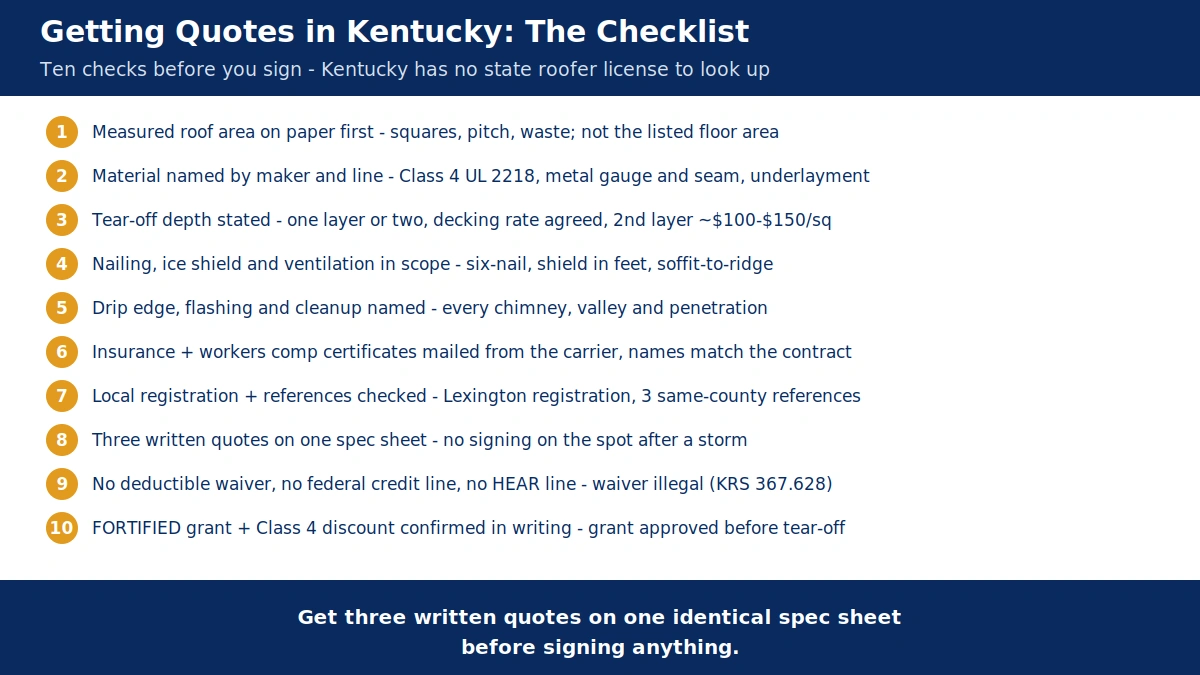
The checklist is the last section because it is the one to carry to the estimate. Ten items, in the order they matter, and every one of them comes from a rule, a number or a statute stated above.
- Get the measured roof area on paper first: the square count, the pitch and the waste allowance, instead of any figure worked out from the home’s listed floor area.
- Material named by manufacturer and line: architectural, Class 4 with its UL 2218 marking, or metal with its gauge and seam type, plus the underlayment and the ice-and-water shield.
- Tear-off depth stated: one layer or two, with the per-sheet decking rate agreed before tear-off and the second-layer charge of roughly $100-$150 a square named.
- Nailing pattern, ice shield and ventilation in the scope: six-nail high-wind fastening, ice and water shield in feet from the eave, balanced soffit-to-ridge ventilation with intake and exhaust named.
- Drip edge, flashing and cleanup named: drip edge at eaves and rakes, flashing at every chimney, valley and penetration, disposal and magnetic nail cleanup in the total.
- Insurance and workers’ compensation certificates mailed from the carrier: business name matches the contract and the Secretary of State registration, and Kentucky requires workers’ comp from the first employee.
- Local registration and references checked: Lexington-Fayette registration, Louisville Metro or county occupational license, or whatever the job’s own city or county requires, because Kentucky has no state roofer license, plus three local references from the same county.
- Three written quotes against one shared spec sheet: no quote signed on the spot after a storm, and the five-business-day cancellation right under KRS 367.622 in the contract, in bold, before the signature.
- No deductible-waiver promise, no federal tax-credit line, no HEAR rebate line: the deductible waiver is illegal under KRS 367.628, the federal credit is $0 in 2026, HEAR has not launched in Kentucky, and no rebate ever pays for a roof.
- FORTIFIED grant and Class 4 discount confirmed in writing first: the Strengthen Kentucky Homes application approved before the old roof comes off, up to $10,000 toward a FORTIFIED roof, and the insurer’s Class 4 discount and FORTIFIED endorsement confirmed with the carrier, not the roofer.
The timing matters too. Late winter and early spring are the quiet months for Kentucky roofers, and the season when the lowest rates are most often locked in. A roof replaced in February is a roof replaced before the spring storms, before the summer heat, and before the autumn rush.
A roof replaced the week after a tornado is a roof replaced at the highest price, by whichever crew is available, under the most pressure. The buyer who can choose the date should choose the quiet one. The buyer who cannot, because the storm chose it, should still get three quotes, still check the paper trail, and still read the contract before signing it.
In Kentucky, where there is no license to check and no inspector coming, the buyer’s own checks are the quality control. Use the checklist above at every estimate.
How much does a roof replacement cost in Kentucky in 2026?
A 2,000-square-foot roof in architectural asphalt shingles costs $8,980–$10,890 installed in Kentucky in 2026, on the NumeralQ planning figures priced October 26, 2026. A 3-tab roof runs $7,580–$8,910, Class 4 impact-resistant shingles $10,000–$15,000, exposed-fastener metal $10,000–$17,000, standing-seam metal $16,600–$25,800, tile $22,000–$33,200, and natural slate $30,230–$60,160, all on a 20-square roof. Louisville runs $9,000–$16,000 and Lexington $9,500–$17,000 for a typical home, as planning estimates, not contractor bids, and the tear-off depth, the decking rate and the flashing are priced separately.
Does Kentucky require roofers to be licensed?
No. Kentucky issues no statewide license, registration or exam for roofing or general contractors. The Department of Housing, Buildings and Construction licenses only electrical, plumbing and HVAC trades, while roofing rules are local: Lexington requires contractors to register with Building Inspection, and Louisville Metro and other cities and counties run their own occupational license and permit offices. Call the building office for the property’s address before hiring to ask about a local license or registration and permits; a 2026 bill draft, BR 1045, would create a statewide contractor license, but it is a filed bill, not an enacted law.
Do I need a permit to replace my roof in Kentucky?
Not for a standard residential reroof in Louisville or Lexington. Louisville Metro requires no permit for a standard reroof and does not inspect it, but a permit is required if any structural part is replaced, including the roof deck, and Lexington requires no permit for a standard reroof either, but structural work such as replacing rafters or changing the roof’s shape needs one. Preservation districts and individual landmarks in both cities need a Certificate of Appropriateness for exterior changes, smaller cities and counties set their own rules, so check with the building department for the property’s address before work starts, and the code limits the roof to two layers of covering.
What does the Strengthen Kentucky Homes grant pay for a roof?
Up to $10,000 of construction cost toward a roof built to the IBHS FORTIFIED Roof standard, paid directly to the contractor when the job is done. The program opened March 1, 2026, under the Kentucky Department of Insurance, funded by a $5 million appropriation from 2024’s House Bill 256, and the grant must usually be approved before the old roof comes off, so apply before signing a roofing contract. The roof must be in good repair and mitigable, with no existing insurance claim, and the work must be done by an approved contractor holding an IBHS FORTIFIED Roofing Contractor certificate, $1,000,000 of general liability cover, and a Letter of Good Standing from the Department of Revenue; the FORTIFIED certificate lasts five years.
Will insurance pay for my Kentucky roof after hail damage?
Usually yes, if wind and hail are covered perils on the policy, but what it pays depends on the deductible, the valuation method and the matching rule. Many Kentucky policies carry a separate wind and hail deductible of 1 or 2 percent of the dwelling coverage, so a $300,000 home with a 2 percent deductible leaves the homeowner paying the first $6,000, while replacement cost cover pays today’s prices at any roof age and actual cash value subtracts depreciation, so an older roof may qualify only for actual cash value. Under KRS 304.12-095, if the shingles cannot be matched in color and quality, the insurer must replace the entire roof for a reasonably uniform appearance; notify the insurer promptly and document the damage with timestamped photographs and video.
Can a Kentucky roofer pay my insurance deductible?
No. Under KRS 367.628, it is a prohibited act for a roofing contractor to offer to pay or rebate any portion of the insurance deductible on a job paid from insurance proceeds, it is insurance fraud, and it exposes the homeowner as well as the roofer. The same statute forbids paying more than $100 to induce a signature, representing the homeowner in claim negotiations with the insurer, and causing damage to increase the claim. The homeowner also has a five-business-day right to cancel the contract under KRS 367.622 after the insurer gives written notice that all or part of the claim is not covered, and the contractor must deliver a bold-face disclosure of that right before the contract is signed.
Is a metal roof worth the extra cost in Kentucky?
It depends on how long the buyer will own the house. Standing-seam metal runs $16,600–$25,800 on a 20-square roof against $8,200–$12,000 for architectural shingles, roughly double, but it lasts 40–70 years against 22–30 for shingles, so it costs about $424 a year of service against about $404 for shingles, while exposed-fastener metal runs $10,000–$17,000 and costs about $386 a year, the cheapest per year of the materials priced above. Metal resists hail better than shingles and sheds snow faster, which helps with ice dams in Lexington’s cold winters, but it needs snow guards and a crew that installs metal every week; on a house to be sold within ten years, architectural shingles are the sensible buy, and on a house to be kept for thirty years in hail country, standing seam is.
Are there any federal credits or rebates for a Kentucky roof in 2026?
No. The One Big Beautiful Bill Act, Public Law 119-21, ended the federal residential energy tax credits under sections 25C and 25D for property placed in service after December 31, 2025, so the federal credit for a 2026 homeowner-owned roof is $0. Kentucky’s HEAR and HOMES rebates have not launched: the state energy office says it is still awaiting unconditional approval from the U.S. Department of Energy, no launch date has been announced, and no retroactive rebates will be paid. The section 48E lease pass-through survives for systems in service by December 31, 2027, but it applies to leased energy systems, not to a roof, so strike any federal credit or HEAR rebate line from a roofing quote before comparing it with anything.