


Oregon asks a solar buyer two questions that most states never pose, and both matter more than the price per watt. The first is which side of the Cascades the roof sits on. A Portland roof and a Bend roof buy the same panels at the same price, and the Bend roof makes about a third more electricity out of them.
Portland averages about 4.06 peak sun hours a day, while Bend, Burns, and Pendleton all clear 5.0. A peak sun hour is an hour of full-strength sunshine, the unit that measures how much sun a place gets. Nobody in the Willamette Valley should size a system from a statewide production number, and nobody east of the mountains should accept a payback computed on valley sun.
The second question is whose name sits at the top of the electric bill. PGE and Pacific Power customers get Energy Trust money and full one-for-one credits. EWEB customers get a small utility rebate and 3.99 cents for exports, and co-op and PUD customers get whatever their own utility offers, which is often a few cents.
The same 8 kW system, the same $22,160, pays back in about 14.6 years in Portland and past 32 years in Eugene. Portland and Eugene get similar sun. Their utilities pay very differently for exported power, and that gap sets the payback.
The calendar is the third Oregon fact. Net-metering credits bank from April to March, and whatever is left after the March bill goes to low-income assistance.
The customer is paid $0 for those leftover credits. Panels beyond your annual use earn nothing, so size to your last twelve months of consumption, not to your roof, not to a salesman’s round number, and not to a future EV you have not bought yet.
Summer matters so much here because Oregon’s long, dry summer days build the credit bank that pays the dark winter bills. A smoky August trims the year’s best month, because the state’s fire season lands squarely on its best production weeks. The annual smoke loss is small, about 1.2% in the modeled 2023 fire season, but the week-by-week loss during a bad smoke event can halve daily output, and ash left on the glass keeps costing until rain washes it off.
On November 13, 2026, the Oregon Department of Energy announced it had received federal approval to launch the state’s HEAR and HOMES rebate programs, with applications opening in early 2027. That puts no dollar into a 2026 solar purchase. HEAR does not pay for solar at all, and no rebate is available today.
The approval matters for households planning heat pumps, insulation, and panel upgrades alongside solar, because those measures may qualify in 2027. Everything else in the federal picture is settled: the 30% credit for owned systems is gone for 2026 installs, the state rebate is closed, and the only money that lowers a solar invoice in Oregon this year comes from Energy Trust or from your own utility.
Table of Contents
How Much Do Solar Panels Cost in Oregon in 2026?
The Oregon market in 2026 can be read three ways. The headline number here is EcoGen’s September 2026 Solar Cost Index figure for Oregon: $2.77 per watt before incentives, or $22,160 for the typical 8.00 kW system.
That is below the national average of $2.89 a watt. Oregon sits among the cheaper solar states in the West, dearer than the cheapest markets, cheaper than Washington’s $2.89 anchor and far cheaper than California’s. Inside the Index’s 12% band, Oregon quotes for 2026 mostly fall between $2.44 and $3.10 per watt.
Within that band, the totals come out near $14,600–$18,600 for 6 kW, $19,500–$24,800 for 8 kW, $24,400–$31,000 for 10 kW, and $29,300–$37,200 for 12 kW. A kilowatt, written kW, is 1,000 watts of panel capacity, and a kilowatt-hour, written kWh, is the unit of electricity on the bill.
A second angle on the same market comes from the marketplace, and it prices Oregon cheaper. EnergySage, as of November 2026, puts Oregon at $2.40 a watt, thirty-seven cents below the EcoGen anchor, but on a much bigger system: its average Oregon system is 12.18 kW, priced at about $29,242, with a range of $24,856 to $33,628.
The size gap is the place to start. One measure prices the median roof, the other prices the marketplace shopper. EnergySage’s marketplace average comes from real quotes, and the Oregon shoppers behind those quotes lean toward oversized systems: all-electric houses, a driveway EV, a heat pump carrying the winter heating load, a home bought with growth in mind.
Berkeley Lab’s 2025 count found 8,617 Oregon installs with a median of 8.00 kW, the size Oregonians actually put on their roofs, and EcoGen’s typical system is built on that median. The median is the typical size used here. As a cross-check on price per watt, EnergySage’s $2.40 sits thirty-seven cents below EcoGen’s $2.77: two unrelated measures, both below the national average, and the gap between them is the gap between a marketplace average and a median of signed installs.
A third measure comes from a consumer publication rather than a quote stream. ConsumerAffairs, using EnergySage data accessed in late August 2026, puts Oregon at $2.46 a watt on a 12.16 kW system, about $29,914, with a modeled payback of 11.7 years and 25-year savings of $35,464.
That sits close to EnergySage’s own $2.40, which is reassuring: two readings of the same marketplace landing within six cents of each other. It still describes the same oversized average system, so it audits the per-watt price rather than the typical total.
Two more numbers complete the comparison, and both need a warning label attached. SolarReviews’ November 2026 Oregon figure, $3.18 a watt, about $19,963 for its 5.9 kW average system, comes from a national model built on NREL, EIA, and Bureau of Labor Statistics inputs, not from a survey of Oregon quotes.
NumeralQ’s planning estimate prices an 8 kW Portland system at $23,370 to $30,510, or $2.92 to $3.81 a watt, a planning range built from EnergySage data retrieved October 26, 2026, wider than the EcoGen band at both ends, and the same range it publishes for Eugene. Read together, the anchors put Oregon below the national average on price per watt, and the width of the quote band, $2.44 to $3.10, says more than any single point inside it.
The typical size shapes every number after it. That 8.00 kW figure is a median of systems actually installed, not a model output, and it sits just short of what the average Oregon household consumes in a year. Each kilowatt yields about 1,136 kilowatt-hours a year, so an 8.00 kW array makes roughly 9,088 kilowatt-hours annually against the average Oregon home’s roughly 10,116 a year, about 843 a month.
The typical installation covers close to 90% of what an average household uses in a year. For a home using the state average, that is a sensibly sized array with a little headroom left. The sizing section further down unpacks what the March true-up does to a system that overshoots it.
The typical buyer and the average home are still different households. Quote-seekers in Oregon draw considerably more power than the state average: electric heat, a hot tub, a workshop, an EV. A system sized to their bills will be bigger than 8 kW.
That per-watt figure carries the whole job: panels, inverter or microinverters, racking, wiring, crew time, permits, inspection, and the interconnection filing. An inverter is the box that turns the panels’ direct current into the alternating current the home uses, and interconnection is the utility’s approval to connect the system to the grid.
Budget separately for the extras the per-watt price leaves out: a new roof, a panel upgrade, tree work, a battery, and a trench to a detached garage. That arithmetic credits no incentive, and for most Oregon buyers in 2026 the only incentive that reduces the purchase price is the Energy Trust amount, $3,500 at PGE and $2,500 at Pacific Power, which the incentives section below prices separately, so the headline stays correct for everyone else.
For most buyers, then, the quoted sticker minus the Energy Trust line is what the system costs. Deducting more than that means calculating under a law that expired on December 31, 2025, or counting a state rebate that closed when its $1.1 million ran out.
The cheapest quote in Oregon is rarely the cheapest system once the job is done, and the gap between the cheapest and dearest quotes for the same roof is wider here than the statewide band suggests. A $0-down loan often quietly carries dealer fees worth 20–30% of the cash price, since an installer’s overhead and margin are most of the bill, and the fee only shows up when you set the cash price beside the financed one.
Energy Trust itself warns about high-rate, high-fee solar loans, and some of its trade allies offer Smart-E Loans as an alternative. A trade ally is a contractor approved by Energy Trust, and only trade allies can pass the incentive through. With quotes from Portland, Salem, Eugene, Bend, and Medford installers spread across the table, the cash price per watt for the same panels on the same Oregon roof is the one number that lets you judge bidder against bidder.
Make three installers put that figure on paper, and drop any bidder who will not. In Oregon the utility’s export rate decides the payback, so that third quote also proves whether the company priced your utility’s rules instead of the state average.
| Source | $ per watt | System | Cash total | Payback |
|---|---|---|---|---|
| EcoGen Index (Sep 2026) | $2.77 | 8.00 kW | ~$22,160 | ~16.2 yrs statewide |
| EnergySage (Nov 2026) | $2.40 | 12.18 kW avg | ~$29,242 | 13.42 yrs — flagged, modeled |
| ConsumerAffairs (Aug 2026) | $2.46 | 12.16 kW avg | ~$29,914 | 11.7 yrs — flagged, modeled |
| SolarReviews (Nov 2026) | $3.18 | 5.9 kW avg | ~$19,963 | Not published |
| NumeralQ planning (Oct 2026) | $2.92–$3.81 | 8 kW (Portland) | ~$23,370–$30,510 | 19.3 yrs — flagged, modeled |
| EnergySage Portland, Washington Co. (Nov 2026) | $2.33 | 10.59 kW avg | ~$24,630 | 10.94 yrs — flagged, modeled |
| EnergySage Portland, Clackamas Co. (Nov 2026) | $2.34 | 12.21 kW avg | ~$28,596 | 11.23 yrs — flagged, modeled |
| EnergySage Portland, Multnomah Co. (Nov 2026) | $2.39 | 10.97 kW avg | ~$26,249 | 12.06 yrs — flagged, modeled |
| EnergySage Bend, Deschutes Co. (Nov 2026) | $2.54 | 10.31 kW avg | ~$26,203 | 16.59 yrs — flagged, modeled |
| National range (article 4) | $2.25–$3.30 | 8.2 kW | ~$24,600 at $3.00/W | 6–12 yrs |
Treat the footnotes on five of those rows as required reading before trusting any number in them. EnergySage’s payback figures, 13.42 years statewide, 10.94 to 12.06 years across the three Portland county pages, and 16.59 years in Bend, are modeled estimates built on its own marketplace averages, and they run on systems of 10.31 to 12.21 kW, far above the 8.00 kW median that Oregon homeowners actually install.
The size gap explains it: a payback modeled on a 12.21 kW system for a house using 10,116 kilowatt-hours a year is a payback for a different Oregon than the tariffs describe. ConsumerAffairs’ 11.7-year payback is the same kind of model, built on the same oversized average. SolarReviews’ $3.18 and NumeralQ’s $2.92–$3.81 stay out of the headline because they are national-model and planning figures, not Oregon quotes.
EcoGen’s figures anchor the prices above, and EnergySage’s figures audit them from the side.
Solar Panel Cost in Oregon by System Size
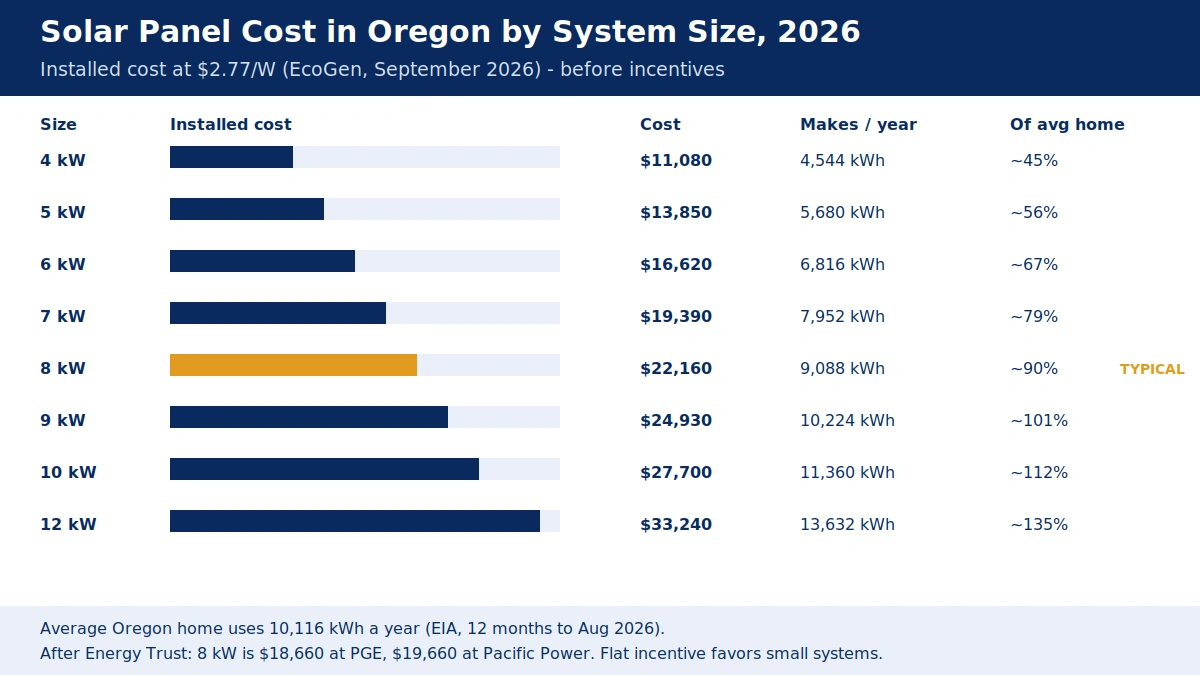
The per-watt price is the unit; the system size is the decision. At the EcoGen anchor of $2.77 a watt, every kilowatt adds $2,770 to the invoice and about 1,136 kilowatt-hours a year to the output.
The table below prices the sizes Oregon installers actually sell, at that anchor, with the production each size delivers and the share of an average Oregon home’s 10,116 kilowatt-hours a year it covers. The right-hand columns show the same sizes after the Energy Trust incentive, because for PGE and Pacific Power customers that is the price they actually pay.
The flat incentive means a small system gets a bigger percentage cut than a large one, which is the opposite of how most rebates work.
| System size | Cash price | Annual production | Share of avg home use | After PGE $3,500 | After Pacific Power $2,500 |
|---|---|---|---|---|---|
| 4 kW | $11,080 | ~4,544 kWh | ~45% | $7,580 | $8,580 |
| 5 kW | $13,850 | ~5,680 kWh | ~56% | $10,350 | $11,350 |
| 6 kW | $16,620 | ~6,816 kWh | ~67% | $13,120 | $14,120 |
| 7 kW | $19,390 | ~7,952 kWh | ~79% | $15,890 | $16,890 |
| 8 kW (typical) | $22,160 | ~9,088 kWh | ~90% | $18,660 | $19,660 |
| 9 kW | $24,930 | ~10,224 kWh | ~101% | $21,430 | $22,430 |
| 10 kW | $27,700 | ~11,360 kWh | ~112% | $24,200 | $25,200 |
| 12 kW | $33,240 | ~13,632 kWh | ~135% | $29,740 | $30,740 |
The covering size for the average home is the arithmetic that matters most in Oregon, because the March true-up makes oversizing uniquely wasteful here. Divide the average home’s 10,116 kilowatt-hours a year by 1,136 kilowatt-hours per kilowatt, and the answer is about 8.9 kW.
A 9 kW system covers the average home almost exactly, at 101%, and a 10 kW system already makes 12% more than the home uses, which is 12% that earns nothing after the March bill. That is the whole sizing discipline in one number: buy the system your last twelve months of bills describe, and stop there.
A household planning an EV or a heat pump should size for the bills it will have, not the bills it has, and should be able to show the installer the math. An EV adds roughly 2,500 to 3,000 kilowatt-hours a year, which is about two more kilowatts of panels, and a heat pump doing the winter heating can add more than that.
Guessing at either one is how a roof ends up with panels whose output gets donated to low-income assistance every March. The net-metering section below explains the March rule in full.
The flat Energy Trust incentive quietly changes the small-system math. On a 4 kW system, $3,500 from PGE is nearly a third of the invoice, and the effective price falls from $2.77 a watt to about $1.90 a watt. On a 12 kW system, the same $3,500 is barely a tenth, and the effective price barely moves, to about $2.48 a watt.
That is the opposite of a per-watt rebate, where the big system wins, and it is one reason a modest system pencils out better in Oregon than the national conversation suggests. A small, well-placed array on a PGE bill, with the incentive taken off the invoice, can be the cheapest solar per watt in the state, even though its total is the smallest.
Solar Within Reach rewrites the table again for income-qualified households. At PGE’s $1.25 a watt up to $7,500, an 8 kW system nets $14,660, which is $7,500 off instead of $3,500, and the effective price falls to about $1.83 a watt. At Pacific Power’s $0.75 a watt up to $4,750, the same system nets $17,410, about $2.18 a watt.
The caps bind at different sizes. PGE’s $7,500 cap is reached at 6 kW, so a 6 kW income-qualified system at PGE costs $16,620 minus $7,500, or $9,120, the cheapest per-watt solar priced here. Pacific Power’s $4,750 cap is reached at about 6.3 kW.
Below the cap, every added kilowatt earns the full per-watt rate; above it, every added kilowatt earns nothing extra. An income-qualified household should size to the cap, not past it, unless the extra production is genuinely needed.
Two costs sit outside every row of that table and surprise first-time buyers more than any other. The first is the roof. Oregon’s rain is relentless from October to May, and a roof with less than ten years of life left should be replaced before panels go on it, because removing and reinstalling an array to re-roof later costs thousands.
The national roof guide prices a typical asphalt replacement at $7,000 to $15,500, and an Oregon roofer’s number for your roof is a quote to get before the solar quote, not after. The second cost is the electrical panel. A home still on a 100-amp panel, or a full 200-amp panel with no spare breaker space, needs work before an inverter can tie in, and that work is itemized separately.
Get it itemized. A buried add-on cannot be compared with an itemized one.
What Portland, Salem, Eugene, Bend & Medford Actually Pay
Oregon’s five big cities do not pay the same price for solar, and the differences have almost nothing to do with the installers. Portland has three EnergySage county pages that disagree with each other by a few hundred dollars on the same city. Bend pays more per watt than Portland but makes far more power per watt.
Salem, Eugene, and Medford have no EnergySage city page at all, so they are priced here at the state anchor and labeled as such. What follows gives the figures that exist, the figures that do not, and the utility behind each one, because the utility explains the payback gap better than the price does.
Portland first, with all three county pages on the table. EnergySage’s Washington County page puts Portland at $2.33 a watt on a 10.59 kW average system, about $24,630, with a range of $20,936 to $28,324, a modeled payback of 10.94 years, and 25-year savings of $47,476.
Its Clackamas County page puts the same city at $2.34 a watt on a 12.21 kW system, about $28,596, range $24,307 to $32,885, modeled payback 11.23 years, 25-year savings $51,059. Its Multnomah County page puts it at $2.39 a watt on a 10.97 kW system, about $26,249, range $22,312 to $30,186, modeled payback 12.06 years, 25-year savings $43,379.
Three pages, three system sizes, three totals, three paybacks. The lesson is not to pick one. A Portland quote anywhere from about $2.33 to $2.39 a watt sits inside the marketplace’s own range, and a quote far outside it in either direction deserves a question.
All three pages agree on the important thing: Portland pays less per watt than the state anchor, because PGE territory has the densest installer competition in Oregon and the deepest Energy Trust support. ConsumerAffairs’ modeled Portland table lands in the same place: $12,100 for 5 kW, $14,520 for 6 kW, $19,360 for 8 kW, $24,200 for 10 kW.
Bend is the counterpoint. EnergySage’s Deschutes County page puts Bend at $2.54 a watt on a 10.31 kW average system, about $26,203, range $22,273 to $30,133, with a modeled payback of 16.59 years and 25-year savings of just $19,472.
Bend pays more per watt than Portland, with fewer installers, longer drives, and a smaller market, and its modeled payback is five years longer than Portland’s, even though Bend makes far more power per kilowatt. The reason is the utility, not the sun: Bend is Pacific Power territory, where each kilowatt-hour is worth 12.72 cents against PGE’s 16.69, and the Energy Trust amount is $2,500 instead of $3,500.
The sun gives Bend back about a third more production; the tariff takes most of it away again. That is the single most counterintuitive fact in Oregon solar, and it is the reason a Bend homeowner who sizes from sunshine alone will be disappointed by the payback. Size from the tariff, and let the sunshine be the bonus.
Salem, Eugene, and Medford have no EnergySage city figure to argue about. Salem sits in PGE territory for most of the city, so its price is the state anchor, $2.77 a watt, $22,160 for 8 kW, $18,660 after the PGE incentive, and its payback is PGE’s 14.6 years before incentives.
Eugene is EWEB territory, and Eugene is where the city table turns into a warning. The same $22,160 system earns 3.99 cents for every exported kilowatt-hour instead of a full one-for-one credit, and EWEB’s own rebate, $0.40 a watt up to $2,500, was 87% allocated by mid-October 2026 on a $125,000 budget.
A Eugene homeowner who buys on the state anchor price and the state average payback will be wrong on both counts. The price is roughly right, and the payback is not. The payback section below prices EWEB at 32.2 to 41.9 years.
Medford is Pacific Power territory, like Bend, so its price is the anchor and its payback is Pacific Power’s 19.2 years. But Medford’s sun is southern Oregon sun, closer to Bend’s than Portland’s, so a Medford roof makes more power per kilowatt than the statewide anchor assumes. Medford is the city where the statewide production figure most understates the roof.
| City | Utility | $/W | Typical 8 kW | After incentive | Payback anchor |
|---|---|---|---|---|---|
| Portland (3 county pages) | PGE | $2.33–$2.39 | ~$18,640–$19,120 | ~$15,140–$15,620 | ~14.6 yrs (EcoGen PGE) |
| Salem | PGE | $2.77 (state anchor) | ~$22,160 | ~$18,660 | ~14.6 yrs (EcoGen PGE) |
| Eugene | EWEB | $2.77 (state anchor) | ~$22,160 | ~$19,660–$22,160 | 32.2–41.9 yrs (EcoGen) |
| Bend | Pacific Power | $2.54 | ~$20,320 | ~$17,820 | ~19.2 yrs (EcoGen Pac) |
| Medford | Pacific Power | $2.77 (state anchor) | ~$22,160 | ~$19,660 | ~19.2 yrs (EcoGen Pac) |
Two footnotes keep that table accurate. First, the Portland 8 kW row is computed at the county-page per-watt rates, not at the state anchor: $2.33 to $2.39 a watt gives $18,640 to $19,120 for 8 kW, and the PGE incentive takes it to roughly $15,140 to $15,620.
Second, Eugene’s “after incentive” range is wide because EWEB’s rebate may or may not still be funded when you apply: $2,500 off if the budget holds, $0 if it does not, and the 87%-allocated figure from October means a Eugene buyer should confirm the budget before counting a dollar of it. Read the payback column first: it is a utility map.
Two Oregons, One Roof: Willamette Valley Clouds vs High Desert Sun
Oregon is two solar states sharing one border, and the line between them is the crest of the Cascades. West of it, the Willamette Valley and the coast run on marine air: long gray winters, short gray days, and a summer that arrives late and leaves early.
East of it, the high desert runs on continental air: cold clear winters, hot dry summers, and more than 300 days of sunshine a year in Klamath Falls, the self-described City of Sunshine. A solar buyer who does not know which Oregon their roof is in will misjudge the system twice, once on production and once on payback.
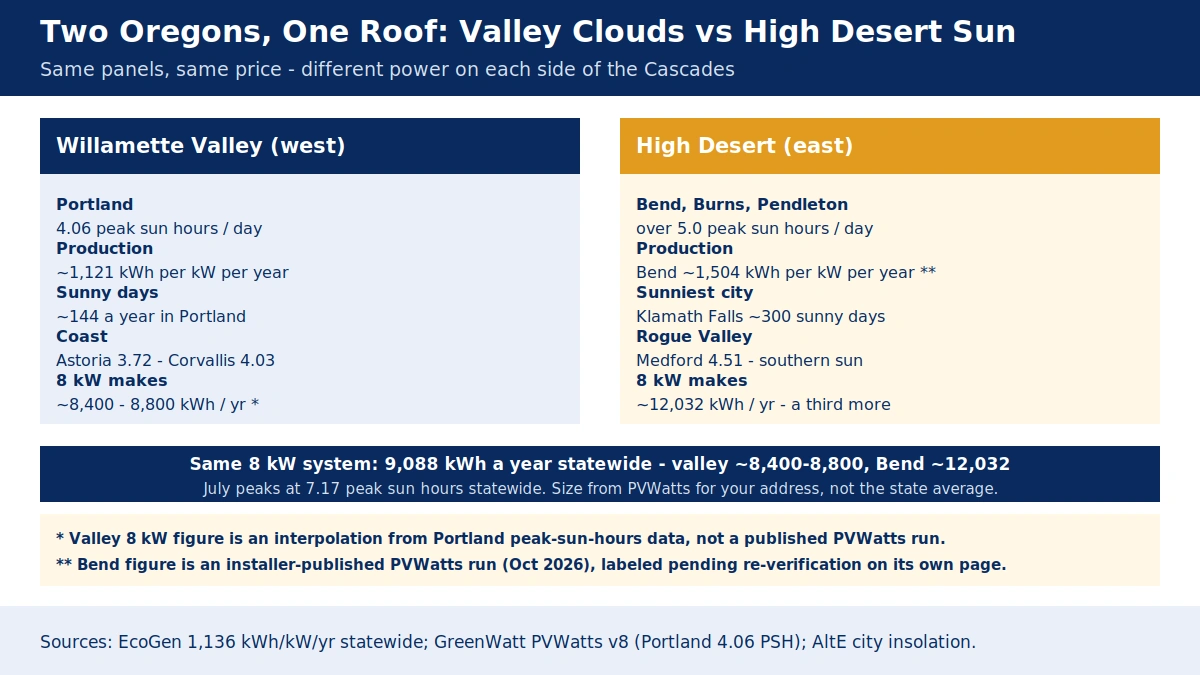
The numbers draw the line sharply. Oregon averages about 4.06 peak sun hours a day on the statewide PVWatts figure, measured at Portland, which works out to about 1,121 kilowatt-hours a year per installed kilowatt. PVWatts is the National Renewable Energy Laboratory’s free solar calculator, and its weather files already contain the clouds, the rain, and the gray weeks of a typical year.
July, the best month, peaks at 7.17 peak sun hours. East of the mountains, Bend, Burns, and Pendleton all clear 5.0 peak sun hours a day, a quarter more sun than Portland, every day, all year.
The city insolation table fills in the gradient. Insolation is the sunlight falling on a square meter of ground, measured in kilowatt-hours per square meter per day. Astoria on the coast averages 3.72, Corvallis in the valley 4.03, and Medford in the Rogue Valley 4.51.
Portland gets about 144 sunny days a year and roughly 2,340 hours of sunshine, about half of what is possible, while Klamath Falls clears 300. The same 8 kW system that makes 9,088 kilowatt-hours a year on the statewide anchor makes roughly 12,000 in Bend on a PVWatts run published by a Bend installer, about a third more, and roughly 8,400 to 8,800 in the valley on an interpolation from Portland’s peak-sun-hours data.
That interpolation is flagged here as an interpolation, not a published PVWatts run. The direction is not in doubt, and the size of the gap is not either.
The seasonal shape is the second half of the story, and it is more extreme in the valley than in the desert. A Portland December delivers a small fraction of a Portland July, with the statewide July peak of 7.17 peak sun hours against a winter day that can pass with barely an hour of useful sun.
The net-metering rules turn that seasonality from a problem into a design feature. Summer production banks as kilowatt-hour credits that pay winter bills, and the March true-up is placed after winter precisely so the summer bank gets spent. A valley roof earns its keep in five months and coasts on credits for the other seven.
A desert roof earns more evenly, because its winters are clearer, but it banks credits the same way. Either way, the monthly shape is the reason a single annual production number is never enough. Ask the installer for the PVWatts monthly table for your address, and look at December before you look at the annual total.
Clouds deserve a correction, because the most common objection to Oregon solar rests on a mistake. Panels do not switch off on a cloudy day. They make power from diffuse light, the scattered sunlight that gets through cloud, at a reduced rate, and the PVWatts weather files that produce the 1,136 kilowatt-hours per kilowatt already contain the clouds.
Nobody needs to apply a cloudy-day discount on top of a PVWatts number; the discount is already in it. What clouds do is make the roof’s specific shade and orientation matter more, because a valley roof has fewer bright hours to waste.
A south-facing valley roof with no shade is a good solar roof. A north-facing valley roof under Douglas firs is not, and no production estimate that ignores the trees is worth the paper it is printed on. Energy Trust’s solar-access standard, measured by TSRF, exists for exactly this reason.
TSRF stands for Total Solar Resource Fraction, a score for how much sun the roof actually gets after shade and orientation. A roof that fails it does not qualify for the incentive, and that failure is information, not bureaucracy.
The desert side has its own trap, and it is the mirror image of the valley’s. High-desert sun is strong, but high-desert heat is real, and panels lose efficiency as they heat up: a panel rated at 25 degrees Celsius makes less power at 40. Bend’s summer afternoons are hot enough for the temperature penalty to shave a few percent off the midday peak, and the clear dry air that makes the sun strong also makes dust and pollen stick to the glass.
The net effect is still strongly positive. Bend makes about a third more power than Portland per kilowatt. But modeling production at nameplate output with no temperature or soiling allowance overstates the case by a few percent.
Ask for the derate assumptions in writing, east or west. A derate is a downward adjustment for real-world losses such as heat, dirt, and wiring.
The practical sizing rule follows from the split. A valley household covering the average 10,116 kilowatt-hours a year needs roughly 9 to 10 kW at valley production rates, not the 8.9 kW the statewide anchor suggests, and it needs to remember that the March true-up caps the useful size at annual use, so the extra kilowatts must be justified by real consumption, not optimism.
A Bend household covering the same use needs roughly 6.7 to 7 kW at desert production rates, and an 8 kW Bend system already makes about 12,000 kilowatt-hours, more than the average home uses, with the surplus donated every March unless the household genuinely uses it. The desert buyer’s risk is oversizing; the valley buyer’s risk is undersizing and then discovering the winter bills did not fall as far as promised.
Both risks are solved the same way: size from twelve months of bills, run PVWatts for the address, and treat the statewide average as a starting point, never as an answer.
Wildfire Smoke and Your Panels: What a Smoky August Really Costs
Every Oregon solar conversation eventually reaches the smoke, and the answer is two numbers instead of one: a small annual number and a large weekly one. The annual number comes from peer-reviewed modeling of the 2023 Canadian wildfire season, which put Oregon’s modeled solar production loss at about 1.2% over the five-month smoke period.
One bad fire season costs an Oregon array roughly one percent of its year. That shows on a monitoring app, and it barely moves a payback calculation.
The weekly number is different. During a heavy smoke event, daily output can fall by half or more, and a 2026 report on bushfire effects at solar farms recorded output reductions up to 70% during severe smoke.
That farm-scale figure is not a rooftop figure, and it is labeled as such, but the physics is the same: smoke scatters sunlight the way cloud does, and a thick plume turns a bright August afternoon into a dim one. EPRI’s cloud work puts overcast-day output reductions at roughly 50% on overcast days and above 90% on dark overcast days, and smoke behaves like a cloud that does not move on.
The timing is what makes smoke an Oregon problem rather than a footnote. Fire season runs late summer, which is exactly when Oregon’s panels earn their keep: long days, high sun, dry air. A smoky August does not just trim a random month; it trims the year’s best month, the month that builds the credit bank for the winter.
A week of smoke in August costs more annual production than a week of smoke in November, because November was never going to produce much anyway. The March true-up softens the blow: credits banked in June and July are already in the account before the smoke arrives, so a bad August rarely means a bad winter bill.
A household that sized its system on a clear-sky August will find the bank a little lighter than modeled. A household that watches its monitoring app during fire week will see numbers that look like a system failure. They are smoke, and they pass.
Ash is the second half of the smoke problem, and it lasts longer than the plume. Wildfire ash settles on the glass and stays there until rain or a wash removes it, and editorial syntheses of soiling studies put the fire-season spike at 5% to 15% of output until the panels are cleaned. Soiling means dirt, dust, and ash on the glass cutting the light that reaches the cells.
Oregon’s baseline soiling loss is only 1% to 2% a year, because the wet winters wash everything, but the wash comes in October, and the ash lands in August, so a September array can carry two months of ash into the autumn. The remedy is unglamorous: a rinse with water from the ground, or a professional cleaning if the roof is steep, after the smoke clears and before the rains.
Do not clean panels during an active fire, and do not climb a roof to do it. The few dozen kilowatt-hours at stake are not worth a fall. A monitoring app that shows a slow recovery after the sky clears, rather than a sharp one, is usually showing ash, not a broken inverter.
There are three practical defenses, and none of them is a bigger system:
- The March true-up itself: size to annual use, bank the summer, and let the winter draw the bank down, so smoke takes a bite out of the deposit, not the account
- A production estimate that uses a typical meteorological year, which already includes the smoke seasons of the past, rather than a clear-sky model that pretends they never happen, since PVWatts runs on historical weather files
- Insurance and expectations: confirm with the homeowners insurer that the array is covered for wildfire damage itself, not just smoke loss, because in the parts of Oregon where fire risk is real, the Rogue Valley, the east side, and the wildland-urban interface, the panels are an asset on a roof that an insurer prices for fire
Modeling every month at clear-sky irradiance ignores real weather, and it overstates production. A system that survives a fire season with a 1% production loss and an intact roof has done its job.
One more Oregon-specific smoke note: the smoke does not respect the Cascade split. A fire in the Cascades or the Coast Range smokes out the valley; a fire in the high desert smokes out Bend; a fire in northern California or British Columbia smokes out both. The 2023 season that produced the 1.2% modeled loss was Canadian smoke drifting south, not Oregon fire at all.
No Oregon roof is smoke-proof, and no Oregon production estimate should pretend otherwise. At about one percent of a year’s output in a bad season, smoke is a small line in a 25-year payback and a bad week on a monitoring app.
Net Metering in Oregon: One-for-One Credits Until the March Bill
Oregon’s net-metering law is the best thing about solar in this state, and the March true-up is the catch. Net metering means the utility credits the home for power the panels send to the grid, and the home draws on those credits later. The law, Oregon Revised Statutes 757.300, with the commission’s rules in OAR 860-039, requires every utility in Oregon to offer net metering: investor-owned, municipal, cooperative, and people’s utility district alike.
No Oregon utility may refuse a home system, and the residential limit is 25 kW, far above any home system priced here. That universality is rare.
In most states the utility on the bill decides whether solar pays at all. In Oregon the law decides that it does, and the utility decides how fast.
For PGE and Pacific Power customers, the rule is one-for-one. Every kilowatt-hour the panels send to the grid becomes one kilowatt-hour of credit, canceling a kilowatt-hour the home uses later at full retail value. The home uses its own solar power first; the surplus goes out through a bidirectional meter, which measures power flowing both ways; the credits roll from month to month for twelve months.
A July surplus pays a January bill. That is the whole mechanism, and it is why the seasonal shape of Oregon production is an advantage rather than a problem: the long summer days build the bank, and the dark winter draws it down. There is no monthly cash-out, no avoided-cost haircut, and no time-of-use penalty for PGE and Pacific Power solar customers on the standard net-metering arrangement.
The annual cycle ends with the March billing period, and that date is the most important date in Oregon solar. Whatever credits remain unused after the March bill are cleared from the account and transferred to the utility’s low-income assistance program. The customer is paid nothing for them: $0, not a wholesale rate, not a credit, nothing.
March is chosen deliberately: it lets summer credits survive the winter, so a system sized to annual use spends its bank before the reset. A system sized above annual use donates the surplus every year, forever. PGE allows a customer to request a different true-up month, which suits a household whose usage peaks at an unusual time of year, but the default March date fits almost everyone, and changing it without a reason is a way to donate more, not less.
The co-op, municipal, and PUD side of the law is where the one-for-one promise thins out. State law makes those utilities offer net metering, but each one sets its own terms for the surplus, and the surplus is often bought at the utility’s avoided-cost rate or credited as kilowatt-hours on terms the utility writes. The avoided-cost rate is what the utility would have paid to buy or make that power itself, and it is far below the retail rate.
The export values EcoGen collected in October 2026 tell the story in cents: EWEB pays 3.99 cents a kilowatt-hour for power beyond the month’s use, Central Electric Cooperative pays 4.68 cents, and Idaho Power pays 2.9019 cents from October to May for its Oregon homes. Those are purchase prices, not net-metering credits, and they are a small fraction of the retail rate the same household pays for power it buys.
A kilowatt-hour a co-op customer uses at home is worth the full retail rate; a kilowatt-hour the same customer exports is worth four cents. That gap is the entire economics of a co-op solar system, and it is why the payback section prices EWEB past three decades. The rule for those households is the opposite of the PGE rule: size the system to what the home uses while the sun shines, because every exported kilowatt-hour is nearly worthless.
Three administrative details belong in any quote conversation:
- The interconnection application with PGE is free for residential systems of 25 kW or less, and Pacific Power’s Schedule 135 governs its Oregon net metering, so ask for the application timeline in writing, because a system that sits unconnected through a sunny summer earns nothing
- Since June 1, 2024, new inverter-based applications in Pacific Power territory must use UL 1741 SB certified inverters meeting the IEEE 1547-2018 standard, a detail that matters only if an installer proposes older equipment, and a useful test of whether the installer is current
- PGE publishes a Net Metering Map showing distribution feeders with limited capacity, so a home on a constrained feeder can face delays or upgrade costs, and the time to discover that is before signing, not after the panels are on the roof
Customers keep ownership of their renewable energy credits under Oregon rules. A renewable energy credit, or REC, is the certificate for the green value of a kilowatt-hour of clean power, and it matters if a buyer ever asks who owns the green attributes. The homeowner does, unless a contract says otherwise.
The net-metering rules could change in the future, and a buyer should know the current status. As of November 2026 the full-retail credit is in force, it covers new residential customers, and no change has been adopted. A system installed under today’s rules banks credits under today’s rules, and the risk is that a future change alters the value of exports for systems installed after it.
Energy Trust of Oregon: $3,500 Off at PGE, $2,500 at Pacific Power
Energy Trust of Oregon is the single most important solar institution in the state, and it is the reason Oregon solar works at all in 2026. It is a nonprofit, funded by a small surcharge on PGE and Pacific Power bills, and it runs the incentive programs for those two utilities’ customers.
It does not send the homeowner a check. It pays an approved solar contractor, a trade ally, who deducts the amount from the invoice. The distinction matters twice: a homeowner who hires a contractor outside the trade ally network gets $0 from Energy Trust, and without the incentive as its own line, a quote cannot be checked.
Ask for the trade ally status in writing and the incentive as a separate line, every time.
The standard residential offer, Solar for Homes, is a flat amount per home: $3,500 for PGE customers, $2,500 for Pacific Power customers, for systems of 2 kW-DC or more. The PGE amount rose from $2,500 on August 4, 2026, which is recent enough that quotes written before that date may still show the old number.
A quote showing $2,500 for a PGE home in late 2026 is either stale or wrong, and either way it should be corrected before signing. The flat structure is the feature: a 5 kW system and a 9 kW system get the same $3,500, so the small system gets the bigger percentage cut.
The roof must meet Energy Trust’s solar-access standard, measured by TSRF, which is the nonprofit’s way of refusing to subsidize a shaded roof. That refusal doubles as free advice about whether the roof is worth paneling at all.
Solar Within Reach is the income-qualified version, and it replaces the flat amount rather than adding to it. It pays $1.25 a watt up to $7,500 for PGE customers, and $0.75 a watt up to $4,750 for Pacific Power customers, for households under an income limit that varies by county and household size.
For a household of four, the limit is $192,450 in Multnomah, Clackamas, and Washington counties, and $125,400 in Coos County. On the typical 8 kW system, that is $7,500 at PGE, since 8,000 watts times $1.25 is $10,000, capped, and $4,750 at Pacific Power, since 8,000 times $0.75 is $6,000, capped, taking the typical system to $14,660 at PGE and $17,410 at Pacific Power.
The caps bind at 6 kW for PGE and about 6.3 kW for Pacific Power, so an income-qualified household gains nothing by sizing past the cap unless the extra production is genuinely needed. The program requires owning and occupying the home and being a PGE or Pacific Power customer, and the income test is done before the install, not after. Apply first, sign second.
The battery incentive rides on the same structure and is priced in the battery section below, but the headline belongs here because it changes the storage decision: $400 a kilowatt-hour up to $5,000 at PGE, $240 a kilowatt-hour up to $3,000 at Pacific Power since October 1, 2026, with higher income-qualified rates. The battery must be paired with solar and be at least 3 kWh.
Energy Trust updates its incentives quarterly. The current Q4 rates run October through December 2026, and every offer is subject to funding availability and may change. That quarterly rhythm is the reason a quote’s incentive line has an expiry date even when the quote does not say so: the amount on the page is the amount in effect when the quote was written, and a job that slips into the next quarter may price at the next quarter’s rate.
Get the reservation confirmed in writing, with a date.
The boundary of Energy Trust’s world is the boundary of its funding: PGE and Pacific Power customers only. EWEB customers, co-op members, and PUD customers get nothing from Energy Trust, no matter how good their roof is, because their bills carry no Energy Trust surcharge.
Those households have only what their own utility offers: EWEB’s $0.40 a watt, Salem Electric’s $300 a kilowatt, Central Lincoln’s $500 a kilowatt. Those amounts are smaller, capped by small budgets, and often already spoken for. A Eugene homeowner who reads about a $3,500 incentive online and budgets for it will be $3,500 short.
Start with the name at the top of the bill. The price per watt comes second.
Payback in Oregon: 14.6 Years at PGE, 19.2 at Pacific Power, Far Longer at EWEB
Payback is where Oregon’s three utilities stop being a footnote and become the whole story. EcoGen’s per-utility figures, published October 30, 2026, price the typical 8.00 kW system at $22,160 before any Energy Trust incentive, and they assume every net-metering credit is used before the March reset, which holds only if the system makes no more than the home uses in a year.
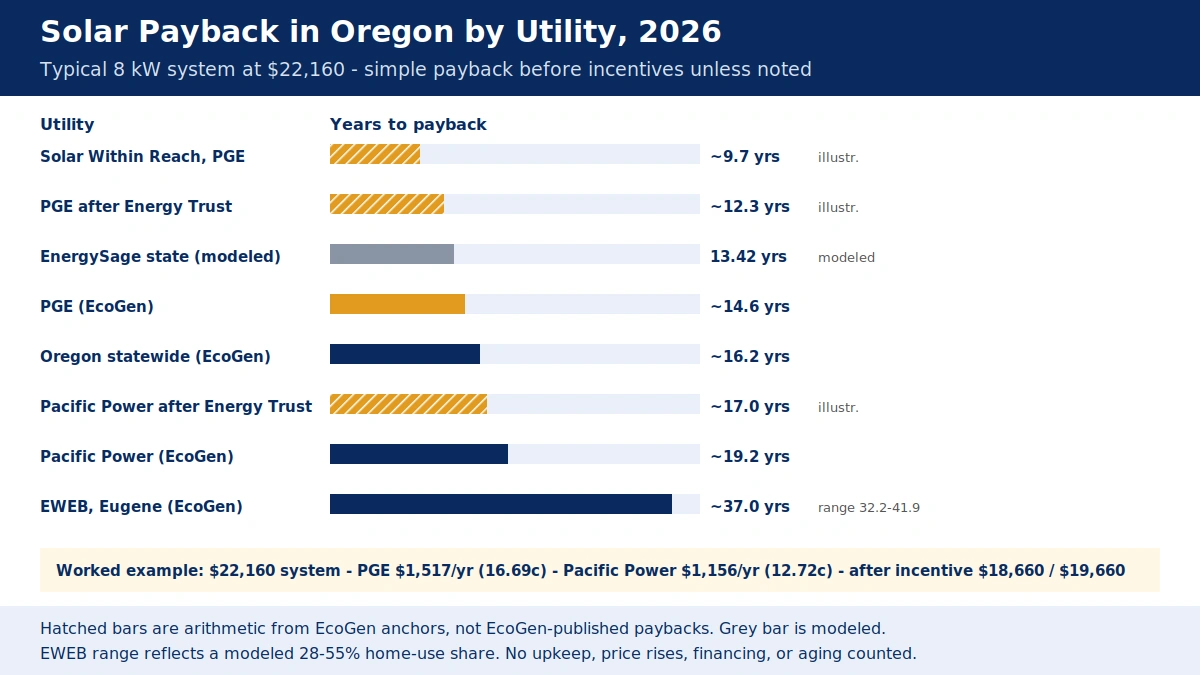
On those terms, the statewide simple payback is 16.2 years. Simple payback means the system cost divided by the first year’s savings, with no upkeep, no price rises, no financing cost, and no panel aging counted. At PGE it is 14.6 years, on year-one savings of $1,517 at a variable value of 16.69 cents a kilowatt-hour.
At Pacific Power it is 19.2 years, on year-one savings of $1,156 at 12.72 cents. At EWEB it is 32.2 to 41.9 years, 37.0 years at the center, on a modeled home-use share of 28% to 55%. The range is wide because so few EWEB solar homes publish the export share, and EcoGen says so plainly.
The Energy Trust incentive shortens the two investor-owned paybacks, and the arithmetic is worth doing in the open because EcoGen publishes the before-incentive figures, not the after. At PGE, $22,160 minus $3,500 is $18,660, and $18,660 divided by $1,517 a year is about 12.3 years. At Pacific Power, $22,160 minus $2,500 is $19,660, and $19,660 divided by $1,156 is about 17.0 years.
For an income-qualified household on Solar Within Reach, PGE’s $14,660 divided by $1,517 is about 9.7 years, and Pacific Power’s $17,410 divided by $1,156 is about 15.1 years. Those are simple paybacks, labeled here as arithmetic from EcoGen’s anchors, not as EcoGen-published paybacks.
Simple payback understates the return in one direction and overstates it in another. It ignores the fact that electricity rates rise, which shortens the real payback, and it ignores the cost of money, which lengthens it for a financed system. A cash buyer at PGE who counts the incentive and a modest rate rise is looking at something closer to eleven years; a financed buyer at Pacific Power who counts dealer fees is looking at something past twenty.
EnergySage’s modeled paybacks tell a shorter story, and the reason is the system size. Its statewide modeled payback is 13.42 years, its Portland county pages run 10.94 to 12.06 years, and its Bend page runs 16.59 years, all modeled on systems of 10.31 to 12.21 kW, all flagged as modeled here.
A payback built on a 12 kW system for a house using 10,116 kilowatt-hours a year is a payback built on a system that exports a third of its output, and at PGE and Pacific Power those exports are worth full retail only until the March reset takes the surplus. The modeled figures are built on different houses. The EcoGen figures are built on the median house, and they are the anchor here.
The EWEB number deserves its own paragraph, because it is the number that should stop a Eugene purchase cold until the buyer has done the math twice. Thirty-seven years is longer than the panels’ 25-year performance warranty, longer than most inverters will last without replacement, and longer than many households will stay in the home.
Eugene’s sun is valley sun, no worse than Portland’s, and the price is the same $2.77 a watt. The cause is the 3.99-cent export rate: every kilowatt-hour the home cannot use while the sun shines is worth four cents, and a home that exports half its production earns half its output at four cents.
The only EWEB systems that pay back in a reasonable time are small ones sized to daytime use, a 4 kW system that the home consumes almost entirely, with the $0.40-a-watt rebate if the budget holds, or systems paired with a battery that stores the midday surplus for the evening. A EWEB homeowner who buys 8 kW on the statewide payback has bought a 37-year asset on a 14-year assumption.
The alternatives for Eugene are a small system, a battery, or community solar, and the incentives section prices all three.
| Utility | Price | Year-one value | Simple payback | After Energy Trust |
|---|---|---|---|---|
| Oregon, weighted | $22,160 | varies | 16.2 years | varies |
| PGE | $22,160 | $1,517/yr | 14.6 years | ~12.3 years |
| PGE, Solar Within Reach | $14,660 | $1,517/yr | ~9.7 years | — |
| Pacific Power | $22,160 | $1,156/yr | 19.2 years | ~17.0 years |
| Pacific Power, Solar Within Reach | $17,410 | $1,156/yr | ~15.1 years | — |
| EWEB | $22,160 | — | 32.2–41.9 years | 37.0 yrs central |
| EnergySage modeled (state) | $29,242 | — | 13.42 years — flagged, modeled | — |
One more factor moves every payback in the table, and it moves in the buyer’s favor: rates rise. PGE’s residential rate is up roughly 49% since 2021 and Pacific Power’s roughly 56% on tariff-series figures, and every cent of future rate rise shortens the payback of a system bought at today’s price.
A system that pays back in 14.6 years at today’s PGE rate pays back sooner if the rate climbs, because each kilowatt-hour it makes is worth more every year. The same logic cuts the other way for a financed system: dealer fees of 20% to 30% folded into a solar loan add thousands to the amount financed, and a loan’s interest adds thousands more, so the financed payback is always longer than the cash payback on the same roof.
The table prices cash. A financed buyer should ask for the financed payback in writing, with the dealer fee shown as its own line, and compare it with the cash payback before signing anything.
Batteries in Oregon: The Storage Incentive and the Outage Question
A battery changes the Oregon solar question from how much power you make to when you use it, and in this state the answer depends, again, on the utility. For a PGE or Pacific Power customer on one-for-one net metering, a battery earns almost nothing financially: every exported kilowatt-hour already earns a full kilowatt-hour of credit, so storing it for the evening saves nothing the grid would not have saved for free.
The battery’s value on those bills is resilience. It keeps the lights, the fridge, and the heat pump running through an outage. For an EWEB or co-op customer, the math flips: exports earn four cents, so a battery that stores the midday surplus for the evening peak is worth the retail rate minus four cents on every kilowatt-hour it shifts, and the battery can be the difference between a system that pays back and one that does not.
Energy Trust’s battery incentive is the best storage money in the state, and it is priced per kilowatt-hour of storage. At PGE it pays $400 a kilowatt-hour up to $5,000; at Pacific Power it pays $240 a kilowatt-hour up to $3,000 since October 1, 2026, down from $288 up to $3,600. Income-qualified households get $500 a kilowatt-hour up to $6,250 at PGE and $360 a kilowatt-hour up to $4,500 at Pacific Power.
The battery must be paired with solar, must be at least 3 kWh, and the incentive is paid to the trade ally contractor, who deducts it from the invoice, the same mechanism as the solar incentive, and the same requirement to use a trade ally. A 10 kWh battery at PGE earns $4,000; a 13.5 kWh battery earns $5,000, the cap. At Pacific Power, a 10 kWh battery earns $2,400 and a 13.5 kWh battery earns $3,000, the cap.
The caps bind at 12.5 kWh for PGE and 12.5 kWh for Pacific Power, so the most common home batteries sit just at or just above the cap. That makes the cap easy to remember and the incentive easy to count.
What a battery costs to install in Oregon was not verified, and no installed-cost figure is stated here. That gap matters, because the incentive is only half the equation: a $4,000 incentive on a $12,000 battery is a different decision from a $4,000 incentive on an $8,000 battery, and Oregon installers’ battery prices vary as widely as their solar prices.
Get the battery as its own line on the quote, with the incentive shown separately, and judge it on its own payback. The incentive divided by the installed cost is not a payback, and a battery bought for resilience should be budgeted as resilience spending.
A battery also has its own replacement clock. Most home batteries carry a 10-year warranty, against 25 years for the panels, so a battery bought in 2026 will likely need replacing before the panels do, and that second purchase belongs in the long-term math.
The outage case is real in Oregon in a way it is not in every state. Ice storms in the valley, windstorms on the coast, wildfire shutoffs in the east, and the memory of the 2020 Labor Day fires all sit in recent history, and a home with a battery and solar can ride through a multi-day outage that leaves its neighbors dark.
But a battery without solar is a smaller asset: it holds a few hours of power and then it is empty. Solar without a battery is a fair-weather asset, because a standard grid-tied inverter shuts down during an outage for lineworker safety. The pair together is the resilient system.
A buyer whose reason for solar is the next ice storm should price the pair together, and should confirm the islanding setup, the equipment that lets the home run off-grid during an outage, is included in the quote, because it is not always standard. A buyer whose reason is the bill should price the panels alone at PGE and Pacific Power, and price the battery only at EWEB or on a co-op, where the export rate makes storage pay.
Oregon Incentives in 2026: The Full Stack, Program by Program
Oregon’s 2026 incentive stack is short, and its shortness is the point: there are three live sources of money, one closed rebate, one not-yet-open federal program, and a long list of dead ones that other websites still advertise. This section prices each one as it stands in November 2026, in the order a buyer should claim them.
Energy Trust of Oregon is the only broad incentive that lowers a solar invoice this year. Solar for Homes: $3,500 flat at PGE, $2,500 flat at Pacific Power, for systems of 2 kW-DC or more installed by a trade ally. Solar Within Reach: $1.25 a watt up to $7,500 at PGE, $0.75 a watt up to $4,750 at Pacific Power, for income-qualified households, replacing the flat amount.
Battery storage: $400 a kilowatt-hour up to $5,000 at PGE, $240 up to $3,000 at Pacific Power, with higher income-qualified rates. Q4 rates run October through December 2026, and Energy Trust updates quarterly. PGE and Pacific Power customers only.
The utility’s own money serves households outside Energy Trust’s world. EWEB pays $0.40 a watt of AC output up to $2,500, with approval before the install, on a 2026 budget of $125,000 that was 87% allocated by October 13, 2026, so confirm the budget before counting it. Salem Electric pays $300 a kilowatt up to $1,500 while funds last, with approval before the install.
Umatilla Electric Cooperative pays up to $1,500. Central Lincoln PUD pays $500 a kilowatt up to $2,000, first come first served. These are small, capped, and often nearly gone, and they are the only utility money their customers get.
The tax rules that still help. Oregon has no general sales tax, so there is no sales tax on a solar purchase to exempt and none to claim. The absence is the benefit.
The added value of a solar system is exempt from property tax under ORS 307.175, for property tax years beginning on or before July 1, 2029: a $22,160 system that would otherwise add to the assessed value adds nothing to the tax bill, at least through that date.
There is no Oregon state income-tax credit for solar. The residential energy tax credit was last awarded for tax years beginning before 2018, and nothing has replaced it.
The closed state rebate. The Oregon Solar + Storage Rebate, which paid up to $5,000 for solar and $2,500 for storage, reopened on June 15, 2026 with $1.1 million, and that money was fully reserved. It is closed now, no applications are being taken, and no new funding has been announced.
Any website or salesperson describing it as open in late 2026 is out of date. Do not budget for it, and treat any quote deducting it as one to correct.
The federal programs that are not yet open. HEAR and HOMES, the Home Electrification and Appliance Rebates and the Home Efficiency Rebates, funded with over $113 million awarded to Oregon in September 2024, had not launched as of November 14, 2026. Contractor enrollment opened October 12, 2026.
On November 13, 2026, the Oregon Department of Energy announced it had received federal approval to launch, with rebate applications opening in early 2027 for single-family owner- and tenant-occupied homes, and multifamily applications and appliance coupons in later 2027 phases. HEAR pays up to $8,000 for income-qualified households and HOMES up to $8,000, but neither pays for solar.
HEAR pays for efficient electric appliances and electrification measures, electric-to-electric only under DOE Program Notice 26-2, with no fuel-switching, and neither program pays a dollar today. The November approval matters for a household planning a heat pump or a panel upgrade alongside solar, because those measures may qualify in 2027, and it matters not at all for the 2026 solar invoice.
The routes for households that cannot put panels on their own roof. The Oregon Community Solar Program lets PGE, Pacific Power, and Idaho Power customers subscribe to a shared solar project and earn bill credits with no roof, no upfront cost, and no equipment to maintain. It is the right product for a renter, a shaded roof, or a household that will move before a rooftop system pays back.
The Portland Solar Access Program offers solar at no cost to homeowners inside Portland city limits with income at or below 80% of area median income, $102,650 for a household of four, with funding for about 1,000 households and a run through 2029. Oregon Solar for All, the federal program that would have funded more of this, is not open: the federal government moved to cancel its funding on August 7, 2025.
The dead programs to stop counting:
- The 30% federal credit for owned systems is $0 for 2026 installs
- The state rebate is closed
- The state income-tax credit ended in 2017
Any quote, advertisement, or article that still shows any of the three as live money is working from an old law, and the correction belongs in writing before the signature.
| Program | Who pays | Amount | Status Nov 2026 |
|---|---|---|---|
| Energy Trust Solar for Homes | Energy Trust | $3,500 PGE / $2,500 Pac flat | Open, trade ally required |
| Energy Trust Solar Within Reach | Energy Trust | $1.25/W to $7,500 PGE; $0.75/W to $4,750 Pac | Open, income-qualified |
| Energy Trust battery | Energy Trust | $400/kWh to $5,000 PGE; $240/kWh to $3,000 Pac | Open, paired with solar |
| EWEB solar rebate | EWEB | $0.40/W AC to $2,500 | Open, 87% allocated Oct 13 |
| Salem Electric | Salem Electric | $300/kW to $1,500 | Open while funds last |
| Umatilla Electric Coop | Umatilla EC | Up to $1,500 | Open |
| Central Lincoln PUD | Central Lincoln | $500/kW to $2,000 | Open, first come first served |
| OR Solar + Storage Rebate | ODOE | Up to $5,000 solar / $2,500 storage | Closed, fully reserved |
| HEAR / HOMES | ODOE / DOE | Up to $8,000 each | Approved Nov 13, 2026; applications early 2027 |
| Property tax exemption | ORS 307.175 | Added value exempt | Through tax years beginning Jul 1, 2029 |
| Federal §25D credit | IRS | 30% | $0 for 2026 owned installs |
Federal Help in 2026: No Credit for Owners, a Narrow Lease Window
The federal picture for an Oregon homeowner who buys solar in 2026 is a short sentence: $0. The Residential Clean Energy Credit, §25D, which paid 30% of an owned system’s cost, was ended by the One Big Beautiful Bill Act, Public Law 119-21, for systems placed in service after December 31, 2025, and the IRS confirmed in FS-2025-05 that the installation’s finish date is what decides it.
Paying in 2025 does not help if the install finished in January 2026. The companion credit for efficiency upgrades, §25C, ended on the same date for property placed in service after December 31, 2025. A 2026 quote that shows a 30% federal credit line on a purchase is an error, and the error is worth $6,648 on the typical $22,160 system, exactly the amount a buyer would discover missing at tax time.
Ask any bidder showing that line to remove it and re-price in writing.
The one federal route that still reaches a homeowner runs through a lease or a power purchase agreement, and it is narrow in two ways. The commercial clean-electricity credit, §48E, survives for systems in service by December 31, 2027, and it belongs to the system owner, which, under a lease or PPA, is the company, not the homeowner.
The company claims the credit and passes savings through as a lower monthly payment or a lower lease rate. The homeowner gets no tax credit personally and owns no panels, but the monthly math can beat buying outright in 2026, because the company is pricing with a 30% credit the homeowner cannot claim. That is the entire mechanism, and it is the only way the federal credit reaches an Oregon roof this year.
The market is the narrow part. No Oregon-specific survey of residential lease and PPA availability was verified, and no claim is made here that a lease market exists statewide in Oregon. A lease offer that exists in writing, naming the monthly payment, the annual escalator, the term, the buyout price, who receives the Energy Trust incentive, and who keeps the renewable energy credits, is a real option to price against a purchase.
An escalator is the yearly percentage rise in the lease payment, written into the contract. A salesman’s assurance that a lease “should be available” is not a real option. Lease terms vary more than purchase prices, because the escalator compounds for twenty years: a payment that starts below the utility bill and rises 3% a year will cross the bill within a decade, and a buyout clause that prices the system at fair market value in year seven is a different deal from one that prices it at a fixed schedule.
Get the full contract before comparing, and compare the twenty-year total, not the first month.
The 2027 deadline on §48E adds urgency that a buyer should treat with care. Systems must be in service by December 31, 2027 for the company to claim the credit, which means a lease signed in late 2027 that slips into 2028 may lose the benefit the pricing assumed. A lease offer should state what happens if the in-service date slips past the deadline: who bears the loss, and whether the monthly payment changes.
A purchase has no such cliff: the buyer’s federal credit is already $0, so there is nothing to lose by waiting, and the decision turns entirely on the utility tariff, the Energy Trust amount, and the roof. For most Oregon households, the purchase math at PGE, about 12.3 years after the incentive, is the cleaner decision, and the lease is the alternative to price.
HEAR and HOMES belong in this section only to keep them out of the solar math. They are federal money, administered by the Oregon Department of Energy, and they will open for applications in early 2027 after the November 13, 2026 federal approval, but they do not pay for solar panels, they do not pay for a solar inverter, and they do not lower a solar invoice by a dollar.
HEAR pays up to $8,000 for income-qualified households for efficient electric appliances and electrification work, electric-to-electric only, with no fuel-switching, under DOE Program Notice 26-2 dated May 29, 2026. HOMES pays up to $8,000 for efficiency improvements. A household planning a heat pump alongside solar should watch the early-2027 opening, because the heat pump may qualify even though the panels do not, and should arrange the rebate before the installation, not after, because these programs pay at the point of sale through participating contractors.
The full federal picture, including the lease route and the HEAR and HOMES rules, is covered in the federal energy tax credits guide, and the national solar cost picture is in the solar panel cost guide.
Permits, Licenses, HOA Rules & the Price Drivers
An Oregon solar job is three permits, two licenses, and one HOA letter, and the price drivers hide in all five. The permits are building and electrical, issued by the city or county where the home sits, plus the utility’s interconnection application. Cities issue their own solar permits: Tigard’s Building Services division names solar installation work in its trade permits, and the permit fee varies by jurisdiction.
No statewide permit-fee schedule was verified, and none is stated here. The fee belongs on the quote as its own line, and a quote without it will grow. The interconnection application with PGE is free for residential systems of 25 kW or less.
The timeline belongs in writing too: a system that waits weeks for an inspection or an interconnection approval is a system that misses sunny weeks, and the installer should name the expected timeline before the deposit is paid.
The licenses are the buyer’s best protection, and they are easy to verify. An Oregon solar installer needs a Construction Contractors Board license, the CCB number, and an Oregon Building Codes Division electrical license, the BCD number. Both are searchable in state records, and both should be checked before signing, with the names matched to the company on the quote.
EcoGen’s Oregon installer profiles, read in October 2026, show what verified looks like: A&R Solar, based in Tualatin, CCB 207641 with BCD electrical license C1179; Earthlight Technologies, based in Silverton, CCB 201408 with BCD C995; Sunlight Solar Energy, based in Bend, CCB 158922 with BCD C556. Those three are examples, not recommendations, and their license numbers are a snapshot from October 2026.
Verify the numbers yourself on the day you sign, because a license that was active in October can lapse by spring. One caution from the same source: Purelight Power, a Medford installer, shut down in December 2025, and its customers should look to the panel and inverter makers’ own warranties rather than to the company. A workmanship warranty is only as durable as the company behind it, and a 10-year workmanship promise from a company that folds in year three is a piece of paper.
The HOA rule in Oregon is unusually clear, and it favors the homeowner. Under ORS 94.778, a provision in a planned community’s declaration or bylaws that prohibits an owner from installing or using solar panels is void and unenforceable as a violation of public policy. An HOA is a homeowners association, the body that sets rules for a planned community.
An HOA may still impose reasonable requirements on size, placement, or appearance, and a reasonable requirement is one that does not effectively ban the system. The association keeps a say in how the system looks, but it cannot ban the system outright. Get architectural-review approval in writing before ordering panels even when the law is on your side, because a written approval ends the argument before it starts, and a verbal one does not.
Condominiums fall under a different chapter, and the deciding point is usually that the roof is a common element rather than the owner’s, so a condo owner who wants solar is negotiating a shared-roof question under different rules. Solar easements are a separate protection: Oregon law since 1979 voids deed provisions that prohibit solar use, and a solar-access easement is recordable under ORS 93.710, which matters for a home whose sun comes over a neighbor’s lot.
The price drivers beyond the permits and licenses are the ones that move a quote by thousands:
- Roof condition. Oregon’s rain punishes a tired roof, and a roof with less than ten years of life should be replaced before panels go on it. The national roof replacement guide prices a typical asphalt job at $7,000 to $15,500, and the re-roofing cost of removing and reinstalling an array later dwarfs the saving from waiting.
- Electrical panel capacity. A 100-amp panel, or a full 200-amp panel with no spare breaker space, needs work before an inverter can tie in. The electrical panel upgrade guide is the place to price it, and the panel work should be itemized, because it is the most common surprise add-on in Oregon quotes.
- Tree work. An Oregon specialty: the Douglas firs that shade a valley roof are also the trees that make the roof unviable for solar, and the choice is often between the trees and the panels, with the shade study as the referee.
- The roof itself. Pitch, orientation, and complexity: a steep, cut-up roof with valleys and dormers costs more in labor than a simple gable, and a north-facing slope earns its keep far more slowly than a south-facing one.
- System size. The flat Energy Trust incentive rewards the small system, the March true-up punishes the oversized one, and the right size is the one the last twelve months of bills describe.
A household weighing solar against a heat pump should read the heat pump cost guide for Oregon before choosing, because the two compete for the same roof budget and the same electrical panel. The heat pump versus solar comparison prices the trade-off directly.
A household choosing between sizes should read the 6 kW, 8 kW, and 10 kW system guide. A household that rents, or whose roof fails the shade test, should read the community solar guide before writing off solar entirely.
Getting Quotes in Oregon: The Checklist
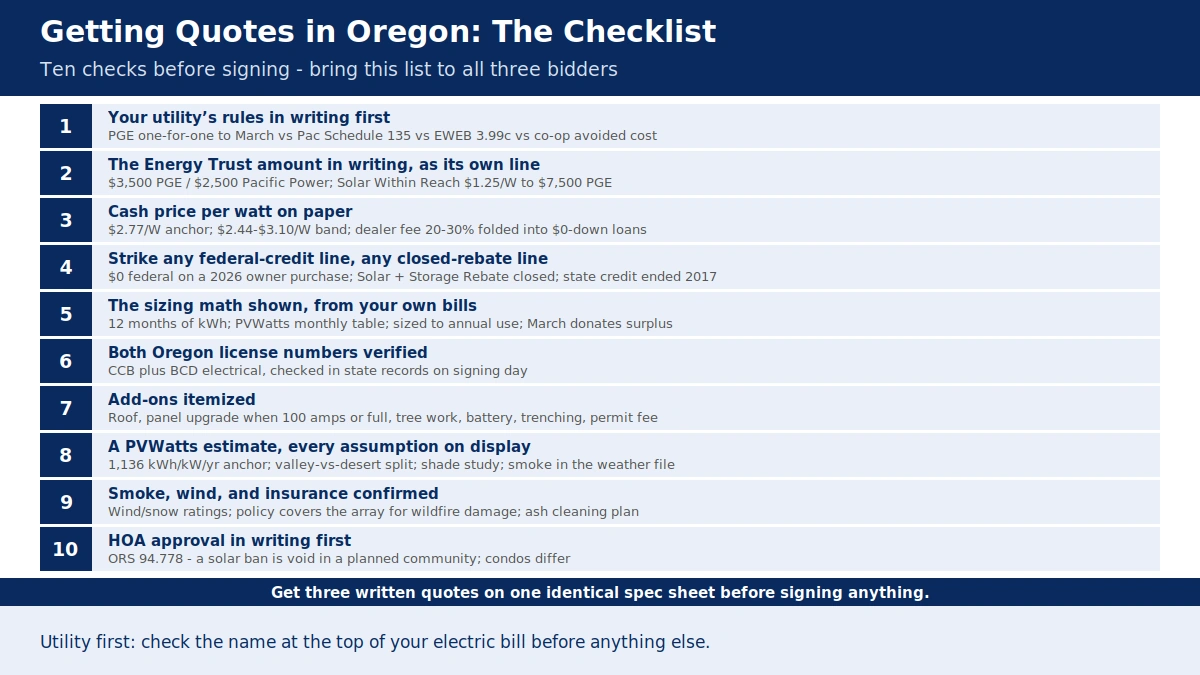
These ten checks run in the order that saves the most money. Print this section, hand it to each installer, and compare the three answers side by side on one identical spec sheet.
- Your utility’s rules in writing first. PGE’s one-for-one credits to the March bill, Pacific Power’s Schedule 135, EWEB’s 3.99 cents, or your co-op’s avoided-cost rate. The gap between them is worth five years of payback at PGE versus Pacific Power and more than twenty at EWEB. A roof priced on the state average instead of your utility’s tariff is priced for someone else’s house.
- The Energy Trust amount in writing, as its own line. $3,500 at PGE, $2,500 at Pacific Power, or the Solar Within Reach per-watt amount if you qualify, plus the trade ally status that makes it real. A contractor outside the trade ally network earns you $0, and an incentive folded into a lump sum cannot be checked.
- Cash price per watt on paper. $2.77 a watt is the anchor; $2.44 to $3.10 is the band. Dealer fees of 20% to 30% folded into a $0-down loan are invisible until the cash price sits next to the financed price, so get both, and judge the job on the cash number.
- Strike any federal-credit line and any closed-rebate line. $0 federal on a 2026 owner purchase; the Oregon Solar + Storage Rebate closed when its $1.1 million was fully reserved; the state income-tax credit ended in 2017. Any quote showing any of the three is out of date, and the correction belongs in writing.
- The sizing math shown, from your own bills. Twelve months of kilowatt-hours, the PVWatts monthly table for your address, and a system sized to annual use, not to the roof, not to a round number, not to a future EV you have not bought. Credits left after the March bill are given away, so every kilowatt past annual use earns nothing.
- Both Oregon license numbers verified. The CCB number and the BCD electrical license, checked in state records on the day you sign, with the names matched to the company on the quote. A&R Solar, Earthlight, and Sunlight Solar are examples of verified licenses from October 2026, so verify yours the same way.
- Add-ons itemized. Roof work, panel upgrade when the panel is 100 amps or full, tree work, battery, trenching, and the interconnection timeline. The permit fee belongs on the quote as its own line. Insist on itemized lines instead of a lump sum.
- A PVWatts production estimate, with every assumption on display. The 1,136 kilowatt-hours per kilowatt statewide anchor, the valley-versus-desert split for your address, the shade study behind it, the temperature and soiling allowances, and the smoke season inside the weather file. A clear-sky model leaves real weather out.
- Smoke, wind, and insurance confirmed. Panels rated for the roof’s wind and snow exposure, the homeowners policy confirmed to cover the array for wildfire damage, and a cleaning plan for the ash that lands in August and stays until the October rain. Ask what the monitoring app should show during a smoke week, so a halved day does not look like a broken system.
- HOA approval in writing first. ORS 94.778 voids a solar ban in a planned community, and the association may still set reasonable rules on placement and appearance, so get the approval letter before ordering panels, even when the law is on your side. Condo owners should confirm the roof’s ownership first, because a common-element roof is a different negotiation.
Before you sign, have three installers quote the same spec sheet in writing. The cheapest quote in Oregon is rarely the cheapest system once the job is done, and the quote that wins usually priced your utility, your side of the Cascades, and your twelve months of bills.
What do solar panels cost in Oregon in 2026?
An Oregon install in 2026 averages $2.77 a watt on EcoGen’s September 2026 index, which puts the typical 8.00 kW system near $22,160, and quotes through the year generally fall between $2.44 and $3.10 a watt. A 6 kW home system lands near $16,620 at the EcoGen rate, while EnergySage’s marketplace average sits at $2.40 a watt on a much larger 12.18 kW system. A homeowner-owned system installed in 2026 earns a $0 federal credit, Oregon offers no state income-tax credit, and the money that lowers the invoice comes from Energy Trust of Oregon, $3,500 off for PGE customers and $2,500 off for Pacific Power customers, plus one-for-one net-metering credits that bank until the March bill.
How much power will solar panels make on my Oregon roof?
It depends which side of the Cascades the roof sits on. Statewide, each kilowatt of panels makes about 1,136 kilowatt-hours a year, so the typical 8 kW system makes about 9,088 kilowatt-hours, roughly 90% of an average Oregon home’s annual use. A Willamette Valley roof makes less, around 1,050–1,100 kilowatt-hours per kilowatt on an interpolation from Portland’s 4.06 peak sun hours a day, while a Bend roof in the high desert makes roughly 1,500 kilowatt-hours per kilowatt on a PVWatts run, about a third more, and July is the best month at 7.17 peak sun hours statewide, so ask the installer for the PVWatts monthly table for your address before you sign.
Does wildfire smoke ruin solar panels in Oregon?
No, smoke trims output without ruining the panels. Peer-reviewed modeling of the 2023 Canadian wildfire season put Oregon’s solar production loss at about 1.2% over the five-month smoke period, a small line in a 25-year payback, while during a heavy smoke week daily output can fall by half or more, because smoke scatters sunlight the way cloud does, and farm-scale reports have recorded reductions up to 70% in severe smoke. Ash left on the glass can cost another 5–15% until rain or a wash removes it, and Oregon’s fire season lands on the year’s best production weeks, so a smoky August takes a bite out of the year’s best month, while the March true-up softens the blow, because credits banked in June and July are already in the account before the smoke arrives.
How does net metering work in Oregon?
Oregon law (ORS 757.300) requires every utility in the state to offer net metering to home systems up to 25 kW. For PGE and Pacific Power customers, every kilowatt-hour exported earns one kilowatt-hour of credit at full retail value, rolling month to month for twelve months, and the annual cycle ends with the March billing period, when any credits left unused go to the utility’s low-income assistance program and the customer is paid $0 for them. Co-op, municipal, and PUD customers get different terms set by their own utility, and the export value is often a few cents: EWEB pays 3.99 cents a kilowatt-hour, Central Electric Cooperative 4.68 cents, Idaho Power 2.9019 cents from October to May, so size the system to your last twelve months of use, because anything past annual use is donated every March.
What does Energy Trust of Oregon pay toward home solar?
Energy Trust pays the approved trade-ally contractor, who deducts it from the invoice, so the homeowner never sees a check. Solar for Homes pays $3,500 flat per home for PGE customers and $2,500 flat for Pacific Power customers, for systems of 2 kW-DC or more, and the PGE amount rose from $2,500 on August 4, 2026, while Solar Within Reach, the income-qualified program, pays $1.25 a watt up to $7,500 at PGE and $0.75 a watt up to $4,750 at Pacific Power, replacing the flat amount. Batteries paired with solar earn $400 a kilowatt-hour up to $5,000 at PGE and $240 up to $3,000 at Pacific Power, and Energy Trust serves PGE and Pacific Power customers only, so EWEB, co-op, and PUD customers get nothing from it and should look to their own utility’s smaller programs instead.
Is the 30% federal solar tax credit still available to Oregon homeowners in 2026?
The credit is gone for systems you buy yourself: Public Law 119-21, the One Big Beautiful Bill Act, ended the Residential Clean Energy Credit (§25D, 30%) for any system placed in service after December 31, 2025, and the finish date of the installation is what decides it. The one federal route left runs through a lease or power purchase agreement, where the company owns the system, claims the commercial §48E credit for systems in service by December 31, 2027, and passes savings through as lower monthly payments, and no Oregon-specific lease market survey was verified, so demand a written offer naming the payment, the escalator, the buyout, and who keeps the Energy Trust incentive before counting on it. HEAR rebates of up to $8,000 exist for income-qualified households, but they do not pay for solar, and no HEAR rebate is available today, since Oregon’s program opens for applications in early 2027.
Why is solar payback about 15 years in Oregon?
The tariff decides the payback more than the price or the sun. The price sits below the national average at $2.77 a watt, and the sun delivers about 1,136 kilowatt-hours a year per installed kilowatt, split by the Cascades into a cloudier valley and a sunnier desert, while PGE values each kilowatt-hour at 16.69 cents, so the typical system pays back in about 14.6 years before incentives and about 12.3 years after the $3,500 Energy Trust amount, and Pacific Power values it at 12.72 cents and stretches payback to about 19.2 years before incentives and about 17.0 years after $2,500. At EWEB, where exports earn 3.99 cents, payback runs 32.2 to 41.9 years, the statewide simple payback lands near 16.2 years before incentives, and rising electricity rates shorten every figure a little each year.
Should I join community solar instead of putting panels on my roof?
For some Oregon households, yes. The Oregon Community Solar Program lets PGE, Pacific Power, and Idaho Power customers subscribe to a shared solar project and earn bill credits with no roof, no upfront cost, and no equipment to maintain, so choose it if you rent, if your roof is shaded or faces north, if you will move before a rooftop system pays back, or if you are an EWEB customer facing a 37-year rooftop payback. Choose the roof if you will stay past payback on a sound, south-facing roof, you are a PGE or Pacific Power customer, and you want the full 25-year return plus the Energy Trust money, and Portland homeowners with income at or below 80% of area median income have a third option: the Portland Solar Access Program installs solar at no cost, with funding for about 1,000 households through 2029.