


Connecticut still heats with oil. About 36 percent of homes in the state burn oil as their main heat, and among detached single-family homes the share reaches 50 percent, with a boiler in the basement and radiators or baseboard along the walls.
In November 2026 that habit turned expensive fast: heating oil averaged $5.67 a gallon in Connecticut for the week ending November 9, up from $3.68 the same week a year earlier, and the winter before had averaged $3.95. A household that burns 332 gallons a season watched its fuel bill climb from about $1,311 to about $1,882 on the same house and the same winter.
The rebate waiting on the other side of that bill is the richest heat pump rebate in the country this year. Energize CT pays $1,500 for every ton of cooling capacity when a qualifying cold-climate heat pump takes over as the main heat source from oil, propane, gas, or electric resistance heat, capped at $10,000 per home. The money comes with strict conditions: the equipment must sit on the Energize CT Qualified Product List, the installer must belong to the Heat Pump Installer Network, and the home must take electric service from Eversource or United Illuminating.
Miss one condition and the same install falls to $250 a ton. The rebate section spells out every condition, because the gap between the tiers is $3,750 on a 3-ton system.
The third fact shapes everything else. Connecticut power averaged 27.4 cents a kilowatt-hour over the 12 months to August 2026, the seventh highest price in the country, and United Illuminating territory runs higher still. At that price a heat pump cannot beat cheap piped gas on heating.
It beats oil, propane, and resistance heat by clear margins. For most Connecticut buyers, the deciding question is which fuel the household is leaving, and what the house needs before a heat pump can take over.
Start with the countrywide picture: our national heat pump cost guide sets the baseline, and Connecticut sits above it on price, above it on power rates, and far above it on rebate value.
Table of Contents
How Much Does a Heat Pump Cost in Connecticut in 2026?
Four kinds of evidence price the Connecticut market in 2026, and they measure different jobs, which explains most of the spread a buyer sees. NumeralQ publishes planning estimates from a national cost model adjusted for Connecticut labor: a 3-ton ducted air-source system at $7,130–$11,710 statewide, with Hartford priced separately at $7,110–$11,690. Trydun models Connecticut from federal wage data and equipment pricing at $7,650–$14,150 for a ducted system, a band that overlaps the top half of the NumeralQ range.
Connecticut contractor guides quote wider, higher bands: ducted cold-climate systems at $14,000–$25,000, ductless zones at $4,500–$7,500 each, and whole-house ductless at $15,000–$30,000. The first two are models. The third is what contractors report charging for cold-climate equipment in boiler houses with no ducts, in a state where labor runs 25 percent above the national median.
The statewide NumeralQ band leads here: it names the machine, the size, and the scope, and NumeralQ calls it a planning estimate rather than dressing it as a record of paid invoices. Its midpoint, about $9,420, anchors the payback arithmetic later in the article.
A heat pump’s capacity is rated in tons, with one ton equal to 12,000 BTU an hour, and 3 tons is the size most Connecticut homes land on. The band covers crew labor, permits, startup and commissioning, and the hardware itself: the outdoor unit, the indoor coil or air handler, the lineset, the pad or stand, the disconnect and wiring, and the thermostat.
The expensive half of a Connecticut job often sits outside that band. New or extended ductwork runs $4,860–$7,970 a job in Hartford, and a 200-amp panel upgrade runs $2,520–$3,880, both NumeralQ planning figures. A boiler house adds its own lines: boiler removal, oil tank decommissioning, new duct runs through a house that never had them, and a raised stand for snow.
No published Connecticut price covers tank removal, snow stands, hail guards, or surge protection, and none is stated here. Ask for each as its own line on the quote, and treat a single lump sum that hides them as unfinished homework.
The contractor bands deserve a fair reading rather than dismissal. A cold-climate ducted machine costs more than the standard ducted unit in the headline band. Connecticut buyers have strong reasons to pick it: the rebate requires cold-climate certification, and the design temperature sits at 7 degrees in Hartford and New Haven.
A boiler house with radiators needs ducts or ductless heads added to a house built without either, and that work lands on the same invoice. Fairfield County labor and permitting run above the state average, and Stamford and Greenwich quotes show it. Line the bids up on a single identical job, with the same model, the same house, and the same backup-heat arrangement, every line in writing, and only the rebate the home truly qualifies for already deducted.
Start from the gross price on every quote. The $4,500 rebate on a 3-ton fuel-switch install is real money, but it arrives only when the equipment, the installer, the utility, and the install date all line up, and the federal government contributes $0 to a 2026 install.
Subtracting the rebate before proving eligibility, or subtracting a federal credit that ended on December 31, 2025, makes a quote impossible to compare with one that prices the job straight. Get three written quotes from licensed contractors on one identical spec sheet, and drop any bidder who refuses to name the model number, publish its SEER2 and HSPF2 ratings, and show the Manual J calculation behind the size.
| Source | 3-ton ducted | Single-zone mini-split | Geothermal |
|---|---|---|---|
| NumeralQ CT (Oct 2026, planning est.) | $7,130–$11,710 | $3,520–$5,400 | $21,480–$33,500 |
| NumeralQ Hartford (Oct 2026, planning est.) | $7,110–$11,690 | $3,510–$5,390 | $21,440–$33,450 |
| Trydun CT (Aug 2026, modeled) | $7,650–$14,150 | Not published | Not published |
| CT contractor guides (2026) | $14,000–$25,000 cold-climate ducted | $4,500–$7,500 per zone | Not published |
| NumeralQ HVAC replacement CT (Oct 2026) | $8,950–$14,900 (furnace + AC) | $3,520–$5,400 (state mini-split) | Not published |
Read two rows of that table with care. The Trydun band is modeled from wage statistics and equipment prices, not collected from Connecticut invoices, and its top end reaches past the NumeralQ band because it prices a broader mix of jobs.
The contractor bands price cold-climate equipment and boiler-house scope that the planning estimates treat as add-ons, so they sit higher by design rather than by error. The furnace-plus-air-conditioner row is the comparator that decides whether the heat pump carries a premium at all, and the payback section prices that comparison in full.
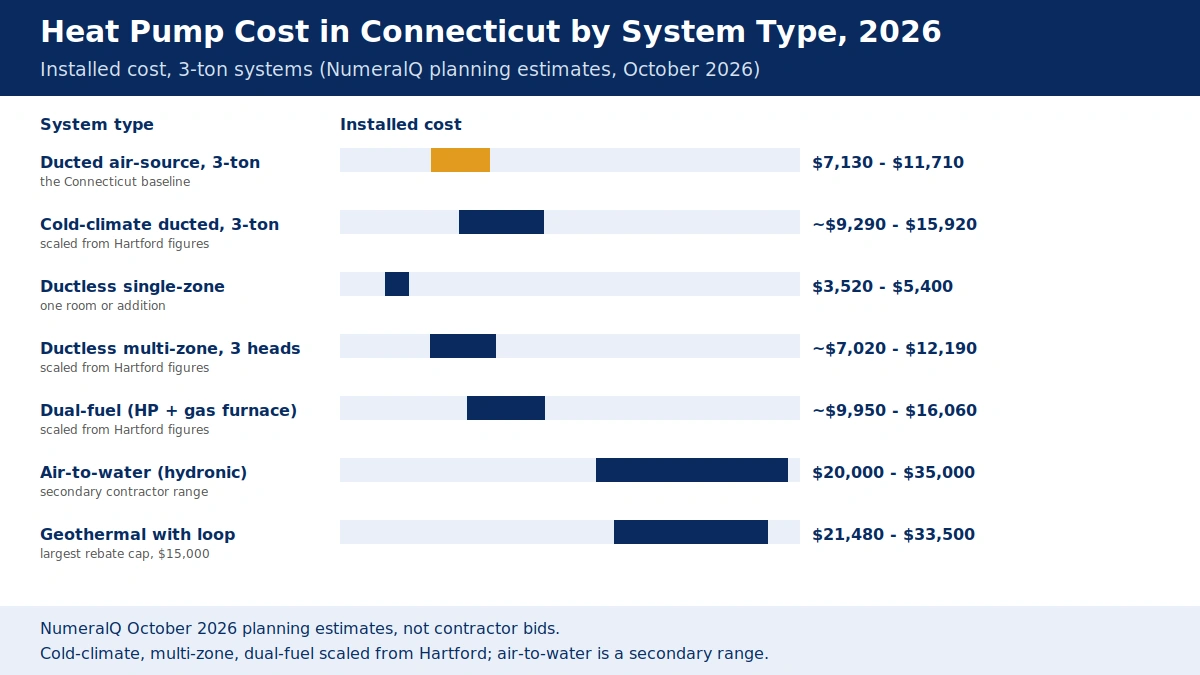
Heat Pump Cost in Connecticut by System Type
The words ‘heat pump’ hide six different machines in Connecticut, with the dearest costing more than six times the cheapest. The house usually settles the choice before the buyer does: a Hartford colonial with ducts in the attic, a New Haven triple-decker with radiators and no duct chases, a Stamford split-level on a slab, a Litchfield County farmhouse on propane with no gas main for miles, a shoreline cottage on a small lot with salt in the air. Each house points toward its own machine, with its own price, its own rebate, and its own January behavior.
| System type | Installed cost (CT) | Best for in Connecticut |
|---|---|---|
| Ducted air-source (3-ton) | $7,130–$11,710 | Whole-home heat + cooling with ducts; the baseline buy |
| Ducted cold-climate (3-ton) | ~$9,290–$15,920 (scaled) | Nearly every CT home; the machine the rebate requires |
| Ductless mini-split, single zone | $3,520–$5,400 | One room, addition, or a house with no ducts |
| Ductless multi-zone (3 heads) | ~$7,020–$12,190 (scaled) | Whole-home without ducts; zone-by-zone control |
| Dual-fuel (heat pump + gas furnace) | ~$9,950–$16,060 (scaled) | Gas-heated home keeping the furnace for cold snaps |
| Air-to-water (hydronic) | $20,000–$35,000 (secondary) | Boiler house keeping radiators or baseboard |
| Geothermal, ground-source with loop | $21,480–$33,500 | Long-term owner, big lot; earns the largest rebate cap |
Ducted air-source is the baseline buy, and in Connecticut it is rarely the final buy. A standard ducted unit works with the ducts already in the house, heats and cools from a single box, and, at $7,130–$11,710 for a 3-ton job, undercuts every other whole-home option on the table. SEER2 measures seasonal cooling efficiency, and HSPF2 measures seasonal heating efficiency, and a standard unit clears the federal minimums of 14.3 SEER2 and 7.5 HSPF2 without drama.
The catch is the rebate: Energize CT’s fuel-switch tier requires ENERGY STAR Cold Climate certification, and a standard unit that misses that bar leaves $4,500 on the table. Price the standard unit and the cold-climate unit side by side, net of the rebate each one earns, before calling the standard unit cheaper.
Cold-climate ducted is the Connecticut default in practice, even though it costs more. The scaled statewide band runs about $9,290–$15,920 against $7,130–$11,710 for the standard ducted 3-ton, scaled from the Hartford figures of $9,270–$15,890 by the statewide-to-Hartford midpoint ratio. The premium buys capacity at 5 degrees: a cold-climate unit keeps at least 70 percent of its rated heating capacity at 5 degrees with a COP of at least 1.75, while a standard unit keeps 40 to 60 percent.
COP stands for coefficient of performance, the units of heat delivered for each unit of electricity used, so a COP of 1.75 means 1.75 units of heat per unit of power. Hartford and New Haven design for 7 degrees, and January nights fall below 25 degrees on average, so the capacity at 5 degrees is the rating that decides whether the house stays warm on the coldest nights without leaning on backup heat.
Ductless mini-splits were built to retrofit the houses Connecticut has the most of. Mini-splits suit radiator houses, triple-deckers, and colonials with no duct chases. They also suit additions, finished attics, and garage bonus rooms that ducts never reached and that overheat every July afternoon. Statewide, one zone runs $3,520–$5,400 and serves a single room or an open-plan area.
The outdoor unit sits on a wall bracket or a pad, the head mounts on the wall, and a single small hole carries the lineset through. Three heads, at about $7,020–$12,190, serve a whole small home with a thermostat per zone. Bedrooms can sleep cool while the living room holds its temperature.
The limit is coverage. One head serves one room, so a four-bedroom colonial with a single living-room head still leaves its bedrooms unheated in January and uncooled in July. Zone-by-zone pricing lives in our mini-split installation guide, and the ducts-or-no-ducts choice gets a room-by-room treatment in our ductless versus ducted guide.
Dual-fuel fits the gas-heated third of the state. One house, two machines: the heat pump runs until the outdoor temperature drops past the installer’s switchover setting, and the furnace takes over from there. The heat pump handles the mild weather, where it runs well, and the furnace handles the cold snaps, where piped gas at $1.78 a therm beats even a good heat pump. The scaled band runs about $9,950–$16,060 for a 3-ton system, heat pump plus furnace plus controls, scaled from the Hartford dual-fuel figure of $9,930–$16,030.
The rebate math needs care: a dual-fuel install that keeps the furnace as backup may qualify for the fuel-switch tier only with a qualified integrated control, and without one it drops to the $250-a-ton tier. Our dual-fuel heat pump guide covers controls, switchover settings, and furnace behavior on cold nights in full.
Air-to-water is the niche answer for a boiler house that wants to keep its radiators. An air-to-water heat pump heats water instead of air, feeding the radiators or baseboard the house already has, so no ducts go in and no heads go on the walls. Contractor guides put the installed range at $20,000–$35,000, a secondary figure flagged as such, and the machine qualifies for the same Energize CT fuel-switch tier when it sits on the Qualified Product List.
Radiators sized for 180-degree boiler water run cooler on heat pump water, so some rooms need larger emitters or a backup source on the coldest days. Price it only from a contractor who has installed air-to-water in Connecticut boiler houses before, and ask for the water temperatures and the backup plan in writing.
Geothermal is the only system whose winter efficiency barely notices the weather, and the only one with a $15,000 rebate cap. Below a Connecticut lawn, the soil holds near 50 degrees through the year, so a ground-source unit pulls heat from stable ground on a 7-degree Hartford night while an air-source unit works against cold air. NumeralQ’s Connecticut installed range is $21,480–$33,500 with the loop. Loop type sets the price.
Horizontal trenches suit open lots, vertical bores suit tight ones, and Connecticut’s rocky soil and small coastal lots push many installs toward bores. The federal 30 percent credit that once softened the price is $0 for a 2026 homeowner-owned install, but Energize CT pays $1,500 a ton up to $15,000 for a qualifying ground-source system, and geothermal equipment and installation are exempt from Connecticut sales tax. Loop types, tight-lot boring, and twenty-year costs all get full treatment in our geothermal heat pump guide.
A last setup deserves its own paragraph: a mini-split or two added to a home that keeps its boiler or furnace. Placed with sense, the heads go where the household spends its hours: the living room, the home office, the main bedroom. The heads carry the mild months, the old system waits for the cold snaps, and the house gains cooling for July. At $3,520–$5,400, the first zone is the cheapest way into a heat pump in Connecticut.
One head cannot carry a whole home. A house with a single living-room head still wakes to cold bedrooms in January and warm bedrooms in July.
No bidder should promise whole-home comfort from a single head. The machine behind the promise is too small for the house.
Heat Pump Cost by Home Size
System type settled, the next decision is size, and in Connecticut the heating load governs it. A machine sized too small leans on resistance backup heat all through the coldest weeks, at 27.4 cents a kilowatt-hour, and the January bill shows it. An oversized machine short-cycles through humid July weather, shutting off before it has pulled moisture from the air, so the house feels cool and clammy at once, and the extra capacity it was bought for goes unused.
The right size comes from one document only: a Manual J load calculation, room by room, at the design temperature, and the design temperature in Hartford and New Haven is 7 degrees. Neither floor area nor the outgoing unit’s size can set the load figure, and only the Manual J can.
The tonnage table below prices ducted air-source systems from the NumeralQ anchors. The state page publishes all seven rows in its by-size table, a fuller set than the single anchored row plus scaling that other states get.
In Connecticut the heating load is the larger one: a 2,000-square-foot Hartford house commonly lands on a 3-ton system for cooling but needs its heating capacity checked against a 7-degree night, where the same house in a mild climate would take a smaller machine. The design temperature sits about 63 degrees below room temperature, and the January heating load does the real work.
| System size | Home size (approx.) | Ducted air-source (CT) |
|---|---|---|
| 1.5 ton | 600–1,000 sq ft | $4,890–$7,710 |
| 2 ton | 1,000–1,400 sq ft | $5,640–$9,040 |
| 2.5 ton | 1,400–1,700 sq ft | $6,380–$10,380 |
| 3 ton | 1,700–2,100 sq ft | $7,130–$11,710 |
| 3.5 ton | 2,100–2,400 sq ft | $7,870–$13,040 |
| 4 ton | 2,100–2,700 sq ft | $8,620–$14,370 |
| 5 ton | 2,700–3,500 sq ft | $10,100–$17,040 |
A single NumeralQ estimator run in October 2026 produced all seven rows, which keeps the table internally consistent, even though every row remains a planning estimate rather than a contractor bid, with the home-size column only a rough guide. Moving up one tonnage step adds roughly $700–$800 at the bottom of each band and $1,300–$1,700 at the top. Most Connecticut homes settle on the 3-ton row.
Every row is a planning estimate, and none reports a price a Connecticut household actually paid. The table’s real value is the shape of the choice: one ton too many costs roughly a thousand dollars at purchase, then takes comfort away every humid summer that follows.
Three cautions qualify everything in that table. First, treat the home-size column as a rough guide, and a rougher one in Connecticut than elsewhere, because about 41 percent of the housing was built before 1960 and the stock runs from 1920s New Haven triple-deckers with no wall insulation to slab-on-grade Stamford split-levels to new subdivisions built tight.
Airtight construction can shift the answer by a full ton. A well-insulated 2,000-square-foot house from 2020 can heat with a ton less capacity than a drafty 1950s colonial of the same floor area, where single-pane windows, bare walls, and attic ducts all add load.
The house itself sets the size: age, insulation, glazing, air leakage, ceiling height, and, above everything else, duct location. Second, the heating load rules in Connecticut, so sizing from the old air conditioner sizes for the wrong season. A system chosen for July alone will lean on backup heat through the coldest weeks, while a system chosen for January alone without a variable-speed compressor will short-cycle through the humidity.
The Manual J must calculate the heating load and the cooling load as separate figures, and the quote must show both. Third, size the backup heat in the same conversation as the heat pump, rather than bolting it on after the equipment is chosen. Whatever provides backup, strips, a kept boiler, or a kept furnace, must carry the full design load alone on the coldest night, when the heat pump contributes its least.
In Connecticut that night is a 7-degree Hartford cold snap with the wind off the northwest hills. A bid that prices the heat pump and leaves backup heat open has skipped the part that keeps the house warm on the nights that test it most.
Look hardest at the 3-ton row, since most Connecticut homes land on it and the payback figures below anchor to it. Where a bid lands inside that $7,130–$11,710 band comes down to brand and efficiency tier. The bottom of the band holds the value-tier standard machine, near SEER2 15 and HSPF2 7.8.
The top holds the premium variable-speed cold-climate machine, above SEER2 20 and HSPF2 10, inside the scaled $9,290–$15,920 cold-climate band. Across a Hartford winter of roughly 5,883 heating degree days, the premium tier repays itself faster than in a mild state, because the heating season is long and the cold weeks are real.
A tight budget still buys a value-tier standard unit that beats resistance heat by a wide margin and cools the house well, but it may miss the rebate that makes the premium tier cheaper net. Spend the money where Connecticut rewards it: a right-sized variable-speed machine running long and slow, with the cold-climate rating that earns the $4,500, beats an oversized single-stage unit that short-cycles through July.
Heat Pump Cost by City: Hartford, New Haven, Stamford & Bridgeport
Connecticut is a small state with one priced market and three estimated ones. NumeralQ prices Hartford only, so Hartford carries the one verified city band in this article, and the New Haven, Stamford, and Bridgeport figures apply the state band as planning estimates, flagged as such.
Labor barely moves between the cities at the state level, but Fairfield County quotes run higher, the utility territory flips between Eversource and United Illuminating along the shore, and the design temperature rises from 7 degrees inland to 9 degrees on the coast. The cities differ on rebate territory, fuel mix, housing stock, and distance from the water, not on the headline band.
| City | 3-ton ducted air-source | Electric utility | Design temp |
|---|---|---|---|
| Hartford | $7,110–$11,690 (NumeralQ) | Eversource | 7 F |
| New Haven | ~$7,130–$11,710 (planning est.) | United Illuminating | 7 F |
| Stamford | ~$7,130–$11,710 (planning est.) | Eversource | ~9 F (planning est.) |
| Bridgeport | ~$7,130–$11,710 (planning est.) | United Illuminating | 9 F |
Hartford is the capital, the largest inland metro, and the only verified figure, at $7,110–$11,690 for a 3-ton ducted system. Hartford is Eversource territory, so the Energize CT rebate runs through Eversource’s Heat Pump Installer Network roster. Housing stock shapes the Hartford job.
Multi-unit buildings hold 79 percent of the city’s housing units, so many installs answer to a condo association that sets equipment locations and approves contractors, and 64 percent of Hartford homes heat with piped gas against 24 percent with electricity. The labor figure underlines the cost level: Hartford HVAC technicians earn a median $36.63 an hour, and contractors bill $73–$95 a worker-hour.
The permit adds about $383 on a $12,000 install, the highest HVAC permit cost among the 35 cities NumeralQ priced. The climate figure underlines the heating load: about 121 freezing nights a year, 2 nights at or below zero, and a 7-degree design temperature that makes the cold-climate rating worth buying.
New Haven is the second city, a UI city on the shore, and its figure is the state band applied as a planning estimate, not a published city price. New Haven is where the power price bites hardest: United Illuminating’s estimated 2026 all-in rate runs near 32.5 cents a kilowatt-hour, against about 27.2 cents for Eversource, on EIA Form 861 figures adjusted for the statewide change, so a New Haven heat pump’s running cost needs modeling at the UI rate rather than the state average. The housing stock is older than Hartford’s in its core: triple-deckers and Victorians with radiators, many without a duct chase to be found, so mini-splits fit many New Haven houses.
Yale University anchors the local economy and the rental stock. Treat the state band as a starting point for New Haven, and let three local quotes set the budget. House variables and the UI rate move the real figure further than any city average.
Stamford is the Fairfield County city, an Eversource city on the coast, and its figure is also the state band applied as a planning estimate. Stamford is the city where the statewide band faces the most upward pressure: Fairfield County labor, permitting, and living costs run above the state average, and Connecticut contractor guides quote cold-climate ducted systems at $14,000–$25,000. The design temperature is about 9 degrees as a planning estimate, matching coastal Bridgeport, two degrees milder than Hartford, and the coastal air brings salt exposure that inland quotes never mention.
The housing stock mixes post-war split-levels, 1960s colonials, and newer construction near the Metro-North line. A Stamford buyer who budgets the state band and meets a Fairfield County quote should compare the two line by line before concluding the quote is padded: the labor line, not the equipment line, usually explains the gap.
Bridgeport is the largest city by population, a UI city on Long Island Sound, and its figure is the state band applied as a planning estimate. Bridgeport shares New Haven’s UI rate pressure and its older housing: industrial-era two-family and three-family homes, many on small lots where a ground loop will not fit and a vertical bore is the only geothermal option. The design temperature is 9 degrees, the mildest of the four cities, and the coastal position softens the cold snaps that test Hartford.
Bridgeport is also where the flood question belongs on the quote: shoreline and harbor-adjacent streets need the outdoor unit raised above flood water, and the elevation work lands on the install invoice. As in New Haven, the UI rate means the running-cost math must use the local rate, and the rebate still runs through the same Energize CT program, because eligibility keys off Eversource or UI electric service and UI qualifies.

Connecticut Cold Decides the Machine: What Cold-Climate Ratings Mean
Connecticut winters run long and damp, broken by sharp cold snaps, rather than settling into steady deep cold. January averages a low of 22 degrees in Hartford, with about 121 nights a year at or below freezing. Hartford counts about 5,883 heating degree days a year against 819 cooling degree days, so the heating season outweighs the cooling season by more than seven to one.
A heat pump in Connecticut is a heating machine that happens to cool, and the sizing, the rating, and the rebate all follow from that order. The cooling load still matters in July, when humidity rides in off the Sound, but no Connecticut buyer should size a system for July and hope January takes care of itself.
Cold-climate status comes from tested ratings with published thresholds. ENERGY STAR Cold Climate certification requires a COP of at least 1.75 at 5 degrees, at least 70 percent of the unit’s 47-degree heating capacity at 5 degrees, and efficiency floors of 8.1 HSPF2 for ducted systems and 8.5 HSPF2 for non-ducted systems. The Northeast Energy Efficiency Partnerships, known as NEEP, runs a parallel cold-climate product list with the same 1.75 COP bar at 5 degrees at maximum capacity, a variable-capacity compressor requirement, and published capacity figures at 5 degrees so buyers can judge the machine themselves.
A standard unit at 5 degrees keeps 40 to 60 percent of its rated capacity, which means it delivers barely half its rated heat on a night Hartford sees most winters. A cold-climate unit keeps 70 to 100 percent, and the best lines hold full rated output down to 5 degrees.
The rebate makes the rating a financial decision as well as a comfort decision. Energize CT’s fuel-switch tier requires ENERGY STAR Cold Climate certified equipment on the Qualified Product List, so a standard unit cannot earn the $1,500-a-ton rate at all. A buyer who saves $2,000 on a standard machine and forfeits $4,500 in rebate money has paid $2,500 for the privilege of a weaker machine.
That arithmetic flips the usual advice. In Connecticut, buyers should treat the cold-climate premium as the entry ticket to the rebate that funds the budget, rather than as an optional upgrade. Ask every bidder for the 5-degree capacity and COP in writing, from the manufacturer’s extended performance table, and strike any bid that quotes only the 47-degree rating.
Backup heat is the other half of the cold-climate conversation, and it needs deciding before signing, not after the first cold snap. Size the second source for the full design load, because the coldest night is when the heat pump has least to give. The options are electric resistance strips inside the air handler, a kept gas furnace in a dual-fuel setup, or a kept boiler feeding the radiators.
Resistance strips are cheap to install and dear to run, at 27.4 cents a kilowatt-hour, so they suit a house where the strips run a few nights a year and punish a house where they run for weeks. A kept boiler or furnace costs more to integrate, needs the controls to hand over cleanly, and affects the rebate tier through the integrated-controls rule. Either way, the backup source, its capacity, and its switchover temperature belong on the quote as named lines, not as a verbal promise.
Two more details belong in this section because buyers meet them on the spec sheet. The refrigerant in 2026 systems is R-454B or R-32: federal rules phased R-410A out of new home systems starting in 2025, so ask which refrigerant each quote uses and confirm the installer holds the federal EPA Section 608 certification for handling it.
And the summer half of the year still rewards the variable-speed compressor that cold-climate units carry: a unit running long and slow at part load pulls humidity from the air that a single-stage unit leaves behind, and a Connecticut July with the windows shut is a humidity problem as much as a temperature problem. The same machine that holds capacity at 5 degrees is the machine that keeps the house dry at 9 p.m. in July.
Switching From Oil Heat: The Boiler House, the Tank, and the Ducts
The typical Connecticut oil house is a boiler house. Boilers heat 46 percent of Connecticut homes and 53 percent of detached single-family homes, and 56 percent of those boilers burn fuel oil. The boiler sits in the basement, hot water runs to radiators or baseboard, and the house has no ducts at all, because the house was built before air conditioning and never needed them.
Fitting a heat pump to that house means ducts or heads where none exist, a decision on the boiler, and a plan for the oil tank. Choosing the equipment is quick, and fitting it to a boiler house is where the work sits.
The oil price spike gives the switch its urgency and its risk in equal measure. At $5.67 a gallon, the planning home’s oil bill runs about $1,882 a year through an 87 percent efficient boiler, and the heat pump at a seasonal COP of 2.5 beats it by about $597 a year. At last winter’s average of $3.95 a gallon, the same oil bill runs about $1,311, and the heat pump’s edge shrinks to about $26 a year.
Both figures are real, both are dated, and neither is a forecast: oil has swung nearly $2 a gallon within a single season before, and the Energy Information Administration’s October 2026 Winter Fuels Outlook expects oil households to spend about 21 percent more this winter than last, on fuel prices assumed 34 percent higher. A buyer who switches on the $5.67 figure alone should know what the math looks like at $3.95, and a buyer who waits for oil to fall should know what another winter at $5.67 costs. The running-cost section shows both.
Four routes fit a boiler house, and the house picks among them. Ductless heads put heat and cooling in the rooms people use, need no ducts, and leave the boiler in place for the coldest nights, at $3,520–$5,400 for the first zone. New ductwork turns the boiler house into a ducted house, at $4,860–$7,970 a job in Hartford, and buys whole-home comfort from one system.
An air-to-water heat pump feeds the radiators the house already has, at a secondary contractor range of $20,000–$35,000, and suits a house whose radiators can run on cooler water. Keeping the boiler as backup in a dual-fuel arrangement preserves the radiators for cold snaps and lets the heat pump own the mild months. Each route carries a different rebate consequence, because the fuel-switch tier pays the full rate when the heat pump takes over as the main heat source, and a kept boiler without a qualified integrated control drops the project to the $250-a-ton tier.
The oil tank needs its own line on the plan, and its own check with the town. An above-ground tank in the basement is usually removed when the boiler goes, and an underground tank raises soil and environmental questions that vary by town and by tank age. No published Connecticut price covers tank removal or decommissioning, and none is stated here.
Ask the contractor whether tank work is included, excluded, or subcontracted, and ask the town building office whether a permit or an inspection applies. A tank left full and forgotten is a liability that outlives the boiler, and a tank removed without the right paperwork is a problem at resale. Either way, the tank decision belongs in the written scope before the boiler decision is final.
Order the work in the right sequence. Insulation and air sealing come first, because a leaky house needs a bigger machine and burns more of every fuel, and Energize CT’s Home Energy Solutions program offers subsidized home energy visits that find the leaks. The Manual J comes second, sized for the house after sealing rather than before it.
The boiler decision comes third, with the rebate tier confirmed in writing for the exact arrangement: full replacement, or kept boiler with a qualified integrated control. A buyer who signs for equipment before the sealing and the load calculation has bought a machine for a house that no longer exists, or for loads that were never measured. Rebate paperwork follows the sequence, so let the sealing and the load calculation finish before the equipment contract is signed.
Heat Pump vs Oil, Propane, and Gas in Connecticut: The Running-Cost Math
Connecticut is the state where the fuel a household leaves decides the verdict more than the machine it buys. Power is dear, gas is dear, oil is dearer than it was a year ago, and propane is the dearest of all per unit of heat. A heat pump that beats one fuel by hundreds of dollars a year loses to another by hundreds, in the same house, at the same efficiency.
Understanding that split before signing prevents disappointment later. A promise of savings against every fuel should raise questions, not confidence.
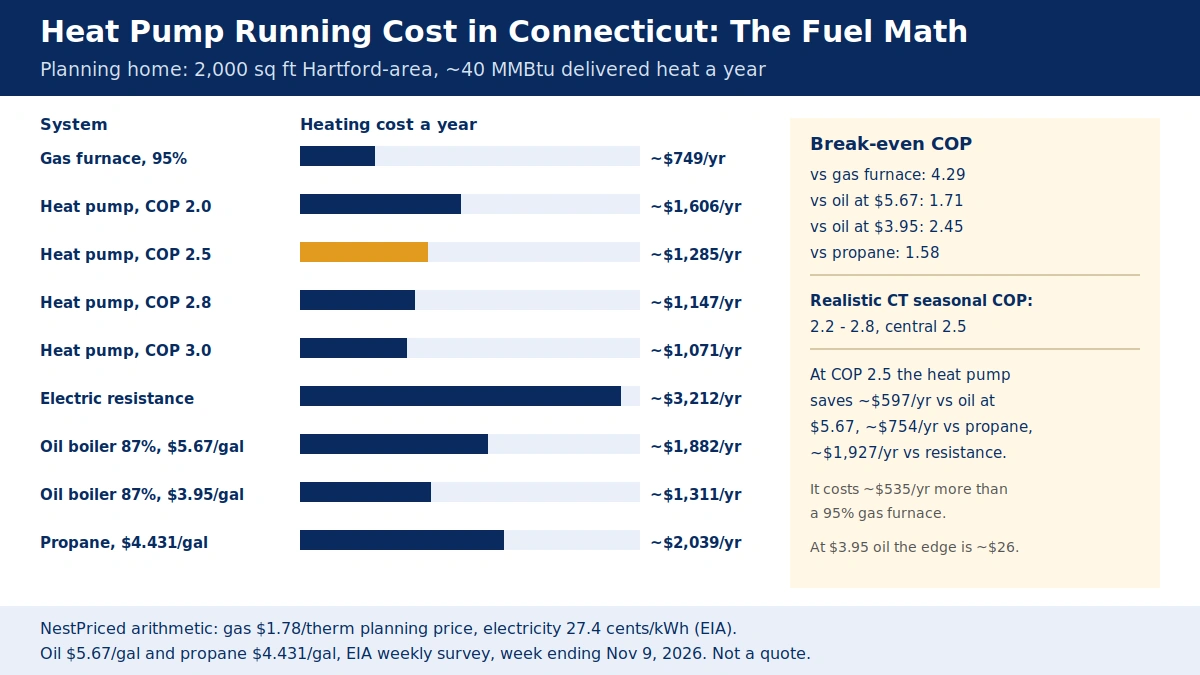
The sums below model a 2,000-square-foot Hartford-area house that needs about 40 MMBtu of delivered heat across the year. MMBtu means a million BTU, and BTU is a unit of heat, so the planning home needs 40 million BTU of heat delivered into its rooms across the season. These sums rest on stated assumptions throughout, and no single figure here is a household’s actual bill: electricity at 27.4 cents a kilowatt-hour, gas at $1.78 a therm through a 95 percent efficient furnace, oil at $5.67 a gallon through an 87 percent efficient boiler, and propane at $4.431 a gallon through a 95 percent efficient furnace.
AFUE measures the share of fuel turned into heat, so a 95 percent AFUE furnace turns 95 cents of each fuel dollar into heat and loses 5 cents up the flue. The seasonal COP planning range runs 2.2 to 2.8 with a central figure of 2.5, which reflects Connecticut’s long heating season and 7-degree design temperature.
| Heat source | Annual heating cost |
|---|---|
| Gas furnace, 95% AFUE (421 therms) | ~$749 |
| Heat pump, COP 2.0 (5,862 kWh) | ~$1,606 |
| Heat pump, COP 2.2 (5,329 kWh) | ~$1,460 |
| Heat pump, COP 2.5 (4,689 kWh) | ~$1,285 |
| Heat pump, COP 2.8 (4,187 kWh) | ~$1,147 |
| Heat pump, COP 3.0 (3,908 kWh) | ~$1,071 |
| Heat pump, COP 3.5 (3,350 kWh) | ~$918 |
| Electric resistance (11,723 kWh) | ~$3,212 |
| Oil boiler, 87% AFUE (332 gal at $5.67) | ~$1,882 |
| Oil boiler, 87% AFUE (332 gal at $3.95) | ~$1,311 |
| Oil boiler, 80% AFUE (361 gal at $5.67) | ~$2,047 |
| Propane furnace, 95% AFUE (460 gal at $4.431) | ~$2,039 |
Break-even COP marks the seasonal efficiency where the heat pump and a rival fuel cost the same to run. Connecticut’s break-evens tell the whole story in four numbers. Against gas the break-even COP is 4.29, a figure no air-source heat pump reaches across a whole Connecticut winter.
Against oil at $5.67 it is 1.71, which any working cold-climate heat pump clears without trying. Against propane it is 1.58, lower still.
Against oil at last winter’s $3.95 average it is 2.45, which sits inside the planning range and means the oil verdict flips with the oil price. Cost per MMBtu of delivered heat says the same thing another way: gas $18.74, heat pump at COP 2.5 $32.12, oil $47.06, propane $50.97, resistance heat $80.30.
At the central planning COP of 2.5, the heat pump costs about $1,285 a year against about $1,882 for oil, a saving of about $597 a year, and against about $2,039 for propane, a saving of about $754 a year. Against electric resistance heat the saving is about $1,927 a year, $3,212 against $1,285, which is the largest saving on the table and the one about 21 percent of Connecticut homes can collect. At COP 2.8 the savings grow: about $735 a year against oil and about $892 against propane.
At COP 2.0 they shrink: about $276 against oil and about $433 against propane, still savings, but thin ones. The tier and the install quality decide where in that range a house lands, and the difference between COP 2.0 and COP 2.8 is worth about $459 a year on the planning home.
Against gas the verdict runs the other way at every realistic efficiency. At COP 2.5 the heat pump costs about $535 a year more than the gas furnace, $1,285 against $749. At COP 2.8 it costs about $398 more.
At COP 3.5, past the top of the planning range, it still costs about $169 more. A gas-heated home buys the heat pump for the air conditioning, for the end of gas price exposure, or for the rebate, not for a heating saving that the arithmetic does not support. A promised heating saving for a Connecticut gas household deserves a challenge: ask for the sums redone with the household’s own rate and gas price before signing.
Two sensitivities belong in the open, because both cut against a careless reading of the table. The first is the oil price: at $3.95 a gallon the heat pump’s edge over oil at COP 2.5 falls to about $26 a year, which is no edge at all, and at COP 2.2 the heat pump costs about $149 a year more than oil at that price. The second is the electric rate: a United Illuminating household near 32.5 cents pays about 19 percent more per kilowatt-hour than the 27.4-cent planning rate, which lifts the COP 2.5 heating cost from about $1,285 to about $1,524 and trims every saving on the table.
An Eversource household near 27.2 cents lands close to the planning figures. Model the sums at the rate on the household’s own bill, with the oil price dated to the week of the quote, and the table becomes a budget instead of a brochure.
Payback depends on the fuel left behind, and the rebate decides whether it arrives in years or decades. Against oil at $5.67, the midpoint $9,420 install pays back in about 15.8 years gross on a $597-a-year saving, and in about 8.2 years net of the $4,500 rebate, on a $4,920 net install. Against propane the same install pays back in about 12.5 years gross and about 6.5 years net.
Against resistance heat it pays back in about 4.9 years gross and about 2.6 years net, which is the fastest payback in the article. Against gas there is no payback on fuel alone at any realistic COP, because the heat pump costs more to run than the furnace it replaces.
The cold-climate machine carries a longer payback on paper and a shorter one in practice. Its midpoint runs about $12,605, and net of the $4,500 rebate it lands at about $8,105. Against oil that pays back in about 13.6 years, against propane in about 10.7 years, and against resistance heat in about 4.2 years.
The standard machine looks faster only until the rebate is counted: the standard unit may miss the rebate entirely, while the cold-climate unit collects it. Compare net prices, not gross prices, and compare machines that earn the same rebate tier, or the comparison misleads.
The comparison that erases the premium entirely is the pair the heat pump replaces. A 3-ton furnace-plus-air-conditioner job runs $8,950–$14,900 in Connecticut, midpoint about $11,925, against the heat pump’s midpoint of $9,420. The heat pump is typically about $2,505 cheaper than the pair, so there is no premium to pay back on that comparison, and the rebate widens the gap further.
That purchase comparison is where a Connecticut heat pump justifies itself against gas: a single machine, a single install, and a single maintenance visit, where the alternative needs two of each. The national picture, with the same sums worked at average rates, sits in our heat pump running cost guide, and the head-to-head machine comparison sits in our heat pump versus furnace guide.
Energize CT Rebates: $1,500 a Ton, Two Tiers, and the Fine Print
Energize CT is the joint efficiency program run by Eversource and United Illuminating under the oversight of the Public Utilities Regulatory Authority, and in 2026 it pays the largest heat pump rebate in the country. Two residential incentives run side by side through December 31, 2026, and which one covers an install depends entirely on what the heat pump replaces. Both require Eversource or UI residential electric service, equipment on the Energize CT Heat Pump Qualified Product List, and installation by a contractor on the Heat Pump Installer Network roster.
A home served by a municipal electric company, such as Wallingford, Groton, South Norwalk, or the Norwalk Third Taxing District, does not qualify for either tier, because the home takes electric service from neither Eversource nor UI. The name at the top of the electric bill settles which program rules apply, so check it before trusting any rebate figure in a quote.
| Incentive | Who it covers | Rate (Sept 1–Dec 31, 2026) | Cap |
|---|---|---|---|
| Residential Energy Optimization | Heat pump replaces oil, propane, gas, or electric resistance as main heat | $1,500 per ton | $10,000 per home |
| Residential Air Source Heat Pump | Heat pump replaces an existing heat pump, serves an unconditioned space, heats without integrated controls, or cools only | $250 per ton | $2,500 combined |
| Ground-source heat pump | Ground-source system replaces oil, propane, gas, or electric baseboard as main heat | $1,500 per ton | $15,000 per home |
The fuel-switch tier pays $1,500 a ton for installs completed September 1 through December 31, 2026. Tonnage comes from the equipment’s AHRI-rated cooling capacity, with one ton equal to 12,000 BTU, so a correctly sized 3-ton system earns $4,500. AHRI is the Air-Conditioning, Heating, and Refrigeration Institute, the body whose ratings the program uses to size the rebate. Installs completed January 1 through August 31, 2026 earned $1,000 a ton, and households that meet income eligibility rules, along with verified electric-resistance replacements, could earn the $1,500 rate all year.
The rebate cannot exceed 100 percent of the total purchase price, and the $10,000 cap covers combined incentives per home. The rebate form and its supporting documents must be postmarked no later than February 27, 2027, and projects may be randomly inspected, with refusal of a post-installation inspection risking forfeiture. The program’s own rebate registration form carries the full terms, and the contractor should walk through it before the contract is signed.
The $250-a-ton tier covers everything the fuel-switch tier does not. Replacing an existing heat pump, adding a system to a previously unconditioned space, installing for cooling only, or installing for heat without integrated controls all fall under the Residential Air Source Heat Pump Incentive at $250 a ton, capped at $2,500 combined. A 3-ton heat-pump-to-heat-pump swap earns $750 under this tier, not $4,500.
Applying the fuel-switch rate to a swap overstates the rebate by $3,750. The tier split is the most expensive misunderstanding in Connecticut heat pump quotes this year, and it is also the easiest to avoid: name the system being replaced, in writing, on the quote, and match the tier to it.
The integrated-controls rule is where partial-displacement jobs win or lose the full rate. A household that keeps its boiler or furnace and adds a heat pump for part of the load is displacing only part of its fossil-fuel heat, and the program requires a qualified integrated control from the Qualified Product List to manage the handover between the two systems. With the control, the project can qualify for the fuel-switch tier. Without one, the project drops to the $250-a-ton tier, even when the heat pump carries most of the season.
An integrated control is a controller that decides, by outdoor temperature and load, when the heat pump runs and when the old system takes over, so the two never fight. Ask the contractor to name the control, confirm it sits on the Qualified Product List, and show the rebate tier for the exact arrangement on the quote.
Ground-source systems earn the same per-ton rate with a higher cap. Energize CT pays $1,500 a ton up to $15,000 per home for a qualifying ground-source heat pump that replaces oil, propane, gas, or electric baseboard as the main heat source. The system must meet ENERGY STAR minimum efficiency standards for its type, sit on the Qualified Product List, and be installed by a Heat Pump Installer Network contractor. A 4-ton ground-source system earns $6,000 under this tier, and the $15,000 cap leaves room for larger systems that a $10,000 cap would clip.
The program’s ground-source incentive page carries the eligibility rules. A heat pump water heater earns a separate $900 rebate, with an additional $1,000 installation incentive reported for income-eligible customers, up to $1,900 in total, a figure carried here as a secondary report to confirm with the program.
Financing for the balance runs through the Connecticut Green Bank’s Smart-E Loan. A promotional rate of 1.99 percent APR applies to 5-year Smart-E loans up to $25,000 for qualifying heat pump projects, available August 1 through December 31, 2026, and it requires an approved Energize CT rebate application first, not after the loan closes. Loans over $25,000, up to a $50,000 maximum, or loans that include non-heat-pump measures, get a blended rate. Standard Smart-E rates run 6.99 to 7.99 percent APR over 5 to 15 years.
The homeowner must be an Eversource or Avangrid electric customer, the installer must belong to the Heat Pump Installer Network, and the loan carries no prepayment penalties. Financing a $15,000 net cost at 1.99 percent over 5 years runs about $263 a month, an approximate figure from a worked example, and the exact payment depends on the lender’s terms. A separate distributor discount program, the New England Heat Pump Accelerator, is reported to pass $650 per air-source outdoor unit and $750 per air-to-water or geothermal unit through participating distributors, and that discount should be confirmed with the contractor rather than assumed.
Income-eligible households get the top rate regardless of install date, and the poorest households may get more. Households between 60 percent of State Median Income and 80 percent of Area Median Income qualify for the $1,500-a-ton rate for installs at any point in 2026, at the same $10,000 cap, on the program’s published enhanced-incentive terms. Households below 60 percent of State Median Income may qualify for Home Energy Solutions, Income Eligible, which can cover a larger share of a heating system project than the standard rebate.
Income thresholds vary by household size and county, and a Heat Pump Installer Network contractor or the Energize CT residential line can confirm eligibility before a contract is signed. Do not let a contractor quote the standard rate to a household that qualifies for the enhanced rate, and do not let one quote the enhanced rate without verifying eligibility, because the rebate approval checks it.
Federal Help in 2026: $0 Tax Credit, HEAR Unlaunched & the Lease Route
Federal help for a 2026 Connecticut install fits in a short section, because little of it survives. The credit ended, the rebates have yet to open, and the lease route stands alone, with no Connecticut provider verified in the research behind this article. Federal money on a 2026 install means the quote was built on 2025 rules, and it needs rewriting before it is compared with anything.
The federal credit ended with calendar year 2025. Public Law 119-21, the One Big Beautiful Bill Act, terminated both credits for property placed in service after December 31, 2025: Section 25C for efficient home improvements and Section 25D for residential clean energy. IRS Fact Sheet FS-2025-05 confirms the cutoff. A Connecticut homeowner who buys a heat pump outright and installs it in 2026, air-source or geothermal, standard or cold-climate, gets a federal tax credit of $0.
The figure is zero, not a reduced or delayed amount. Both vanished for 2026 work: the credit of up to $2,000 for air-source equipment and the 30 percent credit for geothermal. Installs completed in 2025 remain claimable on the 2025 return, through IRS Form 5695.
No return can carry a 2026 install. A contractor claiming otherwise works from an outdated price sheet or counts on the buyer not checking.
The HEAR and HOMES rebates have not launched in Connecticut. HEAR and HOMES are the two federal home energy rebates, funded by the Inflation Reduction Act and run by each state: HEAR covers electrification, up to $8,000 for a heat pump, and HOMES covers whole-home efficiency, up to $8,000. Connecticut’s combined allocation runs about $99 million, roughly $49.5 million for HEAR and $49.7 million for HOMES, administered by the Department of Energy and Environmental Protection, known as DEEP. As of November 9, 2026, neither program had opened to the public, and DEEP’s program page says the rebates are not currently available because the federal Department of Energy must approve both the initial application and the Blueprint before launch.
DEEP told the Energy Efficiency Board in October 2026 that it is updating its planning documents for new federal guidance, that talks with the Department of Energy can take a few months, and that it hopes funding will be available in early 2027. No way to claim the rebates for work finished before launch has been announced.
HEAR money stays off-limits for fuel switches, even once the program opens. Program Notice 26-2 from the Energy Department, effective May 29, 2026, gave HEAR a new name, the High-Efficiency Electric Home Rebate, and narrowed it to electric-to-electric upgrades plus new construction. Replacing gas, oil, or propane equipment with electric equipment earns nothing under the new rules. That shuts out a gas, oil, or propane heated Connecticut home trying to switch to a heat pump, which covers roughly three quarters of the state.
Qualifying work is limited to electric-to-electric upgrades and new construction, a slice that covers only the roughly 21 percent of Connecticut homes already heating with electricity. A household heating with gas or oil that postpones its switch until HEAR opens will wait for funds the rules already exclude.
A lease is the one federal route still open for 2026, and it serves a narrow slice of buyers. Leased systems placed in service by December 31, 2027 can still benefit from Section 48E, the clean electricity investment credit, which the leasing company claims and passes to the homeowner as a lower payment. Leasing is the only federal route left open for 2026 work. Buying outright earns nothing federal.
The research behind this article verified no Connecticut lease provider, so none is named here. An unverified provider does more harm than none at all, since a lease from a company unable to pass the credit through costs more than the purchase it replaced.
Any lease offer should carry the pass-through in writing, naming the Section 48E basis and printing the December 31, 2027 in-service deadline on the agreement. The full 2026 federal picture, with everything that ended and everything that survived, sits in our federal energy tax credits guide.
Connecticut offers no state tax credit on top of that. No Connecticut state tax credit for heat pumps, air-source or geothermal, was found in the research for this article. Saying so plainly matters, since buyers arriving from states with their own credits tend to assume Connecticut has one too.
In Connecticut in 2026, the incentive stack is the Energize CT rebate and the Smart-E Loan, plus the HEAR and HOMES money that has not launched. Budget from that stack alone, and the final bill holds no federal surprises.
Permits & Licensing: DCP Licenses, HIC Registration & the Guaranty Fund
Connecticut licenses the trade at the state level, registers the home improvement business separately, and permits the job at the local level, and the buyer has to check all three. The state license shows the contractor may legally perform the work. The registration proves the business may sell home improvement work and backs the Guaranty Fund claim if the work goes wrong.
The local permit shows the work passed inspection. Miss one of the three, and the gap surfaces later: at resale, on an insurance claim, or on the first service call after a storm.
Connecticut has no single HVAC license, and the code letters matter. The Department of Consumer Protection, known as DCP, licenses heating, piping, cooling, and sheet metal work under Chapter 393 of the Connecticut General Statutes, with the scope defined at Section 20-330. The broadest licenses are the S-1 Unlimited Heating, Piping and Cooling Contractor license and the S-2 journeyperson license, which together cover all heating, piping, and cooling work. An S-1 applicant needs two years as a properly licensed journeyperson or equivalent experience and training, with the equivalent-experience path totaling 12,000 on-the-job hours plus 576 classroom hours, and an S-2 applicant needs a registered apprenticeship or equivalent.
Exams run through PSI, licenses expire annually on August 31, and only individuals can apply, not companies. Limited licenses exist for narrower scopes, including piping-only and limited heating and cooling work, so a contractor’s license letters must match the job: a residential heat pump install needs the heating and cooling scope, and a geothermal loop needs the right piping scope alongside it.
The home improvement registration is a separate check with its own money behind it. A contractor selling home improvement work in Connecticut must hold DCP home improvement contractor registration, and the contract must show the contractor’s registration number. The buyer gets three business days to cancel a home improvement contract, with Saturday counting as a business day, under Connecticut General Statutes Section 20-429. If a contractor takes the money and cannot pay a judgment, the Home Improvement Guaranty Fund pays up to $25,000 per claim when the homeowner hired a registered contractor, under Section 20-432.
The DCP’s own Guaranty Fund page carries the claim rules. Pay by check or card, never cash, so every payment leaves a paper trail, and file the contract, the registration number, and all receipts together.
The local permit desk works in the buyer’s favor. The city or town where the house sits issues the mechanical permit and the electrical permit: the work gets inspected, the inspection gets recorded, and the record follows the house. Hartford charges about $383 for the mechanical permit on a $12,000 install. Its exemption list covers portable heaters and spare parts only, so a full boiler, furnace, air conditioner, or heat pump replacement needs a mechanical permit from Licenses and Inspections.
Electrical work falls under its own DCP license, separate from heating and cooling: whoever wires the disconnect and the panel upgrade must hold the matching electrical credential. Refrigerant handling needs its own federal credential, EPA Section 608 certification, and the R-454B and R-32 refrigerants in 2026 systems do not change that.
The license check has two companions, and skipping either one costs money later. The Heat Pump Installer Network roster governs rebate eligibility, and it is separate from the license: a contractor can hold a valid S-1 license and still sit outside the roster, and an install by a contractor outside the roster earns no Energize CT rebate. Check both the DCP license and the roster before signing, and get the rebate eligibility confirmed for the named contractor, not for the company in general. The lien rule is the second check: in Connecticut, liens on a home are capped at what the owner still owes under the contract, and a home improvement contractor generally needs registration and Home Improvement Act compliance to hold lien rights at all.
Under Section 49-35, a subcontractor with no contract the owner agreed to must send notice of intent within 90 days of stopping work. On a heat pump job, such a notice most likely comes from the equipment distributor or the electrician hired for panel work. Hold back the noticed amount until the contractor proves the subcontractor was paid, and keep payments on the contract schedule instead of running ahead of it.
Salt Air, Snow, and Nor’easters: Placing the Outdoor Unit on the Connecticut Coast
Connecticut’s coast and its hills ask different questions of the same outdoor unit. The shoreline, from Greenwich through Stamford and Bridgeport to New Haven, brings salt air, flood exposure, and nor’easters that drive rain sideways and pile snow against anything standing in the open. The inland hills, from Hartford toward Litchfield County, bring colder nights, deeper snow, and drifts that bury a low pad for days.
Connecticut installs face a coastal New England climate, with the unit standing outside through every season. Placement should survive the worst week of the year, not merely the average one.
Salt air corrodes the coil, and the coast needs the unit sited and coated for it. A heat pump’s outdoor coil is thin aluminum fin over copper tube, and salt-laden air off Long Island Sound attacks it faster than inland air does. The fix is placement and protection: set the unit where the prevailing wind does not drive salt spray straight through the coil, keep it clear of direct splash from roofs and driveways, ask about coastal coil coatings where the contractor offers them, and rinse the coil on the maintenance schedule the installer sets.
No published Connecticut price covers coastal coatings or guards, and none is stated here. A shoreline quote that never mentions salt has not thought about the address, and a buyer in Greenwich, Stamford, or Milford should ask the question before the unit goes on the pad rather than after the first winter’s corrosion shows.
Snow buries a low unit, and a buried unit cannot breathe. The outdoor unit moves large volumes of air through its coil, and snow drifted against it chokes the airflow, forces longer defrost cycles, and can stop the machine entirely. The fix is elevation and clearance: a raised stand or wall bracket that lifts the unit above the usual drift line, clear space on all sides for air and for service, and a plan for keeping the pad clear that does not involve piling shoveled snow against the coil.
Roof drip lines deserve the same attention: a unit parked under a valley that dumps meltwater will ice over in January, and ice on the fan and coil is a service call waiting for a cold night. Ask for the stand height, the clearances, and the drip-line check as named items on the quote, and walk the placement with the installer before the pad is poured.
Backup-heat planning starts with the second exposure: the power supply. Storms cut power, and a heat pump without power delivers no heat, however good the machine. A gas furnace needs electricity too, for its blower and controls, and an oil boiler needs it for its burner and circulator, so the heat pump is not uniquely exposed. A home that loses power loses heat either way, and the buyer who has never thought about it should think about it before the first storm season with the new system.
A furnace blower starts easily on a small portable generator. A heat pump compressor does not: its startup draw runs far higher, and most portable generators cannot start a 3-ton compressor at all. Households pick among three answers: a standby generator sized for the compressor’s startup draw, a smaller generator that powers the essentials while the heat pump waits, or living with a cold house until the lines return.
No answer on that list argues against buying the heat pump. Every answer argues for choosing before the storm season, while the choice is still calm.
Check the unit before restarting it after any storm. Ice loads the fan blades and seals the coil shut. Debris clogs the fins and chokes airflow. A pad knocked out of level leaves the unit vibrating, and vibration wears the compressor mounts until the machine fails years early.
Water inside the electrical compartment starts corrosion on connections that test fine today and arc months later. Walk out to the unit after any storm that drops ice, throws debris, or pushes water through the yard. Look at the coil fins, the fan, the pad, and the disconnect, and keep a visibly damaged unit off until a technician has seen it.
A post-storm inspection costs far less than a compressor ruined by a month of running with a bent fan blade. Buyers weighing both machines can read about the same coastal exposure from the panel side in our Connecticut solar guide.
What Pushes Your Connecticut Quote Up or Down
The $4,580 spread inside the $7,130–$11,710 band for a 3-ton ducted Connecticut install is not random noise. House, machine, and job scope explain it, line by line. Knowing which lines move the number lets a buyer read a quote as the contractor wrote it and spot padding without a second opinion.
The machine itself is the first lever. The bottom of the band belongs to the value-tier single-stage unit, near SEER2 15 and HSPF2 7.8. A mid-efficiency two-stage unit occupies the middle. The top belongs to the premium variable-speed cold-climate unit, above SEER2 20 and HSPF2 10, inside the scaled $9,290–$15,920 band, and it alone earns the $4,500 rebate.
The step from one tier to the next costs roughly $2,000–$3,000 gross, and the rebate softens it only when the machine qualifies. Tier outranks brand. A mid-range unit installed perfectly outperforms a premium unit installed poorly, every time, and warranty terms deserve more attention than the badge on the box.
Ductwork is lever number two, and in a boiler house it usually costs the most. At $4,860–$7,970 a job in Hartford, new or extended ductwork is the largest single add-on in the state. Ducts in a vented attic bake in July and leak cooled air before it reaches a register. Ducts in a vented crawlspace gather condensation in summer and sit in flood water after spring storms.
Furnace-era ducts from 1975 run undersized for a 2026 heat pump, which pushes more air at lower temperatures than a furnace ever did. Pricing the machine without inspecting the ducts leaves out the part of the job that decides the July bill. Duct sealing or duct replacement shown as a separate line means the bidder actually looked at the house.
The electrical panel is the third lever. A 200-amp panel upgrade, at $2,520–$3,880 a job in Hartford, surprises buyers more than any other add-on, because nothing about it shows until the electrician opens the panel. The heat pump needs its own 240-volt circuit. A house still served by a 100-amp panel, a common sight in pre-war triple-deckers and post-war ranches, has no spare capacity to give it.
Nothing about the panel upgrade is optional or negotiable, and none of it is the heat pump contractor’s fault. It is the cost of owning a house built before air conditioning became standard.
Our electrical panel upgrade guide prices that job on its own. A heat pump bid that folds panel work into the per-ton figure hides the most predictable add-on in the book.
The boiler and the tank are the fourth lever, and they are the ones with no published price. Boiler removal, oil tank decommissioning, and the disposal that follows all cost money, and none of them carries a verified Connecticut price in the research for this article. Get each item priced as its own line, and weigh the lines across bidders instead of weighing one lump sum against another.
A bidder who includes tank and boiler work as separate lines has thought about the basement. A bidder who does not mention them has not, and the lines will arrive later as change orders, at prices the buyer no longer has the bargaining power to negotiate.
Labor and location are the fifth lever. Connecticut HVAC technicians earn a median $36.83 an hour, and contractors bill about $74–$96 a worker-hour after insurance, payroll taxes, and overhead. Hartford’s median runs $36.63 an hour, billed at $73–$95, and pay there sits 25 percent above the national median.
Fairfield County runs higher, which is why Stamford quotes often land above the state band, and shoreline work adds elevation, salt protection, and flood planning that inland work does not need. The labor line is also where three quotes diverge most on identical equipment, and the divergence is worth questioning rather than accepting: 323 plumbing, heating, and air conditioning contractors work the Capitol Planning Region, about the national rate per household, so a quote far above the others in Hartford has explaining to do.
The calendar is the sixth lever. Hartford’s mildest months by degree days are June and September, when living without the system for a day costs the least comfort. A planned June or September replacement costs less than an emergency January job, when cold snaps flood contractors with no-heat calls, or an emergency July job, when every crew is swapping failed air conditioners.
The rebate calendar adds its own pressure: the $1,500-a-ton rate and the 1.99 percent Smart-E offer both end December 31, 2026, and a rebate approval is valid for 60 days or through December 31, whichever comes first. Book early enough that the install, the inspection, and the paperwork all finish inside the window, because a job that slips into January may face new program terms that have not been published yet.
Sales tax is the seventh lever, and geothermal is the exception that proves the rule. Connecticut charges a 6.35 percent state sales tax. Geothermal resource systems, including the equipment and the installation services, are exempt from Connecticut sales and use tax, claimed with certificate CERT-140, and ground-source heat pumps are also listed in the residential weatherization exemption. Installation labor for heating and cooling systems in existing one, two, and three family owner-occupied homes is not taxed as a service under a long-standing Department of Revenue Services ruling.
Air-source equipment tax treatment on a bundled quote varies with how the contractor structures the sale, so ask for the tax treatment as its own line rather than assuming it is included or exempt. On a $9,420 midpoint install, 6.35 percent runs about $598, which is too much money to leave to assumption.
The final lever never appears as a line item: how good the installer is. Install quality decides whether a heat pump lasts: the load calculation, the refrigerant charge, the airflow setting, the commissioning, and the controls that hand over to backup heat on a cold night. A bargain install with the wrong refrigerant charge turns dear within five years, because the compressor costs more than any other part in the box and a wrong charge shortens its life.
Three licensed bids are the minimum, and the lowest price among them is not, on its own, a reason to sign. Judge the three bids on the model named, the Manual J shown, the add-ons itemized, and the rebate put in writing.
Getting Quotes in Connecticut: The Checklist
Hold off on signing until three licensed contractors have answered every item below in writing, all priced against the same spec sheet. A missing item does not make a quote cheaper. It makes the quote incomplete, and the missing item will arrive later as a change order, at a price the buyer no longer has the bargaining power to negotiate.
- Your rebate in writing first (Residential Energy Optimization $1,500 a ton up to $10,000 for fuel-switch installs completed September 1 to December 31, 2026; $250 a ton up to $2,500 for swaps, cooling-only, and unconditioned spaces; ground-source $1,500 a ton up to $15,000; HPIN installer; Qualified Product List equipment; Eversource or UI electric service; application postmarked by February 27, 2027)
- Model named with its ratings (SEER2, HSPF2, 5-degree capacity and COP for cold-climate units, ENERGY STAR Cold Climate certification, refrigerant R-454B or R-32)
- Manual J in writing (Hartford 7 F, New Haven 7 F, Bridgeport 9 F, Stamford about 9 F; heating and cooling loads separately; heating load governs)
- Backup heat named and priced (resistance strips or kept boiler or furnace, switchover temperature, full design-load coverage, integrated control named where the old system stays)
- Cash price in writing for the same model ($7,130–$11,710 anchor; cold-climate about $9,290–$15,920; gross before rebate, net beside it)
- No line for a federal credit and no line for a HEAR rebate on a 2026 install ($0 federal; HEAR not launched; no fuel switching even after launch)
- Licenses verified (DCP S-1/S-2 heating and cooling license; home improvement contractor registration number on the contract; Guaranty Fund up to $25,000; electrician’s license for the panel work; EPA 608 for refrigerants; Heat Pump Installer Network roster membership)
- Add-ons itemized (ductwork $4,860–$7,970, panel upgrade $2,520–$3,880, boiler removal, oil tank work, raised stand, coastal protection, surge protection, permit fees, sales tax treatment as its own line)
- Running-cost model by fuel, not by brochure (seasonal COP 2.2–2.8, central 2.5; backup share; your electric rate from your own bill; your fuel price with the oil price dated to the week of the quote)
- Placement, snow, coastal, and HOA approval in writing first (raised stand, salt protection, clear of flood water and roof drip lines, snow clearance plan, condo or association approval where it applies, generator plan for outages decided before the storm season)
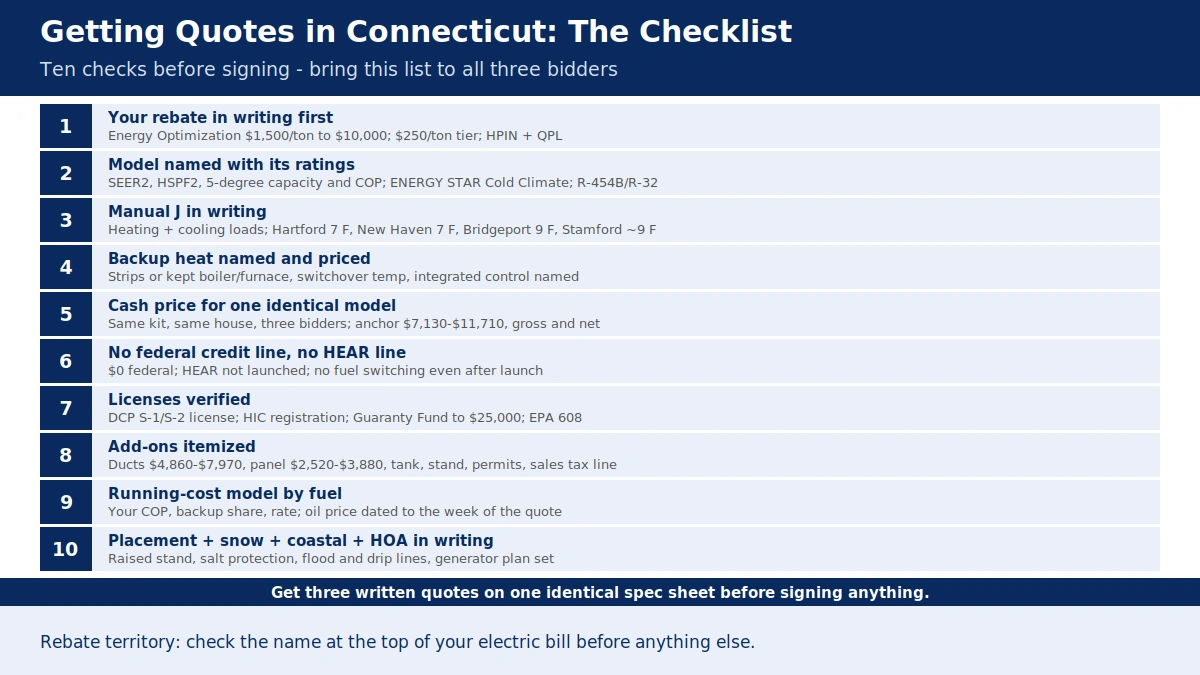
Three written quotes on one identical spec sheet, compared line by line, beat any single bid. Judge them on the model named, the Manual J shown, the add-ons itemized, the rebate in writing, and the license proved. In Connecticut, add one more test: the winning bid is the one that has already thought about January, the oil tank, and the name at the top of the electric bill.
Sources & methodology Installed costs:
- NumeralQ, Heat Pump Cost in Connecticut (2026), estimator pricing as of Oct 26, 2026 (planning estimates, not contractor bids): statewide 3-ton ducted $7,130–$11,710; by size 1.5 ton $4,890–$7,710, 2 ton $5,640–$9,040, 2.5 ton $6,380–$10,380, 3.5 ton $7,870–$13,040, 4 ton $8,620–$14,370, 5 ton $10,100–$17,040; single-zone mini-split $3,520–$5,400; geothermal $21,480–$33,500
- NumeralQ, Heat Pump Cost in Hartford, CT (2026), updated Nov 6, 2026: 3-ton $7,110–$11,690; by size 1.5 ton $4,880–$7,690 to 5 ton $10,090–$17,020; single-zone mini-split $3,510–$5,390; multi-zone 3-head $7,000–$12,160; cold-climate ducted $9,270–$15,890; geothermal $21,440–$33,450; ductwork $4,860–$7,970/job; panel upgrade (200 A) $2,520–$3,880/job; billed $73–$95/worker-hour; HVAC median pay $36.63/hr; electricians $37.34/hr billed $75–$97
- NumeralQ, HVAC Replacement Cost in Connecticut / Hartford (2026): furnace + AC 3-ton $8,950–$14,900 statewide / $8,930–$14,880 Hartford; dual-fuel Hartford $9,930–$16,030
- NumeralQ, Furnace Replacement Cost in Connecticut / Hartford (2026): gas furnace 95–96% AFUE 80,000 BTU $5,670–$9,160 statewide / $5,650–$9,140 Hartford; high-efficiency gas boiler Hartford $7,830–$12,220; electric furnace Hartford $3,920–$6,550
- Trydun, Heat Pump Cost (Aug 2026, modeled from BLS wages + equipment pricing): Connecticut ducted $7,650–$14,150
- Connecticut contractor guides (2026, secondary): ducted cold-climate $14,000–$25,000; ductless $4,500–$7,500 per zone; whole-house ductless $15,000–$30,000; air-to-water $20,000–$35,000; oil boiler replacement $8,000–$14,000
- Scaled bands: cold-climate, multi-zone, and dual-fuel statewide bands scaled from Hartford figures by the statewide-to-Hartford 3-ton midpoint ratio (1.0021), flagged in the article
Electricity, gas, oil, propane:
- EIA Electric Power Monthly, Table 5.6.A, August 2026: Connecticut residential 24.51 cents/kWh (US 18.16; down 18.8% year on year); 12-month average to August 2026 27.4 cents/kWh, 7th highest, ~702 kWh/mo, ~$193/mo bill; 2026 year-to-date average 28.0 cents/kWh (via NumeralQ Hartford page)
- EIA Form 861, 2024, adjusted for statewide change (estimates, flagged): Eversource ~27.2 cents/kWh, United Illuminating ~32.5 cents/kWh
- EIA Natural Gas Monthly, Oct 2026, Table 20, and 12-month average to May 2026: Connecticut residential $18.39/Mcf, about $1.78/therm; monthly Jan 2026 $17.77/Mcf, Feb $17.65, Mar $19.55, May $23.33; Dec 2025 $16.18/Mcf
- EIA Weekly Heating Oil and Propane Survey: Connecticut heating oil $5.667/gal week ending Nov 9, 2026 ($3.679 a year earlier); $6.15/gal week of Oct 26, 2026; last winter average (Oct 2025–Mar 2026) $3.95/gal; $5.88/gal Oct 13, 2026 (state announcement); propane $4.431/gal week ending Nov 9, 2026 ($3.727 a year earlier); $4.32/gal week of Oct 26, 2026; last winter average $3.83/gal; oil and propane prices before taxes
- EIA Winter Fuels Outlook, Oct 7, 2026: oil households spend ~21% more this winter; fuel prices assumed 34% higher, milder Northeast weather assumed
Climate:
- IPC Table D101 design temperatures (97.5% winter / 2.5% summer): Hartford winter 7 F, summer 88 F; New Haven winter 7 F, summer 84 F; Bridgeport winter 9 F, summer 84 F; Hartford heating degree days 6,235; Bridgeport 5,617; New Haven 5,897
- NOAA/NWS 1991–2020 normals: Hartford (BDL) heating degree days 5,883, cooling degree days 819, 125.8 nights at or below 32 F, 3.4 nights at or below 0 F; Hartford (Brainard Field) heating degree days 5,620, 121 freezing nights, 2 nights at or below 0 F; mildest months June and September; January average low 22 F, July average high 84 F; climate zone 5A (Hartford County)
- DOE federal minimum efficiency, northern region: 14.3 SEER2 / 7.5 HSPF2; ENERGY STAR Cold Climate: COP at least 1.75 at 5 F, at least 70% of 47 F capacity at 5 F, HSPF2 at least 8.1 ducted / 8.5 non-ducted; NEEP ccASHP v4.0: variable-capacity compressor, COP at least 1.75 at 5 F; EPA R-410A phaseout in new home systems from 2025 (R-454B / R-32)
Fuel mix, housing, and labor:
- Connecticut RASS R2202 (Sept 2025, n=985): primary heat oil 36%, gas 34%, electricity 21%, propane 5%, wood 3%; detached single-family oil 50%; boilers 46% statewide, 53% detached; 56% of boilers burn fuel oil; Statista/ACS 2022: oil 36.3%, gas 36.27%, electricity 18.3%
- ACS 2020–2024 (via NumeralQ): Hartford 64% piped gas, 24% electric heat; 79% of Hartford units in multi-unit buildings; Hartford median home value $228,600
- CT Mirror analysis of Census estimates (July 2024): ~41% of Connecticut housing built before 1960, median year built 1966
- BLS OEWS May 2025: Connecticut HVAC technicians median $36.83/hr, billed $74–$96/worker-hour; Hartford median $36.63/hr, 25% above US median; 323 plumbing/heating/AC contractors in Capitol Planning Region, 7.8 per 10,000 homes (Census County Business Patterns 2023)
Rebates, financing, and federal:
- Energize CT Residential Energy Optimization Incentive (2026 form): $1,500/ton for installs completed Sept 1–Dec 31, 2026 replacing oil/propane/gas/electric resistance as primary heat, cap $10,000/home, rebate capped at 100% of purchase price; $1,000/ton Jan 1–Aug 31, 2026; enhanced $1,500/ton for income-eligible and electric-resistance replacements; ENERGY STAR Cold Climate equipment; HPIN installer; AHRI tonnage; applications postmarked by Feb 27, 2027; random inspections
- Energize CT Residential Air Source Heat Pump Incentive (2026): $250/ton, cap $2,500 combined, for heat-pump replacements, unconditioned spaces, heat without integrated controls, and cooling-only; through Dec 31, 2026
- Energize CT Residential Ground Source Heat Pump Incentive: $1,500/ton, up to $15,000/home; ENERGY STAR, HPIN, fossil-fuel or electric-baseboard replacement
- Energize CT heat pump water heater rebate (2026 in-store form): $900/unit; additional $1,000 income-eligible installation incentive (secondary report, flagged)
- Connecticut Green Bank Smart-E Loan: 1.99% APR, 5-year, up to $25,000 for qualifying heat pump projects, Aug 1–Dec 31, 2026, approved Energize CT rebate application required first, HPIN installer, Eversource/Avangrid electric customer; blended rate above $25,000 (max $50,000); standard rates 6.99%–7.99% APR (Oct 1, 2026); prior 0.99% offer ended July 31, 2026; no prepayment penalties
- New England Heat Pump Accelerator distributor discounts ($650 air-source / $750 air-to-water or geothermal / $300 water heater): secondary report, flagged
- HEAR/HOMES: ~$49.5M HEAR + ~$49.7M HOMES allocated, DEEP; not launched as of Nov 9, 2026; DEEP hopes funding available early 2027 pending DOE approval; no retroactive claims announced
- OBBBA Public Law 119-21; IRS FS-2025-05 (§25C/§25D $0 after Dec 31, 2025); DOE Program Notice 26-2 (May 29, 2026, no fuel switching, HEAR renamed HEEHR); §48E lease pass-through, in service by Dec 31, 2027
Licensing, permits, tax:
- Connecticut DCP, Chapter 393, Conn. Gen. Stat. §20-330/§20-334a; S-1/S-2 unlimited heating, piping and cooling; S-1 12,000 on-the-job hours + 576 classroom hours on the equivalent-experience path; PSI exams; annual renewal Aug 31; only individuals apply
- Home Improvement Act: contract must show HIC registration number; 3 business days to cancel (Saturday counts), §20-429; Guaranty Fund up to $25,000/claim, §20-432 (PA 21-197)
- Hartford mechanical permit ~$383 for a $12,000 install (City of Hartford fee schedule, effective Aug 6, 2018); lien notice within 90 days, §49-35, liens capped at amount still owed
- Connecticut sales tax 6.35%; geothermal systems exempt (DRS Special Notice 2007(7), CERT-140); ground-source heat pumps in §12-412k weatherization exemption; HVAC installation labor in 1–3 family owner-occupied homes not taxed as a service (DRS Ruling 89-264)
Running-cost and payback arithmetic:
- Planning home 2,000 sq ft Hartford-area, 40 MMBtu delivered heat/yr (NestPriced planning assumption) = 11,723 kWh of heat; gas 95% AFUE at $1.78/therm = 421 therms = ~$749/yr; heat pump COP 2.0 = 5,862 kWh = ~$1,606/yr; COP 2.2 = 5,329 kWh = ~$1,460/yr; COP 2.5 = 4,689 kWh = ~$1,285/yr; COP 2.8 = 4,187 kWh = ~$1,147/yr; COP 3.0 = 3,908 kWh = ~$1,071/yr; COP 3.5 = 3,350 kWh = ~$918/yr; resistance = 11,723 kWh = ~$3,212/yr; oil 87% (138,500 BTU/gal) = 332 gal/yr ($5.67 = ~$1,882/yr; $3.95 = ~$1,311/yr); oil 80% = 361 gal/yr (~$2,047/yr at $5.67); propane 95% (91,500 BTU/gal) = 460 gal/yr ($4.431 = ~$2,039/yr); break-even COP vs 95% gas = 4.29, vs oil at $5.67 = 1.71, vs oil at $3.95 = 2.45, vs propane = 1.58
- Midpoint 3-ton at ~$9,420: vs oil saves ~$597/yr at COP 2.5, ~15.8 yrs gross, ~8.2 yrs net of $4,500 rebate; vs propane saves ~$754/yr, ~12.5 yrs gross, ~6.5 yrs net; vs resistance saves ~$1,927/yr, ~4.9 yrs gross, ~2.6 yrs net; vs gas costs ~$535/yr more at COP 2.5 (never on fuel alone); cold-climate midpoint ~$12,605, net ~$8,105: vs oil ~13.6 yrs, vs propane ~10.7 yrs, vs resistance ~4.2 yrs
- Premium framing: furnace-plus-AC 3-ton midpoint ~$11,925 (statewide $8,950–$14,900) vs ducted heat pump midpoint $9,420, the heat pump typically $2,505 cheaper than the pair it replaces, so the premium is negative
EXCLUDED:
- Any “after 30% credit” or “after $2,000 credit” prices: §25C/§25D are $0 for 2026 installs
- Any HEAR rebate in a 2026 Connecticut quote: not launched, no launch date, early-2027 hope only, and no fuel switching even after launch
- Pre-September rebate rates ($1,000/ton standard; $3,000 ducted / $1,500-per-zone figures from June 2026 sources) as current rates
- The $250/ton tier presented as the fuel-switch rebate, or the $1,500/ton tier presented as available to heat-pump replacements
- New Haven, Stamford, and Bridgeport city install prices and the Stamford design temperature as published figures: planning estimates only, flagged in the article
- Cold-climate, multi-zone, and dual-fuel statewide bands as published figures: scaled from Hartford figures, flagged in the article
- Oil-tank removal, snow-stand, coastal-coating, hail-guard, and surge-protection prices: no Connecticut-verified prices found
- Any Connecticut heat-pump lease provider: none verified
- Air-source equipment sales-tax exemption: not verified; geothermal exemption only
- Connecticut state tax credit for heat pumps: none found; absence not independently verified against the Department of Revenue Services
- 2027 Energize CT rebate levels: not published; not projected
- Heat-pump seasonal COP 2.2–2.8: planning range, not field-measured for a specific Connecticut installation
- Summer-month EIA $/Mcf gas figures as heating prices: fixed charges over tiny summer volumes, not usable
- Eversource/UI 2026 estimated rates (~27.2 / ~32.5 cents): Form 861-based estimates, flagged as estimates, not tariffs
- Heat-pump lifespan figures: national only, flagged as such
Disclaimer: The prices here are 2026 Connecticut planning figures. What you end up paying moves with the city, the house, the utility territory, the boiler and tank scope, and the contractor. Get written quotes from three licensed Connecticut installers before settling on a budget, and check the license yourself with the Department of Consumer Protection before anyone touches the house.
Nothing here is tax advice for your own return, these are general notes only. Program rules change, so confirm current Energize CT terms, the Smart-E Loan rate, and the HEAR/HOMES launch status with the program before signing, and note that the $1,500-a-ton rate and the 1.99 percent Smart-E offer both end December 31, 2026.
This article dates its oil price to its source, $5.67 a gallon for the week ending November 9, 2026, and its propane price the same way, $4.431 a gallon for the same week. An oil or propane heated home’s payback moves with the fuel price, so check the current EIA weekly survey before you decide.
What does a heat pump cost in Connecticut in 2026?
NumeralQ planning estimates put a 3-ton ducted install at $7,130–$11,710 statewide in Connecticut for 2026, with Hartford the one verified city at $7,110–$11,690. A cold-climate ducted machine, the type the rebate requires, runs about $9,290–$15,920, one mini-split zone runs $3,520–$5,400, and geothermal with a ground loop runs $21,480–$33,500. A 3-ton fuel-switch install can earn a $4,500 Energize CT rebate, while the federal tax credit is $0 for a 2026 install.
Do heat pumps work in Connecticut winters?
Yes, when the machine carries a cold-climate rating and the backup heat is sized for the coldest night. Cold-climate certification means the unit holds at least 70 percent of rated heat output at 5 degrees, at a COP of 1.75 or better, where a standard machine falls to 40 to 60 percent. Backup heat still matters on the coldest nights, and the rebate requires cold-climate certified equipment, so the rating decides both comfort and the $1,500-a-ton payment.
Is a heat pump cheaper to run than oil heat in Connecticut?
At November 2026 oil prices, yes, and at last winter’s oil prices, barely. Oil at $5.67 a gallon costs about $1,882 a year to heat the planning home through an 87 percent efficient boiler, against about $1,285 for a heat pump at a seasonal COP of 2.5, a saving of about $597 a year. Oil at last winter’s average of $3.95 a gallon costs about $1,311 a year, which leaves the heat pump ahead by only about $26, so date the oil price on any quote to the week it was written.
What is the Energize CT heat pump rebate in 2026?
Energize CT pays $1,500 per ton, up to $10,000 per home, for installs completed September 1 through December 31, 2026 that replace oil, propane, gas, or electric resistance heat as the main heat source, so a 3-ton system earns $4,500. Replacing an existing heat pump, adding heat to an unconditioned space, or installing for cooling only pays $250 per ton, up to $2,500, and ground-source systems earn $1,500 per ton up to $15,000. Three conditions gate the money: Qualified Product List equipment, a Heat Pump Installer Network installer, and Eversource or United Illuminating electric service.
Can I get the $8,000 HEAR rebate for a heat pump in Connecticut?
Not in 2026. Connecticut’s HEAR and HOMES programs have not launched, with about $99 million allocated through the Department of Energy and Environmental Protection, and DEEP hopes funding will be available in early 2027 pending federal approval. Federal rules bar HEAR money from paying for a fuel switch whenever the programs open, so a gas, oil, or propane heated home cannot use it to switch to a heat pump, and only electric-to-electric upgrades and new construction qualify.
Does Connecticut give a tax credit for a heat pump?
No Connecticut state tax credit applies to heat pump installs, whether air-source or geothermal. Connecticut does exempt geothermal resource systems, equipment and installation together, from the 6.35 percent state sales tax, claimed with certificate CERT-140. The federal credit is also $0 for 2026 installs, so the incentive stack in Connecticut is the Energize CT rebate plus Smart-E Loan financing, and nothing else at the state or federal level.
What license or permit do I need to install a heat pump in Connecticut?
The job needs a mechanical permit and an electrical permit from the city or town, and the contractor needs a DCP heating and cooling license, with S-1 contractor and S-2 journeyperson credentials covering all heating, piping, and cooling work. The contractor must also hold home improvement contractor registration, with the registration number printed on the contract, which backs a Guaranty Fund claim of up to $25,000 and gives you three business days to cancel. The rebate adds a third check: the installer must belong to the Energize CT Heat Pump Installer Network, or the install earns no rebate.
When does a Connecticut heat pump pay for itself?
Against oil heat at $5.67 a gallon, about 8.2 years net of the $4,500 rebate on a saving of about $597 a year, and about 15.8 years on the gross price. Against propane it pays back in about 6.5 years net, and against electric resistance heat in about 2.6 years net, while against a 95 percent gas furnace it never pays back on fuel alone, because the heat pump costs about $535 a year more to run. Set against the furnace-plus-air-conditioner pair the household would buy anyway, the heat pump carries no premium to repay: it typically costs about $2,505 less than the pair.