


Utah gives a solar buyer the best raw material in the country and the weakest pay for surplus power. The sun over the Wasatch Front is high, dry, and strong for most of the year.
A kilowatt of panels in Salt Lake City makes roughly a third more power than the same kilowatt makes in Portland or Seattle. At the same time, Utah grid power is among the cheapest in the country, and the price paid for power sent back to the grid is a small fraction of the price charged for power taken from it.
That pair of facts sets every number that follows. A Utah system makes plenty of power. The power used inside the home is worth the full retail price, about 13.31 cents a kWh on the statewide average.
The power sent out earns about 4 to 5 cents, and any credit left over at the March meter read is gone for good. Size the system to the home’s own daytime use and solar still works. Size it to cover the roof and much of the extra power earns pennies, then expires.
The third fact is the end of the credits that used to soften the price. The federal credit for a homeowner-owned system ended for installs finished after December 31, 2025.
Utah’s own credit for home solar ended earlier, for systems installed in 2024 and later. The $23,749 figure in the answer box is close to the price a buyer actually pays in 2026, with only a battery payment and the export credits left to soften it.
Start with the countrywide picture in our national solar panel cost guide, then read Utah’s numbers against it. Utah sits above the national price per watt and far above the national sun, and the payback section shows which of those two facts wins.
Table of Contents
How Much Do Solar Panels Cost in Utah in 2026?
Three kinds of evidence price the Utah market in 2026, and they measure different things, which is why the per-watt figures disagree by nearly 70 cents. The EcoGen Solar Cost Index puts Utah at $3.01 per watt installed, cash, before incentives, as of September 25, 2026. EnergySage marketplace quotes average $2.33 to $2.34 per watt in October and November 2026.
A third source, ConsumerAffairs, prices Utah at $2.39 per watt. A Sandy contractor publishes $2.50 per watt, dropping to $2.35 above 10 kW on the Wasatch Front.
The gap is mostly about system size. EcoGen pairs its price with the median size Utah homeowners actually installed in 2025, 7.89 kW, from Berkeley Lab data on 481 systems. EnergySage pairs its price with the average size quoted through its marketplace, 13.16 kW, nearly two-thirds larger.
Bigger systems cost less per watt because fixed costs like design, permits, and the crew’s trip spread over more panels. Neither figure is wrong. They describe different buyers.
The $3.01 figure leads here because it pairs with the size Utah homeowners actually install, and because it keeps the payback math conservative. A buyer who budgets at $3.01 and gets quotes at $2.35 has a pleasant surprise.
A buyer who budgets at $2.33 and gets quotes at $3.01 has a shortfall. The EnergySage figures stay in view all through the price sections as the cross-check, with their larger system sizes stated alongside.
Inside the $23,749: panels, inverter or microinverters, racking, wiring, disconnects, monitoring, design, permits, the crew’s labor, and the utility interconnection paperwork. A battery is not in that figure.
Neither is a new roof, a panel upgrade, tree work, or a main panel replacement. Those items land as their own lines on a quote, and the price-drivers section prices the ones with a verified Utah figure.
One more warning belongs before the tables. Plenty of Utah quotes still floating around show a 30% federal credit subtracted, a state credit subtracted, or exports valued at the full retail rate. All three belong to earlier years.
A 2026 quote with any of them in it overstates the value of the system by thousands of dollars. The federal section and the incentives section give the exact dates and statutes so a buyer can spot a stale quote at a glance.
| Source | Price per watt | Typical system | Total before incentives |
|---|---|---|---|
| EcoGen Index, Sep 2026 (headline) | $3.01 | 7.89 kW (Berkeley Lab median) | $23,749 |
| EnergySage, Nov 2026 | $2.33–$2.34 | 13.16 kW (marketplace average) | $30,637 |
| ConsumerAffairs, 2026 | $2.39 | 6 kW (typical in their table) | $14,340 |
| Elite Electric, Sandy, Oct 2026 | $2.50 ($2.35 above 10 kW) | Contractor price list | $25,000 for 10 kW |
The table shows why a single “average cost” hides more than it reveals. The cheapest per-watt figure pairs with the largest system and the largest total.
The headline figure pairs with the median installed size and the smallest total of the three market-wide sources. Compare quotes by price per watt on the same system size, with the same equipment, and the comparison stays fair.
Solar Panel Cost in Utah by System Size
System size is the first decision, and in Utah it is also the payback decision. The average Utah home used 774 kWh a month in 2024, or 9,288 kWh a year. At Salt Lake City production of about 1,524 kWh per kW a year, about 6.1 kW covers that average use.
A 7.89 kW system makes about 12,024 kWh, roughly 29% more than the average home uses. A 13.16 kW system makes about 20,056 kWh, more than double average use.
That does not make a big system a mistake on its own. Large homes, pools, hot tubs, electric heat, and EV charging all push use well past the average. A household charging two EVs at home can use double the state average without trying.
The mistake is buying size for its own sake, on the idea that extra power earns its keep by flowing to the grid. Under Schedule 137 it earns 4 to 5 cents a kWh, and the credit expires each March. Extra size past the home’s own use is the weakest money in the whole purchase.
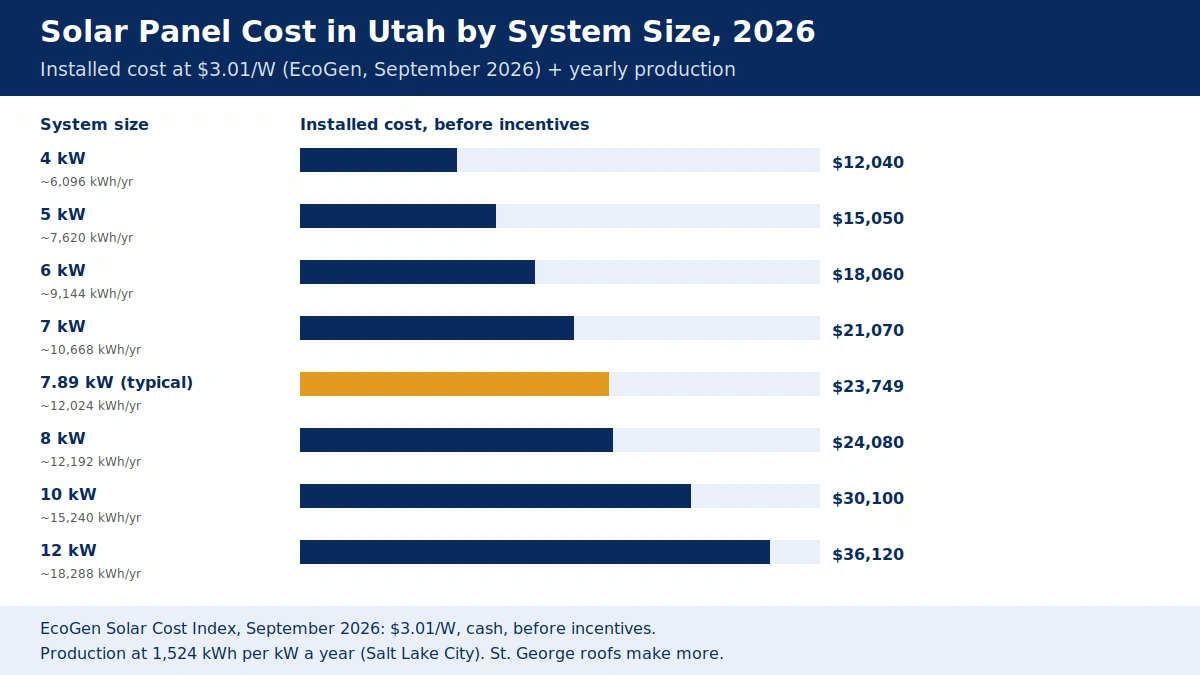
The table below prices each size at the $3.01 headline rate, with production at the Salt Lake City figure. Homes in St. George and the southern desert make more per kW.
Homes with east-west roofs, shade, or low tilt make less. A quote should show a production estimate for the actual roof, from a tool like PVWatts, not just a system size.
| System size | Cost at $3.01/W | Yearly production (SLC) | Fits a home using |
|---|---|---|---|
| 4 kW | $12,040 | ~6,096 kWh | ~508 kWh a month |
| 5 kW | $15,050 | ~7,620 kWh | ~635 kWh a month |
| 6 kW | $18,060 | ~9,144 kWh | ~762 kWh a month |
| 7 kW | $21,070 | ~10,668 kWh | ~889 kWh a month |
| 7.89 kW (typical) | $23,749 | ~12,024 kWh | ~1,002 kWh a month |
| 8 kW | $24,080 | ~12,192 kWh | ~1,016 kWh a month |
| 10 kW | $30,100 | ~15,240 kWh | ~1,270 kWh a month |
| 12 kW | $36,120 | ~18,288 kWh | ~1,524 kWh a month |
The 6 kW row deserves a closer look because it matches the average home. At $18,060 it is the smallest system that covers average Utah use on a good Salt Lake City roof. The 7.89 kW row is what Utah homeowners actually install, which tells its own story: Utah buyers build past average use, for EVs, for growth, or because the roof allows it.
Either row can be right for a given home. The wrong move is picking a row from the table instead of from twelve months of the home’s own bills.
Panel counts help picture each size. Modern home panels run about 400 to 410 watts each, so a 6 kW system needs about 15 panels and a 10 kW system needs about 25. Roof space rarely limits a Wasatch Front home at these sizes.
Shade from the Wasatch foothills, a neighbor’s trees, or a second story limits far more homes than raw roof area does. For how the 6, 8, and 10 kW sizes compare on price and output across the country, see our 6 kW vs 8 kW vs 10 kW guide.
What Salt Lake City, Provo, Ogden & St. George Actually Pay
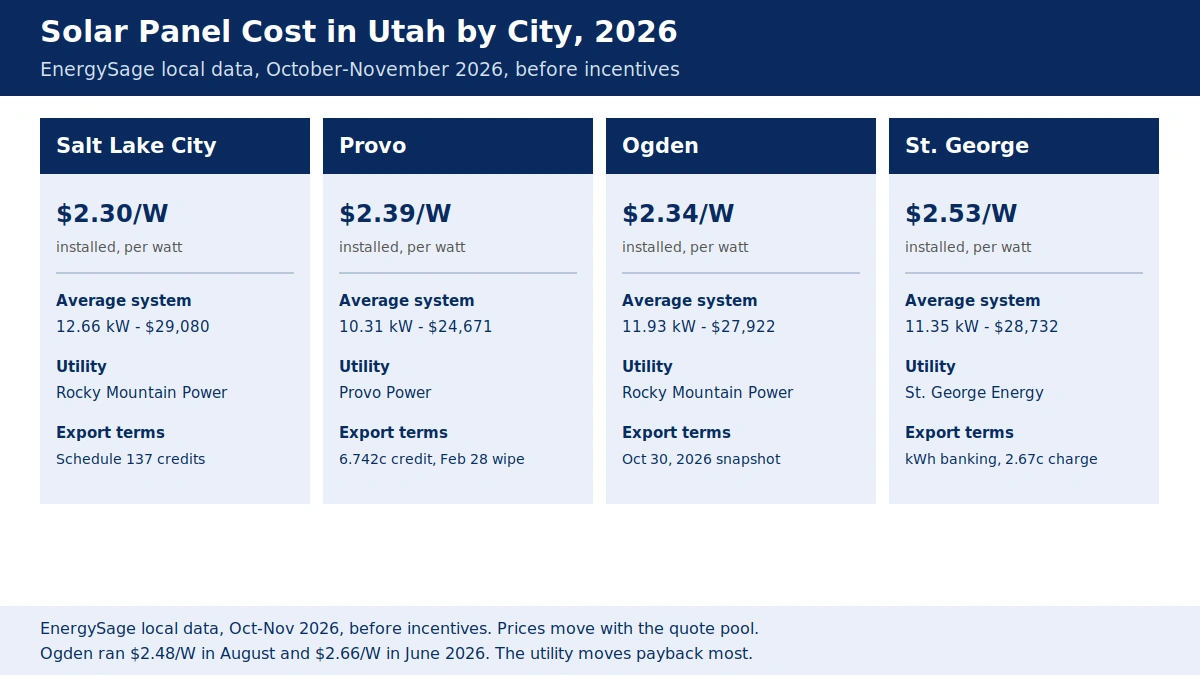
City prices in Utah move less than the utility rules do. EnergySage local data puts the four cities within 23 cents a watt of each other in late 2026. The utility at each address moves the payback by years, not cents.
Salt Lake City and Ogden sit on Rocky Mountain Power. Provo runs its own city power department.
St. George runs its own too, with kWh banking instead of a cent-per-kWh credit. Read the city table and the utility sections together, or the city prices mislead.
Salt Lake City is the cheapest of the four on price per watt and the largest market in the state. EnergySage puts the city at $2.30 per watt in November 2026, with an average 12.66 kW system at $29,080 and most quotes between $24,718 and $33,442. Its modeled payback of 21.81 years and 25-year savings of $7,928 reflect Rocky Mountain Power net billing on a big system.
Competition among Wasatch Front installers keeps the per-watt price down. The export credit keeps the savings modest.
Provo costs a little more per watt and buys a smaller system. EnergySage puts Provo at $2.39 per watt in October 2026, with an average 10.31 kW system at $24,671 and most quotes between $20,970 and $28,372.
A second October snapshot listed $2.36, close enough that the difference is noise in the quote pool. Provo’s own utility credits exports at 6.742 cents, better than Rocky Mountain Power’s rate, but wipes unused credit every February 28 and bars the credits from paying the $18 monthly customer charge.
Ogden carries a warning label because its published figures moved during 2026. The newest snapshot, October 30, 2026, puts Ogden at $2.34 per watt, with an average 11.93 kW system at $27,922 and most quotes between $23,734 and $32,110. An August snapshot put the city at $2.48 per watt, and a June snapshot at $2.66.
The trend is down, and the newest figure leads here. Ogden’s housing stock is old, with a median home built in 1965, so roof condition and electrical service age move individual quotes more than the city average suggests.
St. George is the outlier that proves the utility point. EnergySage puts the city at $2.53 per watt in November 2026, the highest of the four, with an average 11.35 kW system at $28,732 and most quotes between $24,422 and $33,042. Yet its modeled payback is only 13.18 years, with $28,687 in 25-year savings.
The desert sun is stronger, and St. George Energy Services banks exported kWh as kWh instead of paying cents for them. A higher price per watt still pays back years faster when the sun and the rules both favor the buyer.
| City | $ per watt | Average system | Average total | Utility |
|---|---|---|---|---|
| Salt Lake City | $2.30 | 12.66 kW | $29,080 | Rocky Mountain Power |
| Provo | $2.39 | 10.31 kW | $24,671 | Provo Power |
| Ogden | $2.34 | 11.93 kW | $27,922 | Rocky Mountain Power |
| St. George | $2.53 | 11.35 kW | $28,732 | St. George Energy Services |
| Utah statewide | $2.33–$2.34 | 13.16 kW | $30,637 | Mixed |
Sandy, the Wasatch Front suburb where several installers are based, averaged $2.32 per watt on a 14.25 kW system at $33,056 in September 2026. South Jordan averaged $2.50 and Heber City $2.68 in late October snapshots.
Small-city figures bounce with the quote pool, so treat any single city snapshot as a guide to the going rate, not a promise. Three written quotes for the actual address replace all of them.
High Desert Sun: What a Utah Roof Really Produces
Utah ranks 10th in the country for peak sun hours, at 5.39 a day on a PVWatts v8 run for Salt Lake City. A peak sun hour is one hour of sun at full strength, 1,000 watts per square meter. It is the bridge between system size and yearly power: kilowatts times peak sun hours times 365, minus real-world losses, gives yearly kilowatt-hours.
A kilowatt-hour, or kWh, is the unit on the electric bill. A kilowatt, or kW, is the size of the system.
Salt Lake City sits at 4,239 feet, and height helps twice. Thin high-desert air lets more sun reach the roof, and dry air keeps panels cooler than humid air at the same temperature. Panels make less power as they heat up, so a cool sunny day in the Salt Lake Valley can out-produce a hotter day in the low desert at the same sun strength.
Summer still wins on total power because the days are long. June peaks near 7.77 peak sun hours a day on the same PVWatts run.
The yearly figure used through this article is about 1,524 kWh per kW around Salt Lake City. Other runs land close: a statewide PVWatts average gives 1,484, a West Jordan estimate gives about 1,533, and an Orem run on a south-facing roof at a 25-degree tilt gives 1,561.
A south-facing roof with no shade and a tilt near the roof pitch lands near the top of that band. An east-west roof, a low tilt, or afternoon shade from the foothills lands below it.
St. George plays a different game. The National Renewable Energy Laboratory puts the average solar resource there near 6.5 kWh per square meter a day, against about 5.3 for Utah as a whole. Washington County runs about 6.4 peak sun hours a day.
Summer heat trims some of that gain, since panels lose output in extreme heat, and St. George summers are extreme. Even after the heat loss, a St. George roof makes clearly more per kW than a Salt Lake City roof. No single verified kWh-per-kW figure for St. George turned up in the research for this article, so St. George buyers should ask for a PVWatts run on their own roof rather than borrowing the Salt Lake City number.
Roof direction matters more than most buyers expect. South-facing panels in Utah catch the most sun over the year. West-facing panels catch less total power but more late-afternoon power, which lines up better with the evening peak on a time-of-use rate.
East-facing panels catch morning sun and fade early. A roof that faces north is the one case where a buyer should think hard before signing, and a ground mount or a different roof plane may beat it. The quote’s production estimate should name the direction and tilt it assumes.
Shade is the quiet killer of Utah production. A single chimney, a tall pine, or a neighbor’s second story can cut a string of panels for hours each day. Microinverters or optimizers limit the damage to the shaded panels instead of dragging down the whole string.
A shade report from the site survey belongs in the quote file, with the expected production loss stated in kWh, not waved at. If a quote shows full Salt Lake City production for a shaded east-west roof, the production figure is a guess, not a measurement.
Snow, Roofs & the Wasatch Winter: What Winter Costs a Utah Array
Winter in the Salt Lake Valley is short days, low sun, and snow that comes in storms and melts in sun. A heavy blanket of snow on the panels drops production close to zero until it clears.
The good news is that panels are dark, smooth, and tilted, so snow usually slides off within a day or two once the sun returns. Most storms on the Wasatch Front are followed by sunny days, and the panels earn most of their yearly value from spring through fall in any case.
A day or two of snow cover costs little across a year because winter days are short and weak to start with. December and January produce a small share of the yearly total even with clear panels.
The loss that matters is a week of cover in February or March, when the sun is strengthening and the days are lengthening. Watch the monitoring app after a storm: if production stays low through several sunny days in a row, something is still covered or shaded, and a solar professional should take a look.
Never climb an icy roof to clear panels. Falls from icy roofs injure Utah homeowners every winter, and a metal shovel or hard rake can crack a panel or tear a roof. Ground-mounted arrays reachable from the ground can be cleared gently with a soft foam roof rake, pulling downward.
Roof arrays are best left to the sun. Snow guards above walkways and entries keep sliding sheets from dumping on people and plants below, and the installer should raise them before the first winter, not after the first slide.
Roof strength is a separate winter question, and Utah’s code answers it town by town. The design figure is called ground snow load, measured in pounds per square foot. Utah’s residential code lists 28 pounds per square foot in Salt Lake City, 37 in Ogden, and 43 in Logan, with 50 or more around Bear Lake.
The roof design load starts near 70% of the ground figure for a flat roof, then adjusts for slope, wind exposure, and heat loss through the roof. Homes on the benches above the valley floor carry more snow than homes on the floor, and the load climbs with elevation across a single town.
Panels add weight, and the mounting adds point loads where the rails bolt to the rafters. A sound roof built to code handles a standard array without drama. An old roof, a roof with sagging rafters, or a roof near the end of its shingle life needs a structural look before panels go on.
The worst money in Utah solar is paying to take panels off a failing roof, re-roof, and put them back. If the roof has fewer than ten years of life left, re-roof first. Our roof replacement cost guide prices that job, and sequencing it before the panels saves the detach-and-reset cost entirely.
Tile and metal roofs need their own mounting plan. Concrete tile is common in St. George and parts of Utah County, and it cracks if a crew walks it carelessly or bolts through it the wrong way. Standing-seam metal takes clamps that grip the seams without holes.
Asphalt shingle, the most common Wasatch Front roof, takes standard flashing and lag bolts into rafters. The quote should name the mounting method for the actual roof material, and the roofer’s warranty position after the install should be in writing.
Rocky Mountain Power Net Billing: Schedule 137 & the March Expiry
Rocky Mountain Power serves about 3 in 4 Utah homes, so its rules decide the payback for most buyers in the state. New solar customers go on Schedule 137, Net Billing Service. Net billing means two prices: power taken from the grid is billed at the standard retail rate, and power sent to the grid earns a lower export credit.
It is not net metering, where each exported kWh cancels a kWh used later at full price. Utah closed new net metering years ago, and any quote that values exports at the retail rate is using the old program.
The export credit in force since March 1, 2026 is 4.855 cents per kWh for billing months June through September and 4.033 cents for October through May. The Utah Public Service Commission sets the rate by order and resets it each March 1. The March 2026 reset cut the summer rate about 15% and the winter rate about 4% from the prior year.
The winter rate has fallen from 5.639 cents in 2020 to 4.033 cents in 2026. A proposal built on last year’s export rate overstates summer export value by about 17%.
Credits offset the power and energy charges on the bill. They roll forward month to month inside a year-long billing period. That period ends at the March meter read, and any credit left at that point expires.
The value of expired credits goes to low-income bill help or another use the Commission sets. It never comes back as cash, and it never pays the monthly minimum bill. A system that banks a big credit surplus through summer and fall is banking against a deadline.
The retail side of the bill sets what home-used solar is worth. Schedule 1, the standard residential rate in force since August 10, 2026, charges $12 a month before the first kWh, then 9.8332 cents for the first 400 kWh and 12.5263 cents after that in summer, and 8.7020 cents and 11.0852 cents in winter. Riders add roughly 13% to the energy charges, so the upper summer tier lands near 14.1 cents all-in.
Every kWh used at home as it is made saves that retail price. Every kWh exported earns the 4 to 5 cent credit. The gap between those two numbers is the whole sizing argument in Utah.
Two older schedules still cover neighbors with older systems, and buyers hear about them at every neighborhood gathering. Schedule 135, legacy net metering, closed to new applications on November 15, 2017, runs through December 31, 2035, and transfers to a later customer at the same address with a valid interconnection agreement. Schedule 136, the transition program for applications before October 30, 2020, pays 9.2 cents per exported kWh and runs to January 1, 2033.
Neither is available to a 2026 buyer. A neighbor’s bill proves nothing about a new system’s terms.
Schedule 137 covers residential systems up to 25 kW DC. The interconnection review costs $60 for a Level 1 application, or $75 plus $1.50 per kW for Level 2. The time-of-use option under Schedule 1 adds a wrinkle worth pricing: weekday evenings between 6 and 10 cost 33.6173 cents in summer and 29.7498 cents in winter, before riders, while all other hours cost 7.4705 and 6.6111 cents.
Panels cannot cover the evening peak because the sun is down. A battery can, and the battery section prices that move.
Provo, St. George & the Co-ops: Different Utilities, Different Math
Schedule 137 belongs to Rocky Mountain Power alone. City utilities and co-ops write their own rules, and Utah has many of them: Provo, Lehi, Springville, Spanish Fork, Payson, Salem, Murray, Bountiful, Kaysville, Logan, and St. George all run city power departments, and co-ops serve rural areas.
The name at the top of the electric bill decides which rulebook applies. Rocky Mountain Power terms applied to a Provo address are wrong from the first line.
Provo Power credits new residential solar at 6.742 cents per kWh, from the September 1, 2026 billing period, under Schedule 1.1. Its retail energy charges run 7 cents for the first 500 kWh, 11 cents for the next 500, and 13 cents after that, with an $18 monthly customer charge. Credits offset energy charges only and never pay the customer charge or other fees.
Unused credit is given up after the billing cycle that includes February 28, a month earlier than Rocky Mountain Power’s March expiry. A license from Provo Power is required before install, systems cap at 25 kW, and no third party can benefit from the system, which rules out power purchase agreements and landlords selling power to tenants.
Provo’s fee schedule adds up fast. The net metering fee is $375 for 100 to 200 amp service or $825 for 200 to 400 amps, plus an electrical permit. Older grandfathered accounts from October 4, 2016 are credited at the full retail energy charges instead of 6.742 cents, but that rate is closed to new accounts.
Net metering accounts cannot enroll in time-of-use, EV time-of-use, budget billing, SharedSolar, or wind programs. Provo also states that it never works with or sponsors any solar company, so a seller claiming a city partnership is inventing one.
St. George Energy Services banks power instead of paying cents. Extra kWh stay on the meter as kWh and cancel kWh used later, so spring surplus can offset summer air conditioning. A balance left in December can be sold back at 3.622 cents per kWh, and at 5,000 kWh or more that sale happens automatically.
The catch is the Solar Reliability Charge: 2.67 cents on every kWh the panels make, used at home or not. A system making 15,000 kWh a year pays about $400 a year in that charge before saving a cent.
St. George adds fees and gates of its own. A $245 review fee and a $424 meter fee apply, the contractor must have taken the city’s solar class, and applications go through the city’s CityInspect portal before install. Net metering is not allowed on rental property at all.
The program terms date to a revision effective March 8, 2024. Even with the reliability charge, kWh banking plus desert sun explains why St. George payback models run years shorter than Wasatch Front models on Rocky Mountain Power.
Co-ops and smaller city utilities fill out the map with their own terms. Moon Lake Electric pays 2.4 cents per kWh for extra power each month. Bountiful’s Net Metering Hybrid plan pays 5.00 cents per exported kWh.
Murray City Power runs a net metering pilot and states that it is revising it. Dixie Power serves parts of Washington County at low average rates near 9.6 cents, and no verified Dixie export rate turned up in the research for this article. The rule for every address outside Rocky Mountain Power territory is the same: get the current schedule from the city or co-op in writing, with the credit rate, the expiry date, the fees, and the cap, before comparing any quote.
Payback in Utah: The Self-Use Number That Decides Everything
Payback in Utah turns on one number that no quote can know for certain: the share of solar power the home uses as it is made. Call it self-use. Power used at home saves the retail price, about 13.31 cents a kWh on the statewide average.
Power exported earns the planning blend of the two Schedule 137 rates, about 4.31 cents. A home that uses most of its solar power while the sun shines pays back years faster than a home that exports most of it while everyone is at work.
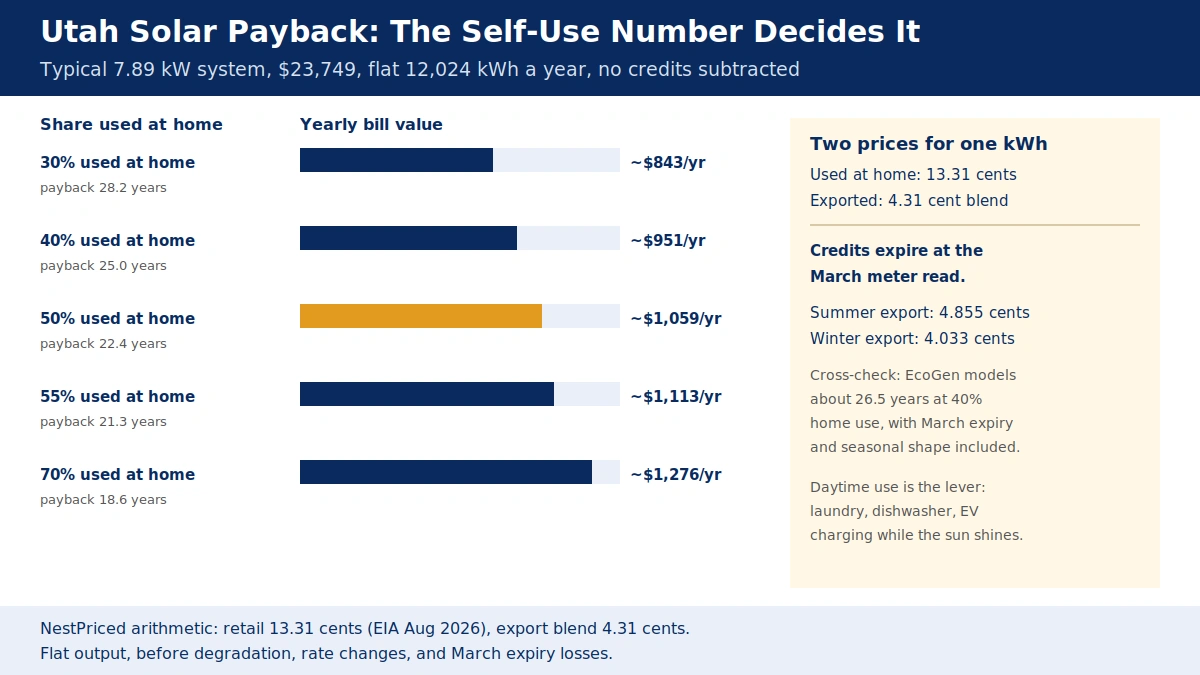
The table below runs the typical system through five self-use shares. It uses flat yearly output of 12,024 kWh, the $23,749 cost, and no credit subtracted.
It leaves out March expiry losses, output loss over time, and any rise in power prices. Those three pull in different directions, and the cross-checks below show where the fuller models land.
| Share used at home | Yearly bill value | Simple payback |
|---|---|---|
| 30% | ~$843 | ~28.2 years |
| 40% | ~$951 | ~25.0 years |
| 50% | ~$1,059 | ~22.4 years |
| 55% | ~$1,113 | ~21.3 years |
| 70% | ~$1,276 | ~18.6 years |
At 50% self-use, the system pays back in about 22.4 years, inside a 25-year panel warranty but only just. At 30% self-use, payback stretches past 28 years, beyond the warranty term. At 70% self-use, it drops under 19 years.
The spread between the rows is a decade, and it comes from household habits, not from equipment. Run the dishwasher, laundry, EV charging, and water heating in daylight hours and self-use climbs. Leave the house empty all day with the thermostat set back and it falls.
Two published models cross-check the table, and both land in the same territory. EcoGen’s per-utility model puts Rocky Mountain Power payback at about 26.5 years at 40% home use, and 22.9 to 30.2 years across 55% to 28% home use. Its figures run a little longer than the flat table because they include the seasonal shape of production and the March expiry.
EnergySage’s statewide model puts payback at 22.49 years on its much larger 13.16 kW system, with $5,142 in 25-year savings. Different systems, different assumptions, same message: Utah payback is long, and self-use decides it.
The 25-year view sharpens the point. At 50% self-use and flat output, 25 years of bill value totals about $26,475 against a $23,749 cost. Output falls a little each year, so at a 0.5% yearly output loss the lifetime value runs near $24,900, roughly break-even before any rise in power prices and before any inverter replacement.
Power prices have risen over time, which helps. An inverter replacement inside 25 years, which many systems need, hurts. Neither future cost is knowable today, and any quote that prices 25 years to the dollar is guessing.
St. George breaks the pattern, and the reason is the rulebook, not the hardware. EnergySage models a 13.18-year payback there with $28,687 in 25-year savings, on kWh banking and stronger sun. A St. George buyer should still run the numbers on the reliability charge and the December sale-back rate, because the banking benefit shrinks as the system grows past the home’s own use.
A Provo buyer should model the February 28 wipe the same way. The payback table above is a Rocky Mountain Power table. Other utilities need their own runs.
Homes that use power while the sun shines are the best Utah solar candidates. A home office, a stay-at-home parent, a pool pump on a daytime timer, or an EV plugged in during the day all lift self-use.
Electric heat lifts winter daytime use, and our Utah heat pump guide prices the machine that creates that load. Homes empty from 8 to 6 with gas heat and no EV are the weakest candidates, and a smaller system or a battery deserves a harder look before signing.
Batteries in Utah: Wattsmart Money & the Outage Question
A battery in Utah does two jobs, and only one of them shows up on the bill. It stores midday solar power for evening use, moving kWh from the 4-cent export credit to the retail price or the evening peak price. It also keeps lights, refrigeration, and heat running through an outage.
The first job is worth real money but rarely repays the battery alone. The second job is the reason most Utah buyers sign.
Battery prices cluster near $1,000 per kWh installed. EnergySage Utah storage data from June 2026 puts the average at $1,000 to $1,079 per kWh, with a typical 13 kWh system near $13,000 and most quotes between $11,050 and $14,950. A Tesla Powerwall 3, at 13.5 kWh and 11.5 kW continuous output, is listed at $14,500 installed by one Utah contractor and $19,102 with a backup gateway by another.
The spread shows how much gateway, wiring, and panel work move the installed price. Get the battery as its own quote line, with the gateway and electrical work itemized.
Rocky Mountain Power pays for approved batteries through Wattsmart Batteries. Since June 15, 2026, the enrollment payment is a flat $2,000 per household for a single approved battery rated 10 kW or more, and $1,000 under 10 kW. The tier follows one battery, so two 5 kW batteries still earn $1,000.
Enrollment runs four years, during which the utility can draw on the battery during peak events. Ongoing bill credits follow: $15 per kW a year in years two through four, capped at $100 a year, then $50 per kW a year from year five, capped at $250 a year.
The approved list matters more than the headline payment. It includes the Tesla Powerwall 3, FranklinWH aPower models, the SolarEdge Energy Bank, Sonnen models, and the Fortress Power Envy True. Some popular batteries are not on it, and a battery off the list earns $0 from Wattsmart.
Incentives can change on 30 days’ notice, so the quote should show the payment as an estimate tied to the program terms on the install date, not as a fixed promise. City-utility customers cannot claim Wattsmart at all, since it belongs to Rocky Mountain Power.
The bill math for a battery is easy to overstate, so run it in the open. Each kWh shifted from export to home use on the standard rate gains about 9 cents, the gap between 13.31 cents retail and the 4.31-cent export blend. Shift 2,000 kWh a year that way and the gain is about $180 a year.
Shift the same 2,000 kWh into the weekday evening peak on time-of-use, near 38 cents all-in in summer, and the gain is about $674 a year. A $13,000 battery less the $2,000 Wattsmart payment is $11,000 net.
At $180 a year it never repays on bill savings alone. At $674 a year it takes about 16 years, and only if evening peak use stays heavy.
Outage protection is where the battery earns its keep for many Utah homes. In June 2026, Rocky Mountain Power cut power to about 7,735 customers in southern Utah to prevent wildfires, with roughly 18,000 customers in the watch-and-warning footprint, including notices as far north as American Fork. A battery with a backup gateway keeps chosen circuits running through a shutoff or a storm outage.
A battery without islanding capability does not, and solar panels alone shut down in a grid outage for lineworker safety. Ask which circuits stay live, for how long, and whether the system restarts the solar panels during an outage.
Size the battery to the outage, not to the array. A single 13.5 kWh unit runs lights, refrigeration, internet, and a gas furnace blower through a night. It does not run central air conditioning, an electric range, and an EV charger together.
Whole-home backup takes more storage and more money. The federal credit for a homeowner-owned battery also ended with 2025, so the Wattsmart payment is the only incentive left on the battery itself. Price the battery as backup with bill benefits, not as an investment with backup benefits, and the decision stays clear.
Utah Incentives in 2026: What Survives & What Ended
Utah’s incentive stack for home solar in 2026 is short. Rocky Mountain Power pays the export credit and the Wattsmart battery payment.
Nothing else from the state or the utilities pays for panels. The table below states the full stack, including the programs that ended, because stale quotes still subtract them.
| Program | 2026 status | Value for a new home system |
|---|---|---|
| Schedule 137 export credit | Open | 4.855 cents summer, 4.033 cents winter per exported kWh |
| Wattsmart Batteries | Open | $1,000 or $2,000 per household, approved batteries only |
| Utah state solar tax credit | Ended | $0 for systems installed in 2024 and later |
| Federal homeowner credit (§25D) | Ended | $0 for installs finished after Dec 31, 2025 |
| HEAR / HOMES rebates | On hold, and HEAR does not cover solar | $0 claimable in Utah in 2026 |
| Sales tax exemption (home systems) | None verified | $0 claimed |
| Property tax exemption | None verified | $0 claimed |
| SREC market | None in Utah | $0 |
The state credit deserves its own paragraph because its history confuses buyers. The Renewable Energy Systems Tax Credit once paid 25% of system cost for home solar, capped at $1,600, then stepped down to a $400 cap. For residential solar systems installed in 2024 and later, the credit is $0.
The Utah Office of Energy Development states the cutoff plainly, and the Tax Commission states that the residential solar credit expired effective 2023. Unused credit earned in earlier years can still be carried forward through 2027. A 2026 install earns nothing new.
The rest of the state credit survives in narrow slices that do not help a home solar buyer. Non-solar home systems using wind, geothermal, hydro, biomass, or certain thermal technologies keep 25% up to $2,000. Commercial systems keep 10% up to $50,000, refundable.
Under HB 264 from the 2025 session, the remainder expires for systems completed and placed in service before January 1, 2028. Home batteries are not eligible for the state credit. The $15 application fee still applies to the claims that remain.
Two tax claims in older guides need correcting, because buyers still meet them. The first is a Utah sales tax exemption for home solar equipment, sometimes put at 6.1%. The DSIRE record behind that claim covers renewable energy production facilities of 2 MW or more, meaning commercial and utility projects, not home roofs.
No home-system sales tax exemption was verified for this article, and no saving is claimed for it. Utah state sales tax is 4.85% plus local tax, so buyers should ask whether tax is included in the quote total.
The second is a property tax exemption for the added home value from panels. Secondary sources conflict: one asserts an exemption, while a careful November 2026 review found none. No exemption is claimed here either.
Ask the county assessor how panels affect the assessment, and get the answer before budgeting, since a higher assessment is a yearly cost that quotes never show. Neither correction changes the headline price. Both stop a buyer from budgeting money that may never arrive.
City and co-op programs add small local wrinkles. Provo and St. George set their own export terms, covered in the utility section, and neither pays a panel rebate. Wattsmart efficiency rebates cover items like heat pumps and smart thermostats, not panels.
No Utah city was found paying a cash rebate for home panels in 2026. A seller who names a city panel rebate should produce the program page, with the city letterhead and the current date, before the rebate enters any quote.
Federal Help in 2026: $0 Credit for Owners, a Narrow Lease Window
The federal picture for a 2026 Utah install fits in one line: the credit for a system the homeowner owns is gone, and the only federal money left runs through a lease. Public Law 119-21, the One Big Beautiful Bill Act, closes both credits for property placed in service after December 31, 2025: Section 25C, the home improvement credit, and Section 25D, the residential clean energy credit. The IRS confirmed the cutoff in Fact Sheet FS-2025-05.
A homeowner-owned system installed in Utah in 2026 gets a $0 federal credit. The federal government contributes $0.
A 2025 install is different, and the difference is the placed-in-service date, not the contract date. A system finished and placed in service in 2025 can still be claimed on a 2025 return through IRS Form 5695, at the 30% rate that applied then. A system finished in 2026 cannot be claimed on any return.
A contractor who prices a 2026 install “after the 30% credit” is pricing a 2025 job. Ask for the gross price, with no federal line at all, and compare quotes gross to gross.
The lease and power purchase agreement route is the one federal path still open. Section 48E, the clean electricity investment credit, still supports leased systems placed in service by December 31, 2027. The leasing company claims the credit and passes part of it through as a lower monthly payment or a lower prepaid price.
Utah authorizes both leases and power purchase agreements, so third-party ownership is legal here. No Utah lease or PPA provider was verified for this article, and none is named, because an unverified provider is worse than no provider.
A lease needs harder questions than a purchase, not easier ones. Ask for the pass-through in writing, with the Section 48E basis named and the December 31, 2027 in-service deadline printed on the agreement. Ask for the escalator, if any, since a payment that climbs 3% a year can erase the savings it promises.
Ask who owns the system at the end of the term, what happens on a home sale, and who pays if the roof needs work under the panels. A lease that cannot answer those questions in writing is a lease to walk away from, credit or no credit.
The federal home energy rebates do not change the picture for solar. Utah’s HEAR and HOMES programs are on hold until further notice because the federal Energy Department has not approved Utah’s application, according to the state energy office page checked in October and November 2026. Utah’s combined allocation is about $101 million, split near evenly between the two programs, and none of it buys a rebate a homeowner can claim today.
HEAR does not cover solar panels in any case: it pays for efficient electric appliances and related upgrades. A solar quote with a HEAR line in it is wrong twice over.
The full 2026 federal picture, with what ended, what survived, and the lease deadline, is in our federal energy tax credits guide. Tax points in this article are general notes only. A Utah tax professional should look over any return that claims an energy credit, and any lease agreement should get the same review before signing.
Permits, Licenses, HOA Rules & What Pushes a Quote Up or Down
Utah licenses solar work at the state level and permits each job at the city or county level, and the buyer has to check both. The state license proves the contractor may do the work.
Without a permit on file, there is no official record that the work was inspected. A job with one and not the other is half done, and the missing half surfaces at resale, at an insurance claim, or at the first service call.
Utah splits solar work in two, and the split catches buyers out. The S202 Solar Photovoltaic Contractor license covers panels and racking. The licensing rule, Utah Admin.
Code R156-55a-301, excludes the wiring, connections, and wire methods governed by the National Electrical Code. That electrical work must go to an E200 General Electrical Contractor or an E201 Residential Electrical Contractor.
An E200 contractor can do both halves, since S202 sits inside the E200 scope. Ask which license covers each half of the job, and check both on the Division of Professional Licensing lookup before anyone touches the roof.
Work of $7,000 or more requires a licensed contractor in Utah, and every home solar job clears that line several times over. The state uses the 2023 National Electrical Code, adopted statewide effective July 1, 2025. NABCEP certification, the solar industry’s installer credential, is widely expected by utilities and buyers, and asking for it costs nothing.
Sources conflict on whether the state requires it for the S202 license, so this article states it as a credential to ask for, not as a licensing rule. Insurance and workers’ compensation coverage should be shown in writing alongside the license.
Permits come from the city or county where the house sits, building plus electrical, and fees vary by city. Published examples from Utah installers include $228.18 in Herriman with a 10 to 15 working day plan review, $106 in West Valley City, and a $75 submittal fee in Pleasant Grove. No statewide fee schedule was verified.
Ogden homes in a historic district need a Certificate of Historic Appropriateness before the permit. The Rocky Mountain Power interconnection application runs alongside the city permit, and the system cannot switch on until the utility grants permission to operate.
HOA rules in Utah limit what an association can do about solar, but they do not remove the association from the process. Under Utah Code 57-8a-701, for a detached home where the association does not own the roof, no governing document other than the recorded declaration can prohibit a solar energy system. A board rule or design guideline cannot ban it.
Adding a new ban to a declaration takes a vote of at least 67% of allocated voting interests. Restrictions on size, location, or placement must cut production by 5% or less and raise install cost by 5% or less, and the association may still require code compliance and low-profile mounting.
Two carve-outs limit that protection. Express bans recorded or adopted before January 1, 2017 fall outside the statute, and associations still under developer control do too. Attached homes get similar protection where the association owns no part of the roof or exterior.
Condominiums fall under a separate statute, the Condominium Ownership Act, and the roof there is usually a common element. Read the recorded declaration before signing, get HOA approval in writing before install day, and keep the approval with the permit file.
What moves a quote inside the market range comes down to the house, the equipment, and the job. The list below names the levers that matter most in Utah, with the verified figures stated once and the rest left as quote lines to compare.
- Roof material and condition. Asphalt shingle is the cheapest mount. Tile needs careful handling and costs more in labor. A roof near the end of its life should be replaced first, or the detach-and-reset cost lands later.
- Electrical work. A panel upgrade, a long wire run, or a service relocation adds hundreds to thousands. No Utah-specific panel-upgrade price was verified, so compare the electrical line across bidders on the same scope.
- Equipment tier. Premium panels and microinverters cost more per watt and help most on shaded or split roofs. On a clear south roof, mid-tier equipment at a lower price per watt often wins on payback.
- Distance and access. Rural installs past the Wasatch Front carry travel charges. One Sandy contractor adds travel past its service area at $0.75 per round-trip mile.
- Snow and slide control. Snow guards, critter guards, and monitoring upgrades have no verified Utah prices. Ask for each as its own line rather than accepting a lump sum that hides them.
- Battery and gateway. A battery roughly doubles the job cost. Price it separately from the panels so the panel payback and the battery payback stay visible as two decisions.
- Sales tax. No home-system exemption was verified. Ask whether the quote total includes tax, and at what rate, since 4.85% state tax plus local tax adds over $1,000 to a typical system.
Getting Quotes in Utah: The Checklist
Hold off signing until three licensed contractors have priced every item on this list in writing, on one identical spec sheet. A quote missing an item is not a cheaper quote. It is an incomplete quote, and the missing item arrives later as a change order, at a price the buyer can no longer negotiate.
- Your utility terms in writing first (Rocky Mountain Power Schedule 137 export credits and March expiry, or your city utility’s credit rate, expiry date, fees, and cap from its own schedule)
- Gross cash price with no credit lines (no federal credit, no state credit, no HEAR rebate; $3.01/W headline anchor, $23,749 for the typical 7.89 kW system)
- Production estimate for your roof (PVWatts run naming direction, tilt, shade loss, and yearly kWh; Salt Lake City planning figure 1,524 kWh per kW)
- Self-use and payback model in the open (your daytime use share, export blend about 4.31 cents, retail value from your own bill, March or February expiry shown)
- Equipment named exactly (panel make and model, wattage, inverter or microinverter make and model, mounting method for your roof material)
- Licenses verified (S202 for panels and racking, E200 or E201 for wiring, DOPL lookup checked, insurance shown, NABCEP credential asked for)
- Permits and interconnection named (city or county permit, Rocky Mountain Power Level 1 $60 or Level 2 fee, permission to operate before switch-on)
- HOA approval in writing first (recorded declaration checked, 5% limits on placement conditions, approval filed with the permit paperwork)
- Add-ons itemized (electrical work, roof work, snow guards, critter guards, monitoring, sales tax as its own line, battery priced separately)
- Battery terms separated (Wattsmart $1,000 or $2,000 only on the approved list, four-year enrollment, bill credits, backup circuits named, islanding confirmed)
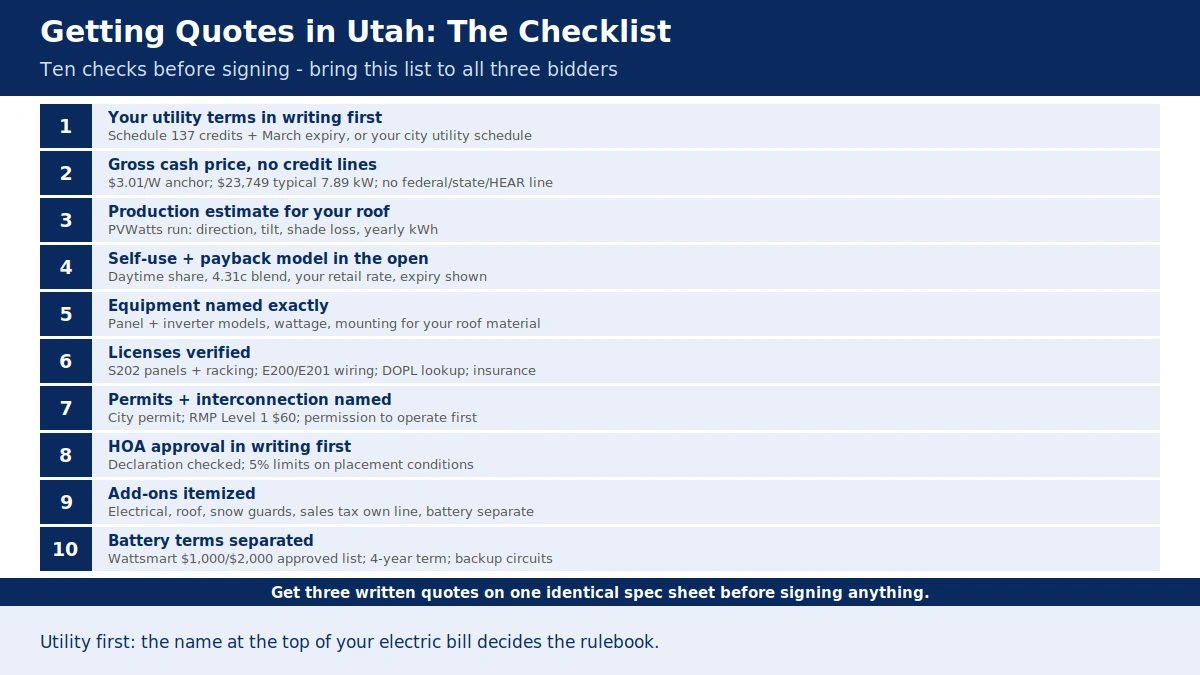
Get three written quotes on one identical spec sheet before signing anything. The cheapest quote is not the best quote.
The best quote is the one that names the equipment, shows the production estimate for the actual roof, prices the utility terms honestly, proves the licenses, and puts the battery decision on its own line. In Utah, the best quote is also the one that sizes the system to the home’s own daytime use, because under net billing that habit is worth more than any extra panel.
Sources & methodology Installed costs:
- EcoGen Solar Cost Index, September 2026 edition: Utah $3.01/W installed, cash, before incentives, as of Sep 25, 2026 (tied 35th lowest of 51); neighbors Arizona $2.56, Nevada $2.68, Idaho $2.96, Colorado $3.02, Wyoming $3.14; US average $2.89
- Berkeley Lab 2025: Utah single-family median installed size 7.89 kW (481 systems) → $23,749 at $3.01/W
- EnergySage Utah local data, updated Nov 6, 2026: $2.33–$2.34/W; average 13.16 kW system $30,637, range $26,041–$35,233; payback 22.49 years; 25-year savings $5,142; 90% offset (Oct 30, 2026 snapshot: $2.33/W, 13.11 kW, $30,596, range $26,007–$35,185, payback 22.52 years)
- EnergySage city data: Salt Lake City $2.30/W, 12.66 kW, $29,080, range $24,718–$33,442, payback 21.81 years, savings $7,928 (Nov 2026); Provo $2.39/W, 10.31 kW, $24,671, range $20,970–$28,372 (Oct 2026); Ogden $2.34/W, 11.93 kW, $27,922, range $23,734–$32,110 (Oct 30, 2026; Aug 2026: $2.48/W, 12.39 kW, $30,729; Jun 2026: $2.66/W); St. George $2.53/W, 11.35 kW, $28,732, range $24,422–$33,042, payback 13.18 years, savings $28,687 (Nov 2026); Sandy $2.32/W, 14.25 kW, $33,056 (Sep 2026)
- ConsumerAffairs Utah page, 2026: $2.39/W; 6 kW $14,340; Salt Lake City below state at each size
- Elite Electric, Sandy (contractor price list, checked Oct 30, 2026): $2.50/W, $2.35/W above 10 kW Wasatch Front, 4 kW $10,000 minimum, travel $0.75/round-trip mile outside service area
Production and use:
- EcoGen (PVWatts-based): about 1,524 kWh/kW/yr around Salt Lake City → 12,024 kWh/yr for 7.89 kW
- GreenWatt PVWatts v8 (NSRDB, Apr 2026): Utah 5.39 peak sun hours/day, rank 10, 1,484 kWh/kW/yr; June 7.77 PSH
- NREL insolation table: Salt Lake City average 5.26 (high 6.09, low 3.78); St. George resource about 6.5 kWh/m2/day, Utah average about 5.3 (via installer page, 2023)
- Orem PVWatts run: 1,561 kWh/kW/yr (south, 25-degree tilt); West Jordan estimate ~1,533 kWh/kW/yr; SolarPriceList Utah: 5.4 PSH, 1,430–1,600 kWh/kW/yr
- EIA Form 861, 2024: Utah average home 774 kWh/month, $94.57 bill, 12.22 cents/kWh; annual use 9,288 kWh
Rates and export rules:
- EIA Electric Power Monthly, Table 5.6.A, Aug 2026: Utah residential 13.31 cents/kWh (US 18.16); Aug 2026 bill $163.76 at 1,230 kWh
- Rocky Mountain Power Schedule 1, effective Aug 10, 2026 (Docket 26-035-T08): $12.00 customer charge; summer 9.8332/12.5263 cents, winter 8.7020/11.0852 cents (first 400 kWh / after); TOU on-peak 33.6173/29.7498 cents, off-peak 7.4705/6.6111 cents, 6–10 p.m. weekdays; riders roughly 13% (installer analysis of Utah Price Summary, Sep 25, 2026)
- Rocky Mountain Power Schedule 137, First Revision Sheet 137.3, effective Mar 1, 2026 (Docket 26-035-T03): export credit 4.855 cents Jun–Sep, 4.033 cents Oct–May (prior 5.704/4.199); 25 kW DC cap; Annualized Billing Period ends at March meter read; interconnection $60 Level 1, $75 + $1.50/kW Level 2
- Schedule 135 closed Nov 15, 2017, through Dec 31, 2035, transferable; Schedule 136 transition 9.2 cents/kWh, applications before Oct 30, 2020, through Jan 1, 2033; winter export credit 5.639 cents in 2020
- PSC settlement approved July 31, 2026; no new general rate case effective before Jan 1, 2029 (reported)
- Provo Power Schedule 1.1 Net Metering, effective Sep 1, 2026 billing period: credit 6.742 cents/kWh; retail 7/11/13 cents; $18 customer charge; unused credit given up after cycle including Feb 28; 25 kW cap; license required; net metering fee $375/$825 plus permit
- St. George Energy Services: kWh banking; December balance sale-back 3.622 cents/kWh (automatic at 5,000+ kWh); Solar Reliability Charge 2.67 cents/kWh generated; $245 review + $424 meter fee; no rentals; contractor solar class required; revision effective Mar 8, 2024
- Moon Lake Electric 2.4 cents/kWh monthly; Bountiful Hybrid 5.00 cents/kWh; Murray pilot under revision; Dixie Escalante REA ~9.6 cents/kWh average (2026 estimate)
Batteries:
- EnergySage Utah storage data, Jun 2026: $1,000–$1,079/kWh installed; 13 kWh ~$13,000, range $11,050–$14,950
- Tesla Powerwall 3 (13.5 kWh, 11.5 kW, 10-year warranty): BYOP Electric $14,500 installed → $12,500 after Wattsmart; Elite Electric $19,102 with backup gateway
- Wattsmart Batteries, tiers since Jun 15, 2026 (was $400/kW): $2,000 single battery 10 kW or more, $1,000 under 10 kW, per household; 4-year enrollment; bill credits $15/kW/yr years 2–4 capped $100, $50/kW/yr from year 5 capped $250; approved list incl. Powerwall 3, FranklinWH, SolarEdge, Sonnen, Fortress; changes on 30 days’ notice
- June 2026 wildfire shutoffs: ~7,735 customers de-energized in southern Utah, ~18,000 in watch-and-warning footprint (KUTV / Rocky Mountain Power, via installer summary)
Incentives and federal:
- Utah Office of Energy Development, RESTC: residential solar PV installed 2024 and later not eligible; $0; last amount up to $400 (2023); carryforward through 2027; non-solar residential 25% up to $2,000; commercial 10% up to $50,000; HB 264 remainder expires for systems placed in service before Jan 1, 2028; batteries not eligible; $15 fee (Utah Code 79-6-401); statute Utah Code 59-10-1014
- DSIRE record for Utah sales tax exemption: facilities 2 MW or greater, commercial/industrial/utility, expires Jun 30, 2027, not home systems; no home-system sales or property tax exemption verified
- HEAR/HOMES: Utah program on hold until further notice, DOE approval pending (OED page, checked Oct 25 and Nov 9, 2026); allocations HEAR $50,403,030, HOMES $50,595,872 (DOE Jan 2025 dataset); DOE Program Notice 26-2 effective May 29, 2026
- OBBBA P.L. 119-21; IRS FS-2025-05 (§25C/§25D $0 after Dec 31, 2025); §48E lease pass-through, in service by Dec 31, 2027; Utah authorizes leases and PPAs
Licensing, permits, HOA, snow:
- Utah DOPL: S202 Solar Photovoltaic Contractor excludes NEC wiring (R156-55a-301); E200/E201 for wiring; 2023 NEC statewide from July 1, 2025; $7,000 licensed-contractor threshold (HB 483, 2024, effective May 7, 2025); Construction Trades Licensing Act, Title 58 Chapter 55
- Permit examples (installer summaries): Herriman $228.18 + WC3 review 10–15 working days; West Valley City $106; Pleasant Grove $75 submittal fee; Ogden historic Certificate of Historic Appropriateness
- Utah Code 57-8a-701 (HB 119, effective May 7, 2025): declaration-only bans for detached homes, 67% vote to add a ban, 5% production/cost limits, pre-Jan 1, 2017 bans and developer control excluded; condominiums under Title 57 Chapter 8; solar easements 57-13-1 et seq.
- Ground snow load, Utah Code 15A-3-202 Table R301.2(3) / USU Utah Snow Load Study: Salt Lake City 28 psf at 4,239 ft, Ogden 37 psf, Logan 43 psf, 50+ psf Bear Lake; roof load starts near 70% of ground load (flat roof)
Payback arithmetic:
- NestPriced arithmetic on stated assumptions: export blend (4 × 4.855 + 8 × 4.033) / 12 = 4.31 cents; retail 13.31 cents; output 12,024 kWh/yr flat; cost $23,749; self-use 30% → $843/yr → 28.2 yrs; 40% → $951 → 25.0 yrs; 50% → $1,059 → 22.4 yrs; 55% → $1,113 → 21.3 yrs; 70% → $1,276 → 18.6 yrs; 25-year flat value at 50% $26,475; at 0.5%/yr output loss ~$24,900
- Cross-checks: EcoGen per-utility model ~26.5 years at 40% home use, 22.9–30.2 years at 55%–28% (Oct 30, 2026); EnergySage statewide 22.49 years on 13.16 kW
- Battery shift illustration: 2,000 kWh/yr × (13.31 − 4.31) cents = ~$180/yr standard rate; × (38.0 − 4.31) cents = ~$674/yr TOU peak; $13,000 − $2,000 = $11,000 net
EXCLUDED:
- Any “after 30% credit” or “after $2,000 credit” prices: §25C/§25D are $0 for 2026 installs
- Any Utah state credit, sales tax saving, or property tax saving in a 2026 quote: none verified for new home solar
- Any HEAR rebate for solar panels or any Utah HEAR/HOMES money in 2026: on hold, and HEAR does not cover solar
- Retail-rate net metering, Schedule 136 rates, or an April true-up for new Rocky Mountain Power customers: Schedule 137 net billing with a March expiry governs
- Stale export rates (5.704/4.199 cents, 5.639 cents, Provo 6.5 cents): superseded
- A Utah lease/PPA provider, lease rate, or escalator: none verified, none named
- A Utah-specific panel-upgrade cost, detach-and-reset cost, snow-guard price, or statewide permit schedule: none verified, none stated
- A St. George kWh/kW/yr figure, a Logan city price, or Dixie/Logan/Murray export terms: none verified, none stated
- An inverter replacement cost or a Utah-measured degradation rate: 0.5%/yr is a labeled planning assumption
- EnergySage and EcoGen payback models as measured outcomes: models with stated assumptions, labeled as such
Disclaimer: The prices here are 2026 Utah planning figures, and what you end up paying moves with the city, the roof, the utility territory, the shade, and the contractor, with the utility moving the payback more than any of them. Get written quotes from three licensed Utah installers on one identical spec sheet before settling on a budget, and check each license yourself on the Division of Professional Licensing lookup before anyone touches the roof. Nothing here is tax advice for your own return, and program rules change, so confirm current terms with Rocky Mountain Power or your city utility, the Utah Office of Energy Development, and the Wattsmart program before signing, and check that every quote uses the Schedule 137 export rates in force since March 1, 2026.
What does solar cost in Utah in 2026?
About $3.01 per watt installed, so a typical 7.89 kW system costs about $23,749 before incentives (EcoGen Solar Cost Index, September 2026). EnergySage marketplace quotes average $2.33 to $2.34 per watt on much larger 13 kW systems, which is why its average total runs higher at about $30,637. No federal or state credit applies to a 2026 homeowner-owned install, so the gross price is close to the price paid.
What does Rocky Mountain Power pay for extra solar power in 2026?
Under Schedule 137 net billing, exported power earns 4.855 cents per kWh from June through September and 4.033 cents from October through May, rates in force since March 1, 2026. Credits offset power and energy charges, roll forward month to month, and expire at the March meter read. Power used at home as it is made saves the full retail price instead, which is why sizing to daytime use matters more than system size alone.
Does Utah still have net metering for new solar customers?
No, not for new Rocky Mountain Power customers. Every interconnection since October 31, 2020 goes on Schedule 137 net billing, where exports earn a low credit instead of canceling retail kWh one for one. Older Schedule 135 net metering and Schedule 136 transition terms are closed to new applicants but grandfathered for homes already on them, while Provo and St. George run their own city programs with different credit rules.
How long does solar take to pay for itself in Utah?
About 22.4 years at 50% self-use on the typical $23,749 system, stretching to about 28.2 years at 30% self-use and dropping to about 18.6 years at 70% self-use, on flat output and current rates. EcoGen models about 26.5 years at 40% home use for Rocky Mountain Power customers, and EnergySage models 22.49 years statewide on a larger system.
Does Utah give a tax credit for solar panels in 2026?
No. The Utah residential solar credit is $0 for systems installed in 2024 and later, and the federal homeowner credit is $0 for installs finished after December 31, 2025. Unused state credit earned in earlier years can still be carried forward through 2027, but a 2026 install earns nothing new, and any quote subtracting either credit uses old rules.
Can my HOA stop me from installing solar panels in Utah?
A board rule or design guideline cannot ban solar on a detached home where the association does not own the roof, under Utah Code 57-8a-701. Only the recorded declaration can prohibit it, and adding a new ban takes a vote of at least 67% of voting interests. Placement conditions must cut production by 5% or less and raise install cost by 5% or less, but bans recorded before January 1, 2017 and associations under developer control fall outside the law.
Is a battery worth it with solar in Utah?
As bill savings alone, usually not: shifting 2,000 kWh a year from export to home use gains about $180 a year on the standard rate, against a net battery cost near $11,000 after the $2,000 Wattsmart payment. The case strengthens for homes on time-of-use with heavy weekday evening use, where the same shift can gain about $674 a year at peak prices. Most Utah buyers buy a battery for outage backup, including wildfire shutoffs, with bill savings as a secondary benefit.
What license should a Utah solar installer hold?
Panels and racking fall under the S202 Solar Photovoltaic Contractor license, while wiring and connections must go to an E200 General Electrical Contractor or an E201 Residential Electrical Contractor, since the S202 rule excludes National Electrical Code wiring. An E200 contractor can cover both halves. Check every license on the Division of Professional Licensing lookup, ask for NABCEP certification and insurance in writing, and confirm the city or county permit before work starts.