

Every bundle of shingles on a Hawaii roof crossed an ocean to get there. The shingles, the metal panels, the underlayment, and most of the fasteners left a mainland port in a container, crossed 2,500 miles of Pacific water to Honolulu Harbor, and then, for a neighbor island job, rode a second barge to Hilo, Kahului, or Nawiliwili. That journey sits inside every Hawaii roofing quote, on every line, whether the quote names it or not.
It is the reason a Hawaii homeowner can collect three honest quotes and still feel lost. One cost model says the roof costs $11,000. A contractor says $21,000. Both numbers come from real arithmetic, and neither is a lie. They measure different things: one prices materials plus local wages, and the other prices what licensed crews actually charge after freight, overhead, wind-rated details, and the general excise tax.
This guide prices both, names the gap, and tells the reader which number to budget from. It also covers the four things that make a Hawaii roof different from a mainland roof at any price: wind that tries to lift the whole roof off the walls, salt air that eats the wrong metal in a decade, rain that ranges from 10 inches a year in Kona to 120 inches in Hilo, and a separate hurricane insurance policy with a deductible measured in percent, not dollars.
The national roof replacement cost guide sets the mainland baseline, and the distance between that baseline and a Hawaii quote is the story of this guide.
Table of Contents
How Much Does a Roof Replacement Cost in Hawaii in 2026?
Seven published sources price a Hawaii roof in 2026, and they do not agree. The spread runs from about $10,000 to about $37,000 for the same 2,000 sq ft architectural shingle roof, which is wider than in any mainland state in this series. The spread is not noise. Each source measures a different job, and once the jobs are separated, the numbers start to make sense.
The NumeralQ Hawaii page builds its price from material prices plus local labor, priced October 26, 2026. It names all three inputs plainly: architectural shingles, a 2,000 sq ft roof, installed. Its answer is $10,060–$12,300. Run the same model across the country and the national band is $9,710–$11,840, so Hawaii lands only about 4 percent above the national figure on this model. That small premium is the first clue that the model misses something Hawaii-specific, because every contractor-facing source puts the premium far higher.
SmartRoofingCalculator takes a different road. It starts from national per-square bands and adjusts them with a state factor built from roofer wages and the Bureau of Economic Analysis regional price parity for goods. Its Hawaii factor is 1.078, which gives $490–$700 per square installed with tear-off, or $9,800–$14,000 for a 20-square roof. The method is transparent, and the result sits close to the NumeralQ band at the low end and above it at the high end.
MyRoofData models a typical single-family home with one layer torn off, then prices each material per square with tear-off quoted separately. Its Hawaii range is $17,250–$30,000 for the typical home, about 35 percent above the national average on a state cost index of 1.35. Its worked example prices 23.4 squares at $17,400–$30,000. The bigger roof and the wider per-square spread push its top end well above the planning models, and the 1.35 index is the first of several independent signs that the real Hawaii premium is measured in tens of percent, not single digits.
Instant Roofer works from a different kind of evidence entirely: prices contractors typed into its app, matched to roofs measured from above. Its Hawaii average is $21,972 for an asphalt shingle roof, on an average measured roof of 2,113 sq ft at $1,040 per square, from 48,900 measured Hawaii roofs and pricing entered by 19 contractors. The same platform prices the national average at $16,261 on a 2,588 sq ft roof at $628 per square. Hawaii’s per-square contractor rate therefore runs about 66 percent above the national platform rate. That is the strongest single piece of evidence in this guide that Hawaii is the highest-cost roofing market in the country, because it comes from contractor pricing rather than from a model.
A Hawaii business guide published in October 2026 lands in the same territory from the contractor side. It puts a typical single-family asphalt roof at $18,000–$35,000, standing-seam metal at $30,000–$60,000, and Hawaii quotes at roughly 30 to 60 percent above a similar job in Arizona or Texas. Its island table prices Oahu asphalt at $17,000–$30,000 for a 1,800 to 2,200 sq ft roof. One guide is one guide, and its figures are labeled as such wherever this draft uses them, but its range overlaps the Instant Roofer average closely.
RoofingEstimatorPros models the same 2,000 sq ft roof highest of all: $20,608–$36,766, or about $1,030–$1,838 per square, on a state multiplier of 1.45. Its own comparison table gives a lower state-average range of $15,950–$27,550, which contradicts its headline band, and this guide records the model as the high end rather than following its top figure. In the Idaho guide this publisher was the high outlier and was set aside; in Hawaii its low end aligns with contractor pricing, which shows how far the Hawaii market sits from the mainland norm.
One more piece of evidence comes from inside the NumeralQ model itself, and it is the most telling conflict in this section. A NumeralQ research index built from an August 2026 snapshot of 147 markets applies a 1.60 factor to Honolulu on a national baseline midpoint of $14,500, giving a modeled Honolulu range of $17,600–$28,800 with a midpoint of $23,200, the highest of all 147 markets. That snapshot is a model output, not a survey of bids, and the page says so. But it sits far above the $10,030–$12,260 Honolulu estimator page from the same publisher two months later. The two NumeralQ outputs cannot both describe the same market, and this guide reports the conflict rather than choosing the tidier number.
| Cost source | Job priced | Hawaii 2026 figure |
|---|---|---|
| NumeralQ, Oct 26, 2026 (planning model) | 2,000 sq ft roof, architectural shingles, installed | $10,060–$12,300 |
| SmartRoofingCalculator, Apr 24, 2026 (modeled) | 20-square roof, architectural shingles, tear-off included | $9,800–$14,000 |
| MyRoofData, 2026 model | Typical home, architectural shingles, one-layer tear-off included | $17,250–$30,000 |
| Instant Roofer (contractor pricing, 48,900 roofs) | Average Hawaii roof: 2,113 sq ft, asphalt shingle | $21,972 average |
| Hawaii business guide, Oct 20, 2026 (single guide) | Typical single-family roof, 1,800–2,200 sq ft, asphalt | $18,000–$35,000 |
| ServiceCostHub, July 2026 (modeled, Honolulu) | 2,000 sq ft home, standard asphalt shingle | $13,882–$16,022 |
| RoofingEstimatorPros, Aug 26, 2026 (modeled) | 2,000 sq ft roof, architectural shingles | $20,608–$36,766 (high model) |
The headline band in this guide, $13,900–$21,700, is the span of the three contractor-facing Honolulu figures: ServiceCostHub at $13,882–$16,022, SmartRoofingCalculator’s Honolulu city page at $15,190–$21,700 for 20 squares, and the Instant Roofer rate applied to a 20-square roof at $20,800. It is a planning range for budgeting, built from named sources, and it is labeled as such in the answer box. A homeowner who budgets from the $10,060 planning band and then opens a $20,000 quote will think the roofer is padding the job. The roofer usually is not. The planning band prices materials and wages; the quote prices the whole island job.
The headline band covers the roof system itself: shingles, underlayment, starter course, ridge cap, flashing, and ventilation pieces, plus tear-off of the old roof, disposal, labor, and the contractor’s markup. The surprises live outside that band, and in Hawaii they are specific. A second tear-off layer adds $1.38–$1.82 per sq ft, each installed decking sheet runs $64.90–$93.40, new gutters run $8.75–$12.49 per linear ft, flashing work adds $353–$503 at a chimney or wall, and re-flashing a skylight adds $521–$671. Every one of those figures comes from the NumeralQ Honolulu page, and each deserves its own line on any quote.
Two Hawaii-only add-ons sit outside even that list. Adding hurricane clips or straps while the roof is open runs roughly $1,500–$5,000 on a typical house, according to the October 2026 Hawaii guide, and removing and reinstalling solar panels for a re-roof runs roughly $3,000–$8,000 on a typical residential system, according to the same guide. Both figures are single-guide estimates, labeled as such, and both are priced on inspection. A quote that folds them into one lump sum hides the two lines most likely to grow.
Labor explains only a small part of the Hawaii premium, and the wage data proves it. The median Hawaii roofer earns $28.64 an hour, 7 percent above the national median of $26.65, according to the Bureau of Labor Statistics for May 2025. Contractors bill $57–$74 per worker-hour once insurance, payroll taxes, overhead, and profit are loaded on. One Hawaii guide claims construction wages run 30 to 45 percent above the mainland, but the BLS survey of 1,110 Hawaii roofers does not support that size of gap for this trade, and this guide follows the survey.
Freight and the small crew pool explain the rest. Materials travel by container ship from the West Coast, neighbor island jobs add a barge hop, and specialty colors and coastal-rated panels can take weeks to arrive by ship. Guides put the freight premium at 15 to 25 percent on shingles and 20 to 35 percent on metal, with another 5 to 15 percent for outer islands, and no verified dollar-per-square freight figure exists, so this guide states freight as a percentage driver from those guides and never as a dollar line. The honest check is to ask each contractor to show freight and special-order charges as separate lines, which is the advice MyRoofData gives and the checklist in the final section repeats.
The general excise tax is the last layer, and it catches newcomers by surprise. Hawaii has no sales tax in the mainland sense. What it has is a 4 percent tax on a contractor’s gross receipts, rising to 4.5 percent once the county surcharge is added in every county, and since contractors usually hand that cost to the buyer, a bill can carry as much as 4.712 percent on top. On a $20,000 roof that is about $942. Before ranking quotes, the reader should pin down whether each one folds the tax into the total or tacks it on at the bottom, or the lowest-looking bid may not be the lowest.
Roof Replacement Cost in Hawaii by Material
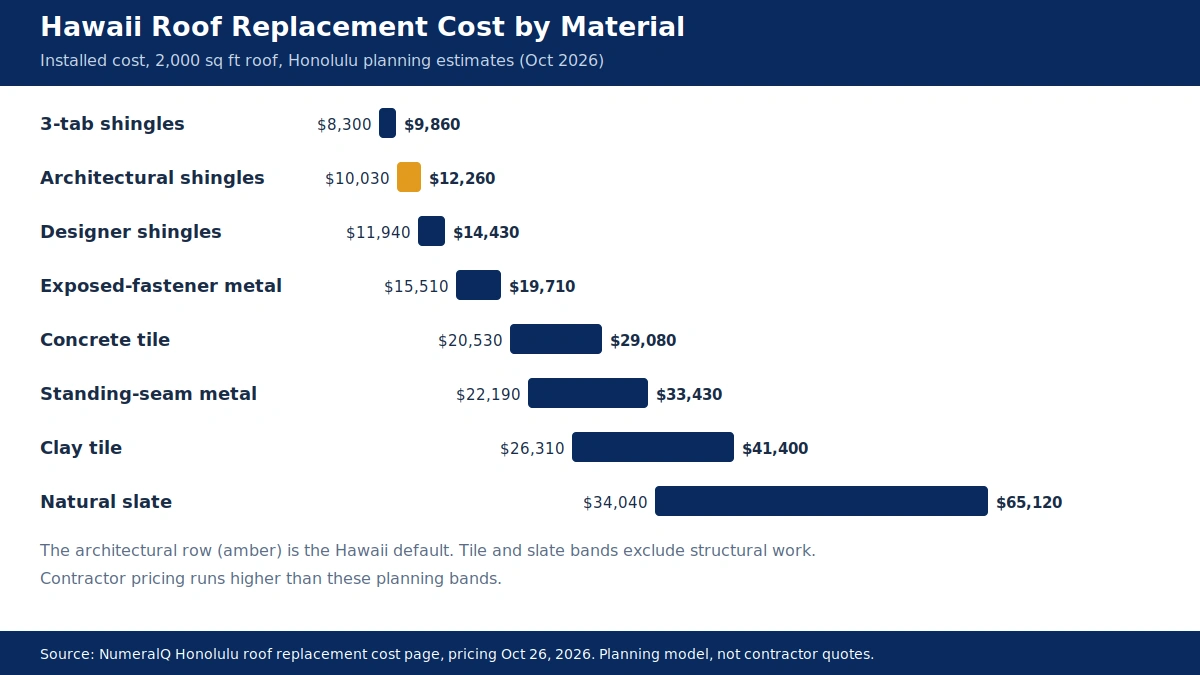
Material is the second-biggest lever on the price after size, and in Hawaii it is also a salt, wind, and sun decision that outlives the install day by decades. The table below prices a 2,000 sq ft roof in every common material from the NumeralQ Honolulu page, which is the only published full material breakdown for a Hawaii market and is labeled as a planning estimate throughout this section. The per-square column comes from the MyRoofData Hawaii model, priced before tear-off, so the reader can see the contractor-model rate beside the planning rate. The life columns carry both the rated life and the Hawaii-calibrated life, because the two differ by enough to change the buying decision.
MyRoofData supplies the rated-life figures in that column. The Hawaii-life column follows the Hawaii guide that calibrates lifespans for island conditions, cross-checked against a second Hawaii guide that puts shingle life at 15 to 20 years. Where the Hawaii guide gives no figure, the cell says so rather than borrowing a mainland number.
| Material | 2,000 sq ft roof, installed (Honolulu planning) | Per square before tear-off (MyRoofData) | Rated life | Hawaii life |
|---|---|---|---|---|
| 3-tab asphalt shingles | $8,300–$9,860 | $473–$743 | 15–20 years | 12–17 years |
| Architectural asphalt shingles | $10,030–$12,260 | $608–$1,013 | 22–30 years | 18–22 years leeward; 14–18 years windward/coastal |
| Designer / luxury asphalt shingles | $11,940–$14,430 | Not published in this model | 25–30 years | Not calibrated in the Hawaii guide |
| Exposed-fastener metal (corrugated, 5V) | $15,510–$19,710 | $743–$1,283 | 30–40 years | 20–40 years (corrugated) |
| Stone-coated steel | $17,450–$25,160 | Not published in this model | 40–50 years | Not calibrated in the Hawaii guide |
| Synthetic slate or shake (composite) | $18,350–$26,370 | Not published in this model | 40–50 years | Not calibrated in the Hawaii guide |
| Cedar shakes | $18,620–$32,310 | $1,215–$2,025 | 25–35 years | Not calibrated in the Hawaii guide |
| Concrete tile | $20,530–$29,080 | $1,350–$2,430 | 40–75 years | 35–50 years |
| Standing-seam metal | $22,190–$33,430 | $1,283–$2,160 | 40–70 years | 35–55 years (aluminum / coated Galvalume) |
| Clay tile | $26,310–$41,400 | $1,620–$3,375 | 50–100 years | Not calibrated in the Hawaii guide |
| Natural slate | $34,040–$65,120 | $2,025–$4,050 | 75–150 years | Not calibrated in the Hawaii guide |
| Flat: modified bitumen / EPDM / TPO | $11,080–$14,270 / $11,440–$17,680 / $13,760–$18,320 | $743–$1,283 (membrane) | 20–30 years | Not calibrated in the Hawaii guide |
The gap between the two price columns is the same gap as in the first section, seen material by material. Take architectural shingles: the Honolulu planning band implies about $502–$613 per square installed, while the MyRoofData model prices the same material at $608–$1,013 per square before tear-off, with tear-off adding another $100–$200 per square per layer. A reader who multiplies the MyRoofData rate across 20 squares and adds tear-off lands at $14,160–$24,260, which sits inside the contractor cluster from the first section. The two columns are not in conflict. They describe a planning price and a contractor price for the same roof.
3-tab shingles are the cheapest buy, and in Hawaii they are the worst value on the table. The 3-tab band of $8,300–$9,860 undercuts architectural shingles by about 19 percent, a gap of roughly $1,730–$2,400 on a 2,000 sq ft roof. The trade is a thin single-layer shingle with lower wind ratings and a Hawaii life of 12 to 17 years, on a roof that will face the same ultraviolet light, the same trade winds, and the same salt air as its thicker neighbor. Few insurers or builders still recommend 3-tab for a full replacement anywhere, and in Hawaii the short life eats the saving twice: once in an earlier replacement, and once in the second round of freight and tear-off. Treat 3-tab as a comparison price, not as the roof to put on the house.
Architectural shingles hold the default slot in Hawaii, and they earn it on price, not on longevity. The shingle is dimensional and two-layered, with wind ratings of 110–130 mph, and every crew in the state can quote it from memory. The Honolulu planning band of $10,030–$12,260 is the number every other material in the table is measured against. The Hawaii caveat on life is blunt: intense ultraviolet light, salt-laden trade winds, and wet-dry cycling wear asphalt faster than the lab test assumes, and a windward or coastal roof will deliver 14 to 18 years rather than the 22 to 30 years on the rated-life column. Algae-resistant lines are worth asking for by name, because the black streaking from algae shows up fast in humid windward areas. For a leeward inland home on a tight budget, architectural shingles remain a reasonable buy. For a coastal or windward home, they are a shorter roof than the price suggests.
Designer and luxury asphalt changes how the roof looks from the street, not how it holds up in a storm. That $11,940–$14,430 band buys a deeper profile, stronger shadow lines, and street presence on a front-facing slope, above what standard architectural offers. Thickness alone adds no wind rating and no salt resistance. A buyer who wants both the look and the storm performance should get a price on a named high-wind line and have the wind rating confirmed in writing, because the word “designer” on a quote describes appearance, not performance.
The word metal covers two different roofs, and in Hawaii it also covers two different metals. For corrugated or 5V exposed-fastener panels, the band is $15,510–$19,710. Screws driven through the panel face make them quick to fit, which is why they show up on plantation-era homes, rural houses, and budget metal conversions across the islands. The screws and their gaskets are the upkeep item: gaskets age in Hawaii sun and temperature swings, salt attacks the fasteners first, and a roof that is never re-checked can weep at a thousand screw holes. Fastener re-nailing is a named Hawaii repair line at $500–$1,500, which tells the reader how common the problem is.
The $22,190–$33,430 standing-seam band reflects a system whose fasteners sit hidden beneath raised seams. Because the panels expand and contract with temperature rather than resisting it, the system earns its 40 to 70 year rated life and its premium price. In Hawaii the panel metal matters as much as the profile: aluminum never rusts, because it contains no iron, and it is the standard recommendation within a few hundred feet of the surf, while coated Galvalume steel serves farther inland. The salt-air section prices the distance rules in full. Two companion guides carry the detail: our metal roof cost guide breaks metal pricing into gauge, finish, and trim lines, while our metal vs shingles guide settles the head-to-head choice.
Stone-coated steel and synthetic slate sit in the middle of the table and solve different problems. Stone-coated steel at $17,450–$25,160 gives a shingle or tile look in steel, sheds the heavy windward rain well, and carries Class A assemblies. Synthetic slate or shake at $18,350–$26,370 mimics slate at roughly half the weight, which matters on older Hawaii framing that was never engineered for a heavy roof. Neither material has a Hawaii-calibrated life published in the guides this draft opened, so the table says so and the buyer should ask the manufacturer for coastal warranty terms in writing, including any distance-from-shore limit.
In Hawaii, tile, slate, and cedar stay special-case choices, and each needs a justification stronger than appearance. Weight rules out a casual switch to tile: concrete at $20,530–$29,080 and clay at $26,310–$41,400 often demand an engineering check of the structure first, because concrete tile weighs 850–1,100 lb per square and many Hawaii homes were framed for light roofing. Clay also cracks underfoot, so repairs call for crews who know tile, and tile can shatter under high-velocity debris in a storm. At $34,040–$65,120, natural slate is priced by its weight and by the specialist labor it needs, and it is rare enough in Hawaii that lead times and crew availability should be confirmed before it is budgeted at all.
Cedar shakes at $18,620–$32,310 ask for upkeep in a hot, humid climate, face restrictions in wildfire-prone areas unless treated to Class A or Class B fire ratings, and sit poorly with Hawaii’s termite pressure. Cedar is a hard sell on any island, and a buyer who wants a wood look should price a rated synthetic shake with the rating in writing. Do not sign a tile quote until the weight and structure questions are answered; our tile roof cost guide works through them.
Low-slope and flat sections carry membrane pricing, not shingle pricing, and a quote that buries them inside the shingle total hides a different job. Where shingles cannot shed water, membranes take over: lanai covers, porches, additions, and mid-century flat roofs price at $11,080–$14,270 for modified bitumen, $11,440–$17,680 for EPDM rubber, and $13,760–$18,320 for TPO. Plantation-era and plantation-revival homes often carry low slopes of 2:12 to 4:12, which need membrane underlayment systems more demanding than standard felt. Where one house carries both a flat lanai roof and a pitched main roof, the quote needs both prices on separate lines. The warning sign is water that still sits on a flat section days after a trade-wind downpour: standing water means the slope or the drainage was never right.
Roof Replacement Cost by Roof Size in Hawaii
A roofer prices the surface the crew works on, not the living area recorded on the deed. One square means 100 sq ft of roof surface, which makes a 2,000 sq ft roof a 20-square roof. The surface always runs larger than the floor plan once slope, overhangs, hips, valleys, and cutting waste at ridges and edges are counted. One Hawaii guide puts the roof surface at roughly 1.3 times the living-area footprint, which means a 2,000 sq ft home carries about 2,600 sq ft of roof. Instant Roofer’s measured Hawaii average tells a similar story from the other direction: its average roof is 2,113 sq ft of surface on homes smaller than that in living area.
When two quotes for the same house land thousands apart, mismatched measurements are usually the reason. One bid prices the surface the crew will stand on, and the other prices the rooms underneath it. Roof surface area drives the table below, taken from the NumeralQ Hawaii page, and the implied per-square rate runs alongside so any quote can be checked against it. The final column applies the Instant Roofer contractor rate of $1,040 per square to the same sizes, so the reader can see both the planning price and the contractor price for their roof size in one place.
| Roof size (sq ft of surface) | Squares | Architectural shingles, installed (planning) | Implied rate per square | Same roof at the $1,040 contractor rate |
|---|---|---|---|---|
| 1,000 | 10 | $5,310–$6,570 | $531–$657 | $10,400 |
| 1,500 | 15 | $7,690–$9,440 | $513–$629 | $15,600 |
| 2,000 | 20 | $10,060–$12,300 | $503–$615 | $20,800 |
| 2,500 | 25 | $12,440–$15,160 | $498–$606 | $26,000 |
| 3,000 | 30 | $14,810–$18,030 | $494–$601 | $31,200 |
The contractor-rate column is NestPriced arithmetic, and it is labeled as such. It is not a quote, and it will not match any single bid, because real bids vary with pitch, access, and material grade. Its purpose is narrower: it stops a reader from budgeting $11,000 for a 2,000 sq ft roof and then being shocked by a $20,000 quote. Both numbers in the row are real. They come from different kinds of evidence, and the quote that lands on the kitchen table will usually sit closer to the right-hand column.
The table gets a second check from an independent planning figure. For the same 25 squares, SmartRoofingCalculator gives $12,250–$17,500 installed with tear-off. That band sits around the NumeralQ figure of $12,440–$15,160, sharing most of its range. MyRoofData’s 23.4-square example at $17,400–$30,000 runs higher at the top end because its per-square material spread is wider. The three models agree that a 25-square roof costs more than a 20-square roof by roughly a quarter. They disagree on the level, and the level is where the freight and contractor pricing live.
What the roof looks like matters more to the per-square rate than how big it is. On a plain two-slope gable with few valleys and no chimney, the crew spends the day laying full courses, so the job prices near the bottom of the range. Every dormer, valley, skylight, and chimney adds hand cutting, flashing, and offcuts, which is why a cut-up roof prices toward the top of the range. Hip roofs, common across Hawaii subdivisions, carry more ridge and hip cap work than a gable roof of the same area, and the cap lines are where wind-driven rain finds its way in if the nailing is thin.
A steep slope slows the crew down, calls for staging the crew would not need on a walkable pitch, and turns every cut into extra waste. Height alone raises the per-square price: getting bundles and tear-off debris up and down two stories, with safety setup to match, takes longer than the same roof area on one story. Access matters in Hawaii in a specific way: a hillside lot in Manoa or an Upcountry Maui lot with a steep drive, a narrow lane, or a backyard the dumpster cannot reach adds labor hours that a flat Kapolei lot never sees. Remote subdivisions on the Big Island can carry a trip premium, and some contractors decline remote jobs altogether, which is a cost in waiting time even when it is not a line on a quote.
Waste is already inside the published material bands, and it is not padding. The NumeralQ bands state that materials include waste and contractor markup, and the waste covers starter shingles, ridge cap, valley cuts, and the offcuts that never land on the roof. Multiplying a home center shingle price by the roof area always underprices the job: waste, ridge cap, and starter strip never appear in that first multiplication. The same warning applies double in Hawaii, where a short order means waiting on the next container ship rather than driving back to the store.
Two quick methods price the roof before any roofer calls back. The quick way: take the table row nearest your roof size, read across to the contractor-rate column, add a contingency for the features that add work (a chimney, a skylight, a valley, a steep pitch, solar panels coming off and going back on), and treat the result as a budgeting number. The careful way: get the roof surface measured from a satellite measurement, count the squares, multiply by the planning rate and by the contractor rate to get the honest range, and add tear-off, decking, flashing, clips, and solar work as separate lines.
Whichever method is used, the figure that counts comes on a written quote, after a licensed crew has walked the roof. A planning number judges a quote; it never replaces one.
Roof Replacement Cost by Island and City: Honolulu, Hilo, Kailua-Kona and Kahului
Only Honolulu has published cost models behind it. No NumeralQ or SmartRoofingCalculator city page exists for Hilo, Kailua-Kona, or Kahului, and no source this guide opened publishes a city-level price for any of the three. The city table below is therefore honest about what it is: one measured city and three island-band planning estimates, labeled as estimates in every cell, drawn from the two Hawaii guides that price by island.
The guides disagree on the size of the neighbor island premium, and the table shows both views rather than averaging them into a false precision. One guide puts Maui 5 to 8 percent above Oahu and the Big Island 5 to 10 percent above Oahu. The other puts neighbor islands 10 to 25 percent above Oahu. The honest read is that neighbor island jobs cost more, that the premium comes from the second barge hop and the thinner crew pool, and that the exact percentage depends on the island, the material, and the season.
| City | 2,000 sq ft architectural roof (planning) | Contractor-facing island band | Basis | Rain (airport normal) |
|---|---|---|---|---|
| Honolulu (Oahu) | $10,030–$12,260 | $13,900–$21,700 | NumeralQ Honolulu + 3 contractor-facing sources | 16.3 in a year |
| Hilo (Big Island) | ~$11,000–$17,500 | ~$19,000–$34,000 | Island bands as planning estimates | 120.4 in a year |
| Kailua-Kona (Big Island) | ~$11,000–$17,500 | ~$19,000–$34,000 | Island bands as planning estimates | 9.9 in a year at the airport |
| Kahului (Maui) | ~$11,000–$17,000 | ~$20,000–$35,000 | Island bands as planning estimates | 16.2 in a year |
Honolulu is the measured market, and it is also the cheapest market to roof in, by Hawaii standards. The Honolulu page prices the 2,000 sq ft roof at $10,030–$12,260 on the planning model, against $10,060–$12,300 statewide, which is effectively the state band. The contractor-facing figures run higher: SmartRoofingCalculator’s Honolulu city page gives $15,190–$21,700 for 20 squares, ServiceCostHub gives $13,882–$16,022, and Instant Roofer’s Oahu community figures run from $20,786 in Wahiawa to $23,268 in Kapolei on its larger average roof. Oahu has the deepest contractor pool in the state, the shortest supply line, and the most competition, which is why it sets the baseline every other island is measured against.
Honolulu roofer pay explains almost none of the price. The median Honolulu roofer earns $28.47 an hour, 7 percent above the national median, with billed rates of $57–$74 per worker-hour. Honolulu County holds 63 roofing contractors, 1.7 per 10,000 homes against a national rate of 1.7, which is an ordinary level of competition. Honolulu’s median home carries a $843,400 value and a 1974 build year, so most of the city’s housing stock is about 52 years old. A house still on its original roof has already outlived two asphalt lives. Fewer than half of Honolulu units are houses, at 34 percent, and in association buildings the roof is usually a shared cost decided by the board, not by the unit owner.
Honolulu itself holds two roofing climates inside one city line. Leeward homes in Ewa and Waianae get intense sun and little rain, while windward homes in Kailua and Kaneohe get steady trade-wind showers. Roofers on the windward side pay more attention to underlayment and valley flashing because water exposure is constant, and a windward quote that prices underlayment thin should be questioned. Older homes in Kaimuki, Manoa, and Aiea often carry single-wall construction and older framing, which can require extra tie-down work during a re-roof, and the wind section explains why that work matters.
Hilo is the estimate that needs the most caution, because its climate is the extreme in the state. No published city price exists, so the island bands are the planning estimates: $11,000–$17,500 on one guide’s planning table, $19,000–$34,000 on the other guide’s contractor-facing island table. Hilo Airport records 120.4 inches of rain a year across 273 days with measurable rain, about three days in four, which makes it the wettest city in the country by rain days. Downtown Hilo records more again on the university rainfall grid, at 142 inches. Leak prevention and mold resistance dominate every Hilo roofing decision, and a Hilo quote should be read for its underlayment, valley, and flashing lines before its shingle line.
Hilo’s second complication is volcanic. South Hilo sits in the vog-affected districts, where sulfur dioxide from Kilauea combines with moisture to form dilute sulfuric acid that attacks asphalt binders and uncoated metal. The salt-air section covers vog in full. A Hilo homeowner quoting a metal roof should confirm the coating and fastener specification against vog exposure, not just salt exposure, and should confirm that the insurer will cover the address at the chosen spec before ordering material.
Kailua-Kona shares Hilo’s island bands and almost nothing else. The same planning estimates apply: $11,000–$17,500 on one guide, $19,000–$34,000 on the other. But Kona is the dry side of the same island. Keahole Airport records 9.9 inches of rain a year, while Kailua-Kona town, upslope from the coast, records about 27 inches on the university grid. Kona roofs bake more and leak less, which shifts the buying decision toward ultraviolet resistance and heat reflection and away from the heavy rain detailing a Hilo roof needs. South Kona shares the vog exposure, so the corrosion specification still matters even though the rain does not.
Kona’s practical complication is distance. Hawaii Island is large, crews are based in a few towns, and a crew driving from Hilo to a Kona-side job, or from Kona to a remote subdivision, may charge a trip premium. Some contractors decline remote jobs altogether. A Kona homeowner should confirm the crew’s base, the trip charge, and the start window in writing before treating any island-band estimate as a budget, because the travel line is where Big Island quotes diverge most.
Kahului is the Maui estimate, and Maui carries the rebuild premium. No published city price exists. The island bands are $11,000–$17,000 on one guide and $20,000–$35,000 on the other. Kahului Airport records 16.2 inches of rain a year, close to Honolulu’s figure, but Maui’s pricing runs higher because materials take an extra barge hop and crews are booked solid. Demand jumped after the August 2023 Lahaina fire, and rebuilding work continues to pull labor and supply across the island. Homeowners in Kihei, Wailuku, and Upcountry areas like Pukalani often wait longer for start dates.
Kahului roofer pay runs a little above the state figure: a median $29.52 an hour in the Kahului-Wailuku metro area, against $28.64 statewide, from a small pool of about 100 roofers in the survey. That thin pool is the Maui story in one number. Three written quotes on one identical spec sheet matter more on Maui than on Oahu, because the local market is smaller, the rebuild demand is real, and the freight line is longer. Upcountry homes see cooler nights and more moisture, while Kihei sees dry heat and salt, so the underlayment and fastener specification should follow the address, not the island average.
The chart below prices the neighbor islands a different way: it applies the neighbor-island percentage premium (5 to 8 percent for Maui, 5 to 10 percent for the Big Island) to the Honolulu planning band, so its figures run lower than the island bands in the table above, which quote each guide’s own dollar figures.

Hurricane Wind and the Load Path: Clips, Straps and the 130 mph Rule
On September 11, 1992, Hurricane Iniki came ashore on Kauai as a Category 4 storm with sustained winds of 145 mph. It destroyed about 1,421 homes and severely damaged at least 5,000 more, damaging or destroying 41 percent of the island’s 15,200 homes. Seven people were killed and about 100 were injured. Total damage ran to about $3.1 billion in 1992 dollars, with about $1.6 billion in insured losses. Iniki remains the benchmark event for wind loss on residential roofing in Hawaii, and it is the storm every Hawaii reinsurer still uses when modeling a direct strike.
The roofs told the story of the storm. A structural engineer who studied the damage described what happened to single-wall homes: the entire roof could be lifted off the walls in one piece by the wind, and the rest of the structure would fall apart after that. The failure was not the shingles. It was the connection. The roof was never tied to the walls, and the walls were never tied to the foundation, so the wind found the weakest link and took the whole assembly.
Hawaii changed its code twice after that lesson, and the dates matter for any buyer of an older home. After Hurricane Iwa brushed Kauai in 1982, new homes had to have their roofs secured to their walls. After Iniki, new construction had to strap upper stories to lower stories and connect the foundation to the first floor. Hurricane clips and straps were not mandated for new construction until 1994. A home built before the mid-1990s may have none of these connections, and no law requires an older home to add them until work triggers the rule.
Most Oahu homes still lack these protections. A 2019 Honolulu study found that 64 percent of single-family homes on Oahu, about 125,000 houses, have no hurricane protections at all. The figure was repeated in state testimony in 2025, and it is the single most important number in this section. A re-roof is the cheapest moment in a home’s life to fix the connection, because the old covering is off, the framing is exposed, and the crew can reach every rafter. Doing the same work later from inside the attic costs more and reaches fewer connection points.
The connection has a name: the continuous load path. It is a chain of metal connectors that ties the roof framing down to the walls, the walls down to the floor below, and the structure down to the foundation, so wind uplift travels through metal all the way to the ground instead of stopping at a nailed joint. A hurricane clip is a small metal bracket that ties a rafter or truss to the top of the wall. A hurricane strap is a longer metal band that wraps the connection and ties it further down the framing. Blocking, bridging, and approved framing anchors fill out the chain. The parts are cheap. The access is what costs money, and a re-roof provides the access for free.
Adding clips or straps while the roof is open runs roughly $1,500–$5,000 on a typical house, according to the October 2026 Hawaii guide. That figure is a single-guide estimate, labeled as such, and the real price is set on inspection, because it depends on how many connection points the roof has and how much of the framing the crew can reach. The quote should name the connector type, the count, and the fastener specification, and the buyer should ask for photos of the installed connectors before the new covering goes on. Some insurers offer wind premium credits for documented clips and tie-downs, and insurers usually need proof, so the photos and the itemized record are worth more than the hardware after the job is done. No discount percentage was verified, and none is stated here.
The wind speed the code designs for is 130 mph for an ordinary home, and it can be higher at the address. Hawaii’s wind design rules sit in Appendix W of the state building code amendments, the Hawaii Wind Design Provisions, which sit on top of the 2018 International Building Code and International Residential Code that the state adopted as its base. Appendix W sets ultimate design wind speeds by risk category before topographic adjustment: 115 mph for low-hazard buildings, 130 mph for ordinary buildings including homes, 145 mph for buildings where many people gather, and 153 mph for essential facilities. The speeds are 3-second gusts, the short sharp bursts that do the lifting, not sustained winds averaged over a minute.
| Risk category | Ultimate design wind speed | What it covers |
|---|---|---|
| Category I | 115 mph | Low-hazard farm and storage buildings |
| Category II | 130 mph | Ordinary buildings, including homes |
| Category III | 145 mph | Buildings where many people gather |
| Category IV | 153 mph | Essential facilities |
The base speed is the starting point, not the final number. Hawaii’s wind speeds are microzoned, which means the map already accounts for speed-up near mountains, ridges, and gorges, and the designer reads the address in the ASCE 7 Hazard Tool or applies topographic factors separately. A home on a ridge, at the mouth of a valley, or on an exposed coast can carry a design speed above 130 mph. A contractor who cannot name the county-adopted code and the design wind speed for the parcel should be treated as a warning sign, because the fastening pattern, the underlayment, and the connector schedule all follow from that number.
The 130 mph line also marks the windborne debris region: areas where the basic design wind speed is 130 mph or greater. In a debris region, openings are expected to be impact-rated or protected, because a door or window that fails lets pressure inside the house, and pressure inside is what takes roofs off. The roof buyer does not need to solve the window question in a roofing quote, but should understand that the roof, the openings, and the connections work as one system, and that a strong roof over weak openings is a chain with a soft link.
The nailing pattern is the single biggest determinant of how shingles perform in wind, and it is invisible once the roof is done. Shingles rated at 110–130 mph achieve that rating only when installed to the manufacturer’s high-wind nailing pattern, with the right nail count, placement, and starter and ridge components. A quote that names the shingle brand but not the nailing pattern has left out the detail that decides whether the rating survives the first trade-wind storm. Trade winds blow 10 to 25 mph nearly year-round, with gusts to 40 mph at exposed ridgelines and North Shore locations, and that constant push causes cumulative fastener fatigue over years. The underlayment is the second line of defense: a sealed, wind-rated underlayment keeps water out when wind-driven rain gets under the covering, which it will, because trade-wind rain arrives sideways.
Hail, by contrast, barely registers in Hawaii, and the money spent on hail protection elsewhere is better spent on wind details here. The National Oceanic and Atmospheric Administration logged 1 report of hail one inch or larger statewide from 2016 to 2025, Honolulu County recorded 1 large-hail report and 0 reports at two inches or larger in the same decade, and Hawaii ranks last of 51 jurisdictions for large hail. The federal hail risk rating for Honolulu County is Very Low. Impact-resistant shingles, the Class 4 lines that dominate hail-country buying guides, are rarely worth it in Hawaii on hail alone, and this guide gives them one paragraph rather than a section. A buyer who wants them for another reason should still confirm the wind rating separately, because impact resistance and wind resistance are different tests.
No grant program pays for this work right now, and the history shows why the question keeps coming up. From 2006 to 2008, the state ran a Loss Mitigation Grant Program that reimbursed 35 percent of hurricane retrofit cost up to $2,100, and about 430 homes were retrofitted, most commonly with hurricane ties. The program lasted two fiscal years and closed. Bills to create a Strengthen Hawaii Homes program modeled on Alabama’s fortified-roof grants were considered in the 2025 session and did not pass; one was deferred in committee. A 2026 budget request proposes $5 million for a Home Retrofit Program starting with a feasibility study, which is a request, not a program. A contractor who promises grant money for clips, straps, or a stronger roof is promising something that does not exist, and the quote should be read with that in mind.
Salt Air, Sun and Vog: What Hawaii Weather Does to Each Roof
Salt air is the most persistent threat to a Hawaii roof, and it works quietly. Day after day, the trade winds push a fine seawater mist over the islands, and the mist settles on every roof in its path. The water dries off, but salt crystals stay behind, and they draw dampness out of humid air, so the surface stays coated in a thin salty layer even when it looks dry. Steel gives way to rust much faster under that damp salty layer than it does in dry air. Homes nearest the surf take the heaviest dose, within the first few hundred yards of breaking waves, and the windward shores of Oahu and the Big Island face that dose almost without a break.
The damage rarely starts on the panel face. It starts at the fasteners, the flashing, and the cut edges, where coatings are thinnest and dissimilar metals meet. On galvanized steel, salt eats through the zinc layer a little at a time, and rust moves in once that layer is used up. Galvalume blends zinc with aluminum and holds up longer in most settings, yet the ocean still sets its limits, and makers often narrow or cancel the warranty for houses close to salt water. No one warranty distance covers every brand, so none is given here, and the buyer should read the warranty terms for the exact product and address before signing.
Distance from the shore decides the metal, and Hawaii guides draw the lines at 300 feet and 3,000 feet. These lines are guide rules of thumb, not code, and the draft says so plainly. Within 300 feet of the shoreline, aluminum is the clear choice over galvanized or Galvalume steel, because aluminum forms a stable oxide layer and holds its integrity in salt air. The premium over Galvalume runs roughly $0.80–$1.50 per sq ft installed, according to the Hawaii guide that publishes the zone rules. From 300 to 3,000 feet, Galvalume steel with a Kynar 500 or Hylar 5000 PVDF coating is an acceptable alternative. Beyond 3,000 feet, standard Galvalume is adequate for most applications. Stainless steel fasteners and copper or stainless flashing should accompany any metal roofing within the 3,000-foot zone, regardless of the panel material.
| Distance from the shore | Panel choice (guide rule of thumb) | Fasteners and flashing |
|---|---|---|
| Within 300 ft | Aluminum | Stainless or aluminum fasteners; copper or stainless flashing |
| 300–3,000 ft | PVDF-coated Galvalume steel (Kynar 500 / Hylar 5000) | Stainless fasteners; copper or stainless flashing |
| Beyond 3,000 ft | Standard Galvalume adequate for most homes | Compatible metals throughout; no mixed-metal contact |
The fastener rule matters as much as the panel rule, because of galvanic corrosion. When two different metals touch in the presence of salty moisture, the less noble metal sacrifices itself and corrodes first. A stainless screw in an aluminum panel with a carbon steel clip compressed between them will show rust streaks within a year, because the steel clip becomes the sacrificial piece. The quote should name the panel metal, the fastener metal, the clip metal, and the flashing metal as one compatible set, and a bid that specs standard galvanized fasteners inside the salt zone should be rejected on that line alone. Standard galvanized fasteners and flashings rust out in 5 to 10 years in the coastal salt zone, according to the Hawaii guide, far earlier than the panel they hold down.
Aluminum has its own trade-offs, and a buyer should hear them before choosing it. The metal is softer than steel, so boots and falling branches leave dents more readily. It needs fasteners and flashing made from metals that get along with it, as above, and a crew that knows how to walk it without dimpling the panels. In return it gives a roof that never rusts and commonly serves 40 years or more near the water, while galvanized steel one block from the beach can rust through in 10 to 15 years. A mile inland, painted Galvalume can serve 25 years or more. The three lifespans describe three different roofs at three different distances, and the address decides which one the buyer gets.
Sun is the second slow killer, and it hits asphalt hardest. Hawaii’s ultraviolet index typically runs 10 to 11 or higher from April through September, among the highest sustained exposures in the country. Ultraviolet light accelerates granule loss on shingles, cracks rubber pipe boots, and makes sealants brittle years ahead of mainland schedules. Salt-laden trade winds add granule loss and wear down the binders in the shingle mat, and wet-dry cycling on windward slopes finishes the job. That is why the Hawaii-calibrated shingle life of 14 to 22 years sits well below the 22 to 30 year rated life, and why a shingle roof in Hawaii should be budgeted as a 15 to 20 year roof in most locations.
Algae is the visible sign of the same climate. Black streaking from algae shows up fast in humid windward areas, and algae-resistant shingle lines are worth specifying by name. Moss and fungal growth force their way under shingle laps on damp valley roofs, lifting materials and wicking rainwater into the sheathing. A roof that stays damp grows things, and the things it grows shorten its life. A fresh-water rinse from a garden hose every few months clears salt off the roof before it has time to bite, and it matters most in the spots rain rarely reaches: dry leeward slopes and the sheltered undersides of overhangs. No other upkeep in this guide costs less, and none is skipped more often.
Vog adds a third chemistry on the Big Island, and it changes both the material choice and the insurance conversation. Vog is volcanic fog: sulfur dioxide from Kilauea degassing that combines with trade-wind moisture to form dilute sulfuric acid. The acid environment attacks asphalt binders, standard galvanized flashing, and uncoated steel fasteners faster than normal weathering. Properties in Puna, Ka’u, South Kona, and South Hilo are most affected. Aluminum roofing with stainless fasteners and copper flashing offers the best vog resistance, and coated steel may need extra coating. Some insurers have restricted coverage or added exclusions in high-vog areas and in Lava Zones 1 and 2 in lower Puna, so a Big Island buyer should verify coverability for the address before investing in a premium system. That advice comes from a single Hawaii guide, and it is labeled as such, but the cost of ignoring it is a roof the insurer will not cover.
Termites and rot are the hidden line in a Hawaii re-roof, and they are found only when the old roof comes off. Formosan subterranean termites are the most economically important insect pest in the state, and Hawaii residents spend more than $100 million a year on control and repairs, according to the University of Hawaii termite project. Colonies run into the millions, and Formosan termites build aerial nests inside attics and wall voids wherever a roof leak supplies moisture, which means they can thrive without soil contact. Drywood termites live entirely inside dry lumber, including roof framing, and need no soil at all. Wet, decaying rafters and fascia boards attract Formosan termites, so a slow leak does double damage: it rots the wood, and then it invites the insects that eat what is left.
No verified dollar figure exists for termite damage repair on Hawaii roofs, and this guide states none. What it requires instead is process: the quote must carry a decking and framing allowance priced per sheet and per repair, with a cap and a documentation rule, so concealed damage is photographed and priced before it is fixed rather than discovered as a surprise at the final invoice. Swarms peak in May through July, which is a good time to look in the attic before the roofing crew arrives. Borate-treated framing lumber, sold on Oahu as HiBor, is common inside Hawaii homes, and a buyer whose framing is replaced should ask what treatment the new lumber carries.
Rain ties all of it together, and Hawaii’s rain range is the widest in the country. Hilo Airport records 120.4 inches a year. Honolulu records 16.3 inches. Kona Airport records 9.9 inches. The same island, the same state, the same roofing catalog, and a twelvefold difference in annual rain. A roof specification that ignores the address will be wrong somewhere in Hawaii by definition. Windward installations need more aggressive flashing details, sealed underlayment laps, and more frequent inspection cycles. Leeward installations need heat and ultraviolet resistance first. The quote should read like it knows which side of the island the house sits on.
Asphalt vs Metal in Hawaii: The Lifetime Math
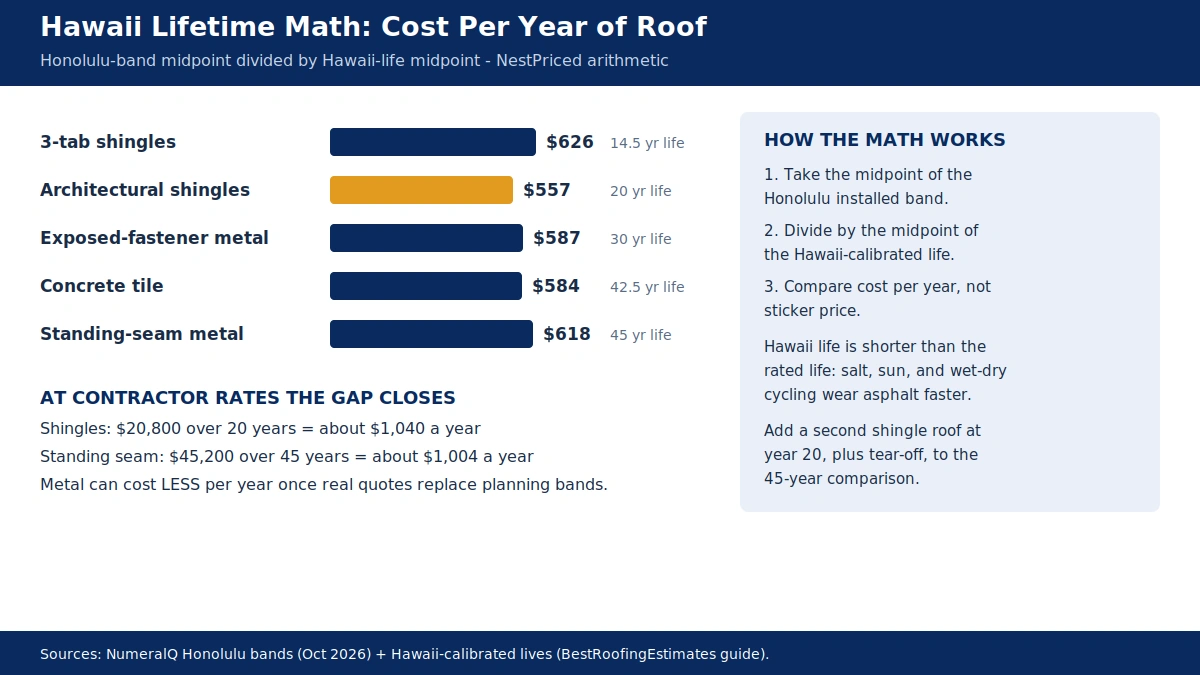
The sticker price favors asphalt by a wide margin, and the lifetime math reverses the result. The honest comparison is cost per year of Hawaii life, computed here from the Honolulu planning-band midpoints and the Hawaii-calibrated life midpoints, with every figure labeled as NestPriced arithmetic. Hawaii life is not a promise: salt distance, sun exposure, vog, and installation quality move the real number, and the sensitivity line at the end of this section shows what happens when the contractor price replaces the planning price.
| Material | Honolulu band midpoint | Hawaii-life midpoint | Cost per year of Hawaii life |
|---|---|---|---|
| 3-tab shingles | $9,080 | 14.5 years | ~$626 |
| Architectural shingles | $11,145 | 20 years | ~$557 |
| Exposed-fastener metal | $17,610 | 30 years | ~$587 |
| Concrete tile | $24,805 | 42.5 years | ~$584 |
| Standing-seam metal | $27,810 | 45 years | ~$618 |
The right-hand column is the one to read first. Architectural shingles at about $557 a year are the cheapest roof in the table per year of Hawaii life on planning prices, because the install price is low even though the life is short. Standing seam at about $618 a year costs more per year despite lasting more than twice as long, because the install price is two and a half times higher. Concrete tile at about $584 a year sits between them. The 3-tab roof, the cheapest buy on install day, is the most expensive roof in the table per year of life, because 14.5 years of Hawaii service cannot carry even its low price.
The sensitivity line is where the Hawaii math gets honest, and it runs in both directions. Run the same arithmetic at contractor pricing and the ranking tightens. An architectural roof at the Instant Roofer rate of $1,040 per square costs $20,800 for 20 squares, which is about $1,040 a year over a 20-year Hawaii life. A standing-seam roof at the Instant Roofer metal rate of $2,260 per square costs $45,200 for 20 squares, which is about $1,004 a year over a 45-year life. At contractor prices the metal roof costs less per year than the shingle roof, because the shingle roof must be bought twice in the metal roof’s lifetime, and each purchase pays freight, tear-off, and disposal again. One Hawaii guide makes the same point with round numbers: a $45,000 metal roof can cost less than two $25,000 shingle roofs over 40 years.
The sensitivity line also runs the other way. If an architectural roof on a windward coastal slope delivers only 16 years instead of 20, the planning-price cost per year rises to about $697, above every material in the table. If the same roof on a leeward inland slope delivers the full 22 years, the cost per year falls to about $507, and no metal roof touches it. The buyer is not choosing between an $11,145 roof and a $27,810 roof. The buyer is choosing between a roof whose life depends on salt distance, sun, and installation quality, and a roof whose life depends mostly on the metal and the fasteners staying compatible.
In Hawaii, the wind exposure shapes this choice more than the arithmetic. Metal throws off heavy trade-wind rain, stands up to strong wind when the fastening is done right, and bounces heat back with a light finish, which doubles as a cool roof. Clip-fastened standing seam is the strongest option for hurricane resistance in the Hawaii guides, rated by one guide at 130–160 mph against 110 mph for properly nailed architectural asphalt. Those wind figures are guide figures, not code values, and the code section above carries the Appendix W speeds that govern. But the direction is consistent: metal, correctly clipped, holds its covering in wind that peels shingles. A buyer on an exposed coast or a trade-wind ridge who can afford standing seam is buying wind performance that the per-year table understates.
Solar decides the rest, and in Hawaii solar decides a lot. About 43 percent of single-family homes in Hawaii have rooftop solar, more than double any mainland state, which means nearly half of all re-roofs in the state involve panels. Panels must come off before the old roofing can be stripped, then go back on with new flashing and mounts, at roughly $3,000–$8,000 for removal and reinstall on a typical residential system, according to the October 2026 Hawaii guide. Standing seam is the friendliest roof for solar, because clamps attach to the seams without drilling holes through the panels. Shingle and tile roofs need mounts that penetrate the covering, and every penetration is a flashing detail that must be right.
The coordination matters as much as the hardware. The roofer and the solar installer should agree early on who removes the panels, who reinstalls them, who warrants leaks at the mounts after the panels go back on, and whether the original solar installer should do the work to protect the system warranty. If the solar system is near the end of its life, a re-roof is the right moment to consider replacing it, because removing an old system once and installing a new one avoids paying for a reinstall on panels that will be replaced in a few years. Homeowners on legacy net-metering terms should get written confirmation before changing or enlarging a system, because a change can put the old terms at risk. Our Hawaii solar panel cost guide prices the panel math, and our solar removal and reinstall guide prices the removal work in full.
Every Hawaii buyer asks three metal questions, about noise, denting, and resale, and each one has a plain answer. On a properly built roof, the noise worry is a myth: insulation and decking quiet rain on metal, and whatever difference remains is heard in the attic rather than the bedroom. Denting is real: aluminum is softer than steel and shows foot traffic and falling branches, and standing seam can show cosmetic dents that do not leak but do show. Resale value is the least solid figure in the whole comparison. A metal roof photographs well, reads as a premium feature in a coastal listing, and can help a sale in windward and oceanfront markets where buyers expect it. In an inland subdivision where every comparable house has shingles, a metal roof is a personal choice that may not return its premium at sale. A five-year stay calls for judging the roof over five years of ownership, not fifty.
The answer is a matrix matched to the house, not a single winner. Architectural shingles fit a leeward inland house on a tight budget that the owner plans to keep for a decade or two. Buy standing-seam aluminum if the house sits within a few hundred feet of the surf, on a windward slope, or on an exposed ridge, and if the budget can carry two and a half times the shingle price for a roof that will outlast two shingle roofs. Buy concrete tile if the structure can carry it, the look matters, and the buyer accepts the weight, the lead time, and the tile-experienced crew. Buy nothing until the salt distance, the wind speed, and the solar plan are all written on the spec sheet, because those three facts decide the material more than the price table does.
Wildfire Embers After Lahaina: Class A Roofs and Screened Vents
In August 2023, wildfire driven by strong winds swept through Lahaina and Kula on Maui and destroyed more than 2,200 buildings. The Lahaina Fire Incident Analysis Report found that embers penetrated through roofs, vents, and windows, and it recommended that counties adopt wildfire and wildland-urban interface building codes to lessen the impact of the next fire. The lesson for a roof buyer is the same lesson the hurricane section teaches, applied to a different hazard: the covering matters, but the openings matter as much.
Embers, not flames, ignite most homes in a wildfire, and the roof is where embers land. Wind carries burning material ahead of the flame front, sometimes over long distances, and drops it onto roofs, into valleys, into gutters full of dry leaves, and through unscreened vents into dry attic insulation, where it smolders out of sight. The Federal Emergency Management Agency’s Maui recovery advisory puts roofing systems at the center of structure ignition risk for exactly this reason: roofs ignite from radiant heat, embers, and direct flame contact, and a roof that catches fire can carry fire from house to house in a dense neighborhood. The practical meaning for a roof buyer is that the ember package on a quote should read like a checklist, not a material name.
Class A sits at the top of the fire ratings, and it applies to the whole assembly rather than the covering alone. ASTM E108 or UL 790 testing earns the rating, by exposing a full assembly to burning brands, flame spread, and wind. Fiberglass asphalt shingles, metal, concrete and clay tile, slate, and rated synthetic lines can all carry Class A ratings as installed assemblies, which means the underlayment and the deck are part of the rating. The FEMA Maui advisory recommends that the entire roof assembly satisfy Class A requirements when tested to those standards. Untreated wood shake fails the test outright, and cedar needs treatment to Class A or Class B before wildfire-prone areas allow it. For a wood look, price a rated synthetic shake or a treated product, get the rating in writing, and make the roofer name the assembly rating on the quote alongside the shingle brand.
The evidence from Lahaina supports the rating and the details together. The Insurance Institute for Business and Home Safety studied a residential development built in 2019 and 2020 that survived the conflagration, and credited fire-retardant construction and modern building codes: Class A roof covers, specifically asphalt shingles and metal, noncombustible exterior wall materials, and high wind-rated attic vents that kept embers out of the attic space. The exteriors of several buildings ignited but were not consumed. Hawaii’s modern high-wind requirements, the report noted, introduced elements that helped newer construction resist wildfire conditions. Wind hardening and fire hardening are the same work in Hawaii more often than not.
One house became the symbol of that overlap. A century-old wood home with a red roof survived surrounded by destroyed houses, and the features credited with saving it were a new heavy-gauge metal roof, noncombustible river stone covering the first five feet around the walls, and vegetation cleared from under the dripline. One house is an anecdote, not a standard, and this guide treats it as an illustration rather than proof. But the three features match the formal guidance exactly: a noncombustible roof, a noncombustible zone around the house, and nothing burnable where embers land.
Every ember detail belongs on the quote as a named line, not a verbal promise. Fit 1/8-inch metal mesh over every eave and attic vent: the openings stop embers while still letting the attic breathe. Secure any loose shingle before embers find the lifted edge and slide underneath. Fit gutters that are easy to clear, and clear the valleys and gutters of leaves and needles before the dry season. Close the open ends of barrel tiles where tile roofs carry them, and fit fire-resistant bird stops at the eaves so embers cannot enter under the roof and ignite the underlayment. Keep the first five feet around the house clear of anything that burns. None of these items is expensive on its own. All of them together are what turns a Class A covering into a Class A roof.
FEMA’s Maui advisory adds a Hawaii-specific warning that mainland fire guides never carry: Maui’s weather and proximity to salt water require corrosion-resistant metals for flashing, vents, connectors, and metal building components. A vent screen that rusts out in five years of salt air is not an ember screen. The mesh, the flashing, and the connectors must be specified for salt at the same time they are specified for fire, or the fire hardening will corrode away before the next dry season.
No statewide wildfire roof code was located, and the county rules are still moving. Kauai County became the first Hawaii county to adopt wildfire interface standards when it passed Bill 2961 in 2025 for homes in Plantation Camp communities. A broader Kauai bill, Bill 2998, would apply wildfire interface standards to new construction island-wide, with noncombustible roofs, noncombustible vent mesh, noncombustible mesh under elevated homes, and dual-pane tempered glass. The county council planning committee deferred the bill in August 2026 for discussion at a later meeting, so it is not law. A buyer on any island should ask the county building department whether a wildfire interface rule applies to the parcel, and should build to the Class A plus screened-vent standard regardless of whether the code requires it, because the insurer and the next fire will both ask the same question the code has not yet answered.
Permits and Code in Hawaii: The Reroof Exemption and the Cool Roof Rule
Hawaii has no statewide reroof permit. No state office issues a roofing permit, and no state desk reviews a re-roof. The four counties, the City and County of Honolulu, Hawaii County, Maui County, and Kauai County, issue building permits and inspect the work, each with its own department, its own online system, and its own rules. A permit from one county does not transfer to another, and a rule that applies in Honolulu may not apply in Hilo.
Honolulu exempts most residential reroofs from a building permit, and the exemption is written in the ordinance. Revised Ordinances of Honolulu section 18-3.1(b)(3) states that no building permit is required for reroofing work that will not adversely affect the structural components, for residential and accessory occupancies in Groups R-3 and U. The Department of Planning and Permitting repeats the exemption in its own guidance listing work that does not require a permit. The exemption covers the common case: old covering off, new covering on, same structure, no framing changes.
The exemption has edges, and the edges are where buyers get into trouble. Work that affects the structure falls outside it: framing changes, structural decking replacement, new tie-downs that alter the framing, or a material change that adds load the structure was not built for, such as tile on a frame built for shingles. A separate exemption covers like-for-like maintenance repairs valued at no more than $10,000 in any 12-month period that do not affect electrical or plumbing installations. Exemption from the permit requirement does not authorize work that violates the technical codes, and the code still governs the fastening, the underlayment, and the connections whether or not a permit is pulled. A Honolulu buyer whose job touches the structure should confirm with the Department of Planning and Permitting whether a permit is needed before work starts, and should get the answer in writing where the scope is close to the line.
Kauai lists a similar exemption, and the other two counties could not be verified. Kauai County code lists reroofing for Group R-3 and U occupancies using similar-type roofing material among work exempt from a permit, as reported by the MyRoofData Hawaii page citing the Kauai code. That is a secondary citation of a primary code, and the draft states it as a county listing to be confirmed with the county, not as a verified quotation. For Hawaii County and Maui County, no verified reroof exemption or requirement text was located in this guide’s research, and the draft will not borrow a rule from another county or from a cost site. Hawaii County permits run through the Building Division’s EPIC online system, and Maui County permits run through the MAPPS online system. A buyer on either island should confirm the reroof rule with the county building department before the quote is signed, because the secondary claim that all four counties require a permit for every full replacement contradicts the Honolulu ordinance and cannot be trusted.
When a Honolulu permit is required, the fee is computable from the city’s own table, and the arithmetic checks. Revised Ordinances of Honolulu Chapter 18, Table 18-A, sets the building permit fee for work valued from $1,000.01 to $20,000 at $12.00 plus $2.20 per $100 or fraction thereof of the total estimated valuation. On a $15,000 job, that is $12 plus 150 times $2.20, which is $342. The modeled permit figures on cost sites, $250–$675 on one, $400–$1,500 on another, $100–$350 on a third, all assume a permit is pulled. In Honolulu and Kauai, where the common reroof is exempt, the permit fee is often zero, and a quote that carries a permit line for an exempt job should be questioned. Where a permit is required, the fee should be confirmed at application, because surcharges and plan review fees sit outside the base table.
The code underneath the permits is the 2018 family, with Hawaii amendments and county amendments on top. The Hawaii State Building Code adopts the 2018 International Building Code and International Residential Code, with Appendix W setting the wind design rules covered in the wind section. Each county amends and adopts the state code, and each county enforces on its own schedule, so the county-adopted version governs the address. The residential code sets the layer limit: a new covering may not go over two or more existing layers, so a two-layer roof must be torn off first. The ice barrier rule that dominates mainland roofing guides is irrelevant in Hawaii, where ice dams do not form, and this guide does not price an ice barrier as a Hawaii need. Underlayment in Hawaii is a wind-driven-rain and secondary-water-barrier question, not an ice question.
The cool roof rule can reach into a reroof, and it surprises buyers who have never heard of it. Hawaii’s energy code is the 2018 International Energy Conservation Code with state amendments, and Honolulu’s version, approved in August 2023 and effective November 23, 2023, carries the same structure with city amendments. For alterations, the rule at section R503.1.1 says that a roof replacement on a roof without insulation in the cavity must meet R-30 insulation or a cool roof, or R-19 insulation or a cool roof for buildings eligible for the Tropical Zone path. A cool roof, under the code’s definition, has an aged solar reflectance of at least 0.55 with an aged thermal emittance of at least 0.75, or an aged solar reflectance index of at least 0.64. Qualifying cool roofs will typically be white: white painted metal, white tile, white liquid-applied coating, or white single-ply membrane, according to the state energy office checklist.
The rule does not say every Hawaii reroof must be white. It says a reroof on an uninsulated roof can trigger an insulation-or-cool-roof choice, and many Hawaii homes, especially single-wall homes with no insulation cavity, sit in that category. Dark shingles do not meet the reflectance test. A buyer whose roof has no cavity insulation should ask the county and the roofer, before ordering material, whether the alteration rule applies to the job and which compliance path the quote follows. A light-colored metal roof can satisfy the cool roof path and the salt-air specification at the same time, which is one more reason metal earns its premium on the right house. The Honolulu energy code checklist carries the full alteration table for a buyer who wants to read it.
Older homes can trigger a historic review, and the age prong is commonly met. Under Hawaii law, before a county agency approves a permit that may affect historic property, the State Historic Preservation Division gets a chance to review and comment. For an existing privately owned single-family home or townhouse, that review applies only if the home is over 50 years old and is listed on or nominated to the Hawaii or national register, or sits in a historic district. Owners of a property on the Hawaii register must also notify the state before construction or alteration and wait for its concurrence or 90 days, though ordinary maintenance that does not change design, material, or outer appearance is not restricted. The median Honolulu home was built in 1974, which is 52 years old in 2026, so the age prong alone is met by about half the city’s homes. The listing or district prong is what decides whether the review applies, and a buyer in a historic district should check it before ordering a material change.
Shoreline lots carry one more layer. Properties near the shore can need Special Management Area clearances and other agency approvals before work starts, and the county planning department is the authority. Homeowner association approval is a separate question from the county permit: a material or color change in a planned community usually needs association approval in addition to anything the county requires, and the association’s design rules should be read before the material is ordered. Neither the shoreline rule nor the association rule is a reason to skip the county check. All three checks belong on the pre-signing list in the final section.
Hiring a Roofer in Hawaii: The C-42 License and the $1,500 Line
Hawaii licenses roofers at the state level, and the license is a real credential, not a registration card. The Contractors License Board, inside the Department of Commerce and Consumer Affairs, runs the program under Hawaii Revised Statutes Chapter 444. Roofing is a specialty classification: C-42 Roofing Contractor. A buyer who understands what the license requires, and what the dollar line below it means, will never mistake an unlicensed crew for a bargain.
The C-42 classification covers installing a weather-tight roof covering in metal, composition and cementitious shingles, wood shingles and shakes, concrete and clay tile, built-up roofing, modified bitumen, single-ply and fluid systems, spray foam, and asphalt, plus protective and reflective coatings, deck coatings, and roof flashing. Narrower subclassifications cover slices of that work: C-42a for metal shingles, C-42b for wood shingles and shakes, C-42c for concrete and clay tile, C-42e for urethane foam, and C-42g for roof coatings. A contractor holding only a subclassification may perform only that slice. A “B” general building license automatically includes only C-42a and C-42b, so a general contractor needs the full C-42 classification for every other roofing system. The buyer should ask which classification covers the proposed system and see it on the license record, not take the contractor’s word for the scope.
Qualifying for the license takes years, an exam, and insurance. The business qualifies through a Responsible Managing Employee, the individual whose experience and exams stand behind the company’s license. That individual must document four years of supervisory experience in roofing work within the last ten years, as a journeyman, foreman, supervisor, or contractor, and must pass two exams: Part I covering business and law, and Part II covering the C-42 trade. Both parts must be passed within six months of the Board approving the application, or the applicant must reapply. The application fee is $50 and is not refunded. Renewal for the 2026–2028 cycle runs $338 for an active contractor entity or sole proprietor and $208 for an active Responsible Managing Employee. All licenses expire September 30 of even-numbered years, and no continuing education is required for contractor licenses under Chapter 444.
Insurance is part of the license, not an optional extra. Continuous general liability coverage must be maintained with evidence on file with the Board: at least $100,000 per person and $300,000 per occurrence for bodily injury, plus $50,000 per occurrence for property damage. Workers’ compensation coverage is required when the contractor has employees, and a lapse in coverage can mean automatic forfeiture of the license. A $5,000 surety bond may be required by the Board based on a financial review, but it is not an automatic flat requirement for every applicant. One Hawaii guide advises buyers to require $500,000 of general liability, which is higher than the Board minimum and is a reasonable ask on a roof job, but the buyer should know which figure is the legal floor and which is a recommendation.
The $1,500 line decides who must be licensed, and every roof replacement crosses it. Hawaii law exempts a project whose aggregate contract price for labor and materials is not more than $1,500, but only when no building permit is required and the job is not part of a larger project. A job may not be split into $1,500 pieces to evade licensing. Any job that needs a permit loses the exemption at any price. No replacement in this guide comes anywhere near $1,500, so a license is mandatory on every replacement job. A roofer who calls the job too small for a license is either mistaken or counting on the buyer not knowing the rule. Unlicensed contracting is a misdemeanor under the statute, and unlicensed contractors generally cannot recover payment in Hawaii civil court, which means the unlicensed bargain can cost the buyer the roof and the contractor the fee.
Counties cannot run their own contractor licensing programs. Chapter 444 is the exclusive legislation for contractors statewide, a position the Hawaii Supreme Court confirmed when it held a Honolulu electrical licensing ordinance invalid. The four counties control building permits and inspections, and every permit applicant must list the license numbers of the contractor and all specialty contractors, which the county checks against the Board’s list. Subcontractors performing contracting work over the threshold must themselves be licensed in the proper classification. An unlicensed person may work only as an employee with wages as sole compensation.
The contract itself is regulated, and its required contents protect the buyer. Every residential home-improvement contract in Hawaii must be written, signed before any work begins, and must state the contractor’s name and address, license number and classification, the exact dollar amount due, start and completion dates, the full scope and materials, the percentage to be subcontracted with subcontractor license numbers, a lien-right disclosure, and a risk-of-loss statement for payments made to any sales representative. A contract missing those items is not a shortcut. It is a contract that fails the statute, and the buyer should insist on a compliant one before any deposit changes hands.
Two safety nets sit behind the contract, and both have limits the buyer should know. The Contractors Recovery Fund pays up to $12,500 per contract and $25,000 per contractor as a last resort when a licensed contractor causes a loss. Whatever the size of the roof job, payment by check or card rather than cash keeps each payment provable later, which is what a recovery claim needs. Lien law cuts the other way: Hawaii is a full-price lien state, so paying the general contractor does not protect the home from a lien by an unpaid subcontractor or supplier, and liens are due 45 days after completion. The owner may withhold payment to cover a lien claim, and liens are barred on a dwelling for materials sold to an unlicensed contractor, which is one more reason to hire licensed. The shingle distributor and any crew the roofer subcontracts are the parties most likely to send a lien notice on a roof job.
The license check takes minutes, it is free, and it answers the questions that matter most. The Department of Commerce and Consumer Affairs keeps a public license search, and the buyer should run the contractor’s name or license number through it before signing anything. Confirm active status, the C-42 classification or the subclassification covering the proposed system, the license expiration date, the Responsible Managing Employee, and any complaint or discipline history. Match the name on the license to the name on the contract, because a license borrowed from another business is not a license at all. Then ask for the liability and workers’ compensation certificates, sent directly from the carrier rather than handed over as a photocopy.
After a storm, the hiring question that matters most is the out-of-state and post-storm test. Hawaii’s license bar is real, which means a crew from out of state must still qualify, but a license alone will not tell the buyer whether the crew will be on the island when a leak appears. Ask four questions in person and write the answers down: the location of the Hawaii office, the years worked on this island, three roofs within ten miles to drive past, and who picks up the phone for a warranty call in six months. Any crew that stumbles on those four questions may be gone by the time the roof needs warranty work. After every Hawaii storm, the pattern repeats: door-knockers offering to handle the insurance claim, a signature on the spot, and a crew that is gone before the first rain tests the flashing. The rule stays simple. Sign nothing at the door, nothing before the adjuster has seen the roof, and nothing before the license check.
Comparing quotes means one spec sheet handed to three roofers, and no shortcuts. Write the material by brand and line, the panel or shingle metal and coating, the fastener and flashing metals, the underlayment, the nailing or clip pattern, the flashing scope, the ventilation pieces, the tear-off scope, the decking allowance, the clip and strap scope, the solar removal scope, the permit responsibility, the general excise tax treatment, the warranty terms, and the cleanup scope on one sheet, and give the identical sheet to three licensed roofers. Quotes on different specs cannot be compared, and a low quote on a thin spec is not a bargain. It is a different job, usually with the wrong metal or the missing clips. Our questions to ask a roofer guide holds the complete interview list, and the final section of this guide turns that list into a routine for signing day.
Insurance in Hawaii: The Separate Hurricane Policy and the Percentage Deductible
Hawaii homeowners insurance looks cheap until the hurricane policy is added, and then it does not. The base homeowners premium is among the lowest in the country, because the standard policy excludes the hazard that matters most. Buyers usually get hurricane protection through a separate policy or an add-on to the main policy, and that hurricane cover carries its own deductible, its own trigger, and its own premium. A roof buyer who prices only the base policy will misunderstand both the cost of owning the home and the value of a stronger roof.
The base numbers prove the point. One national comparison puts the Hawaii average at $659 a year for $300,000 of dwelling coverage, the cheapest state in the country and 74 percent below the national average of $2,543, but notes that hurricane wind is a separate policy there, so the headline understates full protection. A second comparison, pricing one sample home across five insurers in September 2026, puts the Hawaii average at $1,696 a year, with a range from $62 to $244 a month for identical coverage. The spread between insurers for the same house is $182 a month, which is why shopping the policy matters as much as shopping the roof.
The hurricane policy is where the real money sits. In the Hawaii Insurance Division’s 2026 premium guide, the sampled hurricane-only premiums for a $400,000 Oahu house run from $545 to $4,974 a year, with the insurer, the build type, and the wind-resistive features deciding where a house lands. That ninefold spread is the market telling the buyer that construction details matter: a concrete-block house with a metal hip roof and documented tie-downs prices nothing like a single-wall house with an old shingle roof and no connectors. One Hawaii guide totals the full stack for a $900,000 single-family home at $3,500–$7,500 a year, counting the base policy plus hurricane and flood cover together. Premiums statewide rose about 13 percent in 2024 and began stabilizing through 2025, after the Lahaina fire repriced wildfire risk across the market.
Which policy pays turns on the trigger, and the wording deserves a careful read. As a rule, the hurricane cover starts paying when the National Weather Service puts a hurricane watch or warning on the island where the home sits, or when sustained winds at the home reach a set level, often 74 mph, where Category 1 begins. A 72-hour clause is common: harm done within 72 hours after the Central Pacific Hurricane Center issues a watch or warning counts under the hurricane cover. Wind damage outside that window falls under the standard policy. A buyer should read the trigger in their own policy before storm season, not after, because the deductible that applies depends on which side of the trigger the damage falls.
The deductible is a percentage of the dwelling limit, not a flat dollar amount, and it surprises people by a factor of twenty or more. A 2 percent deductible shows up on most of the sampled hurricane quotes, and the typical range runs 1 to 5 percent. The percentage applies to the dwelling coverage limit, not to the size of the damage and not to the market value of the property. Take a $400,000 dwelling limit with a 2 percent deductible: the homeowner pays the first $8,000 of wind damage before the hurricane policy pays anything. At 5 percent, it is $20,000. On a $500,000 limit, the range runs $5,000 at 1 percent to $25,000 at 5 percent. A homeowner who assumes the $1,000 deductible from the standard policy applies to hurricane wind damage is wrong by an amount larger than many roof repairs.
| Dwelling limit | 1% hurricane deductible | 2% hurricane deductible | 5% hurricane deductible |
|---|---|---|---|
| $300,000 | $3,000 | $6,000 | $15,000 |
| $400,000 | $4,000 | $8,000 | $20,000 |
| $500,000 | $5,000 | $10,000 | $25,000 |
| $750,000 | $7,500 | $15,000 | $37,500 |
The table is NestPriced arithmetic, and it is labeled as such. Its purpose is to put the real out-of-pocket figure in front of the reader before a storm does. The declarations page is the document that decides which row applies: it is the summary sheet at the front of the policy, and it names the deductible type and amount, the coverage limit, and whether the roof settles at replacement cost or depreciated value. Read the declarations page before the first quote arrives: the deductible and the settlement method swing the out-of-pocket figure further than any material choice.
Three settlement methods mean three very different checks. Replacement cost value covers the cost of a new roof at today’s prices. It usually arrives as two checks: one for the depreciated value, and a second for the recoverable depreciation once the work is done and the invoices are in. Actual cash value covers only the depreciated value, less the deductible, and the depreciation generally stays unrecovered. A payment schedule ties the payout to a percentage that shrinks with the roof’s age, using the carrier’s filed table for the material. A worked example, labeled as NestPriced arithmetic, shows the difference on a $20,000 roof with a 2 percent hurricane deductible on a $400,000 dwelling limit, which is $8,000. With replacement cost coverage, $12,000 comes from the insurer across two checks, and the $8,000 deductible comes from the homeowner. With depreciated value, the insurer pays the depreciated figure less $8,000, leaving the homeowner to cover the remainder out of pocket. With a payment schedule, the insurer pays the scheduled percentage less $8,000, where the percentage follows the roof’s age and material.
This guide located no Hawaii statute on deductibles, no roof-age settlement rule, and no matching law, and it invents none of them. Other states do set such rules: roofs past a certain age settling at depreciated value, carriers required to match undamaged shingles, or deductible waivers following a state formula. Hawaii has none of those rules in any source this guide opened, which means the buyer’s own policy is the only authority. No Hawaii law this guide located governs matching, so a repair that leaves a visible patch calls for a question to the adjuster, an answer in writing, and a price for the full slope if the answer is no. No Hawaii cancellation-right statute for insurance-funded roofing contracts was verified, and none is stated here.
The state’s backstop programs have narrow doors, and most homeowners cannot walk through them. The Hawaii Hurricane Relief Fund was created in 1993 after Iniki, insured about 155,000 policyholders at its peak, and went dormant in December 2000 when private carriers returned. The legislature reactivated it in 2025, but only for condominium and townhouse associations that have been denied hurricane coverage by at least two admitted private insurers and carry total insured value above $10 million. A single-family homeowner cannot buy Hurricane Relief Fund coverage. For homes no standard carrier will take, the Hawaii Property Insurance Association offers the last-resort fire market, and hurricane cover is not part of what it sells. A buyer who hears that the state will insure the roof should ask which program, for which property type, and get the answer in writing, because the likely answer is that no state program covers a single-family roof.
Wind-resistive features can earn premium credits, but no verified percentage schedule exists, and this guide states no discount as a promise. One Hawaii guide reports an 8 to 15 percent saving on the hurricane premium for a concrete-block house with a metal hip roof, and that figure is labeled as one guide’s figure wherever it appears. Documented hurricane clips and tie-downs may earn wind premium credits from some insurers, with photos and an itemized record as the proof. No Hawaii wind-mitigation discount statute was verified. Treat any promised premium cut as talk until the agent puts it in writing, naming the part of the premium it applies to.
The claim steps work only in order, and that order is the homeowner’s protection. Photograph everything before touching it: roof, gutters, and any attic space where water got in. Stop active water first: tarp the roof, save the receipt, and never wait for the adjuster while water keeps coming in. No roofing contract gets signed until the adjuster has seen the roof and put the scope in writing. Put the roofer’s quote beside the adjuster’s scope and go line by line, asking the roofer to justify anything the adjuster left out. A contractor who offers to absorb the deductible is usually recovering it by inflating the claim or cutting the scope, and the homeowner who signs that deal owns the consequences. Carriers stop writing hurricane coverage once a watch is issued, so a buyer without hurricane coverage cannot buy it the week a storm approaches. The time to fix the coverage gap is before the season starts on June 1.
Paying for a Hawaii Roof in 2026: $0 Federal Credit, the GET and Financing
A 2026 roof replacement gets $0 from the federal government. Two documents ended both credits for post-2025 installs: the One Big Beautiful Bill Act, Public Law 119-21, and Internal Revenue Service guidance FS-2025-05, which together closed the energy-efficient home improvement credit and the residential clean energy credit. A roof on its own never qualified for a federal credit, and the credits that used to soften the energy work around a roof no longer exist for 2026 installs. That is the entire federal picture. Any contractor, advertiser, or calculator site still advertising a federal credit for a 2026 roof is marketing a credit that ended. Our federal energy tax credits guide carries the full post-OBBBA position for every measure.
Hawaii’s home energy rebates are not launched, and a roof is not a rebate measure anyway, which closes the door twice. The state was allocated about $34.1 million for the Home Electrification and Appliance Rebates program and about $34.2 million for the Home Efficiency Rebates program. The state energy office’s eHale page states that the programs are pending federal approval of launch and will be available to Hawaii residents in early 2027, and that installs done before launch will not qualify. The electrification rebates, when they arrive, pay up to $8,000 for heat pumps, heat-pump water heaters, electrical panels, and wiring. They never cover roofs, solar panels, batteries, or windows. A 2026 roof quote should carry no rebate line, and a buyer who is adding insulation with the roof should price the insulation on its own merits, not on a rebate that does not exist yet. Insulation pricing lives in our attic insulation cost guide.
The state solar credit does not share itself with the roof. Hawaii’s Renewable Energy Technologies Income Tax Credit pays 35 percent of a solar system cost, capped at $5,000 for a single-family system, and a battery counts only when installed with the solar system in the same tax year under the same cap. A 2026 law rewrote the credit with a certificate step, a $40 million statewide annual cap from 2027 to 2030, an income limit from tax year 2027, and a final tax year of 2029. None of that helps a roof, because the credit covers the solar equipment, not the covering underneath it. A buyer combining a re-roof with a solar install should keep the two jobs on separate lines with separate paperwork, so the solar credit claim rests on the solar invoice alone. The Hawaii solar guide carries the panel math and the rewritten credit rules in full.
Roofs fall outside the clean-electricity credit’s lease pass-through, which covers clean-electricity property and nothing else. No Hawaii state roof grant, no state roof tax credit, and no verified cool-roof rebate belong in a 2026 quote. One Hawaii guide suggests checking with Hawaii Energy about cool roof programs, and that suggestion is worth following as a question, not as a budget line, because no current rebate amount was verified. A quote that carries a state grant line, a rebate line, or a tax-credit line for a roof should be questioned before it is signed, and the line should come off in writing.
The general excise tax belongs in the financing math, because it is part of the price. The tax can add up to 4.712 percent to the bill, which is about $942 on a $20,000 job and about $1,413 on a $30,000 job. A buyer comparing a $19,500 quote that adds tax at the bottom against a $20,200 quote that includes it is comparing $20,419 against $20,200, and the more expensive-looking quote is cheaper. The spec sheet in the final section carries a tax-treatment line for exactly this reason. No quote comparison is honest until every bid states the tax the same way.
What follows is general financing guidance, since no Hawaii-specific contractor offer could be verified. Most Hawaii buyers pay through one of three routes: a contractor payment plan, a home equity line or loan, or a personal loan. Terms, rates, and risks differ across all three. This guide’s research verified no Hawaii-specific contractor financing offer, rate, or term, so none is stated here. A rate borrowed from another state or another year would mislead more than it would help. Hawaii’s high property values mean many homeowners carry substantial equity, which makes home equity routes available to buyers who would not qualify elsewhere, but equity is not free money, and the loan is secured by the house the roof sits on.
Two named programs deserve a direct inquiry, with no terms promised. The Federal Housing Administration’s Title I loan program lends up to $25,000 for single-family owner-occupied home improvements without requiring equity, through approved lenders, according to the Hawaii guide that names it. Owner-occupant assistance also runs through the Hawaii Housing Finance and Development Corporation, but its programs open and close with funding, so a direct call is the only way to learn what is available for a roof this month. Contractor-sponsored financing through programs such as GreenSky, Service Finance, and Hearth is available through many Hawaii contractors, with quick approval and deferred-interest terms that must be compared carefully before any promotional offer is accepted. For the full comparison, our roof financing guide covers each route and lists the questions on deferred interest, prepayment, and the loan’s cost measured against the roof’s cost.
The payment schedule is the one financing rule that belongs in every Hawaii quote. One Hawaii guide’s milestone example runs 10 percent deposit, 40 percent on material delivery to the site, 40 percent at dry-in, when the underlayment is down and the roof is watertight, and 10 percent at final inspection and cleanup. That schedule is a guide’s example, labeled as such, and the principle behind it matters more than the percentages: a deposit, a progress payment at a named milestone, and the balance on completion and final inspection, with no full payment up front and no final payment before the work is verified. A contractor who demands full payment before the material arrives is asking the buyer to fund the job and carry the risk. The answer is a schedule in the written contract, tied to visible milestones.
Only one post-disaster route exists, and it stays closed until a disaster is declared. Once a disaster is declared, a Small Business Administration disaster loan may exceed the verified loss by up to 20 percent for mitigation work, and that extra room can pay for a stronger roof. The route is genuine, but it is no financing plan for a scheduled replacement. It needs a disaster declaration, an application, and an approval, and it has no place in a quote for a roof replaced on a normal schedule.
Repair or Replace and Getting Quotes in Hawaii: The Decision Rules and the Checklist
Most calls to a Hawaii roofer begin with water coming through the ceiling, and the repair bill is usually smaller than the worry that prompted the call. A Honolulu repair on the planning model runs $234–$499 for flashing work, $314–$880 to find and fix a leak, $325–$720 to re-flash a chimney, and $336–$670 for a skylight leak. A Hawaii guide prices the same kinds of work from the contractor side: missing or blown shingles $250–$800, rusted or corroded flashing $400–$1,100, a leak at a penetration or vent boot $350–$850, corrugated fastener re-nailing $500–$1,500, and vog acid damage on the Big Island $600–$2,500 or more. The two sources agree closely enough to trust the middle ground: most repairs cost $250 to $1,100, and anything over $3,000 belongs in a replacement conversation rather than a repair.
| Repair | Honolulu planning model | Hawaii guide (contractor side) | Common Hawaii cause |
|---|---|---|---|
| Flashing repair | $234–$499 | $400–$1,100 (rusted / corroded flashing) | Salt air on galvanized steel flashings |
| Find and fix a leak | $314–$880 | $350–$850 (penetration / vent boot) | Windward rain volume; UV-degraded pipe boots |
| Missing / blown shingles | Not in this model | $250–$800 | Trade-wind events; tropical storm gusts |
| Chimney flashing reflash | $325–$720 | Not in this guide | Wall and chimney joints in wind-driven rain |
| Skylight leak | $336–$670 | Not in this guide | Failed skylight flashing; aged sealant |
| Corrugated fastener re-nailing | Not in this model | $500–$1,500 | Wind uplift; rusted fasteners on plantation roofs |
| Vog acid damage (Big Island) | Not in this model | $600–$2,500+ | Sulfur dioxide attack on metal in Puna and Ka’u |
A second pair of eyes is cheap insurance before the repair-or-replace call. Our roof repair cost guide prices the national repair ladder, our roof inspection cost guide prices a professional look at the roof, and our gutter installation cost guide prices the gutter work that often rides along with a re-roof. In Honolulu, maintenance repairs using the same or similar materials may be exempt from a building permit when the total repair value is no more than $10,000 in any 12-month period and the work does not affect electrical or plumbing installations, which covers most repairs in the table above.
The decision drivers are age, layers, decking, scope, clips, and solar, in that order. Start with age measured against the Hawaii-calibrated life. A 19-year-old architectural roof leaking on one slope is a different decision from the same roof at 9 years: the older roof nears the end of its island span, while the younger one holds a decade of life. Second is the layer count: two existing layers force a tear-off before new material goes on, turning a repair into a tear-off job at a different price. Decking and framing come third, and in Hawaii they carry the termite and rot question, which is visible only at tear-off and is why the decking allowance belongs on every quote as a per-sheet price with a cap, not as a surprise after the old roof is off.
Fourth is scope: a single slope means repair, the whole roof means replacement, and the deciding factor is how the shingles look on the slopes that are not leaking. The clip opportunity comes fifth and only on older homes: a re-roof is the cheapest time to add hurricane clips and straps, so a repair that postpones the re-roof also postpones the hardening, and the honest comparison prices both. Solar timing comes last: panels near the end of their life argue for combining the re-roof with a solar replacement, while young panels argue for a careful removal and reinstall with the mount warranty agreed in advance.
The 50 percent rule is contractor guidance rather than a sourced figure, and this guide labels it that way. When a repair passes half the replacement cost, replacement usually wins. The repair buys a few more years on an old roof, while the replacement buys a full Hawaii life backed by a warranty. Use the rule as a rough guide rather than a law. It misleads on young roofs, on damage kept to one slope, and whenever an insurance claim reshapes the out-of-pocket math. Let it frame the question; never let it answer the question.
In Hawaii, timing carries a real cost, and the calendar gives a buyer the cheapest lever available. The wet season runs roughly October through April, when Kona storms and heavier trade-wind showers make tear-off days harder to schedule, and a roof cannot be left open during a downpour, so winter jobs stretch across more days. From April through September, leeward Oahu and leeward Maui see their steadiest dry weather, so a crew can keep a tear-off open with the least risk of a downpour. Windward locations receive rainfall year-round and the scheduling window is less seasonal, so a Hilo or Kaneohe job is scheduled around the forecast rather than the month.
Hurricane season runs June 1 through November 30, so starting a full replacement in spring, before the peak of the season, reduces the risk of an exposed partial tear-off during a tropical weather event. There is no cold-weather constraint anywhere in Hawaii: the average low in Honolulu’s coldest month is 67 degrees Fahrenheit, far above the 40-degree mark where shingle makers call for cold-weather steps. June and July are the driest months in Honolulu, averaging about half an inch of rain each on the 1991–2020 normals, which makes early summer the fastest and most reliable install window on Oahu. Material lead times are part of the schedule too: specialty metal colors, coastal-rated panels, and certain tile profiles sometimes take several weeks to arrive by ship, and a contractor who orders as soon as the contract is signed can save a month.
What follows is the signing-day routine, laid out in the order to follow it. Do every step, and sign none of them at the door.
- Measure the roof surface in squares and write the spec sheet: material by brand and line, panel and coating metals, fastener and flashing metals, underlayment, nailing or clip pattern, flashing scope, ventilation, tear-off, decking allowance, clip and strap scope, solar removal scope, tax treatment, warranty, cleanup.
- Check the contractor’s C-42 license through the Department of Commerce and Consumer Affairs search, match the name to the contract, and get the liability and workers’ compensation certificates sent directly from the carrier.
- Get three written quotes on the identical spec sheet, from three licensed roofers, and compare them line by line, including freight, the general excise tax, and the solar lines.
- Confirm the permit position with the county building department for the exact scope, and confirm who files the permit where one is required.
- Confirm the design wind speed, the wildfire interface position, and the cool roof alteration rule for the exact address, in writing from the county where the answer is close to the line.
- Read the declarations page of the homeowners policy and the hurricane policy, note the deductible type and amount and the settlement method, and call the agent about wind credits before ordering material.
- If an insurance claim is involved, secure the adjuster’s written scope before signing any roofing contract.
- Agree the solar plan in writing: who removes and reinstalls the panels, who warrants leaks at the mounts, and whether legacy export terms are affected.
- Put the job in a written contract naming the material by brand and line, the warranty terms, milestone-tied payments, the start and completion window, and the cleanup scope.
- Pay by the schedule, photograph the clips and connectors before the covering goes on, and file the closeout paperwork: the permit final where a permit was pulled, the warranty registration, the connector photos, and the roofer’s written warranty, in one folder with the contract.

Sources & methodology
Installed costs:
- NumeralQ, Hawaii roof replacement cost page, planning estimates with pricing as of October 26, 2026, architectural shingles, 2,000 sq ft roof, $10,060–$12,300; size table and national comparison on the same page.
- NumeralQ, Honolulu roof replacement cost page, pricing as of October 26, 2026, material table for a 2,000 sq ft roof, add-on figures, roofer pay, contractor counts, housing stock, and storm record.
- NumeralQ, 2026 National Roofing Cost Index page, 147-market research snapshot of August 14, 2026, Honolulu factor 1.60 on a $14,500 baseline midpoint, modeled range $17,600–$28,800.
- SmartRoofingCalculator, Hawaii roof cost page, updated April 24, 2026, per-square bands and state factor 1.078; Honolulu city page, updated November 9, 2026, local factor 1.55, 20-square figures.
- MyRoofData, Hawaii roof cost page, 2026 model, per-square figures before tear-off, typical-home range, tear-off rates, rated lives, and state cost index 1.35.
- Instant Roofer, Hawaii roof replacement cost page, contractor pricing across 48,900 measured roofs and 19 contractors, average $21,972 on a 2,113 sq ft roof at $1,040 per square.
- RoofingEstimatorPros, Hawaii page, updated August 26, 2026, high model recorded and not adopted at its top end.
- BestRoofingEstimates, Hawaii roofing cost guide, Oahu pricing by home size, island table, freight percentages, Hawaii-calibrated lifespans, salt-zone rules, and repair figures; single secondary guide, labeled wherever used.
- Hawaii business guide, roof replacement cost in Hawaii 2026 price guide, October 20, 2026, island table, per-square-foot material ranges, hurricane clip estimate, solar removal estimate, and scheduling guidance; single secondary guide, labeled wherever used.
- ServiceCostHub, Honolulu roof replacement cost page, updated July 2026, modeled typical cost $15,003.
- Bureau of Labor Statistics, Occupational Employment and Wage Statistics, May 2025, roofers in Hawaii and the Honolulu and Kahului-Wailuku metro areas.
Wind, salt, sun, vog, and wildfire:
- Hawaii State Building Code amendments, 2018 International Building Code proposed amendments, Appendix W wind design provisions and Appendix U hurricane sheltering provisions.
- Appendix W wind speed summary by risk category and windborne debris region definition, via a published code summary; corroborated by the Hawaii storm-damage guide and the article 102 research file.
- Associated Press via Claims Journal, August 2023, Iniki damage, single-wall construction, and the 2019 Honolulu study finding 64 percent of Oahu homes without hurricane protections.
- Hawaii Green Infrastructure Authority testimony on House Bill 1056, February 2025, 1994 clip mandate date and the 125,000-home figure.
- Grassroot Institute, March 2024, Iniki home counts and Kauai recovery measures; storm-damage guide, Iniki damage and insured-loss figures.
- National Oceanic and Atmospheric Administration storm data via the NumeralQ Hawaii and Honolulu pages, hail and wind reports 2016–2025.
- National Association of Insurance Commissioners Resilience Playbook addendum, January 2026, Loss Mitigation Grant Program history, 2006–2008.
- Hawaii Legislature, House Bill 1467 bill text and status, Strengthen Hawaii Homes program, deferred 2025; Governor’s budget message, January 2026, Home Retrofit Program request.
- Federal Emergency Management Agency, Maui Wildfires Mitigation Assessment Team Recovery Advisory 3, revised April 2025, Class A assembly recommendation, vent and corrosion guidance.
- Lahaina Fire Incident Analysis Report findings via Aloha State Daily, August 2026, ember penetration and county code recommendations; Kauai Bills 2961 and 2998 status via the same report.
- Insurance Institute for Business and Home Safety, Lahaina early insights via Building Design and Construction, September 2023, surviving development features.
- Hawaii salt-air corrosion guide, October 28, 2026, metal selection by distance, warranty limits, and maintenance; coastal metal roofing guidance on galvanic corrosion and panel thickness.
- National Oceanic and Atmospheric Administration 1991–2020 climate normals via published station tables, rainfall for Hilo, Honolulu, Kahului, and Kona; University of Hawaii Rainfall Atlas grid values for downtown Hilo and Kailua-Kona town.
- University of Hawaii termite project via a Honolulu builder guide, Formosan termite damage and control spending; termite biology and swarm timing via Honolulu disclosure guides.
Permits, licensing, liens, and energy code:
- Revised Ordinances of Honolulu, section 18-3.1, reroofing exemption for Groups R-3 and U; Chapter 18, Table 18-A, building permit fee schedule.
- City and County of Honolulu Department of Planning and Permitting, storm-response guidance listing work that does not require a permit.
- Hawaii State Energy Office, residential energy code checklists, May 2025, 2018 International Energy Conservation Code with state and Honolulu amendments, alteration rule R503.1.1 and cool roof definition.
- Hawaii Revised Statutes Chapter 444, contractor licensing, sections 444-2, 444-2.5, 444-7, 444-9, 444-9.1, 444-25.5, and 444-26, via the Contractors License Board and licensing guides checked October 2026.
- Hawaii Administrative Rules section 16-77-28, C-42 classification and subclassifications, via compliance summaries checked October 2026.
- Hawaii Revised Statutes Chapter 507, lien provisions, sections 507-43, 507-48, and 507-49, via the NumeralQ Hawaii page citing Levelset FAQs, checked November 10, 2026.
- Hawaii Revised Statutes sections 6E-10, 6E-42, and 6E-42.2, historic preservation review, via the NumeralQ Honolulu page, checked October 13, 2026.
- Hawaii Revised Statutes Chapter 237, general excise tax, via the NumeralQ Hawaii page, checked November 10, 2026.
Insurance, incentives, and repairs:
- Hawaii Insurance Division, 2026 homeowners premium guide, hurricane-only samples for a $400,000 Oahu house, via an October 2026 market guide.
- Insurance.com state averages, 2026, Hawaii $659 a year for $300,000 of dwelling coverage; insurancequotes.com Hawaii sample-home comparison, rates as of September 30, 2026, average $1,696 a year.
- Hawaii hurricane insurance guides, November 2026, trigger wording, 72-hour clause, deductible ranges, Hurricane Relief Fund reactivation, and Property Insurance Association scope.
- Act 296, Senate Bill 1044, signed July 8, 2025, Hurricane Relief Fund reactivation for condominium and townhouse associations, via the storm-damage guide and market guides.
- One Big Beautiful Bill Act, Public Law 119-21, and Internal Revenue Service FS-2025-05, end of sections 25C and 25D for post-2025 installs.
- United States Department of Energy allocations and Hawaii State Energy Office eHale page, checked October 27, 2026, HEAR and HOMES pending launch in early 2027, via the article 102 research file.
- Hawaii Renewable Energy Technologies Income Tax Credit and Act 24, Senate Bill 3125, May 21, 2026, via the article 102 research file.
- NumeralQ, Honolulu roof repair cost page, pricing as of October 26, 2026, flashing, leak, chimney, and skylight repair figures.
- Derived figures: the contractor-pricing cluster band, the per-square contractor-rate column, the cost-per-year table, the deductible table, the general excise tax arithmetic, and the Honolulu permit fee arithmetic are NestPriced arithmetic from the sources named in the text, and are labeled as such wherever they appear.
Disclaimer: Prices in this guide are planning estimates from published cost models, contractor pricing platforms, and Hawaii guides, not quotes, and the actual cost of a roof depends on the roof’s size, slope, condition, material, distance from the shore, and the contractor’s bid. Permit exemptions, wind speeds, wildfire rules, and energy code triggers vary by county and address and change over time, so confirm the permit position, the design wind speed, and the cool roof rule with the county building department before signing a contract. Insurance deductibles, triggers, and settlement methods depend on the individual policy and carrier, and tax and rebate positions change with legislation; verify the current position with the carrier, the tax adviser, and the state agency before relying on any figure in this guide.
How much does a roof replacement cost in Hawaii in 2026?
A 2,000 sq ft architectural shingle roof costs $13,900–$21,700 installed in Hawaii in 2026 on contractor-facing pricing, while a planning model prices the same roof at $10,060–$12,300. Contractor-entered pricing averages $21,972 on a 2,113 sq ft roof, and freight, wind details, and the general excise tax explain why real quotes land above the planning band.
What is the cost per square for a roof replacement in Hawaii?
Architectural shingles run $608–$1,013 per square installed before tear-off on the MyRoofData Hawaii model, with tear-off adding $100–$200 per square per layer. Contractor-entered pricing averages $1,040 per square for asphalt shingle and $2,260 per square for metal, and the Honolulu planning band implies about $502–$613 per square installed.
Do I need a permit to replace a roof in Hawaii?
In Honolulu, no permit is required for reroofing work that will not adversely affect the structural components of a residential home, and Kauai lists a similar exemption for like-for-like reroofing. Hawaii County and Maui County permit rules for reroofs could not be verified, so confirm the requirement with the county building department for the exact scope before work starts.
Is a C-42 license required to replace a roof in Hawaii?
Yes. Roofing work over $1,500 in labor and materials, or any job needing a permit, must be done by a contractor licensed by the Contractors License Board, normally under the C-42 Roofing Contractor classification. The license requires four years of supervisory experience, two exams, and insurance on file, and every roof replacement exceeds the $1,500 line.
Are hurricane clips required on a Hawaii re-roof?
Clips and straps have been mandated for new construction since 1994, but no law requires an older home to add them until work triggers the rule, and about 64 percent of Oahu single-family homes have no hurricane protections. A re-roof is the cheapest time to add them, at roughly $1,500–$5,000 on a typical house according to one Hawaii guide, because the framing is exposed while the old covering is off.
Is there a federal tax credit or Hawaii rebate for a new roof in 2026?
No on both counts. The federal government contributes $0 to a 2026 roof, because the One Big Beautiful Bill Act ended the relevant credits for post-2025 installs, and a roof alone never carried a federal credit. Hawaii’s home energy rebates are pending launch in early 2027, installs before launch will not qualify, and a roof is not a rebate measure in any case.
How long does a roof last in Hawaii?
Architectural shingles last about 18–22 years on leeward inland homes and 14–18 years on windward and coastal homes, against a rated life of 22–30 years, because ultraviolet light, salt air, and wet-dry cycling wear asphalt faster than the lab test assumes. Standing-seam metal lasts about 35–55 years in Hawaii conditions, and concrete tile about 35–50 years, when the metal and fastener specification matches the distance from the shore.
Is metal roofing worth the extra cost in Hawaii salt air?
Often yes for coastal and windward homes, where aluminum standing seam never rusts, holds up in trade winds and storms, and can cost less per year than shingles bought twice. For leeward inland homes on a tight budget, architectural shingles remain reasonable, but the metal choice must match the salt zone: aluminum within 300 feet of the shore, coated Galvalume farther inland, and compatible stainless fasteners throughout.