


Table of Contents
Hawaii breaks the usual solar story in half. On the mainland, the argument for panels is a slow one: middling power prices, a payback measured in decades, a federal credit doing the heavy lifting. In Hawaii, none of that applies. The power is the most expensive in America by a wide margin. The sun is among the strongest. And the panels pay for themselves in about eight years even with no federal help at all — roughly a third of the time they take in the slowest states in this series. A Honolulu homeowner who spends $212 a month on electricity is not buying panels to save a little. They are buying their way out of the most expensive grid power in the country.
But the fast payback comes with a rulebook no other state shares. Hawaii killed retail net metering in 2015, years before the mainland started arguing about it. The replacement pays for exported power by the island and by the hour, and the gap between the daytime rate and the evening rate is the whole ballgame: on Oahu, a kilowatt-hour sent out at noon earns 13.5 cents, while the same kilowatt-hour sent out at 6 p.m. earns 32.9 cents, and a kilowatt-hour the house uses the moment it is made saves about 41.5 cents. That is why the battery is not an accessory in Hawaii. It is the device that moves cheap midday power into the expensive evening, and it is why almost every new system in the state now includes one.
The other Hawaii twist is the state tax credit. For years it was the simplest deal in American solar: 35% of the system cost, capped at $5,000, no questions asked. In May 2026 the legislature rewrote it — a certificate from the state energy office, a $40 million yearly cap shared across every claimant, an income cliff that takes the whole credit away above $175,000, and an end date after the 2029 tax year. The credit still exists for a 2026 install. It just no longer promises itself.
That is the shape of this guide. The price per watt and every system size. The cities. The sun and the salt air and the hurricane wind the racking has to survive. The export rules island by island, hour by hour. The payback worked out on each island, with the state credit in and out. The incentives, the loans, and the federal picture — including the one route where Washington still pays, through a lease. And the checklist that keeps a fast payback from turning into a mediocre one.
Before weighing Hawaii’s figures, start with the national numbers in our solar panel cost guide.
How Much Do Solar Panels Cost in Hawaii in 2026?
Two anchors describe the Hawaii market in 2026, and they sit about thirty cents apart. EcoGen’s September 2026 Solar Cost Index puts the state at $3.14 per watt installed. At the 7.49 kW typical system size — the median size Hawaii homeowners actually had installed in 2025, from Berkeley Lab’s count of 316 systems — that comes to about $23,519 before incentives. EnergySage’s November 2026 marketplace page puts the state higher, at $3.44 per watt, on a larger 8.97 kW average system at about $30,864, with most quotes landing between $26,234 and $35,494.
The gap between the two totals is mostly system size, not price. EnergySage’s 8.97 kW is a quote average, pulled upward by very large systems on very large homes. EcoGen’s 7.49 kW is the size the typical Hawaii home actually installed. Price the same 8.97 kW system at EcoGen’s $3.14 a watt and it costs about $28,166 — much closer to EnergySage’s figure, with the remaining distance explained by the thirty-cent difference in the per-watt anchors themselves. Two more snapshots land in the same band: SolarReviews’ state table lists $3.13 a watt for a 5.1 kW system at $16,936 before incentives, and the installer Alternate Energy Hawaii puts Honolulu at $3.42 a watt in October 2026, with a typical 8 kW Oahu home at about $27,400.
Taken together, the anchors place Hawaii near the top of the national price table — tied 45th lowest of 51 jurisdictions in EcoGen’s index — and that ranking misleads anyone who reads it the mainland way. Hawaii panels cost more per watt than the national average of $2.89, and the reasons are visible from the harbor: every panel, inverter, and battery arrives by ship; the electricians who install them earn a median of $46.38 an hour, the third-highest in the country; and the general excise tax of 4% plus a 0.5% county surcharge falls on the installer, who may pass it through as its own line. Against power at 47.18 cents a kilowatt-hour, a thirty-cent premium per watt is background noise. The neighbors split around Hawaii in the index: Oregon runs $2.77 a watt, California $2.85, Washington $2.86 — and all three pay back far more slowly, because their power is far cheaper.
That per-watt figure has to pay for the entire installed job — the panels, the inverter or microinverters, the racking, the wiring, the crew’s labor, the permits, the inspection, and the interconnection paperwork. A new roof, a panel upgrade, tree work, and a battery are all extra, and in Hawaii the battery is the extra that matters most: a 13 kWh battery adds about $9,630 at EnergySage’s Hawaii average of $741 a kilowatt-hour, and almost every new system in the state now includes one. Each of those extras should show up as its own line on the quote, and this guide attaches a dollar figure to each one as it comes up. One incentive does sit inside the arithmetic, and it is worth exactly what the law says it is worth: Hawaii’s 35% state credit is capped at $5,000 for a single-family system, so on the typical $23,519 system it takes $5,000 off — not 35% of the price, because 35% of $23,519 is $8,232 and the cap binds. No federal credit is baked into the price either, because Washington offers nothing to put there for a 2026 purchase you own outright.
One caution before the tables: the lowest quote in Hawaii is not always the cheapest system in the end. Overhead and margin make up a large slice of any installer’s total, and loan quotes frequently hide dealer fees of 10-30% of the cash price — occasionally more — inside the amount being financed. When you set bidders side by side, only a single figure compares cleanly: the cash price per watt for identical equipment on the identical roof. Ask at least three installers for that figure in writing, and drop any bidder who will not show it. In a market where 43% of single-family homes already have panels, the experienced crews are busy — and a busy market is exactly where a thin quote deserves a second look.
| Source | $ per watt | System | Cash total | Payback |
|---|---|---|---|---|
| EcoGen Index (Sep 2026) | $3.14 | 7.49 kW | ~$23,519 | ~7.9 yrs statewide |
| EnergySage (Nov 2026) | $3.44 | 8.97 kW | ~$30,864 ($26,234-$35,494) | 10.15 yrs modeled |
| EnergySage Honolulu (Nov 2026) | $3.40 | 7.89 kW | ~$26,850 ($22,822-$30,878) | 9.94 yrs modeled |
| AEI Honolulu (Oct 2026) | $3.42 | 8.03 kW | ~$27,430 | ~10 yrs |
| SolarReviews (Nov 2026) | $3.13 | 5.1 kW | ~$16,936 | 2.7 yrs — flagged, stale |
| RenewEstimator (Jul 2026) | $3.10 | 8 kW | ~$24,320 | 4.2 yrs — flagged, modeled |
| National range (article 4) | $2.25-$3.30 | 8.2 kW | ~$24,600 at $3.00/W | 6-12 yrs |
Two rows in that table are footnote material, not headline material. SolarReviews’ cost page shows $2.82 a watt with a typical 7.2 kW system at $14,213 “after claiming the 30% federal solar tax credit” — that is the dead 30% federal credit, and the after-credit column is stale and must not be used. Its 2.7-year payback assumes full retail net metering, which Hawaii has not offered to new customers since October 2015, so it is modeling a program that no longer exists. RenewEstimator’s 4.2-year payback is a modeled estimate built on a 52-cent rate and six peak sun hours; it is not a verified Hawaii payback, and it is flagged here rather than headlined. GreenWatt’s $3.10-a-watt figure comes from EIA 2024 rates and NREL Q1 2024 benchmarks — older inputs, useful as corroboration and little else.
Solar Panel Cost in Hawaii by System Size
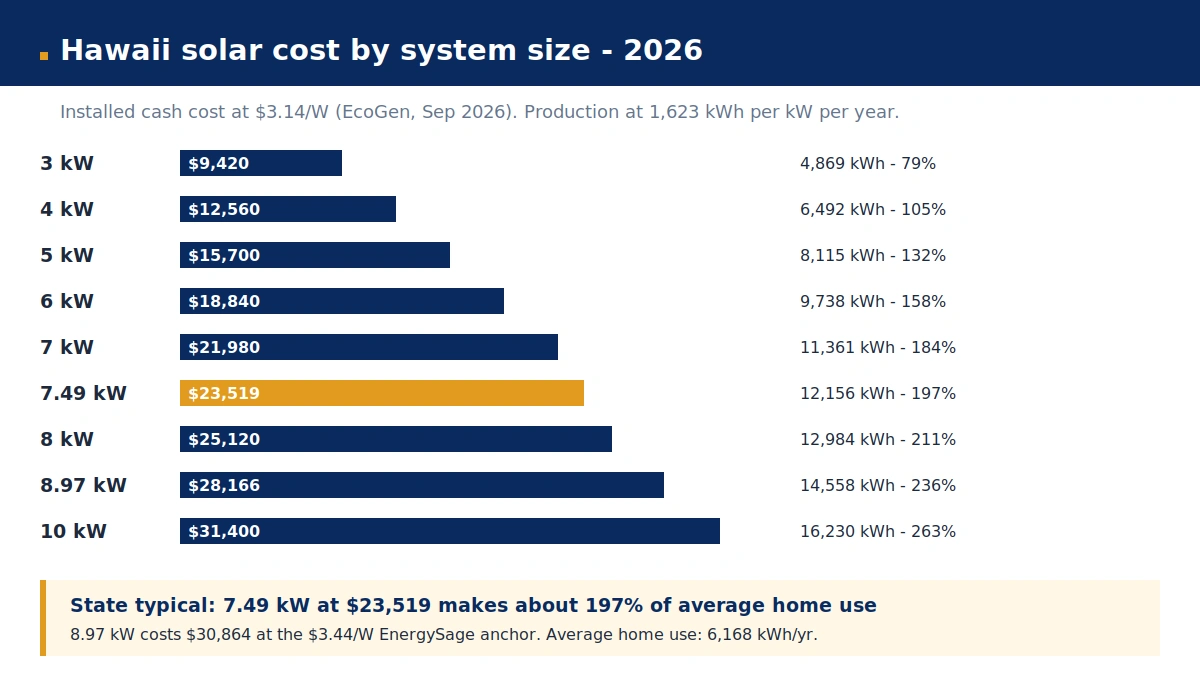
Size is the second decision, and in Hawaii it works differently than on the mainland — because the average Hawaii home uses so little power that the typical system already makes about twice what the house needs. The average Hawaii home uses about 514 kilowatt-hours a month, or roughly 6,168 a year — the lowest usage in the nation, from EIA billing data for the twelve months to August 2026 — yet pays about $228 a month for it, nearly the highest bill in the country. One kilowatt of panels in Hawaii produces about 1,623 kilowatt-hours a year, so a 7.49 kW array produces about 12,156 kilowatt-hours — close to 197% of the average home’s yearly use. A system sized purely to average use would be about 3.8 kW. The median Hawaii buyer installs nearly twice that.
The reason is not waste. It is the shape of a Hawaii household: an electric vehicle charged at home, air conditioning that runs through the afternoon, a pool pump, a heat-pump water heater — and a battery that soaks up the midday surplus and hands it back in the evening, when the house is actually using power. A 7.49 kW system with a battery is a different machine than a 7.49 kW system without one. The table below prices each size off the EcoGen anchor of $3.14 a watt, with output of 1,623 kilowatt-hours per installed kilowatt per year. It also shows what share of average home use each size covers, so the point where the array stops serving the house and starts exporting is visible at a glance — and so is the fact that in Hawaii, that point arrives early.
| Size | Cost at $3.14/W | Yearly output | Share of avg. HI home use (6,168 kWh/yr) |
|---|---|---|---|
| 3 kW | $9,420 | ~4,869 kWh | ~79% |
| 4 kW | $12,560 | ~6,492 kWh | ~105% |
| 5 kW | $15,700 | ~8,115 kWh | ~132% |
| 6 kW | $18,840 | ~9,738 kWh | ~158% |
| 7 kW | $21,980 | ~11,361 kWh | ~184% |
| 7.49 kW (state typical) | ~$23,519 | ~12,156 kWh | ~197% |
| 8 kW | $25,120 | ~12,984 kWh | ~211% |
| 8.97 kW (state avg) | ~$28,166 at $3.14/W ($30,864 at $3.44/W) | ~14,558 kWh | ~236% |
| 10 kW | $31,400 | ~16,230 kWh | ~263% |
Give two rows of that table an extra moment of attention. First, the 4 kW row already covers about 105% of the average home’s yearly use — a 4 kW array, at $12,560, is enough panels for the average Hawaii household’s entire electric bill, before any battery or load shifting. Second, the 7.49 kW typical system already makes about double what the average home uses — so on Oahu, where daytime exports earn only 13.5 cents against a 41.5-cent self-use value, the extra production only earns its keep if it is stored in a battery or used by a daytime load like an EV charger. An oversized array without a battery is the one way to make Hawaii solar mediocre, and the sizing conversation starts with the battery and the bills, and only then the roof.
Size the array from a full year of electric bills, not from how much bare roof happens to be available. Total the kilowatt-hours, divide by roughly 1,623 to find the size that covers them, then adjust: add 1-2 kW for a planned EV, more for air conditioning or a heat-pump water heater, less for a shaded or north-facing roof — then check the result against your utility’s rules, including Kauai’s right-size limit if you live there. If an EV or a battery is in your plans, size for that load first and design the solar second — otherwise the new load shows up after the array is already sized for the smaller house. The country-wide version of that sizing logic lives in our 6 kW vs 8 kW vs 10 kW guide.
Solar Panel Cost by City: Honolulu, Kapolei & Waipahu
Hawaii’s solar market is really one market with three islands’ worth of logistics behind it, and the verified city figures all come from Oahu — the island where most of the state’s people and most of its installers live. EnergySage’s November 2026 city pages show a spread of about twenty-six cents a watt across the three verified Oahu cities, and the pattern is worth reading carefully: the cheapest of the three is not Honolulu, the biggest market, but Kapolei, the fast-growing second city on the west side.
| City | $ per watt | Avg. system | Cash total | Utility |
|---|---|---|---|---|
| Honolulu | $3.40 | 7.89 kW | ~$26,850 ($22,822-$30,878) | Hawaiian Electric (Oahu) |
| Kapolei | $3.33 | 10.61 kW | ~$35,364 ($30,059-$40,669) | Hawaiian Electric (Oahu) |
| Waipahu | $3.59 | 10.12 kW | ~$36,292 ($30,848-$41,736) | Hawaiian Electric (Oahu) |
| Statewide (EnergySage) | $3.44 | 8.97 kW | ~$30,864 ($26,234-$35,494) | All islands |
Honolulu is the biggest market in the state, served by Hawaiian Electric on Oahu, at $3.40 a watt — with a 7.89 kW average system at about $26,850 and a 25-year savings estimate of about $45,716. That is close to the statewide $3.44 a watt, and the installer Alternate Energy Hawaii’s October 2026 figure of $3.42 a watt on an 8.03 kW average system at about $27,430 lands in the same place — two independent reads of the same market agreeing within two cents. Kapolei, about 25 miles west on the same island and the same utility, runs $3.33 a watt on a much larger 10.61 kW average system at about $35,364, with a modeled payback of 8.85 years and 25-year savings of about $75,326 — the newest housing stock in the state, with the biggest roofs and the biggest systems. Waipahu, between the two, runs $3.59 a watt on a 10.12 kW average system at about $36,292, with a modeled payback of 10.31 years and savings of about $61,747 — the most expensive of the three verified cities, and still within the statewide range.
Compare the cities on price per watt, never on the total. Kapolei’s $35,364 looks alarming next to Honolulu’s $26,850, but most of the gap is system size — 10.61 kW against 7.89 kW — not price. And use the utility column before the price column: all three cities sit on Hawaiian Electric’s Oahu tariff, so the export rules are the same for all of them — 13.5 cents by day, 32.9 cents in the evening — and the city comparison is a clean one, unlike states where the utility changes the answer. The neighbor islands carry a warning label rather than a verified price. No EnergySage city figure was pulled in this pass for Hilo, Kailua, Kaneohe, Pearl City, Mililani, Ewa Beach, or Lihue, and this guide does not invent them. One Hilo figure did turn up — $6.46 a watt from a zip-code estimator that still subtracts the dead 30% federal credit — and it is excluded here as unreliable, not repeated as a price.
One more city-level note: the installers named on EnergySage’s Hawaii pages in October 2026 are Independent Energy Hawaii, Sunspear Energy of Honolulu, and ProVision Solar of Hilo, established 1998 — and EcoGen’s October 2026 company check adds RevoluSun, Alternate Energy Hawaii, and Hawaii Energy Connection, with license numbers printed on its pages. A mature installer bench concentrated on one island does not always mean cheaper prices, and Honolulu’s numbers are the proof: the state’s biggest market runs within a few cents of the state average, not below it. Get three quotes, and make at least one from a company that already works on your island — a crew that has to fly to Maui or ship to Hilo prices the trip into the quote.
Hawaii’s Sun: Production, Trade Winds & Salt Air
Hawaii’s sunshine arrives with almost no seasons attached, and a production estimate that is honest has to start from that fact. The islands sit between 19 and 22 degrees north latitude — closer to the equator than any other state — so the days stay near twelve hours long all year, the sun stays high, and the panels run hard in January nearly as well as they run in July. There is no winter cliff here. There is no month when the house needs the most heat and the panels make the least power, because the house barely needs heat at all.
The sun. One kilowatt of panels in Hawaii produces roughly 1,623 kilowatt-hours a year on EcoGen’s PVWatts-based figures, and a 7.49 kW array produces about 12,156 kilowatt-hours — about twice the average home’s yearly use. Cross-checks land close: a second dataset built from EIA and NASA figures gives 1,745 kilowatt-hours per kilowatt a year, a different method rather than a different sky. Take 1,623 as the working anchor, with the higher figure as corroboration that Honolulu-class sun is among the best in the country. Peak sun hours run about six a day on the annual average. Honolulu gets about 270 sunny days a year by most counts, and the dry leeward coasts — the Ewa plain, the Kihei coast, the Kona side of the Big Island — see more sun than the wet windward sides, where the trade winds pile clouds against the mountains every afternoon.
The trade winds are a real advantage. A cell running hotter than 25 degrees Celsius gives up roughly 0.3-0.5% of its efficiency for each extra degree. A rooftop in Honolulu bakes in the midday sun — but the northeast trades blow across it all day, most days, carrying the heat off the glass. A panel that stays cooler makes more power per hour of sunshine, and that steady breeze is a large part of why Hawaii’s per-kilowatt production holds up against sunnier, stiller deserts. The same wind is also the reason the racking matters more here than in a calm climate: the wind that cools the panels is the wind that tries to lift them, and the building code answers it with design speeds no mainland roof has to meet.
Salt air is the variable, and it splits the coast from the interior. A rooftop a mile inland sees ordinary weather. A rooftop on the beach sees salt spray on every surface, every day, and salt corrodes aluminum racking, steel fasteners, and inverter housings faster than rain ever does. No Hawaii-specific corrosion-loss percentage was verified for this guide, so none is stated here — but the specification is worth naming on the quote: marine-grade or anodized racking, stainless fasteners, and an inverter rated for the exposure it will actually face. Ask the installer what the racking warranty covers in a salt-air install, and ask how often the panels should be rinsed. A ground-level rinse a few times a year does what the rain does not, and in a dry leeward neighborhood the rain may not do it at all.
Vog trims output on the Big Island in bad years. Kilauea’s volcanic smog drifts over Hawaii Island and, on some days, across the state, and vog cuts the sunlight reaching the panels the same way wildfire smoke does on the mainland. It is a genuine Hawaii variable, and an unpredictable one — no verified percentage appears here. The Big Island also carries the state’s only geothermal power, which is why Hawaii Electric Light’s rates run the way they do, and the only place in the state where a volcanic eruption is a planning consideration rather than a news story.
The roof itself, and the wind it must survive. A rooftop array in Hawaii sits under a wind load the racking and the roof must carry together — and the code treats the whole state as a hurricane-prone region, which no mainland state has to say about itself. Design wind speeds run about 130-150 miles an hour or more in coastal windborne-debris zones, and about 115 miles an hour inland, with the state building code setting a 145-mile-an-hour minimum peak gust for enhanced hurricane protection areas and a dedicated appendix section — W106 — for rooftop solar panels. Confirm the racking’s uplift rating against the wind speed for your exact address before signing, and let the county’s figure govern, not the installer’s guess. Replace a roof with under ten years of life left before the array goes on — a later detach-and-reset runs to thousands on its own. What a reroof runs is priced out in our roof replacement guide. Standing-seam metal ranks among the best solar roofs anywhere, because clamps grip the seams with no roof penetration at all, and a metal roof sheds wind-driven rain faster than asphalt. Hail is not the defining Hawaii risk — no Hawaii hail statistics were pulled for this guide, and the mainland Hail Alley numbers do not belong here — but panels rated UL 61730 / IEC 61730 remain the specification to ask for, and homeowners insurance remains the cover for storm damage. Ask the insurer in writing whether the array is covered before signing, and ask what the hurricane deductible does to a claim.
Working with the climate. No exotic equipment is required. Pick a south-facing orientation where the roof allows it, a tilt that catches the high tropical sun without turning the array into a sail, microinverters or optimizers so a shaded string cannot drag the whole array down, and a production estimate built on PVWatts data with the soiling assumption out in the open, not hidden. On Oahu, the most valuable kilowatt-hours are the ones the house consumes the instant they are made — and a west-facing tilt that shifts more production into the 5-to-9 p.m. evening window, when exports earn 32.9 cents instead of 13.5, is worth discussing with the installer even if it gives up a little total annual output. That single design choice is worth more in Hawaii than in any other state in this series.
Net Metering in Hawaii: The Rules That Decide Your Return
Hawaii has no net metering for new customers — and it has not had any for a decade, which makes it the oldest post-net-metering market in the country. Anyone who says otherwise is describing a rule that closed on October 13, 2015. What Hawaii has instead is a successor tariff that pays for exported power by the island and by the hour, a co-op on Kauai that pays a monthly rate tied to oil, and a large population of legacy customers holding terms that cannot be replaced. Find your island and your program first. Everything else in this section follows from those two facts.
The history, in order. Hawaiian Electric closed net energy metering to new applicants on October 13, 2015, under a Hawaii Public Utilities Commission order — the first major utility in the country to do it, because Oahu’s circuits were already saturated with rooftop solar. The replacement, Customer Grid-Supply, closed in November 2017. Its successors, Customer Grid-Supply Plus and Smart Export, closed on March 29, 2024. Since April 1, 2024, new systems have connected under Smart Renewable Energy Export, the Smart DER Export tariff under HPUC Docket 2019-0323. The old programs are closed, not dead: a household already on net metering keeps full retail credit for its exports, a household on Customer Grid-Supply, Customer Grid-Supply Plus, or Smart Export moves to Smart Renewable Energy Export seven years after its contract date, starting October 1, 2024 — and changing or enlarging a legacy system can put the old terms at risk, so get the utility’s answer in writing before touching it. Legacy net metering from 2015 cannot be replaced. No upgrade is worth losing it without written confirmation of what happens.
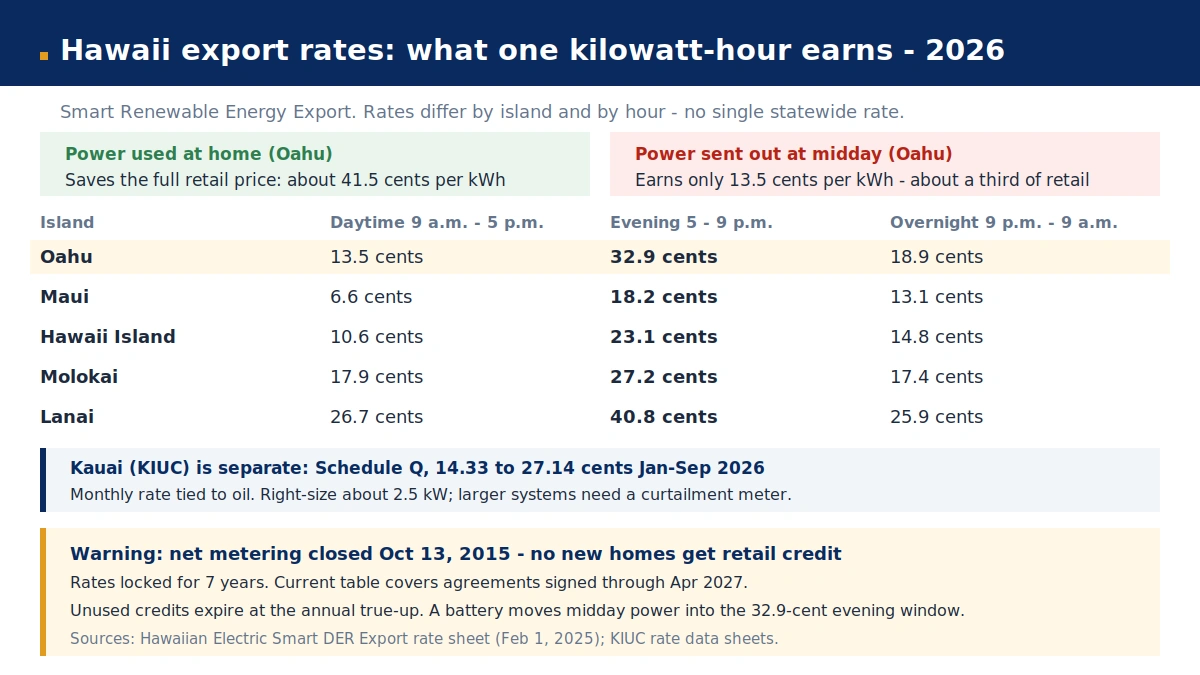
Smart Renewable Energy Export — Hawaiian Electric islands (Oahu, Maui, Hawaii Island, Molokai, Lanai). The tariff credits exported power at a rate set by the island and by the hour of day, and the rate is locked for the first seven years of the agreement, then follows a table the utility updates every three years. The current table covers agreements signed through April 2027; agreements signed later get the next table. An advanced meter is required. Credits roll from month to month, but at the annual true-up any credits left over expire — a big surplus at year end is a gift to the utility, not money in the bank. The three daily windows are daytime, 9 a.m. to 5 p.m.; evening peak, 5 p.m. to 9 p.m.; and overnight, 9 p.m. to 9 a.m.
| Island | Daytime (9 a.m.–5 p.m.) | Evening (5–9 p.m.) | Overnight (9 p.m.–9 a.m.) |
|---|---|---|---|
| Oahu | 13.5 cents | 32.9 cents | 18.9 cents |
| Maui | 6.6 cents | 18.2 cents | 13.1 cents |
| Hawaii Island | 10.6 cents | 23.1 cents | 14.8 cents |
| Molokai | 17.9 cents | 27.2 cents | 17.4 cents |
| Lanai | 26.7 cents | 40.8 cents | 25.9 cents |
Read that table the way a Hawaii homeowner has to read it: as three different prices for the same kilowatt-hour. On Oahu, power the house uses the moment it is made saves about 41.5 cents — the twelve-month average after the monthly customer charge and fees — while power sent out at noon earns 13.5 cents, about a third of retail. The same power sent out at 6 p.m. earns 32.9 cents, about three-quarters of retail. The order holds on every island: self-use beats evening export beats daytime export, roughly three to one end to end. Maui pays the least by day, 6.6 cents — barely a seventh of what a Maui household pays for power — and Lanai pays the most in the evening, 40.8 cents. A quote that uses one export rate for the whole state is wrong for your island, and a quote that uses one blended rate for the whole day is wrong for your roof. Ask the installer to show exports by island and by hour, with the battery’s evening discharge priced separately.
Kauai — Kauai Island Utility Cooperative (KIUC) — is a separate case entirely. None of the Hawaiian Electric figures above apply there. KIUC is a member-owned nonprofit co-op serving about 33,000-38,000 meters, and it pays for exported power under Schedule Q at its avoided cost, which moves every month with the price of oil. From January to September 2026 that rate ran from 14.33 cents (March) to 27.14 cents (June) a kilowatt-hour. KIUC says the Schedule Q price should fall as it burns less oil, so do not plan on this year’s rate for the life of the system. KIUC also sets a “right size” for each home — about 2.5 kW for a home using up to 500 kilowatt-hours a month — and a system above that size needs a curtailment meter, which means KIUC can throttle or switch it off. No Hawaiian Electric battery payment applies on Kauai either. Kauai households should work from KIUC’s current terms, not the Oahu figures on this page, and should ask KIUC for this month’s Schedule Q rate in writing before signing anything.
Payback: How Long Until Hawaii Solar Pays for Itself?
Payback is where a Hawaii system earns its keep faster than anywhere else in America, and the answer still turns on the island — just less sharply than in the slow states, because every island in Hawaii pays back quickly. The worked examples below rest on the EcoGen anchors, so every input can be traced, with EnergySage as the cross-check — and this guide marks each spot where the two sources part ways.
A worked example. Picture a typical 7.49 kW system at $3.14 a watt, priced at $23,519 before incentives. Yearly output comes to about 12,156 kilowatt-hours. The state credit is worth up to $5,000 if it reaches the buyer, so the payback figures below are stated before incentives first, as EcoGen publishes them, and then again with the credit in — so the arithmetic stays comparable across islands.
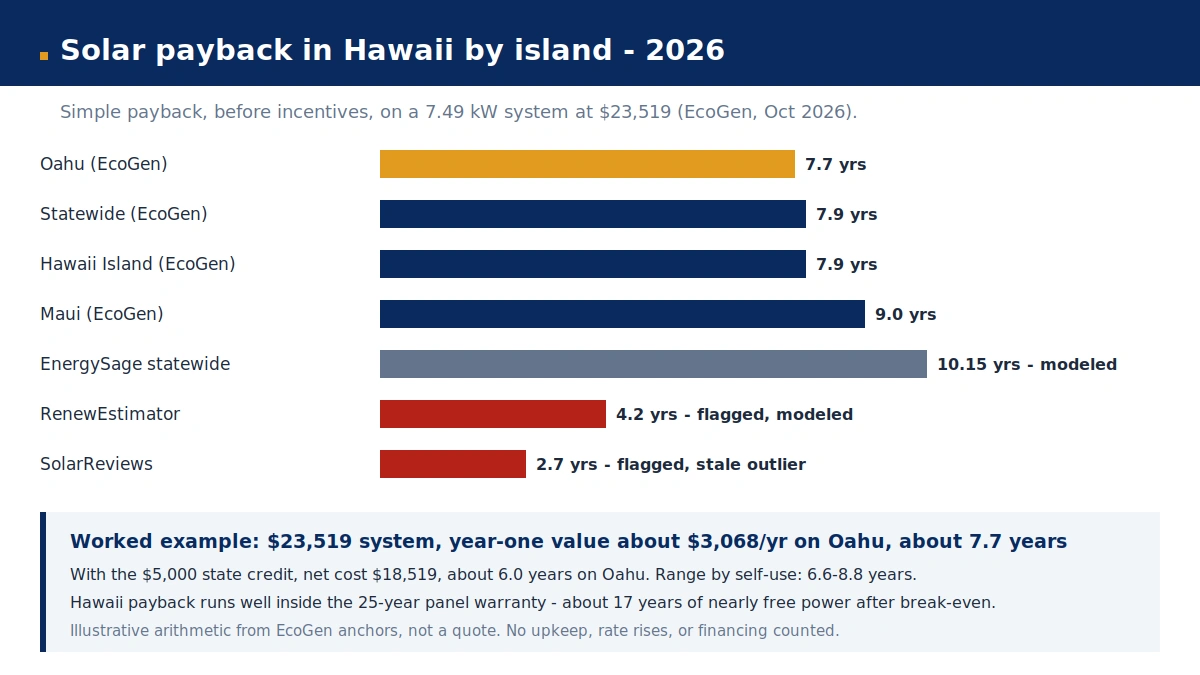
Oahu is the fastest payback on a major island in this series. EcoGen’s per-island worked example for Oahu puts the year-one value at about $3,068 a year, and simple payback is $23,519 divided by $3,068, about 7.7 years — call it about 8 — before incentives, counting no upkeep, no rate rises, and no financing. The range by self-use is 6.6 to 8.8 years, depending on how much of the system’s power the home uses as it is made: a household that uses 55% of its production at home pays back in about 6.6 years, while one that uses only 28% takes about 8.8. With every export at the 13.5-cent daytime rate it is 7.8 years, so even the worst-timed Oahu system pays back in under eight. That is the fastest payback in this series, and it is not close.
Hawaii Island is a step behind Oahu. EcoGen puts it at 7.9 years for the same 7.49 kW system, on year-one savings of about $2,968 a year — $23,519 divided by $2,968 — with a self-use range of 6.6 to 9.5 years. The island’s retail rate is higher than Oahu’s, but its evening export credit is lower, 23.1 cents against Oahu’s 32.9, and the two roughly cancel.
Maui is the slowest of the three modeled islands, and it is still fast. EcoGen puts Maui at 9.0 years — the highest of the three, because Maui pays the least of any island for daytime exports, 6.6 cents a kilowatt-hour, and its households export more of their production at that price. No Maui yearly-savings figure was published in this pass, so none is re-derived here beyond the implied arithmetic: $23,519 divided by 9.0 years implies about $2,613 a year, labeled here as derived, not published. Kauai has no EcoGen payback figure yet, because KIUC’s monthly oil-tied rate cannot be modeled the same way — the draft states none rather than inventing one.
Hawaii’s statewide payback lands between those island figures. Weighted by the homes each utility serves, EcoGen’s statewide payback works out to about 7.9 years before incentives, with no upkeep and no future price rises counted. It is the honest statewide line, and it is a remarkable one: a typical Hawaii system pays for itself in about a third of the panels’ 25-year warranty period, leaving roughly seventeen years of nearly free power after the break-even point.
| Case | Simple payback | Source |
|---|---|---|
| EcoGen Oahu (7.49 kW) | ~7.7 yrs (6.6-8.8 by self-use) | EcoGen per-island figures, Oct 30, 2026 |
| EcoGen statewide (7.49 kW) | ~7.9 yrs | EcoGen Index, Sep-Oct 2026 |
| EcoGen Hawaii Island (7.49 kW) | ~7.9 yrs (6.6-9.5 by self-use) | EcoGen per-island figures, Oct 30, 2026 |
| EcoGen Maui (7.49 kW) | ~9.0 yrs | EcoGen per-island figures, Oct 30, 2026 |
| EnergySage statewide (8.97 kW) | 10.15 yrs | EnergySage, Nov 2026 — modeled, larger system |
| EnergySage Honolulu (7.89 kW) | 9.94 yrs | EnergySage, Nov 2026 — modeled |
| SolarReviews (5.1 kW) | 2.7 yrs | SolarReviews, Nov 2026 — flagged, assumes net metering |
| RenewEstimator (8 kW) | 4.2 yrs | RenewEstimator, Jul 2026 — flagged, modeled |
The state credit shortens every one of those figures by about a year and a half. Take the $5,000 credit off the $23,519 price and the net cost is $18,519. On Oahu, $18,519 divided by $3,068 a year is about 6.0 years. Statewide, $18,519 divided by the implied statewide yearly value of about $2,977 is about 6.2 years. Both figures are NestPriced arithmetic from EcoGen’s published paybacks, labeled as derived — and both depend on the credit actually reaching the buyer, which Act 24 no longer promises outright. A household above the income cliff, or one whose claim lands in a year the $40 million cap is oversubscribed, pays back on the before-incentives figures instead.
The flagged conflict. SolarReviews reports a 2.7-year payback and RenewEstimator reports 4.2 years. Both are modeled estimates that assume conditions Hawaii does not offer — SolarReviews assumes full retail net metering, which closed in 2015, and RenewEstimator prices every kilowatt-hour at a 52-cent rate with six peak sun hours. Do not present either as a verified Hawaii payback, and do not let a quote cite one for a Hawaiian Electric or KIUC home. A gap of 2.7 years against 7.7 years is no rounding difference — the export rate explains it, and any payback that ignores the export rate is modeling a different decade.
What moves the payback most. Daytime self-use is the strongest lever, and in Hawaii it counts for more than anywhere else in this series. Shifting the water heater, the laundry, and the EV charger into daylight hours moves kilowatt-hours out of the 13.5-cent export bucket and into the 41.5-cent self-use bucket, and no other change pays as well — EcoGen’s own model shows the Oahu payback stretching from 6.6 years at 55% self-use to 8.8 years at 28%, a two-year swing on behavior alone. A battery is the second lever, because it moves surplus into the 32.9-cent evening window or into the house at full retail value — the largest spread in the country. A west-facing tilt is the third lever on Oahu, because it pushes more production into the 5-to-9 p.m. window when exports earn 32.9 cents instead of 13.5. Rate escalation is the fourth lever: Hawaii rates are growing about 5.98% a year over the last five years, the fastest growth in this series, and every future increase shortens the payback that today’s flat-rate arithmetic reports. Financing is the fifth lever: dealer fees on a solar loan can raise the effective price by 10-30%, so compare quotes on cash price per watt rather than the monthly payment. And the state credit moves the needle by about 1.7 years on Oahu — real money, but no longer money to count before it is claimed.
Who still comes out ahead. Five kinds of Hawaii household clear it easily. The Oahu homeowner with a big daytime load — home offices, daytime laundry and dishwashing, an EV charged at midday — that keeps most of its production at full retail value. The household pairing solar with a battery, which is nearly every new Hawaii buyer now, and which turns the midday surplus into evening value instead of a 13.5-cent export. The household pairing solar with an EV or a heat-pump water heater, sizing to the new daytime load. The Maui or Hawaii Island homeowner who accepts a nine-year payback in exchange for seventeen years of nearly free power afterward. And the buyer who wants backup power above all — outage protection through hurricanes and wildfire-season shutoffs, savings second — for that household the payback math is context, not verdict. Walk away when you rent, when you plan to move before the payback window closes, or when the installer projects savings without naming your island’s export prices by the hour.
Hawaii Incentives in 2026: The State Credit, GEM$, and What Is Gone
The federal credit is gone, but most states still keep a backup in place: a state credit, a rebate, an exemption. Hawaii keeps the best state credit in the country — and a 2026 law just made it harder to count on. The incentives picture in Hawaii is bigger than any other state in this series, and it is also the most changed. It is worth saying plainly, because most solar advertising in Hawaii still quotes the old rules.
Hawaii’s state credit is still 35%, capped at $5,000 — and the cap is what matters. The Renewable Energy Technologies Income Tax Credit covers 35% of an installed photovoltaic system’s cost, capped at $5,000 for a single-family home. On the typical $23,519 system, 35% is $8,232 — so the $5,000 cap binds, and the cap is reached at a system cost of about $14,286. Nearly every Hawaii system costs more than that, so nearly every Hawaii buyer gets the full $5,000, if the credit reaches them at all. The credit is non-refundable: it can only offset Hawaii income tax the buyer actually owes, so a household with little state tax liability may not be able to use the full $5,000 in one year. A battery counts toward the credit only when it is installed with the solar, on the same property, in the same tax year, under the same $5,000 cap — a battery bought a year later is a separate purchase that does not earn a second credit. Claim it on Form N-342 with the Hawaii return, within twelve months after the tax year ends.
Act 24 rewrote the credit on May 21, 2026, and added four new limits. The law is S.B. 3125, signed as Act 24, and it keeps the 35% rate and the $5,000 cap while changing almost everything around them. First, a certificate: before March 1 of the year after the system is switched on, the owner sends a signed statement to the Hawaii State Energy Office, and the office replies by May 31 with how much may be claimed. The energy office had not posted the steps for that statement when checked on September 30, 2026, so confirm the step with the office itself rather than trusting a sales pitch. Second, a $40 million statewide annual cap from 2027 through 2030, shared pro rata among every claimant — companies included — if claims exceed it, which means a $5,000 credit can shrink if too many households claim at once. Third, an income limit from tax year 2027: no credit at all above $175,000 of adjusted gross income, or $350,000 on a joint return — a cliff, not a taper, so a dollar over the line costs the whole $5,000. Fourth, an end date: the credit does not apply to tax years beginning after December 31, 2029.
For a 2026 install, two protections soften the new law. There is no income test for 2026 installs — the cliff starts with tax year 2027. And Executive Order 26-02, signed June 8, 2026, keeps the $40 million cap off a 2026 system if it was finished before May 21, 2026, or if the owner can show money or work went into it before that date — the reasonable-reliance test. A household installing late in 2026, with no spending before May 21, does not get that protection, and its claim lands in the capped pool. The order matters: document the dates, keep the receipts, and ask a tax preparer whether the credit reaches your return before counting $5,000 in the payback.
GEM$ is the real state help for households that cannot pay cash — and it is a loan, not a grant. The Green Energy Money $aver on-bill program, run by the Hawaii Green Infrastructure Authority, lends for solar and batteries at a fixed 5.5% a year for up to 20-25 years, repaid as a charge on the electric bill. There is no credit check, and the eligibility test is income, not credit history: Hawaiian Electric households under 140% of area median income, with six months of utility history, plus renters with the owner’s signature, nonprofits, and small businesses. The project must pass a bill-savings test — the post-installation bill must fall by at least 5%, 10%, or 15%, depending on how many disconnection notices the household received in the last year — and the repayment obligation attaches to the meter, not the person, so it stays with the property if the household moves. It is not offered on Kauai. It was taking applications when last checked on October 5, 2026, and the authority released $18 million in new loan capital on December 8, 2025, after the federal credit ended. GEM$ does not incorporate tax credits into its savings test, so it approves projects on bill savings alone.
Hawaii offers no sales-tax or property-tax break on solar equipment at the state level. There is no exemption to find, and EnergySage states flatly that Hawaii offers no statewide solar tax exemptions. Hawaii’s general excise tax of 4%, plus a 0.5% county surcharge, falls on the installer — who may add it to the quote as its own line — so ask whether the price includes it, and get the tax shown as a separate line. No Hawaii utility pays a rebate for panels. Not Hawaiian Electric, not KIUC, not anyone. Any installer promising a Hawaii utility rebate for panels is either confused or selling something else. The only utility money in the state is the BYOD Plus battery payment; see the battery section below.
No Solar for All program is taking Hawaii household applications. The EPA closed the Solar for All grant program in August 2025. Federal courts ruled the termination unlawful in September 2026, and the EPA was still considering an appeal in October 2026. The Hawaii Green Infrastructure Authority said in December 2025 that its funds remain in litigation, and its Solar for All page returned “not found” on October 5, 2026. No Hawaii household has a way to apply for it.
The federal home energy rebates have yet to open in Hawaii. The state was allocated about $68.3 million in total — $34,093,900 for HEAR and $34,224,953 for HOMES, per the federal dataset — but the Hawaii State Energy Office’s eHale Energy Saver page says plainly that the program is pending US Department of Energy approval of launch, with both pathways expected for Hawaii residents in early 2027, and that installs done before launch will not qualify. Even after it launches, HEAR still will not fund solar. Electrification is what it pays for — heat pumps, heat-pump water heaters, electrical panels, and insulation-related wiring — never panels, batteries, EV chargers, or windows. The state also launched a rebate finder in October 2026, but a listing in the finder is not an open program — the administering agency still decides eligibility, and eHale remains the prominent program still awaiting federal approval.
| Item | Value | Notes |
|---|---|---|
| HI state tax credit (RETITC) | 35% of cost, up to $5,000 per single-family system | Non-refundable; Form N-342; cap binds on the typical system ($8,232 at 35% becomes $5,000) |
| Act 24 (May 21, 2026) | HSEO certificate; $40M/yr statewide cap 2027-2030; income cliff $175k/$350k from tax year 2027; ends after tax year 2029 | EO 26-02 exempts 2026 systems finished or relied on before May 21, 2026 |
| GEM$ on-bill loan | Fixed 5.5% for up to 20-25 yrs | Under 140% AMI; no credit check; HECO islands only, not Kauai; repaid on the bill |
| HI sales-tax exemption | None — 4% GET + 0.5% county surcharge applies | Falls on the installer; ask whether the price includes it |
| HI property-tax exemption | None verified | EnergySage: no statewide solar tax exemptions |
| Rebate for panels | $0 — none exists | No HI utility pays one |
| BYOD Plus battery payment | $400/kW once + monthly credits | Hawaiian Electric only; LMI adder +$400/kW; see battery section |
| Solar for All | $0 — no program open for HI households | EPA ended grants Aug 2025; HGIA page not found Oct 5, 2026 |
| HEAR / HOMES rebates | Not launched | ~$68.3M allocated; eHale expected early 2027; pre-launch installs do not qualify |
Federal Help in 2026: $0 Tax Credit — and the Lease Route That Works Here
The 2026 federal story fits in one paragraph — and in Hawaii the paragraph has a second half that Idaho does not get, because the lease route that saves other states is alive and selling here.
For a system you buy and install yourself in 2026, the federal tax credit is zero. Signed July 4, 2025, the One Big Beautiful Bill Act (Public Law 119-21) stripped the 30% Residential Clean Energy Credit (§25D) from any system placed in service after December 31, 2025. Per IRS fact sheet FS-2025-05, the finish date is the one that decides: a deposit paid in 2025 buys nothing when the crew wrapped up the job in January 2026. The §25C credit for efficient home improvements ended the same day. If a 2026 cash or loan quote still takes 30% off, it is built on a repealed law — have the installer remove it and price the job again. SolarReviews’ own cost page still lists a $14,213 “after tax credit” figure for Hawaii — that is the stale 30% figure, and it plays no part in any number in this guide.
Leases and PPAs are legal statewide in Hawaii — and companies are actively selling them. Hawaii is one of the few states where a no-money-down solar offer is genuinely available. DSIRE’s third-party PPA map (May 2026) lists Hawaii as authorized, citing HRS §269-1(2)(M), and Sunrun — the country’s largest residential solar company — sells leases in Hawaii alongside local providers. The commercial clean-electricity credit (§48E, 30%) is still claimable on a company-owned array, provided the system enters service by December 31, 2027 and construction began by July 4, 2026 — the cutoff IRS Notice 2025-42 lays down. The company passes part of that value on as a lower monthly payment or a lower per-kilowatt-hour price, and the homeowner pays nothing upfront.
The lease trade is steeper in Hawaii than anywhere else, because the state credit is the biggest in the country. The 35% state credit belongs to whoever owns the equipment. Sign a lease and the $5,000 goes to the leasing company before the first bill arrives — on top of the federal value the company already keeps. A homeowner above the Act 24 income cliff loses nothing on that side, because the cliff would have taken the credit anyway; a homeowner under it hands the company up to $5,000 of state money plus the federal value, in exchange for no upfront cost and no maintenance. At Hawaii’s payback speed, owning usually still wins for a household that can pay cash or borrow cheaply — a 7.7-year payback on Oahu leaves seventeen years of nearly free power, and a lease payment runs for the full twenty or twenty-five years of the agreement, usually with an annual escalator. Have a lawyer read any lease or PPA before signing, and ask in writing who claims the state credit, who claims the BYOD Plus battery payment, what the escalator is, and what happens when the house is sold.
HEAR money never funds solar. In 2026, a household that qualifies by income can still receive as much as $8,000 through the Home Electrification and Appliance Rebates program — for electrification work, not for panels. HEAR’s money covers four things: a heat pump, a heat-pump water heater, an electrical panel, and wiring tied to insulation. Panels, batteries, EV chargers, and windows: none of them are covered. Under the Energy Department’s Notice 26-2, issued May 29, 2026, the program covers only electric-to-electric upgrades — no fuel-switching. Hawaii’s own HOMES and HEAR programs have not launched at all, and the state expects them in early 2027. Counting a HEAR rebate against the solar price gets the program wrong — it was never built to work that way. HEAR can still matter to a Hawaii homeowner. Pairing a heat pump with new panels is a frequent move, and the heat-pump half may qualify once Hawaii’s program launches — the solar half never will.
The honest summary is this: in 2026 the federal government contributes nothing to a Hawaii homeowner who buys solar panels outright, and the state contributes up to $5,000 if the credit reaches the buyer — which Act 24 no longer promises outright. The one door Washington still leaves open is the lease, and Hawaii is one of the few states where that door is genuinely open, with real companies selling through it. On a cash quote, the price is the price, less whatever the state credit is worth on your own return. Our federal tax credits guide has the complete 2026 federal picture, and our national solar cost guide covers lease-versus-buy in depth.
Permits & Licensing: What Hawaii Requires
Hawaii’s licensing picture is unusual in one respect that helps a buyer who knows where to look: the state splits solar work across three license classes, and a company holding only one of them cannot legally finish the job alone.
The contracting work needs a Department of Commerce and Consumer Affairs (DCCA) Contractors License Board license. Hawaii licenses contractors statewide under HRS Chapter 444, and any project over $1,500 in labor and materials — or any job requiring a building, electrical, or plumbing permit regardless of price — requires one. The classes that matter for solar are C-60 Solar Power Systems, which covers panels, batteries, and low-voltage DC wiring only; C-61 Solar Energy Systems; and C-13 Electrical, which must connect the system to the home’s wiring — a C-60 alone cannot do the AC connection, and the electrical work has to be done by or under a C-13 contractor. An “A” General Engineering licensee automatically holds the C-61 specialty without a further exam. Applicants need four years of supervisory experience in the classification, must pass a business-and-law exam plus a trade exam administered by PSI, and must hold a General Excise Tax license from the Department of Taxation before the contractor license can issue — a step unique to Hawaii. Hawaii accepts no NASCLA exam and has no broad reciprocity with any other state. Ask for the installer’s license number and classification, verify it on the DCCA Professional and Vocational Licensing public search, and check that the name matches the contract. A company that waves a mainland license instead of a Hawaii one has shown you the wrong document.
The installers named in this pass carry their numbers in public. EcoGen’s October 2026 company check, drawn from the DCCA registry, lists RevoluSun (CT-30244), Alternate Energy Hawaii (CT-26041), and ProVision Solar of Hilo (CT-26351). EnergySage’s marketplace pages add Independent Energy Hawaii and Sunspear Energy of Honolulu, and Hawaii Energy Connection — the KumuKit company — is the fourth firm EcoGen rated. NABCEP certification is the leading industry credential, and it is worth asking about even though Hawaii, unlike Idaho, does not name it as a requirement of any license class. A crew’s experience on your island matters more than its years in business: a company that has done a hundred installs on Oahu has not necessarily done one on Molokai, and the interconnection paperwork differs by island.
Permits and interconnection take time. A Hawaii rooftop job needs three approvals in sequence — a building permit, an electrical permit, and a utility interconnection agreement — and interconnection is usually the one that drags. This guide found no Hawaii-specific permit fee schedule, so no fee figure appears here. The county building department sets it — the Department of Planning and Permitting on Oahu — and the wind speed the county applies is the one that governs the racking. No Hawaiian Electric interconnection application fee figure was verified for this guide, so none is stated. No Hawaii-specific interconnection timeline turned up either; the national figure, per Palmetto (April 2025), is that residential interconnection usually takes 2-4 weeks, cited here as a national figure only. What slows a Hawaii install down is the calendar, not the price tag: the advanced meter has to be installed before the system can export, the utility has to accept the interconnection agreement, and the export rates in that agreement are the ones locked for seven years. Permission to operate within two weeks is a promise no installer can keep — the utility decides that, not the installer.
Hawaii’s HOA law is among the strongest in this series — trust the statute, not the surveys. Hawaii Revised Statutes §196-7 says no person shall be prevented by any covenant, declaration, bylaws, restriction, deed, lease, or similar binding agreement, however worded, from installing a solar energy device on any single-family residential dwelling or townhouse that the person owns — and any provision to the contrary is void and unenforceable. Private entities must adopt rules that facilitate the placement of solar devices, and those rules may not make the device more than 25% less efficient or increase the cost of installation, maintenance, and removal by more than 15%. No private entity may charge a homeowner any fee for the placement of a solar device. Placement on a common element or limited common element needs the entity’s consent — which matters for condo owners, because the roof is usually common area and the board’s approval process is the whole decision. Still get architectural-review approval in writing before ordering panels — the law protects the installation, not the paperwork fight.
A consumer-protection bill is pending, not law. S.B. 2032, in the 2026 session, would require anyone selling a residential solar device to hold a contractor’s license or be contractually affiliated with a licensed contractor, and to comply with consumer-protection laws — after testimony from the Hawaii Green Infrastructure Authority, KIUC, Hawaiian Electric, Sunrun, and the Hawaii Solar Energy Association about misleading and aggressive sales practices. It is a bill, not a law, and this guide states it only as pending. The March 2026 state warning behind it is already real: door-to-door sellers were falsely claiming a state program gives away panels, and the state said plainly that it does not provide free solar PV systems.
What Pushes Your Hawaii Quote Up or Down
The per-watt anchor is a place to start, not a quote. Seven factors can shift a Hawaii quote by thousands of dollars, and three of them come from this state’s geography and power market.
Labor is the most expensive in this series — and that is itself the point. Hawaii electrician pay runs far above the national median — $46.38 an hour against $30.38 nationally, per BLS May 2025 — with 3,070 electricians employed in the state and a 10th-to-90th percentile range of $21.99-$59.90 an hour. Urban Honolulu runs higher still, at $48.21 an hour. Labor is the largest soft-cost component of an install, and in Hawaii it inflates the job the way coastal wages do everywhere — except that here the wage is the third-highest in the country, behind only Oregon and Illinois. What moves a Hawaii quote is not cheap labor but expensive labor plus island shipping: every panel, inverter, and battery arrives by ship, and the freight is priced into the quote. Ask how many installs the crew has done on your island, not just how many years the company has existed. BLS publishes state-level solar-installer wages for only 32 states, and Hawaii is not among them in this pass, so no Hawaii-specific figure appears here — the national figure stands in, marked as national: a median of $53,140 a year, about $26 an hour, with 31,100-31,350 such jobs nationally and BLS projecting 37% growth from 2025 to 2035.
The roof itself, and the wind it must survive. Hurricanes and tropical storms age Hawaii roofs differently from mainland ones: wind-driven rain works on flashing and shingles, salt air works on fasteners, and a roof that has to hold panels through a 130-mile-an-hour gust carries a load a calm-climate roof never sees. Replace a roof with under a decade left before the array goes on — a later detach-and-reset runs to thousands on its own. Our roof replacement guide prices out what a reroof runs. Standing-seam metal — common on Hawaii homes and newer builds — ranks among the best solar roofs anywhere, because clamps grip the seams with no roof penetration at all, and a metal roof sheds wind-driven rain faster than asphalt. Confirm the racking’s uplift rating against the county’s design wind speed before the panels go up, not after, and confirm the roof’s remaining life with the roofer, not the solar salesperson.
Panel tier. Top-tier panels typically cost 10-20% more per watt than value-tier ones. In Hawaii that premium buys two things that matter: better low-light performance on cloudy windward afternoons and slower degradation over a quarter century of intense tropical sun. On a tight roof, the extra cost of higher efficiency pays off. On a big unshaded leeward roof, a big open plane usually favors the cheaper value-tier panels. Premium n-type panels also degrade more slowly — 0.25-0.5% a year, holding 91-93% of rated output at year 25, against the fleet median of about 0.5% a year and about 88% at year 25 per NREL — which matters more in a state where the payback is already fast, because every extra year of strong output is a year of nearly free power after break-even.
Inverter choice. Upfront, a string inverter is the cheaper of the two. Microinverters or optimizers cost more but generate more on roofs with partial shade — and Hawaii roofs, with their palms, dormers, and neighboring two-story homes, carry shade more often than installers admit, and a cloud passing over one part of an array shades it the same way a tree does. With microinverters, each panel is tracked on its own, so one shaded panel cannot pull the whole string down. Plan on one string-inverter replacement during the system’s life — they typically last 10-15 years — while microinverters typically carry about 25 years. Our inverter replacement guide prices each type across its full life — but remember that guide is national, and its dollar figures are national, not Hawaii-specific.
The electrical panel. Many Hawaii homes still run on 100-amp service — especially plantation-era homes and older Honolulu bungalows — and a solar install often forces the question. A 200-amp panel upgrade runs $1,500-$4,000 nationally, per our electrical panel upgrade guide — and it is the surprise add-on that shows up most often in Hawaii quotes. Find out whether the quote includes it before signing — not after the electrician is already in your driveway. No Hawaii-specific panel-upgrade dollar figure turned up for this guide, so the national figure stands in, marked as national. Here is one Hawaii wrinkle: a panel upgrade counts as electrification work, the kind HEAR is designed to pay for — once Hawaii’s HEAR program launches, which it has not.
Financing terms. Nothing beats cash for long-term return. Dealer fees of 10-30% of the cash price — sometimes over 50% — hide inside the amount financed on a $0-down loan, per the Consumer Financial Protection Bureau’s August 2024 market spotlight, a national figure that Hawaii quotes feel just the same way. GEM$ is the third path in Hawaii, and it is a genuinely cheap one — 5.5% fixed for up to 20-25 years, no credit check, repaid on the bill — but only for households under 140% of area median income on Hawaiian Electric islands, and only if the project passes the bill-savings test. A lease or PPA is the fourth path, and it is genuinely available here: Sunrun and others sell them, the company claims the federal credit and the state credit, and the homeowner pays nothing upfront but never owns the system. The fifth path is community solar, and no general community-solar subscription turned up for Hawaii homeowners in this guide.
Maintenance and lifespan. Expect panels to keep producing for 25-30 productive years, beyond the warranty, at lower output. Product warranties for materials and workmanship typically run 10-25 years, while performance warranties typically run 25-30 years and guarantee 80-92% of rated output at year 25 depending on tier. Upkeep is minimal — an occasional cleaning, plus an annual production check — because there are no moving parts. In Hawaii, salt spray and vog soot are the cleaning reasons, not snow, and a ground-level rinse a few times a year does what the rain does not. Every lifespan, degradation, and maintenance figure here is national only — no Hawaii-specific versions exist — so each one is marked national.
Batteries in Hawaii: Worth It?
Of all the add-ons, a battery is the most consequential in a Hawaii project — and the only state in this series where the answer is usually yes on the economics alone. It can add about $9,600 to the job, and whether that money comes back turns on a question Hawaii answers differently from its neighbors.
Battery cost. A 13 kWh storage add-on runs about $9,630 installed (EnergySage, November 2026, Hawaii average of $741 a kilowatt-hour, with most quotes between $8,186 and $11,074). A 26 kWh battery runs about $19,300. A battery installed by its owner in 2026 earns no federal credit either: §25D covered storage too, and it ended on the same date. Our solar battery cost guide prices individual battery models nationally. One Hawaii wrinkle national guides skip: Hawaii’s battery price runs lower than the national average — the national figure for a 13.5 kWh system is about $15,647 installed — because the Hawaii marketplace is built around batteries and the volume shows in the price.
Hawaiian Electric pays cash for a home battery, and it is the only such payment in the state. The Bring Your Own Device Plus program pays $400 for each kilowatt of battery power committed, once, with no maximum — $2,000 for 5 kW — plus a monthly bill credit for the power the battery sends out during the household’s chosen two-hour window, paid at the customer’s retail billing rate. Hawaiian Electric’s own example for 5 kW is about $52 a month. Households under 140% of area median income get another $400 per kilowatt, for $800 a kilowatt in total — $4,000 for 5 kW. The battery must be new, the commitment must be at least 1 kW, an advanced meter is required, and the household participates for five years — though the utility’s own page gives the term as five years in one place and a ten-year commitment in another, so get it in writing. Leaving early means repaying part of the upfront payment, and on a lease the leasing company owns the battery and gets the payment. The older Battery Bonus program, which once paid $850 a kilowatt, closed on December 31, 2023 on Oahu and June 30, 2024 on Maui. KIUC pays nothing for a battery on Kauai.
The spread is the largest in the country, and that is what pays for the battery. A kilowatt-hour stored at midday is worth 13.5 cents if exported on Oahu. The same kilowatt-hour used at home in the evening saves about 41.5 cents. That spread — about 28 cents a kilowatt-hour — is the biggest in the United States, and it is the battery’s whole business case. One full 13 kWh cycle a day is worth up to about $2,325 a year at the August 2026 rate of 47.18 cents — a ceiling, not a promise, because no battery cycles fully every day and no household uses every stored kilowatt-hour at full retail value. Even at half that ceiling, a $9,630 battery pays for itself in about eight years, before the BYOD Plus payment and before the state credit — which is why the installers report that 95-98% of all new solar installed in Hawaii now includes a battery, a figure this guide attributes to the installer source rather than stating as measured fact.
Backup is the second case in Hawaii, and it is a real one. Hurricanes and tropical storms take down lines across the islands, and the Lahaina fire of August 2023 — and the grid-hardening costs that followed — put wildfire-season shutoffs on the same list as storms. Through an outage that can stretch a day or more on a neighbor island, a battery keeps the refrigerator, medical equipment, and communications running. That is resilience value, not a financial return, and it deserves to be weighed that way. Even a battery that never earns back its cost in arbitrage can be worth buying for a household that cannot afford to lose refrigeration or medical power in a hurricane outage. A generator still delivers backup for less money for most households. A battery’s offer is different: silent, automatic power, nothing to refuel, and no carbon monoxide risk in a garage through a storm.
The payback verdict. In Hawaii, a battery is the rare add-on that can pay for itself on the spread alone — the daytime export price is low, the retail price is the highest in the country, the utility pays $400 a kilowatt to share it, and the state credit can cover part of it when the battery is installed with the solar in the same tax year. Buy the battery as both arbitrage and backup. Size it for the loads that matter in an outage — refrigeration, medical equipment, communications, a fan — not for the whole house, check the BYOD Plus terms in writing before signing, and treat the spend as an investment with a resilience bonus, not as a gamble.
Getting Quotes in Hawaii: The Checklist
Hawaii is the easiest state in this series to buy solar in — the most expensive power, the strongest sun, the fastest payback — but only for a homeowner who checks the island terms before the sales pitch. Run this checklist past every bidder, and sign nothing until each line has a written answer.
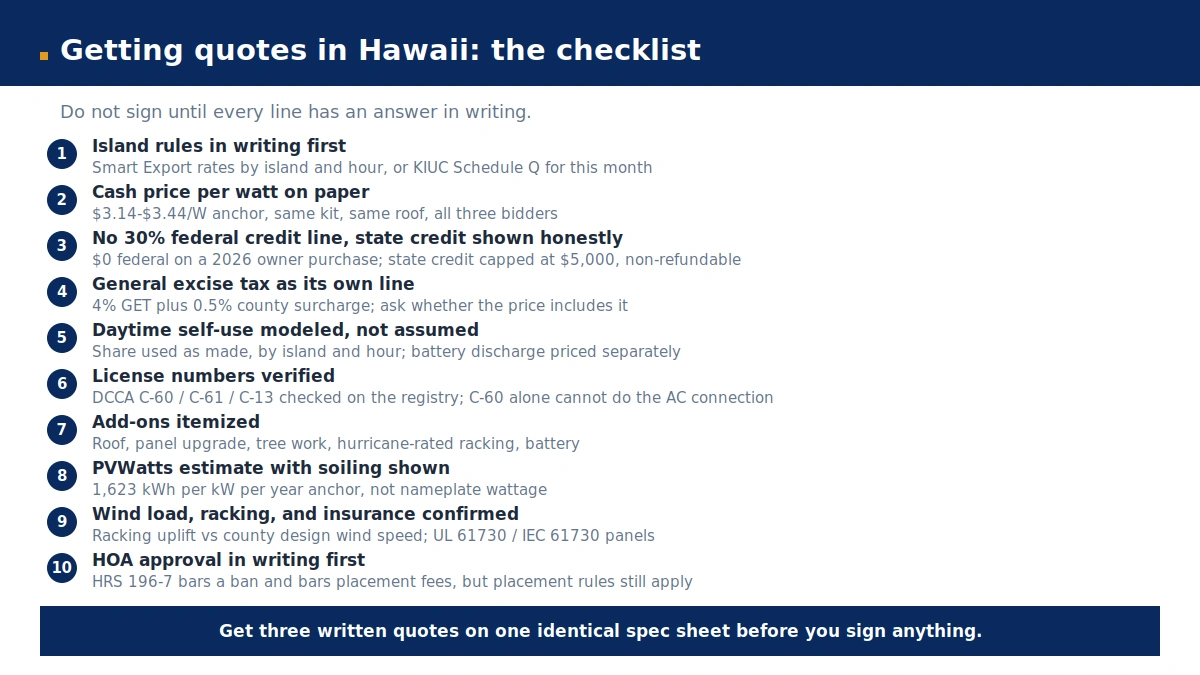
The ten-item quote checklist:
- Your island’s rules, in writing, first — Hawaiian Electric’s Smart Renewable Energy Export rates by island and hour, or KIUC’s Schedule Q rate for this month. Export price and the annual true-up decide the payback before anything else — and Maui’s 6.6-cent daytime rate is a different deal than Oahu’s 13.5 cents.
- Cash price per watt, documented — one identical kit, one identical roof, three bidders. The Hawaii anchor runs $3.14-$3.44 a watt; a quote far above it needs an explanation, and a quote far below it deserves a closer look at what was left out.
- No line for a 30% federal credit, and the state credit shown honestly — a 2026 owner purchase gets $0 federal, and Hawaii’s 35% credit is capped at $5,000, non-refundable, and now subject to Act 24’s certificate, cap, and income cliff. Any quote still deducting a 30% credit is priced under a law that is dead. Ask for it to be removed.
- General excise tax shown as its own line — 4% GET plus a 0.5% county surcharge falls on the installer and may be passed through, so ask whether the price includes it.
- Daytime self-use modeled, not assumed — the share of production the house uses the moment it is made, shown by island and hour, with the battery’s evening discharge priced separately. On Oahu, a quote that prices all exports at one blended rate is wrong.
- License numbers verified — the installer’s DCCA contractor license with its classification (C-60, C-61, or C-13), checked on the DCCA public search, with names matched to the contract. A C-60 alone cannot connect the system to the home’s wiring — ask which C-13 contractor does.
- Add-ons itemized — roof work, panel upgrade, tree work, hurricane-rated racking, and battery, each on its own line, not folded into the per-watt price.
- Production estimate from PVWatts, with the soiling assumption shown — the anchor is about 1,623 kilowatt-hours per kilowatt a year, not nameplate wattage, and not an annual average that hides what the vog and the salt air take away.
- Wind load, racking, and insurance confirmed — the racking’s uplift rating checked against the county’s design wind speed, UL 61730 / IEC 61730 panels specified by name, and homeowners insurance confirmed in writing to cover the array before signing.
- HOA approval, in writing, first — Hawaii law (HRS §196-7) bars an HOA from prohibiting solar on a single-family home or townhouse, and bars the HOA from charging a fee for placement, but the HOA may still set placement rules within the statute’s limits, so approval must come before panels are ordered.
Buy, lease, or community solar? Buying wins over 25 years for homeowners with heavy daytime use, a battery, or a backup-power reason to buy. With a purchase, the system, the resale value, the state credit, and each kilowatt-hour of self-use all stay with the homeowner. Leasing wins for homeowners who want no upfront cost and no maintenance — and in Hawaii the lease is genuinely on offer, with the company claiming the federal and state credits — but the lease payment runs for twenty or twenty-five years, usually with an escalator, and the homeowner never owns the system. GEM$ wins for households under 140% of area median income who want cheap borrowing without a dealer fee — 5.5% fixed, repaid on the bill — but only on Hawaiian Electric islands and only if the project passes the bill-savings test. Renters, condo owners, and homes with shaded or unsuitable roofs are the ones community solar wins for — but no general community-solar subscription turned up for Hawaii homeowners in this guide, so treat any such offer as unverified until its terms are in writing.
Sources & methodology
Cost anchors (per watt, system size, totals):
- EcoGen Solar Cost Index, Sep 2026, prices as of Sep 25: $3.14/W; 7.49 kW typical from the Berkeley Lab 2025 median, 316 HI systems; $23,519 total; 1,623 kWh/kW/yr; 12,156 kWh/yr; statewide payback ~7.9 yrs; neighbors OR $2.77, CA $2.85, US $2.89, WA $2.86, AK $3.15; HI rates +5.98%/yr over 5 yrs; 12-mo avg price 44.27 cents
- EnergySage state page, Nov 2026, updated Oct 30: $3.44/W; 8.97 kW average; $30,864 total; $26,234-$35,494 range; payback 10.15 yrs; 25-yr savings $52,279
- EnergySage city pages, Nov 2026: Honolulu $3.40/W, 7.89 kW, $26,850, payback 9.94 yrs, savings $45,716; Kapolei $3.33/W, 10.61 kW, $35,364, payback 8.85 yrs, savings $75,326; Waipahu $3.59/W, 10.12 kW, $36,292, payback 10.31 yrs, savings $61,747
- Alternate Energy Hawaii cost guide, updated Oct 22, 2026, reviewed by Bruce Ekimura: Honolulu $3.42/W, 8.03 kW, ~$27,430; typical 8 kW ~$27,400; 13 kWh battery ~$9,600; Oahu self-use value 40.54 cents in 2025
- SolarReviews cost page, Nov 2026: $2.82/W; 7.2 kW $14,213 “after 30% federal tax credit” — stale, excluded; 2.7-yr payback assumes full retail net metering — flagged; separate state table $3.13/W, 5.1 kW, $16,936
- RenewEstimator, data compiled Jul 25, 2026: $3.10/W; 8 kW $24,320; payback 4.2 yrs — modeled, flagged
- TheGreenWatt, 2026: $3.10/W; 5 kW $15,500; payback ~4 yrs; older EIA 2024/NREL Q1 2024 inputs, corroboration only
- EnergyScout, Sep 2026: ~$3.43/W, 9.2 kW, ~$31,616 (EnergySage Sep 2026 marketplace data) — corroboration only
- solarcostbyzip Hilo, Sep 2026: $6.46/W, still subtracts the 30% federal credit — excluded as unreliable
Rates:
- EIA Electric Power Monthly Table 5.6.A, Aug 2026: HI 47.18 cents/kWh; US 18.16 cents; #1 highest of 51; 2.6x US average; HI peaked at 52.72 cents in June 2026
- EIA 12-mo averages to Aug 2026: HI 44.27 cents (EcoGen) / 44.3 cents (kadoa); average home use 514 kWh/mo; average bill ~$228/mo, +8.8% YoY; 2024 final: 495 kWh/mo, 42.86 cents, $212.12 bill — highest bill, lowest usage in the US
- kadoa/EIA utility figures, 12 mo to Aug 2026: Hawaiian Electric 44.8 cents, 277,379 customers, +9.7% YoY, ~$212 avg bill
- EIA-861 2024: Hawaiian Electric 42.87 cents, 276,206 customers; Hawaii Electric Light 48.31 cents, 78,386 customers
- EcoGen Hawaii solar page, Oct 2026: Oahu self-use value 41.5 cents after the monthly customer charge and fees; statewide average 44.27 cents
- Hawaiian Electric joint rebasing rate case, Docket 2026-0162, filed October 2026 — hearings underway; KIUC ~38,000 meters, ~40 cents
- 43% of single-family homes in Hawaii have rooftop solar (electricchoice.com, Nov 2026); 232.3 net-metered installations per 1,000 residential customers in 2025 (ECW net-metering census, Oct 27, 2026)
Net metering and buyback:
- Net energy metering closed to new applicants October 13, 2015 (HPUC Docket 2014-0192); Customer Grid-Supply closed November 2017; Customer Grid-Supply Plus and Smart Export closed March 29, 2024; Smart Renewable Energy Export (Smart DER Export, Docket 2019-0323) open since April 1, 2024
- Hawaiian Electric Smart DER Export rate sheet, issued Feb 1, 2025, re-read Oct 14, 2026: Oahu 13.5/32.9/18.9 cents (day/evening/overnight); Maui 6.6/18.2/13.1; Hawaii Island 10.6/23.1/14.8; Molokai 17.9/27.2/17.4; Lanai 26.7/40.8/25.9; locked 7 years; updated every 3 years; current table covers agreements signed through April 2027; credits expire at annual true-up
- Legacy CGS/CGS Plus/Smart Export customers transition to Smart Renewable Energy Export 7 years after contract date, from October 1, 2024 (Hawaiian Electric)
- KIUC Schedule Q: 14.33 cents (March) to 27.14 cents (June), January-September 2026, monthly avoided cost tied to oil (KIUC rate data sheets, read Oct 1, 2026); right-size about 2.5 kW for a home using up to 500 kWh/month; larger systems need a curtailment meter
Incentives:
- RETITC: 35% of cost, up to $5,000 per single-family PV system; non-refundable; Form N-342; battery counts only same tax year/property/system, same $5,000 cap (AEI, Oct 2026; EnergySage; DSIRE)
- Act 24 (S.B. 3125), signed May 21, 2026: HSEO certificate (statement before Mar 1, reply by May 31); $40 million yearly statewide cap 2027-2030; income limit from tax year 2027 ($175,000 AGI, $350,000 joint, cliff); ends for tax years beginning after Dec 31, 2029; cap reached at ~$14,286 cost (NestPriced arithmetic: $5,000 / 0.35)
- Executive Order 26-02, signed June 8, 2026: 2026 systems finished before May 21, 2026, or with reasonable reliance before that date, exempt from the $40M cap; no income test for 2026 installs
- General excise tax: 4% + 0.5% county surcharge, falls on the installer (EcoGen); no sales or property tax exemption (EnergySage: “Hawaii doesn’t offer any statewide solar tax exemptions”)
- GEM$ On-Bill Program (HGIA): fixed 5.5% a year, up to 20-25 years, on-bill repayment, no credit check, under 140% AMI, HECO islands only (not Kauai), 6 months utility history, bill-savings test 5/10/15%; taking applications Oct 5, 2026; $18M new GEMS capital released Dec 8, 2025 (PUC Order 42129)
- Solar for All: EPA ended grants Aug 2025, courts ruled the termination unlawful Sep 2026, EPA weighing appeal; HGIA said Dec 2025 funds remain in litigation; HGIA page returned “not found” Oct 5, 2026
- HEAR/HOMES: DOE dataset (May 2024 figures): $34,093,900 HEAR + $34,224,953 HOMES allocated to Hawaii; HSEO eHale page checked Oct 27, 2026: pending DOE approval of launch, expected early 2027, pre-launch installs do not qualify; Hawaii rebate finder launched Oct 19, 2026 (labels eHale as launching 2026 — conflicts with the HSEO page, which governs)
Federal and financing:
- OBBBA P.L. 119-21 and IRS FS-2025-05: §25D and §25C $0 for post-Dec-31-2025 installs, completion date counts
- §48E 30% for third-party-owned systems, in service by Dec 31, 2027, construction begun by Jul 4, 2026 per IRS Notice 2025-42
- DSIRE Third-Party Solar PV PPA Policies, May 2026: Hawaii authorized, citing HRS §269-1(2)(M); Sunrun sells leases in Hawaii (This Old House, 2026)
- DOE Notice 26-2, May 29, 2026: HEAR electric-to-electric upgrades only, no fuel-switching; solar, batteries, EV chargers, windows outside HEAR
- CFPB Solar Financing Market Issue Spotlight, Aug 2024: dealer fees 10-30%, sometimes over 50%
- State warning, March 2026: door-to-door sellers falsely claiming a state program gives away panels — “the state does not provide free solar PV systems”
Production and climate:
- EcoGen: 1,623 kWh/kW/yr PVWatts-based, Honolulu-class light; 7.49 kW makes ~12,156 kWh/yr; ~6 peak sun hours
- SparkPowered (EIA/NASA data, 2026): 1,745 kWh/kW/yr — different method, cross-check only
- Heat penalty 0.3-0.5% per degree C above 25 C cell temperature, national figure
- Wind: IRC hurricane-prone region (all of Hawaii); design wind speeds ~130-150+ mph coastal windborne-debris zones, 115 mph inland; Hawaii State Building Code amendments: 145 mph minimum peak 3-second gust ultimate for enhanced hurricane protection areas; Appendix W W106 rooftop solar panels; ASCE 7 Hawaii speeds microzoned, read from the ASCE 7 Hazard Tool; ground snow load 0-5 psf
- Hail: no Hawaii-specific hail statistics pulled; mainland Hail Alley numbers not imported; UL 61730 / IEC 61730 remains the specification to ask for
Payback arithmetic:
- The worked examples in the payback section are EcoGen’s per-island figures of Oct 30, 2026, restated: 7.49 kW x $3.14/W = $23,519; production ~12,156 kWh/yr; Oahu year-one value ~$3,068/yr, $23,519 / $3,068 = 7.7 yrs (6.6-8.8 yrs at 28-55% self-use); Hawaii Island ~$2,968/yr, 7.9 yrs (6.6-9.5 yrs); Maui 9.0 yrs; statewide ~7.9 yrs
- Maui yearly savings ~$2,613/yr is NestPriced arithmetic ($23,519 / 9.0), flagged as derived
- With the $5,000 state credit: net $18,519; Oahu $18,519 / $3,068 = ~6.0 yrs; statewide $18,519 / ~$2,977 = ~6.2 yrs — NestPriced arithmetic, flagged as derived
- SolarReviews’ 2.7-year and RenewEstimator’s 4.2-year paybacks are flagged as modeled estimates that do not price Hawaii’s export rates
- Battery ceiling: one full 13 kWh cycle a day at 47.18 cents is worth up to ~$2,325 a year (jouleio arithmetic, Sep 2026) — a ceiling, not a promise
Batteries:
- EnergySage storage cost, Nov 2026 (updated Nov 1): $741/kWh Hawaii average; 13 kWh $9,630 ($8,186-$11,074); AEI Oct 2026: 13 kWh ~$9,600, 26 kWh ~$19,300; national 13.5 kWh ~$15,647 (EnergySage, Jul 2026)
- BYOD Plus (Hawaiian Electric): $400 per kW committed once, no maximum; LMI adder +$400/kW (under 140% AMI); 5-year participation; 2-hour daily window; monthly export credits at the customer’s retail billing rate; HECO example 5 kW = $2,000 + ~$52/month; new battery, min 1 kW commitment, advanced meter; term conflict (5 years vs 10-year commitment) flagged; Battery Bonus closed Dec 31, 2023 (Oahu) and Jun 30, 2024 (Maui)
- 95-98% of new Hawaii solar includes a battery (Oceanic Home Solar, June 2026 — installer-reported)
HOA and licensing:
- HRS §196-7: no person prevented by covenant, declaration, bylaws, restriction, deed, lease, or similar agreement from installing a solar energy device on a single-family dwelling or townhouse owned; contrary provisions void; private entities must adopt facilitating rules; rules may not cut efficiency by more than 25% or raise cost by more than 15%; no fees for placement; common-element placement needs consent
- DCCA Contractors License Board, HRS Chapter 444: C-60 Solar Power Systems (panels, batteries, low-voltage DC only); C-61 Solar Energy Systems; C-13 Electrical connects the system to home wiring; “A” licensee automatically holds C-61; 4 years supervisory experience; PSI business-and-law + trade exams; GET license required before contractor license issues; no NASCLA acceptance, no broad reciprocity
- Installers: RevoluSun CT-30244, Alternate Energy Hawaii CT-26041, ProVision Solar CT-26351 (EcoGen, DCCA registry, Oct 13-14, 2026); Independent Energy Hawaii, Sunspear Energy (EnergySage); Hawaii Energy Connection (KumuKit)
- S.B. 2032 (2026 session): would require solar sellers to hold or be affiliated with a licensed contractor — pending legislation, not law
Labor:
- BLS Occupational Employment and Wage Statistics May 2025: electricians 47-2111 Hawaii, median $46.38/hr, $96,460/yr; mean $44.65/hr; 10th-90th $21.99-$59.90/hr; 3,070 employed; national median $30.38/hr; metro medians Urban Honolulu $48.21, Hawaii/Kauai nonmetro $39.27
- Solar PV installers 47-2231: no Hawaii-specific BLS figure found, BLS publishes state-level wages for only 32 states; national median $53,140/yr, ~$26/hr, 31,100-31,350 jobs nationally, BLS projects +37% growth 2025-35, BLS Occupational Outlook Handbook May 2025
Maintenance, lifespan, warranty (national figures):
- Lifespan 25-30 years productive service; NREL median degradation ~0.5%/yr, ~88% of rated output at year 25; premium n-type 0.25-0.5%/yr, 91-93% at year 25 (NREL Jordan et al. 2022)
- Product warranty typically 10-25 years; performance warranty typically 25-30 years, guaranteeing 80-92% of rated output at year 25 depending on tier; string inverter 10-15 years, one replacement expected; microinverters ~25 years
EXCLUDED:
- Any “after 30% credit” prices, including SolarReviews’ $14,213 column and solarcostbyzip’s “after 30% federal tax credit” columns
- Any HEAR-for-solar claim: HEAR does not cover solar, batteries, EV chargers, or windows; electric-to-electric only since DOE Notice 26-2, May 29, 2026
- Any state rebate or sales-tax exemption for Hawaii solar: none verified / none exists as a rebate
- SolarReviews’ 2.7-year payback (assumes full retail net metering, closed 2015) and RenewEstimator’s 4.2-year payback (modeled on a 52-cent rate and 6 sun hours): flagged, never headlined
- solarcostbyzip’s Hilo $6.46/W: unreliable, still subtracts the 30% federal credit
- EnergySage’s older October 2026 Honolulu figure ($3.42/W) vs November ($3.40/W): November figures used; October cited only via AEI
- The Hawaii rebate finder’s “launching 2026” label for eHale: conflicts with the HSEO program page (pending DOE approval, early 2027); the program page governs
- Act 24’s “30% smaller refundable option”: mentioned by EcoGen without detail; not stated as a claimable figure
- Honolulu city loan program terms: not verified
- Hawaii-specific permit fee schedule, interconnection timeline, and interconnection application fee: not verified
- Hawaii-specific monthly PVWatts production table: not pulled, seasonal shape described qualitatively
- Hawaii-specific hail statistics: not pulled; mainland Hail Alley numbers not imported
- Hawaii-specific salt-air / vog production-loss percentages: not verified, none stated
- KIUC payback figure: none published by EcoGen; none stated
- S.B. 2032 consumer-protection bill: pending legislation, not law
- A single blended Hawaii export rate: the draft shows the five island tables separately by hour, except where EcoGen’s Oahu weighted average is labeled as an average
- Hilo, Kailua, Kaneohe, Pearl City, Mililani, Ewa Beach, Lihue city prices: no verified EnergySage figures pulled; not invented
*Disclaimer: The prices here are 2026 Hawaii planning figures. Island, roof, utility territory, and contractor — the numbers shift with all four. Collect three written quotes from Hawaii installers before you settle on a budget. Treat the tax notes here as general information only — they are not guidance for your own return. Speak with a Hawaii tax professional before you file. Program rules change — Hawaiian Electric Smart Renewable Energy Export, KIUC Schedule Q, BYOD Plus, GEM$, Act 24 — so confirm current terms with Hawaiian Electric, KIUC, or your own utility before signing. Smart Export rates are locked for seven years from the agreement date and the current table covers agreements signed through April 2027, and Act 24’s certificate, cap, and income limit change how the state credit is claimed — rate and program figures in this guide are dated to their sources.*
What do solar panels cost in Hawaii in 2026?
Solar panels cost $3.14 a watt installed in Hawaii in 2026 — about $23,519 for the typical 7.49 kW system (EcoGen, September 2026), or about $30,864 for the 8.97 kW marketplace average (EnergySage, November 2026). At the EcoGen rate, an 8 kW home system typically runs about $25,120. Honolulu runs $3.40 a watt, Kapolei $3.33, and Waipahu $3.59. For a homeowner-owned system installed in 2026, the 30% federal credit is $0, and Hawaii’s 35% state credit is worth up to $5,000 if it reaches you — though a 2026 law added a certificate, a statewide cap, and an income limit.
How long does it take for solar panels to pay for themselves in Hawaii?
About 7.7 years on Oahu, about 7.9 years on Hawaii Island, and about 9.0 years on Maui — so roughly 7.9 years statewide, before incentives. EcoGen’s worked example for Oahu puts a 7.49 kW system at $23,519 paying back in about 7.7 years on $3,068 a year of savings, or about 6.0 years with the $5,000 state credit. Power is the driver: Hawaii electricity costs 47.18 cents a kilowatt-hour, the highest in the country, and a kilowatt of panels here makes about 1,623 kilowatt-hours a year.
Does Hawaii have net metering?
Not for new systems. Hawaiian Electric closed net metering to new applicants on October 13, 2015, and the successor programs — Customer Grid-Supply, Customer Grid-Supply Plus, and Smart Export — have all closed since. New systems connect under Smart Renewable Energy Export, which credits exported power by island and by hour: on Oahu, 13.5 cents by day, 32.9 cents from 5 to 9 p.m., and 18.9 cents overnight, locked for seven years, with unused credits expiring at the annual true-up. Kauai’s co-op, KIUC, pays a monthly Schedule Q rate tied to oil instead. Households already on legacy net metering keep full retail credit — but changing the system can put those terms at risk.
What is the difference between Oahu and Maui for solar?
Both sit on Hawaiian Electric’s Smart Export tariff, but the export tables are different. Oahu pays 13.5 cents a kilowatt-hour for daytime exports and 32.9 cents in the evening, while Maui pays only 6.6 cents by day and 18.2 cents in the evening — barely a seventh of the retail rate at midday. That is why the same 7.49 kW system pays back in about 7.7 years on Oahu and about 9.0 years on Maui. Maui households gain the most from a battery, which moves midday power into the evening window or into the home at full retail value instead of exporting it at 6.6 cents.
Why is solar payback so fast in Hawaii?
Two forces pull in the same direction: power is the most expensive in the country, and the sun is among the strongest. Hawaii’s residential rate is 47.18 cents a kilowatt-hour, two and a half times the national average, so every kilowatt-hour a panel makes replaces an expensive one — and a kilowatt of panels here makes about 1,623 kilowatt-hours a year. The average Hawaii home uses only about 514 kilowatt-hours a month, the lowest in the nation, so the typical system makes about twice what the house needs. The state credit, worth up to $5,000, shortens the payback by about a year and a half when it reaches the buyer.
Can I still get the 30% federal tax credit for solar in Hawaii in 2026?
No, not if you own the system. The One Big Beautiful Bill Act (Public Law 119-21) ended the Residential Clean Energy Credit (§25D, 30%) for homeowner-owned systems placed in service after December 31, 2025, and the IRS has made clear that the installation finish date decides it. Unlike in Idaho, Hawaii offers a second door: the commercial credit (§48E, 30%) survives for third-party-owned systems in service by December 31, 2027, and Hawaii authorizes residential leases and PPAs, so a company-owned system can still claim it. The state credit goes to the leasing company, not the homeowner — have a lawyer read any lease or PPA before signing.
What is Hawaii’s solar tax credit really worth?
Up to $5,000 on a single-family system — 35% of the cost, capped at $5,000, so on the typical $23,519 system the cap binds and the credit is $5,000, not $8,232. It is non-refundable, so it only offsets Hawaii income tax the buyer actually owes, and it is claimed on Form N-342. Act 24, signed May 21, 2026, added a certificate from the Hawaii State Energy Office, a $40 million yearly statewide cap from 2027 to 2030, an income cliff — no credit above $175,000 of adjusted gross income, or $350,000 on a joint return, from tax year 2027 — and an end date after the 2029 tax year. A 2026 system finished before May 21, 2026, or with money or work committed before that date, is exempt from the cap under Executive Order 26-02.
Can a Hawaii HOA block rooftop solar?
No — Hawaii is one of the strongest states in this series on HOA rights. Hawaii Revised Statutes §196-7 says no person may be prevented by any covenant, declaration, bylaws, restriction, deed, or similar agreement from installing a solar energy device on a single-family home or townhouse they own, and any provision to the contrary is void. The HOA must adopt rules that facilitate placement, and those rules may not make the device more than 25% less efficient or raise the cost by more than 15%, and the HOA may not charge a fee for placement. Placement on a common element needs the entity’s consent, which is the hurdle for condo owners, since the roof is usually common area. Still get architectural-review approval in writing before ordering panels.