

Solar panel removal and reinstall cost in 2026 runs $200–$500 per panel — $1,500–$6,000 all-in for a typical residential system (EnergySage, May 2026). The per-panel number times your panel count is the real quote; single-number averages mislead. Twenty panels at $200/panel is $4,000 plus permit; the same job at $500/panel is $10,000. Storm-driven work usually costs you only your insurance deductible. A permanent removal (no reinstall) is cheaper: $75–$200/panel.
Table of Contents
The #1 trigger for this job is a roof replacement. Your roofer can’t do the work — and the crew that can isn’t cheap. Panels weigh 40–60 pounds each, the racking has to come off without damaging mounts, old flashings rarely survive, and the whole system has to be recommissioned and permitted afterward. That is why a “quick panel pull” quoted at $1,000 rarely stays at $1,000.
This guide prices it honestly: the line-item anatomy nobody publishes, the per-panel × count math that reconciles the contradictory averages, the insurance question (deductible vs full price), the licensing red flag (your roofer cannot legally do the electrical disconnect), the warranty nuance competitors get binary-wrong, and the 2026 tax answer. If you’re pricing a brand-new system instead, see our solar panel cost guide — this one is about service on the system you already own.
Solar panel removal and reinstall cost: the real answer is per-panel × count
Competitor pages fight over single numbers and contradict themselves. Angi (Oct 2026) says the national average is $1,000–$3,500 — and, in the same article, says professional removal runs $200–$500 per panel. A 20-panel job at its own per-panel math is $4,000+ — not $3,500. The average is answering a different question than your panels ask.
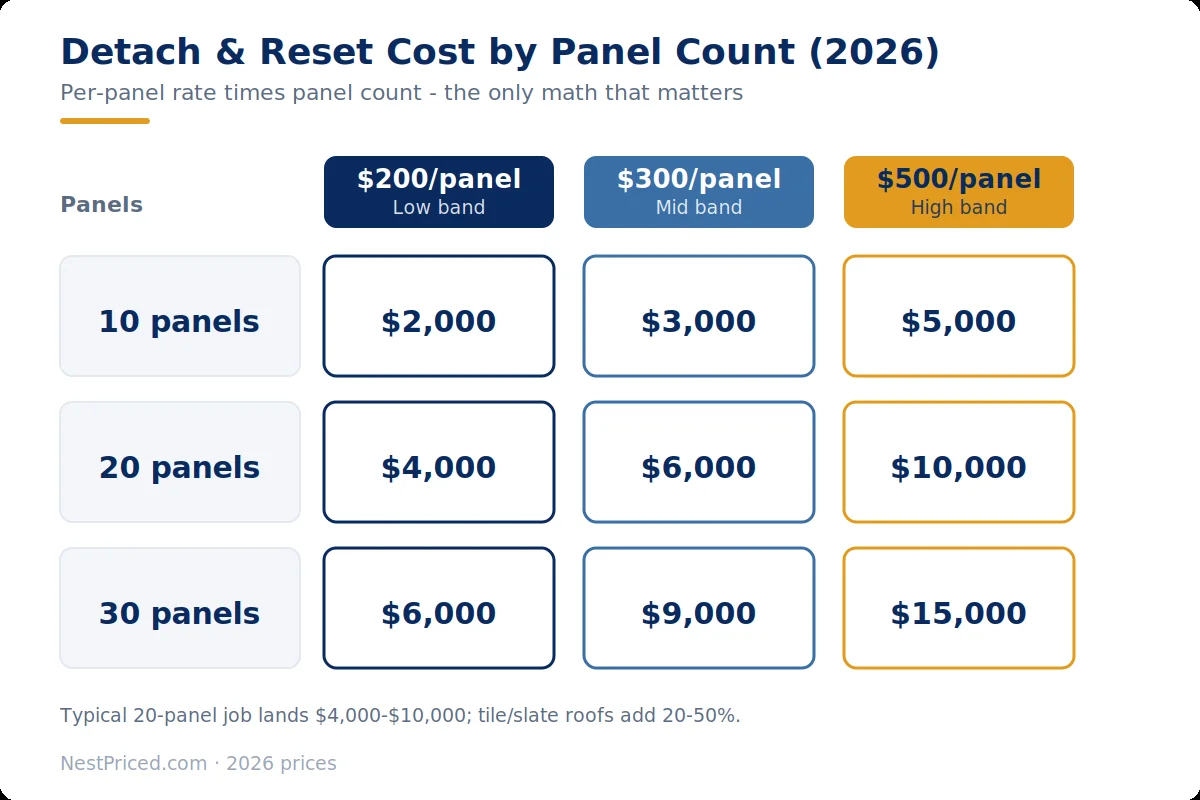
Price it the way contractors price it: per panel, then multiply:
| Per-panel rate | 10 panels | 20 panels | 30 panels |
|---|---|---|---|
| $200/panel (low — easy shingle, Sun Belt) | $2,000 | $4,000 | $6,000 |
| $300/panel (mid — national middle) | $3,000 | $6,000 | $9,000 |
| $500/panel (high — tile, steep, complex) | $5,000 | $10,000 | $15,000 |
Each total above is before the permit ($150–$1,000; typically $300–$800). The range for a typical 20-panel residential job lands at $4,000–$10,000 in 2026 contractor data — wider than EnergySage’s $1,500–$6,000 because regional installers report what they actually charge:
| Region / installer | Per-panel rate (2026) | Typical job |
|---|---|---|
| SoCal (Forme Solar, own records) | $350 flat | ~$5,600 (16 panels) |
| North Carolina (Southern Energy) | $300–$400 | $5,000–$8,000 (20 panels) |
| Bay Area, CA (HomePro) | $250–$350 | $5,000–$8,750 (20–25 panels) |
| Long Island, NY (Solar Pro Roofing) | $150–$200 base | $4,000–$6,000 real-world (20 panels) |
| Phoenix metro, AZ | $140–$180 turnkey | $2,500–$6,000+ residential |
| New Mexico (Positive Energy) | ~$325 + hardware | Varies by roof/system complexity |
| DFW, TX (North Texas Solar) | Size-banded | $2,000–$8,000 by system size |
The per-panel band is $140–$500 — and the next section explains why it varies that much.
The two forks: detach & reset vs permanent removal
Every quote starts with one question: are the panels going back up?
Detach & reset (removal + reinstall): $200–$500/panel. The full job — shutdown, disconnect, remove panels and racking, store them, reinstall everything after the roof is done, recommission, permit. This is the rest of the article.
Permanent removal (decommission): $75–$200/panel. The crew decommissions the system, pulls the panels and conduit, caps the circuit at the main panel, and patches every roof penetration — and the panels don’t come back. Forme Solar charges $75–$200/panel for this. The hard part is disposal: recycling runs about $1 per pound in California, and a panel weighs 40–50 pounds, so $40–$50 per panel just to recycle. NuWatt puts recycling at $15–$45/panel ($300–$900 for 20 panels) and decommissioning labor at $500–$1,500. Angi (Oct 2026) pegs permanent decommissioning at $1,500–$5,000 all-in, with recycling or hazmat fees stacking on top.
Competitor guides routinely mix these two jobs into one number. They are different jobs, different crews, different invoices.
Line-item anatomy: where the $200–$500 per panel actually goes
This breakdown exists on exactly one installer’s page (Forme Solar, Oct 2026, from their own project records). Here it is, nationalized:
| Line item | Per panel | 20-panel total |
|---|---|---|
| Shutdown, disconnect, remove — labeling strings, securing wiring | $75–$125 | $1,500–$2,500 |
| Racking and mount removal — rails, brackets, tile hooks | $40–$75 | $800–$1,500 |
| New flashings and mounting hardware — old flashings rarely survive removal intact | $40–$75 | $800–$1,500 |
| Reinstall racking, panels, reactivation — includes monitoring recommissioning | $75–$150 | $1,500–$3,000 |
| Permit — flat fee, re-establishing structural + electrical attachments | — | $300–$800 |
| Total | $230–$425 + permit | $4,900–$9,300 |
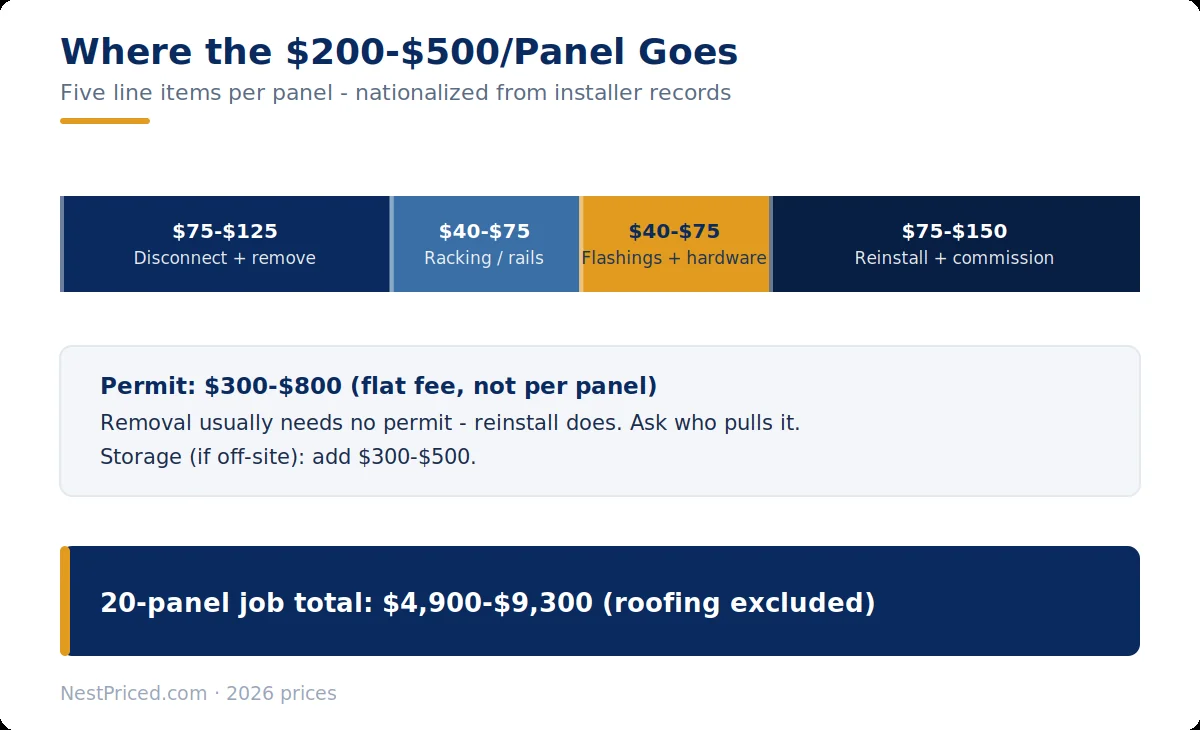
Two things this table reveals that single numbers hide. First, the reinstall is roughly half the cost — anyone quoting removal alone is quoting half a job. Second, flashings and hardware are a real line item, not a surprise: mounts pulled off a 10-year-old roof don’t go back on the same way.
What moves you within the $140–$500 band
Roof material. Tile and slate need extra care — crack risk, tile hooks, replacement tiles for the ones that break. Expect 20–50% over the shingle price for tile jobs (installer data, 2026). Tile also stays offline longer: 1–3 weeks for shingle roofs is typical; tile runs longer.
Roof height and pitch. Steep, high, multi-plane roofs raise labor and safety requirements. Simple jobs (single-story, easy access) take 6–8 hours of crew time; complex ones (steep pitch, three stories, multi-plane) take 12–16 hours.
System age. Older systems take 25–40% more removal time — corroded hardware, obsolete mounts that no longer have matching parts. A 2012 system is not a 2022 system.
Panel count and minimums. Pricing scales roughly linearly with panel count, but small jobs hit minimum charges: some contractors impose minimums in the low thousands because the crew still mobilizes. Ask for the minimum before assuming per-panel math applies to a 6-panel fix.
Inverter type. Microinverters come off with the panels — one roof trip. String systems need the wall box and wiring handled separately (see our inverter replacement guide for what’s involved on that end). If your inverter is due for replacement anyway, doing both jobs in one mobilization saves real money.
Storage. Panels staged in your garage are usually free. Off-site storage adds $300–$500.
The process: removal day to recommissioned
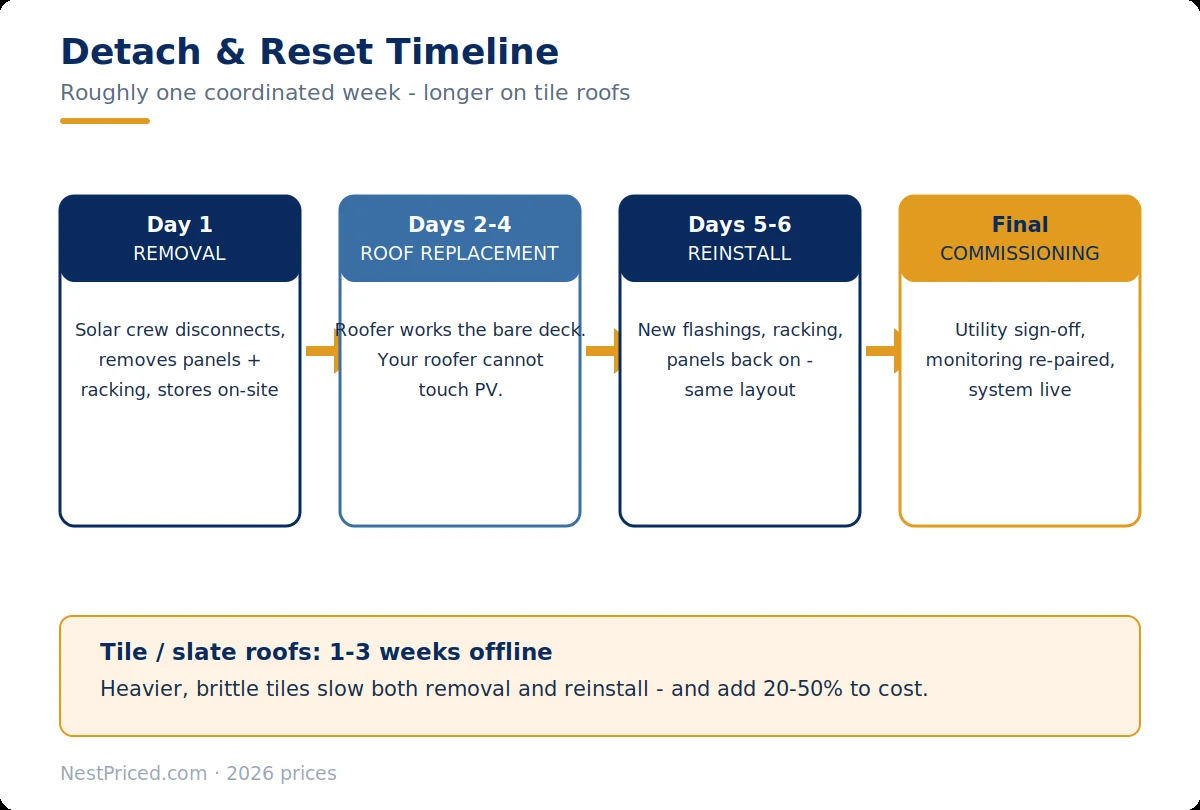
Standard sequence (Positive Energy Solar, 2026): removal takes 1 day; the roof replacement takes 2–4 days; reinstall and recommission take 1–2 days — coordinated with the roofer’s schedule. Tile pushes the offline window out (1–3 weeks for shingle roofs; longer for tile).
Coordinate removal with the planned roof work: one mobilization instead of two saves $500–$2,000 (a1solarstore, 2026). The expensive mistake is hiring the solar crew, then the roofer, then the solar crew again on three separate schedules.
Insurance: deductible vs full price — the money question
This is the question nobody’s guide answers nationally, and it’s the one that decides whether you pay $2,000 or $8,000.
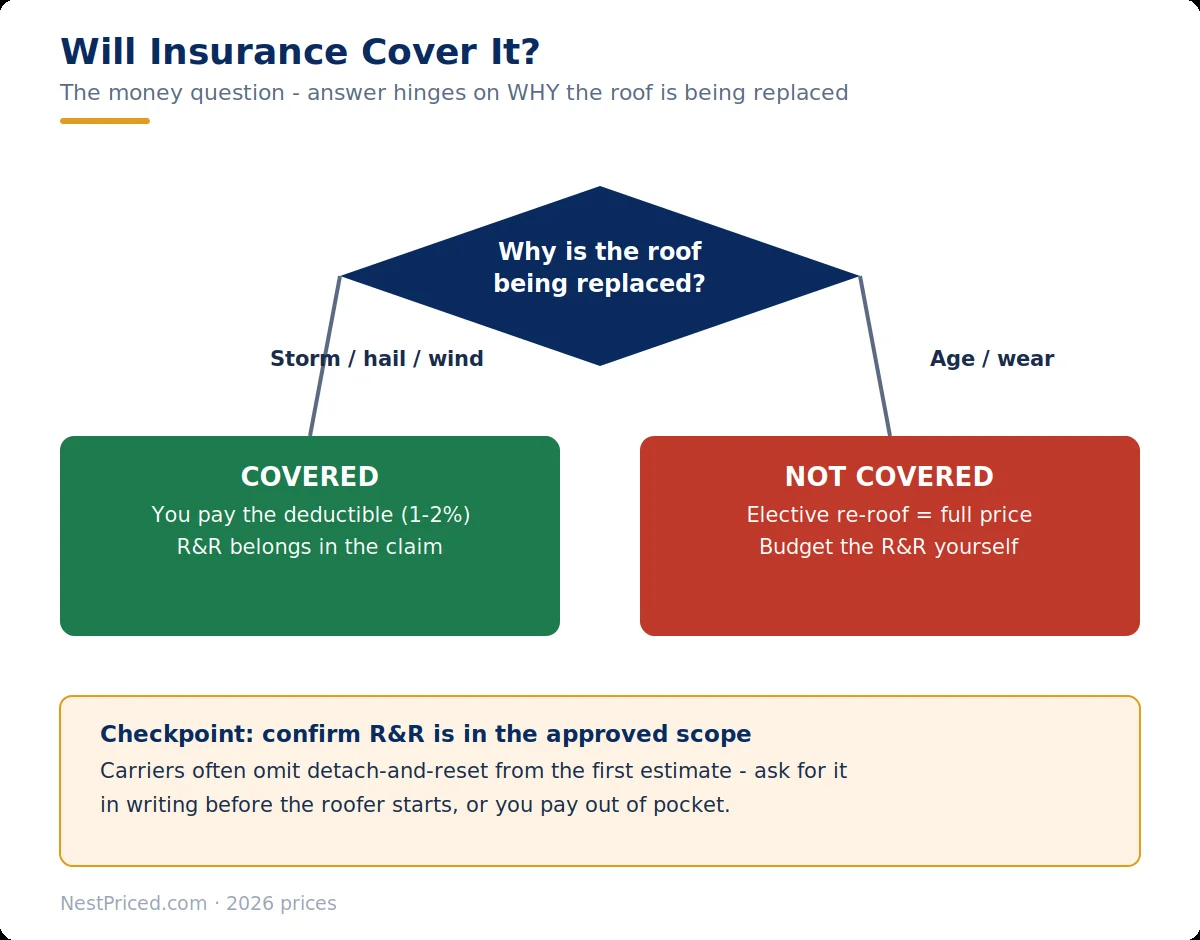
Storm-driven roof replacement is usually covered. When the re-roof is a covered loss — hail, wind — detach & reset is part of the necessary repair work. Out-of-pocket is roughly your policy deductible (often 1–2% of the insured value). North Texas Solar reports most storm-driven projects there end up at “$0 out-of-pocket beyond the deductible.”
Carriers frequently omit R&R from the initial estimate. Document the array before any work starts, and confirm detach & reset is in the approved scope — do not assume the adjuster included it (Florida contractor guidance, Aug 2026).
An aging roof you replace because it’s old is not covered. That’s maintenance — insurance doesn’t cover the roof or the related solar work. Full price, your wallet.
Your roofer cannot legally do this work
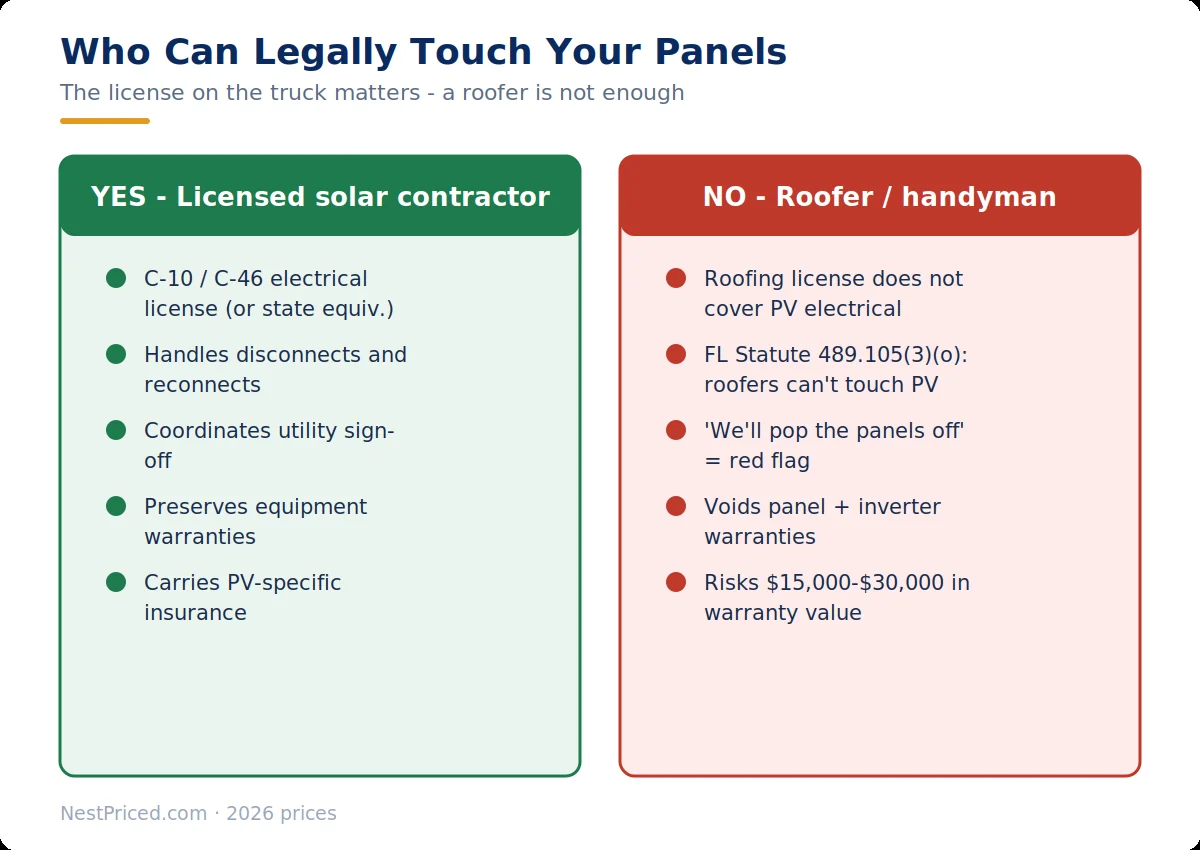
Red flag: a roofer offering to “pop the panels off” for you. Photovoltaic disconnects and reconnects are electrical work — in Florida, Statute §489.105(3)(o) puts PV work in the solar contractor’s scope, and a roofing license alone does not authorize it. The principle generalizes nationally: the wiring must be handled by a licensed solar contractor (C-10 electrical or C-46 solar in California, equivalent licenses elsewhere). Cost info only — this is licensed-trade territory, never DIY.
The permit rule of thumb matches: removal generally needs no permit; reinstall usually does — you’re re-establishing structural attachments and reconnecting a grid-tied electrical system. Permit costs run $150–$1,000 nationally (typically $300–$800).
The warranty nuance competitors get wrong
EnergySage says removal “usually voids” the warranty. That’s binary, and it’s wrong.
The truth is conditional: qualified removal and reinstall does not void warranties — tier-1 manufacturers allow temporary removal for approved roof work when it’s documented and done by qualified solar installers (North Texas Solar; Southern Energy; MySolarFy, Jul 2026). What’s at stake if it’s done wrong: warranties worth $15,000–$30,000 on an average residential system (a1solarstore, 2026). The warranty isn’t voided by removal — it’s voided by unqualified hands.
Get the “who does the work” line in writing before anyone touches the array.
The tax fact: $0 — and it never qualified anyway
Say it plainly because stale pages still imply credits apply: there is no federal tax credit on solar panel removal or reinstall in 2026. Two reasons. First, the residential clean energy credit (§25D) ended for property placed in service after December 31, 2025 under OBBBA (P.L. 119-21; IRS FS-2025-05) — 2026 homeowner installs get $0. Second, removal and reinstall never qualified for the credit in the first place — it’s service on an existing system, not a new qualifying expenditure (Forme Solar, Oct 2026). No federal credit on removal, no credit on the reinstall, no credit on a 2026 cash/loan purchase. For the full credit-kill list, see our 2026 energy tax credits guide.
Net metering: don’t let the reinstall reclassify your system
One warning zero competitor pages give: like-for-like reinstalls generally preserve grandfathered net-metering status — but significant changes during the reinstall can trigger a move to worse export rates (California’s NEM 3.0 is the cited example). The exact rules are utility-specific and change over time. Before changing panel count, capacity, or major components during reinstall, confirm with your utility’s interconnection rules — do not take a contractor’s word for it.
Remove vs replace the whole system
One honest checkpoint before you spend $5,000–$9,000 on a detach & reset: if your panels are 15+ years old and the array is small, run the replace-the-whole-system math instead. Our solar panel cost guide prices new 2026 systems — in 2026, with $0 federal credit, the gap between “pay to move old panels” and “install a new, more efficient system” is narrower than it used to be. If the panels have real life left, reset them. If they’re on their last legs, don’t pay twice.
What a good detach & reset quote itemizes
A lump sum is not a quote. Demand all eight in writing:
- Per-panel price AND panel count — the math has to reconcile to the total
- Line-item anatomy — disconnect/remove, racking, flashings/hardware, reinstall, permit, each priced
- Storage terms — where the panels sit between removal and reinstall, and what it costs
- Timeline and coordination — removal date, roof window, reinstall date, who talks to the roofer
- Permit responsibility — who pulls the reinstall permit and pays the fee
- Warranty continuity — written confirmation the R&R is documented and warranty-preserving
- Insurance scope — if storm-driven, confirmation the carrier’s approved scope includes R&R
- Recommissioning scope — monitoring re-setup, production verification, and who fixes anything that doesn’t come back online
Get three quotes. And never let the roofer’s crew touch the electrical — the cheapest bid is the one that doesn’t void your warranties.
Key takeaways
– Detach & reset costs $200–$500 per panel ($1,500–$6,000 typical); permanent removal is $75–$200/panel.
– Per-panel × count is the only math that matters — single-number averages contradict themselves.
– Storm-driven re-roof = insurance pays beyond your deductible; elective re-roof = full price, your wallet.
– Your roofer cannot legally do the electrical disconnect — licensed solar contractor only.
– Qualified R&R preserves warranties; unqualified work risks $15,000–$30,000 in coverage.
– $0 federal tax credit in 2026 — and R&R never qualified anyway.
Sources & methodology
Cost figures compiled November 2026 from published 2026 cost guides and installer project records: EnergySage (May 2026 — $200–$300/panel, $1,500–$6,000 typical); Angi (Oct 2026 — $200–$500/panel; $1,000–$3,500 average cited as internal contradiction, not data); Forme Solar (Oct 2026, SoCal — $350/panel flat, $5,600 typical 16-panel job, line-item anatomy, removal-only $75–$200/panel, recycling ~$1/lb); Southern Energy (2026, NC — $300–$400/panel); North Texas Solar (2026, DFW — $2,000–$8,000 by size, insurance/deductible framing); Solar Pro Roofing (2026, Long Island — $150–$200/panel base, $4,000–$6,000 real-world); HomePro (Oct 2026, Bay Area — $250–$350/panel); Solar Gardens via Post Solar Services (Oct 2026 — $275–$300/panel, storage $300–$500); NRG Clean Power (2026, CA — $200–$350/panel, 1–3 weeks offline shingle); Positive Energy Solar (2026, NM — ~$325/panel, timeline); Phoenix metro (Oct 2026 — $140–$180/panel turnkey); RoofMechanics (Oct 2026 — $1,500–$6,000 planning estimates, contractor jobs $275–$300/panel); a1solarstore (2026 — $200–$500/panel removal, size bands, labor $50–$200/hr, age penalty 25–40%; minimum-charge claim presented as “some contractors” per single-source flag); HomeGuide via SolarInsure (Sep 2026 — $200–$500/panel, 20-panel $4,000–$10,000); solaredu.starbiono.com (Oct 2026 — $1,500–$6,000); mysolarfy.com (Jul 2026 — qualified R&R warranty continuity); myorangecontracting.com (Aug 2026, FL — permit rule of thumb, §489.105(3)(o) licensing, insurance-scope checkpoint); NuWatt (2026 — recycling $15–$45/panel, decommissioning labor $500–$1,500); newdaysolar.com (2026 — NEM like-for-like nuance, flagged: confirm with your utility); roofersden (Oct 2026 — roof + solar combined). Tax: IRS FS-2025-05, OBBBA P.L. 119-21. Roof pricing referenced from our article 6 ($9,000–$18,000 shingle, pointer only).
Disclaimer: Prices are 2026 US national averages and vary by region, roof material, panel count, and installer — get 3 written, itemized local quotes. Tax and rebate information is general and not tax advice — confirm with a tax professional. PV electrical work (disconnects, wiring, recommissioning) is licensed-trade territory — this article covers cost information only, never DIY electrical instructions. Net-metering terms are utility-specific; confirm with your utility before changing system capacity or components.
How much does it cost to remove and reinstall solar panels in 2026?
$200–$500 per panel in 2026 — $1,500–$6,000 all-in for a typical residential system (EnergySage, May 2026). Multiply the per-panel rate by your panel count, then add the permit ($300–$800). A 20-panel job at the mid-rate ($300/panel) lands around $6,000–$7,000 before insurance.
How much does it cost to remove solar panels for a roof replacement?
The same detach & reset price: $200–$500/panel, since roof replacement is the #1 trigger for the job. The roof itself is separate — our roof replacement guide prices shingle re-roofs at $9,000–$18,000. Coordinating both jobs in one mobilization saves $500–$2,000.
Will my insurance cover solar panel removal and reinstall?
If the re-roof is storm-driven (hail, wind), usually yes — the carrier pays and you’re out roughly your deductible. If you’re replacing an aging roof because it’s old, no — that’s maintenance, and the solar work is on you too. One catch: carriers frequently omit R&R from the initial estimate, so confirm it’s in the approved scope.
Can my roofer remove the solar panels?
No — not the electrical work. Disconnecting and reconnecting PV is licensed-trade territory (in Florida, Statute §489.105(3)(o) reserves it for solar contractors). A roofer offering to “pop the panels off” is a red flag. Hire a licensed solar contractor for the disconnect, reinstall, and recommissioning.
Does removing solar panels void the warranty?
Not if it’s done right. Qualified removal and reinstall by a documented solar installer preserves tier-1 manufacturer warranties. What’s at risk is $15,000–$30,000 in warranty value if unqualified hands do the work. Get warranty continuity in writing.
Is there a tax credit for solar panel removal in 2026?
No. The residential clean energy credit (§25D) ended for 2026 installs ($0 under OBBBA), and removal/reinstall never qualified for it anyway — it’s service on an existing system, not a new qualifying expenditure. Budget the job at full price.
How long does solar panel removal and reinstall take?
Removal takes about 1 day, the roof work 2–4 days, and reinstall/recommissioning 1–2 days — roughly a week coordinated. Tile roofs stay offline longer: 1–3 weeks for shingle is typical, and tile runs longer.