

Replacing a 2,000-square-foot roof in New Mexico with architectural shingles costs $8,840–$10,710 in 2026, based on pricing dated October 26, 2026. That is the planning band for one tear-off layer, new underlayment and standard flashing on a typical single-story home. A cheaper 3-tab shingle roof on the same house runs $7,510–$8,830, while a standing seam metal roof runs $19,510–$29,950 and clay tile runs $22,740–$36,760. Flat and low-slope roofs, which are common on pueblo and adobe homes, cost $9,640–$15,720 in membrane systems on the same footprint. Every re-roof in New Mexico needs a permit, and the federal government contributes $0 toward a 2026 roof because the federal energy tax credits for roofs ended for installations after December 31, 2025.
A July afternoon in Albuquerque tells you most of what a New Mexico roof lives through. The sun sits high over the Sandias, the ultraviolet index hits 11 or higher, and the shingles on a south-facing slope can reach 150 degrees or more. Then a monsoon cell builds over the mountains, and an hour later that same roof is taking a hard burst of rain, gusting wind and sometimes hail.
A roof in this state does not wear out gently. It bakes, it freezes overnight, it gets pounded by summer storms, and it does all of that at 5,000 to 7,000 feet, where the air filters less of the sun.
That is why New Mexico roof prices need their own guide, not a national average with a small adjustment. The state has more flat and low-slope roofs than almost anywhere else in the country, because pueblo, adobe and territorial styles all sit behind parapet walls with membrane or foam roofs you cannot see from the street.
It has tile roofs that last longer than the house underneath them and asphalt roofs that age years faster than the same shingle would in a cooler, lower climate. And it has a permitting rule that surprises homeowners: every re-roof needs a permit, with the manufacturer specifications attached.
This guide prices all of it from published 2026 cost models, not from guesses. The lead figures come from a state cost model with pricing dated October 26, 2026, cross-checked against two more state models and against measured-job data. Where a figure is a planning estimate rather than a published price, the text says so plainly.
Where New Mexico law or a city rule changes what you pay, the rule is named with its source. By the end you will know what your roof should cost, which material fits your house and your climate, what the permit desk will ask for, and what to get in writing before anyone climbs a ladder.
Table of Contents
How Much Does a Roof Replacement Cost in New Mexico in 2026?
A 2,000-square-foot roof is the standard comparison size in this guide, and architectural shingles are the standard material. On that basis, the New Mexico planning band for 2026 is $8,840 to $10,710.
A square is roofing shorthand for 100 square feet, so a 2,000-square-foot roof is 20 squares, and the band works out to $436 to $527 per square. That per-square rate is the number to carry into every quote comparison, because it strips out roof size and lets you compare two bids on the same basis.
The band comes from NumeralQ’s New Mexico state model, with pricing dated October 26, 2026. It covers a full replacement: tearing off one existing layer, installing new underlayment (the water-resistant sheet that goes under the shingles), new architectural shingles, and standard flashing around chimneys, walls and vents. It does not include decking repairs, which are priced separately once the old roof is off and the wood underneath can be seen.
It does not include gutters, skylights or structural work. Whether gross receipts tax is included depends on the contractor, and that point alone can move a quote by 7 to 8 percent, so this guide shows the tax math separately in the permits section.
Three more published models cover New Mexico, and they land close enough to confirm the band rather than contradict it. SmartRoofingCalculator, updated November 9, 2026, prices architectural shingles at $390 to $560 per square installed including tear-off, which puts a 25-square roof at $9,750 to $14,000. MyRoofData’s 2026 model puts a typical New Mexico home at $12,000 to $20,750 including one tear-off layer, about 7 percent below its national figure, and notes that its typical home is larger than the 2,000-square-foot comparison roof used here.
Instant Roofer, working from 118,300 measured roofs, reports a New Mexico average of $14,873 for asphalt shingles, but on an average roof of 2,385 square feet, or 24 squares, which explains why its average sits above the 2,000-square-foot band. These models are not identical in scope, so they should not be averaged together. They agree on the shape of the answer: New Mexico sits below the national average, by roughly 9 percent in the NumeralQ model, and the 2,000-square-foot architectural band is the right anchor for a typical home.
| Source | Basis | 2,000 sq ft architectural shingles | What it covers |
|---|---|---|---|
| NumeralQ New Mexico (Oct 26, 2026) | State cost model | $8,840–$10,710 | Tear-off of one layer, underlayment, shingles, standard flashing |
| SmartRoofingCalculator (Nov 9, 2026) | State model, $390–$560/sq | $7,800–$11,200 at 20 sq | Installed including tear-off |
| MyRoofData (2026 model) | Typical home, larger than 2,000 sq ft | $12,000–$20,750 typical home | One tear-off layer, full replacement |
| Instant Roofer (measured jobs) | 24-sq average roof | $14,873 average at 24 sq | Asphalt shingle average, measured roofs |
| HomeCostLens Albuquerque (Sept 2026) | 2,200 sq ft home | $8,600–$17,190 range, ~$10,510 avg | Full replacement, all materials |
| HomeQuoteHQ Albuquerque (June 2026) | 2,000 sq ft home | $7,200–$14,500 range, ~$9,800 avg | Full replacement, all materials |
One model was left out of the anchor set on purpose. RoofingEstimatorPros, updated August 26, 2026, prices New Mexico at $13,211 to $23,798 with an average of $17,916, roughly double the NumeralQ band for the same scope. No other published model comes close to that range, and its own multiplier math does not reconcile with the figures it quotes.
It is recorded in the research file as a high outlier and is not used anywhere in this guide. When a single source disagrees with every other source by that much, the honest move is to set it aside and say why.
Labor is the smaller half of the bill in New Mexico, but it is the half that varies most by city. The median New Mexico roofer earned $21.78 per hour in May 2025 Bureau of Labor Statistics data, and contractors bill that time at roughly $44 to $57 per worker-hour once insurance, trucks, supervision and overhead are loaded in.
Albuquerque roofers earned a median of $22.01 per hour in the same data, about 17 percent below the national median, while Las Cruces roofers earned $19.79 in the metro-level figures, about 17 percent below the Albuquerque metro figure of $23.75. That spread shows up in the city prices later in this guide, and it is one reason a Santa Fe quote and a Las Cruces quote for the same roof can sit several hundred dollars apart without either contractor overcharging.
The rest of this guide breaks the headline band apart. The next section prices every material on the same 2,000-square-foot roof so the trade-offs are visible in dollars. Then roof size, then the four largest cities, then the weather that shortens roof life here, then flat roofs, lifetime math, hail and wildfire protection, permits, hiring, insurance, payment, and the repair-or-replace decision with a quote checklist.
Roof Replacement Cost in New Mexico by Material
Material choice is the single largest lever on a New Mexico roof bill. The gap between the cheapest and the most expensive material on the same 2,000-square-foot roof is more than $50,000, and it buys real differences in lifespan, fire resistance and storm performance. The table below prices 14 materials on the same footprint, using NumeralQ’s Albuquerque material table as the state proxy.
Albuquerque is the only New Mexico market that model publishes in material detail, and the state band runs $40 to $50 below Albuquerque, so treat these figures as Albuquerque prices that sit very slightly above the state average. Waste and contractor markup are included in every row.
| Material | 2,000 sq ft installed | Per sq ft | Rated life |
|---|---|---|---|
| 3-tab asphalt shingles | $7,510–$8,830 | $3.49–$4.01 | 15–20 years |
| Architectural asphalt shingles | $8,880–$10,760 | $4.17–$4.97 | 22–30 years |
| Modified bitumen (flat) | $9,640–$12,400 | $4.55–$5.79 | 20–30 years |
| EPDM rubber membrane (flat) | $9,930–$15,720 | $4.69–$7.45 | 20–30 years |
| Designer / luxury asphalt | $10,830–$12,980 | $5.15–$6.08 | 25–30 years |
| TPO membrane (flat) | $11,750–$15,700 | $5.60–$7.44 | 20–30 years |
| Exposed-fastener metal | $13,840–$17,540 | $6.65–$8.36 | 30–40 years |
| Stone-coated steel | $15,570–$22,710 | $7.51–$10.95 | 40–70 years |
| Cedar shake | $16,250–$29,230 | $7.86–$14.21 | 25–35 years |
| Synthetic slate / shake | $16,300–$23,710 | $7.88–$11.45 | 40–75 years |
| Concrete tile | $17,120–$24,650 | $8.29–$11.92 | 40–75 years |
| Standing seam metal | $19,510–$29,950 | $9.49–$14.57 | 40–70 years |
| Clay tile | $22,740–$36,760 | $11.10–$17.97 | 50–100 years |
| Natural slate | $29,870–$59,690 | $14.66–$29.44 | 75–150 years |
Three-tab shingles are the cheapest way to put a new roof on a New Mexico house, and the worst value for most owners. They are a single flat layer of asphalt and fiberglass, they carry the shortest rated life in the table, and in New Mexico’s sun they age fastest of all. One local market guide puts 3-tab life here at 13 to 17 years, against 18 to 22 years for architectural shingles in the same climate.
The $1,000 to $2,000 saved on installation is usually spent again on an earlier replacement. The only homes where 3-tab makes sense are rentals being sold soon or houses where the roof budget is genuinely fixed and the owner accepts the shorter life with open eyes.
Architectural shingles are the default choice for a reason. They are thicker, with a layered look that reads as dimension from the street, and their rated life of 22 to 30 years is the baseline every other material is judged against. In New Mexico, plan on the low end of that range for a south-facing slope in full sun, and the high end for a shaded or north-facing roof.
Designer and luxury asphalt shingles cost about $2,000 more on the same roof and buy a heavier mat, a deeper shadow line and a longer warranty, but they do not buy a different lifespan class. They are a looks upgrade, not a durability upgrade, and they should be priced as one.
Metal splits into two very different products, and the price gap between them is the story. Exposed-fastener metal, the ribbed panels screwed through the face, costs $13,840 to $17,540 and lasts 30 to 40 years, but the screws are the weak point: they sit in the weather, their washers age in the sun, and they need checking and re-tightening over the life of the roof. Standing seam metal hides every fastener under a raised seam, costs $19,510 to $29,950, and lasts 40 to 70 years with far less maintenance.
In a hail county, the difference matters again, because a dented exposed-fastener panel is a cheap swap and a dented standing seam panel is a more expensive one. The metal section of the lifetime math later in this guide runs both through the same per-year calculation.
Tile is the New Mexico roof. Concrete tile at $17,120 to $24,650 and clay tile at $22,740 to $36,760 cost two to three times an architectural shingle roof, and they last two to four times as long. Concrete tile weighs 850 to 1,100 pounds per square, and clay tile is heavier still, so an older home switching from shingles to tile needs a structural check before anyone quotes the tile itself.
The underlayment under tile is the part that actually keeps water out, and it ages faster than the tile, so a tile roof in New Mexico is really two purchases: the tile, which may outlive the house, and one underlayment replacement partway through. Ask any tile quote to name the underlayment product and its warranty separately from the tile warranty.
Flat-roof membranes get a full section of their own later, because they are the roof on a large share of New Mexico homes and they price differently. The short version is that modified bitumen is the cheapest membrane at $9,640 to $12,400, EPDM rubber sits in the middle at $9,930 to $15,720, and TPO, the white reflective membrane that dominates new flat work in Albuquerque and Rio Rancho, costs $11,750 to $15,700.
Spray polyurethane foam, or SPF, is not in the NumeralQ table, and the only published New Mexico market figure for it runs $4.50 to $7.80 per square foot, or roughly $9,000 to $15,600 on 2,000 square feet. That foam figure is a single-source planning estimate, flagged as such here and in the flat-roof section, and it needs a recoat every 5 to 7 years at $1.75 to $3.25 per square foot.
Cedar shake deserves a warning that no other material in the table needs. It costs $16,250 to $29,230, it looks right on a mountain home, and in wildfire country it is restricted unless it is treated to a Class A or Class B fire rating. Class A is the highest roof fire rating under the ASTM E108 test, and it is rated for the whole roof assembly, not just the shingle.
If your home sits in the wildland-urban interface, the area where houses meet brush and forest, get the assembly fire rating in writing before you consider cedar at all. Synthetic slate and shake, at $16,300 to $23,710, give the same look in a lighter, fire-rated product, and they are the safer choice in most of the East Mountains, the Jemez and the Sangre de Cristo foothills.
Natural slate at $29,870 to $59,690 is the most expensive row in the table and the longest lived, at 75 to 150 years. Very few New Mexico homes carry it, and almost none need it.
It belongs on historic homes and on houses where the owner is buying a roof for the next century and has the structure to carry the weight. For everyone else it is a comparison point that makes clay tile look reasonable, which is a useful thing for a tile quote to do.

Add-ons move the final bill more than most homeowners expect, because they are priced per unit and they add up on a real roof. A second tear-off layer, when the old roof already has two layers and both must come off, costs $1.09 to $1.44 per square foot in the Albuquerque model, or roughly $2,180 to $2,880 on 2,000 square feet. Decking, the plywood or OSB boards the roof sits on, runs $53.48 to $78.55 per installed 4-by-8 sheet, and no honest quote can fix that number before the old roof is off.
A full ice-and-water barrier, a self-sealing membrane used in valleys and at eaves, costs $0.80 to $1.31 per square foot where it is specified. Chimney and wall flashing runs $284 to $413 per location, re-flashing a skylight runs $434 to $558 each, and seamless aluminum gutters run $7.21 to $10.48 per linear foot.
None of these is a surprise charge when it is named in the quote. All of them feel like one when they are not.
Roof Replacement Cost by Roof Size in New Mexico
Roof size drives cost more directly than any other factor, but the relationship is not a straight line. Small roofs cost more per square foot because the fixed costs, the permit, the dumpster, the crew mobilization, the flashing work, are spread over fewer squares.
Large roofs cost more in total but less per square foot, until the roof gets complex enough that valleys, hips and penetrations eat the savings. The table below uses the NumeralQ New Mexico state band at each size, so every row is the same material, architectural shingles, and the same scope.
| Roof size | Squares | Architectural shingles | Cost per sq ft |
|---|---|---|---|
| 1,000 sq ft | 10 | $4,690–$5,760 | $4.69–$5.76 |
| 1,500 sq ft | 15 | $6,760–$8,240 | $4.51–$5.49 |
| 2,000 sq ft | 20 | $8,840–$10,710 | $4.42–$5.36 |
| 2,500 sq ft | 25 | $10,910–$13,180 | $4.36–$5.27 |
| 3,000 sq ft | 30 | $12,990–$15,660 | $4.33–$5.22 |
The per-square-foot cost falls as the roof grows, from $4.69 to $5.76 on a 1,000-square-foot roof down to $4.33 to $5.22 on a 3,000-square-foot roof. That is the fixed-cost effect at work, and it is why a small casita or guest house roof can feel expensive for its size. It is also why comparing quotes by total price alone misleads: two quotes for different roof sizes are not comparable until both are divided by squares.
Roof size is not the same as house size, and confusing the two is the most common budgeting mistake in this guide’s subject area. A 2,000-square-foot house with a pitched roof has a roof larger than 2,000 square feet, because the slope adds area, the overhangs add area, and the waste factor adds more. A 2,000-square-foot house with a flat roof has a roof close to 2,000 square feet plus the parapet walls.
Contractors measure the roof surface itself, usually by satellite measurement or by a physical tape, and they order material with a waste allowance of 10 to 15 percent for a simple roof and more for a cut-up roof with many valleys. When a quote says 24 squares for a 2,000-square-foot house, that is normal, not padding. When it says 30 squares for the same house, ask to see the measurement.
Pitch, the steepness of the roof, changes the price in two ways. A steeper roof has more surface area for the same footprint, so it needs more material, and it is slower and harder to work on, so it needs more labor hours and more safety setup. The average New Mexico roof pitch in the Instant Roofer measured data is 4-in-12, meaning the roof rises 4 inches for every 12 inches of horizontal run, which is a gentle slope by national standards.
Steeper roofs, common on A-frame and mountain homes around Taos and Red River, cost more per square than the table shows. Flat roofs cost less per square foot to walk and work on, but they carry their own costs in drainage, parapet flashing and insulation, which the flat-roof section prices separately.
Complexity is the quiet multiplier. A simple gable roof, two slopes meeting at a ridge, is the cheapest shape to re-roof. Every valley, hip, dormer, chimney, skylight and vent adds flashing work, cutting and waste.
A roof with four skylights and two chimneys can cost 10 to 20 percent more than a plain roof of the same size in the same material, and that premium is legitimate labor, not markup. When you compare quotes, compare the count of penetrations and valleys each contractor has priced, not just the bottom line.
A quote that prices fewer flashings than the roof actually has is not cheaper. It is incomplete.
Stories matter too. A single-story home is the baseline in every model in this guide. A two-story home costs more to re-roof because material has to be lifted higher, debris has to come down farther, and the crew works at greater height.
The premium is usually folded into the labor rate rather than listed as a line item, so it is hard to pin to a dollar figure, but a two-story quote running 5 to 10 percent above the single-story band for the same roof size is within the normal range. Three-story homes and homes on steep lots, common in the Sandia Heights and the Santa Fe foothills, can run higher still, because access and staging get harder.
If your roof falls between two rows of the table, interpolate honestly. A 2,200-square-foot roof in architectural shingles should land between the 2,000 and 2,500 rows, roughly $9,700 to $11,700, before complexity and add-ons. A 1,200-square-foot roof should land just above the 1,000 row.
And if a quote comes in far outside the band for its size, ask which factor explains it: material, layers, decking, complexity, access, or a scope difference you have not spotted yet. The answer is usually one of those six, and a good contractor can point to it in the quote.
Roof Replacement Cost by City: Albuquerque, Santa Fe, Las Cruces & Rio Rancho
New Mexico is one state with four different roofing markets, and the differences are large enough to matter. Albuquerque is the price anchor, because it is the only New Mexico city with a published material-level cost model. Santa Fe runs higher on labor and on historic-district rules.
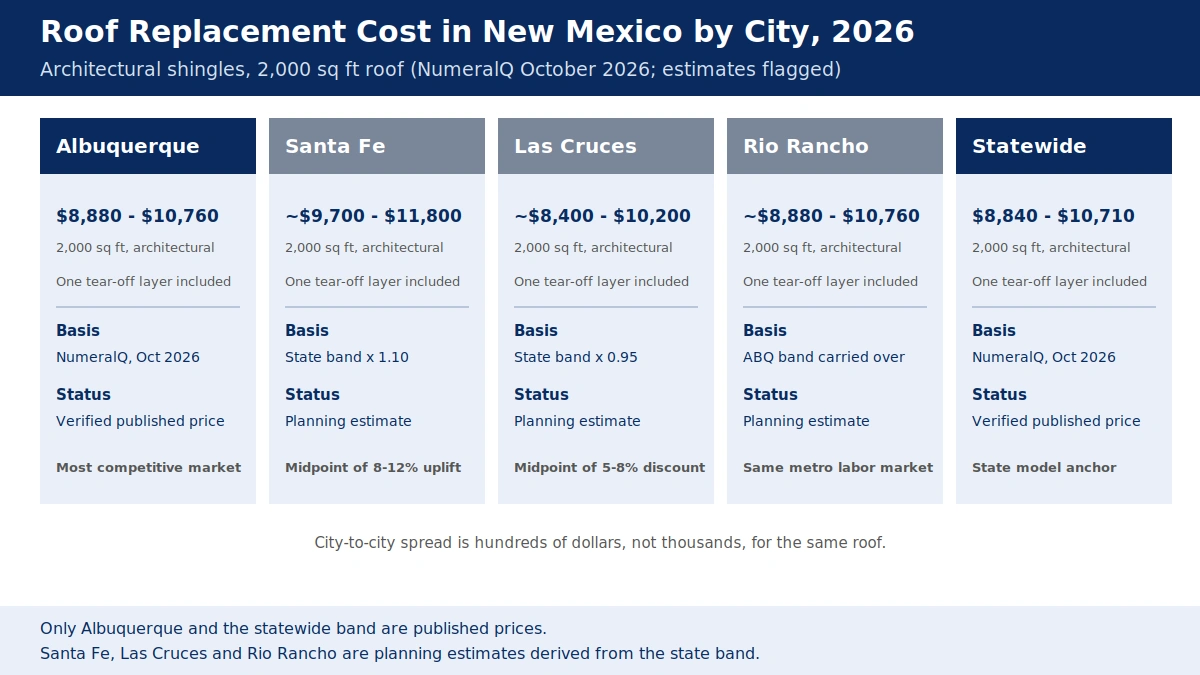
Las Cruces runs lower on labor. Rio Rancho tracks Albuquerque closely, because the two cities share a labor pool and a supply chain across a city line that most crews cross daily. The table below gives the 2,000-square-foot architectural shingle band for each city, with the basis for each figure stated plainly.
| City | 2,000 sq ft architectural shingles | Basis |
|---|---|---|
| Albuquerque | $8,880–$10,760 | NumeralQ Albuquerque model, Oct 26, 2026 |
| Santa Fe | ~$9,700–$11,800 | Planning estimate: state band × 1.10 (see note) |
| Las Cruces | ~$8,400–$10,200 | Planning estimate: state band × 0.95 (see note) |
| Rio Rancho | ~$8,880–$10,760 | Planning estimate: Albuquerque band carried over |
| New Mexico statewide | $8,840–$10,710 | NumeralQ state model, Oct 26, 2026 |
The Santa Fe and Las Cruces figures are planning estimates, not published prices, and they are labeled with a tilde for that reason. No published state cost model prices Santa Fe or Las Cruces directly. The Santa Fe estimate takes the state band and applies a 10 percent uplift, the midpoint of the 8 to 12 percent premium over Albuquerque that a single New Mexico market guide reports.
The Las Cruces estimate takes the state band and applies a 5 percent reduction, the midpoint of the 5 to 8 percent discount to Albuquerque that the same guide reports. Both adjustments are consistent with the wage data: Santa Fe roofers earned a median of $21.41 per hour in May 2025 Bureau of Labor Statistics data, Las Cruces roofers earned $19.79, and Albuquerque roofers earned $23.75 in the metro-level figures.
The Rio Rancho figure carries the Albuquerque band over unchanged, because Rio Rancho sits in the same metro labor market and the same supply chain, and a separate published model does not exist for it. Treat all three planning estimates as budgeting numbers to be confirmed by local quotes, not as prices any contractor has published.
Albuquerque is the most competitive roofing market in the state, and the numbers show it. The city has 89 roofing contractors in Bernalillo County, or 2.9 per 10,000 homes against a national rate of 1.7, according to the NumeralQ Albuquerque model. The median Albuquerque home is valued at $291,500, the typical roof job runs about 3.4 percent of home value, and 68 percent of homes are single-family with a median year built of 1982.
An older housing stock means more decking surprises and more two-layer tear-offs than a newer city would produce, and it means the permit desk sees a steady flow of re-roofs rather than new construction. Albuquerque’s band of $8,880 to $10,760 for architectural shingles is the most solidly sourced figure in this guide, and it is the number to use when a quote needs a reality check.
Santa Fe is the most expensive of the four cities to re-roof, and the reasons are structural rather than opportunistic. Labor costs more, access is harder in the foothills and the narrow streets of the historic districts, and the historic review process adds time that gets priced into the job. The city’s historic districts, Downtown and Eastside, Westside-Guadalupe, Don Gaspar and South Capitol, require Historic Districts Review Board approval for street-visible exterior changes, and a roof replacement that is not in kind, meaning not the same material, design, color and texture as the original, needs an exception.
That process is priced in the permits section. Santa Fe’s elevation, around 7,000 feet, also means colder nights, more freeze-thaw cycles and more snow than Albuquerque, which pushes material choice toward products that handle cold well and toward installation practices, like hand-sealing shingles in cold weather, that take more crew time.
Las Cruces, in the Mesilla Valley at the southern end of the state, is the cheapest of the four cities on labor and the warmest in climate. The planning estimate of $8,400 to $10,200 reflects the lower wage floor, with Las Cruces roofers earning about 17 percent less than Albuquerque roofers in the metro wage data. The climate difference cuts both ways: Las Cruces roofs see less freeze and less snow, but they see more sustained heat, and the Chihuahuan Desert sun is no kinder than the Albuquerque sun.
Hail is a real exposure here too, with the southern plains producing some of the largest hail reports in the state. A Las Cruces quote that lands well below the planning estimate deserves the same scrutiny as one that lands well above it, because the most common cause of a very low bid is a scope difference, usually a missing tear-off layer or missing flashing work.
Rio Rancho is the newest housing stock of the four cities and the fastest growing, which means more of its roofs are first replacements on homes built in the 1990s and 2000s rather than third replacements on mid-century homes. That shows up in fewer decking surprises and fewer two-layer tear-offs, though not in lower prices, because the labor market is Albuquerque’s labor market.
The planning estimate carries the Albuquerque band over at $8,880 to $10,760. Rio Rancho straddles two counties, Sandoval and Bernalillo, and the gross receipts tax rate differs by a fraction of a percent between the two sides of the city line, which is a small detail that shows up in the tax math in the permits section.
Smaller New Mexico cities were not priced individually because no published model covers them and inventing figures would be worse than omitting them. The Instant Roofer measured-job data gives a useful cross-check on the spread: on its 24-square average roof, Albuquerque averages $15,230, Santa Fe $14,962, Las Cruces $15,810 and Rio Rancho $14,918, with a statewide range from $14,070 in Deming to $15,825 in Hobbs.
Those averages are on a larger roof and a different scope than the 2,000-square-foot bands in this guide, so they should not be compared directly, but they confirm that the city-to-city spread is measured in hundreds of dollars, not thousands, for the same roof. The bigger cost differences in New Mexico come from material, roof size and roof condition, not from which city the house sits in. Homeowners comparing prices across the state line can check the Arizona and Colorado guides, which price the same materials under different labor and code conditions.
High-Desert Sun and Monsoon Rain: What New Mexico Weather Does to a Roof
New Mexico weather attacks a roof from four directions at once: ultraviolet light, heat, sudden rain and hail, with freezing nights layered on top for much of the year. Understanding each one matters because it changes which material lasts, which installation details matter, and how long the planning life of a roof really is. A roof that would last 25 years in a mild coastal climate can be done in 17 in New Mexico, and the difference is almost entirely weather.
Ultraviolet light is the dominant aging force. Albuquerque’s typical peak midday UV index in July is 11.2, which the scale calls Extreme, and 99 percent of July days reach 8 or higher while 85 percent reach 11 or higher, according to National Oceanic and Atmospheric Administration bulletins for 2015 through 2024 compiled by MyWild. The UV index runs High, 6 or higher, on average from March through September, seven months of the year.
Elevation makes it worse: the Environmental Protection Agency estimates UV increases about 2 percent for every 1,000 feet of elevation, and the World Health Organization puts the figure at about 10 percent per 1,000 meters. Albuquerque airport sits at 5,311 feet and Santa Fe at around 7,000 feet, so both cities bake under stronger sun than any sea-level city at the same latitude. Snow reflects up to 80 percent of UV light, according to the EPA, which means a winter roof in Santa Fe takes reflected UV from below as well as direct UV from above.
What UV does to a shingle is slow and cumulative. It breaks down the asphalt, dries out the oils that keep the shingle flexible, and loosens the granules that protect the asphalt from the sun. One Albuquerque contractor reports that a 25 to 30 year shingle shows significant aging in 15 to 18 years in the Albuquerque metro, and that dark roof surfaces reach 150 to 160 degrees Fahrenheit on summer afternoons.
That contractor figure is a single-source observation, flagged as such, but it lines up with the market-guide planning life of 15 to 19 years for asphalt in New Mexico and with the daily temperature swings of 25 to 30 degrees that the state is known for. A roof that heats to 150 degrees by afternoon and cools to the upper 60s by dawn is expanding and contracting every day, and that movement works on every seal, every fastener and every flashing joint. The practical lesson is to plan on the low end of any rated life for a south-facing slope, to favor lighter colors and reflective products where the house allows them, and to budget for replacement sooner than the shingle warranty suggests.
The North American monsoon is the second force, and it arrives on a calendar. The National Weather Service office in Albuquerque designates the monsoon season as June 15 through September 30, and about half of the year’s rain falls inside those dates. Albuquerque averages 4.47 inches of monsoon rain against an annual total of 8.84 inches, Santa Fe Airport averages 5.28 inches, and Roswell averages 5.90 inches, all on 1991 to 2020 averages.
The wettest monsoon on record in Albuquerque dropped 9.42 inches in 2006, and the wettest single day brought 2.08 inches. Monsoon rain does not fall gently.
It falls in bursts, often with gusting wind and hail, and it finds every weak flashing, every ponding spot on a flat roof and every gap in a valley. A roof that survives the dry months can fail in the first big monsoon cell of July, which is why claims cluster in July through September and why scheduling a replacement during monsoon season needs a plan for keeping the open roof dry overnight.
Freeze and cold are the third force, and they are easy to underestimate in a desert state. Albuquerque sees 93 nights a year at or below 32 degrees Fahrenheit, and Santa Fe sees far more, with January lows of 17 to 19 degrees and a record low of minus 24. Albuquerque’s winter design temperature, the coldest temperature the heating system is designed for, is 18 degrees, and Santa Fe’s is 10 degrees.
Santa Fe averages 18 to 22 inches of snow a year depending on the station, against about 7.9 inches in Albuquerque. Cold matters for installation as much as for lifespan: shingle manufacturers instruct installers to hand-seal shingles, pressing each tab down by hand with roofing cement, when temperatures are at or below 40 degrees, because the factory adhesive strip will not activate reliably in the cold.
Albuquerque nights fall below 40 degrees from November through March, and Santa Fe nights fall below it for much longer. A winter installation is entirely possible in New Mexico, but it must be a cold-weather installation, with hand-sealing and with materials stored warm, and a quote that does not mention cold-weather practice for a December job in Santa Fe is a quote to question.
Hail and wind are the fourth force, and they are the most episodic. Bernalillo County recorded 38 large-hail reports, hail of 1 inch or larger, and 41 damaging-wind reports of 58 miles per hour or more in the ten years from 2016 through 2025, along with 5 tornado reports. Bernalillo County and the five counties around it recorded 149 large-hail reports in the same period, or 9.5 per 1,000 square miles against a state rate of 8.6 and a national rate of 20.1.
New Mexico’s hail exposure is below the national average, but it is concentrated: Chaves County around Roswell has recorded 164 hail reports since 2006 on 88 separate days, including 3-inch hail on May 28, 2021, and the National Weather Service has warned of 2 to 2.5 inch hail near Hobbs and Lovington in 2025 and 2026. The Federal Emergency Management Agency rates Bernalillo County’s hail risk as Relatively High.
Hail does not have to be frequent to be expensive. One storm can total a roof that had ten years of life left, which is why impact resistance and insurance settlement types get full sections later in this guide.
Wildfire is the fifth force, and the 2022 Calf Canyon and Hermits Peak Fire is the reason it cannot be treated as a footnote. That fire burned about 341,500 acres across San Miguel, Mora and Taos counties between April and August 2022, destroyed 903 structures and damaged 85 more, and became the largest wildfire in New Mexico history. By late June 2022, nearly 900,000 acres had burned statewide in 31 fires larger than 100 acres.
A roof is the most exposed part of a house in a wildfire, because embers land on it and in its gutters from a mile or more away. The fire rating of the roof assembly, the ember resistance of the vents and the clearance of the gutters matter more than the siding or the landscaping in the first minutes of an ember shower. The Class 4 and wildfire section later in this guide prices the hardening options and the certification program that New Mexico now runs.
The housing stock adds a final wrinkle. About 43 percent of New Mexico homes were built before 1980, and older homes carry older roofs, older decking and sometimes older surprises under the roof. Older flat roofs may carry pumice or granular fill, a lightweight volcanic material used as insulation and leveling fill, which must be removed when the roof is replaced.
A pre-1980 home in Albuquerque’s older neighborhoods, in Santa Fe’s historic core or in Las Cruces’ older subdivisions should be budgeted with a decking contingency, because the wood underneath a 40-year-old roof is a question, not a certainty. The repair-or-replace section sets out how to size that contingency.
Flat and Low-Slope Roofs in New Mexico: Membranes, Foam, Parapets & Drainage
If your New Mexico home has a flat roof, this is the most important section in the guide. Flat and low-slope roofs are not a niche product here. They are the roof on a large share of pueblo, adobe, territorial and mid-century homes across Albuquerque, Santa Fe, Taos and Las Cruces, and in the Albuquerque and Santa Fe markets, membrane, foam and coating jobs are as common as shingle tear-offs.
A flat roof is a different system from a pitched roof, with different materials, different failure modes and different things to check on a quote. Pricing it like a shingle roof is the fastest way to a bad decision.
The materials table in the second section gave the headline membrane prices. Modified bitumen, a torch-applied or self-adhered sheet of modified asphalt, costs $9,640 to $12,400 on 2,000 square feet. EPDM, a black rubber membrane with adhesive seams, costs $9,930 to $15,720.
TPO, a white heat-welded membrane, costs $11,750 to $15,700. All three figures come from the NumeralQ Albuquerque model and include waste and markup. A single Albuquerque contractor cross-check runs below those figures, pricing TPO at $4.00 to $6.00 per square foot installed including tear-off and tapered insulation where needed, and modified bitumen at $3.50 to $5.50 per square foot.
The spread between the model and the contractor figure is a scope difference as much as a price difference: the contractor figures assume a straightforward re-cover or tear-off on a sound deck, while the model figures carry fuller allowances. Use the model figures for budgeting and the contractor figures as a reason to ask what is included.
TPO has become the dominant flat-roof material in Albuquerque and Rio Rancho over the past 15 years, and the reason is the sun. A white TPO membrane reflects ultraviolet light and heat that a black EPDM membrane absorbs, and on a flat roof with no shade that reflectivity pays for itself in slower aging and a cooler top floor. TPO seams are heat-welded, which makes them stronger than adhesive seams in sustained heat.
EPDM is a proven product with a long track record, and its black color is less of a penalty on a roof that is shaded or coated, but on a full-sun New Mexico flat roof the reflective membrane has the better argument. Modified bitumen is the workhorse of the three: cheaper, thicker, tolerant of foot traffic, and a good match for roofs that get walked on for swamp cooler and HVAC service. The right choice depends on the roof’s sun exposure, foot traffic and budget, and a contractor who recommends only one membrane for every flat roof is selling, not advising.
Spray polyurethane foam, or SPF, is the fourth flat-roof option and the one most often misunderstood. Foam is sprayed onto the roof as a liquid, expands into a seamless insulating layer, and is then coated with a protective elastomeric coating. The only published New Mexico market figure for foam runs $4.50 to $7.80 per square foot, or roughly $9,000 to $15,600 on 2,000 square feet, and that figure is a single-source planning estimate, flagged as such here and in the sources.
Foam’s advantage is that it insulates and waterproofs in one layer and can be sprayed over an existing sound roof, which can save a tear-off. Its cost is the recoat: the protective coating must be reapplied every 5 to 7 years at $1.75 to $3.25 per square foot, or $3,500 to $6,500 per recoat on 2,000 square feet. With regular recoats, a foam roof can last 30 years or more.
Without them, the foam itself degrades in the sun. A foam quote that does not name the recoat schedule and the recoat price is hiding the second half of the cost.
Elastomeric coating is the cheapest way to extend a flat roof that is still sound. A coating is a thick, paint-like waterproof layer rolled or sprayed over an existing membrane or foam roof. A single Las Cruces contractor prices coating at $3 to $5 per square foot, which is $6,000 to $10,000 on 2,000 square feet, and that figure is a single-source estimate.
Coating is not a replacement. It buys years on a roof whose membrane is intact but weathered, and it buys nothing on a roof with ponding, saturated insulation or failed seams.
The honest test is a moisture survey or a core cut, a small sample cut through the roof to check for wet insulation, before anyone coats. Coating over wet insulation traps the water and guarantees a bigger bill later.
Drainage is where flat roofs fail, and it is the part of the quote that deserves the most attention. A flat roof is never truly flat. It is built with a slight slope toward drains, scuppers or canales, and the design slope in the code summaries is at least one quarter inch per foot, or 2 percent, for built-up, modified bitumen, EPDM, TPO, PVC, foam and liquid-applied systems.
Confirm the slope requirement with your permit desk, because the adopted code and local amendments control. Ponding water, water that stands on the roof for 48 hours or more after rain, is the failure to watch for.
It adds weight, it accelerates membrane aging, it finds seams, and on a roof with a parapet it can hide behind the wall where no one sees it until the ceiling stains. A flat-roof quote must name the drainage plan: tapered insulation or crickets, the wedge-shaped pieces that divert water around chimneys and curbs, the scupper or drain locations, and the parapet flashing detail.
Parapets, the low walls that rise above a flat roof, are the other place flat roofs leak. The membrane must run up the inside face of the parapet and be capped, the cap flashing must be sealed, and the scuppers or canales that carry water through the parapet must be lined and flashed. Canales are the projecting spouts, often wood or metal, that throw water clear of an adobe wall, and they are a signature detail of pueblo architecture.
Viga ends, the exposed beam ends that run through the parapet on many pueblo homes, need boots or flashing collars where they penetrate the wall. None of this is exotic work, but all of it must be named on the quote. A flat-roof quote that prices only the membrane and says nothing about parapets, scuppers, canales or viga ends is missing the parts that leak first.
Older flat roofs can hide one more cost: pumice or granular fill under the membrane. Pumice is a lightweight volcanic rock that was used as insulation and leveling fill on older New Mexico flat roofs, and the Construction Industries Division requires it to be removed when the roof is replaced.
Removal adds labor and disposal cost, and it is the kind of condition that cannot be confirmed until the old roof is opened. If your home is pre-1980 with a flat roof, ask the contractor to state the fill-removal price in the quote as a conditional line, with the trigger condition written down, rather than leaving it as an open-ended extra.
The flat-roof decision usually comes down to three questions. Is the deck and insulation dry and sound, which a moisture check can answer? Is the drainage working, which a hose test or a rain observation can answer?
And is the membrane at the end of its life or just weathered, which a contractor’s core cut and seam inspection can answer? A roof that passes all three tests is a coating candidate.
A roof that fails one is a replacement candidate. A roof that fails two or three is a replacement, and the only question left is which membrane, which slope correction and which parapet detail.
Asphalt vs Metal vs Tile in New Mexico: The Lifetime Math
The cheapest roof is rarely the cheapest roof over time, and New Mexico’s weather makes that gap wider than in most states. A material that costs twice as much and lasts three times as long is cheaper per year, and the per-year number is the one that should decide the purchase for anyone who plans to stay in the house.
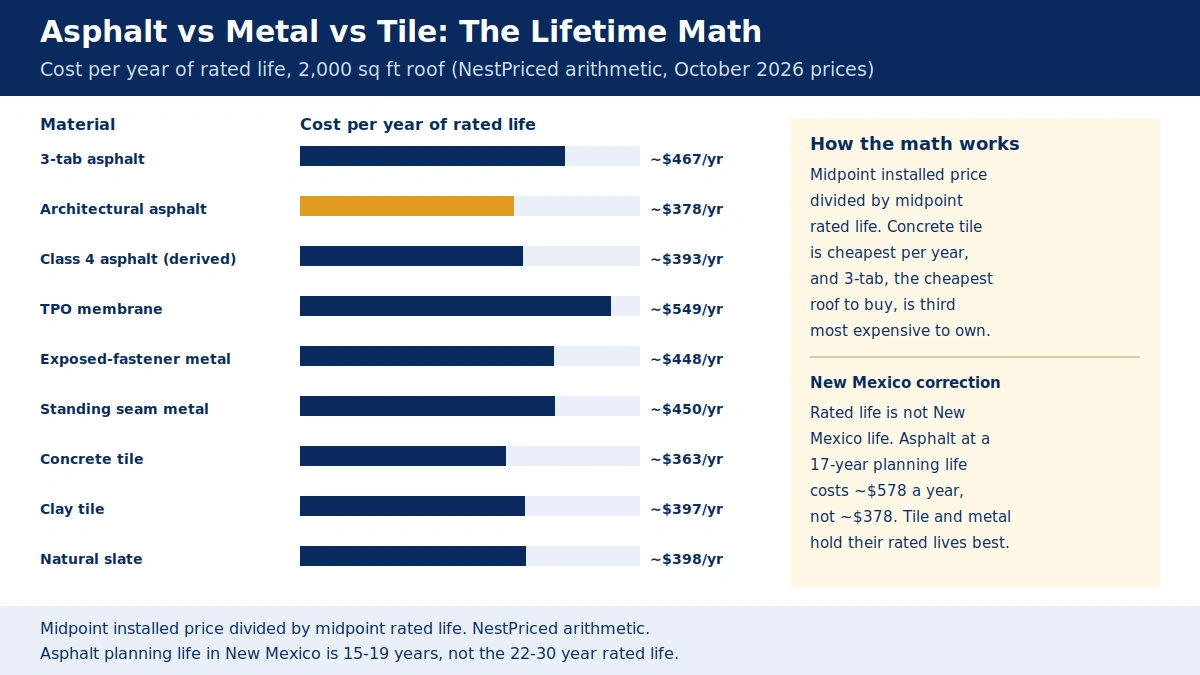
This section runs nine materials through the same calculation: the midpoint of the installed price divided by the midpoint of the rated life. The result is the cost per year of rated life, and it is NestPriced arithmetic from the published figures in this guide, labeled as such.
| Material | Installed midpoint | Rated life midpoint | Cost per year of rated life |
|---|---|---|---|
| 3-tab asphalt | $8,170 | 17.5 years | ~$467 |
| Architectural asphalt | $9,820 | 26 years | ~$378 |
| Class 4 asphalt (derived) | $11,775 | 30 years | ~$393 |
| TPO membrane | $13,725 | 25 years | ~$549 |
| Exposed-fastener metal | $15,690 | 35 years | ~$448 |
| Standing seam metal | $24,730 | 55 years | ~$450 |
| Concrete tile | $20,885 | 57.5 years | ~$363 |
| Clay tile | $29,750 | 75 years | ~$397 |
| Natural slate | $44,780 | 112.5 years | ~$398 |
Read the table from the right-hand column, because that column is the point. Concrete tile is the cheapest roof per year of rated life at about $363, ahead of architectural asphalt at about $378. Clay tile, natural slate and Class 4 asphalt cluster just under $400 a year.
Standing seam and exposed-fastener metal sit around $450 a year, and TPO is the most expensive per year at about $549, because its rated life is shorter than its price suggests. Three-tab asphalt, the cheapest roof to buy, costs about $467 a year, more than architectural asphalt, more than concrete tile and more than clay tile. The cheapest purchase is the third most expensive roof to own.
The rated-life column needs a New Mexico correction before it is used for planning. Rated life is a manufacturer figure for average conditions, and New Mexico conditions are not average. The planning life for asphalt in New Mexico, from the market guide and contractor observations cited in the weather section, is 15 to 19 years, not 22 to 30.
Run the same calculation at a 17-year planning life, the midpoint of that range, and architectural asphalt costs about $578 a year, not $378. That single correction changes the ranking: at New Mexico planning life, architectural asphalt is the most expensive common roof per year, and tile and metal pull well ahead. The correction does not apply equally to every material.
Tile and metal degrade far more slowly in UV than asphalt does, so their rated lives hold up better in the high desert. The honest planning approach is to use rated life for tile, metal and slate, and to use the 15 to 19 year planning life for asphalt, and to say which basis each number uses.
The asphalt-versus-metal decision turns on how long you will own the house. If you plan to sell within five years, architectural asphalt is the rational buy: it is the cheapest roof that looks new, it satisfies a buyer’s inspector, and you will not own the house long enough to collect the metal roof’s longer life. If you plan to stay 15 years or more, standing seam metal starts to win, because one metal roof covers the whole period while asphalt needs a second purchase partway through.
Exposed-fastener metal sits in between: cheaper to buy than standing seam, shorter lived, and carrying the maintenance cost of its exposed screws. The metal-versus-shingle comparison in the national guide runs the same logic with national figures, and the New Mexico version of the argument is stronger, because the asphalt life here is shorter.
The asphalt-versus-tile decision turns on structure and on the underlayment. Tile wins the per-year math by a wide margin, but only if the house can carry the weight and only if the underlayment replacement is budgeted. Concrete tile at 850 to 1,100 pounds per square is roughly four times the weight of architectural shingles, and an older home built for shingles may need structural reinforcement before tile can go on.
That reinforcement is a real cost that belongs in the tile quote, not a footnote. The underlayment under tile is the waterproofing layer, and it will need replacement once during the tile’s life, at a cost that is a substantial fraction of a shingle roof. A tile quote that prices only the tile and ignores the structure check and the underlayment cycle is understating the lifetime cost, even though tile still wins the math when both are included.
The metal-versus-tile decision is closer than either material’s fans admit. Standing seam metal costs about $450 a year of rated life and clay tile about $397, but metal is lighter, faster to install, better in wildfire ember exposure when detailed correctly, and easier to repair in panels. Tile is heavier, slower, better in hail because it does not dent, and unmatched for the look of a New Mexico home.
In a historic district, the choice may be made for you: a tile roof replaced with metal may need a historic exception, and a metal roof replaced with tile may need a structural check. In the foothills and the East Mountains, where wildfire exposure is higher, the fire rating of the assembly and the ember resistance of the details matter more than the per-year gap between the two materials.
Both are good roofs. The wrong choice is the one made on purchase price alone.
One more lifetime cost belongs in the calculation and rarely appears in it: the second roof. An architectural shingle roof bought in 2026 at a 17-year New Mexico planning life needs replacement around 2043, at 2043 prices. A concrete tile roof bought in 2026 needs an underlayment replacement around mid-life and nothing else.
A standing seam roof bought in 2026 may need nothing but fastener and sealant attention for the life of the house. Inflation makes the second purchase more expensive than the first, which widens the gap in favor of the long-lived materials every year. No one can price 2043 accurately, but the direction of the error is certain, and it favors buying the longer life now when the budget allows it.
The practical rule is simple. If the budget is fixed and the house will be sold soon, buy architectural asphalt and buy it well, with good underlayment and good flashing.
If the house is a long-term home and the structure allows it, price concrete tile and standing seam metal alongside asphalt, run the per-year math with the New Mexico planning life for asphalt, and choose on lifetime cost rather than purchase price. If the house has a flat roof, the lifetime math is different, because membranes and foam live on recoat and replacement cycles that the flat-roof section prices, and the cheapest membrane per year is the one whose seams and drainage are detailed correctly, not the one with the lowest sticker price.
Class 4 Shingles and Wildfire-Hardy Roofs in New Mexico: Cost, Discounts & Payback
Hail and wildfire are the two risks that make a New Mexico roof more than a weather cover, and both have products and programs designed for them. Class 4 shingles are the hail answer.
A Class A fire-rated assembly, ember-resistant details and the Wildfire Prepared certification are the wildfire answers. This section prices each one, states what insurers actually discount, and runs the payback math with the assumptions labeled, because the payback claim is where this subject goes wrong most often.
A Class 4 shingle is an asphalt shingle that has passed the UL 2218 impact test at the highest of four ratings. The test drops a 2-inch steel ball from 20 feet onto the shingle, twice in the same spot, and the mat must not crack or tear. Class 4 is an impact rating only.
It says nothing about wind resistance, which is tested separately under ASTM D3161 and D7158, and nothing about fire resistance, which is tested separately under ASTM E108. A shingle can be Class 4 and still be a poor wind performer, and a shingle can be Class 4 and carry a lower fire rating than a tile roof. The rating answers one question, whether the shingle survives a hail strike without cracking, and it answers it well.
Product lines that carry Class 4 ratings include GAF Timberline AS II and ArmorShield II, Owens Corning Duration Storm and Duration FLEX, CertainTeed NorthGate and Landmark IR, Atlas StormMaster, Malarkey Legacy and Vista, IKO Nordic and Tamko StormFighter FLEX. The Insurance Institute for Business & Home Safety rated 24 impact products in 2025, covering about 95 percent of the market, and found that not all shingles marketed as impact resistant perform equally, so the specific product and its test listing matter more than the label on the brochure.
Class 4 shingles cost more than standard architectural shingles, and the premium is the number to get right. The premium basis in this guide is $50 to $150 per square, from a November 2026 roofing-industry pricing guide, which brackets with a New Mexico contractor’s statement that Class 4 costs 10 to 25 percent more than standard shingles. On a 20-square roof, that premium is $1,000 to $3,000, which puts a Class 4 roof on 2,000 square feet at roughly $9,840 to $13,710.
That band is NestPriced arithmetic, the state architectural band plus the premium range, and it is labeled as derived here and in the sources. The midpoint of the derived band, $11,775, is the figure used in the lifetime math table, at an assumed rated life of 25 to 35 years.
No published New Mexico model prices Class 4 directly, so any guide that states a Class 4 price without showing its derivation is guessing. This one shows its work.
The insurance discount is where the sales pitch usually outruns the truth. A New Mexico contractor guide reports discounts of 5 to 35 percent depending on the provider and the policy, and states plainly that no discount is automatic. No New Mexico statute sets a Class 4 discount percentage, and no insurer is required to offer one.
Discounts, when they exist, usually apply to the wind and hail portion of the premium only, not to the whole policy, which means a 15 percent discount on half the premium is a 7.5 percent discount on the bill. The only discount figure that matters is the dollar figure your insurer puts in writing for your policy, your address and your specific shingle product. Get it before the roof goes on, not after, because the payback math depends on it and because some insurers require the product listing and the installation certificate before they apply the discount.
The payback math below uses the NerdWallet New Mexico average premium of $2,800 a year, from a May 2026 analysis of more than 100 companies for a $400,000 dwelling with a $1,000 deductible. Other published averages differ: LendingTree reports $3,242, Insurify reports $2,278, and one calculator reports $3,497 for a $300,000 dwelling.
The NerdWallet figure is used because its basis is stated most clearly, and the math below is an illustration, not a promise. The upgrade cost is the $1,000 to $3,000 premium range.
| Discount scenario | Annual saving on $2,800 premium | Payback on $1,000–$3,000 upgrade |
|---|---|---|
| 10% of full premium | ~$280 | ~3.6–10.7 years |
| 15% of full premium | ~$420 | ~2.4–7.1 years |
| 25% of full premium | ~$700 | ~1.4–4.3 years |
| 15% of half the premium | ~$210 | ~4.8–14.3 years |
The table shows why the discount basis matters more than the discount percentage. At 15 percent of the full premium, the upgrade pays for itself in 2.4 to 7.1 years. At 15 percent of half the premium, which is the more common structure, payback stretches to 4.8 to 14.3 years.
At the low end of the discount range, 5 percent of half the premium, the annual saving is about $70 and payback exceeds the life of the roof. The discount alone is not a reliable reason to buy Class 4. The reliable reasons are the hail performance itself, the avoided deductible on a storm that would have totaled a standard roof, and the longer rated life.
In a hail-exposed county like Chaves, Bernalillo or Doña Ana, those reasons are strong. In a low-hail corner of the state, they are weaker, and the money may be better spent on a better underlayment or on wildfire hardening.
Wildfire hardening is a separate purchase from hail resistance, and it has its own standard. Class A is the highest roof fire rating under ASTM E108, and it is rated for the whole assembly, the covering, the underlayment and the deck together, not for the shingle alone. Tile, metal and Class A rated asphalt assemblies all qualify, while untreated cedar does not.
The details matter as much as the covering: ember-resistant vents that block embers from entering the attic, sealed eaves and gaps, metal flashing at roof-to-wall joints, and gutters kept clear of leaves and needles. A Class A roof with open eave vents and a gutter full of pine needles is a Class A roof with a hole in it.
The IBHS Wildfire Prepared Home program certifies the whole property, roof, vents, gutters, siding and the five-foot zone around the house, and New Mexico aligned its state standards with the IBHS program through the Wildfire Prepared Act, Senate Bill 33, in 2025. The state Office of the Superintendent of Insurance and the State Fire Marshal have certified inspectors, and the first Wildfire Prepared certificate in New Mexico was issued on March 19, 2026, in Otero County.
Certification costs $125 at the standard fee, or $25 for New Mexico homeowners using the NMGRANT code, according to the program’s published fee schedule. The certificate is valid for three years with annual check-ins, and it attaches to the property rather than the owner. The Federal Home Loan Bank of Dallas funds Wildfire Prepared designations for properties in New Mexico only, a new feature in 2026, and the FORTIFIED Fund section in the payment part of this guide explains how that funding works.
New Mexico Home Strong, an IBHS program, offers retrofit grants for homeowners insured through the New Mexico FAIR Plan, the last-resort insurer for homes that private carriers will not cover. No statewide roof grant exists for the general public, and no figure in this section should be read as a guarantee of grant money. The certification is worth pursuing on its own merits: it is the only third-party verification that the whole property, not just the roof, is hardened, and it is increasingly the document insurers ask for in high-risk areas.
The decision sequence for a New Mexico homeowner is straightforward. First, check the hail exposure for your county and the wildfire exposure for your address, using the figures in the weather section and your insurer’s risk rating. Second, price Class 4 and the fire-rated assembly as separate line items, not as a single upgrade bundle, so each one can be judged on its own payback.
Third, get the insurance discount in writing, in dollars, before committing. Fourth, if wildfire exposure is real, budget for the vents, gutters and clearance work alongside the roof, because the roof alone does not harden a house. A roof that survives hail and a roof that survives embers are two different achievements, and a New Mexico roof in the foothills needs both.
Permits & Code in New Mexico: A Re-Roof Permit on Every Job
Every re-roof in New Mexico needs a permit. That is the headline rule, and it is stated in the Construction Industries Division’s own guidance: a permit is required for every re-roof, with the manufacturer’s specifications attached. The permit is issued by the Construction Industries Division or by the local building department under the codes adopted under state law.
This is not a rule that applies only to structural work or only to commercial buildings. A straightforward tear-off and re-cover on a single-family home needs a permit, and a contractor who says otherwise is either mistaken or planning to skip the inspection. The permit protects the homeowner twice: it triggers an inspection that catches installation errors while they can still be fixed, and it creates a record that the roof was replaced legally, which matters at sale time and at claim time.
The code in force is the 2021 New Mexico Residential Building Code, catalogued as 14.7.3 NMAC, which adopts the 2021 International Residential Code with New Mexico amendments. It took effect on July 14, 2023, and permits have been issued only under it since December 14, 2023. The 2021 Residential Energy Conservation Code, 14.7.6 NMAC, which adopts the 2021 International Energy Conservation Code, has been mandatory since July 30, 2024.
The two-layer rule comes from the Construction Industries Division guidance: when two or more existing roof coverings are present, both must be removed, and pumice or granular fill must come out with them. No statewide ice-barrier rule was located in the research for this guide, and no residential cool-roof mandate was located either. Ice-barrier scope is a question for the local permit desk, particularly for Santa Fe and mountain addresses, and any contractor who states a statewide ice-barrier requirement as fact is stating something this guide could not verify.
Albuquerque runs the most streamlined re-roof permit process in the state. A permit is required for a full tear-off and re-cover, and the city’s Express Permitting System offers same-day approval for a residential re-roof without truss repairs. An owner-occupant of a single-family home may apply for the permit and assume the general contractor’s responsibility, while a rental, duplex or commercial property requires a licensed contractor to apply.
A mid-project inspection at 50 percent completion or more, with one business day’s notice, is reported by a secondary source and is flagged as such here; confirm the inspection schedule with the permit desk when you apply. The permit fee is not published in the city’s fee schedule as a re-roof line item, and the published planning figures run $140 to $350 from a single market guide and $100 to $350 in the MyRoofData planning band. Treat the fee as confirmed at application, not as a fixed figure.
Albuquerque’s historic Protection Overlay zones, East Downtown, East End Addition, Eighth and Forrester, Fourth Ward, Huning Highland, Old Town and Silver Hill, require a Certificate of Appropriateness before roof work begins. In-kind repair is exempt from that requirement, but the exemption excludes replacing roofing, so a re-roof in an overlay zone needs the certificate even when the new roof matches the old one.
Santa Fe requires a city permit to re-roof, issued through the Building Permit Division, and the contractor normally pulls it. The fee is reported at $180 to $420 by a single market guide, flagged as a single-source figure. The historic review is the larger cost in Santa Fe, measured in time rather than money.
The city’s historic districts require Historic Districts Review Board approval for street-visible exterior changes, and a roof replacement that is not in kind needs an exception under the city code, section 14-5.2(D)(6). A replacement must match the original in composition, design, color, texture and visual qualities under section 14-5.2(D)(5)(b). The board does grant exceptions: on July 22, 2025, it approved a 26-gauge ribbed Galvalume metal roof at 964 Acequia Madre, with exceptions granted.
Allow extra weeks for the review when the house sits in a historic district, and do not schedule the crew until the approval is in hand. A roof torn off before a historic approval arrives is a roof that cannot legally be finished.
Las Cruces issues permits through the city’s Community Development Department, Building and Development Services, and unincorporated work goes through Doña Ana County. The city enforces the 2021 International Building Code with New Mexico amendments, according to a secondary source, and owner-builders may pull permits for owner-occupied work, also according to a secondary source. The fee is reported at $100 to $280 by a single market guide, flagged as a single-source figure.
Rio Rancho requires a residential building permit through Building and Development Services, with fees reported at $100 to $300 by valuation from a single contractor source and $120 to $260 from a single market guide, both flagged. The city runs an electronic application system. In all four cities, the pattern is the same: the permit itself is inexpensive, the inspection is the value, and the historic or overlay review, where it applies, is the schedule risk.
Gross receipts tax is the cost that surprises out-of-state homeowners, because New Mexico has no sales tax. It has a gross receipts tax, or GRT, which applies to construction services including remodeling, and contractors commonly add it as a separate line on the bill. The rate depends on the location of the house, not the location of the contractor’s office.
The Taxation and Revenue Department schedule for July 1, 2026 through June 30, 2027 sets the state rate at 4.875 percent, with combined local rates of 7.625 percent in Albuquerque, 8.1875 percent in the city of Santa Fe, 8.39 percent in Las Cruces, and 7.4375 percent in the Sandoval County part of Rio Rancho or 7.875 percent in the Bernalillo County part. On a $10,000 quote, GRT adds about $763 in Albuquerque, $819 in Santa Fe and $839 in Las Cruces, taking the totals to about $10,763, $10,819 and $10,839. That arithmetic is NestPriced calculation from the published schedule, labeled as such.
Some older secondary sources quote a 5.00 or 5.125 percent state base rate; those figures are superseded by the July 2026 schedule and should not be used. The practical rule is to compare quotes on the same tax basis: ask every contractor whether the quoted price includes GRT or adds it, and get the answer as a line on the quote, not as a verbal assurance.
The permit and code checklist for a New Mexico re-roof is short. Confirm the permit is in the quote and named as the contractor’s responsibility, unless you are an owner-occupant who has chosen to pull it yourself. Confirm the manufacturer’s specifications will be attached to the application.
Confirm the inspection schedule and who calls for inspections. Confirm whether the house sits in a historic district or overlay zone and, if it does, confirm the approval is in hand before the tear-off date. Confirm the two-layer rule has been checked against the actual roof, not assumed.
And confirm the GRT treatment in writing. A contractor who resists any of those six confirmations is telling you something about how the job will go.
Hiring a Roofer in New Mexico: The GS-21 License, the $7,200 Line & the Storm-Chaser Test
New Mexico licenses roofers through the Construction Industries Division, part of the Regulation and Licensing Department, and the license classification to ask for is GS-21, Roofing. The classification is defined in the state rule at 14.6.6.9(D)(12) NMAC, and its scope is broad: installing, altering and repairing roof systems on new and existing decks, weatherproofing and waterproofing membranes, with or without insulation, in asphalt, pitch, tar, sealants, felt, shakes, shingles, tile, slate, urethane and other approved materials. It includes preparation work, coatings and incidental sheet metal, including cornices, flashing, skylights without structural framing changes, gutters, leaders, downspouts, pans and prefabricated chimneys.
A GS-21 license requires two years of foreman-level experience, and the qualifying party, the person whose experience and exams stand behind the company license, must pass the GS-21 trade exam and the Business and Law exam, both administered through PSI and both open-book. The classification fee is reported at $150 by a secondary source, flagged as such, and licenses renew on terms of up to two years under state law.
Two broader classifications also cover roofing, and both are legitimate for a house roof. GB-2, Residential Building, covers residences and apartment houses of up to four family units, requires two years of foreman-level experience, and includes all GS specialty work, including roofing, when the work is limited to residential construction. GB-98, General Building, covers residential and commercial buildings, requires four years of foreman-level experience with at least two years commercial, and includes GB-2 and all GS classifications.
A contractor holding GB-2 or GB-98 is licensed to roof your house. A contractor holding any other classification, or holding no license at all, is not licensed to roof your house as a prime contractor, and the rule is explicit that work outside the scope of a license classification is a violation.
The classifications named in this section are the only ones this guide asserts. Several secondary sources name classifications that do not exist in the published rule, and those names are deliberately not repeated here, because repeating a bogus classification gives it credibility it has not earned.
The handyman line is the most misunderstood rule in New Mexico contracting, and it is worth stating precisely. State law exempts casual minor jobs totaling $7,200 or less per year from the licensing requirement. The key words are per year and totaling.
The exemption covers a person’s total casual minor work across a whole year, not a single job priced at $7,200. A $7,000 roof repair and a $500 gutter job in the same year total $7,500 and exceed the exemption. A roof replacement, at $8,000 or more for the smallest roofs in this guide, exceeds the exemption on its own in almost every case.
Anyone who offers to replace a roof without a license and cites the $7,200 figure as a per-job threshold has the rule backwards. The exemption exists for genuinely small, occasional work. It does not exist as a way to roof houses unlicensed.
Verification takes five minutes and is the highest-value step in hiring. The Regulation and Licensing Department links to a public license search through PSI, where a contractor’s license number, classification, status and qualifying party can be checked. Search by the company name and by the license number on the quote, and confirm the classification shown is GS-21, GB-2 or GB-98 and the status is active.
Ask for the certificate of insurance directly from the insurer, not as a photocopy from the contractor, and confirm general liability and workers’ compensation coverage. New Mexico licensing generally includes a $10,000 surety bond, stated here in general terms, and the bond is a secondary protection, not a substitute for insurance. Check for complaints through the Construction Industries Division and through the Better Business Bureau, and ask for three local references from jobs completed in the past year, then call them.
A contractor who has roofed houses in your neighborhood for years will have references you can drive past. A contractor who cannot produce them is telling you how long they have been in your market.
The lien rule is the financial risk most homeowners never hear about until it lands on them. Under New Mexico law, an unpaid subcontractor or supplier can place a lien on your home even if you have already paid the contractor in full. Homes of up to four units are exempt from the preliminary notice rule, which means the first notice of a lien problem may be the lien itself.
Liens are capped at the unpaid balance, must be filed within 90 days after completion for subcontractors and 120 days for the prime contractor, and the owner may withhold or offset amounts owed to unpaid subcontractors. The most likely lien senders on a roofing job are the shingle distributor and a subcontracted crew.
The protection is procedural: pay by check or card, never cash, keep a paper trail, require a lien waiver or a final payment affidavit at completion, and do not make the final payment until the work is complete, the inspection has passed and the waiver is in hand. A contractor who demands full payment upfront, in cash, or before the inspection is waving a red flag.
Storm chasers are the hiring risk that follows every hailstorm in New Mexico. They arrive from out of state within days of a storm, knock on doors in the damaged neighborhoods, offer a free inspection, and press for a signed contract on the spot, often with a promise to handle the insurance claim and to waive the deductible. New Mexico has no verified statute on deductible waivers, cancellation rights or door-to-door roofing sales that this guide could locate, and no such rule is asserted here.
The test is simpler than any statute: a local contractor has a local license you can verify, a local address you can visit, local references you can call and a warranty they will still be around to honor. A storm chaser has a rental truck, a temporary phone number and a contract that assigns your insurance proceeds to them. The questions to ask any roofer, local or not, are collected in the national guide to questions to ask a roofer, and they cover licensing, insurance, crew employment, material specifications, tear-off scope, decking pricing, flashing details, cleanup, warranty terms and payment schedule.
Ask all of them. A good contractor welcomes the questions. A bad one resents them, and that resentment is information.
The contract itself deserves the same care as the contractor selection. It should name the material by manufacturer and product line, not just by color or category, and it should name the underlayment, the flashing material, the ventilation products and the warranty terms for each. It should state the tear-off scope, the number of layers to be removed, the decking price per sheet with the trigger condition, the disposal responsibility and the cleanup standard.
It should state the payment schedule, with the final payment tied to completion and inspection, and it should state the start and completion dates with a weather provision. It should state who pulls the permit and who calls for inspections. And it should state the GRT treatment as a line item.
A one-page contract for a $10,000 roof is not a bargain. It is an invitation to a dispute about everything the page does not mention.
Insurance in New Mexico: Deductibles, Settlement Types & What a Claim Really Pays
Insurance is the part of a roof replacement where the numbers on the policy matter more than the numbers in any cost guide, because the policy decides how much of the bill the insurer pays and how much the homeowner pays. New Mexico premiums have risen sharply, driven by wildfire and hail exposure, with published analyses showing increases of about 43 percent from 2021 to 2025. The average premium figures in the Class 4 section, $2,800 from NerdWallet for a $400,000 dwelling, $3,242 from LendingTree and $2,278 from Insurify, disagree with each other because they use different dwelling values, deductibles and company samples.
Your premium is the number on your declarations page, and your deductible and settlement type are the numbers that decide what a claim pays. Read the declarations page before you need it, not after the storm.
The deductible is the first number to find, and in New Mexico it is often not a single flat figure. Many homeowners policies carry a separate wind and hail deductible, stated as a percentage of the dwelling value rather than a dollar amount, commonly 1 to 5 percent according to general homeowners policy practice. No New Mexico statute fixing a wind and hail deductible percentage was located in the research for this guide, so the percentage structure is presented here as common practice, not as a state rule.
The dollars are large enough to change decisions: on a $250,000 dwelling, a 1 percent deductible is $2,500, a 2 percent deductible is $5,000 and a 5 percent deductible is $12,500. On a $350,000 dwelling, the same percentages are $3,500, $7,000 and $17,500. That arithmetic is NestPriced calculation, labeled as such.
A $10,000 roof with a $12,500 deductible is a roof the homeowner pays for entirely, and filing a claim in that situation buys nothing but a claim on the record. A $10,000 roof with a $2,500 deductible and a covered hail loss is a $7,500 insurer payment. The deductible decides whether a claim is worth filing, and it should be checked before the adjuster is called, not during the adjuster’s visit.
| Dwelling value | 1% deductible | 2% deductible | 5% deductible |
|---|---|---|---|
| $250,000 | $2,500 | $5,000 | $12,500 |
| $350,000 | $3,500 | $7,000 | $17,500 |
The settlement type is the second number, and it decides how the insurer values the roof. Replacement cost value, or RCV, pays the cost to replace the roof with like kind and quality, usually in two checks: the actual cash value first, then the recoverable depreciation after the work is complete and documented. Actual cash value, or ACV, pays the replacement cost minus depreciation for the roof’s age and condition, and the depreciated amount is generally not recovered.
A roof payment schedule pays a filed percentage of the replacement cost based on the roof’s age and material, with the percentage falling as the roof ages. These are general policy structures. No New Mexico age threshold, and no rule converting RCV to ACV at a specific roof age, was located in the research for this guide, and none is asserted here.
The settlement type on your policy is the one that controls, and it is stated on the declarations page or in the endorsements. An older roof on an ACV policy may receive a payment far below the replacement cost, and that gap is the homeowner’s to fund.
An older roof on an RCV policy receives the full replacement cost in two stages, provided the work is completed and documented. The difference between the two structures on a 20-year-old roof can be several thousand dollars, which is why the settlement type should be confirmed before a storm, when changing it is still possible.
Matching is the question homeowners ask after a storm damages one slope: will the insurer pay to replace the whole roof so the new shingles match the old ones? No New Mexico matching statute or rule was located in the research for this guide, and no right to matching is claimed here. The answer depends on the policy language, the insurer’s practice and the adjuster’s judgment, and it should be asked directly and answered in writing.
If the damaged slope can be repaired with shingles that match in color, profile and age, the insurer may pay for the slope only. If the shingle is discontinued or the color match is visibly different, the argument for a full replacement is stronger, but it is an argument, not a right. Document the mismatch with photographs, get the adjuster’s answer in writing, and do not authorize a partial repair that leaves a visibly mismatched roof until the matching question is settled.
The claims process follows a sequence, and following it in order protects the payment. Photograph the damage before any temporary repair, and photograph the interior if water has entered. Tarp the roof if it is leaking, because the policy requires mitigation, the reasonable steps to prevent further damage, and a failure to mitigate can reduce the payment.
Call the insurer and file the claim, and note the claim number, the adjuster’s name and every conversation date. Do not sign a roofing contract before the adjuster has inspected, because the scope the insurer approves is the scope the insurer pays for, and a contract signed first may commit you to work the insurer will not fund. Get the adjuster’s scope in writing, compare it line by line with the contractor’s scope, and resolve differences before work begins.
Most carriers require a claim within a year of the damage, according to vendor guidance that is flagged here as guidance rather than a New Mexico rule, and claims cluster in July through September, following the monsoon season. Filing promptly is always safer than filing late, and a claim filed months after a storm invites a dispute about whether the damage came from that storm at all.
Flood is the exclusion that catches New Mexico homeowners by surprise. Standard homeowners policies exclude flood damage, and monsoon flash flooding is a flood question, not a roof-claim question. Water that enters through a damaged roof during a storm is generally a roof claim.
Water that rises from the ground, runs across the lot and enters the house is generally a flood claim, and it is covered only by a separate flood policy. The distinction matters in Albuquerque’s arroyos, in Las Cruces’ low-lying subdivisions and anywhere a monsoon burst turns a street into a stream. If your home sits near an arroyo or in a low spot, the flood question deserves its own conversation with your agent, separate from the roof conversation.
Wildfire coverage is the final insurance question, and it is the hardest one in the state. Homes in high-risk areas may be denied private coverage or priced out of it, and the New Mexico FAIR Plan exists as the last-resort insurer for those homes. The FAIR Plan is not a bargain and it is not comprehensive in the way a private policy is, but it is coverage where none else is available.
Wildfire Prepared certification and the hardening grants described in the Class 4 section are aimed at FAIR Plan homeowners first, because hardening is the path back to insurability. No premium or availability figures for high-risk homes are stated in this guide, because none were verified. The qualitative point is solid and worth acting on: a hardened roof, ember-resistant vents, cleared gutters and a five-foot defensible zone are the strongest argument a homeowner can make to an insurer, and they are worth doing whether or not a discount follows.
Paying for a New Mexico Roof in 2026: $0 Federal Credit, Paused Rebates & Financing
The federal government contributes $0 toward a 2026 roof replacement in New Mexico. That sentence is the most important one in this section, and it needs to be stated without softening, because older guides and older sales pitches still quote federal credits that no longer exist.
Congress closed both federal credits in the One Big Beautiful Bill Act, Public Law 119-21. Neither the Section 25C home improvement credit nor the Section 25D clean energy credit applies to any roof placed in service after December 31, 2025. The IRS confirmed that cutoff date in Fact Sheet FS-2025-05.
A roof installed in 2026 earns no federal tax credit under either section. A contractor or sales representative who promises a federal credit for a 2026 roof is working from expired information, and the promise should be disregarded. The national guide to federal energy tax credits carries the full timeline and the surviving provisions, and it is worth reading before any tax claim is believed.
The state rebate picture is more complicated, because New Mexico launched its federal rebate programs early and then paused them. The Home Electrification and Appliance Rebates program, known as HEAR and renamed HEEHR under a federal program notice effective May 29, 2026, launched on September 3, 2024, making New Mexico the first state to apply for and launch the program. It is run by the Energy, Minerals and Natural Resources Department through an online portal, implemented by Franklin Energy, and it serves only households below 80 percent of area median income, with a heat pump rebate of up to $8,000 and a maximum of $14,000 per address.
The program was paused on August 14, 2026, with a limited reopening expected in October 2026, and a check on November 9, 2026 found the portal still showing a pause on new rebates during a system change, with a waitlist offered and in-progress rebates still being processed. The combined federal allocation for HEAR and the companion HOMES program is about $87.7 million. Two points matter for a roof.
First, a roof is not a HEAR measure: the program pays for appliances, insulation, air sealing, ventilation, wiring and electrical panels, not for roofing. Second, even the measures it does pay for cannot be claimed while the pause is in effect.
Do not put HEAR money in a 2026 roof quote, and do not put it in a 2026 insulation quote either until the portal shows new rebates open. Verify the status on the Energy, Minerals and Natural Resources Department page before relying on it.
The HOMES program, the Home Owner Managing Energy Savings program, has not launched at all. Franklin Energy was selected to implement it on May 4, 2026, and public availability is expected in early 2027. A November 9, 2026 check found no launch date published, and a national tracker listed the program as not listed as of September 30, 2026.
One directory listing that showed the program as open in October 2026 is treated as wrong, because it is contradicted by the newer check and by the implementation timeline. HOMES, when it launches, will pay for measured energy savings from whole-home retrofits, which could include the insulation and air sealing work that often accompanies a re-roof, but it will not pay for the roof itself, and it cannot be claimed in 2026. The Section 48E lease pass-through route, which allows a tax credit to pass through a lease arrangement for clean energy equipment, does not apply to roofs and is not a path to roof funding.
No statewide roof grant was located in the research for this guide, no New Mexico state tax credit for roof replacement was found, and no utility roof rebate from PNM, El Paso Electric or Xcel Energy was found. The Small Business Tax Credit energy program covers heat pumps and similar equipment, not roofs, and it should not be claimed for a roof. The honest summary is that no public money is available for a standard New Mexico roof replacement in 2026, and the only grant route with a real address is the FORTIFIED Fund below, which is narrow, income-limited and currently showing no available funds.
The FHLB Dallas FORTIFIED Fund is the one program that pays for roofs directly, and its terms are specific. It offers grants of up to $17,000 to replace an existing roof with a FORTIFIED Roof, the Insurance Institute for Business & Home Safety standard for storm-resistant re-roofing, for households with income at or below 120 percent of area median income. Applications must be submitted by a member financial institution of the Federal Home Loan Bank of Dallas; homeowners cannot apply directly, and intermediaries must be nonprofits, government entities or tribal entities.
Contractors must be FORTIFIED certified, a new requirement in 2026, and the Wildfire Prepared designation is available for funding for properties in New Mexico only, also new in 2026. The program allocated $10 million in 2026 and helped 650 households in 2025. The critical fact, shown on the program’s own page, is that available funds as of July 1, 2026 were $0, and the second funding offering of 2026 runs until December 31, 2026 or until funds are exhausted, on a first-come, first-served basis.
Check availability through a member bank before counting on this program, and treat it as a possibility to investigate rather than a budget line. A $0 balance on the program page is not a reason to ignore the program, because offerings replenish, but it is a reason not to sign a contract that depends on the grant arriving.
Financing fills the gap that grants do not, and the options are general rather than New Mexico specific, because no New Mexico-specific contractor financing offer was verified in the research for this guide. Contractor payment plans are the most common route, and they should be compared on the total cost of credit, not on the monthly payment, because a low monthly payment over a long term can cost more than the roof itself in interest. Home equity loans and home equity lines of credit usually carry lower rates than unsecured loans, because the house secures the borrowing, but they put the house at risk if payments are missed.
Personal loans are faster and unsecured, but they carry higher rates. After a declared disaster, Small Business Administration disaster loans are available to homeowners, and they may include up to 20 percent additional for mitigation work, according to general federal program guidance that is flagged as such. The national guide to how to finance a new roof compares these routes in detail, and it is the right next read for anyone borrowing for a roof.
No interest rate is stated in this guide, because no rate was verified for New Mexico in November 2026, and an invented rate would be worse than no rate. Get three financing quotes alongside three roofing quotes, compare the total cost of each, and never sign a financing agreement at the kitchen table on the same day as the roofing contract without reading both in full.
The timing of payment matters as much as the source. A reasonable payment schedule ties payments to progress: a deposit at signing, a payment at material delivery or tear-off completion, and the final payment at completion after the inspection has passed. A contractor who demands full payment before work begins, or who demands cash, is asking you to give up every lever you have.
A contractor who ties the final payment to the passed inspection is confident in the work and is giving you a reason to be confident too. Keep every payment documented, keep the contract, the permit, the inspection record and the warranties in one folder, and do not release the final payment until the lien waiver is in hand, as the hiring section explains.
The roof will last decades. The paperwork should last as long as the roof.
Repair or Replace & Getting Quotes in New Mexico: The Decision Rules and the Checklist
The repair-or-replace decision is the question that brings most homeowners to a guide like this one, and it has a clearer answer in New Mexico than in milder climates, because the planning life of an asphalt roof here is shorter and the weather that ends roofs arrives on a schedule. A repair makes sense when the roof is young, the damage is local, the deck is sound and the rest of the roof has years left.
A replacement makes sense when the roof is old, the damage is widespread, the deck is questionable, or the roof has already been repaired more than once and the repairs are chasing each other around the slopes. The sections below set out the decision rules, the repair prices, the timing, and the checklist that turns three quotes into a decision.
Repair prices in New Mexico are modest compared with replacement, and they are worth knowing before the decision is made. A typical Albuquerque repair runs about $800, according to HomeQuoteHQ in June 2026, and HomeCostLens puts the Albuquerque average at about $1,100, with a range of $380 to $2,870, reviewed in September 2026. Single-source market guides report a New Mexico call-out price of about $575, a Santa Fe flat repair price of about $685, and Santa Fe repairs of $300 to $1,500, all flagged as single-source figures.
A repair that costs more than about a quarter of a replacement, on a roof with less than five years of planning life left, is usually money spent twice: once on the repair and once on the replacement that follows it soon after. The 50 percent rule of thumb, that a repair costing half the replacement price means replacement is the better buy, is contractor guidance rather than a sourced figure, and it is stated here as guidance. The sharper rule for New Mexico is the age rule: an asphalt roof past 15 years with widespread granule loss, curling or cracking is a replacement candidate even if the leak that prompted the call is small, because the next monsoon will find the next weak spot.
Seven factors decide the question, and they should be weighed together rather than one at a time. Age against the 15 to 19 year New Mexico planning life for asphalt is the first. The number of existing layers is the second, because two layers must both come off and the tear-off cost doubles.
Decking condition is the third, and it cannot be known until the roof is opened, which is why the decking contingency matters. Pumice or granular fill under an older flat roof is the fourth, because it must be removed. Storm history is the fifth: a roof that has taken a major hailstorm may have damage that is not visible from the ground and not leaking yet.
The extent of the damage, one slope or the whole roof, is the sixth. And the insurance settlement type is the seventh, because an RCV policy may fund a full replacement where an ACV policy funds only a fraction, and the decision changes with the funding. A roof that fails three or more of these tests is a replacement.
A roof that fails one is a repair candidate. A roof that fails two is the judgment call, and it is the call where a second contractor’s opinion earns its fee.
About 30 percent of replacements in older Santa Fe and Albuquerque homes need decking or structural work, according to a single contractor source flagged as such. That figure is not a guarantee and it is not a reason to assume the worst, but it is a reason to budget a contingency. A practical contingency is 10 to 15 percent of the replacement price, held back from the decision until the tear-off reveals the deck.
If the deck is sound, the contingency is unspent. If the deck is rotten or the fill must come out, the contingency is the difference between a completed roof and a stalled job.
A contractor who prices decking as a per-sheet conditional line, with the trigger condition written in the contract, is doing the honest version of the same thing. A contractor who prices no decking at all on a 40-year-old roof is either optimistic or planning a change order.
Timing a replacement in New Mexico is a weather decision as much as a budget decision. January and February are the driest months at the Albuquerque airport, which means the fewest rain delays and the lowest chance of an open roof taking a storm. Late spring and early fall are mild and dry, and they are the most popular scheduling windows, which means the best crews book out earliest.
The monsoon season, June 15 through September 30, is the worst window for an open roof, because a single afternoon cell can drop an inch of rain on a half-finished job. Winter is workable with cold-weather practice, hand-sealing below 40 degrees and warm material storage, but Santa Fe nights fall far below 40 degrees for months, and a winter job there needs a contractor who has done winter work before. The post-storm rush, the weeks after a major hailstorm, is the worst time to hire, because prices firm up, schedules stretch and storm chasers arrive.
The best time to replace a roof is before it fails, in a dry month, with a contractor chosen without urgency. The second best time is now, with the monsoon calendar in mind.
The quote checklist below is the decision tool. Get three quotes, on the same scope, with the same material named by manufacturer and product line, and compare them line by line rather than by total price. A quote that is far below the others is usually missing scope.
A quote that is far above the others is usually carrying scope the others have not priced, or a margin the market will not support. The checklist items are the lines to compare.
- License number and classification (GS-21, GB-2 or GB-98) verified through the PSI public search, with active status confirmed
- Certificate of insurance from the insurer, covering general liability and workers’ compensation
- Material named by manufacturer, product line, color and warranty, including underlayment and flashing products
- Tear-off scope stated: number of layers to be removed, disposal included, and pumice or fill removal priced as a conditional line where it may apply
- Decking price per sheet, with the trigger condition for replacement written in the contract
- Flashing scope: every chimney, wall, valley, skylight and vent named, with the flashing material stated
- Ventilation scope: intake and exhaust products named, with ember-resistant vents where wildfire exposure applies
- Flat-roof drainage plan where applicable: slope correction, tapered insulation or crickets, scupper and drain locations, parapet and canale flashing
- Permit responsibility named, manufacturer’s specifications attached, inspection schedule confirmed, historic or overlay approval confirmed where it applies
- GRT treatment stated as a line: included in the quoted price or added, with the rate and the location basis shown
- Payment schedule tied to progress, final payment after completion and passed inspection, lien waiver at final payment
- Start and completion dates with a weather provision, cleanup standard, and warranty terms for materials and workmanship stated separately
- Class 4 product listing and insurance discount figure in writing, where Class 4 is quoted
- Written scope from the insurer’s adjuster compared line by line with the contractor’s scope, where a claim is involved

A final note on the cheapest quote. In a market where the published band for a 2,000-square-foot architectural roof is $8,840 to $10,710, a quote of $6,500 is not a bargain. It is a quote that has left something out, and the missing item is usually the tear-off, the flashing, the permit, the insurance or the license.
The cost of finding out which one is missing arrives later, as a change order, a leak, a failed inspection or a lien. The right quote is the one that names everything, prices everything, and leaves nothing to be discovered after the crew arrives. Three quotes, compared line by line against the checklist above, will find it.
Sources & methodology
This guide’s lead prices come from published 2026 cost models, cross-checked against each other and against measured-job data. Where a figure is a planning estimate, a single-source observation or NestPriced arithmetic, the text says so at the point of use and the flag is repeated here.
No figure in this guide is asserted without a source, and no New Mexico rule is asserted without a primary or verified secondary source. Figures that could not be verified were excluded rather than estimated, and the exclusions are listed at the end of this section.
Installed costs:
- NumeralQ, New Mexico roof replacement cost, pricing dated October 26, 2026: state band, size bands, labor and housing data. https://www.numeralq.com/new-mexico/roof-replacement-cost
- NumeralQ, Albuquerque roof replacement cost, pricing dated October 26, 2026: material table, add-ons, labor, contractor counts, hail and wind reports. https://www.numeralq.com/new-mexico/albuquerque/roof-replacement-cost
- SmartRoofingCalculator, New Mexico roof cost, updated November 9, 2026: per-square rates, state factor, wage and permit figures.
- MyRoofData, New Mexico roof cost, 2026 model: typical-home band, per-square rates before tear-off, material lives, permit band, flat-roof notes.
- Instant Roofer, New Mexico roof replacement cost, opened November 15, 2026: measured-job averages, city averages, pitch and labor data. https://www.instantroofer.com/new-mexico-roof-replacement-cost/
- HomeCostLens, Albuquerque roof replacement cost, reviewed September 2026: average and range, repair figures.
- HomeQuoteHQ, Albuquerque roofing costs, June 2026: average and range, repair figure, housing data.
- SquareDash, vendor fixed-price averages, April 2026: Albuquerque, Santa Fe and Rio Rancho cross-checks.
- RoofingEstimatorPros, New Mexico roof cost, updated August 26, 2026: recorded as a high outlier and not used as an anchor; see the cost overview section.
Weather, climate and fire:
- National Weather Service, Albuquerque, North American Monsoon statistics, 1991 to 2020 averages with records to 2024: monsoon rainfall, wettest and driest years, season dates June 15 to September 30. https://www.weather.gov/abq/northamericanmonsoon-statistics
- MyWild, UV index data for New Mexico, NOAA Climate Prediction Center bulletins 2015 to 2024: July UV figures, months averaging High. https://www.mywild.report/uv-index-new-mexico
- U.S. Environmental Protection Agency, UV radiation guidance: elevation effect, snow reflection.
- World Health Organization, UV radiation guidance: elevation effect.
- National Oceanic and Atmospheric Administration, 1991 to 2020 climate normals: Albuquerque annual precipitation and snowfall.
- Owens Corning technical bulletin TB-10022497-A: hand-sealing at or below 40 degrees Fahrenheit.
- National Weather Service storm warnings and reports, 2021 to 2026: hail sizes near Roswell, Hobbs and Lovington.
- Federal Emergency Management Agency, National Risk Index: Bernalillo County hail rating.
- Calf Canyon and Hermits Peak Fire: acreage, structures and dates from the National Interagency Fire Center, FEMA and Wikipedia, cross-checked.
- ACS Roofer, Albuquerque roofing guides, 2026: single-contractor observations on UV aging, surface temperatures, TPO and modified bitumen pricing, flagged as single-source throughout.
Licensing, permits, code and tax:
- New Mexico Administrative Code 14.6.6, Classifications and Scopes, effective March 10, 2022: GS-21, GB-2 and GB-98 scopes and experience requirements. https://www.srca.nm.gov/parts/title14/14.006.0006.pdf
- New Mexico Statutes Annotated 60-13-12: handyman exemption, casual minor jobs totaling $7,200 or less per year.
- New Mexico Statutes Annotated 60-13-18: license renewal terms up to two years.
- New Mexico Statutes Annotated 48-2-2.1, 48-2-6 and 48-2-12: lien notice exemption, filing deadlines and owner offset.
- Construction Industries Division, re-roof permit guidance via ReadyDocs, verified October 2026: permit on every re-roof, manufacturer specifications, two-layer and pumice removal rules.
- New Mexico Administrative Code 14.7.3, 2021 New Mexico Residential Building Code, effective July 14, 2023.
- New Mexico Administrative Code 14.7.6, 2021 Residential Energy Conservation Code, mandatory after July 30, 2024.
- City of Albuquerque, Express Permitting System: same-day approval for residential re-roof without truss repairs; historic Protection Overlay zone requirements.
- City of Santa Fe, Building Permit Division and Historic Districts Review Board: permit requirement, historic district rules under Santa Fe City Code 14-5.2(D)(5) and (D)(6), July 22, 2025 approval example.
- City of Las Cruces, Community Development, Building and Development Services: permit jurisdiction.
- City of Rio Rancho, Building and Development Services: permit requirement and electronic application.
- New Mexico Taxation and Revenue Department, gross receipts tax schedule, July 1, 2026 to June 30, 2027: state and combined local rates.
- PSI public license search, linked from the Regulation and Licensing Department: license verification route.
Insurance, hail resistance and wildfire:
- UL 2218 impact test standard: Class 4 test method and rating levels.
- ASTM D3161, D7158 and E108: wind and fire test standards.
- Insurance Institute for Business & Home Safety, 2025 impact product ratings: 24 products, market coverage.
- Fiddler Roofing, New Mexico, August 14, 2026: Class 4 discount range and premium observation, flagged as a single contractor source.
- NerdWallet, May 6, 2026: New Mexico average premium $2,800, basis $400,000 dwelling, $1,000 deductible, 100-plus companies.
- LendingTree, Insurify and insurancecostcalc.com: premium cross-checks with differing bases, cited for the spread.
- Insurance Institute for Business & Home Safety, Wildfire Prepared Home program: New Mexico availability, fee schedule, certificate terms.
- New Mexico Wildfire Prepared Act, Senate Bill 33, 2025: state alignment with IBHS standards.
- New Mexico Office of the Superintendent of Insurance: first Wildfire Prepared certificate, March 19, 2026, Otero County.
- Federal Home Loan Bank of Dallas, FORTIFIED Fund program page, opened November 15, 2026: $17,000 cap, 120 percent AMI limit, member-only applications, $0 available funds as of July 1, 2026, Wildfire Prepared funding for New Mexico only. https://www.fhlb.com/Community-Programs/Homeownership-and-Homebuyer-Programs/FHLB-Dallas-FORTIFIED-Fund
Federal and state programs:
- One Big Beautiful Bill Act, Public Law 119-21, and IRS Fact Sheet FS-2025-05: end of Section 25C and 25D credits for property placed in service after December 31, 2025.
- U.S. Department of Energy, HEAR and HOMES allocations: New Mexico allocations totaling about $87.7 million.
- New Mexico Energy, Minerals and Natural Resources Department: HEAR launch September 3, 2024, pause August 14, 2026, portal status checked November 9, 2026.
- U.S. Department of Energy Program Notice 26-2, effective May 29, 2026: HEEHR renaming and scope limits.
- Franklin Energy selection for HOMES implementation, May 4, 2026; public availability expected early 2027.
- NASEO state tracker, September 30, 2026: HOMES not listed for New Mexico.
Derived figures and planning estimates in this guide:
- Cost per square of $436 to $527: state band divided by 25 squares, NestPriced arithmetic.
- Class 4 band of roughly $9,840 to $13,710: state band plus 20 squares at a $50 to $150 premium, NestPriced arithmetic, premium basis stated in the Class 4 section.
- SPF foam band of roughly $9,000 to $15,600: single market guide rate of $4.50 to $7.80 per square foot applied to 2,000 square feet, flagged as a single-source planning estimate.
- Cost per year of rated life figures: installed midpoint divided by rated-life midpoint, NestPriced arithmetic, bases stated in the lifetime math section.
- Santa Fe city band: state band multiplied by 1.10, the midpoint of a single guide’s 8 to 12 percent uplift, flagged as a planning estimate.
- Las Cruces city band: state band multiplied by 0.95, the midpoint of a single guide’s 5 to 8 percent discount, flagged as a planning estimate.
- Rio Rancho city band: Albuquerque band carried over unchanged, flagged as a planning estimate.
- Deductible dollar figures: percentages applied to $250,000 and $350,000 dwelling values, NestPriced arithmetic.
- GRT dollar figures: published rates applied to a $10,000 quote, NestPriced arithmetic.
- Class 4 payback figures: discount scenarios applied to the $2,800 NerdWallet average premium, NestPriced arithmetic, illustration only.
Excluded from this guide because they could not be verified:
- Any New Mexico rule converting replacement cost coverage to actual cash value at a specific roof age.
- Any New Mexico matching statute or rule requiring insurers to match undamaged slopes.
- Any New Mexico deductible-waiver, cancellation-right or door-to-door roofing statute.
- Any New Mexico statute setting a Class 4 insurance discount percentage.
- Any statewide roof grant, state tax credit for roof replacement or utility roof rebate.
- Any published NumeralQ price for Santa Fe, Las Cruces or Rio Rancho.
- License classification names that do not appear in the published 14.6.6 NMAC rule.
- A per-job reading of the $7,200 handyman exemption; the statute states a per-year total.
- Any statewide ice-barrier rule or residential cool-roof mandate.
- Any federal tax credit for a 2026 roof installation.
Disclaimer: Prices in this guide are planning estimates from published 2026 cost models and the sources named above, not quotes for a specific home. Actual costs vary with roof size, pitch, complexity, condition, material, contractor and location, and every figure should be confirmed with local quotes. Licensing, permit, tax and program rules change, and the reader should verify current requirements with the Construction Industries Division, the local permit desk, the Taxation and Revenue Department and the program administrators named in this guide before acting. This guide is general information, not legal, tax or insurance advice.
How much does a roof replacement cost in New Mexico in 2026?
A 2,000-square-foot roof with architectural shingles costs $8,840 to $10,710 in New Mexico in 2026, based on pricing dated October 26, 2026. That band covers one tear-off layer, new underlayment and standard flashing. Other materials run from $7,510 to $8,830 for 3-tab shingles up to $22,740 to $36,760 for clay tile on the same roof.
How much does a roof replacement cost in Albuquerque?
An architectural shingle roof of 2,000 square feet costs $8,880 to $10,760 in Albuquerque, just above the statewide band. Albuquerque is the most competitive roofing market in New Mexico, with 89 roofing contractors in Bernalillo County. Get three local quotes and compare them per square, with gross receipts tax treated the same way in each one.
How much does a flat roof replacement cost in New Mexico?
A flat roof of 2,000 square feet costs $9,640 to $12,400 in modified bitumen, $9,930 to $15,720 in EPDM rubber membrane, or $11,750 to $15,700 in TPO membrane. Spray foam runs roughly $9,000 to $15,600 on the same footprint, but that figure is a single-source planning estimate and foam needs a recoat every 5 to 7 years. Every flat-roof quote should name the drainage plan, the parapet flashing and the scupper or canale details.
How long does a roof last in New Mexico?
Plan on 15 to 19 years for asphalt shingles in New Mexico, shorter than the 22 to 30 year rated life, because high-desert ultraviolet light and daily temperature swings age asphalt faster than average. Metal roofs last 30 to 70 years depending on the panel type, concrete tile lasts 40 to 75 years, and clay tile lasts 50 to 100 years. A south-facing slope in full sun ages fastest, so plan on the low end of any rated life for that slope.
Do I need a permit to replace a roof in New Mexico?
Yes, every re-roof in New Mexico needs a permit, with the manufacturer’s specifications attached, issued by the Construction Industries Division or the local building department. Albuquerque offers same-day approval for a residential re-roof without truss repairs through its Express Permitting System. Homes in historic districts or overlay zones need an additional historic approval before work begins.
What is the best roof for New Mexico weather?
The best roof depends on the house shape, the budget and the risks at the address. Tile and standing seam metal last longest in the high-desert sun, Class 4 shingles add hail resistance at a $1,000 to $3,000 premium, and white TPO is the strongest choice for a flat roof in full sun. In wildfire country, the fire rating of the whole roof assembly and ember-resistant vents matter as much as the covering material.
Does insurance pay for a new roof in New Mexico?
It depends on the cause of damage, the deductible and the settlement type on the policy. Storm damage from hail or wind is generally covered, while wear and age are not, and a separate wind and hail deductible of 1 to 5 percent of the dwelling value can exceed the cost of the roof. Replacement cost policies pay the full replacement cost in two stages, while actual cash value policies pay replacement cost minus depreciation, so read the declarations page before filing and get the adjuster’s scope in writing before signing a contract.
Are there rebates or tax credits for a new roof in New Mexico in 2026?
No, the federal government contributes $0 toward a 2026 roof, because the federal energy tax credits ended for installations after December 31, 2025. The state HEAR rebate program is paused for new rebates and does not pay for roofs in any case, the HOMES program has not launched, and no statewide roof grant or utility roof rebate was found. The FHLB Dallas FORTIFIED Fund offers up to $17,000 for income-qualified households, but its page showed $0 in available funds as of July 1, 2026, so check availability through a member bank.