

Table of Contents
Colorado does not price roofs the way the rest of the country does, because no other state stacks this many roof-killers on the same house. Drive from Denver to Aspen and the roof has to survive golf-ball hail in May, ultraviolet light a third stronger than at sea level, a 40-degree temperature swing in a single winter day, a Chinook wind gust over 80 mph off the foothills, and a snow load that jumps from 30 pounds per square foot on the plains to 200 in the high country. Then, since 2025, add a statewide wildfire code that reaches into your reroof the moment a quarter of the surface comes off. The material matters, but in Colorado the weather report matters almost as much.
This guide prices the state the way a Front Range estimator would: by material, by roof size, and by region — Denver, Colorado Springs, Boulder, Fort Collins, the Western Slope, and the mountain resorts — with the hail, UV, snow-load, wildfire, permit, licensing, and insurance rules that actually move the number. It also covers the one fact every homeowner moving to Colorado gets wrong: there is no statewide roofing license here, so vetting a roofer works differently than it does in almost any other state.
To see how Colorado stacks up against the rest of the country, start with our roof replacement cost guide.
How Much Does a Roof Replacement Cost in Colorado in 2026?
The strongest Colorado anchor is BestRoofingEstimates’ 2026 state guide: a full architectural asphalt replacement on a typical 2,000 sq ft Front Range home runs $11,600–$19,500, averaging about $14,500. Its per-square-foot table puts architectural shingles at $4.50–$7.50 per sq ft installed, which is $9,000–$15,000 on a 2,000 sq ft roof surface. The gap between those two figures is the measuring-stick problem this guide keeps coming back to: the home-size table prices a 2,000 sq ft home, while the per-square-foot table prices a 2,000 sq ft roof, and a real roof surface runs about 1.3 times the living-area footprint. Both tables are reproduced below as published, and the practical lesson is the same one Colorado estimators repeat on every walk-through: make the roofer measure the roof, and make every quote state which area it priced.
Denver cross-checks land in the same territory. Angi’s Denver page (updated August 4, 2026) puts the city average at $11,712, with most jobs between $7,419 and $16,461 at $4–$11 per sq ft. HomeYou’s Denver 2026 estimate runs $9,162–$18,548 with an average near $12,138. SmartRoofingCalculator’s Denver model prices architectural shingles at $495–$715 per square, or $12,400–$17,900 for a typical 25-square roof, and notes Denver runs about 10% above the Colorado baseline. A Denver contractor guide from June 2026 stretches wider — asphalt $12,000–$35,000 — which mostly reflects steep, cut-up, and premium-system jobs rather than the typical tract-home roof.
Put together, the honest headline is this: most Colorado homeowners pay $9,400–$24,000 for a full asphalt replacement in 2026, and architectural shingles on a typical 2,000 sq ft Front Range home sit at $11,600–$19,500. Every price from here on is an installed total with tear-off already in it, unless the text flags an exception.
| Material | $/sq ft installed (roof surface) | 2,000 sq ft roof total | Colorado realistic lifespan |
|---|---|---|---|
| 3-tab shingle | $3.60–$5.50 | $7,200–$11,000 | 10–15 yrs |
| Architectural shingle | $4.50–$7.50 | $9,000–$15,000 | 15–22 yrs |
| Class 4 impact shingle | $5.60–$9.00 | $11,200–$18,000 | 20–30 yrs |
| Standing-seam metal | $8.50–$15.00 | $17,000–$30,000 | 40–60 yrs |
| Stone-coated steel | $10.00–$16.00 | $20,000–$32,000 | 40–50 yrs |
| Concrete tile | $9.00–$14.50 | $18,000–$29,000 | 40–50 yrs |
| Cedar shake | $9.00–$14.00 | $18,000–$28,000 | 15–25 yrs |
Sources: BestRoofingEstimates Colorado guide (2026); Angi Denver (updated Aug 4, 2026); HomeYou Denver (Sep 3, 2026); SmartRoofingCalculator Denver model (2026, cross-check only).
One caution before you lean on any of these numbers: a roof’s surface is not the same as the home’s size. BestRoofingEstimates says a Colorado roof surface runs about 1.3 times the living-area footprint, and mountain and foothill homes push that multiplier toward 1.4–1.5. A 2,000 sq ft home with a ~2,600 sq ft roof priced at $4.50–$7.50 per sq ft would be $11,700–$19,500 — which is, in fact, exactly what the home-size table says. The two tables agree once you do the multiplication. The practical lesson stands: a bid that never says whether it priced living area or roof surface cannot be compared to one that does.
Where the money goes on a typical Colorado job: labor runs 55–65% of the total on the Front Range (BestRoofingEstimates). Materials eat up roughly 40% of the job, with overhead and profit taking what’s left. Permit, haul-off, and mobilization typically add $300–$1,100 combined, with Boulder and the mountain towns at the top of that range. A second tear-off layer adds $1.20–$2.00 per sq ft, and Colorado roofs installed after the 1990s frequently carry a pre-insurance-era second layer. Decking is the unknown until tear-off: replacement runs $60–$100 per 4×8 sheet installed, and hail-driven water intrusion plus freeze-thaw typically damages 5–15% of sheathing on older Colorado homes. Ventilation and vapor-control upgrades during replacement run $500–$2,200 — worth doing, because Colorado’s daily temperature swing can exceed 40 degrees and attic moisture at altitude silently rots decking from the underside.
Roof Replacement Cost in Colorado by Material
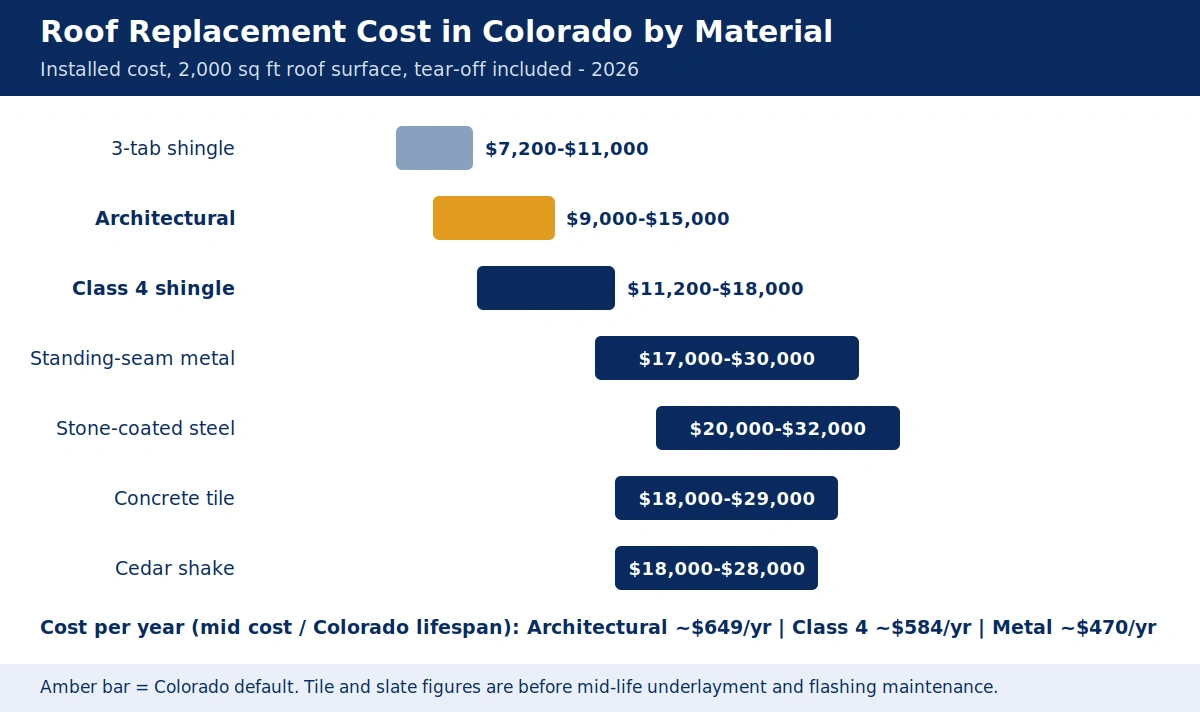
Material is the biggest single line on the invoice — metal costs roughly double what architectural shingles cost to install. But the sticker price tells only half the Colorado story, because hail, high-altitude UV, and freeze-thaw cut shingle life short while metal mostly outlasts the house. The table below pairs 2026 installed prices with Colorado lifespans and cost per year of service, so the expensive option can be judged on what it costs per year, not per invoice.
| Material | $/sq ft installed | 2,000 sq ft roof total | Colorado lifespan | Cost per year* |
|---|---|---|---|---|
| 3-tab shingle | $3.60–$5.50 | $7,200–$11,000 | 10–15 yrs | ~$480–$1,100/yr |
| Architectural shingle | $4.50–$7.50 | $9,000–$15,000 | 15–22 yrs | ~$410–$1,000/yr (mid ~$649/yr) |
| Class 4 impact shingle | $5.60–$9.00 | $11,200–$18,000 | 20–30 yrs | ~$373–$900/yr (mid ~$584/yr) |
| Standing-seam metal | $8.50–$15.00 | $17,000–$30,000 | 40–60 yrs | ~$283–$750/yr (mid ~$470/yr) |
| Stone-coated steel | $10.00–$16.00 | $20,000–$32,000 | 40–50 yrs | ~$400–$800/yr |
| Concrete tile | $9.00–$14.50 | $18,000–$29,000 | 40–50 yrs | ~$360–$725/yr |
| Cedar shake | $9.00–$14.00 | $18,000–$28,000 | 15–25 yrs | ~$720–$1,867/yr |
*Cost per year = installed cost divided by Colorado realistic lifespan. Tile figures are before mid-life underlayment and flashing maintenance. Lifespan and price sources: BestRoofingEstimates (2026).
Architectural shingles are what most Front Range roofs already are: the lowest bid, the most crews who install them, and the simplest product to patch after a storm. In Colorado they last 15–22 years — shorter than the brochure promises, because hail bruising and high-altitude UV age them faster than manufacturer defaults suggest. BestRoofingEstimates’ own worked example makes the value case for upgrading: a $18,500 Class 4 architectural job over a 25-year expected life costs roughly $740 per year in material amortization, while a $30,000 metal roof over 45 years costs about $667 per year — and that excludes reduced claim frequency and solar-compatibility benefits.
Class 4 impact-rated shingles are the upgrade this guide spends a whole section on below, because on the Front Range they are less an upgrade than the default specification. They run $5.60–$9.00 per sq ft installed, roughly 10–20% more than standard architectural shingles, and they stretch service life to 20–30 years while earning an insurance discount that typically runs 15–30% off the wind/hail portion of the premium (BestRoofingEstimates).
Standing-seam metal is the fastest-growing premium roofing category in Colorado, especially on mountain homes, foothill properties, and solar-ready new construction along the Front Range (BestRoofingEstimates). At $8.50–$15.00 per sq ft, a 2,000 sq ft roof runs $17,000–$30,000 — roughly double architectural shingle upfront. What you buy is 40–60 years, Class 4 impact resistance as standard, wind ratings around 140 mph with mechanical clipping, and a surface that sheds mountain snow cleanly. It also pairs exceptionally well with rooftop solar: S-5! and similar clamp-mount systems attach directly to the standing seam without penetrating the roof deck. The tradeoff, beyond price, is cosmetic: heavy Colorado hail can still ding panels, even though Class 4 metal rarely leaks after hail. Still weighing the two, our metal roof vs shingles cost comparison puts them head-to-head, and our metal roof cost guide has the national numbers.
Stone-coated steel (DECRA, Gerard, Metro, Boral and similar) runs $10.00–$16.00 per sq ft ($20,000–$32,000 on 2,000 sq ft) and combines the shingle look of architectural asphalt with 40–50 years of metal durability. The textured stone surface substantially reduces the cosmetic hail denting that slick standing seam suffers, which makes it a favored choice in HOA neighborhoods that restrict metal but want hail resilience. It also slows snow shedding, reducing the dangerous avalanche risk that slick metal presents on steeper mountain-home pitches.
Concrete tile runs $9.00–$14.50 per sq ft and is found mostly on Mediterranean and Spanish-revival architecture in select Denver, Littleton, and Cherry Creek neighborhoods. The tile itself lasts 40–50 years, but concrete can crack under severe hail — a real risk in the hail belt — and the underlayment beneath it gives out first, so budget for a mid-life re-lay. For the country-wide picture on tile, see our tile roof cost guide.
Cedar shake runs $9.00–$14.00 per sq ft and is becoming increasingly rare in Colorado for two reasons that have nothing to do with looks: it is restricted or banned outright in many wildland-urban interface fire zones, particularly in Boulder County, the Jefferson County foothills, and mountain communities, and it is especially vulnerable to hail. Most insurance carriers now either refuse to write policies on cedar Colorado homes or apply steep cedar-roof surcharges. Always verify local fire code and insurance availability before specifying cedar.
The takeaway: metal and stone-coated steel ask for roughly double the shingle money on day one, then hand most of it back over the decades — because a Colorado shingle roof comes off when hail, UV, or a Chinook wind says so, not when the warranty says so.
Roof Replacement Cost by Roof Size
The table below uses BestRoofingEstimates’ 2026 home-size table, priced by home size (living area) at the Front Range metro baseline, typical pitch 4:12–6:12, single-layer tear-off. Read it with the measuring-stick warning from the first section in mind: roof surface runs about 1.3 times living area, so a 2,000 sq ft home here usually carries a ~2,600 sq ft roof — and these totals are the ones BestRoofingEstimates published for that home size.
| Home size | 3-tab asphalt | Architectural | Class 4 IR shingle | Standing-seam metal |
|---|---|---|---|---|
| 1,000 sq ft | $4,700–$7,100 | $5,800–$9,800 | $7,300–$11,700 | $11,000–$19,500 |
| 1,500 sq ft | $7,000–$10,700 | $8,700–$14,600 | $10,900–$17,500 | $16,500–$29,300 |
| 2,000 sq ft | $9,400–$14,200 | $11,600–$19,500 | $14,600–$23,400 | $22,000–$39,000 |
| 2,500 sq ft | $11,700–$17,800 | $14,500–$24,400 | $18,200–$29,300 | $27,500–$48,800 |
| 3,000 sq ft | $14,100–$21,400 | $17,400–$29,300 | $21,900–$35,100 | $33,000–$58,500 |
Cross-checks: SmartRoofingCalculator’s Denver model puts architectural shingles on a typical 25-square Denver roof at about $12,400–$17,900 — inside the band above, toward the middle, as model estimates tend to run. Angi’s Denver average of $11,712 sits just below the table’s 2,000 sq ft architectural band, consistent with a smaller average Denver roof. A smaller house carries a steeper per-square-foot rate, since the fixed costs — permits, dumpsters, crew mobilization — get divided across fewer squares. Big or heavily cut-up roofs cost more for their shape, not just their size: anything above 7:12 pitch adds 15–30% to labor, and mountain homes at 8:12 to 12:12 sit squarely in that premium zone (BestRoofingEstimates).
Roof Replacement Cost by Region: Denver vs Colorado Springs vs Boulder vs Fort Collins vs the Mountains
Colorado roofing labor varies noticeably by region, but the spread is smaller than the weather spread. The Denver metro and the Front Range I-25 corridor set the statewide baseline. Colorado Springs tracks Denver within a few percent. Boulder runs a premium on higher home values, more complex roof geometries, and stricter wildfire and energy compliance. Mountain resort towns carry the big premium — access, seasonality, and specialty snow-load detailing. The Western Slope tracks closer to the Front Range mean.
| Region / Metro | Architectural asphalt (2,000 sq ft home) | Variance vs state mean |
|---|---|---|
| Denver Metro | $11,600–$19,500 | Baseline |
| Colorado Springs / Pikes Peak | $11,200–$18,500 | −2% to −5% |
| Boulder / Boulder County | $12,500–$21,500 | +5% to +10% |
| Fort Collins / Larimer County | $11,900–$20,100 | +3% to +6% |
| Grand Junction / Western Slope | $10,800–$17,700 | −5% to −8% |
| Mountain resort towns (Aspen, Vail, Breckenridge, Telluride) | $14,000–$27,500 | +20% to +40% |
Source: BestRoofingEstimates Colorado region table (2026).
Denver Metro is the benchmark: the deepest bench of crews, the most hail claims, and the most competitive bidding in the state. Within the metro, prices vary a few percentage points city to city. Cherry Creek, Cherry Hills, and Greenwood Village run 3–7% above the metro mean on higher-end homes, larger roof footprints, and HOA review steps. Denver proper, Lakewood, Arvada, and Aurora sit right at the metro mean. Thornton, Westminster, Commerce City, and Wheat Ridge run 2–4% below it. The spreads narrow on basic asphalt jobs and widen on premium metal and tile, where material handling and staging drive a larger share of the total (BestRoofingEstimates).
Colorado Springs / Pikes Peak closely mirrors Denver pricing because labor pools, material supply chains, and hail exposure are all comparable. The Pikes Peak Regional Building Department runs one regional permit and licensing system across El Paso and Teller counties, which keeps the paperwork simpler than Denver’s city-by-city maze.
Boulder / Boulder County runs 5–10% above the baseline. The premium comes from stricter energy compliance (SmartRegs), wildfire-zone material rules, and more complex roof geometries on higher-value homes. Boulder County also has its own permit portal for unincorporated areas, and it banned new wood shake roofs after the Marshall Fire — a rule that directly shapes material choice there.
Fort Collins / Larimer County runs 3–6% above the baseline, with the city running an insulation and ventilation review on full re-roofs that adds a step — and sometimes a cost — other Front Range cities skip.
Grand Junction / Western Slope runs 5–8% below the baseline on softer labor markets and lower hail exposure. The discount narrows on steep or high-elevation sites, where snow-load engineering and access difficulty add the premium back — and the hail case for Class 4 shingles is weaker there, so the payback math has to be run on the actual premium and discount rather than assumed from Front Range numbers.
Mountain resort towns — Aspen, Vail, Breckenridge, Telluride, Crested Butte — run 20–40% above the baseline. A 2,000 sq ft architectural asphalt job that runs about $14,500 in Lakewood or Aurora typically runs $18,000–$24,000 in a resort town. The premium comes from four forces: steeper pitches (often 10:12 or higher to shed heavy mountain snow), much higher design snow loads (often 80 to 200+ psf at elevation), harder access and longer crew travel, and a compressed install window that typically runs May through early October. Mountain metal installations can push $18–$25 per sq ft by the time snow-retention hardware, boot flashings for extensive vent systems, and helicopter material staging on unreachable sites are priced in (BestRoofingEstimates).
Why Colorado Roofs Cost What They Do: Hail, UV, Freeze-Thaw & Wind
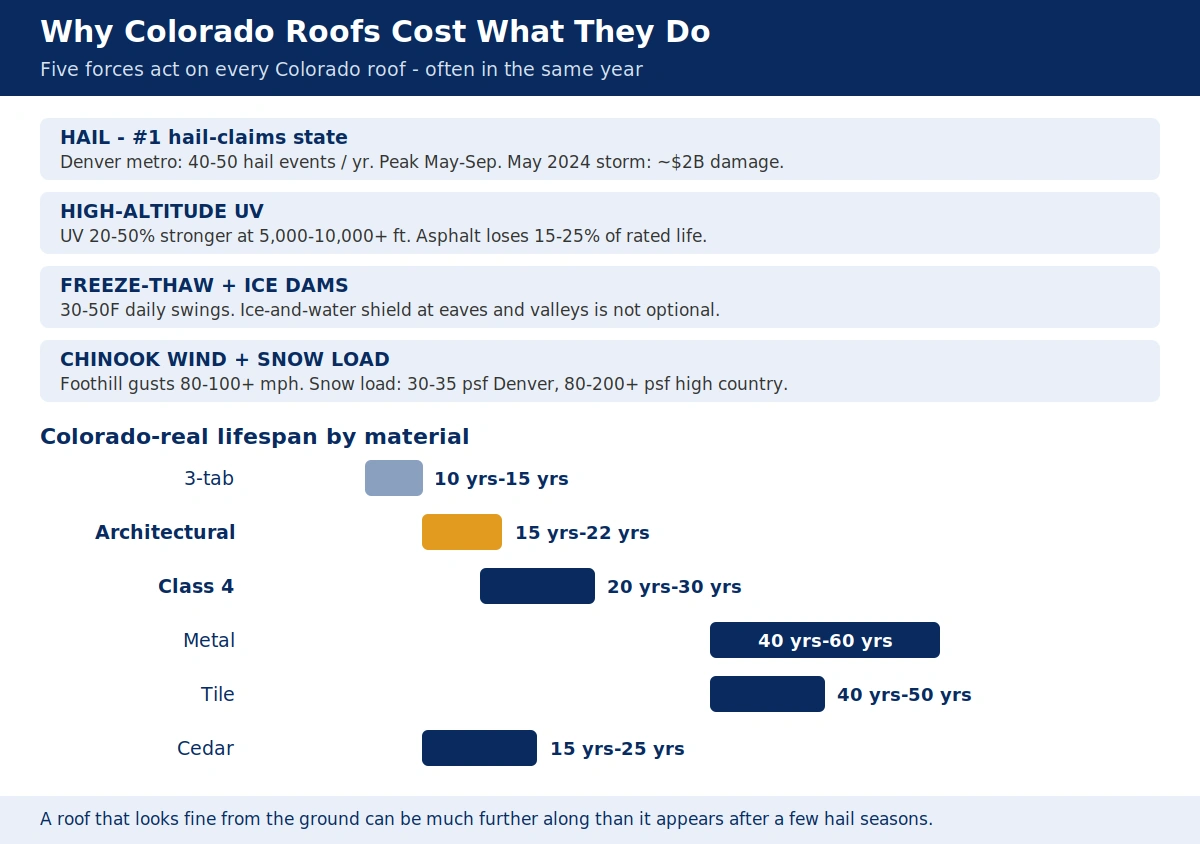
Colorado is one of the most demanding climates in the country for roofing systems because four distinct forces act on every roof in the state, often in the same year. Hail dominates the Front Range; high-altitude UV accelerates asphalt degradation everywhere; freeze-thaw cycling hits hardest at the foothills and at altitude; and Chinook winds plus microbursts drive wind-uplift events that look localized but cascade into full neighborhood-wide claims. A fifth force — snow load — rules the mountains. All five compound: UV-aged asphalt becomes more vulnerable to hail damage, hail creates micro-cracks that accelerate freeze-thaw degradation, and wind-peeled shingles expose underlayment to UV.
Hail is the force that sets Colorado prices. Colorado leads the United States in hail insurance claims, and the Front Range corridor from Colorado Springs through Denver to Cheyenne is known as Hail Alley. The Denver metro alone averages 40–50 hail events per year, with peak season running May through September and the worst large hail concentrated in late May through late June (BestRoofingEstimates). The Front Range sees 7–9 hail days per year. A Home Gnome 2025 analysis ranked Arapahoe County #1 nationally for hail risk, Jefferson County #2, and Denver County #5, with a risk score of 99.71 out of 100. The Rocky Mountain Insurance Information Association reports over $5 billion in insured hail damage over the past decade, with annual statewide damages averaging about $151 million — and the May 2024 Denver metro hailstorm alone caused nearly $2 billion in damages. The National Weather Service in Boulder reported that the 2023 Colorado hail season shattered records: reports of 2-inch hail nearly doubled from previous records, and baseball-sized hail reports nearly tripled since 2019. Stones above 1 inch dent standard asphalt shingles and crack tile, and a severe storm can total thousands of roofs across multiple counties in a single afternoon.
High-altitude UV quietly shortens every asphalt roof in the state. Denver sits at 5,280 feet, and at 5,000–10,000+ feet UV radiation runs 20–50% more intense than at sea level. UV breaks down asphalt binders, dries vent-boot rubber, and accelerates granule loss. BestRoofingEstimates puts the cost plainly: Colorado asphalt roofs lose 15–25% of manufacturer-rated life to altitude UV alone. That is why a shingle rated for 30 years in Ohio is a 15–22 year roof in Denver, and why premium synthetic underlayment and reflective-granule shingles are standard on quality Colorado bids while cheap 30-lb felt is a red flag. Rubber vent boots deserve a special mention: the gaskets fail fast at Colorado UV and altitude, and a $200–$450 boot replacement is one of the cheapest leaks to fix — and one of the most common to ignore until the ceiling stains.
Freeze-thaw cycling breaks asphalt from the inside. Colorado winter brings daily temperature swings of 30–50 degrees. Water trapped in shingle micro-cracks expands when frozen and contracts when thawed, steadily breaking down the asphalt matrix. On mountain and foothill roofs, ice dams form where attic heat melts snow and it refreezes at the cold eave, driving water back up under shingles and flashing. Ice-and-water shield at eaves, valleys, and penetrations is not optional in Colorado for exactly this reason, and a premium synthetic peel-and-stick field underlayment is standard on quality bids. Proper ridge-to-soffit ventilation plus an adequate interior-side vapor retarder prevents the wintertime condensation that silently rots decking from the underside — a $500–$2,200 upgrade at replacement time that is dramatically cheaper than doing it later.
Chinook winds and snow load finish the job. Front Range foothill communities — Boulder, Golden, the west side of Colorado Springs — regularly see 80–100+ mph Chinook gusts that strip shingle tabs on any roof with compromised sealant. At elevation, design snow load jumps from 30 psf on the plains to 80 or even 200+ psf in the high country. The Denver metro designs at 30–35 psf under the 2025 Denver Building Code (2024 IBC/ASCE 7-22 basis). Structural framing, sheathing fastening, and ice-and-water shield scope all scale with the snow-load rating, which is why mountain pitches run 8:12 to 12:12 and why anything above 7:12 adds 15–30% to labor.
The practical habit worth adopting in Colorado: have the roof inspected in late spring after peak hail events (typically June through early July) and again in late fall before winter. Small, cheap fixes caught in time keep minor hail or wind damage from becoming a full ice-dam winter leak into drywall that costs five to ten times as much to remediate. A competent Colorado roofer documents hail bruising by walking the roof after any storm over pea-size, and photographs findings against a date-stamped reference for any insurance claim — because hail damage signatures fade within months, and delayed claims on old damage are among the most common reasons carriers deny coverage.
Timing matters too. The best months to replace a roof in Colorado are May through June, after the last reliable freeze and before peak summer hail, and September through October, after the worst of hail season and before winter storms. The worst are January and February in the mountains, where the install window effectively closes, and mid-winter anywhere: shingle sealant strips take longer to activate below 40°F, and any tear-off left exposed overnight is at storm risk. Reputable Front Range contractors book three to six weeks out in peak shoulder season, so schedule early — and expect mountain crews to be booked solid from May through early October.
Class 4 Impact-Resistant Shingles: Colorado’s Default Roof?
On the Front Range, Class 4 impact-rated shingles are not really an upgrade. They are the baseline specification that happens to cost a little more — and in Colorado, they are the highest-leverage purchase on the roofing market. Here’s where the numbers pay off for a Front Range homeowner — and where they stop adding up.
What Class 4 means. The impact benchmark is UL 2218, and Class 4 sits at the top of it: a shingle earns the rating only if a steel ball two inches across, dropped from twenty feet up, leaves it uncracked. Named products in 2026 Colorado sources include Malarkey Vista AR, CertainTeed NorthGate, Owens Corning Duration Storm, GAF Timberline AS II, and Atlas StormMaster Shake (BestRoofingEstimates). Standard architectural laminates show functional damage at hailstone diameters of 1.25 inches or less — and 1.25-inch hail is a routine Front Range event, not a freak storm.
The discount is written into Colorado law. Colorado statute CRS 10-4-110.8 requires most residential insurers to offer a premium discount for qualifying impact-resistant roofing. Most major carriers — including State Farm, USAA, Allstate, American Family, Farmers, and Travelers — offer 15–30% off the wind/hail portion of the premium for a documented Class 4 roof (BestRoofingEstimates). On a typical Colorado policy that discount runs $150–$450 per year. Carrier-reported ranges run wider in high-hail areas — State Farm up to roughly 35%, Farmers agent-reported up to about 27%, USAA about 15% — but treat those as reported ranges, not promises: the exact figure depends on your carrier, policy, and location. Get the exact discount from your insurer in writing before you order, and get the Class 4 manufacturer certificate from your contractor to submit with your policy.
The dollar math. Class 4 runs $5.60–$9.00 per sq ft installed ($11,200–$18,000 on a 2,000 sq ft roof), roughly 10–20% more than standard architectural shingles — about $1.00–$1.50 per sq ft, or roughly $2,000–$3,500 on a 2,000 sq ft roof — and lasts 20–30 years instead of 15–22 (BestRoofingEstimates). At $150–$450 a year in premium savings, that premium pays back in three to seven years, then keeps paying for the life of the roof — while also dramatically reducing the likelihood of needing to file a claim in the first place. The deciding factor is where your house sits: in the Castle Rock through southeastern Denver into Aurora corridor, the Denver metro suburbs of Lakewood, Thornton, and Westminster, Colorado Springs, and Greeley and Weld County — which regularly top the state for total hail reports — the case is overwhelming. On the Western Slope around Grand Junction, hail exposure is generally lower, so the payback depends more on your specific premium and carrier discount.
Colorado gives you no single state form and no statewide roofing license to lean on — and that missing backstop is the trap. There is no single state form to file and no single list to check: the discount lives or dies on your insurer’s own documentation requirements. Ask your insurer to put its requirements in writing, file the product data sheet with the paid invoice, and get both to your agent the same week the crew finishes — don’t wait for renewal. Some Front Range contractors install Class 4 exclusively — one Colorado contractor’s published pricing installs Class IV asphalt only, at $380–$475 per square — which tells you how settled this question is among crews who work the hail belt every day.
Bottom line: on the Front Range, Class 4 is the default specification that happens to pay for itself. In the mountains, where snow load and wildfire rules compete for the budget, it is still the right call on most homes — metal is the only thing that beats it, and only on a long hold. On the Western Slope, run the numbers on your own premium before deciding.
Wildfire & Ember-Resistant Roofing: The 2025 Wildfire Resiliency Code
Colorado’s newest roofing rule is not about hail at all. It is about fire — and it reaches your roof sooner than most homeowners realize.
The code. Colorado adopted its first statewide wildfire building code, the Colorado Wildfire Resiliency Code (CWRC, 8 CCR 1507-39), effective July 1, 2025. Local jurisdictions were required to adopt it as a baseline by April 1, 2026, with full compliance by July 1, 2026. It applies only inside mapped wildland-urban interface (WUI) areas — the state has published an official CWRC map with a Fire Intensity Classification layer (Low, Moderate, High) — and your local building department can confirm whether a specific address falls inside a designated zone and which classification applies.
The 25% reroof rule. The CWRC is not retroactive. It reaches an existing home when you replace the roof covering, or 25% or more of the roof surface — at which point the whole roof has to meet Class A with compliant valley flashing, noncombustible gutters, and ember-resistant vents. That is the detail that catches homeowners by surprise: a partial repair that crosses the 25% line becomes a full code-compliant reroof. In Low fire-intensity areas, Class 1 hardening applies: Class A roof coverings, noncombustible gutters, and ember- or flame-resistant vents. In Moderate and High areas, Class 2 adds exterior walls, windows, doors, decking, eaves, and soffits on top of Class 1.
What counts as compliant. Most asphalt shingles, standing-seam metal, and stone-coated steel carry Class A fire ratings as installed. Cedar shake typically does not, even with fire-retardant treatment — and Boulder County mandated after the Marshall Fire (June 2022) that no new wood shake roofs be permitted on newly built homes, while Aspen, Summit County, and Boulder already ban natural wood shakes outright. Vents on enclosed attics, rafter spaces, and underfloor spaces must either be listed to ASTM E2886 or be covered with noncombustible, corrosion-resistant mesh with openings no larger than 1/8 inch. Gutters and downspouts must be noncombustible, which excludes vinyl and other plastic gutters in mapped areas.
The insurance angle. Colorado House Bill 25-1182 (2025) requires property insurers to credit documented wildfire mitigation in their ratings and to maintain a written appeal process for wildfire risk scores. A Class A roof, ember-resistant vents, and documented defensible space are the kind of mitigation that now has to show up in pricing — ask your carrier what it credits and what documentation it wants. The Insurance Institute for Business and Home Safety expanded its Wildfire Prepared Home designation program to more states in April 2026, and a designated home is the cleanest way to document mitigation in one package.
The honest caveat. A Class A roof makes your home harder to ignite, not fireproof. Embers also enter through vents, gutters, decks, eaves, and windows, and debris igniting in gutters plus combustible material within the first five feet of the structure are the dominant ignition pathways. The correct term is home hardening, not fireproofing — and the roof is the single most important piece of it, because embers land on roofs first. If your home sits in Boulder County, the Jefferson County foothills, the Colorado Springs foothills, or any mountain community, verify WUI compliance with your local building department before ordering material — not after the crew is on the roof.
Permits & Code: Denver, El Paso County, Boulder & Fort Collins
Colorado runs no single statewide building department, so the exact point at which a roof job legally needs a permit is whatever your specific city or county sets — and it varies between neighboring jurisdictions more than most homeowners expect. A full roof replacement requires a permit essentially everywhere in the state. The variation is mainly about smaller, partial jobs.
| City / Jurisdiction | Typical fee | What to know |
|---|---|---|
| Denver | $250–$600 | Valuation-based; 2025 Denver Building Code (2024 IBC basis); repair needs a permit once it exceeds 10% of roof area or 200 sq ft, whichever is smaller; every new penetration needs one; roof coatings do not |
| Colorado Springs / PPRBD | $150–$400 | Pikes Peak Regional Building Department covers El Paso & Teller counties; repairs larger than 100 sq ft need a permit, roughly $140 |
| Aurora | $175–$450 | Online permitting; mid-roof inspection on multi-layer tear-off |
| Boulder / Boulder County | $300–$700 | SmartRegs energy compliance; WUI ignition-resistant material rules |
| Fort Collins / Larimer Co. | $175–$450 | City-wide insulation and ventilation review on full re-roof |
| Lakewood / Arvada / Westminster | $150–$400 | Jeffco-region cities; each has its own contractor registration |
| Mountain towns (Aspen, Vail, Breckenridge) | $400–$1,200 | Snow-load structural review; WUI codes; design review common |
Source: BestRoofingEstimates Colorado permit table (2026); TallySquare (2026). The Colorado statewide permit average is around $280 (SmartRoofingCalculator model).
What the code actually requires on the roof itself. Colorado jurisdictions generally follow a current version of the International Energy Conservation Code, with Denver on a more recent edition plus the Energize Denver performance standard on larger buildings. The Denver metro designs at 30–35 psf snow load; the high country designs at 80–200+ psf, which is why mountain permits carry a snow-load structural review. Ice-and-water shield at eaves, valleys, and penetrations is effectively universal on quality bids. Attic insulation is commonly targeted at R-49 in Colorado climate zones, and topping attic insulation during a re-roof — when the deck is exposed — is dramatically cheaper than doing it separately. Boulder’s SmartRegs energy compliance and Fort Collins’ insulation and ventilation review both bite at re-roof time, so budget the review into the schedule.
Two more Colorado rules to know before you put pen to paper. In WUI areas, the 2025 Wildfire Resiliency Code’s 25% reroof rule (see the wildfire section above) can turn a partial job into a full Class A reroof with ember-resistant vents and noncombustible gutters — confirm your parcel’s WUI status with the building department before the permit is pulled. And in historic districts — particularly parts of central Denver and Boulder — architectural review can restrict a metal retrofit or a material change, so check your CC&Rs and local historic-district guidelines before ordering materials. A permit without the review-board sign-off is a permit that can still stop the job.
Hiring a Roofer in Colorado: No Statewide License — What to Check Instead
Colorado has one fact that surprises almost every homeowner who moves here from another state: there is no statewide roofing contractor license. Colorado’s Division of Professions and Occupations publishes an exhaustive Occupational Professions List — accountancy, architects, engineers, barbers, electricians, plumbers, outfitters, radon professionals — and roofing is not on it. There is no roofing board, no state registry, and no state exam. Do not point a homeowner at DORA to verify a roofer, because DORA does not license roofers.
Licensing is municipal and county, and it does not transfer. Each city and county sets its own rules, and a license in one city is not automatically a license in the next one over:
- Denver — the city requires a municipal roofing license before a contractor pulls a permit or installs a single shingle, issued through Community Planning & Development. Sources differ on the class label — one 2026 Denver contractor guide calls it a Specialty Class D Roof Covering/Waterproofing license, another calls it a Class C Roofer Registration issued by the Department of Excise and Licenses — so confirm the current class with the city itself rather than trusting any single label. There are two Class D roofing classifications in Denver: Roofing-Shingles, which covers residential-only systems, and Roofing Covering/Waterproofing, which covers both residential and commercial work including low-slope membranes, valleys, gutters, and downspouts.
- Colorado Springs — the Pikes Peak Regional Building Department (PPRBD) issues a residential roofer’s license covering El Paso and Teller counties. Look it up at pprbd.org.
- Aurora — the City of Aurora Building Division issues its own contractor registration required for any roofing work within city limits.
- Boulder & Boulder County — requires a Class D or equivalent contractor license; Boulder County has its own separate permit portal for unincorporated areas.
- Fort Collins — the City of Fort Collins Building Services issues a roofing contractor license; Larimer County maintains its own registration for unincorporated areas.
- Jefferson County — the county planning office or the local municipalities (Lakewood, Arvada, Wheat Ridge, Westminster, Golden) handle licensing, and each has slightly different rules.
What the state does require. Colorado House Bill 10-1394 (2010) requires roofing companies to register with the Colorado Secretary of State and carry liability insurance. That is registration, not a license — a company registered with the Secretary of State but without the local municipal license is not authorized to pull permits or perform licensed roofing work inside city limits. HB 10-1394 also governs insurance-paid roofing: a contractor may not pay or waive any part of the homeowner’s insurance deductible, and the contract must carry a cancellation right. A “we’ll cover your deductible” pitch is not a favor — it is a violation of the statute, and a red flag either way.
The six-step vetting process (BestRoofingEstimates): verify the local license with the jurisdiction your home sits in — ask which specific jurisdiction issued it, and confirm it is current with that jurisdiction’s own building department; confirm bonding and insurance — general liability minimum $1M and an active workers’ comp certificate mailed directly from the carrier; check that the business name on the license matches the business name on the contract exactly, because storm-chaser contractors operating out-of-state after major hail events are a long-standing Colorado problem and a mismatched business name is the single biggest red flag; require a written, itemized proposal with tear-off, underlayment grade, shingle model, flashing scope, ridge vent, disposal, permit, and final cleanup as separate line items, with the Class 4 product name and the ice-and-water shield scope specified; reject layover-only bids, which trap moisture under Colorado freeze-thaw and typically void the manufacturer warranty; check manufacturer certification (GAF Master Elite, Owens Corning Platinum Preferred, CertainTeed SELECT ShingleMaster, Atlas Pro Plus); and pay in milestones, never in full upfront — the typical draw is 10% deposit, 40% on material delivery, 40% at dry-in, 10% at final inspection.
The storm-chaser problem is Colorado-specific in scale. After every major Front Range hail event, out-of-state crews flood in, knock on doors, and offer to “handle the insurance claim.” Use a locally licensed contractor with a verifiable physical address inside Colorado. Never sign an assignment of benefits that hands your insurance claim rights to the contractor, and never let a contractor negotiate the claim for you — document the damage, file the claim yourself, and keep the contractor’s job to the roof. Before you sign anything, run every bidder through our questions to ask a roofer — the vetting checklist we wrote to go with this guide.
Insurance: Hail Claims, ACV vs RCV & Deductibles
Colorado homeowner policies typically cover roof damage from sudden events — hail, wind, and snow-load failure. Slow wear, skipped maintenance, and a roof that simply aged out are all excluded. Three things on your declarations page decide more about a roof claim than the storm does: how the policy values the roof, how the deductible is written, and whether cosmetic damage is covered at all.
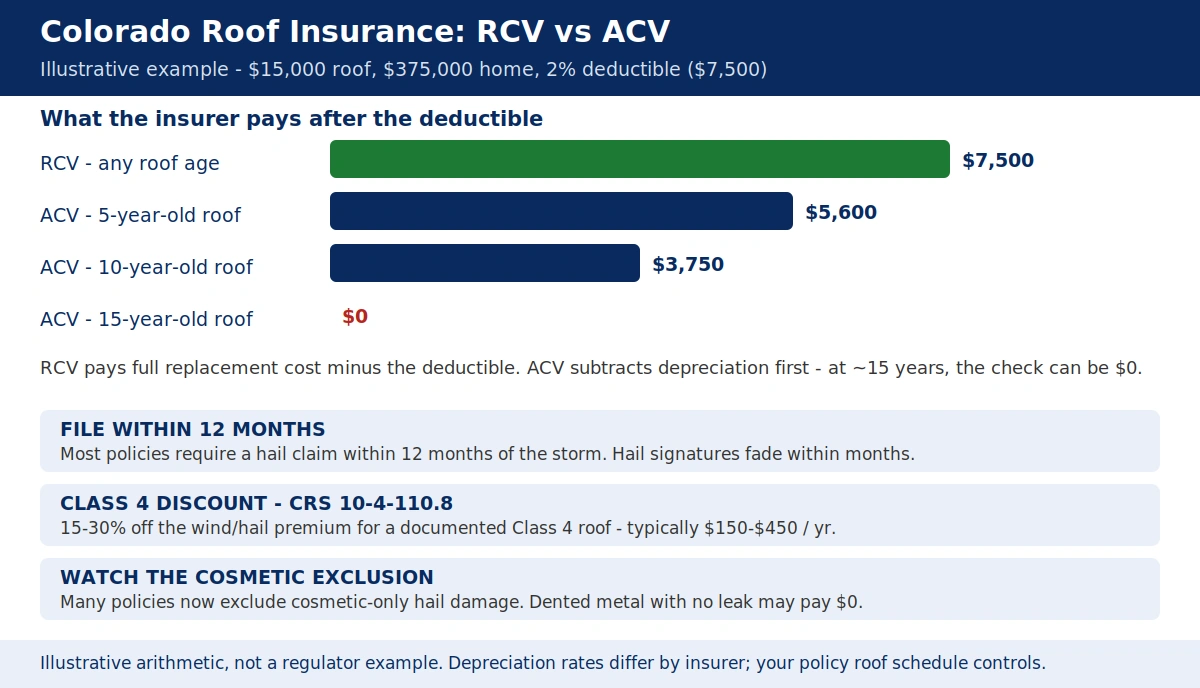
Covered damage, and damage that is not. Sudden storm damage is covered. A roof that simply wore out after years of Front Range hail and high-altitude sun gets no payout at all. A large share of Colorado roofs are replaced through homeowner insurance claims following a hail or wind event, not age-driven replacement — and most policies require you to file a claim within 12 months of the storm. Ask your contractor to photo-document damage before filing, with date-stamped photos, because hail damage signatures fade within months (BestRoofingEstimates).
Replacement cost or actual cash value — which one your policy pays is what decides the size of the check. With Replacement Cost Value, the carrier covers what a brand-new roof runs today, less your deductible. With Actual Cash Value, the check shrinks by depreciation — the older and more worn the roof, the smaller the payout from that same figure. The example below is illustrative arithmetic, not a regulator’s published example — no Colorado regulator example was found for this guide. Take a $15,000 replacement on a $375,000 dwelling with a 2% wind/hail deductible ($7,500): an RCV policy pays $7,500 after the deductible at any roof age, once the work is done and proven. An ACV policy on the same roof at about 15 years old, with roughly half its value depreciated, pays about $7,500 minus the $7,500 deductible — about $0. The depreciation gap is the whole claim.
| Roof age | RCV payout (illustrative) | ACV payout (illustrative) |
|---|---|---|
| New (0–2 years) | $7,500 | ~$7,000–$7,500 |
| 5 years | $7,500 | ~$5,600 |
| 10 years | $7,500 | ~$3,750 |
| 15 years | $7,500 | ~$0–$1,900 |
| 20+ years | $7,500 | $0 |
*Illustrative arithmetic: $15,000 roof, $7,500 deductible (2% of a $375,000 dwelling limit). How fast a roof depreciates varies from carrier to carrier, so the roof schedule printed on your own policy is the one that decides.*
The cosmetic-damage exclusion is the clause Front Range owners miss. Insurers increasingly write policies that exclude cosmetic-only hail damage — dents in metal panels or granule bruising on shingles that do not cause a functional leak. A Class 4 metal roof can survive a storm with zero leaks and still be visibly dented, and under a cosmetic exclusion the carrier pays nothing for the dents. Read the roof schedule and endorsements before the next storm season, not after it, and ask your agent directly whether cosmetic hail damage is covered on your policy.
Deductibles are usually percentage-based on the Front Range. A 1–2% wind/hail deductible is common, which means the deductible on a $375,000 dwelling is $3,750–$7,500 — a number that surprises owners who assumed a flat $1,000 deductible. Some policies carry a separate, higher wind/hail deductible than the standard deductible on the rest of the policy. And remember the Class 4 discount from the section above: a documented Class 4 roof typically earns 15–30% off the wind/hail portion of the premium under CRS 10-4-110.8, which is the closest thing Colorado has to a recurring roof rebate.
Claim timing and complaints. Photograph everything with dates on the pictures, file fast, and hang on to every tarping receipt — hail and wind marks wash out within months, and a late claim on stale damage is one of the easiest ways for a carrier to say no. The Colorado Division of Insurance handles rate filings and consumer complaints. And when hail damage is genuinely close to the repair-vs-replace line, an independent roof inspection is the cheapest way to settle it before calling contractors.
Paying for It: Financing, Rebates & No Federal Credit in 2026
Federal help for a 2026 roof: zero. For any roof installed after December 31, 2025, OBBBA (P.L. 119-21) wiped out both §25C and §25D. So for a 2026 roof on the home you live in, the federal credit is zero — nothing at all. A few Colorado roofing pages still pitch a federal energy credit for insulation bundled with a reroof — that pitch relies on law that no longer exists, because the insulation and air-sealing credit ended with §25C. Plan your budget as though that credit never existed — unless a tax professional puts the opposite in writing for you.
There is no Colorado statewide roof rebate to replace it. No 2026 source verified a Colorado equivalent of Florida’s My Safe Florida Home grant program, and no current residential cool-roof rebate dollar figure was verified for Xcel Energy or Black Hills Energy. Don’t anchor your budget to a grant that doesn’t exist in Colorado.
The narrow help that does exist is utility and insurance-based, not a roof grant. Xcel Energy’s Home Efficiency and Insulation Rebate programs reward attic insulation upgrades commonly bundled with a roof tear-off — topping attic insulation when the deck is exposed is dramatically cheaper than doing it separately. Black Hills Energy offers efficiency rebates in the Colorado Springs and southern Colorado service territory for insulation and cool-roof bundles. The HEAR rebate (up to $8,000, income-qualified) covers heat pumps and electrification, not roofing. And under HB 25-1182, insurers must credit documented wildfire mitigation — including Class A roofing — in their ratings.
The real Colorado “rebate” is the insurance discount. A documented Class 4 roof earns 15–30% off the wind/hail portion of the homeowner premium, and metal earns the same band automatically (see the Class 4 section above). And unlike a grant that lands once, this saving stacks up again every single year the roof stays on the house.
How Coloradans actually pay for a roof (BestRoofingEstimates): the insurance claim path, where storm damage qualifies — deductible applies, the 12-month filing window matters, and ACV vs RCV decides the check; a HELOC or home-equity loan, usually the cheapest rate you will find, though closing takes weeks and the house itself secures the loan; contractor financing through lenders like GreenSky, Service Finance, and Hearth — fast decision, no-equity situations, 0% promo periods common, read the reset-rate fine print; and FHA Title I or 203(k) programs for owner-occupied homes and mid-credit buyers, which are slower to close. Front Range owners with large equity cushions sometimes find a cash-out refinance makes sense when rates are favorable — run the numbers with a lender before committing.
No Colorado-specific contractor APR figures were verified in 2026 sources, so this guide gives none. The same borrowing rules apply here as anywhere: compare APRs instead of monthly payments, stay clear of the deferred-interest trap — a balance still sitting there when a 0% promo ends can pull retroactive interest at 20% or more — and don’t let the loan run longer than the roof, because twenty years out of a shingle roof should never come with a twenty-five-year loan attached. Our roof financing guide lines up every payment route next to each other so you can compare them directly.
If you own solar, there’s one more line to chase: the panels have to come off and go back on around a reroof, so make sure the detach-and-reset cost is written into the claim scope. No verified Colorado dollar figure for detach-and-reset was found, so get it quoted as its own line item — and note that standing-seam metal with clamp mounts makes the next detach-and-reset cheaper, because the mounts never penetrated the deck.
Repair vs Replace: The Colorado Decision Rules
Repair costs (BestRoofingEstimates, Front Range pricing; mountain communities add 15–30%):
| Repair | Typical range |
|---|---|
| Most repair calls | $400–$1,500 |
| Typical repair call-out | $675 |
| Missing / lifted shingles | $300–$750 |
| Hail-damage inspection & claim documentation | $0–$350 (often free if claim filed) |
| Flashing replacement | $450–$1,200 |
| Active leak diagnosis & patch | $500–$1,600 |
| Ice-dam steaming & remediation | $400–$1,400 |
| Vent boot / pipe-collar replacement | $200–$450 |
| Emergency tarp (post-storm) | $350–$1,000 |
| Snow shoveling / load reduction | $300–$900 |
Missing and lifted shingles are common after Chinook wind events along the foothills. Flashing — chimney, skylight, and wall-step — is a common failure point, and ice-dam steaming is a foothill and mountain staple. Rubber vent boots deserve a repeat mention: the gaskets fail fast in Colorado sun, and a $200–$450 boot replacement is one of the cheapest leaks to fix.
A replacement wins out once two or more of these ring true (BestRoofingEstimates):
- Architectural shingle roof age 15+ in Colorado — surrounding materials are already UV-aged and hail-pitted, so patching has diminishing returns
- Three or more leaks in a year — coming back for repairs that often points to the underlayment or flashing failing as a system, not one bad spot
- Interior staining, soft decking, or heavy granule loss — when gutters and driveways fill with granules after Front Range storms, the asphalt binders have already broken down
- Hail damage spread across the whole field — that kind of spread usually points to a full claim instead of a repair
- Cedar shake in a WUI zone, or an insurer that will no longer write the roof — the material itself has become the problem
- Age past the Colorado lifespan for the material, especially in the hail corridor
A repair is the right call when: one leak you can trace on a roof still early in its life, a few shingles lifted by a single Chinook gust, a dead pipe boot, or a flashing detail that gave way. If a repair quote is what you actually need today rather than a replacement number, our roof repair cost guide has those prices.
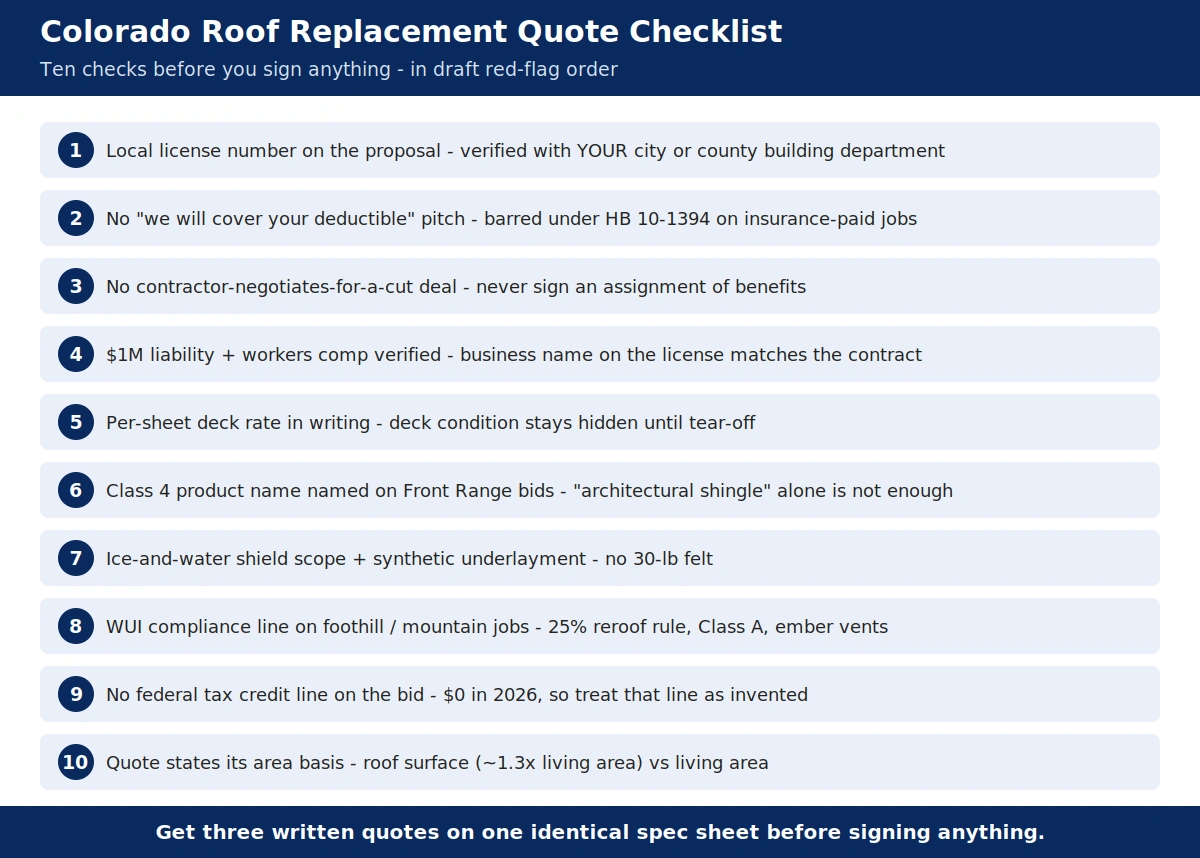
Quote red flags, Colorado-specific:
- No local license number on the proposal — Colorado has no statewide license, so the license that matters is the one from your city or county. Look it up with that jurisdiction before anyone climbs on your roof.
- A “we’ll cover your deductible” pitch — barred under HB 10-1394 on insurance-paid jobs, and a red flag either way.
- A contractor who offers to negotiate with your insurer for a cut — document the damage yourself and file the claim yourself; never sign an assignment of benefits.
- No $1M liability insurance or workers’ comp certificate — these are verifiable, not optional, and the business name on the license must match the contract exactly.
- No per-sheet deck rate — nobody can see the deck’s condition until the tear-off exposes it. Skip the decking allowance in the bid and the total jumps the moment the old shingles come off and the real deck shows itself.
- No Class 4 product name on a Front Range bid — if the bid just says “architectural shingle,” the upgrade that pays for itself was never quoted.
- No ice-and-water shield scope or 30-lb felt instead of synthetic underlayment — freeze-thaw and altitude UV punish cheap underlayment first.
- No WUI compliance line on a foothill or mountain job — a reroof that crosses the 25% threshold in a mapped WUI area must meet Class A with ember-resistant vents and noncombustible gutters.
- A tax-credit line on the bid — that credit is gone for 2026 owner-occupied roofs, so any bid still showing one is padding its numbers with fiction.
- One bare $/sq ft number with no area behind it — a Colorado roof surface runs about 1.3 times the living area, so that lone figure tells you nothing on its own. A quote that hides which area it measured can’t be stacked up against one that spells it out.
Before you sign anything, run every bidder through our questions to ask a roofer — the vetting checklist we wrote to go with this guide. And if your gutters are part of the job, our gutter installation cost guide prices them — remember that in a WUI area the gutters themselves must be noncombustible.
Sources & methodology
Cost anchors: BestRoofingEstimates — “How Much Does a New Roof Cost in Colorado?” (2026, crawled Nov 6, 2026) — primary Colorado anchor: material table, home-size table, region table, permit table, repair table, licensing, climate zones, financing, cost-per-year examples, average ~$14,500 on a 2,000 sq ft home; Angi — “How Much Does Roof Replacement Cost in Denver, CO?” (updated Aug 4, 2026: Denver avg $11,712, most $7,419–$16,461, $4–$11/sq ft); HomeYou — “Roof Replacement Cost Estimate for Denver, CO (2026)” (updated Sep 3, 2026: $9,162–$18,548, avg ~$12,138); SmartRoofingCalculator — “Denver, CO Roof Replacement Cost” (2026 model: arch. $495–$715/square, 25-square roof $12,400–$17,900, Denver ~10% above CO baseline; CO permit avg ~$280 — model-derived, cross-check only); myidealpros — “Roof Replacement Cost in Denver 2026” (Jun 2026: asphalt $12,000–$35,000, $4.50–$8.50/sq ft); Northern Lights Exteriors — “Roofing & Roof Replacement Cost in Colorado” (2026: Class IV asphalt $380–$475/square, typical 20–25 sq home $7,600–$11,900 — contractor low-end cross-check). The 2,000 sq ft roof-surface totals and the cost-per-year figures are arithmetic we did from BestRoofingEstimates’ per-square-foot ranges.
Hail + climate: BestRoofingEstimates CO climate section (2026: Denver metro 40–50 hail events/yr, May–September peak, UV 20–50% stronger at altitude, 15–25% life loss, 30–50°F daily swings, Chinook gusts 80–100+ mph, snow load 30 psf plains to 80–200+ psf high country, 12-month claim window, 3–6 week booking lead); Peak Builders Denver — “Roofing in Denver: Hail Damage” (2026: Home Gnome 2025 county hail-risk ranks Arapahoe #1, Jefferson #2, Denver #5; RMIIA $5B+ decade hail damage, ~$151M/yr avg; May 2024 Denver storm ~$2B; NWS Boulder 2023 record season); RoofingStuffs — “Denver Roofing Materials & Conditions Guide” (2026: Denver snow load 30–35 psf under 2025 Denver Building Code, 2024 IBC/ASCE 7-22; CRS 10-4-110.8 discount 15–30%; Class 4 as baseline spec); Spencer Roofing Denver FAQ (2026: Front Range 7–9 hail days/yr, April–August peak).
Class 4 + insurance: BestRoofingEstimates CO (2026: Class 4 $5.60–$9.00/sq ft, +$1.00–$1.50/sq ft premium, 15–30% discount, $150–$450/yr saving, 3–7 yr payback, named products Malarkey Vista AR, CertainTeed NorthGate, Owens Corning Duration Storm, GAF Timberline AS II, Atlas StormMaster Shake); CRC / Your Commercial Roofer — “Residential Asphalt Shingle Roofing” (2026: carrier discount reports State Farm up to ~35%, USAA ~15%, Farmers up to ~27%; Class 4 = 10–20% premium; UL 2218 2-inch steel ball from 20 ft).
Licensing + permits: Mighty Dog Roofing Downtown Denver — “Roofing Contractor vs. Roofing Company in Denver” (Apr 22, 2026: no statewide license; Denver Specialty Class D; HB 10-1394 registration + insurance); TallySquare — “Roof Replacement Cost in Colorado (2026)” (Aug 2026: no state license; PPRBD >100 sq ft permit ~$140; Denver >10%/200 sq ft trigger); Colorado Roof Authority / RoofingLicenseCheck (Oct 22, 2026: no state license; municipal licensing matrix; DPO Occupational Professions List excludes roofing); BestRoofingEstimates CO permit table (2026: Denver $250–$600, PPRBD $150–$400, Aurora $175–$450, Boulder $300–$700, Fort Collins $175–$450, mountain towns $400–$1,200).
Wildfire code: Greg Unseth Painting — “Colorado’s New Wildfire Code” (2026: CWRC adopted Jul 1, 2025; local adoption by Apr 1, 2026; full compliance Jul 1, 2026; Class 1/2 hardening); Kudu Roofing — “Colorado Wildfire Resiliency Code and Your Roof” (2026: 25% reroof rule, Class A, 1/8-in mesh vents, noncombustible gutters, 8 CCR 1507-39); Town of Lyons PCDC memo (Oct 27, 2025); GlobeNewswire CEDUR release (Oct 20, 2026: HB 25-1182 insurer mitigation credits; 25% rule; Boulder wood-shake bans; Marshall Fire June 2022 mandate).
Federal credit: OBBBA (P.L. 119-21); IRS FS-2025-05 — §25C/§25D ended for post-Dec-31-2025 installs. BestRoofingEstimates’ CO page still mentions §25C for insulation bundled with a reroof; that is outdated law and is not repeated here as live.
Method notes: RCV vs ACV table and the $15,000-roof example are illustrative arithmetic, not a regulator’s published example; no Colorado regulator example was found. Carrier discount percentages beyond the 15–30% band are reported ranges, not promises. The Denver license class label differs between 2026 sources (Specialty Class D vs Class C Roofer Registration) and is flagged in the text rather than resolved. No Colorado-specific contractor APR figures were verified, so none are given.
How much does a roof replacement cost in Colorado in 2026?
Most Colorado asphalt replacements run $9,400–$24,000 in 2026. Architectural shingles on a typical 2,000 sq ft Front Range home cost $11,600–$19,500 (BestRoofingEstimates; average about $14,500). On a 2,000 sq ft roof surface: 3-tab shingles $7,200–$11,000, Class 4 shingles $11,200–$18,000, standing-seam metal $17,000–$30,000, stone-coated steel $20,000–$32,000. Denver runs at the statewide baseline; Boulder runs 5–10% above it; mountain resort towns run 20–40% above it.
Why is my Colorado roof quote so different from my neighbor’s?
Roof surface runs about 1.3 times living area — 1.4–1.5 times on mountain and foothill homes — and quotes price different areas, so a 2,000 sq ft home can be priced as a 2,000 sq ft roof or a ~2,600 sq ft one. Material, pitch above 7:12 (+15–30% labor), tear-off layers, decking condition, and region all move the number. Two quotes cannot be compared until you know which area each one measured.
Are Class 4 impact-resistant shingles worth it in Colorado?
On the Front Range, yes — they are effectively the default roof. They cost 10–20% more than standard architectural shingles ($5.60–$9.00 per sq ft installed) and last 20–30 years instead of 15–22. Colorado statute CRS 10-4-110.8 requires most residential insurers to offer a discount for impact-resistant roofing, typically 15–30% off the wind/hail portion of the premium — usually $150–$450 a year, which pays the upgrade back in three to seven years. Get the exact discount from your insurer in writing and the Class 4 manufacturer certificate from your contractor. On the Western Slope, where hail is lighter, run the numbers on your own premium first.
Does my Colorado roofer need a license?
Yes — but not a state one, because Colorado has no statewide roofing license. Licensing is municipal and county: Denver requires a municipal roofing license through Community Planning & Development, Colorado Springs uses the Pikes Peak Regional Building Department license covering El Paso and Teller counties, and Aurora, Boulder, Fort Collins, and the Jefferson County cities each run their own programs. A license in one city does not transfer to another. Verify every bidder with the building department of the jurisdiction your home sits in, and confirm $1M liability insurance and workers’ comp before signing.
Do I need a permit to replace my roof in Colorado?
Yes — a full replacement requires a permit essentially everywhere in the state. Typical fees: Denver $250–$600, Colorado Springs / PPRBD $150–$400, Aurora $175–$450, Boulder $300–$700, Fort Collins $175–$450, mountain towns $400–$1,200. The variation is mainly about smaller jobs: in Denver a repair needs a permit once it exceeds 10% of the roof area or 200 sq ft, whichever is smaller; in the Pikes Peak region the trigger is repairs larger than 100 sq ft. Check with your own city or county building department before work starts, and remember that in a mapped wildfire zone the 25% reroof rule can turn a partial job into a full Class A reroof.
What is Colorado’s 2025 wildfire code and does it affect my roof?
The Colorado Wildfire Resiliency Code (8 CCR 1507-39) took effect July 1, 2025, and applies inside mapped wildland-urban interface areas. It is not retroactive, but it reaches an existing home when the roof covering — or 25% or more of the roof surface — is replaced: then the whole roof must meet Class A with compliant valley flashing, noncombustible gutters, and ember-resistant vents. Most asphalt shingles, standing-seam metal, and stone-coated steel carry Class A as installed; cedar shake typically does not, and Boulder County and several mountain jurisdictions ban new wood shakes outright. Check your parcel’s WUI status with your building department before ordering material.
Is there a federal tax credit for a new roof in Colorado in 2026?
No — $0. OBBBA shut the door on §25C/§25D for anything put in service after December 31, 2025. Colorado has no statewide roof rebate to replace it. The narrow help that exists is utility-based: Xcel Energy and Black Hills Energy offer insulation rebates that can be bundled with a tear-off, and the HEAR rebate (up to $8,000, income-qualified) covers heat pumps, not roofing. The real recurring payback is the insurance discount — 15–30% off the wind/hail premium for a documented Class 4 roof — plus wildfire-mitigation credits under HB 25-1182.
How long does a roof last in Colorado?
Shorter than the brochure promises, because of hail and altitude UV. Realistic Colorado lifespans: 3-tab shingles 10–15 years, architectural shingles 15–22 years, Class 4 shingles 20–30 years, standing-seam metal 40–60 years, stone-coated steel 40–50 years, concrete tile 40–50 years, cedar shake 15–25 years. UV at 5,000–10,000+ feet runs 20–50% more intense than at sea level and costs asphalt roofs 15–25% of their rated life. A roof that “looks fine” from the ground can be much further along than it appears after a few hail seasons — get it inspected in late spring after peak hail events and again in late fall before winter.