

Table of Contents
Virginia does not price roofs the way its neighbors do. Drive two hours in any direction and the job changes: in Fairfax County the crew is paid Washington wages and the permit desk is the strictest in the state; in Virginia Beach the same shingle gets six nails instead of four because the wind code says so; in Richmond the roof might be slate on a street where a review board has to approve the color; and in Bristol the same architectural shingle costs thousands less because the labor market is softer and the roof is simpler. The material matters, but in Virginia the address matters almost as much.
This guide prices the state the way a Virginia estimator would: by material, by roof size, and by region — Northern Virginia, Richmond, Hampton Roads, and Southwest Virginia — with the slate, wind, permit, licensing, and insurance rules that actually move the number. It also covers the one date every Virginia homeowner should know before signing anything: January 1, 2027, when the state’s new roof law switches on.
For the country-wide baseline, begin with our roof replacement cost guide.
How Much Does a Roof Replacement Cost in Virginia in 2026?
The strongest Virginia anchor is BestRoofingEstimates’ 2026 state guide: a full architectural asphalt replacement on a typical Virginia home runs roughly $9,000–$19,000, with an average of about $12,600 on a 2,000 sq ft home. Its per-square-foot table puts architectural shingles at $6.00–$9.20 per sq ft installed, which is $12,000–$18,400 on a 2,000 sq ft roof surface. Modernize’s 2026 Virginia calculator lands in the same territory from above: most homeowners spend $9,500–$24,000, averaging about $14,600 for architectural asphalt on a typical 1,800–2,200 sq ft home, at $5–$11 per sq ft. A model-based cross-check from SmartRoofingCalculator puts architectural shingles at $430–$620 per square ($4.30–$6.20 per sq ft), or $10,750–$15,500 for a typical 25-square roof — toward the low end, as model estimates usually run.
Put together, the honest headline is this: most Virginia homeowners pay $9,500–$24,000 for a full replacement in 2026, and architectural shingles on a typical 2,000 sq ft roof sit at $12,000–$18,400. All prices below are installed totals with tear-off included, except where the text says otherwise.
| Material | $/sq ft installed (roof surface) | 2,000 sq ft roof total | Virginia realistic lifespan |
|---|---|---|---|
| 3-tab shingle | $4.80–$7.20 | $9,600–$14,400 | 15–20 yrs |
| Architectural shingle | $6.00–$9.20 | $12,000–$18,400 | 20–25 yrs |
| Class 4 impact shingle | $7.20–$10.50 | $14,400–$21,000 | 25–30 yrs |
| Standing-seam metal | $10.00–$17.50 | $20,000–$35,000 | 45–60 yrs |
| Concrete / clay tile | $10.50–$16.00 | $21,000–$32,000 | 40–60 yrs |
| Natural slate | $18.00–$32.00 | $36,000–$64,000 | 75–125 yrs |
| Synthetic slate | $14.50–$22.00 | $29,000–$44,000 | 40–50 yrs |
| Cedar shake | $9.00–$15.00 | $18,000–$30,000 | 20–30 yrs |
Sources: BestRoofingEstimates Virginia guide (2026); Modernize Virginia calculator (updated August 27, 2026); SmartRoofingCalculator Virginia model (2026, cross-check only).
One warning before you use any of these numbers: roof surface is not home size. BestRoofingEstimates says a Virginia roof surface runs about 1.3 times the living-area footprint, yet its own home-size table prices a 2,000 sq ft home at $12,000–$18,400 — the same total as a 2,000 sq ft roof at $6.00–$9.20 per sq ft. Both cannot be true at once: a 2,000 sq ft home with a ~2,600 sq ft roof priced at $6.00–$9.20 per sq ft would be $15,600–$23,900. The headline in this guide is for a 2,000 sq ft roof surface, and the home-size table below is reproduced as BestRoofingEstimates published it. The practical lesson is the one Virginia estimators repeat on every walk-through: make the roofer measure the roof, and make every quote state which area it priced. A bid that never says whether it priced living area or roof surface cannot be compared to one that does.
Where the money goes on a typical Virginia job: labor runs 55–65% of the total in Richmond and Hampton Roads, with Northern Virginia pushing the labor share higher on Washington, D.C. wage pressure (BestRoofingEstimates). Materials take roughly 40%, and overhead and profit the rest. Permit, haul-off, and mobilization typically add $300–$850 combined, with Northern Virginia at the top of that range. A second tear-off layer adds $1.00–$1.80 per sq ft, and Virginia homes built before the mid-1990s frequently carry two layers. Decking is the unknown until tear-off: replacement runs $60–$95 per 4×8 sheet installed, and humidity rot shows up on 5–15% of boards, more on shaded north slopes and in Tidewater.
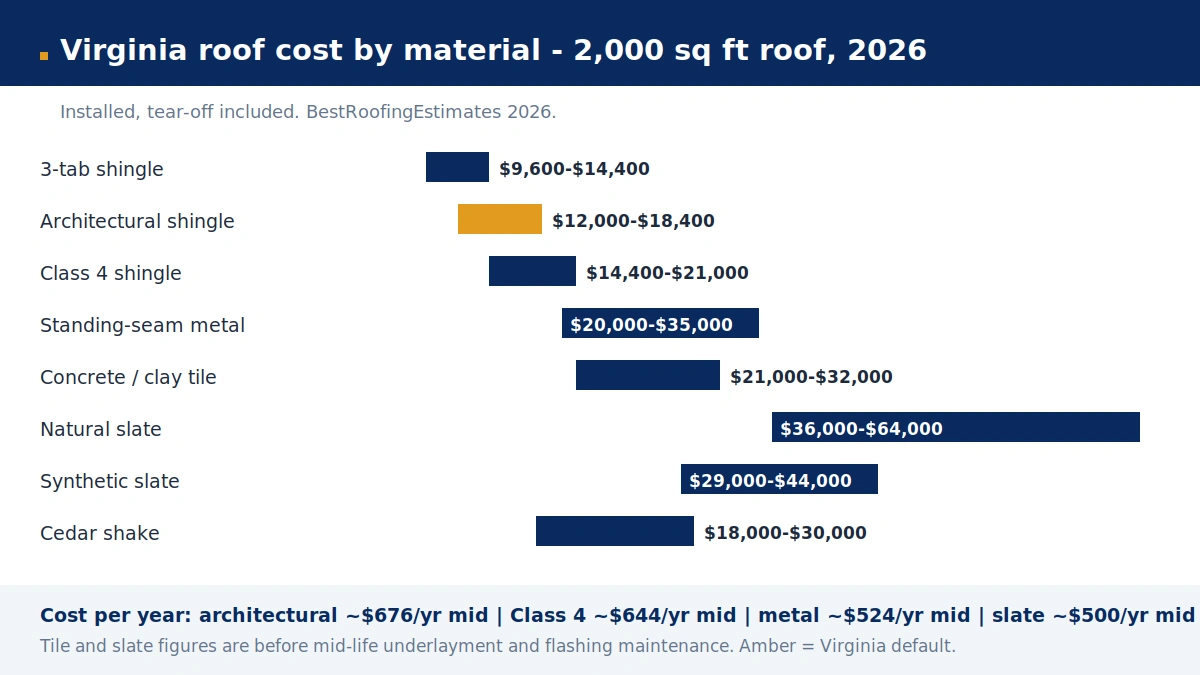
Roof Replacement Cost in Virginia by Material
Material is the biggest single line on the invoice — slate costs three to five times what architectural shingles cost to install. But the sticker price tells only half the Virginia story, because Mid-Atlantic humidity, coastal wind, and mountain freeze-thaw cut shingle life short while metal and slate mostly outlast the house. The table below pairs 2026 installed prices with Virginia lifespans and cost per year of service, so the expensive option can be judged on what it costs per year, not per invoice.
| Material | $/sq ft installed | 2,000 sq ft roof total | Virginia lifespan | Cost per year* |
|---|---|---|---|---|
| 3-tab shingle | $4.80–$7.20 | $9,600–$14,400 | 15–20 yrs | ~$480–$960/yr |
| Architectural shingle | $6.00–$9.20 | $12,000–$18,400 | 20–25 yrs | ~$480–$920/yr (mid ~$676/yr) |
| Class 4 impact shingle | $7.20–$10.50 | $14,400–$21,000 | 25–30 yrs | ~$480–$840/yr (mid ~$644/yr) |
| Standing-seam metal | $10.00–$17.50 | $20,000–$35,000 | 45–60 yrs | ~$330–$780/yr (mid ~$524/yr) |
| Concrete / clay tile | $10.50–$16.00 | $21,000–$32,000 | 40–60 yrs | ~$350–$800/yr |
| Natural slate | $18.00–$32.00 | $36,000–$64,000 | 75–125 yrs | ~$290–$850/yr (mid ~$500/yr) |
| Synthetic slate | $14.50–$22.00 | $29,000–$44,000 | 40–50 yrs | ~$580–$1,100/yr |
| Cedar shake | $9.00–$15.00 | $18,000–$30,000 | 20–30 yrs | ~$600–$1,500/yr |
*Cost per year = installed cost divided by Virginia realistic lifespan. Tile and slate figures are before mid-life underlayment and flashing maintenance — never quote a 75-year slate life without the maintenance next to it. Lifespan and price sources: BestRoofingEstimates (2026); Modernize (2026).
Architectural shingles are what most Virginia roofs already are: the lowest bid, the most crews who install them, and the simplest product to patch after a storm. In Virginia they last 20–25 years — longer than in the deep South, shorter than the brochure promises, because humidity and freeze-thaw age them faster than manufacturer defaults suggest. Algae-resistant granules are worth specifying: black streaking from Gloeocapsa magma shows up on north-facing slopes within 7–10 years on ordinary shingles in Tidewater and the Piedmont (BestRoofingEstimates). BestRoofingEstimates’ own worked example makes the value case: a $14,000 architectural job over a 22-year expected life costs roughly $636 per year in material amortization.
Class 4 impact-rated shingles are the upgrade this guide spends a whole section on below, because in central and western Virginia’s hail corridor they are the highest-leverage purchase on the market. They run $7.20–$10.50 per sq ft installed, roughly 15–25% more than standard architectural shingles, and they stretch service life to 25–30 years while earning an insurance discount that typically runs 5–30% (BestRoofingEstimates).
Standing-seam metal is the fastest-growing roof category in Virginia, especially on Shenandoah Valley farmhouses, coastal Hampton Roads homes, and solar-ready new construction in Northern Virginia (BestRoofingEstimates). At $10.00–$17.50 per sq ft, a 2,000 sq ft roof runs $20,000–$35,000 — roughly double architectural shingle upfront. What you buy is 45–60 years, Class 4 impact resistance as standard, wind ratings around 140 mph with mechanical clipping, and a surface that sheds Blue Ridge snow cleanly. On BestRoofingEstimates’ example math, a $26,000 cool-coated metal roof over 50 years costs about $520 per year — cheaper per year than shingles. On the coast, specify Galvalume or Kynar-coated steel, or aluminum standing seam, because salt air eats ordinary fasteners and flashing. Still weighing the two, our metal roof vs shingles cost comparison puts them head-to-head.
Concrete and clay tile are rare in Virginia outside Mediterranean-style estates, at $10.50–$16.00 per sq ft ($21,000–$32,000 on 2,000 sq ft). The tile itself lasts 40–60 years, but the underlayment beneath it gives out first — budget for a mid-life re-lay, and get that cost quoted before you fall in love with the look. Tile is also heavy, and a house not framed for it needs a structural review before anyone talks about color. Our tile roof cost guide has the national numbers.
Natural slate gets its own section below, because in Virginia it is not just a material — it is the roof on the state’s oldest streets. Synthetic slate (DaVinci, Brava, EcoStar and similar) runs $14.50–$22.00 per sq ft, weighs about a third as much as natural slate, and reads closely enough to satisfy most historic-district review boards.
Cedar shake runs $9.00–$15.00 per sq ft and delivers the rustic look that reads well on Blue Ridge cabins and rural estates in western Albemarle and Nelson counties. Virginia humidity is harder on cedar than drier climates are — plan on regular cleaning, moss treatment, and replacing individual split shakes. Fire-retardant pressure-treated cedar is mandatory in some jurisdictions (BestRoofingEstimates).
The takeaway: metal and slate ask for two to three times the shingle money on day one, then hand most of it back over the decades — because a Virginia shingle roof comes off when humidity, hail, or a nor’easter says so, not when the warranty says so. For national material-by-material numbers, see our metal roof cost guide and tile roof cost guide.
Roof Replacement Cost by Roof Size
The table below uses BestRoofingEstimates’ 2026 home-size table, priced by home size (living area) at the Richmond metro baseline, typical pitch 5:12–7:12, single-layer tear-off. Read it with the measuring-stick warning from the first section in mind: BestRoofingEstimates says roof surface runs about 1.3 times living area, so a 2,000 sq ft home here usually carries a ~2,600 sq ft roof — and these totals are the ones BestRoofingEstimates published for that home size.
| Home size | 3-tab asphalt | Architectural | Standing-seam metal | Slate / synthetic slate |
|---|---|---|---|---|
| 1,000 sq ft | $4,800–$7,200 | $6,000–$9,200 | $10,000–$17,500 | $14,500–$28,000 |
| 1,500 sq ft | $7,200–$10,800 | $9,000–$13,800 | $15,000–$26,250 | $21,750–$42,000 |
| 2,000 sq ft | $9,600–$14,400 | $12,000–$18,400 | $20,000–$35,000 | $29,000–$56,000 |
| 2,500 sq ft | $12,000–$18,000 | $15,000–$23,000 | $25,000–$43,750 | $36,250–$70,000 |
| 3,000 sq ft | $14,400–$21,600 | $18,000–$27,600 | $30,000–$52,500 | $43,500–$84,000 |
Cross-checks: SmartRoofingCalculator’s model puts architectural shingles on a 2,000 sq ft house at about $10,750–$15,500 for a 25-square roof — inside the band above, toward the low end, as model estimates tend to run. Modernize’s metro table (next section) puts a 2,000 sq ft roof at $12,000–$21,000 in Richmond and $13,500–$24,000 in Northern Virginia. Smaller homes pay a higher rate per square foot because fixed costs — permits, dumpsters, mobilization — are spread across fewer squares. Big or heavily cut-up roofs cost more for their shape, not just their size: anything above 6:12 pitch adds 15–25% to labor, and Virginia colonials at 7:12 or 8:12 sit squarely in that premium zone (BestRoofingEstimates).
Roof Replacement Cost by Region: Northern Virginia vs Richmond vs Hampton Roads vs Southwest Virginia
Virginia roofing labor swings harder by region than in almost any other state in this series, because the state holds a DC-wage metro, a coastal wind zone, a historic capital, and Appalachian mountain counties inside one border. The Richmond metro is the statewide mid-range. Everything else is measured against it.
| Region / Metro | Architectural asphalt (2,000 sq ft) | Variance vs state mean |
|---|---|---|
| Richmond metro | $11,500–$17,500 | Baseline |
| Northern Virginia (Fairfax, Arlington, Alexandria, Loudoun) | $13,500–$21,000 | +15% to +25% |
| Hampton Roads / Tidewater (Virginia Beach, Norfolk, Newport News) | $12,400–$19,000 | +5% to +10% |
| Charlottesville / Piedmont | $11,800–$18,200 | +2% to +5% |
| Roanoke / Lynchburg / Southside | $10,600–$16,200 | −6% to −10% |
| Shenandoah Valley (Harrisonburg, Winchester, Staunton) | $11,000–$16,800 | −3% to −6% |
| Far Southwest VA (Bristol, Abingdon, Wise) | $10,200–$15,500 | −8% to −14% |
Source: BestRoofingEstimates Virginia region table (2026). Modernize’s metro table (2,000 sq ft roof) tells the same story with slightly wider bands: Northern Virginia $13,500–$24,000; Richmond $12,000–$21,000; Virginia Beach $12,500–$22,500; Norfolk $12,500–$22,000; Chesapeake $12,000–$21,000; Roanoke $10,500–$18,500; Charlottesville $12,000–$21,000; Lynchburg $10,500–$18,500.
Northern Virginia runs 15–25% above the Richmond baseline for three reasons (BestRoofingEstimates): labor tracks the Washington, D.C. metro wage market; permitting is stricter and slower, with mid-roof inspections and dedicated plan review for any structural deck change; and HOA and historic-district review boards — particularly in Old Town Alexandria, Mount Vernon, and parts of Vienna, Falls Church, and Reston — impose specifications that shrink the contractor pool and push product costs up. Local cross-checks agree: Alexandria architectural shingles typically run $13,500–$18,000 on an 1,800–2,000 sq ft roof, and Falls Church single-family asphalt jobs run $12,500–$19,500, with a GAF Timberline HDZ replacement quoted around $16,650–$18,579 by one contractor in July 2026.
Hampton Roads runs 5–10% above Richmond on the coastal wind code alone: the 115–130 mph design wind zone triggers a 6-nail pattern, wind-rated underlayment, and ring-shank starter-strip fastening, and salt-air hardware (stainless or hot-dipped galvanized instead of standard electro-galvanized) adds $200–$500 per job. Crew transport onto beachfront and barrier-island sites adds labor overhead, and the premium concentrates on oceanfront and sound-side properties (BestRoofingEstimates).
Richmond is the baseline — mid-range labor, the state’s deepest bench of slate-capable crews, and the historic-district wildcard: a Monument Avenue or Fan-district slate roof can cost several times the metro average, which is why the city-level average and the slate-street price barely resemble each other.
Southwest Virginia — Roanoke, Lynchburg, Bristol, Abingdon, Wise — runs 6–14% below Richmond on softer labor markets. The discount narrows on steep or high-elevation sites, where snow-load engineering and access difficulty add the premium back (BestRoofingEstimates).
Why Virginia Roofs Cost What They Do: Humidity, Hurricanes & Ice Dams
Virginia spans three distinct climate regions — coastal Tidewater, the Piedmont, and the Blue Ridge and Appalachian mountains — and each one stresses a roof differently. Four forces dominate material selection and replacement timing statewide (BestRoofingEstimates).
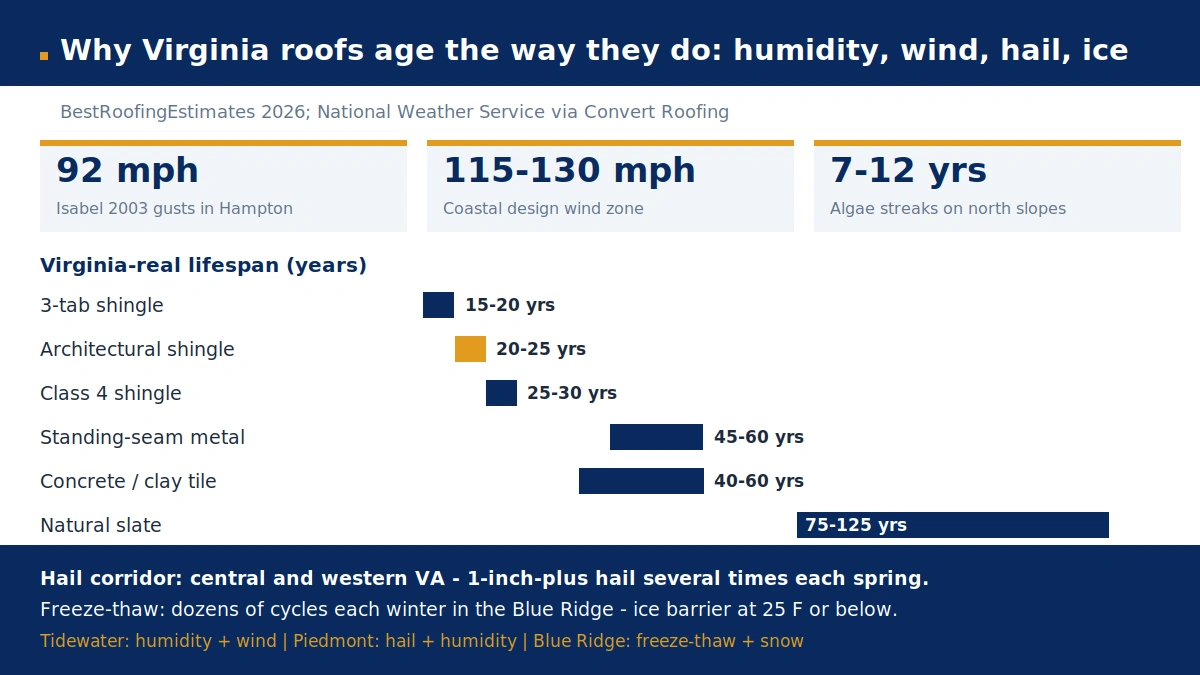
Humidity and algae do the slow damage. Mid-Atlantic humidity, especially in Tidewater and the Piedmont, drives Gloeocapsa magma algae growth that leaves black streaks on north-facing asphalt slopes within 7–12 years. Algae-resistant shingles with copper- or zinc-coated granules materially extend curb-appeal life. Humidity also weakens shingle sealant strips, which makes the next force — wind — more effective at lifting tabs.
Hurricanes and tropical remnants rule the coast. Hampton Roads and the Eastern Shore face direct-hit and brushing hurricanes most seasons, and inland Virginia catches tropical-remnant wind and rain almost every year. Hurricane season runs June through November. The local benchmark is still Hurricane Isabel in 2003: the National Weather Service recorded gusts of 92 mph in Hampton and 87 mph at the Chesapeake Bay Bridge-Tunnel, and the storm peeled roofs across the Southside — it remains the costliest natural disaster in Virginia’s history. Building codes reflect that risk: Virginia Beach publishes a 120 mph design wind speed, parts of the Eastern Shore design higher, and coastal jobs get enhanced nailing, wind-rated underlayment, and starter-strip requirements that inland jobs do not.
Hail is a central and western Virginia story. The Shenandoah Valley and the Piedmont sit in a secondary hail corridor: hail of 1 inch or larger arrives several times per spring in parts of both regions (BestRoofingEstimates). It is not Texas-scale hail — no Virginia statewide 2025 hail-claims total was verified for this guide — but it is enough to make Class 4 shingles a real calculation rather than a sales pitch. One local data point: NOAA logged 15 hail reports within 10 miles of Chesapeake from 2016 to 2025, the largest 2 inches across.
Freeze-thaw and ice dams rule the mountains. The Blue Ridge, Shenandoah, and Allegheny-side counties see dozens of freeze-thaw cycles each winter. Without adequate ice-and-water shield at eaves and proper attic ventilation, melted snow refreezes at the eave line and backs water under the shingles — the dominant failure mode on higher-elevation Virginia homes (BestRoofingEstimates). Ice barrier is required at eaves where the mean January temperature sits at or below 25°F, which in practice covers higher-elevation portions of Highland, Bath, Allegheny, Rockingham, and Shenandoah counties.
The four forces interact: humidity weakens sealant, wind lifts the weakened tabs, hail damage missed at inspection lets freeze-thaw water in through granule-loss zones. That is why a Virginia roof that “looks fine” from the ground can be much further along than it appears — a competent Virginia roofer opens up suspect flashing and hail-impact zones during the bid walk rather than standing in the yard with a ladder.
Timing matters too. The best months to replace a roof in Virginia are April through June, after the last reliable freeze and before peak summer humidity, and September through October, after hurricane season and before winter storms. The worst are January and February: shingle sealant strips take longer to activate below 40°F, and any tear-off left exposed overnight is at nor’easter risk. Reputable contractors book three to six weeks out in peak shoulder season, so schedule early (BestRoofingEstimates).
Slate Roofs: Virginia’s Historic-Roof Premium
No other state in this series has a material this tied to its street addresses. Slate is Virginia’s historic roofing material of choice on pre-1940s homes in Old Town Alexandria, Monument Avenue and the Fan in Richmond, Charlottesville’s historic core, and parts of Fredericksburg and Williamsburg — and it is the most expensive roof in this guide by a wide margin.
Natural slate runs $18.00–$32.00 per sq ft installed — $36,000–$64,000 on a 2,000 sq ft roof — and lasts 75–125 years if the underlayment and flashing are maintained on schedule (BestRoofingEstimates). The catch is weight: slate runs roughly 800–1,500 pounds per roofing square, so a structural engineering review is often required before a non-slate home is converted to it. The other catch is the crew: slate is a specialty trade, and the pool of Virginia roofers who install it well is small, concentrated in Richmond, Alexandria, and Charlottesville. A slate quote from a crew that does not do slate every week is a quote to decline.
Synthetic slate (DaVinci, Brava, EcoStar and similar) runs $14.50–$22.00 per sq ft ($29,000–$44,000 on 2,000 sq ft), lasts 40–50 years, weighs about a third as much as natural slate, and visually replicates it closely enough to satisfy most historic-district architectural review boards (BestRoofingEstimates). For a homeowner in a review district whose deck cannot carry natural slate, synthetic is usually the answer.
The historic-district rule changes the buying process. Material changes — especially slate to asphalt, or shingle to metal — typically require written approval from the local review board before the permit is issued. The boards to know are Alexandria’s Board of Architectural Review (Old & Historic Alexandria District and Parker-Gray), Richmond’s Commission of Architectural Review, Charlottesville’s BAR, and Williamsburg’s Architectural Review Board (BestRoofingEstimates). Get that sign-off in writing before you sign the roofer’s contract, not after — a board rejection after materials are ordered is the most expensive avoidable mistake in Virginia roofing.
The maintenance math nobody quotes with the 100-year life: slate outlasts its underlayment and its flashing. A slate roof past 75 years whose underlayment and flashing were neglected is a replacement candidate even though the slate itself looks fine (BestRoofingEstimates). And a single slate piece replacement runs $450–$1,200 because it is specialty labor and aged slate is hard to match. If you are buying a 1920s home with original slate, budget for the underlayment and flashing work within the next five to ten years — and get a slate specialist, not a general roofer, to inspect it first.
Class 4 Impact-Resistant Shingles: Worth It in Virginia’s Hail Corridor?
For homes in central and western Virginia — the Shenandoah Valley, the Piedmont, and the counties west of Richmond — Class 4 impact-rated shingles are the highest-leverage upgrade on the Virginia market. Here is why the math works, and where it does not.
What Class 4 means. UL 2218 is the impact test, and Class 4 is its top rating: the shingle must survive a 2-inch steel ball dropped from 20 feet without cracking. Named products in 2026 Virginia sources include GAF Armor Shield II, CertainTeed Landmark IR, and Malarkey Legacy with NEX polymer-modified asphalt (BestRoofingEstimates).
The discount is real but smaller than in hail-belt states. Class 4 shingles typically earn a 5–30% homeowner insurance premium discount in Virginia, with BestRoofingEstimates’ own asphalt-vs-metal table putting the conservative end at 5–15% and metal at 10–30%. The honest working range is 5–30%, most-cited toward the lower half outside the hail corridor. Ask your insurer for the exact discount in writing before you order — the math frequently favors the upgrade over a 20–25 year hold, but no Virginia-specific dollar-per-year saving was verified for this guide, so this guide gives none. Do not let a contractor quote you a Texas-style payback number for a Virginia roof.
The dollar math. Class 4 runs $7.20–$10.50 per sq ft installed ($14,400–$21,000 on a 2,000 sq ft roof), roughly 15–25% more than standard architectural shingles, and lasts 25–30 years instead of 20–25 (BestRoofingEstimates). The upgrade premium on a typical job is roughly $2,000–$3,000 over standard architectural shingles. At the low end of the discount band, that premium takes most of the roof’s life to pay back; at the high end, it pays back in a few years. The deciding factor is where your house sits: in the Shenandoah Valley and Piedmont hail corridor, the case is strong; in Tidewater, where wind and salt air matter more than hail, the money is usually better spent on high-wind installation and algae-resistant granules.
The paperwork is simpler than in some states — and that is a trap. No Virginia equivalent of a state impact-roof certification form was verified for this guide. That means there is no single form to file and no single list to check: the discount lives or dies on your insurer’s own documentation requirements. Get the insurer’s requirements in writing, keep the product data sheet and the paid invoice, and send both to your agent the week the roof goes on, not at renewal.
Bottom line: in the hail corridor, Class 4 is the default specification that happens to pay for itself. On the coast, it is a nice-to-have behind wind detailing. In Southwest Virginia, where hail is lighter and budgets are tighter, standard architectural shingles with algae-resistant granules are a reasonable choice.
Permits & Code: Fairfax, Richmond, Virginia Beach & the USBC
Virginia runs one statewide building code — the Uniform Statewide Building Code (USBC), based on the International Codes with Virginia amendments — and enforces it locally, city by city and county by county. The Virginia Residential Code uses the 2021 IRC as its base with Virginia amendments. The code is uniform; the permit desk is not.
| City / Jurisdiction | Typical fee | What to know |
|---|---|---|
| Richmond City | $120–$275 | Online issuance; CAR review in historic districts |
| Virginia Beach / Hampton Roads | $150–$325 | 115 mph wind zone; enhanced nailing & starter strip |
| Fairfax / Arlington / Alexandria | $225–$475 | Strictest review; historic-district boards in Old Town |
| Loudoun / Prince William / Fauquier | $175–$375 | Rural-residential zoning checks for outbuildings |
| Norfolk / Newport News / Hampton | $140–$300 | Coastal wind zone; flood-plain detailing near waterways |
| Chesapeake / Suffolk | $130–$285 | Chesapeake Bay Preservation Act runoff rules near RPA |
| Charlottesville / Albemarle | $150–$325 | BAR review for designated historic structures |
| Roanoke / Shenandoah Valley | $100–$225 | Snow-load & ice-barrier above 3,000 ft elevation |
Source: BestRoofingEstimates Virginia permit table (2026). A fee-schedule calculator lists a Virginia Beach roof permit at $122.20 from the city’s published schedule — inside the table’s band at the low end — and the SmartRoofingCalculator model uses a ~$260 statewide permit average.
A warning the table alone does not give you: BestRoofingEstimates says every major Virginia jurisdiction requires a permit for a roof replacement, but two 2026 sources say otherwise for like-for-like reroofs — a Fairfax County contractor post from August 2026 lists roofs among work exempt from permits in Fairfax County, and a Virginia Beach roofing guide says a full replacement “does not require a permit” in most cases there. The conflict is unresolved in published sources. Confirm with your own city or county building department before work starts — the permit answer depends on your exact jurisdiction and whether the job changes anything structural, and an unpermitted job can void your insurance and complicate a future sale.
What the code actually requires on the roof itself (BestRoofingEstimates): coastal Hampton Roads, the Eastern Shore, and outer Chesapeake Bay areas fall in the 115–130 mph design wind zone, which triggers enhanced nailing (a 6-nail pattern), wind-rated underlayment, and starter-strip requirements; inland Piedmont and western Virginia sit at 90–105 mph. Ice barrier is required at eaves where the mean January temperature is at or below 25°F. Attic ventilation is commonly required at 1/150 or 1/300 net free vent area to attic floor area, and older Virginia homes are often under-ventilated — remediating at re-roof is the cheapest time to do it. The energy code targets R-49 ceiling/attic insulation in most Virginia climate zones (4A and 5A).
Two more local rules worth knowing before you sign. In the Chesapeake Bay Preservation Area — Tidewater Virginia east of Interstate 95 — runoff management and Resource Protection Area setbacks can affect gutter and downspout placement during a reroof; a competent Tidewater roofer coordinates with the locality’s environmental services office before the permit is pulled. And in historic districts, the review board’s approval comes before the permit, not after — see the slate section above.
Hiring a Roofer in Virginia: DPOR Licenses & the 2027 Roof Law
Virginia has one advantage over most states in this series: roofing contractors are licensed by the state, so vetting starts with a public lookup instead of a leap of faith.
The DPOR license classes. Virginia requires contractor licensing through the Department of Professional and Occupational Regulation (DPOR), Board for Contractors. Any roofing job over $1,000 requires a license, and three classes apply, sized by contract value:
- Class C — single contracts from $1,001 to $10,000; annual volume up to $150,000. The Qualified Individual needs 2 years of experience. No net worth requirement, no business exam.
- Class B — single contracts from $10,000 to $120,000; annual volume $150,000–$750,000. The Qualified Individual needs 3 years; the business needs $15,000 net worth (or a $50,000 surety bond instead); the Designated Employee passes PSI business exams (Virginia and General portions).
- Class A — single contracts of $120,000 or more; annual volume $750,000 or more; unlimited. The Qualified Individual needs 5 years; $45,000 net worth (or a $50,000 bond); PSI exams in Virginia, General, and Advanced portions.
All three classes require a Board-approved 8-hour pre-license education course, and the license is issued to the business entity, not to an individual. Most full Virginia replacements fall in Class B — or Class A for slate and large jobs. The contractor also needs the Residential Building Contractor or Roofing specialty designation for roofing scope. (One caution: published sources disagree on the specialty’s abbreviation — RBC/RFC in one, ROC in another — so confirm the designation itself on the lookup rather than trusting any single abbreviation.) Verify every bidder at dporweb.dpor.virginia.gov/LicenseLookup before signing: confirm the class matches the contract size, the license is current, the specialty covers roofing, and there are no recent complaints. BestRoofingEstimates adds a consequence worth knowing: an unlicensed or improperly classed roofer jeopardizes your ability to claim from the Virginia Contractor Transaction Recovery Fund if the work is defective.
The six-step vetting process (BestRoofingEstimates): verify the DPOR license as above; confirm bonding and insurance — general liability minimum $1M and an active workers’ comp certificate mailed directly from the carrier (Virginia requires workers’ comp for contractors with more than two employees); require a written, itemized proposal with tear-off, underlayment grade, shingle model, flashing scope, ridge vent, disposal, permit, and final cleanup as separate line items, with the 6-nail pattern and starter-strip type specified on any coastal job; reject layover-only bids, which trap moisture under Virginia humidity and typically void the manufacturer warranty; check manufacturer certification (GAF Master Elite, Owens Corning Platinum Preferred, CertainTeed SELECT ShingleMaster, Atlas Pro Plus); and pay in milestones, never in full upfront — the typical draw is 10% deposit, 40% on material delivery, 40% at dry-in, 10% at final inspection.
The 2027 roof law — read the date, not just the headline. In 2026 the General Assembly passed HB 677 and SB 402 unanimously, and the Governor signed them on April 13, 2026 as Chapters 657 and 658. They take effect January 1, 2027 — they are not in force yet. Two parts matter for roof owners:
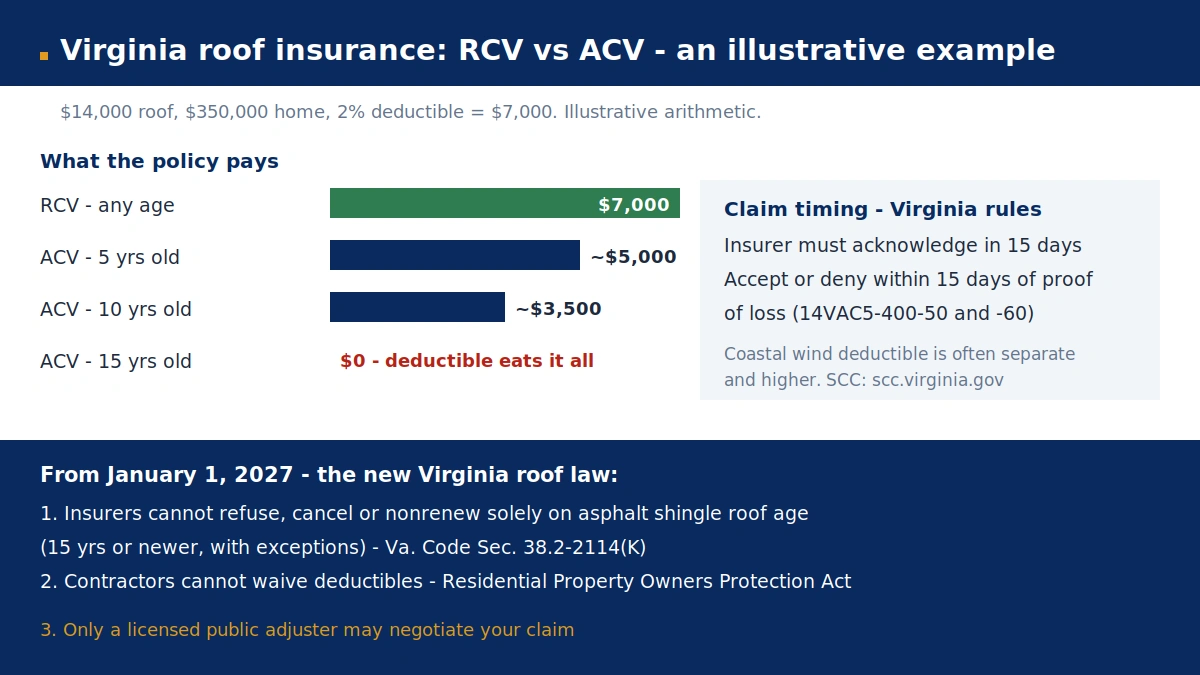
- Insurer limits (Va. Code §38.2-2114(K)): from January 1, 2027, an insurer may not refuse coverage, cancel a policy, refuse to renew, or increase premiums on an owner-occupied dwelling policy solely because of the age or condition of an asphalt shingle roof — with the protection applying where the roof is 15 years old or newer, and with exceptions in the statute. If your insurer is threatening nonrenewal over roof age right now, in 2026, these specific protections are not yet active — but they start in weeks.
- The Residential Property Owners Protection Act (Va. Code §§59.1-614–617): from the same date, roofing contractors may not knowingly or willfully pay, waive, or rebate any part of an insurance deductible on an owner-occupied home; may not offer cash, gifts, credits, or rebates in exchange for permission to inspect a roof or for filing a claim; and may not negotiate a claim on your behalf — only a licensed public adjuster may do that. Roofing ads must carry a disclosure stating the owner is responsible for the deductible, and contracts must include bold 14-point notice language. Owners also get a cancellation right when the Governor declares a state of emergency in the area.
The practical point for a 2026 signing: a “we’ll cover your deductible” pitch is not yet a Virginia statutory offense, but it is still a red flag — general insurance-fraud law applies everywhere — and from January 1, 2027 it is expressly banned. Walk away from the pitch either way.
Insurance: Storm Claims, Roof Age & Deductibles
Virginia homeowner policies typically cover roof damage from sudden events — hurricane wind, nor’easter wind, hail, and falling trees. Gradual wear, poor maintenance, and age-related failure are excluded. Three things on your declarations page decide more about a roof claim than the storm does: how the policy values the roof, how the deductible is written, and whether the roof has already been moved to actual cash value.
Covered damage, and damage that is not. Sudden storm damage is covered. A roof that simply reached the end of its life is not. Coastal properties in Hampton Roads and the Eastern Shore often carry a separate, higher wind or hurricane deductible than the standard deductible on the rest of the policy. Older roofs may be covered only on an actual-cash-value basis rather than full replacement cost. Ask your contractor to photo-document damage before filing (BestRoofingEstimates).
Whether the policy pays replacement cost or actual cash value is where the check gets decided. Under Replacement Cost Value, the insurer pays what a new roof costs today, minus your deductible. Under Actual Cash Value, the payout is that same figure less depreciation for the roof’s age and wear. The example below is illustrative arithmetic, not a regulator’s published example — no Virginia regulator example was found for this guide. Take a $14,000 replacement on a $350,000 dwelling with a 2% wind/hail deductible ($7,000): an RCV policy pays $7,000 after the deductible at any roof age, once the work is done and proven. An ACV policy on the same roof at about 15 years old, with roughly half its value depreciated, pays about $7,000 minus the $7,000 deductible — about $0. The depreciation gap is the whole claim.
| Roof age | RCV payout (illustrative) | ACV payout (illustrative) |
|---|---|---|
| New (0–2 years) | $7,000 | ~$6,500–$7,000 |
| 5 years | $7,000 | ~$5,000 |
| 10 years | $7,000 | ~$3,500 |
| 15 years | $7,000 | ~$0–$1,500 |
| 20+ years | $7,000 | $0 |
*Illustrative arithmetic: $14,000 roof, $7,000 deductible (2% of a $350,000 dwelling limit). Depreciation rates differ by insurer; your policy’s roof schedule controls.*
Claim timing is regulated in Virginia. Under 14VAC5-400-50, the insurer must acknowledge notice of a claim within 15 calendar days. Under 14VAC5-400-60, it must accept or deny the claim within 15 calendar days after receiving a properly executed proof of loss. The Virginia State Corporation Commission’s Bureau of Insurance (scc.virginia.gov) handles rate filings and consumer complaints. Document with dated photos, file promptly, and keep receipts for any emergency tarping — hail and wind damage signatures fade within months, and delayed claims on old damage are among the most common reasons carriers deny coverage.
The 2027 law changes the age question. From January 1, 2027, an insurer may not refuse, cancel, nonrenew, or raise premiums on an owner-occupied policy solely because of the age or condition of an asphalt shingle roof that is 15 years old or newer (with statutory exceptions). Until then, carriers can and do shift older roofs to ACV and nonrenew on age — so if your roof is 10–15 years old, read the renewal packet for a roof schedule or a roof endorsement before the next storm season.
Paying for It: Financing, Rebates & No Federal Credit in 2026
Federal help for a 2026 roof: none at all. OBBBA (P.L. 119-21) closed §25C and §25D for anything installed after December 31, 2025. So a 2026 roof on a home you live in carries no federal credit whatsoever. A few Virginia roofing pages still pitch a federal energy credit for insulation bundled with a reroof — that pitch relies on law that no longer exists. Budget as if it does not exist, unless a tax professional tells you otherwise in writing.
There is no Virginia statewide roof rebate to replace it. No 2026 source verified a Virginia equivalent of Florida’s My Safe Florida Home grant program, and no current residential cool-roof rebate dollar figure was verified for Dominion Energy or Appalachian Power. Do not build a budget around a grant that isn’t there.
The narrow help that does exist is income-qualified. EHARP (the Emergency Home and Accessibility Repair Program) can cover roofing within a $4,000 cap, though it is excluded in many entitlement localities. USDA Section 504 can finance eligible rural repairs. Weatherization Assistance does not pay for roofs, but Weatherization Deferral Repair can fund a roof fix that is blocking weatherization work. A $67 million Virginia package reported in late October 2026 includes $15 million for deferred repairs unlocking weatherization for more than 1,000 income-eligible homes — a single-source report, so confirm eligibility with your local provider before budgeting around it.
The real Virginia “rebate” is the insurance discount. A documented Class 4 roof earns 5–30% off the homeowner premium, and metal earns 10–30% (see the Class 4 section above). Unlike a one-time grant, it compounds every year for the life of the roof.
How Virginians actually pay for a roof (BestRoofingEstimates): the insurance claim path, where storm damage qualifies — deductible applies, and the coastal wind deductible is often separate; a HELOC or home-equity loan, usually the cheapest rate you will find, though closing takes weeks and the house itself secures the loan; contractor financing through lenders like GreenSky, Service Finance, and Hearth — fast decision, no-equity situations, 0% promo periods common, read the reset-rate fine print; and FHA Title I or 203(k) programs for owner-occupied homes and mid-credit buyers, which are slower to close. Northern Virginia owners with large equity cushions sometimes find a cash-out refinance makes sense when rates are favorable — run the numbers with a lender before committing.
No Virginia-specific contractor APR figures were verified in 2026 sources, so this guide gives none. The usual rules still hold: judge APR rather than the monthly payment; watch for the deferred-interest trap, where a balance left after a 0% promo draws retroactive interest at 20% or more; and never let the loan outlive the roof — twenty years of shingle service should not carry a twenty-five-year loan. Every way to pay is compared side by side in our roof financing guide.
Solar owners face one extra line: panels must come off and go back on around a reroof, so the detach-and-reset cost belongs in the claim scope. No verified Virginia dollar figure for detach-and-reset was found, so get it quoted as its own line item.
Repair vs Replace: The Virginia Decision Rules
Repair costs (BestRoofingEstimates, Richmond and Hampton Roads pricing; Northern Virginia adds 15–20%):
| Repair | Typical range |
|---|---|
| Most repair calls | $325–$1,100 |
| Missing / lifted shingles | $225–$625 |
| Slate or tile piece replacement | $450–$1,200 |
| Flashing replacement | $375–$1,050 |
| Active leak diagnosis & patch | $425–$1,350 |
| Hail damage inspection | $0–$325 (often free if claim filed) |
| Vent boot replacement | $180–$425 |
| Ice-dam damage repair (Blue Ridge) | $500–$1,800 |
| Gutter re-pitch / downspout fix | $275–$750 |
| Emergency tarp (post-hurricane or nor’easter) | $300–$850 |
BestRoofingEstimates’ headline figure for a typical Virginia roof repair call-out is $575. Rubber vent boots deserve a special mention: the gaskets fail fast in Virginia sun, and a $180–$425 boot replacement is one of the cheapest leaks to fix — and one of the most common to ignore until the ceiling stains.
A replacement beats a repair once two or more of these are true (BestRoofingEstimates):
- Architectural shingle roof age 20+ in Virginia — surrounding materials are already humidity-aged and hail-pitted, so patching has diminishing returns
- Three or more leaks per year — repeat repairs signal systemic underlayment or flashing failure rather than localized damage
- Interior staining, soft decking, or visible granule loss — significant granule loss in gutters and driveways after storms means the asphalt binders have broken down
- Slate past 75 years with neglected underlayment and flashing — the slate can look perfect while the layer that actually keeps water out is finished
- Hail damage spread across the field — that kind of damage usually means a full claim rather than a repair
- Age past the Virginia lifespan for the material, especially in the hail corridor
Repair is the right call when: a single leak you can trace on a roof still in its early years, a few shingles lifted by one wind event, a dead pipe boot, or a flashing detail that gave way. If repair pricing matters more to you right now than replacement pricing, our roof repair cost guide covers it.
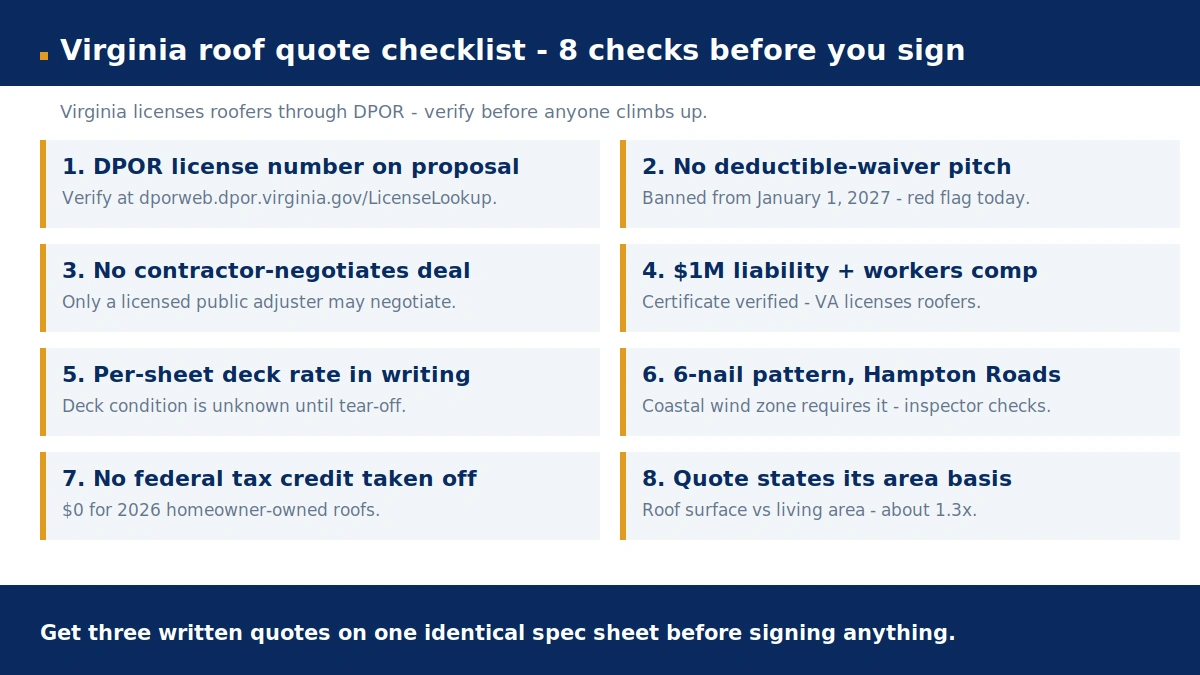
Quote red flags, Virginia-specific:
- No DPOR license number on the proposal — any roofing job over $1,000 requires one. Look it up before anyone climbs on your roof.
- A “we’ll cover your deductible” pitch — banned outright from January 1, 2027 under the Residential Property Owners Protection Act, and a red flag today.
- A contractor who offers to negotiate with your insurer for a cut — only a licensed public adjuster may negotiate a claim in Virginia.
- No $1M liability insurance or workers’ comp certificate — Virginia licenses roofers, so these are verifiable, not optional.
- No per-sheet deck rate — the deck’s condition stays hidden until tear-off. Leave the decking allowance out of a bid and the price will climb once the old roof is off.
- No 6-nail pattern or starter-strip spec on a Hampton Roads job — the coastal wind zone requires it, and the inspector will check.
- A federal tax credit line on the bid — no such credit exists for a 2026 owner-occupied roof, so treat that line as invented.
- A single $/sq ft figure with no area basis — roof surface runs about 1.3 times living area. A quote that stays silent on its area basis cannot be weighed against one that states it.
Before signing, work through our questions to ask a roofer — the vetting checklist built to accompany this guide. And when repair-vs-replace is genuinely close, an independent roof inspection is the cheapest way to settle it before calling contractors.
Sources & methodology
Cost anchors: BestRoofingEstimates — “How Much Does a New Roof Cost in Virginia?” (2026, crawled Nov 5, 2026) — primary Virginia anchor: material table, home-size table, region table, permit table, repair table, DPOR classes, climate zones, financing, cost-per-year examples, average $12,600 on a 2,000 sq ft home; Modernize — “Roof Replacement Cost in Virginia” (published Mar 18, 2026; updated Aug 27, 2026: most homeowners $9,500–$24,000, avg ~$14,600 on 1,800–2,200 sq ft home; metro table; material table; 60–70% ROI — single source); SmartRoofingCalculator — “Virginia Roof Replacement Cost” (2026 model: arch. $430–$620/sq, 25-square roof $10,750–$15,500; metal $860–$1,340/sq; tile $1,150–$1,730/sq; VA permit ~$260 — model-derived, cross-check only); GetMyRoofEstimateNow — Alexandria 2026 guide (arch. $13,500–$18,000 typical; June 2026 shingle increases 6–9% after 4–8% earlier) + Chesapeake 2026 guide (arch. $10,500–$19,500; NOAA 15 hail reports within 10 miles 2016–2025, largest 2 in); RoofingFallsChurchVA (2026: $12,500–$19,500; GAF HDZ $16,650–$18,579, Jul 2026); SmartRoofingCalculator Virginia Beach (2026: 25-square arch. $11,288–$16,275, +5% above VA baseline); Baber Enterprises (Shenandoah Valley, 2026: asphalt $5.00–$8.00/sq ft installed; labor $2.50–$5.00/sq ft). The size and cost-per-year tables are arithmetic we did from BestRoofingEstimates’ per-square-foot ranges.
Climate + wind: BestRoofingEstimates VA climate section (2026: three regions, four forces, algae 7–12 yrs, hail corridor, freeze-thaw, best/worst install months, 3–6 week booking lead); Convert Roofing — “Best Roofing Material for Coastal Homes in Virginia” (2026: VA Beach 120 mph design wind speed, Eastern Shore higher, Isabel 2003 gusts 92 mph Hampton / 87 mph Bay Bridge-Tunnel, costliest natural disaster in VA history); HomeNation — “Complete Guide to Virginia Wind Zones” (2026: HUD Zone 1 inland / Zone 2 coastal incl. Chesapeake, Norfolk, Portsmouth, Virginia Beach); Reitzel Exteriors (2026: wind-borne debris region within ~1 mile of coastal mean high-water line at 130 mph); Keen’s Buildings (2026: snow load 20 psf Hampton Roads to 40+ psf Blue Ridge — secondary).
Slate + historic districts: BestRoofingEstimates VA (2026: natural slate $18–$32/sq ft, 75–125 yrs, 800–1,500 lb/square; synthetic slate $14.50–$22; historic boards Alexandria BAR, Richmond CAR, Charlottesville BAR, Williamsburg ARB; slate piece replacement $450–$1,200).
Permits + licensing + tax: BestRoofingEstimates permit table + DPOR classes + USBC/VRC notes + Recovery Fund (2026); ContractorTrainingCenter — “Virginia Roofing Contractor License Requirements” (2026: Class A/B/C limits, 2/3/5 yrs experience, $45,000/$15,000 net worth, 8-hour course, PSI exams, ROC specialty, $1,000 trigger); SJ Roofing — Fairfax contractor guide (2026: Class B $10,000–$120,000, Class A $120,000+, RBC/ROC specialty); RoofingLicenseCheck Virginia (checked Oct 22, 2026: class bands, $50,000 bond alternative, fee conflicts $385 vs $425 — not used); PermitCalculator (VA Beach roof permit $122.20 from published fee schedule — cross-check only); Fixeep Instagram (Aug 28, 2026: Fairfax County like-for-like reroof listed among permit-exempt work — conflicts with BRE, flagged); RoofHero Virginia Beach (2026: full replacement “does not require a permit” in most cases — conflicts with BRE, flagged); OBBBA P.L. 119-21 / IRS FS-2025-05 ($0 federal credit for post-2025 installs); BRE’s §25C insulation-credit note excluded as stale.
HOA: BestRoofingEstimates (2026: HOA + historic review, Chesapeake Bay Preservation Area); Sugarland Run HOA ARC Procedures and Guidelines (Jan 2025: prior written approval for any exterior modification incl. roofs; approved shingle list; metal/solar conditions; Va. Code §55.1-1806.B); Bridlewood Community Association Architectural Guidelines (May 2024, Gainesville VA: same type/color, skylights rear-only max 4×4 ft); Rhygate HOA Resolution 7 (rev. Sep 2024: same color / black / earth tone, solar shingle conditions); Kennington Meadows Rules (rev. Mar 2026: association owns roof maintenance on townhomes; solar prohibited on common elements).
Insurance + 2027 law: BestRoofingEstimates VA (2026: sudden-event coverage, separate coastal wind deductible, ACV on older roofs); Sterling Roofers — “Roof Insurance Claim Help in Virginia” (2026: 14VAC5-400-50 15-day acknowledgement, 14VAC5-400-60 15-day accept/deny, Va. Code §59.1-618 deductible-waiver ban effective Jan 1, 2027); LegiScan — VA HB677 bill text (2026 session, Ch. 657, passed; §§38.2-2114, 59.1-200 amended; §§59.1-614–617 added; delayed effective date Jan 1, 2027); FastDemocracy bill summary (HB677/SB402 identical; insurer age-only limits + contractor conduct rules + emergency cancellation right); AgentFaircloth — “Virginia Passed a Roof Insurance Law” (Jul 13, 2026: signed Apr 13, 2026, Ch. 657/658, asphalt-shingle roofs 15 yrs or newer, exceptions); Hampton Roads Real Estate Ramblings (Oct 2026: §38.2-2114(K) summary, SCC Bureau of Insurance); DMV Exteriors (2026: only a licensed public adjuster may negotiate a claim in VA; NWS 598 DMV storm-damage reports Oct 2025–Sep 2026 — single source, pattern note only). The RCV/ACV table in the insurance section is illustrative arithmetic, not a regulator example — no Virginia regulator example was found.
Financing + rebates: BestRoofingEstimates VA financing table (2026: insurance claim, HELOC, GreenSky/Service Finance/Hearth, FHA Title I/203(k), Dominion/APCo home-efficiency programs — no roof-specific dollar figure); HomeRepairGrants.org — “Virginia Home Repair Grants and Loans (2026)” (updated Jul 27, 2026: EHARP $4,000 cap, USDA Section 504, Weatherization Deferral Repair); Frank Durnett blog (Oct 29, 2026: $67M package, $15M deferred repairs, ~$86.1K income limit for 4-person household — single source).
Repair + lifespans: BestRoofingEstimates VA repair table (2026: typical call $325–$1,100; call-out headline $575); replace triggers (arch. past 20 yrs, 3-tab past 15, slate past 75 if neglected, 3+ leaks/yr).
EXCLUDED: any “after 30% credit” prices; Florida programs (My Safe Florida Home) — no VA equivalent verified; any VA cool-roof rebate $/sq ft, contractor APR, solar detach-and-reset cost, or tile re-lay $ figure (all unverified); Texas figures as Virginia facts (State Farm $1.4B / 95,200 Texas hail claims, 902 Texas hail events, TDI Form PC068, TWIA/WPI-8, Texas deductible statutes, Texas Class 4 $700–$1,500/yr savings, Texas install timelines); the BRE FAQ-schema $8,315 average as a headline (conflicts with the same page’s $12,600); the PermitCalculator VA Beach $122.20 figure as a headline permit price; BRE’s stale §25C insulation-credit note.
*Disclaimer: Prices are 2026 Virginia planning figures and change by city, roof, and contractor. Collect three written quotes from local roofers before locking in a budget. Tax notes here are general information, not advice for your return — check with a Virginia CPA or tax pro before you file. The January 1, 2027 law summary is a plain-language summary of HB 677/SB 402, not legal advice.*
How much does a roof replacement cost in Virginia in 2026?
Most Virginia replacements run $9,500–$24,000 in 2026. Architectural shingles on a typical 2,000 sq ft roof cost $12,000–$18,400 (BestRoofingEstimates $6.00–$9.20 per sq ft; average about $12,600 on a 2,000 sq ft home). On a 2,000 sq ft roof surface: Class 4 shingles $14,400–$21,000, standing-seam metal $20,000–$35,000, natural slate $36,000–$64,000. Northern Virginia runs 15–25% above the Richmond baseline; Hampton Roads 5–10% above; Southwest Virginia 6–14% below.
Why is my Virginia roof quote so different from my neighbor’s?
Roof surface runs about 1.3 times living area, and quotes price different areas — BestRoofingEstimates’ own home-size table and its per-square-foot table do not agree on this, so a 2,000 sq ft home can be priced as a 2,000 sq ft roof or a ~2,600 sq ft one. Material, pitch above 6:12 (+15–25% labor), tear-off layers, decking condition, and region all move the number. Two quotes cannot be compared until you know which area each one measured.
Is a slate roof worth it in Virginia?
Only on the right house. Natural slate costs $18–$32 per sq ft installed ($36,000–$64,000 on a 2,000 sq ft roof) and lasts 75–125 years, but it weighs 800–1,500 pounds per square and needs a structural review on homes not built for it. It makes sense on pre-1940s homes in Old Town Alexandria, Monument Avenue and the Fan in Richmond, Charlottesville, Fredericksburg, and Williamsburg — where it is often the historically correct roof. Synthetic slate ($14.50–$22 per sq ft, 40–50 years, about a third the weight) satisfies most historic-district review boards for less money. Either way, get historic-board approval in writing before ordering materials.
Are Class 4 impact-resistant shingles worth it in Virginia?
Often yes in the central and western hail corridor. They cost 15–25% more than standard architectural shingles ($7.20–$10.50 per sq ft installed) and last 25–30 years instead of 20–25. Virginia insurers typically discount premiums 5–30% for a documented Class 4 roof, with the lower half of that band most common outside the hail corridor. Get the exact discount from your insurer in writing before ordering — no Virginia dollar-per-year saving was verified for this guide. On the coast, wind detailing matters more than hail resistance.
Do I need a permit to replace my roof in Virginia?
Usually yes, but confirm locally — the sources conflict. BestRoofingEstimates says every major Virginia jurisdiction requires one, with typical fees of $120–$275 in Richmond, $150–$325 in Virginia Beach and Hampton Roads, $225–$475 in Fairfax/Arlington/Alexandria, and $100–$225 in Roanoke and the Shenandoah Valley. But 2026 sources report that like-for-like reroofs may be permit-exempt in Fairfax County and Virginia Beach. Check with your own city or county building department before work starts, and remember historic-district approval comes before the permit.
Does my Virginia roofer need a license?
Yes — Virginia licenses roofing contractors through DPOR, and any job over $1,000 requires one. Class C covers single contracts up to $10,000, Class B covers $10,000–$120,000, and Class A covers $120,000 and up; most full replacements fall in Class B, slate and large jobs in Class A. The contractor also needs the Residential Building Contractor or Roofing specialty designation. Verify every bidder at dporweb.dpor.virginia.gov/LicenseLookup and confirm $1M liability insurance and workers’ comp before signing.
What is Virginia’s 2027 roof law?
HB 677 and SB 402, signed April 13, 2026, take effect January 1, 2027. From that date, insurers may not refuse coverage, cancel, refuse to renew, or raise premiums on an owner-occupied policy solely because of the age or condition of an asphalt shingle roof that is 15 years old or newer (with statutory exceptions). The same law’s Residential Property Owners Protection Act bans contractors from paying, waiving, or rebating any part of an insurance deductible, offering inducements for inspections or claims, or negotiating claims — only a licensed public adjuster may do that. The protections are not in force during 2026.
Is there a federal tax credit for a new roof in Virginia in 2026?
No — $0. OBBBA shut the door on §25C/§25D for anything put in service after December 31, 2025. Virginia has no statewide roof rebate to replace it. The narrow help that exists is income-qualified: EHARP can cover roofing within a $4,000 cap, USDA Section 504 can finance eligible rural repairs, and Weatherization Deferral Repair can fund a roof fix blocking weatherization. The real recurring payback is the insurance discount — 5–30% for Class 4 shingles, 10–30% for metal.