

Table of Contents
New Jersey is the most expensive state in this series to buy a heat pump in, and the most generous state to buy one in — both at once. The installed price runs higher than Pennsylvania’s because labor in the New York metro corridor is among the priciest in the country, North Jersey homes are older and harder to retrofit, and the Shore adds a salt-air premium. The rebate stack runs higher than anywhere else because the state routes its efficiency money through seven utilities that all pay, and PSE&G will pay five figures to get a gas furnace out of a house. This guide prices the state region by region, separates the rebates you can collect this month from the federal money that never arrives for a single-family home, and does the running-cost math at New Jersey’s own electricity price, not a national average.
Compare with the national heat pump cost guide for the US baseline, our Pennsylvania heat pump cost guide for the closest neighbor — a state where the biggest rebate you can collect is $475, while New Jersey’s stack can reach five figures — and our North Carolina heat pump cost guide for the one state where the federal $8,000 rebate actually opened.
How much does a heat pump cost in New Jersey in 2026?
For a typical New Jersey home of 1,500–2,500 square feet, a whole-home ducted air-source heat pump (3-ton) costs $10,500–$16,500 installed. That is the range to budget on for a New Jersey install. It is anchored by Modernize’s New Jersey city pages, which put the statewide average at $13,600, with a standard air-source system at $10,880 and a high-efficiency system at $16,320 — and it is corroborated from the top end by an Essex County installer guide (Adriatic Aire, updated ~October 2026) that prices ducted whole-home jobs in the state’s most expensive county at $12,000–$22,000, averaging ~$15,000, and from the middle by a statewide installer survey (NuWatt, April 2026) that puts regional averages at $13,000–$15,000.
Two numbers sit outside that band and both need explaining. A Paterson installer guide (2026) quotes heat pumps at $6,000–$12,000+ and full HVAC systems at $8,000–$12,000. That reads as equipment-lean pricing — the hardware plus a thin slice of labor, not a complete installed system with air handler, refrigerant lines, electrical, permit, and commissioning — the same trap that showed up in the Pennsylvania guide, where Angi’s city averages sat thousands below every installer quote. At the other end, a Jersey Shore guide prices single mini-split zones at $4,000–$7,500, which is real money for one zone in a coastal home but is not a whole-home price. When a quote lands near $6,000 for a whole-home system, ask which pieces are missing before you sign.
The pricing rule that defines 2026: the number on the quote is the number you pay, minus only the New Jersey rebates in the incentives section. The §25C credit — 30%, up to $2,000 a year — no longer applies to any system placed in service after December 31, 2025. Plenty of pages still show heat pump prices net of a tax credit, including Modernize’s own New Jersey pages, which still mention “federal tax credits (up to 30% under the Inflation Reduction Act).” Treat those as outdated. Every price in this guide is the price you actually pay, before the state and utility rebates that genuinely exist.
Cost by region (Modernize NJ city pages, 2026; NuWatt regional averages, April 2026; Adriatic Aire Essex County, ~October 2026):
| Region | Ducted air-source (3-ton) | What pushes it |
|---|---|---|
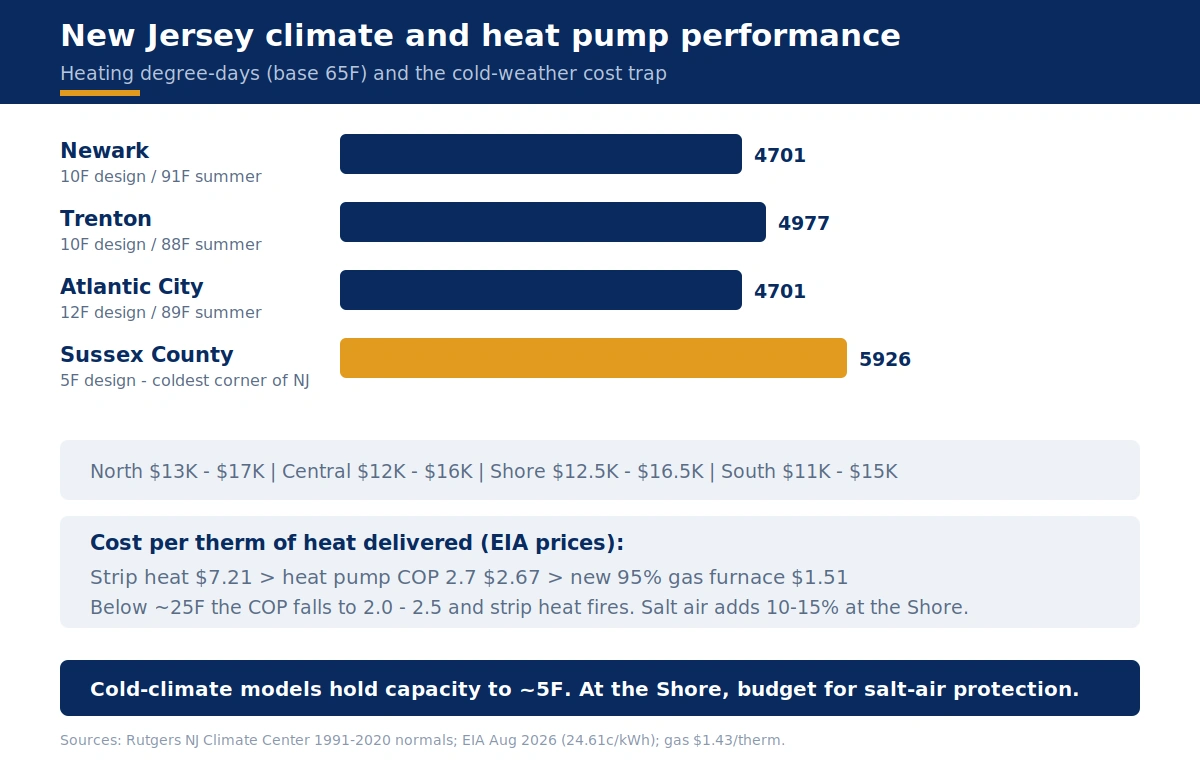
| North Jersey (Newark, Jersey City, Bergen, Sussex) | $13,000–$17,000 | Highest labor ($102–$218/hr statewide, top end in the NYC metro), oldest housing stock, coldest corner (Zone 5A) |
| Central Jersey (Trenton, New Brunswick, Princeton) | $12,000–$16,000 | State median; PSE&G + JCP&L territory; most competitive contractor market outside the north |
| Jersey Shore (Toms River, Atlantic City, Ocean/Monmouth coast) | $12,500–$16,500 | Salt-air corrosion protection adds 10–15%; coastal install rules; ACE territory |
| South Jersey (Cherry Hill, Camden, Vineland, Salem) | $11,000–$15,000 | Mildest winters, lowest labor, ACE territory with the best cold-climate rebate |
North Jersey runs roughly 15% above the South Jersey price for the same system, and the pattern is simple: the closer you are to New York City, the more the labor costs, and the colder the corner of the state, the more expensive the equipment that holds up in it.
Heat pump cost by system type in New Jersey
| System type | New Jersey installed range | Best for |
|---|---|---|
| Ducted air-source heat pump (whole home) | $10,500–$16,500 (typical 3-ton; high-end variable-speed to ~$18,000) | Most NJ homes with existing ducts |
| Ductless mini-split, single zone | $3,500–$7,500 (Modernize NJ: $7,480; Essex: $3,500–$7,000; Shore: $4,000–$7,500/zone) | One room, addition, garage, oil-heated home adding a zone |
| Ductless mini-split, multi-zone (3–4 zones) | $8,000–$18,000 (Modernize NJ 3-zone: $16,320) | Whole home without ducts |
| Dual-fuel (heat pump + gas furnace) | $7,000–$16,000 (planning range — no NJ-specific figure verified) | Any home with cheap gas; NJNG pays up to $4,000 for hybrid |
| Cold-climate ducted heat pump | $12,000–$19,000 (planning: standard +15–30%) | North Jersey, Sussex County, any home going all-electric |
| Geothermal (ground-source) | ~$38,080 (Modernize NJ) | Maximum efficiency; propane-heated rural homes; ACE pays up to $10,000 |
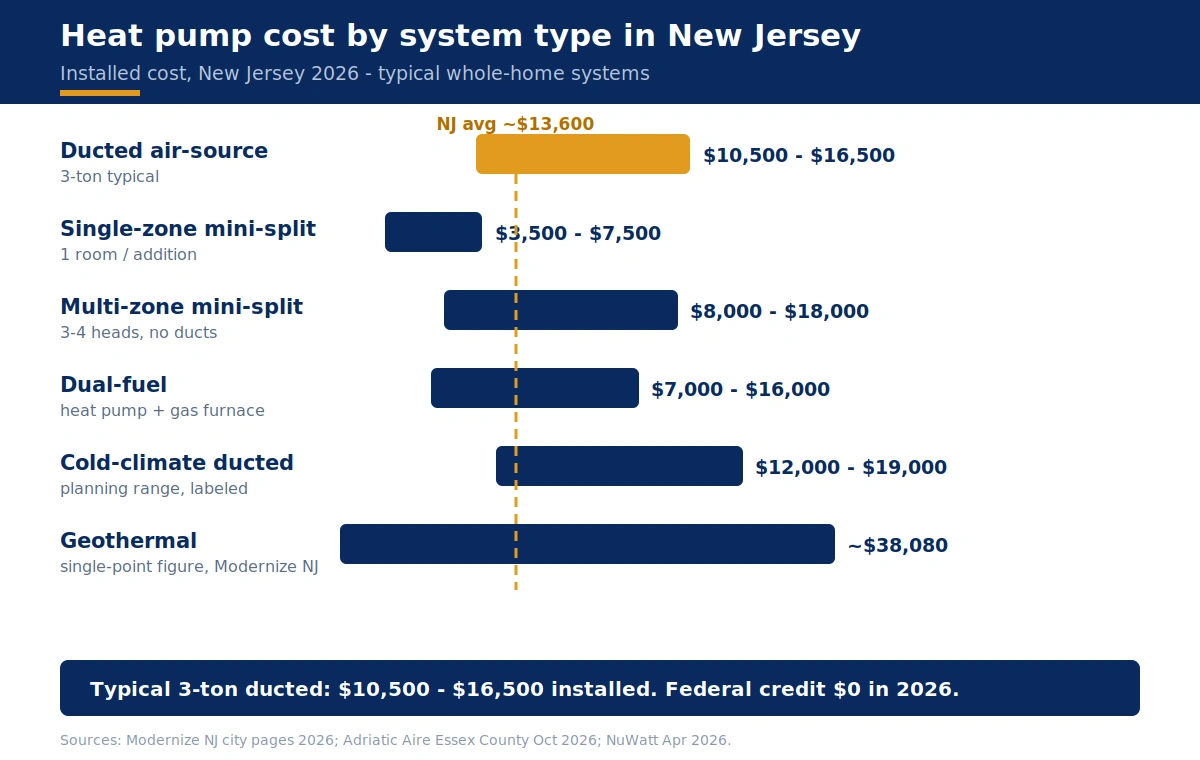
Ducted air-source is the default New Jersey system wherever ducts already exist. Modernize splits the tier cleanly for this state: a standard system at $10,880 against a high-efficiency system at $16,320. The high-efficiency tier means a variable-speed (inverter) system, and in New Jersey that upgrade earns its keep in two ways: it holds heating capacity as the temperature falls, so the expensive auxiliary strip heat fires less often on the coldest nights, and it dehumidifies better through the long, sticky summer. That second benefit matters more here than in Pennsylvania, because New Jersey summers run hotter and more humid.
Mini-splits are the answer for homes without ducts — and New Jersey has a lot of them. The state’s older housing stock includes plenty of homes heated by oil, electric baseboard, or steam radiators with no ductwork at all, plus the Cape Cods and split-levels of the postwar suburbs where adding ducts is a major job. One zone at $3,500–$7,500 handles a single room or an addition. A whole-home 3–4 zone setup runs $8,000–$18,000, and at that spend a ducted system usually gives you more for the money anywhere ducts already exist or can go in cheaply. Our mini-split installation cost guide breaks down per-zone pricing in detail, and our cold-climate mini-split guide covers the inverter models that matter in North Jersey.
Geothermal is the finest system money buys — and the priciest in this series. At ~$38,080 installed (Modernize NJ), it is roughly $7,000 above the Pennsylvania geothermal figure, because drilling in New Jersey’s dense suburbs costs more and the labor is dearer. The counterweight is that Atlantic City Electric pays up to $10,000 toward a new geothermal system replacing an air-source heat pump or electric furnace — the only utility geothermal rebate verified in this series. With gas at $1.43 a therm, the efficiency premium over a good air-source system still buys less than it would where gas is expensive, so the honest exception remains rural homes heating with propane, where payback can be genuinely fast. Geothermal lost its 30% federal credit on the same date as everything else — a $38,000 system that would have run about $26,600 after the credit in 2025 now costs the full $38,000.
Heat pump cost by size in New Jersey
No published New Jersey tonnage table exists, so the table below is built from the New Jersey installer ranges above (3-ton anchor: $10,500–$16,500) and the national tonnage pattern. Treat it as planning ranges, not quotes.
| Tonnage | Home size served | New Jersey installed range (planning) |
|---|---|---|
| 2 ton | 1,000–1,200 sq ft | $8,500–$13,000 |
| 2.5 ton | 1,200–1,500 sq ft | $9,500–$14,500 |
| 3 ton | 1,500–1,800 sq ft | $10,500–$16,500 |
| 4 ton | 1,800–2,200 sq ft | $13,000–$19,500 |
| 5 ton | 2,200–3,000 sq ft | $15,500–$22,000 |
Per-ton installed cost runs roughly $3,600–$4,800 per ton in New Jersey, and the per-ton rate falls as tonnage rises. Stepping up the SEER2/HSPF2 ratings lifts every band, and a cold-climate model adds 15–30% to standard equipment at the same tonnage.
Floor area alone cannot size a New Jersey system. Taking your floor area and dividing by 500 or 600 to get tonnage is a guess dressed up as arithmetic. Real sizing means a Manual J load calculation ($200–$500, often credited toward the install), which accounts for insulation, windows, ceiling height, and — the part that matters most in a New Jersey winter — how much heat the house loses at the local design temperature. An oversized system short-cycles, and an undersized one leans on strip heat all winter; in New Jersey, undersizing is the expensive mistake, because every hour on strip heat costs roughly two and a half times what the heat pump itself would have cost for the same warmth. PSE&G’s Building Decarbonization program agrees with this guide: it requires a Manual J and a Manual S equipment selection before it pays a dollar.
What drives your price up or down in New Jersey
Labor, and where you are. New Jersey HVAC labor runs $102–$218 an hour (Modernize NJ city pages, 2026) — the top of that band is the highest in this series, and it is the North Jersey / New York metro figure. The same system costs roughly 15% more in Bergen County than in Salem County, and quotes for identical systems can swing widely between contractors — which is why three quotes are non-negotiable.
Cold-climate equipment. A standard heat pump starts losing capacity below about 30°F, and New Jersey spends a meaningful share of its winter below that line, especially in the north. Inverter-driven cold-climate models keep delivering their full rated heat down to around 5°F, at a price roughly 15–30% above a standard model. In South Jersey’s Zone 4A corner, a standard model is a defensible choice. In Sussex County and the North Jersey hills, price the cold-climate model first and treat the standard model as the thing you need a reason to choose. The utility rebate tiers push buyers there anyway — every New Jersey utility pays its top heat pump rebate only for cold-climate equipment.
Salt air at the Shore. The Jersey Shore is the one place in this series where the air itself attacks the equipment. Salt spray corrodes coils and cabinets, so coastal installs need corrosion-resistant coatings, stainless hardware, and placement that keeps the unit out of the direct spray line — a 10–15% premium over an identical inland install (NuWatt Shore guide, April 2026). A Shore quote that matches an inland quote dollar for dollar is a quote that skipped the protection.
Ductwork. Have good ducts? A ducted swap is straightforward. Need new ducts? The national planning range is $5,000–$10,000 for a full duct job (no New Jersey-specific ductwork figure was verified). New Jersey’s older homes — pre-war houses across North Jersey, Cape Cods with no duct chases, steam-heated rowhouses in Newark and Jersey City — often have ducts that were sized for a furnace and a separate AC, or no ducts at all. Get duct sealing priced as its own line item; ducts leaking into an unconditioned attic or basement are the house’s quietest energy waste.
Electrical panel. A heat pump needs a dedicated 240V circuit of its own, so a full panel or an old 100-amp service means extra work. Plan on $1,500–$4,000 for a 200-amp upgrade (national planning range — no New Jersey-specific panel figure was verified). The electrical panel upgrade cost guide lays out the options and the price bands.
Efficiency tier. The DOE floor for a split-system heat pump sits at 14.3 SEER2 / 7.5 HSPF2, and ENERGY STAR begins at 15.2 SEER2 / 7.8 HSPF2. In New Jersey the heating number matters more than the cooling number: HSPF2 is the rating that decides how much of the winter the heat pump carries on its own. A mid-tier 15–17 SEER2 system with 8.5+ HSPF2 is the sweet spot for most New Jersey homes, and the utility rebate tiers push buyers there anyway — PSE&G’s cold-climate tier starts at SEER2 15.2 / HSPF2 8.1 with a COP of at least 1.75 at 5°F.
Permits. Most New Jersey municipalities require a construction permit under the Uniform Construction Code for a full system replacement, and the permit is a line item, not an afterthought. Paterson’s Ordinance 26-009 (September 15, 2026) sets $75 minimum per subcode, with furnaces, condensers, and air handlers at $75 each. No statewide permit-fee average was verified, so this guide states no statewide figure — check your own town’s construction office.
Refrigerant changeover. New 2026 equipment ships with R-454B or R-32 inside, because R-410A left new production on January 1, 2025. The new refrigerants cost a small premium over the old ones in New Jersey. If a 2026 quote still lists R-410A, that unit has been sitting in a warehouse — ask which refrigerant the quote actually uses.
A New Jersey heat pump lasts 12–15 years with annual maintenance (national figure — no New Jersey-specific lifespan was verified). Year-round use shortens life against an AC-only unit, and salt air at the Shore is harder on an outdoor unit than anything inland New Jersey throws at one.
New Jersey’s climate: milder winters than Pennsylvania, humid summers, and a salty coast
New Jersey is a heating-dominant state with a milder winter than its neighbor across the Delaware — and a summer that punishes an undersized cooling system. The 1991–2020 Rutgers normals tell the story in numbers:
| Metric | Newark (north) | Trenton (central) | Atlantic City (south) | Sussex County (far north) |
|---|---|---|---|---|
| IECC climate zone | 4A | 4A | 4A | 5A |
| Heating degree-days (base 65°F) | 4,701 | 4,977 | 4,701 | 5,926 |
| Winter design temp (ASHRAE 99%) | ~10°F | ~10°F | ~12°F | ~5°F |
| Summer design temp | 91°F | 88°F | 89°F | Not verified — do not state |
Heating degree-days come from the Rutgers NJ Climate Center 1991–2020 normals; design temperatures from homeenergybasics.com’s ASHRAE 99% table and ICC Appendix D Table D101 (Newark 4,589 HDD / 14°F, Trenton 4,980 / 14°F, Atlantic City 4,812 / 13°F on the older series — treat the Rutgers normals as the planning numbers and the ICC series as the cross-check).
The key insight: New Jersey’s load is heating first, cooling a close second, and the heating season is shorter than Pennsylvania’s but the summer is worse. Newark accumulates 4,701 heating degree-days against Erie’s 6,451 — roughly 27% less heating load at New Jersey’s cold end than at Pennsylvania’s. But Newark’s summer design temperature is 91°F with humidity near 68%, and the state racks up far more cooling degree-days than Pennsylvania does. A heat pump here is bought for its heating performance and its dehumidification in equal measure. In Pennsylvania, ask about HSPF2 first. In New Jersey, ask about HSPF2 and SEER2 together.
New Jersey is three different winters inside one state line. In the south (Atlantic City, Cherry Hill, Vineland, Zone 4A), winters are the mildest in the state: design temperatures around 12°F and about 4,400–4,700 heating degree-days. A modern cold-climate heat pump can carry most or all of the heating load here, and a standard model is a defensible choice. In central New Jersey (Trenton, New Brunswick, Princeton), winters step colder and the heat pump works harder, but standard-plus equipment still holds up. In the north (Newark, Jersey City, Bergen County, and especially Sussex County, Zone 5A, design ~5°F, 5,926 heating degree-days), it is genuinely cold: Sussex County logs about 26% more heating load than Newark, and cold-climate models and dual-fuel are the standard recommendation, not the upgrade.
Getting the cold-weather question right is the number to interrogate. A standard unit loses efficiency as the New Jersey temperature falls, and once it drops below about 25°F the COP (coefficient of performance) sits around 2.0–2.5. When the heat pump can no longer keep up, auxiliary electric strip heat takes over — and strip heat at New Jersey’s 24.61 cents per kWh costs roughly $7.21 per therm, more than four times the cost of gas. That is the design failure to guard against: a system that is fine at 35°F and ruinous at 15°F. The defenses are a cold-climate inverter model that holds capacity to 5°F, a Manual J calculation that sizes for the design temperature rather than the average day, and — where gas is available and cheap — a dual-fuel setup with the furnace cutting in at a switchover point, usually somewhere around 25–35°F in South and Central Jersey.
New Jersey summers are hot and humid, and that shapes the cooling side. Newark’s summer design temperature is 91°F, and humidity runs near 68% through July and August. A variable-speed compressor earns its keep here the same way it does in Florida: longer, slower run cycles pull more moisture out of the air, so the house feels comfortable at a higher thermostat setting. An oversized system that short-cycles will leave a New Jersey house clammy in August just as surely as it would in North Carolina. Florida runs the hotter version of the same playbook — cooling first, heating barely at all — see Florida’s heat pump climate.
Efficiency ratings that matter in New Jersey. Under the DOE’s 2023 standards, a New Jersey split-system heat pump must hit at least 14.3 SEER2 for cooling and 7.5 HSPF2 for heating. To convert HSPF2 to a seasonal COP, divide by 3.412: the 7.5 HSPF2 minimum is a seasonal COP of about 2.2, and a good New Jersey heat pump running at a seasonal COP near 2.7 is the working assumption in this guide’s payback math (a northern New Jersey Manual J report measured a seasonal COP of 2.7 across the heating season). For most New Jersey homes, 15–17 SEER2 with 8.5+ HSPF2 is the sweet spot, with cold-climate models worth the premium everywhere north of Trenton and worth considering even at the Shore, where the salt-air premium already pushes buyers toward better equipment.
The federal tax credit is $0 in 2026 — what that means
Here is the fact that changes every 2026 heat pump quote in New Jersey. The §25C Energy Efficient Home Improvement Credit once paid 30%, up to $2,000 a year, for heat pumps. The One Big Beautiful Bill Act (OBBBA, P.L. 119-21, signed July 4, 2025) cut it off for any property placed in service after December 31, 2025, and the IRS laid out the cutoff in FS-2025-05 (August 21, 2025). For any heat pump installed in New Jersey in 2026, the federal credit is $0.
One exception to keep straight: a system put in during 2025 still belongs on the 2025 return (IRS Form 5695). The 2025 return covers 2025 work only — if the install wrapped up in 2026, paying for the equipment in 2025 does not rescue the credit.
Geothermal’s 30% §25D credit came down on the same date, under the same law. One New Jersey installer page claims §25D “was not terminated” and still pays 30% through 2033 — that is wrong, and this guide follows the statute and the IRS, not the installer page. And there is no lease workaround for heat pumps: the surviving §48E credit covers clean-electricity generation, so it reaches leased solar panels but never a heat pump. If a salesperson promises a federal credit will pass through a heat pump lease to you, that promise has no basis in the law. For the full post-OBBBA picture, see the federal energy tax credits guide.
Watch for New Jersey quotes that still subtract a $2,000 federal credit. It is the most common stale-math trap in 2026 heat pump pricing, and it is live in New Jersey right now: Modernize’s New Jersey city pages still mention “federal tax credits (up to 30% under the Inflation Reduction Act),” and older NJCEP-era pages still describe the closed COOLAdvantage and WARMAdvantage rebates as if they were current. If a contractor is still showing a credit line, ask them to strike it and re-total before you sign.
New Jersey rebates that are still alive in 2026
New Jersey’s rebate map in 2026 is the richest in this series — and the most complicated, because the money comes from seven utilities under one Board of Public Utilities rulebook, and the biggest checks carry conditions. The full dated picture sits in one table below.
| Program | 2026 status | Value |
|---|---|---|
| Federal §25C credit | Expired Dec 31, 2025 — $0 | $0 |
| Federal §25D geothermal credit | Expired Dec 31, 2025 — $0 | $0 |
| NJ Whole Home Energy Efficiency Program (statewide, via all 7 utilities) | Open — terms through June 30, 2027 | Up to $7,500 by modeled savings ($2,000 at 5% TES, +$200/pt to $7,500 at 33% TES; capped at 50% of project cost) + 0% financing to $25,000 |
| PSE&G — standard HVAC instant rebate (north + central NJ) | Open — point-of-sale discount | ASHP Tier 1 $300, Tier 2 $450, cold-climate $600; LMI +$300 per measure |
| PSE&G — Building Decarbonization (full fossil-fuel displacement) | Open — through June 30, 2027 | Conversion lesser of $10,000 or 50% (LMI $12,000/60%); decommissioning up to $2,000; re-ducting up to $2,000; 0% on-bill to $75,000 |
| PSE&G — Dual Heat / Hybrid Heat (partial displacement) | Open | Dual Heat lesser of $5,000 or 50% (LMI $6,000/60%) + up to $1,500 per integrated control; Hybrid Heat lesser of $2,000 or 30% (LMI $3,000/40%) |
| JCP&L (central + western NJ) | Open — post-install via CLEAResult | Ducted ASHP $500–$750, cold-climate $1,000, ductless $750; LMI +$200 |
| Atlantic City Electric (8 southern counties) | Open — cold-climate $2,000 Apr 1, 2026–Jun 30, 2027 | ASHP $500–$750, cold-climate $2,000, geothermal up to $10,000; LMI +$300; thermostat +$150 |
| Rockland Electric (Bergen, Passaic, Sussex) | Open — amounts NOT VERIFIED | No figure — contact RECO directly |
| NJ Natural Gas SAVEGREEN (gas utility) | Open — through June 30, 2027 | ASHP $500–$1,000; hybrid heat up to $2,000 single-zone / $4,000 two-zone; LMI +$300 |
| Comfort Partners (income-qualified, ≤250% FPL) | Open — free improvements | Free heating system repair/replacement, insulation, air sealing for qualifying households |
| IRA HEAR / HOMES — NJ (~$185M federal) | NOT LAUNCHED for single-family homes | $8,000 HEAR cap does NOT apply to a typical NJ homeowner in 2026; funds directed to low-income multifamily (M-RISE) + planned Comfort Partners adder (CP-HEAR) |
| NJ state tax credit for heat pumps | None — does not exist | — |
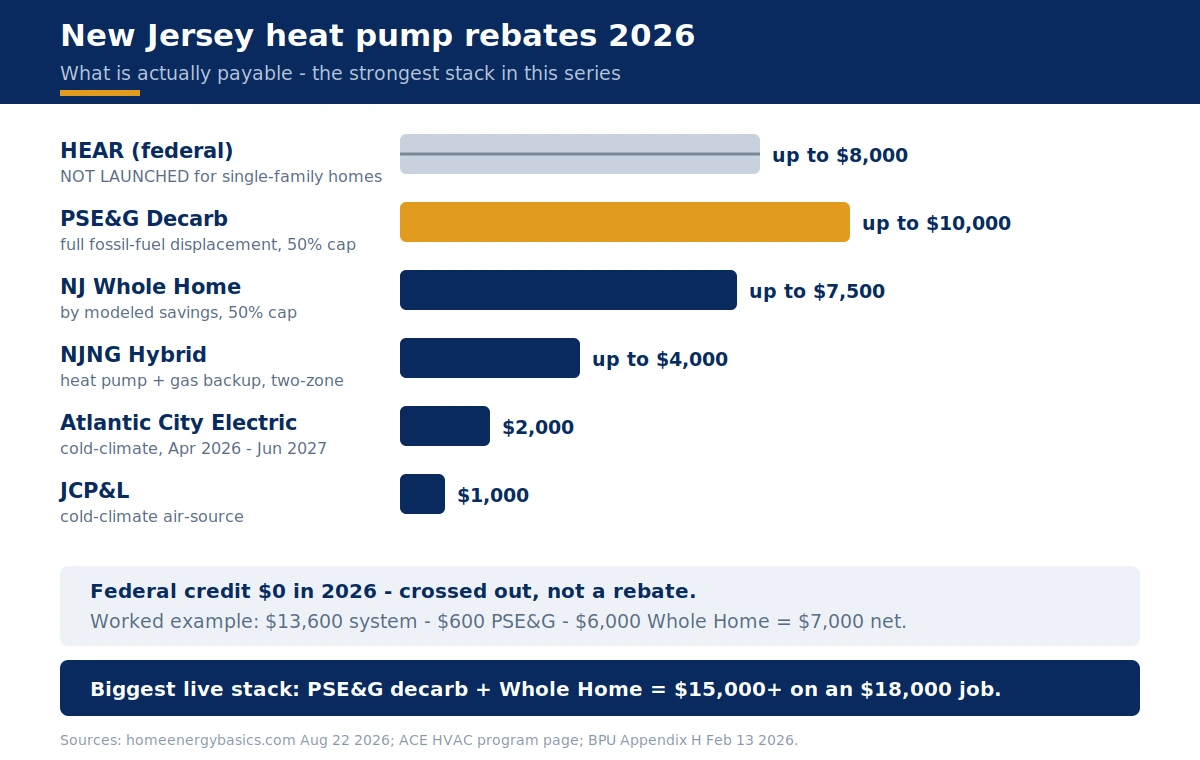
The Whole Home program is the rebate every New Jersey homeowner should price first. The NJ Whole Home Energy Efficiency Program — the successor to Home Performance with ENERGY STAR, run through your utility under the Board of Public Utilities — pays up to $7,500 in cash back, scaled by the modeled Total Energy Savings your project achieves: $2,000 at 5% savings, plus $200 for each additional percentage point, up to $7,500 at 33%. It is capped at 50% of project cost, it requires a home energy assessment, and all work must be done by a BPI-certified contractor participating in your utility’s program. There is no income requirement. It also unlocks 0% on-bill financing up to $25,000 (up to $75,000 through PSE&G when combined with decarbonization). The honest caution: a heat-pump-only job may not reach 33% modeled savings, so the worked examples in this guide use ~$6,000 (25% savings) as the realistic case, not the $7,500 cap.
PSE&G’s Building Decarbonization program is the biggest single check in this series — and it demands a full break with fossil fuel. PSE&G serves about 2.3 million electric customers across northern and central New Jersey, and its decarbonization program pays the lesser of $10,000 or 50% of project cost to fully replace fossil-fuel heating with a NEEP-listed cold-climate heat pump (lesser of $12,000 or 60% for income-qualified households), plus up to $2,000 to decommission the old system and up to $2,000 for re-ducting, plus $2,000 per additional cold-climate system. It requires a Manual J load calculation and Manual S equipment selection. If you are not ready to give up the furnace, the partial paths still pay: Dual Heat (keep the fossil system, add a cold-climate heat pump with integrated controls) pays the lesser of $5,000 or 50%, and Hybrid Heat (replace the cooling system, keep the heating) pays the lesser of $2,000 or 30%. One warning that matters: PSE&G’s 0% on-bill balance becomes due within 30 days if the account closes, including on a home sale — finance with that in mind.
JCP&L pays up to $1,000, Atlantic City Electric up to $2,000 — and the difference is the cold-climate tier. JCP&L (FirstEnergy, central and western New Jersey) pays $500 for a Tier 1 ducted heat pump, $750 for Tier 2, and $1,000 for a cold-climate system, with ductless mini-splits at $750 and a $200 adder for income-qualified households; rebates are post-installation through the CLEAResult portal, with 0% financing available through NEIF ($2,500–$25,000). Atlantic City Electric (Exelon, eight southern counties, about 565,000 customers) pays the same $500/$750 on the standard tiers but $2,000 for a cold-climate heat pump — an enhanced limited-time amount running April 1, 2026 through June 30, 2027 — plus a $300 income-qualified adder and a $150 smart-thermostat adder. ACE also runs its own electrification program: up to $10,000 or 50% for full displacement, up to $5,000 or 50% for a partial or dual-fuel job. ACE’s retail electricity rate runs about 16 cents a kilowatt-hour, the lowest of the four New Jersey electric utilities, which makes the running-cost math in South Jersey noticeably friendlier than in the north.
Rockland Electric is the gap in the map. RECO’s Clean Heat Program covers Bergen, Passaic, and Sussex counties with base incentives plus income-qualified adders for fuel-switching projects and 0% financing through NEIF — but no specific rebate amount could be verified from any published source, and the best available tracker says to contact RECO directly. This guide gives no RECO number, because inventing one would be worse than admitting the gap. If RECO bills you, check oru.com or call before counting on money.
The gas utilities pay, too — including for keeping the gas. NJ Natural Gas’s SAVEGREEN program pays $500 to $1,000 for air-source heat pumps and mini-splits, with a $300 income-qualified adder, and its Building Decarbonization Hybrid Heating offer pays up to $2,000 for a single-zone system or $4,000 for a two-zone system that pairs a heat pump with gas backup. South Jersey Gas and Elizabethtown Gas do not currently offer direct heat pump rebates. The NJNG hybrid money is the one rebate in this guide that rewards not giving up the furnace — and for a gas-heated home in Monmouth or Ocean County, it is often the most practical dollar on the table.
Comfort Partners is free, and it is open right now. For households at or below 250% of the Federal Poverty Guidelines — or participating in LIHEAP, SNAP, TANF, SSI, or Section 8 — Comfort Partners provides free energy efficiency improvements, including heating system repair or replacement, insulation, and air sealing. It is active and fully available, and it is the program the state’s federal IRA money is being steered toward as well. The separate Weatherization Assistance Program (NJ Department of Community Affairs, at or below 200% of poverty) covers the same ground, including heat pumps when cost-effective.
The $8,000 federal HEAR rebate is not available to a typical New Jersey homeowner in 2026. New Jersey received about $185 million in federal IRA funding — roughly $91.6 million for HOMES and $91.3 million for HEAR, plus $3.5 million for contractor training — but as of August 2026 no consumer-facing single-family program has launched. The state’s design directs the money to low-income households through two planned programs: M-RISE, whole-building efficiency projects in low-income multifamily housing, and CP-HEAR, an electrification adder to the existing Comfort Partners program. The best tracker (BetterHouse, September 2026) lists HEAR as open for multifamily properties only; the federal tracker (heatpumppricing.com, status verified November 4, 2026) says the programs are still in development and not open for applications. Do not sign a contract contingent on HEAR funding. One more wrinkle for when any single-family path does open: DOE Program Notice 26-2 rewrote the HEAR rules so the program no longer pays to replace gas, oil, or propane equipment. A home may keep its furnace and add a heat pump alongside it, and electric-to-electric upgrades still qualify — but a gas-to-heat-pump swap will not. That matters in New Jersey more than in most states, because about 72% of New Jersey households heat with natural gas.
Worked rebate examples — 3-ton ducted cold-climate heat pump, $13,600 installed (Modernize NJ average):
- PSE&G customer, standard instant rebate: $13,600 minus $600 = $13,000 net.
- PSE&G customer + Whole Home (~$6,000 at 25% modeled savings): $13,600 minus $600 minus $6,000 = $7,000 net.
- JCP&L customer, cold-climate: $13,600 minus $1,000 = $12,600 net; + Whole Home $6,000 = $6,600 net.
- Atlantic City Electric customer, cold-climate: $13,600 minus $2,000 = $11,600 net; + Whole Home $6,000 = $5,600 net.
- PSE&G Building Decarbonization best case, $18,000 cold-climate system: conversion rebate capped at 50% = $9,000, + Whole Home $6,000 = $3,000 net (plus up to $4,000 more in decommissioning and re-ducting where applicable).
- Rockland Electric customer: $13,600 gross, $13,600 net until RECO publishes an amount — verify before you buy.
- Any New Jersey household counting on the federal HEAR $8,000 in 2026: $13,600 gross, $13,600 net before state and utility rebates — the federal program is not open to single-family homes, and the money cannot be collected this year.
That Pennsylvania comparison is what this section is for. There, the biggest rebate a typical Pennsylvania household can actually collect in 2026 is $475. In New Jersey, a PSE&G customer doing a full decarbonization project can collect $15,000 or more — and even a standard customer stacks $6,600 in Whole Home plus utility money. The quoted price is not the real price here; the stacked price is.
New Jersey electricity rates and what a heat pump costs to run
New Jersey’s residential electricity costs 24.61 cents per kilowatt-hour (EIA Electric Power Monthly, Table 5.6.A, August 2026, released October 28, 2026) — about 36% above the US average of 18.16 cents, and the 10th highest of 51 jurisdictions. The average August bill was $236.26 on 960 kWh. The rate actually fell 1.4% year over year (August 2025 was 24.95 cents), and the 12-month average to August 2026 ran about 23.7 cents on roughly $160 a month. Expensive power is the headwind for heat pump payback in this state — and the reason the running-cost comparison in this section is the least flattering in this series, even though the rebate stack is the most generous.
New Jersey’s electricity market is regulated, not deregulated, and that changes what you actually pay. Unlike Pennsylvania, New Jersey homeowners cannot shop for a generation supplier; the utility is the supplier. PSE&G’s standard residential tariff carries a $6.00 monthly fixed charge plus 12.40 cents per kWh in riders, working out to about 26.00 cents per kWh all-in at 900 kWh. Atlantic City Electric’s retail rate runs about 16 cents a kilowatt-hour, the lowest of the four electric utilities — so a South Jersey heat pump household pays meaningfully less per kilowatt-hour than a North Jersey one, and the running-cost math in this guide’s statewide table is a blend, not a bill. PSE&G also launched a voluntary residential time-of-use rate on June 1, 2026, with on-peak weekday hours from 4–9 p.m. — worth a look for a heat pump household that can shift load overnight, though no savings figure was verified.
What does it cost to run? The honest answer in New Jersey depends entirely on what the heat pump replaces. Using EIA prices — electricity 24.61 cents per kWh (August 2026), natural gas $1.43 per therm (12-month average to July 2026) — the cost per therm of heat delivered works out as follows:
| Heat source | Cost per therm delivered |
|---|---|
| Electric strip heat (COP 1.0) | $7.21 |
| Heat pump, seasonal COP 2.5 | $2.88 |
| Heat pump, seasonal COP 2.7 (NJ planning assumption) | $2.67 |
| Heat pump, seasonal COP 3.0 (mild winter, South Jersey) | $2.40 |
| New 95% AFUE gas furnace | $1.51 |
| Old 80% AFUE gas furnace | $1.79 |
| Propane, 85% (about $3.63/gal, last-winter average) | $4.67 |
| Oil, 85% (about $4.30/gal, last-winter average) | $3.65 |
| Oil, 85% (about $6.38/gal, October 2026 spike) | $5.42 |
A heat pump needs a seasonal COP of about 4.8 to match a 95% gas furnace at New Jersey prices — and a real New Jersey system runs closer to COP 2.7 across the heating season. That single number is the whole running-cost story: against gas, the heat pump loses on heating. Against everything else, it wins. An independent modeled comparison agrees: wheredmymoney.com (2026, EIA data, a 2,000-square-foot home kept at 68°F by day and 64°F overnight) puts a cold-climate heat pump at about $923 a year to heat that home against $859 a year for a natural gas furnace, with a standard heat pump at about $1,072 a year, geothermal at $891, and electric baseboard at $3,028.
The truth for New Jersey in 2026, baseline by baseline:
- Against electric strip heat or baseboard (common in older New Jersey homes, especially pre-war houses and Shore rentals): the heat pump wins big — $7.21 against $2.67 per therm. The heating bill falls by roughly 60%.
- Against oil: the heat pump wins clearly — $3.65 against $2.67 per therm at last winter’s oil price, and $5.42 against $2.67 at the October 2026 spike price of $6.38 a gallon.
- Against propane: the heat pump wins clearly — $4.67 against $2.67 per therm.
- Against an old 80% gas furnace: the heat pump loses on heating — $1.79 against $2.67 per therm.
- Against a new 95% gas furnace: the heat pump loses by more — $1.51 against $2.67 per therm.
One more honest note: when a heat pump takes over from a gas furnace, the winter electric bill climbs in New Jersey. The heat you used to buy as gas now shows up on the PSE&G or JCP&L bill instead, while the gas bill shrinks. The household total is what matters, not one bill — and in New Jersey, for a gas-heated home, that household total goes up on heating alone. For a gas home, the heat pump’s case is the air conditioning it also replaces, not the heating bill.
Heat pump vs furnace in New Jersey: the honest comparison
This is the comparison most articles get wrong. A single heat pump covers two jobs: heating in winter and cooling in summer. The fair comparison puts a furnace plus an air conditioner together against the heat pump — never a furnace on its own.
| Option | Installed (NJ) | Notes |
|---|---|---|
| Heat pump (complete system) | $10,500–$16,500 (typical 3-ton) | Heats AND cools — one system |
| Gas furnace alone | ~$4,500–$10,000 (national, article 1 — no NJ-specific figure verified) | Needs a separate AC |
| Outdoor AC alone | ~$5,500–$12,500 (national, article 61 — no NJ-specific figure verified) | Needs a separate furnace |
| Furnace + AC combined | ~$10,000–$22,500 (national components) | The true comparison — roughly a wash with the heat pump upfront, or the heat pump cheaper |
Upfront, it is roughly a wash in New Jersey — and after the rebate stack, the heat pump is usually cheaper. On running costs the heat pump then beats electric, oil, and propane heat, and trails gas heat. New Jersey-specific furnace and AC component prices were not verified — present the combined $10,000–$22,500 as a national-components estimate, flagged.
When does the furnace win in New Jersey? In most New Jersey gas-heated homes, on the heating bill alone. With gas at $1.43 a therm and electricity at 24.61 cents, a 95% furnace delivers a therm for $1.51 against the heat pump’s $2.67 at a seasonal COP of 2.7. That gap narrows in South Jersey’s mild corner, where the heat pump holds a COP near 3.0 for more of the season, and it widens in Sussex County, where the heat pump spends more hours at low COP or on strip heat. If your home already has cheap natural gas and a working furnace, and the air conditioner is not due for replacement, a heat pump is a comfort and cooling upgrade — not a way to cut the heating bill. For the 10-year math in detail, read the heat pump vs furnace cost comparison, and for the formulas, the heat pump running cost guide.
When does the heat pump win? Against electric strip heat, decisively — the heating cost per therm drops about 60%. Against oil and propane, clearly, and more clearly every week oil stays near $6 a gallon. And when the AC needs replacing anyway: a heat pump is one install instead of two, and the cooling-efficiency gain is real money in New Jersey, with 91°F summer design temperatures and humid Julys. One more point in the heat pump’s favor here: with no combustion it cannot produce carbon monoxide — something to weigh for any family replacing an old gas or oil furnace. And for the New Jersey homes that heat with electricity, oil, or propane, the heat pump is the single biggest heating-bill cut available — before the rebates even enter the picture.
Dual-fuel and geothermal: when they make sense in New Jersey
Dual-fuel pairs a heat pump with a gas furnace. The heat pump carries the mild weather; the furnace cuts in below a switchover point, usually somewhere around 25–35°F in South and Central Jersey. Installed cost runs $7,000–$16,000 (planning range — no New Jersey-specific dual-fuel figure was verified). In North Jersey, where winters are coldest and gas is cheap, dual-fuel is the default recommendation rather than a niche — it is the setup that lets the heat pump do the efficient work above freezing and hands the coldest nights to the furnace at $1.51 a therm instead of strip heat at $7.21. New Jersey’s rebate map rewards this setup directly: NJ Natural Gas pays up to $2,000 for a single-zone hybrid system and up to $4,000 for a two-zone system, PSE&G’s Dual Heat path pays up to $5,000, and ACE’s partial-displacement program pays up to $5,000. Across South Jersey, the furnace in a dual-fuel setup fires less often, so the second system mostly buys insurance for a few cold nights a year. The dual-fuel technology gets its full treatment in our dual-fuel heat pump cost guide.
Geothermal (ground-source) is the efficiency champion: a seasonal COP near 3.8, no loss of performance as the air temperature drops, and a ground loop that lasts 25+ years. It is also ~$38,080 installed in New Jersey (Modernize), the highest geothermal figure in this series. In a state with gas at $1.43 a therm, the efficiency premium over air-source buys less than it would where gas is expensive, so payback runs long for most gas-heated homes. Honest framing: geothermal is the finest system money buys and the hardest to justify on payback alone in New Jersey. It makes sense for rural homes heating with expensive propane — where payback can be genuinely fast — and for homeowners who value the 25-year loop and the absence of an outdoor unit in a salt-air county. Atlantic City Electric pays up to $10,000 toward a new geothermal system replacing an air-source heat pump or electric furnace, the only utility geothermal rebate verified in this series. For the full depth of the technology, read the geothermal heat pump cost guide.
Cold-climate mini-splits are a statewide question in New Jersey, not a mountain-only one. A cold-climate inverter unit still puts out heat at −15°F — and New Jersey installers price that ability at roughly 15–30% over a standard model. That capability buys little in a mild state — but New Jersey spends enough of its winter below 30°F that the premium is worth pricing in Newark, Trenton, and Sussex County alike, and worth considering even at the Shore, where the salt-air premium already pushes buyers toward better equipment. Our cold-climate mini-split guide covers the technology in full — and the takeaway here is not to assume only the north needs it.
Payback math: when a New Jersey heat pump pays for itself
Worked example: 3-ton ducted cold-climate air-source, $13,600 installed (Modernize New Jersey average, 2026). Heating load: a modeled New Jersey home (2,000 sq ft, wheredmymoney.com 2026) uses about 420 therms a year of delivered heat. Annual heating costs from that same model: electric baseboard $3,028, cold-climate heat pump $923, standard heat pump $1,072, gas furnace $859, geothermal $891. Per-therm costs from the running-cost section: strip heat $7.21, heat pump at COP 2.7 $2.67, old 80% furnace $1.79, new 95% furnace $1.51, propane $4.67, oil $3.65 (last-winter average).
| Line | Math | Result |
|---|---|---|
| Installed cost | Modernize NJ average | $13,600 |
| Less PSE&G cold-climate rebate | $600 | −$600 |
| Net cost (typical, PSE&G customer) | $13,000 | |
| Less Whole Home rebate (~25% modeled savings) | $6,000 | −$6,000 |
| Net cost (PSE&G + Whole Home) | $7,000 | |
| Annual heating saving vs electric strip heat | $3,028 − $923 | ~$2,105/yr |
| Simple payback, strip-heat replacement (typical net) | $13,000 ÷ $2,105 | ~6 years |
| Simple payback, strip-heat replacement (with Whole Home) | $7,000 ÷ $2,105 | ~3 years |
| Annual heating saving vs oil | 420 therms × ($3.65 − $2.67) | ~$412/yr |
| Simple payback vs oil (heating only, typical net) | $13,000 ÷ $412 | ~32 years |
| Annual heating saving vs propane | 420 therms × ($4.67 − $2.67) | ~$840/yr |
| Simple payback vs propane (heating only, typical net) | $13,000 ÷ $840 | ~15 years |
| Annual heating saving vs new 95% gas furnace | $859 − $923 | −$64/yr (heat pump costs more) |
| 15-year net position, strip-heat swap (typical net) | $2,105 × 15 − $13,000 | +$18,575 |
| 15-year net position, propane replacement (typical net) | $840 × 15 − $13,000 | −$400 (heating alone) |
Assumptions, stated plainly: $13,600 installed (Modernize New Jersey average); PSE&G $600 cold-climate rebate; Whole Home $6,000 at ~25% modeled savings (not the $7,500 cap, which needs 33% savings); seasonal COP 2.7; savings are heating-only (cooling-efficiency savings against an old AC are real but not modeled — a new heat pump also replaces the AC, which is part of the value); no electricity-price escalation modeled; maintenance excluded (roughly similar for a heat pump against a furnace plus AC); no HEAR stacking in the base case (the program is not open to single-family homes). This payback model is our own arithmetic, not a published New Jersey benchmark — none was found. The honest headline for New Jersey: your payback is decided by the system the heat pump replaces — and by how much of the rebate stack you can actually collect.
Payback by scenario:
- Replacing electric strip heat or baseboard (common in older New Jersey homes, especially pre-war houses and Shore rentals): fastest payback — heating electricity falls by roughly 60% at COP 2.7 (~6 years typical, ~3 years with Whole Home). This is the biggest winning segment in New Jersey.
- Replacing oil heat: heating savings alone (~$412 a year at last winter’s $4.30 a gallon) never pay back the system inside its 12–15 year life — the economic case is the avoided second system (one install instead of furnace plus AC), the end of oil deliveries and tank liability, and the cooling-efficiency gain. If oil stays near the October 2026 spike of $6.38 a gallon, the saving rises to ~$1,155 a year — nearly triple the last-winter figure — and the picture changes materially.
- Replacing propane: heating savings alone (~$840 a year) roughly pay back the system at the edge of its life on the typical net cost, and comfortably inside it with Whole Home stacked (~8 years).
- Replacing a gas furnace: heating savings are negative (~−$64 a year) — do not buy a heat pump for heating savings alone in this scenario; buy it when the AC also needs replacing, for comfort, or for the carbon-monoxide-free operation. The one exception is the PSE&G decarbonization customer: at a $3,000 net cost after the full stack, even a gas home’s payback turns on the cooling replacement and the avoided furnace replacement, not the heating bill.
- Swapping one heat pump for another: the slowest payback of all — the only gain is the efficiency step up (14.3 to 17 SEER2, 7.5 to 9 HSPF2), worth roughly 15–25% of HVAC energy. PSE&G pays only $300–$600 here, JCP&L $500–$1,000, ACE up to $2,000 for cold-climate.
- North Jersey and Sussex County: coldest winters, more strip-heat hours — payback stretches for standard equipment; cold-climate models and dual-fuel deserve quotes. Northern homes on propane are the exception — payback can be fast there.
- South Jersey and the Shore: mildest winters, COP nearer 3.0 for more of the season, ACE’s $2,000 cold-climate rebate and the lowest retail electricity rate in the state — payback improves by roughly a year against electric heat and the gas gap narrows, though it does not close.
A heat pump lasts 12–15 years in New Jersey. A payback near 6 years on a system that lasts 12–15 years is a genuinely good deal for a strip-heat swap — and near 3 years with the Whole Home rebate stacked, it is the best payback in this series. For a gas-heated home, the same system never pays back on heating — and this guide says so plainly because that is the point of doing the math honestly.
How to get quotes in New Jersey + red flags
Collect three or more installer quotes, asking every contractor the same questions so the answers line up:
- What is my cost before any rebates? The New Jersey benchmark is $10,500–$16,500 for a typical 3-ton ducted system, with a ~$13,600 average. A quote far above $20,000 should come with a reason spelled out — complex ductwork, premium variable-speed equipment, panel work, a cold-climate model in Sussex County, or salt-air protection at the Shore.
- Did you do a Manual J load calculation? Sizing from square footage alone makes the quote a guess, and an undersized guess here means a winter of strip heat at $7.21 a therm. PSE&G’s decarbonization program requires a Manual J and a Manual S — hold every contractor to that standard, rebate or not.
- Does the quote knock off a $2,000 federal credit anywhere? The credit is gone for 2026 installs, so have the contractor strike that line and re-total before you sign.
- Is the $8,000 HEAR rebate in this quote? The federal HEAR program has not launched for single-family homes in New Jersey. Any quote that counts an $8,000 HEAR rebate in 2026 is counting money that cannot be collected this year. Ask instead which live programs apply: Whole Home up to $7,500, PSE&G decarbonization up to $10,000, JCP&L up to $1,000, ACE up to $2,000.
- Which rebate applies to MY utility — and is my contractor enrolled? PSE&G pays $300–$600 instant, JCP&L $500–$1,000, ACE up to $2,000 for cold-climate, and Rockland Electric’s amounts are unverified — a quote using another utility’s rebate is the wrong quote. Whole Home money also requires a BPI-certified participating contractor and a home energy assessment, so confirm enrollment before the work starts, not after.
- What SEER2 and HSPF2 ratings does this exact unit carry, and what does the warranty cover on the compressor versus everything else? In New Jersey, 15–17 SEER2 with 8.5+ HSPF2 is the sweet spot, and the HSPF2 number matters more than the SEER2 number. Ask specifically about the compressor warranty and about cold-weather capacity — how much heat the unit still delivers at 5°F, and whether it meets the COP ≥1.75 at 5°F threshold the utilities require for their top rebates.
- Is this installer licensed in New Jersey, and does the price include the permit? New Jersey requires a Master HVACR Contractor License — issued by the State Board of Examiners of HVACR Contractors under the Division of Consumer Affairs — to perform, advertise, or bid HVAC work, with no small-job carve-out. Verify the license through the DCA MyLicense portal, plus EPA Section 608 certification for anyone opening a refrigerant circuit. Confirm the permit (Uniform Construction Code, from your town’s construction office — Paterson charges $75 per subcode) is a line item, not an afterthought. A “13VH” number is a Home Improvement Contractor registration, not an HVACR license — do not confuse the two.
- Did you check my HOA rules, my flood zone, and my salt-air plan? A New Jersey HOA can set rules on where the outdoor unit sits, how it is screened, and how it looks — read the architectural guidelines before the install; this guide takes no legal position. At the Shore, confirm the outdoor unit has corrosion protection and sits above the flood elevation with clearance, not at grade where storm surge and salt spray can reach it.
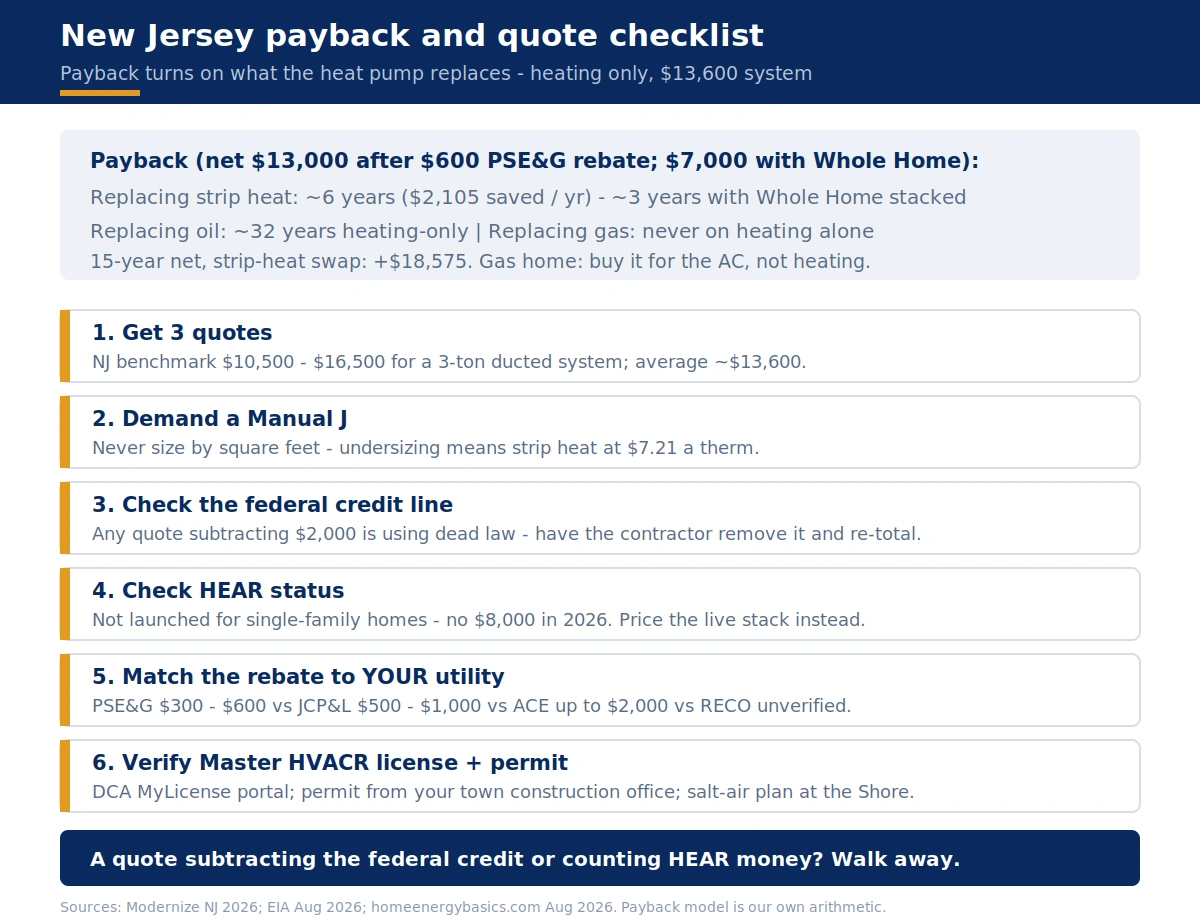
Red flags. A quote far below the $10,500–$16,500 installer range with no explanation of what is excluded — check it against the Paterson $6,000 trap. A contractor who sizes the system from your floor area and never runs a Manual J calculation. Any “free heat pump” or “government program” door-to-door pitch — no government program gives away heat pumps; HEAR is not open to single-family homes, Comfort Partners is income-qualified, and the utility rebates are capped, not free equipment for everyone. A furnace-only price shown as the cheaper alternative, with the air conditioner it still needs left out of the total. A utility rebate assumed without checking which utility bills you — PSE&G, JCP&L, ACE, and RECO all pay different amounts, and RECO’s current amount is unverified. A unit sold as new in 2026 that still runs on R-410A is old stock — new R-410A equipment stopped being produced on January 1, 2025. A Shore quote with no salt-air protection priced the same as an inland quote. And any “sign today to lock in the credit” pressure — there is no credit left to lock in, so that deadline was invented for the sales call. Federal law gives you a 3-day right to cancel any door-to-door sale of $25 or more (the FTC Cooling-Off Rule, 16 CFR Part 429).
Sources & methodology
How this New Jersey guide was put together. Every price in this guide is dated November 2026 New Jersey data, and every figure names its source in the text. The headline range ($10,500–$16,500 installed, ~$13,600 average) is built from Modernize’s New Jersey city pages (statewide average $13,600; standard $10,880; high-efficiency $16,320; single-zone mini-split $7,480; 3-zone $16,320; geothermal $38,080; labor $102–$218/hr) cross-checked against the Essex County installer guide (Adriatic Aire, ~October 2026: ducted $12,000–$22,000, average ~$15,000; single-zone $3,500–$7,000; multi-zone $8,000–$18,000), the NuWatt regional averages (April 2026: North $15,000, Central $14,000, Shore $14,500, South $13,000), and the Jazz Construction Group NJ HVAC guide (updated 2026-09-14: full heat pump system $7,000–$18,000). The Paterson guide’s $6,000–$12,000 heat pump range is treated as an equipment-lean outlier. The Shore salt-air premium (10–15%) and per-zone mini-split range ($4,000–$7,500) come from NuWatt’s Jersey Shore guide (April 2026).
Rebates. Whole Home terms ($2,000 at 5% TES, +$200/pt to $7,500 at 33% TES, 50% project-cost cap, BPI contractor + assessment required, 0% financing to $25,000, terms through June 30, 2027) and the full utility tier tables are verified against homeenergybasics.com (sources last checked August 22, 2026), which is the single most complete 2026 NJ rebate tracker found: PSE&G tiers $300/$450/$600 cold-climate + $300 LMI; PSE&G Building Decarbonization $10,000/50% ($12,000/60% LMI), decommissioning $2,000, re-ducting $2,000, Dual Heat $5,000/50%, Hybrid Heat $2,000/30%, 0% on-bill to $75,000; JCP&L $500/$750/$1,000 cold-climate + $200 LMI; ACE $500/$750/$2,000 cold-climate (April 1, 2026–June 30, 2027) + $300 LMI + $150 thermostat, geothermal up to $10,000; NJNG SAVEGREEN $500–$1,000 + hybrid $2,000/$4,000; RECO amounts explicitly not verified. ACE’s own HVAC Efficiency Program page confirms the $2,000 cold-climate rebate and the geothermal terms (installs July 1, 2026–June 30, 2027). The BPU’s February 13, 2026 Appendix H filing confirms the decarbonization rebate structure. HEAR/HOMES status (not launched for single-family; ~$185M allocation; M-RISE + CP-HEAR design) is verified against homeenergybasics.com (August 22, 2026), BetterHouse (September 2026), heatpumppricing.com (status verified November 4, 2026), HYRE’s state census (September 6, 2026), and the National Housing Trust state funding tracker ($183,147,420 allocation; applications conditionally approved). DOE Program Notice 26-2 is the source for the end of HEAR fuel-switching. Comfort Partners eligibility (≤250% FPL or LIHEAP/SNAP/TANF/SSI/Section 8) comes from homeenergybasics.com. COOLAdvantage/WARMAdvantage closed in 2021 (homeenergybasics.com).
Rates and running costs. Electricity 24.61 cents/kWh (EIA Electric Power Monthly, Table 5.6.A, August 2026, released October 28, 2026); 12-month average ~23.7 cents (wheredmymoney.com, EIA data); PSE&G tariff ~26.00 cents/kWh all-in at 900 kWh (priceofelectricity.com, EIA data); ACE retail rate ~$0.16/kWh (ProFusion). Gas $1.43/therm (12-month average to July 2026, EIA via wheredmymoney.com). Heating oil $6.38/gal (EIA SHOPP, week of October 26, 2026) and $4.30 last-winter average; propane $4.10/gal (same week) and $3.63 last-winter average (wheredmymoney.com / utilitycostcalc.com, EIA data). Heating fuel mix (~72% gas) from homeenergybasics.com. Modeled annual heating costs ($859 gas furnace, $923 cold-climate heat pump, $1,072 standard heat pump, $891 geothermal, $3,028 baseboard) from wheredmymoney.com (2026, 2,000 sq ft home). Per-therm and payback arithmetic in this guide is our own, built from those EIA prices at a seasonal COP of 2.7, and is labeled as such wherever it appears.
Climate. Heating degree-days from the Rutgers NJ Climate Center 1991–2020 normals (Newark 4,701; Trenton 4,977; Atlantic City Intl 4,701; Atlantic City Marina 4,438; Aeroflex-Andover 5,926); design temperatures from homeenergybasics.com’s ASHRAE 99% table (Newark ~10°F, Trenton ~10°F, Atlantic City ~12°F, Sussex ~5°F) cross-checked against ICC Appendix D Table D101 (Newark 4,589/14°F, Trenton 4,980/14°F, Atlantic City 4,812/13°F). Zone 4A/5A framing from homeenergybasics.com. Seasonal COP 2.7 from a northern New Jersey Manual J report (72energy.com, 2026). Newark humidity near 68% from hvacloadcalculate.com.
Federal law. OBBBA (P.L. 119-21, signed July 4, 2025) and IRS FS-2025-05 (August 21, 2025) cut off §25C and §25D for property placed in service after December 31, 2025. The Adriatic Aire claim that §25D survives through 2033 is rejected as contradicting the statute and the IRS.
Licensing and permits. Master HVACR Contractor License requirement (NJ State Board of Examiners of HVACR Contractors, Division of Consumer Affairs, N.J.S.A. 45:16A; $3,000 bond; biennial renewal) from Housecall Pro’s NJ licensing guide and contractorlicensecheck.com; permit requirement under the Uniform Construction Code (N.J.A.C. 5:23) and Paterson Ordinance 26-009 ($75/subcode, September 15, 2026) from hvacpaterson.com.
What was not verified. No New Jersey-specific figures were found for Rockland Electric rebate amounts, dual-fuel installed cost, cold-climate ducted installed cost, panel-upgrade cost, ductwork cost, heat pump lifespan, or a tonnage price table — this guide uses national planning ranges labeled as such, or omits the figure. Conflicting figures (PSE&G flat $900 vs tiered $300/$450/$600; oil $6.38 spike vs $4.30 last-winter average; §25D survival claim vs OBBBA; Paterson $6,000–$12,000 vs Modernize $13,600 average; ICC vs Rutgers degree-days) are flagged in the research file (files/research/75-heat-pump-cost-new-jersey-2026.md, LESS-THAN-CERTAIN section) and handled in the text by naming the figure this guide uses and the one it rejects.
How much does a heat pump cost in New Jersey in 2026?
A typical whole-home ducted heat pump costs $10,500–$16,500 installed in New Jersey in 2026, with the statewide average job near $13,600 (Modernize New Jersey city pages). A single-zone mini-split runs $3,500–$7,500, a multi-zone system $8,000–$18,000, dual-fuel $7,000–$16,000, and geothermal about $38,080. The federal tax credit is $0 for 2026 installs, but New Jersey rebates — up to $7,500 from Whole Home, up to $10,000 from PSE&G decarbonization, up to $2,000 from Atlantic City Electric — can cut the net cost dramatically.
What heat pump rebates can I actually get in New Jersey in 2026?
The statewide Whole Home program pays up to $7,500 based on modeled energy savings, and it stacks with your electric utility’s rebates. PSE&G pays $300–$600 instantly by efficiency tier, plus up to $10,000 through its Building Decarbonization program if you fully replace fossil-fuel heating. JCP&L pays $500–$1,000 (cold-climate $1,000). Atlantic City Electric pays $500–$750, or $2,000 for a cold-climate heat pump through June 30, 2027. NJ Natural Gas pays $500–$1,000, plus up to $4,000 for a hybrid heat pump with gas backup. Rockland Electric’s amounts are not published — contact RECO directly. There is no New Jersey state tax credit for heat pumps.
Is the $8,000 federal HEAR heat pump rebate available in New Jersey?
No — not for a typical single-family homeowner in 2026. New Jersey received about $185 million in federal IRA funding, but the state is directing it to low-income households through a multifamily program (M-RISE) and a planned Comfort Partners electrification adder (CP-HEAR), not broad single-family rebates. No consumer-facing single-family HEAR program has launched as of late 2026. Do not let a quote subtract $8,000 that cannot be collected. Income-qualified households should look at Comfort Partners instead, which provides free heating system replacement for households at or below 250% of the poverty line.
Is a heat pump cheaper to run than a gas furnace in New Jersey?
No, on heating alone it is not. At New Jersey’s electricity price of 24.61 cents per kWh (EIA, August 2026) and gas at about $1.43 a therm, a heat pump at a seasonal COP of 2.7 delivers a therm of heat for about $2.67, while a new 95% gas furnace delivers it for about $1.51. A heat pump would need a seasonal COP near 4.8 to match the furnace here. The heat pump wins clearly against electric strip heat ($7.21 a therm), oil ($3.65 at last winter’s price, $5.42 at the October 2026 spike), and propane ($4.67) — and when the air conditioner needs replacing anyway, one system doing both jobs changes the math.
Do I need a cold-climate heat pump in New Jersey?
In North Jersey, yes — price one first. Sussex County’s design temperature is around 5°F and Newark’s around 10°F, and the state spends much of its winter below 30°F, where standard heat pumps lose capacity. Inverter-driven cold-climate models keep delivering their full rated heat down to about 5°F and cost 15–30% more than standard models. In South Jersey’s mild corner around Atlantic City, a standard model is a defensible choice. Every New Jersey utility also pays its top rebate only for cold-climate equipment, so the upgrade often pays for itself in rebate money alone.
How long does a heat pump last in New Jersey?
Roughly 12–15 years, with a service visit every year. Year-round use shortens life against an air-conditioner-only unit, and salt air at the Jersey Shore is harder on an outdoor unit than anything inland New Jersey throws at one — coastal installs need corrosion protection and should sit above flood elevation. In the north, mount the outdoor unit on an elevated pad or wall bracket with clearance, not at grade where a snowdrift can bury it.
Do I need a permit or a license to install a heat pump in New Jersey?
Most New Jersey municipalities require a construction permit under the Uniform Construction Code for a full system replacement — Paterson charges $75 per subcode. New Jersey requires a Master HVACR Contractor License to perform, advertise, or bid HVAC work, issued by the State Board of Examiners of HVACR Contractors under the Division of Consumer Affairs, with no small-job carve-out. Verify the license through the DCA MyLicense portal, plus EPA Section 608 certification for anyone opening a refrigerant circuit. A “13VH” number is a Home Improvement Contractor registration, not an HVACR license.
Is there still a federal heat pump tax credit I can claim in 2026?
No — not for a 2026 install. The §25C credit — 30%, up to $2,000 a year — came down for any heat pump placed in service after December 31, 2025, under the One Big Beautiful Bill Act (P.L. 119-21), with the IRS cutoff laid out in FS-2025-05. Geothermal’s 30% §25D credit ended on the same date. A system installed in 2025 can still be claimed on the 2025 return with Form 5695, but a 2025 payment does not help if the install itself finished in 2026. If a quote still deducts a $2,000 federal credit, have the contractor remove that line and re-total the quote.