

Table of Contents
Washington asks a heat pump to do two different jobs, and the price follows the job. West of the Cascades, in Seattle, Tacoma, and Bellevue, the winters are so mild that a standard inverter heat pump barely works hard — it heats all winter, cools through the smoke-season summers, and quietly replaces the baseboard heaters that half the region’s older homes still run on. East of the Cascades, in Spokane, Yakima, and the Tri-Cities, the same equipment faces design temperatures near zero, summer highs in the 90s, and a heating season that punishes any unit that was not built for the cold. One state, two climates, two price books — and a rebate map that changes every time you cross a utility boundary.
The other thing that makes Washington different is the electricity itself. The state’s hydro-heavy grid delivers some of the cheapest residential power in America, and the spread between utilities is enormous: a home on Chelan County PUD power pays under 4 cents per kWh while a Puget Sound Energy customer pays about 17. That spread decides whether a heat pump pays for itself in six years or twelve, and whether it beats a gas furnace on fuel at all. This guide prices the state the way a Washington estimator would: by system, by size, and by city — Seattle, Tacoma, Everett, Bellevue, Spokane, Yakima, and the Tri-Cities — with the rebate each utility actually pays in 2026, the running-cost math at real tariff rates, and the honest answer on the federal money that is not here yet.
For the country-wide baseline, begin with our heat pump cost guide.
How much does a heat pump cost in Washington in 2026?
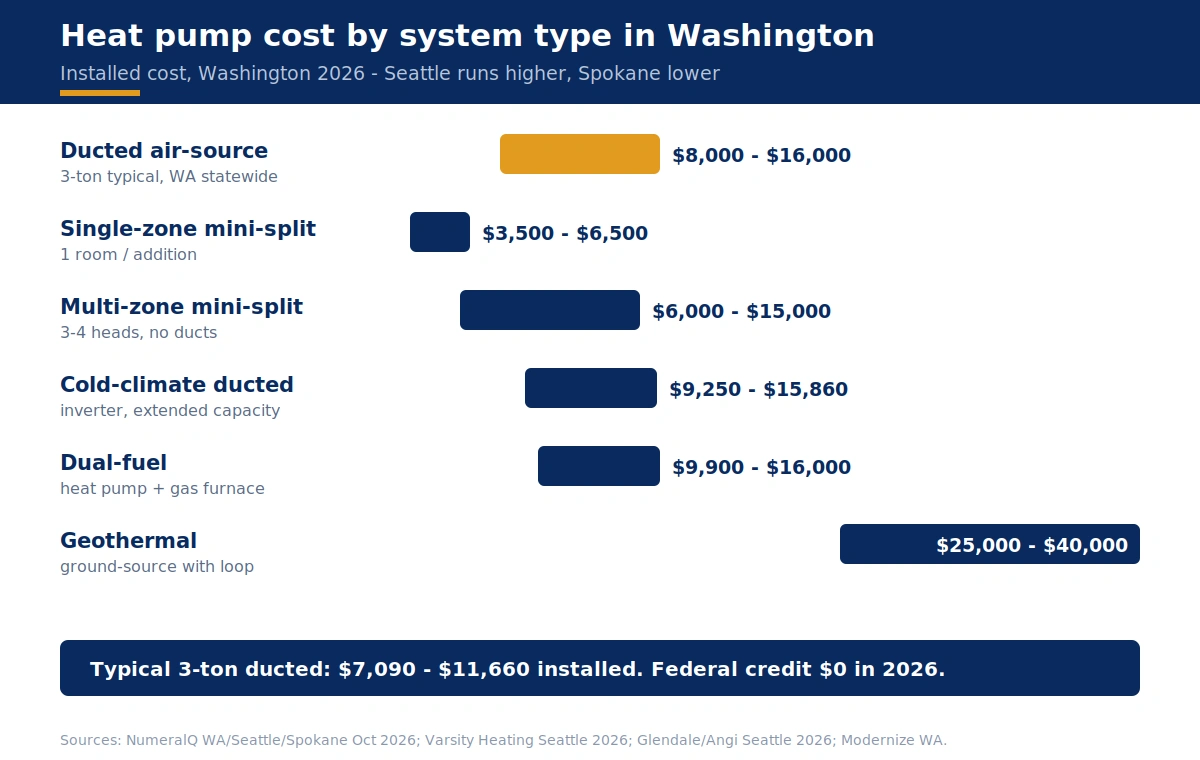
The honest headline is a range, not a number, because Washington’s two halves price the same equipment differently. Most Washington homeowners pay $8,000–$16,000 for a ducted air-source heat pump installed in 2026. That band comes from stitching together the state’s best 2026 sources: NumeralQ’s October 2026 statewide planning estimate puts a 3-ton ducted system at $7,090–$11,660; Glendale Heating’s Seattle-area guide, built on Angi’s 2026 data, puts ducted installs at $8,000–$16,000 with an Angi Seattle average of $10,218; HVAC Project Cost’s statewide guide puts a ducted heat pump at $6,000–$13,500 and a full HVAC replacement at $6,500–$15,500; and Modernize puts the Washington average heat-pump installation at $10,150, with a standard air-source system at $8,160 and a high-efficiency one at $12,240.
Seattle sits at the top of that band and above it. Varsity Heating, a Puget Sound contractor publishing 2026 prices by home age, lists a Seattle ducted heat pump at $14,000–$22,000 installed, a ductless system at $9,500–$17,000, and a straight replacement on existing equipment at $12,000–$19,000 — and it is explicit about why: Seattle is its affluent market tier, running roughly 15–20% above standard Puget Sound pricing on labor, permitting, and older-home complications. A two- to three-zone ductless system in a 1,400–1,800 sq ft Craftsman typically lands at $10,000–$14,000 there; four zones in a larger Tudor pushes toward $17,000. Glendale’s lower Seattle numbers ($8,000–$16,000 ducted) and Varsity’s higher ones are not contradicting each other — they are pricing different tiers of equipment and different vintages of house. A 1940s Craftsman with a 100-amp panel and no ductwork is a Varsity job; a 1990s rambler with good ducts and a 200-amp panel is a Glendale job.
Spokane and the east side sit at the bottom of the band. NumeralQ’s October 2026 Spokane estimate puts a 3-ton ducted system at $6,620–$11,050, and HVAC Project Cost puts Spokane and eastern Washington full replacements at $5,500–$10,500 against Seattle/Bellevue’s $8,000–$15,500. Labor is cheaper, permits are cheaper, and the housing stock is newer on average. The catch is the equipment: Spokane needs a cold-climate model, and that premium eats much of the labor savings back.
| System type | Washington statewide | Seattle / Puget Sound | Spokane / eastern WA |
|---|---|---|---|
| Ducted air-source heat pump | $8,000–$16,000 | $10,000–$22,000 | $6,500–$13,500 |
| Ductless mini-split, single zone | $3,500–$6,500 | $3,500–$6,000 | $3,200–$5,000 |
| Ductless mini-split, multi-zone | $6,000–$15,000 | $9,500–$17,000 | $6,300–$11,300 |
| Cold-climate ducted heat pump | $9,250–$15,860 | $9,400–$16,100 | $8,700–$15,100 |
| Dual-fuel (heat pump + gas furnace) | $9,900–$16,000 | $12,000–$20,000 | $9,300–$15,200 |
| Geothermal (ground-source) | $25,000–$40,000+ | $28,000–$40,000+ | $25,000–$35,000 |
| Heat pump replacement (existing ducts/equipment) | $5,000–$8,000+ | $11,500–$19,200 | $6,000–$10,500 |
Sources: NumeralQ WA/Seattle/Spokane pages (Oct 2026); Varsity Heating Seattle 2026; Glendale Heating/Angi Seattle 2026; HVAC Project Cost WA 2026; Modernize WA. Seattle replacement figures are Varsity’s; the statewide replacement range is Angi’s regional estimate. All prices installed, before rebates.
One warning before you use any of these numbers: the cheapest quote in Washington is often the one that quietly drops the rebate paperwork. PSE has required a Trade Ally or Recommended Energy Professional installer since April 2, 2026 — book anyone outside that network and the $1,500 rebate is gone, whatever the quote says. Snohomish PUD pays only through registered contractors, and Seattle City Light’s instant discounts flow through participating distributors. A bid that is $1,500 cheaper than the next one because the installer is not in the network is not cheaper at all. Ask every bidder, in writing, which rebate they will file and whether they are in that program’s network.
Heat pump cost by system type in Washington
System type is the biggest single line on the invoice, and in Washington the choice is usually made for you by what the house already has. A home with good ducts gets a ducted system. A home with baseboard heat, a 1920s Craftsman with no duct chases, or an addition over the garage gets ductless. A home east of the Cascades gets a cold-climate unit whether it has ducts or not.
Ducted air-source heat pumps are the Washington default for homes with existing ductwork: one outdoor unit, one indoor air handler, whole-home heating and cooling through the ducts you already own. Statewide they run $8,000–$16,000 installed; in Seattle, $10,000–$22,000 on Varsity’s 2026 pricing, or $8,000–$16,000 on Glendale/Angi’s. The spread inside that band is equipment tier (single-stage vs variable-speed inverter), size, and what the ducts need. Ducts that leak or are undersized are the hidden cost here — sealing and repair runs $1,660–$2,440 in Spokane (NumeralQ), and a full new duct system runs $5,420–$8,830 there, $4,830–$7,940 statewide. If your quote does not mention a duct inspection, it has not priced the job yet.
Ductless mini-splits are Washington’s retrofit answer, and the state may be the best ductless market in the country: mild west-side winters, thousands of baseboard-heated homes, and utilities that pay specifically for ductless conversions. A single-zone system runs $3,500–$6,500 installed statewide ($3,500–$6,000 in Seattle on Glendale/Angi data; $3,190–$4,970 in Spokane on NumeralQ; about $4,000–$6,500 from Falco’s, a Spokane installer). A multi-zone system — one outdoor unit serving three or four indoor heads — runs $6,000–$15,000 statewide, $9,500–$17,000 in Seattle, $6,340–$11,300 in Spokane. Each additional head adds roughly $1,500–$2,500 installed. For the full zone-by-zone breakdown, see our mini-split installation cost guide.
Cold-climate heat pumps are not a marketing label in Washington — they are a different machine. Inverter-driven, extended-capacity units (Mitsubishi Hyper-Heat is the name that comes up most in Spokane and Seattle installer literature) hold their heating output down to -5°F or -15°F, where a standard unit has already handed the job to backup strip heat. They cost roughly 25–30% more than a standard unit of the same size: NumeralQ puts a cold-climate ducted 3-ton at $9,250–$15,860 statewide, $9,440–$16,110 in Seattle, and $8,690–$15,140 in Spokane. West of the Cascades, a cold-climate unit is a nice-to-have that pays mostly in comfort on the few sub-freezing nights. East of the Cascades, it is the correct specification — a standard unit in Spokane spends too much of January on strip heat, and strip heat is what turns a heat-pump bill into a baseboard bill.
Dual-fuel systems pair a heat pump with a gas furnace: the heat pump carries the mild weather, the furnace takes over below a set outdoor temperature (usually 30–35°F). They run $9,900–$16,000 statewide (NumeralQ), more in Seattle. They make sense for exactly one Washington household: a PSE gas customer who wants cooling and lower heating bills but does not trust a heat pump alone in a cold snap, or who wants to keep the gas furnace as insurance. They make no sense in a Seattle City Light home with no gas line — there is nothing to dual-fuel with.
Geothermal (ground-source) heat pumps run $25,000–$40,000+ installed in Washington (Modernize: $28,560 average; NumeralQ Seattle: $21,750–$33,850 with loop). The loop field is the constraint: it needs yard space, drilling or trenching access, and a site that can take it — a tight Seattle lot usually cannot. Where it fits, it is the most efficient system on the market and the only one whose performance barely notices a Spokane January. Our geothermal heat pump cost guide has the national numbers.
Heat pump cost by size in Washington
Size is measured in tons, and in Washington the right size is decided by a Manual J load calculation — not by square footage alone, and never by the size of the unit being replaced. A leaky 1920s Craftsman in Tacoma and a tight 2015 build in Redmond can be the same square footage and need different equipment. Still, the size table below is the planning tool most homeowners actually use, built from NumeralQ’s October 2026 Washington estimates for a ducted air-source system, cross-checked against Angi’s Seattle figures.
| System size | Typical home | Ducted air-source (WA) | Cold-climate ducted (WA) |
|---|---|---|---|
| 1.5 tons | 600–900 sq ft | $5,500–$8,500 | $7,000–$11,000 |
| 2 tons | 900–1,400 sq ft | $6,500–$10,000 | $8,000–$13,000 |
| 2.5 tons | 1,400–1,800 sq ft | $7,000–$11,000 | $9,000–$14,500 |
| 3 tons | 1,800–2,400 sq ft | $7,090–$11,660 | $9,250–$15,860 |
| 4 tons | 2,400–3,000 sq ft | $8,500–$14,000 | $11,000–$18,000 |
| 5 tons | 3,000+ sq ft | $10,000–$17,000 | $13,000–$21,000 |
Sources: NumeralQ Washington/Seattle/Spokane (Oct 2026, 3-ton anchor $7,090–$11,660 statewide, $7,260–$11,880 Seattle, $6,620–$11,050 Spokane); other sizes scaled from the 3-ton anchor and cross-checked against Angi Seattle ($10,218 average) and Modernize WA ($10,150 average). Seattle runs toward the top of each band; Spokane toward the bottom.
Three size mistakes Washington homeowners keep making. First, oversizing: a unit too big for the house short-cycles, never dehumidifies properly in summer, and wears itself out — and in Seattle’s mild climate the penalty is worse than in a hot state, because the unit spends most of its life at part load. Second, sizing off the old furnace: the furnace was probably oversized when it was installed, and the house has likely had insulation or windows improved since. Third, skipping the load calculation to save $200–$500: a Manual J is the cheapest insurance on a $12,000 purchase, and most reputable Washington installers credit it toward the job. If a contractor sizes your system from square footage alone, get a second quote.
What drives your price up or down in Washington
The equipment is roughly half the invoice. The other half is everything Washington puts between the box and the wall — and in this state, that half varies more than the equipment does.
Ductwork. The single biggest swing after system type. Good ducts that pass inspection: no added cost. Leaky or undersized ducts: $1,660–$2,440 to seal and repair in Spokane (NumeralQ). No ducts at all: $5,000–$10,000 for a new system, or go ductless instead. Seattle’s pre-1940 housing stock is where duct surprises live — ducts run through unconditioned crawlspaces and attics, and a surprising number of them were sized for a furnace, not a heat pump’s lower supply-air temperatures.
Electrical panel. A heat pump needs a dedicated 240V circuit, and a surprising share of Washington’s older homes still run on 100-amp panels. A panel upgrade runs $1,500–$4,000 and is the add-on that most often appears as a surprise line item. Our electrical panel upgrade cost guide prices it separately so you can spot it in a quote. Note the silver lining: the federal HEAR program, when it launches in Washington, includes up to $4,000 for the electrical work a heat pump needs — but it has not launched, so do not budget on it.
Cold-climate rating. Worth ~25–30% on the equipment, and worth paying east of the Cascades. West of the Cascades it is a judgment call: Seattle sees only a handful of nights a year below 25°F, and a standard inverter unit with a small amount of backup heat handles them fine.
Refrigerant. New systems installed in Washington in 2026 must use a refrigerant under 750 GWP under the state’s HFC rule — in practice R-454B or R-32, not R-410A. The federal cap is 700 GWP (since January 1, 2025). This is mostly a non-issue for a new purchase, because manufacturers have already switched, but it is a check worth running: if a quote lists an R-410A system for a 2026 install, the equipment is old stock and the quote is stale. Confirm the quoted model is a current-refrigerant unit.
Permits. A mechanical permit is required statewide under WAC 51-52, including for like-kind replacements. Seattle fees run $150–$600 depending on scope, with online processing typically in 3–7 business days; Spokane’s mechanical permit runs $75–$300. Electrical permits are separate, and in Seattle, Bellevue, Kirkland, Redmond, Sammamish, Mercer Island, and Renton the city runs its own electrical program while L&I covers the rest of the state. Most licensed contractors pull both permits as part of the package. A contractor who prices the job without permits, or tells you they are optional, is a red flag — see the red-flags section below.
Labor market. Seattle and Bellevue labor runs 15–20% above the Puget Sound baseline (Varsity), and the baseline itself is above the national average. Spokane labor is near the national average. The same 3-ton system can legitimately cost $4,000 more in Seattle than in Spokane before any equipment difference is counted.
Timing. Spring and fall are shoulder season for Washington installers — the summer cooling rush and the first-cold-snap heating rush are the expensive times to book. A reputable Puget Sound installer books one to three weeks out in shoulder season and longer in a cold snap. The Seattle Clean Heat bonus deadline (installations completed by May 30, 2027 on the current city form) is a real scheduling constraint for oil-conversion households — do not leave it to the last month.
The quote itself. Prices for identical equipment vary 30% or more between Washington contractors — the same spread our national guide documents, and the same reason three written, itemized quotes are the single most valuable step in this whole process. Our hidden HVAC quote fees guide lists the ten fees that most often hide in a Washington bid.
Washington’s two climates: marine west side vs cold east side
Washington is two heating climates divided by a mountain range, and buying the wrong side’s system is the most expensive mistake in this guide. The Cascades do not just split the weather — they split the equipment spec, the rebate, and the payback.
West of the Cascades — Seattle, Tacoma, Bellevue, Olympia, Bellingham — is IECC Climate Zone 4C, marine west coast. Winters are mild and damp: design temperatures run about 23–27°F, the heating season is long but shallow, and summers are cool enough that air conditioning was optional until the 2021 heat dome made it a selling point. A standard inverter heat pump is rated “excellent” for this climate by the state’s own cost guides, and it is: the unit spends most of the winter at a COP of 3 or better, rarely calls for backup heat, and the cooling it adds in July is now worth real money to a buyer. The west-side risks are not cold — they are moisture and salt air. Outdoor units near Puget Sound want corrosion-resistant coatings and a mounting pad that keeps them out of standing water, and condensate drainage has to be right in a climate where the unit dehumidifies for months.
East of the Cascades — Spokane, Yakima, the Tri-Cities, Wenatchee, Walla Walla — is Zones 5B and 6B, cold semi-arid. Spokane’s design temperature sits near 2–7°F, the heating season runs 6,500+ heating degree days, and summer highs push into the 90s. A standard single-stage heat pump in Spokane spends too much of January on electric strip heat, and strip heat at eastern Washington rates turns the efficiency case upside down. The right specification is a cold-climate inverter unit — Mitsubishi Hyper-Heat is the line Spokane installers name most — sized with a Manual J that respects the design temperature, not the average one. Our cold-climate mini-split cost guide covers the equipment in detail.
| West side (Seattle/Tacoma) | East side (Spokane/Yakima) | |
|---|---|---|
| Climate zone | 4C marine | 5B / 6B cold semi-arid |
| Winter design temp | ~23–27°F | ~2–7°F |
| Right equipment | Standard inverter heat pump | Cold-climate inverter heat pump |
| Backup heat needed | Rarely, a few nights a year | Yes — sized strip heat or dual-fuel |
| Main risk | Moisture, salt air, old ducts | Deep cold, strip-heat bills |
| Cooling value | High since the 2021 heat dome | High — 90°F+ summers |
| Typical ducted cost | $10,000–$22,000 | $6,500–$13,500 |
Sources: HVAC Project Cost WA climate table (2026); NumeralQ city estimates (Oct 2026); Falco’s Spokane.
The practical test is simple: if your contractor’s proposal does not name your climate zone or your design temperature, the contractor has not done the load calculation. A Seattle quote and a Spokane quote should not read the same. If they do, one of them is wrong.
The federal tax credit is $0 in 2026 — what that means
This section exists because Washington homeowners are still being quoted a federal tax credit that no longer exists. The rule is short and absolute: OBBBA (P.L. 119-21, signed July 4, 2025) ended the §25C Energy Efficient Home Improvement Credit and the §25D Residential Clean Energy Credit for property placed in service after December 31, 2025 (IRS FS-2025-05). A heat pump installed in Washington in 2026 gets $0 in federal tax credit. The old §25C credit was worth 30% up to $2,000 on a qualifying heat pump; that money is gone.
What that means in practice:
- Any 2026 quote that subtracts a $2,000 federal credit is outdated. Ask the contractor to remove it and re-price. If they argue, they have not updated their paperwork since 2025 — and that is information about the contractor, not just the quote.
- A 2025 install can still be claimed. If your system was placed in service in 2025, the credit is claimed on the 2025 return via IRS Form 5695. The cutoff is the in-service date, not the purchase date.
- The federal HEAR rebate is a different program and is also not here yet. The $8,000 federal heat-pump rebate (HEEHR, formerly HEAR/HEEHRA — Washington calls its version HARP) has not launched in Washington. The state Department of Commerce is at step 5 of 7 in setting up delivery, and was still reviewing the Department of Energy’s June 2026 program changes as of its June 15, 2026 update. Do not let a contractor put an $8,000 federal rebate on a 2026 invoice — there is no program to pay it.
- What changed inside the federal program matters for the future. DOE Program Notice 26-2 (May 29, 2026) renamed the federal program the High-Efficiency Electric Home Rebates program and, from September 1, 2026, stopped it paying to replace non-electric equipment — electric-to-electric only. When Washington’s federal program eventually launches, a gas- or oil-to-heat-pump conversion would not qualify under the new federal rules. The program also never covered solar, batteries, EV chargers, or windows. The full federal picture is in our federal energy tax credits guide.
The money that replaces the federal credit in Washington is state and utility money, and that is the next section. It is smaller than the old $2,000 credit plus an $8,000 rebate would have been — but unlike the federal money, it is actually payable today.
Washington rebates that are still alive in 2026
Washington’s rebate map is drawn by utility boundaries, not by county lines — and in the Seattle area, the boundary can run down the middle of a street. Burien, Normandy Park, Renton, SeaTac, and Tukwila are split between Seattle City Light and Puget Sound Energy, and the two run completely different programs. Step one, before you price anything, is to check which utility sends your electric bill. Step two is to check which program that utility runs. Everything below was verified against utility and state program pages in October 2026; amounts change and funds run out, so confirm before you sign.
| Utility / program | What it pays (heat pump) | Key condition |
|---|---|---|
| PSE — electric resistance to heat pump | $1,500 ($2,400 Efficiency Boost) | Trade Ally/REP installer required since Apr 2, 2026 |
| PSE — heat pump upgrade (replace existing) | $1,500 ($2,400 Boost) | Out-of-warranty, centrally ducted, all-electric |
| PSE — hybrid (heat pump + gas furnace) | $1,500 ($2,400 Boost) | Qualifying equipment |
| PSE — gas to heat pump | $4,000 | Income-qualified |
| PSE — instant midstream discount | $300 / $400 / $600 | By SEER2/HSPF2 tier |
| Seattle City Light — instant discount | $300 / $400 / $600 | By SEER2/HSPF2 tier, participating distributor |
| Seattle Clean Heat — oil to heat pump | $2,000, up to $6,000 | Working oil heat, Mitsubishi, participating contractor |
| Snohomish PUD | $1,800 ducted; $2,500 inverter ducted | Registered contractor, replacing electric heat |
| Tacoma Power | $1,000–$2,000 | Participating contractor; $2,000 for variable-speed replacing electric forced air |
| Avista (Spokane) | $300–$600 | Mail-in, 2026 program |
| Pacific Power (eastern WA) | $200–$800 | By equipment and tier |
| Energy Smart Eastside (PSE territory) | +$1,000 (up to $6,000 income-qualified) | Bellevue, Issaquah, Kirkland, Mercer Island, Redmond, Sammamish |
| WA state HEAR (Climate Commitment Act) | Varies by local administrator | Income ≤150% AMI, ~40 administrators |
Sources: PSE program pages via Home Comfort Alliance + Kolmo (read Oct 23, 2026); Seattle City Light / Clean Heat via Eco Services + Eastside Electrical (checked Sept–Oct 2026); Snohomish PUD + Tacoma Power via Eco Services + Home Comfort Alliance (Sept–Oct 2026); Avista via ENERGY STAR DIME (2026); Pacific Power via HVAC Project Cost; WA Commerce HEAR via GridShift + UpgradesRebates (Oct 2026).
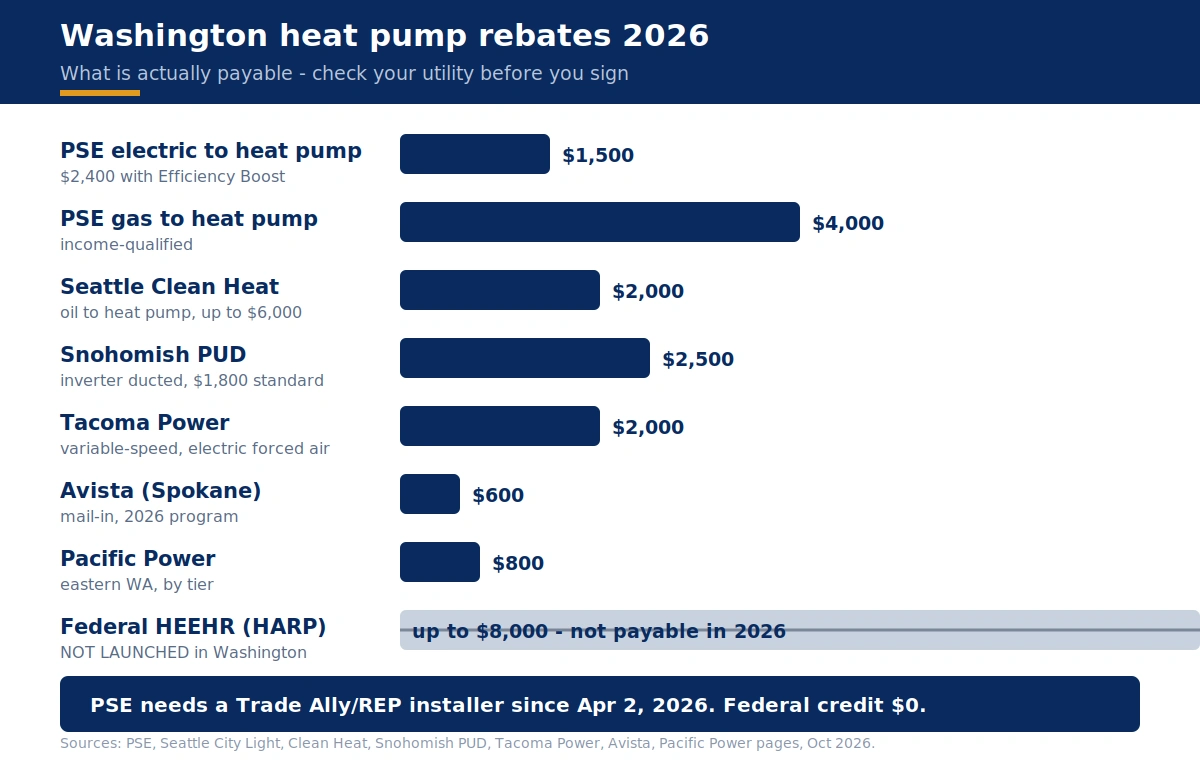
Puget Sound Energy is the biggest program in the state, covering more than 1.1 million customers across King, Pierce, Snohomish, Kittitas, Thurston, and other counties. It pays $1,500 when you replace electric-resistance heat with a qualifying air-source heat pump, $2,400 with the income-qualified Efficiency Boost, and $4,000 for an income-qualified household replacing natural gas heat. A heat-pump upgrade — replacing an out-of-warranty, centrally ducted, all-electric heat pump — also earns $1,500 ($2,400 Boost), and a hybrid heat pump added to a gas furnace earns $1,500 ($2,400 Boost). On top of the rebates, PSE pays an instant midstream discount of $300, $400, or $600 per unit depending on efficiency tier ($300 at SEER2 15.2 / HSPF2 8.1; $400 at 15.2 / 8.5; $600 at 16 / 9.5). The rule that disqualifies the most people: since April 2, 2026, PSE pays only when the work is done by a PSE Trade Ally or Recommended Energy Professional. A non-network installer — or a do-it-yourself install — gets nothing. One rebate per home, existing single-family homes of four units or fewer.
Seattle City Light pays instant contractor discounts of $300, $400, or $600 on qualifying heat pumps, on the same efficiency tiers as PSE’s midstream discount, applied through participating contractors and distributors. The bigger Seattle money is not City Light’s — it is the City’s Clean Heat program, run by the Office of Sustainability & Environment. Clean Heat pays a $2,000 instant rebate when a home heating with oil converts to a qualifying Mitsubishi heat pump through a participating contractor, plus a $4,000 bonus for moderate-income households (81–150% of area median income), for up to $6,000 total. The oil furnace must be working and must be the home’s primary heat source, and the oil tank has to be decommissioned as part of the job. The current city participation form lists the bonus deadline as installations completed by May 30, 2027 (older pages said September 30, 2026 — verify the current deadline before you schedule). Households below the moderate-income band may qualify for a no-cost conversion through the Seattle Office of Housing.
Snohomish County PUD — Everett and most of Snohomish County — pays $1,800 for a ducted conversion and $2,500 for an inverter-driven ducted heat pump replacing electric heat, through a PUD-registered contractor, with the rebate taken off the bid instantly.
Tacoma Power pays $1,000 for a ducted or ductless heat pump (ductless $1,000 up to 4 units, $650 with 5 or more), $2,000 for a variable-speed heat pump replacing electric forced air, and $1,000 for a variable-speed unit replacing non-electric heat or an existing heat pump — all through a participating contractor. Its income-qualified program is the most generous in the state: up to a $7,000 rebate plus a deferred loan, and its Tacoma HEAR program can cover up to 100% of a heat pump replacing gas, oil, or wood heat. Tacoma also offers 0% financing for up to 7 years. Note Tacoma’s permitting quirk: permits must be pulled before installation for some of its programs — install first and permit after, and the rebate can be disqualified.
Avista serves Spokane and the Inland Northwest. Its 2026 heat-pump rebates run $300–$600 (ENERGY STAR DIME listing, valid January 1–December 31, 2026, mail-in). Avista’s amounts vary by program year, so confirm the current figure directly — and check the Spokane Clean Air wood-stove changeout program, which pays a $2,500 voucher for a ductless heat pump when it replaces an old wood-burning device.
Pacific Power serves parts of eastern Washington, including the Yakima Valley and Columbia Basin. Its heat-pump rebates run $200–$800 depending on equipment and tier — the smallest utility rebates in the state, which is one reason eastern Washington payback math leans more on the equipment’s efficiency than on rebate stacking.
Washington state HEAR is the program most people have heard of and fewest have used. It is funded by the state’s Climate Commitment Act — not by the federal government — and it is open now, delivered through roughly 40 local administrators for income-qualified households (at or below 150% of area median income). Amounts vary by administrator, because each one runs its own program. A concrete example: Clallam PUD won a second-round state HEAR award of $1,127,000 in June 2026 to fund dollar-for-dollar heat-pump rebates for about 158 low-income households, running August 1, 2026 through June 30, 2027. To find the administrator for your address, email the Washington Department of Commerce’s HEAR inbox — the program will tell you who serves your area.
Stacking. In most cases you can combine a utility rebate with state HEAR if you qualify for both, and with the PSE or City Light instant discount — but do not add every number on this page together and call it your savings. PSE’s own guidance is explicit that its rebate pathways apply to different homes and should not be summed into one advertised maximum. The honest way to stack is to have your installer list each rebate on the quote as its own line, with the program name next to it, and to confirm each one with the program before signing.
Washington electricity rates and what a heat pump costs to run
Washington’s electricity is cheap by national standards — and that single fact does more for heat-pump economics than any rebate on this page. The statewide residential average is 14.63 cents per kWh (EIA, August 2026), against a US average of 18.16 cents. The 12-month average to August 2026 is 14.2 cents, and the average Washington home’s electric bill runs about $132 a month. But the statewide average hides the spread that actually decides your bill: Chelan County PUD charges 3.78 cents per kWh while Puget Sound Energy charges 17.01 cents — a more than fourfold gap inside one state.
The two rates that matter most to the most homeowners:
- Seattle City Light: a flat $0.1338 per kWh inside Seattle, $0.1464 in its suburban territory (Shoreline and others), checked October 22, 2026. One rate, no tiers, no time-of-use games.
- Puget Sound Energy (Schedule 7, effective October 1, 2026): $0.1891 per kWh for the first 600 kWh in a month, $0.2085 above that. PSE has a rate case pending that would raise electric rates further, and a November 1, 2026 gas filing already in motion — neither approved at the time of writing, so the figures here are the rates in effect today.
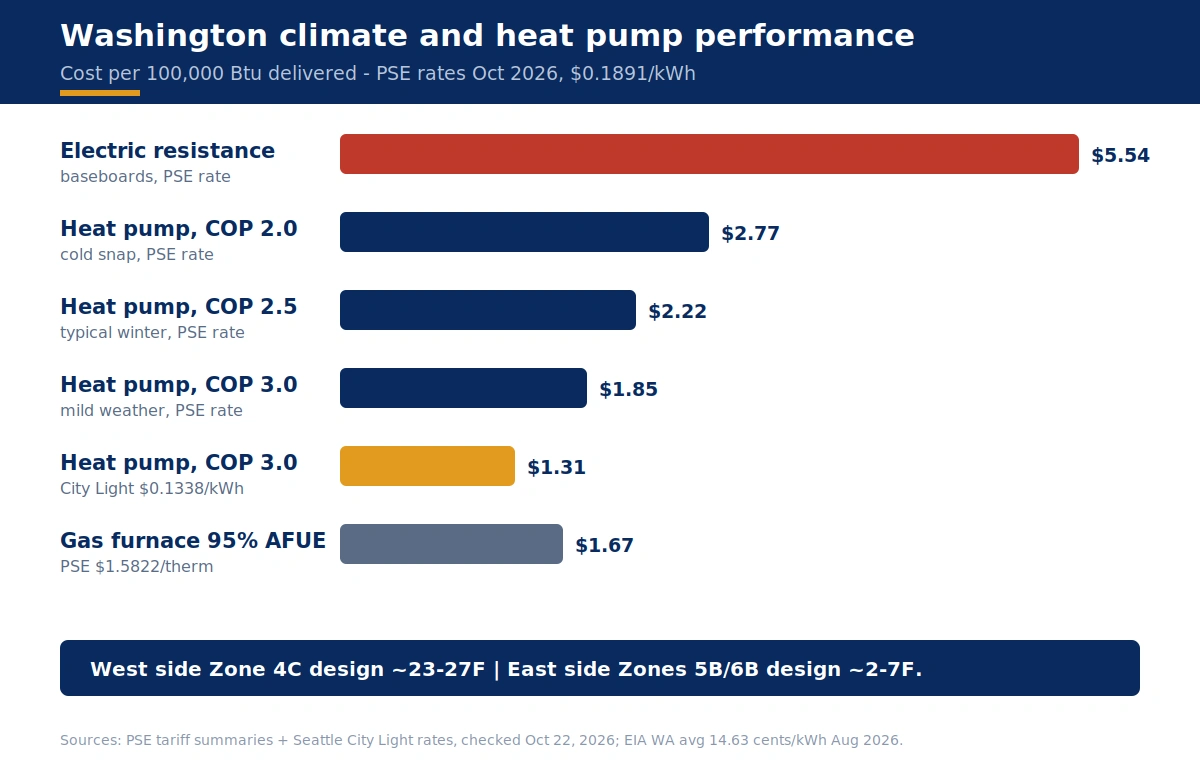
Here is what those rates mean for a heating bill, worked per 100,000 Btu of heat delivered into the house (one therm of gas = 100,000 Btu; one kWh = 3,412 Btu, so 100,000 Btu is 29.3 kWh of resistance heat):
| Heat source | Cost per 100,000 Btu delivered |
|---|---|
| Electric resistance heat, PSE $0.1891/kWh | $5.54 |
| Heat pump COP 3.0, PSE $0.1891/kWh | $1.85 |
| Heat pump COP 2.5, PSE $0.1891/kWh | $2.22 |
| Heat pump COP 2.0 (cold snap), PSE | $2.77 |
| Heat pump COP 3.0, City Light $0.1338/kWh | $1.31 |
| Heat pump COP 2.5, City Light $0.1338/kWh | $1.57 |
| 95% AFUE gas furnace, PSE $1.5822/therm | $1.67 |
Sources: rates from PSE tariff summaries + Seattle City Light residential rates (checked Oct 22, 2026); arithmetic is ours. COP figures are typical seasonal values for a modern inverter unit (COP ~3.0 at 47°F, ~2.0–2.5 in cold weather).
Read the table carefully, because it contains the two most important sentences in this guide. First: against electric resistance heat, a heat pump wins everywhere in Washington, by about two-thirds. Resistance heat at PSE rates costs $5.54 per 100,000 Btu; a heat pump at COP 3 costs $1.85. That is why the baseboard-heated Craftsman is the best heat-pump candidate in the state — the savings are so large that the equipment pays for itself even without a rebate. Second: against a 95% gas furnace, the answer depends on your utility. In City Light territory, the heat pump wins clearly ($1.31 vs $1.67 per 100,000 Btu). In PSE territory, at COP 3.0, the heat pump costs slightly more per unit of heat than gas ($1.85 vs $1.67) — and at COP 2.5 it costs clearly more ($2.22 vs $1.67). A PSE gas customer who installs a heat pump is buying cooling, cleaner air, and freedom from gas-price direction — not a lower heating bill. That is an honest reason to install one, but it is not the reason most sales pitches give.
Two more running-cost facts. Cooling is nearly free on the margin in Seattle: a heat pump cooling a home through a 90°F week uses a fraction of the energy a window-unit farm does, and City Light’s flat 13.38 cents makes the math gentle. And the rate direction favors electricity: PSE’s gas rate has risen from $1.56 to $1.67 per therm across 2026 filings, with another increase requested for November 1, 2026, while Washington’s hydro-heavy electricity has stayed among the cheapest in the country. A heat pump bought today gets cheaper to run relative to gas every year gas rates rise. For the national running-cost picture, see our heat pump running costs guide.
Heat pump vs furnace in Washington: the honest comparison
Washington homeowners usually frame this as heat pump vs gas furnace, and the answer splits cleanly by what heats the house today. The comparison below assumes a 95% AFUE gas furnace at PSE’s $1.5822 per therm and a modern inverter heat pump — and it uses the running-cost table from the previous section, not a sales brochure.
If you heat with electric resistance — baseboards, wall heaters, an electric furnace — the heat pump wins by a landslide. Resistance heat costs $5.54 per 100,000 Btu at PSE rates; a heat pump costs $1.85–$2.22. A home spending $1,500–$2,400 a year on resistance heat saves roughly $900–$1,500 a year with a heat pump. Add the PSE $1,500 rebate ($2,400 with Efficiency Boost), Snohomish PUD’s $1,800–$2,500, or Tacoma Power’s $2,000, and the case closes itself. This is the household the utilities designed their rebates for, and it shows.
If you heat with a gas furnace, the comparison is genuinely close — and the heat pump’s case rests on three things that are not the fuel bill. First, cooling: a furnace gives you none, and a heat pump gives you a full summer of it. Second, the rebates: an income-qualified PSE customer gets $4,000 to convert from gas, and a Seattle oil household gets up to $6,000 through Clean Heat — money a furnace replacement never sees. Third, direction: gas rates have climbed through 2026 while Washington electricity has stayed cheap, so the fuel comparison gets better for the heat pump every year. On fuel alone today, in PSE territory, gas is slightly cheaper per unit of heat. If you replace a gas furnace with a heat pump expecting a smaller heating bill next winter, you may be disappointed — and a contractor who promises otherwise is selling, not advising.
If you heat with oil, convert. Seattle’s Clean Heat program exists precisely for this household: $2,000 at any income, up to $6,000 for a moderate-income household, and a no-cost path for the lowest-income homes. Oil is the most expensive heat in the state per Btu, the most volatile in price, and the one the city most wants gone. The deadline to watch is the bonus cutoff — installations completed by May 30, 2027 on the current city form.
If you heat with wood, check the changeout money. Spokane Clean Air pays a $2,500 voucher for a ductless heat pump replacing an old wood device, and Tacoma’s HEAR program can cover up to 100% of a heat pump replacing wood heat for income-qualified households. Wood heat’s real cost is not the fuel — it is the indoor air quality and the labor of feeding the stove.
| Heat pump | Gas furnace (95% AFUE) | Electric resistance | |
|---|---|---|---|
| Installed cost (WA) | $8,000–$16,000 | $4,500–$10,000 | $0 (already there) |
| Cost per 100,000 Btu (PSE) | $1.85 (COP 3) | $1.67 | $5.54 |
| Cost per 100,000 Btu (City Light) | $1.31 (COP 3) | $1.67* | $3.92 |
| Cooling included | Yes | No (add $5,000–$10,000 AC) | No |
| 2026 rebates | $300–$6,000 by utility | None | None |
| Federal credit 2026 | $0 | $0 | $0 |
| Lifespan | 15–20 yrs | 15–20 yrs | 20–30 yrs |
*Gas price shown is PSE’s; a City Light home with a gas furnace still buys gas from PSE. Sources: rates Oct 2026; furnace cost from our national heat pump vs furnace comparison.
The full national comparison, with lifecycle math, is in our heat pump vs furnace cost guide. The Washington version of the decision is simpler: resistance or oil heat — convert. Gas heat — convert for the cooling and the rebates, or keep the furnace and add a heat pump as a dual-fuel partner.
Dual-fuel and geothermal: when they make sense in Washington
Dual-fuel — a heat pump paired with a gas furnace, with a thermostat that switches between them at a set outdoor temperature — is the compromise that lets a nervous gas customer get a heat pump without giving up the furnace. It makes sense in exactly two Washington situations. The first is a PSE gas household east of the Cascades, where January nights near zero would otherwise push a standard heat pump onto strip heat: the furnace carries the coldest 10% of the heating season and the heat pump carries the other 90%. The second is a household that wants cooling and lower shoulder-season bills but is not ready to trust a heat pump alone. It costs $9,900–$16,000 statewide (NumeralQ), and PSE pays a $1,500 hybrid rebate ($2,400 with Efficiency Boost) for adding a heat pump to a gas furnace. It does not make sense in a home with no gas line, in a City Light home where the heat pump already wins on fuel, or as a way to avoid buying a cold-climate unit — a dual-fuel system with a standard heat pump still leans on the furnace more than it should. Our dual-fuel heat pump cost guide prices the configuration nationally.
Geothermal is the best heating system Washington sells and the hardest to fit. A ground-source loop delivers steady efficiency through a Spokane January that makes air-source units work for it, and it needs no backup heat at all. The price — $25,000–$40,000+ installed, averaging $28,560 on Modernize’s Washington figures — is roughly double a premium air-source system, and the loop field needs yard space that a tight Seattle lot usually cannot give. It fits acreage in Snohomish County, new builds in the suburbs, and eastern Washington properties with room to drill. For everyone else, a cold-climate air-source unit delivers most of the benefit at half the price. One more geothermal note for 2026: the federal §25D credit that used to cover 30% of a geothermal system ended with OBBBA for installs after December 31, 2025, just like §25C — a geothermal quote that still shows a 30% federal credit is using dead law.
Payback math: when a Washington heat pump pays for itself
Payback is the question every Washington homeowner actually asks, and the answer depends on one variable more than any other: what heats your house today.
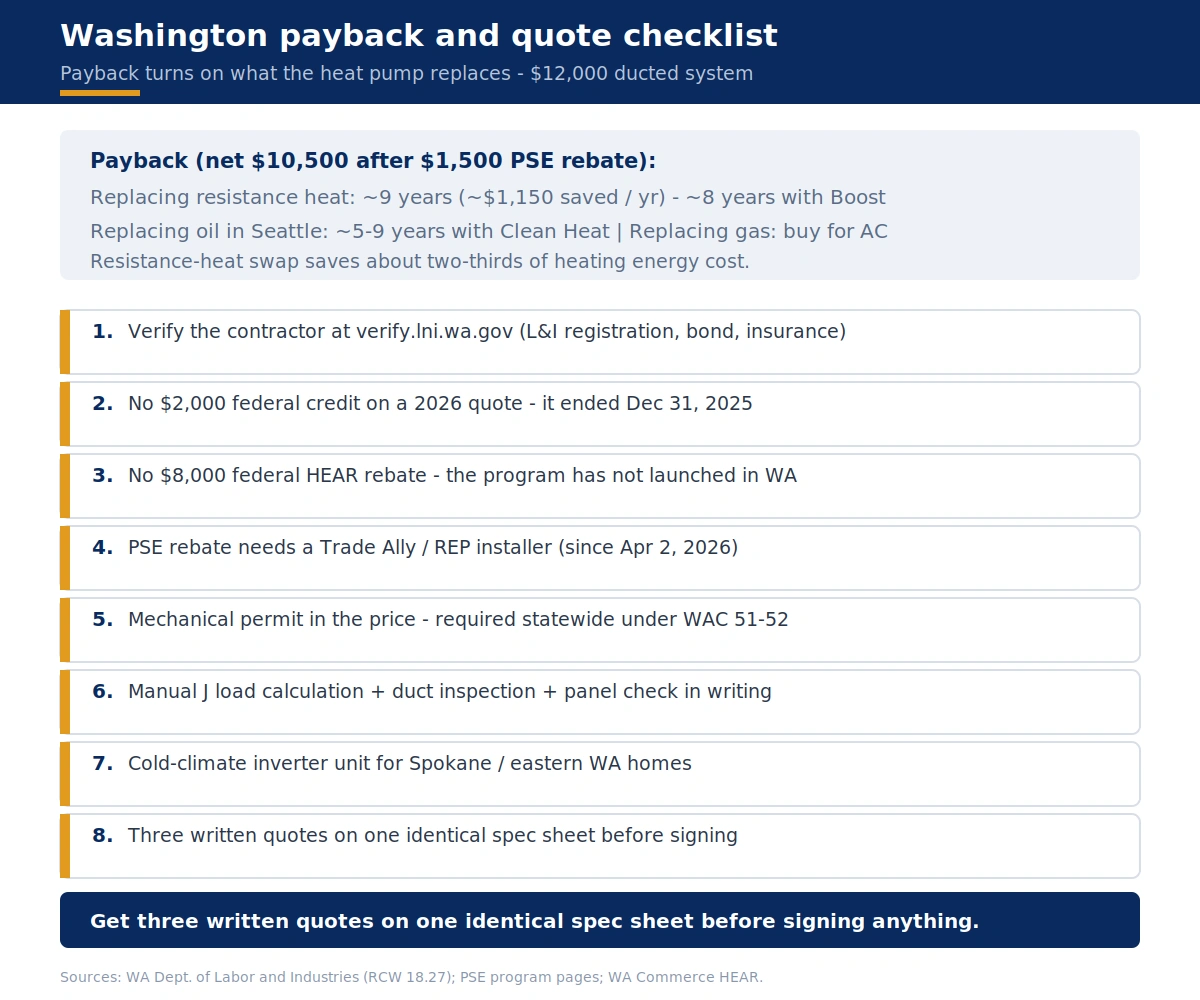
Replacing electric resistance heat — payback roughly 6–9 years. Take a Puget Sound home spending about $1,800 a year on baseboard heat. A heat pump at a seasonal COP of ~2.5–3.0 cuts the heating energy by about 60–65%, saving roughly $1,100–$1,200 a year. A ducted system at $12,000, less the $1,500 PSE rebate, nets $10,500 — paid back in about 9 years at $1,150 a year. With the $2,400 Efficiency Boost, the net is $9,600 and payback is about 8 years. In Snohomish PUD territory, the $2,500 inverter rebate pushes the net to $9,500 on the same job. In Tacoma Power territory, the $2,000 variable-speed rebate does the same. Add the value of the cooling — a window AC setup for a whole house runs $1,500–$3,000 to buy and far more to run — and the effective payback shortens further. State HEAR, where a household qualifies, can cut the net cost by thousands more and pull payback under five years.
Replacing a gas furnace — payback is long on fuel alone, and that is fine. At PSE rates, a heat pump at COP 3 costs slightly more per unit of heat than a 95% gas furnace ($1.85 vs $1.67 per 100,000 Btu), so the fuel savings are near zero or negative. The payback comes from elsewhere: the $4,000 income-qualified PSE gas-conversion rebate, the cooling the furnace never provided, and the direction of gas prices, which rose from $1.56 to $1.67 per therm across 2026 filings with more requested. A gas household should buy a heat pump for the cooling and the rebates and the carbon math — not for a smaller January bill. Anyone promising a three-year payback on a gas-to-heat-pump conversion in PSE territory is inventing numbers.
Replacing an existing heat pump — payback is the longest. The savings are efficiency-only: a jump from an old single-stage unit to a modern variable-speed inverter. The $1,500 PSE upgrade rebate is the main lever, and the decision is usually driven by a failed compressor or a refrigerant that can no longer be serviced — not by the payback spreadsheet.
Replacing oil heat in Seattle — payback is fast and the city pays for it. Oil is the priciest heat in the state, and Clean Heat’s $2,000–$6,000 covers a large share of a ductless conversion. A $9,500 two-zone ductless system, less $2,000 Clean Heat, nets $7,500 — and the annual fuel saving against oil is typically $800–$1,500, putting payback in the 5–9 year range before counting the cooling.
How to get quotes in Washington + red flags
The process that works:
- Find your utility and your program first. Check your electric bill: PSE, Seattle City Light, Snohomish PUD, Tacoma Power, Avista, Pacific Power, or one of the smaller PUDs. Then look up that utility’s heat-pump program and its installer-network rule before you call anyone.
- Get three written, itemized quotes on one identical spec sheet. Same system size (from a Manual J), same efficiency tier, same scope — equipment, ductwork, electrical, permits, rebate filing. Prices for identical equipment vary 30% or more between Washington contractors; the only way to compare them is to hold the spec constant.
- Demand a Manual J load calculation. It costs $200–$500 and is usually credited toward the job. A contractor who sizes from square footage alone has not done the engineering.
- Verify the contractor at verify.lni.wa.gov. Every Washington construction contractor must be registered with the Department of Labor & Industries under RCW 18.27, with a bond and liability insurance. In Seattle, refrigeration and air-conditioning contractors need a city license through SDCI as well. Confirm EPA Section 608 certification for anyone handling refrigerant.
- Check the rebate network membership in writing. PSE Trade Ally or REP? Snohomish PUD registered? Tacoma Power participating? Seattle Clean Heat participating? Get the answer on the quote, not in a phone call.
- Confirm the refrigerant. A 2026 install must use a sub-750 GWP refrigerant (R-454B or R-32) under Washington’s HFC rule. An R-410A system on a 2026 quote is old stock.
- Pay in milestones, never in full upfront. The standard draw is a deposit on signing, a payment on equipment delivery, and the balance on final inspection — after the permit is closed and the rebate paperwork is filed.
Red flags, Washington-specific:
- A $2,000 federal tax credit on a 2026 quote. It ended December 31, 2025. The line is invented.
- An $8,000 federal HEAR rebate on a 2026 invoice. The federal program has not launched in Washington. There is no program to pay it.
- A contractor outside your utility’s rebate network who promises the rebate anyway. PSE has required Trade Ally/REP installers since April 2, 2026. The rebate dies with the wrong installer.
- No mechanical permit in the price. A permit is required statewide under WAC 51-52, including like-kind replacements. “Permits are optional” is false.
- No L&I registration number on the proposal. Look it up at verify.lni.wa.gov before anyone touches your house.
- No Manual J, no duct inspection, no panel check. Three missing engineering steps on a $12,000 job is a contractor guessing.
- A standard single-stage unit quoted for a Spokane home. Eastern Washington needs a cold-climate inverter unit. A standard unit there is a strip-heat bill waiting to happen.
- A single lump-sum price with no line items. Equipment, ductwork, electrical, permits, and rebate filing should each be their own line. A lump sum hides the panel upgrade and the duct repair until after you have signed.
Before signing, work through the vetting questions in our heat pump vs furnace guide and the fee-spotting checklist in our hidden HVAC quote fees guide. And if you are comparing Washington with its neighbors, our heat pump cost in Pennsylvania and heat pump cost in New Jersey guides show how a high-electric-rate state prices the same equipment very differently — Washington’s cheap power is the whole story.
Sources & methodology
Cost anchors: NumeralQ — Washington / Seattle / Spokane heat pump cost pages (Oct 2026, 3-ton ducted WA $7,090–$11,660, Seattle $7,260–$11,880, Spokane $6,620–$11,050; cold-climate and multi-zone tables); Varsity Heating — “Heat Pump Cost in Seattle, WA: 2026 Pricing by Home Age” (Seattle ducted $14,000–$22,000, ductless $9,500–$17,000, replacement $12,000–$19,000; affluent tier +15–20%) + “Seattle City Light Heat Pump Rebates: 2026 Guide”; Glendale Heating — “Heat Pump Cost in Seattle — Rebates First (2026 Guide)” (ducted $8,000–$16,000, Angi Seattle average $10,218, single-zone $3,500–$6,000, multi-zone $6,000–$15,000; verified Jul 2026); HVAC Project Cost — “HVAC Replacement Cost in Washington State (2026 Guide)” (full HVAC $6,500–$15,500; ducted heat pump $6,000–$13,500; Seattle/Bellevue $8,000–$15,500; Spokane $5,500–$10,500; climate zones 4C/5B; Seattle permit $150–$600; Spokane permit $75–$300); Modernize — WA heat pump installation (average $10,150; standard $8,160; high-efficiency $12,240; single-zone $5,610; multi-zone 3-zone $12,240; geothermal $28,560; labor $76–$162/hr); Home Comfort Alliance — heat pump replacement + PSE rebates (checked Oct 2026; Angi Seattle replacement $5,000–$8,000, install average $10,218); Falco’s Spokane — ductless single-zone ~$4,000–$6,500, Mitsubishi Hyper-Heat. Size-table values other than the 3-ton anchor are scaled from the anchor and cross-checked against Angi/Modernize averages; payback arithmetic is ours from the rate table.
Rates: EIA via PriceOfElectricity / BillHike / ElectricRates (Aug 2026 data, released Oct 2026: WA 14.63¢/kWh, US 18.16¢; 12-mo avg 14.2¢; Chelan PUD 3.78¢, PSE 17.01¢); PSE Schedule 7 electric $0.1891/kWh first 600 kWh, $0.2085 above, + Schedule 23 gas $1.5822/therm, effective Oct 1, 2026 (Eastside Electrical, checked Oct 22, 2026); Seattle City Light flat $0.1338/kWh Seattle, $0.1464 suburban (checked Oct 22, 2026); PSE Nov 1, 2026 gas filing (average residential $1.71966/therm requested, UTC notice Sept 2026).
Rebates + programs: PSE program pages via Home Comfort Alliance + Kolmo Construction (read Oct 23, 2026: $1,500/$2,400/$4,000, $300–$600 tiers, Trade Ally requirement Apr 2, 2026); Eco Services WA — “Washington Rebates & Incentives” + “Seattle City Light Rebates & Incentives (2026)” (verified Jul 17, 2026); Seattle Clean Heat via Eco Services + Glendale + Eastside Electrical (checked Sept 5, 2026: $2,000 + $4,000 bonus, May 30, 2027 deadline on current city form; older pages list Sept 30, 2026 — verify); Snohomish PUD + Tacoma Power via Eco Services + Home Comfort Alliance + Seattle HVAC (verified Oct 19, 2026: Snohomish $1,800/$2,500; Tacoma $1,000–$2,000, $7,000 income-qualified + deferred loan, Tacoma HEAR up to 100%); Avista via ENERGY STAR DIME ($300–$600, 2026) + Spokane Clean Air wood-stove changeout ($2,500 ductless voucher); Pacific Power $200–$800 via HVAC Project Cost; Energy Smart Eastside +$1,000/up to $6,000 via Home Comfort Alliance; WA state HEAR via GridShift (Oct 21, 2026: ~$39.3M to 40 administrators) + UpgradesRebates (Commerce step 5 of 7, June 15, 2026) + Clallam PUD news release (June 23, 2026: $1,127,000, ~158 households, Aug 1, 2026–June 30, 2027); federal HEEHR/HARP not launched via Heat Pump Locator (verified Oct 18, 2026) + Heat Pump Network (updated Nov 2, 2026) + ECW (Oct 27, 2026: WA funds awarded, not launched; allocations $82,782,050 HEEHR / $83,102,750 HOMES); DOE Program Notice 26-2 (May 29, 2026: federal HEAR electric-to-electric only from Sept 1, 2026); IRS FS-2025-05 (OBBBA §25C/§25D termination).
Climate, code + licensing: HVAC Project Cost WA (Zone 4C marine west / 5B–6B east; WAC 51-52 mechanical permit; Seattle 3–7 business days); Washington L&I contractor registration RCW 18.27 via ContractorTests + Seattle HVAC Authority (verify.lni.wa.gov; no separate state HVAC license; Seattle SDCI refrigeration licensing; EPA 608); 2021 Washington State Energy Code; WA HFC rule (750 GWP ban on newly installed AC equipment from Jan 1, 2026) via Home Comfort Alliance.
*Disclaimer: Prices are 2026 Washington planning figures compiled from published contractor guides, utility program pages, and federal data in November 2026. They are not quotes. Rebate amounts, deadlines, and eligibility change without notice and funds can run out — confirm every figure with the program before signing. Tax information is general, not tax advice — confirm with a tax professional.*
How much does a heat pump cost in Washington in 2026?
Most Washington homeowners pay $8,000–$16,000 installed for a ducted air-source heat pump in 2026. Seattle runs higher at $10,000–$22,000 (Varsity Heating lists ducted at $14,000–$22,000), while Spokane and eastern Washington run $6,500–$13,500 (NumeralQ Spokane 3-ton: $6,620–$11,050). A single-zone ductless mini-split costs $3,500–$6,500, a multi-zone system $6,000–$15,000, and a cold-climate model adds roughly 25–30%. Prices are before rebates.
What rebates can I get for a heat pump in Washington in 2026?
It depends entirely on your utility. PSE pays $1,500 for an electric-resistance-to-heat-pump conversion ($2,400 income-qualified, $4,000 for an income-qualified gas conversion) plus $300–$600 instant discounts — but only through a Trade Ally or REP installer since April 2, 2026. Seattle City Light pays $300–$600 instant discounts, and Seattle’s Clean Heat program pays $2,000–$6,000 for oil-to-heat-pump conversions. Snohomish PUD pays $1,800–$2,500, Tacoma Power $1,000–$2,000, Avista $300–$600, and Pacific Power $200–$800. Washington’s state HEAR program (Climate Commitment Act) is open for income-qualified households through local administrators.
Is there a federal tax credit for a heat pump in Washington in 2026?
No — $0. OBBBA ended the §25C credit (30%, up to $2,000) for property placed in service after December 31, 2025. Any 2026 quote that subtracts a federal credit is using dead law. The federal $8,000 HEAR rebate has also not launched in Washington — the state Department of Commerce is still setting up delivery — so do not count it in a 2026 price.
Does a heat pump work in Spokane winters?
Yes, but only the right kind. Spokane is Climate Zone 5B with design temperatures near 2–7°F, so a standard single-stage heat pump spends too much of January on expensive backup strip heat. A cold-climate inverter unit (such as Mitsubishi Hyper-Heat) holds its heating output well below zero and costs about 25–30% more — $8,690–$15,140 for a 3-ton ducted system in Spokane. In Seattle’s mild Zone 4C marine climate, a standard inverter unit is the right specification.
How much does a heat pump cost to run in Washington?
Washington’s average residential electricity rate is 14.63 cents per kWh (EIA, August 2026), among the cheapest in the country. At Puget Sound Energy’s $0.1891/kWh, a heat pump at COP 3.0 costs about $1.85 per 100,000 Btu of heat — against $5.54 for electric resistance heat and $1.67 for a 95% gas furnace at $1.5822 per therm. At Seattle City Light’s flat $0.1338/kWh, the heat pump costs about $1.31 per 100,000 Btu and beats gas clearly. Against resistance heat the heat pump saves roughly two-thirds; against gas in PSE territory it is roughly a wash on fuel alone.
Do I need a permit to install a heat pump in Washington?
Yes. A mechanical permit is required statewide under WAC 51-52, including for like-kind replacements. Seattle fees run $150–$600 with online processing typically in 3–7 business days; Spokane’s mechanical permit runs $75–$300. Electrical permits are separate. Your contractor should pull both permits as part of the package — a quote without permits, or a contractor who says they are optional, is a red flag.
Does my Washington heat pump installer need a license?
Yes. Every construction contractor in Washington must be registered with the Department of Labor & Industries under RCW 18.27, with a bond and liability insurance — verify any bidder at verify.lni.wa.gov. Washington has no separate state HVAC trade license, but Seattle additionally licenses refrigeration and air-conditioning contractors through SDCI, and anyone handling refrigerant needs EPA Section 608 certification. For PSE, Snohomish PUD, and Tacoma Power rebates, the installer must also be in that utility’s approved network.
When does a heat pump pay for itself in Washington?
Replacing electric resistance heat, roughly 6–9 years: a home spending about $1,800 a year on baseboard heat saves roughly $1,100–$1,200 a year with a heat pump, so a $12,000 system net of a $1,500 PSE rebate pays back in about 9 years (faster with the $2,400 Efficiency Boost or Snohomish PUD’s $2,500). Replacing oil heat in Seattle is similar, with Clean Heat’s $2,000–$6,000 covering much of the cost. Replacing a gas furnace, payback on fuel alone is long in PSE territory — the case there rests on cooling, rebates, and gas-price direction, not on a smaller heating bill.