


Snow arrives in Vermont in November and does not leave the roof until April. Burlington records about 87.5 inches in a normal year, and the drifts on a shaded north slope can sit there for months. All that weight presses on the deck. Meltwater runs to the eaves, freezes, and backs up under the shingles. Nails work loose. Flashing lifts. A roof that would serve thirty years somewhere mild can give up in twenty here, and the shingles are rarely to blame. The winter did it.
The trade that fixes those roofs is small. Around 270 roofers work in the whole state, most of them in shops of under five people. The season lasts about six months, from snowmelt in April or May to the cold mornings of late October, when asphalt turns brittle underfoot. Six months of work has to carry a full year of business, and the crews people want in Burlington, Montpelier, and Brattleboro book months ahead. Call in June and you may wait until next summer.
The houses make it harder. Burlington’s median home went up in 1957, and 72 percent of the city’s homes predate 1980. Statewide the pre-1980 share is 56 percent. Peel the shingles off a 1950s roof and you can find plank decking, soft spots, or a second layer nobody told the seller about. Each surprise adds a line to the bill, and any price that ignores them will be wrong.
What follows prices Vermont from Vermont evidence. One planning model names the roof size, the material, and the pricing date in a single figure, and it anchors this guide. Contractor-entered pricing, a second cost model, and Vermont guides written for Vermont buyers supply the cross-checks. The sources do not always agree. Where they part ways, this guide names the gap instead of hiding it, because a buyer who sees one number will anchor on it, and a buyer who sees the spread can plan around it.
Behind these Vermont bands sits the country-wide picture, in the national roof replacement cost guide.
Table of Contents
How Much Does a Roof Replacement Cost in Vermont in 2026?
Start with $10,020–$12,240. That is the NumeralQ planning figure for a 2,000 sq ft roof in architectural asphalt shingles, installed, priced October 26, 2026. It is the only figure in this guide that pins down the roof size, the material, and the pricing date together, and NumeralQ is open about what it is: a planning estimate, not a count of invoices Vermonters paid. Split the difference and you get about $11,130 to plan around. A planning estimate is not a quote. The distance between the two is what the rest of this guide is for.
One thing about that figure should be said out loud. NumeralQ prints the same band, $10,020–$12,240, for Montana. Both state pages price October 26, 2026, from the same model family, and the inputs came out the same in both states. This guide prints the Vermont band as published and adjusts nothing, but the coincidence shows how a planning model works: it builds the price from material costs and local labor, and in these two states the sums landed identically. The city prices, the snow loads, and the rules are where Vermont goes its own way, and they fill the rest of this guide.
SmartRoofingCalculator comes in close once you allow for the bigger roof. Its $10,750–$15,750 covers a 25-square roof, 2,500 sq ft of roof surface, tear-off included, at $430–$630 per square for architectural shingles. That brackets the NumeralQ implied rate of $501–$612 per square. Roofers count in squares, and one square covers 100 sq ft of roof surface, so a 2,000 sq ft roof is 20 squares before waste. Match the scope and the two models agree within a few hundred dollars a square, which is about as close as independent models get.
MyRoofData’s band sits wider and higher because it prices a wider job. Its typical-home figure runs $13,250–$23,000 with one layer of tear-off included, and its worked example prices 23.4 squares at $13,400–$23,100, or $5.73–$9.88 per sq ft of roof. The top end is where the bigger, steeper, more cut-up roofs sit, past the flat planning case, with premium materials folded into the model. The bottom end sits just over the NumeralQ top end, which lines up once you count the extra 3.4 squares and the tear-off. Its Vermont crew rates, $56–$94 an hour, span the NumeralQ billing range of $57–$74 per worker-hour.
Instant Roofer’s $16,261 average measures something else again, and it should never be averaged in with the models. It comes from contractor-entered pricing on 34,700 measured Vermont roofs averaging 2,246 sq ft, priced by 160 contractors through the company’s estimating app, with metal and designer jobs mixed in beside asphalt. A bigger roof at contractor-entered rates, with premium materials in the mix, explains the whole gap. Treat it as a warning: real invoices on larger homes with premium materials run well past the planning band. It is not a planning number for a 2,000 sq ft shingle roof.
Two models sit far above the rest, and this guide records them as warning markers. RoofingEstimatorPros prices the same 2,000 sq ft architectural roof at $15,185–$27,220, an average of $20,534, or $10.27 per sq ft, on a state multiplier of 1.08 times the national average. The same pattern showed up in the Montana research, where its own state table contradicted its headline. It is left out of every band that follows, so nobody who finds it first anchors on it. This Old House sits at the other end, with a Vermont average of $6,719 and a range of $5,325–$17,269, published in June 2025 from older data with a scope nobody can pin down. No $6,719 average covers tear-off, disposal, and installation on a 2,000 sq ft Vermont roof in 2026, so it is left out for the same reason: the job it prices is not the job in this guide.
Vermont’s own guides supply a second cross-check, and both run above the NumeralQ band. One prices architectural asphalt at $13,000–$24,000 for an average home, standing seam at $25,000–$45,000, and natural slate at $55,000–$99,000, on a 22-square basis. Another prices a 2,000 sq ft home at $12,100–$18,500 for architectural shingles, $20,900–$36,900 for standing seam, and $36,000–$68,000 for Vermont slate. Both point the same way: a short season, a small contractor pool, and steep old roofs push real Vermont invoices past the planning model. Cost vs Value 2025, which prices one identical 3,000 sq ft job in every region, puts New England at $35,701 for shingles and $56,282 for metal, against $31,871 nationally. That works out to $11.90 per sq ft for the region, well above the NumeralQ per-square rate, because it prices a bigger, specified job through contractor pricing instead of a planning model.
Do not expect the models to agree on whether Vermont beats or trails the national price. They do not. For the same job, NumeralQ’s national band is $9,710–$11,840, which puts Vermont about 3 percent above the country. MyRoofData puts Vermont about 4 percent above the national average. SmartRoofingCalculator applies a 0.967 factor, which sits about 3 percent below its own national baseline. Two say above, one says below. The fair statement is that Vermont sits within a few percent of the national middle on every model, and the direction turns on whose wage and price data is freshest. NumeralQ’s wage data is the newest of the three, from May 2025, which is one more reason it anchors this guide.
Wages explain most of the disagreement. NumeralQ’s figure for Vermont roofer median pay is $28.39 an hour, from Bureau of Labor Statistics data of May 2025, and crews bill at $57–$74 per worker-hour. SmartRoofingCalculator still runs on May 2024 data: median pay $26.13 an hour, mean $26.17, and about 270 roofers counted across the state. That $2.26 gap between the two medians is a calendar gap, not a mistake by either source, and this guide names both vintages so a reader comparing guides does not read a date difference as a contradiction. MyRoofData’s crew rates of $56–$94 an hour span both billing ranges.
Vermont adds a 6 percent sales tax on building materials, a line no Montana-style quote ever shows. The tax lands on the materials in the job, and this research did not pin down how a contractor splits materials from labor on the invoice, so ask whether the quoted price already carries the tax on materials or adds it on top. A quote that never mentions it has not been read closely enough.
Age shows up in the bill as decking. Census data cited by NumeralQ puts 56 percent of Vermont homes before 1980, and 72 percent in Burlington. Peel the covering off a 1950s house and you can find plank decking, soft spots, or a second layer the seller never mentioned. Each one adds a line the planning band leaves out, and the add-on prices in the material section are the honest way to budget for what the tear-off reveals.
| Cost source | Job priced | Vermont 2026 figure |
|---|---|---|
| NumeralQ, Oct 26, 2026 (planning estimate) | 2,000 sq ft roof, architectural shingles, installed | $10,020–$12,240 |
| SmartRoofingCalculator, Apr 24, 2026 (modeled) | 25-square roof, architectural shingles, tear-off included | $10,750–$15,750 |
| MyRoofData, 2026 model | Typical home, architectural shingles, one-layer tear-off included | $13,250–$23,000 |
| Instant Roofer (contractor pricing, 34,700 roofs) | Average roof 2,246 sq ft, asphalt shingle | $16,261 average |
| BestRoofingEstimates (VT guide) | 2,000 sq ft home, architectural shingles | $12,100–$18,500 |
| RoofingEstimatorPros, Aug 26, 2026 (modeled) | 2,000 sq ft roof, architectural shingles | $15,185–$27,220 (high outlier, excluded) |
| This Old House, Jun 2025 | State average, scope unclear | $6,719 average (low outlier, excluded) |
Roof Replacement Cost in Vermont by Material
Every row below comes from the NumeralQ Burlington page, priced October 26, 2026, for a 2,000 sq ft roof installed, waste and markup included. Burlington is the one Vermont market NumeralQ prices at city level, and its table matches the state page, so read each row as the Burlington price, not a price measured in Rutland or Brattleboro. The state band in the first section is the planning number for Vermont as a whole. This table exists to compare materials against each other on one consistent basis.
The rated lives come from the MyRoofData Vermont page, which publishes nine material rows for the state. This table carries all nine, with the flat membranes split out the way NumeralQ prices them. A rated life is what the maker designs for under normal conditions, not a promise, and Vermont’s snow, ice, and freeze-thaw wear asphalt down faster than the rating assumes, as the asphalt-versus-metal section explains. One Vermont guide puts asphalt life under Vermont freeze-thaw at 18–24 years, against the 22–30 year rating. That claim comes from a single guide and is reported here as the guide’s claim, not adopted as fact.
Start at the bottom of the price list. Three-tab shingles are the cheapest roof a Vermont homeowner can buy. They are also the worst value in the state. A 3-tab shingle is one flat asphalt layer with cut tabs, rated 15–20 years, and no shingle resists wind and impact less. In a state where a roof holds snow for months and the eaves freeze and thaw all winter, the cheapest shingle is the likeliest to come off first. The Burlington table saves $1,730–$2,390 against architectural shingles, and buys the shortest life and the weakest cold-weather performance with it. Most Vermont roofers will steer a buyer past it.
Architectural shingles, also called dimensional or laminated shingles, are the default Vermont roof for anyone who chooses asphalt, and the material every band in this guide prices. Architectural shingles laminate two asphalt layers into a thicker shingle with a shadowed profile. They are rated 22–30 years, and the better lines carry wind ratings of 110–130 miles per hour. The Burlington band of $10,020–$12,240 is the number to beat when quotes come in, and the number to plan around. A third layer and a heavier profile that copies slate or shake is what designer or luxury shingles add. In Burlington they run $11,930–$14,410, on a 25–30 year model-family life. What the upgrade buys is looks and weight. A longer rated life than a good architectural line is not what the extra money buys.
Two very different roofs share the name metal. The gap between them is the biggest single choice in this table. Exposed-fastener panels, corrugated or 5V profile, cost $15,490–$19,680 in Burlington and are rated 30–40 years. Their screws go through the panel face and need checking and re-tightening as the roof works through Vermont’s temperature swings. Standing-seam metal hides its fasteners under raised seams that let the panels expand and contract freely. In Burlington it runs $22,150–$33,380, rated 40–70 years. MyRoofData names standing seam the most-installed system in Vermont, then architectural asphalt, then slate. One Vermont guide answers the other way, saying architectural asphalt is still the most common choice on Vermont homes, above all in Burlington, South Burlington, and Essex. Both claims stand here as their sources’ claims. No statewide market-share survey turned up, and this guide asserts none.
Stone-coated steel presses a steel panel into a shingle, shake, or tile shape and coats it with stone granules, at $17,430–$25,130. Steel’s impact resistance with a traditional look, on a 40–50 year model-family life that lands between exposed-fastener and standing-seam metal. Synthetic slate and shake, $18,330–$26,340, mold composite panels to copy the natural materials at a fraction of the weight, also on a 40–50 year model-family life, with no quarry price attached. Both stay niche in Vermont. Both want a roofer who has fitted that exact system before, because the flashing details change by brand.
Cedar shakes, $18,590–$32,270, ask the most upkeep of anything on this table in Vermont’s damp air. A wood roof is rated 25–35 years. Reaching a Class A assembly rating, the top fire rating a roof assembly can carry, takes fire-retardant treatment. Moss and splitting run higher here than on any other material in the list. Nothing else looks like cedar on a farmhouse or a camp, and the maintenance is what that look costs.
Weight is what settles the heavy end of the table. Concrete tile runs $20,480–$29,020, rated 40–75 years; clay tile $26,260–$41,340, rated 50–100 years; natural slate $33,990–$65,050, rated 75–150 years. All three weigh far more than asphalt or metal, and most Vermont homes were framed for a light roof, so any tile or slate quote without a structural check in it is unfinished. The framing upgrade, if the house needs one, sits outside these bands. Slate at the top end costs roughly five times the architectural band, which is why it turns up on historic homes, in the Slate Valley, and on high-end houses, and almost nowhere else in Vermont. The slate section below covers the stone itself, its history, and what a slate roof truly costs once the quarry price stops being the whole story.
Flat and low-slope roofs take membranes, not shingles, and three sit on the Burlington table. Modified bitumen, $11,060–$14,250, is an asphalt sheet applied by torch or adhesive. EPDM rubber is a single-ply black membrane seamed on site, at $11,420–$17,660. TPO, $13,740–$18,290, is a white heat-welded membrane that throws summer sun back. Flat membranes sit in MyRoofData’s 20–30 year group. They matter for the flat sections, porch roofs, and additions that many Vermont homes carry. Shingles on a low-slope section instead of membrane should raise a question in any quote: shingles shed water by slope and fail on flat runs.
Tear-off sits inside every material comparison, and the two models price it two different ways. Tear-off comes after materials in MyRoofData’s pricing, at $100–$200 per square per layer. On a 20-square roof with one layer to strip, that comes to $2,000–$4,000. In NumeralQ’s Burlington add-on table, an extra layer of tear-off runs $1.38–$1.81 per sq ft, or $2,760–$3,620 on 2,000 sq ft, and the material bands already carry waste and markup. Both routes land in the same area, and the lesson holds either way. Replacing a roof that already carries two layers costs more than replacing a one-layer roof, and the code forbids a third layer, so the old roofing has to come off.
At the add-on table, real quotes part company with planning bands. Every figure below is installed, from the NumeralQ Burlington page. A 4-by-8 sheet of OSB decking, the plywood-like board under the shingles, runs $64.76–$93.22 installed, and a 1950s roof can swallow a dozen sheets once the old covering is off. A full ice-and-water barrier, the self-sealing membrane that stops ice-dam leaks, costs $0.90–$1.44 per sq ft, which is $1,800–$2,880 across a 2,000 sq ft roof, where the code asks only for a strip at the eaves. For seamless aluminum gutters, the installed price is $8.73–$12.47 per linear foot. Chimney or wall flashing, the metal that seals where roof meets wall, costs $353–$502 each, and re-flashing a skylight costs $520–$670 each. None of these lines sits inside the headline band, and the quote likeliest to grow mid-job is the one that leaves the decking allowance out entirely.
| Material (2,000 sq ft, Burlington, installed) | Cost | Rated life |
|---|---|---|
| 3-tab asphalt shingles | $8,290–$9,850 | 15–20 years |
| Architectural asphalt shingles | $10,020–$12,240 | 22–30 years |
| Designer / luxury asphalt shingles | $11,930–$14,410 | 25–30 years (model-family span) |
| Exposed-fastener metal panels | $15,490–$19,680 | 30–40 years |
| Stone-coated steel | $17,430–$25,130 | 40–50 years (model-family span) |
| Synthetic slate or shake | $18,330–$26,340 | 40–50 years (model-family span) |
| Cedar shakes | $18,590–$32,270 | 25–35 years |
| Concrete tile | $20,480–$29,020 | 40–75 years |
| Standing-seam metal | $22,150–$33,380 | 40–70 years |
| Clay tile | $26,260–$41,340 | 50–100 years |
| Natural slate | $33,990–$65,050 | 75–150 years |
| Flat: modified bitumen | $11,060–$14,250 | 20–30 years (flat membranes) |
| Flat: EPDM rubber | $11,420–$17,660 | 20–30 years (flat membranes) |
| Flat: TPO membrane | $13,740–$18,290 | 20–30 years (flat membranes) |

Roof Replacement Cost in Vermont by Roof Size
Roofers count in squares, and the size table is the quickest way to scale the headline band to the house in front of you. NumeralQ prices architectural shingles, installed, at five sizes below, and the implied per-square rate drops as the roof grows, from $529–$655 a square on a 1,000 sq ft roof to $492–$598 on a 3,000 sq ft roof. The drop has a plain cause: a job’s fixed costs, the dumpster, the delivery, the crew’s travel, the permit, spread over more squares, while the costs that move with size, shingles and labor per square, stay about flat. Fixed costs land the same on a small roof as on a big one, so the small roof pays more per square.
House size and roof size are not the same number, and mixing them up is the most common budgeting mistake in roofing. A pitched roof over a 2,000 sq ft house covers more than 2,000 sq ft, because the pitch stretches the surface and the overhangs add area. Take a steep-pitched 1,500 sq ft Cape: its roof surface can run to 2,000 sq ft. A shallow-pitched 2,500 sq ft two-story can carry the same surface. One Vermont guide works on roof area at 1.35 times the living-area footprint for the state’s steep pitches, and that multiplier is the guide’s assumption, not a measured fact. What prices a roof is the measured surface, taken by tape, satellite, or drone, and a quote priced off the house footprint is a guess.
Waste is the next number buyers miss. At valleys, hips, ridges, and penetrations, shingles get cut, and the cut pieces go in the bin. Cutting at valleys, hips, and ridges wastes shingles, so the order runs 10–15 percent above the bare surface. On a cut-up roof, a roof with many valleys, dormers, and direction changes, labor runs about 15 percent higher in MyRoofData’s model, and the waste factor climbs with it. A plain gable wastes least. A Victorian in Montpelier with four valleys, two dormers, and a chimney wastes most, and the waste lands as extra squares on the material order, not as its own line.
Pitch moves the labor price more than any other single feature. A walkable 4-in-12 is the baseline pitch: 4 inches of rise for every 12 inches of run. At a steep 10-in-12 or 12-in-12 pitch the crew wants roof jacks, staging, and slower movement, and Vermont roofers charge for that. This research turned up no Vermont-specific steep-pitch surcharge, so none is claimed here, but a buyer with a steep roof should expect the per-square rate at or past the top of the size-table band, and should ask the roofer to name the pitch charge as its own line instead of burying it in the rate. Montpelier and Barre hold plenty of tall Victorian and Greek Revival homes with steep roofs and narrow side yards, and one Vermont guide says tight lots there make staging and dumpster placement harder, which is reported here as the guide’s claim.
Height changes the job in a simpler way: it changes how material gets up and down. Eave height is where the crew stages material on a single-story ranch, and the tear-off goes straight into the dumpster. On a three-story home, tear-off and delivery need a conveyor or a crane lift, and hauling eats more of the crew’s day than laying does. The size table prices no stories. A tall home belongs at the top of its size band for budgeting, and the contract should spell out how the crew gets up there.
NumeralQ’s state size table, architectural shingles installed and priced October 26, 2026, is printed below. That implied per-square column is NestPriced arithmetic, the band divided by the number of squares, so a quote’s per-square rate can be set against the model at the same size. A quote far above the implied rate at the same size has to explain itself in pitch, complexity, layers, or decking, and a quote far below it has to explain itself in scope, because something was left out.
| Roof surface | Installed cost, architectural shingles | Cost per square |
|---|---|---|
| 1,000 sq ft, 10 squares | $5,290–$6,550 | $529–$655 |
| 1,500 sq ft, 15 squares | $7,650–$9,390 | $510–$626 |
| 2,000 sq ft, 20 squares | $10,020–$12,240 | $501–$612 |
| 2,500 sq ft, 25 squares | $12,380–$15,090 | $495–$604 |
| 3,000 sq ft, 30 squares | $14,750–$17,940 | $492–$598 |
A rough scaling rule comes out of the table, and it is a rule of thumb, not a quote. As a rough guide, budget around $2,360–$2,850 more for every additional 500 sq ft at architectural rates. That rule holds where the roof is plain and the pitch is walkable. It breaks on steep, cut-up, or multi-layer roofs, where the add-ons and the complexity charge take over. It breaks on metal too, where the material rate runs roughly double and the per-square math starts over from the material table.
Roof Replacement Cost by City: Burlington, Montpelier, Rutland, and Brattleboro
NumeralQ publishes a Vermont city page for one city only, Burlington. Targeted searches found no NumeralQ page for Montpelier, Rutland, or Brattleboro, and no other source in this research names a band for those three cities with the same size, material, and date discipline. So this section gives a verified band for Burlington and clearly labeled planning estimates for the other three, with every cross-check that exists. Printing four matching bands would mean inventing three of them, and this guide does not do that.
Burlington is the verified city, and its band is the state band: $10,020–$12,240 for a 2,000 sq ft architectural roof. Roofer median pay around Burlington runs $28.39 an hour, 6 percent above the national median, with crews billed at $57–$74 per worker-hour. Chittenden County counts 21 roofing contractors, 2.8 for every 10,000 homes against a national 1.7, and around 86 percent of them employ fewer than five people. Competition is real, and the county holds the deepest bench in the state. The median Burlington home is worth $444,800 and went up in 1957, and a typical roof job runs about 2.5 percent of the median home value. Cross-checks on Burlington run higher than the NumeralQ band: Instant Roofer’s Burlington average is $16,911 on its 22-square contractor-pricing basis, one Vermont guide puts Burlington asphalt jobs near $14,000–$24,000 for an average home, and South Burlington, the next town over, averages $15,497 on Instant Roofer. The NumeralQ band is the planning number. The cross-checks are a reminder that contractor-entered figures measure different jobs on bigger roofs.
Montpelier gets a planning estimate here, not a verified band, and the evidence points to real invoices landing above the state band. Instant Roofer’s Montpelier average is $15,692 on its 22-square basis. A lead-generation site prices a 22-square GAF Timberline HDZ roof in Montpelier at $11,687 in wholesale contractor costs, with retail bids of $16,028–$17,364 after a 30 percent margin, and that figure comes from a single source and is not adopted as a band. One Vermont guide says Montpelier and Barre prices run similar to Burlington, with steep-slope charges more common, because the cities hold many tall Victorian and Greek Revival homes with steep roofs and narrow side yards. The fair statement is that a Montpelier buyer should treat the state band as a floor and expect the quote to land above it once pitch, access, and layers are priced in. The permit evidence for Montpelier is thin too: a single lead-generation source says the city requires a building permit for full replacements, and no city primary document turned up to confirm it, so the buyer confirms with the city desk.
Rutland gets a guide range, not a verified band. One Vermont guide prices Rutland asphalt jobs commonly at $12,000–$21,000, with labor rates often slightly lower than in Chittenden County, and notes that Rutland roofers see more slate repair work than anywhere else in the state because the city sits near the Slate Valley. This research found no NumeralQ city page, no Instant Roofer city average, and no second guide range for Rutland. The ground snow load in Rutland is 50 psf on the state map, against 40 psf in Burlington, which adds a structural note to every Rutland quote even if it adds no price line by itself. A Rutland buyer should budget the state band, ask about the crew’s slate experience if the house carries slate, and get the permit answer from the city desk in writing, because the permit evidence for Rutland is the weakest of the four cities, as the permit section discloses.
Brattleboro gets the state band as a planning estimate, on the thinnest evidence of the four. No verified city band turned up, no contractor-pricing average was located, and no guide range names the city. Brattleboro sits in the southern tier, where the state snow-load map assigns the 50 psf bracket, and it is the smallest market of the four, which usually means fewer crews and longer waits rather than lower prices. One Vermont guide says the best roofers in Burlington, Montpelier, and Brattleboro often carry wait lists stretching into the next summer, and that claim comes from a single guide and is reported as such. A Brattleboro buyer should budget the state band, confirm the permit requirement with the town, and plan the timing around the short season, because a small-market crew books up fast.
For smaller Vermont communities, this research has no verified bands at all. The honest guidance is to start from the state band and adjust for distance and crew travel. Stowe, Killington, the Mad River Valley, and the Northeast Kingdom all sit in higher snow-load brackets, 60 or 70 psf, and a mountain-town quote that runs above the state band is plausible on snow load, access, and crew travel alone. Ask the roofer to name which of the three drives the premium instead of accepting a single lump sum.
| City | 2,000 sq ft architectural roof | Basis |
|---|---|---|
| Burlington | $10,020–$12,240 | NumeralQ Burlington, Oct 26, 2026 |
| Montpelier | ~$10,020–$12,240 (likely low) | State band as planning estimate; Instant Roofer avg $15,692 on 22-sq basis |
| Rutland | ~$12,000–$21,000 | One VT guide range; no verified band found |
| Brattleboro | ~$10,020–$12,240 | State band as planning estimate; no city figure found |

Snow, Ice Dams, and Freeze-Thaw: What Vermont Weather Does to a Roof
Ask for one number that changes by address more than any other, and it is the snow load. It is also the most dangerous number to guess. Snow load means the weight of snow a roof has to be built to carry, measured in pounds per square foot, shortened to psf. Vermont sets its ground snow loads town by town, in four brackets, 40, 50, 60, and 70 psf, on a map published by the Division of Fire Safety and carried in the state’s Fire and Building Safety Code. The brackets change at town lines, so a house on one side of a line can carry a different figure from a house on the other side, and the only safe number is the one for the exact address.
Under the whole system sits a floor. Vermont’s amendments to the International Building Code require the total design roof snow load, counting drifting, sliding, unbalanced, and partial loading, never to fall below 40 psf on low-slope roofs, with the slope factor applied above 5 degrees. Design roof snow load is the load the structure has to carry after the code’s reductions for slope, exposure, and thermal conditions. Ground snow load is different: the weight of snow on flat ground at the site. The 40 psf floor means no Vermont roof is designed for less than 40 psf, even where a ground figure reads lower, and it means the Burlington figure of 40 psf is the bottom of the state’s range, not a low number by national standards.
The town table below sits at the heart of this section, and every figure in it comes from the published town lists that mirror the state map. Burlington and South Burlington sit at 40 psf, in the Champlain Valley bracket. Most of the state, central and southern Vermont, sits at 50 psf, including Rutland, Montpelier, and Brattleboro by the map’s regional description. The Northeast Kingdom and the higher central terrain sit at 60 psf, including St. Johnsbury. The named mountain towns sit at 70 psf: Stowe, Killington and Mendon, and the Mad River Valley. Two of the four city figures in this table, Montpelier and Brattleboro at 50 psf, come from the map’s regional bracket rather than from individually checked town entries, and this guide says so instead of presenting them as checked line items.
Past 2,500 feet of elevation, the map stops applying. Vermont code wants the ground snow load for those sites from a site-specific extreme-value statistical analysis approved by the authority having jurisdiction. A ski-area house, a ridge-top camp, or a home on the upper slopes of the Green Mountains needs that analysis before anyone prices the framing, and a roofer who prices a high-elevation roof off the town bracket without asking the elevation is pricing the wrong roof.
Burlington’s snowfall shows why the load matters. The city takes about 87.5 inches of snow a year on NOAA 1991–2020 normals, with an average extreme snow depth of about 12 inches in February, and about 55 snowy days a year. Other sources give 70 to 86 inches for Burlington on different windows, and the 87.5-inch NOAA normals figure is the one this guide uses. One Vermont guide puts statewide snowfall at 80 to 120 inches a year, which is reported here as the guide’s range. The snow does not fall and melt. It falls, it sits, it melts a little on a sunny afternoon, and it freezes again overnight, and that cycle is what wears a Vermont roof out.
| Town or region | Adopted ground snow load |
|---|---|
| Burlington, South Burlington (Champlain Valley) | 40 psf |
| Most of the state, central and southern Vermont (incl. Rutland, Montpelier, Brattleboro) | 50 psf |
| Northeast Kingdom and higher central terrain (incl. St. Johnsbury) | 60 psf |
| Named mountain towns (Stowe, Killington/Mendon, Mad River Valley) | 70 psf |
| Sites above 2,500 ft elevation | Site-specific analysis required |
Ice dams are the slow leak snow loads never capture. It starts in the attic. Warmth leaking through thin insulation thaws the snowpack on the upper slope. Water runs down to the freezing eave, and the refrozen ridge traps later meltwater behind it until the water finds its way beneath the shingles. Three parts fix it, and only one of them is roofing. Insulation and air sealing in the attic keep heat out of the roof deck, ventilation keeps the deck cold, and an ice-and-water barrier at the eaves seals the deck where water backs up. If a roofer prices a new roof and never mentions the thin insulation in the attic, the quote covers half the problem. What the attic half of the job costs is covered in the attic insulation cost guide.
The ice-barrier rule is a code rule, and it is specific. Section R905.1.2 of the International Residential Code is the rule behind it. The barrier is self-adhering, and it runs from the lowest eave edge to at least 24 inches inside the exterior wall line, wherever the jurisdiction’s design table says ice dams form. The NumeralQ Burlington page says the same for Burlington: ask whether the bid carries an ice barrier along the eaves, which the residential code calls for where ice dams are a known problem. Vermont’s code picture for an owner-occupied single-family home is unusual, as the permit section explains, so confirm the requirement with the local desk and treat the eave barrier as a minimum, not a luxury, anywhere in the state.
Covering the whole deck with ice-and-water barrier, instead of just the eaves and valleys, is an upgrade worth pricing on low-slope and valley-heavy roofs. At Burlington rates of $0.90–$1.44 per sq ft, full coverage on a 2,000 sq ft roof adds $1,800–$2,880 by NestPriced arithmetic. The membrane seals each nail hole and seam against wind-driven rain and ice-dam backup. Where a roof has leaked before, it costs less than the next interior repair. On a steep, simple roof in the Champlain Valley, the eave strip plus valley coverage usually does the job, and the roofer should say which scope the quote carries.
Freeze-thaw works a Vermont roof from the inside out. Water gets into a small crack or a lifted shingle edge, freezes overnight, and expands, prying the crack wider. The cycle repeats through every shoulder season. Vermont’s winters run long enough that the cycle goes on for months, and the spring and fall shoulders add more cycles on top. Installation quality defends against it better than material does: sealed shingle tabs, proper flashing, and a deck that stays dry. A roof laid in a cold snap needs hand-sealing, roofing cement under each shingle tab, because the factory adhesive strip will not wake up in the cold. Owens Corning’s technical bulletin draws the line at 40 degrees Fahrenheit and below. Burlington averages highs under 40 degrees from December through February, so a winter install in the city has to name hand-sealing in the contract or wait for spring.
Wind is the third Vermont load, and buyers underrate it. Chittenden County logged 86 damaging-wind reports from 2016 through 2025, against 8 large-hail reports in the same decade, which says the wind risk around Burlington runs an order of magnitude past the hail risk. The design wind speed for Vermont is 115 miles per hour on a 3-second gust basis, per a Vermont roofing guide, and that figure comes from a single secondary source and is reported as such. What answers wind in practice is the shingle rating and the nailing pattern. Wind ratings for architectural shingles sit at 110–130 miles per hour, with the top lines reaching Class H at 150 miles per hour. A six-nail pattern, six nails per shingle instead of the standard four, is the wind detailing to ask for by name, and the buyer wants the wind rating by product name and the nailing pattern in writing, because a 130 mph shingle fixed with four nails in a windy valley is a 130 mph shingle in name only.
Slate Heritage: Vermont’s Roofing Stone and What It Costs Today
Vermont slate is the one roofing material in this guide that arrives with a birthplace, a date, and a story that still moves prices today. The first slate quarry in western Vermont opened on Scotch Hill in Fair Haven in 1839, worked by Colonel Alonson Allen and Caleb Ranney. Allen started making roofing slate in 1847 and 1848, and the first roof ever covered with Vermont slate was Allen’s own gamble: he agreed to wait a year for his pay, and if the roof broke down under the weight of the slate in the meantime, he would take no pay and cover all the damages. The roof held. By 1869 seventeen quarries worked in Fair Haven, eleven of them on Scotch Hill, and at the peak in the 1890s more than eighty quarries worked in Vermont, employing over five hundred people. Welsh immigrants, who knew slate quarrying from Wales, came to work the stone, and their skill is part of why Vermont slate earned its name.
The stone comes from a belt about 26 miles long, running from Sudbury in Rutland County south to Rupert in Bennington County, between the Taconic range and Lake Champlain, with a second deposit of black slate around Northfield in Washington County. The colors are the trade’s signature: green, purple, variegated, gray, and black, and one quarry may cut only one color while another cuts several. Roofing is still the main use of quarried slate, and the repair skill for it still lives in the Slate Valley in a way it exists almost nowhere else in the country. A Rutland roofer who has spent a career on slate is a different hire from a roofer who has only ever laid shingles, and the buyer should know which one is climbing onto the roof.
A slate roof costs more than the quarry price, and the gap is where buyers get surprised. NumeralQ prices natural slate at $33,990–$65,050 for a 2,000 sq ft roof installed in Burlington, or $16.71–$32.10 per sq ft. One Vermont guide prices new Vermont slate commonly at $25–$45 per sq ft installed, which works out to $55,000–$99,000 on a 22-square roof, and that guide’s range runs past the top of the NumeralQ band. Both figures stand here, and the fair reading is that a slate roof is a $34,000 to $99,000 job depending on the stone, the roofer, and the scope, with the NumeralQ band as the planning figure and the guide as the higher cross-check. The lifetime math in the asphalt-versus-metal section prices slate on the NumeralQ band, and the buyer should treat that math as a floor, not a ceiling.
Weight settles whether a house can take slate at all. Slate is the heaviest common roofing material, and most Vermont homes were framed for a light roof, so a slate quote without a structural check in it is unfinished. The exception is the historic house that already carries slate: it was framed for the weight, and its framing is part of why the slate has lasted a century. Replacing slate with slate on such a house continues a system that works. Switching from asphalt to slate on a house framed for asphalt means buying a structural upgrade as well as a roof, and the framing cost sits outside these bands.
Slate repair is a separate skill from slate installation, and Vermont is one of the few places where it is still a living trade. A slate roof fails one slate at a time: a cracked tile, a slipped tile, a failed nail, a worn valley. A slate roofer swaps the single tile with a hook or a nail, without disturbing the tiles around it, and the roof keeps going for decades. An asphalt roofer who treats a slate roof like a shingle roof, tearing off whole sections to fix one tile, will destroy more value than the repair saves. Ask for slate references by name, and call them, before hiring anyone to touch a slate roof.
The rule follows the house. On a historic home in the Slate Valley, or a home already framed for slate, a slate roof is the right roof, and its 75–150 year rated life makes the lifetime cost per year the lowest of any material in this guide on some math, as the next section shows. On a house framed for asphalt, slate is a luxury purchase that starts with a structural engineer’s report, and the buyer should get that report before falling in love with the stone. Where the budget binds, synthetic slate at $18,330–$26,340 gives the look at a fraction of the weight and the price, and the buyer should weigh the two honestly instead of letting the heritage story make the purchase.
Asphalt Shingles vs Metal Roofing in Vermont
Put asphalt and metal side by side and the sticker prices tell one story while the lifetimes tell another. Architectural asphalt costs $10,020–$12,240 in Burlington for a 2,000 sq ft roof. Standing-seam metal costs $22,150–$33,380. Metal runs roughly double to triple the asphalt price on day one, lasts roughly double the rated life, and changes how the house handles snow, fire, and ice dams. The comparison below prices that trade honestly, and the lifetime math in it flips the first impression.
Snow is where metal earns its keep in Vermont. A smooth metal surface sheds snow instead of holding it, so less load sits on the structure through the winter and less ice builds at the eaves. Standing-seam panels ride temperature swings through concealed fasteners that let the panels expand and contract, which matters where the temperature can move 40 degrees between a January night and a January afternoon. MyRoofData puts it plainly: Vermont is standing-seam country, and the material’s snow-shedding and 50-year service life fit the climate and the state’s old farmhouse stock. The snow-shedding comes with a condition that is not optional. Wet snow sliding off a metal roof two stories up can hurt a person and wreck a gutter line, so snow guards, the bars or cleats that hold snow on the roof until it melts, belong above every entry, walkway, and driveway. A metal quote with no snow-retention line in it is unfinished in Vermont, and the buyer should ask where the guards go and what they cost.
Ice is metal’s second argument, and it follows from the first. A roof that sheds its snow feeds less ice at the eave, because less snowpack sits there to melt and refreeze. That does not make the attic work go away: a metal roof over a warm, under-insulated attic will still grow ice at the eaves, just less of it, and the attic insulation and air sealing in the ice-dam section still apply. What metal changes is the margin. On a house with a history of ice dams, a metal roof plus a full ice-and-water barrier plus an insulated attic is the strongest defense Vermont offers, and the buyer should price all three together instead of buying the roof and hoping the attic fixes itself.
Hail breaks the two materials in opposite ways, with its own insurance result for each break. Metal dents. Hail treats the two materials differently. A big stone cracks asphalt, which insurers pay for as functional damage, and dents metal, which some policies dismiss as cosmetic-only damage and pay nothing for, even when the roof looks battered and still sheds water. On asphalt, hail cracks the shingle and strips granules until the mat shows, and that counts as functional damage, which insurers pay for. In Vermont the hail stakes run low, with zero 2-inch hail reports in Chittenden County from 2016 through 2025, so the dent-versus-crack question matters less here than in the hail belt, and the Class 4 section covers it in full. Even so, a Vermont metal roof deserves a hail-dent talk with the insurer before installation, and the buyer should know whether the policy pays for cosmetic denting or only for functional damage.
Asphalt in Vermont lives shorter than its rating, and that gap is the strongest case against it. On the MyRoofData Vermont page, architectural asphalt is rated at 22–30 years. One Vermont guide claims 18–24 years for asphalt under Vermont freeze-thaw, blaming the cycling that opens cracks and strips granules. That claim comes from a single Vermont guide and is reported here as the guide’s claim, not adopted as fact. The mechanism behind it holds up, though: water gets into a small crack, freezes overnight, expands, and pries the crack wider, and the cycle repeats through every shoulder season. A 30-year stay in the house means budgeting for two asphalt roofs or one metal roof, and the lifetime math below prices exactly that choice.
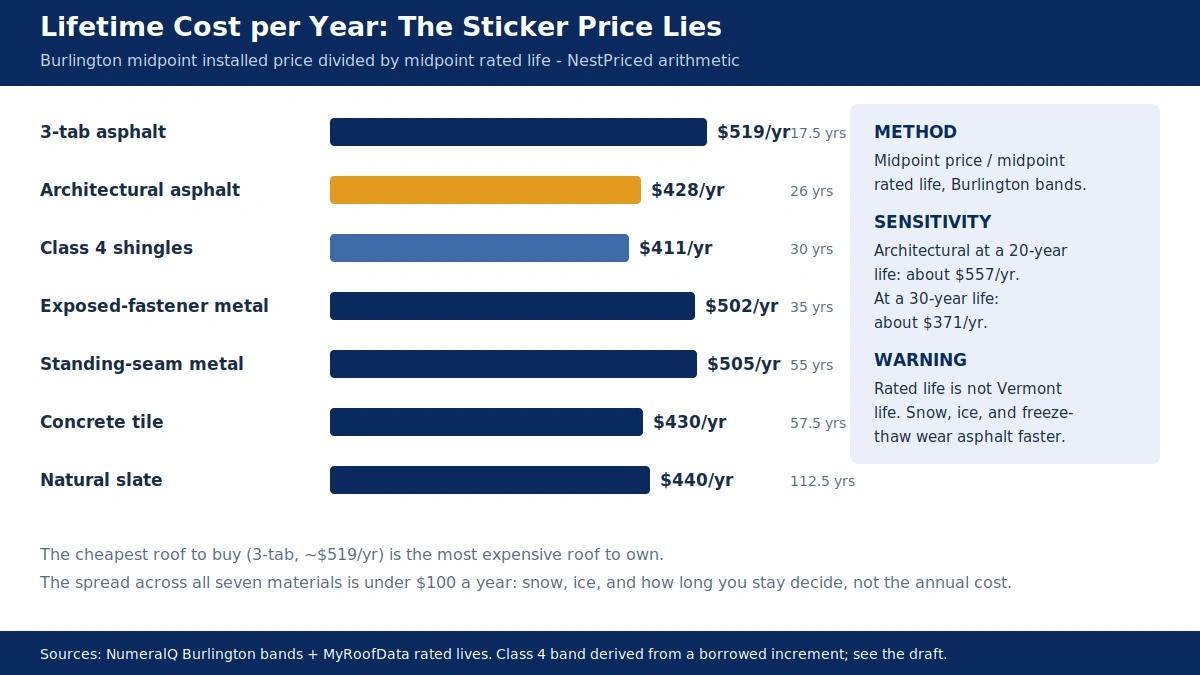
Run the lifetime math and the sticker-price verdict flips. The figures are NestPriced arithmetic on Burlington midpoints divided by rated-life midpoints, and they are labeled as such. Take the $11,130 architectural midpoint over 26 years and the yearly cost works out to about $428. Standing-seam metal at a $27,765 midpoint over 55 years works out to about $505 a year. Exposed-fastener metal at $17,585 over 35 years works out to about $502 a year. Three-tab shingles, the cheapest roof to buy, work out to about $519 a year, the dearest roof to own, because the short life rules the math. Concrete tile at $24,750 over 57.5 years works out to about $430 a year, the cheapest of all on this math, before the structural check. Natural slate at $49,520 over 112.5 years works out to about $440 a year. The gap between the cheapest and dearest yearly cost runs under $100, which means snow, ice, and how long the buyer stays drive the material choice, not the yearly cost alone.
What matters more than the single answer is how far it moves when the assumptions change. Give architectural asphalt 20 years instead of 26 and its yearly cost climbs to about $557, the dearest figure in the table. Give it the full 30 years and the yearly cost drops to about $371, the cheapest. What matters is not which material wins the midpoint math, but which life the roof will truly live in that microclimate, on that pitch, under that snow load. Shade and a gentle slope can carry a Champlain Valley asphalt roof all the way to the end of its rating. A south-facing asphalt roof on a Green Mountain ridge, under deep snow and freeze-thaw, may not. A roofer with ten years on the same streets knows which life a roof will live there, so ask.
Noise is a myth worth retiring. Over a solid deck, with insulation and an attic below, a metal roof in rain is not meaningfully louder than asphalt, and the Vermont guides that raise the subject agree. What is real is the installer pool. Only a crew that has fitted standing seam before should take a standing-seam job, with the seaming tools and the flashing details for that profile. Shingles-only experience does not make that crew. How to check metal experience is covered in the hiring section. The answer is standing-seam references from the same county, not a general claim of metal experience.
The national numbers for both materials, and for tile at the heavy end, are in the metal roof vs shingles cost guide, the metal roof cost guide, and the tile roof cost guide.
| Lifetime cost (Burlington midpoints) | Installed cost | Rated life | Cost per year |
|---|---|---|---|
| 3-tab asphalt | $9,070 | 17.5 years | ~$519 |
| Architectural asphalt | $11,130 | 26 years | ~$428 |
| Class 4 shingles (derived band) | $12,330 | 30 years | ~$411 |
| Exposed-fastener metal | $17,585 | 35 years | ~$502 |
| Standing-seam metal | $27,765 | 55 years | ~$505 |
| Concrete tile | $24,750 | 57.5 years | ~$430 |
| Natural slate | $49,520 | 112.5 years | ~$440 |
Class 4 Impact-Resistant Shingles: Cost, Hail Protection, and Insurance Discounts
Vermont’s hail record is why Class 4 shingles sit in a footnote here instead of a buying decision. Hail season runs May through July, and those three months held 83 percent of the state’s large-hail reports from 2016 through 2025, according to NOAA data reported by NumeralQ. Chittenden County, the state’s most populous county, logged 8 large-hail reports in that decade, and zero at 2 inches or larger, the size that cracks shingles. The county plus its seven neighbors recorded 56 reports, 9.3 per 1,000 square miles against 7.6 statewide and 20.1 nationally. Chittenden County’s hail risk is rated Very Low by the Federal Emergency Management Agency. A Vermont roof faces less than half the recorded hail exposure of the national average, and the Class 4 decision looks correspondingly different here than in the hail belt.
NumeralQ’s own Vermont verdict is blunt: for most Vermont homes, impact-resistant shingles are not worth it, because hail big enough to crack shingles is rare here. This guide agrees with that verdict for most of the state, and the rest of this section covers the exception, the cost, and the insurance question for the buyer who still wants the upgrade.
No shingle impact rating runs higher than Class 4, and the test behind it is exact. Under UL 2218, the Underwriters Laboratories impact standard, a 2-inch steel ball drops from 20 feet onto the same spot twice. The shingle mat must not crack or tear. Impact is all the rating covers. Wind and fire are judged by their own tests with their own ratings, so a Class 4 shingle is not automatically a high-wind shingle or a Class A one. Two Class 4 lines come from GAF, Timberline AS II and ArmorShield II, and two more from Owens Corning, Duration Storm and Duration FLEX. The other makers line up behind them: NorthGate and Landmark IR from CertainTeed, StormMaster from Atlas, Legacy and Vista from Malarkey, Nordic from IKO, and StormFighter FLEX from Tamko. GAF’s Timberline ArmorShield II also carries a Class H wind rating of 150 miles per hour, which matters more in Vermont than the impact rating, because the state’s wind reports outnumber its hail reports ten to one in Chittenden County.
The upgrade cost carries a gap this guide reports instead of resolving, because no Vermont-specific Class 4 premium turned up in this research. The derived band here adds a $600–$1,800 increment, taken from Billings, Montana guides, to the Vermont architectural band, giving about $10,620–$14,040 for a 2,000 sq ft Class 4 roof, and labels the result NestPriced arithmetic on a borrowed increment. Borrowed, not measured, and this guide says so. A Montana guide of the same family says Class 4 adds about $3,000–$5,000 upfront, pricing Class 4 at $600–$950 per square against $450–$750 for architectural. At the top end, the two claims part by a factor of three, and no Vermont roofer quote stating a per-square Class 4 premium was located. Get the Class 4 premium on its own line in the quote. Budgeting from a guide alone is impossible when the two published claims sit this far apart. The lifetime math uses a rated life of 25–35 years, which comes from a single source in the research file of a sibling article and is disclosed here as such.
The insurance discount is where Vermont guides go quiet, and the silence is the finding. No Vermont statute sets a Class 4 discount percentage, no carrier-verified Vermont percentage turned up, and no Vermont guide in this research quotes a discount range for the state. Guides from hail states quote 5–35 percent, but a hail-state discount does not carry over to a state where the hail barely exists. The discount, if the buyer’s carrier offers one, is carrier-specific. Only the wind and hail portion of the premium may be touched, rather than the whole premium. Ask the agent to confirm it in writing, naming the portion, and file the Class 4 certificate with the insurer before the roof goes on.
Four scenarios run below against the Vermont average premium of $1,170 a year, from the NerdWallet analysis of May 6, 2026. Every scenario here is an assumption, and none of them is a promise. Take 10 percent of the full premium and the saving comes to about $117 a year, with the $600–$1,800 upgrade paying back in about 5.1–15.4 years. Take 15 percent of the full premium and the saving comes to about $176 a year, with payback in about 3.4–10.3 years. Take 25 percent of the full premium and the saving comes to about $293 a year, with payback in about 2.0–6.2 years. Take 15 percent of half the premium, the wind-and-hail-portion case, and the saving comes to about $88 a year, with payback in about 6.8–20.5 years. For many policies, the portion-only case is the realistic one. Budget from it until the agent confirms otherwise in writing. Vermont’s premium is the second-lowest in the country, which is exactly why the payback runs so long: 10 percent off a $1,170 premium is $117, where the same discount on a $3,765 premium elsewhere is $377. At the higher $3,000–$5,000 figure instead, every payback in the table roughly triples. That is why the premium line in the quote matters more than the discount percentage in a guide.
The rule follows the hail map, and in Vermont the map says no for most homes. In the Champlain Valley and the southern tier, where the recorded hail exposure runs at less than half the national rate and no 2-inch stone has been recorded in the state’s biggest county in a decade, Class 4 is a peace-of-mind upgrade, not a financial one, and the buyer should choose it for the wind rating or the durability, not for a discount that may not exist. On an exposed ridge or a home with a history of storm damage, the case strengthens, but it strengthens on the wind and the hail together, and the buyer should put three questions to the agent before choosing: the discount percentage, the portion of the premium it applies to, and the certificate the insurer needs on file.
| Payback scenario (assumptions, not promises) | Annual saving | Payback on $600–$1,800 upgrade |
|---|---|---|
| 10% of full $1,170 premium | ~$117 | ~5.1–15.4 years |
| 15% of full $1,170 premium | ~$176 | ~3.4–10.3 years |
| 25% of full $1,170 premium | ~$293 | ~2.0–6.2 years |
| 15% of half the premium (wind/hail portion) | ~$88 | ~6.8–20.5 years |
Vermont Roof Permits, Building Codes, and Snow Load Rules
Ask which desk governs the address, because Vermont has no single permit answer. The reason is unusual: Vermont is one of the few states with no mandatory statewide building code for an owner-occupied single-family home. Under 20 V.S.A. Section 2730, the Vermont Fire and Building Safety Code applies only to the buildings the statute defines, which are public buildings, commercial buildings, and multi-unit dwellings, among others. A single-family home the owner lives in is not covered by that code. The 2025 edition of the Fire and Building Safety Code took effect on November 5, 2025, and it adopts the 2021 International Building Code, but that adoption governs the buildings the statute covers, not the owner’s own house.
That does not leave a Vermont roof unregulated. It leaves the regulation local, and the buyer has to go and find it. Most Vermont towns run their own permitting, and many small towns want only a zoning permit, or no permit at all, for a like-for-like re-roof. The larger municipalities, Burlington, South Burlington, Montpelier, Rutland, and Brattleboro, generally want a building permit or a short-form permit for the work. The practical rule is simple: the town desk decides, and the buyer asks the town desk before the roofer orders material, because a guide cannot answer a question the town has not been asked.
Burlington runs a zoning-first process, and the two permits in it do different jobs. The building permit covers the work itself: roofing sits in the city’s short-form permit materials, and the Building Trades Division publishes an exception for in-kind repairs costing $1,000 or less. That exception is narrow. It covers a repair that replaces material in kind, at or under $1,000, and it does not exempt a full re-roof. The building permit fee comes from the Burlington Code of Ordinances, Chapter 8-28(a): $8.50 per $1,000 of estimated construction cost, with a $30 minimum. On a $15,000 job that works out to about $128 by NestPriced arithmetic, which is not a city quote, and NumeralQ lists the Burlington re-roof permit fee as not published. Work must not begin until the permit is issued, and the city charges extra fees for work done without one.
The zoning permit covers the appearance, and it is the permit buyers forget. Under the Burlington Comprehensive Development Ordinance, Article 3, updated February 10, 2026, a zoning permit is required for changes to a building’s exterior appearance, but repair or in-kind replacement that does not change the location, design, material, or outward appearance is exempt. In design-control districts, re-roofing may be approved by staff. The ordinance does not mention paint color by name, so the buyer asks Permitting and Inspections whether a color change counts as an appearance change. Historic and design-review status turns on the parcel, and the single-family exemption does not cover work in a flood-hazard area. A re-roof that changes the material, from asphalt to standing seam, or the color, is an appearance change, and the buyer should confirm the zoning path before the crew arrives.
South Burlington, the next town over, shows how local the fees run. The city publishes a zoning charge of $5 per $1,000 of project cost plus $13, with a $43 minimum for work costing $6,000 or less. That figure is a South Burlington zoning charge, not a statewide fee, and it sits here only to show the shape of the system: small charges, set town by town, that a buyer has to confirm for the actual parcel.
Montpelier’s permit position is the least verified of the four cities for its importance, and this guide says so. A lead-generation source states that the City of Montpelier Building Department requires a building permit for full roof replacements. No city primary document confirming the requirement turned up in targeted searches of city materials. The claim stands here as a single-source claim, unverified from a city document, and the buyer confirms the requirement and the fee with the city desk before relying on it.
Rutland and Brattleboro carry the weakest permit evidence of the four cities, and the gap is disclosed instead of papered over. No city primary document turned up to confirm the requirement or the fee for either city, and no fee figure was verified. One Vermont guide says the larger municipalities generally require a permit, and that general statement is the only evidence this guide can offer for the two cities. The sources do not state which code edition either city enforces, so no edition is stated for either city. Ring the city desk, get the requirement and the fee in writing, and treat any contractor claim about Rutland or Brattleboro permits as unverified until the desk confirms it.
The snow-load rules in the permit section are the state map, not a town ordinance, and they apply through the code the town enforces. The ground snow load for the town runs 40 to 70 psf on the Division of Fire Safety map, the design roof snow load never falls below 40 psf on low slopes, and sites above 2,500 feet need a site-specific analysis. The snow section of this guide carries the full table. A permit application that never names the snow-load figure the roof was designed to is an application the buyer should question.
The layer limit is the one permit-adjacent rule that holds everywhere. Under the International Residential Code, section R908.3, no new roof covering goes over two or more existing layers. Two layers already on a roof means a tear-off to the deck before new covering goes on. Vermont guides restate the rule as a ban on a third overlay, which matches the code. A quote that prices an overlay on two existing layers is pricing a job the code forbids, and a quote that prices a tear-off without saying how many layers it assumes can grow when the second layer turns up.
| Jurisdiction | Permit for re-roof | Fee evidence |
|---|---|---|
| Burlington (city) | Short-form building permit; zoning permit if appearance changes | $8.50 per $1,000, $30 minimum (city schedule); NumeralQ: not published |
| South Burlington (city) | Zoning charge published | $5 per $1,000 + $13, $43 minimum (city schedule) |
| Montpelier (city) | Reported required for full replacements | No verified figure found |
| Rutland (city) | Not verified from a city document | No verified figure found |
| Brattleboro (town) | Not verified from a town document | No verified figure found |
| Small towns | Often zoning permit only, or none for like-for-like re-roof | Confirm with the town desk |
Hiring a Roofer in Vermont: Registration, Insurance, and How to Vet Bids
The first hiring fact in Vermont in 2026 is that there is no license to ask for. Vermont issues no state roofing license and no general contractor license, and any contractor who claims to hold one is telling the buyer something useful about himself. What Vermont has instead is a residential contractor registration with real teeth, and it is three years old, which means most of the guides a homeowner finds today still describe a world where it does not exist.
Under 26 V.S.A. Chapter 106, passed as Act 182 of 2022, a person has to register with the Secretary of State’s Office of Professional Regulation before contracting with a homeowner for residential construction worth more than $10,000 in labor and materials. The definition of residential construction expressly includes roofing. The requirement has been in force from April 2023. A full roof replacement in Vermont almost always costs more than $10,000, so the registration covers nearly every job in this guide.
Registration carries three obligations that matter to the buyer. The contractor has to carry liability insurance of $1 million per occurrence and $2 million in aggregate. The contractor has to use a written contract before work begins or a deposit is taken, for any job over $10,000. And the contract may ask for a down payment of up to one-half of the cost of labor, or one-half of the price of materials, whichever is greater, which is a cap, not a target. The registration fee is $75 a year for an individual contractor and $250 for a business, at initial application and biennial renewal under 26 V.S.A. Section 5507. There is no exam, no education requirement, and no experience requirement. Registration confirms that the business is registered, insured, and using written contracts. It tests nothing about competence, and it proves nothing about whether the holder can roof.
Enforcement is real and recent. In May 2026, Attorney General Charity Clark filed two lawsuits against residential contractors for failing to register, and the Office of Professional Regulation has been working in public to bring more contractors into the registry. Enforcement began in 2024, and the registry exists to limit the risk to homeowners hiring contractors for substantial work. A contractor who has not registered is not a bargain. He is a contractor the state has not checked, and the buyer should not be the one to find that out on the roof.
Two exemptions matter, and both are narrow. Tradespeople who already hold licenses from the Department of Public Safety, such as plumbers and electricians, do not have to sign up, and neither do licensed engineers and architects. A subcontractor hired by another contractor, rather than directly by the homeowner, does not need this registration. Neither exemption covers a roofing contractor hired directly by the homeowner for a full replacement, which is the job this guide prices.
One source found in this research gets the whole system wrong, and it is named here so a reader who finds it is warned. A licensing-guide site claims Vermont home improvement contractors must pass business and trade exams, document two years of supervised experience, post a $10,000 bond, and pay a $410 two-year fee. Every one of those claims contradicts the statute itself, which sets no exam, no experience, and fees of $75 and $250. This guide follows the statute and leaves the wrong page out entirely.
The registration check takes two minutes and comes first. The Office of Professional Regulation runs a lookup linked from its registration page, and the buyer searches the contractor’s name or business name and confirms an active registration before the first site visit. If the lookup has no record of a contractor, or the record shows inactive, hold off hiring until the Office confirms the status. The lookup check is free, and it catches the two hiring failures that turn up most: the unregistered operator, and the operator working under someone else’s number.
Next comes insurance, which splits into two certificates. Liability coverage of $1 million per occurrence and $2 million aggregate is a registration requirement, and the buyer asks for the certificate naming the buyer as certificate holder. Workers’ compensation coverage protects the buyer if a crew member is hurt on the property, and the buyer asks for that certificate too, then calls the insurer or agent to confirm both policies are current, because a printed certificate can outlive a lapsed policy. A contractor who cannot show both certificates does not get the job, at any price.
Lien law is the third check, and Vermont’s version has a specific shape the buyer should know. A subcontractor’s lien is limited to what the homeowner still owed when the sub’s written notice arrived, under 9 V.S.A. Section 1921(b). Liens have to be recorded within 180 days after payment was due and followed by a court attachment, under Section 1924. Advance waivers are unenforceable in Vermont. What that means in practice is plain: the shingle distributor and any subcontracted crew can lien the house for unpaid bills up to the amount the buyer still owed when they gave notice, unless the buyer collects lien waivers and, for large jobs, pays suppliers by joint check. Write final lien waivers into the contract for the contractor, every subcontractor, and every supplier, and hold the last payment until those waivers are in your hands.
What the registration cannot give, the references can: the quality check. Get three recent jobs in the same county, in the same material, and ring all three. Standing-seam references have to be standing-seam jobs: the seaming tools and flashing details belong to that system. A mountain roof calls for a reference at a high snow-load address. For slate, the references have to be slate jobs, because the repair and installation skills belong to the stone. Put the same questions to each reference: whether the crew showed up when promised, whether the price changed mid-job and why, whether the roof leaked in the first winter, and whether the reference would hire the contractor again. Without same-county, same-material references, a contractor is asking the buyer to pay for the learning curve.
Most buyers fail the bid comparison by comparing totals instead of scopes. Three honest bids on one roof can sit thousands of dollars apart, when one prices tear-off and a decking allowance and another leaves them out. Make every bid name the same lines. Lead with the product lines. Name the shingle or panel by brand and product name, and the underlayment type. Then the ice-barrier scope in feet or full coverage, the flashing scope by penetration, and the ventilation scope. Then the job: the decking allowance in sheets with the per-sheet price beyond it, the tear-off layers assumed, the disposal method, the permit responsibility and fee, the snow-retention scope on a metal roof, the cleanup standard, and the warranty terms for both material and workmanship. Every vetting question worth asking is gathered in the questions to ask a roofer guide. A bid with none of those lines in it is a number, not a bid.
Storm chasers are a smaller risk in Vermont than in the hail belt, because Vermont holds fewer hail events to chase, but the pattern still follows every big storm. After a large wind event, out-of-state crews show up, knock on doors, offer free inspections, and push for a signed contract and an insurance assignment before the adjuster has visited. Vetting steps and defenses are one and the same: an active registration in the lookup, a local address and local references, no signature before the adjuster, no assignment of the insurance claim, and no payment before work starts. A roofer pressing for a signature today, ahead of the adjuster, wants the claim more than the roof.
- Confirm an active residential contractor registration in the Office of Professional Regulation lookup.
- Collect current liability and workers’ compensation certificates and confirm them with the insurer.
- Ring three same-county, same-material references and ask whether the price moved mid-job and whether the roof leaked in its first winter.
- The product, underlayment, ice-barrier scope, flashing, ventilation, decking allowance, snow retention, and permit responsibility all have to be named in every bid.
- The payment schedule goes in the contract: a deposit within the legal cap, progress at a named milestone, and the balance on completion and final inspection.
- Gather lien waivers from the contractor, subcontractors, and suppliers ahead of the final payment.
- Sign nothing before the insurance adjuster visits, and hand the claim to nobody.
Roof Insurance in Vermont: Premiums, Deductibles, and Hail Claims
Vermont homeowners pay the second-lowest insurance cost in the country, and that fact shapes every roof decision that touches insurance. NerdWallet’s May 6, 2026 analysis, covering more than 100 companies, puts the Vermont average at $1,170 a year, $98 a month, while the national average sits at $2,490. NerdWallet’s sample is a 40-year-old with good credit, $400,000 of dwelling cover, $300,000 of liability cover, and a $1,000 deductible, so treat the figure as a benchmark, not a quote; a different home, credit score, or deductible moves the number. What matters is the direction: Vermont premiums run at less than half the national average on the same sample, and the gap reflects low hail, low wildfire, and the small, old housing stock that costs less to rebuild. A second survey agrees: ValuePenguin, updated September 25, 2026, puts Vermont at $924 a year for $350,000 of dwelling coverage, against a national $2,395.
The cheapest carrier in both surveys is a Vermont company. Vermont Mutual, based in Montpelier since 1828, comes in at $572 a year for $350,000 of dwelling coverage on ValuePenguin, and $425 a year for $200,000 on NerdWallet, ahead of State Farm, Allstate, Concord, and Patriot. A buyer who has never priced a local mutual should get a quote from one before renewing a national carrier, because the local company prices Vermont risk instead of spreading it across the country. Credit moves the price sharply: NerdWallet found Vermonters with poor credit pay an average of $2,170 a year, nearly double the $1,170 average for good credit.
A deductible is what the homeowner pays out of pocket before the insurer pays a dollar, and Vermont policies increasingly carry two of them. Most losses fall under the flat deductible, usually $1,000. Storm losses fall under the wind and hail deductible, which is increasingly set as a percentage of the dwelling cover. Take a 2 percent wind and hail deductible on a $250,000 dwelling: $5,000, five times the flat deductible, and it applies to exactly the loss a Vermont roof is likeliest to suffer, which is wind, not hail. Which deductible applies is settled by the declarations page, the summary at the front of the policy, and the time to read it is before the storm, not after. No Vermont rule on hurricane or named-storm deductibles exists, because Vermont has no hurricane exposure. No Vermont statute setting a roof-age settlement rule or a matching rule was located either, so the policy governs both.
An insurer pays one of two ways, replacement cost value or actual cash value, and depreciation is what sets them apart. Under replacement cost value, RCV, the insurer pays today’s replacement price, usually in two checks: the depreciated value first, then the withheld depreciation once the work is finished and invoiced. Under actual cash value, ACV, the insurer pays replacement cost less depreciation for age and wear, and the homeowner absorbs the gap. Take a roof priced at $10,000, with the flat deductible at $1,000. By NestPriced arithmetic, RCV pays $9,000 across the two checks. That same roof at 12 years old, with half its value depreciated away, pays $5,000 under ACV before the deductible and $4,000 after it, so the homeowner ends up $6,000 short of a new roof. Arithmetic on assumed figures is all the worked example is. The insurer owns the real depreciation schedule, and the buyer asks for it before the claim.
The age question matters more in Vermont than in most states, because the houses are old and the roofs on them are often old too. A policy that pays replacement cost on a new roof and actual cash value on a roof past 10 or 15 years can leave a homeowner thousands short on exactly the house that needs the work most. Ask the agent, in writing, at what roof age the settlement method changes, whether the policy pays for matching shingles when a discontinued color is damaged, and whether cosmetic hail denting on a metal roof is covered or excluded. Those three answers, in writing, are worth more than any guide’s discount claim.
Vermont’s flood history is real context for the house, but it is not a roof story, and this guide does not tie the two together. The July 2023 and July 2024 floods damaged basements, roads, and first floors across the state, and the Vermont Department of Financial Regulation published a homeowners and flood insurance overview in April 2026. A roof claim is a wind, snow, or ice claim, and a flood claim is a separate policy with separate limits. Anyone who lives in a floodplain should know which policy covers which loss before either one happens.
After a storm, do things in a set order, because the order is what protects the payment. Take photos of the damage from the ground, and from a ladder if it is safe, before anything moves. Cover the roof with a tarp to stop more water getting in, and keep the receipt: stopping further damage is the homeowner’s job, and the tarp is a reimbursable cost. Ring the insurer and file the claim before putting a signature on anything a contractor hands over. Be on the roof when the adjuster visits, with the contractor there if that can be arranged, and get the agreed scope in writing. Lay the adjuster’s scope beside the contractor’s bid line by line, and dispute missing lines, ridge cap, flashing, ventilation, ice barrier, and snow retention, before the work starts, not after. Sign no assignment of the claim to the contractor, take no offer to absorb the deductible, and approve no work past the agreed scope without a written supplement.
| Insurance term | What it means on a Vermont roof |
|---|---|
| Flat deductible | A fixed sum, usually $1,000, that you pay before the insurer pays on most losses |
| Wind/hail deductible | Usually a share of the dwelling cover, for example 2% of $250,000, which is $5,000 |
| Replacement cost value (RCV) | Pays what a new roof costs today, usually in two checks |
| Actual cash value (ACV) | Pays the replacement cost less depreciation, and the homeowner carries the gap |
| Proof of loss | The documented claim that sets the insurer’s payment clock running |
Paying for a New Roof in Vermont: Financing, $0 Federal Credit, and Assistance
A 2026 Vermont roof earns $0 from the federal government, and the sentence needs no softening. Congress ended the residential energy credits under sections 25C and 25D for installations after December 31, 2025, through the One Big Beautiful Bill Act, Public Law 119-21, and Internal Revenue Service Fact Sheet 2025-05. A roof covering by itself never carried a federal credit, so the change removes nothing roof buyers ever had. It does remove the credit for the energy work that often rides along with a re-roof, insulation and air sealing done in the same project. Section 48E lets clean-electricity property, solar panels and similar equipment, pass its credit through a lease, and a roof is not that property. For the 2026 federal picture in full, including what changed when Congress ended the credits, read the federal energy tax credits guide. Treat any promise of a federal tax credit on a 2026 roof as a promise of money Congress took away.
Vermont’s home energy rebate programs are not available to a roof buyer, and the buyer should not budget for them. The federal Home Electrification and Appliance Rebates, HEAR, were funded at $29.2 million for Vermont and have never launched. The Vermont Department of Public Service says the HEAR funding remains in question while the federal government determines the future of the conditionally approved proposals, and recommends not planning on HEAR funds for future projects. There is no application, and the state page says rebates cannot be issued retroactively. The HOMES program, funded at about $29 million for Vermont, is planned to deliver no-cost whole-home upgrades to low-income households, those earning less than 80 percent of area median income, through the Weatherization Assistance Program. The grant-acceptance request was approved on March 16, 2026, but federal approval is required before Vermont can disburse anything, and no consumer-facing HOMES rebate was open as of November 9, 2026. A roof covering never counted as a rebate measure: these programs pay for insulation, air sealing, ventilation, wiring, panels, and appliances, so only the insulation and ventilation in a whole-home project could ever have qualified. A 2026 Vermont roof quote has no rebate line in it.
Efficiency Vermont runs the live programs that do exist, and they pay for the attic half of an ice-dam fix, not the roof. The Home Performance with ENERGY STAR weatherization offer pays 75 percent of cost up to $3,000, or up to $7,000 for income-eligible households, under a restructured offer effective July 1, 2026, available while funding lasts, and it requires a participating contractor and at least a 10 percent air-leakage reduction. Vermont Gas customers get their weatherization rebates from Vermont Gas, not Efficiency Vermont: 50 percent up to $4,000 at market rate, 75 percent up to $7,000 for moderate income, and 90 percent up to $9,500 for low income only, for projects scheduled for completion by December 31, 2026. Burlington Electric customers apply to Burlington Electric, which publishes no weatherization amount. Anyone who qualifies should apply for the weatherization work in the same season as the roof, so the attic and the roof are fixed together, and should not expect the weatherization rebate to pay for a single shingle.
One assistance program is real, open, and relevant to part of the job, the Weatherization Assistance Program, and it pays for everything except the roof. The program is free to income-qualified households, with an upper limit of 200 percent of the poverty level varying by program year, and an energy auditor decides which measures are most cost-effective for the home. Insulation, air sealing, blower-door testing, and heating-system repair or replacement can all be part of the work. Local Community Action agencies deliver the program. The roof covering is not a weatherization measure, but the attic insulation and air sealing that prevent ice dams are, and the same application that covers the weatherization work is the one to file before the roof goes on.
No Vermont state roof grant, no state roof tax credit, and no verified utility roof rebate turned up in this research. As of October 2026, NumeralQ records no statewide grant. The Department of Public Service’s free home energy advice is real help for a homeowner planning the attic work, and its weatherization programs reach income-qualified households through local partners for insulation and air sealing, not for roof coverings. A promise of a state grant, a utility rebate, or a disaster loan for an ordinary re-roof calls for three questions: the program name, the agency, and the application form. Expect the promise to evaporate.
The balance is financed on the general routes, because no Vermont-specific contractor financing offer, rate, or term was verified in this research. The options are contractor payment plans, home equity lines of credit, home equity loans, and personal loans, each with its own rate, term, and risk. A home equity line is the cheapest money on offer and the riskiest, because the house stands behind the loan. A contractor plan is the easiest to arrange and often the dearest once the promotional period runs out. A personal loan has no security behind it, and the price reflects that. To weigh every route, from contractor plans to home equity lines and personal loans, read the roof financing guide, which compares them in full. Whatever route the buyer takes, the payment schedule in the contract follows the same rule. The schedule is a deposit within the legal cap, a progress payment at a named milestone such as dry-in, and the balance on completion and final inspection, with lien waivers collected before the final payment. Full payment before the work starts is not something a reputable Vermont roofer needs. Demanding full payment upfront signals a cash problem the buyer should not fund.
For a Vermont roof, the budget rule is the band plus the contingencies, and the contingencies are named, not guessed. Plan around $10,020–$12,240 for a 2,000 sq ft architectural roof. The decking allowance should cover a realistic number of sheets at $64.76–$93.22 installed in Burlington, more on a 1950s roof. The ice-barrier scope needs a name: eave strip or full coverage at $1,800–$2,880. Check the permit fee with the desk instead of guessing it. The sales tax on materials should be named, not discovered on the invoice. Budget for the deductible if the roof follows a storm: the percentage deductible can exceed the upgrade cost of the shingles that would have prevented the next claim. Budget the band plus the named contingencies and the number holds up when the quote arrives. Budget the band alone and the quote will surprise you.
Roof Repair vs Replacement in Vermont, and Getting Quotes That Compare
A Vermont roof does not always need replacing, and the repair picture below prices the decision as honestly as the evidence allows. No NumeralQ Vermont repair table was published, so this section invents none. The figures it can state with confidence come from the Burlington add-on table: chimney or wall flashing at $353–$502 each, and re-flashing a skylight at $520–$670 each, both installed. One Vermont guide puts a typical repair call-out at $725, and another puts minor repairs, a few shingles or a small leak, at $250–$1,000. Both are single-guide claims, reported here as such, and a repair quote should be set against at least two other bids instead of against a guide. Adjacent work that often rides along with a repair is priced in the roof repair cost guide and the gutter installation cost guide. Gutters and flashing fail together. Fixing shingles while leaving the flashing is only half a repair.
Four facts settle the repair-versus-replace choice, and the buyer should know all four before choosing. Age comes first. Past 20 years, a shingle roof with granule loss across the whole slope is near the end of its rated life, and a patch buys months, not years. Layers are second. Two layers already on a roof rule out a third, so any repair that adds covering is limited, and a full replacement means a tear-off. Decking is third. The old covering has to come off before soft or rotted decking shows. An old roof’s repair quote carries an unknown in the decking, and a replacement quote prices that unknown as an allowance. Scope is fourth. One slope, one valley, or one penetration: damage held to that is a repair. Curling, cracking, and granule loss across the whole roof call for a replacement. Contractors pass around a 50 percent rule of thumb, that a repair past half the price of a replacement argues for replacement. It is guidance, not a sourced rule, and it is labeled as such here. It is a useful tiebreaker, not a law.
A big repair can set off code requirements a small repair escapes, and the trigger changes by town. In Burlington, the in-kind repair exception covers work costing $1,000 or less, and anything beyond it goes through the short-form permit path. No Vermont 50 percent repair trigger figure was verified in this research, so none is asserted here. A 50 percent figure borrowed from another state’s guide does not transfer to Vermont. The Burlington $1,000 in-kind repair exception is the only verified repair threshold in this guide, and it is a city rule, not a state rule.
What exists for metal repairs is thinner: contractor-published figures, not model bands, and this guide reports them as such. No Vermont-specific metal repair band was verified in this research. A metal repair quote should be set against at least two other bids, and the buyer should ask whether the repair covers the panel, the fasteners, and the snow retention together, because a metal repair that fixes the panel without the fasteners will fail at the same seam. Slate repair is the exception to the thin evidence: the Slate Valley still holds the crews who replace single slates with hooks and nails, and a slate repair quote from a valley crew is priced against a century of practice, not a guide.
For a Vermont roof, timing is a weather decision as much as a price decision. The roofing season runs about six months, from April or May until late October, and the best crews in Burlington, Montpelier, and Brattleboro often carry wait lists that stretch into the next summer, according to Vermont guides. The hand-sealing threshold runs December through February in Burlington, so a spring or early-summer install avoids the cold-weather adhesive problem. Hail season runs May through July. A spring install can meet a hailstorm before the shingles have sealed, and a post-storm install meets backlogs and door-knockers. Late spring through early fall is the practical window for most of the state, and elevation, snowmelt, and the crew’s backlog set the exact weeks. Waiting until the post-storm backlog clears buys a better price and a calmer crew than signing in the week after the storm.
Quotes that compare take discipline, and the checklist below is how that discipline works. Three bids, one scope, the same lines and the same product names, from contractors whose registrations check out in the state lookup. The product lines come first in every bid: the shingle or panel by brand and product, the underlayment, the ice-barrier scope, the flashing by penetration, and the ventilation. Then it names the job lines: the decking allowance and the per-sheet price beyond it, the tear-off layers assumed, the disposal, the permit responsibility, the snow retention on metal, the cleanup standard, and the two warranties. Turn down any bid that prices a lump sum without the lines, any bid that demands full payment upfront, any bid from a contractor the lookup cannot find, and any bid that follows a door knock with pressure to sign before the adjuster. Usually the best bid is the cheapest one that still names every line. The cheapest bid that names none of them usually turns into the dearest roof in the county by the time the work is done.
For the Vermont heating side of the same house, see the attic insulation cost guide for the work that prevents the next ice dam. For a neighboring-state comparison, see the New Hampshire roof replacement cost guide.
| Repair or small job (Burlington, installed) | Cost |
|---|---|
| Chimney or wall flashing | $353–$502 each |
| Re-flash a skylight | $520–$670 each |
| Typical repair call-out (one VT guide, single source) | ~$725 |
| Minor repairs, few shingles or small leak (one VT guide, single source) | $250–$1,000 |

Sources & methodology
This guide prices a 2,000 sq ft roof in architectural asphalt shingles, installed, as its headline job, and every band states its source, its date, and its scope. The lead band comes from NumeralQ planning estimates priced October 26, 2026, for Vermont and for Burlington, including the Burlington material table, the state size table, and the Burlington add-on table. Cross-checks come from SmartRoofingCalculator (April 24, 2026), MyRoofData (2026 model), Instant Roofer (contractor pricing, 34,700 Vermont roofs, 160 contractors), BestRoofingEstimates (Vermont guide), a second Vermont guide (VermontBusinessesNearMe, October 23, 2026), Cost vs Value 2025 (Zonda, New England region), and RoofingEstimatorPros (August 26, 2026, recorded as the high outlier and excluded) and This Old House (June 2025, recorded as the low outlier and excluded). Snow-load figures come from the Vermont Division of Fire Safety ground snow load map and Annex VII town brackets, as mirrored in published Vermont town lists, and from Vermont’s amendments to International Building Code Chapter 16. Snowfall comes from NOAA 1991–2020 normals for Burlington. Hail figures come from NOAA storm data for 2016–2025 as reported on the NumeralQ Vermont and Burlington pages. Slate history comes from the Fair Haven and Poultney historical markers, the History of Rutland County (Smith, 1886), and the Vermont State Geologist report (Perkins, 1906). Registration facts come from 26 V.S.A. Chapter 106 and the Secretary of State Office of Professional Regulation, with enforcement reporting from Seven Days (May 2026). Permit facts come from the Burlington Comprehensive Development Ordinance Article 3 (updated February 10, 2026) and the City of Burlington permit pages, with South Burlington figures from the city’s published zoning charges. Insurance figures come from the NerdWallet analysis of May 6, 2026, and ValuePenguin (September 25, 2026). Tax framing follows the One Big Beautiful Bill Act (Public Law 119-21) and Internal Revenue Service Fact Sheet 2025-05. Rebate status follows the Vermont Department of Public Service Home Energy Rebate Programs page and trackers checked in November 2026, with live Efficiency Vermont program details verified November 11, 2026. Derived figures, including the Class 4 band, the per-square rates, the lifetime cost-per-year math, and the payback scenarios, are NestPriced arithmetic on the cited sources and are labeled as such in the text. Figures that could not be verified, including Montpelier, Rutland, and Brattleboro city bands, the Montpelier and Brattleboro ground snow loads as individual town entries, the Rutland and Brattleboro permit requirements and fees, the Montpelier permit requirement, any Vermont-specific Class 4 premium or discount percentage, and any statewide median year built, are disclosed as unverified or as planning estimates in the sections where they arise, and no figure in this guide is presented as verified when it is not.
Disclaimer: Prices in this guide are planning estimates from the cited cost models and guides, not quotes, and the actual price of a roof depends on the measured roof surface, the pitch, the complexity, the layers to remove, the decking condition, the snow load for the exact address, and the contractor’s current material and labor costs. Permit requirements, fees, code editions, and snow-load brackets change, and the buyer should confirm the current requirement with the local building official before signing a contract. Insurance coverage, deductibles, and discounts are set by the individual policy and carrier, not by this guide, and the buyer should confirm coverage in writing with the insurance agent. This guide is general information, not legal, tax, or insurance advice, and the buyer should consult a licensed professional for advice on a specific property.
How much does a roof replacement cost in Vermont in 2026?
A 2,000 sq ft roof in architectural asphalt shingles costs $10,020–$12,240 installed in Vermont in 2026, on NumeralQ planning estimates priced October 26, 2026. The midpoint is about $11,130. Burlington carries the same band as the verified city, Montpelier and Brattleboro carry the state band as planning estimates, and Rutland carries a one-guide range of $12,000–$21,000, because no verified city band was found for any of the three.
What is the cost per square for a new roof in Vermont?
The implied state rate for architectural shingles is $501–$612 per square, from the 2,000 sq ft band divided by 20 squares. SmartRoofingCalculator prices architectural shingles at $430–$630 per square installed with tear-off, and MyRoofData prices them at $468–$780 per square before tear-off, with tear-off adding $100–$200 per square per layer. A square is 100 sq ft of roof surface. The rate falls as the roof grows, because fixed job costs spread across more squares.
How much does a metal roof cost in Vermont in 2026?
Exposed-fastener metal panels cost $15,490–$19,680 for a 2,000 sq ft roof in Burlington, and standing-seam metal costs $22,150–$33,380, on NumeralQ figures priced October 26, 2026. Standing seam is the standard choice for Vermont mountain homes because it sheds snow, carries a Class A fire rating, and moves with temperature through concealed fasteners, but it needs snow guards above every entry and driveway, and hail dents may be excluded as cosmetic-only by some insurance policies.
Do I need a permit to replace a roof in Vermont?
It depends on the town. Burlington lists roofing in its short-form permit materials, with an exception for in-kind repairs costing $1,000 or less, and a zoning permit is needed if the work changes the exterior appearance. Many small towns require only a zoning permit, or none at all, for a like-for-like re-roof. Montpelier is reported to require a building permit for full replacements, but no city document was located to confirm it, and no verified requirement or fee was found for Rutland or Brattleboro, so the buyer confirms with the town desk.
Does Vermont require a contractor license for roofing?
No, Vermont issues no roofing license and no general contractor license. What exists instead is a residential contractor registration: under 26 V.S.A. Chapter 106, in force since April 2023, anyone contracting for residential construction over $10,000 in labor and materials, including roofing, must register with the Secretary of State Office of Professional Regulation, carry $1 million per occurrence and $2 million aggregate in liability insurance, and use a written contract. The fee is $75 for an individual and $250 for a business, with biennial renewal. Registration requires no exam and no experience, and confirms insurance and paperwork rather than roofing skill. The buyer checks the registration in the Office’s online lookup before hiring.
What snow load must a Vermont roof be designed for?
Vermont adopts ground snow loads town by town in four brackets: 40 psf in the Champlain Valley around Burlington, 50 psf across most of central and southern Vermont, 60 psf in the Northeast Kingdom and higher central terrain, and 70 psf in named mountain towns such as Stowe and Killington. The total design roof snow load never falls below 40 psf on low slopes. Sites above 2,500 feet need a site-specific analysis approved by the authority having jurisdiction. The buyer gets the parcel figure from the town map or the building official, never from a county average.
Are Class 4 shingles worth it in Vermont?
For most Vermont homes, no. Chittenden County logged 8 large-hail reports from 2016 through 2025 and zero at 2 inches or larger, and the Federal Emergency Management Agency rates the county’s hail risk Very Low. The derived Class 4 band is about $10,620–$14,040 for a 2,000 sq ft roof, built by adding a $600–$1,800 increment borrowed from Montana guides to the Vermont band, because no Vermont-specific premium was found. Vermont’s average homeowners premium is only $1,170 a year, so even a 15 percent discount saves about $176 a year, and the payback runs about 3.4–10.3 years on the full premium, or 6.8–20.5 years on the wind-and-hail portion alone.
Is there a tax credit or grant for a new roof in Vermont in 2026?
No. The federal government contributes $0 to a 2026 roof: the residential energy credits ended for installations after December 31, 2025, and a roof covering never carried a federal credit. Vermont’s HEAR rebates have never launched and the state advises not to plan on them, and the HOMES program is planned as no-cost weatherization upgrades for low-income households, not a roof rebate. No statewide roof grant exists. The Weatherization Assistance Program is free to income-qualified households but pays for insulation, air sealing, and heating work, not for the roof covering itself.