

A roof replacement in South Carolina costs $10,500–$15,000 for a typical 25-square architectural shingle roof in 2026. A roof in Mount Pleasant sits in a wind-borne debris region, where design wind speed reaches 145 to 150 miles per hour on the barrier islands, salt spray eats unprotected steel, and the wind policy may come from the state Wind Pool instead of a private carrier. A roof in Seneca, in the Upstate foothills, faces design wind of 115 miles per hour, lower roofer pay than the coast, and the same shingle for a few thousand dollars less at the same square count.
Columbia holds a third market. It has the cheapest roofer pay in the state, the highest hail risk rating of the three big cities, and the biggest bite out of a home’s value for the same job. No single statewide figure fits all three, so judge every quote against its own market: coast, Midlands, or Upstate.
The countrywide backdrop for every number here is our roof replacement cost guide, and South Carolina is held against that baseline all the way through. Two more South Carolina guides cover the rest of the house: our heat pump cost in South Carolina guide covers the system that often goes in with a reroof, and our solar panel cost in South Carolina guide covers the array that should never sit on a roof with under eight to ten years of life left.
Table of Contents
What a Roof Replacement Costs in South Carolina in 2026
Two price anchors count the job in different units, so they can look like they disagree when they do not. SmartRoofingCalculator works in squares. Roofers price by the square, and one square is the roofer’s name for 100 square feet of roof.
SmartRoofingCalculator prices architectural shingles at $420–$600 a square with old-roof removal in the price, which puts a typical 25-square roof at $10,500–$15,000. NumeralQ works in square feet of roof surface instead, putting a 2,000 square foot roof at $8,880–$10,760 across the state, on pricing dated October 26, 2026.
Put both on the same unit and they match. Twenty squares make a 2,000 square foot roof surface, and the per-square band across those 20 squares gives $8,400–$12,000, close to NumeralQ’s band.
Other published models spread wider around that center, because the labor market runs uneven from the coast to the Upstate. MyRoofData’s 2026 model sits higher, pricing a typical single-family architectural roof at $11,750–$20,500, roughly 8 percent under the national average, on crew rates of $46–$80 an hour and a 0.92 state cost index.
Modernize, updated August 26, 2026, lands in the middle: roughly $14,800 on average for architectural asphalt on a typical 1,800 to 2,200 square foot home, most jobs falling between $9,000 and $22,500, asphalt installed at $4.50–$10.25 a square foot.
The top of the range belongs to RoofingEstimatorPros, updated August 26, 2026, at $13,236–$23,823 for a 2,000 square foot architectural roof, a $17,941 average, close to $8.97 a square foot once old-roof removal, permits, and waste are in. This Old House sits at the bottom, averaging near $7,738 across a $6,064–$19,016 spread with asphalt at $4.50 a square foot, a figure shaped by small jobs rather than full replacements.
HomeCostLens, whose cost data was reviewed in September 2026, prices Greenville at $8,400–$16,790, with a $10,260 average on a typical 2,200 square foot home. SquareDash quotes fixed satellite-measured prices, and its April 2026 state average comes to $12,800 for a 2,000 square foot home.
Two contractor-published ranges sit below the planning models, and each needs to be read on its own terms. SureFlow Roofing, pricing from its own 2026 Upstate jobs, puts most Upstate architectural work at $10,000–$16,000, the Midlands at $12,000–$16,000, and the Lowcountry at $14,000–$20,000, a ladder that climbs in step with the wind map.
Four Seasons Building & Remodeling of Greenville, working under South Carolina license RB52147, lists architectural asphalt at $450–$650 a square installed, premium asphalt at $650–$900, and standing-seam metal at $1,200–$1,800 or more, or $11,250–$16,250 for an average Upstate home of 22–28 squares.
A Lowcountry contractor and an Upstate contractor both price houses they have actually stood on, and those houses run smaller and simpler than the ones the statewide planning models assume. Neither range is wrong. Each range fits the kind of house its own contractor priced.
Every model that publishes a comparison puts South Carolina under the national average, and the wage line is the reason. SmartRoofingCalculator works from a 0.927 state factor and a May 2024 Bureau of Labor Statistics vintage. MyRoofData applies a 0.92 cost index, and RoofingEstimatorPros uses a 0.95 state multiplier and a 0.92 labor multiplier.
May 2025 Occupational Employment and Wage Statistics from the Bureau of Labor Statistics put the median South Carolina roofer at $22.00 an hour and the mean at $24.13, with roughly 850 roofers working in the state, against a $26.65 national median, 45th of 51 for roofer pay. Sources disagree on one number: SmartRoofingCalculator’s May 2024 BLS vintage lists the South Carolina roofer median at $22.05 an hour. The May 2025 number is the one used here.
Against its neighbors, South Carolina is the cheaper roof on its own border: the state’s $420–$600 a square sits under the North Carolina and Georgia bands on the SmartRoofingCalculator page. That is worth one quote on a job near the line, as long as that contractor holds the South Carolina registration the job requires, covered in the hiring section below.
Treat RoofingEstimatorPros as the high outlier: its $17,941 average sits roughly half again above the SmartRoofingCalculator midpoint, and reads like the price of a large, steep, or complex job rather than a standard South Carolina ranch or two-story. This Old House earns the opposite flag: a $7,738 average under every planning model and every contractor range here, which reads as a small-job average rather than a full replacement price.
Walk into the first contractor meeting holding two numbers: $10,500–$15,000 for a 25-square roof, with $8,880–$10,760 for a 2,000-square-foot roof as the independent check on it. With fair weather, a crew gets a standard-pitch asphalt roof done in one to three days, and a metal install takes longer.
The time goes to the calendar around the install: collecting three quotes, waiting out the April-to-June hail peak if the old roof can hold, and asking the building department whether the job needs a permit at all, a question South Carolina answers city by city and county by county.
| Source | Typical job | Price | Dated |
|---|---|---|---|
| SmartRoofingCalculator | 25-square architectural roof | $10,500–$15,000 ($420–$600/sq) | Apr 24, 2026 / index Nov 9, 2026 |
| NumeralQ | 2,000 sq ft roof, statewide | $8,880–$10,760 | Oct 26, 2026 |
| NumeralQ | 2,000 sq ft roof, Charleston | $9,070–$11,010 | Oct 26, 2026 |
| NumeralQ | 2,000 sq ft roof, Columbia | $8,780–$10,640 | Oct 26, 2026 |
| NumeralQ | 2,000 sq ft roof, Greenville | $8,940–$10,850 | Oct 26, 2026 |
| MyRoofData | Typical single-family arch roof | $11,750–$20,500 | 2026 model |
| Modernize | Average replacement | ~$14,800 (range $9,000–$22,500) | Aug 26, 2026 |
| RoofingEstimatorPros | 2,000 sq ft arch roof | $13,236–$23,823 (avg $17,941) | Aug 26, 2026 |
| This Old House | Average replacement | ~$7,738 (range $6,064–$19,016) | 2026 |
| HomeCostLens | Replacement, Greenville | $8,400–$16,790 (avg $10,260) | Sep 2026 |
| SquareDash | 2,000 sq ft home, statewide | $12,800 fixed price | Apr 2026 |
| SureFlow Roofing | Upstate / Midlands / Lowcountry arch | $10,000–$16,000 / $12,000–$16,000 / $14,000–$20,000 | 2026 jobs |
| Four Seasons (Greenville) | Average Upstate home, arch | $11,250–$16,250 | 2026 guide |
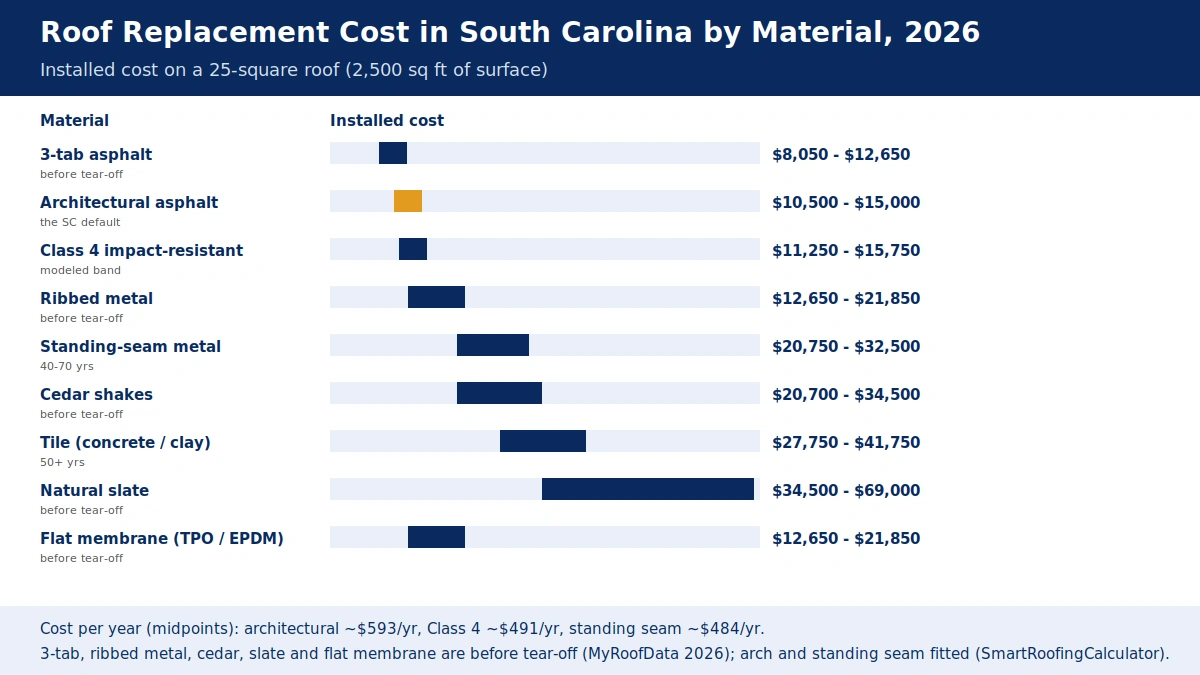
Roof Replacement Cost in South Carolina by Material
Read this warning before the material table. Three rows are priced before tear-off and the rest with it, and confusing the two understates a 25-square job by $2,500 to $5,000. Tear-off means stripping the old roof off, down to the deck boards below it.
MyRoofData’s per-square bands exclude tear-off, which it charges on its own line at $100–$200 a square for each layer. SmartRoofingCalculator’s bands are installed prices with tear-off already in. Two kinds of row share the table, installed rows and before-tear-off rows, each labeled, each priced on the same 25-square roof of 2,500 square feet of surface.
Judge the table by what the coast demands. The sticker price alone misleads. The cheapest shingle on the shelf lifts first in a hurricane-season gust, while the dearest metal on the shelf is still shedding salt wind the year the mortgage is paid off.
| Material | Installed cost per square | Total for 25 squares | Realistic life in South Carolina |
|---|---|---|---|
| 3-tab asphalt shingle | $322–$506 (before tear-off) | $8,050–$12,650 | 15–20 yrs |
| Architectural asphalt shingle | $420–$600 | $10,500–$15,000 | 18–25 yrs |
| Class 4 impact-resistant shingle | $450–$630 (modeled) | $11,250–$15,750 | 25–30 yrs |
| Ribbed metal (exposed fastener) | $506–$874 (before tear-off) | $12,650–$21,850 | 30–40 yrs |
| Standing-seam metal | $830–$1,300 | $20,750–$32,500 | 40–70 yrs |
| Cedar shakes and shingles | $828–$1,380 (before tear-off) | $20,700–$34,500 | 25–35 yrs |
| Tile (concrete/clay) | $1,110–$1,670 | $27,750–$41,750 | 50+ yrs |
| Natural slate | $1,380–$2,760 (before tear-off) | $34,500–$69,000 | 75–150 yrs |
| Flat membrane (TPO/EPDM) | $506–$874 (before tear-off) | $12,650–$21,850 | 20–30 yrs |
The 3-tab row is a budget line for a narrow set of jobs. MyRoofData puts 3-tab at $322–$506 a square installed before tear-off, and NumeralQ’s statewide figures place 3-tab about 17 percent under architectural on an identical roof. It is one flat layer with the weakest wind rating anywhere here and no impact rating a South Carolina insurer would credit.
Most insurers and builders have moved on from 3-tab. On a slope that faces the coast, its low wind rating is the worst place in the whole job to save money. Every summer, humid heat and ultraviolet thin the granular surface a little more, and every tropical season the wind-driven rain tests each sealant strip, so the money saved on 3-tab often only pays the next repair in advance.
A few jobs still suit it: a rental, an outbuilding, or a house headed for sale within a few years. For a house the owner plans to keep through ten Lowcountry summers and hurricane seasons, it is the wrong default.
Roughly three quarters of American homes wear architectural shingles, and South Carolina roofs run the same way. This thicker dimensional shingle sits behind the $420–$600-a-square headline band, and its 110-to-130-mile-per-hour wind rating holds only when the crew follows the manufacturer’s high-wind nailing pattern, six nails a shingle inside the wind-borne debris counties.
Expect 18 to 25 realistic years from architectural shingles in this climate, not the 22 to 30 MyRoofData prints. Humid summers age asphalt faster than dry ones do, wind-driven rain works every flashing lap, and the April-to-June hail peak bruises the mat. A twelve-year-old roof that looks sound can be one tropical remnant from a claim.
SureFlow Roofing, pricing the Upstate in 2026, centers its $10,000–$16,000 Upstate band on architectural shingles and calls them the default for most houses. Architectural is the South Carolina standard, and the rest of the table is measured against it.
Class 4 gets a section of its own below, and in South Carolina it merits a cooler reading than it receives in the hail-belt states. No premium figure for South Carolina alone appeared in the sources checked, and no invented figure stands in for it. The $450–$630-a-square band in the table is modeled arithmetic, a Michigan insurance agent’s 2026 figure of roughly $30 more a square than standard architectural shingles, laid across the South Carolina architectural band.
Run that arithmetic across 25 squares and the total comes to $11,250–$15,750. The case for Class 4 in this state leans less on hail, at 36 reports of two-inch hail in ten years statewide, and more on wind-driven debris, on the FEMA hail risk rated Relatively Moderate in Richland and Greenville counties, and on an insurance discount that varies by carrier and needs confirming in writing before the install. The hail count, the debris risk, and the discount are each weighed in dollars in the Class 4 section that follows.
Metal changes the per-year arithmetic, and the coast rewrites the specification. Ribbed panels with exposed fasteners run $506–$874 a square in MyRoofData’s South Carolina model before tear-off, which is $12,650–$21,850 for a 25-square roof and 30 to 40 years of life. Standing-seam metal runs $830–$1,300 a square in SmartRoofingCalculator’s South Carolina figures, $20,750–$32,500, for 40 to 70 years, while MyRoofData prices it at $874–$1,472 a square before tear-off.
Near tidal water the metal matters as much as the seam. Aluminum is the coastal choice because it does not rust, and steel depends on coatings that salt air attacks. The Myrtle Beach spread shows what getting it right costs: WeatherShield Roofers prices standing seam at $12–$20 a square foot on the Grand Strand, aluminum at $15–$21, and oceanfront aluminum work at $15–$24 or more.
On those figures, a 2,000 square foot aluminum standing-seam roof on the Strand comes to $30,000–$42,000. Hail cannot bruise metal the way it bruises a shingle mat. Standing-seam systems also carry wind ratings of 140 miles per hour or more, far above what a tropical remnant usually delivers in the Midlands.
At the midpoints, standing seam comes to near $484 a year against near $593 for architectural. A metal roof costs more on the day the contract is signed and less across the decades the roof serves. The complete metal price breakdown is in our guide to metal roof costs, and the shingles-versus-metal comparison sets the two side by side.
Cedar shakes suit a narrow slice of South Carolina roofs: $828–$1,380 a square in MyRoofData’s figures, or $20,700–$34,500 for 25 squares, for 25 to 35 realistic years in this climate. Cedar looks beautiful on a wooded Upstate lot and asks for real maintenance, and it holds moisture in its gaps, a poor combination on a roof that must survive humid summers, wind-driven rain, and a hurricane season inside one year. Before budgeting around the MyRoofData band, measure it against a local quote, and ask the bidder what treatment the shakes get for the humidity.
Tile and slate sit at the luxury end of the table, and in South Carolina their rarity owes as much to structure as to price. SmartRoofingCalculator prices tile at $1,110–$1,670 a square, or $27,750–$41,750 for 25 squares, and MyRoofData prices slate at $1,380–$2,760 a square, or $34,500–$69,000. MyRoofData breaks tile down further, with concrete at $920–$1,656 a square and clay at $1,104–$2,300.
Both weigh far more than asphalt, both need a structural check before they go on, and both can serve for fifty years or longer. Tile’s problem in this state is wind uplift on the coast and a thin crew base inland: a tile roof needs a crew that lays tile every week, and few South Carolina roofers do.
Slate’s problem is the same one sharpened. Few South Carolina roofers lay slate regularly, and in Charleston’s historic districts the Board of Architectural Review may review the visible slope.
Slate laid by a crew that rarely handles it finds its first leak at the first tropical storm. Read our tile roof cost guide before pricing tile at all: the first job is checking whether a South Carolina frame can carry concrete or clay weight.
Read the table as a yearly cost. Take a midpoint total and divide it by the midpoint of that material’s realistic life. At those midpoints the yearly figures are near $591 for 3-tab, near $593 for architectural, near $491 for Class 4, near $493 for ribbed metal, near $484 for standing seam, near $920 for cedar, near $579 for tile at a 60-year life, near $460 for slate, and near $690 for flat membrane.
Missing from those yearly figures are the deductible, where Class 4 and metal win, and the salt-air specification, where aluminum wins. Set the material table beside the insurance section when the decision is made. And the flat-membrane row prices a 25-square roof almost no South Carolina porch has: the low-slope section below re-prices membranes on the smaller roofs they actually cover.
Roof Replacement Cost by Roof Size
A pair of South Carolina listings can both show 2,000 square feet and still need roofs of completely different sizes. Roughly 2,000 square feet of ground sits beneath a one-story ranch roof. A colonial of two stories with equal living area sits on only about 1,000 square feet of ground, so its roof surface is about half the rancher’s.
Once the calculation adds pitch, overhangs, and waste, that ranch footprint usually totals 20–25 squares of roof surface. Pitch is the steepness of the roof, stated as rise over a 12-inch run. The pricing error South Carolina homeowners make most often is confusing the listing’s living area with the roof surface.
It is not a small one: a quote built from living area can miss the real roof by a third. Ask every bidder to print the square count as its own line on the bid. Pricing from living area describes a house that was never built.
SmartRoofingCalculator’s architectural band of $420–$600 a square, tear-off included, drives the table, with the modeled Class 4 band alongside it. The headline row is the 25-square one. The NumeralQ cross-check rides on the 20-square row: the per-square band gives $8,400–$12,000, set beside NumeralQ’s $8,880–$10,760 for a 2,000-square-foot roof statewide.
| Roof size | Typical South Carolina home | Architectural shingle total | Class 4 shingle total |
|---|---|---|---|
| 15 squares | Small ranch / cottage | $6,300–$9,000 | $6,750–$9,450 |
| 20 squares | 2,000 sq ft ranch | $8,400–$12,000 | $9,000–$12,600 |
| 25 squares | Typical SC home | $10,500–$15,000 | $11,250–$15,750 |
| 30 squares | Large two-story | $12,600–$18,000 | $13,500–$18,900 |
| 35 squares | Large home, complex roof | $14,700–$21,000 | $15,750–$22,050 |
| 40 squares | Very large / steep | $16,800–$24,000 | $18,000–$25,200 |
Steep pitch is the first thing that makes these numbers stop applying. On a 10/12 or 12/12 slope, crews move slower and stage differently than on a walkable 4/12, and the per-square price climbs with the difficulty.
After pitch comes complexity. Every valley, dormer, skylight, and chimney adds a flashing detail that eats crew time and turns into the first leak when it is rushed. A plain gable and a dormer-cut roof can share a square count and still come out at two different prices.
On a cut-up roof carrying several valleys, dormers, and hips, the labor line grows roughly 15 percent in MyRoofData’s estimator.
Third comes decking, the boards under the shingles. Soft sheathing hides until tear-off exposes it, and the crew prices its replacement by the square foot that day. Linta Roofing, pricing the Myrtle Beach area in 2026, puts rotted decking at $2.50–$5.00 a square foot for the affected areas, and notes that coastal humidity and salt air speed wood decay around penetrations and along eaves.
Settle the deck rate in writing while the old shingles are still on. The housing stock makes this more than a formality: about 33 percent of South Carolina homes went up before 1980, so older roofs hide soft decking and extra layers more often than the quote assumes.
Tearing off a second layer costs $100–$200 a square on MyRoofData’s South Carolina figures, and a house already carrying two layers cannot take a third: the code limit is two, so the job becomes a full tear-off.
Start from measurements of the roof itself when the budget is built. Start with the footprint and apply the pitch factor from SmartRoofingCalculator’s chart, near 1.12 for a 6/12 slope, near 1.25 for 8/12, then add a waste allowance (10 percent on a simple gable, 15 percent on a hip roof) and divide by 100. The answer is the square count.
Square count comes first when the bids are lined up. Prices get compared only once the counts agree. Without a stated square count, a bid cannot be compared with anything.
Roof Replacement Cost by City: Charleston vs Columbia vs Greenville vs Myrtle Beach
Myrtle Beach is the awkward entry in this table, so it comes first. It sits in the dearest roofing market in the state, inside the wind-borne debris region with 130-plus-mile-per-hour ratings baked into every quote, and its verified NumeralQ figure does not exist. The sources checked showed no NumeralQ page for a Myrtle Beach roof.
The planning models part company over the size of the gap. Linta Roofing, pricing the Myrtle Beach area from its own 2026 jobs, puts architectural shingles at $9,500–$18,000 for a typical job, with the coastal wind rating adding 10–15 percent over inland prices. WeatherShield Roofers prices the Strand’s standing-seam work at $12–$20 a square foot installed, with oceanfront aluminum at $15–$24 or more.
Both figures can hold at once, because they measure different houses and different materials. What can be said with confidence is the shape of the market: Grand Strand roofers work to the strictest wind specification in the state, Horry County sits at 9 percent combined sales tax, and the typical job is the dearest in the state once the wind rating is in the scope.
| City / metro | 2,000 sq ft roof (arch) | Roofer median wage | Market note |
|---|---|---|---|
| Charleston | $9,070–$11,010 (NumeralQ) | $23.09/hr (metro) | Dearest roofer pay in SC; Wind Pool territory; BAR review in historic districts |
| Columbia | $8,780–$10,640 (NumeralQ) | $21.47/hr (metro) | Cheapest roofer pay in SC; FEMA hail risk Relatively Moderate; 3.7% of median home value |
| Greenville | $8,940–$10,850 (NumeralQ) | $22.37/hr (metro) | Upstate hub; FEMA hail risk Relatively Moderate; Duke Energy territory |
| Myrtle Beach | $9,500–$18,000 typical job (Linta) | Not published | Grand Strand; 130+ mph ratings add 10–15%; no NumeralQ page verified |
Charleston holds the state’s biggest coastal roofing market, and one number cannot price it, because two markets live inside it. The pitched-roof market runs $9,070–$11,010 on NumeralQ’s figures for a 2,000 square foot roof, while Modernize’s metro band runs $13,500–$24,500 for the same size. That gap reads as the difference between a standard job in a standard house and the larger, steeper, more complex roofs that fill the peninsula and Mount Pleasant.
The roofer median wage in the Charleston-North Charleston metro is $23.09 an hour, about 13 percent below the national median, and the highest verified city figure in the state, with about 110 roofers employed. Charleston’s permit picture is the quirkiest in the state, taken up in the permits section below: the city’s historic districts put the Board of Architectural Review over visible-slope work, and the Wind Pool writes the wind policy where private carriers will not.
Charleston’s climate is the hardest on asphalt in the state, with 52.5 inches of rain a year and a muggy season running five and a half months. That is why the realistic shingle life here runs shorter than the brochure.
Columbia is the cheapest of the three verified cities and the one where the same roof takes the biggest bite out of the house. NumeralQ prices a 2,000 square foot roof at $8,780–$10,640, and Modernize’s metro band runs $12,000–$22,000. The roofer median wage in the Columbia metro is $21.47 an hour, about 19 percent below the national median, the lowest verified city figure in the state, with about 160 roofers employed.
FEMA rates hail risk in Richland County as Relatively Moderate, the highest of the three big-city counties, and NumeralQ puts the typical job at 3.7 percent of the median Columbia home value, against 2.0 percent in Charleston and Greenville. That share is the number that matters for a Columbia buyer: the roof costs less in dollars and more in proportion, because the houses are worth less than the roofs on them.
Columbia’s July averages 92 degrees with 83 days a year above 90, so the heat-aging case for a lighter-colored or metal roof is stronger here than on the coast, even though the wind case is weaker.
Greenville is the Upstate anchor, and its market reads as the most ordinary in the state, which is a compliment. NumeralQ prices a 2,000 square foot roof at $8,940–$10,850, and Modernize’s metro band runs $12,000–$22,000. The roofer median wage in the Greenville-Anderson-Greer metro is $22.37 an hour, about 16 percent below the national median, with about 170 roofers employed.
FEMA rates hail risk in Greenville County as Relatively Moderate, matching Richland. The Upstate’s advantage is the wind map: at 115 miles per hour design wind, a Greenville roof needs no coastal fastening schedule and no Wind Pool policy, and the contractor ranges prove it. SureFlow prices most Upstate architectural jobs at $10,000–$16,000, and Four Seasons at $11,250–$16,250 for the average Upstate home.
Greenville’s housing stock runs newer than Charleston’s or Columbia’s, so deck surprises at tear-off run rarer, and the per-sheet deck rate matters less here than on the coast. The Upstate’s disadvantage is the hail: with the April-to-June peak and a Relatively Moderate county rating, the Class 4 conversation belongs in Greenville as much as anywhere in the state.
Myrtle Beach closes the table with a warning label rather than a verified number. No NumeralQ page exists for the city, so the figures here are contractor-published and labeled as such. Linta’s $9,500–$18,000 architectural band covers a typical Myrtle Beach-area job with tear-off of one layer, disposal, materials, labor, permits, and cleanup included, and its standing-seam band runs $18,000–$35,000.
WeatherShield’s standing-seam figures run higher still on the oceanfront, where aluminum and mechanical-lock seams push $15–$24 a square foot. Read the Strand through the 10–15 percent coastal adder Linta cites: the same shingle costs more here because the code demands more of it, with 130-plus-mile-per-hour ratings, heavier fastening schedules, and synthetic underlayment that holds up in salt air where felt paper degrades. If a Myrtle Beach quote matches a Greenville quote dollar for dollar, the wind rating was left out.
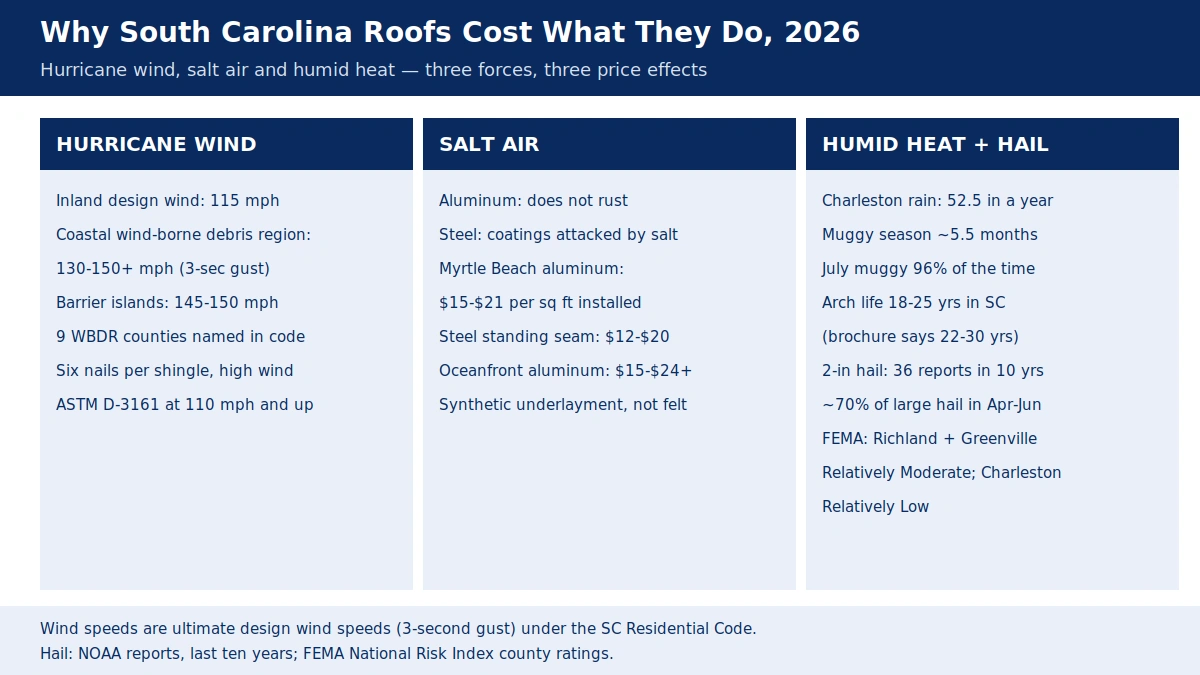
Why South Carolina Roofs Cost What They Do: Hurricane Wind, Salt Air & Humid Heat
Three forces set South Carolina prices. Each one hits a different part of the state.
Wind comes first because the code writes it down. Nine coastal counties sit in the wind-borne debris region the South Carolina code calls out by name: Beaufort, Berkeley, Charleston, Colleton, Dorchester, Georgetown, Horry, Jasper, and Williamsburg. Inside those counties the ultimate design wind speed runs from roughly 130 miles per hour on the inland margin to 145–150 miles per hour on the barrier islands of Charleston and Horry.
Bluffton, in Beaufort County, sits in a 140-mile-per-hour wind zone and makes the builder sign a wind zone design certificate at permit time. Inland, the design wind drops to 115 miles per hour. That 15-to-35-mile-per-hour gap is the whole coastal price story.
Shingles must meet ASTM D-3161, modified for 110 miles per hour, wherever the design wind reaches 110, and the fastening schedule tightens with it: six nails a shingle in the high-wind corridors, heavier edge metal, self-adhering underlayment at the eaves, and wind-rated assembly components throughout.
A coastal quote carries those lines. An inland quote does not. Comparing the two without the wind lines in view is comparing two different roofs.
Salt air comes second, and it punishes the wrong metal choice for decades. Steel relies on coatings that salt air attacks, and the attack starts at the cut edges and the fasteners, where the coating is thinnest. Aluminum does not rust, which is why it is the coastal choice within a mile or two of tidal water, and why the Myrtle Beach aluminum spread, $15–$21 a square foot against $12–$20 for steel standing seam, is money spent on chemistry rather than on looks.
Fasteners and flashings need the same treatment: stainless or coated fasteners, compatible metals throughout, and no bare steel touching aluminum where galvanic corrosion can start. Galvanic corrosion is the eating away that starts when two different metals touch in wet, salty air. On a shingle roof the salt question is narrower but real: felt underlayment degrades faster in salt air than synthetic underlayment, and the coastal crews that last use synthetic as standard.
Within sight of tidal water, specify the metal and the fastener for salty air, and let looks follow. The salt rule is simple to state and expensive to ignore.
Humid heat comes third, and it is the force that shortens the asphalt life priced here. Charleston takes 52.5 inches of rain a year, with 25.8 inches falling between June and September, and the muggy season runs about five and a half months, from early May to late October, with July muggy 96 percent of the time.
A shingle mat in that climate never fully dries between storms in summer, and the granule surface wears a little thinner every hot season while the sealant strips fatigue a little more every tropical-season gust. That is why architectural shingles are priced here at 18 to 25 realistic years in South Carolina rather than the 22 to 30 the manufacturer prints: the brochure life was measured in a drier place.
The same humidity feeds algae and moss on shaded north slopes, which is cosmetic until it is not. A moss mat holds water against the shingle and speeds the wear underneath. Ventilation matters more here than in a dry state: a hot, wet attic cooks the shingle from below while the sun cooks it from above, and a ridge vent that actually moves air is worth more than a thicker shingle on a poorly vented roof.
Snow, by contrast, barely registers. Ground snow load in South Carolina runs 0 to 5 pounds per square foot under ASCE 7, and structural engineering here focuses on wind resistance rather than snow accumulation. No South Carolina roof needs an ice dam strategy, and no line here prices one.
That is the one way South Carolina roofing is cheaper than the national picture: the winter that eats northern roofs does not exist here, and the money goes to wind and water instead.
Hail closes the weather section, because it decides the Class 4 question. South Carolina saw 36 reports of two-inch hail in ten years, and about 70 percent of the state’s large hail falls between April and June. FEMA rates hail risk Relatively Moderate in Richland and Greenville counties and Relatively Low in Charleston County.
That is a real hail season and a modest one. It is real enough that a May storm can bruise a ten-year-old shingle mat into a claim, and modest enough that the Class 4 premium needs an insurance discount to pay for itself. The hail calendar also sets the buying calendar: a roof that can wait until July avoids the peak, and a roof that cannot wait should be inspected the week after the season ends, when the bruising is fresh and the adjuster can still see it.
Asphalt vs Metal on the South Carolina Coast: The Salt-Air Decision
The coast forces a choice that the Upstate never has to make. The choice turns on which material forgives the air.
Asphalt forgives salt air better than steel does and worse than aluminum does. Steel forgives wind better than asphalt does and worse than aluminum does. Aluminum forgives both and charges for the privilege.
The right corner of that triangle depends on how close the house sits to tidal water.
Start with the house closest to the water. On an oceanfront or second-row lot, or on a marsh or Intracoastal lot where the air never dries, aluminum standing seam is the specification the coastal roofers reach for: $15–$21 a square foot installed on the Grand Strand, $30,000–$42,000 for a 2,000 square foot roof, with oceanfront work at $15–$24 or more where mechanical-lock seams and heavier coastal details are the right call.
The premium over steel is the price of a roof that does not rust from the edges inward. A steel roof on the same lot needs its coatings intact for fifty years in air that attacks coatings, and the warranty language usually knows it. Steel warranties commonly limit coverage near salt water, and a homeowner who buys steel two blocks from the surf should read the salt-water exclusion before signing, not after the first rust spot appears.
Step back a mile or two, into the neighborhoods where the air still carries salt but the spray never reaches the roof. Here the choice opens up. Architectural shingles at $420–$600 a square installed, with a 130-mile-per-hour wind rating and a six-nail pattern, hold their own for 18 to 25 years and cost a third of aluminum standing seam.
PVDF-coated steel standing seam at $12–$20 a square foot on the Strand holds its own longer, at 40 to 70 years, and sheds hail without bruising. The tie-breaker is the insurance bill: a standing-seam roof with a FORTIFIED designation can cut the wind portion of the premium by half or more, and over twenty years that discount can close much of the gap between the two quotes. FORTIFIED is a wind-tough build standard for roofs, and the insurance section below prices its discount in full.
Run the per-year arithmetic from the material table, standing seam near $484 a year against architectural near $593, and the metal roof reads as the cheaper roof that happens to cost more on the day.
Step inland, past the wind-borne debris counties, and the triangle collapses. At 115 miles per hour design wind, with no salt in the air and no Wind Pool policy, the metal premium buys longevity and hail resistance but no insurance advantage worth naming, and the shingle roof wins on the day for most buyers.
The Upstate contractor ranges prove the point: Four Seasons prices standing seam at $1,200–$1,800 or more a square in Greenville, against $450–$650 for architectural, and most Upstate buyers take the shingle and bank the difference. That is a rational choice in the Upstate and a costly one on the Strand, and the difference between the two is the wind map.
Three practical rules close the section.
- Never mix metals on a coastal roof: aluminum panels with bare steel fasteners, or copper flashing against a steel panel, will corrode at the joint while the panels themselves look new.
- Specify the underlayment for the coast: synthetic underlayment throughout, self-adhering membrane at the eaves and in the valleys, and high-temperature underlayment under any metal roof, where the panel can run hot enough in a Lowcountry July to cook felt.
- Get the wind rating in writing on the quote. Sales talk does not count: the shingle line, the nailing pattern, the seam type on metal, and the design wind speed the assembly is rated for. Without a wind rating in writing, the quote prices an inland roof.
Class 4 Impact-Resistant Shingles in South Carolina: What the Upgrade Costs and What It Pays Back
The Class 4 question in South Carolina is a narrower question than the brochures make it, and it deserves an answer in dollars rather than in adjectives. A Class 4 shingle carries a UL 2218 impact rating: a two-inch steel ball dropped from twenty feet must not crack the shingle. That test measures hail resistance, and hail is the one South Carolina hazard where the numbers argue against paying for the upgrade on hail alone.
Start with the cost, because it is the only part of the question with a firm number. No published Class 4 premium tied to South Carolina could be found, and no substitute number is offered. The band here is modeled arithmetic: a Michigan insurance agent’s 2026 figure of roughly $30 more per square than standard architectural shingles, applied to the South Carolina architectural band of $420–$600 installed.
That gives $450–$630 a square, or $11,250–$15,750 for a 25-square roof, about $750 more than architectural on the same roof.
The upgrade is cheap as roofing upgrades go. The price is firm. The payback is uncertain.
Now the hail record, stated in full in the weather section above. The record shows 36 reports of two-inch hail in ten years across South Carolina, with about 70 percent of the state’s large hail falling between April and June. FEMA’s county ratings put hail risk at Relatively Moderate in Richland and Greenville counties and Relatively Low in Charleston County.
Compare that with the hail-belt states, where two-inch hail is an annual event rather than a three-times-a-decade one, and the South Carolina case for Class 4 on hail alone is thin. A Columbia roof has the best hail case in the state, with Relatively Moderate risk, the cheapest roofer pay, and the biggest share of home value in the job, and even there the hail record alone does not repay $750 in expected damage avoided.
Charleston’s case is thinner still: Relatively Low hail risk, and a roof whose real enemy is wind-driven rain rather than ice.
So why do South Carolina roofers sell Class 4 at all? Three reasons, in order of weight.
- Wind-driven debris: a tropical storm throws branches, patio furniture, and loose flashing across a roof, and a Class 4 shingle resists the puncture that turns a debris strike into a leak. That is a wind argument dressed as a hail rating, and on the coast it is a real one.
- The insurance discount: carriers publish discounts for Class 4 roofs that range from 5–20 percent to 10–25 percent and even 20–30 percent off the wind and hail portion of the premium, depending on the source, and the only figure that matters is the one your carrier puts in writing before the install. At the midpoint of the published ranges, a $750 upgrade can repay itself in a few years of premium savings on a coastal policy, and can repay itself never on an inland policy where the wind portion is small.
- The roof-age rule: carriers are tightening their appetite for older roofs, and a Class 4 roof with a documented install date can keep a policy renewable at an age when a standard shingle roof starts drawing non-renewal letters. That third reason is the one to ask your agent about by name, because it never appears on a quote.
The decision rule is short. Buy Class 4 in Columbia or Greenville if your carrier confirms the discount in writing and the discount repays the $750 within five years. Buy Class 4 on the coast if the debris argument and the discount together clear the same bar, and treat the hail rating as a bonus rather than the reason.
Skip Class 4 if the carrier will not confirm a discount, or if the roof is a rental the owner expects to sell within a few years. The next buyer will not pay for a rating they cannot see. And whatever the decision, get the UL 2218 marking on the quote: a shingle sold as “impact resistant” without the Class 4 marking earns no discount and resists nothing the test measures.
Low-Slope & Flat Roofs in South Carolina: Porches, Additions & the Charleston Historic District
South Carolina has no rowhome flat-roof market on the Baltimore scale. The state’s flat roofs sit in three places: the low-slope porch and addition roofs that run along the back of Lowcountry houses, the mid-century flat sections on Midlands ranches, and the commercial-style flat roofs over Charleston’s historic outbuildings.
All three price by the membrane rather than the shingle. A membrane is a single sheet of rubber or plastic welded or glued into one waterproof skin. All three fail at the same points: the flashing where the flat section meets the pitched roof, the drain that clogs with live-oak leaves, and the seam that opens in a July heat wave.
The membrane table prices a 25-square roof for comparison with the material table, but almost no South Carolina flat roof is 25 squares. Read the per-square figures and scale them down: EPDM, TPO, and modified bitumen all run $506–$874 a square on MyRoofData’s South Carolina model before tear-off, or $12,650–$21,850 for 25 squares, with lifespans of 20–30 years for EPDM, 15–25 for TPO, and 15–20 for modified bitumen.
A typical Lowcountry porch roof of 300 to 500 square feet, 3 to 5 squares, lands near $1,500–$4,400 on those per-square figures, before the flashing and drain work that usually costs as much as the membrane. A mid-century ranch with a 1,200 square foot flat section, 12 squares, lands near $6,100–$10,500.
Those are planning figures from a statewide model, not quotes, and the flashing lines on a real bid will move them. What matters is the comparison: on a small flat section, the membrane choice matters less than the flashing detail, and the cheapest membrane with the best flashing outlasts the dearest membrane with a rushed flashing.
TPO is the Lowcountry default for a reason: its white surface reflects the July sun that cooks a black EPDM membrane, and its heat-welded seams hold up better than glued seams in humid air. EPDM is the forgiving choice on a complex flat section with many penetrations, because it stretches and patches easily, and its black surface is a liability only where the roof takes full afternoon sun.
Modified bitumen is the torch-down choice on small sections where a single-ply membrane cannot be detailed cleanly, and its 15-to-20-year life is the shortest here. None of the three belongs on a slope above 2/12: a membrane on a pitched roof is a roof installed against its own instructions, and the warranty will say so.
Charleston adds a rule the rest of the state does not have. Work on a visible slope in the Old and Historic District or the Old City District goes before the Board of Architectural Review, and a change of material, shingle to metal, or any visible metal where shingle stood before, can need approval before the crew starts.
The review exists to keep the peninsula looking like itself, and it has real teeth: a roof installed without the approval it needed can be ordered changed. Ask the building department before ordering material, not after the truck arrives.
A fee schedule for the review could not be verified from the sources checked, so no fee figure is printed. The flat-roof market in full, membrane by membrane, is priced in our flat roof replacement cost guide.
Permits & Code: The 2021 IRC, the 2027 Code Change & the County Patchwork
South Carolina’s code story has a date on it, and the date matters for anyone pulling a permit in the next two months. Through the end of 2026, the governing document is the 2021 South Carolina Residential Code, the 2021 International Residential Code (IRC) with South Carolina modifications, effective January 1, 2023.
On January 1, 2027, the 2024 editions take effect statewide: the 2024 South Carolina Residential Code, built on the 2024 IRC with state modifications, adopted by the Building Codes Council on August 26, 2025. The change moves the state from ASCE 7-16 to ASCE 7-22 for wind and structural design, which is a real engineering change rather than a renumbering.
A permit issued before January 1, 2027 vests the job to the code in force when the permit issued, under South Carolina’s Vested Rights Act. So a November 2026 permit locks in the 2021 code, and a January 2027 permit does not.
One 2024 South Carolina modification deserves attention on the coast: it relaxes the prescriptive high-wind asphalt-shingle underlayment column to match the non-high-wind column, on the state’s reasoning that tested performance should govern rather than prescriptive layers. On a coastal reroof, ask the building department which underlayment the 2024 code will actually require for your address.
The reroof rules themselves sit in section R908 of the 2021 IRC, and they are stricter than most homeowners expect. A replacement means removing the existing layers down to the roof deck. The one exception is an adhered ice-barrier membrane, which may stay if a new layer of underlayment covers it.
A recover, a new covering over the old one, is allowed only where the manufacturer’s instructions permit it, or where the new roof is a complete separate system, such as standing-seam metal that carries its own loads directly to the structure. A recover is not allowed where the old roof is water-soaked or deteriorated, over slate, clay, or cement tile, or where the roof already carries two or more layers.
The code limit is two layers, and a house that already carries two cannot take a third. A contractor who offers to lay a third layer over two is offering to break the code, and the permit inspector is the one who will catch it.
Whether a permit is needed at all is a local question, and South Carolina leaves it to each city and county. The IRC’s permit section, R105.1, requires a permit to alter or repair a structure, and the exempt-work list in R105.2 does not mention roofing. Administration, fees, and inspection practice are all local, so the building department’s answer governs and the contractor’s guess does not.
The fee figures disagree with each other, and the disagreement is printed rather than smoothed over: SmartRoofingCalculator puts the average permit near $200, MyRoofData puts most jurisdictions at $75–$300, and RoofingEstimatorPros puts the range at $150–$550. The sources checked gave no fee schedule for any one city. NumeralQ lists the re-roof permit as “Not published” for Charleston, Columbia, and Greenville on a $15,000 job.
So the usable range is the spread across the three sources, and the usable advice is to ask the building department before budgeting. Coastal counties add wind inspections on top of the base permit, which is a separate line on a coastal quote and a separate visit on a coastal job.
The permit checkpoint reaches past the building department and into the license. South Carolina law requires a building official to refuse a permit unless the applicant shows the required state license or registration, or an exemption, and to report suspected violators to the licensing board.
That checkpoint is the homeowner’s best friend: a contractor who cannot get the permit pulled is a contractor whose registration does not check out, and the discovery costs nothing because it happens before the deposit is paid. The hiring section below works through the registration itself.
Hiring a Roofer in South Carolina: Registration, the $5,000 Bond & the Deductible Ban
South Carolina does not license residential roofers. It registers them, and the difference matters more than the vocabulary suggests.
A license means the state tested the holder. A registration means the state recorded the holder.
South Carolina’s Residential Builders Commission, inside the Department of Labor, Licensing and Regulation, registers residential specialty contractors, including roofers. The registration is what a homeowner should ask for, verify, and write into the contract.
The rule is short. Any residential roofing job over $500 needs a Residential Specialty Contractor registration in the Roofers classification, under South Carolina Code sections 40-59-20(7) and 40-59-220(A). There is no exam.
The applicant needs one year of residential experience in the past five years for the classification, a credit report, and a $100 application fee.
One registration covers at most three trades, so a roofer who also wants to do gutters and siding needs the classifications to match the work. The registration defines roofers as the people who install, alter, and repair the materials that form a watertight, weather-resistant roof surface, including accessories, flashing, valleys, gravel stops, and insulation panels above the deck.
Work below the deck, structural deck repair and framing changes, needs a Residential Builder or another appropriately licensed person, not the roofer’s registration alone.
The bond rule sits on top of the registration. When a single job for an individual property owner exceeds $5,000 in labor and materials, the registrant must have a $5,000 surety bond on file under section 40-59-240(D).
A surety bond is money set aside by a third party that pays the homeowner if the contractor fails to finish or pay. Every roof here exceeds $5,000, so every roof here needs the bond.
One conflict belongs in the open: a secondary source in an earlier pass cited a $10,000 bond for jobs over $5,000. The $5,000 figure with its statute citation is used here, because it is the figure the LLR reading supports. Ask for the bond as well as the registration, and ask for both in the name the contract carries.
The commercial line sits higher. Roofing on a commercial, industrial, or institutional building over $10,000 falls under the Contractor’s Licensing Board, with a Roofing subclassification, a PSI technical exam, and a group bid limit.
A residential roofer’s registration does not cover a commercial job, and a commercial license does not excuse a residential job from the registration. The two credentials answer to different boards, and the homeowner’s job is the residential one.
Unlicensed work is a misdemeanor under South Carolina Code section 40-59-30, and an unlicensed contractor generally cannot enforce the contract or file a lien. That is the legal consequence. The practical consequence is worse: an unregistered roofer has no bond behind the job, no board to complain to, and no registration to lose.
The verification step takes five minutes and costs nothing: ask for the registration number and the name it is issued under, then search the Licensee Lookup linked from the Residential Builders Commission page at llr.sc.gov.
The Commission’s own guidance draws the line plainly: a licensed contractor has passed exams and met other requirements, while a registered contractor has provided contact information to the state. Neither fact is a warranty of good work. Both facts are worth checking before the deposit moves.
Two more rules close the hiring section, and both are traps for the unwary. The first is the storm-chaser rule: after a governor-declared emergency, LLR may issue emergency registrations to out-of-state specialty contractors, limited to $35,000 per project, the declared area, and the emergency’s duration.
After Hurricane Helene, out-of-state crews worked South Carolina under exactly that rule, and the legitimate ones carried the emergency registration in writing. A crew that arrives after a storm without any registration at all is not an emergency contractor. It is an unregistered one.
The second is the deductible ban, and it is stated here most plainly: South Carolina Code section 40-59-25(E) makes it a misdemeanor for a roofer to offer to pay or rebate a deductible on an insurance job. Any contractor who promises to “cover your deductible” or “absorb the deductible” is offering to break the law, and a homeowner who accepts is part of the arrangement.
The deductible is the homeowner’s by law, and the quote should show it as a line the homeowner pays. Seven questions that separate a registered roofer from a sales pitch are listed in our questions to ask a roofer guide.
Insurance: Hurricane Deductibles, the Wind Pool, ACV vs RCV & the Safe Home Grant
Insurance is where a South Carolina roof stops being a construction job and becomes a money question, and the deductible is the part most homeowners misunderstand. A hurricane deductible, sometimes called a named-storm or wind and hail deductible, is a separate, higher deductible that applies only to damage from a storm the National Hurricane Center has officially named.
It replaces the flat all-other-perils deductible, usually $1,000 or $2,500, for that event only. Damage from an unnamed storm, a regular thunderstorm, or a random wind event falls under the standard deductible instead.
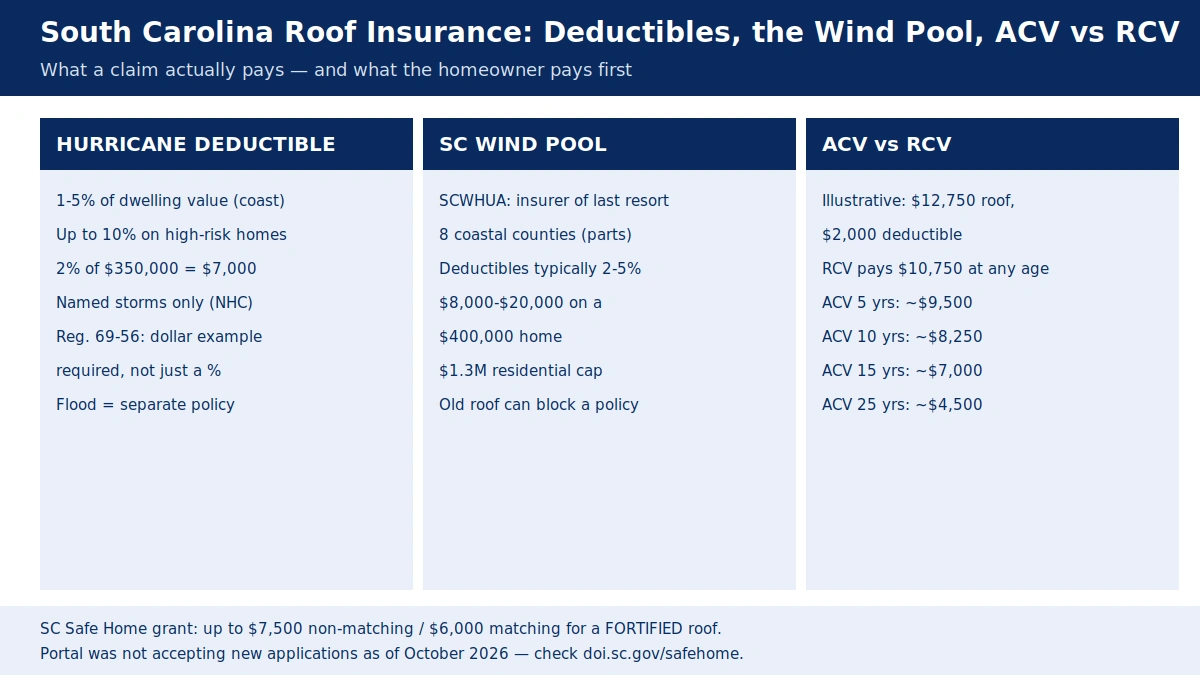
The hurricane deductible is almost always a percentage of the dwelling coverage limit: typically 1 to 5 percent along the South Carolina coast, and up to 10 percent on older or higher-risk coastal properties. At 2 percent on a $350,000 dwelling, the homeowner pays $7,000 before the insurer pays anything on a wind claim. At 5 percent on the same house, the homeowner pays $17,500, more than the entire cost of a 25-square architectural roof.
That comparison is the one to carry into the renewal meeting: the deductible can exceed the roof.
South Carolina regulates how that deductible is communicated. Under South Carolina Code of Regulations 69-56, an insurer writing a homeowners policy with a hurricane, named-storm, or wind and hail deductible must clearly disclose that the deductible exists and provide a worked example of how it applies in dollars, not just as a percentage. If the declarations page shows only a percentage, the homeowner should ask the agent for the dollar figure before the storm, not after it.
Flood and storm surge sit outside all of this: a hurricane deductible covers wind and wind-driven rain only, and flood damage is handled entirely separately under a flood insurance policy with its own deductible. A house that takes both wind and surge in one storm files two claims under two policies with two deductibles, and the roof claim is the wind one.
For many coastal homeowners, the wind policy itself does not come from a private carrier at all. The South Carolina Wind and Hail Underwriting Association, the SC Wind Pool, created under South Carolina Code section 38-75-330, is the state-created insurer of last resort for wind and hail in designated coastal territories where private insurers will not write the coverage.
Its territory covers parts of Beaufort, Berkeley, Charleston, Colleton, Dorchester, Georgetown, Horry, and Jasper counties, though not every property in those counties falls inside the boundary. A Wind Pool policy covers the dwelling, personal property, and loss of use, each with its own percentage deductible, typically 2 to 5 percent of insured value, or $8,000 to $20,000 on a $400,000 home. The maximum residential coverage is $1.3 million combined.
Wind Pool policies cost more than equivalent private coverage and carry higher deductibles, which is why the program is a last resort rather than a first choice. For a coastal homeowner whose carrier has excluded wind, it is the only roof coverage there is. Roof condition matters to the Pool: a 25-year-old roof with visible deterioration can trigger a repair or replacement requirement before a policy issues, which is one more reason a coastal roof should never be left to rot.
The payout question is ACV versus RCV, and it decides what the claim actually buys. ACV means actual cash value, what the old roof was worth after wear. RCV means replacement cost value, what a new roof costs.
A replacement-cost-value policy pays the cost of a new roof at any age, less the deductible. An actual-cash-value policy pays the depreciated value, and South Carolina permits depreciation of both roofing materials and embedded labor when the ACV is calculated.
The arithmetic below is illustrative, built from the $12,750 architectural midpoint here with a $2,000 flat deductible, not a carrier schedule, and labeled as such. RCV pays $10,750 at any age. ACV pays about $9,500 at five years, about $8,250 at ten years, about $7,000 at fifteen years, and about $4,500 at twenty-five years.
The gap between RCV and ACV at twenty-five years is more than $6,000, which is most of a new roof. A homeowner who does not know which settlement basis the policy carries will discover it at the worst possible moment, and the discovery costs more than the premium difference between the two.
The mitigation money is real, and it is the only state money here that touches a roof. The SC Safe Home Mitigation Grant Program, run by the South Carolina Department of Insurance, provides matching and non-matching grants to coastal homeowners who retrofit against hurricanes and high winds.
The Resilient Mitigation Award, a roof upgrade meeting both the SC Safe Home and the IBHS FORTIFIED Roof standards, pays up to $7,500 non-matching or $6,000 matching. Sustainable projects, including SC Safe Home roof retrofits without the full FORTIFIED standard, pay up to $5,000. Shutters pay up to $3,000.
The program covers owner-occupied single-family homes in eleven coastal counties, and the two rules that disqualify applicants are the ones to remember: apply and receive approval before roofing work begins, and no prior storm damage or claim payouts on the home.
The 2026 cycle opened February 10, 2026, with a second round on April 8, 2026, and as of October 10 to 13, 2026, the portal was not accepting new applications, with funds replenishing about twice a year. Check the Department’s Safe Home page before planning around it. The inspection fee runs $150 to $250.
On top of the grant, South Carolina offers a fortification tax credit of 25 percent of qualifying out-of-pocket costs, up to $1,000 a year, not available for costs paid with a non-taxable Safe Home grant. And a FORTIFIED roof can cut the wind portion of the homeowners premium by 50 percent or more, according to Kin’s October 2026 figures. Contractor sources cite 10 to 25 percent off the total premium in coastal markets, a secondary figure flagged as such.
The insurance explainer in full, claim by claim, is priced in our roof repair cost guide for the repair side and in the inspection section of our roof inspection cost guide.
One deadline from the last storm belongs here, because it is still open. Hurricane Helene struck South Carolina on September 27, 2024, and South Carolina generally provides a three-year period for insurance contract and bad-faith actions. One contractor source checked puts the hard outer deadline for Helene roof losses at September 27, 2027.
That date is contractor-stated, not a court ruling, and any homeowner with an unpaid or underpaid Helene claim should check it with counsel rather than with a roofing guide. But the clock is real, and a denied Helene claim left sitting does not get younger.
Paying for It: No Federal Credit in 2026, HEAR Not Launched in South Carolina & the FORTIFIED Math
The money section for a 2026 South Carolina roof is short, and the shortness is the point. There is no federal money for a roof in 2026, there is no state rebate money for a roof in 2026, and the only state money that touches a roof is a grant that was closed to new applications as of October. The rest is the arithmetic of paying for the roof out of the homeowner’s own pocket, plus the one discount that actually moves the number.
Start with the federal picture. The One Big Beautiful Bill Act, Public Law 119-21, signed July 4, 2025, ended the Energy Efficient Home Improvement Credit (section 25C) and the Residential Clean Energy Credit (section 25D) for property placed in service after December 31, 2025, and the IRS confirmed it in fact sheet FS-2025-05. A roof finished in 2026 draws nothing from either credit.
The completion date is what counts. A deposit paid in 2025 for a roof finished in January 2026 earns no credit.
A roof never qualified well under section 25C in any case, since the credit paid for efficiency upgrades. The 2026 answer is the same either way: $0.
A 30 percent federal credit line on a 2026 roof rests on dead law. Have the quote reissued with that line struck. The full federal picture, credit by credit, is in our federal tax credits guide.
The state rebate picture is no better, and the reason is a launch that has not happened. South Carolina’s HEAR and HOMES rebates, the federal Home Energy Rebates programs, have not launched: the South Carolina Energy Office describes them as “not currently available,” with program development underway and availability anticipated in 2026, confirmed as recently as October 13, 2026.
The federal allocations exist, $68,451,650 for HEAR and $68,716,961 for HOMES, about $137 million combined, but an allocation is not a program, and no launch date has been set. Do not count on either rebate when pricing a roof.
And even when HEAR launches, it will never pay for a roof: the program is electric-to-electric only under DOE Program Notice 26-2, issued May 29, 2026, with no fuel-switching, and a roof is not an appliance. HOMES pays for measured energy savings, and a roof covering earns none of it.
The geothermal credit that South Carolina does offer, 25 percent of purchase and installation, capped at $3,500 a facility a year or half the state tax liability, carried forward up to ten years, repealed January 1, 2032, covers geothermal machinery only, and a roof is not geothermal machinery. The record shows no South Carolina program that pays for a roof, and the sources checked turned up no utility roof rebate either.
What remains is the financing and the FORTIFIED math. The financing options, home equity, contractor financing, a personal loan, or a credit card for a small repair, are compared in full in our roof financing guide, and the comparison matters here because the interest on a financed roof is the second-largest cost in the job after the roof itself.
The FORTIFIED math is the one place the numbers bend in the homeowner’s favor. A FORTIFIED roof costs more than a standard roof. The sealed deck, the ring-shank nails, the secondary water barrier, and the high-wind covering add real money to the bid.
It returns three things: a Safe Home grant of up to $7,500 where a round is open, a state tax credit of up to $1,000 a year on the out-of-pocket remainder, and a wind-premium discount that Kin puts at 50 percent or more of the wind portion. On a coastal policy where the wind portion runs several thousand dollars a year, those three together can repay the FORTIFIED premium in three to five years, and the roof that remains is the one most likely to survive the next named storm.
That is the only rebate story here with real money behind it, and the money comes from mitigation: the grant, the credit, and the premium discount.
Sales tax closes the money section, because it is the line most quotes hide. South Carolina charges 6 percent state sales tax plus a county local option of up to 3 percent, for a combined 6 to 9 percent. Charleston County runs 9 percent, Richland County 8 percent, and Horry County 9 percent.
Whether a given quote’s labor is taxed depends on how the contractor structures the sale, which is why the tax should be its own line on every bid rather than buried in the total. On a $12,750 roof, the difference between 6 and 9 percent is $382, small against the roof, large against the margin, and worth one line of the quote.
Repair vs Replace & Getting Quotes in South Carolina: The Decision Rules and the Checklist
The repair-or-replace decision in South Carolina turns on three numbers and one storm. The numbers are the roof’s age, the repair’s share of a replacement, and the deck’s condition. The storm is the next named one, and it does not wait for a convenient year.
A young roof with damage in one place is a repair job. A ten-year-old architectural roof with a lifted flashing at one chimney, a cracked boot at one vent, or a dozen missing tabs after a thunderstorm is a repair job, and the repair should cost a few hundred to a few thousand dollars, not a five-figure replacement. The repair side, price by price, is in our roof repair cost guide.
A roof past eighteen years with damage spread wide is a replacement: granule loss across whole slopes, curling or cracking tabs on more than one face, or a leak that reappears somewhere new every time the old one is fixed. Replace, too, when the repair quote passes a third of the replacement quote. The repaired roof still carries the old roof’s age and the old roof’s deductible.
And replace when the deck says so: soft sheathing found at tear-off, a second layer already on the roof, or a sag the crew can see from the ground. A roof that needs its deck rebuilt needs replacing.
The storm changes the arithmetic in a way no inland guide has to face. A fifteen-year-old coastal roof with two named-storm seasons left in it is a different asset from the same roof inland, because the next storm can turn a repair into a claim, a claim into a deductible, and a deductible into a bill larger than the repair would have been.
On the coast, replace earlier rather than later: a roof with five years of life left is a roof that should be replaced before the next hurricane season, not after it, because the insurer’s roof-age rule and the Wind Pool’s condition requirement both tighten as the roof ages. Inland, the same roof can run to its full life, because the storm that would kill it is a thunderstorm rather than a hurricane.
The inspection that decides the question is priced in our roof inspection cost guide, and it is the cheapest money in the whole job.
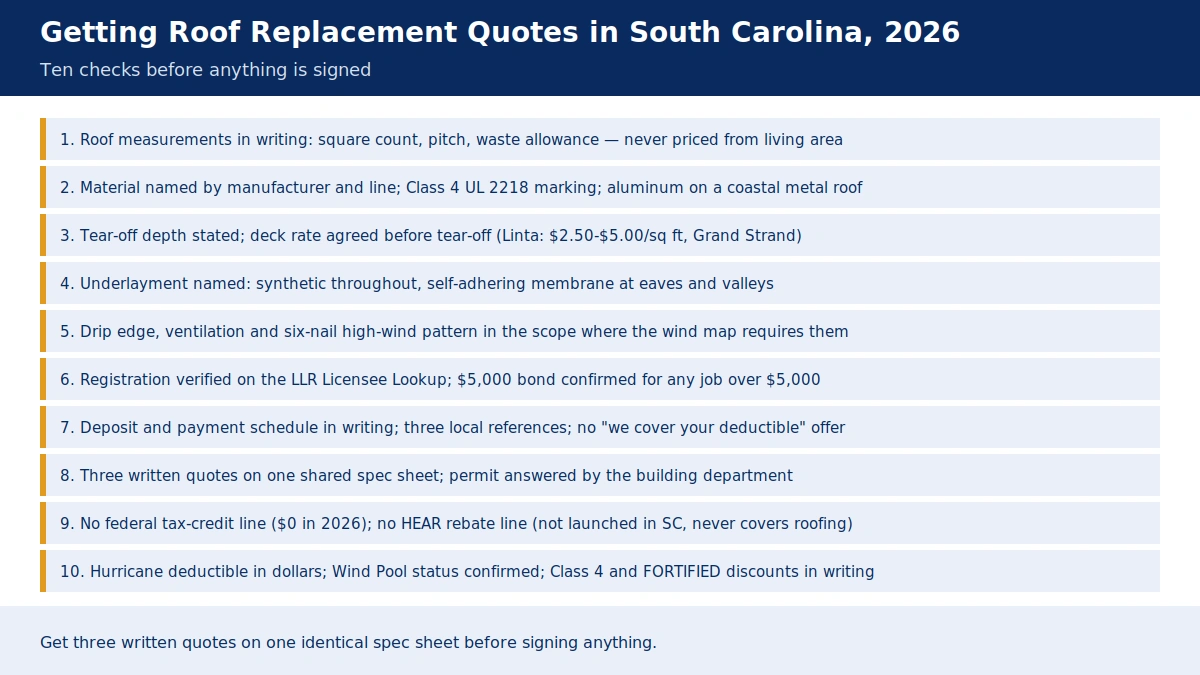
The checklist below is the last thing here and the first thing to use. Ten items, in the order they should be checked, before anything is signed.
- Ask the roofer to write down the square count, the pitch, and the waste allowance. Never let the price come from living area.
- Have the material named by manufacturer and line, with the Class 4 UL 2218 marking where it is priced and aluminum specified on any coastal metal roof.
- Have the tear-off depth stated and the deck rate settled before tear-off (Linta: $2.50–$5.00 a square foot for rotted decking on the Grand Strand).
- Have the underlayment named: synthetic throughout, self-adhering membrane at the eaves and in the valleys, high-temperature underlayment under metal.
- Keep drip edge, ventilation, and the six-nail high-wind pattern in the scope wherever the wind map requires them.
- Verify the registration on the LLR Licensee Lookup, confirm the $5,000 bond on any job over $5,000, and have insurance certificates mailed from the carrier.
- Put the deposit and payment schedule in writing, collect three local references from your own county, and refuse any “we cover your deductible” offer. That offer is illegal under section 40-59-25(E).
- Collect three written quotes against one shared spec sheet, get the permit question answered by the building department, and note the 2027 code change for any permit pulled after January 1.
- Strike any federal tax-credit line ($0 in 2026) and any HEAR rebate line (HEAR has not launched in South Carolina and never covers roofing).
- Know the hurricane deductible in dollars, confirm Wind Pool status for coastal homes, get Class 4 and FORTIFIED discounts confirmed in writing first, and check Safe Home grant status at doi.sc.gov/safehome before planning around it.
What does a roof replacement cost in South Carolina in 2026?
SmartRoofingCalculator puts a typical 25-square architectural shingle roof at $10,500–$15,000 in 2026, and NumeralQ puts a 2,000 square foot roof at $8,880–$10,760 statewide (pricing October 26, 2026). On the same 25-square roof, 3-tab shingles come to $8,050–$12,650 before tear-off, Class 4 impact-rated shingles sit at $11,250–$15,750 as modeled arithmetic, and installed standing-seam metal at $20,750–$32,500. By city, Myrtle Beach runs $9,500–$18,000 for a typical architectural job on Linta Roofing’s contractor-published figures, Charleston $9,070–$11,010, and Columbia $8,780–$10,640.
How much does a roof cost per square in South Carolina?
SmartRoofingCalculator prices architectural shingles at $420–$600 a square installed with tear-off, and one square covers 100 square feet of finished roof surface. The same material comes to $414–$690 a square before tear-off in MyRoofData’s model, Class 4 impact-rated shingles sit at $450–$630 a square as modeled arithmetic, installed standing-seam metal runs $830–$1,300 a square, and 3-tab $322–$506 before tear-off. The Class 4 band is a Michigan agent’s $30-a-square premium laid across the South Carolina architectural band, since no premium specific to South Carolina was verified.
Do I need a permit to replace a roof in South Carolina?
South Carolina leaves permit administration to each city and county, so the answer changes by address, and the building department has the final word. The IRC’s permit section requires a permit to alter or repair a structure, and roofing appears nowhere on the exempt-work list, yet every building department sets its own fee, inspection, and paperwork, with coastal counties adding wind inspections on top. The fee figures do not agree, SmartRoofingCalculator puts the average near $200, MyRoofData puts most jurisdictions at $75–$300, and RoofingEstimatorPros puts the range at $150–$550, with no city schedule verified for Charleston, Columbia, or Greenville, and the 2024 code editions take effect January 1, 2027, with a permit issued before that date locking the job to the 2021 code.
Does South Carolina license roofers?
South Carolina registers residential roofers instead of licensing them. A house roofing job over $500 needs a Residential Specialty Contractor registration in the Roofers classification from the Residential Builders Commission, one year of residential experience in the past five years, a credit report, and a $100 application fee, with no exam to sit, and any job over $5,000 needs a $5,000 surety bond on file as well. Commercial roofing over $10,000 sits under the Contractor’s Licensing Board instead, with a Roofing subclassification and a PSI exam, working without the registration is a misdemeanor under section 40-59-30, an unregistered contractor generally cannot enforce the contract or file a lien, and the number should be checked on the LLR Licensee Lookup before signing.
How does the South Carolina hurricane deductible work on a roof claim?
A hurricane deductible covers only damage from a storm the National Hurricane Center has officially named, and for that event it replaces the flat all-other-perils deductible. It is almost always a percentage of the dwelling coverage limit, typically 1 to 5 percent along the South Carolina coast, reaching 10 percent on older or higher-risk coastal properties, so with a 2 percent deductible on a $350,000 dwelling, $7,000 comes out of the homeowner’s pocket before the insurer pays anything on a wind claim. South Carolina Regulation 69-56 makes the insurer disclose the deductible with a worked dollar example, not a bare percentage, flood and storm surge sit outside it under a flood policy carrying its own deductible, and where private carriers exclude wind, the SC Wind Pool writes the wind and hail coverage instead, with deductibles usually 2 to 5 percent and a $1.3 million residential coverage cap.
How long does a roof last in South Carolina?
Shingle life runs short in South Carolina’s humid heat, salt air, and hurricane wind, while metal and slate outlast what the brochure promises. The lives run 75–150 years for natural slate and 50 or more for tile; 40–70 for standing-seam metal and 30–40 for ribbed metal; 25–35 for cedar shakes; 25–30 for Class 4 shingles, 18–25 for architectural, and 15–20 for 3-tab; and in flat membranes, EPDM runs 20–30 years, TPO 15–25, and modified bitumen 15–20. Hail, wind-driven debris, salt corrosion on the wrong metal, and the April-to-June hail peak all cut those lives short, so put the roof on a twice-a-year inspection rhythm, once in fall after hail season winds down, and once in spring before it starts up.
Can I get a rebate or tax credit for a new roof in South Carolina in 2026?
Nothing pays for a roof in 2026. A roof earns nothing from the 30-percent Residential Clean Energy Credit (§25D), and nothing from the Energy Efficient Home Improvement Credit (§25C) either, since both credits closed for installs finished after 2025 under Public Law 119-21, the One Big Beautiful Bill Act signed July 4, 2025. South Carolina’s HEAR and HOMES rebates have not launched, the South Carolina Energy Office calls them not currently available with no launch date set, and HEAR would never pay for a roof in any case, while the single state program that touches a roof is the SC Safe Home wind-mitigation grant of up to $7,500, which was not accepting new applications as of October 2026, and what pays instead is the insurer: a Class 4 roof can earn a discount on the wind and hail portion of the premium, a FORTIFIED roof can earn a larger one, and every claim avoided is a deductible the homeowner keeps.
What is the SC Safe Home grant, and can it pay for my roof?
The SC Safe Home Mitigation Grant Program, run by the South Carolina Department of Insurance, pays coastal homeowners who retrofit against hurricanes and high wind. A roof upgrade that meets the IBHS FORTIFIED Roof standard earns up to $7,500 as a non-matching grant or $6,000 as a matching grant, and lesser roof retrofits earn up to $5,000, for an owner-occupied single-family home in one of eleven coastal counties, free of prior storm damage or claim payouts, with the homeowner applying and winning approval before any roofing work starts. The 2026 cycle opened February 10 with a second round on April 8, and the portal had stopped taking new applications by October 2026, with funds replenishing about twice a year, so check the Department’s Safe Home page before planning around it, and never sign a roofing contract that assumes the grant will come through.