

Heat pump cost in South Carolina in 2026 runs $6,390 to $10,750 installed for a typical 3-ton ducted system. South Carolina is the state where the heat pump stopped being a bet years ago.
Drive through a Columbia subdivision in February and the outdoor units hum on the side of nearly every other house. About 41 percent of South Carolina homes already use a heat pump as their main heat, a share no northern state comes near, and 71 percent of homes heat with electricity in one form or another.
The buyer here is rarely the first on the street to try the technology. The buyer is usually replacing a heat pump that died, upgrading a strip-heat system that costs too much to run, or adding cooling to a house that never had it.
Winters here are so mild that a standard unit spends most of the season in the 40s and 50s, where it does its best work. The question is whether the replacement is sized for the summer it will actually serve, whether it can pull the humidity out of a Charleston August, and whether it will still be standing on its pad after the first tropical storm.
The price map is flat. Charleston, Columbia and Greenville price within about $80 of each other at the bottom of the 3-ton band and within about $60 at the top, because the labor market barely moves across the state.
HVAC mechanics earn a median $28.08 an hour in Charleston, $27.70 in Columbia and $28.25 in Greenville, all within a few percent of the state median of $27.22. There is no expensive corner to explain away a high quote, and no cheap corner to chase for a bargain.
What moves a South Carolina quote is the house: ducts in a vented crawlspace under a 1960s ranch, a 100-amp panel in a Myrtle Beach condo, a coastal lot in a flood zone that needs the unit lifted above the water line. The cities are still priced separately below, because the utility territory, Dominion, Duke, Santee Cooper or a co-op, decides the rebate, and the rebate is the one part of the price that genuinely changes by address.
The incentive shape is strange. South Carolina will pay a quarter of a geothermal system through the state tax code, spread over several years at $3,500 a year, and will pay nothing at all through that same code for the air-source heat pump most people buy.
The Department of Revenue’s own ruling lists air-source machines as not qualifying. The utilities pay a few hundred dollars each, on different tiers, with different deadlines, and Santee Cooper’s whole 2026 program year ends on November 30.
The federal rebates that would dwarf all of it have not launched, and nobody will name a date. A quote that subtracts money the home cannot collect needs rewriting before you compare it with anything.
That means a federal credit that ended, a HEAR rebate that does not exist yet, or a geothermal credit claimed for an air-source machine.
Weigh South Carolina’s figures against the national heat pump cost guide.
Table of Contents
How Much Does a Heat Pump Cost in South Carolina in 2026?
Three kinds of evidence price the South Carolina market in 2026, and they measure three different things, which is why the numbers disagree and why the disagreement is worth sorting out before any quote is compared. NumeralQ, updated November 9, 2026, publishes planning estimates built from a national cost model adjusted for South Carolina labor: a 3-ton ducted air-source system at $6,390–$10,750 statewide, with city figures a few dollars either side of that band. BetterHouse models the state from a national baseline scaled by the wage index: $3,820–$13,370, typical $10,100.
And South Carolina contractors publish their own numbers. 5 Lakes Heating and Air in the Upstate puts most installs at $5,000–$12,000 and up, and an undated Trane packaged-unit sheet from a South Carolina dealer prices a 3-ton installed package at $8,450–$11,900 depending on stage and trim.
None of these is a survey of what South Carolinians actually paid. The first is a model, the second is a model of a model, and the third is what a small number of real companies charge. The way to use them is to headline the one tied to a specific system size statewide, and to treat the rest as cross-checks with their limits printed on them.
The headline figure is the NumeralQ 3-ton band, $6,390–$10,750, because it names the machine, the size and the scope, a ducted air-source system, 3 tons, installed, and because it is labeled a planning estimate rather than dressed up as a contractor survey. The midpoint of that band, about $8,570, is the figure the payback section builds on. The BetterHouse typical, $10,100, lands near the top of the NumeralQ band, which is reassuring in the loose sense that two different methods point at the same territory.
But the BetterHouse low end, $3,820, is a modeled floor produced by scaling a national range, not a price any South Carolina contractor quoted in the sources checked, and no buyer should budget on it. The Trane sheet is the most concrete evidence in the pile: real model numbers, real installed prices, a 3-ton single-stage economy package at $8,450 sitting squarely inside the NumeralQ band.
But the sheet is undated, covers packaged units only, and comes from one dealer, so it corroborates the band rather than replacing it. A quote inside the NumeralQ band is not automatically fair, and a quote above it is not automatically a rip-off. The question is always which machine, which house, and which add-ons the quote folded in.
A fourth dataset sits below all of them and needs a warning of its own. HomeAdvisor’s Myrtle Beach guide puts heat pump replacement at $4,200–$7,900, with air-source replacement at $4,500–$8,000. Those figures are undated, national in flavor despite the city label, and well below every 2026 planning estimate in the sources checked.
A like-for-like replacement, same size, same ducts, same pad, no electrical work, genuinely costs less than a full new install, and the HomeAdvisor band may describe exactly that narrow job. It does not describe the whole-home installs priced here.
Use it, if at all, as the floor for a swap-out on a healthy house, and do not let a contractor quote it for a job that needs ducts, a panel and a stand.
What the headline price covers is the complete installation:
- Labor, permits, and startup
- The outdoor unit
- The indoor coil or air handler
- The refrigerant lineset
- The pad or stand
- The electrical disconnect and wiring
- The thermostat
What it leaves out is the rest of the job, and in South Carolina the rest of the job is often the expensive part:
- New or extended ductwork at $3,960–$6,810 a job
- A 200-amp panel upgrade at $2,080–$3,300
- A gas furnace for a dual-fuel setup
- A raised stand or flood elevation on a coastal lot
- Hurricane strapping
- A corrosion coating
- A condensate arrangement for a crawlspace that floods in a summer storm
NumeralQ prices the first two as planning add-ons, and they are carried as such. The coastal items carry no verified South Carolina price in the sources checked, and that is stated plainly rather than inventing one. They arrive as separate lines on the quote, and a quote that hides them inside the per-ton figure has hidden the part of the job most likely to surprise the buyer later.
One number sits inside the arithmetic, and in South Carolina it is small enough to change the decision in a specific direction. There is no big rebate to subtract from the sticker. The largest single utility rebate is Duke Energy’s $900 on a high-efficiency early replacement, and most buyers collect $300–$700.
The state geothermal credit is real money, but it pays only for geothermal, over several tax years, and only against state tax owed. Judge every quote on the gross figure first, because in South Carolina the net figure is a few hundred dollars lower and a tax return away.
A quote that subtracts a rebate the home cannot collect, or a federal credit that no longer exists, needs rewriting before it is compared.
One warning before the tables: the lowest South Carolina quote is rarely the lowest-cost system once it is running, and the priciest is not automatically the best. The spread between bidders on identical equipment can run several thousand dollars, and in South Carolina the spread is widest where the house is hardest, a Lowcountry cottage on piers, a 1970s split-level with ducts in the attic, a Grand Strand condo where the outdoor unit lives on a roof.
For a fair comparison, line up the identical job from each bidder: one model, one house, one backup-heat arrangement, all in writing, with the rebate the home actually qualifies for already deducted. Three quotes from licensed contractors is the minimum, and any bidder who will not name the model number, its SEER2 (cooling efficiency) and HSPF2 (heating efficiency) ratings, and the Manual J result (the room-by-room sizing calculation) behind the size is a bidder to walk away from.
| Source | 3-ton ducted | Single-zone mini-split | Multi-zone (3 heads) | Geothermal |
|---|---|---|---|---|
| NumeralQ (Oct-Nov 2026, planning est.) | $6,390-$10,750 | $3,040-$4,770 | $6,030-$10,900 | $19,920-$31,480 |
| BetterHouse (2026, modeled) | $3,820-$13,370, typ. $10,100 | $2,000-$12,000, typ. $3,250 | Not published | $12,000-$40,000+ |
| 5 Lakes Upstate (2026, contractor) | $5,000-$12,000+ (most installs) | Not published | Not published | Not published |
| Trane package sheet (undated, dealer) | $8,450-$11,900 (packaged 3-ton) | Not published | Not published | Not published |
| HomeAdvisor Myrtle Beach (undated) | $4,500-$8,000 (replacement) | $1,300-$8,000 (replacement) | Not published | $6,000-$20,000 |
A health warning belongs in front of two rows of that table before anything else is read from it. The HomeAdvisor figures describe replacements, not full installs, and their dates could not be verified, they sit below the 2026 planning band for a reason, and the reason is scope, not a bargain waiting in Myrtle Beach.
Treat the BetterHouse low end as a modeled floor, not a price anyone charges: no contractor in the South Carolina sources checked quoted a whole-home ducted install in the $3,820 region. The NumeralQ band is the one the figures build on, and every size row in the next sections that comes from it is labeled a planning estimate, because that is what it is.
Heat Pump Cost in South Carolina by System Type
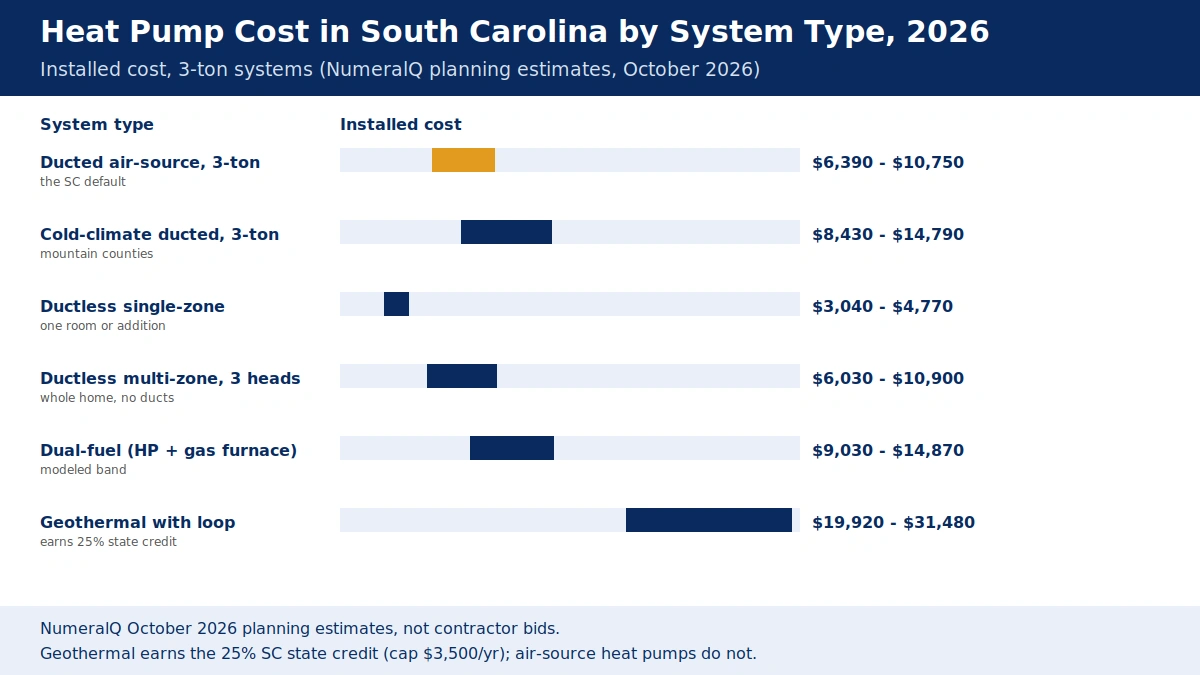
In South Carolina the words “heat pump” can mean five machines at very different prices, more than six to one from the cheapest to the dearest, and the house usually picks before the buyer does. A Columbia brick ranch with ducts in the attic, a Charleston single house with no duct chases at all, a Greenville split-level on a slab, a Myrtle Beach condo with the unit on the roof, a farmhouse outside Aiken on propane with no gas main for miles: each one points at a different machine, and each machine carries a different price, a different rebate, and a different summer. Each machine in the table is priced from the NumeralQ anchors, with contractor figures added where they sharpen the picture.
| System type | Installed cost (SC) | Best for in South Carolina |
|---|---|---|
| Ducted air-source (3-ton) | $6,390-$10,750 | Whole-home heat + cooling with ducts; the default SC buy |
| Ducted cold-climate (3-ton) | $8,430-$14,790 | Upstate edges and mountain counties; rarely needed statewide |
| Ductless mini-split, single zone | $3,040-$4,770 | One room, addition, or a house with no ducts |
| Ductless multi-zone (3 heads) | $6,030-$10,900 | Whole-home without ducts; zone-by-zone control |
| Dual-fuel (heat pump + gas furnace) | $9,030-$14,870 | Gas-heated home that wants a heat pump for mild weather + AC |
| Geothermal, ground-source with loop | $19,920-$31,480 | Long-term owner, big lot; earns the 25% state credit |
Ducted air-source is the default South Carolina buy, and it is the default for a cooling reason. Most of South Carolina is warm enough that a standard ducted heat pump is the right machine, not a compromise, and the reason is the summer: Charleston designs for 24 degrees in winter and cools through a July that averages 91, Columbia designs for 20 degrees and cools through 83 days above 90, and a standard variable-speed unit holds its capacity and efficiency through all of it without the cold-climate premium.
It reuses the ducts already in the house, heats and cools from one system, and at $6,390–$10,750 for a 3-ton job it is the cheapest whole-home heating and cooling system, cheaper, on the planning figures, than the furnace-plus-air-conditioner combination it replaces. Our ductless vs ducted guide works through the keep-the-ducts-or-go-ductless decision in full, room by room and dollar by dollar, for a South Carolina house.
Cold-climate is a mountain-county purchase, not a statewide one, and most buyers should skip it. The cold-climate premium, $8,430–$14,790 against $6,390–$10,750 for the standard ducted 3-ton, buys capacity at 5 degrees and below, and in the Lowcountry and Midlands that capacity is almost never called on: Charleston’s design temperature is 24 degrees, Columbia’s is 20, and most winter hours sit in the 40s and 50s. A cold-climate unit keeps at least 70 percent of rated capacity at 5 degrees with a COP of at least 1.75, and holds full rated output down to 5 degrees on the best lines.
COP is a simple ratio. It says how many units of heat the machine moves for each unit of power it uses.
That is performance a Greenville winter at 18 degrees design might occasionally use, and a Charleston winter will not. A Columbia buyer who pays the premium is buying insurance for a week of weather that may not come in a decade.
A buyer in Oconee or Pickens County, up against the Blue Ridge escarpment where the cold pools, has a better case. The rebate rules do not force the choice the way they do in some northern states: no South Carolina utility pays more for a cold-climate unit as such, so the decision is pure climate, not paperwork, and in most of the state the climate says standard.
Ductless mini-splits were built to retrofit exactly South Carolina’s older housing stock. Mini-splits are how South Carolina retrofits houses that never had ducts, Charleston single houses and peninsula cottages where a duct chase would eat a bedroom, Midlands bungalows on baseboards or strip heat, additions and finished attics and converted garages no duct ever reached, and the FROG rooms (finished room over garage) that bake every Lowcountry summer. One zone runs $3,040–$4,770 statewide and serves a single room or open-plan area: an outdoor unit on a wall bracket or pad, an indoor head on the wall, one small hole for the lineset.
Three heads at $6,030–$10,900 serve a whole small home, each zone on its own thermostat, so bedrooms can sit cooler overnight while the living room holds its temperature. The limit is coverage: a head conditions only its own room, so a four-bedroom colonial with a single living-room head still leaves the bedrooms needing heat and cooling.
Our mini-split installation guide prices the job zone by zone, and Santee Cooper pays mini-split rebates by the half-ton, $40 or $80 per half-ton depending on efficiency, which is the one rebate in the state priced by capacity rather than by the system.
Dual-fuel is the right answer for the one South Carolina home in four that heats with piped gas. For the gas-heated quarter of the state, dual-fuel is the fit: one house shared by a heat pump and a gas furnace, with a control that hands the load to the furnace once the temperature drops below the installer’s switchover setting. The heat pump takes the mild weather, because it beats gas there; the furnace takes the cold snaps, because the heat pump’s COP has dropped past the point where it wins.
NumeralQ’s dual-fuel band is $9,030–$14,870 for a 3-ton system, heat pump plus furnace plus controls, a modeled figure, flagged as such. In Duke Energy territory the configuration also carries the largest conversion rebates in the Carolinas chart, up to $2,000–$2,500 for a heat-pump-to-dual-fuel conversion on the August 2025 chart, though those figures come from North Carolina contractor pages and South Carolina eligibility needs confirming before anyone counts on them.
The running-cost section works out the break-even COP at South Carolina prices, about 2.44, because that number, not the sticker, decides whether dual-fuel saves money here, and in a state where the seasonal COP runs 3.0 to 3.5 the heat pump owns far more of the winter than it would up north. The setup itself, the controls, the switchover, what the furnace actually does on a cold night, is covered in our dual-fuel heat pump guide.
Geothermal is the only system in this state whose winter efficiency barely notices the weather, and the only one South Carolina pays for through the tax code. A ground-source unit pulls heat from soil that stays near 60 degrees all year a few feet under a South Carolina lawn, holding a COP of 3.0 to 5.0 through a 20-degree Columbia night while an air-source unit labors at 2.5 or so. NumeralQ’s South Carolina installed range is $19,920–$31,480 with the loop; the national Carrier and EnergySage range runs $15,000–$40,000 and beyond.
What moves the total most is the loop itself: horizontal trenches on a lot with room to dig, vertical bores on a lot without that room, and a pond loop on land with water to spare. The buyer who fits geothermal is a long-term owner on a big lot staying 20 years, and South Carolina has plenty of those lots outside the three big metros.
The exception is anyone likely to move within five years: the loop stays in the ground, and the payback needs a decade of seasons to arrive. The federal 30 percent credit that once softened the price is $0 for a 2026 homeowner-owned install under the same OBBBA change that ended the air-source credit, but South Carolina’s own 25 percent credit survives, capped at $3,500 a year, which takes $4,980–$7,870 off a 3-ton geothermal job over two or three tax years.
That credit, and its limits, gets a full section below, because it is the single largest incentive and it applies to exactly one machine. For loop types, tight-lot bores, and the math across twenty years, read our geothermal heat pump guide.
One more setup deserves a paragraph: a mini-split added to a home that keeps its furnace or its strip heat. The sensible version puts a head or two where the household actually spends its hours: the living room, the home office, the main bedroom. They carry the shoulder seasons and the mild winter days, the old system handles the cold snaps, and the house gains air conditioning and dehumidification in July.
The first zone at $3,040–$4,770 is the cheapest entry to a heat pump in South Carolina, and in Santee Cooper territory it earns a per-half-ton rebate on top. As a whole-home solution it will disappoint: one head cannot heat or cool a house, and a humid Lowcountry house with one head in the living room still has damp bedrooms.
Any bidder who promises whole-home comfort from a single head is quoting a machine too small for the house.
Heat Pump Cost by Home Size
System type settled, the next decision is size. South Carolina’s characteristic mistake runs one way: oversized. In Greenville an undersized machine leans on resistance heat all through the coldest week, at 15.76 cents a kilowatt-hour.
Too big in Charleston, and it short-cycles through a humid July, never running long enough to wring the moisture out of the air, leaving the house cool and clammy at the same time, and costing thousands extra for capacity the house never calls on. The right size comes from one document only: a Manual J load calculation, room by room, at the design temperature, 24 degrees in Charleston, 20 in Columbia, 18 in Greenville, and at the summer design condition too, because in South Carolina the cooling load is the load that governs.
Neither floor area nor the outgoing unit’s size can do more than guess at the load figure everything else depends on. Insist on the Manual J in writing before signing, and insist that it shows the cooling load and the heating load separately.
Ducted air-source systems are priced by tonnage in the table that follows, using the NumeralQ anchors. Every row here is a NumeralQ planning estimate, published by size on the state page, unlike most states, where only the 3-ton row is anchored and the rest are scaled.
Heat pump capacity is rated in tons, 12,000 BTU an hour to the ton, and in South Carolina the two loads pull in the same direction only by accident: in Charleston and Columbia the cooling load is the larger one by a wide margin, in Greenville the two loads are close, and nowhere in the state does the heating load dominate the way it does up north. A 2,000-square-foot Columbia house commonly needs a 3-ton system, where the same house in a cold climate would take 3.5 tons for the heating load alone, because the design temperature sits only about 50 degrees below room temperature, not 85, while the July cooling load is doing the real work.
| System size | Home size (approx.) | Ducted air-source (SC) |
|---|---|---|
| 1.5 ton | 600-1,000 sq ft | $4,270-$6,900 |
| 2 ton | 1,000-1,400 sq ft | $4,980-$8,180 |
| 2.5 ton | 1,400-1,700 sq ft | $5,680-$9,470 |
| 3 ton | 1,700-2,100 sq ft | $6,390-$10,750 |
| 3.5 ton | 2,100-2,400 sq ft | $7,100-$12,040 |
| 4 ton | 2,100-2,700 sq ft | $7,810-$13,320 |
| 5 ton | 2,700-3,500 sq ft | $9,220-$15,890 |
All seven rows are NumeralQ planning estimates from the same October 2026 estimator, which makes this table more consistent than most, but planning estimates all the same, not contractor bids, and the home-size column is only a rough guide. The step from one tonnage to the next costs roughly $700–$1,300 at the bottom of the band and $1,200–$1,500 at the top, and the 3-ton row is the size most South Carolina homes land on. Do not cite any row as a measured South Carolina price, because none of them is: what they show is the shape of the decision, and the shape is that oversizing by one ton costs about a thousand dollars to buy and then costs comfort every humid summer after.
Three cautions sit behind that table. To begin with, the home-size column is only a rough guide, rougher in South Carolina than most places, because the housing stock runs from raised Lowcountry cottages with vented crawlspaces to slab-on-grade Midlands ranches to Upstate split-levels with finished basements. A tight, well-insulated 2,000-square-foot house built in 2020 can need a full ton less than a drafty 2,000-square-foot 1960s ranch with single-pane windows, bare walls and ducts sweating in a vented attic.
Age, insulation, glazing, air leakage, ceiling height, and above all duct location move the answer more than floor area does. Next, the governing load is cooling almost everywhere in the state, and sizing from the old furnace is sizing for the wrong season: a system chosen for a January in Charleston will be far too big for its July, short-cycling through the humidity, while a system chosen for the summer will handle the winter easily, because the winter asks so little.
In Greenville and the Upstate the two loads are close enough that both must be calculated, and the heating load can govern on an exposed, poorly insulated house, which is exactly why the Manual J must show both. And third, backup heat gets sized in the same conversation as the heat pump, never as an afterthought.
Strips or a furnace must cover the full design load on the coldest night, when the heat pump gives the least, and in South Carolina that night is a 20-degree Columbia cold snap that arrives once or twice a winter and fills the service lines with no-heat calls. A quote that prices the heat pump and leaves backup heat to be decided later has left out the part that keeps the house warm on the one night a year it is genuinely cold.
The 3-ton row deserves the closest look: it is the size most South Carolina homes land on, and the row the whole guide anchors to. Where a quote lands inside that $6,390–$10,750 band is decided by brand and efficiency tier. At the bottom of the band sits the value-tier standard machine, roughly SEER2 15 and HSPF2 7.8.
At the top sits the premium variable-speed machine, past SEER2 20 and HSPF2 10. Across a Columbia summer at 2,250 cooling degree days, the premium tier pays for itself faster than it would in a cool state.
The cooling season is long, the humidity is relentless, and a variable-speed unit running long and slow at part load wrings out moisture a single-stage unit never touches. Short on cash, the value-tier standard unit still beats resistance heat by a wide margin and cools the house fine; the error is buying an oversized single-stage unit for a humid coastal home that needed the smaller machine running longer, or buying a cold-climate unit for a Charleston home that needed the money spent on the ducts instead.
Heat Pump Cost by City: Charleston, Columbia, Greenville & Myrtle Beach
South Carolina is a medium-sized state with no expensive HVAC market and no cheap one, the verified figures run from $6,430 to $6,470 at the bottom of the 3-ton band, a $40 spread across three cities, which is the flattest city map. What sets the cities apart is not labor, which barely moves, but the rebate territory, the humidity, the housing stock, and the storm exposure. NumeralQ’s city figures are the only verified city bands in the sources checked; the Myrtle Beach figure carries a warning label rather than a verified price, because no NumeralQ city page exists for it.
| City | 3-ton ducted air-source | Utility | Design temp |
|---|---|---|---|
| Charleston | $6,460-$10,840 (NumeralQ) | Dominion Energy SC / Santee Cooper | 24 F |
| Columbia | $6,430-$10,800 (NumeralQ) | Dominion Energy SC | 20 F |
| Greenville | $6,470-$10,860 (NumeralQ) | Duke Energy Carolinas | 18 F |
| Myrtle Beach | ~$6,390-$10,750 (planning est.) | Santee Cooper / Horry Electric Co-op | ~24 F (planning est.) |
Charleston is the oldest city, the most humid, and the most exposed, at $6,460–$10,840 for a 3-ton ducted system. Charleston is also where the housing stock fights the installer in a specifically Lowcountry way: peninsula single houses with no duct chases and no room for an outdoor unit except a walled garden, raised cottages on piers with the unit underneath and the flood water rising to meet it, and a 24-degree design temperature that lets a standard unit do the job easily. A Charleston buyer pays the middle price for the install and runs the system in the dampest air in the state, 29.7 muggy days in July, a muggy season running five and a half months.
That is not a reason to skip the heat pump in Charleston. It is the city where the dehumidification half of the machine matters most, because a Charleston July is not just hot, it is wet, and a right-sized variable-speed unit earns its keep every afternoon from May to October.
The utility picture splits by address: Dominion Energy serves much of the city, Santee Cooper serves parts of Berkeley County and the surrounding area, and Berkeley Electric Cooperative serves some of the suburbs, three rebate programs within a single metro, which is why the rebate section below starts with the instruction to read the name at the top of the bill before anything else. The labor figure underlines the flatness: Charleston-North Charleston HVAC mechanics earn a median $28.08 an hour, within cents of the other metros.
Columbia is the capital, the hottest city, and the cheapest verified figure, at $6,430–$10,800 for a 3-ton ducted system. Columbia is where the cooling load is most punishing: a July average high of 92 degrees, 83 days a year above 90, and a 20-degree design temperature that makes the winter a footnote. The housing stock is Midlands ranch and split-level, much of it with ducts in vented attics that bake to 130 degrees in July, ducts that leak 20 percent of the cooled air into the attic before it reaches a register, which is why a Columbia quote that prices the machine without inspecting the ducts has left out the part of the job that decides the July bill.
Dominion Energy serves Columbia, so the rebate is Dominion’s $400–$500, and the gas comparison is Dominion gas too, at the $1.80-a-therm planning price used here. Columbia HVAC mechanics earn a median $27.70 an hour, the lowest of the three verified metros, which is one reason the city’s band sits a few dollars under the others, a few dollars, not a few hundred, because labor is only part of the price and equipment is priced nationally.
Greenville is the Upstate city, the coolest of the four, and the highest verified figure by a few dollars, at $6,470–$10,860 for a 3-ton ducted system. Greenville is where the heating load finally matters: an 18-degree design temperature, the most heating degree days of the big cities on either dataset, and a housing stock of Upstate split-levels and mill-town homes where the gas furnace is more common, only 67 percent of Greenville homes heat with electricity, against 73 percent in Charleston. Duke Energy Carolinas serves Greenville, so the rebate is Smart $aver’s $350–$900 tiered scale, the richest utility rebate in the state, and the gas comparison is Piedmont Natural Gas, whose residential price could not be verified.
Greenville HVAC mechanics earn a median $28.25 an hour, the highest of the three metros, with 1,160 technicians. The Upstate is also where a cold-climate unit stops being a waste of money and starts being a judgment call: Greenville itself rarely needs one, but the counties climbing toward the Blue Ridge escarpment, Oconee, Pickens, the higher parts of Greenville County, see colder nights and longer heating seasons, and a buyer there should have the conversation rather than dismissing it.
Myrtle Beach and the Grand Strand carry a planning estimate of about $6,390–$10,750. The state band, applied to the city, because no Myrtle Beach-specific price was published in the sources checked. Do not quote the Myrtle Beach figure as a NumeralQ figure, because it is not.
What is certain is the context: a coastal city of condos and vacation rentals where the outdoor unit often lives on a roof or a balcony. Salt air corrodes a unit faster than inland air does, Santee Cooper and Horry Electric Cooperative split the territory, and the nearest BLS wage figure, $23.85 an hour for the Northeastern South Carolina nonmetro area, runs well below the big metros, which may or may not show up in quotes.
The rebate picture is Santee Cooper’s $300–$700 tiers for its direct customers, and the co-op’s own schedule for Horry Electric members. The storm picture is the sharpest in the state: the Grand Strand takes tropical systems head-on, and a unit on a roof or a low pad needs strapping, elevation and a corrosion coating the inland quote never mentions. A Myrtle Beach buyer should treat the state band as a starting point and get three local quotes before budgeting anything, because the condo and rooftop variables move the price more than the city average ever could.
Compare cities on price per ton, not on the headline total, and settle which rebate territory the house sits in before comparing any two quotes. Charleston’s $10,840 top end next to Columbia’s $6,430 bottom end looks like a gap, but it is the range itself. The same 3-ton job can land anywhere inside either city’s band with brand and ductwork.
The rebate gap is the real one: a Greenville buyer on Duke Energy can collect up to $900 that a Columbia buyer on Dominion cannot, and a Santee Cooper buyer collects a tiered rebate that a co-op member next door does not. The payback section below works through the fuel-by-fuel numbers, and the rebate section works through the territory-by-territory ones.

South Carolina’s Cooling-First Climate: Humidity, Design Temps & Sizing for July
South Carolina holds one climate with two accents, and the heat pump that suits one accent suits the other with a single adjustment: size it for the summer, everywhere, and let the winter take care of itself. The coast is humid subtropical at its most humid, hot, damp summers, mild winters, a cooling load bigger than the heating load by a wide margin. The Upstate is the same climate a few degrees cooler and a few degrees drier, colder nights, a heating load that nearly matches the cooling load, and a winter that occasionally asks the backup heat to earn its keep.
The state sits in IECC climate zone 3 along the coast and zone 4 across the Piedmont and Upstate, which puts it two zones warmer than Virginia and three warmer than Maryland. That warm position is what makes the standard heat pump the right machine for the whole state, and the cold-climate unit a regional curiosity rather than a statewide requirement.
The design temperatures. Manual J sizing begins with the winter design temperature: the outdoor temperature the weather stays above for nearly all of a typical winter’s hours, and the number the entire heating calculation rests on. Charleston’s is 24 degrees, Columbia’s 20 degrees, Greenville’s 18 degrees, on the planning figures used here, flagged as coming from an older sizing guide rather than a current ASHRAE table.
These are routine winter conditions, not records, Charleston still logs 1,730 heating degree days a year on the state weatherization figures, Columbia 2,167, Greenville 2,158, against cooling degree days of 2,278, 2,250 and 2,099. For scale, the Virginia guide designs around 14 degrees in Richmond and the North Carolina guide cooler still; South Carolina sits warmer than both, nearer Florida than Virginia.
Columbia’s January averages a high near 56 and a low near 37, which puts most of the heating season in the 40s and 50s, the range where a standard unit performs best and a cold-climate premium earns least. One dataset conflict needs a flag attached: NOAA 1991-2020 normals give Greenville 3,019 heating degree days, far above the weatherization manual’s 2,158, because the NOAA station sits at Greer airport rather than in the city.
Both figures are printed in the research brief. The ordering is the same on either dataset, Greenville coldest, Charleston warmest, and no conclusion turns on which Greenville figure is used.
What a mild South Carolina winter does to a heat pump. An air-source unit harvests heat from the air outside, so colder outdoor air means thinner pickings. Capacity and efficiency fall together, but in South Carolina they fall a short distance, and rarely.
Take the rating every 3-ton unit carries: 36,000 BTU an hour when it is 47 degrees outside. When the outdoor air falls to 24 degrees, the design temperature for Charleston, the unit still keeps most of its rated capacity, running at a COP near 3.
At 5 degrees it keeps 40 to 60 percent of rated capacity while its COP falls toward 1.0, but a Charleston winter almost never sees 5 degrees, a Columbia winter sees it for hours in a decade, and even Greenville sees it for nights, not weeks. Field tests from the Department of Energy put numbers on the vapor-injection hardware: a cold-climate unit at 5 degrees still puts out 70 to 80 percent of rated capacity, at a COP of 2.2 to 2.8. In South Carolina, with design temperatures of 18 to 24 degrees and most of the season above 40, a standard unit seldom reaches its worst-case numbers, which is why the planning figure is a seasonal COP of 3.0 to 3.5 for South Carolina, a planning range, rather than the harsher figure a northern winter would force.
Even the best air-source unit fades in a hard freeze, and on a Greenville January’s coldest night it cannot heat the house alone. Backup heat is not a footnote in the Upstate.
It is a small footnote on the coast, and a real line item in the mountains.
Humidity is the South Carolina line item, and it is the whole summer. Below freezing, the outdoor coil ices over: airborne moisture freezes onto it, and the unit has to reverse itself periodically to melt the frost off, pushing cool air indoors for a few minutes while it does. South Carolina winters are damp enough that a coastal unit defrosts on the coldest mornings, but the defrost load here is a minor winter nuisance, not the seasonal burden it is up north.
The heating season is short, the cold snaps are brief, and the meltwater rarely freezes into the ice mound that buries a northern unit. The same humidity is the machine’s defining challenge in July, and its best feature when the machine is right.
Charleston logs 29.7 muggy days in July and 29.0 in August, with muggy conditions 96 percent of the time in July, and the muggy season runs five and a half months, from early May to late October. A heat pump wrings moisture out of the air as it cools. But only while it is running.
A right-sized unit runs long, slow cycles and pulls the damp out steadily. An oversized unit blasts cold air for ten minutes, satisfies the thermostat, and shuts off before the coil has wrung anything out, leaving the house at 72 degrees and 65 percent humidity, cool and clammy, the classic Lowcountry complaint about a new system that was sized by the old unit’s nameplate instead of by a load calculation.
Variable-speed equipment exists for exactly this problem: it runs continuously at part load, dehumidifying all afternoon, and in a Charleston or Columbia summer that steady dehumidification is worth more than the efficiency rating on the box.
Cooling is the bigger half of the value everywhere in the state. July is the bigger half of the value from the coast to the Upstate. Charleston logs 2,278 cooling degree days against 1,730 heating degree days, Columbia 2,250 against 2,167, and even Greenville’s 2,099 cooling degree days nearly match its 2,158 heating degree days.
The cooling load is the larger load in the two biggest cities and a tie in the third, the reverse of every northern state. The same machine cools the house too, and a Columbia July averaging 92 degrees with 83 days a year above 90 is where that second job earns its keep.
For a South Carolina home that has never had cooling, that July comfort is worth more than the heating sums alone suggest, and for a home replacing a dying air conditioner, the heat pump is the air conditioner, with heat included. Size the system for the load that governs where the house sits: cooling in Charleston, Columbia and Myrtle Beach, and both loads calculated in Greenville and the Upstate. A machine chosen for the wrong season is the wrong machine in both, and in South Carolina the wrong season is January.
Salt, wind, and the tropical storm. A tropical storm can push surge water across a Grand Strand yard, drive rain sideways into drifts against a Charleston wall, and leave a Myrtle Beach roof unit sitting in standing water, and an outdoor unit on the windward side, below a roof valley that sheds water, or beside a driveway the storm floods will spend the storm starved for air and the winter after it rusting. Pick the leeward wall, under an eave that throws water clear of the unit, with open space on all sides for airflow and for a technician to get at it after a storm.
On exposed coastal sites, a wind baffle, a plain shield on the intake side, keeps driven rain out of the coil, hurricane strapping keeps the unit on its pad, a raised stand keeps it clear of the water, and a corrosion-resistant coating slows the salt. The catalog never mentions any of it.
The September service bill does, and the hurricane section below prices the thinking, if not every part.
Start with the house, not the machine. The house decides more than the hardware does. Supply air from a heat pump arrives at the register at 90 to 110 degrees, while a gas furnace delivers 120 to 140.
In a tight, well-insulated house the difference goes entirely unnoticed. A drafty 1960s ranch with single-pane windows, bare walls, and ducts in a vented attic notices it every evening: the rooms feel as if the heat pump is always a step behind, and in July the same ducts leak cooled air into an attic hot enough to bake.
The cheapest capacity a South Carolina homeowner can buy is air sealing, insulation, and duct sealing. Every BTU kept inside is one the heat pump need not make at 20 degrees, one the backup heat need not make either, and one the air conditioner need not remake all July. Get the energy assessment and the insulation quote scheduled ahead of the heat pump quote.
When the house needs both, do the envelope first and size the heat pump second: a tightened house may need a full ton less, and in a cooling state a smaller machine is also a drier machine, because it runs longer. A smaller machine is cheaper to buy and cheaper to run, so envelope work first is the one place in this purchase where paying early means paying less twice, once in January, once in July.
Heat Pump vs Gas Furnace in South Carolina: The Running-Cost Math
Every number comes back to this section, and it is also where South Carolina differs most sharply from the northern states, because here the heat pump beats the gas furnace, but by so little that the machine you buy matters more than the fuel you leave. Every figure in this section is NestPriced arithmetic assembled from published prices.
The assumptions sit in the open, so any reader can redo the sums with their own utility’s rate and their own house. And every figure is a heating figure only: the cooling half of the year is where this machine earns most of its keep, and it is counted separately, in words, because no single cooling number fits a single planning home.
The planning home. Take a 2,000-square-foot Columbia-area home needing about 19 million BTU of delivered heat a year, a planning assumption built from Columbia’s 2,167 heating degree days and scaled from the 50-million-BTU Boston planning home. Nineteen million BTU equals 5,568 kilowatt-hours of heat.
What follows divides that heat by each machine’s efficiency, then multiplies by what its fuel costs. The load is small, barely more than a third of Boston’s, and that smallness is the whole story of South Carolina running costs: the heating bill is small whatever heats the house, so the savings from switching fuels are small too, and the purchase must be justified on the whole system, not on the winter fuel bill alone.
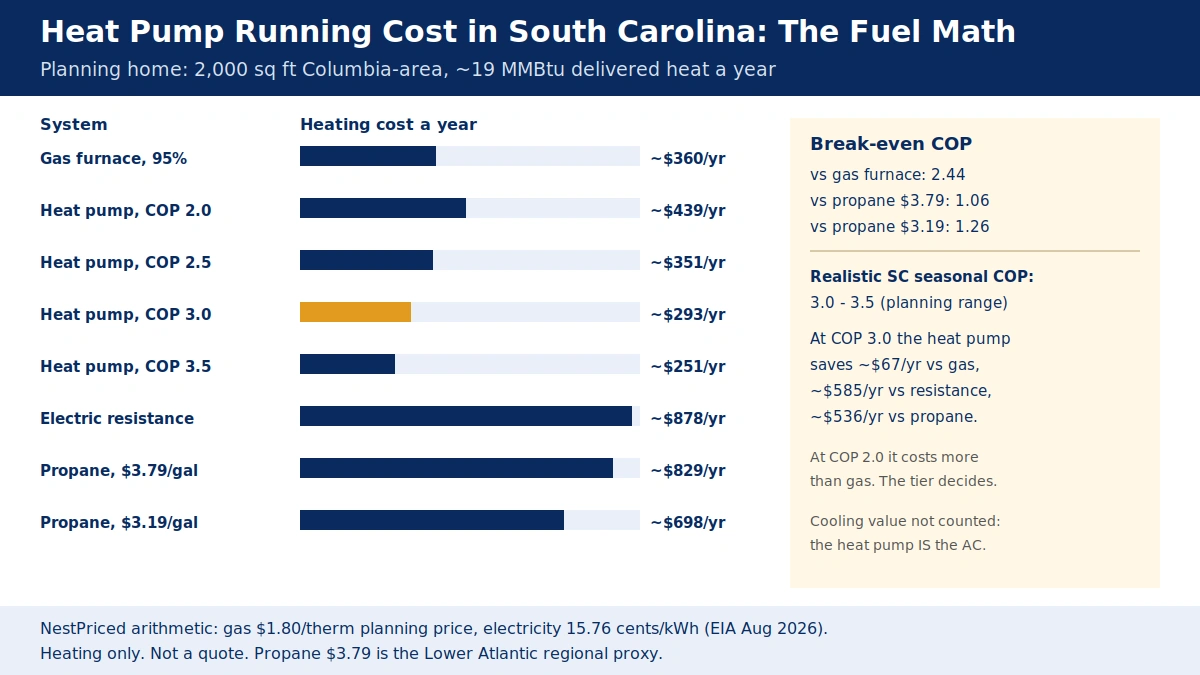
The gas furnace. Begin with the furnace: at 95 percent AFUE (95 percent of the gas energy becomes heat for the house), delivering 19 million BTU of heat from the registers takes about 20 million BTU of gas in, 200 therms. At the planning gas price of about $1.80 a therm, the fuel bill lands near $360 a year.
Dominion Energy’s residential bills for 100 therms ran $180.75 in January 2026, $178.72 in February and $194.51 in March, and the EIA winter-month figures convert to $1.54–$1.76 a therm. That gas price needs a warning attached, because the EIA monthly series for South Carolina is treacherous: the July 2026 figure of $29.90 per thousand cubic feet looks like $2.89 a therm, but it spreads fixed charges over tiny summer volumes and says nothing about what heating gas costs in January.
The winter months and the Dominion bill are the sound basis, and the planning price of $1.80 sits at the top of that range rather than the middle, which flatters gas slightly. Gas is affordable in South Carolina. Electricity is nearly as affordable, and that is what makes the race close, but the mild winter tips it.
The heat pump. A heat pump at a seasonal COP of 3.0, a realistic South Carolina seasonal figure, between the 2.2 to 2.8 it manages at 5 degrees and the much higher numbers it holds through a winter spent mostly above 40, draws 1,856 kilowatt-hours to deliver the same 19 million BTU. At the state-average all-in price, 15.76 cents a kilowatt-hour, EIA August 2026, the bill comes to about $293 a year.
At a seasonal COP of 2.5 it runs about $351 a year; at 3.5, about $251; at 2.0, about $439. Set those beside the gas furnace’s $360: at COP 3.0 the heat pump costs about $67 a year less than gas; at COP 3.5 about $109 less; at COP 2.5 about $9 less; at COP 2.0 about $79 more.
The machine you buy decides the race, not the fuel. A premium variable-speed unit at COP 3.5 beats gas clearly. A value-tier unit at COP 2.5 ties it.
A minimum-efficiency unit at COP 2.0 loses to it. Any quote claiming a South Carolina heat pump beats a 95 percent gas furnace on fuel at the average electric rate is pricing a good machine.
Ask which COP the claim assumes, and whether the unit on the quote actually delivers it.
The break-even COP. Flip the question and it sharpens: what efficiency would a heat pump need to merely tie the gas furnace? The break-even COP is a division sum: electricity’s price per million BTU on top, the gas price per million BTU at 95 percent efficiency underneath.
With electricity at 15.76 cents a kilowatt-hour, $46.19 a million BTU, set against gas at $18.00 a million BTU, $18.95 after the furnace’s 5 percent loss, the break-even COP works out at 2.44. A standard South Carolina heat pump holds a seasonal COP of 3.0 to 3.5 through a Columbia winter, which means the machine sits comfortably above the line, the reverse of the northern states, where the break-even COP sits near or above the realistic seasonal figure.
That is the blunt fact, and it is good news with a catch: the margin is $67 a year at COP 3.0, not $600, because the heating load is small. The heat pump wins the heating race in South Carolina. It wins it by a small amount, and the cooling season is where the money is.
One qualification counts: the all-in average folds in fixed charges that do not all grow with usage, and the marginal rate on some South Carolina tariffs is lower than 15.76 cents, Santee Cooper customers pay around 12.7 cents all-in, which lowers the break-even COP further, to about 2.0. Ask your utility which rate you actually pay before modeling anything, because in this state the utility spread is wide enough to change the answer.
The backup-heat adder. All 19 million BTU above are credited to the heat pump at its seasonal COP. In a real South Carolina winter, the backup system covers part of the season’s heat.
That slice is the expensive one, though a smaller slice here than anywhere else. Suppose 5 percent of the season’s heat comes from electric resistance strips: a fair share for a standard unit on the coldest Columbia nights, a low share for an Upstate home.
That slice works out at 278 kilowatt-hours, roughly $44 extra a year at 15.76 cents, an illustration, not a bill. That 5 percent slice is where dual-fuel earns its keep in gas territory: below the switchover point the furnace covers it at gas prices rather than resistance prices, and the heat pump never operates anywhere near a COP of 1.0. In South Carolina the backup slice is small because the cold is brief, which is one more reason the seasonal COP runs high: the machine rarely visits the temperatures where it performs worst.
What the heat pump beats, clearly. Against electric resistance heat, baseboards, electric furnaces, strip heat, the heat pump wins outright anywhere in South Carolina, and by a wide margin. Heating the same 19 million BTU with resistance costs about $878 a year at the state-average price, $585 a year more than the heat pump’s $293, every single year.
About 71 percent of South Carolina homes heat with electricity, and a large share of those still use resistance heat in some form, so this is the matchup that pays the most South Carolina buyers back the fastest, though the payback is slower here than up north, because the heating load is smaller. Propane loses by less but still loses clearly: a 95 percent propane furnace at $3.79 a gallon, the Lower Atlantic regional proxy, since EIA does not survey South Carolina alone, costs about $829 a year for the planning home, against the heat pump’s $293, a saving near $536 a year.
At the EIA South forecast of $3.19 a gallon the propane bill is about $698, and the saving is about $405. The break-even COP against propane is 1.06 at $3.79 and 1.26 at $3.19, any heat pump on the market clears both easily. Against a 95 percent gas furnace at the average electric rate, the heat pump wins by $67 a year at COP 3.0.
Buy it there for the air conditioning, the dehumidification, the zoning, or a furnace already at the end of its life. The fuel saving alone will not carry the purchase, because the heating bill was never large enough to save much from.
A cross-check on the numbers. NumeralQ runs the same comparison on an average South Carolina home, built from EIA household energy data rather than a 2,000-square-foot planning home, and gets smaller absolute numbers with the same shape: a 95 percent gas furnace at $252 a year, a minimum-efficiency heat pump (HSPF2 7.5) at $312, and a high-efficiency heat pump (HSPF2 9) at $260. On that smaller home the minimum-efficiency machine costs more than gas to run, and the high-efficiency machine roughly ties it.
Both calculations agree on the conclusion that matters: efficiency tier decides the gas race in South Carolina. Buy the cheap machine and the fuel saving disappears.
Buy the good machine and it appears, modestly. The difference between the two cross-checks is the size of the home, not the direction of the answer.
Cooling, counted on its own. A heat pump doubles as the air conditioner, and a Columbia July averaging 92 degrees with humidity to match is where that pays off, not as a saving against a separate air conditioner, because the heat pump IS the air conditioner, but as the reason the purchase makes sense at all. Air conditioning bought on its own would run several thousand dollars, so a chunk of the heat pump’s price is money the buyer was going to spend on cooling regardless.
The sums look far kinder than the fuel-only comparison suggests once the extra cost is set against the furnace-plus-AC pair being replaced instead of the full sticker. The premium framing is unusually strong in South Carolina: on the planning figures a furnace-plus-AC 3-ton system runs $8,180–$13,890 against $6,390–$10,750 for the ducted heat pump, so the heat pump is typically cheaper than the pair it replaces and there is no premium to pay back at all.
The numbers above are South Carolina’s state-specific version of the comparison our heat pump running cost guide runs nationally, fuel by fuel, while our heat pump vs furnace guide runs the head-to-head in full.
Utility Rebates & What You Can Actually Collect in 2026
South Carolina’s rebate picture is a patchwork with a hole in the middle: four kinds of utility, four different programs, and one state tax credit that pays for exactly one machine. There is no single statewide program, no Mass Save, no NYS Clean Heat. What exists is a set of utility programs that differ by territory, by efficiency tier, and by whether the home is replacing the same kind of equipment, and the largest single incentive in the state is not a rebate at all, but a tax credit for geothermal that most buyers will never claim because they are not buying geothermal.
Anyone who treats the headline number as a price for every South Carolina home is heading for disappointment. A buyer who checks their own utility first will know exactly what is on the table, and in most of the state the answer is: a few hundred dollars, and a deadline.
Dominion Energy South Carolina pays $400–$500, Midlands and Lowcountry, no fuel switching. Dominion Energy South Carolina, which serves Columbia, much of Charleston, and the surrounding Midlands and Lowcountry, runs its Heating and Cooling Rebates under the EnergyWise banner. The official program page offers rebates of $400 to $500 toward ENERGY STAR qualified central air conditioners and heat pumps for residential electric customers, with a minimum efficiency of 15.2 SEER2.
The conditions are the ones that trip buyers up:
- The equipment must be new and ENERGY STAR/AHRI rated
- It must be installed by a Licensed Mechanical Contractor
- The application with a detailed invoice must arrive within 90 days of installation
- Self-installed work does not qualify
- The program does not allow fuel switching, the condition that matters most: the new unit must be the same equipment type as the one it replaces
A gas-heated home switching to a heat pump collects nothing from Dominion. Ground-source heat pumps are not eligible either.
Dominion also pays $750 for an ENERGY STAR heat pump water heater and, per a Charleston contractor guide checked in July 2026, $300 for duct sealing or duct insulation. One figure needs a flag attached: the same contractor guide reports $650 for replacing an electric furnace with an ENERGY STAR heat pump, a figure that could not be confirmed on the official program page text retrieved in November 2026.
Treat the $650 as secondary and unconfirmed until Dominion confirms it. The $400–$500 is the verified figure. The average processing time is four to six weeks, and rebates arrive by check to the account holder.
Duke Energy pays the most, Upstate and Pee Dee, tiered by efficiency, duct sealing required. Duke Energy Carolinas and Duke Energy Progress, which serve Greenville, Spartanburg and the Pee Dee, run the Smart $aver program, and its August 1, 2025 Carolinas rebate chart is the richest utility offer in the state. An air-source heat pump replacement, with required duct sealing, earns $350 at 15.2 SEER2 and 7.5 HSPF2, $450 at 16 SEER2, and $700 at 17 SEER2 or better.
Each tier rises to $700, $800 and $900 respectively on an early replacement, where the old equipment is replaced before a critical component fails and the contractor certifies it. Geothermal at 19 EER2 or better earns $700 or $900, and a mini-split at 18 SEER2 and 9.0 HSPF2 earns $700 or $900.
The contractor submits the application through the Smart $aver portal, the homeowner does not fill out the form, and only a Smart $aver participating contractor qualifies. Two flags attach to this program. First, the chart is Carolinas-wide, covering North and South Carolina together, and South Carolina-specific eligibility was not separately verified in the sources checked.
Confirm with Duke or the participating contractor before counting on any tier. Second, the conversion rebates, up to $2,000–$2,500 for converting to dual-fuel or a cold-climate heat pump, plus $125 for a smart thermostat, come from North Carolina contractor pages describing the same Carolinas chart, and their South Carolina availability needs the same confirmation.
Even at the verified replacement tiers, Duke’s $900 top end is the largest utility rebate in South Carolina, and it is the one rebate in the state that genuinely rewards buying the better machine: the jump from 15.2 to 17 SEER2 doubles the money.
Santee Cooper pays $300–$700, but the 2026 program year ends November 30. Santee Cooper, the state-owned utility serving parts of Berkeley, Georgetown and Horry counties directly and selling wholesale power to the co-ops, runs the EmpowerHome program under its Smart Energy Existing Homes banner. The official heat pump table pays $300 for a split-system heat pump at 15.2 SEER2 and 7.8 HSPF2, $400 at 16.3 SEER2 and 8.0 HSPF2, $40 per half-ton for a mini-split at 15.3 SEER2 and $80 per half-ton at 18.4 SEER2, $600 for an ENERGY STAR geothermal system, and $500–$700 for a hybrid heat pump, the headline on Santee Cooper’s own November 2026 notice is “Heat Pumps: Up to $700”.
The home generally must be at least five years old, the work must be done by a Santee Cooper Trade Ally contractor, and duct replacement earns a further $500 while a heat pump water heater earns $400. The deadline is the part that bites: the 2026 program year runs December 1, 2025 to November 30, 2026, and Santee Cooper’s November notice is explicit that the program year is wrapping up.
A buyer reading in late November may have days, not months, to get the work done and the application in, and the 2027 program year, with its own tiers and deadlines, had not been published when the figures were checked. Check empowersc.com before assuming any Santee Cooper figure survives into the new program year.
The electric cooperatives pay their own way: check your co-op, not the state. Twenty electric cooperatives serve much of rural South Carolina, and each runs its own efficiency program or none at all. The examples found in the sources checked show the range: Berkeley Electric Cooperative’s 2026 rebates are capped at 20 percent of equipment cost and run through December 11, 2026, while Southeastern Electric Cooperative’s 2026 schedule pays $300 for a new-home air-source heat pump, $500 for a replacement, and $300 for a mini-split.
No statewide co-op schedule exists, and no co-op figure should be assumed to apply to a different co-op’s members. The co-op is the utility, the co-op’s website is the program page, and the co-op’s deadline is the deadline.
A buyer on co-op power who assumes a Dominion or Duke rebate applies to them will be disappointed twice, once when the application is rejected, and once when the co-op’s own deadline has passed while they were waiting.
The state geothermal credit is the biggest incentive in South Carolina, and it pays nothing for an air-source heat pump. South Carolina Code Section 12-6-3587 allows a credit against state income tax of 25 percent of the purchase and installation costs of a solar energy system, a small hydropower system, or geothermal machinery and equipment. Geothermal machinery means a heat pump that uses the ground or groundwater as its thermal source or sink.
The credit in any year may not exceed the lesser of $3,500 per facility or 50 percent of the taxpayer’s state tax liability, and the excess carries forward for up to ten years. The equipment must meet ENERGY STAR requirements on the installation date, must be installed at the taxpayer’s primary residence, and cannot be claimed before the installation is complete.
The geothermal provisions are repealed on January 1, 2032. On a 3-ton geothermal job at $19,920–$31,480, the 25 percent credit comes to $4,980–$7,870, used over two or three tax years at the $3,500 annual cap, real money, and the only state money that moves the needle on a five-figure purchase. And here is the catch that decides who collects it: the Department of Revenue’s Revenue Ruling 24-2 lists air-source heat pumps explicitly as equipment that does not qualify.
A buyer who installs a $8,570 ducted air-source system and claims a 25 percent state credit has claimed a credit the law does not allow. A buyer who installs geothermal and does not claim it has left thousands on the table.
Get the distinction in writing from a tax professional before filing, because the credit is claimed on Form TC-38 against state tax owed, and a household with little state tax liability uses it slowly. A household with $5,000 of state tax can use only $2,500 a year, stretching a $7,870 credit over four tax years.
Low-income help exists, and it is the one channel where the money is real but slow. Low-income households can access free upgrades through the federal Weatherization Assistance Program, run in South Carolina by the Office of Economic Opportunity, which weatherizes homes at no cost to qualifying households and is the source of the degree-day figures used here. Dominion and Duke run hardship and bill-assistance programs of their own, and the co-ops run theirs.
SC Safe Home, the state’s wind-mitigation grant program, was not accepting applications as of July 2026, after a brief reopening. Do not count on it for hurricane hardening money.
None of these programs pays a middle-income buyer for a heat pump in 2026. They matter here because the households that most need a cheaper heating system are the ones least able to pay $8,570 for one, and the weatherization route, envelope first, equipment second, is the right order for those homes anyway.
The short version. Add up what a South Carolina buyer can actually collect in 2026: $350–$900 from Duke Energy on a tiered replacement, $400–$500 from Dominion Energy on a like-for-like replacement, $300–$700 from Santee Cooper before the November 30 program-year deadline, $300–$500 from some co-ops on their own schedules, a 25 percent state tax credit for geothermal only, nothing from the state for an air-source machine, and nothing from the federal government. The rebate is a discount of a few hundred dollars on an $8,570 purchase in most South Carolina cases, worth collecting, never worth choosing the wrong machine to chase, and always worth confirming in writing before the install, because every program here has a deadline, a contractor list, or an efficiency tier that can disqualify a job that looked eligible on the sales call.
Federal Help in 2026: $0 Tax Credit, HEAR Not Launched & the Lease Route
The whole federal picture for a 2026 install fits in a single paragraph, and that shortness is precisely what lets so much heat pump advertising keep repeating a dead credit. In South Carolina the paragraph has a second half other states do not get: the federal rebates that would matter most here have not launched at all, the state allocation behind them is about $137 million that buys nothing today, and even after they launch they will not pay for the fuel switch a quarter of the state needs most.
The money has gone, so the whole federal story for 2026 fits in one paragraph. Public Law 119-21, the One Big Beautiful Bill Act signed on July 4, 2025, brought the Energy Efficient Home Improvement Credit to an end. Section 25C used to return as much as $2,000 a year on an air-source heat pump; for equipment placed in service after December 31, 2025, the return is zero.
IRS fact sheet FS-2025-05 makes the finish date the one that counts, not the payment date. The calendar that matters is the completion calendar: work finished in January 2026 earns no credit, whatever date the deposit carried.
Section 25D, the Residential Clean Energy Credit at 30 percent, closed the same day, and the geothermal credit went with it, which is why the state geothermal credit in the section above matters so much more in 2026 than it did in 2025, when the federal credit dwarfed it. A federal credit still showing on a 2026 quote means the quote leans on dead law. Have it reissued with that line struck.
For the July 4, 2025 cutoff, and why the finish date decides whether any credit applies, see our federal tax credits guide. For a homeowner-bought system installed in 2026, the federal tax credit on the job is $0.
Any quote subtracting a 30 percent credit for a 2026 owned install is wrong, and any salesperson who insists otherwise is either out of date or hoping the buyer is.
South Carolina’s HEAR and HOMES rebates have not launched, and no launch date is on offer. The federal dataset allocates the state roughly $137 million. The Department of Energy’s January 2025 dataset lists $68,451,650 for HEAR and $68,716,961 for HOMES.
But the South Carolina Energy Office says the rebates are not currently available, program development is underway, and availability is anticipated in 2026. That anticipation was already the position in July 2026, it was still the position when checked on October 13, 2026, and it was still the position in November.
No launch date has been named, no application portal has opened, and no approved-contractor list has been published. Do not count on this money when you buy. Do not let a quote count it.
Do not take a salesperson’s word that it is coming soon. The Energy Office itself will not name a date, and an anticipated launch is not an available rebate.
The planning figures cited by secondary sources, HOMES rebates of $2,000–$16,000 depending on income and modeled savings, HEAR rebates up to $14,000 a household with up to $8,000 for a heat pump, for households below 150 percent of area median income, describe what the programs may pay when they open, not what any South Carolina buyer can claim today.
Even once HEAR arrives, it still will not pay a gas- or propane-heated home to switch. No other federal fact matters more. HEAR’s heat pump payment runs as high as $8,000.
Program Notice 26-2, issued by the Energy Department on May 29, 2026, still confines the money to electric-to-electric upgrades, electric equipment replaced by more efficient electric equipment, plus new construction. A gas or propane furnace replaced by a heat pump is a fuel switch, and fuel switches no longer qualify.
That bites differently in South Carolina than in most states: about 24 percent of homes heat with piped gas and a further share with propane, so roughly a quarter of the state is shut out of HEAR for the switch, while the 71 percent that already heat with electricity, the baseboard homes, the strip-heat homes, the old-heat-pump homes, are the households HEAR was written for, once it launches. HOMES, the whole-home efficiency program, pays on measured or modeled energy savings, as much as $8,000, and up to $16,000 in some income tiers on the planning figures, instead of on the equipment list, and South Carolina has not launched that one either.
The two programs together, when they open, will be the largest incentive in the state by an order of magnitude. Today they are a web page that says “not currently available.”
No verified lease route exists in South Carolina. When a company rather than the South Carolina homeowner owns the heat pump, the federal clean-electricity credit, 30 percent under Section 48E, can still be earned. Timing is the catch here: service entry by December 31, 2027, and construction begun by July 4, 2026, the cutoff IRS Notice 2025-42 sets.
Where the law allows buying power from a third party’s system, the company takes the credit and passes part of it back as a lower monthly lease or power-purchase payment. South Carolina is not a state where that route was verified in the sources checked.
No lease or PPA provider was found selling one to South Carolina homes, and third-party PPA authorization for heat pumps was not confirmed. Before signing any lease offer, put it in front of a lawyer: a cheap-looking monthly payment can conceal a lien, a buyout clause, or a term longer than the equipment’s life.
In short: Washington pays nothing in 2026 toward a South Carolina homeowner’s own heat pump purchase, and indirect payment through a lease cannot be counted on either, neither a clear legal route nor a verified provider exists. On a cash quote, the price is the price, less whatever the utility pays, which in South Carolina is a few hundred dollars, plus whatever the state pays for geothermal, which is a tax credit spread over years.
Permits & Licensing: The $500 License Threshold & the Permit Checkpoint
South Carolina licenses residential HVAC work, and it licenses it at a threshold so low that every whole-home heat pump job in the state falls inside it. The state licenses HVAC through the Residential Builders Commission, with a second license for commercial work, a trade certification that is not a license, and a permit system that turns every city and county building department into a licensing checkpoint.
Knowing which credential to ask for is the protection. A buyer who assumes no license exists never asks at all, and in South Carolina that buyer is the one most likely to hire the unlicensed crew.
South Carolina licenses the contractor, not the technician, through the Department of Labor, Licensing and Regulation, LLR, and two boards split the work. The Residential Builders Commission licenses residential HVAC: a Residential HVAC Installer and Repairer license is required for residential heating and air conditioning work over $500, which covers every heat pump install several times over. The applicant documents at least one year of HVAC experience under an approved supervisor, passes two PSI exams, a technical exam and a Business Management and Law exam, 70 percent to pass, pays a $100 application fee and a $220 license fee, and posts a surety bond.
The bond amount carries a conflict, flagged rather than resolved: one licensing guide puts the bond at $10,000 where the total cost of work exceeds $5,000, another puts it at $5,000. Either way, the bond exists, and the license exists, and both can be checked.
The residential license is capped by equipment size, five tons of cooling and 175,000 BTU an hour of heating per unit, which covers every residential system, since the largest row in the size table is 5 tons. Licenses renew every two years, on June 30 of odd-numbered years. Never settle for asking whether the firm is licensed for HVAC.
The answer to that question is a document, not a yes. The question is which license the firm holds, what its number is, and whether it can be looked up on LLR’s license verification before anyone touches the house.
The commercial license, the certification, and the federal card are three different things. The Contractor’s Licensing Board licenses mechanical contractors for commercial HVAC work over $10,000, in subclassifications covering air conditioning, heating, packaged equipment (to 25 tons and 500,000 BTU an hour per unit) and refrigeration. The qualifying party needs two years of experience, passes PSI exams, and pays a $350 fee, and the license carries a financial group limit starting at $35,000 a job.
A residential buyer will rarely need this license, but a buyer in a large condo building, or a landlord with a multi-unit property, may be buying commercial work without realizing it, and the $10,000 threshold is close enough to a 3-ton install price that the boundary deserves a question. The Master HARV certificate, Heating, Air Conditioning, Refrigeration and Ventilation, is a trade certification run since January 1, 2026 by Carolinas AGC, formerly by the Municipal Association of South Carolina, and it can substitute for the Contractor’s Licensing Board technical exam.
It is not the license itself, and a contractor who shows a HARV certificate instead of an LLR license has shown the wrong document. And everyone who handles refrigerant needs federal EPA Section 608 certification. Ask to see the card by name, because the state license does not cover refrigerant handling and the federal card does not cover the install.
The electrical connections need a licensed electrician under the same LLR system, and the gas piping for a dual-fuel job needs the right gas credentials. Wiring done by a heat pump crew with no electrician’s license is not an option: a licensed electrician must do it, and the electrical permit should name that electrician, not the HVAC firm.
Permits and inspection take time, and the permit desk checks the license first. The city or county building department is the permit source for both trades, and its inspector looks at the outdoor unit’s placement, the refrigerant lines, and the electrical disconnect. South Carolina turns that desk into an enforcement point by statute: a building official must refuse a permit unless the applicant shows the required state license or an exemption, and must report suspected violators to LLR.
That is the buyer’s best protection, and it only works if a permit is actually pulled. A contractor who suggests skipping the permit is suggesting skipping the one checkpoint that verifies the license.
No South Carolina-wide permit fee schedule was verified ; NumeralQ reports the fee as “not published” for Charleston, Columbia and Greenville, so do not borrow another state’s schedule or a national range, the figure belongs to the county issuing the permit. An install in South Carolina waits on the calendar rather than the price tag: through the shoulder seasons the best crews carry bookings weeks deep, and a next-day install promised in October comes from a crew that is either very lucky or very quiet. In the Lowcountry, the floodplain adds a second checkpoint: an outdoor unit in a flood zone needs to sit above the base flood elevation, and the county floodplain office, not the installer, decides what that elevation is.
The placement fight plays out in condos and HOAs, and no South Carolina law was found giving heat pump owners the solar-style protection some states grant. An outdoor unit is visible in a way a furnace never is, so an association can restrict where it sits, how it looks, and whether the street can see it, and in a Myrtle Beach condo the roof or balcony is usually common area, so the board’s approval is decisive.
Bring the installer into the placement discussion before the order goes in, and get the agreed spot in writing: a unit parked where the HOA prefers it, facing into the wind, runs dearer and services harder. In the Lowcountry, the same conversation happens with the floodplain and the historic district: a Charleston peninsula install may need historic review as well as a building permit, and a unit visible from the street in a historic district can wait longer for approval than the install itself takes.
Hurricane Season: Flood Elevation, Tie-Downs & Surge Protection
Hurricane season runs June 1 to November 30, September is the statistical peak, and every coastal heat pump in South Carolina lives its whole working life inside that calendar. This section prices the thinking, not the parts.
No South Carolina-verified prices for strapping, stands, or surge devices were found in the sources checked, and none are invented. What it prices is the decision: which protections belong on the quote, what happens when they are left off, and why the cheapest coastal install is the one that costs the most after the first storm.
Flood elevation comes first, because water decides everything else. An outdoor unit sitting at grade in a Charleston yard, a Grand Strand lot, or a Beaufort County hammock will spend a tropical storm standing in water, and a heat pump that floods is a heat pump that needs a technician before it runs again, if it runs again at all. The rule is simple to state and local to apply: in a flood zone, mechanical equipment must sit above the base flood elevation, and the county floodplain ordinance sets the elevation and the freeboard above it.
The installer does not decide the number. The county does, and the permit review enforces it.
A raised stand, a concrete pedestal, or a wall bracket lifts the unit clear of the water the zone expects, and the cost of the lift is a few hundred dollars on the quote against a few thousand for a flooded unit and a ruined week in September. On a raised Lowcountry cottage the unit often lives under the house, which looks protected until the storm surge arrives. Under the house is where the water goes.
Ask where the unit sits relative to the base flood elevation, get the answer in writing, and check it against the county’s flood map rather than the installer’s memory of the last storm. A buyer outside the mapped flood zone is not exempt from the question either: Charleston’s nuisance flooding reaches streets the maps call dry, and a unit on a low pad beside a driveway that ponds in a summer thunderstorm is a unit that floods in an ordinary August, not just in a hurricane.
Tie-downs and strapping keep the unit on the pad when the wind arrives. A heat pump outdoor unit is a sheet-metal box full of fan and coil, and in a 100-mile-an-hour gust it is a sail. Hurricane strapping, metal straps anchoring the unit to its pad or stand, rated for the wind zone, keeps it where the refrigerant lines can reach it.
Without strapping, the unit slides, the lineset kinks or snaps, the refrigerant escapes, and the repair is a new lineset, a recharge, and a service call in the busiest week of the year. With strapping, the unit stays put and the damage, if any, is a bent fan blade or a dented cabinet.
The strapping itself is inexpensive; the decision to include it is what costs nothing and saves everything. Ask for it by name on a coastal quote, “hurricane strapping” or “tie-downs”, and ask what wind rating it carries.
A quote that leaves it out was priced for an inland summer, not a coastal one, and in Charleston, Myrtle Beach, Hilton Head and Beaufort that is the wrong summer. The same logic covers the pad itself: a unit on a loose paver or a sinking slab moves in a storm even with straps, so the pad or stand must be anchored, level, and high enough to drain, with the condensate line routed where storm water cannot back it up into the house.
Surge protection guards the electronics, which are the most expensive part to replace. A modern heat pump is a computer wrapped in sheet metal: inverter boards, control boards, sensors, and a communicating thermostat, all of which a lightning strike or a utility surge can destroy in a fraction of a second. South Carolina’s summer thunderstorms deliver that surge dozens of times a season, and a hurricane’s grid disturbances deliver it at scale.
Whole-home surge protection at the panel, plus a surge device at the outdoor disconnect, guards the boards that cost hundreds of dollars each to replace, and the labor to diagnose them, which costs more. No verified South Carolina price for either device was found in the sources checked, so none is printed; get both as separate lines on the quote, installed by the electrician doing the panel work, and ask whether the manufacturer’s warranty requires surge protection, because some do and a surge-damaged board without it can be a denied claim.
The same storm logic covers the thermostat: a communicating thermostat that loses its board loses the system, and a surge device at the panel protects the whole house, not just the heat pump.
Salt air is the slow hurricane, and it never leaves. A coastal unit does not need a named storm to die young, salt air corrodes the coil, the cabinet and the fasteners a little every day, and a unit three blocks from the beach ages faster than the same unit in Columbia. Corrosion-resistant coatings on the coil, a rinse schedule for the outdoor unit, and a placement that keeps the coil out of the direct salt spray all slow the damage.
The coating is a quote line item; the rinse schedule is a homeowner habit, and it is the cheapest maintenance, fresh water over the coil, regularly, to wash the salt off before it pits the metal. A coastal buyer should ask which coating the unit carries, whether the warranty covers coastal corrosion, and how often the manufacturer recommends rinsing.
A unit with no coating, facing the ocean, rinsed never, is a unit with a short life and a long service record. The maintenance section below carries the full schedule, and the coastal version of it is the one that matters most.
Power outages are a generator question, not a heat pump feature. A heat pump needs electricity, and a hurricane takes the electricity away. No heat pump on the market heats or cools a house with the power out, and no quote should imply otherwise.
Outage resilience in South Carolina is a generator or battery question, sized to the whole house, priced separately, and installed by an electrician, and a portable generator powering a heat pump through an extension cord is a hazard. What the heat pump buyer can do is ask the right sizing question now: if a generator or battery is in the household’s future, the heat pump’s starting current and running load decide what size that equipment must be, and a variable-speed inverter unit starts softly where a single-stage unit surges.
That conversation belongs in the quote stage, not after the storm, when every electrician in the county is booked for a month. In short, hurricane resilience in South Carolina is a handful of inexpensive decisions made before the install, elevation, strapping, surge protection, coating, placement, and every one of them is cheaper on the quote than on the service call after the storm.
What Pushes Your South Carolina Quote Up or Down
A per-ton anchor orients a budget; it does not price a specific house. Seven things can push a South Carolina heat-pump quote thousands of dollars either way, and three of them come from the state’s geography and its summer rather than from the equipment.
Labor is cheap in South Carolina, and flat across the state. Labor is the largest soft cost on any install, and South Carolina labor is mild: HVAC mechanics earn a median $27.22 an hour statewide ($56,610 a year, BLS May 2025), against $29.33 nationally, and the three big metros sit within a dollar of each other, Charleston $28.08, Columbia $27.70, Greenville $28.25. The exception is the rural northeast, where the nonmetro median runs $23.85, though whether that shows up in Myrtle Beach quotes could not be verified.
What swings a South Carolina quote is not cheap labor but a difficult house: a Charleston single house with no ducts, a Midlands ranch with ducts in a vented attic, a Grand Strand condo with the unit on the roof. Ask how many installs the crew has done in your city and your housing type, not merely how long the company has existed, because a crew that has worked a hundred Columbia ranches may never have lifted a unit onto a Myrtle Beach roof.
The ductwork, and whether it survives. A heat pump pushes a larger volume of cooler air through the ducts than a furnace ever does, and in South Carolina it pushes that air through ducts that often live in the worst place in the house, a vented attic that hits 130 degrees in July, or a vented crawlspace that floods in a summer storm. Ducts that once moved a 140-degree furnace airstream can fail on a 100-degree heat pump airstream, too small, leaking, or bare of insulation, and ducts that leak 20 percent of their air into the attic waste a fifth of the cooling the new machine just paid to make.
In South Carolina the gap is priced in the open as a planning add-on: new or extended ductwork runs $3,960–$6,810 a job (NumeralQ), the largest single swing in any South Carolina quote outside the equipment tier. Quoting the heat pump while taking the ducts on trust leaves the priciest part of the job off the paper.
Demand a duct inspection and a static-pressure reading on paper, along with the price of fixing whatever they reveal, and the price of sealing the ducts Duke Energy’s rebate requires anyway.
The electrical panel. Many South Carolina homes still run on 100-amp service, post-war ranches, Lowcountry cottages, and Grand Strand condos above all, and a heat pump with electric backup strips can force the question. NumeralQ prices a 200-amp panel upgrade in South Carolina at $2,080–$3,300 as a planning add-on, and that figure is carried as such, because no contractor-published South Carolina panel price was verified in the sources checked.
Have the upgrade written as its own line on the quote before signing, not after the electrician is already in the driveway. Here is the South Carolina wrinkle: a panel upgrade is electrification work of precisely the kind HEAR is meant to pay for, once South Carolina’s HEAR program launches, which it has not, and only where the upgrade is electric-to-electric regardless.
For the price of a panel upgrade across the country, see our electrical panel upgrade guide. South Carolina’s missing verified contractor price is why only the planning add-on is printed.
Equipment tier. Premium variable-speed units cost 10–20 percent more than value-tier units, a national figure carried here as a planning range. In South Carolina the premium buys more than it does in the north, for a cooling reason: the season is long, the humidity is relentless, and a variable-speed unit running long and slow at part load dehumidifies all afternoon where a single-stage unit short-cycles and leaves the house clammy.
A cheaper standard unit still leaves resistance heat far behind, and that holds even on a tight budget. In Charleston and Columbia, the value tier is a defensible buy for a house with good ducts and a modest cooling load.
In a humid coastal home, or a house where the old system never quite dried the air, the premium buys the thing the buyer actually notices every July afternoon: dry air. Stay in the house 20 years, and the premium tier’s higher seasonal COP and SEER2 return real money every summer and winter. Premium units also hold their capacity ratings longer as they age, which matters more where the cooling season runs six months, since every point of capacity lost is a point the backup heat or the humidity must cover.
The stand, the strapping, and the salt air. An outdoor unit sitting at grade in Myrtle Beach ends up under surge water, and a starved unit cannot dehumidify a house. A raised stand, hurricane strapping, a wind baffle on an exposed coastal site, and a corrosion-resistant coating cost a few hundred dollars each on the quote as planning phrases.
No verified South Carolina prices were found for these items, so none are printed. They are the difference between a unit that runs clean all summer and one that floods itself into a September service call or rusts itself into an early replacement.
Ask for them by name. A quote without them was priced for an inland summer, not a coastal one, and the hurricane section above explains why each one earns its place.
Financing terms. Paying cash is the cheapest route over the system’s life, and South Carolina offers no 0 percent state loan to beat it. Dealer $0-down financing deserves a wide berth: the loan itself absorbs dealer fees of 10–30 percent of the cash price, sometimes past 50 percent.
A national source supplies that figure, the Consumer Financial Protection Bureau’s August 2024 market spotlight, and South Carolina quotes feel it in exactly the same way. The lease or PPA is the third path, and in South Carolina it is thin: no provider was found actually selling one to homes here, the legal status is unverified, and any lease quote should sit in front of a lawyer before anyone judges it on the monthly payment.
Beyond dealer financing, South Carolina offers no state energy loan for heat pumps that could be verified, the co-ops and utilities run bill-assistance and weatherization programs for qualifying households, not loans for the general buyer. Get the cash price in writing first, then price the financing separately, and never let a monthly payment hide the total.
Maintenance and lifespan. A South Carolina heat pump works a double shift, six months of cooling that never really stops, a short heating season, a defrost cycle on the coldest damp mornings, and an outdoor unit living in salt air, humidity, and summer storms. Book a service once a year: coils cleaned, refrigerant checked, defrost cycle verified, backup heat tested to prove it actually engages when it should, and the condensate drain cleared before the cooling season, because a clogged drain in a Charleston July floods a ceiling.
Change the filters monthly through the cooling season, rinse the salt off the outdoor unit regularly on the coast, and clear leaves and storm debris off the unit after every storm. Filter changes, rinsing salt off the unit, and clearing storm debris are the homeowner’s jobs, not the technician’s.
Every lifespan, degradation, and maintenance figure in this section is a national one, no South Carolina version exists, so read each number here as flagged national, not South Carolinian. With good maintenance, equipment usually lasts 15–20 years; the compressor sets that limit, and a unit that short-cycles because it was oversized will die years before one sized correctly, while a coastal unit without a corrosion coating can die younger still. Servicing, filters, and repair bills get their own treatment in our heat pump maintenance guide and our heat pump repair guide.
Payback: When Does a South Carolina Heat Pump Pay for Itself?
Payback is where a South Carolina heat pump either earns its keep or does not. The answer turns on what it replaces and on whether the buyer counts the cooling at all. The heating savings in this state are small, because the heating load is small.
The cooling value is large, because the cooling load is large. A payback calculation that counts only the winter will make every South Carolina heat pump look like a bad buy, and a calculation that counts the whole system will make most of them look like the right buy.
NumeralQ anchors and the running-cost arithmetic from the section above power the worked examples that follow. Every input can be checked, and every soft spot is flagged where it appears.
A worked example. Picture a typical ducted 3-ton system at the middle of the South Carolina range, about $8,570 installed, heating the planning home: 2,000 square feet in the Columbia area, about 19 million BTU of delivered heat a year. The federal credit is $0.
The state pays nothing for an air-source machine. The rebate depends on the territory: a Duke Energy job earns $350–$900 depending on efficiency and timing, a Dominion job $400–$500, a Santee Cooper job $300–$700 before the November 30 deadline, and a co-op job whatever the co-op’s own schedule pays.
The fuel saving depends on what the heat pump replaces, and the table below runs the four cases that actually occur in South Carolina, on the gross price, because the rebate is small enough that the gross figure is the right starting point, and the net figure follows in the text.
| What it replaces | Annual fuel saving | Payback on $8,570 gross |
|---|---|---|
| Electric resistance heat | ~$585/yr | ~14.6 yrs |
| Propane furnace at $3.79/gal | ~$536/yr | ~16.0 yrs |
| Propane furnace at $3.19/gal | ~$405/yr | ~21.2 yrs |
| 95% gas furnace | ~$67/yr | ~126 yrs (never on fuel) |
Read that table the way you read the running-cost table. It carries the whole verdict, and the verdict is slower than up north. Against electric resistance heat, a heat pump saves about $585 a year and pays back in about 14.6 years.
Resistance heat is the fuel for a large share of the 71 percent of South Carolina homes that heat with electricity, so this is the payback many South Carolina buyers actually get. Against propane at $3.79 a gallon it saves about $536 a year, a payback of about 16 years.
Against propane at the $3.19 forecast it saves about $405 a year, a payback of about 21 years. The two propane rows are the same purchase at two different propane prices, and the buyer has to decide which price to believe. Against a 95 percent gas furnace it saves about $67 a year, a payback of about 126 years, which is the same as never on fuel alone.
At COP 3.5 it saves about $109 a year, a payback of about 79 years, which is also never. The rebate shortens every row by a year or two: Duke’s $700 takes the resistance-heat payback to about 13.5 years, Dominion’s $500 to about 13.8.
A year or two matters. It does not change the shape of the answer, which is that heating fuel savings alone do not pay for a South Carolina heat pump quickly, because the heating bill was never large.
Judge the premium by itself, not the whole machine. Charging the whole heat pump against the whole fuel saving, as that table does, misleads any home facing a new furnace and a new air conditioner regardless. One machine does the work of both.
Where the furnace-plus-AC combination would have run $8,180–$13,890 and the ducted heat pump runs $6,390–$10,750, the premium is negative: the heat pump undercuts the pair it replaces before a single fuel dollar is saved. On the premium framing, the payback works for every fuel in South Carolina, gas included, because there is no premium to pay back.
Past that boundary, the case for the purchase rests on the whole system, not on fuel alone: in South Carolina the heat pump is not an expensive machine bought to save fuel. It is the cheap machine that also saves fuel, and the only machine that cools the house, dries the air, and heats the house from a single box on the side of the house. The household that should think hardest about the premium framing is the one whose air conditioner is dying: the heat pump replaces it at no premium, and the heating saving, the zoning, and the dehumidification arrive free.
What moves the payback most. Five factors move the payback, and they are wildly different in size. No other factor comes close to the fuel being replaced.
The order is resistance heat first, propane second, and gas last. Gas never pays back on fuel alone, at any realistic COP.
The propane price comes second: the same heat pump against the same propane furnace saves $536 a year at $3.79 a gallon and $405 a year at $3.19. That is a $131 swing a year on identical equipment in an identical house, and propane is the most volatile fuel of the three. The rebate is the third lever, and only Duke’s $900 top tier is large enough to matter much: $900 takes about a year and a half off the resistance-heat payback.
Fourth comes the efficiency tier: a premium variable-speed unit at COP 3.5 saves $109 a year against gas where a value-tier unit at COP 2.5 saves $9, a $100 swing a year from the machine alone, and a larger swing in the cooling season, where the SEER2 gap pays every month from May to October. Fifth comes the envelope: air sealing, insulation and duct sealing cut both loads, which cuts the heat pump, which cuts the backup heat, the only lever that improves every row of the table at once, in both seasons.
Who still comes out ahead. Four kinds of South Carolina household come out ahead. The electric-heat home, where the published saving is about $585 a year and the payback is about 14.6 years, is a large share of the state.
Take the propane-heated home: the saving runs about $536 a year at today’s regional propane price, the payback about 16 years. Shorter still if the furnace is dying anyway and the premium framing applies.
The household whose air conditioner is dying, where the heat pump replaces the air conditioner at no premium and the heating side arrives free. And the household with a dying furnace and a dying air conditioner: when replacement is unavoidable anyway, the heat pump undercuts the pair it replaces, so the purchase pays back on day one.
Walk away if your home heats with a 95 percent gas furnace, your air conditioner is new, and you are counting on a fuel saving to justify the purchase: the saving is $67 a year at a seasonal COP of 3.0, and no South Carolina rebate is big enough to invent a payback from it. Wait for the air conditioner to die, and buy the heat pump then.
Getting Quotes in South Carolina: The Checklist
South Carolina is one of the simpler states to buy a heat pump in, the flattest prices, the mildest winters, the cheapest electricity in the Southeast, and a licensing system with a $500 threshold that covers every job, but only for a homeowner who checks the license, the rebate territory, and the equipment ratings before the sales pitch. Carry the list to each of the three bidders, and keep the pen capped until every item carries a written answer.
The ten-item quote checklist:
- Your rebate, in writing, first, Duke Energy Smart $aver $350–$900 in the Upstate and Pee Dee, Dominion Energy $400–$500 in the Midlands and Lowcountry, Santee Cooper $300–$700 before the November 30 program-year deadline, your co-op’s own schedule if you are on co-op power. The territory decides the rebate before anything else. A quote that subtracts a rebate your utility does not pay, or a HEAR rebate that has not launched, needs rewriting.
- Model named, ratings attached, the model number, its SEER2 and HSPF2, its 5-degree capacity and COP for a cold-climate unit, and whether the machine is standard or cold-climate for your part of the state. A quote with no model named has priced a machine that may not exist; a quote naming a cold-climate unit for a Charleston home has priced the wrong machine for the climate.
- Manual J load calculation, in writing, room by room, at your city’s design temperature (Charleston 24 F, Columbia 20 F, Greenville 18 F, Myrtle Beach about 24 F), showing the cooling load and the heating load separately. A contractor who sizes by square footage alone is guessing at the number that decides everything else, and in South Carolina the cooling load governs, so a size picked for January is a size picked for the wrong season.
- Backup heat, fully specified. Strips or furnace named, capacity given, switchover temperature written on the quote. In the Upstate the backup system carries the coldest nights, and a quote that leaves it out has left out the part that keeps the house warm on the one night a year it is genuinely cold.
- Written cash prices for the same specification, every bidder quotes the identical kit for the identical house, so the numbers can actually be compared. The South Carolina anchor for a 3-ton ducted system is $6,390–$10,750; a quote well above it needs explaining, and one well below it needs a closer look at what was left out.
- No federal credit line, no HEAR line, no geothermal credit line on an air-source quote. A 2026 owner purchase gets $0 federal, South Carolina’s HEAR and HOMES programs have not launched, and the 25 percent state credit pays for geothermal only. The only money is your utility’s, plus the state credit if, and only if, the machine is geothermal. Any quote still showing a federal-credit deduction is quoting dead law.
- Licenses verified, the Residential Builders Commission Residential HVAC license for residential work over $500, the Contractor’s Licensing Board mechanical license for commercial work over $10,000, the electrician’s license for electrical work, and EPA Section 608 for refrigerants. Look the LLR license up before anyone touches the house, and remember that a Master HARV certificate is not the license.
- Add-ons itemized. Ductwork, panel upgrade, raised stand or flood elevation, hurricane strapping, wind baffle, corrosion coating, surge protection, and thermostat, each priced on its own line rather than folded into the per-ton figure. Sales tax gets its own line too, 6 percent state plus county local option up to 3 percent, 9 percent in Charleston County, 8 percent in Richland County, 6 to 7 percent in Greenville County on conflicting sources.
- Model the running cost by fuel, not by brochure, seasonal COP assumed, backup-heat share, and the rate applied, worked out against your own fuel: gas at the $1.80 planning price, propane at both $3.19 and $3.79 a gallon, or your own electric rate, which runs from about 12.7 cents on Santee Cooper to about 21.2 cents on some co-ops. Savings modeled at the supply-only rate instead of the all-in 15.76 cents land far off the mark on the planning home, and propane savings modeled at $3.79 without the $3.19 case are not a model at all.
- Placement, flood elevation and HOA approval settled first, in writing, the outdoor unit on the leeward wall, lifted above the base flood elevation on a stand or bracket, strapped to its pad, clear of flood water and storm surge, with HOA or condo board approval before the unit is ordered. Put the unit where it suits the installer, facing the wind at ground level, and the running bills rise while repair visits happen more often. And in a flood zone it may not survive its first September.
Buy, dual-fuel, or geothermal? Buying a standard ducted system wins for homeowners with electric heat or propane heat, and for anyone whose air conditioner, or furnace and air conditioner together, are dying anyway. Dual-fuel suits gas-heated homes in Duke Energy territory, where the furnace owns the cold snaps, the heat pump owns the mild weather and the summer, and Smart $aver pays the richest rebate in the state toward the pair.
Geothermal fits long-term owners on big lots who will stay 20 years and want the steadiest efficiency in South Carolina, at $19,920–$31,480, with the 25 percent state credit softening it over several tax years and no federal credit to help. Cold-climate hardware earns its keep in the mountain counties and wastes money on the coast, where the premium buys capacity the winter never calls on.
A lease earns its keep for almost nobody either, since no provider was verified selling one in this state.
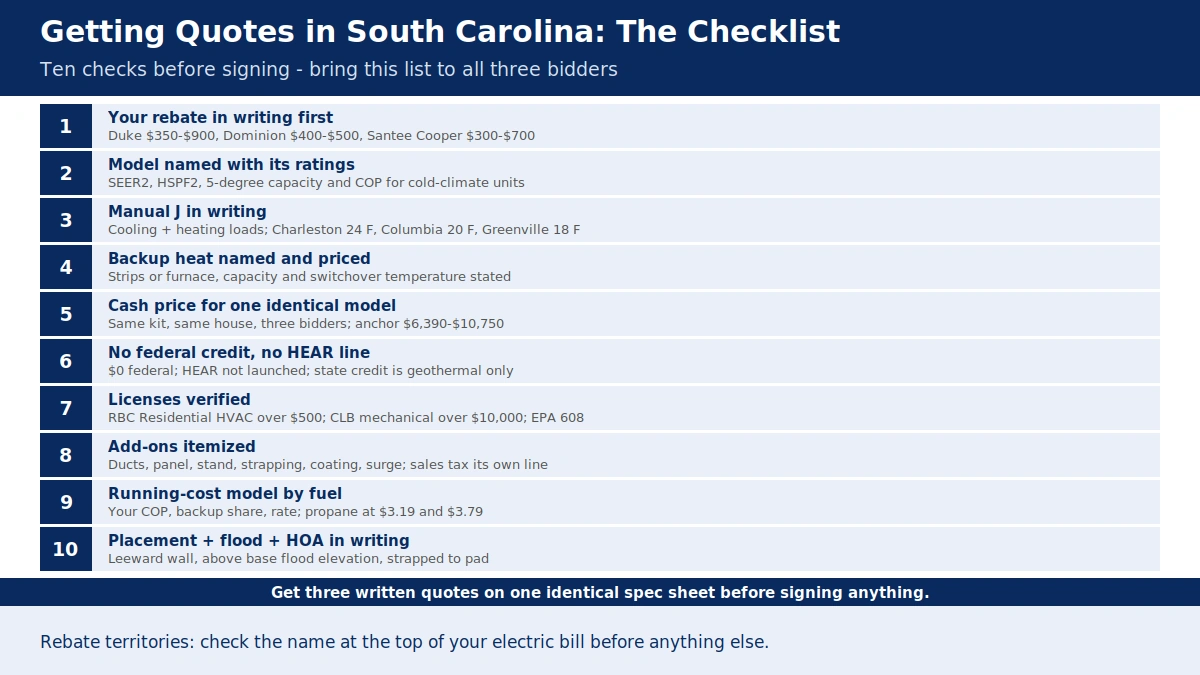
Sources & methodology
Cost anchors:
- NumeralQ Heat Pump Cost in South Carolina 2026 (updated Nov 9, 2026; estimator pricing Oct 26, 2026), planning estimates, not contractor bids: statewide 3-ton ducted $6,390–$10,750; cold-climate ducted $8,430–$14,790; single-zone $3,040–$4,770; multi-zone 3-head $6,030–$10,900; geothermal $19,920–$31,480; by size 1.5-ton $4,270–$6,900, 2-ton $4,980–$8,180, 2.5-ton $5,680–$9,470, 3.5-ton $7,100–$12,040, 4-ton $7,810–$13,320, 5-ton $9,220–$15,890; Charleston $6,460–$10,840; Columbia $6,430–$10,800 (Oct 31, 2026); Greenville $6,470–$10,860 (Oct 20, 2026); add-ons ductwork $3,960–$6,810, panel upgrade (200 A) $2,080–$3,300; permit fees “not published” for SC cities
- NumeralQ HVAC Replacement Cost in South Carolina 2026 (updated Nov 8, 2026): central AC + gas furnace 3-ton $8,180–$13,890; dual-fuel $9,030–$14,870 statewide, Charleston $9,110–$14,970, Columbia $9,080–$14,930, Greenville $9,130–$15,000; city HVAC replacement Charleston $8,240–$13,980, Columbia $8,210–$13,940, Greenville $8,260–$14,000
- BetterHouse Heat Pump Installation Cost by State 2026 (modeled): South Carolina ducted $3,820–$13,370, typical $10,100 (wage index 0.87); national ducted $4,000–$14,000 typical $10,575 (This Old House Aug 2026); single-zone $2,000–$12,000 typical $3,250; geothermal $12,000–$40,000+ typical $15,206 (Angi)
- 5 Lakes Heating & Air (Upstate SC contractor) 2026: most installs $5,000–$12,000+; SEER2 15+ / HSPF2 8+ as a solid SC balance; SC License #39029
- Trane packaged heat pump price sheet (SC dealer PDF, undated, R-454B): 3-ton single-stage economy $8,450, deluxe $10,775, two-stage economy $9,525, deluxe $11,900, installed with Manual J, stand, disconnect, crane and disposal
- HomeAdvisor Myrtle Beach heat pump guide (undated): replacement $4,200–$7,900; air-source replacement $4,500–$8,000; mini-split replacement $1,300–$8,000; geothermal $6,000–$20,000
Rates:
- EIA Electric Power Monthly Table 5.6.A, Oct 28, 2026 release: SC residential 15.76 cents/kWh Aug 2026; US 18.16 cents; Jan-Aug 2026 SC avg 16.00 cents, +7.2% vs same months 2025; Aug 2026 +4.0% YoY, +22.8% in 5 years; average August bill $226.29 at 1,436 kWh
- EIA Form 861 2024 scaled to 2026 (via costperkwh.com): Santee Cooper ~12.7 cents, Dominion Energy SC ~16.3 cents, Blue Ridge Electric Co-op ~21.2 cents
- Dominion Energy SC rate case Docket 2025-325-E: filed Jan 2, 2026 requesting 12.73% (~$19.98/month per 1,000 kWh, ~$322M); May 2026 settlement near 7.6% overall (~$207M); PSC approved $219.3M of $322M on July 2, 2026, effective July 2026
- EIA natural gas: SC residential Jan 2026 $15.91/Mcf, Feb $18.24/Mcf (release Oct 30, 2026); July 2026 $29.90/Mcf not usable (fixed charges over summer volumes); Dominion Energy SC 100-therm residential bills $180.75 (Jan 2026), $178.72 (Feb 2026), $194.51 (Mar 2026) per SC Office of Regulatory Staff; Dominion cost-of-gas factor $0.97342/therm from Jan 2026 (PSC filing); EIA Winter Fuels Outlook 2026-27 (Oct 6, 2026): South gas $14.13/Mcf forecast, season spend $511
- EIA propane: no SC-specific survey; PADD 1C Lower Atlantic residential $3.79/gal week ending Nov 2, 2026 (season high; low $3.58 Oct 5, 2026); SC homeowner reports $4.29/gal typical ($3.61–$4.99); EIA Winter Fuels Outlook South propane forecast $3.19/gal; East Coast retail $3.804/gal week of Nov 9, 2026
Climate and performance:
- SC Weatherization Assistance Program Policy Manual (SC Office of Economic Opportunity, 2026): Greenville 2,158 HDD / 2,099 CDD; Columbia 2,167 HDD / 2,250 CDD; Charleston 1,730 HDD / 2,278 CDD; humid subtropical
- NOAA 1991-2020 normals via FullLoop market pages (conflict flagged): Greenville (Greer) 3,019 HDD / 1,720 CDD; Columbia (Owens downtown) 2,210 HDD / 2,418 CDD; Charleston city 1,623 HDD / 2,448 CDD; Columbia 83 days above 90 F, Greenville 48 days
- Chromalox sizing guide (older ASHRAE-based table, planning figures): design temps Charleston 24 F, Columbia 20 F, Greenville 18 F; HDD Charleston 2,146, Columbia 2,598, Greenville 3,163
- WeatherSpark Charleston International Airport: muggy period 5.5 months (May 5-Oct 20); July muggy 96% of the time, 29.7 muggy days; August 29.0 muggy days; Charleston Executive Airport July 30.3 muggy days, muggiest day July 20-21 at 99%
- WeatherSpark SC state page: Charleston January avg high 59 F / low 43 F, July 89 F / 76 F; Columbia January 56 F / 37 F, July 92 F / 73 F; Greenville January 52 F / 35 F, July 89 F / 71 F; Charleston July avg high 91.3 F, 21.4 days at/above 90 F, 52.5 in rain/year (NOAA 1991-2020 via charlestonvisitor.com)
- DOE regional standards 10 CFR 430.32: split heat pump minimum 14.3 SEER2 / 7.5 HSPF2 since Jan 1, 2023; ENERGY STAR bar 15.2 SEER2; ENERGY STAR CAC/ASHP V6.2 cold-climate bar, COP at least 1.75 at 5 F, capacity at 5 F at least 70% of the 47 F rating
- DOE Cold Climate Heat Pump Challenge field data: 5 F capacity 70-80%, COP 2.2-2.8; standard unit at 5 F 40-60% capacity, COP 1.0-1.5
- EPA Technology Transitions rule (40 CFR 84 subpart B): new residential split systems must use refrigerants with GWP under 700 from Jan 1, 2025 (R-454B / R-32)
Rebates and incentives:
- Dominion Energy South Carolina Heating & Cooling Rebates (EnergyWise), official program page checked Nov 2026: $400–$500 for ENERGY STAR central AC and heat pumps, minimum 15.2 SEER2; Licensed Mechanical Contractor required; application within 90 days; no DIY; no fuel switching; ground-source not eligible; heat pump water heater $750; 4-6 week processing. $650 electric-furnace-to-heat-pump and $300 duct figures per Holy City Heating & Air rebate guide (July 2026). Secondary, flagged
- Duke Energy Smart $aver Carolinas rebate chart (updated Aug 1, 2025): air-source heat pump replacement with duct sealing $350 (15.2 SEER2), $450 (16 SEER2), $700 (17+ SEER2), rising to $700/$800/$900 on early replacement; geothermal $700/$900; mini-split $700/$900; participating contractor submits via smartsaverincentives.com; conversion rebates up to $2,000–$2,500 and smart thermostat $125 per NC contractor pages. SC eligibility flagged; DEC Smart $aver tariff PSCSC Docket 2024-303-E effective Aug 1, 2025; new construction ASHP/CAC up to $300
- Santee Cooper EmpowerHome / Smart Energy Existing Homes, official program page, 2026 program year Dec 1, 2025-Nov 30, 2026: split heat pump $300 (15.2 SEER2) / $400 (16.3 SEER2); mini/multi-split $40 per half-ton (15.3 SEER2) / $80 per half-ton (18.4 SEER2); geothermal $600; hybrid $500–$700; headline “up to $700”; home generally 5+ years old; Trade Ally contractor; duct replacement $500; heat pump water heater $400; November 2026 notice: program year wrapping up Nov 30
- Electric cooperatives: Berkeley Electric Co-op 2026 rebates capped at 20% of equipment cost, through Dec 11, 2026; Southeastern Electric Co-op 2026: air-source $300 new-home / $500 replacement, mini-split $300, no statewide co-op schedule
- SC Code Section 12-6-3587: 25% credit for solar, small hydropower and geothermal machinery/equipment; cap lesser of $3,500 per facility per year or 50% of tax liability; carry forward up to 10 years; ENERGY STAR on install date; primary residence; geothermal provisions repealed Jan 1, 2032; SCDOR Revenue Ruling #24-2: air-source heat pumps do not qualify; Form TC-38
- SC HEAR/HOMES: not launched; SC Energy Office “not currently available”, anticipated 2026 (confirmed Oct 13, 2026 and Nov 2026); DOE Jan 2025 dataset allocations HEAR $68,451,650 + HOMES $68,716,961 (~$137M); NASEO status Sept 30, 2026; planning figures HOMES $2,000–$16,000, HEAR up to $14,000/household
- DOE Program Notice 26-2 (May 29, 2026): HEAR electric-to-electric only, no fuel-switching; HEAR cap $8,000, HOMES up to $8,000
- OBBBA P.L. 119-21 and IRS FS-2025-05: §25C and §25D $0 for post-Dec-31-2025 installs, completion date counts; IRS Notice 2025-42 (§48E, in service by Dec 31, 2027, construction begun by Jul 4, 2026)
- CFPB Aug 2024 market spotlight: dealer $0-down financing fees 10-30% of cash price, sometimes over 50% (national figure)
- SC Safe Home: not accepting applications as of July 2026
Heating fuel mix:
- ACS 2020–2024 5-year estimates (Census, via NumeralQ): SC electricity ~71%, piped gas ~24%, remainder propane/wood/other ~5%; Charleston 73% electric, Columbia 72%, Greenville 67%
- EIA RECS 2020: ~41% of SC homes use a heat pump as main heat
Licensing:
- SC LLR Residential Builders Commission: Residential HVAC Installer and Repairer license required for residential HVAC work over $500 (S.C. Code §40-59-20(7); Reg. 106-2); 1 year experience; PSI technical + Business Management & Law exams (70% pass); application $100, license $220; surety bond $10,000 if job over $5,000 (ServiceTitan/tradelicenseatlas) vs $5,000 (NEXT). Conflict flagged; equipment cap 5 tons cooling / 175,000 BTU/hr heating per unit (Reg. 106-1(c)); renewal biennial June 30 odd years
- SC LLR Contractor’s Licensing Board: Mechanical Contractor license for commercial HVAC over $10,000; subclassifications AC, Heating, Packaged Equipment (to 25 tons / 500,000 BTU), Refrigeration; Primary Qualifying Party 2 years experience; PSI exams; $350 fee; Group 1 cap $35,000/job; renewal Oct 31 odd years
- Permit checkpoint: building official must refuse a permit without the required license or exemption and must report violators to LLR (§40-59-280 residential; §40-11-350 CLB)
- Master HARV / Mechanical Trades Certification: Carolinas AGC from Jan 1, 2026 (formerly MASC); can substitute for CLB technical exam; not the license; EPA Section 608 required for refrigerants; state does not license individual technicians
- Sales tax: 6% state + county local option up to 3% = 6%-9% combined (SCDOR ST-500 chart effective May 1, 2026; Tax Foundation statewide avg 7.49%, July 1, 2026); Charleston County 9%; Richland County (Columbia) 8%; Myrtle Beach (Horry) 9%; Greenville County 6% vs 7% conflict flagged
- Lien law: SC Code Title 29 Ch. 5; liens due within 90 days (29-5-90); total liens capped at contract amount owed (29-5-40); notice of commencement optional (29-5-23)
Labor:
- BLS OEWS May 2025, SOC 49-9021: SC HVAC mechanics median $27.22/hr (mean $27.14, employment 6,920); national median $29.33 (mean $31.14); Charleston-North Charleston median $28.08 (mean $28.11, employment 1,270); Columbia median $27.70; Greenville-Anderson-Greer median $28.25 (mean $27.62, employment 1,160); Hilton Head-Bluffton-Port Royal median $28.02; Northeastern SC nonmetro median $23.85
Running-cost and payback arithmetic:
- Planning home ~19 MMBtu delivered heat/yr (NestPriced planning assumption, scaled from a 50 MMBtu Boston planning home at 5,634 HDD: 50 x 2,167/5,634 = 19.2) = 5,568 kWh of heat; gas 95% AFUE at $1.80/therm planning price = 200 therms = ~$360/yr; heat pump COP 2.0 = 2,784 kWh (15.76 cents) = ~$439/yr; COP 2.5 = 2,227 kWh = ~$351/yr; COP 3.0 = 1,856 kWh = ~$293/yr; COP 3.5 = 1,591 kWh = ~$251/yr; resistance = 5,568 kWh = ~$878/yr; propane 95% (91,452 BTU/gal) = 219 gal/yr ($3.79 = ~$829/yr; $3.19 = ~$698/yr); break-even COP vs 95% gas = 2.44, vs propane at $3.79 = 1.06, vs propane at $3.19 = 1.26; backup-resistance illustration (5% of heat at 15.76 cents) ~$44/yr
- NumeralQ cross-check (RECS average home): gas 95% $252/yr; heat pump HSPF2 7.5 $312/yr; HSPF2 9 $260/yr
- Ducted 3-ton at ~$8,570 (midpoint of $6,390–$10,750): vs resistance saves ~$585/yr -> ~14.6 yrs; vs propane at $3.79 saves ~$536/yr -> ~16.0 yrs; vs propane at $3.19 saves ~$405/yr -> ~21.2 yrs; vs gas 95% saves ~$67/yr at COP 3.0 -> ~126 yrs (never on fuel); at COP 3.5 vs gas saves ~$109/yr; Duke $700 rebate -> net ~$7,870 -> vs resistance ~13.5 yrs; Dominion $500 -> net ~$8,070 -> ~13.8 yrs
- Premium framing: furnace-plus-AC 3-ton $8,180–$13,890 (NumeralQ midpoint ~$11,035) vs ducted heat pump midpoint $8,570. The heat pump is typically cheaper than the furnace-plus-AC it replaces, so the premium is negative
EXCLUDED:
- Any “after 30% credit” or “after $2,000 credit” prices: §25C/§25D are $0 for 2026 installs
- Any HEAR rebate in a 2026 South Carolina quote: not launched, no launch date, and no fuel-switching even after launch
- The 25% state credit claimed for an air-source heat pump: geothermal only, per SCDOR Revenue Ruling #24-2
- Dominion $650 electric-furnace figure as verified: secondary source only, flagged
- Duke conversion rebates up to $2,000–$2,500 as South Carolina-verified: NC contractor pages / Carolinas chart, flagged
- Santee Cooper 2027 rebate levels: not published; 2026 program year ends Nov 30, 2026
- Myrtle Beach city install price and design temperature: planning estimates only, flagged as such
- Cold-climate prices by size other than 3-ton: NumeralQ publishes by-size only for standard ducted, flagged as such
- Dual-fuel bundled installed price: NumeralQ modeled band only, flagged
- SC-specific permit fee schedule: not verified (“not published” for SC cities)
- Greenville County combined sales tax as a single figure: 6% vs 7% conflict, flagged
- Residential HVAC surety bond as a single figure: $10,000 vs $5,000 conflict, flagged
- Piedmont Natural Gas residential $/therm: not verified
- Heat-pump seasonal COP 3.0-3.5: planning range, not field-measured for a specific SC installation
- Summer-month EIA $/Mcf gas figures as heating prices: fixed charges over tiny summer volumes, not usable
- Any SC lease/PPA offer: no provider verified, authorization unverified
- Hurricane add-on prices (strapping, stands, surge protection): no SC-verified prices, flagged
- 2027 utility rebate levels: none published, not projected
- Billed hourly labor rates: not published, omitted (BLS wages only)
- Heat-pump lifespan and degradation figures: national only, flagged as such
Disclaimer: The prices here are 2026 South Carolina planning figures. What you end up paying moves with the city, the house, the utility territory, the flood zone, and the contractor. Get written quotes from three licensed South Carolina installers before settling on a budget, and check the license yourself on LLR’s verification before anyone touches the house.
Nothing here is tax advice for your own return. These are general notes only, and the geothermal credit in particular turns on your own state tax liability and carryforward position.
A South Carolina tax professional can confirm how these notes apply to your return. Ask before you file. Program rules change, Duke, Dominion and Santee Cooper rebate amounts and deadlines, and the HEAR/HOMES launch status, so confirm current terms with your utility before signing, and note that Santee Cooper’s 2026 program year ends November 30, 2026.
Propane prices are dated to their sources, $3.79 a gallon as the Lower Atlantic regional proxy for the week of November 2, 2026, and $3.19 as the EIA South winter forecast. A propane-heated home’s payback moves with the propane price, so check the current EIA weekly survey before you decide.
What does a heat pump cost in South Carolina in 2026?
A typical 3-ton ducted heat pump costs $6,390–$10,750 installed in South Carolina in 2026 (NumeralQ planning estimates, October 2026), with Charleston at $6,460–$10,840, Columbia at $6,430–$10,800 and Greenville at $6,470–$10,860. A single-zone ductless mini-split runs $3,040–$4,770, a cold-climate ducted system $8,430–$14,790, a dual-fuel system $9,030–$14,870, and geothermal with a ground loop $19,920–$31,480. Utility rebates run $300–$900 depending on territory and efficiency, geothermal alone earns a 25 percent state tax credit capped at $3,500 a year, and the federal tax credit is $0 for a 2026 install.
Do heat pumps work in South Carolina winters?
Yes, and South Carolina is one of the easiest states for a heat pump. Charleston is designed for 24 degrees, Columbia for 20, and Greenville for 18, so a standard ducted unit handles the whole state without the cold-climate premium, though backup heat still matters on the coldest Upstate nights, and only the mountain counties near the Blue Ridge escarpment have a case for a cold-climate unit. Five degrees is where the two machines part company: the standard unit holds 40 to 60 percent of its rated capacity there, while the cold-climate machine stays above 70 percent and holds a COP of 1.75 or better, and a seasonal COP of 3.0 to 3.5 is the planning figure for South Carolina, because most of the season sits in the 40s and 50s.
Is a heat pump cheaper to run than a gas furnace in South Carolina?
Yes, by a small amount, and the machine you buy decides how small. South Carolina power averages about 15.76 cents a kilowatt-hour, and tying a 95 percent gas furnace at the $1.80-a-therm planning price takes a seasonal COP of about 2.44, while a realistic South Carolina seasonal COP is 3.0 to 3.5. At COP 3.0 a heat pump costs about $293 a year to heat the planning home against about $360 for gas, saving about $67, and at COP 3.5 it costs about $251, saving about $109, while at COP 2.5 the saving shrinks to about $9 and at COP 2.0 the heat pump costs more than gas.
What rebates can I get for a heat pump in South Carolina in 2026?
It depends entirely on your utility. Duke Energy Smart $aver pays $350–$900 for a heat pump replacement in the Upstate and Pee Dee, tiered by efficiency, with duct sealing required and higher amounts on early replacement, and Dominion Energy South Carolina pays $400–$500 for an ENERGY STAR heat pump in the Midlands and Lowcountry, with no fuel switching allowed and a 90-day application deadline. Santee Cooper pays $300–$700 on tiered efficiency levels, but its 2026 program year ends November 30, 2026, electric cooperatives run their own schedules at $300–$500 in the examples found, geothermal alone earns the 25 percent state tax credit, and the federal tax credit comes to $0 for a 2026 install.
Can I get the $8,000 HEAR rebate for a heat pump in South Carolina?
Not in 2026: South Carolina’s HEAR and HOMES programs have not launched. The South Carolina Energy Office says the rebates are not currently available, development is underway, and availability is anticipated in 2026, with no launch date named, and roughly $137 million is allocated to South Carolina, none of which buys a rebate you can claim today. Once the programs open, HEAR money still cannot fund a fuel switch under the Energy Department’s Program Notice 26-2, which shuts out a gas- or propane-heated home trying to switch to a heat pump, so only electric-to-electric upgrades and new construction qualify, covering the roughly 71 percent of homes that already heat with electricity.
Does South Carolina give a tax credit for a geothermal heat pump?
Yes, and it is the largest incentive available. South Carolina Code Section 12-6-3587 allows a credit of 25 percent of the purchase and installation costs of geothermal machinery and equipment, capped at the lesser of $3,500 per facility per year or 50 percent of the taxpayer’s state tax liability, with the excess carried forward up to ten years, so on a 3-ton geothermal job at $19,920–$31,480 the credit comes to $4,980–$7,870, used over two or three tax years. The equipment must meet ENERGY STAR requirements and sit at the primary residence, the geothermal provisions are repealed January 1, 2032, and air-source heat pumps explicitly do not qualify, per the Department of Revenue’s own ruling, so do not claim this credit for a standard heat pump.
What license or permit do I need to install a heat pump in South Carolina?
You need a mechanical permit and an electrical permit from your city or county, and your contractor needs a state license: a Residential Builders Commission Residential HVAC Installer and Repairer license for residential work over $500, which covers every whole-home install, or a Contractor’s Licensing Board mechanical license for commercial work over $10,000. The permit desk is the checkpoint: a building official must refuse a permit unless the applicant shows the required license or an exemption. The electrician’s license for electrical work and federal EPA Section 608 certification for refrigerants are separate checks, a Master HARV certificate is a trade certification, not the license, and you should look the LLR license up before anyone touches the house.
When does a South Carolina heat pump pay for itself?
Against electric resistance heat the payback is about 14.6 years, because it saves about $585 a year, and that is the payback many South Carolina buyers actually get, since about 71 percent of the state heats with electricity. Against propane at $3.79 a gallon the payback is about 16 years, saving about $536 a year, and at the $3.19 forecast it is about 21 years, saving about $405 a year, while versus a 95 percent gas furnace, fuel savings alone never pay back at a seasonal COP of 3.0, since the saving is about $67 a year. Compare the heat pump against the furnace-plus-air-conditioner you would buy anyway, though, and there is no premium to pay back at all: the heat pump is typically cheaper than the pair it replaces, and it cools and dehumidifies the house all summer besides.