

A Pennsylvania roof has to be three roofs at once, and the state is wide enough that all three exist within a single afternoon’s drive. In the southeast, around Philadelphia, the winter is short and wet: about twenty-three inches of snow a year, rain that arrives sideways off a nor’easter, and tens of thousands of rowhouses whose flat roofs are membrane, not shingle. In the west, around Pittsburgh, the winter is longer and colder: forty-five inches of snow, steep old rooflines on houses built before the Second World War, and a freeze-thaw cycle that opens every flashing seam a little wider each March. In the north, around Erie and the Poconos, the winter is a different animal entirely: more than a hundred inches of lake-effect snow a year, a snow load that can reach seventy pounds a square foot, and a season short enough that a crew booked in October may be watching the first band form over the lake while the ridge cap is still going on.
Price, city, permits, and financing all shape the final bill — yet in Pennsylvania, the snow gradient and the ice dam outweigh every one of them, and the regulatory picture outweighs both. A cheap 3-tab roof that looks like a bargain on the quote can end up costing more than a standing-seam metal roof within fifteen years if it has to be replaced early, with a deductible coming out of the homeowner’s pocket each time. The licensing picture runs the other way from Michigan’s: there is no state licence to check, no exam behind any bid, no sixty hours of education — just a registration that costs a hundred dollars, takes no test, and proves almost nothing about skill. Treating that registration number like a licence means being fooled by the one piece of paper the state actually issues.
The national picture sits in our roof replacement cost guide; everything below measures Pennsylvania against that baseline, city by city and material by material.
Table of Contents
What a Roof Replacement Costs in Pennsylvania in 2026
SmartRoofingCalculator and NumeralQ come at the Pennsylvania market from different directions — one by the square, the other by the house — and land in the same place. The calculator’s Pennsylvania page, updated November 9, 2026, puts architectural shingles at $440–$640 per square fitted with tear-off, which works out to $11,000–$16,000 on a typical 25-square roof. NumeralQ, pricing October 26, 2026, puts a 2,000 square foot roof at $9,730–$11,870 statewide, with Philadelphia at $10,080–$12,320 and Pittsburgh at $9,440–$11,500. Those two bands agree with each other once the geometry is understood: a 2,000 square foot home usually carries about 20 to 25 squares of roof surface once pitch and waste are counted, and twenty squares at $440–$640 comes to $8,800–$12,800, right where NumeralQ sits.
Above that band sit two heavier estimates, and the distance between them says more than any single average could. MyRoofData’s 2026 Pennsylvania model puts a typical single-family architectural asphalt roof at $13,000–$22,750, about 2 percent above the national average, built on per-square installed prices of $459–$765 before tear-off. RoofingEstimatorPros, updated August 26, 2026, puts a typical 2,000 square foot architectural roof at $14,851–$26,551, averaging $20,051, or about $10.03 per square foot installed including tear-off, permits and waste. Modernize, updated August 27, 2026, puts the state average at about $15,200 for a 2,000 square foot home, inside a range of $12,500–$18,500. At the other end, This Old House’s 2026 Roofing Survey reports a Pennsylvania average of $7,489, spanning $5,740–$19,078, with asphalt at $4.42 per square foot. The spread is honest, because the state is spread out: a simple cape in Harrisburg lands near the bottom, while a steep, cut-up Victorian in the Poconos with deck work and a short season lands near the top, and the survey average is dragged down by small repair-sized jobs counted as replacements.
On the direction of travel the sources agree: Pennsylvania hugs the national average, a touch under it on one measure and a touch over it on another. SmartRoofingCalculator applies a state factor of 0.980 and ranks the state 34th of 50 from cheapest to most expensive; MyRoofData applies a 1.02 state cost index; RoofingEstimatorPros applies a 1.05 times multiplier. What keeps Pennsylvania from being cheap the way the Plains states are is labor in the two big metros. The Bureau of Labor Statistics, in its May 2025 Occupational Employment and Wage Statistics, puts the median roofer wage in Pennsylvania at $26.79 an hour through NumeralQ’s reading, with billed rates of $54–$70 an hour — while SmartRoofingCalculator, on the older May 2024 vintage, lists a median of $23.67 an hour and a mean of $26.25. Those two wage figures conflict because they come from different survey years, and this guide prints both instead of picking one. The state counts about 3,540 roofers, and in Philadelphia the median runs 8 percent above the national median while in Pittsburgh it runs 6 percent below it — a fourteen-point gap inside one state, which is why a Philadelphia quote and a Pittsburgh quote for the same roof are never the same number.
Roofing is sold by the square, and the square is the unit to learn before reading any bid: one square covers 100 square feet of finished roof surface. A 25-square roof is therefore 2,500 square feet of surface — what a typical 2,000-square-foot single-story Pennsylvania home carries once pitch, overhangs, and waste are counted. Unless the text says otherwise, each per-square price here already includes taking off one old layer, the underlayment, and standard fitting. Anything beyond the standard scope adds to the bill: a second layer to tear off, rotted decking to replace, a steep pitch to work on, or a roof broken up by valleys and dormers to flash. What no 2026 quote should include is a line for a federal tax credit, because there is no credit left to claim on a roof installed in 2026.
| Source | Typical job | Price | Dated |
|---|---|---|---|
| SmartRoofingCalculator | 25-square architectural roof | $11,000–$16,000 ($440–$640/sq) | Nov 9, 2026 |
| NumeralQ | 2,000 sq ft roof, statewide | $9,730–$11,870 | Oct 26, 2026 |
| NumeralQ | 2,000 sq ft roof, Philadelphia | $10,080–$12,320 | Oct 26, 2026 |
| NumeralQ | 2,000 sq ft roof, Pittsburgh | $9,440–$11,500 | Oct 26, 2026 |
| MyRoofData | Typical single-family arch roof | $13,000–$22,750 | 2026 model |
| RoofingEstimatorPros | 2,000 sq ft arch roof | $14,851–$26,551 (avg $20,051) | Aug 26, 2026 |
| Modernize | 2,000 sq ft arch roof, average | ~$15,200 (range $12,500–$18,500) | Aug 27, 2026 |
| This Old House survey | State average replacement | $7,489 (range $5,740–$19,078) | 2026 survey |
| ProTech Roofing | Average replacement | $8,500–$20,000 | Apr 13, 2026 |
| BestRoofingEstimates | Typical arch replacement | $11,500–$22,500 | 2026 guide |
Two rows of that table deserve footnote treatment rather than headline treatment. RoofingEstimatorPros is the high outlier: its $20,051 average sits about 48 percent above the SmartRoofingCalculator midpoint, and Modernize’s ~$15,200 average sits above the headline band as well — both describe what a large, complex, or metro job costs rather than what a standard Harrisburg ranch costs. This Old House sits at the low end: a $7,489 average that blends small and partial jobs in with full replacements, and a $4.42 per square foot asphalt figure that understates what an installed roof costs. Neither figure is wrong; each measures a different kind of job. The band to carry into the first contractor meeting is $11,000–$16,000 for a 25-square roof, cross-checked against $9,730–$11,870 for a 2,000 square foot roof statewide.
A standard-pitch asphalt roof goes on in one to three days when the weather holds, RoofingEstimatorPros notes, while metal jobs run longer. The slow part is everything around the install — collecting three quotes, waiting out the June tornado peak if the old roof can hold a few more weeks, and getting the permit and the inspection scheduled.
Roof Replacement Cost in Pennsylvania by Material
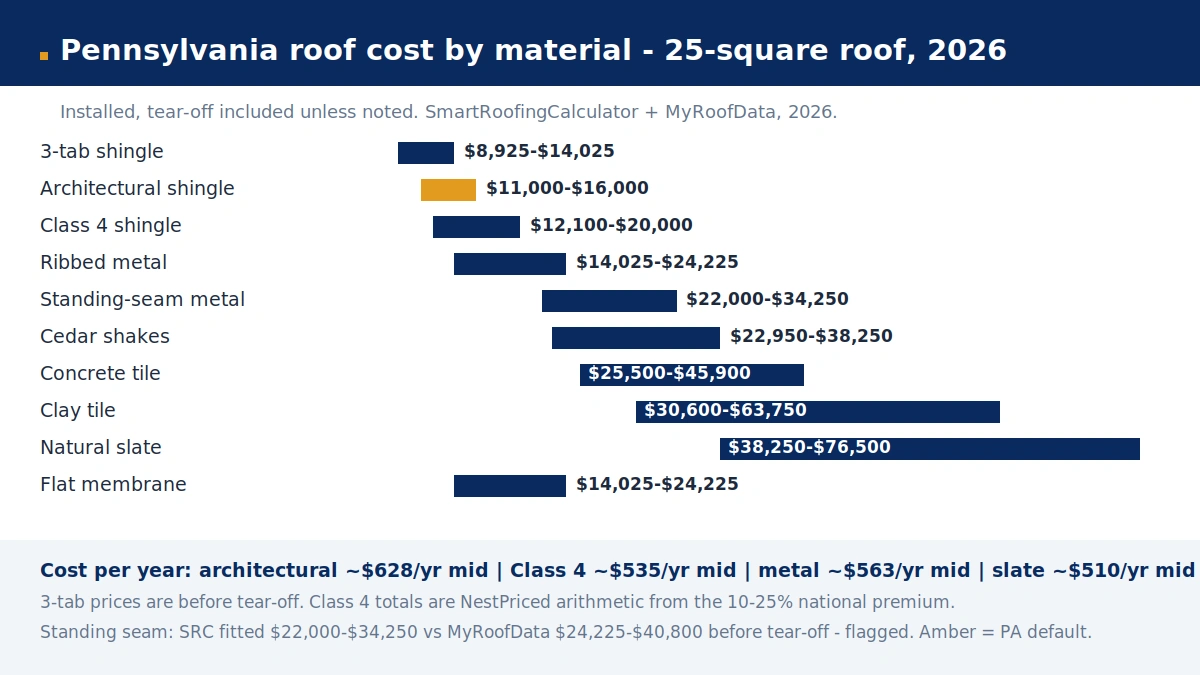
Pick the material by the winter it has to survive, and by the house it has to sit on — in Pennsylvania those are the same decision. The cheapest shingle on the shelf is the one most likely to give up early under a snow load it was never designed to carry, and the most expensive slate on the shelf is the one most likely to already be up there: tens of thousands of Pennsylvania homes, from Pittsburgh to Philadelphia, still carry the slate their builders laid a century ago, and deciding whether to repair or replace a hundred-year-old slate roof is a discipline of its own. The table prices a typical 25-square roof — 2,500 square feet of surface — material by material from Pennsylvania-verified figures, with tear-off noted wherever it is not included.
| Material | Per square installed | 25-square total | Realistic PA life |
|---|---|---|---|
| 3-tab asphalt shingle | $357–$561 (before tear-off) | $8,925–$14,025 | 12–18 yrs |
| Architectural asphalt shingle | $459–$765 (before tear-off) | $11,475–$19,125 | 18–25 yrs |
| Class 4 impact-resistant shingle | $484–$800 (arithmetic) | $12,100–$20,000 | 25–35 yrs |
| Ribbed metal (exposed fastener) | $561–$969 (before tear-off) | $14,025–$24,225 | 30–40 yrs |
| Standing-seam metal | $880–$1,370 (fitted) | $22,000–$34,250 | 40–60 yrs |
| Cedar shakes and shingles | $918–$1,530 (before tear-off) | $22,950–$38,250 | 25–35 yrs |
| Concrete tile | $1,020–$1,836 (before tear-off) | $25,500–$45,900 | 40–75 yrs |
| Clay tile | $1,224–$2,550 (before tear-off) | $30,600–$63,750 | 50–100 yrs |
| Natural slate | $1,530–$3,060 (before tear-off) | $38,250–$76,500 | 75–150 yrs |
| Flat membrane (TPO/EPDM) | $561–$969 (before tear-off) | $14,025–$24,225 | 20–30 yrs |
Read the 3-tab row with its warning attached. MyRoofData’s $357–$561 a square is the installed price before tear-off, so the real job total climbs once the old layer comes off, and 3-tab carries the thinnest margin against Pennsylvania weather of anything in the table: a single flat layer with the lowest wind rating and no impact rating worth naming. Insurers and builders have been walking away from it for years, and in a state where every winter’s freeze-thaw works the sealant strips and flashing laps a little looser, saving $2,500 on the install by choosing 3-tab is simply pre-paying the next deductible. It still fits somewhere — a rental, a shed roof, a house going on the market within a few years — but it should not be the default on a home the owner plans to keep through a decade of Pennsylvania winters.
The default, here as everywhere, is architectural shingle: thicker, dimensional, on roughly three in four American homes, and the same in Pennsylvania. With the manufacturer’s high-wind nailing pattern these shingles carry wind ratings of 110 to 130 miles per hour. The fitted headline is $440–$640 a square, or $11,000–$16,000 for 25 squares; MyRoofData’s before-tear-off band of $459–$765 a square puts the same roof at $11,475–$19,125 before the old layer comes off. Expect 18 to 25 realistic years in Pennsylvania rather than the 22 to 30 the model prints, because ice dams push water back under the courses and freeze-thaw opens the flashing. At year twelve a roof can look fine and still be a single February thaw from leaking.
Class 4 impact-resistant shingles earn their own section below, because the storm-season argument for them is county-specific in this state. No Pennsylvania-specific Class 4 per-square price turned up in this pass, so the band here is NestPriced arithmetic: the national premium of 10 to 25 percent over standard architectural, applied to the fitted $440–$640 band, gives $484–$800 a square, or $12,100–$20,000 for 25 squares. The shingle itself is SBS-modified asphalt — rubberized, so it stays flexible through a Pennsylvania freeze and absorbs a hailstone hit instead of splitting. Behind it sits the UL 2218 Class 4 test, in which a two-inch steel ball drops twenty feet onto the shingle and the shingle has to come through uncracked. That is not the same as hail-proof: a baseball-size stone can still damage it. But most of the hail that does damage in Pennsylvania falls in the one to two inch band, and that is exactly where Class 4 proves itself — with the insurance discount, where the carrier offers one, as the bonus on top.
Metal divides Pennsylvania by region. Ribbed panels with exposed fasteners run $561–$969 a square before tear-off, or $14,025–$24,225 for a 25-square roof, and last 30 to 40 years. Standing seam is the row where the sources disagree with each other: SmartRoofingCalculator prices it fitted at $880–$1,370 a square, or $22,000–$34,250, while MyRoofData prices it at $969–$1,632 a square before tear-off, or $24,225–$40,800 — a fitted band sitting below a before-tear-off band, which cannot both be right, so this guide prints both and headlines the fitted one. What metal does that no asphalt can do is shed snow instead of holding it, shrug off hail without bruising the mat, and skip the granular wear cycle that freeze-thaw attacks. Run the per-year math and the table turns upside down: standing seam comes out near $563 per year of service at the midpoints, against near $628 for architectural shingles and near $535 for Class 4. Metal looks dear on the quote and cheap on the calendar — and in Erie and the Poconos, where the snow load peaks, it is simply the default. Metal gets its own deep dive in our metal roof cost guide, with the head-to-head in our metal vs shingles comparison.
Cedar is the niche pick in Pennsylvania: $918–$1,530 a square, or $22,950–$38,250 for 25 squares, with 25 to 35 realistic years. It looks right on a Pocono cabin, it wants maintenance, and it traps snow and debris in its gaps — a poor combination on a roof that has to shed a hundred inches of snow a winter. Only the one MyRoofData band was pulled for cedar in Pennsylvania, so check it against a local quote before budgeting around it.
At the luxury end, tile and slate split in opposite directions: slate is common here and tile is rare. Concrete tile runs $1,020–$1,836 a square, or $25,500–$45,900 for 25 squares, and clay tile $1,224–$2,550 a square, or $30,600–$63,750. Natural slate runs $1,530–$3,060 a square, or $38,250–$76,500. Each of the three is far heavier than asphalt, each needs the structure checked for the extra weight plus a northern snow load that can reach 70 pounds per square foot, and each lasts half a century or more. Slate is the Pennsylvania story: tens of thousands of homes still carry it, the crews that lay it exist here in a way they do not in most states, and the usual decision is repair-versus-replace on a century-old roof rather than new slate on a new house. Tile’s weakness here is freeze-thaw — a porous tile that drinks autumn rain and freezes in January can spall. Slate’s weakness is the crew: a slate roof fitted by people who rarely touch the material is a thaw-season leak waiting to happen. Our tile roof cost guide goes into the tile choice in depth.
The last row is the rowhouse row, and it belongs here because Philadelphia is a membrane market. EPDM, TPO and modified bitumen run $561–$969 a square before tear-off on the MyRoofData model, or $14,025–$24,225 for a 25-square equivalent — but a Philadelphia rowhome flat roof is six to ten squares, not twenty-five, and the local numbers are smaller: a typical rowhome flat roof of 600 to 1,000 square feet runs $4,500–$9,500 for a full replacement in 2026, with EPDM at $400–$900 a square, modified bitumen at $400–$900, and TPO at $600–$1,200, according to a Philadelphia roofing contractor’s 2026 figures. The same source’s larger-roof figures run higher — $7,000–$11,000 for EPDM and $9,000–$14,000 for TPO on an 800 to 1,200 square foot roof — and the two bands conflict, so both are flagged here rather than averaged. An overlay, new membrane over the old roof, legitimately saves 20 to 30 percent when the conditions are right — one existing layer, dry insulation, sound deck — but Philadelphia code generally prohibits a third layer, so a previously overlaid roof must tear off. The membrane choice in full is in our flat roof replacement cost guide.
Read that table a second time, by the year instead of by the quote. At the midpoints, 3-tab costs about $765 a year, architectural about $628, Class 4 about $535, ribbed metal about $546, standing seam about $563, cedar about $1,020, concrete tile about $621, clay tile about $629, slate about $510, and flat membrane about $765. All of those per-year figures are our own arithmetic — the midpoint total over the midpoint realistic life — and none of them counts the deductibles, where Class 4 earns its keep, or the snow-shedding, where metal earns its. The material table and the insurance section belong next to each other. On its own, neither tells the truth.
Roof Replacement Cost by Roof Size
Most quoting mistakes start with measuring the wrong thing. Bids are priced on roof surface, not on living area. A 2,000-square-foot single-story ranch covers about 2,000 square feet of ground, and pitch, overhangs, and cutting waste usually raise that to 20–25 squares of roof surface. A two-story house with the same 2,000 square feet of living space stands on a footprint near 1,000 square feet, so its roof surface is roughly half the ranch’s — though the listing describes both as “2,000 square feet”. Insist on the square count as a printed line on every bid. A bid worked out from living area has measured the wrong house.
The table below applies the SmartRoofingCalculator architectural band of $440–$640 a square, tear-off included, to the roof sizes Pennsylvania homeowners actually own. The headline lives in the 25-square row, and the NumeralQ cross-check in the 20-square row: $8,800–$12,800 from the per-square band set against $9,730–$11,870 for a 2,000 square foot roof across the state.
| Roof surface | Typical home | Architectural total | Class 4 total |
|---|---|---|---|
| 15 squares | Small ranch / cottage | $6,600–$9,600 | $7,260–$12,000 |
| 20 squares | 2,000 sq ft ranch | $8,800–$12,800 | $9,680–$16,000 |
| 25 squares | Typical PA home | $11,000–$16,000 | $12,100–$20,000 |
| 30 squares | Large two-story | $13,200–$19,200 | $14,520–$24,000 |
| 35 squares | Large home, complex roof | $15,400–$22,400 | $16,940–$28,000 |
| 40 squares | Very large / steep | $17,600–$25,600 | $19,360–$32,000 |
Three add-ons pull a job off this table. The first is pitch: a steep 10/12 or 12/12 roof costs more per square than a walkable 4/12, because the crew works slower and stages differently — and Pennsylvania’s old housing stock is full of steep pitches, from Pittsburgh’s hillside Victorians to the Lehigh Valley’s dormered Capes. Complexity comes next: each valley, dormer, skylight, and chimney means another flashing detail, slow work that springs the first leak if it is hurried — which is why a plain gable and a cut-up roof of identical square count price out as two entirely different jobs. The third is decking: rotted sheathing only shows itself when the old shingles come off, and it is priced per sheet on the day — NumeralQ puts a 4-by-8 sheet of OSB at $62–$90 installed in Pennsylvania, so get the per-sheet deck rate in writing before the tear-off starts.
Price the job from measurements taken off the roof itself. Measure the footprint first, then scale it by the pitch — roughly 1.15 for a 6/12 slope and 1.25 for 8/12 — allow a tenth extra for cutting waste, and divide the result by a hundred to get squares. Better still, get the measured figure printed on each bid, and compare square counts first — prices only after those match.
Roof Replacement Cost by City: Philadelphia vs Pittsburgh vs Harrisburg vs Allentown
One state, four roofing markets: the price follows the snow and the wage, not the skyline. Philadelphia, in the southeast corner, is the biggest city and the mildest climate — and the most expensive labor. Pittsburgh, in the southwest, is the steep-roof city with the cheapest big-city labor. Harrisburg, in the Susquehanna Valley, is the cheapest baseline in the state. Allentown, in the Lehigh Valley, sits between Philadelphia and Harrisburg on both price and snow. The verified figures cluster close together and spread apart in the same pattern: labor sets the price in the southeast, while snow and logistics set it in the north.
| City | 2,000 sq ft roof (arch) | Roofer pay vs US median | Market note |
|---|---|---|---|
| Philadelphia | $10,080–$12,320 | +8% | Largest market, highest wages, mildest snow, rowhouse flats |
| Pittsburgh | $9,440–$11,500 | −6% | Steep old rooflines, freeze-thaw, cheapest big-city labor |
| Harrisburg | $11,500–$17,500 (Modernize) | Not published | Central PA baseline, lowest in the state |
| Allentown | $9,940–$12,140 | +5% | Lehigh Valley, between Philly and Harrisburg on price and snow |
Philadelphia is the largest market in the state, served by the most crews, at $10,080–$12,320 for a 2,000 square foot roof, on a roofer median wage 8 percent above the national median, according to the Bureau of Labor Statistics for May 2025. Philadelphia is also the mildest corner of the state, with about 23 inches of snow a year — the lowest figure in the table — and winters warmer than anywhere else in Pennsylvania. The city’s building department, L&I, charges $69 for a typical re-roof permit under its fee schedule effective October 1, 2026 — the cheapest of the cities priced — but the cheap permit is not the whole story: the city requires licensed contractors with insurance on file, and pre-1978 homes trigger lead and asbestos rules that add scope. A Philadelphia contractor’s own figures run higher, with the metro averaging about $16,800 for a 2,000 square foot home, and SmartRoofingCalculator’s city page prices a 25-square Philadelphia roof at $12,650–$18,400, fifteen percent above the state baseline. The gap between the NumeralQ planning figure and the metro average is the rowhouse effect: Philadelphia’s housing stock is old — half its homes were built in 1949 or earlier — and old rowhouses bring flat membrane roofs, shared party walls, narrow-alley access, and deck surprises that a planning model cannot see.
Pittsburgh is cheaper on the verified figures, $9,440–$11,500 for the same 2,000 square foot roof, on a roofer median wage 6 percent below the national median. Read that lower figure as cheaper labor, not an easier roof. Pittsburgh is the steep-roof city: hillside Victorians and dormered Colonials with pitches that slow every crew, and a freeze-thaw cycle that works the flashing all winter. A Pittsburgh contractor’s own figures put most local replacements at $10,000–$18,000, with most completed jobs landing near $13,000–$15,000 — consistent with the NumeralQ band once the larger and steeper roofs are counted in. The city’s permit runs $130 for a typical job under the 2026 PLI fee schedule, $6 per $1,000 of construction value with a $130 minimum, and most Allegheny County municipalities require a permit for re-roofing. Pittsburgh’s hail risk, notably, is rated Very Low by FEMA for Allegheny County — the lowest in the table — which matters for the Class 4 decision below.
Harrisburg comes with a warning label rather than a verified planning figure. This pass pulled no NumeralQ city-level price for Harrisburg, and this guide invents none. The shape of the market is still visible: Modernize puts Harrisburg and Central Pennsylvania at $11,500–$17,500 for a 2,000 square foot roof, averaging about $14,200, and a fixed-price vendor puts the Harrisburg average at the same $14,200 — a coincidence that should not be read as confirmation, since the vendor figure is a single company’s advertised price. Central Pennsylvania offers the lowest baseline in the state, according to the regional guides, and a south-central contractor’s published planning examples — $8,250 for a small home, $12,500 for a medium home, $19,500 for a large home — sit below the metro figures on either side. Harrisburg’s snow runs about 33 inches a year on the long-term average, though a second source puts it near 30 — both figures are printed in the research spine rather than settled. Get three quotes in Harrisburg, and make at least one of them from a company with a permanent shop in Dauphin County, because warranty service from a crew based two counties away is a promise that gets expensive to keep.
Allentown is the Lehigh Valley market, and its pricing tells the story of the middle ground. NumeralQ puts a 2,000 square foot roof at $9,940–$12,140, on a roofer median wage 5 percent above the national median, while Modernize puts the Lehigh Valley at $12,000–$18,500 and a local guide puts the typical single-family replacement at $11,000–$16,000. Allentown takes about 33 inches of snow a year — more than Philadelphia, less than Pittsburgh — and its housing stock is the same vintage as Philadelphia’s, with a median year built of 1949. Most Lehigh Valley homes run 15 to 25 squares. No Allentown permit figure was published for a standard re-roof, and none is given.
Judge cities by the price per square, never by the total. Philadelphia at $12,320 looks more expensive than Pittsburgh at $11,500, but the gap disappears once pitch, deck condition, and material are held equal. The real city difference is not price. It is exposure: Erie gets four times the snow Philadelphia gets, Pittsburgh gets the freeze-thaw and the steep pitches, Philadelphia gets the nor’easters and the flat membrane roofs, and the central towns get neither the competition nor the fast scheduling, which is why their quotes deserve the closest reading of all.
Why Pennsylvania Roofs Cost What They Do: Snow, Ice Dams & Storms
Four forces set the price of a Pennsylvania roof, and three of them are weather. Snow is the first and the heaviest. Ice dams come second, and they generate the priciest repair bills of the four. Wind and hail are the third and the most persistent. The fourth is the market itself — a labor market that pays a Philadelphia wage in the southeast and a Pittsburgh wage in the southwest, and a housing stock so old that half the homes in the big cities predate the Second World War — and it decides how fast any of the other three gets fixed.
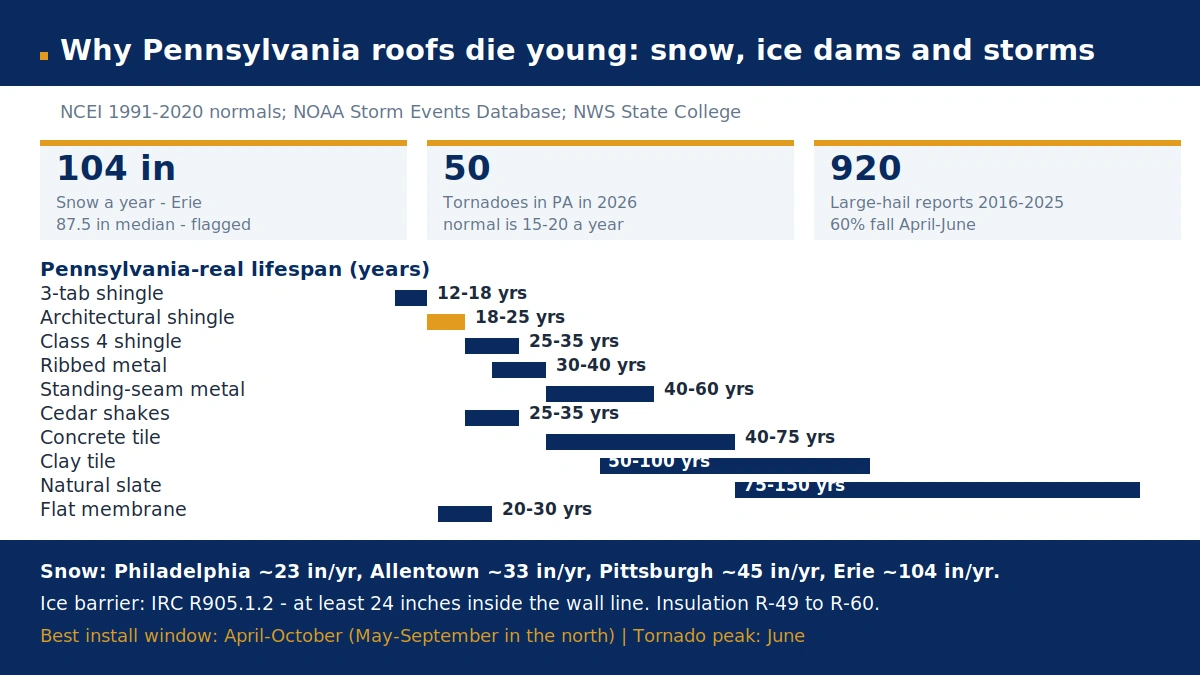
Snow. Pennsylvania is a snow state with a four-to-one gradient, and the numbers leave no room for doubt. On the 1991–2020 normals, Philadelphia averages about 23 inches of snow a year, Allentown about 33, Pittsburgh about 45, and Erie about 104 — and another measure puts Erie’s median season at 87.5 inches, which conflicts with the 104-inch mean and is printed here alongside it rather than settled, since a mean and a median measure different things and Erie’s record seasons pull the mean upward. Erie recorded 166 inches in the 2017–18 season; Philadelphia recorded 79 inches in 2009–10. Harrisburg’s long-term average is about 33 inches a year since 1889, though a second source puts it near 30. The driver in the north is lake effect: cold air flowing over the relatively warm Lake Erie produces heavy snow downwind, and because the lake rarely freezes over completely, the snow around Erie keeps coming all winter long. Snow is weight, and weight is structure. A roof that holds a snow load all winter, carries an ice dam at the eave, and takes freeze-thaw at every joint needs its deck, underlayment, and ventilation sized for the load rather than chosen for looks. Ground snow loads in Pennsylvania run from 25 pounds per square foot at Philadelphia to more than 40 in the mountain counties under ASCE 7, with a 25-to-60-pound range statewide — and one regional guide cites a 70-pound peak in Erie and the Poconos, a single-source figure flagged as such. No single statewide number exists, because the load is set county by county. Whatever number the local building department publishes for the snow load is the number the roof must meet — a contractor’s own estimate carries no authority there.
Ice dams. A dam is the most expensive winter problem on a Pennsylvania roof, and also the most preventable: money spent fixing a dam in February would have been better spent on insulation and ventilation in October. The mechanism is laid out in the next section: attic heat melts snow from below, the meltwater refreezes where the eave turns cold, and the trapped water backs up beneath the shingles. Pennsylvania’s freeze-thaw cycle makes the dam worse than the snowfall alone suggests: the state sits in three climate zones, 4A in the southeast, 5A across most of the center and west, and 6A in the northern tier, and in every one of them the temperature crosses freezing and comes back dozens of times a winter, prying at every seam a little further each time.
Wind and hail. Tornadoes grab the headlines, yet across an average Pennsylvania year it is straight-line thunderstorm wind that damages more roofs. The state averages about 15 to 20 tornadoes a year in a normal year — and 2026 was not a normal year: the National Weather Service in State College counted 50 Pennsylvania tornadoes as of September 23, 2026, more than double the normal. The season’s damage reads like a tour of the Susquehanna Valley: four tornadoes in Crawford County on June 14, three of them EF1, with gusts over 70 miles per hour and more than 150,000 customers without power across Ohio and northwest Pennsylvania; two EF2s on July 18; an EF2 at Wrightsville on August 20 that ripped the roof clean off Eastern York High School’s classrooms and an EF1 at Columbia that tore a firehouse roof off; and an EF1 in Salisbury Township, Lancaster County, on September 1 that took the roof off a barn and a one-room schoolhouse. A tornado means total loss, and no shingle rating is designed for that. Day to day, the threat is straight-line thunderstorm wind: one 70-mile-per-hour gust can lift a tab that was nailed short, break its seal, and open a path for the next rain to run beneath the course above it. The remedy is unglamorous: six nails where four would do, a starter course rated for high wind, and a shingle rated 110 to 130 miles per hour fitted precisely to the manufacturer’s instructions. Ask for the nailing pattern in writing.
Hail. The hail risk in Pennsylvania is moderate rather than Plains-scale, and the record says so plainly. In the NOAA storm record for 2016–2025, Pennsylvania logged 920 large-hail reports of an inch or more, ranking 26th nationally, with 60 percent of them falling between April and June — and 9,313 damaging-wind reports in the same decade, ten times the hail count. Wind, not hail, is the Pennsylvania story, which is why the Class 4 case in this state rests more on wind-driven debris and the insurance discount than on the hail barrage that justifies it in the Dakotas, and why it is strongest in Philadelphia County, where FEMA rates hail risk Relatively High, and weakest in Allegheny County, where FEMA rates it Very Low.
The market. The fourth force is labor, logistics, and age. About 3,540 roofers work in the whole state, on a median wage that reads $26.79 an hour on the May 2025 figures and $23.67 on the May 2024 vintage — and in Philadelphia, 8 percent above the national median. In a quiet month that is enough. In the weeks after an August tornado outbreak in York and Lancaster counties, it is not, and the shortage shows up in two ways: prices rise, and wait times stretch. The age of the housing stock is the quieter constraint: half the homes in Philadelphia, Pittsburgh, Allentown and Erie were built in 1949 or earlier, which means the crew that strips the old roof is as likely as not to find a deck of wide-plank boards rather than plywood and a layer count nobody recorded. Crews generally work from about April to October in the southern counties and from May to September up north.
Ice Dams, Snow Load & Winter: The Cold Pennsylvania Roof Killers
Winter does its damage slowly in Pennsylvania. Every winter an ice dam begins the same way: warmth leaking from the rooms below into the attic heats the underside of the deck and melts the lowest layer of snow on the upper slope. The meltwater then runs down toward the eave, past the warm wall to the point where the deck turns cold again, and freezes into a ridge. The next melt has nowhere to go, so water ponds behind the ridge, creeps back under the shingles, and gets into the house — through sheathing, down the wall, into the ceiling — showing up as a brown March stain and worse. A dam can leak through a brand-new roof, because the shingles were never the problem. The attic’s heat and stale air are the problem.
The defense has three layers, and each one belongs in the reroof scope rather than in a later project. First is the ice and water shield: a self-adhering membrane along the eaves, in valleys, and around penetrations, running from the edge past the inside face of the exterior wall — at least 24 inches inside the wall line under IRC section R905.1.2, which Pennsylvania’s Uniform Construction Code enforces statewide. In a state where snowfall runs from twenty-three to more than a hundred inches a year, the membrane ought to extend past the minimum on a low-slope roof, with the distance written on the quote. One 36-inch roll is often too narrow on a deep-overhang or low-pitch roof: two or three courses, six to nine feet of membrane, are what Pennsylvania contractors actually install. Second is insulation: the goal is a cold attic, and the attic gets cold when the ceiling is insulated well enough that the roof deck stays near the outdoor temperature — R-49 to R-60 for the climate zones 5A and 6A that cover most of the state, with R-38 as the minimum in the 4A southeast. Ventilation is the third layer: intake at the soffits and exhaust at the ridge, balanced under section R806, so attic air keeps moving and the deck stays at an even temperature. A reroof is the single moment when all three layers stand open together. New shingles over a hot, unventilated attic are simply a guarantee of another dam by February.
Snow load is the quieter winter risk. Philadelphia’s average winter leaves about two feet of snow sitting on a roof, yet the city’s record season piled up nearly 79 inches — so the average alone tells only part of the load story. A roof in Erie carries four times that in an average year. The load is not today’s snowfall. What loads the roof is the season’s accumulation: December’s fall pressed down in January, glazed over in February, and still in place when March adds another foot. Flat and low-slope areas are the danger zones: they hold snow rather than shedding it, so a low-slope porch roof or flat garage section can carry double the main slope’s load — and in Philadelphia, where the whole roof is flat, the membrane and the drainage are the snow strategy, not the pitch. No material sheds snow like metal, and a steep pitch clears it better than a shallow one. Shedding has a downside of its own: a slab of snow coming off metal in one piece can tear a gutter loose or bury the front steps, so ask for snow guards over doors and walkways in the original quote rather than as an afterthought.
The install calendar belongs to the weather, not the contractor. The calendar runs April to October in the south and May to September in the north, and the shoulder months are the sweet spot — April and May before tornado season peaks, September and October after it ends. June is tornado season, which means a crew can strip a roof in the morning and be racing a supercell by the afternoon — a good contractor reads the forecast the way a farmer does. A winter install can work — rubberized SBS shingles bond better in the cold than the old asphalt did — yet the adhesive strips still need warmth to set, and a January crew that leaves the tabs unsealed by hand is putting up a roof the first March gale will lift. When a roof must go on in winter, ask the crew how it seals the tabs and what happens if the seal does not take.
One last winter note, for the lakeshore and the mountains: the wind off Lake Erie drives snow and rain sideways, and a north-facing slope in Erie takes weather that a sheltered inland roof never sees. On the lakeshore, insist the quote spell out the flashing work in full, and have the roof looked over after the first heavy November blow instead of waiting for water inside.
Class 4 Impact-Resistant Shingles in Pennsylvania: What the Upgrade Costs and What It Pays Back
Through every revision of this guide, one recommendation has stayed put: price the Class 4 upgrade on each asphalt quote, and accept it whenever the figures support it. In Pennsylvania the numbers say no more often than they do in the hail states, and the map decides where. Hail here is moderate rather than relentless, so the case rests less on a hail barrage and more on wind-driven debris, the insurance discount, and the avoided deductible — and the same money buys more protection in the Philadelphia metro than it does around Pittsburgh. No other single decision does as much for a Pennsylvania asphalt roof in the southeast. In the southwest, the same money may be better spent on the ice barrier and the nailing pattern.
The shingle itself. Under Underwriters Laboratories standard UL 2218, Class 4 sits at the top of the impact-resistance scale. For the test, a two-inch steel ball falls twenty feet onto the shingle — about what a golf-ball hailstone does at terminal velocity — and the shingle must survive without a crack or a fracture. The flex in Class 4 comes from SBS-modified asphalt: a rubberized blend that stays pliable through a freeze and takes a strike without splitting. The lines sold in Pennsylvania include GAF Timberline AS II, CertainTeed Landmark IR, and Owens Corning Duration STORM. Class 4 is not hail-proof. Even so, a stone the size of a baseball can still leave its mark. But most of the hail that does damage in Pennsylvania falls in the one to two inch band, and that is exactly where Class 4 proves itself.
What it costs. No Pennsylvania-specific Class 4 per-square price turned up in this pass, so the band here is NestPriced arithmetic from the national premium: 10 to 25 percent above standard architectural shingles, applied to the fitted $440–$640 band, gives $484–$800 a square, or $12,100–$20,000 for a 25-square roof, versus $11,000–$16,000 for standard architectural. Across the national guides, the premium is quoted as 10 to 25 percent, elsewhere as 10 to 30 percent, and elsewhere again as $1,000 to $2,500 on a typical house. The Pennsylvania-specific read cuts the other way: NumeralQ’s Pennsylvania page calls impact-rated shingles “rarely” worth it in this state, on the grounds that large hail is uncommon here — rank 26th of 51 — and that judgment is fair for Allegheny County, where FEMA rates hail risk Very Low, and wrong for Philadelphia County, where FEMA rates it Relatively High. The upgrade’s value in Pennsylvania is a county-level decision, not a state-level one.
What comes back. Two streams of payback exist, and the second is worth more than the first. First is the insurance discount. Most large carriers in Pennsylvania discount Class 4 on the wind and hail portion of the premium, yet the published ranges do not agree, and the disagreement deserves plain statement: one Michigan agent cites 15–20 percent; a national guide cites 20–30 percent off the wind and hail portion; another cites 5–20 percent; a fourth cites 10–25 percent in hail-heavy states. No named carrier’s Pennsylvania figure was verified for this guide. Only the wind and hail portion gets the discount, never the whole premium, and the figure itself differs from one carrier to the next. Get it confirmed in writing by your own insurer — qualifying product list and paperwork included — before signing anything, and treat any contractor-quoted discount as fiction until the carrier puts it in writing.
The second stream is the avoided deductible, and in Pennsylvania it matters most. For standard perils a typical Pennsylvania deductible falls between $500 and $5,000, and a growing number of policies add a separate, higher deductible for wind and hail on top. Two hail or debris events survived without a replacement mean the deductible never gets paid twice — a saving of $1,000 to $10,000 at standard deductibles, and more where a percentage wind-and-hail deductible applies — set against an upgrade priced at roughly $1,100 to $4,000 for a 25-square roof. A single claim avoided can pay for the upgrade on its own. The premium discount is a bonus. The skipped deductible payment is what makes the upgrade pay.
Where the case fails. Class 4 loses in three situations. A roof shaded by heavy tree cover, where falling limbs and constant shade wear the shingles faster than hail ever would. A house likely to sell within a few years, since the buyer may not pay extra for the upgrade — although a warranty that transfers and a discount on paper can both help the listing. And a home in a pocket with unusually low storm exposure — in Pennsylvania, that pocket is real, and it is called Allegheny County, where FEMA rates hail risk Very Low and the county logged far fewer large-hail reports than the southeast. For everyone else — the long-term owner in the Philadelphia metro, the house that has already had one wind claim, the roof that faces the April-to-June hail season head-on — Class 4 is the default, not the upgrade.
Getting the purchase right. Have the product named on the quote — manufacturer and exact shingle line — and keep the UL 2218 Class 4 marking, printed on the back of the shingle, with the job records. Secure the insurer’s confirmation of the discount and its paperwork requirements in writing ahead of the install: some carriers want photos, a certificate, or an inspection. And ask about the warranty, because the extended warranty that only applies when a credentialed crew does the install is one more reason the cheapest bidder is not always the cheapest roof.
Permits & Code: Pennsylvania UCC, Ice Barrier & the HICPA Registration
Pennsylvania’s permit and code picture is statewide with a local twist, which sets it apart both from the states that leave everything to the city and from the states that license roofers. The state has a building code, the Uniform Construction Code, modeled on the International Residential Code, and it has no statewide roofer licence at all. The rules that govern a roof are the state’s rules first and the city’s rules second — and the person who governs the roofer is not a licensing board but the Attorney General’s consumer-protection office.
A statewide code. Roof construction and replacements across Pennsylvania fall under the Uniform Construction Code, the UCC, administered by the Department of Labor and Industry and enforced locally by municipal code officials. As of January 1, 2026, the UCC moved from the 2018 to the 2021 ICC code series, including the 2021 International Residential Code with Pennsylvania-specific amendments. The design values that count most — the wind speed and snow load the roof must withstand — are taken from the code’s tables and maps as the local building department applies them. Ground snow loads run 25 to more than 60 pounds per square foot across the state under ASCE 7, with 25 at Philadelphia and more than 40 in the mountain counties. No Pennsylvania-specific design wind speed was verified for this guide beyond the general ASCE 7 figure of about 115 miles per hour for much of the interior United States. On wind speed and snow load, the figures the local building department applies from the code tables are binding; an installer’s own estimate is not.
A mandatory ice barrier. IRC section R905.1.2 requires an ice barrier in areas with a history of ice forming along the eaves — which covers all of Pennsylvania. The barrier takes one of two forms: two layers of underlayment cemented together, or a self-adhering polymer-modified bitumen sheet. Either way it has to run from the lowest edges of all roof surfaces to a point not less than 24 inches inside the exterior wall line of the building, and on roofs with a slope of 8 in 12 or steeper it also has to run not less than 36 inches measured along the roof slope from the eave edge. Three code-driven items belong on every Pennsylvania bid, and a bid missing any of them is a red flag: ice and water shield along eaves, valleys, and penetrations, at least 24 inches inside the exterior wall line; drip edge at the eaves and rakes; and, in the wind-exposed parts of the state, the six-nail high-wind fastening pattern. A bid without the ice barrier leaks in February. A bid without the drip edge rots the fascia. Four nails where the manufacturer specifies six buys a roof that comes up in the first July storm.
Permits for a full replacement. A complete roof replacement needs a permit in most Pennsylvania municipalities, and the fee turns on the city and the job’s valuation. One anchor puts permit costs near $75–$400 statewide and another near $200–$700; SmartRoofingCalculator’s planning average is about $260. Philadelphia charges $69 for a typical job under the L&I fee schedule effective October 1, 2026. Pittsburgh charges $130 under the 2026 PLI schedule, $6 per $1,000 of construction value with a $130 minimum. Minor repairs — swapping a few shingles, fixing a flashing — generally need no permit, while substantial work always does. The 2021 UCC also tightened underlayment documentation requirements, so the permit file now carries more paper than it did under the 2018 code.
A registration, not a licence. Pennsylvania licenses no roofers at the state level. What it does instead is register home improvement contractors under the Home Improvement Consumer Protection Act, HICPA, Act 132 of 2008. Any contractor doing $5,000 or more a year of residential home improvement work must register with the Office of Attorney General, Bureau of Consumer Protection, pay a $100 fee renewable every two years, and print the PA HIC number on every advertisement, contract, estimate, business card, truck and proposal. There is no exam, no experience proof, and no continuing education behind the number. Older sources list a $50 fee, and one guide reports the fee rose to $100 on March 2, 2026 — both figures are printed here rather than settled, but the current figure used in this guide is $100. Philadelphia and Pittsburgh add their own local contractor licensing on top of HICPA, and Philadelphia requires licensed contractors with insurance on file plus lead and asbestos rules on pre-1978 homes. HICPA also caps the deposit: on contracts over $5,000, a contractor may not take more than one-third of the price plus any special-order materials named in the contract, and the contract must state the buyer’s right to cancel within three business days when it is signed at the home.
Hiring a Roofer in Pennsylvania: The Registration to Check (and What It Does Not Prove)
No statewide roofing licence exists in Pennsylvania, and that fact changes the hiring job completely. Where a licence exists, homeowners start from a filter the state built: education, an exam, a licence that names the trade. In Pennsylvania, the homeowner has to assemble that screening from nothing — and the one piece of paper the state does issue, the HICPA registration, proves far less than a licence would. The job is to use it for what it is, and to check separately every piece it does not cover.
What the number proves. A HICPA registration proves the contractor filed with the Attorney General, paid the fee, and sits on the state’s books with a number that can be looked up. Check it through the Attorney General’s free online search at hicsearch.attorneygeneral.gov, and look for three things: that the registration is current, that the business name on the registration matches the business name on the contract exactly, and that the PA HIC number appears on the estimate itself — the law requires it on every advertisement, contract, estimate, business card, truck and proposal, so a bid without the number comes from a contractor who is already breaking the rule written for the homeowner’s protection. A contractor who cannot produce a PA HIC number is offering to work unregistered, and an unregistered contractor may be barred from suing to recover payment even if the work was completed — which says plenty about how seriously the state takes the registration, even as it asks nothing else of the contractor.
What the number does not prove. It proves nothing about skill, because there is no exam. It proves nothing about experience, because none is required. Registration says nothing about whether the contractor carries insurance, holds a bond, or does quality work. Pennsylvania requires no state-level surety bond for a home improvement contractor, so the bond that protects a homeowner in some other states does not exist here. It tells you nothing about the crew’s workers’ compensation coverage, or about whether the contractor has ever fitted the material quoted. The registration is the first filter, not the only one — and in Pennsylvania it is a much thinner filter than a licence.
Run these five checks on each bidder, wherever in Pennsylvania the house stands. First, ask for proof of general liability insurance in the form of a certificate sent to you by the insurer itself — a copy handed to you by the bidder proves nothing — and check that the business name on it matches the contract exactly. Second, proof that the crew is covered by workers’ comp, which is required whenever the bidder has employees. Third, a permanent Pennsylvania address and a local phone number older than the last storm. Fourth, three references from your own county, each with a street address you can drive past yourself. Fifth, manufacturer certification wherever it counts — credentialed installer status with GAF, Owens Corning, or CertainTeed — since the extended warranty only holds when a credentialed crew does the work. On top of those five, get a written quote on one identical spec sheet from all three bidders, so the prices compare the same roof. In Philadelphia, add a sixth check: the L&I contractor licence and insurance on file, and the lead and asbestos paperwork if the house predates 1978.
The storm-chaser warning. Pennsylvania is storm-chaser territory after a tornado outbreak, and the crews arrive within days of the event, knocking on doors in the damaged neighborhoods — York and Lancaster counties saw exactly that after the August 2026 tornadoes. Some are legitimate traveling crews. Many are not. The chasers give themselves away the same ways every time: a knock and a free-inspection agreement pushed across the threshold, an out-of-state number and no office in town, no HICPA registration, a promise to make the deductible disappear, and a demand for a big payment before any work starts. A deductible waiver amounts to a promise of insurance fraud carried out for you, and a contract founded on one is worth walking away from. Remember the deposit cap too: on a contract over $5,000, the contractor may not take more than one-third of the price plus special-order materials named in the contract — a demand for half up front is not just aggressive, it is illegal. Door-to-door contracts in Pennsylvania carry a three-business-day cancellation right, which HICPA requires the contract to state — and it exists for exactly this moment. Use it. Do not put your name to a contingency agreement in the driveway while the adjuster has yet to look at the roof.
What belongs on the quote. A Pennsylvania quote should name the manufacturer and the exact shingle line, the underlayment type, the ice and water shield coverage in feet from the eave, the drip edge, the ventilation scope, the nailing pattern, the tear-off depth, the per-sheet deck replacement rate, the disposal, and the cleanup. The quote needs the roof surface in squares alongside a total price for that surface, so two bids can be set against each other square for square. Warranty terms need a place on the quote too — the manufacturer and workmanship periods as separate year counts, each with the party that honors it named. The quote also needs the permit cost, the name of whoever pulls the permit, and the PA HIC number printed where it can be seen. The quote should carry no line for a federal tax credit, since none exists in 2026. Our questions to ask a roofer guide has the full list — print it and work through it at the first contractor meeting.
Insurance: Deductibles, ACV vs RCV & the Class 4 Discount
For a Pennsylvania homeowner, the insurance policy is where a roof job quietly succeeds or quietly disappoints — coverage that seemed generous when it was signed can settle for far less than expected once a claim is filed. Premiums in the state have risen by about a third in five years, the wind and hail share of claims is heavy, and the roof-age underwriting that quietly rewrites old roofs from replacement cost to actual cash value is spreading through the industry. The homeowner’s own policy is the only document that governs the claim, so every figure below should be checked against it.

Premiums. Pennsylvania homeowners pay below the national average, and the studies point the same way even while measuring different coverage levels — though they part company on how wide the gap is, which is worth saying plainly. Insurance.com, in its 2026 rates, puts the state average at about $1,434 a year for $300,000 of dwelling coverage with a $1,000 deductible, against a national figure of $2,872. LendingTree, using Quadrant quotes from February 2026, puts it at $1,893 a year for $400,000 of coverage, 28 percent below the national average of $2,628, and notes premiums have risen 34 percent over the past five years. NerdWallet, updated May 6, 2026, puts it at $1,720 a year for $400,000 of dwelling coverage. InsuranceQuotes, with rates as of September 30, 2026, puts it at $1,780 a year across four of five insurers for a $300,000 sample home — and $2,685 a year once Travelers, the highest-priced of the five, is included. The countrywide figure across those same studies sits near $2,490–$2,872. The honest range for a standard Pennsylvania policy is about $1,434–$1,893 a year depending on coverage, and the direction of travel is up: a third higher than five years ago, driven by severe weather, higher rebuilding costs, and more expensive reinsurance.
Deductibles. A standard deductible of $500 to $5,000 covers most perils on most Pennsylvania policies, and a separate, higher deductible for wind and hail damage now appears on many of them. Raising the deductible from $500 to $1,000 typically saves 10 to 25 percent on the premium, according to the Insurance Information Institute. The number most homeowners do not know until the adjuster is standing in the driveway is the percentage wind and hail deductible: 2 percent of a $450,000 dwelling is $9,000 out of pocket before the insurer pays anything on a wind claim. Study the declarations page before the storm arrives, not once it has passed.
The roof-age question. This is the Pennsylvania-specific gap in this guide, and it is stated as a gap rather than filled with a borrowed fact. No Pennsylvania-specific roof-age trigger — the kind of 15-year rule documented in Michigan, where carriers switch the roof to depreciated actual-cash-value coverage or decline renewal — was verified for Pennsylvania in this pass, so none is claimed here. What can be said honestly is the industry direction: carriers nationally are using roof age as an underwriting trigger, and a Pennsylvania homeowner with a roof past fifteen years should ask the carrier, in writing, whether the policy still settles the roof at replacement cost or has already moved to actual cash value. The arithmetic below shows why the question matters.
Replacement cost or actual cash value. The other number that decides a claim is how the policy settles it — at replacement cost value or at actual cash value. Under replacement cost, the policy pays the price of a new roof less the deductible, whatever age the old roof had reached. Under actual cash value, the insurer pays for the roof as it stood when the damage struck — new-roof cost minus depreciation — and shingles shed value quickly. The table that follows is NestPriced illustrative arithmetic rather than a regulator’s published example: a $13,500 roof, the midpoint of the Pennsylvania architectural band, with a $2,000 flat deductible and straight-line depreciation of 2 percent a year across a 25-year shingle life.
| Roof age | RCV payout | ACV payout |
|---|---|---|
| Any age | $11,500 | — |
| 5 years | — | $10,150 |
| 10 years | — | $8,800 |
| 15 years | — | $7,450 |
| 25 years | — | $4,750 |
Read the pattern as the warning. At five years, ACV leaves the payout $1,350 below replacement cost. At fifteen years, it is $4,050 less. At twenty-five years, the payout is $4,750 on a $13,500 roof — barely a third of the cost — leaving the homeowner to cover the remainder. On an ACV policy, an older roof is largely self-insured — whether the homeowner has grasped that or not. Once a roof passes ten years on ACV, the Class 4 upgrade and the replace-or-repair call both change shape, since the carrier will pay for little of either one.
Filing the claim. Photograph everything before anyone touches the damage: each slope, each gutter, each dented vent cap, all dated. Phone the insurer ahead of the contractor — the adjuster inspects first, the contractor estimates second, and the sequence matters. Say no to any contingency or assignment-of-benefits paperwork offered at the door. Ask for the adjuster’s report on paper, line items included, and set it beside the contractor’s estimate to compare the two line by line. Keep the deductible in cash and ready: no legitimate contractor will waive it, and no insurer will pay it for you. Keep the paperwork on file — the Class 4 product name, the UL 2218 marking, photos from the install — since next year’s discount turns on being able to prove what is up there.
The Class 4 discount, once more. It is real, it is carrier-specific, and it is limited to the wind and hail portion of the premium. Published ranges run from 5–20 percent to 20–30 percent depending on the source, and no named carrier’s Pennsylvania figure could be verified for this guide. Before the install, get your own carrier to put the figure in writing, along with the list of qualifying products and the paperwork it wants. Until the carrier itself confirms a discount, a contractor’s promise of one is worth nothing.
Paying for It: No Federal Credit in 2026, Penn Energy Savers Not Launched & No Roof Rebate
Here is the whole 2026 money story for a Pennsylvania roof, in short: nobody pays for the roof except the homeowner and the insurer — and that is why so many quotes still carry a tax-credit line that does not exist. In 2026, the federal government contributes nothing to a Pennsylvania homeowner who replaces a roof, the state contributes nothing to the roof, and the federal rebate programs that do exist elsewhere have not even launched in Pennsylvania — there is no application to file, no waitlist to join, and no rebate in any case that ever pays for roofing.
The federal credit is gone. IRS fact sheet FS-2025-05 leaves no room for doubt: property placed in service after December 31, 2025 receives nothing under either the Residential Clean Energy Credit (§25D, 30 percent) or the Energy Efficient Home Improvement Credit (§25C). Both were closed by the One Big Beautiful Bill Act, Public Law 119-21, signed July 4, 2025. Roofing was never solar equipment, so §25D never covered it; §25C was sometimes claimed for qualifying roofing materials, and that door has closed as well. Seeing a tax-credit line on a 2026 quote means the pricing still follows a law that has expired — have that line struck and the quote re-issued. The commercial credit for clean electricity, §48E, covers solar arrays and comparable clean-electricity equipment. No documented lease or pass-through arrangement moves federal dollars toward a Pennsylvania roof, and none is claimed here. The credit-by-credit breakdown for 2026 lives in our federal energy tax credits guide.
HEAR and HOMES: not launched in Pennsylvania at all. Pennsylvania is one of the states that has not opened the federal home energy rebates. The state’s program is called Penn Energy Savers, run by the Department of Environmental Protection, and as of September 2026 the DEP was still awaiting final DOE approval to launch — redesigning the program for the federal government’s new rules, and with no consumer application open. The federal allocation to Pennsylvania is $129,226,380 for the electrification rebates, but an allocation is not a rebate: until the state launches, no Pennsylvania homeowner can claim a dollar of it. Once launched, HEAR will pay up to $8,000 per heat pump, restricted to low- and moderate-income households — those at or below 150 percent of area median income — and since the Energy Department’s Notice 26-2 of May 29, 2026, only electric-to-electric upgrades qualify. A reroof paired with an insulation upgrade may qualify for the insulation half once the program opens. Today, there is no application to file at all. For the heat-pump side of the picture, our heat pump cost in Pennsylvania guide covers the equipment the rebates will eventually pay toward.
No state money for the roof. No Pennsylvania state roof grant, rebate, or tax credit turned up in this pass, and no utility roof rebate turned up either — NumeralQ’s October 2026 check records the same finding. Money that does arrive comes from two places: the insurer, by way of the Class 4 discount and the deductible avoided, and the energy bill, by way of insulation and ventilation work done alongside the reroof. A homeowner looking for help paying for a roof in Pennsylvania in 2026 should consider a home-equity loan or a contractor financing plan — and read the annual percentage rate before looking at the monthly payment. The financing options are walked through in our how to finance a new roof guide.
Repair vs Replace: The Pennsylvania Decision Rules
A damaged Pennsylvania roof does not always need replacing, and an old roof does not always need repairing. Age, damage, and the deductible make the call — and in this state, so does the ice-dam outlook for the next five years, since a repaired roof that dams again in February is a repair bought twice.
Repair the young roof with small damage. When the roof is ten years old or less and the trouble is limited — a handful of missing shingles, a leak at one chimney flashing, a few wind-lifted tabs — repair is the right answer, not a whole new roof. Pennsylvania repair figures from NumeralQ, pricing October 26, 2026, put replacing up to ten shingles at $207–$417, flashing repair at $222–$475, finding and fixing a leak at $299–$830, and replacing a 100 square foot section at $500–$1,000. Philadelphia runs a little higher — shingles $218–$440, flashing $236–$500, leak $316–$880 — and Pittsburgh a little lower — shingles $197–$398, flashing $211–$452, leak $284–$790. Repair is the right call, too, when the damage plainly comes from a single storm and the insurance adjuster agrees the rest of the roof still has life left. On a slate roof the calculus is different again: a century-old slate roof with a handful of slipped slates is a repair job for a slate crew, not a replacement, and the replacement quote on slate should be read twice before it is believed.
Replace the old roof, the widely damaged roof, or the one where the math favors new. On architectural shingles past fifteen years, once wind has lifted more than a quarter of the slopes, the call is replacement — patching a lifted mat only dresses up a roof that the next storm will finish off. Replace when the deck is soft or the sheathing delaminated, because structure cannot be repaired, only replaced — and on a pre-war Pennsylvania house, that deck may be wide-plank boards rather than plywood, which changes the repair entirely. When the dams return each winter after the attic has been insulated and ventilated, the system itself has failed — the shingle is only the messenger. Replace when the carrier has already paid one claim and the roof has reached the age where the next claim settles at ACV for about a third of the cost — collect the replacement money while it is still paid as replacement money. Replace, too, when the repair estimate tops roughly a third of the replacement estimate on a roof with under five years of life remaining.
Inspect twice a year. Once in late fall, after tornado season ends, and once in late spring, before it begins. Inspecting in fall catches the summer’s wind and hail damage while the adjuster’s window remains open. A spring visit finds the winter’s ice-dam and freeze-thaw damage before tornado season adds a second layer of trouble. A roof that looks sound from the street may sit far closer to failure than it appears after several Pennsylvania winters — the mat bruises from within, and the bruise stays hidden until the shingle cracks. What an inspection costs and what it covers is set out in our roof inspection cost guide, and repair pricing in our roof repair cost guide. Gutters take the same wind and hail the roof does and give out first at the seams — if they are part of the job, our gutter installation cost guide has the pricing.
Getting Quotes in Pennsylvania: The Checklist
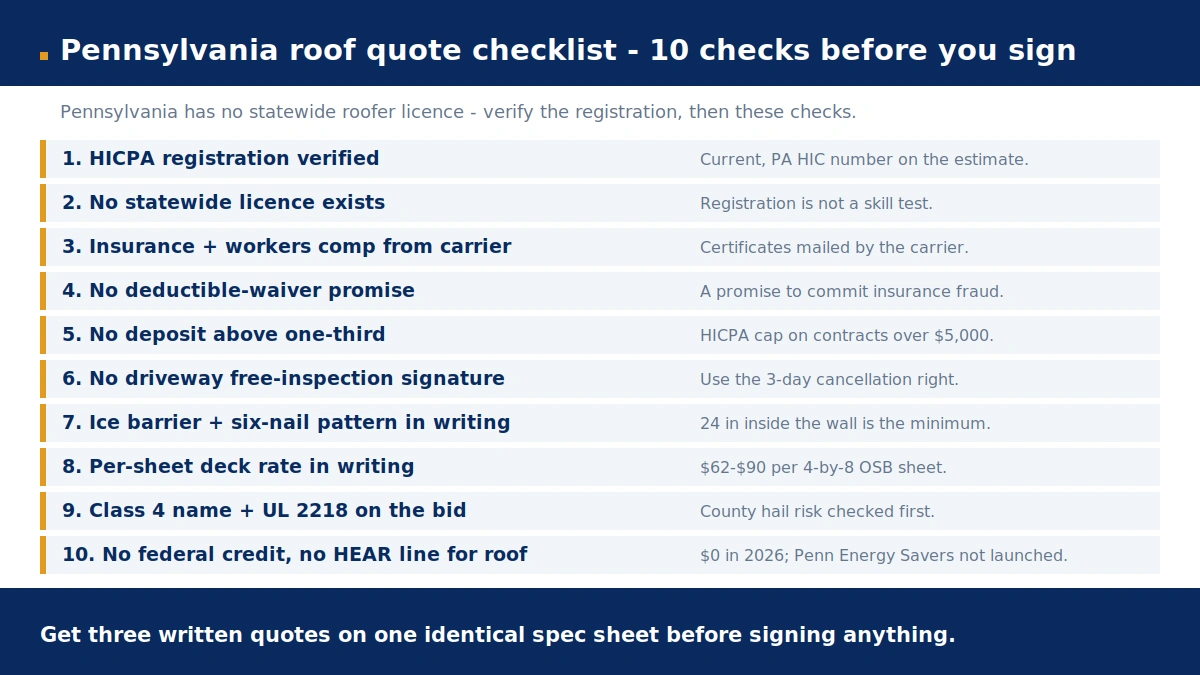
Three written quotes on one identical spec sheet, from three HICPA-registered contractors, before signing anything. Everything below is how to make that sentence real.
- HICPA registration verified on hicsearch.attorneygeneral.gov — current, business name matching the contract exactly, PA HIC number printed on the estimate itself.
- No statewide licence exists, so the registration is not a skill test — check insurance, workers’ comp, and manufacturer certification separately.
- Insurance and workers’ compensation certificates sent directly by the carrier, with the business name identical to the one on the contract.
- No promise to waive the deductible — making one means offering to commit insurance fraud for you.
- No deposit above one-third of the price plus named special-order materials on a contract over $5,000 — the HICPA cap, not a negotiating point.
- Step away from any free-inspection form pressed on you at the door after a tornado — the three-business-day cancellation right is there for exactly that moment.
- The ice-barrier coverage, stated in feet from the eave, and the six-nail high-wind fastening pattern, both in writing — the code’s 24 inches inside the wall line is a floor, not a goal.
- Agree the per-sheet deck rate in writing before the tear-off begins — NumeralQ lists a 4-by-8 OSB sheet at $62–$90 installed.
- Class 4 product name and UL 2218 marking named on the bid, with the insurer’s discount confirmed in writing first — and the county’s hail risk checked, since the case is strongest in Philadelphia and weakest in Pittsburgh.
- No federal tax-credit line ($0 in 2026) and no HEAR rebate line for the roof (Penn Energy Savers has not launched, and HEAR never covers roofing).
Sources & methodology
Cost anchors: SmartRoofingCalculator — Pennsylvania state page (page updated Nov 9, 2026; PA arch $440–$640/sq; 25-square roof $11,000–$16,000; standing-seam metal $880–$1,370/sq; tile $1,180–$1,760/sq; permit ~$260, range $150–$425; roofer median wage $23.67/hr, mean $26.25/hr, May 2024 vintage; ~3,540 roofers; RPP 97.6; state factor 0.980; rank 34 of 50); SmartRoofingCalculator Philadelphia city page (25-square arch $12,650–$18,400, $506–$736/sq, local factor 1.15; L&I permit + lead/asbestos rules on pre-1978 homes); SmartRoofingCalculator Pittsburgh city page (25-square arch $11,000–$16,000, factor 1.00); NumeralQ — Pennsylvania roof replacement cost (pricing Oct 26, 2026, reviewed Nov 5, 2026: statewide 2,000 sq ft roof $9,730–$11,870; Philadelphia $10,080–$12,320; Pittsburgh $9,440–$11,500; Allentown $9,940–$12,140; Erie $9,280–$11,280; deck sheet $61.93–$89.54; whole-roof ice and water barrier $0.88–$1.40/sq ft; BLS May 2025 roofer median PA $26.79/hr, billed $54–$70/hr; Philadelphia permit $69, Pittsburgh $130; median year built 1949 in Philadelphia, Allentown, Erie, Pittsburgh); MyRoofData — Pennsylvania (2026 model: typical arch roof $13,000–$22,750, 2% above national; 3-tab $357–$561/sq, arch $459–$765/sq before tear-off, ribbed metal $561–$969, standing seam $969–$1,632, cedar $918–$1,530, concrete tile $1,020–$1,836, clay tile $1,224–$2,550, slate $1,530–$3,060, flat membrane $561–$969; example 2,338 sq ft, 23.4 squares, $13,100–$22,700; crews $55–$95/hr; tear-off $100–$200/sq/layer; permits $75–$400); This Old House — Pennsylvania roof replacement cost (2026 Roofing Survey: avg $7,489, range $5,740–$19,078; asphalt $4.42/sq ft, metal $8.11/sq ft, clay $14.61/sq ft); RoofingEstimatorPros — Pennsylvania (updated Aug 26, 2026: 2,000 sq ft arch $14,851–$26,551, avg $20,051, $10.03/sq ft, 1.05x multiplier, permit $200–$700); Modernize (updated Aug 27, 2026: average ~$15,200, range $12,500–$18,500; Philadelphia metro $13,500–$20,500, avg ~$16,800; Pittsburgh metro $12,500–$19,500, avg ~$15,600; Allentown/Lehigh Valley $12,000–$18,500; Harrisburg/Central PA $11,500–$17,500, avg ~$14,200); ProTech Roofing (Apr 13, 2026: $8,500–$20,000; arch $450–$700/sq; standing seam $800–$1,400/sq); BestRoofingEstimates (arch $11,500–$22,500; peak snow load 70 psf Erie/Poconos, single source); thepittsburghroofer.com (Pittsburgh 2,000 sq ft arch $10,000–$18,000, most $13,000–$15,000; standing seam $18,000–$35,000+; labor $65–$150/hr); lehighvalleybest.com (Allentown typical $11,000–$16,000, Feb 2026); Joyland Roofing (south-central PA, Aug 2026: small $8,250, medium $12,500, large $19,500; $5.50–$7.50/sq ft); SquareDash Harrisburg ($14,200 avg, Apr 2026 — vendor figure, flagged); Adilay Roofing Philadelphia (2026: rowhome flat roof 600–1,000 sq ft $4,500–$9,500; EPDM $400–$900/sq, mod bit $400–$900/sq, TPO $600–$1,200/sq; overlay saves 20–30%; third layer prohibited); Angi Philadelphia (Aug 1, 2026: 1,000 sq ft flat roof $3,000–$12,000; average flat replacement $4,098). We worked out the 25-square material totals, the size-table figures, the Class 4 totals, and the cost-per-year numbers ourselves, starting from the cited per-square price ranges and lifespan figures.
Climate + snow + ice + wind: snowfall 1991–2020 normals, NCEI via ExtremeWeatherWatch (Erie 103.7 in/yr; Philadelphia 23.2 in/yr; Pittsburgh 44.5 in/yr; Allentown 33.4 in/yr); Erie median season 87.5 in (TripTravelingGuide, medians 1950–51 to 2025–26 — conflicts with the 103.7 in mean; both printed); Harrisburg long-term average 33.2 in/yr since 1889 vs ~29.9 in (chaseday.com — conflicts; both printed); Erie record season 166.3 in (2017–18); Philadelphia record 78.7 in (2009–10); Allentown record winter 75.4 in (1995–96); Pittsburgh 30-year average 44.1 in/yr. Ground snow load 25 psf Philadelphia to 40+ psf mountain counties, 25–60 psf per ASCE 7-22; 70 psf peak Erie/Poconos (BestRoofingEstimates, single source — flagged). Ice barrier IRC R905.1.2 (24 inches inside the exterior wall line; 36 inches along the slope on 8/12 or steeper); ventilation IRC R806; attic insulation R-49 to R-60 in zones 5A/6A, R-38 minimum in zone 4A (standard IECC values, not Pennsylvania-verified); climate zones 4A/5A/6A (roofingstuffs.com). UCC 2021 ICC series effective January 1, 2026 (2018 series before). Tornadoes: 50 in Pennsylvania in 2026 as of September 23, 2026, normal 15–20 a year (NWS State College); June 14, 2026: 4 tornadoes Crawford County (3 EF1, 1 EF0), gusts over 70 mph, 150,000+ outages; July 18, 2026: multiple tornadoes including 2 EF2s; August 20, 2026: EF2 Wrightsville (120 mph, Eastern York High School roof ripped off), EF1 Columbia, EF0 Manor Township; September 1, 2026: EF1 Salisbury Township, Lancaster County. Hail/wind reports: Pennsylvania 2016–2025, NOAA Storm Events Database via NumeralQ (920 large-hail reports, 26th nationally, 60% April–June; 253 tornado reports; 9,313 damaging-wind reports). January 24–26, 2026 winter storm (NWS State College).
Class 4 + insurance discounts: UL 2218 Class 4 test (2-inch steel ball from 20 feet); premium: national guides 10–25% (Roof Ohio; Integrity Home Exteriors; BooBoone Nov 5, 2026: $1,000–$2,500 more on a typical house); discount ranges 15–20% (Michigan agent, May 4, 2026), 20–30% off wind/hail portion (Roof Ohio), 5–20% (RenovateGuide), 10–25% in hail-heavy states (BooBoone) — no named carrier’s Pennsylvania figure verified. Pennsylvania read: NumeralQ calls impact shingles “rarely” worth it statewide; FEMA hail risk Relatively High in Philadelphia County, Very Low in Allegheny County, Relatively Low in Lehigh and Erie counties. The three Class 4 lines cited here are Owens Corning Duration STORM, CertainTeed Landmark IR, and GAF Timberline AS II.
Insurance: Insurance.com (2026: $1,434/yr on $300,000 dwelling, $1,000 deductible; national $2,872); LendingTree (Feb 2026 Quadrant: $1,893/yr on $400,000 coverage, 28% below national $2,628, up 34% over five years); NerdWallet (May 6, 2026: $1,720/yr on $400,000 dwelling); InsuranceQuotes (Sept 30, 2026: $1,780/yr across 4 of 5 insurers, $2,685/yr including Travelers, $300,000 dwelling); III via Jerry (raising deductible $500 to $1,000 cuts premium 10–25%). No Pennsylvania-specific 15-year ACV roof-age trigger verified — flagged as a gap, none claimed.
Permits + licensing: Pennsylvania Uniform Construction Code (Act 45 of 1999; UCC 2021 ICC series effective Jan 1, 2026); R905.1.2 ice barrier; R806 ventilation; R908 re-roofing; Philadelphia L&I permit $69 (fee schedule eff. Oct 1, 2026); Pittsburgh PLI permit $130 (2026 schedule, $6 per $1,000 value, $130 minimum); permits $75–$400 statewide (MyRoofData), ~$260 planning average (SRC), $200–$700 (RoofingEstimatorPros). HICPA: Act 132 of 2008, 73 P.S. §§ 517.1–517.19; $5,000/yr threshold; fee $100 biennial (raised from $50 on Mar 2, 2026 per LegalClarity — conflicts with older $50 listings; both printed); no exam, no experience proof, no continuing education; PA# on all ads, contracts, estimates, cards, trucks and proposals; verify at hicsearch.attorneygeneral.gov; deposit cap one-third plus special-order materials on contracts over $5,000 (73 P.S. 517.9); three-business-day cancellation right in the contract; no state surety bond; no reciprocity; Philadelphia and Pittsburgh local contractor licensing on top of HICPA; unregistered contractors may be barred from suing to recover payment.
Labor: BLS OEWS May 2025 via NumeralQ: Pennsylvania roofer median $26.79/hr, billed $54–$70/hr; SRC (May 2024 vintage): median $23.67/hr, mean $26.25/hr — conflicts; both printed; ~3,540 roofers statewide (SRC); metro medians vs US median (BLS May 2025): Philadelphia +8%, Allentown +5%, Pittsburgh −6%, Erie −9%.
HEAR / HOMES + federal: Penn Energy Savers NOT launched — PA DEP awaiting final DOE approval as of September 2026 (GridShift, updated Nov 9, 2026; StartBusinessByState, checked Oct 6, 2026; BetterHouse, Sept 2026; ReferenceSource, verified Sept 30, 2026); DOE allocation $129,226,380 (HEAR); HEAR up to $8,000 per heat pump when launched, at or below 150% AMI; DOE Program Notice 26-2 (May 29, 2026: HEAR electric-to-electric only). OBBBA (P.L. 119-21), as explained in IRS fact sheet FS-2025-05, ends both §25C and §25D for any install placed in service after Dec 31, 2025. No Pennsylvania state roof grant (NumeralQ, checked October 2026).
Repair costs: NumeralQ — Pennsylvania roof repair cost (Oct 26, 2026, reviewed Nov 2, 2026: up to 10 shingles $207–$417; flashing $222–$475; leak $299–$830; chimney reflash $310–$680; skylight $324–$640; 100 sq ft section $500–$1,000); Philadelphia (shingles $218–$440; flashing $236–$500; leak $316–$880); Pittsburgh (shingles $197–$398; flashing $211–$452; leak $284–$790).
How we worked: we computed every 25-square material total, size-table figure, Class 4 total, cost-per-year number, and RCV/ACV figure ourselves from the cited per-square ranges and lifespans, and each one is labeled as our own arithmetic. We flagged the headline-cost disagreement, the premium spread ($1,434–$2,685), the Class 4 discount disagreement, the Erie snowfall conflict (103.7 in mean vs 87.5 in median), the Harrisburg snowfall conflict (33.2 vs ~29.9 in), the roofer-wage conflict ($26.79 vs $23.67 an hour), the HICPA fee conflict ($100 vs $50), the standing-seam conflict, the Adilay flat-roof conflict, and the city-pricing gaps (no verified Harrisburg figure from NumeralQ; no Allentown permit figure; no named-carrier Class 4 discount; no Pennsylvania 15-year ACV trigger; no Pennsylvania-specific design wind speed). Pennsylvania lifespans in this guide rest on contractor consensus about how materials hold up through local snow, ice dams, and freeze-thaw — realistic working estimates, not numbers taken from any one published table.
How much does a roof replacement cost in Pennsylvania in 2026?
Two independent sources converge on the same band, which is the strongest signal this guide can offer. SmartRoofingCalculator prices a 25-square architectural roof at $11,000–$16,000 ($440–$640 per square, tear-off included), and NumeralQ prices a 2,000 square foot roof at $9,730–$11,870 statewide, with Philadelphia at $10,080–$12,320 and Pittsburgh at $9,440–$11,500. Above that sit MyRoofData at $13,000–$22,750 for a typical single-family architectural roof and RoofingEstimatorPros at $14,851–$26,551 for a 2,000 square foot roof, while This Old House’s survey average of $7,489 mixes small and partial jobs with full replacements. The band to carry into the first contractor meeting is $11,000–$16,000 for a 25-square roof, cross-checked against the per-city figures above.
How much does a roof replacement cost per square foot in Pennsylvania?
The per-square-foot figure depends on which square foot you mean, and the distinction costs real money if it is blurred. Per square foot of roof surface, SmartRoofingCalculator’s fitted architectural band of $440–$640 per square works out to $4.40–$6.40 per square foot of surface, and RoofingEstimatorPros puts a 2,000 square foot roof at $10.03 per square foot installed including tear-off, permits and waste. Per square foot of living area, the same roof looks cheaper, because a 2,000 square foot single-story ranch carries 20–25 squares of roof surface once pitch and waste are counted, while a two-story home of the same living area carries roughly half that. Compare bids by the square count printed on each one, never by a living-area figure.
How long does a roof last in Pennsylvania?
The lifespans quoted here reflect what Pennsylvania contractors generally expect a roof to last under local snow, ice-dam, and freeze-thaw conditions — our own consensus estimates, not figures copied from a single published table. Three-tab asphalt runs 12–18 years here, architectural asphalt 18–25, Class 4 impact-resistant shingles 25–35, ribbed metal 30–40, standing seam 40–60, cedar 25–35, concrete tile 40–75, clay tile 50–100, natural slate 75–150, and flat membrane 20–30. The two numbers that matter most are the ones at the ends: a 3-tab roof in Erie will not see eighteen years, and a slate roof in Pittsburgh may outlive the house it sits on. Ice dams, freeze-thaw at the flashing, and wind lifting the tabs are what cut a Pennsylvania roof short of its warranty life — and the warranty, in most cases, covers the material rather than the labor to replace it.
Do I need a permit to replace a roof in Pennsylvania?
For a full reroof, most Pennsylvania towns and cities require a permit, and the amount charged depends on the municipality and the project’s stated value. SmartRoofingCalculator’s planning average is about $260, with a range of $150–$425; Philadelphia charges $69 for a typical job under the L&I fee schedule effective October 1, 2026, and Pittsburgh charges $130 under the 2026 PLI schedule, $6 per $1,000 of construction value with a $130 minimum. Swapping out a few shingles or fixing a flashing generally falls outside the permit requirement, but substantial work never does. The permit also triggers the inspection that confirms the ice barrier, the drip edge, and the fastening pattern were actually installed. Ask the contractor who pulls the permit, and make sure the answer is in writing before the tear-off starts.
Do roofers need a license in Pennsylvania?
No statewide roofer licence exists in Pennsylvania, and that absence is the single most important fact in this guide for anyone hiring a roofer. What the state has instead is the Home Improvement Consumer Protection Act, HICPA, which requires any contractor doing $5,000 or more a year of residential home improvement work to register with the Office of Attorney General, pay a $100 fee renewable every two years, and print the PA HIC number on every advertisement, contract, estimate, business card, truck and proposal. Registration involves no exam and no proof of experience, and Pennsylvania requires no state-level surety bond. Verify the number free at hicsearch.attorneygeneral.gov, then check insurance, workers’ comp, and manufacturer certification separately — the registration proves none of those. Philadelphia and Pittsburgh add their own local contractor licensing on top.
Does homeowners insurance cover a roof replacement in Pennsylvania?
Insurance covers the damage, not the age — and in Pennsylvania the distinction shows up in the settlement basis, which is the number most homeowners never read until the adjuster is standing in the driveway. A policy that settles at replacement cost pays what a new roof costs minus the deductible, whatever the old roof’s age. A policy that settles at actual cash value pays the new-roof cost minus depreciation, and at twenty-five years old that can mean $4,750 on a $13,500 roof. Pennsylvania premiums run about $1,434–$1,893 a year for a standard policy, up 34 percent over five years, and most policies carry a standard deductible of $500–$5,000 plus a separate, often percentage-based wind and hail deductible. No Pennsylvania-specific roof-age trigger for switching to ACV was verified for this guide, so ask your carrier in writing whether your roof still settles at replacement cost. Photograph all damage before anyone touches it, call the insurer before the contractor, and never sign a contingency agreement in the driveway.
Is there a tax credit for a new roof in Pennsylvania in 2026?
No. IRS fact sheet FS-2025-05 states it plainly: property placed in service after December 31, 2025 gets nothing from either the Residential Clean Energy Credit or the Energy Efficient Home Improvement Credit, both closed by the One Big Beautiful Bill Act. Roofing never qualified for the clean-energy credit anyway, and the home-improvement credit’s door has now closed too. If a 2026 quote still shows a tax-credit line, the job was priced under a law that has already ended — ask the contractor to remove that line and re-price the job. The federal home energy rebates (HEAR and HOMES) have not launched in Pennsylvania at all: the state’s Penn Energy Savers program was still awaiting final DOE approval as of September 2026, with no consumer application open, and HEAR never pays for a roof in any case — it pays up to $8,000 per heat pump, for households at or below 150 percent of area median income, electric-to-electric only. No Pennsylvania state roof grant or utility roof rebate turned up in this pass.
Are Class 4 impact-resistant shingles worth it in Pennsylvania?
The answer is a county-level decision, not a state-level one, and the map is the decider. In Philadelphia County, where FEMA rates hail risk Relatively High, Class 4 is the default: the upgrade costs roughly $1,100–$4,000 on a 25-square roof (10–25 percent over standard architectural, or $12,100–$20,000 total), most major carriers offer a discount on the wind and hail portion of the premium, and one avoided deductible — $500–$5,000 standard, often more under a percentage wind and hail deductible — can cover the upgrade outright. In Allegheny County, where FEMA rates hail risk Very Low, NumeralQ’s judgment that impact-rated shingles are “rarely” worth it in Pennsylvania is fair, and the same money buys more protection in the ice barrier and the nailing pattern. Get the product name and UL 2218 Class 4 marking on the bid, and the insurer’s discount confirmed in writing before the install, not after.