

Table of Contents
Pennsylvania is the hardest state in this series to write a simple price for, and the reason is geography. Philadelphia sits in the mildest corner of the state, where a standard heat pump carries most of the winter without complaint. Pittsburgh and the west run colder, with design temperatures near 5°F, and the northern tier around Erie and Scranton is colder still. One statewide price would lie to two of those three regions, so this guide prices each one separately and says plainly where the numbers come from. Every figure below is 2026 Pennsylvania data, the federal credit is shown as $0 throughout, and the rebate section draws a hard line between money that exists today and money that is only promised.
Compare with the national heat pump cost guide for the US baseline, our Texas heat pump cost guide for a warm-climate contrast, and our North Carolina heat pump cost guide for the closest eastern comparison — a state where the same federal rebate program actually opened and pays up to $8,000, while Pennsylvania’s version still waits on federal approval.
How much does a heat pump cost in Pennsylvania in 2026?
For a typical Pennsylvania home of 1,500–2,500 square feet, a whole-home ducted air-source heat pump (3-ton) costs $8,500–$14,500 installed. That is the range this guide recommends budgeting on. It comes from two independent directions that agree: Modernize’s Pennsylvania city pages put the statewide average at $10,550–$11,100 (Philadelphia $10,550, Pittsburgh $11,050, Harrisburg $11,100, Bethlehem $10,550), with a standard air-source system at $8,480–$8,880 and a high-efficiency system at $12,720–$13,320; and hvacprojectcost.com’s 2026 Pennsylvania guide puts heat pump replacement at $5,500–$14,500 for a complete HVAC replacement market of $5,500–$14,000. The overlap of those two sources is the $8,500–$14,500 band, with ~$11,000 as the working average.
One published average sits well above that band and needs explaining. EnergySage (updated March 19, 2026) reports a Pennsylvania average of $16,080 before incentives from its marketplace quotes, at $3,071 per ton after state incentives. Marketplace quotes skew toward complete, high-end jobs — premium variable-speed equipment, ductwork, panel work bundled in — so $16,080 reads as the top of the market rather than the typical job. This guide does not average it in with Modernize’s $11,000; it reports it here so you know why a quote near $16,000 is not automatically a rip-off, and why a quote near $11,000 is not automatically a bargain.
Two low numbers need the opposite treatment. Angi’s Philadelphia page (updated August 3, 2026) reports an average of $6,266 (range $4,475–$8,291), with air-source “average unit cost” of $1,500–$4,500. Manta’s city calculators show similar figures — Meadville averaging $5,797, Conshohocken $6,877, Dover $5,400. Those numbers describe equipment, or equipment plus a thin slice of labor, not a complete installed system with air handler, refrigerant lines, electrical, permit, and commissioning. When a quote lands near $6,000, ask which pieces are missing before you sign — the same equipment-lean trap showed up in our North Carolina guide, where Angi’s city averages sat thousands below every installer quote.
The pricing rule that defines 2026: the number on the quote is the number you pay, minus only the small Pennsylvania utility rebates in the incentives section. The §25C credit — 30%, up to $2,000 a year — stopped applying to any system placed in service after December 31, 2025. Plenty of pages still show heat pump prices net of a tax credit. Treat those as outdated. Every price in this guide is the price you actually pay.
Cost by region (Modernize PA city pages, 2026; hvacprojectcost.com regional adjustments):
| Region | Ducted air-source (3-ton) | What pushes it |
|---|---|---|
| Philadelphia + southeastern suburbs | $8,500–$14,000 | Mildest winters, most competitive contractor market, most rebate options |
| Harrisburg / Susquehanna Valley | $8,500–$14,000 | State median; PPL and Met-Ed territory |
| Allentown / Bethlehem / Lehigh Valley | $8,500–$14,500 | PPL territory; colder than Philadelphia |
| Pittsburgh metro | $9,000–$15,000 | Zone 5A, ~5–10% above state median; cold-climate equipment; strong union labor market |
| Scranton / Wilkes-Barre (northeast) | $9,000–$15,500 | Among the coldest winters in the state; PPL territory |
| Erie / northwest | $9,500–$16,000 | Coldest in the state (6,451 heating degree-days); lake-effect snow; cold-climate or dual-fuel usually quoted |
Western Pennsylvania runs 5–10% above the state median and northern Pennsylvania 5–15% above it (hvacprojectcost.com, 2026). The pattern is simple: the colder the design temperature, the more expensive the equipment that holds up in it, and the more of the winter it has to carry.
Heat pump cost by system type in Pennsylvania
| System type | Pennsylvania installed range | Best for |
|---|---|---|
| Ducted air-source heat pump (whole home) | $8,500–$14,500 (typical 3-ton; high-end variable-speed to ~$16,000) | Most PA homes with existing ducts |
| Ductless mini-split, single zone | $3,250–$6,500 (Berks: $3,250 average; Modernize PA: $5,830–$6,105) | One room, addition, garage, oil-heated home adding a zone |
| Ductless mini-split, multi-zone (3–4 zones) | $8,500–$15,000 (Modernize PA 3-zone: $12,720–$13,320) | Whole home without ducts |
| Dual-fuel (heat pump + gas furnace) | $7,000–$16,000 (hvacprojectcost.com PA, 2026) | Western PA; any home with cheap gas and cold winters |
| Cold-climate ducted heat pump | $7,983–$17,012 (national, Berks Connect via Fixr, 2026) | Pittsburgh, Erie, Scranton, the northern tier |
| Geothermal (ground-source) | $29,680–$31,080 (Modernize PA); national $15,000–$35,000+ | Maximum efficiency; propane-heated rural homes |
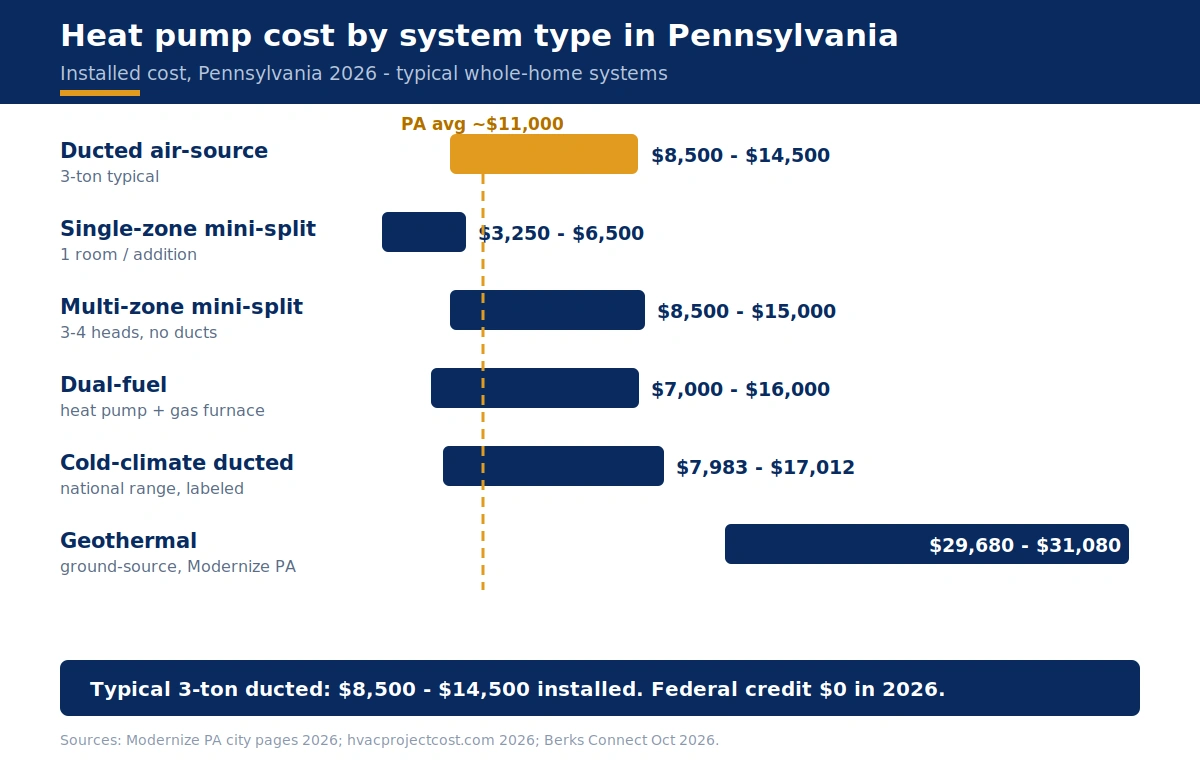
Ducted air-source is the default Pennsylvania system wherever ducts already exist. Modernize splits the tier cleanly for this state: a standard system at $8,480–$8,880 against a high-efficiency system at $12,720–$13,320. The high-efficiency tier means a variable-speed (inverter) system, and in Pennsylvania that upgrade earns its keep in a specific way: it holds heating capacity as the temperature falls, so the expensive auxiliary strip heat fires less often on the coldest nights. That is worth more here than in a mild state, where the strip heat barely runs at all.
Mini-splits are the answer for homes without ducts — and there are a lot of them in Pennsylvania. The state’s older housing stock includes plenty of homes heated by oil, propane, or electric baseboard with no ductwork at all. One zone at $3,250–$6,500 handles a single room or an addition. A whole-home 3–4 zone setup runs $8,500–$15,000, and at that spend a ducted system usually gives you more for the money anywhere ducts already exist or can go in cheaply. Our mini-split installation cost guide breaks down per-zone pricing in detail, and our cold-climate mini-split guide covers the inverter models that matter across most of this state.
Geothermal is the finest system money buys — and the toughest to justify on payback in most of Pennsylvania. At $29,680–$31,080 installed (Modernize PA), with a seasonal COP near 3.8 that never drops with the air temperature, it is superb engineering. But with gas at $1.31 a therm, the efficiency premium over a good air-source system buys less here than it would in a state with expensive gas. The honest exception is rural homes heating with propane, where payback can be genuinely fast. Geothermal lost its 30% federal credit on the same date — a $30,000 system that would have run $21,000 after the credit in 2025 now costs the full $30,000.
Heat pump cost by size in Pennsylvania
No published Pennsylvania tonnage table exists, so the table below is built from the Pennsylvania installer ranges above (3-ton anchor: $8,500–$14,500) and the national tonnage pattern. Treat it as planning ranges, not quotes.
| Tonnage | Home size served | Pennsylvania installed range (planning) |
|---|---|---|
| 2 ton | 1,000–1,200 sq ft | $7,000–$11,000 |
| 2.5 ton | 1,200–1,500 sq ft | $8,000–$12,500 |
| 3 ton | 1,500–1,800 sq ft | $8,500–$14,500 |
| 4 ton | 1,800–2,200 sq ft | $10,500–$17,000 |
| 5 ton | 2,200–3,000 sq ft | $12,500–$19,000 |
Per-ton installed cost runs roughly $2,800–$3,800 per ton in Pennsylvania, and the per-ton rate falls as tonnage rises. Higher SEER2/HSPF2 ratings push each band upward, and cold-climate models add 15–30% over standard equipment at the same tonnage.
Floor area alone cannot size a system. Dividing square footage by 500 or 600 to get tonnage is a guess, not a method. Proper sizing means a Manual J load calculation ($200–$500, often credited toward the install), which weighs insulation, windows, ceiling height, and — the part that matters most here — the heating load at the local design temperature. An oversized system short-cycles, and an undersized one leans on strip heat all winter; in Pennsylvania, the undersizing mistake is the expensive one, because every hour on strip heat costs roughly two and a half times what the heat pump itself would have cost for the same warmth.
What drives your price up or down in Pennsylvania
Cold-climate equipment. This is the cost driver that separates Pennsylvania from the southern state guides. A standard heat pump starts losing capacity below about 30°F, and Pennsylvania spends a large share of its winter below that line. Cold-climate (inverter-driven) models hold full heating capacity down to around 5°F and cost 15–30% more than standard models. In Philadelphia’s Zone 4A corner, a standard model is a defensible choice. In Pittsburgh, Erie, and Scranton, price the cold-climate model first and treat the standard model as the thing you need a reason to choose.
Ductwork. Have good ducts? A ducted swap is straightforward. Need new ducts? Angi Philadelphia lists new ductwork at $3,000–$7,500 per 300 linear feet (August 2026), and the national planning range is $5,000–$10,000 for a full duct job. Pennsylvania’s older homes — rowhouses in Philadelphia and Pittsburgh, pre-war houses across the state — often have ducts that were sized for a furnace and a separate AC, or no ducts at all. Ask for duct sealing as its own line item; leaky ducts in an unconditioned attic or basement are the house’s quietest energy waste.
Electrical panel. Every heat pump needs its own 240V circuit, so a full panel or an old 100-amp service means extra work. Plan on $1,500–$4,000 for a 200-amp upgrade (national planning range — no Pennsylvania-specific panel figure was verified). See the electrical panel upgrade cost guide for the options and the price bands.
Efficiency tier. The DOE floor for a split-system heat pump is 14.3 SEER2 / 7.5 HSPF2, and ENERGY STAR starts at 15.2 SEER2 / 7.8 HSPF2. In Pennsylvania the heating number matters more than the cooling number: HSPF2 is the rating that decides how much of the winter the heat pump carries on its own. A mid-tier 15–17 SEER2 system with 8.5+ HSPF2 is the sweet spot for most Pennsylvania homes, and the utility rebate tiers push buyers there anyway — PPL’s higher tier starts at SEER2 16.3 / HSPF2 8.2, and PECO’s top tier at SEER2 17.1.
Labor market. Pennsylvania HVAC labor runs $79–$178 an hour (Modernize PA city pages, 2026). Pittsburgh’s strong union labor market runs higher than the state median, and quotes for identical systems can swing widely between contractors — which is why three quotes are non-negotiable.
Permits and tax. Most Pennsylvania municipalities require a permit at $50–$200; Philadelphia has stricter requirements than the rest of the state (hvacprojectcost.com, 2026). Check whether quotes include Pennsylvania sales tax — it applies to the equipment, and the rate varies by county.
Lake effect and snow. Erie and the northwest sit in a lake-effect snow belt. An outdoor unit buried in a snowdrift cannot move air, and a unit mounted at grade in a snow county will spend part of every winter fighting for clearance. Budget for an elevated pad or wall mount and for keeping the area clear — a small line item that prevents a no-heat call in January.
Refrigerant changeover. Equipment built in 2026 runs on R-454B or R-32, because R-410A left new production on January 1, 2025. The new refrigerants add a small premium over the old ones. If a 2026 quote still lists R-410A, that unit sat in a warehouse — ask which refrigerant the quote actually uses.
A Pennsylvania heat pump lasts 12–15 years with annual maintenance (national figure — no Pennsylvania-specific lifespan was verified). Year-round use shortens life against an AC-only unit, and lake-effect snow, road salt, and freeze-thaw cycles are harder on an outdoor unit in Erie than on one in Philadelphia.
Pennsylvania’s climate: cold winters, humid summers, and what that means for a heat pump
Pennsylvania is a heating-dominant state with two climate zones and a humidity problem on top. The 1991–2020-era ICC Appendix D figures tell the story in numbers:
| Metric | Philadelphia (southeast) | Pittsburgh (west) | Harrisburg (central) | Erie (northwest) | Scranton (northeast) |
|---|---|---|---|---|---|
| IECC climate zone | 4A | 5A | 5A | 5A/6A | 5A/6A |
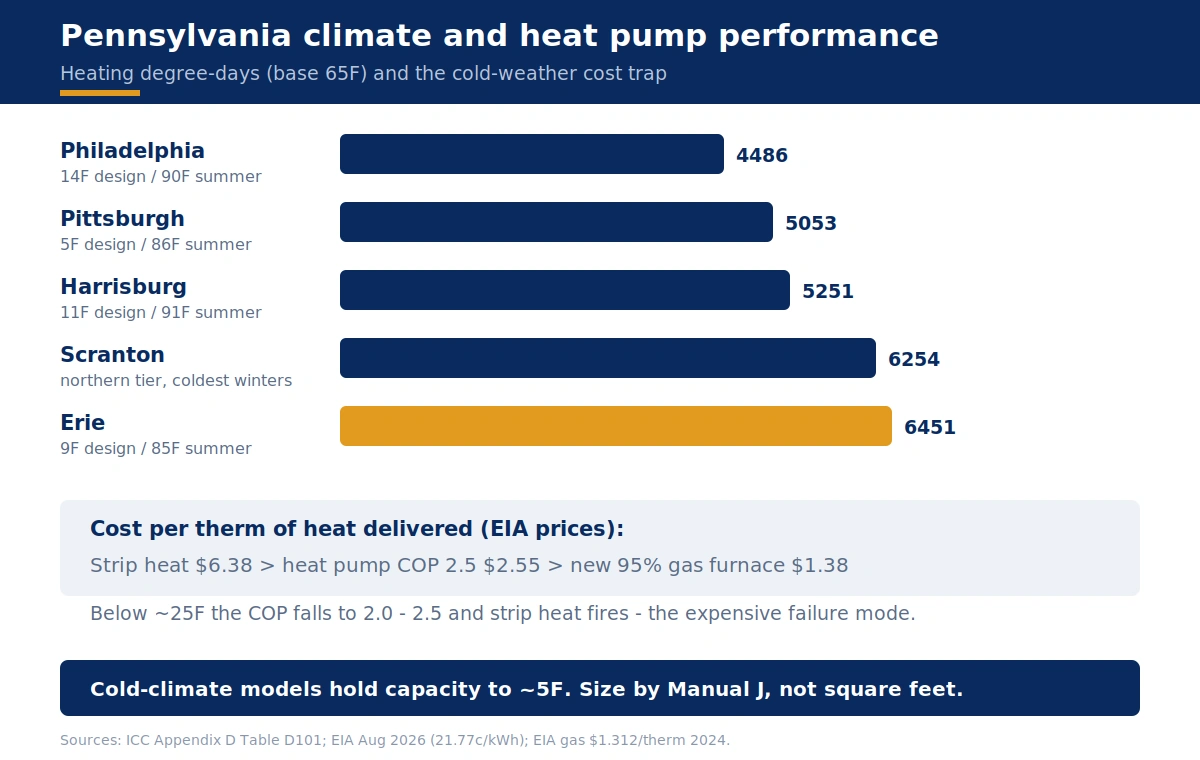
| Heating degree-days (base 65°F) | 4,486 | 5,053 | 5,251 | 6,451 | 6,254 |
| Winter design temp | 14°F | 5°F | 11°F | 9°F | Not verified — do not state |
| Summer design temp | 90°F | 86°F | 91°F | 85°F | Not verified — do not state |
Heating degree-days and design temperatures come from ICC Appendix D, Table D101. An older normals series (Chromalox sizing guide, 1941–1970) runs higher — Philadelphia 4,865, Pittsburgh 5,930, Erie 6,851 — so treat the ICC figures as the planning numbers and the older series as a reminder that the exact count depends on the reference period.
The key insight: Pennsylvania’s load is heating first, cooling second, and the heating season is long. Philadelphia accumulates 4,486 heating degree-days; Erie accumulates 6,451 — roughly 44% more heating load at the cold end of the state than at the warm end. A heat pump here is bought for its heating performance, and its cooling is a bonus. That flips the buying logic of the southern guides, where the cooling rating leads. In Pennsylvania, ask about HSPF2 and cold-weather capacity before you ask about SEER2.
Pennsylvania is four different winters inside one state line. In the southeast (Philadelphia and its suburbs, Zone 4A), winters are the mildest in the state: design temperatures of 8–13°F, fewer than 100 days a year with sub-freezing lows, and zero or below about once every three or four winters (Paramount Plumbing & HVAC, October 2026). A modern cold-climate heat pump can carry most or all of the heating load here. In central Pennsylvania (Harrisburg, Lancaster, the Susquehanna Valley), winters step colder and the heat pump works harder, but standard-plus equipment still holds up. In the west (Pittsburgh, Zone 5A, design ~5–7°F, ~5,900 heating degree-days), cold-climate models and dual-fuel are the standard recommendation, not the upgrade. In the north (Erie, Scranton, the northern tier, Zones 5A/6A), it is genuinely cold: Erie logs 6,451 heating degree-days, and lake-effect snow adds a placement problem no southern guide ever mentions.
Below-freezing performance is the number to interrogate. A standard heat pump’s efficiency falls as the outdoor temperature drops, and below about 25°F its COP (coefficient of performance) drops to 2.0–2.5. When the heat pump can no longer keep up, auxiliary electric strip heat takes over — and strip heat at Pennsylvania’s 21.77 cents per kWh costs roughly $35–$40 per million BTU, more than twice the cost of gas (Lebo’s HVAC, Enola, August 2026). That is the failure mode to design against: a system that is fine at 35°F and ruinous at 15°F. The defenses are a cold-climate inverter model that holds capacity to 5°F, a Manual J calculation that sizes for the design temperature rather than the average day, and — where gas is available and cheap — a dual-fuel setup with the furnace cutting in at a switchover point, usually somewhere around 25–35°F in southeastern Pennsylvania.
Summers are humid, and that shapes the cooling side. Philadelphia’s summer design temperature is 90°F, Harrisburg’s 91°F, and humidity runs high through July and August. A variable-speed compressor earns its keep here the same way it does in the south: longer, slower run cycles pull more moisture out of the air, so the house feels comfortable at a higher thermostat setting. No verified Pennsylvania dew-point or relative-humidity statistic was found, so none is stated here — the design temperatures and the humidity guidance above are enough to size the conversation. An oversized system that short-cycles will leave a Pennsylvania house clammy in August just as surely as it would in North Carolina.
Efficiency ratings that matter in Pennsylvania. Under the DOE’s 2023 standards, a split-system heat pump must hit at least 14.3 SEER2 for cooling and 7.5 HSPF2 for heating. To convert HSPF2 to a seasonal COP, divide by 3.412: the 7.5 HSPF2 minimum is a seasonal COP of about 2.2, and a good Pennsylvania heat pump running at a seasonal COP near 2.5 is the working assumption in this guide’s payback math. For most Pennsylvania homes, 15–17 SEER2 with 8.5+ HSPF2 is the sweet spot, with cold-climate models worth the premium everywhere except the warmest southeastern corner. Florida runs the opposite playbook — cooling first, heating barely at all — see Florida’s heat pump climate.
The federal tax credit is $0 in 2026 — what that means
Here is the fact that changes every 2026 heat pump quote in Pennsylvania. The §25C Energy Efficient Home Improvement Credit used to pay 30%, up to $2,000 a year, for heat pumps. The One Big Beautiful Bill Act (OBBBA, P.L. 119-21, signed July 4, 2025) ended it for any property placed in service after December 31, 2025, and the IRS spelled out the cutoff in FS-2025-05 (August 21, 2025). For any heat pump installed in Pennsylvania in 2026, the federal credit is $0.
One carve-out to keep straight: a system put in during 2025 still belongs on the 2025 return (IRS Form 5695). That covers 2025 work only, not a 2026 job — paying for the equipment in 2025 changes nothing when the install wrapped up in 2026.
Geothermal’s 30% §25D credit ended on the same date, under the same law. And there is no lease workaround for heat pumps: the surviving §48E credit is for clean-electricity generation, so it reaches leased solar panels but never a heat pump. Nobody should sell you a heat pump lease on the promise that a federal credit will pass through to you. The full post-OBBBA picture sits in the federal energy tax credits guide.
Be alert for quotes that still subtract a $2,000 federal credit. It is the most common stale-math trap in 2026 heat pump pricing, and it is live in Pennsylvania right now: Modernize’s Pennsylvania city pages still mention “federal tax credits (up to 30% under the Inflation Reduction Act),” and lowerthepowerbill.org still shows “30% tax credit on insulation & air sealing, up to $2,000 on heat pumps, $3,200 annual cap.” Both are wrong for 2026 installs. Tell any contractor still showing a credit line to strike it and re-total before you sign.
Pennsylvania rebates that are still alive in 2026
Pennsylvania’s rebate map in 2026 is the thinnest in this series, and the reason is a single missing program. The full picture, dated, is in one table below.
| Program | 2026 status | Value |
|---|---|---|
| Federal §25C credit | Expired Dec 31, 2025 — $0 | $0 |
| Federal §25D geothermal credit | Expired Dec 31, 2025 — $0 | $0 |
| Penn Energy Savers — HEAR (PA DEP) | NOT LAUNCHED — awaiting final DOE approval; program site targets Spring 2027 | Up to $8,000 for a heat pump when it launches (planned, not payable) |
| Penn Energy Savers — HOMES (PA DEP) | NOT LAUNCHED — same approval wait | Up to $16,000/dwelling modeled-savings cap when it launches (planned) |
| PECO (Philadelphia + southeast) | Open — Act 129 Phase V, June 1, 2026–May 31, 2031 | Air-source $200–$300 by efficiency tier; ductless $150–$300 |
| PPL Electric (central + eastern PA) | Open — Act 129 Phase V | Air-source $225–$325; income-qualified up to $475; mini-split up to $225, income-qualified up to $350 |
| Duquesne Light (Pittsburgh city) | Open — instant distributor discount | Air-source $215; ductless mini-split $80; heat pump water heater $150 |
| FirstEnergy — Met-Ed, Penelec, Penn Power, West Penn Power | Phase V residential amounts NOT VERIFIED (Sep 4, 2026) | Do not count on a figure — check energysavepa.com |
| UGI Electric | Listed as active; amount not verified | No figure — verify with UGI |
| PA state tax credit for heat pumps | None — does not exist | — |
| PHFA HEELP loan (not a rebate) | Open | $1,000–$10,000 at 1% APR for 10 years (~$88/mo on $10,000) |
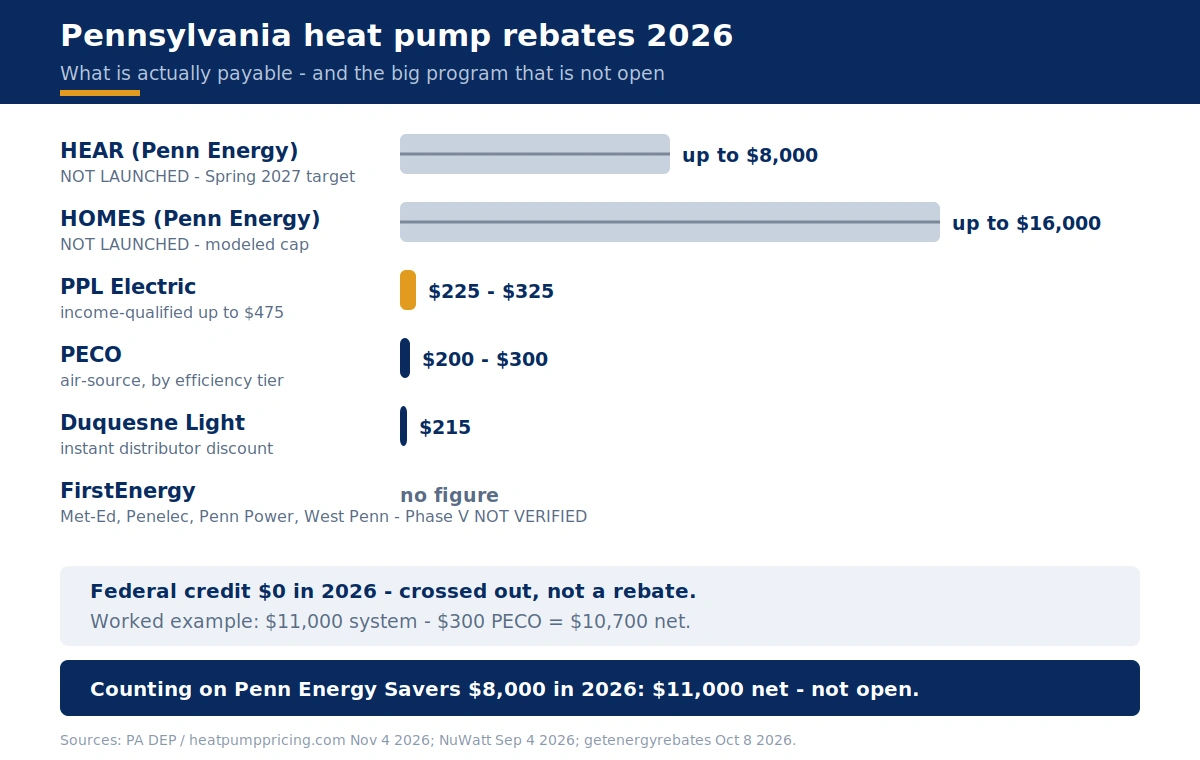
Penn Energy Savers is the rebate that is not there. Pennsylvania’s Department of Environmental Protection secured $258.9 million in federal IRA funding — $129.2 million for HEAR and about $129.7 million for HOMES — under the Penn Energy Savers umbrella. The groundwork is in place and administrators are named. But the federal funds have not been approved for release, the program is not taking applications, and the program site now targets Spring 2027 (heatpumppricing.com, status data verified November 4, 2026; BetterHouse, September 2026; GridShift, updated October 21, 2026; Shipley Energy, May 4, 2026). When it does open, HEAR is planned as a point-of-sale rebate — the discount comes off the invoice at purchase — covering up to 100% of cost for households at or below 80% of area median income (capped at $8,000 for the heat pump) and 50% for households at 80–150% of AMI. Until then, none of that money exists for a 2026 buyer. Sign up for updates at pennenergysavers.com and check eligibility there; do not let a quote subtract $8,000 that cannot be collected.
One more wrinkle for when it launches: DOE Program Notice 26-2 (May 29, 2026) rewrote the HEAR rules so the program no longer pays to replace gas, oil, or propane equipment. A home may keep its furnace and add a heat pump alongside it, and electric-to-electric upgrades still qualify — but a gas-to-heat-pump swap will not, even after Penn Energy Savers opens. That matters in Pennsylvania more than in most states, because 52% of Pennsylvania homes heat with utility gas and only 26% with electricity (Census ACS 2024). Most of the state’s gas-heated homes would not have qualified for the $8,000 even if the program had opened on time.
PECO is the best utility rebate in the state — and it is $200–$300. PECO’s Phase V program (June 1, 2026–May 31, 2031) pays $200 for an air-source heat pump at SEER2 15.2–17.0 and $300 at SEER2 17.1 or above (EER2 ≥11, HSPF2 ≥7.8), with ductless at $150–$300 on the same tiers; the system must be a complete system serving as the primary heat source, and applications go in within 90 days of purchase or installation (getenergyrebates.com, last checked October 8, 2026). One conflict to flag: hvacprojectcost.com says PECO HomeWorks pays “up to $800” for qualifying heat pumps. That figure could not be confirmed against the October 2026 program listing, so this guide uses $200–$300 and treats $800 as unconfirmed. PECO also pays a rebate for an ENERGY STAR heat pump water heater.
PPL pays $225–$325, more if you are income-qualified. PPL Electric’s air-source rebate is $225 or $325 depending on efficiency (higher tier at SEER2 ≥16.3 / HSPF2 ≥8.2), rising to $475 for income-qualified households; mini-splits pay up to $225, or up to $350 income-qualified (NuWatt, program sources checked September 4, 2026; Berks Connect, October 3, 2026). PPL covers Allentown, Harrisburg, Scranton, and much of central and eastern Pennsylvania — the largest territory in the state by customer count outside Philadelphia and Pittsburgh.
Duquesne Light pays $215 at the distributor, not by check. Duquesne’s Phase V offer is a point-of-sale instant discount through participating distributors: $215 for a qualifying air-source heat pump, $80 for a ductless mini-split, $150 for a heat pump water heater (Palmetto, 2026; NuWatt, September 4, 2026, July 2026 sheet). Confirm a participating distributor before purchase — an instant discount that never reaches the invoice is worth $0 — and note that Duquesne’s retail rebate portal was being refreshed at last check. A competing figure of “up to $500” from lowerthepowerbill.org could not be verified and is treated here as an older Phase IV number.
FirstEnergy is the gap in the map. Met-Ed, Penelec, Penn Power, and West Penn Power ran an EnergySave PA program in Phase IV with air-source tiers of $250–$500 — but that purchase window ended May 31, 2026, and as of September 4, 2026 no Phase V residential heat pump amount had been verified for any of the four companies (NuWatt, September 4, 2026). This guide gives no FirstEnergy number, because inventing one would be worse than admitting the gap. If FirstEnergy bills you, check energysavepa.com or call 855-897-6394 before counting on money. The same honesty applies to UGI Electric, listed among active 2026 utility offers by Palmetto with no verified amount.
Worked rebate examples — 3-ton ducted heat pump, $11,000 installed:
- PECO customer, high-efficiency 17.1+ SEER2 unit: $11,000 minus $300 = $10,700 net.
- PPL customer, standard tier: $11,000 minus $225 = $10,775 net; income-qualified at the top tier: $11,000 minus $475 = $10,525 net.
- Duquesne Light customer: $11,000 minus $215 instant discount = $10,785 net.
- FirstEnergy customer: $11,000 gross, $11,000 net until a Phase V amount is published — verify before you buy.
- Any Pennsylvania household counting on Penn Energy Savers’ $8,000 in 2026: $11,000 gross, $11,000 net — the program is not open, and the money cannot be collected this year.
The contrast with North Carolina is the point of this section. There, Duke pays $500–$1,000 and Energy Saver NC pays up to $8,000 today. In Pennsylvania, the biggest rebate a typical household can actually collect in 2026 is $475 — and most will collect $200–$325. The quoted price is the real price here, and the payback math in a later section is built on that fact.
Pennsylvania electricity rates and what a heat pump costs to run
Pennsylvania’s residential electricity costs 21.77 cents per kilowatt-hour (EIA Electric Power Monthly, Table 5.6.A, August 2026, released October 28, 2026) — about 20% above the US average of 18.16 cents, and the 14th highest of 51 jurisdictions. The average August bill was $198.28 on 911 kWh. Rates rose 9.2% year over year (August 2025 was 19.93 cents). The 2025 annual average was 19.29 cents on 839 kWh a month, a $161.90 monthly bill. Expensive power is the headwind for heat pump payback in this state — and the reason the running-cost comparison in this section is the least flattering in this series.
Pennsylvania is a deregulated electricity market, and that changes what you actually pay. Customers can choose their generation supplier (deregulated since 1996). The cheapest fixed 12-month supply plan listed on November 4, 2026 was 11.4 cents per kWh in PECO territory — but that is supply only; delivery is billed separately by the utility, and the all-in EIA average of 21.77 cents is what the average household actually pays. The PUC’s “price to compare” averaged 12.61 cents for June–November 2026 (Independent Fiscal Office). PECO’s standard residential tariff carries an $11.29 monthly fixed charge plus 10.28 cents per kWh in riders, working out to about 23.29 cents per kWh all-in at 900 kWh. A heat pump household should compare the all-in rate, not the supply-only teaser.
What does it cost to run? The honest answer depends entirely on what the heat pump replaces. Using EIA prices — electricity 21.77 cents per kWh (August 2026), natural gas $1.312 per therm (2024) — the cost per therm of heat delivered works out as follows:
| Heat source | Cost per therm delivered |
|---|---|
| Electric strip heat (COP 1.0) | $6.38 |
| Heat pump, seasonal COP 2.5 (PA planning assumption) | $2.55 |
| Heat pump, seasonal COP 3.0 (mild winter, SE PA) | $2.13 |
| New 95% AFUE gas furnace | $1.38 |
| Old 80% AFUE gas furnace | $1.64 |
| Propane, 85% (about $2.67/gal) | $3.08 |
| Oil, 85% (about $4.20/gal) | $3.57 |
A heat pump needs a seasonal COP of about 3.70 to match a 95% gas furnace at Pennsylvania prices (startbusinessbystate, October 6, 2026, on 2025 prices) — and a real Pennsylvania system runs closer to COP 2.5 across a cold winter. That is the whole running-cost story in one number: against gas, the heat pump loses on heating. Against everything else, it wins. An independent modeled comparison agrees: searchright.io (2026, EIA data) puts a federal-minimum heat pump at about $975 a year to heat a modeled Pennsylvania home against $676 a year for a federal-minimum gas furnace, with an ENERGY STAR heat pump at about $715 a year. Its break-even electricity price is 12.31 cents per kWh at the federal-minimum tier and 14.14 cents at the ENERGY STAR tier — Pennsylvania pays 21.77 cents.
The truth for Pennsylvania in 2026, baseline by baseline:
- Against electric strip heat or baseboard (common in older Pennsylvania homes, especially rural ones): the heat pump wins big — $6.38 against $2.55 per therm. The heating bill falls by roughly 60%.
- Against oil: the heat pump wins clearly — $3.57 against $2.55 per therm.
- Against propane: the heat pump wins modestly — $3.08 against $2.55 per therm.
- Against an old 80% gas furnace: the heat pump loses on heating — $1.64 against $2.55 per therm.
- Against a new 95% gas furnace: the heat pump loses by more — $1.38 against $2.55 per therm.
One more honest note: when a heat pump takes over from a gas furnace, your winter electric bill climbs. The heat you used to buy as gas now shows up on the PECO or PPL bill instead, while the gas bill shrinks. The household total is what matters, not one bill — and in Pennsylvania, for a gas-heated home, that household total goes up on heating alone. The heat pump’s case for a gas home is the air conditioning it also replaces, not the heating bill.
Heat pump vs furnace in Pennsylvania: the honest comparison
This is the comparison most articles get wrong. One heat pump does the work of two systems: it heats in winter and cools in summer. The fair comparison puts a furnace and an air conditioner together against the heat pump — never a furnace on its own.
| Option | Installed (PA) | Notes |
|---|---|---|
| Heat pump (complete system) | $8,500–$14,500 (typical 3-ton) | Heats AND cools — one system |
| Gas furnace alone | ~$4,500–$10,000 (national, article 1 — no PA-specific figure verified) | Needs a separate AC |
| Outdoor AC alone | ~$5,500–$12,500 (national, article 61 — no PA-specific figure verified) | Needs a separate furnace |
| Furnace + AC combined | ~$10,000–$22,500 (national components) | The true comparison — roughly a wash with the heat pump upfront, or the heat pump cheaper |
Upfront, it is roughly a wash in Pennsylvania. The heat pump then wins on running costs against electric, oil, and propane heat, and loses on running costs against gas heat. Pennsylvania-specific furnace and AC component prices were not verified — present the combined $10,000–$22,500 as a national-components estimate, flagged.
When does the furnace win in Pennsylvania? In most gas-heated homes, on heating cost alone. With gas at $1.31 a therm and electricity at 21.77 cents, a 95% furnace delivers a therm for $1.38 against the heat pump’s $2.55 at a seasonal COP of 2.5. That gap narrows in Philadelphia’s mild corner, where the heat pump holds a COP near 3.0 for more of the season, and it widens in Erie and the north, where the heat pump spends more hours at low COP or on strip heat. If your home already has cheap natural gas and a working furnace, and the air conditioner is not due for replacement, a heat pump is a comfort and cooling upgrade — not a heating saving. The full heat pump vs furnace cost comparison works through the 10-year math in detail, and the heat pump running cost guide covers the formulas.
When does the heat pump win? Against electric strip heat, decisively — a 60% cut in heating cost per therm. Against oil and propane, clearly. And when the AC needs replacing anyway: a heat pump is one install instead of two, and the cooling-efficiency gain is real money in a state with 90°F summer design temperatures and humid Julys. One more point for the heat pump in this state: with no combustion it cannot produce carbon monoxide — worth weighing for any family replacing an old gas or oil furnace. And for the 26% of Pennsylvania homes that heat with electricity, the heat pump is the single biggest heating-bill cut available.
Dual-fuel and geothermal: when they make sense in Pennsylvania
Dual-fuel pairs a heat pump with a gas furnace. The heat pump carries the mild weather; the furnace cuts in below a switchover point, usually somewhere around 25–35°F in southeastern Pennsylvania. Installed cost runs $7,000–$16,000 (hvacprojectcost.com Pennsylvania, 2026). In western Pennsylvania, where winters are coldest and gas is cheap, dual-fuel is the default recommendation rather than a niche — it is the setup that lets the heat pump do the efficient work above freezing and hands the coldest nights to the furnace at $1.38 a therm instead of strip heat at $6.38. Across the southeast, the furnace in a dual-fuel setup fires less often, so the second system mostly buys insurance for a few cold nights a year. The dual-fuel heat pump cost guide goes into the technology in depth.
Geothermal (ground-source) is the efficiency champion: a seasonal COP near 3.8, no drop-off with air temperature, and a ground loop that lasts 25+ years. It is also $29,680–$31,080 installed in Pennsylvania (Modernize), with hard drilling able to push it past $50,000 nationally. In a state with gas at $1.31 a therm, the efficiency premium over air-source buys less than it would where gas is expensive, so payback runs long for most gas-heated homes. Honest framing: geothermal is the finest system money buys and the hardest to justify on payback alone in Pennsylvania. It makes sense for rural homes heating with expensive propane — where payback can be genuinely fast — and for homeowners who value the 25-year loop and the absence of an outdoor unit in a snow county. No Pennsylvania utility pays a geothermal-specific rebate that was verified. The geothermal heat pump cost guide covers the full depth of the technology.
Cold-climate mini-splits are a statewide question in Pennsylvania, not a mountain-only one. A cold-climate inverter unit still puts out heat at −15°F — and Pennsylvania installers price that ability at roughly 15–30% over a standard model. That capability buys little in a mild state — but Pennsylvania spends enough of its winter below 30°F that the premium is worth pricing in Pittsburgh, Harrisburg, Scranton, and Erie alike, and worth considering even in Philadelphia. Our cold-climate mini-split guide covers the technology in full; the point here is simply not to assume only the north needs it.
Payback math: when a Pennsylvania heat pump pays for itself
Worked example: 3-ton ducted air-source, $11,000 installed (Modernize Pennsylvania average, 2026). Heating load: a modeled Pennsylvania home uses 41.2 MMBtu a year of delivered heat, or 412 therms (searchright.io, 2026, at 5,721 heating degree-days). Per-therm costs from the running-cost section: strip heat $6.38, heat pump at COP 2.5 $2.55, old 80% furnace $1.64, new 95% furnace $1.38, propane $3.08, oil $3.57.
| Line | Math | Result |
|---|---|---|
| Installed cost | Modernize PA average | $11,000 |
| Less PPL rebate (standard tier) | $325 | −$325 |
| Net cost (typical, PPL customer) | $10,675 | |
| Annual heating saving vs electric strip heat | 412 therms × ($6.38 − $2.55) | ~$1,578/yr |
| Simple payback, strip-heat replacement | $10,675 ÷ $1,578 | ~7 years |
| Annual heating saving vs oil | 412 therms × ($3.57 − $2.55) | ~$420/yr |
| Simple payback vs oil (heating only) | $10,675 ÷ $420 | ~25 years |
| Annual heating saving vs propane | 412 therms × ($3.08 − $2.55) | ~$218/yr |
| Simple payback vs propane (heating only) | $10,675 ÷ $218 | ~49 years (heating alone — see framing below) |
| Annual heating saving vs new 95% gas furnace | 412 therms × ($1.38 − $2.55) | −$482/yr (heat pump costs more) |
| 15-year net position, strip-heat swap | $1,578 × 15 − $10,675 | +$12,995 |
| 15-year net position, oil replacement | $420 × 15 − $10,675 | −$4,375 (heating alone) |
Assumptions, stated plainly: $11,000 installed (Modernize Pennsylvania average); PPL $325 rebate; seasonal COP 2.5; savings are heating-only (cooling-efficiency savings against an old AC are real but not modeled — a new heat pump also replaces the AC, which is part of the value); no electricity-price escalation modeled; maintenance excluded (roughly similar for a heat pump against a furnace plus AC); no Penn Energy Savers stacking in the base case (the program is not open). This payback model is our own arithmetic, not a published Pennsylvania benchmark — none was found. The honest headline for Pennsylvania: your payback is decided by the system the heat pump replaces.
Payback by scenario:
- Replacing electric strip heat or baseboard (common in older Pennsylvania homes, especially rural ones): fastest payback — heating electricity falls by roughly 60% at COP 2.5 (~7 years typical). This is the largest winning segment in the state.
- Replacing oil heat: heating savings alone (~$420 a year) never pay back the system inside its 12–15 year life — the economic case is the avoided second system (one install instead of furnace plus AC), the end of oil deliveries and tank liability, and the cooling-efficiency gain.
- Replacing propane: heating savings alone (~$218 a year) never pay back the system — same framing as oil, with the added point that propane prices swing more than gas, so the saving is less certain year to year.
- Replacing a gas furnace: heating savings are negative (~−$482 a year) — do not buy a heat pump for heating savings alone in this scenario; buy it when the AC also needs replacing, for comfort, or for the carbon-monoxide-free operation.
- Swapping one heat pump for another: the slowest payback of all — the only saving is the efficiency step up (14.3 to 17 SEER2, 7.5 to 9 HSPF2), worth roughly 15–25% of HVAC energy. PPL pays only $225–$325 here, PECO $200–$300.
- Philadelphia and the southeast: mildest winters, COP nearer 3.0 for more of the season — payback improves by roughly a year against electric heat and the gas gap narrows, though it does not close.
- Erie and the north: coldest winters, more strip-heat hours — payback stretches for standard equipment; cold-climate models and dual-fuel deserve quotes. Propane-heated northern homes are the exception — payback can be fast.
A heat pump lasts 12–15 years in Pennsylvania. A payback near 7 years on a system that lasts 12–15 years is a genuinely good deal for a strip-heat swap. For a gas-heated home, the same system never pays back on heating — and saying so plainly is the point of this guide.
How to get quotes in Pennsylvania + red flags
Collect three or more installer quotes, asking every contractor the same questions so the answers line up:
- What is my cost before any rebates? The Pennsylvania benchmark is $8,500–$14,500 for a typical 3-ton ducted system, with a ~$10,550–$11,100 average. A quote far above $18,000 should come with a reason spelled out — complex ductwork, premium variable-speed equipment, panel work, or a cold-climate model in the north.
- Did you do a Manual J load calculation? Sizing from square footage alone makes the quote a guess, and an undersized guess here means a winter of strip heat at $6.38 a therm.
- Does the quote deduct a $2,000 federal credit anywhere? The credit ended for 2026 installs, so have the contractor strike that line and re-total before you sign.
- Is Penn Energy Savers in this quote? The program has not launched and is not taking applications. Any quote counting an $8,000 HEAR rebate in 2026 is counting money that cannot be collected this year. Sign up for updates at pennenergysavers.com instead.
- Which rebate applies to MY utility? PECO pays $200–$300, PPL $225–$325 (up to $475 income-qualified), Duquesne Light $215 as an instant distributor discount, and FirstEnergy’s Phase V residential amounts are not verified — a quote using another utility’s rebate is the wrong quote.
- What SEER2 and HSPF2 does this exact unit carry, and what does the warranty cover on the compressor versus the rest? In Pennsylvania, 15–17 SEER2 with 8.5+ HSPF2 is the sweet spot, and the HSPF2 number matters more than the SEER2 number. Ask specifically about the compressor warranty and about cold-weather capacity — how much heat the unit still delivers at 5°F.
- Is the installer licensed, and is the permit included? Pennsylvania has no state HVAC contractor licensing board — verify the contractor through the local license instead (Philadelphia Mechanical Contractor License via the Department of Licenses and Inspections eCLIPSE system; Pittsburgh runs its own program), plus EPA Section 608 certification for anyone opening a refrigerant circuit. Confirm the permit ($50–$200 in most municipalities, stricter in Philadelphia) is a line item, not an afterthought.
- Did you check my HOA rules and my snow plan? An HOA can regulate outdoor-unit placement, screening, and appearance — check architectural guidelines before install; this guide states no legal position. In snow country, confirm the outdoor unit sits on an elevated pad or wall mount with clearance, not at grade where a drift can bury it.
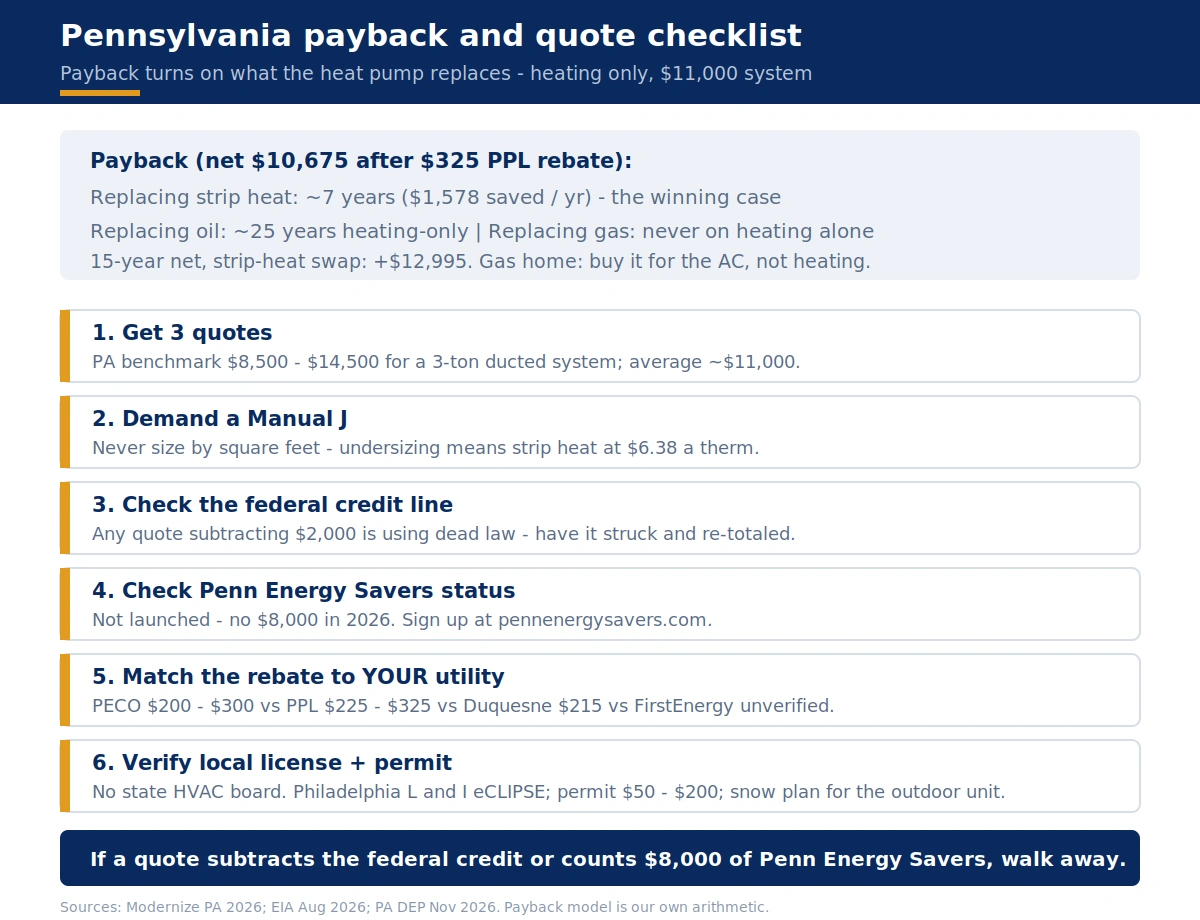
Red flags. A quote far below the $8,500–$14,500 installer range with no explanation of what is excluded — check it against the Angi $6,266 trap. A contractor who picks a size from your floor area and never runs a Manual J calculation. Any “free heat pump” or “government program” door-to-door pitch — no government program gives away heat pumps; Penn Energy Savers is not open, income-qualified when it launches, and capped, not free equipment for everyone. A furnace-only price presented as the cheaper alternative, while the air conditioner it still needs stays out of the total. A utility rebate assumed without checking which utility bills you — PECO, PPL, Duquesne Light, and FirstEnergy all pay different amounts, and FirstEnergy’s current amount is unverified. A system sold as new in 2026 that still runs on R-410A — production of new R-410A equipment stopped on January 1, 2025, so that unit is old stock. And any “sign today to lock in the credit” pressure — the credit is gone, so that deadline was invented for the sales call. The FTC Cooling-Off Rule (16 CFR Part 429) gives you a 3-day right to cancel any door-to-door sale of $25 or more.
Sources & methodology
How this guide was built. Every price in this guide is dated November 2026 Pennsylvania data, and every figure names its source in the text. The headline range ($8,500–$14,500 installed, ~$11,000 average) is built from Modernize’s Pennsylvania city pages (Philadelphia $10,550; Pittsburgh $11,050; Harrisburg $11,100; Bethlehem $10,550; standard $8,480–$8,880; high-efficiency $12,720–$13,320; single-zone mini-split $5,830–$6,105; 3-zone $12,720–$13,320; geothermal $29,680–$31,080; labor $79–$178/hr) cross-checked against hvacprojectcost.com’s 2026 Pennsylvania guide (heat pump $5,500–$14,500; dual-fuel $7,000–$16,000; regional adjustments +5–10% west, +5–15% north). EnergySage’s Pennsylvania average of $16,080 (updated March 19, 2026) is reported as the upper-marketplace figure, not averaged in. Angi Philadelphia ($6,266, updated August 3, 2026) and Manta city calculators are treated as equipment-lean outliers. Berks Connect (published September 5, 2026; updated October 3, 2026) supplies the single-zone mini-split average of $3,250 and the cold-climate range of $7,983–$17,012.
Rebates. Penn Energy Savers status (not launched; Spring 2027 target; $258.9M allocation) is verified against four independent trackers: heatpumppricing.com (status data verified November 4, 2026), BetterHouse (September 2026), GridShift (updated October 21, 2026), and Shipley Energy (May 4, 2026), plus ECW’s October 27, 2026 allocation table ($129,226,380 HEAR + $129,723,107 HOMES). Utility amounts: PECO $200–$300 tiers from getenergyrebates.com (last checked October 8, 2026); PPL $225–$325 / up to $475 income-qualified from NuWatt (program sources checked September 4, 2026) and Berks Connect (October 3, 2026); Duquesne Light $215 / $80 / $150 instant discounts from Palmetto (2026) and NuWatt (September 4, 2026); FirstEnergy Phase V residential amounts explicitly not verified (NuWatt, September 4, 2026), with the ended Phase IV window (June 1, 2021–May 31, 2026) documented from FirstEnergy’s own forms. DOE Program Notice 26-2 (May 29, 2026) is the source for the end of HEAR fuel-switching. The PHFA HEELP loan ($1,000–$10,000 at 1% APR for 10 years) comes from Shipley Energy (May 4, 2026).
Rates and running costs. Electricity 21.77 cents/kWh (EIA Electric Power Monthly, Table 5.6.A, August 2026, released October 28, 2026); 2025 annual average 19.29 cents (EIA); gas $1.312/therm (EIA State Energy Data System, 2024) and $15.04/Mcf (EIA, 2025). Break-even COP 3.70 from startbusinessbystate.com (October 6, 2026, on 2025 prices); modeled annual heating costs ($975 federal-minimum heat pump vs $676 furnace) from searchright.io (2026). Heating fuel mix (52% gas, 26% electricity) from Census ACS 2024 via startbusinessbystate. Per-therm and payback arithmetic in this guide is our own, built from those EIA prices at a seasonal COP of 2.5, and is labeled as such wherever it appears.
Climate. Heating degree-days and design temperatures from ICC Appendix D, Table D101 (Philadelphia 4,486 HDD / 14°F; Pittsburgh 5,053 / 5°F; Harrisburg 5,251 / 11°F; Erie 6,451 / 9°F; Allentown 5,810 / 9°F; Scranton 6,254). Zone 4A/5A/6A framing and southeastern Pennsylvania design temperatures (8–13°F) from Paramount Plumbing & HVAC (October 2026). Cold-climate capacity to 5°F and the 25–35°F balance point from the same source; strip-heat cost of $35–$40/MMBtu from Lebo’s HVAC (Enola, August 2026), used directionally. Efficiency floors (14.3 SEER2 / 7.5 HSPF2; ENERGY STAR 15.2 / 7.8) from DOE 2023 standards.
Federal law. OBBBA (P.L. 119-21, signed July 4, 2025) and IRS FS-2025-05 (August 21, 2025) for the end of §25C and §25D for property placed in service after December 31, 2025. No Pennsylvania state HVAC licensing board (ushvacreviews, August 25, 2026). No Pennsylvania state tax credit for heat pumps (Shipley, May 2026; ushvacreviews, August 2026).
What was not verified. No Pennsylvania-specific figures were found for panel-upgrade cost, duct-sealing cost, dehumidifier cost, furnace-only or AC-only installed prices, heat pump lifespan, or dew-point/relative-humidity statistics — this guide uses national planning ranges labeled as such, or omits the figure. Conflicting figures (PECO $800 vs $200–$300; Duquesne $500 vs $215; EnergySage $16,080 vs Modernize ~$11,000; ICC vs older-normals degree-days; gethomeheat gas $2.77/therm vs EIA $1.312) are flagged in the research file (files/research/71-heat-pump-cost-pennsylvania-2026.md, LESS-THAN-CERTAIN section) and handled in the text by naming the figure this guide uses and the one it rejects.
How much does a heat pump cost in Pennsylvania in 2026?
A typical whole-home ducted heat pump costs $8,500–$14,500 installed in Pennsylvania in 2026, with the statewide average job near $11,000 (Modernize Pennsylvania city pages). A single-zone mini-split runs $3,250–$6,500, a multi-zone system $8,500–$15,000, dual-fuel $7,000–$16,000, and geothermal $29,680–$31,080. The federal tax credit is $0 for 2026 installs, so the quote is the price you pay, minus only the small utility rebates below.
Is the $8,000 Penn Energy Savers heat pump rebate available in Pennsylvania?
No — not in 2026. Penn Energy Savers, Pennsylvania’s HEAR/HOMES program run by the Department of Environmental Protection, has not launched. The Department is still awaiting final federal approval, and the program site now targets Spring 2027. The $8,000 heat pump cap is a planned figure for income-qualified households when the program opens, not money you can collect today. Sign up for updates at pennenergysavers.com and do not let a quote subtract $8,000 that cannot be collected.
What heat pump rebates can I actually get in Pennsylvania in 2026?
Only small utility rebates under Act 129 Phase V, and the amount depends on which utility bills you. PECO pays $200–$300 for an air-source heat pump by efficiency tier. PPL Electric pays $225–$325, up to $475 for income-qualified households. Duquesne Light gives a $215 instant discount through participating distributors. FirstEnergy’s four companies (Met-Ed, Penelec, Penn Power, West Penn Power) have no verified Phase V residential heat pump amount as of September 2026 — check energysavepa.com before counting on money. There is no Pennsylvania state tax credit for heat pumps.
Is a heat pump cheaper to run than a gas furnace in Pennsylvania?
No, on heating alone it is not. At Pennsylvania’s electricity price of 21.77 cents per kWh (EIA, August 2026) and gas at about $1.31 a therm, a heat pump at a seasonal COP of 2.5 delivers a therm of heat for about $2.55, while a new 95% gas furnace delivers it for about $1.38. A heat pump needs a seasonal COP near 3.70 to match the furnace here. The heat pump wins clearly against electric strip heat ($6.38 a therm), oil ($3.57), and propane ($3.08) — and when the air conditioner needs replacing anyway, one system doing both jobs changes the math.
Do I need a cold-climate heat pump in Pennsylvania?
In most of the state, yes — price one first. Pennsylvania spends much of its winter below 30°F, where standard heat pumps lose capacity, and design temperatures run from 14°F in Philadelphia to 5°F in Pittsburgh and 9°F in Erie. Cold-climate inverter models hold full heating capacity down to about 5°F and cost 15–30% more than standard models. A standard model is a defensible choice only in the warmest southeastern corner around Philadelphia. In the west and north, also get a dual-fuel quote (heat pump plus gas furnace, $7,000–$16,000).
How long does a heat pump last in Pennsylvania?
About 12–15 years with annual maintenance. Year-round use shortens life against an air-conditioner-only unit, and lake-effect snow, road salt, and freeze-thaw cycles are harder on an outdoor unit in Erie and the north than on one in Philadelphia. In snow country, mount the outdoor unit on an elevated pad or wall bracket with clearance, not at grade where a drift can bury it.
Do I need a permit or a license to install a heat pump in Pennsylvania?
Most Pennsylvania municipalities require a permit, typically $50–$200, with stricter requirements in Philadelphia. Pennsylvania has no state HVAC contractor licensing board, so verify the contractor through the local license instead — Philadelphia issues Mechanical Contractor Licenses through the Department of Licenses and Inspections eCLIPSE system, and Pittsburgh runs its own program — plus EPA Section 608 certification for anyone opening a refrigerant circuit.
Can I still claim the federal heat pump tax credit in 2026?
No. The §25C credit (30%, up to $2,000 a year) ended for any heat pump placed in service after December 31, 2025, under the One Big Beautiful Bill Act (P.L. 119-21); the IRS set out the rule in FS-2025-05. A system installed in 2025 can still be claimed on the 2025 return with Form 5695, but paying in 2025 changes nothing if the install finished in 2026. If a quote still deducts a $2,000 federal credit, have the contractor strike the line and re-total the quote.
1 thought on “Heat Pump Cost in Pennsylvania 2026”