

Table of Contents
A Kansas heat pump buyer has to settle four facts before any price means anything. Which side of the state line does the house stand on? Which utility sends the electric bill? What fuel heats the house today? And does the quote include sales tax? Get those four right and the rest of the decision — system type, size, rebate, payback — falls into place. Miss one of the four and the quote, the rebate, or the fuel maths will be wrong along with it.
The state line is the first trap, and it is a Kansas-only trap. Kansas City is one metro with two states in it. A buyer in Kansas City, Kansas lives under Evergy’s Kansas tariffs, Kansas sales tax, and Kansas rebate rules. A buyer a few streets east in Kansas City, Missouri lives under different tariffs, different tax, and a different Evergy programme — including the FastTrack on-bill financing that Kansas homeowners cannot use. Prices quoted for “Kansas City” without a state attached are useless until the state is named. This guide names it every time.
The utility split is the second. Evergy serves most of Kansas — about 700,000 Kansas customers across its Central, South, and Metro divisions — but it is not the only name on a Kansas electric bill. Midwest Energy, a co-operative, serves western Kansas at about 12.4 cents a kilowatt-hour, against Evergy’s 15.3 cents in its Central and South divisions. The City of Kansas City, Kansas runs its own municipal electric utility. Each name carries a different rate, a different rebate, and a different running-cost answer. A Wichita buyer and a Hays buyer are not buying the same deal, even when they buy the same machine.
Fuel is the third fact, and no other fact shapes the rebate stack as much. Roughly 63% of Kansas homes heat with piped gas, and only about 27% heat with electricity. About 6% use a heat pump as their main heat. Most Kansas buyers are therefore first-time heat pump buyers deciding against a gas furnace they already own — not baseboard-heated homes collecting the biggest rebates, as in some other states. The best-subsidised Kansas heat pump customer is a rare bird: an electric-heated home. Everyone else collects less, and this guide says that plainly wherever it matters.
The tax split is the fourth, and it is the one no other state guide in this series has had to lead with. Kansas charges 6.5% state sales tax, and local additions push the combined rate to 7.5% in Wichita and 9.35% in Topeka, Overland Park, and Lawrence. A quote that leaves tax out looks $750 to $935 cheaper on a $10,000 job than one that includes it. Always ask whether the number on the page includes tax. Two quotes that differ by $800 may differ by nothing at all once tax is counted.
One more Kansas fact changes the value calculation in a way no price table captures. Kansas summers are long, hot, and humid. Wichita recorded 102 days at or above 90F in 2026 — the most in any year on record there — and the summer design temperature runs 96–98F across the state, with heat indices of 105–110F on the worst afternoons. A heat pump in Kansas is a cooling machine for five months of the year and a heating machine for five more. Weigh the machine across all twelve months, not against a single January bill. And Kansas winters are genuinely cold — design temperatures of 0–7F, with records down to 21 below in Wichita and 26 below in Topeka — so the heating half of the year is no afterthought either. A machine that has to do both jobs, in both extremes, is worth pricing properly.
The US-wide baseline behind every Kansas figure below is our national heat pump cost guide.
How Much Does a Heat Pump Cost in Kansas in 2026?
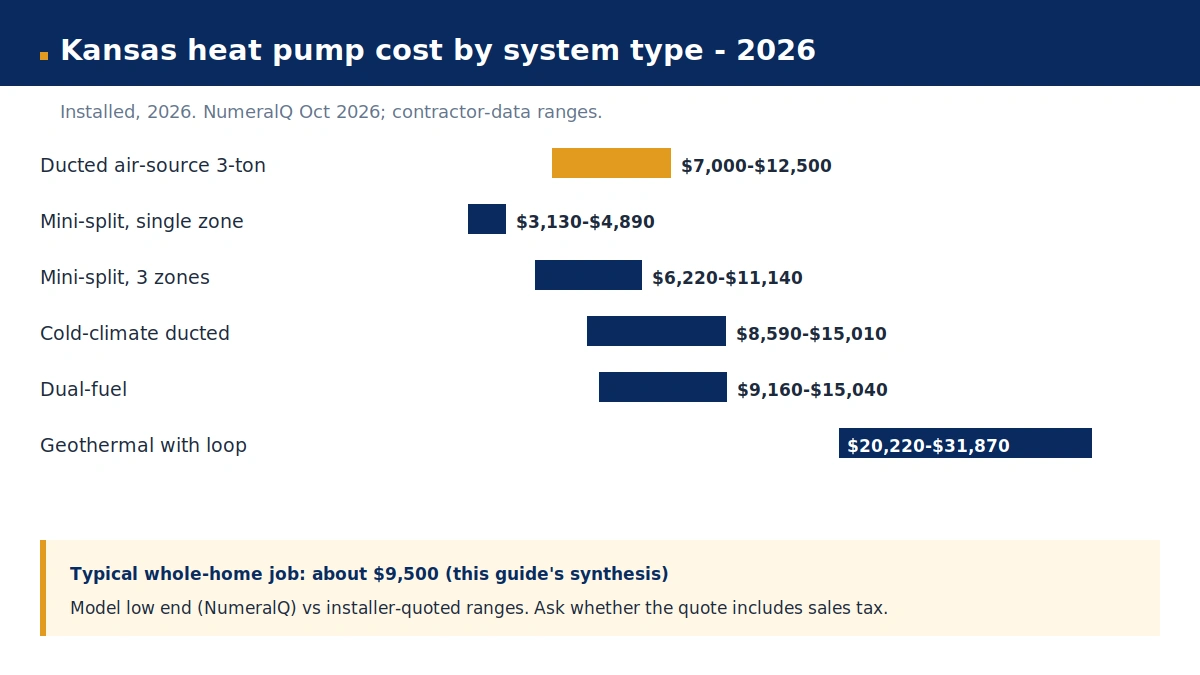
For a Kansas home of 1,500–2,500 square feet, the machine that usually fits is a 3-ton whole-home ducted air-source heat pump. A 2026 fit for that 3-ton job runs $7,000–$12,500, and most settle near $9,500. Plan on that band. That covers the outdoor condenser, the indoor air handler, refrigerant lines, a dedicated circuit, the permit, and the start-up visit — a running system, not a crate on the driveway. Whether it also covers sales tax is a question to ask on every quote, because Kansas tax adds 7.5% in Wichita and 9.35% in Topeka, Overland Park, and Lawrence, and a quote that leaves it out understates the cheque by $750 to $935 on a $10,000 job.
Three anchors pull the band in different directions, and the spread between them tells you something useful on its own. NumeralQ’s Kansas estimator — October 26, 2026 pricing, built from Fixr, This Old House, Home Depot prices, and BLS May 2025 wages — puts the 3-ton ducted job at $6,530–$10,940. A model like that prices parts and local wages and little else — no selling time, no warranty reserve, no surprises lurking inside a real house — so it lands below what installers charge. A contractor-data guide built from Wichita, Topeka, and Kansas City metro jobs in early 2026 pulls wider, putting heat pump replacement at $6,000–$13,500. Between them sits the marketplace view: Modernize’s Kansas pages put the average installation in the state at $10,750, with a standard air-source system near $8,640 and a high-efficiency one near $12,960. The headline lands where those views meet: $7,000–$12,500 for the standard whole-home job, with the top end kept for variable-speed equipment, awkward installs, and Johnson County addresses. That near-$9,500 typical figure is this guide’s own synthesis of the three views. No published Kansas statewide installer average was found, and this guide would rather say that than invent one.
A whole-home bid near $5,000 ought to raise an eyebrow rather than excitement. A bid thousands below its rivals usually signals a missing piece — the indoor unit, the wiring, the permit fee, the duct alterations, the sales tax, the start-up visit — or a separate line that appears later. A bid far under the rest should send you hunting for the missing pieces before signing, not after the crew arrives.
Against the rest of the country, Kansas sits a touch below the national average. The national guide’s US-wide band for a ducted heat pump is $7,500–$15,000 in 2026, and NumeralQ puts Kansas at about the national figure on its state table, with a model band that sits slightly under the national one. Kansas labour runs about 1% below the national median — HVAC mechanics and installers in Kansas earn a median $29.07 an hour against $29.33 nationally (BLS, May 2025) — and the panel work costs less here than in most states. What costs more here is the tax line, which most other states in this series either do not have or charge at a lower rate. The price of a mistake is higher here too, in a different way from the mild states: a wrong size gets punished on a 98F afternoon with 105F heat index as surely as on a 4F night with the wind off the plains, and a standard unit fitted in Goodland without the cold-climate premium will lean on strip heat all winter.
| System | Typical Kansas installed cost (2026) |
|---|---|
| Ducted air-source heat pump, 3-ton (typical home) | $7,000–$12,500 (typical ~$9,500) |
| Ductless mini-split, single zone | $3,130–$4,890 |
| Ductless mini-split, 3 zones | $6,220–$11,140 |
| Cold-climate ducted heat pump, 3-ton | $8,590–$15,010 |
| Dual-fuel (heat pump + gas furnace) | $9,160–$15,040 |
| Geothermal (ground-source) with loop | $20,220–$31,870 |
Sources: NumeralQ Kansas heat pump estimator (Oct 26, 2026); NumeralQ Wichita HVAC replacement page (dual-fuel model); Modernize Kansas pages (2026); HVACProjectCost Kansas guide (early 2026 contractor data); nestpriced national guide (art. 1). No Kansas-specific packaged-unit price was found, so no packaged row is printed here.
Heat Pump Cost in Kansas by System Type
Start from the house, not the catalogue. One wall head costs roughly a third of a full ducted install, and a ground loop roughly triple — but neither number means much until the house itself is understood. Ducts or no ducts, gas or no gas, a furnace with years left or one on its last legs, eastern Kansas mild or western Kansas cold: those facts set the system before any price does.
Ducted air-source heat pumps are what most Kansas homes get. One unit pushes air through the ducts the house already has, heating and cooling every room and retiring the furnace and the air conditioner in one move. NumeralQ’s model puts the 3-ton job at $6,530–$10,940; contractor-data ranges run $6,000–$13,500, with the gap mostly margin, warranty, job conditions, and tax treatment. When the ducts are sound and the furnace and the AC are ageing out together, price this route before any other. Our ductless vs ducted comparison walks through that trade-off in full.
Ductless mini-splits fit the homes that never had ducts — a finished basement in Wichita, an addition in Lawrence, a bonus room over the garage in Overland Park, older homes in Topeka where ducts were never run, and farmhouses and rural homes across western Kansas. NumeralQ puts one 12,000 BTU head at about $3,130–$4,890 fitted, and three zones for an addition or finished basement at $6,220–$11,140. Five or more heads to cover a whole home cost higher still on national figures, and at that point a ducted system is usually the cheaper choice, where ducts exist or can be added. Each mini-split is a heat pump on its own: one box that cools the bonus room in a July heat wave and warms it in January. Per-zone pricing lives in our mini-split installation cost guide.
Cold-climate heat pumps earn their keep across much of Kansas, not just in one corner of it. A cold-climate ducted system costs $8,590–$15,010 (NumeralQ), about $2,000 more than a standard system, for inverter-driven capacity that keeps delivering heat down toward 0F and below. Wichita, Topeka, and Kansas City design to 4–7F in winter — far colder than the mild-climate states in this series — so the premium buys real hours here, not just insurance. Goodland, at a 0F design temperature and 6,141 heating degree days, is a cold-climate job by default. The cold-climate premium is the default in the northwest and a sensible upgrade everywhere else in the state. Our cold-climate mini-split guide shows where that premium pays and where it does not.
Dual-fuel systems pair a heat pump with a gas furnace, and in Kansas they may be the smartest premium spend in the state — because 63% of Kansas homes already have piped gas, and winter design temperatures run 0–7F. Mild weather lets the heat pump carry the long shoulder seasons, while the furnace only steps in on the coldest nights, when the heat pump’s output falls and the strips would otherwise take over. A complete dual-fuel system costs $9,160–$15,040 on NumeralQ’s Wichita model, and contractor-data ranges put dual-fuel at $9,000–$15,500. The cheapest way in is to fit a heat pump where a dying air conditioner stood, while keeping a gas furnace younger than about ten years. A young furnace beside a dying AC makes that route the first one to price. The dual-fuel cost guide gives the full breakdown.
Geothermal sits apart: $20,220–$31,870 including the ground loop (NumeralQ), and near $30,240 on Modernize’s Kansas pages. Nothing you can buy is more efficient or longer-lived — the loop itself runs 25–50+ years on national figures — yet in Kansas the payback sums are stubborn. Gas is piped to most homes at about $2.03 a therm, which shrinks the yearly savings that are meant to repay a premium of $10,000 or more over air-source. New builds with land for a horizontal loop — and Kansas has no shortage of land — or an owner staying 20+ years, are where geothermal adds up. Nearly everyone else gains more from a higher-efficiency air-source unit with duct sealing. Geothermal numbers in full sit in our geothermal heat pump cost guide.
Heat Pump Cost by Home Size
Five hundred to six hundred square feet per ton is a handy rule of thumb — and a poor way to buy a machine. Insulation, glass, ceiling height, shade, duct leakage, and — in Kansas more than most states — how far west and north the house stands all push the right size up or down, and only a Manual J load calculation settles it. That calculation runs $200–$500 on national figures, usually credited back against the install, and no Kansas-specific price for it was found. Floor area alone, or the old unit’s nameplate, is a guess made with your money.
| Home size | Typical system | Ducted air-source installed cost |
|---|---|---|
| 1,000–1,200 sq ft | 1.5–2 ton | $4,390–$8,350 |
| 1,200–1,500 sq ft | 2–2.5 ton | $5,100–$9,640 |
| 1,500–2,000 sq ft | 2.5–3 ton | $5,820–$10,940 |
| 2,000–2,500 sq ft | 3–3.5 ton | $6,530–$12,230 |
| 2,500–3,000 sq ft | 3.5–4 ton | $7,250–$13,530 |
| 3,000+ sq ft | 4–5 ton | $7,960–$16,120 |
Figures: NumeralQ’s Kansas size estimator, October 26, 2026, ducted air-source. Those bands are model outputs — real installer quotes for the same sizes sit toward the top of each band, and Johnson County quotes higher still. Use the table as a rough guide for planning, never as a budget. Sales tax is not included in the model bands; add 7.5% in Wichita or 9.35% in Topeka, Overland Park, and Lawrence if the quote leaves tax out.
Oversizing is the expensive mistake in a Kansas summer. A unit too big for the house blasts cold air for a few minutes, shuts down before it has pulled any moisture out, and leaves the rooms cool and clammy — the worst outcome in a Kansas July where the heat index runs past 105F and the air is thick. Too small, and the unit never rests. It runs around the clock, still calling for strip heat on January nights when the thermometer reads single digits — the priciest heat a Kansas home can buy. Either mistake costs more across ten years than a Manual J ever will — so get the calculation in writing before any equipment is ordered.
In western Kansas the sizing mistake runs the other way. A Goodland or Dodge City home sized to Wichita assumptions will be undersized for a 0F or 5F design night, and the strip heat will carry the house for weeks rather than hours. That is why the western Kansas quote should name the design temperature it was sized to, and why a cold-climate unit with extended capacity at 5F belongs on the quote rather than a standard unit with a hopeful note. Get the Manual J design temperature from the installer in writing before you agree to anything. If the number on it looks like Wichita’s 7F and the house stands in Goodland, the sizing is wrong.
Two-storey homes need their own warning. One system across two floors leaves one floor unhappy — hot bedrooms upstairs in July, a chilly ground floor in January. Workable fixes are two separate systems, one ducted system with zoning dampers, or a ducted unit downstairs with a mini-split head or two upstairs — each dearer than a one-system bid. When a quote covers a two-storey Kansas house with a single system and says nothing about zoning, ask one thing before anything else: what will the upstairs bedrooms feel like on a 98F afternoon? Get a written answer to that question before signing anything.
Heat Pump Cost by City: Wichita, Overland Park & Topeka
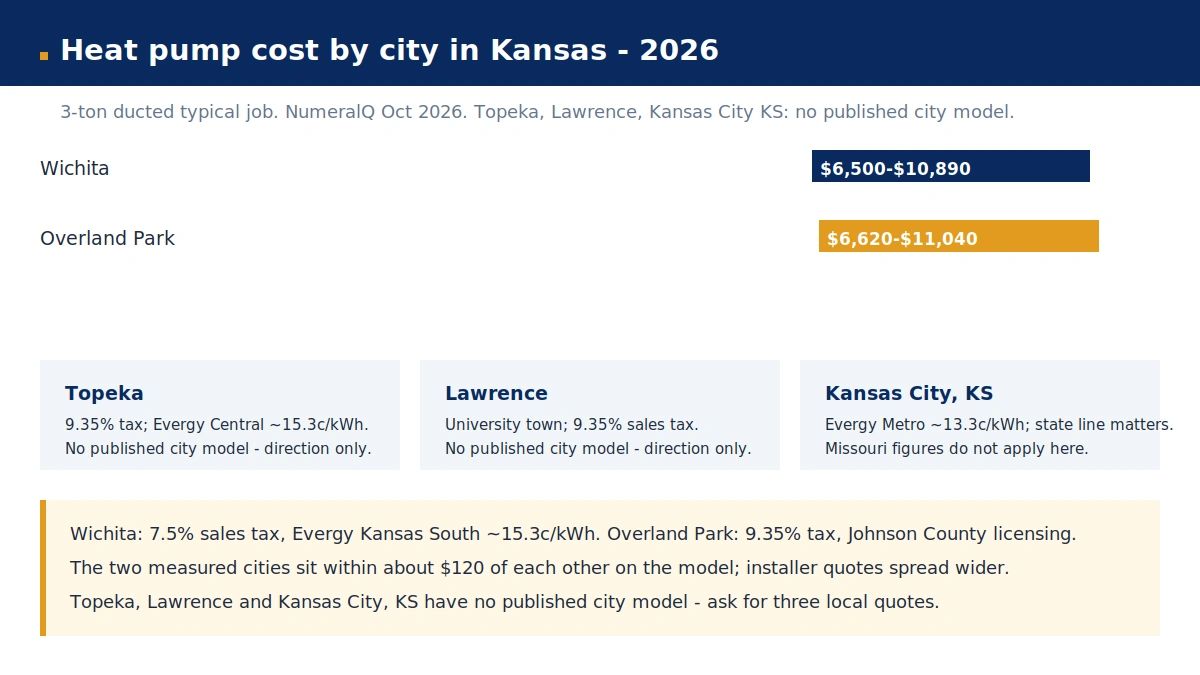
The model prices Kansas’s two measured cities almost identically for the same 3-ton system — separated by about a hundred dollars — yet each city reaches that price for different reasons, and installer-quoted reality spreads wider than the model suggests.
| City | 3-ton ducted job, model range | What drives the price |
|---|---|---|
| Wichita | $6,500–$10,890 | Largest city; Evergy Kansas South at ~15.3c/kWh; 7.5% sales tax |
| Overland Park | $6,620–$11,040 | Johnson County; highest labour in the state; 9.35% sales tax |
| Topeka | No published city model | State capital; Evergy Kansas Central at ~15.3c/kWh; 9.35% sales tax |
| Lawrence | No published city model | University town; Evergy Kansas Central; 9.35% sales tax |
| Kansas City, KS | No published city model | Metro straddles the state line; Evergy Metro at ~13.3c/kWh |
Figures: NumeralQ Kansas city pages, October 2026, 3-ton ducted system. No NumeralQ city model exists for Topeka, Lawrence, or Kansas City, KS. No band is invented here for them — only direction is offered.
Wichita is the biggest heat pump market in Kansas and the cheapest of the measured cities on the model, at $6,500–$10,890 for a 3-ton ducted job. The city sits in Evergy Kansas South territory, where the residential rate averaged about 15.3 cents a kilowatt-hour over the last 12 months, and it carries the lowest combined sales tax of any major Kansas city at 7.5% — a real $185 saving against a 9.35% city on a $10,000 job before any other difference is counted. The housing stock is the other complication: older homes in College Hill and Riverside with no ductwork and 100-amp panels, postwar ranches with ducts in unconditioned attics, and new builds on the east side that price like a different state. Wichita is also the city where the severe-weather case is most concrete: the National Weather Service office here issues the hazardous weather outlooks for central Kansas, and its November 2, 2026 outlook warned of damaging winds with large hail and a few tornadoes possible. A Wichita quote should price anchoring, surge protection, and hail protection as part of the job, not as an afterthought. Wichita’s climate is the Kansas pattern in miniature: a 7F winter design temperature, a 98F summer design temperature, a 113F record from July 1954, and a 21-below record from February 1982.
Overland Park prices a touch above Wichita on the model — $6,620–$11,040 against Wichita’s $6,500–$10,890 — and the difference is mostly labour and tax rather than climate. Overland Park sits in Johnson County, where HVAC technician pay runs about 3% above the national median, the highest in the state, and the combined sales tax runs 9.35% against Wichita’s 7.5%. The city shares the Kansas City metro’s climate, with a winter design temperature near 6F and a summer design temperature near 96F. What an Overland Park buyer should check first is the licence on the bid, because Johnson County licenses contractors in Class A, B, and C tiers with an ICC exam and insurance — a genuine county licence to demand, and a genuine check to run. Overland Park buyers are Evergy customers, inside the KEEIA rebate territory, so the $500–$1,000 ducted rebate applies when the efficiency tier qualifies.
Topeka has no published city price model, and this guide invents none. What can be said with confidence is direction rather than dollars. Topeka is the state capital, in Evergy Kansas Central territory at about 15.3 cents a kilowatt-hour, with a combined sales tax of 9.35% — the dearest tax treatment of the three cities in this section. Its climate runs a touch colder than Wichita’s, with a winter design temperature of 4F and about 5,182 heating degree days, and its records run to 112F in August 2011 and 26 below in December 1989. Topeka’s building department issues its own mechanical licences through the Development Services Division, so the licence check here runs through the city, not the state. Expect a Topeka quote to run near the Wichita bands for the same house, pushed up by the tax rate and pulled down by labour that runs closer to the state median — but no published Topeka band exists to print, so get three local quotes and compare them against each other, not against a Wichita number.
Lawrence has no published city price model either, and this guide invents none. Lawrence is a university town in Evergy Kansas Central territory, with a combined sales tax of 9.35% and a housing stock heavy on older homes near the university and postwar ranches further out. Rental properties are a large share of the market here, which matters for rebates: a landlord’s incentives and a homeowner’s incentives are not the same, and the Evergy rebate follows the equipment and the account, not the occupant. Expect quotes near the Topeka direction — direction only, no band.
Kansas City, Kansas deserves its own warning rather than a price band. The metro straddles the state line, and the two sides are different markets. Evergy Metro, which serves the Kansas City metro, averaged about 13.3 cents a kilowatt-hour over the last 12 months — the cheapest Evergy division in Kansas — and Kansas City, KS carries a 9.125% combined sales tax. But Missouri-side prices do not cross the line: Angi’s Kansas City, Missouri page, updated August 4, 2026, puts the average heat pump cost at $5,174 with an 8.99% sales tax, and Evergy’s FastTrack on-bill financing serves Missouri customers only. A Kansas City, KS buyer who budgets from a Missouri-side figure will under-budget twice over — once on the price, once on the financing. Check which side of the state line the house stands on before trusting any Kansas City figure, and treat any quote that cites FastTrack for a Kansas address as a contractor who does not know the territory.
Smaller Kansas cities — Salina, Hutchinson, Manhattan, Dodge City, Garden City, Hays, Emporia, Pittsburg, Leavenworth, Olathe, Shawnee — generally price near the Wichita bands or, in the west, near the Goodland direction. Dodge City, with a winter design temperature of 5F and 4,986 heating degree days, is a cold-climate or dual-fuel job. Goodland, at 0F and 6,141 heating degree days, is a cold-climate job by default. Manhattan and Salina sit between the two patterns. Hays and the northwest are Midwest Energy co-operative territory, where the 12.4-cent rate improves the running-cost case and the How$mart financing replaces the Evergy rebate.
Kansas’s Two Extremes: Hot Humid Summers, Cold Continental Winters
Kansas is split under the 2021 International Energy Conservation Code into Zone 4A across 87 counties and Zone 5A across 18 counties (PNNL-33270, unchanged in the 2024 IECC). Zone 4A covers most of the state, including Wichita, Topeka, Kansas City, and Overland Park. Zone 5A covers the cooler northern tier. There is no Kansas county in Zone 5B or Zone 6 under the 2021 IECC, so no Kansas job should be sold as a Zone 5B or Zone 6 job. That correction matters, because a Zone 6 label would imply a colder design case than Kansas actually has — and because a contractor who gets the zone wrong may get the equipment wrong too.
The design temperatures a contractor actually sizes to tell the story as numbers. Wichita: winter design 7F, summer 98F, about 4,620 heating degree days (IPC Appendix D). Topeka: winter 4F, summer 96F, about 5,182 heating degree days. Kansas City: winter 6F, summer 96F, about 4,711 heating degree days and about 1,420 cooling degree days. Dodge City: winter 5F, summer 97F, about 4,986 heating degree days. Goodland: winter 0F, summer 96F, about 6,141 heating degree days. The pattern is the same everywhere in the state: winters that design to single digits, summers that design to the high 90s. No Kansas city designs to a mild winter. Every Kansas heat pump works hard in January and in July.
Through most Kansas winters a standard unit needs help on the coldest nights, and the help is expensive. As the thermometer falls, the unit’s output falls alongside it. Near 30–35F, most units start drawing on the electric strips to keep up. In Wichita and Topeka, that means a meaningful number of nights each winter — not weeks at a time, but enough to show on the bill. Strip heat is the dearest heat in the house, and Kansas gives it more hours than a mild-climate state does. In the northwest the picture reverses entirely: a standard unit in Goodland lives on backup heat for much of the winter, which is why the cold-climate premium is the default there and a sensible upgrade everywhere else, and why dual-fuel — gas on the coldest nights, heat pump through the shoulder seasons — is the configuration Kansas installers sell most.
Newcomers underestimate the summer, not the winter — and in Kansas the summer is the longer season. Wichita recorded 102 days at or above 90F in 2026, the most in any year on record, and 161 days at or above 80F. Heat indices of 105–110F are routine on the worst afternoons. A heat pump’s cooling is not a bonus feature in Kansas. It is the machine’s main job for five months of the year. Variable-speed equipment earns its keep on the hottest afternoon, not the coldest night, holding its output and running long, gentle cycles where a single-stage unit’s short bursts leave rooms uneven and clammy. Sizing for cooling, dehumidification included, is what separates a good Kansas install from a merely adequate one.
Kansas weather touches a heat pump in ways no brochure mentions. The state sits in the heart of Tornado Alley, and Wichita’s own trade guidance lists tornadoes, thunderstorms, ice storms, and flooding as the routine threats. The National Weather Service Wichita office’s hazardous weather outlook for November 2, 2026 warned of damaging winds as the primary risk, with large hail and a few tornadoes possible across central and south-central Kansas. A heat pump outdoor unit bolted to its pad, fitted with a surge protector, and sited clear of the roof drip line is cheap protection for a $10,000 machine in a state that leads the country in tornado exposure. Hail guards and coil guards belong on the quote in hail country, not as an afterthought. Ice storms coat an outdoor unit and can block defrost — siting and clearance matter, and a unit tucked under a roof edge where ice dams form will spend its winters fighting the house itself. Dust is the quieter Kansas problem: filters clog faster in dust and pollen season and after severe-weather dust, so budget for more frequent filter changes than the brochure suggests — qualitative advice, not a sourced figure.
Kansas is a low-adoption state with no state heat pump programme behind it. About 6% of Kansas homes use a heat pump as their main heat (EIA RECS), against about 63% heating with piped gas and 27% with electricity. There is no Kansas equivalent of another state’s 500,000-by-2030 goal, no state rebate, and no state tax credit. The push here comes from the equipment itself — one machine replacing a furnace and an air conditioner together — and from the fuel maths, which in Kansas favour a good heat pump more than in most states. That is the honest frame: no state programme is coming to make the decision for you.
Heat Pump vs Gas Furnace in Kansas: The Running-Cost Math
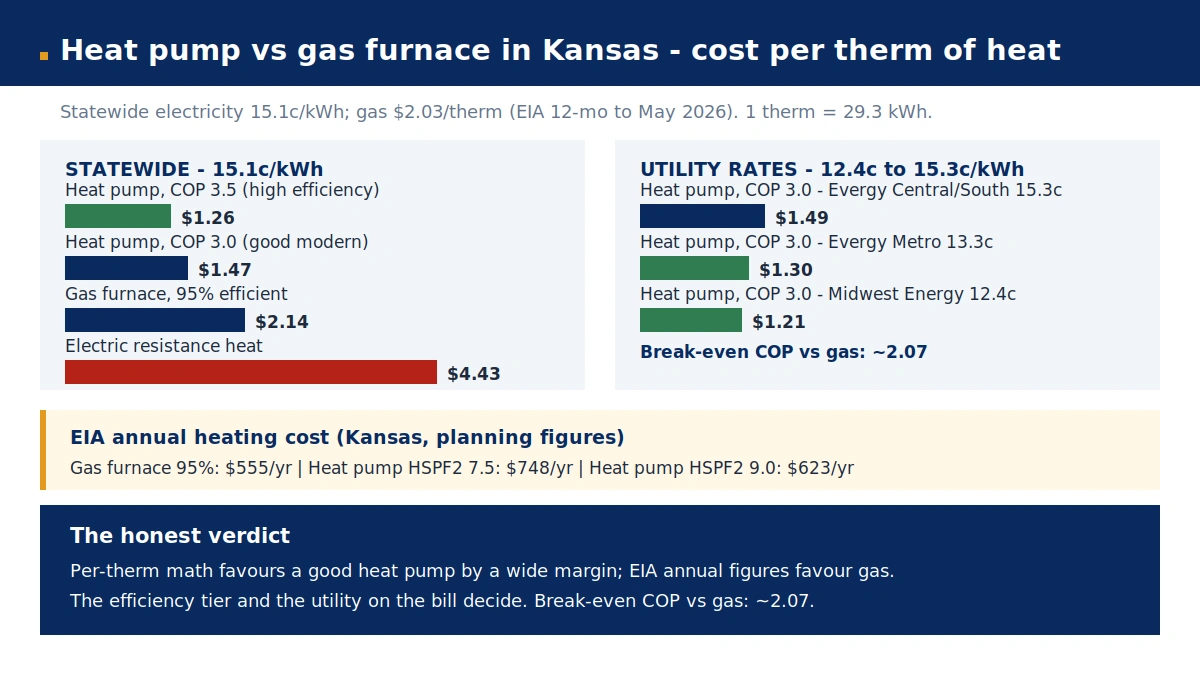
Both Kansas fuels sit below the national average, and that is what makes this comparison a genuine argument rather than a foregone conclusion. Kansas residential electricity averages 15.1 cents per kilowatt-hour on the 12-month average to August 2026 (EIA) — 19th lowest in the US, against 18.0 cents nationally. August 2026 alone was 15.47 cents. The average Kansas home’s electric bill runs about $134 a month — on 887 kilowatt-hours. Residential natural gas runs about $2.03 a therm on the 12-month average to May 2026 ($21.00 per thousand cubic feet, EIA). A second trailing-average series puts Kansas gas lower, near $1.54 a therm, so this guide uses about $2.00 a therm as the heating-season planning figure and cites the range. Summer monthly gas figures spike because fixed charges spread over tiny summer volumes. A summer month’s gas figure is never the heating price — don’t use it as one.
Work it out per therm of heat, with a therm equal to 29.3 kilowatt-hours. At the state-average electricity price of 15.1 cents, a good modern heat pump at a seasonal COP of 3.0 delivers that therm for 29.3 x $0.151 / 3.0, or about $1.47. At COP 3.5, a high-efficiency unit delivers it for about $1.26. For a 95%-efficient gas furnace, that therm costs $2.03 / 0.95 — about $2.14. Electric resistance heat, the fuel some Kansas heat pump buyers are actually replacing, delivers it for 29.3 x $0.151, or about $4.43. At COP 3.0 the heat pump beats gas by about 67 cents a therm at the state-average price — a much wider margin than in the mild-climate states in this series. The break-even COP against gas at Kansas prices is about 2.07, so even a minimum-efficiency heat pump wins on fuel at the state-average rate. On this arithmetic the good heat pump wins, and it wins clearly.
EIA household heating estimates tell the opposite story, and this guide prints that disagreement rather than hiding it. A 95% gas furnace heats the average Kansas home for about $555 a year; a minimum-efficiency heat pump (HSPF2 7.5, the federal minimum) for about $748 a year; a high-efficiency heat pump (HSPF2 9.0) for about $623 a year. On annual figures, gas wins — even against the high-efficiency heat pump, by $68 a year, and clearly against a minimum-efficiency one. NumeralQ’s own Kansas page says the same thing in plain language: at those prices, a heat pump costs more to run than gas. The two views disagree because a real Kansas winter’s seasonal COP, once cold snaps, ice-storm defrost cycles, and strip-heat hours are counted, runs below 3.0, and because the EIA household model prices Kansas gas from a lower series than the $2.03 planning figure used above. So the verdict stays split — the per-therm sums favour a good heat pump by a wide margin, the EIA yearly figures favour gas, and the efficiency tier you choose tips the balance. Showing only one side of that disagreement would turn this guide into a sales pitch.
Now run the same sums at the rates Kansas buyers actually pay, because the statewide average hides a real gap. Evergy Kansas Central and Evergy Kansas South, serving Topeka, Lawrence, and Wichita, averaged 15.3 cents per kilowatt-hour over the last 12 months — a touch above the state average — with a $15.25 a month fixed charge plus 2.96 cents per kilowatt-hour in riders on the Central tariff, for an all-in 15.85 cents at 900 kilowatt-hours. At 15.3 cents, a heat pump at COP 3.0 delivers a therm for about $1.49 — still comfortably ahead of gas at $2.14. Evergy Metro, serving the Kansas City metro, averaged 13.3 cents, where the COP 3.0 therm costs about $1.30. Midwest Energy, the western Kansas co-operative, averaged 12.4 cents, where the COP 3.0 therm costs about $1.21 and even a minimum-efficiency unit wins by a wide margin. The practical point stands without a single rate: the fuel-savings case is weakest in Evergy Central and South territory, where most Kansans live, and strongest where power is cheapest — in the Metro and the co-operative west. A Wichita buyer who buys a minimum-efficiency unit will still beat gas on the per-therm sums, but will lose to gas on the EIA’s annual figures. That is no reason to keep the furnace. It is a reason to buy the efficient unit, or to buy dual-fuel, or to value the job on its cooling as well as its heating.
Two more Kansas situations tilt the sums decisively toward the heat pump. The first case is a home still heated by resistance: baseboard panels, wall units, or an electric furnace on its last legs. A heat pump gives the same warmth there for roughly a third of the electricity — about $1.47 a therm against $4.43 at the state-average price — and that is the case where the payback is fastest and the rebate is largest, because Evergy pays an extra $1,000 when a high-efficiency heat pump replaces electric resistance heat (ask Evergy to confirm the extra amount — it comes from installer summaries, not from Evergy directly). The other is propane or heating oil, whose fuel costs far more than Kansas power or gas. Judge the heat pump’s $7,000–$12,500 against a furnace and an air conditioner bought together, not against a furnace alone. And remember the other half of the year. A gas furnace sits idle all July, while a heat pump cools for months — and in Kansas, where Wichita logged 102 days at or above 90F in 2026, cooling is not a comfort extra. Rate the machine across the full year, not on one January bill. The full argument sits in our heat pump vs furnace comparison, the gas side is priced in our furnace replacement guide, and month-by-month sums live in our running-cost guide.
| Heating system | Cost per therm of heat delivered | EIA estimated annual heating cost (KS) |
|---|---|---|
| Gas furnace, 95% efficient | ~$2.14 | ~$555/yr |
| Heat pump, COP 3.0, statewide 15.1c/kWh | ~$1.47 | — |
| Heat pump, COP 3.5, statewide 15.1c/kWh | ~$1.26 | — |
| Heat pump, COP 3.0, Evergy Central/South 15.3c/kWh | ~$1.49 | — |
| Heat pump, COP 3.0, Evergy Metro 13.3c/kWh | ~$1.30 | — |
| Heat pump, COP 3.0, Midwest Energy 12.4c/kWh | ~$1.21 | — |
| Heat pump, HSPF2 7.5 (federal minimum) | — | ~$748/yr |
| Heat pump, HSPF2 9.0 (high efficiency) | — | ~$623/yr |
| Electric resistance heat, statewide 15.1c/kWh | ~$4.43 | — |
How the table was built: electricity at 15.1 cents per kilowatt-hour statewide, 15.3 cents for Evergy Central and South, 13.3 cents for Evergy Metro, and 12.4 cents for Midwest Energy; gas at $2.03 a therm (EIA 12-month average to May 2026, with a trailing-average series near $1.54 cited in the text); 1 therm = 29.3 kilowatt-hours. The COP figures used here describe the whole heating season as a planning number, not a laboratory test result. The yearly EIA figures are planning estimates, not forecasts of any single bill. They are worked out from household heating use and the state’s current prices. The two views conflict, and the text above explains why.
Evergy Rebates & the Other Money You Can Collect in 2026
Forget the federal money for a moment. In Kansas in 2026, the live rebate money has one big name in most of the state, and which programme pays you depends entirely on which utility sends your electric bill: Evergy for Wichita, Topeka, Lawrence, Overland Park, and the Kansas City metro, KEPCo member co-operatives in their territories, and Midwest Energy in western and central Kansas with financing rather than a rebate. Kansas offers no statewide rebate and no state tax credit for heat pumps at all. The utility is the programme, and the amounts are modest, so budget accordingly.
| Programme | What it pays (heat pump) | Key condition |
|---|---|---|
| Evergy KEEIA, ducted heat pump | $500–$1,000 by SEER2 tier | Evergy-authorized contractor; AHRI-certified, matching coil |
| Evergy KEEIA, ductless mini-split | $150–$200 | Evergy-authorized contractor |
| Evergy KEEIA, ground-source | $1,000 | Replacement; verify — one source says up to $1,500 |
| Evergy KEEIA, extra for resistance-heat replacement | Extra $1,000 | High-efficiency unit replacing electric resistance heat; ask Evergy to confirm |
| KEPCo member co-ops | $300–$600 | Varies by co-op; verify locally |
| Midwest Energy How$mart | Full upfront cost financed | Repaid on the utility bill; not a rebate |
| Kansas Gas Service | $0 | No heat pump or HVAC rebates |
Sources: HomeEnergyBasics Kansas page (updated June 11, 2026); Santa Fe Air (published Oct 28, 2026); Mr Breeze Evergy guides (2026); Evergy KEEIA programme terms (approved Sep 2023, runs through Dec 31, 2027).
Evergy’s KEEIA rebates are the programme most Kansas buyers will actually collect from, and the central rule is the tier: the more efficient the machine, the bigger the cheque. The programme was approved by the Kansas Corporation Commission in September 2023 under the Kansas Energy Efficiency Investment Act, and it runs through December 31, 2027. A ducted air-source heat pump pays $500 at SEER2 15, $700 at SEER2 16, $900 at SEER2 17, and $1,000 at SEER2 20 or better. Conditions: the system must be AHRI-certified with a matching indoor coil, and it must be installed by an Evergy-authorized contractor. A ductless mini-split heat pump pays $150–$200. A ground-source heat pump pays $1,000 on a replacement — though one installer page says up to $1,500, so verify the ground-source amount with Evergy before counting it. The claim window is strict: six months from the date of installation, and equipment must have been installed between June 1, 2024 and December 31, 2027. Evergy also pays insulation up to $500, air sealing up to $300, duct sealing up to $250, and a $250 home energy audit credit — small money, but the duct sealing and the audit are worth collecting on the same job.
The extra $1,000 is the one Evergy amount that deserves a phone call before it is counted. Installer summaries say Evergy pays up to an additional $1,000 when a high-efficiency air-source heat pump replaces old electric resistance heat — baseboard heaters or an electric furnace. That figure comes second-hand, from installer pages rather than from Evergy directly, and this guide says to ask Evergy to confirm it. If it holds, it makes the electric-heated home the best-subsidised heat pump customer in Kansas by a wide margin: $1,000–$2,000 against $500–$1,000 for everyone else.
FastTrack HVAC PAYS is not a Kansas programme, and any Kansas quote that lists it is wrong. Evergy’s FastTrack HVAC PAYS on-bill financing — rebates of $1,000–$1,300, up to 80% of projected 15-year savings spread over 180 monthly payments, tied to the meter with no credit check, launched in August 2025 — serves Missouri customers only. One Kansas pricing guide wrongly lists FastTrack rebates of $1,000–$1,900 for Kansas homeowners. That is a Missouri figure pasted onto a Kansas page. Kansas uses the straight KEEIA rebate model: pick a qualifying system, install it through an authorized contractor, and claim the rebate as a deduction on the invoice or a post-installation cheque. There is no Kansas on-bill financing through Evergy. If a contractor offers you FastTrack terms on a Kansas address, they are selling you a Missouri programme.
KEPCo co-operatives add $300–$600 for heat pumps, depending on the co-op (HomeEnergyBasics, June 2026). Verify the amount with the local co-op — the figure varies, and some co-ops pay by efficiency tier while others pay a flat amount. Midwest Energy, which serves western and central Kansas with both gas and electric service, pays no traditional heat pump rebate at all. Its How$mart programme pays the full upfront cost of a qualifying heat pump installation instead, repaid through a charge on the utility bill. That is financing, not a rebate, and it should be compared as financing: no money off the price, but no money out of pocket on day one. Kansas Gas Service, the state’s largest natural gas utility, offers no heat pump or HVAC rebates of any kind. A gas-heated home collects nothing from its gas utility toward a heat pump, which is worth knowing before the gas bill arrives with a quote attached to it.
Stack the numbers honestly: a $500–$1,000 Evergy rebate off a $9,500 job is a 5–10% discount, real money and not a decision-maker. It is not the five-figure stack some other states’ homeowners collect, and it is not the $8,000 federal rebate that has not launched in Kansas. Count the utility rebate as a windfall, never as the foundation of any budget. In 2026, it is. And remember the fuel rule that governs the whole stack: the best-subsidised Kansas heat pump customer heats with electricity today. A gas-furnace home gets the standard tier only — $500–$1,000 — and, when HEAR launches, no HEAR money for a gas-to-heat-pump switch under Program Notice 26-2.
Federal Help in 2026: $0 Tax Credit & HEAR Not Launched
Federal help in Kansas in 2026 is nearly non-existent, so this section is short — and the part that does exist has not arrived.
The tax credit is $0. The One Big Beautiful Bill Act (Public Law 119-21, signed July 4, 2025) ended both federal credits after December 31, 2025. Both credits are gone: §25C, the Energy Efficient Home Improvement Credit at 30% up to $2,000 a year for a heat pump, and §25D, the Residential Clean Energy Credit. The IRS confirmed it in FS-2025-05. A heat pump fitted in a Kansas home in 2026 earns no federal tax credit at all. If a 2026 quote still deducts a $2,000 federal credit, it is out of date — or the contractor hopes you will not notice. Tell them to strike it. For the statute and the IRS notice, see our federal energy tax credits guide.
Kansas has no state tax credit either. Kansas offers no state tax credit for heat pumps, no statewide heat pump rebate, and no state heat pump programme of any kind. The only live money is the utility money in the section above. A solar-only side note, to prevent confusion: Kansas has no state solar tax credit either, and nothing in Kansas law exempts a heat pump from property tax.
Kansas’s HEAR rebate remains unlaunched. The scheme in question is HEAR — the Home Electrification and Appliance Rebates programme created under IRA §50122. Income-qualified households could collect up to $8,000 toward a heat pump in the federal design, with the largest rebates under 80% of area median income and eligibility to 150%, paid as a point-of-sale discount. Kansas’s allocation for HEAR and HOMES combined runs to $105.6 million — HEAR $52,663,910 and HOMES $52,864,974 on the DOE allocation dataset. The Kansas Corporation Commission runs the Kansas Home Rebates Program, has partnered with HORNE for programme design and implementation, and has opened a public portal at kshomerebates.gov. But the plan is still pending U.S. Department of Energy approval, and there is no launch date (HeatPumpPricing, status verified November 4, 2026). Homeowner rebate applications will open only after DOE approval. The planned design calls for HEAR up to 150% of area median income, covering up to $8,000 for a heat pump within a $14,000 household cap, and HOMES for all incomes, typically up to $8,000 based on whole-home energy savings. No retroactive rebates will be paid: work completed before launch will not qualify. That is the same warning as every other state in this series.
The rules changed while Kansas waited. DOE Program Notice 26-2, issued May 29, 2026, removed the fuel-switching allowance from HEAR: from September 1, 2026, once Kansas’s programme opens, rebates cover electric-to-electric replacements only, and a gas-to-heat-pump conversion will not qualify. The sharpest consequence lands on the most common Kansas scenario of all: a gas-furnace home considering a heat pump. Even after launch, that household — 63% of the state — will not collect the HEAR money. Once HEAR opens, its help reaches homes already heating with electricity: resistance heat, old electric furnaces, and ageing heat pumps. Keep the timing trap in mind. Work done today, ahead of launch, can never collect the rebate, whenever the programme opens.
Leasing is the one route to federal money that remains open, at least in principle. The One Big Beautiful Bill Act left the §48E clean-electricity investment credit open for systems placed in service by December 31, 2027, and heat-pump leasing and subscription products are marketed in Kansas — Palmetto’s Comfort Plan offers heat pumps in Wichita, Lawrence, and Topeka with $0 upfront, a monthly subscription, and maintenance and repairs included. But no primary source was found confirming that any specific Kansas lease product passes a §48E credit through to the homeowner, or the exact §48E mechanics for residential heat-pump leases. This guide says leasing exists and is the one federal-money route still open in principle, and it promises no specific dollar saving from §48E. Ask the leasing company, in writing, what federal credit value, if any, is passed through to you, and treat a vague answer as no answer.
One smaller route deserves a sentence, to prevent confusion. The Kansas Weatherization Assistance Program helps income-qualified households with insulation, air sealing, and heating-system work. It is not a heat pump rebate, and it is not open to every household — but for a low-income Kansas home with an ageing electric furnace, it is the one live route to a subsidised heat pump today, and it is worth asking about before any other programme is counted on.
Never build a Kansas budget around HEAR, a federal tax credit, or a FastTrack financing offer. Before signing, check kshomerebates.gov, and treat any future launch as upside rather than plan.
Permits & Licensing: Kansas Has No Statewide HVAC License
Kansas licenses no HVAC contractor at the state level, and the difference works against the homeowner. Kansas has no statewide HVAC licence and no state licensing board — there is no state-level licence for HVAC technicians or contractors of any kind. Kansas Statutes Chapter 12, Article 15 allows cities and counties to license tradespeople, but it does not require them to. That leaves you with a local licence to demand, a local office for complaints, and — in the smaller towns — no licence to check at all.
The local licences that do exist are real, and they vary sharply by city. In Wichita and Sedgwick County, the Metropolitan Area Building and Construction Department (MABCD, 271 W. 3rd St., Suite 101, Wichita) issues mechanical licences in four tiers: Apprentice, Journeyman (IAPMO exam at 75%, $125 exam fee plus a $35 licence), Master, and Contractor (a $360 licence, and the contractor must employ a master). Renewal runs every two years. In Topeka, the Development Services Division issues mechanical licences, including apprentice licences. In Kansas City, Kansas, Building and Development Services at 701 N. 7th St. requires contractor licensing. In Johnson County — Overland Park, Olathe, Shawnee, Lenexa — the county licenses contractors in Class A, B, and C tiers, with an ICC exam and insurance. Lawrence, Manhattan, Salina, and the other cities each run their own requirements. Kansas municipalities that require licensing must accept a contractor licence from another Kansas city as valid proof of requirements, which helps a contractor working across the metro — but there is no reciprocity with other states, because the licences are municipal. A Missouri licence means nothing on the Kansas side of the state line.
Two further requirements sit underneath the local licences. EPA Section 608 certification is required federally for anyone handling refrigerant — no exceptions, in any Kansas town. And every Kansas business must register with the Kansas Secretary of State, which is a check any buyer can run in minutes. The one construction trade Kansas does regulate at state level is roofing, through mandatory registration with the Kansas Attorney General — a reminder that the state knows how to regulate a trade when it chooses to, and has chosen not to for HVAC.
Wherever a Kansas town has a building department, swapping a system means pulling a mechanical permit. NumeralQ’s 35-city check puts the typical permit fee at $70–$166. Demand the permit number in writing, with the installer pulling the permit. A contractor who asks you to pull it is handing you the liability. In a town with no building department and no licence requirement, the permit and the contractor’s insurance are the only paper in the job, which makes them more important, not less. The federal minimum efficiency under DOE rules is 7.5 HSPF2 for heating and 13.4 SEER2 for cooling in Kansas’s region, in force since January 1, 2023.
The refrigerant and tax rules finish off this section. New home systems run on R-454B or R-32 these days. Under the EPA Technology Transitions rule, which caps global warming potential below 700, R-410A stopped going into new home systems from 2025. Look at the refrigerant on every quote, and refuse a new R-410A system at a 2026 price — yesterday’s equipment at today’s price. And remember the tax line: Kansas charges 6.5% state sales tax, with combined rates of 7.5% in Wichita, 9.125% in Kansas City, KS, and 9.35% in Topeka, Overland Park, and Lawrence. Ask whether the quote includes it. A $10,000 quote that leaves tax out is really a $10,750 quote in Wichita and a $10,935 quote in Topeka.
What Pushes Your Kansas Quote Up or Down
Two quotes for one house can differ by $3,000, and the hardware is almost never why. Everything around the equipment is. The line items below move a Kansas quote, in the order they usually show up.
No other line moves a Kansas quote as far as the ductwork does. Fitting new or extended ductwork costs $4,140–$7,040 per job in Kansas (NumeralQ). Kansas duct runs often sit in vented crawlspaces, basements, or hot attics. Duct leaks there can waste a fifth or more of the conditioned air before it ever reaches a room. A heat pump price with no duct inspection attached is only half the job priced. Duct sealing repays its cost — Evergy will pay up to $250 toward it — yet it is the item a cut-price bid most often omits. Undersized, collapsed, or disconnected ducts in the crawlspace will get blamed on the new heat pump, so have the ducts inspected and priced separately. Ductwork repairs alone run $500–$2,800, and a full replacement runs $2,000–$7,500 on contractor-data ranges.
Sales tax is the Kansas line item other states do not carry in the same form. A 6.5% state rate plus local additions puts the combined rate at 7.5% in Wichita and 9.35% in Topeka, Overland Park, and Lawrence. On a $10,000 job that is $750 to $935 — more than the entire Evergy rebate. Whether the quote includes tax changes the comparison more than any efficiency tier does. Put the tax line on its own row in every comparison, and never compare a tax-included quote with a tax-excluded one.
The electrical panel is the next swing, and in Kansas it swings less far than in most states. A heat pump needs a dedicated 240V circuit, and a panel that is full, still 100-amp, or short of spare breaker space means a 200-amp upgrade at $2,240–$3,520 installed in Kansas (NumeralQ) — lower than the national band’s top end and well below the $3,080–$4,600 seen in some neighbouring state guides. Older Wichita homes in College Hill and Riverside and postwar Topeka ranches on 100-amp panels hit this regularly. Electricians in Kansas earn a median $31.66 an hour (BLS, May 2025), billed at $63–$82 an hour once insurance, payroll taxes, overhead, and profit are counted. Give the panel its own line on the quote, so that $3,000 shows up as electrical work rather than installer margin. Our electrical panel upgrade guide.
Sizing decides whether the system truly works or merely runs. Only a load calculation sizes it honestly. Load calculations run $200–$500 on national figures, and are usually credited back against the install. Nothing else sizes a system honestly for a state with a 0F design night in Goodland, a 98F design afternoon in Wichita, and a heat index past 105F — too big and the house stays clammy, too small and it leans on strip heat. Nameplate figures and floor area alone are guesses rather than sizing.
Refrigerant matters in 2026. A new Kansas system in 2026 should run on R-454B or R-32. EPA rules ended R-410A in new home systems from 2025. Check the refrigerant named on every quote, and refuse any new system still running R-410A at a 2026 price.
Efficiency tiers are a real choice, not a rung on a sales ladder. A variable-speed system holds its output on the coldest nights, dehumidifies properly on the stickiest afternoons, and — for an Evergy Central or South customer — is the difference between a heat pump that beats gas by a little and one that beats it by a lot, because the break-even COP at Kansas prices is only about 2.07. Modernize’s Kansas pages put a standard air-source system near $8,640 and a high-efficiency one near $12,960. Variable-speed costs real money, and in Kansas it earns that back through shoulder-season efficiency, summer dehumidification, and — in the west and north — cold-weather capacity, not through the SEER2 number in the brochure. Compare the tiers with rebates applied — remembering that Evergy pays $500 at SEER2 15 and $1,000 at SEER2 20 or better — and weigh the premium on ten years of summers and winters, not on one rating.
Storm siting is a Kansas line item other states do not carry in the same form. For a few hundred dollars you can buy a bolted-down pad, a surge protector, a hail guard, and sensible siting clear of the roof drip line and drifting debris. That is cheap protection for a $10,000 machine in a state that leads the country in tornado exposure, where the National Weather Service Wichita office warns of damaging winds, large hail, and tornadoes as a matter of routine. If the quote leaves storm protection out, ask what it costs as an add-on. In the west, dust is the quieter cost: filters clog faster in dust and pollen season, so budget for more frequent changes. And in the northwest, a raised pad and defrost clearance against snow and ice are part of the base price rather than extras — Goodland designs to 0F, and an outdoor unit buried in a drift cannot defrost.
Labour and timing round out the list. Kansas HVAC mechanics and installers earn a median $29.07 an hour (BLS, May 2025), about 1% below the national median, across the state. Contractors bill $58–$76 per worker-hour once insurance, payroll taxes, overhead, and profit are counted. Metro medians run higher in Johnson County, where technician pay runs about 3% above the national median, and lower in Wichita, about 2% below. One figure in circulation should not be quoted alongside the billed rate as if it were the same thing: Modernize’s Kansas pages list labour at $81–$172 an hour, which conflicts sharply with NumeralQ’s $58–$76 billed-rate estimate. Different metrics — a marketplace page may bundle crew and overhead or quote a different rate basis — so this guide does not present them as the same number. Spring and fall installs run cheaper and faster than peak summer, and a busy installer is a reassuring sign rather than a problem. During severe-weather season, check the outdoor unit after every major storm; a heat pump that survived a hailstorm with a dented coil will cost you efficiency all summer without anyone noticing.
Payback: When Does a Kansas Heat Pump Pay for Itself?
What the heat pump replaces decides the payback in Kansas, because cheap electricity and mid-priced gas make the fuel sums a near-tie rather than a rout — and because the utility on the bill changes the answer. There is no one payback number in Kansas. The answer breaks into three cases that look almost nothing alike. Every figure in this section is this guide’s own illustrative arithmetic from the prices in the running-cost section, labelled as such — not a published payback study. No Kansas-specific payback study was found.
Trading electric resistance heat for a heat pump: payback in about 3–5 years. It pays back faster than any other case in the state, and it shows up everywhere: all-electric homes, older apartments, and houses with baseboard heat. A heat pump delivers the same heat for about a third of the electricity — about $1.47 a therm against $4.43 at the state-average price — so on a $9,500 system with a $500–$1,000 Evergy rebate, or up to $2,000 if the extra resistance-heat amount holds, the yearly savings against resistance heat run into four figures, and the system pays for itself faster than in almost any other state. If baseboards or an ageing electric furnace heat your home, forget the payback tables — start collecting quotes now. This is also the case where the rebate stack is largest, the fuel saving is largest, and the HEAR design, when it eventually launches, is aimed. Everything lines up for this household.
Replacing an old heat pump, or a furnace-plus-AC pair together: expect roughly 7–12 years before the system pays for itself. Efficiency does the work: a modern variable-speed system against a 15-year-old single-stage one, plus the gain from retiring two ageing machines at once. The utility rebate helps a little. Remember the air conditioner that would otherwise have needed to be bought. Compare the heat pump against furnace-plus-AC, and the gap narrows fast. For an Evergy Central or South customer, buy the high-efficiency tier here: at 15.3 cents a kilowatt-hour, a minimum-efficiency unit still beats gas on the per-therm sums but loses to gas on the EIA’s annual figures, while a COP 3.5 unit wins on both, so the tier choice moves the payback by years.
Replacing a working gas furnace: 8–12 years, and possibly longer if fuel savings alone have to carry it. No sales pitch will ever tell you that. At $2.03 a therm against 15.1-cent electricity, a high-efficiency heat pump saves on fuel each year on the per-therm arithmetic — about 67 cents a therm at COP 3.0 — and saves nothing at all on the EIA’s annual figures, which put a high-efficiency heat pump at $623 a year against a 95% gas furnace at $555. The switch needs another reason: a dying air conditioner, a furnace at end of life, a wish for one system instead of two, or the cooling that a furnace never provides — cooling that, in a state where Wichita logged 102 days at or above 90F in 2026, is a health feature as much as a comfort one. Many Kansas homes with gas service and a furnace under ten years old will find dual-fuel is the answer. Gas furnace on the coldest nights, heat pump through the shoulder seasons, and the Evergy rebate on the heat pump half either way.
Two more payback facts. First, the utility rebate only shortens every payback above by a few months — $500–$1,000 off the front is real money on a $9,500 job, but a fraction of what some other states’ homeowners collect, and $0 from the gas utility for a gas-heated home. The Midwest Energy How$mart route is the exception in the west: no money off the price, but no money out of pocket on day one, which changes the payback to a monthly cash-flow question rather than a lump-sum one. Then, servicing is neither free nor optional. Yearly professional service runs $150–$300 on national figures, and filters need changing every 1–3 months — more often in Kansas dust and pollen season. No Kansas-specific maintenance price was found, so that figure is flagged as national. Skip the servicing and a heat pump sheds efficiency far quicker than any brochure will say. Looked after properly, a system runs 12–15 years as the planning figure on NumeralQ’s listing, with 15–20 years as the well-maintained case on general guides — though a Kansas machine works more hours a year than a mild-climate one, which is a reason to budget for the shorter end of that range. Neglect the servicing and the payback sums collapse with nobody noticing. Running costs across the years sit in our heat pump maintenance guide and heat pump repair guide; month-by-month sums are in our running-cost guide.
Getting Quotes in Kansas: The Checklist
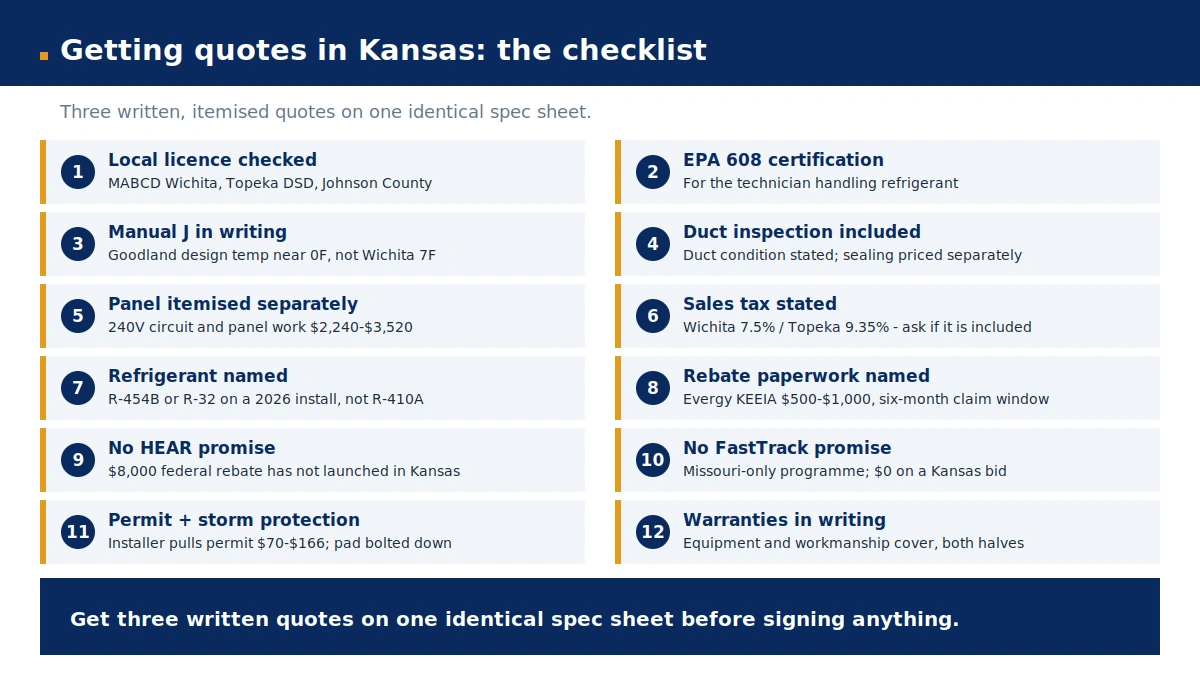
Collect three written, itemised quotes, each built to one identical specification: same tonnage, same efficiency ratings, same duct work, same electrical work, same permit, same sales tax treatment — hold everything fixed except the price. Unless bids line up side by side, line for line, there is no honest comparison, and the cheapest bid usually has the most lines missing. In Kansas, add two more constants to the specification: the utility name and the fuel being replaced, because both change the rebate and the running-cost answer, and the sales tax treatment, because a 7.5% line in Wichita and a 9.35% line in Topeka are not the same quote.
- Local licence checked. Kansas has no statewide HVAC licence — ask for the city or county licence and check it with the local building department: MABCD in Wichita and Sedgwick County, the Development Services Division in Topeka, Building and Development Services in Kansas City, KS, or the county licence in Johnson County. No local licence where one is required is a walk-away. In a town with no licence requirement at all, verify insurance and the permit instead.
- EPA 608 in hand for the person handling the refrigerant on the job. Federal law allows no exceptions.
- Get the Manual J load calculation on paper before any equipment is ordered. Sizing from square footage is a guess. In Goodland or Dodge City, the Manual J should show a design temperature near 0F or 5F, not a Wichita 7F.
- Ducts inspected and priced. State the duct condition in the bid, and list sealing or replacement as its own line. If a bid never mentions the ducts at all, part of the job has simply been left unpriced.
- Panel shown separately. Put the 240V circuit and any panel work on their own lines, and never fold them into the headline total. In Kansas that line often runs $2,240–$3,520.
- Sales tax stated. The quote must say whether it includes sales tax on the equipment. Wichita 7.5%, Kansas City, KS 9.125%, Topeka, Overland Park, and Lawrence 9.35%. A quote that hides the tax line is not comparable with one that shows it.
- Refrigerant stated. A 2026 install should name R-454B or R-32 on its quote. R-410A is last year’s equipment.
- Rebate paperwork spelled out. Evergy KEEIA ($500–$1,000 ducted by SEER2 tier, $150–$200 mini-split) with the efficiency threshold, the authorized-contractor condition, and the six-month claim window checked — or the KEPCo co-op amount, or Midwest Energy How$mart financing in the west. Any federal credit line on the bid should read $0 for a 2026 install, and any FastTrack line on a Kansas bid should read $0 too, because FastTrack is Missouri-only.
- No HEAR promise. A contractor who promises the $8,000 federal HEAR rebate on a Kansas job in 2026 is promising money that has not launched — and work finished before launch can never collect it. Reject the promise, not necessarily the contractor, and remember who made it.
- Permit in the installer’s name, with its number asked for in writing before work starts. Never pull it yourself. The statewide band runs $70–$166.
- Storm protection priced. Bolted pad, surge protector, and hail guard where the site calls for it. A Kansas quote with no storm line has left a Kansas risk unpriced.
- Both warranties in writing. On the equipment side, parts cover typically runs 10 years, and the premium brands stretch the compressor cover longer still. The contractor’s own workmanship cover — usually 1–10 years — counts for even more than the parts cover does. Get both before signing.
Kansas-specific red flags: a “federal tax credit” line on a 2026 bid; a FastTrack financing offer on a Kansas address; a HEAR rebate promised before the KCC opens the programme; a Missouri-side Kansas City price quoted for a Kansas City, KS home; a whole-home quote near $5,000 with no duct, electrical, or tax lines; a standard unit quoted for a Goodland or Dodge City home without the cold-climate premium; a contractor sizing the system from the old unit’s nameplate without a load calculation; and any contractor who cannot name the city or county licence they hold. The strongest Kansas installers run two to three weeks out in peak season; a crew able to start tomorrow deserves scepticism, not a signature. For the neighbouring-state comparison, see our Missouri heat pump cost guide — Missouri is the closest market to Kansas’s, and the contrast in rebates, tax, and financing is instructive.
Sources & methodology
Cost anchors: NumeralQ’s “Heat Pump Cost in Kansas (2026)” estimator, priced October 26, 2026 from Fixr, This Old House, Home Depot prices, and BLS May 2025 wages, is the primary Kansas anchor — 3-ton ducted $6,530–$10,940; size table (1.5t $4,390–$7,050 through 5t $9,390–$16,120); type table (cold-climate ducted $8,590–$15,010; single-zone mini-split $3,130–$4,890; 3-head $6,220–$11,140; geothermal $20,220–$31,870); city table (Overland Park $6,620–$11,040; Wichita $6,500–$10,890); ductwork $4,140–$7,040; panel $2,240–$3,520; permits $70–$166; HVAC median pay $29.07 an hour, billed $58–$76 an hour; electricians $31.66 an hour, billed $63–$82 an hour; EIA heating-cost table (gas furnace $555 a year; heat pump HSPF2 7.5 $748 a year; HSPF2 9.0 $623 a year); about 6% of Kansas homes heat mainly with heat pumps. NumeralQ’s “HVAC Replacement Cost in Wichita, KS (2026)” gives dual-fuel at $9,160–$15,040 and a full AC-plus-furnace system at $8,290–$14,040. HVACProjectCost’s Kansas guide (early 2026 contractor data from Wichita, Topeka, and the Kansas City metro) puts heat pump replacement at $6,000–$13,500, dual-fuel at $9,000–$15,500, a full system at $8,500–$14,000, duct repairs at $500–$2,800, and full duct replacement at $2,000–$7,500 — and wrongly attributes FastTrack rebates to Kansas, which this guide corrects rather than repeats. Modernize’s Kansas pages (2026) average $10,750 statewide, identical on every Kansas city page, so treated here as a statewide template number rather than a city-measured average, with standard air-source near $8,640 and high-efficiency near $12,960. Angi’s Kansas City, Missouri page (updated August 4, 2026) puts the average Missouri-side install at $5,174 — cited here only to warn against using it for Kansas City, KS. Article 1 (Nestpriced) puts the US baseline at $7,500–$15,000 for a ducted heat pump. The headline $7,000–$12,500 band and the near-$9,500 typical job are this guide’s synthesis of the NumeralQ model band, marketplace averages, and contractor-data ranges; no published Kansas statewide installer average was found.
Rates: EIA Electric Power Monthly Tables 5.6.A/B (August 2026, released October 2026), via Where’d My Money Go? (updated October 29, 2026) and Kadoa (updated November 7, 2026) — Kansas residential electricity 15.1 cents per kilowatt-hour on the 12-month average to August 2026 (August 2026 alone 15.47 cents), 19th lowest in the US against 18.0 cents nationally; average bill about $134 a month (887 kilowatt-hours); Evergy Kansas Central and Evergy Kansas South 15.3 cents, Evergy Metro 13.3 cents, Midwest Energy 12.4 cents over the last 12 months; Evergy Kansas Central tariff $15.25 a month fixed charge plus 2.96 cents per kilowatt-hour in riders, all-in 15.85 cents at 900 kilowatt-hours (Price of Electricity, EIA August 2026 data). EIA natural gas via Where’d My Money Go? — Kansas residential gas about $2.03 a therm on the 12-month average to May 2026 ($21.00 per thousand cubic feet); BallparkLab’s trailing average through April 2026 puts it near $1.54 a therm — conflict flagged, $2.03 used as the planning figure with the range cited. We worked the per-therm arithmetic out ourselves from those EIA prices, using 29.3 kilowatt-hours per therm. It gives $1.47 for a heat pump at COP 3.0 and $2.14 for a gas furnace at 95% at the state-average price, with a break-even COP of about 2.07 at Kansas prices. CONFLICT FLAGGED: the per-therm arithmetic favours a good heat pump by a wide margin at the state-average price, while the EIA annual planning figures show gas cheaper ($555 a year vs $623 a year for a high-efficiency heat pump) — the draft reports both and explains the gap.
Climate: IECC 2021 zones (PNNL-33270, via hvacbase.org zone map) — Kansas Zone 4A (87 counties) and Zone 5A (18 counties), unchanged in the 2024 IECC, with no Kansas county in Zone 5B or Zone 6. IPC Appendix D Table D101 design temperatures (Wichita 7F/98F, HDD 4,620; Topeka 4F/96F, HDD 5,182; Kansas City 6F/96F, HDD 4,711; Dodge City 5F/97F, HDD 4,986; Goodland 0F/96F, HDD 6,141) and Kansas City cooling degree days near 1,420. NOAA records via Extreme Weather Watch (Wichita 113F in July 1954 and 21 below in February 1982; Topeka 112F in August 2011 and 26 below in December 1989; Wichita 102 days at or above 90F in 2026, the most on record). Heating fuel mix: Census ACS 2020–2024 via NumeralQ (piped gas about 63%, electricity about 27%) and EIA RECS (about 6% main-heat heat pumps). Severe weather: National Weather Service Wichita hazardous weather outlook (November 2, 2026) and Integrity Trade Services Wichita severe-weather guidance (tornadoes, thunderstorms, ice storms, flooding; bolt the outdoor unit down, fit surge protection).
Rebates: Evergy KEEIA rebates via HomeEnergyBasics Kansas page (updated June 11, 2026), Santa Fe Air (published October 28, 2026), and Mr Breeze Evergy guides (2026) — ducted $500/$700/$900/$1,000 by SEER2 tier, mini-split $150–$200, ground-source $1,000 (one source says up to $1,500 — conflict flagged), extra $1,000 for replacing electric resistance heat (second-hand, verify with Evergy), six-month claim window, equipment installed June 1, 2024 through December 31, 2027, authorized contractor required, programme approved September 2023 and running through December 31, 2027; insulation up to $500, air sealing up to $300, duct sealing up to $250, audit credit $250. KEPCo co-ops $300–$600 and Midwest Energy How$mart financing via HomeEnergyBasics. Kansas Gas Service offers no heat pump rebates (HomeEnergyBasics). FastTrack HVAC PAYS is Missouri-only (Summit Heating, September 3, 2025; Mr Breeze) — HVACProjectCost’s attribution of FastTrack rebates to Kansas is corrected here. No verified 2026 rebate amounts found for Black Hills Energy, the City of Kansas City (KS) municipal electric utility, or other Kansas co-ops beyond KEPCo’s range.
Federal: Public Law 119-21 and IRS notice FS-2025-05 ended §25C and §25D for installs after December 31, 2025. HEAR/HOMES Kansas status via the Kansas Corporation Commission news release (November 6, 2024), HeatPumpPricing HEAR status (verified November 4, 2026), HomeEnergyRebateFinder Kansas page, and Electrical Contractors and Wiring HEAR-by-state table (October 27, 2026) — $105.6 million combined, HEAR $52,663,910 and HOMES $52,864,974, KCC programme with HORNE, portal at kshomerebates.gov, plan pending DOE approval, no launch date. DOE Program Notice 26-2, dated May 29, 2026, removed fuel-switching from September 1, 2026, so HEAR now covers electric-to-electric swaps only. §48E lease route — Palmetto Comfort Plan confirms leasing exists in Wichita, Lawrence, and Topeka, but no primary source confirms §48E pass-through to a residential lessee. The federal minimum under DOE rules is 7.5 HSPF2 / 13.4 SEER2 in Kansas’s region (NumeralQ Kansas FAQ).
Licensing & permits: Kansas has no statewide HVAC licence and no state licensing board (ServiceTitan Kansas HVAC licensing guide; Budget Heating Kansas HVAC regulatory guide, updated August 7, 2026; Housecall Pro Kansas general contractor licensing guide). Kansas Statutes Chapter 12, Article 15 allows cities and counties to license tradespeople. Wichita/Sedgwick County MABCD mechanical licences (Apprentice, Journeyman at 75% IAPMO exam, $125 exam plus $35 licence, Master, Contractor $360 and must employ a master, renewal every 2 years); Topeka Development Services Division; Kansas City, KS Building and Development Services (701 N. 7th St.); Johnson County Class A/B/C contractor licences with ICC exam and insurance. Roofing is the one trade with state registration (Kansas Attorney General). EPA 608 federal. NumeralQ’s 35-city check (October 2026) puts permit fees at $70–$166 across the cities checked.
Sales tax: Kansas Department of Revenue Publication 1700 (effective July 1, 2026), via Country Tax Calc Kansas tax guide 2026 and Stripe Kansas sales tax rates 2026 — state rate 6.5%, combined Wichita 7.5%, Kansas City, KS 9.125%, Topeka 9.35%, Overland Park 9.35%, Lawrence 9.35%, Olathe 9.475%, Shawnee 9.6%, combined range 7.5% to about 10.6%, higher inside special taxing districts.
Method note: where a model estimate and an installer quote disagreed, both figures appear here, and the installer figure is given prominence. Where no Kansas-specific figure was verified (for example maintenance $150–$300 a year; lifespan 12–15 years planning figure; Manual J $200–$500), the figure is the national guide’s and is labeled as such. Topeka, Lawrence, and Kansas City, KS have no published city price model, so this guide invents no band for them. The payback figures in the payback section are this guide’s own illustrative arithmetic, and are labelled as such. Every price in this guide is a 2026 planning figure, not a quote for your house. Plan the budget only after three written local quotes are in hand.
Disclaimer: these 2026 Kansas planning figures vary by city, home, and contractor. Plan spending only after three written local quotes are in hand. Treat the tax and rebate information here as general guidance, not as tax advice. Any incentive should be checked with a tax professional, the Kansas Corporation Commission, or your utility first.
What does a heat pump cost in Kansas in 2026?
For a 3-ton whole-home ducted air-source system, expect $7,000–$12,500 installed, with the typical job near $9,500. A single ductless mini-split zone is $3,130–$4,890, three zones are $6,220–$11,140, a cold-climate ducted unit is $8,590–$15,010, a dual-fuel system is $9,160–$15,040, and geothermal is $20,220–$31,870. Wichita and Overland Park come out nearly the same in the model, within about $120 of each other. Topeka, Lawrence, and Kansas City, KS have no published city price model, so this guide gives direction only for them. Ask whether the quote includes sales tax: 7.5% in Wichita and 9.35% in Topeka, Overland Park, and Lawrence adds $750–$935 to a $10,000 job.
What rebates does Evergy pay for a heat pump in 2026?
Evergy pays $500 for a ducted heat pump at SEER2 15, $700 at SEER2 16, $900 at SEER2 17, and $1,000 at SEER2 20 or better, plus $150–$200 for a ductless mini-split and $1,000 for a ground-source heat pump. The system must be AHRI-certified with a matching indoor coil and installed by an Evergy-authorized contractor, and the claim must be filed within six months of installation. The programme runs through December 31, 2027. An extra $1,000 may be available when a high-efficiency heat pump replaces electric resistance heat — ask Evergy to confirm that amount, because it comes from installer summaries rather than from Evergy directly. KEPCo co-ops add $300–$600, Midwest Energy offers How$mart financing instead of a rebate, and Kansas Gas Service pays nothing toward a heat pump.
Is the FastTrack HVAC PAYS programme available in Kansas?
No. Evergy’s FastTrack HVAC PAYS on-bill financing programme serves Missouri customers only. Kansas uses the straight KEEIA rebate model: pick a qualifying system, install it through an Evergy-authorized contractor, and claim the rebate as a deduction on the invoice or a post-installation cheque. One Kansas pricing guide wrongly lists FastTrack rebates of $1,000–$1,900 for Kansas homeowners — those are Missouri figures. A contractor who offers FastTrack terms on a Kansas address is selling a Missouri programme.
Has Kansas’s HEAR rebate launched yet?
No. Kansas was allocated $105.6 million for HEAR and HOMES combined, and the Kansas Corporation Commission runs the Kansas Home Rebates Program with a public portal at kshomerebates.gov, but the plan is still pending US Department of Energy approval and no launch date is set. The planned design calls for HEAR up to 150% of area median income, with up to $8,000 for a heat pump within a $14,000 household cap, and HOMES for all incomes, typically up to $8,000. Watch two things: rebates are not retroactive, so work finished before launch never collects; and DOE Program Notice 26-2, effective September 1, 2026, limits HEAR to electric-to-electric swaps, so a gas-to-heat-pump conversion collects nothing even after launch — which matters in Kansas, where 63% of homes heat with gas. Leave it out of the budget entirely.
Does any federal tax credit apply to a Kansas heat pump in 2026?
No — $0. IRS notice FS-2025-05 confirms it. §25C, worth 30% up to $2,000 a year on a heat pump, and §25D both ended for property placed in service after December 31, 2025 under the One Big Beautiful Bill Act. Kansas has no state tax credit either and no statewide heat pump rebate. See a $2,000 federal credit subtracted from a 2026 Kansas install? That quote is out of date — ask the contractor to remove the line. What is live is utility money: $500–$1,000 from Evergy for a ducted heat pump, depending on efficiency, or the KEPCo co-op amounts in their territories.
Does a heat pump cost more to run than gas in Kansas, or less?
It depends on which figures you trust, and this guide prints both sides of the argument. At the statewide electricity price of 15.1 cents per kilowatt-hour, a good heat pump at COP 3.0 heats for about $1.47 a therm, against about $2.14 for a 95% gas furnace — a clear win for the pump, with a break-even COP of only about 2.07. The EIA’s annual planning figures tell the opposite story: $623 a year for a high-efficiency heat pump against $555 for a gas furnace, and $748 for a minimum-efficiency unit. Against electric resistance heat, at about $4.43 a therm, the heat pump wins by a wide margin everywhere in Kansas. The gap between the two views comes down to the seasonal COP of a real Kansas winter, once cold snaps, defrost cycles, and strip-heat hours are counted. Buy the high-efficiency tier, or buy dual-fuel, and the fuel maths moves your way on both views.
Do I need a cold-climate heat pump in Kansas?
In the northwest, yes. Goodland designs to 0F with 6,141 heating degree days, and Dodge City designs to 5F — cold-climate or dual-fuel equipment is the default there, not an upgrade. In Wichita, Topeka, and Kansas City, which design to 4–7F, a standard unit can carry the house, but the cold-climate premium at $8,590–$15,010 buys real hours here, not just insurance, because strip heat runs on a meaningful number of nights each winter. With 63% of Kansas homes on piped gas, dual-fuel at $9,160–$15,040 is the configuration most Kansas installers sell: heat pump through the shoulder seasons, gas furnace on the coldest nights. Kansas sits in IECC Zone 4A across 87 counties and Zone 5A across 18 counties, with no Zone 5B or Zone 6 county.
What permit and licence do I need for a Kansas heat pump?
Kansas has no statewide HVAC licence and no state licensing board, so there is no state licence number to check. Licensing is local: Wichita and Sedgwick County license through the Metropolitan Area Building and Construction Department, Topeka through its Development Services Division, Kansas City, KS through Building and Development Services, and Johnson County licenses contractors in Class A, B, and C tiers. Ask for the local licence and check it with the city or county building department. Refrigerant work calls for a technician with EPA Section 608 certification. Where a building department exists, a mechanical permit is part of the job, and statewide the fee typically runs $70–$166. Insist on the permit number in writing, and on the installer pulling the permit. And ask whether the quote includes sales tax — 7.5% in Wichita, 9.35% in Topeka, Overland Park, and Lawrence.