

A roof in Mobile and a roof in Huntsville sit in the same state and answer to different weather. The Mobile roof faces the Gulf: hurricane wind, wind-driven rain, salt air, and a storm surge that no shingle is built to stop. The Huntsville roof faces the tornado belt: spring supercells, hail, and straight-line wind, with a tornado season that runs from February into late November.
Between them, Birmingham holds a third roofing market altogether. Its older neighborhoods hold steep-pitched houses under mature trees, where a 1920s bungalow and a new subdivision home can sit on the same street and need completely different quotes.
No single statewide price fits all three markets. The sections below price the state from the anchors up, then separate the coast, the tornado belt, and the inland city roof so each quote can be read against the right market.
For the countrywide baseline behind the Alabama numbers, see our roof replacement cost guide; Alabama is judged against that baseline all the way through. Where the roof meets the rest of the house, two Alabama guides complete the picture: our solar panel cost in Alabama guide prices the array that should never go on a roof with fewer than eight to ten years of life left in it, and our roof replacement cost in Georgia guide prices the nearest neighboring market for a homeowner near the state line.
Table of Contents
What a Roof Replacement Costs in Alabama in 2026
Two price anchors frame the Alabama market. They count the job in different units, so at first glance they look like they contradict each other. They do not.
SmartRoofingCalculator prices by the square. Roofers measure the job in squares, and each square stands for 100 square feet of roof once the job is done. Its band is $410–$590 for architectural shingles with tear-off in the price, putting a typical 25-square Alabama roof at $10,250–$14,750.
NumeralQ states its prices per square foot of roof surface. It prices a 2,000 square foot roof in Birmingham at $8,950–$10,860, from local data checked in October 2026. Expressed in the same units, the two anchors agree: 20 squares make a 2,000-square-foot roof surface, and running the $410–$590 band across 20 squares gives $8,200–$11,800, which sits almost exactly on NumeralQ’s Birmingham range.
The ruler differs. The roof does not.
The other published models fan out around that center. The fan is wider in Alabama than in most states because the state’s two weathers pull prices in opposite directions. MyRoofData’s 2026 model runs higher, at $11,250–$19,500 for a typical single-family architectural roof including tear-off of one layer, built from crew rates of $45–$75 an hour and a state cost index of 0.88, about 12 percent below the national average.
BestRoofingEstimates lands in the middle, at $8,500–$19,500 with an average near $12,250 for a typical 2,000 square foot home, architectural shingles at $11,000–$15,000. Pinnacle Home Improvements prices the typical asphalt job at $10,000–$16,000 inside an overall range of $5,500–$28,000. At the top of the spread sits RoofingEstimatorPros, refreshed August 26, 2026, with $12,863–$23,227 for a 2,000-square-foot architectural roof: $17,469 at the middle, about $8.73 a square foot once tear-off, permits, and waste are in.
InstantRoofer’s contractor-pricing database puts the Alabama average higher still, at $17,521 for asphalt. That figure sits on the state’s average measured roof of 2,993 square feet, or 30 squares, at $5.85 per square foot. It is a much bigger roof than the 2,000–2,500 square foot planning roof the other models assume.
Two numbers explain why Alabama sits below the national average on nearly every model. The first is wages. The Bureau of Labor Statistics, in its May 2024 Occupational Employment and Wage Statistics as carried by SmartRoofingCalculator, puts the median Alabama roofer at $21.74 an hour, with a construction laborer at $17.45, well under the national roofer median.
SmartRoofingCalculator applies a state factor of 0.909, built from that wage index and the Bureau of Economic Analysis 2024 Regional Price Parities. MyRoofData uses a 0.88 cost index, and RoofingEstimatorPros a 0.93 multiplier.
The second number is the housing stock itself: much of Alabama’s housing is single-story, low-pitch, and simple in plan, which is the cheapest roof to tear off and replace. The expensive Alabama roofs are the exceptions: the steep-pitched Birmingham bungalow under the oaks, the complex hip roof on a new Huntsville build, the coastal house that needs hurricane strapping and a FORTIFIED specification.
Treat RoofingEstimatorPros as the ceiling. Its $17,469 midpoint sits about 50 percent above the SmartRoofingCalculator midpoint, which is the shape of a big, steep, or complicated roof rather than a standard Alabama ranch. InstantRoofer deserves the same flag from a different direction: its $17,521 average is priced on a 30-square roof, and a homeowner who carries that number into a meeting about a 20-square roof will over-budget by thousands.
Walk into the first contractor meeting holding two numbers: $10,250–$14,750 for a 25-square roof, checked against $8,950–$10,860 for a 2,000-square-foot Birmingham roof. On a dry week with a standard pitch, an asphalt crew is done in one to three days; metal takes longer.
The install itself is the fast part. Gathering three quotes, sitting out spring tornado season when the old roof can take it, and asking the building department whether a permit is even needed all take longer, and the permit answer changes by city, and sometimes by street.
| Source | Typical job | Price | Dated |
|---|---|---|---|
| SmartRoofingCalculator | 25-square architectural roof | $10,250–$14,750 ($410–$590/sq) | Apr 24, 2026 / index Nov 9, 2026 |
| NumeralQ | 2,000 sq ft roof, Birmingham | $8,950–$10,860 | Oct 2026 |
| MyRoofData | Typical single-family arch roof | $11,250–$19,500 | 2026 model |
| BestRoofingEstimates | Typical 2,000 sq ft home | $8,500–$19,500 (avg ~$12,250) | 2026 guide |
| Pinnacle Home Improvements | Typical asphalt job | $10,000–$16,000 (range $5,500–$28,000) | 2026 guide |
| RoofingEstimatorPros | 2,000 sq ft arch roof | $12,863–$23,227 (avg $17,469) | Aug 26, 2026 |
| InstantRoofer | Avg asphalt, 30-square roof | $17,521 ($5.85/sq ft) | 2026 database |
| NumeralQ | Typical job, Birmingham midpoint | $9,905 (6.2% of median home) | Oct 2026 |
| NumeralQ | Typical job, Huntsville midpoint | $9,810 (3.3% of median home) | Oct 2026 |
| NumeralQ | Typical job, Montgomery midpoint | $9,810 (6.1% of median home) | Oct 2026 |
Roof Replacement Cost in Alabama by Material
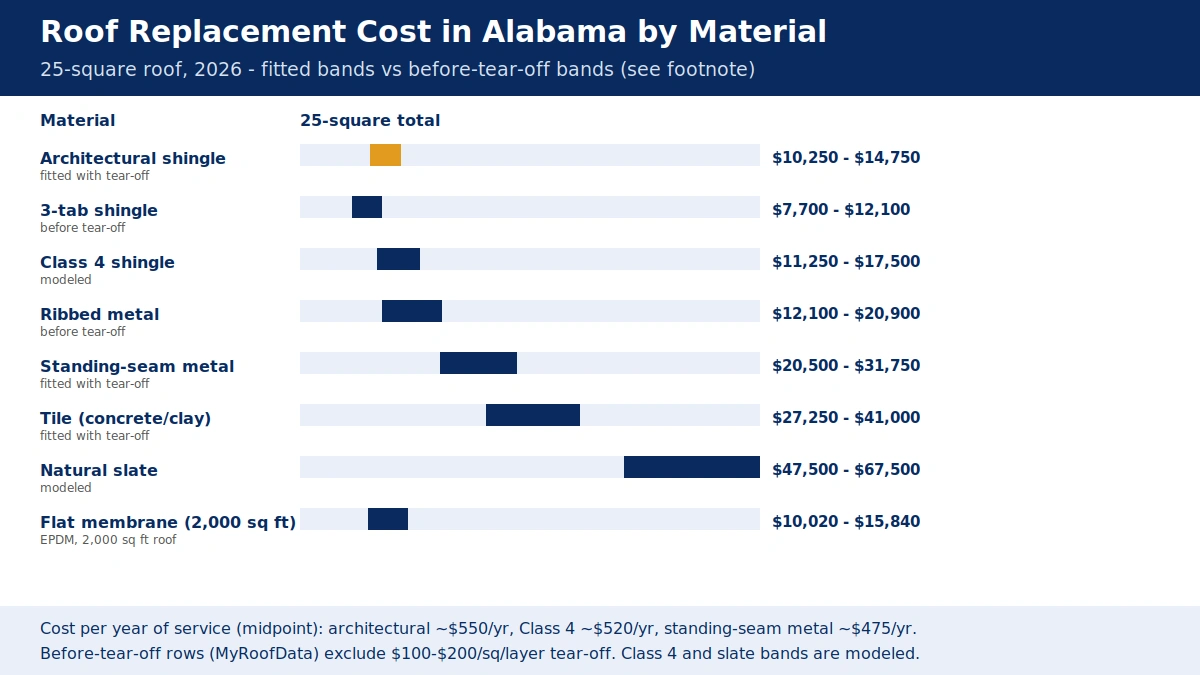
Read the material table with one warning in mind, and read it before the numbers. Three rows exclude tear-off and the rest include it. Confusing the two shaves $2,500 to $5,000 off a 25-square estimate that is not really there.
MyRoofData’s per-square bands leave tear-off out and bill it apart, at $100–$200 a square for each layer. SmartRoofingCalculator’s bands are all-in, tear-off inside the price. Both kinds of row appear below, each labeled, each priced on the same 25-square roof (2,500 square feet of surface).
Read the table with Gulf weather in mind. The lowest-priced shingle is the first to lift in a hurricane, and the highest-priced metal is the one still shedding Gulf wind after the mortgage is gone.
| Material | Installed cost per square | Total for 25 squares | Realistic life in Alabama |
|---|---|---|---|
| 3-tab asphalt (before tear-off) | $308–$484 | $7,700–$12,100 | 15–20 years |
| Architectural asphalt (fitted) | $410–$590 | $10,250–$14,750 | 20–25 years |
| Architectural asphalt (before tear-off) | $396–$660 | $9,900–$16,500 | 22–30 years |
| Class 4 impact-rated shingle (modeled) | $450–$700 | $11,250–$17,500 | 25–30 years |
| Ribbed metal, exposed fastener (before tear-off) | $484–$836 | $12,100–$20,900 | 30–40 years |
| Standing-seam metal (fitted) | $820–$1,270 | $20,500–$31,750 | 40–70 years |
| Standing-seam metal (before tear-off) | $836–$1,408 | $20,900–$35,200 | 40–70 years |
| Tile, concrete/clay (fitted) | $1,090–$1,640 | $27,250–$41,000 | 50+ years |
| Natural slate (modeled) | $1,900–$2,700 | $47,500–$67,500 | 75+ years |
| Flat membrane, EPDM (2,000 sq ft roof) | — | $10,020–$15,840 | 20–30 years |
Three-tab shingles are the budget row, and in Alabama they are a shrinking one. MyRoofData prices them at $308–$484 a square before tear-off, or $7,700–$12,100 for 25 squares, with a 15-to-20-year life. Pinnacle prices them at $3.50–$4.50 per square foot installed, or $5,500–$8,500 for a 2,000 square foot home.
The wind rating is the problem with 3-tab. A flat, single-layer shingle has the lowest uplift resistance on the table, in a state where wind is the whole story. Many insurers and builders have moved away from them, and on the Gulf Coast they are close to uninsurable as a new install.
A 3-tab roof that saves $2,500 at install can cost a deductible after the first tropical storm. That saving is not the cheap option once the storm bill lands.
Architectural shingles are the default Alabama roof, on roughly three out of four homes in the national picture and the overwhelming majority here. SmartRoofingCalculator’s installed band of $410–$590 a square makes $10,250–$14,750 for 25 squares. MyRoofData’s before-tear-off band of $396–$660 makes $9,900–$16,500 before the $2,500–$5,000 tear-off is added.
Pinnacle prices them at $4–$5.50 per square foot installed, or $9,000–$13,000 for a 2,000 square foot home. The realistic Alabama life is 20 to 25 years, at the short end of the 22-to-30-year nominal range, because heat and humidity age the mat faster than the brochure assumes. Designer or premium architectural shingles run $5.50–$7.50 per square foot on Pinnacle’s figures, or $12,000–$17,000 for a 2,000 square foot home, with 30 to 40 years of life: the look of slate at a third of the weight and a fraction of the crew cost.
Class 4 impact-resistant shingles are the inland upgrade that pays for itself in hail country. The band below is a modeled figure, marked as modeled, since the sources checked carry no Alabama-specific premium. A Dothan contractor cites $5.00–$8.50 per square foot installed for Class 4 against $3.50–$7.00 for standard asphalt, and the regional Alabama price guide puts the Class 4 adder at 10 to 25 percent of the shingle cost.
Applied to the SmartRoofingCalculator architectural band, that gives roughly $450–$700 a square installed, or $11,250–$17,500 for 25 squares. That is about $1,000–$2,750 over the standard architectural job. The payback comes from the hail claim that never happens and the insurance credit some carriers offer for a UL 2218 Class 4 marking, which the insurance section below takes up.
Metal is where the long view changes the answer, and where Gulf weather rewrites the specification. Ribbed panels with exposed fasteners run $484–$836 a square on MyRoofData’s Alabama model before tear-off, or $12,100–$20,900 for a 25-square roof, lasting 30 to 40 years. NumeralQ prices exposed-fastener metal on a 2,000 square foot Birmingham roof at $13,950–$17,670.
Standing-seam metal runs $820–$1,270 a square installed on SmartRoofingCalculator’s figures, or $20,500–$31,750, lasting 40 to 70 years, while MyRoofData prices it at $836–$1,408 a square before tear-off. Stone-coated steel sits between the two on NumeralQ’s Birmingham figures at $15,680–$22,860 for a 2,000 square foot roof. Near salt water, the metal itself matters as much as the seam: aluminum is the coastal choice because it does not rust, while steel relies on coatings that salt air attacks, and stainless or hot-dipped galvanized fasteners are the specification to insist on.
Standing-seam systems carry wind ratings of 140 miles per hour or more, which matters on a coast where wind is the design load. Divide each midpoint total by its years of service and the ranking reverses: standing seam lands near $475 a year, architectural near $550.
Metal costs more on the quote and less per year of service. The full metal numbers live in our metal roof cost guide, with the side-by-side contest in the metal vs shingles comparison.
Tile and slate sit at the luxury end, and in Alabama they are rare for structural reasons as much as financial ones. SmartRoofingCalculator puts tile at $1,090–$1,640 a square, which is $27,250–$41,000 across 25 squares. The slate figure here, about $1,900–$2,700 a square, which comes to $47,500–$67,500 for 25 squares, is modeled on a Birmingham finding by NumeralQ that natural slate costs roughly 4.6 times the architectural price, and it is labeled as modeled, since the sources checked publish no Alabama-specific slate band.
Both weigh far more than asphalt, both demand a structural check before installation, and both can outlast half a century. Tile’s Alabama problem is wind uplift on the coast and the weight on a frame never designed for it. With slate, the risk is the installer: Alabama crews lay it rarely, and a slate roof from an inexperienced crew tends to leak at the first Gulf downpour.
Price tile only after reading our tile roof cost guide. An Alabama frame has to be checked for concrete or clay weight before anything else.
Flat and low-slope roofs are a small slice of Alabama’s housing, mostly on commercial buildings and a few modern homes, and they are priced by the membrane rather than the shingle. NumeralQ prices an EPDM rubber roof on a 2,000 square foot Birmingham roof at $10,020–$15,840, or $4.74–$7.51 per square foot installed, with a 20-to-30-year life.
TPO and PVC run higher and reflect more sun, which matters on a low-slope roof over an air-conditioned top floor in an Alabama July. Ponding is the failure mode to watch.
A low-slope roof that holds water after every Gulf rain will fail at the seams first. Flat-roof pricing in full sits in our flat roof replacement cost guide.
Roof Replacement Cost by Roof Size
The commonest budgeting error in Alabama is pricing the living area instead of the roof surface, and it is an expensive one. A 2,000-square-foot house never has a 2,000-square-foot roof. Pitch adds surface, overhangs add surface, hips and valleys add surface, and waste adds more.
A single-story 2,000 square foot ranch with a low-pitch gable roof might measure 2,200 square feet of roof surface. The same living area under a steep-pitched hip roof with dormers can measure 2,800. The quote is written in squares (100 square feet of finished roof surface each), and the square count on the bid is the number that governs the price, not the number on the listing.
NumeralQ’s Birmingham size table makes the point in dollars. A 1,000 square foot roof surface runs $4,750–$5,840 in architectural shingles. A 2,000 square foot roof runs $8,950–$10,860, and a 3,000 square foot roof runs $13,160–$15,880.
The per-square-foot price falls slightly as the roof grows, because the fixed costs spread across more squares: tear-off setup, dumpster, delivery, crew mobilization. The total climbs steeply all the same.
InstantRoofer’s Alabama database puts the state’s average measured roof at 2,993 square feet, or 30 squares, which is why its $17,521 average looks so much higher than the planning models. It is pricing a bigger roof.
The table below works the SmartRoofingCalculator installed band of $410–$590 a square across the sizes Alabama homeowners actually meet, with the tear-off already inside the band. It is NestPriced arithmetic from the cited per-square range, not a published table, and it assumes one layer of tear-off on a standard-pitch roof. Steep pitch, a second layer, or bad decking moves every row up.
| Roof surface | Squares | Architectural, fitted | 3-tab, before tear-off | Standing seam, fitted |
|---|---|---|---|---|
| 1,200 sq ft | 12 | $4,920–$7,080 | $3,696–$5,808 | $9,840–$15,240 |
| 1,500 sq ft | 15 | $6,150–$8,850 | $4,620–$7,260 | $12,300–$19,050 |
| 2,000 sq ft | 20 | $8,200–$11,800 | $6,160–$9,680 | $16,400–$25,400 |
| 2,500 sq ft | 25 | $10,250–$14,750 | $7,700–$12,100 | $20,500–$31,750 |
| 3,000 sq ft | 30 | $12,300–$17,700 | $9,240–$14,520 | $24,600–$38,100 |
| 3,500 sq ft | 35 | $14,350–$20,650 | $10,780–$16,940 | $28,700–$44,450 |
Three adders sit outside the table and belong on the quote as their own lines:
- A second layer of tear-off. Tear-off of a second layer runs $100–$200 a square per layer on MyRoofData’s model, or $2,500–$5,000 on a 25-square roof with two layers down.
- Decking replacement. Decking replacement is priced per sheet once the old shingles come off and the rot shows, and the per-sheet rate agreed before tear-off is the number that counts. The sources checked give no Alabama-specific per-sheet figure, so get the rate in writing rather than taking a verbal one.
- Pitch. Pitch is the quiet multiplier: a roof steeper than about 8-in-12 needs staging, safety lines, and slower crew movement, and contractors price that in whether the homeowner sees the line or not.
Insist that every quote state the measured size, the pitch, and the number of layers. Without those three numbers, the price is a guess.
Roof Replacement Cost by City: Birmingham vs Huntsville vs Mobile vs Montgomery vs Tuscaloosa
Alabama’s cities price roofs differently because they face different weather and different labor markets, and the spread is wide enough to matter. BestRoofingEstimates puts Birmingham at $11,500–$16,000 for a 2,000 square foot home, Montgomery at $10,500–$15,000, Mobile at $12,000–$17,500, and Huntsville at $11,000–$15,500.
The regional Alabama price guide by county tells a similar story from the other direction: coastal homes in Mobile and Baldwin counties usually cost $11,000–$22,000 for a standard asphalt replacement, inland homes usually $9,500–$18,000, and Montgomery’s simple low-pitch ranches often $9,000–$14,000. NumeralQ’s city midpoints put Birmingham at $9,905, Huntsville at $9,810, and Montgomery at $9,810 for the typical job. Those totals sit close together in dollars but far apart as a share of the house: 6.2 percent of the median Birmingham home, 3.3 percent in Huntsville, and 6.1 percent in Montgomery, because Huntsville’s median home costs far more.
Birmingham is the dearest inland market and the most complicated roof stock in the state. The city’s older neighborhoods hold steep-pitched houses from the 1920s through the 1950s, many under mature trees, many with board decking rather than plywood, and many with a chimney, a dormer, and a valley that each add a flashing line to the quote.
Homewood, Crestwood, and Forest Park all fit that pattern. Steep pitch, older decking, and tree debris push Birmingham costs toward the middle or upper end of the range, and hail is a regular visitor.
NumeralQ prices a 2,000 square foot Birmingham roof at $8,950–$10,860 in architectural shingles, with exposed-fastener metal at $13,950–$17,670 and standing seam at $19,670–$30,160. Birmingham also has the highest permit fee of the three NumeralQ cities for a $15,000 re-roof at $142, against $82 in Huntsville and $112 in Montgomery, though the city exempts shingle replacement on one- and two-family homes from permits altogether (see Permits & Code below). Labor is the dearest here too: the largest labor market in the state, the highest demand, and the most competition for crews after every spring storm.
Huntsville is the growth market, and its roofs show it. The city has grown fast, and many of its homes are newer construction from the last 25 years with complex hip roofs and multiple gables: more squares per living area, more valleys, more flashing, and a higher waste factor than a simple gable. Hail is the main concern in Madison County, and Class 4 impact-resistant shingles have become the popular upgrade there, often adding 10 to 25 percent to the shingle cost, with some insurers offering a credit for them.
Prices track close to the state average, at $11,000–$15,500 for a 2,000 square foot home, and the contractor market is strong, which keeps quotes competitive. A Huntsville homeowner should watch the waste line: a complex hip roof can carry a 12-to-15-percent waste allowance where a simple gable carries 10, and that difference is $500 or more on a 25-square job.
Mobile is the dearest market in the state and the one where the specification matters most. A coastal roof follows a different spec from an inland roof. Hurricane strapping is required, wind-rated materials are the baseline, permits cost more, and the crew works to a wind standard the inland cities never see.
BestRoofingEstimates puts Mobile at $12,000–$17,500, and the regional guide puts coastal asphalt at $11,000–$22,000, with a FORTIFIED roof typically adding $1,500–$4,500 to that price. Standing seam is the coastal metal of choice at $11–$18 per square foot installed, or roughly $22,000–$38,000 on an average home. Coastal roofers should use stainless or hot-dipped galvanized nails and corrosion-resistant drip edge, because the small parts fail first in salt air.
InstantRoofer’s database puts Mobile’s average asphalt job at $16,455. That is the lowest of the cities it tracks, which reads oddly against every other source and is flagged here rather than relied on. Its city figures are estimates built from the same statewide pricing data, not separate surveys.
Montgomery is the cheapest roof in the state to replace, and the reason is the housing stock. The River Region holds many brick ranches from the 1960s and 1970s with simple, low-pitch roofs: few valleys, few dormers, easy access, fast tear-off. The regional guide prices most Montgomery architectural jobs at $9,000–$14,000, and BestRoofingEstimates at $10,500–$15,000.
Tornado exposure is real. The March 2025 outbreak hit Dallas, Autauga, Chilton, and Pike counties around the capital.
But the roof itself is simple, and simple is cheap. A Montgomery quote that comes in near the top of the statewide range deserves a second look at the square count and the pitch.
Tuscaloosa sits on the same severe-weather path as Birmingham and prices close to it, at $10,000–$17,000 for most architectural jobs. The mix is older homes near downtown and newer subdivisions toward Northport, and the April 27, 2011 EF4 that ran from Tuscaloosa toward Birmingham is still the reference point every Tuscaloosa roofer and every Tuscaloosa underwriter carries.
A Tuscaloosa roof is priced as a tornado-belt roof. Hail and wind set the spec, rather than surge and salt.
Rural Alabama, outside the five cities, generally prices below the city bands: lower labor rates, simpler roofs, longer drives for the crew. The spread between the cheapest rural quote and the dearest coastal quote can run 40 percent, and the cheapest quote in the state is not a bargain if it comes from a crew that will be gone before the next storm.
| City | Typical range (2,000 sq ft home) | vs state average | Local factors |
|---|---|---|---|
| Birmingham | $11,500–$16,000 | +5–10% | Steep old roofs, hail, dearest labor market |
| Huntsville | $11,000–$15,500 | At average | Complex hip roofs, hail, fast growth |
| Mobile | $12,000–$17,500 | +5–15% | Hurricane strapping, wind-rated materials, higher permits |
| Montgomery | $10,500–$15,000 | At or below average | Simple low-pitch ranches, cheapest roofs in the state |
| Tuscaloosa | $10,000–$17,000 | At average | Tornado path, mix of old and new stock |
| Coastal (Mobile/Baldwin) | $11,000–$22,000 | Above average | FORTIFIED adder $1,500–$4,500; salt air |
Why Alabama Roofs Cost What They Do: Gulf Hurricanes, Dixie Alley Tornadoes & Humidity
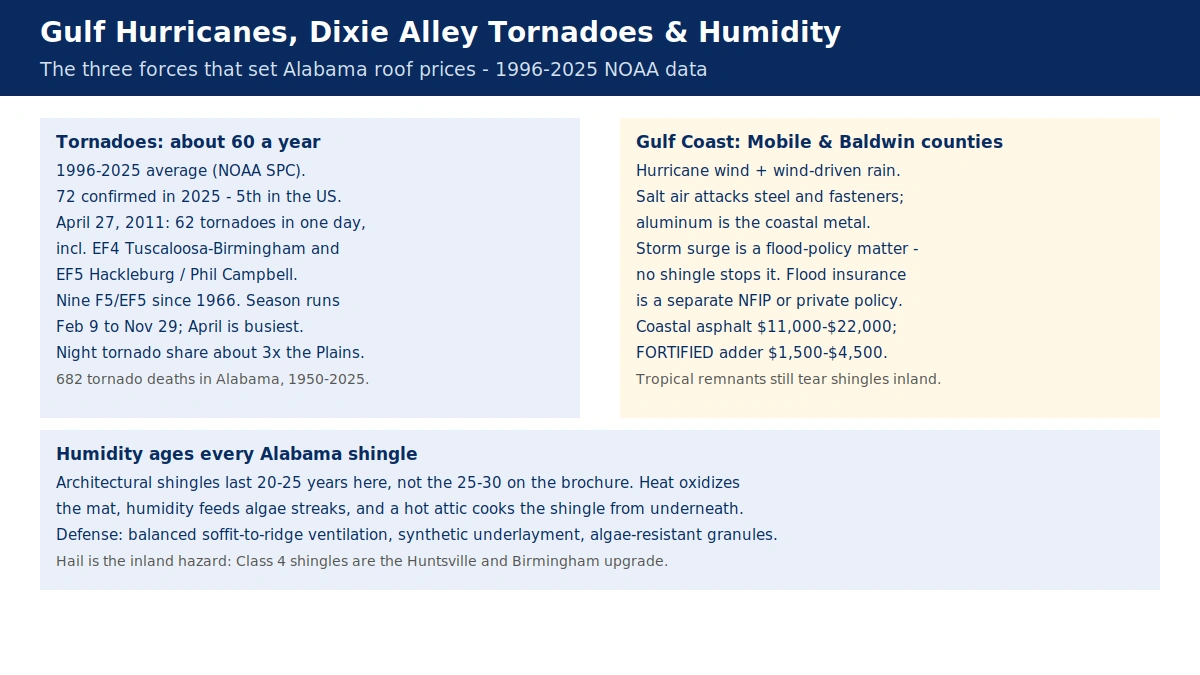
Three forces set Alabama roof prices, and they pull in different directions. The Gulf pulls coastal prices up through wind ratings, strapping, and corrosion-proof parts. The tornado belt pulls inland prices up through hail ratings, Class 4 upgrades, and the sheer frequency of replacement.
Humidity pulls every price in the state toward a shorter shingle life, which is a cost spread over years rather than charged on the day. A spec that ignores any of the three will not survive the first storm season.
The tornado numbers are the ones most homeowners underestimate. Alabama averages about 60 tornadoes a year over 1996–2025 in the National Oceanic and Atmospheric Administration’s Storm Prediction Center database, and the National Weather Service confirmed 72 in 2025, the fifth-highest total in the country. The most active year on record was 2011, with 146 tornadoes, 62 of them on April 27 alone, including the EF4 that ran 80 miles from Tuscaloosa to Birmingham and the EF5 that tore through Hackleburg and Phil Campbell.
Alabama has seen nine F5 or EF5 tornadoes since 1966, the most recent at Rainsville in April 2011, and 682 people have died in Alabama tornadoes since 1950. Per square mile, Alabama sees 11.6 tornadoes a year per 10,000 square miles, close to Kansas at 9.8. The deaths run far higher, because Dixie Alley tornadoes differ from Plains tornadoes in the ways that matter to a roof.
They come at night, three times as often as on the Plains, when nobody is watching the sky. They come in the cool season, when the trees are bare and the ground is wet.
They hide behind hills and trees, so the warning arrives late and the roof takes the first hit. The season runs long: the middle 80 percent of Alabama tornadoes fall between February 9 and November 29, and April is the busiest month.
The Gulf is the second force, and it is concentrated in two counties. Mobile and Baldwin counties face hurricane landfall, and wind is only the first problem. Wind-driven rain gets under lifted tabs and soaks the deck.
Storm surge floods what the wind leaves standing, and no roofing material is a flood defense. Flood insurance is a separate policy (see Insurance below).
Inland, the Gulf’s contribution is the tropical remnant: a hurricane that comes ashore in Mobile can still be tearing shingles in Montgomery two days later. A tropical storm that never earns a hurricane declaration still carries a wind deductible question, which matters because the hurricane deductible in Alabama applies only when a hurricane is officially declared.
Humidity is the third force, and it is the quietest. Alabama is a humid subtropical state, and heat plus humidity age an asphalt shingle from the inside out.
The mat oxidizes faster in sustained heat. The attic runs hotter, and a poorly ventilated attic cooks the shingle from underneath while the sun cooks it from above.
Algae streaking (the black streaks on north-facing slopes) is cosmetic, but it is near-universal in Alabama humidity and it tells a buyer the roof is aging in a wet climate. A realistic life for an architectural shingle in Alabama is 20 to 25 years, not the 25 to 30 the brochure prints, and a 3-tab shingle is 15 to 20. Humidity ages metal far less than asphalt, which is one more reason the per-year arithmetic favors it.
Ventilation is the defense that costs the least and matters the most. Balanced soffit-to-ridge airflow keeps the attic near the outside temperature, and a quote should always carry a ventilation line. Without one, the spec has not reckoned with July.
Hail sits across all three forces. Huntsville and Madison County take the most of it inland, Birmingham takes plenty, and the Gulf takes less but takes it harder when a supercell rides in off the water. Class 4 shingles are the answer inland, and the FORTIFIED standard is the answer on the coast, and both are priced in their own sections below.
In Alabama, weather sets the price. A roof specified for a quiet climate will be replaced twice in the life of a roof specified for this one.
FORTIFIED Roofs in Alabama: What the Upgrade Costs and What It Pays Back
FORTIFIED is the single most valuable roofing word in Alabama, and it is also the most misunderstood. The word names a construction standard from the Insurance Institute for Business & Home Safety. It describes a roof built to resist high wind and wind-driven rain: a sealed roof deck, ring-shank nails in a tighter pattern, stronger edges, and flashing details that keep water out when the shingles lift.
Alabama has been a leader in the standard since the beginning, and Baldwin County holds more FORTIFIED homes than almost anywhere in the country. The reason is money, and the money runs in both directions: a grant that pays for the upgrade, and a discount that pays for years after it.
The upgrade itself costs less than most homeowners expect. On a coastal asphalt job, the regional Alabama price guide puts the FORTIFIED adder at $1,500–$4,500 over a standard replacement.
That buys the sealed deck, plus the ring-shank nailing pattern and the edge details. The sealed deck is a peel-and-stick membrane over the whole deck, or taped seams, so that when shingles blow off, the deck itself stays watertight.
On an inland job the adder runs lower, because the wind specification is lighter and the crew is not fighting salt-air parts. The adder is small against a $12,000 roof, and it is the only roofing upgrade in Alabama that comes with a state grant and a legally mandated insurance discount attached.
The grant is the Strengthen Alabama Homes program, run by the Alabama Department of Insurance and funded entirely by the state’s insurance industry, not by tax dollars. It pays up to $10,000 toward a FORTIFIED roof, straight to the contractor once the home earns its IBHS designation. The eligibility rules matter, and they are strict.
The home must be an existing, owner-occupied, single-family primary residence in a participating county. Condos, mobile homes, rentals, and townhomes do not qualify.
The homeowner must hold an active home insurance policy, carry flood insurance if the home sits in a Special Flood Hazard Area, and get a home evaluation from a certified FORTIFIED evaluator approved by the program. The homeowner pays that evaluation fee.
No roof-related insurance claim may have been filed in the last six months, and the home must not be listed for sale at any time during the process. Grants are awarded as funds allow, on a county-by-county schedule that rotates, so check the current county list on the Strengthen Alabama Homes program site before any planning starts. No fixed list appears here because the list changes.
One question stays open. Sources conflict on whether an income limit applies, with one guide stating there is none and a contractor source stating 200 percent of area median income.
Confirm it on the program site. Do not plan a budget around either claim.
The discount is the part that keeps paying. Alabama Code Section 27-31D-2 has required insurers since 2009 to offer actuarially justified premium discounts on the wind portion of the policy for any homeowner who retrofits to FORTIFIED standards, and the law applies anywhere in Alabama, not only on the coast. The reported size of the discount varies by source, and the spread is printed here rather than settled: NPR reported 20 to 35 percent off the wind portion, the Alabama Department of Insurance discount chart puts FORTIFIED Roof at 35 to 45 percent off the wind premium, and some sources cite up to 55 percent off the wind portion for higher Silver and Gold designations.
The carrier confirms the number; the law only requires that the discount be actuarially justified. On the coast, where the wind portion can be up to 80 percent of the total premium, a 35-percent wind discount is a four-figure annual saving on a Mobile policy that already runs about $6,840 a year.
Inland, where the wind portion is smaller, the saving is smaller. The FORTIFIED roof still earns it, because the statute is statewide.
A second Alabama law sharpens the point. Section 27-31D-2.1, enacted in 2019, requires every insurer writing homeowners insurance in Alabama to offer a FORTIFIED roof endorsement whenever a covered claim requires a full roof replacement. The insurer must offer to upgrade the replacement roof to FORTIFIED standards.
A homeowner who has just lost a roof to a storm should ask for that endorsement by name, in writing, before the adjuster closes the file. It is the cheapest moment in the life of a roof to buy the upgrade, because the tear-off is already paid for by the claim.
The designation itself is the paperwork that makes the money real. A contractor’s word that a roof is “built to FORTIFIED standards” is worth nothing to an insurer. The IBHS-issued FORTIFIED certificate is what the carrier needs, and it comes from a certified evaluator’s inspection, not from the roofing crew.
Keep the certificate with the policy, send a copy to the insurer the week the roof is finished, and ask for the revised premium in writing. A FORTIFIED roof without the certificate is a strong roof that nobody will discount.
Metal Roofs on the Gulf Coast: Standing Seam, Salt Air & the 150 mph Question
Metal is the Gulf Coast roof, and the reasons are written in the wind ratings. A standing-seam system carries wind ratings of 140 miles per hour or more, against 110 to 130 for an architectural shingle, and it sheds wind-driven rain off a continuous panel rather than through a thousand overlapping tabs.
On the coast, that is the difference between a roof that needs patching after a tropical storm and a roof that needs nothing. Inland, the case is weaker but still real: metal does not bruise under hail the way a shingle mat does, it does not age in humidity the way asphalt does, and it lasts 40 to 70 years against 20 to 25 for architectural shingles.
The coastal specification is where the money goes. Standing seam on the coast runs $11–$18 per square foot installed on the regional Alabama guide, or roughly $22,000–$38,000 on an average home, against $20,500–$31,750 on the statewide SmartRoofingCalculator installed band. The premium buys the right metal and the right fasteners.
Aluminum is the coastal choice because it does not rust; steel relies on coatings that salt air attacks, and steel warranties commonly limit coverage near salt water. Stainless or hot-dipped galvanized fasteners and corrosion-resistant drip edge are the specification to insist on, because the small parts fail first.
A standing-seam roof held by rusted screws is a standing-seam roof in name only. Exposed-fastener ribbed panels are the budget metal at $484–$836 a square before tear-off, or $12,100–$20,900 for 25 squares, but every exposed screw is a future leak point in salt air, and the maintenance of re-seating screws every decade is a cost the standing-seam buyer never pays.
The wind question deserves a straight answer. The sources checked state no design wind speed for any Alabama county, so no miles-per-hour code figure appears here. What is verified is the rating spread: standing seam at 140 miles per hour or more, architectural shingles at 110 to 130, and the FORTIFIED standard’s sealed deck and ring-shank nailing as the specification that keeps water out when the wind exceeds the shingle’s rating.
A coastal homeowner choosing between a $14,000 architectural roof and a $28,000 standing-seam roof is choosing between a roof that will be replaced once in the life of the mortgage and a roof that will outlast it. At the midpoints, standing seam works out near $525 a year of service against architectural near $550. Measured by the year, the expensive roof costs less.
Inland, the metal case is the hail case. A Huntsville homeowner who has replaced two shingle roofs in fifteen years to hail has already paid for the metal roof in deductibles. The insurance section below prices that arithmetic.
The one inland caution is noise: rain on a metal roof is louder than rain on shingles, and the fix (solid decking and underlayment) is a line to confirm on the quote rather than discover in the first thunderstorm. The second caution is the crew: standing seam is a specialist install, and a crew that lays shingles all week and metal once a quarter will leave its mistakes in the seams. Ask for three standing-seam references in the same county before signing.
Asphalt in Alabama Heat: How Humidity and Sun Age a Shingle
Asphalt is the Alabama default for a reason: it is cheap, every crew lays it, and it looks right on every style of house in the state. It is also the material the Alabama climate punishes hardest.
Heat oxidizes the asphalt mat. Humidity feeds the algae that streaks the north slope black.
A poorly ventilated attic cooks the shingle from underneath at temperatures that can run 30 degrees above the outside air on a July afternoon. The brochure life of an architectural shingle is 25 to 30 years.
The realistic Alabama life is 20 to 25, and a 3-tab shingle is 15 to 20. A homeowner who budgets on the brochure life will be replacing a roof five years earlier than planned, and the surprise is never cheap.
Ventilation is the first defense here, for the reasons set out above. Balanced soffit-to-ridge airflow keeps the attic near the outside temperature, carries the moisture out before it condenses on the deck, and slows the oxidation that shortens shingle life.
Every quote should carry a ventilation line: ridge vent, soffit vent, baffle. A quote without one has not reckoned with July.
The second defense is the underlayment: synthetic underlayment resists the moisture that felt paper absorbs, and on a FORTIFIED roof the sealed deck turns the underlayment into a second roof. The third is the shingle itself: an algae-resistant shingle with copper granules keeps the black streaks off the north slope, and a Class 4 shingle keeps the hail bruising out of the mat.
None of these is expensive. All of them are cheaper than a roof replaced five years early.
The signs of heat aging are worth knowing before the leak starts. Granule loss in the gutters is the first: the shingle sheds its protective grit, and the bare mat underneath oxidizes faster.
Curling and cupping at the edges is the second, and it means the mat has dried out and shrunk. Cracking across the tab is the third, and it means the shingle has lost its flexibility.
A roof that shows all three on the south slope and looks fine on the north is a roof that has been cooked, not worn. The fix is ventilation on the replacement, not a heavier shingle. Our roof inspection cost guide prices the check that catches all three before the deck rots underneath them.
Color matters too, because it changes the replacement decision. A dark shingle on a low-slope roof over an air-conditioned top floor runs hotter than a light one, and the cooling load follows. A reflective or light-colored shingle, or a metal roof in a light finish, cuts the attic temperature and the air-conditioning bill with it.
The saving is real but small against the cost of the roof. It should never be the reason to choose a material.
Wind and hail should decide that. But between two shingles of equal wind rating, the lighter one is the better Alabama choice, and the cooler attic is the longer-lived roof.
Permits & Code: The Birmingham Exemption, the Mobile County Roofing Permit & the County Patchwork
Alabama has no statewide roofing permit rule, and that is the first thing to understand about permits here. Each city and county sets its own requirement, and the answers vary enough that a contractor’s assurance is not a substitute for the building department’s answer.
A full re-roof needs a permit in most places. Small repairs almost never do. The exceptions are specific, and they are worth knowing by name.
Birmingham holds the biggest exception in the state. Under the city’s 2024 Technical Code, repair or replacement of roof shingles or roof covering, gutters, and downspouts on one- and two-family homes and townhouses is exempt from building permits, except in Historic or Design Review Districts, where a building permit is required. The exemption covers the shingle and the covering.
Deck work, structural changes, and membrane replacements can still need a permit. Put the scope question to the department in writing before the crew arrives, not to the bidder.
Birmingham’s permit fee for a $15,000 re-roof where a permit is needed is $142 on NumeralQ’s figures, the highest of the three cities it prices, against $82 in Huntsville and $112 in Montgomery. That is a small number against a $12,000 roof, and a smaller number still against the cost of tearing off a roof the inspector then orders redone.
Mobile County holds the opposite exception: a roofing-specific permit application that asks for the contract, the license information, the number of squares, the underlayment, and the roof covering. It is the most detailed roofing permit in the state, and it exists because the coast is where the specification matters most.
A Mobile County roofer who cannot produce the license number the application asks for is a roofer who should not be on the roof. The county’s application is also the homeowner’s friend: it forces the material and the system into writing before the work starts, which is exactly the record the insurer and the next buyer will both ask for.
Elsewhere, the patchwork is the rule. Huntsville and Montgomery route building permits through their city permitting departments, with fees in the $82–$112 range for a $15,000 job on NumeralQ’s figures.
Statewide planning sources put the typical Alabama permit range at $100–$400, with SmartRoofingCalculator at about $175. The sources checked publish no statewide fee schedule, and none is printed here.
The inspection that comes with the permit quietly protects the owner: nailing pattern, underlayment, flashing, and ventilation all get checked, and the resulting record is something the next buyer’s inspector and the next underwriter will both request. A permit skipped to save $150 is a record missing when the house sells.
One more rule catches homeowners by surprise. Under Code of Alabama Section 34-14A-13, a city or county building official must refuse a permit for residential work that requires a Home Builders Licensure Board license unless the applicant shows the license or an exemption. The permit desk is, in effect, the license check.
An unlicensed roofer cannot pull a permit for a job over $2,500. A homeowner who hires one anyway is hiring a crew the permit desk already turned away. The licensing section below names the threshold and the credential.
Hiring a Roofer in Alabama: The $2,500 Roofers License, the Storm Chaser & the Vetting List
Alabama has no roofer-only license. The full picture is a threshold system, and the threshold for roofing is the lowest in the state’s construction law. Residential roofing over $2,500 requires a Residential Roofers license from the Home Builders Licensure Board, under Code of Alabama Section 34-14A-2(16).
Every full roof replacement in Alabama costs more than $2,500. Every full roof replacement in Alabama therefore requires a licensed roofer. The “no license” line that storm chasers use at the door is true only for a repair under $2,500, and a repair under $2,500 is not the job they are selling.
The Roofers license itself is a narrow credential. The applicant shows a local contractor business license held currently or within the past year, files a $10,000 surety bond naming the board as obligee, and pays $250 to start: a $150 annual license fee plus a $100 non-refundable application processing fee. There is no written exam.
The license covers installing or repairing the external covering of a residence, and replacing damaged decking and fascia stays inside it. A storm job that also needs a framer to repair a truss involves more than one trade and the structure, and it needs the unlimited home builder license instead.
Holders of the unlimited license may roof without a separate Roofers license. Holders of the limited license may not.
Broader residential work over $10,000 needs the home builder license, and commercial roofing at $100,000 or more needs a Licensing Board for General Contractors license, a threshold raised from $50,000 effective October 1, 2024, under Act 2024-277. Performing residential roofing over the threshold without a license is a Class A misdemeanor.
A license that is narrow and cheap to obtain does not do the screening for you. Run every bidder through the same five checks, whichever county the house sits in.
- The HBLB lookup. Search the contractor’s name or license number on the Home Builders Licensure Board’s license lookup, and confirm the license is current and covers roofing. Never take a number printed on a truck at face value.
- Insurance. At least $500,000 of general liability, proven by a certificate the carrier sends you itself, with the name on it matching the name on the contract, plus workers’ compensation covering the crew.
- A local footprint. A permanent Alabama address and a local number that existed before the latest storm.
- Local references. Three references inside your own county, with street addresses you can actually drive past.
- Manufacturer credentials where they count. Installer standing with GAF, Owens Corning, or CertainTeed. Only a credentialed crew can switch on the extended warranty.
Finish with three written quotes against a single shared specification, so all three prices are pricing the same roof. The full interview list is in our questions to ask a roofer guide, and a pre-quote inspection tells each bidder exactly what they are pricing.
The storm chaser deserves a paragraph of his own, because Alabama’s tornado season creates him every spring. He arrives within days of a hailstorm or a tornado, knocks on doors in the damaged neighborhood, and offers a free inspection, a same-week start, and a promise to “handle the insurance.”
The signs are consistent: an out-of-state plate, a phone number with an unfamiliar area code, no Alabama address, no HBLB license number on the card, and pressure to sign before the adjuster visits. The damage he finds is real, since Alabama storms do real damage, but the crew that finds it matters more than the damage itself.
A chaser’s roof is often installed by a subcontracted crew the homeowner never meets, under a warranty the homeowner cannot enforce once the truck leaves the state. The defense is boring and it works: verify the HBLB license, verify the insurance certificate with the carrier, visit three local references, and never sign anything before the adjuster has seen the roof.
A legitimate Alabama roofer will wait. A chaser will not, and the impatience is the tell.
One Alabama fact closes this section, because it is the one homeowners ask about most after the license. Alabama law sets no deposit cap for roofing work like the one-third caps some neighboring states impose. The deposit is a matter of contract, not statute.
The safe practice is the same everywhere:
- A modest deposit on signing.
- A progress payment on material delivery.
- The balance on completion and final inspection.
Never pay the full price up front, and never pay cash. Get the payment schedule in the contract, in writing, before the first shingle comes off.
Insurance: Hurricane Deductibles, ACV vs RCV, the Roof-Age Rule & the FORTIFIED Discount
Insurance is where an Alabama roof is really paid for, and it is where most homeowners discover the terms of their policy for the first time, after the storm. A standard homeowners policy in Alabama, typically an HO-3 form, covers wind and tornado damage as a named peril, which means wind, hail, and tornado are covered unless specifically excluded. In most Alabama policies they are not excluded, so the coverage exists.
What the policy does not cover is flooding, including storm surge and rainwater entering through intact walls. That needs a separate flood policy through the National Flood Insurance Program or a private carrier.
It does not cover age, normal wear, poor maintenance, or installation defects. A roof that fails because it is twenty-five years old is a maintenance bill, not a claim.
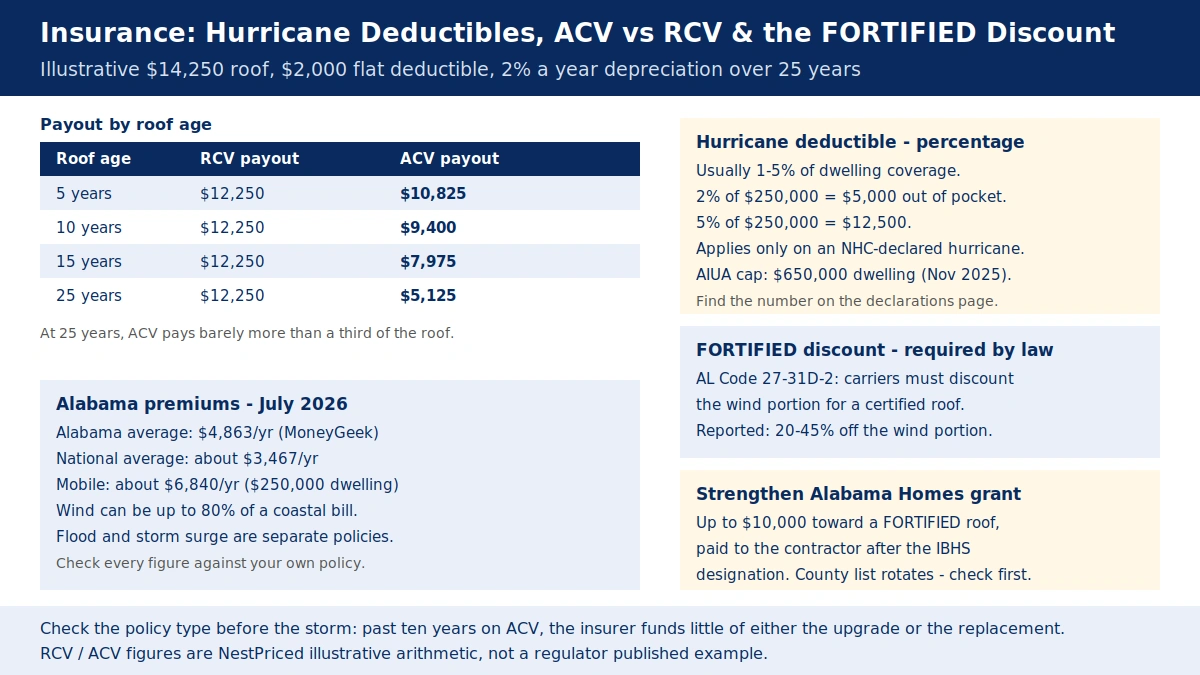
The premium surprises most homeowners first. MoneyGeek’s July 2026 figures put the average Alabama policy at about $4,863 a year, against a national average near $3,467, and the average Mobile policy at about $6,840 a year for $250,000 of dwelling coverage. On the Alabama coast, the wind portion of a premium can be up to 80 percent of the total bill, according to NPR’s reporting on the state’s insurance market.
Mobile sits on the bay, and insurers price in hurricanes. A FORTIFIED roof is the one lever a homeowner controls over that number, and the FORTIFIED section above prices it.
The deductible surprises them next, and it is the one that turns a storm into a five-figure bill before the insurer pays a dollar. Many Alabama policies carry a separate wind or hurricane deductible figured as a percentage of the dwelling coverage, not a flat dollar amount. The usual range is 1 to 5 percent.
On a $250,000 dwelling, 1 percent is $2,500 out of pocket, 2 percent is $5,000, and 5 percent is $12,500. On a $300,000 dwelling at 2 percent, the homeowner pays $6,000 before the insurer pays anything on a wind claim; on a $350,000 dwelling at 2 percent, $7,000.
The standard all-peril deductible, the flat $1,000 or $2,500 that applies to a burst pipe, does not apply to a wind claim. The percentage does.
The declarations page is where the number lives, under a line that says “wind deductible,” “hurricane deductible,” or “named storm deductible.” Pull it before the storm, not after.
One limit on the hurricane deductible is narrower than most homeowners assume. According to the Alabama Department of Insurance, the hurricane deductible applies only when a hurricane is officially declared by the National Hurricane Center, not for a tropical storm.
A tropical storm that tears shingles in Mobile without ever earning a hurricane declaration is paid under the standard deductible, not the percentage one. The distinction is worth a question to the carrier, in writing, before the season starts.
The settlement basis comes third: replacement cost value against actual cash value. Replacement cost value, or RCV, pays what the roof costs to replace today, less the deductible. Actual cash value, or ACV, pays the depreciated value: what a fifteen-year-old roof is worth after fifteen years of depreciation, which can be 40 percent of replacement cost or less.
The table below is NestPriced illustrative arithmetic on a $14,250 roof, the SmartRoofingCalculator midpoint for a 25-square Alabama roof, with a $2,000 flat deductible and straight-line depreciation of 2 percent a year over a 25-year shingle life. It is not a regulator’s published example, and no carrier’s depreciation schedule is exactly straight-line. It shows the shape of the loss, which is what matters.
| Roof age | RCV payout | ACV payout |
|---|---|---|
| 5 years | $12,250 | $10,825 |
| 10 years | $12,250 | $9,400 |
| 15 years | $12,250 | $7,975 |
| 25 years | $12,250 | $5,125 |
At 25 years, ACV pays barely more than a third of the roof. Know which basis the policy uses before the storm, and know the roof-age point at which the carrier switches a policy from replacement cost to actual cash value.
No Alabama-specific trigger age appears in the sources checked. Carriers set their own, and the number is on the policy, not in a statute.
Ask the carrier, get the answer in writing, and put the date on the calendar. A roof nearing that trigger is a replacement candidate while replacement money is still available.
Coastal homeowners face one more rule. In Baldwin and Mobile counties, some policies exclude wind and hail damage entirely, and the homeowner needs separate wind coverage. Alabama’s backup is the Alabama Insurance Underwriting Association, the state’s FAIR plan, which covers fire and wind in eligible coastal areas for homeowners turned down by private carriers.
As of November 2025, dwelling coverage tops out at $650,000, and the association may stop writing new policies while a tropical storm watch or warning is in effect, which is exactly when a homeowner thinks of buying it. A coastal homeowner without wind coverage usually waited too long. The time to check is now.
Paying for It: No Federal Credit in 2026, HEAR Not Launched in Alabama & No Roof Rebate
Alabama’s federal home-energy rebates have not opened. For a roofing quote, that fact changes nothing, because no rebate in the program pays for a roof. The Alabama Department of Economic and Community Affairs runs the state’s program, and its page says the program is under development, with no launch date.
The allocations are $72,607,220 for HEAR and $72,888,465 for HOMES, about $145.6 million in total, and two independent checks, October 6, 2026 and November 9, 2026, both found the same answer: not open yet. Applications are not being taken. No Alabama homeowner can claim a federal home-energy rebate today, and no contractor can promise one on a quote.
Once operating, HEAR (Home Electrification and Appliance Rebates) will pay as much as $8,000 to income-qualified households. Under Energy Department Program Notice 26-2, dated May 29, 2026, only electric-to-electric upgrades qualify, which means replacing electric equipment with more efficient electric equipment, with no fuel-switching. HOMES (Home Owner Managing Energy Savings) caps at $4,000 generally, rising to $8,000 for households at or below 80 percent of area median income.
HEAR never pays for a roof. No lease or pass-through arrangement on record steers federal money toward an Alabama roof, no Alabama state roof grant, rebate, or tax credit beyond the FORTIFIED grant above was found, and no utility roof rebate surfaced either.
A homeowner doing a reroof and a heat pump together should hold the two prices apart: the roof comes out of the homeowner’s own pocket, while the heat pump may qualify for HEAR once Alabama’s program opens. The rebate half of that decision is priced in our solar panel cost in Alabama guide for the array side, and the heat pump side belongs to a future Alabama heat pump guide.
Both federal tax credits are gone, and the dates are what decide who gets nothing. Anything placed in service after December 31, 2025 earns zero from either one: not from the 30 percent Residential Clean Energy Credit (§25D), and not from the Energy Efficient Home Improvement Credit (§25C). Public Law 119-21, the One Big Beautiful Bill Act signed July 4, 2025, closed both credits, and IRS Fact Sheet FS-2025-05 pins down the cutoff date.
After that date, under that law, both credits pay nothing on any install. Shingles and membranes never counted as solar equipment under §25D, so roofing work never qualified there. A bare roof with no solar hardware on it never qualified for the solar credit in the first place.
In earlier years, a small set of roofing materials could be claimed under §25C. That door is closed too.
A 2026 quote that still carries a tax-credit line was priced under a law that has already expired. Have the contractor strike the line and price the job again. The full cutoff dates, and the programs that survived them, are in our federal energy tax credits guide.
The §48E credit is written for solar arrays and other clean-electricity equipment. Roofing work sits outside it.
For a 2026 Alabama roof, two funding routes stand up: a home-equity loan, or a financing plan from the contractor. Start with the annual percentage rate; the monthly payment is the second number to check.
The insurer is what pays toward a roof, through the FORTIFIED discount, the Class 4 discount, and the avoided deductible. A FORTIFIED roof can earn a discount on the wind portion of the premium that Alabama law requires carriers to offer, a Class 4 roof can earn a discount on the wind and hail portion, and every claim the roof rides out saves a deductible.
Anyone weighing a solar array under the new roof should read our solar panel cost in Alabama guide before signing either contract: the §48E pass-through touches a leased solar array only, never the roof below it, and taking panels off and putting them back for a later reroof costs $1,500–$5,000 on the national range. Our how to finance a new roof guide works through financing terms, dealer fees, and the choice between a loan and home equity.
Repair vs Replace & Getting Quotes in Alabama: The Decision Rules and the Checklist
A young roof with local damage needs a patch, not a full tear-off. Picture a roof under ten years old with a few shingles missing, a chimney flashing leaking, and a handful of tabs lifted by wind. There, a targeted fix is the right call.
Alabama planning sources put minor repairs at $150–$500 and storm damage repairs at $500–$3,000, often insurance-covered. The sources checked carry no Alabama-specific repair price table: no published figure for flashing, for a leak, or for chimney reflash work with an Alabama source behind it.
The planning ranges above are labeled as such rather than dressed up as a table. The repair side has its own home in our roof repair cost guide: when a patch will do, when a partial replacement is the call, and when repair has run out of sense on an Alabama roof.
The decision turns on age, spread, and arithmetic:
- Age and spread. Past fifteen years, with wind having lifted more than a quarter of the slopes, an architectural roof is a replacement, not a repair. Patching over a lifted mat is cosmetic; the next storm undoes it either way.
- Decking. When decking goes soft or sheathing delaminates, the answer is replacement. Structural parts are swapped out, never patched over.
- Heat failure. When granule loss fills the gutters and the south slope curls while the north slope still looks sound, the failure is systemic. The shingle is not the problem, the heat is.
- The claim on an old roof. The same logic applies to an insurer-funded claim on an old roof, where the next claim would pay actual cash value at a third of the cost. Take the replacement money while it is still on offer.
- The ACV switch. A roof closing in on the carrier’s switch to actual cash value is a replacement candidate as well, with the policy sliding toward ACV and the renewal sliding toward refusal.
- The one-third rule. When a repair quote tops about a third of the replacement quote on a roof with under five years left, replacement wins once more.
- The Gulf trigger. On the Gulf Coast, add one more trigger: a roof that lost shingles to a tropical storm and is not FORTIFIED has announced what the next storm will do, and the replacement should be the FORTIFIED one.
Two checks a year keep this decision calm instead of panicked. The fall check exists to catch summer wind and hail damage while the adjuster’s window is still open. Spring is for checking what winter and the early tornado season did: lifted tabs, hail bruising, and salt corrosion on a coastal roof, caught before the April peak stacks a second round of trouble on top.
After several Alabama summers, a roof can look sound from the curb while sitting much closer to failure than it looks. Bruising begins inside the mat, invisible until the shingle itself splits open.
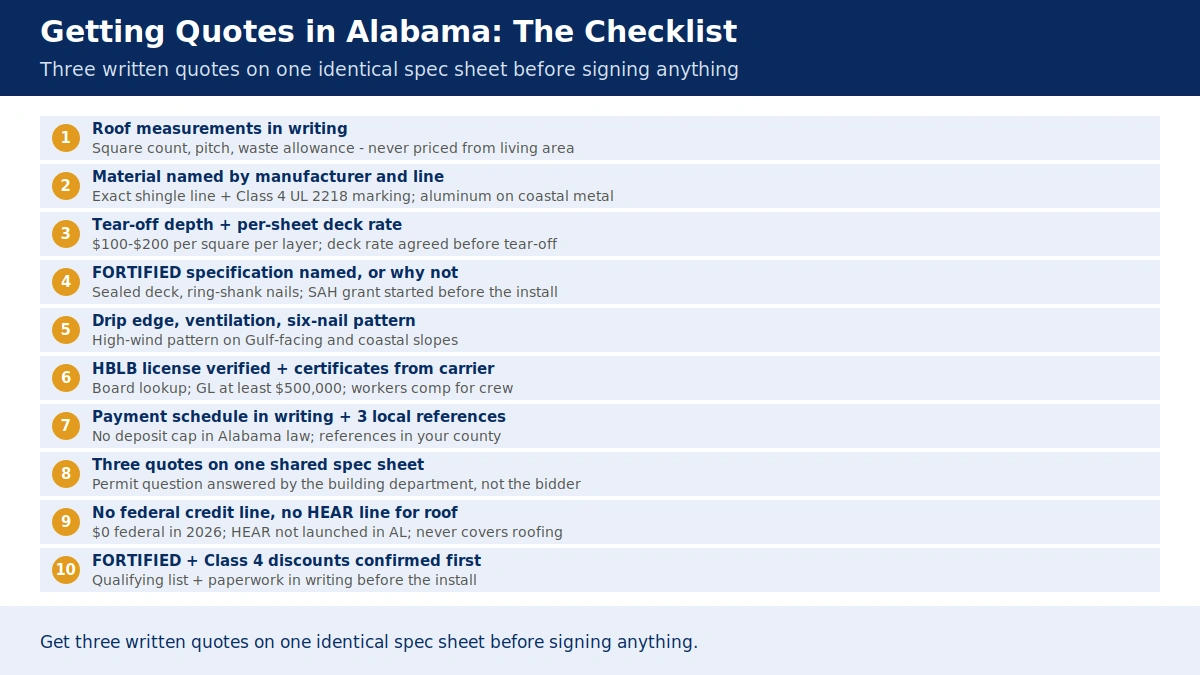
Ten items, in the order they should be used. Leave one out, and the quote heading for a signature has not been properly read.
- Roof measurements in writing. Square count, pitch, and waste allowance all appear on the bid. A price built off the listing’s living area is not acceptable.
- Material named by manufacturer and line. The manufacturer and the exact shingle line (GAF, CertainTeed, or Owens Corning), with the Class 4 UL 2218 marking wherever the upgrade is priced, and aluminum named on any coastal metal roof.
- Tear-off depth stated. One layer or two, the $100–$200 per square per layer tear-off, and the per-sheet deck replacement rate agreed before the old shingles come off.
- FORTIFIED specification named, or the reason it is not. Sealed deck, ring-shank nailing, edge details. The Strengthen Alabama Homes grant application starts before the install, not after.
- Drip edge, airflow, and fastening pattern: each one named in writing. Drip edge on eaves and rakes, soffit-to-ridge ventilation in balance, and the six-nail high-wind pattern wherever a slope faces the Gulf.
- HBLB Roofers license verified on the board’s lookup, and insurance certificates mailed straight from the carrier. The business name on the certificate matches the contract. General liability of at least $500,000, workers’ compensation for the crew. The certificate arrives from the carrier, never handed over by the contractor.
- Payment schedule in writing, and three local references checked. No deposit cap exists in Alabama law, so the schedule is the protection: modest deposit, progress on delivery, balance on completion. References from your own county, with street addresses to visit, and a permanent Alabama address and local number in service since before the last storm.
- Three written quotes against a single shared specification. One specification, three bidders, so the prices all describe the same roof. The permit question is settled by the building department, not by a bidder, since the answer changes by city.
- No federal credit line anywhere on it, and no HEAR rebate line either. The credit is $0 in 2026, and HEAR has not opened in Alabama. It would never cover roofing even if it had.
- Insurer’s FORTIFIED and Class 4 discounts confirmed first. Qualifying product list and paperwork included, before the install. A promised discount is not a discount until the carrier confirms it, and Alabama law requires the carrier to offer the FORTIFIED discount on a certified roof.
Sources & methodology
Every price here carries its source and its date, and every number worked out for this page is labeled as its own arithmetic. The 25-square material totals, the size-table figures, the Class 4 totals, and the cost-per-year figures are NestPriced’s own calculations from the cited per-square ranges and lifespans, worked out by dividing each midpoint total by its midpoint realistic life.
The RCV/ACV worked example in the insurance section is our own calculation too, built on a $14,250 roof, a $2,000 flat deductible, and straight-line depreciation of 2 percent a year over a 25-year shingle life. They are realistic figures worked from the climate, not numbers lifted from one published table. Where two sources disagree, both are printed and the disagreement is flagged rather than settled silently.
- Headline prices: SmartRoofingCalculator Alabama state page (page dated Apr 24, 2026; index updated Nov 9, 2026): architectural shingles $410–$590/sq fitted with tear-off; 25-square roof $10,250–$14,750; standing seam $820–$1,270/sq; tile $1,090–$1,640/sq; permit ~$175; roofer median $21.74/hr (May 2024 BLS vintage); state factor 0.909; neighbors’ state factors not published on the Alabama page.
- MyRoofData Alabama (2026 model): typical single-family architectural roof $11,250–$19,500 incl. tear-off of one layer; state cost index 0.88; crew $45–$75/hr; per-square before tear-off: 3-tab $308–$484, architectural $396–$660, ribbed metal $484–$836, standing seam $836–$1,408; tear-off $100–$200/sq/layer.
- NumeralQ Birmingham (local data checked Oct 2026): 2,000 sq ft roof architectural $8,950–$10,860; 1,000 sq ft $4,750–$5,840; 3,000 sq ft $13,160–$15,880; 3-tab ~17% under architectural; slate ~4.6x architectural; exposed-fastener metal $13,950–$17,670; stone-coated steel $15,680–$22,860; standing seam $19,670–$30,160; EPDM $10,020–$15,840; typical job midpoints Birmingham $9,905 (6.2% of median home), Huntsville $9,810 (3.3%), Montgomery $9,810 (6.1%); permit for a $15,000 re-roof Birmingham $142, Huntsville $82, Montgomery $112; Birmingham 2024 Technical Code shingle-replacement permit exemption.
- RoofingEstimatorPros Alabama (updated Aug 26, 2026): 2,000 sq ft architectural $12,863–$23,227, avg $17,469, ~$8.73/sq ft; state multiplier 0.93x; permit $100–$400. Flagged as the high outlier.
- BestRoofingEstimates Alabama: $8,500–$19,500, avg ~$12,250; architectural $11,000–$15,000; metal $18,000–$28,000; city bands Birmingham $11,500–$16,000, Montgomery $10,500–$15,000, Mobile $12,000–$17,500, Huntsville $11,000–$15,500; minor repair $150–$500, storm repair $500–$3,000.
- Pinnacle Home Improvements Alabama guide: $5,500–$28,000 overall; typical asphalt $10,000–$16,000; 3-tab $3.50–$4.50/sq ft, architectural $4–$5.50, designer $5.50–$7.50; labor 40–60% of total.
- InstantRoofer Alabama database: average $17,521 asphalt on a 2,993 sq ft (30-square) average roof, $5.85/sq ft; metal $43,817; city range $16,455 (Mobile) to $18,296 (Bessemer). Flagged: city figures are estimates from statewide data, not separate surveys.
- Regional Alabama price guide (Oct 20, 2026): coastal $11,000–$22,000; FORTIFIED adder $1,500–$4,500; coastal standing seam $11–$18/sq ft ($22,000–$38,000); inland $9,500–$18,000; Tuscaloosa $10,000–$17,000; Montgomery $9,000–$14,000; Class 4 adder 10–25%.
- Dothan contractor (MAC Construction): asphalt $3.50–$7.00/sq ft, Class 4 $5.00–$8.50, standing seam $10–$16/sq ft (national averages via Modernize/Angi, not the firm’s own prices).
- Tornadoes: NOAA Storm Prediction Center Severe Weather Database 1950–2025 (Alabama ~60/yr 1996–2025; 11.6 per 10,000 sq mi; 682 deaths 1950–2025; nine F5/EF5 since 1966); National Weather Service 2025 count 72; April 27, 2011 outbreak 62 tornadoes in Alabama, 146 in 2011.
- Licensing: LegalClarity Alabama roofing license guide; SimplyWise Alabama contractor license guide (Jun 5, 2026); ReadyDocs Alabama roofing compliance (verified Oct 2026); Code of Ala. §§ 34-14A-2(16), 34-14A-13, 34-8-1; Act 2024-277 (commercial threshold $50,000 to $100,000, Oct 1, 2024); HBLB Roofers license $250 initial ($150 fee + $100 processing), $10,000 bond.
- Insurance/FORTIFIED: Kin Alabama hurricane and tornado insurance guides (Jun–Jul 2026); MoveMadeLocal Mobile insurance guide (MoneyGeek Jul 2026; updated Nov 11, 2026); Akin & Associates North Alabama wind insurance; Kin Strengthen Alabama Homes guide (Aug 29, 2026); LegalClarity FORTIFIED requirements; Southern Roofing Systems FORTIFIED guide; Alabama Code §§ 27-31D-2, 27-31D-2.1; AIUA dwelling cap $650,000 (Nov 2025).
- Money: IRS Fact Sheet FS-2025-05; One Big Beautiful Bill Act, Public Law 119-21 (signed July 4, 2025); DOE Program Notices 26-1/26-2 (May 29, 2026); BetterPowered state incentives (checked Nov 9, 2026); StartBusinessByState rebates by state (checked Oct 6, 2026); HYRE state rebate status (Sep 6, 2026); National Housing Trust DOE tracker (Apr 30, 2026); ADECA HEAR/HOMES allocations $72,607,220 + $72,888,465.
- Wages: BLS Occupational Employment and Wage Statistics, May 2024 (Alabama roofer median $21.74/hr, construction laborer $17.45/hr); BEA Regional Price Parities by State, 2024.
Prices change. A quote from last month may not match a quote from today. Verify every figure against a current written bid before signing.
EXCLUDED:
- Alabama-specific repair prices for flashing, leak diagnosis, and chimney reflash (none verified; planning ranges used, labeled).
- An Alabama-specific roof-age underwriting trigger for the ACV switch (none verified; carrier confirms).
- The Strengthen Alabama Homes income-limit question (sources conflict; flagged, not asserted).
- A fixed SAH participating-county list (rotates; check the program site).
- Exact FORTIFIED discount percentages (sources range 20–55%; range printed, carrier confirms).
- A coastal design wind speed for any Alabama county (none verified).
- An Alabama-specific per-sheet deck replacement rate (none verified; get it in writing).
- A Birmingham permit-exemption reading for membrane and deck work (code text covers shingles/covering/gutters/downspouts; confirm with the department).
- Any Alabama state or utility roof grant, rebate, or tax credit beyond SAH/FORTIFIED (none verified).
- The detach-and-reset figure as an Alabama price (national range $1,500–$5,000, labeled).
Disclaimer: The prices here are general information, not professional advice. Prices are 2026 estimates for Alabama based on the sources cited. They will vary with roof size, pitch, condition, material, and contractor.
Permits, codes, and licensing rules vary by city and county. Confirm them with the local building department.
Insurance terms, deductibles, and discounts vary by carrier and policy. Confirm them with your own insurer before signing. Always obtain multiple written quotes from licensed local contractors before making a decision.
What does a roof replacement cost in Alabama in 2026?
A typical 25-square architectural shingle roof costs $10,250–$14,750 in 2026, per SmartRoofingCalculator, and a 2,000 square foot roof in Birmingham costs $8,950–$10,860, per NumeralQ (local data checked October 2026). On that 25-square roof, 3-tab shingles run $7,700–$12,100 before tear-off, Class 4 impact-rated shingles run $11,250–$17,500 as modeled arithmetic, and standing-seam metal runs $20,500–$31,750. Mobile runs $12,000–$17,500 for a 2,000 square foot home, Huntsville $11,000–$15,500, and Montgomery $10,500–$15,000.
How much does a roof cost per square in Alabama?
Architectural shingles run $410–$590 per square installed with tear-off, per SmartRoofingCalculator, while MyRoofData prices the same material at $396–$660 a square before tear-off. Class 4 impact-rated shingles run $450–$700 a square as modeled arithmetic, from a 10-to-25-percent regional adder applied to the Alabama architectural band, because no Alabama-specific Class 4 premium was verified. Standing-seam metal runs $820–$1,270 a square installed, 3-tab $308–$484 before tear-off, and one square equals 100 square feet of finished roof surface, the unit Alabama bids are written in.
Do I need a permit to replace a roof in Alabama?
It depends on the city, and in Birmingham it depends on the scope: the city’s 2024 Technical Code exempts replacing roof shingles and roof covering on one- and two-family homes and townhouses, except in Historic or Design Review Districts, but deck work and structural changes can still need a permit. Mobile County uses a roofing-specific permit application that asks for the contract, the license number, the square count, the underlayment, and the covering. Fees run about $100–$400 statewide, with SmartRoofingCalculator at about $175 and NumeralQ city fees of $142 in Birmingham, $82 in Huntsville, and $112 in Montgomery for a $15,000 job.
Does Alabama license roofers?
Alabama has no single roofing license, but every full replacement needs one anyway. Residential roofing over $2,500 requires a Home Builders Licensure Board Roofers license: a local contractor license held currently or within the past year, a $10,000 surety bond naming the board, and a $250 initial payment, with no written exam. Broader residential work over $10,000 needs a home builder license, and commercial roofing at $100,000 or more needs a General Contractors Board license; unlicensed residential roofing over the threshold is a Class A misdemeanor, and the building official must refuse a permit where the required license is not shown.
What is a FORTIFIED roof, and what does it cost in Alabama?
FORTIFIED is a wind-resistant construction standard from the Insurance Institute for Business & Home Safety (a sealed roof deck, ring-shank nails in a tighter pattern, and stronger edges), and on a coastal Alabama asphalt job the upgrade typically adds $1,500–$4,500. The Strengthen Alabama Homes program pays up to $10,000 toward a FORTIFIED roof for an owner-occupied single-family primary residence in a participating county, paid to the contractor after the IBHS designation is earned. Alabama law requires insurers to offer a discount on the wind portion of the premium for a certified FORTIFIED home, with reported discounts from 20 percent to 45 percent depending on the source and the designation, and only the IBHS certificate earns the discount.
How does the Alabama hurricane deductible work on a roof claim?
Most Alabama policies carry a separate wind or hurricane deductible figured as a percentage of the dwelling coverage, usually 1 to 5 percent, so on a $250,000 dwelling, 2 percent means $5,000 out of pocket before the insurer pays anything, and 5 percent means $12,500. The hurricane deductible applies only when a hurricane is officially declared by the National Hurricane Center, per the Alabama Department of Insurance, not for a tropical storm. In Baldwin and Mobile counties some policies exclude wind entirely, and the Alabama Insurance Underwriting Association is the wind coverage of last resort there, with dwelling coverage topping out at $650,000 as of November 2025.
How long does a roof last in Alabama?
Heat and humidity cut shingle life short and leave metal standing longer than the brochure claims. Slate runs 75 years or more, tile 50 or more; standing-seam metal 40–70, ribbed metal 30–40; Class 4 shingles 25–30, architectural 20–25, 3-tab 15–20, and flat EPDM membranes 20–30 years. Those lives get cut short by hail, wind-driven debris, salt corrosion on the wrong metal, and attic heat from poor ventilation.
Can I get a rebate or tax credit for a new roof in Alabama in 2026?
No. A roof finished after December 31, 2025 gets zero from either federal credit: $0 from the 30-percent Residential Clean Energy Credit (§25D) and $0 from the Energy Efficient Home Improvement Credit (§25C), under Public Law 119-21, the One Big Beautiful Bill Act signed July 4, 2025. Alabama’s HEAR and HOMES rebates have not launched, and HEAR never pays for a roof in any case; the one program that pays toward a roof is Strengthen Alabama Homes, up to $10,000 for a FORTIFIED roof.