


Louisiana buys a heat pump for the wrong season, if you go by the brochure. The brochure talks about winter.
Louisiana winters barely exist. New Orleans is designed for 33 degrees on the coldest night of the year, Baton Rouge for 28, and the heating season is so short that the whole state logs roughly 1,200 to 1,700 heating degree days (a season’s cold, added up day by day) while New Orleans alone logs more than 3,100 cooling degree days (the same sum for heat).
What Louisiana actually buys is a dehumidifier that also cools. The air in a New Orleans July carries so much water that the wet-bulb temperature (heat plus humidity, measured together) sits near 78 degrees at design conditions, and a machine that drops the temperature without wringing out the moisture leaves a house clammy at 72 degrees. The buyer who understands that buys a different machine than the buyer who shops on tonnage alone.
Next comes the electric bill, and it is the friendliest number a Louisiana buyer will see. Louisiana residential power averaged 12.87 cents a kilowatt-hour in August 2026, the lowest rate in the United States, against a national average of 18.16 cents.
That is not a small gap. It is nearly a third cheaper than the country as a whole.
Cheap power changes the running-cost math in the heat pump’s favor on every comparison here, and it is the reason the break-even COP against gas sits at 2.11 in Louisiana, a bar a standard machine clears without trying. The bill itself is the catch.
The average Louisiana home used 1,763 kilowatt-hours in August 2026 and paid $226.86 for the month, because the air conditioner runs all day in a state where the cooling season never really ends. Cheap power and a huge cooling load is the Louisiana combination, and the heat pump sits at the center of it.
Rebates decide the money before the buyer does, and they follow a map, not a price list. SWEPCO pays up to $3,500 in Shreveport and Bossier City. Cleco pays $350–$600 a ton in Alexandria and Pineville.
Entergy Louisiana, which serves most of the state, pays $500. Energy Smart pays $150–$500 inside Orleans Parish and nothing outside it.
A buyer in Shreveport can collect seven times what a buyer in Baton Rouge collects for the same machine, and a buyer in a co-op territory gets a per-ton schedule the investor-owned utilities never see. The federal rebates that would dwarf all of it, up to $8,000 through HEAR, have not launched in Louisiana, and no state page names a date. Strike any quote that subtracts money the home cannot collect, a federal credit that ended or a HEAR rebate that does not exist yet, and get it rewritten before comparing it with anything.
Start with the national picture in our national heat pump cost guide. Louisiana’s figures make most sense weighed against it.
Table of Contents
How Much Does a Heat Pump Cost in Louisiana in 2026?
The Louisiana market in 2026 is priced by three kinds of evidence, each measuring something different. That is why the numbers disagree, and why the disagreement deserves sorting out before any quote is compared. NumeralQ’s estimator, priced as of October 26, 2026, builds its planning estimates from a national cost model adjusted for Louisiana labor, and lands the statewide 3-ton ducted air-source system at $6,470–$10,850, with city figures a few dollars either side.
BetterHouse takes a different route, a national baseline scaled by the wage index, and lands Louisiana ducted at $3,830–$13,400, typical $10,120. Louisiana contractors and secondary guides publish their own numbers. HomeCostLens puts a typical New Orleans install at $6,020 inside a $4,170–$12,040 range, and a typical Baton Rouge install at $5,900 inside a $4,090–$11,800 range.
None of these is a survey of what Louisianans actually paid. The first is a model, the second is a model of a model, and the third is an aggregator’s estimate built from local labor and material rates. Put the statewide, size-specific figure at the front and keep the other two in view only as cross-checks, limits and all.
The headline figure is the NumeralQ 3-ton band, $6,470–$10,850: it names the machine, the size and the scope, ducted air-source, 3 tons, installed, and it wears its planning-estimate label openly instead of posing as a contractor survey. Take the midpoint, about $8,660, and that is the number the payback section works from.
BetterHouse’s typical of $10,120 sits near the top of the NumeralQ band. Two different methods pointing at the same territory is loosely reassuring. But that $3,830 low end stays a modeled floor built by scaling a national range, with no Louisiana contractor quote behind it in the sources checked, so no buyer should budget around it.
The HomeCostLens typicals, $6,020 in New Orleans and $5,900 in Baton Rouge, sit just below the bottom of the NumeralQ band, which is the shape you expect from a guide that leans on labor rates. Baton Rouge and New Orleans labor runs a little below the national median. But HomeCostLens does not publish its method in enough detail to lean on hard, so it corroborates the band rather than replacing it.
Landing inside the NumeralQ band does not prove a quote fair, and landing above it does not prove the bidder is gouging. What decides it every time is the machine on the page, the house it serves, and the extras folded into the price.
A fourth dataset trails the other three, and it carries a warning all its own. HVAC Visit puts heat pumps at $7,000–$18,100 in New Orleans, $6,900–$17,800 in Baton Rouge, $6,050–$15,650 in Lafayette and $6,100–$15,800 in Shreveport. Those ranges run nearly twice as wide as NumeralQ’s, with tops sitting thousands of dollars past every other published figure in the sources checked.
A range that wide covers several different jobs at once, from a like-for-like swap on a healthy house to a full install with ducts, a panel and a raised stand, folded into one band. Use it, if at all, as a reminder that the top of the market is much higher than the planning band. Do not let a contractor quote its top end for a job that needs none of the extras.
That headline band covers a finished install in full: the outdoor unit, the indoor coil or air handler, the lineset, the pad or stand, the disconnect and wiring, the thermostat, plus the labor, the permits and the startup check. What it does not buy is the rest of the job, and in Louisiana the rest of the job is often the expensive part.
New or extended ductwork in a 1960s Baton Rouge ranch, a 200-amp panel upgrade in a New Orleans shotgun house, a raised stand on a coastal lot in a flood zone, hurricane strapping, a corrosion coating for a unit a mile from the Gulf, or a condensate arrangement for a crawlspace that takes water in a summer storm: each of those sits outside the band. The sources checked publish no Louisiana-specific price for the panel upgrade or the ductwork, and none is printed here.
Each of them should show up as its own line on the quote. Bury one inside the per-ton figure and the buyer loses sight of the part of the job most likely to sting later.
For most Louisiana buyers, no large rebate waits to be taken off the sticker price. The largest single utility rebate is $3,500, but it belongs to SWEPCO and Cleco customers only, and most Louisianans are Entergy customers collecting $500 at most. The federal money is $0.
Read every quote gross first. In Louisiana the net figure runs only a few hundred dollars lower and a rebate form away. Send a quote back for a rewrite when it takes off a rebate the home cannot claim, or a federal credit that ended, and compare it only after the rewrite.
A warning before the tables: the cheapest Louisiana quote rarely stays the cheapest once the system is running, and the dearest is not automatically the best. The spread between bidders on identical equipment can run several thousand dollars, and in Louisiana the spread is widest where the house is hardest: a Creole cottage on piers in the French Quarter, a 1970s split-level with ducts in a vented attic outside Lafayette, a raised house in Terrebonne Parish where the outdoor unit lives eight feet off the ground.
To compare quotes fairly, ask every bidder to price the same job: the same model, the same house, the same backup heat, in writing, with only the rebate the home truly qualifies for already taken off. Collect three written quotes from licensed Louisiana contractors before you commit, and strike off any bidder who refuses to name the model number, its SEER2 (cooling) and HSPF2 (heating) efficiency ratings, and the Manual J sizing calculation behind the size.
| Source | 3-ton ducted | Single-zone mini-split | Multi-zone (3 heads) | Geothermal |
|---|---|---|---|---|
| NumeralQ (Oct 2026, planning est.) | $6,470-$10,850 | $3,090-$4,840 | Not published | $20,080-$31,680 |
| BetterHouse (2026, modeled) | $3,830-$13,400, typ. $10,120 | $2,000-$12,000, typ. $3,250 | Not published | $12,000-$40,000+ |
| HomeCostLens (Sep 2026, secondary) | $6,020 typ. New Orleans; $5,900 typ. Baton Rouge | $5,090 New Orleans | Not published | $12,040 New Orleans |
| HVAC Visit (2026, secondary) | $7,000-$18,100 New Orleans | Not published | Not published | Not published |
Two rows of that table need a caution flag attached before anyone reads a number out of them. The HVAC Visit figures span so widely that they describe several different jobs at once, not one market price, and their tops should never be used to justify a quote. Read the BetterHouse low end as a modeled floor rather than a price anyone charges: nobody in this Louisiana pass quoted a whole-home ducted install anywhere near $3,830.
The sections ahead build on the NumeralQ band, and every size row drawn from it carries the planning-estimate label, because a model output is what it is.
Heat Pump Cost in Louisiana by System Type
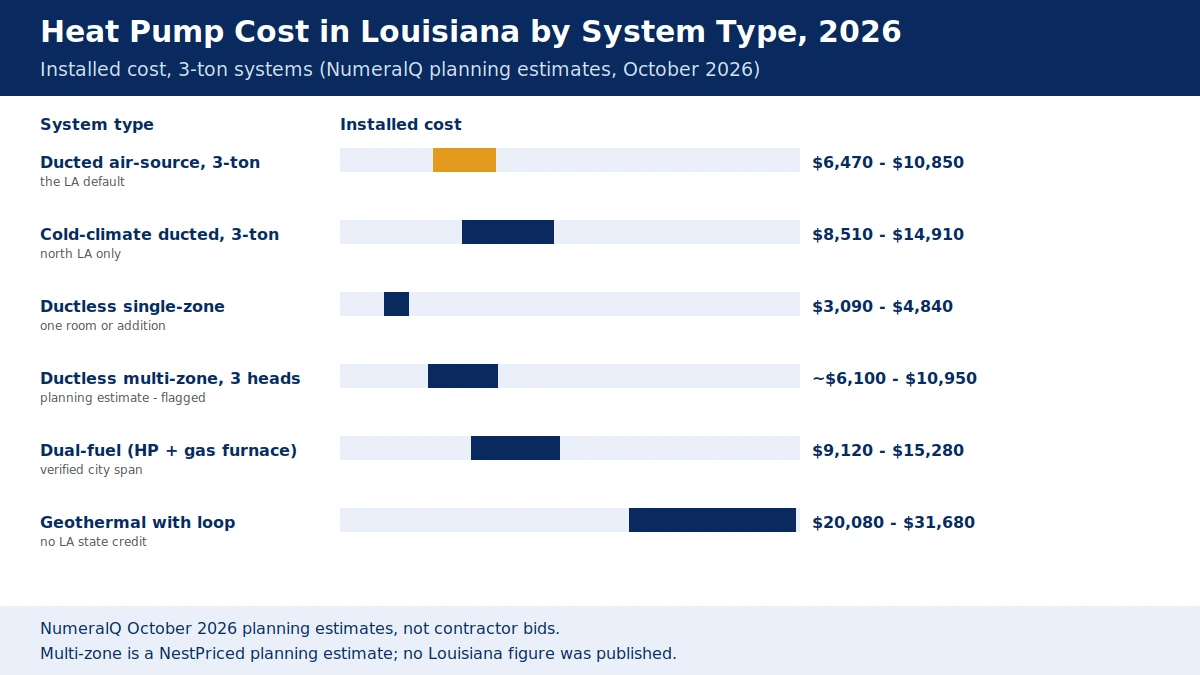
Say “heat pump” in Louisiana and you could mean any of five machines, priced more than six to one from the cheapest to the dearest. The house usually makes the choice before the buyer does. A Baton Rouge brick ranch with ducts in the attic, a New Orleans shotgun house with no duct chases at all, a Shreveport split-level on a slab, a Lafayette condo where the outdoor unit lives on a roof, a farmhouse outside Alexandria on propane with no gas main for miles: each one points at a different machine, and each machine carries a different price, a different rebate, and a different August.
Every machine in the table carries a NumeralQ anchor price, sharpened wherever a contractor figure made the picture clearer.
| System type | Installed cost (LA) | Best for in Louisiana |
|---|---|---|
| Ducted air-source (3-ton) | $6,470-$10,850 | Whole-home heat + cooling with ducts; the default LA buy |
| Ducted cold-climate (3-ton) | $8,510-$14,910 | North Louisiana edges; rarely needed statewide |
| Ductless mini-split, single zone | $3,090-$4,840 | One room, addition, or a house with no ducts |
| Ductless multi-zone (3 heads) | About $6,100-$10,950 (planning est.) | Whole home without ducts; flagged, see text |
| Dual-fuel (heat pump + gas furnace) | $9,120-$15,280 | Gas-heated homes in Shreveport and north LA |
| Geothermal (ground-source) with loop | $20,080-$31,680 | Maximum efficiency, new builds, big lots |
The ducted air-source machine is the Louisiana default, and the price band above is the one most buyers will live inside. It replaces the central air conditioner and the furnace or strip heat in one box, it uses the ducts the house already has, and it cools through a Gulf summer while heating through a winter that rarely asks much of it.
The federal minimum efficiency in Louisiana’s region is 14.3 SEER2 for cooling and 7.5 HSPF2 for heating, and a buyer should treat those as floors, not targets. In a state where the machine runs for cooling ten months of the year, the SEER2 number does more of the work than the HSPF2 number. Shop on the heating rating alone and the machine serves the wrong season.
The cold-climate ducted machine is the one Louisiana buyers most often overbuy. It holds its capacity and its efficiency down toward 5 degrees, which matters in Minnesota and matters almost nowhere in Louisiana. New Orleans is designed for 33 degrees.
Baton Rouge is designed for 28. Shreveport, the coldest big city in the state, is designed for 25.
A standard ducted unit handles all three without the cold-climate premium, and the premium here is real: $8,510–$14,910 against $6,470–$10,850 for the standard machine, roughly $2,000 more at the bottom of the band. The only Louisiana homes with a case for one sit in the far north of the state, on exposed lots outside Shreveport, where the winter nights run coldest and the backup strips would otherwise cycle on. Everywhere else, the money buys more SEER2 on a standard machine, or a better dehumidification setup, and earns more back.
The ductless mini-split is the machine for the house with no ducts, and Louisiana has plenty of them. A single zone at $3,090–$4,840 cools one room, one addition, or one shotgun-house bedroom that never gets comfortable, and it does it without tearing open plaster walls to run ductwork. Our ductless vs ducted guide compares the two shapes head to head for a Louisiana house with ducts and one without, and our mini-split installation guide prices the per-head work in detail.
A three-head multi-zone setup heats and cools a whole small house, and the record shows no Louisiana-specific price for one. The planning estimate carried here is about $6,100–$10,950, scaled from the South Carolina multi-zone-to-ducted ratio and labeled as an estimate.
Do not budget on it the way you budget on the NumeralQ bands. Get it priced on the quote, head by head, with the outdoor unit sized for the house, not for the number of heads.
Dual-fuel pairs the heat pump with a gas furnace, and in Louisiana it belongs mostly to the north. Shreveport heats with gas in a way New Orleans does not: only 55 percent of Shreveport homes heat with electricity, against 67 percent in Baton Rouge. A gas-heated home in Caddo Parish that wants a heat pump without giving up its furnace is the dual-fuel buyer.
The verified city figures run $9,120–$14,990 in Shreveport, $9,320–$15,240 in Baton Rouge and $9,350–$15,280 in New Orleans, and the span $9,120–$15,280 is carried here as the statewide range. The switchover temperature is the number to get in writing: the point where the system hands heating from the heat pump to the furnace. Our dual-fuel heat pump guide prices the pairing nationally and explains how the switchover point is set for a mild-winter state.
Set it too high and the gas furnace does work the heat pump could have done at 12.87 cents a kilowatt-hour. Set it too low and the heat pump strains on the coldest north Louisiana nights.
Geothermal is the dearest machine and the hardest sell in Louisiana, at $20,080–$31,680 with the ground loop. It is the most efficient machine you can buy, and in a cooling-dominated state that efficiency pays mostly in July. But the ground loop needs land, the drilling rig needs access, and the water table in south Louisiana sits so high that loop design in the parishes around New Orleans is a specialist job.
The sources checked also show no state tax credit for geothermal in Louisiana, unlike South Carolina’s 25 percent credit. The buyer carries the full premium and gets it back only through running costs. On a big lot outside Baton Rouge or in a new build where the loop goes in before the landscaping, it can make sense.
As a retrofit on a small New Orleans lot, it almost never does. Our geothermal heat pump guide prices the loop work nationally and explains where the drilling math works and where it does not.
Contractors will also offer a packaged unit, where the whole system sits outside in one cabinet. It suits the slab-on-grade houses and the flat roofs of the Gulf Coast, and it keeps every refrigerant joint outside the living space. The sources checked verify no Louisiana-specific packaged price, so none is printed here.
Ask for it as its own line, compare it against the split-system band, and do not let a packaged quote hide a pad, a stand or a curb adapter inside the equipment price.
Heat Pump Cost by Home Size
Tonnage is the number that moves the price more than any other single choice, and it is the number most often guessed. A ton of cooling is 12,000 BTU an hour (BTU, or British thermal units, are the standard measure of heat), and a Louisiana home needs roughly a ton for every 500 to 600 square feet of cooled space. That rule is only rough, because a shaded brick house in Baton Rouge and a glass-walled house on the same street can need different sizes at the same square footage.
Manual J, the room-by-room calculation of how much heating and cooling the house needs, is the instrument that settles it. A quote with no Manual J result behind the size is a guess. The table below is the NumeralQ by-size band for a ducted air-source system, and it is the table to hold a quote against.
| Home size (approx.) | System size | Installed cost (LA) |
|---|---|---|
| Up to ~1,200 sq ft | 1.5 tons | $4,330-$6,980 |
| ~1,200-1,600 sq ft | 2 tons | $5,040-$8,270 |
| ~1,600-2,000 sq ft | 2.5 tons | $5,760-$9,560 |
| ~2,000-2,400 sq ft | 3 tons | $6,470-$10,850 |
| ~2,400-2,800 sq ft | 3.5 tons | $7,180-$12,140 |
| ~2,800-3,200 sq ft | 4 tons | $7,890-$13,430 |
| ~3,200+ sq ft | 5 tons | $9,310-$16,010 |
The jump from 1.5 tons to 5 tons more than doubles the price, from $4,330–$6,980 to $9,310–$16,010, and every half-ton step in between adds roughly $700 to $1,300 at the bottom of the band. That is the cost of oversizing, and in Louisiana oversizing punishes the buyer twice.
A unit too big for the house short-cycles: it blasts cold air for a few minutes, shuts off, and never runs long enough to pull the moisture out of the air. The house ends up cool and clammy, the exact failure Louisiana humidity exists to produce. A unit too small runs all day in August and never catches up, and the buyer blames the machine for a sizing decision.
The right size is the one the Manual J produces for the actual house: its windows, its insulation, its orientation, its duct leakage. In a state where the moisture load is half the battle, the Manual J’s moisture math matters as much as its temperature math.
Square footage alone misleads in Louisiana for a second reason: the houses are old and leaky in ways the tonnage table cannot see. A 1920s New Orleans double shotgun with no wall insulation and original single-pane windows needs more cooling per square foot than a 2015 Baton Rouge house with spray foam and low-E glass, and no per-square-foot rule captures that.
Ducts make it worse. Ducts in a vented attic in Lafayette can lose a quarter of the system’s output before the air reaches a room, which means the buyer pays for a bigger machine to cool the attic as well as the house.
Sealing and insulating the ducts, or moving them inside the conditioned space, can shrink the machine by half a ton. Half a ton is roughly a thousand dollars of equipment the buyer never has to buy.
The 3-ton row is the one most Louisiana buyers will land on, because the 2,000 to 2,400 square foot house is the state’s modal home. At $6,470–$10,850 it is also the row with the most quotes to compare, which is its own advantage: a buyer with three quotes on the same 3-ton machine learns more about the market in an afternoon than a buyer with one quote on an unusual size learns in a month.
The 1.5-ton row belongs to the condo, the camp and the small shotgun house, and the 5-ton row belongs to the big suburban house in Bossier City or the raised house in St. Tammany Parish with a wall of west-facing glass. Neither end of the table is a bargain or a rip-off on its own. The test is always the same: same machine, same house, same scope, three quotes, in writing.
Mini-split buyers face a size trap of their own. A single outdoor unit feeding three heads is not three single-zone systems, and pricing it as three times the single-zone band overstates the job by thousands. The outdoor unit, the linesets and the controls are shared, and the per-head cost falls as heads are added, which is why the multi-zone planning estimate here, about $6,100–$10,950, sits below three times the single-zone band.
Get the multi-zone quote itemized head by head, and check that the outdoor unit’s capacity matches the sum of the heads at design conditions, not at nameplate.
Heat Pump Cost by City: New Orleans, Baton Rouge, Shreveport & Lafayette
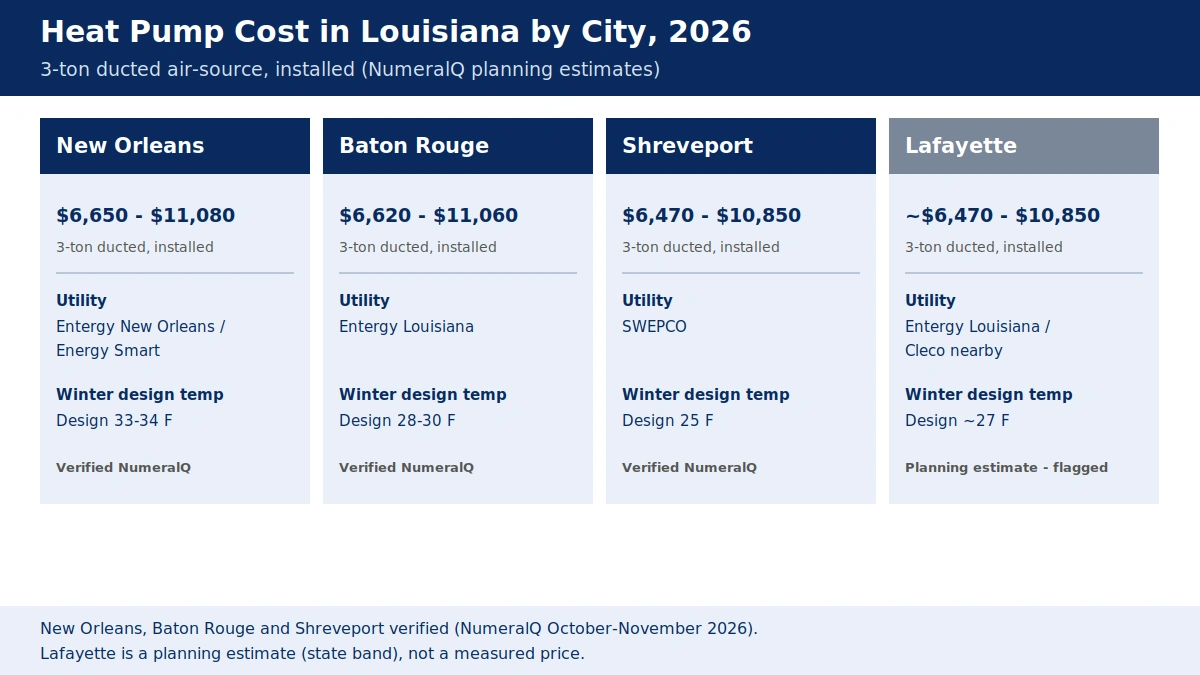
Louisiana’s price map is flatter than its rebate map, and the two maps tell different stories. The installed price for a 3-ton ducted system moves by only about $200 across the three cities NumeralQ prices separately, because the labor market barely moves across the state. HVAC mechanics earn a median $28.20 an hour statewide, 4 percent below the national median, and the metro spread runs only 8 points from Shreveport to New Orleans.
What moves instead is the share of the home’s value the job represents, and the utility on the meter, and both of those move a lot.
| City | 3-ton ducted (NumeralQ) | Utility | Design winter | Electric heat share | Job vs median home value |
|---|---|---|---|---|---|
| New Orleans | $6,650-$11,080 | Entergy New Orleans / Energy Smart | 33-34 F | 61% | 2.8% |
| Baton Rouge | $6,620-$11,060 | Entergy Louisiana | 28-30 F | 67% | 3.8% |
| Shreveport | $6,470-$10,850 | SWEPCO | 25 F | 55% | 4.8% |
| Lafayette | About $6,470-$10,850 (state band, flagged) | Entergy Louisiana / Cleco nearby | About 27 F | Not published | Not published |
New Orleans is the dearest city in dollars and the cheapest in relative terms. A 3-ton system runs $6,650–$11,080, the top of the Louisiana range, because New Orleans labor runs 4 percent above the national median and the city’s housing stock is the hardest in the state to work on: plaster walls, no duct chases, houses on piers, a historic-district review process that can slow any exterior change.
The same job is only 2.8 percent of the median New Orleans home value, the lowest share in the state, because New Orleans homes are worth more than Shreveport homes. The rebate picture is also New Orleans-only: Energy Smart pays $150–$500 inside Orleans Parish and nothing a mile across the parish line in Jefferson Parish, where the same Entergy Louisiana customer gets $500 at most.
The permit desk is its own hurdle. New Orleans issues mechanical permits only to city-licensed contractors holding a Class A Mechanical license, so a state-licensed contractor from Baton Rouge cannot pull the permit without the city credential.
Baton Rouge is the capital’s market: $6,620–$11,060 for the 3-ton system, labor 3 percent above the national median, and the highest electric-heat share of the big three cities at 67 percent. That last number matters more than the price. Two out of three Baton Rouge homes already heat with electricity, which means most Baton Rouge buyers are replacing an electric system with a more efficient electric system, the exact swap the future federal rebates, when they launch, are designed to pay for.
Baton Rouge is also the only Louisiana city that publishes a priceable permit fee for the standard job, about $125, which is small money but useful money: it is the one permit figure in the state a buyer can check against the quote instead of taking the contractor’s word. The city’s housing stock splits between the brick ranches of the 1960s and 1970s, with ducts in vented attics, and the newer subdivisions toward Ascension Parish, where the houses are tighter and the machines run smaller.
Shreveport is the cheapest city in dollars and the dearest in relative terms, and the rebate capital of Louisiana. A 3-ton system runs $6,470–$10,850, the state band itself, because Shreveport labor runs 4 percent below the national median. The same job is 4.8 percent of the median Shreveport home value, the highest share in the state, because Shreveport homes are worth less.
The rebate more than compensates: SWEPCO pays up to $3,500 in Shreveport and Bossier City, seven times the $500 an Entergy Louisiana customer collects in Baton Rouge. Shreveport is also the most gas-heated big city in Louisiana, with only 55 percent of homes on electric heat, which means more Shreveport buyers are choosing between a heat pump and a gas furnace than buyers anywhere else in the state. More of them are dual-fuel buyers, keeping the furnace and adding the heat pump in front of it.
Bossier City adds its own permit rule: a mechanical permit is required for replacements over $300, and the contractor needs city registration backed by a state license and $100,000 of liability insurance.
Lafayette carries the most caution of the four cities. The sources checked hold no NumeralQ city page for Lafayette, so the state band stands in as the figure here, about $6,470–$10,850, marked as a planning estimate instead of a measured city price. The secondary cross-check, HVAC Visit, puts Lafayette at $6,050–$15,650, a range so wide it says more about the spread of jobs than about Lafayette itself.
What is known about Lafayette is its position: it sits in the Acadiana parishes where Entergy Louisiana is the utility, where the design winter runs near 27 degrees, where the housing stock mixes Acadian cottages with new subdivisions, and where the nearest big rebate is Cleco’s $350–$600 a ton to the north. A Lafayette buyer should treat the state band as the anchor, get three local quotes, and let the local quotes, not the statewide band, set the budget.
The pattern across all four cities is the same. The equipment price barely moves. The labor price moves a little.
The rebate moves a lot, and the rebate is decided by the utility territory, not by the city limits. Neighbors on one street, served by different utilities, can collect rebates thousands of dollars apart for the identical machine. Check the utility before checking the price.
Louisiana’s Cooling-First Climate: Humidity, Design Temps & Sizing for August
Louisiana is a cooling state that happens to have a winter, and every sizing decision here follows from that. New Orleans logs 1,193 heating degree days and 3,143 cooling degree days in the ASHRAE data, nearly three cooling degree days for every heating degree day, and Baton Rouge logs 1,689 heating degree days against 2,628 cooling degree days.
The heating season is short, mild and cheap to serve. The cooling season runs from March to November, and the machine that serves it needs to be sized for August, not for January. A heat pump bought for the Louisiana winter serves the season that barely matters.
The design temperatures tell the same story in a different unit. New Orleans is designed for 33 degrees on the coldest night of the year under the ASHRAE 99.6 percent standard, and 34 degrees under the Manual J 99 percent standard, with a summer design of 92 degrees dry bulb and a 78-degree wet bulb.
Baton Rouge is designed for 28 degrees in winter and 93 degrees in summer. Shreveport, the coldest big city, is designed for 25 degrees in winter and 96 degrees in summer.
Alexandria sits at 27 and 94. Lake Charles sits at 31 and 93.
The winter numbers cluster in the high 20s and low 30s, which is why a standard ducted heat pump handles the whole state without a cold-climate premium. The summer numbers cluster in the low to mid 90s, which is why the cooling capacity, not the heating capacity, decides whether the house is comfortable.
Humidity is the Louisiana sizing story, and it is the part the tonnage table cannot show. The summer design wet bulb runs 77 to 79 degrees across the state, which means the outdoor air at design conditions carries a heavy load of water vapor, and the indoor air has to be dried as well as cooled. A machine sized only for sensible temperature, the number on the thermometer, will cool the house to 72 degrees and leave it clammy, because it never runs long enough to condense the moisture out of the air.
The right machine runs longer at lower capacity, wringing out the water while it drops the temperature. That is the case for a two-stage or variable-speed compressor in Louisiana, and for a thermostat that controls humidity, not just temperature. It is also the case against oversizing, restated in humidity terms: the oversized machine that short-cycles is the machine that leaves the house damp.
The rain is the second climate fact, and it is easy to forget when the conversation is all about temperature. Baton Rouge averages 63 inches of rain a year.
New Orleans is not far behind. Summer storms drop inches in an afternoon, and the water goes where the land lets it, which, in the low parishes, is everywhere.
A heat pump outdoor unit sitting on a slab at grade in a yard that ponds in a July thunderstorm is a unit that will sit in water, and a unit that sits in water corrodes, shorts and fails early. The pad matters. The elevation matters.
The condensate drain matters, because a system that pulls gallons of water out of the air every day needs somewhere for that water to go that is not the crawlspace or the slab. The water story continues in the hurricane section below, but the everyday version is the same: Louisiana water is a year-round fact, not a storm-season exception.
The house itself is the third climate fact, and in Louisiana the house is often the problem the machine is asked to solve. The state’s older housing stock, the shotgun houses and Creole cottages of New Orleans, the pier-and-beam houses of the river parishes, the 1960s ranches of Baton Rouge with ducts in vented attics, leaks air and leaks duct air in quantities a new house never would.
A Manual J that assumes a tight house will undersize the machine for a leaky one, and a machine sized for a leaky house will oversize it the day the house gets air-sealed. The sequence matters: seal the envelope and the ducts first, then size the machine for the house that results. A buyer who sizes first and seals later buys a machine too big for the house it ends up serving, and pays for that mistake in humidity and short-cycling for fifteen years.
The August bill in the opening section shows the cooling load plainly. The heat pump is the machine that carries that load, and the efficiency number that matters most on its nameplate is the one that governs cooling. Buy SEER2 first.
Buy HSPF2 second. In Louisiana, that order follows the climate.
Heat Pump vs Gas Furnace in Louisiana: The Running-Cost Math
The running-cost question in Louisiana is not whether a heat pump beats electric resistance heat. It does, by a wide margin, in every parish in the state.
The question is whether it beats gas, because a third of Louisiana homes heat with gas, and the gas in Louisiana is cheap at the wellhead. Henry Hub, the national gas benchmark, sits in Louisiana.
The answer turns on a single number, the seasonal COP, and on the cheapest electricity in the country. Work the sums with the state’s own prices and the answer comes out clearly, if not dramatically. Our heat pump running cost guide runs the same fuel-by-fuel comparison nationally, while our heat pump vs furnace guide weighs the two machines on purchase price as well as on fuel.
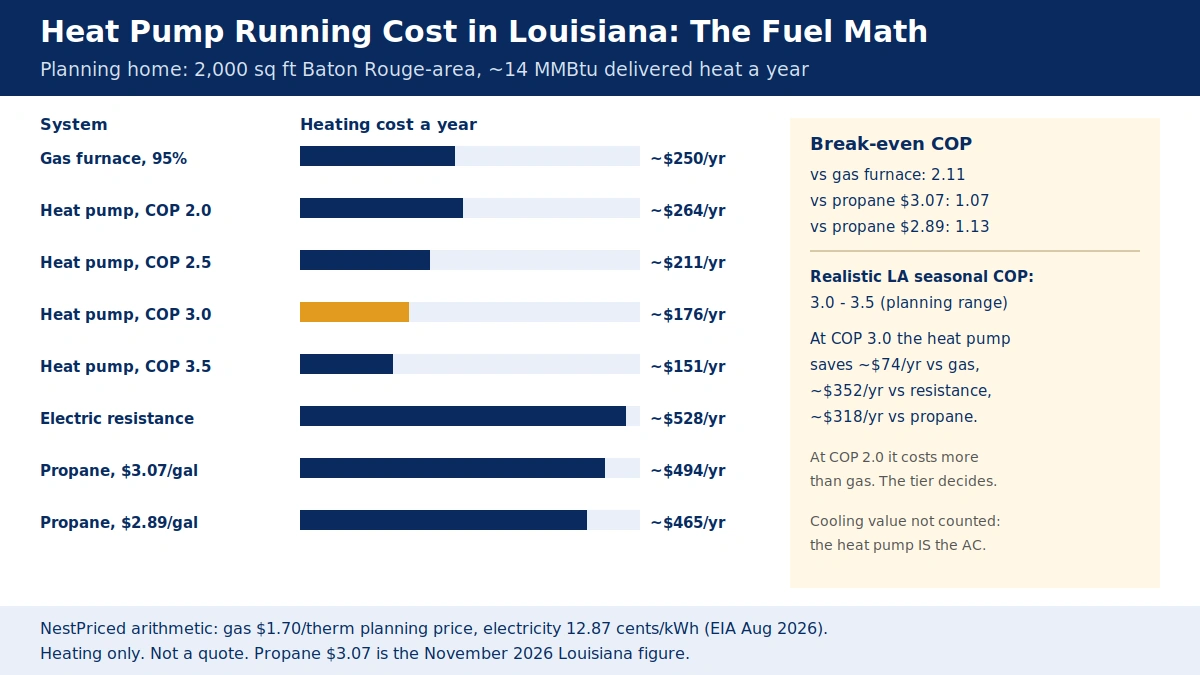
The planning home for this section is a 2,000 square foot house in the Baton Rouge area needing about 14 million BTU of delivered heat a year. That figure is a planning assumption, scaled from the South Carolina planning home’s 19 million BTU by the heating-degree-day ratio, and it is labeled as one. Louisiana winters are shorter, so the house needs less heat.
The prices are the state’s own: electricity at 12.87 cents a kilowatt-hour (EIA, August 2026), gas at a $1.70-a-therm planning price (a therm is 100,000 BTU of gas; EIA 2025 Louisiana residential average, $17.39 per thousand cubic feet), and propane at $3.07 a gallon (November 2026), with the $2.89 2025–26 season average noted. The furnace is 95 percent efficient.
The propane furnace is 95 percent efficient. The heat pump is tested at seasonal COPs from 2.0 to 3.5.
| Heating option | Cost per MMBtu delivered | Annual heating cost (14 MMBtu) |
|---|---|---|
| Heat pump, seasonal COP 2.0 | $18.86 | $264 |
| Heat pump, seasonal COP 2.5 | $15.09 | $211 |
| Heat pump, seasonal COP 3.0 | $12.57 | $176 |
| Heat pump, seasonal COP 3.5 | $10.78 | $151 |
| Gas furnace, 95% @ $1.70/therm | $17.89 | $250 |
| Electric resistance | $37.72 | $528 |
| Propane furnace, 95% @ $3.07/gal | $35.31 | $494 |
| Propane furnace, 95% @ $2.89/gal | $33.25 | $465 |
The break-even seasonal COP against gas is 2.11: a heat pump running at a seasonal COP above 2.11 heats the planning home for less than the 95 percent gas furnace. A realistic Louisiana seasonal COP is 3.0 to 3.5, because most of the heating season sits in the 40s and 50s, where the machine does its best work.
At COP 3.0 the heat pump costs about $176 a year to heat the planning home, against about $250 for gas, a saving of about $74 a year. At COP 3.5 it costs about $151, saving about $99. At COP 2.5 the saving shrinks to about $39, and at COP 2.0 the heat pump costs more than gas, about $264 against $250.
The gas verdict is a small win, and the win belongs to the efficient machine. A heat pump that spends its winter on backup strips, or a machine undersized for the house, can slide below the break-even line without the buyer noticing until the bill arrives.
Against propane the verdict is not close. At $3.07 a gallon the propane furnace costs about $494 a year, and the heat pump at COP 3.0 saves about $318 a year against it. At the $2.89 season average the propane furnace costs about $465, and the saving is about $289.
The break-even COP against propane is 1.07 at $3.07 a gallon and 1.13 at $2.89, a bar any working heat pump clears by a wide margin, including on the coldest north Louisiana night. The propane-heated farmhouse outside Alexandria, the camp on Toledo Bend, the house in a rural parish with no gas main: these are the homes where the heat pump’s heating economics are strongest, because propane is the dearest heat in Louisiana and the heat pump is the cheapest way to replace it.
Against electric resistance heat the verdict is the widest of all, and it is the verdict most Louisiana buyers actually get. About 63.7 percent of Louisiana homes heat with electricity, and a large share of those heat with resistance strips, in the air handler, in baseboards, in wall heaters, that turn a kilowatt-hour of electricity into a kilowatt-hour of heat and nothing more.
Resistance heat costs about $528 a year for the planning home. The heat pump at COP 3.0 costs about $176, saving about $352 a year. That saving is the one that pays for the machine, and it is the one that belongs to the Baton Rouge buyer replacing strip heat, the New Orleans buyer replacing a baseboard system, the Shreveport buyer whose old heat pump died and left the strips doing all the work.
Check what the house heats with now before running any other comparison. If the answer is resistance strips, the heat pump is not a close call.
Cooling is the bigger half of the machine’s year, and the heating sums above are the smaller half. The heat pump cools the house for ten months, and the cooling bill is the big number on the annual statement. The $226.86 August bill is the cooling load made visible.
A heat pump replacing a 10-SEER air conditioner from the 1990s with a 16-SEER2 machine cuts the cooling cost by roughly a third, and that saving dwarfs the $74-a-year heating saving against gas. The planning home gets no cooling-savings figure here, since the sources checked hold no verified Louisiana cooling-load figure, and inventing one would be worse than leaving it out. Judge the machine on the whole year, not on the heating season alone, and the Louisiana verdict gets much stronger.
Utility Rebates & What You Can Actually Collect in 2026
Louisiana’s rebates are a utility-by-utility story, and the utility on the meter decides the number before the buyer decides anything else. There is no statewide rebate.
There is no state tax credit for an air-source heat pump. There are five different programs, with five different amounts, five different efficiency tiers and five different deadlines, and the gap between the best and the worst is $3,000.
Get the utility right first, and the rest of the section follows.
| Utility / program | Territory | Heat pump rebate (2026) | Notes |
|---|---|---|---|
| SWEPCO Residential Energy Improvement | Northwest LA (Shreveport/Bossier) | Up to $3,500 | $250-$500/ton by SEER2 tier; conversion $600/ton |
| Cleco Power Wise | Central LA (Alexandria/Pineville) | Up to $3,500 | $350-$600/ton to 5.4 tons; min 14.3 SEER2; AHRI required |
| Entergy Louisiana (Entergy Solutions) | Most of the state | Up to $500 | Trade-ally program; in transition — confirm first |
| Energy Smart New Orleans | Orleans Parish only | $150-$500 | Ducted $150-$200; mini-split $200-$250; strip-heat replacement $250-$500; ends Dec 31, 2026 |
| Claiborne Electric Co-op | North LA co-op territory | $50-$100/ton | $100/ton new home or gas conversion; $50/ton electric replacement; cap 5 tons |
SWEPCO customers in the Shreveport and Bossier City area have the most generous rebate package in Louisiana. The 2026 Residential Energy Improvement Program pays an instant rebate of up to $3,500 per qualifying high-efficiency heat pump, with per-ton tiers in the program’s own incentive table: $250 a ton for 15.2 to 17.09 SEER2, $400 a ton for 17.1 to 19.94 SEER2, and $500 a ton for 19.95 SEER2 and above, plus a $600-a-ton conversion tier for heat pump conversions.
SWEPCO also pays $1,150 for a heat pump water heater, which is a separate measure and a separate form. The $3,500 cap comes from HomeEnergyBasics, a secondary guide, rather than the program table itself, so confirm the current cap with SWEPCO before counting on it as a promise. The tiers are the program’s own numbers, and a 3-ton machine at the top tier earns $1,500 on the tiers alone.
Cleco’s Power Wise HVAC Replacement Program serves central Louisiana around Alexandria and Pineville, and it pays up to $3,500 per qualifying heat pump on tiers of $350–$600 a ton, up to 5.4 tons, based on SEER2, EER2 (peak-cooling efficiency) and HSPF2 ratings. The minimum requirement is 14.3 SEER2, and AHRI certification (the independent rating record for the exact equipment pairing) is required.
The per-ton tiers come from a secondary guide checked in June 2026, and Cleco’s own Program Year 12 manual, revised May 2026, confirms the residential HVAC program exists and lists a $1,500 geothermal rebate, but the air-source per-ton rows were not legible in the excerpt obtained for this pass. Treat the $350–$600 figure as a secondary-source figure and confirm it with Cleco or a participating contractor before budgeting on it. On a 3-ton machine the tiers imply $1,050 to $1,800, which means the $3,500 cap binds only on the largest and most efficient systems.
Entergy Louisiana, the state’s largest utility, offers the smallest heat pump incentive through the Entergy Solutions program: up to $500 per heat pump, $200 per central air conditioner and $150 for an air conditioner tune-up, through participating trade allies. ENERGY STAR certification and SEER2/HSPF2 ratings are required.
The catch is that the program has recently been in transition after Louisiana Public Service Commission program changes, and the secondary guide that reports the $500 figure warns buyers to confirm the program is currently accepting residential HVAC applications before counting on the amount. That warning belongs on every Entergy Louisiana quote here: $500 is the number to verify, not the number to assume.
Energy Smart New Orleans is the separate program inside Orleans Parish, run by Entergy New Orleans under the New Orleans City Council, and it pays more than Entergy Louisiana on a tiered schedule, but only inside the parish line. The 2026 HVAC system-replacement rebate form pays $150, $175 or $200 per system for an air-source heat pump by efficiency tier, and $200, $225 or $250 for a mini-split ductless heat pump. When the replaced unit is electric strip heat, the rebate rises to $250 or $500.
The offer runs through December 31, 2026, or while funds last, and the application must be submitted within 45 days of service. From January 1, 2026, systems must be rated SEER2, EER2 and HSPF2 to qualify. A New Orleans buyer who waits until January loses the 2026 program entirely, and a buyer in Jefferson Parish never had it at all.
The cooperatives run their own schedules, and Claiborne Electric in north Louisiana is the example with verified figures. Members building a new home or converting from gas to electric heat get $100 a ton for an energy-efficient electric heat pump. Members replacing existing electric heating with a new electric heat pump get $50 a ton.
Rebates are capped at five tons per unit, and more than one unit can qualify. The amounts are small, $300 on a 3-ton replacement, but the co-op’s rates are also the lowest in the state, with a 1,000-kilowatt-hour bill of $128.11 against $154.83 for Entergy in the same LPSC comparison. The sources checked did not verify the schedules of other co-ops, including the Northshore co-op Washington-St. Tammany Electric, which run their own schedules.
Ask the co-op directly. The co-op office will know the number, and the number changes by parish.
One rebate shape confuses buyers more than any other: the rebate that pays for a heat pump water heater is not the rebate that pays for a space-heating heat pump. SWEPCO’s $1,150, Cleco’s heat pump water heater tier and Energy Smart’s $1,000 for a heat pump water heater are all water-heater money. They do not reduce the price of the machine that heats the house.
Folding water-heater money into a space-heating price mixes two programs, and the buyer who counts both will find the second one missing when the check arrives.
Federal Help in 2026: $0 Tax Credit, HEAR Not Launched & the Lease Route
The federal picture for a Louisiana heat pump in 2026 is short. The money is gone, the money that replaces it has not arrived, and the one route still open runs through a lease. Any quote that shows a federal line in 2026 needs correcting before it is signed.
The tax credit is gone. The Energy Efficient Home Improvement Credit, Section 25C, paid up to $2,000 a year for a qualifying heat pump, and the Residential Clean Energy Credit, Section 25D, paid 30 percent for geothermal. The One Big Beautiful Bill Act, Public Law 119-21, ended both credits for property placed in service after December 31, 2025.
A heat pump installed in Louisiana in 2026 earns $0 in federal tax credit, whether it is air-source or geothermal, whether the buyer is rich or poor, whether the installer says otherwise. Our federal tax credits guide tracks what ended, what survived, and what the lease route looks like across all fifty states. The IRS described the end dates in FS-2025-05, and the date is not negotiable.
A contractor who still shows a 30 percent credit on a 2026 quote is working from a 2025 price sheet, and the buyer who signs it will find the credit missing at tax time.
The rebates that were supposed to replace the credit have not launched in Louisiana. The Inflation Reduction Act gave Louisiana about $212.6 million for two programs: HEAR, the Home Electrification and Appliance Rebates, which pays up to $8,000 toward a heat pump for income-qualified households, and HOMES, the Home Owner Managing Energy Savings program, which pays up to $8,000 for whole-home energy savings. Louisiana’s administering agency is the Department of Energy and Natural Resources, and its applications were conditionally approved as of April 2026.
Conditional approval is not a launch. The state’s own page says implementation is in progress and offers no application route, as checked in October 2026. A November 2026 check found no status posted at all.
Louisiana’s only rebate page is an archive from before the energy agency was renamed on October 1, 2025. As of November 2026, no Louisiana household can apply for HEAR or HOMES money, and no state page names a date when one could.
The rules for those rebates also changed while Louisiana waited, and the change shuts out a third of the state’s homes. The Energy Department’s Program Notice 26-2, effective May 29, 2026, limits HEAR money, now renamed HEEHR, to replacing electric equipment with more efficient electric equipment, plus new construction, for reservations made after August 31, 2026.
A gas furnace swapped for a heat pump no longer qualifies. A propane furnace swapped for a heat pump no longer qualifies.
Only an electric-to-electric upgrade qualifies. In Louisiana, where 33 percent of homes heat with gas, that rule matters more than in most states: the gas-heated home in Shreveport that was waiting for HEAR money to fund its switch is waiting for money it cannot use even when the program opens.
The electric-heated home, the 63.7 percent, is the one the program will serve, and the income limits still apply: full payment below 80 percent of area median income, half the cost up to 150 percent.
The lease route is the one federal door still open, and it works differently from a credit or a rebate. Section 48E, the clean electricity investment credit, still pays through the lessor for a leased heat pump system placed in service by December 31, 2027, and the lessor can pass the value through to the homeowner in the lease terms. That is the structure behind the lease offers Louisiana buyers will see in 2026: the homeowner does not claim a credit, the leasing company does, and the monthly payment reflects it.
The details are lease-structure dependent: the term, the buyout, who owns the equipment, who maintains it. No verified Louisiana lease schedule appears in the sources checked, so no lease prices appear here. The point is the direction: if a Louisiana buyer wants federal money on a 2026 heat pump, the lease is where it lives, not the tax return and not the rebate application.
The state picture is just as thin. No state tax credit covers an air-source heat pump in Louisiana, and the sources checked show no Louisiana geothermal state credit. That gap in the record is not proof that none exists, and a buyer who hears otherwise should ask for the statute number.
South Carolina pays 25 percent for geothermal through its tax code. Louisiana pays nothing through its tax code for any heat pump.
What Louisiana pays, it pays through the utilities, and the utility section above is the complete list this pass could verify. A buyer who adds up the federal $0, the state $0 and the utility $500 to $3,500 has the real 2026 incentive picture for Louisiana, and it is a thinner picture than the 2025 buyer ever saw.
Permits & Licensing: The $10,000 License Line & the Parish Permit Desk
Louisiana’s licensing rule for heat pumps is a single dollar figure, and it sits in the middle of every whole-home quote here. Mechanical work worth $10,000 or more, labor and materials together, requires a state license from the Louisiana State Licensing Board for Contractors, in the Mechanical classification or its Heating, Air Conditioning, Ventilation, Duct Work and Refrigeration subclassification.
The rule comes from Louisiana Revised Statutes 37:2150.1, it applies to residential work as well as commercial work, and it covers nearly every whole-home heat pump here, because the 3-ton band tops out at $10,850. A contractor without that license cannot legally do the job at that price, cannot pull the permit for it, and cannot be paid for it through the normal channels. Check the license before the work starts, not after it goes wrong.
The license itself is not a rubber stamp. The contractor, or its designated qualifying party, must pass a trade exam and a Business and Law exam, and must file a financial statement showing at least $50,000 in net worth. The trade exam for the HVAC subclassification runs 100 multiple-choice questions over four hours.
There is no statewide journeyman license and no apprentice registration in Louisiana, which means the person on the roof and the person who holds the license are often different people, and the license holder is the one responsible. Refrigerant work needs its own credential on top: federal EPA Section 608 certification, which every technician who handles refrigerant must hold.
Refrigerant is the fluid that moves heat in and out of the house. The electrician who upgrades the panel needs an electrician’s license, which is a separate credential from the mechanical license.
Three licenses, three checks, and a buyer who verifies all three has done the cheap part of the due diligence.
The permit desk is the checkpoint that makes the license real. Louisiana runs on parishes, not counties, and every parish or municipal permit desk is bound by the same statute: it may not issue a building permit to anyone without an active LSLBC license in the classification that matches the scope, and it must collect a board-form exemption affidavit from an owner-builder. That is the rule that stops the unlicensed job at the counter, before a wrench is turned.
New Orleans adds its own layer: the city issues mechanical permits only to city-licensed contractors holding a Class A Mechanical license, and a mechanical permit is required to install, repair, replace or alter any mechanical or gas-fired apparatus, air conditioning systems, electric or gas heaters, furnaces, gas lines. Bossier City requires a mechanical permit for replacements over $300 and city registration backed by a state license and $100,000 of liability insurance.
The fee itself is small where it can be priced: Baton Rouge publishes about $125 for the standard $12,000 HVAC job, the only published permit fee in the state this pass could find. Everywhere else, ask the building department before signing, and get the fee as its own line on the quote.
The lien rule is the Louisiana detail most buyers never hear about until it bites. On an owner-occupied Louisiana home, the prime contractor must give the homeowner a notice of lien rights before work starts. A mechanic’s lien, a claim against the house by someone who worked on the install or supplied material for it and was not paid, is due 60 days after substantial completion, or 70 days if a subcontractor sent a residential notice of nonpayment, under Louisiana Revised Statutes 9:4822.
Louisiana has no statutory waiver forms, so the protection is a written release from each subcontractor and supplier naming the address and the amount paid. On a heat pump install, a lien notice will most likely arrive from the equipment distributor or from the electrician brought in to do the panel work.
Get the releases before the final payment, not after. The final payment is the only hold the buyer ever has over the job, and it should not leave the buyer’s hands while a lien can still be filed against the house.
Act 757 of 2026 added a footnote worth one line: a mechanical contractor who performs plumbing work worth $10,000 or more must also hold a master plumber license from the State Plumbing Board. Most heat pump jobs never touch that threshold on the plumbing side, but a job that reroutes condensate drains and water lines on a big retrofit can get there. It is a question to ask, not a problem to solve in advance, and it is the kind of question that separates the contractor who knows the 2026 rules from the one working from a 2024 playbook.
Hurricane Season: Flood Elevation, Tie-Downs & Surge Protection
Louisiana’s hurricane season runs June 1 to November 30, and the heat pump’s outdoor unit is the most exposed piece of equipment on the house. It sits outside, on a pad, in the wind and the water, and every landfall in the state’s history has been a test of how well it was installed. Elevation, tie-downs, surge protection, and corrosion decide whether the machine survives the storm that will, sooner or later, come.
Elevation is the first decision, and it is decided by water, not by the installer. The outdoor unit should sit above the base flood elevation, the height the federal flood maps say water can reach in the mapped flood, on a raised stand or a raised pad, not on a slab at grade in a yard that ponds. In the low parishes around New Orleans, in Terrebonne and Lafourche, in the coastal parishes where the land sits barely above sea level, that can mean eight feet off the ground on a platform bolted to the house.
In Baton Rouge, where the flood risk is a bayou backing up rather than a surge coming in, it can mean a modest stand and a pad that drains. The elevation belongs in writing on the quote, with the height named, because a unit installed at grade in a flood zone is a unit the buyer will replace after the first bad storm. The replacement will not be covered by the manufacturer’s warranty, which does not cover flood damage.
Tie-downs are the second decision, and they are decided by wind. A heat pump outdoor unit is a sheet-metal box with a fan in it, and in a hurricane it is a sail. Hurricane straps or tie-downs anchor the unit to the pad, and the pad is anchored to the ground or to the house, so the wind cannot lift the unit, slide it across the yard, or tear the refrigerant lines out of the wall.
The strap is cheap. The unit it saves is not. The placement matters too: the leeward wall, where the house itself shields the unit from the prevailing wind, beats the windward wall every time, and a unit tucked behind the house survives storms that take the unit on the exposed corner.
Get the strapping and the placement in writing, with the hardware named, before the install. After the install, the strap is an afterthought, and afterthoughts get skipped.
Surge protection is the third decision, and it is decided by the power grid, not by the weather. Louisiana’s cheap power does not mean clean power after a storm. Outages, brownouts and surges follow every landfall, and a heat pump’s control board is a small computer that does not forgive a voltage spike.
A whole-home surge protector at the panel, or a dedicated surge protector at the outdoor disconnect, is the insurance policy for the electronics, and it costs a fraction of the board it protects. The sources checked give no verified Louisiana price for strapping, raised stands, corrosion coating or surge protection, and none is invented here.
They arrive as separate lines on the quote, priced by the contractor, and the buyer who asks for them as lines gets them. The buyer who never asks gets a unit on a slab with no strap and no surge protection, and finds out what that costs in September.
Corrosion is the slow hurricane, and it works on the coast all year. Within a few miles of the Gulf, salt air eats the outdoor coil, the cabinet and the fasteners, and a standard unit ages years faster than the same unit in Shreveport. Coastal-rated cabinets, corrosion-resistant coatings on the coil, and a rinse schedule, hosing the coil down after a storm, and a few times a year in normal weather, stretch the life of the machine in the parishes where the air itself is the enemy.
Our heat pump maintenance guide sets out the yearly schedule, and our heat pump repair guide prices the coil replacement that coastal buyers know best. The coating is a line on the quote.
The rinse is a line in the maintenance schedule. Both are cheaper than a coil replacement, and the coil replacement is the repair Louisiana’s coastal buyers know best.
One more storm fact changes the buying decision, not just the installation. After a major storm, the wait for a contractor stretches from days to weeks, and the price of an emergency replacement rises with the demand. A heat pump bought and installed in February, with its elevation and strapping done right, is a machine that survives the season.
A heat pump bought in a panic in September, after the old unit flooded, is a machine bought at the worst price of the year from the busiest contractor in the parish. The hurricane season is the reason to buy the machine before the season, and to buy the elevation and the strapping with it. The roof takes the same storm from above: our Louisiana roof replacement cost guide prices the other half of the storm-hardening job for the same house.
What Pushes Your Louisiana Quote Up or Down
A Louisiana heat pump quote is a stack of prices, and the stack is where the money hides. The equipment is the biggest line, and the size of the machine moves it more than anything else: a 5-ton system at $9,310–$16,010 costs roughly twice a 1.5-ton system at $4,330–$6,980, and the half-ton steps between them add $700 to $1,300 each.
The efficiency tier is the second equipment line: a 16-SEER2 machine and a 20-SEER2 machine are not the same purchase, and the premium for the higher tier is real money that only pays back through the cooling bill. In Louisiana, where the machine cools ten months a year, the SEER2 premium earns more back than it would in a heating state. It still has to be priced as its own line, not folded into the tonnage.
The house is the second stack, and in Louisiana the house is often the expensive part. Ductwork is the biggest house line. New or extended ductwork, or sealing and insulating the ducts the house already has, can run into the thousands, and in a 1960s Baton Rouge ranch with ducts in a vented attic it is the line that decides whether the new machine can actually deliver its rated efficiency to the rooms.
The sources checked publish no Louisiana-specific ductwork price, so none is printed here. Get it as its own line, with the scope named: how many feet, what insulation, what sealing, what testing.
The electrical panel is the second house line. A 100-amp panel in a New Orleans shotgun house cannot carry a heat pump, a water heater and a modern kitchen at once, and the 200-amp upgrade is a separate job with a separate electrician and a separate permit.
Our electrical panel upgrade guide prices that job nationally so the panel line on a Louisiana quote can be checked against it. The same rule applies: its own line, its own price, its own permit.
The site is the third stack, and in Louisiana the site means water and wind. Hurricane strapping, a stand raised above base flood elevation, a coating against corrosion for a coastal lot, and a condensate fix for a crawlspace that takes water in a summer storm: each one is a line, each one carries a price, and no Louisiana-specific published figure for any of them appears in the sources checked.
That gap is a reason to get them priced, not a reason to skip them. The contractor who prices them has thought about the site, and the contractor who folds them into the equipment price has hidden them. Sales tax is the last site line, and it is the one buyers forget: Louisiana charges 4.45 percent state sales tax, and the parish and the city add their own on top.
Get it as its own line. A quote without a tax line will grow by the tax rate at the end.
The rebate is the fourth stack, and it is the one that shrinks the price, if the home qualifies. A Shreveport buyer collecting $3,500 from SWEPCO pays a different net price than a Baton Rouge buyer collecting $500 from Entergy Louisiana for the same machine, and a New Orleans buyer collecting $500 from Energy Smart for replacing strip heat pays a different net price than a New Orleans buyer collecting $150 for replacing an old heat pump.
The rebate belongs on the quote as its own line, with the program named, the tier named, and the condition named. A rebate the home cannot collect, the HEAR rebate that has not launched, the federal credit that ended, a SWEPCO rebate for a house on Entergy’s grid, is a line that should not be on the quote at all.
The contractor is the fifth stack, and it is the one no table can price. A licensed mechanical contractor with a $50,000 net worth behind the license, a Manual J on file, a commissioning report at startup and a labor warranty in writing costs more than a crew that guesses the size, skips the permit and leaves before the startup check.
That difference buys a machine that runs fifteen years instead of a machine that short-cycles itself into an early grave in a damp Louisiana August. Three quotes from licensed contractors, on one identical spec sheet, is the only way to see the contractor stack clearly. The cheapest of the three is rarely the cheapest machine once it is running.
Payback: When Does a Louisiana Heat Pump Pay for Itself?
The payback question in Louisiana has a straight answer and a misleading one, and the misleading one is the one most salespeople give. The misleading version divides the installed price by the annual saving and calls the result the payback. The straight version asks what the heat pump is being compared against, because the payback changes completely with the comparison.
Against electric resistance heat, the payback is long but real. Against propane, it is longer.
Against gas, heating savings alone never pay it back. Against the furnace and air conditioner the buyer would have bought anyway, there is no premium to pay back at all.
Start with the numbers, on the planning home from the running-cost section: a 2,000 square foot Baton Rouge-area house needing about 14 million BTU of delivered heat a year, and a 3-ton ducted system at the band midpoint of about $8,660. Against electric resistance heat, the heat pump at a seasonal COP of 3.0 saves about $352 a year, which gives a simple payback of about 24.6 years on the full installed price.
Against propane at $3.07 a gallon, the yearly saving is about $318, which stretches the payback to about 27.2 years. Against a 95 percent gas furnace, it saves about $74 a year, and the payback stretches past the life of the machine.
Heating savings alone never repay the install. Those are long paybacks, and they are printed here plainly, because a buyer who was promised five years deserves to know the truth before signing.
But the full-price payback is the wrong comparison for most Louisiana buyers, because most Louisiana buyers are not choosing between a heat pump and nothing. They are choosing between a heat pump and the furnace-plus-air-conditioner pair they would buy anyway when the old system dies. That pair, statewide, runs $8,250–$14,000 for a 3-ton system, and the heat pump at $6,470–$10,850 typically costs less than the pair it replaces.
There is no premium to pay back. The heat pump is the cheaper machine on day one, and then it saves $352 a year against resistance heat, $318 against propane and $74 against gas on top of that.
The buyer who frames the purchase as a cooling replacement with a heating bonus has the right frame. The buyer who frames it as a heating investment with a twenty-five-year payback has the wrong frame, and will talk themselves out of the cheaper machine.
The cooling savings are the second correction to the simple payback, and they are the larger one in Louisiana. The heating sums above cover the small season.
The cooling season is the big season, and a heat pump replacing a 10-SEER air conditioner from the 1990s with a 16-SEER2 machine cuts the cooling cost by roughly a third. On an August bill of $226.86, that is real money, month after month, for ten months of the year.
The cooling saving stays out of this section too, since no verified Louisiana cooling-load figure appears in the sources checked, and guessing would mislead more than it helps. But the direction is not in doubt, and the buyer who adds a cooling saving to the heating saving will find the payback much shorter than the heating-only numbers suggest.
The rebate is the third correction, and in Louisiana it is a geography correction. A Shreveport buyer collecting $3,500 from SWEPCO pays a net $5,160 for the midpoint machine, and the payback against resistance heat falls to about 14.7 years.
A Baton Rouge buyer collecting $500 from Entergy Louisiana pays a net $8,160, and the payback against resistance heat is about 23.2 years. A New Orleans buyer collecting $500 from Energy Smart for a strip-heat replacement pays the same net, and gets the same payback.
The rebate changes the arithmetic, not the machine: thousands of dollars in the north of the state, hundreds in the south. Get the rebate in writing before running the payback, or the payback is a fiction.
The last correction is the one nobody puts in a spreadsheet: the machine that is already dying. A heat pump that has failed, a furnace leaking carbon monoxide, an air conditioner that cannot hold 78 degrees in August: the buyer of a replacement is not choosing between spending and saving. The buyer is spending either way.
The question is only which machine the money buys, and the heat pump is the machine that cools, dehumidifies and heats for less than the pair it replaces, on the cheapest electricity in the country, with a rebate attached in half the state. That is the payback that matters, and it is immediate.
Getting Quotes in Louisiana: The Checklist
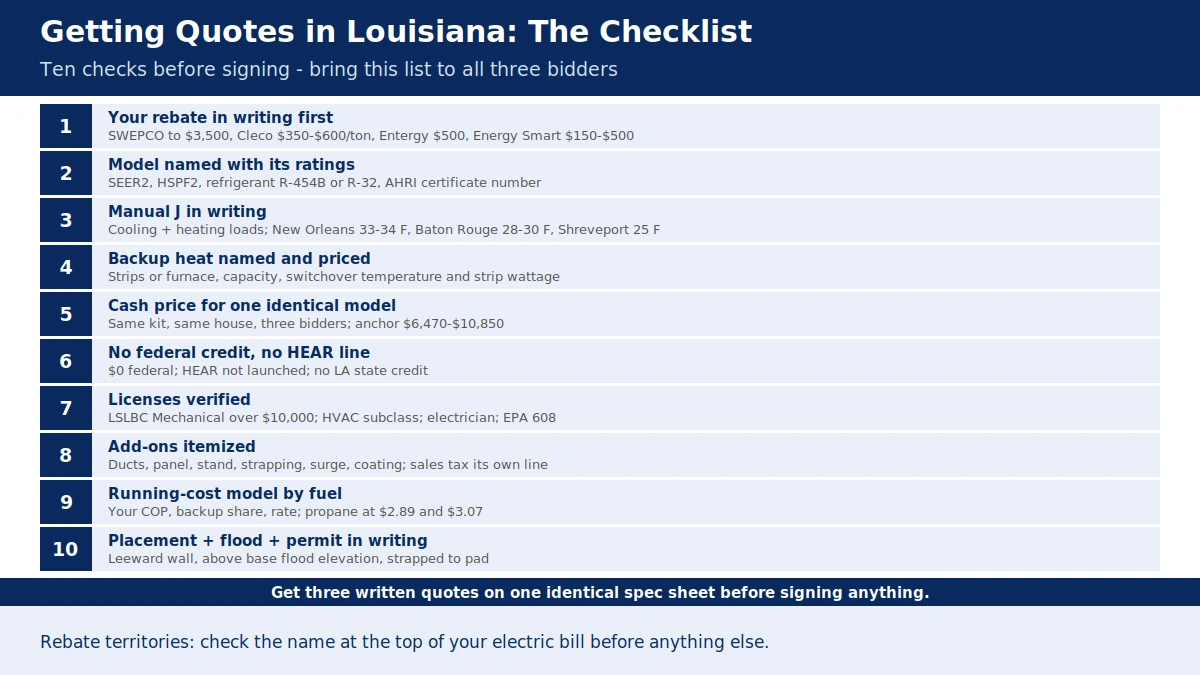
A Louisiana heat pump quote is a document to be checked, not a number to be trusted, and the checklist below is the order to check it in. Ten items, in the order that catches the expensive mistakes first. Ten passes make a quote worth comparing, and any failure in the first three sends it back.
- Your rebate in writing first (SWEPCO up to $3,500, Cleco $350–$600 a ton, Entergy Louisiana up to $500, Energy Smart $150–$500 through Dec 31, 2026, co-op schedules). The program named, the tier named, the condition named, and the deadline on the page.
- Model named with its ratings (SEER2, HSPF2, the refrigerant, R-454B or R-32, and the AHRI certificate number). No model number, no comparison.
- Manual J in writing (New Orleans 33–34 F, Baton Rouge 28–30 F, Shreveport 25 F, Lafayette about 27 F; cooling and heating loads separately, with the moisture load shown). A size without a calculation is a guess.
- Backup heat named and priced (resistance strips or a gas furnace, the switchover temperature for dual-fuel, and the strip wattage). The backup heat is the part of the bill that surprises buyers in January.
- Cash price in writing for the same model ($6,470–$10,850 anchor for a 3-ton ducted system). The same machine, the same house, the same scope, from every bidder.
- No line for a federal credit, no line for a HEAR rebate, no state-credit line on any quote ($0 federal; HEAR not launched in Louisiana; the sources checked show no state credit in Louisiana for an air-source heat pump). Strike any line for money the home cannot collect.
- Licenses verified (LSLBC Mechanical license for work of $10,000 or more, the HVAC subclassification, the electrician’s license for the panel, EPA 608 for the refrigerant; in New Orleans, the Class A city mechanical license). Look the LSLBC license up before anyone touches the house.
- Add-ons itemized (ductwork, panel upgrade, raised stand above base flood elevation, hurricane strapping, surge protection, corrosion coating, sales tax at 4.45 percent state plus parish and city as its own line). Every extra as its own line, or it is hidden.
- Running-cost model by fuel, not by brochure (seasonal COP, backup share, your fuel price: propane at both $2.89 and $3.07, your own electric rate, gas at $1.70 a therm). The model that uses your prices, not the manufacturer’s.
- Placement, flood elevation and parish approval in writing first (leeward wall, above base flood elevation, strapped to the pad, clear of flood water, permit pulled before work starts). The unit’s home on the property decided before the truck arrives.
Get three written quotes on one identical spec sheet before signing anything. The spec sheet gives the buyer control: the same model, the same size, the same scope, the same rebate, the same add-ons, in writing, from three licensed contractors. The bidder who will not fill it in is the bidder who is pricing a different job than the other two, and the buyer who signs without it is buying a surprise.
Louisiana’s cheapest electricity, its mild winters and its generous northern rebates make the heat pump a good buy in this state. That holds only when the size is calculated, the unit is raised and strapped, and every rebate on the quote is one the home can actually collect.
What does a heat pump cost in Louisiana in 2026?
A typical 3-ton ducted heat pump costs $6,470–$10,850 installed in Louisiana in 2026 (NumeralQ planning estimates, October 2026), with New Orleans at $6,650–$11,080, Baton Rouge at $6,620–$11,060 and Shreveport at $6,470–$10,850. One-zone mini-splits start at $3,090–$4,840, cold-climate ducted systems run $8,510–$14,910, dual-fuel $9,120–$15,280, and a geothermal loop $20,080–$31,680. Utility rebates run $500–$3,500 depending on territory, with SWEPCO and Cleco paying the most, and the federal tax credit is $0 for a 2026 install.
Do heat pumps work in Louisiana winters?
Yes, Louisiana winters are among the mildest a heat pump ever has to handle: New Orleans is designed for 33 to 34 degrees, Baton Rouge for 28 to 30, and Shreveport for 25, so a standard ducted unit handles the whole state without the cold-climate premium, and only the far north has a case for one. Expect a seasonal COP of 3.0 to 3.5 here, since most Louisiana winter days land in the 40s and 50s, and keep backup heat for the coldest nights up near Shreveport. The Louisiana winter demands far less of the machine than the summer does.
Is a heat pump cheaper to run than a gas furnace in Louisiana?
Yes, though only by a little, and the size of that little depends on the machine you buy. Louisiana power averages about 12.87 cents a kilowatt-hour, the lowest rate in the country, and matching a 95 percent gas furnace at the $1.70-a-therm planning price takes a seasonal COP of about 2.11, while a realistic Louisiana seasonal COP is 3.0 to 3.5. At COP 3.0, heating the planning home with the pump runs about $176 a year against about $250 for gas, a $74 saving, and at COP 3.5 the pump costs about $151, saving about $99, while against electric resistance heat the pump wins in every parish, saving about $352 a year.
What rebates can I get for a heat pump in Louisiana in 2026?
It depends entirely on your utility: SWEPCO pays up to $3,500 for a qualifying heat pump in the Shreveport and Bossier City area, tiered $250–$500 a ton by SEER2, with a $600-a-ton conversion tier, and Cleco pays $350–$600 a ton up to 5.4 tons in central Louisiana, with a 14.3 SEER2 minimum and AHRI certification required. Entergy Louisiana pays up to $500 through the Entergy Solutions program, but the program has been in transition and the buyer should confirm it is accepting applications, while Energy Smart New Orleans pays $150–$500 inside Orleans Parish only, through December 31, 2026, with $250–$500 when the replaced unit is electric strip heat. Cooperatives run their own schedules, Claiborne Electric pays $50–$100 a ton, and the federal tax credit is $0 for a 2026 install.
Can I get the $8,000 HEAR rebate for a heat pump in Louisiana?
Not in 2026. Louisiana’s HEAR and HOMES programs have not launched: the state’s applications were conditionally approved, the state page says implementation is in progress with no application route, and a November 2026 check found no status posted at all. Even after the programs open, HEAR money cannot pay for a fuel switch, since Program Notice 26-2 from the Energy Department bars it: a gas- or propane-heated home hoping to switch is shut out by that rule, and only electric-to-electric upgrades and new construction qualify, which still covers the roughly 63.7 percent of Louisiana homes already heating with electricity.
Does Louisiana give a tax credit for a heat pump?
No. An air-source heat pump earns no state tax credit in Louisiana, and no geothermal state credit turned up in the sources checked either, which puts Louisiana apart from states such as South Carolina, where geothermal gets a 25 percent credit. What Louisiana pays, it pays through the utilities: SWEPCO and Cleco up to $3,500, Entergy Louisiana up to $500, Energy Smart New Orleans $150–$500, and with the federal tax credit also at $0 for a 2026 install, the utility rebate is the whole incentive picture for most Louisiana buyers, so the utility on the meter should be checked before budgeting on any of it.
What license or permit do I need to install a heat pump in Louisiana?
You need a mechanical permit from your parish or city, and your contractor needs a state license: a Louisiana State Licensing Board for Contractors Mechanical license, or its HVAC subclassification, for mechanical work worth $10,000 or more, which covers nearly every whole-home install. The license requires a trade exam, a Business and Law exam, and a $50,000 net worth statement, and the permit desk is where the license rule bites, since the building official has to refuse a permit unless the applicant shows the required license or an exemption. In New Orleans, the contractor also needs a Class A city mechanical license to pull a mechanical permit, while the electrician’s license for panel work and federal EPA Section 608 certification for refrigerants are separate checks, so verify the LSLBC license online before any work starts on the house.
When does a Louisiana heat pump pay for itself?
Against electric resistance heat, about 24.6 years on the full installed price, because it saves about $352 a year, and that is the payback many Louisiana buyers actually get, since about 63.7 percent of the state heats with electricity. Against propane at $3.07 a gallon, about 27.2 years, saving about $318 a year, while against a 95 percent gas furnace, fuel savings alone never repay the install at a seasonal COP of 3.0, since the saving runs about $74 a year. Weigh the pump against the furnace-plus-air-conditioner you would buy anyway, though, and the premium vanishes: the heat pump typically costs less than the $8,250–$14,000 pair it replaces, and it cools and dries the house all summer on top, while a Shreveport buyer collecting $3,500 from SWEPCO cuts the resistance-heat payback to about 14.7 years.