


October 2026 state cost modeling puts a typical 3-ton ducted heat pump at $6,570–$10,980 installed in South Dakota for 2026. A single-zone ductless mini-split runs $3,180–$4,960 in Sioux Falls, a cold-climate ducted system runs $8,680–$15,120, and a geothermal system with a ground loop runs $20,380–$32,070. The rebate is a matter of address, not effort: Otter Tail Power pays up to $3,120 on a 3-ton cold-climate system, Black Hills Energy pays $250, and Xcel Energy pays no equipment rebate at all. The federal government contributes $0 toward a 2026 install, because South Dakota declined the federal home energy rebates outright.
South Dakota is a state of two heating fuels, and the heat pump verdict splits down the middle between them. About half of homes heat with piped gas, and gas at South Dakota prices heats a home for about $750 a year, less than any heat pump can match. About one home in six heats with propane, and there the heat pump saves about $502 a year. Your fuel, your utility, and your town’s winter decide whether a heat pump pays, and this guide prices all three without flinching.
Drive across South Dakota in January and the heating picture changes with the landscape. In Sioux Falls the streets are lined with furnaces fed by gas mains, and the gas bill is the number every other heating choice has to beat. Out on the prairie between towns, the white propane tank beside the house tells a different story: fuel bought by the truckload, priced by the gallon, and dear enough that a heat pump starts to look like a bargain. In Rapid City the same January brings chinook winds that can lift the afternoon into the 50s, then drop the night below zero, and a heating system has to handle both in the same day.
A heat pump does not make heat. It moves heat from the outdoor air into the house, the same trick as a refrigerator run in reverse. In a South Dakota winter that sounds like a dare, and in some ways it is. The air outside a Sioux Falls home on a January night holds far less heat than the air outside a home in a mild climate, and the machine has to work harder for every unit of warmth it brings inside. The honest question is not whether a heat pump can work here. It is whether the one on the quote is built for minus 11 degrees, sized for the coldest week of the year, and priced against the fuel it actually replaces.
This guide prices a heat pump the way a South Dakota homeowner actually buys one, step by step from the first quote to the rebate check. A published state cost model with October 2026 pricing sets the headline band used here. The rebate section works utility by utility, because South Dakota has no state rebate program and the three big utilities pay wildly different amounts. The running-cost section shows every input, prices propane, gas, oil, and electric heat side by side, and separates Sioux Falls from Rapid City and Aberdeen, because the coldest town in the state needs about 14 percent more heat than the largest city.
One warning belongs up front. South Dakota is the only state in the country that turned down the federal home energy rebates, about $69 million of them, in August 2024. Any web page, rebate roundup, or contractor flyer that promises an $8,000 federal heat pump rebate for a South Dakota home is wrong. There is no federal rebate here, no federal tax credit for a 2026 install, and no state program to take their place. What is left is utility money, and it ranges from $250 to more than $3,000 depending on whose wires reach your house.
Table of Contents
How Much Does a Heat Pump Cost in South Dakota in 2026?
A 3-ton ducted heat pump costs $6,570–$10,980 installed in South Dakota in 2026. NumeralQ dated that state model October 26, 2026, and the band is an installed price: it covers the crew’s labor, the thermostat, the refrigerant lines, the indoor air handler, and the outdoor unit. New ductwork, an electrical panel upgrade, and a permit all sit outside it, and with South Dakota’s older housing stock, most homeowners should plan on paying for at least one of the three.
On the same model, South Dakota sits almost exactly on the national middle. The national heat pump cost band for the same 3-ton ducted system is $6,550–$10,960, so South Dakota runs about $20 higher at each end, a rounding difference rather than a real premium. Labor explains the lack of a premium, or rather the lack of one. Bureau of Labor Statistics data from May 2025 puts the median South Dakota heating and cooling installer at $29.51 an hour, about 1% above the national median. After insurance, payroll taxes, and overhead, contractors bill about $59–$77 per worker-hour. Equipment ships at national prices. The crew costs about what a crew costs anywhere.
Three published sources frame the South Dakota market, and each one measures something different. NumeralQ’s modeled band gives the tightest, most specific figures, broken out by size, system type, and city. The second source, BetterHouse, scales a national baseline by state wages and gives a much wider $3,920–$13,720, with $10,360 as its typical figure. Its typical figure lands near the top of NumeralQ’s band, which reassures, but the band mixes single-zone mini-splits with full ducted systems and runs too wide to budget from. HVAC Visit, a city-price tracker, puts Sioux Falls heat pumps at $7,050–$18,750 installed before rebates across its two South Dakota cities, a range so wide it is direction only.
| Source | South Dakota 3-ton ducted cost | Basis | Date |
|---|---|---|---|
| NumeralQ state model | $6,570–$10,980 | Modeled installed cost, state list | Priced Oct 26, 2026 |
| NumeralQ Sioux Falls model | $6,610–$11,030 | Modeled installed cost, Sioux Falls market | Updated Oct 23, 2026 |
| NumeralQ Rapid City model | $6,570–$10,980 | Modeled installed cost, Rapid City market | Updated Oct 21, 2026 |
| BetterHouse | $3,920–$13,720, typical $10,360 | Aggregator model, wage-adjusted | 2026 |
| HVAC Visit | $7,050–$18,750 (Sioux Falls) | City tracker, before rebates | 2026 |
No contractor-published whole-home range for South Dakota turned up in this research, so this guide does not invent one. What it does show is the shape of a whole-home job in this state: most South Dakota whole-home jobs are either one ducted system swapped onto existing furnace ductwork, which fits the modeled band, or several single-zone ductless units, which do not. A three-head ductless job in Sioux Falls runs $6,320–$11,270 on the modeled figures, and a home that needs two or three outdoor units plus four or five heads will run past the ducted band entirely. Keep the comparisons honest: judge one ducted system against the modeled band, and judge a multi-unit ductless job against the multi-zone rows.
The range runs so wide because two machines can share the same band and still be very different. Cheap jobs use a basic single-stage unit built to the federal efficiency floor. It heats strongly until the outdoor temperature falls to about 30°F. High-end jobs use a variable-speed cold-climate system. It holds most of its heating power at 5°F and keeps rooms at a steadier temperature through a January cold snap. Both carry the name heat pump. Only the second is built to face a Sioux Falls January, and picking between the two is the weightiest decision in this guide.
The work the band leaves out matters just as much. Sioux Falls ductwork, new or extended, runs $4,230–$7,150 a job on the same NumeralQ pricing, and a 200-amp panel upgrade runs $2,140–$3,380 a job. Add $6,370–$10,530 to the headline band for a Sioux Falls home with a 100-amp panel and no ducts, before the heat pump itself is priced. Ask for each extra as a separate line on the quote, and read the permit and contract sections before signing, because South Dakota has no state cap on the down payment and no state HVAC license to fall back on.
South Dakota adds one cost line most states do not have. The state charges contractors a 2% excise tax on gross receipts from realty improvements, including repair and remodeling, under SDCL 10-46A, and it is built into the price rather than added as sales tax. A Sioux Falls quote should show that tax as its own line so totals compare fairly, and a quote that hides it inside the labor line is a quote that cannot be compared with any other.
The calendar matters: the right month to buy can move the price by hundreds of dollars and shorten the wait by weeks. June and September are the mildest install months in NumeralQ’s Sioux Falls data, when a day without heat or cooling is no hardship, and Rapid City’s data names June and August. September and January buy the same machine in Sioux Falls. The January order, though, is more likely an emergency replacement at emergency pricing, with less time to compare bids or wait for a rebate-eligible model. Order in the mild months, and the crew has time to do the load calculation properly.
Heat Pump Cost in South Dakota by System Type
Your choice of system type fixes the price band before a contractor ever crosses your threshold. A geothermal system that pulls heat from the ground costs many times what a single-zone mini-split heating one part of the house costs. Where the state model publishes a row, the table below uses it; where it does not, Sioux Falls figures stand in, labeled as Sioux Falls. Every figure here is an installed cost for a 3-ton equivalent system unless a row says otherwise.
| System type | South Dakota installed cost | Best for |
|---|---|---|
| Single-zone ductless mini-split | $3,180–$4,960 (Sioux Falls) | One zone, addition, or first unit |
| Multi-zone ductless, 3 heads | $6,320–$11,270 (Sioux Falls) | Homes without ducts, zoned rooms |
| Ducted air-source heat pump | $6,570–$10,980 (state) | Homes with good ducts |
| Cold-climate ducted heat pump | $8,680–$15,120 (Sioux Falls) | Sioux Falls, Aberdeen, prairie towns |
| Dual-fuel (heat pump plus gas furnace) | $9,300–$15,210 (Sioux Falls) | Gas-heated homes, coldest nights |
| Geothermal with ground loop | $20,380–$32,070 (Sioux Falls) | Long-term owners, large lots |
A single-zone ductless mini-split is the cheapest way into heat pump heating in South Dakota, and it is the unit the rebate system rewards most. One outdoor box pairs with one indoor head for a single zone. The head usually mounts high on a living room or main bedroom wall, and the pair heats and cools that zone. The Sioux Falls band of $3,180–$4,960 makes it the go-to fix for a Sioux Falls apartment with electric baseboard heat, a Brookings addition that never got ductwork, or the first step in a phased whole-home plan. Otter Tail Power pays $600 per ton on a qualifying cold-climate ductless unit, which is $1,800 on a 3-ton system before its adders, so a single-zone unit on Otter Tail lines can cost less after the rebate than the modeled band suggests.
Multi-zone ductless takes the same idea to three or more rooms. Each room gets its own indoor head and its own thermostat, and one outdoor unit feeds them all. The surprise for homeowners who take ductless as always cheaper: the Sioux Falls band for three heads, $6,320–$11,270, overlaps the ducted band. Set beside ductwork built from nothing, a multi-zone job looks cheap; set beside sound ducts already in the house, it looks expensive. On Otter Tail lines the multi-zone question has a rebate answer too: a cold-climate ductless system earns $600 per ton, so a 3-ton multi-zone outdoor unit can earn $1,800 plus adders, while on Black Hills lines the same system earns a flat $250.
For a furnace-and-ducts house, a ducted air-source heat pump is the natural swap. Ducts stay, vents stay, and often the air handler cabinet stays too, which keeps the crew’s work simple and the price inside the state band. The catch is the condition of those ducts, and in South Dakota that question looms larger than in most states. Many homes here went up in the postwar boom with ducts run through cold attics and crawl spaces, and a ducted swap that trusts those ducts without an inspection can leak a fifth of its heat before any room feels it.
At the Sioux Falls midpoints, a cold-climate ducted system costs about $3,080 more than a standard ducted one, and in South Dakota that premium buys the difference between comfort and a cold house. A variable-speed compressor and an oversized outdoor coil sit inside a cold-climate unit. Together they keep pulling heat from air cold enough to make a standard unit quit and hand the job to resistance backup. An oversized coil, an inverter drive, and a more careful install all sit behind the $8,680–$15,120 Sioux Falls band. In Rapid City the same system runs $8,630–$15,060, close enough that the two cities can share one planning figure.
For a home in Aberdeen, where the heating season runs about 14% longer than in Sioux Falls and the record low is minus 46°F, a cold-climate rating is not an upgrade. It is the baseline. A standard system sized for Sioux Falls rules and installed in Aberdeen will undersize the job twice over: once on the load, once on the capacity at 5°F. The efficiency section shows why the cold-climate rating outweighs the brand name, and the payback section shows the premium paying back in about 9.9 years on efficiency alone.
In a dual-fuel system, one house holds both a heat pump and a gas furnace, and a control hands the heating job between them as the outdoor temperature moves. The Sioux Falls band of $9,300–$15,210 buys two heating systems in one install. In South Dakota, dual-fuel has no rebate problem, because no rebate program here pays for a whole-home system with strings attached, and it has a fuel problem instead: piped gas is so cheap that the furnace half of the pair beats the heat pump half on running cost at every temperature below the switchover point. Dual-fuel still makes sense for a Sioux Falls or Rapid City home on a gas line that wants furnace heat on the coldest nights and heat pump cooling in July, but the buyer pays full price and the running-cost section shows the fuel math is the weakest case in this guide.
Geothermal, also called a ground-source heat pump, tops the list for price. Ground at depth holds near 50°F all year, and a loop of pipe buried in the yard or dropped down a well draws on that steady warmth. Loop and indoor unit both sit inside the $20,380–$32,070 Sioux Falls band, and the final figure turns on the loop itself: horizontal trenches want a large yard, which prairie homes often have, while vertical boreholes cost more and fit a small city lot. Otter Tail Power pays the best geothermal rebate in the state, up to $1,640 per ton, which is $4,920 on a 3-ton system. No geothermal rebate amount was found for Black Hills Energy or Xcel Energy customers, so no rebate is assumed for them in any figure that follows.
One shared cost hides inside every system type: refrigerant, the gas that ferries heat around the loop. The EPA ended R-410A in new home systems in 2025, a refrigerant change that reshaped the market that year. A new South Dakota system in 2026 carries R-454B or R-32, and neither gas can top off an R-410A unit from an earlier year. Both replacement gases burn mildly, so the crews handling them follow extra rules, and the extra rules add a little to the install cost. A cheap recharge offer on an aging system calls for one question first: which refrigerant does it hold? Weigh the repair against replacing the unit outright once you know.

Heat Pump Cost in South Dakota by Home Size and Tonnage
Tons are the unit of sizing, with one ton equal to 12,000 Btu of heat moved in an hour. One Btu is the heat that lifts one pound of water by one degree Fahrenheit. Btu is short for British thermal unit. How heavy the outdoor box is has nothing to do with ton. A 3-ton unit sits in the middle of the home range, far below commercial size.
NumeralQ’s October 2026 pricing gives the state installed costs by size in the table below. Read the home-size column as a rough planning guide only. Same square footage does not mean the same size. Insulation, windows, ceiling height, and air leakage matter as much as floor area, so two homes of the same size on paper can need different systems. In South Dakota, the age of the house often matters more than any of them.
| System size | South Dakota installed cost | Rough home size | Typical South Dakota home |
|---|---|---|---|
| 1.5 ton | $4,420–$7,090 | 600–900 sq ft | Small apartment, cabin |
| 2 ton | $5,130–$8,390 | 900–1,200 sq ft | Starter home, small ranch |
| 2.5 ton | $5,850–$9,680 | 1,200–1,500 sq ft | Older Sioux Falls bungalow |
| 3 ton | $6,570–$10,980 | 1,500–2,100 sq ft | Typical family home |
| 3.5 ton | $7,280–$12,280 | 2,100–2,400 sq ft | Two-story Rapid City home |
| 4 ton | $8,000–$13,570 | 2,400–3,000 sq ft | Large Aberdeen home |
| 5 ton | $9,430–$16,170 | 3,000–3,700 sq ft | Large new-build home |
Roughly $710 at the low end and $1,300 at the high end is what each half-ton step up adds. The one exception is the 4-ton to 5-ton jump, which adds $1,430 and $2,600. The 3-ton to 4-ton jump alone runs about $1,430 at the low end and $2,590 at the high end, which is why oversizing stings. An oversized unit short-cycles. It fires in brief bursts that strain parts, skips the steady running that wrings humidity from summer air, and never settles into efficient operation. An undersized unit runs without rest on the coldest days and drags in resistance backup. That backup heat costs roughly three times what the heat pump delivers per unit.
The right size comes from a Manual J load calculation. That is a room-by-room worksheet of heat loss and heat gain, and it accounts for your walls, windows, insulation, air leakage, and the local design temperature. ACCA, the Air Conditioning Contractors of America, wrote the Manual J method. In South Dakota the calculation is unavoidable in practice for a different reason than in rebate-heavy states: no rebate program here checks your sizing for you, so the load calculation is the only guard against a contractor who sizes from floor area alone or copies the size of the unit coming out without running the numbers. That is guessing dressed up as experience, and in a minus 11°F design climate the guess costs more than in a mild one.
A good load calculation catches three sizing wrinkles in South Dakota homes. First, many homes are old and leaky. Sioux Falls grew fast after the war, and a 1950s ranch with thin walls and single-pane windows can need a full ton more than a new home of the same size. Second, the design temperature swings sharply from the southeast corner to the northern prairie. The Manual J 99% design temperature is minus 11°F in Sioux Falls, and Aberdeen runs colder still on every measure that matters: 8,222 heating degree days against Sioux Falls at 7,248, and about 38 nights a year at or below zero. A size that is right in Sioux Falls is wrong in Aberdeen. Check that the calculation uses your town’s design temperature, not a statewide default. Ask the contractor which temperature went into it.
Third, wind is a sizing factor here in a way it is not in sheltered states. A prairie home on open ground loses heat through air leakage on a windy January night far faster than the same house in a Sioux Falls subdivision, and the load calculation must account for it. South Dakota winters bring cold fronts that drop the temperature 20 to 30 degrees in a single day, and a system sized for an average January week will be caught short by the cold snap that follows. Ask the contractor what outdoor temperature the system is sized to hold the house at, and what happens on a night five degrees colder than that.
The quote South Dakota homeowners truly weigh theirs against is the furnace-plus-air-conditioner comparison, and it sits in this section. A 3-ton central air conditioner plus gas furnace costs $8,400–$14,190 installed in Sioux Falls, which is $1,790–$3,160 more than the Sioux Falls 3-ton heat pump band. Two machines doing one heat pump’s work is why the pair costs more. When both the furnace and the air conditioner are near the end of their lives, replacing them with a heat pump is the cheaper way, not the dearer option. The comparison tightens a lot when the furnace is failing but the air conditioner has years left. The payback section runs that case in full.
Heat Pump Cost by City: Sioux Falls, Rapid City, Aberdeen, and Brookings
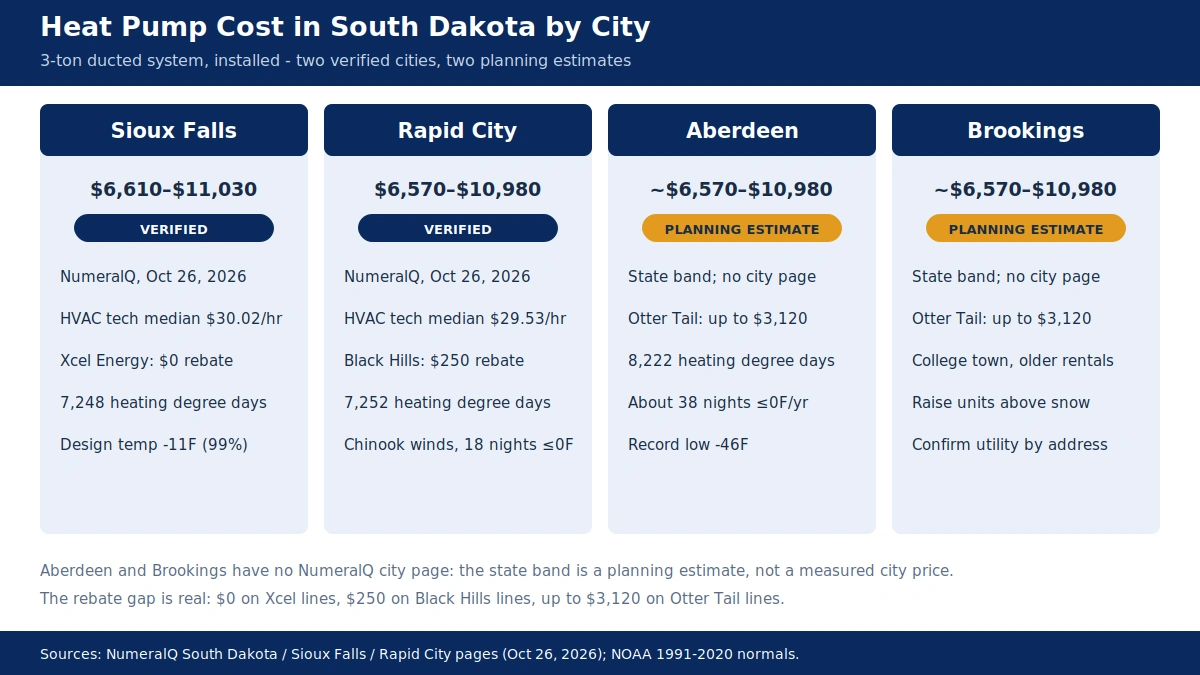
Sioux Falls and Rapid City are the only South Dakota cities with a published cost model. NumeralQ gives Sioux Falls the full treatment: figures split by size, system type, add-on, and labor rate. Rapid City gets the same. No published cost model prices Aberdeen or Brookings, and this section is honest about that gap. The Sioux Falls and Rapid City figures below are modeled costs. The Aberdeen and Brookings figures are planning estimates built from the state band, and they are labeled as estimates wherever they appear.
| City | 3-ton ducted cost | Basis | What moves the price |
|---|---|---|---|
| Sioux Falls | $6,610–$11,030 | NumeralQ model, Oct 2026 | Standard reference market |
| Rapid City | $6,570–$10,980 | NumeralQ model, Oct 2026 | Chinooks, Black Hills Energy |
| Aberdeen | $6,570–$10,980 | State-band planning estimate | Coldest city, Otter Tail lines |
| Brookings | $6,570–$10,980 | State-band planning estimate | Otter Tail lines, college town |
This guide treats Sioux Falls as the reference market, and its numbers are the firmest anywhere in it. Minnehaha County counts 81 plumbing and HVAC contractors, about 9.1 per 10,000 homes: competitive by South Dakota standards. The median Sioux Falls home is worth $292,400, about 61% of housing units are single-family houses, and 67% of homes heat with piped gas while 29% heat with electricity. That fuel split matters for quotes: two-thirds of Sioux Falls homes heat with the cheapest fuel in the state, which is why the running-cost section is blunt about gas. Sioux Falls is also the city where the rebate picture is thinnest: Xcel Energy, which serves the city, pays no heat pump equipment rebate, only discounted electric-heating rates and a backup-heat rate program. Check the rebate section before budgeting any rebate money in Sioux Falls.
Rapid City is a milder heating climate wearing the same state name, with a twist. The city sees 7,252 heating degree days against Sioux Falls at 7,248, essentially identical, yet Rapid City sees 174 freezing nights against Sioux Falls at 162, and 18 nights at or below zero against 25. The Black Hills explain the paradox: chinook winds warm Rapid City afternoons into the 50s and 60s in January, then the night falls hard, and a heating system has to handle a 40-degree swing inside a single day. About 65% of Rapid City homes heat with piped gas and 31% with electricity. Rapid City homeowners should also check which utility serves their address before pricing anything, because Rapid City sits on Black Hills Energy lines, where the heat pump rebate is $250, not Otter Tail lines, where it can reach $3,120 on a 3-ton cold-climate system. The same machine, the same price, a $2,870 difference in rebate money, decided by the meter.
Aberdeen is the coldest of the four cities here, and the one where the heat pump question is sharpest. The city sees 8,222 heating degree days against Sioux Falls at 7,248, about 14% more, and about 38 nights a year at or below zero. January days average near 21°F for a high and below zero for a low, and the record low is minus 46°F. The planning estimate for Aberdeen borrows the state band for a standard system, yet a system that truly works in Aberdeen needs the cold-climate budget of about $8,680–$15,120 and a load calculation that respects the longer, colder heating season. Aberdeen homeowners have one advantage the other cities do not: much of the Aberdeen area sits on Otter Tail Power lines, where the cold-climate ducted rebate can reach $1,040 per ton, or $3,120 on a 3-ton system, plus a $40 per ton adder for putting the system on an off-peak rate. Confirm which utility serves the exact address before counting that money, because Otter Tail territory and the neighboring co-ops interleave across the region.
Brookings sits on the eastern edge of the state, home to South Dakota State University, and shares Aberdeen’s utility advantage. The planning estimate for Brookings also uses the state band, and Brookings-specific fuel shares and permit fees were not found in this research, so this guide does not invent them. The practical Brookings price risks are the same as Aberdeen’s: a colder winter than Sioux Falls, older rental housing near the university with thin insulation, and outdoor units that need raising above the snow line and sheltering from prairie wind. A Brookings home on Otter Tail lines should price the rebate first and the equipment second, because $3,120 of rebate changes which system is affordable.
Beyond the four cities, travel and access move a quote in ways the city bands do not capture. A home in Pierre, Mitchell, Huron, Watertown, or a ranch outside any town may face a trip charge, a smaller pool of contractors, or a longer wait for a cold-climate model the local distributor does not stock. The equipment price stays put through all of that. The timeline gains days, and the labor line gains hundreds of dollars. Beyond the Sioux Falls and Rapid City corridors, get one bid from a contractor based in your county and one from the nearest city. Compare the full installed price, not the equipment price alone. And check whether your home sits on cooperative lines: several South Dakota electric cooperatives run their own 2026 HVAC rebate programs, capped at 20% of the equipment cost, and a co-op member who never asks never collects.
Near a state line, expect the neighboring state’s costs to run close to South Dakota’s. See the guides for North Dakota, Nebraska, Iowa, Minnesota, and Montana for the figures on the other side of the border.
Cold-Climate Performance: What a South Dakota Winter Asks of a Heat Pump
A heat pump makes no warmth of its own by burning fuel. Heat rides a refrigerant loop and a compressor from the outdoor air into the house, the same basic process as a refrigerator run the other way. The trick is moving heat that already exists, not making heat from nothing. That is how one unit of electricity can bring two or three units of warmth indoors. Outdoor temperature matters so much for that reason: the colder the outdoor air, the less heat it holds to carry, the harder the machine strains for each unit, and the further output and efficiency slide downward. In South Dakota the slide is steeper than in most states, because the design temperature is minus 11°F in Sioux Falls and colder still on the northern prairie.
COP sums all of this up in one number. COP is short for coefficient of performance. Heat delivered over electricity used is what COP measures. With a COP of 3.0, three units of heat come indoors for every unit of electricity. Resistance heat, the baseboards in many older South Dakota houses, sits at a COP of 1.0 by definition: one unit of electricity in, one unit of heat out. Resistance heat loses to any COP above 1.0, and heat pumps clear that bar almost all the time, yet the edge thins as the cold deepens, until the machine simply cannot match what the house loses.
Installers call that crossover the balance point. It is the outdoor temperature where the heat pump’s best output just equals the heat escaping the house. On the warm side of the balance point, the heat pump alone handles all the heating. Below it, a second heat source has to cover the shortfall. In a Sioux Falls house, a well-sized cold-climate system may balance near 5°F or lower, so backup heat runs a handful of nights a year. A standard system in an Aberdeen house may balance near 25°F or 30°F, so backup heat runs for weeks. No brochure lists a balance point, since it belongs to one machine matched to one house. The load calculation and the maker’s capacity tables let a good contractor work the number out.
Start honest shopping with the capacity tables. Every model has published heat output at three outdoor temperatures: 47°F, 17°F, and 5°F. At 5°F, a standard unit may deliver only 40% to 60% of its 47°F rating-point heat. Cold-climate models are built to keep far more of their muscle at 5°F. The ENERGY STAR cold-climate designation demands at least 70% of the 47°F output at 5°F, plus a COP of at least 1.75 in that cold. For the precise model on the quote, take its capacity table. Read the 17°F and 5°F rows, and match those figures to your home’s heating load at the local design temperature. Without that table, a quote is unfinished business.
The biggest surprise for new owners comes from defrost cycles. When ice builds on the outdoor coil, the system runs in reverse for a few minutes to melt it off. Indoors, the air feels cool during those minutes unless backup heat warms it. Defrost is normal and necessary. Defrost that never stops signals trouble: an undersized unit, a bad spot, or wet snow and ice piling up around the base. South Dakota installs should put the outdoor unit on a raised stand above the typical snow line, with the drain routed so meltwater does not refreeze under the unit. Sioux Falls averages about 45 inches of snow a year, and a unit set at ground level will spend part of every winter buried.
Snow and wind decide where the unit goes too. Under a roof valley, a unit takes falling snow and ice off the roof. In a low corner, a unit sits in a drift. A unit on the windward side of a prairie house will ice faster than one in a sheltered spot, and prairie wind drives snow sideways into places a sheltered-city install never sees. Ask the contractor where the outdoor unit will sit, how high it will be raised, how it will be sheltered from the wind, and how the defrost drain will be routed. These four questions cost nothing and prevent the most common South Dakota installation complaints.
The southeast-to-north contrast is the single most important climate fact for a South Dakota buyer. Sioux Falls, in the Big Sioux River valley, has 7,248 heating degree days, a measure of how much heating a climate demands over a year. Rapid City, at the edge of the Black Hills, has 7,252, essentially the same. Aberdeen, on the northern prairie, has 8,222, about 14% more than Sioux Falls. Sioux Falls sees about 25 nights a year at or below zero. Aberdeen sees about 38. A contractor who sizes from Sioux Falls rules and installs in Aberdeen will undersize the system. Insist the load calculation uses your town’s design temperature, not a statewide default.
One last cold-climate reality check: a test climate milder than South Dakota stands behind the yellow-label efficiency ratings. The HSPF2 rating, explained in the efficiency section, rests on a test region whose winters run far gentler than a Sioux Falls January. A 7,248-heating-degree-day climate leaves even an HSPF2 9.5 unit short of its rated seasonal efficiency. The label overstates real output, and the gap widens with each degree the design temperature drops. Budget your running costs off the COP range in the next section instead of the label alone. Hear any promise of label efficiency through a South Dakota winter as a sales pitch, not a fact.
South Dakota’s own fuel mix backs up the caution. About half of homes heat with piped gas, and gas is cheap enough that a heat pump cannot beat it on running cost. About one home in six heats with propane, and there the heat pump wins clearly. About one home in three heats with electricity, and there the heat pump wins by thousands of dollars a year. The lesson is not that heat pumps fail in South Dakota. The lesson is that the fuel you heat with today decides whether a heat pump pays, and no rebate in this state is large enough to rescue a bad fuel matchup.
Running Costs: Heat Pump vs Propane, Gas, Oil, and Electric Heat
The usual heat pump sales pitch breaks in both directions at once on running cost in South Dakota. South Dakota electricity is cheaper than the national average, which helps heat pumps. South Dakota piped gas is also cheap, which hurts them. Your utility, your current fuel, and the price of propane in the winter you are actually living through decide which force wins. This section states every input in its math plainly, so your own delivery tickets and utility bills can check it.
This section’s planning home needs 75 million Btu of delivered heat per year. Sioux Falls at 7,248 heating degree days and a whole-house heat-loss rate near 460 Btu per hour per degree Fahrenheit build that figure, which describes a mid-size South Dakota home of about 1,800 square feet with middling insulation. An Aberdeen sensitivity scales that load by the heating degree day ratio, 8,222 divided by 7,248, giving about 85 million Btu. Treat these as planning figures, not measurements of your own house. Every result from this method carries the NestPriced arithmetic label. Burn 863 gallons of propane a year through a 95% efficient furnace and your delivered heat is about 75 million Btu. Scale every figure in this section by your own gallons.
The energy prices are current and dated. Electricity uses the statewide residential average of 14.5 cents per kWh for 2026 so far, from the U.S. Energy Information Administration, against 18.2 cents nationally. That average includes fixed monthly charges, so it overstates the marginal price an added heat pump actually pays, and the true marginal rate is likely lower, which would favor heat pumps. No utility-specific marginal rate table was found for Xcel Energy South Dakota or Black Hills Energy in this research, so the statewide average stands as the planning rate and the direction of its bias is disclosed here. Propane is $2.06 a gallon, the EIA weekly survey average for South Dakota in the week of November 9, 2026, with $1.79, the 2025-26 season average, as the sensitivity. Heating oil is $4.52 a gallon, the EIA survey figure for the same week, with $5.75, a conflicting tracker figure for the same week, as the sensitivity; the conflict is disclosed in the research file and in the flags at the end of this guide. Natural gas is about $0.95 a therm, converted from the EIA 2025 annual average residential price of $9.86 per thousand cubic feet, with $1.20 as the sensitivity. Furnaces use a 95% efficiency planning figure for modern condensing equipment, with an 80% sensitivity for older furnaces; the oil boiler uses 87%.
| Heating system | Annual heating cost, Sioux Falls planning home | Notes |
|---|---|---|
| Heat pump, seasonal COP 2.0 | $1,594 | Harsh winter, standard system |
| Heat pump, seasonal COP 2.2 | $1,449 | Low-efficiency system |
| Heat pump, seasonal COP 2.5 | $1,275 | Central planning case |
| Heat pump, seasonal COP 2.8 | $1,138 | Good cold-climate system |
| Propane furnace, 95%, $2.06/gal | $1,777 | November 2026 survey price |
| Propane furnace, 95%, $1.79/gal | $1,544 | 2025-26 season average |
| Gas furnace, 95%, $0.95/therm | $750 | EIA 2025 average price |
| Gas furnace, 95%, $1.20/therm | $947 | Higher gas price sensitivity |
| Gas furnace, 80%, $0.95/therm | $891 | Older furnace, current price |
| Oil boiler, 87%, $4.52/gal | $2,813 | November 2026 survey price |
| Oil boiler, 87%, $5.75/gal | $3,579 | Conflicting tracker, same week |
| Electric resistance heat | $3,187 | Baseboards, wall heaters |
Read the table from the propane row outward, because propane is the fuel where a South Dakota heat pump earns its keep. A heat pump at the central COP of 2.5 costs $1,275 a year to heat the planning home, which is $502 less than the $1,777 a propane furnace costs at the November 2026 price. At the 2025-26 average propane price of $1.79 a gallon, the propane furnace costs $1,544, and the heat pump still saves $269 a year. The break-even point tells the same story in one number: a heat pump ties propane at a seasonal COP of 1.79, which any working heat pump clears with room to spare. About 15% of South Dakota homes heat with propane, most of them beyond the gas mains, and for those homes a heat pump is a solid fuel saving at current prices. Propane prices in South Dakota sit near the bottom of the country, because the state rides the central-plains storage network, yet even at the cheapest propane prices in America the heat pump wins.
Plain language is owed to the gas comparison, the weakest case in this guide. A gas furnace at $750 a year beats the heat pump by $525 a year, and even at the $1.20 gas sensitivity the furnace costs $947, still $328 less than the heat pump. The break-even COP against gas is 4.25, and no air-source heat pump sustains a seasonal COP of 4.25 in South Dakota. Heat with gas today and a heat pump will raise your heating bill, not lower it. Gas also brings no rebate rescue in this state, because no South Dakota rebate program pays a gas-heated home to switch. Buy a heat pump for cooling, for comfort, or for a failing furnace if your Sioux Falls or Rapid City home heats with gas, never on a promise of fuel savings. When the choice is the same one faced across the country, the heat pump vs furnace comparison works through it in full.
The oil comparison is the strongest fuel saving in raw dollars, and the smallest in reach. Against an oil boiler at $2,813 a year, the heat pump at COP 2.5 saves $1,538 a year, and at the conflicting $5.75 oil figure the saving grows to $2,441 a year. But only about 1% of South Dakota homes, roughly 4,200 households, heat with oil at all, so this verdict matters to very few readers. If you are one of them, the running-cost case is settled, and only sizing, rebates, and the panel remain to be settled.
No case in this guide reaches as far as the electric resistance comparison. Against baseboard heat at $3,187 a year, the heat pump saves $1,912 a year. About one South Dakota home in three heats with electricity, and many of those homes heat with baseboards, ceiling cable, or wall units. Those are the homes where a heat pump transforms the winter bill, and they are also the homes where a ductless system drops in with the least disruption. If you heat with electricity today, the running-cost case is settled, and the rebate section shows that Otter Tail customers can also collect the largest rebate in the state on top of the saving.
Cooling changes the comparison in the heat pump’s favor, and it is the reason many gas-heated South Dakota homes still choose one even when the heating math is against them. Unlike a gas furnace, a heat pump is also an air conditioner. All the planning math above covers heating alone. A South Dakota home that wants cooling through a humid July, when Sioux Falls highs run into the 80s, either buys a window unit or a central air conditioner alongside the furnace or buys a heat pump that does both jobs. The Sioux Falls furnace-plus-air-conditioner pair costs $8,400–$14,190, against $6,610–$11,030 for the heat pump. The heat pump starts about $2,475 ahead on equipment at the midpoints, before a single kilowatt-hour is counted. The payback section carries the payback math with cooling included.
Your own bills are the final check. Count your last 12 months of propane deliveries in gallons, not dollars, because the price moved during 2026. Take your gallons, multiply by 91,500 Btu and by your furnace’s efficiency, and you have an estimate of your delivered heat. Price that heat at the COP range in the table above using your own utility’s rate from your bill. Far above 75 million Btu, delivered heat points to a larger, leakier, or colder house than the planning home. Savings against propane or electric heat grow with it. Far below, and your home is tighter or smaller, with a longer payback.

Efficiency Ratings That Matter: SEER2, HSPF2, and Cold-Climate Labels
Heat pump efficiency comes down to two ratings. In South Dakota, the heating rating deserves far more weight than the cooling one. Cooling efficiency over a whole summer is what SEER2 measures. SEER2 is short for Seasonal Energy Efficiency Ratio 2. Heating efficiency over a whole winter is what HSPF2 measures. HSPF2 is short for Heating Seasonal Performance Factor 2. The 2 marks a 2023 test update that used truer duct pressures. On the new scale, the same machine scores lower than it did as SEER or HSPF. Never set a 16 SEER figure from an old quote beside a 16 SEER2 figure. The two scales do not line up, and the comparison will steer you wrong.
No split-system heat pump sold anywhere in the country may rate below 14.3 SEER2 and 7.5 HSPF2 since January 1, 2023. Those numbers are the floor for any new system sold in South Dakota. That floor is a floor, not advice. A federal-minimum unit gives Sioux Falls homes adequate heat, while Aberdeen homes get marginal heat and heavy backup use in the coldest weeks. Otter Tail Power’s rebate list holds only systems that clear a higher bar, which is a useful signal: the utility will not pay you to install the cheapest legal system, because it knows that system will not perform in a South Dakota winter. One caution: a NumeralQ page cites 13.4 SEER2 as a starting point for its cost comparison. That is a model input, not a legal standard. The federal minimum for a split system is 14.3 SEER2, and the draft uses the federal figure.
Divide HSPF2 by 3.412, the Btu in a watt-hour, and the seasonal COP comes out. The arithmetic gives a seasonal COP near 2.2 at the federal minimum of 7.5. An HSPF2 of 9.5 implies about 2.8. An HSPF2 of 10.5 implies about 3.1. The conversion stays approximate, with the cold-climate section’s caveat attached. HSPF2 testing happens in a climate milder than South Dakota’s. A Sioux Falls realized seasonal COP lands below the converted number. Caveat and all, the conversion still compares two quotes on heating cost faster than anything else. The table below prices each tier for the Sioux Falls planning home.
| Efficiency tier | HSPF2 | Implied seasonal COP | Annual heating cost |
|---|---|---|---|
| Federal minimum | 7.5 | About 2.2 | $1,450 |
| Cold-climate floor, ducted | 8.1 | About 2.4 | $1,343 |
| Mid-tier | 8.5 | About 2.5 | $1,279 |
| High-tier | 9.5 | About 2.8 | $1,145 |
| Top-tier cold-climate | 10.5 | About 3.1 | $1,036 |
The jump from the federal minimum to the high tier saves about $305 a year, before the test-climate caveat. Only a right-sized premium justifies the upgrade. Premiums move by brand, and by how much of the extra money pays for the cold-climate coil instead of the efficiency rating. In Sioux Falls the cold-climate premium runs about $3,080 over a standard system at the midpoints, and the efficiency saving alone pays it back in about 9.9 years. The same premium gives Aberdeen buyers faster payback and a bigger comfort gain, because it also buys 5°F capacity and far fewer backup hours. Price the tier jump and the cold-climate capability as two separate decisions, each with its own price on the quote.
Rating fog in cold climates clears with two labels. The ENERGY STAR cold-climate designation rests on three bars. The first bar is a COP of at least 1.75 at 5°F outdoors. The second is at least 70% of the 47°F heating output at 5°F. The third is a controls check proving the system performs as rated once installed. It also sets 15.2 SEER2 plus 8.1 HSPF2 for ducted units, or 8.5 HSPF2 for ductless ones. NEEP, the Northeast Energy Efficiency Partnerships, maintains the cold-climate specification that rebate programs across the region use. It calls for a variable-capacity compressor and a COP of at least 1.75 at 5°F running flat out. The standard HSPF test never measures below 17°F, which is why both labels exist. A unit can post a fine HSPF2 score and still wilt at 5°F. In South Dakota’s winters, a cold-climate label outweighs a half-point of HSPF2.
SEER2 still matters on the South Dakota prairie, where summer heat is a real load. Sioux Falls sees summer highs in the 80s with humid air off the Big Sioux valley, and a system at 14.3 SEER2 will cost noticeably more to cool and dehumidify with than one at 16 SEER2 or higher. The cooling saving stays below the heating saving in dollars through South Dakota’s short cooling season, yet the dehumidification comfort is genuine. Higher SEER2 tiers tend to arrive with the variable-speed compressors that lift heating performance too. In Aberdeen and the northern prairie, where summers are shorter and drier, weight SEER2 less and HSPF2 and the cold-climate labels more.
EER2, the Energy Efficiency Ratio 2, deserves a warning: it grades cooling at one hot outdoor temperature, not across a season. A high EER2 trumpeted on a quote may be hiding a middling HSPF2. Put EER2 second in your priorities as a South Dakota buyer. Lead your questions with HSPF2, the 5°F capacity, and the cold-climate labels. When the heating figures hide at the back and EER2 leads the quote, press the contractor on why. Brand-by-brand price and cold-climate performance comparisons live in the best heat pump brands cost guide. The cold-climate mini-split guide covers mini-splits the same way.
Gas Furnaces, Propane, and Backup Heat in South Dakota Homes
Most South Dakota heat pumps do not work alone. They work beside a gas furnace, a propane furnace, a wood stove, or electric resistance strips that take over on the coldest nights. How that backup is arranged decides both the rebate and the January bill, and South Dakota’s utility patchwork shapes the arrangement more than in any other state. Three backup patterns are the ones South Dakota homeowners actually use, and this section covers each one with its rebate consequences.
The most common pattern is the retained gas furnace. The heat pump becomes the primary heat in mild weather, and the gas furnace takes over below a set outdoor temperature. In South Dakota this pattern has no rebate penalty, because no rebate program here attaches strings to a retained furnace, and it has a fuel advantage no other state matches: the furnace burns gas at about $10.00 per million Btu, the cheapest heat in the state, while the heat pump at a COP of 2.5 costs about $17.00 per million Btu. Set the switchover temperature where the heat pump stops beating the furnace, not where the brochure says it should. On a mild October day the heat pump wins. On a minus 10°F night the furnace wins. A control that hands over too late wastes money on every cold hour; a control that hands over too early wastes the heat pump entirely. Ask the contractor to name the switchover temperature on the quote and to show you how to change it.
The second pattern is the propane furnace kept as backup, common on prairie homes beyond the gas mains. Here the fuel math runs the other way: propane at $23.70 per million Btu costs more than heat pump heat at every COP above 1.79, so the heat pump should carry as much of the load as it can and the propane furnace should stay in reserve for the coldest nights and for power outages. The propane tank still needs a delivery contract, the furnace still needs annual service, and the propane in the tank still ages, but the tank is also the reason the house survives a winter power cut. A heat pump alone cannot heat a house with no power. A propane furnace with a small generator can. In a state where winter storms close highways for days, that redundancy is worth more than the fuel saving alone.
All-electric homes use a third pattern as their default backup: resistance strips inside the air handler. Fitting strip heaters costs little, often a few hundred dollars. On the coldest nights they count as safety equipment, not a luxury. Their running hours decide the bill, not the strips themselves. Expect the strips to log only a few dozen hours a year with the right size, a cold-climate unit, and a low balance point. A standard unit that is undersized can leave them running for weeks on end. A January electric bill double or triple December’s is the warning sign: the most common complaint from South Dakota owners who bought on price alone. At 14.5 cents a kWh, an hour of strip heat costs about two and a half times what an hour of heat pump heat costs at a COP of 2.5.
Dual-fuel deserves its own paragraph because South Dakota treats it as a straight purchase, not a rebate puzzle. A heat pump paired with a gas furnace makes a dual-fuel system, switching between them by outdoor temperature. The Sioux Falls band is $9,300–$15,210. No South Dakota rebate program pays for a dual-fuel system or bars one, so the decision is pure fuel math and comfort. Give the planning home to the pair this way: the heat pump carries 60% of the load at a COP of 2.8, and the gas furnace carries 40% at 95% efficiency. About $683 a year goes to the heat pump portion and about $300 to the gas portion, for a total of about $983. Heat the same home entirely by gas and it costs $750, so dual-fuel runs about $233 a year more on fuel, on top of a $3,435 equipment premium over the ducted heat pump alone. Redundancy and comfort on a gas line are the reasons to pick dual-fuel, not fuel savings. On Otter Tail lines, the dual-fuel rate can soften the verdict: the utility’s Dual Fuel Rate pairs electric heat with backup non-electric heat at a discounted price, and the $40 per ton off-peak adder applies to cold-climate systems on that rate. Ask Otter Tail what the rate is worth at your address before deciding.
South Dakota’s cold mornings expose how much more thermostat behavior counts with a heat pump than with a furnace. A furnace recovers from a nighttime setback quickly by sending hot air through the ducts. Slow recovery is a heat pump habit. A sharp morning warm-up can wake the resistance strips and erase the overnight saving. Two or three degrees instead of eight is the right size for the overnight setback. A smart thermostat with a heat pump mode is another option. It lifts the temperature gently and keeps the strips off above a chosen outdoor temperature. Before the installer leaves the house, have them set the strip lockout and show you how to adjust it.
System sizing should include backup sizing, not follow it. Strip heaters should hold the house at a safe temperature through a cold night with the heat pump dead. That usually means covering a large share of the design load. The retained furnace should also carry the home on its own. The night the heat pump fails will be the coldest night of the year. Ask the contractor what keeps the house warm on a minus 15°F night with the heat pump stopped. A backup capacity number is what to look for in reply, not a soothing sentence.
Ducted vs Ductless Heat Pumps in Older South Dakota Homes
Nearly all of South Dakota’s older houses fall into two groups, and your group picks your heat pump. A furnace-built house already owns its ducts, and a ducted heat pump drops into that system. Homes built with electric baseboards, or with a propane furnace and no ductwork to speak of, have no ducts worth keeping, and a ductless system avoids the cost and disruption of building ductwork from scratch. The housing stock in Sioux Falls’ older neighborhoods, Rapid City’s west side, and the small towns along the Missouri River holds plenty of both kinds, and the wrong choice costs thousands.
With sound ducts already in place, ducted is the easy winner. Fitting takes less time. The indoor unit tucks away in a closet or basement, and vents already there carry heat to every room. The risk is invisible: ducts leak. A cold attic or crawl space costs a duct run a fifth or more of its heated air before any room feels it. Too-small returns choke the system’s airflow. Before any ducted price is set, have the ducts inspected. In a house past 30 years, have them leakage-tested too. Sealing leaky ducts is often the best dollar in the whole project, and it goes naturally with the weatherization work in the next section.
Three cases call for ductless mini-splits: no ducts, ducts past saving, or rooms that want different temperatures. Every indoor head has its own thermostat. A bedroom can stay cool beside a warm living room, and a spare room can sit turned down without touching the rest of the house. Wall-mounted high or flush in a ceiling, heads connect to the outdoor unit through refrigerant lines in one small hole in the wall. Fitting heads causes far less disruption than cutting duct chases through plaster walls and finished ceilings. A Brookings rental with baseboard heat and no attic access often leaves ductless as the only practical option that does not involve opening walls.
The cost crossover is specific. Building new ductwork in Sioux Falls costs $4,230–$7,150 per job. In Sioux Falls, a three-head ductless system runs $6,320–$11,270. No ducts in place means the ducted system costs $6,610–$11,030, and the ductwork bill comes on top. Ductless at $6,320–$11,270 undercuts ducted-plus-new-ducts at roughly $10,840–$18,180, and the margin is wide enough to settle the question outright. Where the ducts are sound, ducted wins on price and on looks, with no wall heads showing in any room. When the ducts are bad, price both options with the repair folded in. Turn down any ducted quote that trusts the old ducts without an inspection.
Propane-heated homes add a wrinkle that gas-heated homes never face. A propane furnace heats air through ducts, so the ducted swap looks natural, yet the propane tank and the furnace stay in place as backup and the heat pump must be placed so it does not fight the furnace thermostat. The two systems must not fight: the furnace thermostat must be set to take over only below the switchover temperature, and the heat pump heads must be placed so they do not blow hot air directly onto a furnace thermostat and confuse it. A contractor who has converted South Dakota propane homes before will know these patterns. Ask the installer how many propane-to-heat-pump conversions they have done in the last year.
A mix of the two suits some older houses better than either one alone. Let a ducted unit keep the main floor on its old ducts, and let one ductless head warm an addition, a converted garage, or a bonus room the ductwork never touched. Or use ductless heads for the rooms that matter, and leave baseboards behind as backup in the rooms nobody uses much. Remodels in South Dakota use these hybrids often, and they let the investment arrive in phases: main system now, extra head later, with a rebate claim each where the utility allows it. Otter Tail counts its rebates per ton, so a phased plan can earn a rebate at each stage, but the sizing must be planned as a whole from the start, even if it is installed in stages.
Electrical limits in older South Dakota houses press on both options at once. Many pre-1980 houses still get by on a 100-amp panel. A ducted unit with resistance strips can push the house toward 200-amp service. A panel upgrade in Sioux Falls runs $2,140–$3,380 per job. A single-zone setup draws less current through one ductless head, so it may live happily on the old panel where a ducted unit cannot. Answer the panel question at estimate time. Open the panel door, count the spare breaker spaces, and settle it then instead of discovering it on install day. A panel upgrade is walked through, with its fair price, in the electrical panel upgrade cost guide.
In a state with long heating seasons and prairie dust, filtration is the hidden difference between ducted and ductless. All the air passes through one central filter in a ducted system, and upgrading to a high-efficiency filter during a dusty harvest week protects the whole house. One ductless head cleans only the air of its own room, through a small washable filter. It traps dust while fine particles slip past. If anyone in the home has asthma or dust sensitivity, the ducted system’s central filtration is a real health advantage during the weeks when prairie wind fills the air. A ductless household in dust country should price a standalone bedroom purifier, far cheaper than the filtration gap it closes.
Rebates, Loans, and Credits You Can Actually Collect in 2026
South Dakota’s incentive picture is the thinnest in the country for heat pumps, and the most uneven. There is no state program. The money sits with individual utilities, and the amounts run from $250 to more than $3,000 for the same machine. This section covers each source in the order you should check them: your utility first, then the rate programs, then the cooperative programs, then the federal situation, which is zero for 2026 installs and zero on rebates because the state declined them. The utility’s own pages were the check for every rebate figure below in November 2026. Figures that could not be verified against a primary source are flagged as reported.
Otter Tail Power: up to $1,040 per ton for a cold-climate system
Otter Tail Power serves eastern South Dakota, including Brookings, Watertown, Milbank, and the surrounding towns, and it pays the best heat pump rebate in the state. The amounts below come from Otter Tail’s own heat pump rebates page and its 2026 rebate form, read in November 2026. A cold-climate air-source heat pump in a ducted configuration earns $800 per ton at SEER2 16.0 or higher and HSPF2 8.0 or higher, plus $200 per ton when a certified contractor in the Quality installation program does the work, plus $40 per ton when the system sits on a Dual Fuel, Deferred Load, or Residential Demand Control rate. The total potential rebate is $1,040 per ton, which is $3,120 on a 3-ton system. A cold-climate ductless system earns $600 per ton on the same efficiency bar, plus the same $200 and $40 adders, for a total of $840 per ton, or $2,520 on a 3-ton system.
A standard heat pump earns less: $300 per ton at SEER2 14.3 or higher and HSPF2 7.5 or higher, plus $200 per ton for Quality installation, for a total of $500 per ton, or $1,500 on a 3-ton system. An air-to-water heat pump earns $800 per ton at a COP of 1.7 or higher at 5°F outdoors with 110°F supply water, plus $200 for Quality installation, plus $200 for a buffer tank with heating coils for domestic hot water preheating, plus $40 on the Dual Fuel rate, for a total of $1,240 per ton. A geothermal system earns $1,200 per ton for residential customers with an ENERGY STAR label or the published minimum COP and EER ratings, plus $200 for a desuperheater, plus $200 for Quality installation, plus $40 on an off-peak rate, for a total of $1,640 per ton, or $4,920 on a 3-ton system.
Two caps matter. Rebates will not exceed 75% of the project cost, and geothermal rebates will not exceed 50% of the project cost. On a 3-ton cold-climate ducted system at the $8,775 state midpoint, 75% of the project cost is $6,581, so the $3,120 maximum fits comfortably inside the cap. Allow six to eight weeks for the check, and keep the AHRI certificate: the application requires it, along with proof of the efficiency ratings. The rebates stack with each other, base plus Quality installation plus off-peak rate, and that stacking is what makes Otter Tail the best rebate in the state. The current amounts and the 2026 form are on the Otter Tail Power heat pump rebates page.
Black Hills Energy: $250 per unit, and a moderate-income program to confirm
Black Hills Energy serves the Rapid City area and the Black Hills, and its heat pump rebate is the smallest of the three big utilities. The 2025 Residential Prescriptive Program form pays $250 per unit for an air-source heat pump at 15.2 SEER2 or higher, $250 per unit for a ductless mini-split at 15.2 SEER2 or higher, and $250 per unit for an ENERGY STAR heat pump water heater. The 2025 form covers equipment bought and installed between January 1 and December 15, 2025, with applications due by December 31, 2025. No 2026 form was located in this research, so the $250 figure is stated here as the 2025 program amount, and the reader must confirm the 2026 form with Black Hills Energy before counting on it. A $250 rebate on an $8,775 system is about 3% of the price. It is real money, and it is not a reason to choose one system over another.
A second Black Hills program is worth a phone call. Energy Ready, a moderate-income program reported in a February 2026 community newsletter, offers up to 50% back on energy-efficient upgrades including heat pumps, air conditioners, smart thermostats, and weatherization, for households at 81% to 150% of area median income, about $70,000 to $123,000 for a two-income household. Applications run through energy-ready.com or 1-888-391-8702. That program is reported from a secondary source, not verified against a primary program page, so the draft flags it as reported and tells the reader to confirm eligibility and current funding before budgeting it. If it is open and funded, it is the largest single rebate a Rapid City homeowner can collect, and it dwarfs the $250 prescriptive rebate.
Xcel Energy South Dakota: no equipment rebate, only cheaper rates
Xcel Energy serves Sioux Falls and parts of eastern South Dakota, and its South Dakota rebates page, read in November 2026, lists no heat pump equipment rebate at all. What it lists is rate help: a Heating Upgrade program that offers discounted rates when the primary heat source is electric, a Back-Up Relief Program that saves up to 50% of the base electric rate by installing a backup heating system, and two air-conditioning demand programs, AC Rewards and Saver’s Switch, that pay a yearly credit for cutting air-conditioning use at peak demand. A Sioux Falls homeowner on Xcel lines gets cheaper electricity for heating, not a check for the equipment, and the amounts for the rate programs were not published on the page read, so the reader must confirm them with Xcel.
This matters because rebate roundups keep getting it wrong. Xcel Energy’s Colorado program pays $1,500 per heating ton for a cold-climate heat pump from October 1, 2026, down from $2,250, and several roundups quote those Colorado figures as if they applied in South Dakota. They do not. Colorado is a different Xcel territory with a different regulator and a different program. A Sioux Falls quote that subtracts Colorado rebate money is a quote built on the wrong state, and the rebate section of this guide exists so the reader can catch it.
Electric cooperatives: small rebates, ask your own co-op
Several South Dakota electric cooperatives run their own 2026 HVAC rebate programs, and the one form found in this research caps the rebate at 20% of the equipment cost, requires an AHRI certificate, and runs through December 11, 2026, or until funds are depleted, with eight to ten weeks for processing and an inspection for rebates over $200. Amounts vary by cooperative, and the cooperative behind the form found is not named in the fetched text, so the draft does not name it either. The practical advice is simple: if your power comes from a cooperative, call the cooperative before you sign, because a 20% rebate on a $8,775 system is $1,755, and a co-op member who never asks never collects.
Federal money: $0 for 2026 installs, and no federal rebates at all
For a heat pump installed in 2026 in a South Dakota home the owner lives in, the federal government contributes $0. Public Law 119-21, the One Big Beautiful Bill Act, set the cutoff. It shut down both federal credits for property placed in service after December 31, 2025: the energy efficient home improvement credit under §25C and the residential clean energy credit under §25D. Fact Sheet FS-2025-05 is where the IRS confirmed that cutoff date. Any promise of a 30% federal credit or a $2,000 federal credit for a 2026 heat pump install is wrong, whether it sits on a web page, a contractor flyer, or a quote. For the real answer, read the IRS fact sheet, not a contractor’s rebate page. For the national picture, including every state program, see the federal energy tax credits guide.
The federal rebate programs tell a shorter story in South Dakota than anywhere else in the country. Federal law offers up to $8,000 for a heat pump through the High-Efficiency Electric Home Rebate program, known as HEAR, income-qualified and paid at the point of sale. In August 2024 the state said no to about $69 million in federal HEAR and HOMES money, and no other state made that choice. The Department of Energy’s own dataset and the National Association of State Energy Officials both record the refusal, and trackers confirmed it again in November 2026. No IRA home energy rebates are offered in South Dakota, and no expansion had been announced as of the fall of 2026. A quote that assumes federal rebate dollars for a South Dakota home is assuming money that does not exist.
Federal law allows a lease route that no South Dakota company actually offers. A leasing company can claim the clean electricity investment credit under §48E and pass its value to the homeowner. That arrangement runs through December 31, 2027. No provider offering a heat pump lease to South Dakota homes was found, so the route is theoretical here. When no South Dakota company offers the lease behind it, strike any lease saving from a quote.
Weatherization and bill help for low-income households
The South Dakota Weatherization Assistance Program, run by the Department of Social Services through four community action agencies, is free for income-eligible households, up to 200% of the federal poverty level, under the department’s July 2026 brochure. It pays for insulation and air sealing, not for the heat pump itself. A home weatherized in the previous 15 years is not eligible, and renters qualify with the landlord paying a third of the cost unless the owner’s income is below 200% of poverty. With a tighter house, the heat pump can be smaller, run at a higher seasonal COP, and lean less on backup heat. What that work costs is laid out in the attic insulation cost guide, line by line. Get the insulation priced before finalizing the heat pump size. The load calculation should reflect the house after air sealing, not before it.
The Low Income Energy Assistance Program, known as LIEAP, pays heating benefits of $668 to $3,437 for the 2025-26 season, with a crisis benefit of up to $2,400, paid straight to the energy supplier. Applications run through the Department of Social Services at 1-800-233-8503. That money pays the heating bill. It does not buy the heat pump. Both programs are worth applying for before the install, not after, because weatherization changes the size of the system you need.
| Incentive source | Amount | Who qualifies | Status, Nov 2026 |
|---|---|---|---|
| Otter Tail, cold-climate ducted | Up to $1,040/ton, $3,120 on 3 tons | SEER2 16.0+, HSPF2 8.0+, Quality install, off-peak rate | Current, 2026 form |
| Otter Tail, cold-climate ductless | Up to $840/ton, $2,520 on 3 tons | Same efficiency bar, Quality install, off-peak rate | Current, 2026 form |
| Otter Tail, standard heat pump | Up to $500/ton, $1,500 on 3 tons | SEER2 14.3+, HSPF2 7.5+, Quality install | Current, 2026 form |
| Otter Tail, geothermal | Up to $1,640/ton, $4,920 on 3 tons | ENERGY STAR or COP/EER minimums, adders | Current, 2026 form |
| Black Hills Energy, heat pump | $250 per unit | 15.2 SEER2 or higher | 2025 form; confirm 2026 |
| Black Hills Energy Ready | Up to 50% back | Moderate income, 81–150% AMI | Reported, confirm first |
| Xcel Energy South Dakota | $0 equipment rebate | Rate programs only | Current, primary page |
| Electric cooperatives | Up to 20% of equipment cost | Co-op members, 2026 form | Varies by co-op |
| Federal credit §25C/§25D | $0 | 2026 installs | Ended Dec 31, 2025 |
| HEAR rebates | $0 | South Dakota homeowners | State declined funding |
| HOMES rebates | $0 | South Dakota homeowners | State declined funding |
| Weatherization Assistance | Free, income-eligible | Up to 200% of poverty level | Current, DSS |
| LIEAP heating benefit | $668–$3,437 | Income-eligible households | FY 2026 |
Permits, Licensing, and Installation Rules in South Dakota
Heating work in South Dakota is regulated in a way that surprises homeowners from other states: there is no state HVAC contractor license at all. What South Dakota licenses at the state level is electrical work, through the South Dakota Electrical Commission, and refrigerant handling, through the federal EPA Section 608 certification. The heat pump itself falls to local rules, and the credential check for a heat pump job is therefore different from the check for an electrical job, and knowing the difference protects you from hiring on the wrong credential.
Sioux Falls requires a Mechanical Contractors License for contractors doing HVAC work within city limits, earned by passing the Master Mechanic exam, and the city does not reciprocate other licenses. A homeowner who owns and lives in a single-family home needs no license but must get mechanical homeowner permits, which allow only the homeowner personally to do the work. A mechanical permit covers only the HVAC portion of a job, and electrical work may need a separate permit. Rapid City’s mechanical licensing rule was not verified in this research, so the draft does not state one; check with the Rapid City building department before hiring there. Outside the two big cities, check the city or county building department where the work will be done, because the rule changes at the city limit.
Three credentials matter for the heat pump itself. Refrigerant handling comes first. EPA Section 608 certification, a federal rule covering safe handling of the gases in the loop, is mandatory for anyone touching it. Second, the electrical connections require a licensed electrician, including any panel upgrade or new circuit. Third, and most important for your wallet on Otter Tail lines, the installer should be a certified contractor in Otter Tail’s Quality installation program, or the $200 per ton adder is lost. Ask for all three before the site visit. That means the Quality installation status, the EPA 608 card, and the electrician’s license for panel or circuit work. If the job touches the gas line or the propane line, ask for the credential that covers that work too.
Permits are a city matter, and no verified fee was found for Sioux Falls or Rapid City in this research, so this guide does not guess one. Pin down the permits before work starts: which ones the job needs, who pulls them, what they cost, and the permit numbers themselves. A mechanical permit covers the HVAC portion only. A panel upgrade is usually a separate electrical permit. Get both numbers in writing before the crew arrives.
South Dakota lien law gives homeowners one specific protection with a catch, and it is worth knowing before signing. Anyone who works on a heat pump install or supplies material for it, and is not paid, may be able to file a mechanic’s lien against the house for the full value of the work, though not against homestead exemption rights, under SDCL 44-9-5, and a claimant must mail the homeowner a copy before filing, under SDCL 44-9-17. The homeowner may demand a verified account of the lien under SDCL 44-9-14 and force the claimant to sue within 30 days under SDCL 44-9-26. On a heat pump job, lien risk wears a supplier’s face. An unpaid supply house can lien your home for the equipment even after you paid the contractor in full. When a notice arrives, hold back the amount claimed. Release it only when the contractor shows that party was paid.
South Dakota has no state cap on the down payment comparable to the one-third rule some states impose, and no such cap was found in this research, so the draft does not assert one. Keep the down payment modest, tie each payment to delivered equipment or completed work, and never pay the full price before the system is running and the rebate paperwork is filed. Keep the signed contract, every receipt, and the contractor’s license or registration number. A complaint depends on them.
How long the job takes, and when to book it, deserves its own paragraph. Plan on one to two days on site for a straight ducted swap. Two or three days is the stretch for a multi-zone ductless job. A geothermal loop needs a week or more of drilling, with drilling conditions and weather setting the pace. A January install can slip later for snow, frozen ground, and an outdoor unit that cannot be properly tested far below zero. If the system dies in January, ask the contractor what temporary heat it supplies while you wait. Get the whole timeline in writing. A September install avoids all of this. September sits just after Sioux Falls’ mildest install months.
Payback: When a Heat Pump Pays for Itself in South Dakota (and When It Does Not)
Payback is energy savings per year set against the extra money the heat pump costs over the alternative, counted in years. The alternative matters as much as the heat pump, and in South Dakota the fuel matters as much as either. The running-cost section’s planning numbers carry all five cases below, so the arithmetic stays consistent and checkable.
$8,775 is what the heat pump costs at the midpoint of the state ducted band. The net cost after the maximum Otter Tail cold-climate ducted rebate of $3,120 is $5,655. The net cost after the Black Hills $250 rebate is $8,525. The net cost on Xcel lines, where there is no equipment rebate, stays $8,775.
Case one: replacing propane heat. The heat pump saves about $502 a year against a propane furnace at $2.06 a gallon, at a seasonal COP of 2.5. The simple payback is 17.5 years before rebates, 11.3 years after the Otter Tail rebate, and 17.0 years after the Black Hills $250 rebate. A heat pump that lasts 15 to 20 years pays for itself within its life against propane on Otter Tail lines, and only just on Black Hills or Xcel lines. At the 2025-26 average propane price of $1.79 a gallon, the saving falls to $269 a year, and the payback after the Otter Tail rebate stretches to 21.0 years, longer than the equipment will last. Honest advice: size the decision for the middle of the propane range. If the payback works at $1.90 propane, it is robust. If it works only at $2.06 propane, it is a bet on the propane market.
Case two swaps out electric resistance heat. The heat pump saves about $1,912 a year against baseboard heat, for a payback of 4.6 years before rebates and 3.0 years after the Otter Tail rebate. No fuel price forecast is needed for the resistance case. It is the strongest payback in this guide on any utility. About one South Dakota home in three heats with electricity, and those are the homes where a heat pump transforms the winter bill. If you heat with baseboards, the only remaining questions are sizing, rebates, and the panel.
Case three: replacing oil heat. The heat pump saves about $1,538 a year against an oil boiler at $4.52 a gallon, for a payback of 5.7 years before rebates and 3.7 years after the Otter Tail rebate. At the conflicting $5.75 oil figure the saving grows to $2,441 a year and the payback after the Otter Tail rebate falls to 2.3 years. The case is strong and the reach is tiny: only about 1% of South Dakota homes heat with oil. If you are one of them, buy the heat pump and keep the boiler as backup for the coldest nights.
Case four swaps out a gas furnace that still works. Against the gas furnace it replaces, the $8,775 heat pump costs $525 more per year to run. No savings means no payback. Nothing comes back to repay the outlay. The heat pump is a more expensive way to heat the same home, it earns no rebate that changes the verdict on any utility, and the honest advice is to keep the gas furnace until it fails, then compare a heat pump against a furnace-plus-air-conditioner pair. The pattern has one exception: a gas-heated home that wants air conditioning it does not yet have. There, the furnace is not the heat pump’s only rival. Its rival becomes the furnace plus a new cooling system, and the comparison flips to case five.
In case five, a gas furnace and an air conditioner go out at the same time. At the Sioux Falls midpoint, the furnace-plus-air-conditioner pair comes to $11,295. The heat pump costs $8,820 at the Sioux Falls midpoint. Day one favors the heat pump by $2,475 before a dollar of energy saving is counted; each year after, it costs $525 more to run than gas. About 4.7 years of dearer running costs fit inside the day-one saving. Across a 15-year equipment life, the heat pump ends about $5,400 dearer than the pair overall. The premium is real, so look beyond fuel for the decision: steadier temperatures, quieter variable-speed running, lower carbon emissions, and one system under one maintenance contract. A gas-heated home replacing both machines can still pay more across its life and reasonably choose the heat pump. Replacing only the furnace tells a different story.
Give the cold-climate premium a payback line of its own. The cold-climate ducted system runs about $3,080 above the standard one at the Sioux Falls midpoints. With the cold-climate system lifting the seasonal COP from 2.2 to 2.8, the annual saving is about $311. The premium pays back in about 9.9 years on efficiency alone. Reasonable payback, yes. Efficiency is only part of the return, though. Capacity held at 5°F trims resistance-backup hours and steadies indoor temperatures. It also lowers the chance of a cold house through a minus 15°F week. In Aberdeen and the northern prairie, buy the cold-climate system for comfort and reliability, and treat the efficiency saving as a bonus.
Geothermal payback runs longer and depends on a rebate only Otter Tail customers can collect. The $26,225 Sioux Falls geothermal midpoint stands $17,405 higher than a ducted air-source system at $8,820. Against propane heat at $2.06 a gallon, geothermal at a COP of 4.0 costs $797 a year and saves about $981 a year, for a payback of 17.7 years on the premium before any incentive. After the maximum Otter Tail geothermal rebate of $4,920, the net premium falls to $12,485 and the payback to 12.7 years. A ground loop outlives air-source outdoor units by decades. It can serve two generations of indoor equipment in its lifetime. The payback is long, but the asset is longer-lived, and on a large prairie lot with room for horizontal trenches it is the one system in this guide whose efficiency does not fall with the outdoor temperature.
Two ownership costs that are easy to overlook quietly stretch every payback. Start with maintenance. Owning a heat pump means yearly service. The heat pump maintenance cost guide puts a price on it. Second come repairs. A furnace never sees the running hours that cooling duty piles onto a heat pump. The heat pump repair cost guide lists the common failures. The whole-country version of this fuel comparison runs in the national heat pump running cost guide. No one of these costs flips the payback ranking on its own. Each belongs in a 15-year ownership budget next to the energy figures.
Getting Quotes: A Checklist for South Dakota Homeowners
Start with three quotes for a job this size, and make sure all three describe the same work. A quote that breaks out equipment, labor, ductwork, electrical work, permits, and disposal of the old system cannot stand beside a lone total price. Hand every contractor the same itemized format, and set aside any bid that will not fill it in. The questions below matter most in South Dakota, set out in the order to ask them.

The utility and the load calculation come first, because those two decide everything else. Ask which utility serves the address, and what that utility pays: Otter Tail’s per-ton rebate with its Quality installation and off-peak adders, Black Hills Energy’s $250 and the Energy Ready program, or Xcel’s rate programs with no equipment rebate. Ask whether the quote includes a load calculation and a sizing worksheet, and ask to see both. Ask for the design temperature used in the calculation, and confirm it matches your town: about minus 11°F in Sioux Falls at the 99% level, colder in Aberdeen. Sizing off the old unit’s label or off floor area skips the calculation the rebate demands on Otter Tail lines and the comfort demands everywhere.
Move to the equipment. Write down the exact model numbers: outdoor unit, indoor unit, and thermostat. Ask for the AHRI certificate too, proving the set is rated as one matched system. The capacity table comes next. It shows heat output at 47°F, 17°F, and 5°F, and it lists the HSPF2 and SEER2 ratings alongside. Ask whether the system carries the ENERGY STAR cold-climate designation or appears on the NEEP cold-climate list, and whether the exact model meets Otter Tail’s SEER2 16.0 and HSPF2 8.0 bar for the cold-climate rebate. Ask whether the outdoor units are single-zone or multi-zone, because the rebate is paid per ton and the configuration changes the total. In Aberdeen and the northern prairie, the 5°F capacity is the number that decides whether the house stays warm. In Sioux Falls, weigh the HSPF2 rating and variable-speed capability above the 5°F figure.
Ask about backup heat explicitly. Find out which heat source backs the system up, what size it is, and at which outdoor temperature it takes charge. With strips as the backup, ask how many kilowatts are fitted and how the thermostat keeps strip use down during the morning warm-up. If the backup is the retained gas or propane furnace, what is the switchover temperature, and who sets it? A wood stove as backup raises two questions: does it count toward the load coverage, and what happens when nobody is home to feed it? Put the backup arrangement in writing, and have the contractor show you how to adjust it yourself.
Everything around the heat pump itself comes next. How sound are the ducts, and is a leakage test included in the price? Is duct sealing or repair priced? What size is the panel, and does the job force an upgrade? Who takes out the mechanical and electrical permits? What do they add to the bill? Where does the outdoor unit go, how far above the snow line will it stand, how is it sheltered from prairie wind, and where does its defrost water drain? What happens to the old equipment, and is disposal inside the price? Every one of these questions has produced a surprise charge for a South Dakota homeowner after signing.
Ask about money in the right order. Can you split the installed price into its parts, equipment, labor, materials, permits, and disposal, each priced on its own line, with the 2% contractor excise tax shown as its own line? For this equipment, which utility rebate applies, how much is it, and who files the paperwork? Has the Quality installation status been confirmed for the Otter Tail adder, and is the system on an off-peak rate for the $40 per ton adder? Is any line subtracting a federal tax credit or a federal rebate, and if so, why, given that the credit is $0 for 2026 installs and South Dakota declined the federal rebates? What are the payment terms, and is any payment tied to delivered equipment rather than a date? Before the final payment, will the contractor provide proof that the equipment supplier has been paid?
Last comes the warranty, and the service standing behind it. Ask how long the maker’s parts warranty runs, and whether it has been registered for the longer term. Ask how many years the contractor’s own labor warranty lasts. A January night breakdown raises the question: who comes out, and how fast? Ten years of parts cover beside one year of labor cover is a common pairing. The labor side is what counts when a board dies in year three. Put both warranties in writing, and include registration confirmation for the parts cover. Before you sign, learn how to read the fine print on any HVAC quote from the guide to HVAC quote hidden fees.
Finally, ask for time. A discount that dies tonight, pressure to sign on the first visit, or a refusal to leave the quote behind: all three sell urgency, not equipment. The install market is competitive in Sioux Falls and Rapid City, and a second opinion costs you a phone call. Compare the best two quotes line by line, and call your utility to confirm the rebate amount before you sign. Fifteen to 20 years of service is what to expect from the heat pump you choose. For a decision with that lifespan, a week spent comparing quotes is little enough.
The whole guide sums up in five decision rules. If you heat with electric resistance heat, a heat pump saves about $1,912 a year and pays for itself in under five years before rebates. If you heat with propane, a heat pump saves about $502 a year at current prices, and the payback depends on where propane prices land and which utility pays the rebate. If you heat with oil, the saving is larger still, but only about one home in a hundred heats with oil. If you heat with gas, keep the furnace and wait, because a heat pump costs more to run and earns no rebate that changes the verdict. No matter your fuel, size from a load calculation, verify the utility rebate, itemize the invoice, and confirm the rebate before you sign.
Sources & methodology
Cost figures: NumeralQ heat pump cost models for South Dakota (state list), Sioux Falls (city page), and Rapid City (city page), pricing as of October 26, 2026; NumeralQ Sioux Falls and Rapid City HVAC replacement pages for dual-fuel and furnace-plus-air-conditioner rows; BetterHouse heat pump cost by state (2026); HVAC Visit city price guide (2026); Bureau of Labor Statistics May 2025 wage data via NumeralQ.
Energy prices: U.S. Energy Information Administration, Electric Power Monthly (statewide residential average 14.5 cents per kWh for 2026 so far; 2025 annual average 13.38 cents); EIA Weekly Heating Oil and Propane Survey (weeks ending November 2 and November 9, 2026) for propane at $2.06 per gallon and heating oil at $4.52 per gallon, with the conflicting $5.75 oil figure from a secondary tracker for the same week; EIA natural gas residential price, 2025 annual average $9.86 per thousand cubic feet, converted to about $0.95 per therm; EIA Winter Fuels Outlook (October 6, 2026) for the propane outlook; U.S. Census Bureau, American Community Survey 2024 1-year and 2020–2024 5-year estimates (place-level fuel shares, median home values, housing stock).
Climate: NOAA 1991–2020 climate normals via NumeralQ (Sioux Falls 7,248 heating degree days; Rapid City 7,252); NWS Aberdeen annual climate report (8,222 heating degree days, 1991–2020 normal); NCEI engineering weather data for Sioux Falls (99% design temperature minus 11F, 99.6% minus 16F); NOAA snowfall normals (Sioux Falls about 45 inches a year); NWS Black Hills climate overview for chinook winds and Rapid City snowfall.
Incentives and tax: Otter Tail Power heat pump rebates page and 2026 rebate form, read November 16, 2026; Black Hills Energy 2025 Residential Prescriptive Program form (South Dakota and Northeast Wyoming electric residential customers); Black Hills Energy Ready program, reported February 2026 community newsletter (flagged); Xcel Energy South Dakota home rebates page, read November 16, 2026; South Dakota electric cooperative 2026 HVAC rebate form (SmartHub form, read November 16, 2026); South Dakota Department of Social Services Weatherization Assistance Program brochure (July 2026) and LIEAP benefit figures via the LIHEAP Clearinghouse (August 2026); One Big Beautiful Bill Act, P.L. 119-21, and IRS Fact Sheet FS-2025-05; DOE home energy rebate dataset and NASEO program status (September 2026) for South Dakota’s declined HEAR/HOMES allocation.
Efficiency and standards: U.S. Department of Energy, 10 CFR 430.32 (effective January 1, 2023); ENERGY STAR Central Air Conditioner and Heat Pump Specification V6.2 and Northeast Energy Efficiency Partnerships cold-climate air-source heat pump Specification v4.0, via 2026 summaries; EPA refrigerant rules via NumeralQ.
Licensing, permits, and contracts: City of Sioux Falls Mechanical Contractor licensing page (checked October 11, 2026); South Dakota contractor excise tax guide, Department of Revenue (July 2026); South Dakota lien law, SDCL 44-9-5, 44-9-14, 44-9-17, and 44-9-26, via Levelset summaries (checked November 10, 2026); International Code Council, 2021 International Residential Code, Chapter 14: M1401.3 (equipment sized by ACCA Manual S from Manual J loads).
Methodology: state and city cost bands are published modeled estimates, not contractor quotes, and are labeled as such. Aberdeen and Brookings city figures are planning estimates built from the state band, because no published cost model prices those cities. Running-cost, payback, and tier figures are NestPriced arithmetic: the planning home needs 75 MMBtu of delivered heat per year (Sioux Falls) or about 85 MMBtu (Aberdeen sensitivity), electricity is priced at the statewide residential average of 14.5 cents per kWh, propane at $2.06 per gallon with a $1.79 sensitivity, natural gas at about $0.95 per therm with a $1.20 sensitivity, heating oil at $4.52 per gallon with a $5.75 sensitivity, gas and propane furnaces at 95% efficiency with an 80% sensitivity, and oil boilers at 87%. Inputs are stated in the running-cost section so readers can redo the math. Figures that could not be verified against a primary source are flagged in the text and in this list.
Disclaimer: Cost figures in this guide are planning estimates based on published cost models priced in October 2026, not quotes for your home. Your installed price depends on the equipment chosen, the condition of your ducts and electrical panel, local permit fees, and the contractor you hire. Rebate amounts and qualifications change, and the figures here were current as of November 2026. Confirm the current amount with your utility before signing a contract, and confirm any tax treatment with a licensed tax professional. This guide does not provide tax, legal, or installation advice.
How much does a heat pump cost in South Dakota in 2026?
A 3-ton ducted heat pump costs $6,570–$10,980 installed in South Dakota in 2026, based on published state cost modeling priced in October 2026. A single-zone ductless mini-split costs $3,180–$4,960 in Sioux Falls, a cold-climate ducted system costs $8,680–$15,120, and a geothermal system costs $20,380–$32,070. Ductwork, panel upgrades, and permits are extra, and the rebate depends on your utility: Otter Tail pays up to $3,120 on a 3-ton cold-climate system, Black Hills Energy pays $250, and Xcel Energy pays no equipment rebate.
What rebate can I get for a heat pump in South Dakota?
It depends entirely on your utility. Otter Tail Power pays up to $1,040 per ton for a cold-climate ducted system, or $3,120 on a 3-ton system, with a 2026 form and a Quality installation adder. Black Hills Energy pays $250 per unit under its 2025 program form, and the 2026 form should be confirmed before counting on it. Xcel Energy in South Dakota pays no heat pump equipment rebate, only discounted electric-heating rates. There is no state rebate program, and South Dakota declined the federal home energy rebates, so the federal government contributes $0.
Will a heat pump work in a South Dakota winter?
Yes, if it is rated for cold climates and sized for your town’s design temperature. Look for the ENERGY STAR cold-climate designation or the NEEP cold-climate listing, check the capacity table at 5°F, and make sure backup heat is sized to carry the home on the coldest nights. Sioux Falls sizes for a minus 11°F design temperature, and Aberdeen runs colder still. A standard system sized for mild-climate rules will not hold a South Dakota home without heavy backup heat, so buy the cold-climate rating.
Is a heat pump cheaper to run than propane heat in South Dakota?
Yes. A heat pump costs about $1,275 a year to heat a Sioux Falls planning home at a seasonal COP of 2.5, against $1,777 for a propane furnace at the November 2026 price of $2.06 a gallon, a saving of about $502 a year. At the 2025-26 average propane price of $1.79 a gallon, the saving falls to about $269 a year. The break-even seasonal COP against propane is 1.79, which any working heat pump clears.
Is a heat pump cheaper to run than gas heat in South Dakota?
No. A gas furnace costs about $750 a year to heat the same planning home, against $1,275 for the heat pump, so the heat pump costs about $525 a year more to run. The break-even COP against gas is 4.25, and no air-source heat pump sustains that through a South Dakota winter. Gas-heated homes should buy a heat pump for cooling, comfort, or a failing furnace, never on a promise of fuel savings.
Can I get a federal tax credit for a heat pump installed in 2026?
No. The federal government contributes $0 toward a 2026 homeowner-owned install, because the One Big Beautiful Bill Act ended the §25C and §25D credits for property placed in service after December 31, 2025. South Dakota also said no to about $69 million in federal home energy rebate money back in August 2024. No other state refused its share, so there is no federal HEAR rebate of up to $8,000 here either.
Should I choose a ducted or ductless heat pump for an older South Dakota home?
Choose ducted if the home has ducts in good condition, and ductless if it heats with baseboards and has no ducts. Building new ductwork costs $4,230–$7,150 in Sioux Falls, which makes a three-head ductless system at $6,320–$11,270 cheaper than a ducted system plus new ducts. Have the ducts inspected and tested for leaks before deciding, and remember that Otter Tail pays its rebate per ton either way, while Black Hills Energy pays a flat $250 per unit.
What size heat pump do I need for my South Dakota home?
The correct size comes from a Manual J load calculation, not from square footage alone, and a 3-ton system fits most homes between 1,500 and 2,100 square feet as a rough guide. The calculation must use your town’s design temperature, about minus 11°F in Sioux Falls and colder in Aberdeen, and it must account for wind exposure on open prairie ground. Ask the contractor to show you the load calculation before you sign.