


Table of Contents
The equipment price is the number every HVAC ad leads with. It is never the number on the final invoice. A full HVAC replacement averages about $7,500 in 2026 (Angi, Nov 2026), with a typical range of $5,000–$12,500 — and the gap between the advertised price and the signed price is almost entirely line items: permits, disposal, line sets, electrical work, drains, refrigerant, thermostats, cranes, and fine print.
None of these items is automatically a scam. Most are real work with real costs. The trap is that a low headline quote leaves them out, and a high quote buries them in vague lines like “miscellaneous materials $900” or “code upgrades $1,400.” This hvac quote hidden fees 2026 guide prices all twelve line items that show up as surprises, explains when each one is legitimate and when it is a markup, and gives you the exact question to ask for each.
One rule covers all of them: a fee is only legitimate if the quote names the item, the quantity, and the reason. “Permit $250” is a line item. “Fees $850” is a hiding place.
How much do hidden fees add to an HVAC quote in 2026?
On a straightforward replacement — same size system, good ducts, adequate panel, ground-level outdoor unit — the legitimate add-ons usually total $1,500–$3,500. On a job that genuinely needs a subpanel and duct repairs, the honest total can reach $5,000–$8,000 in add-ons. The difference between those two numbers is the whole point of this guide: the first range is normal, the second needs proof.
Every fee in this guide, at a glance:
| # | Hidden fee | Typical 2026 range | Most common markup signal |
|---|---|---|---|
| 1 | Permit and inspection | $100–$600 | Over $600 with no city fee schedule shown |
| 2 | Disposal and haul-away | $75–$400 | Charged twice, or no EPA refrigerant recovery noted |
| 3 | Trip and diagnostic fee | $75–$150 per visit | Charged on top of a “free estimate” install visit |
| 4 | Line-set replacement | $150–$1,200 | Full replacement priced when a flush would do |
| 5 | Refrigerant top-up (R-454B) | $60–$90 per lb installed | A big refrigerant line on a standard-length install |
| 6 | Condensate drain and pump | $45–$450 | Re-billing an existing working drain as new |
| 7 | Electrical panel and circuit work | $250–$5,000 | Panel upgrade quoted with no load calculation |
| 8 | Ductwork modifications | $500–$12,000+ | Duct charges with no leakage test or photos |
| 9 | Thermostat and controls | $114–$500 installed | $400+ for a basic thermostat |
| 10 | Crane and rigging | $400–$1,200 residential | Any crane line on a ground-level split system |
| — | Extended labor warranty | $500–$2,500 optional | Sold as “10-year warranty” that covers parts only |
| — | “Free” maintenance plan | $150–$300 per year fair value | “Free” year funded by an inflated install price |
Sources: Angi 2026 via multiple 2026 guides; Patriot Air Phoenix 2026; ElectrifyAtlas Sep 2026; JCE Energy Solutions Jul 2026; Housecall Pro Oct 2026; PickHVAC Oct 2026; HomeAdvisor 2026. Full sourcing in Sources & methodology.
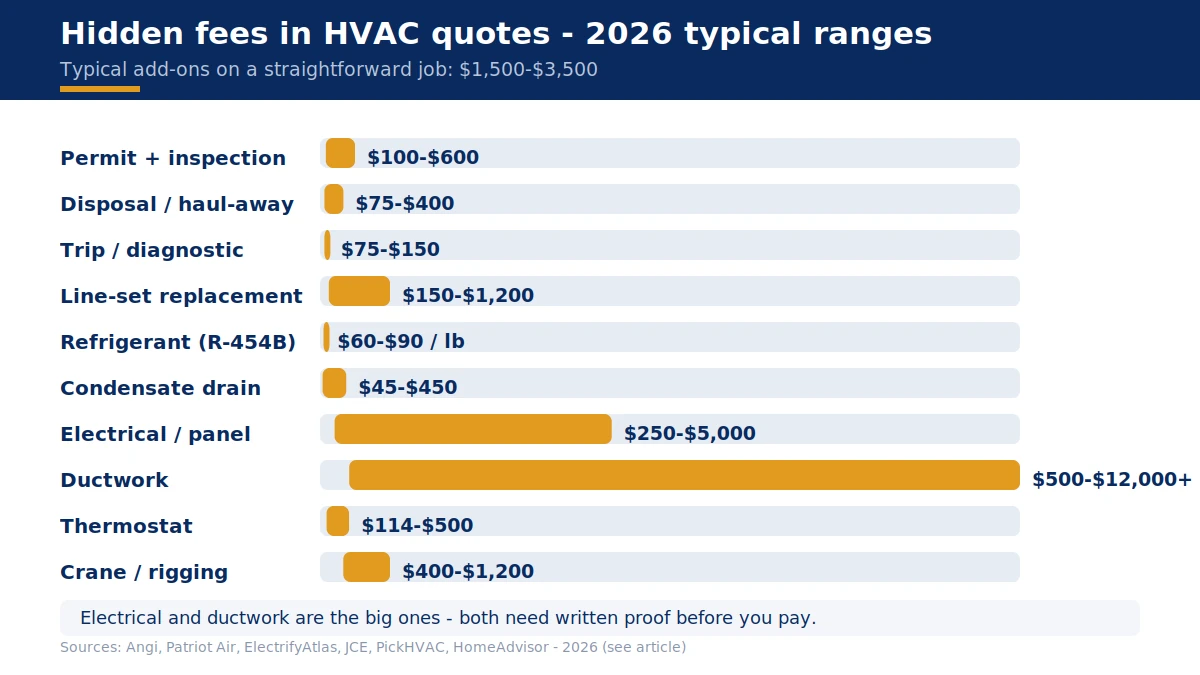
Fees 1–3: permits, disposal, and trip charges
These three are the paperwork fees. They appear on almost every quote, they are small individually, and they are the easiest place to hide a few hundred dollars.
Fee 1: Permit fees — $100–$600
What it is. Most cities and counties require a mechanical permit for an HVAC replacement, plus an inspection after the work. The contractor pulls the permit, pays the city fee, and schedules the inspector. Permit fees vary by jurisdiction: Angi 2026 data puts a typical permit at $250–$400, while contractor-published 2026 ranges run $100–$600 (CalcXI, Nov 2026; CentralAirInstallCost, Jun 2026). Phoenix-area 2026 pricing puts it at about $150–$350 (Patriot Air, Nov 2026). Some cities charge far less — Seattle’s 2026 refrigeration permit is $42.50 plus $35.55 per compressor up to 5 tons.
Legitimate vs markup. A permit fee is legitimate when the quote names the jurisdiction and the amount matches the city’s published fee schedule. It is a markup when it exceeds $600 on a standard residential replacement with no fee schedule attached, or when the same quote charges a separate “inspection fee” on top of a permit that already includes inspection.
What it should cost in 2026: $100–$600, most jobs $150–$400.
Ask: “Which permit are you pulling, what is the city’s fee, and will I get the permit number and the signed-off inspection?” A contractor who will not pull a permit is not giving you a discount — an unpermitted install is a red flag that can void the warranty and complicate a home sale.
Fee 2: Disposal and haul-away — $75–$400
What it is. Removing the old furnace, air handler, or condenser, and disposing of it legally. That includes recovering the old refrigerant, which federal law requires only EPA Section 608-certified technicians to handle (Costimated, Nov 2026). Published 2026 ranges: $100–$400 (CentralAirInstallCost, Jun 2026), $100–$600 per unit for mini-splits (PickHVAC, Oct 2026), and $75 as a line item in a 2026 contractor estimate template (ProJul, Nov 2026).
Legitimate vs markup. Legitimate at $75–$400 with refrigerant recovery included. It is a markup when disposal appears twice (once as “removal” and once as “haul-away”), or when the quote charges for disposal but says nothing about refrigerant recovery — the recovery is the expensive, regulated part, and its absence means the old refrigerant may not be handled legally.
What it should cost in 2026: $75–$400, typically $100–$250.
Ask: “Is disposal included, does it include EPA refrigerant recovery, and is there a separate removal line anywhere else on this quote?”
Fee 3: Trip and diagnostic fees — $75–$150 per visit
What it is. The charge for a technician to come to your home and diagnose a problem. Housecall Pro’s October 2026 rates put a residential service call or diagnostic fee at $85–$125, with labor at $75–$150 per hour and after-hours work at $140–$250 per hour (via Zarla, Nov 2026). Other 2026 sources agree: $79–$150 in Dallas–Fort Worth (TeamEnoch, Nov 2026), $75–$150 for furnace diagnostics (2026 tune-up guide, Oct 2026).
Legitimate vs markup. A diagnostic fee is legitimate when you called for a repair visit — the drive and the diagnosis are real work, and the fee is often credited toward the repair. It becomes a markup when it appears on an installation quote after a visit advertised as a “free estimate,” or when it is charged again on a warranty visit for a part the manufacturer covers. Note the warranty gap: a diagnostic fee applies even when the repair itself is covered under warranty (JupitAir, 2026).
What it should cost in 2026: $75–$150 in standard hours; $140–$250 per hour after hours or in an emergency.
Ask: “Is this visit’s fee credited toward the job if I hire you, and is it waived on warranty calls?”
Fees 4–6: line sets, refrigerant, and condensate drains
These three are the hardware fees — copper, gas, and water. They are where a quote can quietly add $500–$1,500, because most homeowners have never seen a line set and cannot judge whether it needs replacing.
Fee 4: Line-set replacement — $150–$1,200
What it is. The copper refrigerant lines connecting the outdoor unit to the indoor coil. A standard quote includes about 15–25 feet; longer runs cost extra. A 2026 Phoenix contractor guide prices a full line-set replacement at $400–$1,200, and less for a flush and pressure test (Patriot Air, Nov 2026). Materials-only ranges are lower: $150–$700 for lineset, drain, and mounting materials on mini-splits (PickHVAC, Oct 2026), $150–$700 for insulated copper lines 25–50 feet (CentralAirInstallCost, Jun 2026), and about $10–$30 per additional foot beyond the included length.
Legitimate vs markup. Replacement is legitimate when the old lines are the wrong size for the new system, kinked, or contaminated — including lines from an old R-22 system that cannot be cleaned. A flush and pressure test is the legitimate cheaper option when the existing lines are sound and correctly sized. It is a markup when the quote prices a full replacement with no stated reason, or charges for a new line set and a flush on the same job.
What it should cost in 2026: $150–$700 for materials and a flush; $400–$1,200 for a full replacement.
Ask: “Are you flushing the existing line set or replacing it — and what exactly is wrong with the existing one?”
Fee 5: Refrigerant top-ups — $60–$90 per pound installed (R-454B)
What it is. New 2026 systems ship with a factory refrigerant charge sized for a standard line-set length. Longer line sets need extra refrigerant. New equipment uses R-454B, the A2L refrigerant that replaced R-410A in systems manufactured from January 1, 2025 under the EPA AIM Act. Installed pricing in 2026: R-454B runs $60–$90 per pound installed, R-410A $50–$80, and reclaimed R-22 $100–$150 (JCE Energy Solutions, Jul 2026). A typical recharge runs $200–$600, and a full evacuation and recharge $450–$900. Note the wholesale gap: R-454B wholesaled at about $23.75 per pound in the week of November 2, 2026 (The Refrigerant Index) — the installed price covers weighing it in, leak checking, and the technician’s time, not just the gas.
Legitimate vs markup. Extra refrigerant is legitimate when the line set is longer than standard — typically 1–4 extra pounds, or $60–$360. It is a markup when a standard-length install carries a multi-hundred-dollar refrigerant line, since the factory charge already covers it. It is also a red flag when a quote prices refrigerant without naming the type: R-454B and R-410A are not interchangeable, and a new 2026 system takes R-454B.
What it should cost in 2026: $60–$90 per pound installed; $60–$360 total for a typical extra charge.
Ask: “How many extra pounds are you adding beyond the factory charge, at what price per pound, and which refrigerant?”
Fee 6: Condensate drain and pump — $45–$450
What it is. Air conditioners and heat pumps produce condensate water that must drain away. A gravity drain with a trap and a safety float switch is the standard setup; where no gravity drain exists — a basement unit, or an attic air handler with nowhere for water to fall — a condensate pump lifts the water out. Materials are cheap: a drain, trap, and safety switch runs about $45 in a 2026 estimate template (ProJul, Nov 2026). A float switch alone runs $150–$300 installed and is required on attic air handlers (Patriot Air, Nov 2026). A condensate pump runs about $150–$450 installed (PickHVAC, Oct 2026).
Legitimate vs markup. A new drain or pump is legitimate when there is no working gravity drain, or when code requires a secondary pan and float switch on an attic unit. It is a markup when an existing, working drain is billed as new — or when a $45 drain assembly is line-itemed at $400 with no pump involved.
What it should cost in 2026: $45–$300 for a gravity drain with trap and float switch; $150–$450 with a pump.
Ask: “Is my existing condensate drain reusable, and if you are adding a pump, where does the water go?”
Fees 7–8: electrical work and ductwork
These two are the big ones. Together they can add more than the equipment itself, and both are frequently quoted without the evidence that would justify them.
Fee 7: Electrical panel, subpanel, and circuit work — $250–$5,000
What it is. A heat pump or new air handler usually needs a dedicated 240-volt circuit, an outdoor disconnect, and a whip — about $400–$1,200 together (ElectrifyAtlas, Sep 2026). If the panel has no spare capacity, the next steps escalate: a subpanel adds $1,000–$2,500, and a full 200-amp service upgrade adds $2,000–$5,000 before any utility-side charges (ElectrifyAtlas, Sep 2026). Other 2026 ranges agree: electrical or panel upgrades $500–$2,500 (CalcXI, Nov 2026), circuit and disconnect $250–$1,200 on mini-splits (PickHVAC, Oct 2026).
Legitimate vs markup. Circuit and disconnect work is legitimate on most replacements — it is part of a code-compliant install. A panel upgrade is legitimate only when a load calculation proves the panel is actually full. That calculation has a name: NEC 220.83, the load calculation for an existing dwelling. It frequently shows adequate capacity, especially when the project removes an electric furnace or resistance strip heat (ElectrifyAtlas, Sep 2026). A panel upgrade quoted with no load calculation is the single most common electrical markup in HVAC quotes.
What it should cost in 2026: circuit and disconnect $250–$1,200; subpanel $1,000–$2,500; 200-amp service upgrade $2,000–$5,000.
Ask: “Show me the NEC 220.83 load calculation — what is my panel’s spare capacity, and what exactly pushes it over?” Our electrical panel upgrade cost guide has the full 2026 pricing, and electrician rates tell you what the labor behind the line should cost.
Fee 8: Ductwork modifications — $500–$12,000+
What it is. Sealing leaky ducts, repairing collapsed or disconnected runs, adding returns, or replacing the whole duct system. 2026 pricing: duct sealing and balancing $500–$2,500; partial duct repair $1,000–$4,500; full duct replacement $4,000–$12,000+ (LandscapioAI, May 2026). Angi 2026 data puts new ducts for a 2,000 sq ft home at roughly $2,100–$4,000, with an average ductwork job near $3,500, and modifications during an AC replacement at $3,000–$7,500 in involved cases. Sheet-metal trunk and branch runs $25–$55 per linear foot; flex duct $10–$20 per linear foot (SimplyWise, May 2026).
Legitimate vs markup. Ductwork charges are legitimate only with evidence: a duct leakage test with numbers, or photos of collapsed, disconnected, or undersized runs. A 2026 Phoenix contractor guide puts it plainly — duct sealing or repair at $1,000–$4,000 is justified “only with a leakage test or photos to back it up” (Patriot Air, Nov 2026). A quote that mentions ductwork in one vague line (“duct modifications $2,800”) with no test and no photos is not a quote — it is a placeholder for a change order later.
What it should cost in 2026: sealing $500–$2,500; partial repair $1,000–$4,500; full replacement $4,000–$12,000+.
Ask: “What is my duct leakage number, and can I see the photos of the runs you want to replace?”
Fees 9–10: thermostats and crane/rigging
The last two numbered fees are small in most jobs — and that is exactly why they get padded.
Fee 9: Thermostat and controls — $114–$500 installed
What it is. A new thermostat, usually smart, plus any wiring it needs. HomeAdvisor’s 2026 data: professional thermostat installation runs $114–$264, averaging about $185, with labor at $65–$100 per hour; smart thermostat units run $130–$300 (HomeAdvisor, Nov 2026). All-in smart installs run $180–$450 (Patriot Air, Nov 2026) to $250–$500 (TheNiftyHouse, 2026). The hidden adder is the C-wire — the dedicated power wire smart thermostats need. Adding one costs $50–$150 (Ecobee guide, 2026) to $90–$135 (HomeAdvisor, Nov 2026).
Legitimate vs markup. A smart thermostat is legitimate when the system needs it — heat pumps need a thermostat wired for the reversing valve, which a basic thermostat cannot do. It is a markup when a basic thermostat is billed at $400+, or when the quote charges for a premium smart thermostat and a separate “controls setup” fee for the same device. Note the rebate angle: many utilities offer $50–$100+ rebates on smart thermostats, which a quote should mention rather than pocket.
What it should cost in 2026: basic programmable $114–$264 installed; smart $180–$500 installed; C-wire add $50–$150.
Ask: “Which thermostat model is this, what is the unit price versus the labor, and is there a utility rebate for it?”
Fee 10: Crane and rigging — $400–$1,200 residential
What it is. Lifting a rooftop package unit or a condenser over the house and onto the roof. A 2026 Phoenix contractor guide prices crane or lift work at $400–$900 for rooftop units (Patriot Air, Nov 2026). The residential anchor: a short rooftop swap with a 35-ton boom truck, four-hour minimum, runs about $600 for the core lift and roughly $1,200 all-in with rigging help and brief traffic control (ThePricer, Nov 2025). Larger jobs cost far more — hydraulic truck cranes run $400–$900 per hour or $2,000–$4,500 per day (TryBeem crane guide, 2026), and a single-day Brooklyn boom-truck lift runs $1,200–$2,500 with operator and rigging (2026).
Legitimate vs markup. A crane is legitimate when the unit genuinely goes on a roof or over the house — package units, rooftop condensers, and townhouses with no side access. It is pure markup on a ground-level split system, which a two-person crew carries in on foot. If your outdoor unit sits on a pad beside the house, there is no crane line. Period.
What it should cost in 2026: $400–$1,200 for a typical residential rooftop lift; $1,200–$2,500+ per day in dense urban settings.
Ask: “Why does this unit need a crane — and is the crane company named on the quote with its own price?”
The fine-print trap: warranty wording and “free” maintenance plans
These two are not numbered fees. They cost nothing on the quote — and that is the trap. They cost you later.
The warranty gap. Most major brands offer a base parts warranty of 5 years. Register the system within 60–90 days of installation and it typically extends to 10 years (JupitAir, 2026; Trane via This Old House, 2026). Registration is free. It is worth five extra years of parts coverage. Never pay a “registration fee” — and register it yourself if the installer will not, because an unregistered system drops to the 5-year base term.
The expensive misunderstanding is the word “labor.” The manufacturer covers parts only — never labor, refrigerant, or diagnostic fees. A compressor part costs $1,200–$2,800; the labor to fit it runs $800–$1,500, and the refrigerant and service call add more (JupitAir, 2026). Homeowners have received a “free” coil under warranty and still owed $600–$1,200. Contractor labor warranties typically run 1–2 years. An optional extended labor warranty runs $500–$2,500 depending on coverage and system (JupitAir, 2026), and must usually be bought within 30–90 days of installation.
Ask: “Is this 10-year warranty parts only, or parts and labor — and who is registering the system, and by when?”
The “free” maintenance plan. A fair residential maintenance plan costs $150–$300 per year for one system with two visits (Housecall Pro, Oct 2026; TeamEnoch DFW, Nov 2026). Premium multi-system plans run $300–$500 per year (HVACFix.blog, Jul 2026). A plan can be good value — two tune-ups bought separately cost about the same, and members usually get waived diagnostic fees and priority scheduling. The trap is the word “free.” A “free first year” plan is only free if the install price was not inflated to fund it. Compare the install quote against two quotes that include no plan. Also read the renewal terms: monthly auto-pay at $15–$30 per month, auto-renewal clauses, and cancellation fees are where “free” turns into a subscription.
Ask: “What does this plan cost in year two, what exactly is included in each visit, and how do I cancel?” Our heat pump repair cost guide has the repair-side pricing a plan should be measured against.
Anatomy of an itemized HVAC quote
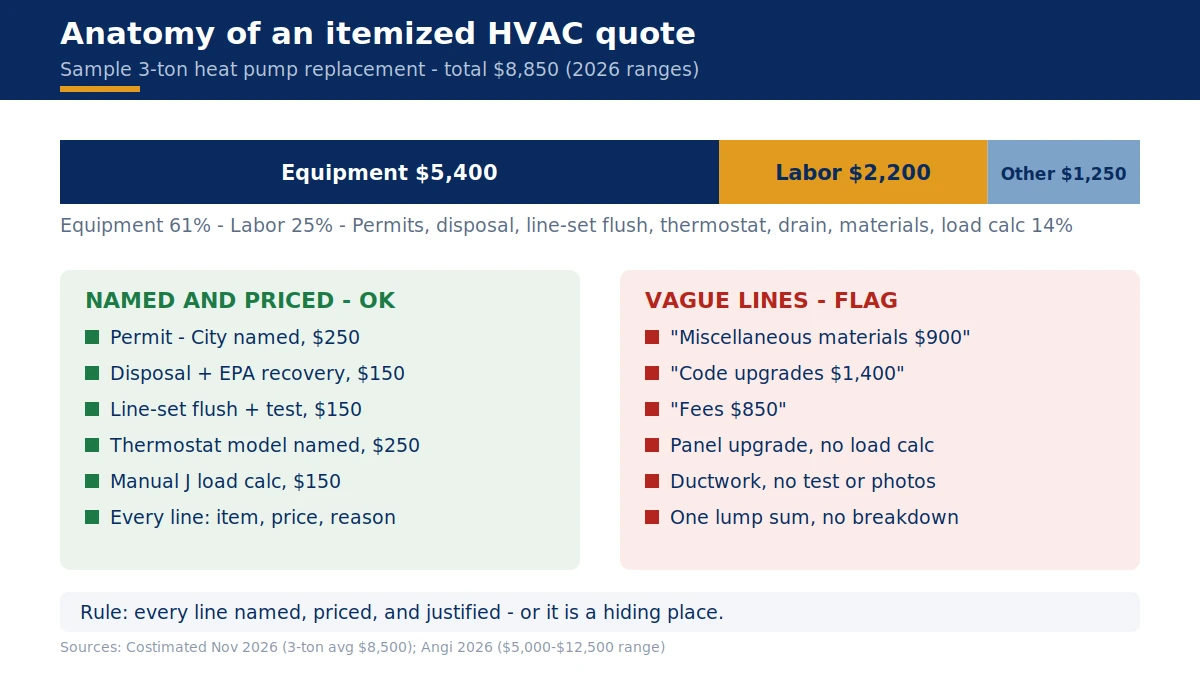
A good quote reads like a parts list, not a sales pitch. Here is what a complete, fairly priced quote looks like for a typical 3-ton heat pump replacement with reused ductwork — built from the 2026 ranges in this guide. The total lands near the $8,500 national average for a complete 3-ton split-system replacement (Costimated, Nov 2026).
| Line item | Amount | Notes |
|---|---|---|
| 3-ton heat pump + variable-speed air handler | $5,400 | Model + serial numbers listed |
| Installation labor (2 techs, 1 day) | $2,200 | $75–$150 per hour per tech, 2026 rates |
| Line-set flush + pressure test | $150 | Existing set reused; reason stated |
| Mechanical permit + inspection | $250 | City named; permit number to follow |
| Disposal + EPA refrigerant recovery | $150 | Old unit hauled away; recovery noted |
| Smart thermostat, installed | $250 | Model named; C-wire already present |
| Condensate drain, trap + float switch | $120 | Gravity drain; no pump needed |
| Misc materials (pad, disconnect, whip) | $180 | Each item named, not “misc $900” |
| Manual J load calculation | $150 | Sizing verified, not copied from old unit |
| Total | $8,850 | Every line named, priced, and justified |
What is missing from this quote is as important as what is in it: no ductwork line (ducts tested fine), no panel work (load calculation showed capacity), no crane (ground-level unit), no refrigerant line (factory charge covers a standard run). A quote that needs none of those should say so — “ductwork: inspected, no work needed” beats silence, because silence is where the change order hides.
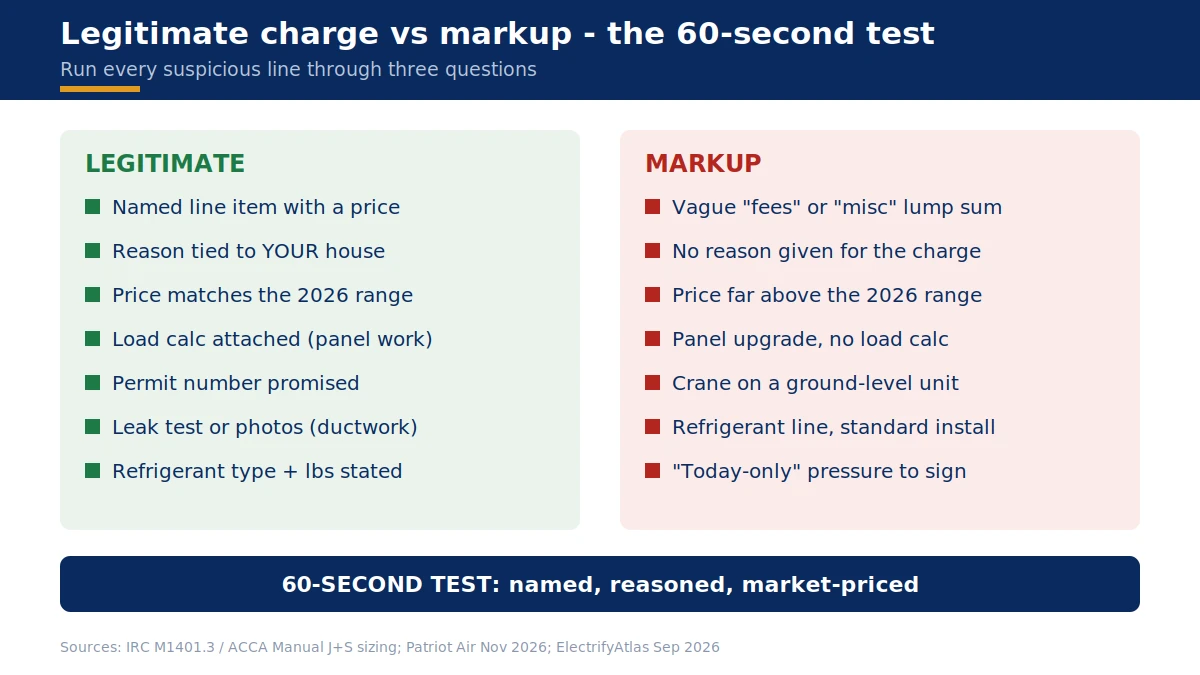
Legitimate charge vs markup: the 60-second test
You do not need to know HVAC to spot a padded quote. Run each suspicious line through three questions:
- Is it named? “Permit — City of Austin, $250” passes. “Fees $850” fails.
- Is there a reason tied to your house? “Subpanel — NEC 220.83 load calc shows 12 amps spare, new heat pump needs 30” passes. “Panel upgrade $2,500” with no calculation fails.
- Is it priced like the market? Compare the line against the ranges in this guide. A $250 permit, a $150 disposal, and a $250 thermostat are market prices. A $600 permit, a $600 disposal, and a $500 basic thermostat are not.
Two more tells. First, the equipment share: on a typical full replacement, equipment is about 45–60% of the installed price (Patriot Air, Nov 2026) — our sample quote sits at 61%, right at the top of that band. If equipment is under 40% of the total, the add-ons are doing the heavy lifting — ask why. Second, the sizing: the International Residential Code (M1401.3) requires equipment to be sized from an ACCA Manual J load calculation via ACCA Manual S — not copied from the old unit’s nameplate (via Horizon Shield teardown, Oct 2026). A quote with no load calculation is a red flag, because size sets the price of the biggest line. A Manual J costs about $150 as a line item (ProJul, Nov 2026) and is the cheapest insurance against an oversized system.
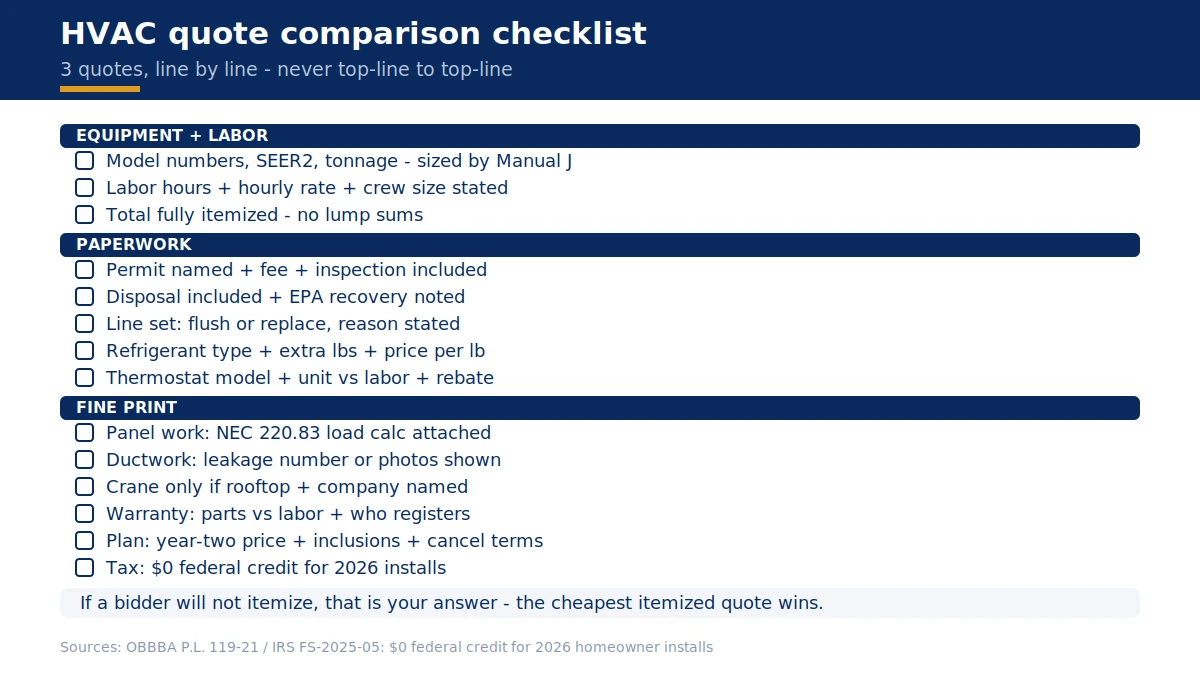
Quote-comparison checklist
Get three quotes. Then compare them line by line — never top-line to top-line, because the lowest top line is usually the quote with the most missing lines. Use this checklist on each one:
- Equipment: full model numbers, SEER2 rating, tonnage, and whether the size came from a Manual J load calculation
- Labor: hours and hourly rate, and how many technicians for how many days
- Permit: named jurisdiction, fee amount, permit number to follow, inspection included
- Disposal: included, with EPA Section 608 refrigerant recovery noted
- Line set: flush or replace, with the reason stated
- Refrigerant: type (R-454B for new 2026 systems), extra pounds and price per pound
- Electrical: circuit and disconnect priced separately from any panel or subpanel work; NEC 220.83 load calculation attached if a panel upgrade is quoted
- Ductwork: leakage-test number or photos, or a written “inspected, no work needed”
- Thermostat: exact model, unit price vs labor, utility rebate noted
- Crane: only if the unit goes on a roof; crane company named with its own price
- Warranty: parts term (5 vs 10 years registered), labor term, who registers and by when
- Maintenance plan: year-two price, what each visit includes, cancellation terms
- Total: every line itemized; no “miscellaneous,” “fees,” or “code upgrades” lump sums
- Tax: no federal credit math for 2026 — OBBBA ended §25C/§25D for property placed in service after December 31, 2025, so a 2026 homeowner-owned install gets $0 federal credit (IRS FS-2025-05). Any quote showing “after 30% credit” pricing for 2026 is using dead law.
If a bidder will not itemize, that is your answer. The cheapest quote that itemizes everything beats the cheapest quote that itemizes nothing — the second one is not cheaper, it is unfinished.
How to get quotes that can’t hide fees
Get three, in writing, itemized. Two quotes let a contractor blame the other guy’s price. Three quotes show you the market. Ask each bidder for the same scope in writing: same tonnage, same efficiency tier, same thermostat, same ductwork decision. A bid that will not put it in writing is not a bid.
Send the same questions to all three. Use the “Ask” line from each fee section above. The contractor who answers with numbers and documents is the one to hire; the one who answers with “trust me, it’s standard” is the one hiding the fee.
Compare the right numbers. Start with the heat pump cost guide or the furnace replacement cost guide for the equipment baseline, the central AC replacement cost guide for AC-only jobs, and the mini-split installation cost guide for ductless work. Then check each add-on line against the ranges in this guide. A quote that is $1,000 above the others because it includes a permit, disposal, and a load calculation is not expensive — it is complete.
Check the license before the visit, not after. Every state licenses HVAC contractors differently; verify the license and insurance before anyone climbs into your attic. And keep the paperwork: equipment model and serial numbers, the permit sign-off, and the warranty registration confirmation belong in one folder for the next decade.
Never sign on the first visit. The “today-only” discount is the oldest pressure tactic in the trade. A fair quote is still fair tomorrow, after you have compared it line by line.
Sources & methodology
Baseline pricing: Angi 2026 ($5,000–$12,500 full replacement, ~$7,500 avg; central AC avg $5,978, Aug 2026); Costimated Nov 2026 (3-ton split-system avg $8,500, range $5,500–$12,500; cost allocation equipment 60%/labor 26%/line set 8%/permits+disposal 6%). Permits: Angi $250–$400; CalcXI $100–$600 (Nov 2026); CentralAirInstallCost $100–$500 (Jun 2026); Patriot Air $150–$350 (Nov 2026); Seattle SDCI 2026 fee schedule. Disposal: CentralAirInstallCost $100–$400 (Jun 2026); PickHVAC $100–$600 (Oct 2026); ProJul $75 (Nov 2026); EPA Section 608 (Costimated, Nov 2026). Trip/diagnostic: Housecall Pro $85–$125, labor $75–$150/hr, after-hours $140–$250/hr (Oct 2026, via Zarla Nov 2026); TeamEnoch $79–$150 (Nov 2026); JupitAir $89–$150 (2026). Line set: Patriot Air $400–$1,200 replacement (Nov 2026); PickHVAC $150–$700, $10–$30/ft extra (Oct 2026); CentralAirInstallCost $150–$700 (Jun 2026). Refrigerant: JCE Energy Solutions $60–$90/lb R-454B installed (Jul 2026); The Refrigerant Index wholesale $23.75/lb (week of Nov 2, 2026); ConstructionCFO surcharges (Aug/Nov 2026); EPA AIM Act Jan 1, 2025; EPA final rule eff. Jul 27, 2026. Condensate: ProJul $45 (Nov 2026); Patriot Air float switch $150–$300 (Nov 2026); PickHVAC pump $150–$450 (Oct 2026). Electrical: ElectrifyAtlas circuit $400–$1,200, subpanel $1,000–$2,500, 200A $2,000–$5,000, NEC 220.83 (Sep 2026); CalcXI $500–$2,500 (Nov 2026); PickHVAC $250–$1,200 (Oct 2026). Ductwork: LandscapioAI sealing $500–$2,500, partial $1,000–$4,500, full $4,000–$12,000+ (May 2026); Angi ~$3,500 avg, mods $3,000–$7,500 (Nov 2026); SimplyWise $25–$55/ft sheet metal, $10–$20/ft flex (May 2026); Patriot Air $1,000–$4,000 with test/photos (Nov 2026). Thermostat: HomeAdvisor $114–$264 installed, avg ~$185, smart $130–$300, C-wire $90–$135 (Nov 2026); Patriot Air $180–$450 (Nov 2026); TheNiftyHouse $250–$500 (2026); Ecobee guide $250–$500, C-wire $50–$150 (2026). Crane: Patriot Air $400–$900 (Nov 2026); ThePricer ~$1,200 all-in residential (Nov 2025 anchor); TryBeem $400–$900/hr truck crane (2026); CountBricks NYC $1,200–$2,500/day (2026). Warranty: Trane via This Old House 60-day registration, 5 vs 10 yrs (2026); JupitAir base 5 yrs, registered 10 yrs, extended labor $500–$2,500, compressor labor $800–$1,500 (2026); HomeStars contractor answers (Jan–Feb 2026). Maintenance plans: Housecall Pro $150–$300/yr (Oct 2026); TeamEnoch $150–$300/yr (Nov 2026); HVACFix.blog $150–$500/yr tiers (Jul 2026); A-1 Comfort Club $150/yr (Nov 2026). Sizing: IRC M1401.3 / ACCA Manual J+S (via Horizon Shield, Oct 2026); ProJul Manual J $150 (Nov 2026); SimplyWise labor $85–$120/hr (May 2026). Tax: OBBBA P.L. 119-21 / IRS FS-2025-05 — $0 federal credit for 2026 homeowner-owned installs. EXCLUDED: UK thermostat pricing (£); commercial crane day-rates used only as contrast; wholesale refrigerant $/lb (draft uses installed $/lb).
—
How much do hidden fees add to an HVAC quote in 2026?
On a straightforward replacement, legitimate add-ons usually total $1,500–$3,500 on top of equipment and labor — permits, disposal, line-set work, thermostat, and drain items. When a panel upgrade and ductwork are genuinely needed, the honest total can reach $5,000–$8,000 in add-ons. The difference is proof: every fee should be named, priced, and tied to a reason.
What is the most common hidden fee in an HVAC quote?
The permit fee is the most common surprise — $100–$600 in 2026, typically $150–$400 (Angi, Nov 2026). It is legitimate when the quote names the jurisdiction and the amount matches the city’s fee schedule, and a markup when it exceeds $600 with no fee schedule shown. Never accept “no permit needed” for a full replacement.
How much should a line-set replacement cost in 2026?
$400–$1,200 for a full replacement, or $150–$700 for materials and a flush and pressure test (Patriot Air, Nov 2026; PickHVAC, Oct 2026). Replacement is legitimate when the old lines are the wrong size, kinked, or contaminated. Ask: “Are you flushing the existing line set or replacing it — and what exactly is wrong with the existing one?”
Is a panel upgrade really needed for a new heat pump?
Often no. A dedicated 240-volt circuit and disconnect runs $250–$1,200, a subpanel $1,000–$2,500, and a full 200-amp service upgrade $2,000–$5,000 (ElectrifyAtlas, Sep 2026). But an NEC 220.83 load calculation frequently shows the existing panel has adequate capacity, especially when the project removes an electric furnace or strip heat. Ask for the load calculation before accepting a panel upgrade.
How much does refrigerant cost on a new HVAC install in 2026?
New systems ship with a factory charge that covers a standard line-set length. Extra R-454B costs $60–$90 per pound installed (JCE Energy Solutions, Jul 2026) — typically 1–4 extra pounds, or $60–$360. A multi-hundred-dollar refrigerant line on a standard-length install is a markup, since the factory charge already covers it.
Does a 10-year HVAC warranty cover labor?
Usually not. Most major brands offer a 5-year base parts warranty that extends to 10 years if you register within 60–90 days of installation — registration is free. The manufacturer covers parts only; labor, refrigerant, and diagnostic fees are excluded. A compressor part costs $1,200–$2,800, but the labor to fit it runs $800–$1,500 (JupitAir, 2026). An extended labor warranty costs $500–$2,500 and is optional.
Are “free” HVAC maintenance plans really free?
A fair plan costs $150–$300 per year for one system with two visits (Housecall Pro, Oct 2026). A “free first year” plan is only free if the install price was not inflated to fund it — compare the install quote against two quotes with no plan. Check the year-two price, what each visit includes, and the cancellation terms before signing.
Is there a federal tax credit for a new HVAC system in 2026?
No — $0 for homeowner-owned installs. OBBBA (P.L. 119-21) ended §25C/§25D for property placed in service after December 31, 2025 (IRS FS-2025-05). Any 2026 quote showing “after 30% credit” pricing is using dead law. Real savings come from comparing itemized quotes, not from a credit that no longer exists.