


Iowa buys a heat pump for January first and July second. Des Moines designs its heating systems for minus 4 degrees. Cedar Rapids designs for minus 5, Sioux City for minus 6, and Davenport for minus 3.
Des Moines counts about 128 nights a year at or below freezing and 10 nights at zero or colder, and Cedar Rapids counts about 144 freezing nights and 16 nights at zero or colder. A machine that cannot hold its output through that kind of cold is a machine that hands the house to backup heat for weeks at a time, and backup heat at Iowa electric rates is the most expensive heat in the house.
The second thing an Iowa buyer learns is that the discount depends on which company sends the electric bill, and in one big city the answer surprises people. MidAmerican Energy and Alliant Energy run matching point-of-purchase discount schedules, topping out at $713 on a cold-climate unit.
Cedar Rapids homes buy gas from MidAmerican but electricity from Alliant, so the discount comes from Alliant even though the MidAmerican name sits on the gas bill. Rural homes on co-op lines play by different rules entirely, with per-ton rebates that can beat both big utilities several times over.
The third thing is the fuel map, and it decides the whole purchase. About 64% of Des Moines homes heat with piped gas and 77% of Cedar Rapids homes do, while more than 13% of Iowa households heat with propane and only about 4% heat with a heat pump as their main heat. Gas costs about $1.00 a therm on the 2025 annual average, which is cheap heat by any standard.
A heat pump in Iowa does not win against gas on the heating bill. It wins against resistance heat by a wide margin, beats propane by a smaller one, and earns its place by replacing the air conditioner at the same time.
Start with the national figures. Our national heat pump cost guide sets the countrywide baseline, and the Iowa numbers below read against it.
Table of Contents
How Much Does a Heat Pump Cost in Iowa in 2026?
Three kinds of evidence price the Iowa market in 2026, and each one measures a slightly different job. NumeralQ publishes planning estimates from a national cost model adjusted for Iowa labor, with estimator pricing as of October 26, 2026: a 3-ton ducted air-source system at $6,540–$10,950 statewide. A Des Moines contractor, Des Moines Plumbing & HVAC, publishes rough 2026 planning ranges for the metro: a cold-climate ducted heat pump keeping the existing furnace as backup at $7,000–$14,000, and a single-zone mini-split at $3,500–$6,000.
NumeralQ’s HVAC replacement pages price the furnace-plus-air-conditioner combination at $8,330–$14,100 for a 3-ton job statewide. The first is a model, the second is one contractor’s working ranges, and the third is the comparator that decides whether the heat pump carries a premium at all.
The sections below lead with the NumeralQ 3-ton band, $6,540–$10,950, because it fixes the machine, the size and the scope in one figure: ducted air-source, 3 tons, installed. The payback section works from its midpoint, about $8,745.
The contractor’s cold-climate range sits higher, as it should, since a cold-climate machine with furnace backup is a bigger job than a standard swap. The two sources agree where it matters: a whole-home ducted install in Iowa starts in the mid six thousands and a well-specified one runs past ten thousand before add-ons.
That band pays for the crew’s labor, the permits, the startup and commissioning, and the hardware: thermostat, electrical disconnect and wiring, pad or stand, refrigerant lineset, indoor coil or air handler, and the outdoor unit itself. The rest of the job sits outside it, and in Iowa the rest of the job is often the expensive part. New or extended ductwork runs $4,240–$7,160 a job in Des Moines and $4,150–$7,050 in Cedar Rapids, and a 200-amp panel upgrade runs $2,170–$3,420 in Des Moines and $1,880–$3,040 in Cedar Rapids.
A gas furnace for a dual-fuel setup, a riser stand to lift the unit above snow drift, wind strapping, and surge protection all sit outside the band too. NumeralQ lists the first two as planning add-ons, and the winter items carry no published Iowa price, so each one needs its own line on the quote.
One small figure in that arithmetic changes how a buyer should read every quote. Most Iowa buyers have no large rebate to take off the sticker price. The biggest discount from either large utility is $713, and most buyers who qualify at all collect $300 to $563.
The federal credit is $0. Read every quote gross first. In Iowa the net figure sits only a few hundred dollars lower at best, and any quote subtracting a federal credit that no longer exists, or a rebate from a utility that does not serve the address, needs rewriting before it can be compared with anything.
Before the tables, one caution: the lowest Iowa bid seldom stays the lowest once the system runs, and the highest bid does not guarantee the best machine. Bidders pricing identical equipment can sit several thousand dollars apart, and in Iowa the gap runs widest where the house is hardest. A 1920s Cedar Rapids foursquare with ducts in a cold attic, a Davenport riverfront home with a 100-amp panel, a Sioux City ranch on propane with no gas main for miles, a new build outside Ankeny where the co-op sets the rebate instead of MidAmerican: each one breaks a different assumption in a flat per-ton quote.
Make the three bids describe one job, not three: same model, same house, same backup-heat arrangement, every line written down, and the discount already taken off only where the home genuinely qualifies. Get written quotes from three licensed contractors. Drop any bidder who refuses to name the model number, its SEER2 and HSPF2 ratings, and the Manual J calculation behind the size.
| Source | 3-ton ducted | Single-zone mini-split | Cold-climate ducted | Geothermal |
|---|---|---|---|---|
| NumeralQ statewide (Oct 2026, planning est.) | $6,540–$10,950 | $3,140–$4,900 | $8,600–$15,020 | $20,240–$31,890 |
| NumeralQ Des Moines (Oct 2026, planning est.) | $6,610–$11,040 | $3,190–$4,960 | $8,680–$15,130 | $20,390–$32,080 |
| NumeralQ Cedar Rapids (Oct 2026, planning est.) | $6,540–$10,950 | $3,140–$4,900 | $8,600–$15,020 | $20,240–$31,890 |
| Des Moines contractor (2026, rough ranges) | Not published | $3,500–$6,000 | $7,000–$14,000 (with furnace backup) | Not published |
| NumeralQ HVAC replacement (Oct 2026) | $8,330–$14,100 (furnace + AC) | Not published | Not published | Not published |
Read two rows of that table with a warning label attached. The contractor’s cold-climate range prices a different job from the NumeralQ cold-climate row, since it keeps the existing furnace as backup and calls itself rough.
Treat the statewide geothermal row as the Cedar Rapids published row: the state page’s by-type table shows the same figures for every row that could be checked against it, and the Sources section at the end names both pages. Every size row in the sections that follow carries the planning-estimate label, because that is what each one is.
Heat Pump Cost in Iowa by System Type
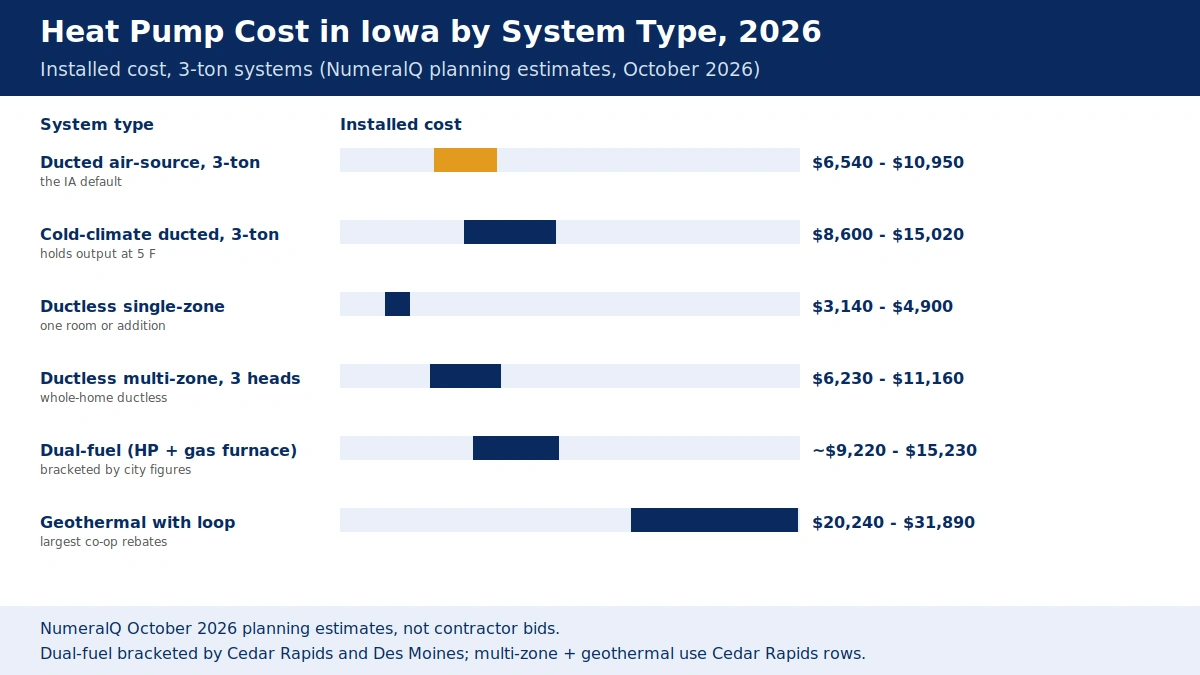
Iowa buyers hear “heat pump” and picture one machine, but the phrase covers six of them, priced more than six to one from the cheapest to the dearest. A Des Moines brick ranch with ducts in the basement, a Cedar Rapids bungalow with no duct chases at all, a Davenport split-level on a slab, a Sioux City ranch on propane with no gas main for miles, a farmhouse outside Decorah with the land for a ground loop, a gas-heated home in West Des Moines with a furnace that still has years left: each one points at a different machine, and each machine carries a different price, a different discount, and a different January. Every machine in the table below carries a NumeralQ anchor, with contractor figures added where they sharpen the picture.
| System type | Installed cost (IA) | Best for in Iowa |
|---|---|---|
| Ducted air-source (3-ton) | $6,540–$10,950 | Whole-home heat + cooling with ducts; the default IA buy |
| Ducted cold-climate (3-ton) | $8,600–$15,020 | Most of Iowa; the safe quote where nights drop below zero |
| Ductless mini-split, single zone | $3,140–$4,900 | One room, addition, or a house with no ducts |
| Ductless multi-zone (3 heads) | $6,230–$11,160 | Whole-home without ducts; zone-by-zone control |
| Dual-fuel (heat pump + gas furnace) | ~$9,220–$15,230 (bracketed) | Gas-heated home keeping its furnace for deep cold |
| Geothermal, ground-source with loop | $20,240–$31,890 | Long-term owner, big lot; earns the biggest co-op rebates |
Ducted air-source is the default Iowa buy, and it earns that place on price and simplicity. Most Iowa homes already have ducts, and a standard ducted unit reuses them, heats and cools from one box, and at $6,540–$10,950 for a 3-ton job it is the cheapest whole-home heating and cooling option priced here. It also carries a real January limit that a buyer in a warm state never faces.
A standard unit loses output as the outdoor temperature falls, and in Des Moines the design temperature sits at minus 4 degrees, far below the 47-degree rating point on the data plate. The unit still heats the house on most winter days, when temperatures sit in the 20s and 30s.
On the coldest nights it leans on backup heat, and the backup heat decides the January bill. Whether an Iowa house should keep its ducts or go ductless, and what each path costs room by room, is worked through in our ductless vs ducted guide.
Cold-climate is the safe quote across most of Iowa, and the premium buys January output. The cold-climate band runs $8,600–$15,020 against $6,540–$10,950 for the standard ducted 3-ton, a premium of roughly $2,000 to $4,000 at each end. What the money buys is output at 5 degrees and below, where a standard unit has faded to roughly 40% to 60% of its rated capacity.
A cold-climate machine on the NEEP list must post a COP of 1.75 or better at 5 degrees, and an ENERGY STAR cold-climate unit must also keep 70% or more of the heating capacity it shows at 47 degrees when the temperature falls to 5 degrees. COP, short for coefficient of performance, says how many units of heat the machine moves for each unit of electricity it uses.
In a state with 10 to 16 nights a year at zero or colder in its two biggest cities, that rating is not a luxury item. It is the difference between a heat pump that carries January and one that watches backup heat carry it.
Ductless mini-splits retrofit exactly the Iowa houses that never had ducts. Mini-splits suit Cedar Rapids bungalows and foursquares where a duct chase would eat a bedroom, Des Moines post-war ranches on baseboards or strip heat, additions and finished attics and converted garages no duct ever reached, and the bonus rooms over garages that bake every July afternoon. One zone, $3,140–$4,900 statewide, serves a single room or an open-plan area: the head mounts on the wall inside, the outdoor unit sits on a bracket or a pad, and the lineset passes through one small hole.
A whole small home takes three heads at $6,230–$11,160, with a thermostat in each zone, so bedrooms can sleep cool while the living room stays warm. The limit is coverage: one head serves only its own room, so a four-bedroom two-story with a single living-room head still leaves the upstairs bedrooms without heat or cooling. Our mini-split installation guide prices the job zone by zone, and both large utilities pay a $375 ductless discount, rising to $525 on a cold-climate ductless unit.
Dual-fuel fits the gas-heated majority of Iowa, and it is the setup the Des Moines contractor prices first. A heat pump and a gas furnace share one house, and a control passes the load to the furnace once the temperature falls below the installer’s switchover setting. The heat pump handles the mild weather, where its COP runs high enough to beat gas even at Iowa prices.
The furnace handles the deep cold, where the heat pump’s COP has fallen past the point of winning. The dual-fuel band runs about $9,220–$15,230 for a 3-ton system, bracketed by the Cedar Rapids figure of $9,220–$15,110 and the Des Moines figure of $9,310–$15,230, and flagged as a bracket rather than a published statewide band.
The Des Moines contractor’s rough $7,000–$14,000 range prices the lighter version of the same job, a cold-climate heat pump added to a furnace the house already owns. How the control hands the load to the furnace, where the switchover sits, and how the furnace behaves in deep cold: our dual-fuel heat pump guide explains all three.
Geothermal is the one Iowa system whose winter efficiency hardly notices the weather, and the one the co-ops pay real money for. A ground-source unit draws heat from soil that holds a steady temperature all year a few feet under an Iowa lawn, keeping strong efficiency through a minus 5 degree Cedar Rapids night while an air-source unit labors. NumeralQ’s Iowa installed range is $20,240–$31,890 with the loop.
The loop sets the price, and the way it goes in decides the number: trenches dug sideways across a big lot, bores drilled straight down where the lot is tight, or a loop sunk in a farm pond. A big lot, a long stay, and twenty years in the same house make geothermal fit, and rural Iowa has no shortage of such lots beyond the four big cities. The exception is anyone likely to move within five years: the loop stays buried, and the payback needs many winters to arrive.
The federal 30% credit that once softened the price is $0 for a 2026 homeowner-owned install, and Iowa’s own geothermal credit expired for installs after December 31, 2023. The co-op rebates survive, and they are the largest in this article: North West REC pays $1,400 a ton on a new geothermal unit, up to a 30% of cost cap. For the ground-loop options, the drilling choices on a small lot, and the lifetime bill, see our geothermal heat pump guide.
One more setup deserves its own paragraph: mini-split heads added while the furnace or the strip heat stays. Done well, heads go where the household actually lives: living room, home office, main bedroom. Heads in the lived-in rooms carry the mild months while the old system waits for the deep cold, and the house gains air conditioning in July.
The first zone at $3,140–$4,900 is the cheapest entry to a heat pump in Iowa, and in co-op territory it can earn a per-ton rebate on top. As a whole-home answer it falls short: one head cannot carry a whole house, and a living-room head alone still leaves cold bedrooms in January.
Whole-home comfort from one head is a promise no bidder should make. The machine behind it is too small for the house.
Heat Pump Cost by Home Size
With the system type settled, size comes next, and the heating load governs it in Iowa. A machine sized too small leans on resistance heat through the coldest weeks, at 14.5 cents a kilowatt-hour on the planning price. Oversized, it short-cycles through a humid July, never running long enough to pull the moisture from the air, and costs thousands extra for capacity the house never calls on.
The right size comes from one document only: a Manual J load calculation, room by room, at the design temperature. A Manual J is the room-by-room math that sizes heating and cooling gear from the house itself: its insulation, its windows, its air leakage, and where the ducts run.
Neither the floor area nor the outgoing unit’s size can fix the load figure everything else depends on. Ask for the Manual J in writing before signing, and check that it lists the cooling load and the heating load as two separate figures.
Pricing by tonnage for ducted air-source systems follows, taken from the NumeralQ anchors. All seven rows come from the state page’s by-size table, which matches the Cedar Rapids page row for row. Heat pump capacity is rated in tons, and one ton moves 12,000 BTU of heat an hour.
BTU stands for British thermal unit, the standard measure of heat. In Iowa the heating load is the larger one by a wide margin: Des Moines runs about 6,178 heating degree days against a far smaller cooling load, and Cedar Rapids runs about 6,824. A heating degree day counts how far and how long the outdoor temperature sits below 65 degrees, so the totals say plainly that Iowa is a heating state first.
Take a 2,000-square-foot Des Moines house: it commonly lands on a 3-ton or 3.5-ton system, where the same house in a warm state would take a smaller machine for cooling alone. Room temperature sits about 74 degrees above the design temperature, and January carries the real load.
| System size | Home size (approx.) | Ducted air-source (IA) |
|---|---|---|
| 1.5 ton | 600–1,000 sq ft | $4,400–$7,060 |
| 2 ton | 1,000–1,400 sq ft | $5,110–$8,360 |
| 2.5 ton | 1,400–1,700 sq ft | $5,830–$9,650 |
| 3 ton | 1,700–2,100 sq ft | $6,540–$10,950 |
| 3.5 ton | 2,100–2,400 sq ft | $7,260–$12,240 |
| 4 ton | 2,100–2,700 sq ft | $7,970–$13,540 |
| 5 ton | 2,700–3,500 sq ft | $9,400–$16,130 |
All seven rows came from one October 2026 NumeralQ estimator, so the rows share one method: every figure a planning estimate, none of them a contractor bid, and the home-size column a rough guide at best. Each half-ton step costs about $710 at the bottom of the band and about $1,300 at the top, and the 3-ton row is the size most Iowa homes land on. Treat no row as a measured Iowa price.
None of them is one. Their value is the decision’s shape: one ton too big costs about a thousand dollars at purchase, then costs comfort through every humid summer after.
Three cautions sit behind that table. To begin with, the home-size column is only a rough guide, and it is rougher in Iowa than in most places, because the housing stock runs from 1920s Cedar Rapids foursquares with little insulation in the walls to slab-on-grade Des Moines ranches to new Ankeny subdivisions built tight. A 2020 build, tight and well insulated at 2,000 square feet, can need a full ton less than a leaky 1950s ranch of the same size with single-pane windows, uninsulated walls and ducts in a cold attic.
The house itself sets the size: where the ducts live above all, then its age, its insulation, its glazing, its leaks, and its ceiling heights. Next, the heating load governs in Iowa, and sizing from the old air conditioner is sizing for the wrong season. A system chosen for July alone will lean on backup heat through the coldest weeks.
Calculate both loads, and make the Manual J show both figures. Third, size the backup heat in the same conversation as the heat pump, not as an afterthought.
Strips or a furnace have to cover the full design load on the coldest night, when the heat pump gives the least, and in Iowa that night is a minus 4 degree Des Moines cold snap with the wind cutting across open ground. A quote pricing the heat pump while leaving backup heat undecided has dropped the part that keeps the house warm on the nights that test it hardest.
The 3-ton row deserves the closest look, since most Iowa homes land on it and the rest of the article anchors to it. Where a quote lands inside that $6,540–$10,950 band comes down to brand and efficiency tier. SEER2 rates cooling efficiency over a season, and HSPF2 rates heating efficiency over a season.
Higher numbers mean lower running costs. At the bottom of the band sits the value-tier standard machine, near the federal minimum of 13.4 SEER2 and 7.5 HSPF2 for Iowa’s region. Top of the band is the premium variable-speed machine, rated past SEER2 20 and HSPF2 10.
Across an Iowa winter of more than 6,000 heating degree days, the premium tier repays itself through the heating season, since a variable-speed unit running long and slow at part load holds its output further into the cold. A tight budget still gets a win from the value-tier standard unit: it beats resistance heat by a wide margin and cools the house fine. The mistake to avoid is the wrong spend: an oversized single-stage unit for a humid Iowa home that needed the smaller machine running longer, or a standard unit for a Sioux City home that needed the cold-climate rating instead.
Heat Pump Cost by City: Des Moines, Cedar Rapids, Davenport & Sioux City
Iowa is a flat-priced state for heat pumps. The verified figures run from $6,540 to $6,610 at the bottom of the 3-ton band, a $70 spread across the two cities NumeralQ prices, which is one of the flattest city maps in the country.
Pay barely differs from city to city, so the utility territory, the fuel mix, the housing stock, and the cold are what set the cities apart. Verified city bands come only from NumeralQ’s city figures; the Davenport and Sioux City figures carry a warning label instead of a verified price, because no NumeralQ city page exists for either one.
| City | 3-ton ducted air-source | Electric utility | Design temp |
|---|---|---|---|
| Des Moines | $6,610–$11,040 (NumeralQ) | MidAmerican | -4 F |
| Cedar Rapids | $6,540–$10,950 (NumeralQ) | Alliant | -5 F |
| Davenport | ~$6,540–$10,950 (planning est.) | MidAmerican | -3 F |
| Sioux City | ~$6,540–$10,950 (planning est.) | MidAmerican | -6 F |
Des Moines is the capital, the largest metro, and the highest verified figure by a few dollars, at $6,610–$11,040 for a 3-ton ducted system. MidAmerican supplies both electricity and gas here, so the discount and the gas comparison come from the same company. The housing stock is post-war ranch and split-level, much of it with ducts in basements that stay cool and dry, which is kinder to a heat pump than a vented attic.
The labor figure underlines the flatness: Des Moines HVAC mechanics earn a median $30.11 an hour, 3% above the national median, and contractors bill $60–$78 a worker-hour. The climate figure underlines the January problem: roughly 128 nights at or below freezing each year, 10 of them at zero or colder, and a minus 4 degree design temperature that makes the cold-climate question real. The gas comparison runs at the $1.00-a-therm planning price.
Cedar Rapids is the second city, the colder of the two verified metros by a degree, and the cheapest verified figure, at $6,540–$10,950 for a 3-ton ducted system. Cedar Rapids is where the utility split bites: Alliant supplies the electricity and MidAmerican supplies the gas, so the heat-pump discount comes from Alliant’s schedule even though the gas bill says MidAmerican. The housing stock is older than Des Moines’s, with 1920s foursquares and bungalows that often lack duct chases, which is why mini-splits suit many Cedar Rapids homes.
Cedar Rapids HVAC mechanics earn a median $29.17 an hour, and contractors bill $58–$76 a worker-hour. The city is also where the derecho record is sharpest: the August 2020 storm estimated winds near 140 mph here, and a unit on a low pad in a yard full of mature trees needs the anchoring and clearance the inland quote never mentions.
Davenport and Sioux City carry planning estimates of about $6,540–$10,950, the state band applied to each city, because no city-specific price was published. Neither figure is a NumeralQ figure, and neither should be quoted as one. What is certain is the context.
Davenport is a river city of about 100,000 on the Mississippi, part of the Quad Cities, served by MidAmerican for electricity and gas, with the mildest design temperature of the four at minus 3 degrees and a housing stock of riverfront Victorians, mid-century ranches and new subdivisions spreading north. Sioux City is a meatpacking and rail city of about 85,000 on the Missouri River at the Nebraska and South Dakota corner, served by MidAmerican for electricity and gas, with the coldest design temperature of the four at minus 6 degrees and a wind that never stops crossing the open plains. A Davenport or Sioux City buyer should treat the state band as a starting point and get three local quotes before budgeting anything, because the house variables move the price more than the city average ever could.

Iowa Winters Set the Rules: Sub-Zero Design Temperatures, Deep Cold & Sizing for January
Iowa winters are long, dry and windy, and they punish any heating system sized on hope. January in Des Moines averages a low of 16 degrees, and the cold season runs from late November to early March with average daily highs below 43 degrees. The design temperatures tell the sizing story in one line each: Des Moines minus 4, Cedar Rapids minus 5, Davenport minus 3, Sioux City minus 6.
A design temperature is the outdoor cold the heating system is sized to handle, and a system sized for it holds the house warm on all but the very coldest hours of the year. A heat pump in Iowa is a heating machine that happens to cool, not the other way around, and the sizing has to respect that order.
The degree-day totals put Iowa near the top of the national heating pack. Des Moines runs about 6,178 heating degree days a year on the 1991–2020 normals, and Cedar Rapids runs about 6,824, against 5,483 at the median station in the country. The older IPC table runs hotter still, at 6,588 for Des Moines and 6,951 for Sioux City.
Either vintage says the same thing: Iowa burns roughly a tenth to a quarter more heating energy than the typical American climate, and the heating bill dominates the energy bill. That weight is what makes the Manual J non-negotiable here. A quote sized off the old air conditioner is a quote sized for July.
A contractor who sizes from the old furnace without a fresh calculation is guessing at January. Either one alone gets the house wrong.
Winter brings cold plus wind plus ice, and buyers underestimate the wind most. Iowa sits open to Canadian air with little in the way, and a minus 4 degree night with a 20 mph wind pulls heat out of a house far faster than the same temperature on a still night. The Manual J accounts for the house, not the wind chill, but the wind finds every leak the calculation assumed was sealed.
A single ice storm loads the power lines, coats the outdoor unit in ice, and jams the service lines with no-heat calls, all in the same night. Heavy snow buries a low pad and blocks airflow until someone clears it.
Most of an Iowa winter needs no help from backup heat, because most winter hours sit in the 20s and 30s, where a standard unit does solid work. Backup heat earns its keep in the cold snaps, and it has to cover the full design load on the coldest night, not the average night.
Summer brings heat plus humidity, and buyers underestimate the humidity most. Iowa summers are not dry heat. Gulf moisture rides north across the state all summer, and July in Des Moines averages a high of 86 degrees with real water in the air.
A right-sized variable-speed unit running long and slow pulls that moisture out of the air. An oversized single-stage unit blasts cold air for ten minutes, shuts off, and leaves the house cool and clammy.
Judge a summer install by the 9 p.m. feeling, not the 3 p.m. thermostat reading. Whether the house feels dry at night is decided at sizing time, not at the thermostat.
Two rating facts belong here, because they decide the efficiency tier and the discount at once. The federal minimum in Iowa’s region is 13.4 SEER2 for cooling and 7.5 HSPF2 for heating, and a value-tier machine clears that bar without drama. The cold-climate ratings sit above it: the NEEP list requires a variable-capacity compressor and a COP of 1.75 or better at 5 degrees, with the 5-degree capacity published so the buyer can judge it, while the ENERGY STAR cold-climate designation adds a capacity rule: the unit must keep 70% or more of its 47-degree heating capacity at 5 degrees.
Both large utilities pay their top discount tier on cold-climate units, and the co-ops pay their top per-ton rate on NEEP-certified machines. In Iowa the rating and the rebate point the same way, which is not true in every state.
The calendar shapes the buying decision in two ways. NOAA degree days mark May and September as the low-demand months in Des Moines, when the house needs the least heating and the least cooling, so a day with the system off for the install is barely noticed. The shoulder-season install, booked before the July rush and before the January cold snaps, is the calmest way to buy.
The shoulder seasons are also when the paperwork is easiest: the discount programs run all year, but a contractor booked solid in July has no time to chase a form, and a buyer who signs in January discovers the co-op tier rules only after the install. Book for May or September, and the forms get chased while the crew still has hours to chase them.
Heat Pump vs Gas Furnace in Iowa: The Running-Cost Math
Iowa is a state where the gas-versus-heat-pump argument is not close, and the direction surprises buyers who read national coverage. Gas is cheap here and electricity is not. Electricity averaged 14.5 cents a kilowatt-hour across January to August 2026, and gas averaged about $1.00 a therm on the 2025 annual figures.
A heat pump that beats gas by hundreds of dollars a year in a high-rate state loses to gas by hundreds of dollars a year in Iowa on heating alone. A buyer who signs with that fact in mind will not feel cheated later. A buyer sold a story of big heating savings against gas will feel the gap every winter.
The planning home for the sums below is a 2,000-square-foot Des Moines-area house needing about 48 MMBtu of delivered heat a year. MMBtu means one million BTU. The figure is a NestPriced planning assumption, not a measured bill, and it cross-checks against the federal energy survey: Iowa gas-heated homes average 56.85 MMBtu of gas input a year for space heating, which at a typical furnace efficiency delivers about 48 MMBtu of heat to the rooms.
That heat runs $2,040 a year from electric resistance at 14.5 cents a kilowatt-hour, because a resistance heater turns each kilowatt-hour into 3,412 BTU and nothing else. A heat pump divides that figure by its seasonal COP, the average efficiency across the whole heating season.
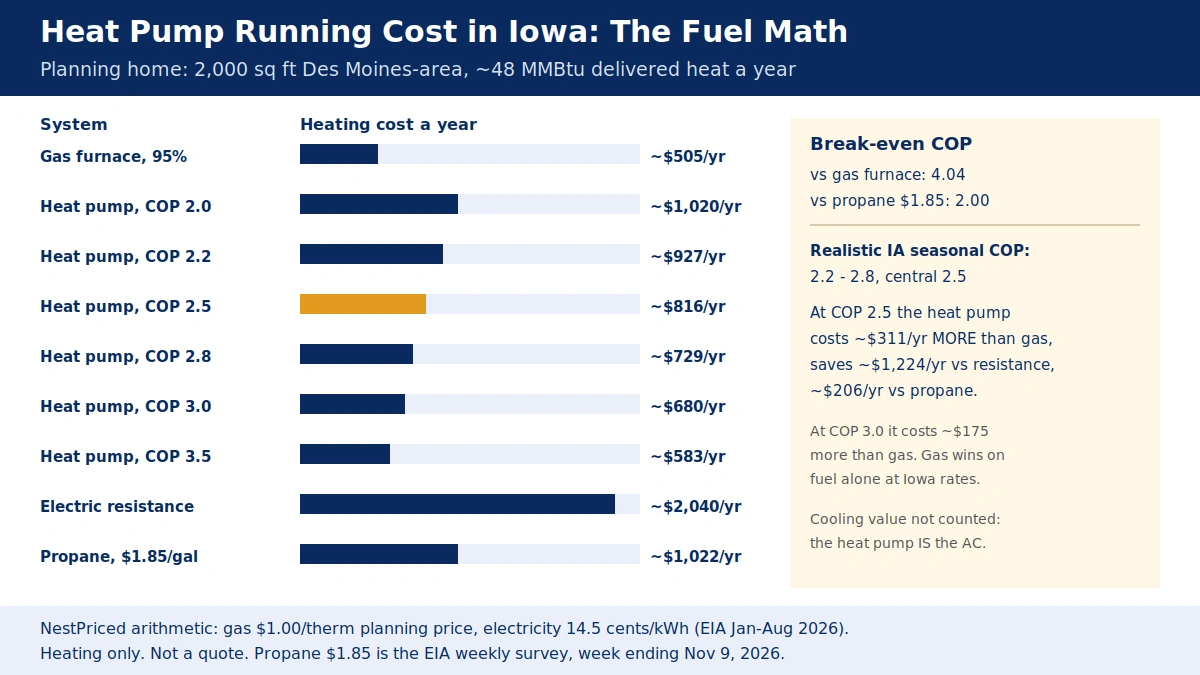
At COP 2.0 it costs about $1,020 a year, at COP 2.2 about $927, at COP 2.5 about $816, at COP 2.8 about $729, at COP 3.0 about $680, and at COP 3.5 about $583. The seasonal COP is the whole argument, and in Iowa the planning range runs 2.2 to 2.8 with a central figure of 2.5, lower than in warm states because Iowa winters are colder and longer.
Gas at the $1.00-a-therm planning price costs about $505 a year to heat the same house through a 95% furnace. A therm is 100,000 BTU of heat, the unit gas bills use. AFUE, the annual fuel use efficiency rating, says what share of the fuel’s heat reaches the house, so a 95% furnace turns 95 cents of each fuel dollar into heat.
The house needs 48 MMBtu delivered, which takes 50.5 MMBtu of gas input, or about 505 therms. Propane at $1.85 a gallon costs about $1,022 a year through a 95% furnace: the same 50.5 MMBtu needs about 552 gallons.
Gas sets a break-even COP of about 4.04: run at that seasonal efficiency, and the heat pump and the gas furnace land on the same annual heating bill. Against propane the bar sits at about 2.00, and any working heat pump clears it without trying.
| Heating option | Annual heating cost (planning home) | Vs gas furnace |
|---|---|---|
| Gas furnace, 95% AFUE, $1.00/therm | ~$505 | Baseline |
| Heat pump, seasonal COP 2.0 | ~$1,020 | ~$515 more |
| Heat pump, seasonal COP 2.2 | ~$927 | ~$422 more |
| Heat pump, seasonal COP 2.5 | ~$816 | ~$311 more |
| Heat pump, seasonal COP 2.8 | ~$729 | ~$224 more |
| Heat pump, seasonal COP 3.0 | ~$680 | ~$175 more |
| Heat pump, seasonal COP 3.5 | ~$583 | ~$78 more |
| Electric resistance heat | ~$2,040 | ~$1,535 more |
| Propane furnace, 95%, $1.85/gal | ~$1,022 | ~$517 more |
At a seasonal COP of 2.5, the heat pump costs about $816 a year against about $505 for gas, which is about $311 more, not a saving at all. At COP 3.0 it costs about $680, still about $175 more than gas. At COP 3.5 it costs about $583, still about $78 more.
Read that plainly: in Iowa, a heat pump does not beat a gas furnace on heating at any seasonal efficiency a real Iowa install reaches. The break-even COP of 4.04 sits above the planning range, and above what any ducted system delivers across a whole Iowa winter.
A tight house with a variable-speed unit and ducts inside the envelope lands closer to gas. A leaky house with ducts in a cold attic and a single-stage unit lands further away, and the electric bill shows it.
The other two fuels tell a different story entirely. Against electric resistance heat, the heat pump saves about $1,224 a year at COP 2.5, $2,040 against $816, and that is the saving a third of Des Moines homes can actually collect, since about 33% of the city heats with electricity. Against propane at $1.85 a gallon, it saves about $206 a year at COP 2.5, $1,022 against $816, and the saving grows with every propane price rise.
Propane cost $1.54 a gallon a year earlier, so a propane-heated home’s saving moves with a fuel that rose 20% in a year. A resistance-heated home is the best heat-pump candidate in Iowa, full stop, and a propane-heated home outside the gas mains is the second best. For a gas-heated home, the heat pump’s case rests on cooling, not on the heating bill.
The planning price hides a sensitivity that runs against the heat pump. The planning price of 14.5 cents is the January to August 2026 average. The August 2026 figure alone was 17.06 cents, and some Iowa utilities bill well above the state average: Interstate Power and Light, the Alliant company, runs near 19.4 cents on the 2026 estimate.
At 17.06 cents, resistance heat costs about $2,400 a year, the heat pump at COP 2.5 costs about $960, and the break-even COP against gas rises to about 4.75. The annual average is the fairer planning price for a full heating season, but a buyer on a high-rate utility should run the sums at their own bill’s rate before signing.
Summer gas prices make a second trap: do not let a contractor quote the heat pump against one. Summer gas figures near $24 per thousand cubic feet are unusable for heating math, because fixed charges spread over tiny summer volumes inflate them beyond recognition.
Dual-fuel changes the comparison in a way the seasonal averages hide, and it is the reason dual-fuel exists in Iowa. The seasonal COP averages the whole winter, but the heat pump’s COP is not one number. On a 45-degree October afternoon it can run above 4.0, beating gas outright.
On a minus 4 degree night it can fall near 2.0, losing badly. A dual-fuel control hands the load to the furnace below the switchover temperature and keeps the heat pump running above it, so the house buys heat from whichever machine is cheaper at that hour.
At Iowa prices the switchover sits at a warmer outdoor temperature than it would where electricity is cheap, because the heat pump needs a higher COP to beat $1.00 gas. The installer sets it from the capacity tables and the two fuel prices, and the setting belongs in writing on the quote.
Cooling belongs in this section too, because the heat pump does that job as well. A 3-ton heat pump cooling a Des Moines house through a humid July at 14.5 cents a kilowatt-hour costs roughly what a same-efficiency straight air conditioner costs. The machine is the same machine in July.
The July bill holds no saving over the furnace-plus-AC pair. It shows up when buying: a single machine, a single install, a single maintenance visit, where the alternative needs two of each. That purchase comparison is where the Iowa heat pump earns its keep against gas, and the payback section prices the comparison exactly that way.
Readers who want the countrywide version of these sums, with national rates instead of Iowa rates, will find it in our heat pump running cost guide, and readers weighing the two machines directly will find that comparison in our heat pump vs furnace guide. For the Iowa house, the short version is this: the heat pump loses to gas on heating, crushes resistance heat, beats propane by a modest margin, and wins outright once the air conditioner it replaces is counted. A quote promising more than that has skipped the arithmetic.
Utility Discounts & What You Can Actually Collect in 2026
Iowa has no statewide heat pump rebate, and in 2026 the money on offer is modest, split three ways, and easy to misread. The two large utilities run matching point-of-purchase discounts that top out at $713. The rural co-ops run their own per-ton schedules, and some of them pay far more.
The federal rebates have not launched. A buyer who counts money from the wrong provider is a buyer who overpays by the amount of the discount they never had.
The first check is the name printed at the top of the electric bill. Everything below follows from it.
MidAmerican Energy pays its discount at the point of purchase, through the dealer. MidAmerican serves Des Moines, Davenport, Sioux City and almost two-thirds of the state with electricity and gas. Its 2026 Instant Discounts schedule pays $300 to $563 per unit on an air-source heat pump, $563 to $713 on a cold-climate air-source unit, $375 on a ductless split, $525 on a cold-climate ductless unit, $900 to $1,200 on geothermal, and $225 on a heat pump water heater.
The discount comes off the price through a participating provider, with no paperwork for the buyer. Equipment must be bought, installed and running between January 1 and December 31, 2026, and MidAmerican must supply the primary electricity to the equipment.
Rebate claims on other equipment go in within 90 days of purchase or by December 31, 2026, whichever comes first, capped at 70% of the equipment cost with labor excluded, and limited to two rebates per equipment type per address. The full schedule sits on MidAmerican’s home discounts and rebates page.
Alliant Energy runs the same schedule to the dollar, and that sameness hides the Cedar Rapids trap. Alliant, through Interstate Power and Light, serves Cedar Rapids, Waterloo, Dubuque and much of eastern Iowa. Its Iowa Instant Discounts pay $300 to $563 on an air-source heat pump, $563 to $713 on a cold-climate unit, $900 to $1,200 on geothermal, $375 on a ductless mini-split, $525 on a cold-climate ductless unit, and $225 on a heat pump water heater.
The discount comes off at purchase through participating distributors, with no paperwork. The trap is the address: a Cedar Rapids home buys gas from MidAmerican and electricity from Alliant, and the discount follows the electric meter.
A Cedar Rapids buyer who calls MidAmerican about a heat-pump discount will be sent to Alliant, and a quote showing a MidAmerican discount on a Cedar Rapids electric bill is a quote built on the wrong company. The full schedule sits on Alliant’s Iowa Instant Discounts page.
The co-ops pay their own schedules, and on some machines they pay several times what the large utilities pay. Eastern Iowa Light & Power, serving the Wilton area and eastern Iowa, pays $300 a ton on an ENERGY STAR air-source unit, $500 a ton on a NEEP-certified unit, $200 a ton on a mini-split, $500 a ton on a closed-loop ground-source unit, and $200 a ton on a ground-source unit alone. A hybrid system with gas backup adds $100 a ton, a retrofit earns a $150 Fire to Wire bonus per unit replaced, and a first-time Heat Plus rate signup earns $100.
On a 3-ton NEEP-certified machine that is $1,500, or $1,800 with the hybrid add-on. The co-op’s own 2026 residential incentives overview lists every rate. North West REC, serving northwest Iowa from Orange City, pays more still: $1,400 a ton on a new geothermal unit and $750 a ton on a replacement, capped at 30% of cost up to $10,000, plus $500 to $700 a ton on air-source units under the same cap.
A 3-ton new geothermal install earns $4,200 before the cap, the largest co-op rebate found anywhere in Iowa. MiEnergy, serving northeast Iowa from Cresco, pays $200 a ton on air-source and mini-split units and $400 a ton on geothermal, through December 31, 2026, with the unit required to be the member’s primary heat source.
| Utility / program | Territory | Heat pump discount or rebate (2026) | Status |
|---|---|---|---|
| MidAmerican Instant Discounts | Des Moines, Davenport, Sioux City, most of IA | $300–$563 air-source; $563–$713 cold-climate; $900–$1,200 geothermal | Open |
| Alliant Instant Discounts | Cedar Rapids, Waterloo, Dubuque, eastern IA | $300–$563 air-source; $563–$713 cold-climate; $900–$1,200 geothermal | Open |
| Eastern Iowa Light & Power | Eastern IA co-op lines | $300/ton ENERGY STAR; $500/ton NEEP; hybrid +$100/ton | Open |
| North West REC | Northwest IA co-op lines | $500–$700/ton air-source; $1,400/ton new geothermal | Open |
| MiEnergy Cooperative | Northeast IA co-op lines | $200/ton air-source; $400/ton geothermal | Open thru Dec 31, 2026 |
| Iowa Lakes Electric Co-op | Estherville area co-op lines | $500/ton air-source; $650/ton with gas backup | Confirm (undated form) |
No Iowa gas utility pays a heat pump discount, and no program in the state pays more for a cold-climate unit as such beyond the top tier of the same schedule. The discount a home can collect is decided by the electric provider on the bill, and only by that provider: MidAmerican, Alliant and the co-ops cover distinct territories, so a typical Iowa homeowner stacks exactly one of them. A contractor who promises a discount from a provider that does not serve the address is a contractor to walk away from.
One more rule governs every discount in this section, and it is the rule that costs buyers the most money when it is missed: the discount must appear on the invoice before signing. The large-utility discounts come off at purchase through participating dealers and distributors, so a buyer whose dealer does not participate never sees the money. The co-op rebates run on their own calendars and funding caps, and several operate first-come, first-served.
Get the discount in writing before signing, with the program name, the amount, the efficiency tier it requires, and the deadline printed on the quote. If the contractor will not put it in writing, price the job as if the discount does not exist, because for the purposes of the budget it does not.
Federal Help in 2026: $0 Tax Credit, HEAR Not Launched & the Lease Route
Federal help for a 2026 Iowa install fits in a short paragraph, and the shortness tells the story. The tax credit is gone. The rebates have not launched.
The one route still open runs through a lease, and no Iowa provider for it was verified. Any quote showing federal money on a 2026 install was built on 2025 rules, and it needs rewriting before it can be compared with anything.
December 31, 2025 was the last day the credit applied. Public Law 119-21, the One Big Beautiful Bill Act, shut both credits off for property placed in service after December 31, 2025: the Section 25C energy efficient home improvement credit and the Section 25D residential clean energy credit. Fact Sheet FS-2025-05 from the IRS confirms the cutoff.
Whether the 2026 Iowa install is air-source or geothermal, standard or cold-climate, a homeowner-owned heat pump gets a federal tax credit of $0. The credit was not trimmed or capped. Gone with it are the 30% geothermal credit and the air-source credit of up to $2,000, both of which once softened an install.
IRS Form 5695 still takes a 2025 install on a 2025 return. Nothing from a 2026 install goes on any return, and a contractor claiming otherwise is reading an old price sheet or counting on the buyer not to check.
The HEAR and HOMES money has not reached Iowa homeowners. The Inflation Reduction Act funds the federal home energy rebates, which run state by state: HEAR, the electrification rebate worth up to $8,000 for a heat pump, and HOMES, the whole-home efficiency rebate worth up to $8,000. Iowa’s combined allocation is about $121 million: $60,473,810 for the electrification rebates and $60,704,701 for the efficiency rebates, administered by the Iowa Energy Office under the Iowa Economic Development Authority.
No launch date is posted, and the programs were still closed to the public on November 9, 2026. The state’s own page, last updated in January 2025, still says the rebates are not yet available. Iowa’s allocation runs about $121 million, and none of it buys a rebate a homeowner can claim today.
Launch will not open HEAR to fuel switches. The Energy Department’s Program Notice 26-2 took effect May 29, 2026: HEAR became the High-Efficiency Electric Home Rebate, open only to electric-to-electric upgrades and new construction. Replacing gas, oil, or propane equipment with electric equipment does not qualify.
That shuts out a gas- or propane-heated Iowa home trying to switch to a heat pump, which is most of the state, since 64% of Des Moines homes and 77% of Cedar Rapids homes heat with piped gas. Only electric-to-electric upgrades and new construction qualify, which in Iowa covers the roughly one home in three in Des Moines and one in five in Cedar Rapids that already heat with electricity. A gas-heated home holding out for HEAR switch money is holding out for money the rules already bar, written before the program even opened.
A lease is the only federal money left for 2026, and the route is narrow. Section 48E, the clean electricity investment credit, still backs leased systems placed in service by December 31, 2027: the leasing company claims the credit and passes it to the homeowner as a lower payment. No purchase route remains open for a 2026 install: only the lease route does.
No Iowa lease or power-purchase provider was verified, so no lease offer is named here: an unverified provider is worse than no provider, because a lease signed with a company that cannot pass the credit through costs more than the purchase it replaced. Where a contractor offers a lease, get the pass-through in writing first: the Section 48E basis named, and the December 31, 2027 in-service deadline printed on the agreement. What ended, what survived, and what a 2026 buyer can still claim: our federal energy tax credits guide lays it all out.
Iowa adds no state tax credit on top, and its old geothermal credit expired two years ago. Iowa Code Section 422.12N once paid a geothermal heat pump credit equal to 20% of the federal Section 25D credit, but the statute says plainly that it does not apply to a geothermal heat pump installation occurring after December 31, 2023. The text is on the Iowa Legislature’s site.
No Iowa state tax credit for air-source heat pumps was found either, and the state has no sales-tax break for heat pump equipment. Buyers arriving from states with their own credits assume one exists here, so the absence needs stating plainly.
In Iowa in 2026, the incentive stack is the utility discount or the co-op rebate and nothing else, plus the HEAR and HOMES money that has not launched. Budget the job on that stack alone, and no surprise follows.
Permits & Licensing: The Iowa State Mechanical License & the Local Permit Desk
The state licenses the trade and the city or county permits the job, and the buyer has to check both. The license is the proof the contractor may legally do the work.
The permit is the proof the work was inspected. Half a job is what a buyer gets with one and not the other, and the missing half is the half that costs money later: at resale, at an insurance claim, or at the first service call after a blizzard.
The state license comes from the Plumbing and Mechanical Systems Board. Under Iowa Code chapter 105, the Plumbing and Mechanical Systems Board, working through the Department of Inspections, Appeals, and Licensing, known as DIAL, issues and regulates every plumbing and mechanical license in the state. Iowa licenses the trade at every level, starting at apprentice, and the license is uniform statewide.
A contractor who holds the state license can work anywhere in Iowa, subject to local permits. A contractor without it cannot legally do the work at all. The board’s own contractor license page lists the requirements, and DIAL runs an online license search any buyer can use before anyone touches the house.
The ladder runs apprentice, journeyperson, master, and each rung is earned. A journeyperson license needs four years of practical experience as an apprentice, in a registered apprenticeship program, plus a passing score on the state journeyperson exam. A master license needs a journeyperson license plus two more years of experience, plus a passing score on the master exam.
Both exams are open-book, need a 75% pass mark, and are administered by Kirkwood Community College at 15 testing sites across Iowa. A master plans and supervises the design, installation and repair of systems, and serves as the master of record for a contractor.
Licenses cover disciplines including mechanical and HVAC-refrigeration, sheet metal and hydronic work, and a separate HVAC service technician specialty exists. License renewal asks for continuing-education hours.
The contractor license adds insurance, a bond, and a second registration. A plumbing and mechanical contractor must hold or employ a master of record who stays actively in charge of the work. The contractor carries at least $500,000 in public liability insurance and a $5,000 surety bond, plus workers’ compensation coverage, and must keep a permanent place of business.
Separately, every contractor earning $2,000 or more a year from construction work in Iowa must register with DIAL under Iowa Code chapter 91C, a registration that is distinct from the trade license. Iowa has no general-contractor competency license: general contracting is registration only, while the regulated trades carry true exam-based licenses. A contractor who claims a state general contractor license is claiming a credential that does not exist.
The local permit desk is the checkpoint that works for the buyer. Cities run their own permit desks, and the rules differ by city. Cedar Rapids requires its own mechanical permit for furnace and air conditioning work, separate from any building permit, and the installer must hold the state license.
An owner can do the work on a single-family home they live in, but only if the home qualifies for the homestead tax exemption, and the permit is still required. No published permit fee for a $12,000 job was found for either Des Moines or Cedar Rapids, so the fee belongs on the quote as its own line rather than as a guess. The residential code requires equipment to be sized by ACCA Manual S from Manual J loads, which is the code’s way of saying the sizing math is not optional.
Two further checks sit beside the license, and neither can be skipped. The electrician’s license for electrical work is separate from the mechanical license: the person who wires the disconnect and the panel upgrade needs the matching license under Iowa Code chapter 103, through the Electrical Examining Board. The refrigerant rule stands on its own: EPA Section 608 certification, which anyone touching refrigerant must hold, and the R-454B and R-32 refrigerants in 2026 systems leave that rule untouched.
Run the license through DIAL’s verification before work starts, collect the bond and insurance certificates on paper, and have the permit numbers in hand before the crew leaves. A tempting price does not excuse a contractor who cannot produce a license, a bond, and a permit: turn that one away.
Iowa’s lien registry is the rule most buyers never hear about, and it deserves a paragraph. Iowa runs an online Mechanics’ Notice and Lien Registry. The contractor posts the job there and gives the owner notice, and subcontractors and suppliers post their preliminary notices there.
On a residential job, a subcontractor’s lien is limited to what the owner owed the contractor when the subcontractor’s notice arrived. If a lien notice ever arrives on a heat pump install, it will most likely come from the equipment distributor or the electrician brought in for the panel work. Search the registry before every payment, keep a running tally of every payment and every notice, pay by the contract schedule and not ahead of it, and the lien rule will never touch the house.
Derecho, Blizzards & Ice: Keeping the Outdoor Unit Working in Iowa Weather
Iowa weather attacks a heat pump from both ends of the year, and no honest Iowa guide can pretend otherwise. Summer brings the straight-line wind event Iowa knows better than any other state. Winter brings blizzards, ice storms and drifting snow that bury the same machine.
No Iowa heat pump goes into a calm climate with an occasional storm. The climate it goes into is a storm climate, calm between outbreaks, and the install has to be built for the outbreak days.
The derecho of August 10, 2020 is the storm every Iowa buyer should size against. A derecho is a long-lived, widespread line of severe storms, and this one tracked 770 miles in 14 hours across eight states. Estimated gusts reached near 140 mph near Cedar Rapids, the highest estimated winds ever recorded in a derecho event, with a measured gust of 126 mph at Atkins.
NOAA put the damage at $11.2 billion, the costliest thunderstorm event on record, and Cedar Rapids suffered a near-complete blackout that lasted weeks in some areas. More than 7 million trees were damaged or downed across Iowa. The lesson for a heat pump is not the record wind speed, which no residential install is built to survive head-on.
The lesson is the debris, the flying branches, the power loss, and the weeks of cleanup that follow. An outdoor unit in Iowa needs to be anchored to its pad, clear of trees and fences that shed branches, and fitted with a hail guard where the contractor recommends one.
The outdoor unit takes the exposure, so it needs anchoring and lifting. A heat pump’s outdoor unit is a metal box full of a coil, a fan, and a compressor, sitting on a pad in the open air, and in an Iowa storm it faces four threats at once: wind that tries to slide it off the pad, hail that dents the coil fins and bends them shut, flying debris that punctures the coil outright, and drifting snow that buries it and blocks airflow. The fix is unglamorous and cheap relative to the machine: anchor the unit to its pad with tie-downs or straps, set the pad on a raised stand where snow drifts or the yard floods, fit a hail guard over the coil where the contractor recommends one, and keep the unit clear of roof drip lines where ice builds.
No Iowa-verified price was found for tie-downs, riser stands, hail guards, or surge protection, so each one needs its own line on the quote. Treat a contractor who says the unit needs no anchoring in Iowa as a contractor who has not thought about August 2020.
Winter brings its own failure modes, and they are routine rather than rare. Heavy snow buries a low pad and starves the coil of air until someone clears it. Ice builds on the coil and forces longer defrost cycles, which cost electricity and interrupt heating.
Condensate freezes where it drains and backs up into places it should never reach. Wind drives snow into the fan grille and packs it hard. None of this means the machine is wrong for Iowa.
All of it means the placement matters: a sheltered wall out of the prevailing northwest wind, a raised stand above the drift line, clear drainage that cannot freeze shut, and room to clear snow from all sides. Ask the installer to walk the placement with the buyer before the pad is poured, and to name the winter clearance the unit needs in writing.
The second exposure is power, and it shapes the backup-heat conversation. A heat pump needs electricity, and an Iowa ice storm or derecho can take the power out for hours, days, or in the worst case weeks. A gas furnace needs electricity too, for its blower and controls, so the heat pump is not uniquely exposed.
Power loss takes heat and cooling together, and the time to think about it is before the first storm season with the new system, not after. Running the heat pump takes a bigger generator than running a furnace blower, because the compressor draws far more on startup, and most portable generators cannot start a 3-ton compressor at all. Three answers exist: a whole-home standby generator sized for the compressor’s startup draw, a smaller generator covering the essentials while the heat pump sits idle, or acceptance that the house stays cold or hot until the lines are back.
None of that argues for skipping the heat pump. All of it argues for deciding the answer before the storm, not during it.
Check the unit after the storm, before restarting it. Hail dents coil fins and chokes airflow. Flying debris bends fan blades and clogs the coil.
A shifted pad tilts the unit, and a tilted unit vibrates, wears out its compressor mounts, and fails early. Flood water inside the electrical compartment eats at connections that test fine until they arc. Ice packed into the fan grille stalls the fan on startup.
After any storm that drops hail, throws debris, buries the unit in snow, or moves water through the yard, walk out to the unit, check the coil fins, the fan, the pad, and the disconnect, and keep a unit that took a visible hit switched off until a technician has looked at it. A post-storm service call costs less than a compressor that died running a month with a bent fan blade. Our Iowa roof replacement guide covers the same storm exposure from the roof side, for buyers weighing both jobs in the same year.
What Pushes Your Iowa Quote Up or Down
A 3-ton ducted heat pump in Iowa runs $6,540–$10,950, and the $4,410 spread inside that band carries a reason behind every dollar. The house, the machine, and the job each price in line by line. Knowing which lines move the number lets a buyer read a quote the way the contractor wrote it and tell a fair quote from a padded one without a second opinion.
The machine itself is the first lever. A value-tier single-stage unit near the federal minimum of 13.4 SEER2 and 7.5 HSPF2 sits at the bottom of the band. A mid-efficiency two-stage unit sits in the middle.
A premium variable-speed unit past SEER2 20 and HSPF2 10 holds the top of the band. Moving up one tier costs roughly $2,000 to $3,000, and the discount tiers soften the climb slightly: the gap between the $300 floor and the $713 ceiling is $413 back on a top-tier cold-climate machine. Judge by tier, not by badge: a mid-range unit installed perfectly beats a premium one installed poorly every time, and warranty terms count for more than the name on the box.
The cold-climate rating is the second lever, and in Iowa it is a real decision rather than an upsell. The cold-climate premium runs roughly $2,000 to $4,000 over the standard ducted machine at each end of the band. In Sioux City, at a minus 6 degree design temperature with the wind off the plains, the premium buys output on the nights that test the house hardest.
In Davenport, at minus 3 degrees on the river, a standard unit with well-sized backup heat can carry the winter for less money. The discount schedules push toward cold-climate in both cities, since the top tier pays only on cold-climate units, and the co-ops pay their top per-ton rate only on NEEP-certified machines. Price the job both ways, with the discount at each tier shown as its own line, because the net price, not the gross price, decides which machine is cheaper.
The ducts are the third lever, and in Iowa they are often the biggest one. New or extended ductwork runs $4,240–$7,160 a job in Des Moines and $4,150–$7,050 in Cedar Rapids, and it is the largest single add-on in the state. Ducts in a cold attic lose heat all winter and gain it all summer.
Crawlspace ducts sweat through the summer and freeze in a cold snap. Ducts sized for a 1975 furnace are undersized for a 2026 heat pump, because a heat pump moves more air at a lower temperature than a furnace does. Quoting the machine without inspecting the ducts skips the part of the job that decides the January bill; separate lines for duct sealing or duct replacement are the sign the bidder actually looked at the house.
The electrical panel is the fourth lever. A 200-amp panel upgrade runs $2,170–$3,420 a job in Des Moines and $1,880–$3,040 in Cedar Rapids, and it is the add-on most likely to surprise a buyer, because it is invisible until the electrician opens the panel. A heat pump needs a dedicated 240-volt circuit, and a house still on a 100-amp panel, common in Cedar Rapids bungalows and post-war Des Moines ranches, has no spare capacity for it.
A panel upgrade is compulsory, it is not up for negotiation, and it is not the heat pump contractor’s fault. The bill belongs to a house built before air conditioning was universal. The panel job carries its own price range in our electrical panel upgrade guide; a heat pump quote that folds panel work into the per-ton figure hides the most predictable add-on in the book.
Winter and storm items are the fifth lever, and none of them carries a published price. Tie-downs, a raised stand, a hail guard, and surge protection all cost money, and not one of them has a verified Iowa price. Elsewhere a bidder could price a raised stand from a published figure; in Iowa no such figure exists.
Ask for each item as its own line, and compare the lines across bidders instead of comparing one lump sum. A bidder who lists storm hardening and snow clearance as separate lines has thought about August 2020 and about January. A bidder who leaves them out has not.
The calendar is the sixth lever. May and September sit at the quiet end of the Des Moines HVAC calendar, when heating and cooling demand both bottom out, so crews have open slots and the house can manage a day with the system off. July is the worst month to buy: every crew in the state is out replacing failed air conditioners, and the buyer negotiates from a house with no cooling.
January runs second hardest, because cold snaps fill the service lines with no-heat calls. A planned May replacement costs less in stress than an emergency July replacement, and the equipment is not what differs. It is the calendar.
Sales tax is the seventh lever, and buyers forget it until the invoice. Iowa charges 6% state sales tax, plus a 1% local option tax in most jurisdictions, for a combined 7% in Des Moines, Cedar Rapids, Davenport and Sioux City. How much of an installed HVAC job is taxable depends on how the contractor bills materials and labor, so the tax treatment belongs in writing on the quote rather than as an assumption.
Taxing the whole $8,745 midpoint at 7% would put the tax alone at about $612. Some bidders break the tax out as a separate line.
Some bury it in the total. Either way it is owed on the taxable part, and silence on tax leaves a quote hundreds short of the real price.
Installer skill is the last lever, and no quote can price it. The install decides whether a heat pump lives or dies: the Manual J, the refrigerant charge, the airflow setting, the commissioning, and the switchover setting on a dual-fuel job. A wrong charge is what kills compressors, and the compressor is the dearest part in the box, so a cheap install done wrong costs more over five years than a costly install done right.
Get three quotes from licensed contractors at minimum, and do not treat the cheapest of the three as automatically the best. Judge the quotes on what they show: the model named, the Manual J attached, the add-ons itemized, and the discount in writing.
Payback: When Does an Iowa Heat Pump Pay for Itself?
Every Iowa buyer asks about payback, and the answer comes in three versions, because it depends entirely on what the heat pump replaces. Replacing resistance heat, the payback runs about seven years. Replacing propane, the payback runs about four decades at the central planning efficiency, longer than the machine lives.
Against a gas furnace, fuel alone never pays it back, and that is no failure of the heat pump, since the machine was never bought to beat gas on heating. The buyer bought it to replace the air conditioner too, and on that comparison no premium exists to pay back at all.
Resistance heat: the payback runs about 7.1 years. The install midpoint for a 3-ton ducted system is about $8,745. A seasonal COP of 2.5 saves about $1,224 a year against resistance heat, $2,040 against $816, which puts $8,745 divided by $1,224 at about 7.1 years.
A third of Des Moines homes can collect that payback, since about 33% of the city heats with electricity, and for a resistance-heated home it makes the heat pump an easy decision. A saving that size is real, and it starts in the first winter.
Propane heat: the payback runs about 42 years at the central planning efficiency. Propane at $1.85 a gallon through a 95% furnace costs about $1,022 a year to heat the planning home, against about $816 for the heat pump at COP 2.5, a saving of about $206 a year. $8,745 divided by $206 lands at about 42 years, longer than the heat pump will live.
A COP of 3.0 lifts the saving to about $342 a year and cuts the payback to about 25.6 years, still longer than the machine’s life. None of that makes the heat pump a bad buy for a propane home. The fuel saving is simply the wrong frame for the decision.
A propane home buys the heat pump for air conditioning it never had, for an end to propane deliveries and propane price spikes, and for a house that holds its temperature in July. The fuel saving rides along as a bonus, not as the payback. Propane climbed from $1.54 to $1.85 a gallon inside a year, and every price swing moves a propane home’s payback.
Gas furnace at 95%: no payback on fuel alone, ever. At COP 2.5 the heat pump runs about $311 a year above gas, $816 against $505, leaving no payback to calculate. At COP 3.0 the gap narrows to about $175 a year.
At COP 3.5 the gap narrows to about $78 a year. In a gas-heated home, a heat pump bought for heating savings is the wrong machine for the wrong reason. Set the heat pump against the furnace-plus-air-conditioner the home would buy anyway, though, and the picture flips: a 3-ton furnace-plus-AC job runs $8,330–$14,100 in Iowa, midpoint about $11,215, against the heat pump’s midpoint of $8,745.
The heat pump typically lands about $2,470 below the pair it replaces. No premium exists to pay back, because no premium was paid. It is the cheaper whole-home system, and it cools the house as well as heating it.
The discount changes the arithmetic, and the territory changes the discount. In MidAmerican or Alliant territory the $713 top discount takes the net install to about $8,032, and the payback against resistance heat drops to about 6.6 years. On Eastern Iowa Light & Power lines the $1,500 NEEP rebate takes the net install to about $7,245, and the payback drops to about 5.9 years.
On North West REC lines a geothermal install earns $1,400 a ton, which is a different machine at a different price and needs its own payback sum. The difference is hundreds of dollars of timing and territory: the same machine, the same house, a different provider, a different year.
An Iowa buyer who waits for HEAR to open is betting a rebate with no launch date against winters of resistance-heat bills and an aging system that might fail in January. That is a bet to run the sums on, not a bet to take on faith.
The long view matters most, and the payback tables never show it. Year-round heating and cooling pile more runtime hours onto a heat pump than a furnace or an air conditioner alone ever sees, and the maintenance has to match: a yearly professional service, filters changed on schedule, the outdoor coil kept clear of debris, hail damage and snow drift. With good maintenance, a heat pump lasts 15–20 years.
Skip the maintenance and the machine dies at 10 years, taking its payback with it. Lowest sticker price does not mean cheapest install. Year 15 is the test, and the installer, the sizing, and the maintenance decide who passes it, in that order.
Getting Quotes in Iowa: The Checklist
Every item on this list belongs in writing, on one identical spec sheet, from three licensed contractors, before anything gets signed. A missing item never makes a quote cheaper. It leaves the quote incomplete, and the missing item comes back later as a change order, at a price the buyer can no longer negotiate.
- Discount in writing before anything else (MidAmerican or Alliant $300–$713 by tier; co-op schedules, EILP $300–$500/ton, North West REC $500–$700/ton air-source and $1,400/ton new geothermal, MiEnergy $200–$400/ton; no HEAR money in 2026)
- Full model name plus ratings (SEER2 and HSPF2, capacity and COP at 5 degrees for cold-climate units, NEEP list or ENERGY STAR cold-climate status, R-454B or R-32 refrigerant)
- Manual J on paper (Des Moines -4 F, Cedar Rapids -5 F, Davenport -3 F, Sioux City -6 F; heating and cooling loads listed separately)
- Backup heat spelled out and priced (electric resistance strips or the gas furnace, the switchover temperature, coverage of the full design load)
- Cash price for the same model, in writing ($6,540–$10,950 anchor; midpoint about $8,745)
- No federal credit line, no HEAR rebate line, no state credit line on a 2026 install ($0 federal; HEAR not launched; Iowa geothermal credit expired after Dec 31, 2023)
- Licenses checked (Iowa PMSB mechanical contractor license, master of record, $500,000 liability, $5,000 bond, DIAL contractor registration; electrician’s license for the panel work; EPA 608 for refrigerants)
- Add-ons as separate lines (ductwork $4,150–$7,160, panel upgrade $1,880–$3,420, tie-downs, raised stand, hail guard, surge protection; sales tax 6% state plus 1% local option as its own line)
- Running-cost model built on fuel prices, not on a brochure (seasonal COP 2.2–2.8, central 2.5; backup share; your fuel price, gas at $1.00 a therm, propane at $1.85 a gallon, your own electric rate)
- Placement, storm hardening and HOA sign-off agreed in writing up front (sheltered wall, unit anchored to the pad, raised above the drift line, hail guard fitted, clear of flood water and debris; outage generator plan settled before the storm season)
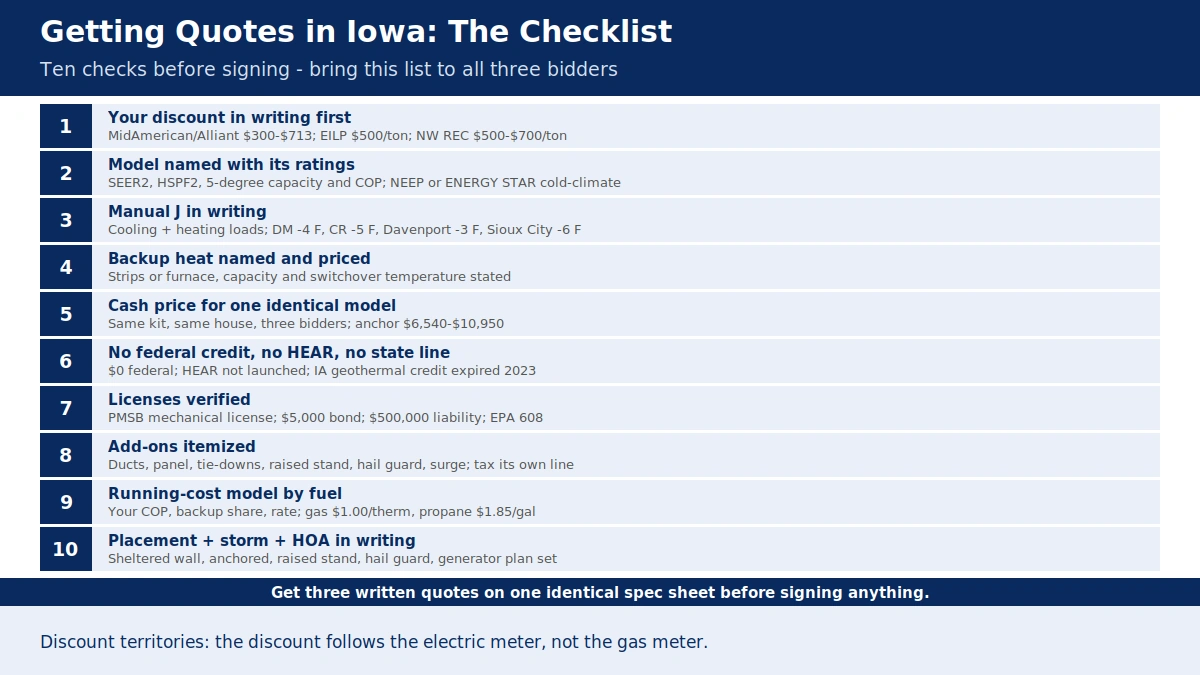
Before signing anything, collect three written quotes built on one identical spec sheet. The lowest quote is rarely the strongest quote. The quote to pick names the model, shows the Manual J, itemizes the add-ons, puts the discount in writing, and proves the license, and in Iowa it is also the quote that has thought about January.
Sources & methodology Installed costs:
- NumeralQ, Heat Pump Cost in Iowa (2026), estimator pricing as of Oct 26, 2026 (planning estimates, not contractor bids): statewide 3-ton ducted $6,540–$10,950; by size 1.5 ton $4,400–$7,060, 2 ton $5,110–$8,360, 2.5 ton $5,830–$9,650, 3.5 ton $7,260–$12,240, 4 ton $7,970–$13,540, 5 ton $9,400–$16,130; single-zone mini-split $3,140–$4,900; cold-climate ducted $8,600–$15,020
- NumeralQ, Heat Pump Cost in Des Moines (2026), updated Oct 27, 2026: 3-ton $6,610–$11,040; by size 1.5 ton $4,460–$7,140 to 5 ton $9,490–$16,240; single-zone mini-split $3,190–$4,960; multi-zone 3-head $6,330–$11,280; cold-climate ducted $8,680–$15,130; geothermal $20,390–$32,080; ductwork $4,240–$7,160/job; panel upgrade (200 A) $2,170–$3,420/job; billed $60–$78/worker-hour; HVAC median pay $30.11/hr
- NumeralQ, Heat Pump Cost in Cedar Rapids (2026), updated Nov 5, 2026: 3-ton $6,540–$10,950; single-zone mini-split $3,140–$4,900; multi-zone 3-head $6,230–$11,160; cold-climate ducted $8,600–$15,020; geothermal $20,240–$31,890; ductwork $4,150–$7,050/job; panel upgrade (200 A) $1,880–$3,040/job; billed $58–$76/worker-hour; HVAC median pay $29.17/hr
- NumeralQ, HVAC Replacement Cost in Des Moines / Cedar Rapids (2026): furnace + AC 3-ton $8,410–$14,200 / $8,330–$14,100; dual-fuel $9,310–$15,230 / $9,220–$15,110; statewide furnace + AC list $8,330–$14,100
- Des Moines Plumbing & HVAC (Des Moines contractor), 2026: cold-climate ducted with existing furnace backup $7,000–$14,000 (rough); single-zone mini-split $3,500–$6,000; 95%+ furnace $6,000–$9,000; 80% furnace $4,000–$5,500; standard AC $4,500–$8,500
Electricity, gas, propane:
- EIA Electric Power Monthly, Table 5.6.A, August 2026: Iowa residential 17.06 cents/kWh (US 18.16; +10.2% YoY; Aug 2026 avg bill $148.72, 872 kWh); Table 5.6.B Jan–Aug 2026 average 14.50 cents/kWh; 12-month average to Aug 2026 14.2 cents/kWh
- EIA Form 861-based estimates: Interstate Power and Light (Alliant) ~19.4 cents/kWh est. 2026; 24 Iowa utilities range ~10.1 to ~19.4 cents/kWh
- EIA Natural Gas Annual, released Sept 30, 2026: Iowa 2025 residential $10.61/Mcf, ~$1.00/therm; 2026 YTD $12.72/Mcf; monthly Nov 2025 $7.70, Dec $8.79, Jan 2026 $9.51, Feb $13.03/Mcf
- EIA Weekly Heating Oil and Propane Survey: Iowa residential propane $1.849/gal week ending Nov 9, 2026; $1.859/gal week ending Nov 2, 2026 (US avg $2.826); year-ago $1.543/gal
Climate:
- ACCA Manual J design conditions (99%): Des Moines winter -4 F, summer 90 F; Cedar Rapids winter -5 F, summer 89 F; Davenport (Moline AP) winter -3 F, summer 90 F; Sioux City winter -6 F, summer 90 F; older IPC table disagrees by a degree (Des Moines -5 F, Sioux City -7 F), flagged
- Degree days: NOAA 1991–2020 normals via NumeralQ, Des Moines HDD 6,178, Cedar Rapids HDD 6,824 (US median station 5,483); IPC table, Des Moines HDD65 6,588, Sioux City 6,951, Davenport 6,061, Dubuque 7,376, Waterloo 7,320
- NumeralQ city pages (NOAA normals): Des Moines ~128 freezing nights a year, 10 nights at or below 0 F; Cedar Rapids ~144 freezing nights, 16 nights at or below 0 F; mildest months in Des Moines May and September; climate zone 5A
- DOE federal minimum efficiency, Iowa region: 13.4 SEER2 / 7.5 HSPF2; EPA R-410A phaseout in new home systems from 2025 (R-454B / R-32)
- NEEP ccASHP Specification v4.0: variable-capacity compressor, COP at least 1.75 at 5 F, capacity at 5 F reported; ENERGY STAR Cold Climate designation: COP at least 1.75 at 5 F and at least 70% of 47 F capacity at 5 F; standard units keep roughly 40–60% of rated capacity at 5 F
Fuel mix and labor:
- ACS 2020–2024 (via NumeralQ): Des Moines 64% piped gas, 33% electric heat, median home value $194,700; Cedar Rapids 77% piped gas, 20% electric heat, median home value $187,100
- EIA RECS 2020: more than 13% of Iowa households use propane as primary space heating; about 4% use a heat pump as main heat; Iowa gas space heating averages 56.85 MMBtu site input per gas-heated household
- BLS OEWS May 2025, SOC 49-9021 (via NumeralQ): Iowa HVAC mechanics median $29.17/hr, billed $58–$76/worker-hour; Des Moines median $30.11/hr, billed $60–$78; Cedar Rapids electricians median $24.15/hr
Discounts and federal:
- MidAmerican Energy Instant Discounts + rebates (own program page, verified Nov 14, 2026): air-source $300–$563/unit, cold-climate $563–$713/unit, ductless $375/unit, cold-climate ductless $525/unit, geothermal $900–$1,200/unit, heat pump water heater $225/unit; 90 days or Dec 31, 2026; 70% of equipment cost cap; 2 per address
- Alliant Energy Instant Discounts, Iowa (own program page, fetched Nov 14, 2026): identical schedule; point-of-purchase through participating distributors
- MidAmerican service territory (own town list): Davenport, Des Moines and Sioux City Electric & Gas; Cedar Rapids Gas only (electricity from Alliant)
- Eastern Iowa Light & Power 2026 Residential Marketing Incentives (co-op PDF, Jan 2026): ENERGY STAR $300/ton, NEEP-certified $500/ton, mini-split $200/ton, ground-source closed loop $500/ton, unit only $200/ton, hybrid add $100/ton, Fire to Wire bonus $150/unit, Heat Plus rate $100
- North West REC rebates (prices effective Apr 29, 2026): geothermal new $1,400/ton, replacement $750/ton (max 30% of cost, up to $10,000); air-source $500–$700/ton (max 30%, up to $10,000); mini-split $500–$700/ton (max 15%, up to $5,000)
- MiEnergy Cooperative 2026 incentive form: air-source and mini-split $200/ton, geothermal $400/ton, through Dec 31, 2026, primary heat source required
- Iowa Lakes Electric Cooperative rebate form (undated, flagged): geothermal $1,000/ton, air-source $500/ton, air-source with gas backup $650/ton with load-control agreement
- HEAR/HOMES: $60,473,810 + $60,704,701 combined allocation (DOE Jan 2025 dataset), Iowa Energy Office / Iowa Economic Development Authority; not launched as of Nov 9, 2026; no launch date posted
- OBBBA P.L. 119-21; IRS FS-2025-05 (§25C/§25D $0 after Dec 31, 2025); DOE Program Notice 26-2 (May 29, 2026, no fuel-switching); IRS Notice 2025-42 (§48E lease pass-through, in service by Dec 31, 2027)
- Iowa Code §422.12N: geothermal credit 20% of federal §25D credit; does not apply to installs after Dec 31, 2023
Licensing, permits, storms:
- Iowa Code chapter 105; Plumbing and Mechanical Systems Board under DIAL; apprentice 4-year registered apprenticeship, journeyperson + exam, master + 2 years + exam; exams open-book, 75% pass, Kirkwood Community College, 15 sites; contractor $500,000 liability, $5,000 bond, master of record, DIAL registration under chapter 91C ($2,000/year threshold)
- Cedar Rapids mechanical permit (separate from building permit; state license required; homestead owner-occupier exception still needs a permit); IRC 2021 M1401.3 (Manual S from Manual J)
- Lien law: Iowa Mechanics’ Notice and Lien Registry; Iowa Code 572.13A, 572.13B (residential lien limited to amount owed when notice arrived)
- NOAA / National Weather Service: Aug 10, 2020 derecho, 770 miles in 14 hours, estimated gusts near 140 mph near Cedar Rapids, measured 126 mph at Atkins, $11.2 billion damage, 4 deaths; Iowa DNR 7M+ trees damaged/downed; FEMA National Risk Index: Polk County heat-wave risk Relatively High
- Sales tax: 6% state + 1% local option (LOST) in most jurisdictions, 7% combined in the four cities (Tax Foundation, July 1, 2026; Zamp 2026)
Running-cost and payback arithmetic:
- Planning home 2,000 sq ft Des Moines-area, 48 MMBtu delivered heat/yr (NestPriced planning assumption) = 14,069 kWh of heat; gas 95% AFUE at $1.00/therm = 505 therms = ~$505/yr; heat pump COP 2.0 = 7,034 kWh = ~$1,020/yr; COP 2.2 = 6,395 kWh = ~$927/yr; COP 2.5 = 5,628 kWh = ~$816/yr; COP 2.8 = 5,025 kWh = ~$729/yr; COP 3.0 = 4,690 kWh = ~$680/yr; COP 3.5 = 4,020 kWh = ~$583/yr; resistance = 14,069 kWh = ~$2,040/yr; propane 95% (91,500 BTU/gal) = 552 gal/yr ($1.85 = ~$1,022/yr); break-even COP vs 95% gas = 4.04, vs propane = 2.00; sensitivity at 17.06 cents/kWh: resistance ~$2,400, COP 2.5 ~$960, COP 3.0 ~$800, break-even vs gas 4.75
- Midpoint 3-ton at ~$8,745: vs resistance saves ~$1,224/yr at COP 2.5 -> ~7.1 yrs; vs propane saves ~$206/yr -> ~42 yrs (at COP 3.0 saves ~$342/yr -> ~25.6 yrs); vs gas costs ~$311/yr more at COP 2.5 (never on fuel alone); $713 discount -> net ~$8,032 -> vs resistance ~6.6 yrs; EILP $1,500 rebate -> net ~$7,245 -> vs resistance ~5.9 yrs
- Premium framing: furnace-plus-AC 3-ton midpoint ~$11,215 ($8,330–$14,100) vs ducted heat pump midpoint $8,745, the heat pump is typically cheaper than the pair it replaces, so the premium is negative
EXCLUDED:
- Any “after 30% credit” or “after $2,000 credit” prices: §25C/§25D are $0 for 2026 installs
- Any HEAR rebate in a 2026 Iowa quote: not launched, no launch date, and no fuel-switching even after launch
- MidAmerican/Alliant rebate figures from secondary trackers ($100–$400) and a local page ($1,500–$3,000+): conflict with both utilities’ own 2026 pages; utility pages win
- Any Iowa state tax credit for heat pumps in 2026: Iowa Code §422.12N expired for installs after Dec 31, 2023
- Davenport and Sioux City install prices: planning estimates only, flagged in the draft
- Dual-fuel statewide band: bracketed by the Cedar Rapids and Des Moines figures, flagged in the draft
- Statewide multi-zone and geothermal rows: Cedar Rapids published rows (see Installed costs note), cited as such
- Iowa Lakes Electric Cooperative rebate amounts: undated form, table-only with a confirm flag
- North West REC $500/$700 tier labels: not legible in fetch; range and cap stated, tier to confirm
- Tie-down / riser / hail-guard / surge-protection prices: no Iowa-verified prices found
- Any Iowa lease/PPA offer: no provider verified, authorization unverified
- Heat-pump seasonal COP 2.2–2.8: planning range, not field-measured for a specific Iowa installation
- Summer-month EIA $/Mcf gas figures as heating prices: fixed charges over tiny summer volumes, not usable
- Continuing-education hour counts: sources conflict; omitted from the draft
- Heat-pump lifespan figures: national only, flagged as such
Disclaimer: The prices here are 2026 Iowa planning figures. What you end up paying moves with the city, the house, the utility territory, the storm exposure, and the contractor. Get written quotes from three licensed Iowa installers before settling on a budget, and check the license yourself on DIAL’s online search before anyone touches the house.
Nothing here is tax advice for your own return. These are general notes only. Program rules change, so confirm current terms with your utility or co-op before signing, and note that the discount follows the electric provider on the bill, not the gas provider.
This article dates its propane price to its source: $1.85 a gallon for the week ending November 9, 2026. A propane-heated home’s payback moves with the propane price, so check the current EIA weekly survey before you decide.
What does a heat pump cost in Iowa in 2026?
A typical 3-ton ducted heat pump costs $6,540–$10,950 installed in Iowa in 2026 (NumeralQ planning estimates, October 2026), with Des Moines at $6,610–$11,040 and Cedar Rapids at $6,540–$10,950. Geothermal with a ground loop is $20,240–$31,890, dual-fuel about $9,220–$15,230, and a cold-climate ducted machine $8,600–$15,020; one mini-split zone runs $3,140–$4,900. The largest discount from the two big utilities is $713, co-op rebates run higher, and the federal tax credit is $0 for a 2026 install.
Do heat pumps work in Iowa winters?
Yes, with the right machine and the right backup heat: Des Moines designs for minus 4 degrees, Cedar Rapids for minus 5, and Sioux City for minus 6, so a cold-climate unit that holds its output at 5 degrees is the safe quote across most of the state, while a standard unit leans on backup heat through the coldest weeks. At 5 degrees the two machines split: a standard unit keeps roughly 40 to 60 percent of its rated capacity, while a cold-climate machine on the NEEP list posts a COP of 1.75 or better at 5 degrees and an ENERGY STAR cold-climate unit also keeps at least 70 percent of the heating capacity it shows at 47 degrees. Backup heat still counts on the coldest nights, sized for the full design load.
Is a heat pump cheaper to run than a gas furnace in Iowa?
No, not on heating: Iowa power averaged 14.5 cents a kilowatt-hour across January to August 2026, and tying a 95% gas furnace at the $1.00-a-therm planning price takes a seasonal COP of about 4.04, while a realistic Iowa seasonal COP is 2.2 to 2.8. At COP 2.5 the heat pump heats the planning home for about $816 a year, against about $505 for gas, which is about $311 more. Against electric resistance heat the heat pump wins in every corner of the state, saving about $1,224 a year, and against propane it saves about $206 a year at the same efficiency.
What discounts can I get for a heat pump in Iowa in 2026?
It depends entirely on your electric provider: MidAmerican Energy and Alliant Energy both pay point-of-purchase discounts of $300 to $563 on an air-source unit and $563 to $713 on a cold-climate unit, plus $900 to $1,200 on geothermal, and a Cedar Rapids home claims from Alliant even though MidAmerican supplies its gas. Rural co-ops pay per-ton rebates instead: Eastern Iowa Light & Power pays $500 a ton on a NEEP-certified unit, and North West REC pays $1,400 a ton on a new geothermal unit, capped at 30% of cost. Install in 2026 and the federal tax credit is $0, gone entirely, not trimmed.
Can I get the $8,000 HEAR rebate for a heat pump in Iowa?
Not in 2026. Iowa’s HEAR and HOMES programs have not launched: about $121 million is allocated to the state through the Iowa Energy Office, and none of it buys a rebate you can claim today, with no launch date posted. Program Notice 26-2 from the Energy Department bars HEAR money from paying for a fuel switch, whenever the programs open, so a gas- or propane-heated home trying to switch to a heat pump is shut out, and only electric-to-electric upgrades and new construction qualify.
Does Iowa give a tax credit for a heat pump?
No state tax credit for heat pumps applies to a 2026 install. Iowa’s geothermal credit in Section 422.12N of the Iowa Code paid 20% of the federal credit, but the statute says it does not apply to installs after December 31, 2023, and no air-source credit was found. Iowa’s incentive stack in 2026 is the utility discount or the co-op rebate and nothing else, plus the HEAR and HOMES money that has not launched, so do not claim a state credit on a 2026 Iowa return without a tax professional confirming one exists, and do not let a quote subtract a credit the home cannot collect.
What license or permit do I need to install a heat pump in Iowa?
You need a mechanical permit from your city or county, and your contractor needs a state license from the Plumbing and Mechanical Systems Board: a mechanical contractor license backed by a master of record, $500,000 in liability insurance, a $5,000 surety bond, and DIAL contractor registration. Cedar Rapids requires its own mechanical permit separate from any building permit, and the installer must hold the state license. The electrician’s license and federal EPA Section 608 certification are separate checks, Iowa has no general-contractor competency license, and the DIAL online search verifies the license before anyone touches the house.
When does an Iowa heat pump pay for itself?
Against electric resistance heat, about 7.1 years on a saving of about $1,224 a year, and that is the payback many Iowa buyers actually get, since about a third of Des Moines homes heat with electricity. Against propane at $1.85 a gallon, about 42 years at the central planning efficiency, saving about $206 a year, which is longer than the machine lives. A 95% gas furnace is never beaten on fuel savings alone at a seasonal COP of 2.5, since the heat pump costs about $311 a year more, but compare the heat pump against the furnace-plus-air-conditioner you would buy anyway and there is no premium to pay back at all: the heat pump is typically about $2,470 cheaper than the pair it replaces.