


South Dakota is the hardest solar market in this series to summarize in one number, because the numbers point in opposite directions and all of them are true at once. The sun is good. A kilowatt of panels in Sioux Falls makes about 1,409 kilowatt-hours a year, which puts the state 23rd out of 51 for sunshine, and Rapid City does a little better at about 1,460. The winters are cold and bright, and cold makes panels run more efficiently, not less. The roofs are big, the sky is wide open, and the state gets about 4.86 peak sun hours a day.
Then the bill arrives, and the other half of the story shows up. South Dakota power is cheap. Homes paid about 14.3 cents a kilowatt-hour on average over the twelve months to August 2026, against 18 cents nationally, and the average home used about 983 kilowatt-hours a month. Cheap power means every kilowatt-hour a panel makes replaces a cheap one. And the state has no net metering, which means the power you cannot use yourself is sold at your utility’s avoided cost, 2.48 to 4.87 cents, instead of cancelling a kilowatt-hour you would have bought at the full retail price. The same panels make more power here than they would in Ohio, but the dollars they save are fewer, because South Dakota electricity is cheap.
That does not make solar a bad buy in South Dakota. It makes the sizing and the utility rules the whole decision, more so than in almost any other state in this series. Size the array to the power you use while the sun is up, keep exports small, and the panels earn the full retail price on most of what they make. Oversize the array, or live on a co-op line that pays 1.93 cents for exports, and the economics fall apart fast. The math below runs separately for Xcel Energy, Black Hills Energy, and the co-ops and city utilities, so jump to your own provider and skip the rest.
For the national numbers this guide builds on, the solar panel cost guide sets the country-wide baseline.
Table of Contents
How Much Do Solar Panels Cost in South Dakota in 2026?
Four solid anchors describe the South Dakota market in 2026, and they do not agree with each other as neatly as the anchors did in Oklahoma. The disagreement is honest, and it is worth understanding before you trust any single figure, because the spread between the anchors is about $9,500 on an 8 kW system, and that spread is the difference between a 15-year payback and a 22-year one.
The lead anchor is EnergySage’s September 2026 marketplace data, as reported by a South Dakota installer guide updated in October 2026: $3.46 per watt installed, before incentives. At that rate an 8 kW system costs about $27,680, a 10 kW system about $34,600, and a 6 kW system about $20,760. EnergySage’s own marketplace cuts run a little higher when the system gets bigger: a second reading of the same September 2026 data puts the state at $3.59 per watt for a 17.3 kW system, about $62,059 in total, and the cash median in a third reading is $3.77 per watt for a 17.31 kW system. The three EnergySage readings differ because they cut the same marketplace different ways, by average, by median, and by system size, and the draft reports all three rather than picking the friendliest one.
The second anchor comes from EcoGen America, whose South Dakota page was updated October 19, 2026. EcoGen puts the typical South Dakota home system at 7.62 kW costing about $21,717, which works out to about $2.85 per watt, and says that system makes about 11,262 kilowatt-hours a year. That is a measured typical installed size, not a model, and it is well below the EnergySage marketplace average system of 17.3 kW, which is dragged upward by very large systems on very large, heavy-use homes. The 7.62 kW figure is the size a typical South Dakota home actually had put on its roof, and it matters because the cost per watt and the total cost tell different stories when the system sizes are that far apart.
The third anchor is NumeralQ’s solar planning guide, retrieved October 26, 2026. NumeralQ prices South Dakota at $2.26 to $2.96 per watt, or $18,090 to $23,650 for an 8 kW system. NumeralQ is candid that its figures are planning estimates built from national cost benchmarks, not a tally of invoices South Dakotans paid, and its band sits below the EnergySage readings by a wide margin. A fourth anchor, RenewEstimator’s 2026 state table, lands in the same lower neighborhood: $2.54 per watt, an 8 kW system at $20,320, and a payback estimate of 12 to 15 years.
Two more readings fill out the table. The Green Watt’s 2026 state table puts South Dakota at $2.70 per watt, a 5 kW system at $13,500. SunMetricLab, with data from September 10, 2026, assumes about $3.00 per watt and prices an 8 kW system at $24,000 gross, with a payback of 11.8 years. SunMetricLab’s table also carries a “net after 30% credit” column, and that column is stale: the federal credit is $0 for a 2026 owned install, so the draft uses only its gross-cost figures and ignores the after-credit column entirely.
Taken together, the anchors span $2.26 to $3.77 per watt, and the honest statement is that South Dakota installs are expensive on the marketplace readings and near the national middle on the planning models. The national average sits near $2.85 to $2.89 per watt on the same sources, so South Dakota runs about 20 percent above the national average on the EnergySage lead anchor and about on it on the NumeralQ anchor. The gap between the two kinds of source is a method gap, not an error by either side: marketplace quotes include the installer overhead, the sales cost, and the thin South Dakota installer field, while planning models build up from equipment and labor benchmarks. A buyer who gets three local cash quotes will find out quickly which side of the spread their roof falls on, and the draft’s advice is to trust those three quotes over any guide, including this one.
That per-watt price already covers the full job: the panels and inverter, the racking and wiring, the crew’s labor, the permits and inspection, and the utility hookup. A new roof, a panel upgrade, tree work, a ground mount, and a battery are all extra, and in western South Dakota the hail detailing a Black Hills roof needs is usually extra too. Roof work, panel upgrades, tree work, ground mounts, and batteries each add a separate charge, and each one gets priced in the section where it belongs. Nothing is subtracted from that price for incentives, because South Dakota offers almost nothing to subtract: no state credit, no rebate, and no federal credit on a 2026 purchase you own yourself. One more thing to watch: South Dakota charges a 4.5 percent state sales tax on solar equipment, plus city and county tax on top, and no verified sales-tax exemption for solar was found in this research, so a quote that omits sales tax understates the cash price. Ask for sales tax to appear as its own line, so the cash price you compare is the full cash price.
A word of warning before the numbers: the cheapest quote on paper is not always the cheapest system once it is running. A big slice of any installer’s price is overhead and margin, and a loan quote often folds dealer fees of 10 to 30 percent of the cash price, sometimes more, into the amount you borrow. One analysis prices South Dakota loans at $4.97 per watt against a $3.77 cash median, a $1.20 national loan-over-cash spread documented by Berkeley Lab. Bids only compare cleanly on one figure, the cash price per watt for the same panels on the same roof. Collect that figure in writing from three installers at least, and set aside any bidder who keeps it hidden.
| Source | $ per watt | System | Cash total | Payback |
|---|---|---|---|---|
| EnergySage (Sep 2026) | $3.46 | 8 kW | ~$27,680 | Not published |
| EnergySage (Sep 2026) | $3.59 | 17.3 kW | ~$62,059 | Not published |
| EnergySage cash median (Aug 2026) | $3.77 | 17.31 kW | ~$65,260 | Not published |
| EcoGen (Oct 2026) | ~$2.85 | 7.62 kW | ~$21,717 | Not published |
| NumeralQ (Oct 26, 2026) | $2.26–$2.96 | 8 kW | $18,090–$23,650 | Not published |
| RenewEstimator (2026) | $2.54 | 8 kW | ~$20,320 | 12–15 yrs |
| SunMetricLab (Sep 10, 2026) | ~$3.00 | 8 kW | ~$24,000 | 11.8 yrs (gross cost) |
| The Green Watt (2026) | $2.70 | 5 kW | ~$13,500 | Not published |
| National range (article 4) | $2.25–$3.30 | 8.2 kW | ~$24,600 at $3.00/W | 6–12 yrs |
Two of the rows above come with a warning label, and the warnings sit in the paragraph below the table. SunMetricLab’s payback of 11.8 years is computed on the gross cost, which is the right basis now that the credit is gone, but its own table still shows a net cost after a 30 percent credit that no longer exists, so a reader who finds that page should ignore the net column. A weaker site, USA Net-Zero, prices 6 to 8 kW systems at $17,500 to $23,000 on $2.80 to $3.20 per watt, but its data was verified in March 2026 and it lists no South Dakota programs at all, so it is a cross-check only. And one pattern from the Oklahoma research repeats here: lead-generation sites claim a “100% sales tax exemption” and other benefits that stronger sources contradict, and none of those claims is used anywhere in this guide.
Solar Panel Cost in South Dakota by System Size
Size is the first decision, and in South Dakota the export rules reward you for getting it right more than in almost any other state. The average South Dakota home uses about 994 kilowatt-hours a month, or roughly 11,928 a year, on 2024 EIA figures, which is heavy by national standards: the national average is 863 a month. One kilowatt of panels in Sioux Falls generates about 1,409 kilowatt-hours a year, so a 7.62 kW array generates about 10,740 kilowatt-hours, roughly 90 percent of what the average home uses in a year. That coverage is why 7.62 kW is the size most South Dakota homes actually install. It meets nearly the whole household demand while sending only a trickle of two-to-five-cent power back to the grid.
Going bigger than the house uses is a worse deal in South Dakota than in a state with net metering, because South Dakota does not net meter at all. There is no annual banking and no monthly banking either. Each kilowatt-hour you send out is bought at your utility’s avoided-cost price the moment it leaves the roof, about 3.16 cents on Xcel and 2.48 cents on Black Hills, while each kilowatt-hour you use at home saves the full retail price of about 14.3 cents. That gap is why the table below turns unattractive past 8 kW for most South Dakota homes. The table prices each size at the EnergySage lead anchor, $3.46 a watt, pairs it with Sioux Falls output of 1,409 kilowatt-hours per kilowatt each year, and shows the share of the average home’s use each size covers, so the point where the array starts exporting instead of covering the house is easy to spot.
| Size | Cost at $3.46/W | Yearly output (Sioux Falls) | Share of avg. SD home use (11,928 kWh/yr) |
|---|---|---|---|
| 4 kW | $13,840 | ~5,636 kWh | ~47% |
| 5 kW | $17,300 | ~7,045 kWh | ~59% |
| 6 kW | $20,760 | ~8,454 kWh | ~71% |
| 7.62 kW (state typical) | ~$26,365 | ~10,740 kWh | ~90% |
| 8 kW | $27,680 | ~11,272 kWh | ~94% |
| 10 kW | $34,600 | ~14,090 kWh | ~118% |
| 12 kW | $41,520 | ~16,908 kWh | ~142% |
| 14 kW | $48,440 | ~19,726 kWh | ~165% |
At the NumeralQ low end of $2.26 a watt, the same sizes run about a third cheaper: an 8 kW system at $18,090 instead of $27,680, a 10 kW system at $22,600 instead of $34,600. At the EcoGen-typical $2.85 a watt, an 8 kW system runs about $22,800. The table above uses the EnergySage lead anchor so the payback math later in this guide stays consistent, but a buyer whose quotes come in near the NumeralQ band will see a payback several years shorter, and the payback section runs both cases side by side.
The size question is really a daytime-use question. A home where someone works from home, runs the dishwasher and laundry in the afternoon, and charges an electric vehicle in the middle of the day will use far more of its own solar power than a home that sits empty from 8 in the morning to 6 at night. The first home can justify an 8 or 10 kW array. The second home should stop at 6 or 7 kW, because every kilowatt-hour it exports earns 3 cents instead of saving 14. A battery changes the answer, and the battery section prices that change honestly: it raises self-use, but it costs about $11,000 for 10 kWh and takes about 30 years to pay for itself on bill savings alone.
Roof direction moves the output more than most buyers expect. South-facing panels at a 20-degree pitch make about 1,409 kilowatt-hours per kilowatt a year in Sioux Falls, and the same panels at a 30-degree pitch make about 1,463, about 4 percent more, because the steeper tilt catches the low winter sun better and sheds snow faster. An east- or west-facing roof loses output against south, and a north-facing roof loses enough that the installer should say so in writing before you sign. Shading matters more than direction: a chimney shadow that crosses the array at noon in December can cost more than a whole winter of snow cover, and microinverters or optimizers, which let each panel work on its own instead of dragging the whole string down, are worth pricing on any roof with partial shade.
Panel count follows from the size and the panel wattage. At 400 watts per panel, the standard residential panel in 2026, an 8 kW system needs 20 panels, a 6 kW system needs 15, and a 10 kW system needs 25. At 450 watts per panel the counts fall to 18, 14, and 23. The roof needs about 20 square feet per panel plus working space around the edges, so a 20-panel array wants roughly 400 to 450 square feet of clear, south-facing roof. A roof that cannot fit the array is not a failed project, it is a smaller project, and the installer should show the layout on a roof diagram before the quote is signed, not after.
Solar Panel Cost by City: Sioux Falls, Rapid City, Pierre, and Brookings
No verified city-level price per watt was found for Sioux Falls or Rapid City in this research, and this section says so plainly instead of printing four identical-looking bands. What differs by city in South Dakota is not the install price, which no source breaks out by city, but the utility, the buyback price, the production, and the hail exposure, and those four differences change the payback by years. This section prices each city from the state anchors plus its own utility and production figures, and labels every city figure as a planning estimate where the city price itself was not measured.
Sioux Falls is the biggest solar market in the state and the easiest place to get a competitive quote. The city sits in Xcel Energy territory, Northern States Power on the contract, which serves about 107,000 customers in South Dakota, mostly around Sioux Falls. Xcel pays 3.16 cents a kilowatt-hour for exports, capped at 2,000 kilowatt-hours a month, with a $3.75 monthly metering charge. Production runs about 1,409 kilowatt-hours per kilowatt a year. Sioux Falls takes about 45.3 inches of snow a year on the 1991 to 2020 normals, and the hail record is moderate for the state: 59 hail days within 15 miles of the city center since 2010, with the largest stone at 3.5 inches. Using the state anchors, an 8 kW system in Sioux Falls runs about $18,090 to $27,680 depending on which anchor your quotes land near, and the payback section runs the Xcel case at about 14.6 years on the low anchor and about 22.4 years on the EnergySage anchor. A small pocket of the city is served by Sioux Falls City Light and Power, the municipal utility, at 13.40 cents a kilowatt-hour plus a $7.61 monthly fixed charge as of January 1, 2026, and a buyer in that pocket should ask the city, not Xcel, for its buyback terms in writing, because the city publishes no solar buyback rate in the sources found.
Rapid City is the sunnier city and the harsher one, and the two facts fight each other. The city sits in Black Hills Energy territory, about 75,000 South Dakota customers, and production runs about 1,460 kilowatt-hours per kilowatt a year, about 4 percent more than Sioux Falls. But Black Hills pays the lowest buyback price of the six regulated utilities, 2.48 cents a kilowatt-hour, unchanged since August 1, 2019, and the meter charge amount is not published on the rate sheet, so the buyer has to ask for it. Rapid City also takes about 48.5 inches of snow a year at the airport, and it is the hail capital of the state: 199 hail days within 15 miles of the city center since 2010, the most of any South Dakota city in the count, with the largest stone at 4.5 inches. An 8 kW system in Rapid City costs the same $18,090 to $27,680 as in Sioux Falls on the state anchors, makes about 4 percent more power, and earns less for every exported kilowatt-hour. The payback on the Black Hills export price runs about 0.3 years longer than on Xcel at the same system price, and the hail section explains why a Rapid City array needs a hail conversation with the insurer before it goes on the roof. Black Hills rates also just rose sharply: final rates approved November 4, 2026 take effect December 1, 2026, lifting a 650 kilowatt-hour residential bill from $105.61 to $121.94, up 15.47 percent, which raises the value of every kilowatt-hour used at home and shortens payback a little, even as the export price stays frozen at 2.48 cents.
Pierre, Brookings, and Watertown form a third group, and it is the least documented of the three. These are municipal utilities whose power comes through Missouri River Energy Services, which filed a minimum buyback price of 3.45 cents a kilowatt-hour for 2026. That filing gives no metering rules and no fees, so the buyer has to get the full terms from the city utility in writing. Production in the eastern cities runs close to the Sioux Falls figure, about 1,409 kilowatt-hours per kilowatt a year, and the hail exposure is lighter than Rapid City’s. An 8 kW system in any of the three runs the same $18,090 to $27,680 state-anchor range, and the 3.45-cent buyback sits between Xcel’s 3.16 and Otter Tail’s 4.871, so the payback falls between the Xcel and Otter Tail cases in the payback section. No city-specific price per watt was verified for any of the three, and no city-specific installer count was found, so a buyer there should expect fewer competing quotes than in Sioux Falls and should budget extra time for the quote round.
The rest of the state is co-op country, and the co-op terms are the weakest documented in this guide. About 40 percent of South Dakotans, by one count, take power from a rural electric cooperative, and each co-op sets its own solar terms without PUC approval of the price. Sioux Valley Energy, which serves the country around Sioux Falls, pays 1.93 cents for each kilowatt-hour of small renewable power on its February 2026 schedule, updated October 2026. That is the lowest verified buyback in the state, and the schedule does not say whether that price covers all solar power or only the surplus. The East River Electric filing of December 22, 2025 prices only systems of 50 to 150 kW and larger and gives no price at all for a home-size system. A buyer on a co-op line should treat the utility call as the first step, before any quote, and should get the buyback price, the metering charge, and the insurance rule in writing, because the co-op answer decides whether solar pays back in 15 years or in 30.
| City | Utility | Export price | Production (kWh/kW/yr) | 8 kW cost (state anchors) |
|---|---|---|---|---|
| Sioux Falls | Xcel Energy | 3.16 cents, cap 2,000 kWh/mo | ~1,409 | $18,090–$27,680 |
| Rapid City | Black Hills Energy | 2.48 cents | ~1,460 | $18,090–$27,680 |
| Pierre / Brookings / Watertown | Municipal (MRES) | 3.45 cents minimum | ~1,409 | $18,090–$27,680 |
| Co-op territory | Rural co-op | 1.93 cents (Sioux Valley); many unpublished | ~1,409–1,460 | $18,090–$27,680 |
| Aberdeen / Huron / Mitchell | NorthWestern / co-op | 2.547 cents (NorthWestern) | ~1,409 | $18,090–$27,680 |

South Dakota’s Sun: Cold, Bright Winters and Big Summer Days
South Dakota’s sun is better than its latitude suggests, and the reason is the sky, not the map. The state sits at 43 to 46 degrees north, which is far enough north that winter days are short, but the air is dry, the cloud cover is thin, and the high plains catch long, clear stretches of sun that cloudier states at the same latitude never see. The result is about 4.86 peak sun hours a day on average, which ranks the state 26th out of 51, and an annual yield of about 1,409 kilowatt-hours per kilowatt in Sioux Falls and about 1,460 in Rapid City. A peak sun hour is one hour of sun at full strength, 1,000 watts per square meter, so 4.86 peak sun hours means the day’s sun adds up to the same energy as nearly five hours at full noon strength.
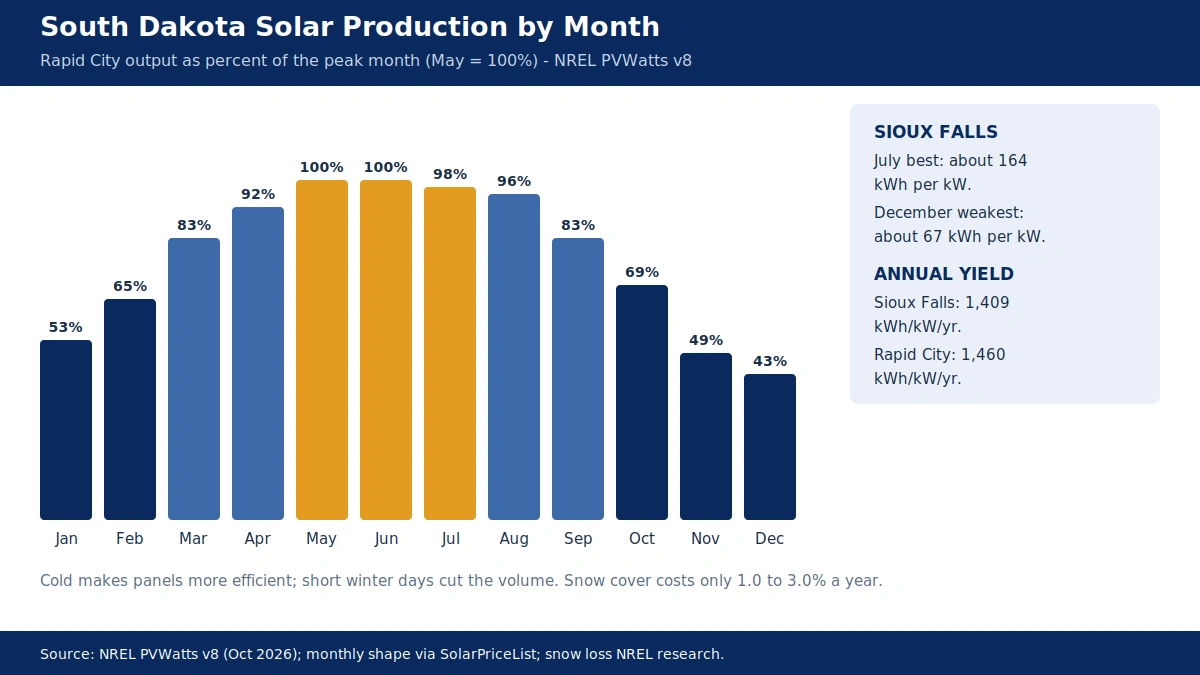
The cold is a help, not a problem, and this is the fact most first-time solar buyers in the state get backwards. Panels make electricity from light, not from heat, and heat makes them worse at their job. Panels are rated at 25 degrees Celsius, about 77 degrees Fahrenheit, and for every degree above that rating a typical panel loses about 0.30 percent of its output. On a summer afternoon when the panel surface reaches 60 to 80 degrees Celsius, the loss is real. On a cold winter day at minus 10 degrees Celsius, the panel sits 35 degrees below its rating, and the same coefficient works in reverse: output rises by about 10.5 percent above the rated wattage. A bright, sunny day in South Dakota at 15 degrees Fahrenheit can outproduce the same panel on a hazy August afternoon when the surface temperature hits 160 degrees. What changes in winter is not efficiency but volume: fewer hours of daylight, a lower sun, and shorter days mean less total energy, even though each hour of sun is used more efficiently.
The seasonal swing is the biggest in this series, and a buyer who does not understand it will misread the first winter bill. In Sioux Falls, July is the best month at about 164 kilowatt-hours per kilowatt, and December is the weakest at about 67, so the best month makes nearly two and a half times the weakest. In Rapid City the shape is similar: May is the best month at about 157 kilowatt-hours per kilowatt, December the weakest at about 72, and the summer months produce about 1.9 times what winter does. December output in Rapid City runs about 43 percent of May. A system sized to cover the house in July will cover less than half of it in December, and that is normal. The year, not the month, is the unit that matters, and the annual yield of 1,409 to 1,460 kilowatt-hours per kilowatt already includes the dark winter.
Snow is the winter question every buyer asks, and the research answer is smaller than the fear. Snow on the panels blocks light completely while it sits there, so a snow-covered panel makes nothing until it clears, but the annual loss is small. National Renewable Energy Laboratory research on homes in snowy climates puts the annual snow-cover loss for the Great Plains, including Rapid City, at 1.0 to 3.0 percent of yearly production. The reason the loss stays small is that south-facing panels at a 30-degree pitch or steeper typically shed snow within 24 to 72 hours, as the dark panel surface warms in the sun and the snow slides off the smooth glass. A steeper tilt helps twice: it catches the low winter sun better and it clears faster. The snow that falls on the ground helps too, because white snow reflects light back up onto the panels, and bifacial panels, which collect light from both faces, can gain 15 to 30 percent during snowy periods from that reflection, on a single guide’s claim that this draft reports as a claim rather than a verified fact.
Sioux Falls takes about 45.3 inches of snow a year and Rapid City about 48.5 inches at the airport, on the 1991 to 2020 normals, and the Black Hills town of Lead takes about 195.9 inches, the most in the state. Those totals sound large, and they are, but they fall across five months and melt between storms, and the panels spend most of the winter clear. The practical advice is simple: do not climb on the roof to clear panels, because a fall from an icy roof costs more than the lost production, and do not pay for a snow-clearing service either, because the 1 to 3 percent annual loss is worth less than the service fee. Let the tilt and the sun do the work, and check the production app after a storm the way you would check the driveway: a day or two of low output after a big snow is normal, and a week of zero output in clear sun is a call to the installer.
Ice is the quieter winter problem, and it is worth one paragraph because it behaves differently from snow. A thin layer of frost lets some light through, but a thick layer of ice or hard-packed snow blocks light the same way a snowdrift does, and it does not slide off as easily as loose snow. The panel frame and the glass are built to take freezing temperatures and heavy snow loads, and the panels themselves are tested to carry snow weight, but the buyer should confirm with the installer that the racking is rated for the local snow load, because South Dakota has no single statewide snow-load figure for roofs and the load is set locally. The draft gives no added-weight figure for panels here, because no South Dakota-specific figure was verified, and the installer must confirm the roof structure before the array goes on.
Hail in South Dakota: The Risk Every Roof Array Faces
If the export price is the economic risk in South Dakota solar, hail is the physical one, and in the western half of the state it is the risk that should be discussed before the contract is signed rather than after the first storm. South Dakota sits in the middle of Hail Alley, and the numbers are blunt. In 2025 the state logged 232 events with hailstones an inch or wider, which put it seventh in the country for that count. Rapid City has logged 199 hail days within 15 miles of the city center since 2010, the most of any South Dakota city in the count, with the largest stone at 4.5 inches. Sioux Falls has logged 59 hail days in the same window, with the largest stone at 3.5 inches. A Rapid City roof faces more than three times the recorded hail days of a Sioux Falls roof, and the array on it faces the same sky.
The recent record makes the point better than any average. On August 11, 2026, hail up to 4 inches fell across the country northwest of Oglala and around Oglala and Pine Ridge, smashing windows in homes and vehicles and damaging roofs, while gusts reached 111 miles an hour near Newell and winds tore roofs partly or fully off homes and businesses around White River, Mission, and Rosebud. On August 30, 2013, softball-size hail 4.25 inches across damaged buildings and vehicles along Norris Peak Road near Johnson Siding and across Rapid City’s west side, and the National Oceanic and Atmospheric Administration’s Storm Events Database lists $12 million in property damage for one Rapid City hail report from that storm. The state also sees about 35 tornadoes a year, concentrated in May through July, and the hail season runs late May through August, the same months when the panels are making their most power.
The good news is that panels are tougher than the roof they sit on. The United States Department of Energy’s position is that hail generally does not damage solar panels unless the stones reach about 1.75 inches across, about golf-ball size, and panels are tested and certified to withstand hailstones up to 2 inches across falling at 50 miles an hour. A 1-inch stone that dents a car and strips shingles will usually bounce off a tempered-glass panel. A 4-inch stone is a different event, and no panel is guaranteed against it, but neither is any roof, car, or window, and the hail that breaks panels is the same hail that breaks everything else on the property. An old NASA hail model from 1977 predicted that solar arrays in the Great Plains would be struck by hail of 1.5 inches or larger as often as every 6 to 8 years, and named Rapid City as a high-frequency hail area. That model is nearly 50 years old and this draft reports it as a historical estimate, not a current forecast, but the direction of its warning has held up: the Black Hills margin is one of the most hail-exposed places in the country to put glass on a roof.
What a buyer should do about hail is practical and cheap. First, ask the installer which panels are quoted and what hail rating they carry, and get the rating in writing: the test standard and the stone size the panel is certified against. Second, call the homeowner’s insurer before the array goes on and ask three questions in writing: does the policy cover the panels as part of the dwelling, does it cover hail damage to the panels, and what is the wind and hail deductible, because a percentage deductible on a $300,000 home can run to $6,000 or more and can swallow the whole repair. No South Dakota-specific figure for solar hail claims or panel insurance was verified in this research, and the draft does not invent one. Third, keep the panel serial numbers and the install photos in the same folder as the roof warranty, because a hail claim after the fact is settled on paperwork, and the paperwork is easiest to gather on the day the system is switched on. A buyer in Sioux Falls can treat hail as a secondary concern. A buyer in Rapid City should treat it as a first-order one, and the extra minutes on the phone with the insurer are the cheapest hail protection in this guide.
Net Metering in South Dakota: There Is None
This is the section that decides whether solar pays in South Dakota, and the first sentence is the whole of it: South Dakota has no net metering. The Public Utilities Commission says it plainly on its own solar FAQ: the state “does not compensate solar generation at a net metered rate.” Net metering is the rule where each kilowatt-hour you send to the grid cancels one kilowatt-hour you buy, at the full retail price. South Dakota does not have that rule, for any utility, in any county, under any tariff. The Legislature looked at net metering in 2013, 2015, and 2016 and did not adopt it, and the decision sits with the Legislature and the Commission, not with the individual utilities.
What South Dakota has instead is avoided-cost buyback. Under the federal PURPA framework, utilities must buy the surplus power a small home system sends out, but only at their avoided cost, which is roughly what it would cost the utility to make or buy that power itself. For systems under 100 kW, the six investor-owned utilities file their buyback rates with the Commission, and the Commission approves them. Rural electric co-ops and city utilities set their own rates, and the Commission does not approve the price. Each address in South Dakota is assigned to exactly one electric utility by law, under SDCL 49-34A-42, so the buyer cannot shop for a better buyback rate the way a buyer in a deregulated state shops for a better retail rate. The utility on the bill is the utility on the roof, for better or worse.
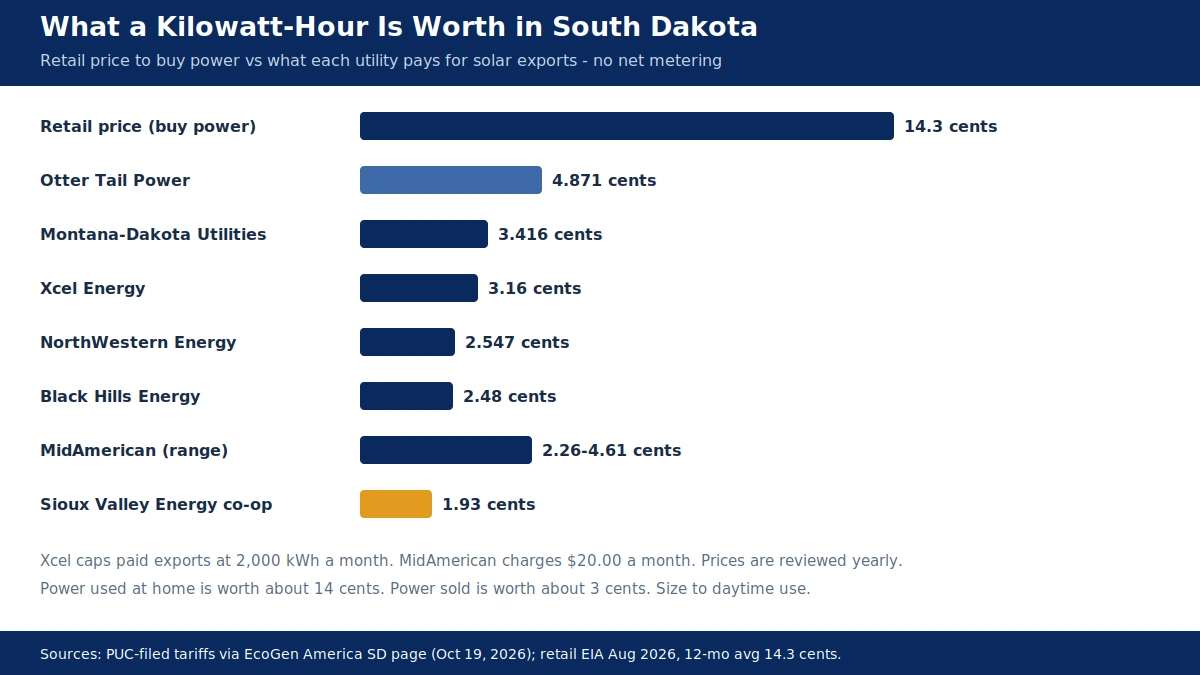
The six regulated utilities pay between 2.48 and 4.871 cents a kilowatt-hour, and the table below is the heart of this guide. Read it against the 14.3 cents a kilowatt-hour the average South Dakota home pays to buy power, and the shape of the whole market appears: the power you use yourself is worth about four to six times the power you sell.
| Utility | Export price (cents/kWh) | Monthly charge | In force since | Notes |
|---|---|---|---|---|
| Otter Tail Power | 4.871 | $1.33/mo | Apr 1, 2026 | Highest of the six; includes 0.3 cent REC |
| Montana-Dakota Utilities | 3.416 | 7 cents/day (~$2.10/mo) | Jan 1, 2026 | Rate 95; contract 12 mo to under 10 yrs |
| Xcel Energy | 3.16 | $3.75/mo | Jan 1, 2026 | Cap 2,000 kWh/mo; $300k liability insurance |
| NorthWestern Energy | 2.547 | $2.00/mo | Apr 1, 2025 | Rate 73; $4.29/kW capacity payment is conditional |
| Black Hills Energy | 2.48 | Charged, amount unpublished | Aug 1, 2019 | Lowest of the six; $300k liability insurance |
| MidAmerican Energy | 2.26–4.61 | By season and hour; highest monthly charge |
Xcel Energy, the utility that serves Sioux Falls and the state’s largest city, pays 3.16 cents a kilowatt-hour under Rate Code E50, in force since January 1, 2026. A hundred extra kilowatt-hours earn $3.16. The metering charge is $3.75 a month, taken off the payment every month. The monthly limit is 2,000 kilowatt-hours: extra power above that limit earns nothing at all. The agreement runs at least 12 months, and Xcel asks for liability insurance of at least $300,000 per occurrence. The credit is paid monthly, so nothing is left at year end, and there is no banking of summer surplus against winter bills.
Black Hills Energy, the utility that serves Rapid City and the west, pays 2.48 cents a kilowatt-hour under Schedule 3, unchanged since August 1, 2019, the lowest price of the six regulated utilities. A hundred extra kilowatt-hours earn $2.48. The meter charge is real but its amount is not published on the rate sheet, so the buyer has to ask for it, and the contract runs one year minimum with liability insurance of at least $300,000 per occurrence. The credit is set against the other charges on the monthly bill. Black Hills asked the Commission on February 19, 2026 to raise its rates in docket EL26-003, and that case was settled with final rates approved November 4, 2026 and effective December 1, 2026, but the export price under Schedule 3 was not changed by the interim rates, and the buyer should ask whether Schedule 3 changes when the final rates land.
Otter Tail Power pays the highest flat price of the six, 4.871 cents a kilowatt-hour under Section 12.01, in force since April 1, 2026. The price is 4.571 cents for the power plus 0.3 cents for the solar renewable energy credit, the proof that the power came from solar, and the credit goes to Otter Tail. The customer charge is $1.33 a month. Montana-Dakota Utilities pays 3.416 cents under Rate 95, in force since January 1, 2026, with a metering charge of 7 cents a day, about $2.10 in a 30-day month, and a written contract of at least 12 months and less than 10 years. NorthWestern Energy pays 2.547 cents under Rate No. 73, in force since April 1, 2025, with a $2.00 monthly charge. NorthWestern’s rate sheet also lists a capacity payment of $4.29 per kilowatt for being available at peak times, but a system must deliver at least 65 percent of its full power, on average, in peak hours from June to September to earn it, and this guide says plainly: do not count on it.
MidAmerican Energy is the complicated one, and its complication is a warning in itself. Its prices changed on August 15, 2026, the second change that year, and they run by season and hour: summer on-peak 4.61 cents, summer off-peak 2.57 cents, winter on-peak 3.29 cents, winter off-peak 2.26 cents. Summer on-peak hours are 6 a.m. to 10 p.m., Monday to Friday, June to September. The basic service charge is $20.00 a month, $240 a year, the highest charge of the six, and it is not clear from the tariff whether that charge comes on top of the basic charge on the normal bill. A home that sends out little power can earn less than the monthly charge, and the buyer on a MidAmerican line should get the arithmetic in writing before signing anything.
The co-ops and city utilities are a thinner story, and the thinness is itself a finding. Sioux Valley Energy, the co-op around Sioux Falls, pays 1.93 cents a kilowatt-hour for small renewable power under its February 2026 schedule, updated October 2026, and the schedule does not say whether that price covers all the solar power or only the surplus. The municipal cities served through Missouri River Energy Services, including Brookings, Pierre, and Watertown, filed a minimum price of 3.45 cents a kilowatt-hour for 2026, with no metering rules or fees in the filing. The East River Electric filing of December 22, 2025 prices only systems of 50 to 150 kW and larger and gives no price for a home-size system at all. None of these prices is fixed for the life of the system: the Xcel, NorthWestern, Otter Tail, and Montana-Dakota rate sheets all say the price is reviewed each year.
Two claims found in other guides are wrong and this guide names them so a reader who finds them first is not misled. One guide claims Black Hills Power credits exports at the full retail rate of about 11 to 13 cents a kilowatt-hour, with monthly netting and an annual true-up, and that the Commission mandates net metering for investor-owned utilities. That contradicts the Commission’s own FAQ and the filed Schedule 3 rate of 2.48 cents, and it is not used anywhere in this guide. A second guide writes that South Dakota “mandates net metering but at avoided cost,” which gets the price right and the law wrong: there is no mandate, and the avoided-cost price is a purchase price, not a net-metering credit. A third claim, that a few co-ops offer net-metering-style crediting on their own, is single-sourced and names no co-op, so it is reported here as unverified and no buyer should plan on it.
The practical meaning of all of this is one sentence long: in South Dakota, the power you use yourself is worth about 14 cents and the power you sell is worth about 3 cents, so the system should be sized to the power you use while the sun is up. The payback section runs the numbers on that rule.
South Dakota Electricity Rates: Cheap Power, Slow Payback
South Dakota power is cheap by national standards, and cheap power is the second half of the payback problem, after the export price. The average residential price in August 2026 was 15.15 cents a kilowatt-hour, against a national average of 18.16 cents, on the Energy Information Administration’s Electric Power Monthly, Table 5.6.A. Over the twelve months to August 2026 the average was 14.3 cents, against 18.0 cents nationally, and the August figure alone was up 9.0 percent on a year earlier, the fastest rise in the country that month. The average South Dakota home used 983 kilowatt-hours a month over those twelve months, more than the national average of 875, and paid about $140 a month. In 2024, the last full year the EIA has published in final form, the average home used 994 kilowatt-hours a month and paid $127.81.
The statewide average hides real differences between utilities. On 2024 EIA Form 861 figures, Xcel Energy’s South Dakota residential price runs about 15.0 cents a kilowatt-hour, with an average bill near $116 a month across about 95,427 residential customers. Sioux Valley Electric Co-op runs about 15.1 cents but an average bill near $183, because its rural customers use far more power, much of it electric heat. Across the state’s 19 utilities with residential customers, the average price runs from about 12.1 cents at Rosebud Electric Co-op to about 17.3 cents at Dakota Energy Co-op. A buyer who plans from the statewide 14.3-cent average and actually pays 17 cents will undercount the savings, and a buyer who pays 12 cents will overcount them, so the first number in any honest payback calculation is the buyer’s own bill, not the state average.
The tariff details show why the all-in price is higher than the energy charge on the rate sheet. Black Hills Energy’s interim residential tariff, in force since August 18, 2026, lists an energy charge of $0.12602 a kilowatt-hour and a customer charge of $12.75 a month, with a total-electric service option at $0.10147 a kilowatt-hour and a $15.00 monthly charge for homes where electricity is the only energy source. On top of the energy charge sits a cost-adjustment rider of about $0.04639 a kilowatt-hour, on a customer comment filed in the rate case, which would put the all-in price near 17 cents before taxes. The draft reports the rider as a single-source figure and uses the EIA average as the planning rate, but the direction is clear: the energy charge is not the bill. The final Black Hills rates approved November 4, 2026, effective December 1, 2026, lift a 650 kilowatt-hour residential bill from $105.61 to $121.94, up 15.47 percent, and a total-electric customer using 1,029 kilowatt-hours sees the bill rise from $141.25 to $163.72.
Xcel’s rates moved the same way, a few months earlier. The Commission approved a settlement on May 8, 2026 in docket EL25-024, allowing Xcel to raise overall electric rates by $25.6 million, about 9.5 percent, against an original request of $43.6 million, and the average residential bill rose about 12 percent, about $13.48 a month for a customer using 750 kilowatt-hours. Interim rates had been in effect since January 1, 2026, the new rates took effect July 1, 2026, and the settlement includes a moratorium that blocks Xcel from asking for another base-rate increase that takes effect before January 1, 2029. The moratorium is good news for a solar buyer in one way and bad news in another: it caps the rate rises that would shorten payback, but it also caps the bill the panels are competing against.
Why South Dakota power stays cheap is structural, not temporary. About 40 percent of the state’s electricity comes from four federal dams on the Missouri River, built under the Pick-Sloan Missouri Basin Program and marketed at wholesale by the Western Area Power Administration, and that hydro power carries almost no fuel cost. The rest comes largely from wind and coal, and the state has no deregulated retail market, so the price is set by the Commission rather than by a competitive supplier. A buyer who assumes rates will rise fast enough to rescue a long payback is betting against that structure, and the draft does not make that bet in its math: the payback figures below assume today’s rates stay flat, and the rate cases are noted as upside, not as a promise.
One more rate detail matters for the battery section. Xcel South Dakota offers a time-of-use plan, with summer on-peak energy at 24.724 cents a kilowatt-hour and off-peak at 6.210 cents, on a peak window of 9 a.m. to 9 p.m., Monday to Friday. Those figures come from a single secondary tariff summary and are flagged as such, but if they hold, they are the only rate in the state where a battery can earn a real spread, and the battery section takes them up there.
Payback: How Long Until South Dakota Solar Pays for Itself?
Payback is the question every South Dakota solar buyer actually asks, and the honest answer is longer than in most states, with a spread so wide that the price per watt matters more than the sunshine. The published estimates cluster at 12 to 15 years: RenewEstimator’s 2026 state table puts South Dakota at 12 to 15 years, and SunMetricLab puts it at 11.8 years on a gross cost of about $3.00 a watt. No EnergySage payback figure for South Dakota was retrieved in this research, and the draft says so rather than inventing one. The published estimates sit at the short end of the range this guide’s own arithmetic produces, and the rest of this section shows why, step by step, so the reader can see which assumption moves the answer.
The arithmetic starts from three numbers the research supports. An 8 kW system in Sioux Falls makes about 11,272 kilowatt-hours a year, at 1,409 per kilowatt. The average South Dakota home uses about 11,928 kilowatt-hours a year. The average price of power is 14.3 cents a kilowatt-hour over the twelve months to August 2026. The one assumption the buyer controls is self-consumption: the share of the system’s output the home uses itself, at the full retail price, instead of exporting at 3 cents. This guide uses 70 percent as its base case, which is a fair planning figure for a family that is home during the day or runs its big loads in daylight hours, and then shows 85 percent and 50 percent as the sensitivity cases.
At 70 percent self-consumption on Xcel, the math runs like this. The home uses 7,890 kilowatt-hours of its own solar power, saving about $1,128 a year at 14.3 cents. It exports 3,382 kilowatt-hours at 3.16 cents, earning about $107. The total first-year bill saving is about $1,235. Against that saving, the payback on the three cost anchors is: about 14.6 years at the NumeralQ low price of $18,090; about 18.5 years at the EcoGen-typical price of about $22,800 for 8 kW; and about 22.4 years at the EnergySage lead price of $27,680. Over 25 years the bill savings total about $30,900 before degradation and before the inverter is replaced, which means that at the EnergySage price the system barely breaks even inside its 25-year warrantied life, and at the NumeralQ price it clears about $12,800 after paying for itself.
On Black Hills Energy the export price is lower, 2.48 cents, and the saving falls a little: the same 3,382 exported kilowatt-hours earn about $84 instead of $107, the total saving is about $1,212 a year, and the paybacks stretch to about 14.9 years, 18.8 years, and 22.8 years on the same three cost anchors. On Otter Tail, the highest buyback at 4.871 cents, the exported power earns about $165, the total saving is about $1,293, and the paybacks shorten to about 14.0, 17.6, and 21.4 years. On Sioux Valley Energy’s 1.93 cents, the exported power earns about $65, the total saving is about $1,193, and the paybacks stretch to about 15.2, 19.1, and 23.2 years. The utility moves the answer by about a year in either direction. The price per watt moves it by about eight years. That is the single most important fact in this section.
| Cost anchor (8 kW) | System cost | Annual saving (Xcel) | Payback (Xcel) | Payback (Black Hills) |
|---|---|---|---|---|
| NumeralQ low | $18,090 | ~$1,235 | ~14.6 yrs | ~14.9 yrs |
| EcoGen typical ($2.85/W) | ~$22,800 | ~$1,235 | ~18.5 yrs | ~18.8 yrs |
| EnergySage lead ($3.46/W) | $27,680 | ~$1,235 | ~22.4 yrs | ~22.8 yrs |
Self-consumption moves the answer almost as much as the price per watt. At 85 percent self-consumption, the home uses 9,581 kilowatt-hours itself and exports 1,691, the annual saving rises to about $1,423, and the payback at the EnergySage price falls to about 19.4 years. At 50 percent self-consumption, the home uses 5,636 kilowatt-hours and exports the same, the annual saving falls to about $984, and the payback at the EnergySage price stretches to about 28.1 years, past the panel warranty. The lesson is blunt: a South Dakota buyer who is out all day and cannot shift loads into daylight should buy a smaller system or no system, because every kilowatt-hour exported at 3 cents instead of used at 14 cents costs about 11 cents of lost value, and a big array on an empty daytime house is a machine for making 3-cent power.
Three things the arithmetic leaves out, and the draft leaves them out on purpose. First, it assumes rates stay flat. Xcel raised the average residential bill 12 percent in 2026 and Black Hills raises bills about 15.5 percent from December 1, 2026, and if rates keep rising the payback shortens, but the draft does not count that rise because the Xcel moratorium runs to 2029 and the hydro base keeps the long-run pressure low. Second, it ignores panel degradation, about 0.5 percent a year on a typical panel, which trims the 25-year savings by roughly 6 percent and stretches every payback by about a year. Third, it ignores the inverter, which is warrantied for 10 to 12 years on a string inverter and 25 years on microinverters, and which can cost $1,500 to $3,000 to replace once in the system’s life. A buyer who adds those three corrections to the base case gets a payback about one to two years longer than the table shows, and a buyer who ignores them gets a pleasant surprise that is not a promise.
The 25-year view makes the same point in dollars. One analysis puts the 25-year cost of owned solar power in South Dakota at about 10.6 cents a kilowatt-hour, against a retail price of 15.73 cents in May 2026, which is a real saving but a thin one: about 5 cents a kilowatt-hour over the life of the system. On a system that makes 11,272 kilowatt-hours a year, that is about $560 a year of lifetime-average saving, and it only arrives if the system is paid for in cash, sized to daytime use, and kept clear of snow and shade for 25 years. A loan changes the picture further: at $4.97 a watt on a loan against $3.77 cash, the same 8 kW system costs about $39,760 financed, and the payback on the loan price runs past 30 years on the base-case saving, which is longer than the panels are warrantied for. Cash is the only financing that makes South Dakota solar pay back inside the warranty on the EnergySage anchor, and the financing section says so directly.
Who comes out ahead, then? A cash buyer in Sioux Falls or Rapid City with a south-facing roof, daytime use, and a quote near the NumeralQ band will pay back in about 15 years and bank a decade of nearly free power after that. A cash buyer with a quote at the EnergySage price and a house that sits empty all day will pay back in 28 years or never, and should wait, shrink the system, or add a battery and shift loads first. A buyer who needs a loan should price the loan per watt, not the monthly payment, and should walk away from any quote that will not show the cash price per watt in writing. South Dakota solar is not a bad investment. It is a narrow one, and the width of the opening is set by the quote, the roof, and the daytime habits of the people who live under it.
South Dakota Incentives in 2026: One Property Tax Break and Nothing Else
South Dakota is the thinnest incentive state in this series, and the thinness has a specific cause that a buyer needs to hear before any salesperson tells them otherwise. The state has no solar rebate, no state tax credit, no sales-tax exemption that could be verified, and no SREC market, and the federal home energy rebates that other states are rolling out do not exist here at all, because South Dakota turned the money down. The one benefit that does exist is a partial property tax exemption, and it is real, but it is worth hundreds of dollars a year at most, not thousands, and no quote should be built around it.
The property tax exemption is the only solar benefit in South Dakota state law, and it is written into SDCL 10-4-44. The county assesses the home with the panels on it, and then the exemption comes off the solar part: the first $50,000 of the system’s assessed value, or 70 percent of it, whichever is greater. The Department of Revenue gives two examples. A system assessed at $30,000 is fully exempt, because $30,000 is below $50,000. A system assessed at $85,000 gets an exemption of $59,500, which is 70 percent, and $25,500 stays taxable. The exemption has no end date, and there is no application form: the buyer contacts the county Director of Equalization, the office that assesses property, and the office applies it. Two limits matter. First, some guides say solar never raises a South Dakota assessment, and that goes too far: a system assessed above $50,000 leaves part of its value taxable, and the draft says so. Second, the state’s guidance says nothing about batteries, so a buyer should not assume a battery gets the same treatment.
A state income-tax credit cannot exist here, since the state collects no income tax at all. South Dakota is one of the few states with no income tax at all, which means there is no state tax bill for a credit to reduce, and no state credit can exist. The same logic does not extend to sales tax: South Dakota charges a 4.5 percent state sales tax plus local tax, and no verified exemption for solar equipment was found in this research. A quote that claims a sales-tax exemption should be asked to name the statute, and a quote that omits sales tax should be asked to add it as its own line.
The federal home energy rebates are the biggest gap, and the gap is a decision, not an oversight. The Home Electrification and Appliance Rebates, known as HEAR and renamed HEEHR in May 2026, would have paid up to $8,000 per household for efficient electric upgrades in other states, and the whole-home HOMES program would have paid alongside it. South Dakota declined its roughly $69 million allocation in August 2024, the only state to opt out, on allocations of $34,178,990 for HEEHR and $34,309,734 for HOMES. The state did not apply, no program was ever launched, and no South Dakota homeowner can claim a HEAR rebate in 2026. The generic framing used elsewhere in this series, that HEAR pays up to $8,000 for income-qualified households, does not apply in South Dakota, and this guide says so in the open rather than burying it in a footnote, because a buyer who budgets $8,000 of rebate money that does not exist will sign a contract on a false price.
The Weatherization Assistance Program is the one assistance program that is real and open in South Dakota, and it does not pay for solar. The program is free to income-qualified households and pays for insulation, air sealing, blower-door testing, and heating-system repair or replacement, delivered through local community action agencies. A buyer who qualifies should apply for the weatherization work in the same season as the roof or the solar install, because the attic insulation and air sealing that stop ice dams and cut heating bills are worth more in South Dakota than the panels on the roof, and the program pays for them in full. The roof covering and the panels are not weatherization measures, and no part of the program’s money goes to them.
No other South Dakota benefit was verified. No utility rebate was found at any of the six regulated utilities or at the co-ops, no municipal solar rebate was found in Sioux Falls or Rapid City, and no SREC market exists in the state, so there is no certificate income to add to the payback math. A contractor who promises a state grant, a utility rebate, or a solar certificate payment should be asked for the program name, the agency, and the application form, and should be expected to have none of the three.
Federal Help in 2026: $0 Tax Credit for Owned Systems, and the Lease Route
The federal government contributes $0 to a South Dakota solar system the homeowner owns and installs in 2026, and the sentence needs no softening. The One Big Beautiful Bill Act, Public Law 119-21, together with Internal Revenue Service Fact Sheet 2025-05, ended the residential clean energy credit under section 25D, and the home improvement credit under section 25C, for property placed in service after December 31, 2025. The 30 percent credit that cut $8,304 off a $27,680 system in 2025 is gone, and the net cost of a 2026 owned system is the gross cost. Any quote, calculator, or guide that still subtracts a 30 percent federal credit from a 2026 owned install is using stale math, and the buyer should ask for the quote to be re-run without it. For every federal rule that touches a 2026 install, see the federal energy tax credits guide.
The lease route is the one federal door that is still open, and it is narrow. The clean-electricity credit under section 48E can pass through to the homeowner on a leased system, because the leasing company owns the system and claims the commercial credit, then passes some of the value through in a lower lease payment. Only projects that began construction before July 4, 2026 still qualify for that route, on the best reading found in this research, and the draft flags that date as a single-source figure that the buyer should confirm with a tax professional before relying on it. A lease signed in late 2026 for a system that starts construction after the cutoff does not carry the credit, and a salesperson who promises it should be asked to show the construction-start paperwork.
A power purchase agreement, where a company puts panels on the roof and sells the homeowner the power by the kilowatt-hour, is not allowed in South Dakota at all. Only the utility assigned to the address may sell electricity at retail, under SDCL 49-34A-108, so a company cannot sell power to a South Dakota home. A lease is allowed, the Commission says, only if it gives the homeowner all rights to operate, maintain, and control the system, and the buyer should ask to see that clause in the lease before signing. The difference matters: a lease that leaves control with the company is a power sale wearing a lease’s clothes, and it is not a lawful arrangement in this state.
The tax position for an owned system is simple to state and easy to get wrong in conversation. There is no federal deduction for the cost of the panels, no depreciation for a home system, and no federal payment for the power the system makes. The property tax exemption in the last section is the only tax benefit, and it is a state exemption from property tax, not a federal credit. A buyer who is told the panels are “tax deductible” should ask which tax, which section, and which form, and should expect the answer to be the property tax exemption and nothing else. Tax advice for a specific property belongs to a licensed tax professional, and this guide is general information, not tax advice.
Permits, Licensing, and Interconnection: What South Dakota Requires
South Dakota has no single solar permit, no mandatory statewide building code for homes, and no dedicated solar permitting office, and the absence of a single desk is the first thing a buyer has to understand, because the work touches three separate processes that do not talk to each other: the wiring permit, the building permit, and the utility interconnection. A good installer handles all three, and a buyer should confirm that in writing before signing, because a quote that prices the panels but not the paperwork is a quote that will grow.
The wiring permit is the state-level piece, and it is handled by the South Dakota Electrical Commission, part of the Department of Labor and Regulation. South Dakota law carves out an owner’s exemption: a homeowner may do their own electrical wiring, including a solar installation, without an electrical license, on their own detached, owner-occupied single-family house, their own farmstead, a house they are building to live in, or non-habitable property they own such as a detached garage. That exemption is set out in SDCL 36-16-15, with the details in the Commission’s rules at ARSD 20:44:14:01(12). Doing the wiring yourself does not mean doing it unpermitted: any installation with an inspection fee of $30 or more needs a wiring permit before work starts, and a home solar job clears that threshold immediately. The homeowner permit application goes to the Electrical Commission in Pierre, by mail with a check or by fax or scan with card payment, and carries a $20 permit fee plus inspection fees calculated from the job, with a $150 minimum. Every installation, homeowner or professional, must meet the National Electrical Code as adopted by South Dakota, currently the 2023 NEC with state amendments, effective November 2024.
Sioux Falls and Rapid City are the exception to the state wiring route. Those two cities issue their own local wiring permits, and the state’s homeowner permit form tells residents inside either city’s limits to contact their city government instead of the Commission. Everywhere else in the state, including unincorporated areas and most smaller cities, the state Commission is the right office. Both Sioux Falls and Rapid City also require building permits for solar, and the installer guide updated in October 2026 states the requirement for both cities plainly: building and electrical permits, in both cities, for every solar install.
The building permit is the local piece, and it is genuinely local. Most counties and cities require a building permit for a roof-mounted or ground-mounted array, because the array adds structural load to the roof and, for a ground mount, puts a new structure on the property. Each county, and each city inside it, runs its own process, its own fee schedule, and its own review timeline, and there is no statewide portal that covers every jurisdiction. No verified permit fee figure for Sioux Falls or Rapid City solar was found in this research, and the draft does not state one. The buyer calls the county or city planning and zoning department directly and asks what it needs for a residential solar installation before the design is finalized, and the installer should be the one who pulls the permit, not the homeowner.
The interconnection agreement is the third process, and it belongs to the utility, not to any government office. Every grid-tied system needs utility approval before it can be switched on. The process runs under the Commission’s small generator rules, ARSD 20:10:36, with a tiered review that moves fastest for small systems, and the regulated utilities must connect small solar systems that accept their terms. Xcel runs the process through an online Solar Application Portal, and the installer usually files it with the homeowner’s signature as soon as the contract is signed. The agreement names the export rate, the monthly charge, and the term, and the buyer should read it before the panels go up, because the rate in the agreement is the rate the payback depends on, and the rate can change each year. Off-grid systems need no utility approval, but they still need to meet the electrical code and any local permit rules.
Installer licensing is the part of this section with the thinnest verification, and the draft says so. The Electrical Commission licenses electrical contractors in South Dakota, and a solar installer doing electrical work needs that license, or needs to work under a licensed electrical contractor. One secondary source describes a separate solar energy contractor license with four years of experience, an exam, and liability insurance of $300,000 for property damage and $200,000 for personal injury, renewed annually. That detail is single-sourced and was not verified against the Commission’s own pages, so the draft does not assert it as fact. What the buyer should do is checkable without it: ask for the license number, look it up with the Electrical Commission, confirm the business carries liability insurance and workers’ compensation, and ask for three recent jobs in the same county, in the same system size, with the homeowners’ phone numbers. A contractor who cannot be found in the lookup, or who cannot produce the insurance certificates, is not hired until the Commission confirms the status.
One local wrinkle is still in motion and deserves a flag rather than a rule. Pennington County, which surrounds Rapid City, was weighing a revised alternative-energy ordinance in May 2026 that would separate small home and farm systems from utility-scale projects, add limits such as prohibiting solar panels and wind systems in residential front yards, and add a full set of rules for battery energy storage systems. The ordinance was a proposal facing public comment at the time of reporting, not an adopted rule, and the draft reports it as proposed. A buyer in Pennington County should ask the county planning office whether the ordinance has been adopted and whether it touches a roof-mounted home system before the design is finalized.
Batteries in South Dakota: Backup Yes, Payback No
A battery in South Dakota is a backup purchase, not a money purchase, and the numbers make that plain. The EnergySage marketplace puts a typical 13.5 kWh home battery at about $15,647 installed before incentives, in July 2026 data, or about $1,159 per usable kilowatt-hour. A 10 kWh battery runs about $11,000 to $11,590 installed, a Tesla Powerwall 3 at 13.5 kWh runs about $13,000 to $13,500 installed, and two Enphase IQ batteries totalling 10 kWh run about $14,300. The range across the ten most-quoted batteries runs about $700 to $1,450 per usable kilowatt-hour. The federal credit on a battery bought outright in 2026 is $0, because the residential credit under section 25D ended December 31, 2025, and South Dakota has no state battery rebate to take its place.
The bill-saving case for a battery is weak because the price gap it would exploit is small. A battery earns money by storing solar power that would otherwise be exported at 3 cents and using it at home later instead of buying power at 14.3 cents, a spread of about 11.1 cents a kilowatt-hour, minus about 10 percent lost on the round trip through the battery and inverter. On that spread, a 10 kWh battery cycled fully once a day saves about $365 a year, and an $11,000 battery takes about 30 years to pay for itself on bill savings alone, against a warranty of 10 to 15 years. The battery would have to outlive its guarantee two or three times over to break even, and that is not a plan, it is a hope. The full national battery picture is in the solar battery cost guide.
The one rate in the state where the battery math improves is Xcel’s time-of-use plan, where summer on-peak energy runs 24.724 cents a kilowatt-hour against 6.210 cents off-peak, a spread of about 18.5 cents. A battery charged from the panels or from the grid off-peak and discharged on-peak earns more than twice the flat-rate spread, and the payback falls toward the warranty life, though it still does not clearly beat it on the figures available. Those time-of-use rates come from a single secondary tariff summary and are flagged as such, so a buyer on Xcel should confirm the plan, the peak window of 9 a.m. to 9 p.m. Monday to Friday, and the seasonal pricing with Xcel before buying a battery for arbitrage.
The backup case is stronger and does not need a spreadsheet. South Dakota winters bring blizzards, ice, and the highest yearly chance of a blizzard in the country, shared with North Dakota and Nebraska, and a battery keeps the fridge, the lights, the phones, and the furnace controls running through an outage that can last hours. A 10 kWh battery backs up a fridge, lights, and outlets through an evening; a 13.5 kWh battery covers a longer outage or a few more loads, but it will not run electric heat through a January night, and no battery in this price range will. The buyer who wants backup should size the battery to the critical loads, name them in the quote, and confirm that the system includes the islanding switch that keeps the battery from feeding power into a dead grid, because that switch is a safety device, not an accessory, and the utility will not approve the interconnection without it. The state’s guidance on the property tax exemption says nothing about batteries, so the buyer should not assume a battery gets the same exemption as the panels.
A generator is the honest comparison for backup, and the draft names it. A portable generator costs a fraction of a battery, runs as long as it has fuel, and needs no roof, no permit, and no utility agreement, but it is loud, it needs fuel stored safely, and it does not earn a cent when the grid is up. A battery is silent, automatic, and earns a little every day, but it costs about $11,000 and goes flat when it is empty. A buyer whose main worry is a winter outage should price both before choosing, and a buyer whose main worry is the electric bill should buy more panels or a smaller system instead of a battery.
Getting Quotes in South Dakota: The Checklist
Getting quotes that compare is a discipline, and the checklist below is the discipline, written for South Dakota’s rules rather than copied from another state. Three bids, same scope, same lines, same product names, from installers whose licenses check out with the Electrical Commission. Every bid names the panels by brand and model, the inverter or microinverters by brand, the system size in kilowatts, the cash price per watt, the expected first-year production in kilowatt-hours, the degradation assumption, the racking and flashing details, the panel upgrade if one is needed, the permit responsibility and fees, the interconnection application, the warranty terms for panels, inverter, and workmanship, and the payment schedule. The buyer rejects any bid that prices a lump sum without the lines, any bid that will not show the cash price per watt, any bid that assumes net metering, any bid that subtracts a federal credit from a 2026 owned system, and any bid from an installer who cannot be found in the Commission lookup. The cheapest bid that names every line is usually the best bid. The cheapest bid that names none of them is usually the most expensive system in the county by the time it is done.
What pushes a South Dakota quote up or down is worth naming before the bids arrive. A steep or cut-up roof costs more than a simple gable, because the crew works slower and the racking takes longer. A ground mount costs more than a roof mount, because it needs footings, trenching, and a longer wire run, and no verified South Dakota ground-mount premium was found, so the buyer should get the ground-mount price as its own line rather than trusting a guide. An old roof should be replaced before the panels go on, because removing and reinstalling an array to re-roof costs thousands, and the roof replacement cost in South Dakota guide prices that job. An electrical panel upgrade, common in older South Dakota homes, adds its own line, and the electrical panel upgrade cost guide prices it. Shading, a north-facing roof, and a long wire run from the array to the panel all push the price per watt up, and a hail-rated panel or a snow guard adds a little more. None of these is a reason not to buy solar. All of them are reasons to get the quote in writing, line by line, before signing.
Timing a South Dakota install is a weather decision as much as a price decision. The install season runs roughly April through October, when the roof is clear and the crew can work in daylight, and the backlog after a hail event can stretch for weeks, because the same crews that install solar also repair hail-damaged roofs. A buyer who signs in the week after a big hailstorm will wait longer and pay more than a buyer who signs in a quiet month, and a buyer who can wait until the backlog clears gets a better price and a calmer crew. The panels themselves do not care about the install month: a system switched on in November will make its first real power in March, and the year, not the season, is the unit that matters.
- Call your utility first and get the buyback price, the monthly charge, and the insurance rule in writing.
- Confirm the installer’s electrical license with the South Dakota Electrical Commission and collect current liability and workers’ compensation certificates.
- Get three written cash quotes on the identical spec sheet, each showing the cash price per watt.
- Check that no quote assumes net metering, a federal credit, a state rebate, or a sales-tax exemption.
- Confirm the permit route in writing: state wiring permit or city permit, local building permit, and who pulls each one.
- Size the system to daytime use, not to annual use, and ask for the expected self-consumption share in writing.
- Read the interconnection agreement before signing: the export rate, the monthly charge, and the term.
- Confirm hail coverage and the wind and hail deductible with the insurer before the array goes on.
- Put the payment schedule in the contract: deposit, progress at a named milestone, balance on completion, inspection, and permission to operate.
- File the closeout folder: permits, inspection sign-off, interconnection agreement, warranties, panel serial numbers, and the county property tax exemption confirmation.

For the South Dakota heating side of the same house, the national solar and battery guides above carry the related costs, and for neighboring-state comparisons see the Oklahoma solar panel cost guide, the South Carolina solar panel cost guide, the Alabama solar panel cost guide, and the Mississippi solar panel cost guide.
Sources & methodology
This guide prices an 8 kW roof-mounted home solar system, installed, as its headline job, and every band states its source, its date, and its scope. The lead cost band comes from EnergySage marketplace data for September 2026, as reported by a South Dakota installer guide updated in October 2026, with the EnergySage cash-median and large-system cuts reported alongside it. Cross-checks come from EcoGen America (October 19, 2026), NumeralQ (retrieved October 26, 2026), RenewEstimator (2026 state table), SunMetricLab (September 10, 2026), and The Green Watt (2026). Production figures come from NREL PVWatts v8 for Sioux Falls and Rapid City, retrieved October 11, 2026, with PVGIS runs from Solar Learning Lab (August 18, 2026) and snow-loss figures from National Renewable Energy Laboratory research. Electricity rates and use come from the Energy Information Administration’s Electric Power Monthly, Table 5.6.A (August 2026) and Table 5A (2024), with utility-level figures from EIA Form 861. Buyback rates come from EcoGen America’s South Dakota page (October 19, 2026), verified against the Public Utilities Commission’s filed tariffs for Xcel Energy Rate Code E50, Black Hills Energy Schedule 3, NorthWestern Energy Rate No. 73, Otter Tail Power Section 12.01, MidAmerican Energy Rate QF, and Montana-Dakota Utilities Rate 95, plus the PUC’s small-renewable filings for Sioux Valley Energy, Missouri River Energy Services, and East River Electric. Rate-case facts come from the Commission dockets EL25-024 (Xcel, settled May 8, 2026) and EL26-003 (Black Hills, interim rates August 18, 2026, final rates approved November 4, 2026). Hail figures come from Cloudbreak’s count of National Oceanic and Atmospheric Administration Storm Prediction Center reports through November 12, 2026, the National Oceanic and Atmospheric Administration Storm Events Database, and the United States Department of Energy’s hail guidance. Snowfall figures come from National Weather Service 1991 to 2020 normals. Property-tax facts come from the South Dakota Department of Revenue and SDCL 10-4-44. Rebate status follows the Department of Energy’s allocations (May 23, 2024) and the National Association of State Energy Officials tracker (September 30, 2026), which record South Dakota as the only state that declined its allocation. Tax framing follows the One Big Beautiful Bill Act (Public Law 119-21) and Internal Revenue Service Fact Sheet 2025-05. Battery prices come from EnergySage marketplace data (July 2026). Permit and licensing facts come from the South Dakota Electrical Commission, SDCL 36-16-15, ARSD 20:44:14:01(12), ARSD 20:10:36, and the Solar in SD guides reviewed in October 2026. Derived figures, including the per-size costs, the production shares, the payback scenarios, the self-consumption sensitivities, and the battery arithmetic, are NestPriced arithmetic on the cited sources and are labeled as such in the text. Figures that could not be verified, including Sioux Falls and Rapid City city-level prices per watt, the EnergySage South Dakota payback figure, the Sioux Falls and Rapid City building-permit fees, the installer-license exam detail, any carrier-verified solar hail-claim figure, the ground-mount cost premium, and the battery treatment under the property tax exemption, are disclosed as unverified or as planning estimates in the sections where they arise, and no figure in this guide is presented as verified when it is not.
Disclaimer: Prices in this guide are planning estimates from the cited cost models and guides, not quotes, and the actual price of a solar system depends on the measured roof, the direction and pitch, the shading, the system size, the equipment chosen, the electrical panel, the distance to the meter, and the installer’s current material and labor costs. Buyback rates, monthly charges, permit requirements, and code editions change, and the buyer should confirm the current terms with the utility and the local building official before signing a contract. Insurance coverage and deductibles are set by the individual policy and carrier, not by this guide, and the buyer should confirm coverage in writing with the insurance agent. This guide is general information, not legal, tax, or insurance advice, and the buyer should consult a licensed professional for advice on a specific property.
How much do solar panels cost in South Dakota in 2026?
Solar panels cost $3.46 per watt installed in South Dakota in 2026, on EnergySage marketplace data for September 2026, or about $27,680 for an 8 kW system before incentives. Cheaper anchors exist: NumeralQ plans the same 8 kW system at $18,090 to $23,650, and EcoGen puts the typical 7.62 kW South Dakota system at about $21,717. The spread between the anchors is about $9,500 on an 8 kW system, which is why this guide shows all of them and tells the buyer to trust three local cash quotes over any guide.
Does South Dakota have net metering in 2026?
No. The Public Utilities Commission says South Dakota does not compensate solar generation at a net metered rate, and the Legislature considered net metering in 2013, 2015, and 2016 without adopting it. Utilities buy surplus power at their avoided cost instead: 3.16 cents a kilowatt-hour on Xcel, 2.48 cents on Black Hills Energy, 4.871 cents on Otter Tail, 2.547 cents on NorthWestern, 3.416 cents on Montana-Dakota, and 2.26 to 4.61 cents on MidAmerican, with co-ops setting their own prices. Power you use at home is worth about 14.3 cents, so sizing the system to daytime use is the whole decision.
How long does it take for solar panels to pay for themselves in South Dakota?
On this guide’s arithmetic, about 15 to 22 years for an 8 kW system, depending on the price per watt and the utility. At the NumeralQ low price of $18,090 the payback is about 14.6 years on Xcel; at the EnergySage lead price of $27,680 it is about 22.4 years. The published RenewEstimator figure is 12 to 15 years. The biggest lever is self-consumption: using 85 percent of your own solar power at home cuts the payback to about 19.4 years at the EnergySage price, while using only 50 percent stretches it to about 28.1 years.
How much electricity do solar panels make in South Dakota?
About 1,409 kilowatt-hours a year for each kilowatt of panels in Sioux Falls, and about 1,460 in Rapid City, on NREL PVWatts figures for a south-facing roof at a 20-degree pitch. An 8 kW system in Sioux Falls makes about 11,272 kilowatt-hours a year, roughly 94 percent of what the average South Dakota home uses. July is the best month at about 164 kilowatt-hours per kilowatt in Sioux Falls and December the weakest at about 67, so the best month makes nearly two and a half times the weakest.
Do solar panels work in South Dakota winters?
Yes, and the cold helps. Panels make electricity from light, not heat, and a typical panel gains about 10.5 percent above its rated output on a cold day at minus 10 degrees Celsius. What falls in winter is the volume of sun, not the efficiency: short days and a low sun cut December output to about 43 percent of May in Rapid City. Snow cover costs only 1.0 to 3.0 percent of annual production in the Great Plains, because south-facing panels at a steep pitch shed snow within a day or two, so the buyer should not climb on an icy roof to clear them.
Can hail damage solar panels in South Dakota?
It can, but only the big stones. The Department of Energy’s position is that hail generally does not damage panels until stones reach about 1.75 inches across, and panels are tested to withstand stones up to 2 inches at 50 miles an hour. Rapid City is the risk center: 199 hail days within 15 miles of the city since 2010, with the largest stone at 4.5 inches, against 59 days and 3.5 inches in Sioux Falls. A Rapid City buyer should confirm hail coverage and the wind and hail deductible with the insurer before installing, and should keep the panel serial numbers and install photos for any future claim.
Is there a South Dakota solar tax credit or rebate in 2026?
No. South Dakota has no state income tax, so no state income-tax credit can exist, and no state rebate, sales-tax exemption, or SREC market was verified. The federal home energy rebates do not exist here either: South Dakota declined its roughly $69 million allocation in August 2024, the only state to opt out. The one benefit that does exist is a partial property tax exemption under SDCL 10-4-44, covering the first $50,000 of the system’s assessed value or 70 percent of it, whichever is greater.
Is there a federal tax credit for solar panels in South Dakota in 2026?
No, not for a system you own. The One Big Beautiful Bill Act ended the residential clean energy credit for property placed in service after December 31, 2025, so a homeowner-owned system installed in 2026 gets $0 in federal credit. A leased system can still carry the section 48E credit through the leasing company, but only for projects that began construction before July 4, 2026, on the best reading found. A power purchase agreement is not allowed in South Dakota at all: only the assigned utility may sell electricity at retail.