

A Minnesota heat pump buyer faces the steepest version of this purchase anywhere in the country, and the sooner that is said plainly, the better the decision that follows. The Twin Cities size their heating systems for minus 15 degrees. Duluth sizes for colder. The heating season piles up 8,382 degree days in Minneapolis and 10,000 in Duluth, against fewer than 4,000 in Richmond and fewer than 3,500 in Norfolk. A machine that spends its winter pulling heat out of air sitting at minus 10 is doing a different job from the same machine in Virginia, and it needs different hardware, a bigger backup plan, and a more honest budget. The buyers who do well in Minnesota are the ones who start from the cold and work backward to the price. The ones who start from a national average and discover the cold later are the ones with the February electric bill that doubles.
The second Minnesota fact cuts the other way, and it is the reason this guide exists at all. Power here is not expensive — 17.20 cents a kilowatt-hour on the state average, about 5 percent below the national figure — and for heat pump owners on Xcel Energy, the real price of winter power is far lower than the average suggests. Xcel’s electric space heating rate charges 6.537 cents a kilowatt-hour for the energy component from October through May, against 11.364 cents on the standard rate, and with riders and fuel charges included the all-in winter figure lands near 11.14 cents. That one enrollment decision moves the break-even efficiency against gas from an impossible 4.04 to a reachable 2.61. No rebate in the state is worth as much over ten winters as that rate. Yet it is not automatic, it cannot be applied retroactively, and a buyer who installs the heat pump and never makes the phone call pays the standard rate all winter. The rate is the rebate that keeps paying.
The third fact is the fuel map. About two Minnesota homes in three heat with piped gas, and gas here costs about $1.19 a therm on the 2026 year-to-date average — cheap enough that a heat pump on standard-rate power loses to a gas furnace by roughly $941 a year on the planning home in this guide. About one home in five heats with electricity, and about one in eight with propane or oil, and for those homes the sums run the other way by hundreds or thousands of dollars a year. Minnesota is therefore not one heat pump market but two: a gas majority for whom the honest purchase is usually dual-fuel or nothing, and an electric, propane, and oil minority for whom a cold-climate heat pump is the best money they will spend on the house. This guide prices both markets, keeps their arithmetic separate, and never lets one market’s answer stand in for the other’s.
Our national heat pump cost guide sets the countrywide context first — then this guide shows where Minnesota sits against it, and why the coldest state in the series needs its own numbers.
Table of Contents
How Much Does a Heat Pump Cost in Minnesota in 2026?
Three kinds of Minnesota price exist, and they disagree for reasons that matter. NumeralQ publishes modeled planning estimates, updated through November 2026, built from a national baseline adjusted for Minnesota costs: a 3-ton ducted air-source system at $7,120-$11,700 statewide. A Twin Cities contractor with a century in the market, MSP Plumbing Heating Air, publishes its own experience: a basic install from $9,000, most jobs around $14,000, premium high-efficiency systems at $18,000 and up. A modeled Minneapolis guide, CoolHeatCosts, lands between them at $6,600-$15,400 with a typical figure near $9,900. None of these is a quote for your house. The NumeralQ band is the only one tied to a specific system size statewide, so this guide headlines it — and treats the contractor figures as the warning that premium cold-climate equipment in the Twin Cities routinely lands above the top of the planning band.
The statewide anchor deserves a careful read before anything is budgeted against it. The $7,120 low end is a value-tier standard ducted unit in a straightforward house with sound ducts and adequate electrical service. The $11,700 high end is a better-tier unit in a harder house. Neither end is the cold-climate machine Minnesota winters actually call for: that machine carries its own band, $9,280-$15,900, and a buyer who budgets the standard band and then discovers the cold-climate premium has under-budgeted by roughly $2,000 at every tier. The honest Minnesota starting budget is the cold-climate band, not the standard one, and the rest of this guide prices the purchase that way.
A second dataset sits above the anchor and needs its own warning. HVAC Visit, tracking this quarter’s installed costs before rebates across ten Minnesota cities, puts the Minnesota heat pump range at $8,450-$22,700, with Minneapolis at $8,800-$22,700 and Duluth at $8,450-$21,850. Those are whole-market ranges across every size and tier, not 3-ton bands, so they read high against NumeralQ — and their top ends describe large premium and geothermal-adjacent jobs, not a standard 3-ton install. Use them as evidence that the market’s ceiling is high, not as evidence that a 3-ton quote should approach $22,000. A 3-ton ducted quote near $20,000 needs either a cold-climate premium, new ductwork, a panel upgrade, or an explanation.
Treat the quoted figure as the whole job, not the box: outdoor unit, indoor coil or air handler, lineset, pad or bracket, disconnect and wiring, thermostat, labor, permits, and the startup visit all sit inside it. What it does not buy is the rest of the job in a Minnesota house: a gas furnace for a dual-fuel setup, a panel upgrade, ductwork repairs or replacement, a raised stand that keeps the outdoor unit clear of snowdrift, or the controls that manage the switchover. NumeralQ prices two of those add-ons for Minnesota directly: new or extended ductwork at $4,860-$7,980 a job, and a 200-amp panel upgrade at $2,530-$3,890 a job. They arrive as separate lines on the quote, and in an older Twin Cities house they can add more to the bill than the difference between equipment tiers.
One number hides inside the arithmetic, large enough in Minnesota to flip the decision. The rebate stack on a qualifying dual-fuel job can reach $3,700: Xcel’s $2,000 cold-climate rebate, CenterPoint’s $1,100 dual-fuel rebate, and Xcel’s $600 insulation bonus when air sealing and insulation precede the heat pump within two years. A Minneapolis home in a Green Zone can add a city bonus of up to $5,000 on top. But every dollar of that stack is conditional — on the utility territory, on the equipment tier, on the contractor, on the order the work is done — and a quote that subtracts the full stack for a home that qualifies for half of it is a quote that needs rewriting before it is compared. Judge every quote on the gross figure first, then subtract only the rebates your own address and equipment actually earn, in writing.
A warning before the tables: the cheapest Minnesota quote is the most dangerous quote in this series, because the cheapest way to cut a Minnesota heat pump price is to sell a standard unit where a cold-climate unit belongs, or to leave the backup heat undersized. Identical equipment can draw bids several thousand dollars apart, and nowhere in Minnesota does that gap yawn wider than the Twin Cities, where the state’s deepest installer bench works alongside its highest wages. To compare bidders fairly, line up the same job from each: one model, one house, one backup-heat arrangement, one switchover temperature, all in writing, with only the rebates your home qualifies for already deducted. Three quotes is the minimum, and any bidder who will not name the model number, its capacity and COP at 5 degrees and at minus 15, and its SEER2 and HSPF2 ratings is a bidder to walk away from.
| Source | 3-ton ducted | Cold-climate ducted | Single-zone mini-split | Geothermal |
|---|---|---|---|---|
| NumeralQ (Nov 2026, planning est.) | $7,120-$11,700 | $9,280-$15,900 | $3,520-$5,400 | $21,460-$33,470 |
| MSP contractor (Twin Cities) | From $9,000; typical ~$14,000 | $18,000+ (premium) | Not published | Not published |
| CoolHeatCosts Minneapolis (2026, modeled) | $6,600-$11,600 (2-3 ton) | $8,800-$15,400 | Not published | Not published |
| Modernize MN (Aug 2026) | Not published separately | $7,500-$14,000 typical | Not published | $25,000-$45,000+ |
| HVAC Visit MN (2026, whole-market) | $8,450-$22,700 (all sizes/tiers) | Included in range | Not published | Not published |
A warning attaches to two rows of that table, and it comes first. The Modernize geothermal range, $25,000-$45,000 and up, runs well above NumeralQ’s $21,460-$33,470, because Modernize prices complex drilling and larger loop fields while NumeralQ prices a standard 3-ton loop job — the overlap, roughly $25,000-$33,000, is where a competitive Minnesota geothermal quote should start, and anything above $40,000 needs a drilling explanation. And the MSP contractor figures describe what one established Twin Cities company actually charges across sizes and tiers, so the $14,000 typical sits above the NumeralQ midpoint without contradicting it: premium cold-climate equipment, installed by a premium crew, in the state’s most expensive labor market. This guide builds on the NumeralQ band throughout, and each number derived from it carries the planning-estimate label.
Heat Pump Cost in Minnesota by System Type
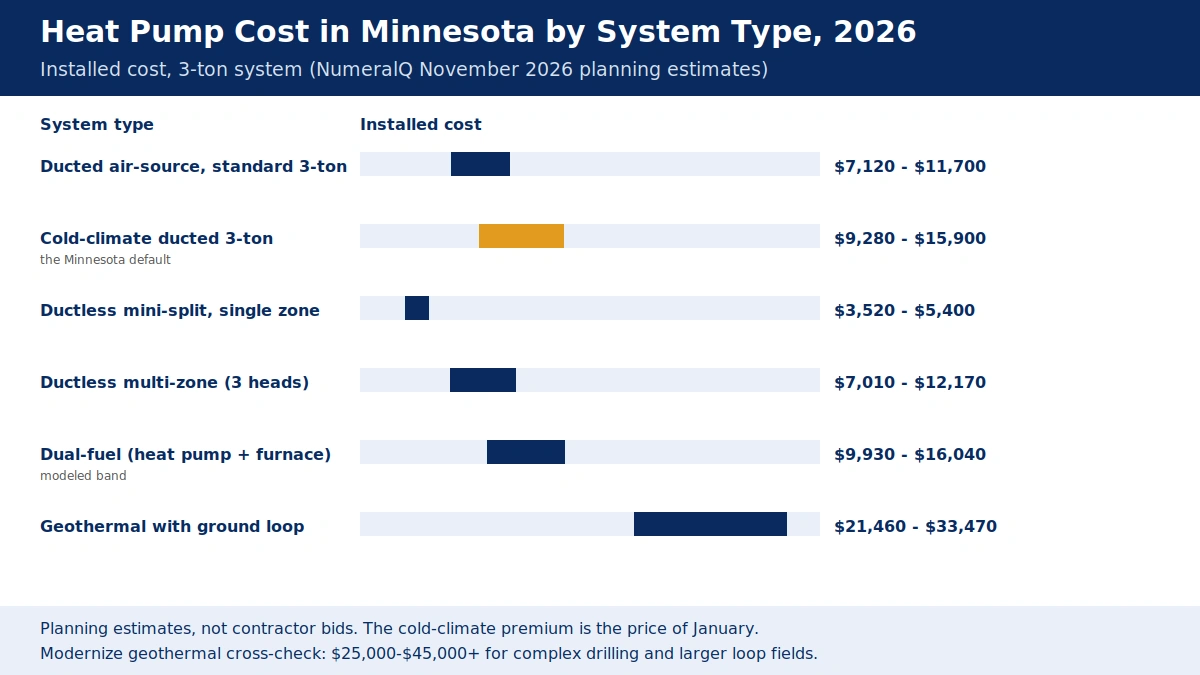
In Minnesota the words “heat pump” can mean six machines at very different prices — more than six to one from the cheapest to the dearest — and the cold sorts them harder than in any warmer state. A standard ducted unit that would serve a Richmond house for twenty years can be the wrong machine in Duluth. A mini-split head that would carry a Virginia Beach addition through January can be a decoration in a St. Cloud February if it was sized for the wrong season. Which machine fits depends on the house, the fuel it heats with today, and which of Minnesota’s climates it sits in, and here the house usually decides: a 1920s Minneapolis bungalow with ducts sized for a furnace, a Rochester rambler on propane past the gas mains, a Duluth hillside home facing Lake Superior wind, a St. Cloud farmhouse on fuel oil with a boiler from another era.
| System type | Installed cost (MN) | Best for in Minnesota |
|---|---|---|
| Ducted air-source, standard (3-ton) | $7,120-$11,700 | Mildest sites only; rarely the right MN buy |
| Ducted cold-climate (3-ton) | $9,280-$15,900 | The Minnesota default; whole-home primary heat |
| Ductless mini-split, single zone | $3,520-$5,400 | One room, addition, or a house with no ducts |
| Ductless multi-zone (3 heads) | $7,010-$12,170 | Whole-home without ducts; zone-by-zone control |
| Dual-fuel (heat pump + gas furnace) | $9,930-$16,040 | Gas-heated majority; furnace owns deep cold |
| Geothermal, ground-source with loop | $21,460-$33,470 | Long-term owner, big lot; steadiest winter COP |
The standard ducted unit is a southern machine wearing a Minnesota price tag. A standard ducted air-source heat pump at $7,120-$11,700 is the cheapest whole-home system in this guide, and in Minnesota it is cheap for a reason: it was designed for climates where the design temperature sits above zero. Below about 5 degrees its capacity falls toward half its rating and its COP slides toward 1.0, and below minus 5 many standard units lock out entirely and hand the whole house to resistance strips. Minneapolis designs for minus 15. A standard unit can still serve a Twin Cities home as part of a dual-fuel pair, where the furnace takes over before the cold bites, or in a well-insulated southern Minnesota home with generous backup heat. As the sole heat source in a Duluth or St. Cloud winter, it is the wrong machine, and the money saved on the sticker comes back as resistance heat on the January bill. Our ductless vs ducted guide works through the keep-the-ducts-or-go-ductless decision in full for a Minnesota house.
Cold-climate ducted is the Minnesota default, and the premium is the price of January. The cold-climate premium — $9,280-$15,900 against $7,120-$11,700 for the standard 3-ton — buys vapor-injection compressors, larger coils, and controls that keep the machine working deep below zero. A unit on the NEEP cold-climate list keeps at least 70 percent of its rated capacity at 5 degrees with a COP of at least 1.75, and the best lines hold full rated output down to 5 degrees and keep producing useful heat at minus 15 with a COP between 1.2 and 1.8. That is the difference between a machine that heats the house through a minus 10 night and one that surrenders to the strips. The premium also unlocks the money: Xcel’s $2,000 rebate, Minnesota Power’s $1,000, and the Minneapolis Green Zone bonus all require cold-climate equipment. A buyer who skips the premium to save $2,000 on the sticker can lose $2,000 in rebates and gain a January of resistance heat in the same transaction. In Minnesota, the cold-climate unit is not the upgrade. It is the machine.
The state’s old houses — plaster walls, no ducts, radiators or baseboards — are the retrofit ductless heads were designed for. Mini-splits are how Minnesota retrofits houses that never had ducts — Minneapolis and St. Paul bungalows on boiler heat, northeast Minneapolis duplexes with no chase for ductwork, lake cabins and finished attics no duct ever reached. One zone runs $3,520-$5,400 anywhere in the state and conditions a single room or open-plan space: the outdoor unit rides a wall bracket, the head hangs indoors, and one small penetration carries the lineset through. At $7,010-$12,170, three heads cover a whole small home with a thermostat per zone, letting bedrooms run cooler overnight while the living room holds steady. Coverage is the limit, and in Minnesota the limit bites harder: a head warms only its own room, and a room the head cannot reach still needs its baseboards or its boiler on a minus 15 night. Xcel’s rebate application says mini-split heat pumps need a backup heat source, and in this state that condition is a statement of physics, not paperwork. For what each added zone adds to the bill, see our mini-split installation guide.
For the two Minnesota homes in three heated by piped gas, dual-fuel is the candid answer. In a dual-fuel house the heat pump and gas furnace divide the season, with a control passing the load to the furnace once the outdoor temperature falls past the switchover point the installer programs in — a setup built for the gas-heated majority. The heat pump owns the mild weather, where its COP is high and the electric space heating rate makes it cheap; the furnace owns the deep cold, where gas at $1.19 a therm beats any air-source machine. NumeralQ’s modeled dual-fuel band for a 3-ton system is $9,930-$16,040, covering heat pump, furnace, and controls together — a modeled number, flagged as one. The configuration also carries the state’s best rebate stack: Xcel’s cold-climate rebate plus CenterPoint’s $1,100 dual-fuel rebate, with a furnace rebate of up to $1,000 more if the furnace itself is a 97 percent replacement. The dual-fuel section below works out the switchover economics at Minnesota prices, because that number — not the sticker — decides whether dual-fuel saves money here. The setup itself gets a full walkthrough in our dual-fuel heat pump guide.
No other system in Minnesota shrugs off the weather the way geothermal does — and no other system’s 2026 math lost a third of its value in a single law. A ground-source unit draws heat from earth that holds near 48 degrees all year a few feet beneath a Twin Cities lawn, keeping a COP of 3.0 to 4.0 through a minus 15 night while an air-source unit works at 1.5. NumeralQ puts the Minnesota installed range at $21,460-$33,470 with the loop; Modernize runs $25,000-$45,000 and up for complex jobs. The loop is the swing: horizontal trenching where the lot allows, vertical bores where it does not, and Minnesota’s well code means vertical bores need a licensed well contractor. The buyer who fits geothermal is a long-term owner on a big lot staying twenty years, and Minnesota has plenty of those lots outside the metro. Anyone likely to move within five years is the wrong buyer: the loop stays buried, and the payback wants a decade of winters to arrive. The 30 percent federal credit that once softened the price is $0 for a 2026 homeowner-owned install under the same law change that ended the air-source credit, so the 2026 geothermal case stands on operating savings alone — and in Minnesota, where those savings against gas are thin but against propane and resistance heat are large, the fuel being replaced decides the case. Our geothermal heat pump guide takes the long view: loop fields, tight-lot drilling, and two decades of math with no federal credit.
A last setup earns its paragraph: a cold-climate mini-split added alongside a furnace or boiler the home keeps. The heads go where people actually spend their hours — the living room, the home office, the main bedroom — one or two of them. Those heads own the shoulder seasons and the gentler winter days, the old system takes the deep cold, and July brings air conditioning the house never had. The first zone at $3,520-$5,400 is the cheapest entry to a heat pump in Minnesota, and in Xcel territory it earns a $1,600 or $2,000 rebate on top. As a whole-home solution it will disappoint in a Minnesota January: one head cannot heat a house at minus 15. A quote that claims otherwise is selling a smaller system than the house needs, and the boiler will prove it on the coldest night of the year.
Heat Pump Cost by Home Size
After system type comes size, and Minnesota punishes sizing errors more severely than any warmer state — in both directions, for opposite reasons. Too small in Duluth, and the machine leans on resistance heat for weeks of subzero weather at 17.20 cents a kilowatt-hour, or hands the house to a furnace that was supposed to be backup. Oversize the unit for a Twin Cities house and it short-cycles through humid Julys, shutting off before it has wrung the moisture from the air — thousands of dollars spent on capacity the house never asks for. The right size comes from one document only: a Manual J load calculation, room by room, at the design temperature — minus 15 in the Twin Cities, minus 16 in Duluth on the 97.5 percent basis, minus 12 in Rochester. Square footage alone — or the size of the furnace coming out — is only a guess at the load figure every other decision hangs on. Insist on the Manual J in writing before signing, and insist that it names the design temperature it was run at, because in Minnesota the basis of that number moves the answer by a ton.
The table below prices ducted air-source systems by tonnage from the NumeralQ size table, the one size table in this pass published for Minnesota directly rather than scaled by this guide. Heat pump capacity is rated in tons, 12,000 BTU an hour to the ton, and in Minnesota the heating load governs everywhere: the cooling load is a fraction of the heating load in every city in the state, the reverse of the southern half of this series. A 2,000-square-foot Twin Cities house commonly needs a 3.5-ton or 4-ton system where the same house in Virginia would take 3 tons — because the design temperature sits about 80 degrees below room temperature, not 55, and the machine must deliver its rated heat against that gap.
| System size | Home size (approx.) | Ducted air-source (MN) |
|---|---|---|
| 1.5 ton | 600-1,000 sq ft | $4,890-$7,700 |
| 2 ton | 1,000-1,400 sq ft | $5,630-$9,030 |
| 2.5 ton | 1,400-1,700 sq ft | $6,370-$10,360 |
| 3 ton | 1,700-2,100 sq ft | $7,120-$11,700 |
| 3.5 ton | 2,100-2,400 sq ft | $7,860-$13,030 |
| 4 ton | 2,100-2,700 sq ft | $8,610-$14,360 |
| 5 ton | 2,700-3,500 sq ft | $10,090-$17,030 |
Every row of that table is a NumeralQ planning estimate for a standard ducted unit, and every row understates the cold-climate price by the premium this state requires. The cold-climate 3-ton band, $9,280-$15,900, sits about $2,160 above the standard 3-ton band at the low end and about $4,200 above it at the high end, and the same premium applies up and down the size table as a planning matter. Do not budget a 4-ton cold-climate job at the 4-ton standard price. The premium is not optional equipment in Minnesota. It is the equipment.
Three cautions sit behind that table. To begin with, the home-size column is only a rough guide — rougher in Minnesota than most places, because the housing stock runs from 1880s Minneapolis Victorians with no wall insulation to 2020s suburban builds tighter than a thermos, and the same floor area can need twice the heat in the first as in the second. Age, insulation, glazing, air leakage, and ceiling height move the answer more than floor area does, and a drafty house on a windy Duluth hillside is a common case, not an edge case. Next, the governing load is heating everywhere in the state, which changes the sizing error that hurts. In the south, an oversized unit short-cycles in summer. In Minnesota, an undersized unit is the expensive error: every BTU the heat pump cannot deliver at minus 10 comes from resistance strips at full price or from a furnace burning a second fuel. Sizing from the old air conditioner’s tonnage is sizing for the wrong season, and sizing from the old furnace’s input rating without accounting for its efficiency is sizing from a number that was never the house’s load in the first place. Finally, the backup heat gets sized in the same pass as the heat pump, never as an afterthought. On the coldest night, when the heat pump contributes its least, the strips or the furnace must carry the entire design load alone. A quote that prices the heat pump while deferring backup heat has omitted the very equipment that keeps pipes from freezing on a minus-20 night in Saint Paul.
The 3-ton row deserves the closest look, because it anchors the whole guide and because it is the size most Minnesota homes land near. Inside that $7,120-$11,700 standard band — and the $9,280-$15,900 cold-climate band above it — brand and efficiency tier decide where a quote lands. Value-tier equipment anchors the bottom of the band, near SEER2 15 and HSPF2 7.8. The top is a premium variable-speed cold-climate unit, above SEER2 20 and HSPF2 10, holding its capacity at 5 degrees and below. Across a Twin Cities winter at 8,382 heating degree days, the premium tier pays for itself faster than it would anywhere warmer — the season is longer and colder, so every point of seasonal efficiency is multiplied by more hours. Short on cash, the value-tier cold-climate unit still beats resistance heat by a wide margin; the error is buying a standard unit for a Minnesota home that needed a cold-climate one, or buying an undersized unit and discovering in January that the strips are doing half the work.
Heat Pump Cost by City: Minneapolis, St. Paul, Rochester, Duluth & St. Cloud
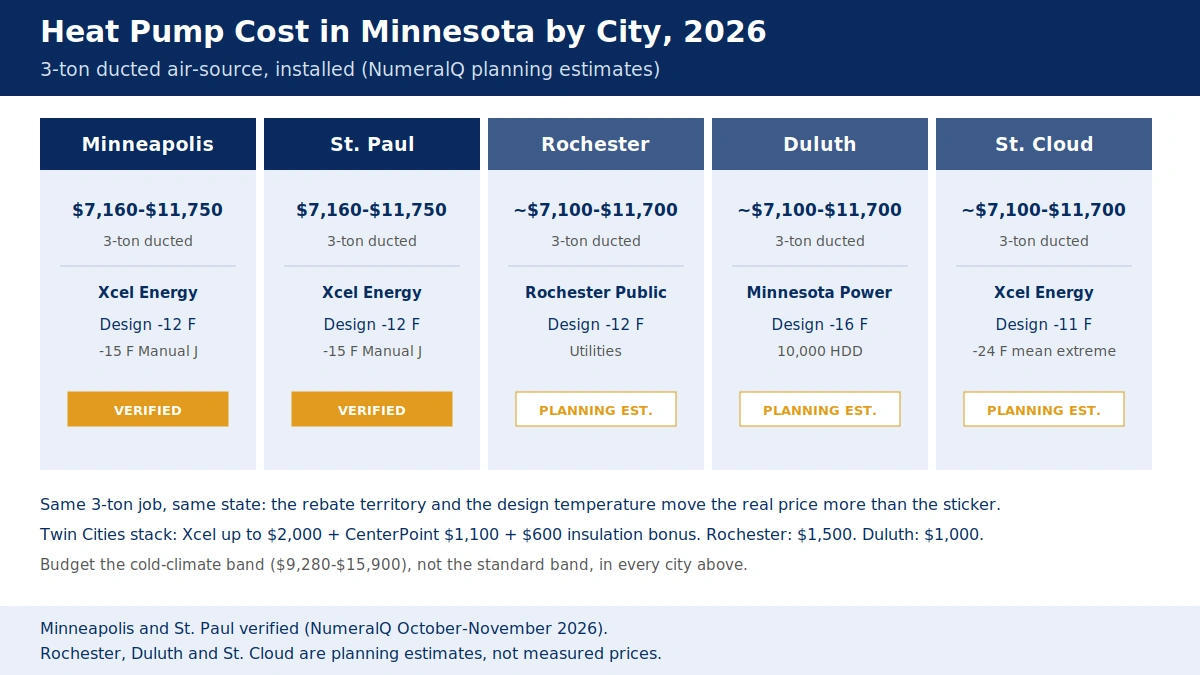
Minnesota is a large state with one dominant HVAC market — the Twin Cities — and several smaller ones a long drive apart, and the verified figures cluster tightly while the unverified ones carry warning labels. What sets the cities apart is not the equipment price, which is national, but labor, the rebate territory, and the cold: the same 3-ton system faces a minus 15 design temperature in Minneapolis, minus 12 in Rochester, minus 16 in Duluth, and minus 11 in St. Cloud on the 97.5 percent basis, with heating degree days running from 8,295 to 10,000. NumeralQ’s Minneapolis and St. Paul figures are the only verified city bands in this pass; the Rochester, Duluth, and St. Cloud figures are planning estimates, flagged as such, because no city-specific price was published for them.
| City | 3-ton ducted air-source | Utility | Design temp (97.5%) |
|---|---|---|---|
| Minneapolis | $7,160-$11,750 (NumeralQ) | Xcel Energy | -12 F (-15 F Manual J) |
| St. Paul | $7,160-$11,750 (NumeralQ) | Xcel Energy | -12 F (-15 F Manual J) |
| Rochester | ~$7,100-$11,700 (planning est.) | Rochester Public Utilities | -12 F |
| Duluth | ~$7,100-$11,700 (planning est.) | Minnesota Power | -16 F |
| St. Cloud | ~$7,100-$11,700 (planning est.) | Xcel Energy | -11 F |
Minneapolis and St. Paul price identically at $7,160-$11,750 for a 3-ton ducted system, and the identity is the story: one labor market, one BLS wage figure, one utility territory, one design temperature. The Bureau of Labor Statistics reports a single metro median for HVAC mechanics across the Minneapolis-St. Paul-Bloomington area — $37.25 an hour, about 27 percent above the national median of $29.33, with 2,420 technicians, the deepest bench in the state. The housing stock fights the installer in a specifically Twin Cities way: 1920s bungalows with ducts sized for a furnace, northeast duplexes with no room for an outdoor unit except the alley, and a minus 15 Manual J design temperature that makes the cold-climate unit the default. A Twin Cities buyer pays the state’s highest labor rate and collects its best rebate stack — Xcel’s $2,000 plus CenterPoint’s $1,100 plus the $600 insulation bonus, with a Minneapolis city bonus of $1,000, or $5,000 in a Green Zone, on top. That stack is why the Twin Cities, for all their labor cost, can produce the lowest net price in the state.
Rochester, in the southeast on Rochester Public Utilities, carries a planning estimate of about $7,100-$11,700 — the state band, applied to the city, because no Rochester-specific price was published in this pass. Rochester is the mildest of the five cities on paper, designed for minus 12 with 8,295 heating degree days, and its HVAC labor runs as dear as the Twin Cities’: the Rochester metro median is $37.26 an hour, a dollar above the metro figure, on a much smaller pool of 190 technicians. The rebate picture is Rochester’s own: RPU pays $1,500 for a ducted air-source heat pump used for heating and cooling, as a main system or in a hybrid setup, with applications for 2026 installs due by March 31, 2027, and funding limited enough that the program can be withdrawn without notice. Do not quote the Rochester figure as a NumeralQ figure, because it is not — but do not dismiss the RPU rebate either, because $1,500 with no Xcel territory behind it is real money.
Duluth, on Lake Superior in Minnesota Power territory, carries the same planning estimate, about $7,100-$11,700, and the coldest design conditions of the five: minus 16 on the 97.5 percent basis, 10,000 heating degree days, and lake wind that drives snow sideways into drifts against the uphill wall. Duluth is where the cold-climate unit stops being a recommendation and becomes a requirement, and where the outdoor unit’s placement — leeward wall, raised stand, clear of the drift line — matters as much as its rating. The rebate is Minnesota Power’s: $1,000 for a cold-climate ducted or ductless unit that maintains efficient operation down to at least 5 degrees, through a participating contractor, plus $800 a ton for ground-source. The lake-effect snow and the hillside lots push real Duluth quotes toward the top of any band, and a Duluth buyer should budget the cold-climate band, not the standard one, from the first conversation.
St. Cloud, in central Minnesota on Xcel Energy, carries the same planning estimate, about $7,100-$11,700, with a design temperature of minus 11 on the 97.5 percent basis — and a warning that the milder number misleads. The Minnesota code table built on mean extreme annual temperatures puts St. Cloud at minus 24, the coldest figure in the state table, and the 1971-2000 normals give the city 8,815 heating degree days with nearly 39 nights a winter at or below zero. St. Cloud winters are long, windy, and cold in a way the 97.5 percent figure understates, and a system sized to minus 11 without attention to the colder nights will lean on its backup heat for weeks. The Xcel rebate stack applies here as in the Twin Cities, and the co-op dual-fuel rates that serve much of central Minnesota can matter more than any rebate — check both before comparing prices.
Compare cities on price per ton rather than the headline total, and settle the rebate question before lining prices up side by side. A Duluth quote at the top of the band next to a Minneapolis quote at the bottom looks like a chasm, but most of it is the range itself — the same 3-ton job can land anywhere inside either city’s band with brand, ductwork, and the cold-climate premium. The rebate gap is the real one: a Twin Cities dual-fuel buyer can collect $3,700 before the city bonus, a Rochester buyer $1,500, a Duluth buyer $1,000, and a St. Cloud buyer the Xcel stack. The payback section below works through the fuel-by-fuel numbers, and the rebate section names every program’s conditions.
Minnesota’s Deep-Cold Climate: Design Temps, HDD & What Minus 15 Does to a Heat Pump
Minnesota holds the coldest winters in this series, and the heat pump that suits a southern Minnesota farm town can be the wrong machine for a Duluth hillside — not because the technology changes at the county line, but because the cold deepens by degrees that matter. The state sits in IECC climate zone 6 across the south and zone 7 across the north, two zones colder than Virginia and one colder than Massachusetts, which puts it at the edge of what air-source equipment was originally designed to do. That position is what makes the cold-climate unit the default here rather than the upgrade, and the backup-heat plan half the system rather than a footnote.
The design temperatures, and why three different numbers all claim to be the Twin Cities figure. Manual J sizing starts with a winter design temperature — the outdoor temperature the calculation assumes on the coldest night the system must handle — and Minnesota publishes it on three different bases, which is why three different numbers circulate. On the 97.5 percent basis, the temperature the weather stays above for 97.5 percent of winter hours, Minneapolis designs for minus 12 degrees, Duluth for minus 16, Rochester for minus 12, and St. Cloud for minus 11. On the 99 percent Manual J basis most Twin Cities contractors actually size to, Minneapolis designs for minus 15. On the mean-extreme basis in the Minnesota code table — the coldest night of an average year — Minneapolis designs for minus 17 and St. Cloud for minus 24. All three are published. All three are correct on their own basis. The number that governs your quote is the one on the Manual J, and a contractor who will not name the basis is a contractor who has not done the calculation. For scale, the Massachusetts guide in this series designs around 9 degrees in Boston and the Virginia guide around 14 in Richmond; Minneapolis at minus 15 sits 24 degrees colder than Boston and 29 colder than Richmond, and every one of those degrees is capacity the heat pump must deliver against.
The heating degree days. Minneapolis piles up 8,382 heating degree days a year on the ICC Appendix D figures, Rochester 8,295, Duluth 10,000, against 5,634 in Boston and 3,963 in Richmond. The newer NOAA 1991-2020 normals put Minneapolis at 7,399 — a warmer vintage, reflecting three warmer decades, and a reminder that degree-day figures carry their era with them. Either way, the Minnesota heating season is roughly double Richmond’s and half again Boston’s, which is why the efficiency tier pays back faster here and why the backup-heat share matters more: a machine that runs 2,000 heating hours a year multiplies every point of COP by 2,000 hours, and every hour on resistance strips by the same. Cooling, by contrast, is a footnote: 527 cooling degree days in Minneapolis, 176 in Duluth. A Minnesota heat pump is bought for January. July is a bonus.
What minus 15 does to a heat pump. An air-source unit harvests heat from outdoor air, so colder air means a thinner harvest. Capacity and efficiency fall together — and in Minnesota they fall a long way. Take the familiar nameplate first: a standard 3-ton unit rated at 36,000 BTU an hour at 47 degrees. At 5 degrees, a cold-climate unit still delivers 70 to 80 percent of its rated capacity with a COP between 2.2 and 2.8, while a standard unit keeps 40 to 60 percent with a COP falling toward 1.0. At minus 5, the cold-climate unit keeps 60 to 70 percent with a COP of 1.8 to 2.4, and the standard unit is locking out or running on strips. At minus 15 — the Twin Cities design temperature — a cold-climate unit still produces useful heat at a COP of roughly 1.2 to 1.8, while a standard unit has long since surrendered. That is why this guide plans on a seasonal COP of 1.8 to 2.5 for a cold-climate unit in Minnesota, with 2.0 as the central case: most of the season sits in the teens and 20s, where the machine works at a COP near 2.5, but the coldest weeks drag the seasonal average down, and a planning figure that ignored those weeks would flatter every payback in this guide. Even the best air-source unit fades below minus 15, and on a St. Cloud night at minus 24 it cannot heat the house alone. Backup heat is not a footnote in Minnesota. It is half the system everywhere in the state.
Snow, drift, and the defrost cycle. Under freezing, airborne moisture frosts the outdoor coil, and the unit periodically reverses to melt that frost — pushing cool air indoors for a few minutes each time it does. Minnesota winters are dry compared with coastal ones, so a Twin Cities unit defrosts less often than a Virginia Beach unit — but Minnesota snow is the problem the coast never has. A unit sitting at grade will disappear into a drift after the first blizzard, and a unit that cannot breathe cannot defrost, cannot draw heat, and cannot run. Lifting the unit on a wall bracket or a raised stand, with the pad draining away from the house and the intake clear of the drift line, adds a few hundred dollars to the quote — and it is what separates a unit that runs clean all winter from one that ices itself into a February service call. The meltwater has to go somewhere too: a unit that defrosts onto a walkway builds an ice sheet where people walk. Site the unit where its melt drains to dirt, not to concrete.
Wind is the Duluth line item, and the north-shore line item. A Lake Superior wind can push snow sideways into drifts against a Duluth wall and drive it straight into an outdoor coil, and an outdoor unit on the windward side, below a roof valley that sheds snow, or beside a driveway the plow buries will spend the winter starved for air. Site it on the leeward wall under an eave that sheds snow away from the unit, keeping open space all around for airflow and for a technician working in a storm. Where the wind has a clear run at the house, a baffle on the intake side — nothing more than a plain shield — stops driven snow packing into the coil. The catalog never mentions any of it. The February service bill does.
Start with the house, not the machine. The house decides the outcome more than the machine does. A heat pump’s register air runs 90 to 110 degrees; a gas furnace’s runs 120 to 140. A tight, well-insulated house never notices that gap. A leaky 1920s bungalow — single-pane glass, bare walls, vented crawlspace — feels it nightly: the rooms seem permanently one step behind the thermostat, and at minus 10, they are. The cheapest capacity a Minnesota homeowner can buy is air sealing and insulation — every BTU kept inside is one the heat pump need not make at minus 15, and one the backup heat need not make either — and Xcel pays a $600 bonus when the envelope work precedes the heat pump within two years. Schedule the energy assessment and the insulation quote ahead of the heat pump quotes. Where the house needs both jobs, tighten the envelope first and size the heat pump after: the tightened house can drop a full ton. A smaller machine costs less to buy and less to run, so spending on the envelope first is the one place in this purchase where paying early means paying less twice over, and in Minnesota it can also be the difference between a machine that holds the house at minus 15 and one that does not.
Heat Pump vs Gas Furnace in Minnesota: The Running-Cost Math
Every number in this guide comes back to this section, and it is also where Minnesota differs most sharply from every warmer state in this series — because here the heat pump loses to the gas furnace on fuel at the standard electric rate by a margin no equipment tier closes, and wins only when the rate changes. Every figure that follows is NestPriced arithmetic, built in the open from published prices. The assumptions sit in plain view, so any reader can redo the sums with a different utility rate or a different house.
The planning home. The planning home is a 2,000-square-foot house near the Twin Cities needing roughly 74 million BTU of delivered heat a year — a planning assumption that scales the 50-million-BTU Boston home in this series up by Minneapolis’s 8,382 heating degree days. Seventy-four million BTU equals 21,688 kilowatt-hours of heat. From here the section divides that heat by each machine’s efficiency, then multiplies by what its fuel costs. A tighter or smaller home needs less heat and the dollar gaps shrink with it; a larger or draftier home needs more and the gaps grow. The ratios — the break-even COPs — do not move with the house. They move with the rates.
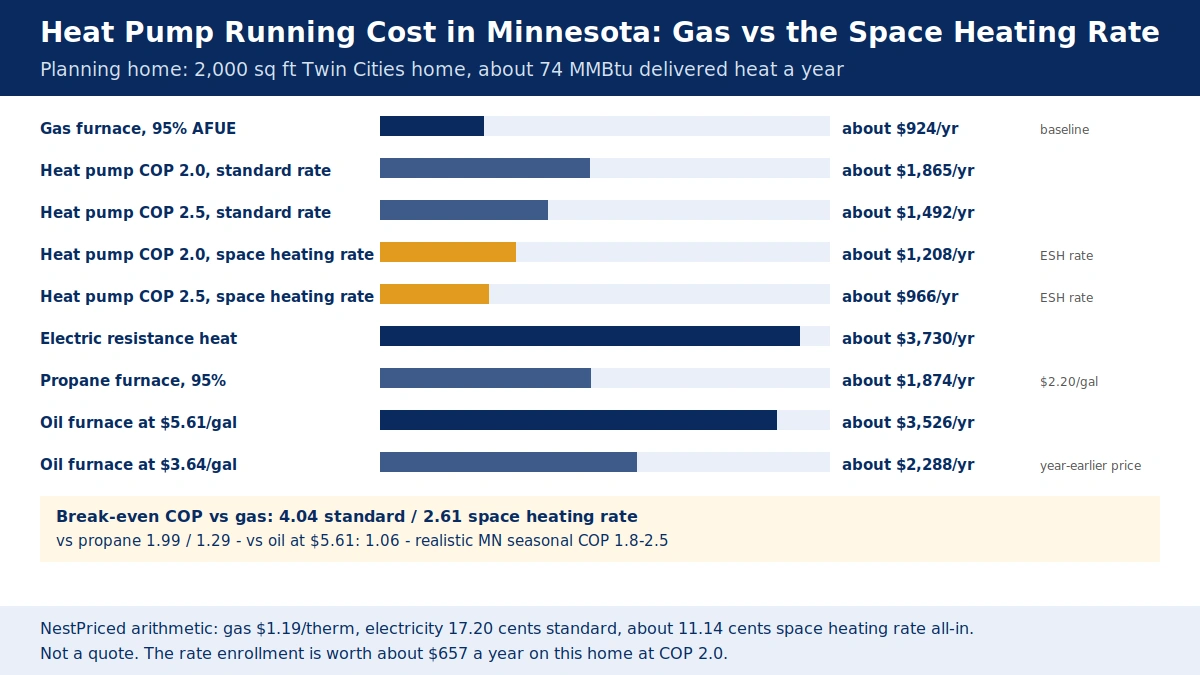
The gas furnace. The furnace goes first: delivering 74 million BTU through the registers at 95 percent AFUE takes about 77.9 million BTU of gas in, or 779 therms. At Minnesota’s residential gas price of about $1.19 a therm (EIA, 2026 year-to-date average of $12.29 per thousand cubic feet, released October 2026), the fuel bill lands near $924 a year. That gas price is the central fact of Minnesota heat pump economics: gas here is among the cheapest in the country, and the winter forecast runs cheaper still — the EIA Winter Fuels Outlook puts Midwest gas at $10.38 per thousand cubic feet for the 2026-27 winter, about $1.00 a therm, which would drop the furnace bill toward $780. Do not use a summer gas price for this math: the August figure of $18.06 per thousand cubic feet folds fixed charges over tiny summer volumes and would flatter the heat pump by hundreds of dollars. The heating-season price is the honest one, and it is low.
The heat pump at the standard rate. A cold-climate heat pump at a seasonal COP of 2.0 — the central Minnesota planning case, between the 2.2 to 2.8 it manages at 5 degrees and the 1.2 to 1.8 it holds at minus 15 — draws 10,844 kilowatt-hours to deliver the same 74 million BTU. Priced at Minnesota’s all-in average of 17.20 cents per kilowatt-hour from the EIA’s August 2026 data, the same heat runs close to $1,865 over a year. At a seasonal COP of 1.8 it runs about $2,072 a year; at 2.5, about $1,492; at 3.0, about $1,243. Set those beside the gas furnace’s $924: at COP 2.0 the heat pump costs about $941 a year more than gas; at COP 2.5, about $568 more; even at COP 3.0 — a seasonal figure no Minnesota winter delivers for an air-source unit — it costs about $319 more. That is the blunt fact, and any quote claiming a Minnesota heat pump beats a 95 percent gas furnace on fuel at the standard electric rate is pricing a different winter than the one Minnesota has.
The break-even COP, and why the rate is the whole story. Flip the question and it sharpens: what efficiency would a heat pump need to tie the gas furnace dollar for dollar? The break-even COP falls out of one division: electricity’s price per million BTU over gas’s price per million BTU at 95 percent efficiency. Electricity at 17.20 cents a kilowatt-hour is $50.41 per million BTU; gas at $11.86 per million BTU becomes $12.49 once the furnace’s 5 percent loss counts, and the ratio lands the break-even COP at 4.04. No air-source heat pump holds a seasonal COP of 4.04 through a Minnesota winter. The best cold-climate units hold 2.0 to 2.5 across the season. The gap between 2.0 and 4.04 is the gap between the heat pump and the gas furnace on the standard rate, and no rebate closes it, because it recurs every winter for the life of the machine.
The heat pump on Xcel’s electric space heating rate. Now change the rate and watch the answer move. Xcel’s electric space heating rate charges an energy component of 6.537 cents a kilowatt-hour from October through May, and with riders and fuel charges the all-in winter figure lands near 11.14 cents (ACEEE-modeled, August 2026). At 11.14 cents, the same heat pump at COP 2.0 costs about $1,208 a year — $657 less than at the standard rate, and only about $284 more than the gas furnace. At COP 2.5 on the space heating rate it costs about $966 a year, within $42 of the furnace. The break-even COP on the space heating rate is 2.61 — high for a Minnesota winter, but inside the range a good cold-climate unit approaches in a mild year or a tight house. The rate does not make the heat pump beat gas outright. It makes the race close enough that the air conditioning, the comfort, and the rebate stack can decide it. Enroll before the first winter: the rate cannot be applied retroactively, there is no cost to enroll, and no metering equipment is needed. A buyer who installs the heat pump and never makes the call pays the standard rate all winter and loses the $657 a year the rate would have saved.
The backup-heat adder. That arithmetic credits the heat pump with every one of the 74 million BTU at its seasonal efficiency. A real Minnesota winter hands part of the season’s heat to the backup system, and that slice carries the highest price. Say 15 percent of the season’s heat comes from electric resistance strips — a fair share for a cold-climate unit on the coldest weeks, a low share for a standard unit. That slice, delivered at a COP of 1.0 instead of 2.0, adds roughly $280 a year at the standard rate — an illustration, not a bill. That 15 percent is where dual-fuel earns its keep in gas territory: below the switchover point the furnace covers it at gas prices instead of resistance prices, the heat pump never sinks toward a COP of 1.0, and the strips stay off on the coldest nights.
What the heat pump beats, clearly. Resistance heat is the matchup the heat pump dominates: baseboards, electric furnaces, and space heaters all lose to it by a wide margin, in every corner of the state. The resistance bill for the same 74 million BTU comes to about $3,730 a year at the state-average price — $1,865 a year more than the heat pump’s $1,865 at COP 2.0, every single year, and the heat pump halves the bill even before the space heating rate. Against propane the race is closer than in any state where propane costs $3.50 or more: a 95 percent propane furnace at $2.20 a gallon costs about $1,874 a year for the planning home, against the heat pump’s $1,865 — a difference of about $9, which is to say no difference at all at the standard rate. On the space heating rate the heat pump wins clearly, saving about $666 a year. Against heating oil at $5.61 a gallon the heat pump wins decisively: an 85 percent oil furnace costs about $3,526 a year, and the heat pump saves about $1,661 a year at COP 2.0. At last year’s oil price of $3.64 a gallon the oil bill falls to about $2,288 and the saving shrinks to about $423 — still a win, but a slower one. The break-even COPs tell the same story from the other side: against propane, 1.99 at the standard rate and 1.29 on the space heating rate; against oil at $5.61, 1.06 and 0.69; against oil at $3.64, 1.63 at the standard rate. A cold-climate unit at a seasonal COP of 2.0 clears every one of those lines except the gas line.
Cooling, counted honestly. A heat pump doubles as the air conditioner, and a Twin Cities July in the high 80s with humidity to match is where that pays off — though in Minnesota the cooling season is short, about 527 cooling degree days against 8,382 heating degree days, so the cooling value is real but smaller than in the south. Cooling bought on its own costs several thousand dollars, which means part of the heat pump’s price tag is air-conditioning money the buyer would have spent anyway. Stop comparing the whole sticker: compare only the extra over the furnace-plus-AC pair being replaced, and the sums suddenly look far kinder than the fuel-only view. Minnesota’s premium framing is unusually strong: planning figures put a 3-ton furnace-plus-AC system at $8,940-$14,890 and the ducted heat pump at $7,120-$11,700, so the heat pump usually undercuts the pair it replaces and leaves no premium to recover. The comparison above is Minnesota’s state-specific cut of the national fuel-by-fuel race in our heat pump running cost guide and our heat pump vs furnace guide.
Dual-Fuel vs All-Electric in Minnesota: The Switchover Decision
Minnesota is the state where the dual-fuel question stops being a preference and becomes the decision itself, because the fuel map and the cold pull in opposite directions. The gas majority has a furnace that beats the heat pump on fuel all winter at the standard rate. The electric, propane, and oil minority has no furnace to fall back on. The right answer for one group is the wrong answer for the other, and a guide that recommended one configuration for the whole state would mislead half its readers. This section keeps the two answers separate.
How dual-fuel works, and what the switchover temperature decides. A dual-fuel system pairs a heat pump with a gas furnace and a control that hands the load from one machine to the other at a single outdoor temperature — the switchover. Above the switchover, the heat pump runs, because its COP is high and the space heating rate makes its power cheap. Below it, the furnace runs, because gas at $1.19 a therm beats any air-source machine in deep cold. The switchover is not a factory preset to accept blindly. It is the economic balance point, and it moves with the rates: on the standard electric rate, where the break-even COP is 4.04, the economic switchover sits high — the heat pump only wins in mild weather, roughly above the mid-30s. On the space heating rate, where the break-even COP is 2.61, the switchover can sit lower, in the 20s, because the heat pump stays competitive deeper into the cold. The program rules bracket the choice: Xcel’s space heating rate requires a dual-fuel switchover at or below 35 degrees, and CenterPoint’s dual-fuel rebate requires the heat pump to hand off at 40 degrees or below. Ask which temperature was picked and why, and get it in writing — a setting 10 degrees too high hands the furnace months of work the heat pump could have done cheaper on the space heating rate, and one 10 degrees too low hands the resistance strips, or a struggling heat pump, a January they cannot afford.
The dual-fuel economics, worked. Take the planning home and split its 74 million BTU: 60 percent through the heat pump at a COP of 3.0 in the mild weather it owns, on the space heating rate, and 40 percent through the 95 percent gas furnace in the deep cold. The heat pump’s share costs about $483 a year. The furnace’s share costs about $371. The total, about $853, beats the all-gas $924 by about $71 a year — a modest saving, honestly stated, and an illustration rather than a promise. The real dual-fuel value is not the $71. It is the air conditioning the house gains, the furnace hours saved across the shoulder seasons, the $3,100 in combined Xcel and CenterPoint rebates, and the option value: if gas prices rise or the space heating rate improves, the switchover drops and the heat pump takes more of the season. Dual-fuel is the configuration that keeps both options open, and in a state where the fuel-price ratio can move, that flexibility is worth more than the first year’s saving suggests.
All-electric, and what it demands. All-electric means the heat pump plus resistance strips, with no furnace at all. It is the right answer for the home with no gas line — the propane and oil homes past the mains, the all-electric homes already on baseboards — and for the homeowner who wants one system and is willing to pay for the strips’ share of January. What it demands is honesty about three things. First, the panel: strips draw heavy current, and a 100-amp service in an older home may need the $2,530-$3,890 upgrade before the strips can be sized to cover the design load. Second, the rate: all-electric without the space heating rate is the most expensive way to heat a Minnesota home with a heat pump, and enrolling in the rate is not optional but essential — the difference is $657 a year on the planning home at COP 2.0. Third, the strips themselves: they must be sized to carry the full design load alone, because on the coldest night the heat pump contributes least and the strips carry the house. A quote that sizes the strips as an afterthought has left out the part that keeps the house warm at minus 20.
The co-op dual-fuel rate, and the second meter. Much of rural Minnesota is served by electric cooperatives, Minnesota Power, or Otter Tail Power, and many of those utilities offer a controlled dual-fuel rate: the utility may interrupt the heat pump during peak demand, the backup heat covers the interruption automatically, and in return the electric rate drops sharply. It is the rural cousin of Xcel’s space heating rate, and for a propane home on a co-op it can be the difference between a heat pump that pays and one that does not. The catch is hardware: Minnesota Power and Otter Tail require a second meter for the dual-fuel rate, which can be costly to install, and the heat pump model must be compatible with the utility’s load-management control system. Check the rate, the meter cost, and the compatible-product list before counting the saving — and check whether your co-op’s rebate, typically $150 a ton for air-source, stacks with the rate. The rate section of the rebate discussion below names the programs that could be verified; your own co-op’s terms decide your own case.
The third path: ground-source, where the switchover disappears. A geothermal system has no switchover temperature, because the ground does not have a cold snap. At a COP of 3.5 through the winter, the planning home’s heat costs about $1,066 a year at the standard rate — more than the gas furnace’s $924, but far less than the air-source heat pump’s $1,865 at COP 2.0, and the gap against propane ($1,874) and oil ($3,526) is large. Geothermal is the all-electric answer for the long-term owner who wants the switchover question to go away entirely, at $21,460-$33,470 installed with no federal credit to soften it. It is not the answer for the gas-heated home counting on a fuel saving: against gas it still loses about $142 a year on fuel at the standard rate, and the payback needs the cooling value, the longevity, and the absence of a furnace replacement to carry it.
Who should choose which. Dual-fuel wins for the gas-heated home with a furnace in reasonable condition or due for replacement anyway, especially in Xcel and CenterPoint territory where the rebate stack and the space heating rate both apply. All-electric wins for the home with no gas line, the propane or oil home ready to leave its tank behind, and the homeowner who wants a single system and will enroll in the space heating rate on day one. Geothermal wins for the long-term owner on a big lot who will stay twenty years and wants the steadiest winter COP in the state. A standard air-source unit as the sole heat source wins for almost no one in Minnesota — and a lease wins for no one either, because no provider was verified selling one here.
Utility Rebates & What You Can Actually Collect in 2026
Minnesota’s rebate picture is the richest in this series for a buyer who knows where to look, and the most misleading for a buyer who does not — because the money is split across two gas and electric utilities, a municipal utility, a regional utility, dozens of cooperatives, and four city programs, each with its own territory, equipment tier, and paperwork, and no single headline number applies to every Minnesota home. A buyer who assumes the $2,000 Xcel figure applies statewide will be disappointed in Duluth. A buyer who checks their own utility first will know exactly what is on the table, and in the Twin Cities what is on the table is the best stack in the Midwest.
Xcel Energy pays the most, and its tiers reward the cold-climate machine. Xcel Energy, which serves about half of Minnesota’s residential electric customers including the Twin Cities, St. Cloud, and much of the south, publishes its heat pump rebates in a 2024-2026 residential summary confirmed in October 2026. A ducted air-source heat pump earns $1,600 if the home gets gas, or both gas and electricity, from Xcel, and $1,100 if it gets only electricity — the unit must meet 15.2 SEER2, 9.6 EER2, and 7.8 HSPF2, with a Quality Installation. A cold-climate ducted unit earns $2,000 for a gas or combined customer and $1,500 for an electric-only customer, and the model must be listed on the NEEP cold-climate product list with a COP of 1.75 or higher at 5 degrees. A ductless mini-split earns $1,600, or $2,000 for a cold-climate mini-split. Three conditions matter: the work must be done by a participating contractor with an Xcel contractor ID, mini-split heat pumps need a backup heat source, and applications must be postmarked by September 30 of the year after installation. One conflict needs a flag attached: the Center for Energy and Environment’s Minneapolis bonus rebate table lists lower utility figures for ducted systems — $900 electric for cold-climate, $500 for standard — which conflict with the Xcel summary figures above. This guide uses the Xcel summary figures as the most recent and flags the CEE table — confirm the current amount with Xcel before you count it. Either way, the rebate reaches only Xcel customers, and only through a participating contractor.
The $600 insulation bonus is the rebate that pays twice. Add qualifying insulation and air sealing first, and Xcel pays a $600 bonus automatically when the heat pump follows within two years. It is the smallest rebate in the stack and the most valuable per dollar, because the envelope work it rewards cuts the heating load, which cuts the heat pump size, which cuts the backup heat — the only rebate that improves every row of the payback table at once. Do the insulation first, keep the paperwork, and claim the bonus with the heat pump application. A contractor who proposes the heat pump before the insulation has the order backward, and in Minnesota the backward order costs $600 plus a ton of capacity.
CenterPoint Energy pays $1,100 for the dual-fuel pair — gas territory only, ducted only. CenterPoint Energy, the gas utility for the Twin Cities metro and much of southern Minnesota, offers a ducted air-source heat pump rebate of $1,100 for an existing home and $400 for new construction, when the heat pump is used for hybrid heating with a high-efficiency natural gas furnace rated 92 percent AFUE or higher. The heat pump must rate at least 7.8 HSPF, be listed on the AHRI directory, and be installed between January 1 and December 31, 2026, with the application submitted in the same calendar year. The program requires the heat pump to hand off to the furnace at 40 degrees or below, and mini-split and ground-source systems do not qualify for this rebate at all. CenterPoint’s furnace rebates stack on the same job: $1,000 for a 97 percent or higher AFUE replacement furnace, $400 for 96 to 96.9 percent, $200 for 92 to 95.9 percent. A dual-fuel job with a new 97 percent furnace can therefore collect $1,100 for the heat pump and $1,000 for the furnace from CenterPoint alone, plus Xcel’s $2,000 — before the insulation bonus. The rebate is independent of any state, electric utility, or co-op offer, which is the program’s own wording for “yes, it stacks.”
Minnesota Power pays $1,000 in the northeast, and more for ground-source. Minnesota Power, serving Duluth and the northeast, pays $1,000 for a cold-climate air-source heat pump, ducted or ductless, that maintains efficient operation down to at least 5 degrees, through a participating contractor, for installs in calendar year 2026. A standard ducted unit earns $400. Ground-source earns $800 a ton, or $1,000 a ton with a Master Installer from the Minnesota Geothermal Heat Pump Association, and new construction earns a $1,500 cold-climate bonus and up to $1,200 a ton for ground-source. One practical note: Minnesota Power’s online rebate applications were reported down at the November 2026 check, so a Duluth buyer should confirm the application route with the utility or the participating contractor rather than assuming the portal works. The money is real. The paperwork route needs a phone call.
Rochester Public Utilities pays $1,500, with a hard deadline. Rochester Public Utilities, the municipal utility for Rochester, pays $1,500 for a ducted air-source heat pump used for heating and cooling, whether as the main system or in a hybrid setup with backup heat. Cooling-only units earn $100 to $200. Mini-split and ground-source rebates run from separate tables whose amounts this guide could not verify in this pass — flagged, not stated. Applications for 2026 installs are due by March 31, 2027, funding is limited, and the program can be withdrawn without notice, so a Rochester buyer should file early and keep the AHRI certificate with the application. Rebates of $500 or less arrive as a bill credit; larger ones arrive as a payment, applied to any past-due balance first.
Cooperatives, city matches, and the gaps. The electric cooperatives that serve much of rural Minnesota pay smaller amounts on their own schedules — the Minnkota system, for example, pays $150 a ton for air-source and mini-split units and $250 a ton for ground-source, capped at $1,500 per off-peak meter — and every co-op’s terms differ, so no statewide co-op figure is stated here. Four city programs match or add to utility rebates: Minneapolis pays a bonus of $1,000 for a cold-climate heat pump outside a Green Zone and $5,000 inside one, first-come first-served, for work completed after December 15, 2025, with combined city and utility rebates capped at the project cost; Edina matches an awarded utility rebate; Hopkins rebates ENERGY STAR cold-climate units through its Climate Solutions Fund; Northfield matches 50 percent of an awarded Xcel rebate up to $2,500; and St. Louis Park matches an awarded utility rebate through Climate Champions. The Edina, Hopkins, and St. Louis Park amounts could not be verified in this pass and are not stated. Minnesota Energy Resources, the gas utility for parts of the state outside CenterPoint territory, had no heat pump rebate amount this guide could verify — its conservation program lists furnace and equipment rebates with amounts confirmed at estimate, and no heat pump figure is stated here. If your gas comes from Minnesota Energy Resources, ask the utility directly and get the answer in writing before budgeting.
The honest summary. Add up what a Minnesota buyer can actually collect in 2026: up to $2,000 from Xcel plus $600 for the insulation bonus, plus $1,100 from CenterPoint on a dual-fuel job, plus up to $1,000 more for the furnace, plus a city bonus of $1,000 to $5,000 in Minneapolis — a Twin Cities dual-fuel stack that can pass $4,000 before the city money. A Rochester buyer collects $1,500. A Duluth buyer collects $1,000. A co-op buyer collects a few hundred. A Minnesota Energy Resources gas customer collects whatever the utility confirms, and nothing is assumed. The rebate is a real factor in Minnesota in a way it is not in Virginia — but only for the buyer whose address, equipment, contractor, and paperwork all line up, and only after the federal money that is not there has been subtracted from the quote.
Federal Help in 2026: $0 Tax Credit, Save Energy Minnesota Not Launched & the Lease Route
The federal picture for 2026 is short enough for one paragraph — which is exactly why so much heat pump advertising still gets it wrong, and why Minnesota buyers need the second half of the paragraph too. The federal rebates that would matter most here have not launched at all, the state rebate that would follow them cannot start until they do, and even after they launch, the federal rules shut out the gas-heated majority. A Minnesota quote that counts federal money in 2026 is counting money that does not exist yet for anyone, and may never exist for a gas-heated home.
The tax credit is gone, and the date that matters is the finish date. Congress repealed the Energy Efficient Home Improvement Credit when it passed the One Big Beautiful Bill Act, Public Law 119-21, on July 4, 2025. Under the old law, section 25C returned as much as $2,000 a year for an air-source heat pump. Equipment placed in service after December 31, 2025, falls outside it entirely. Under IRS fact sheet FS-2025-05, the finish date is what counts, not the payment date: paying the deposit in 2025 changes nothing when the crew finished the work in January 2026. The 30 percent Residential Clean Energy Credit under section 25D closed that same day, taking the geothermal credit down with it. A 2026 quote that still deducts a federal credit is pricing under a dead law — send it back for a revision with the line struck. Our federal tax credits guide explains the July 4, 2025 cutoff and why the completion date is the one the IRS looks at. A homeowner-bought system installed in 2026 earns a federal tax credit of $0.
Minnesota’s HEAR and HOMES rebates have not launched, and the state will not give a launch date. The programs run under the name Save Energy Minnesota, administered by the Minnesota Department of Commerce. The department’s update of October 12, 2026, is blunt: Save Energy Minnesota has not launched yet, Minnesota is waiting for formal approval from the United States Department of Energy, and there is no estimated program launch date. The sequence explains the wait: the Energy Department issued new program rules in May 2026, Commerce submitted a revised application in August 2026, and the approval has not arrived. A November 4, 2026, verification confirmed the same status. Do not count on this money when you buy. Do not let a quote count it. Do not take a salesperson’s word that it is coming soon — the department itself will not name a date, and the program warns that rebates cannot be approved retroactively for equipment bought before launch.
Even after launch, HEAR will not fund a switch for a home heated by gas or propane. That is the most important federal fact this guide carries, and it bites harder in Minnesota than in almost any other state. HEAR pays as much as $8,000 for a heat pump for households under 80 percent of area median income, and up to $4,000 for households between 80 and 150 percent. Program Notice 26-2, issued by the Energy Department on May 29, 2026, confines the money to electric-to-electric upgrades. That means replacing electric equipment with more efficient electric equipment — or new construction, and nothing else. A home that trades a gas or propane furnace for a heat pump has fuel-switched, and under Notice 26-2 that switch takes the rebate off the table. In Minnesota only about 19 percent of homes heat with electricity, so the households that could use HEAR, once it launches, are the minority: the baseboard-heated homes moving to a cold-climate heat pump, which is the configuration HEAR was written for. The 65 percent on gas and the 12 percent on propane or oil are outside it. HOMES, the whole-home efficiency program, pays on measured or modeled energy savings — as much as $8,000 — instead of on the equipment list, prioritizes weatherization, excludes new construction, and Minnesota has not launched that one either.
The state $4,000 rebate cannot start until HEAR does. Minnesota’s own Residential Heat Pump Rebate, under Minnesota Statutes section 216.46, will pay the lesser of $4,000 or the total install cost minus the HEAR rebate and other rebates — but only to an applicant who has first received a HEAR rebate, for an ENERGY STAR certified cold-climate air-source heat pump in an owner-occupied primary residence. The program begins at the same time as Save Energy Minnesota, which has not launched. The $4,000 is therefore doubly out of reach in 2026: the program is not running, and its precondition is not running either. A quote that stacks $8,000 of HEAR plus $4,000 of state money onto a 2026 install is stacking $12,000 of programs that do not exist yet, for a gas-heated home that would not qualify for the first $8,000 even after launch.
No verified lease route exists in Minnesota. Company ownership changes the federal picture: a heat pump a firm owns rather than the Minnesota homeowner can still earn the 30 percent clean-electricity credit under section 48E. The catch is timing. Under IRS Notice 2025-42, construction must have begun by July 4, 2026, with the system in service by December 31, 2027. In states where homeowners may buy power from a third party’s system, the credit goes to the owning company, which passes part of it back as a lower monthly lease or power-purchase payment. This pass found no company leasing heat pumps to Minnesota homeowners and no confirmation that third-party power-purchase agreements are authorized here, so the lease route stays unverified for this state. Put any lease offer in front of a lawyer before signing: a monthly payment that looks cheap can hide a lien, a buyout clause, or a term longer than the equipment’s life. The honest summary: in 2026 Washington pays nothing toward a Minnesota homeowner’s own heat pump purchase, and it cannot be counted on to pay indirectly through a lease either. On a cash quote, the price is the price — less whatever your utility pays, which in the Twin Cities can be substantial and in much of the rest of the state is modest.
Permits & Licensing: No State HVAC License, the $25,000 Bond & City Rules
Minnesota’s licensing picture surprises buyers who come from states with a single HVAC license to check, because Minnesota does not have one — and the correction matters, because the protection that does exist is a bond filing most buyers never think to ask about. There is no state competency license for HVAC work in Minnesota. What the state requires instead is money on file: a $25,000 mechanical contractor bond with the Department of Labor and Industry. A buyer who knows to ask for the bond filing, the city credential, and the electrician’s license is protected. A buyer who assumes a state license exists and accepts a yes at face value has checked nothing at all.
Minnesota licenses the trades around the heat pump, but not the heat pump trade itself. Under Minnesota Statutes section 326B.197, anyone who installs gas piping, heating, ventilation, cooling, air conditioning, fuel-burning, or refrigeration equipment must post a $25,000 bond and file it with the Department of Labor and Industry’s Construction Codes and Licensing Division. The filing fee is $100, the filing is valid for two years, and the bond must be written by a surety company licensed to do business in Minnesota. The bond guarantees compliance with the Minnesota State Mechanical Code and payment of valid claims from customers, employees, or suppliers harmed by non-performance. It is not a competency exam: there is no state test, no state experience requirement, and no state license for individual employees of mechanical contractors. The question is never “are you licensed for HVAC,” because in Minnesota the answer is a bond record, not a license. The question is whether the bond filing is current with DLI, whether the crew holds the city credential where the work sits, and whether both can be verified before anyone touches the house.
The city credential is where competency is actually checked. Cities may require licensure or a competency card for workers performing mechanical work, and those credentials are not issued by DLI. Minneapolis requires HVAC Class A or Class B licensing — Class A requires the state $25,000 bond, Class B a $10,000 city bond — plus gas fitter contractor licensing for gas work. St. Paul requires a Plumbing and Gasfitter Business Trade License. Smaller cities vary, and some require nothing beyond the state bond filing. The practical rule: ask the city building department what credential the job requires, then ask the contractor to produce it. A contractor who works the whole metro should hold the Minneapolis and St. Paul credentials as a matter of course; a contractor who cannot produce the credential for your city is a contractor to pass over, whatever the bond filing says.
The licenses on the edges of the job matter just as much. The electrical connections need a licensed electrician under the DLI system — electricians and electrical contractors are state-licensed in Minnesota, unlike HVAC mechanics — and the gas piping for a dual-fuel job needs a gas fitter credential. Federal EPA Section 608 certification is mandatory for anyone handling refrigerant — ask for the card, in the technician’s own name. If nobody on the heat pump crew holds an electrician’s license, the wiring falls to a licensed electrician, and the electrical permit should carry that electrician’s name, not the HVAC firm’s. The rebate adds a credential of its own: Xcel, Minnesota Power, and the other utilities require a participating contractor, or the rebate does not apply, whatever bonds the company holds. And geothermal boreholes fall under the Minnesota well code, administered by the Department of Health: vertical loops need a licensed well contractor, a separate credential from everything above.
The city controls the permit clock, so inspection timing is the city’s call, not the installer’s. Both permits, mechanical and electrical, are the city or county building department’s to issue, and the inspection covers the outdoor unit’s siting, the refrigerant lines, and the disconnect. No Minnesota-wide permit fee schedule was verified for this guide; fees vary by locality and usually follow the job cost. One local figure could be verified: mechanical permits for existing Minneapolis homes run $85 to $220. Do not borrow another state’s schedule — the figure belongs to the city issuing the permit. What slows a Minnesota install is the schedule, not the sticker: strong crews carry bookings weeks deep through the shoulder seasons, so a next-day October slot means a crew that is either very lucky or very quiet. In the Twin Cities, the permit itself is rarely the delay; the crew’s backlog is.
Two consumer protections deserve a paragraph of their own. Minnesota’s Contractor Recovery Fund pays up to $100,000 per homeowner and $550,000 total per licensed contractor for homeowners who win a judgment a contractor cannot pay — keep the signed contract, every receipt, and the contractor’s bond and license numbers, because a fund claim depends on them. And Minnesota’s mechanic’s lien law requires contractors to put the state lien notice in the written contract or deliver it within 10 days, or lose lien rights, with subcontractors notifying the homeowner within 45 days. Read the contract for the lien notice before signing, and never pay in full before the final inspection passes. The placement fight happens in condos and associations, and no Minnesota law was found that gives heat pump owners the solar-style protection some states grant: an outdoor unit shows itself in a way a furnace never does, so an association can limit where it sits and whether the street can see it. Get the placement agreed in writing before the unit is ordered, with the installer in the conversation early — a unit sited to suit the association and against the wind costs more to run and more to service.
What Pushes Your Minnesota Quote Up or Down
A per-ton anchor orients a budget; it cannot price a specific house. Seven forces can move a Minnesota heat-pump quote by thousands in either direction, and three of them come from the state’s cold and its labor market rather than from the equipment.
Labor is expensive in Minnesota — the second-highest wage floor in this series. Labor is the largest soft cost on any install, and Minnesota labor is dear: HVAC mechanics earn a median $36.71 an hour statewide ($76,350 a year, BLS May 2025), against $29.33 nationally, and the Minneapolis-St. Paul metro median runs higher still at $37.25 an hour, about 27 percent above the national median, with 2,420 technicians. Rochester matches the metro at $37.26. Central Minnesota runs lower at $33.70 and the northwest lower still at $29.22, which is why a St. Cloud or Bemidji quote can undercut a Twin Cities quote on labor alone. What swings a Minnesota quote is not cheap labor but a difficult house: a 1920s bungalow with no ducts, a Duluth hillside home with no level ground for the outdoor unit, a farmhouse an hour’s drive from the contractor’s shop. Ask how many installs the crew has done in your city and your housing type — not merely how long the company has existed — and ask how many of them were cold-climate units sized for a minus 15 design temperature.
The ductwork, and whether it survives. Heat pumps move more air, and cooler air, through the ducts than any furnace. Ductwork that handled a 140-degree furnace airstream can fail against a 100-degree heat pump airstream: undersized, leaking, or stripped of insulation. In Minnesota the gap is priced in the open: new or extended ductwork runs $4,860-$7,980 a job (NumeralQ), the largest single swing in any Minnesota quote outside the cold-climate premium itself. Price the heat pump on the assumption the ducts are fine, and the priciest part of the job never reaches the quote. Demand a duct inspection and a static-pressure reading on paper — along with the price of fixing whatever they reveal — and remember that leaky ducts in an unconditioned attic lose more heat in a Minnesota January than in any month a southern system ever sees.
The electrical panel. Many Minnesota homes still run on 100-amp service — post-war ramblers, Minneapolis bungalows, and farmhouses above all — and a heat pump with electric backup strips can force the question. NumeralQ prices a 200-amp panel upgrade in Minnesota at $2,530-$3,890 a job. Insist the upgrade appears as its own quote line before signing, not after the electrician’s van is in the driveway. Minnesota adds a wrinkle here: a panel upgrade is precisely the electrification work HEAR exists to fund — once the state’s HEAR program launches, which it has not, and only for upgrades that are electric-to-electric regardless. A panel upgrade is priced nationally in our electrical panel upgrade guide — Minnesota’s verified $2,530-$3,890 range is why this guide prints a state figure where the Virginia guide could not.
Equipment tier. Premium cold-climate and variable-speed units cost 20 to 35 percent more than value-tier standard units in Minnesota — the $9,280-$15,900 cold-climate band against the $7,120-$11,700 standard band. Here the premium buys more than it does anywhere warmer: the season is longer and colder, so a higher HSPF2 pays back faster across 8,382 heating degree days, and the low-temperature capacity it buys is the difference between heating the house and surrendering to the strips on the coldest nights. Stay in the house twenty years and the premium tier’s stronger seasonal COP returns real money each winter. Premium units also hold their capacity ratings deeper into old age, which counts for more where the heating season runs long: each point of capacity lost is a point the backup heat has to cover. The value-tier cold-climate unit is a defensible buy on a tight budget. The value-tier standard unit, as the sole heat source in a Minnesota winter, is not a saving. It is a January bill waiting to happen.
The stand, the baffle, and the snow load. A Minnesota outdoor unit sitting at grade ends up under a snowdrift, and a unit that cannot breathe cannot defrost. A wall bracket or raised stand, a wind baffle on an exposed site, and a pad that drains meltwater away from walkways cost a few hundred dollars each on the quote — and they are the difference between a unit that runs clean all winter and one that ices itself into a February service call. Ask for them by name. Leave those items off a quote and the price belongs to a mild-winter state, not this one. The same applies to the refrigerant: new residential systems must use refrigerants with a global warming potential under 700 under the EPA Technology Transitions rule, phased in from January 1, 2025 — R-454B or R-32 — so ask which refrigerant each quote uses, because an R-410A system in 2026 is old stock.
Financing terms. Over the system’s life, cash stays the cheapest way to pay — and Minnesota offers no 0 percent state loan to beat it. Dealer $0-down financing deserves a wide berth: the dealer fees it folds into the loan run 10-30 percent of the cash price, and sometimes past 50 percent. The CFPB’s August 2024 market spotlight is a national source, and its dealer-fee finding applies to Minnesota paperwork with the same force. The lease or PPA is the third path, and in Minnesota it runs thin: no provider was found selling one to homes here, its legal status is unverified, and any lease quote needs a lawyer’s eyes before its monthly payment gets judged. Beyond dealer financing, Minnesota offers no state energy loan for heat pumps that this guide could verify — the Center for Energy and Environment’s financing programs change by city and year, so ask CEE directly rather than assuming a loan exists.
Maintenance and lifespan. A Minnesota heat pump works the hardest shift in this series — seven months of heating, a defrost cycle every cold snap, an outdoor unit living in snow, wind, and road salt, and a cooling season short enough that the machine never really rests. Put one annual service visit on the calendar: a cleaned set of coils, a refrigerant check, a verified defrost cycle, and a backup-heat test proving it engages when it should. Filters get changed monthly through the heating season, and the outdoor unit gets cleared of snow and ice after each storm. Those two jobs — filters and storm clearing — belong to the homeowner, not the technician. Lifespan, degradation, and maintenance figures here are all national — no Minnesota-specific versions exist — so read each number in this paragraph as flagged national data, not a Minnesota measurement. With good maintenance, equipment usually lasts 15-20 years; the compressor sets that limit, and a unit that short-cycles because it was oversized, or that spends every January on resistance strips because it was undersized, will die years before one sized correctly. Servicing and filter costs live in our heat pump maintenance guide. Repair bills get the same treatment in our heat pump repair guide.
Payback: When Does a Minnesota Heat Pump Pay for Itself?
Payback is where a Minnesota heat pump either earns its keep or does not, and the answer turns on two things at once — what it replaces, and which electric rate it runs on — more sharply than in any other state in this series, because in Minnesota the rate moves the answer by more than the rebate does. The examples below run on the NumeralQ anchors and the running-cost arithmetic from earlier in this guide. Each input stays open to checking, and each soft spot carries its flag where it appears.
A worked example. For the worked example, price the planning home — a 2,000-square-foot Twin Cities house needing roughly 74 million BTU of delivered heat across the year — with a cold-climate ducted 3-ton unit at the midpoint of the Minnesota band, near $12,590 fitted. The federal credit is $0. The state pays nothing yet. The rebate depends on the territory: an Xcel gas or combined customer earns $2,000, an Xcel electric-only customer $1,500, a Rochester buyer $1,500, a Duluth buyer $1,000. The fuel saving depends on what the heat pump replaces and which rate it runs on, and the table below runs the cases that actually occur in Minnesota, on the gross price and at the standard rate first — because the standard rate is what a buyer pays if the space heating enrollment never happens.
| What it replaces | Annual fuel saving (std rate, COP 2.0) | Payback on $12,590 gross |
|---|---|---|
| Electric resistance heat | ~$1,865/yr | ~6.8 yrs |
| Heating oil at $5.61/gal | ~$1,661/yr | ~7.6 yrs |
| Heating oil at $3.64/gal | ~$423/yr | ~29.8 yrs |
| Propane furnace | ~$9/yr (a tie) | Essentially never |
| 95% gas furnace | Negative — costs ~$941/yr MORE | Never on fuel |
Read this table the way the running-cost table was read: it holds the whole verdict. Against electric resistance heat, a heat pump saves about $1,865 a year and pays back in about 7 years — and resistance heat is the fuel for about one Minnesota home in five, so this is the payback a large minority of buyers actually get. At today’s oil price of $5.61 a gallon, the yearly saving is about $1,661 and the payback runs about 8 years. At last year’s $3.64, the saving shrinks to about $423 a year and the payback stretches to about 30 years — the two oil rows describe one purchase at two oil prices, and the buyer must choose which price to believe. Against propane at $2.20 a gallon it saves about $9 a year, which is no saving at all: Minnesota propane is cheap enough that a heat pump on the standard rate merely ties it. Against a 95 percent gas furnace it costs about $941 a year more to run than the furnace, so there is no fuel payback at all at a seasonal COP of 2.0 — and none at COP 2.5 either, where it still loses about $568 a year.
Now change the rate, and watch the table move. On Xcel’s electric space heating rate, at an all-in 11.14 cents, the same heat pump at COP 2.0 costs about $1,208 a year instead of $1,865. Against propane it now saves about $666 a year, and on the net price of $10,590 — the $12,590 midpoint minus Xcel’s $2,000 rebate — the payback is about 16 years. Against resistance heat already on the space heating rate, where the resistance bill is about $2,416, it saves about $1,208 a year, a payback of about 9 years on the net price. Against gas it still loses about $284 a year — the rate closes most of the gap, but not all of it, at a seasonal COP of 2.0. At COP 2.5 on the space heating rate the heat pump costs about $966, within $42 of the furnace, and the race is close enough for the air conditioning and the rebate stack to decide it. The lesson is not that the rate fixes everything. It is that in Minnesota, the rate is worth more than the rebate: $657 a year, every year, against a one-time $2,000.
Judge the extra cost on its own, apart from the full machine price. Charging the entire heat pump against the entire fuel saving misleads any home facing a new furnace and a new air conditioner regardless. One machine does the work of both. With the furnace-plus-AC combination at $8,940-$14,890 and the ducted heat pump at $7,120-$11,700, the premium turns negative: the heat pump undercuts the pair it replaces before one fuel dollar is saved. On the premium framing, payback works against every fuel in Minnesota — gas included — because no premium remains to be recovered. The cold-climate premium itself, about $2,160 to $4,200 over the standard unit, is the only part that needs a fuel saving to justify it — and against resistance heat, oil, or propane on the space heating rate, it earns that justification in a few winters. That boundary is where this guide stops defending the purchase on fuel alone and starts defending it on the whole system: in Minnesota, the standard heat pump is the cheap machine, the cold-climate heat pump is the right machine, and the difference between them is the price of January.
What moves the payback most. The payback answers to five forces of wildly uneven size. The fuel being replaced dwarfs every other factor. The order is resistance heat first, oil at today’s price second, propane on the space heating rate third, and gas last — gas never pays back on fuel alone at any realistic seasonal COP. The electric rate comes second: the same heat pump against the same propane furnace saves $9 a year at the standard rate and $666 a year on the space heating rate, a $657 swing a year on identical equipment in an identical house. Third comes the oil price: one heat pump against one oil furnace saves $1,661 a year at $5.61 a gallon, and $423 a year at $3.64. The rebate is the fourth lever, and only the Twin Cities stack is large enough to matter: $2,000 takes about a year off the resistance-heat payback, and the full dual-fuel stack takes more. Fifth, the dual-fuel switchover point: set it well and the heat pump keeps the shoulder seasons at peak efficiency; set it 10 degrees high and the furnace inherits months of heating the heat pump would have delivered more cheaply on the space heating rate.
Who still comes out ahead. Four kinds of Minnesota household come out ahead. The electric-heat home, where the published saving is about $1,865 a year at the standard rate and the payback is about 7 years — and that is about one home in five. Consider the oil-heated home at today’s oil price: about $1,661 a year saved, about 8 years to payback — shorter again where the boiler is dying anyway and the premium framing applies. The propane home on the space heating rate, where the saving is about $666 a year and the payback is about 16 years on the net price — slow, but real, and faster if propane rises from $2.20. Then the household with a dying furnace and a dying air conditioner: replacement is unavoidable anyway, the heat pump costs less than the pair it replaces, and the purchase pays for itself on day one. Walk away when your home heats with a 95 percent gas furnace, your air conditioner is new, you are not enrolling in the space heating rate, and you are counting on a fuel saving to justify the purchase — the saving is not there at any realistic seasonal COP, and no rebate in Minnesota is big enough to invent it.
Getting Quotes in Minnesota: The Checklist
Minnesota is the most paperwork-rewarding state in this series to buy a heat pump in — the deepest rebate stack, the most valuable electric rate, the coldest design temperatures, and no state license to lean on — but only for a homeowner who checks the bond filing, the equipment ratings, and the rate enrollment before the sales pitch. Carry the list to each of the three bidders, and keep the pen capped until every item has its answer in writing.
The ten-item quote checklist:
- Your rebate, in writing, first — Xcel up to $2,000 cold-climate ($1,600 standard ducted) in Xcel territory, CenterPoint $1,100 dual-fuel in CenterPoint gas territory, Minnesota Power $1,000 in the northeast, Rochester Public Utilities $1,500 in Rochester, plus the $600 insulation bonus and any city match. Rebate territory comes first: a quote subtracting a rebate the buyer’s utility never pays needs to go back for a rewrite.
- Model named, with its ratings — the model number, its SEER2 and HSPF2, its capacity and COP at 5 degrees and at minus 15, its NEEP cold-climate listing, and whether it is a standard or cold-climate machine. A quote that names no model has priced a machine that may not exist, and a quote naming a standard unit as the sole heat source for a Minnesota home has priced the wrong machine.
- Manual J load calculation, in writing — room by room, at your city’s design temperature on a named basis (Twin Cities minus 15 on the 99 percent basis, Duluth minus 16, Rochester minus 12, St. Cloud minus 11 on the 97.5 percent basis). A contractor who sizes by square footage alone is guessing at the number that decides everything else — and in Minnesota the heating load governs everywhere.
- Backup heat, fully itemized — the strips or the furnace, its capacity, and the switchover temperature, all written on the quote. In Minnesota the backup system carries the coldest weeks of the winter, and a quote that leaves it out has left out the part that keeps the pipes from freezing.
- A written cash price for one identical model — same kit, same house, from each of the three bidders. The Minnesota anchor runs $7,120-$11,700 for a standard 3-ton ducted system and $9,280-$15,900 cold-climate; a quote well above it needs an explanation, and one well below it needs a closer look at what was left out.
- No federal credit line, no HEAR line — a 2026 owner purchase gets $0 federal, and Minnesota’s Save Energy Minnesota programs have not launched. The only money is your utility’s and your city’s: Xcel up to $2,000, CenterPoint $1,100, Minnesota Power $1,000, Rochester $1,500, Minneapolis up to $5,000 in a Green Zone. Any quote still showing a federal-credit deduction is built on repealed law.
- Bond and licenses verified — the $25,000 mechanical contractor bond filing with DLI, the city credential where the work sits (Minneapolis HVAC Class A or B, St. Paul Plumbing/Gasfitter), the electrician’s license for electrical work, the gas fitter credential for dual-fuel work, and EPA Section 608 for refrigerants. Minnesota has no state HVAC license — the bond filing and the city credential are the checks that exist, so run both.
- Add-ons itemized — ductwork ($4,860-$7,980), panel upgrade ($2,530-$3,890), raised stand or wall bracket, wind baffle, thermostat, and the switchover controls, each priced on its own line rather than folded into the per-ton figure. The primary heating fuel’s sales-tax exemption for November through April gets its own question too — confirm it is applied to the electric bill.
- Model the running cost by fuel and by rate, not by brochure — seasonal COP assumed, backup-heat share, and the rate applied, worked out against your own fuel: gas at $1.19 a therm, propane at $2.20 a gallon, oil at both $3.64 and $5.61, and electricity at both the standard 17.20 cents and the space heating rate near 11.14 cents all-in. A quote that models savings at the standard rate for an Xcel customer who will enroll in the space heating rate understates the saving by about $657 a year on the planning home.
- Placement and rate enrollment settled first, in writing — the outdoor unit on the leeward wall, lifted on a bracket or stand, clear of drifts and plow berms, with association approval before the unit is ordered, and the electric space heating rate enrollment confirmed with Xcel before the first winter. A unit sited for the installer’s convenience, facing into the wind at grade, costs more to run and calls the technician out more often — and a heat pump installed without the rate enrollment pays the standard rate all winter.
Buy, dual-fuel, or geothermal? Buying a cold-climate ducted system wins for homeowners with electric heat, oil heat, or propane heat who will enroll in the space heating rate — and for anyone whose furnace and air conditioner are both dying anyway. Dual-fuel suits the gas-heated majority, where the furnace owns January, the heat pump owns the shoulder seasons and the summer, and the rebate stack pays up to $3,100 toward the pair. Long-term owners on big lots, staying twenty years and wanting Minnesota’s steadiest winter COP, are geothermal’s buyers — at $21,460-$33,470, with no 2026 federal credit to soften the price. A standard unit as the sole heat source wins in almost no Minnesota home, and a lease wins for almost no one either, because no provider was verified selling one here.
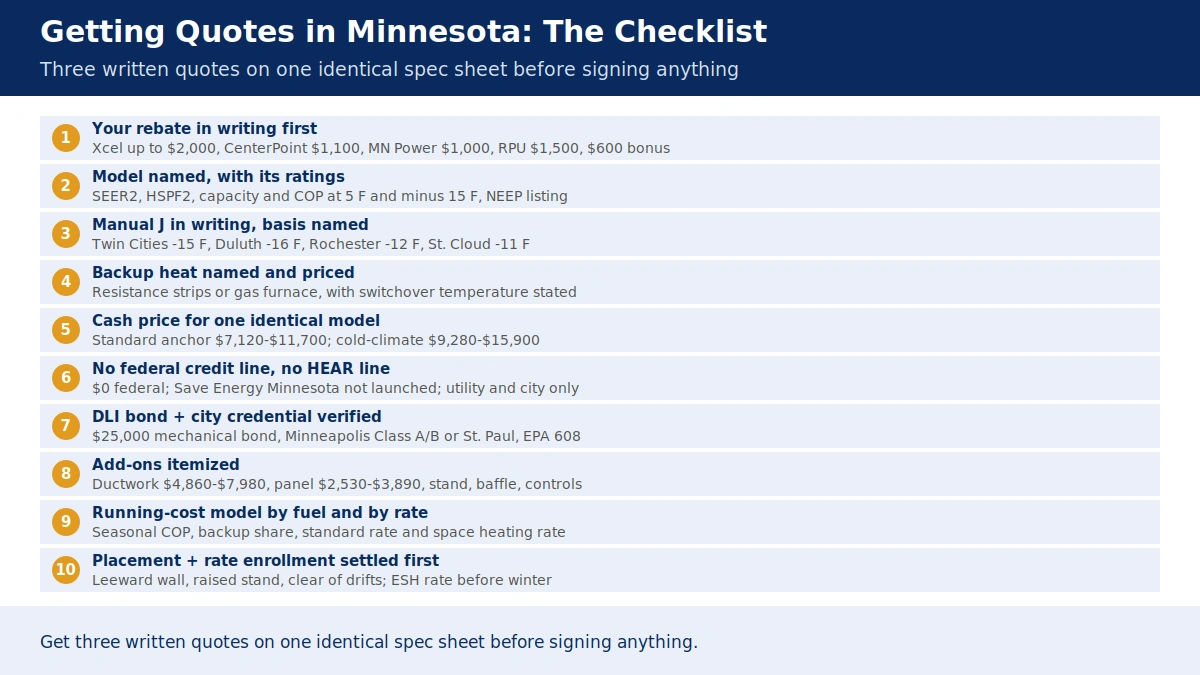
Sources & methodology
Cost anchors:
- NumeralQ Heat Pump Cost in Minnesota 2026 (updated Nov 3, 2026) — planning estimates, not contractor bids: statewide 3-ton ducted $7,120-$11,700; cold-climate ducted $9,280-$15,900; single-zone $3,520-$5,400; multi-zone 3-head $7,010-$12,170; geothermal $21,460-$33,470; by size 1.5T $4,890-$7,700, 2T $5,630-$9,030, 2.5T $6,370-$10,360, 3.5T $7,860-$13,030, 4T $8,610-$14,360, 5T $10,090-$17,030; ductwork $4,860-$7,980/job; panel upgrade (200A) $2,530-$3,890/job; Minneapolis $7,160-$11,750 (Nov 6, 2026), cold-climate $9,330-$15,970; St. Paul $7,160-$11,750 (Oct 31, 2026)
- NumeralQ HVAC Replacement Cost in Minnesota 2026 (checked Oct 2026): central AC + gas furnace 3-ton $8,940-$14,890; dual-fuel $9,930-$16,040 (St. Paul $9,990-$16,110)
- MSP Plumbing Heating Air (Twin Cities contractor, since 1918): basic install from $9,000; most common ~$14,000; premium $18,000+
- CoolHeatCosts Minneapolis 2026 (modeled, zone 6A): $6,600-$15,400, typical ~$9,900; standard ducted 2-3T $6,600-$11,600; cold-climate $8,800-$15,400; dual-fuel $10,500-$17,600
- Modernize Heat Pump in Minnesota Cost (updated Aug 26, 2026): most homeowners $7,500-$14,000 cold-climate; average ~$10,500; geothermal $25,000-$45,000+ (conflicts with NumeralQ — flagged)
- HVAC Visit 2026 (this quarter, before rebates, whole-market): Minnesota heat pump $8,450-$22,700; Minneapolis $8,800-$22,700; Duluth $8,450-$21,850
- Angi Minneapolis (updated Aug 4, 2026): $4,250-$7,162, average $5,498 (equipment-weighted, not used as installed anchor); mechanical permits $85-$220
- TryDun (Aug 2026, BLS-modeled): Minnesota ducted $7,950-$14,650 (cross-check only)
Rates:
- EIA Electric Power Monthly Table 5.6.A, Oct 28, 2026 release: MN residential 17.20 cents/kWh Aug 2026; US 18.16 cents; MN +1.8% vs Aug 2025 (16.89 cents); average bill $145.27 at 844 kWh; July 2026 17.45 cents (preliminary); 12-month range 15.0 cents (Dec 2025) to 17.5 cents (June 2026); 46 utilities from Otter Tail ~12.1 cents to Lake Country Power ~19.0 cents; Xcel standard tariff all-in ~19.02 cents at 900 kWh (priceofelectricity)
- Xcel Energy electric space heating rate: energy charge 6.537 cents/kWh Oct-May vs 11.364 cents standard (CUB Minnesota, June 2025; MN PUC approved March 2025; effective Oct 2025); ~42% savings vs standard winter rate (MN ASHP Collaborative); all-in ~11.14 cents vs ~18.11 cents standard with riders/fuel (ACEEE, Aug 2026, modeled); dual-fuel switchover at or below 35 F; no enrollment cost, no meter; RMI average improvement ~$689/yr
- EIA Natural Gas Monthly Table 20 (released Oct 30, 2026): MN residential 2026 YTD $12.29/Mcf (~$1.19/therm); 2025 annual $10.98/Mcf; monthly Jan $11.17, Feb $13.03, Mar $12.24, Apr $10.70, May $12.13, Jun $14.79, Jul $17.28, Aug $18.06; citygate 2026 YTD $6.59/Mcf; EIA Winter Fuels Outlook (Oct 6, 2026) Midwest forecast $10.38/Mcf winter 2026-27 (forecast, flagged)
- EIA Weekly Heating Oil and Propane Survey: MN propane $2.198/gal week of Nov 2, 2026 (year earlier $1.82), $2.191/gal week of Nov 9, 2026 (year earlier $1.849); Midwest $2.311; US $2.826; MN heating oil $5.609/gal week of Nov 9, 2026 (year earlier $3.642); US oil $5.915
- Minnesota primary-heating-fuel sales-tax exemption, November-April (CUB Minnesota)
Climate and performance:
- ICC Appendix D Table D101 (97.5% design temp / HDD65 / CDD65): Minneapolis -12 F / 8,382 / 527; Duluth -16 F / 10,000 / 176; Rochester -12 F / 8,295 / 474; St. Cloud -11 F (HDD not listed)
- Minnesota Rules Table 6.4.2.1 (mean extreme annual temp basis, Dec 7, 2023): Minneapolis/St. Paul -17 F; St. Cloud -24 F; Table C403.2.1 (2015): Minneapolis/St. Paul -15 F (Manual J 99% basis commonly used)
- NOAA 1991-2020 normals, Minneapolis/St. Paul airport: HDD65 7,399; CDD65 830; January mean 16.2 F; St. Cloud HDD 8,815 (1971-2000 normals, St. Cloud State/NWS) with ~39 nights/yr at or below 0 F
- IECC zones 6 (south) and 7 (north); Minneapolis zone 6A; CoolHeatCosts ~700 CDD / ~7,800 HDD
- ENERGY STAR CAC/ASHP V6.2 (revised Mar 2025) cold-climate bar — COP at least 1.75 at 5 F, capacity at 5 F at least 70% of the 47 F rating, HSPF2 8.1+ ducted / 8.5+ ductless, SEER2 15.2+ — alongside NEEP ccASHP Spec v4.0 (effective Jan 1, 2023)
- DOE Cold Climate Heat Pump Challenge field data: 5 F capacity 70-80%, COP 2.2-2.8; -5 F capacity 60-70%, COP 1.8-2.4; secondary compilations (NREL/PNNL/NEEP via HVAC Solver): cold-climate COP 1.5-2.2 at -5 F, 1.2-1.8 at -15 F, capacity 50-75% at -13 F; standard units lock out below about -5 F
- EPA Technology Transitions rule (40 CFR 84 subpart B): new residential systems GWP under 700 from Jan 1, 2025 (R-454B or R-32)
- DOE ground temperatures 40-70 F at 4-6 ft depth; geothermal COP 3.0-4.0 planning range
Rebates and incentives:
- Xcel Energy MN 2024-2026 residential rebate summary (via Krinkie’s, Oct 15, 2026): ducted ASHP $1,600 gas/combined / $1,100 electric-only (15.2 SEER2, 9.6 EER2, 7.8 HSPF2, Quality Installation); cold-climate ducted $2,000 / $1,500 (NEEP list, COP 1.75+ at 5 F); mini-split $1,600 / $2,000 cold-climate; participating contractor + Xcel ID; mini-split backup heat required; postmark by Sept 30 of year after install; 30-day cancellation/modification notice; 2027 terms unpublished; $600 insulation/air-sealing bonus within 2 years (Mankato Heating, July 2026; Twin City, June 2026); CEE Minneapolis table lists lower ducted utility figures ($900/$500 electric) — conflict flagged
- CenterPoint Energy MN ducted ASHP rebate (official program page, 2026): $1,100 existing home / $400 new construction; 92%+ AFUE furnace; HSPF 7.8+; AHRI-listed; install Jan 1-Dec 31, 2026; same-calendar-year application; handoff at 40 F or below; mini-split and ground-source excluded (Twin City, June 2026); furnace rebates $1,000 (97%+ AFUE), $400 (96-96.9%), $200 (92-95.9%)
- Minnesota Power 2026 residential rebates (official page): cold-climate ASHP ducted/ductless $1,000 (efficient operation to at least 5 F, participating contractor); standard ducted $400; ground-source $800/ton ($1,000/ton MNGHPA Master Installer); air-to-water $400/ton; new-construction bonus $1,500 cold-climate, up to $1,200/ton ground-source; online applications reported down Nov 2026
- Rochester Public Utilities 2026 Electric HVAC application: ducted ASHP heating + cooling $1,500 (main or hybrid); cooling-only $100-$200; mini-split/GSHP per Tables 2/3 (amounts unverified); 50% equipment-cost cap for mini-split/GSHP; 2026 applications due Mar 31, 2027; funding-limited
- Minnkota/co-op 2026 application: ASHP and mini-split $150/ton, ground-source $250/ton, cap $1,500 per off-peak meter; co-op amounts vary
- Minneapolis Green Cost Share / bonus rebate (CEE official page, 2026): cold-climate ASHP $1,000 non-Green Zone / $5,000 Green Zone; standard $1,000 / $4,000; program caps $6,000 / $20,000; first-come first-served; work after Dec 15, 2025; Xcel-tier equipment; city + utility capped at project cost; Home Energy Basics “up to $14,000” unverified, not used; Edina match, Hopkins Climate Solutions Fund, Northfield 50% match up to $2,500, St. Louis Park Climate Champions (Edina/Hopkins/St. Louis Park amounts unverified)
- Minnesota Energy Resources: no heat pump rebate amount verified in this pass — flagged; Great Plains Natural Gas 2026: furnace/boiler rebates $300-$500 only
- MN HEAR/HOMES (Save Energy Minnesota): not launched; MN Dept. of Commerce update Oct 12, 2026 — waiting for DOE approval of Aug 2026 revised application, no launch date; verified Nov 4, 2026 (heatpumppricing); no retroactive rebates; HEAR planned up to $8,000 (under 80% AMI) / $4,000 (80-150% AMI), ENERGY STAR cold-climate, Approved Contractor (MN ASHP Collaborative)
- DOE Program Notice 26-2 (May 29, 2026): HEAR electric-to-electric only, no fuel-switching; HEAR cap $8,000, HOMES up to $8,000
- Minnesota Residential Heat Pump Rebate (Minn. Stat. 216.46): lesser of $4,000 or cost minus HEAR + other rebates; requires HEAR rebate first; begins with Save Energy Minnesota — not launched
- OBBBA P.L. 119-21 and IRS FS-2025-05: §25C and §25D $0 for post-Dec-31-2025 installs, completion date counts; IRS Notice 2025-42 (§48E, in service by Dec 31, 2027, construction begun by Jul 4, 2026)
- CFPB Aug 2024 market spotlight: dealer $0-down financing fees 10-30% of cash price, sometimes over 50% (national figure)
Heating fuel mix:
- Census ACS 2020-2024 5-year (via NumeralQ, checked Oct 2026): MN piped gas ~65%, electricity ~19%, propane or oil ~12%; St. Paul 28% electric, 67% gas; Minneapolis 25% electric
Licensing:
- Minnesota DLI eLicense (modified Sept 3, 2026): no state HVAC license; Minn. Stat. 326B.197 requires $25,000 mechanical contractor bond filed with DLI-CCLD for G/HVACR work; $100 fee, valid 2 years; surety licensed in MN; no state license for individual employees; cities may require licensure/competency cards (not issued by DLI); Minneapolis HVAC Class A (state bond) / Class B ($10,000 city bond) + gas fitter; St. Paul Plumbing/Gasfitter Business Trade License; electricians/plumbers state-licensed by DLI; EPA Section 608 required for refrigerants; geothermal bores under MN well code (Minn. Stat. ch. 4725, MDH)
- Contractor Recovery Fund: up to $100,000 per homeowner, $550,000 per contractor (Minn. Stat. 326B.89 subd. 5, via NumeralQ); mechanic’s lien notice in contract or within 10 days (Minn. Stat. 514.011)
Labor:
- BLS OEWS May 2025, SOC 49-9021: MN median $36.71/hr (mean $35.57, employment 4,200); Minneapolis-St. Paul-Bloomington metro median $37.25/hr (mean $36.67, employment 2,420); Rochester metro median $37.26/hr (employment 190); national median $29.33/hr (mean $31.14); MN DEED Q1 2025: Seven County Mpls-St Paul $37.90/hr mean, Central MN $33.70, Northwest MN $29.22
Running-cost and payback arithmetic:
- Planning home ~74 MMBtu delivered heat/yr (NestPriced planning assumption, scaled from the series’ 50 MMBtu Boston home at 5,634 HDD: 50 x 8,382/5,634 = 74.4) = 21,688 kWh of heat; gas 95% AFUE at $1.19/therm = 779 therms = ~$924/yr; heat pump standard rate 17.20 cents: COP 1.8 = 12,049 kWh = ~$2,072/yr, COP 2.0 = 10,844 kWh = ~$1,865/yr, COP 2.2 = 9,858 kWh = ~$1,696/yr, COP 2.5 = 8,675 kWh = ~$1,492/yr, COP 3.0 = 7,229 kWh = ~$1,243/yr; heat pump ESH all-in 11.14 cents (ACEEE-modeled): COP 1.8 = ~$1,342/yr, COP 2.0 = ~$1,208/yr, COP 2.2 = ~$1,098/yr, COP 2.5 = ~$966/yr, COP 3.0 = ~$805/yr; resistance = 21,688 kWh = ~$3,730/yr standard, ~$2,416/yr ESH; propane 95% (91,452 BTU/gal) at $2.20 = 852 gal = ~$1,874/yr; oil 85% (138,500 BTU/gal) = 629 gal/yr ($5.61 = ~$3,526/yr; $3.64 = ~$2,288/yr); geothermal COP 3.5 standard = 6,197 kWh = ~$1,066/yr; break-even COP vs 95% gas = 4.04 standard / 2.61 ESH, vs propane = 1.99 / 1.29, vs oil at $5.61 = 1.06 / 0.69, vs oil at $3.64 = 1.63 standard; backup-resistance illustration (15% of heat via strips vs COP 2.0) ~$280/yr at standard rate; dual-fuel blend illustration (60% heat via HP at COP 3.0 on ESH + 40% gas) ~$853/yr vs $924 all-gas
- Cold-climate 3-ton at ~$12,590 (midpoint of $9,280-$15,900): vs resistance saves ~$1,865/yr -> ~6.8 yrs; vs oil at $5.61 saves ~$1,661/yr -> ~7.6 yrs; vs oil at $3.64 saves ~$423/yr -> ~29.8 yrs; vs propane saves ~$9/yr -> essentially never at standard rate; vs gas 95% loses ~$941/yr -> never on fuel; on ESH net $10,590 ($12,590 minus Xcel $2,000): vs propane saves ~$666/yr -> ~15.9 yrs; vs resistance-on-ESH saves ~$1,208/yr -> ~8.8 yrs; vs gas loses ~$284/yr -> never on fuel; dual-fuel midpoint $12,985, net $9,885 after Xcel $2,000 + CenterPoint $1,100 (illustration)
EXCLUDED:
- Any “after 30% credit” or “after $2,000 credit” prices: §25C/§25D are $0 for 2026 installs
- Any HEAR rebate or $4,000 state rebate in a 2026 Minnesota quote: not launched, no launch date, HEAR requires electric-to-electric even after launch, state rebate requires HEAR first
- Xcel ducted rebate tiers from the CEE Minneapolis table as current: conflict with Xcel 2024-2026 summary, flagged; confirm with Xcel
- Minnesota Energy Resources heat pump rebate: no amount verified, none stated
- RPU mini-split and ground-source rebate amounts: not verified, flagged
- Edina / Hopkins / St. Louis Park match amounts: not verified, flagged
- Minneapolis “up to $14,000” Green Cost Share figure: unverified third-party claim, not used
- Rochester, Duluth, and St. Cloud city install prices: planning estimates only, flagged in the draft
- A single Twin Cities design temperature without its basis: three published bases (-12 / -15 / -17 F), basis named with every figure
- Geothermal $25,000-$45,000+ as the headline range: conflicts with NumeralQ $21,460-$33,470, flagged
- Angi $4,250-$7,162 as an installed-system price: equipment-weighted, not used as an anchor
- HVAC Visit $8,450-$22,700 as a 3-ton band: whole-market range, cross-check only
- Heat-pump seasonal COP 1.8-2.5: planning range, not field-measured for a specific MN installation
- Any MN lease/PPA offer: no provider verified, authorization unverified
- 2027 utility rebate levels: none published, not projected
- Statewide permit fee schedule: not verified, flagged (Minneapolis $85-$220 is an Angi figure only)
- Contractor Recovery Fund coverage for mechanical-bond-only contractors: not verified, hedged
- Billed hourly labor rates: not published, omitted (BLS wages only)
- Snowfall totals: no primary figure used, omitted
*Disclaimer: The prices here are 2026 Minnesota planning figures. What you end up paying moves with the city, the house, the utility territory, the design temperature, and the contractor. Get written quotes from three Minnesota installers with a current DLI bond filing before settling on a budget, and confirm the city credential where the work sits. Nothing here is tax advice for your own return — these are general notes only. A Minnesota tax professional can confirm how these notes apply to your return — ask before you file. Program rules change — Xcel, CenterPoint, Minnesota Power, and Rochester rebate amounts, the electric space heating rate terms, and the Save Energy Minnesota launch status — so confirm current terms with your utility before signing. This guide dates its propane and heating oil prices to their sources — propane at $2.20 a gallon and oil at $5.61 from the EIA weekly surveys of early November 2026, and oil at $3.64 as the year-earlier price. A propane- or oil-heated home’s payback moves with the fuel price, so check the current EIA weekly survey before you decide.*
What does a heat pump cost in Minnesota in 2026?
A typical 3-ton ducted heat pump costs $7,120-$11,700 installed in Minnesota in 2026 (NumeralQ planning estimates, November 2026), and the cold-climate ducted system this state actually needs costs $9,280-$15,900. A single-zone ductless mini-split runs $3,520-$5,400, a dual-fuel system $9,930-$16,040, and geothermal with a ground loop $21,460-$33,470. Minneapolis and St. Paul both price at $7,160-$11,750 for a standard 3-ton ducted system. The largest utility rebate is Xcel Energy’s $2,000 for a cold-climate unit, and the federal tax credit is $0 for a 2026 install.
Do heat pumps work in Minnesota winters?
Yes — if the machine is a cold-climate unit sized for the design temperature, with backup heat sized to carry the coldest night. The Twin Cities design for minus 15 degrees, Duluth for minus 16 on the 97.5 percent basis, and a cold-climate unit on the NEEP list keeps at least 70 percent of its rated capacity at 5 degrees with a COP of at least 1.75, and keeps producing useful heat at minus 15 with a COP between 1.2 and 1.8. A standard unit loses half its capacity by 5 degrees and locks out below about minus 5. This guide plans on a seasonal COP of 1.8 to 2.5 for a cold-climate unit in Minnesota, with 2.0 as the central case. No air-source unit heats a Minnesota house alone on the coldest night — backup heat is half the system here.
Is a heat pump cheaper to run than a gas furnace in Minnesota?
Not on the standard electric rate, and close on Xcel’s electric space heating rate. Minnesota power averages 17.20 cents a kilowatt-hour, and tying a 95 percent gas furnace at $1.19 a therm takes a seasonal COP of 4.04 — a figure no Minnesota winter allows. On the space heating rate, near 11.14 cents all-in from October through May, the break-even COP drops to 2.61, which a good cold-climate unit approaches. At COP 2.0 a heat pump costs about $1,865 a year to heat the planning home against about $924 for gas at the standard rate, and about $1,208 on the space heating rate. Against electric resistance heat, the heat pump wins everywhere in the state, saving about $1,865 a year.
Should I get dual-fuel or all-electric in Minnesota?
Dual-fuel suits the two Minnesota homes in three that heat with piped gas: the heat pump owns the mild weather, the furnace owns the deep cold, and the rebate stack pays up to $3,100 toward the pair from Xcel and CenterPoint. All-electric suits the home with no gas line — propane, oil, or baseboard heat — provided the owner enrolls in Xcel’s electric space heating rate and sizes the resistance strips to carry the full design load. The switchover temperature decides the dual-fuel economics: Xcel’s space heating rate requires a switchover at or below 35 degrees, and CenterPoint’s rebate requires a handoff at 40 degrees or below. Get the chosen temperature in writing, with the reason for it.
What rebates can I get for a heat pump in Minnesota in 2026?
It depends entirely on your utility. Xcel Energy pays up to $2,000 for a cold-climate ducted unit ($1,600 for a standard ducted unit, $1,100 electric-only), plus a $600 bonus when insulation and air sealing precede the heat pump within two years. CenterPoint Energy pays $1,100 for a ducted heat pump in a dual-fuel setup with a 92 percent or better furnace, plus up to $1,000 for the furnace itself. Minnesota Power pays $1,000 for a cold-climate unit in the northeast, Rochester Public Utilities pays $1,500 for a ducted unit, and Minneapolis adds a bonus of $1,000, or $5,000 in a Green Zone. A Minnesota heat pump installed in 2026 earns a federal tax credit of exactly $0 — not a reduced credit, no credit at all.
Can I get the $8,000 HEAR rebate or the $4,000 state rebate in Minnesota?
Not in 2026. Minnesota’s Save Energy Minnesota programs — HEAR and HOMES — have not launched: the Department of Commerce submitted a revised application to the Department of Energy in August 2026 and says there is no estimated launch date. The state $4,000 heat pump rebate cannot start until HEAR does, because it requires the applicant to have received a HEAR rebate first. After launch, Program Notice 26-2 from the Energy Department still bars HEAR money for fuel-switching, which shuts out the gas- and propane-heated majority; only electric-to-electric upgrades and new construction qualify — about 19 percent of Minnesota homes heat with electricity.
What license or permit do I need to install a heat pump in Minnesota?
You need a mechanical permit and an electrical permit from your city or county, and your contractor needs a $25,000 mechanical contractor bond filed with the Department of Labor and Industry — Minnesota has no state HVAC license, and the bond filing is the statewide check that exists. The crew may also need a city credential, such as a Minneapolis HVAC Class A or B license or a St. Paul Plumbing and Gasfitter license, and the electrician’s license, the gas fitter credential for dual-fuel work, and federal EPA Section 608 certification for refrigerants are separate checks. Verify the bond filing and the city credential before anyone touches the house.
When does a Minnesota heat pump pay for itself?
Against electric resistance heat, about 7 years, because it saves about $1,865 a year at the standard rate. Against heating oil at $5.61 a gallon, about 8 years, saving about $1,661 a year; at last year’s $3.64 a gallon, about 30 years, saving about $423 a year. Against propane at $2.20 a gallon, essentially never at the standard rate — the heat pump merely ties the propane furnace — but about 16 years on Xcel’s electric space heating rate, saving about $666 a year on the net price. Versus a 95 percent gas furnace, fuel savings never arrive at a seasonal COP of 2.0 — the heat pump runs about $941 a year dearer at the standard rate. Set the heat pump beside the furnace and air conditioner you would have to buy in any case, and the premium vanishes: the heat pump usually costs less than that pair put together.