

The squall line reached Wayne County a little after nine on the morning of April 2, 2024, and it did not slow down for the mountains. By half past nine the wind gauge at Huntington Tri-State Airport had measured a 92 mile per hour gust, the strongest the station had ever recorded. Over the next hour the line ran east through Cabell County and into Kanawha County, dropping tornadoes as it went, and near Hernshaw a tornado skipped along an intermittent path, tore the top roof off a house, and rolled a recreational vehicle before it broke up short of the interstate.
Ten tornadoes touched down in West Virginia that day. It was the most the state had ever confirmed in a single day, beating the old record of seven, and 2024 went on to break the state’s yearly tornado record.
More than a hundred places reported wind damage that had nothing to do with a funnel at all.
That morning is the honest starting point for pricing a roof in this state. West Virginia is not a high-hail state and it is not a hurricane state, and the averages say so. But averages are made of quiet years, and a West Virginia roof has to survive the loud ones: the straight-line wind that runs down the Ohio River valley, the spring hail that falls hardest in May, the wet snow that piles up on a high-elevation roof while the valley below it gets rain.
The price of the roof itself is one of the lowest in the country. Roofer pay runs 8 percent below the national median, the cost models all land below the national band, and a Charleston roof costs about 4 percent less than the same roof priced nationally. The catch is that the cheap roof sits on old houses, steep lots, and a patchwork of local rules.
The median Charleston home was built in 1957. Nearly four in five Charleston homes predate 1980. Kanawha County holds 11 roofing contractors for its housing stock, 28 percent below the national rate per home, so the good crews book up early and the thin bench shows after every storm.
This guide prices the roof first and then prices everything around it: the wind rating the April 2024 line proved necessary, the snow load the buyer’s own address carries, the permit desk that may or may not exist at that address, the license check that takes minutes, and the cancellation right that West Virginia law hands every insurance-funded roofing customer. For the national picture that West Virginia sits inside, open the national roof replacement cost guide.
Table of Contents
How Much Does a Roof Replacement Cost in West Virginia in 2026?
Four cost models price a West Virginia roof in 2026, and they do not price the same job. One names the roof size, the material, and the pricing date. One adjusts national rates for what West Virginia roofers earn.
One models a typical home with tear-off folded in. One runs so far above the rest that it reads like a different state. The spread between them is the first thing a buyer has to understand, because a quote that looks expensive against one model looks cheap against another, and only the scope behind each number settles which comparison is fair.
The NumeralQ West Virginia page builds its figure from material prices plus local labor, priced October 26, 2026, and it is the model this guide leans on. It states all three inputs in the open: architectural shingles, a 2,000 sq ft roof, installed. Its band for that job is $9,340–$11,360, with a midpoint near $10,350.
It calls itself a planning estimate rather than a record of checks West Virginians wrote, and that honesty is part of why it leads: a planning estimate that admits what it is beats a survey average that hides its scope.
SmartRoofingCalculator reaches a nearby place by a different road. It starts from national installed rates per square, then applies a state factor of 0.868 built from roofer wages and goods prices, and lands at $390–$560 per square installed with tear-off. On a 25-square roof that is $9,750–$14,000.
The model’s own arithmetic is printed on its page, which makes it checkable in a way most cost pages are not, and its wage inputs come from the Bureau of Labor Statistics.
MyRoofData takes the widest scope of the three. Its West Virginia page models a typical single-family home, prices each material per square before tear-off, then adds tear-off at $100–$200 per square per layer. Its worked example covers 23.4 squares, 2,338 sq ft of roof surface once pitch and waste are counted, and lands at $11,100–$19,100.
Its headline range for a typical home is $11,000–$19,000. The top end runs high because the per-square spread is wide and the modeled roof is bigger than the 2,000 sq ft planning size.
RoofingEstimatorPros sits apart from all three. Its August 2026 model prices the same 2,000 sq ft architectural roof at $12,752–$23,004, about $8.65 per sq ft installed, with a per-square range of $638–$1,150. Its top end is double the NumeralQ top end.
Nothing in its published scope notes explains a gap that large, so this guide records it as the high outlier and uses it in no band that follows.
Two thinner sources bracket the market from below. SquareDash, working from 8,900 completed replacements, puts West Virginia at $6,400–$8,800 for a 2,000 sq ft architectural roof. ProRoofCalc puts the state at $7,000–$10,500 with an $8,700 average.
Neither states its scope with enough care to follow, so both are recorded here and neither sets a number in this guide.
| Cost source | Job priced | West Virginia 2026 figure |
|---|---|---|
| NumeralQ, Oct 26, 2026 (planning estimate) | 2,000 sq ft roof in architectural shingles, installed | $9,340–$11,360 |
| SmartRoofingCalculator, Apr 24, 2026 (modeled) | 25-square roof in architectural shingles, tear-off included | $9,750–$14,000 |
| MyRoofData, 2026 model | Typical home in architectural shingles, one-layer tear-off included | $11,000–$19,000 |
| One Good Roofer, Oct 7, 2026 (modeled) | 1,500–2,500 sq ft home, asphalt shingles, single-layer tear-off | $9,800–$15,300 |
| SquareDash, Apr 7, 2026 (completed jobs) | 2,000 sq ft roof, architectural shingles, scope unstated | $6,400–$8,800 (low figure, not followed) |
| RoofingEstimatorPros, Aug 26, 2026 (modeled) | 2,000 sq ft roof in architectural shingles | $12,752–$23,004 (high outlier) |
Inside the headline band sit the roof system and the work itself: shingles, underlayment, starter course, ridge cap, flashing, ventilation pieces, tear-off of the old roof, disposal, labor, and contractor markup. What grows a quote past the band lives outside it, and the Charleston page prices those extras line by line. Removing one extra layer of shingles adds $1.21–$1.59 per sq ft, which is $2,420–$3,180 on a 2,000 sq ft roof.
Each replacement decking sheet runs $58.06–$84.51 installed. A full-roof ice-and-water barrier costs $0.84–$1.36 per sq ft. New seamless aluminum gutters run $7.83–$11.29 per linear ft.
Chimney or wall flashing adds $312–$449 each, and re-flashing a skylight adds $468–$604 each.
Every add-on figure deserves its own line on a written quote. A lump-sum quote that folds decking, flashing, and barrier work into one total hides the exact lines that grow once tear-off exposes the deck, and a buyer comparing two lump sums is comparing two guesses. The materials-only versions of the same lines run far lower, a decking sheet at $14.56–$27.96 before labor, which is why a buyer who prices materials at a home center and multiplies will always underprice the finished job.
Run the NumeralQ model nationally and the same 2,000 sq ft roof prices at $9,710–$11,840. West Virginia lands about 4 percent below that band. Pay is the reason.
The median West Virginia roofer earns $24.60 an hour on Bureau of Labor Statistics May 2025 figures, 8 percent below the national median, and contractors bill $49–$64 per worker-hour once insurance, payroll taxes, overhead, and profit are loaded on. Materials ride national prices, so the whole West Virginia discount sits in the crew.
One older wage figure runs lower and is worth naming. SmartRoofingCalculator, working from May 2024 Bureau of Labor Statistics estimates, puts the West Virginia roofer median at $18.95 an hour with a mean of $20.40, across about 470 roofers statewide. The two figures come from different survey years, and this guide leads with the newer May 2025 number.
Either way the direction is the same: West Virginia crews cost less than the national middle, and that is the discount.
The thin contractor bench cuts against the discount in one specific way. With 11 roofing contractors in Kanawha County against 1.7 per 10,000 homes nationally, scheduling tightens fast after a storm, and a homeowner quoting in the weeks after a hail or wind event should expect longer lead times and more out-of-county crews. The hiring section covers how to vet a crew that drove in for the storm.
Roof Replacement Cost in West Virginia by Material
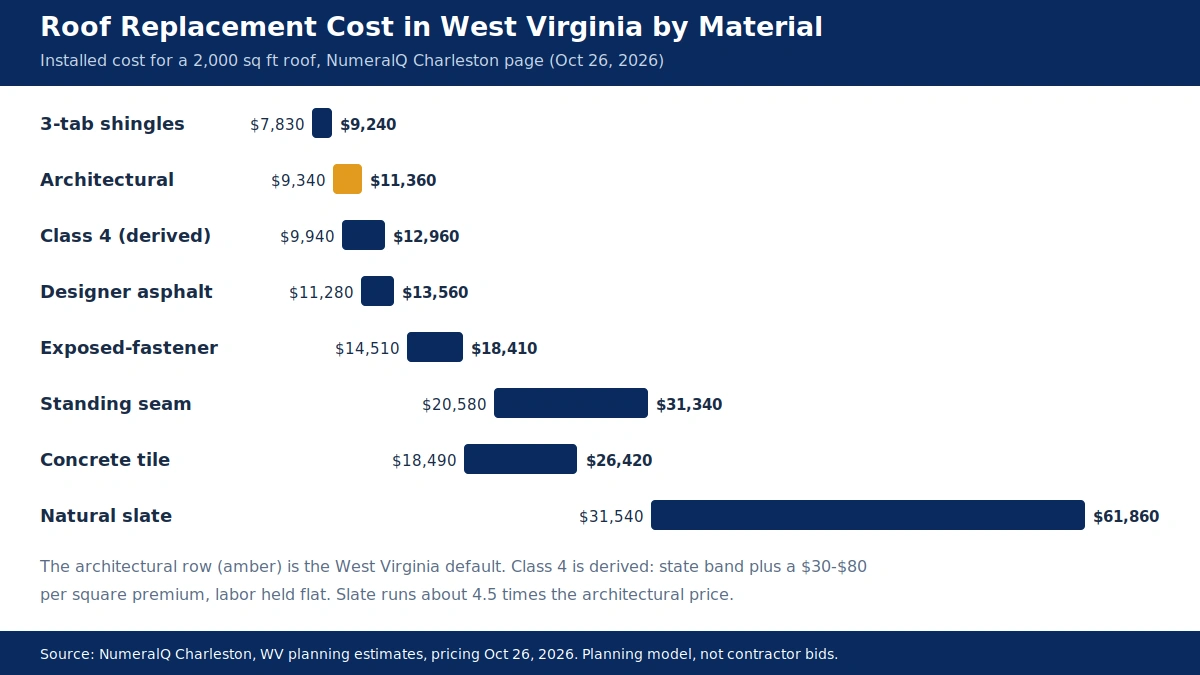
Material choice is the second-biggest lever on the price after size, and in West Virginia it is also a wind, rain, and snow decision. The table below prices a 2,000 sq ft roof in every common material from the NumeralQ Charleston page, which is the only published material breakdown in the state. The Charleston band equals the state band exactly, because Charleston is the one market NumeralQ prices here, so the table is labeled as the Charleston page throughout and no reader should mistake it for a survey of bids from all 55 counties.
Rated life follows the MyRoofData West Virginia model. The last column gives the West Virginia read: what each material faces in a state with 45 inches of annual precipitation, spring wind, and mountain snow. The Class 4 row is the one figure no publisher prints; it is derived by adding a $30–$80 per square installed premium to the state architectural band, labor held flat, and the Class 4 section shows the full derivation.
| Material | 2,000 sq ft roof, installed (Charleston page) | Rated life | West Virginia read |
|---|---|---|---|
| 3-tab asphalt shingles | $7,830–$9,240 | 15–20 years | Cheapest buy; lowest wind ratings; most insurers have moved on |
| Architectural asphalt shingles | $9,340–$11,360 | 22–30 years | The default West Virginia roof; 110–130 mph wind ratings |
| Class 4 impact-resistant shingles | ~$9,940–$12,960 (derived) | 25–35 years | Top hail rating; the discount roof; see the Class 4 section |
| Designer / luxury asphalt shingles | $11,280–$13,560 | 25–30 years | Thicker look; same hail exposure as standard architectural |
| Exposed-fastener metal (corrugated, 5V) | $14,510–$18,410 | 30–40 years | Deep roots in rural West Virginia; screws need checking as gaskets age |
| Stone-coated steel | $16,320–$23,700 | 40–50 years | Shingle look in steel; sheds snow; Class A assemblies available |
| Cedar shakes | $17,200–$30,460 | 25–35 years | Needs upkeep in a wet climate; heavy shade and moss country |
| Synthetic slate or shake (composite) | $17,120–$24,780 | 40–50 years | Slate look at half the weight; Class 4 options exist |
| Concrete tile | $18,490–$26,420 | 40–75 years | Heavy at 850–1,100 lb per square; structure check first |
| Standing-seam metal | $20,580–$31,340 | 40–70 years | Concealed fasteners; the mountain metal roof |
| Clay tile | $24,170–$38,620 | 50–100 years | Brittle underfoot; tile-experienced crews only |
| Natural slate | $31,540–$61,860 | 75–150 years | A lifetime roof at roughly 4.5 times the shingle price; specialist labor |
| Flat: modified bitumen / EPDM / TPO | $10,220–$13,150 / $10,530–$16,510 / $12,550–$16,750 | 20–30 years | Low-slope sections, porches, additions, flat porch roofs |
3-tab shingles save about 18 percent against architectural, and the saving is the weakest money in this table. The 3-tab band of $7,830–$9,240 undercuts architectural by roughly $1,510–$2,120 on a 2,000 sq ft roof. The trade is a flat, single-layer shingle with lower wind ratings and a 15–20 year rated life, on a roof that will face the same April squall lines, the same wind-driven rain, and the same freeze-thaw swings as its thicker neighbor. Many insurers and builders have moved away from 3-tab, and a buyer who saves $2,000 on install day can lose it to one earlier replacement.
Treat 3-tab as the comparison price, not the roof to buy.
Architectural shingles hold the default slot, and the wind rating is the reason to care about which line goes on. This dimensional, two-layer shingle brings wind ratings of 110–130 mph and a rated life of 22–30 years, at an install price any crew in the state can quote from memory. MyRoofData prices the material at $387–$645 per square installed before tear-off, with tear-off adding $100–$200 per square per layer. The West Virginia caveat on life is moisture: 45 inches of precipitation a year, shaded hollows that stay damp, and freeze-thaw cycles that work at sealant joints all wear asphalt faster than a lab test assumes, and ventilation underneath the deck decides how much of the rated span a real roof delivers.
Designer and luxury asphalt buys depth and shadow lines, not strength. The $11,280–$13,560 band pays for curb appeal on a front-facing slope over standard architectural. Thickness alone adds no impact rating and no wind rating beyond what the product line is tested to. A buyer who wants the look and the hail rating together should price a Class 4 designer line by name and have the UL 2218 rating confirmed in writing on the quote.
Metal in West Virginia means two roofs, and the state has deep roots in the cheaper one. Corrugated and ribbed exposed-fastener panels cost $14,510–$18,410. Screws driven through the panel face make them quick to fit, which is why they cover rural homes, barns, and budget metal conversions across the state, and why MyRoofData names ribbed metal the most-installed system locally. Upkeep centers on the screws and their gaskets: sun and temperature swings age the gaskets, and a roof nobody re-checks can weep at a thousand screw holes.
Standing seam costs $20,580–$31,340 because its fasteners hide under raised seams and the panels move with temperature instead of fighting it, which supports the 40–70 year rated life. Before tear-off, MyRoofData puts standing seam at $817–$1,376 per square and ribbed panels at $473–$817.
Gauge, finish, and trim each get their own priced line in our metal roof cost guide. The head-to-head choice is worked through in full in our metal vs shingles guide.
Tile, slate, cedar, and synthetic stay special-case choices in West Virginia, and each needs a stronger reason than appearance. Weight rules out a casual switch to tile: concrete at $18,490–$26,420 and clay at $24,170–$38,620 often demand an engineering check of the structure first, and clay cracks underfoot, so repairs call for crews who know tile. Natural slate at $31,540–$61,860 is priced by its weight and by the specialist labor it needs, and it can outlast the mortgage itself. Cedar shakes at $17,200–$30,460 ask for upkeep in a wet, shaded climate where moss grows fast, and synthetic slate or shake at $17,120–$24,780 mimics slate at roughly half the weight, with some product lines carrying Class 4 ratings.
Any buyer weighing tile should read our tile roof cost guide first, because the weight and structure questions decide whether tile is even possible on the house.
Low-slope and flat areas price on a separate scale from pitched shingle work, and a shingle quote can easily swallow them without a line of their own. Porches, additions, and low-slope sections where shingles cannot shed water take membranes instead: modified bitumen $10,220–$13,150, EPDM rubber $10,530–$16,510, TPO $12,550–$16,750. A house with a flat porch roof and a pitched main roof needs both prices on separate quote lines. The flat section is the part that fails first when it is treated as an afterthought, and ponding water after a summer downpour is the tell: a flat section that holds water for days is a section whose slope or drainage was never right.
Roof Replacement Cost by Roof Size in West Virginia
Roofers count in squares. One square covers 100 sq ft of roof surface, which makes a 2,000 sq ft roof a 20-square job, and the roof surface always runs bigger than the floor plan on the deed because of the slope, the overhangs, the valleys, and the waste cut at ridges and edges. A single-story house with 2,000 sq ft of living space can easily carry 25 squares of roof, and that gap between living area and roof area is the most common reason two quotes for the same house look wildly apart.
One roofer measured the roof. The other quoted the floor plan.
Roof surface area from the NumeralQ West Virginia page drives the table below, and the implied per-square rate rides along so a reader can test any quote against it. The per-square rate falls slightly as the roof grows, because fixed costs like mobilization, dumpster, and permit spread across more squares, but the fall is small: a bigger roof is still a bigger bill.
| Roof size (sq ft of surface) | Squares | Architectural shingles, installed | Implied rate per square |
|---|---|---|---|
| 1,000 | 10 | $4,950–$6,100 | $495–$610 |
| 1,500 | 15 | $7,140–$8,730 | $476–$582 |
| 2,000 | 20 | $9,340–$11,360 | $467–$568 |
| 2,500 | 25 | $11,540–$14,000 | $462–$560 |
| 3,000 | 30 | $13,740–$16,630 | $458–$554 |
A second model checks the table from a different direction. SmartRoofingCalculator’s installed-with-tear-off figure for 25 squares, $9,750–$14,000, sits around the NumeralQ figure of $11,540–$14,000, sharing most of its range. MyRoofData’s 23.4-square example, $11,100–$19,100, climbs higher at the top end, because its per-square material spread runs wider and its scope is stated less tightly.
The three models agree on the middle and disagree on the edges, which is the honest shape of a planning range.
Shape bends the per-square rate more than size does. A plain gable roof, two slopes, few valleys, no chimneys, lands near the bottom of the per-square range, because the crew keeps laying shingle after shingle with barely a cut to make. A roof broken up by dormers, valleys, skylights, and a chimney lands near the top of the range, since each valley and each penetration means cutting by hand, fitting flashing, and throwing away offcuts. Steepness pushes the rate up as well: the crew moves slower, staging takes longer to set, and every cut wastes more material.
Two stories cost more per square than one story on the same roof area, because getting bundles up and setting safety gear eats more of the crew’s day.
Access bends it in a West Virginia way. MyRoofData names steep terrain as a real line item in this state, and any buyer who has watched a crew work a hillside lot in Charleston or Morgantown knows why: a steep drive the dumpster cannot climb, a backyard the material hoist cannot reach, a narrow hollow road with nowhere to stage. Those hours cost money that a flat valley lot never sees.
One West Virginia guide claims steep roofs of 10:12 pitch or more in Morgantown and Charleston hill neighborhoods carry a 35 percent premium, but that figure is single-source and unverified, and this guide does not adopt it. The honest version is simpler: steep and hard-to-reach roofs cost more, and the quote should say how much more, on its own line.
The waste allowance of 10–15 percent of the material order is real material, not contractor padding. Waste and contractor markup sit inside the published material bands already, and the waste share pays for starter shingles, ridge cap, valley cuts, and offcuts that never reach the roof. Multiplying a home center shingle price by the roof area always comes in low, because that first sum leaves out waste, ridge cap, and starter strip entirely.
A buyer can size the job two ways before any roofer visits. The quick way: take the NumeralQ band for the roof size nearest yours, add the add-on lines for every feature that adds work, and treat the result as a planning number with a 10 percent contingency for what tear-off reveals. The careful route starts with a measured roof surface: count the squares, multiply by $467–$568 per square for architectural shingles, then add tear-off, decking, and flashing as separate lines. Whichever route a buyer takes, the figure that counts is the written quote produced after a crew has walked the roof.
A planning number helps a buyer judge a quote. It never stands in for one.
Roof Replacement Cost by City: Charleston, Huntington, Morgantown and Parkersburg
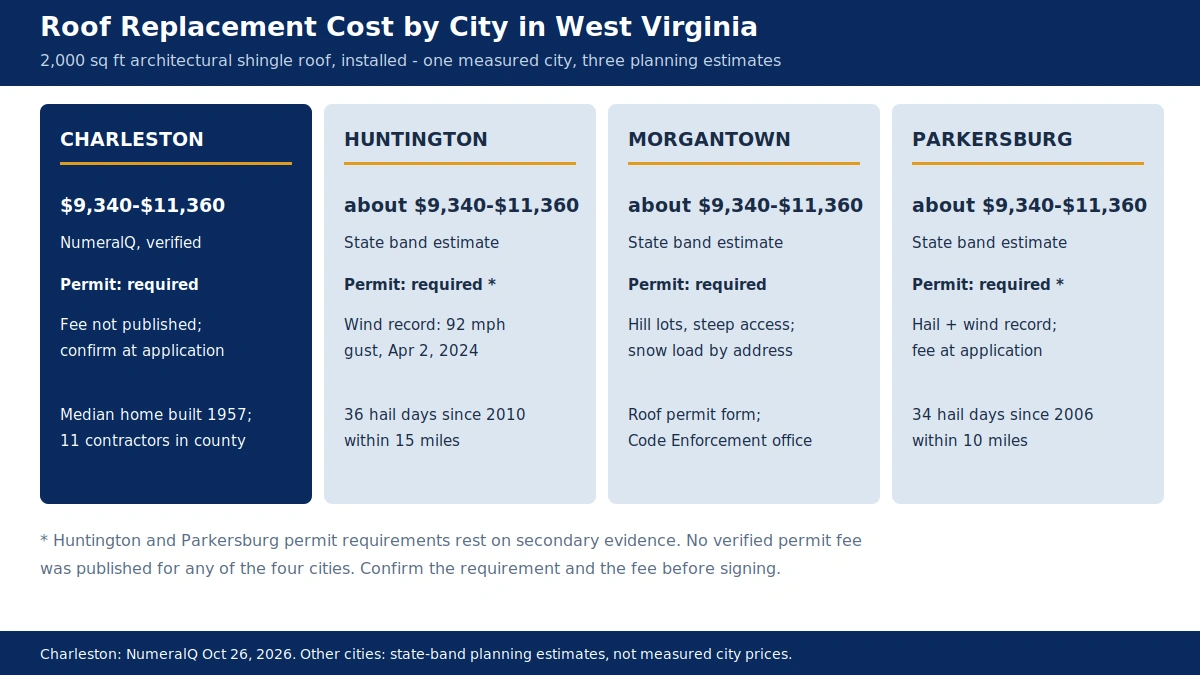
Only Charleston has a published cost model behind it. Huntington, Morgantown, and Parkersburg have no NumeralQ or SmartRoofingCalculator city pages, and no city-level price is published for any of the three in any source this guide opened. The city table that follows says plainly what it is: Charleston measured, and three planning estimates that carry the state band, shaped by what each city’s market is known to do, with every cell labeled an estimate.
The differences between these four markets are small, and the evidence for them is thin. Charleston sets the baseline. Huntington sits downriver on the Ohio, in flatter country with a similar crew pool.
Morgantown sits up the Monongahela in hill country, with a university market and steeper lots. Parkersburg sits on the Ohio at the state’s western edge, with its own weather record and its own permit desk. None of those facts is enough to price a city premium, and this guide does not invent one.
| City | 2,000 sq ft architectural roof | Basis | Permit |
|---|---|---|---|
| Charleston | $9,340–$11,360 | NumeralQ Charleston page, Oct 26, 2026 | Required |
| Huntington | ~$9,340–$11,360 | State band as planning estimate | Required (secondary sources) |
| Morgantown | ~$9,340–$11,360 | State band as planning estimate; hill lots, steep access | Required |
| Parkersburg | ~$9,340–$11,360 | State band as planning estimate; Ohio River valley | Required (secondary sources) |
Charleston is the measured market, and its band is the state band. The Charleston page prices the 2,000 sq ft roof at $9,340–$11,360, identical to the statewide figure at every size: 1,000 sq ft $4,950–$6,100, 1,500 $7,140–$8,730, 2,500 $11,540–$14,000, 3,000 $13,740–$16,630. Charleston roofer pay explains why the city sits at the state number rather than above it: a median $24.60 an hour, 8 percent below the national median, with billed rates of $49–$64 per worker-hour. The housing stock explains why the work is rarely simple: the median home dates to 1957, 79 percent of homes were built before 1980, and a house on its second or third roof is the normal Charleston job, with the two-layer question waiting under the old shingles.
Charleston also carries the thinnest bench in this guide. Kanawha County’s 11 roofing contractors, 1.2 per 10,000 homes against a national 1.7, mean a Charleston homeowner should ask about lead time at the first call, not at the signing table, and should not rule out a contractor from the next county over. The median Charleston home is worth $203,300, and the typical roof midpoint works out to about 5.1 percent of that value, the 27th highest share of the 147 markets NumeralQ prices, which is another way of saying a roof is a bigger decision here relative to the house than it is in most of the country.
Huntington is the estimate that rides the river. With no published city price to use, the $9,340–$11,360 state band stands as the planning estimate. Huntington’s weather record argues for spending the money on wind performance rather than on hail performance: 124 high-wind days within 15 miles since 2010, gusts to 105 mph, and the 92 mph station-record gust of April 2, 2024. Hail near Huntington is real but thinner, with 36 hail days since 2010 and the largest stone at 3.0 inches in 2025.
A Huntington quote should name the shingle wind rating and the nailing pattern, because the city’s record says wind is the hazard that will test the roof first.
One West Virginia guide claims Huntington runs 5 to 10 percent below the Charleston baseline. That claim is single-source and unverified, and it is not used in the table above. A Huntington buyer who gets three quotes on one identical spec sheet will learn the real local number faster than any statewide guide can print it.
Morgantown is the estimate where the lot matters as much as the roof. Here too the planning estimate is the state band, $9,340–$11,360. Morgantown’s hills are the pricing factor no model captures: steep drives, tight lots, and roofs that pitch hard enough to slow a crew and add staging. The city’s permit process is the best documented of the four, with a dedicated roof permit form and a Code Enforcement office that answers the phone, which is a genuine advantage for a buyer who wants the work checked.
Morgantown’s snow runs heavier than the Ohio River valley’s, and the snow section gives the elevation warning that applies to Monongalia County addresses. Three local quotes on one identical spec sheet matter more in Morgantown than in Charleston, because the access penalty varies lot by lot and no statewide band can price a specific hillside.
Parkersburg is the estimate with the longest hail paper trail. The state band of $9,340–$11,360 is the planning number. Parkersburg’s hail record within 10 miles runs to 34 hail days since 2006, 19 of them at one inch or larger, with the largest stones at 2.75 inches in April 2015. Damaging wind reports within 10 miles number 191 on 92 days, with the strongest measured gust at 72 mph in April 2025.
A Parkersburg buyer faces both hazards at once, which is why the Class 4 section and the wind section both deserve a read before the material is chosen. The city’s permit requirement rests on secondary evidence, and the permit section says so plainly, with the fee confirmed at application rather than guessed here.
Wind, Hail and the April 2024 Derecho: What West Virginia Storms Do to a Roof
Wind is the hazard West Virginia meets most often, and the record is not close. The National Oceanic and Atmospheric Administration logged 2,958 damaging-wind reports across the state in ten years. In Kanawha County and the nine counties around it, 639 thunderstorm-wind reports at 58 mph or more arrived between 2016 and 2025, against 143 hail reports of one inch or larger in the same window.
Wind reports in that ten-county area ran 118.5 per 1,000 square miles, against 48.8 nationally, while the state as a whole ran 123.0. A West Virginia roof is a wind roof first and everything else second.
The Charleston forecast office agrees: in its area, damaging thunderstorm wind is the severe hazard that shows up most. Thunderstorm wind made up nearly 65 percent of severe weather reports in the Charleston forecast area from 1950 to March 2020. The practical meaning for a roof buyer is that the shingle wind rating and the nailing pattern are not fine print.
They are the roof.
The April 2, 2024 line is the case study. A strong low-pressure system tracking through the Ohio Valley pushed an intense squall line across southern and central West Virginia in the late morning and midday hours. The line bowed, met the criteria of a derecho, and dropped at least nine embedded tornadoes in a corridor from Huntington to east of Charleston, with a tenth in Fayette County that afternoon. The strongest was a high-end EF2 near Hico.
More than 100 locations reported wind damage with no tornado involved. The yearly tornado record fell in a single day.
The National Centers for Environmental Information narrative for the Kanawha County tornado describes what wind does to a roof when it finds an edge: the tornado skipped along an intermittent path from Kanawha State Forest toward Hernshaw, and the most destructive damage was the top roof of a home blown off, a recreational vehicle rolled, and more structure damage around Hernshaw. Roofs fail at edges, ridges, and eaves, where wind gets underneath and lifts. A wind-rated shingle, a six-nail pattern, and sealed edges are the details that keep a roof on in that moment, and NumeralQ’s own advice on its West Virginia page is to ask about exactly those two items.
Tornadoes are uncommon in West Virginia, and the 30-year record shows how uncommon. From 1996 to 2025 the state recorded 94 tornadoes on 57 days, about 3.1 a year spread over 1.9 tornado days a year, with the strongest an EF3 on March 2, 2012. The mountains break up the organized storms tornadoes need, which is why the state averages three brief tornadoes a year and why April 2, 2024, with 10 in one day, stands so far outside the pattern. Kanawha County recorded 11 tornadoes in the 30-year window, the strongest an EF2, the most recent on April 2, 2024.
A roof buyer does not buy tornado protection; no shingle rating covers a direct hit. The buyer buys wind performance for the straight-line gusts that arrive a hundred times more often.
Hail in West Virginia is seasonal, mostly small, and unevenly spread. The MyWild analysis of National Oceanic and Atmospheric Administration Storm Prediction Center data from 1996 through 2025 counts 13 severe hail days a year statewide, ranking West Virginia 32nd of 46 states, with the middle 80 percent of the season running April 7 to August 27 and May the busiest month. Days with hail at two inches or more, the threshold the Storm Prediction Center calls significant severe, come about 1.4 times a year. The largest stone in the 30-year record is 4.25 inches, which fell near Pinch in Kanawha County on May 23, 2019, when 3-inch hail also fell near Jodie in Fayette County and dented many cars.
NumeralQ’s shorter window tells the same seasonal story: April through June accounts for 72 percent of one-inch-plus hail reports since 2016.
County records sharpen the picture. Kanawha County recorded 35 large-hail reports from 2016 to 2025, four of them at two inches or larger, and the ten-county area around it recorded 143 reports at 26.5 per 1,000 square miles, above both the state rate of 22.0 and the national rate of 20.1. The Federal Emergency Management Agency rates Kanawha County’s hail risk as relatively moderate.
Huntington’s record within 15 miles shows 36 hail days since 2010 with a 3.0-inch largest stone in 2025. Parkersburg’s record within 10 miles shows 34 hail days since 2006 with a 2.75-inch largest stone in 2015. The hail question is therefore a county question, not a state question, and the Class 4 section splits the verdict that way.
The 2024 annual tornado total is a small conflict this guide will not smooth over. Different counts of the same year give 18, 20, and 21 tornadoes, because the counts cover different areas and different confirmation windows. The National Weather Service’s own record for the warning area includes parts of neighboring states, while the state-only counts differ by a few late confirmations. Every count agrees on the two facts that matter: 2024 broke the yearly record, and April 2 alone broke the single-day record.
This guide states those two facts and asserts no single annual total.
What the storm record means on a quote. Get the shingle wind rating named by product and the nailing pattern confirmed in writing. Six nails per shingle, rather than four, is the upgrade NumeralQ names, and it costs little against the price of the roof. Ask how the eaves, rakes, and ridge will be sealed, because those are the edges wind lifts first.
Ask whether the quote includes an impact-rated option alongside the standard option, so the hail decision is priced rather than assumed. And after any storm, photograph the roof, the gutters, and the attic before moving anything, tarp active leaks and keep the receipt, and let the adjuster see the roof before signing a roofing contract. The insurance section covers the claim sequence, and the Storm Scammer Act section covers the cancellation right that protects a buyer who signed too fast.
Snow, Ice Dams and Mountain Loads: The Elevation Problem in West Virginia
No statewide ground snow load exists in West Virginia. That fact is the whole snow-load system in one line, and it surprises buyers who come from states with a published statewide table. The State Building Code leaves the design values to each jurisdiction that adopts it, and the county or city building department fills in the blanks for its own addresses.
Each county sets its own figure, so crossing into the next county can change the number even when the town stays the same, and two houses a few miles apart at different elevations can carry very different design loads.
Snow load is the weight of snow the roof must carry, measured in pounds per square foot. The ground snow load is what falls and lies on open ground. The roof design load is what the structure must carry after the code discounts for roof slope, shape, and exposure.
Ground load and roof load are two different numbers, and mixing them up is the snow mistake buyers make most often. In West Virginia the confusion is worse than usual, because the secondary sources that publish regional ranges do not agree with each other, and none of them is the number a permit desk enforces.
The published regional ranges spread wide, and this guide reports the spread rather than picking a winner. One engineering source, working from ASCE 7 county and elevation data, puts the southern and western valleys at roughly 20 to 35 pounds per square foot, much of the state at 35 to 60, and the Allegheny Highlands and high eastern ridges at site-specific values of 60 to 100-plus, where a licensed engineer often sets the number. A snow-load calculator puts populated areas at roughly 20 to 50 pounds per square foot with a typical value of 30. A structural guide puts the state range at 20 to 70.
A roofing guide puts the ASCE 7-22 baseline at 15 to 30. Those ranges overlap in the valleys and diverge in the mountains, which is exactly where the elevation driver takes over.
Elevation is the driver, and West Virginia has more of it than any buyer expects. Charleston sits in the Kanawha Valley and averages 31.5 inches of snow a year on the 1991–2020 normals, with the snowiest winter on record reaching 106 inches in 1996. Elkins, up in the mountains, averages about 60 inches.
Bayard in Grant County averages 117.8 inches. Snowshoe and the Canaan Valley, at 3,200 feet and higher, average more than 150 inches, and Canaan Valley holds snow from November to April. A roof priced from a valley table will underprice a mountain roof badly, because the engineering, the snow retention hardware, and the short working season all cost money a valley quote never carries.
One published jurisdiction table shows what a West Virginia design table looks like. The City of Moundsville, in Marshall County, publishes its climatic and geographic design criteria in the open: ground snow load 30 pounds per square foot, design wind speed 90 miles per hour, frost line depth 30 inches, seismic design category B. That table governs Moundsville addresses and no others. It is quoted here as the single worked example this guide could verify from a primary city source, not as a number to borrow for Charleston, Huntington, Morgantown, or Parkersburg.
No design table was verified for any of the four cities in this guide, and no snow-load figure is stated for any of them.
A buyer in the high country should treat the mountain numbers as an engineering conversation, not a table lookup. The International Residential Code covers prescriptive roof design up to 70 pounds per square foot of ground snow, and above that line the structure needs engineering. In the Allegheny Highlands, ASCE 7 treats many sites as case-study zones, which means elevation drives the load and a high site can carry several times what a valley site carries.
A roof in the high country needs three things: retention that stops the load sliding off in one sheet onto a walkway or a car, ice protection at the eaves, and a crew that has already worked steep roofs under heavy snow.
Morgantown’s snowfall is a conflict this guide leaves open. Three sources give three different annual figures for the city, spanning 14.4 inches to 33 inches, and no primary normals table was opened that settles it. This guide states no Morgantown snowfall figure. Before signing a quote, a Morgantown buyer should get the design snow load for the exact address from the building department, and treat any quote without a named snow figure as incomplete for a hill address.
Snow numbers never show freeze-thaw, the slow wear that does the quiet damage. West Virginia winters run freezing nights and milder days, and that daily swing is harder on a roof than steady cold. Water finds a hairline opening, freezes, expands, and widens it. The next thaw carries water deeper.
The next freeze widens it again. Granules shed faster off the shingles, sealant joints pull open, and flashing that held tight in September starts weeping by February. The same cycle drives ice dams: heat escaping through an under-insulated attic melts snow on the upper roof, the meltwater runs down to the cold eave, refreezes into a dam, and backs water under the shingles.
No covering prevents ice dams on its own. The fix is attic insulation and ventilation that keep the roof deck cold, plus an ice barrier membrane at the eaves where the code requires it.
The price of the insulation work itself is covered in our attic insulation cost guide.
The ice barrier rule is local, and no city-level Yes or No was verified for the four cities. IRC section R905.1.2 calls for a self-adhering ice barrier membrane running from the lowest eave edge to at least 24 inches inside the exterior wall line, but that rule bites only where the jurisdiction’s own design table says ice dams form. The Charleston page notes that the building code calls for an ice barrier at the eaves where ice dams are common, and advises checking that the quote includes it. That is as far as the verified evidence goes.
A buyer who hears that West Virginia mandates a full ice barrier statewide is hearing a generalization, not the code. The Charleston page prices a full-roof ice-and-water barrier at $0.84–$1.36 per sq ft, which puts roughly $1,680–$2,720 on a 2,000 sq ft roof, and the open question is whether the address and the roof’s ice history justify that spend. In a valley home with good insulation, eave and valley protection is often the right spend.
In a mountain home, full coverage is the conversation to have with the roofer and the inspector.
Rain is the quiet hazard underneath the snow conversation. Charleston averages about 45 inches of precipitation a year, and the state runs from under 32 inches in the lower eastern section to more than 56 inches on the higher parts of the Allegheny Front. That much water, arriving as wind-driven rain as often as steady rain, is why flashing scope matters more here than in drier states: step flashing, valley flashing, chimney flashing, and sidewall flashing are the lines that keep 45 inches of water out of the house, and reusing old flashing to save a few hundred dollars is one of the most common reasons a new West Virginia roof leaks within a few years. The quote should name every flashing line as new work, or say plainly which lines are reused and why.
A winter install runs slower than a summer one, and the shingles need sealing by hand. The Owens Corning cold-weather bulletin says that at 40 degrees Fahrenheit and below, shingles should be hand-sealed at the edges with dabs of roof cement, because the sun will not activate the sealant strip. Charleston days usually warm past 40 degrees all year, but nights drop below it from November through March, so shingles laid late in the day may not seal until a warm spell. Hand-sealing belongs on a winter quote in writing, never left as an assumption.
August and September are the driest months in Charleston, with about six measurable-rain days each, which makes late summer the fastest and most reliable install window.
Asphalt vs Metal in West Virginia: The Lifetime Math
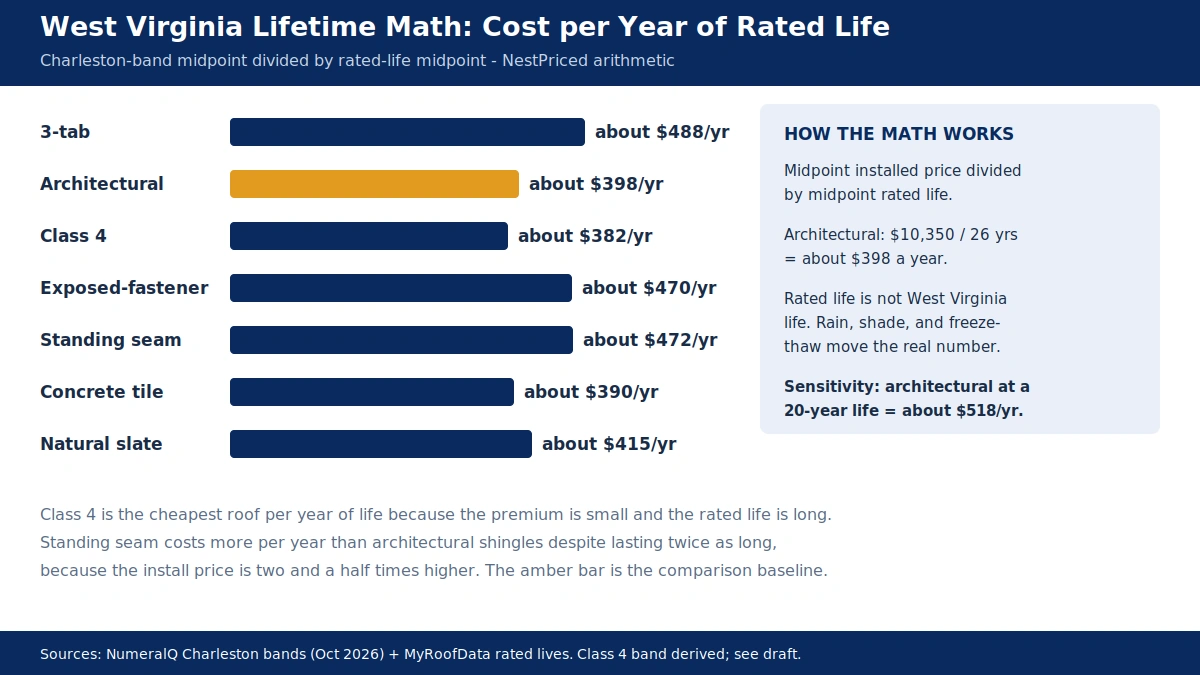
Asphalt wins the sticker-price comparison by a wide margin, and the lifetime math narrows that lead without erasing it. Cost per year of rated life is the comparison that tells the truth, worked out here from the Charleston material bands and the rated lives in the material table, with NestPriced arithmetic labeled on every figure. Rated life promises nothing: rain, shade, freeze-thaw, and the quality of the install all move the real number, and the sensitivity line near the end of this section shows an asphalt roof delivering only 20 years instead of 26.
| Material | Charleston band midpoint | Rated-life midpoint | Cost per year of rated life |
|---|---|---|---|
| 3-tab shingles | $8,535 | 17.5 years | ~$488 |
| Architectural shingles | $10,350 | 26 years | ~$398 |
| Class 4 shingles | $11,450 (derived) | 30 years | ~$382 |
| Exposed-fastener metal | $16,460 | 35 years | ~$470 |
| Standing-seam metal | $25,960 | 55 years | ~$472 |
| Concrete tile | $22,455 | 57.5 years | ~$390 |
| Natural slate | $46,700 | 112.5 years | ~$415 |
Start with the right-hand column of the table, where the yearly cost sits, and work left from there. At about $398 a year, architectural shingles beat 3-tab at about $488 a year: the thicker shingle buys eight and a half extra years for roughly $1,800. Class 4 comes out cheapest per year of life in the table, about $382 a year, because the upgrade premium is small and the rated life runs long.
Standing seam costs about $472 a year, more per year than architectural shingles even though it lasts twice as long, because the install price runs two and a half times higher.
The sensitivity line is the part of the asphalt math that refuses to flatter the buyer. If an architectural roof in a damp, shaded hollow delivers 20 years instead of 26, which West Virginia moisture makes plausible, the cost per year rises to about $518, above standing seam. If that roof reaches the full 30 years at the top of its rated span, the yearly cost drops to about $345, a figure no metal roof reaches. The real choice is not a $10,350 roof against a $25,960 roof.
The buyer is choosing between a roof whose life depends on ventilation, shade, and installation quality, and a roof whose life depends mostly on the fasteners staying tight.
In this choice, the snow on the roof matters more than the arithmetic on the page. Snow slides off standing seam instead of sitting on it, and on a steep roof at elevation that shedding is the whole argument: the structure carries less load all winter long. Sliding snow still has to land somewhere, so a metal roof above a walkway, a driveway, or a lower roof needs snow guards, and guards add a cost that first quotes often leave out. A valley roof in Charleston, where the snow melts between storms, gains little from shedding.
A mountain roof in the Allegheny Highlands, where snow sits for weeks, gains a great deal.
Wind decides the rest, and metal’s advantage here is narrower than the brochures suggest. A standing-seam roof with concealed fasteners holds well in wind, and exposed-fastener panels hold until a screw works loose, which is why the screw check matters. But an architectural shingle roof with a 110–130 mph wind rating, six nails per shingle, and sealed edges holds well too, and the April 2024 record shows that the roofs that failed were the ones where wind found an unsealed edge, not the ones made of the wrong material. The buyer who cannot afford standing seam is not buying a wind trap by choosing architectural shingles.
The buyer is buying a roof whose edge details must be right.
Every West Virginia metal buyer asks about noise, denting, and resale, and each question has a plain answer. On a properly built roof the noise worry is overblown: insulation and decking bring rain on metal down to roughly the shingle level, and any difference the homeowner notices shows up in the attic, not the bedroom. Denting, unlike noise, is real: large hail dents exposed-fastener panels, and standing seam can carry cosmetic dents that never leak but stay visible, which is why metal buyers should read the hail section too. Of the three, resale rests on the softest numbers.
A metal roof photographs well and reads as a premium feature in a listing, and in rural and mountain markets where buyers expect metal it can help a sale. In a valley subdivision full of shingle roofs, a metal roof is a personal choice, and its premium may not come back at sale. A buyer moving on in five years should judge the roof on five years of ownership, not on fifty.
The choice works as a matrix matched to the house, not as one winner for every roof. Architectural shingles suit a valley house, a tight budget, and a plan to own the place for a decade or two. Class 4 shingles fit when hail risk or an insurance discount shapes the decision, and the next section puts prices on both. Standing seam suits a house at elevation, on a steep slope, or where snow load and wind both bite, provided the budget stretches to two and a half times the shingle price for a roof that outlasts two shingle roofs.
Buy exposed-fastener metal if the house is rural, the budget sits between shingles and standing seam, and the buyer accepts the screw check as part of owning the roof.
Class 4 Shingles in West Virginia: Cost, Discounts and the Hail Question
The highest impact-resistance rating a shingle can carry is Class 4, earned in one specific test: UL 2218 drops a 2-inch steel ball from 20 feet onto the same spot twice, and the shingle mat must come through without cracking or tearing. The rating covers impact only. Wind and fire ratings come from separate tests of their own, so a shingle can carry Class 4 yet lack the wind rating a West Virginia squall line demands, and the buyer needs to check all three.
Most Class 4 lines use polymer-modified asphalt: ordinary asphalt blended with rubber-like polymers, so the shingle bends under a hit instead of cracking. Every major maker sells a Class 4 line: Tamko StormFighter FLEX, IKO Nordic, Malarkey Legacy and Vista, Atlas StormMaster, CertainTeed NorthGate and Landmark IR, Owens Corning Duration Storm and Duration FLEX, and GAF Timberline AS II and ArmorShield II. A second shopping check comes from the Insurance Institute for Business and Home Safety, whose shingle performance ratings mark Good and Excellent tiers that meet UL 2218 or the FM 4473 impact standard, independent of what the manufacturer claims.
This guide derives the Class 4 band rather than quoting one, and it shows every step so a reader can redo the sum. A 2,000 sq ft roof, or 20 squares, is what the $9,340–$11,360 state architectural band covers. A 2026 Class 4 pricing guide puts the installed premium at $30–$80 per square. Multiplying 20 squares by $30–$80 gives $600–$1,600, which lifts the state band to about $9,940–$12,960.
The labor line stays put for Class 4, since the crew lays the same count of shingles in the same way. A wider national adjuster estimate of $50–$150 per square would push the total to $10,340–$14,360, and this guide records that wider figure as a cross-check without adopting it. No West Virginia-specific Class 4 quote was located in this guide’s research, so the derivation rests on the national premium range and is labeled as such wherever it appears.
West Virginia hail is real and seasonal, but mostly small, and the recorded numbers beat the folklore. The MyWild analysis of Storm Prediction Center data from 1996 through 2025 counts 13 severe hail days a year statewide, with 1.4 days a year at two inches or more, and ranks the state 32nd of 46. The largest stone in the record is 4.25 inches, near Pinch in 2019. May is the busiest month, and the middle 80 percent of the season runs April 7 to August 27.
Kanawha County is hailier than the state as a whole: 35 large-hail reports from 2016 to 2025, four of them at two inches or larger, in a ten-county area that runs above the national rate per square mile. Huntington and Parkersburg both carry thinner but real records, with largest stones of 3.0 and 2.75 inches respectively.
Two published judgments point in opposite directions, and both are quoted here. NumeralQ’s statewide judgment is that impact-resistant shingles are rarely worth it in West Virginia, because large hail is uncommon and the state ranks 32nd of 51. Its Charleston-page judgment, written against the Kanawha County record, is that with hail above the national rate, it is worth asking for a quote on impact-rated shingles alongside the standard option. Both judgments use the same hail data.
They differ because one reads the state average and the other reads the county record. The honest read is that the state average argues against Class 4 on damage alone, and the Kanawha County record argues for pricing it.
Whether Class 4 pays is the question that matters, and the insurance discount decides it, not the hail record. No West Virginia statute sets a Class 4 discount percentage, and no West Virginia-specific percentage was verified in this guide’s research. Cited national discounts run 10–25 percent, and one insurance agency example claims 15–20 percent, about $350 a year on a $1,800–$2,000 policy, with the upgrade paying for itself in three to four years. That example belongs to one agency, its location is unconfirmed as West Virginia, and this guide cites it as an agency example only, never as a West Virginia guarantee.
Four discount assumptions drive the payback table below, which sets the $600–$1,600 upgrade cost against West Virginia’s $2,465 average yearly premium from NerdWallet’s May 2026 analysis. Each scenario names its assumption, and no scenario promises anything: the discount varies by carrier, it can cover the whole premium or only the wind and hail portion, and the figure that counts is the one the buyer’s own agent confirms in writing before any material is ordered.
| Discount assumption | Saving per year on $2,465 premium | Payback on $600–$1,600 upgrade |
|---|---|---|
| 10% of full premium | ~$247 | ~2.4–6.5 years |
| 15% of full premium | ~$370 | ~1.6–4.3 years |
| 25% of full premium | ~$616 | ~1.0–2.6 years |
| 15% of half the premium (wind/hail portion only) | ~$185 | ~3.2–8.7 years |
Start with the bottom row of the table. That row is the outcome most buyers actually live with. When the discount touches only the wind and hail portion, often about half the premium, the saving lands near $185 a year and the upgrade pays back in roughly three to nine years. The upgrade still pays back inside the roof’s rated life, but the headline discount’s three-year payback is not what most buyers get.
A buyer who gets two answers in writing from the agent, which portion of the premium the discount touches and what paperwork the carrier wants, knows the real number before paying for the upgrade.
The certificate is the discount. A carrier offering a Class 4 discount wants proof the right shingles went on, and that proof is either the manufacturer’s certificate or the roofer’s written record of the product installed. Paying for Class 4 without filing the certificate means paying the upgrade price and missing the discount both. The closeout paperwork should hold the certificate next to the warranty registration and the permit final.
The verdict splits by county. In Kanawha County and the ten-county area around Charleston, where hail runs above the national rate, Class 4 is both a discount play and a damage play, and the case is the strongest in the state. In the Ohio River valley around Huntington and Parkersburg, where wind dominates and hail is thinner, Class 4 is mainly a discount play, and the agent’s written figure decides whether it pays. In the high mountains, where snow load dominates and the material choice is usually metal anyway, the Class 4 question rarely arises.
Everywhere in the state, the wind rating and the nailing pattern matter more than the impact rating, because wind arrives far more often than hail big enough to crack a shingle.
Permits and Code in West Virginia: A State Code That Only Applies Where It Is Adopted
West Virginia has a State Building Code, and it does not apply everywhere. That sounds like a contradiction until the adoption system is understood. The State Fire Commission writes the code as a legislative rule, Title 87, Series 4.
Each county and municipality then decides whether to adopt it by ordinance, notify the Fire Commission, and run a permit-and-inspection program. Where a local government has adopted it, the code has force and a permit desk enforces it. Where no local government has adopted it, there is no permit desk, no inspection, and no one checking the work but the homeowner.
The same roof, twenty miles apart, can sit under two different systems.
The current rule was filed January 7, 2022, and took effect August 1, 2022. It adopts the 2018 International Building Code and the 2018 International Residential Code, with West Virginia amendments, plus the 2018 plumbing, mechanical, fuel gas, existing building, and property maintenance codes. Multiple city adoption ordinances corroborate the 2018 editions and the August 2022 effective date.
Several secondary permit guides still say West Virginia adopted the 2015 editions, and those guides are stale. This guide follows the 2018 adoption and notes the stale claim so a buyer who meets it knows which version to trust.
Charleston requires a permit, and the fee for a roof job is not published. The city’s Building Department issues permits for roofs, siding, fences, and driveways alike, on the city’s own fee schedules as retrieved in October 2026. Fees are waived for jobs costing $2,500 or less, which covers no roof replacement in this guide. A contractor who starts without a permit pays at least $100 or double the fee.
The fee on a $15,000 job is listed as not published in NumeralQ’s permit research, which means no priceable figure was found online, and no verified Charleston reroof fee figure was located in this guide’s research either. The fee is confirmed at application. Any guide that prints a Charleston reroof fee without naming a city schedule is guessing.
Charleston adds a second layer in its historic districts. Within a historic district, or on an individually designated landmark, exterior changes visible from a public street may not be made until the Charleston Historic Landmarks Commission approves a certificate of appropriateness, except as its rules provide, and the commission holds a public hearing on each application. Work that skips the certificate of appropriateness can be halted halfway through the job.
A buyer in the East End or any other designated district should check the district boundary and the commission’s rules before ordering material.
Morgantown requires a permit, and its own city pages say so in plain language. The city’s permit guide states that a building permit must be obtained any time a building is erected, enlarged, altered, repaired, moved, converted, or demolished, and its list of projects that usually require permits names re-roofing alongside renovations. The city publishes a dedicated roof permit form. The Building Inspection Division sits in the Code Enforcement Office at City Hall on Spruce Street, answers at 304-284-7401, and accepts permit copies by email at [email protected].
No verified fee figure was located for Morgantown, and the draft will not borrow one from a secondary site. The fee is confirmed at application.
Huntington requires a permit on secondary evidence, and the draft says so. No primary Huntington reroof-permit document was located in this guide’s research. Two secondary sources agree that Huntington runs a permit-and-inspection program under the State Building Code: one storm-damage guide names Huntington among the cities that enforce the code through a local program, and one permit guide describes the city’s Building Department administering permits for new construction, additions, and substantial alterations, with most residential permits processing in one to two weeks and no fully online portal. A secondary fee range of $100–$275 was not used, because it names no city schedule.
A Huntington buyer should call the Building Department before the quote is signed and ask three questions: is a permit required for this address and scope, what is the fee, and what inspections apply.
Parkersburg requires a permit on secondary evidence, and its fee picture is the murkiest of the four. One permit guide states that total roof replacement, structural repairs, and re-decking require permits in Parkersburg, with inspection covering underlayment, flashing, and fastening, and puts permit costs typically at $75–$200. That range is secondary and is not used here as a verified fee. The city’s published code carries a valuation-based fee schedule under its property maintenance code amendments, at 0.011 times the value for residential work between $1,000 and $19,999, but that schedule sits under the maintenance code and its application to reroof building permits was not confirmed, so this guide does not compute a fee from it.
One roofing directory is admirably honest about Parkersburg: it states that the local rules have not been checked and prints no figure. This guide follows that example. A Parkersburg buyer confirms the requirement and the fee with the Building Department at City Hall, 1 Government Square, before signing.
Planning fee ranges from the cost models conflict, and none of them is a city fee. SmartRoofingCalculator budgets $100–$275 for a West Virginia permit, with a planning average near $175. MyRoofData puts incorporated-city permits at $40–$200. RoofingEstimatorPros puts the range at $100–$400.
Those three ranges overlap but do not agree, and none names a city schedule, so none is used as a fee for any city in this guide. They are useful only as a budgeting reminder: the permit is a small line, a few hundred dollars at most, and skipping it to save that line is the most expensive saving in roofing.
Outside the four cities the picture splits: some places run tight programs and some run none at all. Some counties and towns adopted the code and run full programs. Plenty of rural counties run no building department at all, leaving no permit desk, no inspection, and nobody checking the work except the homeowner. The absence of a permit is not a saving.
It is a gap in quality control. With no inspector coming, a rural buyer should treat the license check, the written contract, and the manufacturer’s installation instructions as the inspection, and weigh a third-party roof inspection at completion, since nobody else will catch a flashing error before the first rain.
The code underneath the permits carries two rules every buyer should know. Residential code section R908.3 sets the layer limit: a new covering may not go over two or more existing layers, so a roof already carrying two layers has to come off first. On a housing stock as old as Charleston’s, where the median home has likely been re-roofed at least once already, the two-layer question is not theoretical. The snow section covers the ice barrier rule at section R905.1.2 in full.
The design criteria table for each adopting jurisdiction sets the snow load, wind speed, frost depth, and ice barrier requirement for that address, and it is the table the inspector enforces where an inspector exists.
The permit desk is also the license checkpoint. Under the Contractor Licensing Act, a permit applicant must show a valid contractor license or file a written affidavit that the work is not subject to licensure, and the permit authority may not issue a permit to an unlicensed person when a license is required. That rule turns the permit application into a free license check, and a contractor who asks the homeowner to pull the permit in the homeowner’s name to dodge it is telling the buyer something important about how the job will be run.
Hiring a Roofer in West Virginia: The $5,000 License Line and the Storm Scammer Law
West Virginia licenses contractors through the Contractor Licensing Board, with administrative and enforcement help from the Division of Labor. The license is a state record that the contractor exists, passed an exam, and certified compliance with tax, workers’ compensation, unemployment, and wage-bond laws. It is not a test of roofing skill, and it is not a guarantee of quality.
A buyer who understands that sentence will never mistake a license card for craftsmanship, and will ask the questions the license does not answer: how long has this crew worked in this county, what roofs can I drive past, and who answers the phone when a leak shows up in February.
The $5,000 line decides who must hold a license, and an older figure still circulates. Under the current Contractor Licensing Act, W. Va. Code section 30-42-3(d), a contractor is a person contracting for residential work of $5,000 or more, or commercial work of $25,000 or more, and section 30-42-6(a) bars unlicensed contracting above those lines. Every roof replacement in this guide costs far more than $5,000, so every roofer on a replacement job must be licensed. Many web pages still cite $2,500 as the threshold, under the old chapter 21-11 sections, which were repealed when the Act moved to chapter 30.
The $2,500 figure is the repealed-chapter figure, and it survives on pages that were never updated. This guide follows $5,000 as current law and names the older figure so a buyer who meets it knows it is out of date.
There is no roofing exam, and the classification picture is genuinely muddled. The licensing rule, 28CSR2 section 6.2, lists exam categories and names no roofing classification. Roofing work that falls outside the listed classifications is licensed as a specialty contractor, and the Board’s application requires only the West Virginia Business and Law exam, the Contractor Licensing Act exam, for that path. A residential contractor license also covers all trades on a residential structure.
Other pages claim a specialty roofing classification with its own trade exam, under codes like WV-039, or a roofing trade exam through the testing vendor. Those claims conflict with the current rule as read by two compliance trackers in October and November 2026. The Board itself asks applicants to email their scope of work to confirm the classification and exams before testing, which is the honest answer to a muddled question: the classification is confirmed with the Board, case by case, and a buyer should ask which classification the roofer holds and what exam sits behind it.
The exam pass mark is 70 percent, taken through ProV, Inc., by an owner, officer, member, or full-time employee of the firm. Older materials name a different vendor, PSI, and an older exam fee of $51.95 against the current bulletin’s $59.95 per exam. The license costs $90 a year and runs one year.
No experience requirement, no insurance minimum, and no surety bond requirement appears in the licensing sections or the rule as read in November 2026. The state license stands alone: cities and counties may not stack a contractor license of their own on top of it. The buyer checks a license through the Division of Labor’s contractor search before signing anything.
The check is free, it takes minutes, and it answers the one question that matters most: does this contractor exist in the state’s records, with a current license, right now.
Lien law gives the buyer one defense and one deadline to know. If a subcontractor or supplier on a roof replacement is not paid, the law may let them file a lien on the house even when the homeowner paid the contractor. On an existing owner-occupied single-family West Virginia home, the owner has a defense if the owner owes the contractor nothing, or less than the claim, under section 38-2-21(b) of the West Virginia Code. Subcontractors and suppliers must notify the owner within 100 days, and the owner may demand an itemized account, which is due within 10 days, under section 38-2-19.
The lien notice on a replacement job most often comes from the shingle distributor or from a crew the roofer brought in as a subcontractor. The protection is procedural: pay through the contract’s terms, keep the payment record, and get the supplier picture clear before the final payment.
The Storm Scammer Consumer Protection Act is the strongest buyer protection in this guide, and most buyers have never heard of it. W. Va. Code chapter 46A, article 6M, in force since July 1, 2015, governs residential roofing contracts expected to be paid from property and casualty insurance proceeds. It gives the owner a right to cancel the contract before midnight of the fifth business day after receiving the insurer’s notice that all or part of the claim is not a covered loss. The contractor must disclose that right on a standard form.
The contractor may not require any advance payment on an insurance-funded roofing contract until the cancellation period has expired, and on cancellation must return payments, deposits, and notes within ten days, except for emergency repairs the owner authorized. The contractor may not represent or negotiate the insurance claim for the owner, may not offer to pay or rebate any part of the deductible or the claim proceeds as a sales inducement, and may not pay the owner compensation in connection with the contract. Violations carry private remedies and criminal penalties.
Read those rules together and they describe the exact playbook of the storm-chasing crew: knock after the storm, offer to handle the claim, promise the deductible away, take a deposit on the spot. Every step of that playbook is barred by the Act. A contractor who offers to absorb the deductible is not offering a discount.
The contractor is offering to break the law, and is usually recovering the money by inflating the claim or cutting the scope. A contractor who asks for a deposit before the cancellation period expires on an insurance-funded job is asking for something the statute forbids. Three no-signature rules protect the buyer: nothing signed at the door, nothing signed before the adjuster has seen the roof, and nothing signed before the license check.
After a storm, the hiring question that matters most is whether the crew comes from out of state. West Virginia’s licensing bar tests business law, not roofing craft, which means a crew from out of state can license, work a storm, and leave, and the license alone will not tell the buyer whether the crew will be in West Virginia when a leak appears. Four questions, asked face to face with the answers written down, make up the test: where the West Virginia office sits, how long the crew has worked in this county, which three roofs within ten miles a buyer can drive past, and who answers the phone for warranty calls in February. A crew with no good answer to all four questions may be gone by the time the roof needs warranty work.
The pattern after every West Virginia storm is the same: door-knockers offering to handle the insurance claim, a signature on the spot, and a crew that is gone before the first rain tests the flashing.
Comparing quotes follows one rule: a single spec sheet, three quotes, no exceptions. One sheet should carry the material, the underlayment, the ice barrier scope, the flashing scope, the ventilation pieces, the tear-off scope, the decking allowance, the permit responsibility, the warranty terms, and the cleanup scope, and the identical sheet should go to three licensed roofers. Quotes written to different specs cannot be lined up against each other, and a low price on a thin spec is no bargain. It is a different job.
The full interview list lives in our questions to ask a roofer guide, and the final section turns that list into a signing-day routine.
Insurance in West Virginia: Deductibles, the Cancellation Right and What a Claim Really Pays
West Virginia’s homeowners insurance market sits near the national middle on price, and the price is not the story. The story is what the policy pays when a roof fails, and that story is written on one page most buyers have never read. Covering more than 100 companies, NerdWallet’s May 2026 analysis puts West Virginia’s average at $2,465 a year, $205 a month, against a $2,490 national average.
NerdWallet’s sample policy assumes a 40-year-old homeowner with good credit, a $400,000 dwelling limit, $300,000 of liability coverage, and a $1,000 deductible. Charleston averages $2,350 a year and Huntington $2,330 on the same basis. Policyholders with poor credit pay an average of $4,750 a year, 93 percent more.
A second study puts the West Virginia average at $1,961 a year, but it models a smaller $300,000 dwelling limit, so the two figures describe different policies and should never be averaged.
This guide located no West Virginia deductible statute, roof-age settlement rule, or matching law, and it will not invent one. Other states write rules of this kind: roofs past a set age settling at depreciated value, carriers required to match undamaged shingles, or percentage deductibles following a state formula. None of those rules turned up in any source this guide opened, so the buyer’s own policy stands as the only authority, and the declarations page decides what a claim pays. That page sits at the front of the policy and works as its summary sheet, naming the deductible type and amount, the coverage limit, and the settlement basis for the roof, replacement cost or depreciated value.
A buyer who has never read that page should read it before any roofer quotes, because the deductible and the settlement method move the out-of-pocket figure more than any choice of material.
Three settlement methods mean three different checks in the mailbox. Replacement cost value covers the cost of a new roof at today’s prices, usually in two payments: depreciated value first, then the recoverable depreciation once the work is finished and the invoices are submitted. Actual cash value pays depreciated value only, less the deductible, and the depreciation amount generally stays unrecovered. A roof payment schedule pays a slice of replacement cost that shrinks as the roof ages, with the carrier’s filed schedule fixing the percentage for each material and age.
A worked example, labeled NestPriced arithmetic, puts the difference in dollars on a $10,000 roof with the $1,000 flat deductible from the NerdWallet sample policy. With replacement cost coverage, the insurer sends $9,000 in two checks and the homeowner covers the $1,000 deductible. With depreciated value coverage, the insurer sends the depreciated figure less $1,000, and the homeowner funds the rest of the replacement from their own pocket.
With a payment schedule, the insurer sends the scheduled percentage less $1,000, and the roof’s age and material fix that percentage.
The reader’s own deductible may be flat or percentage-based, and no West Virginia percentage-deductible range appears in this guide, because none was verified. On a $400,000 dwelling limit, a 1 percent deductible means $4,000 out of pocket and a 2 percent deductible means $8,000, which is why the declarations page beats any general statement about deductibles. Read that page, write down the deductible type and the dollar figure, and carry both into the quote comparison.
After damage, the order of steps is itself a form of protection for the homeowner. Take photos of the damage before touching anything: the roof, the gutters, and the attic wherever water has come in. If water is coming in, tarp the roof at once, keep the receipt, and never wait for the adjuster before stopping active water. The adjuster should see the roof before any roofing contract is signed, and the adjuster’s scope should come back in writing.
Lay the roofer’s quote beside the adjuster’s scope and check every line, asking the roofer to explain anything the adjuster left out.
West Virginia law adds two protections no other section of this guide can give. The first is the cancellation right: on an insurance-funded residential roofing contract, the owner may cancel before midnight of the fifth business day after the insurer’s notice that all or part of the claim is not covered, and the contractor must return payments within ten days. The second is the deductible bar: since 2015, a roofing contractor may not offer to pay or rebate any part of the deductible as a sales inducement, and may not negotiate the claim for the owner. A contractor who promises either is promising something the law forbids.
No West Virginia law this guide located governs matching, so a buyer left with a visible patch after a repair should ask the adjuster, get the answer in writing, and price the full slope if the answer is no.
The discount math in the Class 4 section starts from the average premium. The $2,465 NerdWallet average is the figure the Class 4 payback table runs against, and a buyer whose premium runs above that average should run the table against their own premium, not the state average. Raising the deductible from $1,000 to $2,500 saves about 9 percent a year on average nationally, which is a real saving with a real cost: the next claim starts $1,500 deeper out of pocket. That trade is worth making deliberately, with the deductible figure written down next to the roof quote, and never worth making by accident.
Paying for a West Virginia Roof in 2026: $0 Federal Credit, Rebates That Do Not Cover Roofs, and Financing
The federal government contributes $0 to a 2026 roof replacement. The energy-efficient home improvement credit and the residential clean energy credit both ended for installations after December 31, 2025, under the One Big Beautiful Bill Act, Public Law 119-21, and Internal Revenue Service guidance FS-2025-05. A roof by itself never qualified for a federal credit, and the credits that once eased the cost of energy work done alongside a roof no longer apply to 2026 installs.
The federal picture ends there. A contractor, advertiser, or calculator site still promising a federal credit for a 2026 roof is selling something that no longer exists. The full post-OBBBA position for every measure is set out in our federal energy tax credits guide.
West Virginia’s home energy rebates launched, and they do not pay for roofs. The West Virginia Office of Energy launched the Home Electrification and Appliance Rebates program and the Home Efficiency Rebates program statewide on September 28, 2026, with $88 million in federal funding, after a pilot in southern counties that began August 6, 2026. The electrification rebates cover heat pumps up to $8,000, heat-pump water heaters, electrical panels, wiring, and insulation, air sealing, and ventilation up to $1,600, with a household limit of $14,000, income-qualified, and applied through certified contractors. Federal rules now bar fuel switching: the rebates pay only for electric-to-electric upgrades, so replacing a gas furnace with a heat pump does not qualify.
Some rebate trackers still showed West Virginia as not launched well into November 2026, and those pages are stale against the launch announcement. Confirm the current position on the Office of Energy’s site before counting on any figure.
None of that money reaches a roof covering. A roof is not a rebate measure under either program. At most, insulation, air sealing, or ventilation installed as part of a whole-home efficiency project could qualify under program rules, and that work is priced on its own merits, through a certified contractor, with the rebate confirmed before the work starts.
A buyer who is adding insulation with the roof should price the insulation separately, confirm the rebate in writing, and never let a roofing quote carry a rebate line for the roof itself. Section 48E, the lease pass-through for the clean-electricity credit, leaves roofs out, because it covers clean-electricity property only. The heat pump math, for a buyer combining the two jobs, is priced in our West Virginia heat pump guide.
No West Virginia state roof grant, no state roof tax credit, and no utility roof rebate was located. No state program that pays for a roof replacement was found anywhere in this guide’s research, and no utility rebate for roofing was found either. A quote that carries a state grant line or a utility rebate line for a roof should be questioned before it is signed. One narrow federal route exists for a small group of homeowners: the United States Department of Agriculture Section 504 home repair program, for very-low-income owner-occupants in eligible rural areas, offers loans up to $40,000 at 1 percent fixed interest for up to 20 years, and grants up to $10,000, lifetime, for homeowners aged 62 or older who cannot repay a loan, for work that removes health and safety hazards, with roofing named as an eligible repair type.
The grant must be repaid if the home is sold within three years. The program is real, the eligibility is narrow, and it is not a general roof grant. Weatherization help through Community Action agencies normally does not cover a full roof, and a failed roof can hold up weatherization work until it is fixed.
Sales tax on a roof job turns on one question, and the contractor’s billing answers it. West Virginia does not tax labor on work that is a capital improvement, but taxes repairs and maintenance that do not add value or extend the home’s life, under W. Va. Code section 11-15-8 and Tax Division guidance TSD-310. Whether a roof replacement counts as a capital improvement or a repair decides the tax, so the buyer should ask the contractor how the job will be billed and what tax treatment follows. This guide does not assert that a roof replacement is or is not taxed, because the billing treatment decides it case by case.
Financing stays general in this guide, since no contractor offer specific to West Virginia was verified. Most West Virginia buyers borrow through one of three routes, contractor payment plans, home equity lines and loans, or personal loans, and each route carries its own terms, rates, and risks. This guide’s research verified no contractor financing offer, rate, or term specific to West Virginia, so no rate appears here: a rate borrowed from another state or another year would mislead more than it would help. Our roof financing guide works through every route in full, with the questions to ask on deferred interest, prepayment, and the loan’s total cost set against the roof’s cost.
The one financing rule that belongs in every West Virginia quote is the payment schedule: a deposit, a progress payment at a named milestone, and the balance on completion and final inspection, with no full payment up front. On an insurance-funded job, the Storm Scammer Act adds a legal floor: no advance payment may be required until the cancellation period has expired.
A single post-disaster route exists, and a disaster declaration is the key that opens it. After a declared disaster, a Small Business Administration disaster loan can run up to 20 percent above the verified loss for mitigation measures, which can pay for a stronger roof. The route is genuine, but it is no plan for a scheduled replacement: it needs a disaster declaration, an application, and an approval, and it has no place in a quote for a roof replaced on a normal schedule.
Repair or Replace and Getting Quotes in West Virginia: The Decision Rules and the Checklist
A brown stain spreading across a bedroom ceiling is the usual start of a West Virginia roof job, and the bill for the repair behind it is often smaller than the worry that stain caused. A Charleston repair model prices a flashing repair at $207–$444, finding and fixing a leak at $279–$780, a chimney flashing reflash at $290–$640, and a skylight leak at $309–$600. A South Charleston contractor ladder brackets the same work from the other side: most repairs at $275–$875, a minor leak repair or pipe boot at $275–$450, flashing repair at $400–$900, and larger flashing or valley work at $600–$1,200.
A third guide puts most West Virginia repair calls at $275–$1,100, with emergency tarping at $275–$700. The ranges overlap well enough to trust the middle ground: most repairs land between $275 and $900, while anything above $3,000 starts a replacement conversation, not a repair.
For the full repair price picture, see our roof repair cost guide, and for the gutter work that often rides along with a roof job, see our gutter installation cost guide.
The decision drivers are age, layers, decking, scope, and the storm record, in that order. First comes age measured against rated life: a 25-year-old architectural roof leaking on one slope is a different decision from the same roof at 12 years, since the older roof nears the end of its span while the younger one holds a decade or more. Second come the layers: a roof already carrying two layers must be stripped before anything new goes on, which turns a repair into a tear-off job at a different price. Nobody sees the decking until tear-off, which is why every quote should carry a decking allowance as a per-sheet price with a cap, instead of a surprise once the old roof is off.
Fourth comes scope: a single slope points to repair and the whole roof points to replacement, and the shingles on the slopes that are not leaking draw the line between the two. The storm record comes last: a roof that has already taken two hail seasons and a squall line, with granule loss across every slope, is a roof whose remaining life is shorter than its age suggests.
The 50 percent rule of thumb comes from contractor guidance, not from a sourced figure, and this guide labels it that way. When a repair costs more than half of a replacement, replacement usually wins the argument: the repair buys a few years on an old roof, while the replacement buys a full rated life plus a warranty. The rule works as a shortcut, not a law, and it fails on a young roof, on damage confined to one slope, or wherever an insurance claim changes the out-of-pocket math. Treat it as a way to frame the question, not as the answer to it.
In West Virginia the calendar is a real cost lever, and the cheapest one a buyer holds. Late summer earns its reputation as the fastest and most reliable install window, with Charleston’s driest weeks falling in August and September. Winter work runs slower, calls for hand-sealing below 40 degrees, and can stall on snow, so a winter quote should carry both a weather clause and a hand-sealing line. Spring brings hail season, and the weeks after a hailstorm bring backlogs, out-of-area crews, and door-knockers, so a spring quote deserves careful comparison and a slow signature.
The buyer who can choose the season should choose late spring or late summer, book the crew before the season, and avoid signing anything at the door in the week after a storm.
The checklist that follows is the signing-day routine, set out in the order to follow it. Every step gets done, and none of them gets signed at the door.
- Count the squares on the roof surface. Then write one spec sheet naming the material, underlayment, ice barrier scope, flashing scope, ventilation, tear-off, decking allowance, permit, warranty, and cleanup.
- Check the contractor’s state license through the Division of Labor, and get the liability and workers’ compensation certificates in writing.
- Collect three written quotes against the identical spec sheet, one from each of three licensed roofers, and compare them line by line.
- Ask the city or county building department what permit the job needs and what the fee is, and settle who pulls the permit.
- Confirm the design snow load and the ice barrier requirement for the exact address, in writing from the permit desk where one exists.
- Go through the homeowners policy declarations page, write down the deductible type and amount plus the settlement method, and call the agent about the Class 4 discount before any material is ordered.
- Get the adjuster’s scope in writing before signing any roofing contract, if the job involves an insurance claim, and keep the five-business-day cancellation right in hand.
- Hold off signing until the contract spells out the cleanup scope, the start and completion window, the payment schedule, the warranty terms, and the material by brand and line.
- Pay by the schedule: deposit, progress at a named milestone, balance on completion and final inspection, with no advance payment on an insurance-funded job before the cancellation period expires.
- Gather the closeout paperwork into one folder with the contract: the permit final, the warranty registration, the Class 4 certificate where it applies, and the roofer’s written warranty.
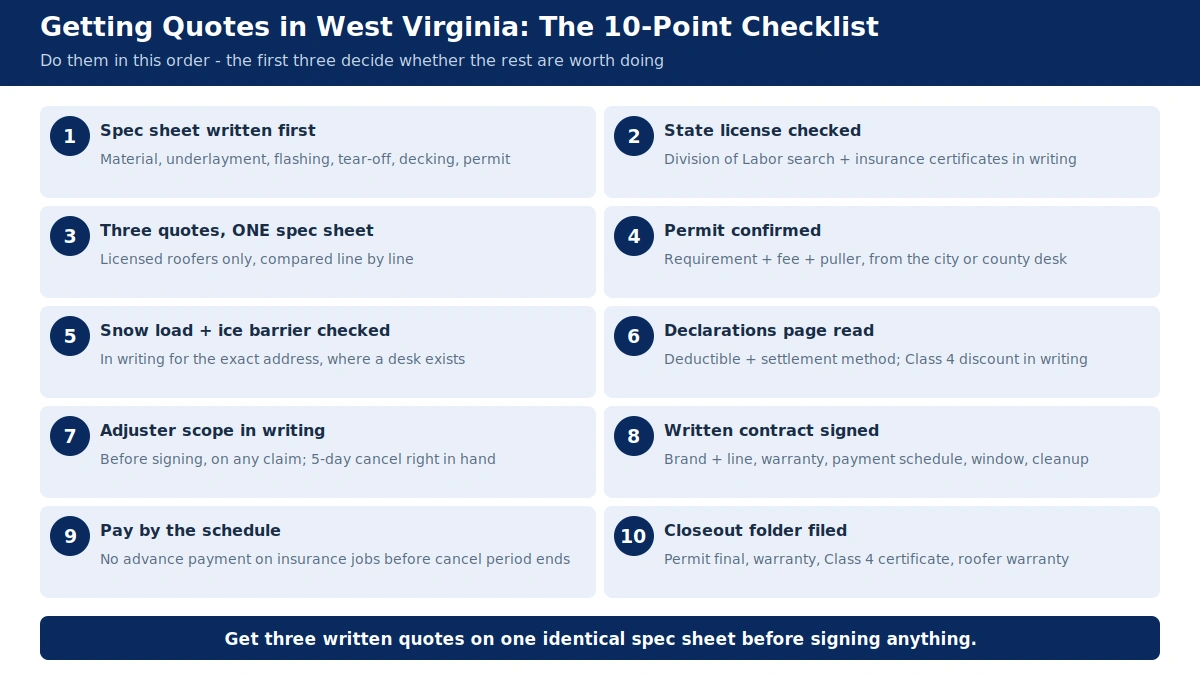
Sources & methodology
Installed costs:
- NumeralQ, West Virginia roof replacement cost page, planning estimates with pricing as of October 26, 2026, architectural shingles, 2,000 sq ft roof, $9,340–$11,360; size table and national comparison on the same page.
- NumeralQ, Charleston, WV roof replacement cost page, pricing as of October 26, 2026, material table for a 2,000 sq ft roof, add-on figures, roofer pay, contractor counts, housing stock, storm record, and permit notes.
- SmartRoofingCalculator, West Virginia roof cost page, updated April 24, 2026, per-square bands, state factor 0.868, wage and price-parity inputs, and permit planning range.
- MyRoofData, West Virginia roof cost page, 2026 model, per-square figures before tear-off, typical-home range, tear-off rates, rated lives, and access note.
- RoofingEstimatorPros, West Virginia page, updated August 26, 2026, high outlier recorded and not adopted.
- One Good Roofer, West Virginia page, published October 7, 2026, modeled home-size bands and per-square figures.
- SquareDash and ProRoofCalc state tables, April 2026, low figures recorded and not adopted.
Wind, hail, tornadoes, and snow:
- MyWild West Virginia hail analysis, National Oceanic and Atmospheric Administration Storm Prediction Center data, 1996–2025, severe hail days, season, size breakdowns, and the 4.25-inch record stone.
- NumeralQ West Virginia and Charleston pages, National Oceanic and Atmospheric Administration data, ten-year wind reports, hail season share, Kanawha County counts, and the impact-resistant shingle judgments.
- Cloudbreak hail history, West Virginia and Huntington pages, Storm Prediction Center reports through November 2026, hail days and wind days near Huntington.
- HailHistory Parkersburg page, National Centers for Environmental Information Storm Events Database through July 2026 plus National Weather Service preliminary reports, hail days and wind reports near Parkersburg.
- National Weather Service Charleston, April 2, 2024 outbreak summary, and National Centers for Environmental Information Storm Events Database episode narrative, ten tornadoes, the 92 mph Huntington gust, and the Hernshaw roof damage.
- MyWild West Virginia tornado analysis, Storm Prediction Center data, 1996–2025, tornado counts, days, and ratings.
- MyWild West Virginia ground snow load page, September 23, 2026, Title 87 CSR 4 and the county-keyed jurisdiction system.
- Universal Steel West Virginia page, ASCE 7 ground snow load ranges by region and elevation; RoofHelm West Virginia snow load page; StruCalc snow load guide; City of Moundsville design criteria table.
- National Weather Service Charleston, 2025 annual climate summary, 1991–2020 normals, Charleston snowfall and precipitation.
- Owens Corning technical bulletin TB-10022497-A, hand-sealing at 40 degrees Fahrenheit and below.
- International Residential Code sections R905.1.2 and R908.3, ice barrier and layer-limit rules.
Licensing, permits, liens, and the Storm Scammer Act:
- West Virginia Code Title 30, Chapter 42, Contractor Licensing Act, sections 30-42-3, 30-42-5, 30-42-6, 30-42-10, and 30-42-20, and rule 28CSR2, via ReadyDocs Compliance (verified October 2026) and VerticalOS (verified November 1, 2026).
- West Virginia Code Chapter 46A, Article 6M, Storm Scammer Consumer Protection Act, sections 46A-6M-2 through 46A-6M-6, statute text via the West Virginia Legislature.
- West Virginia Code sections 38-2-19 and 38-2-21, lien notice and owner-occupied defense, via NumeralQ and Levelset summaries.
- Title 87, Series 4, State Building Code, State Fire Commission rule, filed January 7, 2022, effective August 1, 2022, adopting the 2018 International Building Code and International Residential Code, via city adoption ordinances.
- City of Morgantown permit guide and frequently asked questions, re-roofing permit requirement, roof permit form, and Code Enforcement contact.
- Charleston permit notes via NumeralQ, city fee schedules retrieved October 2026, and Charleston Code of Ordinances section 2-696, historic district certificate of appropriateness.
- Huntington and Parkersburg permit guides, secondary sources, requirement and process only, fee figures not used.
Insurance, Class 4, and incentives:
- NerdWallet, West Virginia homeowners insurance analysis, May 6, 2026, average premium $2,465 a year, sample-policy basis, city figures, and credit-tier figures.
- UL 2218 Class 4 test description and manufacturer lines, via manufacturer and standards summaries recorded in the research file.
- Slade Roofing 2026 pricing, Class 4 premium $30–$80 per square; wider national delta $50–$150 per square via the art 170 research file.
- WinChoice, November 2026, commonly cited national discount range of 10–25 percent; Lifelong Insurance Agency, May 2026, agency example of 15–20 percent.
- One Big Beautiful Bill Act, Public Law 119-21, and Internal Revenue Service FS-2025-05, end of sections 25C and 25D for post-2025 installs.
- West Virginia Office of Energy, Home Energy Rebate Programs, statewide launch September 28, 2026, via the Governor’s announcement, Everblue, and the art 101 research file; United States Department of Energy Program Notice 26-2, electric-to-electric limit.
- West Virginia Code section 11-15-8 and Tax Division TSD-310, sales tax on capital improvements versus repairs, via NumeralQ.
- United States Department of Agriculture, Section 504 Home Repair program, loan and grant limits and eligibility, via program summaries recorded in the research file.
- Derived figures: the Class 4 band, the cost-per-year table, the payback table, the insurance worked example, and the full-roof barrier and extra-layer totals are NestPriced arithmetic from the sources named in the text, and are labeled as such wherever they appear.
Disclaimer: Prices in this guide are planning estimates from published cost models and contractor pricing, not quotes, and the actual cost of a roof depends on the roof’s size, slope, condition, material, access, and the contractor’s bid. Snow loads, permit fees, and code adoption vary by address and change over time, so confirm the design values, the permit requirement, and the fee with the local building department before signing a contract. Insurance discounts, deductibles, and settlement methods depend on the individual policy and carrier, and tax and rebate positions change with legislation; verify the current position with the carrier, the tax adviser, and the state agency before relying on any figure in this guide.
How much does a roof replacement cost in West Virginia in 2026?
A 2,000 sq ft architectural shingle roof costs $9,340–$11,360 installed in West Virginia in 2026, on NumeralQ planning estimates priced October 26, 2026. Charleston prices the same job identically, and the price rises with roof size, slope, layers, access, and material.
What is the cost per square for a roof replacement in West Virginia?
Architectural shingles run about $467–$568 per square installed on the NumeralQ state band, and SmartRoofingCalculator prices the same material at $390–$560 per square installed with tear-off. MyRoofData prices architectural shingles at $387–$645 per square before tear-off, with tear-off adding $100–$200 per square per layer.
Do I need a permit to replace a roof in West Virginia?
Charleston and Morgantown require a permit on their own city documents, and Huntington and Parkersburg require one on secondary evidence, while many rural counties have no permit program at all because the State Building Code applies only where the county or city adopted it. Confirm the requirement and the fee with the local building department before work starts, since no verified fee figure was published for any of the four cities.
Does West Virginia require a roofing license?
West Virginia licenses contractors through the Contractor Licensing Board, and residential work of $5,000 or more requires a license, which covers every roof replacement in this guide. The rule names no roofing exam, so roofing is licensed as a specialty or under a residential license, and the buyer should check the license through the Division of Labor and ask which classification the roofer holds.
Are Class 4 shingles worth it in West Virginia?
In Kanawha County, where hail runs above the national rate, Class 4 is both a discount play and a damage play, while in the Ohio River valley it is mainly a discount play and the agent’s written figure decides whether the $600–$1,600 upgrade pays back. Statewide, large hail is uncommon and wind is the bigger hazard, so the wind rating and nailing pattern matter more than the impact rating on most West Virginia roofs.
Can I cancel a roofing contract in West Virginia if my insurance claim is denied?
Yes, under the Storm Scammer Consumer Protection Act: on an insurance-funded residential roofing contract, the owner may cancel before midnight of the fifth business day after the insurer’s notice that all or part of the claim is not covered, and the contractor must return payments within ten days. The same law bars advance payments before the cancellation period expires and bars the contractor from rebating the deductible or negotiating the claim.
Is there a federal tax credit or a West Virginia rebate for a new roof in 2026?
No on both counts for the roof itself. The federal government contributes $0 to a 2026 roof, because the One Big Beautiful Bill Act ended the relevant credits for post-2025 installs, and West Virginia’s home energy rebates, launched statewide on September 28, 2026, do not cover a roof covering, though insulation or ventilation done with the roof may qualify under program rules.
How long does a roof last in West Virginia?
Architectural shingles carry a rated life of 22–30 years, 3-tab shingles 15–20 years, exposed-fastener metal 30–40 years, and standing-seam metal 40–70 years, on the MyRoofData West Virginia model. Rain, shade, and freeze-thaw wear asphalt faster than the lab test assumes, so ventilation, flashing quality, and installation decide where inside each range a real roof lands.